
26 March 2026 1 Kibali Gold Mine, Democratic Republic of the Congo Technical Report Summary Report current at: 31 December 2025 Report prepared for: AngloGold Ashanti plc Qualified Persons: Richard Peattie, FAusIMM Derek Holm, FAusIMM AngloGold Ashanti Kibali Gold Mine Technical Report Summary – current at 31 December 2025 ______________________________________________________________________________ 26 March 2026 2 Forward looking statements Certain statements contained in this Technical Report Summary (Report), other than statements of historical fact, including, without limitation, those concerning metal price assumptions, cash flow forecasts, projected capital and operating costs, metal recoveries, mine life and production rates, and other assumptions used in this Report, are forward-looking statements. These forward-looking statements or forecasts are not based on historical facts, but rather reflect current beliefs and expectations concerning future events and generally may be identified by the use of forward-looking words, phrases and expressions such as “believe”, “expect”, “aim”, “anticipate”, “intend”, “foresee”, “forecast”, “predict”, “project”, “estimate”, “likely”, “may”, “might”, “could”, “should”, “would”, “seek”, “plan”, “scheduled”, “possible”, “continue”, “potential”, “outlook”, “target” or other similar words, phrases, and expressions; provided that the absence thereof does not mean that a statement is not forward-looking. Similarly, statements that describe objectives, plans or goals are or may be forward- looking statements. These forward-looking statements or forecasts involve known and unknown risks, uncertainties and other factors that may cause actual results, performance, actions or achievements to differ materially from the anticipated results, performance, actions or achievements expressed or implied in these forward-looking statements. Although AngloGold Ashanti plc (“AngloGold Ashanti”) believes that the expectations reflected in such forward-looking statements and forecasts are reasonable, no assurance can be given that such expectations will prove to have been correct. Accordingly, results, performance, actions or achievements could differ materially from those set out in the forward-looking statements as a result of, among other factors, changes in economic, social, political and market conditions, including related to inflation or international conflicts, the success of development and operating initiatives, changes in the regulatory environment and other government actions, including environmental approvals, fluctuations in gold prices and exchange rates, the lack of legal challenges or social opposition to our mines or facilities, the outcome of future litigation proceedings, any supply chain disruptions, any public health crises, pandemics or epidemics, the ultimate determination and realisation of Mineral Reserve, the existence or realisation of Mineral Resource, the availability and receipt of required approvals, titles, licences and permits, the availability of sufficient working capital, availability of a qualified work force, the timing and amount of future production, the ability to meet production, cost and capital expenditure targets, the timing and ability to produce studies and analyses, the ultimate ability to mine, process and sell mineral products on economically favourable terms and other timing, business and operational risks and challenges and other factors that may influence future events or conditions. These factors are not necessarily all of the important factors that could cause AngloGold Ashanti’s actual results, performance, actions or achievements to differ materially from those expressed in any forward- looking statements. Other unknown or unpredictable factors could also have material adverse effects on AngloGold Ashanti’s future results, performance, actions or achievements. Consequently, readers are cautioned not to place undue reliance on forward-looking statements. AngloGold Ashanti undertakes no obligation to update publicly or release any revisions to these forward-looking statements to reflect events or circumstances after the date hereof or to reflect the occurrence of unanticipated events, except to the extent required by applicable law. AngloGold Ashanti Kibali Gold Mine Technical Report Summary – current at 31 December 2025 ______________________________________________________________________________ 26 March 2026 3 Qualified Persons signatures page This Report is current at 31 December 2025. In preparing this Report, the Qualified Person(s) may have, where necessary, relied on the company reports, property data, public information, and assumptions supplied by Barrick employees and other third party sources, including the reports, documents and other information, if any, listed in Chapter 24 and Chapter 25 of this Report, available at the time of writing this Report. QUALIFIED PERSONS /s/ Richard Peattie Richard Peattie, FAusIMM Senior Vice President Technical AME Mineral Resource Manager /s/ Derek Holm Derek Holm, FAusIMM AME Planning Lead AngloGold Ashanti Kibali Gold Mine Technical Report Summary – current at 31 December 2025 ______________________________________________________________________________ 26 March 2026 4 Contents 1. Executive summary ............................................................................................................................. 12 1.1 Property description...................................................................................................................... 12 1.2 Ownership .................................................................................................................................... 12 1.3 Geology and mineralisation .......................................................................................................... 12 1.4 Status of exploration ..................................................................................................................... 13 1.5 Mineral Resource and Mineral Reserve estimates ........................................................................ 14 1.6 Mining methods ............................................................................................................................ 19 1.7 Mineral processing ....................................................................................................................... 19 1.8 Infrastructure ................................................................................................................................ 21 1.9 Market studies .............................................................................................................................. 21 1.10 Environmental, permitting and social consideration ................................................................... 22 1.11 Capital and operating costs ....................................................................................................... 23 1.12 Conclusions and recommendations .......................................................................................... 23 2. Introduction.......................................................................................................................................... 29 2.1 Disclose registrant ........................................................................................................................ 29 2.2 Terms of reference ....................................................................................................................... 29 2.3 Purpose of this Report .................................................................................................................. 30 2.4 Sources of information and data contained in the report or used in its preparation ....................... 30 2.5 Report date .................................................................................................................................. 30 2.6 Qualified Person Chapter Responsibilities .................................................................................... 30 2.7 QPs site inspections ..................................................................................................................... 30 3. Property description ............................................................................................................................. 31 3.1 Location of the property ................................................................................................................ 31 3.2 Area of the property ...................................................................................................................... 33 3.3 Legal aspects (including environmental liabilities) and permitting ................................................. 33 4. Accessibility, climate, local resources, infrastructure and physiography ............................................... 35 4.1 Accessibility .................................................................................................................................. 35 4.2 Climate and physiography ............................................................................................................ 36 4.3 Local resources and infrastructure ................................................................................................ 37 4.4 Sufficiency of surface rights .......................................................................................................... 38 5. History ................................................................................................................................................. 39 5.1 Ownership and Project history ...................................................................................................... 39 5.2 Historic Resource and Reserve estimates .................................................................................... 40 5.3 Past production ............................................................................................................................ 40 6. Geological setting, mineralisation and deposit ..................................................................................... 40 6.1 Regional geology .......................................................................................................................... 40 6.2 Structural geology ........................................................................................................................ 41 6.3 Property geology .......................................................................................................................... 43 6.4 Property deposits ......................................................................................................................... 46 6.5 Comment on geological setting and mineralisation ....................................................................... 57 7. Exploration .......................................................................................................................................... 57

AngloGold Ashanti Kibali Gold Mine Technical Report Summary – current at 31 December 2025 ______________________________________________________________________________ 26 March 2026 5 7.1 Nature and extent of relevant exploration work ............................................................................. 57 7.2 Drilling .......................................................................................................................................... 62 7.3 Hydrogeology ............................................................................................................................... 71 7.4 Geotechnical ................................................................................................................................ 72 8. Sample preparation, analyses and security ......................................................................................... 77 8.1 Sample preparation ...................................................................................................................... 77 8.2 Sample analysis ........................................................................................................................... 81 8.3 Sample security ............................................................................................................................ 83 8.4 Quality assurance and quality control ........................................................................................... 83 8.5 Comment on sample preparation, analyses, and security ............................................................. 89 9. Data verification ................................................................................................................................... 90 9.1 Drill hole data verification ............................................................................................................. 90 9.2 Internal reviews and audits ........................................................................................................... 91 9.3 External reviews and audits .......................................................................................................... 91 9.4 Comment on data verification ....................................................................................................... 91 10. Mineral processing and metallurgical testing .................................................................................... 91 10.1 Metallurgical test work .............................................................................................................. 91 10.2 Recent metallurgical test work .................................................................................................. 93 10.3 Metallurgical recoveries .......................................................................................................... 106 10.4 Historical performance ............................................................................................................ 108 10.5 Deleterious elements .............................................................................................................. 109 10.6 Blending .................................................................................................................................. 110 10.7 Comment on mineral processing and metallurgical testing ...................................................... 111 11. Mineral Resource estimates ........................................................................................................... 111 11.1 Summary ................................................................................................................................ 111 11.2 Mineral Resource databases .................................................................................................. 112 11.3 Geological modelling ............................................................................................................... 113 11.4 Compositing ............................................................................................................................ 114 11.5 Variography ............................................................................................................................ 116 11.6 Mineral Resource estimation ................................................................................................... 120 11.7 Block models .......................................................................................................................... 126 11.8 Mineral Resource classification ............................................................................................... 128 11.9 Block model validation ............................................................................................................ 129 11.10 Stockpiles ............................................................................................................................... 134 11.11 Mineral Resource cut-off grade ............................................................................................... 134 11.12 Mineral Resource statement ................................................................................................... 148 11.13 External review ....................................................................................................................... 151 11.14 Comment on Mineral Resource estimate ................................................................................ 151 12. Mineral Reserve estimates ............................................................................................................. 152 12.1 Summary ................................................................................................................................ 152 12.2 Metal price assumptions ......................................................................................................... 152 12.3 Mineral Resource models ....................................................................................................... 152 AngloGold Ashanti Kibali Gold Mine Technical Report Summary – current at 31 December 2025 ______________________________________________________________________________ 26 March 2026 6 12.4 Mineral Reserve estimation process ....................................................................................... 153 12.5 Open pit Mineral Reserve estimation ...................................................................................... 155 12.6 Underground Mineral Reserve estimation ............................................................................... 167 12.7 Stockpile Mineral Reserve estimation ..................................................................................... 173 12.8 Mineral Reserve statement ..................................................................................................... 174 12.9 External review ....................................................................................................................... 176 12.10 Comment on Mineral Reserve estimate .................................................................................. 177 13. Mining methods.............................................................................................................................. 178 13.1 Summary ................................................................................................................................ 178 13.2 Open pit mining methods ........................................................................................................ 180 13.3 Underground mining methods ................................................................................................. 199 13.4 Stockpiles and stockpiling strategy ......................................................................................... 217 13.5 Combined life of mine schedule .............................................................................................. 217 13.6 External review ....................................................................................................................... 221 13.7 Comment on mining methods ................................................................................................. 221 14. Processing and recovery methods ................................................................................................. 222 14.1 Processing and ore blending ................................................................................................... 222 14.2 Plant availability and throughput ............................................................................................. 223 14.3 Process description ................................................................................................................. 224 14.4 Power, water and reagents ..................................................................................................... 227 14.5 Comment on recovery methods .............................................................................................. 229 15. Infrastructure .................................................................................................................................. 230 15.1 Summary ................................................................................................................................ 230 15.2 Site access and mine roads .................................................................................................... 230 15.3 Logistics and supply chain ...................................................................................................... 230 15.4 Power supply and distribution ................................................................................................. 231 15.5 Water supply ........................................................................................................................... 232 15.6 Water management ................................................................................................................ 233 15.7 Site common purpose infrastructure........................................................................................ 234 15.8 Waste rock storage ................................................................................................................. 238 15.9 Tailings storage facilities ......................................................................................................... 239 16. Market studies ............................................................................................................................... 249 16.1 Market studies ........................................................................................................................ 249 16.2 Commodity price assumptions ................................................................................................ 249 16.3 Contracts ................................................................................................................................ 250 16.4 Comment on market studies and contracts ............................................................................. 250 17. Environmental studies, permitting plans, negotiations, or agreements with local individuals or groups 250 17.1 Summary ................................................................................................................................ 250 17.2 Environmental assessment and studies .................................................................................. 251 17.3 Permitting ............................................................................................................................... 252 17.4 Environmental considerations ................................................................................................. 253 17.5 Social and community requirements ....................................................................................... 256 AngloGold Ashanti Kibali Gold Mine Technical Report Summary – current at 31 December 2025 ______________________________________________________________________________ 26 March 2026 7 17.6 Mine closure and reclamation ................................................................................................. 260 17.7 Comment on environmental studies, permitting and social or community impact .................... 262 18. Capital and operating costs ............................................................................................................ 263 18.1 Summary ................................................................................................................................ 263 18.2 Capital costs ........................................................................................................................... 263 18.3 Operating costs ....................................................................................................................... 264 18.4 Comment on capital and operating costs ................................................................................ 265 19. Economic analysis ......................................................................................................................... 266 19.1 Key assumptions, parameters and methods ........................................................................... 266 19.2 Results of economic analysis .................................................................................................. 266 19.3 Sensitivity analysis .................................................................................................................. 268 20. Adjacent properties ........................................................................................................................ 268 21. Other relevant data and information ............................................................................................... 268 22. Interpretation and conclusions ....................................................................................................... 268 22.1 Geology and Mineral Resources ............................................................................................. 269 22.2 Mining and Mineral Reserves .................................................................................................. 269 22.3 Mineral processing .................................................................................................................. 270 22.4 Infrastructure ........................................................................................................................... 270 22.5 Environment and social aspects .............................................................................................. 270 22.6 Project economics ................................................................................................................... 270 22.7 Risks ....................................................................................................................................... 271 23. Recommendations ......................................................................................................................... 273 23.1 Geology and Mineral Resources ............................................................................................. 273 23.2 Mining and Mineral Reserves .................................................................................................. 273 23.3 Mineral Processing ................................................................................................................. 273 23.4 Infrastructure ........................................................................................................................... 274 23.5 Environment, permitting, and social and community ............................................................... 274 24. References .................................................................................................................................... 274 24.1 References ............................................................................................................................. 274 24.2 Glossary of terms .................................................................................................................... 277 24.3 Abbreviations and acronyms ................................................................................................... 282 25. Reliance on information provided by the registrant ......................................................................... 283 List of figures Figure 3.1 Kibali Mine Location ................................................................................................................... 32 Figure 3.2 Kibali Exploitation Permits ......................................................................................................... 34 Figure 4.1 Kibali Average Monthly Rainfall Statistics .................................................................................. 36 Figure 4.2 Overview of Kibali Mine Infrastructure........................................................................................ 38 Figure 6.1 Regional Geology ...................................................................................................................... 41 Figure 6.2 Summary Geologic Map of the Moto (Kibali Greenstone) Belt, Showing Major Geologic Domains, Crosscutting Granitoid Plutons, and the General Structural Architecture .................................... 42 Figure 6.3 Stratigraphic column of the Moto Greenstone Belt ..................................................................... 43 Figure 6.4 Photograph Showing Examples of Altered and Mineralised Rocks from the KCD Deposit ......... 46 AngloGold Ashanti Kibali Gold Mine Technical Report Summary – current at 31 December 2025 ______________________________________________________________________________ 26 March 2026 8 Figure 6.5 Simplified Geological Map Showing Deposits in the KZ Central Area, KZ North Trend and KZ South Trend ................................................................................................................................................ 48 Figure 6.6 Summary Geological Map of the KZ Central Area...................................................................... 49 Figure 6.7 Geological Cross-section (A-A’) through the KCD Deposit (looking northeast) ........................... 50 Figure 6.8 Geological Long Section (B-B’) through the KCD Deposit (looking northwest) ........................... 51 Figure 6.9 Geological Cross-section (C-C’) through the ARK and KCD Deposits (looking northeast) ......... 53 Figure 6.10 Geological Cross-section (D-D’) through Kalimva (looking north-northeast) ............................. 56 Figure 6.11 Geological Cross-section (E-E’) through Aindi Watsa (looking east-northeast) ........................ 57 Figure 7.1 Plan View Map of Geophysical Surveys at Kibali ....................................................................... 59 Figure 7.2 Plan View Map of Soil and Stream Sediment Sampling at Kibali ................................................ 61 Figure 7.3 Kibali Drill Collar Location Plan .................................................................................................. 64 Figure 7.4 KCD and ARK Deposit Drill Plan ................................................................................................ 65 Figure 7.5 Representative Cross-section (B-B’) through the KCD Deposit (looking northeast) .................... 66 Figure 7.6 Representative Cross-section (A-A’) through the ARK Deposit (looking northeast) .................... 67 Figure 8.1 Diamond Drill Core Sample Flowchart for CPA .......................................................................... 78 Figure 8.2 Diamond Drill Core Sample Flowchart for Fire Assay ................................................................ 79 Figure 8.3 Reverse Circulation Sample Flowchart for CPA ......................................................................... 80 Figure 8.4 Reverse Circulation Sample Flowchart for Fire Assay ............................................................... 81 Figure 8.5 Kibali QC Protocol Flowchart ..................................................................................................... 84 Figure 8.6 Tramline Plot of CRM Assays analysed for Gold (g/t) using CPA at MSALABS Doko ................ 85 Figure 8.7 Tramline Plot of Coarse Blank Samples Analysed for Gold (g/t) using CPA at MSALABS Doko 86 Figure 8.8 Logscale Scatterplot for DD Field Duplicates Analysed for Gold (g/t) using CPA at MSALABS Doko ........................................................................................................................................................... 87 Figure 8.9 Logscale Scatterplot for RC 1st Split (Field) Duplicates Analysed for Gold using CPA at MSALABS Doko ......................................................................................................................................... 87 Figure 8.10 Logscale Scatterplot for 2nd Split (Coarse Crush) Duplicates Analysed for Gold (g/t) using fire assay at MSALABS Doko ........................................................................................................................... 88 Figure 8.11 Logscale Scatterplot of Gold (g/t) Analyses using CPA vs Fire Assay Samples from MSALABS Doko ........................................................................................................................................................... 89 Figure 8.12 Logscale Scatterplot of Gold (g/t) Analyses at MSALABS Doko (CPA) and at ALS (Fire Assay) ................................................................................................................................................................... 89 Figure 10.1 Sessenge-Gorumbwa BRT and mineralisation ........................................................................ 96 Figure 10.2 KCD Deeps Metallurgical Drilling and Sampling ...................................................................... 97 Figure 10.3 ARK Metallurgical Drilling and Sampling .................................................................................. 98 Figure 10.4 Direct Leach Gold Extractions................................................................................................ 100 Figure 10.5 Direct BRT Extraction on Composites (Excluding the Leaching of Flotation Tails) ................. 101 Figure 10.6 Existing and New BBWi Values ............................................................................................. 102 Figure 10.7 Average Plant P80 and Specific Energy Consumption (2025) ................................................. 103 Figure 10.8 Bulk Rock Mineralogy ............................................................................................................ 104 Figure 10.9 Deportment of Gold for Flotation Perspective ........................................................................ 104 Figure 10.10 Deportment of Gold for Leach Perspective .......................................................................... 105 Figure 10.11 Comparison Between Predicted and Actual Plant Recovery ................................................ 108 Figure 10.12 Kibali Processing Plant Overall Gold Recovery 2022 to 2025 .............................................. 108 Figure 10.13 Comparison of Actual and Planned Throughput ................................................................... 109 Figure 11.1 Mineralisation Models for KCD (looking northwest) ................................................................ 114 Figure 11.2 KCD 5000 Lode High Grade Log Histogram, Log Probability Plot, Length Histogram, and Cumulative Length Distribution of 2 m Uncapped Composites.................................................................. 115 Figure 11.3 ARK Log High Grade Histogram, Log Probability Plot, Length Histogram, and Cumulative Length Distribution of 2 m Uncapped Composites .................................................................................... 116 Figure 11.4 KCD High Grade 9000 Lode Normal Score Variogram Models and Nested Back Transformed Variogram Model ...................................................................................................................................... 118 Figure 11.5 Rhino Low Grade Normal Score Variogram Models and Nested Back Transformed Variogram Model ....................................................................................................................................................... 119 Figure 11.6 QKNA for KCD Domain 5101 and 5201 Underground GC Zone ............................................ 123 Figure 11.7 Boundary Analysis Plots for the KCD Hard Low-grade/High-grade Hard Boundary (left) and High-grade/Very High-Grade One-way Firm Boundary (right) ................................................................... 125 Figure 11.8 Cross-section through KCD (looking northeast) Showing Search Ellipses Orientated by Dynamic Anisotropy .................................................................................................................................. 126 Figure 11.9 ARK Mineral Resource Classification Volumes Long Sectional View (looking northwest) ...... 129

AngloGold Ashanti Kibali Gold Mine Technical Report Summary – current at 31 December 2025 ______________________________________________________________________________ 26 March 2026 9 Figure 11.10 KCD Swath Plot of 5000 Lode Along Strike (45°) ................................................................. 131 Figure 11.11 KCD Swath Plot of 5000 Lode Across Strike (135°) ............................................................. 132 Figure 11.12 Visual Validation of Estimated Block Grades and Composites for KCD 5000 Lode (looking northeast) ................................................................................................................................................. 133 Figure 11.13 Decluster Plot for KCD Model .............................................................................................. 133 Figure 11.14 Visual Validation of Density Estimate at KCD 5000 Lode (looking northeast) ....................... 134 Figure 11.15 KCD Underground Development with Mineral Resource Exclusion Solids (looking northwest) ................................................................................................................................................................. 137 Figure 11.16 3D View of UG Reporting Solid Limiting MSO Shapes for Mineral Resource Estimation (looking northwest) ................................................................................................................................... 138 Figure 11.17 Plan View Map of the Pakaka Geometallurgical Domains and Their Spatial Correlation with the Mineralisation Resource Domains ...................................................................................................... 141 Figure 12.1 KCD Underground Mining Zones (looking northwest) ............................................................ 153 Figure 12.2 Kibali Underground Mineral Reserve Classification (looking northwest) ................................. 173 Figure 13.1 Overall Mining Plan of Kibali .................................................................................................. 179 Figure 13.2 Rhino, Kombokolo, Gorumbwa, Sessenge, Sessenge SW and KCD Pits and Dumps Designs ................................................................................................................................................................. 186 Figure 13.3 Mengu Hill and Megi Marakeke Sayi Pit and Dump Design ................................................... 187 Figure 13.4 Oere, Kalimva and Ikamva Pits and Dump Designs ............................................................... 188 Figure 13.5 Pamao, Pamao South, Pakaka, Ndala and Aerodrome Pits and Dumps Designs .................. 189 Figure 13.6 ARK And Gorumbwa Pushback Designs ............................................................................... 190 Figure 13.7 Kibali Open Pit Production Schedule ..................................................................................... 196 Figure 13.8 Kibali Underground Production History .................................................................................. 200 Figure 13.9 Database of Cablebolt-Supported Stopes .............................................................................. 202 Figure 13.10 Underground As Built (existing) Voids and LOM Stopes by Gold Grade (looking northwest) 205 Figure 13.11 Underground As Built (Existing) Voids and Planned LOM Development (looking northwest)206 Figure 13.12 Kibali Underground LOM Ventilation Network (looking northwest) ....................................... 209 Figure 13.13 Kibali Underground Infrastructure LOM Electrical Reticulation (looking northwest) .............. 210 Figure 13.14 Kibali Underground Water Flows 2019 to 2025 (m3/day) ...................................................... 211 Figure 13.15 Underground Pumping System Infrastructure Diagram (looking northwest) ......................... 213 Figure 13.16 LOM Plant Throughput Production Profile ............................................................................ 218 Figure 13.17 LOM Gold Production Profile (Reserves Basis).................................................................... 218 Figure 14.1 Simplified Flowsheet of the Kibali Processing Plant Depicting Two Discrete Streams ............ 223 Figure 14.2 Kibali Processing Plant Tonnes Treated 2013 to 2025 ........................................................... 224 Figure 14.3 CRP Plant Block Flow Diagram ............................................................................................. 226 Figure 14.4 Kibali Processing Plant Specific Energy Consumption 2015 to 2025 ..................................... 227 Figure 14.5 Kibali Processing Plant Water Demand 2013 to 2025 ............................................................ 228 Figure 14.6 Kibali Processing Plant Specific Water Consumption 2013 to 2025 ....................................... 228 Figure 15.1 Kibali Power Generation 2022 to 2025 ................................................................................... 232 Figure 15.2 Overview of the Kibali Water Management Flow .................................................................... 234 Figure 15.3 Kibali TSF Area Plan View ..................................................................................................... 241 Figure 15.4 Cross-Section of CTSF3 Embankment Design ...................................................................... 244 Figure 15.5 View of CTSF3 Phase 1......................................................................................................... 244 Figure 15.6 Kibali CTSF3 Phase 2 Project Location ................................................................................. 245 Figure 15.7 CTSF Life of Mine Deposition Plan ........................................................................................ 248 Figure 15.8 FTSF Life of Mine Deposition Plan ........................................................................................ 248 Figure 19.1 NPV sensitivity analysis for Kibali. ......................................................................................... 268 List of tables Table 1.1 Kibali Mineral Resources Summary as at December 31, 2025 – reported inclusive of Mineral Reserve ...................................................................................................................................................... 15 Table 1.2 Kibali Mineral Resources Summary as at December 31, 2025 – reported exclusive of Mineral Reserve ...................................................................................................................................................... 16 Table 1.3 Kibali Mineral Reserves Summary as at December 31, 2025 ...................................................... 18 Table 1.4 Kibali Risk Analysis ..................................................................................................................... 27 Table 2.1 QP Responsibilities ..................................................................................................................... 30 Table 3.1 Kibali Exploitation Permit Details ................................................................................................. 33 AngloGold Ashanti Kibali Gold Mine Technical Report Summary – current at 31 December 2025 ______________________________________________________________________________ 26 March 2026 10 Table 5.1 Summary of Kibali Ownership and Development ........................................................................ 39 Table 5.2 Past Production Records for the Kibali Gold Mine ....................................................................... 40 Table 7.1 Kibali Soil and Stream Sediment Sample Summary .................................................................... 60 Table 7.2 Kibali Trenches, Auger and Pits Summary .................................................................................. 60 Table 7.3 Kibali Drilling Summary to September 2025 ................................................................................ 63 Table 7.4 Resource Drill Hole Spacing Definitions per Deposit ................................................................... 70 Table 7.5 Conceptual ranges of hydraulic properties for main hydrogeological units. ................................. 71 Table 7.6 Gorumbwa Slope Angles ............................................................................................................ 74 Table 7.7 Pamao Slope Angles .................................................................................................................. 74 Table 7.8 Ikamva Slope Angles .................................................................................................................. 74 Table 7.9 Kalimva Slope Angles ................................................................................................................. 75 Table 8.1 Descriptive Statistics for CPA and Fire Assay – May 2022 to May 2024 ..................................... 82 Table 8.2 Summary of Samples Submitted from October 1, 2024 to September 30, 2025 .......................... 83 Table 9.1 Summary of Data Quality Management System .......................................................................... 90 Table 10.1 Summary of Previous Metallurgical Test Work Completed at Kibali .......................................... 92 Table 10.2 Summary of analytical and metallurgical laboratories, accreditation status, and relationship to the registrant .............................................................................................................................................. 93 Table 10.3 Summary of Recent Metallurgical Test Work Completed at Kibali ............................................. 94 Table 10.4 Summary of Metallurgical Samples ........................................................................................... 99 Table 10.5 Extraction Comparison ............................................................................................................ 102 Table 10.6 Summary Results of Recent Metallurgical Test Work .............................................................. 106 Table 10.7 Summary of Average Recoveries by Deposit .......................................................................... 107 Table 10.8 Kibali Processing Plant Production Data for 2025 ................................................................... 108 Table 11.1 Summary of Deposits and Updates to Mineral Resources ...................................................... 112 Table 11.2 Summary of Drilling Data Used for the 2025 Mineral Resource Estimate ................................ 113 Table 11.3 Summary of Mineralisation Models and Methods .................................................................... 114 Table 11.4 KCD Density Measurement Summary ..................................................................................... 120 Table 11.5 ARK Density Measurement Summary ..................................................................................... 121 Table 11.6 KCD 5000 Lodes Top Capping Analysis ................................................................................. 122 Table 11.7 Rhino Top Capping Analysis ................................................................................................... 122 Table 11.8 Search Parameters for Main KCD 5000 Lode Domains .......................................................... 124 Table 11.9 Block Model Parameters ......................................................................................................... 127 Table 11.10 Block Model Depletion by Deposit ......................................................................................... 127 Table 11.11 Kibali Mineral Resource Classification Parameters ............................................................... 128 Table 11.12 2025 Block Model Volume Comparison ................................................................................ 130 Table 11.13 Summary Table of Resource Cut-off Grades at US$2,000/oz Gold Price per Deposit ........... 135 Table 11.14 KCD Open Pit 2025 Optimisation Parameters ....................................................................... 135 Table 11.15 KCD Underground 2025 Optimisation Parameters ................................................................ 136 Table 11.16 KCD Underground MSO Parameters .................................................................................... 136 Table 11.17 Agbarabo-Rhino 2025 Optimisation Parameters ................................................................... 138 Table 11.18 Kombokolo 2025 Optimisation Parameters ........................................................................... 139 Table 11.19 Gorumbwa 2025 Optimisation Parameters ............................................................................ 139 Table 11.20 Sessenge 2025 Optimisation Parameters ............................................................................. 140 Table 11.21 Pakaka 2025 Optimisation Parameters ................................................................................. 140 Table 11.22 Pakaka Geometallurgical Domained Recoveries................................................................... 142 Table 11.23 Pamao and Makoke 2025 Optimisation Parameters ............................................................. 143 Table 11.24 Megi-Marakeke-Sayi 2025 Optimisation Parameters ............................................................ 143 Table 11.25 Kalimva 2025 Optimisation Parameters ................................................................................ 144 Table 11.26 Ikamva 2025 Optimisation Parameters ................................................................................. 144 Table 11.27 Oere 2025 Optimisation Parameters ..................................................................................... 145 Table 11.28 Mengu Hill 2025 Optimisation Parameters ............................................................................ 145 Table 11.29 Aerodrome 2025 Optimisation Parameters ........................................................................... 146 Table 11.30 Ndala 2025 Optimisation Parameters .................................................................................... 146 Table 11.31 Mengu Village 2025 Optimisation Parameters ...................................................................... 147 Table 11.32 Kibali Mineral Resources as at December 31, 2025 – reported inclusive of Mineral Reserve 149 Table 11.33 Kibali Mineral Resources as at December 31, 2025 – reported exclusive of Mineral Reserve ................................................................................................................................................................. 150 Table 12.1 Summary of Mineral Resource Block Models Used for Mineral Reserve Estimation ............... 153 Table 12.2 Slope Angles Used for Open Pit Optimisation ......................................................................... 155 AngloGold Ashanti Kibali Gold Mine Technical Report Summary – current at 31 December 2025 ______________________________________________________________________________ 26 March 2026 11 Table 12.3 Cut-off Grade and Optimisation Inputs for Kibali Open Pits ..................................................... 158 Table 12.4 Pamao and Pamao South Optimisation Results ...................................................................... 159 Table 12.5 ARK (Agbarabo Rhino Kombokolo) Optimisation Results ....................................................... 160 Table 12.6 Gorumbwa Optimisation Results ............................................................................................. 160 Table 12.7 Ikamva Optimisation Results ................................................................................................... 161 Table 12.8 Kalimva Optimisation Results ................................................................................................. 161 Table 12.9 Ndala Optimisation Results ..................................................................................................... 162 Table 12.10 Mengu Hill Optimisation Results ........................................................................................... 162 Table 12.11 Megi Marakeke Sayi Optimisation Results ............................................................................ 163 Table 12.12 Aerodrome Optimisation Results ........................................................................................... 163 Table 12.13 Oere Optimisation Results .................................................................................................... 163 Table 12.14 Pakaka Optimisation Results ................................................................................................ 164 Table 12.15 Sessenge and Sessenge SW Optimisation Results .............................................................. 165 Table 12.16 KCD Optimisation Results ..................................................................................................... 165 Table 12.17 Pit Optimisation Sensitivity to Gold Price .............................................................................. 166 Table 12.18 Actual Stope Dilution Performance (2020 to 2025) ................................................................ 168 Table 12.19 Summary of Underground Unplanned Dilution Parameter Matrix .......................................... 169 Table 12.20 Summary of Underground Ore Recovery Parameter Matrix .................................................. 169 Table 12.21 Kibali Underground Mine – Breakeven Head Grade Cut-off Calculation ................................ 170 Table 12.22 Deswik.SO Parameters ......................................................................................................... 172 Table 12.23 Kibali Mineral Reserve Statement as at December 31, 2025 ................................................ 175 Table 13.1 Kibali Open Pits Historical Ore Tonnes Production (Mt) .......................................................... 181 Table 13.2 Summary of Slope Design Inputs ............................................................................................ 184 Table 13.3 Open Pits LOM Mining Sequence ........................................................................................... 194 Table 13.4 Open Pit LOM Mining Schedule .............................................................................................. 197 Table 13.5 Capacity and Location of Mining Contractors .......................................................................... 198 Table 13.6 DTP-KMS Fleet Summary ....................................................................................................... 198 Table 13.7 Local Contractors Mining – Fleet Summary............................................................................. 199 Table 13.8 KCD Underground Support Categories and Classifications for Short Life Openings (<5 years) ................................................................................................................................................................. 203 Table 13.9 KCD Underground Support Categories and Classifications for Long Life Openings (>5 years) ................................................................................................................................................................. 203 Table 13.10 UG LOM Mining Schedule .................................................................................................... 215 Table 13.11 Underground Mining Equipment List ..................................................................................... 216 Table 13.12 Labour Requirements ........................................................................................................... 217 Table 13.13 Combined Kibali LOM Schedule ........................................................................................... 220 Table 14.1 Plant Availability and Utilisation ............................................................................................... 223 Table 14.2 Reagent Consumptions 2025 .................................................................................................. 229 Table 15.1 Summary of Operating and Planned Flotation Tailings Storage Facilities ............................... 240 Table 15.2 Summary of Operating and Planned Cyanide Tailings Storage Facilities ................................ 240 Table 15.3 CTSF 1 and 2 Stage Developments ........................................................................................ 242 Table 15.4 CTSF3 Stage Developments .................................................................................................. 242 Table 15.5 FTSF Stage Developments ..................................................................................................... 246 Table 15.6 Actual Tailings Deposition 2013 to 2025 ................................................................................. 247 Table 15.7 Predicted Tailings Deposition 2026 to 2040 ............................................................................ 247 Table 17.1 Kibali Goldmines Experiences in RAP Implementation ........................................................... 258 Table 18.1 LOM Capital Expenditure Based on Mineral Reserves ............................................................ 263 Table 18.2 LOM Operating Unit Costs Based on Mineral Reserves .......................................................... 264 Table 18.3 LOM Total Operating Costs Based on Mineral Reserves ........................................................ 265 Table 19.1 Cash flow forecast for Kibali (100%). ...................................................................................... 267 Table 19.2 NPV Cash flow sensitivity to the gold price, grade processed, operating costs, capital. .......... 268 Table 22.1 Kibali Risk Analysis ................................................................................................................. 272 AngloGold Ashanti Kibali Gold Mine Technical Report Summary – current at 31 December 2025 ______________________________________________________________________________ 26 March 2026 12 1. Executive summary 1.1 Property description This Technical Report Summary (Report) for Kibali Gold Mine (Kibali, the Mine, or the Project), located in the Democratic Republic of the Congo (DRC) has been prepared for AngloGold Ashanti plc (AngloGold Ashanti) by Qualified Persons (QPs) employed at Barrick Mining Corporation (Barrick). The purpose of this Report is to support public disclosure of Mineral Resource and Mineral Reserve estimates at the Mine as at December 31, 2025. Kibali Goldmines SA (Kibali Goldmines) is an exploration and mining company, which is currently owned 45% by Barrick and 45% by AngloGold Ashanti Limited. The remaining 10% interest in Kibali Goldmines is held by Congolese parastatal Société Minière de Kilo-Moto SA (SOKIMO) with the shareholding held by the Minister of Portfolio (MoP) of the DRC. The Mine is operated by Barrick. Unless otherwise stated, all data in this report is reported on a 100% basis. 1.2 Ownership Kibali consists of multiple gold deposits including an underground mine at Karagba-Chauffeur-Durba (KCD), active open pits at Gorumbwa, Pamao Main, Pamao South, Kalimva, Ikamva, Ndala, and Agbarabo-Rhino, and partially depleted open pits with planned pushbacks at Aerodrome, Pakaka, Sessenge, Mengu Hill, Kombokolo, and KCD. There are additionally three planned open pits at Megi-Marakeke-Sayi, Sessenge SW, and Oere. There is also a processing plant (7.2 million tonnes per annum [Mtpa] design capacity), three hydropower stations, a photovoltaic (PV) solar plant, high-speed diesel generators, two Battery Energy Storage Systems (BESS), and other associated mining and exploration infrastructure. The Kibali processing plant produces gold doré bars. Total mine production delivered to the mill from both Kibali underground and open pits in 2025 was 8.322 million tonnes (Mt) at a head grade of 2.79 g/t Au for a total of 673 thousand ounces (koz) Au (90.31% recovery). Kibali is located in the district of Haut Uélé in Province Orientale in the northeast of the DRC close to the border with Uganda and Sudan, and approximately 1,800 km northeast of the capital city of Kinshasa. The Project is covered by ten Exploitation Permits with a total area of 1,836 km2. The Exploitation Permits are held by Kibali Goldmines and are in good standing. 1.3 Geology and mineralisation Kibali is situated in the Neoarchean Moto Greenstone Belt, in the northeast of the Congo Craton. The Moto Greenstone Belt is orientated west-northwest to east-southeast, bounded to the north by the West Nile Gneiss and to the south by plutonic rocks of the Watsa Igneous Complex. It is composed of volcano- sedimentary conglomerates, carbonaceous shales, siltstones, banded iron formations (BIF), sub-aerial basalts, mafic intermediate intrusions (dykes and sills), and crosscut by several intrusive phases ranging from granodiorite to gabbroic in composition. The Kibali gold deposits are predominantly hosted along, or within proximity to, a curvilinear structure 60 kilometre (km) in length and up to one km in width, called the KZ Trend. The KZ Trend is situated in the central part of the Moto Greenstone Belt, forming a structural boundary between older eastern and younger western lithological domains. Deposits along the KZ Trend are further sub-divided into three areas: KZ North Trend, KZ Central Area, and KZ South Trend. The structural architecture of the Kibali district is the product of at least seven phases of deformation, the most critical of which being the D1 to D3 events which created the favourable structural architecture for later ore shoot formation. These events are associated with recumbent, isoclinal folding with axial planes dipping approximately 25° to 30° north-northeast and fold axes that plunge approximately 25° northeast. Gold is generally concentrated in gently northeast to north-northeast-plunging mineralised shoots, having formed between the D4 and D5 deformation events. Gold deposits are hosted primarily within siliciclastic rocks, BIFs, and chert. There are broad halos of quartz- carbonate-sericite (ACSA-A) alteration surrounding the mineralised systems, whereas gold mineralisation is typically associated with areas where this alteration has been overprinted by siderite ± quartz, ± magnetite
AngloGold Ashanti Kibali Gold Mine Technical Report Summary – current at 31 December 2025 ______________________________________________________________________________ 26 March 2026 13 (ACSA-B) alteration, especially when hosted within or proximal to BIF sequences. There are three dominant mineralisation styles recorded: (1) disseminated mineralisation typically associated with low-grade halos of mineralisation, (2) replacement styles of mineralisation common in the fold-controlled mineralisation systems and characterised by ACSA-B alteration, and (3) vein-style mineralisation characterised by quartz-siderite- sulphide veins in lithologies that have undergone extensive iron-carbonate alteration. The principal deposit at Kibali, KCD, the Agbarabo-Rhino-Airbo-Kombokolo (ARK) deposits, and satellite deposits Sessenge and Gorumbwa are located in the KZ Central Area. Deposits in this area are predominantly fold controlled and hosted in BIF or in more competent units such as cherts or conglomerate which are incorporated within these folds. High-grade mineralisation trends are rod/cigar in shape and tend to have a shallow plunge towards the northeast. Mineralisation is commonly of the replacement and disseminated styles, with lower grades associated with extensive ACSA-A alteration halos and higher grades associated with ACSA-B alteration. KCD comprises five semi-stacked lodes, termed the 3000, 5000, 9000, 11000, and 12000 lodes, each having formed along the hinges and limbs of tightly folded BIF, conglomerate and carbonaceous shale sequences, which plunge approximately 25° northeast. Mineralisation extends more than 2.5 km down plunge and remains open at depth. The ARK deposits, approximately one to two kilometres northwest of KCD, form a single mineralised system and represent the largest gold system at Kibali outside of KCD. The system extends for approximately 1.5 km along strike, with down-plunge continuity to approximately 1.0 km at Agbarabo and Rhino, 750 metres (m) at Kombokolo, and 700 m at Airbo. The mineralisation has widths between 100 m and 200 m and thicknesses between 15 m and 40 m. Like KCD, the mineralisation plunges 25° to 30° northeast parallel to fold hinges. It is hosted within a folded siliciclastic sequence comprising polymictic conglomerates, sandstones, carbonaceous argillite, volcanogenic sediments, and several BIF horizons. The KZ North Trend hosts several satellite deposits including the more significant Pakaka, Pamao, Mengu Hill, Oere, Kalimva, and Ikamva deposits. Deposits occur either along, or within proximity to, the KZ Trend. Deposits are typically more tabular in geometry but are interpreted to have formed under the same structural controls and timing as deposits in the KZ Central Area, with the dominant orientation of high-grade shoots remaining gently northeast plunging. Alteration is comparable to those within the KZ Central Area, but ductile strain and associated silica-carbonate-chlorite alteration is more common. The KZ South Trend is less well explored but has similarities in geology and structural setting to the KZ North Trend. Two targets, Aindi Watsa and Zambula, have been identified and are characterised as largely chert- hosted systems along a shear corridor separating two lithologically contrasting domains. The mineralisation forms narrower zones but can host significantly higher gold grades. The presence of arsenopyrite-rich quartz veins at high angles to the regional structural fabric contrasts with the style of mineralisation associated with other deposits. 1.4 Status of exploration The approach to exploration at Kibali involves the identification of deep crustal, long-lived, gold-bearing structures that have the potential to supply fertile hydrothermal fluids sufficient to host mineralisation. Second- order structures within prospective host lithologies, such as chemically reactive or rheologically contrasting units, or structural dilation zones, are also targeted. These structures are identified through geophysical, geochemical, and isotope data, and through regional geological mapping. Exploration is structured to develop advanced targets to rapidly feed into the mine plan, and to develop early-stage targets to replenish the target pipeline and sustain the long-term growth of the Mine. Recent early-stage exploration has focused on the Dembu Area of Interest (AOI) which is located in the west of the Kibali Exploitation Permits and shows similarities in geological setting to the deposits in the KZ Central Area. Further exploration will focus on the Ikamva Northwest (NW) AOI, which is currently thought to be an extension of the KZ North Trend. Exploration will also focus on improving the geological understanding of the KZ South Trend, including further delineation drilling at the Aindi Watsa and Zakitoko targets. Advanced exploration will involve drill testing of several deposits. In the KZ Central Area, drilling at the margins of and down plunge of the ARK and KCD systems is planned to test for new lodes and extensions AngloGold Ashanti Kibali Gold Mine Technical Report Summary – current at 31 December 2025 ______________________________________________________________________________ 26 March 2026 14 to existing lodes. In addition, drilling along the KZ North Trend will test the down-dip extension of deposits such as Pakaka, Mengu Hill, Oere and Ikamva, all of which have mineralisation open at depth. 1.5 Mineral Resource and Mineral Reserve estimates 1.5.1 Mineral Resource estimates The Mineral Resource estimates have been prepared in accordance with Subpart 229.1300 of Regulation S- K (Regulation S-K 1300) of the U.S. Securities and Exchange Commission (SEC). Mineral Resources have been estimated for the KCD, ARK (Agbarabo-Rhino and Kombokolo inclusive of Airbo), Gorumbwa, Sessenge, Sessenge SW, Pakaka, Mengu Hill, Megi-Marakeke-Sayi, Pamao (inclusive of Pamao South), Kalimva, Ikamva, Oere, Aerodrome, Ndala, Makoke, and Mengu Village deposits. The KCD, Kombokolo, Gorumbwa, Pamao and Pamao South, Kalimva, Ikamva, Sessenge, Sessenge SW, Aerodrome, Ndala, and Oere Mineral Resources have been updated based on ongoing drilling, geological modelling, and mining depletion in active open pits. For the Mengu Hill, Pakaka, Mengu Village, Megi- Marakeke-Sayi, and Makoke deposits, there has been no drilling or depletion, but Mineral Resources have been updated based on a new gold price. Rhino Mineral Resources have been expanded into the combined Agbarabo-Rhino deposit. For open pit Mineral Resources, reasonable prospects for economic extraction (RPEE) are demonstrated by reporting Mineral Resources inside an optimised pit shell at a gold price of US$2,000/oz Au. A cut-off grade (COG) corresponding to the in situ marginal cut-off grade for fresh, transitional, or oxidation zones, and using the same cost assumptions and metallurgical recoveries as used in the Mineral Reserve (but a gold price of US$2,000/oz Au), is also used to report open pit Mineral Resources. For underground Mineral Resources, RPEE are demonstrated by reporting Mineral Resources using Mineable Stope Optimiser (MSO), effectively within a minimum mineable stope shape, applying reasonable mining constraints, including a minimum mining width, a reasonable distance from current or planned development, and a measure of assumed profitability at the Mineral Resource cut-off grade, which is based on the same cost assumptions and metallurgical recoveries as used in the Mineral Reserve, but a gold price of US$2,000/oz Au. Active open pit and underground Mineral Resources are limited by the December 31, 2025 depletion surfaces. The total inclusive Measured and Indicated Mineral Resources, as at December 31, 2025, are estimated to be 200 Mt at 2.79 g/t Au containing 18 million ounces (Moz) of gold, with an additional Inferred Resource of 49 Mt at 2.1 g/t Au containing 3.3 Moz of gold (100% basis). The attributable inclusive Measured and Indicated Mineral Resources, as at December 31, 2025, are estimated to be 90 Mt at 2.79 g/t Au containing 8.1 million ounces (Moz) of gold, with an additional Inferred Resource of 22 Mt at 2.1 g/t Au containing 1.5 Moz of gold (45% basis). The total exclusive Measured and Indicated Mineral Resources, as at December 31, 2025, are estimated to be 74 Mt at 2.4 g/t Au containing 5.7 million ounces (Moz) of gold, with an additional Inferred Resource of 49 Mt at 2.1 g/t Au containing 3.3 Moz of gold (100% basis). The attributable exclusive Measured and Indicated Mineral Resources, as at December 31, 2025, are estimated to be 33 Mt at 2.4 g/t Au containing 2.5 million ounces (Moz) of gold, with an additional Inferred Resource of 22 Mt at 2.1 g/t Au containing 1.5 Moz of gold (45% basis). The QP is not aware of any environmental, permitting, legal, title, taxation, socioeconomic, marketing, political, metallurgical, or other relevant factors, that could materially affect the Mineral Resource estimate. AngloGold Ashanti Kibali Gold Mine Technical Report Summary – current at 31 December 2025 ______________________________________________________________________________ 26 March 2026 15 1.5.2 Mineral Resource statement A summary of the Kibali Mineral Resources reported as inclusive of Mineral Reserves is presented in Table 1.1. Table 1.1 Kibali Mineral Resources Summary as at December 31, 2025 – reported inclusive of Mineral Reserve Location Measured Indicated Measured + Indicated Inferred Tonnes (Mt) Grade (g/t Au) Contained Metal (Moz Au) Tonnes (Mt) Grade (g/t Au) Contained Metal (Moz Au) Tonnes (Mt) Grade (g/t Au) Contained Metal (Moz Au) Tonnes (Mt) Grade (g/t Au) Contained Metal (Moz Au) Stockpiles 3.7 1.07 0.13 - - - 3.7 1.07 0.13 - - - Open Pits 20 2.22 1.4 84 2.17 5.8 100 2.18 7.3 39 2.0 2.5 Surface Total 24 2.04 1.5 84 2.17 5.8 110 2.14 7.4 39 2.0 2.5 Underground 23 4.09 3.0 71 3.35 7.6 94 3.53 11 10 2.4 0.77 Total 46 3.04 4.5 150 2.71 13 200 2.79 18 49 2.1 3.3 Notes: • Mineral Resources are reported on a 100% and attributable basis. AngloGold Ashanti’s attributable share of the Mineral Reserve is 45% based on its interest in Kibali Goldmines. • All disclosure of Mineral Resource is inclusive of Mineral Reserve. The Mineral Resource inclusive of Mineral Reserve is defined as the inclusive Mineral Resource less the Mineral Reserve before dilution and other factors are applied. • Open pit Mineral Resources are reported within the US$2,000/oz Au pit shell at a weathering specific cut-off grade between a minimum of 0.59 g/t Au and a maximum of 0.82 g/t Au, with an overall tonnage weighted average cut-off grade of 0.71 g/t Au. • Underground Mineral Resources are those which meet an incremental cut-off grade of 0.91 g/t Au and are reported in situ within a minimum mineable stope shape, at a gold price of US$2,000/oz Au. • Metallurgical recovery is applied by weathering domain and values range from 75.5% to 91.0%. • Active open pit and underground Mineral Resources are limited by the December 31, 2025 depletion surfaces. • Tonnes and contained gold are rounded to 2 significant figures. All Measured and Indicated grades are reported to 2 decimal places while Inferred Mineral Resource grades are reported to 1 decimal place. Numbers may not add due to rounding. • The QP responsible for Mineral Resources is Richard Peattie, FAusIMM. AngloGold Ashanti Kibali Gold Mine Technical Report Summary – current at 31 December 2025 ______________________________________________________________________________ 26 March 2026 16 A summary of the Kibali Mineral Resources reported as exclusive of Mineral Reserves is presented in Table 1.2. Table 1.2 Kibali Mineral Resources Summary as at December 31, 2025 – reported exclusive of Mineral Reserve Location Measured Indicated Measured + Indicated Inferred Tonnes (Mt) Grade (g/t Au) Contained Metal (Moz Au) Tonnes (Mt) Grade (g/t Au) Contained Metal (Moz Au) Tonnes (Mt) Grade (g/t Au) Contained Metal (Moz Au) Tonnes (Mt) Grade (g/t Au) Contained Metal (Moz Au) Stockpiles - - - - - - - - - - - - Open Pits 3.9 2.41 0.30 22 1.96 1.40 26 2.03 1.7 39 2.02 2.5 Surface Total 3.9 2.41 0.30 22 1.96 1.40 26 2.03 1.7 39 2.02 2.5 Underground 9.3 3.05 0.91 38 2.49 3.07 48 2.60 4.0 10 2.40 0.77 Total 13 2.86 1.2 60 2.30 4.5 74 2.40 5.7 49 2.10 3.3 Notes: • Mineral Resources are reported on a 100% and attributable basis. AngloGold Ashanti’s attributable share of the Mineral Reserve is 45% based on its interest in Kibali Goldmines. • All disclosure of Mineral Resource is exclusive of Mineral Reserve. The Mineral Resource exclusive of Mineral Reserve is defined as the inclusive Mineral Resource less the Mineral Reserve before dilution and other factors are applied. • Open pit Mineral Resources are reported within the US$2,000/oz Au pit shell at a weathering specific cut-off grade between a minimum of 0.59 g/t Au and a maximum of 0.82 g/t Au, with an overall tonnage weighted average cut-off grade of 0.71 g/t Au. • Underground Mineral Resources are those which meet an incremental cut-off grade of 0.91 g/t Au and are reported in situ within a minimum mineable stope shape, at a gold price of US$2,000/oz Au. • Metallurgical recovery is applied by weathering domain and values range from 75.5% to 91.0%. • Active open pit and underground Mineral Resources are limited by the December 31, 2025 depletion surfaces. • Tonnes and contained gold are rounded to 2 significant figures. All Measured and Indicated grades are reported to 2 decimal places while Inferred Mineral Resource grades are reported to 1 decimal place. Numbers may not add due to rounding. • The QP responsible for Mineral Resources is Richard Peattie, FAusIMM.
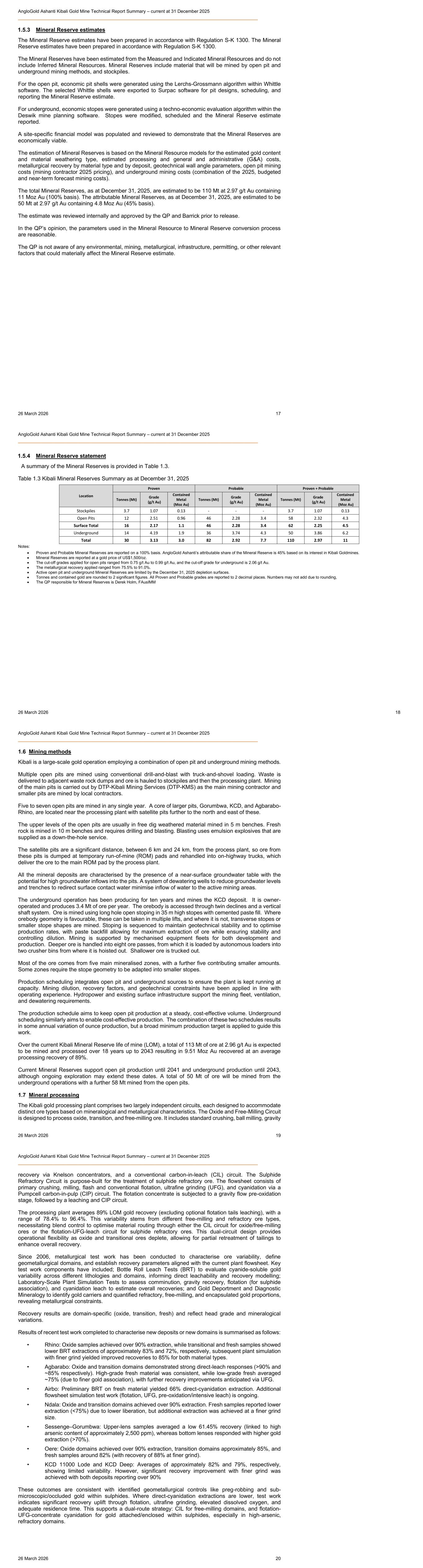
AngloGold Ashanti Kibali Gold Mine Technical Report Summary – current at 31 December 2025 ______________________________________________________________________________ 26 March 2026 17 1.5.3 Mineral Reserve estimates The Mineral Reserve estimates have been prepared in accordance with Regulation S-K 1300. The Mineral Reserve estimates have been prepared in accordance with Regulation S-K 1300. The Mineral Reserves have been estimated from the Measured and Indicated Mineral Resources and do not include Inferred Mineral Resources. Mineral Reserves include material that will be mined by open pit and underground mining methods, and stockpiles. For the open pit, economic pit shells were generated using the Lerchs-Grossmann algorithm within Whittle software. The selected Whittle shells were exported to Surpac software for pit designs, scheduling, and reporting the Mineral Reserve estimate. For underground, economic stopes were generated using a techno-economic evaluation algorithm within the Deswik mine planning software. Stopes were modified, scheduled and the Mineral Reserve estimate reported. A site-specific financial model was populated and reviewed to demonstrate that the Mineral Reserves are economically viable. The estimation of Mineral Reserves is based on the Mineral Resource models for the estimated gold content and material weathering type, estimated processing and general and administrative (G&A) costs, metallurgical recovery by material type and by deposit, geotechnical wall angle parameters, open pit mining costs (mining contractor 2025 pricing), and underground mining costs (combination of the 2025, budgeted and near-term forecast mining costs). The total Mineral Reserves, as at December 31, 2025, are estimated to be 110 Mt at 2.97 g/t Au containing 11 Moz Au (100% basis). The attributable Mineral Reserves, as at December 31, 2025, are estimated to be 50 Mt at 2.97 g/t Au containing 4.8 Moz Au (45% basis). The estimate was reviewed internally and approved by the QP and Barrick prior to release. In the QP’s opinion, the parameters used in the Mineral Resource to Mineral Reserve conversion process are reasonable. The QP is not aware of any environmental, mining, metallurgical, infrastructure, permitting, or other relevant factors that could materially affect the Mineral Reserve estimate. AngloGold Ashanti Kibali Gold Mine Technical Report Summary – current at 31 December 2025 ______________________________________________________________________________ 26 March 2026 18 1.5.4 Mineral Reserve statement A summary of the Mineral Reserves is provided in Table 1.3. Table 1.3 Kibali Mineral Reserves Summary as at December 31, 2025 Location Proven Probable Proven + Probable Tonnes (Mt) Grade (g/t Au) Contained Metal (Moz Au) Tonnes (Mt) Grade (g/t Au) Contained Metal (Moz Au) Tonnes (Mt) Grade (g/t Au) Contained Metal (Moz Au) Stockpiles 3.7 1.07 0.13 - - - 3.7 1.07 0.13 Open Pits 12 2.51 0.96 46 2.28 3.4 58 2.32 4.3 Surface Total 16 2.17 1.1 46 2.28 3.4 62 2.25 4.5 Underground 14 4.19 1.9 36 3.74 4.3 50 3.86 6.2 Total 30 3.13 3.0 82 2.92 7.7 110 2.97 11 Notes: • Proven and Probable Mineral Reserves are reported on a 100% basis. AngloGold Ashanti’s attributable share of the Mineral Reserve is 45% based on its interest in Kibali Goldmines. • Mineral Reserves are reported at a gold price of US$1,500/oz. • The cut-off grades applied for open pits ranged from 0.75 g/t Au to 0.99 g/t Au, and the cut-off grade for underground is 2.06 g/t Au. • The metallurgical recovery applied ranged from 75.5% to 91.0%. • Active open pit and underground Mineral Reserves are limited by the December 31, 2025 depletion surfaces. • Tonnes and contained gold are rounded to 2 significant figures. All Proven and Probable grades are reported to 2 decimal places. Numbers may not add due to rounding, • The QP responsible for Mineral Reserves is Derek Holm, FAusIMM AngloGold Ashanti Kibali Gold Mine Technical Report Summary – current at 31 December 2025 ______________________________________________________________________________ 26 March 2026 19 1.6 Mining methods Kibali is a large-scale gold operation employing a combination of open pit and underground mining methods. Multiple open pits are mined using conventional drill-and-blast with truck-and-shovel loading. Waste is delivered to adjacent waste rock dumps and ore is hauled to stockpiles and then the processing plant. Mining of the main pits is carried out by DTP-Kibali Mining Services (DTP-KMS) as the main mining contractor and smaller pits are mined by local contractors. Five to seven open pits are mined in any single year. A core of larger pits, Gorumbwa, KCD, and Agbarabo- Rhino, are located near the processing plant with satellite pits further to the north and east of these. The upper levels of the open pits are usually in free dig weathered material mined in 5 m benches. Fresh rock is mined in 10 m benches and requires drilling and blasting. Blasting uses emulsion explosives that are supplied as a down-the-hole service. The satellite pits are a significant distance, between 6 km and 24 km, from the process plant, so ore from these pits is dumped at temporary run-of-mine (ROM) pads and rehandled into on-highway trucks, which deliver the ore to the main ROM pad by the process plant. All the mineral deposits are characterised by the presence of a near-surface groundwater table with the potential for high groundwater inflows into the pits. A system of dewatering wells to reduce groundwater levels and trenches to redirect surface contact water minimise inflow of water to the active mining areas. The underground operation has been producing for ten years and mines the KCD deposit. It is owner- operated and produces 3.4 Mt of ore per year. The orebody is accessed through twin declines and a vertical shaft system. Ore is mined using long hole open stoping in 35 m high stopes with cemented paste fill. Where orebody geometry is favourable, these can be taken in multiple lifts, and where it is not, transverse stopes or smaller stope shapes are mined. Stoping is sequenced to maintain geotechnical stability and to optimise production rates, with paste backfill allowing for maximum extraction of ore while ensuring stability and controlling dilution. Mining is supported by mechanised equipment fleets for both development and production. Deeper ore is handled into eight ore passes, from which it is loaded by autonomous loaders into two crusher bins from where it is hoisted out. Shallower ore is trucked out. Most of the ore comes from five main mineralised zones, with a further five contributing smaller amounts. Some zones require the stope geometry to be adapted into smaller stopes. Production scheduling integrates open pit and underground sources to ensure the plant is kept running at capacity. Mining dilution, recovery factors, and geotechnical constraints have been applied in line with operating experience. Hydropower and existing surface infrastructure support the mining fleet, ventilation, and dewatering requirements. The production schedule aims to keep open pit production at a steady, cost-effective volume. Underground scheduling similarly aims to enable cost-effective production. The combination of these two schedules results in some annual variation of ounce production, but a broad minimum production target is applied to guide this work. Over the current Kibali Mineral Reserve life of mine (LOM), a total of 113 Mt of ore at 2.96 g/t Au is expected to be mined and processed over 18 years up to 2043 resulting in 9.51 Moz Au recovered at an average processing recovery of 89%. Current Mineral Reserves support open pit production until 2041 and underground production until 2043, although ongoing exploration may extend these dates. A total of 50 Mt of ore will be mined from the underground operations with a further 58 Mt mined from the open pits. 1.7 Mineral processing The Kibali gold processing plant comprises two largely independent circuits, each designed to accommodate distinct ore types based on mineralogical and metallurgical characteristics. The Oxide and Free-Milling Circuit is designed to process oxide, transition, and free-milling ore. It includes standard crushing, ball milling, gravity AngloGold Ashanti Kibali Gold Mine Technical Report Summary – current at 31 December 2025 ______________________________________________________________________________ 26 March 2026 20 recovery via Knelson concentrators, and a conventional carbon-in-leach (CIL) circuit. The Sulphide Refractory Circuit is purpose-built for the treatment of sulphide refractory ore. The flowsheet consists of primary crushing, milling, flash and conventional flotation, ultrafine grinding (UFG), and cyanidation via a Pumpcell carbon-in-pulp (CIP) circuit. The flotation concentrate is subjected to a gravity flow pre-oxidation stage, followed by a leaching and CIP circuit. The processing plant averages 89% LOM gold recovery (excluding optional flotation tails leaching), with a range of 78.4% to 96.4%. This variability stems from different free-milling and refractory ore types, necessitating blend control to optimise material routing through either the CIL circuit for oxide/free-milling ores or the flotation-UFG-leach circuit for sulphide refractory ores. This dual-circuit design provides operational flexibility as oxide and transitional ores deplete, allowing for partial retreatment of tailings to enhance overall recovery. Since 2006, metallurgical test work has been conducted to characterise ore variability, define geometallurgical domains, and establish recovery parameters aligned with the current plant flowsheet. Key test work components have included; Bottle Roll Leach Tests (BRT) to evaluate cyanide-soluble gold variability across different lithologies and domains, informing direct leachability and recovery modelling; Laboratory-Scale Plant Simulation Tests to assess comminution, gravity recovery, flotation (for sulphide association), and cyanidation leach to estimate overall recoveries; and Gold Deportment and Diagnostic Mineralogy to identify gold carriers and quantified refractory, free-milling, and encapsulated gold proportions, revealing metallurgical constraints. Recovery results are domain-specific (oxide, transition, fresh) and reflect head grade and mineralogical variations. Results of recent test work completed to characterise new deposits or new domains is summarised as follows: • Rhino: Oxide samples achieved over 90% extraction, while transitional and fresh samples showed lower BRT extractions of approximately 83% and 72%, respectively, subsequent plant simulation with finer grind yielded improved recoveries to 85% for both material types. • Agbarabo: Oxide and transition domains demonstrated strong direct-leach responses (>90% and ~85% respectively). High-grade fresh material was consistent, while low-grade fresh averaged ~75% (due to finer gold association), with further recovery improvements anticipated via UFG. • Airbo: Preliminary BRT on fresh material yielded 66% direct-cyanidation extraction. Additional flowsheet simulation test work (flotation, UFG, pre-oxidation/intensive leach) is ongoing. • Ndala: Oxide and transition domains achieved over 90% extraction. Fresh samples reported lower extraction (<75%) due to lower liberation, but additional extraction was achieved at a finer grind size. • Sessenge–Gorumbwa: Upper-lens samples averaged a low 61.45% recovery (linked to high arsenic content of approximately 2,500 ppm), whereas bottom lenses responded with higher gold extraction (>70%). • Oere: Oxide domains achieved over 90% extraction, transition domains approximately 85%, and fresh samples around 82% (with recovery of 88% at finer grind). • KCD 11000 Lode and KCD Deep: Averages of approximately 82% and 79%, respectively, showing limited variability. However, significant recovery improvement with finer grind was achieved with both deposits reporting over 90% These outcomes are consistent with identified geometallurgical controls like preg-robbing and sub- microscopic/occluded gold within sulphides. Where direct-cyanidation extractions are lower, test work indicates significant recovery uplift through flotation, ultrafine grinding, elevated dissolved oxygen, and adequate residence time. This supports a dual-route strategy: CIL for free-milling domains, and flotation- UFG-concentrate cyanidation for gold attached/enclosed within sulphides, especially in high-arsenic, refractory domains.

AngloGold Ashanti Kibali Gold Mine Technical Report Summary – current at 31 December 2025 ______________________________________________________________________________ 26 March 2026 21 1.8 Infrastructure Kibali is situated in a rural setting that lacks local infrastructure. Infrastructure in the DRC is generally poor because of limited investment. Raw water collected from rainfall, spring water, pit dewatering, and the Kibali River is stored in the Raw Water Dam, which has a capacity of 9,500 m³. The processing plant requires approximately 35,000 m³ of water per day. Of this demand, approximately 75% is fulfilled with recycled water from the Tailings Storage Facilities (TSF), while the remaining 25% comes from the Raw Water Dam. Recent improvements to the freshwater reticulation system have reduced reliance on the Kibali River, lowering abstraction from 15% to around 11% of total demand. There are two types of TSF in operation at Kibali; • Cyanide Tailings Storage Facilities (CTSF) for storage of tailings from the Cyanide Reduction Plant. These are lined, downstream facilities. • Flotation Tailings Storage Facilities (FTSF), for the tailings from the sulphide flotation circuit. The current FTSF is a self raised, unlined, buttressed facility with the next planned facility to involve the tailings backfill into an exhausted open pit. Currently, it is estimated that up to 25% of the flotation tailings is used for paste backfill. The capacity of the currently permitted FTSF will be exhausted by 2032 and the capacity of the currently permitted CTSF will be exhausted by 2034. The LOM based on the current Mineral Reserves is 2043. Studies are currently underway for future expansions to contain the LOM tailings production in the form of an options study exercise known as a Multi-Criteria Alternatives Analysis (MAA) that is being prepared by the Engineer of Record for Kibali. Given the lead time, land availability, and that prior TSF permits have been issued in good time, the QP does not believe the current shortfall of tailings capacity is a material risk to the Mineral Reserves. Selection and design of all new facilities is to be completed to a concept level by the end of 2026 and is to adhere to the requirements of the national regulations and the Global Industry Standard for Tailings Management (GISTM). As there is no power grid in the region, Kibali operates on a hybrid power supply system designed to provide reliable and sustainable energy in a remote location. Most power is provided by three off-site hydropower stations; Nzoro II is currently producing approximately 22 megawatts (MW), Ambarau produces 10.6 MW, and Azambi produces a further 10.2 MW, with a total peak hydropower capacity of 42.8 MW. A separate, pre-existing hydropower facility, Nzoro 1, is of low capacity (i.e., less than 1 MW). It was previously refurbished and represents a historical legacy comprising equipment dating from the 1930s. This power is dedicated to local communities. To ensure continuity of power supply during periods of peak demand and seasonal hydropower shortages, a bank of high-speed diesel generators is used with a total capacity of 32 MW. A BESS with a capacity of 7 MW was integrated into the system in 2020 to smooth the impact of the winder load on the power grid. This has allowed the reduction of the spinning reserve from nine diesel generators running to four. In 2025, the commissioning of a 16 MW solar plant, integrated with a new 15 MW BESS, marked a significant milestone in Kibali’s energy transition strategy. With the integration of the solar plant and BESS, renewable energy now accounts for approximately 85% of the site’s total energy consumption. Notably, Kibali is now capable of operating on 100% renewable energy for up to six months each year. 1.9 Market studies Gold doré produced at the Mine is shipped from site under secured conditions and sold under agreement to Rand Refinery in South Africa. Under the agreement, Kibali Goldmines receives the ruling gold price on the day after dispatch, less refining and freight costs, for the gold content of the doré gold. Kibali Goldmines has an agreement to sell all gold production to only one customer. The “customer” is chosen periodically on a tender basis from a selected pool of accredited refineries and international banks to ensure competitive AngloGold Ashanti Kibali Gold Mine Technical Report Summary – current at 31 December 2025 ______________________________________________________________________________ 26 March 2026 22 refining and freight costs. Gold mines do not compete to sell their product given that the price is not controlled by the producers. 1.10 Environmental, permitting and social consideration The initial Environmental and Social Impact Assessment (ESIA) for Kibali was completed in 2010 as part of the acquisition and early development of the Mine. This ESIA was updated in 2011 and subsequently has been updated every five years in line with national legislation. The next update is required before Q3 2026. Kibali is working towards certification to the International Cyanide Management Code (ICMC) and has an environmental management plan in place which conforms to ISO14001:2015. This includes routine environmental monitoring of dust, nuisance noise, ground and surface water, as well as a mechanism for reporting and responding to environmental incidents and auditing to ensure that the various commitments made are being adhered to. There are two types of TSF in operation, the CTSF for storage of cyanide tailings and the FTSF for the tailings from the sulphide flotation circuit. The CTSF contains some cyanide and the FTSF does not. Approximately 25% of the tailings generated by the sulphide flotation circuit is used for underground backfill. Waste rock is stored adjacent to the open pits and underground shaft and has been characterised as non-acid-generating. The waste rock is reused on site where appropriate, including platforms for infrastructure, TSF construction and buttressing, or stope backfill. Kibali Goldmines is conscious of its water demand and has introduced improvements to its recirculation processes so that less than 10% of the overall processing plant water demand is abstracted from the Kibali River. A Biodiversity Management Plan is in place and supports both the improvement of biodiversity within Exploitation Permits as well as supporting a partnership with African Parks for conservation work in the Garamba National Park which lies 65 km to the north, as well as contributing to poaching prevention. An Exclusion Zone has been established across the site, for the safe operation of current and future mining activities. This demarcated area required the relocation and compensation, through the promulgation of a Moratorium, of 17,000 people from within the Exclusion Zone to purpose-built settlements outside the exclusion area. Relocations have been carried out in accordance with International Finance Corporation (IFC) Performance Standards (PS) and national legislation, and have included the development of houses, utility supplies, schools, health and well-being infrastructure, and religious spaces. Resettlement Working Groups (RWGs) have been established for these movements, to ensure that new developments meet the needs of the communities being relocated and contribute to socio-economic upliftment. There is an ongoing Resettlement Action Plan (RAP) for the relocation of 755 households to enable mining of the Oere deposit. The Mine is a significant employer and contributor to the local and national economy and is very active in growing the skills of the local population. In 2025, Congolese nationals made up 91% of employees, with 54% coming from the local community, and more than 63% of management positions held by Congolese nationals. The population of Durba and the surrounding community has grown considerably after 2010 leading to a much larger regional economy and causing pressure for land availability immediately surrounding Kibali. Kibali contributes a mandatory 0.3% of turnover to a community endowment fund, in addition to the Cahier de Charges (five-year community development plan). The endowment fund supports projects within five focused sustainable development categories, with decisions managed by a dedicated board, including members from communities, local non-governmental organisations (NGOs), and government departments. The 5-year community development plan aims to implement commitments made by mining companies, including Kibali Goldmines, to build socio-economic infrastructure and services. Kibali’s investment has targeted the community of Durba and the surrounding areas and has included building a road through the Central Business District (CBD) and building bridges to enable movement of people throughout the year, regardless of the weather. The Project’s Social Licence to Operate (SLTO) is maintained and strengthened through stakeholder engagement activities, community development projects, and economic development initiatives. A formalised grievance mechanism is in place to ensure that community concerns are registered and addressed. Artisanal and small-scale miners (ASM) remain a concern in the Kibali Exploitation Permit area and the Mine is working with provincial authorities to prevent and relocate ASM within the Exploitation Permits. AngloGold Ashanti Kibali Gold Mine Technical Report Summary – current at 31 December 2025 ______________________________________________________________________________ 26 March 2026 23 Mine closure costs are updated annually, considering new disturbances adding to the overall liability or areas rehabilitated, decreasing the assessment. The current cost for rehabilitation and closure of the Mine according to the calculation model is estimated to be US$41.5 million as at December 31, 2025. 1.11 Capital and operating costs Kibali is an operating mine with an extensive production record to enable accurate estimation of future capital and operating costs. The estimated total capital cost over the LOM is US$3,017 million. This includes sustaining capital of US$1,089 million, growth capital of US$777 million, capitalised stripping costs of US$960 million, and underground development capital of US$190 million, all expected to be spent from January 1, 2026 to December 31, 2043. The operating costs for the LOM were developed considering mining, operating, processing, G&A, and downstream costs. The average LOM total unit operating cost is estimated at US$93.11/t of processed ore. The DRC Mining Code 2002 and associated regulations were amended with an updated Mining Code which came into force on March 9, 2018 (DRC, 2002, as amended 2018, referred thereafter as the DRC Mining Code) and the related amended mining regulations which came into force on June 8, 2018 (DRC, 2003, as amended 2018). Royalties payable to the DRC government increased following the amendment of the DRC Mining Code in 2018. A total royalty and other charges payable to the DRC government of 5.7% of gold revenue inclusive of 2% shipment fees was used for the Mineral Reserve estimate. Kibali also pays super profits taxes on its gold and silver sales. The tax applies when the commodity price is 25% higher than the price established in the project's Bankable Feasibility Study (being $1,600/oz). The trigger price for Kibali is $2,000/oz and therefore is not applicable at the Mineral Reserve pricing of $1,500/oz or the Mineral Resource pricing at $2,000/oz. The rate is 50% and is applied to the increase in gross operating surplus driven by the gold price exceeding $2,000/oz. This tax is deductible from the corporate tax base. Kibali currently pays income tax at a rate of 30% to the DRC government (initial accelerated depreciation allowances have been depleted). 1.12 Conclusions and recommendations 1.12.1 Conclusions The QPs note the following interpretations and conclusions in their respective areas of expertise, based on the review of data available for this Report. 1.12.1.1 Geology and Mineral Resources • Procedures for drilling, logging, sampling, analyses, and security are in place and meet industry standards. Data validation and data verification procedures indicate that the data within the database is suitable for Mineral Resource estimation. • Significant exploration, drilling, and operational data provides a good understanding of the deposit geology as well as an understanding of the geometry, thickness, and grade continuity of the mineralisation at Kibali. • Recent drilling has advanced understanding of the geology, mineralisation, and extent of the ARK deposit. This area will be a focus for advanced exploration and study in 2026. • The total inclusive Measured and Indicated Mineral Resources, as at December 31, 2025, are estimated to be 200 Mt at 2.79 g/t Au containing 18 Moz of gold, with an additional Inferred Resource of 49 Mt at 2.1 g/t Au containing 3.3 Moz of gold (100% basis). The attributable inclusive Measured and Indicated Mineral Resources, as at December 31, 2025, are estimated to be 90 Mt at 2.79 g/t Au containing 8.1 million ounces (Moz) of gold, with an additional Inferred Resource of 22 Mt at 2.1 g/t Au containing 1.5 Moz of gold (45% basis). AngloGold Ashanti Kibali Gold Mine Technical Report Summary – current at 31 December 2025 ______________________________________________________________________________ 26 March 2026 24 • The total exclusive Measured and Indicated Mineral Resources, as at December 31, 2025, are estimated to be 74 Mt at 2.4 g/t Au containing 5.7 million ounces (Moz) of gold, with an additional Inferred Resource of 49 Mt at 2.1 g/t Au containing 3.3 Moz of gold (100% basis). The attributable exclusive Measured and Indicated Mineral Resources, as at December 31, 2025, are estimated to be 33 Mt at 2.4 g/t Au containing 2.5 million ounces (Moz) of gold, with an additional Inferred Resource of 22 Mt at 2.1 g/t Au containing 1.5 Moz of gold (45% basis). • The strategic focus of exploration at Kibali is to prioritise near surface opportunities close to the processing plant and down-plunge extensions to existing deposits. The objective is to increase years of production with complementary underground and open pit sources to meet a gold production profile target of 700 koz beyond 2030. • In 2025, SLR USA Advisory Inc. (SLR) completed a site visit and independent review of the Mineral Resource and its informing data and processes. SLR concluded that the processes underlying the generation and declaration of the Mineral Resource are appropriate and consistent with industry best practice. 1.12.1.2 Mining and Mineral Reserves • Barrick, as the owner operator of the Project, has significant experience in other mining operations within Africa and the planned production rates, modifying factors, and costs are benchmarked against other African operations to ensure they are suitable. • The total Mineral Reserves, as at December 31, 2025, are estimated to be 110 Mt at 2.97 g/t Au containing 11 Moz Au (100% basis). The attributable Mineral Reserves, as at December 31, 2025, are estimated to be 50 Mt at 2.97 g/t Au containing 4.8 Moz Au (45% basis). • Kibali is a mature mining operation and planned production uses the same mining methods and the same types of equipment as the current operation, substantially reducing risks. • The cut-off grades, dilution, mining losses, process recoveries, and geotechnical factors used in the determination of the Mineral Reserves are appropriate and supported by historical data. • The mine designs are appropriate for both the underground and open pits, being reasonably laid out for production purposes, and having reasonably considered geological, geotechnical, and economic factors. • While subject to continuous improvements, geotechnical aspects and risks are reasonably managed through ongoing geotechnical and hydrogeological programmes, both in underground and the open pits. • The production schedule is conservative and aligns with current production rates, with the potential for improvement. • There is currently insufficient planned tailings capacity for the full LOM. The capacity of the currently permitted FTSF will be exhausted by 2032 and the capacity of the currently permitted CTSF will be exhausted by 2034. Studies are currently underway for future expansions to contain the LOM tailings production in the form of an MAA that is being prepared by the Engineer of Record for Kibali. Given the lead time, land availability, and that prior TSF permits have been issued in good time, the current shortfall of tailings capacity is not considered to be a material risk to the Mineral Reserves. • Mine infrastructure such as ventilation, electrical power reticulation, and pumping is currently sufficient and will continue to need progressive extensions as the mine develops. • In 2025, SLR completed a site visit and external review of the Mineral Reserves and its informing data, modifying factors, mine planning, and scheduling processes. Overall, SLR concluded that the underground mine design, Mineral Reserve basis, and operational readiness were technically sound and that the production and cost assumptions underlying the reserve statement were reasonable and achievable within normal operating risk.

AngloGold Ashanti Kibali Gold Mine Technical Report Summary – current at 31 December 2025 ______________________________________________________________________________ 26 March 2026 25 1.12.1.3 Mineral processing • Mineral processing and metallurgical testing fundamentals are well established at Kibali. The ore characterisation insights gained through ongoing test work and actual operations have contributed to the achievement of relatively high, consistent, and predictable gold recoveries. • Test work and gold recovery variability characterisation have resulted in provision of considerable operational flexibility and rigor within the plant processes to enable the operation to target and customise parameters appropriate for the different ore types. • The representative sampling and testing of new deposits provides a sound geometallurgical understanding of the process requirements as mining activities advance. • Recent geometallurgical test work outcomes are consistent with the identified geometallurgical controls (preg-robbing and sub-microscopic/occluded gold within sulphides). Where direct- cyanidation extractions are lower, test work demonstrates material uplift via flotation, ultrafine grinding, elevated dissolved oxygen, and adequate residence time. • Deportment data supports the dual-route strategy: (i) CIL for free-milling domains with meaningful gravity recoverable gold (GRG), and (ii) flotation → UFG → concentrate cyanidation (with adequate oxygenation and residence time) for domains where gold is attached/enclosed within sulphides. 1.12.1.4 Infrastructure • Kibali is a mature operation that has the necessary support infrastructure in place. • Since there is no national grid power supply to the site, Kibali is dependent on its own power generation facilities. The power supply currently comes from a combination of on-site, high-speed diesel generator sets, and three off-site hydropower stations (Nzoro II, Ambarau and Azambi). An additional 16 MW solar power plant and 16 MW and BESS are commissioned and currently undergoing optimisation. 1.12.1.5 Environment and social aspects • The ESIA for Kibali was completed in 2010 and approved in 2011. Subsequent ESIAs were consolidated, with the most recent ESIA updated and approved in 2021. • The next main ESIA update has been initiated and is due for completion by Q3 2026 to meet the regulatory requirements for an update every five years. • All ESIAs and Environmental Assessments will be incorporated into the 2026 ESIA update to ensure that Kibali operates with one consolidated Environmental and Social Management Plan (ESMP) for operational efficiency. • All environmental permits are in place for the Kibali processing plant, open pit and underground operations, the hydropower stations, and a permit register forms part of the ESMP. 1.12.1.6 Project economics • Using the assumptions detailed in this Report, Kibali has positive economics in the LOM plan, which confirms the economic viability of the Mineral Reserves at a US$1,500/oz gold sales price. • The basis for the combined LOM plan is the Proven and Probable Mineral Reserve estimate documented in this Report. Cost inputs have been priced in real Q4 2025 US dollars, without any allowance for inflation. • Operating cost estimates include all operational activities required for the mining, processing, G&A costs, and off-site costs (including freight and refining, and royalties) for all forecasted production. AngloGold Ashanti Kibali Gold Mine Technical Report Summary – current at 31 December 2025 ______________________________________________________________________________ 26 March 2026 26 • Capital cost estimates are based on quantities generated from the open pit and underground development requirements, on operating experience gained in the many years of current operations, and where appropriate, on equipment quotes received from manufacturers. Sustaining (replacement) capital costs reflect current price trends. • All taxes have been incorporated as appropriate. The Super Profit Tax set out in Chapter 3.3.2 is only applicable to gold prices higher than US$2,000/oz. 1.12.2 Risks The QPs have examined the various risks and uncertainties known or identified that could reasonably be expected to affect reliability or confidence in the exploration information, the Mineral Resources or Mineral Reserves of the Mine, or projected economic outcomes contained in this Report. They have considered the controls that are in place or proposed to be implemented and have determined the residual risk post- mitigation measures. The post-mitigation risk rating is evaluated consistent with guidance provided by Barrick’s Formal Risk Assessment Procedure (FRA) and considers the likelihood and consequence of the risk’s occurrence and impact. Table 1.4 details the significant risks and uncertainties as determined by the QPs. AngloGold Ashanti Kibali Gold Mine Technical Report Summary – current at 31 December 2025 ______________________________________________________________________________ 26 March 2026 27 Table 1.4 Kibali Risk Analysis Area Risk Mitigation Post- mitigation Risk Rating Geology and Mineral Resources Confidence in Mineral Resource Models Additional scheduled grade control (GC) drilling maintaining 18 months of partial GC coverage ahead of mining. Resource model updated on a regular basis using new drilling and updated geologic interpretation. Low Mining and Mineral Reserves Open Pit Slope Stability Continued 24hr in-pit monitoring with radar, instrumentation, and continued updating of geotechnical and hydrogeology models. Minor Mining and Mineral Reserves Underground dilution control in shallow ore bodies Dilution risk for shallow angle stopes in underground to be continuously reviewed and adjusted with mining. Minor Mining and Mineral Reserves Availability of local mining skills The quality of the local mining contractors to be improved by consolidation of companies, a higher level of supervision from Kibali Goldmines, and through the dedicated training programmes in place. Minor Mining and Infrastructure LOM tailings capacity Current FTSF has permitted capacity until 2032 and CTSF has permitted capacity until 2034 so there is time to prepare for further capacity. Given the success in obtaining permissions for the existing TSFs, and the space and mined-out pits available for further deposition, this is seen as a manageable risk. Low Processing Incorrect blend fed into the processing plant. Deleterious elements, specifically arsenic, and refractory material. The blend ratios of refractory and high deleterious content materials are defined through geometallurgical test work. This mitigates risks of plant underperformance by optimising feed composition. Minor Environmental and Operational Tailings Embankment or lining system failure Robust engineering design and construction of TSF to international standards. Tailings Management Systems for rigorous operational and water management at the TSF; emergency spillway; buttressing if required. Low Capital and Operating Costs Unplanned increases to budgeted costs. Continue to track actual costs and LOM forecast costs, including considerations for inflation. Low Regulatory Changes or developments to legislative framework which impact tax and customs or operating cost base Dedicated government liaison team in Kinshasa Government participation/ownership. Medium Regulatory Permitting delays The processes to obtain and renew required permits, access, and rights are well understood by Kibali Goldmines and similar permits, access, and rights have been granted to the operations in the past. Low 1.12.3 Recommendations The QPs have made the following recommendations. 1.12.3.1 Geology and Mineral Resources • Follow up on all recommendations from the external audit: • Closer alignment to the planned quarterly umpire sample submission with continual update of Standard Operating Procedures (SOPs) to align with the new Data Quality Management System (DQMS) – lower QC percentages, but enough to be statistically relevant on a monthly frequency. AngloGold Ashanti Kibali Gold Mine Technical Report Summary – current at 31 December 2025 ______________________________________________________________________________ 26 March 2026 28 • Support for planned upgrades to the new core logging facility - such as roller tables, an updated photography station, and improved bulk density measurement areas (including auto capture of weights) to further enhance workflow and data quality. • Complete the transition from explicit strings to implicit lithological and estimation domain modelling. Upskill production geologists to transition ownership of 3D lithological interpretations as the final output of the mine geology team. • Incorporate both geotechnical/structural and hydrogeological models into the same Leapfrog Resource Model workspaces to ensure seamless compatibility. • Continue to improve geometallurgical understanding through integration of multi-element data to potentially improve recoveries and process costs. • Follow existing resource definition drilling and maintain infill grade control coverage at targeted levels. • The classification boundary between Indicated and Inferred Mineral Resources should continuously be revisited, using Mineral Reserve stope design corrections to ensure Inferred mineralisation is not included. • Continue with planned advanced exploration at the ARK deposit. • Investigate the use of downhole geophysical logging tools to further improve mineral deposit knowledge and local bulk density estimates (use of Acoustic/Optical Televiewer, caliper paired with magnetic susceptibility, natural gamma, and neutron gamma density tools). 1.12.3.2 Mining and Mineral Reserves • Complete a trade-off study of mining options for the emerging ARK deposit. • Review opportunities to reduce open pit mining costs using in-pit dumping and by optimising a combined production schedule, dumping schedule, and backfilling schedule. • Investigate potential mining cost reduction through changing to open pit owner mining. • Underground development needs to be resourced (employees, equipment) and supported to sustain the overall increase in development from 700 m to 1,000 m per month. • Implement early test stopes in the flatter zones of the underground orebody to validate the underlying assumptions. 1.12.3.3 Mineral processing • Continue geometallurgical refinement of new satellite deposits to ensure that the plant performance remains optimal for both sulphide and free-milling ores. • Review metallurgical predictions against actual processing performance. Use the accumulated data to fine-tune operational strategies. • Continue to implement the established blending strategy by stockpiling different ore sources separately. This is essential for controlling deleterious elements (e.g., arsenic), maintaining consistent feed grades, and optimising recovery based on oxidation level and geometallurgical characteristics. • Continue cyanide destruction optimisation as part of continuous improvement of Kibali. 1.12.3.4 Infrastructure • Continue to investigate opportunities to decrease the Mine’s reliance on thermal power, improve grid stability, and potentially reduce operating costs in dry season, by increasing current battery
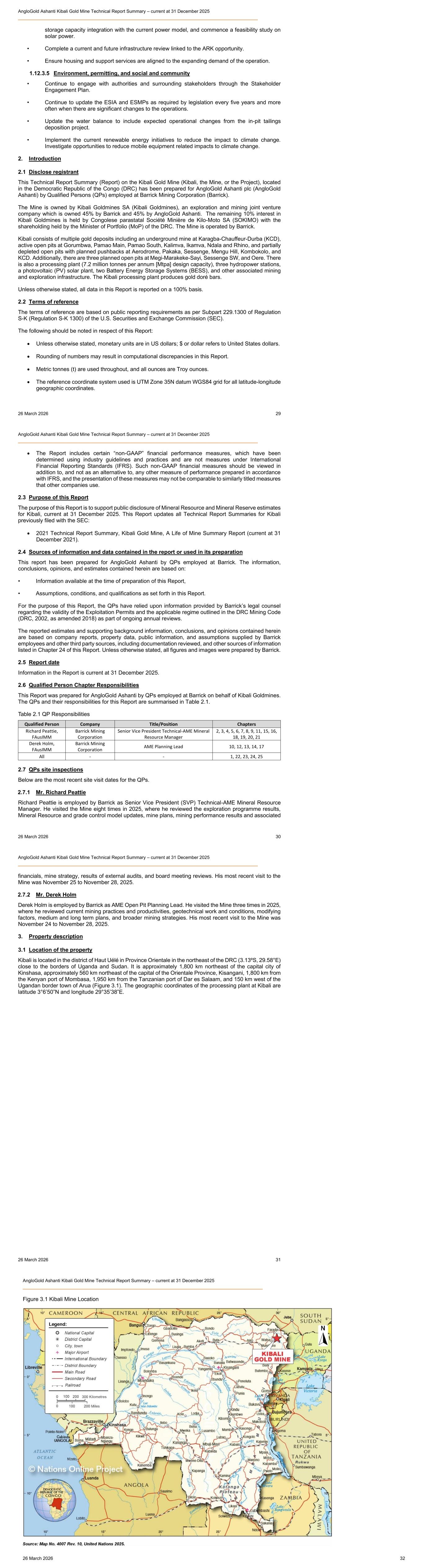
AngloGold Ashanti Kibali Gold Mine Technical Report Summary – current at 31 December 2025 ______________________________________________________________________________ 26 March 2026 29 storage capacity integration with the current power model, and commence a feasibility study on solar power. • Complete a current and future infrastructure review linked to the ARK opportunity. • Ensure housing and support services are aligned to the expanding demand of the operation. 1.12.3.5 Environment, permitting, and social and community • Continue to engage with authorities and surrounding stakeholders through the Stakeholder Engagement Plan. • Continue to update the ESIA and ESMPs as required by legislation every five years and more often when there are significant changes to the operations. • Update the water balance to include expected operational changes from the in-pit tailings deposition project. • Implement the current renewable energy initiatives to reduce the impact to climate change. Investigate opportunities to reduce mobile equipment related impacts to climate change. 2. Introduction 2.1 Disclose registrant This Technical Report Summary (Report) on the Kibali Gold Mine (Kibali, the Mine, or the Project), located in the Democratic Republic of the Congo (DRC) has been prepared for AngloGold Ashanti plc (AngloGold Ashanti) by Qualified Persons (QPs) employed at Barrick Mining Corporation (Barrick). The Mine is owned by Kibali Goldmines SA (Kibali Goldmines), an exploration and mining joint venture company which is owned 45% by Barrick and 45% by AngloGold Ashanti. The remaining 10% interest in Kibali Goldmines is held by Congolese parastatal Société Minière de Kilo-Moto SA (SOKIMO) with the shareholding held by the Minister of Portfolio (MoP) of the DRC. The Mine is operated by Barrick. Kibali consists of multiple gold deposits including an underground mine at Karagba-Chauffeur-Durba (KCD), active open pits at Gorumbwa, Pamao Main, Pamao South, Kalimva, Ikamva, Ndala and Rhino, and partially depleted open pits with planned pushbacks at Aerodrome, Pakaka, Sessenge, Mengu Hill, Kombokolo, and KCD. Additionally, there are three planned open pits at Megi-Marakeke-Sayi, Sessenge SW, and Oere. There is also a processing plant (7.2 million tonnes per annum [Mtpa] design capacity), three hydropower stations, a photovoltaic (PV) solar plant, two Battery Energy Storage Systems (BESS), and other associated mining and exploration infrastructure. The Kibali processing plant produces gold doré bars. Unless otherwise stated, all data in this Report is reported on a 100% basis. 2.2 Terms of reference The terms of reference are based on public reporting requirements as per Subpart 229.1300 of Regulation S-K (Regulation S-K 1300) of the U.S. Securities and Exchange Commission (SEC). The following should be noted in respect of this Report: • Unless otherwise stated, monetary units are in US dollars; $ or dollar refers to United States dollars. • Rounding of numbers may result in computational discrepancies in this Report. • Metric tonnes (t) are used throughout, and all ounces are Troy ounces. • The reference coordinate system used is UTM Zone 35N datum WGS84 grid for all latitude-longitude geographic coordinates. AngloGold Ashanti Kibali Gold Mine Technical Report Summary – current at 31 December 2025 ______________________________________________________________________________ 26 March 2026 30 • The Report includes certain “non-GAAP” financial performance measures, which have been determined using industry guidelines and practices and are not measures under International Financial Reporting Standards (IFRS). Such non-GAAP financial measures should be viewed in addition to, and not as an alternative to, any other measure of performance prepared in accordance with IFRS, and the presentation of these measures may not be comparable to similarly titled measures that other companies use. 2.3 Purpose of this Report The purpose of this Report is to support public disclosure of Mineral Resource and Mineral Reserve estimates for Kibali, current at 31 December 2025. This Report updates all Technical Report Summaries for Kibali previously filed with the SEC: • 2021 Technical Report Summary, Kibali Gold Mine, A Life of Mine Summary Report (current at 31 December 2021). 2.4 Sources of information and data contained in the report or used in its preparation This report has been prepared for AngloGold Ashanti by QPs employed at Barrick. The information, conclusions, opinions, and estimates contained herein are based on: • Information available at the time of preparation of this Report, • Assumptions, conditions, and qualifications as set forth in this Report. For the purpose of this Report, the QPs have relied upon information provided by Barrick’s legal counsel regarding the validity of the Exploitation Permits and the applicable regime outlined in the DRC Mining Code (DRC, 2002, as amended 2018) as part of ongoing annual reviews. The reported estimates and supporting background information, conclusions, and opinions contained herein are based on company reports, property data, public information, and assumptions supplied by Barrick employees and other third party sources, including documentation reviewed, and other sources of information listed in Chapter 24 of this Report. Unless otherwise stated, all figures and images were prepared by Barrick. 2.5 Report date Information in the Report is current at 31 December 2025. 2.6 Qualified Person Chapter Responsibilities This Report was prepared for AngloGold Ashanti by QPs employed at Barrick on behalf of Kibali Goldmines. The QPs and their responsibilities for this Report are summarised in Table 2.1. Table 2.1 QP Responsibilities Qualified Person Company Title/Position Chapters Richard Peattie, FAusIMM Barrick Mining Corporation Senior Vice President Technical-AME Mineral Resource Manager 2, 3, 4, 5, 6, 7, 8, 9, 11, 15, 16, 18, 19, 20, 21 Derek Holm, FAusIMM Barrick Mining Corporation AME Planning Lead 10, 12, 13, 14, 17 All - - 1, 22, 23, 24, 25 2.7 QPs site inspections Below are the most recent site visit dates for the QPs. 2.7.1 Mr. Richard Peattie Richard Peattie is employed by Barrick as Senior Vice President (SVP) Technical-AME Mineral Resource Manager. He visited the Mine eight times in 2025, where he reviewed the exploration programme results, Mineral Resource and grade control model updates, mine plans, mining performance results and associated AngloGold Ashanti Kibali Gold Mine Technical Report Summary – current at 31 December 2025 ______________________________________________________________________________ 26 March 2026 31 financials, mine strategy, results of external audits, and board meeting reviews. His most recent visit to the Mine was November 25 to November 28, 2025. 2.7.2 Mr. Derek Holm Derek Holm is employed by Barrick as AME Open Pit Planning Lead. He visited the Mine three times in 2025, where he reviewed current mining practices and productivities, geotechnical work and conditions, modifying factors, medium and long term plans, and broader mining strategies. His most recent visit to the Mine was November 24 to November 28, 2025. 3. Property description 3.1 Location of the property Kibali is located in the district of Haut Uélé in Province Orientale in the northeast of the DRC (3.13ºS, 29.58°E) close to the borders of Uganda and Sudan. It is approximately 1,800 km northeast of the capital city of Kinshasa, approximately 560 km northeast of the capital of the Orientale Province, Kisangani, 1,800 km from the Kenyan port of Mombasa, 1,950 km from the Tanzanian port of Dar es Salaam, and 150 km west of the Ugandan border town of Arua (Figure 3.1). The geographic coordinates of the processing plant at Kibali are latitude 3°6’50”N and longitude 29°35’38”E. AngloGold Ashanti Kibali Gold Mine Technical Report Summary – current at 31 December 2025 ______________________________________________________________________________ 26 March 2026 32 Figure 3.1 Kibali Mine Location
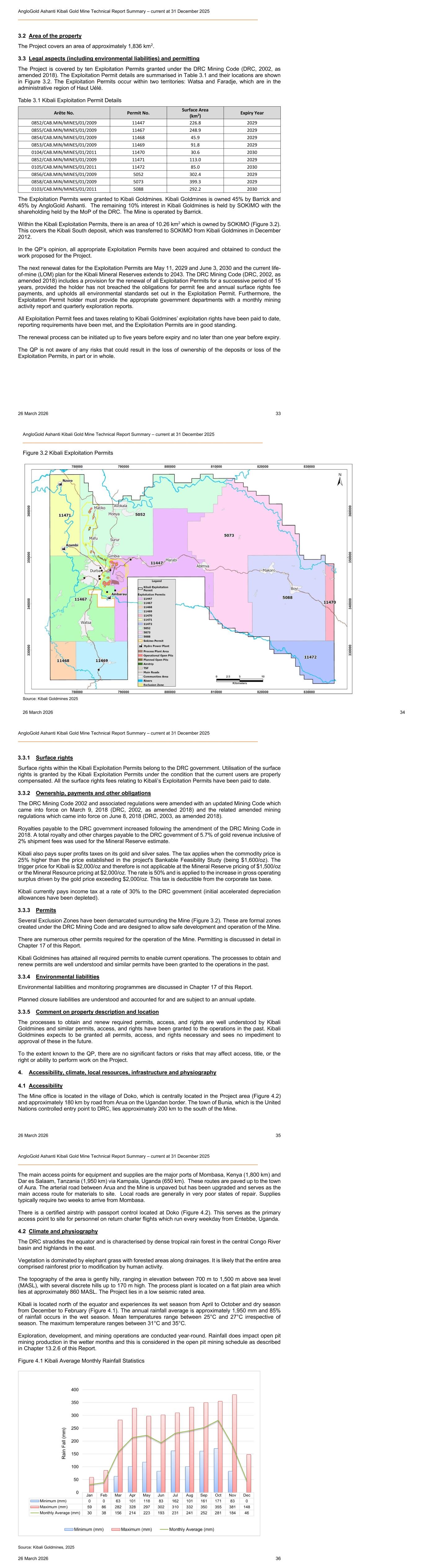
AngloGold Ashanti Kibali Gold Mine Technical Report Summary – current at 31 December 2025 ______________________________________________________________________________ 26 March 2026 33 3.2 Area of the property The Project covers an area of approximately 1,836 km2. 3.3 Legal aspects (including environmental liabilities) and permitting The Project is covered by ten Exploitation Permits granted under the DRC Mining Code (DRC, 2002, as amended 2018). The Exploitation Permit details are summarised in Table 3.1 and their locations are shown in Figure 3.2. The Exploitation Permits occur within two territories: Watsa and Faradje, which are in the administrative region of Haut Uélé. Table 3.1 Kibali Exploitation Permit Details Arête No. Permit No. Surface Area (km2) Expiry Year 0852/CAB.MIN/MINES/01/2009 11447 226.8 2029 0855/CAB.MIN/MINES/01/2009 11467 248.9 2029 0854/CAB.MIN/MINES/01/2009 11468 45.9 2029 0853/CAB.MIN/MINES/01/2009 11469 91.8 2029 0104/CAB.MIN/MINES/01/2011 11470 30.6 2030 0852/CAB.MIN/MINES/01/2009 11471 113.0 2029 0105/CAB.MIN/MINES/01/2011 11472 85.0 2030 0856/CAB.MIN/MINES/01/2009 5052 302.4 2029 0858/CAB.MIN/MINES/01/2009 5073 399.3 2029 0103/CAB.MIN/MINES/01/2011 5088 292.2 2030 The Exploitation Permits were granted to Kibali Goldmines. Kibali Goldmines is owned 45% by Barrick and 45% by AngloGold Ashanti. The remaining 10% interest in Kibali Goldmines is held by SOKIMO with the shareholding held by the MoP of the DRC. The Mine is operated by Barrick. Within the Kibali Exploitation Permits, there is an area of 10.26 km2 which is owned by SOKIMO (Figure 3.2). This covers the Kibali South deposit, which was transferred to SOKIMO from Kibali Goldmines in December 2012. In the QP’s opinion, all appropriate Exploitation Permits have been acquired and obtained to conduct the work proposed for the Project. The next renewal dates for the Exploitation Permits are May 11, 2029 and June 3, 2030 and the current life- of-mine (LOM) plan for the Kibali Mineral Reserves extends to 2043. The DRC Mining Code (DRC, 2002, as amended 2018) includes a provision for the renewal of all Exploitation Permits for a successive period of 15 years, provided the holder has not breached the obligations for permit fee and annual surface rights fee payments, and upholds all environmental standards set out in the Exploitation Permit. Furthermore, the Exploitation Permit holder must provide the appropriate government departments with a monthly mining activity report and quarterly exploration reports. All Exploitation Permit fees and taxes relating to Kibali Goldmines’ exploitation rights have been paid to date, reporting requirements have been met, and the Exploitation Permits are in good standing. The renewal process can be initiated up to five years before expiry and no later than one year before expiry. The QP is not aware of any risks that could result in the loss of ownership of the deposits or loss of the Exploitation Permits, in part or in whole. AngloGold Ashanti Kibali Gold Mine Technical Report Summary – current at 31 December 2025 ______________________________________________________________________________ 26 March 2026 34 Figure 3.2 Kibali Exploitation Permits Source: Kibali Goldmines 2025 AngloGold Ashanti Kibali Gold Mine Technical Report Summary – current at 31 December 2025 ______________________________________________________________________________ 26 March 2026 35 3.3.1 Surface rights Surface rights within the Kibali Exploitation Permits belong to the DRC government. Utilisation of the surface rights is granted by the Kibali Exploitation Permits under the condition that the current users are properly compensated. All the surface rights fees relating to Kibali’s Exploitation Permits have been paid to date. 3.3.2 Ownership, payments and other obligations The DRC Mining Code 2002 and associated regulations were amended with an updated Mining Code which came into force on March 9, 2018 (DRC, 2002, as amended 2018) and the related amended mining regulations which came into force on June 8, 2018 (DRC, 2003, as amended 2018). Royalties payable to the DRC government increased following the amendment of the DRC Mining Code in 2018. A total royalty and other charges payable to the DRC government of 5.7% of gold revenue inclusive of 2% shipment fees was used for the Mineral Reserve estimate. Kibali also pays super profits taxes on its gold and silver sales. The tax applies when the commodity price is 25% higher than the price established in the project's Bankable Feasibility Study (being $1,600/oz). The trigger price for Kibali is $2,000/oz and therefore is not applicable at the Mineral Reserve pricing of $1,500/oz or the Mineral Resource pricing at $2,000/oz. The rate is 50% and is applied to the increase in gross operating surplus driven by the gold price exceeding $2,000/oz. This tax is deductible from the corporate tax base. Kibali currently pays income tax at a rate of 30% to the DRC government (initial accelerated depreciation allowances have been depleted). 3.3.3 Permits Several Exclusion Zones have been demarcated surrounding the Mine (Figure 3.2). These are formal zones created under the DRC Mining Code and are designed to allow safe development and operation of the Mine. There are numerous other permits required for the operation of the Mine. Permitting is discussed in detail in Chapter 17 of this Report. Kibali Goldmines has attained all required permits to enable current operations. The processes to obtain and renew permits are well understood and similar permits have been granted to the operations in the past. 3.3.4 Environmental liabilities Environmental liabilities and monitoring programmes are discussed in Chapter 17 of this Report. Planned closure liabilities are understood and accounted for and are subject to an annual update. 3.3.5 Comment on property description and location The processes to obtain and renew required permits, access, and rights are well understood by Kibali Goldmines and similar permits, access, and rights have been granted to the operations in the past. Kibali Goldmines expects to be granted all permits, access, and rights necessary and sees no impediment to approval of these in the future. To the extent known to the QP, there are no significant factors or risks that may affect access, title, or the right or ability to perform work on the Project. 4. Accessibility, climate, local resources, infrastructure and physiography 4.1 Accessibility The Mine office is located in the village of Doko, which is centrally located in the Project area (Figure 4.2) and approximately 180 km by road from Arua on the Ugandan border. The town of Bunia, which is the United Nations controlled entry point to DRC, lies approximately 200 km to the south of the Mine. AngloGold Ashanti Kibali Gold Mine Technical Report Summary – current at 31 December 2025 ______________________________________________________________________________ 26 March 2026 36 The main access points for equipment and supplies are the major ports of Mombasa, Kenya (1,800 km) and Dar es Salaam, Tanzania (1,950 km) via Kampala, Uganda (650 km). These routes are paved up to the town of Aura. The arterial road between Arua and the Mine is unpaved but has been upgraded and serves as the main access route for materials to site. Local roads are generally in very poor states of repair. Supplies typically require two weeks to arrive from Mombasa. There is a certified airstrip with passport control located at Doko (Figure 4.2). This serves as the primary access point to site for personnel on return charter flights which run every weekday from Entebbe, Uganda. 4.2 Climate and physiography The DRC straddles the equator and is characterised by dense tropical rain forest in the central Congo River basin and highlands in the east. Vegetation is dominated by elephant grass with forested areas along drainages. It is likely that the entire area comprised rainforest prior to modification by human activity. The topography of the area is gently hilly, ranging in elevation between 700 m to 1,500 m above sea level (MASL), with several discrete hills up to 170 m high. The process plant is located on a flat plain area which lies at approximately 860 MASL. The Project lies in a low seismic rated area. Kibali is located north of the equator and experiences its wet season from April to October and dry season from December to February (Figure 4.1). The annual rainfall average is approximately 1,950 mm and 85% of rainfall occurs in the wet season. Mean temperatures range between 25°C and 27°C irrespective of season. The maximum temperature ranges between 31°C and 35°C. Exploration, development, and mining operations are conducted year-round. Rainfall does impact open pit mining production in the wetter months and this is considered in the open pit mining schedule as described in Chapter 13.2.6 of this Report. Figure 4.1 Kibali Average Monthly Rainfall Statistics Source: Kibali Goldmines, 2025

AngloGold Ashanti Kibali Gold Mine Technical Report Summary – current at 31 December 2025 ______________________________________________________________________________ 26 March 2026 37 Note: Data collected from 2012 to 2025. 4.3 Local resources and infrastructure The population in the Project area is approximately 65,000 with Durba being the key settlement (Figure 4.2). The population of the Watsa territory population is approximately 300,000. Kibali Goldmines prioritises host country employment and skills transfer, and currently 91% of employees are Congolese, with 54% from the local area. Congolese contractors are also utilised for construction projects. The area lacks any substantial infrastructure other than that constructed by Kibali Goldmines to support the mining operations. Other existing infrastructure supports the local subsistence and small-scale agriculture. The key infrastructure at Kibali includes mine access and internal road networks, a processing plant, Tailings Storage Facilities (TSF), Waste Rock Dumps (WRD), accommodation village, administrative buildings, stores, warehouses, laboratory, workshops, security buildings, medical and emergency response facilities, communications and data transmission networks, airstrip, fuel storage and dispensing facilities (Figure 4.2). There is no national grid power supply to the Mine and Kibali is fully dependent on its own power generation. The current power supply comes from a combination of on-site high-speed diesel generator sets, three hydropower stations, a PV solar plant, and two BESS. The location of the hydropower plants and the solar plant are shown in Figure 3.2 and Figure 4.2 respectively. Raw water is collected from rainfall, spring water, pit dewatering, and the Kibali River and is stored in a Raw Water Dam, which has a capacity of 9,500 m³. Project infrastructure is discussed in detail in Chapter 15 of this Report. AngloGold Ashanti Kibali Gold Mine Technical Report Summary – current at 31 December 2025 ______________________________________________________________________________ 26 March 2026 38 Figure 4.2 Overview of Kibali Mine Infrastructure Source: Kibali Goldmines, 2025. 4.4 Sufficiency of surface rights In the opinion of the QP, the surface rights secured for Kibali are sufficient to allow for the operation of all required Project infrastructure, and sufficient surface area remains if expansions to the existing infrastructure are required. Surface rights are discussed in detail in Chapter 3.3.1 of this Report. AngloGold Ashanti Kibali Gold Mine Technical Report Summary – current at 31 December 2025 ______________________________________________________________________________ 26 March 2026 39 5. History 5.1 Ownership and Project history Previous ownership and key Project milestones are summarised in Table 5.1. Table 5.1 Summary of Kibali Ownership and Development Year Owner Work Completed 1903 Prospectors First documented gold discovery in the northeast of the DRC documented by prospectors who observed alluvial gold washing. 1926 SOKIMO Belgian Government, via SOKIMO, began mining operations in the Kilo-Moto area including Gorumbwa, Agbarabo, and Durba. Most mining was undertaken in the 1950s and included a processing plant with crushing and ball milling, gravity, cyanide leach, and amalgamation circuits. 1960 Artisanal miners/SOKIMO After independence from Belgium in 1960 production dropped sharply as mining was undertaken largely by artisanal-scale miners (ASM). 1966 OKIMO SOKIMO changed its name to OKIMO which continued to be the main mining operator in the area. Sporadic underground mining continued but production is thought to have been minimal. 1991 Government of Zaire The Government of Zaire, with funding from the African Development Bank, commissioned an assessment of the area, which included significant drilling to verify historical data. 1996 Barrick-OKIMO, AngloGold Barrick acquired exploration rights over most of the Kilo-Moto belts in a 70/30 joint venture with OKIMO. Several targets were drilled and regional and detailed soil sampling was completed. Subsequently Barrick split its 70% holding in the Project equally in a joint venture with AngloGold. 1998 Barrick-AngloGold & OKIMO KCD discovered, drilling completed at KCD and Pakaka, soil sampling completed across the property, and a regional aeromagnetic survey completed. AngloGold became operator of the Project. 1998 Barrick- AngloGold Withdrawal from the Project due to civil war. 2004 Moto Goldmines Ltd (Moto)- OKIMO Moto acquired Barrick-AngloGold Ashanti’s 70% stake in the Project. 2008 Moto Mineral Resource and Mineral Reserve estimate, and Feasibility Study 2009 Moto Updated Feasibility Study 2009 Randgold- AngloGold Ashanti, OKIMO Randgold Resources Limited (Randgold) and AngloGold Ashanti entered into a 50/50 joint venture and acquired Moto and its 70% stake in the Project. Subsequently the joint venture acquired a further 20% shareholding with OKIMO retaining the remaining 10% interest. Randgold became operator of the Project. 2010 Randgold- AngloGold Ashanti, SOKIMO OKIMO changed its name back to SOKIMO. 2012 Randgold- AngloGold Ashanti, SOKIMO Construction and commencement of open pit mining at KCD. 2013 Randgold- AngloGold Ashanti, SOKIMO Construction, commissioning of the processing plant, and first commercial gold production. 2014 Kibali Goldmines Kibali Goldmines formally incorporated to house the final shareholding structure (45% Randgold, 45% AngloGold Ashanti, 10% SOKIMO). Construction of thermal power station and first hydropower station Nzoro 2. 2017 Kibali Goldmines Haulage shaft and material handling system commissioned. 2019 Kibali Goldmines Barrick acquired Randgold and the 45% ownership of Kibali Goldmines was transferred to Barrick, which continues the partnership with AngloGold Ashanti (45%) and SOKIMO (10%). Barrick became operator of the Mine. AngloGold Ashanti Kibali Gold Mine Technical Report Summary – current at 31 December 2025 ______________________________________________________________________________ 26 March 2026 40 5.2 Historic Resource and Reserve estimates Historical Mineral Resources and Mineral Reserves have been superseded by the Mineral Resources and Mineral Reserves presented in Chapters 11 and 12 of this Report, respectively. 5.3 Past production Since commencing mining operations in 2013 to the end of 2025, 92 Mt of ore have been milled from the various deposits at Kibali. Table 5.2 summarises the past mill production for the Project. Table 5.2 Past Production Records for the Kibali Gold Mine Year Tonnes Milled (kt) Grade (g/t Au) Contained Gold (oz Au) Recovery (%) 2013 808 3.87 88,199 91.5 2014 5,546 3.81 526,627 79.0 2015 6,833 3.55 642,720 83.8 2016 7,299 3.10 586,530 79.8 2017 7,621 2.87 596,226 83.6 2018 8,218 3.45 807,251 88.6 2019 7,513 3.80 814,027 88.7 2020 7,632 3.68 808,134 89.4 2021 7,783 3.62 812,152 89.8 2022 7,769 3.30 749,590 88.5 2023 8,222 3.19 762,851 89.9 2024 8,504 2.82 686,417 89.2 2025 8,322 2.79 673,520 90.3 6. Geological setting, mineralisation and deposit 6.1 Regional geology The Kibali gold deposits are hosted within the Moto Greenstone Belt, a Neoarchean terrane that lies in the northeast Congo Craton (Figure 6.1). The northeastern part of the Congo Craton is formed of Archean rocks, which extend eastward from the northern part of the DRC across the East African Rift into Uganda, southern Kenya, and northern Tanzania (Allibone et al., 2020). The Moto Greenstone Belt is oriented west-northwest to east-southeast and is bounded to the north by the West Nile Gneiss Complex, a Meso- or Paleoarchean granite gneiss that extends northward into the Sahara Desert (U-Pb ages > 2670 Ma; Turnbull et al., 2017). To the south, it is bounded by the Upper Zaire Granitic Massif, an Archean granite-gneiss terrane that dominates the northeast Congo Craton. The Massif is locally represented by the Watsa Igneous Complex. The Moto Greenstone Belt comprises an Archean-age volcano-sedimentary sequence of conglomerates, carbonaceous shales, siltstone, banded iron formations (BIFs), basalts, and volcanogenic sediments; intruded by mafic to felsic dykes, sills, and granitoid plutons (2640 Ma and younger). The Kibali deposits are predominantly hosted within sedimentary lithologies that have undergone complex structural deformation and metamorphism. Metamorphic grade varies from lower greenschist facies in the west, progressively increasing to amphibolite facies in the east. Intrusive units from both the West Nile Gneiss and Moto Belt Greenstones are thought to have formed in an island arc environment (Allibone et al., 2020). Extrusive units from both terranes are typical of Mid-Oceanic Ridge Basalts (MORB) (Allibone et al., 2020). The Moto Greenstone Belt is believed to be a thrust stack that formed during the collision of an island arc along the northern margin of the Upper Zaire Granitic Massif, with the West Nile Gneiss thrust southward over the Moto Greenstone Belt resulting in a polyphase deformation history. This includes isoclinal and recumbent folding, overprinted by brittle-ductile shear zones. Two principal structural sets dominate – northwest-southeast thrust faults dipping northeast and sub-vertical northeast-southwest shear zones. Together with folding, these structures are the primary controls on gold mineralisation across the Kibali district.

AngloGold Ashanti Kibali Gold Mine Technical Report Summary – current at 31 December 2025 ______________________________________________________________________________ 26 March 2026 41 Figure 6.1 Regional Geology Source: Allibone et al., 2020 6.2 Structural geology The Kibali gold deposits are predominantly hosted along, or within proximity of (<1 km), a curvilinear structure 60 km in length and up to one kilometre in width called the KZ Trend, named after the original known extents of Kalimva in the north and Zakitoko in the south (Figure 6.2). Gold is principally concentrated within gently northeast to north-northeast-plunging mineralised shoots, whose orientations are generally parallel with a prominent lineation in the mineralised rocks. It has been concluded that the structure of the Kibali district is the product of at least seven phases of deformation. Key features of each event are listed below: • D1: ductile faults generally orientated parallel to lithological layering, but which can also locally cut across lithological layering. • D2: isoclinal recumbent Phase 2(F2) folds whose axial planes dip approximately 25° to 30° north- northeast, axes that plunge approximately 25° northeast, and an associated generally axial planar foliation fabric. AngloGold Ashanti Kibali Gold Mine Technical Report Summary – current at 31 December 2025 ______________________________________________________________________________ 26 March 2026 42 • D3: upright Phase 3 (F3) folds whose axial planes dip steeply towards either the northeast or southeast and axes plunge approximately 25° northeast. • D4: sericite-rich spaced foliation largely restricted to altered rocks at the KCD deposit. • D5: northeast-striking, steeply dipping brittle faults close to parallel with axial planes of the late F3 folds associated with a well-developed crenulation cleavage in the district (D6). • D6: localised late post-mineralisation folds with near horizontal axes that trend west-northwest or east-southeast, an associated axial plane-parallel crenulation cleavage, and related contractional faults. • D7: minor south-southwest-dipping normal faults, fractures, and associated barren en-echelon quartz veins. D1 to D4 are all ductile in character and each involved the formation of ductile faults, folds, penetrative foliations, and/or penetrative linear fabrics. D2 and D3 occurred in a contractional setting, but evidence of the tectonic settings of D1 and D4 is more ambiguous. D5 is a phase of brittle faulting that was followed by a return to a more ductile style of contractional deformation during D6. The D7 event likely represents some type of minor tectonic relaxation following cessation of D6 shortening. Figure 6.2 Summary Geologic Map of the Moto (Kibali Greenstone) Belt, Showing Major Geologic Domains, Crosscutting Granitoid Plutons, and the General Structural Architecture Source: After Allibone, 2020. The location and orientation of the mineralisation at Kibali is largely controlled by the early deformation events within the district (D1 to D3), having created the favourable structural architecture for later ore shoot formation. Fold hinges and limbs provided both competency contrasts and permeability pathways; thrust faults and shear zones acted as fluid conduits which focused the alteration and gold-bearing sulphide deposition; lineation-parallel ore shoot plunges which explain the continuity of mineralisation down plunge observed in most of the deposits but particularly at KCD and Agbarabo-Rhino-Airbo-Kombokolo (ARK). Most aspects of the district-scale structural architecture formed during D1 to D3, although the effects of D5 faulting AngloGold Ashanti Kibali Gold Mine Technical Report Summary – current at 31 December 2025 ______________________________________________________________________________ 26 March 2026 43 are locally apparent in district-scale geological maps. Mineralised lodes formed at some time between the S4 sericite foliation, which they overprint, and movement on the D5 faults. This structural complexity underpins the geometry, continuity, and scale of the deposits along the KZ Trend. 6.3 Property geology A stratigraphic column of the Moto Greenstone Belt is illustrated in Figure 6.3. Figure 6.3 Stratigraphic column of the Moto Greenstone Belt Source: After Alibone, 2020. The KZ Trend is located in the central part of the Moto Greenstone Belt, is an important boundary between the older Eastern Domain and younger Western Domain (Allibone et al., 2020), and is the first order control for all significant gold occurrences discovered to date (Figure 7 2). Mineral deposits are located in three areas along the KZ Trend: KZ North Trend, KZ Central Area, and KZ South Trend (Figure 6.2). AngloGold Ashanti Kibali Gold Mine Technical Report Summary – current at 31 December 2025 ______________________________________________________________________________ 26 March 2026 44 6.3.1 Structural setting Geochronology indicates the proto-KZ Trend originated as a network of extensional faults around 2629 Ma (Allibone et al., 2020). This controlled the development of a basin west of the KZ Trend, which filled with volcanic, volcaniclastic, and sedimentary rocks. Subsequent contractional deformation inverted this basin, thrusting older eastern rocks over younger western sequences. The inversion established the altered shear zones that now defines the KZ Trend, coinciding with the location of many gold occurrences in the western part of the Moto Greenstone Belt (Allibone et al., 2020). Thrust faults and klippes created structural traps and permeability pathways, folded and juxtaposed stratigraphy provided rheological contrasts that enhanced fluid focusing (Bird, 2016), and plutonism in the western domain sustained the thermal gradients necessary for hydrothermal activity and gold deposition (Allibone and Vargas, 2017). 6.3.2 Lithology East of the KZ Trend lithologies comprise variably deformed and metamorphosed basalts, dacitic volcaniclastic rocks, psammo-pelitic schists, amphibolites, BIFs, carbonaceous argillite, cherts, and granitoid intrusions (Bird, 2016; Allibone et al., 2020). Metamorphism increases eastward from lower greenschist to mid amphibolite facies, with garnet-bearing schists and recrystallised BIFs marking the higher-grade assemblages (Allibone et al., 2020). West of the KZ Trend the stratigraphy is dominated by immature sandstones, gritstones, pebble conglomerates, carbonaceous argillites, BIFs, and cherts, intruded by granitoids and mafic–intermediate dykes and sills. These rocks are the primary hosts for the deposits at Kibali, including the KCD deposit (Figure 6.2). Early felsic to intermediate intrusive rocks are common and are referred to as either QS (quartz-sericite), QSF (quartz-sericite-fuchsite), or QSP (quartz-sericite porphyry). These pre-mineralisation intrusives have undergone similar deformation and alteration to the rest of the stratigraphy but are unfavourable host rocks and so commonly form internal waste-zones particularly at KCD and ARK. Detrital zircon ages align with emplacement ages of tonalitic plutons to the east, suggesting deposition during a basin extension event between 2629 and 2626 Ma, with sediment derived from older adjacent terranes (Allibone and Vargas, 2017; Allibone et al., 2020). 6.3.3 Alteration Deposits within the Kibali district are commonly associated with halos of diffuse silica-carbonate-sericite (ACSA-A) alteration, often extending well into the barren host rocks. Gold occurrences are directly associated with ankerite and siderite ± quartz, ± magnetite (ACSA-B) alteration, which is more intense and texturally destructive, along with fine disseminated pyrite and minor pyrrhotite and arsenopyrite. The pyrite occurs as both ‘salt and pepper’ disseminated fine grains and clusters of disseminated grains forming blebs and pseudo-vein mosaics. 6.3.4 Mineralisation At Kibali, the gold deposits are hosted mainly in siliciclastic rocks, BIF, and chert. Mineralising H2O-CO2-rich fluids migrated along a linked network of gently northeast-dipping shears and northeast to north-northeast- plunging fold axes, which acted as structurally favourable fluid traps. The source(s) of metal and fluids which formed the deposits remain unknown, but metamorphic devolatilisation reactions within the supracrustal rocks of the Moto Greenstone Belt and/or deeper fluid and metal sources may have contributed. Mineralisation occurs as oxide, transitional, and fresh mineralisation types. Oxide mineralisation forms in the weathered profile where sulphides have become oxidised, with gold occurring as free grains or within iron oxides. Transitional mineralisation is partially oxidised, containing both sulphides and oxides. Fresh mineralisation typically occurs from 20 m to 60 m below surface, comprising primary sulphides with gold mainly physically encapsulated within these sulphides. Fresh mineralisation forms most of the gold endowment. In general, mineralisation in fresh rock exhibits three dominant styles. These include disseminated, replacement, and vein styles, all dominated by an iron-sulphide phase, mostly pyrite, with variable chalcopyrite, arsenopyrite, and pyrrhotite (Bird, 2016).

AngloGold Ashanti Kibali Gold Mine Technical Report Summary – current at 31 December 2025 ______________________________________________________________________________ 26 March 2026 45 1. Disseminated mineralisation is widespread and characterised by sulphide minerals overprinting and replacing chlorite and iron-carbonate mineral phases in the phyllosilicate-rich inter-clast zones in the deformed volcano-sedimentary conglomerates. This style is typically associated with low-grade mineralisation in most deposits. 2. Replacement mineralisation styles are common within the fold-controlled mineralisation systems (e.g., KCD, ARK) and are characterised by ankerite-siderite-pyrite replacement alteration (ACSA-B) that is typically texturally destructive, replacing magnetite grains within host BIF units. This style of mineralisation is typically associated with high-grade mineralisation. 3. Vein style mineralisation is present in many of the deposits and is characterised by the formation of quartz-siderite (±aluminoceladonite) sulphide veins in lithologies that have undergone extensive iron- carbonate alteration (Bird, 2016; Allibone et al., 2020). Gold generally occurs as inclusions in pyrite and along the margins of pyrite grains (Lawrence, 2011; Bird, 2016). A second phase of gold mineralisation occurs as fracture-hosted gold grains and, in the case of the KCD, as isolated gold grains within the groundmass (Bird, 2016). Pyrite dominates the mineral assemblages with arsenopyrite, chalcopyrite, and pyrrhotite also present, with multiple generations of each having been documented. Gold is hosted within the dominant second pyrite phase and as late fracture fillings associated with chalcopyrite and galena. Higher grades are associated with ACSA-B with disseminated sulphides. This is interpreted as being a result of silicified and altered host units becoming brecciated as deformation progressed, producing competency contrasts and increasing permeability. Zones of mineralised ACSA-B alteration are commonly developed along the margins of BIFs, or contacts between chert, carbonaceous phyllite, clastic sediments, and BIFs (Figure 6.4). In smaller peripheral deposits, such as Kalimva and Oere, a late chlorite, carbonate, pyrite assemblage is associated with the mineralisation rather than the ACSA-B assemblage, implying a district-wide zonation of mineral assemblages along and across the KZ Trend. Local remobilisation and upgrading of ACSA-B related mineralisation occurred adjacent to the margins of some post-mineralisation crosscutting chlorite, carbonate, ± pyrite, ± magnetite-altered dolerite dykes. AngloGold Ashanti Kibali Gold Mine Technical Report Summary – current at 31 December 2025 ______________________________________________________________________________ 26 March 2026 46 Figure 6.4 Photograph Showing Examples of Altered and Mineralised Rocks from the KCD Deposit Source: After Allibone et al., 2020 A. Carbonate, quartz, sericite (ACSA-A) altered sandstone and siltstone in which sericite is largely confined to spaced folia that cut relict bedding at an oblique angle. B. Strong carbonate, quartz, sericite (ACSA-A) alteration which has largely destroyed all the primary textures within the protolith. Early-formed carbonate-quartz veinlets have been dismembered along the sericite folia. C. Siderite-pyrite (ACSA-B) alteration front overprinting ACSA-A alteration and destroying the sericite folia associated with this earlier assemblage. D. Typical ore from the KCD deposit, comprising numerous irregular-shaped mineralised pyrite veinlets surrounded by siderite, ± quartz, ± magnetite (ACSA-B) alteration. Relicts of the BIF protolith remain within the altered and mineralised rocks. 6.4 Property deposits The gold deposits of the Kibali district are part of the globally significant group of Neoarchean orogenic gold deposits, examples of which are found in most Neoarchean cratons around the world. However, the gold deposits of the Kibali district are hosted within sulphide veins and disseminated in the altered country rocks instead of mineralised quartz veins found generally in most Neoarchean cratons around the world (Allibone et al., 2020). Vein-hosted gold is identified in the Project area, but to date only represents small-scale mineral occurrences. Gold mineralisation within the Neo-Archean Moto Greenstone Belt is associated with epigenetic mesothermal style mineralisation, consistent with the majority of Archaean and Proterozoic greenstone terranes worldwide. The type of deposit has been termed orogenic gold and is generally associated with regionally metamorphosed terranes that have experienced a long history of thermal and deformational events and intrusion by igneous complexes. As such, the gold deposits are invariably structurally controlled. The most common style of mineralisation in this setting is fracture, vein type and disseminated gold-bearing sulphide mineralisation in zones of brittle fracture to ductile folding and dislocation. The Kibali deposits differ from many orogenic gold deposits in terms of structural setting. Rather than being linked to a major large-scale steeply dipping strike-slip fault with brittle-ductile deformational evolution, many of the deposits are hosted within a thrust stack sequence with ductile to brittle-ductile deformational structures and complex folding history. Some Kibali deposits, like Kalimva and Oere, are more typical orogenic gold AngloGold Ashanti Kibali Gold Mine Technical Report Summary – current at 31 December 2025 ______________________________________________________________________________ 26 March 2026 47 deposits, with planar mineralised lodes associated with mineralised brittle-ductile fault systems, and with high-grade shoots associated with geological intersections and/or flexures of the host fault zone. The richly mineralised KZ Trend appears to have initially developed as an extensional fault system along the boundary between the relatively young basin in the western part of the belt and older rocks to the east. Mineralisation occurred during the later stages of subsequent regional contractional deformation which resulted in inversion of the basin and development of reverse faults and folds. Most of the gold endowment at Kibali is located in the KZ Central Area, with the remaining known deposits located along the KZ North Trend, and other targets under exploration along the KZ South Trend (Figure 6.5). The Dembu Area of Interest (AOI) shows similarities to the KZ Central Area fold-controlled systems, and the Ikamva NW AOI is being investigated to understand the potential for extension of the KZ North Trend (Figure 6.5). 6.4.1 KZ Central Area deposits The KCD deposit, ARK, Sessenge, and Gorumbwa are dominantly fold-controlled systems associated with BIF or within rheologically competent units such as cherts or conglomerates. Mineralisation in the KZ Central Area has a consistent shallow (25°) northeast plunge, is commonly replacement and disseminated style, with limited gold mineralisation associated with veining. 6.4.1.1 Karagba-Chauffeur-Durba The KCD deposit is the principal mineralised occurrence at Kibali (Figure 6.6). It comprises five semi-stacked lodes: 3000 Lode (2.2 km long, 240 m in width, 50 m to 80 m in thickness), 5000 Lode (1.8 km long, 230 m in width, 80 m to 100 m in thickness), 9000 Lode (2.4 km long, 100 m to 170 m in width, 70 m to 270 m in thickness, 11000 Lode (800 m long, 80 m in width, 260 m in thickness), and the 12000 Lode (an emerging lode whose dimensions are still being tested). These stacked lodes primarily formed along the hinges and limbs of tightly folded BIF, conglomerates and carbonaceous shales, with folds plunging approximately 20° northeast (Figure 6.7 and Figure 6.8). The lodes are dominantly BIF-hosted, extend more than 2.5 km down plunge, and remain open at depth (Figure 6.8). The 3000 and 5000 lodes crop out in the KCD open pit. The 3000 is broad and gently dipping, while the 5000 is steeper and consistently higher grade. The 9000 lodes, exposed in the Sessenge open pit, connect at depth with the 5000 lodes and also directly link with Gorumbwa via a shallow dipping lens. The 11000 Lode also merges with the 5000 and 9000 at depth, while the 12000 Lode is distinct and crops out separately in the Sessenge SW deposit. Structurally, KCD can be separated into two stratigraphic blocks separated by a shear zone. The Carbonaceous Shale Domain, which hosts the 3000 Lode and is characterised by ferruginous cherts, carbonaceous argillites, and minor greywacke, and the main KCD Domain, which hosts the 5000, 9000, 11000, and 12000 lodes and is characterised by siliciclastic rocks (primarily sandstones and siliceous conglomerates) and BIF. Both stratigraphic domains, and the shear that controls the contact between them, have been folded by a series of gently northeast plunging, tight to isoclinal folds. This folding, in conjunction with the location of the BIFs, is the primary control on lode geometry. AngloGold Ashanti Kibali Gold Mine Technical Report Summary – current at 31 December 2025 ______________________________________________________________________________ 26 March 2026 48 Figure 6.5 Simplified Geological Map Showing Deposits in the KZ Central Area, KZ North Trend and KZ South Trend Source: Kibali Goldmines, 2025
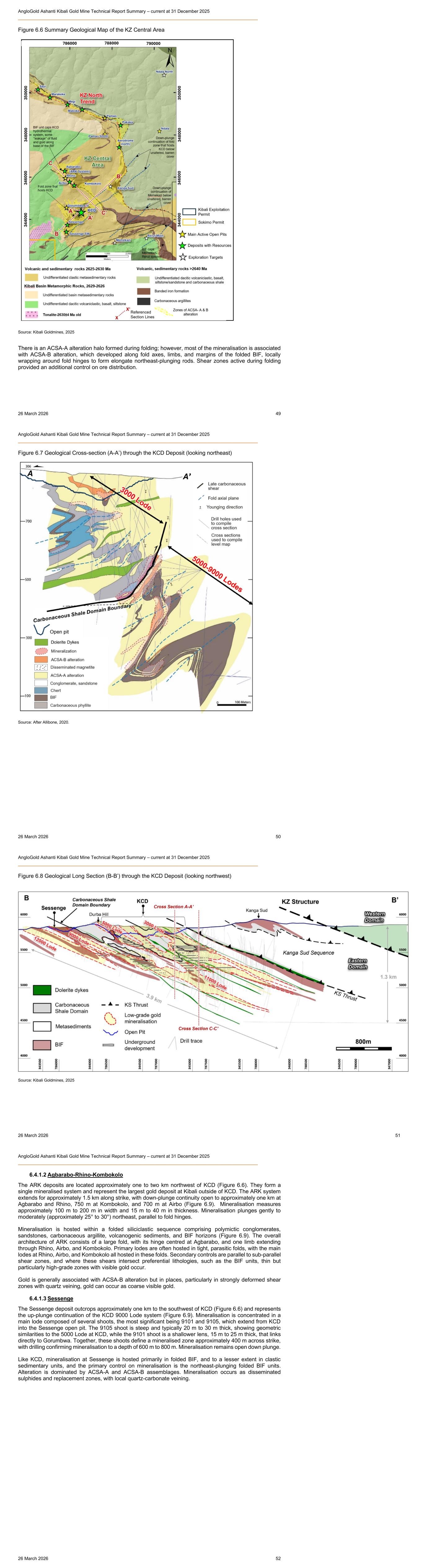
AngloGold Ashanti Kibali Gold Mine Technical Report Summary – current at 31 December 2025 ______________________________________________________________________________ 26 March 2026 49 Figure 6.6 Summary Geological Map of the KZ Central Area Source: Kibali Goldmines, 2025 There is an ACSA-A alteration halo formed during folding; however, most of the mineralisation is associated with ACSA-B alteration, which developed along fold axes, limbs, and margins of the folded BIF, locally wrapping around fold hinges to form elongate northeast-plunging rods. Shear zones active during folding provided an additional control on ore distribution. AngloGold Ashanti Kibali Gold Mine Technical Report Summary – current at 31 December 2025 ______________________________________________________________________________ 26 March 2026 50 Figure 6.7 Geological Cross-section (A-A’) through the KCD Deposit (looking northeast) Source: After Allibone, 2020. AngloGold Ashanti Kibali Gold Mine Technical Report Summary – current at 31 December 2025 ______________________________________________________________________________ 26 March 2026 51 Figure 6.8 Geological Long Section (B-B’) through the KCD Deposit (looking northwest) Source: Kibali Goldmines, 2025 AngloGold Ashanti Kibali Gold Mine Technical Report Summary – current at 31 December 2025 ______________________________________________________________________________ 26 March 2026 52 6.4.1.2 Agbarabo-Rhino-Kombokolo The ARK deposits are located approximately one to two km northwest of KCD (Figure 6.6). They form a single mineralised system and represent the largest gold deposit at Kibali outside of KCD. The ARK system extends for approximately 1.5 km along strike, with down-plunge continuity open to approximately one km at Agbarabo and Rhino, 750 m at Kombokolo, and 700 m at Airbo (Figure 6.9). Mineralisation measures approximately 100 m to 200 m in width and 15 m to 40 m in thickness. Mineralisation plunges gently to moderately (approximately 25° to 30°) northeast, parallel to fold hinges. Mineralisation is hosted within a folded siliciclastic sequence comprising polymictic conglomerates, sandstones, carbonaceous argillite, volcanogenic sediments, and BIF horizons (Figure 6.9). The overall architecture of ARK consists of a large fold, with its hinge centred at Agbarabo, and one limb extending through Rhino, Airbo, and Kombokolo. Primary lodes are often hosted in tight, parasitic folds, with the main lodes at Rhino, Airbo, and Kombokolo all hosted in these folds. Secondary controls are parallel to sub-parallel shear zones, and where these shears intersect preferential lithologies, such as the BIF units, thin but particularly high-grade zones with visible gold occur. Gold is generally associated with ACSA-B alteration but in places, particularly in strongly deformed shear zones with quartz veining, gold can occur as coarse visible gold. 6.4.1.3 Sessenge The Sessenge deposit outcrops approximately one km to the southwest of KCD (Figure 6.6) and represents the up-plunge continuation of the KCD 9000 Lode system (Figure 6.9). Mineralisation is concentrated in a main lode composed of several shoots, the most significant being 9101 and 9105, which extend from KCD into the Sessenge open pit. The 9105 shoot is steep and typically 20 m to 30 m thick, showing geometric similarities to the 5000 Lode at KCD, while the 9101 shoot is a shallower lens, 15 m to 25 m thick, that links directly to Gorumbwa. Together, these shoots define a mineralised zone approximately 400 m across strike, with drilling confirming mineralisation to a depth of 600 m to 800 m. Mineralisation remains open down plunge. Like KCD, mineralisation at Sessenge is hosted primarily in folded BIF, and to a lesser extent in clastic sedimentary units, and the primary control on mineralisation is the northeast-plunging folded BIF units. Alteration is dominated by ACSA-A and ACSA-B assemblages. Mineralisation occurs as disseminated sulphides and replacement zones, with local quartz-carbonate veining.
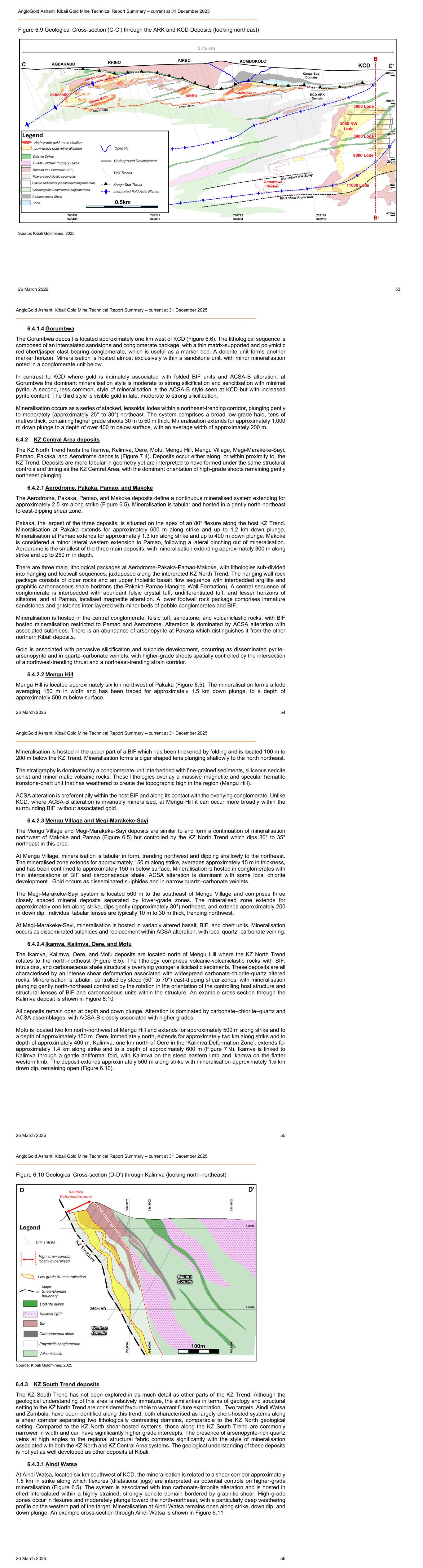
AngloGold Ashanti Kibali Gold Mine Technical Report Summary – current at 31 December 2025 ______________________________________________________________________________ 26 March 2026 53 Figure 6.9 Geological Cross-section (C-C’) through the ARK and KCD Deposits (looking northeast) Source: Kibali Goldmines, 2025 AngloGold Ashanti Kibali Gold Mine Technical Report Summary – current at 31 December 2025 ______________________________________________________________________________ 26 March 2026 54 6.4.1.4 Gorumbwa The Gorumbwa deposit is located approximately one km west of KCD (Figure 6.6). The lithological sequence is composed of an intercalated sandstone and conglomerate package, with a thin matrix-supported and polymictic red chert/jasper clast bearing conglomerate, which is useful as a marker bed. A dolerite unit forms another marker horizon. Mineralisation is hosted almost exclusively within a sandstone unit, with minor mineralisation noted in a conglomerate unit below. In contrast to KCD where gold is intimately associated with folded BIF units and ACSA-B alteration, at Gorumbwa the dominant mineralisation style is moderate to strong silicification and sericitisation with minimal pyrite. A second, less common, style of mineralisation is the ACSA-B style seen at KCD but with increased pyrite content. The third style is visible gold in late, moderate to strong silicification. Mineralisation occurs as a series of stacked, lensoidal lodes within a northeast-trending corridor, plunging gently to moderately (approximately 25° to 30°) northeast. The system comprises a broad low-grade halo, tens of metres thick, containing higher grade shoots 30 m to 50 m thick. Mineralisation extends for approximately 1,000 m down plunge to a depth of over 400 m below surface, with an average width of approximately 200 m. 6.4.2 KZ Central Area deposits The KZ North Trend hosts the Ikamva, Kalimva, Oere, Mofu, Mengu Hill, Mengu Village, Megi-Marakeke-Sayi, Pamao, Pakaka, and Aerodrome deposits (Figure 7 4). Deposits occur either along, or within proximity to, the KZ Trend. Deposits are more tabular in geometry yet are interpreted to have formed under the same structural controls and timing as the KZ Central Area, with the dominant orientation of high-grade shoots remaining gently northeast plunging. 6.4.2.1 Aerodrome, Pakaka, Pamao, and Makoke The Aerodrome, Pakaka, Pamao, and Makoke deposits define a continuous mineralised system extending for approximately 2.5 km along strike (Figure 6.5). Mineralisation is tabular and hosted in a gently north-northeast to east-dipping shear zone. Pakaka, the largest of the three deposits, is situated on the apex of an 80° flexure along the host KZ Trend. Mineralisation at Pakaka extends for approximately 600 m along strike and up to 1.2 km down plunge. Mineralisation at Pamao extends for approximately 1.3 km along strike and up to 400 m down plunge. Makoke is considered a minor lateral western extension to Pamao, following a lateral pinching out of mineralisation. Aerodrome is the smallest of the three main deposits, with mineralisation extending approximately 300 m along strike and up to 250 m in depth. There are three main lithological packages at Aerodrome-Pakaka-Pamao-Makoke, with lithologies sub-divided into hanging and footwall sequences, juxtaposed along the interpreted KZ North Trend. The hanging wall rock package consists of older rocks and an upper tholeiitic basalt flow sequence with interbedded argillite and graphitic carbonaceous shale horizons (the Pakaka-Pamao Hanging Wall Formation). A central sequence of conglomerate is interbedded with abundant felsic crystal tuff, undifferentiated tuff, and lesser horizons of siltstone, and at Pamao, localised magnetite alteration. A lower footwall rock package comprises immature sandstones and gritstones inter-layered with minor beds of pebble conglomerates and BIF. Mineralisation is hosted in the central conglomerate, felsic tuff, sandstone, and volcaniclastic rocks, with BIF hosted mineralisation restricted to Pamao and Aerodrome. Alteration is dominated by ACSA alteration with associated sulphides. There is an abundance of arsenopyrite at Pakaka which distinguishes it from the other northern Kibali deposits. Gold is associated with pervasive silicification and sulphide development, occurring as disseminated pyrite– arsenopyrite and in quartz–carbonate veinlets, with higher-grade shoots spatially controlled by the intersection of a northwest-trending thrust and a northeast-trending strain corridor. 6.4.2.2 Mengu Hill Mengu Hill is located approximately six km northwest of Pakaka (Figure 6.5). The mineralisation forms a lode averaging 150 m in width and has been traced for approximately 1.5 km down plunge, to a depth of approximately 500 m below surface. AngloGold Ashanti Kibali Gold Mine Technical Report Summary – current at 31 December 2025 ______________________________________________________________________________ 26 March 2026 55 Mineralisation is hosted in the upper part of a BIF which has been thickened by folding and is located 100 m to 200 m below the KZ Trend. Mineralisation forms a cigar shaped lens plunging shallowly to the north northeast. The stratigraphy is dominated by a conglomerate unit interbedded with fine-grained sediments, siliceous sericite schist and minor mafic volcanic rocks. These lithologies overlay a massive magnetite and specular hematite ironstone-chert unit that has weathered to create the topographic high in the region (Mengu Hill). ACSA alteration is preferentially within the host BIF and along its contact with the overlying conglomerate. Unlike KCD, where ACSA-B alteration is invariably mineralised, at Mengu Hill it can occur more broadly within the surrounding BIF, without associated gold. 6.4.2.3 Mengu Village and Megi-Marakeke-Sayi The Mengu Village and Megi-Marakeke-Sayi deposits are similar to and form a continuation of mineralisation northwest of Makoke and Pamao (Figure 6.5) but controlled by the KZ North Trend which dips 30° to 35° northeast in this area. At Mengu Village, mineralisation is tabular in form, trending northwest and dipping shallowly to the northeast. The mineralised zone extends for approximately 150 m along strike, averages approximately 15 m in thickness, and has been confirmed to approximately 150 m below surface. Mineralisation is hosted in conglomerates with thin intercalations of BIF and carbonaceous shale. ACSA alteration is dominant with some local chlorite development. Gold occurs as disseminated sulphides and in narrow quartz–carbonate veinlets. The Megi-Marakeke-Sayi system is located 500 m to the southeast of Mengu Village and comprises three closely spaced mineral deposits separated by lower-grade zones. The mineralised zone extends for approximately one km along strike, dips gently (approximately 30°) northeast, and extends approximately 200 m down dip. Individual tabular lenses are typically 10 m to 30 m thick, trending northwest. At Megi-Marakeke-Sayi, mineralisation is hosted in variably altered basalt, BIF, and chert units. Mineralisation occurs as disseminated sulphides and replacement within ACSA alteration, with local quartz–carbonate veining. 6.4.2.4 Ikamva, Kalimva, Oere, and Mofu The Ikamva, Kalimva, Oere, and Mofu deposits are located north of Mengu Hill where the KZ North Trend rotates to the north-northeast (Figure 6.5). The lithology comprises volcanic-volcaniclastic rocks with BIF, intrusions, and carbonaceous shale structurally overlying younger siliciclastic sediments. These deposits are all characterised by an intense shear deformation associated with widespread carbonate-chlorite-quartz altered rocks. Mineralisation is tabular, controlled by steep (50° to 70°) east-dipping shear zones, with mineralisation plunging gently north-northeast controlled by the rotation in the orientation of the controlling host structure and structural lenses of BIF and carbonaceous units within the structure. An example cross-section through the Kalimva deposit is shown in Figure 6.10. All deposits remain open at depth and down plunge. Alteration is dominated by carbonate–chlorite–quartz and ACSA assemblages, with ACSA-B closely associated with higher grades. Mofu is located two km north-northwest of Mengu Hill and extends for approximately 500 m along strike and to a depth of approximately 150 m. Oere, immediately north, extends for approximately two km along strike and to depth of approximately 400 m. Kalimva, one km north of Oere in the ‘Kalimva Deformation Zone’, extends for approximately 1.4 km along strike and to a depth of approximately 600 m (Figure 7 9). Ikamva is linked to Kalimva through a gentle antiformal fold, with Kalimva on the steep eastern limb and Ikamva on the flatter western limb. The deposit extends approximately 500 m along strike with mineralisation approximately 1.5 km down dip, remaining open (Figure 6.10). AngloGold Ashanti Kibali Gold Mine Technical Report Summary – current at 31 December 2025 ______________________________________________________________________________ 26 March 2026 56 Figure 6.10 Geological Cross-section (D-D’) through Kalimva (looking north-northeast) Source: Kibali Goldmines, 2025 6.4.3 KZ South Trend deposits The KZ South Trend has not been explored in as much detail as other parts of the KZ Trend. Although the geological understanding of this area is relatively immature, the similarities in terms of geology and structural setting to the KZ North Trend are considered favourable to warrant future exploration. Two targets, Aindi Watsa and Zambula, have been identified along this trend, both characterised as largely chert-hosted systems along a shear corridor separating two lithologically contrasting domains, comparable to the KZ North geological setting. Compared to the KZ North shear-hosted systems, those along the KZ South Trend are commonly narrower in width and can have significantly higher grade intercepts. The presence of arsenopyrite-rich quartz veins at high angles to the regional structural fabric contrasts significantly with the style of mineralisation associated with both the KZ North and KZ Central Area systems. The geological understanding of these deposits is not yet as well developed as other deposits at Kibali. 6.4.3.1 Aindi Watsa At Aindi Watsa, located six km southwest of KCD, the mineralisation is related to a shear corridor approximately 1.8 km in strike along which flexures (dilatational jogs) are interpreted as potential controls on higher-grade mineralisation (Figure 6.5). The system is associated with iron carbonate-limonite alteration and is hosted in chert intercalated within a highly strained, strongly sericite domain bordered by graphitic shear. High-grade zones occur in flexures and moderately plunge toward the north-northeast, with a particularly deep weathering profile on the western part of the target. Mineralisation at Aindi Watsa remains open along strike, down dip, and down plunge. An example cross-section through Aindi Watsa is shown in Figure 6.11.

AngloGold Ashanti Kibali Gold Mine Technical Report Summary – current at 31 December 2025 ______________________________________________________________________________ 26 March 2026 57 Figure 6.11 Geological Cross-section (E-E’) through Aindi Watsa (looking east-northeast) Source: Kibali Goldmines, 2025 6.5 Comment on geological setting and mineralisation In the opinion of the QP, the understanding of the deposit settings, lithologies, and geologic, structural, and alteration controls on mineralisation is sufficient to support estimation of Mineral Resources and Mineral Reserves. 7. Exploration 7.1 Nature and extent of relevant exploration work Kibali has been explored in detail since the early 1990s by geochemistry sampling, mapping, trenching, geophysical surveys, and drilling. The Kibali district is highly prospective for gold mineralisation, with a relatively low exploration maturity. The full potential of the district remains undefined. The approach to exploration at Kibali involves the identification of deep crustal, long-lived, gold-bearing structures that have the potential to supply fertile hydrothermal fluids sufficient to host mineralisation. Second- order structures within prospective host lithologies such as chemically reactive or rheologically contrasting units, or structural dilation zones, are also targeted. These structures are identified through geophysical, geochemical, and isotope data, and through regional geological mapping. Exploration is structured to develop advanced targets to rapidly feed into the mine plan, and to develop early- stage targets to replenish the target pipeline and sustain the long-term growth of the Mine. Recent surface exploration, including geological mapping, trenching, soil sampling, and stream sediment sampling, has focused on the Dembu AOI (Figure 6.5). This prospect is in the west of the Kibali Exploitation Permits and shows similarities to the geological setting of the KCD area, with favourable host rocks (BIF, sediments, felsic intrusive), hydrothermal alteration, and structural complexity AngloGold Ashanti Kibali Gold Mine Technical Report Summary – current at 31 December 2025 ______________________________________________________________________________ 26 March 2026 58 7.1.1 Geology and geochronology Geological and geochronological investigations have been undertaken on a variety of scales including at the KCD deposit, along the KZ Trend, and throughout the Moto Greenstone Belt to define the internal structure, hydrothermal character, and geologic context of the gold deposits in the district more clearly (Lawrence, 2011; Bird, 2016; Jongens et al., 2016; Allibone and Vargas, 2017, and Allibone et al., 2020). Geological mapping is completed regularly as part of the approach to exploration at Kibali. Geological mapping is undertaken to understand the geology of a target and to aid the interpretation of geochemical and geophysical datasets. Additionally, geological mapping is used to help identify prospective rock types (BIF, carbonaceous shales, intrusives), hydrothermal alteration and structural settings that may indicate the potential for mineralisation. Recently, geological mapping has been completed at all early-stage targets as part of the exploration workflow, with larger mapping programmes across Dembu, Ikamva NW, and KZ South (Figure 6.5). 7.1.2 Geophysics and remote sensing Geophysical surveying forms a key part of the approach to exploration at Kibali. The distribution and form of the ironstone units, carbonaceous shale horizons, and intrusives can be mapped by airborne geophysics with confidence. Targets with coincident magnetic highs (BIF), electromagnetic (EM) conductive highs (carbonaceous shales), structural complexity with folding and dislocations, evidence of alteration and/or geochemical anomalism are of particular interest. Geophysical datasets have been combined with a longer-term ongoing study to develop a more detailed tectonostratigraphy for Kibali, and to improve the understanding of the controls to gold mineralisation and regional geological architecture. This project-wide geological framework is driving a re-assessment of exploration work to date and supporting early-stage target generation. In the past, a range of geophysical surveys have been completed and these are still used to guide exploration. These surveys include airborne magnetics, radiometrics, EM, and detailed topographic surveys (LiDAR). The coverage of the various geophysical surveys is shown in Figure 7.1. In 2010, Spectrem Air Limited completed an airborne EM, magnetic, and radiometric survey covering a total of 2,219 km2 including a total of 10,559 line-km at nominal line spacing of 200 m, with 100 m line spacing at KCD (Figure 7.1). In 2020, Xcalibur Airborne Geophysics completed a high-resolution aeromagnetic and radiometric survey along the KZ Trend covering an area of 304 km2 at nominal line spacing of 50 m, for a total of 7,221 line-km (Figure 7.1). There are plans to extend this survey to the west in 2026 to support geological understanding in the Dembu AOI. In 2020, a high-resolution topographical survey was undertaken by Southern Mapping to produce a digital terrain model (DTM) and rectified colour images of the KZ South Trend, thus completing high-resolution DTM coverage over the entire KZ Trend (Figure 7.1). The survey was carried out using an aircraft-mounted LiDAR system to create a high-resolution DTM of the ground surface and objects above the ground (>6 cm vertical accuracy). The remainder of the Project area utilised topography data from Shuttle Radar Topography Mission (SRTM). An Audio Magneto-Telluric (AMT) survey is planned to commence in February 2026, along the KZ Trend. The survey is due to cover an area of 237 km2 with a line spacing between 400 m and 800 m (Figure 7.1). The objective of the survey is to map structure over the identified KZ Trend targets and map the contact between BIF and carbonaceous shales beyond the depths possible with current drilling and EM surveys. The survey and subsequent processing will be completed in phases during 2026. AngloGold Ashanti Kibali Gold Mine Technical Report Summary – current at 31 December 2025 ______________________________________________________________________________ 26 March 2026 59 Figure 7.1 Plan View Map of Geophysical Surveys at Kibali Source: Kibali Goldmines, 2025 7.1.3 Geochemical sampling Surface geochemical sampling, including soil sampling, stream sediment sampling, trenching, and pitting, is a key part of early exploration at Kibali. Geochemical anomalies developed from surface sampling correlate well with the KZ Trend and the northeast-trending structural corridors at Kibali. Soil sampling is a first-pass technique where the terrane is suitable and access is good. Despite potential contamination from ASM workings, the thin transported cover, shallow paleoweathering surfaces, and weak laterite development mean that robust geochemical anomalies can be found proximal to mineralisation in some areas. Prior to conducting a soil sampling programme, a regolith map is produced by interpreting existing datasets (including DTM, satellite imagery, and radiometrics) and by field validation. Test pits are excavated to further understand the regolith profile, thickness, validate regolith mapping, and ultimately to identify any regolith characteristics that may impact soil results. Once a grid is designed, each sampling station is cleared of surface vegetation prior to sampling. A hole is excavated to the subsoil, approximately 30 cm depth, and a 1 kg sample is collected. If quartz fragments are abundant, the sample is sieved to <5 mm. Samples are generally collected at 50 m centres along lines spaced 200 m and 400 m apart. Anomalous lines are in filled with samples at 50 m centres along lines spaced 100 m and 200 m apart. Soil samples are analysed by aqua regia-atomic absorption spectroscopy (AAS) for gold and X-Ray Fluorescence (XRF) for multi-elements. Soil samples collected are summarised in Table 7.1 and their locations are shown in Figure 7.2. AngloGold Ashanti Kibali Gold Mine Technical Report Summary – current at 31 December 2025 ______________________________________________________________________________ 26 March 2026 60 Table 7.1 Kibali Soil and Stream Sediment Sample Summary Year Company Number of Soil Samples Number of Stream Samples Total Number of Samples 2008 Moto 28,864 - 28,864 2009 Kibali Goldmines 5,030 - 5,030 2010 Kibali Goldmines 617 - 617 2013 Kibali Goldmines 205 - 205 2014 Kibali Goldmines 1,673 - 1,673 2015 Kibali Goldmines 2,295 - 2,295 2016 Kibali Goldmines - - 0 2017 Kibali Goldmines 4,073 - 4,073 2018 Kibali Goldmines - 313 313 2019 Kibali Goldmines 2,420 - 2,420 2020 Kibali Goldmines 1,528 - 1,528 2021 Kibali Goldmines 447 - 447 2022 Kibali Goldmines - - - 2023 Kibali Goldmines - - - 2024 Kibali Goldmines - - - 2025 Kibali Goldmines 3,843 - 3,843 Total 50,995 313 50,995 Soil sampling in 2025 has focused on the Dembu AOI where a total of 3,843 soil samples were collected over 54 km2 on a 200 m by 100 m grid. The objective of the soil sampling campaign was to verify the location and shape of the historical gold anomalies, and to complete multi-element analysis to map gold pathfinder elements to aid planning of further exploration including mapping, trenching, and drilling. Additionally, the multi-element analysis results produce lithogeochemical signatures that will aid in building the geological framework under the regolith cover. Interpretation of geochemical results will be completed in 2026. Due to thicker transported cover (>2 m) and higher-grade metamorphism, soil sampling is less suitable in the east and so an extensive stream sediment sampling programme was undertaken in 2018. The objective was to generate potential new greenfield targets with a greater confidence than the historical soil sampling alone. The stream sediment samples were analysed for low detection gold and for 53 elements to define pathfinders. Anomalous catchments were ranked and selected for follow-up on soil sampling and mapping. The stream sediment samples taken at Kibali are summarised in Table 7.1 and their locations and results are shown in Figure 7.2. Stream sediment sampling identified grassroots targets Makoro, Abimva, Kialo, Lanza, and Marabi in the east of the licence (Figure 7.2). The Lanza target was further tested in 2020 with soil sampling and geological mapping, but the anomalous catchment was found not to have significant potential. The Makoro target was followed up with drill testing, but the mineralisation was found to be lower grade, discontinuous, and too far from the processing plant to host significant potential. Abimva, Kialo, and Marabi are yet to be followed up. Geophysical and geochemical targets and geological mapping are also ground tested with pitting and trenching prior to drill testing. Table 7.2 presents a summary of the Kibali trenching, auger, and pit lithosamples collected to date. Table 7.2 Kibali Trenches, Auger and Pits Summary Year Company Trenches Auger Pits Total Metres No. Metres No. Metres No. Metres No. 2010 Kibali Goldmines 481 5 - - 273 48 754 53 2011 Kibali Goldmines 398 2 350 185 538 147 1,286 334 2012 Kibali Goldmines 1,050 43 1,083 181 691 131 2,823 355 2013 Kibali Goldmines 3,216 61 11 2 498 165 3,725 228 2014 Kibali Goldmines 8,570 83 83 23 1,115 383 9,768 489

AngloGold Ashanti Kibali Gold Mine Technical Report Summary – current at 31 December 2025 ______________________________________________________________________________ 26 March 2026 61 Year Company Trenches Auger Pits Total Metres No. Metres No. Metres No. Metres No. 2015 Kibali Goldmines 12,240 110 800 360 3,727 1,128 16,767 1,598 2016 Kibali Goldmines 8,066 101 1,799 843 1,830 648 11,694 1,592 2017 Kibali Goldmines 8,712 58 - - 1,596 605 10,308 663 2018 Kibali Goldmines 7,751 53 5791.75 1128 1,137 334 14,680 1515 2019 Kibali Goldmines 4,073 30 1178.57 265 314 87 5,565 382 2020 Kibali Goldmines 3,336 21 - - 123 50 3,459 71 2021 Kibali Goldmines 697.5 7 - - 43 24 50 31 2022 Kibali Goldmines 36 1 - - 152.58 64 153.58 65 2023 Kibali Goldmines 750 4 - - - - 750 4 2024 Kibali Goldmines - - - - - - - - 2025 Kibali Goldmines 1,208 4 - - 213 54 1421 58 Total 60,360 582 11,096 2,987 12,253 3,868 83,709 7437 Figure 7.2 Plan View Map of Soil and Stream Sediment Sampling at Kibali Source: Kibali Goldmines, 2025 7.1.4 Exploration potential Future exploration will focus on the known mineralised areas including KZ North Trend, KZ South Trend, Ikamva NW AOI, and Dembu AOI (Figure 6.5). Exploration will include geological mapping, trenching, geochemistry, high-resolution geophysics surveys, with follow-up drilling as appropriate in the following key areas: • Aerodrome to Mengu (KZ North Trend): The AMT survey will be completed and processed, and results will be used to support drill planning in two locations over the 7 km KZ North Trend to test AngloGold Ashanti Kibali Gold Mine Technical Report Summary – current at 31 December 2025 ______________________________________________________________________________ 26 March 2026 62 open mineralisation below the current pits and to better understand the KZ Trend. Drilling will aim to identify changes in dip in the structure and identify where prospective host rocks have been dismembered, both of which are known controls on high-grade mineralisation along the KZ North Trend. • Ikamva NW AOI (KZ North Trend): Target generation work, including geological mapping, trenching, and soil sampling along the northwest extension of the KZ North Trend. The objective is to assess the geology and structure in this area which currently indicates that the KZ North Trend extends approximately 4 km further to the northwest. • Aindi Watsa to Zakitoko (KZ South Trend): Results of geological mapping, soil sampling, and the planned AMT survey will be used to plan trenching, and potentially drilling to assess the KZ South Trend, which at present is less well understood than other parts of the KZ Trend. The objective is to test for localised higher grades along structural dilations or intersections, as well as testing for sub-parallel structures. • Dembu AOI: A high-resolution aeromagnetic survey is planned for 2026. Results of this survey, along with recent soil sampling, will be interpreted and used to plan follow-up drilling to identify and further understand the structural controls in this area, which has a similar geological setting to KCD. 7.1.5 Comment on exploration Kibali has detailed Standard Operating Procedures (SOPs) for Exploration and Drilling Practices that provides standardisation and consistency to ensure the collection of quality data by all field technical personnel. In the opinion of the QP, all samples collected to date by the current and previous operators are representative and unbiased. In the opinion of the QP, the exploration programmes completed to date are appropriate for the style of the deposits and prospects within the Project. Kibali retains significant exploration potential, and additional work is planned. 7.2 Drilling 7.2.1 Drilling summary Kibali is an advanced project with operating open pits and an underground mine, and drilling is completed regularly as part of ongoing operations. All drilling falls into three categories each with specific objectives and outcomes as follows: • Exploration Drilling (EXP) - Wide spaced (>100 m) exploration drilling intended to grow the Mineral Resource base. • Resource Definition Drilling (RDD) – First pass wide spaced (<100 m to >10 m) drilling to increase confidence in open pit and underground Mineral Resources to a sufficient level of confidence to support Mineral Reserves. This can be more tightly spaced (<40 m to >10 m) in areas of increased geological complexity or varied grade distribution. • Grade Control (GC) Drilling – Close spaced (<10 m to >5 m) grade control drilling for final production definition to inform Measured Mineral Resources/Proven Mineral Reserves. Generally, Kibali Goldmines’ target inventory of infill GC drilling is approximately six to 12 months of production coverage for open pits and between 18 and 24 months for underground. Diamond drilling (DD) is used in all categories and for underground GC drilling. Reverse circulation (RC) drilling is used for exploration, resource definition, and GC. RC drilling is used only on surface, primarily for shallow exploration and open pit GC. If penetration rates of RC drilling decrease materially or if groundwater inflows prevent the collection of a dry sample, then the drill hole is continued with a DD tail. AngloGold Ashanti Kibali Gold Mine Technical Report Summary – current at 31 December 2025 ______________________________________________________________________________ 26 March 2026 63 Table 7.3 and Figure 7.3 present drilling completed at Kibali to September 2025. Table 7.3 Kibali Drilling Summary to September 2025 Year Company Diamond Drilling Reverse Circulation RC Collar + DD Tail Total Metres No. of Metres No. of Metres No. of Metres No. of (m) Holes (m) Holes (m) Holes (m) Holes 1950 OKIMO 35,153 242 2,856 102 - - 38,009 344 1951 OKIMO 1,259 15 - - - - 1,259 15 1952 OKIMO 294 5 - - - - 294 5 1960 OKIMO 16,162 175 - - - - 16,162 175 1980 Moto 1,484 10 - - - - 1,484 10 1996 Barrick 8,988 70 - - - - 8,988 70 2004 Moto 9,840 50 42,133 655 - - 51,973 705 2005 Moto 42,672 201 51,685 739 - - 94,357 940 2006 Moto 50,396 227 34,658 558 178 1 85,232 786 2007 Moto 51,540 125 19,574 402 - - 71,114 527 2008 Moto 50,516 98 - - - - 50,516 98 2009 Moto 23,035 67 - - - - 23,035 67 Sub-Total 291,339 1,285 150,906 2,456 178 1 442,423 3,742 2009 Kibali Goldmines 2,938 9 - - - - 2,938 9 2010 Kibali Goldmines 28,403 64 24,166 483 - - 52,569 547 2011 Kibali Goldmines 10,507 28 59,192 1,811 - - 69,699 1,839 2012 Kibali Goldmines 23,166 79 94,764 1,834 - - 117,930 1,913 2013 Kibali Goldmines 18,794 77 80,036 1,487 - - 98,830 1,564 2014 Kibali Goldmines 34,079 176 140,283 2,941 417 3 174,779 3,120 2015 Kibali Goldmines 52,375 311 112,260 2,372 2,715 17 167,350 2,700 2016 Kibali Goldmines 71,834 559 210,908 2,950 8,691 48 291,433 3,557 2017 Kibali Goldmines 122,074 700 202,680 2,854 - - 324,754 3,554 2018 Kibali Goldmines 112,571 616 114,867 1,701 772 3 228,210 2,320 2019 Kibali Goldmines 79,584 409 102,002 1,514 - - 181,586 1,923 2020 Kibali Goldmines 116,729 551 133,902 1,900 - - 250,631 2,451 2021 Kibali Goldmines 113,698 672 182,739 3,152 793 3 297,230 3,827 2022 Kibali Goldmines 113,474 701 166,980 2,800 8,191 15 288,645 3,516 2023 Kibali Goldmines 161,198 1,172 171,348 3,642 - - 332,546 4,814 2024 Kibali Goldmines 160,594 1,179 265,241 4,354 498 4 426,333 5,535 2025 Kibali Goldmines 135,701 834 158,013 2,733 293,714 3,567 Sub-Total 1,357,719 8,137 2,219,381 38,528 22,077 93 3,599,177 46,756 Total 1,649,058 9,422 2,370,287 40,984 22,255 94 4,041,600 50,498 AngloGold Ashanti Kibali Gold Mine Technical Report Summary – current at 31 December 2025 ______________________________________________________________________________ 26 March 2026 64 Figure 7.3 Kibali Drill Collar Location Plan Source: Kibali Goldmines, 2025 Drilling completed before 2009 by previous operators is considered historical. Historical drilling accounts for a minority (7.4%) of the total drill data and is largely superseded by more recent drilling. Drilling completed before 2004 does not have fully documented procedures and therefore is not used to estimate Mineral Resources. Drilling completed between 2004 and 2009 by Moto has documented procedures, good quality assurance/quality control (QA/QC) practices, and has been verified with twin drilling. This data is used to estimate Mineral Resources but once drilling gets to the GC stage this data is removed from the Mineral Resource database as it is superseded by the high-density GC drilling. Historical drilling is also used for exploration targeting.

AngloGold Ashanti Kibali Gold Mine Technical Report Summary – current at 31 December 2025 ______________________________________________________________________________ 26 March 2026 65 The overall proportions of RC and DD drilling are based on the stage of the programme and the required drill spacing. In most years, the amount of RC drilling is greater than DD drilling due to the close-spaced GC drilling required in the numerous active open pits. In the last three years, RDD for Mineral Resource and Mineral Reserves has primarily been DD and focused on the KCD and ARK deposits. Between 2022 and 2025, drilling at KCD focused on expanding the underground Mineral Resources and Mineral Reserves by defining the extent of the 5000 and 11000 lodes, as well as defining the down-plunge continuity of the ‘KCD Deeps’ target, which is the continuation of the 3000 and 5000 lodes. Figure 7.4 and Figure 7.5 show a detailed plan view of this drilling and representative cross-section through the KCD deposit, respectively. Between 2023 and 2025, drilling at ARK progressed from gaining an understanding of the geological system to testing and defining the mineralisation. Figure 7.4 and Figure 7.6 show a detailed plan view of this drilling and representative cross-section through the ARK deposits, respectively. Figure 7.4 KCD and ARK Deposit Drill Plan Source: Kibali Goldmines, 2025 AngloGold Ashanti Kibali Gold Mine Technical Report Summary – current at 31 December 2025 ______________________________________________________________________________ 26 March 2026 66 Figure 7.5 Representative Cross-section (B-B’) through the KCD Deposit (looking northeast) Source: Kibali Goldmines, 2025 AngloGold Ashanti Kibali Gold Mine Technical Report Summary – current at 31 December 2025 ______________________________________________________________________________ 26 March 2026 67 Figure 7.6 Representative Cross-section (A-A’) through the ARK Deposit (looking northeast) Source: Kibali Goldmines, 2025 7.2.2 Drill methods 7.2.2.1 Drill planning and site preparation Drill holes are planned in Vulcan, Leapfrog, and Micromine software. Consideration is given to the orientation of the drilling in relation to the geological structures to provide unbiased sampling. Drilling directions are optimised on an individual deposit basis to ensure that the preferred drilling direction is on a cross-plunge basis, cutting the geological trend perpendicularly, or at high angle close to true thickness. Efforts to avoid low angle intercepts that may introduce bias are ongoing during drill programme design and budgeting. The senior geologist, drill contractor, mine planner, mine surveyor, and mineral resource manager all sign off on the drill hole plan prior to initiating drilling. Open pit drill collars, as well as backsights and foresights, were surveyed using a differential Global Positioning System (GPS) and then staked by Kibali Goldmines mine surveyors or geologists. Underground drill collars, as well as backsights and foresights, were surveyed using total station underground survey instruments, and marked on the drift walls, by Kibali Goldmines mine surveyors. 7.2.2.2 Downhole surveying Reflex EZ-Trac tools were used prior to mid-2016 but were replaced by Reflex EZ-Gyro. When both EZ-Trac and conventional Gyro surveys were being completed, the results of the Gyro survey took higher priority than those of Reflex EZ-Trac surveys. Orientation surveys were completed on all holes using either a Reflex EZ-Gyro or a Reflex Sprint-Gyro (new gyro tool introduced in 2020). Reflex EZ-Gyro surveys were undertaken in both uphole and downhole directions every 5 m and Reflex Sprint-Gyro surveys were undertaken in an uphole direction every 3 m. Downhole survey equipment is calibrated yearly and checked every quarter by Reflex technicians during site visits. 7.2.2.3 Collar surveys All drill collar locations were surveyed using a differential GPS to 10 mm accuracy. The Mine uses the UTM Zone 35N datum WGS84 grid for drill hole coordinates. A local mine grid height adjustment of +5000 mRL from true elevation (above mean sea level) is applied to all data to maintain positive underground mine level naming. AngloGold Ashanti Kibali Gold Mine Technical Report Summary – current at 31 December 2025 ______________________________________________________________________________ 26 March 2026 68 7.2.2.4 Diamond drilling From surface, 85.0 mm diameter core (PQ) is generally drilled for the first 20 m to 40 m down hole through overlying alluvium/saprolite, following which the core size is reduced to either 63.3 mm diameter core (HQ), or 47.6 mm diameter core (NQ). All underground diamond drilling is completed in NQ. Recent DD has generally been completed by Boart Longyear, Orezone, Comisemi, Amazone, and Action B, the last three of which are local drilling companies. Core recoveries are in general excellent, with an average of 99.3% recovery in fresh rock, 88.8% recovery in the transitional zone, and 87.4% in saprolite zone. Drilling Procedure A project geologist must be on site prior to drilling commencing to ensure that the drill rig is lined up as per the drill plan. They will supervise ongoing drilling, core orientation, and downhole surveying. Once each drill run is complete, the drill core is removed from the drill rod and placed in an angled iron rack to mark up an orientation line with red chinagraph pencil or crayon, as indicated by a Reflex ACT II Core Orientation Tool. The apex of the structure is also marked on the core in a chinagraph pencil or crayon by the core technician. If the orientation and apex lines are overlapping, then the apex line is offset by 5 mm. DD core is transferred into metal core trays, and a downhole depth marker is placed at the end of each core run with the depth marked on it. All areas of core loss are identified, and the run markers are updated with the core recovery. Each drill core box is marked with the hole ID, top and bottom depth of the core, and the box number. The core is then transferred to the core yard facility for logging and sampling. Core Logging Core is geologically logged directly into computer tablets with Maxwell LogChief installed, or, less commonly, into standardised paper log sheets. Logging includes weathering, grain size, mineralisation, alteration style, lithology, structural measurements, and oxidation state data. Senior geologists review all logs, as well as working geological sections to ensure accuracy. Geologists create a sampling plan directly into computer tablets, or, less commonly, into standardised paper sampling sheets, labelling the boxes and core with sample codes. The core (both wet and dry) is then digitally photographed using a purpose-built imaging station, high-resolution camera, and Imago software. These photos are stored on the cloud for ease of sharing and future viewing in 3D modelling software. When paper logs or sample sheets are utilised, the data is manually transcribed to Microsoft Excel before being stored in a central database, after the responsible geologist has validated their inputs. All core is oriented and where orientation is not possible, the core is assembled with previous runs, where possible, to extend the orientation line. A dedicated geotechnical logging team digitally captures detailed geotechnical logging using tablets for all open pit and underground drill core, not just for holes drilled specifically for geotechnical assessment. Since 2018, logging data has been synchronised with the main database at the end of the shift. Sampling Core samples are usually between 0.7 m and 1.3 m long, according to major geological contacts. The drill core is split in half along a cutting line (CL), 10° clockwise from the orientation line (OL), using diamond saws utilising freshwater. When looking down hole, the right-hand side half core is submitted for primary assay. First split duplicates consist of submitting the other remaining half of the core. All remaining half-core is stored for future reference.

AngloGold Ashanti Kibali Gold Mine Technical Report Summary – current at 31 December 2025 ______________________________________________________________________________ 26 March 2026 69 Samples for density analysis are collected from half core intervals measuring up to 20 cm in length. Density is measured from these samples by applying the Archimedes Principle: Density = weight (in air) ÷ (weight (in air) – weight (in water) Bulk density measurements were carried out on the oxide, transition, and fresh material for both mineralised and waste rock using this water immersion method. Downhole geophysical methods for measuring density will be investigated with the aim of increasing the resolution of density sampling. 7.2.2.5 Reverse circulation drilling RC chip samples are logged with the same lithological, mineralogical, and alteration information as DD core, but on regular 2 m RC sample intervals split through a levelled riffle splitter several times until a 3 kg to 5 kg sub-sample is obtained (6.25% mass of total material targeted). Recent RC drilling has generally been completed by Boart Longyear and Ore Zone, with smaller amounts completed by local contractors Amazone, Comisemi, and Action B. RC holes typically use 144 mm diameter rods with a 5.5-inch face-sampling bit. RC recovery is measured by proxy, taking the total weight of the sample collected compared against the theoretical expected weight for each material type (accounting for lithology and weathering logged). Chip recovery is in general good, with an average of 67.2% recovery in fresh rock, 70.1% recovery in the transitional zone, and 89.2% in saprolite zone. No trend between grade and recovery has been observed and so lower recoveries are not deemed to have a material impact on the Mineral Resource estimate. Drilling Procedure A project geologist and sampling technicians must be on site prior to drilling. They will ensure that the drill rig is lined up as per the drill plan, supervise the drilling contractor, and carry out manual sampling exterior to the cyclone, plus quality control of all downhole surveying. RC samples are collected in pre-numbered rice bags, arranged in numerical order away from the cyclone area. Samples are weighed and recorded in a sample book to track the quality of drilling and actively feedback to the driller. After homogenisation and splitting, chips are sieved from the reject material and collected in chip trays labelled with the hole ID, depth interval, and the sample number. The samples and chip trays are later stored in the core yard facility for future reference. Logging RC chips are logged in the field by a geologist. Geological logging is completed digitally using Maxwell LogChief installed on tablets that captures weathering, grain size, mineralisation, alteration style, lithology, and oxidation state data, for each 2 m run interval. Sampling RC samples are collected from the rig in fixed 2 m intervals using an external Gilson splitter. The total mass is collected from the cyclone in 1 m run intervals, split by 50% to reduce manual handling. Two consecutive runs are combined to be mixed and further homogenised twice through the splitter. This mass is split three further times to a final 6.25% mass that gives a 3 kg to 5 kg sub-sample for primary assay. First split duplicates arise from splitting the original 1 m reject material in the same way. Auxiliary booster units are used to ensure that samples remain dry. On the rare occasion a moist sample is obtained; it is dried in the sun before being manually split. Wet samples are not accepted, and drilling is stopped. AngloGold Ashanti Kibali Gold Mine Technical Report Summary – current at 31 December 2025 ______________________________________________________________________________ 26 March 2026 70 7.2.3 Twin drilling studies In 2019 twin drilling studies were completed to compare historical Moto drilling to recent drilling at Gorumbwa, Pakaka, and Megi-Marakeke-Sayi. Overall results showed no significant differences between historical Moto drilling and current drilling. Additional twin drilling was done at Ndala in 2024 comparing RC drilling and DD twins. Comparisons of twin holes have shown that although there can be local variations in grade, as expected from the inherent grade variability of each deposit (nugget effect ranges from 15% to 35% of total variance), the broad intercepts and relative grade of the intersections are comparable between twins. 7.2.4 Drill spacing optimisation Drill spacing is based on geological complexity and is optimised using drill hole spacing studies based on closely spaced variance grids. Table 7.4 summarises the range of drill spacing at each deposit. Exploration drilling is generally completed at a spacing of 80 m to 100 m by 80 m or less. Table 7.4 Resource Drill Hole Spacing Definitions per Deposit Deposit Grade Control (m) Min. RDD (m) Max. RDD (m) Comments KCD 20 x 5 to 10 x 5 & 5 x 5 20 x 10 40 x 40 High grade (>2.04 g/t Au) mining polygons drilled to 10 m x 5 m Pakaka 20 x 5 to 10 x 5 & 5 x 5 20 x 10 40 x 40 Areas of high geological complexity drilled to 5 m x 5 m Pamao 20 x 5 to 10 x 5 & 5 x 5 20 x 20 40 x 40 High grade (>1.43 g/t Au) mining polygons drilled to 5 m x 5m Gorumbwa 10 x 5 to 5 x 5 20 x 10 40 x 40 Areas of high geological complexity and high-grade mining polygons drilled to 5 m x 5 m Mengu Hill 10 x 10 20 x 20 40 x 40 Sessenge 10 x 7.5 to 5 x 7.5 20 x 20 40 x 40 Areas of high geological complexity and high-grade mining polygons drilled to 5 m x 7.5 m Sessenge SW To be drilled 10 x 10 20 x 20 40 x 40 Megi-Marakeke- Sayi To be drilled 10 x 10 to 10 x 5 20 x 20 40 x 40 High grade (>1.47 g/t Au) mining polygons drilled to 10 m x 5 m Kalimva 10 x 10 to 10 x 5 20 x 20 40 x 20 High grade (>2.26 g/t Au) mining polygons drilled to 10 m x 5 m Ikamva 10 x 10 to10 x 5 20 x 10 40 x 20 High grade (>2.06 g/t Au) mining polygons drilled to 10 m x 5 m Aerodrome 10 x 10 20 x 20 40 x 40 Oere To be drilled 10 x 10 to 10 x 5 20 x 20 40 x 40 High grade (>3.03 g/t Au) mining polygons drilled to 10 m x 5 m ARK 10 x 5 20 x 20 40 x 20 High grade (>3.03 g/t Au) mining polygons drilled to 10 m x 5 m 7.2.5 Comment on drilling In the opinion of the QP, the quantity and quality of lithological, geotechnical, collar, and downhole survey data collected in the drill programmes are sufficient to support Mineral Resource and Mineral Reserve estimation. The drilling, sampling methods, and collection process are representative of the material with no known factors that would introduce any biases of significant note. No other material factors were identified with the data collection from the drill programmes that would significantly affect the accuracy and reliability of drilling results or the Mineral Resource and Mineral Reserve estimation. AngloGold Ashanti Kibali Gold Mine Technical Report Summary – current at 31 December 2025 ______________________________________________________________________________ 26 March 2026 71 7.3 Hydrogeology 7.3.1 Open pit The groundwater system of Kibali is characterised by the regolith, comprising laterite (often missing in river valleys), highly altered low permeability saprolite and a transition zone that exhibits decreasing clay content and increasing permeability compared to the saprolite. The regolith is typically 10–50 m thick, varying according to the strength of the underlying parent rock. Fracturing in the underlying fresh rock decreases with depth. The base of the ‘fractured aquifer’ is typically 80–120 m below ground level, below which groundwater flow tends to be associated with major structures. Away from open pits groundwater levels are typically within 2–10 m of ground surface. The groundwater surface is progressively lowered during dewatering of open pits. The relatively low permeability of fresh rock and saprolite generally limits the impact on the water table to within 1 km of an operating pit. Infiltration through streambeds maintains groundwater levels close to ground surface in alluvial material. Hydrogeological characterization has been supported through the installation of dewatering boreholes and standpipe piezometers, as well as packer testing programs designed to determine formation-specific hydraulic conductivity and storage coefficients (specific yield). Parameters are refined through progressive data collection and calibration of groundwater models. The typical range of hydrogeological parameters is provided in Table 7.5. Table 7.5 Conceptual ranges of hydraulic properties for main hydrogeological units. Hydraulic conductivity (m/d) Specific yield (%) Unit Low High Low High Alluvium 1 x 10⁻³ 1 x 100 3 25 Laterite / Saprolite 5 x 10⁻⁴ 1 x 10⁻² 2 7.5 Saprock 9 x 10⁻³ 7.2 x 10⁻¹ 1 5 Fractured bedrock 1 x 10⁻⁴ 7 x 10⁻² 0.1 2 Intact bedrock 1 x 10⁻⁴ 5 x 10⁻² 0.01 1 Continuous improvements in the local geological understanding have refined the conceptual hydrogeological model. Groundwater flow paths are primarily associated with brittle shear zones and structural features like carbonaceous schist, or lithological controls; often dolerite intrusions, QSF units and basalt formations. Groundwater monitoring comprises a combination of: • Site wide shallow and deep pairs of monitoring boreholes for water quality and water levels. The shallow boreholes are completed within the weathered zone and a deeper borehole completed within the fractured bedrock; and, • Pit-specific and risk-based monitoring of groundwater levels and pore pressures for ongoing evaluation of dewatering and depressurisation. To improve groundwater management all dewatering boreholes and sump pumping systems have been equipped with flowmeters. A mine-wide upgrade to the pore pressure monitoring network is also being implemented around the open pits, with weekly data collection supporting both dewatering operations and geotechnical stability assessments. AngloGold Ashanti Kibali Gold Mine Technical Report Summary – current at 31 December 2025 ______________________________________________________________________________ 26 March 2026 72 Historically surface water flows have been measured and analysed to determine hydrological parameters for input to water balance models and surface water management design studies. Plans are in place to install permanent flow-measurement weirs in streams in mine-impacted and natural watersheds water for continuous, long-term hydrological monitoring. Surface water sampling is conducted monthly by the Environment team, the results used to regularly update conceptual models of the groundwater and surface water system and inform technical studies as required. An integrated geological and geotechnical structure model approach is being developed to reduce water-related operational and geotechnical risks. This integrated framework aims to improve the understanding of groundwater flow pathways, structural controls on permeability, and expected pit inflows, thereby supporting the optimization of pit dewatering design and mine planning. Digby Wells Environmental and Hydrotechnica Ltd have been contracted to build and calibrate numerical hydrogeological models for all open pits, to support ongoing mine expansion investigations. Groundwater models are calibrated to groundwater level and pit inflow data. The calibration considers surface water influences, local mining conditions including adjacent mine dewatering, pit lake levels and borehole pumping. After calibration, forward looking models are developed and various scenarios run to help optimise groundwater management and assess impacts on the groundwater environment. Water table or pore pressure data are made available to the geotechnical team for input to stability models. It’s the opinion of the QP that the hydrogeology programs are appropriate to support slope design recommendations according to the established slope design criteria and mine plans. 7.3.2 Underground Underground dewatering is managed through a series of drain holes, targeting structures and high permeability zones, leading to sumps. Water in the sumps are pumped to surface using pumps and staging tanks into surface dams from where water is utilised as needed for operations. Typical dewatering rates are approximately 60 000 m3 per week. Water levels are monitored using VWPs in underground and surface holes and the information used to adjust drain hole locations. Interpretations from packer tests indicate a geometric mean hydraulic conductivity of 2.38E- 08m/s. Conductivities of up to 1E-5m/s were interpreted, indicating the presence of high yielding structures, even at depth. Hydrogeological modelling and monitoring at KCD underground are managed by a hydrogeological team on site. SRK provides support and review on hydrogeological aspects. A revised conceptual model for the Northern KCD area was developed that considers both current (pre- mitigation) and future (post-mitigation) groundwater pathways. The revised conceptual model was used as the basis for the proposed dewatering and depressurisation plan. This is managed through the dewatering plans and processes, which rely on the appropriate pumping infrastructure that exists within the mine. Pumping installations in the sections of the mine accessed from the decline are in operation. A permanent pumping station in the shaft has been commissioned and provides pumping of all water from the underground mine. The objective of the dewatering programme at KCD is full depressurisation of deep and shallow aquifers. This is being achieved by draining exposed aquifers and faults and by allowing grade control and exploration holes to flow when intersected. It is the QP’s view that the current and planned work is adequate to manage the drainage of the underground (UG) excavations. 7.4 Geotechnical 7.4.1 Open pit The pit designs underpinning the Reserves are based on geotechnical data as follows: • Geotechnical core logging using the Dempers logging system that allows multiple rock mass rating systems to be used. The core logging was validated to check that the data makes logical sense and that entries don’t contradict each other. Drill plans aimed to achieve a typical spacing of 100 m to 200 m

AngloGold Ashanti Kibali Gold Mine Technical Report Summary – current at 31 December 2025 ______________________________________________________________________________ 26 March 2026 73 along the slopes, however, as resource geology holes are also geotechnically logged, some areas have a closer spacing, and some areas a more open spacing. Typically, the drill hole spacing meets or exceeds spacing requirements for pre-feasibility study (PFS) levels of confidence, although some gaps remain. The total meterage of geotechnical core incorporated into the designs are: o Gorumbwa/Sessenge – 53,200 m of rock mass logging from 226 drill holes and 4,024 structural measurements from 109 oriented drill holes. o Pamao – 2,580m of rock mass logging from 24 drill holes. o Ikamva/Kalimva – 41 drill holes producing 856 structural measurements. Further logging has since been carried out on resource definition drilling producing a total of 61 holes geotechnically logged. These are being incorporated into a design update later this year. • Structural measurements from drones are taken on a regular basis to cover newly mined areas. This information includes measurements of dip and dip direction. The current designs are based on the following number of measurements: o Gorumbwa/Sessenge – 3,979 structural measurements. o Ikamva /Kalimva – 856 structural measurements. • Laboratory testing was carried out to support the slope designs and generally meets a PFS level of confidence. The number of tests are: o Gorumbwa/Sessenge – 12 uniaxial compressive tests and 9 direct shear shear tests were carried out in 2025 but arrived too late for incorporation into the design. As a result, the 2025 design update is based on 16 UCS tests and 15 direct shear tests. o Pamao – 40 uniaxial compressive tests on rock, 31 soil triaxial tests on weathered zones, and 19 direct shear tests on rock joints. o Ikamva /Kalimva – 70 uniaxial compressive tests with strain measurement, 32 direct shear tests on structures, and 24 soil triaxial tests on weathered rock. The laboratory testing and core logs were incorporated into geotechnical block models using the Dempers methodology and the rock mass volumes around the pits domained based on rock mass properties and slope azimuth. The domain attributes are as follows: • Gorumbwa/Sessenge – 10 rock mass units with 3 interpreted shear zones. 8 geotechnical domains each receiving its own slope angles. • Ikamva /Kalimva – 13 rock mass units with Ikamva divided into 6 slope domains and Kalimva into 8 slope angle domains. The majority of the designs were carried out by external consultants with only Pamoa carried out in-house. Inter- ramp and overall slope designs were carried out using 2D Limit Equilibrium methods, 3D Limit Equilibrium methods and in some cases 2D Finite Element methods. Batter scale slope designs were carried out using kinematic design methods. For Gorumbwa, the typical recommended slope angles are given by Table 7.6 below. Further work is planned in 2026 to update and streamline the slope angles based on performance. AngloGold Ashanti Kibali Gold Mine Technical Report Summary – current at 31 December 2025 ______________________________________________________________________________ 26 March 2026 74 Table 7.6 Gorumbwa Slope Angles The Pamao slope angles are presented in Table 7.7. Table 7.7 Pamao Slope Angles The Ikamva slope angles are presented in Table 7.8 and Kalimva slope angles in Table 7.9. Table 7.8 Ikamva Slope Angles AngloGold Ashanti Kibali Gold Mine Technical Report Summary – current at 31 December 2025 ______________________________________________________________________________ 26 March 2026 75 Table 7.9 Kalimva Slope Angles In summary, it is the QP’s view that the slope angles provided are consistent with at least a PFS level of confidence, and in some areas a feasibility (FS) level of confidence considering the data available, analyses carried out and remaining gaps. Regular reconciliation against design is carried out on site and reported to ensure that design assumptions remain valid, and that the pit shells are mined to design. Further work to improve and optimize the pits are also ongoing. 7.4.2 Underground Various geotechnical studies and further work, including mining rock mass and structural models, stress measurements, empirical and numerical analyses, have been completed since the start of mining. The mine has adopted the Western Australian Mines Safety and Inspection Regulations (1995) and specifically looks to comply with Regulation 10.28. This ensures adequate geotechnical consideration when planning, designing, and operating the mine. Several underground mining geotechnical assessments for Kibali have been undertaken by various external consultants, namely SRK Consulting (2011), Dempers & Seymour (2017, 2018, 2023), Coffey Mining (2013, 2014), Beck Engineering (2018a, 2018b, 2023, 2025), Applied Geomechanics Consulting (2020), KSCA Geomechanics Pty Limited (2012, 2016, 2017, 2018, 2023, 2024), and the Western Australian School of Mines (2011, 2012, 2020, 2023). The geotechnical works carried out by these consultants is summarised as follows: • Development and construction of mining rock mass and geotechnically significant structural models between 2012 and 2025. These models have incorporated raw geotechnical data comprised of rock mass and structural logs of exploration, geotechnical drill holes, grade control diamond holes, and underground mapping. • 3D numerical modelling of mining-induced stress and its seismic potential and damage. This best practice approach of numerical modelling assists the understanding of the mining interactions, testing new concepts and designs to improve the overall design confidence. • In situ pre-mining stress measurements ranging from 220 m to 1,140 m below surface. • The establishment of a stope performance database to enable a comparison between predicted and actual stope behaviour. • Geotechnical damage mapping to calibrate the numerical model and aid an understanding of mining- induced stress effects. AngloGold Ashanti Kibali Gold Mine Technical Report Summary – current at 31 December 2025 ______________________________________________________________________________ 26 March 2026 76 • Installation of the underground seismic system, which is used to calibrate the numerical model. While the seismic potential at Kibali is not high, seismic monitoring is still completed as a normal part of risk management. • The continued development of the site-based geotechnical engineers through training and mentoring. A summary of the data being collected, geotechnical domain and rock mass properties along with the numerical modelling and monitoring that is carried out. • A total of 680 km of geotechnical rock mass logging from 4,800 drillholes, 130,000 measured structures from 2,700 drillholes and 36 km of underground mapping is used to characterize the rock mass and develop geotechnical domains for the underground mine design. A total of 340 laboratory samples have been tested accompanied by site based point load tests. A total of 8 in-situ stress measurements have been used to determine the stress orientations. • The rock mass is classified as Very Strong with average strengths between 120 to 130 MPa and rock mass quality classification as Good to Very Good. The geotechnical domain model consists of 9 domains that have been assigned rock properties to be used for mine design. The geotechnical domain model consists of 108 geotechnically relevant faults. • Industry published empirical based approaches are adopted for the ground support design. Kinematic analyses for gravity/wedge failure mechanisms are carried out based on available structural data for each excavation. Ground support standards are included in the Ground Control Management Plan for each type of mine excavation, which is reviewed and updated annually. • Life of mine numerical stress modelling using the geotechnical domains and in-situ stress test results are used to analyse the mining sequence and stope performance to define geotechnical risks to the design and schedule. Recommendations are developed into mitigation measures and actions to manage those risks. • Monitoring is carried out primarily using visual inspections with some extensometers installed in key areas on a project requirement basis. Plans are in place to develop a robust monitoring program documented in a management plan setting out the type of monitoring and frequency with specific focus on critical infrastructure and high exposure areas. It is the QP’s view that the amount of geotechnical data being collected and the various technical studies being carried out by the Consultants is deemed to be suitable for an underground operation of this scale.

AngloGold Ashanti Kibali Gold Mine Technical Report Summary – current at 31 December 2025 ______________________________________________________________________________ 26 March 2026 77 8. Sample preparation, analyses and security Various laboratories have been used for sample preparation and analysis in the past including ALS Chemex Johannesburg (ALS), SGS Mwanza, and the on-site laboratory at Doko. ALS and SGS Mwanza are independent of Barrick and AngloGold Ashanti and have ISO 17025 accreditation. The on-site laboratory facility and equipment are owned by Kibali Goldmines. The laboratory was previously managed by SGS but since the introduction of Chrysos Photon Assay (CPA) in May 2022, it has been managed by MSALABS (MSALABS Doko). MSALABS Doko received ISO 17025 accreditation in 2025. ALS in Johannesburg has been used as an umpire laboratory. 8.1 Sample preparation On arrival at the laboratory, samples, weighing approximately 4 kg, are weighed and entered in a Laboratory Information Management System (LIMS). Samples are dried in an oven at 105°C for approximately four to eight hours, depending on the moisture content. Channel and trench samples are disaggregated to remove dry lumps. Samples are then crushed to achieve 70% passing a 2 mm screen. The crushed sample is automatically split via Boyd rotary sample divider, with 500 g retained in a jar for CPA. Where fire assay is required, a 1.0 kg to 1.5 kg sub-sample is taken and further pulverised in an LM2 pulveriser to achieve 85% passing through a 75 µm (200 mesh) screen. The sample is homogenised by mat rolling, and approximately 200 g is spooned into a packet. Both the crusher and the LM2 pulveriser are cleaned with blank material and compressed air after every sample. A dry sieve test is conducted after every 40th sample. Figure 8.1 to Figure 8.4 show the sample preparation for the DD and RC samples submitted for analysis by CPA and fire assay. AngloGold Ashanti Kibali Gold Mine Technical Report Summary – current at 31 December 2025 ______________________________________________________________________________ 26 March 2026 78 Figure 8.1 Diamond Drill Core Sample Flowchart for CPA AngloGold Ashanti Kibali Gold Mine Technical Report Summary – current at 31 December 2025 ______________________________________________________________________________ 26 March 2026 79 Figure 8.2 Diamond Drill Core Sample Flowchart for Fire Assay AngloGold Ashanti Kibali Gold Mine Technical Report Summary – current at 31 December 2025 ______________________________________________________________________________ 26 March 2026 80 Figure 8.3 Reverse Circulation Sample Flowchart for CPA
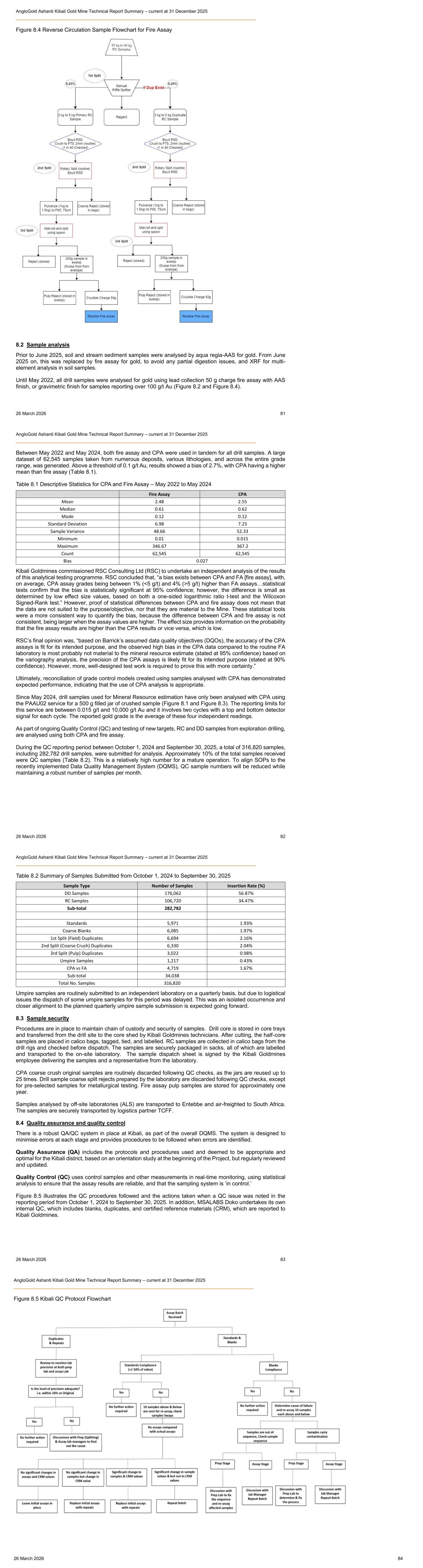
AngloGold Ashanti Kibali Gold Mine Technical Report Summary – current at 31 December 2025 ______________________________________________________________________________ 26 March 2026 81 Figure 8.4 Reverse Circulation Sample Flowchart for Fire Assay 8.2 Sample analysis Prior to June 2025, soil and stream sediment samples were analysed by aqua regia-AAS for gold. From June 2025 on, this was replaced by fire assay for gold, to avoid any partial digestion issues, and XRF for multi- element analysis in soil samples. Until May 2022, all drill samples were analysed for gold using lead collection 50 g charge fire assay with AAS finish, or gravimetric finish for samples reporting over 100 g/t Au (Figure 8.2 and Figure 8.4). AngloGold Ashanti Kibali Gold Mine Technical Report Summary – current at 31 December 2025 ______________________________________________________________________________ 26 March 2026 82 Between May 2022 and May 2024, both fire assay and CPA were used in tandem for all drill samples. A large dataset of 62,545 samples taken from numerous deposits, various lithologies, and across the entire grade range, was generated. Above a threshold of 0.1 g/t Au, results showed a bias of 2.7%, with CPA having a higher mean than fire assay (Table 8.1). Table 8.1 Descriptive Statistics for CPA and Fire Assay – May 2022 to May 2024 Fire Assay CPA Mean 2.48 2.55 Median 0.61 0.62 Mode 0.12 0.12 Standard Deviation 6.98 7.23 Sample Variance 48.66 52.33 Minimum 0.01 0.015 Maximum 346.67 367.2 Count 62,545 62,545 Bias 0.027 Kibali Goldmines commissioned RSC Consulting Ltd (RSC) to undertake an independent analysis of the results of this analytical testing programme. RSC concluded that, “a bias exists between CPA and FA [fire assay], with, on average, CPA assay grades being between 1% (<5 g/t) and 4% (>5 g/t) higher than FA assays…statistical tests confirm that the bias is statistically significant at 95% confidence; however, the difference is small as determined by low effect size values, based on both a one-sided logarithmic ratio t-test and the Wilcoxon Signed-Rank test.” However, proof of statistical differences between CPA and fire assay does not mean that the data are not suited to the purpose/objective, nor that they are material to the Mine. These statistical tools were a more consistent way to quantify the bias, because the difference between CPA and fire assay is not consistent, being larger when the assay values are higher. The effect size provides information on the probability that the fire assay results are higher than the CPA results or vice versa, which is low. RSC’s final opinion was, “based on Barrick’s assumed data quality objectives (DQOs), the accuracy of the CPA assays is fit for its intended purpose, and the observed high bias in the CPA data compared to the routine FA laboratory is most probably not material to the mineral resource estimate (stated at 95% confidence) based on the variography analysis, the precision of the CPA assays is likely fit for its intended purpose (stated at 90% confidence). However, more, well-designed test work is required to prove this with more certainty.” Ultimately, reconciliation of grade control models created using samples analysed with CPA has demonstrated expected performance, indicating that the use of CPA analysis is appropriate. Since May 2024, drill samples used for Mineral Resource estimation have only been analysed with CPA using the PAAU02 service for a 500 g filled jar of crushed sample (Figure 8.1 and Figure 8.3). The reporting limits for this service are between 0.015 g/t and 10,000 g/t Au and it involves two cycles with a top and bottom detector signal for each cycle. The reported gold grade is the average of these four independent readings. As part of ongoing Quality Control (QC) and testing of new targets, RC and DD samples from exploration drilling, are analysed using both CPA and fire assay. During the QC reporting period between October 1, 2024 and September 30, 2025, a total of 316,820 samples, including 282,782 drill samples, were submitted for analysis. Approximately 10% of the total samples received were QC samples (Table 8.2). This is a relatively high number for a mature operation. To align SOPs to the recently implemented Data Quality Management System (DQMS), QC sample numbers will be reduced while maintaining a robust number of samples per month. AngloGold Ashanti Kibali Gold Mine Technical Report Summary – current at 31 December 2025 ______________________________________________________________________________ 26 March 2026 83 Table 8.2 Summary of Samples Submitted from October 1, 2024 to September 30, 2025 Sample Type Number of Samples Insertion Rate (%) DD Samples 176,062 56.87% RC Samples 106,720 34.47% Sub-total 282,782 Standards 5,971 1.93% Coarse Blanks 6,085 1.97% 1st Split (Field) Duplicates 6,694 2.16% 2nd Split (Coarse Crush) Duplicates 6,330 2.04% 3rd Split (Pulp) Duplicates 3,022 0.98% Umpire Samples 1,217 0.43% CPA vs FA 4,719 1.67% Sub-total 34,038 Total No. Samples 316,820 Umpire samples are routinely submitted to an independent laboratory on a quarterly basis, but due to logistical issues the dispatch of some umpire samples for this period was delayed. This was an isolated occurrence and closer alignment to the planned quarterly umpire sample submission is expected going forward. 8.3 Sample security Procedures are in place to maintain chain of custody and security of samples. Drill core is stored in core trays and transferred from the drill site to the core shed by Kibali Goldmines technicians. After cutting, the half-core samples are placed in calico bags, tagged, tied, and labelled. RC samples are collected in calico bags from the drill rigs and checked before dispatch. The samples are securely packaged in sacks, all of which are labelled and transported to the on-site laboratory. The sample dispatch sheet is signed by the Kibali Goldmines employee delivering the samples and a representative from the laboratory. CPA coarse crush original samples are routinely discarded following QC checks, as the jars are reused up to 25 times. Drill sample coarse split rejects prepared by the laboratory are discarded following QC checks, except for pre-selected samples for metallurgical testing. Fire assay pulp samples are stored for approximately one year. Samples analysed by off-site laboratories (ALS) are transported to Entebbe and air-freighted to South Africa. The samples are securely transported by logistics partner TCFF. 8.4 Quality assurance and quality control There is a robust QA/QC system in place at Kibali, as part of the overall DQMS. The system is designed to minimise errors at each stage and provides procedures to be followed when errors are identified. Quality Assurance (QA) includes the protocols and procedures used and deemed to be appropriate and optimal for the Kibali district, based on an orientation study at the beginning of the Project, but regularly reviewed and updated. Quality Control (QC) uses control samples and other measurements in real-time monitoring, using statistical analysis to ensure that the assay results are reliable, and that the sampling system is ‘in control.’ Figure 8.5 illustrates the QC procedures followed and the actions taken when a QC issue was noted in the reporting period from October 1, 2024 to September 30, 2025. In addition, MSALABS Doko undertakes its own internal QC, which includes blanks, duplicates, and certified reference materials (CRM), which are reported to Kibali Goldmines. AngloGold Ashanti Kibali Gold Mine Technical Report Summary – current at 31 December 2025 ______________________________________________________________________________ 26 March 2026 84 Figure 8.5 Kibali QC Protocol Flowchart

AngloGold Ashanti Kibali Gold Mine Technical Report Summary – current at 31 December 2025 ______________________________________________________________________________ 26 March 2026 85 8.4.1 Certified Reference Materials CRMs are purchased from Ore Research & Exploration Pty Ltd (OREAS) and inserted into sample batches within mineralised zones to validate and monitor laboratory accuracy. All CRMs analysed by CPA in this period comprised oxide or sulphide material to match the different ore types processed in Kibali. A total of 5,971 samples of various CRMs were used within the reporting period. CRM assay performance was monitored and classified as a failure if any individual result fell outside three standard deviations (3SD) from the certified mean. During the reporting period, 98% of CRM results were within 3SD, indicating acceptable analytical accuracy, as illustrated in Figure 8.6. Figure 8.6 Tramline Plot of CRM Assays analysed for Gold (g/t) using CPA at MSALABS Doko The CRMs used are representative of the different grade classes and material matrix. The performance of the CRMs is good and within acceptable limits. 8.4.2 Blanks Blank samples are assayed to help ensure no false positives are obtained from laboratory analyses, checking for contamination during sample preparation or analytical contamination (fire assay only). These samples should return gold assay values at or near the analytical detection limit (i.e., <0.01 g/t Au for fire assay and <0.015 g/t Au for CPA). The coarse blank samples used are collected from barren granite material located at Matiko and Kalimva, approximately 20 km northwest of the Mine. This blank has been used for many years and is a proven reliable source of material with a gold value below detection limit. A total of 6,085 coarse blank samples (2% of total samples) were analysed in the reporting period. They were inserted only within samples from the mineralised zones and were subject to the same preparation and analytical procedures as the analytical samples. The results were evaluated against a tolerance limit set at three times the detection limit (0.045 g/t Au). The overall performance shows more than 99.9% of the blank samples assayed are within tolerance (Figure 8.7). The two samples that had grades above 0.1 g/t Au were due to contamination, and the entire batch was re-analysed, but no significant differences were observed. AngloGold Ashanti Kibali Gold Mine Technical Report Summary – current at 31 December 2025 ______________________________________________________________________________ 26 March 2026 86 Figure 8.7 Tramline Plot of Coarse Blank Samples Analysed for Gold (g/t) using CPA at MSALABS Doko The performance of the blanks analysed indicates no significant contamination at the laboratory. 8.4.3 Duplicates Duplicate samples are primarily used to assess precision (repeatability) of the assay data and can also be used to assess for the presence of bias in the sample preparation chain, from each sample reduction stage. Precision is calculated using the root mean squared average coefficient of variation (RMSavgCV) approach. A duplicate sample is a duplicate mass taken at the same time and in the same way as the original but prepared and analysed separately with a unique sample number, taken only in mineralised zones (>0.1 g/t Au). Duplicate samples are obtained from three sources, with the error being cumulative: 1st Split (Field) Duplicate: a duplicate sample taken from the RC rig splitter or the second half of DD core, which quantifies the combined errors from field splitting through to analysis. Precision of the 1st split duplicate is tracked monthly and is typically between 15% and 25%. 2nd Split (Coarse Crush) Duplicate: a duplicate sample taken at the crusher which quantifies coarse crush splitting error and pulverising error (fire assay only) through to analysis. Precision of the 2nd split (coarse crush) duplicates is tracked monthly and is typically between 10 % and 15%. 3rd Split (Pulp) Duplicate: a duplicate sample taken at the pulveriser which quantifies pulverising (fire assay only) and analytical error. Precision of the 3rd split (pulp) duplicate precision is tracked monthly and is typically around 10%. RC and DD 1st split (field) duplicate samples are quantified separately. A total of 6,694 1st split (filed) duplicates, 6,330 2nd split (coarse crush) duplicates, and 3,022 3rd split (pulp) duplicates were analysed during the reporting period. Figure 8.8, Figure 8.9, and Figure 8.10 show scatterplots of the DD 1st split (field) duplicates, the RC 1st split (field) duplicates, and combined 2nd split (coarse crush) duplicates, respectively. The plots are filtered to show samples >0.1 g/t Au to reflect the mineralisation. All plots show a good correlation between the original and duplicate indicating no significant issues in sampling and sample preparation. AngloGold Ashanti Kibali Gold Mine Technical Report Summary – current at 31 December 2025 ______________________________________________________________________________ 26 March 2026 87 Figure 8.8 Logscale Scatterplot for DD Field Duplicates Analysed for Gold (g/t) using CPA at MSALABS Doko Figure 8.9 Logscale Scatterplot for RC 1st Split (Field) Duplicates Analysed for Gold using CPA at MSALABS Doko AngloGold Ashanti Kibali Gold Mine Technical Report Summary – current at 31 December 2025 ______________________________________________________________________________ 26 March 2026 88 Figure 8.10 Logscale Scatterplot for 2nd Split (Coarse Crush) Duplicates Analysed for Gold (g/t) using fire assay at MSALABS Doko 8.4.4 Repeat assays There are two types of repeat assays completed: CPA vs Fire Assay: A repeat assay of the same sample at the same analytical laboratory. In this instance, the original 50 g CPA sample is pulverised and re-analysed by fire assay at MSALABS Doko. This assesses for bias between the two analytical methods. Umpire: A repeat assay of the sample at an independent umpire laboratory. In this instance, the coarse crushed jar of material used for CPA analysis at MSALABS Doko is submitted to independent umpire laboratory ALS Johannesburg for analysis by fire assay (along with CRMs). A total of 4,719 (1.67% of samples) CPA and fire assay samples were compared (Figure 8.11 and Figure 8.12). There is a reasonable correlation between the original (CPA) and repeat (fire assay) analyses indicating no significant bias. A total of 1,998 umpire samples (0.43% of samples) were submitted across the grade range, showing no significant bias between MSALABS Doko and the umpire laboratory. High variability was observed at grades below 1 g/t Au but this likely reflects reduced precision in fire assay from pulverising and analysing a smaller volume (50 g). The comparison is somewhat limited due to the different analytical techniques used at the laboratories. The procedure for umpire testing is under review to ensure that an umpire laboratory using CPA is used.

AngloGold Ashanti Kibali Gold Mine Technical Report Summary – current at 31 December 2025 ______________________________________________________________________________ 26 March 2026 89 Figure 8.11 Logscale Scatterplot of Gold (g/t) Analyses using CPA vs Fire Assay Samples from MSALABS Doko Figure 8.12 Logscale Scatterplot of Gold (g/t) Analyses at MSALABS Doko (CPA) and at ALS (Fire Assay) 8.5 Comment on sample preparation, analyses, and security The QP is of the opinion that the sample collection, preparation, analysis, and security used at Kibali are performed in accordance with best practice guidelines and industry standards and are appropriate for the style of deposit. AngloGold Ashanti Kibali Gold Mine Technical Report Summary – current at 31 December 2025 ______________________________________________________________________________ 26 March 2026 90 The QA/QC procedures and management are consistent with industry standards and the assay results within the database are suitable for use in Mineral Resource estimation. The QP has not identified any issues that could materially affect the accuracy, reliability, or representativeness of the results. 9. Data verification 9.1 Drill hole data verification 9.1.1 Historical drill hole data verification Data collected before 2009 is considered historical and constitutes 7.4% of the total drill hole database. Drilling by companies prior to 2004 does not have recorded procedures nor information on QA/QC practices. This drilling has not been verified by any twin drilling. This data is not used for Mineral Resource estimation. Drilling completed by companies between 2004 and 2009 has recorded procedures and industry standard QA/QC practices. Twin holes completed for drilling from this period show results are generally reliable in terms of grade and significant intercept locations down hole. Drilling from this period is used for Mineral Resource estimates until the GC stage, where the density of GC drilling is sufficient to remove the holes from the estimation. The majority of the data from this period is located in areas that have already been mined. The QP does not consider historical data to have a material impact on the current Mineral Resource estimate. 9.1.2 Current drill hole data verification All forms of data, including grade, density, geotechnical and hydrogeology, are securely stored in an industry standard maxgeo DataShed SQL database. Data must pass validation through constraints, library tables, triggers, and stored procedures prior to importing. Failed data is either rejected or stored in buffer tables awaiting correction. A full-time Database Manager employed at site manages the database. Daily backups are stored off site in the cloud, servers for which are in the UK but can be accessed globally. A custom MS Access front end application has been designed for data entry, reporting, and viewing via Open Database Connectivity (ODBC), which utilises the data validation procedures from the SQL database. All other geological and mining software databases on site use ODBC link to retrieve information from the date stamped MS Access database. In February 2025, Kibali Goldmines introduced a DQMS, which is a structured framework of processes, tools, and standards designed to ensure that all geological and geoscientific data, from field collection to Mineral Resource estimation are accurate, complete, consistent, reliable, and traceable throughout the data lifecycle. Key aspects of the DQMS are summarised in Table 9.1. Table 9.1 Summary of Data Quality Management System Aspect Details Data Quality Objective (DQO) Set out the purpose and quality threshold Quality Assurance (QA) Specify standard operating procedures that everyone needs to follow to reduce variance and bias Quality Control (QC) Monitor the sampling and measuring process by constantly evaluating checks and balances Quality Acceptance Testing (QAT) Determine whether that data that we collected from a process matches our DQOs and if it is fit for the stated purpose Data Verification Proving that it is real, exists and approving it after examining Audits Internal and External Auditing to ensure the DQMS is working properly To meet the DQO, collar survey pickup coordinates are compared against plan and verified by the responsible geologist in 3D. Downhole surveys are uploaded directly from the IMDEX hub via application programming interface (API). Survey accuracy and completeness are also verified by the responsible geologist. Assay data is imported directly from assay csv files from the laboratory using maxgeo auto loader. Only fully trained and authorised DataShed users can upload laboratory data. Assay data is stored in a normalised format AngloGold Ashanti Kibali Gold Mine Technical Report Summary – current at 31 December 2025 ______________________________________________________________________________ 26 March 2026 91 and multiple assays are stored for each sample. Ranking of different assay formats is performed automatically so that one assay result is displayed in the final table and any resultant exports. Any change to the rankings in the assay table must be approved by the Database Manager. The monthly DQMS report is reviewed by the QP. 9.2 Internal reviews and audits As part of the DQMS, the senior geologists review 10% of the geology logging of all drill holes to improve consistency and quality. As part of the modelling process, database extractions are systematically reviewed by the resource geologist for missing, changed, or incorrect data in 3D. All errors and changes are investigated and corrected in the source database. The QP visits Kibali several times per year and during the visit the QP: • Observes drilling to ensure that drilling, core handling, sampling, and sampling procedures are followed. • Reviews the latest key core intersections and spot checks these against assay results. • Reviews the database to ensure validation checks are completed and that database extractions are valid. • Visits the on-site laboratory to observe sample preparation and analytical procedures. The QP also reviews monthly DQMS reports and attends monthly meetings with senior geologists and the database manager to discuss performance and drive continuous improvement action. Regular ad-hoc meetings also take place with resource geologists, reviewing and guiding both rolling grade control and budget model updates, as drilling progresses through the year. Formal model handover meetings are also attended, with future recommendations being captured. 9.3 External reviews and audits As part of the upgrade from DataShed 4 to DataShed 5 in April 2025, maxgeo performed data validation and verification, that included minor structural integrity re-alignment and corrections. The SQL database was considered to be in good order. To support the transition from fire assay to CPA, RSC was commissioned to undertake an independent analysis of repeat results using both analytical methods. RSC designed specific test work and routine QC flowsheets aimed to compare precision and relative accuracy, which were adopted elsewhere to support the ongoing implementation of CPA across Barrick. RSC’s final opinion was that the accuracy and precision of the CPA assays is fit for its intended purpose. Ultimately, reconciliation of grade control models based on CPA have been able to demonstrate stable expected performance before and after this adoption. 9.4 Comment on data verification In the QP’s opinion, an appropriate level of data verification has been completed, and no material issues have been identified from the programmes undertaken. The QP has reviewed and completed checks on the data and is of the opinion that the data verification and DQMS programmes undertaken on the database adequately support the geological interpretations and Mineral Resource estimation process. 10. Mineral processing and metallurgical testing 10.1 Metallurgical test work Metallurgical test work has been conducted on representative samples from the various Kibali deposits since Project initiation in 2006 and is continuing to date as new deposits are developed. Comprehensive metallurgical test work programmes have been designed and conducted to characterise ore variability, define geometallurgical domains, and establish recovery parameters under conditions representative of the current plant flowsheet. AngloGold Ashanti Kibali Gold Mine Technical Report Summary – current at 31 December 2025 ______________________________________________________________________________ 26 March 2026 92 Previous and recent test work has included the following key components: • Bottle Roll Leach Tests (BRT): Conducted on spatially distributed composite samples derived from Mineral Resource drilling and aimed at evaluating the variability of cyanide-soluble gold across different lithologies and domains, providing a basis for direct leachability assessment and domain-specific recovery modelling. • Laboratory-Scale Plant Simulation Tests: These included standard Bond Ball Work index (BBWi) testing for comminution, gravity recovery amenability tests (Knelson and table), flotation tests to assess sulphide association and cyanidation leach tests on both whole ore and flotation products. The results were used to estimate overall metallurgical recoveries across the different ore types. • Gold Deportment and Diagnostic Mineralogy: Comprehensive gold deportment studies and mineralogical analyses to identify gold carriers and quantify the proportion of refractory, free-milling, and encapsulated gold. These findings informed the expected recovery ranges and allowed for the identification of metallurgical constraints in the recovery model. Collectively, this test work has defined the recovery parameters and ensured that the financial model reflects realistic and technically supported metallurgical performance expectations. Metallurgical and mineralogical characterisation informed the initial plant design criteria and ongoing process optimisation initiatives to maximise cost effective gold recovery from a reasonably complex and variable ore mix delivered to the plant. Test work has led to the following features being incorporated in the gold recovery process: • Centrifugal gravity concentrators in conjunction with flash flotation to recover gravity recoverable gold (GRG) early in the milling circuit. • In-line leach reactor to dissolve concentrated gravity gold facilitating a short pipeline to bullion dispatch of GRG (± 23% of total gold produced). • Processing fresh ore through conventional flotation to recover refractory gold bearing sulphide/arsenopyrite concentrate for fine grinding and high shear partial oxidation resulting in improved leach recovery and reduced cyanide consumption. • Processing free-milling oxide/transition ore through conventional carbon-in-leach (CIL) minimising the occasional preg-robbing effect from natural carbon in ore. Several metallurgical test work programmes have been completed at Kibali to support process design, Mineral Resource conversion, and the definition of modifying factors for Mineral Reserves. Initial test work focused on KCD prior to plant commissioning, while subsequent campaigns have been conducted to characterise additional satellite deposits. A summary of the previous metallurgical test work completed at Kibali is shown in Table 10.1. Table 10.1 Summary of Previous Metallurgical Test Work Completed at Kibali Deposit and Study Type Summary of Metallurgical Test Work Completed Date Early-Stage Feasibility Studies (Prefeasibility, Feasibility, Bankable Feasibility, Risk Reduction) Gravity separation, flotation, and cyanidation (CIP/CIL) leach tests. Evaluated oxide and fresh ore process routes for gold recovery and reagent consumption. 2006-2011 Mengu Hill (Deportment, Test Work Summary) Gold deportment studies (XRD, SEM-EDX, SIMS) to understand gold forms and liberation. Comprehensive extraction/recovery tests (gravity, flotation, pressure oxidation, direct cyanidation, UFG-CN) on oxide, transition, and fresh ores. 2012-2013 Pakaka (Metallurgical Performance, Flotation, Gold Deportment) Gold deportment analysis, direct-leach distribution assessment, laboratory flotation, and CIL simulation. Included mineralogical characterisation. 2014-2017 Gorumbwa (Feasibility, Gold Deportment) Gold deportment studies (XRD, SEM-EDX, SIMS) for gold forms, carriers, and liberation behaviour. Comprehensive metallurgical test work including comminution, gravity recovery, and direct- cyanidation leach tests. 2014-2016

AngloGold Ashanti Kibali Gold Mine Technical Report Summary – current at 31 December 2025 ______________________________________________________________________________ 26 March 2026 93 Deposit and Study Type Summary of Metallurgical Test Work Completed Date Sessenge ores (Flowsheet Processing, Gold Deportment) Gold deportment studies, process flowsheet simulation (flotation and leaching), and comprehensive metallurgical test work (BRT, comminution, gravity, CIL). Focused on current Kibali flowsheet application. 2016-2020 Pamao (Gravity Test Work, BRT) Extended gravity recoverable gold testing and full metallurgical test work including BRT, comminution, gravity, and CIL. 2017 Kalimva-Ikamva (Flowsheet Simulation, Gold Deportment) Process flowsheet simulation (gravity, flotation, leaching) including diagnostic leach on residues, and detailed gold deportment studies (XRD, SEM-EDX, SIMS) for gold forms and liberation. 2019 3000 Lode & 5000 Lode Down Plunge (Metallurgical Test Work, Gold Deportment) Gold deportment studies (XRD, SEM-EDX, SIMS) and full metallurgical test work including comminution, gravity recovery, flotation, and Aachen assisted leach tests for specific lode ores. 2020 Megi-Marakeke-Sayi (Flowsheet Simulation, Gold Deportment) Process flowsheet simulation (gravity, flotation, leaching) including sample characterisation, diagnostic leach, and detailed gold deportment (XRD, SEM-EDX, SIMS) to determine gold forms, carriers, and liberation behaviour. 2019-2020 Note. CIP/CIL – carbon-in-pulp/carbon-in-leach, XRD – X-Ray Diffraction, SEM-EDX – Scanning Electron Microscope Energy Dispersive X-Ray Spectroscopy, SIMS – Secondary Ion Mass Spectrometry, UFG-CN – ultrafine grinding-cyanide leaching 10.2 Recent metallurgical test work Recent test work, completed between 2022 and 2025, is in line with previous metallurgical studies and has included BRT, laboratory-scale plant simulation tests, and detailed gold deportment and mineralogical studies. These programmes were specifically aimed at confirming metallurgical response and validating recovery assumptions used in the application of modifying factors. This test work has been completed on material from the 11000 Lode of KCD (2002), Oere (2023), Sessenge- Gorumbwa (2024), KCD Deep (2024 and 2025), Ndala (2024), Rhino (2024 and 2025), and Agbarabo (2025). Test work has also commenced for Airbo, and Kombokolo, collectively known as the ARK deposits along with Rhino and Agbarabo. Test work commenced for these two deposits in November 2025. BRT test work has been completed and some laboratory-scale plant simulation test work is available. A summary of the analytical and metallurgical laboratories together with the accreditation status and relationship to the registrant is shown in Table 10.2. Table 10.2 Summary of analytical and metallurgical laboratories, accreditation status, and relationship to the registrant Laboratory Location Relationship to Registrant Accreditation & Certification Scope of Work Maelgwyn Mineral Services Africa (Pty) Ltd (MMSA) Building A, Paddock Lane, Boundary Park, North Riding, Randburg, South Africa Independent metallurgical testwork provider ISO 9001 certified (valid: 09 Feb 2024 – 08 Feb 2027; first certified 2021) Provides metallurgical testwork and process development services. All chemical analyses are subcontracted to SGS South Africa (Pty) Ltd, an independent ISO/IEC 17025 accredited laboratory. MMSA is not ISO/IEC 17025 accredited. Nesch Mintech Tanzania Limited Plot 27, Block E, Butimba, Mwanza, Tanzania Independent third- party laboratory ISO/IEC 17025 accredited (SADCAS Accreditation No. TEST-5 0029; valid 03 Jun 2023 – 02 Jun 2028) Accreditation covers fire assay and multi-element mineral analysis. QA/QC protocols align with international best practice. Advanced Mineral Technology Laboratory Ltd (AMTEL) 100 Collip Circle, Suite 205, UWO Research Park, Canada Independent metallurgical and mineralogical laboratory Not ISO 9001 or ISO/IEC 17025 accredited Specializes in mineralogical characterization (SEM-EDS, optical microscopy, D-SIMS, ToF- SIMS). All chemical assays subcontracted to accredited laboratories (e.g., ALS Global or AGAT Laboratories). AngloGold Ashanti Kibali Gold Mine Technical Report Summary – current at 31 December 2025 ______________________________________________________________________________ 26 March 2026 94 Kibali Metallurgical Laboratory Kibali Gold Mine, Haut- Uélé Province, Democratic Republic of Congo Company-owned, on-site laboratory (Barrick / Kibali JV) Not ISO 9001 or ISO/IEC 17025 accredited Conducts geometallurgical testwork, process monitoring, and operational support testwork (e.g., comminution variability, gravity/flotation response, leach kinetics). Analytical results are used for operational control and variability characterization. Where data is used for reporting or critical decision-making, A summary of the recent metallurgical test work completed at Kibali is shown in Table 10.3. Table 10.3 Summary of Recent Metallurgical Test Work Completed at Kibali Name of Program Laboratory Test Work Summary Date Oere Metallurgical Test work Oere 2022 Kibali Metallurgical Laboratory BRT, full metallurgical test work including comminution, gravity recovery, flotation, Aachen assisted leach tests. 2022 Deportment of gold in Oere ore 2022 AMTEL Gold deportment study, including detailed mineralogical characterisation (XRD, SEM-EDX, SIMS) determining gold forms, carriers, and liberation behavior. Recovery response to gravity, flotation, pressure oxidation, and direct-cyanidation assessment 2022 Metallurgical Test work Oere 2022 Maelgwyn Mineral Services Africa Laboratory-Scale Plant Simulation Tests. 2022 KCD 11000 Lode Metallurgical Test work KCD UG 11000 Lode 2022 Kibali Metallurgical laboratory BRT, full metallurgical test work including comminution, gravity recovery, flotation, Aachen assisted leach tests. 2022 Deportment of gold in KCD UG 11000 Lode ore 2022 AMTEL Gold deportment study, including detailed mineralogical characterisation (XRD, SEM-EDX, SIMS) determining gold forms, carriers, and liberation behavior. Recovery response to gravity, flotation, and direct-cyanidation assessment 2022 Sessenge-Gorumbwa Metallurgical Test work Sessenge-Gorumbwa 2024 Kibali Metallurgical Laboratory BRT, full metallurgical test work including comminution, gravity recovery, flotation, Aachen assisted leach tests. 2024 Diagnostic leach on Sessenge-Gorumbwa ore Nesch Mintec Gold deportment evaluation using diagnostic leaching tests. Included geochemical head and particle size distribution assays, diagnostic leaching tests. 2024 Deportment of gold in Sessenge Gorumbwa ore 2024 AMTEL Gold deportment study, including detailed mineralogical characterisation (XRD, SEM-EDX, SIMS) determining gold forms, carriers, and liberation behavior. Recovery response to gravity, flotation, and direct-cyanidation assessment 2024 KCD Deep Metallurgical Test work KCD Deep 2024 Kibali Metallurgical Laboratory BRT, full metallurgical test work including comminution, gravity recovery, flotation, Aachen assisted leach tests. 2024 Diagnostic leach on KCD Deep ore 2025 Nesch Mintec Gold deportment evaluation using diagnostic leaching tests. Included geochemical head and particle size distribution assays, diagnostic leaching tests. 2025 Deportment of gold KCD Deep 2025 AMTEL Pending 2025 Ndala Metallurgical Test work Aerodrome 2020 Kibali Metallurgical Laboratory BRT, full metallurgical test work including comminution, gravity recovery, flotation, Aachen assisted leach tests. 2024 Rhino Metallurgical Test work Rhino 2023 Kibali Internal Metallurgical Test Work BRT, full metallurgical test work including comminution, gravity recovery, flotation, Aachen assisted leach tests. 2023 AngloGold Ashanti Kibali Gold Mine Technical Report Summary – current at 31 December 2025 ______________________________________________________________________________ 26 March 2026 95 Name of Program Laboratory Test Work Summary Date Diagnostic leach on Rhino ore Nesch Mintec Gold deportment evaluation using diagnostic leaching tests. Included geochemical head and particle size distribution assays, diagnostic leaching tests. 2023 Deportment of gold in Rhino ore 2024 AMTEL Gold deportment study, including detailed mineralogical characterisation (XRD, SEM-EDX, SIMS) determining gold forms, carriers, and liberation behaviour. Recovery response to gravity, flotation, and direct-cyanidation assessment. 2023 Agbarabo, Airbo & Kombokolo Metallurgical Test work Agbarabo, Airbo & Kombokolo 2025 Kibali Metallurgical Laboratory BRT and Laboratory-Scale Plant Simulation Tests. 2025 Metallurgical Test work Agbarabo 2025 Maelgwyn SA Laboratory-Scale Plant Simulation Tests. 2025 Diagnostic Agbarabo, Airbo & Kombokolo 2025 Nesch Mintec Diagnostic leach and comminution test. 2025 Deportment of gold in Agbarabo 2025 AMTEL Gold deportment study, including detailed mineralogical characterisation (XRD, SEM-EDX, SIMS) determining gold forms, carriers, and liberation behaviour. Recovery response to gravity, flotation, and direct-cyanidation assessment. 2025 10.2.1 Sample selection A sampling protocol was implemented to generate metallurgical test work samples that are reasonably representative of the mineralisation. The protocol integrated review of BRT distributions derived from drilling with geological and weathering models to capture variability across domains. Following this assessment, targeted metallurgical drilling and compositing were undertaken to produce representative composites for subsequent test work. Figure 10.1 to Figure 10.3 provide examples of the geospatial spread of drilling and sampling at Sessenge-Gorumbwa, KCD Deep, and ARK. These figures indicate that the metallurgical composites are representative of the principal mining domains, grades, and weathering states. The resulting metallurgical composites are shown in Table 10.4. Geometallurgical work completed prior to and during initial processing identified two principal zones with distinct arsenic tenors and recovery responses at the Sessenge-Gorumbwa contact as depicted in Figure 10.1. Zones with arsenic levels of less than approximately 500 ppm have delivered recoveries of around 90% in the sulphide circuit and zones exceeding 4,000 ppm arsenic returned lower recoveries of approximately 74% prior to blending and operating adjustments. Blending strategies and reagent/oxygen controls are applied to maintain plant stability and recovery. AngloGold Ashanti Kibali Gold Mine Technical Report Summary – current at 31 December 2025 ______________________________________________________________________________ 26 March 2026 96 Figure 10.1 Sessenge-Gorumbwa BRT and mineralisation Source: Kibali Goldmines, 2025

AngloGold Ashanti Kibali Gold Mine Technical Report Summary – current at 31 December 2025 ______________________________________________________________________________ 26 March 2026 97 Figure 10.2 KCD Deeps Metallurgical Drilling and Sampling Source: Kibali Goldmines, 2025 AngloGold Ashanti Kibali Gold Mine Technical Report Summary – current at 31 December 2025 ______________________________________________________________________________ 26 March 2026 98 Figure 10.3 ARK Metallurgical Drilling and Sampling Source: Kibali Goldmines, 2025 AngloGold Ashanti Kibali Gold Mine Technical Report Summary – current at 31 December 2025 ______________________________________________________________________________ 26 March 2026 99 Table 10.4 Summary of Metallurgical Samples Deposit Total Drill Hole Intervals Oxidation State and Sample Frequency Lithology and Sample Frequency Alteration Oere 6 Fresh (4) Oxide (1) Transition (1) Meta conglomerate (5) Metavolcanic (1) Limonite, Hematite, Chlorite, Silica, ACSA-A KCD 11000 3 Fresh (3) BIF (3) Albite, carbonate, silica low intensity (ACSA-A) Rhino 15 Fresh (8) Transition (4) Oxide (3) Metasediment (4) BIF (1) Chlorite, Sericite, Albite, Carbonate, Silica, ACSA-A, Limonite, Hematite, Magnetite Sessenge- Gorumbwa 9 Fresh (9) Metasediment (3) Banded iron formation (1) Metasediment, BIF (1) Metasediment, silicified BIF (3) Silicified BIF (1) Chlorite, Sericite, ACSA-A, Magnetite, Silica KCD Deep 5 Fresh (5) Albite, carbonate, silica High intensity (ACSA-B) (1) Metasediment (2) ACSA-B (1) BIF (1) Albite, Carbonate, Silica (High intensity), ACSA-A, Sericite, Magnetite, ACSA-B Ndala 11 Fresh (5) Oxide (4) Transition (2) Meta-volcanoclastic (9) Carbonaceous shale (2) Limonite, Chlorite, Graphite, Hematite Agbarabo 9 Fresh (7) Oxide (1) Transition (1) Metasediment (6) BIF (3) Limonite, Hematite, ACSA-A, Chlorite, Silica, Sericite Airbo 10 Fresh (10) Oxides (0) Transition (0) Metaconglomerate, Banded iron formation (BIF), Quartz Vein ACSA-A, ACSA-B, Chlorite, Sericite, Silica, Magnetite 10.2.2 Extraction To date, process plant gold recovery has averaged 89% (excluding optional leaching of sulphide-circuit flotation tails), with observed minimum and maximum of 78.4% and 96.4%, respectively. This range reflects the variability between free-milling and partially refractory ore types and underscores the importance of blend control to route appropriate material to the CIL or flotation-ultrafine grinding (UFG)-leach circuits to maximise overall recovery. Figure 10.4 summarises the direct-cyanidation gold extractions achieved from testing the new samples from the ARK deposits, Ndala, Sessenge-Gorumbwa, Oere, KCD 11000 Lode, and KCD Deep. The results are domain- specific (oxide, transition, fresh) and reflect head grade and mineralogical variability. • Rhino (ARK): Oxide samples achieved over 90% extraction. Transition and fresh samples reported lower BRT extractions of approximately 83% and 72%, respectively. These recoveries improved with finer grind under plant simulation to 85% for both transition and fresh material. • Agbarabo (ARK): Oxide and transition domains showed relatively strong direct-leach responses at over 90%. High-grade fresh material was consistent with these ranges; low-grade fresh samples averaged approximately 75%, indicative of finer gold association. Further recovery improvements are anticipated through the application of UFG. • Airbo (ARK): Preliminary BRT on fresh material returned 66% extraction in response to direct cyanidation. Additional test work simulating plant flowsheet (flotation, UFG of concentrate, pre- oxidation/intensive leach) has commenced. • Ndala: Oxide and transition domains achieved over 90% and 85% extraction, respectively. While fresh samples reported relatively lower extraction (less than 75%), mainly due to lower liberation, additional extraction was subsequently achieved at a finer grind size. AngloGold Ashanti Kibali Gold Mine Technical Report Summary – current at 31 December 2025 ______________________________________________________________________________ 26 March 2026 100 • Sessenge–Gorumbwa: Upper lens samples, which reflect the continuity of the main Sessenge mineralisation with a high arsenic content (2,500 ppm), reported low recovery, 61.45% on average. The bottom lenses responded with a relatively higher gold extraction above 70%. • Oere: Samples from oxide and transition domains achieved over 90% and approximately 85% extraction, respectively. Fresh samples averaged approximately 82%, with additional extraction of 3.3% realised at finer grind. • KCD 11000 Lode and KCD Deep: Averages of approximately 82% and 79%, respectively, with limited variability observed across tested sub-domains. However, significant recovery improvement with finer grind was achieved with both deposits reporting approximately 90%. These outcomes are consistent with the identified geometallurgical controls (preg-robbing and sub- microscopic/occluded gold within sulphides). Where direct-cyanidation extractions are lower, test work demonstrates material uplift via flotation, UFG, elevated dissolved oxygen, and adequate residence time. Figure 10.4 Direct Leach Gold Extractions Figure 10.5 shows a summary of gold recoveries achieved through direct BRT tests on composite samples prepared from metallurgical drill holes (Table 10.4). In areas where no metallurgical holes were available (e.g. Airbo and Kombokolo), composites were instead generated from selected RDD samples. No additional leaching of the flotation tails was included. This was conducted on samples from the Oere, Rhino, Agbarabo, KCD Deep, KCD 11000 Lode, Sessenge-Gorumbwa, and Ndala. Initial results for Airbo and Kombokolo are also shown.

AngloGold Ashanti Kibali Gold Mine Technical Report Summary – current at 31 December 2025 ______________________________________________________________________________ 26 March 2026 101 Figure 10.5 Direct BRT Extraction on Composites (Excluding the Leaching of Flotation Tails) Table 10.4 summarises extraction (gold recovery) variability for the two principal processing routes: (i) CIL for free-milling domains, and (ii) the sulphide route (flotation → UFG of concentrate → concentrate cyanidation). The results demonstrate that increased specific surface area from UFG improves liberation and leach kinetics; the magnitude of uplift relative to primary extraction is domain-dependent and varies materially by lithology, grade, and deleterious element tenor. As of the date of this Report, Agbarabo and Airbo programmes remain in progress and are not included in Table 10.5. AngloGold Ashanti Kibali Gold Mine Technical Report Summary – current at 31 December 2025 ______________________________________________________________________________ 26 March 2026 102 Table 10.5 Extraction Comparison Deposit Total Drilled Holes Unique Sample Numbers Oxidation State Average CIL Extraction (Direct BRT) % of Total Au Average Extraction Plant Simulation (Sulphide Process Route) % of Total Au Rhino 28 15 Oxide 90.67 - Transition 82.86 85.38 Fresh 71.86 84.4 Sessenge - Gorumbwa 10 9 Fresh 66.49 79.33 KCD Deep 6 4 Fresh 79.78 91.3 KCD 11000 Lode 26 3 Fresh 79.99 92.9 Oere 9 3 Oxide 90.46 - Transition 85.23 88.5 Fresh 82.42 87.44 Ndala 6 8 Oxide 90.99 - Transition 86.7 85.63 Fresh 74.6 86.5 Agbarabo 8 9 Oxide 93.9 - Transition 93.0 - Fresh 80.55 89.92 10.2.3 Comminution characterisation BBWi testing was completed on samples from Oere, KCD 11000 Lode, Rhino, Ndala, and Sessenge– Gorumbwa. Results for the new deposits plot within the range established for existing deposits (Figure 10.6) and show the expected domain-level variability. Figure 10.6 Existing and New BBWi Values Plant operating data from 2024 to 2025 indicates average operating work indices (WI) of 10.22 kWh/t (oxide Mill #2) and 10.81 kWh/t (sulphide Mill #1), corresponding to a Bond scale-up efficiency of 102%. This close agreement between laboratory BBWi and operating WI is consistent with accurate BBWi determination and 0.0 2.0 4.0 6.0 8.0 10.0 12.0 14.0 16.0 18.0 20.0 K C D 5 1 1 0 L o d e _ F re s h K C D 5 0 0 0 L o d e _ F re s h K o m b o k o lo _ F re s h K C D O C _ F re s h K C D O C _ T ra n s it io n K C D O C _ O x id e P a k a k a _ L G F re s h P a k a k a _ H G F re s h S e s s e n g e _ F re s h M ill P e b b le s M e g i_ T ra n s it io n M e g i_ F re s h # 1 M e g i_ F re s h # 2 M a ra k e k e _ F re s h S a y i_ O x id e /T ra n s it io n S a y i_ F re s h K a lim v a _ O x id e /T ra n s it io n K a lim v a _ F re s h Ik a m v a _ O x id e /T ra n s it io n F R _ Ik a m v a C O M P 1 A e ro d ro m e _ O x id e A e ro d ro m e _ F re s h # 1 A e ro d ro m e _ F re s h # 2 P a m a o S o u th _ F re s h P a m S o u th _ T ra n s it io n P a m S o u th _ O x id e K C D 1 1 1 0 1 L o d e _ F re s h K C D 1 1 1 0 2 L o d e _ F re s h K C D 1 1 1 0 3 L o d e _ F re s h O e re _ O x id e O e re _ T ra n s it io n O e re _ F re s h N d a la _ O x id e N d a la _ T ra n s it io n N d a la _ F re s h K C D D e e p S e s s e n g e -G o ru m b w a _ F re s h # 1 S e s s e n g e -G o ru m b w a _ F re s h # 2 R h in o _ F re s h # 1 R h in o _ F re s h # 2 R h in o _ F re s h # 3 A g b a ra b o _ L G F R _ 1 A g b a ra b o _ L G F R _ 2 A g b a ra b o _ O x id e /T ra n s it io n _ 3 B o n d B a ll w o rk i n d e x ( K w h /t ) Deposits BBWi Existing deposits BBWi New deposits Average AngloGold Ashanti Kibali Gold Mine Technical Report Summary – current at 31 December 2025 ______________________________________________________________________________ 26 March 2026 103 stable mill control. Mill-specific energies averaged 10.75 kWh/t and 11.63 kWh/t, delivering product sizes of 80% passing (P80) approximately 86 µm (Mill #1) and 85 µm (Mill #2) (Figure 10.7). Figure 10.7 Average Plant P80 and Specific Energy Consumption (2025) 10.2.4 Mineralogical assessment and gold deportment Across the deposits, mineralogy is broadly similar and variations in the proportions of sulphides and gangue explain most differences in recovery. Deportment work indicates that lower direct-leach extractions are primarily driven by sub-microscopic gold in pyrite/arsenopyrite, with the effect strongest in high-arsenic domains, for example in parts of Sessenge and Pakaka. • Domains with meaningful free/exposed gold respond well to CIL and gravity/flash flotation. • Domains with attached/enclosed gold in sulphides require flotation → UFG → concentrate cyanidation to lift recovery. Recovery ceilings are set by any refractory fraction that remains sub-microscopic post- UFG. Datasets for new open pit areas and new domains have been added to the existing data and are summarised in Figure 10.8 to Figure 10.10.The deportment data support the dual-route strategy: (i) CIL for free-milling domains with meaningful GRG, and (ii) flotation → UFG → concentrate cyanidation (with adequate oxygenation and residence time) for domains where gold is attached/enclosed within sulphides. Where refractory fractions are material (e.g., high-arsenic domains), recovery ceilings are governed by sub-microscopic gold that remains refractory after UFG. These findings are consistent with observed plant response and with the recovery assumptions presented in this Report. 76 78 80 82 84 86 88 90 92 94 96 5.0 6.0 7.0 8.0 9.0 10.0 11.0 12.0 13.0 Jan Feb Mar Apr May Jun Jul Aug Sep Oct Nov Dec G ri n d s iz e P 8 0 ( u m ) S p e c if ic e n e rg y c o n s u m p ti o n ( k W h /t ) Mill#1 spec energy consumption Mill#2 spec energy consumption Mill#1 P80 Mill#2 P80 AngloGold Ashanti Kibali Gold Mine Technical Report Summary – current at 31 December 2025 ______________________________________________________________________________ 26 March 2026 104 Figure 10.8 Bulk Rock Mineralogy Figure 10.9 Deportment of Gold for Flotation Perspective 0% 10% 20% 30% 40% 50% 60% 70% 80% 90% 100% K C D O P E N P IT K C D U G 3 0 0 0 K C D U G 5 0 0 0 K C D U G 5 1 0 3 K C D U G 5 1 1 0 K C D U G 9 0 0 0 G o ru m b w a G o ru m b w a G G D 0 5 0 G o ru m b w a G G D 0 5 3 G o ru m b w a G G D 0 6 4 P a k a k a H G -H ig h A s P a k a k a H G -L o w A s P a k a k a L G P a k a k a L G P a k a k a P a m a o M e n g u F re s h M e n g u o x id e M e n g u t ra n s it io n M e n g u T ra n /O X Ik a m v a H G Ik a m v a L G k a lim v a H G k a lim v a L G M E G I H G M E G I L G M a ra k e k e H G M a ra k e k e L G S a y i K C D U G 3 0 0 0 D P K C D U G 5 0 0 0 D P P a m a o S o u th L G F R P a m a o S o u th H G F R O e re 4 _ fr e s h O e re 5 _ fr e s h O e re 6 _ fr e s h 1 1 1 0 1 l o d e 1 1 1 0 2 l o d e 1 1 1 0 3 l o d e R h in o _ R H D D 0 1 5 R h in o _ R H D D 0 1 2 R h in o _ R H D D 0 1 6 S e s s e n g e -G o ru m b w a _ L A s S e s s e n g e -G o ru m b w a _ H A s A g b a ra b o _ O X A g b a ra b o _ L G F R _ 1 A g b a ra b o _ H G F R _ 2 A g b a ra b o _ H G F R _ 3 R a ti o ( % ) Sulphides Fe-TiOxides Carbonates Sheet silicates Feldspar Quartz New Data 0% 10% 20% 30% 40% 50% 60% 70% 80% 90% 100% K C D U G 3 0 0 0 l o d e K C D U G 3 1 0 1 l o d e K C D U G 3 1 2 1 l o d e K C D U G 5 0 0 0 l o d e K C D U G 9 1 0 1 l o d e IK V H G IK V L G K L V H G K L V L G M E G I H G F R M E G I L G F R M R K K H G M R K K L G S A Y I L G P a m S o u th L G F R P a m S o u th H G F R K C D U G 1 1 1 0 1 l o d e K C D U G 1 1 1 0 2 l o d e K C D U G 1 1 1 0 3 l o d e O E R E 4 F re s h O E R E 5 F re s h O E R E 6 F re s h S e s s e n g e -G o ru m b w a L A s H R S e s s e n g e -G o ru m b w a H A s L R R h in o R H D D 0 1 5 R h in o R H D D 0 1 2 /1 3 R h in o R H D D 0 1 6 A g b a ra b o _ O X A g b a ra b o _ L G F R _ 1 A g b a ra b o _ H G F R _ 2 A g b a ra b o _ H G F R _ 3 R a ti o ( % ) Free gold>40µm Free gold 7-40µm Free gold <7µm Pyrite Pyrrhotite Composites Binaries Free oxides New Data

AngloGold Ashanti Kibali Gold Mine Technical Report Summary – current at 31 December 2025 ______________________________________________________________________________ 26 March 2026 105 Figure 10.10 Deportment of Gold for Leach Perspective 10.2.5 Ultrafine grinding Gold deportment studies indicate that a substantial proportion of the gold is hosted within fine disseminated pyrite, occurring as attached, enclosed, or refractory particles. Advanced microscopic analysis confirmed that complete liberation of enclosed gold is achieved at a grind size of approximately 13 µm. Consequently, during laboratory-scale test work, flotation concentrates are subjected to regrinding to a particle size of 20 µm to 23 µm prior to leaching. This grind size range was selected to align with the current plant grinding performance, although finer grinding would result in greater gold liberation. In 2025, the average P80 of the re-ground flotation concentrate was approximately 23.5 µm, with a corresponding specific energy consumption of 38.4 kWh/t, yielding an average gold dissolution of 88.1%. 10.2.6 Aachen assisted oxidation and leaching Sulphide minerals display an elevated oxygen uptake rate (OUR) and therefore an elevated oxygen demand which, if not met during pre-oxidation, can result in recovery losses in the leaching circuit. The plant operates two-stage Aachen assisted pre-oxidation, followed by an extended leach system, with targeted dissolved oxygen levels more than 10 ppm in the leach circuit. This resulted in additional liberation from partially oxidised pyrite, pyrrhotite, and arsenopyrite and more stable leach kinetics. 10.2.7 Summary of recent metallurgical test work Recent metallurgical test work results are summarised in Table 10.6. Overall, the outcomes demonstrate that recovery performance across the various deposits is consistent with the Mineral Reserve model, with fresh material from all evaluated deposits processed through ultra-fine grinding achieving improved recoveries relative to coarser grind conditions. Under these conditions, fresh and oxide materials from KCD Deep, KCD 11000 Lode, Oere, and Agbarabo returned recoveries generally exceeding 90%. In contrast, Sessenge–Gorumbwa fresh material exhibited comparatively lower recoveries despite application of ultra-fine grinding, which is considered to be associated with an increased presence of arsenic-bearing sulphide mineralisation that can adversely influence gold leach performance. Transitional ores from Rhino, Ndala, and Agbarabo similarly yielded lower recoveries, typically in the 82% to 88% range, consistent with increased sulphide complexity and reduced effective liberation. 0% 10% 20% 30% 40% 50% 60% 70% 80% 90% 100% K C D U G 3 0 0 0 l o d e K C D U G 3 1 0 1 l o d e K C D U G 3 1 2 1 l o d e K C D U G 5 0 0 0 l o d e K C D U G 9 1 0 1 l o d e IK V H G IK V L G K L V H G K L V L G M E G I H G F R M E G I L G F R M R K K H G M R K K L G S A Y I L G P a m S o u th L G F R P a m S o u th H G F R K C D U G 1 1 1 0 1 l o d e K C D U G 1 1 1 0 2 l o d e K C D U G 1 1 1 0 3 l o d e O E R E 4 F re s h O E R E 5 F re s h O E R E 6 F re s h S e s s e n g e -G o ru m b w a L A s H R S e s s e n g e -G o ru m b w a H A s L R R h in o R H D D 0 1 5 R h in o R H D D 0 1 2 /1 3 R h in o R H D D 0 1 6 A g b a ra b o _ O X A g b a ra b o _ L G F R _ 1 A g b a ra b o _ H G F R _ 2 A g b a ra b o _ H G F R _ 3 R a ti o ( % ) Free gold>40µm Free gold 7-40µm Free gold <7µm Attached gold grains Enclosed gold grains Refractory New Data AngloGold Ashanti Kibali Gold Mine Technical Report Summary – current at 31 December 2025 ______________________________________________________________________________ 26 March 2026 106 Table 10.6 Summary Results of Recent Metallurgical Test Work Deposit Weathering Test Work Recovery (%) Main Reagent Consumption (kg/t) BBWi (kwh/t) NaCN Lime KCD Deep Fresh 91.3 0.82 1.19 10.13 KCD 11000 Lode Fresh 92.9 0.75 1.24 9.46 Sessenge-Gorumbwa Fresh 79.4 0.86 1.13 10.83 Ndala Fresh 86.5 0.74 1.25 10.45 Transition 86.7 0.65 1.82 8.90 Oxide 92.5 0.55 1.86 - Rhino Fresh 84.5 0.77 1.11 11.64 Transition 82.9 0.73 1.45 9.89 Oxide 93.7 0.6 1.76 - Oere Fresh 88.5 0.85 1.20 12.35 Transition 85.2 0.60 1.47 10.07 Oxide 90.5 0.60 1.5 6.79 Agbarabo Fresh 89.9 0.77 1.14 8.13 Transition 93.0 0.60 2.30 6.84 Oxide 93.9 0.55 1.70 6.84 Reagent consumption for cyanide and lime remained within operational norms, with cyanide usage ranging from 0.55 kg/t to 0.86 kg/t and lime, from 1.12 kg/t to 2.30 kg/t across the test domains. Measured BBWi values fall within the expected range for Kibali ores and are consistent with historical comminution performance. Collectively, the test work confirms that the metallurgical behaviour of the evaluated ores remains aligned with current processing parameters at Kibali, while identifying arsenic-rich domains such as Sessenge–Gorumbwa as requiring continued blending and operational management. 10.3 Metallurgical recoveries Recoveries reported in this chapter are based on domain-specific test work. Unless stated otherwise, recoveries exclude optional flotation-tail leach. Geometallurgical test work establishes oxide recoveries primarily by direct BRT, while sulphide (fresh) domains are evaluated using plant-simulation programs (flotation → UFG of concentrate → concentrate cyanidation). As summarised in Table 10.6, oxide direct-leach recoveries are generally >90%. Direct cyanidation of sulphide material is variable by domain and averages approximately 79% across the deposits listed. When processed under the sulphide flowsheet simulation, recoveries increase to 86% on average, with individual domains showing uplifts up to 13%. These outcomes are consistent with plant performance and the identified geometallurgical controls (preg-robbing and sub-microscopic/occluded gold in sulphides); where direct-leach extractions are lower, test work demonstrates material uplift via flotation, ultra-fine grinding, elevated dissolved oxygen, and adequate residence time. The sample selection for the deposits, metallurgical recoveries expected, and those used in the Mineral Resources and Mineral Reserves (which include a scale up factor applied by deposit and weathering zone) are shown in Table 10.7. Mineral processing and metallurgical testing fundamentals are well established at Kibali. The ore characterisation insights gained through ongoing test work and actual operations have contributed to the achievement of relatively high, consistent and predictable gold recoveries. Test work and gold recovery variability characterisation have resulted in provision of considerable operational flexibility and rigor within the plant processes to enable the operation to target and customise parameters appropriate for the different ore types. The rigorous representative sampling and testing of new deposits provides a sound geometallurgical understanding of the process requirements as mining activities advance. AngloGold Ashanti Kibali Gold Mine Technical Report Summary – current at 31 December 2025 ______________________________________________________________________________ 26 March 2026 107 Table 10.7 Summary of Average Recoveries by Deposit Ore Source Weathering Average Direct Leach (BRT) Recovery (%) Average Plant Simulation Test Recovery (%) Average Deposit Recovery (%) KCD Fresh OP 86.4 89.2 86.1 Fresh UG 81.0 93.4 90.0 Transition 86.6 91.3 85.0 Oxide 90.1 89.1 Sessenge (Low As/High Recovery Domain) Lode 9002 Fresh 76.9 90.4 88.0 Transition 88.8 88.5 86.2 Oxide 92.4 90.3 Sessenge (High As/ Low Recovery Domain) Lode 9102 Fresh 63.2 74.3 72.4 Transition 74.9 74.7 72.7 Oxide 92.7 90.6 Sessenge (High As / Low Recovery Domain) Lode 9103 Fresh 54.6 64.2 62.5 Transition 63.7 63.5 61.9 Oxide 92.1 90.0 Pakaka Fresh 78.1 82.3 80.2 Transition 84.0 81.3 Oxide 96.9 88.7 Mengu Hill Fresh 66.4 75.5 72.0 Transition 86.7 89.9 84.4 Oxide 92.6 89.3 Kombokolo Fresh 75.270.3 87.9 85.0 Transition 78.9 95.3 85.0 Oxide 88.0 85.0 Pamao Fresh 74.5 86.5 85.0 Transition 86.5 85.0 Oxide 93.5 90.9 Kalimva-Ikamva Fresh 81.6 90.2 89.0 Transition 89.2 87.0 Oxide 90.1 89.0 3000 Lode DP_KCD UG Fresh 86.0 91.2 89.5 5000 Lode DP_KCD UG Fresh 78.6 91.0 89.4 Aerodrome Fresh 79.1 87.3 85.8 Transition 89.0 88.0 Oxide 92.8 89.5 Pamao South Fresh 81.2 88.0 86.5 Transition 90.1 88.0 Oxide 90.6 89.5 Megi-Marakeke-Sayi Fresh 87.4 90.3 89.5 Transition 92.6 90.0 Oxide 94.3 90.0 Oere Fresh 82.4 88.5 87.1 Transition 85.2 88.0 Oxide 90.5 89.0 Sessenge-Gorumbwa Fresh 66.5 79.4 78.4 KCD Deep Fresh 78.5 91.3 90.3 KCD 11000 Lode Fresh 82.6 92.9 91.5 Rhino Fresh 71.9 84.5 83.7 Transition 82.9 83.7 Oxide 93.7 90.9 Ndala Fresh 74.6 86.5 84.5 Transition 86.7 85.6 Oxide 92.5 90.0 Agbarabo Fresh 80.6 89.9 87.3 Transition 93.0 90.3 Oxide 93.9 91.2 AngloGold Ashanti Kibali Gold Mine Technical Report Summary – current at 31 December 2025 ______________________________________________________________________________ 26 March 2026 108 10.4 Historical performance The Kibali geometallurgical model has demonstrated strong predictive accuracy, with variance ranging between 0.07% and 0.45% when compared to actual plant performance (Figure 10.11). Figure 10.11 Comparison Between Predicted and Actual Plant Recovery The process plant gold recovery for 2025 has varied monthly from 88.7% to 93.3% (Table 10.8). The average gold recovery in 2024 was 89.1% and the average recovery for 2025 is 90.31% (Figure 10.12). The average LOM recovery is estimated as 89%. Figure 10.12 Kibali Processing Plant Overall Gold Recovery 2022 to 2025 Table 10.8 Kibali Processing Plant Production Data for 2025 Item Unit Jan Feb Mar Apr May Jun Jul Aug Sep Oct Nov Dec 2025 Total Tonnes Treated (Dry) kt 735 646 687 709 719 676 715 722 641 701 677 694 8,322 Plant Head Grade g/t 2.80 2.22 2.03 2.58 2.45 3.17 2.80 2.95 3.78 3.06 2.86 2.79 2.79 Overall Recovery % 90.4 89.2 89.1 89.0 90.4 91.0 89.6 93.3 88.7 90.3 91.9 90.1 90.31 Throughput has consistently exceeded plan between 2022 and 2025 (Figure 10.13). Variability between quarters has been minor and is considered consistent with normal operating fluctuations. 8 8 .2 9 8 9 .7 1 8 9 .1 1 8 9 .8 4 9 0 .0 2 9 0 .2 6 9 0 .3 0 8 8 .4 1 8 9 .7 7 8 9 .1 8 8 9 .6 9 9 0 .2 0 9 0 .4 7 9 0 .7 1 70.00 75.00 80.00 85.00 90.00 95.00 2022 2023 2024 Q1_2025 Q2_2025 Q3_2025 Q4_2025 A u r e c o v e ry ( % ) Predicted recovery Plant recovery 0.00 0.50 1.00 1.50 2.00 2.50 3.00 3.50 4.00 80.00% 82.00% 84.00% 86.00% 88.00% 90.00% 2022 2023 2024 2025 P la n t h e a d g ra d e ( A u g /t ) O v e ra ll re c o v e ry ( % ) Overall recovery % Plant head grade g/t

AngloGold Ashanti Kibali Gold Mine Technical Report Summary – current at 31 December 2025 ______________________________________________________________________________ 26 March 2026 109 Figure 10.13 Comparison of Actual and Planned Throughput These results for 2025 demonstrate consistent performance in terms of throughput and gold recovery, with a noticeable trend of higher head grades. Apart from lower recovery in September, higher head grades generally achieve higher gold recoveries, although performance depends on the metallurgical characteristics of each individual deposit, as determined from geometallurgical test work. 10.5 Deleterious elements The key deleterious elements that must be considered in the processing of Kibali ores are arsenic, both in terms of gold recovery impact (refractory gold at lower recovery is associated with arsenopyrite) and its management for tailings disposal, and cyanide, also in terms of its management for tailings disposal. The impact of cyanide usage for leaching and the presence of arsenic in the ores are managed in terms of best practice for tailings disposal and detoxification, ore blending, and optimised process parameters based on geometallurgical test work for refractory ores. 10.5.1 Cyanide Kibali abides by the guidelines of the International Cyanide Management Code (ICMC) (ICMI, 2021) to which both Barrick and AngloGold Ashanti are formal signatories. The cyanide tailings storage facility (CTSF3 phase 1) is lined with a high-density polyethylene (HDPE) liner. Kibali successfully implemented a Cyanide Recovery Process which was commissioned and became fully operational in 2024. The system consistently achieves International Cyanide Management Institute (ICMI) compliance, maintaining Weak Acid Dissociable Cyanide (CNWAD) concentrations below 50 ppm in slurry discharged to the TSF. Additional operational benefits include a measurable reduction in cyanide consumption through the recycling of recovered cyanide species and an improvement in overall gold recovery of approximately 0.85%. Following optimisation of the CRP, the Kibali processing plant completed an ICMI certification audit in 2025 (pending approval from ICMI). The CRP circuit comprises six upflow reactors configured in series, utilising AZMET’s proprietary reactor technology and operating with an internal carbon concentration of approximately 50 g/L. Copper sulphate is introduced into the feed slurry to promote the formation of copper–cyanide complexes, which are strongly adsorbed onto activated carbon. This mechanism effectively reduces CNWAD in the discharge to levels below 50 ppm. The loaded carbon from the CRP is periodically harvested and treated through a cold elution stripping process. The resultant pregnant solution is directed to the stripping vessel located within the scrubber building, where contact with sulphuric acid liberates hydrogen cyanide (HCN) gas. The generated HCN is subsequently 7 ,7 6 9 8 ,2 2 2 8 ,5 0 4 8 ,3 2 2 7 ,5 3 1 7 ,7 0 1 8 ,1 3 6 8 ,2 1 5 1,000 2,000 3,000 4,000 5,000 6,000 7,000 8,000 9,000 2022 2023 2024 2025 T h ro u g h p u t (t ) T h o u s a n d s Actual Plan AngloGold Ashanti Kibali Gold Mine Technical Report Summary – current at 31 December 2025 ______________________________________________________________________________ 26 March 2026 110 neutralised through a two-stage scrubbing system, consisting of lime and caustic soda vessels, respectively, to produce calcium and sodium cyanide solutions. These cyanide products are recycled back to the leach and CIL circuits, thereby reducing the plant’s overall fresh cyanide demand. During periods of oxide ore processing, elevated free cyanide levels in the feed to the CRP are mitigated through a partial INCO pre-treatment stage installed upstream of the recovery process. This ensures that feed cyanide concentrations entering the CRP remain within design limits, maintaining final tailings CNWAD levels consistently below 50 ppm. 10.5.2 Arsenic The main deleterious element in the Kibali ore is arsenic, with certain ore types such as Pakaka, Sessenge, and Aerodrome exhibiting elevated arsenic levels. Elevated arsenic can adversely affect gold dissolution, with recoveries dropping to around 70% at arsenic contents of approximately 9,000 ppm, compared with significantly higher recoveries at contents below approximately 2,000 ppm. Detailed geometallurgical analyses have therefore been completed on Pakaka and Sessenge, and arsenic content is explicitly modelled and estimated within impacted Mineral Resource block models. This enables definition of stockpiling and blending metrics to dilute and minimise the impact of high-arsenic domains in the overall plant feed, which remains the primary mitigation strategy at Kibali. From a processing perspective, flotation concentrate containing arsenopyrite is subjected to UFG, followed by intensive pre-oxidation in high-shear Aachen reactors and subsequent pre-oxidation tanks operated under controlled alkaline pH via lime addition, with lead nitrate also dosed to passivate reactive sulphide surfaces and enhance gold leach kinetics, thereby reducing parasitic cyanide and oxygen consumption and limiting deleterious dissolution of arsenic-bearing sulphides. Under these strongly oxidising, alkaline conditions, arsenopyrite is oxidised, but the simultaneous oxidation of iron sulphides generates ferric iron which hydrolyses to form iron oxyhydroxide phases that provide an effective sink for arsenic via adsorption and co-precipitation, thereby limiting arsenic mobilisation into solution. In addition, flotation tails report to a dedicated flotation tailings storage facility (FTSF), where arsenic is largely contained within the solid phase. Collectively, the blending strategy, geometallurgical control, and controlled pre-oxidation conditions mitigate the impact of arsenic both on gold recovery and on arsenic mobility in the process circuit. 10.6 Blending Efficient stockpiling and blending strategies are critical to maintaining a steady plant feed and optimising metallurgical performance, ensuring that the right ore goes to the right circuit (either as free-milling or refractory ore). At Kibali, the stockpiling system is primarily based on the following principles: 1. Different ore sources are stockpiled separately to manage variability in material characteristics and to control the levels of deleterious elements in the feed within acceptable limits. 2. Grade ranges, to ensure a consistent feed grade to the plant. 3. Oxidation level a. Oxide ores are processed through a conventional crushing and milling circuit followed by CIL leaching. b. Fresh (unweathered) ores undergo flotation, then UFG and pre-oxidisation before undergoing CIP leaching. 4. Deleterious elements, specifically arsenic, and refractory material. The blend ratios of refractory and high-deleterious-content materials are predefined based on geometallurgical test work. This mitigates risks of plant underperformance by optimising feed composition. AngloGold Ashanti Kibali Gold Mine Technical Report Summary – current at 31 December 2025 ______________________________________________________________________________ 26 March 2026 111 10.7 Comment on mineral processing and metallurgical testing Mineral processing and metallurgical testing fundamentals are well established at Kibali. The ore characterisation insights gained have contributed to the achievement of relatively high, consistent and predictable gold recoveries. In the opinion of the QP, the rigorous representative sampling and testing of new deposits provides a sound geometallurgical understanding of process requirements as mining activities advance. Test work and gold recovery variability characterisation has, in the QP’s opinion, resulted in sufficient operational flexibility within the plant processes to enable the operation to target and customise parameters appropriate for the different ore types. 11. Mineral Resource estimates 11.1 Summary The Mineral Resource estimates have been prepared in accordance with Regulation S-K 1300. Mineral Resources have been estimated for the KCD, ARK (Agbarabo-Rhino and Kombokolo inclusive of Airbo), Gorumbwa, Sessenge, Sessenge SW, Pakaka, Mengu Hill, Megi-Marakeke-Sayi, Pamao (inclusive of Pamao South), Kalimva, Ikamva, Oere, Aerodrome, Ndala, Makoke, and Mengu Village deposits. Some Mineral Resources have been updated based on ongoing drilling, geological modelling, and mining depletion in active open pits. For other deposits, there has been no drilling or depletion, but Mineral Resources have been updated based on a new gold price. Rhino Mineral Resources have been expanded into the combined Agbarabo-Rhino deposit. Table 11.1 summarises the basis on which the Mineral Resources for each deposit have been updated. For open pit Mineral Resources, reasonable prospects for economic extraction (RPEE) are demonstrated by reporting Mineral Resources inside an optimised pit shell at a gold price of $2,000/oz Au. A cut-off grade (COG) corresponding to the in situ marginal cut-off grade for fresh, transitional or oxidation zones, and using the same cost assumptions and metallurgical recoveries as used in the Mineral Reserve, is also used to report open pit Mineral Resources. For underground Mineral Resources, RPEE are demonstrated by reporting Mineral Resources using Mineable Stope Optimiser (MSO), effectively within a minimum mineable stope shape, applying reasonable mining constraints, including a minimum mining width, a reasonable distance from current or planned development, and a measure of assumed profitability at the cut-off grade, which is based on the same cost assumptions and metallurgical recoveries as used in the Mineral Reserve, but a gold price of $2,000/oz Au. Active open pit and underground Mineral Resources are limited by the December 31, 2025 depletion surfaces. AngloGold Ashanti Kibali Gold Mine Technical Report Summary – current at 31 December 2025 ______________________________________________________________________________ 26 March 2026 112 Table 11.1 Summary of Deposits and Updates to Mineral Resources Deposit Producing Status Model Cut-off Date Changes to Mineral Resource KCD Underground Active 26/06/2025 Ongoing drilling, modelling and mining depletion Agbarabo-Rhino Active 26/08/2025 Expanded deposit. Ongoing drilling, modelling and mining depletion Gorumbwa Active 10/07/2025 Ongoing drilling, modelling and mining depletion Pamao and Pamao South Active 09/06/2025 Ongoing drilling, modelling and mining depletion Kalimva Active 06/05/2025 Ongoing drilling, modelling and mining depletion Ikamva Active 26/08/2025 Ongoing drilling, modelling and mining depletion Mengu Hill Partially depleted at $1,000/oz, pushback in LOM 10/07/2023 Model methodology and parameters updated Pakaka Partially depleted at $1,000/oz, pushback in LOM 06/06/2019 No model change, only pit shell and COG updated Kombokolo Partially depleted at $1,000/oz, pushback in LOM 26/08/2025 Ongoing drilling and modelling KCD Open Pit Partially depleted at $1,200/oz, pushback in LOM 26/06/2025 Ongoing drilling and modelling Sessenge Partially depleted at $1,300/oz, pushback in LOM 26/06/2025 Ongoing drilling, modelling and mining depletion Aerodrome Partially depleted at $1,300/oz, pushback in LOM 31/07/2023 Ongoing drilling, modelling and mining depletion Ndala Partially depleted at $1,400/oz, pushback in LOM 05/08/2024 Ongoing drilling, modelling and mining depletion Sessenge SW Unmined, included in LOM 26/06/2025 Ongoing drilling and modelling Mengu Village Unmined, not included in LOM 30/06/2021 No model change, only pit shell and COG updated Oere Unmined, included in LOM 07/11/2022 Ongoing drilling and modelling Megi-Marakeke-Sayi Unmined, included in LOM 15/08/2020 No model change, only pit shell and COG updated Makoke Unmined, not included in LOM 27/11/2023 No model change, only pit shell and COG updated 11.2 Mineral Resource databases All data, including collar, survey, downhole survey, geological logging, and assay data, is validated in Datashed and Leapfrog before use in Mineral Resource estimation. Any data errors, including missing data, lack of or erroneous surveys, lithological and/or grade inconsistencies in 3D are investigated and if not resolved, the data is removed. Historical data drilled before 2004 is also removed from the database, and for any deposit areas with GC drilling coverage, any historical data from before 2009 is also removed from the database. A summary of drilling data used to support the current Mineral Resource estimate is presented in Table 11.2. In this table the deposits are grouped by geographical location and sometimes deposits in close proximity are evaluated using the same block model. Hole numbers and meterage are based on the data cut-off date for each deposit model (Table 11.1).

AngloGold Ashanti Kibali Gold Mine Technical Report Summary – current at 31 December 2025 ______________________________________________________________________________ 26 March 2026 113 Table 11.2 Summary of Drilling Data Used for the 2025 Mineral Resource Estimate Areas Diamond Drilling Reverse Circulation RC Collar + DD Tail Total No. of Holes Total Drilled (m) No. of Holes Total Drilled (m) No. of Holes Total Drilled (m) No. of Holes Max Depth (m) Total Drilled (m) KCD (Open Pit and Underground) 7,232 1,205,462 9,727 463,487 - - 16,959 2,000 1,668,949 Gorumbwa, Sessenge and Sessenge SW 943 132,891 5,743 325,197 1,237 60,644 7,923 900 518,732 ARK (Agbarabo, Rhino and Kombokolo) 487 111,626 3,653 259,357 2 599 4,142 712 371,582 Pamao, Pamao South, Makoke, Megi-Marakeke- Sayi and Aerodrome 314 35,425 9,201 510,701 - - 9,515 375 546,126 Kalimva, Ikamva and Oere 203 33,795 3,667 263,239 158 25,733 4,028 761 322,766 Mengu Hill and Mengu Village 119 27,413 1,949 90,073 17 2,715 2,085 806 120,201 Pakaka and Ndala 74 10,269 1,246 75,639 - - 1,320 375 85,907 Grand Total 9,372 1,556,880 35,186 1,987,693 1,414 89,691 45,972 2,000 3,634,263 11.3 Geological modelling Previous geological modelling was completed using explicit modelling in Micromine or Vulcan software, but more recently, geological modelling has been completed using implicit modelling in Leapfrog software. Both modelling methods are supported by hand-drawn geological cross-sections at spacings of 10 m to 50 m which are imported into the relevant software and reviewed and interpreted along with data from drilling and mapping. Geological models are created for structures, lithology, oxidation, and mineralisation. Models are based on geological interpretation of drilling data and on geological interpretations made on cross-sections. Three oxidation surfaces are created for fresh rock, transitional rock, and oxide rock. During Mineral Resource estimation, these zones are used to apply different metallurgical recoveries and to define material that requires drilling and blasting (fresh and transition zones) and material that is free digging (oxide material). Models for mineralisation are based on assay data and are created at a range of gold thresholds to separate the low-, medium-, and high-grade populations in each deposit. Lithological and structural models are used to support the interpretation of the mineralisation models. Table 11.3 summarises the modelling methods and the mineralisation models for each of the deposits and Figure 11.1 shows an example of the modelled mineralisation at KCD. The transition from Vulcan to Leapfrog modelling was implemented for most major deposits and is an ongoing task. An intermediate step of interval selection (Explicit – Leapfrog) was a staged and measured approach to implementation, to gradually build team skill sets and carefully manage the change. This work still forms an integral continuous improvement recommendation from the QP. All geological models are peer reviewed at several stages before use in Mineral Resource estimation. AngloGold Ashanti Kibali Gold Mine Technical Report Summary – current at 31 December 2025 ______________________________________________________________________________ 26 March 2026 114 Table 11.3 Summary of Mineralisation Models and Methods Deposit Modelling Method Thresholds for Mineralisation Modelling (g/t Au) KCD, Sessenge, Sessenge SW 3000 Explicit - Leapfrog 0.5, 2.0 and 7.5 5000 Explicit - Vulcan 0.5, 2.0 and 7.5 9000 Explicit - Leapfrog 0.5 and 2.0 11000 Explicit - Vulcan 0.5 and 2.0 12000 Explicit - Leapfrog 0.5 Gorumbwa Open Pit Explicit - Vulcan 0.5 ARK (Agbarabo - Rhino – Kombokolo) Implicit - Leapfrog 0.1, 0.5,1.5, 4.0 and 8.0 Pamao Main Implicit - Leapfrog 0.2, 0.5 and 2.0 South Implicit - Leapfrog 0.2, 0.5 and 1.5 Megi - Marakeke - Sayi Explicit - Vulcan 0.5 and 2.0 Aerodrome Explicit - Vulcan 0.5 Ikamva Implicit - Leapfrog 0.1, 0.5 and 2.0 Kalimva Implicit - Leapfrog 0.5, 1.0 and 2.0 Oere Explicit - Vulcan 0.5 and 2.0 Mengu Village Explicit - Vulcan 0.5 Mengu Hill Explicit - Vulcan 0.5 and 2.0 Pakaka Explicit - Vulcan 0.5 and 2.0 Ndala Implicit - Leapfrog 0.5, 1.5, and 4.0 Makoke Explicit - Vulcan 0.5 Figure 11.1 Mineralisation Models for KCD (looking northwest) Source: Kibali Goldmines, 2025. 11.4 Compositing All samples were composited to 2 m lengths honouring domain boundaries. Prior to selecting the composite length, the data was analysed using a histogram of sample length to identify the mode of the lengths. The coefficient of variation (CV), standard deviation (StdDev), and mean plots were produced with several composite lengths to ensure that they remain stable and do not vary with compositing. AngloGold Ashanti Kibali Gold Mine Technical Report Summary – current at 31 December 2025 ______________________________________________________________________________ 26 March 2026 115 Compositing was completed in Vulcan software using the merge option, which adds the last composite (if smaller than the 1 m tolerance) to the previous interval. For Pakaka and Mengu Hill, this method was not used, and residual composites were filtered out and disregarded during Mineral Resource estimation. The main deposits have cumulative length distributions where approximately 90% of the composited sample lengths is 2 m or more. Figure 11.2 and Figure 11.3 illustrate a log histogram, log probability plot of the gold grades, and the length distributions after compositing for the 2 m uncapped composites within the high-grade 5000 lodes at KCD and high-grade lodes at ARK. Figure 11.2 KCD 5000 Lode High Grade Log Histogram, Log Probability Plot, Length Histogram, and Cumulative Length Distribution of 2 m Uncapped Composites AngloGold Ashanti Kibali Gold Mine Technical Report Summary – current at 31 December 2025 ______________________________________________________________________________ 26 March 2026 116 Figure 11.3 ARK Log High Grade Histogram, Log Probability Plot, Length Histogram, and Cumulative Length Distribution of 2 m Uncapped Composites 11.5 Variography Exploratory data analysis (EDA) was conducted using Snowden Supervisor statistical software and grade interpolation was completed in Maptek Vulcan. Variography was used to analyse the spatial continuity and relation within the individual mineralised domains and to determine the appropriate search strategy and estimation parameters. The variogram modelling process involved the following steps: • A normal score transform was applied to all data prior to undertaking variography on the top capped composite dataset. • An omni-directional or downhole variogram was created to characterise the nugget effect. • A variogram fan within the plane of greatest continuity was calculated to identify the direction of maximum continuity within this plane.

AngloGold Ashanti Kibali Gold Mine Technical Report Summary – current at 31 December 2025 ______________________________________________________________________________ 26 March 2026 117 • An experimental variogram was modelled in the direction of maximum continuity and the orthogonal directions, typically using exponential (first) and spherical models. • A back transform to all variogram model was applied to obtain the appropriate variogram models for interpolation of the capped composite data. Within the domains, the relative nugget effect ranged between 9% and 35%, indicating a low to moderate grade variability, which is typical for these types of gold deposits. The variogram ranges interpreted were typically significantly greater than the average drill hole spacing. In some areas which contain infill GC drilling, variograms were required for nested structures, thus multiple ranges were used. Where an individual domain had insufficient samples the variography parameters from a comparative domain was used. Figure 11.4 shows an example of the normal score and nested back transformed variogram models of the KCD 9000 high-grade domains on the upper limb of the lode. AngloGold Ashanti Kibali Gold Mine Technical Report Summary – current at 31 December 2025 ______________________________________________________________________________ 26 March 2026 118 Figure 11.4 KCD High Grade 9000 Lode Normal Score Variogram Models and Nested Back Transformed Variogram Model Figure 11.5 shows an example of the variograms constructed for the Main Rhino low-grade domain. AngloGold Ashanti Kibali Gold Mine Technical Report Summary – current at 31 December 2025 ______________________________________________________________________________ 26 March 2026 119 Figure 11.5 Rhino Low Grade Normal Score Variogram Models and Nested Back Transformed Variogram Model AngloGold Ashanti Kibali Gold Mine Technical Report Summary – current at 31 December 2025 ______________________________________________________________________________ 26 March 2026 120 11.6 Mineral Resource estimation 11.6.1 Bulk density assignment and estimation In general, a single mean density value is assigned to each domain based on lithology and weathering, except for KCD, where there is sufficient data for density to be interpolated by ordinary kriging (OK). At KCD density is estimated within lithology and weathering domains, which better reflects the differences in density due to alteration, different BIF facies, and other lithological changes. Before estimation or assignment, outliers above or below threshold values per oxidation state and lithology are removed from the data. Where there are no density measurements, or the volume of density data is not sufficient to make an unbiased estimate, a substitute density is applied. This substitute density is obtained from the assigned value in the previous model or has been calculated using the density obtained from other lodes with similar rock and mineralisation characteristics. Table 11.4 and Table 11.5 provide examples of the densities for the KCD and ARK deposits. The densities of the other deposits at Kibali are consistent with these examples. Table 11.4 KCD Density Measurement Summary Lithology Weathering Category Sample Count Min Density (g/cm³) Max Density (g/cm³) Mean Density (g/cm³) Meta-Conglomerate Oxide 1,314 1.20 2.70 1.67 Transition 1,668 1.20 3.50 2.29 Fresh 173,926 2.50 3.80 2.88 Carbonaceous Shale Oxide 31 1.20 2.70 2.00 Transition 299 1.20 3.50 2.12 Fresh 7,232 2.50 3.60 2.84 BIF Oxide 64 1.30 3.00 2.05 Transition 128 1.32 3.16 2.36 Fresh 53,336 2.50 3.80 3.19 Chert Oxide 12 1.36 2.84 1.99 Transition 59 1.34 3.00 2.30 Fresh 4,579 2.50 3.70 3.01 Dolerite Oxide 10 1.24 1.99 1.48 Transition 59 1.20 3.00 2.13 Fresh 6,490 2.50 3.60 2.86 Felsic Dykes Fresh 4,154 2.50 3.80 2.96 Albite-Carbonate-Silica Alteration Fresh 9,048 2.50 3.70 3.06
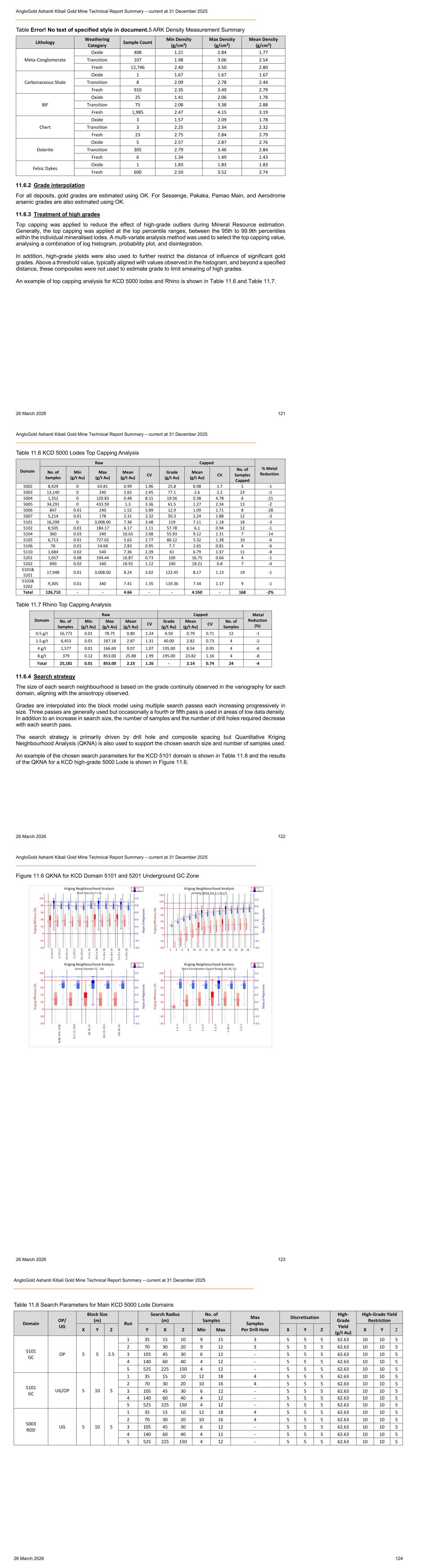
AngloGold Ashanti Kibali Gold Mine Technical Report Summary – current at 31 December 2025 ______________________________________________________________________________ 26 March 2026 121 Table Error! No text of specified style in document.5 ARK Density Measurement Summary Lithology Weathering Category Sample Count Min Density (g/cm³) Max Density (g/cm³) Mean Density (g/cm³) Meta-Conglomerate Oxide 408 1.21 2.84 1.77 Transition 107 1.98 3.06 2.54 Fresh 12,746 2.40 3.50 2.80 Carbonaceous Shale Oxide 1 1.67 1.67 1.67 Transition 8 2.09 2.78 2.44 Fresh 910 2.35 3.49 2.79 BIF Oxide 25 1.41 2.06 1.78 Transition 75 2.08 3.38 2.88 Fresh 1,985 2.47 4.15 3.19 Chert Oxide 3 1.57 2.09 1.78 Transition 3 2.25 2.34 2.32 Fresh 23 2.75 2.84 2.79 Dolerite Oxide 5 2.57 2.87 2.76 Transition 305 2.79 3.46 2.84 Fresh 6 1.34 1.49 1.43 Felsic Dykes Oxide 1 1.83 1.83 1.83 Fresh 600 2.50 3.52 2.74 11.6.2 Grade interpolation For all deposits, gold grades are estimated using OK. For Sessenge, Pakaka, Pamao Main, and Aerodrome arsenic grades are also estimated using OK. 11.6.3 Treatment of high grades Top capping was applied to reduce the effect of high-grade outliers during Mineral Resource estimation. Generally, the top capping was applied at the top percentile ranges, between the 95th to 99.9th percentiles within the individual mineralised lodes. A multi-variate analysis method was used to select the top capping value, analysing a combination of log histogram, probability plot, and disintegration. In addition, high-grade yields were also used to further restrict the distance of influence of significant gold grades. Above a threshold value, typically aligned with values observed in the histogram, and beyond a specified distance, these composites were not used to estimate grade to limit smearing of high grades. An example of top capping analysis for KCD 5000 lodes and Rhino is shown in Table 11.6 and Table 11.7. AngloGold Ashanti Kibali Gold Mine Technical Report Summary – current at 31 December 2025 ______________________________________________________________________________ 26 March 2026 122 Table 11.6 KCD 5000 Lodes Top Capping Analysis Domain Raw Capped % Metal Reduction No. of Samples Min (g/t Au) Max (g/t Au) Mean (g/t Au) CV Grade (g/t Au) Mean (g/t Au) CV No. of Samples Capped 5002 8,429 0 63.81 0.99 1.96 25.8 0.98 1.7 5 -1 5003 13,140 0 240 2.65 2.45 77.1 2.6 2.2 23 -2 5004 1,352 0 120.83 0.48 8.15 19.56 0.38 4.78 6 -21 5005 34,291 0 433.59 1.3 3.36 61.5 1.27 2.34 13 -2 5006 847 0.01 240 1.52 5.89 12.9 1.09 1.71 8 -28 5007 5,214 0.01 178 2.31 2.32 50.3 2.24 1.88 12 -3 5101 16,299 0 3,008.00 7.36 3.48 119 7.11 1.18 18 -3 5102 8,505 0.01 184.17 6.17 1.11 57.78 6.1 0.94 12 -1 5104 360 0.03 240 10.63 2.08 55.93 9.12 1.31 7 -14 5105 6,713 0.01 727.02 5.63 2.77 86.12 5.32 1.38 10 -6 5106 76 0.01 14.68 2.83 0.95 7.7 2.65 0.81 4 -6 5110 1,684 0.02 540 7.36 2.39 61 6.79 1.37 11 -8 5201 1,657 0.08 194.44 16.87 0.73 100 16.75 0.66 4 -1 5202 890 0.02 340 18.92 1.12 100 18.21 0.8 7 -4 5101& 5201 17,948 0.01 3,008.00 8.24 3.02 122.45 8.17 1.13 19 -1 5102& 5202 9,305 0.01 340 7.41 1.35 119.36 7.34 1.17 9 -1 Total 126,710 - - 4.66 - - 4.550 - 168 -2% Table 11.7 Rhino Top Capping Analysis Domain Raw Capped Metal Reduction (%) No. of Samples Min (g/t Au) Max (g/t Au) Mean (g/t Au) CV Grade (g/t Au) Mean (g/t Au) CV No. of Samples 0.5 g/t 16,772 0.01 78.75 0.80 1.24 6.50 0.79 0.71 12 -1 1.5 g/t 6,453 0.01 187.18 2.87 1.31 40.00 2.82 0.73 4 -2 4 g/t 1,577 0.01 166.69 9.07 1.07 195.00 8.54 0.95 4 -6 8 g/t 379 0.12 853.00 25.88 1.99 195.00 23.82 1.16 4 -8 Total 25,181 0.01 853.00 2.23 1.26 - 2.14 0.74 24 -4 11.6.4 Search strategy The size of each search neighbourhood is based on the grade continuity observed in the variography for each domain, aligning with the anisotropy observed. Grades are interpolated into the block model using multiple search passes each increasing progressively in size. Three passes are generally used but occasionally a fourth or fifth pass is used in areas of low data density. In addition to an increase in search size, the number of samples and the number of drill holes required decrease with each search pass. The search strategy is primarily driven by drill hole and composite spacing but Quantitative Kriging Neighbourhood Analysis (QKNA) is also used to support the chosen search size and number of samples used. An example of the chosen search parameters for the KCD 5101 domain is shown in Table 11.8 and the results of the QKNA for a KCD high-grade 5000 Lode is shown in Figure 11.6. AngloGold Ashanti Kibali Gold Mine Technical Report Summary – current at 31 December 2025 ______________________________________________________________________________ 26 March 2026 123 Figure 11.6 QKNA for KCD Domain 5101 and 5201 Underground GC Zone AngloGold Ashanti Kibali Gold Mine Technical Report Summary – current at 31 December 2025 ______________________________________________________________________________ 26 March 2026 124 Table 11.8 Search Parameters for Main KCD 5000 Lode Domains Domain OP/ UG Block Size (m) Run Search Radius (m) No. of Samples Max Samples Per Drill Hole Discretisation High- Grade Yield (g/t Au) High-Grade Yield Restriction X Y Z Y X Z Min Max X Y Z X Y Z 5101 GC OP 5 5 2.5 1 35 15 10 9 15 3 5 5 5 62.63 10 10 5 2 70 30 20 9 12 3 5 5 5 62.63 10 10 5 3 105 45 30 6 12 - 5 5 5 62.63 10 10 5 4 140 60 40 4 12 - 5 5 5 62.63 10 10 5 5 525 225 150 4 12 - 5 5 5 62.63 10 10 5 5101 GC UG/OP 5 10 5 1 35 15 10 12 18 4 5 5 5 62.63 10 10 5 2 70 30 20 10 16 4 5 5 5 62.63 10 10 5 3 105 45 30 6 12 - 5 5 5 62.63 10 10 5 4 140 60 40 4 12 - 5 5 5 62.63 10 10 5 5 525 225 150 4 12 - 5 5 5 62.63 10 10 5 5003 RDD UG 5 10 5 1 35 15 10 12 18 4 5 5 5 62.63 10 10 5 2 70 30 20 10 16 4 5 5 5 62.63 10 10 5 3 105 45 30 6 12 - 5 5 5 62.63 10 10 5 4 140 60 40 4 12 - 5 5 5 62.63 10 10 5 5 525 225 150 4 12 - 5 5 5 62.63 10 10 5

AngloGold Ashanti Kibali Gold Mine Technical Report Summary – current at 31 December 2025 ______________________________________________________________________________ 26 March 2026 125 Boundary analysis is completed to assess the nature of the contacts between the mineralised domains. Almost all domains use hard boundaries to ensure that separate grade populations do not influence the grades. An exception is the boundaries between the high and very high-grade domains at KCD which have a firm one-way boundary. Examples of the boundary analysis for the KCD 5000 Lodes are shown in Figure 11.7. Figure 11.7 Boundary Analysis Plots for the KCD Hard Low-grade/High-grade Hard Boundary (left) and High- grade/Very High-Grade One-way Firm Boundary (right) 11.6.5 Dynamic anisotropy Since 2017 dynamic anisotropy (DA) has been used to orientate the search neighbourhoods used for grade interpolation. DA surfaces are modelled for each domain and reflect a trend through the middle of the 3D mineralisation wireframes. Figure 11.8 shows search ellipses orientated by DA at KCD. AngloGold Ashanti Kibali Gold Mine Technical Report Summary – current at 31 December 2025 ______________________________________________________________________________ 26 March 2026 126 Figure 11.8 Cross-section through KCD (looking northeast) Showing Search Ellipses Orientated by Dynamic Anisotropy Source: Kibali Goldmines, 2025 11.7 Block models 11.7.1 Setup When choosing block sizes, consideration is given to selectivity during mine design and planning. Selective Mining Units (SMUs) reflect the geological knowledge of the deposit and balancing equipment efficiency and anticipated ore loss and dilution. Variable block sizes are used on each deposit and domain, directly linked to the drill data density (GC, RDD, or exploration). Parent block sizes are typically one half to one third the drilling spacing. Sub-blocking is typically as low as 1 m to 2 m to capture geological and domain contacts to an acceptable level of accuracy within the block model. The block model setup is presented in Table 11.9. Dolerite dykes were wireframed and coded into the block model with the relevant grade field set to zero as default. AngloGold Ashanti Kibali Gold Mine Technical Report Summary – current at 31 December 2025 ______________________________________________________________________________ 26 March 2026 127 Table 11.9 Block Model Parameters Block Model Azimuth Rotation (°) Smallest Parent Block Size (m) Largest Parent Block Size (m) Sub Cell Size (m) KCD 45 5 10 5 10 20 10 1.25 1.25 1.25 Agbarabo-Rhino 55 2.5 5 2.5 10 10 5 1.25 1.25 1.25 Gorumbwa 45 5 5 2.5 10 20 10 2.5 2.5 2.5 Pamao and Pamao South 325 5 5 2.5 20 20 5 2.5 2.5 2.5 Kalimva 0 2.5 5 2.5 10 20 5 2.5 2.5 2.5 Ikamva 35 2.5 5 2.5 10 15 5 2.5 2.5 2.5 Mengu Hill 295 5 5 2.5 20 20 5 2.5 2.5 2.5 Pakaka 0 5 5 2.5 10 20 10 2.5 2.5 2.5 Kombokolo 55 2.5 5 2.5 10 10 5 1.25 1.25 1.25 Sessenge 45 5 5 2.5 10 20 10 1.25 1.25 1.25 Aerodrome 70 5 5 2.5 10 20 5 2.5 2.5 2.5 Ndala 45 5 5 2.5 20 20 5 2.5 2.5 2.5 Sessenge SW 45 5 5 2.5 10 20 10 2.5 2.5 2.5 Mengu Village 40 5 5 2.5 20 10 5 2.5 2.5 2.5 Oere 20 5 10 5 10 20 5 2.5 2.5 2.5 Megi-Marakeke-Sayi 40 5 5 2.5 20 10 5 2.5 2.5 2.5 Makoke 325 5 5 2.5 20 20 5 2.5 2.5 2.5 11.7.2 Block model depletion The block models are limited depending on the mining status of the deposit (Table 11.10). Table 11.10 Block Model Depletion by Deposit Deposit Limit/Depletion Type KCD Mined-out surface and Underground depletion Agbarabo-Rhino Mined-out surface Gorumbwa Mined-out surface Pamao and Pamao South Mined-out surface Kalimva Mined-out surface Ikamva Mined-out surface Mengu Hill Mined-out surface Pakaka Mined-out surface Kombokolo Mined-out surface Sessenge Mined-out surface Aerodrome Mined-out surface Ndala Mined-out surface Sessenge SW Topography Mengu Village Topography Oere Topography Megi-Marakeke-Sayi Topography Makoke Topography The KCD underground block model is depleted using cavity monitoring laser scanner (CMS) surveys of the development stopes as at December 31, 2025. In addition, remnant skins and pillars of mineralisation that no longer meet RPEE are excluded. A series of resource exclusion wireframes are updated in and around areas where both primary and secondary stopes have been extracted. This ensures that minor lower-grade remnants do not get reported, despite being present within the resource MSO stope shapes. AngloGold Ashanti Kibali Gold Mine Technical Report Summary – current at 31 December 2025 ______________________________________________________________________________ 26 March 2026 128 The block models for active open pit mining areas are depleted using detailed drone photogrammetry surveys of the open pit surface as at December 31, 2025. There has been historical open pit and underground mining at Gorumbwa and Agbarabo. The high-grade central lode of the Agbarabo deposit was mined at surface and underground in the 1950s. The original plans indicate the presence of both adits and stopes. Ongoing drilling campaigns record these void intercepts and a depletion wireframe is created and used to deplete the block model. These void models are continuously updated as drilling progresses. Ahead of open pit mining at Gorumbwa in 2018, 3D Mine Surveying International Limited (3DMSI) carried out a 3D laser scan of the void to increase confidence in the modelled depletion volume. The open pit surface and overall development and stope void wireframes were used to deplete the model and will continuously be updated. The remaining block models are limited by the topography which has been defined using a 2 m contoured LiDAR DTM. This DTM covers the entire Project area as required for mine design purposes. The surface was checked against known drill hole collar elevations, and an acceptable match was found. 11.8 Mineral Resource classification Resource classification was based on geological continuity and drill data density, variogram range continuity and stability, as well as estimation quality in form of slope of regression (SR). This was carried out by displaying the estimated blocks (SR), together with the supporting data as a guide. The Mineral Resource classification parameters are presented in Table 11.11. Table 11.11 Kibali Mineral Resource Classification Parameters Statistic Deposit Measured Indicated Inferred Minimum Samples used in Estimate 8 6 4 Max Drilling Density KCD OP 10 m by 5 m or 20 m by 5 m 40 m by 30 m 80 m by 80 m KCD UG 25 m by 10 m 40 m by 40 m 80 m by 80 m Gorumbwa 10 m by 5 m 20 by 10 80 m by 80 m Pakaka 20 m by 10 m or 20 m by 5 m 40 m by 40 m 80 m by 60 m Sessenge 10 m by 10 m 40 m by 40 m 80 m by 80 m Sessenge SW - 40 m by 40 m 80 m by 80 m Pamao 10 m by 10 m 20 by 20 80 m by 80 m Pamao South - 20 by 20 40 m by 40 m Makoke - - 80 m by 80 m Kombokolo 10 m by 5 m or 10 by 10 m 30 m by 30 m 80 m by 80 m Mengu Village - - 40 m by 40 m to 80 m by 40 m Megi-Marakeke- Sayi - 20 m by 20 m 80 m by 80 m Kalimva-Ikamva 10 m by 5 m 20 m by 20 m 40 m by 20 m Aerodrome 10 m by 10 m 20 m by 20 m 40 m by 40 m Mengu Hill 10 m by 5 m 30 m by 20 m 80 m by 60 m Oere NA 20 m by 20 m 40 m by 40 m Rhino 10 m by 5 m 20 m by 20 m 40 m by 40 m The classification volumes are modified to ensure that they are coherent, contiguous and geometrically defensible, avoiding any “spotted-dog” pattern that would not be applicable at the scale of mining decisions. A change-of-support mindset is applied with classification done across zones large enough to represent a quarter or a year of production in a realistic mining context. For Indicated Mineral Resources, there is some flexibility in areas with lower drilling density where successive drilling campaigns have consistently demonstrated both grade and geological continuity. In those cases, the confidence level is based on the observed behaviour of the deposit as much as on drill spacing.

AngloGold Ashanti Kibali Gold Mine Technical Report Summary – current at 31 December 2025 ______________________________________________________________________________ 26 March 2026 129 Figure 11.9 shows an example of the Mineral Resource classification volumes at ARK. Figure 11.9 ARK Mineral Resource Classification Volumes Long Sectional View (looking northwest) Source: Kibali Goldmines, 2025 11.9 Block model validation Before, during, and after the block models were classified, validation checks were undertaken on the block model volumes and estimated grades to check for errors, and to assess the precision, accuracy, and any bias in the estimated grades. The block models were validated using the following steps: • Volume reconciliation between the block model estimation domains and related wireframes. Table 11.12 summarises the variances between the wireframe and block model volumes across all deposits and demonstrates that the block model adequately honours the geometry of the wireframes. The intent is to avoid situations where a highly detailed, geologically meaningful wireframe is represented by blocks that are too coarse to capture its shape or volume accurately. • Swath plots are created for each geological domain to validate the estimated grade variability compared to the composite grade variability along strike, across strike, and Z axis. This is to check that the estimated block grades reflect trends seen in the data and that there is no overall bias. Areas with less data support are also highlighted for further drilling and geological work. The swath plots are used to confirm that the confidence for the deposit is within acceptable limits and that conditional bias is kept to a minimum. Example swath plots for the KCD 5000 Lode are shown in Figure 11.10 and Figure 11.11. The naïve sample mean is an arithmetic average that does not reflect a real spatial average (due to over-sampling in higher grade areas). The estimate is expected to follow the declustered sample mean, as shown in the figures. • Visual check of the correlation between the composite data and the block estimates (Figure 11.12). For these checks, the composites and the estimated blocks are plotted using the same colour scale, which allows a direct visual comparison. This makes it easy to confirm that the block estimates are generally consistent with the informing data, and to identify any obvious cases where estimated blocks appear significantly higher or lower than the local composite grades. • Decluster plots are generated to compare the OK block estimate against the local change-of-support block estimate (Figure 11.13). The arithmetic average of the composites within each parent block is calculated and compared directly with the OK block estimate. A second graph is produced in which a change-of-support correction is applied to the composite grades before averaging them within the blocks, accounting for the difference in scale between the samples (several kilograms) and the parent blocks (hundreds of tonnes). Displaying both plots together allows the variance reduction introduced AngloGold Ashanti Kibali Gold Mine Technical Report Summary – current at 31 December 2025 ______________________________________________________________________________ 26 March 2026 130 by the change-of-support to be visualised and the global coherence of the estimates to be evaluated. In particular, a clear relationship is sought where high-grade data informs high-grade blocks and low- grade data informs low-grade blocks. This provides a method to assess the overall behaviour of the estimate and to identify any fatal flaws or high-grade smearing that could compromise the model. A tighter spread and straighter alignment of points around the 45° line indicates a higher quality estimate. Kibali deposit estimates compared well with no major concerns noted. • Much like the grade, visual checks are also performed on the density estimates and assignments to ensure that the estimated and/or applied densities honour the geological boundaries and reflect the expected trends within each domain, as shown in Figure 11.14. Table 11.12 2025 Block Model Volume Comparison Deposit Wireframe Volume (m³) Block Model Volume (m³) Variance (%) KCD UG 79,432,928 79,389,061 0% KCD OP 18,606,011 18,618,034 0% Sessenge 3,994,273 3,995,541 0% Sessenge SW 4,176,694 4,176,486 0% Gorumbwa 11,025,860 11,031,844 0% Pakaka 12,365,957 12,366,826 0% Kombokolo 2,984,241 2,984,110 0% Pamao 13,697,374 13,688,344 0% Pamao South 1,729,009 1,728,547 0% Mengu Village 4,123,637 4,119,742 0% Megi-Marakeke-Sayi 10,265,978 10,266,791 0% Kalimva Ikamva 14,551,715 14,553,578 0% Mengu Hill 4,123,637 4,119,742 0% Aerodrome 1,059,927.82 1,059,593.75 0% Oere 29,364,412.50 29,350,812.50 0% AngloGold Ashanti Kibali Gold Mine Technical Report Summary – current at 31 December 2025 ______________________________________________________________________________ 26 March 2026 131 Figure 11.10 KCD Swath Plot of 5000 Lode Along Strike (45°) AngloGold Ashanti Kibali Gold Mine Technical Report Summary – current at 31 December 2025 ______________________________________________________________________________ 26 March 2026 132 Figure 11.11 KCD Swath Plot of 5000 Lode Across Strike (135°)

AngloGold Ashanti Kibali Gold Mine Technical Report Summary – current at 31 December 2025 ______________________________________________________________________________ 26 March 2026 133 Figure 11.12 Visual Validation of Estimated Block Grades and Composites for KCD 5000 Lode (looking northeast) Source: Kibali Goldmines, 2025 Figure 11.13 Decluster Plot for KCD Model AngloGold Ashanti Kibali Gold Mine Technical Report Summary – current at 31 December 2025 ______________________________________________________________________________ 26 March 2026 134 Figure 11.14 Visual Validation of Density Estimate at KCD 5000 Lode (looking northeast) Source: Kibali Goldmines, 2025 Notes: 1. Blue ellipses showing areas with local density variability which is honoured in the density block estimate. 11.10 Stockpiles Stockpiles comprise mineralised material stored at the surface run-of-mine (ROM) pad, originating from both open pit and underground production. Each stockpile is filled with similar material types, with an established grade range and oxidation state, tracked as part of normal mining operations and metal accounting. The stockpiles are measured by weekly drone survey. Grade and tonnage of open pit stocks are estimated according to source dig blocks and number of truck counts, using a weighbridge to adjust for fluctuations in both density and truck fill factor. Grade and tonnage of underground stocks are estimated according to shaft skip weights and ore pass truck counts and their source blasts from stopes, adjusting for the presence of paste dilution. The stockpile estimates are based on full GC drill coverage and therefore are classified as Measured Mineral Resources. 11.11 Mineral Resource cut-off grade The assumptions used to generate cut-off grades for Mineral Resource estimation are based on the same cost and metallurgical recovery values used in the Mineral Reserve. A gold price of $2,000/oz is used in line with Barrick corporate guidelines, which considers long-term gold price forecasts (refer to Chapter 16.2). The open pits use a marginal cut-off grade while the underground uses an incremental cut-off grade for Mineral Resource reporting. AngloGold Ashanti Kibali Gold Mine Technical Report Summary – current at 31 December 2025 ______________________________________________________________________________ 26 March 2026 135 Table 11.13 summarises the Mineral Resource cut-off grades at a US$2,000/oz gold price for each deposit. Table 11.13 Summary Table of Resource Cut-off Grades at US$2,000/oz Gold Price per Deposit Deposit Oxide COG (g/t) Transitional COG (g/t) Fresh COG (g/t) Tonnage Weighted Average COG (Au g/t) UG KCD - - 0.91 0.91 OP KCD 0.63 0.63 0.67 0.67 Sessenge & Sessenge SW 0.59 0.70 0.68 0.68 Gorumbwa 0.63 0.63 0.64 0.64 Kombokolo 0.67 0.67 0.68 0.68 Agbarabo-Rhino 0.62 0.70 0.70 0.70 Pamao 0.63 0.67 0.68 0.67 Pakaka 0.69 0.69 0.78 0.78 Megi Marakeke Sayi 0.69 0.69 0.71 0.71 Ndala 0.59 0.61 0.64 0.64 Aerodrome 0.69 0.71 0.74 0.74 Mengu Village 0.69 0.74 0.76 0.76 Mengu Hill 0.78 0.82 0.82 0.82 Oere 0.77 0.79 0.80 0.80 Ikamva 0.76 0.76 0.78 0.78 Kalimva 0.76 0.76 0.78 0.77 The cut-off grade calculations by deposit are summarised in Table 11.14 to Table 11.31. 11.11.1 KCD open pit The input parameters for cut-off grade calculations for the KCD open pit Mineral Resources are summarised in Table 11.14. Table 11.14 KCD Open Pit 2025 Optimisation Parameters Material Type Unit Oxide Transition Fresh Waste Cost $/t mined 3.17 3.43 3.77 Extra Ore Cost – GC + Ore – Rehandle + Overhaul $/t mined 1.25 1.25 1.25 GC Only $/t mined 0.73 0.73 0.73 Dilution % 10% 10% 10% Ore Loss % 3% 3% 3% Haulage Cost $/t mined 0 0 0 Process Cost $/t milled 17.95 17.95 18.75 Processing Recovery % 90.1 90.1 86.1 General and Administration (G&A) $/t milled 10.25 10.25 10.25 Gold Price (Resource) $/oz Au 2,000 2,000 2,000 Gold Royalty (5.7%) $/oz Au 85.5 85.5 85.5 Total Process Cost $/t milled 19.65 19.65 20.46 Total Mining Cost $/t ore mined 26.69 28.77 31.48 Marginal In-situ Cut-off Grade g/t Au 0.63 0.63 0.67 Strip Ratio 7 The average tonnage weighted cut-off grade for the KCD open pit is 0.67 g/t Au. 11.11.2 KCD Underground The input parameters for cut-off grade calculations for KCD underground Mineral Resources are summarised in Table 11.15. AngloGold Ashanti Kibali Gold Mine Technical Report Summary – current at 31 December 2025 ______________________________________________________________________________ 26 March 2026 136 Table 11.15 KCD Underground 2025 Optimisation Parameters Description Units Break-even COG Incremental COG Stoping Gold Price $/oz 2,000 2,000 Process Plant Gold Recovery % 90 90 Royalty % 5.7 5.7 Mine Production and Backfill $/t 52.55 20.91 Sustaining Capital $/t 3.42 N/A Processing $/t 18.22 18.22 Site G&A $/t 10.25 10.25 Total Unit Cash Costs $/t 84.45 49.38 Mining Cut-off Grade g/t Au 1.56 0.91 MSO shapes were used to differentiate blocks that demonstrate RPEE. This reporting method of using stopes, not blocks, excludes high-grade blocks that are geometrically isolated and can include blocks at lower grades that are geometrically contiguous. The parameters used are less restrictive than those used for Mineral Reserve estimation. Stope orientation changes and stope sizes are more flexible, as well as a proportion of waste included. All stope orientations are set to follow wireframe surfaces modelled on deposit structure. Same global stopes parameters have been applied to generate at 25 m (along plunge) x 35 m (down dip) and optimised across strike, with a 40% allowance for material below the cut-off grade. The minimum Mineral Resource MSO stope dimensions across the lodes are set at approximately 12.5 m x 12.5 m x 5 m (Table 11.16). Table 11.16 KCD Underground MSO Parameters MSO Parameter Input Stope Orientation plane YZ (Fixed strike length and height, optimised width) Dimensions 25 m x 35 m Model discretisation int 8 x 8 Waste Fraction 0.4 (40%) COG 0.91 g/t Regular Sub-stope 2 x 2 (i.e., 12.5 m x 17.5 m) Minimum/Maximum stope width 5 m and 50 m Min waste Pillar width 10 m Top Bottom/Front back max ratio 2.25 and 2.25 Strike Min/Max and Max change -45°, 45°, 20° Min Foot wall near/ Max footwall near 40° and 140° Max foot wall change near 20° After creating the MSO shapes, exclusion solid shapes were manually constructed to ensure there was no accumulation of unrecoverable mineralised blocks with no RPEE in the current Mineral Resource (Figure 11.15).

AngloGold Ashanti Kibali Gold Mine Technical Report Summary – current at 31 December 2025 ______________________________________________________________________________ 26 March 2026 137 Figure 11.15 KCD Underground Development with Mineral Resource Exclusion Solids (looking northwest) Source: Kibali Goldmines, 2025 An incremental mined cut-off grade of 0.91 g/t Au at a $2,000/oz gold price defines the KCD underground optimised mineable stope shapes. A solid wireframe interface is used to divide the open pit Mineral Resources from the underground Mineral Resources. Geotechnical parameters were considered when defining this interface (Figure 11.16). AngloGold Ashanti Kibali Gold Mine Technical Report Summary – current at 31 December 2025 ______________________________________________________________________________ 26 March 2026 138 Figure 11.16 3D View of UG Reporting Solid Limiting MSO Shapes for Mineral Resource Estimation (looking northwest) Source: Kibali Goldmines, 2025 11.11.3 Agbarabo-Rhino The input parameters for cut-off grade calculations for the Agbarabo-Rhino open pit Mineral Resource are summarised in Table 11.17. Table 11.17 Agbarabo-Rhino 2025 Optimisation Parameters Material Type Unit Oxide Trans Fresh Waste Cost $/t mined 3.79 4.10 4.74 Extra Ore Cost – GC + Ore – Rehandle + Overhaul $/t mined 1.25 1.25 1.25 GC Only $/t mined 0.73 0.73 0.73 Dilution % 10% 10% 10% Ore Loss % 10% 10% 10% Haulage Cost $/t mined - - - Process Cost $/t milled 17.95 17.95 18.75 Processing Recovery % 91.00 81.00 83.00 G&A $/t milled 10.25 10.25 10.25 Gold Price (Resource) $/oz Au 2,000 2,000 2,000 Gold Royalty (5.7%) $/oz Au 85.50 85.50 85.50 Total Process Cost (per ore tonne mined) $/t ore 19.65 19.65 20.46 Total Mining Cost (per ore tonne mined) $/t ore 31.67 34.13 39.29 Marginal In-situ Cut-off Grade g/t Au 0.62 0.70 0.70 Strip Ratio 11.8 The average tonnage weighted cut-off grade for Agbarabo-Rhino is 0.70 g/t Au. 11.11.4 Kombokolo The input parameters for cut-off grade calculations for the Kombokolo open pit Mineral Resource are summarised in Table 11.18. AngloGold Ashanti Kibali Gold Mine Technical Report Summary – current at 31 December 2025 ______________________________________________________________________________ 26 March 2026 139 Table 11.18 Kombokolo 2025 Optimisation Parameters Material Type Unit Oxide Trans Fresh Waste Cost $/t mined 3.21 3.49 3.78 Extra Ore Cost – GC + Ore – Rehandle + Overhaul $/t mined 1.25 1.25 1.25 GC Only $/t mined 0.73 0.73 0.73 Dilution % 10% 10% 10% Ore Loss % 3% 3% 3% Haulage Cost $/t mined - - - Process Cost $/t milled 17.95 17.95 18.75 Processing Recovery % 85.00 85.00 85.00 G&A $/t milled 10.25 10.25 10.25 Gold Price (Resource) $/oz Au 2,000 2,000 2,000 Gold Royalty (5.7%) $/oz Au 85.50 85.50 85.50 Total Process Cost (per ore tonne mined) $/t ore 19.65 19.65 20.46 Total Mining Cost (per ore tonne mined) $/t ore 85.72 93.05 100.75 Marginal In-situ Cut-off Grade g/t Au 0.67 0.67 0.68 Strip Ratio 25.3 The average tonnage weighted cut-off grade for Kombokolo is 0.68 g/t Au. 11.11.5 Gorumbwa The input parameters for cut-off grade calculations for Gorumbwa open pit Mineral Resource are summarised in Table 11.19. Table 11.19 Gorumbwa 2025 Optimisation Parameters Material Type Unit Oxide Trans Fresh Waste Cost $/t mined 3.22 3.46 3.78 Extra Ore Cost – GC + Ore – Rehandle + Overhaul $/t mined 1.25 1.25 1.25 GC Only $/t mined 0.73 0.73 0.73 Dilution % 10% 10% 10% Ore Loss % 16% 16% 16% Haulage Cost $/t mined - - - Process Cost $/t milled 17.95 17.95 18.75 Processing Recovery % 90.00 90.00 90.00 G&A $/t milled 10.25 10.25 10.25 Gold Price (Resource) $/oz Au 2,000 2,000 2,000 Gold Royalty (5.7%) $/oz Au 85.50 85.50 85.50 Total Process Cost (per ore tonne mined) $/t ore 19.65 19.65 20.46 Total Mining Cost (per ore tonne mined) $/t ore 38.15 40.86 44.57 Marginal In-situ Cut-off Grade g/t Au 0.63 0.63 0.64 Strip Ratio 10.45 The average tonnage weighted cut-off grade for Gorumbwa is 0.64 g/t Au. 11.11.6 Sessenge and Sessenge SW The input parameters for cut-off grade calculations for the Sessenge open pit Mineral Resource are summarised in Table 11.20. AngloGold Ashanti Kibali Gold Mine Technical Report Summary – current at 31 December 2025 ______________________________________________________________________________ 26 March 2026 140 Table 11.20 Sessenge 2025 Optimisation Parameters Material Type Unit Oxide Trans Fresh Waste Cost $/t mined 3.17 3.44 3.61 Extra Ore Cost – GC + Ore – Rehandle + Overhaul $/t mined 1.25 1.25 1.25 GC Only $/t mined 0.73 0.73 0.73 Dilution % 4% 4% 4% Ore Loss % 13% 13% 13% Haulage Cost $/t mined - - - Process Cost $/t milled 17.95 17.95 18.75 Processing Recovery % 90.30 75.90 81.00 G&A $/t milled 10.25 10.25 10.25 Gold Price (Resource) $/oz Au 2,000 2,000 2,000 Gold Royalty (5.7%) $/oz Au 85.50 85.50 85.50 Total Process Cost (per ore tonne mined) $/t ore 19.65 19.65 20.46 Total Mining Cost (per ore tonne mined) $/t ore 23.98 25.92 27.13 Marginal In-situ Cut-off Grade g/t Au 0.59 0.70 0.68 Strip Ratio 6.17 The average tonnage weighted cut-off grade for Sessenge and Sessenge SW is 0.68 g/t Au. 11.11.7 Pakaka The input parameters for cut-off grade calculations for the Pakaka open pit Mineral Resource are summarised in Table 11.21. Table 11.21 Pakaka 2025 Optimisation Parameters Material Type Unit Oxide Trans Fresh Waste Cost $/t mined 3.12 3.55 3.79 Extra Ore Cost – GC + Ore – Rehandle + Overhaul $/t mined 1.25 1.25 1.25 GC Only $/t mined 0.73 0.73 0.73 Dilution % 10% 10% 10% Ore Loss % 3% 3% 3% Haulage Cost $/t mined 2.63 2.63 2.63 Process Cost $/t milled 17.95 17.95 18.75 Processing Recovery % 89.00 89.00 80.00 G&A $/t milled 10.25 10.25 10.25 Gold Price (Resource) $/oz Au 2,000 2,000 2,000 Gold Royalty (5.7%) $/oz Au 85.50 85.50 85.50 Total Process Cost (per ore tonne mined) $/t ore 22.28 22.28 23.09 Total Mining Cost (per ore tonne mined) $/t ore 46.29 52.41 55.90 Marginal In-situ Cut-off Grade g/t Au 0.69 0.69 0.78 Strip Ratio 13.42 The average tonnage weighted cut-off grade for Pakaka is 0.78 g/t Au (oxide and transition material has been mined out). Feasibility test work and limited follow up metallurgical test work completed in 2016 identified two main domains where arsenic impacts recovery. The test work demonstrated that there is a direct correlation between gold grade and arsenic content, and an inverse correlation between recovery and arsenic grade. Consequently, the recoveries shown in Table 11.21 are an average for each weathering classification. The detailed Pakaka domain recoveries are provided in Table 11.22 and the geometallurgical domains are shown in Figure 11.17.

AngloGold Ashanti Kibali Gold Mine Technical Report Summary – current at 31 December 2025 ______________________________________________________________________________ 26 March 2026 141 There has been no mining at Pakaka since 2018 when Pushback 1 was mined out and there has been no further exploration drilling or geological modelling. For this Mineral Resource estimate only the pit shell and cut-off grade have been revised. Figure 11.17 Plan View Map of the Pakaka Geometallurgical Domains and Their Spatial Correlation with the Mineralisation Resource Domains Source: Kibali Goldmines, 2021 In addition to applying these recoveries to the LOM optimisation, the delineation of the six geometallurgical domains was used to optimise the blending strategy during feeding in the plant (Table 11.22). Apart from understanding the recoveries associated with the individual domains, arsenic concentration in the plant feed blend is used to maintain the thresholds (<2,000 ppm), which ensures not only stable recovery, but reasonable reagent consumption. A small amount of silver is also found within the ore and doré bars for which a penalty is applied by the smelters. However, this is not material and silver grades are not required to be estimated in the model. AngloGold Ashanti Kibali Gold Mine Technical Report Summary – current at 31 December 2025 ______________________________________________________________________________ 26 March 2026 142 Table 11.22 Pakaka Geometallurgical Domained Recoveries Domain Description Weathering BRTs Average Dissolution (%) Arsenic Assay (ppm) Feasibility Direct Leach (%) Comments 1 Low Au grade / Low As / Low Recovery Saprolite 84.1 <1,000 - - Oxidised Transition 86.8 <1,000 - - Reduced Transition 81.6 <1,000 - - 2 High Au grade / High As / High Recovery Saprolite 90.8 >2,000 - - Oxidised Transition 90.4 >2,000 - - Reduced Transition 86 >2,000 - - 3 High Au grade / High As / Low Recovery Fresh 75.2 >2,000 59.6 Feasibility dissolution exclude gravity, so use BRT value to cater for gravity 4 High Au grade / High As / High Recovery Saprolite 85.5 <1,000 - - Reduced Transition 92.6 <1,000 - - Fresh 93.4 <1,000 87.3 Use feasibility number and the BRT number for plant performance tracking 5 Medium Au grade / Medium As / Medium Recovery Saprolite 87.4 1,000 – 2,000 - - Fresh 88.3 1,000 – 2,000 87.3 Feasibility split only caters for above and below 0.2% arsenic content. Sample represents below 0.2% 6 High Au grade / High As / High Recovery Saprolite 89 >2,000 - - Oxidised Transition 89.6 >2,000 - - Fresh 88.8 >2,000 - - AngloGold Ashanti Kibali Gold Mine Technical Report Summary – current at 31 December 2025 ______________________________________________________________________________ 26 March 2026 143 11.11.8 Pamao and Makoke The input parameters for cut-off grade calculations for the Pamao and Makoke open pit Mineral Resource are summarised in Table 11.23. Specific studies for haulage and processing recovery have not yet been undertaken for Makoke. As such, values for these parameters are taken from the nearest deposit, Pamao, which has similar mineralisation, host lithology, and distance to the ROM pad. Table 11.23 Pamao and Makoke 2025 Optimisation Parameters Material Type Unit Oxide Trans Fresh Waste Cost $/t mined 2.86 3.19 3.73 Extra Ore Cost – GC + Ore – Rehandle + Overhaul $/t mined 1.25 1.25 1.25 GC Only $/t mined 0.73 0.73 0.73 Dilution % 2% 2% 2% Ore Loss % 12% 12% 12% Haulage Cost $/t mined 2.63 2.63 2.63 Process Cost $/t milled 17.95 17.95 18.75 Processing Recovery % 90.90 85.00 85.00 G&A $/t milled 10.25 10.25 10.25 Gold Price (Resource) $/oz Au 2,000 2,000 2,000 Gold Royalty (5.7%) $/oz Au 85.50 85.50 85.50 Total Process Cost (per ore tonne mined) $/t ore 22.28 22.28 23.09 Total Mining Cost (per ore tonne mined) $/t ore 20.80 23.11 26.78 Marginal In-situ Cut-off Grade g/t Au 0.63 0.67 0.68 Strip Ratio 5.84 The average tonnage weighted cut-off grade for Pamao is 0.67 g/t Au and for Makoke is 0.68 g/t Au. 11.11.9 Megi-Marakeke-Sayi The input parameters for cut-off grade calculations for the Megi-Marakeke-Sayi open pit Mineral Resource are summarised in Table 11.24. Table 11.24 Megi-Marakeke-Sayi 2025 Optimisation Parameters Material Type Unit Oxide Trans Fresh Waste Cost $/t mined 3.51 3.80 4.19 Extra Ore Cost – GC + Ore – Rehandle + Overhaul $/t mined 1.25 1.25 1.25 GC Only $/t mined 0.73 0.73 0.73 Dilution % 10% 10% 10% Ore Loss % 3% 3% 3% Haulage Cost $/t mined 3.00 3.00 3.00 Process Cost $/t milled 17.95 17.95 18.75 Processing Recovery % 90.00 90.00 89.50 G&A $/t milled 10.25 10.25 10.25 Gold Price (Resource) $/oz Au 2,000 2,000 2,000 Gold Royalty (5.7%) $/oz Au 85.50 85.50 85.50 Total Process Cost (per ore tonne mined) $/t ore 22.65 22.65 23.46 Total Mining Cost (per ore tonne mined) $/t ore 39.83 43.10 47.39 Marginal In-situ Cut-off Grade g/t Au 0.69 0.69 0.71 Strip Ratio 10 The average tonnage weighted cut-off grade for Megi-Marakeke-Sayi is 0.71 g/t Au. AngloGold Ashanti Kibali Gold Mine Technical Report Summary – current at 31 December 2025 ______________________________________________________________________________ 26 March 2026 144 11.11.10 Kalimva The input parameters for cut-off grade calculations for the Kalimva open pit Mineral Resource are summarised in Table 11.25. Table 11.25 Kalimva 2025 Optimisation Parameters Material Type Unit Oxide Trans Fresh Waste Cost $/t mined 4.83 5.29 5.96 Extra Ore Cost – GC + Ore – Rehandle + Overhaul $/t mined 1.25 1.25 1.25 GC Only $/t mined 0.73 0.73 0.73 Dilution % 10% 10% 10% Ore Loss % 3% 3% 3% Haulage Cost $/t mined 6.30 6.30 6.30 Process Cost $/t milled 17.95 17.95 18.75 Processing Recovery % 90.00 89.00 89.00 G&A $/t milled 10.25 10.25 10.25 Gold Price (Resource) $/oz Au 2,000 2,000 2,000 Gold Royalty (4.7%) $/oz Au 85.50 85.50 85.50 Total Process Cost (per ore tonne mined) $/t ore 25.95 25.95 26.76 Total Mining Cost (per ore tonne mined) $/t ore 45.71 50.00 56.10 Marginal In-situ Cut-off Grade g/t Au 0.76 0.76 0.78 Strip Ratio 6.58 The average tonnage weighted cut-off grade for Kalimva is 0.77 g/t Au. 11.11.11 Ikamva The input parameters for cut-off grade calculations for the Ikamva open pit Mineral Resource are summarised in Table 11.26. Table 11.26 Ikamva 2025 Optimisation Parameters Material Type Unit Oxide Trans Fresh Waste Cost $/t mined 4.29 4.93 5.60 Extra Ore Cost – GC + Ore – Rehandle + Overhaul $/t mined 1.25 1.25 1.25 GC Only $/t mined 0.73 0.73 0.73 Dilution % 10% 10% 10% Ore Loss % 10% 10% 10% Haulage Cost $/t mined 6.30 6.30 6.30 Process Cost $/t milled 17.95 17.95 18.75 Processing Recovery % 90.00 89.00 89.00 G&A $/t milled 10.25 10.25 10.25 Gold Price (Resource) $/oz Au 2,000 2,000 2,000 Gold Royalty (4.7%) $/oz Au 85.50 85.50 85.50 Total Process Cost (per ore tonne mined) $/t ore 25.95 25.95 26.76 Total Mining Cost (per ore tonne mined) $/t ore 40.79 46.69 52.79 Marginal In-situ Cut-off Grade g/t Au 0.76 0.76 0.78 Strip Ratio 8.21 The average tonnage weighted cut-off grade for Ikamva is 0.78 g/t Au.

AngloGold Ashanti Kibali Gold Mine Technical Report Summary – current at 31 December 2025 ______________________________________________________________________________ 26 March 2026 145 11.11.12 Oere The input parameters for cut-off grade calculations for the Oere open pit Mineral Resource are summarised in Table 11.27. Table 11.27 Oere 2025 Optimisation Parameters Material Type Unit Oxide Trans Fresh Waste Cost $/t mined 4.44 4.84 4.98 Extra Ore Cost – GC + Ore – Rehandle + Overhaul $/t mined 1.25 1.25 1.25 GC Only $/t mined 0.73 0.73 0.73 Dilution % 10% 10% 10% Ore Loss % 3% 3% 3% Haulage Cost $/t mined 6.30 6.30 6.30 Process Cost $/t milled 17.95 17.95 18.75 Processing Recovery % 88.00 86.50 87.00 G&A $/t milled 10.25 10.25 10.25 Gold Price (Resource) $/oz Au 2,000 2,000 2,000 Gold Royalty (4.7%) $/oz Au 85.50 85.50 85.50 Total Process Cost (per ore tonne mined) $/t ore 25.95 25.95 26.76 Total Mining Cost (per ore tonne mined) $/t ore 67.12 73.08 75.19 Marginal In-situ Cut-off Grade g/t Au 0.77 0.79 0.80 Strip Ratio 13.84 The average tonnage weighted cut-off grade for the Oere is 0.80 g/t Au. 11.11.13 Mengu Hill The input parameters for cut-off grade calculations for the Mengu Hill open pit Mineral Resource are summarised in Table 11.28. Table 11.28 Mengu Hill 2025 Optimisation Parameters Material Type Unit Oxide Ox-Trans Red-Trans Fresh Waste Cost $/t mined 2.89 3.16 3.26 3.49 Extra Ore Cost – GC + Ore – Rehandle + Overhaul $/t mined 1.25 1.25 1.25 1.25 GC Only $/t mined 0.73 0.73 0.75 0.73 Dilution % 10% 10% 10% 10% Ore Loss % 3% 3% 3% 3% Haulage Cost $/t mined 3.50 3.50 3.50 3.50 Process Cost $/t milled 17.95 17.95 17.95 18.75 Processing Recovery % 81.00 77.00 77.00 75.50 G&A $/t milled 10.25 10.25 10.25 10.25 Gold Price (Resource) $/oz Au 2,000 2,000 2,000 2,000 Gold Royalty (4.7%) $/oz Au 85.50 85.50 85.50 85.50 Total Process Cost (per ore tonne mined) $/t ore 23.15 23.15 23.15 23.96 Total Mining Cost (per ore tonne mined) $/t ore 43.35 47.38 48.84 52.18 Marginal In-situ Cut-off Grade g/t Au 0.78 0.82 0.82 0.85 Strip Ratio 13.58 The average tonnage weighted cut-off grade for Mengu Hill is 0.82 g/t Au. The transition zone for Mengu Hill was further divided into oxidised transition and reduced transition, according to a slight increase in mining cost (impact negligible at the current gold price). A hardness difference leads to a slower drilling penetration rate and increased powder factor, and increased cost as a result. AngloGold Ashanti Kibali Gold Mine Technical Report Summary – current at 31 December 2025 ______________________________________________________________________________ 26 March 2026 146 11.11.14 Aerodrome The input parameters for cut-off grade calculations for the Aerodrome open pit Mineral Resource are summarised in Table 11.29. Table 11.29 Aerodrome 2025 Optimisation Parameters Material Type Unit Oxide Trans Fresh Waste Cost $/t mined 4.35 4.69 5.04 Extra Ore Cost – GC + Ore – Rehandle + Overhaul $/t mined 1.25 1.25 1.25 GC Only $/t mined 0.73 0.73 0.73 Dilution % 12% 12% 12% Ore Loss % 11% 11% 11% Haulage Cost $/t mined 2.63 2.63 2.63 Process Cost $/t milled 17.95 17.95 18.75 Processing Recovery % 90.00 88.00 85.90 G&A $/t milled 10.25 10.25 10.25 Gold Price (Resource) $/oz Au 2,000 2,000 2,000 Gold Royalty (4.7%) $/oz Au 85.50 85.50 85.50 Total Process Cost (per ore tonne mined) $/t ore 22.28 22.28 23.09 Total Mining Cost (per ore tonne mined) $/t ore 30.63 32.94 35.29 Marginal In-situ Cut-off Grade g/t Au 0.69 0.71 0.74 Strip Ratio 5.76 The average tonnage weighted cut-off grade for the Aerodrome is 0.74 g/t Au. 11.11.15 Ndala The input parameters for cut-off grade calculations for the Ndala open pit Mineral Resource are summarised in Table 11.30. Specific studies for haulage and processing recovery have not yet been undertaken for Ndala. As such, values for these parameters are taken from the nearest deposit, Meg-Marakeke-Sayi, which has similar mineralisation, host lithology, and distance to the ROM pad. Table 11.30 Ndala 2025 Optimisation Parameters Material Type Unit Oxide Trans Fresh Waste Cost $/t mined 2.19 2.71 2.89 Extra Ore Cost – GC + Ore – Rehandle + Overhaul $/t mined 1.25 1.25 1.25 GC Only $/t mined 0.73 0.73 0.73 Dilution % 10% 10% 10% Ore Loss % 3% 3% 3% Haulage Cost (after Megi-Marakeke-Sayi) $/t mined 3.50 3.50 3.50 Process Cost $/t milled 17.95 17.95 18.75 Processing Recovery (after Megi-Marakeke-Sayi) % 90.90 85.00 85.00 G&A $/t milled 10.25 10.25 10.25 Gold Price (Resource) $/oz Au 2,000 2,000 2,000 Gold Royalty (5.7%) $/oz Au 85.50 85.50 85.50 Total Process Cost (per ore tonne mined) $/t ore 23.15 23.15 23.96 Total Mining Cost (per ore tonne mined) $/t ore 15.29 18.61 19.74 Marginal In-situ Cut-off Grade g/t Au 0.69 0.74 0.76 Strip Ratio 5.40 The average tonnage weighted cut-off grade for Ndala is 0.76 g/t Au. AngloGold Ashanti Kibali Gold Mine Technical Report Summary – current at 31 December 2025 ______________________________________________________________________________ 26 March 2026 147 11.11.16 Mengu village The input parameters for cut-off grade calculations for the Mengu Village open pit Mineral Resource are summarised in Table 11.31. Specific studies for haulage and processing recovery have not yet been undertaken for Mengu Village. As such, values for these parameters are taken from the nearest deposit, Megi-Marakeke-Sayi, which has similar mineralisation, host lithology, and distance to the ROM pad. Table 11.31 Mengu Village 2025 Optimisation Parameters Material Type Unit Oxide Trans Fresh Waste Cost $/t mined 2.19 2.71 2.89 Extra Ore Cost – GC + Ore – Rehandle + Overhaul $/t mined 1.25 1.25 1.25 GC Only $/t mined 0.73 0.73 0.73 Dilution % 10% 10% 10% Ore Loss % 3% 3% 3% Haulage Cost (after Megi-Marakeke-Sayi) $/t mined 3.50 3.50 3.50 Process Cost $/t milled 17.95 17.95 18.75 Processing Recovery (after Megi-Marakeke-Sayi) % 90.90 85.00 85.00 G&A $/t milled 10.25 10.25 10.25 Gold Price (Resource) $/oz Au 2,000 2,000 2,000 Gold Royalty (5.7%) $/oz Au 85.50 85.50 85.50 Total Process Cost (per ore tonne mined) $/t ore 23.15 23.15 23.96 Total Mining Cost (per ore tonne mined) $/t ore 15.29 18.61 19.74 Marginal In-situ Cut-off Grade g/t Au 0.69 0.74 0.76 Strip Ratio 5.40 The average tonnage weighted cut-off grade for Mengu Village is 0.76 g/t Au. AngloGold Ashanti Kibali Gold Mine Technical Report Summary – current at 31 December 2025 ______________________________________________________________________________ 26 March 2026 148 11.12 Mineral Resource statement For open pit, RPEE are demonstrated by reporting Mineral Resources inside an optimised pit shell at a gold price of $2,000/oz Au. A cut-off grade corresponding to the in situ marginal cut-off grade for fresh, transitional or oxidation zones, and using the same cost assumptions and metallurgical recoveries as used in the Mineral Reserve, is also used to report open pit Mineral Resources. For underground, RPEE are demonstrated by reporting Mineral Resources using MSO, effectively within a minimum mineable stope shape, applying reasonable mining constraints, including a minimum mining width, a reasonable distance from current or planned development, and a measure of assumed profitability at the Mineral Resource cut-off grade, which is based on the same cost assumptions and metallurgical recoveries as used in the Mineral Reserve, but a gold price of $2,000/oz Au. Stockpiles are estimated based on operational material movement tracking from their open pit and underground sources. The total inclusive Measured and Indicated Mineral Resources, as at December 31, 2025, are estimated to be 200 Mt at 2.79 g/t Au containing 18 million ounces (Moz) of gold, with an additional Inferred Resource of 49 Mt at 2.1 g/t Au containing 3.3 Moz of gold (100% basis). The attributable inclusive Measured and Indicated Mineral Resources, as at December 31, 2025, are estimated to be 90 Mt at 2.79 g/t Au containing 8.1 million ounces (Moz) of gold, with an additional Inferred Resource of 22 Mt at 2.1 g/t Au containing 1.5 Moz of gold (45% basis). The total exclusive Measured and Indicated Mineral Resources, as at December 31, 2025, are estimated to be 74 Mt at 2.4 g/t Au containing 5.7 million ounces (Moz) of gold, with an additional Inferred Resource of 49 Mt at 2.1 g/t Au containing 3.3 Moz of gold (100% basis). The attributable exclusive Measured and Indicated Mineral Resources, as at December 31, 2025, are estimated to be 33 Mt at 2.4 g/t Au containing 2.5 million ounces (Moz) of gold, with an additional Inferred Resource of 22 Mt at 2.1 g/t Au containing 1.5 Moz of gold (45% basis). Table 11.32 presents the Kibali Mineral Resource estimate reported as inclusive of Mineral Reserves, as at December 31, 2025. Table 33 presents the Kibali Mineral Resource estimate reported as exclusive of Mineral Reserves, as at December 31, 2025.
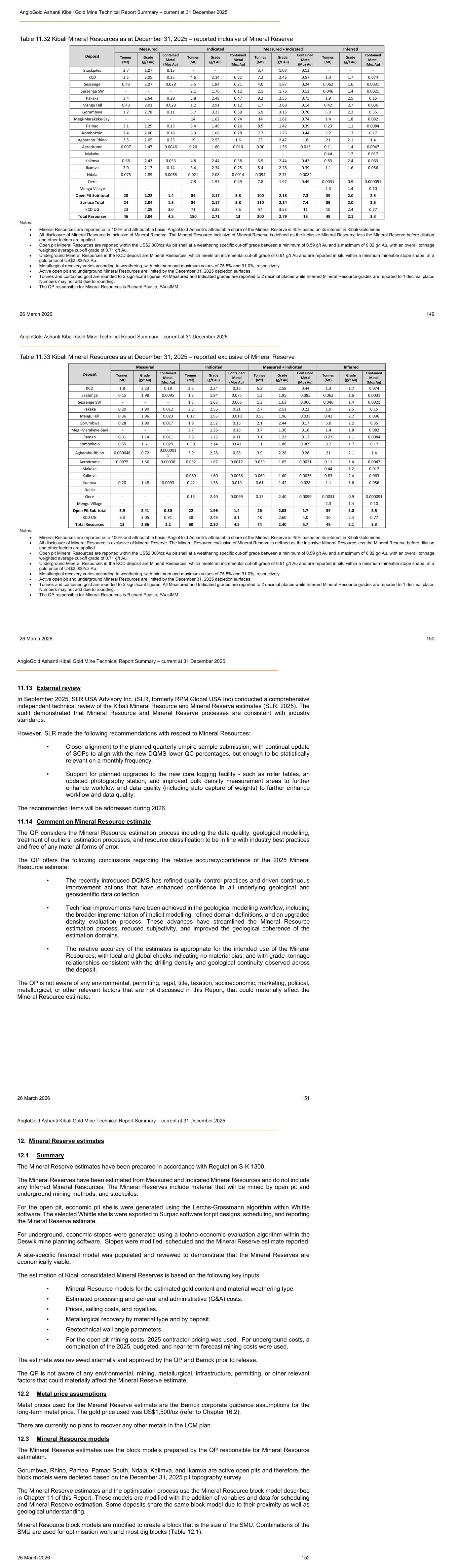
AngloGold Ashanti Kibali Gold Mine Technical Report Summary – current at 31 December 2025 ______________________________________________________________________________ 26 March 2026 149 Table 11.32 Kibali Mineral Resources as at December 31, 2025 – reported inclusive of Mineral Reserve Deposit Measured Indicated Measured + Indicated Inferred Tonnes (Mt) Grade (g/t Au) Contained Metal (Moz Au) Tonnes (Mt) Grade (g/t Au) Contained Metal (Moz Au) Tonnes (Mt) Grade (g/t Au) Contained Metal (Moz Au) Tonnes (Mt) Grade (g/t Au) Contained Metal (Moz Au) Stockpiles 3.7 1.07 0.13 - - - 3.7 1.07 0.13 - - - KCD 2.5 3.05 0.25 4.6 2.14 0.32 7.2 2.46 0.57 1.3 1.7 0.074 Sessenge 0.43 2.07 0.028 3.5 1.84 0.21 4.0 1.87 0.24 0.062 1.6 0.0031 Sessenge SW - - - 2.1 1.76 0.12 2.1 1.76 0.12 0.046 1.4 0.0021 Pakaka 3.4 2.64 0.29 5.8 2.49 0.47 9.2 2.55 0.75 1.9 2.5 0.15 Mengu Hill 0.43 2.01 0.028 1.2 2.91 0.12 1.7 2.68 0.14 0.42 2.7 0.036 Gorumbwa 1.2 2.78 0.11 5.7 3.23 0.59 6.9 3.15 0.70 5.0 2.2 0.35 Megi-Marakeke-Sayi - - - 14 1.62 0.74 14 1.62 0.74 1.4 1.8 0.082 Pamao 3.1 1.29 0.13 5.4 1.49 0.26 8.5 1.42 0.39 0.23 1.1 0.0084 Kombokolo 2.4 2.00 0.16 5.3 1.66 0.28 7.7 1.76 0.44 3.2 1.7 0.17 Agbarabo-Rhino 3.5 2.05 0.23 19 2.55 1.6 23 2.47 1.8 21 2.1 1.4 Aerodrome 0.097 1.47 0.0046 0.20 1.60 0.010 0.30 1.56 0.015 0.11 1.4 0.0047 Makoke - - - - - - - - - 0.44 1.2 0.017 Kalimva 0.68 2.43 0.053 4.8 2.44 0.38 5.5 2.44 0.43 0.83 2.4 0.063 Ikamva 2.0 2.17 0.14 3.4 2.34 0.25 5.4 2.28 0.39 1.1 1.6 0.056 Ndala 0.073 2.89 0.0068 0.021 2.08 0.0014 0.094 2.71 0.0082 - - - Oere - - - 7.8 1.97 0.49 7.8 1.97 0.49 0.0031 0.9 0.000091 Mengu Village - - - - - - - - - 2.3 1.4 0.10 Open Pit Sub-total 20 2.22 1.4 84 2.17 5.8 100 2.18 7.3 39 2.0 2.5 Surface Total 24 2.04 1.5 84 2.17 5.8 110 2.14 7.4 39 2.0 2.5 KCD UG 23 4.09 3.0 71 3.35 7.6 94 3.53 11 10 2.4 0.77 Total Resources 46 3.04 4.5 150 2.71 13 200 2.79 18 49 2.1 3.3 Notes: • Mineral Resources are reported on a 100% and attributable basis. AngloGold Ashanti’s attributable share of the Mineral Reserve is 45% based on its interest in Kibali Goldmines • All disclosure of Mineral Resource is inclusive of Mineral Reserve. The Mineral Resource inclusive of Mineral Reserve is defined as the inclusive Mineral Resource less the Mineral Reserve before dilution and other factors are applied. • Open pit Mineral Resources are reported within the US$2,000/oz Au pit shell at a weathering specific cut-off grade between a minimum of 0.59 g/t Au and a maximum of 0.82 g/t Au, with an overall tonnage weighted average cut-off grade of 0.71 g/t Au. • Underground Mineral Resources in the KCD deposit are Mineral Resources, which meets an incremental cut-off grade of 0.91 g/t Au and are reported in situ within a minimum mineable stope shape, at a gold price of US$2,000/oz Au. • Metallurgical recovery varies according to weathering, with minimum and maximum values of 75.5% and 91.0%, respectively. • Active open pit and underground Mineral Resources are limited by the December 31, 2025 depletion surfaces. • Tonnes and contained gold are rounded to 2 significant figures. All Measured and Indicated grades are reported to 2 decimal places while Inferred Mineral Resource grades are reported to 1 decimal place. Numbers may not add due to rounding. • The QP responsible for Mineral Resources is Richard Peattie, FAusIMM AngloGold Ashanti Kibali Gold Mine Technical Report Summary – current at 31 December 2025 ______________________________________________________________________________ 26 March 2026 150 Table 11.33 Kibali Mineral Resources as at December 31, 2025 – reported exclusive of Mineral Reserve Deposit Measured Indicated Measured + Indicated Inferred Tonnes (Mt) Grade (g/t Au) Contained Metal (Moz Au) Tonnes (Mt) Grade (g/t Au) Contained Metal (Moz Au) Tonnes (Mt) Grade (g/t Au) Contained Metal (Moz Au) Tonnes (Mt) Grade (g/t Au) Contained Metal (Moz Au) KCD 1.8 3.23 0.19 3.5 2.24 0.25 5.3 2.58 0.44 1.3 1.7 0.074 Sessenge 0.15 1.98 0.0095 1.2 1.94 0.075 1.3 1.95 0.085 0.062 1.6 0.0031 Sessenge SW - - - 1.3 1.63 0.066 1.3 1.63 0.066 0.046 1.4 0.0021 Pakaka 0.20 1.90 0.012 2.5 2.56 0.21 2.7 2.51 0.22 1.9 2.5 0.15 Mengu Hill 0.36 1.96 0.023 0.17 1.95 0.010 0.53 1.96 0.033 0.42 2.7 0.036 Gorumbwa 0.28 1.90 0.017 1.9 2.52 0.15 2.1 2.44 0.17 5.0 2.2 0.35 Megi-Marakeke-Sayi - - - 3.7 1.36 0.16 3.7 1.36 0.16 1.4 1.8 0.082 Pamao 0.31 1.14 0.011 2.8 1.23 0.11 3.1 1.22 0.12 0.23 1.1 0.0084 Kombokolo 0.55 1.61 0.029 0.59 2.14 0.041 1.1 1.88 0.069 3.2 1.7 0.17 Agbarabo-Rhino 0.000046 0.72 0.000001 1 3.9 2.28 0.28 3.9 2.28 0.28 21 2.1 1.4 Aerodrome 0.0075 1.56 0.00038 0.032 1.67 0.0017 0.039 1.65 0.0021 0.11 1.4 0.0047 Makoke - - - - - - - - - 0.44 1.2 0.017 Kalimva - - - 0.069 1.60 0.0036 0.069 1.60 0.0036 0.83 2.4 0.063 Ikamva 0.20 1.48 0.0093 0.42 1.38 0.019 0.61 1.42 0.028 1.1 1.6 0.056 Ndala - - - - - - - - - - - - Oere - - - 0.13 2.40 0.0099 0.13 2.40 0.0099 0.0031 0.9 0.000091 Mengu Village - - - - - - - - - 2.3 1.4 0.10 Open Pit Sub-total 3.9 2.41 0.30 22 1.96 1.4 26 2.03 1.7 39 2.0 2.5 KCD UG 9.3 3.05 0.91 38 2.49 3.1 48 2.60 4.0 10 2.4 0.77 Total Resources 13 2.86 1.2 60 2.30 4.5 74 2.40 5.7 49 2.1 3.3 Notes: • Mineral Resources are reported on a 100% and attributable basis. AngloGold Ashanti’s attributable share of the Mineral Reserve is 45% based on its interest in Kibali Goldmines • All disclosure of Mineral Resource is exclusive of Mineral Reserve. The Mineral Resource exclusive of Mineral Reserve is defined as the inclusive Mineral Resource less the Mineral Reserve before dilution and other factors are applied. • Open pit Mineral Resources are reported within the US$2,000/oz Au pit shell at a weathering specific cut-off grade between a minimum of 0.59 g/t Au and a maximum of 0.82 g/t Au, with an overall tonnage weighted average cut-off grade of 0.71 g/t Au. • Underground Mineral Resources in the KCD deposit are Mineral Resources, which meets an incremental cut-off grade of 0.91 g/t Au and are reported in situ within a minimum mineable stope shape, at a gold price of US$2,000/oz Au. • Metallurgical recovery varies according to weathering, with minimum and maximum values of 75.5% and 91.0%, respectively. • Active open pit and underground Mineral Resources are limited by the December 31, 2025 depletion surfaces. • Tonnes and contained gold are rounded to 2 significant figures. All Measured and Indicated grades are reported to 2 decimal places while Inferred Mineral Resource grades are reported to 1 decimal place. Numbers may not add due to rounding. • The QP responsible for Mineral Resources is Richard Peattie, FAusIMM AngloGold Ashanti Kibali Gold Mine Technical Report Summary – current at 31 December 2025 ______________________________________________________________________________ 26 March 2026 151 11.13 External review In September 2025, SLR USA Advisory Inc. (SLR, formerly RPM Global USA Inc) conducted a comprehensive independent technical review of the Kibali Mineral Resource and Mineral Reserve estimates (SLR, 2025). The audit demonstrated that Mineral Resource and Mineral Reserve processes are consistent with industry standards. However, SLR made the following recommendations with respect to Mineral Resources: • Closer alignment to the planned quarterly umpire sample submission, with continual update of SOPs to align with the new DQMS lower QC percentages, but enough to be statistically relevant on a monthly frequency. • Support for planned upgrades to the new core logging facility - such as roller tables, an updated photography station, and improved bulk density measurement areas to further enhance workflow and data quality (including auto capture of weights) to further enhance workflow and data quality. The recommended items will be addressed during 2026. 11.14 Comment on Mineral Resource estimate The QP considers the Mineral Resource estimation process including the data quality, geological modelling, treatment of outliers, estimation processes, and resource classification to be in line with industry best practices and free of any material forms of error. The QP offers the following conclusions regarding the relative accuracy/confidence of the 2025 Mineral Resource estimate: • The recently introduced DQMS has refined quality control practices and driven continuous improvement actions that have enhanced confidence in all underlying geological and geoscientific data collection. • Technical improvements have been achieved in the geological modelling workflow, including the broader implementation of implicit modelling, refined domain definitions, and an upgraded density evaluation process. These advances have streamlined the Mineral Resource estimation process, reduced subjectivity, and improved the geological coherence of the estimation domains. • The relative accuracy of the estimates is appropriate for the intended use of the Mineral Resources, with local and global checks indicating no material bias, and with grade–tonnage relationships consistent with the drilling density and geological continuity observed across the deposit. The QP is not aware of any environmental, permitting, legal, title, taxation, socioeconomic, marketing, political, metallurgical, or other relevant factors that are not discussed in this Report, that could materially affect the Mineral Resource estimate. AngloGold Ashanti Kibali Gold Mine Technical Report Summary – current at 31 December 2025 ______________________________________________________________________________ 26 March 2026 152 12. Mineral Reserve estimates 12.1 Summary The Mineral Reserve estimates have been prepared in accordance with Regulation S-K 1300. The Mineral Reserves have been estimated from Measured and Indicated Mineral Resources and do not include any Inferred Mineral Resources. The Mineral Reserves include material that will be mined by open pit and underground mining methods, and stockpiles. For the open pit, economic pit shells were generated using the Lerchs-Grossmann algorithm within Whittle software. The selected Whittle shells were exported to Surpac software for pit designs, scheduling, and reporting the Mineral Reserve estimate. For underground, economic stopes were generated using a techno-economic evaluation algorithm within the Deswik mine planning software. Stopes were modified, scheduled and the Mineral Reserve estimate reported. A site-specific financial model was populated and reviewed to demonstrate that the Mineral Reserves are economically viable. The estimation of Kibali consolidated Mineral Reserves is based on the following key inputs: • Mineral Resource models for the estimated gold content and material weathering type. • Estimated processing and general and administrative (G&A) costs. • Prices, selling costs, and royalties. • Metallurgical recovery by material type and by deposit. • Geotechnical wall angle parameters. • For the open pit mining costs, 2025 contractor pricing was used. For underground costs, a combination of the 2025, budgeted, and near-term forecast mining costs were used. The estimate was reviewed internally and approved by the QP and Barrick prior to release. The QP is not aware of any environmental, mining, metallurgical, infrastructure, permitting, or other relevant factors that could materially affect the Mineral Reserve estimate. 12.2 Metal price assumptions Metal prices used for the Mineral Reserve estimate are the Barrick corporate guidance assumptions for the long-term metal price. The gold price used was US$1,500/oz (refer to Chapter 16.2). There are currently no plans to recover any other metals in the LOM plan. 12.3 Mineral Resource models The Mineral Reserve estimates use the block models prepared by the QP responsible for Mineral Resource estimation. Gorumbwa, Rhino, Pamao, Pamao South, Ndala, Kalimva, and Ikamva are active open pits and therefore, the block models were depleted based on the December 31, 2025 pit topography survey. The Mineral Reserve estimates and the optimisation process use the Mineral Resource block model described in Chapter 11 of this Report. These models are modified with the addition of variables and data for scheduling and Mineral Reserve estimation. Some deposits share the same block model due to their proximity as well as geological understanding. Mineral Resource block models are modified to create a block that is the size of the SMU. Combinations of the SMU are used for optimisation work and most dig blocks (Table 12.1).

AngloGold Ashanti Kibali Gold Mine Technical Report Summary – current at 31 December 2025 ______________________________________________________________________________ 26 March 2026 153 For KCD, the same block model is used for both underground and open pit Mineral Reserve estimation. Five main mineralised zones, 5101, 5102, 9101, 11000, and 9105, comprise 85% of the Mineral Reserves, while five other mineralised zones, 3101, 3102, 5104, 5105, and 5110, contribute the remaining 15% of the Mineral Reserve (Figure 12.1). Table 12.1 Summary of Mineral Resource Block Models Used for Mineral Reserve Estimation Open Pit Sub-cell Size (m) Parent Cell Size (m) SMU (m) Target Dig Block (m) Megi Marakeke Sayi 1.25 x 1.25 x 1.25 20 x 10 x 5 3 x 3 x 2.5 7.5 x 5 x 2.5 Mengu Hill 2.5 x 2.5 x 2.5 20 x 20 x 5 3 x 3 x 2.5 7.5 x 5 x 2.5 Kalimva 2.5 x 2.5 x 2.5 10 x 20 x 5 1.5 x 1.5 x 2.5 5 x 5 x 2.5 Ikamva 2.5 x 2.5 x 2.5 10 x 15 x 5 1.5 x 1.5 x 2.5 5 x 5 x 2.5 Gorumbwa 2.5 x 2.5 x 2.5 10 x 20 x 10 3 x 3 x 2.5 7.5 x 5 x 2.5 KCD Open Pit 1.25 x 1.25 x 1.25 10 x 20 x 10 3 x 3 x 2.5 7.5 x 5 x 2.5 Kombokolo 1.25 x 1.25 x 1.25 10 x 10 x 5 3 x 3 x 2.5 7.5 x 5 x 2.5 Agbarabo-Rhino 1.25 x 1.25 x 1.25 10 x 10 x 5 1.5 x 1.5 x 2.5 5 x 5 x 2.5 Pamao 2.5 x 2.5 x 2.5 20 x 20 x 5 3 x 3 x 2.5 7.5 x 5 x 2.5 Pamao South 2.5 x 2.5 x 2.5 20 x 20 x 5 3 x 3 x 2.5 7.5 x 5 x 2.5 Sessenge 1.25 x 1.25 x 1.25 10 x 20 x 10 3 x 3 x 2.5 7.5 x 5 x 2.5 Sessenge South-West 1.25 x 1.25 x 1.25 10 x 20 x 10 3 x 3 x 2.5 7.5 x 5 x 2.5 Aerodrome 2.5 x 2.5 x 2.5 10 x 20 x 5 1.5 x 1.5 x 2.5 5 x 5 x 2.5 Oere 2.5 x 2.5 x 2.5 10 x 20 x 10 3 x 3 x 2.5 7.5 x 5 x 2.5 Ndala 2.5 x 2.5 x 2.5 20 x 20 x 5 1.5 x 1.5 x 2.5 5 x 5 x 2.5 Pakaka 2.5 x 2.5 x 2.5 10 x 20 x 10 3 x 3 x 2.5 7.5 x 5 x 2.5 Figure 12.1 KCD Underground Mining Zones (looking northwest) Source: Kibali Goldmines, 2025 12.4 Mineral Reserve estimation process 12.4.1 Open pits The following process was used to estimate open pit Mineral Reserves: AngloGold Ashanti Kibali Gold Mine Technical Report Summary – current at 31 December 2025 ______________________________________________________________________________ 26 March 2026 154 • Inputs were gathered for each deposit, namely operating cost forecasts, metallurgical recoveries, geotechnical parameters, hydrogeological, and production factors. • Mineral Resource models were depleted to obtain current face positions. • Inputs were combined with the Mineral Resource block models in pit optimisation software and pit shells were generated. • Pit shells were selected based primarily on value but other factors were also considered, such as in pit tailings deposition and pit life. • Pit designs were completed based on the optimised pit shells. In some instances where pit boundaries cannot change or no material change is expected following the optimisation work, existing pit designs were used for the estimate. • The final cut-off grade determined for each pit was applied, along with modifying factors, to determine ore and waste contained in the pit design. • Production schedules were developed using a combination of overall targets, pushbacks, pit working space, unit productivity, and overall productivity. • The open pit schedule was combined with the underground schedule to produce an overall schedule. Operating and capital costs were applied to the schedule to determine the value of the production profile. • A final December 31, 2025 face position from each active pit was used to update the planned volumes and production schedule. • Open pit stockpiles were estimated as at December 31, 2025. • Measured and Indicated Mineral Resources, modified by factors and contained in the schedule, were classified as Proven and Probable Mineral Reserves. 12.4.2 Underground The following steps were used to estimate the underground Mineral Reserves: • Mining methods were defined by area, based on geological zones and the related geometry, geotechnical considerations, and the mine development requirement to access the orebody. • Cut-off grades were determined from LOM planned costs based on a combination of first principles and historical costs. • Optimisation software was used to evaluate the mineralisation in the geological block model to determine the areas to be included and their overall mining shapes. Resultant shapes were modified for geotechnical, hydrogeological, productivity, and practical mining constraints. • Stope wireframes were depleted using the mined-out surfaces and evaluated with the Mineral Resource block model to estimate the tonnes, grade, and ounces of the stopes. • Development was designed to access the mineable stopes. • Scheduling software was used to schedule the tonnes, grades, and metal contained in the stopes and development, and to calculate any post-design aspects, including mining dilution and the number of paste fill exposures. • The overall economics of mining areas and individual stopes were checked, with sub- economic areas omitted. • Stopes that were not based on Measured or Indicated Resources were removed from the schedule. • The Mineral Reserve was classified into Proven and Probable Mineral Reserve on a proportional basis. • A final December 31, 2025 mined-out solid was used to update the planned volumes and production schedule. AngloGold Ashanti Kibali Gold Mine Technical Report Summary – current at 31 December 2025 ______________________________________________________________________________ 26 March 2026 155 12.4.3 Stockpiles Stockpiles comprise mineralised material stored at the surface ROM pad or in nearby areas, originating from both open pit and underground production. Each stockpile is filled with similar material types, with an established grade range and oxidation state, tracked as part of normal mining operations and metal accounting. The stockpiles are measured by a weekly drone survey. The grade and tonnage of the open pit stockpiles are estimated according to source dig blocks and the number of truck counts, using a weigh bridge to adjust for fluctuations in both density and truck fill factor. Grade and tonnage of underground stockpiles are estimated according to shaft skip weights and ore pass truck counts and their source blasts from stopes, adjusting for the presence of paste dilution. 12.5 Open pit Mineral Reserve estimation 12.5.1 Pit optimisation inputs 12.5.1.1 Mining Recovery and Dilution Basic pit-by-pit reconciliation is used to estimate the dilution and loss in operating pits (Table 12.3). For pits where mining has not begun, an ore loss of 3% and dilution of 10% were added to the evaluated ore blocks. This covers unplanned dilution due to geological model inaccuracy and mining inaccuracy caused by blast movement, changes from idealised dig blocks to practical dig blocks, and misaligned mining. Where an ore overspill occurs from one pushback onto another, an interim adjustment factor is applied. At Gorumbwa, where a void is present within the pushback, ore loss and dilution are adjusted immediately adjacent to the void. The dilution and loss factors are reasonable assumptions for the estimation of Mineral Reserves. 12.5.1.2 Geotechnical Slope Parameters Slope angles used in the optimisation work were overall slope angles based on geotechnical domains. The overall slope angle is between 30 and 40° in oxide material, between 35 and 45° in transition material, and between 45 and 60° in fresh material (Table 12.2). Table 12.2 Slope Angles Used for Open Pit Optimisation Pit Material Inter Ramp Angle (°) Sessenge Weathered 35 - 50 Transition 47 - 55 Fresh 55 to 59 Gorumbwa Fresh 32 - 50 Fresh (Footwall) 38 Pakaka Weathered 33 Fresh 33 - 52 Pamao Saprolite/Oxide 34 - 42 Fresh 55 - 56 Pamao South Saprolite/Oxide 34 Fresh 53 - 56 Oere Saprolite/Oxide 34 Fresh 46 - 56 Megi Marakeke Sayi Saprolite/Oxide 31-34 Transitional 34 - 43 Fresh 53 - 56 AngloGold Ashanti Kibali Gold Mine Technical Report Summary – current at 31 December 2025 ______________________________________________________________________________ 26 March 2026 156 Pit Material Inter Ramp Angle (°) KCD Saprolite/Oxide 27 Fresh 30 - 48 Kalimva Saprolite/Oxide 30 - 31 Transitional 36 - 39 Fresh 54 - 55 Ikamva Saprolite/Oxide 30 - 31 Fresh 31 - 57 Rhino Saprolite/Oxide 31 - 34 Fresh 43 - 56 Mengu Hill Oxide/Transitional 36 - 40 Fresh 48 - 51 12.5.1.3 Cut-off Grade and Optimisation Inputs The Mineral Reserves are based on a pit rim breakeven cut-off grade, which excludes the mining cost. Mining cost is excluded as this is considered in determining the final pit limits, so the cut-off grade only determines if a planned tonne that has already been mined should be treated as ore or waste. Mineralised material contained within the final pit designs was evaluated against these cut-off grades. Where it was found to be economic, it was included in the ore production schedule and in the open pit Mineral Reserves. Some mineralised material that is above a marginal cut-off grade is stockpiled as mineralised waste, but this is excluded from the Mineral Reserves. The input parameters are summarised in Table 12.3. Operating Costs Current operating costs, with adjustments, were used for optimisation and for the LOM cost estimate. Mining The open pit mining costs were derived from the current main contractor’s ‘Budget Unit Plan’ and ‘Long-Term Review’, which contain the agreed mining cost for the larger open pits. This mining cost included fuel, drilling and blasting, load and haul, pit dewatering, rehabilitation, the fixed contractor costs, and the owner’s mining department costs. The costs were determined for each elevation across various pits. For the optimisation, those costs per bench were converted into a Mining Cost Adjustment Factor (MCAF), using the pit rim as a reference mining cost with no adjustment. That cost was applied to the block models. In Whittle, the cost adjustment factors were used to estimate the overall economic value of a block. Processing Processing costs were split between fixed and variable costs. The fixed costs were averaged by year and divided by the design plant throughput to estimate a unit cost for all tonnes processed. Fixed costs include items such as gold refining, contractors' fees, equipment hiring, labour, consultancy and other general costs. The variable processing operating cost formulas were provided by the Kibali Goldmines processing team and consider the hardness of the ore type, split into oxide, transitional, and fresh. General and Administration Cost The average annual G&A costs were apportioned to the processing plant throughput and included as a cost per tonne of ore processed. Ore Rehandle and Haulage
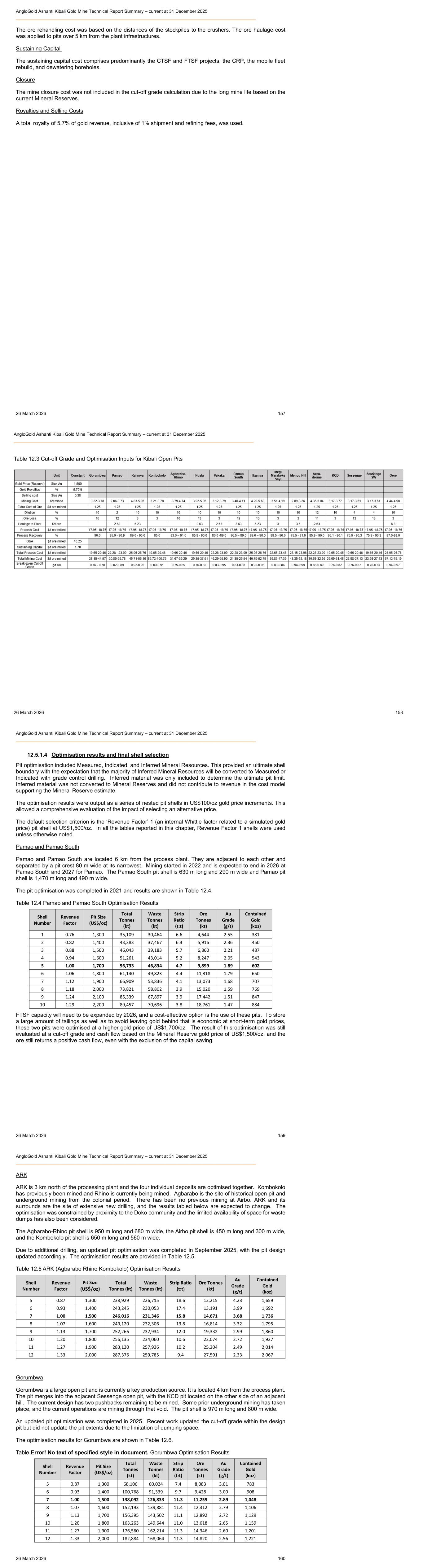
AngloGold Ashanti Kibali Gold Mine Technical Report Summary – current at 31 December 2025 ______________________________________________________________________________ 26 March 2026 157 The ore rehandling cost was based on the distances of the stockpiles to the crushers. The ore haulage cost was applied to pits over 5 km from the plant infrastructures. Sustaining Capital The sustaining capital cost comprises predominantly the CTSF and FTSF projects, the CRP, the mobile fleet rebuild, and dewatering boreholes. Closure The mine closure cost was not included in the cut-off grade calculation due to the long mine life based on the current Mineral Reserves. Royalties and Selling Costs A total royalty of 5.7% of gold revenue, inclusive of 1% shipment and refining fees, was used. AngloGold Ashanti Kibali Gold Mine Technical Report Summary – current at 31 December 2025 ______________________________________________________________________________ 26 March 2026 158 Table 12.3 Cut-off Grade and Optimisation Inputs for Kibali Open Pits AngloGold Ashanti Kibali Gold Mine Technical Report Summary – current at 31 December 2025 ______________________________________________________________________________ 26 March 2026 159 12.5.1.4 Optimisation results and final shell selection Pit optimisation included Measured, Indicated, and Inferred Mineral Resources. This provided an ultimate shell boundary with the expectation that the majority of Inferred Mineral Resources will be converted to Measured or Indicated with grade control drilling. Inferred material was only included to determine the ultimate pit limit. Inferred material was not converted to Mineral Reserves and did not contribute to revenue in the cost model supporting the Mineral Reserve estimate. The optimisation results were output as a series of nested pit shells in US$100/oz gold price increments. This allowed a comprehensive evaluation of the impact of selecting an alternative price. The default selection criterion is the ‘Revenue Factor’ 1 (an internal Whittle factor related to a simulated gold price) pit shell at US$1,500/oz. In all the tables reported in this chapter, Revenue Factor 1 shells were used unless otherwise noted. Pamao and Pamao South Pamao and Pamao South are located 6 km from the process plant. They are adjacent to each other and separated by a pit crest 80 m wide at its narrowest. Mining started in 2022 and is expected to end in 2026 at Pamao South and 2027 for Pamao. The Pamao South pit shell is 630 m long and 290 m wide and Pamao pit shell is 1,470 m long and 490 m wide. The pit optimisation was completed in 2021 and results are shown in Table 12.4. Table 12.4 Pamao and Pamao South Optimisation Results Shell Number Revenue Factor Pit Size (US$/oz) Total Tonnes (kt) Waste Tonnes (kt) Strip Ratio (t:t) Ore Tonnes (kt) Au Grade (g/t) Contained Gold (koz) 1 0.76 1,300 35,109 30,464 6.6 4,644 2.55 381 2 0.82 1,400 43,383 37,467 6.3 5,916 2.36 450 3 0.88 1,500 46,043 39,183 5.7 6,860 2.21 487 4 0.94 1,600 51,261 43,014 5.2 8,247 2.05 543 5 1.00 1,700 56,733 46,834 4.7 9,899 1.89 602 6 1.06 1,800 61,140 49,823 4.4 11,318 1.79 650 7 1.12 1,900 66,909 53,836 4.1 13,073 1.68 707 8 1.18 2,000 73,821 58,802 3.9 15,020 1.59 769 9 1.24 2,100 85,339 67,897 3.9 17,442 1.51 847 10 1.29 2,200 89,457 70,696 3.8 18,761 1.47 884 FTSF capacity will need to be expanded by 2026, and a cost-effective option is the use of these pits. To store a large amount of tailings as well as to avoid leaving gold behind that is economic at short-term gold prices, these two pits were optimised at a higher gold price of US$1,700/oz. The result of this optimisation was still evaluated at a cut-off grade and cash flow based on the Mineral Reserve gold price of US$1,500/oz, and the ore still returns a positive cash flow, even with the exclusion of the capital saving. AngloGold Ashanti Kibali Gold Mine Technical Report Summary – current at 31 December 2025 ______________________________________________________________________________ 26 March 2026 160 ARK ARK is 3 km north of the processing plant and the four individual deposits are optimised together. Kombokolo has previously been mined and Rhino is currently being mined. Agbarabo is the site of historical open pit and underground mining from the colonial period. There has been no previous mining at Airbo. ARK and its surrounds are the site of extensive new drilling, and the results tabled below are expected to change. The optimisation was constrained by proximity to the Doko community and the limited availability of space for waste dumps has also been considered. The Agbarabo-Rhino pit shell is 950 m long and 680 m wide, the Airbo pit shell is 450 m long and 300 m wide, and the Kombokolo pit shell is 650 m long and 560 m wide. Due to additional drilling, an updated pit optimisation was completed in September 2025, with the pit design updated accordingly. The optimisation results are provided in Table 12.5. Table 12.5 ARK (Agbarabo Rhino Kombokolo) Optimisation Results Shell Number Revenue Factor Pit Size (US$/oz) Total Tonnes (kt) Waste Tonnes (kt) Strip Ratio (t:t) Ore Tonnes (kt) Au Grade (g/t) Contained Gold (koz) 5 0.87 1,300 238,929 226,715 18.6 12,215 4.23 1,659 6 0.93 1,400 243,245 230,053 17.4 13,191 3.99 1,692 7 1.00 1,500 246,016 231,346 15.8 14,671 3.68 1,736 8 1.07 1,600 249,120 232,306 13.8 16,814 3.32 1,795 9 1.13 1,700 252,266 232,934 12.0 19,332 2.99 1,860 10 1.20 1,800 256,135 234,060 10.6 22,074 2.72 1,927 11 1.27 1,900 283,130 257,926 10.2 25,204 2.49 2,014 12 1.33 2,000 287,376 259,785 9.4 27,591 2.33 2,067 Gorumbwa Gorumbwa is a large open pit and is currently a key production source. It is located 4 km from the process plant. The pit merges into the adjacent Sessenge open pit, with the KCD pit located on the other side of an adjacent hill. The current design has two pushbacks remaining to be mined. Some prior underground mining has taken place, and the current operations are mining through that void. The pit shell is 970 m long and 800 m wide. An updated pit optimisation was completed in 2025. Recent work updated the cut-off grade within the design pit but did not update the pit extents due to the limitation of dumping space. The optimisation results for Gorumbwa are shown in Table 12.6. Table Error! No text of specified style in document. Gorumbwa Optimisation Results Shell Number Revenue Factor Pit Size (US$/oz) Total Tonnes (kt) Waste Tonnes (kt) Strip Ratio (t:t) Ore Tonnes (kt) Au Grade (g/t) Contained Gold (koz) 5 0.87 1,300 68,106 60,024 7.4 8,083 3.01 783 6 0.93 1,400 100,768 91,339 9.7 9,428 3.00 908 7 1.00 1,500 138,092 126,833 11.3 11,259 2.89 1,048 8 1.07 1,600 152,193 139,881 11.4 12,312 2.79 1,106 9 1.13 1,700 156,395 143,502 11.1 12,892 2.72 1,129 10 1.20 1,800 163,263 149,644 11.0 13,618 2.65 1,159 11 1.27 1,900 176,560 162,214 11.3 14,346 2.60 1,201 12 1.33 2,000 182,884 168,064 11.3 14,820 2.56 1,221

AngloGold Ashanti Kibali Gold Mine Technical Report Summary – current at 31 December 2025 ______________________________________________________________________________ 26 March 2026 161 Ikamva and Kalimva Ikamva and Kalimva are 24 km and 22 km, respectively, from the process plant and mining started there in 2024. The Ikamva pit shell is 1,350 m long and 260 m wide, while Kalimva is 630 m long and 330 m wide. Both pits include portions of small hills and valley terrain. An updated pit optimisation was completed in 2025 and results are presented in Table 12.7 and Table 12.8. Table Error! No text of specified style in document. Ikamva Optimisation Results Shell Number Revenue Factor Pit Size (US$/oz) Total Tonnes (kt) Waste Tonnes (kt) Strip Ratio (t:t) Ore Tonnes (kt) Au Grade (g/t) Contained Gold (koz) 5 0.87 1,300 44,062 38,414 6.8 5,649 2.50 455 6 0.93 1,400 46,239 40,117 6.6 6,122 2.40 473 7 1.00 1,500 48,377 41,890 6.5 6,486 2.33 486 8 1.07 1,600 52,625 45,781 6.7 6,845 2.27 500 9 1.13 1,700 56,205 49,053 6.9 7,152 2.22 511 10 1.20 1,800 60,893 53,497 7.2 7,396 2.19 520 11 1.27 1,900 63,518 56,009 7.5 7,509 2.17 525 12 1.33 2,000 65,355 57,746 7.6 7,609 2.16 528 Table Error! No text of specified style in document. Kalimva Optimisation Results Shell Number Revenue Factor Pit Size (US$/oz) Total Tonnes (kt) Waste Tonnes (kt) Strip Ratio (t:t) Ore Tonnes (kt) Au Grade (g/t) Contained Gold (koz) 5 0.87 1,300 56,148 49,682 7.7 6,466 2.37 493 6 0.93 1,400 58,377 51,651 7.7 6,725 2.33 504 7 1.00 1,500 59,311 52,444 7.6 6,867 2.31 509 8 1.07 1,600 59,636 52,684 7.6 6,951 2.29 512 9 1.13 1,700 60,402 53,376 7.6 7,026 2.28 514 10 1.20 1,800 61,318 54,199 7.6 7,119 2.26 517 11 1.27 1,900 62,135 54,895 7.6 7,239 2.24 521 12 1.33 2,000 63,056 55,631 7.5 7,425 2.20 526 Ndala Ndala is a small pit developed on the site of a potential TSF extension. The pit shell is 380 m long and 230 m wide and is located 7 km from the process plant. The pit optimisation was completed in 2023. Ndala has a small Mineral Resource and so at higher gold prices, there is a negligible gain in ounces and small changes in pit size. The pit shell used as the basis for further detailed mine design (further detailed in Chapter 13 of this Report) was the US$2,000/oz pit shell. This retains a positive cash flow at US$1,500/oz, so it qualifies as a Mineral Reserve despite using a higher gold price to set the pit boundary. Given the short pit life, there is no material risk to the operation as a consequence of this decision. Mining will be completed April 2026. The results of the optimisation are provided in Table 12.9. AngloGold Ashanti Kibali Gold Mine Technical Report Summary – current at 31 December 2025 ______________________________________________________________________________ 26 March 2026 162 Table Error! No text of specified style in document. Ndala Optimisation Results Shell Number Revenue Factor Pit Size (US$/oz) Total Tonnes (kt) Waste Tonnes (kt) Strip Ratio (t:t) Ore Tonnes (kt) Au Grade (g/t) Contained Gold (koz) 8 1.00 1,400 1,636 1,385 5.5 251 2.69 22 9 1.07 1,500 1,644 1,391 5.5 253 2.68 22 10 1.14 1,600 1,683 1,425 5.5 258 2.65 22 11 1.21 1,700 1,850 1,576 5.8 274 2.57 23 12 1.29 1,800 1,858 1,583 5.8 275 2.56 23 13 1.36 1,900 1,894 1,615 5.8 279 2.55 23 14 1.43 2,000 1,922 1,641 5.8 281 2.53 23 15 1.50 2,100 1,964 1,679 5.9 285 2.51 23 16 1.57 2,200 1,967 1,681 5.9 285 2.51 23 18 1.71 2,400 1,984 1,697 5.9 287 2.50 23 20 1.86 2,600 1,999 1,711 5.9 288 2.50 23 22 2.00 2,800 2,045 1,755 6.0 290 2.49 23 Mengu Hill Mengu Hill is located 16 km from the process plant and was previously mined in 2015. The pit shell is 900 m long and 400 m wide. An updated pit optimisation was completed in 2025, although the pit design remained the same, as the change in gold price was largely offset by cost increases. The results of the optimisation are provided in Table 12.10. Table Error! No text of specified style in document. Mengu Hill Optimisation Results Shell Number Revenue Factor Pit Size (US$/oz) Total Tonnes (kt) Waste Tonnes (kt) Strip Ratio (t:t) Ore Tonnes (kt) Au Grade (g/t) Contained Gold (koz) 5 0.87 1,300 10,454 9,557 10.7 896 3.30 95 6 0.93 1,400 12,058 11,046 10.9 1,011 3.21 104 7 1.00 1,500 12,164 11,081 10.2 1,083 3.07 107 8 1.07 1,600 15,609 14,319 11.1 1,289 2.96 123 9 1.13 1,700 18,844 17,326 11.4 1,518 2.82 138 10 1.20 1,800 19,361 17,727 10.8 1,634 2.71 142 11 1.27 1,900 27,404 25,293 12.0 2,111 2.55 173 12 1.33 2,000 27,718 25,490 11.4 2,227 2.47 177 Megi Marakeke Sayi Megi Marakeke Sayi is located 9 km from the process plant and there is a river and a national dirt road that currently pass over the deposit. To mine this deposit, 1.4 km of road and 1 km of river will be diverted. A bridge will also be required to cross the new river alignment. An application has been made for permission to divert the road, and river diversion plans are being evaluated. In the opinion of the QP, this is routine work that is usually approved and is not likely to affect the Mineral Reserves. The pit shell is 2,300 m long and 500 m wide. An updated pit optimisation was completed in 2025, and the pit design was updated accordingly. The results of the optimisation are provided in Table 12.11. AngloGold Ashanti Kibali Gold Mine Technical Report Summary – current at 31 December 2025 ______________________________________________________________________________ 26 March 2026 163 Table Error! No text of specified style in document.1 Megi Marakeke Sayi Optimisation Results Shell Number Revenue Factor Pit Size (US$/oz) Total Tonnes (kt) Waste Tonnes (kt) Strip Ratio (t:t) Ore Tonnes (kt) Au Grade (g/t) Contained Gold (koz) 5 0.87 1,300 26,138 20,106 3.3 6,032 2.05 398 6 0.93 1,400 37,270 29,044 3.5 8,226 1.89 500 7 1.00 1,500 43,052 33,213 3.4 9,839 1.78 562 8 1.07 1,600 51,303 39,754 3.4 11,549 1.70 630 9 1.13 1,700 57,573 44,575 3.4 12,998 1.64 683 10 1.20 1,800 63,747 49,460 3.5 14,287 1.59 729 11 1.27 1,900 71,252 55,429 3.5 15,823 1.53 780 12 1.33 2,000 80,867 63,405 3.6 17,461 1.49 835 Aerodrome Aerodrome is located 6 km from the process plant and was previously mined in 2023. The pit shell is 490 m long and 400 m wide. An updated pit optimisation was completed in 2025, but no change was made to the pit design as the deposit is being mined for a shorter life, which is expected to be under a year. The results of the optimisation are provided in Table 12.12. Table Error! No text of specified style in document. Aerodrome Optimisation Results Shell Number Revenue Factor Pit Size (US$/oz) Total Tonnes (kt) Waste Tonnes (kt) Strip Ratio (t:t) Ore Tonnes (kt) Au Grade (g/t) Contained Gold (koz) 5 0.87 1,300 2,554 2,063 4.2 490 1.73 27 6 0.93 1,400 3,014 2,435 4.2 579 1.67 31 7 1.00 1,500 3,831 3,096 4.2 735 1.59 38 8 1.07 1,600 4,674 3,781 4.2 893 1.52 44 9 1.13 1,700 6,029 4,957 4.6 1,072 1.48 51 10 1.20 1,800 6,099 4,985 4.5 1,113 1.46 52 11 1.27 1,900 7,981 6,661 5.0 1,320 1.43 61 12 1.33 2,000 8,129 6,762 4.9 1,368 1.41 62 Oere Oere is located 20 km from the process plant. The pit shell is 1,130 m long and 530 m wide. An updated pit optimisation was completed in 2025, but there was no change to the pit design as the increased cost was offset by the increased gold price. The results of the optimisation are provided in Table 12.13. Table Error! No text of specified style in document. Oere Optimisation Results Shell Number Revenue Factor Pit Size (US$/oz) Total Tonnes (kt) Waste Tonnes (kt) Strip Ratio (t:t) Ore Tonnes (kt) Au Grade (g/t) Contained Gold (koz) 2 0.87 1,300 62,885 59,483 17.5 3,402 2.67 292 3 0.93 1,400 63,792 59,888 15.3 3,904 2.48 311 4 1.00 1,500 65,813 61,279 13.5 4,534 2.30 335 AngloGold Ashanti Kibali Gold Mine Technical Report Summary – current at 31 December 2025 ______________________________________________________________________________ 26 March 2026 164 Shell Number Revenue Factor Pit Size (US$/oz) Total Tonnes (kt) Waste Tonnes (kt) Strip Ratio (t:t) Ore Tonnes (kt) Au Grade (g/t) Contained Gold (koz) 5 1.07 1,600 70,448 65,152 12.3 5,296 2.16 367 6 1.13 1,700 71,756 65,764 11.0 5,992 2.02 389 7 1.20 1,800 74,522 67,812 10.1 6,710 1.91 413 8 1.27 1,900 88,778 80,749 10.1 8,029 1.82 470 9 1.33 2,000 204,215 189,422 12.8 14,793 1.72 819 Pakaka Pakaka is located 6 km from the process plant. The pit shell is 850 m long and 740 m wide. An updated pit optimisation was completed in 2025 and the pit design was updated accordingly. The results of the optimisation are given in Table 12.14. Table Error! No text of specified style in document. Pakaka Optimisation Results Shell Number Revenue Factor Pit Size (US$/oz) Total Tonnes (kt) Waste Tonnes (kt) Strip Ratio (t:t) Ore Tonnes (kt) Au Grade (g/t) Contained Gold (koz) 12 0.87 1,300 57,380 52,786 11.5 4,594 3.06 452 13 0.93 1,400 61,924 56,677 10.8 5,247 2.88 486 14 1.00 1,500 103,467 96,665 14.2 6,802 2.91 637 15 1.07 1,600 120,255 112,424 14.4 7,832 2.81 707 16 1.13 1,700 131,304 121,873 12.9 9,430 2.56 776 17 1.20 1,800 140,769 130,274 12.4 10,495 2.44 825 18 1.27 1,900 146,421 135,086 11.9 11,335 2.35 857 19 1.33 2,000 153,373 141,442 11.9 11,931 2.31 884 Sessenge and Sessenge SW Sessenge and Sessenge SW are located 3 km from the process plant. The Sessenge SW pit shell is 510 m long and 270 m wide, while Sessenge is 670 m long and 550 m wide. The pit optimisation was completed in 2025 and the results of the optimisation are provided in Table 12.15.
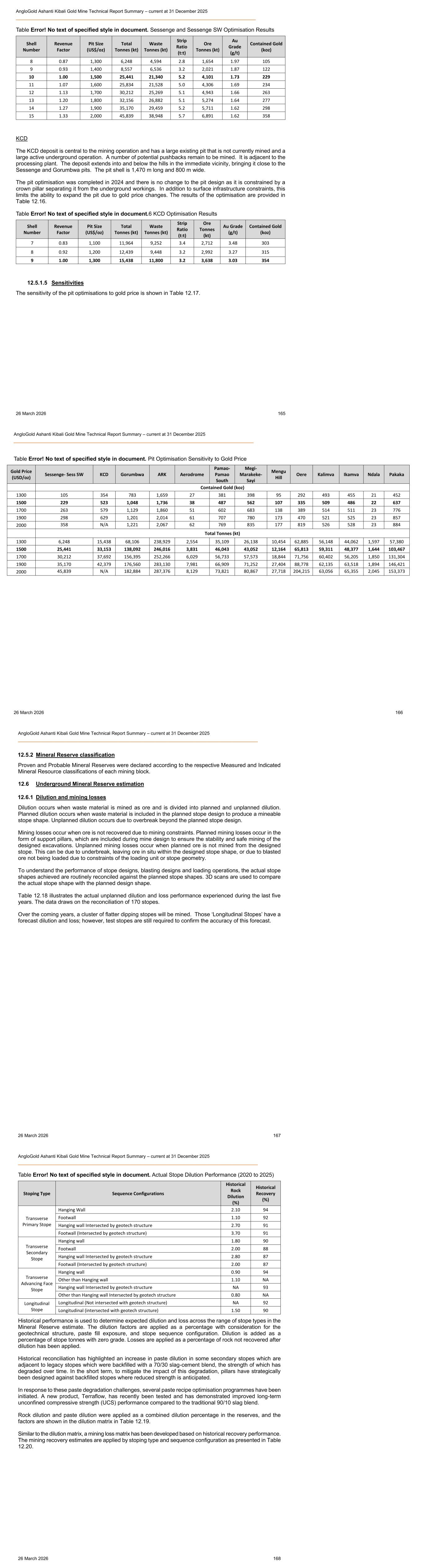
AngloGold Ashanti Kibali Gold Mine Technical Report Summary – current at 31 December 2025 ______________________________________________________________________________ 26 March 2026 165 Table Error! No text of specified style in document. Sessenge and Sessenge SW Optimisation Results Shell Number Revenue Factor Pit Size (US$/oz) Total Tonnes (kt) Waste Tonnes (kt) Strip Ratio (t:t) Ore Tonnes (kt) Au Grade (g/t) Contained Gold (koz) 8 0.87 1,300 6,248 4,594 2.8 1,654 1.97 105 9 0.93 1,400 8,557 6,536 3.2 2,021 1.87 122 10 1.00 1,500 25,441 21,340 5.2 4,101 1.73 229 11 1.07 1,600 25,834 21,528 5.0 4,306 1.69 234 12 1.13 1,700 30,212 25,269 5.1 4,943 1.66 263 13 1.20 1,800 32,156 26,882 5.1 5,274 1.64 277 14 1.27 1,900 35,170 29,459 5.2 5,711 1.62 298 15 1.33 2,000 45,839 38,948 5.7 6,891 1.62 358 KCD The KCD deposit is central to the mining operation and has a large existing pit that is not currently mined and a large active underground operation. A number of potential pushbacks remain to be mined. It is adjacent to the processing plant. The deposit extends into and below the hills in the immediate vicinity, bringing it close to the Sessenge and Gorumbwa pits. The pit shell is 1,470 m long and 800 m wide. The pit optimisation was completed in 2024 and there is no change to the pit design as it is constrained by a crown pillar separating it from the underground workings. In addition to surface infrastructure constraints, this limits the ability to expand the pit due to gold price changes. The results of the optimisation are provided in Table 12.16. Table Error! No text of specified style in document.6 KCD Optimisation Results Shell Number Revenue Factor Pit Size (US$/oz) Total Tonnes (kt) Waste Tonnes (kt) Strip Ratio (t:t) Ore Tonnes (kt) Au Grade (g/t) Contained Gold (koz) 7 0.83 1,100 11,964 9,252 3.4 2,712 3.48 303 8 0.92 1,200 12,439 9,448 3.2 2,992 3.27 315 9 1.00 1,300 15,438 11,800 3.2 3,638 3.03 354 12.5.1.5 Sensitivities The sensitivity of the pit optimisations to gold price is shown in Table 12.17. AngloGold Ashanti Kibali Gold Mine Technical Report Summary – current at 31 December 2025 ______________________________________________________________________________ 26 March 2026 166 Table Error! No text of specified style in document. Pit Optimisation Sensitivity to Gold Price Gold Price (USD/oz) Sessenge- Sess SW KCD Gorumbwa ARK Aerodrome Pamao- Pamao South Megi- Marakeke- Sayi Mengu Hill Oere Kalimva Ikamva Ndala Pakaka Contained Gold (koz) 1300 105 354 783 1,659 27 381 398 95 292 493 455 21 452 1500 229 523 1,048 1,736 38 487 562 107 335 509 486 22 637 1700 263 579 1,129 1,860 51 602 683 138 389 514 511 23 776 1900 298 629 1,201 2,014 61 707 780 173 470 521 525 23 857 2000 358 N/A 1,221 2,067 62 769 835 177 819 526 528 23 884 Total Tonnes (kt) 1300 6,248 15,438 68,106 238,929 2,554 35,109 26,138 10,454 62,885 56,148 44,062 1,597 57,380 1500 25,441 33,153 138,092 246,016 3,831 46,043 43,052 12,164 65,813 59,311 48,377 1,644 103,467 1700 30,212 37,692 156,395 252,266 6,029 56,733 57,573 18,844 71,756 60,402 56,205 1,850 131,304 1900 35,170 42,379 176,560 283,130 7,981 66,909 71,252 27,404 88,778 62,135 63,518 1,894 146,421 2000 45,839 N/A 182,884 287,376 8,129 73,821 80,867 27,718 204,215 63,056 65,355 2,045 153,373 AngloGold Ashanti Kibali Gold Mine Technical Report Summary – current at 31 December 2025 ______________________________________________________________________________ 26 March 2026 167 12.5.2 Mineral Reserve classification Proven and Probable Mineral Reserves were declared according to the respective Measured and Indicated Mineral Resource classifications of each mining block. 12.6 Underground Mineral Reserve estimation 12.6.1 Dilution and mining losses Dilution occurs when waste material is mined as ore and is divided into planned and unplanned dilution. Planned dilution occurs when waste material is included in the planned stope design to produce a mineable stope shape. Unplanned dilution occurs due to overbreak beyond the planned stope design. Mining losses occur when ore is not recovered due to mining constraints. Planned mining losses occur in the form of support pillars, which are included during mine design to ensure the stability and safe mining of the designed excavations. Unplanned mining losses occur when planned ore is not mined from the designed stope. This can be due to underbreak, leaving ore in situ within the designed stope shape, or due to blasted ore not being loaded due to constraints of the loading unit or stope geometry. To understand the performance of stope designs, blasting designs and loading operations, the actual stope shapes achieved are routinely reconciled against the planned stope shapes. 3D scans are used to compare the actual stope shape with the planned design shape. Table 12.18 illustrates the actual unplanned dilution and loss performance experienced during the last five years. The data draws on the reconciliation of 170 stopes. Over the coming years, a cluster of flatter dipping stopes will be mined. Those ‘Longitudinal Stopes’ have a forecast dilution and loss; however, test stopes are still required to confirm the accuracy of this forecast. AngloGold Ashanti Kibali Gold Mine Technical Report Summary – current at 31 December 2025 ______________________________________________________________________________ 26 March 2026 168 Table Error! No text of specified style in document. Actual Stope Dilution Performance (2020 to 2025) Stoping Type Sequence Configurations Historical Rock Dilution (%) Historical Recovery (%) Transverse Primary Stope Hanging Wall 2.10 94 Footwall 1.10 92 Hanging wall Intersected by geotech structure 2.70 91 Footwall (Intersected by geotech structure) 3.70 91 Transverse Secondary Stope Hanging wall 1.80 90 Footwall 2.00 88 Hanging wall Intersected by geotech structure 2.80 87 Footwall (Intersected by geotech structure) 2.00 87 Transverse Advancing Face Stope Hanging wall 0.90 94 Other than Hanging wall 1.10 NA Hanging wall Intersected by geotech structure NA 93 Other than Hanging wall Intersected by geotech structure 0.80 NA Longitudinal Stope Longitudinal (Not intersected with geotech structure) NA 92 Longitudinal (intersected with geotech structure) 1.50 90 Historical performance is used to determine expected dilution and loss across the range of stope types in the Mineral Reserve estimate. The dilution factors are applied as a percentage with consideration for the geotechnical structure, paste fill exposure, and stope sequence configuration. Dilution is added as a percentage of stope tonnes with zero grade. Losses are applied as a percentage of rock not recovered after dilution has been applied. Historical reconciliation has highlighted an increase in paste dilution in some secondary stopes which are adjacent to legacy stopes which were backfilled with a 70/30 slag-cement blend, the strength of which has degraded over time. In the short term, to mitigate the impact of this degradation, pillars have strategically been designed against backfilled stopes where reduced strength is anticipated. In response to these paste degradation challenges, several paste recipe optimisation programmes have been initiated. A new product, Terraflow, has recently been tested and has demonstrated improved long-term unconfined compressive strength (UCS) performance compared to the traditional 90/10 slag blend. Rock dilution and paste dilution were applied as a combined dilution percentage in the reserves, and the factors are shown in the dilution matrix in Table 12.19. Similar to the dilution matrix, a mining loss matrix has been developed based on historical recovery performance. The mining recovery estimates are applied by stoping type and sequence configuration as presented in Table 12.20.

AngloGold Ashanti Kibali Gold Mine Technical Report Summary – current at 31 December 2025 ______________________________________________________________________________ 26 March 2026 169 Table Error! No text of specified style in document. Summary of Underground Unplanned Dilution Parameter Matrix Stoping Type Sequence Configurations Applied Dilution Factor (%) No. Fill Exposures Fill Dilution by Exposures (%) Paste Dilution (%) Total Unplanned + Paste Dilution (%) Transverse Primary Stope Hanging Wall 1.8 0 N/A 0.0 1.8 Footwall 1.1 1 2.0 2.0 3.1 Hanging wall Intersected by geotech structure 2.8 0 N/A 0.0 2.8 Footwall (Intersected by geotech structure) 4.4 1 2.0 2.0 6.4 Transverse Secondary Stope Hanging wall 1.8 2 2.50 5.00 6.8 Footwall 1.7 3 2.5 7.5 9.2 Hanging wall Intersected by geotech structure 3.2 2 2.5 5.0 8.2 Footwall (Intersected by geotech structure) 1.9 3 2.5 7.5 9.4 Transverse Advancing Face Stope Hanging wall 0.7 0 N/A 0.0 0.7 Footwall 1.3 2 2.0 4.0 5.3 Hanging wall Intersected by geotech structure NA NA NA NA NA Footwall (Intersected by geotech structure) 0.8 1 2.0 2.0 2.8 Longitudinal Stope Longitudinal (Not intersected with geotech structure) NA NA NA NA NA Longitudinal (intersected with geotech structure) 1.5 1 2.0 2.0 3.5 Table Error! No text of specified style in document. Summary of Underground Ore Recovery Parameter Matrix Stoping Type Sequence Configuration Recovery (%) Transverse Primary Stope Hanging Wall 92 Not Hanging Wall 92 Hanging Wall intersected by Geotech structure 91 Not Hanging Wall intersected by Geotech structure 92 Transverse Secondary Stope Hanging Wall 89 Not Hanging Wall 88 Hanging Wall intersected by Geotech Structure 89 Not Hanging Wall Intersected by Geotech Structure 87 Transverse Advancing Face Stope Hanging Wall 92 12.6.2 Cut-off grade The underground Mineral Reserve cut-off grade is updated once a year using inputs based on recent operating experience, projected costs, and Barrick corporate guidance. The cut-off grade inputs are as follows: • Gold price • Mining costs • Processing recovery • Processing costs • G&A costs AngloGold Ashanti Kibali Gold Mine Technical Report Summary – current at 31 December 2025 ______________________________________________________________________________ 26 March 2026 170 • Royalty and selling costs A break-even head grade cut-off (BCOG) is used for Mineral Reserve estimation. All stopes and development material that fail to meet the BCOG are classified as waste. As this is a head grade cut-off, it is applied after consideration for dilution during individual stope design. BCOG is the grade of material that will generate revenue from the sale of the finished product at the metal price after applying all operating costs, including sustaining capital and royalties. An incremental cut-off grade (ICOG) is used on a case-by-case basis and generally applies to opportunistic material that can help offset cost, rather than deliver revenue. The ICOG is applied to the mineralised part of the deposit below the BCOG, which can incrementally add value to the operation. The ICOG carries only the variable portion of the mining costs (drilling, blasting, mucking, and hoisting), process operating costs, G&A costs, royalties, and rehandling costs if stockpiling is required. Development costs (capital or operating) are only included if the development is required to mine the incremental ore. This material is intended to offset a portion of the fixed cost when no other material is available or at the end of the mine life, when costs can be significantly lower once mining has concluded. Material above the ICOG (but below the BCOG) is not planned to displace available higher-grade material above the BCOG and is only included in the schedule (but not the Mineral Reserve) on a case-by-case basis or is scheduled for processing at the end of the LOM, if practical. ICOG material is considered under any of the following circumstances: • When mine development goes through low-grade material to expose higher-grade production areas or stopes, • When there is low-grade material near an already developed part of the mine, and • When the mill is operating at capacity, and the underground mine has additional mining capacity, with material placed in the stockpiles that can be economically processed at a later stage. The break-even and incremental cut-off grades estimated for the Kibali underground operation for the 2025 Mineral Reserves are summarised in Table 12.21. Table Error! No text of specified style in document. Kibali Underground Mine – Breakeven Head Grade Cut-off Calculation Description Units BCOG ICOG Stoping Gold Price US$/oz 1,500 1,500 Process Plant Gold Recovery % 90 90 Royalty % 5.7 5.7 Selling Cost US$/oz 0.38 0.38 Mine Production and Backfill US$/t 52.55 20.91 Sustaining Capital US$/t 3.42 N/A Processing US$/t 18.22 18.22 Site G&A US$/t 10.25 10.25 Total Unit Cost US$/t 84.45 49.38 Mining Cut-off Grade g/t 2.06 1.21 The QP considers the Mineral Reserve head grade COG calculation to be appropriate for Kibali and this type of deposit. 12.6.3 Stope optimisation Stope optimisation was completed to define the optimal mining shapes and dimensions that balance ore recovery, dilution control, and geotechnical stability within the economic limits of the mining method. Economic assessments are performed on both a short-term and long-term basis. The short-term economic assessment involves evaluating individual stope economics, considering the direct costs (i.e., rehabilitation, AngloGold Ashanti Kibali Gold Mine Technical Report Summary – current at 31 December 2025 ______________________________________________________________________________ 26 March 2026 171 production, and paste filling) required to mine specific stopes. A long-term economic assessment involves evaluating the economics of a mining area by considering the capital, development, and operating costs associated with mining that area. Deswik.SO was used to evaluate the stope shapes. The optimiser considers the geological block model mineralisation and determines the areas to be included and the overall mining shapes. The parameters used for generating the Deswik.SO shapes are presented in Table 12.22. AngloGold Ashanti Kibali Gold Mine Technical Report Summary – current at 31 December 2025 ______________________________________________________________________________ 26 March 2026 172 Table Error! No text of specified style in document. Deswik.SO Parameters Deswik.SO Parameters Value Slice Interval 0.5 m Minimum Mining Width 5 m Cut-off Grade 2.06 g/t Footwall Minimum Dip 45⁰ Hanging Wall Minimum Dip 45⁰ Maximum Stope Thickness Ratio 4 Near Dilution * 0 Far Dilution * 0 Section and Level Intervals Variable based on mining method and mining lode Sections (U) Variable based on mining method and mining lode Note. * Dilution is added through manual design. Stopes are created for each mining method, depending on the shape and orientation of the orebody. The most appropriate mining method and associated development strategy are selected for each area of mineralisation. The stopes produced by the stope optimiser algorithm are then considered on an individual basis. The economic stope shapes are then used as a guide to manually create stope section strings and the final stope designs. Throughout the stope design process, the size of the stopes is determined by the stable stope dimensions, which were estimated during the geotechnical analysis described in Chapter 13.3.2. Planned dilution is incorporated into the stope shape to create a mineable stope. In the few instances where Inferred Mineral Resources were present in the resulting stope shape, they were assigned a zero grade and treated as waste. 12.6.4 Mineral Reserve classification Mineral Resources are converted into Mineral Reserves through the addition of dilution to, and then the subtraction of mining losses from, each of the Measured and Indicated Resource categories. Where a stope contains both, their proportion was retained. The location of the Proven and Probable Mineral Reserves for the KCD deposit is shown in Figure 12.2.
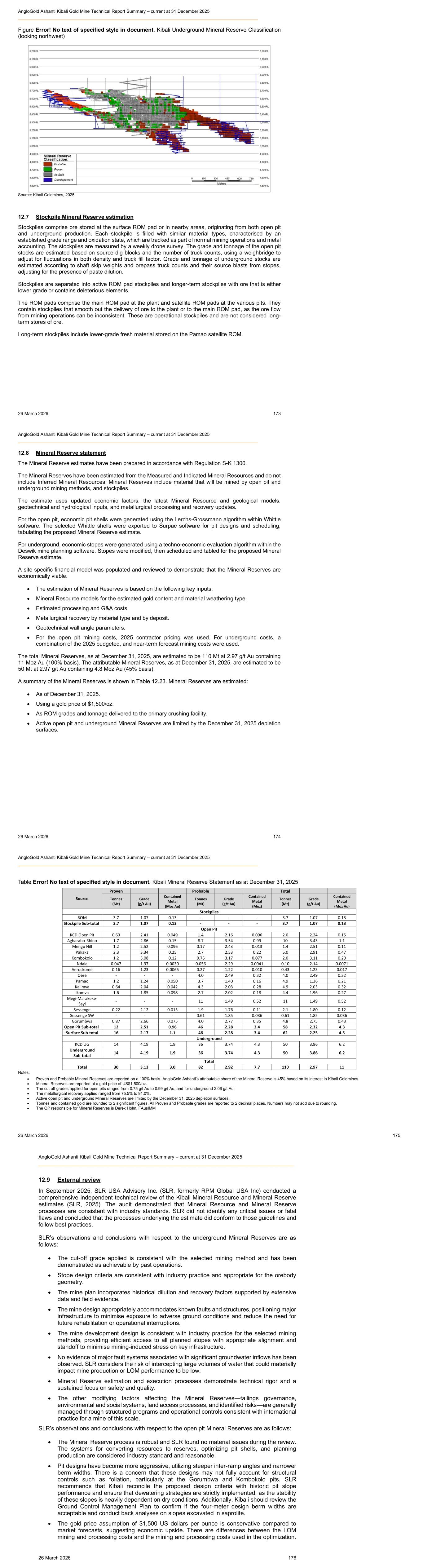
AngloGold Ashanti Kibali Gold Mine Technical Report Summary – current at 31 December 2025 ______________________________________________________________________________ 26 March 2026 173 Figure Error! No text of specified style in document. Kibali Underground Mineral Reserve Classification (looking northwest) Source: Kibali Goldmines, 2025 12.7 Stockpile Mineral Reserve estimation Stockpiles comprise ore stored at the surface ROM pad or in nearby areas, originating from both open pit and underground production. Each stockpile is filled with similar material types, characterised by an established grade range and oxidation state, which are tracked as part of normal mining operations and metal accounting. The stockpiles are measured by a weekly drone survey. The grade and tonnage of the open pit stocks are estimated based on source dig blocks and the number of truck counts, using a weighbridge to adjust for fluctuations in both density and truck fill factor. Grade and tonnage of underground stocks are estimated according to shaft skip weights and orepass truck counts and their source blasts from stopes, adjusting for the presence of paste dilution. Stockpiles are separated into active ROM pad stockpiles and longer-term stockpiles with ore that is either lower grade or contains deleterious elements. The ROM pads comprise the main ROM pad at the plant and satellite ROM pads at the various pits. They contain stockpiles that smooth out the delivery of ore to the plant or to the main ROM pad, as the ore flow from mining operations can be inconsistent. These are operational stockpiles and are not considered long- term stores of ore. Long-term stockpiles include lower-grade fresh material stored on the Pamao satellite ROM. AngloGold Ashanti Kibali Gold Mine Technical Report Summary – current at 31 December 2025 ______________________________________________________________________________ 26 March 2026 174 12.8 Mineral Reserve statement The Mineral Reserve estimates have been prepared in accordance with Regulation S-K 1300. The Mineral Reserves have been estimated from the Measured and Indicated Mineral Resources and do not include Inferred Mineral Resources. Mineral Reserves include material that will be mined by open pit and underground mining methods, and stockpiles. The estimate uses updated economic factors, the latest Mineral Resource and geological models, geotechnical and hydrological inputs, and metallurgical processing and recovery updates. For the open pit, economic pit shells were generated using the Lerchs-Grossmann algorithm within Whittle software. The selected Whittle shells were exported to Surpac software for pit designs and scheduling, tabulating the proposed Mineral Reserve estimate. For underground, economic stopes were generated using a techno-economic evaluation algorithm within the Deswik mine planning software. Stopes were modified, then scheduled and tabled for the proposed Mineral Reserve estimate. A site-specific financial model was populated and reviewed to demonstrate that the Mineral Reserves are economically viable. • The estimation of Mineral Reserves is based on the following key inputs: • Mineral Resource models for the estimated gold content and material weathering type. • Estimated processing and G&A costs. • Metallurgical recovery by material type and by deposit. • Geotechnical wall angle parameters. • For the open pit mining costs, 2025 contractor pricing was used. For underground costs, a combination of the 2025 budgeted, and near-term forecast mining costs were used. The total Mineral Reserves, as at December 31, 2025, are estimated to be 110 Mt at 2.97 g/t Au containing 11 Moz Au (100% basis). The attributable Mineral Reserves, as at December 31, 2025, are estimated to be 50 Mt at 2.97 g/t Au containing 4.8 Moz Au (45% basis). A summary of the Mineral Reserves is shown in Table 12.23. Mineral Reserves are estimated: • As of December 31, 2025. • Using a gold price of $1,500/oz. • As ROM grades and tonnage delivered to the primary crushing facility. • Active open pit and underground Mineral Reserves are limited by the December 31, 2025 depletion surfaces. AngloGold Ashanti Kibali Gold Mine Technical Report Summary – current at 31 December 2025 ______________________________________________________________________________ 26 March 2026 175 Table Error! No text of specified style in document. Kibali Mineral Reserve Statement as at December 31, 2025 Source Proven Probable Total Tonnes (Mt) Grade (g/t Au) Contained Metal (Moz Au) Tonnes (Mt) Grade (g/t Au) Contained Metal (Moz) Tonnes (Mt) Grade (g/t Au) Contained Metal (Moz Au) Stockpiles ROM 3.7 1.07 0.13 - - - 3.7 1.07 0.13 Stockpile Sub-total 3.7 1.07 0.13 - - - 3.7 1.07 0.13 Open Pit KCD Open Pit 0.63 2.41 0.049 1.4 2.16 0.096 2.0 2.24 0.15 Agbarabo-Rhino 1.7 2.86 0.15 8.7 3.54 0.99 10 3.43 1.1 Mengu Hill 1.2 2.52 0.096 0.17 2.43 0.013 1.4 2.51 0.11 Pakaka 2.3 3.34 0.25 2.7 2.53 0.22 5.0 2.91 0.47 Kombokolo 1.2 3.08 0.12 0.75 3.17 0.077 2.0 3.11 0.20 Ndala 0.047 1.97 0.0030 0.056 2.29 0.0041 0.10 2.14 0.0071 Aerodrome 0.16 1.23 0.0065 0.27 1.22 0.010 0.43 1.23 0.017 Oere - - - 4.0 2.49 0.32 4.0 2.49 0.32 Pamao 1.2 1.24 0.050 3.7 1.40 0.16 4.9 1.36 0.21 Kalimva 0.64 2.04 0.042 4.3 2.03 0.28 4.9 2.03 0.32 Ikamva 1.6 1.85 0.098 2.7 2.02 0.18 4.4 1.96 0.27 Megi-Marakeke- Sayi - - - 11 1.49 0.52 11 1.49 0.52 Sessenge 0.22 2.12 0.015 1.9 1.76 0.11 2.1 1.80 0.12 Sessenge SW - - - 0.61 1.85 0.036 0.61 1.85 0.036 Gorumbwa 0.87 2.66 0.075 4.0 2.77 0.35 4.8 2.75 0.43 Open Pit Sub-total 12 2.51 0.96 46 2.28 3.4 58 2.32 4.3 Surface Sub-total 16 2.17 1.1 46 2.28 3.4 62 2.25 4.5 Underground KCD UG 14 4.19 1.9 36 3.74 4.3 50 3.86 6.2 Underground Sub-total 14 4.19 1.9 36 3.74 4.3 50 3.86 6.2 Total Total 30 3.13 3.0 82 2.92 7.7 110 2.97 11 Notes: • Proven and Probable Mineral Reserves are reported on a 100% basis. AngloGold Ashanti’s attributable share of the Mineral Reserve is 45% based on its interest in Kibali Goldmines. • Mineral Reserves are reported at a gold price of US$1,500/oz. • The cut off grades applied for open pits ranged from 0.75 g/t Au to 0.99 g/t Au, and for underground 2.06 g/t Au. • The metallurgical recovery applied ranged from 75.5% to 91.0%. • Active open pit and underground Mineral Reserves are limited by the December 31, 2025 depletion surfaces. • Tonnes and contained gold are rounded to 2 significant figures. All Proven and Probable grades are reported to 2 decimal places. Numbers may not add due to rounding, • The QP responsible for Mineral Reserves is Derek Holm, FAusIMM AngloGold Ashanti Kibali Gold Mine Technical Report Summary – current at 31 December 2025 ______________________________________________________________________________ 26 March 2026 176 12.9 External review In September 2025, SLR USA Advisory Inc. (SLR, formerly RPM Global USA Inc) conducted a comprehensive independent technical review of the Kibali Mineral Resource and Mineral Reserve estimates (SLR, 2025). The audit demonstrated that Mineral Resource and Mineral Reserve processes are consistent with industry standards. SLR did not identify any critical issues or fatal flaws and concluded that the processes underlying the estimate did conform to those guidelines and follow best practices. SLR’s observations and conclusions with respect to the underground Mineral Reserves are as follows: • The cut-off grade applied is consistent with the selected mining method and has been demonstrated as achievable by past operations. • Stope design criteria are consistent with industry practice and appropriate for the orebody geometry. • The mine plan incorporates historical dilution and recovery factors supported by extensive data and field evidence. • The mine design appropriately accommodates known faults and structures, positioning major infrastructure to minimise exposure to adverse ground conditions and reduce the need for future rehabilitation or operational interruptions. • The mine development design is consistent with industry practice for the selected mining methods, providing efficient access to all planned stopes with appropriate alignment and standoff to minimise mining-induced stress on key infrastructure. • No evidence of major fault systems associated with significant groundwater inflows has been observed. SLR considers the risk of intercepting large volumes of water that could materially impact mine production or LOM performance to be low. • Mineral Reserve estimation and execution processes demonstrate technical rigor and a sustained focus on safety and quality. • The other modifying factors affecting the Mineral Reserves—tailings governance, environmental and social systems, land access processes, and identified risks—are generally managed through structured programs and operational controls consistent with international practice for a mine of this scale. SLR’s observations and conclusions with respect to the open pit Mineral Reserves are as follows: • The Mineral Reserve process is robust and SLR found no material issues during the review. The systems for converting resources to reserves, optimizing pit shells, and planning production are considered industry standard and reasonable. • Pit designs have become more aggressive, utilizing steeper inter-ramp angles and narrower berm widths. There is a concern that these designs may not fully account for structural controls such as foliation, particularly at the Gorumbwa and Kombokolo pits. SLR recommends that Kibali reconcile the proposed design criteria with historic pit slope performance and ensure that dewatering strategies are strictly implemented, as the stability of these slopes is heavily dependent on dry conditions. Additionally, Kibali should review the Ground Control Management Plan to confirm if the four-meter design berm widths are acceptable and conduct back analyses on slopes excavated in saprolite. • The gold price assumption of $1,500 US dollars per ounce is conservative compared to market forecasts, suggesting economic upside. There are differences between the LOM mining and processing costs and the mining and processing costs used in the optimization.

AngloGold Ashanti Kibali Gold Mine Technical Report Summary – current at 31 December 2025 ______________________________________________________________________________ 26 March 2026 177 SLR opines that the differences are likely immaterial given the conservative nature of the metal price. • The review of the contract services and equipment availability indicated low risk to the reserves, and the waste dump designs generally align with the prescribed parameters. Recommendations for future underground Mineral Reserve work: • As mining transitions into flatter zones of the orebody, SLR cautions that maintaining current dilution and recovery levels may be more difficult and recommends early test stopes to validate assumptions. SLR notes that the recovery applied in these flatter zones has already been reduced by approximately 2% relative to the recovery applied in comparable mining methods. • The underground cut-off grade should be separated by mining method (transverse stoping, longitudinal stoping, remnant mining). • The classification boundary between Indicated and Inferred Resources should be revisited where minable shapes intersect. As per these recommendations, Kibali Goldmines has planned initial test stopes in the areas with a flatter orebody. A cut-off grade has been developed that is split by mining method; however, initial results show a marginal impact. The approach to the classification boundary will be revised prior to the next Mineral Reserve estimate. Recommendations for future open pit Mineral Reserve estimate work: • Undertake a systematic review to ensure pit designs consistently meet geotechnical specifications. • Compare the global dilution and loss parameters against actual production data to confirm that the current estimation approach provides accurate results. • Maintain internal optimizations and designs at higher gold prices to strategically assess land requirements. As per these recommendations, a programme of geotechnical review has been started. Further improvements to the measure of dilution and loss are planned for this year. Optimisation results are tested at a higher gold price but a more systematic approach will be implemented in 2026. 12.10 Comment on Mineral Reserve estimate The QP responsible for the Mineral Reserves has supervised the estimation process, and in their opinion, the process has been carried out to industry standards using appropriate modifying factors for the conversion of Mineral Resources to Mineral Reserves. The current permitted and designed TSF capacity is not sufficient for the proposed LOM. The current permitted sites will run out of capacity in 2034, while the Life of Mine Schedule continues to 2043. An MAA has begun to source further TSF capacity after 2034. Given the lead time, land availability, and that prior TSF permits have been issued in good time, the QP does not believe the current shortfall of tailings capacity is a material risk to the Mineral Reserves. Apart from the above, the QP is not aware of any environmental, mining, metallurgical, infrastructure, permitting, or other relevant factors that could materially affect the Mineral Reserve estimate. AngloGold Ashanti Kibali Gold Mine Technical Report Summary – current at 31 December 2025 ______________________________________________________________________________ 26 March 2026 178 13. Mining methods 13.1 Summary Kibali is a large-scale gold operation employing a combination of open pit and underground mining methods. Multiple open pits are mined using the conventional drill-and-blast method with truck-and-shovel loading. Pit designs are optimised based on geotechnical domains and economic cut-off grades, with ore hauled to stockpiles and the processing plant. The underground operation, centred on the KCD deposit, is accessed through twin declines and a vertical shaft system. Ore is extracted primarily using long hole open stoping with cemented paste fill, supplemented by transverse stopes where orebody geometry requires. Stoping is sequenced to maintain geotechnical stability and to optimise production rates, with paste backfill allowing for maximum extraction of ore while ensuring stability and controlling dilution. Development rates are aligned with sustaining production at nameplate capacity. Mining is supported by mechanised equipment fleets for both development and production. Production scheduling integrates open pit and underground sources to ensure the plant is kept running at capacity. Mining dilution, recovery factors, and geotechnical constraints have been applied in line with operating experience. Hydropower and existing surface infrastructure support the mining fleet, ventilation, and dewatering requirements. The production schedule aims to keep open pit production at a steady, cost-effective volume. Underground scheduling similarly aims to enable cost-effective production. The combination of these two schedules results in some annual variation of ounce production, but a broad minimum production target is applied to guide this work. Recent geological discoveries in the ARK complex have resulted in the recent extension of planned open pit mining, and further work is underway that may further extend it. The overall mining layout is shown in Figure 13.1. AngloGold Ashanti Kibali Gold Mine Technical Report Summary – current at 31 December 2025 ______________________________________________________________________________ 26 March 2026 179 Figure Error! No text of specified style in document. Overall Mining Plan of Kibali Source: Kibali Goldmines, 2025. AngloGold Ashanti Kibali Gold Mine Technical Report Summary – current at 31 December 2025 ______________________________________________________________________________ 26 March 2026 180 13.2 Open pit mining methods 13.2.1 Summary Open pit mining is carried out using conventional drill, blast, load, and haul surface mining methods. Mining of the main pits is carried out by DTP-Kibali Mining Services (DTP-KMS) as the main mining contractor and smaller pits are mined by local contractors IOB, Action B, and AMLS. From 2026 onwards, open pit production will be from active open pits at Gorumbwa, Pamao Main, Pamao South, Kalimva, Ikamva, Ndala, and Rhino (which will eventually encompass Agbarabo); and partially depleted open pits with planned pushbacks at Aerodrome, Pakaka, Sessenge, Mengu Hill, Kombokolo, and KCD. There are additionally three planned open pits at Megi-Marakeke-Sayi, Sessenge SW, and Oere. The upper levels of the open pits are usually in weathered material, which typically is free digging. Drilling and blasting are required in fresh rock. Emulsion explosives are supplied as a down-the-hole service by the mine’s explosive contractor, Orica, which manufactures and stores the explosives on- site. A bench height of 5 m is used in oxide and transitional material, and a bench height of 10 m is used in hard fresh rock. In the pits run by DTP-KMS, mining is done with Liebherr 9350, Liebherr 9200, and Caterpillar 6020 excavators and these load 90-tonne capacity Caterpillar 777 trucks. Mining operations are monitored and controlled using an office-based Accutrack dispatch system. In the pits being mined by local contractors, loading is carried out with Caterpillar 390 and SY500/350 excavators, and these load a mixed fleet of articulated Caterpillar and Bell dump trucks of 40 and 45 tonne capacity. The satellite pits are between 6 km and up to 24 km from the process plant. To ensure efficient cycle times of the mining equipment, ore is dumped at temporary ROM pads and rehandled to the process plant. Historical ore production from the Kibali open pits, up to 2025, is detailed in Table 13.1.
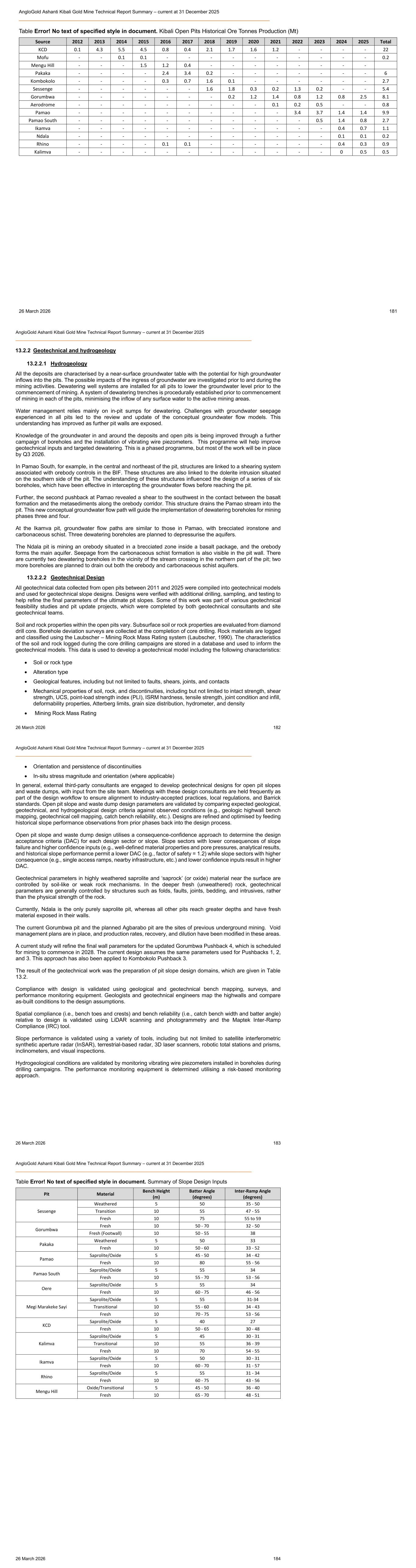
AngloGold Ashanti Kibali Gold Mine Technical Report Summary – current at 31 December 2025 ______________________________________________________________________________ 26 March 2026 181 Table Error! No text of specified style in document. Kibali Open Pits Historical Ore Tonnes Production (Mt) Source 2012 2013 2014 2015 2016 2017 2018 2019 2020 2021 2022 2023 2024 2025 Total KCD 0.1 4.3 5.5 4.5 0.8 0.4 2.1 1.7 1.6 1.2 - - - - 22 Mofu - - 0.1 0.1 - - - - - - - - - - 0.2 Mengu Hill - - - 1.5 1.2 0.4 - - - - - - - - Pakaka - - - - 2.4 3.4 0.2 - - - - - - - 6 Kombokolo - - - - 0.3 0.7 1.6 0.1 - - - - - - 2.7 Sessenge - - - - - - 1.6 1.8 0.3 0.2 1.3 0.2 - - 5.4 Gorumbwa - - - - - - - 0.2 1.2 1.4 0.8 1.2 0.8 2.5 8.1 Aerodrome - - - - - - - - - 0.1 0.2 0.5 - - 0.8 Pamao - - - - - - - - - - 3.4 3.7 1.4 1.4 9.9 Pamao South - - - - - - - - - - - 0.5 1.4 0.8 2.7 Ikamva - - - - - - - - - - - - 0.4 0.7 1.1 Ndala - - - - - - - - - - - - 0.1 0.1 0.2 Rhino - - - - 0.1 0.1 - - - - - - 0.4 0.3 0.9 Kalimva - - - - - - - - - - - - 0 0.5 0.5 AngloGold Ashanti Kibali Gold Mine Technical Report Summary – current at 31 December 2025 ______________________________________________________________________________ 26 March 2026 182 13.2.2 Geotechnical and hydrogeology 13.2.2.1 Hydrogeology All the deposits are characterised by a near-surface groundwater table with the potential for high groundwater inflows into the pits. The possible impacts of the ingress of groundwater are investigated prior to and during the mining activities. Dewatering well systems are installed for all pits to lower the groundwater level prior to the commencement of mining. A system of dewatering trenches is procedurally established prior to commencement of mining in each of the pits, minimising the inflow of any surface water to the active mining areas. Water management relies mainly on in-pit sumps for dewatering. Challenges with groundwater seepage experienced in all pits led to the review and update of the conceptual groundwater flow models. This understanding has improved as further pit walls are exposed. Knowledge of the groundwater in and around the deposits and open pits is being improved through a further campaign of boreholes and the installation of vibrating wire piezometers. This programme will help improve geotechnical inputs and targeted dewatering. This is a phased programme, but most of the work will be in place by Q3 2026. In Pamao South, for example, in the central and northeast of the pit, structures are linked to a shearing system associated with orebody controls in the BIF. These structures are also linked to the dolerite intrusion situated on the southern side of the pit. The understanding of these structures influenced the design of a series of six boreholes, which have been effective in intercepting the groundwater flows before reaching the pit. Further, the second pushback at Pamao revealed a shear to the southwest in the contact between the basalt formation and the metasediments along the orebody corridor. This structure drains the Pamao stream into the pit. This new conceptual groundwater flow path will guide the implementation of dewatering boreholes for mining phases three and four. At the Ikamva pit, groundwater flow paths are similar to those in Pamao, with brecciated ironstone and carbonaceous schist. Three dewatering boreholes are planned to depressurise the aquifers. The Ndala pit is mining an orebody situated in a brecciated zone inside a basalt package, and the orebody forms the main aquifer. Seepage from the carbonaceous schist formation is also visible in the pit wall. There are currently two dewatering boreholes in the vicinity of the stream crossing in the northern part of the pit; two more boreholes are planned to drain out both the orebody and carbonaceous schist aquifers. 13.2.2.2 Geotechnical Design All geotechnical data collected from open pits between 2011 and 2025 were compiled into geotechnical models and used for geotechnical slope designs. Designs were verified with additional drilling, sampling, and testing to help refine the final parameters of the ultimate pit slopes. Some of this work was part of various geotechnical feasibility studies and pit update projects, which were completed by both geotechnical consultants and site geotechnical teams. Soil and rock properties within the open pits vary. Subsurface soil or rock properties are evaluated from diamond drill core. Borehole deviation surveys are collected at the completion of core drilling. Rock materials are logged and classified using the Laubscher – Mining Rock Mass Rating system (Laubscher, 1990). The characteristics of the soil and rock logged during the core drilling campaigns are stored in a database and used to inform the geotechnical models. This data is used to develop a geotechnical model including the following characteristics: • Soil or rock type • Alteration type • Geological features, including but not limited to faults, shears, joints, and contacts • Mechanical properties of soil, rock, and discontinuities, including but not limited to intact strength, shear strength, UCS, point-load strength index (PLI), ISRM hardness, tensile strength, joint condition and infill, deformability properties, Atterberg limits, grain size distribution, hydrometer, and density • Mining Rock Mass Rating AngloGold Ashanti Kibali Gold Mine Technical Report Summary – current at 31 December 2025 ______________________________________________________________________________ 26 March 2026 183 • Orientation and persistence of discontinuities • In-situ stress magnitude and orientation (where applicable) In general, external third-party consultants are engaged to develop geotechnical designs for open pit slopes and waste dumps, with input from the site team. Meetings with these design consultants are held frequently as part of the design workflow to ensure alignment to industry-accepted practices, local regulations, and Barrick standards. Open pit slope and waste dump design parameters are validated by comparing expected geological, geotechnical, and hydrogeological design criteria against observed conditions (e.g., geologic highwall bench mapping, geotechnical cell mapping, catch bench reliability, etc.). Designs are refined and optimised by feeding historical slope performance observations from prior phases back into the design process. Open pit slope and waste dump design utilises a consequence-confidence approach to determine the design acceptance criteria (DAC) for each design sector or slope. Slope sectors with lower consequences of slope failure and higher confidence inputs (e.g., well-defined material properties and pore pressures, analytical results, and historical slope performance permit a lower DAC (e.g., factor of safety = 1.2) while slope sectors with higher consequence (e.g., single access ramps, nearby infrastructure, etc.) and lower confidence inputs result in higher DAC. Geotechnical parameters in highly weathered saprolite and ‘saprock’ (or oxide) material near the surface are controlled by soil-like or weak rock mechanisms. In the deeper fresh (unweathered) rock, geotechnical parameters are generally controlled by structures such as folds, faults, joints, bedding, and intrusives, rather than the physical strength of the rock. Currently, Ndala is the only purely saprolite pit, whereas all other pits reach greater depths and have fresh material exposed in their walls. The current Gorumbwa pit and the planned Agbarabo pit are the sites of previous underground mining. Void management plans are in place, and production rates, recovery, and dilution have been modified in these areas. A current study will refine the final wall parameters for the updated Gorumbwa Pushback 4, which is scheduled for mining to commence in 2028. The current design assumes the same parameters used for Pushbacks 1, 2, and 3. This approach has also been applied to Kombokolo Pushback 3. The result of the geotechnical work was the preparation of pit slope design domains, which are given in Table 13.2. Compliance with design is validated using geological and geotechnical bench mapping, surveys, and performance monitoring equipment. Geologists and geotechnical engineers map the highwalls and compare as-built conditions to the design assumptions. Spatial compliance (i.e., bench toes and crests) and bench reliability (i.e., catch bench width and batter angle) relative to design is validated using LiDAR scanning and photogrammetry and the Maptek Inter-Ramp Compliance (IRC) tool. Slope performance is validated using a variety of tools, including but not limited to satellite interferometric synthetic aperture radar (InSAR), terrestrial-based radar, 3D laser scanners, robotic total stations and prisms, inclinometers, and visual inspections. Hydrogeological conditions are validated by monitoring vibrating wire piezometers installed in boreholes during drilling campaigns. The performance monitoring equipment is determined utilising a risk-based monitoring approach. AngloGold Ashanti Kibali Gold Mine Technical Report Summary – current at 31 December 2025 ______________________________________________________________________________ 26 March 2026 184 Table Error! No text of specified style in document. Summary of Slope Design Inputs Pit Material Bench Height (m) Batter Angle (degrees) Inter-Ramp Angle (degrees) Sessenge Weathered 5 50 35 - 50 Transition 10 55 47 - 55 Fresh 10 75 55 to 59 Gorumbwa Fresh 10 50 - 70 32 - 50 Fresh (Footwall) 10 50 - 55 38 Pakaka Weathered 5 50 33 Fresh 10 50 - 60 33 - 52 Pamao Saprolite/Oxide 5 45 - 50 34 - 42 Fresh 10 80 55 - 56 Pamao South Saprolite/Oxide 5 55 34 Fresh 10 55 - 70 53 - 56 Oere Saprolite/Oxide 5 55 34 Fresh 10 60 - 75 46 - 56 Megi Marakeke Sayi Saprolite/Oxide 5 55 31-34 Transitional 10 55 - 60 34 - 43 Fresh 10 70 - 75 53 - 56 KCD Saprolite/Oxide 5 40 27 Fresh 10 50 - 65 30 - 48 Kalimva Saprolite/Oxide 5 45 30 - 31 Transitional 10 55 36 - 39 Fresh 10 70 54 - 55 Ikamva Saprolite/Oxide 5 50 30 - 31 Fresh 10 60 - 70 31 - 57 Rhino Saprolite/Oxide 5 55 31 - 34 Fresh 10 60 - 75 43 - 56 Mengu Hill Oxide/Transitional 5 45 - 50 36 - 40 Fresh 10 65 - 70 48 - 51
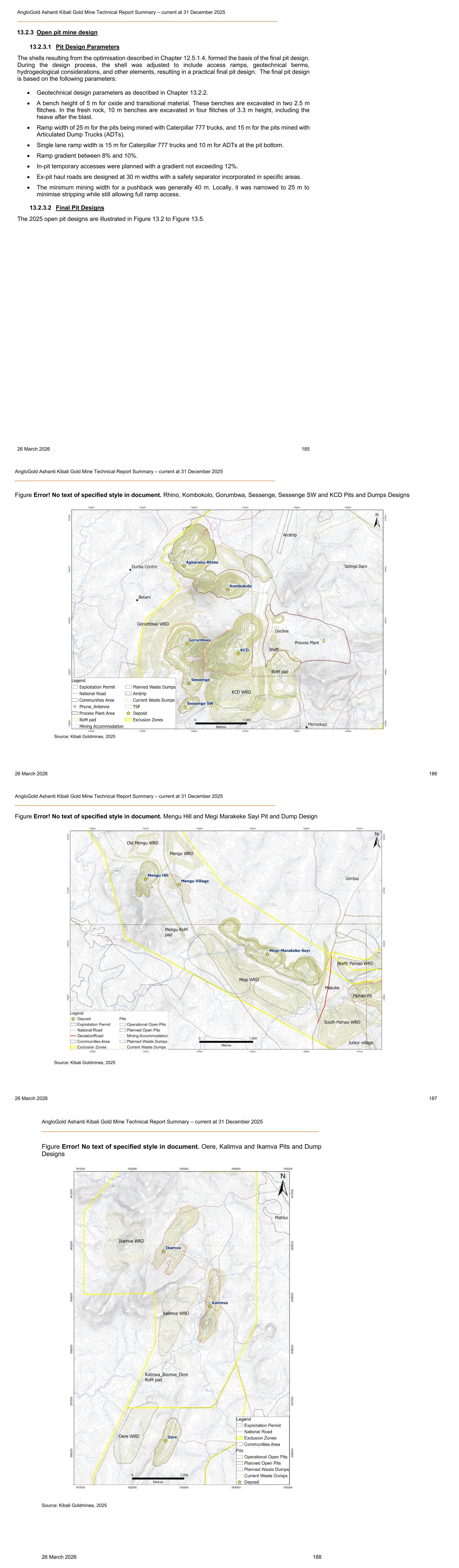
AngloGold Ashanti Kibali Gold Mine Technical Report Summary – current at 31 December 2025 ______________________________________________________________________________ 26 March 2026 185 13.2.3 Open pit mine design 13.2.3.1 Pit Design Parameters The shells resulting from the optimisation described in Chapter 12.5.1.4, formed the basis of the final pit design. During the design process, the shell was adjusted to include access ramps, geotechnical berms, hydrogeological considerations, and other elements, resulting in a practical final pit design. The final pit design is based on the following parameters: • Geotechnical design parameters as described in Chapter 13.2.2. • A bench height of 5 m for oxide and transitional material. These benches are excavated in two 2.5 m flitches. In the fresh rock, 10 m benches are excavated in four flitches of 3.3 m height, including the heave after the blast. • Ramp width of 25 m for the pits being mined with Caterpillar 777 trucks, and 15 m for the pits mined with Articulated Dump Trucks (ADTs). • Single lane ramp width is 15 m for Caterpillar 777 trucks and 10 m for ADTs at the pit bottom. • Ramp gradient between 8% and 10%. • In-pit temporary accesses were planned with a gradient not exceeding 12%. • Ex-pit haul roads are designed at 30 m widths with a safety separator incorporated in specific areas. • The minimum mining width for a pushback was generally 40 m. Locally, it was narrowed to 25 m to minimise stripping while still allowing full ramp access. 13.2.3.2 Final Pit Designs The 2025 open pit designs are illustrated in Figure 13.2 to Figure 13.5. AngloGold Ashanti Kibali Gold Mine Technical Report Summary – current at 31 December 2025 ______________________________________________________________________________ 26 March 2026 186 Figure Error! No text of specified style in document. Rhino, Kombokolo, Gorumbwa, Sessenge, Sessenge SW and KCD Pits and Dumps Designs Source: Kibali Goldmines, 2025 AngloGold Ashanti Kibali Gold Mine Technical Report Summary – current at 31 December 2025 ______________________________________________________________________________ 26 March 2026 187 Figure Error! No text of specified style in document. Mengu Hill and Megi Marakeke Sayi Pit and Dump Design Source: Kibali Goldmines, 2025 AngloGold Ashanti Kibali Gold Mine Technical Report Summary – current at 31 December 2025 ______________________________________________________________________________ 26 March 2026 188 Figure Error! No text of specified style in document. Oere, Kalimva and Ikamva Pits and Dump Designs Source: Kibali Goldmines, 2025
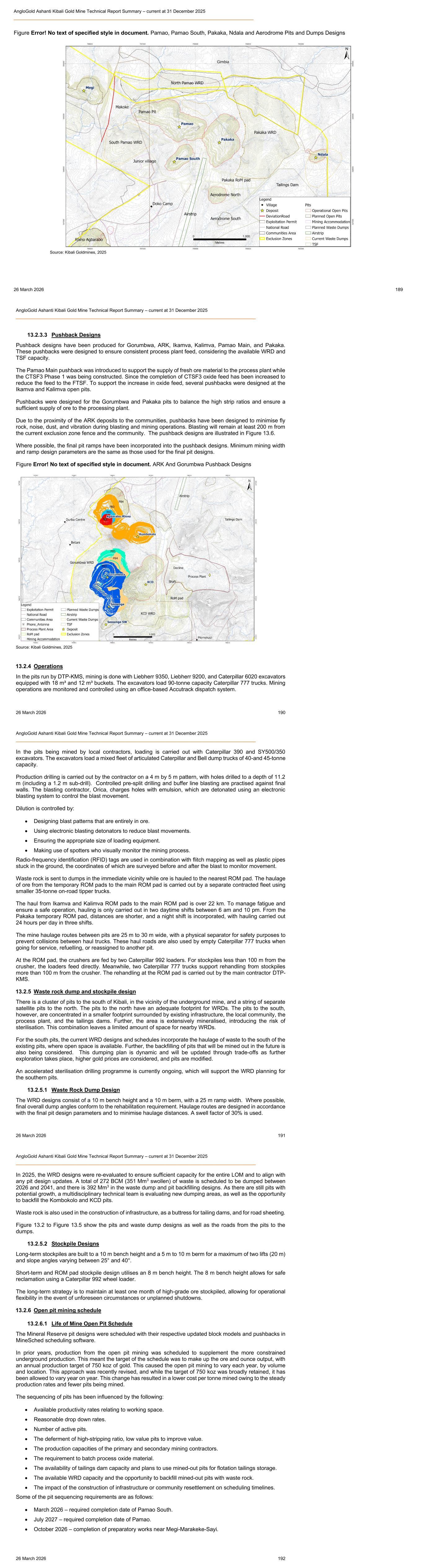
AngloGold Ashanti Kibali Gold Mine Technical Report Summary – current at 31 December 2025 ______________________________________________________________________________ 26 March 2026 189 Figure Error! No text of specified style in document. Pamao, Pamao South, Pakaka, Ndala and Aerodrome Pits and Dumps Designs Source: Kibali Goldmines, 2025 AngloGold Ashanti Kibali Gold Mine Technical Report Summary – current at 31 December 2025 ______________________________________________________________________________ 26 March 2026 190 13.2.3.3 Pushback Designs Pushback designs have been produced for Gorumbwa, ARK, Ikamva, Kalimva, Pamao Main, and Pakaka. These pushbacks were designed to ensure consistent process plant feed, considering the available WRD and TSF capacity. The Pamao Main pushback was introduced to support the supply of fresh ore material to the process plant while the CTSF3 Phase 1 was being constructed. Since the completion of CTSF3 oxide feed has been increased to reduce the feed to the FTSF. To support the increase in oxide feed, several pushbacks were designed at the Ikamva and Kalimva open pits. Pushbacks were designed for the Gorumbwa and Pakaka pits to balance the high strip ratios and ensure a sufficient supply of ore to the processing plant. Due to the proximity of the ARK deposits to the communities, pushbacks have been designed to minimise fly rock, noise, dust, and vibration during blasting and mining operations. Blasting will remain at least 200 m from the current exclusion zone fence and the community. The pushback designs are illustrated in Figure 13.6. Where possible, the final pit ramps have been incorporated into the pushback designs. Minimum mining width and ramp design parameters are the same as those used for the final pit designs. Figure Error! No text of specified style in document. ARK And Gorumbwa Pushback Designs Source: Kibali Goldmines, 2025 13.2.4 Operations In the pits run by DTP-KMS, mining is done with Liebherr 9350, Liebherr 9200, and Caterpillar 6020 excavators equipped with 18 m³ and 12 m³ buckets. The excavators load 90-tonne capacity Caterpillar 777 trucks. Mining operations are monitored and controlled using an office-based Accutrack dispatch system. AngloGold Ashanti Kibali Gold Mine Technical Report Summary – current at 31 December 2025 ______________________________________________________________________________ 26 March 2026 191 In the pits being mined by local contractors, loading is carried out with Caterpillar 390 and SY500/350 excavators. The excavators load a mixed fleet of articulated Caterpillar and Bell dump trucks of 40-and 45-tonne capacity. Production drilling is carried out by the contractor on a 4 m by 5 m pattern, with holes drilled to a depth of 11.2 m (including a 1.2 m sub-drill). Controlled pre-split drilling and buffer line blasting are practised against final walls. The blasting contractor, Orica, charges holes with emulsion, which are detonated using an electronic blasting system to control the blast movement. Dilution is controlled by: • Designing blast patterns that are entirely in ore. • Using electronic blasting detonators to reduce blast movements. • Ensuring the appropriate size of loading equipment. • Making use of spotters who visually monitor the mining process. Radio-frequency identification (RFID) tags are used in combination with flitch mapping as well as plastic pipes stuck in the ground, the coordinates of which are surveyed before and after the blast to monitor movement. Waste rock is sent to dumps in the immediate vicinity while ore is hauled to the nearest ROM pad. The haulage of ore from the temporary ROM pads to the main ROM pad is carried out by a separate contracted fleet using smaller 35-tonne on-road tipper trucks. The haul from Ikamva and Kalimva ROM pads to the main ROM pad is over 22 km. To manage fatigue and ensure a safe operation, hauling is only carried out in two daytime shifts between 6 am and 10 pm. From the Pakaka temporary ROM pad, distances are shorter, and a night shift is incorporated, with hauling carried out 24 hours per day in three shifts. The mine haulage routes between pits are 25 m to 30 m wide, with a physical separator for safety purposes to prevent collisions between haul trucks. These haul roads are also used by empty Caterpillar 777 trucks when going for service, refuelling, or reassigned to another pit. At the ROM pad, the crushers are fed by two Caterpillar 992 loaders. For stockpiles less than 100 m from the crusher, the loaders feed directly. Meanwhile, two Caterpillar 777 trucks support rehandling from stockpiles more than 100 m from the crusher. The rehandling at the ROM pad is carried out by the main contractor DTP- KMS. 13.2.5 Waste rock dump and stockpile design There is a cluster of pits to the south of Kibali, in the vicinity of the underground mine, and a string of separate satellite pits to the north. The pits to the north have an adequate footprint for WRDs. The pits to the south, however, are concentrated in a smaller footprint surrounded by existing infrastructure, the local community, the process plant, and the tailings dams. Further, the area is extensively mineralised, introducing the risk of sterilisation. This combination leaves a limited amount of space for nearby WRDs. For the south pits, the current WRD designs and schedules incorporate the haulage of waste to the south of the existing pits, where open space is available. Further, the backfilling of pits that will be mined out in the future is also being considered. This dumping plan is dynamic and will be updated through trade-offs as further exploration takes place, higher gold prices are considered, and pits are modified. An accelerated sterilisation drilling programme is currently ongoing, which will support the WRD planning for the southern pits. 13.2.5.1 Waste Rock Dump Design The WRD designs consist of a 10 m bench height and a 10 m berm, with a 25 m ramp width. Where possible, final overall dump angles conform to the rehabilitation requirement. Haulage routes are designed in accordance with the final pit design parameters and to minimise haulage distances. A swell factor of 30% is used. AngloGold Ashanti Kibali Gold Mine Technical Report Summary – current at 31 December 2025 ______________________________________________________________________________ 26 March 2026 192 In 2025, the WRD designs were re-evaluated to ensure sufficient capacity for the entire LOM and to align with any pit design updates. A total of 272 BCM (351 Mm3 swollen) of waste is scheduled to be dumped between 2026 and 2041, and there is 392 Mm3 in the waste dump and pit backfilling designs. As there are still pits with potential growth, a multidisciplinary technical team is evaluating new dumping areas, as well as the opportunity to backfill the Kombokolo and KCD pits. Waste rock is also used in the construction of infrastructure, as a buttress for tailing dams, and for road sheeting. Figure 13.2 to Figure 13.5 show the pits and waste dump designs as well as the roads from the pits to the dumps. 13.2.5.2 Stockpile Designs Long-term stockpiles are built to a 10 m bench height and a 5 m to 10 m berm for a maximum of two lifts (20 m) and slope angles varying between 25° and 40°. Short-term and ROM pad stockpile design utilises an 8 m bench height. The 8 m bench height allows for safe reclamation using a Caterpillar 992 wheel loader. The long-term strategy is to maintain at least one month of high-grade ore stockpiled, allowing for operational flexibility in the event of unforeseen circumstances or unplanned shutdowns. 13.2.6 Open pit mining schedule 13.2.6.1 Life of Mine Open Pit Schedule The Mineral Reserve pit designs were scheduled with their respective updated block models and pushbacks in MineSched scheduling software. In prior years, production from the open pit mining was scheduled to supplement the more constrained underground production. This meant the target of the schedule was to make up the ore and ounce output, with an annual production target of 750 koz of gold. This caused the open pit mining to vary each year, by volume and location. This approach was recently revised, and while the target of 750 koz was broadly retained, it has been allowed to vary year on year. This change has resulted in a lower cost per tonne mined owing to the steady production rates and fewer pits being mined. The sequencing of pits has been influenced by the following: • Available productivity rates relating to working space. • Reasonable drop down rates. • Number of active pits. • The deferment of high-stripping ratio, low value pits to improve value. • The production capacities of the primary and secondary mining contractors. • The requirement to batch process oxide material. • The availability of tailings dam capacity and plans to use mined-out pits for flotation tailings storage. • The available WRD capacity and the opportunity to backfill mined-out pits with waste rock. • The impact of the construction of infrastructure or community resettlement on scheduling timelines. Some of the pit sequencing requirements are as follows: • March 2026 – required completion date of Pamao South. • July 2027 – required completion date of Pamao. • October 2026 – completion of preparatory works near Megi-Marakeke-Sayi.
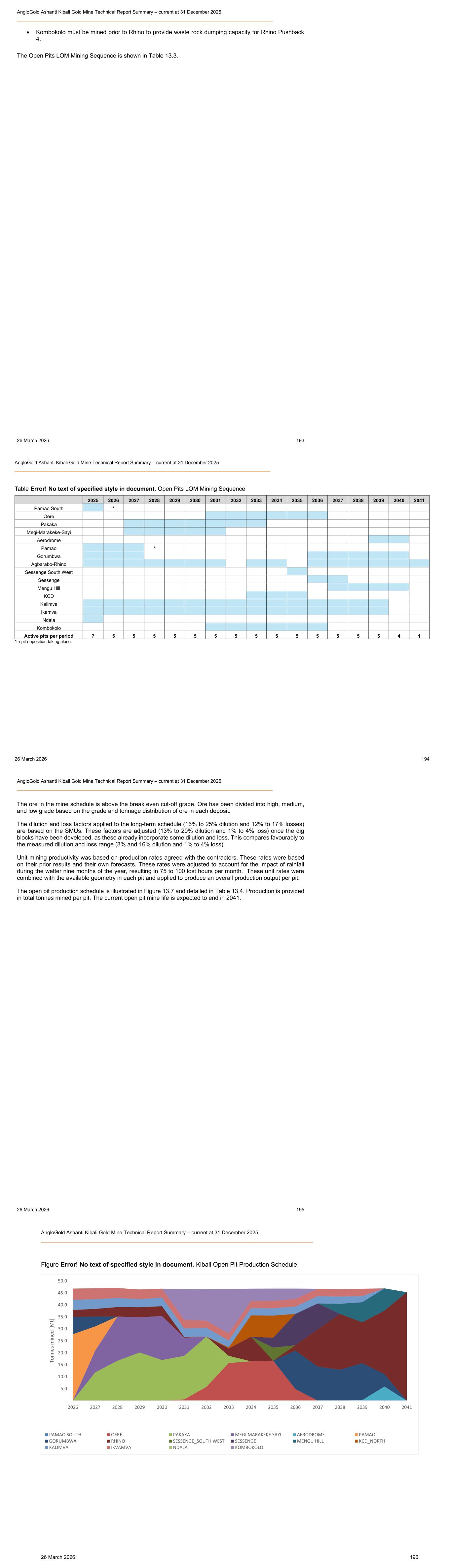
AngloGold Ashanti Kibali Gold Mine Technical Report Summary – current at 31 December 2025 ______________________________________________________________________________ 26 March 2026 193 • Kombokolo must be mined prior to Rhino to provide waste rock dumping capacity for Rhino Pushback 4. The Open Pits LOM Mining Sequence is shown in Table 13.3. AngloGold Ashanti Kibali Gold Mine Technical Report Summary – current at 31 December 2025 ______________________________________________________________________________ 26 March 2026 194 Table Error! No text of specified style in document. Open Pits LOM Mining Sequence 2025 2026 2027 2028 2029 2030 2031 2032 2033 2034 2035 2036 2037 2038 2039 2040 2041 Pamao South * Oere Pakaka Megi-Marakeke-Sayi Aerodrome Pamao * Gorumbwa Agbarabo-Rhino Sessenge South West Sessenge Mengu Hill KCD Kalimva Ikamva Ndala Kombokolo Active pits per period 7 5 5 5 5 5 5 5 5 5 5 5 5 5 5 4 1 *In-pit deposition taking place. AngloGold Ashanti Kibali Gold Mine Technical Report Summary – current at 31 December 2025 ______________________________________________________________________________ 26 March 2026 195 The ore in the mine schedule is above the break even cut-off grade. Ore has been divided into high, medium, and low grade based on the grade and tonnage distribution of ore in each deposit. The dilution and loss factors applied to the long-term schedule (16% to 25% dilution and 12% to 17% losses) are based on the SMUs. These factors are adjusted (13% to 20% dilution and 1% to 4% loss) once the dig blocks have been developed, as these already incorporate some dilution and loss. This compares favourably to the measured dilution and loss range (8% and 16% dilution and 1% to 4% loss). Unit mining productivity was based on production rates agreed with the contractors. These rates were based on their prior results and their own forecasts. These rates were adjusted to account for the impact of rainfall during the wetter nine months of the year, resulting in 75 to 100 lost hours per month. These unit rates were combined with the available geometry in each pit and applied to produce an overall production output per pit. The open pit production schedule is illustrated in Figure 13.7 and detailed in Table 13.4. Production is provided in total tonnes mined per pit. The current open pit mine life is expected to end in 2041. AngloGold Ashanti Kibali Gold Mine Technical Report Summary – current at 31 December 2025 ______________________________________________________________________________ 26 March 2026 196 Figure Error! No text of specified style in document. Kibali Open Pit Production Schedule - 5.0 10.0 15.0 20.0 25.0 30.0 35.0 40.0 45.0 50.0 2026 2027 2028 2029 2030 2031 2032 2033 2034 2035 2036 2037 2038 2039 2040 2041 To n n es m in ed [ M t] PAMAO SOUTH OERE PAKAKA MEGI MARAKEKE SAYI AERODROME PAMAO GORUMBWA RHINO SESSENGE_SOUTH WEST SESSENGE MENGU HILL KCD_NORTH KALIMVA IKVAMVA NDALA KOMBOKOLO
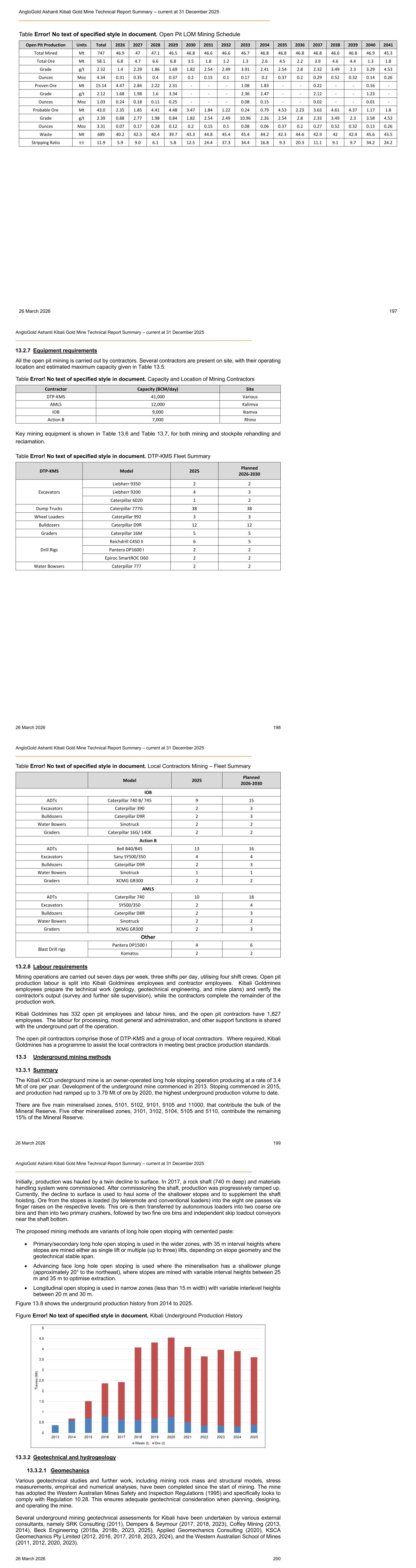
AngloGold Ashanti Kibali Gold Mine Technical Report Summary – current at 31 December 2025 ______________________________________________________________________________ 26 March 2026 197 Table Error! No text of specified style in document. Open Pit LOM Mining Schedule Open Pit Production Units Total 2026 2027 2028 2029 2030 2031 2032 2033 2034 2035 2036 2037 2038 2039 2040 2041 Total Mined Mt 747 46.9 47 47.1 46.5 46.8 46.6 46.6 46.7 46.8 46.8 46.8 46.8 46.6 46.8 46.9 45.3 Total Ore Mt 58.1 6.8 4.7 6.6 6.8 3.5 1.8 1.2 1.3 2.6 4.5 2.2 3.9 4.6 4.4 1.3 1.8 Grade g/t 2.32 1.4 2.29 1.86 1.69 1.82 2.54 2.49 3.91 2.41 2.54 2.8 2.32 3.49 2.3 3.29 4.53 Ounces Moz 4.34 0.31 0.35 0.4 0.37 0.2 0.15 0.1 0.17 0.2 0.37 0.2 0.29 0.52 0.32 0.14 0.26 Proven Ore Mt 15.14 4.47 2.84 2.22 2.31 - - - 1.08 1.83 - - 0.22 - - 0.16 - Grade g/t 2.12 1.68 1.98 1.6 3.34 - - - 2.36 2.47 - - 2.12 - - 1.23 - Ounces Moz 1.03 0.24 0.18 0.11 0.25 - - - 0.08 0.15 - - 0.02 - - 0.01 - Probable Ore Mt 43.0 2.35 1.85 4.41 4.48 3.47 1.84 1.22 0.24 0.79 4.53 2.23 3.63 4.61 4.37 1.17 1.8 Grade g/t 2.39 0.88 2.77 1.98 0.84 1.82 2.54 2.49 10.96 2.26 2.54 2.8 2.33 3.49 2.3 3.58 4.53 Ounces Moz 3.31 0.07 0.17 0.28 0.12 0.2 0.15 0.1 0.08 0.06 0.37 0.2 0.27 0.52 0.32 0.13 0.26 Waste Mt 689 40.2 42.3 40.4 39.7 43.3 44.8 45.4 45.4 44.2 42.3 44.6 42.9 42 42.4 45.6 43.5 Stripping Ratio t:t 11.9 5.9 9.0 6.1 5.8 12.5 24.4 37.3 34.4 16.8 9.3 20.3 11.1 9.1 9.7 34.2 24.2 AngloGold Ashanti Kibali Gold Mine Technical Report Summary – current at 31 December 2025 ______________________________________________________________________________ 26 March 2026 198 13.2.7 Equipment requirements All the open pit mining is carried out by contractors. Several contractors are present on site, with their operating location and estimated maximum capacity given in Table 13.5. Table Error! No text of specified style in document. Capacity and Location of Mining Contractors Contractor Capacity (BCM/day) Site DTP-KMS 41,000 Various AMLS 12,000 Kalimva IOB 9,000 Ikamva Action B 7,000 Rhino Key mining equipment is shown in Table 13.6 and Table 13.7, for both mining and stockpile rehandling and reclamation. Table Error! No text of specified style in document. DTP-KMS Fleet Summary DTP-KMS Model 2025 Planned 2026-2030 Excavators Liebherr 9350 2 2 Liebherr 9200 4 3 Caterpillar 6020 1 2 Dump Trucks Caterpillar 777G 38 38 Wheel Loaders Caterpillar 992 3 3 Bulldozers Caterpillar D9R 12 12 Graders Caterpillar 16M 5 5 Drill Rigs Reichdrill C450 II 6 5 Pantera DP1600 I 2 2 Epiroc SmartROC D60 2 2 Water Bowsers Caterpillar 777 2 2 AngloGold Ashanti Kibali Gold Mine Technical Report Summary – current at 31 December 2025 ______________________________________________________________________________ 26 March 2026 199 Table Error! No text of specified style in document. Local Contractors Mining – Fleet Summary Model 2025 Planned 2026-2030 IOB ADTs Caterpillar 740 B/ 745 9 15 Excavators Caterpillar 390 2 3 Bulldozers Caterpillar D9R 2 3 Water Bowers Sinotruck 2 2 Graders Caterpillar 16G/ 140K 2 2 Action B ADTs Bell B40/B45 13 16 Excavators Sany SY500/350 4 4 Bulldozers Caterpillar D9R 2 3 Water Bowers Sinotruck 1 1 Graders XCMG GR300 2 2 AMLS ADTs Caterpillar 740 10 18 Excavators SY500/350 2 4 Bulldozers Caterpillar D8R 2 3 Water Bowers Sinotruck 2 2 Graders XCMG GR300 2 3 Other Blast Drill rigs Pantera DP1500 I 4 6 Komatsu 2 2 13.2.8 Labour requirements Mining operations are carried out seven days per week, three shifts per day, utilising four shift crews. Open pit production labour is split into Kibali Goldmines employees and contractor employees. Kibali Goldmines employees prepare the technical work (geology, geotechnical engineering, and mine plans) and verify the contractor's output (survey and further site supervision), while the contractors complete the remainder of the production work. Kibali Goldmines has 332 open pit employees and labour hires, and the open pit contractors have 1,827 employees. The labour for processing, most general and administration, and other support functions is shared with the underground part of the operation. The open pit contractors comprise those of DTP-KMS and a group of local contractors. Where required, Kibali Goldmines has a programme to assist the local contractors in meeting best practice production standards. 13.3 Underground mining methods 13.3.1 Summary The Kibali KCD underground mine is an owner-operated long hole stoping operation producing at a rate of 3.4 Mt of ore per year. Development of the underground mine commenced in 2013. Stoping commenced in 2015, and production had ramped up to 3.79 Mt of ore by 2020, the highest underground production volume to date. There are five main mineralised zones, 5101, 5102, 9101, 9105 and 11000, that contribute the bulk of the Mineral Reserve. Five other mineralised zones, 3101, 3102, 5104, 5105 and 5110, contribute the remaining 15% of the Mineral Reserve. AngloGold Ashanti Kibali Gold Mine Technical Report Summary – current at 31 December 2025 ______________________________________________________________________________ 26 March 2026 200 Initially, production was hauled by a twin decline to surface. In 2017, a rock shaft (740 m deep) and materials handling system were commissioned. After commissioning the shaft, production was progressively ramped up. Currently, the decline to surface is used to haul some of the shallower stopes and to supplement the shaft hoisting. Ore from the stopes is loaded (by teleremote and conventional loaders) into the eight ore passes via finger raises on the respective levels. This ore is then transferred by autonomous loaders into two coarse ore bins and then into two primary crushers, followed by two fine ore bins and independent skip loadout conveyors near the shaft bottom. The proposed mining methods are variants of long hole open stoping with cemented paste: • Primary/secondary long hole open stoping is used in the wider zones, with 35 m interval heights where stopes are mined either as single lift or multiple (up to three) lifts, depending on stope geometry and the geotechnical stable span. • Advancing face long hole open stoping is used where the mineralisation has a shallower plunge (approximately 20° to the northeast), where stopes are mined with variable interval heights between 25 m and 35 m to optimise extraction. • Longitudinal open stoping is used in narrow zones (less than 15 m width) with variable interlevel heights between 20 m and 30 m. Figure 13.8 shows the underground production history from 2014 to 2025. Figure Error! No text of specified style in document. Kibali Underground Production History 13.3.2 Geotechnical and hydrogeology 13.3.2.1 Geomechanics Various geotechnical studies and further work, including mining rock mass and structural models, stress measurements, empirical and numerical analyses, have been completed since the start of mining. The mine has adopted the Western Australian Mines Safety and Inspection Regulations (1995) and specifically looks to comply with Regulation 10.28. This ensures adequate geotechnical consideration when planning, designing, and operating the mine. Several underground mining geotechnical assessments for Kibali have been undertaken by various external consultants, namely SRK Consulting (2011), Dempers & Seymour (2017, 2018, 2023), Coffey Mining (2013, 2014), Beck Engineering (2018a, 2018b, 2023, 2025), Applied Geomechanics Consulting (2020), KSCA Geomechanics Pty Limited (2012, 2016, 2017, 2018, 2023, 2024), and the Western Australian School of Mines (2011, 2012, 2020, 2023).

AngloGold Ashanti Kibali Gold Mine Technical Report Summary – current at 31 December 2025 ______________________________________________________________________________ 26 March 2026 201 The geotechnical works carried out by these consultants is summarised as follows: • Development and construction of mining rock mass and geotechnically significant structural models between 2012 and 2025. These models have incorporated raw geotechnical data comprised of rock mass and structural logs of exploration, geotechnical drill holes, grade control diamond holes, and underground mapping. • 3D numerical modelling of mining-induced stress and its seismic potential and damage. This best practice approach of numerical modelling assists the understanding of the mining interactions, testing new concepts and designs to improve the overall design confidence. • In situ pre-mining stress measurements ranging from 220 m to 1,140 m below surface. • The establishment of a stope performance database to enable a comparison between predicted and actual stope behaviour. • Geotechnical damage mapping to calibrate the numerical model and aid an understanding of mining- induced stress effects. • Installation of the underground seismic system, which is used to calibrate the numerical model. While the seismic potential at Kibali is not high, seismic monitoring is still completed as a normal part of risk management. • The continued development of the site-based geotechnical engineers through training and mentoring. Since the start of production stoping and paste backfilling in December 2014, the geotechnical understanding of the operation has been continually developed. An understanding of the response of the rock mass to mining activities continues to inform planned mining developments, stope design work and sequencing. Numerical modelling of the LOM sequence confirmed that new stope shapes and extraction sequences are acceptable in terms of geotechnical risk and planning parameters. Modelling quantifies the stability and performance of stopes and allows their extraction to be optimised. Numerical modelling better quantifies risk and the mitigating factors. Stope Dimensions Stope dimensions are primarily based on the stable stope Hydraulic Radius (HR). The Modified Stability Graphs were used to assess stope dimensions (Figure 13.9). The stope sizing analysis includes the Mining Rock Mass Model (MRMM) and structural model. The MRMM enables stope dimensions to be based on the rock mass competency and quality in individual geotechnical domains. Resulting stope dimensions vary by geotechnical zone but range from 20 m to 40 m in strike length, 15 m to 40 m wide, and 25 m to 35 m high per lift. Multiple lifts can be taken where geotechnical conditions are appropriate. AngloGold Ashanti Kibali Gold Mine Technical Report Summary – current at 31 December 2025 ______________________________________________________________________________ 26 March 2026 202 Figure Error! No text of specified style in document. Database of Cablebolt-Supported Stopes Source: Hutchinson and Diederichs, 1996 13.3.2.2 Development Development dimensions are based on equipment and ventilation constraints and not geotechnical requirements. Basic geotechnical constraints are applied when placing development: • Minimum offset of the footwall drive is usually 25 m to 30 m but can be as much as 60 m in places. • For longitudinal stoping, infrastructure in the development can make the offset between 60 m and 100 m. Ground Support Ground support systems at Kibali are typically made up of reinforcing elements (end-anchored rock bolts, grouted tendons, or friction rock stabilisers) that act directly upon the rock mass to increase its inherent strength. In addition to this, fabric (mesh) or coatings (shotcrete) are utilised to contain any potentially unstable rock mass between the reinforcing units. The ground support regime considers the following: • Expected service life of excavations • Geology • Hydrogeological conditions • Rock mass classification data (Barton’s Q Classification) • Structural analysis • Seismic considerations AngloGold Ashanti Kibali Gold Mine Technical Report Summary – current at 31 December 2025 ______________________________________________________________________________ 26 March 2026 203 • Perimeter control Using the empirical design method known as the Norwegian Tunnelling Index method, which is based on Barton’s Q classification, the ground support categories are summarised in Tables 13.8 and 13.9. Table Error! No text of specified style in document. KCD Underground Support Categories and Classifications for Short Life Openings (<5 years) Span Range 6 m (Standard) 6 m (Wide Span) Q range 0.4 - 4 4 - 1000 0.4 - 4 4 - 1000 Rock Class Very Poor, Poor, all Carb. Shale Fair and better Very Poor, Poor, all Carb. Shale Fair and better Ground Support Category A B C D Primary Ground Support Surface Support 50 mm Fibrecrete Mesh 50 mm Fibrecrete Mesh Rock Bolt 2.4 m galvanised splitsets 3 m galvanised spitsets Bolting Pattern 1.5m x 1.5m Note. Cable bolts required for intersections and certain very poor, poor condition development Table Error! No text of specified style in document. KCD Underground Support Categories and Classifications for Long Life Openings (>5 years) Span Range 6 m (Standard) 6 m (Wide Span) Q range 0.4 - 4 4 - 1000 0.4 - 4 4 - 1000 Rock Class Very Poor. Poor Fair and better Very Poor. Poor Fair and better Ground Support category E F Primary Ground Support Surface support 50 mm Fibrecrete 100 mm Fibrecrete Rock bolt 2.4 m fully encapsulated bolts 3 m fully encapsulated bolts Bolting pattern 1.5m x 1.5m Note. Cable bolts required for intersections and certain very poor, poor condition development 13.3.2.3 Hydrogeology The objective of the dewatering programme at KCD is full depressurisation of deep and shallow aquifers. This is being achieved by draining exposed aquifers and faults and by allowing grade control and exploration holes to flow when intersected. The permeability of the rock adjacent to mine workings comprises both geological and non-geological features, with joints and faults accentuating the north-south preferential connectivity and fractures parallel to foliation and dykes causing the partial compartmentalisation of flow of the groundwater. The deposit is a typical tropical basement aquifer where the permeability decreases with depth. The permeability of the area around the excavations comprises: • Foliation-parallel fractures. Foliation is planar in high strain zones with a distribution in the order of metres. It is likely that the sheared contacts of dykes and alteration zones with significant competency contribute a down-dip fracture permeability allowing groundwater to collect and percolate down-dip. • Joints and minor faults. These structures are the most abundant in the mine exposures and drill holes. However, overall rock quality is excellent with low frequencies of fractures or faults affecting the rock mass. The main north-south orientation of the joints likely influences the overall preferred groundwater circulation pathway. • Major structures. Major modelled structures (D1, D2 shears, late brittle reverse faults) do not appear to contribute greatly to the deposit-scale groundwater flow. AngloGold Ashanti Kibali Gold Mine Technical Report Summary – current at 31 December 2025 ______________________________________________________________________________ 26 March 2026 204 • Dykes. Foliation-parallel dolerite sheets do not appear more preferentially fractured than other lithologies at KCD. Despite the limited observations, certain portions of the intrusives may be affected by fracturing due to competency contrasts. • Matrix permeability. Large volumes of the deposit are strongly altered, including the alteration by silicification, which may have occluded any remnant porosity in the rock mass. Therefore, matrix permeability is likely to be negligible throughout the mine area. • Drill holes. Un-grouted exploration drill holes are an important contributor to the permeability framework. A conceptual model for the KCD area considers both existing and future groundwater pathways. The conceptual model is used as the basis for the dewatering and depressurisation plan. In the QP’s opinion, the volume of groundwater does not present an unusual risk to the operation and is managed in an appropriate manner. 13.3.2.4 Stope Types Three stoping methods are used at Kibali: primary/secondary transverse stoping, longitudinal stoping, and advancing face transverse stoping. Very few advancing face transverse stopes exist. When stoping, a slot raise is developed by a production drilling machine or by raise boring and production drill holes are either a combination of up and down holes or down holes of 102 mm diameter. Primary/Secondary Transverse Stoping Primary stopes are mined from hanging wall to footwall, and multi-level stopes are mined concurrently up to the full design height. Secondary stopes are mined once the primary stopes on either side have been mined and backfilled. The level interval is 35 m (floor to floor), and stopes are mined as either single lift or multiple (up to three lifts), depending on stope geometry and stable span analysis. Primary stopes are 20 m along strike, and secondary stopes are 30 m along strike, to minimise the consumption of binder. The width of primary stopes can be up to 40 m across strike. The controlling span for primary stope size is generally the side walls (north and south). Secondary stopes are up to 30 m across strike. The controlling span for secondary stope size is generally the side wall paste exposure of the adjacent primary stopes. Where the orebody is too wide for a single stope span (> 30 m to 40 m wide), multiple primary and secondary stopes are mined, retreating from hanging wall to footwall. Advancing face transverse stoping is used in the 9101 zone, which has a shallow plunge of 20° to 30°to the northeast. The level interval varies from 25 m to 30 m to optimise the ore extraction. The stopes are 25 m down plunge and 25 m across plunge. Mining is carried out in a similar fashion to primary/secondary transverse stoping; however, the stopes are mined out diagonally in a checkered pattern from the northeast to the southwest along an “advancing face”. Each stope is backfilled with paste fill prior to mining the adjacent stope; however, if a stope in the same mining front can be accessed from an alternative direction or ore drive, it can be mined simultaneously. This mining sequence is designed to avoid the creation of pillars which might become highly stressed as mining progresses. Longitudinal Stoping Longitudinal stoping is used as the main extraction method to mine the narrower portions of the orebody (< 15 m width). Mining is carried out in retreat with stopes split into single or multiple (up to three) lift blocks. Each block is paste-filled before mining of the subsequent stope to maintain hanging wall stability. The planned LOM stopes and grades are presented in Figure 13.10.

AngloGold Ashanti Kibali Gold Mine Technical Report Summary – current at 31 December 2025 ______________________________________________________________________________ 26 March 2026 205 Figure Error! No text of specified style in document. Underground As Built (existing) Voids and LOM Stopes by Gold Grade (looking northwest) Source: Kibali Goldmines, 2025 13.3.2.5 Underground Development and Access The mine is accessed via a twin decline, a vertical shaft, and an internal system of ramps. In general, access to the six discrete mining zones consists of six internal ramps. The underground mine's internal ramp system connects various mining lodes. A significant portion of the capital and access development for the mine is in place. To date, 52,700 m of capital development has been completed. The current LOM plan contains a further 35,300 m of capital lateral development. The key capital infrastructures remaining to be developed are 3102 Lode (CD zone), 11000 Lode (E zone), 5102 extension (CK zone), and 9101 incline (F zone). The existing development and planned development are shown in Figure 13.11. AngloGold Ashanti Kibali Gold Mine Technical Report Summary – current at 31 December 2025 ______________________________________________________________________________ 26 March 2026 206 Figure Error! No text of specified style in document. Underground As Built (Existing) Voids and Planned LOM Development (looking northwest) Source: Kibali Goldmines, 2025 13.3.3 Mining operations Planned mining operations are divided into stoping and development, with development further categorised into operational development and capital development. Capital development provides the main access to production areas (declines, footwall drives, ventilation, etc.) and operational development provides access to the stopes (ore drives). The development cycle consists of support, drilling, charging, firing, and mucking. The development activities are carried out by the development crew. Development operation is undertaken using four twin-boom jumbos, which are used for face and ground support drilling. Charging up is done using a MacLean charging unit. The stoping cycle consists of cable bolting, drilling, charging, firing, and mucking of the stope to ore passes or to the truck. Production drilling is carried out using five production drilling rigs at a rate of 200 to 250 m/day. At the end of the stope drilling, the production hole charging is completed by the production charge-up crew. Both the development and the stope cycle use emulsion for charging the holes. Due to the size of the stope and the firing sequence, electronic detonators are used in stope blasting. The blasting of the development heading and production stopes takes place at the end of each shift. The loading operation is undertaken using eleven loaders, split between development, stope production, and haulage levels, to feed the crusher. Hauling is completed using nine trucks. The hauling operations consist of hauling development and stope material to ore passes or to the surface WRDs or ROM pad. The shaft is used for hoisting most of the underground ore material, while trucks are mainly used for hauling underground waste material and stope material located in the shallower part of the mine, or for internal trucking to the ore passes. AngloGold Ashanti Kibali Gold Mine Technical Report Summary – current at 31 December 2025 ______________________________________________________________________________ 26 March 2026 207 13.3.3.1 Dilution and Mining Loss Improvement Initiatives There is an improvement initiative to minimise dilution, and this has resulted in several changes to pillar design and drill-and-blast practices. A standard 2.5 m drilling and blasting stand-off from paste fill walls is now implemented to minimise paste damage. Skin pillars are designed to contain potential paste fill failure. Aspects that impact the performance of paste/ore skin pillars were identified as geological and geotechnical structures, drill-and-blast quality, skin pillar geometry, and double lift or large design spans, resulting in a potentially unstable slender aspect ratio. The skin pillars have been reviewed to account for these aspects, ensuring stable pillar performance. Over the past several years, drill-and-blast has been improved by using up-hole and down-hole blasting, reducing drill hole deviations, minimising paste dilution, and improving productivity with better fragmentation. Further optimisation work has been conducted to maximise loading rates with trough designs and the implementation of new concepts, including the pre-split blast technique in the underground stoping method, to control overbreaking on the wings of stopes. Further improvement initiatives are being implemented, and testing of Web Gen blasting technology for secondary stopes commenced in late 2025. Further to this, a new zone with flat dipping stopes, of a type that has not yet been mined, is scheduled in the LOM. The recovery in this zone is estimated to be 2% less than for other zones. This will be revised as production data becomes available. 13.3.4 Underground services and infrastructure In the opinion of the QP, the infrastructure and provision of services are sufficient to meet current production demands. As the mine extends, these services will need to be extended as planned and costed for in order to sustain production as planned. Existing underground infrastructure comprises: • A vertical shaft • Mobile equipment mining fleet • Backfill plant • Batch plant • Underground dewatering facility • Surface compressor house • Multiple surface workshop facilities • Electrical power line connection to the grid • Office building • Warehouse • Water clarifying plant 13.3.4.1 Material Handling The key components of the materials handling system are: • A fleet of teleremote (and manually operated) front-end loaders which tram ore from the stopes and development faces to the orepass finger raises on each level. • Eight raise bored ore passes with finger raises to each production level. • The haulage level (210 Level) with up to four remotely operated automated loaders which tram ore from the passes to two coarse ore bins. AngloGold Ashanti Kibali Gold Mine Technical Report Summary – current at 31 December 2025 ______________________________________________________________________________ 26 March 2026 208 • Two Osborn jaw crushers, which are fed by two coarse ore bins. • Two fine ore bins receive the crushed rock and dispense onto the conveyor level, which supplies material to the shaft via the loading pocket. • A 740 m deep, 8 m diameter shaft is used to hoist the ore to the surface with a double drum winder with 14.8 t capacity skips. The shaft hoists an average of 34 skips per hour and has a capacity of 3.2 Mtpa at a 90% utilisation. Work is planned in 2027 to increase the shaft capacity to 3.4 Mtpa. • The headframe ore bin, which receives hoisted ore and dispenses to a surface conveyor. • The conveyor and stacker system, which delivers ore from the shaft to the process plant and interim stockpile. The materials handling system is also supplemented, when required, by truck haulage up the decline to the ROM pad at the process plant. 13.3.4.2 Backfill The paste backfill plant dewaters (filters) the tailings from the flotation circuit to produce a 73% to 76% solids (by weight) paste, with added binder, that is delivered to underground stopes under gravity or using a Putzmeister pump via a distribution piping system. The paste plant has been designed to treat a feed rate of 292 tph of dry tailings solids and produce nominally 190 m3/h of paste fill. The tailings slurry from the tailings thickener reports to the paste plant at nominally 50% solids by weight. The paste plant is fully automated with its own fully equipped laboratory. The paste is transported to the stopes underground via a single borehole at a time (one duty and two stand-by). Paste is subsequently transported horizontally along the levels to the upper stopes. Internal boreholes take paste fill to the lower levels. The mining method is bottom-up long hole stoping, so the extraction sequence requires both horizontal and vertical exposure of the paste-filled stopes. 13.3.4.3 Ventilation The ventilation of the underground workings is provided via four surface primary fans and four auxiliary fans that provide approximately 1,420 m3/s of fresh air to adequately ventilate the mine at a dilution rate of 0.05 m3/s. The fresh air supply consists of five intakes (FAR), including the West and East declines (5.5 m wide x 6.0 m height, each), Central and Southern fresh airways of 4.1 m diameter each, and the main shaft. The return airways consist of four raises of 4.5 m diameter each, including Southern return air raise (RAR), Central RAR, Northern RAR, and Crusher RAR. These raises are equipped with a vertical fan, providing a total airflow of approximately 1,250 m3/s. Currently, the shaft return system is via the refrigeration raise of 4.1 m diameter and equipped with four 110 kW fans mounted in parallel at approximately 170 m3/s. This is temporary until the change of the ventilation system, when it will be converted into an intake. In total, the mine has a capacity of 1,420 m3/s, which represents the airflow ratio of 12 tonnes of air per tonne of ore mined. The LOM ventilation network is presented in Figure 13.12. There is a system of exhaust raises on various levels, which lead to the main return airways. All the levels are connected by a series of internal raises, and drop board regulators are installed in the vent access drives at different levels to allow regulation of the airflows in each of the levels. Secondary fans are installed in the decline and on each level to convey fresh air from the decline to the active headings through flexible ducts. Sixteen refuge stations are placed in strategic locations underground to ensure safe areas for personnel in the event of an emergency.
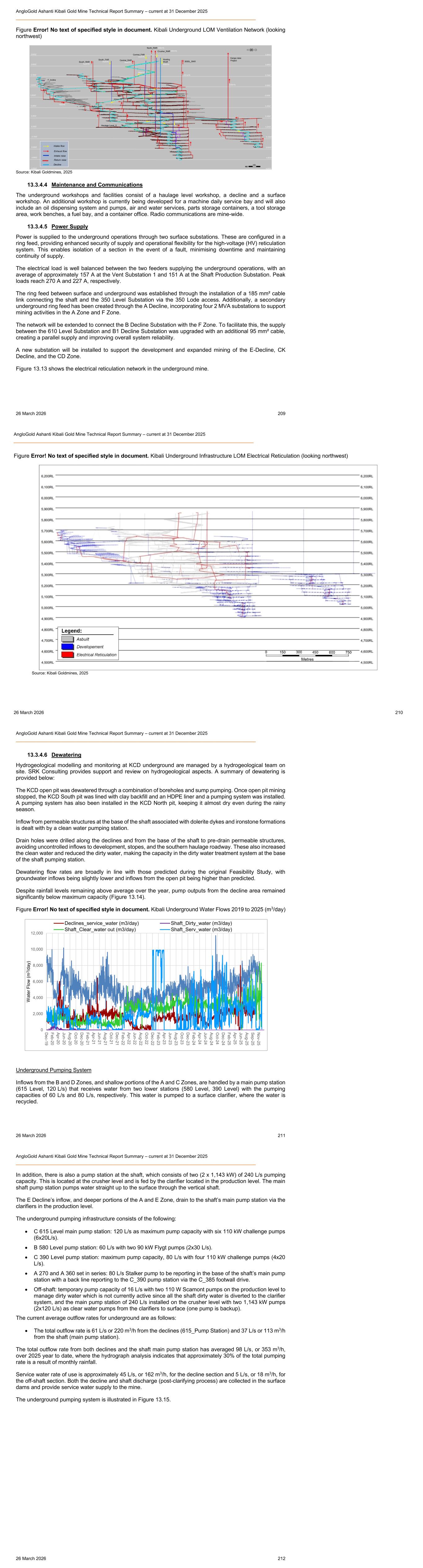
AngloGold Ashanti Kibali Gold Mine Technical Report Summary – current at 31 December 2025 ______________________________________________________________________________ 26 March 2026 209 Figure Error! No text of specified style in document. Kibali Underground LOM Ventilation Network (looking northwest) Source: Kibali Goldmines, 2025 13.3.4.4 Maintenance and Communications The underground workshops and facilities consist of a haulage level workshop, a decline and a surface workshop. An additional workshop is currently being developed for a machine daily service bay and will also include an oil dispensing system and pumps, air and water services, parts storage containers, a tool storage area, work benches, a fuel bay, and a container office. Radio communications are mine-wide. 13.3.4.5 Power Supply Power is supplied to the underground operations through two surface substations. These are configured in a ring feed, providing enhanced security of supply and operational flexibility for the high-voltage (HV) reticulation system. This enables isolation of a section in the event of a fault, minimising downtime and maintaining continuity of supply. The electrical load is well balanced between the two feeders supplying the underground operations, with an average of approximately 157 A at the Vent Substation 1 and 151 A at the Shaft Production Substation. Peak loads reach 270 A and 227 A, respectively. The ring feed between surface and underground was established through the installation of a 185 mm² cable link connecting the shaft and the 350 Level Substation via the 350 Lode access. Additionally, a secondary underground ring feed has been created through the A Decline, incorporating four 2 MVA substations to support mining activities in the A Zone and F Zone. The network will be extended to connect the B Decline Substation with the F Zone. To facilitate this, the supply between the 610 Level Substation and B1 Decline Substation was upgraded with an additional 95 mm² cable, creating a parallel supply and improving overall system reliability. A new substation will be installed to support the development and expanded mining of the E-Decline, CK Decline, and the CD Zone. Figure 13.13 shows the electrical reticulation network in the underground mine. AngloGold Ashanti Kibali Gold Mine Technical Report Summary – current at 31 December 2025 ______________________________________________________________________________ 26 March 2026 210 Figure Error! No text of specified style in document. Kibali Underground Infrastructure LOM Electrical Reticulation (looking northwest) Source: Kibali Goldmines, 2025 AngloGold Ashanti Kibali Gold Mine Technical Report Summary – current at 31 December 2025 ______________________________________________________________________________ 26 March 2026 211 13.3.4.6 Dewatering Hydrogeological modelling and monitoring at KCD underground are managed by a hydrogeological team on site. SRK Consulting provides support and review on hydrogeological aspects. A summary of dewatering is provided below: The KCD open pit was dewatered through a combination of boreholes and sump pumping. Once open pit mining stopped, the KCD South pit was lined with clay backfill and an HDPE liner and a pumping system was installed. A pumping system has also been installed in the KCD North pit, keeping it almost dry even during the rainy season. Inflow from permeable structures at the base of the shaft associated with dolerite dykes and ironstone formations is dealt with by a clean water pumping station. Drain holes were drilled along the declines and from the base of the shaft to pre-drain permeable structures, avoiding uncontrolled inflows to development, stopes, and the southern haulage roadway. These also increased the clean water and reduced the dirty water, making the capacity in the dirty water treatment system at the base of the shaft pumping station. Dewatering flow rates are broadly in line with those predicted during the original Feasibility Study, with groundwater inflows being slightly lower and inflows from the open pit being higher than predicted. Despite rainfall levels remaining above average over the year, pump outputs from the decline area remained significantly below maximum capacity (Figure 13.14). Figure Error! No text of specified style in document. Kibali Underground Water Flows 2019 to 2025 (m3/day) Underground Pumping System Inflows from the B and D Zones, and shallow portions of the A and C Zones, are handled by a main pump station (615 Level, 120 L/s) that receives water from two lower stations (580 Level, 390 Level) with the pumping capacities of 60 L/s and 80 L/s, respectively. This water is pumped to a surface clarifier, where the water is recycled. 0 2,000 4,000 6,000 8,000 10,000 12,000 D e c -1 9 F e b -2 0 A p r-2 0 J u n -2 0 A u g -2 0 O c t-2 0 D e c -2 0 F e b -2 1 A p r-2 1 J u n -2 1 A u g -2 1 O c t-2 1 D e c -2 1 F e b -2 2 A p r-2 2 J u n -2 2 A u g -2 2 O c t-2 2 D e c -2 2 F e b -2 3 A p r-2 3 J u n -2 3 A u g -2 3 O c t-2 3 D e c -2 3 F e b -2 4 A p r-2 4 J u n -2 4 A u g -2 4 O c t-2 4 D e c -2 4 F e b -2 5 A p r-2 5 J u n -2 5 A u g -2 5 S e p -2 5 N o v -2 5 W a te r F lo w ( m 3 /d a y ) Declines_service_water (m3/day) Shaft_Dirty_water (m3/day) Shaft_Clear_water out (m3/day) Shaft_Serv_water (m3/day) AngloGold Ashanti Kibali Gold Mine Technical Report Summary – current at 31 December 2025 ______________________________________________________________________________ 26 March 2026 212 In addition, there is also a pump station at the shaft, which consists of two (2 x 1,143 kW) of 240 L/s pumping capacity. This is located at the crusher level and is fed by the clarifier located in the production level. The main shaft pump station pumps water straight up to the surface through the vertical shaft. The E Decline’s inflow, and deeper portions of the A and E Zone, drain to the shaft’s main pump station via the clarifiers in the production level. The underground pumping infrastructure consists of the following: • C 615 Level main pump station: 120 L/s as maximum pump capacity with six 110 kW challenge pumps (6x20L/s). • B 580 Level pump station: 60 L/s with two 90 kW Flygt pumps (2x30 L/s). • C 390 Level pump station: maximum pump capacity, 80 L/s with four 110 kW challenge pumps (4x20 L/s). • A 270 and A 360 set in series: 80 L/s Stalker pump to be reporting in the base of the shaft’s main pump station with a back line reporting to the C_390 pump station via the C_385 footwall drive. • Off-shaft: temporary pump capacity of 16 L/s with two 110 W Scamont pumps on the production level to manage dirty water which is not currently active since all the shaft dirty water is diverted to the clarifier system, and the main pump station of 240 L/s installed on the crusher level with two 1,143 kW pumps (2x120 L/s) as clear water pumps from the clarifiers to surface (one pump is backup). The current average outflow rates for underground are as follows: • The total outflow rate is 61 L/s or 220 m3/h from the declines (615_Pump Station) and 37 L/s or 113 m3/h from the shaft (main pump station). The total outflow rate from both declines and the shaft main pump station has averaged 98 L/s, or 353 m3/h, over 2025 year to date, where the hydrograph analysis indicates that approximately 30% of the total pumping rate is a result of monthly rainfall. Service water rate of use is approximately 45 L/s, or 162 m3/h, for the decline section and 5 L/s, or 18 m3/h, for the off-shaft section. Both the decline and shaft discharge (post-clarifying process) are collected in the surface dams and provide service water supply to the mine. The underground pumping system is illustrated in Figure 13.15.
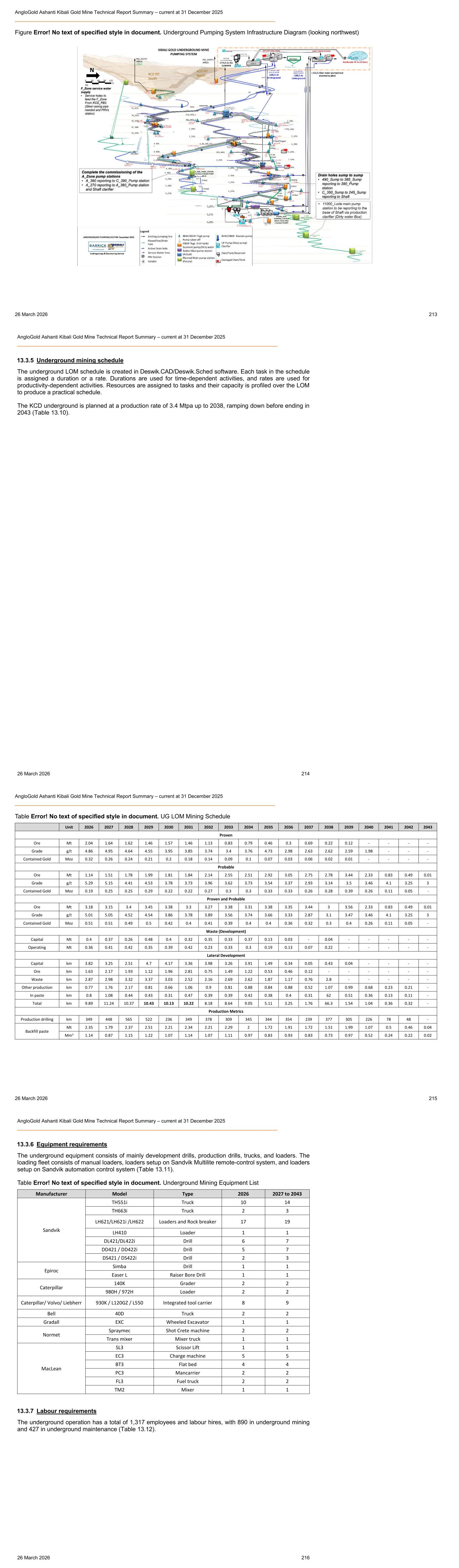
AngloGold Ashanti Kibali Gold Mine Technical Report Summary – current at 31 December 2025 ______________________________________________________________________________ 26 March 2026 213 Figure Error! No text of specified style in document. Underground Pumping System Infrastructure Diagram (looking northwest) AngloGold Ashanti Kibali Gold Mine Technical Report Summary – current at 31 December 2025 ______________________________________________________________________________ 26 March 2026 214 13.3.5 Underground mining schedule The underground LOM schedule is created in Deswik.CAD/Deswik.Sched software. Each task in the schedule is assigned a duration or a rate. Durations are used for time-dependent activities, and rates are used for productivity-dependent activities. Resources are assigned to tasks and their capacity is profiled over the LOM to produce a practical schedule. The KCD underground is planned at a production rate of 3.4 Mtpa up to 2038, ramping down before ending in 2043 (Table 13.10). AngloGold Ashanti Kibali Gold Mine Technical Report Summary – current at 31 December 2025 ______________________________________________________________________________ 26 March 2026 215 Table Error! No text of specified style in document. UG LOM Mining Schedule Unit 2026 2027 2028 2029 2030 2031 2032 2033 2034 2035 2036 2037 2038 2039 2040 2041 2042 2043 Proven Ore Mt 2.04 1.64 1.62 1.46 1.57 1.46 1.13 0.83 0.79 0.46 0.3 0.69 0.22 0.12 - - - - Grade g/t 4.86 4.95 4.64 4.55 3.95 3.85 3.74 3.4 3.76 4.73 2.98 2.63 2.62 2.59 1.98 - - - Contained Gold Moz 0.32 0.26 0.24 0.21 0.2 0.18 0.14 0.09 0.1 0.07 0.03 0.06 0.02 0.01 - - - - Probable Ore Mt 1.14 1.51 1.78 1.99 1.81 1.84 2.14 2.55 2.51 2.92 3.05 2.75 2.78 3.44 2.33 0.83 0.49 0.01 Grade g/t 5.29 5.15 4.41 4.53 3.78 3.73 3.96 3.62 3.73 3.54 3.37 2.93 3.14 3.5 3.46 4.1 3.25 3 Contained Gold Moz 0.19 0.25 0.25 0.29 0.22 0.22 0.27 0.3 0.3 0.33 0.33 0.26 0.28 0.39 0.26 0.11 0.05 - Proven and Probable Ore Mt 3.18 3.15 3.4 3.45 3.38 3.3 3.27 3.38 3.31 3.38 3.35 3.44 3 3.56 2.33 0.83 0.49 0.01 Grade g/t 5.01 5.05 4.52 4.54 3.86 3.78 3.89 3.56 3.74 3.66 3.33 2.87 3.1 3.47 3.46 4.1 3.25 3 Contained Gold Moz 0.51 0.51 0.49 0.5 0.42 0.4 0.41 0.39 0.4 0.4 0.36 0.32 0.3 0.4 0.26 0.11 0.05 - Waste (Development) Capital Mt 0.4 0.37 0.26 0.48 0.4 0.32 0.35 0.33 0.37 0.13 0.03 - 0.04 - - - - - Operating Mt 0.36 0.41 0.42 0.35 0.39 0.42 0.23 0.33 0.3 0.19 0.13 0.07 0.22 - - - - - Lateral Development Capital km 3.82 3.25 2.51 4.7 4.17 3.36 3.98 3.26 3.91 1.49 0.34 0.05 0.43 0.04 - - - - Ore km 1.63 2.17 1.93 1.12 1.96 2.81 0.75 1.49 1.22 0.53 0.46 0.12 - - - - - - Waste km 2.87 2.98 3.32 3.37 3.03 2.52 2.16 2.69 2.62 1.87 1.17 0.76 2.8 - - - - - Other production km 0.77 1.76 2.17 0.81 0.66 1.06 0.9 0.81 0.88 0.84 0.88 0.52 1.07 0.99 0.68 0.23 0.21 - In paste km 0.8 1.08 0.44 0.43 0.31 0.47 0.39 0.39 0.42 0.38 0.4 0.31 62 0.51 0.36 0.13 0.11 - Total km 9.89 11.24 10.37 10.43 10.13 10.22 8.18 8.64 9.05 5.11 3.25 1.76 66.3 1.54 1.04 0.36 0.32 - Production Metrics Production drilling km 349 448 565 522 236 349 378 309 345 344 354 239 377 305 226 78 48 - Backfill paste Mt 2.35 1.79 2.37 2.51 2.21 2.34 2.21 2.29 2 1.72 1.91 1.72 1.51 1.99 1.07 0.5 0.46 0.04 Mm3 1.14 0.87 1.15 1.22 1.07 1.14 1.07 1.11 0.97 0.83 0.93 0.83 0.73 0.97 0.52 0.24 0.22 0.02 AngloGold Ashanti Kibali Gold Mine Technical Report Summary – current at 31 December 2025 ______________________________________________________________________________ 26 March 2026 216 13.3.6 Equipment requirements The underground equipment consists of mainly development drills, production drills, trucks, and loaders. The loading fleet consists of manual loaders, loaders setup on Sandvik Multilite remote-control system, and loaders setup on Sandvik automation control system (Table 13.11). Table Error! No text of specified style in document. Underground Mining Equipment List Manufacturer Model Type 2026 2027 to 2043 Sandvik TH551i Truck 10 14 TH663i Truck 2 3 LH621/LH621i /LH622 Loaders and Rock breaker 17 19 LH410 Loader 1 1 DL421/DL422i Drill 6 7 DD421 / DD422i Drill 5 7 DS421 / DS422i Drill 2 3 Epiroc Simba Drill 1 1 Easer L Raiser Bore Drill 1 1 Caterpillar 140K Grader 2 2 980H / 972H Loader 2 2 Caterpillar/ Volvo/ Liebherr 930K / L120GZ / L550 Integrated tool carrier 8 9 Bell 40D Truck 2 2 Gradall EXC Wheeled Excavator 1 1 Normet Spraymec Shot Crete machine 2 2 Trans mixer Mixer truck 1 1 MacLean SL3 Scissor Lift 1 1 EC3 Charge machine 5 5 BT3 Flat bed 4 4 PC3 Mancarrier 2 2 FL3 Fuel truck 2 2 TM2 Mixer 1 1 13.3.7 Labour requirements The underground operation has a total of 1,317 employees and labour hires, with 890 in underground mining and 427 in underground maintenance (Table 13.12).
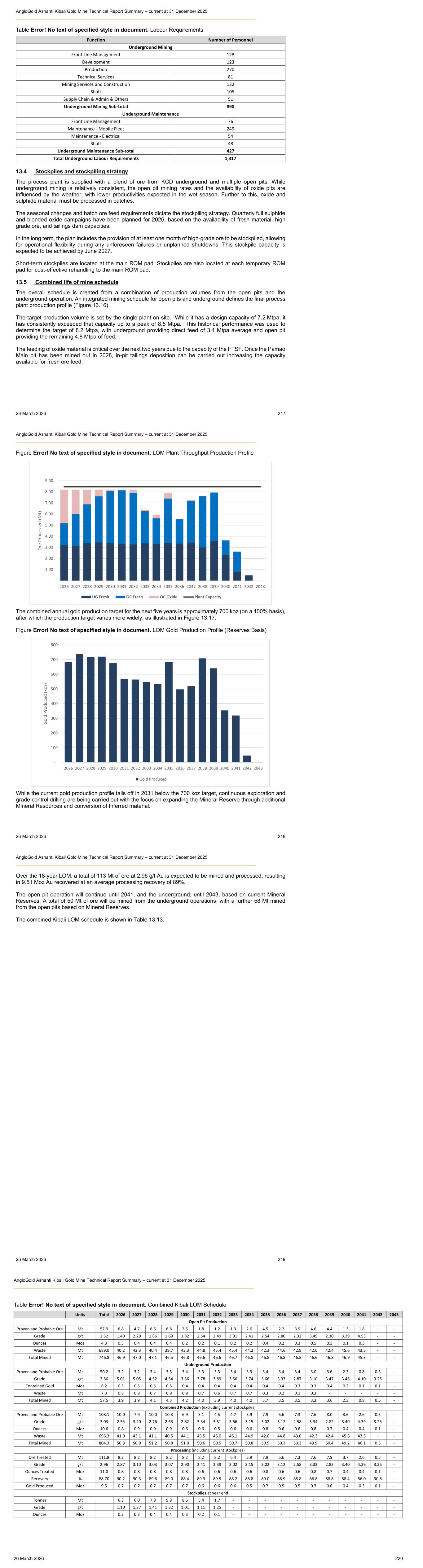
AngloGold Ashanti Kibali Gold Mine Technical Report Summary – current at 31 December 2025 ______________________________________________________________________________ 26 March 2026 217 Table Error! No text of specified style in document. Labour Requirements Function Number of Personnel Underground Mining Front Line Management 128 Development 123 Production 270 Technical Services 81 Mining Services and Construction 132 Shaft 105 Supply Chain & Admin & Others 51 Underground Mining Sub-total 890 Underground Maintenance Front Line Management 76 Maintenance - Mobile Fleet 249 Maintenance - Electrical 54 Shaft 48 Underground Maintenance Sub-total 427 Total Underground Labour Requirements 1,317 13.4 Stockpiles and stockpiling strategy The process plant is supplied with a blend of ore from KCD underground and multiple open pits. While underground mining is relatively consistent, the open pit mining rates and the availability of oxide pits are influenced by the weather, with lower productivities expected in the wet season. Further to this, oxide and sulphide material must be processed in batches. The seasonal changes and batch ore feed requirements dictate the stockpiling strategy. Quarterly full sulphide and blended oxide campaigns have been planned for 2026, based on the availability of fresh material, high grade ore, and tailings dam capacities. In the long term, the plan includes the provision of at least one month of high-grade ore to be stockpiled, allowing for operational flexibility during any unforeseen failures or unplanned shutdowns. This stockpile capacity is expected to be achieved by June 2027. Short-term stockpiles are located at the main ROM pad. Stockpiles are also located at each temporary ROM pad for cost-effective rehandling to the main ROM pad. 13.5 Combined life of mine schedule The overall schedule is created from a combination of production volumes from the open pits and the underground operation. An integrated mining schedule for open pits and underground defines the final process plant production profile (Figure 13.16). The target production volume is set by the single plant on site. While it has a design capacity of 7.2 Mtpa, it has consistently exceeded that capacity up to a peak of 8.5 Mtpa. This historical performance was used to determine the target of 8.2 Mtpa, with underground providing direct feed of 3.4 Mtpa average and open pit providing the remaining 4.8 Mtpa of feed. The feeding of oxide material is critical over the next two years due to the capacity of the FTSF. Once the Pamao Main pit has been mined out in 2028, in-pit tailings deposition can be carried out increasing the capacity available for fresh ore feed. AngloGold Ashanti Kibali Gold Mine Technical Report Summary – current at 31 December 2025 ______________________________________________________________________________ 26 March 2026 218 Figure Error! No text of specified style in document. LOM Plant Throughput Production Profile The combined annual gold production target for the next five years is approximately 700 koz (on a 100% basis), after which the production target varies more widely, as illustrated in Figure 13.17. Figure Error! No text of specified style in document. LOM Gold Production Profile (Reserves Basis) While the current gold production profile tails off in 2031 below the 700 koz target, continuous exploration and grade control drilling are being carried out with the focus on expanding the Mineral Reserve through additional Mineral Resources and conversion of Inferred material. - 1.00 2.00 3.00 4.00 5.00 6.00 7.00 8.00 9.00 2026 2027 2028 2029 2030 2031 2032 2033 2034 2035 2036 2037 2038 2039 2040 2041 2042 2043 O re P ro ce ss ed ( M t) UG Fresh OC Fresh OC Oxide Plant Capacity - 100 200 300 400 500 600 700 800 2026 2027 2028 2029 2030 2031 2032 2033 2034 2035 2036 2037 2038 2039 2040 2041 2042 2043 G o ld P ro d u ce d ( ko z) Gold Produced AngloGold Ashanti Kibali Gold Mine Technical Report Summary – current at 31 December 2025 ______________________________________________________________________________ 26 March 2026 219 Over the 18-year LOM, a total of 113 Mt of ore at 2.96 g/t Au is expected to be mined and processed, resulting in 9.51 Moz Au recovered at an average processing recovery of 89%. The open pit operation will continue until 2041, and the underground, until 2043, based on current Mineral Reserves. A total of 50 Mt of ore will be mined from the underground operations, with a further 58 Mt mined from the open pits based on Mineral Reserves. The combined Kibali LOM schedule is shown in Table 13.13. AngloGold Ashanti Kibali Gold Mine Technical Report Summary – current at 31 December 2025 ______________________________________________________________________________ 26 March 2026 220 Table Error! No text of specified style in document. Combined Kibali LOM Schedule Units Total 2026 2027 2028 2029 2030 2031 2032 2033 2034 2035 2036 2037 2038 2039 2040 2041 2042 2043 Open Pit Production Proven and Probable Ore Mt 57.9 6.8 4.7 6.6 6.8 3.5 1.8 1.2 1.3 2.6 4.5 2.2 3.9 4.6 4.4 1.3 1.8 - - Grade g/t 2.32 1.40 2.29 1.86 1.69 1.82 2.54 2.49 3.91 2.41 2.54 2.80 2.32 3.49 2.30 3.29 4.53 - - Ounces Moz 4.3 0.3 0.4 0.4 0.4 0.2 0.2 0.1 0.2 0.2 0.4 0.2 0.3 0.5 0.3 0.1 0.3 - - Waste Mt 689.0 40.2 42.3 40.4 39.7 43.3 44.8 45.4 45.4 44.2 42.3 44.6 42.9 42.0 42.4 45.6 43.5 - - Total Mined Mt 746.8 46.9 47.0 47.1 46.5 46.8 46.6 46.6 46.7 46.8 46.8 46.8 46.8 46.6 46.8 46.9 45.3 - - Underground Production Proven and Probable Ore Mt 50.2 3.2 3.2 3.4 3.5 3.4 3.3 3.3 3.4 3.3 3.4 3.4 3.4 3.0 3.6 2.3 0.8 0.5 - Grade g/t 3.86 5.01 5.05 4.52 4.54 3.86 3.78 3.89 3.56 3.74 3.66 3.33 2.87 3.10 3.47 3.46 4.10 3.25 - Contained Gold Moz 6.2 0.5 0.5 0.5 0.5 0.4 0.4 0.4 0.4 0.4 0.4 0.4 0.3 0.3 0.4 0.3 0.1 0.1 - Waste Mt 7.3 0.8 0.8 0.7 0.8 0.8 0.7 0.6 0.7 0.7 0.3 0.2 0.1 0.3 - - - - - Total Mined Mt 57.5 3.9 3.9 4.1 4.3 4.2 4.0 3.9 4.0 4.0 3.7 3.5 3.5 3.3 3.6 2.3 0.8 0.5 - Combined Production (excluding current stockpiles) Proven and Probable Ore Mt 108.1 10.0 7.9 10.0 10.3 6.9 5.1 4.5 4.7 5.9 7.9 5.6 7.3 7.6 8.0 3.6 2.6 0.5 - Grade g/t 3.03 2.55 3.40 2.76 2.65 2.82 3.34 3.51 3.66 3.15 3.02 3.12 2.58 3.34 2.82 3.40 4.39 3.25 - Ounces Moz 10.6 0.8 0.9 0.9 0.9 0.6 0.6 0.5 0.6 0.6 0.8 0.6 0.6 0.8 0.7 0.4 0.4 0.1 - Waste Mt 696.3 41.0 43.1 41.1 40.5 44.1 45.5 46.0 46.1 44.9 42.6 44.8 43.0 42.3 42.4 45.6 43.5 - - Total Mined Mt 804.3 50.8 50.9 51.2 50.8 51.0 50.6 50.5 50.7 50.8 50.5 50.3 50.3 49.9 50.4 49.2 46.1 0.5 - Processing (including current stockpiles) Ore Treated Mt 111.8 8.2 8.2 8.2 8.2 8.2 8.2 8.2 6.4 5.9 7.9 5.6 7.3 7.6 7.9 3.7 2.6 0.5 - Grade g/t 2.96 2.87 3.10 3.03 3.07 2.90 2.41 2.39 3.02 3.15 3.02 3.12 2.58 3.33 2.83 3.40 4.39 3.25 - Ounces Treated Moz 11.0 0.8 0.8 0.8 0.8 0.8 0.6 0.6 0.6 0.6 0.8 0.6 0.6 0.8 0.7 0.4 0.4 0.1 - Recovery % 88.70 90.2 90.3 89.6 89.0 88.4 89.3 89.5 88.2 88.8 89.0 88.9 85.8 86.8 88.8 88.4 86.0 90.8 - Gold Produced Moz 9.5 0.7 0.7 0.7 0.7 0.7 0.6 0.6 0.6 0.5 0.7 0.5 0.5 0.7 0.6 0.4 0.3 0.1 - Stockpiles at year end Tonnes Mt 6.3 6.0 7.8 9.8 8.5 5.4 1.7 - - - - - - - - - - - Grade g/t 1.10 1.37 1.41 1.32 1.01 1.11 1.25 - - - - - - - - - - - Ounces Moz 0.2 0.3 0.4 0.4 0.3 0.2 0.1 - - - - - - - - - - -

AngloGold Ashanti Kibali Gold Mine Technical Report Summary – current at 31 December 2025 ______________________________________________________________________________ 26 March 2026 221 13.6 External review In September 2025, SLR USA Advisory Inc. (SLR, formerly RPM Global USA Inc) conducted a comprehensive independent technical review of the Kibali Mineral Resource and Mineral Reserve estimates (SLR, 2025). The audit demonstrated that Mineral Resource and Mineral Reserve processes are consistent with industry standards. SLR did not identify any critical issues or fatal flaws and concluded that the processes underlying the estimate conform to the above guidelines and follow best practices. SLR’s observations and conclusions are as follows: • The open pit Mineral Reserves are technically sound, operational management is adequate, and cost assumptions underlying the Mineral Reserve statement are reasonable and achievable within normal operating risk. • Mine infrastructure, including ventilation, electrical power, dewatering, and paste backfill systems, is adequate for the scale and planned production rate, with no material deficiencies identified. The operation demonstrates strong management systems and plan-do-review processes linking engineering and operations teams, supporting continuous improvement and compliance with the mine plan. • The use of paste fill provides an efficient and proven method for long hole open stoping, reducing surface tailings requirements. Material handling via ore/waste passes, truck haulage, and shaft hoisting offers sufficient capacity to support the LOM production plan. • Development rates and alignments used in the schedule are reasonable and allow flexibility for localised delays. • The schedule allows for the timely establishment of ventilation and secondary egress prior to production on each level and maintains sufficient developed stope inventory to provide operational flexibility and production reliability. • The process plant design, operating performance, and non-cost parameters, as well as the current and planned TSF capacities, are technically sound and adequate to support the declared Mineral Reserves within normal operating risk. Recommendation: • Ensure appropriate resources are added to raise total development advance rate from 700 m to 1,000 m per month. Kibali Goldmines is aware of the production demand and will implement the recommendation from SLR in line with the planned ramp-up. 13.7 Comment on mining methods In the opinion of the QP, the mining methods, the mining equipment and productivities, the mine designs and input parameters are suitable for the Kibali Goldmines operations and estimation of Mineral Reserves. AngloGold Ashanti Kibali Gold Mine Technical Report Summary – current at 31 December 2025 ______________________________________________________________________________ 26 March 2026 222 14. Processing and recovery methods 14.1 Processing and ore blending The Kibali gold processing facility comprises two largely independent circuits, each designed to accommodate distinct ore types based on mineralogical and metallurgical characteristics: • Oxide and Free-Milling Circuit: this circuit is designed to process oxide, transition, and free-milling ore. It includes standard crushing, ball milling, gravity recovery via Knelson concentrators and a conventional CIL circuit. • Sulphide Refractory Circuit: this circuit is purpose-built for the treatment of sulphide refractory ore. The flowsheet consists of primary crushing, milling, flash and conventional flotation, ultrafine grinding (UFG) and cyanidation via a Pumpcell CIP circuit. The flotation concentrate is subjected to a gravity flow pre-oxidation stage, followed by a leaching and CIP circuit. Both circuits have been designed with operational flexibility, enabling either circuit to process sulphide ore as required (i.e., whether refractory or free-milling). This dual-stream configuration supports a progressive transition to full sulphide ore processing as oxide and transition ore sources are depleted. Interoperability between the circuits also allows for partial retreatment of tailings or intermediate products to improve overall recovery. Most of the deposits contain free native gold, recovered using Knelson gravity concentrators during the milling cycle. Ore blending at Kibali is an operational function designed to homogenise ore feed characteristics and optimise metallurgical recovery and throughput across both the oxide and sulphide circuits. Given the geometallurgical variability, blending ensures consistent plant feed, reducing process upsets and maximising gold recovery. Ore is sourced from the KCD underground mine (predominantly sulphide ore) and a series of satellite open pits (primarily oxide and transition ore, with variable sulphide content). Each ore source differs in grade, hardness, sulphide content, and gold deportment (free vs. locked within sulphides). These differences significantly affect processing behaviour, especially flotation and leaching efficiency. Blending operations are coordinated through the following logistics and controls: • Stockpile Management o Segregated Stockpiling: ore from each source is delivered separately and stockpiled in dedicated pads or bins near the process plant, preserving ore identity for controlled blending. o Stockpile Inventory Control: Real-time monitoring of stockpile volumes and grades is maintained via weighing systems, grade control sampling, and frequent assay updates to ensure accurate blend planning. o Blending Zones: Stockpiles are categorised by ore type and metallurgical domains. For example, oxide ore stockpiles are kept separate from sulphide stockpiles but may be further sub-divided by grade or hardness to fine-tune blends. • Blending Planning and Execution o Daily Blend Scheduling: the blending plan is developed daily based on mine production schedules and ore availability, metallurgical plant requirements, and metallurgical test results predicting recovery for specific blends. o Blend Targets: blending targets include parameters such as target head grade (Au, g/t), below maximum arsenic threshold, and the Bond Work index (to manage grinding energy requirements). AngloGold Ashanti Kibali Gold Mine Technical Report Summary – current at 31 December 2025 ______________________________________________________________________________ 26 March 2026 223 • Quality Control and Monitoring o Sampling and Assays: frequent sampling of stockpiles and blended feed ensures that metallurgical parameters remain within desired ranges. o Process Feedback Loops: plant metallurgical data is monitored to validate blending effectiveness and guide adjustments. Figure 14.1 shows a summary schematic flowsheet for the processing plant, incorporating the two parallel circuits. Actual gold recovery performance is included in Chapter 10.4 of this Report. Figure Error! No text of specified style in document. Simplified Flowsheet of the Kibali Processing Plant Depicting Two Discrete Streams Source: Kibali Goldmines, 2025 14.2 Plant availability and throughput The steady improvement since 2013 in terms of plant utilisation and availability, which are currently at excellent levels, has been driven by regular planned maintenance, coupled with good performance of process operations (Table 14.1). Table Error! No text of specified style in document. Plant Availability and Utilisation 2013 2014 2015 2016 2017 2018 2019 2020 2021 2022 2023 2024 2025 Availability 74.9 87.0 93.6 94.7 96.4 95.2 95.6 94.9 95.4 95.13 93.52 95.54 95.03 Utilization 64.9 93.1 95.9 98.0 98.6 98.8 98.8 99.5 99.1 98.81 99.30 99.67 99.27 AngloGold Ashanti Kibali Gold Mine Technical Report Summary – current at 31 December 2025 ______________________________________________________________________________ 26 March 2026 224 The processing plant throughput is designed for 3.6 Mtpa for the oxide circuit and 3.6 Mtpa for the parallel sulphide circuit. When the plant eventually processes sulphide only, the design capacity is therefore 7.2 Mtpa. Figure 14.2 summarises the throughput data since 2013 through year end 2025, with current throughput exceeding design (8.32 Mt treated in 2025). Figure Error! No text of specified style in document. Kibali Processing Plant Tonnes Treated 2013 to 2025 14.3 Process description The oxide circuit includes the following processes: • Primary crushing. • An optional secondary hybrid roll type crusher for harder transitional and free-milling sulphide ores. • Milling. • Cyclone classification. • Gravity concentration. • Flash flotation – runs optionally when the feed blend is predominantly free-milling fresh ore. • CIL. • Tailings disposal. ROM ore received from trucks is treated in a primary crushing circuit comprising a ROM bin, apron feeder, and single toggle jaw crusher. Primary crushed product (450 tph) can either be diverted to the primary mill feed conveyor when oxide ore is treated or alternatively conveyed to a common 5,000 t live primary crushed stockpile when sulphide ore is treated. Provision is made for an in-line hybrid crushing stage for harder transitional and free-milling sulphide ore as necessary. After primary crushing, the ore is fed to the mill feed conveyor (without secondary crushing), where a ball mill operating in closed circuit with cyclones grinds the solids to 80% passing (P80) 80 m. Both flash flotation and gravity concentration circuits are used to treat a portion of the cyclone underflow to recover a coarse gold concentrate, which is leached in a Gekko Inline Leach Reactor (ILR) with the pregnant solution reporting to the Gold Room. Cyclone overflow reports to a conventional CIL circuit. This consists of nine tanks, with the first two being Aachen-assisted pre-oxidation tanks and the remaining tanks carbon adsorption tanks. Lime is added to the first tank to maintain the pH at approximately 10.5 and cyanide added to the second tank. Regenerated carbon is added to the last tank and is moved upstream counter-current to the flow of slurry. Loaded carbon

AngloGold Ashanti Kibali Gold Mine Technical Report Summary – current at 31 December 2025 ______________________________________________________________________________ 26 March 2026 225 is removed from Tank #3 (the first adsorption tank) for elution. Oxygen is sparged into the tanks to maintain the required dissolved oxygen content. The loaded carbon is processed via a conventional Anglo American Research Laboratories (AARL) elution circuit which treats a 12-tonne batch of carbon. Loaded solution passes through the electrowinning circuit for conventional gold recovery on cathodes and subsequent smelting. Pregnant solution from the ILR reports to a dedicated electrowinning cell. CIL tails report as final tails after detoxification. The sulphide circuit includes the following processes: • Primary and secondary crushing. • Milling. • Cyclone classification. • Gravity concentration. • Flash flotation. • Conventional flotation. • Ultra-fine grinding of the concentrates. • Pre-oxidation circuit. • Extended intensive oxygenation assisted leach. • Pumpcell adsorption circuit to recover gold from the concentrates. • Tailings disposal. Sulphide ore is both primary and secondary crushed to a Fine Ore Stockpile (FOS), from which apron feeders feed the mill feed conveyor belt. A Coarse Ore Stockpile (COS) is also included after primary crushing, where underground pre-crushed sulphide ore also reports. Two primary Sandvik CJ815 jaw crushers and two secondary Sandvik CS660 cone crushers are available. The secondary circuit was commissioned in May 2014 and crushes to a P80 of 45 mm. The FOS, with a live capacity of 11,700 t, serves as a common stockpile to both mills when sulphide ore is being treated. When oxide ore is treated, jaw crusher product reports directly to the mill feed conveyor with no secondary crushing. A ball mill operates in closed circuit with cyclones for a target grind of P80 75 m, also including flash flotation and gravity concentration circuits as for oxide ore. Cyclone overflow reports to the rougher flotation circuit, consisting of two separate parallel banks of six 70 m3 Outotec forced air flotation cells. Only one bank is required when processing oxide ore. Rougher concentrate (together with flash flotation concentrate as required) reports to the concentrate thickener. Thickener underflow reports to the UFG circuit consisting of eight VXP2500 FLSmidth ceramic bead mills in parallel. These grind the concentrate to a P80 of 23 m which is then pumped to the pre-oxidation and pre- leach circuits. The pre-oxidation circuit consists of two tanks, each fitted with four Aachen reactors. Lime, oxygen, and lead nitrate are dosed into the tanks and the slurry overflows from the second tank to the pre-leach tank, also fitted with an Aachen reactor, and cyanide and lime are added. The pre-leach slurry is pumped to two 2,100 m3 leach tanks (from the oxide CIL circuit) for extended leach residence time in an Aachen-assisted environment. For CIP processing, the pre-oxygenated, pre-leached slurry overflows to eight 100 m3 Kemix Pumpcell tanks operated in series and in carousel mode, with counter-current flow of carbon relative to the slurry. Loaded carbon is processed in an identical parallel 12-tonne AARL elution circuit, i.e., one circuit for the Pumpcell loaded carbon and one for the CIL loaded carbon. Pumpcell tails are re-processed in the oxide CIL circuit for additional gold recovery. AngloGold Ashanti Kibali Gold Mine Technical Report Summary – current at 31 December 2025 ______________________________________________________________________________ 26 March 2026 226 Once the oxide, transition, and free-milling ore sources have been depleted, the existing oxide plant can be converted to a parallel sulphide circuit, which will necessitate the expansion of the concentrate handling and Pumpcell circuits. There are already two flotation circuits present in the sulphide plant. The original fine-grind section was expanded in 2017 by adding an additional four UFG mills, totalling eight. The current feed plan allows for an oxide–sulphide campaign for thirty percent of the year, with the remainder of the year treating only sulphide ores. The processing plant has a total of 570 employees and labour hires, assisted by 245 contractors, whose responsibilities are split as per below: • Paragon: TSF management. • Lutula & Munguleni: Plant cleaning. • Air Liquide: Oxygen plant production and maintenance. A new Cyanide Removal Plant (CRP) has now been installed and is operating for cyanide detoxification of the CIL tails, and which is described below (also shown schematically in Figure 14.1). 14.3.1 Cyanide removal plant (CRP) The AZ-CRP® circuit makes use of six patented upflow reactors and consists of the following distinct process steps: Adsorption of gold and copper cyanide complexes. • Copper elution and carbon regeneration. • Acidification and precipitation of copper using H2SO4 and NaHS. • HCN scrubbing and cyanide recovery. The 4.8 Mtpa AZ-CRP plant was installed to reduce cyanide levels in the CIL tails slurry to comply with ICMI standards with added benefit of additional gold recovery from the CIL plant tailings. Figure 14.3 represents the process flow diagram of the Kibali AZ-CRP. Figure Error! No text of specified style in document. CRP Plant Block Flow Diagram AngloGold Ashanti Kibali Gold Mine Technical Report Summary – current at 31 December 2025 ______________________________________________________________________________ 26 March 2026 227 14.4 Power, water and reagents 14.4.1 Power The process plant specific energy consumption has reduced from 28.5 kWh/t in 2015 to 26.9 kWh/t in 2025 (Figure 14.4) as a result of crushing the KCD underground plant feed to a P80 <50 mm. This is forecast to continue at the 2025 levels for the remaining LOM based upon Mineral Reserves. The Kibali hydropower system has a peak capacity of 42.8 MW and 43 MW of thermal generation with full redundancy. Actual hydro generation capacity is season dependent. The total load demand of the mine is not constant. Power demand at full production ranges between 39 MW and 43 MW, and currently averages approximately 41 MW, which in the QP’s opinion is well resourced to cater for the LOM process plant power demands based upon Mineral Reserves. Figure Error! No text of specified style in document. Kibali Processing Plant Specific Energy Consumption 2015 to 2025 14.4.2 Water The plant water demand has stabilised at an average of 11.5 Mm3 per annum for the past three years with a specific water consumption of 1.38 m3/t (Figure 14.5 and Figure 14.6). The remaining LOM is forecast to continue at these levels based upon Mineral Reserves. 28.5 kWh/t 29.0 kWh/t 29.2 kWh/t 27.3 kWh/t 28.2 kWh/t 26.9 kWh/t 25.8 kWh/t 26.5 kWh/t 25.8 kWh/t 26.4 kWh/t 26.9 kWh/t 24.0 kWh/t 25.0 kWh/t 26.0 kWh/t 27.0 kWh/t 28.0 kWh/t 29.0 kWh/t 30.0 kWh/t 2015 2016 2017 2018 2019 2020 2021 2022 2023 2024 2025 S p e c if ic p o w e r c o n s u m p ti o n ( k W h /t ) "Specific energy consumption (kWh/t) Trendline (Plant specific energy consumption) AngloGold Ashanti Kibali Gold Mine Technical Report Summary – current at 31 December 2025 ______________________________________________________________________________ 26 March 2026 228 Figure Error! No text of specified style in document. Kibali Processing Plant Water Demand 2013 to 2025 Figure Error! No text of specified style in document. Kibali Processing Plant Specific Water Consumption 2013 to 2025 1,337 8,809 13,042 13,015 12,636 9,451 9,847 9,818 10,181 10,049 10,011 12,107 12,404 0 2,000 4,000 6,000 8,000 10,000 12,000 14,000 2013 2014 2015 2016 2017 2018 2019 2020 2021 2022 2023 2024 2025 W a te r d e m a n d ( th o u s a n d m 3 ) Year Volume used Linear (Volume used) 1.63 1.58 1.91 1.78 1.66 1.15 1.31 1.29 1.31 1.29 1.22 1.42 1.49 0.00 0.50 1.00 1.50 2.00 2.50 2013 2014 2015 2016 2017 2018 2019 2020 2021 2022 2023 2024 2025 S p e c if ic w a te r c o n s u m p ti o n ( m 3 /t ) Year Spec water cons Linear (Spec water cons)

AngloGold Ashanti Kibali Gold Mine Technical Report Summary – current at 31 December 2025 ______________________________________________________________________________ 26 March 2026 229 14.4.3 Reagent consumptions The 2025 reagent consumptions are presented in the Table 14.2 below. Table Error! No text of specified style in document. Reagent Consumptions 2025 Reagents Q1 Q2 Q3 Q4 Forecast (kg/t) Actual (kg/t) Forecast (kg/t) Actual (kg/t) Forecast (kg/t) Actual (kg/t) Forecast (kg/t) Actual (kg/t) Cyanide 0.767 0.657 0.767 0.663 0.726 0.672 0.752 0.638 Lime 1.392 1.271 1.386 1.138 1.41 1.314 1.477 1.290 Grinding Media 0.59 0.546 0.59 0.54 0.59 0.527 0.590 0.541 Caustic Soda 0.426 0.445 0.426 0.417 0.419 0.314 0.340 0.277 Lead Nitrate 0.026 0.012 0.026 0.025 0.025 0.017 0.023 0.017 Hydrogen Peroxide 0.279 0.27 0.232 0.273 0.331 0.471 0.424 0.456 Activated Carbon 0.053 0.015 0.054 0.067 0.051 0.081 0.071 0.057 Hydrochloric Acid 0.125 0.112 0.125 0.098 0.124 0.094 0.100 0.079 Flocculant 0.011 0.009 0.011 0.009 0.009 0.008 0.011 0.006 Copper Sulphate 0.14 0.138 0.14 0.165 0.201 0.246 0.157 0.161 Pax 0.12 0.116 0.12 0.113 0.109 0.093 0.105 0.098 Promoter/Betacol 0.015 0.01 0.015 0.009 0.012 0.008 0.013 0.009 Frother 0.016 0.01 0.016 0.011 0.012 0.013 0.014 0.012 Beads ceramics 0.035 0.027 0.035 0.029 0.028 0.019 0.029 0.022 NaSH 0.063 0.024 0.063 0.032 0.037 0.003 0.000 0.000 Sulfuric Acid 0.22 0.132 0.22 0.134 0.152 0.02 0.000 0.000 SMBS 0.069 0.051 0.067 0.418 0.476 0.937 0.520 0.623 14.5 Comment on recovery methods It is the opinion of the QP that the current facilities are suitable for processing the ores envisaged in the LOM plan. AngloGold Ashanti Kibali Gold Mine Technical Report Summary – current at 31 December 2025 ______________________________________________________________________________ 26 March 2026 230 15. Infrastructure 15.1 Summary Kibali is supported by extensive infrastructure developed to accommodate both open pit and underground mining in a remote location. Surface facilities include workshops, warehouses, fuel storage areas, and processing support facilities. There is a processing plant, as described in Chapter 14 of this Report, as well as comprehensive laboratory facilities to support geological and metallurgical testing. Power is supplied by three hydropower stations supplemented by a photovoltaic (PV) solar plant and a thermal power plant. Workforce requirements are supported by an accommodation camp complex, while logistics are facilitated by an on-site airstrip and all-weather road connections. The water supply is derived from surface water abstraction and storage facilities, with treatment, recycling, and discharge systems established to manage environmental impacts. 15.2 Site access and mine roads The Mine is located in the northeast of the DRC. The main access points for equipment and supplies are the major ports of Mombasa, Kenya (1,800 km), and Dar es Salaam, Tanzania (1,950 km) via Kampala, Uganda (650 km). These routes are paved up to the town of Aura on the border with Uganda. The road from Arua has been upgraded and is maintained by Kibali Goldmines to accommodate the Project and ongoing operations traffic. The local road infrastructure was developed during exploration drilling programmes and upgraded during the construction of the Mine. Mine internal roads provide access to various infrastructure areas, including roads to the TSF, Explosives Storage, Land Fill Site, Mine Villages, Central Mine Offices, Shaft Collar Area, Open Pit Mining Central Operations Area, general mining operations areas, new exploration areas, various water boreholes, and overhead line routes. All roads are constructed with layers of rock/gravel/laterite, varying in specification according to traffic expectations. 15.3 Logistics and supply chain Since its inception, Kibali Goldmines has relied on a trusted supply chain partner, Tradecorp, and its subsidiary companies, RTS and Trans East, to manage all aspects of procurement, freight, and logistics, ensuring a seamless and efficient supply chain. Kibali Goldmines logistics operations utilise a multimodal transportation network, comprising sea, road, and air freight. Specifically: • Sea freight: Primarily via Mombasa Port, with occasional shipments through Dar-es-Salaam Port. • Road freight: Utilising Beitbridge, Chirundu, Nakonde, Tunduma, Mutukula, and Vurra borders. • Air freight: Mainly through Entebbe Airport in Uganda, with occasional shipments via Jomo Kenyatta Airport in Nairobi, Kenya. Most imports are shipped into the port of Mombasa, Kenya, and thereafter trucked through the Northern Corridor Road route which links Mombasa to the landlocked countries in Eastern and Central Africa. The cargo initially moves through Kenya and Uganda into the eastern DRC to Kibali. Up to the Uganda and DRC border, the trucks use a two-way tarmac road considered to be the main route from the port of Mombasa to East and Central Africa. The final 200 km of the trip from the DRC border to Kibali is on laterite roads. The primary ports of origin for mining spares and consumables are Durban, South Africa and Stockholm, Sweden. Reagents, such as cyanide, steel balls, peroxide, hydrochloric acid, and other flotation reagents, are shipped from a variety of different ports worldwide. The shipping terms for the mining consumables are typically Cost, Insurance and Freight (CIF), and reagents are typically Cost and Freight (CFR) Mombasa. AngloGold Ashanti Kibali Gold Mine Technical Report Summary – current at 31 December 2025 ______________________________________________________________________________ 26 March 2026 231 The costs associated with 20 ft and 40 ft containers, for both sea freight and inland transport (Mombasa to the Mine site), are calculated on a cost-plus basis. This is a fully transparent exercise with shipping/freight invoices being sent through for verification. Estimated port-to-port transit times for Kibali’s most frequent sailings are as follows: • South Africa = 15 days • Europe = 35 days • China = 45 days • USA = 65 days Border crossings between Uganda, Kenya, Zambia, Tanzania, South Africa, and DRC customs are typically efficient, facilitated by long-standing partnerships between Tradecorp, border authorities, and Barrick forged over several years in Eastern Africa. 15.4 Power supply and distribution The load demand of the Mine is not constant; power demand at full production is currently between 39 MW and 43 MW, averaging approximately 41 MW. There is no power grid in the region, and Kibali operates on a hybrid power supply system designed to provide reliable and sustainable energy in a remote location. Most of the power is generated by a system of off-site hydropower stations; Nzoro II is currently producing approximately 22 MW, Ambarau produces 10.6 MW, and Azambi produces a further 10.2 MW, with a total peak hydropower capacity of 42.8 MW. A separate, pre-existing hydropower facility, Nzoro 1, has a low capacity (i.e., less than 1 MW). It was previously refurbished and represents a historical legacy, comprising equipment dating back to the 1930s. This power is dedicated to local communities. To ensure continuity of power supply during periods of peak demand and seasonal hydropower shortages, a bank of high-speed diesel generators is used with a total capacity of 32 MW. A Battery Storage System (BESS) with a capacity of 7 MW was integrated into the system in 2020 to smooth the impact of the winder load on the power grid. This has enabled the reduction of spinning reserve from nine diesel generators to four. In 2025, the commissioning of a 16 MW solar plant, integrated with a new 15 MW BESS, marked a significant milestone in the energy transition strategy. With this integration, renewable energy now accounts for approximately 85% of total energy consumption. Notably, Kibali is now capable of operating on 100% renewable energy for up to six months each year. The long-term power supply strategy for the operation aims to generate the maximum amount of power from hydroelectric sources. Diesel generators will remain available as a backup and as a spinning reserve to meet peak loads from the shaft hoist. The number of running generators has been reduced by half during the wet season. This has a marked effect on reducing unit power operating costs. Wet seasons with high river flows allow for more beneficial hydro operating conditions; however, the beneficial effect is not seen in the lower rainfall months. This effect is evident in Figure 15.1 which shows the power supply mix to 2025. AngloGold Ashanti Kibali Gold Mine Technical Report Summary – current at 31 December 2025 ______________________________________________________________________________ 26 March 2026 232 Figure Error! No text of specified style in document. Kibali Power Generation 2022 to 2025 The hydro-generated power is reticulated to the site via 66 kV overhead lines from the hydropower plants to a switchyard located at the mine. The voltage is stepped down from 66 kV to 11 kV, which then feeds the 11 kV consumer substation. Diesel generation supplies power to the mine at 400 V, which is stepped up to 11 kV for distribution. 15.5 Water supply The Mine lies within the northern tropical climatic region of the DRC. The rainy season extends from March to November, and the dry season from December to mid-February. Annual rainfall averages 1,950 mm, resulting in a positive water balance. This is particularly evident in the TSFs, where evaporation remains lower than precipitation throughout the year. Approximately 75% of the water required for the processing plant is sourced from reclaimed water returned from the TSFs. An additional 15% is supplied through the reuse of water from mining dewatering operations. However, certain process plant activities—such as reagent preparation and elution—require the use of freshwater. To meet this need, between 7% and 11% of the total water demand is abstracted from the Kibali River via a pumping station located on the southern boundary of the mine. There are currently no restrictions on water abstraction from the river. The Kibali River also supplies raw water to a treatment plant, which provides potable water for the mine’s camps and administrative offices. Since the treatment plant requires water of a specific quality, four boreholes have been drilled to supplement the river supply and ensure a reliable source of feed water. For dust suppression, sufficient water is provided by pit dewatering ponds. Raw water collected from rainfall, spring water, pit dewatering, and the Kibali River is stored in the Raw Water Dam, which has a capacity of 9,500 m³. The processing plant requires approximately 35,000 m³ of water per day. Of this demand, approximately 75% is fulfilled with recycled water from the TSFs, while the remaining 25% comes from the Raw Water Dam. Recent improvements to the freshwater reticulation system have reduced reliance on the Kibali River, lowering abstraction from 15% to approximately 11% of total demand. The plant’s process water circuit is supported by a 25 m diameter clarifier and a process water dam with a capacity of 4,600 m³. Additionally, the process plant includes a water treatment plant that produces soft water, which is distributed for strategic uses including the elution circuit, laundries, flocculant preparation, firefighting systems, and the metallurgy laboratory.

AngloGold Ashanti Kibali Gold Mine Technical Report Summary – current at 31 December 2025 ______________________________________________________________________________ 26 March 2026 233 15.6 Water management The water management system is designed to limit the impacts of mining, processing, and storage activities on-site. The water management system complies with DRC regulations and industry best practice, with the main objective of keeping clean water separate from potentially contaminated water. The processing plant is the largest consumer of water at the Mine. As the site does not operate a closed water circuit, it discharges excess water into the Kibali River, provided it is within the discharge standards set by the DRC authorities. The complete mine water sources or inflows include the following: • Kibali River; • Dewatering water from the open pits and underground mine; • Rainfall/Runoff water; • Recycling of water from the FTSF and CTSF; • Boreholes for potable water. Kibali Goldmines aims to maximise the recycling efficiencies and reduce the freshwater intake from the Kibali River. The Mine aims to prioritise water produced from the open pits, with water from the Kombokolo and Pakaka pits currently being pumped into the KMS Dam. The KMS Dam was built on a natural drainage line that feeds the Kibali River, capturing clean runoff before it enters the mining areas. Excess water flows into a concrete channel and then the Catchment Dam, which serves as the final compliance point before discharge. The Catchment Dam also receives inflows from underground dewatering, the plant clarifier, the Return Water Dam, Gorumbwa pit, and the sewage treatment plant. Water from the Gorumbwa pit and runoff from the KCD WRD pass through a wetland before reaching the Catchment Dam. The Kibali River dominates the drainage of the Project area and flows along the southern boundary of the site and joins the Nzoro River approximately 40 km downstream. Numerous springs maintain consistent flow throughout the dry season. The significant sources of water that can affect the operations include rainfall coming directly into the open pits, surface runoff and groundwater entering the pits from the surrounding rock masses. Surface runoff is high due to high-intensity rainfall events and an undulating landscape. The rainfall that falls within the pit perimeter is directed out of the pit where possible. The water that cannot be directed outwards flows to the sump at the pit bottom, from where it is pumped to the catchment dams on the surface. At the surface, a system of bund walls and dewatering trenches has been established around the pits to prevent surface water from entering the pit areas. The network of drainage channels is used to discharge water intercepted by the perimeter drains to the Kibali River via a series of settling ponds. The underground operation features a staged pumping system comprising a series of underground sumps and pumping stations, which lift water to the surface where it is sent to the Catchment Dam for recycling or controlled discharge. The primary water management flow is illustrated in Figure 15.2. AngloGold Ashanti Kibali Gold Mine Technical Report Summary – current at 31 December 2025 ______________________________________________________________________________ 26 March 2026 234 Figure Error! No text of specified style in document. Overview of the Kibali Water Management Flow Source: Kibali Goldmines, 2025 15.7 Site common purpose infrastructure 15.7.1 Security The Mine is located in a region of post-conflict where security is an important consideration for a continuous and safe operation. The property is secured by a perimeter fence and access road, with entry controlled through manned checkpoints and electronic systems, including CCTV and card access. Contracted security personnel and a permanent police detachment provide on-site protection. The plant and storage areas are fenced, and high-value facilities have additional electronic access control systems and security measures. Gold is shipped from the site on private charter flights under the escort of security personnel. During the past 14 years of operation, no major security incidents have affected production at the Mine. 15.7.2 Camp The camp complex comprises 1,216 rooms across several accommodation areas. These include the Doko Camp, which houses both employees and contractors, short-term visitor guest houses, and a junior village camp located outside the main camp for junior employees living with their families. Additional accommodation is located in the nearby town for government officials and the police unit assigned to the Mine. Catering services are provided to all residents and business partners by Golden Camp Solution (GCS). The main canteen serves both company and contractor personnel, supplemented by satellite dining facilities for local workers. On-site amenities include a grocery store, mini-supermarket, restaurant, club, gym, ATM, and recreational areas with tennis, basketball, volleyball, and football facilities. 15.7.3 Offices, workshops and warehouses A central administration office complex accommodates senior management and support functions not located at the process plant or the mining operation offices. Additional offices and support facilities are located at the shaft collar area and the open pit mining operations area, each including offices, change houses, security gatehouses, and maintenance workshops. The process plant area includes control and engineering rooms, Uninterruptible Power Supply (UPS) rooms, laboratories (carbon, metallurgical, wet, bullion, balance and environmental), sample preparation and grade control facilities, and a maintenance workshop. Warehousing is provided at the Central Mine Facilities Area adjacent to the processing plant. This includes four large steel-framed, steel-clad buildings with reinforced concrete floors, used primarily for storing machinery spares and consumables, such as personal protective equipment. AngloGold Ashanti Kibali Gold Mine Technical Report Summary – current at 31 December 2025 ______________________________________________________________________________ 26 March 2026 235 15.7.4 Laboratory facilities 15.7.4.1 MSALABS MSALABS are a multinational laboratory company which currently operates a fully equipped, on-site Assay Laboratory. The laboratory provides analytical support for exploration drilling, growth drilling, grade control drilling, grade control grab sampling, metallurgical sampling, and environmental monitoring programs. The facility ensures efficient turnaround, traceability, and compliance with Barrick’s QA/QC protocols. The facilities in the laboratory comprise: • Sample Sorting and Reception Area: Secure sample receiving area with barcode registration, sample tracking terminals, and controlled access. • Sample Preparation: Drying ovens, jaw crushers, riffle splitters, and LM2 pulverisers housed in dust- extracted enclosures to achieve >70 passing 2 mm and >85% passing 75 µm. • Photon Assay: Two Chrysos Photon Assay units, which provide rapid, non-destructive gold determination directly from crushed samples. • Fire Assay: Gas-fired fusion furnaces and cupellation units to execute fire assay work. • Wet Chemistry and Solution Preparation: Acid digestion benches under fume hoods for solution preparation and elemental testing. • Atomic Absorption Spectrometers (AAS): Four dual-instrument setups for gold and multi-element analysis with detection limits down to 0.01 ppm Au. • Bullion Testing Unit: A secured area fitted with balances, furnace, and XRF spectrometer for bullion purity verification and doré composition analysis before shipment. • Environmental Laboratory: Dedicated facility for monitoring process water, tailings, effluents, and soil samples. The section is equipped with pH and conductivity meters, spectrophotometers, and digestion systems for compliance with environmental standards. • XRF Analyser: Bench-top unit for multi-element screening of ore, concentrate, and bullion samples. • Administrative and Data Office: Integrated with the LIMS. 15.7.4.2 Metallurgical Laboratory The metallurgical laboratory, owned and operated by Kibali as an integral section of the process plant, is fully equipped to perform metallurgical test work aimed at guiding, controlling, and optimising plant operations. Routine test work and specialised studies are conducted to support process performance and continuous improvement initiatives. The facilities within the metallurgical laboratory are designed to simulate various sections of the process plant, encompassing the following key areas: • Sample Preparation: This section includes three ovens, one jaw crusher, two cone crushers, a pulveriser, a rod mill, riffle and rotary splitters, and a range of precision scales. The setup replicates the plant’s crushing and milling circuits. It is used for the preparation of samples prior to test work, as well as for the preparation of mill feed samples before submission to MSALABS for official assays. • Flotation Test Work: Prepared samples, particularly fresh ore samples, are processed using a Denver flotation machine for flotation test work. Daily rougher flotation samples from the plant are also received and tested to monitor flotation circuit performance and recovery trends. • Leaching Test Work: There are two bottle roll machines used for direct-leach test work on both daily plant samples and special samples. Additionally, an Aachen reactor is available for conducting Aachen-assisted leach test work, simulating process conditions and improving understanding of oxidation and leaching kinetics. AngloGold Ashanti Kibali Gold Mine Technical Report Summary – current at 31 December 2025 ______________________________________________________________________________ 26 March 2026 236 • Gravity Test Work: Includes a Knelson and a Falcon concentrator for conducting GRG tests. These units help assess gold recovery potential from different ore types and evaluate gravity circuit performance. • Ultrafine Grinding and Downstream Simulation: An ultrafine grinding machine is available for downstream process simulation and test work involving fine particle size distributions. • Metallurgical and Solution Analysis: The laboratory is equipped with a range of instruments for metallurgical analysis and plant parameter control. For grinding and particle size analysis, the laboratory utilises a wet sieve shaker, a Ro-Tap sieve shaker for dry sieving, and a Gibson shaker for crushing and milling samples. For finer downstream samples, analysis is conducted using a Mastersizer and a Bettersizer. For solution analysis, an AAS is used for gold determination, and a Cyanoprobe is available for cyanide concentration analysis. It should be noted that all official gold/cyanide analyses are conducted by MSALABS. The metallurgical laboratory provides essential analytical and test work capabilities to support plant operations, process optimisation, and metallurgical accounting, ensuring that the Kibali process plant maintains consistent performance and continuous improvement. 15.7.5 Airstrip The Doko airstrip is 1,750 m long and is constructed from laterite. It is approved annually by the DRC Civil Aviation Authority and can receive aircraft with a maximum load of six tonnes per single wheel and twelve tonnes per double wheel. Kibali Goldmines operates two Beechcraft 1900 aircraft (ZS-BGC and ZS-BGO) for scheduled flights between the site and Entebbe, Uganda, five days per week (Monday to Friday). A Cessna Caravan (ZS-KGM) is also maintained for internal exploration support and medical evacuation cases. The airstrip infrastructure includes a 12,000 L ISUZU GIGA fire truck, a hangar that accommodates all three aircraft and is equipped with an automatic fire suppression system, and a Jet A1 fuel storage facility. Runway lights and precision approach path indicator lights have been installed to improve operational safety. 15.7.6 Communications The mine-wide communications backbone consists of fibre optic links (including satellite uplink and redundancy) supporting cellular for voice, and wireless Local Area Network (LAN) for internet connections. Voice communication is supplemented by two-way digital radio, and fibre optics on overhead lines provides for communication between the various operational sites. Site communication is enabled through commercial mobile networks such as Vodacom and Airtel, which offer voice and 3G/4G data coverage. This is supplemented by company-managed internet connectivity and local networks for data and information sharing. The Mine is fully covered with Wi-Fi at all designated work areas and expanded to accommodation facilities, supported by more than 400 access points interconnected through approximately 150 switches. Internet connectivity is maintained by two internet service providers, one that uses satellite technology and one that uses terrestrial microwave technology, providing redundancy. The site's LAN operates using two transmission media: • Fibre Optic cable Network • Antenna Masts for Mid to Long-range Wi-Fi Transmission Radio Communication System provide the site voice coverage across operational areas such as inside the processing plant, underground shaft, and site security. The mine uses a full Allen-Bradley automation solution, from programmable logic controllers (PLC) and field devices to the SCADA system. There are more than 50 ControlLogix and CompactLogix PLCs installed across the site, each controlling different machines and process areas. The operation is divided into four
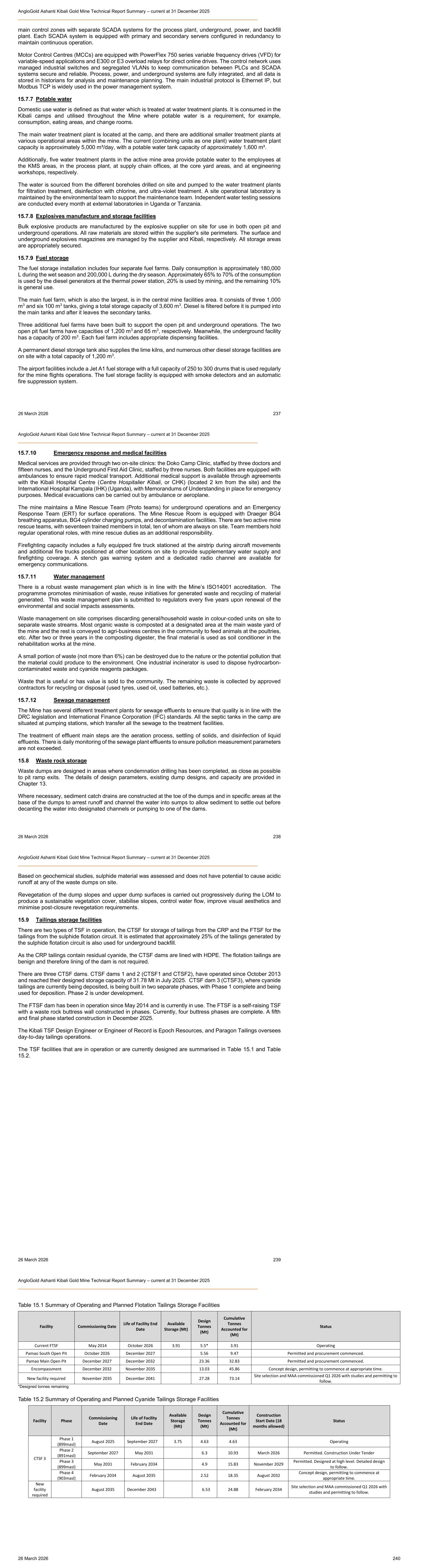
AngloGold Ashanti Kibali Gold Mine Technical Report Summary – current at 31 December 2025 ______________________________________________________________________________ 26 March 2026 237 main control zones with separate SCADA systems for the process plant, underground, power, and backfill plant. Each SCADA system is equipped with primary and secondary servers configured in redundancy to maintain continuous operation. Motor Control Centres (MCCs) are equipped with PowerFlex 750 series variable frequency drives (VFD) for variable-speed applications and E300 or E3 overload relays for direct online drives. The control network uses managed industrial switches and segregated VLANs to keep communication between PLCs and SCADA systems secure and reliable. Process, power, and underground systems are fully integrated, and all data is stored in historians for analysis and maintenance planning. The main industrial protocol is Ethernet IP, but Modbus TCP is widely used in the power management system. 15.7.7 Potable water Domestic use water is defined as that water which is treated at water treatment plants. It is consumed in the Kibali camps and utilised throughout the Mine where potable water is a requirement, for example, consumption, eating areas, and change rooms. The main water treatment plant is located at the camp, and there are additional smaller treatment plants at various operational areas within the mine. The current (combining units as one plant) water treatment plant capacity is approximately 5,000 m³/day, with a potable water tank capacity of approximately 1,600 m³. Additionally, five water treatment plants in the active mine area provide potable water to the employees at the KMS areas, in the process plant, at supply chain offices, at the core yard areas, and at engineering workshops, respectively. The water is sourced from the different boreholes drilled on site and pumped to the water treatment plants for filtration treatment, disinfection with chlorine, and ultra-violet treatment. A site operational laboratory is maintained by the environmental team to support the maintenance team. Independent water testing sessions are conducted every month at external laboratories in Uganda or Tanzania. 15.7.8 Explosives manufacture and storage facilities Bulk explosive products are manufactured by the explosive supplier on site for use in both open pit and underground operations. All raw materials are stored within the supplier's site perimeters. The surface and underground explosives magazines are managed by the supplier and Kibali, respectively. All storage areas are appropriately secured. 15.7.9 Fuel storage The fuel storage installation includes four separate fuel farms. Daily consumption is approximately 180,000 L during the wet season and 200,000 L during the dry season. Approximately 65% to 70% of the consumption is used by the diesel generators at the thermal power station, 20% is used by mining, and the remaining 10% is general use. The main fuel farm, which is also the largest, is in the central mine facilities area. It consists of three 1,000 m3 and six 100 m3 tanks, giving a total storage capacity of 3,600 m3. Diesel is filtered before it is pumped into the main tanks and after it leaves the secondary tanks. Three additional fuel farms have been built to support the open pit and underground operations. The two open pit fuel farms have capacities of 1,200 m3 and 65 m3, respectively. Meanwhile, the underground facility has a capacity of 200 m3. Each fuel farm includes appropriate dispensing facilities. A permanent diesel storage tank also supplies the lime kilns, and numerous other diesel storage facilities are on site with a total capacity of 1,200 m3. The airport facilities include a Jet A1 fuel storage with a full capacity of 250 to 300 drums that is used regularly for the mine flights operations. The fuel storage facility is equipped with smoke detectors and an automatic fire suppression system. AngloGold Ashanti Kibali Gold Mine Technical Report Summary – current at 31 December 2025 ______________________________________________________________________________ 26 March 2026 238 15.7.10 Emergency response and medical facilities Medical services are provided through two on-site clinics: the Doko Camp Clinic, staffed by three doctors and fifteen nurses, and the Underground First Aid Clinic, staffed by three nurses. Both facilities are equipped with ambulances to ensure rapid medical transport. Additional medical support is available through agreements with the Kibali Hospital Centre (Centre Hospitalier Kibali, or CHK) (located 2 km from the site) and the International Hospital Kampala (IHK) (Uganda), with Memorandums of Understanding in place for emergency purposes. Medical evacuations can be carried out by ambulance or aeroplane. The mine maintains a Mine Rescue Team (Proto teams) for underground operations and an Emergency Response Team (ERT) for surface operations. The Mine Rescue Room is equipped with Draeger BG4 breathing apparatus, BG4 cylinder charging pumps, and decontamination facilities. There are two active mine rescue teams, with seventeen trained members in total, ten of whom are always on site. Team members hold regular operational roles, with mine rescue duties as an additional responsibility. Firefighting capacity includes a fully equipped fire truck stationed at the airstrip during aircraft movements and additional fire trucks positioned at other locations on site to provide supplementary water supply and firefighting coverage. A stench gas warning system and a dedicated radio channel are available for emergency communications. 15.7.11 Water management There is a robust waste management plan which is in line with the Mine’s ISO14001 accreditation. The programme promotes minimisation of waste, reuse initiatives for generated waste and recycling of material generated. This waste management plan is submitted to regulators every five years upon renewal of the environmental and social impacts assessments. Waste management on site comprises discarding general/household waste in colour-coded units on site to separate waste streams. Most organic waste is composted at a designated area at the main waste yard of the mine and the rest is conveyed to agri-business centres in the community to feed animals at the poultries, etc. After two or three years in the composting digester, the final material is used as soil conditioner in the rehabilitation works at the mine. A small portion of waste (not more than 6%) can be destroyed due to the nature or the potential pollution that the material could produce to the environment. One industrial incinerator is used to dispose hydrocarbon- contaminated waste and cyanide reagents packages. Waste that is useful or has value is sold to the community. The remaining waste is collected by approved contractors for recycling or disposal (used tyres, used oil, used batteries, etc.). 15.7.12 Sewage management The Mine has several different treatment plants for sewage effluents to ensure that quality is in line with the DRC legislation and International Finance Corporation (IFC) standards. All the septic tanks in the camp are situated at pumping stations, which transfer all the sewage to the treatment facilities. The treatment of effluent main steps are the aeration process, settling of solids, and disinfection of liquid effluents. There is daily monitoring of the sewage plant effluents to ensure pollution measurement parameters are not exceeded. 15.8 Waste rock storage Waste dumps are designed in areas where condemnation drilling has been completed, as close as possible to pit ramp exits. The details of design parameters, existing dump designs, and capacity are provided in Chapter 13. Where necessary, sediment catch drains are constructed at the toe of the dumps and in specific areas at the base of the dumps to arrest runoff and channel the water into sumps to allow sediment to settle out before decanting the water into designated channels or pumping to one of the dams. AngloGold Ashanti Kibali Gold Mine Technical Report Summary – current at 31 December 2025 ______________________________________________________________________________ 26 March 2026 239 Based on geochemical studies, sulphide material was assessed and does not have potential to cause acidic runoff at any of the waste dumps on site. Revegetation of the dump slopes and upper dump surfaces is carried out progressively during the LOM to produce a sustainable vegetation cover, stabilise slopes, control water flow, improve visual aesthetics and minimise post-closure revegetation requirements. 15.9 Tailings storage facilities There are two types of TSF in operation, the CTSF for storage of tailings from the CRP and the FTSF for the tailings from the sulphide flotation circuit. It is estimated that approximately 25% of the tailings generated by the sulphide flotation circuit is also used for underground backfill. As the CRP tailings contain residual cyanide, the CTSF dams are lined with HDPE. The flotation tailings are benign and therefore lining of the dam is not required. There are three CTSF dams. CTSF dams 1 and 2 (CTSF1 and CTSF2), have operated since October 2013 and reached their designed storage capacity of 31.78 Mt in July 2025. CTSF dam 3 (CTSF3), where cyanide tailings are currently being deposited, is being built in two separate phases, with Phase 1 complete and being used for deposition. Phase 2 is under development. The FTSF dam has been in operation since May 2014 and is currently in use. The FTSF is a self-raising TSF with a waste rock buttress wall constructed in phases. Currently, four buttress phases are complete. A fifth and final phase started construction in December 2025. The Kibali TSF Design Engineer or Engineer of Record is Epoch Resources, and Paragon Tailings oversees day-to-day tailings operations. The TSF facilities that are in operation or are currently designed are summarised in Table 15.1 and Table 15.2. AngloGold Ashanti Kibali Gold Mine Technical Report Summary – current at 31 December 2025 ______________________________________________________________________________ 26 March 2026 240 Table 15.1 Summary of Operating and Planned Flotation Tailings Storage Facilities Facility Commissioning Date Life of Facility End Date Available Storage (Mt) Design Tonnes (Mt) Cumulative Tonnes Accounted for (Mt) Status Current FTSF May 2014 October 2026 3.91 5.5* 3.91 Operating Pamao South Open Pit October 2026 December 2027 5.56 9.47 Permitted and procurement commenced. Pamao Main Open Pit December 2027 December 2032 23.36 32.83 Permitted and procurement commenced. Encompassment December 2032 November 2035 13.03 45.86 Concept design, permitting to commence at appropriate time. New facility required November 2035 December 2041 27.28 73.14 Site selection and MAA commissioned Q1 2026 with studies and permitting to follow. *Designed tonnes remaining Table 15.2 Summary of Operating and Planned Cyanide Tailings Storage Facilities Facility Phase Commissioning Date Life of Facility End Date Available Storage (Mt) Design Tonnes (Mt) Cumulative Tonnes Accounted for (Mt) Construction Start Date (18 months allowed) Status CTSF 3 Phase 1 (899masl) August 2025 September 2027 3.75 4.63 4.63 Operating Phase 2 (891masl) September 2027 May 2031 6.3 10.93 March 2026 Permitted. Construction Under Tender Phase 3 (899masl) May 2031 February 2034 4.9 15.83 November 2029 Permitted. Designed at high level. Detailed design to follow. Phase 4 (903masl) February 2034 August 2035 2.52 18.35 August 2032 Concept design, permitting to commence at appropriate time. New facility required August 2035 December 2043 6.53 24.88 February 2034 Site selection and MAA commissioned Q1 2026 with studies and permitting to follow.

AngloGold Ashanti Kibali Gold Mine Technical Report Summary – current at 31 December 2025 ______________________________________________________________________________ 26 March 2026 241 An overview of the TSF locations is provided in Figure 15.3 and further detail of each facility is provided in the following chapters. Figure 15.3 Kibali TSF Area Plan View Source: Kibali Goldmines, 2025 15.9.1 Cyanide Tailings Storage Facility 1 and 2 The CTSF comprises two full-containment, HDPE lined facilities CTSF1 and CTSF2 that have a continuous surrounding embankment and share a common internal wall. The CTSF1 and CTSF2 footprints have been merged into a single footprint (CTSF 1st Lift) by raising the embankment walls and sacrificing the common internal wall (Figure 15.3). The embankment walls of CTSF1 and CTSF2 were raised by 3.5 m using a downstream construction method (CTSF 2nd Lift). The CTSF 2nd Lift was completed in April 2021, providing an additional dam capacity of approximately 6.5 Mt, which supported the tailings deposition plan through to July 2025. The CTSF1 and CTSF2 stage developments are summarised in Table 15.3. AngloGold Ashanti Kibali Gold Mine Technical Report Summary – current at 31 December 2025 ______________________________________________________________________________ 26 March 2026 242 Table Error! No text of specified style in document. CTSF 1 and 2 Stage Developments Stage Status Material End Elevation (MASL) CTSF1 Phase 1 Completed Earth fill 891.5 CTSF2 Phase 1 Completed Earth fill 892.0 CTSF 1st Lift Completed Earth fill 895.5 CTSF 2nd Lift Completed Waste Rock 899.0 The Kibali CTSF1 and CTSF2 Risk Assessment was completed in October 2023, and no risk drivers were identified. The assessment confirmed that the measures implemented for the facility ensure the risk level is as low as reasonably practicable. The GISTM consequence classification of the CTSF1 and CTSF2 is “High”. The current minimum vertical freeboard for CTSF1 and CTSF2 is 3.28 m below dam crest, which is greater than the DRC regulatory requirement of 1.5 m. 15.9.2 Cyanide Tailings Storage Facility 3 CTSF3 is a downstream-raised, HDPE-lined, compacted earthfill facility which is expected to reach designed capacity in 2035. The facility is situated immediately north of CTSF1 and CTSF2, approximately three kilometres northeast of the process plant (Figure 15.4). The valley-type topography allows containment between two ridgelines trending southwest–northwest, with the embankment aligned across the lower valley outlet. The CTSF3 project comprises two progressive phases providing a combined storage capacity of approximately 18.79 Mt of tailings, with Phase 1 (commissioned in July 2025) designed for approximately 4.63 Mt of tailings over an estimated operational life of two years. Construction of CTSF3 Phase 2 is planned to begin in Q1 2026. The maximum dam height will be approximately 30 m, and the maximum tailings surface elevation for Phase 1 is 897.5 MASL, with a final wall crest at 899.0 MASL. The CTSF3 stage developments are summarised in Table 15.4. Table Error! No text of specified style in document. CTSF3 Stage Developments Phase Status Material End Elevation (MASL) 1 Operating Earthfill 899.0 2 Planned Earthfill 891.0 3 (Phase 2 Lift) Planned Earthfill 899.0 4 (Phase ½ encompassment) Planned Earthfill 903.0 A risk assessment has been completed with the objective of identifying a comprehensive list of failure modes and planned and potential additional controls. The goal of this risk assessment was to adapt the TSF design to address all credible failure modes, ensuring long-term safety and environmental protection. Prior to commencing the design phase, a Multi-Criteria Alternatives Analysis (MAA) was conducted to identify the most suitable location for CTSF3. Ten potential sites were initially considered and screened based on factors such as proximity to the plant, potential social displacement, environmental sensitivity, and topographic suitability. Six final locations were assessed in more detail using four weighted criteria groups: technical feasibility, environmental impact, capital and operating costs, and social factors. The selected site with conventional slurry deposition technology emerged as the optimal option across all base and sensitivity cases, due to minimal community impact, favourable topography, and proximity to existing infrastructure. The Environmental and Social Impact Assessment (ESIA) was developed and approved in line with the host-country mining code (DRC) and in line with the IFC’s categorisation process. AngloGold Ashanti Kibali Gold Mine Technical Report Summary – current at 31 December 2025 ______________________________________________________________________________ 26 March 2026 243 The most significant impact is physical and economic displacement of surrounding communities, associated with the extension of the fence line to accommodate the LOM footprint. A resettlement process was conducted to ensure that affected households are fairly compensated and responsibly resettled. Under the GISTM consequence classification framework, CTSF3 is classified as “Very High” and is designed to meet the corresponding “Extreme” loading criteria.’ The seismic hazard assessment conducted by A Kijiko (2022) established a Peak Ground Acceleration (PGA) of 0.271g (1-in-10,000 year). Deterministic and pseudo-static slope stability analyses were performed using these values, demonstrating acceptable minimum static and dynamic Factors of Safety > 1.5 (static) and > 1.1 (pseudo-static) for all critical sections. The facility’s flood-management system was designed in accordance with Canadian Dam Association Bulletin - Application of Dam Safety Guidelines for Mining Dams (CDA, 2019) and DRC regulatory standards. • Environmental Design Flood (EDF): 1-in-100-year, 24-hour storm (153 mm rainfall). • Inflow Design Flood (IDF): 72-hour Probable Maximum Precipitation (PMP) of 487 mm. • Freeboard: A regulatory minimum of 1.5 m between the maximum flood level 897.5 MASL and the dam crest 899.0 MASL. Tailings are transported from the process plant via an HDPE pipeline to the TSF basin, discharged through spigot lines at approximately 35 m to 50 m spacing along the crest, promoting central beach formation and decant pond retention. A floating turret pump system positioned near the pond centre returns process water to the detoxification pond and then to the process plant. Groundwater control is achieved through a sub-liner drainage network: • Groundwater Drains: Perforated pipes embedded in a stone matrix beneath the liner collect underdrainage, designed for a peak flow of 0.25 m³/s based on a 10× safety factor over existing facility data. • Surface water diversion channels upstream and lateral to the facility convey non-contact runoff away from the containment area. The design incorporates: o Perimeter diversion drains, o Energy-dissipation structures at outlet transitions, and o Under normal operating conditions, an operating pond of approximately 50,000 m³ is maintained near the decant turret to provide sufficient supernatant water for process reuse. The operating pond volume is controlled within the normal operating water level (NOWL) envelope as defined by the deterministic water-balance model. The facility has been sized in accordance with CDA (2019) guidelines to safely contain both the EDF and the IDF. • The EDF corresponds to the 1-in-100-year, 24-hour storm event of 153 mm rainfall, stored entirely within the basin above the NOWL. • The IDF is based on the 72-hour PMP of 487 mm, for which temporary storage is provided. • The flood-storage capacity between elevation 897.5 MASL and 898.9 MASL (0.1 m below normal operating crest) corresponds to approximately 1.90 million m³ of floodwater storage. A minimum freeboard of 1.5 m is maintained between the maximum water level and the dam crest elevation of 899.0 MASL, in compliance with DRC regulatory requirements and CDA standards. The current minimum vertical freeboard for CTSF3 Phase 1 is 18.12 m below the dam crest. AngloGold Ashanti Kibali Gold Mine Technical Report Summary – current at 31 December 2025 ______________________________________________________________________________ 26 March 2026 244 15.9.2.1 CTSF3 Phase 1 CTSF3 Phase 1 has been in operation since July 2025. The facility was constructed using the downstream method and features a zoned earth fill embankment with a composite liner system. The liner system is comprised of a 1.5 mm HDPE geomembrane overlying a compacted clay liner and drainage systems. This design aligns with regulatory requirements due to the "Highly Hazardous" classification of the cyanide- bearing tailings. An example cross-section of the embankment design is provided in Figure 15.4 and a view of the facility is provided in Figure 15.5. Figure Error! No text of specified style in document. Cross-Section of CTSF3 Embankment Design Source: Adapted from Epoch Resources, 2024. Figure Error! No text of specified style in document. View of CTSF3 Phase 1 Source: Kibali Goldmines, 2025. 15.9.2.2 CTSF3 Phase 2 CTSF3 Phase 2 is a downstream, lined facility that links CTSF3 Phase 1 to CTSF1 and CTSF2 and is planned to be in operation after the completion of CTSF3 Phase 1 (Figure 15.6). Geotechnical drilling for the CTSF3 Phase 2 construction preparation works is currently ongoing. The dam construction is scheduled for completion by June 2027, with an estimated capacity of 6.3 Mt. Deposition is planned to begin after the life of facilities of CTSF3 Phase 1, currently projected for September 2027.

AngloGold Ashanti Kibali Gold Mine Technical Report Summary – current at 31 December 2025 ______________________________________________________________________________ 26 March 2026 245 Figure Error! No text of specified style in document. Kibali CTSF3 Phase 2 Project Location Source: Epoch Resources, 2024 15.9.3 Flotation Tailings Storage Facility The FTSF is an unlined, upstream, self-raised, paddock, open ring dyke facility with a downstream waste rock buttress along the south and downstream raised earth core rockfill embankment along the west. The FTSF is contained on the east by a common compacted residual soil embankment with the adjacent CTSF (Figure 15.3). Ongoing waste rock buttressing takes place as the self-raised tailing height increases above the crest of the already placed waste rock buttressing at intermittent times. The FTSF has been in operation since May 2014. Currently it stores approximately 46.5 Mt of flotation tailings. The current maximum height of the embankments is 59.2 m (896.7 MASL). It is designed to a maximum height of 61.5 m (899.0 MASL). An unlined Return Water Dam captures and stores return water from the FTSF. Water from the Return Water Dam is either pumped directly to the process plant or discharged into a stormwater diversion channel running to an unlined catchment dam. The catchment dam water overflows into the Kibali River. The FTSF stage developments are summarised in Table 15.5. AngloGold Ashanti Kibali Gold Mine Technical Report Summary – current at 31 December 2025 ______________________________________________________________________________ 26 March 2026 246 Table 15.5 FTSF Stage Developments Stage Status Material End Elevation (MASL) FTSF Starter Embankment Completed Earth fill 880.0 Self-raised tailings Completed Tailings 888.0 Waste rock buttressing Phase 1 Completed Waste rock 888.0 Self-raised tailings Completed Tailings 892.0 Waste rock buttressing Phase 2 Completed Waste rock 892.0 Self-raised tailings Completed Tailings 894.0 Waste rock buttressing Phase 3 Completed Waste rock 894.0 Self-raised tailings Completed Tailings 896.5 Waste rock buttressing Phase 4 Completed Waste rock 896.5 Self-raised tailings Completed Tailings 898.5 Waste rock buttressing Phase 5 Under construction (Target completion is Q1 2026) Waste rock 898.5 Closure lift Future 899.0 The capacity of the current FTSF is due to be exhausted by September 2026. After this date, flotation tailings will be deposited up to Natural Ground Level (NGL) in the Pamao South pit and then Pamao Main pit (see Figure 15.8). Further strategies for capacity over the remainder of the LOM will be decided on by an MAA which commenced in January 2026 including the following options: Construction of a series of walls around the pit to increase capacity Encompassment of the current CTSF and FTSF to generate one large facility Use of another pit, which may be available during this time 15.9.4 Tailings deposition record The actual (2013 to 2025) and predicted tailings deposition (2026 to 2040) between CTSF, FTSF, and backfill are presented in Table 15.6 and Table 15.7. AngloGold Ashanti Kibali Gold Mine Technical Report Summary – current at 31 December 2025 ______________________________________________________________________________ 26 March 2026 247 Table Error! No text of specified style in document. Actual Tailings Deposition 2013 to 2025 Table Error! No text of specified style in document. Predicted Tailings Deposition 2026 to 2040 Year Oxides Tons (Mt) Sulphides Tons (Mt) Concentrate (Mt) Tailings to Paste Plant (Mt) Tailings to FTSF (Mt) Tailings to CTSF (Mt) 2026 0.85 7.35 0.88 2.04 4.43 1.73 2027 0.66 7.50 0.90 1.82 4.78 1.56 2028 0.58 7.57 0.91 1.89 4.77 1.49 2029 0.65 7.47 0.90 1.89 4.69 1.55 2030 1.19 7.21 0.86 1.89 4.45 2.06 2031 1.18 7.08 0.85 1.89 4.34 2.03 2032 0.62 7.59 0.91 1.89 4.79 1.53 2033 0.92 7.40 0.89 1.89 4.62 1.80 2034 0.69 7.75 0.93 1.89 4.93 1.62 2035 0.69 7.30 0.88 1.80 4.62 1.57 2036 0.49 7.97 0.96 1.09 5.92 1.45 2037 0.44 7.86 0.94 1.89 5.03 1.38 2038 0.00 8.20 0.98 1.89 5.32 0.98 2039 0.00 7.24 0.87 1.89 4.48 0.87 2040 0.00 5.81 0.70 1.89 3.22 0.70 2041 0.00 4.16 0.50 1.89 1.77 0.50 Total 8.95 Mt 115.46 Mt 13.86 Mt 29.46 Mt 72.14 Mt 22.81 Mt 15.9.5 Summary of deposition plan Figure 15.7 illustrates the current deposition plan for the CTSF to 2041. CTSF3 Phase 1 is estimated to exhaust storage volume in September 2027. CTSF3 Phase 2 construction is planned to begin in Q1 2026 and be completed by the end of June 2027, with further facilities designed to provide capacity until 2035. An MAA is underway, to assess options for capacity beyond 2035. Year Oxides (Mt) Sulphides (Mt) Concentrate (Mt) Tailings to Paste Plant (Mt) Tailings to FTSF (Mt) Tailings to CTSF (Mt) 2013 0.81 0.00 0.00 0.00 0.00 0.82 2014 3.22 2.33 0.29 0.00 2.01 3.56 2015 3.72 3.11 0.54 0.17 2.48 4.19 2016 2.81 4.49 0.46 0.54 2.87 3.89 2017 1.41 6.22 0.64 0.46 3.86 3.30 2018 2.28 5.94 0.65 1.04 4.13 3.04 2019 1.89 5.63 0.68 1.38 3.54 2.59 2020 0.70 6.93 0.83 1.94 4.03 1.64 2021 1.15 6.63 0.80 2.11 3.34 2.33 2022 1.56 6.21 0.75 2.17 3.52 2.08 2023 1.07 7.16 0.86 2.04 4.35 1.83 2024 1.06 7.44 0.89 1.69 5.02 1.79 2025 0.78 7.54 0.90 1.47 5.30 1.55 Total 22.45 69.62 8.28 15.00 44.45 32.61 AngloGold Ashanti Kibali Gold Mine Technical Report Summary – current at 31 December 2025 ______________________________________________________________________________ 26 March 2026 248 Figure Error! No text of specified style in document..7 CTSF Life of Mine Deposition Plan Figure 15.8 illustrates the current deposition plan for the FTSF until 2041. The current FTSF life is planned to end in September 2026, and the new facility, Pamao In-pit, is planned to be ready for tailings deposition at the beginning of September 2026. The current designed storage capacity is expected to be exhausted in 2035. An additional pit or FTSF dam facility will be designed and undergo MAA as part of GISTM compliance. Figure Error! No text of specified style in document. FTSF Life of Mine Deposition Plan 15.9.6 Ongoing engineering studies An additional CTSF and FTSF dam facility will be designed and undergo MAA as part of GISTM compliance. The CTSF3 Phase 2 geotechnical drilling campaign was completed at the end of December 2025 and clearing of site preparation is planned to start in February 2026. FTSF in-pit deposition studies on water balance, geochemistry, hydrogeology, and pit suitability are progressing in order to comply with Barrick Tailings standard. This also includes pumping requirements on both return water and tailings slurry pipes. These studies are due to be completed at the end of February 2026.

AngloGold Ashanti Kibali Gold Mine Technical Report Summary – current at 31 December 2025 ______________________________________________________________________________ 26 March 2026 249 15.9.7 Operation 15.9.7.1 CTSF Phase 1 The CTSF3 Phase 1 is a lined, full containment valley dam. The tailings are deposited into the basin of the TSF by means of an open-ended deposition technique whereby flexible hosing off-takes, positioned at approximately 30 m intervals, are utilised. Water accumulation in the dam is managed using two turret pumps mounted in series. Water is pumped back to the processing plant via a detoxification plant, where residual cyanide in the water is destroyed. 15.9.7.2 FTSF The FTSF is a paddocked and buttressed valley dam. The tailings are deposited into the basin of the TSF by means of an open-ended deposition technique around most of the TSF and paddocked along the main wall, whereby flexible hosing off-takes, positioned at regular intervals, are utilised. Water accumulation in the FTSF dam is managed using two turret pumps mounted in parallel. The FTSF water can either be pumped to the Return Water Dam, to the processing plant, or discharged into the channel, which flows to the catchment dam. 15.9.8 Closure The CTSF1 and CTSF2 have exhausted their planned storage capacity and are now entering the active closure phase of its lifecycle. The FTSF is expected to exhaust its storage capacity in September 2026. Conceptual closure plans were developed for each facility during the design phase by the Engineer of Record and these were updated with the detailed design of each operational phase. SRK Consulting carried out a closure options and risk analysis in 2023 for the CTSF1 and CTSF2 and the FTSF combined. Five options were assessed including wet and dry caps as well as human-centric or nature- centric solutions. Knight Piésold was engaged in October 2025 to work with the Engineer of Record to conduct a final closure options analysis and detailed design for a closure capping and water management system for both facilities combined. The DRC Mining Code requires that a site undergo monitoring of ground and surface water for a minimum of three years prior to any passive closure hand back or further usage. Future and operating tailings storage facilities at Kibali have conceptual level closure plans, including capping and water management strategy, developed and updated as part of the design of each phase. 16. Market studies 16.1 Market studies Gold doré produced at the Mine is shipped from site under secure conditions and sold under agreement to Rand Refinery in South Africa. Under the agreement, Kibali Goldmines receives the ruling gold price on the day after dispatch, less refining and freight costs, for the gold content of the gold doré. Kibali Goldmines has an agreement to sell all gold production to only one customer. The “customer” is chosen periodically on a tender basis from a selected pool of accredited refineries and international banks to ensure competitive refining and freight costs. Gold mines do not compete to sell their product given that the price is not controlled by the producers. 16.2 Commodity price assumptions Barrick sets metal price forecasts by reviewing the LOM for the operations, which is 10+ years, and setting the commodity price for that duration. The guidance is based on a combination of historical and current contract pricing, contract negotiations, knowledge of its key markets from a long operating production record, short-term versus long-term price forecasts prepared by Barrick’s internal marketing group, public documents, and analyst forecasts of long-term commodity prices. AngloGold Ashanti Kibali Gold Mine Technical Report Summary – current at 31 December 2025 ______________________________________________________________________________ 26 March 2026 250 Higher metal prices are used for the Mineral Resource estimates to ensure the Mineral Reserves are a sub- set of, and not constrained by, the Mineral Resources, in accordance with industry-accepted practice. The long-term commodity price forecasts are: • Mineral Resources: US$2,000/oz Au. • Mineral Reserves: US$1,500/oz Au. 16.3 Contracts Kibali has established policies and procedures for letting of contracts. There are numerous contracts in place to supply the goods and services necessary for its operations, with contracts negotiated and renewed as required. Kibali currently has signed contracts in place for refining which are subject to fluctuations in the cost of transport as well as insurance costs. While there are numerous contracts in place at Kibali, there are no contracts in place or planned which are considered to be material to Barrick. 16.4 Comment on market studies and contracts The QP notes: • That all material contracts discussed above are currently in place and the terms contained within the sales contracts are typical and consistent with standard industry practice and are similar to contracts for the supply of doré elsewhere in the world. All contract terms, rates and charges are within the norms of Barrick’s regional benchmarks, which are generally within the lower half of industry wide standards. • Metal prices used in this Report have been set by Barrick and are appropriate to the commodity and mine life projections. The QP has reviewed commodity pricing assumptions, marketing assumptions and the current major contract areas, and considers the information to be acceptable for use in estimating Mineral Reserves and in the economic analysis that supports the Mineral Reserves. 17. Environmental studies, permitting plans, negotiations, or agreements with local individuals or groups 17.1 Summary The initial ESIA for Kibali was completed in 2010 as part of the acquisition and initial development of the Mine. This ESIA was updated in 2011 based on the updated mine concept as part of the Feasibility Study. The ESIA is updated every five years to assess the status of environmental and social attributes in the Kibali Area of Influence and associated changes since the last ESIA. Updates to the ESIA were made by an independent consultant in 2014 and 2020 and the next five-yearly regulatory ESIA update has been initiated and is due for completion by Q3 2026. The Mine is a significant employer in the local community. The mining operations have contributed to the growth of the national and local economy and has led to the employment of many Congolese citizens. Kibali’s policy is to grow local skills and experience by ensuring the participation of citizens in the management of the mine. The policy of promoting local employment also extends to its contractors. Exclusion Zones have been demarcated to develop the mine and restrict access as a safety precaution to avoid exposing the general public to industrial activities. The Exclusion Zones were established through the promulgation of a Moratorium, which also included formal authorisation to resettle the existing communities. Kibali follows a resettlement and compensation process that will leave Project-affected people (PAPs) in the same or better off position than before, which is in conformance to the International Finance Corporation AngloGold Ashanti Kibali Gold Mine Technical Report Summary – current at 31 December 2025 ______________________________________________________________________________ 26 March 2026 251 Performance Standards (IFC PS). Previous resettlements have involved the successful resettlement of 17,000 people. Resettlements have allowed for the construction of water sources, schools, solar power energy, road infrastructure, sports infrastructures, health facilities, a cemetery, places of prayer, and adequate sanitation at the host site. Guidance was provided by Congolese town planners, as well as the Resettlement Working Groups (RWGs), for a town plan outlining the development of the host site that improves the provision of basic services and social infrastructure. Currently, Kibali is finalising the resettlement of 755 households in anticipation of mining the Oere deposit. From the time significant investment was made into Kibali to develop it as a large commercial mine in 2012 to 2013, there has been a significant influx of people into the area benefitting from the economic opportunities created by the operation thus increasing the local population and economic activity, and supporting many large and small businesses. 17.2 Environmental assessment and studies The ESIA for Kibali was completed in 2010 as part of the initial acquisition and development of the Mine. The ESIA was updated in 2011 based on the updated mine concept in the Feasibility Study. The original ESIA and subsequent updates were undertaken in compliance with DRC legislation and the applicable IFC PS (2006). The Project is governed by the DRC Mining Code (DRC, 2002, as amended 2018) and associated Mining Regulations (DRC, 2003, as amended 2018). The Mining Regulations contain provisions regarding ESIAs and environmental management, public consultation, and compensation for loss of access to land. Articles 127 and 128 of the Mining Regulations set out the contents of the Environmental Impact Study (EIS) and the Environmental Management Plan (EMP), and Article 452 establishes the objectives of management measures and standards of the EMP. In accordance with the DRC’s Mining and Environmental Codes requirements, the ESIA is updated every five years to assess the status of environmental and social attributes in Kibali’s Area of Influence and associated changes since the last ESIA. Digby Wells conducted updates to the ESIA in 2014 and 2020. The ESIA was revised in 2020 and approved in 2021 to incorporate Kalimva-Ikamva and the future project for in-pit deposition into the Pamao and Pamao South open pits. The ESIA complies with IFC PS (2012), the Environmental Code (2011) and complies with the Mining Regulations (2018) that stipulate a mine’s ESIA is to be updated every five years (Article 463). This allows for a re-examination of the management processes and responsibilities and assists the mine in managing its environmental and social impacts on an ongoing basis. Mitigation and rehabilitation measures and financial provision for planned Project closure were included in the ESIA update. Annually, Kibali Goldmines identifies and undertakes concurrent rehabilitation of disturbed areas. Environmental monitoring of these areas is ongoing. The current ESIA is valid until 21 November 2026. In addition to the main operational ESIA, the following ESIAs have been undertaken based on additional activities or operational changes which warranted E&S assessments and permitting: • ESIA for the Nzoro 2 hydropower station, and refurbishment of the Nzoro 1 hydropower station adjacent to the Kibali and Nzoro Rivers, respectively (Digby Wells, 2011). This ESIA included details of the upgrade of the existing powerlines from the Nzoro 1 station, construction of new powerlines from Nzoro 2 and the construction of a diversion canal from the Nzoro River to the Nzoro 2 station. • ESIA for the construction and operation of the Ambarau and Azambi hydropower plants located on the Kibali River (Digby Wells, 2012). • ESIA to incorporate Kalimva-Ikamva and the future project for in-pit deposition into Pamao South and Main Pits (Digby Wells, 2020). • ESIA for the construction and operation of the CTSF3 located directly east of the current TSFs (Digby Wells, 2023). • ESIA for the construction and operation of a solar PV plant located adjacent to the Ambarau Hydropower Plan (Digby Wells, 2024). AngloGold Ashanti Kibali Gold Mine Technical Report Summary – current at 31 December 2025 ______________________________________________________________________________ 26 March 2026 252 • Environmental Assessment for the development of the Ndala mining area, including an open pit and waste rock dump located east of the Pakaka deposit (Digby Wells, 2024). The next ESIA update has been initiated and is due for completion by Q3 2026 to meet the regulatory requirements for an update every five years. Concurrently, further Environment Assessments were completed in 2025: • Environmental Assessment for the extension of existing WRDs to meet the immediate waste rock storage capacity demand of the operations. • Updates to the existing groundwater modelling and water balance for the planned and approved in- pit deposition at Pamao South and Main pits. All of the ESIAs and Environmental Assessments referred to above will be incorporated into the 2026 ESIA update to ensure that Kibali operates with one consolidated Environmental and Social Management Plan (ESMP) for operational efficiency. The review of the environmental impact studies and the environmental management plans presented in the Kibali EAP was completed by the Standing Committee of Evaluation (CPE), comprising 14 members and directed by the Director of the Direction de la Protection de l’Environnement Minier (DPEM). The Plan National d’Action Environnementale (in English, “National Environmental Action Plan”) (EAP) was approved by the CPE, as required under Articles 455 and 456 of the Mining Regulations (2003) and included the following conditions: • Adequate management of social aspects around the mine. • Respect of air quality requirements. • Water management and effluents to be in line with the legal limits before any discharge from the mine. • Waste management and hazardous waste management in line with legislation. • Flora and fauna promotion and conservation. Copies of the EAP were submitted to the Mining Registry Office as requested under Articles 69, 92, 103, 154 of the DRC Mining Code (2002) and Article 454 of the Mining Regulations (2003). All environmental permits are in place for the Kibali processing plant, open pits and underground operations, the hydropower stations, and a permit register forms part of the EMP. Permits include: ESIA approbation – letter for approval of the environmental impacts assessment (valid for five years and subject to ESIA updates). Environmental certificate (valid as long as taxes are paid). Other Project permits and licences in place include an import and export licence, permit for the construction of infrastructure at Kokiza, authorisation to import explosives, demolition permit, authorisation to resettle people, and authorisation for exhumation (so that graves can be relocated out of the mining zone). Resettled households are given their own title deeds for Kokiza. 17.3 Permitting Kibali Goldmines strives to comply with all applicable laws of the DRC, which are mainly contained within the DRC Mining Code (DRC, 2002, as amended 2018) and the mining regulation laws (DRC, 2003, as amended 2018). These laws govern the environmental management in the mining sector in the country and they require every mine to have in place some exploration/exploitation permits which are received at the Cadastre Minier (CAMI) and approved ESIAs for those projects that are in construction or production phases already. Kibali Goldmines has ten exploitation permits, each of which is valid until 2029 or 2030. Among these ten permits, only three are currently being used for mining operations and the others are used for exploration.

AngloGold Ashanti Kibali Gold Mine Technical Report Summary – current at 31 December 2025 ______________________________________________________________________________ 26 March 2026 253 Mineral rights are discussed in detail in Chapter 3 of this Report. Within these permits, four Exclusion Zones have been established to designate an area in which access is restricted as a safety precaution to avoid exposing the public to industrial activities. Independent environmental audits are required every two years for the regulators to review at which extent we can provide evidence for each commitment made in the EMP contained in the approved ESIA. The last legal audit was conducted in February 2024, and zero non-compliance or objection was raised by the bureau of DPEM regulators. The next independent audit will take place in 2026. The Mine also submits annual reports to the DPEM regulators and environmental ministries to keep track of required conservation measures and to inform the regulators about the necessary environmental mitigation measures related to main identified impacts for the operational works. As part of its commitment to compliance with international standards, Kibali Goldmines has been certified ISO 14001 since 2015. These standards are adequately rolled out within each operational department of the Mine and all the contractors and visitors on site are well trained and made aware to participate in the full implementation of the requirements for continual improvement. The GISTM for responsible tailings management has been implemented at Kibali at both the FTSF and CTSF1 and CTSF2 and is currently being implemented for the newly constructed CTSF3. Management of TSFs is discussed in detail in Chapter 15.9 of this Report. In addition to updating the environmental liability annually and undertaking rehabilitation, regulations in the DRC require taxes be paid on infrastructure, equipment, or product that has the potential to impact the environment. The annual declaration period occurs from February to March based on which taxes are paid. Declarations and payments are verified by environmental inspectors in October every year. 17.4 Environmental considerations 17.4.1 Compliance monitoring As per the requirements of the DRC Mining Code and associated regulations in the DRC, the Mine has implemented environmental and social management plans. Management plans are living documents, and are updated every five years to incorporate changes in the overall development of the Mine, as the need arises. The Mine has two types of facilities for tailings storage: the CTSF and FTSF. The CTSF contains cyanide tailings and the FTSF takes the flotation tailings which are not cyanided. CSTF3 has recently been commissioned as CTSF1 and CTSF2 have reached their design capacity. Prior to the deposition on the CTSF cyanide is recovered in a CRP to keep levels of cyanide in the CTSF at the discharge point under 50 ppm as per the ICMC guidelines. There are also 24 monitoring boreholes around the TSFs to monitor groundwater quality compliance. To date, no cyanide content has been detected, nor have other chemicals associated with the gold processing activity. The CTSF is lined with a plastic lining material to restrict seepage and contamination of the groundwater. The mine discharges all the mine volumes through the catchment dam and daily monitoring of those effluents is in place. Average dissolved solids are often below 450 ppm and the pH is between 6 and 8 most of the time. For further understanding of the impacts at the point of discharge of the mine effluents, bi-annual aquatic surveys are performed in those water ponds. The dust deposition is monitored via a network of fall out collection buckets located in twelve positions around the site. These buckets are analysed at the end of every month. All positions located in proximity to communities show levels below the prescribed maximum amount in the DRC Mining Code of 1,200 mg/m2/day. At most locations, the monthly concentrations are often below 500 mg/m2/day, due to the nine- month period of rainy season. Fine particulate matters are also monitored on site by a fixed device which can be moved from month-to- month to new locations to assess the concentrations of SOX and NOX and PM2.5, normally expressed in µm. Concentrations in the camp and in the surrounding villages for these respirable pollutants were all in compliance with country requirements and as well with international standards. AngloGold Ashanti Kibali Gold Mine Technical Report Summary – current at 31 December 2025 ______________________________________________________________________________ 26 March 2026 254 Noise emissions monitoring is maintained on a quarterly basis around the Mine premises. Special assessments are conducted in circumstances when the Mine operations are located very close to the communities. The mine has not exceeded the prescribed limits of noise nuisance. In some instances, the recreational facilities in the community were influencing the levels of noise nuisance which were spotted in the readings of the monitoring equipment. 17.4.2 Water management The Mine is located in the Kibali catchment area, which is dominated by the fast-slowing Kibali River. The flow of the Kibali River increases during June and July and experiences a large rise during September and October. After the Kibali and Nzoro rivers join, the Kibali follows a northwestern route and flows into the much larger Uélé River. The upper catchments are relatively unimpacted by anthropogenic activities when compared to the middle and lower catchments. These rivers are supplemented by a relatively large amount of surface springs throughout their course. The middle and lower reaches of the streams flow through rural communities, artisanal mining sites, small scale, and agricultural sites. Where these streams have adjacent anthropogenic activity, the streams have undergone significant modification. Various water points have been established by Kibali in the surrounding communities to provide cleaner and safer potable water abstracted from the river for domestic use. Between 7% and 10% of water demand is met through abstraction from the Kibali River. There are no restrictions on water abstraction volumes from the river. This is due to the climate of the area, with a wet season lasting nine months and average annual precipitation reaching 1,950 mm. The site water accounting framework is well operational and has revealed an 83.5% efficiency rate in recycling or reusing water within our different facilities. Further optimisation of the existing reticulation is planned by recirculating more water discharged from the underground mines towards the process plant to achieve more than 85% efficiency in water recycling or reuse rate. More than 75% of water demand for the process plant operations is met by recirculating water from the TSF, with a further 15% being sourced from mine dewatering operations. Most of the stormwater and dewatering water is pumped to the catchment dam, having a functional wetland along the way, to make sure no contaminated effluent is discharged from the mine exclusion zone. Daily water quality monitoring is practiced and bi-monthly samples are analysed at independent laboratories for compliance requirements. Water quality impacts are considered one of the key management aspects. The WHO drinking water quality guidelines were used to benchmark the water quality within surface water bodies. Levels of most parameters such as, potassium (K), magnesium (Mg), calcium (Ca), chloride (Cl), copper (Cu), aluminium (Al), fluoride (F), arsenic (As), and cadmium (Cd) at most of the monitored points are variably below WHO guidelines throughout the monitoring period since 2010. Although nitrate (NO3) concentrations are generally within WHO guidelines, elevated levels were observed in mid-2018 and mid-2022. The elevated levels were likely attributed to livestock faeces and agricultural fertilisers transported to the water network via surface runoff. There is an on-site water treatment plant, fed by the numerous boreholes, to provide the potable water needs of the operation. Water supply to the camps and administration offices is via a separate water treatment plant, supplied by four boreholes. Further details on water supply and management can be found in Chapter 15 of this Report. 17.4.3 Waste management Kibali has a robust waste management plan in line with its ISO14001 certification standards. The programme promotes minimisation of waste, reuse initiatives for generated waste, and recycling of material generated. This waste management plan is submitted to regulators every five years, upon renewal of the environmental and social impacts assessments. Waste management on site comprises discarding general/household waste in colour coded units, to separate waste streams. Most of the organic waste is composted at a designated area at the main waste yard of the Mine and the rest is conveyed to agri-business centres in the community to feed animals, poultry, etc. After AngloGold Ashanti Kibali Gold Mine Technical Report Summary – current at 31 December 2025 ______________________________________________________________________________ 26 March 2026 255 two or three years in the composting digester, the final material is used as soil conditioner in the rehabilitation works at the Mine. A small portion of waste must be destroyed due to the potential pollution that those materials could cause to the environment. One industrial incinerator is used to dispose of hydrocarbon-contaminated waste and cyanide reagent packages. Waste that is useful or has value is sold to the community. The remaining waste (used tyres, used oil, used batteries, etc.) is collected by approved contractors for recycling or disposal. In 2024, a total of 3,950 t of waste were produced (hazardous and non-hazardous) of which 3,135 t were recycled. 17.4.4 Acid rock drainage Geochemistry studies have been conducted by specialists (Digby Wells consultants) and tests carried out at accredited laboratories (SGS laboratories). All recommendations from the assessment of potential acid- generating rocks are strictly implemented as precautions to avoid any impact of acid generation from waste dumps and open pits. The general material characterisations indicate low sulphur percentages and high capacity for neutralisation in almost all the pits at Kibali. At Pakaka and Sessenge, there were spot areas of high concentrations of heavy metals. This has been dealt with carefully at the waste dumps locations by encapsulation protocols of these lithologies. To date, no issue has been detected in the waste dumps runoff water and in the effluents of the mine which could correlate to such chemical reactions. The ARD assessment is also conducted in situations where waste rocks are used as construction materials for the TSF buttressing materials, to avoid future ARD issues. Monitoring of the quality of water at all pits before discharge has continued to ensure compliance with standards before discharging into the environment. 17.4.5 Biodiversity and conservation A Biodiversity Action Plan (BAP) was initially developed by Digby Wells in 2016 and was updated in 2022. A total of 36 actions were developed in the BAP, 94% of which have been implemented and the remainder are in progress. The key biodiversity features that have been identified at Kibali are: forest galleries, woodlands, wetlands, aquatic biodiversity, rivers and streams for fish conservation and savannas. To aid conservation of the southern white rhino and ecological integrity of Garamba National Park, 72 rhinos were successfully translocated from South Africa in a program which has been led by African Parks since 2023. The support of the Garamba National Park has produced very positive results in terms of security in the park and the wild species population growth, especially with a very high reduction of poaching rates for kardoffan giraffes, buffalos, elephants (including the use of GPS collars), and hippos. The park has then taken this opportunity to start leveraging the tourism framework and establishing necessary infrastructures and systems to facilitate any regional visitors or nationals to join the Garamba complex for wildlife discoveries and recreational activities. The Mine has established a strong awareness programme related to conservation of fauna and flora species at the Mine. Around 10,000 indigenous trees are planted every year at Kibali and surrounding communities, involving the school pupils and local community chiefs to support the campaigns. The Mine has three hydropower plants with a total capacity of 42 MW and one solar plant with a capacity of 16 MW, which generate electricity for the Mine operations and grant a portion to the community for their use. This has helped the surrounding villages use modern techniques for cooking as opposed to deforestation to sustain their livelihoods. Monitoring of fauna species using some automatic camera traps has demonstrated a significant increase in the population of on-site wild animals: this has been promoted within the Exclusion Zone which restricts any hunting, or over-fishing in the different streams or ecosystems of within the Mine. In addition to tree planting projects, the Mine conducts campaigns of progressive rehabilitation of areas which have finished being used. Such initiatives contribute to reduce the final cost of Mine liabilities. Numerous specialist studies are conducted on annual or bi-annual basis, including aquatic biomonitoring assessment, wetland and amphibian assessments, vegetation mapping, etc. AngloGold Ashanti Kibali Gold Mine Technical Report Summary – current at 31 December 2025 ______________________________________________________________________________ 26 March 2026 256 Kibali Goldmines has communicated all the necessary policies and protocols related to wetlands protection, restriction of unnecessary tree cutting at the Mine, and any animal killing at the Mine. Inspections in the past revealed intrusions of surrounding community members into the mine premises and setting of some wild animal traps. This situation was attended to by the Mine security team, and more information shared on radio-broadcasting channels to promote biodiversity conservation and discourage villagers in such activities, which are against the legal framework and the Mine policy. Following that awareness campaign to promote biodiversity conservation, it can be confirmed that, in recent years, environmental inspections along the mine fence and at random locations in the habitats of the Mine, almost no traps were detected. Digby Wells are engaged to periodically perform verification studies to confirm the status or quality of different key biodiversity features at the Mine. For example, in September 2025 terrestrial (fauna and flora) studies were conducted on site. Positive results were observed in terms of improvement of key biodiversity species and the density surveyed via automatic cameras, observations on site, and density of individuals. This includes tangible improvement in the Mine biodiversity status from the conditions found as baseline at the time of mine construction, following the period of resettlement of the communities which were occupying the mine location in 2013. While there has been improvement in the Mine fenced area, the impact on the surrounding area by the large in-migration of people has been significant. 17.5 Social and community requirements 17.5.1 Social impacts Kibali has had and continues to have a positive impact on both the local and regional communities through multiple channels. Its direct operations have generated significant economic opportunities for the local population, particularly through employment, service provision, and procurement. Beyond this, the Mine’s commitment to community development has improved living standards in the area through social projects and resettlement programs. Additionally, contributions to government revenues via taxes and royalties have supported broader development across the province. Currently, over 400 companies in the DRC do business with Kibali, covering a range of activities: open pit mining, drilling services, construction projects, roadworks, camp services and maintenance, food products and catering services, transport and vehicle maintenance, fuel supply, testing facilities, and oxygen supply. Kibali’s policy of promoting local employment also extends to its contracted workforce. The major companies that Kibali engages with for contractors include: • Universal Security – 1,107 employees • IOB – 577 employees • MD Services – 299 employees • Golden Camp Solution – 279 employees • Kongo River – 74 employees When including contractors, 96% of the total workforce, or approximately 6,900, are Congolese nationals. 17.5.2 Community management and relations Kibali contributes to the realisation of community development projects, led by established Community Development Committee’s, through two main channels: a mandatory contribution (0.3% to the endowment fund) and Cahier de Charges (the five-year development plan). Projects and initiatives fall within five focused sustainable development categories: local economic development, education, health, access to water, and food security. The 2018 revision of the DRC Mining Code mandates that mining companies contribute to local development with a minimum amount of 0.3% of annual gross revenue, with funds used for community development projects such as schools, roads, health centres, etc. Funds are managed by a specialised body made up of twelve members (from communities, the company, local NGOs, and government departments).

AngloGold Ashanti Kibali Gold Mine Technical Report Summary – current at 31 December 2025 ______________________________________________________________________________ 26 March 2026 257 A more recent development initiative by Kibali is its participation in the Cahier de Charges programme – a five-year community development plan to implement commitments made by mining companies to build basic socio-economic infrastructure and social services for the benefit of communities. The amount of investment required under the Cahier de Charges programme is not defined by law and depends on the financial capacity of the mining operator and how it has negotiated with communities. The projects are identified by the communities themselves through the Community Development Committee based on their own priority needs and subsequently executed by the company. Kibali has invested significantly as part of its Cahier de Charges contributions. Several major initiatives have been implemented to enhance the well-being of local communities and stimulate regional economic recovery. These include the construction of health centres in Faradje, Ngangazo, and Moku; the installation of water supply systems in Moku and Ngangazo; bridges that have connected communities throughout all weather seasons; as well as the creation of community markets in Nzopi and Moku. These projects directly contribute to improving access to essential services and boosting economic activity in the region. Artisanal and small-scale mining (ASM) is a widespread reality in many regions where Barrick operates, including Kibali (Barrick, 2024). ASM provides an income to communities and households be it as a full-time occupation or to supplement their needs from other occupations like farming. There is a clear distinction, however, between legal and illegal ASM. In a combined paper by the IFC, World Bank and the International Council for Mining and Metals (ICMM) it is recognised that the majority of ‘ASM operators’ are deemed illegal (ICMM, 2010). Illegal ASM miners are defined as those who do not own mining rights, mine illegally on other parties’ mining or exploration permits, and/or are selling their product through black-market channels and may have other nefarious activities such as money laundering. • Barrick operates on three basic principles, as guided by the ICMM: • Barrick supports engagement with government and local communities to manage ASM-related challenges. • ASM activities and illegal miners may not encroach legally permitted mining areas. Gold is mined and processed by Barrick’s own operations only, ensuring transparent and responsible supply chains as per the Organisation for Economic Co-operation and Development (OECD) Guidelines and responsible mining principles. Barrick does not and will not source ore or gold from any third parties. Where regulated, legal ASM can contribute to growing the local economy. The responsibility and regulation of these activities fall with the government. There are numerous areas where illegal ASM is being practised, and where these activities encroach on Kibali property, these issues are raised with the local authorities. Currently, none of these activities have impacted mining operations directly. Impacts sometimes occur with exploration drilling crews and conflicts are resolved on an individual basis through consultation with all levels of government, local chiefdoms, and illegal ASM operators. 17.5.3 Resettlement The implementation of any Resettlement Action Plan (RAP) at Kibali is based on a transparent, participatory, and methodologically structured approach. It begins with the establishment of a dedicated Resettlement Unit (RU) composed of social, land, technical, and community engagement specialists. This unit works in close coordination with traditional leaders and territorial authorities through the RWG, which serves as a platform for consultation and oversight. The initial operational phase consists of the precise demarcation of the project-affected area and the legal issuance of a Moratorium that defines the Exclusion Zones. The Exclusion Zones are demarcated to develop the Mine and restrict access as a safety precaution to avoid exposing the general public to industrial activities. The Exclusion Zones were established through the effect of a Moratorium, which also includes formal authorisation to resettle the existing communities. A broad communication campaign is subsequently conducted to disseminate the contents of the Moratorium to the affected communities in local languages, with particular emphasis on the cut-off date. Following this AngloGold Ashanti Kibali Gold Mine Technical Report Summary – current at 31 December 2025 ______________________________________________________________________________ 26 March 2026 258 dissemination, a systematic aerial survey of the Exclusion Zone is carried out using drones to establish an objective baseline of existing conditions. This is complemented by a full census of households and a detailed inventory of all affected assets, both land-based and non-land assets. Based on this primary data, an eligibility matrix is applied to determine compensation entitlements for each household, according to their tenure status, the nature and extent of their losses, and their vulnerability. This assessment strictly follows Congolese legal requirements and international best practice, particularly IFC PS5. Between 2012 and 2025, a total of eleven RAPs have been implemented or are ongoing. These have affected more than 20,000 PAPs across various infrastructure and energy-related projects and have involved both physical and economic displacement. The implementation spans over a decade, with recent activities continuing through 2025 at Oere (2,989 PAPs) and CTSF3 (541 PAPs), which are still ongoing (Table 17.1). Table 17.1 Kibali Goldmines Experiences in RAP Implementation Project Number of PAPs Type of Displacement Implementation RAP Karagba–Chauffeur–Doko 5,780 Physical and economic 2012 RAP Nzoro II power plant 9 Physical 2014 RAP Nzoro II transmission line 21 Physical 2014 RAP Ambarau power plant 83 Physical and economic 2015 RAP Azambi power plant 128 Economic 2017 RAP Gorumbwa 1,483 Physical and economic 2018 RAP Kalimva–Ikamva–Pamao 3,029 Physical and economic 2022 RAP Mengu Hill 52 Physical and economic 2023 RAP for Oere 2,989 Physical and economic Ongoing RAP CTSF3 541 Physical and economic Ongoing RAP Ndala 94 Economic 2024 The implementation timeline included: • 2012 to 2018: Early RAPs included major displacements for projects such as Karagba–Chauffeur– Doko and Gorumbwa, with significant PAP numbers. • 2019 to 2025: More recent RAPs, including Kalimva–Ikamva–Pamao, Mengu Hill, Oere and CTSF3, indicate continued expansion of resettlement efforts, with a focus on both physical and economic displacement. There are three displacement types: • Physical and Economic Displacement-eight RAPs (majority). • Economic Only-two RAPs (Azambi and Ndala). • Physical Only-two RAPs (Nzoro II Power Plant and Transmission Line). Most resettlement projects have involved both relocation and livelihood restoration measures. After resettlement, a livelihood restoration and enhancement programme is implemented. It includes targeted interventions such as agricultural support, promotion of cooperatives, vocational training, and support to income-generating activities. Finally, a robust monitoring and evaluation system ensures continuous assessment of the well-being of resettled households, the adjustment of measures when necessary, and full compliance with national regulatory requirements and IFC PS5. In 2010, Kibali was granted the right to establish an Exclusion Zone over certain areas, named Exclusion Zone A and Exclusion Zone B (Exclusion Zone). The Moratorium is in essence a legal ban for new settlements to be established in the designated Exclusion Zone including the creation or improvements of homes, amenities and crops. The Moratorium also included formal authorisation to resettle the existing communities living in the Exclusion Zone. This resettlement was successfully implemented, however, communities began illegally settling back into the area. Kibali informed the DRC government on several occasions to prevent ongoing encroachment. It was and is the government’s mandate to ensure law and order by addressing illegal settlers contrary to the terms of the Mortarium. Although the government is AngloGold Ashanti Kibali Gold Mine Technical Report Summary – current at 31 December 2025 ______________________________________________________________________________ 26 March 2026 259 responsible for the Government Implemented Resettlement, Kibali has in accordance with international guidelines exercised its leverage throughout the process to encourage government officials to take into account humanitarian considerations in the government’s resettlement process. In 2024 and 2025, the government acted upon this responsibility and successfully resettled the illegally settled communities from Exclusion Zone B. 17.5.4 Stakeholder engagement A Stakeholder Engagement Plan (SEP) was developed in 2015 (Digby Wells, 2015) which is updated annually alongside a Social Licence Strategy and a Community Development Plan. Kibali has built strong relations with the community through reinforced and continuous stakeholder engagement which includes regular meetings with a range of stakeholders and regular radio broadcasts targeting key issues pertinent to the community. During the reporting period, a total of 1,838 engagements were conducted, primarily focused on collaboration, grievance resolution, expectation management, facilitation of mining operations, as well as resettlement and community development activities, particularly within the Mine’s direct Area of Influence. The key engagements recorded from the beginning of 2025 to date are the following: • The General Manager (GM) met with the National Minister of Mines to discuss the violation of the mining perimeter by illegal operators. • On three occasions, the GM held meetings with the Governor of Haut-Uélé Province to discuss Mine operations and the continued presence of illegal miners within the Kibali Gold Mine Exploitation Permits. • The GM also held three meetings with the Chief Surur, focusing on strengthening collaboration and partnership. • In addition, the GM met with the Local Development Committees (CLDs) of the Watsa and Faradje territories to discuss development projects and review the specifications related to the 0.3% contribution to local development. The Social Department team also conducted several high-level interactions, including with: • The Provincial Minister of Health, during the inauguration of the CHK morgue. • The Provincial Minister of the Interior, during the inauguration of the Watsa Central Prison. • The Provincial Minister of Mines, as part of the ongoing collaboration and partnership with Kibali Goldmines. Regular interactions with local authorities and communities remain at the core of the social team’s daily activities, ensuring transparent and constructive communication. These initiatives reflect Kibali Goldmines continued commitment to the well-being of local communities and the sustainable development of its Area of Influence. 17.5.5 Grievance management and procedures Kibali Goldmines’ overall objective in grievance and complaint management is to work proactively with communities to prevent grievances from arising. However, a formal grievance handling mechanism is in place to ensure effective response to any complaint raised by communities or other stakeholders. At Kibali this mechanism is structured as follows: • First level: The complaint is reviewed and addressed by the Kibali Social Department team. • Second level: If the complainant is not satisfied with the proposed resolution, the case is escalated to the second level, involving the External Grievance Resolution Committee. AngloGold Ashanti Kibali Gold Mine Technical Report Summary – current at 31 December 2025 ______________________________________________________________________________ 26 March 2026 260 The grievance management mechanism is based on a clear structure, defined timelines, appropriate feedback methods, and robust monitoring and evaluation processes, including key performance indicators (KPIs). It also includes a formal complaint closure procedure. In 2024, there were 84 registered grievances from communities. A total of 83% of these grievances related to the current resettlement program and compensation. Such grievances are addressed through the grievances mechanism and associated RWG. The RWG committee based on elected members of the community to facilitate the resettlement and address grievances registered through the grievances procedure. In 2025, 83 grievances were received and 67 were successfully closed within 30 days. The majority (83%) of these grievances related to resettlement activities. 17.5.6 Human resources Kibali Goldmines complies with the labour laws of the DRC, which govern the following: • Salary and remuneration. • Job classification and competencies. • Annual leave system. • Ratios of expat to national workforce. • Representation by unions. • Employee code of conduct and disciplinary measures. • Mine Level Agreement (MLA). Kibali Goldmines has an internal in-reach programme which is a platform where both employer and employee are able to actively engage with each other regarding operational updates in addition to social and community matters. Kibali Goldmines employment policy gives priority to DRC nationals who have the required skills and experience. Identifying skilled nationals involves advertising and searching in the nearby communities before extending the recruitment process to other regions of the country. Where there is a lack of skills, expatriates with specific skills are employed with the primary aim of training nationals. A timeframe is developed for training nationals to take over from the skilled expatriates. Development plans are in place to facilitate skills development and succession planning. The Mine prioritises local employment and, in 2025, the employees were made up of 91% Congolese nationals with more than 54% from the local area and more than 63% of management positions held by Congolese nationals. Kibali Goldmines has a local procurement policy, and this extends to procurement through contractors. Kibali Goldmines procured more than $1.3 billion of goods and services from DRC suppliers and contractors during the period from 2022 through 2025. This includes produce from agri-businesses (e.g., producers of eggs, pork, maize) which is purchased for use in the mine canteens. 17.6 Mine closure and reclamation Barrick has developed a Mine Closure Standard, based on best practice, that each mine has the responsibility to follow considering the different site-specific context and ensuring that closure engineers and mine planners reach agreement about the working closure plans documents. A Conceptual Mine Closure Plan, which is based on Barrick’s over-arching closure objectives, was established for Kibali in 2016. This document is updated every five years to account for changes in the future development of the mine operations and infrastructures are included. The current closure objectives include: • Ensure that all reclaimed properties support productive uses considering pre-mining conditions. • Ensure safety and health of workers during closure activities.

AngloGold Ashanti Kibali Gold Mine Technical Report Summary – current at 31 December 2025 ______________________________________________________________________________ 26 March 2026 261 • Ensure that local communities utilising the site after closure are not exposed to unacceptable risks. • Responsibly manage all reagents and chemicals. Neutralise or control-and-treat all potentially harmful residual discharges from decommissioned facilities so that water and land resources are properly protected. • Physically and chemically stabilise remaining structures to ensure proper drainage, minimise erosion and sedimentation, and limit the quantity of water requiring management. • Reclaim Mine properties to protect and enhance pre-existing plant and animal communities. • Utilise closure strategies that relinquish properties in a self-sustaining condition with little or no need for ongoing care and maintenance. • Understand and address community concerns regarding closure. Safeguard the sustainability of community interest to the greatest extent practicable. • Comply with mine closure permitting and regulatory requirements and obtain documented confirmation of meeting all closure requirements. The overall, long term post-closure land use objective for the site is to return it to a self-sustaining condition suitable to support post-closure land use activities, such as subsistence agriculture, with the final landform not adversely affecting water resources. A number of activities are already underway to ensure a smooth transition into the post-closure phase: • Mining areas – including pits, waste rock dumps and tailings - are landscaped concurrently where practical to ensure safety, water management, and to allow for future revegetation programmes. • Waste handling procedures are continually assessed to prevent, identify, and address waste handling, spillages on site, and manage chemical handling and storage. • Infrastructure that is no longer utilised is decommissioned, dismantled, and removed from site (or sold to third-parties) where possible. • Engineering trials and assessments of options (including hydrology/hydrogeology studies) are completed throughout the operational lifecycle. • Concurrent/progressive closure options are assessed to take advantage of areas which can be closed ahead of the main closure period and distribute financial burden throughout LOM. In addition to the site-wide closure plan, a stand-alone Conceptual Closure Plan was developed for the TSFs. The high-level plan was established by SRK Consulting in July 2023 and suggested four options, in line with potential future development of the Mine. The Conceptual Closure Plan is now being upgraded into a Working Closure Plan, that will select one of the conceptual options identified and develop the relevant inputs and objectives that will allow rehabilitation to formally commence for both CTSF and FTSF. The plan is being prepared in accordance with the following Barrick environmental standards or guidelines: • Barrick Mine Closure Standards and Guidelines. • Barrick Mine Closure Cost Estimate Guideline. • Barrick Social Closure Guidance. • Barrick Biodiversity Standard. • Barrick Water Conservation Standard. • GISTM. In accordance with Article 258 of DRC Mining Code (DRC, 2002, as amended 2018) a bond called a “sureté financière” is booked or lodged in a bank identified by the regulators, in which the necessary funds can be placed, as a guarantee to be used in a situation whereby the Mine has shut operations in an urgent event and there is no capacity to adequately roll out the closure plan of the Mine. AngloGold Ashanti Kibali Gold Mine Technical Report Summary – current at 31 December 2025 ______________________________________________________________________________ 26 March 2026 262 There is a closure liability assessment for mine closure which is updated on annual basis by an independent body or consultant (Digby Wells, 2025) using the regional quotations and in line with the national legislation in terms of closure techniques and requirements. The immediate closure cost estimate for Kibali, as at the date of this Report is $41.5 million ($25.8 million discounted under IFRS, as defined by IAS 37). 17.7 Comment on environmental studies, permitting and social or community impact It is the opinion of the QP that the approved Environmental and Social Impact Assessments, including relevant specialist studies, adequately addresses environmental compliance and permitting, and maintains industry best practice. AngloGold Ashanti Kibali Gold Mine Technical Report Summary – current at 31 December 2025 ______________________________________________________________________________ 26 March 2026 263 18. Capital and operating costs 18.1 Summary Capital and operating costs are based on extensive experience gained from operating the Mine over a number of years and the knowledge gained from operating other gold mines situated in Africa. Sustaining (replacement) capital costs reflect current price trends and supporting studies. All operating costs presented are in real USD as of Q4 2025 and are in line with historical averages, without any allowance for inflation or consideration for changes in foreign exchange rates. Any potential non-capitalised exploration expenditure has not been included in the economic forecasts. 18.2 Capital costs Kibali is an ongoing combined open pit and underground mining operation with the necessary facilities, equipment, and workforce in place to produce gold. The basis for the capital cost estimates in the combined LOM plan is the Proven and Probable Mineral Reserves estimate described in Chapter 12 of this Report. The majority of the capital cost estimates contained in this Report are based on quantities generated from the open pit and underground development requirements and operational data provided by Kibali Goldmines. Capital expenditure over the remaining LOM is estimated to be $3,017 million based on the 2025 Mineral Reserves, consisting of the following allocation of costs (as defined in Table 18.1). Table 18.1 LOM Capital Expenditure Based on Mineral Reserves Description Value ($ million) Sustaining 1,089 Capitalised deferred stripping 960 Underground Capital Development and Drilling 190 Growth Capital 777 Total LOM Capital Expenditure 3,017 18.2.1 Sustaining Capital Sustaining capital costs include all sustaining capital costs that have been budgeted throughout the LOM to support the current operations, mainly the CTSF and FTSF projects, and underground sustaining capital (mobile fleet). 18.2.2 Capitalised Deferred Stripping Capitalised waste stripping is an allocation from operating costs to capital costs reflecting the waste stripping phases over the LOM. Capitalised stripping has been determined on a per pit basis and calculated based on the following two parameters: • Where no ore is mined in a particular phase, the total waste is capitalised, • Where ore and waste are mined, the portion of the stripping ratio above the LOM average for that particular pit is capitalised. 18.2.3 Underground Capital Development and Drilling This category covers the cost of ongoing LOM capital ore and waste development. Capital development costs are based on a calculated average cost per metre for development including development of declines, inclines, stockpiles, ventilation drives, grade control platforms, level access drives, and ventilation raises. AngloGold Ashanti Kibali Gold Mine Technical Report Summary – current at 31 December 2025 ______________________________________________________________________________ 26 March 2026 264 18.2.4 Growth Capital Mine site growth capital expenditures include non-sustaining capital expenditures at existing operations that are related to discrete projects intended to increase the net present value, extend the mine life, and/or increase production capacity and will not benefit production for at least twelve months. This category also includes capital expenditure related to the initial construction of a project and includes all expenditure required to bring the project into operation and achieve commercial production levels. A summary of capital requirements anticipated over the LOM from 2026, based on the 2025 Mineral Reserves disclosed in Chapter 12 of this Report, is provided in Table 18.1. A summary of capital requirements anticipated over the LOM from 2026, based on the 2025 Mineral Reserves disclosed in Chapter 12 of this Report, is provided in Table 18.1. In the opinion of the QP, the projected capital costs at Kibali are reasonable and are comparable with those of other operations within the Africa and Middle East region. 18.3 Operating costs The open pit mining operation is contractor-run, mainly operated by KMS, with smaller open pits operated by local contractors, while underground mining has been owner-operated by Kibali Goldmines since 2018. The basis for the operating cost estimates in the combined LOM plan is the Proven and Probable Mineral Reserves estimate described in Chapter 12 of this Report. The mining costs used for the pit optimisations were derived from the 2025 budget unit plans (BUP) from the respective contractors and Long-Term Review (LTR) pricing for the Kibali open pit operations. Owner’s costs were also added. Labour costs for national employees were based on actual costs adjusted for expected increases due to changes in local legislation for 2026. Local labour laws regarding hours of work, etc., were also considered and overtime costs included. During 2025, costs for processing and G&A were updated based on actuals adjusted for the latest forward estimates, production profiles, and personnel levels. Customs duties, taxes, charges, and logistics costs are included. Unit costs used to estimate the LOM operating costs are summarised in Table 18.2. The annual fluctuation in production levels is relatively low, such that the effect of fixed versus variable expenses is minimised. Table 18.2 LOM Operating Unit Costs Based on Mineral Reserves Activity Units Value Mining Total $/t milled 60.98 Processing $/t milled 19.54 G&A $/t milled 10.59 Other Operating Costs $/t milled 2.01 Total LOM Net Operating costs $/t milled 93.11 Notes: The operating cost basis of the estimate is the 2025 Mineral Reserve reported in Chapter 12. Mining Total cost in this table represents the total amount including capitalised cost. Total LOM Net operating cost in this table represents the total amount before capitalised cost and royalty costs of 5.7% based on the total revenue. As per the AngloGold Ashanti financial modelling process the operating costs for the Mineral Reserve excludes Inferred Mineral Resource that would otherwise be treated as waste. The LOM operating costs are shown in Table 18.3.
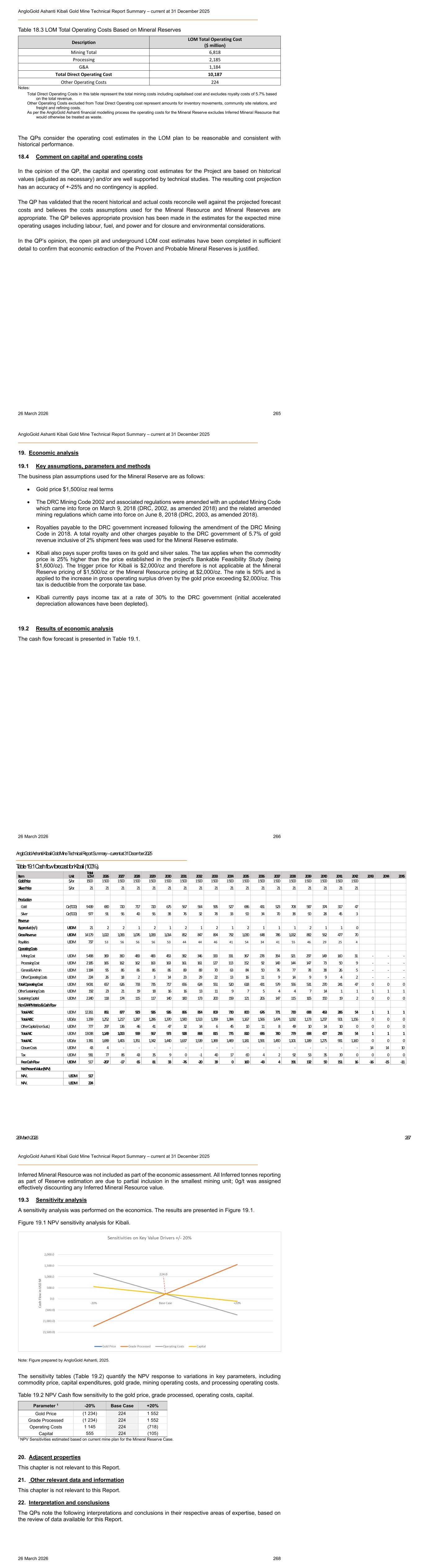
AngloGold Ashanti Kibali Gold Mine Technical Report Summary – current at 31 December 2025 ______________________________________________________________________________ 26 March 2026 265 Table 18.3 LOM Total Operating Costs Based on Mineral Reserves Description LOM Total Operating Cost ($ million) Mining Total 6,818 Processing 2,185 G&A 1,184 Total Direct Operating Cost 10,187 Other Operating Costs 224 Notes: Total Direct Operating Costs in this table represent the total mining costs including capitalised cost and excludes royalty costs of 5.7% based on the total revenue. Other Operating Costs excluded from Total Direct Operating cost represent amounts for inventory movements, community site relations, and freight and refining costs. As per the AngloGold Ashanti financial modelling process the operating costs for the Mineral Reserve excludes Inferred Mineral Resource that would otherwise be treated as waste. The QPs consider the operating cost estimates in the LOM plan to be reasonable and consistent with historical performance. 18.4 Comment on capital and operating costs In the opinion of the QP, the capital and operating cost estimates for the Project are based on historical values (adjusted as necessary) and/or are well supported by technical studies. The resulting cost projection has an accuracy of +-25% and no contingency is applied. The QP has validated that the recent historical and actual costs reconcile well against the projected forecast costs and believes the costs assumptions used for the Mineral Resource and Mineral Reserves are appropriate. The QP believes appropriate provision has been made in the estimates for the expected mine operating usages including labour, fuel, and power and for closure and environmental considerations. In the QP’s opinion, the open pit and underground LOM cost estimates have been completed in sufficient detail to confirm that economic extraction of the Proven and Probable Mineral Reserves is justified. AngloGold Ashanti Kibali Gold Mine Technical Report Summary – current at 31 December 2025 ______________________________________________________________________________ 26 March 2026 266 19. Economic analysis 19.1 Key assumptions, parameters and methods The business plan assumptions used for the Mineral Reserve are as follows: • Gold price $1,500/oz real terms • The DRC Mining Code 2002 and associated regulations were amended with an updated Mining Code which came into force on March 9, 2018 (DRC, 2002, as amended 2018) and the related amended mining regulations which came into force on June 8, 2018 (DRC, 2003, as amended 2018). • Royalties payable to the DRC government increased following the amendment of the DRC Mining Code in 2018. A total royalty and other charges payable to the DRC government of 5.7% of gold revenue inclusive of 2% shipment fees was used for the Mineral Reserve estimate. • Kibali also pays super profits taxes on its gold and silver sales. The tax applies when the commodity price is 25% higher than the price established in the project's Bankable Feasibility Study (being $1,600/oz). The trigger price for Kibali is $2,000/oz and therefore is not applicable at the Mineral Reserve pricing of $1,500/oz or the Mineral Resource pricing at $2,000/oz. The rate is 50% and is applied to the increase in gross operating surplus driven by the gold price exceeding $2,000/oz. This tax is deductible from the corporate tax base. • Kibali currently pays income tax at a rate of 30% to the DRC government (initial accelerated depreciation allowances have been depleted). 19.2 Results of economic analysis The cash flow forecast is presented in Table 19.1. AngloGold Ashanti Kibali Gold Mine Technical Report Summary – current at 31 December 2025 ______________________________________________________________________________ 26 March 2026 267 Table 19.1 Cash flow forecast for Kibali (100%). Item Unit Total LOM 2026 2027 2028 2029 2030 2031 2032 2033 2034 2035 2036 2037 2038 2039 2040 2041 2042 2043 2044 2045 Gold Price $/oz 1500 1 500 1 500 1 500 1 500 1 500 1 500 1 500 1 500 1 500 1 500 1 500 1 500 1 500 1 500 1 500 1 500 1 500 Silver Price $/oz 21 21 21 21 21 21 21 21 21 21 21 21 21 21 21 21 21 21 Production Gold Oz ('000) 9 439 680 720 717 720 675 567 564 595 527 686 431 523 708 587 374 317 47 Silver Oz ('000) 977 91 96 40 96 38 76 32 78 33 90 34 70 38 90 28 45 3 Revenue By product (+/-) USD M 21 2 2 1 2 1 2 1 2 1 2 1 1 1 2 1 1 0 Gross Revenue USD M 14 179 1,022 1,083 1,076 1,083 1,014 852 847 894 792 1,030 648 786 1,062 882 562 477 70 Royalties USD M 737 53 56 56 56 53 44 44 46 41 54 34 41 55 46 29 25 4 Operating Costs Mining Cost USD M 5 498 369 360 483 483 453 382 346 333 331 367 278 354 321 297 149 160 31 - - - Processing Cost USD M 2 185 166 162 162 163 163 161 161 127 113 152 92 140 144 147 73 50 9 - - - General & Admin USD M 1 184 95 86 86 86 86 89 89 70 63 84 50 76 77 78 38 26 5 - - - Other Operating Costs USD M 224 26 18 2 3 14 23 29 22 13 16 11 9 14 9 9 4 2 - - - Total Operating Cost USD M 9 091 657 626 733 735 717 656 624 551 520 618 431 579 556 531 270 241 47 0 0 0 Other Sustaining Costs USD M 192 23 21 19 18 16 16 13 11 9 7 5 4 4 7 14 1 1 1 1 1 Sustaining Capital USD M 2 240 118 174 115 117 140 180 173 200 159 121 206 147 115 105 150 19 2 0 0 0 Non-GAAP Metrics & Cash Flow Total AISC USD M 12 261 851 877 923 926 926 896 854 809 730 800 676 771 730 688 463 286 54 1 1 1 Total AISC USD/oz 1 299 1,252 1,217 1,287 1,286 1,370 1,580 1,513 1,359 1,384 1,167 1,566 1,474 1,032 1,173 1,237 901 1,156 0 0 0 Other Capital (non Sust.) USD M 777 297 136 46 41 47 32 14 6 45 10 11 8 49 10 14 10 0 0 0 0 Total AIC USD M 13 038 1,149 1,013 969 967 973 928 868 815 775 810 686 780 779 698 477 295 54 1 1 1 Total AIC USD/oz 1 381 1,689 1,406 1,351 1,342 1,440 1,637 1,539 1,369 1,469 1,181 1,591 1,490 1,101 1,189 1,275 931 1,160 0 0 0 Closure Costs USD M 43 4 - - - - - - - - - - - - - - - - 14 14 10 Tax USD M 581 77 86 43 35 9 0 -1 40 17 60 4 2 92 53 35 30 0 0 0 0 Free Cash Flow USD M 517 -207 -17 65 81 33 -76 -20 39 0 160 -43 4 191 132 50 151 16 -16 -15 -11 Net Present Value (NPV) NPV0 USD M 517 NPV5 USD M 224 AngloGold Ashanti Kibali Gold Mine Technical Report Summary – current at 31 December 2025 ______________________________________________________________________________ 26 March 2026 268 Inferred Mineral Resource was not included as part of the economic assessment. All Inferred tonnes reporting as part of Reserve estimation are due to partial inclusion in the smallest mining unit; 0g/t was assigned effectively discounting any Inferred Mineral Resource value. 19.3 Sensitivity analysis A sensitivity analysis was performed on the economics. The results are presented in Figure 19.1. Figure 19.1 NPV sensitivity analysis for Kibali. Note: Figure prepared by AngloGold Ashanti, 2025. The sensitivity tables (Table 19.2) quantify the NPV response to variations in key parameters, including commodity price, capital expenditures, gold grade, mining operating costs, and processing operating costs. Table 19.2 NPV Cash flow sensitivity to the gold price, grade processed, operating costs, capital. Parameter 1 -20% Base Case +20% Gold Price (1 234) 224 1 552 Grade Processed (1 234) 224 1 552 Operating Costs 1 145 224 (718) Capital 555 224 (105) 1 NPV Sensitivities estimated based on current mine plan for the Mineral Reserve Case. 20. Adjacent properties This chapter is not relevant to this Report. 21. Other relevant data and information This chapter is not relevant to this Report. 22. Interpretation and conclusions The QPs note the following interpretations and conclusions in their respective areas of expertise, based on the review of data available for this Report.

AngloGold Ashanti Kibali Gold Mine Technical Report Summary – current at 31 December 2025 ______________________________________________________________________________ 26 March 2026 269 22.1 Geology and Mineral Resources • Procedures for drilling, logging, sampling, analyses, and security are in place and meet industry standards. Data validation and data verification procedures indicate that the data within the database is suitable for Mineral Resource estimation. • Significant exploration, drilling, and operational data provides a good understanding of the deposit geology as well as an understanding of the geometry, thickness, and grade continuity of the mineralisation at Kibali. • Recent drilling has advanced understanding of the geology, mineralisation, and extent of the ARK deposit. This area will be a focus for advanced exploration and study in 2026. • The total inclusive Measured and Indicated Mineral Resources, as at December 31, 2025, are estimated to be 200 Mt at 2.79 g/t Au containing 18 Moz of gold, with an additional Inferred Resource of 49 Mt at 2.1 g/t Au containing 3.3 Moz of gold (100% basis). The attributable inclusive Measured and Indicated Mineral Resources, as at December 31, 2025, are estimated to be 90 Mt at 2.79 g/t Au containing 8.1 million ounces (Moz) of gold, with an additional Inferred Resource of 22 Mt at 2.1 g/t Au containing 1.5 Moz of gold (45% basis). • The total exclusive Measured and Indicated Mineral Resources, as at December 31, 2025, are estimated to be 74 Mt at 2.4 g/t Au containing 5.7 million ounces (Moz) of gold, with an additional Inferred Resource of 49 Mt at 2.1 g/t Au containing 3.3 Moz of gold (100% basis). The attributable exclusive Measured and Indicated Mineral Resources, as at December 31, 2025, are estimated to be 33 Mt at 2.4 g/t Au containing 2.5 million ounces (Moz) of gold, with an additional Inferred Resource of 22 Mt at 2.1 g/t Au containing 1.5 Moz of gold (45% basis). • The strategic focus of exploration at Kibali is to prioritise near-surface opportunities close to the processing plant and down-plunge extensions to existing deposits. The objective is to increase years of production with complementary underground and open pit sources to meet a gold production profile target of 700 koz beyond 2030. • In 2025, SLR completed a site visit and independent review of the Mineral Resource and its informing data and processes. SLR concluded that the processes underlying the generation and declaration of the Mineral Resource are appropriate and consistent with industry best practice. 22.2 Mining and Mineral Reserves • Barrick, as the owner operator of the Project, has significant experience in other mining operations within Africa and the planned production rates, modifying factors, and costs are benchmarked against other African operations to ensure they are suitable. • The total Mineral Reserves, as at December 31, 2025, are estimated to be 110 Mt at 2.97 g/t Au containing 11 Moz Au (100% basis). The attributable Mineral Reserves, as at December 31, 2025, are estimated to be 50 Mt at 2.97 g/t Au containing 4.8 Moz Au (45% basis). • Kibali is a mature mining operation and planned production uses the same mining methods and the same types of equipment as the current operation, substantially reducing risks. • The cut-off grades, dilution, mining losses, process recoveries, and geotechnical factors used in the determination of the Mineral Reserves are appropriate and supported by historical data. • The mine designs are appropriate for both the underground and open pits, being reasonably laid out for production purposes, and having reasonably considered geological, geotechnical, and economic factors. • While subject to continuous improvements, geotechnical aspects and risks are reasonably managed through ongoing geotechnical and hydrogeological programmes, both in underground and the open pits. • The production schedule is conservative and aligns with current production rates, with the potential for improvement. • There is currently insufficient planned tailings capacity for the full LOM. The capacity of the currently permitted FTSF will be exhausted by 2032 and the capacity of the currently permitted CTSF will be exhausted by 2034. Studies are currently underway for future expansions to contain the LOM tailings AngloGold Ashanti Kibali Gold Mine Technical Report Summary – current at 31 December 2025 ______________________________________________________________________________ 26 March 2026 270 production in the form of an MAA that is being prepared by the Engineer of Record for Kibali. Given the lead time, land availability, and that prior TSF permits have been issued in good time, the current shortfall of tailings capacity is not considered to be a material risk to the Mineral Reserves. • Mine infrastructure such as ventilation, electrical power reticulation, and pumping is currently sufficient and will continue to need progressive extensions as the mine develops. • In 2025, SLR completed a site visit and external review of the Mineral Reserves and its informing data, modifying factors, mine planning, and scheduling processes. Overall, SLR concluded that the underground mine design, Mineral Reserve basis, and operational readiness were technically sound and that the production and cost assumptions underlying the reserve statement were reasonable and achievable within normal operating risk. 22.3 Mineral processing • Mineral processing and metallurgical testing fundamentals are well established at Kibali. The ore characterisation insights gained through ongoing test work and actual operations have contributed to the achievement of relatively high, consistent, and predictable gold recoveries. • Test work and gold recovery variability characterisation have resulted in provision of considerable operational flexibility and rigor within the plant processes to enable the operation to target and customise parameters appropriate for the different ore types. • The representative sampling and testing of new deposits provides a sound geometallurgical understanding of the process requirements as mining activities advance. • Recent geometallurgical test work outcomes are consistent with the identified geometallurgical controls (preg-robbing and sub-microscopic/occluded gold within sulphides). Where direct- cyanidation extractions are lower, test work demonstrates material uplift via flotation, ultrafine grinding, elevated dissolved oxygen, and adequate residence time. • Deportment data supports the dual-route strategy: (i) CIL for free-milling domains with meaningful GRG, and (ii) flotation → UFG → concentrate cyanidation (with adequate oxygenation and residence time) for domains where gold is attached/enclosed within sulphides. 22.4 Infrastructure • Kibali is a mature operation that has the necessary support infrastructure in place. • Since there is no national grid power supply to the site, Kibali is dependent on its own power generation facilities. The power supply currently comes from a combination of on-site, high-speed diesel generator sets, and three off-site hydropower stations (Nzoro II, Ambarau and Azambi). An additional 16 MW solar power plant and 16 MW and BESS are commissioned and currently undergoing optimisation. 22.5 Environment and social aspects • The ESIA for Kibali was completed in 2010 and approved in 2011. Subsequent ESIAs were consolidated, with the most recent ESIA updated and approved in 2021. • The next main ESIA update has been initiated and is due for completion by Q3 2026 to meet the regulatory requirements for an update every five years. • All ESIAs and Environmental Assessments will be incorporated into the 2026 ESIA update to ensure that Kibali operates with one consolidated ESMP for operational efficiency. • All environmental permits are in place for the Kibali processing plant, open pit and underground operations, the hydropower stations, and a permit register forms part of the ESMP. 22.6 Project economics • Using the assumptions detailed in this Report, Kibali has positive economics in the LOM plan, which confirms the economic viability of the Mineral Reserves at a US$1,500/oz gold sales price. AngloGold Ashanti Kibali Gold Mine Technical Report Summary – current at 31 December 2025 ______________________________________________________________________________ 26 March 2026 271 • The basis for the combined LOM plan is the Proven and Probable Mineral Reserve estimate documented in this Report. Cost inputs have been priced in real Q4 2025 US dollars, without any allowance for inflation. • Operating cost estimates include all operational activities required for the mining, processing, G&A costs, and off-site costs (including freight and refining, and royalties) for all forecasted production. • Capital cost estimates are based on quantities generated from the open pit and underground development requirements, on operating experience gained in the many years of current operations, and where appropriate, on equipment quotes received from manufacturers. Sustaining (replacement) capital costs reflect current price trends. • All taxes have been incorporated as appropriate. The Super Profit Tax set out in Chapter 3.3.2 is only applicable to gold prices higher than US$2,000/oz. 22.7 Risks The QPs have examined the various risks and uncertainties known or identified that could reasonably be expected to affect reliability or confidence in the exploration information, the Mineral Resources or Mineral Reserves of the Mine, or projected economic outcomes contained in this Report. They have considered the controls that are in place or proposed to be implemented and have determined the residual risk post- mitigation measures. The post-mitigation risk rating is evaluated consistent with guidance provided by Barrick’s Formal Risk Assessment Procedure (FRA) and considers the likelihood and consequence of the risk’s occurrence and impact. Table 22.1 details the significant risks and uncertainties as determined by the QPs. AngloGold Ashanti Kibali Gold Mine Technical Report Summary – current at 31 December 2025 ______________________________________________________________________________ 26 March 2026 272 Table 22.1 Kibali Risk Analysis Area Risk Mitigation Post Mitigation Risk Rating Geology and Mineral Resources Confidence in Mineral Resource Models Additional scheduled GC drilling maintaining 18 months of partial GC coverage ahead of mining. Resource model updated on a regular basis using new drilling and updated geologic interpretation. Low Mining and Mineral Reserves Open Pit Slope Stability Continued 24hr in-pit monitoring with radar, instrumentation, and continued updating of geotechnical and hydrogeology models. Minor Mining and Mineral Reserves Underground dilution control in shallow ore bodies Dilution risk for shallow angle stopes in underground to be continuously reviewed and adjusted with mining. Minor Mining and Mineral Reserves Availability of local mining skills The quality of the local mining contractors to be improved by consolidation of companies, a higher level of supervision from Kibali Goldmines, and through the dedicated training programmes in place. Minor Mining and Infrastructure LOM tailings capacity Current FTSF has permitted capacity until 2032 and CTSF has permitted capacity until 2034 so there is time to prepare for further capacity. Given the success in obtaining permissions for the existing TSFs, and the space and mined-out pits available for further deposition, this is seen as a manageable risk. Low Processing Incorrect blend fed into the processing plant. Deleterious elements, specifically arsenic, and refractory material. The blend ratios of refractory and high deleterious content materials are defined through geometallurgical test work. This mitigates risks of plant underperformance by optimising feed composition. Minor Environmental and Operational Tailings Embankment or lining system failure Robust engineering design and construction of TSF to international standards. Tailings Management Systems for rigorous operational and water management at the TSF; emergency spillway; buttressing if required. Low Capital and Operating Costs Unplanned increases to budgeted costs. Continue to track actual costs and LOM forecast costs, including considerations for inflation. Low Regulatory Changes or developments to legislative framework which impact tax and customs or operating cost base Dedicated government liaison team in Kinshasa Government participation/ownership. Medium Regulatory Permitting delays The processes to obtain and renew required permits, access, and rights are well understood by Kibali Goldmines and similar permits, access, and rights have been granted to the operations in the past. Low

AngloGold Ashanti Kibali Gold Mine Technical Report Summary – current at 31 December 2025 ______________________________________________________________________________ 26 March 2026 273 23. Recommendations The QPs have made the following recommendations. 23.1 Geology and Mineral Resources • Follow up on all recommendations from the external audit: o Closer alignment to the planned quarterly umpire sample submission with continual update of SOPs to align with the new DQMS – lower QC percentages, but enough to be statistically relevant on a monthly frequency. o Support for planned upgrades to the new core logging facility - such as roller tables, an updated photography station, and improved bulk density measurement areas (including auto capture of weights) to further enhance workflow and data quality. • Complete the transition from explicit strings to implicit lithological and estimation domain modelling. Upskill production geologists to transition ownership of 3D lithological interpretations as the final output of the mine geology team. • Incorporate both geotechnical/structural and hydrogeological models into the same Leapfrog Resource Model workspaces to ensure seamless compatibility. • Continue to improve geometallurgical understanding through integration of multi-element data to potentially improve recoveries and process costs. • Follow existing resource definition drilling and maintain infill grade control coverage at targeted levels. • The classification boundary between Indicated and Inferred Mineral Resources should continuously be revisited, using Mineral Reserve stope design corrections to ensure Inferred mineralisation is not included. • Continue with planned advanced exploration at the ARK deposit. • Investigate the use of downhole geophysical logging tools to further improve mineral deposit knowledge and local bulk density estimates (use of Acoustic/Optical Televiewer, calliper paired with magnetic susceptibility, natural gamma, and neutron gamma density tools). 23.2 Mining and Mineral Reserves • Complete a trade-off study of mining options for the emerging ARK deposit. • Review opportunities to reduce open pit mining costs using in-pit dumping and by optimising a combined production schedule, dumping schedule, and backfilling schedule. • Investigate potential mining cost reduction through changing to open pit owner mining. • Underground development needs to be resourced (employees, equipment) and supported to sustain the overall increase in development from 700 m to 1,000 m per month. • Implement early test stopes in the flatter zones of the underground orebody to validate the underlying assumptions. 23.3 Mineral Processing • Continue geometallurgical refinement of new satellite deposits to ensure that the plant performance remains optimal for both sulphide and free-milling ores. • Review metallurgical predictions against actual processing performance. Use the accumulated data to fine-tune operational strategies. • Continue to implement the established blending strategy by stockpiling different ore sources separately. This is essential for controlling deleterious elements (e.g., arsenic), maintaining consistent feed grades, and optimising recovery based on oxidation level and geometallurgical characteristics. • Continue cyanide destruction optimisation as part of continuous improvement of Kibali. AngloGold Ashanti Kibali Gold Mine Technical Report Summary – current at 31 December 2025 ______________________________________________________________________________ 26 March 2026 274 23.4 Infrastructure • Continue to investigate opportunities to decrease the Mine’s reliance on thermal power, improve grid stability, and potentially reduce operating costs in dry season, by increasing current battery storage capacity integration with the current power model, and commence a feasibility study on solar power. • Complete a current and future infrastructure review linked to the ARK opportunity. • Ensure housing and support services are aligned to the expanding demand of the operation. 23.5 Environment, permitting, and social and community • Continue to engage with authorities and surrounding stakeholders through the Stakeholder Engagement Plan. • Continue to update the ESIA and ESMPs as required by legislation every five years and more often when there are significant changes to the operations. • Update the water balance to include expected operational changes from the in-pit tailings deposition project. • Implement the current renewable energy initiatives to reduce the impact to climate change. Investigate opportunities to reduce mobile equipment related impacts to climate change. 24. References 24.1 References Allibone, A., Vargas C., Mwandale E., Kwibisa J., Jongens R., Quick S., Komarnisky N., Fanning M., Bird P., MacKenzie D., Turnbull R., and Holliday J. (2020). Orogenic Gold Deposits of the Kibali District, Neoarchean Moto Belt, Northeastern Democratic Republic Allibone, A.H., and Vargas, C.A. (2017). Geological setting and prospectivity of the KZ trend, Moto belt, DR Congo: St. Helier, Jersey, Channel Islands, Randgold Resources Ltd., Unpublished report, 124 p. Applied Geomechanics Consulting (2020). Life-of-mine deformation & stability assessment for Kibali. Barrick, (2022). Technical Report on the Kibali Gold Mine, Democratic Republic of the Congo. Barrick, (2024). Beyond the Horizon. Sustainability Report 2020. https://s25.q4cdn.com/322814910/files/doc_downloads/sustainability/Barrick_Sustainability_Report_2024.p df Beck Engineering (2018a). Life of Mine Deformation & Stability Assessment for Kibali. Report dated 04 July 2018. Beck Engineering (2018b). Assessment of Revised Life of Mine Sequence for Kibali. Letter Report dated 04 July 2018. Beck Engineering (2023). Kibali Life of Mine Numerical Model Update Beck Engineering (2025). Life of Mine Global Stability Assessment for the Kibali and Gorumbwa Mines Bird, P.J., 2016, Evolution of the Kibali granite-greenstone belt, northeast Democratic Republic of the Congo, and controls on gold mineralisation at the Kibali gold deposit: Unpublished Ph.D. thesis, London, Kingston University, 307 p. Canadian Dam Association (2019). Bulletin - Application of Dam Safety Guidelines for Mining Dams 2019 Edition. . AngloGold Ashanti Kibali Gold Mine Technical Report Summary – current at 31 December 2025 ______________________________________________________________________________ 26 March 2026 275 Coffey Mining (2013). Kibali Gold SA 3D Mine Wide Numerical Modelling – Stage 1. Report dated 11 March 2013. Coffey Mining (2014). Kibali Gold SA 3D Mine Wide Numerical Modelling – Stage 2. Report dated 31 March 2014. Dempers & Seymour (2017). Kibali Project Mining Rock Mass Model Update. Report dated March 2017. Dempers & Seymour (2017). Kibali Project Mining Rock Mass Model Update. Report dated September 2017. Dempers & Seymour (2018). Kibali Project Mining Rock Mass Model Update. Report dated December 2018. Dempers & Seymour (2023). Barrick Gold Corporation Kibali Gold Mine 11000 Lode SGSM and MRMM Updates Digby Wells Environmental (2011). Kibali ESIA 2011. Digby Wells Environmental (2012). Environmental and Social Impact Assessment for two hydropower stations on the Kibali River. October 2012. Digby Wells Environmental (2013). Resettlement Action Plan Audit Report March 2013. Digby Wells Environmental (2015). Kibali Stakeholder Engagement Plan July 2015. Digby Wells Environmental (2015). Resettlement Policy Framework and Action Plan for the Ambarau Hydropower Project. Kibali Gold Mine - Ambarau Hydropower Project. Digby Wells Environmental (2016). Kibali ESIA Megi Update 2016. Digby Wells Environmental (2016). Site Report - Gorumbwa Resettlement Review, and Monitoring and Evaluation Framework Development. Digby Wells Environmental (2020). Kibali Gold Mine Project Update and Assessment of the Kalimva-Ikamva Satellite Pits, Environmental and Social Impact Assessment Report. Report dated October 2020. Digby Wells Environmental (2023). Impact Assessment for the solar plant at Kibali Gold Mine. November 2023. Digby Wells Environmental (2024). Environmental and Social Impact Assessment for CTSF Phase 3 at Kibali Gold Mine. February 2024. Digby Wells Environmental (2024). ESIA for the Exploitation Of The Ndala Deposit At Kibali Gold Mine. September 2024. Digby Wells Environmental (2025). Annual Closure Cost Assessment. DRC (2002). Law No. 007/2002 of 11 July 2002 (Mining Code), as amended by Law No. 18/001 of 9 March 2018. DRC (2003). Decree No. 038/2003 of 26 March 2003 implementing the Mining Code, as amended and supplemented by Decree No. 18/024 of 8 June 2018. Epoch Resources (2024). CTSF 3 Phase 1 Design Document. Hutchinson, D.J. and Diederichs, M.S. (1996). Cablebolting in Underground Mines. Bi Tech Publishers, Richmond. ICMI, (2021). The International Cyanide Management Code. International Cyanide Management Institute. June 2021. AngloGold Ashanti Kibali Gold Mine Technical Report Summary – current at 31 December 2025 ______________________________________________________________________________ 26 March 2026 276 ICMM, (2010). Working Together. How large-scale mining can engage with artisanal and small-scale miners.https://www.icmm.com/website/publications/pdfs/social-performance/2010/guidance_artisanal- small-scale-mining.pdf Jongens, R., Allibone, A.H., and Vargas, C.A. (2016). Geology and controls on the location of the 5000 and 9000 series lodes, KCD gold deposit, Kibali: St. Helier, Jersey, Channel Islands, Randgold Resources Ltd., Unpublished report, 53 p. Kijko, A (2022). Deterministic and Probabilistic Seismic Hazard Analysis for Kibali Gold Mine, DRC (Extended Study). Rev: 11 December 2022 (1.00). Prepared by Natural Hazard Assessment Consultancy (Pty) Ltd. KSCA Geomechanics Pty Ltd (2012). A Review of the SRK Consulting Kibali Underground Geotechnical Feasibility Study Report (Rev0) dated February 2012. KSCA Geomechanics Pty Ltd (2016). Kibali Stope Performance Database. Excel spread sheet dated 03 September 2016. KSCA Geomechanics Pty Ltd (2017). Kibali Gold Mine Stope Performance (Stability Graphs). Report dated April 2017. KSCA Geomechanics Pty Ltd (2018). Kibali Gold Mine Stope Performance (Stability Graphs). Report dated January 2018. KSCA Geomechanics Pty Ltd (2023). Kibali Underground Ground Control Management Plan. KSCA Geomechanics Pty Ltd (2024). Kibali Gold Mine (Barrick Africa and the Middle East) Underground Geotechnical Site Visit. Lawrence, D.M. (2011). Gold deportment studies on the Karagba-Chauffeur-Durba deposit, Kibali, NE Democratic Republic of Congo: St. Helier, Jersey, Channel Islands, Randgold Resources Ltd., Unpublished report, 44 Laubscher, D. H. (1990). Mine Design: A Geomechanics Classification System for the Rating of Rock Mass in Mine Design. Journal of the South African Institute of Mining & Metallurgy, 10, 257-272. Randgold Resources Ltd (2009). Technical Report NI 43-101 Kibali Gold Project in the Democratic Republic of Congo. SLR USA Advisory Inc. (2025). Kibali Goldmine. 2025 Resource and Reserve Review. November, 2025. SRK Consulting (2011). Kibali Underground Geotechnical Feasibility Study report (Rev0) dated November 2011. Turnbull, R., Allibone, A.H., Fanning, C.M., and Matheys, F. (2017). Geochronology, isotope chemistry, and relative prospectivity of Archean rocks in the northeast Democratic Republic of Congo, central Africa: St. Helier, Jersey, Channel Islands, Randgold Resources Ltd, Unpublished report, 79 p. Western Australian School of Mines (2011). Stress measurements from oriented core using the acoustic emission method – Kibali Gold Mine. Report to Randgold Resources, April 2011. Western Australian School of Mines (2012). Stress Measurements from Oriented Core using the Acoustic Emission Method. Report to Dempers & Seymour, December 2012. Western Australian School of Mines (2020). Stress Measurements from Oriented Core using the Acoustic Emission Method. Report to Kibali Gold Mines SPRL, May 2020. Western Australian School of Mines (2023). Report on Rock Properties Testing.

AngloGold Ashanti Kibali Gold Mine Technical Report Summary – current at 31 December 2025 ______________________________________________________________________________ 26 March 2026 277 24.2 Glossary of terms All-in costs (AIC): All-in cost refers to the total expenses associated with completing a transaction, project, or obtaining a loan, inclusive of all direct and indirect costs. AIC includes growth capital and exploration cost for new deposits and or expansions. All-in sustaining costs (AISC): AISC is a non-GAAP measure which is an extension of the existing “total cash costs” metric and incorporates all costs related to sustaining production and recognises sustaining capital expenditures associated with developing and maintaining gold mines. In addition, the metric includes the cost associated with corporate office structures that support these operations, the community and environmental rehabilitation costs attendant with responsible mining and any exploration and evaluation cost associated with sustaining current operations. AISC includes stay-in-business capital and items of capital nature and excludes growth capital. By-products: Any potentially economic or saleable products that emanate from the core process of producing gold or copper, including silver, molybdenum and sulphuric acid. Capital expenditure: Capital expenditures are the funds companies allocate to acquire, upgrade, and maintain essential physical assets like property, technology, or equipment, crucial for expanding operational capacity and securing long-term economic benefits. Carbon-in-leach (CIL): Gold is leached from a slurry of ore where cyanide and carbon granules are added to the same agitated tanks. The gold loaded carbon granules are separated from the slurry and treated in an elution circuit to remove the gold. Carbon-in-pulp (CIP): Gold is leached conventionally from a slurry of ore with cyanide in agitated tanks. The leached slurry then passes into the CIP circuit where activated carbon granules are mixed with the slurry and gold is adsorbed on to the activated carbon. The gold-loaded carbon is separated from the slurry and treated in an elution circuit to remove the gold. Comminution: Comminution is the crushing and grinding of ore to make gold available for physical or chemical separation (see also “Milling”). Contained gold: The total gold content (tonnes multiplied by grade) of the material being described. Cut-off grade: Cut-off grade is the grade (i.e., the concentration of metal or mineral in rock) that determines the destination of the material during mining. For purposes of establishing “prospects of economic extraction,” the cut-off grade is the grade that distinguishes material deemed to have no economic value (it will not be mined in underground mining or if mined in surface mining, its destination will be the waste dump) from material deemed to have economic value (its ultimate destination during mining will be a processing facility). Other terms used in similar fashion as cut-off grade include net smelter return, pay limit, and break- even stripping ratio. Depletion: The decrease in the quantity of ore in a deposit or property resulting from extraction or production. Development: The process of accessing an orebody through shafts and/or tunnelling in underground mining operations. Development stage property: A development stage property is a property that has Mineral Reserve disclosed, but no material extraction. Diorite: An igneous rock formed by the solidification of molten material (magma). Doré: Impure alloy of gold and silver produced at a mine to be refined to a higher purity. Economically viable: Economically viable, when used in the context of Mineral Reserve determination, means that the Qualified Person has determined, using a discounted cash flow analysis, or has otherwise analytically determined, that extraction of the Mineral Reserve is economically viable under reasonable investment and market assumptions. AngloGold Ashanti Kibali Gold Mine Technical Report Summary – current at 31 December 2025 ______________________________________________________________________________ 26 March 2026 278 Electrowinning: A process of recovering gold from solution by means of electrolytic chemical reaction into a form that can be smelted easily into gold bars. Elution: Recovery of the gold from the activated carbon into solution before zinc precipitation or electrowinning. Exploration results: Exploration results are data and information generated by mineral exploration programmes (i.e., programmes consisting of sampling, drilling, trenching, analytical testing, assaying, and other similar activities undertaken to locate, investigate, define or delineate a mineral prospect or mineral deposit) that are not part of a disclosure of Mineral Resource or Mineral Reserve. A registrant must not use exploration results alone to derive estimates of tonnage, grade, and production rates, or in an assessment of economic viability. Exploration stage property: An exploration stage property is a property that has no Mineral Reserve disclosed. Exploration target: An exploration target is a statement or estimate of the exploration potential of a mineral deposit in a defined geological setting where the statement or estimate, quoted as a range of tonnage and a range of grade (or quality), relates to mineralisation for which there has been insufficient exploration to estimate a Mineral Resource. Feasibility study: A feasibility study is a comprehensive technical and economic study of the selected development option for a mineral project, which includes detailed assessments of all applicable modifying factors, as defined by this section, together with any other relevant operational factors, and detailed financial analyses that are necessary to demonstrate, at the time of reporting, that extraction is economically viable. The results of the study may serve as the basis for a final decision by a proponent or financial institution to proceed with, or finance, the development of the project. A feasibility study is more comprehensive, and with a higher degree of accuracy, than a pre-feasibility study. It must contain mining, infrastructure, and process designs completed with sufficient rigour to serve as the basis for an investment decision or to support project financing. The confidence level in the results of a feasibility study is higher than the confidence level in the results of a pre-feasibility study. Terms such as full, final, comprehensive, bankable, or definitive feasibility study are equivalent to a feasibility study. Flotation: Concentration of gold and gold-hosting minerals into a small mass by various techniques (e.g. collectors, frothers, agitation, air-flow) that collectively enhance the buoyancy of the target minerals, relative to unwanted gangue, for recovery into an over-flowing froth phase. Gold produced or gold production: Refined gold in a saleable form derived from the mining process. Grade: The quantity of ore contained within a unit weight of mineralised material generally expressed in grams per metric tonne (g/t) or ounce per short ton for gold bearing material. Greenschist: A schistose metamorphic rock whose green colour is due to the presence of chlorite, epidote or actinolite. Indicated Mineral Resource: An Indicated Mineral Resource is that part of a Mineral Resource for which quantity and grade or quality are estimated on the basis of adequate geological evidence and sampling. The level of geological certainty associated with an Indicated Mineral Resource is sufficient to allow a Qualified Person to apply modifying factors in sufficient detail to support mine planning and evaluation of the economic viability of the deposit. Because an Indicated Mineral Resource has a lower level of confidence than the level of confidence of a Measured Mineral Resource, an Indicated Mineral Resource may only be converted to a Probable Mineral Reserve. Inferred Mineral Resource: An Inferred Mineral Resource is that part of a Mineral Resource for which quantity and grade or quality are estimated on the basis of limited geological evidence and sampling. The level of geological uncertainty associated with an Inferred Mineral Resource is too high to apply relevant technical and economic factors likely to influence the prospects of economic extraction in a manner useful for evaluation of economic viability. Because an Inferred Mineral Resource has the lowest level of geological confidence of all Mineral Resource, which prevents the application of the modifying factors in a manner useful for evaluation of economic viability, an Inferred Mineral Resource may not be considered when assessing the economic viability of a mining project, and may not be converted to a Mineral Reserve. AngloGold Ashanti Kibali Gold Mine Technical Report Summary – current at 31 December 2025 ______________________________________________________________________________ 26 March 2026 279 Initial assessment (also known as concept study, scoping study, conceptual study and preliminary economic assessment): An initial assessment is a preliminary technical and economic study of the economic potential of all or parts of mineralisation to support the disclosure of Mineral Resource. The initial assessment must be prepared by a Qualified Person and must include appropriate assessments of reasonably assumed technical and economic factors, together with any other relevant operational factors, that are necessary to demonstrate at the time of reporting that there are reasonable prospects for economic extraction. An initial assessment is required for disclosure of Mineral Resource but cannot be used as the basis for disclosure of Mineral Reserve. Leaching: Dissolution of gold from crushed or milled material, including reclaimed slime, prior to adsorption on to activated carbon or direct zinc precipitation. Life of mine (LOM): Number of years for which an operation is planning to mine and treat ore, and is taken from the current mine plan. Measured Mineral Resource: A Measured Mineral Resource is that part of a Mineral Resource for which quantity and grade or quality are estimated on the basis of conclusive geological evidence and sampling. The level of geological certainty associated with a Measured Mineral Resource is sufficient to allow a qualified person to apply modifying factors, as defined in this section, in sufficient detail to support detailed mine planning and final evaluation of the economic viability of the deposit. Because a Measured Mineral Resource has a higher level of confidence than the level of confidence of either an Indicated Mineral Resource or an Inferred Mineral Resource, a Measured Mineral Resource may be converted to a Proven Mineral Reserve or to a Probable Mineral Reserve. Metallurgical plant / gold plant / plant: A processing plant constructed to treat ore and extract gold (and, in some cases, often valuable by-products). Metallurgical recovery factor (MetRF): A measure of the efficiency in extracting gold or silver from the ore. Milling: A process of reducing broken ore to a size at which concentrating or leaching can be undertaken (see also “Comminution”). Mine call factor (MCF): The ratio, expressed as a percentage, of the total quantity of recovered and unrecovered mineral product after processing with the amount estimated in the ore based on sampling. The ratio of contained gold delivered to the metallurgical plant divided by the estimated contained gold of ore mined based on sampling. Mineralisation: The process or processes by which a mineral or minerals are introduced into rock, resulting in a potentially valuable deposit. Mineral deposit: A mineral deposit is a concentration (or occurrence) of material of possible economic interest in or on the earth’s crust. Mineral Reserve: A Mineral Reserve is an estimate of tonnage and grade or quality of Indicated and Measured Mineral Resource that, in the opinion of the Qualified Person, can be the basis of an economically viable project. More specifically, it is the economically mineable part of a Measured or Indicated Mineral Resource, which includes diluting materials and allowances for losses that may occur when the material is mined or extracted. Mineral Reserve is subdivided in order of increasing confidence into Probable Mineral Reserve and Proven Mineral Reserve. Mineral Reserve is aggregated from the Proven and Probable Mineral Reserve categories. A Measured Mineral Resource may be converted to either a Proven Mineral Reserve or a Probable Mineral Reserve depending on uncertainties associated with modifying factors that are taken into account in the conversion from Mineral Resource to Mineral Reserve. The Mineral Reserve tonnages and grades are estimated and reported as delivered to plant (i.e., the point where material is delivered to the processing facility). AngloGold Ashanti Kibali Gold Mine Technical Report Summary – current at 31 December 2025 ______________________________________________________________________________ 26 March 2026 280 Mineral Resource: A Mineral Resource is a concentration or occurrence of material of economic interest in or on the Earth's crust in such form, grade or quality, and quantity that there are reasonable prospects for economic extraction. A Mineral Resource is a reasonable estimate of mineralisation, taking into account relevant factors such as cut-off grade, likely mining dimensions, location or continuity, that, with the assumed and justifiable technical and economic conditions, is likely to, in whole or in part, become economically extractable. It is not merely an inventory of all mineralisation drilled or sampled. Mineral Resource is subdivided and must be so reported, in order of increasing confidence in respect of geoscientific evidence, into Inferred, Indicated or Measured categories. The Mineral Resource tonnages and grades are reported in situ and stockpiled material is reported as broken material. Mining recovery factor (MRF): This factor reflects a mining efficiency factor relating the recovery of material during the mining process and is the variance between the tonnes called for in the mining design and what the plant receives. It is expressed in both a grade and tonnage number. Modifying factors: Modifying factors are the factors that a Qualified Person must apply to Indicated and Measured Mineral Resource and then evaluate in order to establish the economic viability of Mineral Reserve. A Qualified Person must apply and evaluate modifying factors to convert Measured and Indicated Mineral Resource to Proven and Probable Mineral Reserve. These factors include but are not restricted to: Mining; processing; metallurgical; infrastructure; economic; marketing; legal; environmental compliance; plans, negotiations, or agreements with local individuals or groups; and governmental factors. The number, type and specific characteristics of the modifying factors applied will necessarily be a function of and depend upon the mineral, mine, property, or project. Non-sustaining capital (expenditure): Non-sustaining capital (expenditure) is a non-GAAP measure comprising capital expenditure incurred at new operations and capital expenditure related to ‘major projects’ at existing operations where these projects will materially increase production. Open pit mining: An excavation made at the surface of the ground for the purpose of extracting minerals, inorganic and organic, from their natural deposits, which excavation is open to the surface. Operating expenditure: An operating expense is an expenditure that a business incurs as a result of performing its normal business operations. Operating expenses differ from capital expenses, which are involved with acquiring or upgrading assets over time, and non-operating expenses, which are not related to core business activities. Ounce (oz) (troy): Used in imperial statistics for the standard measurement of mass specifically for precious metals. A kilogram is equal to 32.1507 ounces. A troy ounce is equal to 31.1035 grams. Pay limit: The grade of a unit of ore at which the revenue from the recovered mineral content of the ore is equal to the sum of total cash costs, closure costs, Mineral Reserve development and sustaining capital. This grade is expressed as an in situ value in grams per tonne or ounces per short ton (before dilution and mineral losses). Precipitate: The solid product formed when a change in solution chemical conditions results in conversion of some pre-dissolved ions into solid state. Preliminary feasibility study (pre-feasibility study): is a comprehensive study of a range of options for the technical and economic viability of a mineral project that has advanced to a stage where a Qualified Person has determined (in the case of underground mining) a preferred mining method, or (in the case of surface mining) a pit configuration, and in all cases has determined an effective method of mineral processing and an effective plan to sell the product. A pre-feasibility study includes a financial analysis based on reasonable assumptions, based on appropriate testing, about the modifying factors and the evaluation of any other relevant factors that are sufficient for a Qualified Person to determine if all or part of the Indicated and Measured Mineral Resource may be converted to Mineral Reserve at the time of reporting. The financial analysis must have the level of detail necessary to demonstrate, at the time of reporting, that extraction is economically viable. A pre-feasibility study is less comprehensive and results in a lower confidence level than a feasibility study. A pre-feasibility study is more comprehensive and results in a higher confidence level than an initial assessment.
AngloGold Ashanti Kibali Gold Mine Technical Report Summary – current at 31 December 2025 ______________________________________________________________________________ 26 March 2026 281 Probable Mineral Reserve: A Probable Mineral Reserve is the economically mineable part of an Indicated and, in some cases, a Measured Mineral Resource. The confidence in the modifying factors applying to a Probable Mineral Reserve is lower than that applying to a Proven Mineral Reserve. The degree of assurance, although lower than that for Proven Mineral Reserve, is high enough to assume continuity between points of observation. Production stage property: A production stage property is a property with material extraction of Mineral Reserve. Productivity: An expression of labour productivity based on the ratio of ounces of gold produced per month to the total number of employees in mining operations. Proven Mineral Reserve: A Proven Mineral Reserve is the economically mineable part of a Measured Mineral Resource and can only result from conversion of a Measured Mineral Resource. A Proven Mineral Reserve implies a high degree of confidence in the modifying factors. Qualified Person: A Qualified Person is an individual who is (1) a mineral industry professional with at least five years of relevant experience in the type of mineralisation and type of deposit under consideration and in the specific type of activity that person is undertaking on behalf of the registrant; and (2) an eligible member or licencee in good standing of a recognised professional organisation at the time the technical report is prepared. Section 229.1300 of Regulation S-K 1300 details further recognised professional organisations and also relevant experience. Quartz: A hard mineral consisting of silica dioxide found widely in all rocks. Recovered grade: The recovered mineral content per unit of ore treated. Refining: The final purification process of a metal or mineral. Regulation S-K 1300: Subpart 1300 of Regulation S-K (17 CFR § 229.1300) which contains the SEC’s mining property disclosure requirements for mining registrants. Rehabilitation: The process of reclaiming land disturbed by mining to allow an appropriate post-mining use. Rehabilitation standards are defined by country-specific laws, including but not limited to the US Bureau of Land Management, the US Forest Service, and the relevant Australian mining authorities, and address among other issues, ground and surface water, topsoil, final slope gradient, waste handling and re- vegetation issues. Resource modification factor (RMF): This factor is applied when there is an historic reconciliation discrepancy in the Mineral Resource model. For example, between the Mineral Resource model tonnage and the grade control model tonnage. It is expressed in both a grade and tonnage number. Scats: Within the metallurgical plants, scats is a term used to describe ejected ore or other uncrushable / grinding media arising from the milling process. This, typically oversize material (ore), is ejected from the mill and stockpiled or re-crushed via a scats retreatment circuit. Retreatment of scats is aimed at fracturing the material such that it can be returned to the mills and processed as with the other ores to recover the gold locked up within this oversize material. Seismic event: A sudden inelastic deformation within a given volume of rock that radiates detectable seismic energy. Shaft: A vertical or subvertical excavation used for accessing an underground mine; for transporting personnel, equipment and supplies; for hoisting ore and waste; for ventilation and utilities; and/or as an auxiliary exit. Smelting: A pyro-metallurgical operation in which gold precipitate from electro-winning or zinc precipitation is further separated from impurities. AngloGold Ashanti Kibali Gold Mine Technical Report Summary – current at 31 December 2025 ______________________________________________________________________________ 26 March 2026 282 Stay-in-business capital (or sustaining capital): Refers to funds used to maintain existing assets and operations to ensure continued service. These expenditures, often categorised as maintenance capital expenditure, are crucial for replacing old equipment, ensuring safety compliance, and improving operational efficiency without necessarily driving growth. Stoping: The process of excavating ore underground. Stripping ratio: The ratio of waste tonnes to ore tonnes mined calculated as total tonnes mined less ore tonnes mined divided by ore tonnes mined. Sustaining capital (expenditure): Sustaining capital (expenditure) is a non-GAAP measure comprising capital expenditure incurred to sustain and maintain existing assets at their current productive capacity in order to achieve constant planned levels of productive output and capital expenditure to extend useful lives of existing production assets. This includes replacement of vehicles, plant and machinery, Mineral Reserve development, deferred stripping and capital expenditure related to financial benefit initiatives, safety, health and the environment. Tailings: Finely ground rock of low residual value from which valuable minerals have been extracted. Tailings storage facility/facilities (TSF): Facilities designed to store discarded tailings. Tonnage: Quantity of material measured in tonnes. Tonne: Used in metric statistics. Equal to 1,000 kilograms. Total cash costs: Total cash costs is a non-GAAP metric and, as calculated and reported by AngloGold Ashanti, includes costs for all mining, processing, onsite administration costs, royalties and production taxes, as well as contributions from by-products, but exclude amortisation of tangible, intangible and right of use assets, rehabilitation costs and other non-cash costs, retrenchment costs, corporate administration, marketing and related costs, capital costs and exploration costs. Underground mining: The extraction of rocks, minerals and industrial materials, other than coal, oil and gas, from the Earth by developing entries or shafts from the surface to the seam or deposit before recovering the product by underground extraction methods. Waste: Material that contains insufficient mineralisation for consideration for future treatment and, as such, is discarded. Yield: The amount of valuable mineral or metal recovered from each unit mass of ore expressed as ounces per short ton or grams per metric tonne. Zinc precipitation: Zinc precipitation is the chemical reaction using zinc dust that converts gold in solution to a solid form for smelting into unrefined gold bars. 24.3 Abbreviations and acronyms Units of measurement used in this Report conform to the metric system. All currency in this Report is in US dollars (US$ or $) unless otherwise noted. Abbreviations used in this Report are included below. Unit Measure Unit Measure g microgram kt thousand metric tonnes m micron kVA kilovolt-amperes °C degree Celsius kW kilowatt °F degree Fahrenheit kWh kilowatt-hour A ampere L litre a annum L/s litres per second bbl barrels m metre BCM Bank cubic metre M mega (million) Btu British thermal units m2 square metre AngloGold Ashanti Kibali Gold Mine Technical Report Summary – current at 31 December 2025 ______________________________________________________________________________ 26 March 2026 283 Unit Measure Unit Measure C$ Canadian dollars m3 cubic metre cal calorie m3/h cubic metres per hour cfm cubic feet per minute Ma million years ago cm centimetre min minute cm2 square centimetre MASL metres above sea level d day mm millimetre dia. Diameter Moz million ounces dmt dry metric tonne mph miles per hour dwt dead-weight ton Mt million metric tonnes ft foot Mtpa million metric tonnes per annum ft/s feet per second MVA megavolt-amperes ft2 square foot MW megawatt ft3 cubic foot MWh megawatt-hour g gram opt, oz/st ounces per short ton G giga (billion) oz Troy ounce (31.10348 g) Gal Imperial gallon ppm parts per million g/L grams per litre psia pounds per square inch absolute g/t grams per tonne psig pounds per square inch gauge gpm Imperial gallons per minute RL relative elevation gr/ft3 grains per cubic foot s second gr/m3 grains per cubic metre st short ton hr hour stpa short tons per annum ha hectare stpd short tons per day hp horsepower t metric tonne in inch tpa metric tonnes per annum in2 square inch tpd metric tonnes per day J joule tph metric tonnes per hour k kilo (thousand) US$, USD United States dollar kcal kilocalorie USg United States gallon kg kilogram USgpm US gallon per minute km kilometre V volt km/h kilometres per hour W watt km2 square kilometre wmt wet metric tonne koz thousand ounces yd3 cubic yard kPa kilopascal yr year 25. Reliance on information provided by the registrant No information was provided by the registrant for this Report.