☐REGISTRATION STATEMENT PURSUANT TO SECTION 12(b) OR (g) OF THE SECURITIES EXCHANGE ACT OF 1934
OR
☒ANNUAL REPORT PURSUANT TO SECTION 13 OR 15(d) OF THE SECURITIES EXCHANGE ACT OF 1934 For the fiscal year ended December 31, 2025
OR
☐TRANSITION REPORT PURSUANT TO SECTION 13 OR 15(d) OF THE SECURITIES EXCHANGE ACT OF 1934 For the transition period from to .
OR
☐SHELL COMPANY REPORT PURSUANT TO SECTION 13 OR 15(d) OF THE SECURITIES EXCHANGE ACT OF 1934 Date of event requiring this shell company report
Commission file number: 001-41889
Cadeler A/S (Exact name of Registrant as specified in its charter)
Not applicable (Translation of Registrant’s name into English)
The Kingdom of Denmark (Jurisdiction of incorporation or organization)
Kalvebod Brygge 43
DK-1560Copenhagen, Denmark (Address of principal executive offices)
Alexander W. Simmonds Chief Legal Officer +453246 3100 alexander.simmonds@cadeler.com Kalvebod Brygge 43 DK-1560Copenhagen, Denmark (Name, Telephone, E-mail and/or Facsimile number and Address of Company Contact Person)
Securities registered or to be registered pursuant to Section 12(b) of the Act:
Title of each class
Trading Symbol(s):
Name of each exchange on which registered
Cadeler ordinary shares, with a nominal value of DKK 1.00 per share
New York Stock Exchange(1)
American Depositary Shares, each representing four (4) ordinary shares
CDLR
New York Stock Exchange
(1) Not for trading, but only in connection with the registration of American Depositary Shares, pursuant to the requirements of the Securities and Exchange Commission.
Securities registered or to be registered pursuant to Section 12(g) of the Act:
None
Securities for which there is a reporting obligation pursuant to Section 15(d) of the Act:
None
Indicate the number of outstanding shares of each of the issuer’s classes of capital or common stock as of the close of the period covered by the annual report.
The number of outstanding shares as of December 31, 2025 was:
Title of Class
Number of Shares Outstanding
Ordinary shares, with a nominal value of DKK 1.00 per share
350,957,583
Indicate by check mark if the registrant is a well-known seasoned issuer, as defined in Rule 405 of the Securities Act.
Yes☒No ☐
If this report is an annual or transition report, indicate by check mark if the registrant is not required to file reports pursuant to Section 13 or 15(d) of the Securities Exchange Act of 1934.
Yes ☐No☒
Note – Checking the box above will not relieve any registrant required to file reports pursuant to Section 13 or 15(d) of the Securities Exchange Act of 1934 from their obligations under those Sections.
Indicate by check mark whether the registrant (1) has filed all reports required to be filed by Section 13 or 15(d) of the Securities Exchange Act of 1934 during the preceding 12 months (or for such shorter period that the registrant was required to file such reports), and (2) has been subject to such filing requirements for the past 90 days.
Yes☒No ☐
Indicate by check mark whether the registrant has submitted electronically every Interactive Data File required to be submitted pursuant to Rule 405 of Regulation S-T (§232.405 of this chapter) during the preceding 12 months (or for such shorter period that the registrant was required to submit such files).
Yes☒No ☐
Indicate by check mark whether the registrant is a large accelerated filer, an accelerated filer, a non-accelerated filer, or an emerging growth company. See definition of “large accelerated filer,” “accelerated filer,” and “emerging growth company” in Rule 12b-2 of the Exchange Act. (Check one):
Large Accelerated Filer☒Accelerated Filer☐Non-accelerated Filer☐Emerging growth company ☐
If an emerging growth company that prepares its financial statements in accordance with U.S. GAAP, indicate by check mark if the registrant has elected not to use the extended transition period for complying with any new or revised financial accounting standards provided pursuant to Section 13(a) of the Exchange Act. ☐
The term “new or revised financial accounting standard” refers to any update issued by the Financial Accounting Standards Board to its Accounting Standards Codification after April 5, 2012.
Indicate by check mark whether the registrant has filed a report on and attestation to its management’s assessment of the effectiveness of its internal control over financial reporting under Section 404(b) of the Sarbanes-Oxley Act (15 U.S.C. 7262(b)) by the registered public accounting firm that prepared or issued its audit report. ☒
If securities are registered pursuant to Section 12(b) of the Act, indicate by check mark whether the financial statements of the registrant included in the filing reflect the correction of an error to previously issued financial statements. ☐
Indicate by check mark whether any of those error corrections are restatements that required a recovery analysis of incentive based compensation received by any of the registrant’s executive officers during the relevant recovery period pursuant to §240.10D-1(b). ☐
Indicate by check mark which basis of accounting the registrant has used to prepare the financial statements included in this filling:
☐ U.S. GAAP
☒ International Financial Reporting Standards as issued by the International Accounting Standards Board
☐ Other
If “Other” has been checked in response to the previous question, indicate by check mark which financial statement item the registrant has elected to follow.
☐ Item 17 ☐ Item 18
If this is an annual report, indicate by check mark whether the registrant is a shell company (as defined in Rule 12b-2 of the Exchange Act).
Yes ☐No ☒
(APPLICABLE ONLY TO ISSUERS INVOLVED IN BANKRUPTCY PROCEEDINGS DURING THE PAST FIVE YEARS)
Indicate by check mark whether the registrant has filed all documents and reports required to be filed by Section 12, 13 or 15(d) of the Securities Exchange Act of 1934 subsequent to the distribution of securities under a plan confirmed by a court.
In this annual report on Form 20-F (the “Annual Report on Form 20-F”) the terms “Company” and “Cadeler” refer to Cadeler A/S, a public limited liability company incorporated under the laws of Denmark, and the term “Cadeler Group” refers to Cadeler together with its subsidiaries on a consolidated basis. The term “Cadeler Shares” refers to ordinary shares of Cadeler, each with a nominal value of DKK 1.00 per share, and the term “Cadeler ADSs” refers to Cadeler’s American Depositary Shares (“ADSs”), each of which represents four (4) Cadeler Shares.
Pursuant to Rule 12b-23(a) of the Securities Exchange Act of 1934, as amended, certain information required to be included in this Annual Report on Form 20-F is being incorporated by reference from the Company’s statutory annual report for the year ended December 31, 2025, including the consolidated financial statements of the Cadeler Group included therein (the “Annual Report 2025”), and the Company’s remuneration report for the year ended December 31, 2025 (the “Remuneration Report 2025”) as specified in this Annual Report on Form 20-F. Therefore, the information in this Annual Report on Form 20-F should be read in conjunction with the Annual Report 2025 and the Remuneration Report 2025, to the extent specified (see Exhibits 15.1 and 15.2, respectively). With the exception of the items and pages so specified, the Annual Report 2025 and Remuneration Report 2025 are not being, and shall not be deemed to be, filed as part of this Annual Report on Form 20-F.
The Company publishes its financial statements in Euros (“EUR”). The terms “USD,” “U.S. dollars” and “$” refer to the currency of the United States, the term “NOK” refers to Norwegian Kroner and the term “DKK” refers to Danish kroner.
Forward-looking statements
The information set forth in this Annual Report on Form 20-F contains “forward-looking statements” as that term is defined in the U.S. Private Securities Litigation Reform Act of 1995. These forward-looking statements are generally identified by terminology such as “believe,” “may,” “will,” “potentially,” “estimate,” “continue,” “anticipate,” “intend,” “could,” “would,” “should,” “project,” “target,” “plan,” “expect,” or the negatives of these terms or variations of them or similar terminology. The absence of these words, however, does not mean that the statements are not forward-looking. These forward-looking statements are based upon current expectations, beliefs, estimates and assumptions that, while considered reasonable as and when made by Cadeler, are, by their nature, subject to significant risks and uncertainties. In addition, new risks and uncertainties may emerge from time to time, and it is not possible to predict all such risks and uncertainties. Factors that could cause actual results to differ materially from those expressed or implied by any forward-looking statements set out herein include:
•the Cadeler Group’s limited number of vessels and its vulnerability in the event of a loss of revenue relating to any such vessel(s);
•risks inherent to Cadeler’s offshore operations,
•the possibility that the utilization of the Cadeler Group’s vessels may be lower than expected and that its backlog of contracts may fail to materialize;
•contractual and non-contractual legal risks related to the Cadeler Group’s operations which may expose the Cadeler Group to financial losses and for which the Cadeler Group may not have insurance coverage;
•risks related to the ordering, construction and delivery of new build vessels and upgrades of existing vessels;
•failure to maintain an effective system of internal control over financial reporting;
•risks relating to technical, maintenance, transportation and other commercial services supplied to the Cadeler Group by third parties;
•increased competition and volatility in demand;
•international, national or local economic, social, political or geopolitical conditions and macroeconomic factors that could adversely affect the Cadeler Group;
•risks deriving from restrictive covenants and other conditions under Cadeler’s financing arrangements and financial risks arising generally as a result of the Cadeler Group’s level of indebtedness;
•risks relating to the failure to retain and recruit key personnel and/or to labor disruptions;
•risks relating to any failure to comply with applicable laws and regulations as well as expectations regarding environmental, social and governance as well as sustainability matters;
•risks related to Danish and U.S. taxation;
•credit, interest and exchange rate risks;
•any failure to realize the anticipated benefits of the Business Combination (as defined below) and risks related to the integration of the acquired business;
•the possible dilution of Cadeler Shares and Cadeler ADSs;
•the limited rights of Cadeler ADS holders; and
•the ability of certain of the Cadeler Group’s largest shareholders to influence matters requiring shareholder approval and affect the price of the Cadeler Shares.
These and other risks and uncertainties may cause actual results to differ materially and adversely from those expressed in any forward-looking statements. Cadeler cautions you not to place undue reliance on any forward-looking statements as they are not guarantees of future performance or outcomes. Actual performance and outcomes, including, without limitation, Cadeler’s actual results of operations, financial condition and liquidity, and the development of new markets or market segments in which Cadeler operates, may differ materially from those made in or suggested by the forward-looking statements contained herein.
For additional information about factors that could cause Cadeler’s results to differ materially from those described in the forward-looking statements, please see the section hereof entitled “Risk Factors” beginning on page 3 of this Annual Report on Form 20-F.
Except as required by law, Cadeler has no duty and undertakes no obligation to update or revise any forward-looking statement or any other information contained herein after the date of this document, whether as a result of new information, future events or otherwise.
Enforceability of civil liabilities
Cadeler is a public limited company incorporated under the laws of Denmark. The majority of Cadeler’s current directors and executive officers, and certain experts named herein, reside outside the United States. All or a substantial portion of Cadeler’s assets and the assets of those non-resident persons are located outside the United States. As a result, it may not be possible for investors to effect service of process within the
United States upon Cadeler or those persons or to enforce against Cadeler or them, either inside or outside the United States, judgments obtained in U.S. courts, or to enforce in U.S. courts, judgments obtained against them in courts in jurisdictions outside the United States, in any action predicated upon the civil liability provisions of the federal securities laws of the United States.
The United States does not have a treaty with Denmark providing for reciprocal recognition and enforcement of judgments, other than arbitration awards, in civil and commercial matters. Accordingly, a final judgment for the payment of money rendered by a U.S. court based on civil liability may not be directly enforceable in Denmark. However, if the party in whose favor such final judgment is rendered brings a new lawsuit in a competent court in Denmark, that party may submit to the Danish court the final judgment that has been rendered in the United States. A judgment by a federal court or state court in the United States will neither be recognized nor enforced by a Danish court but such judgment may serve as evidence in a Danish court. It is uncertain whether Danish courts would allow actions to be predicated on the securities laws of the United States or other jurisdictions outside Denmark, and Danish courts may deny claims for punitive damages and may grant a reduced amount of damages compared to U.S. courts.
Item 1. Identity of Directors, Senior Management and Advisers
Not applicable.
Item 2. Offer Statistics and Expected Timetable
Not applicable.
Item 3. Key Information
A.[Reserved]
B.Capitalization and indebtedness
Not applicable.
C.Reasons for the offer and use of proceeds
Not applicable.
D.Risk factors
Set out below is a summary of certain risk factors which could affect the Cadeler Group’s future results and may cause them to differ from expected results materially. The factors discussed below should not be regarded as a complete and comprehensive statement of all potential risks and uncertainties that the Cadeler Group’s business faces.
Risks Related to the Cadeler Group’s Business
The Cadeler Group has a limited number of vessels and could be adversely impacted if any vessel is taken out of operation, or if there is a delay in the delivery of any new build vessel.
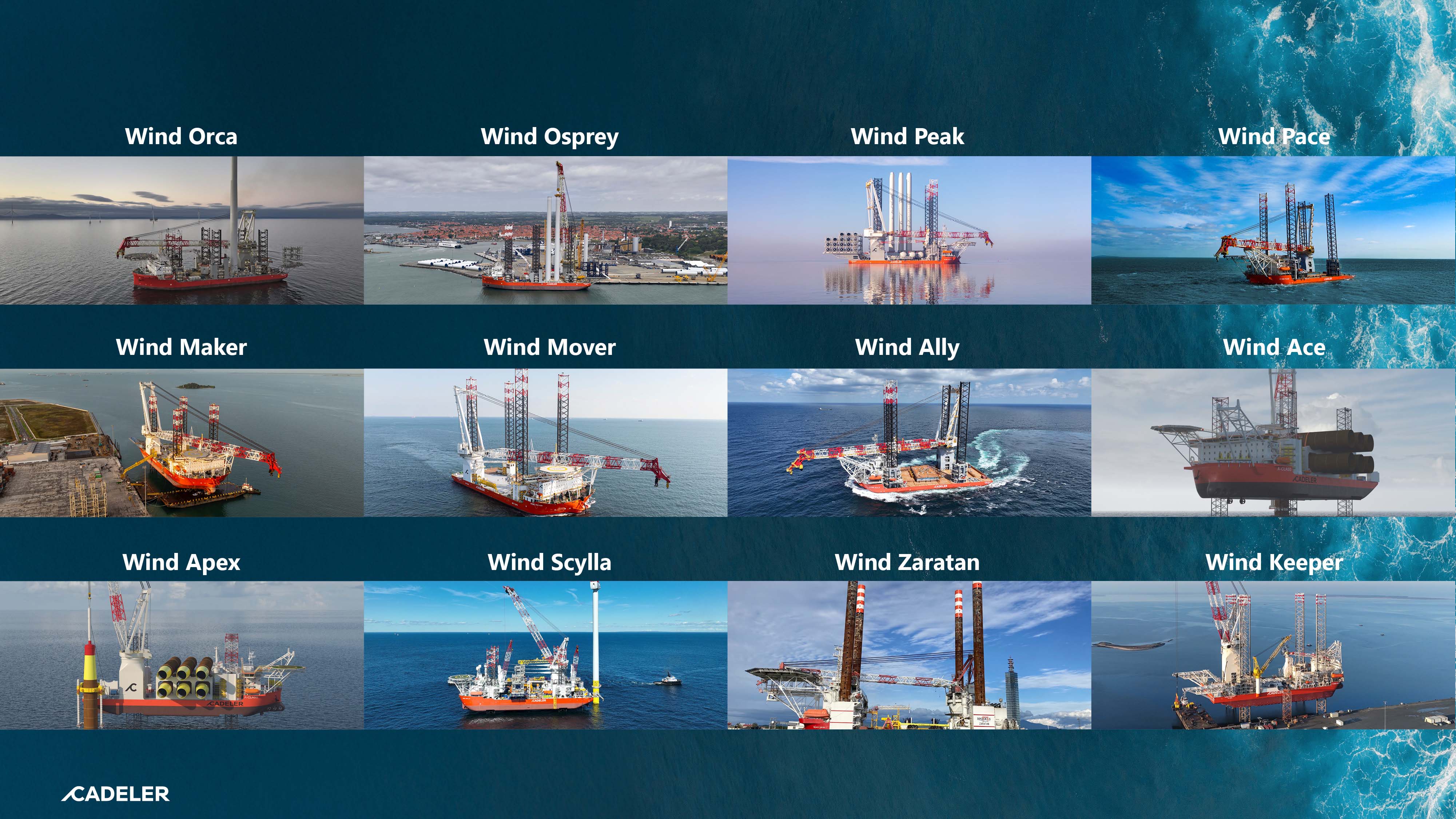
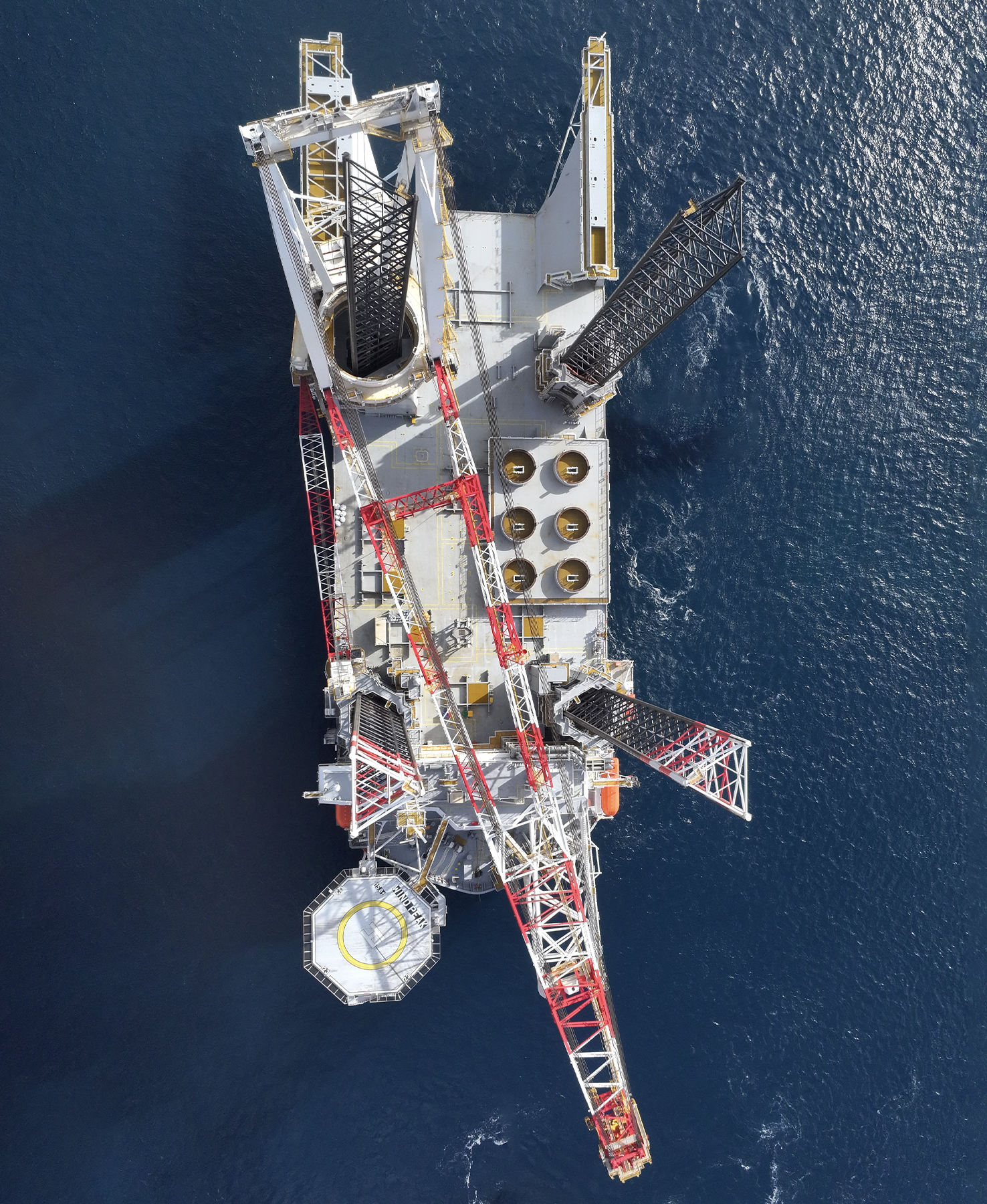
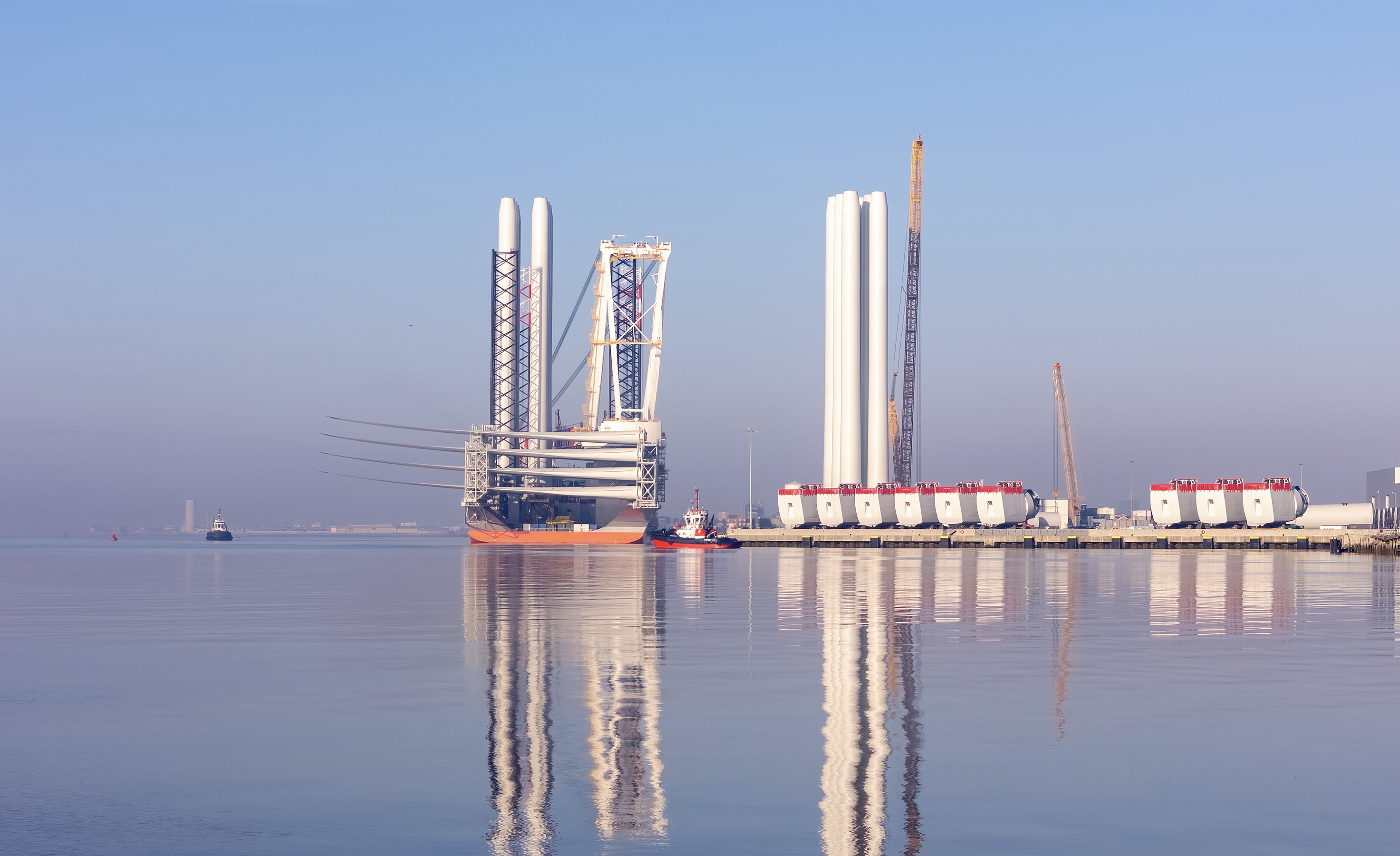
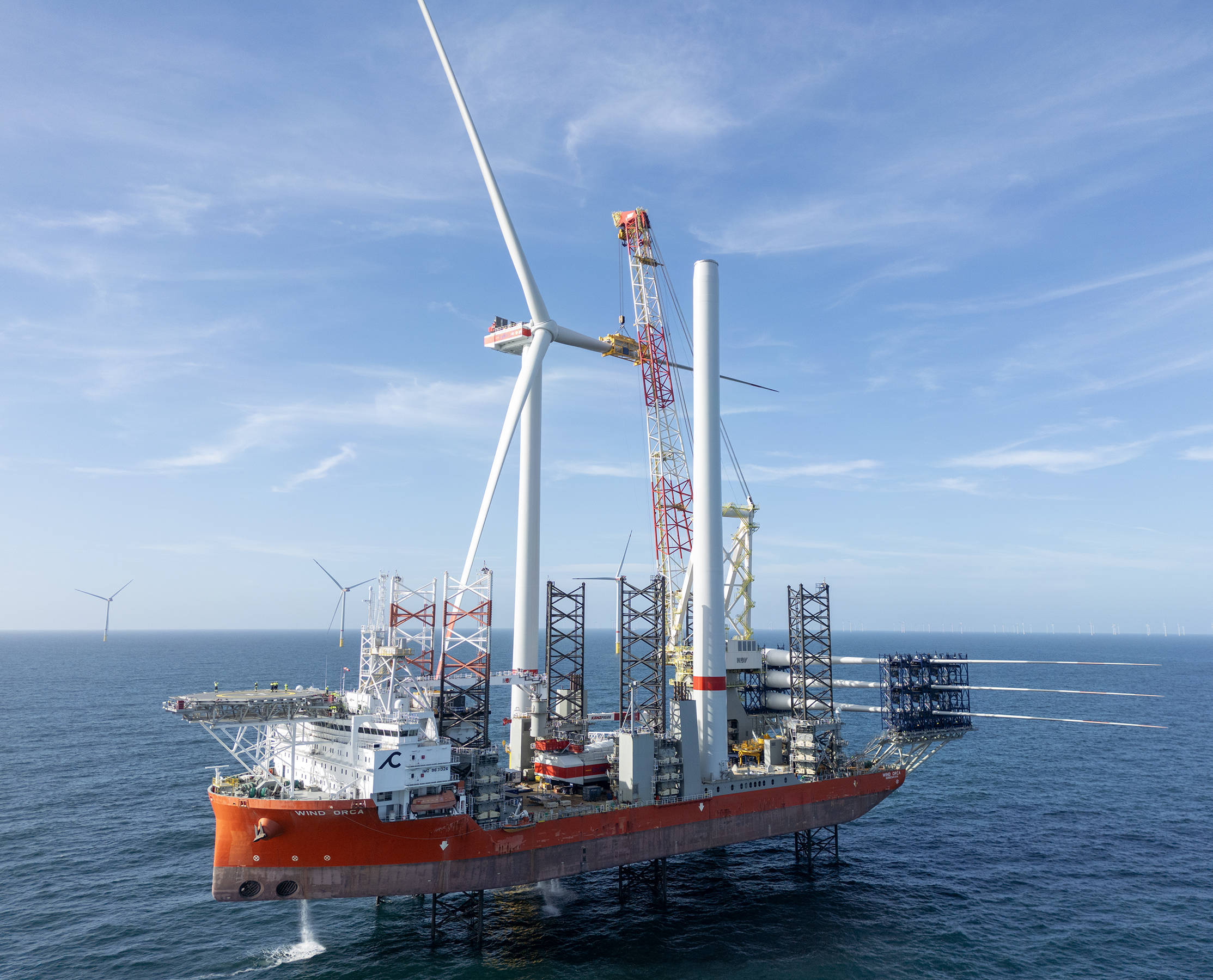
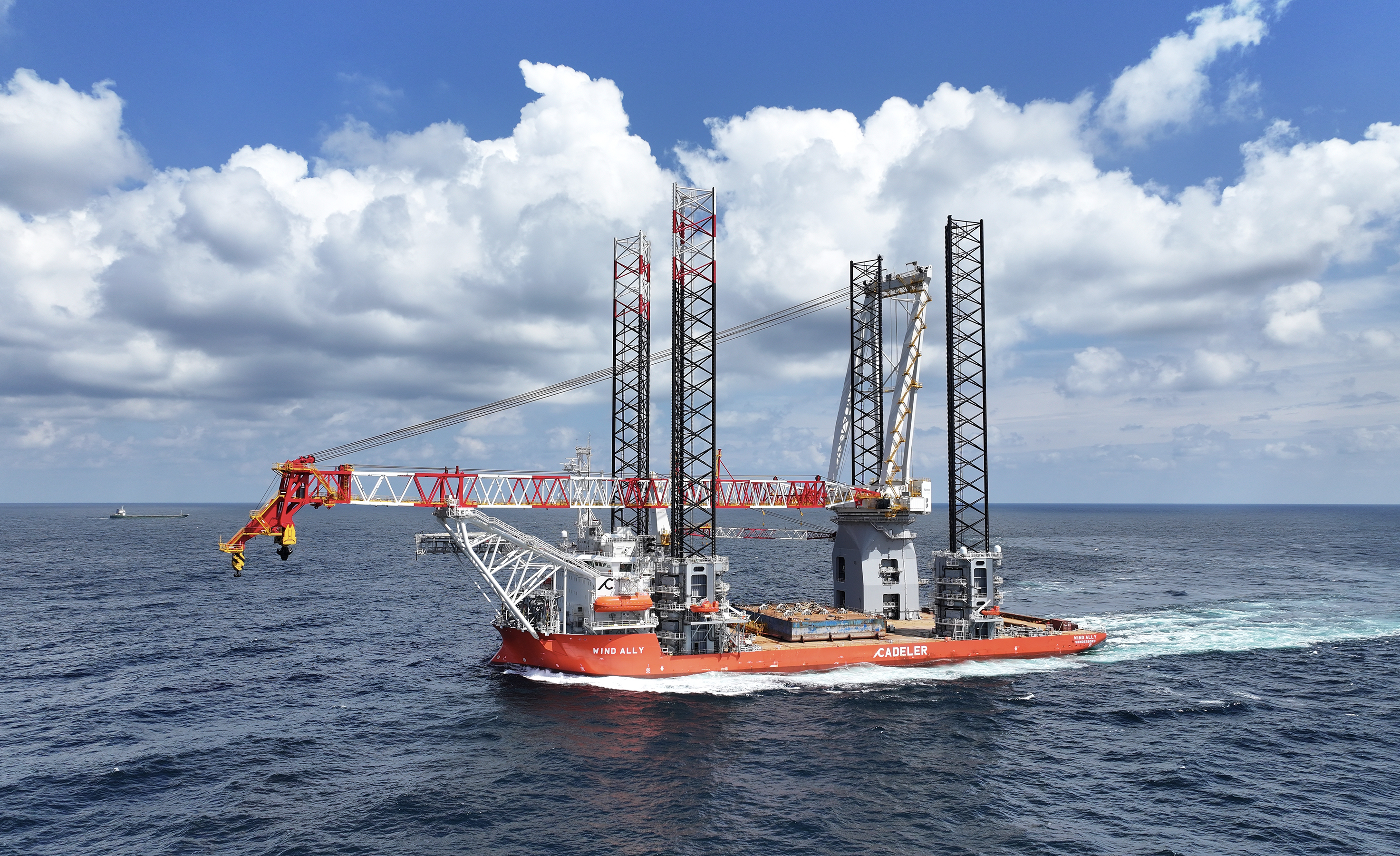
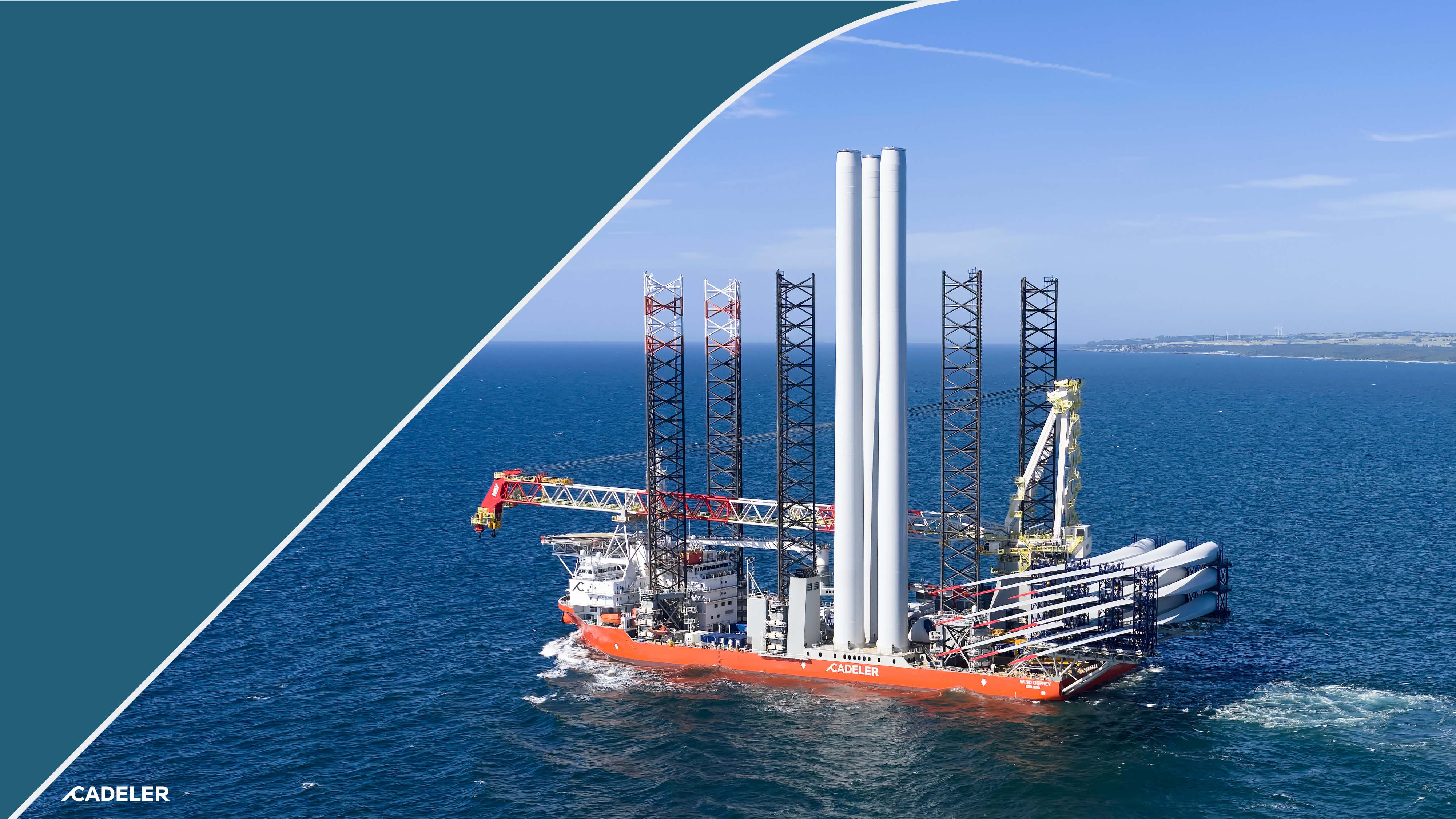
The Cadeler Group generates revenue by utilizing its fleet for the transportation and installation of offshore wind turbine generators and foundations and the provision of maintenance and decommissioning services in the offshore wind industry. The Cadeler Group’s operating fleet of wind installation vessels (together, the “Operating Vessels”) currently comprises one A-Class (previously referred to as F-Class) vessel, Wind Ally (the “Operating A-Class Vessel”), two P-Class (previously referred to as X-Class) vessels, Wind Peak and Wind Pace (the “P-Class Vessels”), two M-Class vessels, Wind Maker and Wind Mover (the “M-Class Vessels”), two O-Class vessels, Wind Orca and Wind Osprey (the “O-Class Vessels”), Wind Keeper, Wind Scylla and Wind Zaratan. In addition, the Cadeler Group has two new builds under construction, both of which are A-Class vessels (the “A-Class New Builds” and, together with the Operating A-Class Vessel, the “A-Class Vessels”). If any of the Operating Vessels or, once delivered, the A-Class New Builds are temporarily or permanently taken out of operation, including due to one of the risks described in this Annual Report on Form 20-F materializing, this could result in a loss of revenue that would otherwise be generated by such vessel. In addition to a potential loss of revenue, the Cadeler Group could also be liable to its customers for liquidated damages under any charters the Cadeler Group has entered into with respect to such vessel. The loss of revenue and liability to its charterers could have a material adverse impact on the Cadeler Group’s business, prospects and financial results and condition, including its ability to comply with the financial covenants included in its financing arrangements.
The Cadeler Group’s vessels may be subject to operational incidents or the need for refurbishments and/or repairs, following which such vessels may be out of operation for a shorter or longer period of time. For example, Wind Osprey had a crane accident in 2018 following which the vessel was out of operation for more than a year (due in part to the incident and in part to the Cadeler Group’s decision to design and procure an upgraded crane boom). More recently, in June 2025, Wind Scylla suffered minor damage to one of the vessel’s jack-up legs during jacking operations, requiring urgent repair works lasting approximately one month. As described in the risk factor entitled “—The Cadeler Group is exposed to hazards that are inherent to offshore operations, and damages may not be covered by insurance,” the Cadeler Group experiences smaller breakdowns on an ongoing basis as part of its ordinary course of business. In addition to the costs of repair, such incidents expose the Cadeler Group to potential contractual claims from the Cadeler Group’s clients and to loss of revenue, as vessels may be placed off-hire during the repair process. As there is a significant degree of operational homogeneity across the Cadeler Group’s fleet, it is also possible that a technical or design failure discovered to be affecting one vessel or any significant component thereof may be found to be similarly affecting one or more other vessels in the fleet. Any future incidents or upgrades could result in the unavailability of one or more vessels within the Cadeler Group’s fleet and may result in the Cadeler Group losing market share, being exposed to penalties or missing future contract opportunities as a result of shorter or longer periods of limited or no availability of the Cadeler Group’s fleet.
In addition, there is a risk that the delivery of the A-Class New Builds ordered by the Cadeler Group could be delayed. The Cadeler Group expects to take delivery of the two A-Class New Builds in the third quarter of 2026 and the first half of 2027, respectively. The Cadeler Group has contracted with COSCO SHIPPING Heavy Industry Co. Ltd. (“COSCO”), a Chinese shipyard, for the delivery of the A-Class New Builds. Any problems that may affect China, whether geographically or geopolitically, the general availability of components or material needed, or the COSCO shipyard could lead to delayed delivery of any or all of the A-Class New Builds. For example, there is continuing uncertainty relating to the development of the political climate within China and between China and other countries, including the United States, including with respect to Taiwan, as well as the global supply chain, in particular in light of the various tariff announcements by the U.S. administration and reciprocal responses thereto. In addition, in January 2025, certain of COSCO’s affiliates and several Chinese shipyards were designated by the U.S. Department of Defense as “Chinese military companies” under Section 1260H of the U.S. National Defense Reauthorization Act 2021 (see also “—The Cadeler Group is exposed to risks related to macroeconomic factors and geopolitical conditions.”). Whilst that designation does not directly affect the COSCO entity with which Cadeler has a contractual relationship or otherwise impact Cadeler’s ability to conduct business with COSCO, the imposition of further measures by the United States or other jurisdictions against COSCO and/or its affiliates could have an adverse effect on the Cadeler Group’s ability to receive delivery of its A-Class New Builds or to order future new build vessels from the same shipyard. Delayed delivery of any or all of the A-Class New Builds could delay the Cadeler Group’s generation of revenue from the utilization of such vessels and may trigger payments of liquidated damages under any charters the Cadeler Group has entered into with respect to these vessels, which may materially affect the Cadeler Group’s business, prospects and financial results and condition. See also “—The ordering, construction
and delivery of new build vessels and upgrades of existing vessels is subject to various risks and uncertainties, including forward-looking assessments which could turn out to be incorrect, and requires substantial financing which may not be available on favorable terms or at all.”
From time to time, the Cadeler Group’s vessels undergo upgrades of various types to remain competitive in the market, to ensure compliance with legal requirements and to implement sustainability-related improvements. Expenditures may be incurred when repairs or upgrades are required by law, in response to an inspection by a governmental authority, when damaged, or because of market or technological developments. From late 2023, for example, the two O-Class Vessels were off-hire for approximately six months for planned main-crane upgrades. Such upgrades, as well as other refurbishment and repair projects, are subject to various risks, including delays and cost overruns, which could, if realized, have an adverse impact on the Cadeler Group’s available cash resources, results of operations and its ability to comply with financial covenants pursuant to its financing arrangements. To ensure timely completion of refurbishment and repair projects, the Cadeler Group may be required to allocate extra resources to the relevant project, increasing the cost of the refurbishment or repair. For example, the Cadeler Group has from time to time taken the decision to accelerate work on its vessels by adding additional resources in order to ensure the vessel was ready for its next project on time. Moreover, periods without operations for one or more of the Cadeler Group’s vessels may have a material adverse effect on the Cadeler Group’s ability to generate revenue and thereby on its business, prospects and financial results and condition.
The Cadeler Group is exposed to hazards that are inherent to offshore operations, and damages may not be covered by insurance.
The Cadeler Group is operating in the offshore construction industry and is thus subject to hazards inherent to that industry, such as breakdowns, technical problems, harsh weather conditions, environmental pollution, force majeure events (nationwide or port-specific strikes, etc.), accidents (including dropped objects), collisions and groundings. These hazards can cause personal injury or loss of life, severe damage to or destruction of property and equipment, pollution or environmental damage, claims by third parties or customers and suspension of operations. Wind installation vessels, including the Cadeler Group’s vessels, are also subject to hazards inherent in marine operations, either while on-site or during mobilization, such as capsizing, sinking, grounding, collision, damage from severe weather and marine life infestations. Operations may also be suspended because of machinery breakdowns, abnormal operating conditions, failure of subcontractors to perform or supply goods or services or personnel shortages. For example in June 2025, as described above, Wind Scylla suffered minor damage to one of the vessel’s jack-up legs during jacking operations, requiring urgent repair works lasting approximately one month. Additionally, the Cadeler Group experiences various types of technical breakdowns on an ongoing basis as part of the operation of its vessels; however, such breakdowns are typically of a smaller nature with limited downtime and impact. Operations may also be interrupted even where an incident does not cause material damage or injury, but could have done, as the Cadeler Group’s policies (and, often, those of the Cadeler Group’s clients) require that such “near miss” events be investigated and corrective procedures implemented where appropriate.
The Cadeler Group’s vessels are covered by industry standard hull and machinery and protection and indemnity insurance. Standard protection and indemnity insurance for vessel owners provides limited cover for damage to project property during wind farm installation operations, as such damage is expected to be covered by the construction all risks insurance procured by the Cadeler Group’s customers. However, in recent years, the Cadeler Group has seen more contracts imposing liability for property damage on contractors such as the Cadeler Group and, even where such liability is insured, the deductibles payable in the event of an incident can be significant. Such risks are difficult to adequately insure against under standard protection and indemnity insurance for vessel owners. The Cadeler Group has also considered obtaining insurance for loss-of-hire, but has evaluated and considered such insurance not to be commercially viable. As a result, certain damages and losses resulting from the aforementioned hazards may not be covered by insurance.
The Cadeler Group is dependent on the employment and utilization of its vessels, and its backlog of contracts may not materialize.
The Cadeler Group’s revenue and income are dependent on project contracts and vessel charters for the employment of its vessels. These contracts are typically entered into several years in advance, with terms and conditions generally not expected to be subject to subsequent change. Additionally, the Cadeler Group has recently experienced a trend towards reservation agreements and contracts being entered into at an earlier stage of the project, which increases the difficulty of anticipating and adjusting to changes in circumstances, such as geopolitical developments or other unforeseen events. These preliminary reservation arrangements may not result in binding contracts or generate revenue for the Cadeler Group. Expected or estimated terms regarding specifications, commercial arrangements and delivery schedules are current estimates only and may differ materially in any final agreement entered into, if such agreements are concluded at all.
The Cadeler Group’s contract backlog includes both “firm” contracted days and “option” days (days that are callable at the relevant customer’s option). As of December 31, 2025, the Cadeler Group’s contract backlog (including 100% of option days) amounted to approximately EUR 2,765 million (compared to EUR 2,336 million as of December 31, 2024), comprising EUR 2,391 million from firm contracted days and EUR 374 million from contracted days subject to the exercise of counterparty options (compared to a split of EUR 1,907 million from firm contracted days and EUR 430 million from contracted days subject to the exercise of counterparty options as of December 31, 2024). Options are exercisable at the sole discretion of the customer and may not be realized as revenue. These contracts are subject to various conditions, including potential cancellation, and the resulting revenue may be reduced, delayed, or not realized at all. Customers also have express cancellation rights under current contracts, typically linked to penalties or termination fees. For example, on June 30, 2025, the Cadeler Group received a notice of termination from Ørsted A/S (“Ørsted”) in relation to a Long-Term Agreement (“LTA”) for an A-Class wind installation vessel. The termination of the LTA was principally a result of Ørsted’s decision to discontinue work towards the Hornsea 4 Offshore Wind Farm. The Cadeler Group received compensation as a consequence of this termination. Under its customer contracts, the Cadeler Group may also become liable to its customers for liquidated damages if there are delays in delivering a vessel for employment in connection with a project or for delays that arise during the operation of the vessels under the applicable contracts (see also “—The Cadeler Group has a limited number of vessels and could be adversely impacted if any vessel is taken out of operation, or if there is a delay in the delivery of any new build vessel”).
It may be difficult for the Cadeler Group to obtain future employment for its vessels and, as a result, utilization may decrease. Wind farm installation projects are tendered and awarded at irregular intervals and installation projects in certain locations are seasonal, particularly as a result of weather-related seasonality. Consequently, the Cadeler Group’s vessels may need to be deployed on lower-yielding work or remain idle, resulting in periods without any compensation to the Cadeler Group. There can also be off-hire periods as a consequence of accidents, technical breakdown and non-performance, as experienced with the Wind Osprey crane accident in 2018 and the Wind Scylla jacking incident in 2025 (see “—The Cadeler Group is exposed to hazards that are inherent to offshore operations, and damages may not be covered by insurance”) or due to maintenance or upgrades, such as the main crane upgrades for the two O-Class Vessels which were completed in 2024 and for which each such vessel was off-hire for approximately six months.
The cancellation, amendment to or postponement of one or more contracts can have a material adverse impact on the Cadeler Group’s revenue and may thus affect the pricing of the Cadeler Shares. For example, the Cadeler Group revised its guidance for the financial year ended December 31, 2025, principally due to the receipt of termination fees in respect of the cancelled LTA described above. While the Cadeler Group has generally not had a history of cancellations, amendments or postponements of its contracts, there can be no assurance that no such cancellation, amendment or postponement will occur in the future. As the size of the Cadeler Group’s fleet is limited, the Cadeler Group’s
business, prospects and financial results and condition could be materially impacted if any of its Operating Vessels were to become disabled or otherwise unable to operate for an extended period.
The Cadeler Group could be materially adversely affected if demand for the Cadeler Group’s services is lower than anticipated or decreases, including as a result of oversupply, changing trends in the energy market or a deterioration of the Cadeler Group’s market reputation and client relationships.
The Cadeler Group relies on revenue generated from wind farm installation and related maintenance. The lack of diversification in Cadeler’s sources of revenue makes the Cadeler Group vulnerable to adverse developments or periods of low demand in the market in which it operates. The demand for the Cadeler Group’s services may be volatile and is subject to variations for a number of reasons, including uncertainty in future demand and regulatory changes. For example, the market for offshore wind energy has recently experienced certain challenges in various jurisdictions including the United States, Sweden, the Netherlands, Germany and Denmark, including delays in relevant supply chains, cancellation of government approvals and failed government auction rounds, which could adversely affect the number of offshore wind farm projects to be developed in these markets in the future, and there is a risk that similar challenges might also affect other countries. In the case of delays on multiple projects, it may be difficult for the Cadeler Group to adapt, which would impact its revenue stream but also potentially compliance with its financing covenants. Due to the fact that the Cadeler Group invests in capital assets with life-spans of approximately 25 years and that market visibility beyond 10 years is difficult to estimate, the Cadeler Group’s long-term performance and growth depend heavily on the supply of vessels relative to market demand. Any oversupply of vessels compared to the market demand for such vessels or similar capacity could cause contract rates to decline, and falling rates could materially adversely affect the Cadeler Group’s financial performance and results of operations. As the Cadeler Group’s vessels are highly specialized for wind farm installation, redeploying them to other sectors of the marine industry may be difficult or impossible to achieve, both practically and commercially.
The wind energy market is affected by the price and availability of other energy sources, including nuclear, coal, natural gas and oil, as well as other sources of renewable energy. To the extent renewable energy, particularly wind energy, becomes less cost-competitive due to reduced government targets, increases in the cost of wind energy, new regulations or incentives that favor alternative renewable energy, cheaper, more efficient or otherwise more attractive alternatives or otherwise, demand for wind energy and other forms of renewable energy could decrease. Slow growth or a long-term reduction in the demand for wind energy could in turn reduce the demand for the Cadeler Group’s services, which could have a material adverse effect on the Cadeler Group’s business, prospects and financial results and condition.
In addition, market reputation and customer relationships are key factors to securing contracts and establishing long-lasting customer relations. For example, it is the Cadeler Group’s assessment that its market reputation and customer relationships have enabled the Cadeler Group to secure contracts for its A-Class New Builds before they are delivered. Adverse changes to the Cadeler Group’s customer relations or market reputation could result in a decrease in demand for the Cadeler Group’s services, resulting in a significant loss of revenue and adversely affecting the Cadeler Group’s business including the ability to secure future contracts.
The Cadeler Group faces other contractual and non-contractual legal risks related to its operations, which may expose the Cadeler Group to financial loss.
The Cadeler Group’s ability to fulfill its contractual obligations depends heavily on the timely and efficient execution of offshore wind installation projects, which are inherently complex and subject to numerous operational variables. Project schedules may be adversely impacted by unpredictable weather conditions, logistical challenges, supply chain disruptions, and technical setbacks during mobilization or installation activities. For example, the Cadeler Group experienced a crane accident in 2018 following which the vessel involved was out of operation for more than a year, resulting in both a claim from the charterers and lost revenue for the period. More recently, in June 2025, Wind Scylla suffered minor damage to one of the vessel’s jack-up legs during jacking operations, requiring urgent repair works lasting approximately one month. Any delays in completing key project milestones could result in contractual penalties, including the payment of liquidated damages, and may harm customer relationships or lead to early termination of contracts. In addition, offshore operations often involve small installation windows and coordination with other contractors and stakeholders. Failure to meet these timelines could disrupt the broader project schedule and expose the Cadeler Group to liability for consequential losses. Such execution risks may materially and adversely affect the Cadeler Group’s revenues, financial condition, and reputation.
The Cadeler Group’s contracts with customers typically contain strict performance requirements, including specifications related to the capabilities of its vessels, installation accuracy, and safety and environmental standards. If the Cadeler Group fails to meet these specifications, whether due to equipment limitations, operational shortcomings, or human error, it may be deemed in breach of contract or warranties. In such a case, the customer contract could be terminated, and the Cadeler Group may be held liable for the relevant charterer’s losses.
Contract terms may also not be sufficient to protect the Cadeler Group from liability with respect to installation works. The Cadeler Group could be liable to third parties who are involved or have an interest in the various projects involving the Cadeler Group’s vessels. The Cadeler Group may also face claims for damages from customers based on, for example, poor workmanship. Some of these liabilities and/or losses may not be covered by the Cadeler Group’s insurance policies or otherwise indemnified.
The ordering, construction and delivery of new build vessels and upgrades to existing vessels is subject to various risks and uncertainties, including forward-looking assessments which could turn out to be incorrect, and requires substantial financing which may not be available on favorable terms or at all.
The Cadeler Group may from time to time order additional new vessels, such as the ordering of the A-Class New Builds, and upgrades of existing vessels, such as the recent crane upgrades for both O-Class Vessels which were completed in 2024.
The ordering, construction, supervision and delivery of such new build vessels or upgrades to existing vessels is subject to a number of risks, including the risk of cost overruns and delays. Further, when such vessels or upgraded vessels are delivered, they are subject to market risk at the time of delivery including fulfilling conditions in any pre-committed customer contracts for such vessels or upgraded vessels, and the risk of failure to secure future employment of the new or upgraded vessels at satisfactory rates, which could have a material adverse effect on the financial performance of the Cadeler Group. If the Cadeler Group is not able to procure the A-Class New Builds, similar new build vessels or vessel upgrades in the future, this could have an adverse impact on the Cadeler Group’s business, prospects and financial results and condition.
The offshore wind installation market is a fast-moving market with a relatively long lead-time on delivery of new build vessels with the specifications needed to bid on, and win, wind farm installation contracts. The Cadeler Group must correctly predict future supply of, and demand for, wind installation vessels and continuously assess the attractiveness of securing a contract for the construction of additional vessels. When making such assessments, the Cadeler Group considers a number of uncertainties and factors, including expected supply and demand (see also “—The Cadeler Group could be materially adversely affected if demand for the Cadeler Group’s services is lower than anticipated or decreases,
including as a result of oversupply, changing trends in the energy market or a deterioration of the Cadeler Group’s market reputation and client relationships”), construction time, the price of construction and the expected development in construction prices, technological development in the offshore wind installation market and financing possibilities. If the Cadeler Group fails to correctly and timely assess the need for placing orders for additional vessels, the Cadeler Group may miss out on attractive contract opportunities due to capacity constraints and lose market share or incur costs of construction without being able to secure contracts for such new build vessels on commercially attractive terms or at all.
The vast majority of the agreed construction costs for the A-Class New Builds is fixed. However, some elements of the construction contract pricing are subject to variation. As a result, the total construction costs for the A-Class New Builds could increase, and the Cadeler Group may be unable to pass on such higher costs to its customers, which could have an adverse impact on its financial results. The aggregate capital expenditures estimated to be required during 2026 and 2027 in connection with the A-Class New Builds are approximately EUR 462 million.
Ordering any additional new build vessels, or deciding to upgrade any existing vessel, will increase capital expenditures (consisting of the purchase price and associated costs) materially and will likely require significant debt or equity financing. The Cadeler Group has in the past obtained substantial debt financing in order to fund its new build program (see Item 5.B. “Liquidity and Capital Resources—Financing Arrangements” of this Annual Report on Form 20-F). There can be no guarantee that the Cadeler Group will be able to obtain financing of any additional new builds and any future upgrades on attractive terms or at all. If the required financing is not obtained, the Cadeler Group may default on its obligations and be liable towards the relevant yard and/or other suppliers of goods and services related thereto, and the Cadeler Group may not be able to expand its fleet and thereby maintain its competitive position. The Cadeler Group may seek to obtain the required financing through equity or debt financing. Should the Cadeler Group not be able to secure the needed financing, in part or in whole, for example due to unattractive terms such as unfavorable interest rates, the Cadeler Group may be required to postpone future investments (including orders for new build vessels). If, in connection with an equity financing, the demand for or price of the Cadeler Shares is lower than historically experienced, this could result in significant dilution of the shareholding of existing holders of Cadeler Shares (the “Cadeler Shareholders”) and a decrease in the price of the Cadeler Shares.
The Cadeler Group has historically derived its revenue from a small number of customers, and the loss or default of any such customer could result in a significant loss of revenue and adversely affect the Cadeler Group’s business.
The Cadeler Group has historically had a high customer concentration as a result of the small number of vessels in its fleet and the typical duration of its projects. Consequently, if the Cadeler Group loses any of its most significant customers or any of them fail to pay for the services provided by the Cadeler Group or enters into bankruptcy, the Cadeler Group’s revenue could be materially adversely affected. The loss of one or more significant customers, or a decline in the number of projects or consideration paid for the Cadeler Group’s services under the Cadeler Group’s contracts with significant customers, would affect the Cadeler Group’s revenue and cash flow, and could have a material adverse effect on the Cadeler Group’s business, prospects and financial results and condition. Additionally, any delay of a project for one or more of the Cadeler Group’s most significant customers could affect the Cadeler Group’s revenue, the utilization of its vessels and potentially its ability to fulfill other contracts. Many of the Cadeler Group’s contracts contain options for additional work, which, if exercised, would generate additional revenue. If such options are not exercised to the extent the Cadeler Group expects based on its historic experience, the Cadeler Group’s revenue could be substantially lower than anticipated.
If the Cadeler Group fails to maintain an effective system of internal control over financial reporting, it may not be able to accurately report financial results in a timely manner or prevent fraud, which may adversely affect its business and the market price of the Cadeler ADSs and Cadeler Shares.
In connection with the audit of its financial statements for the year ended December 31, 2023 the Cadeler Group and its independent registered public accounting firm identified material weaknesses related to the Cadeler Group’s internal control over financial reporting driven by (i) a lack of formalized risk assessment and documented procedures in relation to the Company’s business processes and entity level controls, lack of evidence of performing internal controls including the completeness and accuracy of information used in the execution of controls, and lack of monitoring control activities, and (ii) lack of internal controls over change management and access management in the relevant financial information technology (“IT”) systems required to support effective internal control framework.
As defined in the standards established by the U.S. Public Company Accounting Oversight Board (“PCAOB”), a material weakness is a deficiency, or a combination of deficiencies, in internal control over financial reporting, such that there is a reasonable possibility that a material misstatement of the Cadeler Group’s annual or interim consolidated financial statements will not be prevented or detected on a timely basis.
Following the Company’s remediation efforts, no material weakness was identified in connection with the audit of the Company’s financial statements for the year ended December 31, 2025 or December 31, 2024. The Cadeler Group cannot guarantee, however, that its internal controls over financial reporting will remain effective in the future and that further material weaknesses will not be identified. Any failure to remediate such material weaknesses or a failure to discover and address any other material weaknesses or significant deficiencies in the future, could result in inaccuracies in the Cadeler Group’s consolidated financial statements and impair its ability to comply with applicable financial reporting requirements and related regulatory filings on a timely basis.
Generally, the failure to achieve and maintain an effective internal control environment could result in material misstatements in the Cadeler Group’s financial statements and could also impair the Cadeler Group’s ability to comply with applicable financial reporting requirements and related regulatory filings on a timely basis. As a result, the Cadeler Group’s business, prospects and financial results and condition, as well as the trading price of Cadeler Shares and Cadeler ADSs, may be materially and adversely affected.
The Cadeler Group is dependent on technical, maintenance, transportation and other commercial services from third parties.
The Cadeler Group is and will continue to be dependent on technical, maintenance, transportation and other commercial services from third parties to manage its vessels and fulfill its contractual obligations. Performance by such service providers is critical. If third-party service providers, such as those involved in assisting the Cadeler Group in sea fastening design, fabrication, installation and various technical services, fail to perform at an optimal level, this could materially and adversely affect the Cadeler Group’s ability to complete its contracts, as well as its business, prospects and financial results and condition, including its ability to be compliant with the financial covenants under its financing arrangements. For example, as a result of an error in design work conducted by a third-party engineering supplier in 2025 relating to the sea fastenings on one of the Cadeler Group’s vessels, the Cadeler Group incurred costs and minor delays necessitated by corrective design and repair works, and incurred liquidated damages under its contract with the Cadeler Group’s end client. These costs, though not material to the Cadeler Group, exceeded the amount that the Cadeler Group was able to recover from the responsible supplier. Additionally, the Cadeler Group narrowed its guidance for the financial year ended December 31, 2022 due to upstream delay as a result of a subcontractor on a project being unable to operate as planned. If the amount the Cadeler Group is required to pay for subcontractors, equipment or supplies exceed what has been estimated, the profitability of the commercial employment of its vessels may be adversely affected. If a subcontractor, supplier, or manufacturer fails to
provide services, supplies or equipment as required under a contract for any reason, the Cadeler Group may be required to source such services, supplies or equipment from other third parties, which could lead to delays or higher prices than anticipated.
The Cadeler Group relies on third-party contractors, suppliers, vendors, joint venture partners and other parties for the engineering design, procurement of materials, equipment, and services for the performance of work on the Cadeler Group’s projects. The successful completion of these projects depends on the ability of these third parties to perform their contractual obligations and is subject to factors beyond the Cadeler Group’s control, including actions or omissions by these parties and their subcontractors. Any non-performance, or a failure by such third parties to perform their contractual obligations to a satisfactory standard could result in delays to the planned project timelines, which could in turn result in late penalties or fines being imposed on the Cadeler Group.
The Cadeler Group could be materially adversely affected by increased supply of offshore wind farm installation services as a result of new competitors entering the market or existing competitors expanding their fleet of suitable vessels.
The industry in which the Cadeler Group operates is in management’s view characterized by a limited supply of efficient offshore wind farm installation services as a limited number of vessels are available and fit for the specific needs of, and trusted by, customers. Consequently, it may be difficult or expensive for customers of the Cadeler Group to find efficient alternative suppliers for their contracts in the near term, and it may be even more difficult for customers in the long term to find trusted suppliers of efficient offshore wind installation vessels as newer generations of larger turbines (capable of producing 18-20MW+ of electricity) are rolled out in future years. Since the supply of offshore wind farm installation services depends on the number of vessels dedicated to such services, market conditions may change significantly if one or multiple existing or new competitors of the Cadeler Group were to order new build vessels or modify existing vessels to fit the future needs of the offshore wind farm industry. It is the Cadeler Group’s assessment that over the past decade there has been a general increase in the number of players active in the wind farm industry. Should similar developments occur in the market for offshore wind farm installation, the Cadeler Group may experience increased competition. Any increase in the supply of offshore wind farm installation services may result in a decrease in the prices that the Cadeler Group is able to obtain for its services. As the Cadeler Group currently only operates within the market for offshore wind farm transportation, installation and maintenance, it is more exposed to any changes in prices within the industry or utilization of its vessels compared to those of its competitors having multiple sources of revenue. See also “—The Cadeler Group faces competition from industry participants who may have greater resources than the Cadeler Group.”
The Cadeler Group faces competition from industry participants who may have greater resources than the Cadeler Group.
The markets in which the Cadeler Group operates are competitive and the Cadeler Group’s business is subject to risks associated with competition from new and existing industry participants. The Cadeler Group has a number of well-established competitors, including DEME Offshore, Jan de Nul (both Belgium-headquartered), Fred. Olsen (Norway-headquartered) and Van Oord (Netherlands-headquartered). In addition, Seaway7, Dominion Energy, and Maersk have each taken delivery of new build wind installation vessels. These companies will directly compete (and in a number of cases are already directly competing) with the Cadeler Group in tenders for wind turbine foundation and installation projects. There can be no assurances that the Cadeler Group will be able to maintain or improve its competitive position or continue to meet changes in the competitive environment, including when entering new markets. In addition, certain of the Cadeler Group’s competitors may have more resources and better access to capital than the Cadeler Group. For example, new and existing competitors may have greater financial resources, customer support, technical and marketing resources, larger customer bases, longer operating histories, greater name recognition or more established relationships in the industry. These industry participants compete with the Cadeler Group based on, among other things, price, service portfolio, technology, location and vessel availability. There is no assurance that the Cadeler Group will have the resources and expertise to compete successfully in the future, that it will be able to succeed in the face of current or future competition, or that it will be successful when entering new markets. Increased competition in the markets where the Cadeler Group operates or which it may enter could lead to reduced profitability and/or future growth opportunities for the Cadeler Group. The failure of the Cadeler Group to secure future growth, maintain or improve its competitiveness and respond to increased competition may have a material adverse effect on the Cadeler Group’s business, prospects and financial results and condition.
Technological progress might render the technologies used by the Cadeler Group obsolete or less profitable.
The offshore wind sector in which the Cadeler Group operates is affected by constant technological development. To maintain a successful and profitable business, the Cadeler Group must keep pace with technological developments and changing standards to meet the evolving demands of existing and potential customers. The Cadeler Group has been focused on implementing energy efficiency and emission reduction technologies. Improvements to the Cadeler Group’s wind installation vessel design include shore power connections (expected to reduce fuel consumption by up to 15%), fuel-efficient engines and optimized engine sizing. The Cadeler Group also intends to move towards alternative fuels when the right technologies are commercially available and has already invested resources in ensuring newbuild vessels can undergo a conversion to alternative fuels in the future. If the Cadeler Group fails to adequately respond to the technological changes in its industry, make the necessary capital investments, or is not suited to offer commercially competitive products and implement commercially competitive services, the Cadeler Group’s business, prospects and financial results and condition may be adversely affected.
Competitors’ vessels have previously become obsolete due to the growth in the size of turbines only 10 years into their lifespan. Although the Cadeler Group has previously upgraded certain of its vessels, as demonstrated by the recent main crane upgrades to its two O-Class Vessels, and has designed its new build vessels to be capable of transporting and installing turbines significantly larger than the current generation of 15MW wind turbines, there is no certainty that such vessels will remain viable for the entirety of their planned 25-year lifespan. In addition, as the Cadeler Group’s vessels are purpose-built for the offshore wind industry, they cannot easily be repurposed for use in other segments of the marine industry. A movement towards other energy sectors or the development of new technology could render the Cadeler Group’s vessels obsolete, and the Cadeler Group may not be able to secure alternative contracts or revenue on attractive terms, if at all.
The Cadeler Group operates across multiple jurisdictions and is thereby exposed to a number of risks inherent in international operations, including political, civil or economic disturbance.
The Cadeler Group operates in multiple jurisdictions and serves a wide range of customers. As a result, the Cadeler Group is exposed to risks that are inherent to conducting international operations, some of which are due to factors beyond the Cadeler Group’s control, including:
•terrorist acts, war, civil disturbances and military actions;
•seizure, nationalization or expropriation of property or equipment;
•public health threats, and outbreaks of contagious diseases and pandemics;
•global warming and extreme weather events;
•restrictions on the ability to repatriate income or capital;
•complications associated with repairing and replacing vessels and equipment in remote locations;
•delays or difficulties in obtaining necessary visas and work permits for employees;
•wage and price controls imposed by the relevant authorities; and
•the imposition of trade barriers, moratoriums or sanctions and other forms of government regulation.
Some of these risks could limit or disrupt the Cadeler Group’s operations (for example, by requiring or resulting in the evacuation of personnel, cancellation of contracts, or the loss of personnel, vessels or assets), impose practical or legal barriers to the Cadeler Group’s continued operations, or negatively impact the profitability of those operations, and could therefore have a material adverse effect on the Cadeler Group’s business, prospects and financial results and condition.
The Cadeler Group is exposed to risks related to macroeconomic factors and geopolitical conditions.
The Cadeler Group is exposed to macroeconomic factors and geopolitical conditions. The international macroeconomic situation is currently characterized by material uncertainty, mainly due to the elevated levels of public debt in many of the leading global economies, increasing interest and inflation rates, the war in Ukraine, recent developments and heightened public and diplomatic focus on Greenland and Arctic security, the imposition of sanctions against Russia, conflict in the Middle East, European energy crises, global supply-chain constraints and various tariff announcements by the U.S. administration and reciprocal responses thereto. For example, the Cadeler Group has contracted with COSCO, a Chinese shipyard, for the delivery of the A-Class New Builds, and any problems that may affect China, whether geographically or geopolitically, the general availability of components or material needed, or the shipyard itself could lead to delayed delivery of any or all of the A-Class New Builds. There is continuing uncertainty relating to the development of the political climate within China and between China and other countries, including the United States, including with respect to Taiwan. In addition, in January 2025, certain of COSCO’s affiliates and several Chinese shipyards were designated by the U.S. Department of Defense as “Chinese military companies” under Section 1260H of the U.S. National Defense Reauthorization Act 2021. Whilst that designation does not directly affect the COSCO entity with which Cadeler has a contractual relationship or otherwise impact Cadeler’s ability to conduct business with COSCO, the imposition of further measures by the United States or other jurisdictions against COSCO and/or its affiliates could have an adverse effect on the Cadeler Group’s ability to receive delivery of its A-Class New Builds or to order future new build vessels from the same shipyard. See also “—The Cadeler Group has a limited number of vessels and could be adversely impacted if any vessel is taken out of operation, or if there is a delay in the delivery of any new build vessel” and “—The ordering, construction and delivery of new build vessels and upgrades of existing vessels is subject to various risks and uncertainties, including forward-looking assessments which could turn out to be incorrect, and requires substantial financing which may not be available on favorable terms or at all”. These macroeconomic conditions have had, and a continuation or further worsening of these conditions could continue to have, material effects on the global economy and capital markets and could have material adverse effects on the Cadeler Group, its business, prospects and financial results and condition. Additionally, geopolitical tensions may have an impact on the future prospects of the markets in which the Cadeler Group operates and may increase the risks associated with the Cadeler Group’s operations.
If Cadeler’s vessels operate in countries or territories that are subject to restrictions, sanctions, or embargoes imposed by the U.S. government, the European Union, the United Nations, or other governments, it could lead to monetary fines or other penalties and adversely affect Cadeler’s reputation and the market for its shares and trading price.
Although Cadeler does not expect that its vessels will operate in countries or territories subject to country-wide or territory-wide sanctions or embargoes imposed by the U.S. government or other authorities in violation of applicable sanctions laws, and Cadeler endeavors to take precautions reasonably designed to mitigate the risk of such activities, it is possible that the Cadeler Group’s vessels may call on ports located, and/or otherwise operate in countries or territories subject to such sanctions, including on charterers’ instructions and/or without Cadeler’s consent. In addition, Cadeler’s A-Class New Builds are being built in China, which may further expose Cadeler to certain restrictions. See also “—The Cadeler Group is exposed to risks related to macroeconomic factors and geopolitical conditions.” Similarly, Cadeler’s supply chain for spare parts for the vessels or secondary steel deliveries needs to be monitored closely and may be limited due to these restrictions, which could result in Cadeler not being able to source such spare parts from certain suppliers.
Failure to comply with the U.S. Foreign Corrupt Practices Act could result in fines, criminal penalties, contract terminations and have an adverse effect on the Cadeler Group’s business.
The Cadeler Group regularly operates in, or transits through, jurisdictions around the world, including jurisdictions known to have a reputation for corruption. The Cadeler Group is committed to doing business in accordance with applicable anti-corruption laws including the U.S. Foreign Corrupt Practices Act of 1977 (“FCPA”), U.K. Bribery Act, the Danish Criminal Code and other applicable anti-corruption laws. The Cadeler Group is subject, however, to the risk that Cadeler, its affiliated entities or its officers, directors, employees or agents may take actions determined to be in violation of such anti-corruption laws, including the FCPA and the U.K. Bribery Act. The offshore energy and renewables sectors have seen notable anti-corruption enforcement actions, where violations of international anti-corruption laws led to substantial fines, legal penalties, and reputational damage. These cases highlight the significant risks faced by companies operating in, or transiting through, jurisdictions with high corruption exposure. While the Cadeler Group is committed to conducting business in compliance with all applicable anti-corruption laws and has implemented robust compliance measures, it remains exposed to potential liability and reputational harm should any actual or alleged violations occur, whether by employees, agents, or third parties acting on its behalf. Any such violation could result in substantial fines, sanctions, civil and/or criminal penalties and curtailment of operations in certain jurisdictions, and might adversely affect the Cadeler Group’s business, prospects and financial results and condition. In addition, actual or alleged violations could damage Cadeler’s reputation and ability to do business. Furthermore, detecting, investigating, and resolving actual or alleged violations is expensive and has the potential to consume significant time and attention of Cadeler’s senior management.
Breakdowns in the Cadeler Group’s information technology and/or noncompliance with data protection laws could negatively impact the Cadeler Group’s business, including its ability to service customers.
The Cadeler Group’s ability to operate its business and service its customers is dependent on the continued operation of the Cadeler Group’s IT systems, including those relating to the location, operation, maintenance and employment of the Cadeler Group’s vessels. The Cadeler Group’s IT systems could be compromised by a malicious third party or employee (see also “—A cybersecurity attack could materially disrupt the Cadeler Group’s business”), man-made or natural events, or the inadvertent actions or inactions by the Cadeler Group’s employees and third-party service providers. If the Cadeler Group’s IT systems experience a breakdown, the Cadeler Group’s business information could be lost, destroyed,
disclosed, misappropriated, altered or accessed without consent, and the Cadeler Group’s IT systems, or those of its service providers, may be disrupted.
Any breakdown in the Cadeler Group’s IT systems could lead to lost revenues resulting from a loss in competitive advantage due to the unauthorized disclosure, alteration, destruction or use of proprietary information, the failure to retain or attract customers, the disruption of critical business processes or IT systems and the diversion of management’s attention and resources. In addition, such breakdown could result in significant remediation costs, including repairing system damage, engaging third-party experts, deploying additional personnel, training employees and compensation or incentives offered to third parties whose data has been compromised. The Cadeler Group may also be subject to legal claims or legal proceedings, including regulatory investigations and actions, and the attendant legal fees as well as potential settlements, judgments and fines.
In addition, data protection laws apply to the Cadeler Group in certain countries in which it does business. Specifically, the EU General Data Protection Regulation (“GDPR”) imposes penalties of up to a maximum of 4% of global annual turnover for breaches thereof. The GDPR requires mandatory breach notification, the standard for which is also followed outside the EU (particularly in Asia). Non-compliance with data protection laws could expose the Cadeler Group to regulatory investigations, which could result in fines and penalties. In addition to imposing fines, regulators may issue orders to stop processing personal data, which could disrupt operations. The Cadeler Group could also be subject to litigation from persons or corporations allegedly affected by data protection violations. Any violation of these laws or harm to the Cadeler Group’s reputation could have a material adverse effect on the Cadeler Group’s business, prospects and financial results and condition.
A cybersecurity attack could materially disrupt the Cadeler Group’s business.
The efficient operation of the Cadeler Group’s business, including processing, transmitting and storing electronic and financial information, is dependent on computer hardware and software systems. IT systems are vulnerable to security breaches by computer hackers and cyber terrorists. The Cadeler Group relies on industry accepted security measures and technology (including a cloud-based solution provided by Microsoft including their E5 security suite) to securely maintain confidential and proprietary information maintained on its information systems. However, such measures and technology may not adequately prevent security breaches. Therefore, the Cadeler Group’s operations and business administration could be targeted by individuals or groups seeking to sabotage or disrupt such systems and networks, or to steal data, and as a result these systems may be damaged, shut down or cease to function properly (whether due to planned upgrades, force majeure, telecommunications failures, hardware or software break-ins or viruses, other cybersecurity incidents or otherwise), which could have a material adverse effect on the Cadeler Group’s reputation as well as its business, prospects and financial results and condition.
Cybersecurity attacks may result in disruptions to the Cadeler Group’s operations or in business data being temporarily unreadable, and cyber criminals may demand ransoms in exchange for de-encrypting such data. As cybersecurity attacks become increasingly sophisticated, and as tools and resources become more readily available to malicious third parties, there can be no guarantee that the Cadeler Group’s actions, security measures and controls designed to prevent, detect or respond to intrusion, to limit access to data, to prevent destruction or alteration of data or to limit the negative impact from such attacks, can provide absolute security against compromise. Even without actual breaches of information security, protection against increasingly sophisticated and prevalent cybersecurity attacks may result in significant future prevention, detection, response and management costs, or other costs, including the deployment of additional cybersecurity technologies, engaging third-party experts, deploying additional personnel and training employees. For example, in 2024 the Cadeler Group identified revised payment instructions from a counterpart as having been issued by malicious actors who had obtained access to that counterpart’s email system. Although the Cadeler Group’s internal controls (including its procedures for the telephone verification of updated payment instructions) prevented the misdirection of funds in that instance, there can be no guarantee that cybersecurity attacks affecting the Cadeler Groups’ customers or suppliers will not affect the Cadeler Group in the future. Further, as cybersecurity threats are continually evolving, the Cadeler Group’s controls and procedures may become inadequate, and the Cadeler Group may be required to devote additional resources to modify or enhance its systems in the future. Such expenses could have a material adverse effect on the Cadeler Group’s business, prospects and financial results and condition. To the extent the Cadeler Group integrates artificial intelligence (“AI”) into its operations, this may increase the cybersecurity and privacy risks, including the risk of unauthorized or misuse of AI tools it is exposed to, and threat actors may leverage AI to engage in automated, targeted and coordinated attacks of the Cadeler Group’s systems. While the Cadeler Group regularly reviews its network security, backup and disaster recovery, enhanced training and other security measures to protect its systems and data, these measures cannot provide absolute security or guarantee that it will be successful in preventing or responding to every breach or disruption on a timely basis.
A successful cybersecurity attack could materially disrupt the Cadeler Group’s operations or result in the unauthorized release or alteration of information in the Cadeler Group’s systems, particularly if the Cadeler Group’s IT systems were affected for extended periods. Any cybersecurity attack could also result in significant expenses to investigate and repair security breaches or system damages and could lead to litigation, fines, other remedial action, heightened regulatory scrutiny, diminished customer confidence and damage to the Cadeler Group’s reputation. While the Cadeler Group currently maintains cyber-liability insurance, there can be no assurance that the Cadeler Group will be able to continue to maintain such insurance coverage at commercially reasonable rates or that available coverage will be adequate to cover future claims. As a result, a cybersecurity attack or other breach of any such IT systems could have a material adverse effect on the Cadeler Group’s business, prospects and financial results and condition.
The Cadeler Group faces financial risk due to its level of indebtedness and is subject to restrictive covenants and conditions pursuant to its financing agreements.
The Cadeler Group has extensive debt financing agreements, as described in more detail in Item 5.B. “Liquidity and Capital Resources—Financing Arrangements” of this Annual Report on Form 20-F. The Cadeler Group’s level of indebtedness (1,459.1 million as at December 31, 2025, of which 100% bears a floating interest rate) exposes it to certain risks, including increased vulnerability to general adverse economic industry conditions and interest rate fluctuations. Should interest rates rise in the future, the Cadeler Group’s interest expenses on floating-rate borrowings could increase materially, leading to higher financing costs and increased pressure on profitability (see “—Changes in interest rates and inflation will continue to affect the Cadeler Group’s business and results”).
In addition to the interest rate burden, the agreements governing the Cadeler Group’s indebtedness contain (and it is expected that any agreements governing any additional debt that the Cadeler Group may incur or assume would contain) various operating and financial covenants with respect to the business of the Cadeler Group. Any failure to comply with such restrictions may result in an event of default under such agreements. Any such default may allow the applicable creditors to accelerate the related debt, which acceleration may trigger cross-acceleration or cross-default provisions in the Cadeler Group’s other debt facilities. For instance, there are specific financial covenants in the Cadeler Group’s debt facilities with respect to the minimum liquidity of the Cadeler Group, the Cadeler Group’s equity ratio and its working capital, and the fair market value of the Cadeler Group’s wind installation vessels. Failure to meet any of these covenants could trigger the mandatory repayment of
the relevant facility or all of them and may thus have an adverse effect on the financial position of the Cadeler Group. Additionally, all of the Cadeler Group’s debt facilities contain change of control provisions and covenants restricting the payments of dividends in certain circumstances.
The Cadeler Group’s ability to comply with the financial covenant requirements under its financing arrangements depends largely on the market value of its Operating Vessels and their ability to generate sufficient revenue. If future cash flows are inadequate to meet all of the Cadeler Group’s financial obligations and contractual commitments, this could negatively impact the Cadeler Group’s business and may require it to refinance existing debt, incur additional indebtedness, raise additional equity, or sell assets and use the proceeds to repay debt. Furthermore, the Group’s indebtedness could constrain future operations, as a portion of operating cash flow must be allocated to interest and principal payments and will not be available for other purposes, while financial and non-financial covenants may restrict operational and strategic flexibility, limit asset disposals and the use of related proceeds, reduce resilience to future economic or industry downturns, hinder the Cadeler Group’s ability to compete with others in its industry for strategic opportunities, and constrain access to additional financing for working capital, capital expenditures, acquisitions, and general corporate purposes.
Litigation proceedings could have a material adverse impact on the business, prospects and financial results and condition of the Cadeler Group.
The nature of the business of the Cadeler Group from time to time results in clients, subcontractors, employees/manning agencies or vendors claiming, among other things, recovery of costs related to accidents, contracts and projects. This risk is further heightened by Cadeler’s relatively small fleet and high asset concentration, meaning that any incident involving one or a few assets (such as accidents or technical failures) could have significant financial consequences for the Cadeler Group as a whole. The crane accident in 2018 on Wind Osprey, for example, resulted in a claim from the charterers for liquidated damages as well as personal injury claims by four seafarers involved in the accident. Should any of the Cadeler Group’s vessels experience or be involved in any future incidents of a similar nature, the Cadeler Group may be subject to further claims and litigation. Litigation outcomes are unpredictable and may result in reputational damage as well as fines, penalties or other sanctions imposed by governmental authorities or general damages payable by the Cadeler Group in respect of third-party claims such as, for example, personal injury claims, employment-related claims or claims for property damage.
As part of the Cadeler Group’s wind farm installation operations, it manages large, high-value components. In addition, as the Cadeler Group takes on full-service foundations projects (such as the Hornsea 3 and East Anglia 2 offshore wind farms in the U.K.), it is exposed to an increasingly complex scope of work encompassing technical design, engineering and construction. Any claims from its clients, subcontractors or vendors resulting from damage to component parts while within the Cadeler Group’s control, or defects in construction works carried out by the Cadeler Group, may be significant. The Cadeler Group could also require extensive resources to assess and defend itself against potential claims and litigation, including under professional liability or warranty obligations, any of which could have a material adverse effect on the Cadeler Group’s business, prospects and financial results and condition.
The Cadeler Group’s insurance coverage may be inadequate to protect the Cadeler Group from liabilities that could arise in its business.
Although the Cadeler Group maintains insurance coverage against certain risks related to its business, risks may arise for which the Cadeler Group is not insured, or which are outside the scope of its existing insurance coverage. In addition, claims covered by insurance are subject to deductibles, the aggregate amount of which could be material, and certain policies impose caps on coverage or certain carve-outs. Insurance policies are also subject to compliance with certain conditions, the failure of which could lead to a denial of coverage as to a particular claim or the voiding of a particular insurance policy. There can be no assurance that existing insurance coverage will be renewed at commercially reasonable rates or that available coverage will be adequate to cover future claims. If a loss occurs that is partially or completely uninsured, or the carrier is unable or unwilling to cover the Cadeler Group’s claim with respect to such loss, the Cadeler Group could be exposed to substantial liability. Further, to the extent that the proceeds from its insurance are not sufficient to repair or replace a damaged asset, the Cadeler Group would be required to expend funds to supplement the insurance proceeds and in certain circumstances may decide that such expenditures are not justified, which, in either case, could adversely affect the Cadeler Group’s business, prospects and financial results and condition.
The Cadeler Group faces risks related to recruiting and retaining key personnel, and any loss of senior management or failure to recruit or retain highly skilled personnel could have a material adverse effect on the Cadeler Group’s operations.
The Cadeler Group’s continued success is largely dependent on its ability to recruit, retain and develop skilled personnel for its business. The market for qualified personnel is highly competitive and the Cadeler Group cannot be certain that it will be successful in attracting and retaining key personnel and crewing its vessels in the future. If the Cadeler Group loses any members of its senior management or other key individuals, or fails to hire, train and retain qualified employees, it may not be able to compete effectively and may have increased incident rates as well as regulatory and other compliance failures, which could have a material adverse effect on the Cadeler Group’s business, prospects and financial results and condition. Difficulty in hiring and retaining qualified personnel could also adversely affect the Cadeler Group’s results of operations.
The Cadeler Group is exposed to counterparty credit risks relating to its key customers and certain other third parties.
The Cadeler Group is subject to risks of loss resulting from the non-payment or non-performance by third parties of their obligations. Although the Cadeler Group monitors and manages counterparty risks, some of the Cadeler Group’s customers and other counterparties may be highly leveraged and subject to their own operating, financial and regulatory risks. For example, some of the Cadeler Group’s contractual counterparts are special purpose vehicles created for the purpose of carrying out a specific offshore wind farm project. These special purpose vehicles typically have limited assets or capital, and the Cadeler Group is not always able to obtain parent or third-party performance or financial guarantees for such counterparts’ obligations. During periods of more challenging market environments, the Cadeler Group will be subject to an increased risk of customers seeking to repudiate contracts. The ability of the Cadeler Group’s customers to perform their contractual obligations may also be adversely affected by restricted credit markets and economic downturns. Any bankruptcy, insolvency or inability by the Cadeler Group’s customers affecting their ability to settle their debts or honor their obligations to the Cadeler Group when they fall due may adversely affect the Cadeler Group’s business, prospects and financial results and condition.
The Cadeler Group may fail to comply with applicable environmental laws and regulations, which could have an adverse effect on the Cadeler Group’s business, prospects and financial results and condition.
The Cadeler Group’s operations are subject to a variety of laws, regulations, and requirements controlling the discharge of various materials into the environment, requiring removal and clean-up of materials that may harm the environment, controlling carbon dioxide emissions, or otherwise relating to the protection of the environment in the countries in which the Cadeler Group operates. Such laws, regulations and requirements vary from jurisdiction to jurisdiction and the operations of the Cadeler Group may be negatively affected by changes in environmental laws and other regulations that can result in large expenses including modification of vessels and changes in the operation of vessels. A lack of harmonization globally in relation to environmental, social and governance (“ESG”) reform and the different pace at which
legislators and regulators across the globe operate creates uncertainty and the risk of fragmentation. New ESG regulation affects how the Cadeler Group can conduct it business as the compliance requirements increase.
Despite the Cadeler Group’s commitment to meet the environmental and other ESG requirements for the operation of its vessels, there is a risk that the Cadeler Group fails to comply with applicable laws and regulations. Non-compliance with environmental laws and regulations in any of the jurisdictions in which the Cadeler Group operates may result in increased costs, material fines, penalties, possible revocation of ability to do business or contract termination and could have a material adverse effect on the Cadeler Group’s business, prospects and financial results and condition.
The Cadeler Group faces increasing scrutiny related to environmental, social and governance as well as sustainability matters that may impact its business.
Recent years have seen an increase in investor and regulatory attention to ESG, including diversity and inclusion (“DEI”), environmental stewardship and transparency. A lack of harmonization globally in relation to ESG reform and the different pace at which legislators and regulators across the globe operate as well as diverging stakeholder views more generally when it comes to ESG and DEI matters, create uncertainty and the risk of fragmentation. While it appears unlikely that the SEC’s previous climate agenda will be further pursued, conflicting supervisory directives between U.S. regulatory and non-U.S. authorities or Congress and certain U.S. state governments may result in pressure from investors, unfavorable reputational impacts, including inaccurate perceptions or a misrepresentation of the Cadeler Group’s actual ESG-related practices and diversion of management’s attention and resources. Any failure, or perceived failure, by the Cadeler Group to adhere
to its public statements, comply fully with developing interpretations of ESG-related laws and regulations, including with respect to DEI-related matters, or meet evolving and varied stakeholder expectations and standards could negatively impact the Cadeler Group’s reputation or result in legal and enforcement proceedings against the Cadeler Group.
Pending and future regulations targeting emissions, marine pollution, air quality, and biodiversity protection may further increase capital and operating costs. Additionally, limited availability of alternative fuels and shore power infrastructure could hinder the Cadeler Group’s energy transition efforts. While the Cadeler Group may at times engage in voluntary initiatives (such as voluntary disclosures, certifications, or goals, among others) to improve its ESG profile or to respond to stakeholder expectations, such initiatives may be costly and may not achieve the desired effect. For example, the Cadeler Group has set high standards and ambitions for its environmental responsibility, including its goal to run a carbon-neutral business by 2035. Achieving these goals will require emission reductions across the fleet, innovations in operations as well as research into reliable solutions for sequestering the greenhouse gases that the Cadeler Group cannot avoid emitting. Despite its efforts, there is a risk that the Cadeler Group will fail in meeting its environmental goals, for example due to failed technological advancements and failure in developing more eco-friendly vessels.
Expectations around the Cadeler Group’s management of ESG matters continue to evolve rapidly, in many instances due to factors that are out of the Cadeler Group’s control. If the Cadeler Group fails to, or is perceived to fail to, comply with or advance certain ESG initiatives (including the timeline and manner in which initiatives are completed), it may be subject to various adverse impacts, including reputational damage, allegations of “greenwashing” and potential stakeholder engagement and/or litigation, even if such initiatives are currently voluntary.
The Cadeler Group is subject to risks related to tax, including the applicability of tonnage taxation, and to changes in tax laws
Tax laws, regulations and treaties are highly complex and subject to interpretation. Consequently, the Cadeler Group is subject to changing tax laws, regulations and treaties in and between the countries in which it operates. Certain members of the Cadeler Group operate within the tonnage tax regimes in Denmark, Cyprus and the United Kingdom, pursuant to which ship owners (or operators) pay a fixed amount per net ton at their disposal, rather than being taxed under a conventional corporate tax regime where a taxable income is calculated based on taxable revenue less tax-deductible expenses, depreciations and amortizations. In addition, certain of Cadeler’s subsidiaries are resident for taxation purposes in the United Kingdom and so are subject to corporation tax in the United Kingdom on their income.
From time to time, the Cadeler Group’s positions in respect of taxes, including tonnage taxation, may be subject to review or investigation by tax authorities in the jurisdictions in which the Cadeler Group operates. If any tax authority were to successfully challenge the Cadeler Group’s operational structure, the taxable presence of Cadeler’s subsidiaries in certain countries or the Cadeler Group’s interpretation of applicable tax laws and regulations, or if the Cadeler Group were to lose any other material tax dispute in any country, the result could be an increase in the Cadeler Group’s tax expenses and/or a higher effective tax rate. For instance, if the tax authorities in Denmark, Cyprus or the United Kingdom were to determine that income taxed under the tonnage tax regime should have been subject to corporate income tax instead, such income would be taxed at a higher rate after deducting allowable expenses. In addition, as Cadeler operates in various tax jurisdictions when carrying out wind farm installation projects, one or more foreign tax authorities could claim that Cadeler has a permanent establishment in such tax jurisdiction and Cadeler could, as a result, potentially be subject to taxation in such jurisdictions. The analysis of whether a permanent establishment exists depends on the interpretation of local tax rules and the impact on the Cadeler Group’s taxation in Denmark or the United Kingdom depends on whether or not a double tax treaty exists between Denmark or the United Kingdom, as applicable, and the relevant jurisdiction. As a general principle under both Danish and UK tax law, income attributed to a permanent establishment abroad should not be included in the taxable income (computed for Danish or UK tax purposes, as applicable) of a Danish or UK parent company, provided that the Danish or UK tax authorities agree that the permanent establishment exists and that the allocation of profits and costs to such permanent establishment is correct. Thus, the risk is generally limited to the difference in tax rate between Denmark or the United Kingdom, as applicable, and the “permanent establishment country” leading to a different tax levied on the income attributed to the permanent establishment(s), excluding penalties and interest for any late payment. However, if the income attributable to the permanent establishment is taxed under the tonnage tax scheme in Denmark or the United Kingdom, as applicable, such income would likely be subject to corporate income taxation in the permanent establishment country, and as a result such income may be taxed at a higher rate and could result in a higher tax payment by the Cadeler Group. In addition, potential fines and interest for late payment of taxes may be levied for noncompliance with foreign requirements for the registration of any such permanent establishment(s).
The Cadeler Group may also be affected by changes in global tax initiatives. For instance, in October 2021, members of the OECD agreed on a two-pillar approach to reform the international tax system: the so-called Pillar One rules, which reallocate profits to the market jurisdictions where sales arise versus physical presence, and the so-called Pillar Two rules, which are designed to compel multinational corporations with EUR 750 million or more in annual revenue to pay a minimum effective corporate tax rate of 15% on income received in each jurisdiction in which they operate. The reforms aim to level the playing field between countries by discouraging them from reducing their corporate income taxes to attract foreign business investment. The principal jurisdictions in which the Cadeler Group may be exposed to additional taxation as a result of the Pillar Two rules include Denmark, the United Kingdom and Cyprus. The Cadeler Group is actively assessing the potential future impact of the Pillar Two rules on the Cadeler Group’s business (including the application of the Pillar Two rules’ international shipping income exclusion). The Pillar Two rules could, however, have the effect of increasing the burden and costs of the Cadeler Group’s tax compliance, the amount of taxes the Cadeler Group incurs in the relevant jurisdictions and its global effective tax rate, and in turn have a material adverse impact on the Cadeler Group’s business, prospects and financial results and condition.
The Cadeler Group is dependent on certain certificates and approvals.
The Cadeler Group’s operations require a number of certificates and approvals from relevant authorities in which the Cadeler Group operates. See also Item 4.B “Business Overview—Impact of regulation” of this Annual Report on Form 20-F. The comprehensiveness and the procedures for obtaining such certificates and approvals may vary across countries. Such certificates and approvals may be necessary for both onshore and offshore construction and operation activities. Moreover, after having obtained such certificates and approvals, the Cadeler Group is required to comply with relevant conditions for their maintenance, and failure to do so may result in sanctions (including, for example, a prohibition on continued operations), fines and/or revocation or suspension of the certificates and approvals granted to the Cadeler Group.
The Cadeler Group can provide no assurance that all necessary certificates and approvals will be obtained and renewed as and when required. Failure to obtain, or delays in obtaining, the necessary certificates and approvals could result in termination or delay of the Cadeler Group’s projects.
Classification societies have established requirements that all vessels are required to meet and which may result in substantial costs. The Cadeler Group’s vessels are subject to inspections, surveys or tests, and the relevant classification society may impose “conditions of class” or “recommendations,” i.e., specific measures, repairs, surveys etc. relating to any vessel and require that the owner of that vessel (i.e., the Cadeler Group) implement such recommendations either immediately, by a certain deadline or at the next (mandatory) drydocking. If any required action is not taken, the classification society may suspend or revoke the relevant vessel’s classification, in which case, the vessel is not permitted to operate. The same may result if the Cadeler Group’s vessels do not undergo the required surveys at regular intervals or do not make the required reporting to the classification societies. Failure to comply with classification requirements may also adversely affect insurance coverage and may result in certain vessels being denied access to, or detained in, certain ports, which may in turn have a material adverse impact on the Cadeler Group’s business, prospects and financial results and condition.
The Cadeler Group is subject to risks relating to changes in, compliance with, or failure to comply with certain domestic and international laws and regulations.
The Cadeler Group and its business are subject to laws and regulations governing the offshore industry. Future changes in the domestic and international laws and regulations applicable to the Cadeler Group and its activities are unpredictable and are beyond the control of the Cadeler Group, and such changes could imply the need to materially alter the Cadeler Group’s operations and organization and may prompt the need to apply for permits, which could in turn have a material adverse effect on the Cadeler Group’s business, prospects and financial results and condition. See also “—The Cadeler Group is dependent on certain certificates and approvals” and Item 4.B “Business Overview—Impact of regulation” of this Annual Report on Form 20-F.
Any change in or introduction of new regulations may increase the costs of operations, which could have an adverse effect on the Cadeler Group’s profitability. For example, changes in regulations on fuel for vessels could materially affect the Cadeler Group’s cost base. As a result of an International Maritime Organization (“IMO”) regulation which entered into force on January 1, 2020, the shipping industry has been exposed to a shift from heavy fuel oil to low sulphur fuels or alternatively installing so-called scrubbers on vessels, with either alternative resulting in additional costs to shipping companies. In addition, on July 14, 2021, the European Commission formally proposed its plan to gradually include the maritime sector in the EU Emissions Trading System (“EU ETS”) from 2024 by phasing the sector into the EU ETS requirements over a three-year period. This will require shipowners to buy permits to cover greenhouse gas emissions and is expected to affect Cadeler’s vessels from 2027 onwards. The European Commission’s plan will permit vessel owners to pass the costs of compliance with the EU ETS onto charterers for vessel emissions during on-hire periods. If Cadeler is unable to pass on these additional costs to its customers during on-hire periods, this could have a material adverse effect on the Cadeler Group’s financial position. During off-hire periods, Cadeler will need to develop a strategy for purchasing EU ETS allocations at favorable rates. If Cadeler is unable to obtain favorable rates or if Cadeler is unable to implement adequate processes to manage the purchasing and surrendering of EU ETS allocations, it could be exposed to financial penalties or operational restrictions which may in turn have a material adverse impact on the Cadeler Group’s business, prospects and financial results and condition.
If any of the Cadeler Group’s vessels does not comply with the extensive regulations applicable from time to time, the Cadeler Group may be unable to continue such vessel’s operations without costly and time-consuming retrofits, and/or the Cadeler Group could be in non-compliance with applicable rules and regulations. See also “—The Cadeler Group is dependent on certain certificates and approvals.”
Labor disruptions could materially adversely affect the Cadeler Group’s business and operations.
The seafarers operating the O-Class Vessels, P-Class Vessels and the Operating A-Class Vessel belong to unions, and the Cadeler Group has collective bargaining agreements with Metal Maritime, Maskinmestrenes Forening and Dansk EL-forbund that govern the employment of the seafarers serving on those vessels. In addition, the Cadeler Group has agreements with the Japanese Seamen’s Union (JSU) with respect to certain of the seafarers on the Wind Zaratan, and with the International Transport Workers’ Federation (ITF) with respect to certain of the seafarers on the Wind Scylla. In aggregate, approximately two-thirds of the Cadeler Group’s seafarers are unionized. The terms of these agreements generally govern the wages paid to the crew, minimum living conditions onboard the vessels, as well as other benefits and conditions of the seafarers’ employment. The collective bargaining agreements relating to the Cadeler Group’s Danish-flagged vessels are currently being renegotiated, and the Cadeler Group may also become subject to additional agreements in the future. While management believes that the Cadeler Group’s relationships with the Metal Maritime and other trade unions are good, if the Cadeler Group’s relations with its seafarers, the Metal Maritime or other trade unions deteriorate, or if the Cadeler Group’s employees or the relevant unions decide to strike or stop work for any other reason, the Cadeler Group may be unable to operate its vessels, which could result in loss of revenues, increased costs and decreased cash flows. Further, the Cadeler Group’s collective bargaining agreements govern the wages paid by the Cadeler Group to certain of its seafaring employees, and there can be no assurance that future renegotiations will lead to wage levels acceptable to the Cadeler Group. Any labor disruptions or significant increase in wages could harm the Cadeler Group’s operations and could have a material adverse effect on the Cadeler Group’s business, prospects and financial results and condition.
Changes in interest rates and inflation will continue to affect the Cadeler Group’s business and results.
The Cadeler Group’s level of indebtedness (1,459.1 million as at December 31, 2025, of which 100% bears a floating interest rate) exposes the Cadeler Group to changes in interest rates. Benchmark overnight interest rates remained relatively stable, declining slightly through 2025. Forward rates suggest that interest rates will decline further in 2026. Stable interest rates support more predictable income flow and less volatility in asset and liability valuations, although persistently low and negative interest rates may adversely affect the Cadeler Group by, for example, lowering investment returns on cash reserves or affecting the valuation of certain assets and liabilities. Conversely, should interest rates rise in the future, the Cadeler Group’s interest expenses on floating-rate borrowings could increase materially, leading to higher financing costs and increase
pressure on profitability. In addition, the Cadeler Group’s indebtedness requires the Cadeler Group to dedicate a portion of its cash flow from operations to payments on its debt, thereby reducing the availability of cash flow to fund working capital, capital expenditures, acquisitions and investments and other general corporate purposes, potentially limiting its ability to borrow additional funds or to borrow funds at rates or on other terms it finds acceptable.
In addition to interest rate risk, Cadeler is exposed to other market factors including inflation, currency exchange rate fluctuations and shifts in the use of the U.S. dollar in global trade. Inflationary pressures can increase operating costs, while economic slowdowns caused by inflation may reduce demand for the Cadeler Group’s services, particularly capital-intensive offshore wind projects that depend on favorable financing conditions. Market factors may also result in losses from the derivatives and other instruments the Cadeler Group uses to hedge the interest rate risk associated with Cadeler’s financing arrangements. The Cadeler Group uses derivative instruments to hedge approximately 50% of its floating interest rate exposure, but market volatility may still result in losses. Changes in interest rates and related market conditions, in combination with the Cadeler Group’s current debt profile and hedging policies, could materially and adversely impact the Cadeler Group’s business, prospects and financial results and condition.
Risks Related to the Business Combination
In December 2023, Cadeler completed its business combination with Eneti Inc., a registered company incorporated under the laws of the Republic of the Marshall Islands (“Eneti” and, together with its subsidiaries, the “Eneti Group”) (the “Business Combination”). Set out below is a summary of certain risk factors related to the Business Combination.
Cadeler may fail to realize all of the anticipated benefits of the Business Combination, or these benefits may take longer to realize than expected.
Cadeler believes that there are significant benefits as well as cost and revenue synergies that may be realized through leveraging the flexibility and size of the combined fleet, scale, respective capabilities and deep industry relationships of each of Cadeler and Eneti. In June 2023, when Cadeler and Eneti announced their agreement to enter into the Business Combination, the members of the board of directors of Cadeler (the “Cadeler Board”) estimated that the Business Combination would create synergies of at least EUR 106 million per year, comprising EUR 55 million in cost and operational synergies and EUR 51 million in utilization synergies. While it is the assessment of Cadeler’s management that the combined Cadeler Group remains on track to realize in full the synergies anticipated by the Cadeler Board (having already achieved at least EUR 30 million in cost and operational synergies, principally as a result of reduced management headcount and an optimized hiring plan as well as improved terms on certain of the combined Cadeler Group’s debt financing facilities) there is no assurance that such synergies will be realized.
Cadeler believes that the Business Combination has resulted and will continue to result in a number of operational benefits, such as increased redundancy and improved ability to meet customer demand for larger scopes and project sizes. However, the efforts to realize these benefits and synergies will be a complex process and may disrupt the Cadeler Group’s operations if not implemented in a timely and efficient manner. Failure to achieve the anticipated benefits of the Business Combination could adversely affect the Cadeler Group’s results of operations or cash flows, decrease or delay any accretive effect of the Business Combination and negatively impact the price of Cadeler Shares and Cadeler ADSs.
Integration involves numerous challenges that may be more time-consuming and costly than expected.
The Cadeler Group’s success after the Business Combination will depend, in part, upon Cadeler’s ability to integrate Eneti without disruption to its existing business. The integration process is complex and has required and continues to require the coordinated efforts of Cadeler’s and retained Eneti’s management teams and employees. This process is ongoing, based on detailed plans created by Cadeler to seek to ensure a smooth and efficient integration of Eneti’s and Cadeler’s operations. Integration may take longer than expected, may prove more difficult than currently anticipated or unanticipated difficulties may arise, thereby posing a risk to the Cadeler Group’s profitability.
A significant amount of the Cadeler Group’s management’s time has been and will be required to achieve the integration of Cadeler’s and Eneti’s businesses, and this may affect or impair the ability of the management team to run the business of the combined company effectively. Cadeler has a relatively small management team and organization, which could further exacerbate this risk. The foregoing could have a material adverse effect on the Cadeler Group’s business, prospects and financial results and condition.
Risks Related to the Cadeler Shares and Cadeler ADSs
Future issuances of new Cadeler Shares or other securities in Cadeler may dilute the holdings of Cadeler Shareholders and could materially affect the price of the Cadeler ADSs and the Cadeler Shares.
Future issuances of new Cadeler Shares or other securities in Cadeler may dilute the holdings of Cadeler Shareholders and could materially and adversely affect the price of the Cadeler ADSs and the Cadeler Shares. Cadeler may in the future issue additional Cadeler Shares or securities convertible into Cadeler Shares through directed offerings without pre-emptive rights for existing holders of Cadeler Shares and Cadeler ADSs. For example, Cadeler has carried out four equity capital raises without pre-emptive rights since its listing on the Oslo Stock Exchange (the “OSE”) in November 2020, raising gross proceeds in aggregate of approximately EUR 546.8 million, principally to finance its new build program. It is possible that Cadeler may decide to offer additional Cadeler Shares or other securities in Cadeler in connection with new capital investments in the future, unanticipated liabilities and expenses, future acquisitions, any share incentive or share option plan, or for any other purposes. Any such offer could reduce the proportionate ownership and voting interests of holders of Cadeler Shares and Cadeler ADSs as well as the earnings per share and the net asset value per share, and any such offering by Cadeler could also have a material adverse effect on the market price of Cadeler Shares and Cadeler ADSs.
The market value of Cadeler ADSs and Cadeler Shares and dividends are subject to exchange risk.
The Cadeler Shares have a nominal value in DKK, while priced in NOK when listed and traded on the OSE. In addition, Cadeler ADSs are listed and admitted to trading, and the Cadeler Shares underlying such Cadeler ADSs are listed (but not admitted to trading), on the New York Stock Exchange (the “NYSE”), where they are priced in USD. Any future payments of dividends on the Cadeler Shares listed on the OSE and the NYSE is expected to be paid in NOK and/or USD, respectively. Additionally, the Cadeler Group prepares its financial statements in EUR, which is also the functional currency of the Cadeler Group, and a majority of Cadeler’s contractual obligations are either in EUR or USD, including the remaining payments for the orders of the A-Class New Builds. Income is primarily invoiced in EUR, as are most costs, or in DKK, which is pegged to the EUR. Accordingly, transactions in a currency other than the EUR are translated into EUR using the exchange rates at the dates of
the transactions and the Cadeler Group’s revenue, costs and results may increase or decrease compared to prior periods as a result of changes in foreign currency exchange rates. As a result of these factors, investors are subject to adverse movements in NOK, DKK, EUR and USD against the respective other currencies, and the dividends paid on the Cadeler Shares or price received in connection with the sale of such Cadeler Shares could be materially adversely affected by such exchange rate movements.
Holders of Cadeler ADSs may not be able to exercise voting rights or receive distributions as readily as holders of Cadeler Shares.
Holders of Cadeler ADSs who would like to vote their underlying Cadeler Shares at general meetings of Cadeler Shareholders must timely instruct the Depositary on how to vote these underlying Cadeler Shares in advance of such meeting to enable the Depositary to submit the votes ahead of the deadline set out in Cadeler’s notice for the meeting. Neither Cadeler nor the Depositary can guarantee that holders of Cadeler ADSs will receive the notice for any general meeting or any voting materials provided by Cadeler or the Depositary in time to ensure that you are able to instruct the Depositary to vote the Cadeler Shares underlying their Cadeler ADSs. Furthermore, the Depositary and its agents are not responsible for failure to carry out voting instructions or for the manner of carrying out voting instructions. Therefore, there is a risk that the vote of holders of Cadeler ADSs may not be carried out in the manner intended and, in such instance, there would be no recourse available to them. Holders of Cadeler ADSs also may not receive the distributions that Cadeler makes on the Cadeler Shares or any value for them if it is illegal or impracticable for the Depositary to make them available to them.
The Deposit Agreement includes a jury trial waiver provision and a forum selection provision, as a result of which holders of Cadeler ADSs may not be entitled to a jury trial or to bring a claim in a judicial forum they find favorable with respect to claims arising under the Deposit Agreement, each of which could result in less favorable results to the plaintiff(s) in any such action.
On December 19, 2023 Cadeler, JPMorgan Chase Bank, N.A., in its capacity as depositary (the “Depositary”) and all holders and beneficial owners from time to time of ADRs issued thereunder, entered into a deposit agreement (the “Deposit Agreement”). The Deposit Agreement governing the Cadeler ADSs provides that holders and beneficial owners of Cadeler ADSs, including those who acquire Cadeler ADSs in the secondary market, irrevocably waive the right to a trial by jury in any legal proceeding arising out of or relating to the Deposit Agreement or the Cadeler ADSs, including claims under U.S. federal securities laws, against Cadeler or the Depositary to the fullest extent permitted by applicable law. If this jury trial waiver provision is prohibited by applicable law, an action could nevertheless proceed under the terms of the Deposit Agreement with a jury trial. To Cadeler’s knowledge, the enforceability of a jury trial waiver under the U.S. federal securities laws has not been finally adjudicated by a federal court, and holders of the Cadeler ADSs are not able to waive Cadeler’s or the Depositary’s compliance with U.S. federal securities laws or the rules and regulations promulgated thereunder.
In addition, the Deposit Agreement governing the Cadeler ADSs provides that by holding or owning Cadeler ADSs or an interest therein, holders and beneficial owners of Cadeler ADSs irrevocably agree that any legal suit, action or proceeding against or involving the Depositary and/or Cadeler brought by holders or beneficial owners, arising out of or based upon the Deposit Agreement, the Cadeler ADSs, the ADRs or the transactions contemplated herein, therein, hereby or thereby, including, without limitation, claims under the U.S. Securities Act, may be instituted only in the United States District Court for the Southern District of New York (or in the state courts of New York County in New York if either (i) the United States District Court for the Southern District of New York lacks subject matter jurisdiction over a particular dispute or (ii) the designation of the United States District Court for the Southern District of New York as the exclusive forum for any particular dispute is, or becomes, invalid, illegal or unenforceable). Any person or entity purchasing or otherwise acquiring any Cadeler ADSs, whether by transfer, sale, operation of law or otherwise, shall be deemed to have notice of and have irrevocably agreed and consented to this choice of forum provision. This forum selection provision seeks to reduce litigation costs and increase outcome predictability. While forum selection provisions have been upheld by courts in certain states, it is possible that in connection with any action a court could find the forum selection provision to be inapplicable or unenforceable in such action. If a court were to find the forum selection provision inapplicable to, or unenforceable in respect of, one or more actions or proceedings, a holder or beneficial owner of Cadeler ADSs may incur additional costs associated with resolving such action in other jurisdictions and may not obtain the benefits of limiting jurisdiction to the courts selected. To the extent that such claims may be based upon federal law claims, Section 27 of the U.S. Securities Exchange Act of 1934, as amended (the “U.S. Exchange Act”) creates exclusive federal jurisdiction over all suits brought to enforce any duty or liability created by the U.S. Exchange Act or the rules and regulation thereunder. Furthermore, Section 22 of the U.S. Securities Act creates concurrent jurisdiction for federal and state courts over all suits brought to enforce any duty or liability created by the Securities Act or the rules and regulations thereunder. Actions by beneficial owners and holders of Cadeler ADSs to enforce any duty of liability created by the U.S. Exchange Act, the U.S. Securities Act or the respective rules and regulations thereunder must be brought in the U.S. District Court for the Southern District of New York. Holders of Cadeler ADSs will not be deemed to have waived Cadeler’s compliance with the federal securities laws and regulations promulgated thereunder.
The jury trial waiver provision and the forum selection provision of the Deposit Agreement can discourage claims or limit the ability of holders of Cadeler ADSs to bring a claim in a judicial forum that they find favorable. In addition, there may be imbalances of resources between Cadeler and the Depositary and holder(s), including in regard to access to information. If any holder or beneficial owner of Cadeler ADSs brings a claim against Cadeler or the Depositary in connection with matters arising under the Deposit Agreement or the Cadeler ADSs, such holder or beneficial owner may not be entitled to a jury trial with respect to such claims. If a lawsuit is brought against Cadeler and/or the Depositary under the Deposit Agreement, it may be heard only by a judge or justice of the applicable trial court, which would be conducted according to different civil procedures and may result in increasing costs of bringing a claim. A case that is only heard by a judge or justice of the applicable trial court may result in different outcomes than a trial heard by jury would have, including results that could be less favorable to the plaintiff(s) in any such action, depending on, among other things, the nature of the claims, the judge or justice hearing such claims, and the venue of the hearing.
No condition, stipulation or provision of the Deposit Agreement or Cadeler ADSs serves as a waiver by any holder or beneficial owner of Cadeler ADSs or by Cadeler or the Depositary of compliance with any provision of the U.S. federal securities laws.
Cadeler’s largest shareholders have significant voting power and the ability to influence matters requiring shareholder approval. Sales of substantial amounts of Cadeler Shares by Cadeler’s largest shareholders could reduce the price of Cadeler Shares.
Based on information provided in connection with their latest notifications to Cadeler, BW Altor Pte. Ltd. (“BW Altor”) has an ownership interest in Cadeler of approximately 27.40% and Scorpio Holdings Limited (“Scorpio Holdings”) has an ownership interest of approximately 12.09%. Accordingly, each of BW Altor and Scorpio Holdings may have the ability to influence matters that require approval by a majority of shareholders at a general meeting, including the appointment of directors and payment of dividends, and exercise of significant influence in matters where a majority or special majority is required, including mergers and other extraordinary transactions, as well as amendments of the combined company’s organizational documents and alterations of its capital structure, including authorizing the issue of new shares or share buybacks of existing shares. The interests of each of BW Altor and Scorpio Holdings may differ significantly from or compete with Cadeler’s interests or those of other Cadeler Shareholders, and it is possible that each of BW Altor and Scorpio Holdings may exercise significant influence or control over the Cadeler in a manner that is not in the best interests of all Cadeler Shareholders or with which other investors may not agree. This concentration of ownership and voting power could delay, postpone or prevent a change of control in Cadeler, impede mergers,
consolidation, takeover or other forms of combinations involving Cadeler, or discourage a potential acquirer from attempting to obtain control of Cadeler.
In addition, if any of Cadeler’s largest shareholders sell substantial amounts of their shareholdings in the public market or if there is a perception in the market that such substantial sales may occur in the future, the market price of the Cadeler Shares could fall. The occurrence of such substantial sales or the perception that substantial sales of Cadeler Shares may occur in the future could put downward pressure on the market price of Cadeler Shares and may make it more difficult for Cadeler to raise additional financing through the sale of equity or equity related securities in the future at a time and price that Cadeler deems reasonable or appropriate.
If insolvency proceedings are commenced against Cadeler resulting in a liquidation, the Cadeler Shareholders may only be entitled to receive a liquidation dividend from Cadeler to the extent that all of Cadeler’s liabilities have been paid to creditors in full.
Any insolvency proceedings with respect to Cadeler will be subject to the insolvency laws applicable to Danish limited liability companies as set out in the Danish Act no. 1600 of December 25, 2022 on bankruptcy or other applicable laws. If insolvency proceedings are commenced against Cadeler resulting in a liquidation, Cadeler Shareholders may only be entitled to receive a liquidation dividend from Cadeler to the extent that all of Cadeler’s liabilities have been paid to creditors in full. If the liquidation of Cadeler’s assets does not generate sufficient proceeds for the bankruptcy estate to pay any liquidation dividend to Cadeler’s shareholders, any equity investment in Cadeler may be lost.
There can be no assurances that Cadeler will not be a passive foreign investment company (a “PFIC”) for any taxable year, which would generally result in adverse U.S. federal income tax consequences to U.S. investors in Cadeler ADSs or Cadeler Shares.
In general, a non-U.S. corporation is a PFIC for any taxable year in which (i) 75% or more of its gross income consists of passive income or (ii) 50% or more of the value of its assets (generally determined on a quarterly average basis) consists of assets that produce, or are held for the production of, passive income. For the purposes of the above calculations, a non-U.S. corporation that owns, directly or indirectly, at least 25% by value of the stock of another corporation is treated as if it held its proportionate share of the assets of the other corporation and received directly its proportionate share of the income of the other corporation. Passive income generally includes dividends, interest, investment gains and certain rents and royalties, but does not include income received as compensation for services. Cash and cash equivalents are generally treated as passive assets. Goodwill and other intangible assets are generally treated as active assets to the extent associated with activities that generate non-passive income.
Cadeler’s gross income consists primarily of gross income from time charter hire services contracts with customers where the Cadeler Group utilizes its vessels, equipment and crew to deliver a service to the customer based on either a fixed day rate or milestone deliverables. Customers cannot charter a vessel from the Cadeler Group without also receiving the relevant wind turbine installation, engineering or maintenance services from the vessel’s crew. While the treatment of the gross income from time charter hire services for purposes of the PFIC rules is unclear, Cadeler intends to take the position that such income is non-passive income from services (rather than rental income). This position is based on general U.S. federal income tax law principles and court decisions that distinguish between income from services and rental income for other tax purposes. However, there is a court decision that characterized time charter income as rental income, rather than income from services, for another (not PFIC) tax purpose. Although the IRS indicated that it disagreed with that court decision, and although the facts of the court case may be different from Cadeler’s business model, there is no assurance that the IRS or a court will not treat Cadeler’s gross income from time charter hire services contracts as rental income, in which case the income (and the assets that produce it) may be treated as passive, unless the income is treated as derived in an active conduct of a trade or business under relevant Treasury regulations.
Assuming that Cadeler’s gross income from time charter hire services contracts with customers is not passive income, Cadeler does not believe it was a PFIC for 2025. However, Cadeler’s PFIC status for any taxable year is an annual factual determination that can be made only after the end of that year, and will depend, among other things, on the composition and character of its income and assets and the value of its assets from time to time (including the value of its goodwill and other intangible assets, which may be determined, in part, by reference to its market capitalization, which could be volatile). Accordingly, there can be no assurance that Cadeler will not be a PFIC for any taxable year. If Cadeler is a PFIC for any taxable year during which a U.S. investor owns Cadeler ADSs or Cadeler Shares, the U.S. investor will generally be subject to adverse U.S. federal income tax consequences, including increased taxes on gains and certain distributions as well as reporting requirements. See also Item 10.E. “Taxation—Material U.S. Federal Income Tax Considerations—Passive foreign investment company rules.”
Item 4. Information on the Company
A. History and development of the company
Cadeler A/S was incorporated under the laws of Denmark on January 15, 2008 and has, from its incorporation, operated solely in the market for offshore wind. The Cadeler Group is headquartered in Copenhagen, Denmark and currently operates 10 offshore jack-up wind installation vessels, with two new builds on order. In addition to the transportation and installation of offshore wind turbine generators (“WTGs”) and their foundations, the Cadeler Group provides operations and maintenance, decommissioning and other general construction services to the offshore wind industry.
The Cadeler Shares are listed on the OSE (ticker: CADLR), where they have been listed since November 2020. The Cadeler ADSs are listed on the NYSE (ticker: CDLR), where they have been listed since December 2023. Each Cadeler ADS represents four (4) Cadeler Shares.
Reference is made to the sections titled “Business Review” and “The Year 2025 in Brief” on pages 6-12 of the Annual Report 2025 for information on important events in 2025 and 2026 to date.
Capital expenditure
For capital expenditure since the beginning of 2023 (including current capital expenditures and methods of financing), reference is made to the section titled “Finance Review” on pages 13-20 of the Annual Report 2025.
No significant divestments took place in the period 2023-2025.
Public takeover offers in respect of the Cadeler Shares
No such offers occurred during 2025 or have occurred in 2026 to date.
Available information
The SEC maintains a website at www.sec.gov which contains, in electronic form, each of the reports and other information that Cadeler has filed electronically with the SEC. Cadeler’s website address is www.cadeler.com. The information contained on, or accessible through, the website is not incorporated by reference herein, and any information contained in, or that can be accessed through, the website should not be considered as part hereof. The website address has been included as an inactive textual reference only.
B. Business overview
Description of Company’s operations and principal markets
The Cadeler Group is a leading offshore wind installation vessel contractor. The Cadeler Group is headquartered in Copenhagen, Denmark and currently operates 10 offshore jack-up wind installation vessels, with two new builds on order. The Cadeler Group operates within the market for the transportation and installation of offshore WTGs and their foundations. In addition to wind farm installation, the Cadeler Group’s vessels can perform maintenance, decommissioning, and other general construction tasks within the offshore industry.
Management believes that there is strong underlying demand for installation services in offshore wind and, with relevant vessel supply expected to be limited, that there are good employment prospects for the Cadeler Group’s vessels, which are optimized for transportation and installation of offshore WTGs and their foundations.
The Cadeler Group’s fleet currently comprises one A-Class Vessel (Wind Ally), two P-Class Vessels (Wind Peak and Wind Pace), two M-Class Vessels (Wind Maker and Wind Mover), two O-Class Vessels (Wind Orca and Wind Osprey), Wind Keeper, Wind Scylla and Wind Zaratan. The Cadeler Group has placed orders for two A-Class New Builds (to be named Wind Ace and Wind Apex). The Cadeler Group expects to take delivery of the two A-Class New Builds in the third quarter of 2026 and first half of 2027, respectively. Cadeler refers to its next-generation wind installation vessels as P-Class vessels, to the similar next-generation wind installation vessels previously commissioned by Eneti as M-Class vessels, and to its vessels specifically intended to be used for the installation of WTG foundations as A-Class vessels. Crane upgrades of the O-Class Vessels were completed in 2024, ensuring that the O-Class Vessels are capable of handling the next generation of offshore wind turbines.
The Cadeler Group’s customer base consists of offshore wind farm developers, original equipment manufacturers and various offshore contractors. As of December 31, 2025, the Cadeler Group had completed approximately 40 offshore projects since 2012 and management believes that the Cadeler Group is well positioned in its current market, including in light of its contracts with “blue-chip” customers such as Siemens Gamesa Renewable Energy, Vestas, Ørsted, Vattenfall and ScottishPower Renewables. In the years ended December 31, 2025, 2024 and 2023, the Cadeler Group worked on projects in the United Kingdom, the United States, Germany, Poland, Taiwan, France and the Netherlands.
Segment information
The Cadeler Group’s management does not segment its operations or otherwise make operating decisions based solely on customer type, type of service or geographical segments. The Cadeler Group operates 10 jack-up wind installation vessels, all of which are viewed as operating within one segment and each of which can, subject to applicable technical and regulatory restrictions, operate in any geographical area. Accordingly, the Cadeler Group has only one operating segment.
Seasonality
The market for wind installation vessels has historically exhibited seasonal variations in demand as well as cyclical peaks and troughs and, as a result, variable charter hire rates. This seasonality may result in quarter-to-quarter volatility in the Cadeler Group’s operating results. The market is typically stronger in the summer months and shoulder seasons, when weather conditions are more favorable for offshore construction activities. As a result, the revenues of European operators of wind installation vessels in general have historically been weaker during the fiscal quarters ended December 31 and March 31, and, conversely, been stronger in the fiscal quarters ended June 30 and September 30. Due to global expansion, these trends may vary according to continental seasonality. This seasonality may materially affect operating results.
Patents
The Cadeler Group has trademark rights to the Cadeler name, logo and domain, but is not otherwise materially dependent on any patents, trademarks, licenses or new manufacturing processes.
Impact of regulation
Reference is made to the section titled “Regulatory,” on pages 26-30 of the Annual Report 2025 for information on the impact of regulation.
The Cadeler Group operates within the offshore wind farm transportation and installation vessel market, which constitutes a part of the global wind energy industry. The fundamental driver of wind energy installation activity is energy companies’ investments in developing and installing renewable energy capacity. At the heart of these investment decisions is the levelized cost of energery (“LCOE”), a measure of the average net present cost of electricity generation for a particular project over its lifetime, alongside broader strategic considerations, including the decarbonization of the energy sector to limit climate change and achieve a more sustainable energy mix globally.
The engineering challenges presented by the transportation and installation of turbines at sea have resulted in the development of specialist equipment and innovative construction techniques. The wind turbine itself is constructed in sections. The sections split the structure into main components which include: the foundations or substructure, the tower (which may itself be constructed in sections), the nacelle (housing the generator), the hub and the blades. These components are assembled at sea by wind installation vessels.
Key competitive parameters for wind farm transportation and installation vessels include, among other things:
•Lifting height capacity above sea level: for the next generation of turbines, it is expected that the hub heights may reach 160 – 180 meters;
•Lifting heights above main deck: for the next generation turbines, it is anticipated that towers may be 125 – 150 meters high;
•Large deck space and variable load capacity: in order to be able to transport very large and heavy foundations often exceeding 2,000 tons per unit, nacelles of up to 1200 tons per unit and blades with lengths exceeding 120m; and
•Crane capacity: if targeting installation of heavy foundations/substructures or focusing on next generation wind turbine jacket foundations, the crane capacity is a key parameter due to the overturning moment capacity required.
Growth and demand within the offshore wind farm transportation and installation vessel market are affected by, among others, the following factors:
•Energy companies’ investment levels in renewable energy: Energy companies’ investment levels in developing offshore wind farms are the key driver of demand for transportation and installation vessels, which are, in turn, dependent on energy prices and the competitiveness of developing offshore wind projects.
•Cost of completing offshore wind projects & LCOE: Long term prospects for offshore wind depend to a large extent on how competitive offshore wind is compared to other sources of electricity. The LCOE combines all of the cost elements that are attributed to offshore wind projects into a single number representing the average generation cost for the projects. This metric measures the attractiveness of developing offshore wind projects versus other sources of energy.
•Consumer pricing (Consumer willingness to pay): Using renewable energy for domestic consumption has been identified as a key strategy by the Intergovernmental Panel on Climate Change to reduce greenhouse gas emissions. As part of the success of offshore wind, the declining costs and increased competitiveness have made the outbuild of offshore wind much faster. Critical to the success of this is to know whether consumers are willing to pay to increase the proportion of electricity generated from renewable energy in their electricity portfolio.
•Technology and innovation: The global offshore wind market has been gaining momentum over the last decade, benefitting from rapid technology improvements. Equipment suppliers have focused research and development spending on bigger and better performing offshore wind turbines, a technology that has grown in physical size and rated power output. With the continuous technology leaps propelling the offshore wind industry, larger and larger turbines are coming to market, in terms of size and swept area, which in turn raises the turbines’ maximum output. The tip height of commercially available turbines increased from just over 100 meters in 2010 (~3 MW turbine) to more than 200m in 2016 (8 MW turbine) and the swept area increased by 230%. The industry standard is currently a 15MW turbine, with even larger turbines expected to enter production in the medium term. Larger turbines require larger foundations and hence construction becomes more challenging. The trend is expected to lead to increased demand for high-end transportation and installation vessels.
•Political and regulatory environment: Changes in the political, economic and regulatory environment across regions affect the global demand for offshore wind development. The political and regulatory regimes of a country also have a significant impact on the economic attractiveness of developing offshore wind farms.
•Global energy transition: Focus on the environment has been and will continue to be one of the most important drivers for developing offshore wind projects. The global energy markets are currently in a megatrend towards greener and sustainable energy solutions. Reducing energy-related CO2 emissions is at the heart of this transformation. Shifting the world away from the consumption of fossil fuels that cause climate change and towards cleaner, renewable forms of energy is key to the world reaching agreed climate goals.
The Cadeler Group has a number of well-established competitors, including DEME Offshore, Jan de Nul (both Belgium-headquartered), Fred. Olsen (Norway-headquartered) and Van Oord (Netherlands-headquartered). In addition, Seaway7, Dominion Energy, and Maersk have each taken delivery of new build wind installation vessels. These companies will directly compete (and in a number of cases are already directly competing) with the Cadeler Group in tenders for wind foundation and turbine installation projects.
C. Organizational structure
The following chart is a simplified presentation of the Cadeler Group’s organizational structure as of the date of this Annual Report on Form 20-F, identifying the Cadeler Group’s significant subsidiaries, their country of incorporation as well as the Cadeler Group’s direct or indirect ownership percentage.
In 2024, Cadeler announced that it is considering the re-domiciliation of its parent company to the United Kingdom. A detailed feasibility analysis, including a review of legal, tax and other considerations, is ongoing and no final decision with respect to such a re-domiciliation has been made at this time. It is anticipated that, if Cadeler determines to proceed with a re-domiciliation to the United Kingdom, it would maintain stock exchange listings on the Oslo Stock Exchange and the NYSE.
D. Property, plants and equipment
Reference is made to Note 13 to the Consolidated Financial Statements, “Property, Plant and Equipment,” included in the Annual Report 2025, for information on property, plants and equipment.
Item 4A. Unresolved Staff Comments
None.
Item 5. Operating and Financial Review and Prospects
A. Operating results
Reference is made to the discussion of Cadeler’s results of operations and financial condition as of December 31, 2025 and 2024 and for the financial years ended December 31, 2025 and 2024 included in the section titled “Finance Review” on pages 13-20 of the Annual Report 2025, except that where references therein are made to EBITDA they should be replaced by Adjusted EBITDA (see also “—Non-IFRS Financial Measures”).
Non-IFRS Financial Measures
To supplement its financial information presented in accordance with IFRS, the Cadeler Group uses certain non-IFRS metrics, including Adjusted EBITDA, when measuring performance, including when measuring current period results against prior periods. Because of its non-standardized definition, these non-IFRS measures (unlike IFRS measures) may not be comparable to the calculation of similar measures of other companies. These supplemental non-IFRS measures are presented solely to permit investors to more fully understand how the Cadeler Group management assesses underlying performance. These supplemental non-IFRS measures are not, and should not, be viewed as a substitute for IFRS measures. Management believes the presentation of these non-IFRS measures provides investors with greater transparency and supplemental data relating to the Cadeler Group’s financial condition and results of operations, and therefore a more complete understanding of factors affecting its business and Cadeler Group’s operating performance. In addition, management believes the presentation of these non-IFRS measures is useful to investors for period-to-period comparison of results as the items may reflect certain unique and/or non-operating items such as asset sales, write-offs, contract termination costs or items outside of management’s control.
Adjusted EBITDA
The Cadeler Group uses earnings before interest, tax, finance income/costs and depreciation and amortization (“Adjusted EBITDA”) as a performance measure for financial performance.
The table below shows a reconciliation from profit for the period, the most directly comparable IFRS financial measure, to Adjusted EBITDA.
Year ended December 31, 2025
Year ended December 31, 2024
(EUR million)
(EUR million)
Profit for the period
280.2
65.1
Income tax expense / (credit)
7.7
2.4
Finance income
(7.5)
(5.2)
Finance costs
37.4
7.2
Depreciation and amortization
107.6
56.5
Adjusted EBITDA
425.4
126.0
Reference is made to the discussion of Cadeler’s results of operations and financial condition as of December 31, 2024 and 2023 and for the financial years ended December 31, 2024 and 2023 included in the section titled “Operating Results” on pages 32-33 of Cadeler’s annual report on Form 20-F for the year ended December 31, 2024, filed with the SEC on March 25, 2025 (the “2024 Annual Report on Form 20-F”).
Reference is also made to the sections titled “Forward-looking statements” and Item 3.D. “Risk Factors” of this Annual Report on Form 20-F and to the section titled “Finance Review—Special Risks” on pages 23-25 of the Annual Report 2025. The analysis and discussion included in the Annual Report 2025 is primarily based on the Cadeler Group’s consolidated financial statements which are prepared in accordance with IFRS Accounting Standards (“IFRS”) as issued by the International Accounting Standards Board (“IASB”).
Segment information
Reference is made to Note 3 to the Consolidated Financial Statements, “Revenue—Operating segments and geographical information,” in the Annual Report 2025.
Foreign currencies
Reference is made to Note 2 to the Consolidated Financial Statements, “Basis of Presentation and other significant accounting policies—Currency translation,” in the Annual Report 2025.
Governmental policies
Reference is made to the section titled “Regulatory,” on pages 26-30 of the Annual Report 2025 and Item 4 hereof.
Off-balance sheet arrangements
As of December 31, 2025, the Cadeler Group did not have any off-balance sheet arrangements that have had or are reasonably likely to have a current or future material effect on the Cadeler Group’s financial condition, changes in financial condition, revenues or expenses, results of operations, liquidity, capital expenditures or capital resources other than those related to debt facilities not yet utilized and commitments related to the A-Class New Builds and future lease commitments discussed elsewhere in this Annual Report on Form 20-F. The Cadeler Group has uncommitted guarantee facilities in the aggregate amount of EUR 302.4 million (of which EUR 200 million are secured and EUR 102.4 million are unsecured guarantee facilities), which are used principally to issue ordinary course performance guarantees on behalf of Cadeler and its subsidiaries to customers demanding security for the performance of contract responsibilities. As of December 31, 2025, the Cadeler Group had utilised a total of EUR 252.5 million under its guarantee facilities (of which, EUR 157.2 million under its secured guarantee facilities and EUR 95.3 million under its unsecured guarantee facilities).
B. Liquidity and capital resources
Funding and liquidity
The Cadeler Group’s objective when managing capital is to ensure its ability to continue as a going concern and to maintain an optimal capital structure. In order to achieve this overall objective, the Cadeler Group’s capital management, among other things, aims to ensure that it meets financial covenants attached to the interest-bearing loans and borrowings that define the Cadeler Group’s capital structure requirements. Breaches in meeting the financial covenants would permit the relevant lender(s) to immediately call loans and borrowings. There were no breaches of the financial covenants under any of the Cadeler Group’s interest-bearing loans during the year ended December 31, 2025 and management believes that the Cadeler Group has sufficient headroom to comply with its debt covenants for at least 12 months following the date of this Annual Report on Form 20-F.
In order to maintain or adjust its capital structure in the future, the Cadeler Group may repurchase outstanding shares or pay dividends to its shareholders (where it is permitted to do so pursuant to the terms of its credit facilities), issue new shares and/or sell assets to reduce debt. The Cadeler Group manages its liquidity risk by ensuring that it has sufficient cash and credit facilities to meet operational needs and new vessel instalments, as described below.
Financing arrangements
On November 15, 2023, Cadeler entered into an unsecured green corporate term loan facility arranged and coordinated by The Hongkong and Shanghai Banking Corporation Limited, Singapore Branch (“HSBC”) in an initial aggregate amount of EUR 50 million (for a five-year tenor) with a non-committed accordion option of up to EUR 50 million (the “2023 Holdco Facility”). On March 7, 2024, the 2023 Holdco Facility was increased from EUR 50 million to EUR 80 million. On August 26, 2024, the Cadeler Group further increased the capacity available to it under the 2023 Holdco Facility, with the lender commitments thereunder increased by EUR 45 million, bringing the total capacity available to the Cadeler
Group thereunder to EUR 125 million. The proceeds of the 2023 Holdco Facility are to be used, amongst other purposes, for the partial funding of the wind installation activities of the Cadeler Group and for general corporate purposes. The 2023 Holdco Facility may not be reborrowed once repaid and contains customary financial and other covenants, including certain change of control provisions. A change of control will be deemed to have occurred under the 2023 Holdco Facility if (i) together, the interests of Andreas Sohmen-Pao, his immediate family and their respective heirs and successors, including trusts or similar arrangements of which they are individual or collective beneficiaries (the “Sohmen Family Trust”) and the BW Group cease to beneficially and legally hold (directly or indirectly) 17.5% or more of the issued share capital or voting rights of Cadeler; or (ii) any person other than the BW Group or Swire Pacific and its subsidiaries from time to time gains control of 25% or more of the issued share capital or voting rights of Cadeler; provided that in no case shall a change of control be deemed to have occurred if neither the BW Group nor the Sohmen Family Trust has divested any of the Cadeler Shares they held as of November 15, 2023. The 2023 Holdco Facility is governed by English law.
The 2023 Holdco Facility bears interest at three-month EURIBOR plus the applicable margin. As of December 31, 2025, the full amount of the funding available under the 2023 Holdco Facility had been drawn.
On December 7, 2023 Cadeler entered into a facilities agreement for senior secured green credit and guarantee facilities (the “Green Corporate Facility”) of up to EUR 550 million with a group of banks led by DNB and supported by Rabobank, Credit Agricole, Danske Bank, Oversea-Chinese Banking Corporation (“OCBC”), Standard Chartered Bank and Société Générale initially providing for (i) a revolving credit facility of up to EUR 250 million (with a five-year tenor) (the “RCF-A Facility”), (ii) a revolving credit facility of up to EUR 100 million (originally with an 18-month tenor) (the “RCF-B Facility”), (iii) a term loan of up to EUR 100 million (with an 8.5-year tenor), guaranteed by The Danish Export and Investment Fund of Denmark (EIFO), and (iv) an uncommitted guarantee facility of up to EUR 100 million, available until 19 December 2028. The Green Corporate Facility was entered into for the purpose of refinancing certain existing facility agreements, obtaining financing for general corporate purposes and funding the Cadeler Group’s working capital requirements. Borrowings under each of the RCF-A Facility and the RCF-B Facility may be drawn and repaid at any time and may be re-borrowed until the relevant facility terminates (at which time any balance must be repaid as a bullet repayment). Under the guarantee facility, Cadeler may request that the lender/issuing bank issue letters of credit as security for the contracts of employment for the Cadeler Group’s vessels. On August 6, 2024, the Cadeler Group achieved the extension of the RCF-B Facility to June 19, 2026 and the increase of the uncommitted guarantee line under the Green Corporate Facility from EUR 100 million to EUR 200 million. Total drawings under the Green Corporate Facility are limited to a maximum of EUR 450 million until the maturity of the RCF-B Facility and thereafter to a maximum of EUR 350 million for the remaining term of the Green Corporate Facility. The Green Corporate Facility is secured by guarantees from Wind Orca Limited, Wind Osprey Limited, Wind Scylla Limited and Seajacks 3 Japan LLC, first priority mortgages granted over the O-Class Vessels as well as Wind Scylla and Wind Zaratan, first priority assignments of the insurance policies and earnings of the O-Class Vessels as well as Wind Scylla and Wind Zaratan, and contains customary financial and other covenants including change of control provisions similar to those included in the P-Class Facility (as described below). The Green Corporate Facility is governed by English law.
The Green Corporate Facility bears interest at three-month EURIBOR plus the applicable margin, and subject to a green loan margin discount as long as the Cadeler Group is in compliance with certain green loan criteria defined in Cadeler’s Green Finance Framework. As of December 31, 2025, the Cadeler Group was in compliance with these green loan criteria and expects to remain compliant for the duration of the Green Corporate Facility. As of December 31, 2025, EUR 283 million was outstanding under the Green Corporate Facility.
On December 22, 2023, Cadeler and two of its subsidiaries, Wind Peak Limited (then known as Wind N1063 Limited) and Wind Pace Limited (then known as Wind N1064 Limited), entered into a Sinosure-backed senior secured green term loan facility of up to EUR 425 million (with a 12-year tenor), with a group of banks led by DNB and supported by Rabobank, Santander, Credit Agricole, CIC, HSBC, KfW-IPEX, OCBC, Société Générale, Sparebank 1 SR-Bank and Standard Chartered Bank, to finance the purchase of the P-Class Vessels (the “P-Class Facility”). In August 2024, Cadeler requested the utilization of EUR 210 million under the P-Class Facility to finance the final instalment for the delivery, in the same month, of the first P-Class Vessel, Wind Peak, and in March 2025, Cadeler requested the utilization of EUR 211 million under the P-Class Facility to finance the final instalment for the delivery, in the same month, of the second P-Class Vessel, Wind Pace. The funds borrowed under the P-Class Facility may not be reborrowed once repaid. The P-Class Facility is secured by a guarantee from Cadeler, first priority mortgages over each of the P-Class Vessels, first priority assignments of the insurance policies and earnings of each of the P-Class Vessels, and contains customary financial and other covenants including certain change of control provisions. A change of control will be deemed to have occurred under the P-Class Facility if any person or group of persons acting in concert (other than Swire Pacific or the BW Group) become the legal and beneficial owner of more than 25% of Cadeler’s issued and outstanding share capital. The P-Class Facility is governed by English law.
In connection with the Business Combination, the Cadeler Group acquired a USD 436 million senior secured green term loan facility which Eneti had entered into in November 2023 with a group of international banks and export credit agencies co-arranged and co-underwritten by Crédit Agricole Corporate and Investment Bank and Société Générale, and with Société Générale as Green Loan Coordinator, to fund the purchase of the M-Class New Builds. On August 16, 2024, following the Business Combination, Cadeler successfully refinanced this facility, with Cadeler and certain of its subsidiaries including, amongst others, Wind Maker Limited (then known as Seajacks 1 Limited) and Wind Mover Limited (then known as Seajacks 4 Limited), entering into senior secured green term loan facility agreements (each with a 12-year tenor from the delivery of the relevant vessel) for an aggregate of up to EUR 420 million (the “M-Class Facilities”) with substantially the same group of international banks and export credit agencies. In January 2025, Cadeler requested the utilization of EUR 212 million under the M-Class Facilities to finance the final instalment for the delivery, in the same month, of the first M-Class Vessel, Wind Maker, and in November 2025, Cadeler requested the utilization of EUR 208 million under the M-Class Facilities to finance the final instalment for the delivery, in the same month, of the second M-Class Vessel, Wind Mover. The terms of the M-Class Facilities are substantially identical to those of the P-Class Facility.
On March 21, 2025, Cadeler and two of its subsidiaries, Wind Ally Limited and Wind Ace Limited, entered into a Sinosure-backed senior secured green term loan facility of up to EUR 525 million (with a 12-year tenor), with a group of banks led by DNB and supported by Credit Agricole, CIC, HSBC, KfW-IPEX, OCBC, Rabobank, Santander, Société Générale, Sparebank 1 SR-Bank and Standard Chartered Bank, to finance the purchase of the first two of the Cadeler Group’s three A-Class Vessels (the “A-Class Facility”) and associated mission equipment. In September 2025, Cadeler requested utilization of EUR 228 million under the A-Class Facility to finance the final instalment for the delivery, in the same month, of the first A-Class Vessel, Wind Ally. In December 2025, Cadeler requested utilization of EUR 35 million under the A-Class Facility to finance the final instalment for the delivery, in the same month, of certain mission equipment for Wind Ally. The terms of the A-Class Facility are substantially identical to those of the P-Class Facility and the M-Class Facilities.
On May 22, 2025, Cadeler and its subsidiary, Wind Keeper Limited, entered into a EUR 150 million facilities agreement (the “Wind Keeper Bridge Facility”) in order to finance the purchase of Wind Keeper. On May 22, 2025, Cadeler requested utilization of EUR 88 million of the Wind Keeper Bridge Facility, and a further EUR 62 million utilization was requested on June 24, 2025. On July 21, 2025, the Cadeler Group entered into a green term loan facility of up to EUR 125 million (with a five-year tenor) with DNB, KfW-IPEX and Sparebank 1 SR-Bank (the
“Wind Keeper Facility”) to secure the refinancing, in substantial part, of the Wind Keeper Bridge Facility with a long-term facility. On October 17, 2025, Cadeler repaid the Wind Keeper Bridge Facility of EUR 150 million in full, funded by the drawdown on the same date of the full amount of the EUR 125 million Wind Keeper Facility together with EUR 25 million in cash.
On November 28, 2025, Cadeler entered into an unsecured green corporate term loan facility arranged and coordinated by HSBC and Clifford Capital Holdings Pte. Ltd. (“Clifford Capital”), with both HSBC and Clifford Capital as lenders, in an aggregate amount of EUR 60 million with a non-committed accordion option of up to EUR 80 million (the “2025 Holdco Facility” and, together with the 2023 Holdco Facility, the “Holdco Facilities”). The 2025 Holdco Facility, the terms of which are substantially identical to those under the 2023 Holdco Facility, will be used for general corporate purposes, enhancing Cadeler’s balance sheet and its financial flexibility. The 2025 Holdco Facility bears interest at three-month EURIBOR plus the applicable margin. As of December 31, 2025, the full amount of the funding available under the 2025 Holdco Facility had been drawn.
The following table sets forth the Cadeler Group’s financial debt as of the dates indicated:
December 31,
2025
2024
2023
(EUR million)
Cash and cash equivalents
151.7
51.3
96.6
Liquidity
151.7
51.3
96.6
Current debt to credit institutions
(116.1)
(31.2)
(0.8)
Current financial indebtedness
(116.1)
(31.2)
(0.8)
Net current financial indebtedness
35.6
20.1
95.8
Non-current debt to credit institutions
(1,494.6)
(539.9)
(204.8)
Non-current financial indebtedness
(1,494.6)
(539.9)
(204.8)
Net total financial indebtedness
(1,459.0)
(519.8)
(109.0)
The following table sets forth the Cadeler Group’s lease liabilities for the years indicated:
Year ended December 31,
2025
2024
2023
(EUR million)
Lease liabilities at January 1 (current and non-current lease)
11.0
1.0
0.3
Acquisition of businesses
—
—
1.3
Movements during the year
4.6
11.9
—
Cash paid for lease obligations
(2.1)
(2.0)
(0.6)
Lease liabilities at end of period (current and non-current lease)
13.5
10.9
1.0
The following table sets forth the Cadeler Group’s debts to credit institutions as of the dates and for the years indicated:
As of and year ended December 31,
2025
2024
2023
(EUR million)
Debt to credit institutions at January 1
(571.0)
(205.6)
(115.0)
Overdraft facility drawn
(1,337.2)
(385.2)
(211.9)
Overdraft repayment
279.3
10.6
115.0
New loan fees
25.2
11.1
8.3
Non cash items
(7.0)
(3.5)
—
Write off of loan fees
—
—
(1.9)
Debt to credit institutions at end of period
(1,610.8)
(571.0)
(205.6)
Net working capital
The Cadeler Group assesses that, as of the date of this Annual Report on Form 20-F, its net working capital is adequate to meet its present financing requirements for at least 12 months following the date of this Annual Report on Form 20-F.
The following table presents the primary components of the Cadeler Group’s cash flow for the years ended December 31, 2025, 2024 and 2023:
For the year ended December 31,
2025
2024
2023
(EUR million)
Net cash provided by operating activities
394.2
93.1
63.4
Net cash (used in) investing activities
(1,264.2)
(623.0)
(54.7)
Net cash (used in)/provided by financing activities
967.7
482.0
70.3
Net increase/(decrease) in cash and cash equivalents
97.7
(47.9)
79.0
Cash and cash equivalents at beginning of period
51.3
96.6
19.0
Net foreign exchange difference
2.7
2.5
(1.3)
Cash and cash equivalents at end of period
151.7
51.2
96.7
Cash and cash equivalents at December 31, 2025 amounted to EUR 151.7 million compared to EUR 51.2 million at December 31, 2024, mainly driven by the net fluctuations of operating. investing and financing activities outlined below.
Cash and cash equivalents at December 31, 2024 amounted to EUR 58.5 million compared to EUR 96.7 million at December 31, 2023, mainly driven by the net fluctuations of operating, investing and financing activities outlined below.
Net cash provided by operating activities
For the year ended December 31, 2025, cash provided by operating activities was EUR 394.2 million, compared to EUR 93.1 million for the year ended December 31, 2024, mainly driven by increased operating profit and deferred revenue.
For the year ended December 31, 2024, cash provided by operating activities was EUR 93.1 million, compared to EUR 63.4 million for the year ended December 31, 2023, mainly driven by increased operating profit and deferred revenue.
Net cash used in investing activities
For the year ended December 31, 2025, cash provided by investing activities was EUR 1,264.2 million million, compared to EUR 623.0 million for the year ended December 31, 2024, mainly driven by large asset investments, including the final instalments of Wind Maker, Wind Pace, Wind Ally and Wind Mover, other vessel upgrades and instalment payments for certain of the Group’s vessels under construction.
For the year ended December 31, 2024, cash used in investing activities was EUR 623.0 million, compared to EUR 54.7 million for the year ended December 31, 2023, mainly driven by large asset investments, including the final instalment of Wind Peak, crane upgrades and instalment payments for certain of the Cadeler Group’s vessels under construction.
Net cash (used in)/provided by financing activities
For the year ended December 31, 2025, cash provided by financing activities was EUR 967.7 million, compared to cash provided by financing activities of EUR 482.0 million for the year ended December 31, 2024, mainly driven by proceeds from borrowings of EUR 1,309.2 million (net of bank fees), partially offset by increased interest paid and repayments.
For the year ended December 31, 2024, cash provided by financing activities was EUR 482.0 million, compared to cash provided by financing activities of EUR 70.3 million for the year ended December 31, 2023, mainly driven by the capital raised in the Cadeler Group’s February 2024 private placement of EUR 152 million (after transaction costs) and proceeds from borrowings of EUR 355 million (net of bank fees and repayments).
Financing Arrangements and Commitments
Capital expenditure
The Cadeler Group defines capital expenditure as investments in property, plant and equipment. The following table sets forth the Cadeler Group’s capital expenditure (not including any capitalized interest shown under interest paid in financing activities) for the years ended December 31, 2025, 2024 and 2023.
Year ended December 31,
2025
2024
2023
(EUR million)
Additions to property, plant and equipment not including capitalized interest
1,235.7
615.5
66.9
Capital expenditure (not including any capitalized interest shown under interest paid in financing activities) for the year ended December 31, 2025 increased to EUR 1,235.7 million from EUR 615.5 million in the year ended December 31, 2024, primarily due to large asset investment payments.
Capital expenditure (not including any capitalized interest shown under interest paid in financing activities) for the year ended December 31, 2024 increased to EUR 615.5 million from EUR 66.9 million in the year ended December 31, 2023, primarily due to large asset investment payments.
The total contract value for the construction of the P-Class Vessels was approximately EUR 573 million, of which EUR 137 million was paid in 2021, EUR 14 million was paid in 2023, EUR 245 million was paid in 2024, and EUR 177 million was paid in 2025. Of the total contract value, USD 390 million was paid in USD and EUR 220 million was paid in EUR.
The total value of the contracts for the construction of the M-Class Vessels was approximately EUR 600 million, of which EUR 30 million, EUR 59 million, EUR 29 million, EUR 92 million and EUR 390 million were paid in 2021, 2022, 2023, 2024 and 2025, respectively. All contractual payments for the M-Class Vessels were made in USD.
The total value of the contracts for the construction of the A-Class Vessels is approximately EUR 981 million, of which EUR 167 million was paid in 2022, EUR 94 million was paid in 2024, and EUR 257 million was paid in 2025. The remaining amounts will be due in 2026 and 2027. Of the total contract value, USD 794 million is to be paid (or has been paid) in USD and EUR 299 million is to be paid (or has been paid) in EUR.
Financial and other long-term contractual obligations
The following table analyses the maturity profile of the financial liabilities of the Cadeler Group based on contractual undiscounted cash flows.
Less 1 year
Between 1 and 2 years
After 2 years
Total
(EUR million)
December 31, 2025
Trade and other payables
98.2
—
—
98.2
Payables to Related parties
0.3
—
—
0.3
Lease liabilities
1.9
2.8
8.9
13.5
Debt to credit institutions
194.5
247.7
1,607.2
2,049.5
Derivative liabilities
3.1
1.9
8.8
13.7
Total
297.9
252.4
1,624.9
2,175.2
December 31, 2024
Trade and other payables
43.6
—
—
43.6
Payables to Related parties
0.2
—
—
0.2
Lease liabilities
1.3
2.3
7.4
11.0
Debt to credit institutions
31.2
54.3
485.5
571.0
Derivative liabilities
0.2
—
16.2
16.4
Total
76.5
56.7
509.1
642.2
December 31, 2023
Trade and other payables
32.6
—
—
32.6
Payables to Related parties
0.2
—
—
0.2
Lease liabilities
0.6
0.4
—
1.0
Debt to credit institutions
0.8
—
204.8
205.6
Derivative liabilities
4.0
5.7
12.3
22.0
Total
38.2
6.1
217.0
261.3
Off-balance sheet arrangements
As of December 31, 2025, the Cadeler Group did not have any off-balance sheet arrangements that have had or are reasonably likely to have a current or future material effect on the Cadeler Group’s financial condition, changes in financial condition, revenues or expenses, results of operations, liquidity, capital expenditures or capital resources other than debt facilities not yet utilized and commitments related to the New Builds and future lease commitments discussed elsewhere in this Annual Report on Form 20-F.The Cadeler Group has uncommitted guarantee facilities in the aggregate amount of EUR 302.4 million (of which EUR 200 million are secured and EUR 102.4 million are unsecured guarantee facilities), which are used principally to issue ordinary course performance guarantees on behalf of Cadeler and its subsidiaries to customers demanding security for the performance of contract responsibilities. As of December 31, 2025, the Cadeler Group had utilised a total of EUR 252.5 million under its guarantee facilities (of which, EUR 157.2 million under its secured guarantee facilities and EUR 95.3 million under its unsecured guarantee facilities).
Commercial commitments and contingent liabilities
On June 30, 2021, the Cadeler Group entered into a contract with COSCO to build two P-Class wind installation vessels, both of which have subsequently been delivered. On May 9, 2022, the Cadeler Group entered into a further contract with COSCO to build one new A-Class wind installation vessel, which has subsequently been delivered. On November 22, 2022, the Cadeler Group exercised an option under the May 9, 2022 contract to enter into a further contract with COSCO to build a second new A-Class wind installation vessel, and on May 22, 2024, the Cadeler Group exercised an additional option under the May 9, 2022 contract to enter into a further contract with COSCO to build a third new A-Class wind installation vessel, both of which are yet to be delivered. The Cadeler Group, as a result of the Business Combination, also inherited two contracts with Hanwha Ocean Co., Ltd. (formerly Daewoo Shipbuilding & Marine Engineering Co. Ltd) for the construction of two M-Class wind installation vessels, both of which have subsequently been delivered. The total contract sum for the P-Class Vessels, the A-Class Vessels and the M-Class Vessels amounted to approximately EUR 2.2 billion, of which EUR 167 million was paid in 2021, EUR 227 million was paid in 2022, EUR 43 million was paid in 2023, EUR 430 million was paid in 2024, EUR 824 million was paid in 2025 and EUR 33.2 million has been paid in 2026 to date. The aggregate capital expenditures estimated to be required during 2026 and 2027 in connection with the A-Class New Builds are approximately EUR 462 million.
BW Group provided COSCO with a total of five guarantees in respect of the sums payable by Cadeler in accordance with the contracts for the construction of the P-Class Vessels and the A-Class Vessels, two of which remained outstanding as of December 31, 2025. See Note 28 to the Consolidated Financial Statements, “Commitments and Pledges,” in the Annual Report 2025 for further information.
Financial Risk Management
The Cadeler Group’s activities expose it to market risk (including currency risk and interest rate risk), credit risk and liquidity risk. Financial risk management within the Cadeler Group is the responsibility of the Cadeler Group’s management and overseen by the Cadeler Board and Audit Committee.
The fair value of the Cadeler Group’s financial assets and liabilities as of December 31, 2025 does not deviate materially from the carrying amounts as of December 31, 2024.
Quantitative and Qualitative Disclosures about Market Risk
(a) Currency risk
The Cadeler Group prepares its financial statements in EUR, which is also the functional currency of the Cadeler Group. The Cadeler Group’s business is exposed to USD, DKK, British pound sterling (“GBP”) and, to a lesser extent, the Japanese Yen and Taiwan Dollar, as certain operating expenses are denominated in these currencies. The Cadeler Group will look to use financial instruments to reduce currency risk when there is significant liability or income in a non-EUR denominated currency and there is a cost-effective solution. As a policy, the Cadeler Group seeks to hedge 50% of its identified currency risk exposures.
The largest currency risk exposure of the Cadeler Group is the future instalments for the A-Class New Builds that are denominated in USD (an aggregate of USD 478 million as of March 24, 2026). See Note 24 to the Consolidated Financial Statements, “Derivative Financial Instruments,” in the Annual Report 2025 with regards to the current instruments used to mitigate this currency risk. The relevant currency risk is also partially offset by USD-denominated income. The Cadeler Group’s management and the Cadeler Board will evaluate the potential cost and benefits of currency risk exposure on an ongoing basis.
The Cadeler Group holds cash balances in USD. If the USD:EUR exchange rate deteriorated by 10%, the Cadeler Group’s profits before tax would have decreased by EUR 1.6 million based on the Cadeler Group’s USD cash holdings as of December 31, 2025.
The Cadeler Group holds cash balances in GBP. If the GBP:EUR exchange rate deteriorated by 10% the Cadeler Group’s profits before tax would have decreased by EUR 0.4 million based on the Cadeler Group’s GBP cash holdings as at December 31, 2025.
As the DKK is pegged to the EUR, no material currency risk has been identified against the DKK even though the Cadeler Group has costs denominated in DKK. As of December 31, 2025, the Cadeler Group did not have any material NOK cash holdings.
(b) Interest rate risk
Interest rate risk is the risk that the fair value or future cash flows of a financial instrument will fluctuate because of changes in market interest rates. The Cadeler Group’s current exposure to the risk of changes in market interest rates relates primarily to its credit facilities. See Note 24 to the Consolidated Financial Statements, “Derivative Financial Instruments,” in the Annual Report 2025 for a description of the current instruments used to mitigate this risk. As a policy, the Cadeler Group seeks to hedge 50% of its interest rate risk exposure for vessel-related financing and 40-60% of its interest rate exposure on a total portfolio basis.
The interest rate payable under each of the Cadeler Group’s credit facilities is based on the 3-month EURIBOR interest rate plus the margin applicable under the relevant facility. The EURIBOR interest rate has a floor of zero basis points and was 2.1% and 2.9% at December 31, 2025 and 2024.
If the EURIBOR interest rate increased 100 basis points over the floor of zero basis points, and each of the Cadeler Group’s credit facilities had been drawn in full throughout the twelve months to the end of December 2025, the cost to the Cadeler Group would have increased by EUR 15.6 million (EUR 5.9 million in 2024). A portion of this variation could potentially have qualified as capitalizable borrowing costs, which would have reduced the impact on the Cadeler Group’s profits before tax.
If the EURIBOR interest rate had decreased, the Cadeler Group’s profits before tax would not have changed due to the capitalization of borrowing costs.
The Cadeler Group’s management and the Cadeler Board will evaluate the potential cost and benefits of fixed interested rate borrowings on an ongoing basis.
Credit risk
Credit risk refers to the risk that a counterparty will default on its contractual obligations, resulting in financial loss to the Cadeler Group. When dealing with banks and financial institutions, the Cadeler Group mitigates its credit risk by transacting only with counterparties who are rated “A” and above by independent rating agencies.
With respect to its customers, the Cadeler Group has adopted a practice of dealing only with customers of appropriate credit history and standing, and obtaining sufficient security, where appropriate, to mitigate identified credit risk. The Cadeler Group adopts stringent procedures on extending credit terms to customers and on the monitoring of credit risk. These credit terms are normally contractual and the Cadeler Group’s credit policies explicitly set forth guidelines on extending credit to customers, including procedures for monitoring the process of engaging with new customers and using industry best practices as a reference in setting credit terms. This includes an assessment and valuation of customers’ credit reliability and periodic review of their financial status to determine the appropriate credit limits to be granted. Customers are also assessed based on their historical payment records. Where necessary, customers may also be requested to provide security or advance payment before services are rendered.
Related party credit risk is managed by the Cadeler Group’s management and overseen by the Cadeler Board and Audit Committee.
The maximum exposure to credit risk is the carrying amount of trade receivables and other receivables, receivables from group entities and cash and cash equivalents presented on the balance sheet.
Impairment of financial assets
The Cadeler Group assesses on a forward-looking basis the expected credit losses associated with its financial assets which are trade and other receivables, cash and cash equivalents and contract assets. Financial assets are written off when there is no reasonable expectation of recovery, such as a non-related debtor failing to engage in a repayment plan with the Cadeler Group.
Where receivables have been written off, the Cadeler Group will engage in enforcement activity to attempt to recover the receivables due. Where recoveries are made, these will be recognized in profit or loss.
The Cadeler Group has applied the simplified credit loss approach by using a provision matrix to measure the lifetime expected credit losses for trade receivables from customers. To measure the expected credit losses, the Cadeler Group grouped receivables based on shared credit characteristics and days past due.
Trade receivables from external customers that are neither past due nor impaired are with creditworthy companies. Based on the provision matrix, the trade receivables from external customers are subject to immaterial credit loss. For an analysis of expected credit loss on trade receivables and contract assets, please refer to Note 16 to the Consolidated Financial Statements, “Trade and Other Receivables,” in the Annual Report 2025.
For cash and cash equivalents and other receivables that are measured at amortized cost, the Cadeler Group considers these financial assets as low credit risk. Cash and cash equivalents are mainly deposits with banks who have high credit ratings as determined by international credit rating agencies. As of December 31, 2025, cash and cash equivalents and other receivables are subject to immaterial credit loss.
There was no credit loss allowance for other financial assets at amortized cost as of December 31, 2025, December 31, 2024 and December 31, 2023.
Liquidity risk
The Cadeler Group manages its liquidity risk by maintaining sufficient cash and available funding through committed credit facilities to enable it to meet its operational requirements and to meet its obligation to make instalment payments towards the delivery of its New Builds.
For further information on the Cadeler Group’s liquidity risk, please see “—Funding and liquidity—Financing arrangements”.
The following maturity table shows the contractual obligations for the construction of the P-Class, M-Class and A-Class vessels as of the dates indicated:
Less than 1 year
Between 1 and 2 years
Between 2 and 5 years
As of December 31, 2025
Obligation in USD millions
301.0
195.0
—
Obligation in USD (in EUR) millions
256.0
166.0
—
Obligation in EUR millions
40.0
—
—
Total obligations (in EUR)
296.0
166.0
—
As of December 31, 2024
Obligation in USD millions
651
496
195
Obligation in USD (in EUR) millions
626
476
188
Obligation in EUR millions
65
40
—
Total obligations (in EUR)
691
516
188
As of December 31, 2023
Obligation in USD millions
328
833
180
Obligation in USD (in EUR) millions
296
752
163
—
—
—
Obligation in EUR millions
69
99
6
Total obligations (in EUR)
365
851
169
For further information regarding interest-bearing loans and borrowings please refer to Note 23 to the Consolidated Financial Statements, “Financial Risk Management,” in the Annual Report 2025.
Fair value measurement
The Cadeler Group measures financial instruments such as derivatives at fair value at each balance sheet date. Fair value is the price that would be received to sell an asset or paid to transfer a liability in an orderly transaction between market participants at the balance sheet date.
The principal or the most advantageous market must be accessible by the Cadeler Group. The fair value of an asset or a liability is measured using the assumptions that market participants would be expected to use when pricing the asset or liability, assuming that market participants act in their economic best interest.
In measuring the fair value of unlisted derivative financial instruments and other financial instruments for which there is no active market, fair value is determined using generally accepted valuation techniques. Market-based parameters such as market-based yield curves and forward exchange prices are used for the valuation.
The Cadeler Group uses valuation techniques that are appropriate in the circumstances and for which sufficient data is available to measure fair value, maximizing the use of relevant observable inputs and minimizing the use of unobservable inputs.
Financial instruments for which fair value is measured or disclosed in the financial statements are categorized within the fair value hierarchy, described as following:
Level 1: The fair value of financial instruments traded in active markets (such as publicly traded derivatives, and equity securities) is based on quoted market prices at the end of the reporting period. The quoted market price used for financial assets held by the Cadeler Group is the current bid price. These instruments are included in level 1.
Level 2: The fair value of financial instruments that are not traded in an active market (e.g., over-the-counter derivatives) is determined using valuation techniques that maximize the use of observable market data and rely as little as possible on entity-specific estimates. Valuation techniques applied are primarily based on marked-based inputs of the instruments. If all significant inputs required to fair value an instrument are observable, the instrument is included in level 2.
Level 3: If one or more of the significant inputs is not based on observable market data, the instrument is included in level 3.
The following table shows the fair value measurement hierarchy of the Cadeler Group’s assets and liabilities as of the dates indicated:
Level 1
Level 2
Level 3
Total
(EUR million)
December 31, 2025
Derivatives assets
—
—
Total financial assets at fair value through the income statement
—
—
Derivatives liabilities
2.1
2.1
Total financial liabilities at fair value through the income statement
2.1
2.1
Cash flow hedges
Derivatives assets
2.7
2.7
Cash flow hedges
Derivatives liabilities
(10.7)
(10.7)
December 31, 2024
Derivatives assets
—
—
Total financial assets at fair value through the income statement
—
—
Derivatives liabilities
—
—
Total financial liabilities at fair value through the income statement
—
—
Cash flow hedges
Derivatives assets
13.1
13.1
Cash flow hedges
Derivatives liabilities
(16.2)
(16.2)
Derivative financial instruments
(a)Hedge accounting generally
The Cadeler Group uses forward/option exchange contracts and interest rate swap contracts to hedge currency risks and interest rate risks regarding highly probable future cash flows and designates them as cash flow hedges subject to meeting the criteria for the application of cash flow hedging.
Hedging ratios are determined as the notional value of the instrument divided by the notional value of the hedged item. The Cadeler Group seeks to establish hedge relationships with a hedging ratio of 1:1. This is generally possible either by designating only a portion of the notional value of the underlying instrument as a hedge instrument or by maintaining the hedge notional value such that it is equal to or lower than that of the hedge item. The principle driver for the ineffectiveness of certain of the Cadeler Group’s hedging instruments arises from changes to the timing of the delivery of the New Build vessels. The delivery of the vessels will expose the Cadeler Group to several market risks, including currency risks and interest rate risks. The fair value reserve of the derivatives used as hedging instruments is recognized in other comprehensive income until the hedged items are realized. The table below shows the movement in the reserves for cash flow hedges, listed by the hedged risk.
The fair value of cash flow hedges at December 31 can be specified as follows:
Interest rate risk hedging
(9.8)
(14.9)
(11.8)
Foreign currency risk hedging
1.5
11.6
(6.1)
Foreign currency risk hedging – time value
(0.6)
5.1
(3.6)
Cumulative fair value change at December 31
(9.0)
1.8
(21.6)
(b)Interest rate risk
The Cadeler Group’s current exposure to the risk of changes in market interest rates relates primarily to its credit facilities.
As a policy, the Cadeler Group seeks to hedge 50% of its interest rate exposure for vessel-related financing and 40-60% of its interest rate exposure on a total portfolio basis. Where the Cadeler Group enters into interest rate hedges, it seeks to match critical terms between the hedged item and the relevant hedge instrument. When it enters into a hedging transaction, the Cadeler Group assesses terms related to instalments on the facilities, the payment date for interest payments, and other instalment and timing differences in the maturity of the hedge item and the relevant hedge instrument. The principal expected causes of hedging ineffectiveness relate to changes to the expected date of delivery of the A-Class New Builds.
The below table shows the profile of the nominal amount of the interest rate swaps and the fair values.
Less than 1 year
Between 1 and 2 years
Between 2 and 5 years
More than 5 years
Fair Value
Asset
Liability
(Notional amount million)
2025
Interest rate Swap – EURIBOR 3M
—
150.0
576.7
141.9
2.2
(10.5)
2024
Interest rate Swap – EURIBOR 3M
—
—
355.1
455.6
1.3
(16.2)
2025
2024
2023
(EUR million)
Movements in the hedging reserve
Cumulative fair value change at January 1
(14.9)
(11.8)
3.2
Fair value adjustment for the year
5.9
(3.3)
(14.2)
Transferred to Financial expenses
0.8
0.1
(0.8)
December 31
(9.8)
(14.9)
(11.8)
(c) Foreign currency risk hedging
The largest currency risk exposure of the Cadeler Group is the future instalments for the A-Class New Builds that are denominated in USD (an aggregate of USD 478 million as of March 24, 2026).
Where the Cadeler Group enters into foreign currency hedges, it seeks to match critical terms between the hedged item and the relevant hedge instrument. When it enters into a hedging transaction, the Cadeler Group assesses terms related to the payment date of the instalment to be paid in a foreign currency and the maturity of the hedged item and the relevant hedge instrument. The principal expected cause of hedging ineffectiveness would be a change to the expected date of delivery of either or both of the A-Class New Builds. As a policy, the Cadeler Group seeks to hedge 50% of its identified currency risk exposures. The below table shows the profile of the nominal amount of the interest rate swaps and the fair values.
Fair value adjustment for the year – FX forward contracts
(7.9)
12.2
(3.5)
Fair value adjustment for the year – Option collars
(4.8)
5.6
(0.8)
Transfer to property, plant and equipment
2.5
—
—
Time value adjustment for the year
(5.7)
8.8
(3.6)
December 31
0.9
16.7
(9.8)
General Accounting Policies and Significant Accounting Estimates
For information on the Cadeler Group’s general accounting policies and significant accounting estimates and judgments, see Note 2 to the Consolidated Financial Statements, “Basis of Presentation and other significant accounting policies,” in the Annual Report 2025.
C. Research and development, patents and licenses, etc.
Reference is made to the section titled “Finance Review—Research and development activities” at page 20 of the Annual Report 2025 for research and development activities.
D. Trend information
Reference is made to the section titled “2026 Outlook” on page 21 of the Annual Report 2025, except that where references are made to EBITDA they should be replaced by Adjusted EBITDA (see also Item 5.A “Operating Results—Non-IFRS Financial Measures” of this Annual Report on Form 20-F).
E. Critical accounting estimates
Reference is made to Note 2 to the Consolidated Financial Statements, “Basis of Presentation and other significant accounting policies,” in the Annual Report 2025.
Item 6. Directors, Senior Management and Employees
A. Directors and senior management
Reference is made to the section titled “Corporate Governance” on pages 31-37 of the Annual Report 2025 for the names, qualifications, principal positions held outside of Cadeler, and date of birth for the members of the Cadeler Board and the members of Cadeler’s executive management, respectively.
B. Compensation
For compensation data in respect of the members of the Cadeler Board, reference is made to the section titled “Board of Directors” on pages 5-6 of the Remuneration Report 2025.
For compensation data in respect of the members of the Company’s executive management, reference is made to the section titled “Executive Management” on pages 7-10 of the Remuneration Report 2025.
C. Board practices
Reference is made to the section titled “Corporate Governance” on pages 33-35 of the Annual Report 2025 for a description of the Cadeler Board and its committees, as well as the year of election and current term of each member of the Cadeler Board. Reference is made to page 36 of the Annual Report 2025 for the year of appointment of each member of Cadeler’s executive management.
Directors’ service contracts
Mikkel Gleerup and Peter Brogaard Hansen, as the Chief Executive Officer and the Chief Financial Officer of Cadeler, respectively, are, under their respective service contracts, entitled to a notice period of 12 months if their employment is terminated by Cadeler. Subject to certain conditions, Cadeler may terminate the employment of the Chief Executive Officer and the Chief Financial Officer upon one month’s notice in the
case of long-term illness. Each of the Chief Executive Officer and the Chief Financial Officer may terminate their respective employment upon six months’ notice. Neither the Chief Executive Officer nor the Chief Financial Officer is entitled to severance pay, except in accordance with the Danish Salaried Employees Act.
Under their respective service contracts, the Chief Executive Officer and the Chief Financial Officer are subject to noncompetition clauses for a period of twelve months after their respective employment has ended. During the restricted period, each of the Chief Executive Officer and the Chief Financial Officer are entitled to compensation corresponding to 60% of their remuneration at the time their respective employment ended. Such compensation will be reduced if the Chief Executive Officer or the Chief Financial Officer, respectively, commences an independent business or obtains new employment during the relevant restricted period.
D. Employees
Reference is made to Note 6 to the Consolidated Financial Statements, “Employee Compensation,” in the Annual Report 2025 regarding the average number of full-time employees and the total number of full-time employees in Cadeler at year-end for the years 2023–2025, as well as a breakdown of onshore and offshore employees.
The Cadeler Group’s executive management believes that the Company enjoys a good relationship with its employees in general and with the labor unions relevant to certain of Cadeler’s offshore employees. See also Item 3.D. “Risk Factors—Risks Related to the Cadeler Group’s Business—Labor disruptions could materially adversely affect the Cadeler Group’s business and operations.”
E. Share ownership
The following table presents information regarding the total amount of Cadeler Shares directly or indirectly owned by members of the Cadeler Board and Cadeler’s senior management as of March 20, 2026 (excluding shares underlying incentive programs):
Name of shareholder
Number of shares
%(1)
Cadeler Board
Andreas Sohmen-Pao(2)
96,166,034
27.40%
Emanuele Lauro(3)
*
*
Andrea Abt
*
*
Ditlev Wedell-Wedellsborg
*
*
James B. Nish
*
*
Colette Cohen
—
—
Thomas Thune Andersen
—
—
Executive management
Mikkel Gleerup
*
*
Peter Brogaard Hansen
*
*
*Denotes a shareholding of less than 1%.
(1)Calculated based on the holding of shares and votes disclosed in connection with the most recent major shareholders notification, which may have changed since such date.
(2)Includes shares held by BW Altor. BW Altor is ultimately controlled by Andreas Sohmen-Pao who is also the Chair of the Cadeler Board.
(3)Excludes shares held by Scorpio Holdings. Emanuele Lauro, Vice Chair of the Cadeler Board, is a director, Chief Executive Officer, and 10% stockholder of Scorpio Holdings Limited. See Item 7.A. “Major Shareholders.”
F. Disclosure of a registrant’s action to recover erroneously awarded compensation
None.
Item 7. Major Shareholders and Related Party Transactions
A. Major shareholders
As of the date of this Annual Report on Form 20-F, the issued share capital of Cadeler consisted of 350,957,583 ordinary shares, of which 89,992 were held in treasury.
There is no complete record of all holders of Cadeler Shares and therefore it is not possible to give an accurate breakdown of the geographical distribution of Cadeler’s share capital or of the number of shareholders by country of residence. Additionally, certain of the Cadeler Shares are held by brokers or other nominees and, as a result, the number of holders of record is not representative of the number of beneficial holders or of the residence of such beneficial holders. However, JPMorgan Chase Bank, N.A., our ADS Depositary, has informed us that as of March 20, 2026 the total number of ADRs outstanding was 5,455,891, representing approximately 6.22% of the Cadeler Group’s issued and outstanding share capital at that date. All of the Cadeler ADSs are held of record by the Depositary. For more information regarding our ADSs, see Item 12.D. below.
Set forth below is information as of March 20, 2026 with respect to any shareholder who is known to Cadeler to be the beneficial owner of 5% or more of Cadeler’s share capital or voting rights:
(1)BW Altor is ultimately controlled by Andreas Sohmen-Pao who is also the Chair of the Cadeler Board.
(2)Emanuele Lauro, Vice Chair of the Cadeler Board, is a director, Chief Executive Officer, and 10% stockholder of Scorpio Holdings Limited.
As part of BW Altor becoming a lead investor in Cadeler’s initial public offering in November 2020, Swire Pacific Limited and BW Altor entered into a memorandum of understanding on November 4, 2020, as amended, pursuant to which BW Altor, subject to certain terms and conditions, was granted a right of first refusal to purchase a number of Cadeler Shares held by Swire Pacific Limited should it wish to sell such Cadeler Shares. However, the right of first refusal does not apply in the event that Swire Pacific Limited accepts an offer from a third party for all Cadeler Shares. On June 6, 2024, Swire Pacific Limited sold 12,353,125 Cadeler Shares (equivalent to 3.5% of Cadeler’s then-outstanding share capital) to third party institutional investors and, as a result of such transaction, held less than 5% of Cadeler’s total share capital and voting rights. On November 27, 2025, BW Altor agreed to purchase from an unidentified third party a total of 17,510,330 Cadeler Shares in a privately negotiated transaction. The purchase was completed on December 1, 2025.
As a result of the Business Combination and the subsequent private placement, there have been significant changes in the percentage ownership held by Cadeler’s major shareholders. For a discussion of the major shareholdings in Cadeler prior to the Business Combination, reference is made to the section titled “Beneficial Ownership of Cadeler Securities” on pages 215-216 of the prospectus filed by Cadeler with the SEC on November 7, 2023 (the “Prospectus”).
Cadeler has only one share class. As a result, none of the above major shareholders hold voting rights which are different from those held by other Cadeler Shareholders and there are no Cadeler Shares that carry special rights relating to the control of Cadeler. All Cadeler Shares carry one vote per nominal value of DKK 1.00.
To the knowledge of Cadeler’s management: Cadeler is not directly or indirectly owned or controlled by (a) another corporation or (b) any foreign government. Cadeler’s management is not aware of Cadeler being owned or controlled, directly or indirectly, by any third party, or of any agreements that could later result in any third party taking over control of Cadeler. To the knowledge of Cadeler’s management, Cadeler has no controlling shareholder.
B. Related party transactions
For information on related party transactions, reference is made to Note 27 to the Consolidated Financial Statements, “Related Party Transactions,” in the Annual Report 2025.
C. Interests of experts and counsel
Not applicable.
Item 8. Financial Information
A. Consolidated Statements and Other Financial Information
The Consolidated Financial Statements and Notes to the Consolidated Financial Statements on pages 138-210 of the Annual Report 2025 are incorporated herein by reference. See also Item 18 “Financial Statements.”
Legal proceedings
The Cadeler Group is not aware of any governmental, legal or arbitration proceedings, including any such proceedings which are pending or threatened, that may have had in the recent past, or may have in the future, a significant effect on Cadeler or the Cadeler Group’s financial position or profitability.
Dividends
Cadeler has never paid any cash dividends on its shares. In addition, Cadeler Group’s credit facilities contain covenants restricting the payments of dividends. The Cadeler Board currently intends to retain earnings to support operations and to finance the growth and development of Cadeler’s business. Any future determination related to Cadeler’s dividend policy will be made by and at the discretion of the Cadeler Board.
Item 9. The Offer and Listing
A. Offer and listing details
The Cadeler Shares are listed on the OSE and traded under the symbol “CADLR.” The Cadeler ADSs are listed on the NYSE and traded under the symbol “CDLR.” See Exhibit 2.2 to this Annual Report on Form 20-F for a description of the Cadeler Shares.
Reference is made to the section titled “Description of Cadeler Shares and Articles of Association,” on pages 12-20 of the registration statement on Form F-3ASR (File no. 333-283947) filed with the SEC by Cadeler on December 20, 2024.
See also Exhibit 2.2 to this Annual Report on Form 20-F for a summary of certain material provisions of Cadeler’s Articles of Association, certain other constitutive documents and relevant Danish corporate law. See Exhibit 1.1 to this Annual Report on Form 20-F for Cadeler’s Articles of Association.
C. Material contracts
Reference is made to the sections titled “Business Combination Agreement” and “Other Transaction Agreements,” on pages 110-134 of the Prospectus. See also Item 5.B. “Liquidity and Capital Resources—Financing Arrangements” of this Annual Report on Form 20-F.
D. Exchange controls
Other than the Danish rules on screening of certain foreign direct investments (“FDI”), etc. in Denmark (the “Danish FDI Rules”) and applicable international trade and financial sanctions as outlined below, (i) there are no governmental laws, decrees, or regulations in Denmark (including, but not limited to, foreign exchange controls) that restrict the export or import of capital, or that affect the remittance of dividends, interest or other payments to nonresident holders of the Cadeler Shares or the Cadeler ADSs, and (ii) there are no limitations on the right of non-resident or foreign owners to hold or vote the Cadeler Shares or the Cadeler ADSs imposed by the laws of Denmark or the Articles of Association of the Company.
Under the Danish FDI Rules, a screening mechanism applies to foreign direct investments in certain sensitive sectors, if the foreign investor obtains at least 10% ownership or voting rights, or equivalent control by other means. Among such sensitive sectors are companies and entities within critical technology with activities comprised by technologies for industrial energy storage, energy conversion and critical infrastructure in Denmark with activities comprised by energy transport or electricity production, electricity storage capacity as well as transportation and supply of electricity that are necessary to restore or maintain the energy functions that are important for the society. If a contemplated foreign direct investment in Cadeler is considered to fall within the scope of the mandatory screening mechanism, the foreign investor is required to apply for prior authorization with the Danish Business Authority. FDI filings, notifications or approvals may under certain circumstances also be required in non-Danish jurisdictions.
If a foreign investor fails to comply with the Danish FDI Rules, the Danish Business Authority may impose restrictions, inter alia, ordering to reverse the investment or to suspend the foreign investor’s voting rights.
International trade and financial sanctions are continually evolving. If applicable, such international trade and financial sanctions may under certain circumstances prevent the possibility of export and import of capital, and affect the remittance of dividends, interests and other payments to the non-resident holders of the Cadeler Shares or the Cadeler ADSs. In addition, international trade and financial sanctions may also restrict the right of non-resident or foreign owners to acquire, transfer, hold or vote the Cadeler Shares and Cadeler ADSs. Failure to comply with international trade and financial sanctions can lead to criminal and civil liability.
E. Taxation
Danish taxation
The following summary outlines certain Danish tax consequences to U.S. Holders (as defined below):
Withholding tax
Generally, Danish withholding tax is deducted from dividend payments to U.S. Holders at a 27% rate, the rate generally applicable to non-residents in Denmark without regard to eligibility for a reduced treaty rate. Under the Current Convention between the Government of the United States of America and the Government of the Kingdom of Denmark for the Avoidance of Double Taxation and the Prevention of Fiscal Evasion with respect to Taxes on Income (the “Current Convention”), the maximum rate of Danish tax that may be imposed on a dividend paid to a U.S. Holder that does not have a “permanent establishment” (as defined therein) in Denmark to which the Cadeler ADSs are allocated for tax purposes is generally 15% and, for certain pension funds, 0% (each, the “Treaty Rate”). U.S. Holders eligible for the Treaty Rate may apply to the Danish tax authorities to obtain a refund to the extent that the amount withheld reflects a rate in excess of the Treaty Rate (any such amount, the “Excess Withholding Tax”).
Any U.S. Holders of Cadeler ADSs wishing to apply for a refund of Excess Withholding Tax will have to provide a Danish Claim for Refund of Danish Dividend Tax (at https://udbytterefusion.skat.dk/SelfService/submission/submit/SKATRefusion), a properly completed U.S. Internal Revenue Service Form 6166 and additional documentation including: proof of dividend received; proof of ownership of the Cadeler ADSs and eligibility for the dividend received and proof that the dividend received was reduced by an amount corresponding to the Danish withholding tax. These documentation requirements may be expanded and may be subject to change. Refund claims must be filed within the three-year period following the date in which the dividend was paid in Denmark.
Information on tax reclaims, how they should be filed and the requisite tax forms may be obtained from:
JPMorgan Chase Bank, N.A. c/c
GlobeTax Services Inc. One New
York Plaza – 34th Floor
New York, NY 10004-1936, USA
Tel. +1-212-747-9100
U.S. Holders should consult their tax advisers regarding dividend withholding tax refunds.
Sale or exchange of Cadeler ADSs or Cadeler Shares
Any gain or loss realized on the sale or other disposition of Cadeler ADSs or Cadeler Shares by a U.S. Holder that is not either a resident of Denmark or a corporation that is doing business in Denmark by a Danish permanent establishment to which the Cadeler ADSs or Cadeler Shares are allocated for tax purposes is not subject to Danish taxation. In addition, any non-resident of Denmark may remove from Denmark any convertible currency representing the proceeds of the sales of Cadeler ADSs or Cadeler Shares in Denmark.
Material U.S. Federal Income Tax Considerations
The following is a description of material U.S. federal income tax consequences to the U.S. Holders described below of owning and disposing of Cadeler ADSs or Cadeler Shares. This discussion applies only to U.S. Holders that hold Cadeler ADSs or Cadeler Shares as “capital assets” within the meaning of Section 1221 of the U.S. Internal Revenue Code of 1986, as amended (the “Code”) (generally, property held for investment). Further, this discussion does not address all aspects of U.S. federal income taxation that might be relevant to U.S. Holders in light of their particular circumstances or to U.S. Holders subject to special treatment under U.S. federal income tax laws, such as, for example:
•dealers or certain electing traders in securities that are subject to mark-to-market tax accounting rules;
•banks and certain other financial institutions;
•insurance companies;
•tax-exempt entities, “individual retirement accounts” or “Roth IRAs”;
•partnerships or other entities classified as partnership for U.S. federal income tax purposes and their partners or investors;
•regulated investment companies;
•real estate investment trusts;
•persons whose functional currency is not the U.S. dollar;
•persons that hold Cadeler ADSs or Cadeler Shares as part of a straddle or other integrated transaction;
•persons that hold Cadeler ADSs or Cadeler Shares in connection with a trade or business conducted outside the United States;
•persons that acquired Cadeler ADSs or Cadeler Shares pursuant to the exercise of employee stock options or otherwise as compensation;
•persons that acquired Cadeler ADSs or Cadeler Shares on or prior to the Business Combination; or
•persons that own (directly, indirectly or constructively) 10% or more of Cadeler ADSs or Cadeler Shares (by vote or value).
If an entity or arrangement classified as a partnership for U.S. federal income tax purposes owns Cadeler ADSs or Cadeler Shares, the tax treatment of a partner in the partnership will generally depend on the status of the partner and the activities of the partnership. Entities classified as partnerships for U.S. federal income tax and their partners should consult their tax advisers regarding the tax consequences of the ownership and disposition of Cadeler ADSs or Cadeler Shares in their specific circumstances.
This discussion is based on the Code, proposed, temporary and final Treasury regulations promulgated under the Code, and judicial and administrative interpretations thereof, as well as the income tax treaty between the United States and Denmark (the “U.S.-Denmark Treaty”), all as of the date hereof. All of the foregoing is subject to change, which change could apply retroactively and could affect the tax considerations described herein. This discussion does not address any minimum tax or Medicare contribution tax considerations, the special tax accounting rules under Section 451(b) of the Code, or U.S. federal taxes other than those pertaining to U.S. federal income taxation (such as estate or gift taxes), nor does it address any aspects of U.S. state, local or non-U.S. taxation. This discussion assumes that each obligation under the deposit agreement for the Cadeler ADSs and any related agreement will be performed in accordance with its terms.
This discussion does not address any specific consequences to former Eneti shareholders that acquired Cadeler ADSs pursuant to the Business Combination. Former Eneti shareholders should review the Prospectus for additional information regarding any effect that the Business Combination, or Eneti’s PFIC status for any taxable year, may have on the former Eneti shareholders’ ownership of Cadeler ADSs or Cadeler Shares in their particular circumstances.
For purposes of this discussion, a “U.S. Holder” is a person that is, for U.S. federal income tax purposes, a beneficial owner of Cadeler ADSs or Cadeler Shares and:
•an individual citizen or resident of the United States,
•a corporation, or entity treated as a corporation, organized in or under the laws of the United States or any state therein or the District of Columbia, or
•an estate or trust the income of which is includible in gross income regardless of its source.
In general, a U.S. Holder that owns Cadeler ADSs will be treated as the owner of the underlying Cadeler Shares represented by those ADSs for U.S. federal income tax purposes. Accordingly, no gain or loss will be recognized if a U.S. Holder exchanges Cadeler ADSs for the underlying Cadeler Shares represented by those ADSs.
THIS SUMMARY DOES NOT PURPORT TO BE A COMPREHENSIVE ANALYSIS OR DESCRIPTION OF ALL POTENTIAL U.S. FEDERAL INCOME TAX CONSEQUENCES OF THE OWNERSHIP AND DISPOSITION OF CADELER ADSS OR CADELER SHARES. U.S. HOLDERS SHOULD CONSULT THEIR TAX ADVISERS REGARDING THE PARTICULAR TAX CONSEQUENCES TO THEM OF THE OWNERSHIP AND DISPOSITION OF CADELER ADSS OR CADELER SHARES, INCLUDING THE APPLICABILITY AND EFFECTS OF U.S. FEDERAL, STATE, LOCAL, AND NON-U.S. TAX LAWS.
Dividends
The following is subject to the discussion under “— Passive foreign investment company rules” below.
Distributions received by a U.S. Holder on the Cadeler ADSs or Cadeler Shares, including the amount of any Danish taxes withheld, other than certain pro rata distributions of shares to all shareholders, will constitute dividend income to the extent paid out of Cadeler’s current or accumulated earnings and profits (as determined for U.S. federal income tax purposes). Because Cadeler does not maintain calculations of its earnings and profits under U.S. federal income tax principles, it is expected that distributions generally will be reported to U.S. Holders as dividends. Dividends will be included in a U.S. Holder’s income on the date of receipt by the depositary (in the case of Cadeler ADSs) or the U.S. Holder (in the case of Cadeler Shares). The amount of dividend income paid in DKK that a U.S. Holder will be required to include in income will equal the U.S. dollar value of the distributed DKK, calculated by reference to the exchange rate in effect on the date of receipt, regardless of whether the payment is converted into U.S. dollars on such date. If the dividend is converted into U.S. dollars on the date of receipt, a U.S. Holder generally should not be required to recognize foreign currency gain or loss in respect of the dividend income. A U.S. Holder may have foreign currency gain or loss if the dividend is converted into U.S. dollars after the date of its receipt. Corporate U.S. Holders will not be entitled to claim a dividends-received deduction with respect to dividends paid by Cadeler. Subject to applicable limitations, dividends received by certain non-corporate U.S. Holders may be taxable at rates applicable to long-term capital gains. Non-corporate U.S. Holders should consult their tax advisers to determine whether they are subject to any special rules that limit their ability to be taxed at these favorable rates.
Dividends will be treated as foreign-source income and will include any amounts withheld therefrom in respect of Danish taxes. Non-refundable Danish taxes withheld from dividends on the Cadeler ADSs or Cadeler Shares (at a rate not in excess of any applicable rate under the U.S.- Denmark Treaty, in the case of a U.S. Holder that qualifies for the benefits of the U.S.-Denmark Treaty) will generally be creditable against a U.S. Holder’s U.S. federal income tax liability, subject to applicable limitations that vary depending upon the U.S. Holder’s circumstances. The rules governing foreign tax credits are complex.
For example, under Treasury regulations, in the absence of an election to apply the benefits of an applicable income tax treaty, in order to be creditable, non-U.S. income tax rules must be consistent with certain U.S. federal income tax principles, and no determination has been made as to whether the Danish income tax system meets these requirements. The IRS has released notices that provide relief from certain of the Treasury regulations described above for taxable years ending before the date that a notice or other guidance withdrawing or modifying the temporary relief is issued (or any later date specified in such notice or other guidance). In lieu of claiming a credit, a U.S. Holder may be able to elect to deduct non-U.S. taxes, including the Danish taxes, in computing its taxable income, subject to generally applicable limitations. An election to deduct non-U.S. taxes (instead of claiming foreign tax credits) applies to all otherwise creditable non-U.S. taxes paid or accrued in the taxable year. U.S. Holders should consult their tax advisers regarding the creditability or deductibility of Danish taxes imposed on dividends in their particular circumstances.
Sale or other taxable disposition
The following is subject to the discussion under “—Passive foreign investment company rules” below.
A U.S. Holder will generally recognize U.S.-source capital gain or loss on the sale or other taxable disposition of the Cadeler ADSs or Cadeler Shares. Any gain or loss will be long-term capital gain or loss if the holding period of the Cadeler ADSs or Cadeler Shares exceeds one year. The amount of the U.S. Holder’s gain or loss will be equal to the difference between such U.S. Holder’s tax basis in the Cadeler ADSs or Cadeler Shares sold or disposed of and the amount realized on the sale or disposition, each as determined in U.S. dollars. The deductibility of capital losses is subject to limitations.
Passive foreign investment company rules
In general, a non-U.S. corporation is a PFIC for any taxable year in which (i) 75% or more of its gross income consists of passive income or (ii) 50% or more of the value of its assets (generally determined on a quarterly average basis) consists of assets that produce, or are held for the production of, passive income. For the purposes of the above calculations, a non-U.S. corporation that owns, directly or indirectly, at least 25% by value of the stock of another corporation is treated as if it held its proportionate share of the assets of the other corporation and received directly its proportionate share of the income of the other corporation. Passive income generally includes dividends, interest, investment gains and certain rents and royalties, but does not include income received as compensation for services. Cash and cash equivalents are generally treated as passive assets. Goodwill and other intangible assets are generally treated as active assets to the extent associated with activities that generate non-passive income.
Cadeler’s gross income consists primarily of gross income from time charter hire services contracts with customers where the Cadeler Group utilizes its vessels, equipment and crew to deliver a service to the customer based on either a fixed day rate or milestone deliverables. Customers cannot charter a vessel from the Cadeler Group without also receiving the relevant wind turbine installation, engineering or maintenance services from the vessel’s crew. While the treatment of the gross income from time charter hire services for purposes of the PFIC rules is unclear, Cadeler intends to take the position that such income is non-passive income from services (rather than rental income). This position is based on general U.S. federal income tax law principles and court decisions that distinguish between income from services and rental income for other tax purposes. However, there is a court decision that characterized time charter income as rental income, rather than income from services, for another (not PFIC) tax purpose. Although the IRS indicated that it disagreed with that court decision, and although the facts of the court case may be different from Cadeler’s business model, there is no assurance that the IRS or a court will not treat Cadeler’s gross income from time charter hire services contracts as rental income, in which case the income (and the assets that produce it) may be treated as passive, unless the income is treated as derived in an active conduct of a trade or business under relevant Treasury regulations.
Assuming that Cadeler’s gross income from time charter hire services contracts with customers is not passive income, Cadeler does not believe it was a PFIC for 2025. However, Cadeler’s PFIC status for any taxable year is an annual factual determination that can be made only
after the end of that year, and will depend, among other things, on the composition and character of its income and assets and the value of its assets from time to time (including the value of its goodwill and other intangible assets, which may be determined, in part, by reference to its market capitalization, which could be volatile). Accordingly, there can be no assurance that Cadeler will not be a PFIC for any taxable year. Cadeler has not attempted to make any determination, and thus does not express a view, regarding its PFIC status for any taxable year prior to the taxable year in which the Business Combination took effect.
If Cadeler is a PFIC for any taxable year during a U.S. Holder’s holding period of the Cadeler ADSs or Cadeler Shares, Cadeler will generally continue to be a PFIC with respect to the U.S. Holder for any subsequent taxable year, even if Cadeler ceases to be a PFIC for any future taxable year. In that case, gain recognized upon a disposition (including, under certain circumstances, a pledge) of the Cadeler ADSs or Cadeler Shares by a U.S. Holder generally will be allocated ratably over the U.S. Holder’s holding period of such Cadeler ADSs or Cadeler Shares. The amounts allocated to the taxable year of the disposition and to any year before Cadeler became a PFIC will be taxed as ordinary income. The amount allocated to each other taxable year will be subject to tax at the highest tax rate in effect for that taxable year for individuals or corporations, as appropriate, and an interest charge will be imposed on the tax allocated to each taxable year. Further, to the extent that distributions which a U.S. Holder receives on the Cadeler ADSs or Cadeler Shares in any taxable year exceed 125% of the average of the annual distributions on the ADSs or shares that the U.S. Holder received during the preceding three taxable years or its holding period, whichever is shorter, the excess distributions will be subject to taxation in the same manner as gain, described immediately above. Certain elections may be available that would result in alternative treatments of the Cadeler ADSs or Cadeler Shares (such as a mark-to-market election for any taxable year in which Cadeler is a PFIC if the Cadeler ADSs or Cadeler Shares, as applicable, are “marketable stock,” or a “deemed sale” election in the event that Cadeler is a PFIC for any taxable year but ceases to be a PFIC thereafter). U.S. Holders should consult their tax advisers regarding whether, if Cadeler is or becomes a PFIC, any of these elections would be available and, if so, what the consequences of the alternative treatments would be in the U.S. Holders’ particular circumstances. In addition, non-corporate U.S. Holders will not be eligible for reduced rates of taxation applicable to “qualified dividend income” on any dividends received from Cadeler if Cadeler is a PFIC (or is treated as a PFIC with respect to a U.S. Holder) for the taxable year in which the dividends are paid or the preceding taxable year.
If Cadeler is a PFIC for any taxable year during which a U.S. Holder owns Cadeler ADSs or Cadeler Shares, such U.S. Holder generally will be subject to specified reporting obligations. U.S. Holders should consult their tax advisers regarding the potential application of the PFIC rules to their ownership of Cadeler ADSs or Cadeler Shares.
Information reporting and backup withholding
Payments of dividends and sales proceeds that are made within the United States or through certain U.S.-related financial intermediaries may be subject to information reporting and backup withholding, unless (i) the U.S. Holder is a corporation or other “exempt recipient” (and establishes that status if required to do so) or (ii) in the case of backup withholding, the U.S. Holder provides a correct taxpayer identification number and certifies that it is not subject to backup withholding.
Backup withholding is not an additional tax. The amount of any backup withholding from a payment to a U.S. Holder will be allowed as a credit against its U.S. federal income tax liability and may entitle it to a refund, provided that the required information is timely furnished to the IRS.
Certain U.S. Holders who are individuals (and certain specified entities) may be required to report information relating to their ownership of Cadeler ADSs or Cadeler Shares, or non-U.S. accounts through which they are held.
F. Dividends and paying agents
Not applicable.
G. Statements by experts
Not applicable.
H. Documents on display
Documents referred to and filed with the SEC together with this Annual Report on Form 20-F can be read and copied at the SEC’s public reference room located at 100 F Street, NE, Washington, DC 20549. Please call the SEC at 1-800-SEC-0330 for further information on the public reference rooms.
Copies of this Annual Report on Form 20-F as well as the Annual Report 2025 and the Remuneration Report 2025 can be downloaded from the investors page at www.cadeler.com. The contents of this website are not incorporated by reference into this Annual Report on Form 20-F. This Annual Report on Form 20-F is also filed and can be viewed via EDGAR on www.sec.gov.
I. Subsidiary Information
Not applicable.
J. Annual Report to Security Holders
Cadeler intends to submit any annual report provided to security holders in electronic format as an exhibit to a current report on Form 6-K.
Item 11. Qualitative and Quantitative Disclosures About Market Risk
Reference is made to the section titled “Finance Review—Special Risks” on pages 23-25 of the Annual Report 2025.
Item 12. Description of Securities Other than Equity Securities
Cadeler’s American Depositary Receipt (“ADR”) program is administered by JPMorgan Chase Bank, N.A as Depositary (JPMorgan Chase Bank, N.A., 383 Madison Avenue, Floor 11, New York, United States). The Cadeler ADSs are traded under the symbol “CDLR” on the NYSE. Each Cadeler ADS represents four (4) Cadeler Shares. The Cadeler Shares underlying the Cadeler ADSs are admitted to trading under the symbol “CADLR” on the OSE and not on the NYSE, where they are only admitted for listing.
The Depositary distributes relevant notices, reports and proxy materials to the holders of the Cadeler ADSs. When dividends are paid to Cadeler Shareholders, the Depositary converts the amounts into U.S. dollars and distributes the dividends to the holders of the Cadeler ADSs. See Exhibit 2.1 to this Annual Report on Form 20-F for a description of the rights of holders of the Cadeler ADSs.
The holder of a Cadeler ADS may have to pay the following fees and charges related to services in connection with the ownership of the Cadeler ADS up to the amounts set forth in the table below.
Service
Fee
Issuance or delivery of a Cadeler ADS, surrendering of a Cadeler ADS for delivery of a Cadeler Share, reduction or cancellation of a Cadeler ADS, including issuance, delivery, reducing, surrendering or cancellation in connection with share distributions, stock splits, rights and mergers
A maximum of USD 5.00 for each 100 Cadeler ADSs (or portion thereof), to be paid to the Depositary
Distribution of cash or elective cash/stock dividend offered to the holder of the Cadeler ADS
A maximum of USD 0.05 per Cadeler ADS, to be paid to the Depositary
Direct or indirect distribution of securities (other than Cadeler ADSs or rights to purchase additional Cadeler ADSs) or the net cash proceeds from the public or private sale of any such securities
A maximum of USD 0.05 per Cadeler ADS, to be paid to the Depositary
Services performed by the Depositary in administering the Cadeler ADSs
A maximum of USD 0.05 per Cadeler ADS (or portion thereof), to be paid to the Depositary
Servicing of the Cadeler Shares, the sale of securities, the delivery of the Cadeler Shares or otherwise in connection with the Depositary’s compliance with applicable law, rule or regulation
Reimbursement of charges and expenses as necessary
Taxes and other governmental charges payable by the holder of the Cadeler ADS or persons depositing Cadeler Shares
As necessary
A transaction fee per cancellation request and any applicable delivery expenses
As necessary
The registration or transfer of Cadeler Shares on any applicable register in connection with the deposit or withdrawal of Cadeler Shares
As necessary
The Depositary may make available to Cadeler a set amount or a portion of the Depositary fees charged in respect of the ADR program or otherwise upon such terms and conditions as Cadeler and the Depositary may agree from time to time. The Depositary collects its fees for issuance and cancellation of Cadeler ADSs directly from investors depositing Cadeler Shares or surrendering Cadeler ADSs for the purpose of withdrawal or from intermediaries acting for them. The Depositary collects fees for making distributions to investors by deducting those fees from the amounts distributed or by selling a portion of distributable property to pay the fees. The Depositary may collect its annual fee for Depositary services by deduction from cash distributions, or by directly billing investors, or by charging the book-entry system accounts of participants acting for them. The Depositary will generally set off the amounts owing from distributions made to holders of Cadeler ADSs. If, however, no distribution exists and payment owing is not timely received by the Depositary, the Depositary may refuse to provide any further services to ADR holders that have not paid those fees and expenses owing until such fees and expenses have been paid. At the discretion of the Depositary, all fees and charges owing under the Deposit Agreement are due in advance and/or when declared owing by the Depositary.
The Depositary may agree to reduce or waive certain fees, charges and expenses provided in the ADRs and in the Deposit Agreement, including, without limitation, those described above that would normally be charged on Cadeler ADSs issued to or at the direction of, or otherwise held by, Cadeler and/or certain ADR holders and beneficial owners and holders and beneficial owners of Cadeler Shares.
The Depositary has agreed to reimburse certain reasonable expenses related to Cadeler’s ADR program and incurred by Cadeler in connection with the program. In the year ended December 31, 2025, Cadeler received an aggregate of USD 552,674 in payments from the Depositary.
Item 13. Defaults, Dividend Arrearages and Delinquencies
None.
Item 14. Material Modifications to the Rights of Security Holders and Use of Proceeds
None.
Item 15. Controls and Procedures
Disclosure controls and procedures
Cadeler maintains disclosure controls and procedures that are designed to ensure that information required to be disclosed in reports that Cadeler files or submits under the U.S. Exchange Act, is recorded, processed, summarized and reported within the time periods specified in the rules and forms of the SEC, and such disclosure controls and procedures include, without limitation, controls and procedures designed to ensure that information required to be disclosed in reports that Cadeler files or submits under the U.S. Exchange Act is accumulated and communicated to Cadeler’s management, including the Chief Executive Officer and Chief Financial Officer, as appropriate to allow timely decisions regarding required disclosure.
Cadeler’s management, including the Chief Executive Officer and Chief Financial Officer, evaluated the effectiveness of Cadeler’s disclosure controls and procedures as of December 31, 2025. Based on this evaluation, the Chief Executive Officer and Chief Financial Officer concluded that as of December 31, 2025 the design and operation of Cadeler’s disclosure controls and procedures were effective.
In designing and evaluating the disclosure controls and procedures, management recognized that any controls and procedures, no matter how well designed and operated, can provide only reasonable assurance of achieving the desired control objectives.
Changes in internal control over financial reporting
Except as described below, there were no changes in the Company’s internal control over financial reporting that occurred during the period covered by this Annual Report on Form 20-F that have materially affected, or are reasonably likely to materially affect, the Company’s internal control over financial reporting.
Management’s annual report on internal control over financial reporting
Cadeler’s management is responsible for establishing and maintaining adequate internal control over financial reporting as such term is identified under Rule 13a-15 (f) and 15d-15 (f) of the U.S. Exchange Act. Cadeler’s internal control over financial reporting is a process designed by, or under the supervision of, the Chief Executive Officer and Chief Financial Officer and effected by the Cadeler Board, management and other personnel, to provide reasonable assurance regarding the reliability of financial reporting and the preparation of financial statements for external purposes in accordance with generally accepted accounting principles and includes those policies and procedures that (i) pertain to the maintenance of records that, in reasonable detail, accurately and fairly reflect Cadeler’s transactions and dispositions of assets; (ii) provide reasonable assurance that transactions are recorded as necessary to permit preparation of financial statements in accordance with generally accepted accounting principles, and that receipts and expenditures are being made only in accordance with the authorization of Cadeler’s management and directors; and (iii) provide reasonable assurance regarding prevention or timely detection of unauthorized acquisition, use or disposition of Cadeler’s assets that could have a material effect on its consolidated financial statements.
Cadeler’s management, with the participation of the Chief Executive Officer and the Chief Financial Officer, assessed the effectiveness of the Cadeler’s internal control over financial reporting as of December 31, 2025 using the criteria set forth in the “Internal Control - Integrated Framework” issued by the Committee of Sponsoring Organizations of the Treadway Commission or COSO (2013 Framework).
As a result of this assessment, Cadeler’s management concluded that the Company’s internal controls over financial reporting were effective as of December 31, 2025.
Remediation of Previously Reported Material Weaknesses
As described in the 2024 Annual Report on Form 20-F, during the year ended December 31, 2024, the Company completed its efforts to remediate the material weaknesses identified in 2023. Upon completion of those efforts, the Company concluded that the material weaknesses had been remediated as of December 31, 2024. As part of those remediation efforts, the Company implemented remediation actions during 2024 that included the implementation of formalized risk assessment, oversight and compliance processes as well as formalized control descriptions for all key controls. Where control activities are dependent on IT applications or certain information or reports, internal controls have been developed to assess the completeness and accuracy of such information. The Cadeler Group has further initiated steps to improve IT general controls covering access and change management, as well as cyber risks. The actions that the Cadeler Group is taking are subject to ongoing executive management review and audit committee oversight.
The Cadeler Group cannot guarantee, however, that its internal controls over financial reporting will remain effective in the future. Any failure to remediate such material weaknesses identified in the future, or to discover and address any other material weaknesses or significant deficiencies, could result in inaccuracies in the Cadeler Group’s consolidated financial statements and impair its ability to comply with applicable financial reporting requirements and related regulatory filings on a timely basis. See also Item 3.D. “Risk Factors—Risks Related to the Cadeler Group’s Business—If the Cadeler Group fails to maintain an effective system of internal control over financial reporting, it may not be able to accurately report financial results in a timely manner or prevent fraud, which may adversely affect its business and the market price of the Cadeler ADSs and Cadeler Shares,” and “Risk Factors —Risks Related to the Business Combination—Cadeler became subject to the reporting requirements of the U.S. Exchange Act in connection with the Business Combination and it needs to devote substantial time and resources to complying with public company regulations. There can be no assurance that the Cadeler Group’s internal control over financial reporting will remain effective.”
Internal control systems, no matter how well designed, have inherent limitations and may not prevent or detect misstatements. Also, projections of any evaluation of effectiveness to future periods are subject to the risk that controls may become inadequate because of changes in conditions, or that the degree of compliance with the policies and procedures may deteriorate.
EY Godkendt Revisionspartnerselskab, an independent registered public accounting firm, has issued opinions on Cadeler’s consolidated financial statements and on its internal controls over financial reporting. These opinions appear under Item 18 of this Annual Report on Form 20-F.
Item 16A. Audit Committee Financial Expert
Reference is made to page 33-34 of the Annual Report 2025 for the name, position and experience of the members of the Audit Committee.
James Nish is designated as the Audit Committee financial expert as defined by the SEC. All members of the Audit Committee qualify as independent as defined by the U.S. Exchange Act and the NYSE Corporate Governance Standards applicable to listed companies as described in Section 303A of the NYSE Listed Company Manual (the “NYSE Standards”).
Item 16B. Code of Ethics
Cadeler has in place a Code of Conduct which applies to its employees, officers, including the Chief Executive Officer and Chief Financial Officer, and directors. Cadeler’s Code of Conduct describes the general principles on business conduct and ethics which are essential to enable Cadeler to operate responsibly as a business and achieve commercial success, and address a number of the topics required by the Sarbanes-Oxley Act and the NYSE Standards.
Cadeler’s Code of Conduct may be found on Cadeler’s website at www.cadeler.com (the contents of Cadeler’s website are not incorporated by reference into this Annual Report on Form 20-F).
Item 16C. Principal Accountant Fees and Services
Reference is made to Note 4 to the Consolidated Financial Statements, “Operating Expenses—Auditor remuneration,” in the Annual Report 2025 regarding fees paid to Cadeler’s statutory auditors.
The audit opinion of EY Godkendt Revisionspartnerselskab (PCAOB Firm ID 1757) is included in Item 18.
Pre-approval policies
The Audit Committee assesses and pre-approves all audit and non-audit services provided by the statutory auditors. The pre-approval includes the type of service and a fee budget. Furthermore, the Audit Committee receives regular updates on actual services provided and fees realized.
Item 16D. Exemptions from the Listing Standards for Audit Committees
None.
Item 16E. Purchases of Equity Securities by the Issuer and Affiliated Purchasers
Period
(a) Total number of Cadeler Shares purchased
(b) Average price paid per Cadeler Share (EUR)
(c) Total number of Cadeler Shares purchased as part of publicly announced plans or programs
(d) Maximum number of Cadeler Shares that may yet be purchased under the plans or programs
May 26, 2025 — May 30, 2025(1)
395,200
4.31
395,200
0
(1) On May 26, 2025, Cadeler announced the launch of a share repurchase program of up to NOK 22.5 million (approximately EUR 1.9 million), pursuant to the authorization for the acquisition of treasury shares granted by Cadeler Shareholders to the Cadeler Board at Cadeler’s annual general meeting on April 22, 2025. The purpose of the share repurchase program was to enable the Cadeler Group to meet its obligations to employees arising from certain of Cadeler’s share-based incentive programs. The program was to be conducted in the period from May 26, 2025 until June 6, 2025, however, the program was terminated early on May 30, 2025 as the maximum number of shares authorized for repurchase under the program had been purchased at such date. In total, share buy-back program resulted in the repurchase, in the open market, of 395,200 shares at an average price of NOK 49.90 (EUR 4.31), corresponding to an aggregate repurchase price of NOK 19,728,604 (EUR 1.7 million), including commission.
Item 16F. Change in Registrant’s Certifying Accountant
Not applicable.
Item 16G. Corporate Governance
Cadeler is a public limited company incorporated in Denmark and the Cadeler Shares are admitted to trading on the OSE. Cadeler therefore follows the Norwegian Code of Practice for Corporate Governance issued on October 14, 2021 (the “Norwegian Code of Practice”) and applicable Danish law in respect of its corporate governance practices.
The Cadeler ADSs are listed on the NYSE and Cadeler is therefore required to comply with certain U.S. securities laws and regulations, including the Sarbanes-Oxley Act, and the NYSE Standards. As a foreign private issuer, Cadeler is permitted to follow the corporate governance practice of its home country in lieu of certain provisions of the NYSE Standards. Specifically, Cadeler complies with the requirements of Sections 303A.06, 303A.11, 303A.12(b) and (c), and 303A.14 of the NYSE Listed Company Manual but otherwise follows its home country practice in lieu of the remaining requirements of Section 303A of the NYSE Listed Company Manual.
Below is a brief summary of the corporate governance practices adopted by Cadeler as a foreign private issuer that differ from those adopted by U.S. domestic issuers under the NYSE Standards:
Independence requirements
Under the NYSE Standards, listed companies must have at least a majority of independent directors and no director qualifies as “independent” unless the Board of Directors has affirmatively determined that the relevant director has no material relationship with the listed company (either directly or as a partner, shareholder or officer of an organization that has a relationship with the company).
The Cadeler Board has determined whether Cadeler Board members qualify as independent in accordance with the Norwegian Code of Practice (provided that the Cadeler Board has determined whether members of the Audit Committee qualify as independent pursuant to Rule 10A-3 under the Securities Exchange Act), rather than the NYSE Standards.
The Nomination Committee
Under Section 303A.04 of the NYSE Listed Company Manual, U.S. domestic issuers are generally required to have a nominating/corporate governance committee composed entirely of independent directors, and further provide that the nomination committee must have a written charter addressing certain specified duties.
Cadeler has a nomination committee, the members of which qualify as independent under the Norwegian Code of Practice, however, the composition of Cadeler’s nomination committee is determined by the election of its shareholders at each annual general meeting and, consistent with the Norwegian Code of Practice, members of the nomination committee are not required to be, and are not currently, members of the Cadeler Board. Cadeler’s Articles of Association and its Corporate Governance Policy provide that the nomination committee shall consist of two or three members who shall be shareholders or shareholder representatives, each of whom is elected for a term of one or two years. Cadeler’s nomination committee is required to make recommendations to the general meeting regarding the election of shareholder-elected members to the Cadeler Board and to the nomination committee but does not otherwise maintain a written charter consistent in scope with the requirements of the NYSE Standards.
The Remuneration Committee
Under the NYSE Standards, U.S. domestic issuers are generally required to have a compensation committee composed entirely of independent directors, each of whom must satisfy the heightened independence requirements specific to compensation committee membership set forth in Section 303A.02(a)(ii) of the NYSE Listed Company Manual. In addition, the NYSE Standards provide that the compensation committee must have a written charter that addresses certain specified duties.
Cadeler has a remuneration committee, the composition of which is determined by the Cadeler Board. In accordance with Cadeler’s Corporate Governance Policy, only members of the Cadeler Board are permitted to serve on the remuneration committee. When designating members to the remuneration committee, the Cadeler Board considers all factors relevant to determine whether any member of the remuneration committee has a relationship to Cadeler which is material to that director’s ability to be independent from management, though any such determination is made in accordance with the Norwegian Code of Practice rather than the independence requirements set out in the NYSE Standards. Cadeler’s remuneration committee is required to advise the Cadeler Board on salaries and other remuneration payable to the members of the Cadeler Board and Cadeler’s executive management but does not otherwise maintain a written charter consistent in scope with the requirements of the NYSE Standards.
The Audit Committee
In accordance with Section 303A.06 of the NYSE Listed Company Manual and Rule 10A-3 under the Securities Exchange Act, the Cadeler Board has an audit committee composed entirely of independent directors.
Under the NYSE Standards, however, U.S. domestic issuers are generally required to maintain an audit committee comprised of a minimum of three members and to have a written charter addressing certain specified duties and purposes. In addition, U.S. domestic issuers are generally required to have an internal audit function.
Consistent with the Norwegian Code of Practice, Cadeler does not require that its audit committee be comprised of three members and the audit committee may from time to time be, and currently is, comprised of two directors (provided that each shall have been determined to be independent in accordance with, or exempt from the requirements of, Rule 10A-3(b)(1) under the Securities Exchange Act). Cadeler’s audit committee is responsible for oversight of, and reporting to, the Cadeler Board on the elements described in section 303A.07(b)(i)(A) of the NYSE Listed Company Manual but does not otherwise maintain a written charter consistent in scope with the requirements of the NYSE Standards. The Cadeler Group does not have an internal audit function.
Under Section 303A.08 of the NYSE Listed Company Manual, shareholders of U.S. domestic issuers must be given the opportunity to vote on all equity compensation plans and any material revisions thereto, with certain limited exceptions. Cadeler has a written remuneration policy describing its practices with respect to the remuneration of the Cadeler Board and Cadeler’s executive management. In accordance with Danish law, that policy is subject to a binding shareholder vote at least once every four years. All incentive programs offered to the Cadeler Board and/or Cadeler’s executive management must comply with the framework set out in the remuneration policy. The practice of voting on specific equity compensation plans is not customary in Denmark nor required under Danish law and, accordingly, Cadeler’s equity compensation plans are not generally subject to shareholder approval.
CEO certification
Under Section 303A.12(a) of the NYSE Listed Company Manual, the chief executive officer of each U.S. domestic issuer must certify to the NYSE each year that he or she is not aware of any violation by the listed company of the NYSE Standards, qualifying the certification to the extent necessary. As permitted by the NYSE Standards and in accordance with Danish law and regulations (which do not contemplate such certifications), Cadeler does not intend to submit such certifications.
Item 16H. Mine Safety Disclosure
Not applicable.
Item 16I. Disclosures Regarding Foreign Jurisdictions that Prevent Inspections
Not applicable.
Item 16J. Insider Trading Policies
Cadeler has adopted, and the Cadeler Board has approved, a policy setting out requirements in relation to dealings in Cadeler’s securities by directors, officers or employees, as well as by Cadeler itself. Cadeler believes such policy is reasonably designed to promote compliance with insider trading laws, rules and regulations, and the exchange listing standards applicable to Cadeler. The Cadeler Board recognizes that it is the individual responsibility of each director, officer and employee to ensure he or she complies with Cadeler’s policy on dealings in Cadeler’s securities as well as all applicable insider trading laws.
The policy is filed as Exhibit 11.1 to this Annual Report on Form 20-F.
Item 16K. Cybersecurity
Cybersecurity risk management is an integral part of Cadeler’s governance and management practices and is implemented through a structured, risk‑based approach designed to protect the confidentiality, integrity, availability, and authenticity of Cadeler’s network and information systems. Cadeler maintains defined cybersecurity governance and controlled documentation to support consistent implementation and oversight of cybersecurity requirements and regulatory compliance obligations.
Cybersecurity risk management is also embedded within Cadeler’s broader Quality Management System, ensuring that cybersecurity risks are governed, assessed, and monitored in alignment with the Company’s overall management system principles and continuous improvement processes. Cadeler’s overall cybersecurity program is built on a structured, risk‑based approach supported by defined governance, documented processes, and management oversight. The program is inspired by recognized international standards and industry best practices and includes procedures for identifying, assessing, and prioritizing cybersecurity risks across the Company including within corporate IT environments and onboard the Cadeler’s fleet of vessels. These risks are consolidated into the Company’s overall business risk register. Cadeler’s executive management is actively involved in these activities and receives updates regularly and when material changes occur.
Cadeler implements a set of cybersecurity controls and processes designed to ensure timely detection, handling, escalation, and remediation of cybersecurity threats and incidents, including those arising from critical systems and applications provided by third‑party service providers, for which relevant attestations are received. As part of its governance and assurance model, Cadeler’s IT organization engages independent security specialists and strategic advisors to perform risk assessments, technical and manual security evaluations, penetration testing, and infrastructure improvements. The IT team further supports secure operations by providing cybersecurity awareness training for employees and relevant third parties and by conducting simulated phishing exercises at least annually to strengthen the Company’s security culture.
The Cadeler Board retains ultimate responsibility for the approval and oversight of the Company’s cybersecurity risk‑management measures in accordance with applicable regulatory requirements.The Cadeler Board is supported by the audit committee, which assists by reviewing cybersecurity risks, monitoring management’s processes for identifying and evaluating such risks, and overseeing the systems implemented to manage and mitigate cybersecurity incidents. The audit committee reports material cybersecurity risks and relevant developments to the Cadeler Board to support informed oversight and decision‑making.
Management is responsible for the ongoing identification, assessment, and monitoring of cybersecurity risks, establishing processes to manage potential exposures, implementing appropriate mitigation measures, and maintaining the Company’s cybersecurity programs.Cadeler’s cybersecurity program is overseen operationally by the Chief Financial Officer, who receives reporting from Cadeler’s IT organization and monitors the prevention, detection, mitigation, and remediation of cybersecurity incidents.
Cadeler’s IT organization is primarily supported by its internal Risk & Compliance function, which provides governance support, promotes consistency in cybersecurity risk‑management practices, and ensures the quality and traceability of cybersecurity risk information. This core internal capability is further supplemented by external experts and security advisors who assist with specialized assessments and the continual improvement of cybersecurity controls and mitigation strategies. Management, including the Chief Financial Officer, and Cadeler’s IT team provide regular updates to the audit committee on the Company’s cybersecurity program, material cybersecurity risks, and mitigation efforts. These updates include quarterly cybersecurity reporting covering, among other topics, third‑party security assessments, developments in cybersecurity, and updates to the Company’s cybersecurity program and mitigation strategies.
In 2025, Cadeler did not identify any cybersecurity incidents or risks from cybersecurity threats that have materially affected, or are reasonably likely to materially affect, its business strategy, results of operations, or financial condition. Nevertheless, cybersecurity risks cannot
be fully eliminated, and Cadeler cannot guarantee that it has not experienced an undetected cybersecurity incident. Additional information regarding these risks is provided in Item 3.D. “Risk Factors—Risks Related to the Cadeler Group’s Business—A cybersecurity attack could materially disrupt the Cadeler Group’s business.”
The Consolidated Financial Statements on pages 139-143 of the Annual Report 2025 and Notes to the Consolidated Financial Statements on pages 144-210 of the Annual Report 2025 are incorporated herein by reference.
Reconciliation of non-IFRS financial measures
In the financial statements, Cadeler discloses certain financial measures of the Cadeler Group’s financial performance, financial position and cash flows that reflect adjustments to the most directly comparable measures calculated and presented in accordance with IFRS. The inclusion of non-IFRS measures has been expressly permitted by the Danish Business Authority and thereby exempted from the prohibition in Item 10(e)(1)(ii)(C) of Regulation S-K. However, these non-IFRS financial measures may not be defined and calculated by other companies in the same manner and may thus not be comparable with such measures.
Reference is also made to Item 5.A “Operating Results—Non-IFRS Financial Measures” of this Annual Report on Form 20-F and the section titled “Operating Results—Non-IFRS Financial Measures” on page 32 of the 2024 Annual Report on Form 20-F.
Report of Independent Registered Public Accounting Firm
To the Shareholders and the Board of Directors of Cadeler A/S
Opinion on the Financial Statements
We have audited the accompanying consolidated balance sheets of Cadeler A/S (the Company) as of December 31, 2025, 2024, and 2023, the related consolidated statements of profit or loss and other comprehensive income, changes in equity and cash flows for each of the three years in the period ended December 31, 2025, and the related notes (collectively referred to as the “consolidated financial statements”). In our opinion, the consolidated financial statements present fairly, in all material respects, the financial position of the Company at December 31, 2025, 2024, and 2023, and the results of its operations and its cash flows for each of the three years in the period ended December 31, 2025, in conformity with IFRS Accounting Standards as issued by the International Accounting Standards Board.
We also have audited, in accordance with the standards of the Public Company Accounting Oversight Board (United States) (PCAOB), the Company's internal control over financial reporting as of December 31, 2025, based on criteria established in Internal Control-Integrated Framework issued by the Committee of Sponsoring Organizations of the Treadway Commission (2013 framework), and our report dated March 24, 2026 expressed an unqualified opinion thereon.
Basis for Opinion
These financial statements are the responsibility of the Company's management. Our responsibility is to express an opinion on the Company’s financial statements based on our audits. We are a public accounting firm registered with the PCAOB and are required to be independent with respect to the Company in accordance with the U.S. federal securities laws and the applicable rules and regulations of the Securities and Exchange Commission and the PCAOB.
We conducted our audits in accordance with the standards of the PCAOB. Those standards require that we plan and perform the audit to obtain reasonable assurance about whether the financial statements are free of material misstatement, whether due to error or fraud. Our audits included performing procedures to assess the risks of material misstatement of the financial statements, whether due to error or fraud, and performing procedures that respond to those risks. Such procedures included examining, on a test basis, evidence regarding the amounts and disclosures in the financial statements. Our audits also included evaluating the accounting principles used and significant estimates made by management, as well as evaluating the overall presentation of the financial statements. We believe that our audits provide a reasonable basis for our opinion.
Critical Audit Matter
The critical audit matter communicated below is a matter arising from the current period audit of the financial statements that was communicated or required to be communicated to the audit committee and that: (1) relates to accounts or disclosures that are material to the financial statements and (2) involved our especially challenging, subjective or complex judgments. The communication of the critical audit matter does not alter in any way our opinion on the consolidated financial statements, taken as a whole, and we are not, by communicating the critical audit matter below, providing a separate opinion on the critical audit matter or on the accounts or disclosures to which it relates.
Recognition of revenue from time charter and transportation and installation activities
Description of the Matter
As discussed in note 3 to the consolidated financial statements, the Company recognized EUR 490 million in revenue from time charter and transportation and installation activities for the year ended December 31, 2025. Evaluating the criteria for recognizing revenue from contracts required management judgment in identifying performance obligations.
Auditing the Company’s revenue from time charter and transportation and installation activities is a critical audit matter due to the complexity and efforts in determining whether the contracts contain one or more performance obligations.
We obtained an understanding, evaluated the design and tested the operating effectiveness of the Company's internal controls over the revenue recognition process, including management’s review controls over the contracts and related determination of the performance obligations.
Our audit procedures included, among others, inspection of customer contracts to understand the contracts. For a sample of customer agreements, we obtained and inspected the contract source documents and evaluated the Company’s identification of distinct performance obligations and measurement methods against the principles in IFRS 15 Revenue from Contracts with Customers and IFRS 16 Leases.
We also evaluated the adequacy of the Company’s disclosures included in Note 3 to the consolidated financial statements.
/s/ EY Godkendt Revisionspartnerselskab
We have served as the Company’s auditor since 2015.
Copenhagen, Denmark
March 24, 2026
Report of Independent Registered Public Accounting Firm
To the Shareholders and the Board of Directors of Cadeler A/S
Opinion on Internal Control Over Financial Reporting
We have audited Cadeler A/S’ internal control over financial reporting as of December 31, 2025, based on criteria established in Internal Control—Integrated Framework issued by the Committee of Sponsoring Organizations of the Treadway Commission (2013 framework), (the COSO criteria). In our opinion, Cadeler A/S (the Company) maintained, in all material respects, effective internal control over financial reporting as of December 31, 2025, based on the COSO criteria.
We also have audited, in accordance with the standards of the Public Company Accounting Oversight Board (United States) (PCAOB), the consolidated statements of profit or loss and other comprehensive income, changes in equity and cash flows for each of the three years in the period ended December 31, 2025, and the related notes and our report dated March 24, 2026 expressed an unqualified opinion thereon.
Basis for Opinion
The Company’s management is responsible for maintaining effective internal control over financial reporting and for its assessment of the effectiveness of internal control over financial reporting included in the accompanying Management’s annual report on internal control over financial reporting. Our responsibility is to express an opinion on the Company’s internal control over financial reporting based on our audit. We are a public accounting firm registered with the PCAOB and are required to be independent with respect to the Company in accordance with the U.S. federal securities laws and the applicable rules and regulations of the Securities and Exchange Commission and the PCAOB.
We conducted our audit in accordance with the standards of the PCAOB. Those standards require that we plan and perform the audit to obtain reasonable assurance about whether effective internal control over financial reporting was maintained in all material respects.
Our audit included obtaining an understanding of internal control over financial reporting, assessing the risk that a material weakness exists, testing and evaluating the design and operating effectiveness of internal control based on the assessed risk, and performing such other procedures as we considered necessary in the circumstances. We believe that our audit provides a reasonable basis for our opinion.
Definition and Limitations of Internal Control Over Financial Reporting
A company’s internal control over financial reporting is a process designed to provide reasonable assurance regarding the reliability of financial reporting and the preparation of financial statements for external purposes in accordance with generally accepted accounting principles. A company’s internal control over financial reporting includes those policies and procedures that (1) pertain to the maintenance of records that, in reasonable detail, accurately and fairly reflect the transactions and dispositions of the assets of the company; (2) provide reasonable assurance that transactions are recorded as necessary to permit preparation of financial statements in accordance with generally accepted accounting principles, and that receipts and expenditures of the company are being made only in accordance with authorizations of management and directors of the company; and (3) provide reasonable assurance regarding prevention or timely detection of unauthorized acquisition, use, or disposition of the company’s assets that could have a material effect on the financial statements.
Because of its inherent limitations, internal control over financial reporting may not prevent or detect misstatements. Also, projections of any evaluation of effectiveness to future periods are subject to the risk that controls may become inadequate because of changes in conditions, or that the degree of compliance with the policies or procedures may deteriorate.
The following pages from the Annual Report 2025 (see Exhibit 15.1) are incorporated by reference into this Annual Report on Form 20-F. The content of websites, other sources, reports and materials referenced on these pages are not incorporated by reference into this Annual Report on Form 20-F.
Page(s) in the Annual Report
Business Review
6-12
Finance Review
13-21
Risks
23-25
Regulatory
26-30
Corporate Governance
31-37
Consolidated Financial Statements
Consolidated Statement of Profit or Loss and Other Comprehensive Income for the years ended December 31, 2025, 2024 and 2023
139
Consolidated Balance Sheet as of December 31, 2025 and 2024
140
Consolidated Statement of Changes in Equity at December 31, 2025, 2024 and 2023
141
Consolidated Statement of Cash Flows for the years ended December 31, 2025, 2024 and 2023
143
Notes to the Consolidated Financial Statements
144-210
B. Remuneration Report
The following pages from the Remuneration Report 2025 (see Exhibit 15.2) are incorporated by reference into this Annual Report on Form 20-F. The content of websites, other sources, reports and materials referenced on these pages are not incorporated by reference into this Annual Report on Form 20-F.
Page(s) in the Remuneration Report
Board of Directors
5-6
Executive Management
7-10
C. Prospectus
The following pages from the Prospectus (see Exhibit 15.3) are incorporated by reference into this Annual Report on Form 20-F. The content of websites, scientific articles and other sources referenced on these pages are not incorporated by reference into this Annual Report on Form 20-F.
Page(s) in the Prospectus
Beneficial Ownership of Cadeler Securities
215-216
Business Combination Agreement
110-132
Other Transaction Agreements
133-134
Material Tax Consequences—Material U.S. Federal Income Tax Considerations
Incorporated by reference to Exhibit 2.1 to Cadeler’s annual report on Form 20-F for the year ended December 31, 2023, filed with the SEC on March 26, 2024 (the 2023 Annual Report on Form 20-F”).
Filed together with this Annual Report on Form 20-F.
15.1
Cadeler’s Annual Report for the fiscal year ended December 31, 2025
Filed together with this Annual Report on Form 20-F. Certain of the information included within Exhibit 15.1, which is provided pursuant to Rule 12b-23(a)(3) of the U.S. Exchange Act, is incorporated by reference in this Annual Report on Form 20-F, as specified elsewhere in this Annual Report on Form 20-F. With the exception of the items and pages so specified, Exhibit 15.1 is not deemed to be filed as part of this Annual Report on Form 20-F.
Filed together with this Annual Report on Form 20-F. Certain of the information included within Exhibit 15.2, which is provided pursuant to Rule 12b-23(a)(3) of the U.S. Exchange Act, is incorporated by reference in this Annual Report on Form 20-F, as specified elsewhere in this Annual Report on Form 20-F. With the exception of the items and pages so specified, Exhibit 15.2 is not deemed to be filed as part of this Annual Report on Form 20-F.
Incorporated by reference to Cadeler’s Prospectus filed on November 7, 2023 pursuant to Rule 424(b)(3) under the U.S. Securities Act of 1933, as amended.
The registrant hereby certifies that it meets all of the requirements for filing on Form 20-F and that it has duly caused and authorized the undersigned to sign this annual report on its behalf.
CADELER A/S
/s/ Mikkel Gleerup
Name: Mikkel Gleerup
Title: Chief Executive Officer
Date:
March 24, 2026
46
1
Annual Report 2025
For the year ending 31 December 2025
Cadeler A/S. Incorporated in Denmark. Registration Number (CVR no.): 3118 0503
Net (decrease)/increase in cash and cash equivalents
97,726
(47,870)
78,924
16,703
(61,328)
Share related key figures
Earnings per share (EPS), EUR
0.80
0.19
0.06
0.22
0.06
Diluted earnings per share (diluted EPS), EUR
0.79
0.19
0.06
0.22
0.06
Operational metrics
Contracted days (no. of days)
1,926
1,051
568
635
562
Utilisation (%)
75%
66%
75%
87%
77%
1 Consolidated revenue as of 31 December 2023 include EUR 3.4 million for 12 days from business combination with Eneti.
16
Financial Highlights
Continued from previous page
Key figures
2025
2024
2023
2022
2021
EUR'000
Total assets
3,416,676
1,937,017
1,252,560
670,030
424,766
Non-current asset
3,026,719
1,755,611
1,105,110
610,524
400,148
Total liabilities
1,913,000
703,122
293,519
129,462
99,510
Equity
1,503,676
1,233,894
959,041
540,568
325,256
Cash and cash equivalents
151,679
51,253
96,608
19,012
2,308
Financial ratios and operational metrics
Return on assets (%)
11.9%
4.4%
1.6%
7.6%
3.0%
Return on equity (%)
20.5%
6.0%
1.6%
8.3%
2.7%
Equity ratio (%)
44.0%
63.7%
76.6%
80.7%
76.6%
Average number of employees
Onshore
307
242
113
70
58
Offshore¹
586
364
182
162
12
1 Offshore crew members were hired directly by the Company from the end of November 2021. Average number of employees in 2021 reflect the number of seafarers divided by 12 months. The Company had 148 seafarers by the end of 2021.
17
Finance Review
Capital structure and assets
Equity
On 31 December 2025, equity amounted to EUR1,504 million,
reflecting an increase of 22% from the balance as of 1 January 2025
(EUR1,234 million in 2024 and EUR959 million in 2023) as a result of
profit for the year of EUR280 million (EUR65 million in 2024 and EUR
11 million in 2023), and EUR 11 million loss from value adjustment of
hedges (EUR 23 million gain in 2024 and EUR 23 million loss in 2023).
As of 1 January 2025, all entities of the former Eneti Group changed
their functional currency from USD to EUR. The change reflects the
impact of Cadeler’s acquisition and subsequent changes to the
entities’ financing, organisation and activities. Based on these
changes, Management determined that the primary economic
environment in which these entities operate is now predominantly
EUR-denominated and that EUR therefore represents the most
appropriate functional currency.
Assets
As of 31 December 2025, the Company's total assets amounted to
EUR3,417 million, a 76%increase for the reporting period, driven
principally by an increase in property, plant and equipment of EUR
1,225 million of which EUR1,255 million relates to the Group’s
newbuild programmes. Additions to property, plant, and equipment
are described in Note 13.
Property, Plant and Equipment
The Cadeler Group’s property, plant, and equipment increased to
EUR3.0 billion in 2025, up from EUR1.7 billionin 2024. This primarily
comprised the newbuild vessels under construction. The Cadeler
Group does not own any substantial real estate. The Cadeler Group is
currently leasing its headquarters in Copenhagen. The Group entered
into additional lease agreements for office premises in other
locations. A new lease agreement was concluded for office facilities in
Norwich, effective March 2025, Cadeler also entered into leases for
office premises in Monaco and Taiwan, and Vejle, Denmark.
The Fleet
As of 31 December 2025, the Cadeler Group’s fleet consists of nine
operating vessels, one A-class Vessel (Wind Ally), two P-class Vessels
(Wind Peak and Wind Pace), two M-class Vessels (Wind Maker and
Wind Mover), two O-class Vessels (Wind Orca and Wind Osprey),
Wind Scylla and Wind Zaratan. Moreover, in 2025, acquired Wind
Keeper, a newly-constructed vessel which, following upgrades, will be
well-suited for the global O&M market, enabling Cadeler to meet
growing after market demand while enhancing fleet flexibility.
Funding
At the end of the reporting period, EUR148 million from the RCF
remains unutilised.
The Company had significant headroom to comply with its debt
covenants and on 31 December 2025, the Company had available
liquidity of EUR343 million from cash at hand and available
committed facilities including the Green Corporate Facility. The
Cadeler Group’s management anticipates seeking further debt
financing in connection with milestone payments for the delivery of
the Cadeler Group’s third A-class newbuild, due to be delivered in Q2
2027.
18
Finance Review
Continued from previous page
Income statement and cash flows
Profit for the year
The Group’s result for the year was a profit of EUR280 million, representing an increase of EUR215 million
compared to the EUR65 million profit earned in 2024. This result was principally driven by higher gross
profit. In 2025, gross profit amounted to EUR384 million, corresponding to a gross margin of 62%, up from
a gross margin of 50% in 2024, reflecting improved profitability principally due to the receipt of termination
fees under a Long-Term Agreement (LTA) and an increase in operating vessels in the year along with an
increase in vessel utilisation.
Revenue
The Group’s revenue for the year amounted to EUR620 million, reflecting an increase of EUR372 million
compared to the EUR249 million revenue reported in 2024, driven principally by the increased revenue
from fleet expansion and higher utilisation, and the receipt of termination fees under the LTA. On 1 July
2025, the Company issued revised full-year guidance indicating that it expected 2025 revenue to range
between EUR 588 million and EUR 628 million; the actual revenue for the year is within this guidance.
Cadeler's order book for 2026 is substantially filled. As of March 2026, the contract backlog stood as follows:
EUR million
Within 1
year
After 1
year
Total
Contract backlog including options as of 31 December 2025
846
1,919
2,765
Additions in the period 1 January 2026 to 24 March 2026:
Firm, excluding options
52
—
52
Options considered as contingent considerations for revenue
recognition purposes
5
—
5
Options not considered as contingent considerations for
revenue recognition purposes
5
—
5
Contract backlog including options as of 24 March,
unadjusted for services provided during the period 1
January - 24 March 2026¹
908
1,919
2,827
Refer to Note 3 for further information regarding the total contract backlog at 31 December 2025.
1 As of the report release date, 80% of the contract backlog (an aggregate of EUR 2,259 million) relates to projects for which the
relevant counterparty has taken a positive final investment decision (FID), while an aggregate of EUR 568 million remains subject to
counterparty FID.
19
Finance Review
Continued from previous page
Costs
Amounting to EUR237 million, the Group’s cost of sales for 2025 was
EUR113 millionhigher than the EUR124 million reported for 2024,
driven mainly by the addition of newly built vessels becoming part of
the Group’s fleet and operating in the market.
Administrative expenses in 2025 amounted to EUR75 million, an
increase from the EUR57 million in 2024. This was primarily driven by
the Group’s increasing headcount, including the strategic recruitment
of key personnel to ensure an elevated level of support for ongoing
operations and significant new projects.
EBITDA
The Group’s EBITDA for the year amounted to EUR425 million,
reflecting an increase of EUR299 million from EUR126 million in
2024, as disclosed in the Alternative Performance Measures (APM)
section, slightly exceeding the revised EBITDA guidance ranging
between EUR 381 million and EUR 421 million. Adjusted EBITDA,
which excludes transaction costs related to the business combination
with Eneti, was EUR 50 million in 2023, as disclosed in the APM
section. The Group does not report adjusted EBITDA for 2025 or
2024.
Financial Income and Expenses
Financial income, amounting to EUR7 million, was EUR2 million
higher in 2025 than the EUR5 million financial income in 2024,
mainly driven by a EUR4 millionincrease in foreign exchange gains
and a EUR(2) million decrease in interest income. Financial costs in
2025 amounted to EUR37 million, EUR30 millionhigher than the
EUR7 million reported in 2024, primarily explained by a EUR 18.8
million increase of interest linked to debt facilities due to more
outstanding debt as a result of new vessels, and a EUR8 million
increase in foreign exchange losses.
Cash flows
Net cash flow from operating activities amounted to EUR394 million
in 2025, EUR301 millionhigher than the EUR93 million recorded in
2024, driven by increased operating profit and deferred revenue.
Net cash flow used in investing activities was EUR1,264 million in
2025, representing an increase of EUR641 million compared to the
EUR623 million reported in 2024. The increase was driven by large
asset investments, including the final instalments of Wind Maker,
Wind Pace, Wind Ally and Wind Mover, other vessel upgrades and
instalment payments for certain of the Group's vessels under
construction.
Net cash flow from financing activities in 2025 was EUR968 million,
an increase of EUR486 million compared to a net inflow of EUR482
million reported in 2024. This increase was driven by proceeds from
borrowings of EUR 1.3 billion net of bank fees and partially offset by
the increased interest paid and repayments.
Parent Company
Cadeler A/S, the Parent Company, reported a net profit of EUR114
million, an increase from the EUR20 million reported in 2024. The
Parent Company’s revenue in 2025 amounted to EUR422 million, an
increase from the EUR127 million in 2024. This performance exceeds
the projected revenue range for 2025, as disclosed in the Group's
Annual Report 2024, which was between EUR 280 million and EUR
320 million due to the receipt of termination fees under a Long-Term
Agreement (LTA).
Total expenses for the Parent Company in 2025 amount to EUR277
million (EUR 116 million in 2024). As the Group’s vessels are owned
by subsidiaries of the Parent Company, no vessel depreciation or
vessel insurance expenses are recognised in the Parent Company.
Instead, the Parent Company is subject to bareboat charges from
vessel owning subsidiaries, amounting to EUR135 million in 2025
(EUR43 million in 2024).
As of 31 December 2025, total assets amounted to EUR1.9 billion
(EUR1.7 billion in 2024). The increase in the Parent Company’s
assets is primarily driven by a EUR114 milliondecrease in property,
plant and equipment along with an increase in investments in
subsidiaries.
Total liabilities in 2025 amounted to EUR628 million (EUR599
million in 2024) driven by an increase of EUR81 million in debt to
credit institutions and a decrease of EUR152 million in payables to
subsidiaries. Equity amounted to EUR1.3 billion (EUR1,134 million in
2024), compared to the Group’s EUR1.5 billion (EUR1,234 million in
2024).
20
Finance Review
Continued from previous page
Knowledge resources
The Company is committed to attracting and retaining highly skilled
professionals to meet the needs of its customers and provide
exceptional service. This includes recruiting experienced engineers
who can adapt the Company's vessels to meet the specific
requirements of customer projects, as well as commercial experts
with relevant industry knowledge. The Company's ongoing
investment in talent enables it to maintain a competitive edge in the
market and position itself for long-term success.
Research and development activities
The Company's research and development efforts focus on advancing
fleet capabilities and developing innovative solutions to optimize offshore
wind operations. Continued investment in research and development
strengthens The Company’s competitive position, enhances efficiency,
and ensures alignment with evolving customer needs. These initiatives
remain key drivers of long-term growth and success.
Data ethics
As per section 99D of the Danish Financial Statements Act, Cadeler as
a listed company is obliged to disclose its policy on data ethics. For
further information, see the sustainability statements (page 38).
Impact on the external environment
Sustainability remains a strategic priority for the Company and is key
to its ability to create long-term value for its shareholders. It
represents an opportunity for innovation, improved efficiency and a
foundation for growth. The Company strives to identify and reduce
the negative impact that its business has on the environment and
local communities and is committed to demonstrating leadership in
matters of environment, health and safety, employment, and
corporate responsibility across its value chain.
The Company pursues the long-term goals relating to
decarbonisation and improved circularity of its operations. These are
pursued, inter alia, through improvements to the operating fleet and
optimized vessel design for the newbuild vessels, including energy-
efficient solutions or the adoption of alternative fuels. The Company
is working on ensuring continuous improvements by actively
monitoring performance.
As environmental regulations evolve, maintaining vessel compliance
with International Convention for the Prevention of Pollution from
Ships (MARPOL) requirements and operating on low-sulphur fuels,
IMO and EU targets, and CSRD reporting requirements, remain key
priorities for the Company. The Company also prioritises
collaboration with business partners and engagements across the
value chain to enhance sustainability practices across the industry.
For further information, see the sustainability statements (pages
As an extension of these key targets, Cadeler has identified
improvements and already started implemented some of them in 2025
to ensure that its targets support the objectives of its transition plan:
•Third-party verification of Scope 1, Scope 2, and Scope 3
emissions reporting. This was performed for the 2024 and
2025 figures in accordance with the ISO 14064 standard.
This process will be repeated annually,
•Verification of the emission targets with the SBTi, and a
clearer quantification of the emission reductions achievable
through specific decarbonisation levers (future reporting),
•Ensuring that Company actions and financial planning to
achieve targets and are time-bound,
•Third-party verification of the KPIs used to track the
progress in 2024 and 2025 throughout CSRD verification,
•Cadeler views every MW of wind power installed or
repaired as a societal contribution.To achieve this, Cadeler
strives to maximise vessels utilisation for projects
supporting the energy transition, reduce emissions from
operations by enhancing the technical systems of existing
and future vessels, improve operational practices, and
ensure that its vessels remain capable of meeting the
evolving requirements of the offshore wind market.
77
Tackling Climate Change
Continued from previous page
According to the ESRS, Cadeler will be required to update the base
year for its GHG emission reduction targets every five years from
2030 onwards.
In line with the Company-wide net-zero goal, Cadeler aims to
reduce Scope 1 CO2e emissions intensity from a 2021 baseline.
Cadeler’s emissions intensity target is to reduce emissions from its
own operations (Scope 1) by 50% before 2030, and to reach net-
zero by 2035, which requires direct emissions to be reduced as
much as possible . Cadeler has not yet implemented the use of
carbon credits, GHG removals, or GHG storage in its decarbonisation
strategy. The Company has also not yet set an internal price on
carbon. Lastly, Cadeler has not evaluated the financial effects from
material physical and transition risks and potential climate-related
opportunities. These topics are therefore not reported this year.
Cadeler has not yet fully assessed the value of these options, but
intends to evaluate whether they may act as effective supporting
mechanisms in reaching its net zero target in the coming years.
Cadeler introduced two metrics to track the emissions intensity of its
operations: emissions per MW installed or serviced, and emissions
per revenue. These metrics, reported annually, include all Scope 1
emissions (direct emissions).
•KPI 1: GHG Emissions per MW installed or serviced (tCO2₂e/
MW): please see “Carbon Footprint” note below.
•KPI 2: GHG emissions per EUR revenue (tCO2₂e/Million
EUR): please see “Carbon Footprint” note below.
78
Tackling Climate Change
Continued from previous page
E1-5 – Energy consumption and mix
Cadeler used to track the energy consumption from the operation of its vessels, offices and other
equipment that contribute to its Scope 1 and Scope 2 emissions. In 2025, Cadeler also considered
emissions from the value chain (Scope 3) and all the scopes have been verified by an external specialist.
Please refer to Cadeler’s footprint below.
In 2024, Cadeler signed an agreement with Vindstød to deliver electricity from wind power to the head
office in Copenhagen. This guarantee of origin for the electricity delivered to the head office in
Copenhagen was the first step towards achieving the target of sourcing 100% of electricity from renewable
sources. Cadeler strives to connect more of its offices with renewable power agreements.
Energy intensity per net revenue*
2025
2024
% change
Total energy consumption from activities in high climate
impact sectors per net revenue from activities in high
climate impact sectors (MWh/mEUR)
270
353
-23.6%
*See Key Financial Figures for net revenue used to calculate the energy intensity ratio
Energy consumption
Cadeler uses Marine Gas Oil (MGO) to power operation of its vessels and, in much smaller amounts, petrol/
diesel for operation of company cars and other equipment.
Some vessels in the fleet are equipped with a system for monitoring energy consumption. Where
unavailable, all vessels are equipped with a system for monitoring fuel consumption and required to report
fuel consumption towards the office. The fuel record is used to calculate energy consumption based on the
average specific fuel oil consumption (SFOC). Accounting for energy consumption of onshore sites has
been based on invoices received. When the Company did not obtain such documentation, an average of
energy consumption per person across the other offices is applied to fill in the data gap.
Consumption mix has been calculated in Cadeler’s different locations: DK, UK, Japan, Taiwan and the US.
100% of the Company’s energy consumption is attributable to activities in high climate-impact sectors.
This is due to the fact that all revenue-generating operations are directly or indirectly linked to the
shipping industry, which is classified as a high climate impact sector.
79
Tackling Climate Change
Continued from previous page
Energy consumption and mix
2025
2024
1. Fuel consumption from coal and coal products (MWh)
-
-
2. Fuel consumption from crude oil and petroleum products (MWh)
166,577
87,011
3. Fuel consumption from natural gas (MWh)
-
-
4. Fuel consumption from other fossil sources (MWh)
-
-
5.Consumption of purchased or acquired electricity, heat, steam, and cooling from fossil sources (MWh)
1,073
567
6. Total fossil energy consumption (MWh) (calculated as the sum of lines 1 to 5)
167,650
87,578
Share of fossil sources in total energy consumption (%)
99.4%
99.7%
7. Consumption from nuclear sources (MWh)
149
60
Share of consumption from nuclear sources in total energy consumption (%)
0.1%
0.1%
8.Fuel consumption for renewable sources, including biomass (also comprising industrial and municipal waste of biologic origin, biogas, renewable hydrogen, etc.) (MWh)
387
-
9. Consumption of purchased or acquired electricity, heat, steam, and cooling from renewable sources (MWh)
445
183
10. The consumption of self-generated non-fuel renewable energy (MWh)
-
-
11. Total renewable energy consumption (MWh) (calculated as the sum of lines 8 to 10)
833
183
Share of renewable sources in total energy consumption (%)
0.5%
0.2%
Total energy consumption (MWh) (calculated as the sum of lines 6, 7 and 11)
168,631
87,821
80
Tackling Climate Change
Continued from previous page
Electricity consumption
2025
2024
% change
Total consumption of purchased or acquired electricity
(MWh)
1,155
411
181%
Total consumption of purchased or acquired electricity
using contractual mechanisms to ensure renewable sources
(MWh)
233
160
46%
Electricity from renewable sources (%)
20%
39%
-48%
Please note that this table, electricity consumption, is not a specific requirement of CSRD, but is included to show Cadeler’s
progress against its target to procure 100% of its electricity from renewable sources by 2030
The percentage of purchased electricity from renewable energy sources decreased by 48% as compared
to 2024. The Copenhagen office remains the only location that Cadeler has made a power purchase
agreement for renewable electricity. In 2025, the proportion of electricity consumed by the Copenhagen
office decreased as Cadeler moved its UK office, Vejle office and Taipei office to new, larger premises,
enabling growth of workforces in these regions. In combination, these offices accounted for a larger
portion of Cadeler’s electricity footprint in 2025. Additionally, Wind Keeper was connected to shore
power during a drydock, which accounted for a significant portion of Cadeler’s 2025 electricity
consumption. Going forward, Cadeler maintains its ambition to get more renewable electricity purchase
agreements in place.
Cadeler’s carbon footprint
_________________________________
E1-6 – Gross Scope 1. 2. 3 and Total GHG emissions
Cadeler tracks its Scope 1, Scope 2, and Scope 3 emissions for the entire Company, Cadeler A/S. No part
of the business has been excluded in accounting of the Company’s footprint. Scope 1 emissions, being
direct emissions, are largely from the operation of Cadeler’s vessels, with the combustion of marine gas
oil in vessel engines acting as the primary emission source. Scope 2, being indirect emissions, covers the
purchase of electricity, steam, heating, and cooling. Scope 3 emissions, being indirect emissions, cover
Cadeler’s upstream and downstream value chain. As Cadeler main focus is the provision of windfarm
installation and maintenance services, the value chain emissions are predominantly upstream of the
organisation. For this reason, Cadeler has identified emissions stemming from the GHG Protocol’s Scope
3 categories one to seven.
Due to the growth of the Cadeler fleet from 5 vessels at the end of 2024 to 9 operating vessels at the
end of 2025, Cadeler’s GHG footprint has increased significantly compared to 2024. For further
information regarding Cadeler’s vessels, please refer to Our Fleet in the Management Report. Cadeler is
working to reduce emissions from its operations and improve the performance of its assets. The baseline
year against which improvements can be measured has been defined as 2021, representing the first full
year in which Cadeler operated as an independent entity for Scope 1 and Scope 2 emissions. For Scope 3,
2024 serves as the baseline as this is the first year with full Scope 3 emissions accounting.
In line with the Company-wide net-zero goal, Cadeler aims to close the gap to approach zero tonnes of
CO2e emitted from its vessel engines by 2035.
81
Tackling Climate Change
Continued from previous page
Cadeler is looking for ensuring ESG information, and especially the Company’s carbon emission, is
accurately assessed. To support this objective, Cadeler’s carbon emissions have been verified by an
independent auditor in 2024 and 2025. The Company’s Greenhouse Gas verification has been performed
based on ISO 14064. In 2025, the verification covers the following Scopes and results:
GHG emissions and intensity in 2025
______________________________________________
Scope 1 GHG intensity per net revenue decreased by 28%, indicating that Cadeler is generating greater
value while producing fewer carbon emissions relative to its revenue. However, absolute GHG emissions
increased following the delivery of five newbuilds. Scope 1 GHG emissions rose by 81%, reflecting the
addition of these new vessels to the fleet, despite ongoing efforts to decarbonise operations and a
relatively positive trend in emissions intensity metrics. This rise is also partly explained by transit voyages
from shipyards to the Company’s operational locations. As a result, the Company does not consider 2025
to be a fully reliable baseline year for comparison.
GHG intensity per net revenue per Scope
2025
2024
Total GHG emissions Scope 1 per net revenue (tCO2e/mEUR)
185
257
Total GHG emissions Scope 2 (location-based) per net revenue
(tCO2e/mEUR)
0
0
Total GHG emissions Scope 2 (market-based) per net revenue
(tCO2e/mEUR)
1
0
Total GHG emissions Scope 3 per net revenue (tCO2e/mEUR)
2,040
1,212
82
Retrospective
Milestones and target years
E1-6 - Gross Scopes 1, 2, 3 and Total GHG emissions
Base year
Base year
value
2024
2025
% change
2030
2035
Annual %
target/Base
Scope 1 GHG emissions
Gross Scope 1 GHG emissions (tCO2eq)
2021
36,846
64,000
115,939
+81%
net zero
-7%
Percentage of Scope 1 GHG emissions from regulated emission trading schemes (%)
Total Gross indirect (Scope 3) GHG emissions (tCO2eq)
2024
301,392
301,392
1,275,370
+323%
-9%
1 Purchased goods and services
2024
97,409
97,409
385,568
+296%
2 Capital goods
2024
184,895
184,895
853,145
+361%
3 Fuel and energy-related Activities (not included in Scope1 or Scope 2)
2024
14,492
14,492
27,672
+91%
4 Upstream transportation and distribution
2024
248
248
1,486
+499%
5 Waste generated in operations
2024
167
167
273
+64%
6 Business travel
2024
4,049
4,049
6,969
+72%
7 Employee commuting
2024
132
132
257
+94%
8 Upstream leased assets
2024
-
-
-
-%
9 Downstream transportation
2024
-
-
-
-%
10 Processing of sold products
2024
-
-
-
-%
11 Use of sold products
2024
-
-
-
-%
12 End-of-life treatment of sold products
2024
-
-
-
-%
13 Downstream leased assets
2024
-
-
-
-%
14 Franchises
2024
-
-
-
-%
15 Investments
2024
-
-
-
-%
Total GHG emissions
Total GHG emissions (location-based) (tCO2eq)
365,474
1,391,466
+281%
281%
Total GHG emissions (market-based) (tCO2eq)
365,484
1,391,645
+281%
2.8077
83
Tackling Climate Change
Continued from previous page
Gross Scope 3 GHG emissions
Much of Cadeler’s scope 3 reporting is not based on direct sources
from its value chain. Many categories are calculated using spend-
based data rather than physical data.
Cat. 3.1 data is based on a 12-month assessment of company
spending.
3.2 newbuild vessel data is based on a Life-Cycle Assessment (LCA)
with emissions related to the manufacturing phase attributed to the
year of vessel delivery and spending data for other capital goods
3.3 data is based on the fuel records used for Scope 1 emissions
calculation. Cadeler used the well to tank emission factors published by
the UK government GHG conversion factors for company reporting.
3.4 data have been calculated based on a record of shipment from its
procurement system including information on transport type, start and
end locations, and weight of goods shipped and fuel reports from
third parties providing monopile delivery services.
3.5 data was derived from Cadeler’s waste management records for
2025. Sometimes, garbage management records on disposal methods
are missing, and in these cases, Cadeler assumes landfill as the
disposal method as a conservative approach
3.6 data is calculated based on an annual emissions report from each
of the travel agencies used for booking flights and other business-
travel related expenses as well as its expense reporting system
3.7 data is based on averages of own workforce commuting practices
that were determined via a survey sent out to employees.
GHG intensity per net revenue
2025
2024
Total GHG emissions (location-based) per net revenue (tCO2e/mEUR)
2,226
1,470
Total GHG emissions (market-based) per net revenue (tCO2e/mEUR)
2,227
1,470
See Key Financial Figures in the Management Report for net revenue used to calculate the GHG intensity ratio
Gross Scope 1 GHG emissions
Items identified as contributing to Cadeler’s Scope 1 GHG emissions
consist primarily of vessel engine emissions due to combustion of
MGO, tank to wake emissions and, to a lesser extent, use of other
consumables such as lube oils and ozone depleting gases. Cadeler
accounts for all vessels in own operations, as Cadeler owns the fleet
and maintain operational control.
For Danish flagged vessels that are required to report into IMO Data
Collection System (DCS), Cadeler uses the fuel record that it also submits
for verification by a third party. Vessel fuel consumption is determined
using a combination tank sounding measurements and flowmeter
readings.
Gross Scope 2 GHG emissions
To convert energy consumption data to location-based GHG
emissions, Cadeler applies the emission factors based on national or
regional averages, giving priority to regional averages if available.
Market-based emissions are determined based on specific energy
sources chosen or procured by the organisation. This may include
emission factors associated with renewable energy certificates,
contractual agreements, or supplier-specific energy mixes. In the
absence of such procurement, the emissions are calculated using the
residual mix, which represents the unclaimed energy in the regional
grid, where available.
84
Tackling Climate Change
Continued from previous page
KPI 1: GHG Emissions per MW installed or serviced (tCO2e/MW)
Scope 1 CO2e emissions are assessed against the annual installation of wind turbine generators and
foundations as well as the maintenance of offshore wind power capacity. The core purpose of Cadeler is to
support the transition to a renewables-based energy system. Accordingly, Cadeler considers it important to
assess vessel performance based on the efficiency of supporting turbine installation and maintenance
measured as the amount of carbon emitted (negative impact) per MW of offshore wind power installed or
serviced (positive impact). The delivery and subsequent transit from Asia of the vessels delivered in 2025 is a
key emission source contributing to the increase in tCO2e/MW installed or serviced, as the vessel was not
performing installation or maintenance activities during the transit period.
KPI 2: GHG emissions per EUR revenue (tCO2e/Million EUR)
Scope 1 CO2e emissions relative to annual revenue was incorporated in 2023. This KPI reflects the
Company’s commitment to driving decarbonisation strategies that align with its growth objectives, while
supporting innovation and efficiency across its operations. Measuring and managing Cadeler’s
environmental footprint in a transparent manner, integrating sustainability into business performance is
intended to demonstrate accountability. For both emissions intensity KPIs, Cadeler has selected 2021 as the
baseline year as this represents the first full year in which Cadeler operated as an independent Company
and the first year where Cadeler had full control of its environmental data.
85
EU Taxonomy
86
EU Taxonomy
Cadeler publishes its 2025 EU Taxonomy reporting in accordance
with the Delegated Act published on 4 July 2025, amending
Delegated Regulation (EU) 2021/2178 as regards the simplification of
the content and presentation of information to be disclosed
concerning environmentally sustainable activities and Regulation (EU)
2023/2486 as regards simplification of certain technical screening
criteria for determining whether economic activities cause no
significant harm to environmental objectives.The Climate Delegated
Act and the Environmental Delegated Act specify technical screening
criteria for determining the conditions under which an economic
activity qualifies as contributing substantially to any of the
environmental objectives of the Taxonomy Regulation. Cadeler’s core
operational purpose is to support the installation of offshore
renewable energy sources. This activity contributes to climate change
mitigation and can be aligned with the EU Taxonomy’s objective
when performed in a manner that does no significant harm to the
other five environmental objectives of the Taxonomy and complies
with the minimum social safeguards. The majority of the Company’s
eligible economic activities relating to the installation of offshore
wind energy can be categorised as activity 4.3 – electricity generation
from wind power. This category was selected in line with FAQ 139 of
Commission Notice C/2023/267 on the interpretation and
implementation of certain provisions of the EU Taxonomy, published
by the EU Commission on 29 November 2024, which links
commercial-scale installation and maintenance activities to category
4.3 rather than to other categories potentially associated with the
installation and maintenance of renewable energy.
Do no significant harm (DNSH)
Cadeler has performed the following activities to support compliance
with the DNSH requirements for climate change mitigation activity
4.3.
Climate Change Adaptation
In late 2023, Cadeler performed its first risk assessment for
addressing the impact of climate change on its assets and key parts
of its supply chain. This was followed up by a second assessment that
was finalized in early 2026. The assessment considered the
representative concentration pathway scenario 8.5 (RCP 8.5), which
represents the worst-case scenario as identified by the IPCC, and
considered two time horizons, 2030 and 2050, with the timespan
based on Cadeler’s visibility of its scope of operations.
Cadeler sees some potential for varying levels of operational weather
downtime with respect to its own operations as a slight risk due to
changing wind patterns with increased frequency of storms, extreme
wind events, at the locations assessed. The Company also recognises
some elevated risks across its supply chains where fixed assets and
providers, such as ports and shipyards, are exposed to climate-
related risks, including variable precipitation events, flooding,
droughts, storms, changing wind patterns and heat waves which may
periodically interrupt operations or in some cases damage
infrastructure that Cadeler may rely on to perform its vessel
operations or for the delivery of core operational equipment and
provisions.
Cadeler has considered physical climate hazards as defined by the EU
Taxonomy requirements for a climate risk assessment. For the
assessment, Cadeler considered its own vessel operations, including
all known future wind farm locations at the time of the assessment, all
known ports that would be used to complete these projects, the main
offices, and potential impacts on its core suppliers such as shipyards
and critical equipment providers.
Post assessment, Cadeler sees a rather low vulnerability in its own
operations due to climate-related impacts. The main risk is likely to
be changing weather conditions that affect the weather downtime of
the vessels. Cadeler did recognise medium and high levels of
vulnerability in some parts of its supply chain; for example, at ports
due to potential flooding and high wind incidents that could cause
longer periods of inaccessibility due to the potential for damaged
infrastructure.
Additionally, some elevated risk was identified in relation to the on-
time delivery of vessels and larger items of equipment, as many of
the facilities that produce these products are located in riverine and
coastal areas in typhoon-impacted regions. As a result, an elevated
potential for damage to supplier facilities due to high winds, changes
in precipitations, and flooding was identified in the climate risk
model. Cadeler’s means of mitigating this vulnerability may include
ensuring sufficient contingency time when ordering any key
equipment from areas with an elevated climate risk.
87
EU Taxonomy
Continued from previous page
This approach allowed Cadeler to determine whether climate
impacts could pose potential risks to its business. In future iterations,
Cadeler plans to adopt a more nuanced approach by incorporating
multiple RCP scenarios to further assess the likelihood and severity
of the identified risks. The Company has already done so in its most
recent assessment; however, the internal reporting includes only
impacts under the RCP 8.5 scenario, as it was considered clearer for
internal decision-makers to understand the potential risks.
Cadeler has a few measures in place in response to the identified
climate risks. These include development of adverse weather plans
for its vessels for operations in regions with elevated risk of severe
weather and ensuring that spare parts are available via ordering
with contingency in supplier schedules and keeping critical items on
stock, if possible. As a result of the most recent assessment, a few
new adaptation measures have been recommended towards
Cadeler’s Executive Senior Leadership. The full description of this
climate assessment is present in section ESRS 2 SBM-3.
Sustainable use and protection of water and marine
resources
With regard to the construction of offshore wind farms, the activity
must not hamper the achievement of good environmental status as
set out in Directive 2008/56/EC of the European Parliament and of
the Council, requiring that appropriate measures are taken to
prevent or mitigate impacts in relation to the Directive’s Descriptor
11 (Noise/Energy). Prior to commencement of construction activities,
windfarms are subject to attainment of an environmental permit,
which typically sets operational requirements during construction.
Additionally, Cadeler performs an environmental impact and risk
assessment prior to commencement of new scopes of work to
identify any potentially negative impacts and develop associated
mitigation techniques.
Transition to a circular economy
The activity assesses the availability of and, where feasible, utilises
equipment and components with high durability and recyclability
which are easy to dismantle and refurbish. In 2024, Cadeler also
procured a third party expert for performance of a lifecycle
assessment (LCA) of its vessels to map the environmental footprint
of the manufacturing and decommissioning phases. This was
followed up in late 2025 with another LCA covering the new classes
of vessels in the Cadeler fleet. This assessment represented a first
step toward gaining a clearer understanding of the value of specific
changes to the Company’s shipbuilding and operational choices.
Additionally, low-carbon steel has been procured for the
construction of major components of the jacking system on
Cadeler’s newbuild vessel, Wind Apex. Low-carbon is defined as a
type of steel that contains a small amount of carbon, typically about
0.05% to 0.25% carbon by weight Finally, the Company’s project
engineering department has been working on optimising the design
of project seafastening used on Cadeler projects for less overall steel
use and adaptability for project to project reuse. In 2025, 578 tons of
steel were reused. Cadeler has started installing the first 15MW
turbines and contributed to integrating reused steel into tower
grillages, as well as blade rack root-end and tip-end grillages for this
turbine type. As a result, the amount of reused material is expected
to increase in the coming years, starting in 2026. The Company is
continuously assessing whether additional initiatives can be
established to support the transition to a circular economy.
Pollution prevention and control
This category is not applicable for alignment with EU Taxonomy activity
4.3. However, Cadeler operates its vessels in accordance with MARPOL,
the International Maritime Organisation’s international convention
covering prevention of pollution of the marine environment by ships.
Protection and restoration of biodiversity and ecosystems
With regard to the construction of offshore wind farms, the activity
cannot hamper the achievement of good environmental status as
set out in Directive 2008/56/EC of the European Parliament and of
the Council, requiring that appropriate measures are taken to
prevent or mitigate impacts in relation to the Directive’s Descriptors
1 (biodiversity) and 6 (seabed integrity). All offshore wind farms in
regions where Cadeler operates are legally required to have an
environmental impact assessment performed before the approval
for construction is granted. These permits often lead to specific
operational requirements that Cadeler must comply with as a
contractor. Cadeler does not control the permitting process at the
wind farm level, but it does collaborate with its clients on
operational measures that may address, reduce or mitigate any
potentially adverse impacts on biodiversity and ecosystems.
Nuclear and fossil gas related activities
Cadeler does not conduct activities related to nuclear and fossil gas.
88
EU Taxonomy
Continued from previous page
Minimum Social Safeguards
Cadeler has a corporate set of policies in place that outline its
commitment to protect human rights, prevent corruption, and
promote fair competition and taxation. The Company has also
designated functions responsible for embedding its policies into the
Company’s systems and work culture. On top of that, Cadeler commits
to respect human rights and under its Human Rights Policy seeks to
identify, prevent, mitigate and remedy any adverse impacts resulting
from or caused by its business activities. Cadeler acknowledges that
human rights risks are inherently high for Cadeler and its industry,
given the nature of offshore work and its supply chain.
Human Rights
Cadeler has publicly available policies that include its approach to
human rights such as a Human Rights policy, a Company Code of
Conduct, and a Supply Chain Code of Conduct. The Company has
introduced a due diligence process as part of supplier onboarding
and has implemented compliance requirements with its Supply Chain
Code of Conduct into the standard terms and conditions for supplier
contracts. The Company has a dedicated Ethics and Compliance
function responsible for overseeing human rights. It maintains a
policy on human rights and a policy for the remediation and
mitigation of any potential human rights impacts. In 2025, Cadeler
completed its first formal Human Rights Impact Assessment with the
support of a third-party expert. The assessment’s findings will guide
the Company’s roadmap for addressing potential human rights
impacts, with future assessments conducted every three years.
Cadeler reports annually on its human rights program in the Annual
Report and has published a UK Modern Slavery Statement. Both
documents are approved by the Board of Directors and are publicly
available on the Company’s website.
Grievance Mechanisms
Cadeler has a confidential reporting hotline, Speak Up!, which is
available to all employees, business partners and the general public
and allows for anonymous reporting. Employees are informed of this
mechanism during onboarding, and it is accessible via the Company’s
SharePoint site and public website. Cadeler commits to a non-
retaliation policy for any reports submitted in good faith.
Consumer Interests
Cadeler operates in accordance with EU requirements.
Anti-Corruption
Cadeler has a Code of Conduct and an Anti-Bribery & Corruption
policy that define expected behaviours related to this topic. The
Company also maintains documentation of reported incidents,
conducts internal trainings, performs suppliers due diligence,
maintains internal organisational control procedures, and shares
necessary information publicly through its Annual Reporting.
Competition
The Company provides employees with guidance on competition-
related matters through the Code of Conduct and targeted training is
provided to at-risk functions and senior leadership.
Taxation
Cadeler has a publicly available tax policy that outlines the
Company’s practices and its commitment to compliance with tax
regulations in all jurisdictions in which it operates.
89
EU Taxonomy
Continued from previous page
Taxonomy KPIs
Taxonomy eligibility and alignment are expressed using three KPIs,
calculated as the proportion of turnover, CapEx, and OpEx that is
Taxonomy-eligible and Taxonomy-aligned (numerator) divided by
total turnover, CapEx, and OpEx. The calculations are prepared in
accordance with IFRS. Under the EU Taxonomy, an activity must not
significantly harm any other environmental objective to be
considered aligned. Cadeler’s core operations support the installation
of renewable energy sources, which meet the definition of climate
change mitigation. This activity is aligned with the EU Taxonomy
when carried out in a manner that does no significant harm to the
other five environmental objectives. Alignment with an EU Taxonomy
objective also requires that the economic activity is conducted with
appropriate social safeguards. As noted, Cadeler operates without
compromising Minimum Social Safeguards. Furthermore, there is no
risk of double counting in the calculation of KPIs, as only one activity
is relevant for the three KPIs.
KPI for Taxonomy-aligned turnover
The proportion of Taxonomy-aligned activities is calculated as net
turnover from products and services associated with Taxonomy-
aligned activities, including turnover from operation of a fleet of
purpose-built vessels used for the installation and maintenance of
offshore wind energy, divided by total net turnover.
KPI for Taxonomy-aligned CapEx
CapEx is defined as Taxonomy-aligned CapEx, capital expenditures
related to the operation of a fleet of purpose-built vessels for the
installation and maintenance of offshore wind energy, divided by
total CapEx. Total CapEx consists of additions to tangible and
intangible fixed assets before depreciation, amortisation and re-
measurements, including acquisitions of property, plant and
equipment, intangible assets, leases with usage rights and investment
properties.
KPI for Taxonomy-aligned OpEx
The EU Taxonomy defines OpEx differently than IFRS: this KPI aims to
capture non-capitalised costs which relate to investments in assets
and processes. The OpEx is therefore a category of costs which
complements CapEx in relation to investments. Taxonomy-defined
OpEx includes only direct costs related to:
(iv) Research and development, excluding overheads
(v) Building renovation
(vi) Short-term lease agreements
(vii) Maintenance, upkeep and repairs
Cadeler assesses its alignment on an annual basis.
90
EU Taxonomy
ANNEX II Template I: Proportion of turnover, CapEx, OpEx from products or services associated with Taxonomy-eligible or Taxonomy-aligned economic activities – disclosure covering year
2025
KPI
(1)
Total
(2)
Proportion
of
Taxonomy
eligible
activities
(3)
Taxonomy
aligned
activities
(4)
Proportion
of
Taxonomy
aligned
activities
(5)
Breakdown by environmental objectives of
Taxonomy aligned activities
Proportion
of
enabling
activities
(12)
Proportion
of
transitional
activities
(13)
Not assessed
activities
considered
non-material
(14)
Taxonomy
aligned
activities in
previous
financial year
(15)
Proportion of
Taxonomy
aligned
activities
in previous
financial year
(16)
Climate Change
Mitigation (6)
Climate Change
Adaptation (7)
Water (8)
Circular Economy (9)
Pollution (10)
Biodiversity (11)
Turnover
620.4
mEUR
100%
620.4
mEUR
100%
100%
0%
0%
0%
0%
0%
0%
0%
0%
248.7 mEUR
100%
CapEx
1,323.7
mEUR
100%
1,323.7
mEUR
100%
100%
0%
0%
0%
0%
0%
0%
0%
0%
650.0 mEUR
100%
OpEx
23.1 mEUR
100%
23.1 mEUR
100%
100%
0%
0%
0%
0%
0%
0%
0%
0%
10.8 mEUR
100%
91
EU Taxonomy – Turnover
ANNEX II Template II: Proportion of turnover from products or services associated with Taxonomy-eligible or Taxonomy-aligned economic activities – disclosure covering year (N) (activity breakdown)
Reported KPI (Turnover)
2025
Economic Activities (1)
Code
(2)
Taxonomy
eligible KPI
(Proportion
of Taxonomy
eligible
Turnover)
(3)
Taxonomy
aligned KPI
(monetary
value of
Turnover)
(4)
Taxonomy
aligned KPI
(Proportion
of
Taxonomy
aligned
Turnover
(5)
Environmental objective of Taxonomy aligned
activities
Enabling
activity
(12)
Transitional
activity
(13)
Proportion of
Taxonomy
aligned in
Taxonomy
eligible
(14)
Climate Change
Mitigation (6)
Climate Change
Adaptation (7)
Water (8)
Circular Economy (9)
Pollution (10)
Biodiversity (11)
Electricity generation from wind power
4.3 CCM
100%
620.4 mEUR
100%
100%
0%
0%
0%
0%
0%
E
T
100%
Sum of alignment per objective
100%
0%
0%
0%
0%
0%
Total KPI (Turnover)
620.4 mEUR
Y-Yes (taxonomy-eligible and taxonomy-aligned activity with the relevant environmental objective); N-No (taxonomy-eligible but not taxonomy-aligned activity with the relevant environmental objective); N/EL- Not eligible; EL-eligible; CCM-climate change mitigation
92
EU Taxonomy – CapEx
ANNEX II Template II: Proportion of CapEx from products or services associated with Taxonomy-eligible or Taxonomy-aligned economic activities – disclosure covering year (N) (activity breakdown)
Reported KPI (CapEx)
2025
Economic Activities
(1)
Code
(2)
Taxonomy
eligible KPI
(Proportion
of Taxonomy
eligible
CapEx)
(3)
Taxonomy
aligned KPI
(monetary
value of
CapEx)
(4)
Taxonomy
aligned KPI
(Proportion
of
Taxonomy
aligned
CapEx
(5)
Environmental objective of Taxonomy aligned
activities
Enabling
activity
(12)
Transitional
activity
(13)
Proportion of
Taxonomy
aligned in
Taxonomy
eligible
(14)
Climate Change
Mitigation (6)
Climate Change
Adaptation (7)
Water (8)
Circular Economy (9)
Pollution (10)
Biodiversity (11)
Electricity generation from wind power
4.3 CCM
100%
1,323.7 mEUR
100%
100%
0%
0%
0%
0%
0%
E
T
100%
Sum of alignment per objective
100%
0%
0%
0%
0%
0%
Total KPI (CapEx)
1,323.7 mEUR
Y-Yes (taxonomy-eligible and taxonomy-aligned activity with the relevant environmental objective); N-No (taxonomy-eligible but not taxonomy-aligned activity with the relevant environmental objective); N/EL- Not eligible; EL-eligible; CCM-climate change mitigation
93
EU Taxonomy – OpEx
ANNEX II Template II: Proportion of OpEx from products or services associated with Taxonomy-eligible or Taxonomy-aligned economic activities – disclosure covering year (N) (activity breakdown)
Reported KPI (OpEx)
2025
Economic Activities
(1)
Code
(2)
Taxonomy
eligible KPI
(Proportion
of Taxonomy
eligible
OpEx)
(3)
Taxonomy
aligned KPI
(monetary
value of
OpEx)
(4)
Taxonomy
aligned KPI
(Proportion
of
Taxonomy
aligned
OpEx
(5)
Environmental objective of Taxonomy aligned
activities
Enabling
activity
(12)
Transitional
activity
(13)
Proportion of
Taxonomy
aligned in
Taxonomy
eligible
(14)
Climate Change
Mitigation (6)
Climate Change
Adaptation (7)
Water (8)
Circular Economy (9)
Pollution (10)
Biodiversity (11)
Electricity generation from wind power
4.3 CCM
100%
23.1 mEUR
100%
100%
0%
0%
0%
0%
0%
E
T
100%
Sum of alignment per objective
100%
0%
0%
0%
0%
0%
Total KPI (OpEx)
23.1 mEUR
Y-Yes (taxonomy-eligible and taxonomy-aligned activity with the relevant environmental objective); N-No (taxonomy-eligible but not taxonomy-aligned activity with the relevant environmental objective); N/EL- Not eligible; EL-eligible; CCM-climate change mitigation
conditions, including inflationary pressures, interest rate fluctuations,
and geopolitical uncertainties that may impact operations. The
international macroeconomic situation is currently characterised by
material uncertainty, mainly due to the elevated levels of public debt
in many of the leading global economies, increasing interest and
inflation rates, the war in Ukraine, the imposition of sanctions against
Russia, conflict in the Middle East, European energy crises and global
supply-chain constraints. Over the past year, the sector has
experienced continued negative sentiment and political headwinds in
the United States. The energy sector remains subject to volatility due
to regulatory shifts, oil prices and economic developments, and we
remain proactive in integrating these factors into financial
evaluations. Through continuous assessment and review, we ensure
that our accounting policies reflect a comprehensive understanding
of macroeconomic and climate-related risks, maintaining a robust
approach to financial reporting and impairment analyses. For further
information on the risks to which Cadeler is exposed, refer to the
Financial review.
153
Note 3
Revenue
The Group is a leading supplier to the offshore wind industry,
specialising in T&I and O&M services rendered to customers in Europe,
Asia, and the United States. The Group owns and operates the world's
largest, most advanced, and most flexible fleet of wind turbine transport
and installation vessels.The Group’s revenue is dependent on project
contracts and vessel charters for the employment and utilization of the
vessels. The customers are typically major project developers or energy
companies that operate globally, and the current order backlog spans a
number of years. Refer to separate information on major customers and
order backlog below. The Group has operated nine vessels compared
to five operating vessels in 2024. The increase in the number of
operating vessels in 2025 compared to 2024 is the main driver for
increased revenue.
The Group derives its revenue from fees charged to our customers for
the use of our vessels and related services. The Group’s contracts with
customers comprises the following main revenue generating activities:
Time-charter activities represents revenue earned from time charter
contracts and time charter related activities. Revenue from time
charter hire services are contracts with customers where the Group
utilizes its vessels, equipment and crew to deliver a service to the
customer normally based on either a fixed day rate or milestone
deliverables. Contracts may also include other promises such as
mobilization and demobilization, provision of bunker services,
catering and accommodation.
Transportation and installation activities (T&I) represents contracts
with customers where the Group utilises its vessels, equipment and
crew to perform the transportation and installation of offshore wind
turbine foundations as well as heavy lifting operations,
decommissioning and planning and engineering.
Other revenue represents cost recharges and other personnel
services revenue, as well as early termination fees by customers.
154
Note 3
Revenue
Continued from previous page
Disaggregation of revenue from contracts with customers by activity
The following table provides information about disaggregated revenue.
EUR'000
2025
2024
2023
Revenue disaggregation
Time charter services and transportation and installation
services
490,454
226,545
99,841
Other revenue, including fees earned for early
termination of contracts by customers
129,900
22,193
8,781
Total revenue
620,354
248,738
108,622
Balance of other revenue primarily includes fees earned for early termination of contracts by customers in
2025 includes the receipt of termination fees under a Long-Term Agreement (LTA).
We have determined that our contracts - in general - contain a lease component and, therefore, we
separately disclose revenues associated with the lease and service components of our contracts. For the
year ended 31 December 2025, the lease component, included within time charter services and
transportation and installation services, amounts toEUR194 million (2024: EUR85 million; 2023: EUR
79 million). The lease component is calculated by applying the estimated bareboat charter day-rate to the
on-hire days.
Operating segments and geographical information
Operating segments
The Group’s nine windfarm installation vessels (WFIVs) operate in a global market and are often redeployed
to different regions due to changing customers or contracts. Accordingly, the Group reports its operations
as a single reportable segment.
Geographical revenue split
The following table presents financial information by country and region based on the location of the
service provided. Individual countries are shown if they are above 10% of revenue.
EUR'000
2025
2024
2023
Total revenue by country and region
Denmark
102,466
51,071
5,431
UK
131,679
68,511
48,880
Germany
60,439
—
—
Poland
58,512
—
—
Rest of Europe
3,575
4,983
54,311
Europe
356,671
124,565
108,622
United States
140,612
87,958
—
Americas
140,612
87,958
—
Taiwan
123,071
36,215
—
Asia
123,071
36,215
—
Total Revenue
620,354
248,738
108,622
155
Note 3
Revenue
Continued from previous page
Major customers
For the year ended 31 December 2025, revenue from 3 customers each exceeded 10% of total revenue. The
revenue derived from these three customers was EUR312 million, EUR110 million, EUR72 million respectively.
For the year ended 31 December 2024, revenue from four customers each exceeded 10% of total revenue.
The revenue derived from these four customers was EUR60 million, EUR58 million, EUR56 million and
EUR36 million respectively.
For the year ended 31 December 2023, revenue from three customers each exceeded 10% of total revenue.
The revenue derived from these three customers was EUR44.5 million, EUR28.5 and EUR22.7 million
respectively.
Non-current assets by geography
The Company’s non-current assets (excluding derivatives) are based on domicile of the legal entity
ownership in the following countries/regions:
EUR'000
2025
2024
2023
Non-current assets (excluding derivatives) by country
and region
Denmark (country of domicile)
395,881
491,463
430,878
UK
1,158,396
499,070
369,594
Cyprus
1,346,002
663,174
217,788
Rest of Europe
679
—
—
Total Europe
2,900,958
1,653,707
1,018,260
Japan
81,780
88,083
86,484
Taiwan
740
2
26
Total Asia
82,520
88,085
86,510
United States
—
14
Total
2,983,478
1,741,806
1,104,770
156
Note 3
Revenue
Continued from previous page
Contract backlog
The Group's order backlog including options as of 31 December 2025
amounts to EUR2.8 billion (2024: EUR2.3 billion; 2023: EUR
1.7 billion). EUR846 million of the backlog pertains to contracts that
management expects to recognise in 2026, if all options are
exercised.
The Group's order backlog excluding options as of 31 December 2025
amounts to EUR2.4 billion (2024: EUR1.9 billion; 2023: EUR
1.4 billion).
Contract backlog for firm orders (as of reporting date)
The following table presents the aggregate amount of the revenues
expected to be realized in the future from partially or fully unsatisfied
performance obligations as we perform under the contracts. We
disclose both the value of firm contracts and a contract backlog
including options (non-GAAP measure). The values includes all new
contracts signed at the reporting date:
EUR million
Within 1 year
After 1 year
Total
Contract Backlog
Firm, excluding options
764
1,627
2,391
Options considered as contingent considerations for revenue recognition purposes
41
146
187
Options not considered as contingent considerations for revenue recognition
purposes
41
146
187
Total as of 31 December 2025
846
1,919
2,765
Firm, excluding options
372
1,534
1,906
Options considered as contingent considerations for revenue recognition purposes
28
187
215
Options not considered as contingent considerations for revenue recognition
purposes
28
187
215
Total as of 31 December 2024
428
1,908
2,336
Firm, excluding options
176
1,201
1,377
Options considered as contingent considerations for revenue recognition purposes
16
163
179
Options not considered as contingent considerations for revenue recognition
purposes
16
163
179
Total as of 31 December 2023
208
1,527
1,735
Total contract backlog represents estimated transaction price for unfulfilled performance obligations, including both fixed and variable
consideration. Options that are considered for revenue recognition purposes and options not considered for revenue recognition purpose,
represent 50%each of the variable portion of the backlog. Contract backlog excludes vessel reservation agreements. All contracts may be
subject to future modifications, and off-hire days, that might impact the amount and/or timing of revenue recognition.
157
Note 3
Revenue
Continued from previous page
Contract costs, assets and deferred revenue
Customers are typically invoiced monthly, when the vessels are on contract, with normal payment terms
between 30-60 days. Payment terms with customers are considered industry standard and do not include a
significant financing component. To the extent possible, we obtain payment guarantees to minimise the
credit risk during the contract term.
Sometimes revenue is recognised for work performed prior to issuance of invoice to customer and it will be
reported as a contract asset. For more information about contract assets at the reporting period, refer to
Note 16. When the right to consideration is conditional only on the passage of time, the balance does not
meet the definition of a contract asset and is classified as an unbilled receivable. This typically arises where
the timing of the related billing cycle occurs in a period after the performance obligation is satisfied.
Deferred revenue relates to consideration received from customers for unsatisfied performance obligations.
Revenue will be recognised when the related services are provided to the customers, which is almost
entirely within 12 months.
Incremental costs of obtaining a contract and certain costs to fulfil a contract to be recognised as a
contract asset if certain criteria are met. Any capitalised contract assets are amortised on a systematic basis
that is consistent with the transfer of the related goods or services to the customer.
EUR'000
2025
2024
2023
Beginning of financial year
47,337
13,881
3,157
Acquisition of businesses
—
—
1,913
Deferred during the period
158,739
45,360
10,670
Recognised as revenue during the period
(46,459)
(11,928)
(1,859)
Exchange differences
—
24
—
Total deferred revenue at end of period
159,617
47,337
13,881
Current
128,716
45,590
12,103
Non-current
30,901
1,747
1,778
158
Note 3
Revenue
Continued from previous page
Accounting policies for revenue from contracts with
customers
We initially assess whether the contracts contain a lease component.
In general, we have determined that our contracts consist of a leasing
component (the element relating to hire of the vessel) and a service
component. These components are not treated or priced separately
in the contracts, nor does the Group offer either of the services
separately. The service component is within the scope of IFRS 15,
while the leasing component is within the scope of IFRS 16. The lease
components are classified as an operating lease, as such leases do
not cover a significant part of the economic life of the vessels and the
Group retains substantially all risks and rewards incidental to
ownership of the vessels. The leasing component is recognised as
revenue over time over the charter period. Prepayments from
customers for the leasing component are recognised as deferred
revenue.
Once the service component has been determined to be within the
scope of IFRS 15, the Group performs the following five steps on a
contract-by-contract basis: (i) identify the contract(s) with a customer;
(ii) identify the performance obligations in the contract; (iii) determine
the transaction price; (iv) allocate the transaction price to the
performance obligations in the contract; and (v) recognise revenue
when (or as) the Group satisfies a performance obligation.
Our contracts with customers are complex and normally contains
multiple types of promises to the customer. At contract inception,
judgement is performed when determining if a contract contains one
or more performance obligations. The Group assesses the goods and
services promised within each contract and identifies as a
performance obligation each good or service that is distinct.
Revenue from transportation and installation activities may,
depending on the contract, represent one or more performance
obligations. In respect of T&I service components, the following main
promises apply: Planning and engineering, Transport of monopiles
and secondary steel from supply port to feeder port, Installation of
monopiles and secondary steel offshore, Storage and handling at
feeder port, and Warranty. While the contracts contain several
distinct promises, these are considered less interdependent and
interrelated and as such are considered multiple performance
obligations.
Revenue is generally recognised over time as the service is being
provided using a method, depending on what better depicts the
progress of each separate performance obligation, as detailed below:
Performance obligations in T&I
contracts
Recognition of
revenue
Measure of progress
Planning and engineering services to the
customer.
Over time
Total costs incurred to date
compared with total forecast
costs at completion
Transportation of monopiles and
secondary steel from supply port to
feeder port
Over time
Total time spend compared
with total forecast time
Storage and handling of the material used
in the installation
Over time
Total time spend compared
with total forecast time
Installation of monopiles and secondary
steel offshore
Over time
Total time spend compared
with total forecast time
While time-charter contracts contain several promises, these are
usually considered highly interdependent and highly interrelated and
as such considered as one single performance obligation recognised
over time applying a relevant measured of progress, usually output
method based on time.
The Group is sometimes providing bunker procurement services to
help customers ensure that sufficient bunker is available to operate
the vessels at the right time and in the right quality and quantity.
Management’s assessment of whether a principal or agent
relationship exists is based upon whether the Group has the ability to
control the goods before they are transferred to the customer. This
assessment is performed on a contract-by-contract basis at contract
inception and takes into account various factors such as whether the
Group takes legal title of the bunker and has the ability to direct the
use of the bunker. The fees earned are recognized as revenue over
the service period.
Revenue is recognised when control of the services is transferred to
the customer at an amount that reflects the consideration to which
the Group expects to be entitled in exchange for those services.
Revenue is recognised in the amount of the transaction price that is
allocated to the respective performance obligations when (or as) the
performance obligation is satisfied.
Variable consideration, for example in respect of weather days and
extension of time, steel price or bunker price etc, is constrained at
contract inception to the extent that it is highly probable that a
significant reversal in the amount of cumulative revenue recognised
will not occur when the uncertainty associated with the variable
consideration is subsequently resolved.
The Group provides warranties for repair of defects which are
identified during the contract and within a defined period thereafter.
In general, all are assurance-type warranties, as defined within IFRS
15, which the Group recognises under IAS 37. Compensation
received, or receivable, for early termination are recognised as
revenue with deferral of an estimated value of any obligations to
standing ready for new engagements in the remaining contract
period.
159
Note 4
Operating Expenses
EUR'000
Note
2025
2024
2023
Cost of sales
Right-of-use asset depreciation
14
—
235
30
Insurance
6,268
2,754
1,573
Vessel depreciation
13
104,042
53,696
22,484
Impairment of property, plant and equipment
13
—
—
5,000
Seafarer payroll
6
50,088
32,285
15,921
Fuel and oil
7,928
2,976
711
Maintenance
17,878
7,886
5,121
Messing costs
5,270
2,948
1,448
Seafarer travel
11,634
7,110
2,835
Specific charter costs
30,512
10,776
4,052
Utilities
1,720
1,308
389
Other operating expenses
1,334
2,254
294
Tonnage tax
81
—
—
Total cost of sales
236,755
124,228
59,858
EUR'000
Note
2025
2024
2023
Administrative expenses
Depreciation and amortisation
12 , 13 , 14
3,549
2,522
534
Employee compensation
6
46,282
33,132
18,889
Repair and maintenance expenses
3,449
3,020
1,123
Legal and professional fees
9,087
7,576
2,122
Transaction costs
—
—
7,707
Rental expenses
2,484
1,757
751
Travel expense
2,393
1,988
985
Marketing and entertainment expenses
968
1,283
602
Other expenses
6,414
5,823
1,745
Total administrative expenses
74,626
57,101
34,458
Transaction costs in 2023 include all costs related to the business combination with Eneti, such as advisory,
legal and consulting fees, which are included in administrative expenses.
160
Note 4
Operating Expenses
Continued from previous page
Accounting policies
Cost of sales and administrative expenses
Cost of sales consists of expenses directly attributable to the Group’s core activities, including seafarers
payroll, vessel depreciation, and the operation and maintenance of vessels.
Administrative expenses, which include administrative staff costs, share-based compensation, management
costs, office expenses, business combination transaction costs and other administration-related expenses,
are expensed as they are incurred.
Auditor remuneration
Administrative expenses include fees to the auditors appointed by the shareholder at the Annual General
Meeting:
EUR'000
2025
2024
2023
Statutory audit
1,748
2,016
474
Other assurance services
34
264
1,608
Tax services
25
9
2
Other services
—
22
606
Total
1,807
2,311
2,690
Statutory audit services consist of fees for professional services rendered by Ernst & Young for the audit of
the annual consolidated financial statements and services that are provided by the auditor in connection
with the statutory audit.
For 2025 and 2024, the fee includes services related to the issuance of audit report on the design and
operating effectiveness of the Company's internal controls over financial reporting (SOX404(b)).
Other assurance services consist of reviews of interim financial information and, for 2023, include PCAOB
re-audits for 2021 and 2022, as well as assurance reports in respect of pro forma financial information in
connection with regulatory filings.
Tax services consist of tax compliance services.
Other services consist of services provided for other permitted services, including fees for work performed
in connection with the US listing in December 2023.
161
Note 5
Net Other Operating Income and Expenses
EUR'000
Note
2025
2024
2023
Other operating income
8,770
2,286
3,000
Other operating expenses
—
(251)
(2,863)
Net other operating income and expenses
8,770
2,035
137
Other operating income and expenses for 2025 includes approximately EUR 5 million in accelerated
payments relating to the early termination of a contract for operations and advisory services.
Other operating income and expenses for 2024 primarily consist of management fees earned from the
operation of third-party vessels.
Other operating income and expenses for 2023 include the net gain from the sale of the main cranes and
spare parts of both O-class vessels. The contract signed for the sale of both main cranes states a purchase
price of EUR1.5 million for each main crane. In the case of Wind Orca, the carrying amount of the main
crane had been written down, reflecting the value that was expected from the disposal of the assets. Thus,
an impairment loss of EUR5 million was reflected in the statement of profit and loss. The Wind Osprey
main crane had been kept at its carrying amount since there was a gain from the disposal. The sale of both
main cranes was driven by the main crane upgrades to the O-class vessels.
Accounting policies
Other operating income and expenses, include transactions not related to the operations of the Group,
such as, gains and losses on the sale of non-current assets. Such transactions are generally recognised
when it is probable that the benefits and losses associated with the transaction will flow to the Company
and when the significant risks and rewards have been transferred to the buyer (generally when the
transaction is finalised).
162
Note 6
Employee Compensation
Onshore - presented within administrative expenses
EUR'000
Note
2025
2024
2023
Wages and Salaries
37,322
29,340
16,957
Employer's contribution to defined
contribution plans
3,765
1,635
847
Share based payment expense
7
2,071
1,662
1,134
Other short-term benefits
3,124
495
611
Total onshore employee compensation
46,282
33,132
19,549
Average number of employees
307
242
113
In 2023, employee compensation includes EUR660 thousand related to bonus paid, included in transaction
costs.
Accounting policies
Employee benefits are recognised as an expense, unless the cost qualifies for capitalisation as an asset.
Employee compensation includes wages and salaries, including compensated absence and pensions, as
well as other social security contributions made to the entity’s employees or public and government
authorities.
Offshore - presented within cost of sales
EUR'000
Note
2025
2024
2023
Wages and Salaries
46,008
30,043
14,056
Employer's contribution to defined contribution plans
3,557
2,059
1,124
Other short-term benefits
523
183
741
Total offshore employee compensation
50,088
32,285
15,921
Average number of employees
586
364
182
Total
EUR'000
Note
2025
2024
2023
Wages and Salaries
83,330
59,383
31,013
Employer's contribution to defined contribution plans
7,322
3,694
1,971
Share based payment expense
7
2,071
1,662
1,134
Other short-term benefits
3,647
678
1,352
Total employee compensation
96,370
65,417
35,470
Average number of full time employees
893
606
295
Number of employees at the end of the reporting period
1,073
659
570
163
Note 6
Employee Compensation
Continued from previous page
Eneti employees, both onshore and offshore, joined the Group by the end of December 2023. Thus, the
average number of full-time employees as of 2023 reflects the number of employees in Eneti divided by 12
months. Eneti had 99 onshore full time employees and 176 seafarers by the end of 2023.
Labour costs related to certain employees who are working on the management of the newbuilding
process have been capitalised. These capitalised costs amounted toEUR7.8 million in 2025, EUR2.7 million
in 2024 and EUR1.1 million in2023 and are recognised under assets under construction.
164
Note 7
Long Term Incentive Programmes
The following share-based long-term incentive programmes were in place as of 31 December 2025:
(i) In January 2022, the Executive Management and select employees were granted from 10,393 to 55,430
Restricted Share Units (RSU) which fully vested and were issued in July 2024. The total fair value of the RSU
allocation is calculated based on the Company's closing share price on Nasdaq Copenhagen A/S on the day
of grant, and the value is EUR394 thousand(EUR3.3 per RSU). As the RSUs fully vested in 2024, there was
no expense recognised in profit and loss in the current year (EUR53 thousand in 2024; EUR 143 thousand in
2023).
(ii) In January 2022, the Executive Management and select employees were granted from 10,393 to 55,430
Options in Cadeler shares, which fully vested in May 2024 and expire in April 2027. The strike price ranged
from NOK36.02 to NOK38.42, depending on the exercise period. The fair value of these options was EUR
160 thousand (EUR1.3 per RSU) as determined at grant date using the Black-Scholes model. As these
options fully vested in 2024, there was no expense recognised in profit and loss in the current year (EUR
13 thousand in 2024; EUR62 thousand in 2023).
(iii) In May 2022, the Executive Management and select employees were granted from 43,420 to 221,719
Options in Cadeler shares, which fully vested in May 2025 and expire in May 2028. The strike price is
NOK40.24 and as of 31 December 2025, no options have been exercised. The fair value of these options was
EUR761 thousand (EUR1.3 per RSU) as determined at grant date using the Black-Scholes model. The
expense recognised in profit and loss for the year amounts to EUR173 thousand (EUR 237 thousand in
2024; EUR237 thousandin 2023).The average remaining contractual life for the options as per
31 December 2025 is 2.3 years. The annualised volatility of the shares of 42.5% is based on the historical
volatility of the share price, annual risk-free interest rate of 2.8%, dividend yield of zero, expected life until
expiration date and average share price of EUR3.7.
(iv) In January 2023, the Executive Management and select employees were granted from 19,760 to 130,416
RSUs, which fully vested and were issued in July 2025. The fair value of the RSUs’ are EUR1.2 million (EUR3.0
per RSU) as determined at grant date using the Black-Scholes model. The expense recognised in profit and
loss for the year amounts to EUR234 thousand(EUR468 thousand in 2024, EUR 498 thousand in 2023).
165
Note 7
Long term incentive programmes
Continued from previous page
(v) In August 2023, the Executive Management and select employees
were granted from 88,920 to 385,320 options in Cadeler shares which
will vest in August 2026 and expire in August 2029. The strike price
will be NOK45.49 and vesting is conditional upon continued
employment at Cadeler. The fair value of these options is
EUR2.2 million (EUR1.8 per option) as determined at grant date using
the Black-Scholes model. The expense recognised in profit and loss
for the year amounts to EUR 500 thousand (EUR419 thousand in
2024; EUR250 thousand in 2023). The average remaining contractual
life of the options as of 31 December 2025 is 3.5 years. The
annualised volatility of the shares of 61.0% is based on the historical
volatility of the share price, an annual risk-free interest rate of 2.68%,
a dividend yield of zero, the expected life until expiration date and
average share price of EUR3.7.
(vi) In May 2024, the Executive Management was granted a total of
193.011 RSUs, which will vest at the end of May 2027. The RSUs’ expire
at the end of May 2030 and are conditional upon continued
employment at Cadeler. The fair value of the RSU’s is EUR1.1 million
(EUR5.6 per RSU) as determined at grant date using the Black-
Scholes model. The expense recognised in profit and loss for the year
amounts to EUR350 thousand (EUR 206 thousand in 2024). The
average remaining contractual life as of 31 December 2025 is 4.4
years. The average share price used is NOK64.2.
(vii) In May 2024, the Executive Management and select employees
were granted from 140,372 to 245,651 options in Cadeler shares,
which will vest at the end of May 2027 and expire at the end of May
2030. The strike price will be NOK74.32 and vesting is conditional
upon continued employment at Cadeler. The fair value of these
options is EUR1.4 million (EUR1.4 per option) as determined at grant
date using the Black-Scholes model. The expense recognised in profit
and loss for the year amounts to EUR450 thousand (EUR
265 thousand in 2024). The average remaining contractual life of the
options as of 31 December 2025 is 4.4 years. The annualised volatility
of the shares of 31.2% is based on the historical volatility of the share
price, annual risk-free interest rate of 3.63%, dividend yield of zero,
expected life until expiration date, and average share price of
NOK64.2.
(viii) In March 2025, the Executive Management and select employees
were granted from 42,115 to 631,724 options in Cadeler shares, which
will vest in March 2028 and expire in March 2031. The strike price will
be NOK60.2 and vesting is conditional upon continued employment
at Cadeler. The fair value of these options is 2 million (EUR 1.4 per
option) as determined at grant date using the Black-Scholes model.
The expense recognized in profit and loss for the year amounts to
EUR479 thousand. The average remaining contractual life of the
options as of 31 December 2025 is 5.3 years. The annualised volatility
of the shares is 31.66% based on historical volatility of the share price
price, annual risk-free interest rate of 3.93%, a dividend yield of zero,
an expected life of 4 years from grant date and average share price
of NOK52.
Accounting policies
Share-based payments
Employees (including senior executives) of the Group receive
remuneration in the form of share-based payments, whereby
employees render services as consideration for equity instruments
(equity-settled transactions).
Equity-settled transactions
The cost of equity-settled transactions is determined by the fair value
at the date on which the grant is made using an appropriate
valuation model. That cost is recognised as employee benefits
expenses, together with a corresponding increase in equity (retained
earnings), over the period in which the service and, where applicable,
the performance conditions are fulfilled (the vesting period). The
cumulative expense recognised for equity-settled transactions at each
reporting date until the vesting date reflects both the extent to which
the vesting period has expired and the Group’s best estimate of the
number of equity instruments that will ultimately vest. The expense or
credit in the statement of profit or loss for a period represents the
movement in cumulative expense recognised at the beginning and
end of that period.
166
Note 7
Long term incentive programmes
Continued from previous page
Service and non-market performance conditions are not considered
when determining the grant date fair value of awards. Instead, the
likelihood of these conditions being met is assessed as part of the
Group’s best estimate of the number of equity instruments that will
ultimately vest. Market performance conditions are reflected directly
in the grant date fair value.
Any other conditions attached to an award, that do not include an
associated service requirement, are considered to be non-vesting
conditions. Non-vesting conditions are reflected in the fair value of
an award and result in an immediate expensing, unless there are also
service and/or performance conditions.
No expense is recognised for awards that do not ultimately vest as a
result non-market performance and/or service conditions not being
met.
Where awards include a market or non-vesting condition, the
transactions are treated as vested regardless of whether the market
or non-vesting condition is satisfied, provided that all other
performance and/or service conditions are satisfied.
The dilutive effect of outstanding options is reflected as additional
share dilution in the computation of diluted earnings per share in a
loss situation only where the loss per share is reduced.
167
Note 7
Long term incentive programmes
Continued from previous page
2025
2024
2023
Executive management
Other employees
Executive management
Other employees
Executive management
Other employees
Outstanding instruments -
Options
Number
WAEP1
Number
WAEP1
Number
WAEP1
Number
WAEP1
Number
WAEP1
Number
WAEP1
Outstanding at 1 January
1,353,052
4.39
1,487,689
4.76
967,029
3.47
894,123
3.46
344,589
3.16
330,963
3.15
Granted during the year
912,490
5.09
491,341
5.09
386,023
6.24
631,674
6.24
622,440
3.64
563,160
3.64
Forfeited during the year
—
—
(62,908)
3.80
—
—
—
—
—
—
—
—
Exercised during the year
—
—
—
—
—
3.03
(38,108)
—
—
—
—
—
Expired during the year
—
—
—
—
—
—
—
—
—
—
—
—
Outstanding at 31 December
2,265,542
4.69
1,916,122
4.90
1,353,052
4.39
1,487,689
4.76
967,029
3.47
894,123
3.46
2025
2024
2023
Executive management
Other employees
Executive management
Other employees
Executive management
Other employees
Outstanding instruments -
RSU
Number
WAEP1
Number
WAEP1
Number
WAEP1
Number
WAEP1
Number
WAEP1
Number
WAEP1
Outstanding at 1 January
382,707
—
205,504
—
245,126
—
271,327
—
55,430
—
65,823
—
Granted during the year
—
—
—
—
193,011
—
—
—
189,696
—
205,504
—
Forfeited during the year
—
—
(6,847)
—
—
—
—
—
—
—
—
—
Exercised during the year
(189,696)
—
(198,657)
—
(55,430)
—
(65,823)
—
—
—
—
—
Expired during the year
—
—
—
—
—
—
—
—
—
—
—
—
Outstanding at 31 December
193,011
—
—
—
382,707
0
205,504
0
245,126
0
271,327
0
168
Note 8
Board of Directors and Executive Management Compensation
2025
2024
2023
EUR'000
Board of
directors
Executive
management
Total
Board of
directors
Executive
management
Total
Board of
directors
Executive
management
Total
Wages, salaries and board fees
419
998
1,417
334
955
1,289
183
821
1,004
Pension costs - defined contribution plans
—
100
100
—
95
95
—
29
29
Share based payment
—
1,249
1,249
—
957
957
—
588
588
Other short-term benefits
—
35
35
—
41
41
—
55
55
Cash bonus
—
2,473
2,473
—
1,197
1,197
—
1,155
1,155
Total management compensation
419
4,855
5,274
334
3,245
3,579
183
2,648
2,831
Executive Management
Executive Management refers to the members of the Executive
Management who are registered with the Danish business authority
and who have the authority and responsibility for the planning,
directing and controlling of the activities of the Company as defined
by IAS 24. As such, Executive Management is considered Chief
Operating Decision Makers (CODM) as defined by IFRS 8.
Board of Directors
Andreas Sohmen-Pao and Andreas Beroutsos are employed by the
BW Group. These board members did not receive remuneration from
Cadeler in 2023, 2024 and 2025. Andreas Beroutsos stepped down
from the Board with effect from 25 April 2023. On the same date,
Andrea Abt joined the Board.
David Peter Cogman is employed by the Swire Group and did not
receive remuneration from Cadeler in 2022 and 2023. David Peter
Cogman stepped down from the Board with effect from 16 June
2023, together with Connie Hedegaard.
On 20 February 2024, Emanuele Lauro and James Nish joined the
Board. Emanuele Lauro is the Director and Chief Executive Officer of
Scorpio Holdings Limited, which is considered a related party (see
Note 27).
On 23 April 2024, Jesper T. Lok left the Board of Directors and
Colette Cohen was elected to serve a two year term through the 2026
AGM.
On 11 November 2024, Thomas Thune Andersen was elected as a
new member of the Board of Directors.
169
Note 9
Financial Income and Expenses
EUR'000
2025
2024
2023
Foreign currency gain
5,784
1,511
109
Fair value change of derivative (ineffectiveness)
—
428
—
Interest income
1,714
3,294
1,432
Financial income
7,498
5,233
1,541
EUR'000
2025
2024
2023
Interest linked to debt liabilities
21,209
2,368
2,851
Guarantee charges
994
581
—
Fair value change of derivative (ineffectiveness)
1,577
—
765
Lease liabilities
746
428
25
Foreign currency loss
10,877
3,322
389
Bank fees
1,974
501
456
Financial expenses
37,377
7,200
4,486
Total interest paid in 2025 as per Consolidated Statement of Cash Flows amounts to EUR56 million (2024:
EUR19.7 million; 2023: EUR7.1 million) and has primarily been capitalised to Property, Plant and Equipment.
For further information refer to Note 13. Interest linked to debt liabilities include EUR2.4 million in 2024 and
EUR1.9 million in 2023 relating to the write off of loan fees associated with previous debt facilities. In
addition, in 2023, EUR1.0 million relates to the amendment of a prior debt facility in June 2023.
Accounting policies
Finance income and expenses comprise interest income and expenses, as well as realised and unrealised
exchange rate gains and losses on transactions denominated in foreign currencies, together with fair value
adjustments related to the ineffective portion of financial instruments.
Interest income and interest expenses are recognised using the effective interest rate. The effective interest
rate is the discount rate used to discount expected future cash payments or receipts over the expected life
of a financial asset or financial liability to the amortised cost (carrying amount) of such asset or liability.
170
Note 10
Income Taxes
EUR'000
2025
2024
2023
Income tax expense
Tax expense attributable to profit is made up of:
Current tax
(6,396)
(1,271)
—
Movement on deferred tax
(1,284)
(1,137)
—
Total Income tax expense
(7,680)
(2,408)
—
Tax expenses comprise the expected income tax charge for the year in accordance with IAS 12.
The tax base of the Group’s vessel assets are held by wholly owned subsidiaries located in Cyprus, UK and
Japan. Besides Japan, vessel owning entities and their corresponding Fleet Manager entities operate within
tonnage tax regimes in Denmark, Cyprus and the United Kingdom, pursuant to which in-scope entities pay a
fixed amount per net ton at their disposal, rather than income being taxed under a conventional corporate
tax regime. Cyprus owned vessels participate in dual tonnage tax schemes, with Denmark as Danish Fleet
Manager and Cyprus as Danish Fleet Owner. From 1st January 2025 UK vessel owning entities and the UK
Fleet Manager entity participate in the UK tonnage tax scheme.
The total recorded tonnage tax expense for 2025 in Denmark, UK and Cyprus amount to EUR34 thousand,
EUR48 thousand andEUR11 thousandrespectively (2024 and 2023:EUR0 thousand in Denmarkand EUR
5 thousand in Cyprus, UK tonnage tax effective from 2025).
In addition, certain of Cadeler’s subsidiaries are resident for taxation purposes in the United Kingdom or
other foreign jurisdictions that are outside the scope of the tonnage tax ring-fence. These entities are
subject to their local corporation tax regimes based on their taxable income.
The Group routinely evaluates its exposure to local income taxes (Permanent Establishments) relating to its
foreign operations which can also result in additional current foreign taxes.
The Group continues to assess the potential impact of the Pillar Two rules on future reporting periods. Refer
to Note 2 for further details.
EUR'000
2025
2024
2023
Effective tax rate
Profit before income tax
287,864
67,477
11,498
Tax at Corporate Tax rate (22%)
63,330
14,845
2,530
Effects of:
Income not taxable/impact of tonnage tax regime
(73,214)
(9,606)
(2,530)
Amounts not recognised
9,055
(6,022)
—
Deferred tax on consolidation adjustments
577
721
—
Adjustment to prior periods - deferred tax
707
416
—
Adjustment to prior periods - current tax
1,855
74
—
Impact of overseas taxes
5,370
1,980
—
Income tax expense, reported
7,680
2,408
—
Effective tax rate (%)
2.7%
3.6%
—%
171
Note 10
Income Taxes
Continued from previous page
Accounting policies
Income tax
Current income tax for current and prior periods is recognised at the
amount expected to be paid to or recovered from the tax authorities,
using the tax rates and tax laws that have been enacted or
substantively enacted at the balance sheet date.
Management periodically evaluates positions taken in tax returns in
situations where applicable tax regulation is subject to interpretation.
It establishes provisions, where appropriate, based on amounts
expected to be paid to the tax authorities.
Deferred income tax is recognised for all temporary differences
arising between the tax bases of assets and liabilities and their
carrying amounts in the financial statements. An exception applies
where the deferred tax arises from the initial recognition of an asset
or liability in a transaction that is not a business combination and, at
the time of the transaction, affects neither accounting profit nor
taxable profit or loss and does not give rise to equal taxable and
deductible temporary differences.
Deferred income tax is measured at the tax rates expected to apply
when the related deferred income tax asset is realised or the deferred
income tax liability is settled, based on tax rates and tax laws that
have been enacted or substantively enacted at the balance sheet
date.
Current and deferred income taxes are recognised as income or
expenses in profit or loss, except to the extent that the tax arises from
a transaction that is recognised directly in equity.
Tonnage tax
Under the scheme, ship-owners (or bareboat charterers) pay a fixed
tax amount per net tonne at their disposal rather than paying taxes
based on taxable income, expenses, and depreciation. The Group has
participated in the Danish scheme since 27 November 2020 and
joined the UK tonnage tax scheme, effective January 2025.
As the vessels are owned and registered by subsidiaries in
jurisdictions other than Denmark, the Group is also subject to
tonnage taxation in those jurisdictions. Such tonnage taxation is
calculated based on a fixed tax amount per tonne.
As this scheme is based on a notional income derived from tonnage
capacity and not based on the entities' actual income and expenses,
the Group does not consider the scheme to fall under the scope of
IAS 12. Consequently, tonnage tax expenses are not presented as part
of tax expense in the statement of profit and loss, but are recognised
within costs of sales.
172
Note 11
Earnings Per Share (EPS)
The following table reflects the income and share data used in the basic and diluted EPS calculations:
EUR'000
2025
2024
2023
Profit attributable to ordinary equity holders of the
parent for basic earnings
280,184
65,069
11,498
Thousands
2025
2024
2023
Weighted average number of ordinary shares for basic
EPS
350,508
345,979
201,362
Effect of dilution from share-based payments programme
4,182
980
1,861
Weighted average number of ordinary shares adjusted
for the effect of dilution¹
354,690
346,959
203,223
The weighted average number of ordinary shares considers the weighted average effect of treasury shares
during the period.
During 2024, the weighted average number of ordinary shares was also affected by the issuance of shares in
connection with a private placement on 15 February 2024, resulting in the issuance of 39.5 million shares, a
private placement on 26 June 2024, resulting in the issuance of 28 thousand shares and the share buy-back
programme, resulting in the repurchase of 215 thousand shares.
In December 2023, 114 million shares were issued in connection with the business combination with Eneti.
There have been no other transactions involving ordinary shares or potential ordinary shares between the reporting date and the date
of authorisation of these consolidated financial statements.
1The weighted average number of shares considers the weighted average effect of share-based payments during the year.
Accounting policies
The Company calculates Basic EPS by dividing the profit for the year attributable to ordinary equity holders
of the parent by the weighted average number of ordinary shares outstanding during the year.
Diluted EPS is calculated by dividing the profit attributable to ordinary holders of the parent by the weighted
average number of ordinary shares outstanding during the year plus the weighted average number of
ordinary shares that would be issued on conversion of all the dilutive potential ordinary shares into ordinary
shares.
173
Note 12
Intangible Assets
2025
2024
2023
EUR'000
Software
Goodwill
Total
Software
Goodwill
Total
Software
Goodwill
Total
Cost
Beginning of period
1,069
17,763
18,832
693
16,707
17,400
662
—
662
Acquisition of businesses
—
—
—
—
—
—
—
16,919
16,919
Additions
1,506
—
1,506
410
—
410
31
—
31
Disposals
—
—
—
(38)
—
(38)
—
—
—
Exchange differences
—
—
—
4
1,056
1,060
—
(212)
(212)
31 December
2,575
17,763
20,338
1,069
17,763
18,832
693
16,707
17,400
Accumulated depreciation
Beginning of period
642
—
642
453
—
453
243
—
243
Depreciation charge
264
—
264
189
—
189
210
—
210
31 December
906
—
906
642
—
642
453
—
453
Net book value
1,669
17,763
19,432
427
17,763
18,190
240
16,707
16,947
Software additions during 2025, 2024 and 2023 are mainly related to the development of the Company’s software solutions. In 2025, software additions also included the implementation costs related to the Enterprise
Resource Planning (ERP) system.
Goodwill of EUR16.9 million was recognised on 19 December 2023 in relation to the acquisition of Eneti. The Group has two CGUs consisting of the WTGFIV and the O&M units with specific vessels allocated.
131 December 2024 and 2023 the recoverable amount is based on the fair value less cost of disposal of the CGU's (Broker Value).
174
Note 12
Intangible Assets
Continued from previous page
Impairment test
Goodwill arising from the merger with Eneti is allocated to the WTGFIV CGU as the expected synergies will
arise from this CGU. Management has performed an evaluation of impairment indicators for the O&MV
CGU to which no goodwill is allocated. Management concluded that indicators of impairment are present
and has therefore also performed an impairment test for this CGU. The Company has performed an annual
impairment test of the WTGFIV CGU. Neither in 2025, 2024 and nor in 2023 did the test result in any
impairment.
The annual impairment test is an assessment of whether the recoverable amount being the value in use (or
fair value less cost of disposal) of the cash generating unit, will be able to generate sufficient positive future
net cash flows to support the carrying amount of the assets related to the cash generating unit.
EUR m
Recoverable amount
Excess values (recoverable
amount less carrying amount)
CGU
2025
20241
2023¹
2025
2024¹
2023¹
WTGFIV
5,099
1,103
574
2,457
227
58
O&MV
355
89
95
41
1
—
Total
5,454
1,192
669
2,498
228
58
Applied assumptions
As of 31 December 2025, the assessment of the recoverable amount of the CGU's is based on the value in
use (VIU). In 2024 and 2023, the impairment test involves estimating both FVLCOD (Fair value less costs of
disposal) and VIU and comparing the higher amount to the asset’s carrying amount. Fair values are
obtained through third-party broker assessment (level 3) of the vessels from at least two independent
brokers.
The discounted cash flow period has been calculated from the remaining useful life of the vessels as this is
deemed most representative for the actual value of the vessels. Accordingly, the calculation has no terminal
value.
The VIU is based on cash flow projections in financial budgets and business plans using a five year period
from 2026-2031 as follows:
•Revenue projection is based on signed contracts and expected revenue for the capacity not signed
yet as well as foundation contracts.
•Cost of sales are based on the business plan which is inflated afterwards, and expected
maintenance based on investment budget.
•Inflation is forecast at 2.5%
The discount rate used in the calculation is based on a Weighted Average Cost of Capital (WACC), reflecting
the cost of equity, cost of debt and capital structure, and is 10.1% after tax, (9.5% after tax in 2024 and 9.5%
after tax in 2023). As Cadeler is subject to the tonnage tax regime, the tax consideration in the WACC
calculation for impairment of a vessel is immaterial, thus the before and after tax WACC remain the same for
impairment testing purposes. Regarding the O&MV CGU, the calculations showed no indication of
impairment, as the future value of cash flows was higher than the carrying amount of the vessel, although
there was limited headroom.
Accounting policies
Goodwill is tested for impairment at least once a year or sooner if an impairment indication arises.
Impairment testing is performed for each CGU to which goodwill is allocated, as determined by
Management.
If the carrying amount of intangible assets exceeds the recoverable amount, an impairment will be
recognised in the statement of profit and loss. Any impairment of goodwill impairment losses cannot be
reversed subsequently.
Intangible assets, such as software, are recognised at cost less accumulated depreciation and accumulated
impairment losses. The cost of an intangible asset initially recognised includes its purchase price and any
directly attributable costs necessary to prepare the asset for its intended use. Depreciation is calculated on a
straight-line basis over the estimated useful life, which is 3 years for software.
175
Note 13
Property, Plant and Equipment
EUR'000
Vessels
Dry dock
Other fixtures and fittings
Assets under construction
Total
Cost 2025
Beginning of financial year
1,056,664
17,644
13,513
736,610
1,824,431
Additions
71,255
843
3,661
1,254,658
1,330,417
Transfer from assets under construction
1,381,140
20,423
(10,371)
(1,391,192)
—
Disposals
—
—
(124)
—
(124)
Exchange differences
—
—
—
—
—
31 December 2025
2,509,059
38,910
6,679
600,076
3,154,724
Accumulated depreciation and impairment
Beginning of financial year
104,119
6,541
1,505
—
112,165
Depreciation charge
97,615
6,425
1,582
—
105,622
Disposals
—
—
(123)
—
(123)
Exchange differences
—
—
—
—
—
31 December 2025
201,734
12,966
2,964
—
217,664
Net book value
2,307,325
25,944
3,715
600,076
2,937,060
Additions during 2025 are mainly driven by newbuild vessels of P-class vessels of EUR199 million, newbuild
A-class vessels of EUR 385 million, newbuild M-class vessels of EUR 436 million, and vessel upgrades ofEUR
48 million. In 2025, Wind Pace, Wind Mover, Wind Maker and Wind Ally vessels were delivered and
transferred from asset under construction to vessels.
Borrowing costs (including cash and non-cash items) for 2025 have been capitalised in a total amount of
EUR53.9 million (2024: 19.7 million; 2023: EUR7.1 million). The capitalisation rate used to determine the
amount of borrowing costs to be capitalised is the weighted average interest rate applicable to the
Company’s general borrowings during the reporting period, being 6.05%(2024: 7.6%; 2023: 5.5%).
176
Note 13
Property, Plant and Equipment
Continued from previous page
EUR'000
Vessels
Dry dock
Other fixtures and fittings
Assets under construction
Total
Cost 2024
Beginning of financial year
566,360
9,135
979
571,745
1,148,219
Additions
8,029
4,377
12,680
624,679
649,765
Transfer from assets under construction
468,678
4,000
—
(472,678)
—
Disposals
(5,146)
—
(306)
—
(5,452)
Exchange differences
18,743
132
160
12,864
31,899
31 December 2024
1,056,664
17,644
13,513
736,610
1,824,431
Accumulated depreciation and impairment
Beginning of financial year
58,727
3,548
312
—
62,587
Depreciation charge
50,571
3,125
1,166
—
54,862
Disposals
(5,000)
—
(306)
—
(5,306)
Impairment on disposal
—
—
—
—
—
Exchange differences
(179)
(132)
333
—
22
31 December 2024
104,119
6,541
1,505
—
112,165
Net book value
952,545
11,103
12,008
736,610
1,712,266
Additions during 2024 are mainly driven by newbuild P-class vessels of EUR290 million, newbuild A-class
vessels of EUR114 million, newbuild M-class vessels of EUR103 million, O-class main crane upgrades of EUR
62 million, and vessel upgrades of EUR54 million. In 2024, Wind Peak vessel was delivered and transferred
from asset under construction to vessels.
Borrowing costs for 2024 have been capitalised for a total of EUR19.7 million (2023: EUR7.1 million). The
capitalisation rate used to determine the amount of borrowing costs to be capitalised is the weighted
average interest rate applicable to the Company’s general borrowings during the reporting period, being
7.6% (2023: 5.5%).
177
Note 13
Property, Plant and Equipment
Continued from previous page
EUR'000
Vessels
Dry dock
Other fixtures and fittings
Assets under construction
Total
Cost 2023
Beginning of financial year
282,282
9,261
536
356,163
648,242
Acquisition of businesses
296,536
171
599
144,219
441,525
Additions
227
—
3
73,169
73,399
Disposals
(8,002)
(291)
—
—
(8,293)
Exchange differences
(4,683)
(6)
(159)
(1,806)
(6,654)
December 31, 2023
566,360
9,135
979
571,745
1,148,219
Accumulated depreciation and impairment
Beginning of financial year
39,570
2,023
445
—
42,038
Depreciation charge
20,847
1,637
19
—
22,503
Disposals
(5,722)
(108)
—
—
(5,830)
Impairment on disposal
5,000
—
—
—
5,000
Exchange differences
(968)
(4)
(152)
—
(1,124)
December 31, 2023
58,727
3,548
312
—
62,587
Net book value
507,633
5,587
667
571,745
1,085,632
178
Note 13
Property, Plant and Equipment
Continued from previous page
Due to the business combination with Eneti, the Group’s property, plant, and equipment increased by EUR
441.5 million in 2023. This increase primarily comprised the operating vessels Wind Scylla and Wind Zaratan
(EUR206 million and EUR87 million, respectively) as well as the newbuilds under construction, including the
M-class down payments for EUR144 million.
Additions during 2023 were mainly driven by down payments of EUR42 million for new P-class installation
vessels (EUR15.4 million), the new A-class FIVs (foundation installation vessels) (EUR3.8 million) and
instalments for the main cranes for both Wind Orca (EUR16.0 million) and Wind Osprey (EUR6.8 million), as
presented above under assets under construction. In addition, assets under construction include EUR
7.6 million of guarantee fees to BW Group related to the A-class and P-class newbuild vessels as well as EUR
5.7 million of assets related to future projects that have not yet commenced.
Borrowing costs for 2023 were capitalised in a total amount of EUR7.1 million. The capitalisation rate used
to determine the amount of borrowing costs to be capitalised is the weighted average interest rate
applicable to the Company’s general borrowings during the reporting period, being 5.5%.
Disposals during 2023 were mainly driven by the main cranes upgraded on both O-class vessels, as well as
impairment recognised. For further details, please refer to Note 5.
179
Note 13
Property, Plant and Equipment
Continued from previous page
Accounting policies
Property, plant and equipment are recognised at cost less accumulated depreciation and accumulated
impairment losses.
The cost of an item of property, plant and equipment initially recognised includes its purchase price and any
costs that are directly attributable to bringing the asset to the location and condition necessary for it to be
capable of operating in the manner intended by management.
Subsequent expenditure relating to property, plant and equipment that has already been recognised is
added to the carrying amount of the asset only when it is probable that future economic benefits associated
with the item will flow to the Group and the cost of the item can be measured reliably. All other repair and
maintenance expenses are recognised in profit or loss as incurred.
To maintain operational capability, the vessels are required to undergo dry-docking procedures every five
years. The costs of the dry-docking procedures are capitalised at cost, including any costs that are directly
attributable to bringing the vessels to the location and condition necessary for the dry-docking procedures.
Depreciation is calculated using the straight-line method to allocate their depreciable amounts over the
assets’ estimated useful life. The estimated useful lives are as follows:
Useful life
Vessels and furnished equipment
Up to 25 years
Drydock
5 years
Cars
5 years
Other fixtures and fittings
2 to 3 years
The estimated useful life of the vessels of up to 25 years has been determined by an external consultant
through a fatigue analysis based on the technical specification of the vessels, whereas for Wind Peak, the
estimated useful life has been determined based on an internal technical analysis, validated by an external
expert. The estimated useful life of these vessels depends on the initial delivery date.
Prior to their acquisition, Wind Orca and Wind Osprey, had already been in use for eight years, therefore the
remaining useful life of these vessels is estimated at 17 years for all components except for the jacking
system and the main crane, which have a remaining useful life of three years from the acquisition date. For
Wind Scylla and Wind Zaratan, the remaining useful lives at the acquisition date were assessed to be 17 and
14 years respectively, and all components are assigned the same useful life. Hull and steel components have
a salvage value of up toEUR15 million per vessel at the end of their useful lives. Both the salvage value and
the residual value are estimated as the lightweight tonnage of each vessel multiplied by the scrap value per
tonne. Depreciation is based on costs less the estimated residual value.
Further information is provided in Note 2.4, Material accounting judgements, estimates and assumptions, in
relation to vessels acquired through the business combination.
The residual value, useful life, and methods of depreciation of property, plant, and equipment are reviewed
at each financial year end and adjusted accordingly, if appropriate.
Borrowing costs
Borrowing costs are capitalised in accordance with IAS 23, where borrowing costs directly attributable to the
construction of assets are capitalised until the asset is substantially ready for its intended use. Borrowing
costs consist of interest and other costs incurred by the Group incurs in connection with the borrowing of
funds, including guarantee fees provided by related parties.
Impairment of non-financial assets
Property, plant and equipment and right-of-use assets are tested for impairment whenever there is
objective evidence or an indication that these assets may be impaired. Refer to note 12 for further
information impairment testing.
180
Note 14
Right-of-Use Assets and Lease Liabilities
Nature of the Group’s leasing activities
Office space
The Group leases office space for the purpose of office operations. In 2025, the company terminated the
lease agreement for its office in Great Yarmouth and entered into a lease contract for a new location in
Norwich, effective March 2025, with a binding period of 10 years. Additionally, the Company entered into 5-
year leases for office premises in Monaco and Taiwan, and a 3-year lease for a new office in Vejle.
Warehouse facilities
The Group leases a warehouse facility located in the UK.
EUR'000
Leasehold
equipment
Warehouse
facilities
Office space
Total
Cost 2025
Beginning of financial year
—
—
13,324
13,324
Additions
—
—
4,122
4,122
Disposals
—
—
(228)
(228)
Exchange differences
—
—
—
—
31 December 2025
—
—
17,218
17,218
Accumulated depreciation
Beginning of financial year
—
—
2,987
2,987
Depreciation charge
—
—
1,861
1,861
Disposals
—
—
(228)
(228)
Exchange differences
—
—
—
—
31 December 2025
—
—
4,620
4,620
Carrying amount
—
—
12,598
12,598
181
Note 14
Right-of-Use Assets and Lease Liabilities
Continued from previous page
EUR'000
Leasehold
equipment
Warehouse
facilities
Office space
Total
Cost 2024
Beginning of financial year
464
409
2,261
3,134
Acquisition of businesses
—
—
10,864
10,864
Disposals
(464)
(429)
—
(893)
Exchange differences
—
20
199
219
31 December 2024
—
—
13,324
13,324
Accumulated depreciation
Beginning of financial year
464
24
1,673
2,161
Depreciation charge
—
235
1,144
1,379
Disposals
(464)
(265)
—
(729)
Exchange differences
—
6
170
176
31 December 2024
—
—
2,987
2,987
Carrying amount
—
—
10,337
10,337
EUR'000
Leasehold
equipment
Warehouse
facilities
Office space
Total
Cost 2023
Beginning of financial year
464
—
1,681
2,145
Acquisition of businesses
—
421
612
1,033
Exchange differences
—
(12)
(32)
(44)
31 December 2023
464
409
2,261
3,134
Accumulated depreciation
Beginning of financial year
381
—
1,477
1,858
Depreciation charge
83
30
221
334
Exchange differences
—
(6)
(25)
(31)
31 December 2023
464
24
1,673
2,161
Carrying amount
—
385
588
973
182
Note 14
Right-of-Use Assets and Lease Liabilities
Continued from previous page
EUR'000
2025
2024
2023
Lease liabilities at 1 January (current and
non-current lease)
10,971
993
279
Acquisition of subsidiaries
—
—
1,299
Additions during the year
4,640
11,909
—
Exchange differences
—
30
(16)
Repayment of lease obligations
(2,072)
(1,961)
(569)
Total lease liabilities at 31 December
13,539
10,971
993
Current
1,057
1,274
601
Non-current
12,482
9,697
392
Leas interest expenses recognised in profit and loss
1.Interest expense
EUR'000
2025
2024
2023
Interest expense on lease liabilities (vessels
and office)
746
428
25
1.Lease expense not capitalised in lease liabilities
EUR'000
2025
2024
2023
Short-term lease expense
614
477
180
Total cash outflow for all leases in 2025, 2024 and 2023 wereEUR2,686 thousand, EUR1,152 thousand and
EUR283 thousand respectively, excluding variable lease fee (refer to Note 24). Please refer to Note 28 for
disclosure on lease commitments.
Accounting policies
Right-of-Use Assets
The Group recognises a right-of-use asset and lease liability at the date on which the underlying asset is
made available for use. Right-of-use assets are measured at cost, which comprises the initial measurement
of the lease liability using an incremental borrowing rate adjusted for any lease payments made at or before
the commencement date and any lease incentives received. Any initial direct costs that would not have been
incurred if the lease had not been obtained are included in to the carrying amount of the right-of-use
assets.
The right-of-use asset is subsequently measured at cost, less any accumulated depreciation and impairment
losses, and adjusted for any remeasurement of the lease liability.
Right-of-use assets are depreciated on a straight-line basis over the lease term.
Right-of-use assets are tested for impairment whenever there is objective evidence or an indication that
these assets may be impaired. For further information regarding impairment testing. please refer to Note 13.
Lease liabilities
At the inception of a contract, the Group assesses whether the contract contains a lease. A contract contains
a lease if it conveys the right to control the use of an identified asset for a period of time in exchange for
consideration. Reassessment is required only when the terms and conditions of the contract are changed.
183
Note 14
Right-of-Use Assets and Lease Liabilities
Continued from previous page
At the commencement date of the lease, the Group recognises lease liabilities measured at the present
value of lease payments to be made over the lease term. The lease payments include fixed payments
(including in-substance fixed payments) less any lease incentives receivable, variable lease payments that
depend on an index or a rate, and amounts expected to be paid under residual value guarantees.
Variable lease payments that do not depend on an index or a rate are recognised as expenses in the period
in which the event or condition that triggers the payment occurs. Utilisation based lease fees are classified
as variable lease payments.
In calculating the present value of lease payments, the Group uses its incremental borrowing rate at the
lease commencement date, as the interest rate implicit in the lease is not readily determinable. After the
commencement date, the carrying amount of lease liabilities is increased to reflect the accretion of interest
and reduced by lease payments made.
In addition, the carrying amount of lease liabilities is remeasured if there is a modification, a change in the
lease term, a change in the lease payments (e.g., changes to future payments resulting from a change in an
index or rate used to determine such lease payments) or a change in the assessment of an option to
purchase the underlying asset.
Short-term and low-value leases
The Group has elected not to recognise right-of-use assets and lease liabilities for short-term leases with
lease terms of twelve months or less, and for low-value leases. Lease payments relating to these leases are
expensed to profit or loss on a straight-line basis over the lease term. Short-term and low-value leases
include cars, coffee machines, office premises and AV equipment.
Note 15
Inventories
EUR'000
2025
2024
2023
Fuel and oil
3,540
1,039
1,836
As of 31 December 2025, the Company's inventories include fuel and oil totalling EUR4 million.
As of 31 December 2024, the Company's inventories include fuel and oil totalling EUR1.0 million, a decrease
from EUR1.8 million in 2023, primarily because three of the Company’sfour operating vessels were off hire
at the end of the reporting period.
Accounting policies
Inventories are carried at the lower of cost and net realisable value. Cost is determined using the first-in,
first-out basis. Net realisable value is the estimated selling price in the ordinary course of business, less
applicable variable selling expenses. Inventories mainly comprise fuel and oil.
184
Note 16
Trade and Other Receivables
EUR'000
2025
2024
2023
Trade receivables from non-related parties
117,734
51,467
26,802
Contract assets
81,923
37,609
8,880
Receivables from related parties
—
214
592
Other receivables
21,295
11,305
3,158
Total trade receivables and other
receivables
220,952
100,595
39,432
As of 31 December 2025, the Company's receivables include contract assets totalling EUR81.9 million, a
significant increase from EUR37.6 million in 2024 (2023: EUR8.9 million). These contract assets represent
the Company's entitlement to consideration for work performed to date on ongoing projects as of the
balance sheet date. Typically, these contract assets are reclassified to trade receivables when the Company
fulfils its obligations and the right to consideration becomes unconditional.
The balance of other receivables includes contract fulfilment costs amounted to EUR14 million(EUR
8.5 million in 2024 and nil in 2023). These costs represent expenditures directly incurred in fulfilling contracts
with customers, such as direct labour, materials, and other costs necessary to complete the performance
obligations under the contracts. These costs are recognized as assets as they are expected to be recovered
over the life of the respective contracts. Contract costs are amortised on a systematic basis that is consistent
with the transfer of the related goods or services to the customer. For accounting policies, refer to Note 3.
The table below outlines movements in contract assets during the year:
EUR'000
2025
2024
2023
Contract assets at 1 January
37,609
8,880
19,999
Acquisition of businesses
—
—
8,266
Recognised during the period
81,923
37,710
614
Transfer to receivables
(37,609)
(8,880)
(19,999)
Exchange differences
—
(101)
—
Total contract assets at 31 December
81,923
37,609
8,880
Current
81,923
37,609
8,880
Non-current
—
—
—
185
Note 16
Trade and Other Receivables
Continued from previous page
Expected credit loss on trade receivables
The Group has historically only experienced immaterial credit losses on trade receivables, if any. In addition,
a material part of the cash flows under the Group’s contracts consist of prepayments received up front.
The Group's assessment remains consistent with its historical experiences. Although certain receivables may
become up to 30 days overdue, the Group’s overall credit risk profile remains unchanged. This assessment is
supported by historical loss data, a limited number of reliable counterparties, and the Group’s forward-
looking outlook.
Accounting policies
Financial assets
The classification of financial assets depends on the Group’s business model for managing the financial
assets as well as the contractual terms of the cash flows of the respective financial assets.
(1)At initial recognition: the Group measures a financial asset at fair value, plus, in the case of a
financial asset not measured at fair value through profit or loss, transaction costs that are directly
attributable to the acquisition of the financial assets. Transaction costs of financial assets carried at
fair value through profit or loss are recognised as an expense in profit or loss.
(1i)At subsequent measurement: the Group’s financial assets mainly comprise cash and bank balances,
trade receivables and other current assets.
Interest income from these financial assets is recognised using the effective interest rate method.
The Group assesses on a forward-looking basis the expected credit losses associated with its financial assets
carried at amortised cost. For trade and other receivables, the Group applied the simplified approach
permitted by IFRS 9, which requires lifetime expected losses to be recognised from initial recognition of the
receivables.
EUR'000
Trade
receivables
Contract
assets
Expected
loss
Total
31 December 2025
Not due
115,559
81,923
—
197,482
Overdue 1-30 days
716
—
—
716
Overdue 31 to 60 days
1,459
—
—
1,459
Overdue +61 days
—
—
—
—
Total
117,734
81,923
—
199,657
31 December 2024
Not due
49,029
37,609
—
86,638
Overdue 1-30 days
—
—
—
—
Overdue 31 to 60 days
2,373
—
—
2,373
Overdue +61 days
65
—
—
65
Total
51,467
37,609
—
89,076
31 December 2023
Not due
9,639
8,880
—
18,519
Overdue 1-30 days
14,287
—
—
14,287
Overdue 31 to 60 days
603
—
—
603
Overdue +61 days
2,273
—
—
2,273
Total
26,802
8,880
—
35,682
186
Note 17
Prepayments and other non-current assets
EUR'000
2025
2024
2023
Prepayments (Current)
13,523
16,643
9,562
Prepayments include deferred costs like bank loan fees, commitment fees of uncommitted facilities, annual
insurance premiums and annual software subscriptions.
EUR'000
2025
2024
2023
Other non-current assets
54,069
7,211
—
Other non-current assets include EUR 20 million primarily relating to certain prepayments.
Cash deposits subject to restrictions, of 34.1 million as at 31 December 2025 (2024: 7.2 million) are included
in the Other non-current assets balance.
Note 18
Cash and Cash Equivalents
EUR'000
2025
2024
2023
Cash at bank and on hand
151,679
51,253
96,608
The Company held cash as of 31 December 2025 with the intention of paying assets under construction-
related instalments in 2026.
Accounting policies
Cash and cash equivalents consist of cash net of short-term bank overdrafts, as these are considered an
integral part of the Group’s cash management. Cash and cash equivalents are measured at amortised cost.
187
Note 19
Statement of Cash Flows Specifications
EUR'000
Note
2025
2024
2023
Adjustments of non-cash items
Depreciation and amortisation
12 , 13 , 14
107,520
56,595
23,048
Impairment of fixed assets
13
—
—
5,000
Non-cash disposals of property, plant and
equipment and intangible assets
12 , 13
1
183
—
Other operating income and expenses, net
5
—
—
(137)
Finance income
9
(1,714)
(3,294)
—
Interest expenses
9
15,993
428
1,898
Finance costs
9
(725)
2,589
—
Income tax expense
7,680
2,401
—
Fair value change of derivative instruments
through profit or loss
9
630
(427)
766
Items recycled
25
947
—
—
Share-based payment expenses
2,071
1,662
1,134
Total adjustments of non-cash items
132,403
60,137
31,709
Changes in working capital
Note
2025
2024
2023
Inventories
(2,501)
788
(1,140)
Trade receivables, contract assets,
prepayments and other receivables
(133,704)
(62,706)
28,541
Trade and other payables
8,126
380
(16,087)
Provisions
(841)
(6,059)
—
Receivables from related parties
—
414
—
Payables to related parties
49
51
73
Deferred revenue
112,280
33,482
8,787
Net change in working capital
(16,591)
(33,650)
20,174
188
Note 20
Provisions, Trade and Other Payables
EUR'000
2025
2024
2023
Trade and other payables:
Trade payables
22,388
11,577
8,399
Other payables
75,820
32,018
24,237
Total trade and other payables
98,208
43,595
32,636
The increase in other payables is attributable to year-end activity and the timing of payment processing.
EUR'000
2025
2024
2023
Provisions at 1 January:
841
6,899
—
Acquisition of businesses
—
—
6,987
Additions during the year
—
—
—
Utilised during the year
(421)
(4,570)
—
Reversed during the year
(420)
(1,576)
—
Exchange differences
—
88
(88)
Total provisions at 31 December
—
841
6,899
Current
—
841
2,086
Non-current
—
—
4,813
The provisions relate to an onerous contract and were released in 2025 following the settlement of the
related obligations. For further information, please refer to Note 4.
Accounting policies
Trade and other payables represent liabilities for goods and services provided to the Group before the end
of the financial year, that remain unpaid. They are classified as current liabilities if payment is due within one
year or less (within the normal operating cycle of the business, if longer). Otherwise, they are presented as
non-current liabilities. Trade and other payables are initially recognised at fair value, and subsequently
carried at amortised cost, using the effective interest method.
A provision is recognised for certain contracts with customers where the unavoidable costs of meeting the
performance obligations exceed the economic benefits expected to be received. These costs are expected
to be incurred in the following financial year.
189
Note 21
Deferred Income Taxes
Deferred tax charge
Deferred tax is recognised in respect of temporary differences between the carrying amounts of assets and
liabilities for financial reporting purposes and the amounts used for income tax purposes, in accordance
with IAS12. Deferred tax is calculated at the income tax rates expected to apply in the period when the
liability is settled or the asset is realised, based on tax laws that have been enacted or substantively enacted
at the balance sheet date. The deferred tax is recognised in profit or loss, except when it relates to other
items recognised in other comprehensive income.
Deferred tax assets and liabilities
The Group has unrecognised deferred tax assets in Denmark and the UK, amounting to EUR52 millon
(31 December 2024: EUR12 million; 31 December 2023:EUR 13 million) and EUR52 million (31 December
2024: EUR89 million; 31 December 2023: EUR 124 million), respectively. These deferred tax assets arise from
tax losses and shipping allowances. No deferred tax asset has been recognised as of 31 December 2025, as
they are not expected to be utilised within the foreseeable future three to five). A majority of the Group’s UK
unrecognised deferred asset will be forfeited on 1January 2025 as a result of the Group’s UK tonnage tax
election.
The Group has a deferred tax liability relating to the ownership of the Wind Zaratan vessel in Japan, arising
from temporary differences between the carrying amount and the tax base of the vessel (2025: EUR
43 million; 2024: EUR17 million;2023: 14 million), offset by the tax value of tax losses (2025: EUR30 million;
2024: EUR5 million;2023: 4 million). As of 31 December 2025, deferred tax liabilities amounted to EUR13
million (2024: EUR12 million).
For accounting policies on deferred taxes, please refer to Note 10.
EUR'000
2025
2024
2023
Reconciliation of deferred tax liabilities, net
1 January
11,972
10,191
—
Acquisition of businesses
—
—
10,321
Movements during the year
1,284
1,137
—
Exchange differences
—
644
(130)
31 December
13,256
11,972
10,191
190
Note 22
Issued Share Capital
EUR'000
No. of shares (in
thousands)
Total
Beginning of financial year 2023
197,600
26,575
First issue for capital increase 2023
113,809
15,263
End of financial year 2023
311,409
41,838
First issue for capital increase 2024
39,520
5,302
Second issue for capital increase 2024
28
4
End of financial year 2024
350,957
47,144
End of financial year 2025
350,957
47,144
As of 31 December 2025, the Group had share capital amounting to DKK 350,958 thousand, equal to EUR
47,144 thousand, consisting of 350,957,583 shares of nominal DKK1 each.
All shares have equal rights.
Treasury shares
On 30 May 2025, the Company completed a share buy-back program to fulfil share-based incentive
obligations resulting in the repurchase of 395,200 shares of a nominal price of DKK 1 each at an average
price of NOK 49.90, corresponding to an aggregate amount of EUR1.7 million, including commission. As of
31 December 2025, the Company holds 89,992 treasury shares.
Accounting policies
Ordinary shares are classified as equity. When there is a capital increase through the issuance of new shares,
these shares are recorded at their nominal value.
The share premium reserve represents capital contributed by investors in excess of the nominal value of the
shares issued, net of any incremental costs directly attributable to the issuance of new shares.
Own equity instruments that are reacquired (treasury shares) are recognised at cost and deducted from
equity. No gain or loss is recognised in profit or loss on the purchase, sale, issue or cancellation of the
Group’s own equity instruments. Any difference between the carrying amount and the consideration
received, upon reissuance, is recognised in equity.
191
Note 23
Financial Risk Management
Financial risk factors
The Group’s activities expose it to market risk, including currency risk and interest rate risk, as well as credit
risk and liquidity risk.
The financial risk management of the Group is performed by the Management of Cadeler and overseen by
the Board of Directors and Audit Committee. The fair value of the Group's financial assets and liabilities as of
31 December 2025 does not deviate materially from the carrying amounts as of 31 December 2025.
Quantitative and qualitative disclosures about market risk
Currency risk
The Group’s business is exposed to the Danish Kroner (“DKK”), Norwegian Kroner (“NOK”), British Pound
Sterling (“GBP”), United States Dollar (“USD”), New Taiwan Dollar (“TWD”), and Japanese Yen (“JPY”), as
certain operating expenses are denominated in these currencies. The Company seeks to use financial
instruments to reduce currency risk when there is significant exposure to income or liabilities denominated
in currencies other than EUR or DKK, and where a cost-effective solution is available.
The functional currency of Cadeler A/S is EUR, while the largest currency exposure of the Group relates to
future instalments for newbuild vessels, denominated in USD, amounting to USD 496 million. Further details
regarding the instruments currently used to mitigate this currency risk are provided in Note 24. Management
and the Board of Directors evaluate the potential costs and benefits of currency exposure on an ongoing basis.
The Group holds cash balances in USD. If the USD:EUR exchange rate were to deteriorate by 10% the result
before tax would have decreased by EUR1.6 million (2024: EUR1.8 million; 2023: EUR4.6 million), based on
USD cash holdings as of 31 December 2025.
The Group holds cash balances in GBP. If the GBP:EUR exchange rate were to deteriorate by 10% the result
before tax would have decreased by EUR0.4million (2024: EUR0.7 million) based on GBP cash holdings as
of 31 December 2025.
As the DKK is pegged to the EUR, no material currency risk has been identified in relation to the DKK, despite the
Cadeler Group incurring costs denominated in DKK. As of 31 December 2025, the Cadeler Group did not hold any
material cash balances denominated in NOK, JPY, or TWD.
Currency risk associated with other financial instruments denominated in foriegn currencies is limited and
therefore excluded from this analysis.
Interest rate risk
The Group’s current exposure to the risk of changes in market interest rates relates primarily to the Green
Corporate Facility, the P-class Facility, M-class Facility and Holdco Facility. Further details regarding the
hedging instruments used to mitigate this risk are provided in Note 24.
The Green Corporate Facility and Holdco Facility are based on a EURIBOR 3M interest rate plus a margin.
The EURIBOR interest rate has a floor of 0bps and was 2.1%, 2.9% and 3.9% at the end of 2025, 2024 and
2023, respectively.
If the EURIBOR interest rate increased 100bps, and the loans had been provided throughout the entire 2025
reporting period, interest costs would have increased by EUR15.6 million (2024: EUR5.9 million; 2023: EUR
2.1 million). Such an increase could potentially qualify as capitalisable borrowing costs, thereby mitigating
the impact on the result before tax. Conversely, if the interest rates were to decrease, the result before tax
would not be materially affected due to the capitalisation of borrowing costs.
Management and the Board of Directors evaluate the potential costs and benefits of fixed interest rate
borrowings on an ongoing basis.
192
Note 23
Financial Risk Management
Continued from previous page
Credit risk
Risk management
Credit risk refers to the risk that a counterparty will default on its contractual obligations resulting in
financial loss to the Group. The Group adopts the following policies to mitigate credit risk.
For banks and financial institutions, the Group mitigates its credit risks by transacting only with
counterparties rated “A” or above by independent rating agencies.
The Group adopts a policy of dealing only with customers with an appropriate credit history and obtaining
sufficient security where appropriate, to mitigate credit risk. The Group applies stringent procedures for
extending credit terms to customers and for the ongoing monitoring of credit risk.
These credit terms are normally contractual, and credit policies clearly define the guidelines for extending
credit to customers, including monitoring processes and reference to relevant industry practices. This
includes the assessment and evaluation of customers’ creditworthiness and periodic reviews of their
financial status to determine the credit limits. Customers are also assessed based on their historical
payment behaviour. Where necessary, customers may be required to provide security or advance payments
before services are rendered.
Related party credit risk is managed by the Executive Management of Cadeler and overseen by the Board
of Directors.
The maximum exposure to credit risk is the carrying amount of trade receivables and other receivables,
receivables from group entities and cash and bank balances presented in the statement of financial
position.
Impairment of financial assets
The Group assesses on a forward-looking basis the expected credit losses (ECLs) associated with its
financial assets which include trade and other receivables, cash and bank balances and contract assets.
Financial assets are written off when there is no reasonable expectation of recovery, such as when a non-
related debtor fails to engage in a repayment plan with the Group.
Where receivables have been written off, the Group continues to pursue enforcement activities in an
attempt to recover amounts due. Where recoveries are made, these are recognised in profit or loss. As of
the reporting date, no receivables have been written off.
The Group has applied the simplified credit loss approach by using a provision matrix to measure the
lifetime expected credit losses for trade receivables from customers. To measure expected credit losses, the
Group groups receivables based on shared credit characteristics and days past due.
Trade receivables from external customers that are neither past due nor impaired are with creditworthy
counterparties. Based on the provision matrix, trade receivables from external customers are subject to
immaterial credit loss. For further analysis, refer to Note 16 for details on expected credit losses on trade
receivables and contract assets.
For cash and bank balances and other receivables measured at amortised cost, the Group considers these
financial assets to have low credit risk. Cash and bank balances mainly comprise deposits with banks that
have high credit ratings, as determined by international credit rating agencies. As of 31 December 2025,
cash and bank balances and other receivables are subject to immaterial credit loss. There is no credit loss
allowance for other financial assets measured at amortised cost as of 31 December 2025, 2024 and 2023.
193
Note 23
Financial Risk Management
Continued from previous page
Liquidity risk
The Group manages liquidity risk by maintaining sufficient cash and access to funding through committed
credit facilities to enabling it to meet its operational requirements and instalments payments for the
contracted newbuild vessels.
The management of the Cadeler Group anticipates seeking additional debt financing in connection with
milestone payments related to the delivery of the third A-class newbuild vessel. For further details, please
refer to Note 25, which provides a detailed disclosure of the Group’s existing credit facilities.
The following maturity table shows the contractual obligation relating to the construction of the newbuilds
vessels.
EUR Millions
Less than 1
year
Between 1
and 2 years
Between 2
and 5 years
Total
2025
Obligation in USD
301
195
—
496
Obligation in USD (in EUR)
256
166
—
422
Obligation in EUR
40
—
—
40
Total obligations (in EUR)
296
166
—
462
2024
Obligation in USD
651
496
195
1,342
Obligation in USD (in EUR)
626
476
188
1,290
Obligation in EUR
65
40
—
105
Total obligations (in EUR)
691
516
188
1,395
2023
Obligation in USD
328
833
180
1,341
Obligation in USD (in EUR)
296
752
163
1,211
Obligation in EUR
69
99
6
174
Total obligations (in EUR)
365
851
169
1,385
194
Note 23
Financial Risk Management
Continued from previous page
The table below analyses the maturity profile of the Company’s financial liabilities based on contractual-
undiscounted cash flows, excluding payments relating to newbuild vessels.
EUR'000
Less than 1
year
Between 1
and 2 years
After 2
years
Total
2025
Trade and other payables
98,208
—
—
98,208
Payables to related parties
272
—
—
272
Lease liabilities
1,851
2,819
8,868
13,538
Debt to credit institutions
194,548
247,706
1,607,212
2,049,466
Derivatives
3,062
1,884
8,770
13,716
297,941
252,409
1,624,850
2,175,200
2024
Trade and other payables
43,595
—
—
43,595
Payables to related parties
223
—
—
223
Lease liabilities
1,274
2,337
7,360
10,971
Debt to credit institutions
31,163
54,339
485,515
571,017
Derivatives
209
—
16,205
16,414
76,464
56,676
509,080
642,220
2023
Trade and other payables
32,636
—
—
32,636
Payables to related parties
162
—
—
162
Lease liabilities
601
392
—
993
Debt to credit institutions
799
—
204,773
205,572
Derivatives
4,004
5,683
12,274
21,961
38,202
6,075
217,047
261,324
Change in debts to credit institutions during the year
EUR'000
2025
2024
2023
Debt to credit institutions at 1 January
(571,017)
(205,572)
(115,002)
Loans repayments
279,281
10,630
115,000
Proceeds from borrowing
(1,337,178)
(385,234)
(211,934)
New loan fees
25,193
11,100
8,262
Non-cash movements
(7,033)
(1,941)
—
Write-off of loan fees
—
—
(1,898)
Debt to credit institutions at 31 December 2025
(1,610,754)
(571,017)
(205,572)
Total Proceeds from borrowing, net of bank fees, in 2025 as per Consolidated Statement of Cash Flows
amounted to EUR1,309 million, excluding EUR 2.8 of loan fees that have been included in Prepayments.
195
Note 23
Financial Risk Management
Continued from previous page
Capital management
The Company’s objectives when managing capital are to ensure the
Company’s ability to continue as a going concern and to maintain an
optimal capital structure.
In order to achieve this overall objective, the Company’s capital
management aims, among other things, to ensure compliance wth
the financial covenants attached to the interest-bearing loans and
borrowings that define capital structure requirements. A breach of
the financial covenants would permit the bank to immediately call
loans and borrowings. There have been no breaches of the financial
covenants of any interest-bearing loans and borrowing in the current
period.
In order to maintain or adjust the capital structure in the future, the
Group may adjust dividend payments to shareholders, issue new
shares and/or dispose of assets to reduce debt. Pursuant to the
Green Corporate Facility, the Company is not permitted to pay any
dividends or other distributions without the prior written consent of
DNB Bank ASA.
Fair value measurement
The Group measures derivatives at fair value at each balance sheet
date. Fair value is the price that would be received to sell an asset or
paid to transfer a liability in an orderly transaction between market
participants at the balance sheet date.
The principal, or in its absence the most advantageous market must
be accessible by the Group. The fair value of an asset or liability is
measured using the assumptions that market participants would use
when pricing the asset or liability, assuming that market participants
act in their own economic best interest.
In measuring the fair value of unlisted derivative financial instruments
and other financial instruments for which there is no active market,
fair value is determined using generally accepted valuation
techniques. Market-based parameters such as market-based yield
curves and forward exchange rate are used for the valuation.
The Group uses valuation techniques that are appropriate in the
circumstances and for which sufficient data is available to measure
fair value, maximising the use of relevant observable inputs and
minimising the use of unobservable inputs.
Financial instruments for which fair value is measured or disclosed in
the financial statements are categorised within the fair value
hierarchy, as described below:
Level 1: The fair value of financial instruments traded in active markets
(such as publicly traded derivatives, and equity securities) is based on
quoted market prices at the end of the reporting period. The quoted
market price used for financial assets held by the Group is the current
bid price. These instruments are included in level 1.
Level 2: The fair value of financial instruments that are not traded in
an active market (e.g. over-the counter derivatives) is determined
using valuation techniques that maximise the use of observable
market data and rely as little as possible on entity-specific estimates.
The valuation techniques applied are primarily based on marked-
based inputs of the instruments. If all significant inputs required to
measure the fair value of an instrument are observable, the
instrument is included in Level 2.
Level 3: If one or more of the significant inputs is not observable
market data, the instrument is included in Level 3.
The table below shows the fair value measurement of the Group’s
assets and liabilities:
196
Note 23
Financial Risk Management
Continued from previous page
EUR'000
2025
2024
2023
Derivative assets measured at fair value
Interest from IRS recycled through OCI
—
228
—
Interest rate swaps
2,171
1,287
338
FX forward contracts
511
6,849
—
FX option collars
—
4,764
—
Time value of FX option collars through OCI
—
5,340
—
Total derivative assets
2,682
18,468
338
Derivative liabilities measured at fair value
Interest rate swap
10,499
16,231
11,789
FX forward contracts
—
—
5,338
Interest recycled through OCI
525
—
810
Time value of FX option collars through OCI
576
209
3,621
Derivatives ineffective hedges
2,116
(26)
403
Total derivative liabilities
13,716
16,414
21,961
As of 31 December 2025, the fair value of the derivative assets amounted to EUR2,682 thousand (2024: EUR
18,468 thousand; 2023: EUR 338 thousand) and derivative liabilities amounted to 13,716 thousand (2024: EUR
16,414 thousand; 2023: EUR21,961 thousand). The variation primarily reflects the execution of certain
financial instruments, together with changes in interest rate expectations in 2025 compared to 2024. These
expectations were driven by more persistent inflation and continued economic resilience, resulting in higher
interest rates and a stronger USD.
As of 31 December 2025, derivatives measured at fair value through profit or loss amounted to a gain of
The fair value hierarchy for the above derivative financial instruments is Level 2.
197
Note 24
Derivative Financial Instruments
Hedge accounting
The Group uses forward exchange contracts, including options (collars), and interest rate swap contracts to
hedge currency and interest rate risks related to highly probable future cash flows, and designates these
instruments as cash flow hedges, subject to meeting the criteria for the application of cash flow hedge
accounting.
The hedging ratios are determined as the notional value of the hedging instrument divided by the notional
value of the hedged item. The Group seeks to establish hedge relationships with a hedging ratio of 1:1. Due
to the nature of the hedged item’s risk, this is achieved by either designating a proportion of the hedging
instrument or by insuring that the hedge notional value is equal to or lower than the notional value of the
hedged item. The primary source of hedge ineffectiveness arises from the timing of vessel deliveries. The
delivery of the vessel exposes the Group to multiple market risks, primarily foreign currency risks and
interest rate risk. The fair value changes of the hedging instruments are recognised in other comprehensive
income until the hedged items are recognised or realised.
The table below shows the movement in the reserve for cash flow for hedging, listed by the hedged risk.
EUR'000
2025
2024
2023
Fair Value change of Cash flow hedges
Cumulative fair value change at 1 January
1,799
(21,559)
1,343
Fair value adjustment at year-end, net
(5,003)
13,079
(18,505)
Items recycled at year-end, net
(2,582)
1,527
(776)
Transfer of cash flow hedge reserve to property, plant
and equipment
2,536
—
—
Time value adjustment at year-end, net
(5,708)
8,752
(3,621)
Cumulative fair value change at 31 December
(8,958)
1,799
(21,559)
The fair value of cash flow hedges at 31 December
can be specified as follows:
Interest rate risk hedging
(9,839)
(14,945)
(11,790)
Foreign currency risk hedging
1,457
11,612
(6,148)
Foreign currency risk hedging - time value
(576)
5,132
(3,621)
Cumulative fair value change at 31 December
(8,958)
1,799
(21,559)
198
Note 24
Derivative Financial Instruments
Continued from previous page
Interest rate risk
The Group entered interest rate swap contracts with its main bank and designated these in relation to the
Green Corporate Facility, P-class Facility and future loans to finance the purchase of the newbuild vessels.
Further details regarding the Group’s current debt facilities related to interest rate swaps are provided in
Note 25.
The interest rate risk arising from the loans has been partially hedged by swapping exposure from 3M
EURIBOR to a fixed interest rate. The credit facilities continue to expose the Group to changes in the 3M
EURIBOR rate.
The average fixed rate of the swaps is 2.83% (2024: 2.78%; 2023: 2.81%).
A further portion of the exposure has been hedged through interest rate swap contracts with caps and
floors. The average fixed rate of the cap/floor swaps falls between 2.1% and 1.1%.
The economic relationship is established through a match of critical terms between the hedged item and
the hedging instrument. The Group has assessed the following terms when entering into the hedge
relationship:
◦Instalments on the facilities.
◦Payment date of interest and instalment.
◦Timing difference in the maturity of the hedge item and hedge instrument.
The expected causes of hedge ineffectiveness relate to:
◦Changes to the expected date of delivery of the vessels.
◦3M EURIBOR rate falling below 0%.
The table below shows the nominal amounts and the fair values of the interest rate swaps.
Fair Value EUR'000
Notional amount EUR'000
Less
than 1
year
Between
1 and 2
years
Between
2 and 5
years
More than
5 years
Asset
Liability
2025
IRS – EURIBOR 3M
—
150,000
576,703
141,875
2,172
(10,499)
2024
IRS – EURIBOR 3M
—
—
355,117
455,625
1,286
(16,231)
2023
IRS – EURIBOR 3M
—
—
555,000
—
—
(11,790)
EUR'000
2025
2024
2023
Movements in the hedging
reserve
Beginning of year
(14,945)
(11,790)
3,163
Fair value adjustment for
the year
5,864
(3,265)
(14,177)
Ineffectiveness
(1,511)
—
—
Items recycled for the year
753
110
(776)
End of year
(9,839)
(14,945)
(11,790)
199
Note 24
Derivative Financial Instruments
Continued from previous page
Foreign currency risk hedging
As a result of the contracts signed with COSCO and Hanwha for the construction of the newbuild vessels,
the Group is exposed to foreign exchange risk, as instalment payments are denominated in USD, while the
functional currency is EUR. The final instalments are payable upon delivery of the vessels.
The currency exposure arising from these contracts has been swapped into EUR at an average USD:EUR rate
of 0.8586 (0.9107 for 2024 and 0.9187 for 2023).
A further portion of the exposure to fluctuations in future exchange rates has been hedged through zero-
cost collar contracts, securing an average USD:EUR rate ranging between 0.8607 and 0.9092. As of
31 December 2025, the total coverage effectively mitigates approximately 42% on average of the Group’s
foreign exchange risk related to future USD denominated instalments under the A-class vessel contracts.
The economic relationship is established through a match of critical terms between the hedge item and
hedge instrument. The Group has assessed the following terms when entering into the hedge relationship:
◦Payment dates of instalments in foreign currency.
◦Maturity of the hedged item and hedged instruments (forward contract and option
collars).
The expected causes of hedging ineffectiveness primarily relate to changes in the expected delivery dates of
the vessel. The table below presents the nominal amounts and fair values of the foreign currency forward
contracts and option collars.
Fair Value EUR'000
Notational amount USD'000
Less than 1
year
Between 1
and 2 years
Between 2
and 5 years
Asset
Liability
2025
FX forward contracts
162,295
48,800
—
511
—
Option collars
159,875
48,800
—
—
(576)
2024
FX forward contracts
104,545
55,398
—
6,849
—
Option collars
300,000
100,000
—
10,104
(209)
2023
FX forward contracts
150,000
50,000
—
—
(5,338)
Option collars
—
250,000
50,000
—
(4,431)
EUR'000
2025
2024
2023
Movements in the hedging
reserve
Beginning of year
16,744
(9,769)
(1,820)
Fair value adjustment for the
year - FX forward contracts
(6,103)
10,771
(3,518)
Fair value adjustment for the
year - Option collars
(4,764)
5,573
(810)
Transfer of cash flow hedge
reserve to property, plant and
equipment
2,536
—
—
Items recycled for the year
(1,824)
1,417
—
Time value adjustment for the
year
(5,708)
8,752
(3,621)
End of year
881
16,744
(9,769)
200
Note 24
Derivative Financial Instruments
Continued from previous page
Accounting policies
Derivative financial instruments are initially recognised at fair value on the date the derivative contract is
entered into and are subsequently remeasured at fair value through profit and loss. Derivatives are carried
as financial assets, presented as derivative assets, when the fair value is positive and as financial liabilities,
presented as derivative liabilities, when the fair value is negative.
At the inception of a hedge relationship, the Group formally designates and documents the hedge
relationship, including the risk management objective and strategy for undertaking the hedge.
Changes in the fair value of derivative financial instruments designated as cash flow hedges are recognised
in other comprehensive income and presented under “Hedging reserves” (equity). Where the expected
future transactions result in the acquisition of non-financial assets, amounts deferred in equity are
transferred from equity and included in the cost of the asset. Where expected future transactions result in
income or expenses, amounts deferred under in equity are transferred from equity to the statement of
profit and loss, in the same item as the hedged transaction, as a reclassification adjustment. In addition, the
entity may transfer the cumulative fair value changes recognised in equity upon derecognition of the
hedged item.
Changes in the fair value of derivative financial instruments not designated as hedges are recognised in the
statement of profit and loss. Certain borrowing facilities when undrawn do not qualify for hedge
accounting. Changes in the fair value of these derivative financial instruments are therefore recognised in
the statement of profit and loss under “Financial income” or “Financial expenses” for interest rate swaps.
The amount included in the hedging reserve is the lower, in absolute terms, of the cumulative fair value
adjustment of the hedging instrument and the hedged item. Hedge ineffectiveness is recognised in the
consolidated statement of profit and loss. Cost of hedging reserves include the time value of options.
These costs are recognised separately in Other Comprehensive Income (OCI) and are amortised over the
life of the hedging instrument, in accordance with the specific hedging relationship. If the hedge is
discontinued, any unamortised cost of hedging is recognised immediately in profit or loss.
201
Note 25
Financial Liabilities: Interest-bearing Loans and Borrowings
As of 31 December 2025
Committed (EUR millions)
Related derivatives contracts
EUR Millions
Interest rate
Maturity
Covenants
Utilised
Accumulated
repayments
Unutilised
Average IRS rate
IRS nominal (EUR
millions)
Secured
Green Corporate Facility (RCF + term loan)
3 months EURIBOR + 2% - 2.75%
2032
Yes - refer to page 203
283
(87)
148
2.7%
247
Green Corporate Facility - Guarantee
0.8% - 1.2%
2026
Yes - refer to page 203
157
—
43
Total Green Corporate Facility
440
(87)
191
P-Class Facility¹
3 months EURIBOR + 1.6%
2037
Yes - refer to page 203
421
(35)
—
3.0%
105.1
A-Class Facility I & II
3 months EURIBOR + 1.6%
2037
Yes - refer to page 203
262
(5)
263
Wind Keeper Facility
3 months EURIBOR + 2.1%
2030
Yes - refer to page 203
125
—
—
M-Class Facility I & II
3 months EURIBOR + 2.5%
2037
Yes - refer to page 203
420
(13)
—
Unsecured
HoldCo Facility
3 months EURIBOR + 4%
2028
Yes - refer to page 203
125
—
—
HoldCo Facility II
3 months EURIBOR + 4%
2030
Yes - refer to page 203
60
—
—
Unsecured guarantee facility
Yes - refer to page 203
96
—
7
Total (excluding Guarantee facility)
1,696²
(140)
411
1 For the P-class Facility, up to EUR425 million, EUR214million was available for Wind Peak of which EUR421 million has been utilised and the remaining EUR4 million lapsed.
2 The difference between EUR1,696 million and the carrying amount of EUR1,611 million is mainly related to interest and fees.
202
Note 25
Financial Liabilities: Interest-bearing Loans and Borrowings
Continued from previous page
Company Financing
Green Corporate Facility (formerly referred to as “New
debt Facility”)
In December 2023, Cadeler announced the signing of a EUR
550 million Senior Secured Green Facilities, the “Green Corporate
Facility”, with a group of banks led by DNB and supported by
Rabobank, Credit Agricole, Danske Bank, Oversea-Chinese Banking
Corporation (“OCBC”), Standard Chartered Bank and Société
Générale.
The main objective of the Green Corporate Facility is to refinance
and fund upgrades to existing vessels, as well as to provide funding
for general corporate and working capital purposes.
The Green Corporate Facility comprises two RCFs amounting to EUR
350 million, a EUR 100 million term loan guaranteed by The Danish
Export and Investment Fund of Denmark (EIFO) and a EUR
200 million uncommitted Guarantee facility.
Holdco Facility
In November 2023, Cadeler entered into a bilateral unsecured
Green Loan Facility with HSBC of EUR 80 million, which was upsized
to EUR 125 million during 2024. The main purpose of the facility has
been to pre-finance the construction of the P-class and A-class
newbuild vessels in addition to the upgrade of the existing O-class
vessels.
In November 2025, Cadeler entered into a second unsecured Green
Loan Facility with HSBC and Clifford Capital of EUR 60 million with a
non-committed accordion option of up to EUR 80 million.
As of 31 December 2025, both unsecured facilities are fully utilised.
Project Financing
P-class Facility
In December 2023, Cadeler announced the signing of a Sinosure-
backed Senior Secured Green Term Loan Facility of up to
EUR425 million. The purpose of the P-class Facility is to finance
Cadeler’s two newbuild vessels, Wind Peak and Wind Pace, which
were delivered on August 2024 and March 2025, respectively.
M-class Facility I & II
In August 2024, Cadeler successfully refinanced the USD 436 million
Senior Secured Green Term Loan Facility (M-class Facility) to two
individual M-class facilities (M-class Facility I and M-class Facility II).
Both facilities are backed by Danmarks Eksport og Investeringsfond
(EIFO) and Export Finance Norway (Eksfin), and provide an
aggregate of up to EUR420 million in post-delivery financing. The
two newbuild vessels, Wind Maker and Wind Mover, were delivered
on January 2025 and November 2025, respectively.
A-class Facility
In March 2025, Cadeler entered into a EUR 525m Green Term Loan
Pre-Delivery and Post-Delivery Facility secured by Sinosure and
Eksfin. The purpose of the facility is to finance Cadeler’s two
newbuild vessels, Wind Ally and Wind Ace. Wind Ally has been
successful delivered ahead of schedule in September 2025 and
Wind Ace is expected to be delivered in Q1 2026.
Keeper Facility
In May 2025, Cadeler entered into a bridge facility of up to EUR
150 million for the acquisition of Wind Keeper. This facility was
subsequently refinanced by a EUR 125 million Green Term Loan,
which was fully drawn in October 2025.
203
Note 25
Financial Liabilities: Interest-bearing Loans and Borrowings
Continued from previous page
Covenants
The Group debt facilities include the following covenants:
All debt facilities
•Minimum Free Liquidity: Freely available cash and cash
equivalents of i) the higher ofEUR35 million or 5% of gross
interest-bearing debt, where the ratio of forward-looking
contract cash flow to net interest-bearing debt exceeds 50%
or ii) EUR50 million or an amount equal to 7.5% of gross
interest-bearing debt at all other times.
•Equity Ratio: The ratio of book equity to total assets must at
all times be a minimum 35%.
•Working capital: The working capital shall be higher than
zero (0).
•Minimum security value (loan-to-value for individual debt
facilities).
Additional items included in Green Corporate Facility
•If, in any reported quarter, the aggregated loan balance
exceeds 80% of the forward-looking expected cash
revenues from legally binding contracts (the Contracted
Cash Flows), the Borrower shall prepay the excess amount
of the loans within five business days.
Additional items included in Holdco Facility
•The Group is subject to a debt service coverage ratio where
cash flow available for debt service (including available
liquidity comprising cash, cash equivalents and undrawn
Green Corporate Facility) at the Parent Company must be at
leaast two times the debt service cash flow relating to the
Holdco Facility (2:1).
Additional items included in M-Class Facility I & II
•The Group is required to maintain a specified number of
employees in Denmark.
All covenants are tested semi-annually, at 30 June and 31 December.
The Group is in compliance with all covenants.
As of the reporting date, M-class Facilities I and II remain unutilised.
Due to the non-utilisation of these facilities, no assessment of
compliance with associated covenants has been required to date.
These covenants, once applicable, will require assessment upon
utilisation of the facilities and include customary financial and other
covenants, including certain change of control provisions, similar to
those disclosed for the utilised facilities.
In addition, the Group is in compliance with the following
requirements:
Restriction on dividends: The Company is not permitted to pay any
dividends or other distributions without lender’s written consent.
Across the Group’s Debt Facilities, dividends and distributions must
not exceed 50% of the consolidated net profit for the respective year
and the net interest bearing debt to EBITDA ratio should not be lower
than 2.75:1. Furthermore, under the Holdco Facility, the Company is
not permitted to make any distributions prior to the delivery of the P-
Class, the first two A-Class and M-Class vessels.
Change of control: If any person or group of persons (other than
Swire Pacific, Scorpio Group or the BW Group) acting in concert
directly or indirectly gains control of 25% or more of the voting and/
or ordinary shares of the Borrower, the Agent (acting on the
instructions of the majority lenders) may, by written notice of 60 days
cancel the total commitments and demand prepayment of all
amounts outstanding under the facilities.
204
Note 25
Financial Liabilities: Interest-
bearing Loans and Borrowings
Continued from previous page
Accounting policies
Debt to credit institutions etc. is recognised at the time of borrowing
at fair value after deduction of directly attributable transaction costs.
Subsequently, the financial liabilities are measured at amortised cost
using the "effective interest method", whereby the difference
between the proceeds and the nominal value is recognised in the
statement of profit and loss under financial expenses over the loan
period.
A financial liability is derecognised when the obligation under the
liability is discharged, cancelled or expires.
When an existing financial liability is replaced by another from the
same lender on substantially different terms, or when the terms of an
existing liability are substantially modified, such an exchange or
modification is treated as the derecognition of the original liability
and the recognition of a new liability.
The difference in the respective carrying amounts of the original and
the new financial liability is recognised in the statement of profit and
loss.
Note 26
Business Combination
On 19 December 2023, the Group completed the acquisition of Eneti.
The fair value of the identified net assets acquired and goodwill
recognised in the Eneti acquisition comprises as follows:
EUR'000
19 December
2023
Vessels including dry docks
296,707
Vessel under construction
144,219
Other fixtures & fittings
598
Right-of-use assets
1,033
Trade and other receivables
29,408
Inventories
147
Prepayments
3,821
Cash and cash equivalents
106,056
Total assets
581,989
EUR'000
19 December 2023
Provisions
6,987
Deferred tax liabilities
10,315
Trade and other payables
40,271
Lease liabilities
1,300
Deferred charter hire income
1,937
Current income tax liabilities
1,217
Total liabilities
62,027
Total identifiable net assets at fair value
519,962
Goodwill arising on acquisition
16,919
Purchase price transferred
536,881
Cash and cash equivalents acquired
106,056
Consideration paid in shares
441,228
Net cash purchase price
(10,403)
205
Note 27
Related Party Transactions
The following significant transactions took place between the Company and related parties within the BW
Group, Scorpio Holdings and Swire Pacific Offshore Holdings Group at terms agreed between the parties:
EUR'000
2025
2024
2023
Purchases of services from related parties
(5,732)
(8,260)
(9,216)
BW Group Limited (including subsidiaries)
(5,455)
(7,121)
(9,199)
Scorpio Holdings Limited (including subsidiaries)
(277)
(1,139)
(17)
Receivables from related parties at reported period
—
214
592
Scorpio Holdings Limited (including subsidiaries)
—
214
592
Payables to related parties at reported period
382
223
162
BW Group Limited (including subsidiaries)
306
181
10
Scorpio Holdings Limited (including subsidiaries)
76
42
152
Related party transactions during the reporting period are primarily related to guarantee fees charged by
BW Group Limited, bunker supply provided by Hafnia Pools (a member of the BW Group), training-related
costs charged by BW Maritime, and administrative expenses charged by Scorpio Services Holding.
As at 31 December 2025, approximately EUR 3 million recognised within prepayments relates to legal and
advisory costs incurred by the Company on behalf of a special purpose vehicle incorporated by BW Altor
Pte. Ltd. in connection with the Cadeler Group’s proposed re-domiciliation to the United Kingdom, as first
disclosed on 28 June 2024. It is anticipated that these costs will be reimbursed by the special purposes
vehicle (which is today a related party) immediately following the contemplated transaction, which the
Company expects to complete in 2026.
In addition, Cadeler has not entered into any significant transactions with members of the Cadeler Board of
Directors or Executive Management, other than remuneration and reimbursement of expenses. Cadeler has
not provided or granted any loans or guarantees to its directors or Executive Management. For information
on remuneration paid to members of the Cadeler Board and Executive Management, refer to Note 8.
Group’s Related Party Transactions
Members of Cadeler’s Executive Management and its Board of Directors, as well as their respective close
family members and entities controlled by them or over which they exercise significant influence are
considered related parties of Cadeler. BW Altor Pte. Ltd. (“BW Altor”) and Scorpio Holdings Limited (“Scorpio
Holdings”), together with certain of their respective affiliates are considered related parties as they are
deemed to be controlled by, or under the significant influence of, Andreas Sohmen-Pao and Emanuele
Lauro (each a member of Cadeler’s Board of Directors), respectively. For the financial year 2022, Swire
Pacific Limited (“Swire Pacific”) was considered a related party of Cadeler due to its significant ownership
stake and the fact that one of its employees served as a director on the Cadeler Board of Directors.
However, with effect from 1 January 2023, Cadeler ceased to consider Swire Pacific to be a related party due
to its reduced ownership percentage and the fact that it was no longer represented on Cadeler’s Board of
Directors.
For the financial years ended 31 December 2025, 2024 and 2023, there were no material transactions
between Cadeler or any entity within the Cadeler Group and BW Altor, Scorpio Holdings and/or Swire
Pacific (or their respective affiliates) other than the transactions described below.
206
Note 27
Related Party Transactions
Continued from previous page
Guarantees provided by BW Group
BW Group has provided COSCO with four guarantees in respect of
the sums payable by Cadeler in accordance with the contracts for the
construction of certain P-class and A-class WTIVs in 2021, 2022 and
2023. Under this guarantee arrangement, certain fees are payable by
the Group to BW Group until the guarantees are discharged in full.
On 27 May 2024, additional guarantees were provided in respect of
the sums owed by Cadeler pursuant to the ordered third A-class
vessel.
Training courses provided by BW Maritime
BW Maritime has provided training courses for Cadeler’s onshore
staff as well as reimbursement of travelling costs for board members.
Administrative support provided by Scorpio Services
Holding
The Group, due to the business combination with Eneti, holds an
agreement with Scorpio Services Holding (“SSH”) for the provision of
administrative staff, office space and accounting, legal compliance,
financial and information technology services for which it is required
to reimburse to SSH for the direct and indirect expenses incurred in
providing such services.
Ultramax and Kamsarmax pools
Through the business combination the Company acquired
receivables positions from Eneti related to transactions to Scorpio
Group related parties for commercial management services. These
services involved securing employment for Eneti’s drybulk vessels in
the spot market or on time charters. The pools are owned by Scorpio
Holdings which is considered a related party.
207
Note 28
Commitments and Pledges
Lease commitments
The future minimum lease payables under non-cancellable low value and short-term leases contracted for
at the balance sheet date but not recognised as liabilities are as follows:
EUR'000
2025
2024
2023
Not later than one year
16,483
117
1,090
Between one and five years
229
219
4,984
16,712
336
6,074
As of 31 December 2025, the Company’s lease commitments included the lease of third-party vessels
related to T&I activities.
As of 31 December 2023, the Company’s lease commitments included the tenure of the new headquarters.
These commitments were reflected on the balance sheet starting in Q1 2024 as 'Right-of-Use Assets' and
'Lease Liabilities' in accordance with IFRS 16.
The Group has issued performance and payment guarantees through its banking partners in favour of
customers and suppliers in connection with offshore wind installation projects. At 31 December 2025,
outstanding guarantees totalled EUR 253 million. The guarantees relate to the Group’s contractual
performance and payment obligations. No provision has been recognised, as management assesses that an
outflow of resources is not probable. The Group would be required to reimburse the issuing bank should
any guarantee be called.
Pledge of Fixed Assets
The Green Corporate Facility detailed in Note 25 is secured by, inter alia, a first priority mortgage over the
Wind Orca, Wind Osprey, Wind Scylla and Wind Zaratan Vessels (EUR603 million carrying amount, see Note
13). In addition, the facility is secured by a first priority assignment of the earnings of the vessel-owning
entities, including certain change of control provisions which are similar to those included in the P-class
Facility.
The P-class Facility, detailed in Note 25, is secured by a first priority mortgage over the P-class newbuild
vessels, first priority assignments of the insurances and earnings of the P-class newbuilds by Cadeler and the
two borrowers and contain customary financial and other covenants, including certain change of control
provisions. A change of control under the P-class Facility if any person or group of persons acting in concert
(other than Swire Pacific and the BW Group) legally and beneficially holds more than 25% of both the issued
and outstanding share capital and/or the issued and outstanding voting share capital of Cadeler A/S. In
addition, certain changes to the ownership structure further down in the Group will also trigger a change of
control, including, among others, circumstances in which Wind Pace Ltd (formerly referred as to N1064 Ltd)
or Wind Peak Ltd (formerly referred as to N1063 Ltd) ceases to be a wholly owned (direct or indirect)
subsidiary of Cadeler.
208
Note 28
Commitments and Pledges
Contractual amounts, newbuilds vessels:
Millions
P-Class
M-Class
A-Class
Total
Contract amount in EUR
220
—
299
519
Contract amount in USD
390
655
794
1,839
Total Contract amount translated to EUR
573
600
981
2,154
Remaining commitments, newbuilds vessels:
Commitment amount in EUR
—
—
40
40
Commitment amount in USD
—
—
496
496
Remaining commitment translated to EUR at
31 December 2025
—
—
462
462
Commitment amount in EUR
—
—
105
105
Commitment amount in USD
193
425
724
1,342
Remaining commitment translated to EUR at
31 December 2024
185
409
801
1,395
Commitment amount in EUR
69
—
105
174
Commitment amount in USD
390
524
426
1,340
Remaining commitment translated to EUR at
31 December 2023
421
474
490
1,385
Maturity of total payments are disclosed in Note 23.
P-Class vessels
Since 30 June 2021, the Company had a contract with COSCO to build two new P-class WTIVs. On 14 August
2024, Wind Peak was delivered and the final instalments were paid upon delivery. On 26 March 2025, Wind
Pace was delivered with the final instalments also paid upon delivery.
A-class vessels
On 9 May 2022 and 22 November 2022, the Company entered into contracts with COSCO to build a total of
two new A-class FIVs. In May 2024, the Company entered into an additional contract with COSCO to build
the third A-class FIV. On 29 September 2025, Wind Ally was delivered, with the final instalments paid upon
delivery.
The remaining amounts are due in 2026 and 2027 with expected deliveries in Q3 2026 and Q2 2027,
respectively.
M-Class vessels
As a result of the business combination with Eneti, the Company had a contract with Hanwha for the
construction of two next-generation offshore WTIVs.
On 31 January 2025, Wind Maker was delivered and the final instalments were paid upon delivery. On 28
November 2025, Wind Mover was delivered with the final instalments also paid upon delivery.
209
Note 29
Group Information
The consolidated financial statements of the Group include the following subsidiaries, which are all wholly
owned by the Parent Company:
Entities
Country
Vessel owning entities
Wind Orca Ltd
Cyprus
Wind Osprey Ltd
Cyprus
Wind Peak Ltd (formerly referred as to N1063 Ltd)
Cyprus
Wind Pace Ltd (formerly referred as to N1064 Ltd)
Cyprus
Wind Ally Ltd.
Cyprus
Wind Ace Ltd.
Cyprus
Wind Maker Ltd (formerly referred to as Seajacks 1 Ltd)
UK
Wind Mover Ltd (formerly referred to as Seajacks 5 Ltd)
UK
Wind Scylla Ltd (formerly referred to as Seajacks 5 Ltd)
UK
Wind Keeper Ltd (formerly referred to as Seajacks 7 Ltd)
UK
Seajacks 3 Japan LLC
Japan
Trading and Operations
Cadeler UK Ltd (formerly referred to as Seajacks UK Ltd)
UK
Cadeler UK Ltd Taiwan Branch (formerly referred as to Seajacks UK Ltd Taiwan Branch)
Taiwan
Seajacks US Inc.
USA
Seajacks Merman Marine Ltd
Bermuda
Cadeler Crewing Services Ltd (formerly referred to as Seajacks Crewing Services Ltd)
UK
Cadeler Management Services SARL
Monaco
Seajacks Japan LLC
Japan
Investment holding entities
Wind MI Ltd
Marshall Islands
Cadeler Holdings Ltd (formerly referred to as Atlantis Investorco Ltd)
Bermuda
Atlantis Investorco Ltd
UK
Entities
Country
Investment holding entities (continuation)
Cadeler International Ltd (formerly referred to as Seajacks International Ltd)
UK
Dormant entities
SBI Chartering and Trading Ltd
Marshall Islands
SBI Macarena Shipping Company Ltd
Marshall Islands
SBI Taurus Shipping Company Ltd
Marshall Islands
During 2025, several entities were dissolved:
Entities
Country
Investment holding entities
Atlantis Equityco Ltd
UK
Atlantis Midco Ltd
UK
Dormant entities
SBI Parapara Shipping Company Ltd
Marshall Islands
SBI Pegasus Shipping Company Ltd
Marshall Islands
SBI Perseus Shipping Company Ltd
Marshall Islands
Eneti (Bermuda) Ltd
Bermuda
Seajacks 2 Ltd
UK
Seajacks 3 Ltd
UK
Seajacks 8 Limited
UK
210
Note 30
Events After Reporting Period
Management has evaluated events and transactions occurring after
the balance sheet date through the date the financial statements
were available to be issued. Based on this evaluation, there were no
subsequent events identified that require adjustment to or disclosure
in the accompanying financial statements.
Note 31
Authorisation of Financial
Statements
These financial statements were authorised for issue by a resolution
of the Board of Directors and Executive Management of Cadeler A/S
on 24 March 2026 and will be submitted for approval to the
shareholders of the Company at the annual general meeting to be
held on 21 April 2026.
211
Parent Company
Financial
Statements
212
Parent Company Statement of Profit and Loss
EUR'000
Note
2025
2024
2023
Revenue
2
422,004
126,680
108,810
Cost of sales
3
(221,318)
(77,283)
(57,077)
Gross profit
200,686
49,397
51,733
Administrative expenses
3
(55,217)
(38,347)
(33,666)
Operating profit
145,469
11,050
18,067
Finance income
1,312
11,258
1,362
Finance costs
(31,283)
(2,496)
(8,081)
Profit before income tax
115,498
19,812
11,348
Income tax credit/expense
5
(1,359)
—
—
Profit for the year
114,139
19,812
11,348
213
Parent Company Balance Sheet
EUR'000
Note
2025
2024
2023
Assets
Non-current assets
Intangible assets
7
1,000
312
240
Property, plant and equipment
8
361,248
475,632
369,154
Other non-current assets
20,000
—
—
Financial assets
Investments in subsidiaries
9
1,105,545
745,499
745,489
Leasehold deposits
1,141
1,014
1,220
Derivatives
11
540
1,915
338
Total financial assets
1,107,226
748,428
747,047
Total non-current assets
1,489,474
1,224,372
1,116,441
Current assets
Inventories
2,377
848
1,836
Receivables
Trade receivables
168,506
47,958
35,227
Receivables from subsidiaries
15
173,243
424,506
91,510
Current Income tax receivable
—
—
12
Other current assets
6,940
11,140
5,212
Total receivables
348,689
483,604
131,961
Derivatives
11
—
7,742
—
Cash and bank balances
41,311
16,727
59,436
Total current assets
392,377
508,921
193,233
Total assets
1,881,851
1,733,293
1,309,674
EUR'000
Note
2025
2024
2023
Equity
Share capital
14
47,144
47,144
41,839
Share premium
1,099,495
1,099,495
952,858
Treasury shares
(2,999)
(1,283)
—
Reserves
(3,116)
(8,365)
(17,938)
(Accumulated losses)/retained earnings
113,716
(2,494)
(23,968)
Total equity
1,254,240
1,134,497
952,791
Liabilities
Non-current liabilities
Debt to credit institutions
12
439,575
358,395
204,773
Deferred revenue
2
27,759
942
1,778
Derivatives
11
5,331
12,906
17,957
Total non-current liabilities
472,665
372,243
224,508
Current liabilities
Debt to credit institutions
12
15,463
13,056
799
Deferred revenue
2
107,662
31,641
10,190
Trade and other payables
31,078
29,344
16,437
Payables to related parties
306
181
10
Payables to subsidiaries
15
5
152,317
100,922
Current income tax liabilities
432
14
13
Derivatives
11
—
—
4,004
Total current Liabilities
154,946
226,553
132,375
Total liabilities
627,611
598,796
356,883
Total equity and liabilities
1,881,851
1,733,293
1,309,674
214
Parent Company Statement of Changes in Equity
EUR'000
Note
Share capital
Share premium
Treasury shares
Hedging reserves
(Accumulated
losses)/ retained
earnings
Total
2025
Beginning of financial year
47,144
1,099,495
(1,283)
(8,365)
(2,494)
1,134,497
Profit for the year
—
—
—
—
114,139
114,139
Value adjustments of hedging instruments
—
—
—
5,249
—
5,249
Treasury shares
—
—
(1,716)
—
—
(1,716)
Share-based payments
—
—
—
—
2,071
2,071
End of financial year
47,144
1,099,495
(2,999)
(3,116)
113,716
1,254,240
2024
Beginning of financial year
41,839
952,858
—
(17,938)
(23,968)
952,791
Profit for the year
—
—
—
—
19,812
19,812
Value adjustments of hedging instruments
—
—
—
9,573
—
9,573
Capital increase February 2024
9
5,301
149,567
—
—
—
154,868
Costs incurred in connection with February 2024 capital increase
—
(3,014)
—
—
—
(3,014)
Capital increase June 2024
4
84
—
—
—
88
Treasury shares
—
—
(1,283)
—
—
(1,283)
Share-based payments
—
—
—
—
1,662
1,662
End of financial year
47,144
1,099,495
(1,283)
(8,365)
(2,494)
1,134,497
215
Parent Company Statement of Changes in Equity
Continued from previous page
EUR'000
Note
Share capital
Share premium
Treasury shares
Hedging reserves
(Accumulated
losses)/ retained
earnings
Total
2023
Beginning of financial year
26,575
509,542
—
1,343
(12,831)
524,629
Profit for the year
—
—
—
—
11,348
11,348
Value adjustments of hedging instruments
—
—
—
(19,281)
(19,281)
Registration of new shares in connection with December 2023 business
combination
15,264
450,271
—
—
—
465,535
Costs incurred in connection with listing
(6,955)
—
—
—
(6,955)
Changes from business combination
—
—
—
—
(23,619)
(23,619)
Share-based payments
—
—
—
—
1,134
1,134
End of financial year
41,839
952,858
—
(17,938)
(23,968)
952,791
216
Notes to the Parent
Company Financial
Statements
217
Note 1
Accounting Policies
The Parent Company financial statements of Cadeler A/S for 2025
have been prepared in accordance with the provisions of the Danish
Financial Statements Act applicable to reporting class D entities.
The Parent Company’s accounting policies on recognition and
measurement are generally consistent with those of the Group. Any
differences between the Parent Company’s accounting policies and
the Group’s accounting policies are described below.
Changes in accounting policies
The Parent Company financial statements have been prepared using
the same accounting policies as in the prior years.
Omission of a cash flow statement
With reference to Section 86(4) of the Danish Financial Statements
Act, no cash flow statement has been prepared. The Company's cash
flows are included in the consolidated cash flow statement of Cadeler
A/S.
Dividends from subsidiaries
Dividends from subsidiaries are recognised in the statement of profit
and loss to the extent that the dividend does not exceed the
accumulated earnings of the subsidiary during the period of
ownership.
Receivables
Receivables are measured at amortised cost.
The Company has chosen IAS 39 as the basis for impairment of
financial receivables.
An impairment loss is recognised if there is objective evidence that a
receivable or a group of receivables is impaired. If there is objective
evidence that an individual receivable has been impaired, an
impairment loss is recognised on an individual basis.
Revenue
The Company has chosen IFRS 15 under Danish GAAP as the basis for
revenue recognition. For further information on accounting policies
refer to Note 3 in the consolidated financial statements.
The Company’s revenue includes intercompany transactions with
Wind Orca, Wind Osprey, Wind Peak, and Wind Pace, which are
governed by ship management agreements. The Company
recognises revenue from the Wind entities during off-hire periods
(off-hire ship management costs).
Investments in subsidiaries
Investments in subsidiaries are initially measured at cost less
impairment. Dividends received that exceed the accumulated
earnings of the subsidiary during the period of ownership are treated
as a reduction of the investment cost. Costs incurred in connection
with the purchase of subsidiaries are included in the cost of the
investment. Where the carrying amount exceeds the recoverable
amount, an impairment loss is recognised, reducing the carrying
amount to the recoverable amount.
The carrying amount of investments in subsidiaries is tested for
impairment when an indication of impairment arises.
218
Note 1
Accounting Policies
Continued from previous page
Derivatives and hedge accounting
Derivative financial instruments are initially recognised at fair value on
the date on which a derivative contract is entered into and
subsequently remeasured at fair value through profit and loss.
Derivatives are carried as financial assets, presented under derivatives
assets, when the fair value is positive and as financial liabilities,
presented under derivatives liabilities, when the fair value is negative.
For further details on the accounting policies, refer to Note 23 in the
Consolidated Financial Statements, with the exception that cost of
hedging is not permitted under Danish GAAP.
Property, plant and equipment
Property, plant and equipment are recognised at cost less
accumulated depreciation and accumulated impairment losses.
Depreciation is calculated using the straight-line method to allocate
their depreciable amounts over the assets’ estimated useful lives. The
estimated useful lives are as follows:
Useful lives
Other fixtures and fittings
Two to three years
Share capital
Ordinary shares are classified as equity. When there is a capital
increase through the issuance of new shares, these shares are
recorded at their nominal value.
Share premium reserve and treasury shares
The share premium reserve represents the capital contributed by
investors exceeding the nominal value of the shares issued, net of any
incremental costs directly associated with the issuance of new shares.
Own equity instruments that are reacquired (treasury shares) are
recognised at cost and deducted from equity. No gain or loss is
recognised in profit or loss on the purchase, sale, issue or
cancellation of the Group’s own equity instruments. Any difference
between the carrying amount and the consideration received, if
reissued, is recognised in equity.
Hedging reserves and retained earnings
Hedging reserves reflect the changes in the fair value of derivative
financial instruments designated as cash flow hedges. Retained
earnings include results from prior periods, changes in equity arising
from business combination purchase price adjustments, and share-
based payments.
Share-based payments
Employees (including senior executives) of the Group receive
remuneration in the form of share-based payments, whereby
employees render services as consideration for equity instruments
(equity-settled transactions). For further details on the accounting
policies, refer to Note 7 in the Consolidated Financial Statements.
Changes in the fair value of derivative financial instruments
designated as cash flow hedges are recognised in equity and
presented under “Hedging reserves” (equity).
Leasing with the Company as lessee
The Company has decided to apply IAS 17 as the basis for accounting
for leases. Leases that do not transfer substantially all the risks and
rewards incident to ownership to the entity are operating leases.
Payments relating to operating leases and any other leases are
recognised in the income statement over the term of the lease. The
Group’s or the Parent Company’s total liabilities relating to operating
leases and other leases are disclosed under contingencies.
219
Note 2
Revenue
Refer to Note 3 in the consolidated financial statements for disclosure
relating to revenue.
Parent company revenue includes the receipt of termination fees
under a Long-Term Agreement (LTA). Further includes revenue from
related parties totalling EUR7.4 million (2024: EUR 2.1 million; 2023:
EUR 3.6 million). Related party revenue consists of income derived
from the management and maintaining of the two WTIVs during off-
hire periods.
Deferred revenue relates to that portion of the consideration received
from customers that relates to unsatisfied performance obligations
under the relevant charter contract at the time of the receipt of that
revenue. Revenue will be recognised when the related services are
provided to the customers. For further information on accounting
policies, refer to Note 3 in the Consolidated Financial Statements.
Segment information
The Group’s management does not operate or make decisions based
on customer types, types of service, revenue streams or geographical
segments. In 2025, the Group operatednine WTIVs, which are viewed
as a single operating segment and can operate in all geographical
areas required for the specification of a specific windfarm project.
The following table presents financial information by country and
region based on the location of the service provided. Individual
countries are shown if they are above 10% of revenue:
EUR'000
2025
2024
2023
Total revenue by country and region
Denmark
102,466
51,095
5,000
UK
131,631
68,060
48,472
Germany
60,439
—
—
Poland
58,512
—
—
Netherlands
—
5,410
51,758
Rest of Europe
12,435
2,115
3,580
Europe
365,483
126,680
108,810
United States
56,521
—
—
Total Revenue
422,004
126,680
108,810
220
Note 3
Expenses by Nature
EUR'000
Note
2025
2024
2023
Cost of sales
Bareboat charter hire, from subsidiaries
134,608
43,407
29,508
Insurance
3,598
1,066
42
Seafarer payroll
4
27,215
15,590
14,420
Fuel and oil
6,015
1,121
501
Maintenance
9,550
4,145
4,917
Messing costs
2,743
1,304
1,398
Seafarer travel
7,774
3,031
2,835
Specific charter costs
28,535
6,463
2,882
Utilities
1,064
719
389
Other operating expenses
189
437
190
Tonnage tax
27
—
(5)
Total cost of sales
221,318
77,283
57,077
EUR'000
Note
2025
2024
2023
Administrative expenses
Depreciation and amortisation
7,8
1,316
970
504
Employee compensation
4
33,406
20,680
18,983
Repair and maintenance expenses
2,802
2,270
1,123
Legal and professional fees
7,359
5,908
1,406
Transaction costs
—
—
7,707
Rental expenses
2,671
2,385
731
Travel expense
1,687
1,164
965
Marketing and entertainment expenses
830
1,001
601
Other expenses
5,146
3,969
1,646
Total administrative expenses
55,217
38,347
33,666
221
Note 3
Expenses by Nature
Continued from previous page
Auditor remuneration
Administrative expenses include fees to the auditors appointed by the shareholder at the Annual General
Meeting:
EUR'000
2025
2024
2023
Statutory audit
1,748
1,930
464
Tax services
34
201
—
Other assurance services
25
9
1,608
Other services
—
22
606
Total
1,807
2,162
2,678
Statutory audit services consist of fees for professional services rendered by EY for the audit of the Group’s
annual consolidated financial statements, as well as services that are provided by the auditor in connection
with statutory audit.
Tax services consist of tax compliance services.
Other assurance services include re-audits and assurance reports in respect of pro-forma financial
information in connection with regulatory filings in December 2023, as well as reviews of interim financial
information.
Other services consist of permitted non-audit services, including fees for work performed in connection with
the US listing in December 2023.
222
Note 4
Employee Compensation
Onshore - presented within administrative expenses
EUR'000
Note
2025
2024
2023
Wages and salaries
27,003
18,233
16,671
Employer's contribution to defined contribution plans
3,345
1,338
819
Share based payment expense
6
936
896
1,134
Other short-term benefits
2,122
213
359
Total onshore employee compensation
33,406
20,680
18,983
Average number of full-time employees
211
144
105
Offshore - presented within cost of sales
EUR'000
Note
2025
2024
2023
Wages and salaries
24,434
13,991
13,190
Employer's contribution to defined contribution plans
2,561
1,416
1,060
Other short-term benefits
220
183
170
Total offshore employee compensation
27,215
15,590
14,420
Average number of full-time employees
359
200
167
Total
EUR'000
Note
2025
2024
2023
Wages and salaries
51,437
32,224
29,861
Employer's contribution to defined contribution plans
5,906
2,754
1,879
Share based payment expense
936
896
1,134
Other short-term benefits
2,342
396
529
Total employee compensation
60,621
36,270
33,403
Average number of full-time employees
570
344
272
223
Note 5
Tax
EUR'000
2025
2024
2023
Tax expense attributable to profit is made up of:
Adjustment to prior periods - current tax
1,359
—
—
Total
1,359
—
—
An expansion of the Danish Tonnage Tax regime to cover WTIVs was passed in January 2020 with
retroactive effect from 2017, 2017 inclusive.
On 15 December 2020, Cadeler A/S received a binding ruling from the Danish Tax Authorities. According to
this ruling, Cadeler A/S was permitted to apply the Danish Tonnage Taxation following the listing of its
shares on 27 November 2020. Management applied the Danish Tonnage Taxation during 2021. The
recorded tonnage tax expense for 2025 in Denmark amounts to EUR 34 thousand.
Cadeler A/S also has material tax losses from previous periods available for carry forward. Such tax losses
can be utilised against future tonnage taxation income and other income, which does not qualify for
tonnage taxation. The tax value of tax losses for carry forward as of 31 December 2025 is approximately EUR
52.1 million, which has not been recognised for the reasons set out in Note 21 to the consolidated financial
statements. The tax losses are not subject to expiry, but their utilisation is limited on an annual basis.
Tonnage taxes are not accounted for as income tax. Accordingly, the related costs are presented as part of
cost of sales. No tax expense has been recognised in 2025 in relation to Danish Tonnage Tax.
224
Note 6
Board of Directors and Executive Management Compensation
2025
2024
2023
EUR'000
Board of
directors
Executive
management
Total
Board of
directors
Executive
management
Total
Board of
directors
Executive
management
Total
Wages, salaries and board fees
419
998
1,417
334
955
1,289
183
821
1,004
Pension costs - defined
contribution plans
—
100
100
—
95
95
—
29
29
Share based payment
—
1,249
1,249
—
957
957
—
588
588
Other short-term benefits
—
35
35
—
41
41
—
55
55
Cash bonus
—
2,473
2,473
—
1,197
1,197
—
1,155
1,155
Total management compensation
419
4,855
5,274
334
3,245
3,579
183
2,648
2,831
225
Note 7
Intangible Assets
EUR'000
2025
2024
2023
Software
Cost
Beginning of period
954
693
662
Additions
906
299
31
Disposals
—
(38)
—
31 December 2025
1,860
954
693
Accumulated amortization
Beginning of period
642
453
243
Amortization charge
218
189
210
31 December 2025
860
642
453
Carrying amount
1,000
312
240
Additions during 20252024 and 2023: are mainly related to further developments of the Company’s
software solutions.
226
Note 8
Property, Plant and Equipment
EUR'000
Other fixtures and
fittings
Assets under
construction
Total
Cost 2025
Beginning of financial year
3,053
473,505
476,558
Additions
608
229,765
230,373
Disposals
—
(343,660)
(343,660)
31 December 2025
3,661
359,610
363,271
Accumulated depreciation
Beginning of financial year
926
—
926
Depreciation charge
1,097
—
1,097
Disposals
—
—
—
31 December 2025
2,023
—
2,023
Net book value
1,638
359,610
361,248
Additions during 2025 were mainly driven by vessel newbuild and upgrades. Disposals during 2025 were
mainly attributable to the sale of Wind Pace and Wind Ally to their respective subsidiaries, with no gain/loss
recognised due to the recharge taking place at cost. Borrowing costs for 2025 have been capitalised for a
total of EUR13.1 million (2024: 19.7 million; 2023: EUR 7.1 million). The capitalisation rate used to determine
the amount of borrowing costs to be capitalised is the weighted average interest rate applicable to the
Company’s general borrowings during the reporting period, being 6.05% (2024: 7.6%; 2023: 5.5%).
EUR'000
Other fixtures and
fittings
Assets under
construction
Total
Cost 2024
Beginning of financial year
539
368,470
369,605
Additions
2,820
356,095
358,915
Disposals
(306)
(251,060)
(251,366)
31 December 2024
3,053
473,505
476,558
Accumulated depreciation
Beginning of financial year
451
—
451
Depreciation charge
781
—
781
Disposals
(306)
—
(306)
31 December 2024
926
—
926
Net book value
2,127
473,505
475,632
Additions during 2024 were mainly driven by vessel newbuild and upgrades. Disposals during 2024 were
driven by the sale of Wind Peak to a subsidiary.
227
Note 8
Property, Plant and Equipment
EUR'000
Other fixtures and
fittings
Assets under
construction
Total
Cost 2023
Beginning of financial year
536
320,964
321,500
Additions
3
47,506
48,105
31 December 2023
539
368,470
369,605
Accumulated depreciation
Beginning of financial year
445
—
445
Depreciation charge
6
—
6
31 December 2023
451
—
451
Net book value
88
368,470
369,154
Additions during 2023 were primarily driven by down payments of EUR 19.2 million relating to the new P-
class installation vessels (EUR 15.4 million) and the new A-class FIVs (EUR 3.8 million), which are represented
above as assets under construction. In addition, assets under construction include EUR 7.6 million in
guarantee fees payable to BW Group related to the A-class and P-class newbuild vessels as well as EUR 2.2
million relating to assets associated with future projects that have not yet commenced.
Borrowing costs for 2023 have been capitalised in the amount of EUR 7.1 million (2023: EUR 4.2 million). The
capitalisation rate applied to determine the amount of borrowing costs eligible for capitalisation is the
weighted average interest rate applicable to the Company’s general borrowings during the reporting
period, being 5.5%.
228
Note 9
Investment in Subsidiaries
Shown below are movements related to investments in subsidiaries:
EUR'000
2025
2024
2023
Cost
Beginning of financial year
745,489
745,489
249,534
Additions
360,056
—
495,955
End of financial year
1,105,545
745,489
745,489
Impairment
Beginning of financial year
—
—
—
End of financial year
—
—
—
Carrying amount
1,105,545
745,489
745,489
The list of subsidiaries is presented in Note 29 of the Consolidated Financial Statements.
In 2023, an additional EUR 496 million relates to a business combination, pursuant to which Cadeler A/S
acquired 100% of the shares in Eneti through a share exchange.
The shares were recognised at a cost price of EUR 496 million, including acquisition-related expenses
amounting to EUR 15 million. This cost consists of the fair value of shares issued, amounting to EUR 441
million, and a squeeze-out payment of EUR 55 million.
All transaction costs incurred have been included in the cost, which differs from the presentation in the
Consolidated Financial Statements, where some transaction costs are expensed, while others are deducted
from equity.
Further details regarding the issuance of shares in connection with the business combination are disclosed
in Note 14.
As of 31 December 2025, management has not identified any indicators of impairment. Accordingly, no
impairment has been recognised. The carrying amount of investments in subsidiaries is subject to
impairment testing if impairment indicators are identified.
Note 10
Share-based Payments
Share-based payments are disclosed in Note 7 to the Consolidated Financial Statements.
Note 11
Derivatives
Derivative Financial Instruments are disclosed in Note 24 to the Consolidated Financial Statements. Not all
derivatives are entered into by the Parent Company, as derivative liabilities of EUR8.4million and derivative
assets of EUR2.1million are entered into by subsidiaries. Derivatives are measured at Level 2 in the fair value
hierarchy. As of 31 December 2025, the fair value of the derivative assets amounts to EUR2,640 thousand
(2024: EUR 9.7 million; 2023: EUR 338 thousand) and derivative liabilities amount to EUR13.7million (2024:
EUR 12.9 million; 2023: EUR 22 million). Derivatives in the parent Company primarily relate to interest rate
swap contracts and FX forward contract, for which further details are provided in note 24 to the
consolidated financial statements.
Note 12
Debt to credit institutions
The total amount of utilised debt, amounting to EUR468million, is due within 5 years.
229
Note 13
Off-Balance Sheet Obligations and Commitments
The Company has off-balance sheet obligations relating to the leasing of vessels from its subsidiaries Wind
Orca Ltd, Wind Osprey Ltd., Wind Peak Ltd, Wind Pace Ltd, and Wind Ally Ltd.The off-balance sheet
obligations relating to the vessels are estimated to amount to up to EUR208.9 million, depending on the
number of days the vessels are on hire. Moreover, the Company has concluded customary bilateral
agreements in the ordinary course of business of the Company.
Additionally, the Company’s has off-balance sheet commitments related to the lease of third-party vessels
related to T&I activities. The off-balance sheet obligations relating to these vessel is estimated to amount to
up to EUR 16.3 million.
The Company has issued performance and payment guarantees through its banking partners in favour of
customers and suppliers in connection with offshore wind installation projects. At 31 December 2025,
outstanding guarantees totalled EUR 201 million. The guarantees relate to the Group’s contractual
performance and payment obligations. No provision has been recognised, as management assesses that an
outflow of resources is not probable. The Company would be required to reimburse the issuing bank should
any guarantee be called.
P-class vessels
Since 30 June 2021, the Company has a contract with COSCO to build two new P-class WTIVs. On 14 August
2024, Wind Peak was delivered and the final instalments were paid upon delivery. On 26 March 2025, Wind
Pace was delivered with the final instalments also paid upon delivery.
A-class vessels
On 9 May 2022 and 22 November 2022, the Company signed contracts with COSCO to build a total of two
new A-class FIVs. In May 2024, the Company signed an additional contract with COSCO to build the third A-
class FIV. On 29 September 2025, Wind Ally was delivered with the final instalments paid upon delivery.
The total contract value for the new vessels amounts to approximately EUR1.0 billion, of which
approximately EUR 167 million was paid in 2022 EUR 94 million was paid in 2024 and EUR 257 million was
paid in 2025. The remaining amounts will fall due in the period from 2026 to 2027.
Of the total contract value, USD 794 million is payable in USD and EUR299 million is payable in EUR.
Further information regarding the remaining instalments for the newbuild vessels is provided in Note 28 to
the Consolidated Financial Statements.
Financial liabilities: Interest-bearing loans and borrowings
Terms and covenants relating to the Debt Facilities are disclosed in Note 25 to the Consolidated Financial
Statements.
230
Note 14
Issued Share Capital
EUR'000
No. of shares (in thousands)
Total
Beginning of financial year 2023
197,600
26,575
First issue for capital increase 2023
113,809
15,264
Second issue for capital increase 2023
—
—
End of financial year 2023
311,409
41,839
First issue for capital increase 2024
39,520
5,301
Second issue for capital increase 2024
28
4
End of financial year 2024
350,957
47,144
End of financial year 2025
350,957
47,144
As of 31 December 2025, the Group had share capital amounting to DKK 350,958 thousand, equal
to EUR 47,143 thousand, consisting of 350,957,583 shares of nominal DKK 1 each.
All shares carry equal rights.
Treasury shares
On 30 May 2025, the Company completed a share buy-back programme to fulfil share based incentive
obligations resulting in the repurchase of 395,200 shares of a nominal value of DKK 1 each at an average
price of NOK 49.90, corresponding to an aggregate amount of EUR 1.7 million, including commission.
On 31 December 2025, the Company held 89,992 treasury shares.
Note 15
Related Parties
Cadeler A/S’ related party transactions include revenue from the subsidiaries of EUR7.4million relating to
the management and maintenance of vessels during off-hire periods as well as operating lease expenses
paid to the subsidiaries of EUR134.6 million relating to vessels during on-hire periods. Furthermore,
receivables from subsidiaries of EUR173.2 million are recognised.
Cadeler A/S’ related parties comprise its subsidiaries, as listed in Note 9, all of which are wholly owned by
the Company.
Cadeler A/S also engages in related party transactions, as disclosed in Note 27 to the Consolidated
Financial Statements, excluding transactions related to Scorpio Holdings that were not entered into by the
parent company.
Note 16
Appropriation of Profit and Loss
EUR'000
2025
2024
2023
Recommended appropriation of profit and loss
Retained earnings/accumulated loss
114,139
19,812
11,348
114,139
19,812
11,348
231
Note 17
Events After Reporting Period
Management has evaluated events and transactions occurring after
the balance sheet date through the date the financial statements
were available to be issued. Based on this evaluation, there were no
subsequent events identified that require adjustment to or disclosure
in the accompanying financial statements.
232
Statement by
Management
233
Statement by Management
The Board of Directors and the Executive Board have today discussed
and approved the annual report of Cadeler A/S for 2025.
The consolidated financial statements have been prepared in
accordance with IFRS Accounting Standards as adopted by the EU
and as issued by the International Accounting Standards Board
(IASB), and with additional disclosure requirements in the Danish
Financial Statements Act. The Parent Company financial statements
have been prepared in accordance with the Danish Financial
Statements Act.
In our opinion, the consolidated financial statements and the Parent
Company financial statements give a true and fair view of the
financial position of the Group and the Parent Company as of
31 December 2025 and of the results of their operations and the
consolidated cash flows for the financial year 1 January to
31 December 2025
In connection with digital filing under the ESEF Regulation, in our
opinion, the Annual Report for the financial year ended 31 December
2025, has been prepared in all material respects in compliance with
the ESEF Regulation.
The sustainability statement has been prepared in accordance with
the ESRS as required by the Danish Financial Statements Act section
99a as well as Article 8 of the EU Taxonomy Regulation.
Further, in our opinion, the Management's review gives a fair review
of the development of the Group's and the Parent Company's
activities and financial matters, results for the year, consolidated cash
flows and financial position as well as a description of material risks
and uncertainties that the Group and the Parent Company face.
We recommend that the Annual Report be approved at the annual
general meeting.
Copenhagen, 24 March 2026
Executive Management
Mikkel Gleerup
CEO
Peter Brogaard Hansen
CFO
Board of Directors
Andreas Sohmen-Pao
Emanuele Lauro
Ditlev Wedell-Wedellsborg
Andrea Abt
James B. Nish
Colette Cohen
Thomas Thune Andersen
234
Independent
Auditor's
Reports
235
Independent Auditor's Reports
Independent Auditor’s report
To the shareholders of Cadeler A/S
Report on the audit of the Consolidated Financial Statements and
Parent Company Financial Statements
Opinion
We have audited the consolidated financial statements and the
parent company financial statements of Cadeler A/S for the financial
year 1 January – 31 December 2025, which comprise balance sheet,
statement of changes in equity and notes, including material
accounting policy information, for the Group and the Parent
Company, a consolidated statement of profit and loss and other
comprehensive income and a consolidated statement of cash flow for
the Group, and a statement of profit and loss for the Parent
Company. The consolidated financial statements are prepared in
accordance with IFRS Accounting Standards as issued by the IASB
and as adopted by the EU and additional requirements of the Danish
Financial Statements Act, and the parent company financial
statements are prepared in accordance with the Danish Financial
Statements Act.
In our opinion, the consolidated financial statements give a true and
fair view of the financial position of the Group at 31 December 2025
and of the results of the Group's operations and cash flows for the
financial year 1 January – 31 December 2025 in accordance with IFRS
Accounting Standards as issued by the IASB and as adopted by the
EU and additional requirements of the Danish Financial Statements
Act.
Further, in our opinion the parent company financial statements give
a true and fair view of the financial position of the Parent Company at
31 December 2025 and of the results of the Parent Company's
operations for the financial year 1 January – 31 December 2025 in
accordance with the Danish Financial Statements Act.
Our opinion is consistent with our long-form audit report to the Audit
Committee and the Board of Directors.
Basis for opinion
We conducted our audit in accordance with International Standards
on Auditing (ISAs) and additional requirements applicable in
Denmark. Our responsibilities under those standards and
requirements are further described in the "Auditor's responsibilities
for the audit of the consolidated financial statements and the parent
company financial statements" (hereinafter collectively referred to as
"the financial statements") section of our report. We believe that the
audit evidence we have obtained is sufficient and appropriate to
provide a basis for our opinion.
Independence
We are independent of the Group in accordance with the
International Ethics Standards Board for Accountants' International
Code of Ethics for Professional Accountants (IESBA Code), as
applicable to audits of financial statements of public interest entities,
and the additional ethical requirements applicable in Denmark to
audits of financial statements of public interest entities. We have also
fulfilled our other ethical responsibilities in accordance with these
requirements and the IESBA Code.
To the best of our knowledge, we have not provided any prohibited
non-audit services as described in article 5(1) of Regulation (EU) no.
537/2014.
236
Independent Auditor's Reports
Continued from previous page
Appointment of auditor
Cadeler A/S’ shares were initially listed on Nasdaq Oslo in November
2020. Subsequent to the listing, we were appointed by resolution of
the general meeting held on 29 April 2021 for the financial year 2021
and since the listing, we have been reappointed annually by
resolution of the general meeting for a total consecutive period of 5
years up until the financial year 2025.
Key audit matters
Key audit matters are those matters that, in our professional
judgement, were of most significance in our audit of the financial
statements for the financial year 2025. These matters were addressed
during our audit of the financial statements as a whole and in
forming our opinion thereon. We do not provide a separate opinion
on these matters. For each matter below, our description of how our
audit addressed the matter is provided in that context.
We have fulfilled our responsibilities described in the "Auditor's
responsibilities for the audit of the financial statements" section,
including in relation to the key audit matter below. Accordingly, our
audit included the design and performance of procedures to respond
to our assessment of the risks of material misstatement of the
financial statements. The results of our audit procedures, including
the procedures performed to address the matter below, provide the
basis for our audit opinion on the financial statements.
Recognition of revenue from time charter and
transportation and installation activities
As discussed in note 3 to the consolidated financial statements, the
Company recognized EUR 490 million in revenue from time charter
and transportation and installation activities for the year ended
31 December 2025. Evaluating the criteria for recognizing revenue
from contracts required management judgment in identifying
performance obligations.
Auditing the Company’s revenue from time charter and
transportation and installation activities is a key audit matter due to
the complexity and efforts in determining whether the contracts
contain one or more performance obligations.
How we addressed the matter in our audit
We obtained an understanding, evaluated the design and tested the
operating effectiveness of the Company's internal controls over the
revenue recognition process, including management’s review
controls over the contracts and related determination of the
performance obligations.
Our audit procedures included, among others, inspection of
customer contracts to understand the contracts. For a sample of
customer agreements, we obtained and inspected the contract
source documents and evaluated the Company’s identification of
distinct performance obligations and measurement methods against
the principles in IFRS 15 Revenue from Contracts with Customers and
IFRS 16 Leases.
We also evaluated the adequacy of the Company’s disclosures
included in Note 3 to the consolidated financial statements.
237
Independent Auditor's Reports
Continued from previous page
Statement on the Management's review
Management is responsible for the Management's review.
Our opinion on the financial statements does not cover the
Management's review, and we do not as part of our audit express any
assurance conclusion thereon.
In connection with our audit of the financial statements, our
responsibility is to read the Management's review and, in doing so,
consider whether the Management's review is materially inconsistent
with the financial statements, or our knowledge obtained during the
audit, or otherwise appears to be materially misstated.
Moreover, it is our responsibility to consider whether the
Management's review provides the information required by relevant
law and regulations. This does not include the requirements in
paragraph 99a related to the sustainability statement covered by the
separate auditor’s limited assurance report hereon.
Based on our procedures, we conclude that the Management's
review is in accordance with the financial statements and has been
prepared in accordance with the requirements of relevant law and
regulations. We did not identify any material misstatement of the
Management's review.
Management's responsibilities for the financial
statements
Management is responsible for the preparation of consolidated
financial statements that give a true and fair view in accordance with
IFRS Accounting Standards as adopted by the EU and additional
requirements of the Danish Financial Statements Act and for the
preparation of parent company financial statements that give a true
and fair view in accordance with the Danish Financial Statements Act.
Moreover, Management is responsible for such internal control as
Management determines is necessary to enable the preparation of
financial statements that are free from material misstatement,
whether due to fraud or error.
In preparing the financial statements, Management is responsible for
assessing the Group's and the Parent Company's ability to continue
as a going concern, disclosing, as applicable, matters related to going
concern and using the going concern basis of accounting in
preparing the financial statements unless Management either intends
to liquidate the Group or the Parent Company or to cease operations,
or has no realistic alternative but to do so.
Auditor's responsibilities for the audit of the financial
statements
Our objectives are to obtain reasonable assurance as to whether the
financial statements as a whole are free from material misstatement,
whether due to fraud or error, and to issue an auditor's report that
includes our opinion. Reasonable assurance is a high level of
assurance, but is not a guarantee that an audit conducted in
accordance with ISAs and additional requirements applicable in
Denmark will always detect a material misstatement when it exists.
Misstatements can arise from fraud or error and are considered
material if, individually or in the aggregate, they could reasonably be
expected to influence the economic decisions of users taken on the
basis of the financial statements.
238
Independent Auditor's Reports
Continued from previous page
As part of an audit conducted in accordance with ISAs and additional
requirements applicable in Denmark, we exercise professional
judgement and maintain professional scepticism throughout the
audit. We also:
•Identify and assess the risks of material misstatement of the
financial statements, whether due to fraud or error, design
and perform audit procedures responsive to those risks and
obtain audit evidence that is sufficient and appropriate to
provide a basis for our opinion. The risk of not detecting a
material misstatement resulting from fraud is higher than
for one resulting from error, as fraud may involve collusion,
forgery, intentional omissions, misrepresentations or the
override of internal control.
•Obtain an understanding of internal control relevant to the
audit in order to design audit procedures that are
appropriate in the circumstances, but not for the purpose of
expressing an opinion on the effectiveness of the Group's
and the Parent Company's internal control.
•Evaluate the appropriateness of accounting policies used
and the reasonableness of accounting estimates and related
disclosures made by Management.
•Conclude on the appropriateness of Management's use of
the going concern basis of accounting in preparing the
financial statements and, based on the audit evidence
obtained, whether a material uncertainty exists related to
events or conditions that may cast significant doubt on the
Group's and the Parent Company's ability to continue as a
going concern. If we conclude that a material uncertainty
exists, we are required to draw attention in our auditor's
report to the related disclosures in the financial statements
or, if such disclosures are inadequate, to modify our
opinion. Our conclusions are based on the audit evidence
obtained up to the date of our auditor's report. However,
future events or conditions may cause the Group and the
Parent Company to cease to continue as a going concern.
•Evaluate the overall presentation, structure and contents of
the financial statements, including the note disclosures, and
whether the financial statements represent the underlying
transactions and events in a manner that gives a true and
fair view.
•Plan and perform the group audit to obtain sufficient
appropriate audit evidence regarding the financial
information of the entities or business units within the
group as a basis for forming an opinion on the group
financial statements and the parent company financial
statements. We are responsible for the direction,
supervision and review of the audit work performed for
purposes of the group audit. We remain solely responsible
for our audit opinion.
We communicate with those charged with governance regarding,
among other matters, the planned scope and timing of the audit and
significant audit findings, including any significant deficiencies in
internal control that we identify during our audit.
We also provide those charged with governance with a statement
that we have complied with relevant ethical requirements regarding
independence, and to communicate with them all relationships and
other matters that may reasonably be thought to bear on our
independence, and where applicable, actions taken to eliminate
threats or safeguards applied.
From the matters communicated with those charged with
governance, we determine those matters that were of most
significance in the audit of the consolidated financial statements and
the parent company financial statements of the current period and
are therefore the key audit matters. We describe these matters in our
auditor's report unless law or regulation precludes public disclosure
about the matter.
239
Independent Auditor's Reports
Continued from previous page
Report on compliance with the ESEF Regulation
As part of our audit of the Consolidated Financial Statements and
Parent Company Financial Statements of Cadeler A/S, we performed
procedures to express an opinion on whether the annual report of
Cadeler A/S for the financial year 1 January – 31 December 2025 with
the file name cadeler-2025-12-31-en.zip is prepared, in all material
respects, in compliance with the Commission Delegated Regulation
(EU) 2019/815 on the European Single Electronic Format (ESEF
Regulation) which includes requirements related to the preparation of
the annual report in XHTML format and iXBRL tagging of the
Consolidated Financial Statements including notes.
Management is responsible for preparing an annual report that
complies with the ESEF Regulation. This responsibility includes:
•The preparing of the annual report in XHTML format;
•The selection and application of appropriate iXBRL tags,
including extensions to the ESEF taxonomy and the
anchoring thereof to elements in the taxonomy, for all
financial information required to be tagged using
judgement where necessary;
•Ensuring consistency between iXBRL tagged data and the
Consolidated Financial Statements presented in human
readable format; and
•For such internal control as Management determines
necessary to enable the preparation of an annual report
that is compliant with the ESEF Regulation.
Our responsibility is to obtain reasonable assurance on whether the
annual report is prepared, in all material respects, in compliance with
the ESEF Regulation based on the evidence we have obtained, and to
issue a report that includes our opinion. The nature, timing and
extent of procedures selected depend on the auditor’s judgement,
including the assessment of the risks of material departures from the
requirements set out in the ESEF Regulation, whether due to fraud or
error. The procedures include:
•Testing whether the annual report is prepared in XHTML
format;
•Obtaining an understanding of the company’s iXBRL
tagging process and of internal control over the tagging
process;
•Evaluating the completeness of the iXBRL tagging of the
Consolidated Financial Statements including notes;
•Evaluating the appropriateness of the company’s use of
iXBRL elements selected from the ESEF taxonomy and the
creation of extension elements where no suitable element in
the ESEF taxonomy has been identified;
•Evaluating the use of anchoring of extension elements to
elements in the ESEF taxonomy; and
•Reconciling the iXBRL tagged data with the audited
Consolidated Financial Statements.
240
Independent Auditor's Reports
Continued from previous page
In our opinion, the annual report of Cadeler A/S for the financial year
1 January – 31 December 2025 with the file name cadeler-2025-12-31-
en.zip is prepared, in all material respects, in compliance with the
ESEF Regulation.
Copenhagen, 24 March 2026
EY Godkendt Revisionspartnerselskab
CVR no. 30700228
Mikkel Sthyr
State Authorised Public
Accountant
mne26693
Christian Schwenn Johansen
State Authorised Public
Accountant
mne33234
241
Independent Auditor's Reports
Continued from previous page
Independent auditor’s Limited Assurance Report on
Sustainability Statements
To the shareholders of Cadeler A/S
Limited assurance conclusion
We have conducted a limited assurance engagement on the
sustainability statement of Cadeler A/S (the group) included in the
Sustainability Statements of the Annual Report (the sustainability
statement), page 38 – 136, for the financial year 1 January –
31 December 2025 including disclosures incorporated by reference
listed on page 40-42.
Based on the procedures we have performed and the evidence we
have obtained, nothing has come to our attention that causes us to
believe that the sustainability statement is not prepared, in all
material respects, in accordance with the Danish Financial Statements
Act section 99 a, including:
•compliance with the European Sustainability Reporting
Standards (ESRS), including that the process carried out by
the management to identify the information reported in the
sustainability statement (the process) is in accordance with
the description set out in chapter General information, in
the section Double Materiality assessment, pages 54-66;
and
•compliance of the disclosures in chapter EU Taxonomy
within the environmental section, pages 85-93 of the
sustainability statement with Article 8 of EU Regulation
2020/852 (the Taxonomy Regulation).
Basis for conclusion
We conducted our limited assurance engagement in accordance with
International Standard on Assurance Engagements (ISAE) 3000
(Revised), Assurance engagements other than audits or reviews of
historical financial information (ISAE 3000 (Revised)) and the
additional requirements applicable in Denmark.
The procedures in a limited assurance engagement vary in nature
and timing from, and are less in extent than for, a reasonable
assurance engagement. Consequently, the level of assurance
obtained in a limited assurance engagement is substantially lower
than the assurance that would have been obtained had a reasonable
assurance engagement been performed.
We believe that the evidence we have obtained is sufficient and
appropriate to provide a basis for our conclusion. Our responsibilities
under this standard are further described in the Auditor's
responsibilities for the assurance engagement section of our report.
Our independence and quality management
We are independent of the group in accordance with the
International Ethics Standards Board for Accountants' International
Code of Ethics for Professional Accountants (IESBA Code) and the
additional ethical requirements applicable in Denmark. We have also
fulfilled our other ethical responsibilities in accordance with these
requirements and the IESBA Code.
EY Godkendt Revisionspartnerselskab applies International Standard
on Quality Management 1, which requires the firm to design,
implement and operate a system of quality management including
policies or procedures regarding compliance with ethical
requirements, professional standards and applicable legal and
regulatory requirements.
242
Independent Auditor's Reports
Continued from previous page
Inherent limitations in preparing the sustainability
statement
In reporting forward-looking information in accordance with ESRS,
management is required to prepare the forward-looking information
on the basis of disclosed assumptions about events that may occur in
the future and possible future actions by the group. Actual outcomes
are likely to be different since anticipated events frequently do not
occur as expected.
Management's responsibilities for the sustainability
statement
Management is responsible for designing and implementing a
process to identify the information reported in the sustainability
statement in accordance with the ESRS and for disclosing this Process
in chapter General Information, in the section Double Materiality
assessment, pages 54-66 of the sustainability statement. This
responsibility includes:
•understanding the context in which the group's activities
and business relationships take place and developing an
understanding of its affected stakeholders;
•the identification of the actual and potential impacts (both
negative and positive) related to sustainability matters, as
well as risks and opportunities that affect, or could
reasonably be expected to affect, the group's financial
position, financial performance, cash flows, access to finance
or cost of capital over the short-, medium-, or long-term;
•the assessment of the materiality of the identified impacts,
risks and opportunities related to sustainability matters by
selecting and applying appropriate thresholds; and
•making assumptions that are reasonable in the
circumstances.
Management is further responsible for the preparation of the
sustainability statement, in accordance with the Danish Financial
Statements Act paragraph 99a, including:
•compliance with the ESRS;
•preparing the disclosures in chapter EU Taxonomy within
the environmental section, pages 85-93 of the sustainability
statement, in compliance with Article 8 of the Taxonomy
Regulation;
•designing, implementing and maintaining such internal
control that management determines is necessary to enable
the preparation of the sustainability statement that is free
from material misstatement, whether due to fraud or error;
and
•the selection and application of appropriate sustainability
reporting methods and making assumptions and estimates
that are reasonable in the circumstances.
243
Independent Auditor's Reports
Continued from previous page
Auditor's responsibilities for the assurance engagement
Our objectives are to plan and perform the assurance engagement to
obtain limited assurance about whether the sustainability statement is
free from material misstatement, whether due to fraud or error, and
to issue a limited assurance report that includes our conclusion.
Misstatements can arise from fraud or error and are considered
material if, individually or in the aggregate, they could reasonably be
expected to influence decisions of users taken on the basis of the
sustainability statement as a whole.
As part of a limited assurance engagement in accordance with ISAE
3000 (Revised) we exercise professional judgement and maintain
professional scepticism throughout the engagement.
Our responsibilities in respect of the process include:
•Obtaining an understanding of the process but not for the
purpose of providing a conclusion on the effectiveness of
the process, including the outcome of the process;
•Considering whether the information identified addresses
the applicable disclosure requirements of the ESRS, and
•Designing and performing procedures to evaluate whether
the process is consistent with the group's description of its
process, as disclosed in chapter General information, in the