Please wait
0001979306--12-312025FYhttp://fasb.org/us-gaap/2025#UnrealizedGainLossOnInvestmentshttp://fasb.org/us-gaap/2025#InvestmentUnaffiliatedIssuerMemberhttp://andalusiancreditCompany.com/20251231#FirstLienTermLoanMemberhttp://fasb.org/us-gaap/2025#InvestmentUnaffiliatedIssuerMemberhttp://andalusiancreditCompany.com/20251231#CapitalEquipmentMemberhttp://xbrl.sec.gov/country/2025#UStruetruehttp://fasb.org/us-gaap/2025#InvestmentUnaffiliatedIssuerMemberhttp://andalusiancreditCompany.com/20251231#CapitalEquipmentMemberhttp://xbrl.sec.gov/country/2025#UStruetruehttp://fasb.org/us-gaap/2025#InvestmentUnaffiliatedIssuerMemberhttp://andalusiancreditCompany.com/20251231#CapitalEquipmentMemberhttp://xbrl.sec.gov/country/2025#UStruetruehttp://fasb.org/us-gaap/2025#InvestmentUnaffiliatedIssuerMemberhttp://fasb.org/us-gaap/2025#FinancialServicesSectorMemberhttp://xbrl.sec.gov/country/2025#UStruetruehttp://fasb.org/us-gaap/2025#InvestmentUnaffiliatedIssuerMemberhttp://fasb.org/us-gaap/2025#FinancialServicesSectorMemberhttp://xbrl.sec.gov/country/2025#UStruetruehttp://fasb.org/us-gaap/2025#InvestmentUnaffiliatedIssuerMemberhttp://fasb.org/us-gaap/2025#FinancialServicesSectorMemberhttp://xbrl.sec.gov/country/2025#UStruetruehttp://fasb.org/us-gaap/2025#InvestmentUnaffiliatedIssuerMemberhttp://fasb.org/us-gaap/2025#FinancialServicesSectorMemberhttp://xbrl.sec.gov/country/2025#UStruetruehttp://fasb.org/us-gaap/2025#InvestmentUnaffiliatedIssuerMemberhttp://fasb.org/us-gaap/2025#FinancialServicesSectorMemberhttp://xbrl.sec.gov/country/2025#UStruetruehttp://fasb.org/us-gaap/2025#InvestmentUnaffiliatedIssuerMemberhttp://fasb.org/us-gaap/2025#InsuranceSectorMemberhttp://xbrl.sec.gov/country/2025#UStruetruehttp://fasb.org/us-gaap/2025#InvestmentUnaffiliatedIssuerMemberhttp://fasb.org/us-gaap/2025#InsuranceSectorMemberhttp://xbrl.sec.gov/country/2025#UStruetruehttp://fasb.org/us-gaap/2025#InvestmentUnaffiliatedIssuerMemberhttp://fasb.org/us-gaap/2025#HealthcareSectorMemberhttp://xbrl.sec.gov/country/2025#UStruetruehttp://fasb.org/us-gaap/2025#InvestmentUnaffiliatedIssuerMemberhttp://fasb.org/us-gaap/2025#HealthcareSectorMemberhttp://xbrl.sec.gov/country/2025#UStruetruehttp://fasb.org/us-gaap/2025#InvestmentUnaffiliatedIssuerMemberhttp://fasb.org/us-gaap/2025#HealthcareSectorMemberhttp://xbrl.sec.gov/country/2025#UStruetruehttp://fasb.org/us-gaap/2025#InvestmentUnaffiliatedIssuerMemberhttp://fasb.org/us-gaap/2025#HealthcareSectorMemberhttp://xbrl.sec.gov/country/2025#UStruetruehttp://fasb.org/us-gaap/2025#InvestmentUnaffiliatedIssuerMemberhttp://andalusiancreditCompany.com/20251231#DiversifiedAndProductionMediaSectorMemberhttp://xbrl.sec.gov/country/2025#UStruetruehttp://fasb.org/us-gaap/2025#InvestmentUnaffiliatedIssuerMemberhttp://andalusiancreditCompany.com/20251231#HighTechIndustriesSectorMemberhttp://xbrl.sec.gov/country/2025#UStruetruehttp://fasb.org/us-gaap/2025#InvestmentUnaffiliatedIssuerMemberhttp://andalusiancreditCompany.com/20251231#HighTechIndustriesSectorMemberhttp://xbrl.sec.gov/country/2025#UStruetruehttp://fasb.org/us-gaap/2025#InvestmentUnaffiliatedIssuerMemberhttp://andalusiancreditCompany.com/20251231#HighTechIndustriesSectorMemberhttp://xbrl.sec.gov/country/2025#UStruetruehttp://fasb.org/us-gaap/2025#InvestmentUnaffiliatedIssuerMemberhttp://andalusiancreditCompany.com/20251231#BusinessServicesSectorMemberhttp://xbrl.sec.gov/country/2025#UStruetruehttp://fasb.org/us-gaap/2025#InvestmentUnaffiliatedIssuerMemberhttp://andalusiancreditCompany.com/20251231#BusinessServicesSectorMemberhttp://xbrl.sec.gov/country/2025#UStruetruehttp://fasb.org/us-gaap/2025#InvestmentUnaffiliatedIssuerMemberhttp://andalusiancreditCompany.com/20251231#BusinessServicesSectorMemberhttp://xbrl.sec.gov/country/2025#UStruetruehttp://xbrl.sec.gov/country/2025#UShttp://fasb.org/us-gaap/2025#InvestmentUnaffiliatedIssuerMemberhttp://andalusiancreditCompany.com/20251231#DiversifiedAndProductionMediaSectorMemberhttp://xbrl.sec.gov/country/2025#UStruetruehttp://fasb.org/us-gaap/2025#InvestmentUnaffiliatedIssuerMemberhttp://andalusiancreditCompany.com/20251231#DiversifiedAndProductionMediaSectorMemberhttp://xbrl.sec.gov/country/2025#UStruetruehttp://fasb.org/us-gaap/2025#InvestmentUnaffiliatedIssuerMemberhttp://andalusiancreditCompany.com/20251231#DiversifiedAndProductionMediaSectorMemberhttp://xbrl.sec.gov/country/2025#UStruetruehttp://fasb.org/us-gaap/2025#InvestmentUnaffiliatedIssuerMemberhttp://andalusiancreditCompany.com/20251231#DiversifiedAndProductionMediaSectorMemberhttp://xbrl.sec.gov/country/2025#UStruetruehttp://fasb.org/us-gaap/2025#InvestmentUnaffiliatedIssuerMemberhttp://andalusiancreditCompany.com/20251231#DiversifiedAndProductionMediaSectorMemberhttp://xbrl.sec.gov/country/2025#UStruetruehttp://fasb.org/us-gaap/2025#InvestmentUnaffiliatedIssuerMemberhttp://andalusiancreditCompany.com/20251231#DiversifiedAndProductionMediaSectorMemberhttp://xbrl.sec.gov/country/2025#UStruetruehttp://fasb.org/us-gaap/2025#InvestmentUnaffiliatedIssuerMemberhttp://andalusiancreditCompany.com/20251231#DiversifiedAndProductionMediaSectorMemberhttp://xbrl.sec.gov/country/2025#UStruetruehttp://fasb.org/us-gaap/2025#InvestmentUnaffiliatedIssuerMemberhttp://andalusiancreditCompany.com/20251231#HighTechIndustriesSectorMemberhttp://xbrl.sec.gov/country/2025#UStruetruehttp://fasb.org/us-gaap/2025#InvestmentUnaffiliatedIssuerMemberhttp://andalusiancreditCompany.com/20251231#HighTechIndustriesSectorMemberhttp://xbrl.sec.gov/country/2025#UStruetruehttp://fasb.org/us-gaap/2025#InvestmentUnaffiliatedIssuerMemberhttp://andalusiancreditCompany.com/20251231#HighTechIndustriesSectorMemberhttp://xbrl.sec.gov/country/2025#UStruetruehttp://fasb.org/us-gaap/2025#InvestmentUnaffiliatedIssuerMemberhttp://andalusiancreditCompany.com/20251231#HighTechIndustriesSectorMemberhttp://xbrl.sec.gov/country/2025#UStruetruehttp://fasb.org/us-gaap/2025#InvestmentUnaffiliatedIssuerMemberhttp://andalusiancreditCompany.com/20251231#HighTechIndustriesSectorMemberhttp://xbrl.sec.gov/country/2025#UStruetruehttp://fasb.org/us-gaap/2025#InvestmentUnaffiliatedIssuerMemberhttp://andalusiancreditCompany.com/20251231#HighTechIndustriesSectorMemberhttp://xbrl.sec.gov/country/2025#UStruetruehttp://fasb.org/us-gaap/2025#InvestmentUnaffiliatedIssuerMemberhttp://andalusiancreditCompany.com/20251231#HighTechIndustriesSectorMemberhttp://xbrl.sec.gov/country/2025#UStruetruehttp://fasb.org/us-gaap/2025#InvestmentUnaffiliatedIssuerMemberhttp://andalusiancreditCompany.com/20251231#HotelGamingAndLeisureSectorMemberhttp://xbrl.sec.gov/country/2025#UStruetruehttp://fasb.org/us-gaap/2025#InvestmentUnaffiliatedIssuerMemberhttp://andalusiancreditCompany.com/20251231#HotelGamingAndLeisureSectorMemberhttp://xbrl.sec.gov/country/2025#UStruetruehttp://fasb.org/us-gaap/2025#InvestmentUnaffiliatedIssuerMemberhttp://andalusiancreditCompany.com/20251231#HotelGamingAndLeisureSectorMemberhttp://xbrl.sec.gov/country/2025#UStruetruehttp://fasb.org/us-gaap/2025#InvestmentUnaffiliatedIssuerMemberhttp://andalusiancreditCompany.com/20251231#HotelGamingAndLeisureSectorMemberhttp://xbrl.sec.gov/country/2025#UStruetruehttp://fasb.org/us-gaap/2025#InvestmentUnaffiliatedIssuerMemberhttp://fasb.org/us-gaap/2025#RetailSectorMemberhttp://xbrl.sec.gov/country/2025#UStruetruehttp://fasb.org/us-gaap/2025#InvestmentUnaffiliatedIssuerMemberhttp://fasb.org/us-gaap/2025#RetailSectorMemberhttp://xbrl.sec.gov/country/2025#UStruetruehttp://fasb.org/us-gaap/2025#InvestmentUnaffiliatedIssuerMemberhttp://andalusiancreditCompany.com/20251231#BusinessServicesSectorMemberhttp://xbrl.sec.gov/country/2025#UStruetruehttp://fasb.org/us-gaap/2025#InvestmentUnaffiliatedIssuerMemberhttp://fasb.org/us-gaap/2025#TransportationSectorMemberhttp://xbrl.sec.gov/country/2025#UStruetruehttp://fasb.org/us-gaap/2025#InvestmentUnaffiliatedIssuerMemberhttp://fasb.org/us-gaap/2025#TransportationSectorMemberhttp://xbrl.sec.gov/country/2025#UStruetruehttp://fasb.org/us-gaap/2025#InvestmentUnaffiliatedIssuerMemberhttp://andalusiancreditCompany.com/20251231#AutomotiveMemberhttp://xbrl.sec.gov/country/2025#UStruetruehttp://fasb.org/us-gaap/2025#InvestmentUnaffiliatedIssuerMemberhttp://andalusiancreditCompany.com/20251231#BeverageFoodTobaccoMemberhttp://xbrl.sec.gov/country/2025#UStruetruehttp://fasb.org/us-gaap/2025#InvestmentUnaffiliatedIssuerMemberhttp://andalusiancreditCompany.com/20251231#CapitalEquipmentMemberhttp://xbrl.sec.gov/country/2025#UStruetruehttp://fasb.org/us-gaap/2025#InvestmentUnaffiliatedIssuerMemberhttp://andalusiancreditCompany.com/20251231#CapitalEquipmentMemberhttp://xbrl.sec.gov/country/2025#UStruetruehttp://fasb.org/us-gaap/2025#InvestmentUnaffiliatedIssuerMemberhttp://andalusiancreditCompany.com/20251231#ChemicalsPlasticsRubberMemberhttp://xbrl.sec.gov/country/2025#UStruetruehttp://fasb.org/us-gaap/2025#InvestmentUnaffiliatedIssuerMemberhttp://fasb.org/us-gaap/2025#ConsumerSectorMemberhttp://xbrl.sec.gov/country/2025#UStruetruehttp://fasb.org/us-gaap/2025#InvestmentUnaffiliatedIssuerMemberhttp://andalusiancreditCompany.com/20251231#EnvironmentalSectorMemberhttp://xbrl.sec.gov/country/2025#UStruetruehttp://fasb.org/us-gaap/2025#InvestmentUnaffiliatedIssuerMemberhttp://andalusiancreditCompany.com/20251231#EnvironmentalSectorMemberhttp://xbrl.sec.gov/country/2025#UStruetruehttp://fasb.org/us-gaap/2025#InvestmentUnaffiliatedIssuerMemberhttp://andalusiancreditCompany.com/20251231#EnvironmentalSectorMemberhttp://xbrl.sec.gov/country/2025#UStruetruehttp://fasb.org/us-gaap/2025#InvestmentUnaffiliatedIssuerMemberhttp://andalusiancreditCompany.com/20251231#EnvironmentalSectorMemberhttp://xbrl.sec.gov/country/2025#UStruetruehttp://fasb.org/us-gaap/2025#InvestmentUnaffiliatedIssuerMemberhttp://andalusiancreditCompany.com/20251231#EnvironmentalSectorMemberhttp://xbrl.sec.gov/country/2025#UStruetruehttp://fasb.org/us-gaap/2025#InvestmentUnaffiliatedIssuerMemberhttp://fasb.org/us-gaap/2025#FinancialServicesSectorMemberhttp://xbrl.sec.gov/country/2025#UStruetruehttp://fasb.org/us-gaap/2025#InvestmentUnaffiliatedIssuerMemberhttp://fasb.org/us-gaap/2025#FinancialServicesSectorMemberhttp://xbrl.sec.gov/country/2025#UStruetruehttp://fasb.org/us-gaap/2025#InvestmentUnaffiliatedIssuerMemberhttp://fasb.org/us-gaap/2025#FinancialServicesSectorMemberhttp://xbrl.sec.gov/country/2025#UStruetruehttp://fasb.org/us-gaap/2025#InvestmentUnaffiliatedIssuerMemberhttp://fasb.org/us-gaap/2025#FinancialServicesSectorMemberhttp://xbrl.sec.gov/country/2025#UStruetruehttp://fasb.org/us-gaap/2025#InvestmentUnaffiliatedIssuerMemberhttp://fasb.org/us-gaap/2025#FinancialServicesSectorMemberhttp://xbrl.sec.gov/country/2025#UStruetruehttp://fasb.org/us-gaap/2025#InvestmentUnaffiliatedIssuerMemberhttp://fasb.org/us-gaap/2025#FinancialServicesSectorMemberhttp://xbrl.sec.gov/country/2025#UStruetruehttp://fasb.org/us-gaap/2025#InvestmentUnaffiliatedIssuerMemberhttp://fasb.org/us-gaap/2025#FinancialServicesSectorMemberhttp://xbrl.sec.gov/country/2025#UStruetruehttp://fasb.org/us-gaap/2025#InvestmentUnaffiliatedIssuerMemberhttp://fasb.org/us-gaap/2025#InsuranceSectorMemberhttp://xbrl.sec.gov/country/2025#UStruetruehttp://fasb.org/us-gaap/2025#InvestmentUnaffiliatedIssuerMemberhttp://fasb.org/us-gaap/2025#InsuranceSectorMemberhttp://xbrl.sec.gov/country/2025#UStruetruehttp://fasb.org/us-gaap/2025#InvestmentUnaffiliatedIssuerMemberhttp://fasb.org/us-gaap/2025#HealthcareSectorMemberhttp://xbrl.sec.gov/country/2025#UStruetruehttp://fasb.org/us-gaap/2025#InvestmentUnaffiliatedIssuerMemberhttp://fasb.org/us-gaap/2025#HealthcareSectorMemberhttp://xbrl.sec.gov/country/2025#UStruetruehttp://fasb.org/us-gaap/2025#InvestmentUnaffiliatedIssuerMemberhttp://fasb.org/us-gaap/2025#HealthcareSectorMemberhttp://xbrl.sec.gov/country/2025#UStruetruehttp://fasb.org/us-gaap/2025#InvestmentUnaffiliatedIssuerMemberhttp://fasb.org/us-gaap/2025#HealthcareSectorMemberhttp://xbrl.sec.gov/country/2025#UStruetruehttp://fasb.org/us-gaap/2025#InvestmentUnaffiliatedIssuerMemberhttp://fasb.org/us-gaap/2025#HealthcareSectorMemberhttp://xbrl.sec.gov/country/2025#UStruetruehttp://fasb.org/us-gaap/2025#InvestmentUnaffiliatedIssuerMemberhttp://fasb.org/us-gaap/2025#HealthcareSectorMemberhttp://xbrl.sec.gov/country/2025#UStruetruehttp://fasb.org/us-gaap/2025#InvestmentUnaffiliatedIssuerMemberhttp://fasb.org/us-gaap/2025#HealthcareSectorMemberhttp://xbrl.sec.gov/country/2025#UStruetruehttp://fasb.org/us-gaap/2025#InvestmentUnaffiliatedIssuerMemberhttp://fasb.org/us-gaap/2025#HealthcareSectorMemberhttp://xbrl.sec.gov/country/2025#UStruetruehttp://fasb.org/us-gaap/2025#InvestmentUnaffiliatedIssuerMemberhttp://fasb.org/us-gaap/2025#HealthcareSectorMemberhttp://xbrl.sec.gov/country/2025#UStruetrue0000http://fasb.org/us-gaap/2025#InvestmentUnaffiliatedIssuerMemberhttp://andalusiancreditCompany.com/20251231#ApexAutoIntermediateHoldingsLlcMemberhttp://andalusiancreditCompany.com/20251231#FirstLienTermLoanMemberhttp://fasb.org/us-gaap/2025#SecuredOvernightFinancingRateSofrMemberhttp://andalusiancreditCompany.com/20251231#DonutIntermediateCoMemberhttp://andalusiancreditCompany.com/20251231#FirstLienTermLoanMemberhttp://fasb.org/us-gaap/2025#SecuredOvernightFinancingRateSofrMemberhttp://andalusiancreditCompany.com/20251231#KomlineSandersonGroupInc.Memberhttp://andalusiancreditCompany.com/20251231#FirstLienTermLoanMemberhttp://fasb.org/us-gaap/2025#SecuredOvernightFinancingRateSofrMemberhttp://andalusiancreditCompany.com/20251231#KomlineSandersonGroupInc.Memberhttp://andalusiancreditCompany.com/20251231#FirstLienRevolvingLoanMemberhttp://fasb.org/us-gaap/2025#SecuredOvernightFinancingRateSofrMemberhttp://andalusiancreditCompany.com/20251231#TcpBuyerInc.Memberhttp://andalusiancreditCompany.com/20251231#FirstLienTermLoanMemberhttp://fasb.org/us-gaap/2025#SecuredOvernightFinancingRateSofrMemberhttp://andalusiancreditCompany.com/20251231#VivosHoldingsLlcMemberhttp://andalusiancreditCompany.com/20251231#FirstLienTermLoanMemberhttp://fasb.org/us-gaap/2025#SecuredOvernightFinancingRateSofrMemberhttp://andalusiancreditCompany.com/20251231#VivosHoldingsLlcMemberhttp://andalusiancreditCompany.com/20251231#FirstLienTermLoanMemberhttp://fasb.org/us-gaap/2025#SecuredOvernightFinancingRateSofrMemberhttp://andalusiancreditCompany.com/20251231#VtcBuyerCorp.Memberhttp://andalusiancreditCompany.com/20251231#FirstLienTermLoanMemberhttp://fasb.org/us-gaap/2025#SecuredOvernightFinancingRateSofrMemberhttp://andalusiancreditCompany.com/20251231#VtcBuyerCorp.Memberhttp://andalusiancreditCompany.com/20251231#FirstLienDelayedDrawTermLoanMemberhttp://fasb.org/us-gaap/2025#SecuredOvernightFinancingRateSofrMemberhttp://andalusiancreditCompany.com/20251231#VtcBuyerCorp.Memberhttp://andalusiancreditCompany.com/20251231#FirstLienDelayedDrawTermLoanMemberhttp://fasb.org/us-gaap/2025#SecuredOvernightFinancingRateSofrMemberhttp://andalusiancreditCompany.com/20251231#VtcBuyerCorp.Memberhttp://andalusiancreditCompany.com/20251231#FirstLienRevolvingLoanMemberhttp://fasb.org/us-gaap/2025#SecuredOvernightFinancingRateSofrMemberhttp://andalusiancreditCompany.com/20251231#AllworthFinancialGroupL.p.Memberhttp://andalusiancreditCompany.com/20251231#FirstLienDelayedDrawTermLoanMemberhttp://fasb.org/us-gaap/2025#SecuredOvernightFinancingRateSofrMemberhttp://andalusiancreditCompany.com/20251231#AllworthFinancialGroupL.p.Memberhttp://andalusiancreditCompany.com/20251231#FirstLienRevolvingLoanMemberhttp://fasb.org/us-gaap/2025#SecuredOvernightFinancingRateSofrMemberhttp://andalusiancreditCompany.com/20251231#AraxMidcoLlcMemberhttp://andalusiancreditCompany.com/20251231#FirstLienTermLoanMemberhttp://fasb.org/us-gaap/2025#SecuredOvernightFinancingRateSofrMemberhttp://andalusiancreditCompany.com/20251231#AraxMidcoLlcMemberhttp://andalusiancreditCompany.com/20251231#FirstLienDelayedDrawTermLoanMemberhttp://fasb.org/us-gaap/2025#SecuredOvernightFinancingRateSofrMemberhttp://andalusiancreditCompany.com/20251231#StrategycorpsLlcMemberhttp://andalusiancreditCompany.com/20251231#FirstLienTermLoanMemberhttp://fasb.org/us-gaap/2025#SecuredOvernightFinancingRateSofrMemberhttp://andalusiancreditCompany.com/20251231#StrategycorpsLlcMemberhttp://andalusiancreditCompany.com/20251231#FirstLienDelayedDrawTermLoanMemberhttp://fasb.org/us-gaap/2025#SecuredOvernightFinancingRateSofrMemberhttp://andalusiancreditCompany.com/20251231#StrategycorpsLlcMemberhttp://andalusiancreditCompany.com/20251231#FirstLienRevolvingLoanMemberhttp://fasb.org/us-gaap/2025#SecuredOvernightFinancingRateSofrMemberhttp://andalusiancreditCompany.com/20251231#IntegrityMarketingAcquisitionLlcMemberhttp://andalusiancreditCompany.com/20251231#FirstLienTermLoanMemberhttp://fasb.org/us-gaap/2025#SecuredOvernightFinancingRateSofrMemberhttp://andalusiancreditCompany.com/20251231#WorldInsuranceAssociatesLlcMemberhttp://andalusiancreditCompany.com/20251231#FirstLienTermLoanMemberhttp://fasb.org/us-gaap/2025#SecuredOvernightFinancingRateSofrMemberhttp://andalusiancreditCompany.com/20251231#AlphaAestheticsPartnersOpcoLlcMemberhttp://andalusiancreditCompany.com/20251231#FirstLienTermLoanMemberhttp://fasb.org/us-gaap/2025#SecuredOvernightFinancingRateSofrMemberhttp://andalusiancreditCompany.com/20251231#AlphaAestheticsPartnersOpcoLlcMemberhttp://andalusiancreditCompany.com/20251231#FirstLienDelayedDrawTermLoanMemberhttp://fasb.org/us-gaap/2025#SecuredOvernightFinancingRateSofrMemberhttp://andalusiancreditCompany.com/20251231#AlphaAestheticsPartnersOpcoLlcMemberhttp://andalusiancreditCompany.com/20251231#FirstLienRevolvingLoanMemberhttp://fasb.org/us-gaap/2025#SecuredOvernightFinancingRateSofrMemberhttp://andalusiancreditCompany.com/20251231#GivingHomeHealthCareMemberhttp://andalusiancreditCompany.com/20251231#FirstLienTermLoanMemberhttp://fasb.org/us-gaap/2025#SecuredOvernightFinancingRateSofrMemberhttp://andalusiancreditCompany.com/20251231#PediatricHomeRespiratoryServicesLlcMemberhttp://andalusiancreditCompany.com/20251231#FirstLienTermLoanMemberhttp://fasb.org/us-gaap/2025#SecuredOvernightFinancingRateSofrMemberhttp://andalusiancreditCompany.com/20251231#PediatricHomeRespiratoryServicesLlcMemberhttp://andalusiancreditCompany.com/20251231#FirstLienTermLoanMemberhttp://fasb.org/us-gaap/2025#SecuredOvernightFinancingRateSofrMemberhttp://andalusiancreditCompany.com/20251231#PediatricHomeRespiratoryServicesLlcMemberhttp://andalusiancreditCompany.com/20251231#FirstLienDelayedDrawTermLoanMemberhttp://fasb.org/us-gaap/2025#SecuredOvernightFinancingRateSofrMemberhttp://andalusiancreditCompany.com/20251231#PediatricHomeRespiratoryServicesLlcMemberhttp://andalusiancreditCompany.com/20251231#FirstLienRevolvingLoanMemberhttp://fasb.org/us-gaap/2025#SecuredOvernightFinancingRateSofrMemberhttp://andalusiancreditCompany.com/20251231#RahHoldingsLlcMemberhttp://andalusiancreditCompany.com/20251231#FirstLienTermLoanMemberhttp://fasb.org/us-gaap/2025#SecuredOvernightFinancingRateSofrMemberhttp://andalusiancreditCompany.com/20251231#MoodMediaBorrowerLlcMemberhttp://andalusiancreditCompany.com/20251231#FirstLienTermLoanMemberhttp://fasb.org/us-gaap/2025#SecuredOvernightFinancingRateSofrMemberhttp://andalusiancreditCompany.com/20251231#MoodMediaBorrowerLlcMemberhttp://andalusiancreditCompany.com/20251231#FirstLienRevolvingLoanMemberhttp://fasb.org/us-gaap/2025#SecuredOvernightFinancingRateSofrMemberhttp://andalusiancreditCompany.com/20251231#RostrumRecordsLlcMemberhttp://andalusiancreditCompany.com/20251231#FirstLienDelayedDrawTermLoanMemberhttp://fasb.org/us-gaap/2025#SecuredOvernightFinancingRateSofrMemberhttp://andalusiancreditCompany.com/20251231#TouchtunesMusicGroupLlcMemberhttp://andalusiancreditCompany.com/20251231#FirstLienTermLoanMemberhttp://fasb.org/us-gaap/2025#SecuredOvernightFinancingRateSofrMemberhttp://andalusiancreditCompany.com/20251231#UscreenParentInc.Memberhttp://andalusiancreditCompany.com/20251231#FirstLienTermLoanMemberhttp://fasb.org/us-gaap/2025#SecuredOvernightFinancingRateSofrMemberhttp://andalusiancreditCompany.com/20251231#XposureMusicHoldingsInc.Memberhttp://andalusiancreditCompany.com/20251231#FirstLienDelayedDrawTermLoanMemberhttp://fasb.org/us-gaap/2025#SecuredOvernightFinancingRateSofrMemberhttp://andalusiancreditCompany.com/20251231#XposureMusicHoldingsInc.Memberhttp://andalusiancreditCompany.com/20251231#FirstLienRevolvingLoanMemberhttp://fasb.org/us-gaap/2025#SecuredOvernightFinancingRateSofrMemberhttp://andalusiancreditCompany.com/20251231#AxiometrixSolutionsPortfolioCo.Memberhttp://andalusiancreditCompany.com/20251231#FirstLienTermLoanMemberhttp://fasb.org/us-gaap/2025#SecuredOvernightFinancingRateSofrMemberhttp://andalusiancreditCompany.com/20251231#AxiometrixSolutionsPortfolioCo.Memberhttp://andalusiancreditCompany.com/20251231#FirstLienRevolvingLoanMemberhttp://fasb.org/us-gaap/2025#SecuredOvernightFinancingRateSofrMemberhttp://andalusiancreditCompany.com/20251231#IrvingParentCorp.Memberhttp://andalusiancreditCompany.com/20251231#FirstLienTermLoanMemberhttp://fasb.org/us-gaap/2025#SecuredOvernightFinancingRateSofrMemberhttp://andalusiancreditCompany.com/20251231#IrvingParentCorp.Memberhttp://andalusiancreditCompany.com/20251231#FirstLienRevolvingLoanMemberhttp://fasb.org/us-gaap/2025#SecuredOvernightFinancingRateSofrMemberhttp://andalusiancreditCompany.com/20251231#OnezeroFinancialSystemsLlcMemberhttp://andalusiancreditCompany.com/20251231#FirstLienTermLoanMemberhttp://fasb.org/us-gaap/2025#SecuredOvernightFinancingRateSofrMemberhttp://andalusiancreditCompany.com/20251231#OnezeroFinancialSystemsLlcMemberhttp://andalusiancreditCompany.com/20251231#FirstLienDelayedDrawTermLoanMemberhttp://fasb.org/us-gaap/2025#SecuredOvernightFinancingRateSofrMemberhttp://andalusiancreditCompany.com/20251231#OnezeroFinancialSystemsLlcMemberhttp://andalusiancreditCompany.com/20251231#FirstLienRevolvingLoanMemberhttp://fasb.org/us-gaap/2025#SecuredOvernightFinancingRateSofrMemberhttp://andalusiancreditCompany.com/20251231#AgBellsLlcMemberhttp://andalusiancreditCompany.com/20251231#FirstLienTermLoanMemberhttp://fasb.org/us-gaap/2025#SecuredOvernightFinancingRateSofrMemberhttp://andalusiancreditCompany.com/20251231#AgBellsLlcMemberhttp://andalusiancreditCompany.com/20251231#FirstLienRevolvingLoanMemberhttp://fasb.org/us-gaap/2025#SecuredOvernightFinancingRateSofrMemberhttp://andalusiancreditCompany.com/20251231#AmplerQsrHoldingsLlcMemberhttp://andalusiancreditCompany.com/20251231#FirstLienTermLoanMemberhttp://fasb.org/us-gaap/2025#SecuredOvernightFinancingRateSofrMemberhttp://andalusiancreditCompany.com/20251231#AmplerQsrHoldingsLlcMemberhttp://andalusiancreditCompany.com/20251231#FirstLienRevolvingLoanMemberhttp://fasb.org/us-gaap/2025#SecuredOvernightFinancingRateSofrMemberhttp://andalusiancreditCompany.com/20251231#NpmFranchisingLlcMemberhttp://andalusiancreditCompany.com/20251231#FirstLienTermLoanMemberhttp://fasb.org/us-gaap/2025#SecuredOvernightFinancingRateSofrMemberhttp://andalusiancreditCompany.com/20251231#NpmFranchisingLlcMemberhttp://andalusiancreditCompany.com/20251231#FirstLienRevolvingLoanMemberhttp://fasb.org/us-gaap/2025#SecuredOvernightFinancingRateSofrMemberhttp://andalusiancreditCompany.com/20251231#SafebuiltLlcMemberhttp://andalusiancreditCompany.com/20251231#FirstLienTermLoanMemberhttp://fasb.org/us-gaap/2025#SecuredOvernightFinancingRateSofrMemberhttp://andalusiancreditCompany.com/20251231#A.StuckiCompanyMemberhttp://andalusiancreditCompany.com/20251231#FirstLienTermLoanMemberhttp://fasb.org/us-gaap/2025#SecuredOvernightFinancingRateSofrMemberhttp://andalusiancreditCompany.com/20251231#A.StuckiCompanyMemberhttp://andalusiancreditCompany.com/20251231#FirstLienDelayedDrawTermLoanMemberhttp://fasb.org/us-gaap/2025#SecuredOvernightFinancingRateSofrMemberhttp://fasb.org/us-gaap/2025#SecuredOvernightFinancingRateSofrMemberhttp://andalusiancreditCompany.com/20251231#KomlineSandersonGroupInc.Memberhttp://andalusiancreditCompany.com/20251231#FirstLienTermLoanMemberhttp://fasb.org/us-gaap/2025#SecuredOvernightFinancingRateSofrMemberhttp://andalusiancreditCompany.com/20251231#KomlineSandersonGroupInc.Memberhttp://andalusiancreditCompany.com/20251231#FirstLienDelayedDrawTermLoanMemberhttp://fasb.org/us-gaap/2025#SecuredOvernightFinancingRateSofrMemberhttp://andalusiancreditCompany.com/20251231#KomlineSandersonGroupInc.Memberhttp://andalusiancreditCompany.com/20251231#FirstLienRevolvingLoanMemberhttp://fasb.org/us-gaap/2025#SecuredOvernightFinancingRateSofrMemberhttp://andalusiancreditCompany.com/20251231#AllworthFinancialGroupL.p.Memberhttp://andalusiancreditCompany.com/20251231#FirstLienDelayedDrawTermLoanMemberhttp://fasb.org/us-gaap/2025#SecuredOvernightFinancingRateSofrMemberhttp://andalusiancreditCompany.com/20251231#AllworthFinancialGroupL.p.Memberhttp://andalusiancreditCompany.com/20251231#FirstLienRevolvingLoanMemberhttp://fasb.org/us-gaap/2025#SecuredOvernightFinancingRateSofrMemberhttp://andalusiancreditCompany.com/20251231#StrategycorpsLlcMemberhttp://andalusiancreditCompany.com/20251231#FirstLienTermLoanMemberhttp://fasb.org/us-gaap/2025#SecuredOvernightFinancingRateSofrMemberhttp://andalusiancreditCompany.com/20251231#StrategycorpsLlcMemberhttp://andalusiancreditCompany.com/20251231#FirstLienDelayedDrawTermLoanMemberhttp://fasb.org/us-gaap/2025#SecuredOvernightFinancingRateSofrMemberhttp://andalusiancreditCompany.com/20251231#StrategycorpsLlcMemberhttp://andalusiancreditCompany.com/20251231#FirstLienRevolvingLoanMemberhttp://fasb.org/us-gaap/2025#SecuredOvernightFinancingRateSofrMemberhttp://andalusiancreditCompany.com/20251231#AccessionRiskManagementGroupInc.Memberhttp://andalusiancreditCompany.com/20251231#FirstLienDelayedDrawTermLoanMemberhttp://fasb.org/us-gaap/2025#SecuredOvernightFinancingRateSofrMemberhttp://andalusiancreditCompany.com/20251231#WorldInsuranceAssociatesLlcMemberhttp://andalusiancreditCompany.com/20251231#FirstLienTermLoanMemberhttp://fasb.org/us-gaap/2025#SecuredOvernightFinancingRateSofrMemberhttp://andalusiancreditCompany.com/20251231#GivingHomeHealthCareMemberhttp://andalusiancreditCompany.com/20251231#FirstLienTermLoanMemberhttp://fasb.org/us-gaap/2025#SecuredOvernightFinancingRateSofrMemberhttp://andalusiancreditCompany.com/20251231#PediatricHomeRespiratoryServicesLlcMemberhttp://andalusiancreditCompany.com/20251231#FirstLienTermLoanMemberhttp://fasb.org/us-gaap/2025#SecuredOvernightFinancingRateSofrMemberhttp://andalusiancreditCompany.com/20251231#PediatricHomeRespiratoryServicesLlcMemberhttp://andalusiancreditCompany.com/20251231#FirstLienDelayedDrawTermLoanMemberhttp://fasb.org/us-gaap/2025#SecuredOvernightFinancingRateSofrMemberhttp://andalusiancreditCompany.com/20251231#PediatricHomeRespiratoryServicesLlcMemberhttp://andalusiancreditCompany.com/20251231#FirstLienRevolvingLoanMemberhttp://fasb.org/us-gaap/2025#SecuredOvernightFinancingRateSofrMemberhttp://andalusiancreditCompany.com/20251231#TouchtunesMusicGroupLlcMemberhttp://andalusiancreditCompany.com/20251231#FirstLienTermLoanMemberhttp://fasb.org/us-gaap/2025#SecuredOvernightFinancingRateSofrMemberhttp://andalusiancreditCompany.com/20251231#OnezeroFinancialSystemsLlcMemberhttp://andalusiancreditCompany.com/20251231#FirstLienTermLoanMemberhttp://fasb.org/us-gaap/2025#SecuredOvernightFinancingRateSofrMemberhttp://andalusiancreditCompany.com/20251231#OnezeroFinancialSystemsLlcMemberhttp://andalusiancreditCompany.com/20251231#FirstLienDelayedDrawTermLoanMemberhttp://fasb.org/us-gaap/2025#SecuredOvernightFinancingRateSofrMemberhttp://andalusiancreditCompany.com/20251231#OnezeroFinancialSystemsLlcMemberhttp://andalusiancreditCompany.com/20251231#FirstLienRevolvingLoanMemberhttp://fasb.org/us-gaap/2025#SecuredOvernightFinancingRateSofrMemberhttp://andalusiancreditCompany.com/20251231#ImagefirstHoldingsLlcMemberhttp://andalusiancreditCompany.com/20251231#FirstLienTermLoanMemberhttp://fasb.org/us-gaap/2025#SecuredOvernightFinancingRateSofrMemberhttp://andalusiancreditCompany.com/20251231#IntegrityMarketingAcquisitionLlcMemberhttp://andalusiancreditCompany.com/20251231#FirstLienTermLoanMemberhttp://fasb.org/us-gaap/2025#SecuredOvernightFinancingRateSofrMemberhttp://andalusiancreditCompany.com/20251231#SafebuiltLlcMemberhttp://andalusiancreditCompany.com/20251231#FirstLienTermLoanMemberhttp://fasb.org/us-gaap/2025#SecuredOvernightFinancingRateSofrMemberhttp://fasb.org/us-gaap/2025#SecuredOvernightFinancingRateSofrMemberhttp://andalusiancreditCompany.com/20251231#FirstLienTermLoanMemberhttp://fasb.org/us-gaap/2025#UnrealizedGainLossOnInvestmentshttp://andalusiancreditCompany.com/20251231#MeasurementInputTransactionPriceMemberhttp://fasb.org/us-gaap/2025#MeasurementInputDiscountRateMemberhttp://andalusiancreditCompany.com/20251231#MeasurementInputTransactionPriceMemberhttp://fasb.org/us-gaap/2025#MeasurementInputDiscountRateMemberhttp://xbrl.sec.gov/country/2025#USfalse0001979306us-gaap:CommonStockMember2023-01-012023-12-310001979306us-gaap:RetainedEarningsMember2025-12-310001979306us-gaap:AdditionalPaidInCapitalMember2025-12-310001979306us-gaap:RetainedEarningsMember2024-12-310001979306us-gaap:AdditionalPaidInCapitalMember2024-12-310001979306us-gaap:RetainedEarningsMember2023-12-310001979306us-gaap:AdditionalPaidInCapitalMember2023-12-310001979306us-gaap:RetainedEarningsMember2022-12-310001979306none:UnregisteredSalesOfEquitySecuritiesMember2025-12-310001979306none:UnregisteredSalesOfEquitySecuritiesMember2025-12-220001979306none:UnregisteredSalesOfEquitySecuritiesMember2025-12-110001979306none:UnregisteredSalesOfEquitySecuritiesMember2025-11-210001979306none:UnregisteredSalesOfEquitySecuritiesMember2025-09-290001979306none:UnregisteredSalesOfEquitySecuritiesMember2025-08-290001979306none:UnregisteredSalesOfEquitySecuritiesMember2025-06-240001979306none:UnregisteredSalesOfEquitySecuritiesMember2025-03-030001979306none:UnregisteredSalesOfEquitySecuritiesMember2024-12-020001979306none:UnregisteredSalesOfEquitySecuritiesMember2024-09-030001979306none:UnregisteredSalesOfEquitySecuritiesMember2024-04-150001979306none:UnregisteredSalesOfEquitySecuritiesMember2024-02-130001979306none:UnregisteredSalesOfEquitySecuritiesMember2023-11-140001979306none:UnregisteredSalesOfEquitySecuritiesMember2023-06-300001979306none:UnregisteredSalesOfEquitySecuritiesMember2025-12-222025-12-220001979306none:UnregisteredSalesOfEquitySecuritiesMember2025-12-112025-12-110001979306none:UnregisteredSalesOfEquitySecuritiesMember2025-11-212025-11-210001979306none:UnregisteredSalesOfEquitySecuritiesMember2025-09-292025-09-290001979306none:UnregisteredSalesOfEquitySecuritiesMember2025-08-292025-08-290001979306none:UnregisteredSalesOfEquitySecuritiesMember2025-06-242025-06-240001979306none:UnregisteredSalesOfEquitySecuritiesMember2025-03-032025-03-030001979306none:PlacementAgentFeesMember2025-01-012025-12-310001979306none:UnregisteredSalesOfEquitySecuritiesMember2024-12-022024-12-020001979306none:UnregisteredSalesOfEquitySecuritiesMember2024-09-032024-09-030001979306none:UnregisteredSalesOfEquitySecuritiesMember2024-04-152024-04-150001979306none:UnregisteredSalesOfEquitySecuritiesMember2024-02-132024-02-130001979306none:PlacementAgentFeesMember2024-01-012024-12-310001979306none:UnregisteredSalesOfEquitySecuritiesMember2023-11-142023-11-140001979306none:UnregisteredSalesOfEquitySecuritiesMember2023-07-012025-12-310001979306none:UnregisteredSalesOfEquitySecuritiesMember2023-06-302023-06-300001979306none:AdviserMember2023-06-302023-06-300001979306none:PlacementAgentFeesMember2023-01-012023-12-3100019793062022-12-310001979306us-gaap:RelatedPartyMember2025-12-310001979306us-gaap:RelatedPartyMember2024-12-310001979306us-gaap:RevolvingCreditFacilityMember2025-12-310001979306us-gaap:RevolvingCreditFacilityMember2024-12-310001979306none:GoldmanSachsRevolvingCreditFacilityMemberus-gaap:SubsequentEventMember2026-03-110001979306us-gaap:RevolvingCreditFacilityMember2025-12-120001979306us-gaap:TransportationSectorMemberus-gaap:InvestmentUnaffiliatedIssuerMember2025-12-310001979306us-gaap:RetailSectorMemberus-gaap:InvestmentUnaffiliatedIssuerMember2025-12-310001979306us-gaap:InsuranceSectorMemberus-gaap:InvestmentUnaffiliatedIssuerMember2025-12-310001979306us-gaap:HealthcareSectorMemberus-gaap:InvestmentUnaffiliatedIssuerMember2025-12-310001979306us-gaap:FinancialServicesSectorMemberus-gaap:InvestmentUnaffiliatedIssuerMember2025-12-310001979306us-gaap:ConsumerSectorMemberus-gaap:InvestmentUnaffiliatedIssuerMember2025-12-310001979306none:HotelGamingAndLeisureSectorMemberus-gaap:InvestmentUnaffiliatedIssuerMember2025-12-310001979306none:HighTechIndustriesSectorMemberus-gaap:InvestmentUnaffiliatedIssuerMember2025-12-310001979306none:EnvironmentalSectorMemberus-gaap:InvestmentUnaffiliatedIssuerMember2025-12-310001979306none:DiversifiedAndProductionMediaSectorMemberus-gaap:InvestmentUnaffiliatedIssuerMember2025-12-310001979306none:ChemicalsPlasticsRubberMemberus-gaap:InvestmentUnaffiliatedIssuerMember2025-12-310001979306none:CapitalEquipmentMemberus-gaap:InvestmentUnaffiliatedIssuerMember2025-12-310001979306none:BusinessServicesSectorMemberus-gaap:InvestmentUnaffiliatedIssuerMember2025-12-310001979306none:BeverageFoodTobaccoMemberus-gaap:InvestmentUnaffiliatedIssuerMember2025-12-310001979306none:AutomotiveMemberus-gaap:InvestmentUnaffiliatedIssuerMember2025-12-310001979306us-gaap:InvestmentUnaffiliatedIssuerMember2025-12-310001979306us-gaap:InsuranceSectorMemberus-gaap:InvestmentUnaffiliatedIssuerMember2024-12-310001979306us-gaap:HealthcareSectorMemberus-gaap:InvestmentUnaffiliatedIssuerMember2024-12-310001979306us-gaap:FinancialServicesSectorMemberus-gaap:InvestmentUnaffiliatedIssuerMember2024-12-310001979306none:HighTechIndustriesSectorMemberus-gaap:InvestmentUnaffiliatedIssuerMember2024-12-310001979306none:DiversifiedAndProductionMediaSectorMemberus-gaap:InvestmentUnaffiliatedIssuerMember2024-12-310001979306none:CapitalEquipmentMemberus-gaap:InvestmentUnaffiliatedIssuerMember2024-12-310001979306none:BusinessServicesSectorMemberus-gaap:InvestmentUnaffiliatedIssuerMember2024-12-310001979306us-gaap:InvestmentUnaffiliatedIssuerMember2024-12-310001979306Xposure Music Holdings Inc., Debt investments, First Lien Revolving Loan2025-01-012025-12-310001979306Xposure Music Holdings Inc., Debt investments, First Lien Delayed Draw Term Loan2025-01-012025-12-310001979306World Insurance Associates, LLC, Debt investments, First Lien Term Loan2025-01-012025-12-310001979306VTC Buyer Corp., Debt investments, First Lien Term Loan2025-01-012025-12-310001979306VTC Buyer Corp., Debt investments, First Lien Revolving Loan2025-01-012025-12-310001979306VTC Buyer Corp., Debt investments, First Lien Delayed Draw Term Loan Two2025-01-012025-12-310001979306VTC Buyer Corp., Debt investments, First Lien Delayed Draw Term Loan One2025-01-012025-12-310001979306Vivos Holdings, LLC, Debt investments, First Lien Term Loan2025-01-012025-12-310001979306Uscreen Parent Inc., Debt investments, First Lien Term Loan2025-01-012025-12-310001979306Touchtunes Music Group, LLC, Debt investments, First Lien Term Loan2025-01-012025-12-310001979306TCP Buyer Inc., Debt investments, First Lien Term Loan2025-01-012025-12-310001979306StrategyCorps, LLC, Debt investments, First Lien Term Loan2025-01-012025-12-310001979306StrategyCorps, LLC, Debt investments, First Lien Revolving Loan2025-01-012025-12-310001979306StrategyCorps, LLC, Debt investments, First Lien Delayed Draw Term Loan2025-01-012025-12-310001979306SAFEbuilt, LLC, Debt investments, First Lien Term Loan2025-01-012025-12-310001979306Rostrum Records, LLC, Debt investments, First Lien Delayed Draw Term Loan2025-01-012025-12-310001979306RAH Holdings, LLC, Debt investments, First Lien Term Loan2025-01-012025-12-310001979306Pediatric Home Respiratory Services, LLC, Debt investments, First Lien Term Loan Two2025-01-012025-12-310001979306Pediatric Home Respiratory Services, LLC, Debt investments, First Lien Term Loan One2025-01-012025-12-310001979306Pediatric Home Respiratory Services, LLC, Debt investments, First Lien Revolving Loan2025-01-012025-12-310001979306Pediatric Home Respiratory Services, LLC, Debt investments, First Lien Delayed Draw Term Loan2025-01-012025-12-310001979306oneZero Financial Systems, LLC, Debt investments, First Lien Term Loan2025-01-012025-12-310001979306oneZero Financial Systems, LLC, Debt investments, First Lien Revolving Loan2025-01-012025-12-310001979306oneZero Financial Systems, LLC, Debt investments, First Lien Delayed Draw Term Loan2025-01-012025-12-310001979306NPM Franchising, LLC, Debt investments, First Lien Term Loan2025-01-012025-12-310001979306NPM Franchising, LLC, Debt investments, First Lien Revolving Loan2025-01-012025-12-310001979306Mood Media Borrower, LLC, Debt investments, First Lien Term Loan2025-01-012025-12-310001979306Mood Media Borrower, LLC, Debt investments, First Lien Revolving Loan2025-01-012025-12-310001979306Komline-Sanderson Group, Inc., Debt Investments, First Lien Term Loan2025-01-012025-12-310001979306Komline-Sanderson Group, Inc., Debt Investments, First Lien Revolving Loan2025-01-012025-12-310001979306Irving Parent, Corp., Debt investments, First Lien Term Loan2025-01-012025-12-310001979306Irving Parent, Corp., Debt investments, First Lien Revolving Loan2025-01-012025-12-310001979306Integrity Marketing Acquisition, LLC, Debt investments, First Lien Term Loan2025-01-012025-12-310001979306GrayMar Acqusition, LLC, Debt investments, First Lien Term Loan2025-01-012025-12-310001979306Giving Home Health Care, Debt investments, First Lien Term Loan2025-01-012025-12-310001979306Donut Intermediate Co, Debt investments, First Lien Term Loan2025-01-012025-12-310001979306Axiometrix Solutions Portfolio Co., Debt investments, First Lien Term Loan2025-01-012025-12-310001979306Axiometrix Solutions Portfolio Co., Debt investments, First Lien Revolving Loan2025-01-012025-12-310001979306Arax Midco, LLC, Debt investments, First Lien Term Loan2025-01-012025-12-310001979306Arax Midco, LLC, Debt investments, First Lien Delayed Draw Term Loan2025-01-012025-12-310001979306Apex Auto Intermediate Holdings, LLC, Debt investments, First Lien Term Loan2025-01-012025-12-310001979306Ampler QSR Holdings LLC, Debt investments, First Lien Term Loan2025-01-012025-12-310001979306Ampler QSR Holdings LLC, Debt investments, First Lien Revolving Loan2025-01-012025-12-310001979306Alpha Aesthetics Partners Opco, LLC, Debt investments, First Lien Term Loan2025-01-012025-12-310001979306Alpha Aesthetics Partners Opco, LLC, Debt investments, First Lien Revolving Loan2025-01-012025-12-310001979306Alpha Aesthetics Partners Opco, LLC, Debt investments, First Lien Delayed Draw Term Loan2025-01-012025-12-310001979306Allworth Financial Group, L.P., Debt Investments, First Lien Revolving Loan2025-01-012025-12-310001979306Allworth Financial Group, L.P., Debt Investments, First Lien Delayed Draw Term Loan2025-01-012025-12-310001979306Ag Bells LLC, Debt investments, First Lien Term Loan2025-01-012025-12-310001979306Ag Bells LLC, Debt investments, First Lien Revolving Loan2025-01-012025-12-310001979306A. Stucki Company, Debt investments, First Lien Term Loan2025-01-012025-12-310001979306A. Stucki Company, Debt investments, First Lien Delayed Draw Term Loan2025-01-012025-12-310001979306World Insurance Associates, LLC, Debt investments, First Lien Term Loan2024-01-012024-12-310001979306Touchtunes Music Group, LLC, Debt investments, First Lien Term Loan2024-01-012024-12-310001979306StrategyCorps, LLC, Debt investments, First Lien Term Loan2024-01-012024-12-310001979306StrategyCorps, LLC, Debt investments, First Lien Revolving Loan2024-01-012024-12-310001979306StrategyCorps, LLC, Debt investments, First Lien Delayed Draw Term Loan2024-01-012024-12-310001979306SAFEbuilt, LLC, Debt investments, First Lien Term Loan2024-01-012024-12-310001979306Pediatric Home Respiratory Services, LLC, Debt investments, First Lien Term Loan2024-01-012024-12-310001979306Pediatric Home Respiratory Services, LLC, Debt investments, First Lien Revolving Loan2024-01-012024-12-310001979306Pediatric Home Respiratory Services, LLC, Debt investments, First Lien Delayed Draw Term Loan2024-01-012024-12-310001979306oneZero Financial Systems, LLC, Debt investments, First Lien Term Loan2024-01-012024-12-310001979306oneZero Financial Systems, LLC, Debt investments, First Lien Revolving Loan2024-01-012024-12-310001979306oneZero Financial Systems, LLC, Debt investments, First Lien Delayed Draw Term Loan2024-01-012024-12-310001979306Komline-Sanderson Group, Inc., Debt Investments, First Lien Term Loan2024-01-012024-12-310001979306Komline-Sanderson Group, Inc., Debt Investments, First Lien Revolving Loan2024-01-012024-12-310001979306Komline-Sanderson Group, Inc., Debt Investments, First Lien Delayed Draw Term Loan2024-01-012024-12-310001979306Integrity Marketing Acquisition, LLC, Debt investments, First Lien Term Loan2024-01-012024-12-310001979306ImageFirst Holdings, LLC, Debt investments, First Lien Term Loan2024-01-012024-12-310001979306Giving Home Health Care, Debt investments, First Lien Term Loan2024-01-012024-12-310001979306Allworth Financial Group, L.P., Debt Investments, First Lien Revolving Loan2024-01-012024-12-310001979306Allworth Financial Group, L.P., Debt Investments, First Lien Delayed Draw Term Loan2024-01-012024-12-310001979306Accession Risk Management Group, Inc., Debt investments, First Lien Delayed Draw Term Loan2024-01-012024-12-310001979306none:InvestmentCompanyDistributableEarningsLossAccumulatedNetRealizedGainLossMember2025-01-012025-12-310001979306none:FirstLienTermLoanMemberus-gaap:MeasurementInputDiscountRateMemberus-gaap:IncomeApproachValuationTechniqueMember2025-12-310001979306none:FirstLienTermLoanMembernone:MeasurementInputTransactionPriceMemberus-gaap:ValuationTechniqueMatrixPricingMember2025-12-310001979306none:FirstLienTermLoanMemberus-gaap:MeasurementInputDiscountRateMemberus-gaap:IncomeApproachValuationTechniqueMember2024-12-310001979306none:FirstLienTermLoanMembernone:MeasurementInputTransactionPriceMemberus-gaap:ValuationTechniqueMatrixPricingMember2024-12-310001979306srt:WeightedAverageMembernone:FirstLienTermLoanMemberus-gaap:MeasurementInputDiscountRateMemberus-gaap:IncomeApproachValuationTechniqueMember2025-12-310001979306srt:WeightedAverageMembernone:FirstLienTermLoanMembernone:MeasurementInputTransactionPriceMemberus-gaap:ValuationTechniqueMatrixPricingMember2025-12-310001979306srt:MinimumMembernone:FirstLienTermLoanMemberus-gaap:MeasurementInputDiscountRateMemberus-gaap:IncomeApproachValuationTechniqueMember2025-12-310001979306srt:MinimumMembernone:FirstLienTermLoanMembernone:MeasurementInputTransactionPriceMemberus-gaap:ValuationTechniqueMatrixPricingMember2025-12-310001979306srt:MaximumMembernone:FirstLienTermLoanMemberus-gaap:MeasurementInputDiscountRateMemberus-gaap:IncomeApproachValuationTechniqueMember2025-12-310001979306srt:MaximumMembernone:FirstLienTermLoanMembernone:MeasurementInputTransactionPriceMemberus-gaap:ValuationTechniqueMatrixPricingMember2025-12-310001979306srt:WeightedAverageMembernone:FirstLienTermLoanMemberus-gaap:MeasurementInputDiscountRateMemberus-gaap:IncomeApproachValuationTechniqueMember2024-12-310001979306srt:WeightedAverageMembernone:FirstLienTermLoanMembernone:MeasurementInputTransactionPriceMemberus-gaap:ValuationTechniqueMatrixPricingMember2024-12-310001979306srt:MinimumMembernone:FirstLienTermLoanMemberus-gaap:MeasurementInputDiscountRateMemberus-gaap:IncomeApproachValuationTechniqueMember2024-12-310001979306srt:MinimumMembernone:FirstLienTermLoanMembernone:MeasurementInputTransactionPriceMemberus-gaap:ValuationTechniqueMatrixPricingMember2024-12-310001979306srt:MaximumMembernone:FirstLienTermLoanMemberus-gaap:MeasurementInputDiscountRateMemberus-gaap:IncomeApproachValuationTechniqueMember2024-12-310001979306srt:MaximumMembernone:FirstLienTermLoanMembernone:MeasurementInputTransactionPriceMemberus-gaap:ValuationTechniqueMatrixPricingMember2024-12-310001979306us-gaap:CommonStockMember2025-01-012025-12-310001979306us-gaap:CommonStockMember2024-01-012024-12-310001979306Xposure Music Holdings Inc., Debt investments, First Lien Revolving Loan2025-12-310001979306Xposure Music Holdings Inc., Debt investments, First Lien Delayed Draw Term Loan2025-12-310001979306World Insurance Associates, LLC, Debt investments, First Lien Term Loan2025-12-310001979306VTC Buyer Corp., Debt investments, First Lien Term Loan2025-12-310001979306VTC Buyer Corp., Debt investments, First Lien Revolving Loan2025-12-310001979306VTC Buyer Corp., Debt investments, First Lien Delayed Draw Term Loan Two2025-12-310001979306VTC Buyer Corp., Debt investments, First Lien Delayed Draw Term Loan One2025-12-310001979306Vivos Holdings, LLC, Debt investments, First Lien Term Loan2025-12-310001979306Uscreen Parent Inc., Debt investments, First Lien Term Loan2025-12-310001979306Touchtunes Music Group, LLC, Debt investments, First Lien Term Loan2025-12-310001979306TCP Buyer Inc., Debt investments, First Lien Term Loan2025-12-310001979306StrategyCorps, LLC, Debt investments, First Lien Term Loan2025-12-310001979306StrategyCorps, LLC, Debt investments, First Lien Revolving Loan2025-12-310001979306StrategyCorps, LLC, Debt investments, First Lien Delayed Draw Term Loan2025-12-310001979306SAFEbuilt, LLC, Debt investments, First Lien Term Loan2025-12-310001979306Rostrum Records, LLC, Debt investments, First Lien Delayed Draw Term Loan2025-12-310001979306RAH Holdings, LLC, Debt investments, First Lien Term Loan2025-12-310001979306Pediatric Home Respiratory Services, LLC, Debt investments, First Lien Term Loan Two2025-12-310001979306Pediatric Home Respiratory Services, LLC, Debt investments, First Lien Term Loan One2025-12-310001979306Pediatric Home Respiratory Services, LLC, Debt investments, First Lien Revolving Loan2025-12-310001979306Pediatric Home Respiratory Services, LLC, Debt investments, First Lien Delayed Draw Term Loan2025-12-310001979306oneZero Financial Systems, LLC, Debt investments, First Lien Term Loan2025-12-310001979306oneZero Financial Systems, LLC, Debt investments, First Lien Revolving Loan2025-12-310001979306oneZero Financial Systems, LLC, Debt investments, First Lien Delayed Draw Term Loan2025-12-310001979306NPM Franchising, LLC, Debt investments, First Lien Term Loan2025-12-310001979306NPM Franchising, LLC, Debt investments, First Lien Revolving Loan2025-12-310001979306Mood Media Borrower, LLC, Debt investments, First Lien Term Loan2025-12-310001979306Mood Media Borrower, LLC, Debt investments, First Lien Revolving Loan2025-12-310001979306Komline-Sanderson Group, Inc., Debt Investments, First Lien Term Loan2025-12-310001979306Komline-Sanderson Group, Inc., Debt Investments, First Lien Revolving Loan2025-12-310001979306Irving Parent, Corp., Debt investments, First Lien Term Loan2025-12-310001979306Irving Parent, Corp., Debt investments, First Lien Revolving Loan2025-12-310001979306Integrity Marketing Acquisition, LLC, Debt investments, First Lien Term Loan2025-12-310001979306GrayMar Acqusition, LLC, Debt investments, First Lien Term Loan2025-12-310001979306Giving Home Health Care, Debt investments, First Lien Term Loan2025-12-310001979306Donut Intermediate Co, Debt investments, First Lien Term Loan2025-12-310001979306Axiometrix Solutions Portfolio Co., Debt investments, First Lien Term Loan2025-12-310001979306Axiometrix Solutions Portfolio Co., Debt investments, First Lien Revolving Loan2025-12-310001979306Arax Midco, LLC, Debt investments, First Lien Term Loan2025-12-310001979306Arax Midco, LLC, Debt investments, First Lien Delayed Draw Term Loan2025-12-310001979306Apex Auto Intermediate Holdings, LLC, Debt investments, First Lien Term Loan2025-12-310001979306Ampler QSR Holdings LLC, Debt investments, First Lien Term Loan2025-12-310001979306Ampler QSR Holdings LLC, Debt investments, First Lien Revolving Loan2025-12-310001979306Alpha Aesthetics Partners Opco, LLC, Debt investments, First Lien Term Loan2025-12-310001979306Alpha Aesthetics Partners Opco, LLC, Debt investments, First Lien Revolving Loan2025-12-310001979306Alpha Aesthetics Partners Opco, LLC, Debt investments, First Lien Delayed Draw Term Loan2025-12-310001979306Allworth Financial Group, L.P., Debt Investments, First Lien Revolving Loan2025-12-310001979306Allworth Financial Group, L.P., Debt Investments, First Lien Delayed Draw Term Loan2025-12-310001979306Ag Bells LLC, Debt investments, First Lien Term Loan2025-12-310001979306Ag Bells LLC, Debt investments, First Lien Revolving Loan2025-12-310001979306A. Stucki Company, Debt investments, First Lien Term Loan2025-12-310001979306A. Stucki Company, Debt investments, First Lien Delayed Draw Term Loan2025-12-310001979306World Insurance Associates, LLC, Debt investments, First Lien Term Loan2024-12-310001979306Touchtunes Music Group, LLC, Debt investments, First Lien Term Loan2024-12-310001979306StrategyCorps, LLC, Debt investments, First Lien Term Loan2024-12-310001979306StrategyCorps, LLC, Debt investments, First Lien Revolving Loan2024-12-310001979306StrategyCorps, LLC, Debt investments, First Lien Delayed Draw Term Loan2024-12-310001979306SAFEbuilt, LLC, Debt investments, First Lien Term Loan2024-12-310001979306Pediatric Home Respiratory Services, LLC, Debt investments, First Lien Term Loan2024-12-310001979306Pediatric Home Respiratory Services, LLC, Debt investments, First Lien Revolving Loan2024-12-310001979306Pediatric Home Respiratory Services, LLC, Debt investments, First Lien Delayed Draw Term Loan2024-12-310001979306oneZero Financial Systems, LLC, Debt investments, First Lien Term Loan2024-12-310001979306oneZero Financial Systems, LLC, Debt investments, First Lien Revolving Loan2024-12-310001979306oneZero Financial Systems, LLC, Debt investments, First Lien Delayed Draw Term Loan2024-12-310001979306Komline-Sanderson Group, Inc., Debt Investments, First Lien Term Loan2024-12-310001979306Komline-Sanderson Group, Inc., Debt Investments, First Lien Revolving Loan2024-12-310001979306Komline-Sanderson Group, Inc., Debt Investments, First Lien Delayed Draw Term Loan2024-12-310001979306Integrity Marketing Acquisition, LLC, Debt investments, First Lien Term Loan2024-12-310001979306ImageFirst Holdings, LLC, Debt investments, First Lien Term Loan2024-12-310001979306Giving Home Health Care, Debt investments, First Lien Term Loan2024-12-310001979306Allworth Financial Group, L.P., Debt Investments, First Lien Revolving Loan2024-12-310001979306Allworth Financial Group, L.P., Debt Investments, First Lien Delayed Draw Term Loan2024-12-310001979306Accession Risk Management Group, Inc., Debt investments, First Lien Delayed Draw Term Loan2024-12-310001979306us-gaap:CashAndCashEquivalentsMember2025-01-012025-12-310001979306none:InvestmentUnaffiliatedMember2025-01-012025-12-310001979306us-gaap:CashAndCashEquivalentsMember2024-01-012024-12-310001979306none:InvestmentUnaffiliatedMember2024-01-012024-12-310001979306none:PriorToOccurrenceOfExchangeListingPreIncentiveFeeNetInvestmentIncomeDoesNotExceedHurdleAmountMemberus-gaap:RelatedPartyMember2025-12-310001979306none:AfterOccurrenceOfExchangeListingPreIncentiveFeeNetInvestmentIncomeDoesNotExceedHurdleAmountMemberus-gaap:RelatedPartyMember2025-12-310001979306none:FirstLienTermLoanMember2025-12-310001979306none:FirstLienTermLoanMember2024-12-310001979306none:XposureMusicHoldingsInc.Membernone:FirstLienRevolvingLoanMember2025-12-310001979306none:XposureMusicHoldingsInc.Membernone:FirstLienDelayedDrawTermLoanMember2025-12-310001979306none:VtcBuyerCorp.Membernone:FirstLienRevolvingLoanMember2025-12-310001979306none:VtcBuyerCorp.Membernone:FirstLienDelayedDrawTermLoanMember2025-12-310001979306none:StrategycorpsLlcMembernone:FirstLienRevolvingLoanMember2025-12-310001979306none:StrategycorpsLlcMembernone:FirstLienDelayedDrawTermLoanMember2025-12-310001979306none:RostrumRecordsLlcMembernone:FirstLienDelayedDrawTermLoanMember2025-12-310001979306none:PediatricHomeRespiratoryServicesLlcMembernone:FirstLienRevolvingLoanMember2025-12-310001979306none:PediatricHomeRespiratoryServicesLlcMembernone:FirstLienDelayedDrawTermLoanMember2025-12-310001979306none:OnezeroFinancialSystemsLlcMembernone:FirstLienRevolvingLoanMember2025-12-310001979306none:OnezeroFinancialSystemsLlcMembernone:FirstLienDelayedDrawTermLoanMember2025-12-310001979306none:MoodMediaBorrowerLlcMembernone:FirstLienRevolvingLoanMember2025-12-310001979306none:KomlineSandersonGroupInc.Membernone:FirstLienRevolvingLoanMember2025-12-310001979306none:IrvingParentCorp.Membernone:FirstLienRevolvingLoanMember2025-12-310001979306none:AxiometrixSolutionsPortfolioCo.Membernone:FirstLienRevolvingLoanMember2025-12-310001979306none:AraxMidcoLlcMembernone:FirstLienDelayedDrawTermLoanMember2025-12-310001979306none:AmplerQsrHoldingsLlcMembernone:FirstLienRevolvingLoanMember2025-12-310001979306none:AlphaAestheticsPartnersOpcoLlcMembernone:FirstLienRevolvingLoanMember2025-12-310001979306none:AlphaAestheticsPartnersOpcoLlcMembernone:FirstLienDelayedDrawTermLoanMember2025-12-310001979306none:AllworthFinancialGroupL.pMembernone:FirstLienRevolvingLoanMember2025-12-310001979306none:AllworthFinancialGroupL.pMembernone:FirstLienDelayedDrawTermLoanMember2025-12-310001979306none:AgBellsLlcMembernone:FirstLienRevolvingLoanMember2025-12-310001979306none:StrategycorpsLlcMembernone:FirstLienRevolvingLoanMember2024-12-310001979306none:StrategycorpsLlcMembernone:FirstLienDelayedDrawTermLoanMember2024-12-310001979306none:PediatricHomeRespiratoryServicesLlcMembernone:FirstLienRevolvingLoanMember2024-12-310001979306none:PediatricHomeRespiratoryServicesLlcMembernone:FirstLienDelayedDrawTermLoanMember2024-12-310001979306none:OnezeroFinancialSystemsLlcMembernone:FirstLienRevolvingLoanMember2024-12-310001979306none:OnezeroFinancialSystemsLlcMembernone:FirstLienDelayedDrawTermLoanMember2024-12-310001979306none:KomlineSandersonGroupInc.Membernone:FirstLienRevolvingLoanMember2024-12-310001979306none:KomlineSandersonGroupInc.Membernone:FirstLienDelayedDrawTermLoanMember2024-12-310001979306none:AllworthFinancialGroupL.pMembernone:FirstLienRevolvingLoanMember2024-12-310001979306none:AllworthFinancialGroupL.pMembernone:FirstLienDelayedDrawTermLoanMember2024-12-310001979306none:GoldmanSachsRevolvingCreditFacilityMemberus-gaap:SubsequentEventMemberus-gaap:SecuredOvernightFinancingRateSofrMember2026-03-112026-03-110001979306srt:MinimumMemberus-gaap:RevolvingCreditFacilityMemberus-gaap:SecuredOvernightFinancingRateSofrMember2025-12-122025-12-120001979306srt:MinimumMemberus-gaap:RevolvingCreditFacilityMemberus-gaap:PrimeRateMember2025-12-122025-12-120001979306srt:MaximumMemberus-gaap:RevolvingCreditFacilityMemberus-gaap:SecuredOvernightFinancingRateSofrMember2025-12-122025-12-120001979306srt:MaximumMemberus-gaap:RevolvingCreditFacilityMemberus-gaap:PrimeRateMember2025-12-122025-12-120001979306none:SecuredOvernightFinancingRateSofrThreeMonthsTermMember2025-01-012025-12-310001979306none:SecuredOvernightFinancingRateSofrSixMonthsTermMember2025-01-012025-12-310001979306none:SecuredOvernightFinancingRateSofrOneMonthTermMember2025-01-012025-12-310001979306none:InvestmentsAtFairValueMembernone:IndustryConcentrationRiskMemberus-gaap:TransportationSectorMember2025-01-012025-12-310001979306none:InvestmentsAtFairValueMembernone:IndustryConcentrationRiskMemberus-gaap:RetailSectorMember2025-01-012025-12-310001979306none:InvestmentsAtFairValueMembernone:IndustryConcentrationRiskMemberus-gaap:InsuranceSectorMember2025-01-012025-12-310001979306none:InvestmentsAtFairValueMembernone:IndustryConcentrationRiskMemberus-gaap:HealthcareSectorMember2025-01-012025-12-310001979306none:InvestmentsAtFairValueMembernone:IndustryConcentrationRiskMemberus-gaap:FinancialServicesSectorMember2025-01-012025-12-310001979306none:InvestmentsAtFairValueMembernone:IndustryConcentrationRiskMemberus-gaap:ConsumerSectorMember2025-01-012025-12-310001979306none:InvestmentsAtFairValueMembernone:IndustryConcentrationRiskMemberus-gaap:CommercialAndIndustrialSectorMember2025-01-012025-12-310001979306none:InvestmentsAtFairValueMembernone:IndustryConcentrationRiskMembernone:HotelGamingAndLeisureSectorMember2025-01-012025-12-310001979306none:InvestmentsAtFairValueMembernone:IndustryConcentrationRiskMembernone:EnvironmentalSectorMember2025-01-012025-12-310001979306none:InvestmentsAtFairValueMembernone:IndustryConcentrationRiskMembernone:DiversifiedAndProductionMediaSectorMember2025-01-012025-12-310001979306none:InvestmentsAtFairValueMembernone:IndustryConcentrationRiskMembernone:ChemicalsPlasticsRubberMember2025-01-012025-12-310001979306none:InvestmentsAtFairValueMembernone:IndustryConcentrationRiskMembernone:CapitalEquipmentMember2025-01-012025-12-310001979306none:InvestmentsAtFairValueMembernone:IndustryConcentrationRiskMembernone:BusinessServicesSectorMember2025-01-012025-12-310001979306none:InvestmentsAtFairValueMembernone:IndustryConcentrationRiskMembernone:BeverageFoodTobaccoMember2025-01-012025-12-310001979306none:InvestmentsAtFairValueMembernone:IndustryConcentrationRiskMembernone:AutomotiveMember2025-01-012025-12-310001979306country:USnone:InvestmentsAtFairValueMemberus-gaap:GeographicConcentrationRiskMember2025-01-012025-12-310001979306country:CAnone:InvestmentsAtFairValueMemberus-gaap:GeographicConcentrationRiskMember2025-01-012025-12-310001979306none:InvestmentsAtFairValueMemberus-gaap:GeographicConcentrationRiskMember2025-01-012025-12-310001979306none:InvestmentsAtFairValueMembernone:IndustryConcentrationRiskMember2025-01-012025-12-310001979306none:InvestmentsAtFairValueMembernone:IndustryConcentrationRiskMemberus-gaap:InsuranceSectorMember2024-01-012024-12-310001979306none:InvestmentsAtFairValueMembernone:IndustryConcentrationRiskMemberus-gaap:HealthcareSectorMember2024-01-012024-12-310001979306none:InvestmentsAtFairValueMembernone:IndustryConcentrationRiskMemberus-gaap:FinancialServicesSectorMember2024-01-012024-12-310001979306none:InvestmentsAtFairValueMembernone:IndustryConcentrationRiskMemberus-gaap:CommercialAndIndustrialSectorMember2024-01-012024-12-310001979306none:InvestmentsAtFairValueMembernone:IndustryConcentrationRiskMembernone:DiversifiedAndProductionMediaSectorMember2024-01-012024-12-310001979306none:InvestmentsAtFairValueMembernone:IndustryConcentrationRiskMembernone:CapitalEquipmentMember2024-01-012024-12-310001979306none:InvestmentsAtFairValueMembernone:IndustryConcentrationRiskMembernone:BusinessServicesSectorMember2024-01-012024-12-310001979306country:USnone:InvestmentsAtFairValueMemberus-gaap:GeographicConcentrationRiskMember2024-01-012024-12-310001979306none:InvestmentsAtFairValueMemberus-gaap:GeographicConcentrationRiskMember2024-01-012024-12-310001979306none:InvestmentsAtFairValueMembernone:IndustryConcentrationRiskMember2024-01-012024-12-310001979306us-gaap:CommonStockMember2025-12-310001979306us-gaap:CommonStockMember2024-12-310001979306us-gaap:CommonStockMember2023-12-3100019793062023-06-290001979306none:S2025Q4DividendsMember2025-01-012025-12-310001979306none:S2025DividendsMember2025-01-012025-12-310001979306none:O2025Q4DividendsMember2025-01-012025-12-310001979306none:O2025Q3DividendsMember2025-01-012025-12-310001979306us-gaap:FairValueInputsLevel3Memberus-gaap:FairValueMeasurementsRecurringMember2025-12-310001979306us-gaap:FairValueInputsLevel1Memberus-gaap:FairValueMeasurementsRecurringMember2025-12-310001979306us-gaap:FairValueMeasurementsRecurringMember2025-12-310001979306us-gaap:FairValueInputsLevel3Memberus-gaap:FairValueMeasurementsRecurringMember2024-12-310001979306us-gaap:FairValueInputsLevel1Memberus-gaap:FairValueMeasurementsRecurringMember2024-12-310001979306us-gaap:FairValueMeasurementsRecurringMember2024-12-310001979306us-gaap:RevolvingCreditFacilityMember2025-01-012025-12-310001979306us-gaap:RevolvingCreditFacilityMember2024-01-012024-12-310001979306none:AdministratorMember2024-01-012024-12-310001979306none:AdministratorMember2023-01-012023-12-310001979306none:AdministratorMember2025-12-310001979306none:AdministratorMember2024-12-310001979306none:FirstLienTermLoanMember2025-01-012025-12-310001979306none:FirstLienTermLoanMember2024-01-012024-12-310001979306us-gaap:AdditionalPaidInCapitalMember2025-01-012025-12-310001979306us-gaap:RetainedEarningsMember2024-01-012024-12-310001979306us-gaap:AdditionalPaidInCapitalMember2024-01-012024-12-310001979306us-gaap:RetainedEarningsMember2023-01-012023-12-310001979306us-gaap:AdditionalPaidInCapitalMember2023-01-012023-12-310001979306none:AdministratorMember2025-01-012025-12-3100019793062022-10-172025-12-3100019793062022-01-012022-12-310001979306srt:MinimumMember2025-01-012025-12-310001979306srt:MaximumMember2025-01-012025-12-310001979306none:AdviserMember2025-01-012025-12-3100019793062023-12-310001979306us-gaap:VariableIncomeInterestRateMember2025-12-310001979306us-gaap:VariableIncomeInterestRateMember2024-12-310001979306none:PriorToLiquidityEventMemberus-gaap:RelatedPartyMember2025-01-012025-12-310001979306none:PostToLiquidityEventMemberus-gaap:RelatedPartyMember2025-01-012025-12-310001979306us-gaap:RelatedPartyMember2022-10-172025-12-310001979306none:PriorToOccurrenceOfExchangeListingPreIncentiveFeeNetInvestmentIncomeIfAnyThatExceedsHurdleAmountThresholdRateMemberus-gaap:RelatedPartyMember2025-01-012025-12-310001979306none:AfterOccurrenceOfExchangeListingPreIncentiveFeeNetInvestmentIncomeIfAnyThatExceedsHurdleAmountThresholdRateMemberus-gaap:RelatedPartyMember2025-01-012025-12-310001979306us-gaap:RetainedEarningsMember2025-01-012025-12-310001979306none:O2026Q1DividendsMemberus-gaap:SubsequentEventMember2026-01-012026-03-030001979306none:PriorToOccurrenceOfExchangeListingPreIncentiveFeeNetInvestmentIncomeIfAnyThatExceedsHurdleAmountButIsLessThanOrEqualToAmountThresholdRateMemberus-gaap:RelatedPartyMember2025-01-012025-12-310001979306none:AfterOccurrenceOfExchangeListingPreIncentiveFeeNetInvestmentIncomeIfAnyThatExceedsHurdleAmountButIsLessThanOrEqualToAmountThresholdRateMemberus-gaap:RelatedPartyMember2025-01-012025-12-310001979306us-gaap:RelatedPartyMember2025-01-012025-12-310001979306us-gaap:RelatedPartyMember2024-01-012024-12-310001979306us-gaap:RelatedPartyMember2023-01-012023-12-3100019793062025-12-3100019793062024-12-3100019793062023-01-012023-12-3100019793062024-01-012024-12-3100019793062025-10-012025-12-3100019793062025-06-3000019793062026-03-1200019793062025-01-012025-12-31xbrli:sharesiso4217:USDxbrli:pureiso4217:USDxbrli:sharesnone:componentnone:item
UNITED STATES
SECURITIES AND EXCHANGE COMMISSION
WASHINGTON, D.C. 20549
FORM 10-K
(Mark One)
☒ ANNUAL REPORT PURSUANT TO SECTION 13 OR 15(d) OF THE SECURITIES EXCHANGE ACT OF 1934
For the fiscal year ended December 31, 2025
OR
☐ TRANSITION REPORT PURSUANT TO SECTION 13 OR 15(d) OF THE SECURITIES EXCHANGE ACT OF 1934
For the transition period from
to
Commission File Number: No. 814-01670
ANDALUSIAN CREDIT COMPANY, LLC
(Exact Name of Registrant as Specified in its Charter)
Delaware
(State or other jurisdiction of
incorporation or organization) | 92-2145091
(I.R.S. Employer
Identification No.) |
| |
40 West 57th Street Suite 1700
New York, New York
(Address of principal executive offices) | 10019
(Zip Code) |
Registrant’s telephone number, including area code: (646) 989-4070
Securities registered pursuant to Section 12(b) of the Act:
Title of each class | | Trading Symbol(s) | | Name of each exchange on which registered |
None | | None | | None |
Securities registered pursuant to Section 12(g) of the Act:
Shares of Limited Liability Company Interests, par value $0.001 per share
Indicate by check mark if the Registrant is a well-known seasoned issuer, as defined in Rule 405 of the Securities Act. Yes ☐ No ☒
Indicate by check mark if the Registrant is not required to file reports pursuant to Section 13 or 15(d) of the Act. Yes ☐ No ☒
Indicate by check mark whether the registrant (1) has filed all reports required to be filed by Section 13 or 15(d) of the Securities Exchange Act of 1934 during the preceding 12 months (or for such shorter period that the registrant was required to file such reports), and (2) has been subject to such filing requirements for the past 90 days. Yes ☒ No ☐
Indicate by check mark whether the registrant has submitted electronically every Interactive Data File required to be submitted pursuant to Rule 405 of Regulation S-T (§ 232.405 of this chapter) during the preceding 12 months (or for such shorter period that the registrant was required to submit such files). Yes ☒ No ☐
Indicate by check mark whether the registrant is a large accelerated filer, an accelerated filer, a non-accelerated filer, a smaller reporting company, or an emerging growth company. See the definitions of “large accelerated filer,” “accelerated filer”, “smaller reporting company” and “emerging growth company” in Rule 12b-2 of the Exchange Act.
Large accelerated filer | ☐ | Accelerated filer | ☐ |
Non-accelerated filer | ☒ | Smaller reporting company | ☐ |
Emerging growth company | ☒ | | |
If an emerging growth company, indicate by check mark if the registrant has elected not to use the extended transition period for complying with any new or revised financial accounting standards provided pursuant to Section 13(a) of the Exchange Act. Yes ☐ No ☒
Indicate by check mark whether the registrant has filed a report on and attestation to its management`s assessment of the effectiveness of its internal control over financial reporting under Section 404(b) of the Sarbanes-Oxley Act (15 U.S.C. 7262(b)) by the registered public accounting firm that prepared or issued its audit report. Yes ☐ No ☒
If securities are registered pursuant to Section 12(b) of the Act, indicate by check mark whether the financial statements of the registrant included in the filing reflect the correction of an error to previously issued financial statements. ☐
Indicate by check mark whether any of those error corrections are restatements that required a recovery analysis of incentive-based compensation received by any of the registrant’s executive officers during the relevant recovery period pursuant to §240.10D-1(b). ☐
Indicate by check mark whether the registrant is a shell company (as defined in Rule 12b-2 of the Exchange Act). Yes ☐ No ☒
The aggregate market value of common stock held by non-affiliates as of June 30, 2025 has not been provided because there is no established market for the registrant’s Shares.
As of March 12, 2026, the registrant had 22,381,776 Shares, $0.001 par value per Share, outstanding.
Auditor Name | Auditor Firm ID | Auditor Location |
Ernst & Young LLP | 42 | New York |
In this Annual Report on Form 10-K, or Annual Report, the “Company,” “ACC,” “we,” “us,” and “our” refer to Andalusian Credit Company, LLC, and its wholly owned subsidiaries unless the context otherwise requires.
CAUTIONARY STATEMENT REGARDING FORWARD-LOOKING STATEMENTS
This Annual Report on Form 10-K contains forward-looking statements that involve substantial risks and uncertainties. Words such as “may,” “will,” “should,” “expect,” “anticipate,” “estimate,” “believe,” “intend,” “target,” “goals,” “plan,” “forecast,” “project,” other variations on these words or comparable terminology, or the negative of these words are intended to identify forward-looking statements. Such statements involve known and unknown risks, uncertainties and other factors, which may cause our actual results, performance or achievements to be materially different from future results, performance or achievements expressed or implied by any forward-looking statements, and undue reliance should not be placed thereon. The forward-looking statements contained in this Annual Report on Form 10-K involve risks and uncertainties, including statements as to:
●Our, or our portfolio companies’, future business, operations, operating results or prospects;
| ● | the return or impact of current and future investments; |
●the effect of investments that we expect to make and the competition for those investments;
●the timing of cash flows, if any, from the operations of our portfolio companies;
●the impact of fluctuations in interest rates on our business;
●the valuation of any investments in portfolio companies, particularly those having no liquid trading market;
●our ability to recover unrealized depreciation on investments;
| ● | the ability of the Andalusian Credit Partners, LLC (“ACP” or the “Adviser”) to locate suitable investments for us and to monitor and administer our investments; |
●our expected financings and investments;
| ● | the ability of the Adviser to manage and support our investment process; |
●our informal relationships with third parties including sponsor parties in the middle-market;
●our current and future management structure;
●the adequacy of our financing sources and working capital;
●our ability to access debt markets and equity markets;
●the timing, form and amount of any distributions;
| ● | changes to the anticipated timing or manner of Liquidity Events (as defined below); |
●the dependence of our future success on the general economy and its impact on the industries in which we invest;
| ● | the occurrence and impact of macro-economic developments (for example, global pandemics, natural disasters, terrorism, international conflicts and war) on us and our portfolio companies; |
●our ability to operate as a business development company (“BDC”);
| ● | our ability to qualify and maintain qualification as a regulated investment company (“RIC”), under Subchapter M of the Internal Revenue Code of 1986, as amended (the “Code”) and as a BDC; |
| ● | the impact of changes in laws or regulations (including the interpretation thereof), including tax laws, governing our operations or the operations of our portfolio companies or the operations of our competitors; |
| ● | actual and potential conflicts of interest with Adviser, and its affiliates; |
| ● | restrictions on our ability to enter into transactions with our affiliates; |
●the ability of the Adviser or its affiliates to attract and retain highly talented professionals;
●the impact of cybersecurity risks, cyber incidents, corruption of confidential information on us or our portfolio companies; and
| ● | our ability to comply with legal requirements, contractual obligations and industry standards relating to security, data protection and privacy. |
Although we believe the forward-looking statements included in this Annual Report on Form 10-K are based on reasonable assumptions, any of those assumptions could prove to be inaccurate, and as a result, the forward-looking statements based on those assumptions also could be inaccurate. Factors or events that could cause our actual results to differ from our forward-looking statements may emerge from time to time, and it is not possible for us to predict all of them. In light of these and other uncertainties, the inclusion of a projection or forward-looking statement in this Annual Report should not be regarded as a representation by us that our plans and objectives will
be achieved. The factors listed under “Item 1A. Risk Factors” in this Annual Report, as well as any cautionary language in this Annual Report, provide examples of risks, uncertainties and events that may cause our actual results to differ materially from the expectations we describe in our forward-looking statements.
These forward-looking statements apply only as of the date of this Annual Report. We undertake no obligation to publicly update or review any forward-looking statements, whether as a result of new information, future developments or otherwise, except as required by applicable law. However, you are advised to consult any additional disclosures that we may make directly to you or through reports that we in the future may file with the United States Securities and Exchange Commission (the “SEC”), including subsequent amendments to this Annual Report, quarterly reports on Form 10-Q and current reports on Form 8-K. Because we are an investment company, the forward-looking statements and projections contained in this Annual Report are excluded from the safe harbor protection provided by Section 21E of the Securities Exchange Act of 1934, as amended (the “Exchange Act”).
PART I
The Company
Andalusian Credit Company, LLC, a Delaware limited liability company (collectively with its consolidated subsidiaries, the “Company”), was formed on October 17, 2022 (“Inception”). The Company is structured as an externally managed, closed-end management investment company. The Company has elected to be treated as a BDC under the Investment Company Act of 1940, as amended (the “1940 Act”). In addition, the Company intends to elect to be treated as a regulated investment company (a “RIC”) for U.S. federal income tax purposes under Subchapter M of the Code for the tax period ended December 31, 2025, and intends to maintain its qualification as a RIC annually thereafter. For periods prior to the effectiveness of the RIC election, the Company was taxed as a corporation for U.S. federal income tax purposes. The Company commenced operations contemporaneously with the initial drawdown from investors in the Private Offering (as defined below) which occurred on November 14, 2023 (the “Initial Closing Date”).
Our investment objective is to generate current income and to a lesser extent capital appreciation by investing primarily in senior secured loans with a first lien on collateral, including “unitranche” loans, which are loans that combine the characteristics of both first lien and second lien debt, and to a lesser extent second lien, subordinated loans, and equity securities of U.S. middle-market companies. We generally consider middle-market companies to consist of companies with between $10 million and $100 million of annual earnings before interest expense, income tax expense, depreciation and amortization (“EBITDA”), although the Company may from time to time invest in larger or smaller companies. Although we invest primarily in middle-market companies domiciled in the United States, we also may from time to time invest, to a lesser extent, in companies domiciled outside of the United States (subject to compliance with BDC requirements to invest at least 70% of our assets in qualified United States companies). To achieve our investment objective, we leverage the experience, talent and extensive network of relationships of Andalusian Credit Partners, LLC’s (“ACP” or the “Adviser”) investment personnel (the “Investment Team”) to source and evaluate opportunities. There are no assurances that we will achieve our investment objective.
The Company is conducting, on a continuous basis, a private offering (the “Private Offering”) of its limited liability company interests, par value $0.001 per share (“Shares”), to accredited investors, as defined in Regulation D under the Securities Act of 1933, as amended (the “Securities Act”) in reliance on exemptions from the registration requirements of the Securities Act. Shares will be offered for subscription continuously throughout an initial closing period and may be offered from time to time thereafter pursuant to the terms set forth in the Company’s confidential private placement memorandum, as may be amended, amended and restated, and/or supplemented from time to time (the “Memorandum”). Each investor in the Private Offering will make a capital commitment (a “Capital Commitment”) to purchase Shares pursuant to a subscription agreement entered into with the Company (the “Subscription Agreement”).
The Company operates as a privately offered, unlisted BDC until such time as the Company’s Board of Managers (the “Board” or “Board Members”) in its sole discretion determines that the Company should conduct a Liquidity Event. A “Liquidity Event” may include (1) an initial public offering or a listing on a nationally recognized stock exchange (“Exchange Listing”), subject to certain conditions or (2) commencement of tender offers in respect of its Shares or (3) otherwise seeking to undergo a Sale Transaction. A “Sale Transaction” means (a) the sale of all or substantially all of the Company’s assets to, or other liquidity event with, another entity or (b) a transaction or series of transactions, including by way of merger, consolidation, recapitalization, reorganization, or sale of Shares, in each case for consideration of either cash and/or publicly listed securities of the acquirer. In making a determination of whether and what type of Liquidity Event is in the best interests of the Company and the Members of the Company (each, a “Member” and collectively, the “Members”), the Board, including the managers who are not “interested persons” of the Company or the Adviser as defined in the 1940 Act (the “Independent Board Members”), may consider a variety of criteria, including but not limited to such factors as the trading prices of other comparable vehicles that are publicly traded, portfolio composition, diversification and allocation, portfolio performance, the Company’s financial condition, potential access to capital and the potential for Member liquidity. At this time, we do not know what circumstances will exist in the future and therefore we do not know what factors the Board will consider in determining whether or when to pursue a Liquidity Event in the future.
Each Member will be required to agree to cooperate with the Company and take all actions, execute all documents and provide all consents as may be reasonably necessary or appropriate to consummate an Exchange Listing, it being understood that the Company may, subject to applicable Delaware law and the 1940 Act and without obtaining the consent of any Members, make modifications to the Company’s constitutive documents, capital structure and governance arrangements, including increasing the Company’s leverage in connection with any such modifications, so long as, in the reasonable opinion of the Board, (x) the economic interests of the Members are not materially diminished or materially impaired, (y) such modifications are consistent with the requirements applicable to BDCs under the 1940 Act and (z) such modifications are not inconsistent with the provisions set forth in the Company’s Memorandum.
Following a Liquidity Event, Members may be restricted from selling or transferring their Shares for a certain period of time by applicable securities laws and any lockup agreement negotiated by the Company following such Liquidity Event.
CORPORATE STRUCTURE
Overall responsibility for the Company’s oversight rests with the Board. We have entered into the Investment Advisory Agreement (the “Advisory Agreement”) with the Andalusian Credit Partners, LLC, pursuant to which the ACP manages the Company as described herein.
The Adviser
Subject to the supervision of the Company’s Board, we are externally managed by ACP, a Delaware limited liability company that is registered with the SEC as an investment adviser under the Investment Advisers Act of 1940, as amended (the “Advisers Act”). The Adviser provides certain investment management services to the Company pursuant to the Advisory Agreement. The Adviser is responsible for formulating the Company’s investment policy and execution of the Company’s investment objective by providing oversight of the investment process. This includes the ACP investment committee (the “Investment Committee”), which is responsible for our investment origination and certain portfolio monitoring activities for the Company. The Investment Committee members include Aaron Kless, Chief Executive Officer of the Company and Chief Executive Officer, Chief Investment Officer, and Managing Partner of ACP, and certain other senior investment professionals. Additionally, the Adviser, in its sole and absolute discretion, will exercise all powers necessary and convenient for the purposes of the Company, but subject to the limitations and restrictions expressly set forth in the Company’s second amended and restated limited liability company agreement (as may be further amended and restated from time to time, the “Limited Liability Company Agreement” or “LLCA”), on behalf and in the name of the Company. Notwithstanding anything to the contrary contained herein, the acts of the Adviser in carrying out the business of the Company as authorized by the LLCA will bind the Company.
The Administrator
Andalusian Credit Partners, LLC serves as our Administrator (the “Administrator”). The principal executive office of the Administrator is located at 40 W. 57th Street, Suite 1700, New York, NY 10019. The Administrator provides the administrative services necessary for us to operate pursuant to an administration agreement between us and the Administrator (the “Administration Agreement”). See “Item 1. Business—Administration Agreement” below for a discussion of the fees and expenses we are required to reimburse to the Administrator.
The Administrator, on behalf of us and at our expense, may retain one or more service providers that may or may not also be affiliates of ACP to serve as sub-administrator, custodian, accounting agent, investor services agent, transfer agent or other service provider for us. Any fees we pay, or indemnification obligations we undertake, in respect of the administrator and those other service providers that are ACP affiliates, will be set at arm’s length and approved by the Independent Board Members. The Administrator entered into a sub-administration agreement with SS&C Technologies, Inc. (“SS&C”), on behalf of the Company, pursuant to which SS&C will receive compensation for its services.
The Board of Managers
The Board is responsible for overseeing the Adviser and other service providers in our operations in accordance with the provisions of the 1940 Act, the Company’s Limited Liability Company Agreement and applicable provisions of state and other laws. The Adviser will keep the Board well informed as to the Adviser’s activities on our behalf and our investment operations and provide the Board with additional information as the Board may, from time to time, request. The Board is currently composed of three (3) Board Members, two (2) of whom are Independent Board Members. Board Members who are “interested persons” as defined in Section 2(a)(19) of the 1940 Act are referred to herein as “Interested Board Members.” The Board meets at regularly scheduled quarterly meetings each year. In addition, the Board may hold special in-person or telephonic meetings or informal conference calls to discuss specific matters that may arise or require action between regular meetings. As described below, the Board has established an Audit Committee and a Nominating and Governance Committee, and may establish ad hoc committees or working groups from time to time, to assist the Board in fulfilling its oversight responsibilities.
OUR BUSINESS STRATEGY
We seek to generate attractive total return through generation of current income and, to a lesser extent, capital appreciation by investing primarily in senior secured loans with a first lien on collateral, including “unitranche” loans, which are loans that combine the characteristics of both first lien and second lien debt of U.S. middle-market companies (“Portfolio Investments”). We may also selectively invest in (i) second lien and subordinated loans of, and warrants and minority equity securities in, U.S. middle-market
companies, (ii) secondary purchases of assets or portfolios and (iii) distressed debt, debtor-in-possession loans, structured products, structurally subordinated loans, investments with deferred interest features, payment-in-kind (“PIK”) securities, zero-coupon securities and defaulted securities, but such investments are not the principal focus of our investment strategy.
We expect that our investment portfolio will be comprised primarily of first lien senior secured debt of U.S. middle-market companies, with target hold size of approximately $10 million to $50 million. During our initial ramp-up period we may hold more concentrated positions and may deploy capital into temporary investments, including to a lesser extent broadly syndicated loans. A significant portion of our investments are expected to be rated below investment grade by rating agencies or, if unrated, would be rated below investment grade if they were rated. Below investment grade securities, which are often referred to as “junk,” have predominantly speculative characteristics with respect to the issuer’s capacity to pay interest and repay principal. In addition, many of our debt investments may have floating interest rates that reset on a periodic basis and typically do not fully pay down principal prior to maturity, which may increase our risk of losing part or all our investment.
We expect to invest, under normal circumstances, at least 80% of our net assets (plus any borrowings for investment purposes), directly or indirectly in credit obligations and related instruments. The Company defines “credit obligations and related instruments” for this purpose as any fixed-income instrument, including loans to, and bonds and preferred stock of, portfolio companies and other instruments that provide exposure to such fixed-income instruments (“80% policy”). These other instruments may not by definition be fixed-income instruments, but structurally have the underlying investment risk and return profile and income-payment profile of fixed-income instruments. Derivative instruments will be counted towards the 80% policy to the extent they have economic characteristics similar to credit obligations. To the extent we determine to invest indirectly in credit obligations and related instruments, we may invest through certain synthetic instruments, including derivatives that have similar economic characteristics to such credit obligations. We will notify Members of the Company at least 60 days prior to any change to the 80% policy.
We intend to achieve our investment objective by (i) accessing the loan origination channels developed by our team of experienced private credit investors, including our Investment Team and executive leadership, (ii) selecting investments within our core U.S. middle-market company focus, (iii) partnering with experienced private equity firms, sponsors or independent business owners, as well as a group of relationship lenders in so called “club deals” (which are generally investments that are either pre-marketed to a smaller group of relationship lenders, or lenders joining together to provide the investment), (iv) implementing the disciplined underwriting standards established by the Adviser, and (v) using leverage to enhance the return to Members. Any such leverage would be expected to increase the total capital available for investment by the Company, and would be subject to limitations
We are generally permitted, under specified conditions, to issue multiple classes of indebtedness and one class of stock senior to the Shares if our asset coverage, as defined in the 1940 Act, would at least equal to 200% immediately after each such issuance. However, legislation has modified the 1940 Act by allowing a BDC to increase the maximum amount of leverage it may incur from an asset coverage ratio of 200% to an asset coverage ratio of 150%, if certain requirements are met. This means that generally, we can borrow up to $1 for every $1 of investor equity (or, if certain requirements are met, we can borrow up to $2 for every $1 of investor equity). On August 1, 2023, we received approval from ACP, as our sole initial Member, for the application of the modified asset coverage requirements set forth in Section 61(a)(2) of the 1940 Act, as amended by the Small Business Credit Availability Act. As a result, effective on August 2, 2023, our asset coverage requirement applicable to senior securities was reduced from 200% to 150%.
COMPETITIVE STRENGTHS
We believe that we represent an attractive investment opportunity for the following reasons:
Deep, Experienced Management Team. We seek to capitalize on the significant experience and expertise of the Investment Team and Investment Committee of the Adviser. We expect to benefit from the extensive and varied relevant experience of our senior Investment Team, which includes expertise in privately originated and publicly traded leveraged credit, stressed and distressed debt, bankruptcy, mergers and acquisitions and private equity. We believe the shared history and experience of our leadership team over multiple credit cycles, and across various asset classes and industries provides us with a competitive advantage in sourcing and idea generation, investment due diligence and recommendations, credit committee approval and portfolio construction and portfolio and risk management. For biographies of the leadership team, see “Item 10. Board Members, Executive Officers, and Corporate Governance – Board Member Biographies.”
Differentiated Relationship-Based Sourcing Network. We believe ACP’s senior Investment Team benefits from extensive relationships with commercial banks, private equity firms and business owners, relationships with leading middle-market senior lenders financial intermediaries, management teams as well as M&A and debt advisors. The Investment Team of ACP will supplement these relationships through personal visits and marketing campaigns. We believe that this broad sourcing network differentiates us from our competitors
and offers us a diversified origination approach that does not rely on a single channel and offers us consistent deal flow throughout the economic cycle. We also believe that this broad network allows us to originate a substantial number of non-private equity-sponsored investments.
Disciplined, “Credit-First” Underwriting Process. ACP has developed a systematic underwriting process that applies a consistent approach to credit review and approval, with a focus on evaluating credit first and then appropriately assessing the risk-reward profile of each loan. Using its disciplined approach to lending, ACP seeks to minimize credit losses through effective underwriting, comprehensive due diligence investigations, structuring, implementation of restrictive debt covenants and thorough and frequent Investment Committee review. ACP’s assessment of credit outweighs pricing and other considerations, as we seek to minimize potential credit losses through effective due diligence, structuring and covenant design. ACP underwriting process is customized to each transaction structure and financial covenant to reflect risks identified through the underwriting and due diligence process. We also seek to actively manage our origination and credit underwriting activities through personal visits and calls on all parties involved with an investment, including the management team, private equity sponsors, if any, or other lenders. Further, ACP’s Investment Committee, which includes a former vice chairman of the U.S. Federal Reserve and a former U.S. Comptroller of the Currency, gives ACP’s investment process unique perspective on the risks and possibilities throughout various market cycles.
Established Credit Risk Management Framework. We seek to manage our credit risk through a well-defined portfolio strategy and credit policy. In terms of credit monitoring, ACP assigns each loan to a particular portfolio management professional and maintains an internal credit rating analysis for all loans. ACP then employs ongoing review and analysis, together with regular portfolio review meetings to monitor the status of certain complex and challenging loans and a comprehensive quarterly review of all loan transactions. We believe this careful approach to investment and monitoring enables us to identify problems early and gives us an opportunity to assist borrowers before they face difficult liquidity constraints. By anticipating possible negative contingencies and preparing for them, we believe that we diminish the probability of underperforming assets and loan losses. This careful approach, which involves ongoing review and analysis by ACP’s Investment Team, will enable ACP to identify problems early and to assist borrowers before they face difficult liquidity constraints. If necessary and where possible, ACP will seek to assume the role of deal sponsor in a work-out situation and has extensive restructuring experience, both in and out of bankruptcy. ACP believes in the need to prepare for possible adverse contingencies in order to address them promptly should they arise.
Concentrated Middle-Market Focus. Because of our focus on the middle-market, we expect the following general characteristics of middle-market lending to provide attractive investment opportunities:
| ● | Middle-market companies are generally less leveraged than large companies and, we believe, offer more attractive investment returns in the form of upfront fees, prepayment penalties and greater credit spreads; |
| ● | Middle-market issuers are more likely to have simple capital structures; |
| ● | Carefully structured covenant packages enable middle-market lenders to take early action to remediate weakened financial performance; and |
| ● | Middle-market lenders can undertake extensive and thorough due diligence investigations prior to investment. |
INVESTMENT STRUCTURE
We principally invest in loans with a first lien on collateral, including “unitranche” loans, which are loans that combine the characteristics of both first lien and second lien debt, and to a lesser extent second lien, subordinated loans, and equity securities of U.S. middle-market companies. We tailor the terms of each investment to the facts and circumstances of the transaction and the prospective portfolio company, negotiating a structure that protects our rights and manages our risk while creating incentives for the portfolio company to achieve its business plan and improve its operating results. We seek to limit the downside potential of our investments by:
| ● | Selecting investments that we believe have a low probability of loss; |
| ● | Requiring a total return on our investments that we believe will compensate us appropriately for credit risk; and |
| ● | Negotiating covenants in connection with our investments that afford our portfolio companies as much flexibility in managing their businesses as possible, consistent with the preservation of our capital. Such restrictions could include affirmative, negative and financial covenants, default penalties, lien protection, change of control provisions and board rights. |
Our investments typically have maturities of three to seven years, and we expect to hold most of our investments to maturity or repayment. However, we may sell some of our investments earlier if a Liquidity Event occurs, such as a sale, recapitalization or worsening of the credit quality of the portfolio company.
We typically structure our investments as follows:
Senior Secured Loans. We structure investments in senior secured loans, where we obtain security interests in the assets of the portfolio company that serve as collateral in support of the repayment of such loans. This collateral often takes the form of first-priority liens on the assets of the portfolio company. Our senior secured loans often provide for moderate loan amortization in the early years of the loan, with most of the amortization deferred until loan maturity. Our senior secured loans may include a PIK feature.
Unitranche Loans. We structure our unitranche loans as senior secured loans. A unitranche loan is a single loan that blends the characteristics of first lien and second lien debt. The structure generally combines the stronger lender protections associated with first lien senior secured debt with the superior economics of junior capital. We obtain security interests in the assets of the portfolio company that serve as collateral in support of the repayment of these loans. This collateral often takes the form of first-priority liens on the assets of the portfolio company. In some cases, unitranche loans are provided to borrowers experiencing high revenue growth supported by a high level of discretionary expenditures. As part of the underwriting of such loans and consistent with industry practice, we adjust our characterization of the earnings of such borrowers for a reduction or elimination of such discretionary expenses, if appropriate. Unitranche loans typically provide for moderate loan amortization in the initial years of the facility, with most of the amortization deferred until loan maturity. Unitranche loans may also include a PIK feature. Unitranche loans generally allow the borrower to make a large balloon payment of principal at the end of the loan term. There is a risk of loss if the borrower is unable to make the balloon payment or refinance the amount owed at maturity. In many cases, we may be the sole lender or, together with a small group of co-lenders, we may be the sole lenders of a unitranche loan, which can afford us greater influence over the borrower in terms of monitoring and, if necessary, remediating any underperformance.
Second Lien Loans. We structure these investments as secured loans for which our claims on the related collateral are subordinated to those of first lien loans. We obtain security interests in the assets of the portfolio company that serve as collateral in support of the repayment of such loans. This collateral typically takes the form of second-priority liens on the assets of a portfolio company. Second-lien loans typically provide for minimal loan amortization in the initial years of the facility, with most of the amortization deferred until loan maturity. These loans are typically priced at a premium to first lien loans, often providing for a higher interest rate.
Subordinated Loans. We structure these investments as unsecured, subordinated loans that provide for relatively high, fixed interest rates and provide us with significant current interest income. These loans typically have interest-only payments (often representing a combination of cash pay and PIK interest) in the early years, with all or most of amortization of principal deferred until loan maturity. Subordinated loans generally allow the borrower to make a large lump sum payment of principal at the end of the loan term, and there is a risk of loss if the borrower is unable to pay the lump sum or refinance the amount owed at maturity.
Second-lien loans and subordinated loans are generally more volatile than first lien, senior secured loans and involve a greater risk of loss of principal. In addition, the PIK feature of many subordinated loans, which effectively operates as negative amortization of loan principal, increases credit risk exposure over the life of the loan. Subordinated loans are more likely to include a PIK feature. As previously noted, due to the higher risk profile of these loans, they are structured to provide a greater return attendant to the investment.
Equity Investments. In some cases, we may also invest in nominally priced warrants or options to buy a minority equity interest in the portfolio company in connection with a loan. We generally structure such investments to achieve additional investment returns if a portfolio company appreciates in value. We may also make investments as direct or indirect minority equity co-investments in a portfolio company, typically in connection with a loan to such portfolio company.
We may structure these equity investments to include provisions protecting our rights as a minority-interest holder, which could include a “put,” or right to sell such securities back to the issuer, upon the occurrence of specified events or demand and “piggyback” registration rights. However, because these equity investments are typically made in private companies, there is no guarantee that we, as a minority-interest holder, will control the timing or value of our realization of any gains on such investments. Our equity investments may also include customary “tag-along” or “drag-along” rights that will permit or require us to participate in a sale of such equity investments at such time as the majority owners determine.
INVESTMENT PROCESS
The following chart illustrates the stages of ACP’s evaluation and underwriting process:
ILLUSTRATIVE DEAL EVALUATION PROCESS
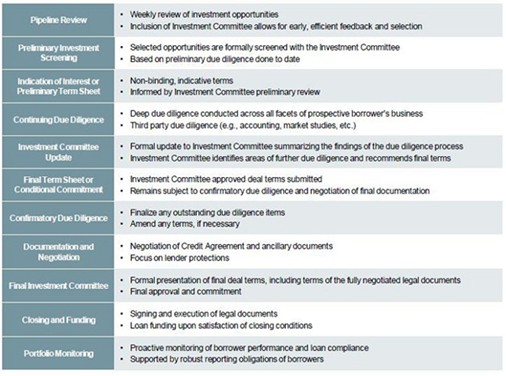
Our investment process consists of the phases described below:
Origination. ACP sources investment opportunities through access to a broad network of individual contacts across industries. Among these contacts is an extensive network of private equity firms and business owners, relationships with leading middle-market senior lenders, as well as M&A and debt advisors. The senior deal professionals of ACP will supplement these relationships through personal visits and marketing campaigns. It is their responsibility to identify specific opportunities, to refine opportunities through exploration of the underlying facts and circumstances and to apply creative and flexible solutions for borrowers’ financing needs. The investment professionals of ACP have a long and successful track record investing in companies across many industry sectors. ACP intends to make investments across industries, including, among others: sports, media and entertainment, financials, industrials, consumer and retail and select natural resources-linked opportunities. Each of ACP’s originators maintains long-standing client relationships and is responsible for covering a specified target market. We believe that the strength and breadth of those relationships across a wide range of markets generate numerous financing opportunities, which we believe enable ACP to be highly selective in recommending investments to us.
Underwriting. We utilize a systematic, consistent approach to underwriting developed by ACP, with a particular focus on determining the value of a business in a downside scenario. The key criteria that we consider include (i) strong and resilient underlying business fundamentals, (ii) a substantial equity cushion in the form of either capital ranking junior in right of payment to our investment, or appraised collateral value and (iii) strong company leadership that can manage challenging business conditions. While the size of equity cushion in a given debt investment will vary over time and across industries, the equity cushion generally sought by ACP today is generally greater than 35% of total portfolio capitalization. We generally focus on the criteria developed by ACP for evaluating prospective portfolio companies, which uses a combination of analyses, including (a) fundamental analysis of a business’ financial statements (historical, projected and pro forma), financial health, quality and depth of management, competitive advantages, competitors and markets, (b) analysis of opportunities in a given market based upon fluctuations due to seasonal, financial and economic factors, (c) quantitative analysis of the relative risk-return characteristics of investments and a comparison of yields between asset classes and other indicators and (d) analysis of proprietary and secondary models.
In evaluating a particular company, we put more emphasis on credit considerations, such as (i) loan-to-value ratio (which is the principal amount of our loan divided by the enterprise value of the company in which we are investing), (ii) the ability of the company to maintain a liquidity cushion through economic cycles and in downside scenarios, (iii) the ability of the company to service its fixed charge obligations under a variety of scenarios and (iv) its anticipated strategic value in a downturn, than on the profit potential and loan pricing of a given investment. Based upon a combination of bottom-up analysis of the individual investment and ACP’s expectations of future market conditions, ACP seeks to assess the relative risk and reward for each investment. ACP seeks to mitigate the risks of a single company or single industry through limitations on investment concentration. The number of portfolio companies in which the Company invests may be insufficient to afford adequate diversification against the risk that an insufficient number of portfolio companies in which the Company invests may yield a return.
Execution. In executing transactions for us, ACP will utilize a thorough due diligence process developed by its leadership’s decades of investment experience. Through a consistent approach to underwriting and careful attention to the details of execution, ACP seeks to maintain discipline with respect to credit, pricing and structure to ensure the ultimate success of the financing. Starting with selecting which financing opportunities to pursue, ACP’s Investment Team and Investment Committee will engage in a collaborative process to identify, underwrite, negotiate and structure loans with an attractive risk-adjusted return and strong lender protections. This process relies on the active involvement of the Investment Committee and includes the Investment Team delivering a series of memoranda to the Investment Committee. These memoranda, among other things, will provide a description of the issuer, an overview of the transaction and its underlying rationale, proposed terms of the loan, sources and uses of the financing being provided, financial information and related credit statistics. Once an investment has been approved by a majority vote of the members of the Investment Committee, it will move through a series of steps, including initial documentation using standard document templates, final documentation, including resolution of business points and the execution of original documents held in escrow. Upon completion of final documentation, the Investment Team delivers a pre-closing memo (highlighting key terms during negotiation) to the Investment Committee, closing conditions are met and a loan is funded upon the execution of the legal documents by all parties.
Monitoring. Post-transaction, we view active portfolio monitoring as a vital part of our investment process. ACP’s portfolio management process is designed to maximize risk-adjusted returns and identify non-performing assets well in advance of potentially adverse events in order to mitigate investment losses. Key aspects of the ACP investment and portfolio management process include the following:
| ● | Culture of Risk Management. The Investment Team that originates an investment will continue to be connected with the credit and monitors the investment performance of the borrower through repayment. We believe this practice encourages accountability by connecting Investment Team members with the long-term performance of the investment. This also allows us to leverage the underwriting process, namely the comprehensive understanding of the risk factors associated with the investment that the Investment Team develops during underwriting. In addition, we foster continuous interaction between the Investment Team and the Investment Committee. This frequent communication encourages the early escalation of issues to members of the Investment Committee to leverage their experience and expertise well in advance of potentially adverse events. |
| ● | Ongoing Monitoring. Each portfolio company will be overseen by a team of investment professionals who are responsible for the ongoing monitoring of the investment. Upon receipt of information (financial or otherwise) relating to an investment, a preliminary review is performed by the investment professional in order to assess whether the information raises any issues that require increased attention. Particular consideration is given to information which may impact the value of an asset. If something material is identified, the investment professional is responsible for notifying the relevant members of the Investment Team and Investment Committee. |
| ● | Quarterly Portfolio Reviews. All investments will be reviewed on at least a quarterly basis. The quarterly portfolio reviews provide a forum to evaluate the status of each asset and identify any recent or long-term performance trends, either positive or negative, that may affect its current valuation. The investment will be reviewed more frequently if there are issues identified pertaining to the credit or if a material event occurs, as is noted below. |
| ● | Focus Credit List Reviews. Certain credits may be reviewed on a more frequent basis. These reviews typically occur monthly but can occur more or less frequently based on situational factors and the availability of updated information from the portfolio company. During these reviews, the Investment Team provides an update on the situation and discusses potential courses of action with the Investment Committee to ensure any mitigating steps are taken in a timely manner. |
| ● | Sponsor Relationships. For investments in transactions backed by a private equity sponsor and when evaluating investment opportunities, we consider the strength of the sponsor (e.g., track record, sector expertise, strategy, governance, follow-on investment capacity and relationship with ACP). Having a strong relationship and staying in close contact with sponsors and |
| | management during not only the underwriting process but also throughout the life of the investment allows us to engage the sponsor and management early to address potential covenant breaks or other issues. |
| ● | Robust Investment and Portfolio Management System. ACP’s investment and portfolio management system serves as the central repository of data used for investment management, including both portfolio company-level metrics (e.g., probability of default, adjusted EBITDA, geography) and asset-level metrics (e.g., price, spread/coupon, seniority, collateral coverage). ACP’s portfolio management has established a required set of data that analysts must update quarterly, or more frequently when appropriate, in order to produce a one-page summary for each portfolio company, which are used during quarterly portfolio reviews. |
As part of the monitoring process, no less frequently than quarterly, the Adviser regularly assesses the risk profile of each of our investments based on an internal performance risk rating system that grade investments on a scale of 1 to 5. This system is intended primarily to reflect the underlying risk of a Portfolio Investment relative to our initial cost basis in respect of such Portfolio Investment (i.e., at the time of origination or acquisition), although it may also take into account under certain circumstances the performance of the Portfolio Investment’s business, the collateral coverage of the investment and other relevant factors. In evaluating the appropriate grade, the Adviser considers, as applicable, the portfolio company’s operating performance, financial condition, liquidity, leverage, capital structure, covenant compliance, collateral coverage, and other relevant factors. The grade of a Portfolio Investment may be reduced or increased over time. Generally, new investments will initially be assigned a grade of 2. The following is a description of each investment grade:
| ● | Grade 1: Indicates that the risk to our ability to recoup our initial cost basis is lower than the risk to our initial cost basis at the time of origination or acquisition. Since origination or acquisition, business trends and risk factors have generally been favorable and a potential exit or repayment may be expected. |
| ● | Grade 2: Indicates a level of risk to our initial cost basis that is generally consistent with the risk to our initial cost basis at the time of origination or acquisition. This portfolio company is generally performing in line with expectations. |
| ● | Grade 3: Indicates that the risk to our ability to recoup our initial cost basis has increased relative to the risk to our initial cost basis at the time of origination or acquisition. The portfolio company may be experiencing operating or financial challenges, including declining performance or non-compliance with certain debt covenants. However, the investment is generally continuing to make scheduled payments and on accrual. |
| ● | Grade 4: Indicates that the risk to our ability to recoup the initial cost basis has increased materially since origination or acquisition. The portfolio company may be experiencing significant performance deterioration, sustained covenant non-compliance, liquidity constraints, or other material adverse developments. The investment may be on non-accrual status and there is an elevated risk of impairment of principal. |
| ● | Grade 5: Indicates that the risk to our ability to recoup the initial cost basis has substantially increased since origination or acquisition. The portfolio company is experiencing material and sustained deterioration in performance and financial condition, the investment is generally on non-accrual status, and there is a significant risk of loss of principal (initial cost basis) upon exit. |
For investments graded 3, 4, or 5, the Adviser enhances its level of scrutiny over the monitoring of such portfolio company. The Investment Team will review the investment credit risk more frequently, no less than monthly, and may perform additional research on areas of concern with the objective of early intervention with the portfolio company to avoid further deterioration.
COMPETITION
We operate in a highly competitive market for investment opportunities. We compete for investments with various other investors, such as other public and private funds, other BDCs, commercial and investment banks, commercial finance companies and to the extent they provide an alternative form of financing, private equity funds, some of which may be our affiliates. Other ACP managed investment vehicles and accounts (the “ACP Funds”) may have investment objectives that overlap with ours, which may create competition for investment opportunities. Many competitors are substantially larger and have considerably greater financial, technical and marketing resources than we do. For example, some competitors may have a lower cost of funds and access to funding sources that will not be available to us. In addition, some of our competitors may have higher risk tolerances or different risk assessments than we do, which could allow them to consider a wider variety of investments and establish more relationships than us. Furthermore, many of our competitors are not subject to the regulatory restrictions that the 1940 Act and the Code impose on us. The competitive pressures could impair our business, financial condition, and results of operations. As a result of this competition, we may not be able to take advantage of attractive investment opportunities.
MANAGEMENT AND OTHER AGREEMENTS
Employees
We do not currently have any employees and do not expect to have any employees. Services necessary for our business are provided by individuals who are employees of ACP or its affiliates, pursuant to the terms of the Advisory Agreement and the Administration Agreement. Each of our executive officers is employed by ACP or its affiliates and our day-to-day investment activities are managed by ACP.
Advisory Agreement
The Advisory Agreement was most recently re-approved on September 16, 2025 by our Board, including a majority of the Board Members, for an additional one-year term ending on October 23, 2026, and will continue automatically for successive one-year periods, provided that such continuance is specifically approved at least annually by (i) the vote of the Board, or by the vote of a majority of the outstanding voting securities of the Company and (ii) the vote of a majority of the Independent Board Members. The Advisory Agreement may be terminated at any time, without the payment of any penalty, upon 60 days’ written notice, (i) by the vote of a majority of the outstanding voting securities of the Company, (ii) by the vote of the Board, or (iii) by the Adviser. The Advisory Agreement will automatically terminate in the event of its “assignment” (as such term is defined for purposes of Section 15(a)(4) of the 1940 Act).
Under the Advisory Agreement, the Company will pay the Adviser fees for investment management services consisting of a base management fee (the “Management Fee”) and an incentive fee (the “Incentive Compensation”).
Management Fee
Pursuant to the Advisory Agreement the Company will pay to the Adviser a Management Fee, payable quarterly in arrears at a rate of 1.50% per annum of the sum of (1) the Members’ total unfunded Capital Commitments and (2) the Company’s total assets (excluding cash or cash equivalents but including assets purchased with borrowed amounts) as of the end of the most recently completed calendar quarter. In the event the Company engages in an Exchange Listing, the Company will pay to the Adviser an annual Management Fee, payable quarterly in arrears at a rate of 1.75% per annum of the Company’s total assets (excluding cash or cash equivalents but including assets purchased with borrowed amounts) as of the end of the most recently completed calendar quarter. The Adviser contractually agreed to waive 0.25% of the Management Fee for a one-year period beginning on the Company’s Initial Closing Date and ended on November 14, 2024.
Incentive Compensation
Incentive Compensation will be payable by the Company to the Adviser and will consist of two components that are independent of each other, with the result that one component may be payable even if the other is not. A portion of the incentive fee is based on a percentage of the Company’s income (an “Income Incentive Fee”) and a portion is based on a percentage of the Company’s capital gains (the “Capital Gains Incentive Fee”), each as described below. Because of the structure of the Incentive Compensation, it is possible that the Company may pay an Income Incentive Fee in a quarter where it incurs a loss. For example, if the Company receives pre-incentive fee net investment income in excess of the hurdle rate (as defined below) for a quarter, the Company will pay the applicable Income Incentive Fee even if it has incurred a loss in that quarter due to realized and unrealized capital losses.
Income Incentive Fee.
The first component of the Incentive Compensation, the Income Incentive Fee, is payable quarterly in arrears. Pre-incentive fee net investment income means interest income, dividend income and any other income (including any other fees such as commitment, origination, structuring, diligence and consulting fees or other fees that we receive from portfolio companies but excluding fees for providing managerial assistance) accrued during the calendar quarter, minus operating expenses for the quarter (including the Management Fee, any expenses payable under the Administration Agreement, and any interest expense and dividends paid on any outstanding preferred stock, but excluding the incentive fee). Pre-incentive fee net investment income includes, in the case of investments with a deferred interest feature such as market discount, original issue discount, debt instruments with PIK interest, preferred stock with PIK dividends and zero-coupon securities, accrued income that we have not yet received in cash.
Pre-incentive fee net investment income does not include any realized or unrealized capital gains or losses or unrealized capital appreciation or depreciation. Because of the structure of the incentive fee, it is possible that we may pay an incentive fee in a quarter where we incur a loss. For example, if we receive pre-incentive fee net investment income in excess of the “hurdle rate” for a quarter, we will pay the applicable incentive fee even if we have incurred a loss in that quarter due to realized and unrealized capital losses.
Pre-incentive fee net investment income will be compared to a “Hurdle Amount” equal to the product of (i) the “hurdle rate” of 1.25% per quarter (5% annualized) and (ii) the Company’s net assets (defined as total assets less indebtedness and before taking into account any incentive fees payable during the period) at the end of the immediately preceding calendar quarter. If market interest rates rise, we may be able to invest the Company’s funds in debt instruments that provide for a higher return, which would increase the Company’s pre-incentive fee net investment income and make it easier for the Adviser to surpass the fixed “hurdle rate” and receive an incentive fee based on such net investment income. The Company’s pre-incentive fee net investment income used to calculate this part of the incentive fee is also included in the amount of the Company’s total assets (other than cash and cash equivalents but including assets purchased with borrowed amounts) used to calculate the Management Fee.
Prior to the occurrence of an Exchange Listing, the Company will pay the Income Incentive Fee in each calendar quarter as follows:
| ● | No Income Incentive Fee in any calendar quarter in which the Company’s pre-incentive fee net investment income does not exceed the Hurdle Amount; |
| ● | 100% of the Company’s pre-incentive fee net investment income with respect to that portion of such pre-incentive fee net investment income, if any, that exceeds the Hurdle Amount but is less than or equal to an amount (the “Pre-Exchange Listing Catch-Up Amount”) determined on a quarterly basis by multiplying 1.4705% (5.882% annualized) by the Company’s net asset value (“NAV”) at the beginning of each applicable calendar quarter. The Pre-Exchange Listing Catch-Up Amount is intended to provide the Adviser with an incentive fee of 15% on all of the Company’s pre-incentive fee net investment income when the Company’s pre-incentive fee net investment income reaches the Pre-Exchange Listing Catch-Up Amount in any calendar quarter; and |
| ● | For any calendar quarter in which the Company’s pre-incentive fee net investment income exceeds the Pre-Exchange Listing Catch-Up Amount, the Income Incentive Fee shall equal 15% of the amount of the Company’s pre-incentive fee net investment income for the calendar quarter. |
Prior to an Exchange Listing, the Income Incentive Fee is subject to a cap (the “Pre-Exchange Listing Incentive Fee Cap”). The Pre-Exchange Listing Incentive Fee Cap in respect of any quarter is an amount equal to 15% of the Pre-Incentive Fee Net Return (as defined below) during the relevant quarter. For this purpose, “Pre-Incentive Fee Net Return” during the relevant quarter means (x) pre-incentive fee net Investment income in respect of the quarter less (y) any Net Capital Loss (as defined below), if any. For this purpose, “Net Capital Loss” in respect of a particular quarter means the difference, if positive, between (i) aggregate capital losses, whether realized or unrealized, in respect of such quarter and (ii) aggregate capital gains, whether realized or unrealized, in respect of such quarter.
If, in any calendar quarter, the Pre-Exchange Listing Incentive Fee Cap is zero or a negative value, the Company shall pay no Income Incentive Fee to the Adviser in respect of that quarter. If, in any calendar quarter, the Pre-Exchange Listing Incentive Fee Cap is a positive value but is less than the Income Incentive Fee amount, the Company shall pay the Adviser the Pre-Exchange Listing Incentive Fee Cap in respect of such quarter. If, in any calendar quarter, the Incentive Fee Cap is equal to or greater than the Income Incentive Fee, the Company shall pay the Adviser the Income Incentive Fee in respect of such quarter.
On and after the occurrence of an Exchange Listing, the Company will pay the Income Incentive Fee in each calendar quarter as follows:
| ● | No Income Incentive Fee in any calendar quarter in which the Company’s pre-incentive fee net investment income does not exceed the Hurdle Amount; |
| ● | 100% of the Company’s pre-incentive fee net investment income with respect to that portion of such pre-incentive fee net investment income, if any, that exceeds the Hurdle Amount but is less than or equal to an amount (the “Post-Exchange Listing Catch-Up Amount”) determined on a quarterly basis by multiplying 1.5625% (6.25% annualized) by the Company’s NAV at the beginning of each applicable calendar quarter. The Post-Exchange Listing Catch-Up Amount is intended to provide the Adviser with an incentive fee of 20% on all of the Company’s pre-incentive fee net investment income when the Company’s pre-incentive fee net investment income reaches the Post-Exchange Listing Catch-Up Amount in any calendar quarter; and |
| ● | For any calendar quarter in which the Company’s pre-incentive fee net investment income exceeds the Post-Exchange Listing Catch-Up Amount, the Income Incentive Fee shall equal 20% of the amount of the Company’s pre-incentive fee net investment income for the calendar quarter. |
Subsequent to an Exchange Listing, the Income Incentive Fee is subject to a cap (the “Post-Exchange Listing Incentive Fee Cap”). The Post-Exchange Listing Incentive Fee Cap in respect of any quarter is an amount equal to 20% of the Pre-Incentive Fee Net Return during the relevant quarter.
If, in any calendar quarter, the Post-Exchange Listing Incentive Fee Cap is zero or a negative value, the Company shall pay no Income Incentive Fee to the Adviser in respect of that quarter. If, in any calendar quarter, the Incentive Fee Cap is a positive value but is less than the Income Incentive Fee amount, the Company shall pay the Adviser the Post-Exchange Listing Incentive Fee Cap in respect of such quarter. If, in any calendar quarter, the Incentive Fee Cap is equal to or greater than the Income Incentive Fee, the Company shall pay the Adviser the Income Incentive Fee in respect of such quarter.
These calculations will be appropriately pro-rated for any period of less than three months and adjusted for any Share issuances or repurchases by the Company during the current quarter. The Company does not currently intend to institute a Share repurchase program and Share repurchases will be effected only in extremely limited circumstances in accordance with applicable law. If the Exchange Listing occurs on a date other than the first day of a calendar quarter, the Income Incentive Fee shall be calculated for such calendar quarter at a weighted rate calculated based on the fee rates applicable before and after an Exchange Listing based on the number of days in such calendar quarter before and after an Exchange Listing.
Capital Gains Incentive Fee.
The second component of the Incentive Compensation, the Capital Gains Incentive Fee, is payable at the end of each calendar year in arrears and equals (i) 15% of the Company’s realized capital gains as of the end of the fiscal year prior to a Liquidity Event, and (ii) 20% of the Company’s realized capital gains as of the end of the fiscal year after a Liquidity Event. In determining the Capital Gains Incentive Fee payable to the Adviser, we calculate the cumulative aggregate realized capital gains and cumulative aggregate realized capital losses since the Company’s Inception, and the aggregate unrealized capital depreciation as of the date of the calculation, as applicable, with respect to each of the investments in the Company’s portfolio. For this purpose, cumulative aggregate realized capital gains, if any, equals the sum of the differences between the net sales price of each investment, when sold, and the original cost of such investment since the Company’s Inception. Cumulative aggregate realized capital losses equals the sum of the amounts by which the net sales price of each investment, when sold, is less than the original cost of such investment since the Company’s Inception. Aggregate unrealized capital depreciation equals the sum of the difference, if negative, between the valuation of each investment as of the applicable calculation date and the original cost of such investment. At the end of the applicable year, the amount of capital gains that serves as the basis for the Company’s calculation of the Capital Gains Incentive Fee equals the cumulative aggregate realized capital gains less cumulative aggregate realized capital losses, less aggregate unrealized capital depreciation, with respect to the Company’s portfolio of investments. If this number is positive at the end of such year, then the Capital Gains Incentive Fee for such year will equal 15% before an Exchange Listing or 20% after an Exchange Listing, as applicable, of such amount, less the aggregate amount of any Capital Gains Incentive Fees paid in respect of the Company’s portfolio in all prior years.
If an Exchange Listing occurs on a date other than the first day of a fiscal year, a Capital Gains Incentive Fee shall be calculated as of the day before the Exchange Listing, with such Capital Gains Incentive Fee paid to the Adviser following the end of the fiscal year in which the Exchange Listing occurred. For the avoidance of doubt, such Capital Gains Incentive Fee shall be equal to 15% of the Company’s realized capital gains on a cumulative basis from Inception through the day before the Exchange Listing, computed net of all realized capital losses and unrealized capital depreciation on a cumulative basis, less the aggregate amount of any previously paid Capital Gains Incentive Fees. Following an Exchange Listing, solely for the purposes of calculating the Capital Gains Incentive Fee, the Company will be deemed to have previously paid Capital Gains Incentive Fees prior to an Exchange Listing equal to the product obtained by multiplying (a) the actual aggregate amount of previously paid Capital Gains Incentive Fees for all periods prior to an Exchange Listing by (b) the percentage obtained by dividing (x) 20% by (y) 15%. In the event that the Advisory Agreement shall terminate as of a date that is not a fiscal year end, the termination date shall be treated as though it were a fiscal year end for purposes of calculating and paying a Capital Gains Incentive Fee.
Administration Agreement
Under the Administration Agreement, the Administrator furnishes the Company with office facilities and equipment and will provide the Company with clerical, bookkeeping, recordkeeping and other administrative services at such facilities. The Administrator also performs, or oversees the performance of, the Company’s required administrative services, which include being responsible for the financial and other records that the Company is required to maintain and preparing reports to its Members and reports and other materials filed with the SEC. In addition, the Administrator assists the Company in determining and publishing its NAV, oversees the preparation and filing of its tax returns and the printing and dissemination of reports and other materials to its Members, and generally oversees the payment of its expenses and the performance of administrative and professional services rendered to the Company by others. Under the Administration Agreement, the Administrator also provides managerial assistance on the Company’s behalf to those portfolio companies that have accepted the Company’s offer to provide such assistance. The Company will pay to the Administrator an annual administration fee of 0.25% on the Company’s total Capital Commitments, payable quarterly in arrears, for services and facilities provided under the Administration Agreement (the “Administration Fee”). For purposes of the Administration Fee, total Capital Commitments equals the sum of the Members’ funded Capital Commitments and unfunded Capital Commitments at the end of each fiscal quarter.
Payment of Our Expenses
All investment professionals of ACP and/or its affiliates, when and to the extent engaged in providing investment advisory services to us, and the compensation and routine overhead expenses of personnel allocable to these services to us, are provided and paid for by ACP and not by us. We bear all other out-of-pocket costs and expenses of our operations and transactions, including, without limitation:
| ● | organization and offering expenses (subject to the Cap, as described below); |
| ● | calculating our NAV (including the cost and expenses of any independent valuation firm); |
| ● | fees and expenses incurred by ACP payable to third parties, including agents, consultants or other advisors, in monitoring financial and legal affairs for us and in conducting research and due diligence on prospective investments and equity sponsors, analyzing investment opportunities, structuring our investment and monitoring our investments and portfolio companies on an ongoing basis (although none of ACP’s duties will be subcontracted to subadvisors); |
| ● | interest payable on debt, if any, incurred to finance our investments; |
| ● | offerings of our Shares and other securities; |
| ● | the Management Fee and Incentive Compensation (as described above); |
| ● | administration fees and expenses, if any, payable under the Administration Agreement (including payments under the Administration Agreement between us and ACP); |
| ● | transfer agent, dividend agent and custodial fees and expenses; |
| ● | federal and state registration fees; |
| ● | all costs of registration and listing our Shares on any securities exchange; |
| ● | federal, state and local taxes; |
| ● | independent directors’ fees and expenses; |
| ● | costs of preparing and filing reports or other documents required by the SEC or other regulators; |
| ● | costs of any reports, proxy statements or other notices to Members, including printing costs; |
| ● | fidelity bond, directors and officers/errors and omissions liability insurance, and any other insurance premiums; |
| ● | direct costs and expenses of administration, including printing, mailing, long distance telephone, copying, secretarial and other staff, independent auditors and outside legal costs; |
| ● | proxy voting expenses; and |
| ● | all other expenses incurred by us or ACP in connection with administering our business. |
The Company will pay all initial Organizational and Offering Expenses associated with the Private Offering up to a maximum amount of 1.50% of aggregate Capital Commitments to the Company over the initial four-year period following the Initial Closing Date (the “Cap”). The Adviser will pay all Organizational and Offering Expenses in excess of the Cap.
Generally, expenses incurred directly in connection with a particular investment (or proposed investment) of the Company and other accounts in which Andalusian conducts substantial investment and other activities in their own accounts and the accounts of other ACP Funds will be allocated among the Company and other ACP Funds pro rata based upon capital invested (or proposed to be invested) in such investment; provided that expenses specifically attributable to the Company or any other ACP Fund may be allocated to the Company or any such other ACP Fund, as applicable. The Adviser will allocate other expenses among the Company and other ACP Funds in a fair and equitable manner taking into account such factors as it deems appropriate.
Notwithstanding the foregoing, in light of the Company’s investment mandate, which may include investments in small loans, niche credits and other similar securities, it may not be practical to specifically allocate certain investment-related expenses to the particular loans to which they relate. The Adviser, in its absolute and sole discretion, may instead allocate such expenses (along with expenses that relate to transactions that are not consummated) pro rata across one or more investments.
Determination of Net Asset Value
The NAV per Share of our outstanding Shares is determined at least quarterly by dividing the value of total assets minus liabilities by the total number of Shares outstanding at the date as of which the determination is made. Pursuant to Rule 2a-5 under the 1940 Act, our Board has designated the Adviser as our valuation designee, subject to the oversight of the Board.
Investment transactions will be recorded on the trade date. Realized gains or losses will be measured by the difference between the net proceeds received (excluding prepayment fees, if any) and the amortized cost basis of the investment using the specific identification method without regard to unrealized gains or losses previously recognized, and include investments charged off during the period, net
of recoveries. The net change in unrealized gains or losses will primarily reflect the change in investment values, including the reversal of previously recorded unrealized gains or losses with respect to investments realized during the period.
Investments for which market quotations are readily available will typically be valued at the bid price of those market quotations. To validate market quotations, we may utilize a number of factors to determine if the quotations are representative of fair value, including the source and number of the quotations. Debt and equity securities that are not publicly traded or whose market prices are not readily available, as is expected to be the case for substantially all of our investments, will be valued at fair value as determined in good faith by our Adviser, as our valuation designee, at least quarterly, with the input of one or more external independent valuation firms and subject to the oversight of our Board.
The determination of the fair value involves subjective judgments and estimates. As part of the valuation process, the Adviser will take into account relevant factors in determining the fair value of our investments, including: the estimated enterprise value of a portfolio company (i.e., the total fair value of the portfolio company’s debt and equity), the nature and realizable value of any collateral, the portfolio company’s ability to make payments based on its earnings and cash flow, the markets in which the portfolio company does business, a comparison of the portfolio company’s securities to any similar publicly traded securities, and overall changes in the interest rate environment and the credit markets that may affect the price at which similar investments may be made in the future. When an external event such as a purchase transaction, public offering or subsequent equity sale occurs, the Adviser will consider whether the pricing indicated by the external event corroborates its valuation.
The Adviser undertakes a multi-step valuation process, which includes, among other procedures, the following:
| • | With respect to investments for which market quotations are readily available, those investments will typically be valued at the bid price of those market quotations; |
| • | With respect to investments for which market quotations are not readily available, the valuation process will begin with either (i) independent valuation firm(s) providing a preliminary valuation of such investment to the Adviser’s valuation committee or (ii) the Adviser preparing a preliminary valuation of such investment based on proprietary models; and |
| • | Preliminary valuation conclusions will be documented and discussed within the Adviser’s valuation committee. |
The Adviser applies Financial Accounting Standards Board Accounting Standards Codification (“ASC”) 820, Fair Value Measurements (“ASC 820”), as amended, which establishes a framework for measuring fair value in accordance with accounting principles generally accepted in the United States (“GAAP”) and required disclosures of fair value measurements. ASC 820 determines fair value to be the price that would be received for an investment in a current sale, which assumes an orderly transaction between market participants on the measurement date. Market participants are defined as buyers and sellers in the principal or most advantageous market (which may be a hypothetical market) that are independent, knowledgeable, and willing and able to transact. In accordance with ASC 820, we consider its principal market to be the market that has the greatest volume and level of activity. ASC 820 specifies a fair value hierarchy that prioritizes and ranks the level of observability of inputs used in determination of fair value. In accordance with ASC 820, these levels are summarized below:
Level 1—Valuations based on quoted prices in active markets for identical assets or liabilities that the Company has the ability to access.
Level 2—Valuations based on quoted prices in markets that are not active or for which all significant inputs are observable, either directly or indirectly.
Level 3—Valuations based on inputs that are unobservable and significant to the overall fair value measurement.
In addition to using the above inputs in investment valuations, the Adviser will apply a valuation policy approved by the Board that is consistent with ASC 820. Consistent with the valuation policy, the Adviser will evaluate the source of the inputs, including any markets in which our investments are trading (or any markets in which securities with similar attributes are trading), in determining fair value. When an investment is valued based on prices provided by reputable dealers or pricing services (that is, broker quotes), the Adviser will subject those prices to various criteria in making the determination as to whether a particular investment would qualify for treatment as a Level 2 or Level 3 investment. For example, the Adviser, or the independent valuation firm(s), will review pricing support provided by dealers or pricing services in order to determine if observable market information is being used, versus unobservable inputs.
Due to the inherent uncertainty of determining the fair value of investments that do not have a readily available market value, the fair value of our investments may fluctuate from period to period. Additionally, the fair value of such investments may differ significantly from the values that would have been used had a ready market existed for such investments and may differ materially from the values that may ultimately be realized. Further, such investments are generally less liquid than publicly traded securities and may be subject to contractual and other restrictions on resale. If we were required to liquidate a Portfolio Investment in a forced or liquidation sale, it could
realize amounts that are different from the amounts presented and such differences could be material. In addition, changes in the market environment and other events that may occur over the life of the investments may cause the gains or losses ultimately realized on these investments to be different than the unrealized gains or losses reflected herein.
REGULATION
Regulation as a BDC
We have elected to be regulated as a BDC under the 1940 Act. The 1940 Act contains prohibitions and restrictions relating to transactions between BDCs and their affiliates (including any investment advisers or sub-advisers), principal underwriters and affiliates of those affiliates or underwriters. The 1940 Act requires that a majority of the Board Members be persons other than “interested persons,” as that term is defined in the 1940 Act. In addition, the 1940 Act provides that we may not change the nature of our business so as to cease to be, or to withdraw our election as, a BDC unless approved by a majority of our outstanding voting securities, which the 1940 Act defines as the lesser of: (i) 67% or more of such company’s shares present at a meeting if more than 50% of the outstanding shares of such company are present or represented by proxy, or (ii) more than 50% of the outstanding shares of such company.
Qualifying Assets
Under the 1940 Act, a BDC may not acquire any asset other than assets of the type listed in Section 55(a) of the 1940 Act, which are referred to as qualifying assets, unless, at the time the acquisition is made, qualifying assets represent at least 70% of the company’s total assets. The principal categories of qualifying assets relevant to our business are any of the following:
| (1) | Securities purchased in transactions not involving any public offering from the issuer of such securities, which issuer (subject to certain limited exceptions) is an eligible portfolio company, or from any person who is, or has been during the preceding 13 months, an affiliated person of an eligible portfolio company, or from any other person, subject to such rules as may be prescribed by the SEC. An eligible portfolio company is defined in the 1940 Act as any issuer which: |
| (a) | is organized under the laws of, and has its principal place of business in, the United States; |
| (b) | is not an investment company (other than a small business investment company wholly owned by the BDC) or a company that would be an investment company but for certain exclusions under the 1940 Act; and |
| (c) | satisfies any of the following: |
| (i) | does not have any class of securities that is traded on a national securities exchange; |
| (ii) | has a class of securities listed on a national securities exchange, but has an aggregate market value of outstanding voting and non-voting common equity of less than $250 million; |
| (iii) | is controlled by a BDC or a group of companies including a BDC and the BDC has an affiliated person who is a director of the eligible portfolio company; or |
| (iv) | is a small and solvent company having total assets of not more than $4 million and capital and surplus of not less than $2 million. |
| (2) | Securities of any eligible portfolio company controlled by the Company. |
| (3) | Securities purchased in a private transaction from a U.S. issuer that is not an investment company or from an affiliated person of the issuer, or in transactions incident thereto, if the issuer is in bankruptcy and subject to reorganization or if the issuer, immediately prior to the purchase of its securities was unable to meet its obligations as they came due without material assistance other than conventional lending or financing arrangements. |
| (4) | Securities of an eligible portfolio company purchased from any person in a private transaction if there is no ready market for such securities and the Company already owns 60% of the outstanding equity of the eligible portfolio company. |
| (5) | Securities received in exchange for or distributed on or with respect to securities described in (1) through (4) above, or pursuant to the exercise of warrants or rights relating to such securities. |
| (6) | Cash, cash equivalents, U.S. government securities or high-quality debt securities maturing in one year or less from the time of investment. |
In addition, a BDC must be operated for the purpose of making investments in the types of securities described in (1), (2) or (3) above.
Control, as defined by the 1940 Act, is presumed to exist where a BDC beneficially owns more than 25% of the outstanding voting securities of the portfolio company but may exist in other circumstances based on the facts and circumstances.
The regulations defining qualifying assets may change over time. The Company may adjust its investment focus as needed to comply with and/or take advantage of any regulatory, legislative, administrative or judicial actions.
Managerial Assistance to Portfolio Companies
A BDC must have been organized and have its principal place of business in the United States and must be operated for the purpose of making investments in the types of securities described above. However, in order to count portfolio securities as qualifying assets for the purpose of the 70% test, the BDC must either control the issuer of the securities or must offer to make available to the issuer of the securities (other than small and solvent companies described above) significant managerial assistance; except that, where the BDC purchases such securities in conjunction with one or more other persons acting together, one of the other persons in the group may make available such managerial assistance. Making available significant managerial assistance means, among other things, any arrangement whereby the BDC, through its directors, officers or employees, offers to provide and, if accepted, does so provide, significant guidance and counsel concerning the management, operations or business objectives and policies of a portfolio company through monitoring of portfolio company operations, selective participation in board and management meetings, consulting with and advising a portfolio company’s officers or other organizational or financial guidance.
Temporary Investments
As a BDC, pending investment in other types of “qualifying assets,” as described above, our investments may consist of cash, cash equivalents, U.S. government securities or high-quality debt securities maturing in one year or less from the time of investment, which are referred to, collectively, as temporary investments, such that at least 70% of the Company’s assets are qualifying assets. We may invest in highly rated commercial paper, U.S. government agency notes, U.S. Treasury bills or in repurchase agreements relating to such securities that are fully collateralized by cash or securities issued by the U.S. government or its agencies. A repurchase agreement involves the purchase by an investor, such as the Company, of a specified security and the simultaneous agreement by the seller to repurchase it at an agreed-upon future date and at a price that is greater than the purchase price by an amount that reflects an agreed-upon interest rate. There is no percentage restriction on the proportion of the Company’s assets that may be invested in such repurchase agreements. However, the 1940 Act and certain diversification tests in order to qualify as a RIC for federal income tax purposes typically require us to limit the amount we invest with any one counterparty. Accordingly, we do not intend to enter into repurchase agreements with a single counterparty in excess of this limit. The Adviser will monitor the creditworthiness of the counterparties with which we may enter into repurchase agreement transactions.
Senior Securities; Asset Coverage Ratio
In accordance with the Small Business Credit Availability Act, our initial Member approved the reduction of our minimum asset coverage ratio applicable under Section 61(a)(2) of the 1940 Act on August 1, 2023. As a result, effective August 2, 2023, the minimum asset coverage ratio under the 1940 Act applicable to us decreased from 200% to 150%, permitting us to incur additional leverage.
We are permitted, under specified conditions, to issue multiple classes of indebtedness and one class of stock senior to its Shares if the Company’s asset coverage, as defined in the 1940 Act, is at least equal to 150% for indebtedness and 200% for preferred equity immediately after each such issuance. In addition, while any preferred stock or publicly-traded debt securities are outstanding, the Company may be prohibited from making distributions to its Members or the repurchasing of such securities or Shares unless it meets the applicable asset coverage ratios at the time of the distribution or repurchase. The Company may also borrow amounts up to 5% of the value of its total assets for temporary purposes without regard to asset coverage. The 1940 Act imposes limitations on a BDC’s issuance of preferred shares, which are considered “senior securities” subject to the 150% asset coverage requirement described above. In addition, (i) preferred shares must have the same voting rights as the Members (one share, one vote), and (ii) Members must have the right, as a class, to appoint members to the Board.
Codes of Ethics
The Company and the Adviser have adopted a code of ethics pursuant to Rule 17j-1 under the 1940 Act and Rule 204A-1 under the Advisers Act, respectively, that establishes procedures for personal investments and restricts certain personal securities transactions. Personnel subject to each code may invest in securities for their personal investment accounts, including securities that may be purchased or held by the Company, so long as such investments are made in accordance with the code’s requirements.
Affiliated Transactions
The 1940 Act contains prohibitions and restrictions relating to transactions between BDCs and their affiliates (including any investment advisers or sub-advisers), principal underwriters and affiliates of those affiliates or underwriters without prior approval of the directors who are not interested persons, and in some cases, the prior approval of the SEC.
On March 9, 2026, we received an updated form of co-investment exemptive relief from the SEC to allow certain managed funds and investment vehicles, each of whose investment adviser is ACP or an investment adviser controlling, controlled by or under common control with ACP, to participate in negotiated co-investment transactions where doing so is consistent with regulatory requirements and other pertinent factors, and pursuant to the conditions of the exemptive relief. (the “Co-Investment Order”). The Co-Investment
Order, which supersedes the prior co-investment order issued to us on August 14, 2024, is a new form of co-investment exemptive relief that adopts a more flexible requirement that allocations be “fair and equitable” to us and that ACP considers the interests of us and any other affiliated 1940 Act-regulated funds that rely on the Co-Investment Order in allocations and which minimizes certain board approval requirements as compared to the prior form of co-investment exemptive relief. Among other things, under the Co-Investment Order, the terms, conditions, price, class of securities to be purchased in respect of a particular investment, the date on which such investment is to be made and any registration rights applicable thereto, must be generally the same for us and each other participating affiliated entity. The requirements of the Co-Investment Order (including any requirements for board approval thereunder), as well as other regulatory requirements associated with us and any other affiliated 1940 Act-regulated funds that rely on the Co-Investment Order, potentially will impact the investment allocations among participating entities (including, for the avoidance of doubt, us) or otherwise impact allocation results. Any changes to the Co-Investment Order or the rules and other guidance promulgated by the SEC and its staff under the 1940 Act could impact allocations made available to us and thereby affect (and potentially decrease) the allocation made to us or otherwise impact the process for allocations in transactions in which we participate.
Other 1940 Act Regulations
We are also required to provide and maintain a bond issued by a reputable fidelity insurance company to protect against larceny and embezzlement. Furthermore, as a BDC, we are prohibited from protecting any Board Member or officer against any liability to our Members arising from willful misfeasance, bad faith, gross negligence or reckless disregard of the duties involved in the conduct of such person’s office.
We are also required to designate a chief compliance officer and to adopt and implement written policies and procedures reasonably designed to prevent violation of the federal securities laws and to review these policies and procedures annually for their adequacy and the effectiveness of their implementation.
We may invest up to 100% of our assets in securities acquired directly from issuers in privately negotiated transactions. With respect to such securities, we may, for the purpose of public resale, be deemed an “underwriter” as that term is defined in the Securities Act.
We are not generally able to issue and sell our Shares at a price below NAV per Share. We may, however, issue and sell our Shares, or warrants, options or rights to acquire our Shares, at a price below the then-current NAV of our Shares if (1) our Board determines that such sale is in our best interests and the best interests of our Members, and (2) our Members have approved our policy and practice of making such sales within the preceding 12 months. In any such case, the price at which our securities are to be issued and sold may not be less than a price which, in the determination of our Board, closely approximates the market value of such securities.
Our intention is to not write (sell) or buy put or call options to manage risks associated with the publicly traded securities of our portfolio companies, except that we may enter into hedging transactions to manage the risks associated with interest rate or currency fluctuations. However, we may purchase or otherwise receive warrants to purchase the common stock of our portfolio companies in connection with acquisition financing or other investments. Similarly, in connection with an acquisition, we may acquire rights to require the issuers of acquired securities or their affiliates to repurchase them under certain circumstances.
Rule 18f-4 under the 1940 Act requires BDCs that use derivatives to, among other things, comply with a value-at-risk leverage limit, adopt a derivatives risk management program, and implement certain testing and board reporting procedures. Rule 18f-4 exempts BDCs that qualify as “limited derivatives users” from the aforementioned requirements, provided that these BDCs adopt written policies and procedures that are reasonably designed to manage the BDC’s derivatives risks and comply with certain recordkeeping requirements. We currently qualify as a “limited derivatives user” and expect to continue to do so. We have adopted a derivatives policy and comply with the recordkeeping requirements of Rule 18f-4.
Proxy Voting Policies and Procedures
We have delegated our proxy voting responsibility to the Adviser. The proxy voting policies and procedures of the Adviser are described below. The guidelines are reviewed periodically by the Adviser and our Independent Board Members, and, accordingly, are subject to change.
As an investment adviser registered under the Advisers Act, the Adviser has a fiduciary duty to act solely in the best interests of its clients. As part of this duty, the Adviser recognizes that it must vote client securities in a timely manner free of conflicts of interest and in the best interests of its clients. These policies and procedures for voting proxies for the Adviser’s investment advisory clients are intended to comply with Section 206 of, and Rule 206(4)-6 under, the Advisers Act.
Proxy Policies
The Adviser will seek to vote all proxies relating to our portfolio securities in the best interest of our Members. The Adviser reviews on a case-by-case basis each proposal submitted to a Member vote to determine its impact on the portfolio securities held by the Company. Although the Adviser will generally vote against proposals that may have a negative impact on its clients’ portfolio securities, the Adviser may vote for such a proposal if there exists compelling long-term reasons to do so.
The Adviser’s proxy voting decisions are made by senior officers who are responsible for monitoring each of our investments. All potential conflicts of interest in the proxy voting process must be reported to the Compliance Officer. The Compliance Officer will evaluate any conflicts that exist between the interests of the Adviser and clients. This evaluation will include a review of the relationship of the Adviser and its affiliates with the issuer of each security and any of the issuer’s affiliates to determine if the issuer is an affiliate of the Adviser or has some other relationship with the Adviser or a client. If a material conflict exists, the Adviser will determine whether voting in accordance with the voting guidelines and factors described above is in the best interests of the client.
Proxy Voting Records
You may obtain information about how the Adviser voted proxies by making a written request for proxy voting information to: Andalusian Credit Company, LLC, Attention: Investor Relations, 40 West 57th Street, Suite 1700, New York, New York 10019 or by calling Andalusian Credit Company, LLC at (646) 989-4070.
Privacy Policy
We are sensitive to the privacy concerns of our investors. We have a policy of protecting the confidentiality and security of information we collect about investors, and provide privacy notices to help investors better understand why and how we collect certain personal information, the care with which we treat that information, and how we use that information. Pursuant to our privacy policies, we will provide a clear and conspicuous notice to each Member that details our privacy policies and procedures at the time of subscription.
License Agreement
We have also entered into a license agreement (the “License Agreement”) with Andalusian Private Capital, LP, pursuant to which we were granted a non-exclusive license to use the name “Andalusian.” Under the License Agreement, we have a right to use the Andalusian name for so long as the Adviser or one of its affiliates remains our investment adviser. Other than with respect to this limited license, we have no legal right to the “Andalusian” name or logo.
Emerging Growth Company
We are an emerging growth company as defined in the Jumpstart our Business Startups Act of 2012 and we are eligible to take advantage of certain specified reduced disclosure and other requirements that are otherwise generally applicable to public companies that are not “emerging growth companies” including, but not limited to, not being required to comply with the auditor attestation requirements of Section 404 of the Sarbanes-Oxley Act of 2002 (the “Sarbanes-Oxley Act”). We expect to remain an emerging growth company for up to five years following the completion of our initial public offering or until the earliest of (i) the last day of the first fiscal year in which our annual gross revenues exceed $1.235 billion, (ii) December 31 of the fiscal year that we become a “large accelerated filer” as defined in Rule 12b-2 under the Exchange Act which would occur if the market value of our Shares that are held by non-affiliates exceeds $700 million as of the last business day of our most recently completed second fiscal quarter and we have been publicly reporting for at least 12 months or (iii) the date on which we have issued more than $1 billion in non-convertible debt securities during the preceding three-year period. In addition, we will take advantage of the extended transition period provided in Section 7(a)(2)(B) of the Securities Act for complying with new or revised accounting standards.
Reporting Obligations
We file annual, quarterly and current reports, proxy statements and all amendments to these reports and other information with the SEC. Any of the materials we file with the SEC may also be read and/or copied at the SEC’s Public Reference Room at 100 F Street, NE, Washington, DC 20549. Information on the operation of the SEC’s Public Reference Room may be obtained by calling the SEC at 1-800-732-0330. The SEC also maintains a website (https://www.sec.gov/) that contains such information.
CERTAIN U.S. FEDERAL INCOME TAX CONSIDERATIONS
The following discussion is a brief summary of some of the U.S. federal income tax considerations relevant to an investment in the Company as a Member. This discussion does not purport to be a complete description of the income tax considerations applicable to
such an investment. For example, this Annual Report does not describe tax consequences that we have assumed to be generally known by investors or certain considerations that may be relevant to certain types of holders subject to special treatment under U.S. federal income tax laws, including persons who hold our Shares as part of a straddle or a hedging, integrated or constructive sale transaction, persons subject to the alternative minimum tax, tax-exempt organizations, insurance companies, brokers or dealers in securities, pension plans and trusts, persons whose functional currency is not the U.S. dollar, U.S. expatriates, regulated investment companies, real estate investment trusts, personal holding companies, persons who acquire an interest in us in connection with the performance of services, and financial institutions. Such persons are urged to consult with their tax advisers as to the U.S. federal income tax consequences of an investment in us, which may differ substantially from those described herein. This summary assumes that Members hold their investment as capital assets (within the meaning of the Code).
The discussion is based upon the Code, Treasury regulations, and administrative and judicial interpretations, each as of the date of this Annual Report and all of which are subject to change, possibly retroactively, which could affect the continuing validity of this discussion. We have not sought and will not seek any ruling from the Internal Revenue Service (the “IRS”) regarding any matter discussed herein. Prospective investors should be aware that, although we intend to adopt positions we believe are in accord with current interpretations of the U.S. federal income tax laws, the IRS may not agree with the tax positions taken by us and that, if challenged by the IRS, our tax positions might not be sustained by the courts. This summary does not discuss any aspects of U.S. estate, alternative minimum, or gift tax or foreign, state or local tax. It also does not discuss the special treatment under U.S. federal income tax laws that could result if we invested in tax-exempt securities or certain other investment assets. Prospective investors must consult their own tax advisers as to the U.S. federal income tax consequences (including the alternative minimum tax consequences) of acquiring, holding and disposing of Shares, as well as the effects of state, local, and foreign tax laws
The discussion generally describes the tax consequences to investors of certain likely investments assuming that they are held by the Company directly or through subsidiaries that are transparent (i.e., disregarded or treated as partnerships) for U.S. federal income tax purposes, including entities that engage in investment activities in securities or other assets that are primarily controlled by the Company. We will comply with the provisions of the 1940 Act governing investment policies, capital structure, and leverage on an aggregate basis with such subsidiary. Each such subsidiary will also be subject to the Company’s compliance policies and procedures, including compliance with applicable provisions of the 1940 Act relating to affiliated transactions.
We may in the future hold at least some investments through subsidiaries that are not transparent for U.S. federal income tax purposes. We may choose (but is not required) to hold investments through a non-transparent subsidiary in order to address 1940 Act issues, tax considerations, or for other reasons. Some non-transparent subsidiaries (e.g., U.S. corporate subsidiaries, may involve subsidiary-level tax leakage). The Adviser, in its sole discretion, will determine whether to hold particular investments through non-transparent subsidiaries.
For purposes of this discussion, a “U.S. Member” is a Member and a “U.S. Holder” is a Member that is, for U.S. federal income tax purposes: (a) an individual who is a citizen or resident of the United States, (b) a corporation created or organized in or under the laws of the United States, any state thereof or the District of Columbia, (c) an estate, the income of which is subject to U.S. federal income taxation regardless of its source or (d) a trust if a court within the United States can exercise primary supervision over its administration and certain other conditions are met. A “Non-U.S. Member” is a Member who is not a U.S. Member.
Taxation as a RIC
The Company intends to elect to be treated as a RIC for U.S. federal income tax purposes, for the tax period ended December 31, 2025 and intends to maintain its qualification as a RIC annually thereafter. As a RIC, we generally will not have to pay corporate-level U.S. federal income taxes on any ordinary income or capital gains that we distribute to the Members as dividends. Effective for the tax year beginning on January 1, 2025, we met the criteria specified below and expect to be eligible to elect and to qualify as a RIC and intend to elect to be treated as a RIC for such tax year. For periods prior to the effectiveness of the RIC election, the Company was taxed as a corporation for U.S. federal income tax purposes.
Our qualification and taxation as a RIC depend upon our ability to satisfy on a continuing basis, through actual, annual operating results, distribution, income and asset, and other requirements imposed under the Code. No assurance can be given that we will be able to meet the complex and varied tests required to qualify as a RIC or to avoid corporate level tax. In addition, because the relevant laws may change, compliance with one or more of the RIC requirements may be impossible or impracticable.
As a RIC, the Company will be able to deduct qualifying distributions to its Members, so that it is subject to U.S. federal income taxation only in respect of earnings that it retains and does not distribute. In addition, certain distributions made to the Company’s Members may be eligible for look-through tax treatment determined by reference to the earnings from which the distribution is made.
In order to qualify as a RIC, the Company must, among other things,
| (a) | at all times during each taxable year maintain its election under the 1940 Act to be treated as a BDC; |
| (b) | derive in each taxable year at least 90% of its gross income from dividends, interest, gains from the sale or other disposition of stock or securities and other specified categories of investment income; and |
| (c) | diversify its holdings so that, subject to certain exceptions and cure periods, at the end of each quarter of its taxable year |
| (i) | at least 50% of the value of its total assets is represented by cash and cash items, U.S. government securities, the securities of other RICs and “other securities,” provided that such “other securities” shall not include any amount of any one issuer, if its holdings of such issuer are greater in value than 5% of its total assets or greater than 10% of the outstanding voting securities of such issuer, and |
| (ii) | no more than 25% of the value of its assets may be invested in the securities of any one issuer, or of any two or more issuers that are controlled by the Company and are engaged in the same or similar or related trades or business (excluding U.S. government securities and securities of other RICs), or the securities of one or more “qualified publicly traded partnerships.” |
| (d) | distribute to its Members, in respect of each taxable year, dividends for U.S. federal income tax purposes of an amount generally equal to at least 90% of the Company’s “investment company taxable income,” which is generally equal to the sum of its net ordinary income plus the excess of its realized net short-term capital gains over our realized net long-term capital losses, determined without regard to any deduction for dividends paid (the “Distribution Requirements”). |
As a RIC, the Company will be subject to a non-deductible 4% federal excise tax on certain undistributed income and gains unless it makes distributions treated as dividends for U.S. federal income tax purposes in a timely manner to its Members in respect of each calendar year of an amount at least equal to the sum of.
| (1) | at least 98% of its ordinary income (not taking into account any capital gains or losses) for the calendar year; |
| (2) | at least 98.2% of its capital gains in excess of its capital losses (adjusted for certain ordinary losses) for a one-year period generally ending on October 31 of the calendar year; and |
| (3) | any undistributed amounts from previous years on which the Company paid no U.S. federal income tax. |
The Company is generally expected to distribute substantially all of its earnings on a quarterly basis, though one or more of the considerations described below could result in the Company delaying distributions until the end of the fiscal year:
| (1) | The Company may make investments that are subject to tax rules that require it to include amounts in income before cash corresponding to that income is received, or that defer or limit the Company’s ability to claim the benefit of deductions or losses. For example, if the Company holds securities issued with original issue discount, such discount will be included in income in the taxable year of accrual and before any corresponding cash payments are received. |
| (2) | In cases where the Company’s taxable income exceeds its available cash flow, the Company will need to fund distributions with the proceeds of sale of securities or with borrowed money and will raise funds for this purpose opportunistically over the course of the year. |
Taxable Income Considerations
In certain circumstances (e.g., where the Company is required to recognize income before or without receiving cash representing such income), the Company may have difficulty making distributions in the amounts necessary to satisfy the requirements for maintaining RIC status and for avoiding income and excise taxes. Accordingly, the Company may have to sell investments at times it would not otherwise consider advantageous, raise additional debt or equity capital or reduce new investment originations to meet these distribution requirements. If the Company is not able to obtain cash from other sources, it may fail to qualify as a RIC and thereby be subject to corporate-level income tax.
Although the Company does not presently expect to do so, it will be authorized to borrow funds and to sell assets in order to satisfy distribution requirements. However, under the 1940 Act, it will not be permitted to make distributions to its Members while its debt obligations and other senior securities are outstanding unless certain “asset coverage” tests are met. Moreover, the Company’s ability to dispose of assets to meet distribution requirements may be limited by (1) the illiquid nature of its portfolio and/or (2) other requirements
relating to its qualification as a RIC, including the diversification tests. If the Company disposes of assets in order to meet the annual distribution requirement or to avoid the excise tax, it may make such dispositions at times that, from an investment standpoint, are not advantageous.
Certain of the Company’s investment practices may be subject to special and complex U.S. federal income tax provisions that may, among other things: (i) disallow, suspend or otherwise limit the allowance of certain losses or deductions, (ii) convert lower taxed long- term capital gain into higher taxed short-term capital gain or ordinary income, (iii) convert an ordinary loss or a deduction into a capital loss (the deductibility of which is more limited), (iv) cause the Company to recognize income or gain without a corresponding receipt of cash, (v) adversely affect the time as to when a purchase or sale of securities is deemed to occur, (vi) adversely alter the characterization of certain complex financial transactions, and (vii) produce income that will not be qualifying income for purposes of the 90% gross income test described above.
The Company intends to invest its net assets primarily in below investment grade instruments. Investments in these types of instruments may present special tax issues for the Company. U.S. federal income tax rules are not entirely clear about issues such as when the Company may cease to accrue interest, original issue discount or market discount, when and to what extent deductions may be taken for bad debts or worthless instruments, how payments received on obligations in default should be allocated between principal and income and whether exchanges of debt obligations in a bankruptcy or workout context are taxable.
A portfolio company in which the Company invests may face financial difficulties that require the Company to work out, modify or otherwise restructure the Company’s investment in the portfolio company. Any such transaction could, depending upon the specific terms of the transaction, result in unusable capital losses and future non-cash income. Any such transaction could also result in the Company receiving assets that give rise to non-qualifying income for purposes of the 90% gross income test described above or otherwise would not count toward satisfying the diversification tests described above. Furthermore, some of the income that the Company might otherwise earn, such as fees for providing managerial assistance, certain fees earned with respect to the Company’s investments, income recognized in a work out or restructuring of a portfolio investment, or income recognized from an equity investment in an operating partnership, may not satisfy the 90% gross income test. To manage the risk that such income might disqualify the Company as a RIC for failure to satisfy the 90% gross income test, one or more subsidiary entities treated as U.S. corporations for entity level income tax purposes may be employed to earn such income and (if applicable) hold the related asset. Such subsidiary entities will be required to pay entity level income tax on their earnings, which ultimately will reduce the yield to Members on such fees and income.
Gain or loss recognized by the Company from warrants or other securities acquired by the Company, as well as any loss attributable to the lapse of such warrants, generally will be treated as capital gain or loss. Such gain or loss generally will be long term or short-term depending on how long the Company held a particular warrant or security.
In the event the Company invests in foreign securities, it may be subject to withholding and other foreign taxes with respect to those securities. The Company is not expected to satisfy the requirement to pass through to Member their share of the foreign taxes paid by the Company.
If the Company acquires shares in a passive foreign investment company (“PFIC”), the Company may be subject to U.S. federal income tax on a portion of any “excess distribution” received on, or any gain from the disposition of, such shares even if the Company distributes such income as a taxable dividend to Members. Additional charges in the nature of interest generally will be imposed on the Company in respect of deferred taxes arising from any such excess distribution or gain. If the Company invests in the shares of a PFIC and elects to treat the PFIC as a “qualified electing fund” under the Code (a “QEF”), in lieu of the foregoing requirements, the Company will be required to include in income each year the Company’s proportionate share of the ordinary earnings and net capital gain of the QEF, even if such income is not distributed by the QEF. Alternatively, the Company may be able to elect to mark its shares in a PFIC at the end of each taxable year to market; in this case, the Company will recognize as ordinary income any increase in the value of such shares, and as ordinary loss any decrease in such value to the extent that any such decrease does not exceed prior increases in such value included in the Company’s income. The Company’s ability to make either election will depend on factors beyond the Company’s control and is subject to restrictions which may limit the availability of the benefit of these elections. Under either election, the Company may be required to recognize in a taxable year income in excess of any distributions the Company receives from PFICs and any proceeds from dispositions of PFIC stock during that taxable year, and such income will be taken into account for purposes of determining whether the Company has distributed sufficient income to avoid any material U.S. federal income tax or the 4% excise tax.
Under Section 988 of the Code, gains or losses attributable to fluctuations in exchange rates between the time the Company accrues income, expenses or other liabilities denominated in a foreign currency and the time the Company actually collects such income or pay
such expenses or liabilities are generally treated as ordinary income or loss. Similarly, gains or losses on foreign currency denominated forward, futures, and option contracts, as well as certain other financial instruments, and the disposition of debt obligations denominated in a foreign currency, to the extent attributable to fluctuations in exchange rates between the acquisition and disposition dates, are also treated as ordinary income or loss.
For U.S. federal income tax purposes, the Company is generally permitted to carry forward a net capital loss in any taxable year to offset its own capital gains, if any. These amounts are available to be carried forward to offset future capital gains to the extent permitted by the Code and applicable tax regulations. Any such loss carryforwards will retain their character as short term or long term. In the event that the Company were to experience an ownership change as defined under the Code, the capital loss carryforwards and other favorable tax attributes of the Company, if any, may be subject to limitation.
Failure to Qualify as a RIC
If in any particular taxable year, the Company does not qualify as a RIC, all of the Company’s taxable income (including net capital gains) will be subject to tax at regular corporate rates without any deduction for distributions to Members, and distributions will be taxable to Members as ordinary dividends to the extent of the Company’s current and accumulated earnings and profits. Provided certain holding period and other requirements were met, distributions received by non-corporate Members could qualify for treatment as “qualified dividend income” eligible for the maximum 20% rate (plus a 3.8% Medicare surtax, if applicable) applicable to qualified dividends to the extent of our current and accumulated earnings and profits. Subject to certain limitations under the Code, corporate Members would be eligible for a dividends received deduction on distributions they receive. Distributions in excess of our current and accumulated earnings and profits would be treated first as a return of capital to the extent of the Member’s tax basis, and any remaining distributions would be treated as a capital gain. Any amount treated as a return of capital will reduce a Member’s adjusted tax basis in their Shares, thereby increasing the Member’s potential gain or reducing the Member’s potential loss on the subsequent sale or other disposition of their Shares. The Company could be required to recognize unrealized gains, pay taxes and make distributions (which could be subject to interest charges) before requalifying for taxation as a RIC. If the Company fails to qualify as a RIC, it may be subject to regular corporate tax on any net built-in gains with respect to certain of its assets (i.e., the excess of the aggregate gains, including items of income, over aggregate losses that would have been realized with respect to such assets if the Company had been liquidated) that the Company elects to recognize on requalification or when recognized over the next five taxable years. In order to requalify as a RIC, in addition to the other requirements discussed above, the Company would be required to distribute all of its previously undistributed earnings attributable to the period it failed to qualify as a RIC by the end of the first year that it intends to requalify as a RIC.
While the Company generally intends to qualify as a RIC for each taxable year, it is possible that as the Company ramps up its portfolio the Company may not satisfy the diversification requirements described above with respect to its initial taxable years, and thus may not qualify as a RIC for such taxable years.
Summary of Risk Factors
An investment in the Company’s Shares involves significant risks. The risk factors described below are a summary of the principal risk factors associated with an investment in the Shares. These are not the only risks the Company faces. This summary should be read closely together with the risk factors set forth below in “Item 1A. Risk Factors” of this Annual Report and other reports and documents the Company files with the SEC.
Risks Related to Our Business and Structure
| ● | We and the Adviser have a limited operating history. |
| ● | We are dependent on senior management personnel for our future success, particularly our CEO, Aaron Kless |
| ● | We operate in a highly competitive market for investment opportunities. |
| ● | We are subject to risks associated with the current interest rate environment. |
| ● | Our Board could change our investment objective, operating policies and strategies without prior notice or Member approval. |
Risks Related to Our Investments
| ● | We primarily invest in privately-held companies, which generally involve a higher degree of risk. |
| ● | We primarily invest in privately held companies and securities that are rated below investment grade by rating agencies or that would be rated below investment grade if they were rated. Below investment grade securities have predominantly speculative characteristics with respect to the issuer’s capacity to pay interest and repay principal. |
| ● | The lack of liquidity of our investments may adversely impact our business. |
| ● | Defaults by portfolio companies may harm the Company’s operating results. |
| ● | Because we generally do not hold controlling equity interests in our portfolio companies, we generally will not be able to exercise control over our portfolio companies or prevent decisions by management of our portfolio companies that could decrease the value of our investments. |
Risks Related to Borrowing
| ● | We may finance our investments with borrowed money, which will accelerate and increase the potential for gain or loss on amounts invested and could increase the risk of investing in the Company. |
Risks Related to BDCs
| ● | Failure to maintain our status as a BDC would reduce our operating flexibility. |
| ● | Failure to comply with applicable laws or regulations and changes in laws or regulations governing our operations may adversely affect our business or cause us to alter our business strategy. |
| ● | The Company’s regulatory structure as a BDC and expected tax status as a RIC could limit certain of the Company’s investments or negatively affect the Company’s investment returns. |
| ● | Future changes in laws or regulations and conditions related to the Company’s operating areas could have an adverse impact on the Company. |
Federal Income Tax Risks
| ● | We are subject to certain risks related to our ability to qualify as a RIC and to related regulations governing our operation as a BDC. |
| ● | We will be subject to U.S. federal income tax if we are unable to qualify as a RIC under Subchapter M Part I of the Code. |
| ● | We may have difficulty paying the distributions required to qualify for and maintain RIC status under the Code if we recognize income before or without receiving cash representing such income. |
Risks Related to the Private Placement of our Shares
| ● | Our Shares are not currently listed on an exchange and it is uncertain whether a secondary trading market will develop for our Shares. |
| ● | An investment in the Company is suitable only for sophisticated investors and requires the financial ability and willingness to accept the high risks and lack of liquidity inherent in an investment in the Company. |
| ● | An investment in our Shares is not suitable for you if you might need access to the money you invest in the foreseeable future. |
| ● | There is no public market for the Shares and there are restrictions on holders of the Shares. |
| ● | There is a risk that Members may not receive distributions. |
| ● | There is a risk that a Member may default on its obligations to fund drawdowns (“Capital Contributions”), which can adversely affect the Company and its Members. |
Risks Related to our Adviser and its Affiliates
| ● | The Company depends on the Adviser for its success and upon its access to investment professionals. |
| ● | There are significant potential conflicts of interest as a result of our arrangements with the Adviser and its affiliates and the Adviser’s Investment Committee that could affect our investment returns. |
General Risk Factors
| ● | We and the Adviser could be the target of litigation or regulatory investigations. |
| ● | Capital markets may experience periods of disruption and instability in the future. These market conditions, when they occur, may materially and adversely affect debt and equity capital markets in the United States and abroad, which may have a negative impact on our business and operations. |
| ● | We are highly dependent on information systems and systems failures could significantly disrupt our business, which may, in turn, negatively affect the NAV of our Shares and our ability to pay dividends. |
| ● | The failure of cybersecurity systems, as well as the occurrence of events unanticipated in our disaster recovery systems and business continuity planning could impair our ability to conduct business effectively. |
Item 1A.Risk Factors
Investments in the Company involve a high degree of risk. There can be no assurance that our investment objective will be achieved. The following considerations, along with the other information in this Annual Report, should be carefully evaluated before making an investment in our Shares. The risks set out below are not the only risks that we face, and we may face other risks that are not presently known to us or not presently deemed material by us. If any of the following events occur, our business, financial condition and results of operations could be materially and adversely affected. In such case, our NAV, could decline, and you may lose all or part of your investment.
Risks Related to our Business and Structure
We and the Adviser have a limited operating history
The Company was formed on October 17, 2022 and commenced operations on November 14, 2023. Accordingly, we are an entity with a limited operating history. Additionally, the Adviser and its affiliates have a limited operating history. As a result, we are subject to all of the business risks and uncertainties associated with any new business, including the risks that it will not achieve its investment objective, and that the value of a Member’s Shares could decline substantially. Additionally, the results of any other ACP Funds, the senior Investment Team or affiliates of the Adviser are not indicative of the results that we may achieve.
We are dependent on senior management personnel for our future success, particularly our CEO, Aaron Kless
The Company is dependent on the continued services of key management personnel, particularly Aaron Kless for the portfolio strategy, identification, final selection, structuring, closing and monitoring of our investments. These employees have critical industry experience and relationships on which we rely to implement our business plan. If the Company were to lose Aaron Kless or any member of our senior management team or a significant number of our Investment Team, such a loss could result in operating inefficiencies and lost business opportunities, and/or a change in overall investment strategy which could have a negative effect on the Company’s operating performance.
We operate in a highly competitive environment for investment opportunities
We will compete for investments with other BDCs and investment funds (including registered investment companies, private equity or credit funds and mezzanine funds) and other clients of the Adviser or its affiliates, as well as traditional financial services companies such as commercial banks and other sources of funding. Moreover, alternative investment vehicles, such as hedge funds, continue to
increase their investment focus in our target market of privately owned U.S. companies. We may experience increased competition from banks and investment vehicles who may continue to lend to the middle-market.
As a result of these market participants and regulatory incentives, competition for investment opportunities in privately owned U.S. companies is strong and may intensify. Many of our competitors are substantially larger and have considerably greater financial and marketing resources than we do. For example, some competitors may have a lower cost of capital and access to funding sources that are not available to us. In addition, some competitors may have higher risk tolerances or different risk assessments than us. These characteristics could allow our competitors to consider a wider variety of investments, establish more relationships and offer better pricing and more flexible structuring than we are able to do. As a result, there can be no assurances that the Company may be able to invest and reinvest its capital fully or that suitable investment opportunities will be identified which satisfy the Company’s rate of return or maturity objectives.
We may experience fluctuations in our quarterly results.
We could experience fluctuations in our quarterly operating results due to a number of factors, including our ability or inability to make investments in companies that meet our investment criteria, the interest rate payable on the loans or other debt securities we originate or acquire, the level of our expenses (including our borrowing costs), variations in and the timing of the recognition of realized and unrealized gains or losses, the degree to which we encounter competition in our markets and general economic conditions. As a result of these factors, results for any previous period should not be relied upon as being indicative of performance in future periods.
Because our business model in the future may depend to an extent upon relationships with private equity sponsors and intermediaries, the inability of the Adviser to maintain or develop these relationships, or the failure of these relationships to generate investment opportunities, could adversely affect our business.
If the Adviser or its affiliates fail to maintain their existing relationships or develop new relationships with sponsors or other sources of investment opportunities, we may not be able to grow our investment portfolio. In addition, individuals with whom the Adviser or its affiliates have relationships are not obligated to provide us with investment opportunities, and, therefore, there is no assurance that such relationships will generate investment opportunities for us.
Inflation may adversely affect the business, results of operations and financial condition of our portfolio companies.
Certain of the portfolio companies in which we may invest may be impacted by inflation. U.S. inflation rates have fluctuated in recent periods. Inflationary pressures have increased the costs of labor, energy and raw materials and have adversely affected consumer spending, economic growth and may adversely affect our portfolio companies’ operations. Projected future decreases in our portfolio companies’ operating results due to inflation could adversely impact the fair value of those investments. Any decreases in the fair value of our investments could result in future realized or unrealized losses and therefore reduce our net assets resulting from operations. If such portfolio companies are unable to pass any increases in their costs along to their customers, it could adversely affect their results and impact their ability to pay interest and principal on our loans.
We are subject to risks associated with the current interest rate environment.
We are subject to financial market risks, including changes in interest rates. General interest rate fluctuations may have a substantial negative impact on our ability to make investments, the value of our investments and our ability to realize gains from the disposition of investments and, accordingly, could have a material adverse effect on our investment objectives and our rate of return on invested capital. On one hand, a reduction in the interest rates on new investments relative to interest rates on current investments could have an adverse impact on our net investment income, which also could be negatively impacted by our borrowers making prepayments on their loans.
On the other hand, an increase in interest rates could increase the interest repayment obligations of our borrowers and result in challenges to their financial performance and ability to repay their obligations, adversely affecting the credit quality of our investments. In addition, to the extent the Company borrows money subject to a floating interest rate, the Company’s cost of funds would increase, which could reduce its net investment income. Further, rising interest rates could also adversely affect the Company’s performance if such increases cause the Company’s borrowing costs to rise at a rate in excess of the rate that its investments yield.
Additionally, in periods of rising interest rates, there is a risk that the portfolio companies in which the Company makes floating rate investments will be unable to pay escalating interest amounts, which could result in a default under their loan documents. Rising interest rates could also cause portfolio companies to shift cash from other productive uses to the payment of interest, which may have a material adverse effect on their business and operations and could, over time, lead to increased defaults. In addition, rising interest rates may
increase pressure on the Company to provide fixed rate loans to its portfolio companies, which could adversely affect the Company’s net investment income, as increases in its cost of borrowed funds would not be accompanied by increased interest income from such fixed-rate investments. Moreover, an increase in interest rates available to investors could make investment in our Shares less attractive if we are not able to increase our dividend rate, which could reduce the value of our Shares.
The U.S. previously experienced a sustained period of historically low interest rate levels. More recently, however, the U.S. Federal Reserve and certain other monetary authorities globally have sought to influence interest rates in an effort to manage inflationary pressures. The uncertainty of the U.S. and global economy, changes in U.S. government policy and changes in the federal funds rate, increase the risk that interest rates will remain volatile in the future. Sustained future interest rate volatility may cause the value of the fixed income securities to decrease or force the Company to liquidate securities at disadvantageous prices negatively impacting performance.
Lack of Diversification and Limited Number of Portfolio Companies
We are classified as a non-diversified investment company within the meaning of the 1940 Act, which means that the Company is not limited by the 1940 Act with respect to the proportion of its assets that it may invest in securities of a single issuer. The Company does not have fixed guidelines for diversification (other than certain maximum concentration limitations), and the Company could be concentrated in relatively few industries and portfolio companies. The Company could participate in a relatively limited number of investments and, as a consequence, the aggregate return could be substantially adversely affected by the unfavorable performance of even a single investment. To the extent that the Company assumes large positions with respect to a small number of investments or industries, its valuation may fluctuate to a greater extent than that of a more diversified investment company. Realized aggregate returns may be significantly adversely affected if a small number of investments perform poorly or if the value of any one investment is written down, and a downturn in any particular industry in which the Company is invested could significantly affect its aggregate returns. To the extent that the Company operates as a non-diversified investment company, it may be subject to greater risk.
Our investment portfolio is recorded at fair value as determined in good faith in accordance with valuation policies and procedures established by our Adviser and approved by our Board (the “Valuation Policy”) and, as a result, there is and will be uncertainty as to the value of our Portfolio Investments.
There generally is not a public market or active secondary market for many of the types of investments in privately held companies that we hold and make. As a result, we value these investments quarterly at fair value as determined in good faith in accordance with the Valuation Policy. In accordance with Rule 2a-5 under the 1940 Act, our Board has designated the Adviser to serve as our valuation designee. Subject to the oversight of our Board, the Adviser values our investments, no less frequently than quarterly, including with the assistance of one or more independent valuation firms. The types of factors that may be considered in determining the fair values of our investments include the nature and realizable value of any collateral, the portfolio company’s ability to make payments and its earnings, the markets in which the portfolio company does business, comparison to publicly traded companies, discounted cash flow, current market interest rates and other relevant factors. In connection with that determination, portfolio company valuations are prepared using different sources, including preliminary valuations obtained from independent valuation firms and/or proprietary models depending on the availability of information and the type of asset being valued, all in accordance with the Valuation Policy.
The determination of fair value, and thus the amount of unrealized appreciation or depreciation we may recognize in any reporting period, is to a degree subjective, and the Adviser has a conflict of interest in fair valuing our investments, as the Adviser’s Management Fee is based in part on our gross assets. Because such valuations, and particularly valuations of private securities and private companies, are inherently uncertain, the valuations may fluctuate significantly over short periods of time due to changes in current market conditions. The determinations of fair value in accordance with the Valuation Policy may differ materially from the values that would have been used if an active market and market quotations existed for such investments. Volatile market conditions could also cause reduced liquidity in the market for certain assets, which could result in liquidation values that are materially less than the values of such assets as reflected in NAV. Our NAV could be adversely affected if the determinations regarding the fair value of the investments were materially higher than the values that we ultimately realize upon the disposal of such investments
Our Board may change our operating policies and strategies without prior notice or Member approval, the effects of which may be adverse to our Members.
Our Board has the authority to modify or waive current operating policies, investment criteria and strategies without prior notice and without Member approval. However, absent Member approval, we may not change the nature of our business so as to cease to be, or withdraw our election as, a BDC. We cannot predict the effect any changes to current operating policies, investment criteria and strategies would have on our business, NAV, operating results and the value of our securities. However, the effects might be adverse, which could negatively impact our ability to pay you distributions and cause you to lose all or part of your investment. Moreover, we
will have significant flexibility in investing the net proceeds of our offering and may use the net proceeds from our offering in ways with which our investors may not agree.
The Company may not consummate any Exchange Listing, and may, in its sole discretion, determine to commence tender offers to its Members, and/or otherwise seek to undergo a sales transaction, which could restructure the Company and may result in the Company being wound down and/or liquidated and dissolved in an orderly manner.
The Company operates as a privately offered, unlisted BDC until such time as the Board, in its sole discretion, determines that the Company should conduct a Liquidity Event. A “Liquidity Event” may include Exchange Listing, through an initial public offering or a direct listing on a nationally recognized stock exchange, subject to certain conditions, commencing tender offers to Members, or otherwise seeking to undergo a Sale Transaction. Refer to “Item 1. Business – The Company” for more information.
We cannot assure Members when we will undertake any Liquidity Event, including whether we will undertake an Exchange Listing. If we undertake an Exchange Listing, we cannot assure Members of the Share price at which such listing would be consummated. Additionally, BDCs frequently trade at a discount from their NAV. This characteristic of closed-end investment companies is separate and distinct from the risk that our NAV per Share may decline. We cannot predict whether our Shares, if listed on a national securities exchange, will trade at, above or below NAV. Each Member will acknowledge and agree in its Subscription Agreement that, following an Exchange Listing, if any, the Member shall be restricted from selling or disposing its Shares of the Company by applicable securities laws or contractually by a lock-up agreement with the underwriters of any Exchange Listing, or similar institutions, acting on the Company’s behalf, in connection with an Exchange Listing.
If we have not effectuated an Exchange Listing, and the Board determines to commence tender offers or undertake a sales transaction, we may be required to sell investments at an inopportune time, which could adversely affect our performance and/or cause us to seek to invest in loans with a shorter term than would be the case if the timeline was extended, which might adversely affect the nature and/or quality of our investments. Additionally, commencing tender offers or undertaking a sales transaction may cause our fixed expenses to increase as a percentage of assets under management. In addition, any proceeds realized by us from the sale or repayment of investments could result in an increased concentration of our portfolio, which could increase the risks associated with ownership of our Shares.
Risks Related to our Investments
Investing in private companies involves a high degree of risk.
The Company’s portfolio consists of debt and, to a lesser extent, equity investments in private U.S. middle-market companies with less than $250 million in market capitalization. Investments in private businesses involve a high degree of business and financial risk, which can result in substantial losses for the Members in those investments and accordingly should be considered speculative. There is generally no publicly available information about the private companies in which the Company invests, and the Company relies significantly on the diligence of its service providers and agents to obtain information in connection with investment decisions. If the Company is unable to identify all material information about these companies, the Company may fail to receive its expected return on investment or lose some or all of the capital invested in these companies. In addition, these businesses may have shorter operating histories, narrower product lines, smaller market shares and less experienced management than their larger competitors and may be more vulnerable to customer preferences, market conditions, and loss of key personnel, or economic downturns, which may adversely affect the return on, or the recovery of, investments in such businesses. As an investor, the Company is subject to the risk that a Portfolio Investment may make a business decision that does not serve the Company’s best interests, which could decrease the value of the Company’s investment. Deterioration in an underlying portfolio company’s financial condition and business prospects may be accompanied by deterioration in the collateral for a loan, if any, and an event of default by the portfolio company. Such an event may reduce the Company’s anticipated return on invested capital and delay the timeline for distributions to Members.
We generally will not control the business operations of our portfolio companies.
We anticipate that we will acquire a significant percentage of our portfolio company investments from privately held companies in directly negotiated transactions. We do not expect to control most of our portfolio companies, although we may have board representation or board observation rights, and our debt agreements may impose certain restrictive covenants on our borrowers. As a result, we are subject to the risk that a portfolio company in which we invest may make business decisions with which we disagree and the management of such company, as representatives of the holders of their common equity, may take risks or otherwise act in ways that do not serve our interests as a debt investor and could decrease the value of our portfolio holdings.
Risks Associated with Sub-investment Grade and Unrated Debt Obligations
We generally invest in sub-investment grade debt obligations. Investments in the sub-investment grade categories are subject to greater risk of loss of principal and interest than higher-rated securities and may be considered to be predominantly speculative with respect to the obligor’s capacity to pay interest and repay principal. They may also be considered to be subject to greater risk than securities with higher ratings in the case of deterioration of general economic conditions. Because investors generally perceive that there are greater risks associated with non-investment grade securities, the yields and prices of such securities may fluctuate more than those for higher-rated securities. The market for non-investment grade securities may be smaller and less active than that for higher-rated securities, which may adversely affect the prices at which these securities can be sold and result in losses to the Company, which, in turn, could have a material adverse effect on the performance of the Company, and, by extension, the Company’s business, financial condition, results of operations and NAV.
In addition, the Company may invest in debt obligations which may be unrated by a recognized credit rating agency, which may be subject to greater risk of loss of principal and interest than higher-rated debt obligations or debt obligations which rank behind other outstanding securities and obligations of the obligor, all or a significant portion of which may be secured on substantially all of that obligor’s assets. The Company may also invest in debt obligations which are not protected by financial covenants or limitations on additional indebtedness. In addition, evaluating credit risk for debt securities involves uncertainty because credit rating agencies throughout the world have different standards, making comparison across countries difficult. Any of these factors could have a material adverse effect on the performance of the Company, and, by extension, the Company’s business, financial condition, results of operations and NAV.
To the extent that the Company invests in sub-investment grade investments that are also stressed or distressed then the risks discussed above are heightened.
Risks Associated with Covenant-Lite Loans
A significant number of leveraged loans in the market may consist of loans that do not contain financial maintenance covenants (“Covenant-Lite Loans”). While we do not intend to invest in Covenant-Lite Loans as part of our principal investment strategy, a portion of our Company’s portfolio is comprised of Covenant-Lite Loans. Such loans do not require the borrower to maintain debt service or other financial ratios. Ownership of Covenant-Lite Loans may expose the Company to different risks, including with respect to liquidity, price volatility, ability to restructure loans, credit risks and less protective loan documentation than is the case with loans that also contain financial maintenance covenants.
Portfolio Company Bankruptcy Risk
The Company invests in the debt of U.S. middle-market private companies that may not always have sufficient cash-on-hand to satisfy loans in full. Following an investment, these companies may be unable to successfully scale operations and increase revenue as anticipated at the time of investment. In certain circumstances, these companies may not be able to generate meaningful customer sales, commitments, or orders due to unfavorable market conditions. As a result, the company may not generate sufficient cash flow to service the loan. As a consequence, the Company could: (i) request a restructuring of the loan resulting in the delay of principal repayment, the reduction of fees, and/or future interest rates and/or the possible loss of principal; or (ii) experience bankruptcy, liquidation, or similar financial distress. The Company may be unable to accommodate any such restructuring request due to the eligibility requirements under its leverage facility or otherwise.
The bankruptcy, liquidation and/or recovery process has a number of significant inherent risks for the Company as a creditor. Many events in a bankruptcy proceeding are the product of contested matters and adversarial proceedings and are beyond the control of the creditors. A bankruptcy filing by one of the portfolio companies may adversely and permanently affect the investment in that company. If the proceeding is converted to liquidation, the liquidation value of the company may not equal the fair value that was believed to exist at the time of investment. The duration of a bankruptcy, liquidation and/or recovery proceeding is also difficult to predict, and a creditor’s return on investment can be materially and adversely affected by delays until the plan of reorganization or liquidation ultimately becomes effective. The administrative costs of the debtor and any official committees appointed in connection with a bankruptcy proceeding (for example, the fees and expenses of the debtor’s and committee’s legal, financial, and other advisors) are frequently high and would be paid out of the debtor’s estate prior to any return to creditors. If the Adviser were to participate in such committees (including creditors’ committees), the Company could be deemed to have duties to other creditors represented by the committees, which might thereby expose the Company to liability to any other creditors who disagree with the Adviser’s or the Company’s actions. Additionally, participation on a committee often exposes members to material non-public information about a company which could hinder the Company’s ability to invest in, or divest of, securities of the company. Participation on such committees also creates a risk of litigation and liability that
could cause the Company to incur significant legal fees and potential losses. Further, if the bankruptcy case involves protracted or difficult litigation, or turns into a liquidation, substantial assets could be devoted to such administrative costs; and the Company’s costs in monitoring and enforcing its investment also could substantially increase. Certain claims that have priority by law (for example, claims for taxes) also could significantly reduce or eliminate any partial recovery.
Because the standards for classification of claims under bankruptcy law are vague, the Adviser’s influence with respect to the obligations owned by the Company may be lost by increases in the number and size of claims or by different treatment. In the early stages of the bankruptcy process, it is often difficult to estimate the extent of, or even to identify, any contingent claims that might be made. In addition, certain claims that have priority by law (for example, claims for taxes) may be substantial.
Risks Associated with Second-Lien or Other Subordinated Loans
The Company may acquire and/or originate second-lien or other subordinated loans. In the event of a loss of value of the underlying assets that collateralize the loans, the subordinate portions of the loans may suffer a loss prior to the more senior portions suffering a loss. If a borrower defaults and lacks sufficient assets to satisfy the Company’s loan, the Company may suffer a loss of principal or interest. If a borrower declares bankruptcy, the Company may not have full recourse to the assets of the borrower, or the assets of the borrower may not be sufficient to satisfy the loan. In addition, certain of the Company’s loans may be subordinate to other debt of the borrower. As a result, if a borrower defaults on the Company’s loan or on debt senior to the Company’s loan, or in the event of the bankruptcy of a borrower, the Company’s loan will be satisfied only after all senior debt is paid in full. The Company’s ability to amend the terms of the Company’s loans, assign the Company’s loans, accept prepayments, exercise the Company’s remedies (through “standstill periods”) and control decisions made in bankruptcy proceedings relating to borrowers may be limited by intercreditor arrangements if debt senior to the Company’s loans exists.
Risk Associated with Unsecured Loans
The Company may invest in unsecured loans which are not secured by collateral. In the event of default on an unsecured loan, the first priority lien holder has first claim to the underlying collateral of the loan. It is possible that no collateral value would remain for an unsecured holder and therefore result in a loss of investment to the Company. Because unsecured loans are lower in priority of payment to secured loans, they are subject to the additional risk that the cash flow of the borrower may be insufficient to meet scheduled payments after giving effect to the secured obligations of the borrower. Unsecured loans generally have greater price volatility than secured loans and may be less liquid.
Equity Securities Risk
Subject to the Company’s 80% policy, the Company may purchase common and other equity securities. Although equity securities have historically generated higher average total returns than fixed income securities over the long term, equity securities also have experienced significantly more volatility in those returns. The equity securities the Company acquires may fail to appreciate and may decline in value or become worthless, and the Company’s ability to recover its investment will depend on a portfolio company’s success. Investments in equity securities involve a number of significant risks. While there are many types of equity securities, prices of all equity securities will fluctuate. Any equity investment in a portfolio company could be subject to further dilution as a result of the issuance of additional equity interests and to serious risks as a junior security that will be subordinate to all indebtedness (including trade creditors) or other senior securities in the event that the issuer is unable to meet its obligations or becomes subject to a bankruptcy process. To the extent that the portfolio company requires additional capital and is unable to obtain it, the Company may not recover its investment. In some cases, equity securities in which the Company invests will not pay current dividends, and the Company’s ability to realize a return on its investment, as well as to recover its investment, will be dependent on the success of the portfolio company.
Illiquid Nature of Investment Portfolio
The illiquidity of our portfolio company investments may make it difficult or impossible for us to sell investments if the need arises. Many of these investments will be subject to legal and other restrictions on resale or will otherwise be less liquid than exchange-listed securities or other securities for which there is an active trading market. We typically would be unable to exit these investments unless and until the portfolio company has a liquidity event such as a sale, maturity, refinancing, or initial public offering. If we are required to liquidate all or a portion of our portfolio quickly, we may realize significantly less than the value at which we have previously recorded our investments, which could have a material adverse effect on our business, financial condition and results of operations. Moreover, investments purchased by us that are liquid at the time of purchase may subsequently become illiquid due to events relating to the issuer, market events, economic conditions or investor perceptions.
PIK Interest Payments
Certain of the Company’s debt investments may contain provisions providing for the payment of PIK interest. Because PIK interest results in an increase in the size of the loan balance of the underlying loan, the receipt of PIK interest will have the effect of increasing the Company’s assets under management. As a result, the receipt of PIK interest may result in an increase in the amount of the Management Fee payable by the Company. In addition, any such increase in a loan balance due to the receipt of PIK interest will cause such loan to accrue interest on the higher loan balance, which will result in an increase in the Company’s pre-incentive fee net investment income and, as a result, an increase in incentive fees that are payable by the Company to the Adviser. To the extent PIK interest income constitutes a portion of our income, we will be exposed to risks associated with such income being required to be included in accounting income and taxable income prior to receipt of cash, including the following:
| ● | The higher yields and interest rates on PIK securities reflect the payment deferral and increased credit risk associated with such instruments and that such investments may represent a significantly higher credit risk than coupon loans. |
| ● | PIK securities may have unreliable valuations because their continuing accruals require continuing judgments about the collectability of the deferred payments and the value of any associated collateral. |
| ● | PIK interest has the effect of generating investment income and increasing the incentive fees payable at a compounding rate. In addition, the deferral of PIK interest also reduces the loan-to-value ratio at a compounding rate. |
| ● | PIK securities create the risk that incentive fees will be paid to the Adviser based on non-cash accruals that ultimately may not be realized, but the Adviser will be under no obligation to reimburse the Company for these fees. |
Prepayment Risk
The terms of loans in which the Company invests may permit the borrowers to voluntarily prepay loans at any time, either with no or a nominal prepayment premium. This prepayment right could result in the borrower repaying the principal on an obligation held by the Company earlier than expected. This may happen when there is a decline in interest rates, when the borrower’s improved credit or operating or financial performance allows the refinancing of certain classes of debt with lower cost debt. The yield of the Company’s investment assets may be affected by the rate of prepayments differing from the Adviser’s expectations. Assuming an improvement in the credit market conditions, early repayments of the debt held by the Company could increase. To the extent early prepayments increase, they may have a material adverse effect on the Company’s investment objectives and profits. In addition, if the Company is unable to reinvest the proceeds of such prepayments received in investments expected to be as profitable, the proceeds generated by the Company will decline as compared to the Adviser’s expectations.
Collateral Risk
The collateral and security arrangements in relation to such secured obligations as the Company may invest in will be subject to such security or collateral having been correctly created and perfected and any applicable legal or regulatory requirements which may restrict the giving of collateral or security by an obligor, such as, for example, thin capitalization, over-indebtedness, financial assistance and corporate benefit requirements. If the investments do not benefit from the expected collateral or security arrangements, this may adversely affect the value of or, in the event of default, the recovery of principal or interest from such investments made by the Company. Accordingly, any such failure to properly create or perfect collateral and security interests attaching to the investments could have a material adverse effect on the performance of the Company, and, by extension, the Company’s business, financial condition, results of operations and NAV.
Non-U.S. Currencies and Investments
Investing in securities of non-U.S. issuers involves certain considerations comprising both risks and opportunities not typically associated with investing in securities of U.S. issuers. These considerations include changes in exchange control regulations, political and social instability, expropriation, imposition of non-U.S. taxes, less liquid markets and less available information than is generally the case in the United States, higher transaction costs, less government supervision of exchanges, brokers and issuers, difficulty in enforcing contractual obligations, lack of uniform accounting and auditing standards and greater price volatility. Although most of the Company’s investments will be U.S. dollar denominated, any investments that are denominated in a non-U.S. currency are subject to the risk that the value of a particular currency will change in relation to one or more other currencies. Among the factors that may affect currency values are trade balances, the level of short-term interest rates, differences in relative values of similar assets in different currencies, long-term opportunities for investment and capital appreciation, and political developments. The Company may, but is not obligated to, employ hedging techniques to minimize these risks, and there can be no assurance that any such hedging strategies, if employed, will be effective.
Our investments in non-U.S. companies may involve significant risks in addition to the risks inherent in U.S. investments.
Our investment strategy contemplates potential investments in securities of non-U.S. companies to the extent permissible under the 1940 Act. Investing in non-U.S. companies may expose us to additional risks not typically associated with investing in U.S. companies. These risks include changes in exchange control regulations, political and social instability, expropriation, imposition of non-U.S. taxes (potentially at confiscatory levels), less liquid markets, less available information than is generally the case in the United States, higher transaction costs, less government supervision of exchanges, brokers and issuers, less developed bankruptcy laws, difficulty in enforcing contractual obligations, lack of uniform accounting and auditing standards and greater price volatility. These risks are likely to be more pronounced for investments in companies located in emerging markets and particularly for middle-market companies in these economies.
Although most of our investments are expected to be denominated in U.S. dollars, our investments that are denominated in a non-U.S. currency will be subject to the risk that the value of a particular currency will change in relation to the U.S. dollar. Among the factors that may affect currency values are trade balances, the level of short-term interest rates, differences in relative values of similar assets in different currencies, long-term opportunities for investment and capital appreciation and political developments. We may employ hedging techniques to minimize these risks, but we cannot assure you that such strategies will be effective or without risk to us.
We may not have the funds or ability to make additional investments in our portfolio companies.
After our initial investment in a portfolio company, we may be called upon from time to time to provide additional funds to such company or have the opportunity to increase our investment, including through the exercise of a warrant or other right to purchase common stock. There is no assurance that we will make, or will have sufficient funds to make, follow-on investments. Even if we do have sufficient capital to make a desired follow-on investment, we may elect not to make a follow-on investment because we may not want to increase our level of risk, we prefer other opportunities, we are limited in our ability to do so by compliance with BDC requirements, or in order to qualify for and maintain our RIC status, or otherwise. Our ability to make follow-on investments may also be limited by the Adviser’s allocation policies and is subject to the terms of the Company’s co-investment exemptive relief order. Any decision not to make a follow-on investment or any inability on our part to make such an investment may have a negative impact on a portfolio company in need of such an investment, may result in a missed opportunity for us to increase our participation in a successful investment or may reduce the expected return to us on the investment.
There could be circumstances in which the Company may not be able to control the modification, waiver or amendment of the terms and conditions of a loan agreement if a sufficient number of the other lenders act contrary to the Company’s preferences.
The terms and conditions of loan agreements and related assignments may be amended, modified or waived only by the agreement of the lenders. Generally, any such agreement must include a majority or a supermajority (measured by outstanding loans or commitments) or, in certain circumstances, a unanimous vote of the lenders. The Company and the Adviser would be expected to have the authority to negotiate any amendments or modifications to the Portfolio Investments that are loans, but even where they do not have any such authority, they may have the authority to give or withhold consent to amendments or modifications initiated and negotiated by portfolio companies or other lenders. Consequently, there could be circumstances in which the Company may not be able to control the modification, waiver or amendment of the terms and conditions of a loan agreement if a sufficient number of the other lenders act contrary to the Company’s preferences. If the Company invests or holds an investment through participation interests or derivative securities rather than directly, it is possible that the Company may not be entitled to vote on any such adjustment of terms of such agreements.
The exercise of remedies may also be subject to the vote of a specified percentage of the lenders thereunder. The Company will have the authority to cause the Company to consent to certain amendments, waivers or modifications to the investments requested by obligors or the lead agents for loan syndication agreements. The Company may, in accordance with its investment management standards, cause the Company to extend or defer the maturity, adjust the outstanding balance of any investment, reduce or forgive interest or fees, release material collateral or guarantees, or otherwise amend, modify or waive the terms of any related loan agreement, including the payment terms thereunder. The Company will make such determinations in accordance with its investment management standards. Any amendment, waiver or modification of an investment could adversely impact the Company’s investment returns.
Defaults by Portfolio Companies
A portfolio company’s failure to satisfy financial or operating covenants imposed by the Company or other lenders could lead to defaults and, potentially, acceleration of the time when the loans are due and foreclosure on the portfolio company’s assets representing collateral for its obligations. This could trigger cross defaults under other agreements and jeopardize the portfolio company’s ability to meet its obligations under the debt that the Company holds and the value of any equity securities the Company owns. The Company may incur expenses to the extent necessary to seek recovery upon default or to negotiate new terms with a defaulting portfolio company.
Risks of Engaging in Hedging Transactions
Subject to application of the 1940 Act and applicable Commodity Futures Trading Commission regulations, the Company may enter into hedging transactions, which may expose it to risks associated with such transactions. Such hedging may utilize instruments such as forward contracts, currency options and interest rate swaps, caps, collars and floors to seek to hedge against fluctuations in the relative values of the Company’s portfolio positions from changes in currency exchange rates and market interest rates. Use of these hedging instruments may include counter-party credit risk.
Hedging against a decline in the values of the Company’s portfolio positions does not eliminate the possibility of fluctuations in the values of such positions or prevent losses if the values of such positions decline. However, such hedging can establish other positions designed to gain from those same developments, thereby offsetting the decline in the value of such portfolio positions. Such hedging transactions may also limit the opportunity for gain if the values of the underlying portfolio positions should increase. Moreover, it may not be possible to hedge against an exchange rate or interest rate fluctuation that is so generally anticipated that the Company is not able to enter into a hedging transaction at an acceptable price.
The success of any hedging transactions the Company may enter into will depend on the Company’s ability to correctly predict movements in currencies and interest rates. Therefore, while the Company may enter into such transactions to seek to reduce currency exchange rate and interest rate risks, unanticipated changes in currency exchange rates or interest rates may result in poorer overall investment performance than if the Company had not engaged in any such hedging transactions. In addition, the degree of correlation between price movements of the instruments used in a hedging strategy and price movements in the portfolio positions being hedged may vary. Moreover, for a variety of reasons, the Company may not seek to (or be able to) establish a perfect correlation between such hedging instruments and the portfolio holdings being hedged. Any such imperfect correlation may prevent the Company from achieving the intended hedge and expose it to risk of loss. In addition, it may not be possible to hedge fully or perfectly against currency fluctuations affecting the value of securities denominated in non-U.S. currencies because the value of those securities is likely to fluctuate as a result of factors not related to currency fluctuations.
Timing of Investment Returns
The Company may not always be able to realize upon its investments in a manner that produces the maximum return on such investments. The Company may elect or be required to remain invested in a manner that does not maximize returns on a given investment because of the inherent unpredictability involved in evaluating the point at which such returns are maximized.
Counterparty Risk
To the extent that contracts for investment will be entered into between the Company and a market counterparty as principal (and not as agent), the Company is exposed to the risk that the market counterparty may, in an insolvency or similar event, be unable to meet its contractual obligations to the Company. The Company may have a limited number of potential counterparties for certain of its investments, which may significantly impair the Company’s ability to reduce its exposure to counterparty risk. In addition, difficulty reaching an agreement with any single counterparty could limit or eliminate the Company’s ability to execute such investments altogether. Because certain purchases, sales, hedging, financing arrangements and other instruments in which the Company will engage are not traded on an exchange but are instead traded between counterparties based on contractual relationships, the Company is subject to the risk that a counterparty will not perform its obligations under the related contracts. Although the Company intends to pursue its
remedies under any such contracts, there can be no assurance that a counterparty will not default and that the Company will not sustain loss on a transaction as a result.
Potential Adverse Effects of New or Modified Laws or Regulations
The Company and its portfolio companies are subject to regulation at the local, state, and federal levels. These laws and regulations, as well as their interpretation, are likely to change from time to time, and new laws and regulations may be enacted. Accordingly, any change in these laws or regulations, changes in their interpretation, or newly enacted laws or regulations, or any failure by the Company or its portfolio companies to comply with these laws or regulations, could require changes to certain of the Company’s or its portfolio companies’ business practices, negatively impact the Company’s or its portfolio companies’ operations, cash flows or financial condition, impose additional costs on the Company or its portfolio companies or otherwise adversely affect the Company’s business or the business of its portfolio companies. In addition to the legal, tax and regulatory changes that are expected to occur, there may be unanticipated changes. The legal, tax and regulatory environment for BDCs, investment advisers and the instruments that they utilize (including derivative instruments) is continuously evolving.
Over the last several years, there also has been an increase in regulatory attention to the extension of credit outside of the traditional banking sector, raising the possibility that some portion of the non-bank financial sector will be subject to new regulation. While it cannot be known at this time whether any regulation will be implemented or what form it will take, increased regulation of non-bank credit extension could negatively impact the Company’s operations, cash flows or financial condition, impose additional costs on the Company, intensify the regulatory supervision of the Company or otherwise adversely affect the Company’s business.
Risks Related to Borrowing
Leverage and Borrowing Risk
The Company may seek to employ direct or indirect leverage in a variety of forms, including through borrowings, derivatives, and other financial instruments as part of its investment program, which leverage is expected to be secured by the Company’s assets. For example, the Company may borrow from and issue senior debt securities to banks, insurance companies and other lenders or investors as part of its investment strategy. Holders of these senior securities will have fixed-dollar claims on the Company’s assets that are superior to the claims of Members. In addition, any credit agreement or other debt financing agreement into which the Company may enter may impose financial and operating covenants that restrict its investment activities, the Company’s ability to call capital, remedies on default and similar matters. In connection with such borrowings, the Company’s lenders may also require the Company to pledge assets, investor commitments to fund Capital Contributions, thereby allowing the lender to call for Capital Contributions upon the occurrence of an event of default under such financing arrangement. To the extent such an event of default does occur, Members could therefore be required to fund any shortfall up to their remaining Capital Commitments, without regard to the underlying value of their investment. The greater the total leverage of the Company relative to its assets, the greater the risk of loss and possibility of gain due to changes in the values of its investments.
The extent to which the Company uses leverage may have other significant consequences to Members, including, the following: (i) greater fluctuations in the net assets of the Company, (ii) use of cash flow for debt service and related costs and expenses, rather than for additional investments, distributions, or other purposes, (iii) to the extent that the Company’s cash proceeds are required to meet principal payments, the Members may be allocated income (and therefore incur tax liability) in excess of cash available for distribution, (iv) in certain circumstances the Company may be required to harvest investments prematurely or in unfavorable market conditions to service its debt obligations, and in such circumstances the recovery the Company receives from such harvests may be significantly diminished as compared to the Company’s expected return on such investments, (v) limitation on the Company’s flexibility to make distributions to Members or result in the sale of assets that are pledged to secure the indebtedness, (vi) increased interest expense if interest rate levels were to increase significantly, (vii) during the term of any borrowing, the Company’s returns may be materially reduced by increased costs attributable to regulatory changes, and (viii) banks and dealers that provide financing to the Company may apply discretionary margin, haircut, financing and collateral valuation policies. Changes by banks and dealers in any of the foregoing may result in large margin calls, loss of financing and forced liquidations of positions at disadvantageous prices. There can also be no assurance that the Company will have sufficient cash flow or be able to liquidate sufficient assets to meet its debt service obligations. As a result, the Company’s exposure to losses, including a potential loss of principal, as a result of which Members could potentially lose all or a portion of their investments in the Company, may be increased due to the use of leverage and the illiquidity of the investments generally. Similar risks and consequences apply with respect to indebtedness related to a particular asset or portfolio of assets.
Additionally, the use of leverage may increase the Company’s expenses, including advisory fees paid to the Adviser, and create certain potential conflicts of interest. The Management Fee is calculated based, in part, on our total assets, including assets purchased with
borrowed amounts (but excluding cash or cash equivalents). Accordingly, the Management Fee is payable regardless of whether the value of our total assets and/or any Member’s investment has decreased during the then-current quarter and creates an incentive for the Adviser to incur leverage, which may not be consistent with our Members’ interests.
Generally, the Incentive Compensation payable by the Company to the Adviser may also create an incentive for the Adviser to use the additional available leverage. For example, because the Income Incentive Fee is calculated as a percentage of the Company’s net assets subject to a hurdle, having additional leverage available may encourage the Adviser to use leverage to increase the leveraged return on our investment portfolio. To the extent additional leverage is available at favorable rates, the Adviser could use leverage to increase the size of our investment portfolio to generate additional income, which may make it easier to meet the Hurdle Amount. In addition, an increase in interest rates would make it easier to meet or exceed the Hurdle Amount and may result in a substantial increase of the amount of Incentive Compensation payable to the Adviser with respect to pre-incentive fee net investment income. Because of the structure of the Incentive Compensation, it is possible that the Company may pay an Income Incentive Fee in a quarter in which it incurs a loss. For example, if the Company receives pre-incentive fee net investment income in excess of the quarterly Hurdle Amount, the Company will pay the applicable incentive fee even if the Company has incurred a loss in that calendar quarter due to realized and unrealized capital losses.
The Board is charged with protecting the Company’s interests by monitoring how the Adviser addresses these and other conflicts of interests associated with its management services and compensation. While the Board is not expected to review or approve each investment decision, borrowing or incurrence of leverage, the Board’s Independent Board Members will periodically review the Adviser’s services and fees as well as its Investment Committee decisions and portfolio performance. In connection with these reviews, the Independent Board Members will consider whether the Company’s fees and expenses (including those related to leverage) remain appropriate.
Volatility of Loans and Debt Securities of Leveraged Companies
Leveraged companies may experience bankruptcy or similar financial distress. Many of the events within a bankruptcy case are adversarial and often beyond the control of the creditors. While creditors generally are afforded an opportunity to object to significant actions, there can be no assurance that a bankruptcy court would not approve actions that may be contrary to the Company’s interests. Furthermore, there are instances where creditors can lose their ranking and priority if they are considered to have taken over management of a borrower.
The reorganization of a company can involve substantial legal, professional and administrative costs to a lender and the borrower; it is subject to unpredictable and lengthy delays; and during the process a company’s competitive position may erode, key management may depart and a company may not be able to invest its capital adequately. In some cases, the debtor company may not be able to reorganize and may be required to liquidate assets. The debt of companies in financial reorganization will, in most cases, not pay current interest, may not accrue interest during reorganization and may be adversely affected by an erosion of the issuer’s fundamental value.
In addition, lenders can be subject to lender liability claims for actions taken by them where they become too involved in the borrower’s business or exercise control over the borrower. For example, the Company could become subject to a lender’s liability claim, if, among other things, the borrower requests significant managerial assistance from the Company and the Company provides such assistance as contemplated by the 1940 Act.
Various laws enacted for the protection of creditors may apply to certain investments that are debt obligations, although the existence and applicability of such laws will vary between jurisdictions. For example, if a court were to find that an obligor did not receive fair consideration or reasonably equivalent value for incurring indebtedness evidenced by an investment and the grant of any security interest securing such investment, and, after giving effect to such indebtedness, the obligor: (i) was insolvent, (ii) was engaged in a business for which the assets remaining in such obligor constituted unreasonably small capital, or (iii) intended to incur, or believed that it would incur, debts beyond its ability to pay such debts as they mature, such court may: (a) invalidate such indebtedness and such security interest as a fraudulent conveyance, (b) subordinate such indebtedness to existing or future creditors of the obligor, or (c) recover amounts previously paid by the obligor in satisfaction of such indebtedness or proceeds of such security interest previously applied in satisfaction of such indebtedness. In addition, if an obligor in whose debt the Company has an investment becomes insolvent, any payment made on such investment may be subject to avoidance, cancellation and/or clawback as a “preference” if made within a certain period of time (which for example under some current laws may be as long as two years) before insolvency.
In general, if payments on an investment are voidable, whether as fraudulent conveyances, extortionate transactions or preferences, such payments may be recaptured either from the initial recipient or from subsequent transferees of such payments. To the extent that any such payments are recaptured, there may be a material adverse effect on the Company’s performance.
Risks Related to BDCs
The requirement that we invest a sufficient portion of our assets in Qualifying Assets could preclude us from investing in accordance with our current business strategy; conversely, the failure to invest a sufficient portion of our assets in Qualifying Assets could result in our failure to maintain our status as a BDC.
Under the 1940 Act, a BDC may not acquire any asset other than assets of the type listed in section 55(a) of the 1940 Act described as “qualifying” assets, (“Qualifying Assets”) unless, at the time of and after giving effect to such acquisition, at least 70% of our total assets are Qualifying Assets. Therefore, we may be precluded from investing in what we believe are attractive investments if such investments are not Qualifying Assets. Conversely, if we fail to invest a sufficient portion of our assets in Qualifying Assets, we could lose our status as a BDC, which would have a material adverse effect on our business, financial condition and results of operations. Similarly, these rules could prevent us from making additional investments in existing portfolio companies, which could result in the dilution of our position, or could require us to dispose of investments at an inopportune time to comply with the 1940 Act. If we were forced to sell non-qualifying investments in the portfolio for compliance purposes, the proceeds from such sale could be significantly less than the current value of such investments.
Regulations governing our operation as a BDC and RIC will affect our ability to raise, and the way in which we raise, additional capital or borrow for investment purposes, which may have a negative effect on our growth.
As a result of the annual distribution requirement to qualify as a RIC, we may need to periodically access the capital markets to raise cash to fund new investments. We may issue “senior securities,” as defined under the 1940 Act, including borrowing money from banks or other financial institutions only in amounts such that our asset coverage meets the threshold set forth in the 1940 Act immediately after each such issuance. The 1940 Act currently requires an asset coverage of at least 150% (i.e., the amount of debt may not exceed two-thirds of the value of our assets). Our ability to issue different types of securities is also limited. Compliance with these requirements may unfavorably limit our investment opportunities and reduce our ability in comparison to other companies to profit from favorable spreads between the rates at which we can borrow and the rates at which we can lend. As a BDC, therefore, we intend to continuously issue equity at a rate more frequent than our privately-owned competitors, which may lead to greater Member dilution.
We expect to borrow for investment purposes. If the value of our assets declines, we may be unable to satisfy the asset coverage test, which would prohibit us from paying distributions and could prevent us from qualifying as a RIC. If we cannot satisfy the asset coverage test, we may be required to sell a portion of our investments and, depending on the nature of our debt financing, repay a portion of our indebtedness at a time when such sales may be disadvantageous.
Under the 1940 Act, we generally are prohibited from issuing or selling our Shares at a price per Share, after deducting selling commissions, that is below our NAV per Share, which may be a disadvantage as compared with other public companies. We may, however, sell our Shares, or warrants, options or rights to acquire our Shares, at a price below the current NAV of our Shares if our Board, including our Independent Board Members, determine that such sale is in our best interests and the best interests of our Members, and our Members, as well as those Members that are not affiliated with us, approve such sale. In any such case, the price at which our securities are to be issued and sold may not be less than a price that, in the determination of our Board, closely approximates the fair value of such securities.
Possibility of the Need to Raise Additional Capital
The Company may need additional capital to fund new investments and grow its Portfolio Investments once it has fully invested the net proceeds of this offering. Unfavorable economic conditions could increase the Company’s funding costs or limit its access to the capital. A reduction in the availability of new capital could limit the Company’s ability to grow. In addition, the Company is required to distribute at least 90% of its net ordinary income and net short-term capital gains in excess of net long-term capital losses, if any, to Members to maintain its qualification as a RIC. As a result, these earnings will not be available to fund new investments. An inability on the Company’s part to access the capital successfully could limit its ability to grow its business and execute its business strategy fully and could decrease its earnings, if any, which would have an adverse effect on the value of its Portfolio Investments.
Federal Income Tax Risks
We will be subject to corporate-level income tax if we are unable to qualify as a RIC under Subchapter M of the Code or to satisfy RIC distribution requirements.
We intend to elect to be treated, and intend to qualify annually thereafter, as a RIC under Subchapter M of the Code; however, no assurance can be given that we will be able to qualify for and maintain RIC status. To qualify for RIC tax treatment under the Code and
to be relieved of U.S. federal taxes on income and gains distributed to our Members, we must meet certain requirements, including source-of-income, asset-diversification and annual distribution requirements. The annual distribution requirement applicable to RICs generally is satisfied if we timely distribute at least 90% of our net ordinary income and net short-term capital gains in excess of net long-term capital losses, if any, to our Members on an annual basis. To the extent we use debt financing, we will be subject to certain asset coverage ratio requirements under the 1940 Act and may be subject to financial covenants under loan and credit agreements, each of which could, under certain circumstances, restrict us from making annual distributions necessary to receive RIC tax treatment. If we are unable to obtain cash from other sources, we may fail to qualify to be taxed as a RIC and, thus, may be subject to U.S. federal income tax on our entire taxable income at corporate tax rates without regard to any distributions made by us. In order to be taxed as a RIC, we must also meet certain asset-diversification requirements at the end of each calendar quarter. Failure to meet these tests may result in our having to dispose of certain investments quickly in order to prevent the loss of RIC status. Because most of our investments are in private or thinly traded public companies, any such dispositions could be made at disadvantageous prices and may result in substantial losses. If we fail to be taxed as a RIC for any reason and are subject to U.S. federal income tax at corporate rates, the resulting taxes could substantially reduce our net assets, the amount of income available for distributions to Members and the amount of our distributions and the amount of funds available for new investments. Such a failure would have a material adverse effect on us and our Members.
We may have difficulty paying our required distributions if we recognize income before or without receiving cash representing such income.
For federal income tax purposes, we may be required to recognize taxable income in circumstances in which we do not receive a corresponding payment in cash. For example, if we hold debt obligations that are treated under applicable tax rules as having original issue discount (such as zero coupon securities, debt instruments with PIK interest or, in certain cases, increasing interest rates or debt instruments that were issued with warrants), we must include in income each year a portion of the original issue discount that accrues over the life of the obligation, regardless of whether cash representing such income is received by us in the same taxable year. We may also have to include in income other amounts that we have not yet received in cash, such as deferred loan origination fees that are paid after origination of the loan or are paid in non-cash compensation such as warrants or stock. We anticipate that a portion of our income may constitute original issue discount or other income required to be included in taxable income prior to receipt of cash. Further, we may elect to amortize market discount and include such amounts in our taxable income in the current year, instead of upon disposition, as an election not to do so would limit our ability to deduct interest expenses for tax purposes.
Because any original issue discount or other amounts accrued will be included in our investment company taxable income for the year of the accrual, we may be required to make a distribution to our Members in order to satisfy the annual distribution requirement, even though we will not have received any corresponding cash amount. As a result, we may have difficulty meeting the annual distribution requirement necessary to qualify for and maintain RIC tax treatment under Subchapter M of the Code. We may have to sell some of our investments at times and/or at prices we would not consider advantageous, raise additional debt or equity capital or forgo new investment opportunities for this purpose. If we are not able to obtain cash from other sources, we may not qualify for or maintain RIC tax treatment and thus become subject to corporate-level income tax.
Members may have current tax liability on dividends they elect to reinvest in our Shares but would not receive cash from such dividends to pay such tax liability.
If Members participate in our dividend reinvestment plan, they will be deemed to have received, and for federal income tax purposes will be taxed on, the amount reinvested in our Shares to the extent the amount reinvested was not a tax-free return of capital. As a result, unless a Member is a tax-exempt entity, it may have to use funds from other sources to pay its tax liability on the value of the dividend that they have elected to have reinvested in our Shares.
If we are not treated as a “publicly offered regulated investment company,” as defined in the Code, our Members that are individuals, trusts or estates will be taxed as though they received a distribution of some of our expenses.
Until and unless we are treated as a “publicly offered regulated investment company” as a result of either (1) our Shares being held by at least 500 persons at all times during a taxable year, (2) our Shares being continuously offered pursuant to a public offering (within the meaning of Section 4 of the Securities Act) or (3) our Shares being treated as regularly traded on an established securities market, each U.S. Member that is an individual, trust or estate will be treated as having received a dividend for U.S. federal income tax purposes from us in the amount of such U.S. Member’s allocable share of the management and incentive fees paid to the Adviser and certain of our other expenses for the calendar year, and these fees and expenses will be treated as miscellaneous itemized deductions of such U.S. Member. Miscellaneous itemized deductions generally are not deductible by a U.S. Member that is an individual, trust or estate.
Legislative or regulatory tax changes could adversely affect our Members.
At any time, the U.S. federal income tax laws governing RICs or the administrative interpretations of those laws or regulations may be amended. The likelihood of any new legislation being enacted is uncertain. Any of those new laws, regulations or interpretations may take effect retroactively and could adversely affect the taxation of us or our Members. Therefore, changes in tax laws, regulations or administrative interpretations or any amendments thereto could diminish the value of an investment in our Shares or the value or the resale potential of our investments. If we do not comply with applicable laws and regulations, we could lose any licenses that we then hold for the conduct of our business and may be subject to civil fines and criminal penalties.
FATCA withholding may apply to payments made to certain foreign entities.
The Foreign Account Tax Compliance Act provisions of the Code and the related Treasury Regulations and other administrative guidance promulgated thereunder, or collectively, FATCA, generally requires us to withhold U.S. tax (at a 30% rate) on payments of interest and taxable dividends made to a foreign financial institution or non-financial foreign entity (including such an institution or entity acting as an intermediary) unless the foreign financial institution or non-financial foreign entity complies with certain information reporting, withholding, identification, certification and related requirements imposed by FATCA. Persons located in jurisdictions that have entered into an intergovernmental agreement with the United States to implement FATCA may be subject to different rules. Members may be requested to provide additional information to enable us to determine whether such withholding is required.
Risks Related to the Private Placement of our Shares
Members are obligated to fund Capital Contributions and may need to maintain a substantial portion of their Capital Commitments in assets that can be readily converted to cash.
Until the earlier of (i) an Exchange Listing and (ii) a sales transaction, Members are obligated to make Capital Contributions to purchase Shares based on their Capital Commitment. To satisfy such obligations, Members may need to maintain a substantial portion of their Capital Commitments in assets that can be readily converted to cash. Failure by a Member to timely fund its Capital Contribution may result in some of its Shares being forfeited or subject the Member to other remedies available to us, as set forth in further detail in the Subscription Agreement. Failure of a Member to timely make their Capital Contribution could also cause us to be unable to realize our investment objective. A default by a substantial number of Members or by one or more Members who have made substantial Capital Commitments would limit our opportunities for investment or diversification and would likely reduce our returns.
Members who default on their Capital Commitment to us will be subject to significant adverse consequences.
The Subscription Agreement provides for significant adverse consequences in the event a Member defaults on its Capital Commitment to us. In addition to losing its right to participate in future drawdowns, a defaulting Member may be forced to transfer its Shares to a third party for a price that is less than the NAV of such Shares.
Certain Members may have to comply with Exchange Act filing requirements.
Because the Shares are registered under the Exchange Act, ownership information for any person who beneficially owns 5% or more of the Shares has to be disclosed in a Schedule 13G, Schedule 13D or other filings with the SEC. Beneficial ownership for these purposes is determined in accordance with the rules of the SEC, and includes having voting or investment power over the securities. In some circumstances, Members who choose to reinvest their distributions may see their percentage stake increased to more than 5%, thus triggering this filing requirement. Each Member is responsible for determining their filing obligations and preparing the filings. In addition, Members who hold more than 10% of a class of our equity securities may be subject to Section 16(b) of the Exchange Act, which recaptures for the benefit of our profits from the purchase and sale, or sale and purchase, of registered stock within a six-month period.
The amount of any distributions we may make on our Shares is uncertain.
Subject to our Board’s discretion and applicable legal restrictions, we intend to authorize and declare cash distributions on a quarterly basis and pay such distributions on a quarterly basis. We expect to pay distributions out of assets legally available for distribution. However, we cannot assure you that we will achieve investment results that will allow us to make a consistent level of cash distributions or year-to-year increases in cash distributions. Our ability to pay distributions might be adversely affected by, among other things, the impact of one or more of the risk factors described herein. In addition, the inability to satisfy the asset coverage test applicable to us as a BDC may limit our ability to pay distributions. Distributions from offering proceeds also could reduce the amount of capital we ultimately invest in debt or equity securities of portfolio companies. All distributions are and will be paid at the discretion of our Board and will depend on our earnings, our financial condition, maintenance of our RIC status, compliance with applicable BDC regulations
and such other factors as our Board may deem relevant from time to time. We cannot assure you that we will pay distributions to our Members in the future.
Members will experience dilution in their ownership percentage if they do not elect to reinvest their distributions.
All distributions declared in cash payable to Members will generally be automatically reinvested (net of applicable withholding tax) in shares of our Shares, unless otherwise elected by the Member. As a result, Members that do not elect to reinvest their distributions may experience dilution over time.
Illiquid Nature of Shares
Our Shares are illiquid investments for which there is not a secondary market nor is it expected that any such secondary market will develop in the future. Because we have issued, and anticipate that we will continue to issue, our securities through Private Offerings, the sale of our Shares has not been registered under the Securities Act, or any state securities law and as a result our Shares are and will be restricted as to transfer by law and the terms of our LLCA. Members generally may not sell, assign or transfer their Shares without prior written consent of the Company, which the Company may grant or withhold in its sole discretion. Except in limited circumstances for legal or regulatory purposes, Members are not entitled to redeem their Shares. Members must be prepared to bear the economic risk of an investment in us for an indefinite period of time.
Risks Related to Our Adviser and its Affiliates
Our ability to achieve our investment objective depends on the Adviser’s ability to manage and support our investment process.
The Company does not have any employees. Additionally, the Company has no internal management capacity other than our appointed executive officers and will be dependent upon the investment expertise, skill and network of business contacts of the Adviser to achieve our investment objective. The Adviser evaluates, negotiates, structures, executes, monitors and services our investments. Our success will depend to a significant extent on the continued service and coordination of the Adviser, including its key professionals. We cannot provide any assurance that unforeseen business, medical, personal or other circumstances would not lead any such individual to terminate his or her relationship with us and/or the Adviser. The departure of a significant number of key professionals from the Adviser could have a material adverse effect on our ability to achieve our investment objective. The Company also depends upon investment professionals to obtain access to deal flow generated by the Adviser.
Our ability to achieve our investment objective will also depend on the ability of the Adviser to identify, analyze, invest in, finance, and monitor companies that meet our investment criteria. The Adviser’s capabilities in structuring the investment process and providing competent, attentive and efficient services to us depend on the involvement of investment professionals of adequate number and sophistication to match the corresponding flow of transactions. To achieve our investment objective, the Adviser may need to retain, hire, train, supervise, and manage new investment professionals to participate in our investment selection and monitoring process. The Adviser may not be able to find qualified investment professionals in a timely manner or at all. Any failure to do so could have a material adverse effect on our business, financial condition and results of operations. The Adviser may also be called upon to provide managerial assistance to our portfolio companies. These demands on their time, which will increase as the number of investments grow, may distract them or slow the rate of investment.
In addition, the Advisory Agreement has a termination provision that allows the agreement to be terminated by us on 60 days’ notice without penalty by the vote of a majority of the outstanding Shares or by the vote of our Independent Board Members. The Advisory Agreement generally may be terminated at any time, without penalty, by the Adviser upon 60 days’ notice to us. Furthermore, the Advisory Agreement automatically terminates in the event of its assignment, as defined in the 1940 Act, by the Adviser. If the Adviser resigns or is terminated, or if we do not obtain the requisite approvals of our Members and the Board to approve an agreement with the Adviser after an assignment, we may not be able to find a new investment adviser or hire internal management with similar expertise and ability to provide the same or equivalent services on acceptable terms prior to the termination of the Advisory Agreement, or at all. If we are unable to do so quickly, our operations are likely to experience a disruption and costs under any new agreements that we enter into could increase. Even if we are able to retain comparable management, whether internal or external, the integration of such management and their lack of familiarity with our investment objective may result in additional costs and time delays. Our financial condition, business and results of operations, as well as our ability to meet our payment obligations under any indebtedness and to pay distributions, are likely to be adversely affected, and the value of our Shares may decline.
In addition, the Adviser depends on its relationships with corporations, financial institutions and investment firms, and we will rely to a significant extent upon these relationships to provide us with potential investment opportunities. If the Adviser fails to maintain its existing relationships or develop new relationships or sources of investment opportunities, we may not be able to grow our investment
portfolio. In addition, individuals with whom the Adviser has relationships are not obligated to provide us with investment opportunities, and, therefore, there is no assurance that such relationships will generate investment opportunities for us.
Our fee structure may create a conflict of interest due to the incentives for the Adviser to make speculative investments or use substantial leverage.
The Incentive Fee payable by us to the Adviser may create an incentive for the Adviser to make investments on our behalf that are risky or more speculative than would be the case in the absence of such compensation arrangements. These compensation arrangements could affect the Adviser’s or its affiliates’ judgment with respect to investments made by us, which allow the Adviser to earn increased Management Fees and Incentive Fees. The way in which the Incentive Fee is determined may encourage the Adviser to use leverage to increase the leveraged return on our investment portfolio.
In addition, the fact that our Management Fee is payable based in part on our assets excluding cash and cash equivalents but including assets purchased with borrowed amounts may encourage the Adviser to use leverage to make additional investments. Such a practice could make such investments riskier than would otherwise be the case, which could result in higher investment losses, particularly during cyclical economic downturns. Under certain circumstances, the use of substantial leverage (up to the limits prescribed by the 1940 Act) may increase the likelihood of our defaulting on our borrowings, which would be detrimental to holders of our securities.
The “catch-up” portion of the Incentive Fee may encourage our Adviser to accelerate or defer interest payable by portfolio companies from one calendar quarter to another, potentially resulting in fluctuations in timing and dividend amounts.
We may invest, to the extent permitted by law, in the securities and instruments of other investment companies, including private funds, and, to the extent we so invest, bear our ratable share of any such investment company’s expenses, including management and performance fees. We also remain obligated to pay Management Fees and Incentive Fees to our Adviser with respect to the assets invested in the securities and instruments of other investment companies. With respect to each of these investments, each of our Members will bear their share of the Management Fees and Incentive Fees of our Adviser as well as indirectly bearing the management and performance fees and other expenses of any investment companies in which we invest.
The Adviser and its affiliates may have incentives to favor their respective other funds, accounts and clients over us, which may result in conflicts of interest that could be adverse to us and our investment opportunities and harmful to us.
The Adviser and its affiliates may, from time to time, manage assets for funds and accounts other than us. While the Adviser and its affiliates seek to manage potential conflicts of interest in good faith, the portfolio strategies employed by the Adviser and its affiliates in managing its other funds and accounts could conflict with the transactions and strategies employed by the Adviser in managing us and may affect the prices and availability of investments. The Adviser and its affiliates may, from time to time, give advice and make investment recommendations to other affiliate-managed investment vehicles that differ from advice given to, or investment recommendations made to, us, even though their investment objective may be the same or similar to ours. Other affiliate-managed investment vehicles, whether now existing or created in the future, could compete with us for the purchase and sale of investments.
With respect to the allocation of investment opportunities among us and other affiliated funds and accounts, the ability of the Adviser to recommend such opportunities to us may be restricted by applicable laws or regulatory requirements (including under the 1940 Act and the Company’s co-investment exemptive relief order) and the Adviser will allocate investment opportunities and realization opportunities between us and other affiliated funds and accounts in a manner that is consistent with the adopted written investment allocation policies and procedures established by the Adviser and its affiliates, which may be amended from time to time, designed to ensure allocations of opportunities are made over time on a fair and equitable basis. The outcome of any allocation determination by the Adviser and its affiliates may result in the allocation of all, a portion, or none of an investment opportunity to us. The Adviser’s allocation of investment opportunities among us and other affiliated investment funds and accounts in the manner discussed above may not result in proportional allocations, and such allocations may be more or less advantageous to some relative to others.
To the extent the Company and such other funds and accounts invest in the same Portfolio Investments, actions taken by the Adviser or its affiliates on behalf of such other funds and accounts may be adverse to us and our investments, which could harm our performance. For example, we may invest in the same credit obligations, although, to the extent permitted under the 1940 Act, our investments may include different obligations or levels of the capital structure of the same issuer. Such investments may inherently give rise to conflicts of interest or perceived conflicts of interest between or among the various classes of securities that may be held.
Conflicts may also arise because portfolio decisions regarding our portfolio may benefit such funds and accounts. On the other hand, such funds and accounts may pursue or enforce rights with respect to one of our portfolio companies, and those activities may have an adverse effect on us. As a result, prices, availability, liquidity and terms of our investments may be negatively impacted by the activities
of such funds and accounts, and transactions for us may be impaired or effected at prices or terms that may be less favorable than would otherwise have been the case.
In addition, a conflict of interest exists to the extent the Adviser, its affiliates, or any of their respective executives, portfolio managers or employees have proprietary or personal investments in other investment companies or accounts or when certain other investment companies or accounts are investment options in the Adviser’s or its affiliates’ employee benefit plans. In these circumstances, the Adviser has an incentive to favor these other investment companies or accounts over us. The Board seeks to monitor these conflicts but there can be no assurances that such monitoring will fully mitigate any such conflicts.
The Adviser and its affiliates may face conflicts of interest with respect to services performed for issuers in which we invest and their use of service providers.
Conflicts of interest may exist with respect to the Adviser’s selection of brokers, dealers, transaction agents, counterparties and financing sources for the execution of our transactions. When engaging these services, the Adviser may, subject to best execution, take into consideration a variety of factors, including, to the extent applicable, the ability to achieve prompt and reliable execution, competitive pricing, transaction costs, operational efficiency with which transactions are effected, access to deal flow and precedent transactions, and the financial stability and reputation of the particular service provider, as well as other factors that the Adviser deems appropriate to consider under the circumstances. Service providers and financing sources may provide other services that are beneficial to the Adviser and their affiliates, but that are not necessarily beneficial to us, including capital introductions, other marketing assistance, client and personnel referrals, consulting services, and research-related services. These other services and items may influence the Adviser’s selection of service providers and financing sources.
In addition, the Adviser or an affiliate thereof may exercise its discretion to recommend to a business in which we have made an investment, that it contract for services with (i) the Adviser or a related person of the Adviser (which may include a business in which we have made an investment), (ii) an entity with which the Adviser or its affiliates and their employees has a relationship or from which the Adviser or its affiliates otherwise derives financial or other benefit, including relationships with joint venturers or co-venturers, or relationships where personnel of the Adviser or its affiliates are seconded, or from which the Adviser or its affiliates receives secondees, or (iii) certain investors (including Members) or their affiliates. Such relationships may influence decisions that Adviser makes with respect to us. Although the Adviser and its affiliates select service providers that it believes are aligned with our operational strategies and will enhance portfolio company performance and, relatedly, our returns, the Adviser has a potential incentive to make recommendations because of its or its affiliates’ financial or other business interest. There can be no assurance that no other service provider is more qualified to provide the applicable services or could provide such services at lesser cost.
The Adviser and its affiliates’ personnel will work on other projects and conflicts may arise in the allocation of personnel between us and other funds, accounts or projects.
Our Adviser and its affiliates will devote such time as they deem necessary to conduct our business affairs in an appropriate manner. However, the Adviser’s personnel, as well as the personnel of Company, will work on matters related to other funds and accounts. Employees of affiliates of the Adviser may also serve as directors, or otherwise be associated with, companies that are competitors of businesses in which we have made investments. These businesses may also be counterparties or participants in agreements, transactions, or other arrangements with businesses in which other affiliated investment vehicles have made investments that may involve fees and/or servicing payments to the Adviser or its affiliates.
In addition, the Adviser and its affiliates may also, from time to time, employ employees of its affiliates with pre-existing ownership interests in businesses owned by us; conversely, former employees of the Adviser and/or its affiliates are expected, from time to time, to serve in significant management roles at businesses or service providers recommended by the Adviser. In such capacity, this may give rise to conflicts to the extent that an employee’s fiduciary duties to such business may conflict with our interests, but, because the Adviser and/or affiliates will generally have made a significant investment in such business, it is expected that such interests will generally be aligned.
Our access to confidential information may restrict our ability to take action with respect to some investments, which, in turn, may negatively affect our results of operations.
We, directly or indirectly through the Adviser, may obtain confidential information about the companies in which we have invested or may invest or be deemed to have such confidential information. The Adviser, including its investment personnel, may come into possession of material, non-public information through its members, officers, directors, employees, principals or affiliates. The possession of such information may, to our detriment, limit the ability of us and the Adviser to buy or sell a security or otherwise to participate in an investment opportunity. In certain circumstances, employees of the Adviser may serve as board members or in other
capacities for portfolio or potential portfolio companies, which could restrict our ability to trade in the securities of such companies. For example, if personnel of the Adviser come into possession of material non-public information with respect to one of our investments, such personnel may be restricted by the Adviser’s information-sharing policies and procedures or by law or contract from sharing such information with our management team, even where the disclosure of such information would otherwise influence decisions taken by the members of the management team with respect to that investment. This conflict and these procedures and practices may limit the freedom of the Adviser to enter into or exit from an investment, which could have an adverse effect on the returns on such investment to the Company. Additionally, there may be circumstances in which one or more individuals associated with the Adviser will be precluded from providing services to us because of certain confidential information available to those individuals or to other parts of the Adviser.
We will be obligated to pay the Adviser an Incentive Fee even if we incur a net loss due to a decline in the value of our portfolio and even if our earned interest income is not payable in cash.
The Advisory Agreement entitles the Adviser to receive an Incentive Fee that is based on our Pre-Incentive Fee Net Investment Income regardless of any capital losses. In such case, we may be required to pay the Adviser an Incentive Fee for a fiscal quarter even if there is a decline in the value of our portfolio or if we incur a net loss for that quarter.
Any Incentive Fee payable by us that relates to Pre-Incentive Fee Net Investment Income may be computed and paid on income that may include interest that has been accrued but not yet received or interest in the form of securities received rather than cash (“payment-in-kind”, or “PIK”, income). PIK income will be included in the Pre-Incentive Fee Net Investment Income used to calculate the incentive fee to the Adviser even though we do not receive the income in the form of cash. If a portfolio company defaults on a loan that is structured to provide accrued interest income, it is possible that accrued interest income previously included in the calculation of the Incentive Fee will become uncollectible. The Adviser is not obligated to reimburse us for any part of the Incentive Fee it received that was based on accrued interest income that we never receive as a result of a subsequent default. The quarterly Incentive Fee on income is recognized and paid without regard to: (i) the trend of Pre-Incentive Fee Net Investment Income as a percent of adjusted capital over multiple quarters in arrears which may in fact be consistently less than the quarterly preferred return, or (ii) the net income or net loss in the current calendar quarter, the current year or any combination of prior periods. For federal income tax purposes, we may be required to recognize taxable income in some circumstances in which we do not receive a corresponding payment in cash and to make distributions with respect to such income to obtain and maintain our RIC treatment and/or minimize corporate-level U.S. federal income or excise tax. Under such circumstances, we may have difficulty meeting the Annual Distribution Requirement necessary to obtain and maintain RIC tax treatment under the Code. This difficulty in making the required distribution may be amplified to the extent that we are required to pay the incentive fee on income with respect to such accrued income. As a result, we may have to sell some of our investments at times and/or at prices we would not consider advantageous, raise additional debt or equity capital, or forgo new investment opportunities for this purpose. If we are not able to obtain cash from other sources, we may fail to qualify for RIC tax treatment and thus will be subject to corporate-level U.S. federal income tax.
Our ability to enter into transactions with our affiliates is restricted.
We are prohibited under the 1940 Act from participating in certain transactions with certain of our affiliates without the prior approval of a majority of our Independent Board Members and, in some cases, the SEC. Any person that owns, directly or indirectly, 5% or more of our outstanding voting securities will be our affiliate for purposes of the 1940 Act, and we will generally be prohibited from buying or selling any securities from or to such affiliate on a principal basis, absent the prior approval of the Board and, in some cases, the SEC. The 1940 Act also prohibits certain “joint” transactions with certain of our affiliates, including other funds or clients advised by the Adviser or its affiliates, which in certain circumstances could include investments in the same portfolio company (whether at the same or different times to the extent the transaction involves a joint investment), without prior approval of the Board and, in some cases, the SEC. If a person acquires more than 25% of our voting securities, we will be prohibited from buying or selling any security from or to such person or certain of that person’s affiliates, or entering into prohibited joint transactions with such persons, absent the prior approval of the SEC. Similar restrictions limit our ability to transact business with our officers or directors or their affiliates or anyone who is under common control with us. The SEC has interpreted the BDC regulations governing transactions with affiliates to prohibit certain joint transactions involving entities that share a common investment adviser. As a result of these restrictions, we may be prohibited from buying or selling any security from or to any portfolio company that is controlled by an ACP Fund or its affiliates without the prior approval of the SEC, which may limit the scope of investment or disposition opportunities that would otherwise be available to us.
We rely on the Co-Investment Order to co-invest with other ACP Funds or their affiliates in a manner consistent with our investment objective, positions, policies, strategies and restrictions as well as regulatory requirements and other pertinent factors. Pursuant to the Co-Investment Order, we generally are permitted to co-invest with certain of our affiliates if a “required majority” (as defined in Section 57(o) of the 1940 Act) of our Independent Board Members make certain conclusions in connection with a co-investment transaction, including that (1) the terms of the transaction, including the consideration to be paid, are reasonable and fair to us and our Members and
do not involve overreaching of us or our Members on the part of any person concerned, (2) the transaction is consistent with the interests of our Members and is consistent with our investment objective and strategies, and (3) the investment by our affiliates would not disadvantage us, and our participation would not be on a basis different from or less advantageous than that on which our affiliates are investing.
In addition to co-investing pursuant to the Co-Investment Order, we may invest alongside affiliates or their affiliates in certain circumstances where doing so is consistent with applicable law and current regulatory guidance. For example, we may invest alongside such investors consistent with guidance promulgated by the SEC staff permitting us and an affiliated person to purchase interests in a single class of privately placed securities so long as certain conditions are met, including that we negotiate no term other than price. We may, in certain cases, also make investments in securities owned by affiliates that we acquire from non-affiliates. In such circumstances, our ability to participate in any restructuring of such investment or other transaction involving the issuer of such investment may be limited, and as a result, we may realize a loss on such investments that might have been prevented or reduced had we not been restricted in participating in such restructuring or other transaction.
In situations when co-investment with the Adviser’s or its affiliates’ other clients is not permitted under the 1940 Act and related rules, existing or future staff guidance, or the terms and conditions of the Co-Investment Order, the Adviser will need to decide which client or clients will proceed with the investment. Generally, we will not be entitled to make a co-investment in these circumstances and, to the extent that another client elects to proceed with the investment, we will not be permitted to participate. Moreover, except in certain circumstances, we will not invest in any issuer in which an affiliate’s other client holds a controlling interest.
We may make investments that could give rise to a conflict of interest.
We do not expect to invest in, or hold securities of, companies that are controlled by an affiliate and/or an affiliate’s other clients. However, the Adviser or an affiliate’s other clients may invest in, and gain control over, one of our portfolio companies. If the Adviser or an affiliate’s other client, or clients, gains control over one of our portfolio companies, it may create conflicts of interest and may subject us to certain restrictions under the 1940 Act. As a result of these conflicts and restrictions the Adviser may be unable to implement our investment strategies as effectively as they could have in the absence of such conflicts or restrictions. For example, as a result of a conflict or restriction, the Adviser may be unable to engage in certain transactions that it would otherwise pursue. In order to avoid these conflicts and restrictions, the Adviser may choose to exit such investments prematurely and, as a result, we may forego any positive returns associated with such investments. In addition, to the extent that an affiliate’s other client holds a different class of securities than us as a result of such transactions, our interests may not be aligned.
The recommendations given to us by the Adviser may differ from those rendered to their other clients.
The Adviser and its affiliates may, from time to time, give advice and recommend securities to other clients which may differ from advice given to, or securities recommended or bought for, us even though such other clients’ investment objectives may be similar to ours, which could have an adverse effect on our business, financial condition and results of operations.
The Adviser’s liability is limited under the Advisory Agreement, and we are required to indemnify the Adviser against certain liabilities, which may lead the Adviser to act in a riskier manner on our behalf than it would when acting for its own account.
The Adviser will not assume any responsibility to us other than to render the services described in the Advisory Agreement, and it will not be responsible for any action of our Board in declining to follow the Adviser’s advice or recommendations. Pursuant to the Advisory Agreement, the Adviser and its directors, officers, members, agents, employees, controlling persons, and any other person or entity affiliated with, or acting on behalf of the Adviser will not be liable to us for their acts under the Advisory Agreement, absent willful misfeasance, bad faith, gross negligence in the performance of the Adviser’s duties or reckless disregard of the Adviser’s duties and obligations under the Advisory Agreement. We will also agree to indemnify, defend and protect the Adviser and its directors, officers, members, agents, employees, controlling persons and any other person or entity affiliated with, or acting on behalf of the Adviser with respect to all damages, liabilities, costs and expenses resulting from acts of the Adviser not arising out of willful misfeasance, bad faith or gross negligence in the performance of the Adviser’s duties or reckless disregard of the Adviser’s duties and obligations under the Advisory Agreement. These protections may lead the Adviser to act in a riskier manner when acting on our behalf than it would when acting for its own account.
Investment by employees of the Adviser in the Company may lead to conflicts of interest.
Employees of the Adviser, including members of the Investment Committee, are permitted to invest, and at times may invest significantly, in ACP Funds, including the Company. Such investments can operate to align the interests of the Adviser and its employees with the interests of the Adviser Funds and their investors but will also give rise to conflicts of interest as such employees can have an incentive to favor the Adviser Funds in which they participate or from which they are otherwise entitled to share in returns or fees.
Further, from time to time, employees of Adviser, or members of their families, could have an interest in a particular transaction, or in securities or other financial instruments of the same kind or class, or a different kind or class, of the same obligor or issuer, that Adviser directs for an investor, including the Company.
General Risk Factors
We will expend significant financial and other resources to comply with the requirements of being a reporting entity under the Exchange Act.
As a BDC, we are subject to the reporting requirements of the Exchange Act and requirements of the Sarbanes-Oxley Act. The Exchange Act requires that we file annual, quarterly and current reports with respect to our business and financial condition. The Sarbanes-Oxley Act requires that we maintain effective disclosure controls and procedures and internal controls over financial reporting. Our management is required to report on our internal control over financial reporting pursuant to Section 404 of the Sarbanes-Oxley Act. We are required to review on an annual basis our internal control over financial reporting, and on a quarterly and annual basis to evaluate and disclose changes in our internal control over financial reporting.
In order to maintain and improve the effectiveness of our disclosure controls and procedures and internal controls, significant resources and management oversight are required. As a relatively new company, developing and maintaining an effective system of internal controls may require significant expenditures, which may negatively impact our financial performance and our ability to make distributions. We have implemented procedures, processes, policies and practices for the purpose of addressing the standards and requirements applicable to reporting companies. These activities may divert management’s attention from other business concerns, and may require significant expenditures, each of which could have a material adverse effect on our business, financial condition, results of operations and cash flows. We also expect to incur significant additional annual expenses related to these steps, and, among other things, directors’ and officers’ liability insurance, director fees, reporting requirements to the SEC, transfer agent fees, additional administrative expenses payable to our Administrator to compensate them for hiring additional accounting, legal and administrative personnel, increased auditing and legal fees and other similar expenses. We cannot be certain when these activities will be completed or the impact of the same on our operations. In addition, we may be unable to ensure that the process is effective or that our internal controls over financial reporting are or will be effective in a timely manner. In the event that we are unable to develop or maintain an effective system of internal controls and maintain or achieve compliance with the Sarbanes-Oxley Act and related rules, we may be adversely affected.
The systems and resources necessary to comply with applicable reporting requirements will increase further once we cease to be an “emerging growth company” under the JOBS Act. As long as we remain an emerging growth company, we intend to take advantage of certain exemptions from various reporting requirements that are applicable to other reporting companies, including not being required to comply with the auditor attestation requirements of Section 404 of the Sarbanes-Oxley Act. See “We are an “emerging growth company” under the JOBS Act, and we cannot be certain if the reduced disclosure requirements applicable to emerging growth companies will make our Shares less attractive to investors.”
We are an “emerging growth company” under the JOBS Act, and we cannot be certain if the reduced disclosure requirements applicable to emerging growth companies will make our Shares less attractive to investors.
We are and we will remain an “emerging growth company” as defined in the JOBS Act until the earlier of (a) the last day of the fiscal year (i) following the fifth anniversary of the completion of our initial public offering of common equity securities, (ii) in which we have total annual gross revenue of at least $1.235 billion, or (iii) in which we are deemed to be a large accelerated filer, which means the market value of our Shares that is held by non-affiliates exceeds $700 million as of the prior June 30th, and (b) the date on which we have issued more than $1.0 billion in non-convertible debt during the prior three-year period. For so long as we remain an “emerging growth company” we may take advantage of certain exemptions from various reporting requirements that are applicable to other public companies that are not “emerging growth companies” including not being required to comply with the auditor attestation requirements of Section 404 of the Sarbanes-Oxley Act. In addition, Section 107 of the JOBS Act also provides that an “emerging growth company” can take advantage of the extended transition period provided in Section 7(a)(2)(B) of the Securities Act for complying with new or revised accounting standards. In other words, an “emerging growth company” can delay the adoption of certain accounting standards until those standards would otherwise apply to private companies. We intend to take advantage of such extended transition periods.
We cannot predict if investors will find our Shares less attractive because we will rely on some or all of these exemptions. Investors may be unable to compare our business with other companies in our industry if they believe that our financial accounting is not as transparent as other companies in our industry. If we are unable to raise additional capital as and when we need it, our financial condition and results of operations may be materially and adversely affected.
Global economic, political and market conditions, public health emergencies including epidemics or pandemics, terrorist attacks, acts of war, tariffs and natural disasters may impact the Company’s Portfolio Investments or the Adviser and harm the Company’s business, operating results and financial condition
Global economic, political and market conditions, public health emergencies including epidemics or pandemics, terrorist acts, acts of war, tariffs and natural disasters or other similar events, or the threat or potential of one or more such events, may disrupt the Company’s operations, as well as the operations of the Company’s Portfolio Investments and the Adviser. Such events present risk with respect to markets globally, which have created, and continue to create, material economic and political uncertainties and have contributed to recent global economic instability.
As global systems, economies and financial markets are increasingly interconnected, events that once had only local impact are now more likely to have regional or even global effects. Uncertainty can result in or coincide with, among other things: increased volatility in the financial markets for securities, derivatives, loans, credit and currency; a decrease in the reliability of market prices and difficulty in valuing assets (including portfolio company assets); greater fluctuations in spreads on debt investments and currency exchange rates; increased risk of default (by both government and private obligors and issuers); greater governmental involvement in the economy or in social factors that impact the economy; changes to governmental regulation and supervision of markets by governments or self-regulatory organizations and reduced enforcement of regulations; the significant loss of liquidity and the inability to purchase, sell and otherwise fund investments or settle transactions (including a market freeze); substantial, and in some periods extremely high rates of inflation, potential for economic recession, interest rate volatility and resulting fluctuations in commodity prices; and difficulties in obtaining and/or enforcing legal judgments. The United States may also potentially withdraw from or renegotiate various trade agreements and take other actions that would change current trade policies of the United States. These market and economic disruptions could negatively impact the operating results of our portfolio companies. This could in turn materially reduce our NAV and dividends and adversely affect our financial prospects and condition.
Any such disruptions could affect the Company’s Portfolio Investments’ operations and, as a result, could have a material adverse effect on the Company’s business, financial condition and results of operations.
Cybersecurity Breaches and Identity Theft
Cybersecurity incidents and cyberattacks have been occurring globally at a more frequent and severe level and will likely continue to increase in frequency in the future. The information and technology systems of the Company, Andalusian, the Adviser and their respective service providers may be vulnerable to damage or interruption from computer viruses and other malicious code, network failures, computer and telecommunication failures, infiltration by unauthorized persons and security breaches, usage errors by their respective professionals or service providers, power, communications or other service outages and catastrophic events such as fires, tornadoes, floods, hurricanes and earthquakes. If unauthorized parties gain access to such information and technology systems, they may be able to steal, publish, delete or modify private and sensitive information. The failure of these systems and/or of disaster recovery plans for any reason could cause significant interruptions in the Company’s, Andalusian’s, the Adviser’s and/or a Portfolio Investment’s operations and result in a failure to maintain the security, confidentiality or privacy of sensitive data, including personal information relating to any Members and the intellectual property and trade secrets of the Company, Andalusian, the Adviser and/or Portfolio Investments. Such a failure could harm the Company’s, Andalusian’s, the Adviser’s and/or a Portfolio Investment’s reputation, subject any such entity and their respective affiliates to legal claims and adverse publicity and otherwise affect their business and financial performance.
Use of Artificial Intelligence
Artificial intelligence, including machine learning and similar tools and technologies that collect, aggregate, analyze or generate data or other materials, or collectively, AI, and its current and potential future applications including in the private investment and financial industries, as well as the legal and regulatory frameworks within which AI operates, continue to rapidly evolve.
Recent technological advances in AI pose risks to the Company, the Adviser, and our Portfolio Investments. The Company and our Portfolio Investments could also be exposed to the risks of AI if third-party service providers or any counterparties, whether or not known to the Company, also use AI in their business activities. We and our Portfolio Companies may not be in a position to control the use of AI technology in third-party products or services.
Use of AI could include the input of confidential information in contravention of applicable policies, contractual or other obligations or restrictions, resulting in such confidential information becoming part accessible by other third-party AI applications and users. While the Adviser does not currently use AI to make investment recommendations, the use of AI could also exacerbate or create new and unpredictable risks to our business, the Adviser’s business, and the business of our portfolio companies, including by potentially
significantly disrupting the markets in which we and our portfolio companies operate or subjecting us, our portfolio companies and the Adviser to increased competition and regulation, which could materially and adversely affect business, financial condition or results of operations of us, our portfolio companies and the Adviser. In addition, the use of AI by bad actors could heighten the sophistication and effectiveness of cyber and security attacks experienced by our portfolio companies and the Adviser.
Independent of its context of use, AI technology is generally highly reliant on the collection and analysis of large amounts of data, and it is not possible or practicable to incorporate all relevant data into the model that AI technology utilizes to operate. Certain data in such models will inevitably contain a degree of inaccuracy and error—potentially materially so—and could otherwise be inadequate or flawed, which would be likely to degrade the effectiveness of AI technology. To the extent that we or our Portfolio Investments are exposed to the risks of AI use, any such inaccuracies or errors could have adverse impacts on the Company or our investments.
AI technology and its applications, including in the private investment and financial sectors, continue to develop rapidly, and it is impossible to predict the future risks that may arise from such developments.
We are subject to risks related to corporate and social responsibility.
Our business faces increasing public scrutiny related to corporate and social responsibility matters, referred to as ESG matters. Adverse incidents with respect to ESG matters could impact the value of the Company’s brand, the cost of its operations and relationships with Members, all of which could adversely affect the business and results of operations. Additionally, new regulatory initiatives related to ESG could adversely affect the Company’s business. In addition, different stakeholder groups have divergent views on ESG matters, which increases the risk that any action or lack thereof with respect to ESG matters will be perceived negatively by at least some stakeholders and may adversely impact our reputation and business. If we do not successfully manage ESG-related expectations across these varied stakeholder interests, it could erode stakeholder trust, impact our reputation and constrain our business.
Third Party Litigation
The Company’s investment activities subject it to the normal risks of becoming involved in litigation initiated by third parties. This risk is somewhat greater where the Company exercises control or influence over a portfolio company’s direction. The expense of defending against claims by third parties and paying any amounts pursuant to settlements or judgments would, absent willful misconduct or gross negligence by Andalusian, be borne by the Company (to the extent not borne by the portfolio companies) and would reduce net assets or could require Members to return to the Company distributed capital and earnings. Andalusian and others are indemnified in connection with such litigation, subject to certain conditions.
Item 1B.Unresolved Staff Comments
None.
Item 1C.Cybersecurity
Cybersecurity Program Overview
We rely on the cybersecurity program and policies implemented by the Adviser. The Adviser has instituted a cybersecurity program designed to identify, assess, and manage cyber risks applicable to the Company and assist as necessary with the oversight of other third-party service providers and their cybersecurity programs as discussed further below. As part of the Adviser’s program, the Adviser has engaged external experts, including cybersecurity assessors, consultants, and auditors to evaluate these cybersecurity measures and risk management processes, including those applicable to the Company.
The Adviser’s cybersecurity risk management processes include technical security controls, policy enforcement mechanisms, monitoring systems, tools and related services, which include tools and services from third-party providers, and management oversight to assess, identify and manage risks from cybersecurity threats. The Adviser’s cybersecurity program also includes physical, administrative and technical safeguards, as well as plans and procedures designed to help the Adviser prevent and timely and effectively respond to cybersecurity threats and incidents, including threats or incidents that may impact us, the Adviser or the Administrator.
The Adviser’s cybersecurity risk management and awareness programs include periodic identification and testing of vulnerabilities, regular phishing simulations and annual general cybersecurity awareness and data protection training including for its employees. The Adviser also has annual certification requirements for employees, including employees who provide services to us pursuant to our Advisory Agreement and our Administration Agreement with respect to certain policies supporting the cybersecurity program including information security and electronic communications, data protection and privacy. Management of the Adviser also undertakes periodic
internal security reviews of our information systems and related controls, including systems affecting personal data and the cybersecurity risks of the Adviser’s and our critical third-party service providers and other partners. The Adviser actively monitors the current threat landscape in an effort to identify material risks arising from new and evolving cybersecurity threats, including material risks faced by the Company.
In the event of a cybersecurity incident impacting us, the Adviser, or the Administrator, the Adviser has developed an incident response plan that provides guidelines for responding to such an incident and facilitates coordination across multiple operational functions of the Adviser, including coordinating with the relevant employees of the Adviser and the Administrator. The incident response plan includes notification to the applicable members of cybersecurity leadership, including the Company’s Chief Compliance Officer (“CCO”). Depending on their nature, incidents may also be reported to the Audit Committee or full Board, if appropriate.
Board Oversight of Cybersecurity Risks
The Board provides strategic oversight on cybersecurity matters, including risks associated with cybersecurity threats. The Board receives periodic updates from the Company’s CCO regarding the overall state of the Adviser’s cybersecurity program, information on the current threat landscape, and risks from cybersecurity threats and cybersecurity incidents impacting the Company.
Management’s Role in Cybersecurity Risk Management
The Company’s management, including the Company’s CCO and the Adviser, oversees the establishment of and adherence to the cybersecurity program and plays an oversight role regarding cybersecurity preparedness. Management of the Company is informed about and monitors the prevention, detection, mitigation, and remediation of cybersecurity incidents impacting the Company, including through the receipt of notifications from service providers and reliance on communications with risk management, legal, information technology, and/or compliance personnel of the Adviser.
The Company’s CCO also plays a vital oversight role in the area of cybersecurity preparedness and the effective implementation of the cybersecurity program. The CCO has worked in the financial services industry for more than 30 years, during which time the CCO has gained expertise in assessing and managing regulatory compliance risk applicable to the Company.
Assessment of Cybersecurity Risk
The potential impact of risks from cybersecurity threats on the Company are assessed on an ongoing basis, and how such risks could materially affect the Company’s business strategy, operational results, and financial condition are regularly evaluated. During the reporting period, the Company has not identified any risks from cybersecurity threats, including as a result of previous cybersecurity incidents, that the Company believes have materially affected, or are reasonably likely to materially affect, the Company, including its business strategy, operational results, and financial condition.
Item 2.Properties
Our corporate headquarters are located at 40 West 57th Street, Suite 1700, New York, New York 10019 and are provided by the Administrator in accordance with the terms of our Administration Agreement. We believe that our office facilities are suitable and adequate for our business as it is contemplated to be conducted.
Item 3.Legal Proceedings
Neither we nor the Adviser are currently subject to any material legal proceedings, nor, to our knowledge, are any material legal proceeding threatened against us. From time to time, we may be a party to certain legal proceedings in the ordinary course of business, including proceedings relating to the enforcement of our rights under contracts with our portfolio companies. Our business is also subject to extensive regulation, which may result in regulatory proceedings against us. While the outcome of any such future legal or regulatory proceedings cannot be predicted with certainty, we do not expect that any such future proceedings will have a material effect upon our financial condition or results of operations.
Item 4.Mine Safety Disclosures
Not applicable.
PART II
Item 5.Market for Registrant’s Common Equity, Related Member Matters and Issuer Purchases of Equity Securities
Market Information
There is no established public trading market for our Shares currently, and until an Exchange Listing we do not expect there to be, a public market for our Shares, nor can we give any assurance that one will develop.
Until any Liquidity Event, our Shares may not be sold, transferred, assigned, pledged or otherwise disposed of unless our Adviser consents to such transfer. Each transferee will be required to be bound by these restrictions and the other restrictions imposed on our Shares by the terms of the Memorandum and Subscription Agreement, and to execute such other instruments or certifications as we may reasonably require.
Holders
As of March 12, 2026, there were 167 holders of record of our Shares.
Distributions
To qualify as a RIC and to maintain our RIC status under the Code, we must distribute to our Members dividend distributions of an amount generally at least equal to the Distribution Requirements. See “Item 1. Business - Certain United States Income Tax Considerations.”
Our Board maintains a variable distribution policy with the objective of distributing four quarterly distributions in an amount that approximates 90-100% of our taxable quarterly income or potential annual income for a particular tax year. In addition, periodically our Board may choose to pay additional special distributions, so that we may distribute approximately all of our annual taxable income in the taxable year in which it was earned, or may elect to maintain the option to spill over our excess taxable income into the following taxable year as part of any future distribution payments.
Distributions from our taxable income to a Member generally will be treated as dividends for U.S. federal income tax purposes to the extent of such Member’s allocable share of our current and accumulated earnings and profits. Distributions in excess of our current and accumulated earnings and profits would generally be treated first as a return of capital to the extent of a Member’s tax basis in our Shares, and any remaining distributions would be treated as a capital gain. The determination of the tax attributes of our distributions is made annually as of the end of our taxable year based upon our taxable income for the full taxable year and distributions paid for the full taxable year. Approximately 100% of distributions declared during the year ended December 31, 2025 were derived from our current earnings and profits.
Dividend Reinvestment Plan (“DRP”)
We maintain an “opt-out” dividend reinvestment plan that provides for reinvestment of our distribution on behalf of our Members, unless a Member elects to receive cash. As a result, if our Board authorizes, and we declare a cash distribution, then our Members who have not “opted out” of our dividend reinvestment plan will have their cash distribution automatically reinvested (net of applicable withholding tax) in additional Shares, rather than receiving the cash distributions. During the year ended December 31, 2025, the only period in which distributions have been declared, we reinvested $1.5 million issuing 99,292 Shares to Members in connection with the dividend reinvestment plan.
Share Issuances
The Company’s sales of the Shares are made in private offerings in the United States under the exemption provided by Section 4(a)(2) of the Securities Act and Regulation D promulgated thereunder, and entered into by the Company with its investors via Subscription Agreements. Under the terms of the Subscription Agreement, each investor is required to fund drawdowns to purchase Shares up to the amount of their respective Capital Commitments each time the Company delivers a drawdown notice with a minimum of 10 business days prior notice to the date on which payment will be due. The Company relies, in part, upon representations from investors in the relevant Subscription Agreements that each investor is an “accredited investor,” as defined in Regulation D under the Securities Act.
For the year ended December 31, 2025, the Company issued 12,430,263 Shares at an average price of $15.33 through the Private Offering, resulting in gross proceeds to the Company of $190.5 million.
Recent Sales of Unregistered Securities and Use of Proceeds
Except as previously reported by the Company on its current reports on Form 8-K, we did not sell any securities during the period covered by this Annual Report that were not registered under the Securities Act.
Discretionary Repurchase of Shares
If an Exchange Listing is not undertaken by the Company, the Board, under no obligation to but may in its sole discretion, cause the Company to commence quarterly repurchases of Shares (each a “Tender Offer” or collectively, “Tender Offers”) to provide liquidity over a commercially reasonable period of time. The Board may also cause the Company to undertake a sales transaction, as described within “Item 1 – Business.” of this Annual Report.
Should the Board make the determination that the Company will commence Tender Offers, a notice will be provided to Members describing the terms of the offer, containing information Members should consider in deciding whether to participate in the repurchase opportunity and containing information on how to participate. There is no minimum portion of a Member’s Shares which must be repurchased in any repurchase offer. If a Tender Offer is oversubscribed by Members who tender Shares, the Company may repurchase a pro rata portion by value of the Shares tendered by each Member, extend the Tender Offer, or take any other action with respect to the repurchase offer permitted by applicable law. The Board has not made any Tender Offers from Inception to the date of this Annual Report.
Item 6.Reserved
Item 7.Management’s Discussion and Analysis of Financial Condition and Results of Operations.
The information in this section contains forward-looking statements that involve risks and uncertainties. Please see “Item 1A. - Risk Factors” and “Cautionary Statement Regarding Forward-Looking Statements” for a discussion of the uncertainties, risks and assumptions associated with these statements. Actual results could differ materially from those implied or expressed in any forward-looking statements.
The following discussion is designed to provide a better understanding of our consolidated financial statements, including a brief discussion of our business, key factors that impacted our performance and a summary of our operating results. The following discussion should be read in conjunction with our consolidated financial statements and related notes and other financial information appearing in “Item 8. – Consolidated Financial Statements and Supplementary Data” found elsewhere in this Annual Report. In addition to historical information, the following discussion and other parts of this Annual Report contain forward-looking information that involves risks and uncertainties.
Overview
Andalusian Credit Company, LLC is a closed-end, externally managed, non-diversified management investment company that has elected to be regulated as a BDC under the Investment Company Act of 1940, as amended. In addition, we intend to elect to be treated as a RIC for U.S. federal income tax purposes under Subchapter M of the Code for the tax period ended December 31, 2025 and we intend to maintain our qualification as a RIC annually thereafter. We currently qualify and intend to continue to qualify annually to be treated as a RIC for U.S. federal income tax purposes. For periods prior to the effectiveness of the RIC election, the Company has been taxed as a corporation for U.S. federal income tax purposes.
We are externally managed by Andalusian Credit Partners, LLC, pursuant to the Advisory Agreement. ACP also serves as the administrator under the Administration Agreement. The Adviser is supervised by our Board, of which a majority of the Board Members are not “interested persons,” as defined in Section 2(a)(19) of the 1940 Act, of us, the Adviser and its affiliates.
As a specialty finance company focused on lending to middle-market companies, our primary business objectives are to generate current income and capital appreciation by investing primarily in senior secured loans with a first lien on collateral, including “unitranche” loans, which are loans that combine the characteristics of both first lien and second lien debt, and to a lesser extent second lien, subordinated loans, and equity securities of U.S. middle-market companies. We generally define middle-market companies as those having earnings before interest, taxes, depreciation and amortization of less than $150 million annually and we seek to achieve our investment objectives by:
| ● | Accessing the loan origination channels developed by the Adviser’s team of experienced private credit investors, including the Adviser’s Investment Team and executive leadership; |
| ● | Partnering with experienced private equity firms, sponsors or independent business owners, as well as a group of relationship lenders in so called “club deals” (which are generally investments that are either pre-marketed to a smaller group of relationship lenders, or lenders joining together to provide the investment); |
| ● | Implementing the disciplined underwriting standards established by the Adviser; and |
| ● | Selecting investments within our core U.S. middle-market company focus. |
Our target portfolio is intended to be comprised primarily of first lien senior secured debt of U.S. middle-market companies, with target hold size of approximately $10 million to $50 million. However, during our initial ramp-up period we may hold more concentrated positions and deploy capital into temporary investments, including broadly syndicated loans. Additionally, we may invest a portion of the portfolio in second lien, subordinated loans, and equity securities in order to seek to enhance returns to Members.
Our origination strategy focuses on leading the negotiation and structuring of the loans or securities in which we invest and holding the investments in our portfolio to maturity. In some cases, we may be the sole investor in a loan or security in our portfolio. Where there are multiple investors, we will generally seek to control or obtain significant influence over the rights of investors in the loan or security. We generally invest in securities that have been rated below investment grade by independent rating agencies or that would be rated below investment grade if they were rated. These securities, which are often referred to as “junk,” have predominantly speculative characteristics with respect to the issuer’s capacity to pay interest and repay principal. In addition, many of our debt investments have floating interest rates that reset on a periodic basis and typically do not fully pay down principal prior to maturity, which could increase our risk of losing part or all of our investment.
As of December 31, 2025, we have raised and received Capital Commitments of approximately $509.2 million of which $162.9 million was undrawn as of December 31, 2025. Since we began our investment activities in February 2024 through December 31, 2025, we have originated approximately $420.2 million aggregate principal commitments to over 32 portfolio companies.
Portfolio Composition
As of December 31, 2025 and 2024, the total value of our investment portfolio was $316.0 million and $91.2 million, respectively. As of December 31, 2025 and 2024, we had investments in 29 and 12 portfolio companies, respectively. As of December 31, 2025 and December 31, 2024, the number of our portfolio companies that represented greater than 10% of the total fair value of our investment portfolio was zero and three, respectively.
The following table summarizes certain additional characteristics of our investment portfolio as of December 31, 2025 and December 31, 2024:
| | | | | |
| | December 31, 2025 | | December 31, 2024 | |
Number of investments | | 53 | | 21 | |
Number of portfolio companies | | 29 | | 12 | |
Percentage of total investment fair value | | | | | |
First-lien term loans | | 100.0 | % | 100.0 | % |
Percentage of debt investment fair value | | | | | |
Floating rate (1) | | 100.0 | % | 100.0 | % |
Fixed interest rate | | — | % | — | % |
Weighted Average Yield (2) | | 9.5 | % | 10.2 | % |
Weighted Average Spread (3) | | 5.5 | % | 5.6 | % |
(1) | Primarily subject to interest rate floors. |
(2) | Weighted average yield is calculated by weighting the yield to maturity of each investment by its ending funded par amount. Yield to maturity is calculated inclusive of a portfolio company’s spread, reference rate floor (if any) or actual reference rate in effect as of the reporting period, and original issue discount through maturity and excludes any upfront fees or present value adjustments. |
(3) | Weighted average spread is calculated by weighting the spread above benchmark of each investment by its ending funded par amount. Calculation excludes fixed rate investments. Spreads used are the current actual spreads, inclusive of any step-ups or step-down adjustments. |
The weighted average yield of our accruing debt and income producing securities will not be the same as a return on investment for our Members but, rather, relates to our investment portfolio and is calculated before the payment of all and any of our subsidiaries’ fees and expenses. The weighted average yield will be computed using the effective interest rates as of each respective date, including accretion of original issue discount and loan origination fees, but excluding investments on non-accrual status, if any. There can be no assurance that the weighted average yield will remain at its current level.
Investment Activity
Our portfolio activity for the years ended December 31, 2025 and 2024 was comprised of the following (in thousands):
| | | | | | |
| | December 31, 2025 | | December 31, 2024 |
Investment Commitments | | $ | 282,713 | | $ | 137,434 |
| | | | | | |
Investment Fundings: | | | | | | |
New portfolio company | | | 214,070 | | | 110,505 |
Existing portfolio company | | | 25,929 | | | - |
Total Investment Fundings | | $ | 239,999 | | $ | 110,505 |
Investment Repayments | | | 14,868 | | | 20,027 |
Total Net Investment Activity | | $ | 225,131 | | $ | 90,478 |
Our level of investment activity can and is expected to vary substantially from period to period depending on many factors, including the amount of debt available to middle-market companies, the general economic environment and the competitive environment for the types of investments we make.
Macroeconomic Market
The capital markets are subject to fluctuations caused by various external factors such as changes in the inflationary environment, interest rate movements, concerns over economic growth, changes to U.S. tariff and import/export regulations, uncertainty and disruption caused by geopolitical conflicts, among other factors. These macroeconomic developments are outside our control and could require us to adjust our plan of operations, and impact our financial position, results of operations, or cash flows in the future. We monitor macroeconomic market developments and their related impact to our business, including impacts to our portfolio companies, due diligence and underwriting processes, and the broader financial markets.
Our investment portfolio is currently focused on industries and sectors that are generally expected to be more resilient to U.S. and global economic cycles. This includes being partially insulated from declining interest rates as we expect the majority of our debt investments to be floating rate instruments. As of December 31, 2025 and December 31, 2024, floating rate debt represented 100% and 100% of our portfolio, respectively. While our portfolio is not immune to the impact of macroeconomic events, we believe we and our portfolio are well positioned to manage the current environment. Given the unpredictability and fluidity of the macroeconomic market, neither our management nor our Board can predict the full impact of the macroeconomic events on our business, future results of operations, financial position, or cash flows. For additional information, refer to “Item 1A. - Risk Factors” in this Annual Report.
Portfolio Grading
Our Adviser monitors on an ongoing basis, the financial trends of each portfolio company to determine if it is meeting its respective business plan and to assess the appropriate course of action for each company. Our Adviser has several methods of evaluating and monitoring the performance and fair value of our investments, which may include the following: (i) assessment of success in adhering to the portfolio company’s business plan and compliance with covenants, (ii) periodic or regular contact with portfolio company management and, if appropriate, the financial or strategic sponsor to discuss financial position, requirements and accomplishments, (iii) comparisons to our other portfolio companies in the industry, if any, (iv) attendance at and participation in board meetings or presentations by portfolio companies, and (v) review of monthly and quarterly financial statements and financial projections of portfolio companies.
As part of the monitoring process, no less frequently than quarterly, the Adviser regularly assesses the risk profile of each of our investments based on an internal performance risk rating system that grade investments on a scale of 1 to 5. This system is intended primarily to reflect the underlying risk of a Portfolio Investment relative to our initial cost basis in respect of such Portfolio Investment (i.e., at the time of origination or acquisition), although it may also take into account under certain circumstances the performance of the Portfolio Investment’s business, the collateral coverage of the investment and other relevant factors. In evaluating the appropriate grade, the Adviser considers, as applicable, the portfolio company’s operating performance, financial condition, liquidity, leverage, capital structure, covenant compliance, collateral coverage, and other relevant factors. The grade of a Portfolio Investment may be reduced or increased over time. Generally, new investments will initially be assigned a grade of 2. The following is a description of each investment grade:
| ● | Grade 1: Indicates that the risk to our ability to recoup our initial cost basis is lower than the risk to our initial cost basis at the time of origination or acquisition. Since origination or acquisition, business trends and risk factors have generally been favorable and a potential exit or repayment may be expected. |
| ● | Grade 2: Indicates a level of risk to our initial cost basis that is generally consistent with the risk to our initial cost basis at the time of origination or acquisition. This portfolio company is generally performing in line with expectations. |
| ● | Grade 3: Indicates that the risk to our ability to recoup our initial cost basis has increased relative to the risk to our initial cost basis at the time of origination or acquisition. The portfolio company may be experiencing operating or financial challenges, including declining performance or non-compliance with certain debt covenants. However, the investment is generally continuing to make scheduled payments and on accrual. |
| ● | Grade 4: Indicates that the risk to our ability to recoup the initial cost basis has increased materially since origination or acquisition. The portfolio company may be experiencing significant performance deterioration, sustained covenant non-compliance, liquidity constraints, or other material adverse developments. The investment may be on non-accrual status and there is an elevated risk of impairment of principal. |
| ● | Grade 5: Indicates that the risk to our ability to recoup the initial cost basis has substantially increased since origination or acquisition. The portfolio company is experiencing material and sustained deterioration in performance and financial condition, the investment is generally on non-accrual status, and there is a significant risk of loss of principal (initial cost basis) upon exit. |
For investments graded 3, 4, or 5, the Adviser enhances its level of scrutiny over the monitoring of such portfolio company. The Investment Team will review the investment credit risk more frequently, no less than monthly, and may perform additional research on areas of concern with the objective of early intervention with the portfolio company to avoid further deterioration. The Adviser reviews our investment ratings in connection with our quarterly valuation process. The following table summarizes the internal performance ratings assigned as of December 31, 2025 and December 31, 2024 (in thousands):
| | | | | | | | | | | | |
| | December 31, 2025 | | | December 31, 2024 | |
| | | | | Percentage of | | | | | | Percentage of | |
Internal Performance Rating | | Fair Value | | Total Investments | | | Fair Value | | Total Investments | |
1 | | $ | 12,995 | | 4.11 | % | | $ | — | | — | |
2 | | | 303,020 | | 95.89 | | | | 91,188 | | 100.00 | % |
3 | | | — | | — | | | | — | | — | |
4 | | | — | | — | | | | — | | — | |
5 | | | — | | — | | | | — | | — | |
Total | | $ | 316,015 | | 100.00 | % | | $ | 91,188 | | 100.00 | % |
As of December 31, 2025 and December 31, 2024, our debt investments had a weighted average investment grading of 2.0 and 2.0 on a cost basis, respectively. Changes in a portfolio company’s investment grading may be a result of changes in a portfolio company’s performance and/or timing of expected liquidity events. For instance, we may downgrade a portfolio company if it is not meeting our financing criteria or is underperforming relative to its business plan. Conversely, we may upgrade a portfolio company’s investment grading when it is exceeding our financial performance expectations and/or is expected to mature/repay in full due to a liquidity event.
Non-accrual Investments
Loans are generally placed on non-accrual status when there is reasonable doubt that principal or interest will be collected in full. When a loan is placed on non-accrual status, the Company ceases to recognize interest income until the portfolio company has paid all principal and interest due or demonstrated the ability to repay its current and future contractual obligations to the Company. The Company may
determine to continue to accrue interest on a loan where the investment has sufficient collateral value to collect all of the contractual amount due and is in the process of collection. Interest collected on non-accrual investments are generally applied to principal. As of December 31, 2025 and December 31, 2024, there were no loans placed on non-accrual status.
Results of Operations
The following table sets forth certain of our financial data for the years ended December 31, 2025 and December 31, 2024. The selected financial data has been derived from our audited financial statements, which are included elsewhere in this Annual Report.
| | | | | | |
| | Year ended | | Year ended |
(in thousands) | | December 31, 2025 | | December 31, 2024 |
Total investment income | | $ | 20,372 | | $ | 6,894 |
Less: Net operating expenses | | | (12,278) | | | (11,191) |
Net investment income (loss) | | | 8,094 | | | (4,297) |
Net change in unrealized appreciation (depreciation) | | | (834) | | | 184 |
Net increase (decrease) in net assets resulting from operations | | $ | 7,260 | | $ | (4,113) |
Investment Income
Our investment income is primarily comprised of interest income and fees from our debt investments. Overall, for the years ended December 31, 2025 and 2024 we generated $20.4 million and $6.9 million of investment income, respectively. Interest income from investments for the years ended December 31, 2025 and 2024 totaled approximately $18.2 million and $5.8 million, respectively. The increase in interest income from investments for the year ended December 31, 2025 is primarily attributable to an increase in the weighted average principal held during the year. Note that in some cases, our debt investments may pay PIK interest. No PIK interest was earned in either of the years ended December 31, 2025 and 2024.
Interest income on cash and cash equivalents primarily relates to cash held in money market accounts, which for the year ended December 31, 2025 totaled approximately $2.2 million. Interest income on cash and cash equivalents for the year ended December 31, 2024 totaled approximately $0.8 million. Cash is held for investment purposes and as needed held to ensure the portfolio remains in compliance with RIC diversification requirements.
Operating Expenses
Our operating expenses are comprised of management, incentive, and administration fees, professional fees, interest and other financing fees, offering expenses, and general and administrative expenses. For the years ended December 31, 2025 and 2024, our operating expenses totaled approximately $12.3 million and $11.2 million, respectively.
Management, Incentive, and Administration Fees
For the years ended December 31, 2025 and 2024, gross management fees totaled approximately $6.7 million and $6.8 million, respectively. For the year ended December 31, 2024, approximately $1.0 million of the gross management fees were waived. The management fee waiver was made pursuant to the waiver election which ended in November 2024. As such, there was no management fee waiver for the year ended December 31, 2025. On a net basis, management fees (net of management fee waiver) increased for the year ended December 31, 2025 primarily due to the absence of a management fee waiver during the year ended December 31, 2025.
For the year ended December 31, 2025, incentive fees earned by the Adviser totaled approximately $0.3 million. No incentive fees were earned during the year ended December 31, 2024. Incentive fees increased for the year ended December 31, 2025 primarily due to outperformance of net investment income above the target hurdle, as calculated each quarter in arrears. Refer to “Note 3. – Related Party Agreements – Advisory Agreement” in the notes to our consolidated financial statements for additional discussion related to management and incentive fees.
During the years ended December 31, 2025 and 2024, administration fees totaled approximately $1.3 million and $1.2 million, respectively. Administration fees increased primarily due to our increase in Capital Commitments. Refer to “Note 3. – Related Party Agreements – Administration Agreement” in the notes to our consolidated financial statements for additional discussion related to administration fees.
Professional and Legal Fees
Professional fees include legal, audit, tax, valuation and other professional fees incurred related to the management of the Company. During the years ended December 31, 2025 and 2024, professional fees totaled approximately $2.0 million and $1.3 million, respectively. Professional fees increased primarily due to an increase in legal expenses.
Interest and Other Financing Expenses
Interest and other financing expenses relates to interest and costs associated with our CIBC Credit Facility. During the years ended December 31, 2025 and 2024, interest expenses totaled approximately $0.2 million and $0.1 million, respectively. During the years ended December 31, 2025 and 2024, other financing costs totaled approximately $0.6 million and $0.7 million, respectively.
For the years ended December 31, 2025 and 2024 average borrowings outstanding were approximately $4.0 million and $1.4 million, respectively. The weighted average interest rate (excluding unused fees and financing costs) of the aggregate borrowings outstanding for the years ended December 31, 2025 and 2024 were 6.23% and 8.22%, respectively. Refer to “Note 6. – Borrowings” in the notes to our consolidated financial statements for more information.
Other Expenses
Other expenses include board fees, certain allocated technology, research, other regulatory and compliance expenses, and excise taxes (as applicable) incurred related to the management of the Company. During the years ended December 31, 2025 and 2024, other expenses totaled approximately $1.0 million and $2.1 million, respectively. Other expenses declined primarily due to lower offering and organizational expenses.
Pursuant to the terms of the Company’s governing documents, the Company will bear all costs associated with the initial organizational and offering expenses of the Private Offering of its Shares up to a maximum amount of 1.50% of aggregate Capital Commitments. Since Inception through December 31, 2025, the Company has incurred $2.2 million of organizational and offering expenses. During the year ended December 31, 2025 there were no additional offering expenses incurred. During the year ended December 31, 2024, offering expenses totaled approximately $1.1 million.
Income Taxes, Including Excise Taxes
We intend to elect to be treated as a RIC under Subchapter M of the Code for the tax period ended December 31, 2025 and intend to maintain qualification as a RIC annually thereafter. To qualify for tax treatment as a RIC, we must, among other things, distribute to our Members in each taxable year generally at least 90% of our investment company taxable income, as defined by the Code, and net tax-exempt income, if any for that taxable year. To maintain our tax treatment as a RIC, we, among other things, intend to make the required distributions to our Members, which generally relieves us from U.S. federal income taxes at corporate rates to the extent of such distributions. The character of income and gains that the Company distributes is determined in accordance with U.S. income tax regulations that may differ from GAAP. Book and tax basis differences relating to Member dividends and distributions and other permanent book and tax differences are reclassified as paid-in capital. For periods prior to the effectiveness of our RIC election, we expect to be taxed as a corporation. It is not anticipated that we will incur U.S. federal, state, and local taxes (other than nominal state and local taxes) as a corporation and consequently, no such taxes were accrued for the year ended December 31, 2025.
Upon our qualification as a RIC, depending on the level of taxable income earned in a tax year, we can be expected to carry forward taxable income (including net capital gains, if any) in excess of current year dividend distributions from the current tax year into the next tax year and pay a nondeductible 4% U.S. federal excise tax on such taxable income, as required. To the extent that we determine that our estimated current year annual taxable income will be in excess of estimated current year dividend distributions from such income, we will accrue excise tax on estimated excess taxable income. As of December 31, 2025, no accrual for excise taxes was considered necessary.
Net Change in Unrealized Appreciation and Depreciation
The net change in unrealized appreciation and depreciation of our investments is derived from the changes in fair value of each investment determined in good faith by the Adviser, in its capacity as our valuation designee under rule 2a-5 under the 1940 Act, in accordance with valuation policies and procedures that were approved by the Board. The following table summarizes the change in net unrealized appreciation or depreciation of investments for the years ended December 31, 2025 and 2024 (in thousands):
| | | | | | |
| | | | |
| | Year ended | | Year ended |
| | December 31, 2025 | | December 31, 2024 |
Investment valuation appreciation (depreciation) | | $ | (829) | | $ | 184 |
Reversal of prior period net change in unrealized (appreciation) depreciation upon a realization event | | | (5) | | | — |
Total net change in unrealized appreciation (depreciation) | | $ | (834) | | $ | 184 |
For the year ended December 31, 2025, the net change in unrealized depreciation was primarily related to depreciation of our debt investments due to an increase in discount rates.
Financial Condition, Liquidity and Capital Resources
Our liquidity and capital resources are derived from investor drawdowns, debt borrowings and cash flows from operations, including investment sales and repayments, and income earned. Our primary use of funds from operations includes investments in portfolio companies and payments of fees and other operating expenses we incur.
We have used, and expect to continue to use, the proceeds from the turnover of our portfolio and from private offerings of Shares to finance our investment objectives. We may also raise additional equity or debt capital through private offerings of securities, by securitizing a portion of our investments. As noted previously, we are conducting, on a continuous basis, a private offering of our limited liability company interests, at par value $0.001 per Share, to accredited investors, as defined in Regulation D under the Securities Act in reliance on exemptions from the registration requirements of the Securities Act. Shares are offered for subscription continuously, pursuant to the terms set forth in our Memorandum. This “Financial Condition, Liquidity and Capital Resources” section should be read in conjunction with the “Macroeconomic Market Developments” section above.
As of December 31, 2025, the Company had Capital Commitments of $509.2 million of which $162.9 million was undrawn.
During the year ended December 31, 2025 we principally funded our operations from (i) cash receipts from interest and fee income from our investment portfolio, (ii) cash proceeds from the realization of Portfolio Investments through the repayments of debt investments, (iii) borrowings under the CIBC Credit Facility and (iv) drawdowns from unfunded equity commitments.
During the year ended December 31, 2025, our operating activities used $218.1 million of cash and cash equivalents, compared to $93.7 million used during the year ended December 31, 2024. The $124.4 million increase in cash used in operating activities was primarily due to increased purchases of investments of approximately $129.5 million.
During the year ended December 31, 2025, our financing activities provided $186.3 million of cash, compared to $152.1 million provided during the year ended December 31, 2024. The $34.2 million increase in cash flows from financing activities was primarily the result of $36.1 million of increased proceeds from issuances of Shares during the year ended December 31, 2025, compared to the year ended December 31, 2024. This was partially offset by distributions paid of $2.6 million.
Available Liquidity and Capital Resources as of December 31, 2025
As of December 31, 2025, we had $240.5 million in available liquidity, including $27.6 million of cash and cash equivalents, and $50.0 million of availability under the CIBC Credit Facility, subject to certain conditions, and undrawn Capital Commitments of $162.9 million. We believe we have adequate financial resources to satisfy unfunded portfolio company commitments of $62.6 million and ample liquidity to support our near-term capital requirements. We will continue to evaluate our overall liquidity position and take proactive steps to maintain the appropriate liquidity position based upon the Company’s circumstances and considering the macroeconomic environment.
The 1940 Act permits BDCs to incur borrowings, issue debt securities, or issue preferred stock unless immediately after the borrowings or issuance the ratio of total assets (less total liabilities other than indebtedness) to total indebtedness plus preferred stock is less than 200% (or 150% if certain requirements are met). On August 1, 2023, the Company received approval from ACP, as the Company’s sole initial Member, for the application of the modified asset coverage requirements set forth in Section 61(a)(2) of the 1940 Act, as amended by the Small Business Credit Availability Act. As a result, effective on August 2, 2023, the Company’s asset coverage requirement applicable to senior securities was reduced from 200% to 150%. The Company had no debt outstanding as of December 31, 2025.
Share Issuances
As of December 31, 2025 the Company had the authority to issue an unlimited number of Shares at $0.001 par value per Share.
Since Inception through December 31, 2025 the Company has completed the following Share issuances (in thousands, except for Shares):
| | | | | |
Share Issuance Date | | Shares Issued | | Proceeds Received |
June 30, 2023 | | 50 | | $ | 1 |
November 14, 2023 | | 171,824 | | | 3,436 |
February 13, 2024 | | 973,655 | | | 19,473 |
April 15, 2024 | | 2,482,469 | | | 38,892 |
September 3, 2024 | | 2,901,546 | | | 44,013 |
December 2, 2024 | | 3,333,813 | | | 50,543 |
March 3, 2025 | | 3,375,975 | | | 51,358 |
June 23, 2025 | | 2,003,675 | | | 30,679 |
August 29, 2025 (1) | | 40,707 | | | 624 |
September 29, 2025 | | 1,991,586 | | | 30,592 |
November 21, 2025 (1) | | 58,585 | | | 901 |
December 11, 2025 | | 3,641,168 | | | 56,039 |
December 22, 2025 | | 1,318,567 | | | 20,306 |
Total | | 22,293,620 | | $ | 346,857 |
(1)Shares were issued under the Company’s DRP.
The sales of the Shares were made pursuant to Subscription Agreements entered into by the Company with its investors, as described in “Note 8. Net Assets” in the notes to our consolidated financial statements, with the exception of Shares issued pursuant to the DRP. As of December 31, 2025 and December 31, 2024, the Company had 22,293,620 and 9,863,357 Shares outstanding, respectively.
Commitments and Obligations
In the normal course of business, we are party to financial instruments with off-balance sheet risk. These consist primarily of unfunded contractual commitments to extend credit, in the form of loans, to our portfolio companies. Unfunded contractual commitments to provide funds to portfolio companies are not reflected on our balance sheet. As of December 31, 2025 and December 31, 2024, the Company had unfunded commitments to portfolio companies totaling approximately $62.6 million and $22.1 million, respectively.
Related Party Transactions
As detailed in “Note 3. Related Party Transactions” in the notes to our consolidated financial statements, we have entered into a number of business relationships with affiliated or related parties, including the Advisory Agreement and the Administration Agreement. In addition to the aforementioned agreements, the Company has received an exemptive order from the SEC that permits the Company, Adviser and certain of its affiliates to co-invest with ACP Funds and their affiliates in a manner consistent with our investment objective, positions, policies, strategies and restrictions as well as regulatory requirements and other pertinent factors.
Critical Accounting Policies
The preparation of our consolidated financial statements and related disclosures in conformity with U.S. GAAP requires management to make estimates and assumptions that affect the reported amounts of assets and liabilities and disclosure of contingent assets and liabilities at the date of the consolidated financial statements and revenues and expenses during the periods reported. On an ongoing basis, management evaluates its estimates and assumptions, which are based on the information that is currently available to them, historical experience and on various other inputs and assumptions that it believes to be reasonable under the circumstances. Actual results could differ materially from those estimates under different assumptions or conditions. For a description of our critical accounting
policies, refer to “Note 2. Summary of Significant Accounting Policies” in the notes to our consolidated financial statements. We consider the most significant accounting policies to be those related to our Investments at Fair Value, Fair Valuation Measurements, and Income Recognition. The valuation of investments is our most significant critical estimate. The most significant input to this estimate is the discount interest rate, which includes the hypothetical market yield plus premium or discount adjustment, used in determining the fair value of our debt investments.
Item 7A.Quantitative and Qualitative Disclosures About Market Risk
We are subject to financial market risks, including changes in interest rates. A rise in the general level of interest rates can be expected to lead to higher interest rates applicable to the variable rate investments we may hold and to declines in the value of any fixed rate investments we may hold. A rise in interest rates would also be expected to lead to higher cost on any floating rate borrowings we may have in the future.
We intend to fund portions of our investments with borrowings, and at such time, our net investment income will be affected by the difference between the rate at which we invest and the rate at which we borrow. Accordingly, we cannot assure you that a significant change in market interest rates will not have a material adverse effect on our net investment income. In a low interest rate environment, the difference between the total interest income earned on interest earning assets and the total interest expense incurred on interest bearing liabilities may be compressed, reducing our net income and potentially adversely affecting our operating results. Conversely, in a rising interest rate environment, such difference could potentially increase thereby increasing our net income as indicated per the table below.
As of December 31, 2025, 100.0% of our debt investments based on fair value bear interest at floating rates. Additionally, the weighted average reference rate floor, based on fair value, of our debt investments was 1.44%. The CIBC Credit Facility bears interest at floating rates with no interest rate floor.
Based on our Consolidated Statements of Assets and Liabilities as of December 31, 2025, assuming there are no changes in our investment and borrowing structure, the following table shows the approximate annualized impact on net interest income, of hypothetical base rate changes in interest rates (considering interest rate floors for floating rate instruments) (in thousands):
| | | | | | | | | |
Basis Point Change | | Interest Income | | Interest Expense | | Net Interest Income |
Up 300 basis points | | $ | 9,596 | | $ | — | | $ | 9,596 |
Up 200 basis points | | | 6,397 | | | — | | | 6,397 |
Up 100 basis points | | | 3,199 | | | — | | | 3,199 |
Down 100 basis points | | | (3,199) | | | — | | | (3,199) |
Down 200 basis points | | | (6,397) | | | — | | | (6,397) |
Down 300 basis points | | | (9,596) | | | — | | | (9,596) |
We may in the future hedge against interest rate fluctuations by using hedging instruments such as additional interest rate swaps, futures, options, and forward contracts. While hedging activities may mitigate our exposure to adverse fluctuations in interest rates, certain hedging transactions that we may enter into in the future, such as interest rate swap agreements, may also limit our ability to participate in the benefits of lower interest rates with respect to our Portfolio Investments.
Item 8.Consolidated Financial Statements and Supplementary Data
INDEX TO CONSOLIDATED FINANCIAL STATEMENTS
| Page |
| |
Report of Independent Registered Public Accounting Firm (Ernst & Young LLP, New York, New York, PCAOB ID: 42) | 59 |
| |
Consolidated Statements of Assets and Liabilities as of December 31, 2025 and December 31, 2024 | 60 |
| |
Consolidated Statements of Operations for the years ended December 31, 2025, December 31, 2024 and December 31, 2023 | 61 |
| |
Consolidated Statements of Changes in Net Assets for the years ended December 31, 2025, December 31, 2024 and December 31, 2023 | 62 |
| |
Consolidated Statements of Cash Flows for the years ended December 31, 2025, December 31, 2024 and December 31, 2023 | 63 |
| |
Consolidated Schedule of Investments as of December 31, 2025 and December 31, 2024 | 67 |
| |
Notes to the Consolidated Financial Statements | 69 |
Report of Independent Registered Public Accounting Firm
To the Members and the Board of Managers of Andalusian Credit Company, LLC
Opinion on the Financial Statements
We have audited the accompanying consolidated statements of assets and liabilities of Andalusian Credit Company, LLC (the Company), including the consolidated schedule of investments, as of December 31, 2025 and 2024, the related consolidated statements of operations, changes in net assets, and cash flows for each of the three years in the period ended December 31, 2025, and the related notes (collectively referred to as the “consolidated financial statements”). In our opinion, the consolidated financial statements present fairly, in all material respects, the financial position of the Company at December 31, 2025 and 2024, and the results of its operations, changes in its net assets, and its cash flows for each of the three years in the period ended December 31, 2025, in conformity with U.S. generally accepted accounting principles.
Basis for Opinion
These financial statements are the responsibility of the Company’s management. Our responsibility is to express an opinion on the Company’s financial statements based on our audits. We are a public accounting firm registered with the Public Company Accounting Oversight Board (United States) (PCAOB) and are required to be independent with respect to the Company in accordance with the U.S. federal securities laws and the applicable rules and regulations of the Securities and Exchange Commission and the PCAOB.
We conducted our audits in accordance with the standards of the PCAOB. Those standards require that we plan and perform the audit to obtain reasonable assurance about whether the financial statements are free of material misstatement, whether due to error or fraud. The Company is not required to have, nor were we engaged to perform, an audit of its internal control over financial reporting. As part of our audits we are required to obtain an understanding of internal control over financial reporting but not for the purpose of expressing an opinion on the effectiveness of the Company's internal control over financial reporting. Accordingly, we express no such opinion.
Our audits included performing procedures to assess the risks of material misstatement of the financial statements, whether due to error or fraud, and performing procedures that respond to those risks. Such procedures included examining, on a test basis, evidence regarding the amounts and disclosures in the financial statements. Our procedures included confirmation of investments owned as of December 31, 2025 and 2024, by correspondence with the underlying portfolio companies and others. Our audits also included evaluating the accounting principles used and significant estimates made by management, as well as evaluating the overall presentation of the financial statements. We believe that our audits provide a reasonable basis for our opinion.
/s/ Ernst & Young LLP
We have served as the auditor of the Company since 2023.
New York, NY
March 12, 2026
Andalusian Credit Company, LLC
Consolidated Statements of Asset and Liabilities
(in thousands, except per share data)
| | | | | | | |
| | December 31, | | December 31, | |
| | 2025 | | 2024 | |
Assets: | | | | | | | |
Investments in non-controlled non-affiliated investments, at fair value (cost $316,665 and $91,004, respectively) | | $ | 316,015 | | $ | 91,188 | |
Cash | | | 10,487 | | | 552 | |
Cash equivalents | | | 17,082 | | | 58,868 | |
Interest receivable | | | 2,523 | | | 913 | |
Prepaid expenses and other assets | | | 533 | | | 400 | |
Total assets | | $ | 346,640 | | $ | 151,921 | |
| | | | | | | |
Liabilities: | | | | | | | |
Distribution payable | | $ | 4,013 | | $ | — | |
Management fees payable | | | 1,807 | | | 1,521 | |
Incentive fee payable | | | 344 | | | — | |
Administration fees payable | | | 318 | | | 316 | |
Professional fees payable | | | 298 | | | 151 | |
Interest and credit facility fees payable (Note 6) | | | 219 | | | 63 | |
Legal fees payable | | | 127 | | | 74 | |
Due to affiliate | | | 67 | | | 32 | |
Accounts payable and accrued expenses | | | 47 | | | 15 | |
Total liabilities | | $ | 7,240 | | $ | 2,172 | |
| | | | | | | |
Commitments and contingencies (Note 7) | | | | | | | |
| | | | | | | |
Net assets: | | | | | | | |
Shares, par value $0.001 (22,293,620 and 9,863,357 shares issued and outstanding as of December 31, 2025 and December 31, 2024, respectively) | | $ | 22 | | $ | 10 | |
Paid-in-capital in excess of par value | | | 340,042 | | | 155,066 | |
Distributable earnings (loss) | | | (664) | | | (5,327) | |
Total net assets | | $ | 339,400 | | $ | 149,749 | |
Total liabilities and net assets | | $ | 346,640 | | $ | 151,921 | |
Net asset value per share | | $ | 15.22 | | $ | 15.18 | |
The accompanying notes are an integral part of these consolidated financial statements.
Andalusian Credit Company, LLC
Consolidated Statements of Operations
(in thousands, except per share data)
| | | | | | | | | | |
| | | | | | | | | |
| | | | | | | | | |
| | | | | | | | |
| | Year ended | | Year ended | | Year ended | |
| | December 31, | | December 31, | | December 31, | |
| | 2025 | | 2024⁽¹⁾ | | 2023⁽¹⁾ | |
Investment Income: | | | | | | | | | | |
Interest income from non-controlled/non-affiliated investments | | $ | 18,187 | | $ | 5,788 | | $ | — | |
Interest from cash and cash equivalents | | | 2,172 | | | 769 | | | — | |
Other income | | | 13 | | | 337 | | | — | |
Total investment income | | | 20,372 | | | 6,894 | | | — | |
| | | | | | | | | | |
Expenses: | | | | | | | | | | |
Management fees | | $ | 6,748 | | $ | 6,804 | | $ | 740 | |
Administration fees | | | 1,272 | | | 1,189 | | | 124 | |
Legal fees | | | 1,214 | | | 723 | | | 14 | |
Professional fees | | | 833 | | | 573 | | | 262 | |
Interest expense and other financing costs | | | 824 | | | 805 | | | — | |
General and administrative expenses | | | 613 | | | 539 | | | 165 | |
Incentive fees | | | 344 | | | — | | | — | |
Board fees | | | 430 | | | 430 | | | 197 | |
Offering expenses | | | — | | | 1,121 | | | 162 | |
Organizational expenses (Note 2) | | | — | | | — | | | 814 | |
Total operating expenses | | | 12,278 | | | 12,184 | | | 2,478 | |
Management fee waiver | | | — | | | (993) | | | (123) | |
Net operating expenses | | | 12,278 | | | 11,191 | | | 2,355 | |
Net investment income (loss) | | | 8,094 | | | (4,297) | | | (2,355) | |
| | | | | | | | | | |
Net change in unrealized appreciation (depreciation) | | | | | | | | | | |
Net change in unrealized appreciation (depreciation) from non-controlled non-affiliated investments | | | (834) | | | 184 | | | — | |
Net change in unrealized appreciation (depreciation) | | | (834) | | | 184 | | | — | |
Net increase (decrease) in net assets resulting from operations | | $ | 7,260 | | $ | (4,113) | | $ | (2,355) | |
| | | | | | | | | | |
Per share data: | | | | | | | | | | |
Net investment income (loss) per share | | $ | 0.56 | | $ | (1.07) | | $ | (52.78) | (2) |
Net increase (decrease) in net assets resulting from operations per share | | $ | 0.50 | | $ | (1.02) | | $ | (52.78) | (2) |
Weighted average shares outstanding | | | 14,502,666 | | | 4,026,013 | | | 44,618 | |
| (1) | Certain items have been reclassified in prior years to conform with the current year presentation. |
| (2) | Not meaningful given timing and amount of the Company’s first capital call. |
The accompanying notes are an integral part of these consolidated financial statements.
Andalusian Credit Company, LLC
Consolidated Statements of Changes in Net Assets
(in thousands, except per share data)
| | | | | | | | | | | | | | |
| | Shares | | | | | | | | | |
| | | | | | | Paid in | | Distributable | | | |
| | Share | | Par | | Capital in | | Earnings | | Total Net |
| | Amount | | Amount | | Excess of Par | | (Loss) | | Assets |
Balance at December 31, 2022 | | — | | $ | — | | $ | — | | $ | (141) | | $ | (141) |
| | | | | | | | | | | | | | |
Operations: | | | | | | | | | | | | | | |
Net investment income (loss) | | — | | | — | | | — | | | (2,355) | | | (2,355) |
Net increase (decrease) in net assets resulting from operations | | — | | | — | | | — | | | (2,355) | | | (2,355) |
| | | | | | | | | | | | | | |
Capital transactions: | | | | | | | | | | | | | | |
Proceeds from issuance of shares | | 171,874 | | | — | | | 3,437 | | | — | | | 3,437 |
Net increase (decrease) in net assets resulting from capital share transactions | | 171,874 | | | — | | | 3,437 | | | — | | | 3,437 |
Total increase (decrease) for the year ended December 31, 2023 | | 171,874 | | | — | | | 3,437 | | | (2,355) | | | 1,082 |
Tax reclassification of net assets | | — | | | — | | | 162 | | | (162) | | | — |
Balance at December 31, 2023 | | 171,874 | | $ | — | | $ | 3,599 | | $ | (2,658) | | $ | 941 |
| | | | | | | | | | | | | | |
Operations: | | | | | | | | | | | | | | |
Net investment income (loss) | | — | | | — | | | — | | | (4,297) | | | (4,297) |
Net change in unrealized appreciation (depreciation) on investments | | — | | | — | | | — | | | 184 | | | 184 |
Net increase (decrease) in net assets resulting from operations | | — | | | — | | | — | | | (4,113) | | | (4,113) |
| | | | | | | | | | | | | | |
Capital transactions: | | | | | | | | | | | | | | |
Proceeds from issuance of shares | | 9,691,483 | | | 10 | | | 152,911 | | | — | | | 152,921 |
Net increase (decrease) in net assets resulting from capital share transactions | | 9,691,483 | | | 10 | | | 152,911 | | | — | | | 152,921 |
Total increase (decrease) for the year ended December 31, 2024 | | 9,691,483 | | | 10 | | | 152,911 | | | (4,113) | | | 148,808 |
Tax reclassification of net assets | | — | | | — | | | (1,444) | | | 1,444 | | | — |
Balance at December 31, 2024 | | 9,863,357 | | $ | 10 | | $ | 155,066 | | $ | (5,327) | | $ | 149,749 |
| | | | | | | | | | | | | | |
Operations: | | | | | | | | | | | | | | |
Net investment income (loss) | | — | | | — | | | — | | | 8,094 | | | 8,094 |
Net change in unrealized appreciation (depreciation) on investments | | — | | | — | | | — | | | (834) | | | (834) |
Net increase (decrease) in net assets resulting from operations | | — | | | — | | | — | | | 7,260 | | | 7,260 |
| | | | | | | | | | | | | | |
Capital transactions: | | | | | | | | | | | | | | |
Proceeds from issuance of shares | | 12,330,971 | | | 12 | | | 188,963 | | | — | | | 188,975 |
Distributions declared to members | | — | | | — | | | — | | | (8,108) | | | (8,108) |
Shares issued in connection with dividend reinvestment plan | | 99,292 | | | — | | | 1,524 | | | — | | | 1,524 |
Net increase (decrease) in net assets resulting from capital share transactions | | 12,430,263 | | | 12 | | | 190,487 | | | (8,108) | | | 182,391 |
Total increase (decrease) for the year ended December 31, 2025 | | 12,430,263 | | | 12 | | | 190,487 | | | (848) | | | 189,651 |
Tax reclassification of net assets | | — | | | — | | | (5,511) | | | 5,511 | | | — |
Balance at December 31, 2025 | | 22,293,620 | | $ | 22 | | $ | 340,042 | | $ | (664) | | $ | 339,400 |
The accompanying notes are an integral part of these consolidated financial statements.
Andalusian Credit Company, LLC
Consolidated Statements of Cash Flows
(in thousands)
| | | | | | | | | | |
| | Year ended | | Year ended | | Year ended | |
| | December 31, | | December 31, | | December 31, | |
| | 2025 | | 2024(1) | | 2023(1) | |
Cash flows from operating activities: | | | | | | | | | | |
Net increase (decrease) in net assets resulting from operations | | $ | 7,260 | | $ | (4,113) | | $ | (2,355) | |
Adjustments to reconcile net increase (decrease) in net assets resulting from operations to net cash provided by (used in) operating activities: | | | | | | | | | | |
Purchases of investments | | | (239,999) | | | (110,505) | | | — | |
Proceeds from principal repayments | | | 14,868 | | | 20,027 | | | — | |
Net change in unrealized (appreciation) depreciation | | | 834 | | | (184) | | | — | |
Amortization of premium and accretion of discount, net | | | (530) | | | (526) | | | 162 | |
Amortization of deferred offering expenses | | | — | | | 1,121 | | | — | |
Amortization of deferred financing costs | | | 329 | | | 458 | | | — | |
Amortization of prepaid expenses | | | 87 | | | 126 | | | 15 | |
Changes in operating assets and liabilities: | | | | | | | | | | |
Interest receivable | | | (1,610) | | | (913) | | | — | |
Prepaid expenses and other assets | | | (401) | | | (173) | | | (52) | |
Due from affiliate | | | — | | | 17 | | | (18) | |
Management fees payable | | | 286 | | | 904 | | | 617 | |
Professional fees payable | | | 147 | | | (14) | | | 165 | |
Organizational expenses payable | | | — | | | (132) | | | 9 | |
Administration fees payable | | | 2 | | | 192 | | | 124 | |
Legal fees payable | | | 53 | | | (16) | | | 89 | |
Incentive fee payable | | | 344 | | | — | | | — | |
Interest and credit facility fees payable | | | 156 | | | 63 | | | — | |
Due to affiliate | | | 35 | | | 32 | | | (21) | |
Accounts payable and accrued expenses | | | 32 | | | (71) | | | 86 | |
Net cash provided by (used in) operating activities | | | (218,107) | | | (93,707) | | | (1,179) | |
| | | | | | | | | | |
Cash flows from financing activities: | | | | | | | | | | |
Net proceeds from issuance of shares(2) | | | 188,975 | | | 152,921 | | | 3,437 | |
Distributions paid | | | (2,571) | | | — | | | — | |
Offering expenses paid | | | — | | | (33) | | | (1,246) | |
Borrowings of debt | | | 85,000 | | | 20,500 | | | — | |
Repayments of debt | | | (85,000) | | | (20,500) | | | — | |
Debt issuance costs paid | | | (149) | | | (773) | | | — | |
Net cash provided by (used in) financing activities | | | 186,256 | | | 152,115 | | | 2,191 | |
Net increase (decrease) in cash and cash equivalents | | | (31,851) | | | 58,408 | | | 1,012 | |
Cash and cash equivalents, beginning of year | | | 59,420 | | | 1,012 | | | — | |
Cash and cash equivalents, end of year | | $ | 27,569 | | $ | 59,420 | | $ | 1,012 | |
| | | | | | | | | | |
Supplemental and non-cash activities | | | | | | | | | | |
Interest, including credit facility fees, paid during the year | | $ | 552 | | $ | 285 | | $ | — | |
Shares issued from dividend reinvestment plan | | $ | 1,524 | | $ | — | | $ | 33 | |
| | | | | | | | | | |
Cash | | $ | 10,487 | | $ | 552 | | $ | 1,012 | |
Cash equivalents | | | 17,082 | | | 58,868 | | | — | |
Total cash and cash equivalents | | $ | 27,569 | | $ | 59,420 | | $ | 1,012 | |
| (1) | Certain items have been reclassified in prior years to conform with the current year’s presentation. |
| (2) | Proceeds from the issuance of shares are presented net of placement agent fees of $474, $394 and $3, respectively for the periods presented. |
The accompanying notes are an integral part of these consolidated financial statements.
Andalusian Credit Company, LLC
Consolidated Schedule of Investments
As of December 31, 2025
(in thousands)
| | | | | | | | | | | | | | | | | | | | | | | |
| | | | | | Reference | | | | | | Par/ | | | | | | | | Percentage | |
| | | | | | Rate and | | Interest | | | | Shares/ | | Amortized | | Fair | | of Net | |
Company (1) | | Footnotes | | Investment | | Spread | | Rate | | Maturity | | Units | | Cost (2)(3) | | Value (4) | | Assets | |
Non-controlled non-affiliated investments | | | | | | | | | | | | | | | | | | | | | | | |
Debt investments | | | | | | | | | | | | | | | | | | | | | | | |
Automotive | | | | | | | | | | | | | | | | | | | | | | | |
Apex Auto Intermediate Holdings, LLC | | (5) | | First Lien Term Loan | | S+ | 4.50 | % | 8.38 | % | 4/18/2030 | | $ | 6,447 | | $ | 6,392 | | $ | 6,392 | | 2.0 | % |
| | | | | | | | | | | | | | | | | 6,392 | | | 6,392 | | 2.0 | % |
| | | | | | | | | | | | | | | | | | | | | | | |
Beverage, Food & Tobacco | | | | | | | | | | | | | | | | | | | | | | | |
Donut Intermediate Co | | (5) | | First Lien Term Loan | | S+ | 4.75 | % | 8.79 | % | 5/30/2031 | | | 5,269 | | | 5,222 | | | 5,222 | | 1.6 | % |
| | | | | | | | | | | | | | | | | 5,222 | | | 5,222 | | 1.6 | % |
| | | | | | | | | | | | | | | | | | | | | | | |
Capital Equipment | | | | | | | | | | | | | | | | | | | | | | | |
Komline-Sanderson Group, Inc. | | (5) | | First Lien Term Loan | | S+ | 6.00 | % | 9.82 | % | 9/6/2029 | | | 17,108 | | | 16,897 | | | 16,759 | | 4.9 | % |
Komline-Sanderson Group, Inc. | | (5)(6) | | First Lien Revolving Loan | | S+ | 6.00 | % | 10.08 | % | 9/6/2029 | | | 1,149 | | | 1,142 | | | 1,096 | | 0.3 | % |
| | | | | | | | | | | | | | | | | 18,039 | | | 17,855 | | 5.2 | % |
| | | | | | | | | | | | | | | | | | | | | | | |
Chemicals, Plastics, & Rubber | | | | | | | | | | | | | | | | | | | | | | | |
TCP Buyer Inc. | | (5) | | First Lien Term Loan | | S+ | 4.75 | % | 8.95 | % | 3/12/2031 | | | 5,746 | | | 5,696 | | | 5,696 | | 1.7 | % |
| | | | | | | | | | | | | | | | | 5,696 | | | 5,696 | | 1.7 | % |
| | | | | | | | | | | | | | | | | | | | | | | |
Consumer Goods: Non-Durable | | | | | | | | | | | | | | | | | | | | | | | |
Vivos Holdings, LLC | | (5) | | First Lien Term Loan | | S+ | 6.00 | % | 9.74 | % | 8/13/2030 | | | 31,867 | | | 31,556 | | | 31,309 | | 9.2 | % |
| | | | | | | | | | | | | | | | | 31,556 | | | 31,309 | | 9.2 | % |
| | | | | | | | | | | | | | | | | | | | | | | |
Environmental Industries | | | | | | | | | | | | | | | | | | | | | | | |
GrayMar Acqusition, LLC | | (5) | | First Lien Term Loan | | S+ | 4.50 | % | 8.22 | % | 9/13/2030 | | | 4,987 | | | 4,948 | | | 4,948 | | 1.5 | % |
VTC Buyer Corp. | | (5) | | First Lien Term Loan | | S+ | 5.25 | % | 9.16 | % | 7/15/2031 | | | 4,123 | | | 4,123 | | | 4,123 | | 1.2 | % |
VTC Buyer Corp. | | (5)(6) | | First Lien Delayed Draw Term Loan | | S+ | 5.25 | % | 9.01 | % | 7/15/2031 | | | 2,154 | | | 2,154 | | | 2,154 | | 0.6 | % |
VTC Buyer Corp. | | (5)(6) | | First Lien Delayed Draw Term Loan | | S+ | 5.25 | % | 8.99 | % | 7/15/2031 | | | 573 | | | 573 | | | 573 | | 0.2 | % |
VTC Buyer Corp. | | (5)(6) | | First Lien Revolving Loan | | S+ | 5.25 | % | 9.01 | % | 7/15/2031 | | | - | | | - | | | (7) | | 0.0 | % |
| | | | | | | | | | | | | | | | | 11,798 | | | 11,791 | | 3.5 | % |
| | | | | | | | | | | | | | | | | | | | | | | |
FIRE: Finance | | (7) | | | | | | | | | | | | | | | | | | | | | |
Allworth Financial Group, L.P. | | (5)(6) | | First Lien Delayed Draw Term Loan | | S+ | 4.75 | % | 8.47 | % | 12/23/2027 | | | 3,290 | | | 3,263 | | | 3,248 | | 1.0 | % |
Allworth Financial Group, L.P. | | (5)(6) | | First Lien Revolving Loan | | S+ | 4.75 | % | 8.47 | % | 12/23/2027 | | | - | | | (2) | | | (2) | | 0.0 | % |
Arax Midco, LLC | | (5) | | First Lien Term Loan | | S+ | 5.00 | % | 8.96 | % | 4/11/2029 | | | 2,104 | | | 2,084 | | | 2,083 | | 0.6 | % |
Arax Midco, LLC | | (5)(6) | | First Lien Delayed Draw Term Loan | | S+ | 5.00 | % | 8.96 | % | 4/11/2029 | | | - | | | (12) | | | (24) | | 0.0 | % |
StrategyCorps, LLC | | (5) | | First Lien Term Loan | | S+ | 5.50 | % | 9.22 | % | 6/28/2030 | | | 5,601 | | | 5,541 | | | 5,524 | | 1.6 | % |
StrategyCorps, LLC | | (5)(6) | | First Lien Delayed Draw Term Loan | | S+ | 5.50 | % | 9.22 | % | 6/28/2030 | | | - | | | (5) | | | (31) | | 0.0 | % |
StrategyCorps, LLC | | (5)(6) | | First Lien Revolving Loan | | S+ | 5.50 | % | 9.21 | % | 6/28/2030 | | | 142 | | | 131 | | | 127 | | 0.0 | % |
| | | | | | | | | | | | | | | | | 11,000 | | | 10,925 | | 3.2 | % |
| | | | | | | | | | | | | | | | | | | | | | | |
FIRE: Insurance | | (7) | | | | | | | | | | | | | | | | | | | | | |
Integrity Marketing Acquisition, LLC | | (5) | | First Lien Term Loan | | S+ | 5.00 | % | 8.82 | % | 8/27/2028 | | | 13,479 | | | 13,416 | | | 13,361 | | 3.9 | % |
World Insurance Associates, LLC | | (5) | | First Lien Term Loan | | S+ | 5.00 | % | 8.67 | % | 4/3/2030 | | | 4,493 | | | 4,493 | | | 4,487 | | 1.3 | % |
| | | | | | | | | | | | | | | | | 17,909 | | | 17,848 | | 5.2 | % |
| | | | | | | | | | | | | | | | | | | | | | | |
Healthcare & Pharmaceuticals | | | | | | | | | | | | | | | | | | | | | | | |
Alpha Aesthetics Partners Opco, LLC | | (5) | | First Lien Term Loan | | S+ | 4.50 | % | 8.24 | % | 12/10/2031 | | | 11,789 | | | 11,774 | | | 11,774 | | 3.5 | % |
Alpha Aesthetics Partners Opco, LLC | | (5)(6) | | First Lien Delayed Draw Term Loan | | S+ | 4.50 | % | 8.24 | % | 12/10/2031 | | | - | | | (14) | | | (14) | | 0.0 | % |
Alpha Aesthetics Partners Opco, LLC | | (5)(6) | | First Lien Revolving Loan | | S+ | 4.50 | % | 8.24 | % | 12/10/2031 | | | - | | | (3) | | | (3) | | 0.0 | % |
Giving Home Health Care | | (5) | | First Lien Term Loan | | S+ | 6.25 | % | 10.23 | % | 4/26/2029 | | | 12,888 | | | 12,728 | | | 12,711 | | 3.7 | % |
Pediatric Home Respiratory Services, LLC | | (5) | | First Lien Term Loan | | S+ | 5.50 | % | 9.10 | % | 12/23/2030 | | | 13,849 | | | 13,781 | | | 13,745 | | 4.0 | % |
Pediatric Home Respiratory Services, LLC | | (5) | | First Lien Term Loan | | S+ | 5.50 | % | 9.10 | % | 12/23/2030 | | | 9,083 | | | 9,039 | | | 9,015 | | 2.7 | % |
Pediatric Home Respiratory Services, LLC | | (5)(6) | | First Lien Delayed Draw Term Loan | | S+ | 5.50 | % | 9.10 | % | 12/23/2030 | | | - | | | (6) | | | (20) | | 0.0 | % |
Pediatric Home Respiratory Services, LLC | | (5)(6) | | First Lien Revolving Loan | | S+ | 5.50 | % | 9.10 | % | 12/23/2030 | | | - | | | (6) | | | (13) | | 0.0 | % |
RAH Holdings, LLC | | (5) | | First Lien Term Loan | | S+ | 6.50 | % | 10.37 | % | 8/18/2030 | | | 15,960 | | | 15,651 | | | 15,661 | | 4.6 | % |
| | | | | | | | | | | | | | | | | 62,944 | | | 62,856 | | 18.5 | % |
| | | | | | | | | | | | | | | | | | | | | | | |
The accompanying notes are an integral part of these consolidated financial statements.
Andalusian Credit Company, LLC
Consolidated Schedule of Investments
As of December 31, 2025
(in thousands)
| | | | | | | | | | | | | | | | | | | | | | | |
| | | | | | Reference | | | | | | Par/ | | | | | | | | Percentage | |
| | | | | | Rate and | | Interest | | | | Shares/ | | Amortized | | Fair | | of Net | |
Company (1) | | Footnotes | | Investment | | Spread | | Rate | | Maturity | | Units | | Cost (2)(3) | | Value (4) | | Assets | |
Media: Diversified & Production | | | | | | | | | | | | | | | | | | | | | | | |
Mood Media Borrower, LLC | | (5) | | First Lien Term Loan | | S+ | 6.75 | % | 10.47 | % | 5/30/2030 | | $ | 21,055 | | $ | 20,856 | | $ | 20,844 | | 6.1 | % |
Mood Media Borrower, LLC | | (5)(6) | | First Lien Revolving Loan | | S+ | 6.75 | % | 10.48 | % | 5/30/2030 | | | 400 | | | 385 | | | 382 | | 0.1 | % |
Rostrum Records, LLC | | (5)(6) | | First Lien Delayed Draw Term Loan | | S+ | 6.00 | % | 9.87 | % | 11/26/2030 | | | 5,382 | | | 5,347 | | | 5,347 | | 1.6 | % |
Touchtunes Music Group, LLC | | (5) | | First Lien Term Loan | | S+ | 4.75 | % | 8.42 | % | 4/1/2029 | | | 4,481 | | | 4,481 | | | 4,447 | | 1.3 | % |
Uscreen Parent Inc. | | (5) | | First Lien Term Loan | | S+ | 4.50 | % | 8.57 | % | 2/14/2032 | | | 2,488 | | | 2,466 | | | 2,466 | | 0.7 | % |
Xposure Music Holdings Inc. | | (5)(6)(10)(11) | | First Lien Delayed Draw Term Loan | | S+ | 7.25 | % | 10.92 | % | 11/24/2030 | | | 750 | | | 575 | | | 575 | | 0.2 | % |
Xposure Music Holdings Inc. | | (5)(6)(10)(11) | | First Lien Revolving Loan | | S+ | 7.25 | % | 10.92 | % | 11/24/2030 | | | - | | | (37) | | | (37) | | 0.0 | % |
| | | | | | | | | | | | | | | | | 34,073 | | | 34,024 | | 10.0 | % |
| | | | | | | | | | | | | | | | | | | | | | | |
High Tech Industries | | | | | | | | | | | | | | | | | | | | | | | |
Axiometrix Solutions Portfolio Co. | | (5) | | First Lien Term Loan | | S+ | 5.50 | % | 9.47 | % | 8/14/2030 | | | 13,658 | | | 13,464 | | | 13,453 | | 4.0 | % |
Axiometrix Solutions Portfolio Co. | | (5)(6) | | First Lien Revolving Loan | | S+ | 5.50 | % | 9.47 | % | 8/14/2030 | | | 2,125 | | | 2,068 | | | 2,065 | | 0.6 | % |
Irving Parent, Corp. | | (5) | | First Lien Term Loan | | S+ | 5.25 | % | 8.92 | % | 3/11/2031 | | | 15,812 | | | 15,634 | | | 15,634 | | 4.6 | % |
Irving Parent, Corp. | | (5)(6) | | First Lien Revolving Loan | | S+ | 5.25 | % | 8.92 | % | 3/11/2031 | | | - | | | (26) | | | (26) | | 0.0 | % |
OneZero Financial Systems, LLC | | (5) | | First Lien Term Loan | | S+ | 5.00 | % | 8.84 | % | 10/7/2031 | | | 5,223 | | | 5,178 | | | 5,197 | | 1.5 | % |
OneZero Financial Systems, LLC | | (5)(6) | | First Lien Delayed Draw Term Loan | | S+ | 5.00 | % | 8.84 | % | 10/7/2031 | | | 294 | | | 291 | | | 290 | | 0.1 | % |
OneZero Financial Systems, LLC | | (5)(6) | | First Lien Revolving Loan | | S+ | 5.00 | % | 8.84 | % | 10/7/2031 | | | - | | | (5) | | | (5) | | 0.0 | % |
| | | | | | | | | | | | | | | | | 36,604 | | | 36,608 | | 10.8 | % |
| | | | | | | | | | | | | | | | | | | | | | | |
Hotel, Gaming & Leisure | | | | | | | | | | | | | | | | | | | | | | | |
Ag Bells LLC | | (5) | | First Lien Term Loan | | S+ | 5.00 | % | 8.72 | % | 8/19/2031 | | | 13,635 | | | 13,504 | | | 13,499 | | 4.0 | % |
Ag Bells LLC | | (5)(6) | | First Lien Revolving Loan | | S+ | 5.00 | % | 8.72 | % | 8/19/2030 | | | - | | | (14) | | | (15) | | 0.0 | % |
Ampler QSR Holdings LLC | | (5) | | First Lien Term Loan | | S+ | 5.00 | % | 8.72 | % | 8/19/2031 | | | 14,413 | | | 14,275 | | | 14,268 | | 4.2 | % |
Ampler QSR Holdings LLC | | (5)(6) | | First Lien Revolving Loan | | S+ | 5.00 | % | 8.72 | % | 8/19/2030 | | | - | | | (21) | | | (22) | | 0.0 | % |
| | | | | | | | | | | | | | | | | 27,744 | | | 27,730 | | 8.2 | % |
| | | | | | | | | | | | | | | | | | | | | | | |
Retail | | | | | | | | | | | | | | | | | | | | | | | |
NPM Franchising, LLC | | (5) | | First Lien Term Loan | | S+ | 5.50 | % | 9.50 | % | 1/13/2029 | | | 10,603 | | | 10,436 | | | 10,510 | | 3.1 | % |
NPM Franchising, LLC | | (5) | | First Lien Revolving Loan | | S+ | 5.50 | % | 9.50 | % | 1/13/2029 | | | 1,820 | | | 1,792 | | | 1,804 | | 0.5 | % |
| | | | | | | | | | | | | | | | | 12,228 | | | 12,314 | | 3.6 | % |
| | | | | | | | | | | | | | | | | | | | | | | |
Services: Business | | | | | | | | | | | | | | | | | | | | | | | |
SAFEbuilt, LLC | | (5) | | First Lien Term Loan | | S+ | 6.75 | % | 10.57 | % | 1/16/2026 | | | 12,995 | | | 12,995 | | | 12,995 | | 3.8 | % |
| | | | | | | | | | | | | | | | | 12,995 | | | 12,995 | | 3.8 | % |
| | | | | | | | | | | | | | | | | | | | | | | |
Transportation: Cargo | | | | | | | | | | | | | | | | | | | | | | | |
A. Stucki Company | | (5) | | First Lien Term Loan | | S+ | 4.75 | % | 8.68 | % | 3/27/2030 | | | 16,565 | | | 16,453 | | | 16,441 | | 4.8 | % |
A. Stucki Company | | (5) | | First Lien Delayed Draw Term Loan | | S+ | 4.75 | % | 8.68 | % | 3/27/2030 | | | 6,054 | | | 6,012 | | | 6,009 | | 1.8 | % |
| | | | | | | | | | | | | | | | | 22,465 | | | 22,450 | | 6.6 | % |
Total debt investments | | | | | | | | | | | | | | | | | 316,665 | | | 316,015 | | 93.1 | % |
Total non-controlled non-affiliated investments | | | | | | | | | | | | | | | | | 316,665 | | | 316,015 | | 93.1 | % |
Cash and cash equivalents | | | | | | | | | | | | | | | | | | | | | | | |
State Street Institutional U.S. Government Money Market Fund - Premier Class | | (8)(9) | | Money Market Fund | | | | | 3.74 | % | | | | | | | 17,082 | | | 17,082 | | 5.0 | % |
Cash | | | | Cash | | | | | | | | | | | | | 10,487 | | | 10,487 | | 3.1 | % |
Total cash and cash equivalents | | | | | | | | | | | | | | | | | 27,569 | | | 27,569 | | 8.1 | % |
Total investments and cash and cash equivalents | | | | | | | | | | | | | | | | $ | 344,234 | | $ | 343,584 | | 101.2 | % |
| | | | | | | | | | | | | | | | | | | | | | | |
Andalusian Credit Company, LLC
Consolidated Schedule of Investments
As of December 31, 2025
(in thousands)
| (1) | Certain portfolio company investments are subject to contractual restrictions on sales. |
| (2) | The amortized cost represents the original cost adjusted for the amortization of discounts and premiums, as applicable, on debt investments using the effective interest method. |
| (3) | As of December 31, 2025, the estimated cost basis of investments for U.S. federal tax purposes was $344,234 resulting in estimated gross unrealized gains and losses of $115 and ($765), respectively. |
| (4) | In accordance with Financial Accounting Standards Board Accounting Standards Codification Topic 820, Fair Value Measurements, unless otherwise indicated, the fair values of all investments were determined using significant unobservable inputs and are considered Level 3 investments. See “Note 5. - Fair Value Measurements” for further information related to investments at fair value. |
| (5) | Investment contains a variable rate structure, subject to an interest rate floor. Variable rate investments bear interest at a rate that may be determined by reference to either the Secured Overnight Financing Rate (“S+” or “SOFR”) which may also contain a credit spread adjustment depending on the tenor election, or an alternate base rate (which can include the Federal Funds Effective Rate or the Prime Rate or “P”), all of which include an available tenor, selected at the borrower’s option, which reset periodically based on the terms of the credit agreement. For investments with multiple interest rate contracts, the interest rate shown is the weighted average interest rate in effect at December 31, 2025. As of December 31, 2025, the reference rates for our variable rate loans was SOFR at 3.69%, 3.65% and 3.57% for 1 month, 3 month and 6 month term SOFR rates, respectively. |
| (6) | Position or portion thereof is an unfunded loan commitment, and no interest is being earned on the unfunded portion. The investment may be subject to an unused/letter of credit facility fee. The negative amortized cost or fair value is the result of the capitalized discount being greater than the principal amount outstanding on the loan. |
| (7) | Finance, Insurance, and Real Estate (“FIRE”). |
| (8) | This investment is valued using observable inputs and is considered a Level 1 investment. See “Note 5. - Fair Value Measurements” for further information related to investments at fair value. |
| (9) | The rate presented represents the annualized seven-day yield as of December 31, 2025. |
| (10) | This asset is deemed not a “qualifying asset” under Section 55(a) of the 1940 Act by the Company. Under the 1940 Act, the Company may not acquire any non-qualifying asset unless, at the time such acquisition is made, qualifying assets represent at least 70% of total assets. |
| (11) | Non-U.S. portfolio company or the portfolio company’s principal place of business is outside the United States. |
The accompanying notes are an integral part of these consolidated financial statements.
Andalusian Credit Company, LLC
Consolidated Schedule of Investments
As of December 31, 2024
(in thousands)
| | | | | | | | | | | | | | | | | | | | | | | |
| | | | | | Reference | | | | | | Par/ | | | | | | | | Percentage | |
| | | | | | Rate and | | Interest | | | | Shares/ | | Amortized | | Fair | | of Net | |
Company (1) | | Footnotes | | Investment | | Spread | | Rate | | Maturity | | Units | | Cost (2)(3) | | Value (4) | | Assets | |
Non-controlled non-affiliated investments | | | | | | | | | | | | | | | | | | | | | | | |
Debt investments | | | | | | | | | | | | | | | | | | | | | | | |
Capital Equipment | | | | | | | | | | | | | | | | | | | | | | | |
Komline-Sanderson Group, Inc. | | (5) | | First Lien Term Loan | | S+ | 5.75 | % | 10.24 | % | 09/06/29 | | $ | 10,828 | | $ | 10,628 | | $ | 10,628 | | 7.1 | % |
Komline-Sanderson Group, Inc. | | (5)(6) | | First Lien Delayed Draw Term Loan | | S+ | 5.75 | % | 10.24 | % | 09/06/29 | | | — | | | (49) | | | (49) | | 0.0 | % |
Komline-Sanderson Group, Inc. | | (5)(6) | | First Lien Revolving Loan | | S+ | 5.75 | % | 10.24 | % | 09/06/29 | | | — | | | (40) | | | (40) | | 0.0 | % |
| | | | | | | | | | | | | | | | | 10,539 | | | 10,539 | | 7.1 | % |
| | | | | | | | | | | | | | | | | | | | | | | |
FIRE: Finance | | (7) | | | | | | | | | | | | | | | | | | | | | |
Allworth Financial Group, L.P. | | (5)(6) | | First Lien Delayed Draw Term Loan | | S+ | 5.00 | % | 9.36 | % | 12/23/27 | | | 106 | | | 79 | | | 79 | | 0.1 | % |
Allworth Financial Group, L.P. | | (5)(6) | | First Lien Revolving Loan | | S+ | 5.00 | % | 9.36 | % | 12/23/27 | | | — | | | (2) | | | (2) | | 0.0 | % |
StrategyCorps, LLC | | (5) | | First Lien Term Loan | | S+ | 5.25 | % | 9.61 | % | 06/28/30 | | | 5,658 | | | 5,586 | | | 5,615 | | 3.7 | % |
StrategyCorps, LLC | | (5)(6) | | First Lien Delayed Draw Term Loan | | S+ | 5.25 | % | 9.61 | % | 06/28/30 | | | — | | | (7) | | | (17) | | 0.0 | % |
StrategyCorps, LLC | | (5)(6) | | First Lien Revolving Loan | | S+ | 5.25 | % | 9.61 | % | 06/28/30 | | | — | | | (15) | | | (8) | | 0.0 | % |
| | | | | | | | | | | | | | | | | 5,641 | | | 5,667 | | 3.8 | % |
| | | | | | | | | | | | | | | | | | | | | | | |
FIRE: Insurance | | (7) | | | | | | | | | | | | | | | | | | | | | |
Accession Risk Management Group, Inc. | | (5) | | First Lien Delayed Draw Term Loan | | S+ | 4.75 | % | 9.21 | % | 10/30/29 | | | 4,527 | | | 4,526 | | | 4,526 | | 3.0 | % |
World Insurance Associates, LLC | | (5) | | First Lien Term Loan | | S+ | 6.00 | % | 10.33 | % | 04/03/28 | | | 4,527 | | | 4,527 | | | 4,527 | | 3.0 | % |
| | | | | | | | | | | | | | | | | 9,053 | | | 9,053 | | 6.0 | % |
| | | | | | | | | | | | | | | | | | | | | | | |
Healthcare & Pharmaceuticals | | | | | | | | | | | | | | | | | | | | | | | |
Giving Home Health Care | | (5) | | First Lien Term Loan | | S+ | 6.00 | % | 10.62 | % | 04/26/29 | | | 8,524 | | | 8,368 | | | 8,418 | | 5.6 | % |
Pediatric Home Respiratory Services, LLC | | (5) | | First Lien Term Loan | | S+ | 5.50 | % | 9.78 | % | 12/23/30 | | | 13,954 | | | 13,884 | | | 13,884 | | 9.3 | % |
Pediatric Home Respiratory Services, LLC | | (5)(6) | | First Lien Delayed Draw Term Loan | | S+ | 5.50 | % | 9.78 | % | 12/23/30 | | | — | | | (7) | | | (7) | | 0.0 | % |
Pediatric Home Respiratory Services, LLC | | (5)(6) | | First Lien Revolving Loan | | S+ | 5.50 | % | 9.78 | % | 12/23/30 | | | 243 | | | 235 | | | 235 | | 0.2 | % |
| | | | | | | | | | | | | | | | | 22,480 | | | 22,530 | | 15.1 | % |
| | | | | | | | | | | | | | | | | | | | | | | |
Media: Diversified & Production | | | | | | | | | | | | | | | | | | | | | | | |
Touchtunes Music Group, LLC | | (5) | | First Lien Term Loan | | S+ | 4.75 | % | 9.08 | % | 04/01/29 | | | 4,526 | | | 4,526 | | | 4,526 | | 3.0 | % |
| | | | | | | | | | | | | | | | | 4,526 | | | 4,526 | | 3.0 | % |
| | | | | | | | | | | | | | | | | | | | | | | |
High Tech Industries | | | | | | | | | | | | | | | | | | | | | | | |
oneZero Financial Systems, LLC | | (5) | | First Lien Term Loan | | S+ | 5.00 | % | 9.59 | % | 10/07/31 | | | 5,250 | | | 5,199 | | | 5,199 | | 3.5 | % |
oneZero Financial Systems, LLC | | (5)(6) | | First Lien Delayed Draw Term Loan | | S+ | 5.00 | % | 9.59 | % | 10/07/31 | | | — | | | (5) | | | (5) | | 0.0 | % |
oneZero Financial Systems, LLC | | (5)(6) | | First Lien Revolving Loan | | S+ | 5.00 | % | 9.59 | % | 10/07/31 | | | — | | | (6) | | | (6) | | 0.0 | % |
| | | | | | | | | | | | | | | | | 5,188 | | | 5,188 | | 3.5 | % |
| | | | | | | | | | | | | | | | | | | | | | | |
Services: Business | | | | | | | | | | | | | | | | | | | | | | | |
ImageFirst Holdings, LLC | | (5) | | First Lien Term Loan | | S+ | 4.25 | % | 8.58 | % | 04/27/28 | | | 7,005 | | | 7,000 | | | 7,005 | | 4.7 | % |
Integrity Marketing Acquisition, LLC | | (5) | | First Lien Term Loan | | S+ | 5.00 | % | 9.51 | % | 08/27/28 | | | 13,615 | | | 13,531 | | | 13,615 | | 9.1 | % |
SAFEbuilt, LLC | | (5) | | First Lien Term Loan | | S+ | 6.85 | % | 11.40 | % | 12/31/25 | | | 13,130 | | | 13,046 | | | 13,065 | | 8.7 | % |
| | | | | | | | | | | | | | | | | 33,577 | | | 33,685 | | 25.5 | % |
Total debt investments | | | | | | | | | | | | | | | | | 91,004 | | | 91,188 | | 64.0 | % |
Total non-controlled non-affiliated investments | | | | | | | | | | | | | | | | | 91,004 | | | 91,188 | | 64.0 | % |
| | | | | | | | | | | | | | | | | | | | | | | |
Cash and cash equivalents | | | | | | | | | | | | | | | | | | | | | | | |
State Street Institutional U.S. Government Money Market Fund - Premier Class | | (8)(9) | | Money Market Fund | | | | | 4.43 | % | | | | | | | 58,868 | | | 58,868 | | 39.3 | % |
Cash | | | | Cash | | | | | | | | | | | | | 552 | | | 552 | | 0.4 | % |
Total cash and cash equivalents | | | | | | | | | | | | | | | | | 59,420 | | | 59,420 | | 39.7 | % |
Total investments and cash and cash equivalents | | | | | | | | | | | | | | | | $ | 150,424 | | $ | 150,608 | | 103.7 | % |
Andalusian Credit Company, LLC
Schedule of Investments
As of December 31, 2024
(in thousands)
| (1) | Certain portfolio company investments are subject to contractual restrictions on sales. |
| (2) | The amortized cost represents the original cost adjusted for the amortization of discounts and premiums, as applicable, on debt investments using the effective interest method. |
| (3) | As of December 31, 2024, the estimated cost basis of investments for U.S. federal tax purposes was $150,424 resulting in estimated gross unrealized gains and losses of $194 and ($10), respectively. |
| (4) | In accordance with Financial Accounting Standards Board Accounting Standards Codification Topic 820, Fair Value Measurements, unless otherwise indicated, the fair values of all investments were determined using significant unobservable inputs and are considered Level 3 investments. See “Note 5. - Fair Value Measurements” for further information related to investments at fair value. |
| (5) | Investment contains a variable rate structure, subject to an interest rate floor. Variable rate investments bear interest at a rate that may be determined by reference to either the Secured Overnight Financing Rate (“S+” or “SOFR”) which may also contain a credit spread adjustment depending on the tenor election, or an alternate base rate (which can include the Federal Funds Effective Rate or the Prime Rate or “P”), all of which include an available tenor, selected at the borrower’s option, which reset periodically based on the terms of the credit agreement. For investments with multiple interest rate contracts, the interest rate shown is the weighted average interest rate in effect at December 31, 2024. As of December 31, 2024, the reference rates for our variable rate loans was SOFR at 4.49%. |
| (6) | Position or portion thereof is an unfunded loan commitment, and no interest is being earned on the unfunded portion. The investment may be subject to an unused/letter of credit facility fee. The negative amortized cost or fair value is the result of the capitalized discount being greater than the principal amount outstanding on the loan. |
| (7) | Finance, Insurance, and Real Estate (“FIRE”). |
| (8) | This investment is valued using observable inputs and is considered a Level 1 investment. See “Note 5. - Fair Value Measurements” for further information related to investments at fair value. |
| (9) | The rate presented represents the annualized seven-day yield as of December 31, 2024. |
The accompanying notes are an integral part of these consolidated financial statements.
Andalusian Credit Company, LLC
Notes to Consolidated Financial Statements
December 31, 2025
(in thousands, except per share data)
Note 1. Organization
Andalusian Credit Company, LLC, a Delaware limited liability company (collectively with its consolidated subsidiaries, the “Company”), was formed on October 17, 2022. The Company is structured as an externally managed, closed-end management investment company. The Company has elected to be treated as a BDC under the 1940 Act. In addition, the Company intends to elect to be treated as a RIC for U.S. federal income tax purposes under the Code as soon as is reasonably practicable and intends to maintain its qualification as a RIC annually thereafter. For periods prior to the effectiveness of the RIC election, the Company expects to be taxed as a corporation for U.S. federal income tax purposes. The Company commenced operations contemporaneously with the initial drawdown from investors in the Private Offering which occurred on November 14, 2023.
The Company is externally managed by Andalusian Credit Partners, LLC, a Delaware limited liability company that is registered with the SEC as an investment adviser under the Investment Advisers Act of 1940, as amended. ACP also serves as the Company’s administrator pursuant to the Administration Agreement.
The Company’s investment objective is to generate current income and capital appreciation by investing primarily in senior secured loans with a first lien on collateral, including “unitranche” loans, which are loans that combine the characteristics of both first lien and second lien debt, and to a lesser extent second lien, subordinated loans, and equity securities of U.S. middle-market companies. The Company generally considers middle-market companies to consist of companies with between $10 million and $100 million of annual earnings before interest expense, income tax expense, depreciation and amortization, although the Company may from time to time invest in larger or smaller companies. Although we invest primarily in middle-market companies domiciled in the United States, we also may from time to time invest, to a lesser extent, in companies domiciled outside of the United States (subject to compliance with BDC requirements to invest at least 70% of our assets in qualified United States companies). To achieve our investment objective, we leverage the experience, talent and extensive network of relationships of Andalusian Credit Partners, LLC’s investment personnel to source and evaluate opportunities.
The Company is conducting, on a continuous basis, a private offering of its limited liability company interests, par value $0.001 per share, to accredited investors, as defined in Regulation D under the Securities Act of 1933, as amended, in reliance on exemptions from the registration requirements of the Securities Act. Shares will be offered for subscription continuously throughout an initial closing period and may be offered from time to time thereafter pursuant to the terms set forth in the Company’s confidential private placement memorandum, as may be amended, amended and restated, and/or supplemented from time to time. Each investor in the Private Offering will make a capital commitment to purchase Shares of the Company pursuant to a subscription agreement entered into with the Company.
In 2025 the Company established wholly owned subsidiaries, Andalusian Credit Finance, LLC, ACC Financing SPV I, LLC, and ACC Financing SPV II, LLC, each a Delaware limited liability company, to hold investments in certain portfolio companies. The subsidiaries are consolidated for financial reporting purposes in accordance with generally accepted accounting principles in the United States of America. From time to time the Company may form wholly owned subsidiaries to facilitate the normal course of business.
Note 2. Summary of Significant Accounting Policies
Basis of Presentation
The accompanying consolidated financial statements are prepared in conformity with accounting principles generally accepted in the United States of America. The Company is an investment company and, therefore, applies the specialized accounting and reporting guidance in Accounting Standards Codification 946, Financial Services — Investment Companies. The functional currency of the Company is the U.S. Dollar, and all transactions were in U.S. Dollars.
The Company reclassified certain prior period amounts in the accompanying consolidated statement of assets and liabilities, consolidated statement of operations, and consolidated statement of cash flows to conform to its current period presentation, including the notes to the consolidated financial statements. These reclassifications had no impact on prior periods’ net income or net assets.
Basis of Consolidation
As permitted under ASC 946, the Company will generally not consolidate its investment in a portfolio company other than an investment company subsidiary or a controlled operating company whose business consists of providing services to the Company. Accordingly, the Company consolidated the results of its wholly owned subsidiaries in its consolidated financial statements. All significant intercompany transactions and balances have been eliminated in consolidation.
Use of Estimates
The preparation of the consolidated financial statements in conformity with GAAP requires management to make estimates and assumptions that affect the reported amounts of assets and liabilities and disclosure of contingent assets and liabilities at the date of the consolidated financial statements. Actual amounts could differ from those estimates and such differences could be material.
Investments at Fair Value
Loan originations are recorded on the date of a binding commitment, which is generally the funding date. Investment transactions purchased through a secondary market are recorded on the trade date. Realized gains or losses are measured by the difference between the net proceeds from the repayment or sale and the amortized cost basis of the investment using the specific identification method without regard to unrealized appreciation or depreciation previously recognized, and includes investments charged off during the period, net of recoveries. Net change in unrealized appreciation or depreciation on investments reflects the net change in the fair value of investments, including the reversal of previously recorded unrealized appreciation or depreciation when gains or losses are realized. Fair value and amortized cost on positions with unfunded commitments can result in negative investment balances when unamortized discounts or fees are greater than the principal amount outstanding on the loan.
Fair Value Measurements
The Company applies fair value accounting in accordance with the terms of ASC 820, Fair Value Measurements, as amended, which establishes a framework for measuring fair value in accordance with GAAP and required disclosures of fair value measurements. ASC 820 determines fair value to be the price that would be received for an investment in a current sale, which assumes an orderly transaction between market participants on the measurement date. Market participants are defined as buyers and sellers in the principal or most advantageous market (which may be a hypothetical market) that are independent, knowledgeable, and willing and able to transact. In accordance with ASC 820, the Company considers its principal market to be the market that has the greatest volume and level of activity. ASC 820 specifies a fair value hierarchy that prioritizes and ranks the level of observability of inputs used in determination of fair value. In accordance with ASC 820, these levels are summarized below:
Level 1—Valuations based on quoted prices in active markets for identical assets or liabilities that the Company has the ability to access.
Level 2—Valuations based on quoted prices in markets that are not active or for which all significant inputs are observable, either directly or indirectly.
Level 3—Valuations based on inputs that are unobservable and significant to the overall fair value measurement.
In certain cases, the inputs used to measure fair value may fall into different levels of the fair value hierarchy. In such cases, an investment’s level within the fair value measurement is based on the lowest level of observable input that is significant to the fair value measurement. The assessment of the significance of a particular input to the fair value measurement in its entirety requires judgment and considers factors specific to the investment.
The Adviser, as the valuation designee of the Company’s Board, pursuant to Rule 2a-5 under the 1940 Act, determines in good faith the fair value of the Company’s investment portfolio for which market quotations are not readily available. The Adviser applies a valuation policy approved by the Board that is consistent with ASC 820 (the “Valuation Policy”). In accordance with the Valuation Policy, the Adviser evaluates the source of the inputs, including any markets in which the Company’s investments are trading (or any markets in which securities with similar attributes are trading), in determining fair value. When an investment is valued based on prices provided by reputable dealers or pricing services, the Adviser subjects those prices to various criteria in making the determination as to whether a particular investment would qualify for treatment as a Level 1, Level 2 or Level 3 investment.
Due to the inherent uncertainty of determining the fair value of investments that do not have a readily available market value, the fair value of the Company’s investments may fluctuate from period to period. Additionally, the fair value of such investments may differ significantly from the values that would have been used had a ready market existed for such investments and may differ materially from the values that may ultimately be realized. Further, such investments are generally less liquid than publicly traded securities and may be
subject to contractual and other restrictions on resale. If the Company were required to liquidate a Portfolio Investment in a forced or liquidation sale, it could realize amounts that are different from the amounts presented and such differences could be material.
In addition, changes in the market environment and other events that may occur over the life of the investments may cause the gains or losses ultimately realized on these investments to be different than the unrealized gains or losses reflected herein.
Cash and Cash Equivalents
Cash and cash equivalents may consist of demand deposits and highly liquid investments (e.g., money market funds, U.S. Treasury notes, and similar type instruments) with original maturities of three months or less. Cash and cash equivalents are categorized as Level 1 of the fair value hierarchy. The Company deposits its cash and cash equivalents with highly rated banking corporations and, at times, cash deposits may exceed the insured limits under applicable law.
Income Recognition
Interest income is recorded on the accrual basis and includes accretion or amortization of discounts or premiums. Discounts and premiums to par value on securities purchased are capitalized into the cost basis and accreted or amortized into interest income over the contractual life of the respective security using the effective yield method. The amortized cost of investments represents the original cost adjusted for the accretion or amortization of discounts or premiums, if any.
Certain investments may have contractual payment-in-kind (“PIK”) interest or dividends. PIK interest represents accrued interest that is added to the principal amount of the investment on the respective interest payment dates rather than being paid in cash and generally becomes due at maturity. PIK dividends represent accrued dividends that are added to the shares held of the equity investment on the respective dividend payment dates rather than being paid in cash and generally becomes due at a certain trigger date. For the years ended December 31, 2025, 2024 and 2023, the Company did not hold any investments that have contractual PIK interest or PIK dividends.
Other income may include income such as consent, waiver, amendment, unused, underwriting, arranger and prepayment fees associated with the Company’s investment activities as well as any fees for managerial assistance services rendered by the Company to the portfolio companies. Such fees are recognized as income when earned or the services are rendered.
Debt investments are generally placed on non-accrual status when there is reasonable doubt that principal or interest will be collected in full. When a debt investment is placed on non-accrual status, the Company ceases to recognize interest income until the portfolio company has paid all principal and interest due or demonstrated the ability to repay its current and future contractual obligations to the Company. The Company may determine to continue to accrue interest on a loan where the investment has sufficient collateral value to collect all of the contractual amount due and is in the process of collection. Interest collected on non-accrual investments are generally applied to principal.
Dividend income on preferred equity securities is recorded on the accrual basis to the extent that such amounts are payable by the portfolio company and are expected to be collected. Dividend income on common equity securities is recorded on the record date for private portfolio companies or on the ex-dividend date for publicly traded portfolio companies.
Organizational and Offering Expenses
Organizational expenses to establish the Company are charged to expense as incurred. These expenses consist primarily of legal fees and other costs of organizing the Company. Offering expenses in connection with the offering of Shares are capitalized as a deferred charge and are amortized over a twelve-month period beginning with the later of either the Initial Closing Date or from incurrence. These costs consist primarily of legal and other fees incurred in connection with the Company’s Private Offering of its Shares.
In accordance with the Company’s Memorandum, the Company will pay all initial organizational and offering expenses associated with the Private Offering of its Shares up to a maximum amount of 1.50% of aggregate Capital Commitments to the Company over the initial four-year period following the Initial Closing Date (the “Cap”). The Adviser will pay all organizational and offering expenses in excess of the Cap. Since Inception through December 31, 2025, the Company has incurred $0.8 million and $1.3 million of organizational and offering expenses, respectively.
No organizational or offering expenses were incurred during the year ended December 31, 2025. During the year ended December 31, 2024, the Company incurred no organizational and $1.1 million of offering expenses. For the year ended December 31, 2023, the Company incurred $0.8 million and $0.2 million of organizational and offering expenses, respectively. As of December 31, 2025 and 2024, no organizational or offering expenses remained payable.
Deferred Financing Costs
Deferred financing costs are fees and other direct incremental costs incurred by the Company related to the closing or amendments of a debt borrowing. These costs are capitalized and amortized over the life of the related debt borrowing using the effective yield method or the straight-line method, which closely approximates the effective yield method. Deferred financing costs are generally presented as a reduction to the associated liability balance on the Consolidated Statements of Assets and Liabilities, except for deferred financing costs associated with line-of-credit arrangements which are included within Prepaid expenses and other assets as permitted under GAAP.
Expenses
Expenses are accrued in the period to which they are incurred. The Company will generally bear the following expenses, including but not limited to legal, tax, auditing, compliance, consulting and other professional expenses, the Management Fee, Incentive Compensation, and Administration Fee (each as described in “Note 3. - Related Party Transactions”), professional liability insurance and research and market data expenses. Generally, research and market data expenses will be allocated among the Company and other funds or accounts managed by the Adviser on a pro rata basis. However, the Adviser has authority to negotiate arrangements with other funds and accounts pursuant to which those funds and accounts will not bear such expenses, despite benefiting, directly or indirectly, from the applicable products and services by participating in investments that have been analyzed with the help of those resources. In such instances, the Company and other funds and accounts that have not entered into such arrangements with the Adviser will bear more than their respective pro rata share of the applicable expenses. The Adviser currently manages one separate account client that does not bear investment related research and data costs pursuant to such an arrangement.
Distributions
The Company records dividend distributions on the declaration date. The amount to be paid as a dividend is determined by the Company’s Board each quarter and is generally based upon the earnings estimated by management and considers the level of undistributed taxable income for distribution. Net realized capital gains, if any, are generally distributed, although the Company may decide to retain such capital gains for investment.
The Company has adopted a Dividend Reinvestment Program (“DRP”), pursuant to which each Member will receive dividends in the form of additional Shares unless they notify the Company that they instead desire to receive cash. As a result, if the Company’s Board authorizes, and the Company declares, a cash dividend, then the Company’s Members who have not “opted out” of the Company’s dividend reinvestment plan will have their cash dividends automatically reinvested in additional Shares, rather than receiving the cash dividend.
Income Taxes
The Company intends to elect to be treated for U.S. federal income tax purposes as a RIC under Subchapter M of the Code for the fiscal year ended December 31, 2025, and intends to make the required distributions to its Members to qualify and maintain its ability to be taxed as a RIC.
To qualify as a RIC, the Company must, among other things, meet certain source-of-income and asset diversification requirements as well as distribute each taxable year dividends for U.S. federal income tax purposes of an amount generally at least equal to 90% of the Company’s investment company taxable income (“ICTI”), as defined by the Code, each year. Depending on the level of ICTI earned in a tax year, the Company may choose to carry forward ICTI in excess of current year distributions into the next tax year. Any such carryover ICTI must be distributed before the end of that next tax year through a dividend declared prior to filing the final tax return related to the year which generated such ICTI. In addition, based on the excise distribution requirements, the Company is subject to a 4% nondeductible federal excise tax on undistributed income unless the Company distributes in a timely manner an amount at least equal to the sum of (1) 98% of its ordinary income for each calendar year, (2) 98.2% of capital gain net income (both long-term and short-term) for the one-year period ending October 31 in that calendar year and (3) any income realized, but not distributed, in the preceding year. For this purpose, however, any ordinary income or capital gain net income retained by the Company that is subject to corporate income tax is considered to have been distributed. The Company intends to timely distribute to our Members substantially all of our annual taxable income for each year, except that the Company may retain certain net capital gains for reinvestment and, depending upon the level of taxable income earned in a year, it may choose to carry forward taxable income for distribution in the following year and pay any applicable U.S. federal excise tax. So long as the Company qualifies for and maintains its tax treatment as a RIC, it generally will not be subject to corporate-level U.S. federal income taxes on any ordinary income or capital gains distributed to Members as dividends. Therefore, no provision for federal income taxes is recorded in the consolidated financial statements of the Company.
For periods prior to the effectiveness of our RIC election, the Company was subject to taxation as a corporation. There are no outstanding tax liabilities associated with such prior periods.
The Company evaluates tax positions taken or expected to be taken in the course of preparing its consolidated financial statements, to determine whether the tax positions are “more-likely-than-not” to be sustained by the applicable tax authority. Tax positions not deemed to meet the “more-likely-than-not” threshold are reserved and recorded as a tax benefit or expense in the current period. All penalties and interest associated with income taxes, as applicable, are included in income tax expense. Conclusions regarding tax positions are subject to review and may be adjusted at a later date based on factors including, but not limited to, on-going analyses of tax laws, regulations and interpretations thereof. The Company recognizes accrued interest and penalties, as applicable, related to unrecognized tax positions in the provision for income taxes. If recognized, the entire amount of unrecognized tax positions would be recorded as a reduction in the provision for income taxes. As of December 31, 2025, December 31, 2024 and December 31, 2023, there were no uncertain tax positions. Furthermore, the Company is not aware of any tax positions for which it is reasonably possible that the total amounts of unrecognized tax benefits will change significantly in the next 12 months.
The 2023 and 2024 federal tax years for the Company remain subject to examination by the Internal Revenue Service. The 2023 and 2024 state tax years for the Company remain subject to examination by the state taxing authorities.
Segment Reporting
The Company has determined that it has a single operating segment in accordance with ASC 280, Segment Reporting. As a result, the Company’s segment accounting policies are the same as described herein and the Company does not have any intra-segment sales and transfers of assets.
The Company operates through a single operating and reporting segment with an investment objective to generate current income and capital appreciation by investing primarily in senior secured loans. The chief operating decision maker (“CODM”) is the management committee of the Adviser. The CODM uses our net investment income (loss) and net increase (decrease) in net assets resulting from operations as reported in the Consolidated Statements of Operations to assess the Company’s performance and when allocating resources. Net Investment Income is comprised of total investment income (loss) and total net operating expenses, which are considered the key segment measures of profit or loss received by the CODM. As the Company’s operations comprise of a single reporting segment, the segment assets are reflected on the accompanying Consolidated Statements of Assets and Liabilities as “total assets” and the significant segment expenses are listed on the accompanying Consolidated Statements of Operations.
Recent Accounting Pronouncements
In November 2024, the FASB issued ASU 2024-03, Income Statement—Reporting Comprehensive Income—Expense Disaggregation Disclosures (“ASU 2024-03”), which requires disaggregated disclosure of certain costs and expenses, including purchases of inventory, employee compensation, depreciation, amortization and depletion, within relevant income statement captions. ASU 2024-03 is effective for fiscal years beginning after December 15, 2026, and interim periods beginning with the first quarter ended March 31, 2028. Early adoption and retrospective application is permitted. The Company is currently assessing the impact of this guidance, however, the Company does not expect a material impact on its consolidated financial statements.
Other than the aforementioned guidance, the Company does not believe any recently issued but not yet effective accounting standards, if currently adopted, would have a material effect on the accompanying consolidated financial statements.
Note 3. Related Party Transactions
Advisory Agreement
Subject to the overall supervision of the Board and in accordance with the 1940 Act, the Adviser manages the Company’s day-to-day operations and provides investment advisory services to the Company.
Under the Advisory Agreement, the Company will pay the Adviser fees for investment management services consisting of a base management fee (the “Management Fee”) and an incentive fee (the “Incentive Compensation”).
Management Fee
Pursuant to the Advisory Agreement, the Company will pay to the Adviser a Management Fee, payable quarterly in arrears at a rate of 1.50% per annum of the sum of (1) the Members’ total unfunded Capital Commitments and (2) the Company’s total assets (excluding cash or cash equivalents but including assets purchased with borrowed amounts) as of the end of the most recently completed calendar
quarter. In the event the Company engages in a listing on a nationally recognized stock exchange (“Exchange Listing”), the Company will pay to the Adviser an annual Management Fee, payable quarterly in arrears at a rate of 1.75% per annum of the Company’s total assets (excluding cash or cash equivalents but including assets purchased with borrowed amounts) as of the end of the most recently completed calendar quarter. The Adviser contractually agreed to waive 0.25% of the Management Fee for a one-year period beginning on the Company’s Initial Closing Date and ended November 14, 2024.
For the year ended December 31, 2025, the Company incurred Management Fees of $6.7 million. For the year ended December 31, 2024, the Company incurred Management Fees of $5.8 million, net of the Management Fee waiver of $1.0 million. For the year ended December 31, 2023, the Company incurred Management Fees of $0.6 million, net of the Management Fee waiver of $0.1 million. As of December 31, 2025 and 2024, the Company recorded a Management Fee payable of $1.8 million and $1.5 million, respectively.
Incentive Compensation
Incentive Compensation is payable by the Company to the Adviser and consists of two components that are independent of each other, with the result that one component may be payable even if the other is not. A portion of the incentive fee is based on a percentage of the Company’s income (an “Income Incentive Fee”) and a portion is based on a percentage of the Company’s capital gains (the “Capital Gains Incentive Fee”).
Income Incentive Fee
The Income Incentive Fee is payable quarterly in arrears and is calculated by comparing “Pre-incentive fee net investment income” to a “Hurdle Amount”, which is equal to the product of (i) the “hurdle rate” of 1.25% per quarter (5% annualized) and (ii) the Company’s net assets (defined as total assets less indebtedness and before taking into account any incentive fees payable during the period) at the end of the immediately preceding calendar quarter.
“Pre-incentive fee net investment income” means interest income, dividend income and any other income (including any other fees such as commitment, origination, structuring, diligence and consulting fees or other fees that we receive from portfolio companies but excluding fees for providing managerial assistance) accrued during the calendar quarter, minus operating expenses for the quarter (including the Management Fee, any expenses payable under the Administration Agreement, and any interest expense and dividends paid on any outstanding preferred stock, but excluding the incentive fee). Pre-incentive fee net investment income includes, in the case of investments with a deferred interest feature such as market discount, original issue discount, debt instruments with PIK interest, preferred stock with PIK dividends and zero-coupon securities, accrued income that we have not yet received in cash.
Prior to the occurrence of an Exchange Listing, the Company will pay the Income Incentive Fee in each calendar quarter as follows:
| ● | No Income Incentive Fee in any calendar quarter in which the Company’s pre-incentive fee net investment income does not exceed the Hurdle Amount; |
| ● | 100% of the Company’s pre-incentive fee net investment income with respect to that portion of such pre-incentive fee net investment income, if any, that exceeds the Hurdle Amount but is less than or equal to an amount (the “Pre-Exchange Listing Catch-Up Amount”) determined on a quarterly basis by multiplying 1.4705% (5.882% annualized) by the Company’s NAV at the beginning of each applicable calendar quarter. The Pre-Exchange Listing Catch-Up Amount is intended to provide the Adviser with an incentive fee of 15% on all of the Company’s pre-incentive fee net investment income when the Company’s pre-incentive fee net investment income reaches the Pre-Exchange Listing Catch-Up Amount in any calendar quarter; and |
| ● | For any calendar quarter in which the Company’s pre-incentive fee net investment income exceeds the Pre-Exchange Listing Catch-Up Amount, the Income Incentive Fee shall equal 15% of the amount of the Company’s pre-incentive fee net investment income for the calendar quarter. |
Prior to an Exchange Listing, the Income Incentive Fee is subject to a cap (the “Pre-Exchange Listing Incentive Fee Cap”). The Pre-Exchange Listing Incentive Fee Cap in respect of any quarter is an amount equal to 15% of the Pre-Incentive Fee Net Return during the relevant quarter.
“Pre-Incentive Fee Net Return” during the relevant quarter means (x) pre-incentive fee net Investment income in respect of the quarter less (y) any Net Capital Loss, if any. “Net Capital Loss” in respect of a particular quarter means the difference, if positive, between (i) aggregate capital losses, whether realized or unrealized, in respect of such quarter and (ii) aggregate capital gains, whether realized or unrealized, in respect of such quarter.
If, in any calendar quarter, the Pre-Exchange Listing Incentive Fee Cap is zero or a negative value, the Company shall pay no Income Incentive Fee to the Adviser in respect of that quarter. If, in any calendar quarter, the Pre-Exchange Listing Incentive Fee Cap is a positive value but is less than the Income Incentive Fee amount, the Company shall pay the Adviser the Pre-Exchange Listing Incentive Fee Cap in respect of such quarter. If, in any calendar quarter, the Incentive Fee Cap is equal to or greater than the Income Incentive Fee, the Company shall pay the Adviser the Income Incentive Fee in respect of such quarter.
On and after the occurrence of an Exchange Listing, the Company will pay the Income Incentive Fee in each calendar quarter as follows:
| ● | No Income Incentive Fee in any calendar quarter in which the Company’s pre-incentive fee net investment income does not exceed the Hurdle Amount; |
| ● | 100% of the Company’s pre-incentive fee net investment income with respect to that portion of such pre-incentive fee net investment income, if any, that exceeds the Hurdle Amount but is less than or equal to an amount (the “Post-Exchange Listing Catch-Up Amount”) determined on a quarterly basis by multiplying 1.5625% (6.25% annualized) by the Company’s NAV at the beginning of each applicable calendar quarter. The Post-Exchange Listing Catch-Up Amount is intended to provide the Adviser with an incentive fee of 20% on all of the Company’s pre-incentive fee net investment income when the Company’s pre-incentive fee net investment income reaches the Post-Exchange Listing Catch-Up Amount in any calendar quarter; and |
| ● | For any calendar quarter in which the Company’s pre-incentive fee net investment income exceeds the Post-Exchange Listing Catch-Up Amount, the Income Incentive Fee shall equal 20% of the amount of the Company’s pre-incentive fee net investment income for the calendar quarter. |
Subsequent to an Exchange Listing, the Income Incentive Fee is subject to a cap (the “Post-Exchange Listing Incentive Fee Cap”). The Post-Exchange Listing Incentive Fee Cap in respect of any quarter is an amount equal to 20% of the Pre-Incentive Fee Net Return during the relevant quarter.
If, in any calendar quarter, the Post-Exchange Listing Incentive Fee Cap is zero or a negative value, the Company shall pay no Income Incentive Fee to the Adviser in respect of that quarter. If, in any calendar quarter, the Incentive Fee Cap is a positive value but is less than the Income Incentive Fee amount, the Company shall pay the Adviser the Post-Exchange Listing Incentive Fee Cap in respect of such quarter. If, in any calendar quarter, the Incentive Fee Cap is equal to or greater than the Income Incentive Fee, the Company shall pay the Adviser the Income Incentive Fee in respect of such quarter.
These calculations will be appropriately pro-rated for any period of less than three months and adjusted for any Share issuances or repurchases by the Company during the current quarter. The Company does not currently intend to institute a Share repurchase program and Share repurchases will be effected only in extremely limited circumstances in accordance with applicable law. If the Exchange Listing occurs on a date other than the first day of a calendar quarter, the Income Incentive Fee shall be calculated for such calendar quarter at a weighted rate calculated based on the fee rates applicable before and after an Exchange Listing based on the number of days in such calendar quarter before and after an Exchange Listing.
For the year ended and as of December 31, 2025, the Company incurred and had payable $0.3 million of Income Incentive Fees. For the years ended December 31, 2024 and 2023, the Company did not incur any Income Incentive Fees.
Capital Gains Incentive Fee
The second component of the Incentive Compensation, the Capital Gains Incentive Fee, which is payable at the end of each calendar year in arrears and equals (i) 15% of the Company’s realized capital gains as of the end of the fiscal year prior to an initial public offering, an Exchange Listing, or (a) the sale of all or substantially all of the Company’s assets to, or other liquidity event with, another entity or (b) a transaction or series of transactions, including by way of merger, consolidation, recapitalization, reorganization, or sale of Shares, in each case for consideration of either cash and/or publicly listed securities of the acquirer (each, a “Liquidity Event”) and (ii) 20% of the Company’s realized capital gains as of the end of the fiscal year after a Liquidity Event.
In determining the Capital Gains Incentive Fee payable to the Adviser, we calculate the cumulative aggregate realized capital gains and cumulative aggregate realized capital losses since the Company’s Inception, and the aggregate unrealized capital depreciation as of the date of the calculation, as applicable, with respect to each of the investments in the Company’s portfolio. For this purpose, cumulative aggregate realized capital gains, if any, equals the sum of the differences between the net sales price of each investment, when sold, and the original cost of such investment since the Company’s Inception. Cumulative aggregate realized capital losses equals the sum of the amounts by which the net sales price of each investment, when sold, is less than the original cost of such investment since the Company’s
Inception. Aggregate unrealized capital depreciation equals the sum of the difference, if negative, between the valuation of each investment as of the applicable calculation date and the original cost of such investment. At the end of the applicable year, the amount of capital gains that serves as the basis for the Company’s calculation of the Capital Gains Incentive Fee equals the cumulative aggregate realized capital gains less cumulative aggregate realized capital losses, less aggregate unrealized capital depreciation, with respect to the Company’s portfolio of investments. If this number is positive at the end of such year, then the Capital Gains Incentive Fee for such year will equal 15% before an Exchange Listing or 20% after an Exchange Listing, as applicable, of such amount, less the aggregate amount of any Capital Gains Incentive Fees paid in respect of the Company’s portfolio in all prior years.
If an Exchange Listing occurs on a date other than the first day of a fiscal year, a Capital Gains Incentive Fee shall be calculated as of the day before the Exchange Listing, with such Capital Gains Incentive Fee paid to the Adviser following the end of the fiscal year in which the Exchange Listing occurred. For the avoidance of doubt, such Capital Gains Incentive Fee shall be equal to 15% of the Company’s realized capital gains on a cumulative basis from Inception through the day before the Exchange Listing, computed net of all realized capital losses and unrealized capital depreciation on a cumulative basis, less the aggregate amount of any previously paid Capital Gains Incentive Fees. Following an Exchange Listing, solely for the purposes of calculating the Capital Gains Incentive Fee, the Company will be deemed to have previously paid Capital Gains Incentive Fees prior to an Exchange Listing equal to the product obtained by multiplying (a) the actual aggregate amount of previously paid Capital Gains Incentive Fees for all periods prior to an Exchange Listing by (b) the percentage obtained by dividing (x) 20% by (y) 15%. In the event that the Advisory Agreement shall terminate as of a date that is not a fiscal year end, the termination date shall be treated as though it were a fiscal year end for purposes of calculating and paying a Capital Gains Incentive Fee.
For the years ended December 31, 2025, 2024 and 2023, the Company did not incur any Capital Gains Incentive Fees.
Administration Agreement
Under the Administration Agreement, the Administrator furnishes the Company with office facilities and equipment and will provide the Company with clerical, bookkeeping, recordkeeping and other administrative services. The Administrator also performs, or oversees the performance of, the Company’s required administrative services, which include being responsible for the financial and other records that the Company is required to maintain and preparing reports to its investors and reports and other materials filed with the SEC. In addition, the Administrator assists the Company in determining and publishing its NAV, oversees the preparation and filing of its tax returns and the printing and dissemination of reports and other materials to its investors, and generally oversees the payment of its expenses and the performance of administrative and professional services rendered to the Company by others. Under the Administration Agreement, the Administrator also provides managerial assistance on the Company’s behalf to those portfolio companies that have accepted the Company’s offer to provide such assistance. Additionally, under the terms of the Administration Agreement, the Administrator may retain a sub-administrator to provide certain administrative services to the Company. The Administrator has retained SS&C Technologies, Inc. as a sub-administrator to perform any or all of its obligations under the Administration Agreement.
The Administrator is authorized to incur and pay, in the name and on behalf of the Company, all expenses which it deems necessary or advisable. The Company will pay to the Administrator an annual administration fee of 0.25% on the Company’s total Capital Commitments, payable quarterly in arrears, for services and facilities provided under the Administration Agreement (the “Administration Fee”). For purposes of the Administration Fee, total Capital Commitments equals the sum of the investors’ funded Capital Commitments and unfunded Capital Commitments at the end of each fiscal quarter.
For the years ended December 31, 2025, 2024 and 2023, the Company incurred Administration Fees of $1.3 million, $1.2 million and $0.1 million, respectively. As of December 31, 2025 and 2024, the Company recorded Administration Fees payable of $0.3 million and $0.3 million, respectively.
Note 4. Investments
The following table presents the composition of the Company’s investment portfolio at amortized cost and fair value as of December 31, 2025 and December 31, 2024:
| | | | | | | | | | | | | | | | | | |
(In thousands) | | December 31, 2025 | | December 31, 2024 |
| | | | | | | | Net Unrealized | | | | | | | | Net Unrealized |
| | Amortized Cost (1) | | Fair Value | | Gain (Loss) | | Amortized Cost (1) | | Fair Value | | Gain (Loss) |
First Lien Loans | | $ | 316,665 | | $ | 316,015 | | $ | (650) | | $ | 91,004 | | $ | 91,188 | | $ | 184 |
Total | | $ | 316,665 | | $ | 316,015 | | $ | (650) | | $ | 91,004 | | $ | 91,188 | | $ | 184 |
(1) | The amortized cost represents the original cost adjusted for the amortization of discounts or premiums, as applicable, on debt investments using the effective interest method. |
The industry composition of investments based on fair value as of December 31, 2025 and December 31, 2024 was as follows:
| | | | | | |
| | December 31, 2025 | | | December 31, 2024 | |
Healthcare & Pharmaceuticals | | 19.8 | % | | 24.7 | % |
High Tech Industries | | 11.5 | % | | 5.7 | % |
Media: Diversified & Production | | 10.8 | % | | 5.0 | % |
Consumer Goods: Non-Durable | | 10.0 | % | | — | % |
Hotel, Gaming & Leisure | | 8.8 | % | | — | % |
Transportation: Cargo | | 7.1 | % | | — | % |
Capital Equipment | | 5.7 | % | | 11.6 | % |
FIRE: Insurance | | 5.6 | % | | 9.9 | % |
Services: Business | | 4.1 | % | | 36.9 | % |
Retail | | 3.9 | % | | — | % |
Environmental Industries | | 3.7 | % | | — | % |
FIRE: Finance | | 3.5 | % | | 6.2 | % |
Automotive | | 2.0 | % | | — | % |
Chemicals, Plastics, & Rubber | | 1.8 | % | | — | % |
Beverage, Food & Tobacco | | 1.7 | % | | — | % |
Total | | 100.0 | % | | 100.0 | % |
The geographic composition of investments based on fair value as of December 31, 2025 and December 31, 2024 was as follows:
| | | | | | |
| | December 31, 2025 | | | December 31, 2024 | |
United States | | 99.8 | % | | 100.0 | % |
Canada | | 0.2 | % | | — | % |
Total | | 100.0 | % | | 100.0 | % |
The interest rate composition of investments based on fair value as of December 31, 2025 and December 31, 2024 was as follows:
| | | | | | |
| | December 31, 2025 | | | December 31, 2024 | |
Floating | | 100.0 | % | | 100.0 | % |
Fixed | | — | % | | — | % |
Total | | 100.0 | % | | 100.0 | % |
| | | | | | |
Note 5. Fair Value Measurements
The following tables summarize the Company’s investments measured at fair value by the above fair value hierarchy levels as of December 31, 2025 and December 31, 2024.
| | | | | | | | | | | | |
(In thousands) | | As of December 31, 2025 |
Assets | | Level 1 | | Level 2 | | Level 3 | | Total |
First Lien Loans | | $ | — | | $ | — | | $ | 316,015 | | $ | 316,015 |
Cash Equivalents | | | 17,082 | | | — | | | — | | | 17,082 |
Total | | $ | 17,082 | | $ | — | | $ | 316,015 | | $ | 333,097 |
| | | | | | | | | | | | |
(In thousands) | | As of December 31, 2024 |
Assets | | Level 1 | | Level 2 | | Level 3 | | Total |
First Lien Loans | | $ | — | | $ | — | | $ | 91,188 | | $ | 91,188 |
Cash Equivalents | | | 58,868 | | | — | | | — | | | 58,868 |
Total | | $ | 58,868 | | $ | — | | $ | 91,188 | | $ | 150,056 |
Transfers between levels, if any, are recognized at the beginning of the quarter in which the transfers occur. For the years ended December 31, 2025 and 2024, there were no transfers between levels.
The tables below present the summary of changes in fair value of Level 3 assets by investment type for the years ended December 31, 2025 and 2024:
| | | | | | |
| | First Lien | | | |
(In thousands) | | Loans | | Total |
Fair Value as of December 31, 2024 | | $ | 91,188 | | $ | 91,188 |
Purchases | | | 239,999 | | | 239,999 |
Accretion of discount and fees (amortization of premium), net | | | 530 | | | 530 |
Proceeds from principal repayments | | | (14,868) | | | (14,868) |
Net change in unrealized appreciation (depreciation) from non-controlled non-affiliated investments | | | (834) | | | (834) |
Balance as of December 31, 2025 | | $ | 316,015 | | $ | 316,015 |
Net change in unrealized appreciation (depreciation) on Level 3 investments still held as of December 31, 2025 | | $ | (829) | | $ | (829) |
| | | | | | |
| | First Lien | | | |
(In thousands) | | Loans | | Total |
Fair Value as of December 31, 2023 | | $ | — | | $ | — |
Purchases | | | 110,505 | | | 110,505 |
Accretion of discount and fees (amortization of premium), net | | | 526 | | | 526 |
Proceeds from principal repayments | | | (20,027) | | | (20,027) |
Net change in unrealized appreciation (depreciation) from non-controlled non-affiliated investments | | | 184 | | | 184 |
Balance as of December 31, 2024 | | $ | 91,188 | | $ | 91,188 |
Net change in unrealized appreciation (depreciation) on Level 3 investments still held as of December 31, 2024 | | $ | 184 | | $ | 184 |
The Company generally uses the following framework when determining the fair value of investments that are categorized as Level 3:
The fair value of the Company’s investment portfolio for which market quotations are not readily available is determined by the Adviser’s valuation committee, subject to oversight by the Board, consistent with the Valuation Policy. In connection with that determination, investment valuations will be prepared using ranges of valuations obtained from independent valuation firms, and/or proprietary models depending on the materiality of the investments, the availability of information on the Company’s investments and the type of investment being valued, all in accordance with the Valuation Policy.
Determination of fair value involves subjective judgments and estimates. As part of the valuation process, the factors that may be taken into account in determining the fair value of the Company’s investments, include, as relevant: the estimated enterprise value of a portfolio company (i.e., the total fair value of the portfolio company’s debt and equity), the nature and realizable value of any collateral, the portfolio company’s ability to make payments based on its earnings and cash flow, the markets in which the portfolio company does business, a comparison of the portfolio company’s securities to any similar publicly traded securities, and overall changes in the interest rate environment and the credit markets that may affect the price at which similar investments may be made in the future. When an external event such as a purchase transaction, public offering or subsequent equity sale occurs, the Adviser’s valuation committee will consider whether the pricing indicated by the external event corroborates its valuation.
Investments in debt securities are initially evaluated to determine whether the enterprise value of the portfolio company is greater than the applicable debt. The enterprise value of the portfolio company is estimated using a market approach and an income approach. The market approach utilizes market value, typically EBITDA, multiples of publicly traded comparable companies and available precedent sales transactions of comparable companies. The Adviser carefully considers numerous factors when selecting the appropriate companies whose multiples are used to value the Company’s portfolio companies. These factors include, but are not limited to, the type of organization, similarity to the business being valued, relevant risk factors, as well as size, profitability and growth expectations. The income approach typically uses a discounted cash flow analysis of the portfolio company.
Investments in debt securities that do not have sufficient coverage through the enterprise value analysis are valued based on an expected probability of default and discount recovery analysis.
Investments in debt securities with sufficient coverage through the enterprise value analysis are generally valued using a discounted cash flow “yield analysis” of the underlying security. Projected cash flows in the discounted cash flow typically represent the relevant security’s contractual interest, fees and principal payments plus the assumption of full principal recovery at the security’s expected maturity date.
The following tables summarize the quantitative information related to the significant unobservable inputs for Level 3 instruments which are carried at fair value as of December 31, 2025 and December 31, 2024:
| | | | | | | | | | | | | | |
(In thousands) | | Fair Value as of | | Valuation Techniques/ | | Unobservable | | Range | | Weighted | |
Investment Type | | December 31, 2025 | | Methodologies | | Input | | Low | | High | | Average (1) | |
First Lien Loans | | $ | 42,366 | | Recent Transaction | | Transaction Price | | 98.50 | % | 99.88 | % | 99.41 | % |
| | | 273,649 | | Income - Yield Analysis | | Discount Rate | | 8.25 | % | 15.20 | % | 10.02 | % |
Total | | $ | 316,015 | | | | | | | | | | | |
| (1) | The weighted average is calculated based on the fair value of each investment. |
| | | | | | | | | | | | | | |
| | | | | Valuation | | | | | | | | | |
(In thousands) | | Fair Value as of | | Techniques/ | | Unobservable | | Range | | Weighted | |
Investment Type | | December 31, 2024(1) | | Methodologies | | Input | | Low | | High | | Average (1) | |
First Lien Loans | | $ | 14,189 | | Recent Transaction | | Transaction Price | | 99.00 | % | 99.50 | % | 99.50 | % |
| | | 76,999 | | Income - Yield Analysis | | Discount Rate | | 8.17 | % | 12.94 | % | 10.19 | % |
Total | | $ | 91,188 | | | | | | | | | | | |
(1)The weighted average is calculated based on the fair value of each investment.
The significant unobservable inputs used in the fair value measurement of the Company’s investments in first lien term loans are discount rates and transaction prices. Significant increases in discount rates in isolation would result in a significantly lower fair value measurement.
The carrying value of other financial assets and liabilities approximates their fair value based on the short-term nature of these items.
Note 6. Borrowings
On December 12, 2025, the Company, through a special purpose wholly owned subsidiary, ACC Financing SPV II, LLC, as borrower, entered into a $50 million revolving credit facility with CIBC Bank USA (the “CIBC Credit Facility”) as administrative agent, and the financial institutions as lenders party thereto. The CIBC Credit Facility matures on December 12, 2026, and includes an accordion provision to increase the total facility amount to $150 million, subject to certain customary conditions. The CIBC Credit Facility replaced the expiring facility with CIBC that was set to expire on December 13, 2025. The CIBC Credit Facility refinanced the prior $75 million CIBC facility entered into directly by the Company on December 13, 2024 and matured on December 13, 2025.
Interest rates under the CIBC Credit Facility are determined by the appropriate benchmark rate (SOFR, Prime) as applicable for the type of borrowing plus an applicable margin adjustment which can range from 1.90% to 2.0% per annum for SOFR and 0.90% to 1.00% for Prime subject to certain conditions.
The Company’s obligations under the CIBC Credit Facility are secured by the Company’s ability to draw capital from its investors, the Capital Commitments and Capital Contributions of such investors, the bank accounts into which such capital contributions are funded and any other assets.
As of December 31, 2025 and December 31, 2024 under the CIBC Credit Facility, the unused portion and amount available to draw was $50 million and $75 million, respectively.
For the years ended December 31, 2025 and 2024, the components of interest expense and credit facility fees were as follows:
| | | | | | | |
| | Year ended | | Year ended | |
(In thousands) | | December 31, 2025 | | December 31, 2024 | |
Interest expense | | $ | 247 | | $ | 116 | |
Unused commitment fee | | | 248 | | | 231 | |
Amortization of deferred financing costs | | | 329 | | | 458 | |
Total interest expense and credit facility fees | | | 824 | | | 805 | |
Average principal debt outstanding | | $ | 3,975 | | $ | 1,415 | |
Average interest rate | | | 6.23 | % | | 8.22 | % |
As of December 31, 2025 and December 31, 2024, the components of interest and credit facility fees payable were as follows:
| | | | | | | |
| | As of | | As of | |
(In thousands) | | December 31, 2025 | | December 31, 2024 | |
Interest expense payable | | $ | 213 | | $ | — | |
Unused commitment fee payable | | | 6 | | | 63 | |
Total interest expense and credit facility fees payable | | $ | 219 | | $ | 63 | |
For the year ended December 31, 2023 the Company did not incur any interest expenses or have any debt outstanding.
As of December 31, 2025, the unamortized balance of financing costs of $0.3 million is deferred and included in prepaid expenses and other assets in the accompanying Consolidated Statements of Assets and Liabilities.
Note 7. Commitments and Contingencies
The Company may enter into investment commitments through executed credit agreements or commitment letters. In many circumstances for executed commitment letters, borrower acceptance and final terms are subject to transaction-related contingencies. As of December 31, 2025, the Company believed that it had adequate financial resources to satisfy its unfunded commitments.
As of December 31, 2025 and December 31, 2024, the Company had the following unfunded commitments:
| | | | | | | | |
(In thousands) | | Par as of | | Par as of |
Company | | Investment | | December 31, 2025 | | December 31, 2024 |
Ag Bells LLC | | First Lien Revolving Loan | | $ | 1,537 | | $ | — |
Allworth Financial Group, L.P. | | First Lien Delayed Draw Term Loan | | | 2,344 | | | 5,548 |
Allworth Financial Group, L.P. | | First Lien Revolving Loan | | | 261 | | | 261 |
Alpha Aesthetics Partners Opco, LLC | | First Lien Delayed Draw Term Loan | | | 10,966 | | | — |
Alpha Aesthetics Partners Opco, LLC | | First Lien Revolving Loan | | | 2,742 | | | — |
Ampler QSR Holdings LLC | | First Lien Revolving Loan | | | 2,212 | | | — |
Arax Midco, LLC | | First Lien Delayed Draw Term Loan | | | 2,438 | | | — |
Axiometrix Solutions Portfolio Co. | | First Lien Revolving Loan | | | 1,859 | | | — |
Irving Parent, Corp. | | First Lien Revolving Loan | | | 2,276 | | | — |
Komline-Sanderson Group, Inc. | | First Lien Delayed Draw Term Loan | | | — | | | 5,219 |
Komline-Sanderson Group, Inc. | | First Lien Revolving Loan | | | 1,364 | | | 2,124 |
Mood Media Borrower, LLC | | First Lien Revolving Loan | | | 1,201 | | | — |
OneZero Financial Systems, LLC | | First Lien Delayed Draw Term Loan | | | 610 | | | 919 |
OneZero Financial Systems, LLC | | First Lien Revolving Loan | | | 656 | | | 656 |
Pediatric Home Respiratory Services, LLC | | First Lien Delayed Draw Term Loan | | | 2,730 | | | 2,730 |
Pediatric Home Respiratory Services, LLC | | First Lien Revolving Loan | | | 1,517 | | | 1,274 |
Rostrum Records, LLC | | First Lien Delayed Draw Term Loan | | | 3,118 | | | — |
StrategyCorps, LLC | | First Lien Delayed Draw Term Loan | | | 2,274 | | | 2,274 |
StrategyCorps, LLC | | First Lien Revolving Loan | | | 995 | | | 1,137 |
VTC Buyer Corp. | | First Lien Delayed Draw Term Loan | | | 935 | | | — |
VTC Buyer Corp. | | First Lien Revolving Loan | | | 1,308 | | | — |
Xposure Music Holdings Inc. | | First Lien Delayed Draw Term Loan | | | 16,750 | | | — |
Xposure Music Holdings Inc. | | First Lien Revolving Loan | | | 2,500 | | | — |
Total (1) | | | | $ | 62,593 | | $ | 22,142 |
(1) | The Adviser’s determination of the fair value of the current investments in these portfolio companies includes an analysis of the fair value of any unfunded commitments. |
From time to time, the Company may become a party to certain legal proceedings incidental to the normal course of its business. As of December 31, 2025, the Company is not aware of any pending or threatened litigation. Additionally, in the ordinary course of its business, the Company enters into contracts or agreements that contain indemnification or warranties. Future events could occur that lead to the execution of these provisions against the Company. The Company believes that the likelihood of such an event is remote; however, the maximum potential exposure is unknown. No accrual has been made in the consolidated financial statements as of December 31, 2025 and December 31, 2024 for any such exposure.
Note 8. Net Assets
Unregistered Sales of Equity Securities
As of December 31, 2025, the Company had the authority to issue an unlimited number of Shares at $0.001 par value per share. The following table summarizes the Company’s Share issuances since inception through December 31, 2025.
| | | | | | | | |
(In thousands, except for shares) | | | | |
Share Issuance Date | | Shares Issued | | Proceeds Received | | Price per Share |
June 30, 2023 | | 50 | | $ | 1 | | $ | 20.00 |
November 14, 2023 | | 171,824 | | | 3,436 | | | 20.00 |
February 13, 2024 | | 973,655 | | | 19,473 | | | 20.00 |
April 15, 2024 | | 2,482,469 | | | 38,892 | | | 15.67 |
September 3, 2024 | | 2,901,546 | | | 44,013 | | | 15.17 |
December 2, 2024 | | 3,333,813 | | | 50,543 | | | 15.16 |
March 3, 2025 | | 3,375,975 | | | 51,358 | | | 15.21 |
June 24, 2025 | | 2,003,675 | | | 30,679 | | | 15.31 |
August 29, 2025 (1) | | 40,707 | | | 624 | | | 15.33 |
September 29, 2025 | | 1,991,586 | | | 30,592 | | | 15.36 |
November 21, 2025 (1) | | 58,585 | | | 901 | | | 15.38 |
December 11, 2025 | | 3,641,168 | | | 56,039 | | | 15.39 |
December 22, 2025 | | 1,318,567 | | | 20,306 | | | 15.40 |
Total | | 22,293,620 | | $ | 346,857 | | $ | 15.56 |
(1) | Shares were issued to Members participating in the Company’s DRP |
The sales of the Shares were made pursuant to subscription agreements entered into by the Company with its investors. Under the terms of the subscription agreements, each investor is required to fund drawdowns to purchase Shares up to the amount of their respective Capital Commitments each time the Company delivers a drawdown notice with a minimum of 10 business days prior notice to the date on which payment will be due.
As of December 31, 2025 and 2024, the Company had 22,293,620 and 9,863,357 Shares outstanding, respectively. As of December 31, 2025, the Company had Capital Commitments of $509.2 million of which $162.9 million were undrawn. As of December 31, 2024, the Company had Capital Commitments of $505.6 million of which $348.9 million were undrawn.
Distributions
The following table reflects distributions declared, per share, by the Board for the year ended December 31, 2025.
| | | | | | | | | |
Dividend Type | | Date Declared | | Record Date | | Payment Date | | Per Share Amount |
Base | | August 6, 2025 | | August 15, 2025 | | August 29, 2025 | | $ | 0.11 |
Base | | November 5, 2025 | | November 14, 2025 | | November 21, 2025 | | | 0.11 |
Supplemental | | November 5, 2025 | | November 14, 2025 | | November 21, 2025 | | | 0.03 |
Special | | December 22, 2025 | | December 31, 2025 | | January 26, 2026 | | | 0.18 |
| | Total | | | | | | $ | 0.43 |
The Company did not pay any distributions for the years ended December 31, 2024 and 2023.
Share Repurchases
Prior to a Liquidity Event, and subject to market conditions and the Board’s commercially reasonable judgment, the Company may from time to time offer to repurchase Shares pursuant to written tenders by Members. The Company does not currently intend to institute a share repurchase program and Share repurchases will be effected only in extremely limited circumstances in accordance with applicable law. Any periodic repurchase offers are subject in part to our available cash and compliance with the BDC and RIC qualification and diversification rules promulgated under the 1940 Act and the Code, respectively. During the years ended December 31, 2025, 2024 and 2023, the Company did not repurchase any Shares.
Note 9. Earnings Per Share
The Company computes earnings per share in accordance with ASC 260, Earnings Per Share. Basic and diluted earnings per share was calculated by dividing net decrease in net assets resulting from operations attributable to the Company by the weighted average number of Shares outstanding for the period. The following table sets forth the computation of basic and diluted earnings per share for the years ended December 31, 2025, 2024 and 2023:
| | | | | | | | | | |
| | | | | | | | | | |
| | | | | | | | | | |
| | | | | | | | | | |
| | Year ended | | Year ended | | Year ended | |
| | December 31, | | December 31, | | December 31, | |
(In thousands, except for shares) | | 2025 | | 2024 | | 2023 | |
Net increase (decrease) in net assets resulting from operations | | $ | 7,260 | | $ | (4,113) | | $ | (2,355) | |
Weighted average shares outstanding | | | 14,502,666 | | | 4,026,013 | | | 44,618 | |
Basic and diluted loss per share | | $ | 0.50 | | $ | (1.02) | | $ | (52.78) | (1) |
| (1) | Not meaningful due to the timing of commencement of operations and the Company’s first capital call. |
Note 10. Tax Matters
For the tax period ended December 31, 2025, the Company intends to elect to be treated as a RIC for U.S. federal income tax purposes. The Company qualified to be treated as a RIC for the period ended December 31, 2025, and intends to continue to qualify annually as a RIC for U.S. federal income tax purposes. So long as the Company qualifies and maintains its tax treatment as a RIC, it generally will not be subject to corporate-level U.S. federal income taxes on any ordinary income or capital gains distributed to Members as dividends. As such, no income taxes were accrued for the year ended December 31, 2025.
Upon qualification as a RIC, depending on the level of taxable income earned in a tax year, the Company may carry forward taxable income (including net capital gains, if any) in excess of current year dividend distributions from the current tax year into the next tax year and pay a nondeductible 4% U.S. federal excise tax on such taxable income, as required. To the extent that we determine that our estimated current year annual taxable income will be in excess of estimated current year dividend distributions from such income, we will accrue excise tax on estimated excess taxable income. As of December 31, 2025, no accrual estimated excise taxes was considered necessary.
Taxable income for the year ended December 31, 2025, appears as follows:
| | | |
(In thousands, except shares) | | December 31, 2025 |
Taxable income | | $ | 7,942 |
Taxable income, per share | | | 0.55 |
Taxable net realized gains (losses) | | | 88 |
Taxable net realized gains, per share | | | 0.01 |
Weighted average shares of common stock outstanding | | | 14,502,666 |
| | | |
As of December 31, 2025, the components of distributable earnings on a tax basis detailed below differ from the amounts reflected in the Company's Consolidated Statements of Assets and Liabilities by temporary and permanent book differences arising during the year:
| | | |
(In thousands) | | December 31, 2025 |
Accumulated capital gains | | $ | — |
Other temporary differences | | | 15 |
Undistributed ordinary income | | | (15) |
Unrealized appreciation (depreciation) | | | (650) |
Components of tax basis distributable earnings | | $ | (650) |
| | | |
The character of income and gains that the Company distributes is determined in accordance with U.S. income tax regulations that may differ from GAAP. Book and tax basis differences relating to Member distributions and other permanent book and tax differences are reclassified to paid-in capital
During the year ended December 31, 2025, the Company reclassified amounts from undistributed ordinary income or accumulated realized gains (losses) to additional paid-in capital for book purposes, as follows:
| | | |
(In thousands) | | December 31, 2025 |
Undistributed net investment income (distributions in excess of investment income) | | $ | 5,511 |
Accumulated net realized gain(loss) | | | (184) |
Paid-in-capital | | | (5,511) |
| | | |
For the years ended December 31, 2024 and 2023, the Company was subject to taxation as a U.S. corporation. For the years ended December 31, 2024 and 2023, the Company did not incur U.S. federal, state, and local taxes (other than nominal state and local taxes) as a corporation and consequently, no such taxes were accrued. Total income tax (expense) benefit for the Company differs from the amount computed by applying the federal statutory income tax rate of 21% to net increase (decrease) in net assets from operations for the years ended December 31, 2024 and 2023, as follows:
| | | | | | |
(In thousands) | | December 31, 2024 | | December 31, 2023 |
Income tax benefit at federal statutory rate (21.0%) | | $ | 864 | | $ | 524 |
State and local income tax benefit (estimated 11.7%, net of federal detriment) | | | 482 | | | 274 |
Permanent book/tax differences. | | | (367) | | | (34) |
Valuation allowance | | | (979) | | | (764) |
Total income tax (expense)/benefits | | $ | — | | $ | — |
As of December 31, 2024 the Company’s income tax provision consisted of the following:
| | | |
(In thousands) | | December 31, 2024 |
Current tax (expense)/benefit: | | | |
Federal | | $ | — |
State and Local | | | — |
Total current tax (expense)/benefit | | | — |
| | | |
Deferred tax (expense)/benefit: | | | |
Federal | | | 1,119 |
State and Local | | | 624 |
Total | | | 1,743 |
Valuation allowance | | | (1,743) |
Total deferred tax (expense)/benefit | | | — |
| | | |
Total income tax (expense)/benefit | | $ | — |
Deferred income taxes reflect the net tax effect of temporary differences between the carrying amount of assets and liabilities, including organizational expenses, for financial reporting and tax purposes. Components of the Company’s deferred tax assets and liabilities as of December 31, 2024 were as follows:
| | | |
(In thousands) | | December 31, 2024 |
Deferred tax assets: | | | |
Net operating loss carryforward | | $ | 1,455 |
Organizational costs | | | 288 |
Total | | | 1,743 |
Valuation allowance | | | (1,743) |
Total deferred tax assets | | | — |
Deferred tax liabilities: | | | |
Total deferred tax liabilities | | | — |
Net deferred tax assets and liabilities | | $ | — |
As of December 31, 2024, the Company had a net operating loss carryforward for federal and state income tax purposes of $1.5 million. This net operating loss may be carried forward indefinitely but would not be useable to offset income in taxable years in which the Company qualifies as a RIC. As of December 31, 2024, the Company did not have any capital loss carryforward. As of December 31, 2024, the Company determined a valuation allowance was required. The Company’s assessment considered, among other matters, the nature, frequency and severity of current and cumulative losses, the duration of statutory carryforward periods and the associated risk that operating loss and capital loss carryforwards are limited or are likely to expire unused. Through the consideration of these factors, the Company has determined that it is more likely than not that the Company’s net deferred tax asset would not be realized. As a result, the Company recorded a full valuation allowance with respect to its deferred tax asset as of December 31, 2024.
From time to time, the Company may modify its estimates or assumptions regarding its deferred tax liability and/or asset balances and any applicable valuation allowance as new information becomes available. Modifications to the Company’s estimates or assumptions regarding its deferred tax liability and/or asset balances and any applicable valuation allowance, changes in U.S. GAAP or related guidance or interpretations thereof, limitations imposed on or expirations of the Company’s net operating losses and capital loss carryovers (if any) and changes in applicable tax law could result in increases or decreases in the Company’s NAV per Share, which could be material.
Note 11. Financial Highlights
The below table presents the schedule of financial highlights of the Company:
| | | | | | | | | | |
| | Year ended | | Year ended | | Year ended | |
| | December 31, | | December 31, | | December 31, | |
(In thousands, except shares) | | 2025 | | 2024 | | 2023 (1)(2) | |
Per share data:* | | | | | | | | | | |
Net asset value at beginning of year | | $ | 15.18 | | $ | 5.47 | | $ | (3.17) | |
Net investment loss | | | 0.56 | | | (1.07) | | | (52.78) | |
Net unrealized appreciation (depreciation) | | | (0.06) | | | 0.05 | | | — | |
Net increase (decrease) in net assets resulting from operations | | | 0.50 | | | (1.02) | | | (52.78) | |
Issuance of Shares** | | | (0.89) | | | 10.73 | | | 61.42 | |
Distributions declared | | | 0.43 | | | — | | | — | |
Net asset value at end of year | | $ | 15.22 | | $ | 15.18 | | $ | 5.47 | |
| | | | | | | | | | |
Shares outstanding at end of year | | | 22,293,620 | | | 9,863,357 | | | 171,874 | |
Weighted average net assets | | $ | 237,961 | | $ | 65,108 | | $ | (215) | |
Weighted average shares outstanding | | | 14,502,666 | | | 4,026,013 | | | 44,618 | |
Total return based on net asset value (3) | | | 3.14 | % | | 177.48 | % | | NM | (5) |
| | | | | | | | | | |
Supplemental Data/Ratio:* | | | | | | | | | | |
Net assets at end of year | | $ | 339,400 | | $ | 149,749 | | $ | 941 | |
Ratio of total expenses to average net assets | | | 5.16 | % | | 18.71 | % | | 1,150.93 | % (4) |
Ratio of net expenses after waivers to average net assets | | | 5.16 | % | | 17.19 | % | | 1,093.65 | % (4) |
Ratio of net investment loss to average net assets | | | 3.40 | % | | (6.60) | % | | (1,093.65) | % (4) |
Portfolio turnover | | | 8.46 | % | | 39.47 | % | | — | % |
* | Financial highlights are not required from the inception date to December 31, 2022 as there were no Members during this period. |
** | Adjusted for the difference between certain per share data presented using the shares outstanding as of the period end or transaction date and the weighted average shares outstanding. |
| (1) | The weighted average shares outstanding calculation begins on June 30, 2023, the date the Adviser purchased 50 Shares for an aggregate purchase price of $1,000. Prior to this date, there were no shares outstanding. |
| (2) | The per share data, including the NAV at beginning of year, was derived by using the weighted average shares outstanding as described in footnote 1. The NAV at beginning of the year is based on the NAV as of January 1, 2023. |
| (3) | Calculated as the change in NAV per share during the respective periods, assuming dividends and distributions, if any, are reinvested in accordance with the Company’s distribution reinvestment plan. |
| (4) | The calculations of the ratio of total expenses to average net assets, ratio of net expenses after waivers to average net assets and ratio of net investment loss to average net assets are not meaningful, as the Company commenced operations on November 14, 2023 and therefore had limited operational activity and made no investments during 2023. |
| (5) | Not meaningful due to the timing of commencement of operations and the Company’s first capital call. |
Note 12. Subsequent Events
Distribution Declaration
On March 3, 2026, the Board declared a cash distribution of $0.11 per Share and a supplemental cash distribution of $0.03 per Share to be paid on March 30, 2026 to Members of record as of March 13, 2026.
Exemptive Relief
On March 9, 2026, we received the updated Co-Investment Order from the SEC to allow certain managed funds and investment vehicles, each of whose investment adviser is ACP or an investment adviser controlling, controlled by or under common control with ACP, to participate in negotiated co-investment transactions where doing so is consistent with regulatory requirements and other pertinent factors, and pursuant to the conditions of the exemptive relief. The Co-Investment Order, which supersedes the prior co-investment order issued to us on August 14, 2024, is a new form of co-investment exemptive relief that adopts a more flexible requirement that allocations be “fair and equitable” to us that ACP considers the interests of us and any other affiliated 1940 Act-regulated funds that rely on the Co-Investment Order in allocations and which minimizes certain board approval requirements as compared to the prior form of co-investment exemptive relief. Please see “Item 1 – Regulation” for further information.
Goldman Sachs Revolving Credit Facility
On March 11, 2026, the Company, through a special purpose wholly owned subsidiary, ACC Financing SPV I, LLC, as borrower, entered into a $200 million revolving credit facility with Goldman Sachs Bank USA (the “ GS Credit Facility”), as syndication agent and as calculation agent, the Company as collateral manager, GS ASL LLC as administrative agent, Computershare Trust Company N.A., as collateral agent, as collateral custodian and as collateral administrator, and the various financial institutions as lenders party. The GS Credit Facility matures on March 10, 2031, and includes an accordion provision to increase the total facility amount, subject to certain customary conditions. Interest rates under the GS Credit Facility are determined by the appropriate benchmark rate (SOFR, Base Rate) as applicable for the type of borrowing plus an applicable margin of 2.15% per annum for SOFR.
The Company has made certain representations and warranties and must comply with various covenants and reporting requirements customary for facilities of this type. The GS Credit Facility contains events of default customary for facilities of this type. Upon the occurrence of an event of default, the administrative agent, at the request of the requisite lenders, may terminate the commitments and declare the loans and all other obligations under the GS Credit Facility immediately due and payable.
Item 9.Changes in and Disagreements with Accountants on Accounting and Financial Disclosure
There are not and have not been any disagreements between the Company and its accountant on any matter of accounting principles, practices, or financial statement disclosure.
Item 9A.Controls and Procedures
(a) Evaluation of Disclosure Controls and Procedures
In accordance with Rules 13a-15(b) and 15d-15(b) of the Exchange Act, we, under the supervision and with the participation of our Chief Executive Officer and Chief Financial Officer, carried out an evaluation of the effectiveness of our disclosure controls and procedures (as defined in Rule 13a-15(e) and Rule 15d-15(e) of the Exchange Act) as of the end of the period covered by this Annual Report and determined that our disclosure controls and procedures are effective as of the end of the period covered by the Annual Report.
(b) Management’s Report on Internal Controls Over Financial Reporting
Our management, including our Chief Executive Officer and Chief Financial Officer, is responsible for establishing and maintaining adequate internal control over financial reporting, as such term is defined in Rules 13a-15(f) and 15d-15(f) under the Exchange Act. Our internal control over financial reporting is a process designed to provide reasonable assurance regarding the reliability of financial reporting and the preparation of our consolidated financial statements for external reporting purposes in accordance with GAAP. Internal control over financial reporting includes those policies and procedures that: (i) pertain to the maintenance of records that in reasonable detail accurately and fairly reflect the transactions and dispositions of the assets of the Company, (ii) provide reasonable assurance that transactions are recorded as necessary to permit preparation of consolidated financial statements in accordance with GAAP, and that receipts and expenditures of the Company are being made only in accordance with authorizations of management and directors of the Company, and (iii) provide reasonable assurance regarding prevention or timely detection of unauthorized acquisition, use, or disposition of the Company’s assets that could have a material effect on the consolidated financial statements. Because of its inherent limitations, internal control over financial reporting may not prevent or detect misstatements. Also, projections of any evaluation of effectiveness to future periods are subject to the risk that controls may become inadequate because of changes in conditions, or that the degree of compliance with policies or procedures may deteriorate.
Management (with the participation of our Chief Executive Officer and Chief Financial Officer) conducted an evaluation of the effectiveness of our internal control over financial reporting based on the framework in Internal Control — Integrated Framework issued in 2013 by the Committee of Sponsoring Organizations of the Treadway Commission. Based on this evaluation, management concluded that our internal control over financial reporting was effective as of December 31, 2025.
(c) Changes in Internal Controls Over Financial Reporting
There have been no changes in our internal controls over financial reporting that occurred during the quarter ended December 31, 2025 that have materially affected, or are reasonably likely to materially affect, our internal control over financial reporting.
Item 9B.Other Information
Goldman Sachs Revolving Credit Facility
On March 11, 2026, the Company, through a special purpose wholly owned subsidiary, ACC Financing SPV I, LLC, as borrower, entered into a $200 million revolving credit facility with Goldman Sachs Bank USA (the “ GS Credit Facility”), as syndication agent and as calculation agent, the Company as collateral manager, GS ASL LLC as administrative agent, Computershare Trust Company N.A., as collateral agent, as collateral custodian and as collateral administrator, and the various financial institutions as lenders party. The GS Credit Facility matures on March 10, 2031, and includes an accordion provision to increase the total facility amount, subject to certain customary conditions. Interest rates under the GS Credit Facility are determined by the appropriate benchmark rate (SOFR, Base Rate) as applicable for the type of borrowing plus an applicable margin of 2.15% per annum for SOFR.
The Company has made certain representations and warranties and must comply with various covenants and reporting requirements customary for facilities of this type. The GS Credit Facility contains events of default customary for facilities of this type. Upon the occurrence of an event of default, the administrative agent, at the request of the requisite lenders, may terminate the commitments and declare the loans and all other obligations under the GS Credit Facility immediately due and payable.
Rule 10b5-1 Trading Plans
During the fiscal quarter ended December 31, 2025, none of our Board Members or officers adopted or terminated any contract, instruction or written plan for the purchase or sale of our securities to satisfy the affirmative defense conditions of Exchange Act Rule 10b5-1(c) or any “non-Rule 10b5-1 trading arrangement.”
Item 9C.Disclosure Regarding Foreign Jurisdictions that Prevent Inspections
Not applicable.
PART III
Item 10.Board Members, Executive Officers, and Corporate Governance
Our Board
Our business and affairs are managed under the direction and oversight of the Board. The Board consists of three members, two of whom are not “interested persons” as defined in Section 2(a)(19) of the 1940 Act (the “Independent Board Members”). Board Members who are “interested persons” as defined in Section 2(a)(19) of the 1940 Act are referred to herein as “Interested Board Members.” The Board appoints the officers who serve at the discretion of the Board. The responsibilities of the Board include corporate governance activities, oversight of our financing arrangements and oversight of our investment activities.
The Limited Liability Company Agreement provides that a majority of the Board must be Independent Board Members. Each Board Member will hold office until his or her successor is duly elected and qualified, or until his or her earlier death, resignation, retirement, disqualification or removal. The Board initially consists of one class. Immediately prior to an Exchange Listing, the Board shall be divided into three classes. Each class of Board Members holds office for a three-year term. However, the initial Members of the three classes will have initial terms of one, two and three years, respectively. At each meeting of Members, the successors to the class of Board Members whose terms expire at such meeting will be elected to hold office for a term expiring at the meeting of Members held in the third year following the year of their election.
The Board is responsible for the oversight of our investment, operational and risk management activities. The Board reviews risk management processes at both regular and special board meetings throughout the year, consulting with appropriate representatives of the Adviser as necessary and periodically requesting the production of risk management reports or presentations. The goal of the Board’s risk oversight function is to ensure that the risks associated with our investment activities are accurately identified, thoroughly investigated and responsibly addressed. The Board’s oversight function cannot eliminate all risks or ensure that particular events do not adversely affect the value of our investments.
The Board has established an Audit Committee and a Nominating and Corporate Governance Committee, which have the responsibilities discussed in greater detail below. Under our organizational documents, we are not required to hold annual Member meetings.
Joseph M. Otting, an Interested Board Member, serves as Chairman of the Board. The Board believes that it is in the best interests of our Members for Mr. Otting to lead the Board because his extensive knowledge of and experience in the financial services industry. The Board believes that its leadership structure is appropriate because the structure allocates areas of responsibility among the individual Board Members and the committees in a manner that enhances effective oversight. The Board believes that its small size creates an efficient corporate governance structure that provides opportunity for direct communication and interaction between management and the Board.
Biographical Information
Brief biographies of the Board Members are set forth below. In addition, set forth further below is a biography of each of our executive officers who is not a Board Member.
Board Members
| | | | | | |
Name | | Birth Year | | Position | | Length of Service |
Interested Board Member | | | | | | |
Joseph M. Otting | | 1957 | | Chairman | | Since 2023 |
| | | | | | |
Independent Board Members | | | | | | |
Bita Ardalan | | 1961 | | Board Member | | Since 2023 |
Alan Frank | | 1951 | | Board Member | | Since 2023 |
The address for each Board Member is c/o Andalusian Credit Company, LLC, 40 West 57th Street, Suite 1700, New York, New York 10019.
The following information regarding the executive officers and key personnel who are not Board Members is as of December 31, 2025:
Executive Officers
Name | | Birth Year | | Position | |
Aaron Kless | | 1973 | | Chief Executive Officer (ACC), Chief Executive Officer, Managing Partner and Chief Investment Officer (ACP) | |
Moses Awe | | 1985 | | Chief Financial Officer (ACC), Chief Financial Officer (ACP) | |
Key Personnel
Name | | Birth Year | | Position | |
Joseph M. Otting | | 1957 | | Chairman of the Board (ACC), Vice Chairman (ACP) | |
Kimberly Smith | | 1973 | | Chief Capital Formation Officer (ACP) | |
Roger W. Ferguson, Jr. | | 1951 | | Executive Chairman (ACP) | |
Jeffrey Kaplan | | 1961 | | Co-Founding Partner (ACP) | |
Nicholas Savasta | | 1980 | | Co-Founding Partner (ACP) | |
Board Member Biographies
Our Managers have been divided into two groups – an Interested Board Member and Independent Board Members. An Interested Board Member is an “interested person,” as defined in Section 2(a)(19) of the 1940 Act, of the Company or the Adviser.
Interested Board Member
Joseph M. Otting (Vice Chairman of ACP, Chairman of the Board of ACC): Joseph M. Otting is a Vice Chairman of ACP and the Chairman of the Board of ACC. Mr. Otting serves as Executive Chairman, President, and Chief Executive Officer of Flagstar Bank, N.A. Mr. Otting previously served as the 31st United States Comptroller of the Currency from 2017 to 2020. The Comptroller of the Currency is the administrator of the federal banking system and chief officer of the Office of the Comptroller of the Currency (“OCC”). The OCC supervises nearly 1,400 national banks, federal savings associations and federal branches and agencies of foreign banks operating in the U.S. The mission of the OCC is to ensure that national banks and federal savings associations operate in a safe and sound manner, provide fair access to financial services, treat customers fairly and comply with applicable laws and regulations. As the Comptroller, Mr. Otting also served as a director of the Federal Deposit Insurance Corporation. Prior to being sworn in as the Comptroller of the Currency, Mr. Otting was President and CEO of OneWest Bank, N.A. from 2010 to 2015 when it was acquired by CIT Group. Prior to OneWest, Mr. Otting was Vice Chairman and Head of the Commercial Banking Group at U.S. Bank. Mr. Otting holds a Bachelor of Arts degree from the University of Northern Iowa.
Independent Board Members
Bita Ardalan (Board Member): Bita Ardalan is an Independent Board Member for ACC and also serves as Chair of ACC’s Nominating and Corporate Governance Committee. Ms. Ardalan previously worked for over 30 years at MUFG Union Bank across corporate financing, credit management, strategy and other focus areas. Ms. Ardalan served as the Managing Manager and Head of the Commercial Banking Group at MUFG Union Bank for approximately a decade, which included all Middle-Market Lending and Commercial Credit. Ms. Ardalan received her B.S. from Roger Williams College.
Alan Frank (Board Member): Alan Frank is an Independent Board Member for ACC and also serves as Chairman of the Audit Committee. Mr. Frank also serves on the Board of Directors and as Audit Committee Chairman for Flagstar Bank, N.A. Mr. Frank previously worked at Deloitte for almost 40 years, where he served as an Audit Partner. Mr. Frank managed Deloitte’s Southern California Consumer Business Practice and Los Angeles Small Business Practice during his time at Deloitte. He serves on the Board of Directors and as Audit Committee Chairman of Flagstar Financial, Inc. and its bank subsidiary, Flagstar Bank, N.A and previously served on the Board of Directors and as Audit Committee Chairman for CIT Group and OneWest Bank. He received his B.S. in Accounting from the University of Southern California.
Executive Officers and Key Personnel Who Are Not Board Members
Aaron Kless is the Chief Executive Officer of ACC and Chief Executive Officer, Managing Partner and Chief Investment Officer of ACP. Prior to joining ACC and ACP, Mr. Kless was Head of Non-Sponsor Direct Lending at Apollo Global Management. He has also held tenures as Managing Manager in the US Private Capital Group at BlackRock, and Senior Principal in the Global Private Equity Group at Merrill Lynch & Co. and its successor fund, GMN Partners. Previously, he was an Associate at Simpson Thacher & Bartlett. Mr. Kless graduated with Honors from the University of North Carolina at Chapel Hill with B.A. degrees in Political Science and U.S. History and received his JD with Highest Honors from the George Washington University School of Law.
Moses Awe is the Chief Financial Officer of ACP and ACC. Prior to joining Andalusian, Mr. Awe was the Controller for Hercules Capital, Inc.’s private funds and investment adviser. He also operated as the Senior Director of Finance for Hercules Capital, Inc., a publicly listed, internally managed, BDC specializing in venture debt. Prior to Hercules, Mr. Awe was a Director at PricewaterhouseCoopers, LLP, where he specialized in BDCs, asset managers, and private wealth funds, servicing clients in New York and London. Mr. Awe is a CPA in New York and Texas. Mr. Awe graduated with Honors from the University of Texas at Austin with a Master in professional accounting, Bachelor of Business Administration, and B.A. in German.
Kimberly Smith is the Chief Capital Formation Officer of ACP. Prior to joining ACP, Ms. Smith was the Chief Capital Formation Officer at Techstars, where she was responsible for the firm’s fundraising and investor relations activities, as well as new business development. Previously, Ms. Smith was a Partner/Director of Marketing and Investor Relations at Owl Creek Asset Management, L.P., where she was responsible for managing relationships with Owl Creek’s investors and forging new relationships with prospective investors. Additionally, Ms. Smith was a member of the Owl Creek Risk Management Committee. Ms. Smith received her M.B.A. from Fordham University and her B.A. from Middlebury College.
Roger W. Ferguson, Jr. is the Executive Chairman of ACP. Mr. Ferguson served as the 17th Vice Chairman of the Board of Governors of the United States Federal Reserve System from 1999 to 2006 and as a member of the Board of Governors of the United States Federal Reserve System since 1997. After leaving the United States Federal Reserve, Mr. Ferguson served as the President and CEO of TIAA ($1.4 Trillion of AUM) from 2008 to 2021. Mr. Ferguson has been a member of the Board of Directors of Alphabet Inc. (Nasdaq: GOOGL) since 2016. Mr. Ferguson is currently the Steven A. Tananbaum Distinguished Fellow for International Economics at the Council on Foreign Relations. From 2006-2008 Mr. Ferguson worked at Swiss Re, a global reinsurance company, where he served as Chairman of the firm’s America Holding Corporation, Head of Financial Services, and a member of the Executive Committee from 2006 to 2008. Mr. Ferguson has also worked as an Associate and Partner at McKinsey & Company. Mr. Ferguson holds a Bachelor of Arts degree in economics, a Doctoral degree in economics and a Juris Doctor degree, all from Harvard University.
Jeffrey Kaplan is a Co-Founding Partner and Managing Partner of ACP. Mr. Kaplan is also the Co-Founder and Managing Partner of Andalusian Private Capital, a private investment firm founded in 2020. Andalusian Private Capital is headquartered in New York, New York. From 2011 to 2020, Mr. Kaplan was the Chief Operating Officer of Appaloosa Management, where he oversaw Appaloosa’s private investing activities. Mr. Kaplan was also responsible for leading and executing acquisitions and managing the firm’s investment banking relationships. Mr. Kaplan has also served as Global Head of Mergers & Acquisitions, Financial Sponsors and Corporate Finance at Bank of America Merrill Lynch. Over the course of his career, Mr. Kaplan has cultivated an extensive network of relationships with C-suite executives, corporate board members, financial sponsors and investment bankers. Mr. Kaplan holds a degree in Applied Mathematics from Brown University and joint Bachelor’s and Master’s degrees in Accounting/Finance from New York University.
Nicholas Savasta is a Co-Founding Partner and Managing Partner of ACP. Mr. Savasta is also the Co-Founder and Managing Partner of Andalusian Private Capital. Prior to co-founding Andalusian Private Capital, Mr. Savasta was Managing Director and Co-Head of the Strategic Investments Group at Michael Dell’s MSD Partners. Prior to his time at MSD Partners, Mr. Savasta was a senior merchant banker at Allen & Company. Mr. Savasta earned a Bachelor of Science in International Affairs from Georgetown University and a Master of Business Administration from Massachusetts Institute of Technology. Mr. Savasta has served on the Executive Board of the MIT Sloan School of Management and has been a guest lecturer at Yale University, where he taught the school’s Introduction to Alternative Investments seminar. He was a Fulbright Scholar and a Truman Fellow.
Meetings and Attendance
The Board met six times during 2025. All Board Members then in office attended at least 75% of the aggregate number of meetings of the Board held during the period for which they were a Board Member and of the respective committees on which they served during 2025.
Board Leadership Structure and Role in Risk Oversight
The business and affairs of the Company are managed under the direction and oversight of the Board. The Board consists of three Board Members, two of whom are Independent Board Members. The Board appoints the officers, who serve at the discretion of the Board. The responsibilities of the Board include oversight of the quarterly valuations of the Company’s assets, oversight of the Company’s financing arrangements and oversight of the Company’s investment activities.
The Board is responsible for the oversight of the Company’s investment, operational and risk management activities. The Board reviews risk management processes at both regular and special Board meetings throughout the year, consulting with appropriate representatives of the Adviser as necessary and periodically requesting the production of risk management reports or presentations. The goal of the
Board’s risk oversight function is to ensure that the risks associated with the Company’s investment activities are accurately identified, thoroughly investigated and responsibly addressed. Investors should note, however, that the Board’s oversight function cannot eliminate all risks or ensure that particular events do not adversely affect the value of the Company’s investments.
We are subject to a number of risks, including investment, compliance, operational and valuation risks, among others. Risk oversight forms part of the Board’s general oversight of the Company and is addressed as part of various Board and committee activities. Day-to-day risk management functions are subsumed within the responsibilities of the Adviser and other service providers (depending on the nature of the risk), which carry out our investment management and business affairs. The Adviser and other service providers employ a variety of processes, procedures and controls to identify various events or circumstances that give rise to risks, to lessen the probability of their occurrence and to mitigate the effects of such events or circumstances if they do occur. Each of the Adviser and other service providers has their own independent interest in risk management, and their policies and methods of risk management will depend on their functions and business models. The Board recognizes that it is not possible to identify all of the risks that may affect the Company or to develop processes and controls to eliminate or mitigate their occurrence or effects. As part of its regular oversight of the Company, the Board interacts with and reviews reports from, among others, the Adviser, our chief compliance officer, our independent registered public accounting firm and counsel, as appropriate, regarding risks faced by the Company and applicable risk controls. The Board may, at any time and in its discretion, change the manner in which it conducts risk oversight.
Communications with Board Members
Members and other interested parties may contact any Board Member (or all Board Members) by mail. To communicate with the Board, any individual Board Members or any group or committee of Board Members, correspondence should be addressed to the Board or any such individual Board Members or group or committee of Board Members by either name or title. All such correspondence should be sent to c/o Andalusian Credit Company, LLC, 40 West 57th Street, Suite 1700, New York, New York 10019.
Committees of the Board
The Board has an Audit Committee and a Nominating and Corporate Governance Committee and may form additional committees in the future. A brief description of each committee is included in this Annual Report.
As of the date of this Annual Report, the members of each of the Board’s committees are as follows (the names of the respective committee chairperson are bolded):
Audit Committee | | Nominating and Corporate Governance Committee | |
Bita Ardalan | | Bita Ardalan | |
Alan Frank | | Alan Frank | |
Audit Committee
The Audit Committee is composed of all Independent Board Members. Alan Frank serves as Chairman of the Audit Committee. The Board has determined that Mr. Frank is an “audit committee financial expert” as that term is defined under Item 407 of Regulation S-K, as promulgated under the Exchange Act and meets the current requirements of Rule 10A-3 under the Exchange Act. The Audit Committee operates pursuant to a charter approved by the Board, which sets forth the responsibilities of the Audit Committee. The Audit Committee’s responsibilities include establishing guidelines and making recommendations to the Board regarding the valuation of the Company’s loans and investments; selecting the Company’s independent registered public accounting firm, reviewing with such independent registered public accounting firm the planning, scope and results of their audit of the Company’s consolidated financial statements, pre-approving the fees for services performed, reviewing with the independent registered public accounting firm the adequacy of internal control systems, reviewing the Company’s annual audited consolidated financial statements, overseeing internal audit staff, if any, and periodic filings, and receiving the Company’s audit reports and consolidated financial statements. The Audit Committee met four times during 2025.
Nominating and Corporate Governance Committee
The members of the Nominating and Corporate Governance Committee are the Independent Board Members. Bita Ardalan serves as Chair of the Nominating and Corporate Governance Committee. The Nominating and Corporate Governance Committee is responsible for selecting, researching and nominating Board Members for election by the Company’s Members, selecting nominees to fill vacancies on the Board or a committee of the Board, developing and recommending to the Board a set of corporate governance principles and overseeing the evaluation of the Board and the Company’s management.
The Nominating and Corporate Governance Committee seeks candidates who possess the background, skills and expertise to make a significant contribution to the Board, the Company and its Members. In considering possible candidates for election as a Board Member, the Nominating and Corporate Governance Committee takes into account, in addition to such other factors as it deems relevant, the desirability of selecting Board Members who:
| ● | are of high character and integrity; |
| ● | are accomplished in their respective fields, with superior credentials and recognition; |
| ● | have relevant expertise and experience upon which to be able to offer advice and guidance to management; |
| ● | have sufficient time available to devote to the Company’s affairs; |
| ● | are able to work with the other Board Members and contribute to the Company’s success; |
| ● | can represent the long-term interests of the Company’s Members as a whole; and |
| ● | are selected such that the Board represents a range of backgrounds and experience. |
The Nominating and Corporate Governance Committee has not adopted a formal policy with regard to the consideration of diversity in identifying Board Member nominees. In determining whether to recommend a Board Member nominee, the Nominating and Corporate Governance Committee considers and discusses diversity, among other factors, with a view toward the needs of the Board as a whole. The Nominating and Corporate Governance Committee generally conceptualizes diversity expansively to include, without limitation, concepts such as race, gender, national origin, differences of viewpoint, professional experience, education, skill and other qualities that contribute to the Board, when identifying and recommending Board Member nominees. The Nominating and Corporate Governance Committee believes that the inclusion of diversity as one of many factors considered in selecting Board Member nominees is consistent with the goal of creating a Board that best serves the Company’s needs and the interests of its Members. The Nominating and Corporate Governance Committee met twice time during 2025.
Delinquent Section 16(a) Reports
Pursuant to Section 16(a) of the Exchange Act, the Company’s Board Members and executive officers, and any persons holding more than 10% of its Shares, are required to report their beneficial ownership and any changes therein to the SEC and the Company. Specific due dates for those reports have been established, and the Company is required to report herein any failure to file such reports by those due dates. Based solely on the Company’s review of Forms 3, 4 and 5 filed by such persons and information provided by the Company’s directors and officers, the Company believes that during the year ended December 31, 2025, all Section 16(a) filing requirements applicable to such persons were met in a timely manner.
Code of Ethics
The Company and the Adviser have adopted a code of ethics pursuant to Rule 17j-1 under the 1940 Act that establishes procedures for personal investments and restricts certain personal securities transactions. Personnel subject to each code may invest in securities for their personal investment accounts, including securities that may be purchased or held by the Company, so long as such investments are made in accordance with the code’s requirements. The Company and ACP have also adopted a joint code of ethics, which applies to, among others, our senior officers, including our Chief Executive Officer and Chief Financial Officer, as well as all of our Board Members and ACP’s officers, managers and employees.
We will provide any person, without charge, upon request, a copy of our codes of ethics. To receive a copy, please provide a written request to: Andalusian Credit Company, LLC, Attn: Chief Compliance Officer, 40 West 57th Street, Suite 1700, New York, New York 10019.
There have been no material changes to our codes of ethics or material waivers of the code that apply to our Chief Executive Officer or Chief Financial Officer. If we make any substantive amendment to, or grant a waiver from, a provision of our Code of Business Conduct and Ethics, we will promptly disclose the nature of the amendment or waiver by filing a Form 8-K with the SEC.
Item 11.Executive Compensation
We do not currently have any employees and do not expect to have any employees. Services necessary for our business are provided by individuals who are employees of our Adviser, pursuant to the terms of the Advisory Agreement and the Administration Agreement. Our day-to-day investment operations are managed by our Adviser. We pay the Adviser fees for investment management services consisting of the Management Fee and the Incentive Compensation pursuant to the Advisory Agreement. We pay to the Administrator an annual Administration Fee of 0.25% on the Company’s total Capital Commitments, i.e. the sum of the Members’ funded Capital
Commitments and unfunded Capital Commitments at the end of each fiscal quarter, payable quarterly in arrears, for services and facilities provided under the Administration Agreement.
None of our officers will receive direct compensation from us.
Board Member Compensation
Each Independent Board Member of the Board is paid an annual board retainer of $200,000, payable quarterly in arrears. The Independent Board Members of the Board do not receive any stock-based compensation for their service as Board Members. Any Board Members who are employed by ACP do not receive any compensation for their service as Board Members. In addition, the Audit Committee Chairman is paid an additional annual retainer of $20,000 and the Nominating and Corporate Governance Committee Chair is paid an additional annual retainer of $10,000.
The table below sets forth the compensation received by each Board Member from us and the Adviser for service during the fiscal year ended December 31, 2025:
| | | | | | |
| | Fees Earned and Paid in | | Total Compensation |
Name of Board Member | | Cash by the Company | | from the Company |
Alan L. Frank | | $ | 220,000 | | $ | 220,000 |
Bita Ardalan | | $ | 210,000 | | $ | 210,000 |
Timing of Grants of Options
The Company did not grant awards of stock options, stock appreciation rights or similar option like instruments during the fiscal year ended December 31, 2025. Accordingly, we have nothing to report under Item 402 (x) of Regulation S-K.
Item 12.Security Ownership of Certain Beneficial Owners and Management and Related Member Matters.
The following table sets forth information with respect to the beneficial ownership of Shares as of December 31, 2025, by each person known to us to beneficially own 5% or more of the outstanding Shares and all of our executive officers and Board Members, individually and as a group. With respect to persons known to us to beneficially own 5% or more of the outstanding Shares, we base such knowledge on beneficial ownership filings made by the holders with the SEC and other information known to us. We have determined beneficial ownership for purposes of the following table in accordance with the rules of the SEC. These rules generally provide that a person is the beneficial owner of securities if such person has or shares the power to vote or direct the voting of securities, or to dispose or direct the disposition of securities, or has the right to acquire such powers within 60 days.
There are no Shares subject to options or warrants that are currently exercisable or exercisable within 60 days of March 12, 2026. Percentage of beneficial ownership is based on 22,381,776 Shares outstanding as of March 12, 2026. Unless otherwise indicated by footnote, the business address of each person listed below is Andalusian Credit Company, LLC, 40 West 57th Street Suite 1700 New York, New York 10019.
| | | | | | | |
| | | | Percentage of Shares | |
| | | | outstanding | |
| | Type of | | Shares | | | |
Name | | ownership | | owned | | Percentage | |
Interested Board Member | | | | | | | |
Joseph M. Otting(1) | | Indirect | | 65,822.79 | | * | |
Independent Board Member | | | | | | | |
Bita Ardalan | | N/A | | — | | — | |
Alan Frank | | Direct | | 34,766.32 | | * | |
Executive Officers | | | | | | | |
Aaron Kless | | Direct | | 2,194.09 | | * | |
Moses Awe | | N/A | | — | | — | |
All Board Members and Executive Officers as a group (5 persons) | | | | 102,783.20 | | 0.5 | % |
*Less than one percent.
| (1) | Shares held indirectly through Gulf BLVD, LLC, where Mr. Otting has sole voting and dispositive control. |
Item 13.Certain Relationships and Related Transactions, and Board Member Independence.
Certain Relationships and Related Transactions
We have entered into the Advisory Agreement with the Adviser and the Administration Agreement with the Administrator. Certain of our executive officers may have ownership and financial interests in the Adviser and the Administrator. Certain of our executive officers and the Chairperson of our Board also serve as principals of other investment managers affiliated with the Adviser and the Administrator that may in the future manage investment funds with investment objectives similar to ours. In addition, our executive officers and managers and the partners of the Adviser and Andalusian serve or may serve as officers, managers, principals of entities that operate in the same or related line of business as we do, or of investment funds managed by its affiliates, although we may not be given the opportunity to participate in certain investments made by investment funds managed by advisers affiliated with Andalusian. However, the Adviser and its affiliates intend to allocate investment opportunities in a fair and equitable manner consistent with our investment objectives and strategies so that we are not disadvantaged in relation to any other client. We may invest, to the extent permitted by law, on a concurrent basis with affiliates of Andalusian, subject to compliance with applicable regulations and any allocation procedures.
Exemptive Relief
On March 9, 2026, we received the updated Co-Investment Order from the SEC to allow certain managed funds and investment vehicles, each of whose investment adviser is ACP or an investment adviser controlling, controlled by or under common control with ACP to participate in negotiated co-investment transactions where doing so is consistent with regulatory requirements and other pertinent factors, and pursuant to the conditions of the exemptive relief. The Co-Investment Order, which supersedes the prior co-investment order issued to us on August 14, 2024, is a new form of co-investment exemptive relief that adopts a more flexible requirement that allocations be “fair and equitable” to us and that ACP considers the interests of us and any other affiliated 1940 Act-regulated funds that rely on the Co-Investment Order in allocations and which minimizes certain board approval requirements as compared to the prior form of co-investment exemptive relief. Among other things, under the Co-Investment Order, the terms, conditions, price, class of securities to be purchased in respect of a particular investment, the date on which such investment is to be made and any registration rights applicable thereto, must be generally the same for us and each other participating affiliated entity. The requirements of the Co-Investment Order (including any requirements for board approval thereunder), as well as other regulatory requirements associated with us and any other affiliated 1940 Act-regulated funds that rely on the Co-Investment Order, potentially will impact allocation results. Any changes to the Co-Investment Order or the rules and other guidance promulgated by the SEC and its staff under the 1940 Act could impact the process for allocations in transactions in which we participate.
Review, Approval or Ratification of Transactions with Related Persons
The Audit Committee is required to review and approve any transactions with related persons (as such term is defined in Item 404 of Regulation S-K).
Insider Trading Policy
The Company has adopted an Insider Trading Policy applicable to us, our officers and our directors that we believe is reasonably designed to promote compliance with insider trading laws, rules and regulations. A copy of the Insider Trading Policy has been filed as an exhibit to this Annual Report.
Board Member Independence
Pursuant to our Limited Liability Company Agreement, a majority of the Board will at all times consist of Board Members who are not “interested persons” of us, of the Adviser, or of any of our or its respective affiliates, as defined in the 1940 Act. We refer to these Board Members as our “Independent Board Members.”
Consistent with these considerations, after review of all relevant transactions and relationships between each Board Member, or any of his or her family members, and the Company, the Adviser, or of any of their respective affiliates, the Board has determined that each of Mr. Frank and Ms. Ardalan are independent, has no material relationship with the Company, and is not an “interested person” (as defined in Section 2(a)(19) of the 1940 Act) of the Company. Mr. Otting is considered an “interested person” (as defined in the 1940 Act) of the Company because he is employed by the Adviser.
Item 14.Principal Accounting Fees and Services.
Ernst & Young LLP has been appointed by the Board to serve as the Company’s independent registered public accounting firm for the year ended December 31, 2025.
Fees
Set forth in the table below are audit fees, audit-related fees, tax fees and all other fees billed to the Company by Ernst & Young LLP for professional services performed for the years ended December 31, 2025, 2024 and 2023 (in thousands).
| | | | | | | | | |
| | For the | | For the | | For the |
| | Year Ended | | Year Ended | | Year Ended |
| | December 31, 2025 | | December 31, 2024 | | December 31, 2023 |
Audit Fees(1)(2) | | $ | 372 | | $ | 336 | | $ | 135 |
Audit-Related Fees(3) | | | 25 | | | — | | | — |
Tax Fees(4) | | | — | | | — | | | — |
All Other Fees(5) | | | — | | | — | | | — |
Total Fees | | $ | 397 | | $ | 336 | | $ | 135 |
| (1) | “Audit Fees” are fees billed for professional services rendered for the audit of the Company’s annual consolidated financial statements and review of interim consolidated financial statements or services that are normally provided by Ernst & Young LLP in connection with statutory and regulatory filings or engagements. |
| (2) | During the years ended December 31, 2025 and 2024, Ernst & Young LLP billed aggregate non-audit fees of $0 and $0 related to the Company for services rendered to the Company. |
| (3) | “Audit-Related Fees” are fees billed for assurance and related services by Ernst & Young LLP that are reasonably related to the performance of the audit or review of the Company’s consolidated financial statements that are not reported under “Audit Fees.” |
| (4) | “Tax Fees” are fees billed services rendered by Ernst & Young LLP for tax compliance, tax advice, and tax planning. These services include assistance regarding federal, state and international tax compliance, customs and duties and international tax planning. |
| (5) | “All Other Fees” are fees billed for services other than those stated above. |
Pre-Approval Policies and Procedures
The Audit Committee has established a pre-approval policy that describes the permitted audit, audit-related, tax and other services to be provided by Ernst & Young LLP, the Company’s independent registered public accounting firm. The policy requires that the Audit Committee pre-approve the audit and non-audit services performed by the independent auditor in order to assure that the provision of such service does not impair the auditor’s independence.
Any requests for audit, audit-related, tax and other services that have not received general pre-approval must be submitted to the Audit Committee for specific pre-approval, irrespective of the amount, and cannot commence until such approval has been granted. Normally, pre-approval is provided at regularly scheduled meetings of the Audit Committee. The Audit Committee does not delegate its responsibilities to pre-approve services performed by the independent registered public accounting firm to management.
PART IV
Item 15.Exhibits, Financial Statement Schedules.
The following documents are filed as part of this Annual Report:
| (1) | Consolidated Financial Statements – Consolidated financial statements are included in Item 8. See the Index to the Consolidated Financial Statements on page F-1 of this Annual Report on Form 10-K. |
| (2) | Financial Statement Schedules - None. We have omitted financial statement schedules because they are not required or are not applicable, or the required information is shown in the statements or notes to the consolidated financial statements included in this Annual Report on Form 10-K. |
| (3) | Exhibits - The following is a list of all exhibits filed as a part of this Annual Report on Form 10-K, including those incorporated by reference. |
Please note that the agreements included as exhibits to this Annual Report are included to provide information regarding their terms and are not intended to provide any other factual or disclosure information about us or the other parties to the agreements. The agreements contain representations and warranties by each of the parties to the applicable agreement that have been made solely for the benefit of the other parties to the applicable agreement and may not describe the actual state of affairs as of the date they were made or at any other time.
The following exhibits are filed as part of this Annual Report or hereby incorporated by reference to exhibits previously filed with the SEC:
| | |
Exhibit
Number | | Description of Exhibits |
3.1* | | Second Amended and Restated Limited Liability Company Agreement |
4.1 | | Form of Subscription Agreement (incorporated by reference to Exhibit 10.5 to Amendment No. 1 to the Company’s Registration Statement, filed on December 22, 2023). |
4.2 | | Description of Securities (incorporated by reference to Exhibit 4.2 to the Company’s Annual Report on Form 10-K, filed on March 19, 2025). |
10.1 | | Investment Advisory Agreement by and between the Company and ACP (incorporated by reference to Exhibit 10.1 to Amendment No. 1 to the Company’s Registration Statement, filed on December 22, 2023). |
10.2 | | Administration Agreement by and between the Company and ACP (incorporated by reference to Exhibit 10.2 to Amendment No. 1 to the Company’s Registration Statement, filed on December 22, 2023). |
10.3 | | Custody Agreement (incorporated by reference to Exhibit 10.6 to Amendment No. 1 to the Company’s Registration Statement, filed on December 22, 2023). |
10.4 | | Trademark License Agreement (incorporated by reference to Exhibit 10.3 to Amendment No. 1 to the Company’s Registration Statement, filed on December 22, 2023). |
10.5 | | Dividend Reinvestment Plan (incorporated by reference to Exhibit 10.4 to Amendment No. 1 to the Company’s Registration Statement, filed on December 22, 2023). |
10.6 | | Credit Agreement, by and among the Company, as borrower, CIBC BANK USA, as administrative agent and letter of credit issuer, and lenders from time to time party thereto, dated February 12, 2024. (Filed as Exhibit 10.1 to the Company’s Current Report on Form 8-K filed with the Securities and Exchange Commission on February 16, 2024 and incorporated herein by reference). |
10.7 | | First Amendment to Credit Agreement by and among the Company, as borrower, CIBC BANK USA, as administrative agent and letter of credit issuer, and lenders from time to time party thereto, dated December 13, 2024. (Filed as Exhibit 10.1 to the Company’s Current Report on Form 8-K filed with the Securities and Exchange Commission on December 16, 2024 and incorporated herein by reference). |
10.8 | | Credit Agreement, by and among ACC Financing SPV II, LLC, as borrower, CIBC Bank USA, as administrative agent, and the lenders party thereto, dated as of December 12, 2025. (Filed as Exhibit 10.1 to the Company’s Current Report on Form 8-K filed with the Securities and Exchange Commission on December 18, 2025, and incorporated herein by reference). |
10.9* | | Credit Agreement, dated as of March 11, 2026, by and among ACC Financing SPV I, LLC, as borrower, the Company, as collateral manager, the lenders from time to time party thereto, GS ASL LLC, as administrative agent, Goldman Sachs Bank USA, as syndication agent and as calculation agent, and Computershare Trust Company, N.A., as collateral agent, as collateral custodian, and as collateral administrator. |
Item 16.Form 10-K Summary.
Not applicable.
SIGNATURES
Pursuant to the requirements of the Securities Exchange Act of 1934, the registrant has duly caused this Annual Report to be signed on its behalf by the undersigned thereunto duly authorized.
| | |
| | Andalusian Credit Company, LLC |
Date: March 12, 2026 | |
| By: | /s/ Moses Awe |
| | Moses Awe
Chief Financial Officer (Principal Financial Officer) (Principal Accounting Officer) |
Pursuant to the requirements of the Securities Exchange Act of 1934, this Annual Report has been signed below by the following persons on behalf of the Registrant in the capacities indicated on March 12, 2026.
| | |
/s/ Aaron Kless | | Chief Executive Officer |
Aaron Kless | | (Principal Executive Officer) |
| | |
/s/ Moses Awe | | Chief Financial Officer |
Moses Awe | | (Principal Financial and Accounting Officer) |
| | |
/s/ Joseph M. Otting | | Manager and Chairman of the Board |
Joseph M. Otting | | |
| | |
/s/ Bita Ardalan | | Manager |
Bita Ardalan | | |
| | |
/s/ Alan L. Frank | | Manager |
Alan L. Frank | | |