.3

MAREX GROUP PLC
Recommended Proposals for the introduction of a new Bermuda incorporated holding company
by means of a Scheme of Arrangement
under Part 26 of the Companies Act 2006
and
Notices of Court Meeting and General Meeting
1
.3
MAREX GROUP PLC
Recommended Proposals for the introduction of a new Bermuda incorporated holding company
by means of a Scheme of Arrangement
under Part 26 of the Companies Act 2006
and
Notices of Court Meeting and General Meeting
1

Letter from the Board
10 April 2026
Dear Shareholder:
We are pleased to present our proposal to change the legal domiciliation of the Marex Group to Bermuda.
Today, our parent company Marex Group plc is incorporated in England and Wales and is a foreign private issuer listed on Nasdaq in the U.S. Compliance with both English corporate law and Nasdaq and SEC rules in the U.S. has resulted in considerable additional legal and administrative burdens for the Group. Our corporate structure and regulatory framework have also become more complex as a result of our significant growth in recent years, including through acquisitions. The proposed redomiciliation of our parent company to Bermuda is designed to reduce these legal and administrative burdens while at the same time giving us the opportunity to reorganise our Group in order to simplify our corporate structure and regulatory framework.
The transaction would not impact the services we provide to clients or the day-to-day operations of the Group. We would still be listed on Nasdaq, our new Bermuda parent company would remain tax resident in the U.K. and there would be no changes to the existing Marex Board composition or our senior management team, as discussed below.
Shareholder value creation is our objective
The principal objective of the proposed redomiciliation is to facilitate shareholder value creation by: (i) simplifying the Group’s corporate structure and regulatory framework and delivering cost savings and efficiencies by reducing administrative burdens, and (ii) aligning the U.S. style corporate law of Bermuda with our listing on Nasdaq.
Transaction is not tax-driven
The proposed transaction is not tax-driven and the introduction of a new Bermuda parent company does not change the Group’s overall tax position. Our operating companies’ jurisdictions of tax residence would not change as part of the transaction and our new Bermuda parent company will be a U.K. taxpayer.
Choice of Bermuda as the jurisdiction for our parent company
The Board and our advisors conducted an extensive review of five different jurisdictions (the U.S. (including Delaware), Bermuda, Cayman Islands, Jersey and Guernsey) assessing each on a number of different factors. Following detailed analysis, the Board selected Bermuda as the jurisdiction it believed offered the Group and shareholders the best balance in terms of reputation, familiarity to U.S. investors, tax neutrality, feasibility to achieve regulatory simplification and creation of long-term shareholder value. The U.S. was set aside as an option due to overall cost considerations, including a material tax impact that would have been detrimental to shareholders.
Commitment to our existing services and business
We remain committed to providing our existing services to clients and operating our business as we do today. The change in jurisdiction of our parent company will have no impact on our services, our day-to-day operations, credit ratings, financial statements or employee base. In addition, the Group will continue to have access to the same debt financing arrangements and capital markets as it does today.
Continuity of Board level governance arrangements and management team
2
The proposed transaction will not result in any changes to our existing Board composition or its governance mandate. The existing Marex Board will become the Board of the new Bermuda parent company, with additional governance layers being introduced at the regional sub-group level comprising members of our regional management teams. There will also be no change to our senior management team. The Group will remain subject to SEC regulation and Nasdaq listing rules as it is today.
Corporate reorganisation
In conjunction with changing the jurisdiction of our parent company, we will reorganise our Group to simplify our corporate structure and regulatory framework and reduce administrative burdens. The result will be four regional sub-groups (U.K., U.S., EMEA and Rest of World) under our new Bermuda parent holding company. Local regulation will continue to apply to each regional sub-group once formed. In the U.K., this will be by the U.K. Financial Conduct Authority. The Company believes this revised corporate structure will also align more closely with its strategic objective to evolve as a global firm with strong regional networks.
Shareholder rights
From a shareholder rights perspective, our overall approach when implementing the proposed transaction will be to preserve shareholders’ rights and protections, including by adding additional protections above those provided by Bermuda law in the new governing documents to align them with English law. We do intend to take advantage of the flexibility of Bermuda law where we see opportunities to create shareholder value, such as improving the ease with which we can execute share buybacks. In addition, there are limited instances where Bermuda law does not permit us to follow the current position under English law, for example the number of shares a shareholder is required to hold to call a shareholder meeting is higher for a Bermuda company. See Part 5 (Information Relating to the Redomiciliation and New Marex) – Section 1 (Comparison of the rights of Marex Shareholders and New Marex Shareholders) on page 64 of this document for further details. Overall, our view is that the change of domicile to Bermuda will not be detrimental from a shareholder rights perspective.
Expected timeframes
In addition to shareholder approval, the proposed transaction is subject to a number of other conditions set out in Part 2 (Explanation of the Scheme and its Effects) – Section 4 (Conditions to implementation of the Scheme) beginning on page 36 of this document, including approvals from the English Court and our global regulators. We are confident that these conditions will be satisfied, and we expect that the transaction will be effective in the second half of 2026.
Manner of voting
As a shareholder of the Group, you are entitled to vote on the proposed transaction as outlined in the letter from the Group Head of Legal and the Group Company Secretary beginning on page 5 of this document and in further detail in Part 1 (Summary) on page 16 of this document.
To achieve this change we must hold two shareholder meetings where shareholders will be asked to approve the proposals. We intend to align these shareholder meetings with the date of our Annual General Meeting on 21 May 2026.
We summarize the meetings to be held and the votes to be taken in Part 1 (Summary) on page 16 of this document.
Your vote is important
It is important that the maximum number of votes possible is cast at the shareholder meetings so as to demonstrate that there is a fair representation of shareholder opinion. You are encouraged to vote at both the
3
Court Meeting and the General Meeting. We encourage you to vote promptly in the manner set out in Part 1 (Summary) on page 16 of this document.
Further information
Further information about the proposed transaction and its impact are set out in Part 1 (Summary) on page 16, the explanatory statement in Part 2 (Explanation of the Scheme and its Effects) on page 33 and Part 6 (Additional Information) on page 89 of this document.
Recommendation
The Board considers the proposed redomiciliation of the Marex Group parent company and connected corporate reorganisation to be fair and reasonable and in the best interests of the Group and its shareholders as a whole.
We recommend that shareholders vote in favour of the resolutions to implement the proposed transaction at the shareholder meetings and each member of the Board (which includes all of Marex’s executive officers) have indicated that they will vote their Marex Ordinary Shares in favour of the proposed transaction.
Sincerely,
The Board of Directors
Marex Group plc
4
Letter from Nick Jones and Scott Linsley: Voting Methods
Group Head of Legal and Group Company Secretary
| Date of Meetings: |
21 May 2026 | |
| Time: |
Court Meeting: 2:00 p.m. (UK Time) General Meeting: 2:15 p.m. (UK Time) | |
| Place: |
Winterflood Securities (a division of Marex), Riverbank House, 2 Swan Lane, London EC4R 3GA | |
| Vote: |
Your vote is important, regardless of the number of Marex ordinary shares you own | |
| Promptly vote by Internet, or by completing, signing, dating and returning your proxy card or voting instruction form so that your Marex Group plc (Marex Group) ordinary shares will be represented at the Court Meeting and the General Meeting (as defined below). | ||
How to Vote:
Instructions on how to vote are as set out in Part 1 (Summary) – Section 19 (How can I vote?) on page 23 of this document.
Items to be Voted On:
| Meeting | Matter for Approval | Board | ||
| Resolutions Which Must Be Approved for Redomiciliation To Become Effective | ||||
| Court Meeting | (i) Scheme: Redomiciliation | ☑ VOTE “FOR” | ||
| General Meeting | (i) Approval of the Scheme | ☑ VOTE “FOR” | ||
| (ii) Approval of Scheme Reduction of Capital | ☑ VOTE “FOR” | |||
| (iii) Amendment of Marex Articles | ☑ VOTE “FOR” | |||
| (iv) Issuance of New Shares to New Marex | ☑ VOTE “FOR” | |||
| (v) Reduction of Deferred Shares | ☑ VOTE “FOR” | |||
To obtain the shareholder approvals that are a condition to effect the introduction of a new holding company incorporated in Bermuda (New Marex) that will become the parent holding company of the Marex Group and the issuer of the shares you hold (the Redomiciliation), we will be holding a series of back-to-back meetings due to U.K. legal requirements. These back-to-back meetings include: (i) a meeting ordered by the High Court of Justice of England and Wales (the Court Meeting); and (ii) a related general meeting (the General Meeting, and together with the Court Meeting, the Meetings). Each of the resolutions to be voted on at the Court Meeting and the General Meeting (other than any adjournment resolution) must be approved by the requisite majority in order for the Redomiciliation to become effective.
The Court Meeting and the General Meeting will be held at Winterflood Securities (a division of Marex), Riverbank House, 2 Swan Lane, London EC4R 3GA on 21 May 2026. The Court Meeting will be held at 2:00 p.m. (UK Time) and the General Meeting will be held at 2:15 p.m. (UK Time).
For information as to how you can attend the Meetings, please refer to Part 1 (Summary) – Section 27 (Can I attend the Meetings in person?) on page 27 of this document.
5
As is currently the case for all of the ordinary shares in Marex Group (Marex Ordinary Shares), the New Marex ordinary shares will be listed on Nasdaq, trading under the symbol “MRX”, the same symbol under which our shares are currently trading.
We are asking Marex Group shareholders to approve the Redomiciliation via a scheme of arrangement (the Scheme) and certain other related proposals. The Scheme will be approved for purposes of the Court Meeting if a majority in number of Registered Ordinary Shareholders present and voting, whether in person or by proxy, representing 75% or more in value of all Marex Ordinary Shares approve the Scheme. For an explanation of who is a Registered Ordinary Shareholder, please refer to Part 1 (Summary) – Section 17 (What is the difference between holding a beneficial interest in Marex Ordinary Shares and a legal interest in Marex Ordinary Shares?) on page 21 of this document.
The board of directors of Marex Group (the Board) has determined that the Scheme, including the Redomiciliation and related governance changes, are advisable and in the best interests of Marex Group and its shareholders and, as such, has approved the proposal of the Scheme, including the Redomiciliation and those governance changes. The Board unanimously recommends that you vote “FOR” each of the resolutions proposed at the Court Meeting and the General Meeting, in each case, as described in this document.
All of the members of the Board (which includes all of our executive officers) have indicated that they will vote in favour of the Scheme and each of the resolutions proposed at the Court Meeting and the General Meeting with respect to the Marex Ordinary Shares they hold.
This document provides you with detailed information about the Redomiciliation. We urge you to read all of the information contained and incorporated by reference in this document carefully and in its entirety. Do not rely solely on this letter or Part 1 (Summary) beginning on page 16 as a substitute for reading this document in full.
Only holders of Marex Ordinary Shares as of 9 April 2026 at 4:59 a.m. (UK Time), are entitled to notice of the applicable Meetings or any adjournment thereof.
8 May 2026 at 4:59 a.m. (UK Time) will serve as the record date for determining those holders of Marex Ordinary Shares held: (i) in depositary receipt form; and (ii) in “street name” beneficially through a bank, broker or other nominee within the facilities of the Depository Trust Company who are entitled to instruct such bank, broker or other nominee on how to vote those shares at the Meetings. The record date for determining which Registered Ordinary Shareholders are entitled to vote their Marex Ordinary Shares at the Meetings will be close of business two business days before the Meetings (including any adjourned Meeting).
Your vote is important, regardless of the number of Marex Ordinary Shares you own. To make sure your Marex Ordinary Shares are represented at the Meetings, please submit your proxy or your voting instruction form as soon as possible.
If you have any questions or need assistance voting your shares, please contact redomiciliation@marex.com.
Sincerely,
| Nick Jones | Scott Linsley | |
| Group Head of Legal | Group Company Secretary | |
| Marex Group plc | Marex Group plc |
6
THIS DOCUMENT AND ANY ACCOMPANYING DOCUMENTS ARE IMPORTANT AND REQUIRE YOUR IMMEDIATE ATTENTION. PART 2 (EXPLANATION OF THE SCHEME AND ITS EFFECTS) OF THIS DOCUMENT CONTAINS AN EXPLANATORY STATEMENT IN COMPLIANCE WITH SECTION 897 OF THE COMPANIES ACT 2006. If you are in any doubt about the Proposals or the contents of this document or what action you should take, you are recommended to seek your own independent professional advice immediately from your stockbroker, bank manager, solicitor, accountant or other independent financial adviser who, if you are in the United Kingdom, should be authorised under the Financial Services and Markets Act 2000 (as amended), or from another appropriately authorised independent financial adviser if you are in a territory outside the United Kingdom.
Neither this document nor the accompanying documents constitute an offer or an invitation to purchase any securities or a solicitation of an offer to sell any securities pursuant to these documents or otherwise in any jurisdiction in which such offer or solicitation is unlawful. This document and the accompanying documents have been prepared in connection with a proposal in relation to a scheme of arrangement pursuant to and for the purpose of complying with the laws of England and Wales and information disclosed in this document and the accompanying documents may not be the same as that which would have been prepared in accordance with laws of jurisdictions outside England and Wales. Nothing in this document or the accompanying documents should be relied on for any other purpose.
If you sell or otherwise transfer, or have sold or otherwise transferred all your Marex Shares, please forward this document together with the accompanying documents (but excluding any personalised Forms of Proxy) at once to the purchaser or transferee, or to the stockbroker, bank or other agent through whom the sale or transfer was effected, for delivery to the purchaser or transferee. These documents should not however be forwarded or transmitted in or into any jurisdiction in which such act would constitute a violation of the relevant laws in such jurisdiction. If you sell or otherwise transfer or have sold or otherwise transferred only part of your holding of Marex Shares, please retain these documents and consult the bank, stockbroker or other agent through whom the sale or transfer was effected.

MAREX GROUP PLC
Recommended Proposals for the introduction of a new Bermuda incorporated holding company
by means of a Scheme of Arrangement
under Part 26 of the Companies Act 2006
and
Notices of Court Meeting and General Meeting
The release, publication or distribution of this document and/or the accompanying documents in, into or from jurisdictions other than the United Kingdom, the United States and Bermuda may be restricted by the laws of those jurisdictions and therefore this document and/or the accompanying documents may not be distributed or published in any jurisdiction except under circumstances which result in compliance with applicable laws and regulations. Persons into whose possession this document and/or the accompanying documents come should inform themselves about, and observe, any such restrictions. Any failure to comply with any such restrictions may constitute a violation of the securities laws of the relevant jurisdiction. This document does not constitute an offer to sell or issue,
7
nor the solicitation of an offer to buy or subscribe for, shares in any jurisdiction in which such offer or solicitation is unlawful.
Capitalised words and phrases used in this document have the meanings given to them in Part 7 (Definitions) beginning on page 98 of this document.
Shareholders should carefully read the whole of this document and the Forms of Proxy. Your attention is drawn to the Letter from the Board set out at the start of this document, which contains the unanimous recommendation of the Directors that you vote in favour of the Scheme at the Court Meeting and in favour of the Resolutions to be proposed at the General Meeting. Part 2 (Explanation of the Scheme and its Effects) beginning on page 33 of this document explains the Scheme in greater detail and constitutes an Explanatory Statement in compliance with section 897 of the Companies Act.
Notices of the Court Meeting and the General Meeting, both of which will be held at Winterflood Securities (a division of Marex), Riverbank House, 2 Swan Lane, London EC4R 3GA on 21 May 2026, are set out in Part 8 (Notice of Court Meeting) on page 104 of this document and Part 9 (Notice of General Meeting) on page 108 of this document. The Court Meeting will start at 2:00 p.m. (UK Time) and the General Meeting will start at 2:15 p.m. (UK Time) (or as soon thereafter as the Court Meeting shall have been concluded or adjourned).
Each Shareholder is requested to vote with respect to the Scheme as outlined in the notes to the Notices of the Court Meeting and the General Meeting, as set out in Part 8 (Notice of Court Meeting) on page 104 of this document and Part 9 (Notice of General Meeting) on page 108 of this document.
A hard copy of this document (and any information incorporated into it by reference) will not be sent to you unless you are a Registered Ordinary Shareholder or beneficial owner who has previously notified Marex’s Transfer Agent or your relevant broker that you wished to receive all documents in hard copy form.
Some financial and other numerical information in this document has been rounded and, as a result, the numerical figures shown as totals in this document may vary slightly from the exact or arithmetic aggregation of the figures that precede them.
The statements contained in this document are not to be construed as legal, business, financial or tax advice. If you are in any doubt about the contents of this document, you should consult your own legal adviser, financial adviser or tax adviser for legal, business, financial or tax advice.
No person has been authorised to give any information or make any representations on behalf of Marex concerning the Proposals other than those statements contained in this document and any such information or representations, if given or made, may not be relied upon as having been so authorised.
The statements contained in this document are made as at the date of this document, unless some other time is specified in relation to them, and service of this document shall not give rise to any implication that there has been no change in the facts set out in this document since such date. Nothing contained in this document shall be deemed to be a forecast, projection or estimate of the future financial performance of Marex or New Marex except where otherwise expressly stated. Marex does not intend or undertake any obligation to update any information contained in this document, except as required by applicable law.
NEW MAREX ORDINARY SHARES HAVE NEITHER BEEN MARKETED TO, NOR ARE AVAILABLE FOR PURCHASE OR EXCHANGE, IN WHOLE OR IN PART BY, THE PUBLIC IN THE UNITED KINGDOM OR ELSEWHERE IN CONNECTION WITH THE INTRODUCTION OF THE NEW MAREX ORDINARY SHARES TO NASDAQ. THIS DOCUMENT IS NOT A PROSPECTUS BUT A SHAREHOLDER CIRCULAR AND DOES NOT CONSTITUTE AN INVITATION OR OFFER TO SELL OR THE SOLICITATION OF AN INVITATION OR OFFER TO BUY ANY SECURITY. NONE OF THE SECURITIES REFERRED TO IN THIS DOCUMENT SHALL BE SOLD, ISSUED, SUBSCRIBED FOR, PURCHASED, EXCHANGED OR TRANSFERRED IN ANY JURISDICTION IN CONTRAVENTION OF APPLICABLE LAW.
8
You should read this document in its entirety and, if you are in any doubt as to the action you should take, consult an independent financial adviser. In making any investment decision, Shareholders must rely on their own examination of the terms of the Scheme, including the merits and risks involved. If you have any questions relating to this document, any of the Meetings or the completion and return of any of the Forms of Proxy, please contact redomiciliation@marex.com.
OVERSEAS JURISDICTIONS
The release, publication or distribution of this document in, into or from jurisdictions other than the United Kingdom, the United States or Bermuda may be restricted by law. Any person who is subject to the law of any jurisdiction other than the United Kingdom, the United States or Bermuda should inform themselves of, and observe, any applicable legal or regulatory requirements. In particular, the ability of persons who are not resident in the United Kingdom, the United States or Bermuda to vote their Marex Ordinary Shares with respect to the Scheme at the Meetings, or to appoint another person as proxy to vote at the Meetings on their behalf, may be affected by the laws of the relevant jurisdictions in which they are located. Any failure to comply with applicable restrictions may constitute a violation of the securities laws of any such jurisdiction. To the fullest extent permitted by applicable law, the companies and persons involved in the Scheme disclaim any responsibility or liability for the violation of such restrictions by any person. This document has been prepared for the purposes of complying with English law and the information disclosed herein may not be the same as that which would have been disclosed if this document had been prepared in accordance with the laws and regulations of other jurisdictions.
Unless otherwise determined by Marex and permitted by applicable laws and regulations, this document will not be made available, directly or indirectly, in, into or from any Restricted Jurisdiction or any other jurisdiction where to do so would violate the laws of that jurisdiction, and no person may vote in favour of the Scheme, the matters presented at the Court Meeting or the matters presented at the General Meeting by any use, means, instrumentality or form within a Restricted Jurisdiction or any other jurisdiction if to do so would constitute a violation of the laws of that jurisdiction. Accordingly, copies of this document will not be and must not be mailed or otherwise forwarded, distributed or sent in, into or from any Restricted Jurisdiction or any jurisdiction where to do so would violate the laws of that jurisdiction, and persons receiving this document (including custodians, nominees and trustees) must not mail or otherwise forward, distribute or send it in, into or from any Restricted Jurisdiction or any jurisdiction where to do so would violate the laws of that jurisdiction.
In any case where a Shareholder who has a registered address outside the United Kingdom, the United States or Bermuda, or who is a citizen of, or resident in, a jurisdiction other than the United Kingdom, the United States or Bermuda (an Overseas Shareholder) is resident, located or has a registered address in a Restricted Jurisdiction or where New Marex is advised, or otherwise reasonably believes, that the issue of New Marex Ordinary Shares to an Overseas Shareholder would or might violate the laws of any jurisdiction outside the United Kingdom, the United States or Bermuda, or would or might require Marex or New Marex to obtain or observe any governmental or other consent or any registration, filing or other formality (including ongoing requirements) with which Marex or New Marex is unable to comply, or which Marex or New Marex regards as unduly onerous: (a) the Company may, subject to the amendment of the Articles pursuant to the Articles Amendment Resolution (unless such member satisfies the Company that no such violation or requirement would apply), in its sole discretion, appoint any person to execute as transferor an instrument of transfer transferring, prior to the Scheme Record Time, the Marex Ordinary Shares held by such holder to a nominee to hold such Marex Ordinary Shares in trust for that holder, on terms that the nominee shall sell the New Marex Ordinary Shares that it receives pursuant to the Scheme in respect of such Marex Ordinary Shares as soon as practicable following the Effective Date; or (b) allot and issue the New Marex Ordinary Shares due to the relevant Shareholder pursuant to the Scheme to a nominee appointed by New Marex as trustee for such Shareholder, on terms that they shall, as soon as practicable following the Effective Date, be sold on behalf of such Shareholder, provided in each case that any such sale shall be at the best price which can reasonably be obtained at the time of such sale and that the proceeds of such sale (net of the expenses of sale including
9
commissions and value added tax) shall be paid to such member by delivering a check to such member in accordance with the provisions of clause 5 of the Scheme.
THIS DOCUMENT DOES NOT CONSTITUTE, AND MAY NOT BE USED FOR THE PURPOSES OF, AN OFFER TO SELL OR AN INVITATION OR THE SOLICITATION OF AN OFFER TO SUBSCRIBE FOR OR BUY ANY NEW MAREX SHARES BY ANY PERSON IN ANY RESTRICTED JURISDICTION. NO ACTION HAS BEEN OR WILL BE TAKEN IN ANY JURISDICTION BY ANY SUCH PERSON THAT WOULD PERMIT A PUBLIC OFFERING OF NEW MAREX SHARES IN ANY JURISDICTION WHERE ACTION FOR THAT PURPOSE IS REQUIRED, NOR HAS ANY SUCH ACTION BEEN TAKEN WITH RESPECT TO THE POSSESSION OR DISTRIBUTION OF THIS DOCUMENT OTHER THAN IN ANY JURISDICTION WHERE ACTION FOR THAT PURPOSE IS REQUIRED. NONE OF MAREX, NEW MAREX OR THEIR RESPECTIVE ASSOCIATES, DIRECTORS, OFFICERS, AGENTS OR ADVISERS ACCEPTS ANY RESPONSIBILITY FOR ANY VIOLATION OF ANY OF THESE RESTRICTIONS BY ANY OTHER PERSON.
The availability of a legal or beneficial interest in New Marex Shares under the Scheme to Shareholders who are not resident in the United Kingdom, the United States or Bermuda may be affected by the laws of the relevant jurisdictions in which they are resident. Persons who are not resident in the United Kingdom, the United States or Bermuda should inform themselves of, and observe, any applicable legal or regulatory requirements.
Shareholders in the United States
The cancellation of the Scheme Shares and the allotment and issue of the New Marex Ordinary Shares relate to shares of a company incorporated in England and Wales and a company incorporated in Bermuda, respectively, and are proposed to be effected by means of a scheme of arrangement under Part 26 of the Companies Act.
The issuance of the New Marex Ordinary Shares in connection with the Redomiciliation will not be registered under the U.S. Securities Act or under the securities laws of any state or other jurisdiction of the United States. Section 3(a)(10) of the U.S. Securities Act provides an exemption for securities issued in exchange for one or more outstanding securities from the general requirement of registration where, among other things, the terms and conditions of such issuance and exchange have been approved by a court of competent jurisdiction after a hearing upon the fairness of the terms and conditions thereof at which all persons to whom such securities will be issued have a right to appear and to whom adequate notice of the hearing has been given. Marex will advise the Court that its sanctioning of the Scheme at the Scheme Court Hearing will be relied upon by Marex as a court approval for the purpose of qualifying for the exemption from the registration requirements of the U.S. Securities Act described above. In determining whether it is appropriate to sanction the Scheme, the Court will consider at the Scheme Court Hearing whether the terms and conditions of the Scheme are fair to Shareholders. The Court will fix the date and time for the Scheme Court Hearing, which is expected to be held in the second half of 2026. The New Marex Ordinary Shares issued to Registered Ordinary Shareholders in connection with the Redomiciliation will be freely transferable, except for certain restrictions, as follows.
| • | Persons who were at the Effective Date, or were within 90 days prior to the Effective Date, “affiliates” of Marex under the U.S. Securities Act will be permitted to sell their legal or beneficial interest in New Marex Ordinary Shares received pursuant to the Redomiciliation in the manner permitted by Rule 144 under the U.S. Securities Act. |
| • | Persons with legal or beneficial interest in Marex Shares which bear one or more legends restricting transfer will receive an interest in New Marex Shares that are subject to the same restrictions. |
| • | In computing the holding period of their legal or beneficial interest in New Marex Shares for the purposes of Rule 144(d) under the U.S. Securities Act, holders of a legal or beneficial interest in New Marex Shares should be permitted to “tack” the holding period of their Marex Shares held prior to the Effective Date. |
10
We have not filed a registration statement with the SEC covering any resales of any legal or beneficial interest in the New Marex Shares to be received by Shareholders pursuant to the Redomiciliation. New Marex intends to succeed Marex’s registration statement by filing certain post-effective amendments to Marex’s existing effective registration statements shortly after the completion of the Redomiciliation.
Further details relating to Overseas Shareholders are set forth in Part 2 (Explanation of the Scheme and its Effects) – Section 10 (Overseas Shareholders) beginning on page 39 of this document.
CAUTIONARY NOTE REGARDING FORWARD LOOKING STATEMENTS
This document contains forward-looking statements within the meaning of the Private Securities Litigation Reform Act of 1995. All statements contained in this press release that do not relate to matters of historical fact should be considered forward-looking statements, including, without limitation, the Scheme of Arrangement and expected timing, court hearing, expected benefits of the reorganisation, required approvals, Nasdaq listing and SEC registration and available exemptions. In some cases, these forward-looking statements can be identified by words or phrases such as “may,” “will,” “expect,” “anticipate,” “aim,” “estimate,” “intend,” “plan,” “believe,” “potential,” “continue,” “is/are likely to” or other similar expressions.
These forward-looking statements are subject to risks, uncertainties and assumptions, some of which are beyond our control. In addition, these forward-looking statements reflect our current views with respect to future events and are not a guarantee of future performance. Actual outcomes may differ materially from the information contained in the forward-looking statements as a result of a number of factors, including, without limitation: risks related to our planned reorganisation; subdued commodity market activity or pricing levels; the effects of geopolitical events, terrorism and wars, such as the effect of Russia’s military action in Ukraine or the conflicts in the Middle East, on market volatility, global macroeconomic conditions and commodity prices; changes in interest rate levels or tariffs; the risk of our clients and their related financial institutions defaulting on their obligations to us; regulatory, reputational and financial risks as a result of our international operations; software or systems failure, loss or disruption of data or data security failures; risks associated with the use of artificial intelligence; an inability to adequately hedge our positions and limitations on our ability to modify contracts and the contractual protections that may be available to us in OTC derivatives transactions; market volatility, reputational risk and regulatory uncertainty related to commodity markets, equities, fixed income, foreign exchange and cryptocurrency; the impact of climate change and the transition to a lower carbon economy on supply chains and the size of the market for certain of our energy products; the impact of changes in judgments, estimates and assumptions made by management in the application of our accounting policies on our reported financial condition and results of operations; lack of sufficient financial liquidity; if we fail to comply with applicable law and regulation, we may be subject to enforcement or other action, forced to cease providing certain services or obliged to change the scope or nature of our operations; significant costs, including adverse impacts on our business, financial condition and results of operations, and expenses associated with compliance with relevant regulations; and if we fail to remediate the material weaknesses we identified in our internal control over financial reporting or prevent material weaknesses in the future, the accuracy and timing of our financial statements may be impacted, which could result in material misstatements in our financial statements or failure to meet our reporting obligations and subject us to potential delisting, regulatory investigations or civil or criminal sanctions; short seller activity and securities litigation and other risks discussed under the caption “Risk Factors” in our Annual Report on Form 20-F for the year ended 31 December 2025 filed with the Securities and Exchange Commission (the “SEC”) as updated by our other reports filed with the SEC.
The forward-looking statements made in this document relate only to events or information as of the date on which the statements are made in this document. Except as required by law, we undertake no obligation to update or revise publicly any forward-looking statements, whether as a result of new information, future events or otherwise, after the date on which the statements are made or to reflect the occurrence of unanticipated events.
11
In addition, statements that “we believe” and similar statements reflect our beliefs and opinions on the relevant subject. These statements are based upon information available to us as of the date of this document, and while we believe such information forms a reasonable basis for such statements, such information may be limited or incomplete, and our statements should not be read to indicate that we have conducted an exhaustive inquiry into, or review of, all potentially available relevant information. These statements are inherently uncertain, and investors are cautioned not to unduly rely upon these statements.
Legal Advisers
Marex’s lead legal adviser on the recommended Proposals is Allen Overy Shearman Sterling LLP.
Date
This document is dated 10 April 2026.
12
TABLE OF CONTENTS
Contents
| Expected Timetable of Principal Events |
14 | |||||
| Part 1. | Summary | 16 | ||||
| Part 2. | Explanation of the Scheme and its Effects (Explanatory Statement in compliance with section 897 of the Companies Act) | 33 | ||||
| Part 3. | The Scheme of Arrangement | 46 | ||||
| Part 4. | Taxation | 54 | ||||
| Part 5. | Information Relating to the Redomiciliation and New Marex | 64 | ||||
| Part 6. | Additional Information | 89 | ||||
| Part 7. | Definitions | 98 | ||||
| Part 8. | Notice of Court Meeting | 104 | ||||
| Part 9. | Notice of General Meeting | 108 | ||||
| Annex 1. | Amended and Restated Bye-laws of Marex Group Limited | 115 | ||||
13
EXPECTED TIMETABLE OF PRINCIPAL EVENTS
The following indicative timetable sets out expected dates for the implementation of the Proposals and is subject to change. If any of these dates and/or times change, Shareholders will be notified of the revised dates and/or times by an announcement that will be made available at Marex Group’s website at www.marex.com.
| Event | Time and/or date | |
| Court Directions Hearing in relation to the Scheme | 8 April 2026 | |
| Date of circulation of this document | 10 April 2026 | |
| Voting record time for beneficial Shareholders | 4:59am (UK Time) on 8 May 2026 | |
| Voting Record Time for Registered Ordinary Shareholders | Close of business two business days before the Meetings (including any adjourned Meeting) | |
| Voting Deadline Time for the Court Meeting and the General Meeting for Shareholders | 4:59am (UK Time) on 20 May 2026 | |
| Last day and time for lodging the Forms of Proxy for the Court Meeting for Registered Ordinary Shareholders | 4:59am (UK Time) on 20 May 2026 | |
| Last day and time for lodging the Forms of Proxy for the General Meeting for Registered Ordinary Shareholders | 4:59am (UK Time) on 20 May 2026 | |
| Court Meeting | 2:00pm (UK Time) on 21 May 2026 | |
| General Meeting | 2:15 p.m. (UK Time) on 21 May 2026 | |
| The following dates are subject to change | ||
| Confirmation Hearing with respect to the Deferred Shares Reduction | 16 June 2026 | |
| Effective Date of Deferred Shares Reduction | The date that the Registrar of Companies processes the relevant documentation for the Deferred Shares Reduction, expect to be on or shortly after 17 June 2026 | |
| Scheme Court Hearing | Currently expected H2 2026 | |
| Scheme Record Time | the record time for participating in the Scheme, being 6pm (UK Time) on the business day immediately prior to the Effective Date | |
14
| Last time of trading in and for registration of transfers, and for disablement in DTC, of Marex Ordinary Shares | End of trading hours on the business day immediately prior to the Effective Date | |
| Effective Date | To occur following the receipt of all applicable regulatory approvals and the sanction of the Scheme by the Court | |
| Commencement of trading New Marex Ordinary Shares on Nasdaq | Open of trading hours on the Effective Date | |
| Long Stop Date | 1 July 2027 | |
Notes
(1) The times and dates given above are based on the Board’s expectations and may be subject to change. The times and dates are indicative only and will depend, among other things, on the date upon which the Conditions (including obtaining certain regulatory approvals to which the Scheme is subject) are satisfied or, if capable of waiver, waived and the date on which the Court sanctions the Scheme. The timetable is also dependent on when the Court Order sanctioning the Scheme and the associated reduction of capital of Marex is delivered to the English Registrar of Companies. Marex will give notice of any change(s) to the expected timetable by issuing an announcement.
(2) It is requested that the Forms of Proxy for the Court Meeting be lodged before the Voting Deadline Time.
(3) The Forms of Proxy for the General Meeting must be lodged before the Voting Deadline Time in order for them to be valid.
(4) The General Meeting shall commence at the time fixed or as soon thereafter as the Court Meeting has been concluded or adjourned.
(5) The Court Directions Hearing in relation to the Deferred Shares Reduction after approval at the General Meeting is expected to be 5 June 2026.
(6) The Court Directions Hearing in relation to the Scheme Reduction of Capital after approval at the General Meeting is expected to be 15 June 2026.
15
PART 1
SUMMARY
This document describes the Scheme, the Resolutions, and the Redomiciliation that will result in a new Bermuda incorporated parent holding company of the Group and other related matters. As announced on 26 March 2026, it is proposed that Marex will be replaced as the holding company of the Group by a new holding company by way of the Scheme. The new holding company, New Marex, has been incorporated in Bermuda under the name Marex Group Limited with registration number 202505104. Under the terms of the Scheme, you will receive the legal or beneficial interest in one New Marex Share in exchange for the equivalent existing Marex Ordinary Share that you hold the legal or beneficial interest in.
Here is what you need to do:
| • |
Read this summary. |
| • |
Read the Letter from the Board and Letter from the Group Head of Legal and the Group Company Secretary set out at the beginning of this document in their entirety. These explain what is happening and, alongside further information contained in this Part, why the Board recommends that you should vote in favour of the Proposals. |
| • |
Read the explanatory statement set out in Part 2 (Explanation of the Scheme and its Effects) on page 33 of this document, which constitutes an Explanatory Statement in compliance with section 897 of the Companies Act, in its entirety. |
| • |
Read the remainder of this document. |
Shareholders should read the whole of this document and not rely solely on this summary. This summary highlights selected information from this document and may not contain all of the information that is important to you; as such, this summary should not be regarded as a substitute for reading the whole document.
If you are in any doubt about the Proposals or the contents of this document or what action you should take, you are recommended to seek your own independent financial advice immediately from your stockbroker, bank manager, solicitor, accountant or other independent financial adviser duly authorised under FSMA if you are resident in the United Kingdom or, if not, from another appropriately authorised independent financial adviser in the relevant jurisdiction.
Information about this document
| 1. |
WHY AM I RECEIVING THIS DOCUMENT? |
You are receiving this document because, as a holder of a legal or beneficial interest in Marex Ordinary Shares, you are being asked to approve the Scheme and the Redomiciliation as well as certain related matters.
Pursuant to the Scheme, New Marex will issue the New Marex Ordinary Shares to all Registered Ordinary Shareholders as of the Scheme Record Time on a one-for-one basis to the holdings of Marex Ordinary Shares by the Registered Ordinary Shareholders.
The implementation of the Scheme requires Registered Ordinary Shareholders to vote on the Scheme and the Scheme Resolutions at the Court Meeting and the General Meeting, respectively. Each Shareholder who is a beneficial owner or a shareholder of record will be entitled to instruct their relevant nominee or Marex’s Transfer Agent how to vote in accordance with the procedure set out in Part 1 (Summary) – Section 19 (How can I vote?) on page 23 of this document.
16
Please also refer to Part 1 (Summary) – Section 17 (What is the difference between holding a beneficial interest in Marex Ordinary Shares and a legal interest in Marex Ordinary Shares?) on page 21 of this document.
This is why we have called the Meetings and made available to you this document as a holder of a legal or beneficial interest in Marex Ordinary Shares.
| 2. |
WHAT IS A SCHEME OF ARRANGEMENT? |
A scheme of arrangement is a statutory mechanism under English law set out in the Companies Act. It allows a company to enter into an arrangement with its shareholders, under which the company and its shareholders may agree to any matter they are lawfully entitled to agree. The terms are approved by shareholders through a vote on the company’s proposal, which must pass by a majority in number of those present and voting, and by at least 75% in value of each class of shares present and voting, whether in person or by proxy. With respect to Marex, the only class of shares entitled to vote is the Marex Ordinary Shares. The scheme then requires Court sanction before it can take effect.
Schemes of arrangement are frequently used to implement significant corporate changes, including takeovers, reorganisations, returns of capital, or demergers. Another common application – relevant to the Scheme for which your approval is sought – is to introduce a new group holding company in order to redomicile a corporate group from one jurisdiction to another. The Company proposes to implement the Redomiciliation by way of a scheme of arrangement.
The English courts supervise the conduct of schemes of arrangement. The Court oversees the statutory process and grants permission for the scheme document, which sets out the terms, to be circulated to shareholders. If the proposal achieves the required level of shareholder approval, the Court has the power to sanction the scheme, meaning to grant formal approval. Once sanctioned, the scheme binds all shareholders, regardless of whether or not they voted.
| 3. |
WHAT IS BEING PROPOSED? |
The Scheme, if it is approved and becomes Effective, will result in: (a) New Marex, a new holding company incorporated in Bermuda, becoming the parent holding company of the Group, (b) Shareholders receiving an interest in New Marex Ordinary Shares of the equivalent number and class of shares as the Marex Ordinary Shares you currently hold an interest in, and (c) Marex becoming a wholly owned subsidiary of New Marex. Prior to the Scheme becoming Effective the Group intends to establish four regional sub-groups under local holding companies, including the UK Sub-Group, which will be under FCA supervision. A governance framework will be established within each of the new regional holding companies comprising members of our existing regional management teams, and it is therefore expected that no additional managers or other headcount will be required to support these regional management structures. Following the Effective Date, the Enlarged Group, with New Marex as its parent holding company, will continue to conduct the same business operations as were conducted by the Group prior to the Effective Date. No existing operating business of the Group will be transferred to Bermuda by virtue of the Scheme.
Under the Scheme, on the Effective Date, New Marex will issue the New Marex Ordinary Shares to all Registered Ordinary Shareholders as of the Scheme Record Time (the relevant time being 6:00 p.m. UK Time on the business day immediately preceding the Effective Date). On the Effective Date all Marex Shares will be cancelled, and all holders of Marex Ordinary Shares will receive the legal or beneficial interest (as relevant) of one New Marex Ordinary Share in exchange for each legal or beneficial interest in each existing Marex Ordinary Share that they hold.
The Board may exercise its discretion to delay or abandon the Scheme and the Redomiciliation at any time, including after Shareholder approval has been obtained at the Meetings.
17
| 4. |
WHAT ARE THE REASONS FOR REDOMICILIATION? |
See the Letter from the Board on page 2 of this document.
| 5. |
WHY IS MAREX USING A SCHEME? |
The Scheme is a formal procedure under the Companies Act which is commonly used to carry out corporate reorganisations. The Scheme requires the approval of the Registered Ordinary Shareholders and the sanction of the Court. Each Shareholder who is a beneficial owner or a shareholder of record will be entitled to instruct their relevant nominee or Marex’s Transfer Agent how to vote as set out in Part 1 (Summary) – Section 19 (How can I vote?) on page 23 of this document.
The Scheme Court Hearing will be held after certain regulatory approvals have been received. If the Scheme is approved, all Shareholders will be bound by the Scheme regardless of whether or how they voted.
| 6. |
WHAT ARE THE STEPS TO IMPLEMENT THE REDOMICILIATION BY WAY OF A SCHEME OF ARRANGEMENT? |
Marex is proposing to use a “cancellation scheme” to implement the Redomiciliation. Under a cancellation scheme, a company cancels all of its outstanding shares by way of a reduction of capital. This cancellation creates a credit arising in its books of account, which is “capitalised” (i.e. converted into share capital) with such new share capital being issued to a third party (in this case, New Marex). In consideration for such new share capital being issued to New Marex, New Marex will be required to (and will commit to the Court that it will) issue New Marex Ordinary Shares to the Registered Ordinary Shareholders on a one-for-one basis to the Marex Ordinary Shares that each Registered Ordinary Shareholder held prior to this reduction of capital. Consequently, New Marex will become the parent of Marex and the ultimate parent of the Group and each Registered Ordinary Shareholder will hold New Marex Ordinary Shares, and New Marex’s shareholder register will be updated to reflect this at the Effective Date.
| 7. |
WHAT ARE THE CONDITIONS TO AND FURTHER TERMS OF THE SCHEME? |
The Scheme is subject to the satisfaction (or if not satisfied, to the extent permitted by applicable law, waiver) of the Conditions, each of which needs to be satisfied (or, to the extent permitted by applicable law, waived) in order for the Scheme to be implemented, and to the further terms set forth in Part 2 (Explanation of the Scheme and its Effects) – Section 4 (Conditions to implementation of the Scheme) beginning on page 36 of this document.
The implementation of the Scheme is primarily conditional upon, among other things: (a) the Scheme being approved by a majority in number of Registered Ordinary Shareholders (as at the Voting Record Time) present and voting, whether in person or by proxy, representing 75% or more in value of all Marex Ordinary Shares voted by such Registered Ordinary Shareholders at the Court Meeting; (b) each of the Scheme Resolutions being passed by a majority of not less than 75% of the votes cast by Registered Ordinary Shareholders holding Marex Ordinary Shares (whether in person or by proxy) at the General Meeting; (c) the sanction of the Court; and (d) receipt of any required regulatory and foreign investment approvals, including any such approvals as are customary and necessary in the context of a transaction similar to that contemplated under the Scheme, given the nature of Marex’s business; see further in Part 2 (Explanation of the Scheme and its Effects) – Section 4 (Conditions to implementation of the Scheme) beginning on page 36 of this document. With respect to (a) and (b), each Shareholder who is a beneficial owner or a shareholder of record will be entitled to instruct their relevant nominee or Marex’s Transfer Agent how to vote as set out in Part 1 (Summary) – Section 19 (How can I vote?) on page 23 of this document.
For more information in respect of the regulatory approvals that the Scheme will be conditional on, see Part 1 (Summary) – Section 35 (What regulatory approvals are required?) on page 30 of this document.
18
| 8. |
WHAT ARE THE MAJOR ACTIONS THAT WILL BE PERFORMED TO EFFECT THE REDOMICILIATION? |
See the timetable of the principal events that will be performed to give effect to the Redomiciliation in the “Expected Timetable of Principal Events” beginning on page 14 of this document.
| 9. |
DO I HAVE TO PAY ANYTHING UNDER THE SCHEME? |
No. All New Marex Ordinary Shares arising as a result of the Scheme are being issued to Registered Ordinary Shareholders in consideration for the cancellation of their existing Marex Ordinary Shares. No payment is required by any legal or beneficial interest holder of Marex Ordinary Shares.
| 10. |
WILL THERE BE ANY CHANGE TO THE VALUE OF MY SHAREHOLDING OR THE NUMBER OF SHARES THAT I HOLD? |
No. Unless you are resident within a Restricted Jurisdiction, your relative economic and voting interest in New Marex will remain the same as your relative economic and voting interest in Marex immediately before the Effective Date.
Each Shareholder will receive the legal or beneficial interest (as relevant) of one New Marex Ordinary Share in exchange for each legal or beneficial interest in each existing Marex Ordinary Share that they hold.
| 11. |
WHAT EFFECT WILL THE SCHEME HAVE ON INCENTIVE PLANS? |
The Scheme will affect participants in the Marex Equity Incentive Plans. New Marex will adopt and assume the Marex Equity Incentive Plans or make other arrangements for any outstanding awards under the Marex Equity Incentive Plans to be settled in New Marex Ordinary Shares. Each of the Marex Equity Incentive Plans contains compulsory exchange provisions that will apply in the case of the Scheme.
To the extent required, the Marex Equity Incentive Plans will be amended, effective at the Effective Date, to provide that all outstanding awards relating to Marex Ordinary Shares will entitle the holder to purchase or receive, or receive benefits or amounts based on, as applicable, an equivalent number of New Marex Ordinary Shares. All such awards will otherwise generally be subject to the same terms and conditions (including the same vesting conditions) as were applicable to such awards immediately prior to the Effective Date (with amendments to reflect the incorporation of New Marex in Bermuda).
The Scheme will not result in a “change in control” for purposes of the Marex Equity Incentive Plans. Marex will inform participants in the Marex Equity Incentive Plans in due course of the effect on their participation in more detail. No further awards will be granted under the Marex Equity Incentive Plans in respect of Marex Ordinary Shares after the Effective Date. Any future share awards will be granted by New Marex under the Marex Group Plc Global Omnibus Plan and/ or the Marex Group Plc Employee Share Purchase Plan over New Marex Ordinary Shares.
For the avoidance of doubt, New Marex may issue New Marex Ordinary Shares after the Effective Date to satisfy: (a) any outstanding awards granted under the Marex Equity Incentive Plans; and (b) any new awards to be granted by New Marex following the Effective Date under the Marex Group Plc Global Omnibus Plan and the Marex Group Plc Employee Share Purchase Plan.
New Marex may do so in accordance with Marex’s existing authority to issue shares to satisfy awards under the Marex Equity Incentive Plans (including a “share reserve” and “evergreen” reserve providing for an automatic increase in the amount of the share reserve as described in the Marex IPO prospectus) and will take all steps necessary for this purpose.
19
| 12. |
WHEN WILL THE SCHEME BECOME EFFECTIVE? |
If the Scheme is sanctioned by the Court and the other conditions to the Scheme have been satisfied (or if not satisfied, to the extent permitted by applicable law, waived), the Scheme will become Effective on the Effective Date, expected to occur in the second half of 2026.
These dates may be delayed if it is necessary to adjourn the Meetings, if there is any delay in obtaining the Court’s sanction of the Scheme, or if there is a delay in satisfying any of the other Conditions. More detail on the expected timetable and further information about the Scheme is set forth in the Expected Timetable of Principal Events beginning on page 14 of this document.
| 13. |
AFTER THE REDOMICILIATION, WHERE WILL THE NEW MAREX ORDINARY SHARES BE LISTED? |
It is a condition to the implementation of the Scheme that the New Marex Ordinary Shares will be authorised for listing on Nasdaq. If the Scheme becomes Effective, New Marex will succeed Marex as the entity whose shares are registered pursuant to the registration statements previously filed with the SEC by Marex, and its ordinary shares will be listed on Nasdaq instead of Marex shares.
| 14. |
AFTER THE REDOMICILIATION, WILL EITHER OF MAREX OR NEW MAREX CONTINUE TO FILE REPORTS WITH THE SEC? |
Immediately following the Redomiciliation, New Marex will continue to prepare financial statements in accordance with International Financial Reporting Standards as issued by the International Accounting Standards Board and report in U.S. dollars, and will continue to file reports with the SEC under the U.S. Exchange Act, including reports on Forms 20-F and 6-K, as Marex currently does.
The Meetings
| 15. |
WHAT IS THE PURPOSE OF THE MEETINGS? |
Court Meeting
The Court Meeting has been convened, pursuant to an order of the Court, to enable the Registered Ordinary Shareholders, to consider and approve the Scheme (and therefore the Redomiciliation).
The approval required to approve the Scheme at the Court Meeting is a majority in number of Registered Ordinary Shareholders (as at the Voting Record Time) present and voting, whether in person or by proxy, representing 75% or more in value of all Marex Ordinary Shares voted by such Registered Ordinary Shareholders at the Court Meeting. Each Shareholder who is a beneficial owner or a shareholder of record will be entitled to instruct their relevant nominee or Marex’s Transfer Agent how to vote as set out in Part 1 (Summary) – Section 19 (How can I vote?) on page 23 of this document.
The Board unanimously recommends that the Shareholders vote “FOR” the Resolution at the Court Meeting.
General Meeting
Following the Court Meeting, the Resolutions contained in the Notice of General Meeting are to be considered at the General Meeting.
We are requesting the Registered Ordinary Shareholders to approve the following Resolutions. Each Shareholder who is a beneficial owner or a shareholder of record will be entitled to instruct their relevant nominee or Marex’s Transfer Agent how to vote as set out in Part 1 (Summary) – Section 19 (How can I vote?) on page 23 of this document.
20
Scheme Resolution No. 1: Approval of Scheme: the purpose is to approve the Scheme and give the Board the authority to carry out the procedural actions necessary to implement the Scheme.
Scheme Resolution No. 2: Approval of Scheme Reduction of Capital: the purpose is to approve the Scheme Reduction of Capital associated with the cancellation and extinguishment of the Scheme Shares.
Scheme Resolution No. 3: Amendment of Marex Articles: the purpose is to approve certain amendments relating to the Scheme to the Marex Articles, further explained in Part 2 (Explanation of the Scheme and its Effects) – Section 13 (Meetings and consents for implementation of the Scheme) on page 41 of this document.
Scheme Resolution No. 4: Issuance of shares to New Marex: the purpose is to approve the issuance of Marex Reissued Shares to New Marex as part of the Scheme. As a result of such issuance, Marex will become a wholly owned subsidiary of New Marex.
Special Resolution No. 1: Reduction of Marex Deferred Shares: the purpose is to authorise the Deferred Shares Reduction in order to cancel the relevant Marex Deferred Shares. See Part 2 (Explanation of the Scheme and its Effects) – Section 3 (Effects of the Scheme) on page 34 for further information in respect of the Deferred Shares Reduction.
The Board unanimously recommends that the Shareholders vote “FOR” each of the Resolutions at the General Meeting.
| 16. |
WHO IS ENTITLED TO VOTE? |
All Registered Ordinary Shareholders who have their Marex Ordinary Shares registered directly in their names on the Company’s register of members at the Voting Record Time will be entitled to vote at the applicable Meetings in respect of the Marex Ordinary Shares registered in their names at such time. Any corporation which is a Registered Ordinary Shareholder may authorise one or more persons to act as its representative(s) at the Meetings and the person(s) so authorised shall be entitled to exercise these same powers on behalf of the corporation as that corporation could exercise if it were an individual Registered Ordinary Shareholder of Marex.
Each Shareholder who is a beneficial owner or shareholder of record will be entitled to instruct their relevant nominee or Marex’s Transfer Agent how to vote as set out in Part 1 (Summary) – Section 19 (How can I vote?) on page 23 of this document.
For more information on the Meetings, see Part 2 (Explanation of the Scheme and its Effects) – Section 13 (Meetings and consents for implementation of the Scheme) on page 41 of this document.
| 17. |
WHAT IS THE DIFFERENCE BETWEEN HOLDING A BENEFICIAL INTEREST IN MAREX ORDINARY SHARES AND A LEGAL INTEREST IN MAREX ORDINARY SHARES? |
Shareholders on the Register of Members hold legal title to the relevant Marex Ordinary Shares that they hold as a matter of English law. Such Shareholders have a right to vote at and attend the Meetings. For the purposes of this document, these Shareholders are referred to as “Registered Ordinary Shareholders”.
All other Shareholders hold a beneficial interest in the relevant Marex Ordinary Shares that they hold, that is, they are beneficial owners who hold their shares through a brokerage firm, bank, dealer or other nominee rather than directly in their own name, or they are shareholders of record whose shares are registered directly in their name with Marex’s Transfer Agent.
Persons with a beneficial interest in Marex Ordinary Shares are: (a) Shareholders holding through DTC (and the relevant Registered Ordinary Shareholder is Cede & Co.); or (b) Shareholders holding in depository receipt
21
form where their Marex Ordinary Shares are registered with Marex’s Transfer Agent (and the relevant Registered Ordinary Shareholder is GTU Ops Inc. (which is also registered with Marex’s Transfer Agent)).
Nearly all Shareholders only hold a beneficial interest in Marex Ordinary Shares (and are therefore not Registered Ordinary Shareholders). If your shares are held in an account at a brokerage firm, bank, dealer or other nominee, then you are the “beneficial owner” of shares held in “street name”. Your brokerage firm, bank, dealer or other nominee is a shareholder of record and is not a Registered Ordinary Shareholder, with their beneficial interest held by a nominee. The ultimate nominee (Cede & Co.) is the Registered Ordinary Shareholder who has the right to attend and vote at the Meetings; provided, however, as a beneficial owner, you have the right to direct your brokerage firm, bank, dealer or other nominee on how to vote the shares in your account. However, you may not vote your shares during the Meetings yourself unless you obtain a legal proxy from your brokerage firm, bank, dealer or other nominee (who in turn has received a relevant proxy).
Shareholders holding through DTC
The vast majority of Shareholders are beneficial owners who hold their Marex Ordinary Shares through DTC in an account at a brokerage firm, bank, dealer or other nominee. Such Shareholders are the “beneficial owner” of shares held in “street name”. The brokerage firm, bank, dealer or other nominee holding such shares is considered the shareholder of record for the purposes of voting.
| (a) |
Cede & Co. is the global nominee for DTC and acts as depositary for all the shares held beneficially through a brokerage firm, bank, dealer or other nominee holding shares in DTC. When shares are deposited in DTC, they are registered in the name of Cede & Co. Cede & Co. is the ultimate nominee on the Register of Members (and the relevant Registered Ordinary Shareholder for the purposes of this document). Cede & Co. holds 69,616,631 Marex Ordinary Shares (representing 95.24% of the Marex Ordinary Shares). |
| (b) |
Cede & Co. holds shares on behalf of brokerage firms, banks, dealers and other nominees (commonly called “participants”). Cede & Co. is the Registered Ordinary Shareholder for the purposes of this document. |
| (c) |
These participants are considered the shareholder of record for the purposes of voting and act on behalf of individual investors who are the beneficial shareholders. |
Shareholders holding in depositary receipt form
Shareholders whose Marex Ordinary Shares are registered directly in their name with Marex’s Transfer Agent hold their interest in depository receipt form and are the “shareholder of record” with respect to those shares.
| (a) |
GTU Ops Inc. is a nominee and custodian for Marex’s Transfer Agent and acts as depositary for the purpose of issuance of depositary receipts in respect of Marex Ordinary Shares registered with Marex’s Transfer Agent. GTU Ops Inc. holds 3,474,269 Marex Ordinary Shares (representing 4.75% of the Marex Ordinary Shares). |
| (b) |
Shareholders that have Marex Ordinary Shares registered directly in their name with Marex’s Transfer Agent hold their interest in depositary receipt form and the legal interest in shares is held by GTU Ops Inc. as the nominee and custodian of Marex Ordinary Shares for depository receipt holders. Shareholders who hold their interest in depository receipt form are the shareholder of record in respect of those shares for the purpose of voting. GTU Ops Inc. is the Registered Ordinary Shareholder for the purposes of this document. |
22
| 18. |
DO I NEED TO VOTE? |
It is important that as many Shareholders as possible cast their votes. This applies to the Court Meeting and the General Meeting. Registered Ordinary Shareholders holding Marex Ordinary Shares on your behalf will not vote unless they receive instructions on how to vote.
In order for the Proposals to be implemented, the Scheme needs to be approved by a majority in number of Registered Ordinary Shareholders (as at the Voting Record Time) present and voting, whether in person or by proxy, representing 75% or more in value of all Marex Ordinary Shares voted by such Registered Ordinary Shareholders at the Court Meeting. In addition, the Resolutions need to be duly passed at the General Meeting by a majority of not less than 75% of the votes cast by Registered Ordinary Shareholders holding Marex Ordinary Shares (whether in person or by proxy). Each Shareholder who is a beneficial owner or a shareholder of record will be entitled to instruct their relevant nominee or Marex’s Transfer Agent how to vote as set out in Part 1 (Summary) – Section 19 (How can I vote?) on page 23 of this document.
YOUR VOTES COUNT. It is important that the maximum number of votes possible is cast at the Court Meeting so as to demonstrate that there is a fair representation of shareholder opinion. You are encouraged to vote at both the Court Meeting and the General Meeting.
| 19. |
HOW CAN I VOTE? |
Registered Ordinary Shareholders
Whether or not they plan to attend the Meetings, each eligible Registered Ordinary Shareholder is requested to complete and sign both the Court Meeting and General Meeting Forms of Proxy and return them, in accordance with the instructions printed thereon.
The Scheme requires approval at both the Court Meeting and the General Meeting.
Each Registered Ordinary Shareholder should have received the following with this document:
| • |
a Form of Proxy for use in respect of the Court Meeting; and |
| • |
a Form of Proxy for use in respect of the General Meeting. |
If you have not received all of these documents, please contact Marex at groupcosec@marex.com.
If you are a Registered Ordinary Shareholder, there are three ways you can vote:
| (a) |
by Internet at www.proxyvote.com 24 hours a day, seven days a week, until the Voting Deadline Time (have your Form of Proxy to hand when you visit the website). We encourage you to vote this way as it is the most cost-effective method; |
| (b) |
by completing and mailing your Form of Proxy to Vote Processing, c/o Broadridge, 51 Mercedes Way, Edgewood, New York 11717. The Form of Proxy must be received prior to the Voting Deadline Time; or |
| (c) |
by attending in person. |
The Redomiciliation requires approval at both the Court Meeting and the General Meeting.
The completion and return of a Form of Proxy will not prevent any Registered Ordinary Shareholder from attending and voting in person at the Meetings, or any adjournment thereof, should they wish to do so. Each Registered Ordinary Shareholder has the right to attend the Meetings or vote by proxy and to appoint a person or corporate representative other than the person designated in the Form of Proxy, who need not be a
23
Registered Ordinary Shareholder, to attend and act on behalf of such Registered Ordinary Shareholder at the Meetings. Each Registered Ordinary Shareholder may do so either by inserting the name of that other person or corporate representative in the blank space provided in the Form of Proxy or by completing and delivering another suitable form of proxy or appointment of corporate representative, and registering their attendance in advance at groupcosec@marex.com.
Shareholders of record holding through DTC
If you are a shareholder of record for Marex Ordinary Shares through DTC, there are three ways you can vote:
| (a) |
by Internet at www.proxyvote.com 24 hours a day, seven days a week, until the Voting Deadline Time (have your voting instruction to hand when you visit the website). We encourage you to vote this way as it is the most cost-effective method; |
| (b) |
by completing and mailing your voting instruction form to Vote Processing, c/o Broadridge, 51 Mercedes Way, Edgewood, New York 11717. The voting instruction form must be received prior to the Voting Deadline Time; or |
| (c) |
by attending in person only if you obtain a “legal proxy” from the nominee that holds your shares. Please contact the organisation that holds your shares for instructions regarding obtaining a legal proxy. |
Beneficial owners holding through DTC
The vast majority of Shareholders are beneficial owners who hold their Marex Ordinary Shares through DTC.
If you are a beneficial owner of Marex Ordinary Shares through DTC, there are three ways you can vote:
| (a) |
by Internet at www.proxyvote.com 24 hours a day, seven days a week, until the Voting Deadline Time (have your voting instruction in hand when you visit the website). We encourage you to vote this way as it is the most cost-effective method; |
| (b) |
if you received printed copies of the Scheme materials by mail from a brokerage firm, bank, broker-dealer or other similar organisation, you should have received a voting instructions form which allows you to vote by filling out the voting instruction form and returning it in the envelope provided prior to the Voting Deadline Time; or |
| (c) |
by attending in person only if you obtain a “legal proxy” from the nominee that holds your shares. Please contact the brokerage firm, bank, dealer or other nominee that holds your shares for instructions regarding obtaining a legal proxy. |
Shareholders of record holding in depositary receipt form
If you are a shareholder of record for Marex Ordinary Shares registered directly in your name with Marex’s Transfer Agent, you have the right to direct your nominee to vote your shares by proxy as detailed below. You may not vote your shares during the Meetings yourself unless you obtain a proxy from the nominee that holds your shares, so we advise you to vote your shares in advance. You are invited to view the Meetings electronically.
If you are a shareholder of record there are three ways you can vote:
| (a) |
by Internet at www.proxyvote.com 24 hours a day, seven days a week, until the Voting Deadline Time (have your voting instruction form in hand when you visit the website). We encourage you to vote this way as it is the most cost-effective method; |
24
| (b) |
by completing and mailing your voting instruction form to Vote Processing, c/o Broadridge, 51 Mercedes Way, Edgewood, New York 11717. The voting instruction form must be received prior to the Voting Deadline Time; or |
| (c) |
by attending in person only if you obtain a proxy from the nominee that holds your shares. Please contact the organisation that holds your shares for instructions regarding obtaining a proxy. |
Beneficial holders of Marex Ordinary Shares accessed through the Marex Employee Share Portal
If your Marex Ordinary Shares are accessed through the Marex Employee Share Portal, operated by CSC Employee Benefit Trust (Jersey) Limited as nominee, CSC Employee Benefit Trustee (Jersey) Limited will collect voting instructions from you directly.
| 20. |
IF I GIVE A PROXY OR A VOTING INSTRUCTION FORM, HOW ARE MY MAREX ORDINARY SHARES VOTED? |
Regardless of the method you choose to appoint your proxy or instruct your vote, the individuals named on the proxy card(s) or voting instruction forms, will vote your interest in Marex Ordinary Shares in the way that you indicate if you validly appoint a proxy (in respect of a proxy) and properly specify how you want your interest in Marex Ordinary Shares voted.
See Part 8 (Notice of Court Meeting) on page 104 of this document and Part 9 (Notice of General Meeting) on page 108 of this document for more information on the appointment of proxies.
| 21. |
WHAT IS THE DIFFERENCE BETWEEN HOLDING SHARES AS A “SHAREHOLDER OF RECORD” AND AS A “BENEFICIAL OWNER” (OR IN “STREET NAME”)? |
Most shareholders are considered “beneficial owners” of their shares, that is, they hold their shares through a brokerage firm, bank, dealer or other nominee rather than directly in their own name. As summarised below, there are some distinctions between shares held of record and those owned beneficially or in “street name”.
Shareholder of record
If your Marex Ordinary Shares are registered directly in your name with Marex’s Transfer Agent then you are the “shareholder of record” with respect to those shares (but you are not a Registered Ordinary Shareholder). As a shareholder of record, you have the right to direct your nominee to vote your Marex Ordinary Shares by voting instruction at the Court Meeting and the General Meeting. You may not vote your Marex Ordinary Shares during the Court Meeting or the General Meeting yourself unless you obtain a proxy from the nominee that holds your shares, so we advise you to vote your shares in advance.
Beneficial owner
If your Marex Ordinary Shares are held, directly or indirectly, in the name of a brokerage firm, bank, dealer or other nominee, you are a beneficial owner of the Marex Shares held in “street name”. The brokerage firm, bank, dealer or other nominee holding your shares is considered the shareholder of record as set out above. As a beneficial owner, you have the right to instruct your brokerage firm, bank, dealer or other nominee on how to vote the Marex Ordinary Shares that you hold a beneficial interest in.
You must provide voting instructions to your brokerage firm, bank, dealer or other nominee by the deadline outlined in Part 1 (Summary) – Section 19 (How can I vote?) beginning on page 23 of this document to ensure your Marex Ordinary Shares are voted in the way you would like at the Meetings. Your bank, broker or other nominee will send you specific instructions in this regard to vote your Marex Ordinary Shares.
25
You may not vote your Marex Ordinary Shares during the Court Meeting or the General Meeting yourself unless you obtain a legal proxy from your brokerage firm, bank, dealer or other nominee, so we advise you to vote your shares in advance.
| 22. |
WHAT HAPPENS IF I DO NOT GIVE SPECIFIC VOTING INSTRUCTIONS? |
See Part 1 (Summary) – Section 25 (Can a proxyholder exercise discretion?) on page 27 of this document.
| 23. |
HOW ARE ABSTENTIONS TREATED? |
Court Meeting
It is not possible to register an abstention at the Court Meeting. Voting by proxy is either “FOR” or “AGAINST”.
General Meeting
An abstention on any Resolution at the General Meeting by way of selecting the “Vote Withheld” option has the effect of a vote not being cast with respect to the applicable Marex Ordinary Shares in relation to that proposal. Although considered present for purposes of the applicable quorum requirement at the General Meeting, a “Vote Withheld” has no legal effect and will not be counted in the votes “For” and “Against” a resolution with the result that such Marex Ordinary Shares will not be considered when determining whether the proposal has received the required approval.
| 24. |
CAN I CHANGE MY VOTE OR REVOKE MY PROXY? |
Yes. If you are a Registered Ordinary Shareholder, you (or your attorney authorised in writing) can change or revoke your proxy before the time of voting at the Meetings in several ways:
| (a) |
by completing and mailing a revised proxy card dated later than the prior proxy card provided the revised proxy card is received to Vote Processing, c/o Broadridge, 51 Mercedes Way, Edgewood, New York 11717 before 4:59am (UK Time) on 20 May 2026; |
| (b) |
by notifying the Marex Company Secretary in writing at groupcosec@marex.com that you are revoking your proxy. Your revocation must be received before 4:59am (UK Time) on 20 May 2026 to be effective; or |
| (c) |
by attending in person or by proxy or by appointed corporate representative and voting at the Meetings. |
Any power of attorney or any other authority under which the revocation notice is signed (or a duly certified copy of such power of authority) must be included with the revocation notice. If a Registered Ordinary Shareholder attempts to revoke their proxy appointment but the revocation is received after the time specified, then the proxy appointment will remain valid. If you have appointed a proxy and attend the Meetings in person, your proxy appointment will automatically be terminated.
If you hold shares beneficially, you may change or revoke your voting instructions by contacting the brokerage firm, bank, dealer or other nominee holding the shares or by obtaining a legal proxy from such organisation and voting at the Meetings.
All Marex Ordinary Shares that have been properly voted and not revoked will be counted at the applicable Meeting.
26
| 25. |
CAN A PROXYHOLDER EXERCISE DISCRETION? |
Court Meeting
If a Registered Ordinary Shareholder appoints a proxy for the Court Meeting, the person(s) named in the Forms of Proxy will vote the Marex Ordinary Shares represented thereby in accordance with such Registered Ordinary Shareholder’s instructions. If a Registered Ordinary Shareholder appoints a proxy for the Court Meeting but does not specify how they want to vote their Marex Ordinary Shares at the Court Meeting, the proxy will be invalid, and the relevant Marex Ordinary Shares will not be voted at that Meeting.
General Meeting
If a Registered Ordinary Shareholder appoints a proxy for the General Meeting, the person(s) named in the Forms of Proxy will vote the Marex Ordinary Shares represented thereby in accordance with such Registered Ordinary Shareholder’s instructions. If a Registered Ordinary Shareholder appoints a proxy for the General Meeting but does not specify how they want to vote their Marex Ordinary Shares at the General Meeting, these shares will be “FOR” the matters submitted for approval in accordance with the recommendations of the Marex Board.
Exercise of discretion by nominees of beneficial owners of Marex Ordinary Shares
If you are a beneficial owner and: (i) you do not provide your brokerage firm, bank, dealer or other nominee who holds your shares with voting instructions; or (ii) you do provide a voting instruction form but you fail to specify your voting instructions on one or more of the resolutions to be voted upon at the Meetings, under applicable rules, laws and regulations, your brokerage firm, bank, dealer or other nominee does not have discretion to vote your shares on non-routine proposals and therefore your shares will not be voted.
IT IS IMPORTANT THAT, FOR THE COURT MEETING, AS MANY VOTES AS POSSIBLE ARE CAST SO THAT THE COURT MAY BE SATISFIED THAT THERE IS A FAIR SHAREHOLDER REPRESENTATION APPROVING THE SCHEME. MAREX ORDINARY SHAREHOLDERS ARE THEREFORE STRONGLY URGED TO COMPLETE, SIGN AND RETURN THEIR FORMS OF PROXY AS SOON AS POSSIBLE.
| 26. |
HOW CAN I VIRTUALLY VIEW THE MEETINGS? |
You will be able to view the Meetings via live audio webcast by visiting the Company’s meeting website at www.virtualshareholdermeeting.com/MRX2026 at:
2:00 p.m. (UKT) on 21 May 2026 with respect to the Court Meeting; and
2:15 p.m. (UKT) on 21 May 2026 with respect to the General Meeting.
Upon visiting the meeting website, you will be prompted to enter your 16-digit Control Number provided to you on your proxy card or voting instructions form. Your unique Control Number allows us to identify you as a Shareholder and will enable you to securely log on and submit questions during the Meetings on the meeting website. You will not be able to vote online during the Meetings, so we encourage you to vote your shares online, before the Voting Deadline Time, as noted above under Part 1 (Summary) – Section 19 (How can I vote?) on page 23 of this document.
| 27. |
CAN I ATTEND THE MEETINGS IN PERSON? |
Attendance at Meetings by Registered Ordinary Shareholders
The completion and return of a Form of Proxy will not prevent any Registered Ordinary Shareholder from attending and voting in person at the Meetings, or any adjournment thereof, should they wish to do so. Each
27
Registered Ordinary Shareholder has the right to attend the Meetings or vote by proxy and to appoint a person or company other than the person designated in the Form of Proxy, who need not be a Registered Ordinary Shareholder, to attend and act on behalf of such Registered Ordinary Shareholder at the Meetings.
Attendance at Meetings by beneficial owners or shareholders of record
If you are a beneficial owner, you may also attend the Meetings provided you show a brokerage statement or account statement reflecting share ownership and register your attendance in advance to groupcosec@marex.com. You may not, however: (a) speak at the Meetings (other than as outlined in Section 28 (What if I have questions during the Meetings?) below); or (b) vote your Marex Ordinary Shares held in “street name” unless you obtain a legal “proxy” from your brokerage firm, bank, dealer or other nominee (who in turn holds a relevant “proxy” from the relevant Registered Ordinary Shareholder that holds the Marex Ordinary Shares), which gives you the right to vote the shares at the applicable Meeting.
If you are a shareholder of record, you may attend the Meetings in person but will not be allowed to vote at either Meeting unless you obtain a proxy from the nominee that holds your shares.
Beneficial owners or shareholders of record who intend to attend the Meetings in person or by proxy should contact the Company Secretary at groupcosec@marex.com, no later than 11.59 p.m. (UK Time) on 14 May 2026 to be registered or to register their corporate representatives and provide photo identification on attendance.
| 28. |
WHAT IF I HAVE QUESTIONS DURING THE MEETINGS? |
Questions during the Meetings can be submitted on the meeting website atwww.virtualshareholdermeeting.com/MRX2026. The decision as to whether a question is relevant to the business of the meeting, or is otherwise suitable, shall be at the sole discretion of the chair of the meeting.
| 29. |
WHERE CAN I FIND THE VOTING RESULTS OF THE MEETINGS? |
The results of the voting at the Court Meeting and General Meeting will be published on the Company’s website, https://ir.marex.com/. The voting results will also be announced by the filing of a Form 6-K with the SEC.
| 30. |
WHAT DOES THE BOARD RECOMMEND? |
For the reasons described in the Letter from the Board beginning on page 2 of this document, the Board unanimously recommends that Shareholders vote “FOR” the Scheme at the Court Meeting and “FOR” each of the Resolutions at the General Meeting.
As of the Last Practicable Date, Marex Directors beneficially owned the percentage of Marex Ordinary Shares and the percentage of the voting power of the outstanding Marex Ordinary Shares as listed in the table below. All Marex Directors have indicated to the Company that they will vote their Marex Ordinary Shares in favour of the Scheme and the Resolutions.
| Directors | Ordinary Shares | Percentage Holding |
Percentage Voting Power | |||
|
Ian Lowitt |
2,629,573 | 3.5975 | 3.5975 | |||
|
Crispin Robert John Irvin |
5,661 | 0.0077 | 0.0077 | |||
|
Robert Pickering |
26,909 | 0.0368 | 0.0368 | |||
28
|
Konstantin Graf von Schweinitz |
21,308 | 0.0292 | 0.0292 | |||
|
Sarah Ing |
7,348 | 0.0101 | 0.0101 | |||
|
Linda Myers |
19,472 | 0.0266 | 0.0266 | |||
|
John Pietrowicz |
19,472 | 0.0266 | 0.0266 | |||
| 31. |
WHAT ARE THE RIGHTS OF DISSENTING SHAREHOLDERS? |
No appraisal or similar rights of dissenting Shareholders will apply in connection with the Scheme because no such rights are applicable under English law. However, objections to the Scheme may be raised at the Court Hearing, as explained in Part 2 (Explanation of the Scheme and its Effects) on page 33 of this document.
| 32. |
HOW DO I BECOME A REGISTERED ORDINARY SHAREHOLDER? |
You do not need to be a Registered Ordinary Shareholder for your vote to be transmitted or be recorded through the Registered Ordinary Shareholder, who is likely to be Cede & Co.
Beneficial owners holding through DTC
The relevant Shareholder should contact their brokerage firm, bank, dealer or other nominee for the relevant documentation. The process involves returning a stock transfer request form to your brokerage firm, bank, dealer or other nominee. Once received, Cede & Co. must sign and affix their stamp and the brokerage firm, bank, dealer or other nominee must affix their medallion guarantee beside the authorised Cede & Co. signature.
If any stamp duty or stamp duty reserve tax arises or is to be paid, the beneficial owner will be responsible for such payment. In respect of stamp duty, the beneficial owner will be required to forward the completed transfer form with signatures to HMRC along with payment. Once HMRC stamp and return the stock transfer form, the transfer onto the register of members is then initiated and Marex’s Transfer Agent creates the relevant entry into the register of members.
The costs of such process are payable by the relevant Shareholder.
Shareholders should also take legal and tax advice with respect to any such action and whether any stamp duty or other tax would be payable.
Shareholders of record holding in depositary receipt form
The relevant Shareholder should contact Computershare Trust Company N.A. for the relevant documentation. The process involves returning a stock transfer request form to Computershare Trust Company N.A. and returning your depositary receipt certificate. Once received, GTU Ops Inc. must sign and affix their stamp and the relevant shareholder of record must affix their medallion guarantee beside the authorised GTU Ops Inc. signature.
If any stamp duty or stamp duty reserve tax arises or is to be paid, the shareholder of record will be responsible for such payment. In respect of stamp duty, the shareholder of record will be required to forward the completed
29
transfer form with signatures to HMRC along with payment. Once HMRC stamp the form and return the stock transfer form, the transfer onto the register of members is then initiated and Marex’s Transfer Agent creates the relevant entry into the register of members.
The costs of such process are payable by the relevant Shareholder and the above process will be subject to any transfer restrictions on the depositary receipts.
Beneficial holders of Marex Ordinary Shares accessed through the Marex Employee Share Portal
Beneficial holders of Marex Ordinary Shares in the Corporate Sponsored Nominee Service will need to access the Marex Share Awards Portal and arrange for their shares to be transferred to their own broker, then follow the “Beneficial owners holding through DTC” process above.
Directors’ Interests
| 33. |
WHAT ARE THE INTERESTS OF DIRECTORS IN THE SCHEME? |
The effect of the Scheme on the interests of the directors (including the non-executive directors) in their capacity as holders of Marex Ordinary Shares will not differ from the effect of the Scheme on the interests of other holders of Marex Ordinary Shares.
The directors (including the non-executive directors) of Marex have certain interests in the Redomiciliation that are in addition to their interests as Shareholders. For more information on these interests, see Part 2 (Explanation of the Scheme and its Effects) – Section 5 (Directors’ and other interests) on page 37 of this document and Part 6 (Additional Information) – Section 5 (Directors’ interests in Shares) on page 90 of this document.
Tax Matters
| 34. |
WHAT ARE THE MATERIAL TAX CONSEQUENCES? |
See Part 4 (Taxation) on page 54 of this document with respect to certain tax implications of the Scheme in the U.K., the U.S., Bermuda and Jersey.
Summary information on taxation in this document is intended as a guide only and Shareholders who are in any doubt about their tax position, including those who are resident for tax purposes outside the U.K., the U.S., Bermuda or Jersey, are strongly advised to contact an appropriate professional, independent adviser immediately.
Miscellaneous
| 35. |
WHAT REGULATORY APPROVALS ARE REQUIRED? |
New Marex will need to obtain regulatory approval (or deemed approval) from the Relevant Regulators to become the indirect parent of certain of the Group’s regulated entities upon the Scheme becoming Effective. See Section 4(c) of Part 2 (Explanation of the Scheme and its Effects) on page 36 of this document for the related condition to the implementation of the Scheme.
Other than as noted above, the only governmental or regulatory approvals or actions that are required to complete the Redomiciliation are compliance with U.S. federal and state securities laws, Nasdaq rules and regulations, and all applicable laws in the United Kingdom, the United States, Bermuda and the various countries in which the Group does business.
30
| 36. |
WHAT IS THE ACCOUNTING TREATMENT OF THE SCHEME? |
Historical cost basis accounting, rather than acquisition method accounting, will be applied to the Scheme in accordance with International Financial Reporting Standards as issued by the International Accounting Standards Board. Given that, for accounting purposes, there will be no change in control of Marex and the Shareholders will be in the same economic position immediately before and after the Redomiciliation, and because the Redomiciliation will be accounted for as an internal reorganisation of entities under common control, there will be no revaluation of Marex’s assets and liabilities.
| 37. |
WHAT IS THE DEFERRED SHARES REDUCTION AND WHY IS IT PROPOSED? |
The Marex Deferred Shares carry no rights to receive notice of, attend or vote at any general meeting of Marex, no entitlements to dividends, are not listed and have no economic value other than on a return of capital on a winding up or otherwise to a sum equal to £1.00 in aggregate to be distributed to the holders of the Marex Deferred Shares pro rata according to the number of Marex Deferred Shares held by them.
In order to simplify the share capital structure of Marex, Marex is proposing to reduce the number of Marex Deferred Shares. It is intended that all but two of the Marex Deferred Shares will be cancelled prior to the Effective Date by way of a confirmation order granted by the Court pursuant to Chapter 10 of Part 17 of the Companies Act (the Deferred Shares Reduction). Two Marex Deferred Shares will not be cancelled to ensure that the register of members of New Marex, immediately after the Scheme becomes Effective, mirrors that of Marex immediately prior to the Scheme becoming Effective (the Mirroring Requirements). The Mirroring Requirements are required to satisfy the requirements under: (i) section 641(2A) of the Companies Act; and (ii) section 724A of the Corporation Tax Act 2010, which are relevant to the tax position of the Group. The Marex Deferred Shares have no voting rights. The two uncancelled Marex Deferred Shares (the Uncancelled Marex Deferred Shares) are Scheme Shares but their holders are not participating in the Meetings. The Uncancelled Marex Deferred Shares will be held by Scott Linsley and Ruby Purcell, Company Secretary and Deputy Company Secretary, respectively, who will also hold the two New Marex Subscriber Shares prior to the Scheme becoming Effective.
As Scheme Shares, the Uncancelled Marex Deferred Shares will be part of the Scheme Reduction of Capital, however, New Marex will not issue New Marex Deferred Shares to the Marex Deferred Shareholders (of which there will only be two) at the Scheme Record Time. Instead, the New Marex Subscriber Shares will be automatically re-designated as New Marex Deferred Shares upon and subject to the Scheme becoming effective (the Re-designation).
The New Marex Deferred Shares will have the same respective rights as the Marex Deferred Shares as noted above.
The Marex Deferred Shareholders do not have the right to vote in respect of the Deferred Shares Reduction or the Scheme. The Registered Ordinary Shareholders will therefore need to approve the Deferred Shares Reduction Resolution at the General Meeting.
The confirmation hearing (at which it is proposed that the Court will confirm the Deferred Shares Reduction) is expected to be held on or around 16 June 2026 (the Deferred Shares Confirmation Hearing).
The Deferred Shares Reduction is expected to become effective shortly before the Scheme Court Hearing.
The two Uncancelled Marex Deferred Shares will be Scheme Shares but will not participate in the Meetings. The holders of the two Uncancelled Marex Deferred Shares have agreed to be bound by the Scheme.
31
| 38. |
WHAT IF I STILL HAVE QUESTIONS? |
If you have read this summary and the rest of this document and have any questions, please contact redomiciliation@marex.com.
Please note that for legal reasons, we will only be able to provide practical information and will not provide advice on the merits of any of the Proposals or give any financial, legal or taxation advice. For financial, legal or taxation advice, you will need to consult an independent financial, legal or tax adviser.
32
PART 2
EXPLANATION OF THE SCHEME AND ITS EFFECTS (EXPLANATORY STATEMENT IN COMPLIANCE
WITH SECTION 897 OF THE COMPANIES ACT)
10 April 2026
To all Marex Group plc Shareholders and, for informational purposes only, to the holders of awards granted under the Marex Equity Incentive Plans
Marex Group plc – Recommended Proposals in respect of the introduction of a new holding
company and related matters
Capitalised terms have the meaning ascribed to them in Part 7 (Definitions) on page 98 of this document.
| 1. |
BACKGROUND TO AND REASONS FOR THE PROPOSALS |
See Letter from the Board beginning on page 2 of this document.
| 2. |
SUMMARY OF THE SCHEME |
The principal steps involved in the Scheme are as follows:
Cancellation of Scheme Shares
All of the Scheme Shares will be cancelled by way of a reduction of capital (the Scheme Reduction of Capital) on the Effective Date. In consideration of the cancellation of the Scheme Shares, the holders of the Marex Ordinary Shares will receive, in respect of any Marex Ordinary Shares held as at the Scheme Record Time:
for each one Marex Ordinary Share cancelled, one New Marex Ordinary Share.
With effect from the Scheme Record Time, the rights attaching to the New Marex Shares will be substantially the same as those attaching to the Marex Shares (as outlined in more detail below). Upon implementation of the Scheme, a Shareholder will effectively have the same voting rights and the same proportionate interest in the profits, net assets and dividends of the Enlarged Group as they currently have in the profits, net assets and dividends of the Group.
A summary of the principal differences between English law and Bermuda law with respect to the corporate governance of a company is set out in Part 5 (Information Relating to the Redomiciliation and New Marex) – Section 1 (Comparison of the rights of Marex Shareholders and New Marex Shareholders) on page 64 of this document. Certain provisions in the bye-laws of New Marex to be adopted by New Marex prior to the Scheme becoming Effective (the New Marex Bye-Laws) have been included in order to enshrine rights that are not conferred by Bermuda law but which shareholders in a company listed on Nasdaq would normally expect. These provisions are highlighted in Part 5 (Information Relating to the Redomiciliation and New Marex) – Section 1 (Comparison of the rights of Marex Shareholders and New Marex Shareholders) on page 64 of this document. In all other material respects, the New Marex Bye-Laws are the same as the Marex Articles.
Establishing New Marex as the new holding company of the Group
Following the Scheme Reduction of Capital, which cancels the Scheme Shares, the credit arising in the accounts of Marex as a result of the cancellation will be capitalised and applied in paying up, in full at par, such number of shares as shall be equal to the number (and aggregate nominal value) of the Marex Shares cancelled (such shares being the Marex Reissued Shares). The Marex Reissued Shares will be allotted and issued, credited as fully paid, to New Marex pursuant to the Scheme which will, as a result, become the new
33
direct holding company of Marex and the ultimate holding company of the Enlarged Group. Please see Section 3 (Effects of the Scheme) below for further information.
Amendments to the Marex Articles
Registered Ordinary Shareholders will be asked to approve at the General Meeting, by way of Scheme Resolution 3, certain amendments to the Marex Articles in order to facilitate the Scheme (the Articles Amendment Resolution). Each Shareholder who is a beneficial owner or a shareholder of record will be entitled to instruct their relevant nominee or Marex’s Transfer Agent how to vote as set out in Part 1 (Summary) – Section 19 (How can I vote?) on page 23 of this document.
It is proposed that, at the General Meeting, the Marex Articles be amended in such a way as to ensure that:
| (a) |
any Marex Ordinary Shares which are issued to any person other than New Marex (or its nominee(s)) before the Scheme Record Time (but after the General Meeting) are allotted subject to the terms of the Scheme and the holders of such shares will be bound by the Scheme accordingly; and |
| (b) |
any Marex Ordinary Shares which are allotted after the Scheme Record Time will be immediately transferred to New Marex in exchange for the issue or transfer to the relevant allottees of one New Marex Ordinary Share for each Marex Ordinary Share transferred. |
These changes are necessary because, in some cases, Marex Ordinary Shares may need to be allotted before the Scheme Record Time but the timing of their allotment could mean that they are not classified as Scheme Shares and are therefore outside the scope of the Scheme. In addition, Marex Ordinary Shares may be issued after the Scheme Record Time, which would also put them outside the scope of the Scheme.
These measures will avoid any person other than New Marex being left with Marex Ordinary Shares after dealings in such shares have ceased trading on Nasdaq, and will further ensure that New Marex will own the entire issued share capital of Marex despite any issues of Marex Ordinary Shares that would otherwise not be classified as Scheme Shares. The full text of the Articles Amendment Resolution can be found in the Notice of General Meeting which is set out in Part 9 of this document.
| 3. |
EFFECTS OF THE SCHEME |
The Scheme entails a change to the corporate structure of the Group by redomiciling the parent company from England and Wales to Bermuda. Approval and implementation of the Scheme will result in: (a) New Marex, a new holding company incorporated in Bermuda, becoming the parent holding company of the Group; (b) Shareholders receiving an interest in New Marex Ordinary Shares of the equivalent number and class of shares as the Marex Ordinary Shares you currently hold an interest in; and (c) Marex becoming a wholly owned subsidiary of New Marex. Prior to the Scheme becoming Effective the Group intends to establish four regional sub-groups under local holding companies, including a UK Sub-Group which will be under FCA supervision. A governance framework will be established within each of the new regional holding companies comprising members of our existing regional management teams, and it is therefore expected that no additional managers or other headcount will be required to support these regional management structures.
Under the Scheme, on the Effective Date, New Marex will issue the New Marex Ordinary Shares to the Marex Ordinary Shareholders as of the Scheme Record Time (the relevant time being 6:00 p.m. (UK Time) on the business day immediately preceding the Effective Date), and accordingly, on the Effective Date, all Scheme Shares will be cancelled and all holders of Marex Ordinary Shares will receive fully paid and non-assessable New Marex Ordinary Shares as follows:
one New Marex Ordinary Share for each Marex Ordinary Share held at the Scheme Record Time.
34
In addition, on the Effective Date, the New Marex Subscriber Shares will be automatically re-designated as New Marex Deferred Shares so that the holders of the Uncancelled Marex Deferred Shares will on the Effective Date, hold the equivalent number of New Marex Deferred Shares.
The current share capital of Marex comprises Marex Ordinary Shares and Marex Deferred Shares. All the Marex Deferred Shares other than the Uncancelled Marex Deferred Shares will be cancelled pursuant to the Deferred Shares Reduction prior to the Effective Date.
In summary, following the implementation of the Scheme:
| (a) |
instead of owning the legal or beneficial interest in a given number of Marex Ordinary Shares, each such Shareholder will own the legal or beneficial interest an equivalent number of equivalent New Marex Ordinary Shares; |
| (b) |
the holders of the Uncancelled Marex Deferred Shares will hold an equivalent number of New Marex Deferred Shares pursuant to the re-designation of the New Marex Subscriber Shares; |
| (c) |
New Marex will be the new holding company of the Enlarged Group; |
| (d) |
New Marex Ordinary Shares will be listed on Nasdaq; |
| (e) |
instead of having its share capital owned by the Shareholders, Marex will become a subsidiary of New Marex with its entire issued share capital owned by New Marex; |
| (f) |
the existing directors’ remuneration policy approved by shareholders under section 439 of the Companies Act will no longer apply on a mandatory basis. New Marex will review the ongoing suitability and application of the existing directors’ remuneration policy to New Marex following the Scheme becoming Effective; |
| (g) |
the Group will continue to be owned by a UK tax resident holding company, New Marex (incorporated in Bermuda); and |
| (h) |
there would be no impact on the Group’s presence or the business operations in the UK. |
The chart below illustrates the structure of the Enlarged Group following the implementation of the Scheme:
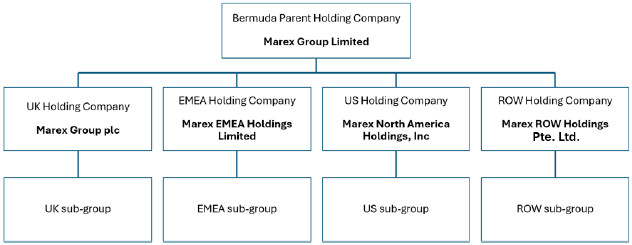
The current Directors of Marex are or will, upon the Scheme becoming Effective, all be directors of New Marex. Immediately following the Scheme becoming Effective, the only material assets of New Marex will be the ordinary share capital of Marex.
35
New Marex will be called Marex Group Limited following the Effective Date. Shortly after the Scheme becoming Effective, Marex will be re-registered as a private limited company and change its name to Marex UK Holdings Limited.
Marex Deferred Shares
The Marex Deferred Shares carry no rights to receive notice of, attend or vote at any general meeting of Marex, no entitlements to dividends, are not listed and have no economic value other than on a return of capital on a winding up or otherwise to a sum equal to £1.00 in aggregate to be distributed to the holders of the Marex Deferred Shares pro rata according to the number of Marex Deferred Shares held by them. The majority of these shares are held by CSC Employee Benefit Trust (Jersey) Limited. Further details in relation to the rights attaching to the Marex Deferred Shares are set out in Part 2 (Explanation of the Scheme and its Effects) – Section 2 (Summary of the Scheme) beginning on page 33 of this document.
All but the two Uncancelled Marex Deferred Shares will be cancelled by way of a confirmation order granted by the Court pursuant to a court approved reduction of capital under sections 645-649 of the Companies Act prior to the Effective Date. Shareholders will need to approve the Deferred Shares Reduction Resolution at the General Meeting.
| 4. |
CONDITIONS TO IMPLEMENTATION OF THE SCHEME |
The implementation of the Scheme is conditional upon the following conditions being satisfied (or if not satisfied, to the extent permitted by applicable law, waived):
| (a) |
approval of the Scheme by a majority in number of Registered Ordinary Shareholders (as at the Voting Record Time) present and voting, whether in person or by proxy, representing 75% or more in value of all Marex Ordinary Shares voted by such Registered Ordinary Shareholders at the Court Meeting (or at any adjournment of such meeting) and such meeting being held on or around 21 May 2026; |
| (b) |
all resolutions required to implement the Scheme as set out in the notice of the General Meeting being duly passed by not less than 75% of the votes cast by Registered Ordinary Shareholders holding Marex Ordinary Shares voting in person or by proxy at the General Meeting in order to be passed at the General Meeting (or at any adjournment of such meeting) and such meeting being held on or around 21 May 2026; |
| (c) |
the Relevant Regulators each having been notified of, and having approved or having been deemed to have approved in accordance with the relevant applicable law or regulation (to the extent such notification, approval (or deemed approval) is required by the relevant applicable law or regulation and has not been withdrawn or deemed withdrawn) any acquisition or increase of control or ownership (howsoever described in the relevant applicable law or regulation) by New Marex of any relevant entities within the Group or otherwise that in each case would occur (or be deemed to occur) upon the Scheme becoming Effective. Marex will not seek the sanction of the Scheme until the approvals or deemed approvals set out in this paragraph 4(c) have been granted; |
| (d) |
the directors not having resolved to abandon the Scheme prior to the Scheme Court Order (the directors have discretion to determine that the Scheme should no longer proceed if they consider that it is no longer in the best interests of the Company and the Shareholders as a whole); |
| (e) |
the New Marex Ordinary Shares to be issued pursuant to the Scheme having been authorised for listing on Nasdaq; |
36
| (f) |
all statutory, regulatory or governmental consents, licenses, confirmations, clearances (including, but not limited to, any foreign investment clearances), permissions and other approvals required in connection with the Scheme under applicable laws in the UK, the U.S., Bermuda and the various countries in which we do business and/or hold our interests in have been obtained on terms reasonably acceptable to the Board; |
| (g) |
the sanction of the Scheme by the Court (with or without modification) and confirmation of the Scheme Reduction of Capital by the Court; |
| (h) |
a copy of the Scheme Court Order and the related statement of capital having been delivered to the Registrar of Companies for registration; and |
| (i) |
at the Effective Date, there is no threatened, pending or effective decree, order, injunction or other legal restraint prohibiting the consummation of the Scheme or related transactions, |
together, the Conditions.
The Scheme shall lapse unless the Scheme has become Effective on or before midnight on the Long Stop Date or such later date (if any) as New Marex and Marex may agree upon and (if required) the Court may approve.
The issuance of the New Marex Ordinary Shares in connection with the Redomiciliation will not be registered under the United States Securities Act of 1933, as amended (the “Securities Act”) or under the securities laws of any state or other jurisdiction of the United States. Section 3(a)(10) of the Securities Act provides an exemption for securities issued in exchange for one or more outstanding securities from the general requirement of registration where, among other things, the terms and conditions of such issuance and exchange have been approved, by a court of competent jurisdiction after a hearing upon the fairness of the terms and conditions thereof at which all persons to whom such securities will be issued have a right to appear and to whom adequate notice of the hearing has been given.
The Scheme Court Hearing (at which it is proposed that the Court will sanction the Scheme and confirm the Scheme Reduction of Capital) will be arranged following receipt of all applicable regulatory approvals pursuant to condition (c) above. If you are interested in attending the Scheme Court Hearing, you are directed to the Business and Property Courts Rolls Building Cause List at www.justice.gov.uk for details of how to do so. The time of the Scheme Court Hearing and information on how to attend will be updated on the Court’s website on the business day before the Scheme Court Hearing.
| 5. |
DIRECTORS’ AND OTHER INTERESTS |
Directors
All current directors of Marex will be appointed as directors of New Marex on or by the Effective Date. Following the Effective Date, with the exception of two non-executive directors, those individuals will resign from the board of Marex, and a new board of directors will be appointed to Marex.
The effect of the Scheme on the interests of the directors in their capacity as Shareholders does not differ from its effect on the equivalent interests of other Shareholders.
After the Effective Date, the members of the Board will have their service contracts with and receive their remuneration from New Marex. The total compensation to be paid to each of those members of the Board will not be materially varied as a result of the Scheme. However, the existing directors’ remuneration policy approved by the holders of Marex Ordinary Shares under section 439 of the Companies Act will no longer apply on a mandatory basis. In addition, the allocation of responsibilities to individual members of the Board will remain unchanged in all material respects following implementation of the Scheme.
37
Directors’ interests
The interests of the directors in Marex Shares, as at the Last Practicable Date, are set out below. In the event that the Scheme becomes Effective, the directors will have corresponding interests in New Marex Shares by virtue of the effect of the Scheme on their existing holdings of interests in Marex Shares. The directors’ interests in the New Marex Shares will therefore correspond with their interests in Marex Shares on the Effective Date, subject to any vesting, sale or acquisition of Marex Shares after the Last Practicable Date. We do not expect there to be any material change in the corresponding directors’ interests in the New Marex Shares as at the Effective Date.
| Director | Number of Marex Ordinary Shares | |
|
Ian Lowitt |
2,629,573 | |
|
Crispin Robert John Irvin |
5,661 | |
|
Robert Pickering |
26,909 | |
|
Konstantin Graf von Schweinitz |
21,308 | |
|
Sarah Ing |
7,348 | |
|
Linda Myers |
19,472 | |
|
John Pietrowicz |
19,472 | |
The effect of the Scheme on the interests of the members of the Board in their capacity as holders of beneficial interests in Marex Shares will not differ from the effect of the Scheme on the interests of other holders of beneficial interests of Marex Shares.
| 6. |
NEW MAREX |
New Marex has been established for the specific purpose of carrying on the existing business of the Company upon the Scheme becoming Effective and implemented in accordance with its terms. New Marex’s shareholding consists of the New Marex Subscriber Shares, which will be, on the Effective Date, automatically redesignated into New Marex Deferred Shares.
Under the Scheme, it is proposed that, on the Effective Date, New Marex will become the new parent holding company of the Company and the Enlarged Group.
It is intended that New Marex will have the same strategy and mirror the capital structure of the Company to the extent permissible by Bermuda law. In that regard, Shareholders should note the following in relation to New Marex:
38
| (a) |
New Marex will have the same share capital structure as the Company currently has with the New Marex Ordinary Shares being listed on Nasdaq. |
| (b) |
Shareholders will hold the same proportionate interests in New Marex as they hold in the Company as at the Scheme Record Time. |
| (c) |
The relevant system to facilitate the transfer of beneficial title to New Marex Ordinary Shares will be DTC. |
| (d) |
New Marex’s ongoing costs and expenses are expected to be less than the current expected ongoing costs and expenses of the Company. |
| (e) |
The New Marex Bye-Laws, in substantially the form attached to this document as Annex 1, will govern New Marex after the Effective Date. |
| 7. |
REREGISTRATION AND CHANGE OF NAME |
New Marex will be called Marex Group Limited following the Effective Date. Shortly after the Scheme becoming Effective, Marex will be re-registered as a private limited company and change its name to Marex UK Holdings Limited.
| 8. |
NEW MAREX BYE-LAWS |
The New Marex Bye-Laws, which will be adopted by New Marex automatically on the Scheme becoming Effective, are based on the Marex Articles (excluding, for the avoidance of doubt, the changes to the Marex Articles proposed to be made pursuant to Scheme Resolution 3 to be put to Registered Ordinary Shareholders at the General Meeting).
As set out in more detail in the comparison between Bermuda Law and English law in Part 5 on page 64 of this document, there are a number of differences between the Bermuda Companies Act and the Companies Act which may impact on the rights of Shareholders.
| 9. |
COST OF THE PROPOSAL |
The total costs and expenses payable in connection with the Scheme are not material to the Company and will be paid by Marex. No expenses will be charged directly to the Shareholders.
| 10. |
OVERSEAS SHAREHOLDERS |
The implications of the Scheme for, and the distribution of this document to, Overseas Shareholders may be affected by the laws of the relevant jurisdictions. Overseas Shareholders should inform themselves about and observe all applicable legal requirements.
It is the responsibility of any person into whose possession this document comes to satisfy themselves as to the full observance of the laws of the relevant jurisdiction in connection with the Scheme and the distribution of this document and/or the accompanying documents, including the obtaining of any governmental, exchange control or other consents which may be required and/or compliance with other necessary formalities which are required to be observed and the payment of any issue, transfer or other taxes or levies due in such jurisdiction.
If, in respect of any Overseas Shareholder, New Marex is advised that the allotment and issue of New Marex Ordinary Shares pursuant to the Scheme would or might infringe the laws of any jurisdiction outside the United Kingdom, or would or might require New Marex to obtain any governmental or other consent or effect any registration, filing or other formality with which, in the opinion of New Marex, it would be unable to comply or which it regards as unduly onerous, the Scheme provides that New Marex may determine that the New Marex
39
Ordinary Shares shall be issued to such Overseas Shareholder and then sold on his or her behalf as soon as reasonably practicable at the best price which can reasonably be obtained at the time of sale, with the net proceeds of sale being remitted to the Overseas Shareholder at the risk of such shareholder. Alternatively, New Marex may determine that no New Marex Ordinary Shares shall be allotted and issued to that Overseas Shareholder but instead those New Marex Ordinary Shares shall be allotted and issued to a nominee appointed by New Marex as trustee for such Overseas Shareholder, on terms that they shall be sold on behalf of such Overseas Shareholder as soon as reasonably practicable after the Scheme becomes Effective, with the net proceeds of sale being remitted to the Overseas Shareholder concerned at the risk of such Overseas Shareholder.
THIS DOCUMENT DOES NOT CONSTITUTE AN INVITATION OR OFFER TO SELL OR THE SOLICITATION OF AN INVITATION OR OFFER TO BUY ANY SECURITY. NONE OF THE SECURITIES REFERRED TO IN THIS DOCUMENT SHALL BE SOLD, ISSUED, SUBSCRIBED FOR, PURCHASED, EXCHANGED OR TRANSFERRED IN ANY JURISDICTION IN CONTRAVENTION OF APPLICABLE LAW.
| 11. |
NASDAQ LISTING |
Following approval of the Scheme of Arrangement, New Marex will succeed Marex as the entity whose shares are registered pursuant to the registration statements previously filed with the SEC by Marex, and the New Marex Ordinary Shares will be listed on Nasdaq instead of the Marex Ordinary Shares.
| 12. |
SETTLEMENT |
In the Scheme, New Marex will issue the New Marex Ordinary Shares to all Registered Ordinary Shareholders as of the Scheme Record Time and all Registered Ordinary Shareholders will be issued New Marex Ordinary Shares on a one-for-one basis to the holdings of Marex Ordinary Shares of the Registered Ordinary Shareholders. In addition, on the Effective Date, the New Marex Subscriber Shares will be automatically redesignated into New Marex Deferred Shares. Accordingly, Shareholders will cease to own a legal or beneficial interest in Marex Shares and instead will own a legal or beneficial interest in the proportionate number of New Marex Shares.
If you are a Registered Ordinary Shareholder of Marex Shares, you are not required to return your existing Marex share certificates and you will not be issued a new certificate representing your New Marex Shares.
If you are a beneficial owner your Marex Ordinary Shares are held in “street name” through a brokerage firm, bank, dealer or other nominee within the facilities of DTC, you will not be required to take any action. Cede & Co. will hold the relevant New Marex Ordinary Shares as ultimate nominee for the beneficial owners who participate in the DTC system. Your ownership of the beneficial interest in New Marex Shares will be recorded in book-entry form by your brokerage firm, bank, dealer or other nominee and, unless otherwise advised by your brokerage firm, bank, dealer or other nominee, without the need for any additional action on your part.
If you are a shareholder of record for Marex Ordinary Shares registered directly in your name with Marex’s Transfer Agent and hold your interest in depositary receipt form, you will not be required to take any action. GTU Ops Inc. will hold the relevant New Marex Ordinary Shares as the nominee and custodian for depositary receipt holders and issue depositary receipts reflecting the underlying New Marex Ordinary Shares.
Mandates
All instructions in force at the Effective Date relating to notices and other communications will, unless and until varied or revoked, be deemed from the Effective Date to be valid and effective mandates or instructions to New Marex in relation to the corresponding holding of New Marex Shares.
40
General
All documents and cheques sent by or to Registered Shareholders, or as such persons shall direct, will be sent at their own risk and will be sent by post either to the Registered Shareholder’s address as set out on the Register of Members at the Scheme Record Time or to such other address of the Registered Shareholder as is notified as a change of address in writing by a Registered Shareholder to the Company prior to the Effective Date.
The Company and New Marex have confirmed that, except as provided for in the Scheme, settlement of the New Marex Shares will be implemented in full without regard to any lien, right of set-off, counter claim or other analogous right to which the Company or New Marex may be, or claim to be, entitled against such Shareholder.
| 13. |
MEETINGS AND CONSENTS FOR IMPLEMENTATION OF THE SCHEME |
To obtain the shareholder approvals required to effect the Scheme, two back-to-back meetings will be held. These meetings include a court meeting ordered by the Court and a related general meeting of the Shareholders and will be held on 21 May 2026 at 2:00 p.m. (UK Time) and 2:15 p.m. (UK Time), respectively (or, in the case of the General Meeting, if later, as soon as the Court Meeting has been concluded or adjourned).
The Registered Ordinary Shareholders are those entitled to vote at the Meetings. Each Shareholder who is a beneficial owner or a shareholder of record will be entitled to instruct their relevant nominee or Marex’s Transfer Agent how to vote as set out in Part 1 (Summary) – Section 19 (How can I vote?) on page 23 of this document.
Before the Court’s approval can be sought to sanction the Scheme, the Scheme will require to be approved at the Court Meeting by the requisite majority of Shareholders and at the General Meeting by the requisite number of Shareholders.
The Court Meeting and General Meeting will be held at Winterflood Securities (a division of Marex), Riverbank House, 2 Swan Lane, London EC4R 3GA at 2:00 p.m. (UK Time) and 2:15 p.m. (UK Time), respectively (or, in the case of the General Meeting, if later, as soon as the Court Meeting has been concluded or adjourned). Notices of the Court Meeting and the General Meeting are set forth in Part 8 (Notice of Court Meeting) on page 104 of this document and Part 9 (Notice of General Meeting) on page 108 of this document, respectively.
The Company will announce the preliminary voting results at each of the Meetings. It will also report the final results in a current report on Form 6-K that it will file with the SEC. All reports Marex files on Form 6-K with the SEC are publicly available when filed.
All Registered Ordinary Shareholders as of the Voting Record Time will be entitled to vote at the Court Meeting in respect of the number of Marex Ordinary Shares respectively registered in their names at the relevant time.
The Court Meeting
The Court Meeting is being held at the direction of the Court to seek the approval of Registered Ordinary Shareholders on the Scheme (and therefore the Redomiciliation). Each Shareholder who is a beneficial owner or a shareholder of record will be entitled to instruct their relevant nominee or Marex’s Transfer Agent how to vote as set out in Part 1 (Summary) – Section 19 (How can I vote?).
The Court Meeting has been convened at 2:00 p.m. (UK Time) on 21 May 2026 and will be held at Winterflood Securities (a division of Marex), Riverbank House, 2 Swan Lane, London EC4R 3GA pursuant to an order of the Court, to enable the Registered Ordinary Shareholders to consider and, if thought fit, approve the Scheme.
At the Court Meeting, voting will be by way of a poll and each Registered Ordinary Shareholder present, whether in person or by proxy will be entitled to one vote for each Marex Ordinary Share held.
41
At the Court Meeting, voting will be by way of a poll and each Registered Ordinary Shareholder present, whether in person or by proxy will be entitled to one vote for each Marex Ordinary Share held. The approval required by statute at the Court Meeting is a majority in number of Registered Ordinary Shareholders (as at the Voting Record Time) present and voting, whether in person or by proxy, representing 75% or more in value of all Marex Ordinary Shares voted by such Registered Ordinary Shareholders at the Court Meeting.
The Board unanimously recommends that the Shareholders vote “FOR” the Scheme.
General
In order for the Court to be satisfied that the votes cast constitute a fair representation of the views of Shareholders, it is important that as many votes as possible are cast at the Court Meeting. Shareholders are therefore urged to take the action relating to the submission of your proxy vote(s) referred to in Part 1 (Summary) – Section 19 (How can I vote?) on page 23 of this document and Part 8 (Notice of Court Meeting) on page 104 of this document.
If the Scheme is approved and becomes Effective, it will be binding on all Shareholders as at the Scheme Record Time irrespective of whether they attended the Court Meeting, the way in which they voted or whether they voted at all.
The General Meeting
The General Meeting is convened to consider and, if thought fit, pass the Scheme Resolutions to implement the Scheme and the Deferred Shares Reduction Resolution.
Scheme Resolutions
| (a) |
authorise the Directors to take all such action as they may consider necessary or appropriate for carrying the Scheme into effect; |
| (b) |
approve the Scheme Reduction of Capital associated with the cancellation and extinguishment of the Scheme Shares; |
| (c) |
approve, conditional upon the Scheme becoming Effective, certain amendments to the Marex Articles (including as referred to below); and |
| (d) |
approve the issuance of Marex Reissued Shares to New Marex as part of the Scheme. As a result of such issuance, Marex will become a wholly owned subsidiary of New Marex. |
The Scheme Resolutions will require votes in favour of not less than 75% of the votes cast by the Registered Ordinary Shareholders holding Marex Ordinary Shares, whether in person or by proxy, at the General Meeting in order to be passed.
If the Directors consider it impracticable or undesirable to hold the General Meeting, they have the power under Article 51 of the Marex Articles to postpone the General Meeting in accordance with the provisions of that Article.
Deferred Shares Reduction Resolution
Further, the General Meeting is convened to consider and, if thought fit, pass the special resolution to authorise the reduction of the Company’s share capital associated with the cancellation and extinguishment of the Marex Deferred Shares. As noted in greater detail in Part 1 (Summary) – Section 37 on page 31 of this document, the Deferred Shares Reduction is a separate reduction of capital from the Scheme Reduction of Capital.
42
The Deferred Shares Reduction Resolution will require votes in favour of not less than 75% of the votes cast by the Registered Ordinary Shareholders voting, whether in person or by proxy, at the General Meeting in order to be passed.
The Board unanimously recommends that the Shareholders vote “FOR” each of the Scheme Resolutions and the Deferred Shares Reduction Resolution at the General Meeting.
Amendments to the Marex Articles
It is proposed that the Marex Articles be amended so as to ensure that any Marex Ordinary Shares which are issued or transferred after the Voting Record Time but prior to the Scheme Record Time will be subject to and bound by the Scheme. It is also proposed that the Marex Articles be amended so that any Marex Ordinary Shares issued or transferred to any person other than New Marex on or after the Scheme Record Time will automatically be acquired by New Marex in consideration for the issue by New Marex to such person of such number of New Marex Ordinary Shares which would have been issued had such Marex Ordinary Shares been Scheme Shares.
The proposed amendments to the Marex Articles are set out in full in the Notice of the General Meeting in Part 9 beginning on page 108 of this document.
| 14. |
MAREX EQUITY INCENTIVE PLANS |
The Scheme will affect participants in the Marex Equity Incentive Plans. New Marex will adopt and assume each outstanding award granted under the Marex Equity Incentive Plans or make other arrangements for any outstanding awards under the Marex Equity Incentive Plans to be settled in New Marex Ordinary Shares. Each of the Marex Equity Incentive Plans contains compulsory exchange provisions which will apply in the case of the Scheme.
To the extent required, the Marex Equity Incentive Plans will be amended, effective at the Effective Date, to provide that all outstanding awards relating to Marex Ordinary Shares will entitle the holder to purchase or receive, or receive benefits or amounts based on, as applicable, an equivalent number of New Marex Ordinary Shares. All such awards will otherwise generally be subject to the same terms and conditions (including the same vesting conditions) as were applicable to such awards immediately prior to the Effective Date (with amendments to reflect the incorporation of New Marex in Bermuda).
The Scheme will not result in a “change in control” for purposes of the Marex Equity Incentive Plans. Marex will inform participants in the Marex Equity Incentive Plans in due course of the effect on their participation in more detail. No further awards will be granted under the Marex Equity Incentive Plans in respect of Marex Ordinary Shares after the Effective Date. Any future share awards will be granted by New Marex under the Marex Group Plc Global Omnibus Plan and/or the Marex Group Plc Employee Share Purchase Plan over New Marex Ordinary Shares.
For the avoidance of doubt, New Marex may issue New Marex Ordinary Shares after the Effective Date to satisfy: (a) any outstanding awards granted under the Marex Equity Incentive Plans; and (b) any new awards to be granted by New Marex following the Effective Date under the Marex Group Plc Global Omnibus Plan and the Marex Group Plc Employee Share Purchase Plan.
New Marex may do so in accordance with Marex’s existing authority to issue shares to satisfy awards under the Marex Equity Incentive Plans (including a “share reserve” and “evergreen” reserve providing for an automatic increase in the amount of the share reserve as described in the Marex IPO prospectus) and will take all steps necessary for this purpose.
43
| 15. |
REGULATORY IMPACT OF THE PROPOSAL |
Following the date of this document, the Group is proposing an internal corporate reorganisation, the result of which will be that all of the Group’s non-UK incorporated subsidiaries (with the exception of those that are in liquidation or dormant), will be transferred such that they will remain direct or indirect subsidiaries (as applicable) of New Marex but will cease to be direct or indirect subsidiaries (as applicable) of Marex.
The regulatory consequence of this is that those transferred entities will cease to be within the regulatory consolidation group that is subject to consolidated supervision and oversight by the FCA.
Following the corporate reorganisation, the FCA will continue to supervise the UK Sub-Group (as defined in Part 7 (Definitions) on page 103 of this document) on a consolidated basis, and the UK Sub-Group will submit returns to the FCA on its capital adequacy and other relevant matters on that new consolidated basis (Group subsidiary undertakings regulated on a solo basis by the FCA will continue to meet their UK regulatory obligations – these are unaffected by the Proposals). Other subsidiary undertakings of the Group will be reorganised under New Marex and will continue to be regulated by their respective local regulators but not by the FCA. Following the proposed changes, the Board will continue to judge the Group’s capital needs against its operational and strategic requirements.
| 16. |
U.K., U.S., BERMUDA AND JERSEY TAXATION: IMPACT OF THE PROPOSAL |
See Part 4 (Taxation) on page 54 of this document with respect to certain tax implications of the Scheme in the U.K., the U.S., Bermuda and Jersey.
Summary information on taxation in this document is intended as a guide only and Shareholders who are in any doubt about their tax position, including those who are resident for tax purposes outside the U.K., the U.S., Bermuda or Jersey, are strongly advised to contact an appropriate professional, independent adviser immediately.
| 17. |
ACCOUNTING TREATMENT OF THE SCHEME |
Historical cost basis accounting, rather than acquisition method accounting, will be applied to the Scheme in accordance with International Financial Reporting Standards as issued by the International Accounting Standards Board. Given that, for accounting purposes, there will be no change in control and the Shareholders will be in the same economic position immediately before and after the Redomiciliation, and because the Redomiciliation will be accounted for as an internal reorganisation of entities under common control, there will be no revaluation of Marex’s assets and liabilities.
| 18. |
ACTION TO BE TAKEN |
See Part 1 (Summary) – Section 19 (How can I vote?) on page 23 of this document, Part 8 (Notice of Court Meeting) on page 104 of this document and Part 9 (Notice of General Meeting) on page 108 of this document.
| 19. |
FURTHER INFORMATION |
You should read the whole of this document.
Your attention is drawn, in particular, to Part 1 (Summary) beginning on page 16 of this document, the Letter from the Board beginning on page 2 of this document, the Letter from the Group Head of Legal and Group Company Secretary beginning on page 5 of this document, Part 6 (Additional Information) beginning on page 89 of this document, the Scheme of Arrangement set out in Part 3 beginning on page 46 of this document, and the Notices of Meetings in Part 8 (Notice of Court Meeting) and Part 9 (Notice of General Meeting) on pages 104 and 108 of this document, respectively.
44
Yours faithfully,
Marex Group plc
45
PART 3
THE SCHEME OF ARRANGEMENT
| IN THE HIGH COURT OF JUSTICE |
CR-2025-008243 |
BUSINESS AND PROPERTY COURTS OF ENGLAND AND WALES
COMPANIES COURT (ChD)
IN THE MATTER OF MAREX GROUP PLC
and
IN THE MATTER OF THE COMPANIES ACT 2006
SCHEME OF ARRANGEMENT
(under Part 26 of the Companies Act 2006)
between
MAREX GROUP PLC
and
THE HOLDERS OF SCHEME SHARES
(as hereinafter defined)
PRELIMINARY
| (a) |
In this Scheme, the following expressions have the meanings stated, unless they are inconsistent with the subject or context: |
| £, Pound, Sterling, pence or p |
the lawful currency of the United Kingdom; | |
| Articles |
the articles of association of Marex, as amended from time to time; | |
| Bermuda Companies Act |
the Companies Act 1981 of Bermuda as may be amended or replaced from time to time; | |
| business day |
a day (excluding a Saturday, Sunday, public or bank holiday) on which banks generally are open for business in Bermuda, the City of London and New York for the transaction of normal banking business; | |
| Company or Marex |
Marex Group plc, incorporated in England and Wales with company registration number 05613060; | |
| Companies Act |
the United Kingdom Companies Act 2006 (as amended from time to time); | |
| Conditions |
the conditions of the Scheme set out in Section 4 of Part 2 of this document, and Condition shall mean any of them; | |
46
| Court |
the High Court of Justice, Business and Property Courts of England and Wales (ChD); | |
| Court Meeting |
the meeting of the Registered Ordinary Shareholders (and any adjournment thereof), convened by order of the Court pursuant to Part 26 of the Companies Act, to be held at 2:00 p.m. (UK Time) on 21 May 2026 at Winterflood Securities (a division of Marex), Riverbank House, 2 Swan Lane, London EC4R 3GA, to consider and, if thought fit, approve this Scheme; | |
| Deferred Shares Reduction |
the cancellation of all but two of the Marex Deferred Shares under Chapter 10 of Part 17 of the Companies Act; | |
| DTC |
the relevant system to facilitate the transfer of beneficial title to shares in respect of which The Depositary Trust Company is the operator; | |
| Effective |
the Scheme having become effective pursuant to its terms; | |
| Effective Date |
the date on which this Scheme becomes Effective in accordance with clause 9 of this Scheme; | |
| General Meeting |
the general meeting of the Shareholders to be held at 2:15 p.m. (UK Time) on 21 May 2026 (or as soon thereafter as the Court Meeting shall have been concluded) (including any adjournment thereof); | |
| holder |
a registered holder of Marex Shares (including any person(s) entitled by transmission); | |
| Last Practicable Date |
8 April 2026, being the last practicable date prior to the date of this document; | |
| Marex Deferred Shares |
the deferred shares of £0.000469 each in the capital of Marex; | |
| Marex Ordinary Shares |
the ordinary shares of US$0.001551 each in the capital of Marex; | |
| Marex Reissued Shares |
such number of new Marex Ordinary Shares and Marex Deferred Shares equal to the number of Scheme Shares cancelled pursuant to the Scheme Reduction of Capital to be created immediately following the Scheme Reduction of Capital and to be issued credited as fully paid to New Marex pursuant to the Scheme; | |
| Marex Shares |
the Marex Ordinary Shares and the Marex Deferred Shares; | |
| Marex’s Transfer Agent |
Computershare Trust Company, N.A., 150 Royall Street, Canton, MA, 02021, United States; | |
| Nasdaq |
Nasdaq Stock Market; | |
| New Marex |
Marex Group Limited, an exempted company limited by shares incorporated on 2 October 2025 in Bermuda, with registered number 202505104 and having its registered office at c/o Compass Administration Services, Ltd., Crawford House, 50 Cedar Avenue, Hamilton, HM11 Bermuda; | |
47
| New Marex Deferred Shares |
the deferred shares of £0.000469 each in the capital of New Marex; | |
| New Marex Ordinary Shares |
the ordinary shares, par value US$0.001551 per share, in the capital of New Marex from time to time; | |
| New Marex Subscriber Shares |
the two ordinary shares of par value US$1.00 (to be reduced to US$0.001551 each on or about the date of this document) each in the capital of New Marex issued on incorporation of New Marex and being the entire issued share capital of New Marex prior to the Scheme becoming Effective; | |
| Overseas Shareholders |
shareholders of Marex from time to time who are resident in, or nationals or citizens of, jurisdictions outside the UK or who are nominees of, or custodians or trustees for, residents, citizens or nationals of other countries; | |
| Register of Members |
the register of holders of Marex Shares maintained by Computershare Trust Company N.A.; | |
| Registered Ordinary Shareholders |
holders of the Marex Ordinary Shares who are on the Register of Members at the Voting Record Time; | |
| Registered Shareholders |
holders of the Marex Ordinary Shares and/or Uncancelled Marex Deferred Shares who are on the register of members at the Voting Record Time; | |
| Registrar of Companies |
the Registrar of Companies in England and Wales; | |
| Restricted Jurisdiction |
any jurisdiction where local laws or regulations may result in a significant risk of civil, regulatory or criminal exposure if information concerning the Scheme is sent or made available to Shareholders in that jurisdiction, or a legal or beneficial interest in New Marex Shares are made available to Shareholders in the jurisdiction; | |
| Restricted Overseas Shareholder |
a Shareholder with a registered address in, or who is a citizen, resident or national of, a Restricted Jurisdiction; | |
| Scheme |
this scheme of arrangement under Part 26 of the Companies Act between Marex and the holders of Scheme Shares in its present form or with or subject to any modification, addition or condition which Marex and New Marex may agree and the Court may approve or impose; | |
| Scheme Court Hearing |
the hearing at which the Scheme Court Order is made; | |
| Scheme Court Order or Court Order |
the order of the Court granted at the Scheme Court Hearing to sanction the Scheme under Part 26 of the Companies Act; | |
| Scheme Record Time |
the record time for participating in the Scheme, being 6pm (UK Time) on the business day immediately prior to the Effective Date; | |
| Scheme Reduction of Capital |
the reduction of the Company’s share capital associated with the cancellation and extinguishment of the Scheme Shares provided for by | |
48
| clause 1 of the Scheme and under Chapter 10 of Part 17 of the Companies Act; | ||
| Scheme Shares |
the aggregate of:
• the Marex Ordinary Shares and the Uncancelled Marex Deferred Shares in issue at the date of this document;
• the Marex Ordinary Shares (if any) issued after the date of this document and prior to the Voting Record Time; and
• the Marex Ordinary Shares (if any) issued on or after the Voting Record Time and prior to the Scheme Record Time either on terms that the original holder of Marex Ordinary Shares or any subsequent holder thereof shall be bound by this Scheme or in respect of which the holder thereof shall have agreed in writing to be bound by this Scheme,
and in each case (where the context requires) remaining in issue at the Scheme Record Time and, in each case, excluding any Excluded Shares; | |
| Shareholders |
the legal and beneficial holders of Marex Shares from time to time; | |
| subsidiary |
has the meaning ascribed to it in the Companies Act; | |
| trading day |
any day on which shares are traded on Nasdaq; | |
| Uncancelled Marex Deferred Shares |
the two Marex Deferred Shares that are not cancelled pursuant to the Deferred Shares Reduction; and | |
| Voting Record Time |
close of business two business days before the Meetings (including any adjourned Meeting). | |
| (b) |
References to “clauses” are to clauses of this Scheme and, save for the definition of “business day” as defined above, references to time are to London, United Kingdom time unless the context provides otherwise. Any reference to any provision of any legislation shall include any amendment, modification, re-enactment or extension thereof. |
| (c) |
The issued share capital of Marex at the Last Practicable Date is 73,094,693 Marex Ordinary Shares and 4,129,436 Marex Deferred Shares. |
| (d) |
In advance of the Effective Date, the Deferred Shares Reduction is intended to become effective. |
| (e) |
Subject to the Deferred Shares Reduction being effective, the issued share capital of Marex at the Scheme Record Time is expected to be the Marex Ordinary Shares and two Marex Deferred Shares of £0.000469 each. |
| (f) |
New Marex was incorporated in Bermuda under the Bermuda Companies Act on 2 October 2025. |
| (g) |
The issued share capital of New Marex as at the Last Practicable Date is the New Marex Subscriber Shares, being the two ordinary shares of par value US$1.00 each. |
49
| (h) |
Subject to the satisfaction or waiver of the Conditions, New Marex has agreed to appear by legal counsel at the hearing to sanction this Scheme and to undertake to the Court to be bound thereby and to execute and do and procure to be executed and done all such documents, acts and things as may be necessary or desirable to be executed or done by it for the purpose of giving effect to this Scheme. The holders of the Uncancelled Marex Deferred Shares will consent to be bound by the Scheme. |
THE SCHEME
| 1. |
Cancellation of the Scheme Shares |
| (a) |
At the Effective Date, the issued share capital of the Company shall be reduced by cancelling and extinguishing the Scheme Shares. |
| (b) |
Subject to and forthwith upon the reduction of capital referred to in sub-clause 1(a) taking effect, and notwithstanding anything to the contrary in the Company’s Articles, the credit arising in the books of account of Marex as a result of the reduction of capital shall be capitalised and applied in paying up, in full at par, such number of Marex Reissued Shares as shall be equal to the number (and aggregate nominal value) of the Scheme Shares cancelled in accordance with subclause 1(a) above which shall be allotted and issued, credited as fully paid (free from all liens, charges, equitable interests and encumbrances), to New Marex. |
| 2. |
Consideration for cancellation of the Scheme Shares |
| (a) |
In consideration of the cancellation of the Scheme Shares and the allotment and issue of the Marex Reissued Shares to New Marex pursuant to clause 1 above, New Marex shall (subject to, and in accordance with, the remaining provisions in this Scheme), at the Scheme Record Time, allot and issue (credited as fully paid) New Marex Ordinary Shares to the Registered Ordinary Shareholders (as appearing in the register of members of Marex at the Scheme Record Time) on the following basis: |
one New Marex Ordinary Share for each Marex Ordinary Share held at the Scheme Record Time.
| (b) |
The New Marex Ordinary Shares shall be issued and credited as fully paid, shall rank equally in all respects with all other fully paid New Marex Ordinary Shares and shall be entitled to all dividends and other distributions declared, paid or made by New Marex by reference to a record date on or after the Effective Date. |
| 3. |
Allotment and issue of the New Marex Ordinary Shares |
The provisions of clause 3 shall be subject to any prohibition or condition imposed by law. Without prejudice to the generality of the foregoing, if, in respect of any Overseas Shareholder, New Marex is advised that the allotment and issue of New Marex Ordinary Shares pursuant to clause 2 would or might infringe the laws of any jurisdiction outside the United Kingdom, the United States or Bermuda or would or might require New Marex to observe any governmental or other consent or effect any registration, filing or other formality with which, in the opinion of New Marex, it would be unable to comply or which it regards as unduly onerous, then New Marex may in its sole discretion either:
| (a) |
determine that the legal or beneficial interest in such New Marex Ordinary Shares shall be sold, in which event the legal or beneficial interest in such New Marex Ordinary Shares shall be issued to such Overseas Shareholder and New Marex shall appoint a person to act pursuant to this sub-clause 3(a) and such person shall be authorised on behalf of such Overseas Shareholder to procure that any legal or beneficial interest in shares in respect of which New Marex has made such a determination shall, as soon as practicable following the Effective Date, be sold at the best price which can reasonably be obtained at the time of sale |
50
|
|
and the net proceeds of such sale shall (after the deduction of all expenses and commissions, including any amount in respect of value added tax payable thereon) be paid to such Overseas Shareholder by sending a cheque or warrant to such Overseas Shareholder in accordance with the provisions of clause 4 below. To give effect to any such sale, the person so appointed shall be authorised on behalf of such Overseas Shareholder to execute and deliver a form of transfer and to give such instructions and do all such things which he may consider necessary or expedient in connection with such sale. In the absence of bad faith or wilful default, none of Marex, New Marex, any appointee referred to in this sub-clause 3(a) or any broker or agent of any of them shall have any liability for any loss arising as a result of the timing or terms of any such sale; or |
| (b) |
determine that no such legal or beneficial interest in any New Marex Ordinary Shares shall be allotted and issued to such Overseas Shareholder under clause 2, but instead such legal or beneficial interest in such New Marex Ordinary Shares shall be allotted and issued to a nominee appointed by New Marex as trustee for such Overseas Shareholder, on terms that they shall, as soon as reasonably practicable following the Effective Date, be sold on behalf of such Overseas Shareholder at the best price which can reasonably be obtained at the time of sale and the net proceeds of such sale shall (after the deduction of all expenses and commissions, including any amount in respect of value added tax payable thereon) be paid to such Overseas Shareholder by sending a cheque or warrant to such Overseas Shareholder in accordance with the provisions of clause 5 below. In the absence of bad faith or wilful default, none of Marex, New Marex, any nominee referred to in this subclause 3(b) or any broker or agent of any of them shall have any liability for any loss arising as a result of the timing or terms of any such sale. |
| 4. |
New Marex Deferred Shares |
New Marex intends to pass board and shareholder resolutions to automatically re-designate the New Marex Subscriber Shares as New Marex Deferred Shares, on the Effective Date, subject to the Scheme becoming effective.
| 5. |
Certificates and payments |
| (a) |
At the Effective Date, New Marex shall allot and issue all New Marex Ordinary Shares which it is required to allot and issue to give effect to this Scheme. |
| (b) |
The delivery of new share certificates in respect of New Marex Ordinary Shares allotted and issued to the relevant Registered Ordinary Shareholders will be subject to customary exchange procedures established by Marex’s Transfer Agent. Registered Ordinary Shareholders are not required to return their existing Company share certificates but will not be automatically issued with a new certificate representing their New Marex Shares. Registered Ordinary Shareholders will, however, be required to return their Company share certificate(s) to Marex’s Transfer Agent at or before the time they decide to transfer their New Marex Shares to another party, including when depositing into the DTC or should they prefer to be in receipt of a New Marex Share certificate. |
| (c) |
Not later than ten (10) Business Days following the sale of any relevant New Marex Ordinary Shares pursuant to clause 3, New Marex shall procure that the nominee referred to in clause 3(b) shall account for the cash payable by dispatching to the persons respectively entitled thereto cheques by post. |
| (d) |
In the event that any Scheme Share certificates shall have been lost, stolen or destroyed, upon the relevant Registered Ordinary Shareholder’s compliance with the replacement requirements established by Marex’s Transfer Agent, including, if necessary, the posting by the relevant Registered Ordinary Shareholder of a bond in customary amount as indemnity against any claim that may be made against it with respect to the lost, stolen or destroyed Scheme Share certificate, Marex’s Transfer |
51
|
|
Agent shall provide in exchange for the lost, stolen or destroyed Scheme Share certificate the applicable New Marex Ordinary Shares certificate with respect to the New Marex Ordinary Shares allotted and issued to such Registered Ordinary Shareholder. |
| (e) |
All deliveries of notices and/or all cheques required to be sent pursuant to clause 5(c) shall be sent through the post in pre-paid envelopes addressed to the persons respectively entitled thereto at their respective addresses appearing in the Register of Members at the Scheme Record Time (or, in the case of joint holders, to the address of that one of the joint holders whose name stands first in the register in respect of the joint holding) or in accordance with any special instructions regarding communications received at the registered office of the Company before the Scheme Record Time. |
| (f) |
None of the Company, New Marex, any nominee referred to in clause 3 or any agent of any of them shall be responsible for any loss or delay in transmission of certificates or cheques sent in accordance with this clause 5. |
| (g) |
All cheques and warrants shall be made payable to the holder of the Scheme Shares concerned (except, in the case of joint holders, the Company reserves the right to make such cheques payable to that one of the joint holders whose name stands first in the register of members of the Company) and the encashment of any such check or warrant shall be a complete discharge of New Marex for the moneys represented thereby. |
| (h) |
This clause 5 shall be subject to any prohibition or condition imposed by law. |
| 6. |
Record of cancellation of Scheme Shares |
Appropriate entries shall be made in the Register of Members with effect from the Effective Date to reflect the cancellation of the Scheme Shares.
| 7. |
Certificates representing Scheme Shares |
With effect from and including the Effective Date, all certificates representing holdings of Scheme Shares shall cease to have effect as documents of title to the Scheme Shares comprised therein, and every Registered Shareholder holding Scheme Shares shall be bound on the request of the Company to deliver up to the Company the certificate(s) in respect of its, his or her entire holding of Scheme Shares.
| 8. |
Mandates and other instructions |
Each mandate in force and duly notified to Marex at the Scheme Record Time relating to the payment of dividends and bonus share issues on Scheme Shares and each instruction, election and communication preference then in force as to notices and other communications (including electronic communications) from Marex shall, unless and until varied or revoked, be deemed, from and including the Effective Date, to be a valid and effective mandate or instruction to New Marex in relation to the corresponding New Marex Ordinary Shares to be allotted and issued pursuant to this Scheme.
| 9. |
Effective Date |
| (a) |
This Scheme shall become effective as soon as an order of the Court sanctioning this Scheme under Part 26 of the Companies Act and an order of the Court confirming the reduction of capital under this Scheme pursuant to Section 648 of the Companies Act, together with the statement of capital under Section 649 of the Companies Act, shall have been duly delivered to the Registrar of Companies for registration. |
| (b) |
Unless this Scheme shall have become effective on or before midnight on 1 July 2027 or such later date, if any, as the Company and New Marex may agree and the Court may allow, it shall lapse. |
52
| 10. |
Modification |
Marex and New Marex may jointly consent on behalf of all persons concerned to any modification of, or addition to, the Scheme or to any condition which the Court may think fit to approve or impose.
| 11. |
Governing law and jurisdiction |
This Scheme shall be governed by, and construed in accordance with, the laws of England and Wales and the Registered Ordinary Shareholders and holders of Uncancelled Marex Deferred Shares hereby agree that the Court shall have exclusive jurisdiction to hear and determine any suit, action or proceeding and to settle any dispute which arises out of or is connected with the terms of this Scheme.
Date: 10 April 2026
53
PART 4
TAXATION
The following section is a summary guide only to certain aspects of the tax treatment of: (a) the Scheme; and (b) post-Scheme ownership and disposition of New Marex Ordinary Shares in the U.K., the U.S., Bermuda and Jersey. This is not a complete analysis of the potential tax effects of the Proposals nor will it relate to the specific tax position of all Shareholders or New Marex Shareholders in all jurisdictions. This summary does not purport to be a legal opinion.
Each Shareholder is advised to consult their own tax advisers as to the effects of the Proposals in relevant jurisdictions, including whether the Proposals and the holding of New Marex Ordinary Shares could give rise to any potential tax charges on them.
UK TAXATION
The following summary is intended as a general guide only and relates only to certain limited aspects of the UK tax consequences for Shareholders of the Scheme and of holding and disposing of New Marex Ordinary Shares. It is based on current UK tax law (insofar as it has effect in England) and what is understood to be the current practice of HMRC, both of which are subject to change, possibly with retrospective effect. The summary applies only to shareholders who are resident in the UK for taxation purposes (and, if individuals, who are not “qualifying new residents” within the meaning of Chapter 5 of Part 8 of the Income Tax (Trading and Other Income) Act 2005 and to whom “split year” treatment does not apply), who are absolute beneficial owners of the Marex Ordinary Shares and, after the Scheme, will be the absolute beneficial owners of the New Marex Ordinary Shares and any dividends paid on them and who hold such shares as a capital investment (other than under an individual savings account or a self-invested personal pension). These comments may not apply to certain classes of Shareholders and New Marex Shareholders such as (but not limited to) trustees, persons acquiring their Marex Ordinary Shares and their New Marex Ordinary Shares by virtue of an office or employment (whether current, historic or prospective), persons holding their shares through trust arrangements, dealers in securities, banks, collective investment schemes and insurance companies. The commentary below only applies to Marex Ordinary Shares and New Marex Ordinary Shares and does not apply to Marex Deferred Shares or New Marex Deferred Shares. For the purposes of the commentary below (and except in relation to the discussion of inheritance tax and stamp duty issues), references to Marex Ordinary Shares and New Marex Ordinary Shares should be read as including references to beneficial interests in Marex Ordinary Shares and New Marex Ordinary Shares where they are held through DTC or in the form of depositary receipts.
If you are in any doubt about your tax position, you should consult your own professional adviser without delay.
UK tax consequences of the cancellation of Marex Ordinary Shares and issue of New Marex Ordinary Shares.
For the purposes of capital gains tax or corporation tax on chargeable gains (CGT), the cancellation of the Marex Ordinary Shares and the issue of New Marex Ordinary Shares pursuant to the Scheme should be treated as a scheme of reconstruction. This means that (subject to the following paragraphs) the New Marex Ordinary Shares issued to a New Marex Shareholder pursuant to the Scheme should be treated as the same asset, and as having been acquired at the same time and for the same consideration, as the Marex Ordinary Shares from which they are derived and that the Scheme does not result in the holders of Marex Ordinary Shares being treated as disposing of their Marex Ordinary Shares for CGT purposes (Scheme of Reconstruction Rollover Treatment).
The application of the treatment described in the paragraph above is subject to an anti-avoidance rule in Section 137 of the Taxation of Chargeable Gains Act 1992 (as amended by the Finance Act 2026). Section
54
137 of the Taxation of Chargeable Gains Act 1992 applies in respect of arrangements relating to a scheme of reconstruction if the main purpose, or one of the main purposes, of the arrangements is to reduce or avoid liability to capital gains tax or corporation tax. The application of this test depends on, among other things, whether the relevant Shareholder has entered into any such arrangements relating to the Scheme. Where Section 137 of the Taxation of Chargeable Gains Act 1992 applies, any such reduction or avoidance that would arise from such arrangements is to be counteracted by the making of such adjustments as are just and reasonable (which may include disapplying Scheme of Reconstruction Rollover Treatment altogether). If this anti-avoidance rule applies then, depending on the adjustments made, the relevant Shareholder may be treated as receiving New Marex Ordinary Shares in consideration for the cancellation of their Marex Ordinary Shares and as having made a disposal of their Marex Ordinary Shares which may, depending on individual circumstances, give rise to a chargeable gain or allowable loss for CGT purposes.
UK stamp duty and stamp duty reserve tax
No UK stamp duty or stamp duty reserve tax will be payable by Shareholders or New Marex Shareholders as a result of the cancellation of the Marex Ordinary Shares and issue of New Marex Ordinary Shares under the Scheme.
UK taxation of dividends on New Marex Ordinary Shares
New Marex will not be required to deduct or withhold amounts on account of UK tax at source from dividend payments it makes, irrespective of the residence or particular circumstances of the New Marex Shareholder receiving such dividend payment.
Individuals
A nil rate of income tax will apply for the first £500 of dividend income received by individual New Marex Shareholders in a tax year (the Nil Rate Band).
The rate of tax applicable to dividend income in excess of the Nil Rate Band will depend on the wider tax position of the New Marex Shareholder. Broadly speaking, after taking into account the amount (if any) of a New Marex Shareholder’s personal allowance, and any other allowances, exemptions and reliefs, the New Marex Shareholder’s taxable income up to the basic rate limit will fall within the basic rate band; taxable income between the basic rate limit and the higher rate limit will fall within the higher rate band; and taxable income above the higher rate limit will fall within the additional rate band.
From 6 April 2026 onwards, the rates of income tax on dividends received above the Nil Rate Band are: (a) 10.75 per cent. for dividends in the basic rate band; (b) 35.75 per cent. for dividends in the higher rate band; and (c) 39.35 per cent. for dividends in the additional rate band.
In determining the tax band in which any dividend income over the Nil Rate Band falls, dividend income is treated as the top slice of a New Marex Shareholder’s income and dividend income within the Nil Rate Band is still taken into account.
Because dividend income (including income within the Nil Rate Band) is taken into account in assessing whether a New Marex Shareholder’s overall income is above the higher or additional rate limits, the receipt of such income may affect the wider tax position of the New Marex Shareholder, including the amount of personal allowances to which the New Marex Shareholder is entitled.
Companies
Provided that New Marex remains resident only in the United Kingdom, New Marex Shareholders within the charge to UK corporation tax that are “small companies” for the purposes of Chapter 2 of Part 9A of the
55
Corporation Tax Act 2009 will not be subject to UK corporation tax on any dividend received from the company provided certain conditions are met (including an anti-avoidance condition).
New Marex Shareholders within the charge to UK corporation tax that are not “small companies” for this purpose will not be subject to UK corporation tax on any dividend received from New Marex so long as the dividend falls within an exempt class and certain conditions are met. For example: (i) dividends paid on shares that are not redeemable and do not carry any present or future preferential rights to dividends or to New Marex’s assets on its winding up, and (ii) dividends paid to a person holding less than a 10 per cent. interest in New Marex, should generally fall within an exempt class. However, the exemptions mentioned above are not comprehensive and are subject to anti-avoidance rules.
If the conditions for exemption are not met or cease to be satisfied, or such a New Marex Shareholder elects for an otherwise exempt dividend to be taxable, the New Marex Shareholder will be subject to UK corporation tax on dividends received from New Marex, at the rate of corporation tax applicable to that New Marex Shareholder (the main rate of corporation tax is currently 25%).
UK CGT consequences of disposing of New Marex Ordinary Shares in the future
A disposal or deemed disposal of New Marex Ordinary Shares by a New Marex Shareholder who is resident in the United Kingdom for tax purposes, may, depending on the New Marex Shareholder’s circumstances and subject to any available exemptions and reliefs, give rise to a chargeable gain or an allowable loss for the purposes of UK taxation of chargeable gains.
Individuals
For individual New Marex Shareholders, the principal factors that will determine the UK capital gains tax position on a disposal or deemed disposal of New Marex Ordinary Shares are the extent to which the New Marex Shareholder realises any other capital gains in the UK tax year in which the disposal is made, the extent to which the New Marex Shareholder has incurred capital losses in that or earlier UK tax years, the income tax band into which the New Marex Shareholder falls, and the level of the annual allowance of tax-free gains in that UK tax year (the Annual Exemption). The Annual Exemption for 6 April 2026 to 5 April 2027 is £3,000.
The applicable rate for an individual New Marex Shareholder who makes a capital gain on the disposal (or deemed disposal) of New Marex Ordinary Shares which (after taking advantage of the Annual Exemption and deducting any available capital losses) is liable to UK capital gains tax is 18% or 24%, depending on the individual’s personal circumstances, including other taxable income and gains in the relevant year.
A New Marex Shareholder who ceases to be resident in the United Kingdom for tax purposes and then reacquires UK tax residence before five complete tax years have elapsed and who disposes of New Marex Ordinary Shares during that period of non-residence may also be liable on their return to the United Kingdom to tax on any capital gain realised, subject to any available exemptions or reliefs.
Companies
A disposal or deemed disposal of New Marex Ordinary Shares by a New Marex Shareholder within the charge to UK corporation tax may give rise to a chargeable gain or allowable loss for the purposes of UK corporation tax, depending on the circumstances and subject to any available exemptions or reliefs. Corporation tax is charged on chargeable gains at the rate applicable to that company (the main rate of corporation tax is currently 25%).
Inheritance tax
The New Marex Ordinary Shares will be assets situated outside the UK for the purposes of UK inheritance tax provided that, and for so long as, they are not registered in any register kept in the UK.
56
Accordingly, if a New Marex Shareholder is not a “long-term UK resident” for the purposes of the Inheritance Tax Act 1984, the death of the New Marex Shareholder or a lifetime disposition (which may include a gift, transfer at less than full market value, settlement or deemed transfer) of such New Marex Ordinary Shares by the New Marex Shareholder should not generally give rise to a liability to UK inheritance tax.
Where an individual New Marex Shareholder is a “long-term UK resident” for the purposes of the Inheritance Tax Act 1984, (i) the deemed transfer of New Marex Ordinary Shares on the death of that New Marex Shareholder under the UK inheritance tax rules, or (ii) a lifetime disposition (which may include a gift, transfer at less than full market value, settlement or deemed transfer) of New Marex Ordinary Shares by that New Marex Shareholder, may give rise to a liability to UK inheritance tax.
Special rules also apply to, without limitation, close companies and to trustees of settlements who hold New Marex Ordinary Shares, bringing them within the charge to inheritance tax.
Stamp duty and stamp duty reserve tax on the transfer of the New Marex Ordinary Shares
The following statements about UK stamp duty and stamp duty reserve tax (SDRT) apply regardless of whether a New Marex Shareholder is resident in the United Kingdom.
No stamp duty will arise on a transfer of the New Marex Ordinary Shares provided that: (i) any instrument of transfer is executed outside the UK; and (ii) such instrument of transfer does not relate to any property situate, or any matter or thing done or to be done, in the UK. No stamp duty will arise on a transfer of a beneficial interest in New Marex Ordinary Shares that is settled within DTC on the assumption that there is no instrument of transfer, or on the transfer of a depositary receipt in respect of New Marex Ordinary Shares. In practice, even where a stamp duty charge does arise on a transfer of the New Marex Ordinary Shares it may not be necessary to pay any such stamp duty which does arise, but New Marex Shareholders should note that if an instrument of transfer is chargeable to UK stamp duty, then that instrument may not be produced in civil proceedings in the United Kingdom, and may not be available for any other purpose in the United Kingdom (other than criminal proceedings), until the UK stamp duty, and any interest and penalties for late stamping, have been paid.
No SDRT will be payable on any agreement to transfer (i) the New Marex Ordinary Shares provided that the New Marex Ordinary Shares are not registered in a register kept in the UK, (ii) a beneficial interest in the New Marex Ordinary Shares where such agreement is settled within DTC, or (iii) a depositary receipt in respect of a New Marex Ordinary Share.
U.S. TAXATION
The following discussion, subject to the limitations set forth below, describes the material U.S. federal income tax consequences to U.S. Holders and non-U.S. Holders (each, as defined below and, together, Holders) of the exchange of Marex Ordinary Shares for New Marex Ordinary Shares in the Redomiciliation and their subsequent ownership and disposition of New Marex Ordinary Shares.
This discussion is based on the U.S. Internal Revenue Code of 1986, as amended (the Code), the Treasury regulations promulgated thereunder (the Treasury Regulations), and judicial interpretations thereof and administrative rulings and published positions of the U.S. Internal Revenue Service (IRS), in each case as in effect and available as of the date of this document. All of the foregoing is subject to change, which change could apply with retroactive effect and could affect the U.S. federal income tax consequences described below. No advance ruling from the IRS has been sought, nor is it expected such a ruling will be sought, regarding any matter discussed below and the statements below are not binding on the IRS or any court. Thus, no assurance can be given that the IRS would not assert, or that a court would not sustain, a position contrary to any of the tax consequences described below.
57
This discussion only addresses Holders that hold Marex Ordinary Shares and will, after the Redomiciliation, hold New Marex Ordinary Shares as capital assets within the meaning of Section 1221 of the Code (generally, property held for investment). This discussion does not address any aspects of U.S. taxation other than U.S. federal income taxation, is not a complete analysis or listing of all potential tax consequences with respect to the Redomiciliation or of the ownership and disposition of New Marex Ordinary Shares and does not address all tax consequences that may be relevant to Holders. Further, this discussion does not address (i) Holders who acquire New Marex Ordinary Shares other than in the Redomiciliation, (ii) Holders of Marex Deferred Shares, before the Redomiciliation, or New Marex Deferred Shares, after the Redomiciliation, or (iii) Holders that are subject to special treatment under U.S. federal income tax laws, such as:
| (a) |
Holders that own directly, indirectly, or through attribution, five percent or more of the stock entitled to vote or the value of the issued and outstanding shares of Marex, before the Redomiciliation, or of New Marex, after the Redomiciliation; |
| (b) |
Tax-exempt organizations; |
| (c) |
Banks, financial institutions, and insurance companies; |
| (d) |
Regulated investment companies and real estate investment trusts (each, as defined under the Code); |
| (e) |
Dealers in stocks and securities; |
| (f) |
Traders or investors who elect the mark-to-market method of accounting; |
| (g) |
Holders who received Marex Ordinary Shares from the settlement of employee share awards or otherwise as compensation; |
| (h) |
Holders who hold Marex Ordinary Shares that are subject to one or more gain recognition agreements in respect of Marex filed with the IRS; |
| (i) |
Holders who hold Marex Ordinary Shares or New Marex Ordinary Shares (i) in a tax-qualified retirement plan, individual retirement account or other qualified savings account, or (ii) as part of a hedge, straddle, or constructive sale or conversion transaction or other risk reduction or integrated investment transaction; |
| (j) |
Certain U.S. expatriates; |
| (k) |
Controlled foreign corporations within the meaning of Section 957 of the Code; |
| (l) |
Passive foreign investment companies within the meaning of Section 1297 of the Code (PFICs); and |
| (m) |
S corporations or entities or arrangements taxable as partnerships for U.S. federal income tax purposes and the owners thereof. |
Furthermore, this discussion does not address any other U.S. federal tax consequences (e.g., estate or gift tax, the alternative minimum tax or the Medicare tax on net investment income) or any state, local or non-U.S. tax laws. Holders should consult their own tax advisers regarding the U.S. federal, state, local and non-U.S. income and other tax consequences to them in their particular circumstances.
If an entity or arrangement treated as a partnership for U.S. federal income tax purposes is a beneficial owner of Marex Ordinary Shares and, after the completion of the Redomiciliation, New Marex Ordinary Shares, the tax treatment of a partner in that partnership will generally depend on the status of the partner and the activities of the partnership. Partners in a partnership that holds Marex Ordinary Shares and will, after the completion of the Redomiciliation, hold New Marex Ordinary Shares, should consult their own tax advisers regarding the
58
specific U.S. federal income tax consequences to them of the Redomiciliation and the partnership’s holding or disposing of New Marex Ordinary Shares.
For purposes of this discussion, a U.S. Holder is a beneficial owner of Marex Ordinary Shares and, after the completion of the Redomiciliation, New Marex Ordinary Shares, that is, for U.S. federal income tax purposes: (i) an individual who is a citizen or resident of the United States; (ii) a corporation (or other entity treated as a corporation for U.S. federal income tax purposes) created or organised under the laws of the United States or any state thereof or the District of Columbia; (iii) an estate the income of which is subject to U.S. federal income taxation regardless of its source; or (iv) a trust that: (a) is subject to the control of one or more U.S. persons and the primary supervision of a U.S. court; or (b) has made a valid election to be treated as a U.S. person for U.S. federal income tax purposes.
A non-U.S. Holder is a beneficial owner of Marex Ordinary Shares and, after the completion of the Redomiciliation, New Marex Ordinary Shares, other than a U.S. Holder or an entity or arrangement treated as a partnership for U.S. federal income tax purposes.
Material U.S. Federal Income Tax Consequences of the Redomiciliation
In general, a taxpayer realizes gain or loss when it exchanges property for other property differing materially in kind or extent, and unless an exception applies, such gain or loss is recognized. However, under certain nonrecognition provisions of the Code, a taxpayer may realize, but not recognize, a gain or loss if certain requirements are satisfied. Under Section 354 of the Code, a shareholder shall not recognize gain or loss on its exchange, pursuant to a plan of reorganization, of its shares in one corporation, a party to a reorganization, for shares in another corporation, a party to the reorganization. The term “reorganization” is defined under Section 368(a) of the Code.
The exchange of Marex Ordinary Shares for New Marex Ordinary Shares in the Redomiciliation is structured in a manner that is intended to be treated as a tax-deferred exchange to exchanging Holders for U.S. federal income tax purposes. More specifically, on or about five days after the Redomiciliation, Marex will be re-registered as a private limited company (the Conversion). Marex will make a U.S. federal income tax entity classification election to be treated as an entity disregarded as separate from New Marex effective as of the later of the date of the Conversion or one day after the Effective Date (the Marex Entity Classification Election). The Redomiciliation, the Conversion and the Marex Entity Classification Election, taken together (collectively, the Transactions), are intended to be treated as a “reorganization” within the meaning of Section 368(a) of the Code. However, this treatment is not free from doubt, and neither Marex nor New Marex has requested a ruling from the IRS as to the U.S. federal income tax consequences of the Redomiciliation, including the Transactions. Thus, there can be no absolute assurance that the IRS will not take a contrary position to that described herein.
The remainder of this discussion assumes that the Transactions qualify as a “reorganization” within the meaning of Section 368(a) of the Code, and that Marex has not been during a U.S. Holder’s holding period for its Marex Ordinary Shares a PFIC. U.S. Holders should discuss with their own tax advisers the PFIC rules, which are summarised below under Part 4 — U.S. Taxation — Material U.S. Federal Income Tax Consequences for U.S. Holders of New Marex Ordinary Shares — Passive Foreign Investment Company Status.
U.S. Holders
A U.S. Holder should not recognize any gain or loss solely as a result of the exchange of Marex Ordinary Shares for New Marex Ordinary Shares in the Redomiciliation. Such U.S. Holder’s tax basis in the New Marex Ordinary Shares received in the Redomiciliation should equal their tax basis in the Marex Ordinary Shares surrendered therefor. Such U.S. Holder’s holding period in the New Marex Ordinary Shares received in the Redomiciliation should include their holding period in the Marex Ordinary Shares surrendered therefor.
59
U.S. Holders that hold their Marex Ordinary Shares with differing tax bases or holding periods should consult their own tax advisers with regard to identifying the tax bases and holding periods of the particular New Marex Ordinary Shares received in the Redomiciliation.
Non-U.S. Holders
A non-U.S. Holder generally should not be subject to U.S. federal income taxation on the gain realized, if any, on the exchange of Marex Ordinary Shares for New Marex Ordinary Shares in the Redomiciliation.
Material U.S. Federal Income Tax Consequences for U.S. Holders of New Marex Ordinary Shares
Taxation of Cash Distributions on New Marex Ordinary Shares
General
If cash distributions are made on New Marex Ordinary Shares, subject to the discussion below under Part 4 (Taxation) — U.S. Taxation — Material U.S. Federal Income Tax Consequences for U.S. Holders of New Marex Ordinary Shares — Passive Foreign Investment Company Status, the gross amount of any such cash distributions by New Marex on New Marex Ordinary Shares will be taxable to U.S. Holders as dividend income to the extent of New Marex’s earnings and profits (as determined for U.S. federal income tax purposes) or if no such determination can be made because of a lack of information or otherwise, then entirely as dividend income. Any dividends that New Marex pays will not be eligible for the dividends-received deduction allowed to qualifying corporations under Section 243 of the Code. Dividends received from a foreign corporation, such as New Marex, generally constitute foreign-source income.
To the extent that the amount of any distribution exceeds New Marex’s earnings and profits (if such earnings and profits can be determined for U.S. federal income tax purposes), the distribution will first be treated as a tax-free return of capital to the extent, but not in excess, of the U.S. Holder’s tax basis in their New Marex Ordinary Shares, and thereafter will be taxed as gain from the sale or exchange of property.
Dividends paid in a currency other than U.S. dollars will be included in a U.S. Holder’s gross income in a U.S. dollar amount based on the spot exchange rate in effect on the date of actual or constructive receipt, whether or not the payment is converted into U.S. dollars at that time. The U.S. Holder will have a tax basis in such currency equal to such U.S. dollar amount, and any gain or loss recognized upon a subsequent sale or conversion of the foreign currency for a different U.S. dollar amount will be U.S. source ordinary income or loss. If the dividend is converted into U.S. dollars on the date of receipt, a U.S. Holder generally should not be required to recognize foreign currency gain or loss in respect of the dividend income.
Qualified Dividend Income
Dividends received by a non-corporate U.S. Holder (including an individual) from a “qualified foreign corporation” will be treated as “qualified dividend income” and subject to U.S. federal income tax at preferential rates, provided that certain holding period requirements and other conditions are satisfied. A non-U.S. corporation will be treated as a qualified foreign corporation with respect to any dividend paid on stock that is treated as readily tradable on an established securities market in the United States. Under currently applicable guidance from the IRS, any class of stock that is listed on an established securities market in the United States (which, under such guidance, includes Nasdaq) should be treated as readily tradeable on such securities market. Since the New Marex Ordinary Shares are expected to be listed on Nasdaq, any dividends received by U.S. Holders with respect to their New Marex Ordinary Shares should be eligible to be taxed at the preferential rates applicable to qualified dividend income, provided that holding period requirements and other conditions are satisfied. However, there can be no assurance that the New Marex Ordinary Shares will remain listed on Nasdaq or that IRS guidance regarding what constitutes a class of shares being treated as “readily tradeable on an established securities market” will not change. U.S. Holders should consult their own tax advisers regarding the availability of the preferential rate based on their particular situation.
60
Taxation of Dispositions of New Marex Ordinary Shares
Subject to the discussion below under Part 4 (Taxation) — U.S. Taxation — Material U.S. Federal Income Tax Consequences for U.S. Holders of New Marex Ordinary Shares — Passive Foreign Investment Company Status, for U.S. federal income tax purposes, a U.S. Holder will recognize taxable gain or loss on any sale, exchange, or other taxable disposition of New Marex Ordinary Shares in an amount equal to the difference between the amount realized (generally the fair market value of property and the amount of cash received) from such sale, exchange, or other taxable disposition and the U.S. Holder’s adjusted tax basis in such shares. Such recognized gain or loss generally will be capital gain or loss. Capital gains of non-corporate U.S. Holders (including individuals) will be subject to U.S. federal income tax at preferential rates if the U.S. Holder has a holding period in the New Marex Ordinary Shares of greater than one year as of the date of the sale or other taxable disposition. The deductibility of capital losses is subject to limitations. Any gain or loss recognized by a U.S. Holder on the sale or other taxable disposition of New Marex Ordinary Shares generally will be treated as U.S.-source gain or loss.
Passive Foreign Investment Company Status
Notwithstanding the foregoing, certain adverse U.S. federal income tax consequences could apply to a U.S. Holder if at any time during a U.S. Holder’s holding period, Marex or New Marex were classified as a PFIC. A non-U.S. corporation, such as Marex or New Marex, will be classified as a PFIC for U.S. federal income tax purposes for any taxable year in which either: (i) 75 percent or more of its gross income for such year consists of certain types of “passive” income, or (ii) 50 percent or more of the value of its assets (generally, determined on the basis of a quarterly average) during such year produce or are held for the production of passive income. For purposes of applying the tests in the preceding sentence, a look-through rule applies and the non-U.S. corporation is deemed to own its proportionate share of the assets, and to receive directly the proportionate share of the income, of any other corporation of which the foreign corporation owns, directly or indirectly, at least 25 percent by value of the stock.
Marex believes that it is not currently and has never been a PFIC. Additionally, based upon its business and operations, New Marex does not expect to be treated as a PFIC for the taxable year in which the Redomiciliation occurs or for foreseeable future taxable years. This conclusion is a factual determination, however, that must be made annually at the close of each taxable year and, thus, is subject to change. Further, it is difficult to accurately predict future assets and income of New Marex relevant to the PFIC determination. Thus, there can be no assurance that New Marex will not be treated as a PFIC for any future taxable year.
If New Marex were to be treated as a PFIC, U.S. Holders of New Marex Ordinary Shares could be subject to certain adverse U.S. federal income tax consequences with respect to gain realized on a disposition of such shares, and certain distributions received on such shares. In addition, dividends received with respect to New Marex Ordinary Shares would not constitute qualified dividend income eligible for preferential tax rates if New Marex were treated as a PFIC for the taxable year of the dividend or for its preceding taxable year. Certain elections (including a mark-to-market election) may be available to U.S. Holders to mitigate some of the adverse tax consequences resulting from PFIC treatment.
U.S. Holders should consult their own tax advisers regarding the application of the PFIC rules to their ownership of the New Marex Ordinary Shares.
Material U.S. Federal Income Tax Consequences for Non-U.S. Holders of New Marex Ordinary Shares
Taxation of Cash Distributions on New Marex Ordinary Shares
A non-U.S. Holder generally will not be subject to U.S. federal income taxation on cash distributions by New Marex on New Marex Ordinary Shares treated as dividend income for U.S. federal income tax purposes unless: (i) the dividends are effectively connected with the non-U.S. Holder’s conduct of a trade or business in the United States (or, if an applicable income tax treaty applies, the dividends are attributable to a permanent
61
establishment or fixed base maintained by the non-U.S. Holder in the United States), or (ii) such non-U.S. Holder is subject to backup withholding (as discussed below).
Taxation of Dispositions of New Marex Ordinary Shares
A non-U.S. Holder generally will not be subject to U.S. federal income taxation on any gain recognized on the sale, exchange or other disposition of New Marex Ordinary Shares unless: (i) such gain is effectively connected with the conduct by the non-U.S. Holder of a trade or business within the United States (or, if an applicable income tax treaty applies, is attributable to a permanent establishment or fixed base maintained by the non-U.S. Holder in the United States), (ii) in the case of certain capital gains recognized by a non-U.S. Holder that is an individual, such individual is present in the United States for 183 days or more during the taxable year in which the capital gain is recognized and certain other conditions are met, or (iii) the non-U.S. Holder is subject to backup withholding (as discussed below).
Information Reporting and Backup Withholding
In general, information reporting will apply to dividends in respect of New Marex Ordinary Shares and the proceeds from the sale, exchange or redemption of New Marex Ordinary Shares that are paid to Holders within the U.S. (or through certain U.S.-related intermediaries), unless the Holder is a non-U.S. Holder, corporation or other exempt recipient that establishes its exempt status. Dividends subject to information reporting are subject to backup withholding (currently at a rate of 24 percent) and may be subject to penalties imposed by the IRS unless the payee furnishes the payor with a taxpayer identification number and satisfies certain certification requirements. Information reporting requirements and backup withholding may also apply to the payment of proceeds from a sale of New Marex Ordinary Shares within the U.S. or through certain U.S.-related intermediaries. Any amounts withheld under the backup withholding rules will be allowed as a refund or a credit against a Holder’s U.S. federal income tax liability provided the required information is timely furnished to the IRS.
U.S. Holders that own, immediately before the Redomiciliation, either (i) at least five percent (by vote or value) of the Marex Ordinary Shares or (ii) Marex Ordinary Shares with a basis of US$1,000,000 or more will be required to file certain information statements with the IRS. Other information reporting requirements could also apply to the Redomiciliation. Holders of Marex Ordinary Shares should consult their own tax advisers about the information reporting requirements that could be applicable to the exchange of Marex Ordinary Shares for New Marex Ordinary Shares in the Redomiciliation.
Certain U.S. Holders of specified foreign financial assets with an aggregate value in excess of the applicable U.S. dollar threshold are required to report information relating to their New Marex Ordinary Shares, subject to certain exceptions (including an exception for New Marex Ordinary Shares held in accounts maintained by certain financial institutions), by attaching a properly completed IRS Form 8938 (Statement of Specified Foreign Financial Assets) with their U.S. federal income tax return for each year in which they hold New Marex Ordinary Shares. Holders should consult their own tax advisers regarding information reporting requirements relating to the ownership of New Marex Ordinary Shares.
The foregoing is a summary of the U.S. federal income tax consequences of the Redomiciliation and ownership and disposition of New Marex Ordinary Shares without regard to the particular facts and circumstances of each Holder of Marex Ordinary Shares. Holders of Marex Ordinary Shares should consult their own tax advisers as to the specific tax consequences to them of the transactions and holding New Marex Ordinary Shares under the Holder’s own circumstances, including the applicability and effect of U.S. federal, state, local, non-U.S. and other tax laws.
BERMUDA TAXATION
Material Bermuda Tax Consequences
62
Under current Bermuda law, there are no adverse Bermuda tax consequences for the Shareholders of the Scheme or in respect of the ownership or disposal of New Marex Ordinary Shares.
The summary above is a general summary. It does not cover all tax matters that may be important to a particular shareholder. Each shareholder should consult their own tax advisers about the tax consequences of participating in the Proposals and holding an interest in New Marex Ordinary Shares under the holder’s own circumstances.
JERSEY TAXATION
Material Jersey Tax Consequences
The cancellation of Marex Ordinary Shares and issue of New Marex Ordinary Shares under the Scheme may give rise to a capital gain for Jersey resident holders of Marex Ordinary Shares. Capital gains are not subject to tax in Jersey (unless the provisions of Part 20A of the Income Tax (Jersey) Law 1961 apply) and therefore no capital gains tax should be payable by the Jersey resident holders of Marex Ordinary Shares.
Under current Jersey tax legislation, no Jersey stamp duty will be payable by Shareholders or New Marex Shareholders as a result of the cancellation of the Marex Ordinary Shares and issue of New Marex Ordinary Shares under the Scheme.
New Marex Shareholders who are not resident for income tax purposes in Jersey will not be subject to taxation in Jersey in respect of any income or gains arising in respect of the New Marex Ordinary Shares held by them. New Marex Shareholders who are resident for income tax purposes in Jersey may be subject to income tax in Jersey on any dividends paid on New Marex Ordinary Shares held by them or on their behalf.
The summary above is intended as a general guide only to certain Jersey capital gains and stamp duty considerations applicable to the Scheme and does not constitute tax advice. Specifically, the summary does not deal with any other Jersey tax considerations which may be relevant for shareholders who are resident in Jersey. Each shareholder should consult their own tax advisers about the tax consequences of participating in the Proposals and holding an interest in New Marex Ordinary Shares under the holder’s own circumstances.
63
PART 5
INFORMATION RELATING TO THE REDOMICILIATION AND NEW MAREX
The Redomiciliation would change the jurisdiction of incorporation and governing documents of our parent company but would have no effect on Marex’s operations:
| • | the Redomiciliation is not tax-driven; |
| • | there is not intended to be any material difference between the governance of the Group following the Redomiciliation and the current governance of the Group; |
| • | as a Bermuda company, New Marex will continue trading on Nasdaq (under the symbol MRX) and will continue to be governed by SEC rules and regulations; |
| • | our day-to-day operations in all of our businesses will be unaffected by the Redomiciliation; |
| • | the Redomiciliation will not result in a change in the Group’s offices, management team, the Board or employee base and no changes to our operating companies’ customer services and products; |
| • | there will be no impact on the Group’s services, our day-to-day operations, credit ratings, financial statements or employee base; and |
| • | the Group will continue to have access to the same debt financing arrangements as it does today. |
| 1. | Comparison of the rights of Marex Shareholders and New Marex Shareholders |
Your rights as a Marex Shareholder are governed by English law and the Marex Articles. After the Scheme becomes Effective, in place of your Marex Shares, you will own New Marex Shares and have the rights of a New Marex Shareholder, which will be governed by Bermuda law, the New Marex Memorandum of Association, and the New Marex Bye-laws. The economic and voting rights of Marex Shares and New Marex Shares are substantially similar. However, there are differences between your rights under applicable English and Bermuda law. In addition, there are differences between the Marex Articles and the New Marex Bye-laws.
The following table is a summary comparison of your rights as a Marex Shareholder and your rights that would result from the Scheme becoming effective and you becoming a New Marex Shareholder. However, this summary does not cover all the differences between English law and Bermuda law affecting companies and their shareholders or all of the differences between the Marex Articles, the New Marex Memorandum of Association and the New Marex Bye-laws. While we believe this summary is accurate in all material respects, the following descriptions are qualified in their entirety by reference to the complete text of the relevant provisions of applicable English law, Bermuda law, the Marex Articles and the New Marex Bye-laws. We encourage you to read those laws and documents in their entirety. The New Marex Bye-laws, in substantially the form attached to this document as the Annex, will govern New Marex with effect from the Effective Date. A copy of the New Marex Bye-laws will be available free of charge on Marex’s website, marex.com, and will be available for inspection upon request during normal business hours on any weekday (Saturdays, Sundays and public holidays excepted) at Marex’s registered office (being 155 Bishopsgate, London EC2M 3TQ) or at New Marex’s registered office (being c/o Compass Administration Services, Crawford House, 50 Cedar Avenue, Hamilton, HM11 Bermuda) from the date of this document until the Effective Date.
|
Provisions applicable to Marex Shareholders |
Provisions applicable to New Marex Shareholders | |
|
Voting rights, voting generally, supermajority vote requirements | ||
64
|
Provisions applicable to Marex Shareholders |
Provisions applicable to New Marex Shareholders | |
|
Authorised shares and votes per share | ||
|
The Marex Shares issued as of the Scheme Record Time are expected to be as follows: i. 73,503,140 Marex Ordinary Shares, par value US$0.001551 per share; and ii. Two Marex Deferred Shares, par value £0.000469 per share.
Marex has an existing shareholder authority to issue shares in Marex with up to US$37,621.44 in aggregate nominal value and is seeking approval at the 2026 AGM to renew such authority up to US$37,789.95 in aggregate nominal value.
Each Marex Ordinary Share has one vote.
Each Marex Deferred Share is non-voting. |
New Marex will have an authorised share capital of US$151,159.82 and £0.000938 aggregate nominal value, of which approximately US$114,003.37 will be utilised at the Effective Date to issue an expected 73,503,140 New Marex Ordinary Shares of par value US$0.001551 each, based on the number of New Marex Ordinary Shares outstanding as of the Scheme Record Time.
The remaining portion of the authorised share capital of aggregate nominal value of US$37,156.45 may be allotted and issued by the New Marex Board as New Marex Ordinary Shares without further approval by the New Marex Shareholders. This remaining portion is equal to one third of the share capital of New Marex and aligns to the shareholder authority in respect of new issuances sought by Marex at each annual general meeting.
New Marex will not issue New Marex Deferred Shares to the Marex Deferred Shareholders on the Effective Date. Instead, the New Marex Subscriber Shares will be automatically re-designated as New Marex Deferred Shares upon the Effective Date.
Each New Marex Ordinary Share shall have one vote.
Each New Marex Deferred Share shall be non-voting.
| |
|
Preference shares | ||
|
Under English law and Marex’s Articles, preference shares may be issued by Marex with such rights (including voting rights), powers and preferences, if any, as may be proposed by the Board, giving the holders of such preference shares rights of priority over shareholders holding Marex Ordinary Shares, only if: (i) Shareholders agree via a resolution approved by at least 75% of Shareholders entitled to vote and present in person or by proxy at a general meeting of Marex (a special resolution); or (ii) the Articles are amended to incorporate the terms of the preference shares. |
Preference shares may only be issued by New Marex with approval by a special resolution, which, similarly to the existing Marex position, will be a resolution approved by at least 75% of New Marex Shareholders entitled to vote and present in person or by proxy at a general meeting of New Marex.
The provision applicable to New Marex Shareholders is substantially similar to the provision applicable to Marex Shareholders. | |
65
|
Provisions applicable to Marex Shareholders |
Provisions applicable to New Marex Shareholders | |
| In each instance, the approval of at least 75% of Shareholders is required to issue preference shares. |
||
|
Alteration of share capital | ||
|
Under the Articles, a resolution approved by a simple majority of Marex Shareholders entitled to vote and present in person or by proxy at a general meeting of Marex (an ordinary resolution), is required for Marex to consolidate and divide all or any of its share capital into shares of larger nominal amount than the Marex Shares or to sub-divide the Marex Shares into shares of a smaller nominal amount than the Marex Shares.
Under English law, a special resolution is required to reduce Marex’s share capital. |
Pursuant to the New Marex Bye-laws, New Marex may, similarly to the existing Marex position, if authorised by an ordinary resolution, increase, divide, consolidate, sub-divide, change the currency denomination of, diminish or otherwise alter but not reduce its share capital in the manner permitted under the Bermuda Companies Act.
A special resolution is required for a reduction of share capital in any manner permitted under the Bermuda Companies Act.
The provision applicable to New Marex Shareholders is substantially similar to the provision applicable to Marex Shareholders. | |
|
Ranking of shares | ||
| The Marex Ordinary Shares and the Marex Deferred Shares constitute separate classes of shares.
Each Marex Ordinary Share carries the right to one vote at a general meeting of Marex, dividends as the Board may from time to time declare and a pro rata share of any surplus assets (after distribution to the Marex Deferred Shares, as outlined below) of Marex on winding-up or dissolution of Marex in accordance with the Articles.
The Marex Deferred Shares carry no rights to receive notice of, attend or vote at any general meeting of Marex, no entitlements to dividends, are not listed and have no economic value other than on a return of capital on a winding up or otherwise to a sum equal to £1 in aggregate to be distributed to the holders of the Marex Deferred Shares pro rata according to the number of Marex Deferred Shares held by them.
The balance of the assets of Marex available for distribution on a winding-up or otherwise shall be distributed to the holders of Marex Ordinary Shares |
The position under the New Marex Bye-laws follows the position under the Articles. | |
66
|
Provisions applicable to Marex Shareholders |
Provisions applicable to New Marex Shareholders | |
| pro-rata according to the number of Marex Ordinary Shares held by them. |
||
|
Ordinary and special resolutions generally | ||
|
Under English law and the Articles, certain matters require an ordinary resolution and certain other matters require a special resolution.
An ordinary resolution is needed to (among other things) remove a director, provide, vary or renew the directors’ authority to allot shares, approve substantial property transactions with directors or their connected persons, and appoint directors.
A special resolution is needed to (among other things) alter a company’s articles of association, exclude statutory pre-emptive rights on allotment of securities for cash (for up to five years), reduce a company’s share capital, liquidate the company, and re-register a public company as a private company (or vice versa). See section ‘Shareholders’ votes for certain matters’ for further detail. |
Under Bermuda law, subject to other standards that may be provided in a company’s bye-laws, most actions or resolutions requiring approval of the shareholders may be passed by an ordinary resolution.
Under the Bermuda Companies Act, certain matters have a different voting requirement. These include: i. re-registration of a limited liability company as an unlimited liability company (which requires the consent of all shareholders); ii. waiving the laying of accounts before a general meeting and waiving the appointment of an auditor (which requires the consent of all shareholders); iii. the removal of an auditor before the expiration of the auditor’s term of office (which requires a resolution passed by at least two-thirds of the votes cast at a quorate general meeting); and iv. subject to certain limited exceptions, the making of a loan or the provision of a guarantee or other security to any person who is a director of the company or a director of its holding company (and to certain connected persons such as spouses or children of the director or to a company of which the director, their spouse or children own or control directly or indirectly more than 20% of the capital or loan debt) (which requires the consent of 90% of the total voting rights of all issued and outstanding shares).
Notwithstanding the position at Bermuda law, the New Marex Bye-laws stipulate that the following matters require approval by special resolution: i. excluding statutory pre-emptive rights on the allotment and issuance of securities for cash; ii. reducing Marex’s share capital; iii. amending the New Marex Bye-laws or New Marex’s memorandum of association; iv. issuing preference shares; | |
67
|
Provisions applicable to Marex Shareholders |
Provisions applicable to New Marex Shareholders | |
|
v. a merger or amalgamation; vi. converting New Marex from a company to a partnership; vii. de-listing of New Marex’s shares from a stock exchange; and viii. liquidating Marex.
See the section ‘Shareholders’ votes for certain matters’ for further detail. | ||
|
Voting on resolutions | ||
| The Articles require that for so long as any shares are held in a settlement system operated by DTC, any resolution put to the vote of a general meeting must be decided on a poll (and for so long as any shares are held in a settlement system operated by DTC this provision may not be amended without the unanimous consent of all the Shareholders). If no shares are held in DTC, a resolution put to the vote of a general meeting must be decided on a show of hands unless a poll is validly demanded.
Resolutions are approved by a simple majority of votes cast, unless a greater majority is specified by English law or the Articles. Please see the section on Supermajority shareholder voting provisions below for further details. |
The position under the New Marex Bye-laws follows the position under the Articles. | |
|
Dividends and distributions | ||
|
Financial / legal limitations | ||
|
Under English law, Marex may not pay dividends unless Marex has sufficient available distributable reserves to do so and the assets of Marex are not, and following the dividend will not be, less than the aggregate of its issued and called-up share capital and undistributable reserves.
“Distributable reserves”, per the Companies Act, are a company’s accumulated realised profits, to the extent not previously utilised by distribution or capitalisation, less its accumulated realised losses, to the extent not previously written off in a reduction or reorganisation of capital duly made. |
Under Bermuda law, New Marex may not declare or pay dividends if there are reasonable grounds for believing that: (i) New Marex is, or would after the payment be, unable to pay its liabilities as they become due; or (ii) that the realisable value of its assets would thereby be less than its liabilities. | |
|
Declaration of dividends | ||
68
|
Provisions applicable to Marex Shareholders |
Provisions
applicable to New Marex | |
|
Under the Articles, Marex may, by ordinary resolution, declare dividends in accordance with the respective rights of the members, but no dividend shall exceed the amount recommended by the Board. In addition, the Board may pay interim dividends.
For any dividend declared or in respect of the capitalisation of profits, each holder of Marex Ordinary Shares will be entitled to the same dividend per share as any other holder of Marex Ordinary Shares.
The holders of the Marex Deferred Shares shall not be entitled to any dividend in respect of such shares. |
The position under the New Marex Bye-laws follows the position under the Articles. | |
|
Distribution of company’s own shares | ||
|
Under the Articles, Marex may, by ordinary resolution, capitalise profits / reserves to pay up amounts unpaid on existing shares or issue fully paid shares to members. |
The position under the New Marex Bye-laws follows the position under the Articles. | |
|
Distribution of other securities | ||
|
Under the Articles, the Board may determine when resolving to pay a dividend, and a general meeting declaring a dividend may, upon the recommendation of the Board, direct that it shall be satisfied wholly or partly by the distribution of specific assets and in particular of fully paid shares or debentures of any other company. Where any difficulty arises in regard to the distribution, the Board may settle the same as they think fit and in particular (but without limitation) may: i. issue fractional certificates or other fractional entitlements (or ignore fractions) and fix the value for distribution of such specific assets or any part thereof; ii. determine that cash shall be paid to any member on the basis of the value so fixed in order to adjust the rights of those entitled to participate in the dividend; and iii. vest any such specific assets in trustees. |
The position under the New Marex Bye-laws follows the position under the Articles. | |
|
Shareholder meetings | ||
|
Meeting requests | ||
69
|
Provisions applicable to Marex Shareholders |
Provisions applicable to New Marex Shareholders | |
|
Under English law, meetings must be called upon the request of Shareholders holding not less than 5% of the paid-up capital of Marex carrying the right to vote at general meetings.
Under the Articles, meetings may also be called by the Board. If there are insufficient directors to form a quorum in order to call a general meeting, any director may call a general meeting. If there is no director, any member of Marex may call a general meeting. |
Meetings may be called by the New Marex Board and, under Bermuda law, must be called upon the request of New Marex Shareholders holding not less than 10% of the paid-up capital of New Marex carrying the right to vote at general meetings. The 10% threshold is a requirement under Bermuda law and cannot be lowered by the New Marex Bye-laws.
At an annual general meeting of New Marex, New Marex Shareholders holding not less than 5% of the paid-up capital of New Marex carrying the right to vote at general meetings may propose a resolution to be voted on at such meeting – see below for further details. | |
|
Proposal of resolutions at an annual general meeting | ||
|
Under English law: (i) one or more shareholders holding at least five percent of the total voting rights of all shareholders who have the right to vote on the resolution at the annual general meeting to which a request relates, or (ii) at least 100 shareholders who have a right to vote on the resolution and hold (on average) at least £100 per shareholder of paid-up share capital, can require Marex to propose any resolutions to be put to shareholders at the next annual general meeting.
The request must be received at least six weeks before the relevant annual general meeting or if later, the time at which notice of the meeting is given. A request may not propose any resolution which the Marex Shareholders would not ordinarily be entitled to vote upon under the Articles or English law. |
Under Bermuda law: (i) one or more shareholders holding at least one-twentieth (i.e. five percent) of the total voting rights of all shareholders who have a right to vote at the meeting to which a requisition relates, or (ii) at least 100 shareholders, can require New Marex to propose any resolutions to be put to shareholders at the next annual general meeting.
The request must be received at least six weeks before the annual general meeting, unless the annual general meeting is called for a date six weeks or less after the request is received. A request may not propose any resolution which the New Marex Shareholders would not ordinarily be entitled to vote upon under the New Marex Bye-laws.
The only difference with the English law position is that the requirement for the 100 shareholders to hold (on average) at least £100 per shareholder of paid up capital is no longer applicable. | |
|
Physical / hybrid shareholder meetings | ||
|
Under the Articles, the Board may decide whether to hold a general meeting as a physical meeting or as a hybrid meeting with both in-person and electronic attendance. |
The position under the New Marex Bye-laws follows the position under the Articles. | |
|
Notice of shareholder meetings | ||
70
|
Provisions applicable to Marex Shareholders |
Provisions applicable to New Marex Shareholders | |
|
Under English law, shareholders must be given at least 14 clear days’ notice of a general meeting (assuming satisfaction of certain other conditions) and 21 clear days’ notice of an annual general meeting, but the accidental failure to give notice to any person does not invalidate the proceedings at a meeting.
Notice of general meetings must, among other things, specify the date and time of the meeting, place and purpose of the meeting and give notice of any special business. |
The position under the New Marex Bye-laws follows the position under the Articles. | |
|
Quorum | ||
|
Under English law and the Articles, the quorum required at a general meeting is two persons entitled to vote upon the business to be transacted, each being a member or a proxy for a member or a duly authorised representative of a corporation which is a member (including for this purpose two persons who are proxies or corporate representatives of the same member). |
The quorum required at a general meeting is at least two New Marex Shareholders present in person or by proxy throughout.
The provision applicable to New Marex Shareholders is substantially similar to the provision applicable to Marex Shareholders. | |
|
Member proposals | ||
|
Under English law, a members’ request for a general meeting must state the general nature of the business to be dealt with at the meeting. |
The New Marex Bye-laws preserve the provisions relating to member proposals under English law, while being tailored to be in compliance with the Bermuda Companies Act. The New Marex Shareholders must submit the request within specified time frames relative to the general meeting. Failure to comply with these stipulations may result in the New Marex Shareholders’ inability to vote on the proposed matters.
The provision applicable to New Marex Shareholders is substantially similar to the provision applicable to Marex Shareholders. | |
|
Shareholders’ votes for certain matters | ||
|
Amendments to the constitutional documents | ||
|
Under English law, a special resolution is required to amend the Articles. Marex does not have the power to amend the Articles without Shareholder approval. |
Bermuda law provides that the memorandum of association of a company may be amended by an ordinary resolution passed at a general meeting of shareholders, and that a company’s bye-laws may be amended by a resolution of its board and an ordinary resolution passed at a general meeting of shareholders. | |
71
|
Provisions applicable to Marex Shareholders |
Provisions applicable to New Marex Shareholders | |
| However, under the New Marex Bye-laws, the analogous provisions of the Marex Articles have substantially been preserved such that no alteration or amendment of New Marex’s memorandum of association may be made save in accordance with the Bermuda Companies Act and until such alteration or amendment has been approved by a resolution of the New Marex Board and by a special resolution of the New Marex Shareholders. Similarly, the New Marex Bye-laws may only be amended in accordance with the Bermuda Companies Act and by a resolution of the New Marex Board and a special resolution of the New Marex Shareholders.
The provision applicable to New Marex Shareholders is substantially similar to the provision applicable to Marex Shareholders. | ||
|
Supermajority shareholder voting provisions | ||
|
Under English law, approval via special resolution is required in order for Marex to take the following actions (among others): i. exclude statutory pre-emptive rights on the allotment and issuance of securities for cash; ii. reduce Marex’s share capital; iii. amend Marex’s Articles; iv. re-register Marex as a private company; or v. liquidate Marex. |
Except as set out elsewhere in this table, there are no other actions of New Marex that require a special resolution of the New Marex Shareholders under the New Marex Bye-laws. | |
|
Takeovers / mergers | ||
|
Under English law, an acquiring party is generally able to ensure it acquires all of the outstanding shares of a public company such as Marex in the following ways: i. by a court-approved “scheme of arrangement”, which requires the approval of a majority in number of shareholders present and voting, and by at least 75% in value of each class of shares present and voting, whether in person or at a special meeting convened by order of the court; or ii. by way of a takeover offer where acceptances are received from shareholders representing 90% (in value |
Under Bermuda law, an acquiring party is generally able to ensure it acquires all of the issued and outstanding shares of a company in the following ways: i. by a court-approved “scheme of arrangement”, which requires the agreement of holders of common shares representing in the aggregate a majority in number and at least 75% in par value of the common shareholders present and voting at a court ordered meeting or meetings held to consider the scheme; ii. by acquiring pursuant to a tender offer 90% of the shares or class of shares not already owned by, or by a nominee for, the | |
72
|
Provisions applicable to Marex Shareholders |
Provisions applicable to New Marex Shareholders | |
|
and in voting rights) of the shares or class of shares not already owned by the offeror.
Statutory mergers under which only one company survives are not available under English law. |
acquiring party (the offeror), or any of its subsidiaries; or iii. where the acquiring party or parties hold not less than 95% of the shares or a class of shares of the company, by acquiring, pursuant to a notice given to the remaining shareholders or class of shareholders, the shares of such remaining shareholders or class of shareholders.
Statutory mergers and amalgamations are available under Bermuda law. Under the New Marex Bye-laws (which reflects the default position under the Bermuda Companies Act), a special resolution of New Marex Shareholders is required to approve a merger or amalgamation. | |
|
Mandatory offer provisions | ||
|
As a public company with its registered office in the UK and its place of central management and control in the UK, the Takeover Code currently applies to Marex. This includes the requirement for a mandatory cash offer to be made if either: i. a person acquires an interest in shares which, when taken together with the shares in which persons acting in concert with it are interested, increases the percentage of shares carrying voting rights in which it is interested to 30% or more; or ii. a person, together with persons acting in concert with it, is interested in shares which in the aggregate carry not less than 30% of the voting rights of a company but does not hold shares carrying more than 50% of such voting rights and such person, or any person acting in concert with it, acquires an interest in any other shares which increases the percentage of shares carrying voting rights in which it is interested.
However, in the absence of the Scheme, the Code would have ceased to apply to Marex from 2 February 2027. |
No mandatory offer provisions will apply to New Marex.
The provision applicable to New Marex Shareholders is substantially similar to the provision applicable to Marex Shareholders that would have applied from 2 February 2027. | |
|
Other shareholder rights | ||
|
Pre-emption rights | ||
73
| Provisions applicable to Marex Shareholders |
Provisions
applicable to New Marex | |
|
Under English law, the issue of equity securities for cash (including rights to subscribe for, or convert securities into, such equity securities) must be offered first to existing shareholders in proportion to the respective nominal amounts (i.e. par values) of their holdings. English law permits a company’s shareholders to, by special resolution or via a provision in a company’s articles of association, exclude pre-emptive rights for a period of up to five years. |
Bermuda law does not impose statutory pre-emption rights on the allotment and issue of shares of Bermuda companies. However, under the New Marex Bye-laws, New Marex Shareholders will be entitled to pre-emptive rights to purchase a portion of any new shares proposed to be issued by New Marex equal to the number of new shares multiplied by the percentage of equity ownership of the New Marex Shareholder, unless such pre-emptive rights have been expressly excluded by a special resolution of the New Marex Shareholders.
The provision applicable to New Marex Shareholders is substantially similar to the provision applicable to Marex Shareholders. | |
|
Variation of class rights | ||
|
Under English law and the Articles, rights attached to a class of Marex shares may only be varied: (i) in such manner (if any) as may be provided by those rights; (ii) if explicitly provided by the Articles; (iii) in the absence of any such provision, with the written consent of the holders of 75% in nominal value of the issued Marex Shares of that class (excluding any shares of that class held as treasury shares); or (iv) with the sanction of a special resolution passed by holders of 75% of the shares voted at a separate meeting of the holders of that class.
Under English law and the Articles, the following are deemed not to vary the rights attaching to any class of Marex Shares, unless expressly provided by the rights attached to such shares: (i) the purchase by Marex of any of its own shares; or (ii) the holding of such shares as treasury shares. |
Under the New Marex Bye-laws, if at any time the capital of New Marex is divided into different classes of shares, the rights attached to any class (unless otherwise provided by the terms of issue of the shares of that class) may (whether or not New Marex is being wound up) be varied with the consent in writing of 75% of the issued shares of that class or with the sanction of a special resolution of the New Marex Shareholders passed by at least 75% of the votes cast at a separate general meeting of the holders of such shares of the class at which meeting the necessary quorum shall be two persons at least holding or representing by proxy one-third of the issued shares of the class.
In addition, the New Marex Bye-Laws provide that, the rights conferred upon the holders of the shares of any class issued with preferred or other rights shall not, unless otherwise expressly provided by the terms of issue of the shares of that class, be deemed to be varied by the creation or issue of further shares ranking pari passu therewith. | |
|
Shareholder suits | ||
| Under English law, there are two main types of shareholder suit: i. The first is an unfair prejudice claim, which vests with shareholders directly and gives them the right to petition the court for relief where the affairs of a company are, or have been, conducted in manner unfairly |
Shareholder suits are less common and more difficult to bring in Bermuda than certain other jurisdictions, including England and Wales.
Under Bermuda law, there are three main types of shareholder suits:
| |
74
| Provisions applicable to Marex Shareholders |
Provisions
applicable to New Marex | |
|
prejudicial for the interests of the members, either generally or in part, or where an actual or proposed act or omission of the company is, or would be, so prejudicial. ii. The second is a derivative claim for claims vesting in the company but for which shareholders are entitled to bring the claim provided the court has granted its permission. In making its decision on whether to permit a shareholder to bring a derivative claim, the court will consider a number of discretionary factors such as, among others, whether the shareholder is acting in good faith and whether the company has chosen not to pursue the claim. |
i. The first is an unfair prejudice petition under Section 111 of the Bermuda Companies Act. When the affairs of a company are being conducted in a manner that is oppressive or prejudicial to the interests of some part of the shareholders, one or more shareholders may apply to the Supreme Court of Bermuda, which may make such order as it sees fit, including an order regulating the conduct of the company’s affairs in the future or ordering the purchase of the shares of any shareholders by other shareholders or by the company. ii. The second is a derivative claim. The Bermuda courts would ordinarily be expected to permit a shareholder to commence an action in the name of a company to remedy a wrong to the company where the act complained of is alleged to be beyond the corporate power of the company or illegal, or would result in the violation of the company’s memorandum of association or bye-laws. Furthermore, consideration would be given by a Bermuda court to acts that are alleged to constitute a fraud against the minority shareholders or, for instance, where an act requires the approval of a greater percentage of the company’s shareholders than that which actually approved the act. iii. The third is a personal claim if a shareholder’s individual rights as a shareholder have been infringed.
Class actions are not available to shareholders under Bermuda law. | |
|
Dissenter’s right of appraisal | ||
| No dissenter’s / appraisal rights are available under English law. |
Under Bermuda law, a dissenting shareholder that did not vote in favor of a statutory amalgamation or merger of a Bermuda exempted company limited by shares is entitled to be paid the fair value of his or her shares in an amalgamation or merger as appraised by the Bermuda Supreme Court.
Under the New Marex Bye-laws, the New Marex Shareholders agree that if a statutory | |
75
| Provisions applicable to Marex Shareholders | Provisions applicable to New Marex Shareholders | |
| amalgamation or merger of New Marex is effected in accordance with the New Marex Bye-Laws, no New Marex Shareholder shall be entitled to exercise the power to apply to the Bermuda Supreme Court to appraise the fair value of their shares.
Where the holders of not less than 95% of the shares or any class of shares of a company give notice for the compulsory acquisition of the remaining shareholders, shareholders who are subject to such notice may apply to the Bermuda Supreme Court for an appraisal of the value of their shares. | ||
| Shareholder rights plans | ||
|
Marex does not have a shareholder rights plan in place as shareholder rights plans run counter to the frustrating action prohibition under the Takeover Code.
As a transitional company under the Takeover Code, the restrictions on shareholder rights plans that Marex is currently subject to would no longer apply from 2027. |
Shareholder rights plans are permissible under Bermuda law, with certain restrictions for directors under their fiduciary duties. | |
|
Share buybacks | ||
|
Under English law, a company may, in certain circumstances, purchase its own shares either: (i) on-market on a recognised stock exchange; or (ii) off-market (i.e. other than on a recognised stock exchange).
For a company to make off-market purchases of its shares, its shareholders must provide authorisation to the company to do so by way of an ordinary resolution. Such authority must specify an expiry date with a maximum period of five years before it is required to be renewed.
For an off-market purchase, the proposed purchase contract and the identity of the counterparty must be authorised by ordinary resolution of the shareholders before being entered into. The purchase contract must also be made available for inspection by the shareholders at the company’s registered office at least 15 days ending with the date of the general meeting where the resolution to |
Under Bermuda law and the New Marex Bye-laws, New Marex may purchase its own shares for cancellation or acquire them as treasury shares on such terms as the New Marex Board shall think fit, without any distinction between on-market and off-market purchases. However, no such purchase shall be made if there are reasonable grounds for believing that New Marex is, or after the purchase would be, unable to pay its liabilities as they become due.
The New Marex Board may exercise all the powers of New Marex to purchase or acquire all or any part of its own shares in accordance with the Bermuda Companies Act.
It will be simpler for New Marex to purchase its own shares when compared against Marex. | |
76
|
Provisions applicable to Marex Shareholders |
Provisions
applicable to New Marex | |
|
approve the purchase contract is being proposed and at the general meeting itself.
Marex intends to seek authority to purchase shares in Marex up to an aggregate nominal value of 10% of its issued share capital at its 2026 AGM. |
||
|
Directors | ||
|
Number of directors | ||
|
Under English law, the Board must consist of at least two directors.
Marex’s Articles require not fewer than two directors (disregarding alternate directors) unless otherwise determined by ordinary resolution of the shareholders. The Articles do not stipulate a maximum number of directors. |
Under the Bermuda Companies Act, the board must consist of at least one director.
The New Marex Bye-laws require the New Marex Board must consist of no fewer than two directors and no more than 15 directors, unless otherwise determined by an ordinary resolution of the New Marex Shareholders. | |
|
Election | ||
|
Shareholders may, by ordinary resolution, appoint a person who is willing to act as a director, and is permitted by law to do so, to be a director, either to fill a vacancy or as an additional director. Any motion at a general meeting for the appointment of two or more persons as directors by a single resolution shall not be made, unless a resolution that it shall be so made has first been agreed to by the meeting without any vote being given against it.
The directors may also appoint a person who is willing to act as a director, and is permitted by law to do so, either to fill a vacancy or as an additional director, provided that the appointment does not cause the number of directors to exceed any number fixed as the maximum number of directors. |
The position under the New Marex Bye-laws follows the position under the Articles. | |
|
Removal | ||
|
The shareholders of a company incorporated in England and Wales may remove a director with or without cause by ordinary resolution, irrespective of any provisions in the company’s articles of association, provided that 28 clear days’ notice of the resolution is given to the company. In addition, a person ceases to be a director of the company if all of the other directors pass a resolution stating that that person shall cease to be a director with immediate effect. |
Pursuant to the New Marex Bye-laws, New Marex Shareholders entitled to vote for the election of a director may remove a director with or without cause by ordinary resolution. Notice of the shareholders’ meeting convened to remove the director must be provided to the director not less than 28 clear days before the meeting. The director is entitled to attend the meeting and be heard on the motion for his or her removal. In addition, a person ceases to be a director of the company if all of the | |
77
|
Provisions applicable to Marex Shareholders |
Provisions
applicable to New Marex | |
| At each annual general meeting, all of the directors shall retire from office (except any director appointed after the notice of that annual general meeting has been given and before that annual general meeting has been held). |
other directors pass a resolution stating that that person shall cease to be a director with immediate effect.
At each annual general meeting, all of the directors shall retire from office (except any director appointed after the notice of that annual general meeting has been given and before that annual general meeting has been held).
The provision applicable to New Marex Shareholders is substantially similar to the provision applicable to Marex Shareholders.
| |
|
Classified board | ||
| The Articles provide for a non-classified board. |
The New Marex Bye-laws do not provide for a classified board. | |
|
Vacancies | ||
| To fill a vacancy, Marex Shareholders may, by ordinary resolution, appoint a person who is willing to act as a director, and is permitted by law to do so, to be a director. Similarly, to fill a vacancy, the Board may also appoint a person who is willing to act as a director, and is permitted by law to do so, provided that the appointment does not cause the number of directors to exceed any number fixed as the maximum number of directors. |
The New Marex Bye-laws provide that New Marex Shareholders may by an ordinary resolution at any general meeting, elect a person who is willing to act as a director, and is permitted by law to do so, to be a director to fill a vacancy.
Additionally, at any general meeting, shareholders may authorise the New Marex Board to fill any vacancy in their number left unfilled.
The New Marex Board may, by ordinary resolution, appoint any person who is willing to act as a director, and is permitted by law to do so, to be a director, either to fill a vacancy or as an additional director, provided that the appointment does not cause the number of directors to exceed any number fixed as the maximum number of directors of New Marex.
The provision applicable to New Marex Shareholders is substantially similar to the provision applicable to Marex Shareholders. | |
|
Duties of directors | ||
|
Under the Companies Act, directors are required: i. to act in accordance with the company’s constitution and exercise powers only for the purposes for which they are conferred; |
Under Bermuda common law, directors of a company owe a fiduciary duty to that company to act in good faith in their dealings with or on behalf of the company and to exercise their powers and | |
78
|
Provisions applicable to Marex Shareholders |
Provisions applicable to New
Marex
| |
|
ii. to act in a way he or she considers, in good faith, would be most likely to promote the success of the company for the benefit of its shareholders as a whole; iii. to exercise independent judgment; iv. to exercise reasonable care, skill and diligence; v. to avoid conflicts of interest; vi. to not accept benefits from third parties; and vii. to declare any interest in proposed transactions with the company. |
fulfill the duties of their office honestly. This duty includes the following essential elements: i. to act in good faith in the best interests of the company; ii. not to make a personal profit from opportunities that arise from the office of director; iii. a duty to avoid conflicts of interest; and iv. a duty to exercise powers for the purpose for which such powers were intended.
The Bermuda Companies Act imposes a statutory duty on directors and officers of a Bermuda company: i. to act honestly and in good faith with a view to the best interests of the company; and ii. to exercise the care, diligence and skill that a reasonably prudent person would exercise in comparable circumstances.
The position under English and Bermuda law is substantially similar.
| |
|
Conflicts of interest / related party transactions
| ||
79
|
Provisions applicable to Marex Shareholders |
Provisions applicable to New
Marex
| |
| Provided that a director has declared the nature and extent of his or her interest in a proposed transaction or arrangement with the company, a director notwithstanding his or her office: i. may be party to, or otherwise interested in a transaction with the company or in which it is otherwise (directly or indirectly) interested; and ii. may be a director or other officer of, or employed by, or a party to a transaction or arrangement with, or otherwise in, any body corporate.
Under the Articles (and subject to certain specified exceptions), a director is not permitted to vote on any resolution in which he or she has a material interest (other than an interest in shares, debentures or other securities of the company) unless approved by an ordinary resolution of the Shareholders.
In addition, under English law, certain transactions between a company and a director of the company (or a person connected with such director, which includes, among others, companies in which the director is interested in at least 20% of the share capital or is entitled to control more than 20% of the voting power) are prohibited unless approved by the shareholders. These transactions include loans, quasi-loans, credit transactions and substantial property transactions (i.e. transactions involving the acquisition of substantial non-cash assets).
|
The New Marex Bye-Laws will include the same conflict of interest provisions as currently contained in the existing Marex Articles.
In addition, under Bermuda law, not less than 90% shareholder approval of related party transactions is required where a company proposes to make a loan or provide a guarantee or other security to any person who is a director of the company or a director of its holding company (and to certain connected persons such as spouses or children of the director or to a company of which the director, their spouse or children own or control directly or indirectly more than 20% of the capital or loan debt). | |
| Remuneration
| ||
| English law requires Marex to hold a binding shareholder vote on remuneration policy at least once every three years.
The directors of a company incorporated in England and Wales must prepare a directors’ remuneration report. The directors’ remuneration report must form part of the annual financial statements and must be presented to the shareholders for approval at a general meeting.
Remuneration payments made to directors and former directors of a company incorporated in England and Wales need to be consistent with the
|
Under the New Marex Bye-laws, unless otherwise determined by ordinary resolution of New Marex Shareholders, directors who do not hold executive office (other than alternate directors), shall be paid such fees for their services in the office of a director as the directors may determine, provided that such amount shall not exceed the higher of an aggregate annual sum as provided in the New Marex Bye-Laws, or such other figure as may be approved by New Marex Shareholders in accordance with the prevailing directors’ remuneration policy from time to time. | |
80
|
Provisions applicable to Marex Shareholders |
Provisions applicable to New
Marex
| |
| terms of the approved remuneration policy or otherwise approved by amendment to the remuneration policy via ordinary resolution.
English law requires, in the case of officers who are considered directors under English law, that employment agreements with a guaranteed term of more than two years be subject to the prior approval of shareholders via ordinary resolution.
|
||
| Liability of directors and officers
| ||
| Subject to exceptions, English law does not permit a company to exempt a director or certain officers from, or indemnify him or her against, liability in connection with any negligence, default, breach of duty or breach of trust by him or her in relation to the company. However, a company incorporated in England and Wales is permitted to purchase and maintain limited insurance for a director or executive officer of the company against any such liability.
Shareholders can ratify by ordinary resolution a director’s or certain officer’s conduct amounting to negligence, default, breach of duty or breach of trust in relation to the company. |
The Bermuda Companies Act provides generally that a Bermuda company may exempt its directors, officers and auditors from, and indemnify them against, any liability which by virtue of any rule of law would otherwise be imposed on them in respect of any negligence, default, breach of duty or breach of trust, except in cases where such liability arises from fraud or dishonesty of which such director, officer or auditor may be guilty in relation to the company.
The New Marex Bye-laws contain a provision by virtue of which the New Marex Shareholders waive any claim or right of action that they may at any time have, both individually and on New Marex’s behalf, against any director or officer in relation to any action or failure to take action by such director or officer in the performance of his or her duties for New Marex, except in respect of any fraud or dishonesty of such director or officer. Consequently, this waiver limits the right of New Marex Shareholders to assert claims against New Marex’s officers and directors unless the act or failure to act involves fraud or dishonesty.
New Marex Shareholders can ratify by a resolution in a general meeting a director’s or certain officer’s conduct amounting to negligence, default, breach of duty or breach of trust in relation to the company.
| |
|
Indemnification
| ||
| The Articles include a provision that allows Marex to indemnify, to the extent permitted by law, any person who is or was a director of Marex against any loss or liability, whether in connection with any negligence, default, breach of duty or breach of
|
The New Marex Bye-laws provide that New Marex will indemnify New Marex’s directors, the secretary and other officers of New Marex (including any person appointed to any committee by the New Marex Board) in respect of their actions and
| |
81
|
Provisions applicable to Marex Shareholders |
Provisions applicable to New
Marex
| |
| trust by him or her or otherwise, in relation to the Marex or any associated company. |
omissions in the conduct of the affairs of New Marex or any subsidiary thereof, from and against all liability, except such indemnification shall not extend to any fraud or dishonesty which may attach to any of the said persons.
Further, under the New Marex Bye-laws, New Marex may advance moneys to a director or officer for the costs, charges and expenses incurred by the director or officer in defending any civil or criminal proceedings against him or her, on condition that the director or officer shall repay the advance if any allegation of fraud or dishonesty is proved against him or her.
| |
|
Political donations
| ||
|
Under English law, public companies such as Marex may not make any “political donations” or incur “political expenditure” unless authorised by an ordinary resolution of shareholders. |
Bermuda law and the New Marex Bye-laws do not include any restrictions in respect of political donations. | |
The above is a summary only of certain differences between the New Marex Bye-Laws and Marex Articles, the full provisions of which will be available for inspection free of charge on Marex’s website, marex.com, and will be available for inspection upon request during normal business hours on any weekday (Saturdays, Sundays and public holidays excepted) at Marex’s registered office (being 155 Bishopsgate, London, United Kingdom, EC2M 3TQ) or at New Marex’s registered office (being c/o Compass Administration Services, Ltd., Crawford House, 50 Cedar Avenue, Hamilton, HM11 Bermuda) from the date of this document until the Effective Date. In addition, a copy of the New Marex Bye-Laws is attached as Annex 1 of this document.
| 1. | Summary of certain provisions of Bermuda company law and implications of New Marex being a Bermuda incorporated company |
There are a number of differences between the Companies Act and the Bermuda Companies Act which may impact upon the rights of Shareholders when they become shareholders of New Marex. Certain provisions of the Bermuda Companies Act are discussed in this section.
Corporate governance
Bermuda has not adopted a general corporate governance regime, however, the New Marex directors are subject to common law fiduciary obligations and similar statutory duties (including a duty to exercise certain care, diligence and skill) imposed on them pursuant to the Bermuda Companies Act.
Pre-emption rights
Shareholders of a company incorporated under the Bermuda Companies Act are not entitled to pre-emptive rights.
82
Amendments to bye-laws
Bermuda law provides that the bye-laws of a company may be amended by a resolution passed at a general meeting of shareholders of which due notice has been given. Certain amendments to the memorandum of association may require approval of the Bermuda Minister of Finance, who may grant or withhold approval at his or her discretion.
Under Bermuda law, the holders of an aggregate of not less than 20% in par value of a company’s issued share capital shall have the right to apply to the Bermuda courts for an annulment of any amendment of the memorandum of association adopted by shareholders at any general meeting, other than an amendment which alters or reduces a company’s share capital as provided in the Bermuda Companies Act. Where such an application is made, the amendment becomes effective only to the extent that it is confirmed by the Bermuda court. An application for annulment of an amendment of the memorandum of association must be made within 21 days after the date on which the resolution altering the company’s memorandum of association is passed and may be made on behalf of persons entitled to make the application by one or more of their designees as such holders may appoint in writing for such purpose. No application may be made by the shareholders voting in favour of the amendment.
Inspection of books and records
Members of the general public have a right to inspect the public documents of a company available at the office of the Registrar of Companies in Bermuda. These documents include the company’s memorandum of association (including its objects and powers), certain alterations to the memorandum of association, any prospectus filed with the Registrar of Companies, the certificate of incorporation, the register of charges of the company and the notice stating the registered office of the company. The shareholders have the additional right to inspect the bye-laws of the company, minutes of general meetings and the company’s audited financial statements, which must be presented to the annual general meeting unless the requirement is waived. The register of members of a company and the register of directors and officers of a company are also open to inspection by shareholders and members of the general public without charge for not less than two hours in any business day (subject to such reasonable restrictions as a company may impose). A company is required to maintain its register of members in Bermuda but may, subject to the provisions of the Bermuda Companies Act, establish a branch register outside of Bermuda. Bermuda law does not, however, provide a general right for shareholders to inspect or obtain copies of any other corporate records.
Exchange control
New Marex has been designated by the Bermuda Monetary Authority as a non-resident for Bermuda exchange control purposes. This designation allows New Marex to engage in transactions in currencies other than the Bermuda dollar, and there are no restrictions on New Marex’s ability to transfer funds (other than funds denominated in Bermuda dollars) in and out of Bermuda or to pay dividends and/or distributions to United States residents who are holders of a legal or beneficial interest in New Marex Shares.
Share certificates
In accordance with Bermuda law, share certificates are only issued in the names of companies, partnerships or individuals. In the case of a shareholder acting in a special capacity (for example as a trustee), certificates may, at the request of the shareholder, record the capacity in which the shareholder is acting. Notwithstanding such recording of any special capacity, with respect to any trust, New Marex is not bound to investigate or see to the execution of any such trust, and New Marex will take no notice of any trust applicable to any of its shares, whether or not New Marex has been notified of such trust.
83
Duties of directors
The Bermuda Companies Act authorises the directors of a company, subject to its bye-laws, to exercise all powers of the company except those that are required by the Bermuda Companies Act or the company’s bye-laws to be exercised by the shareholders of the company. New Marex Bye-Laws provide that its business is to be managed and conducted by New Marex’s board of directors. At common law, members of a board of directors owe a fiduciary duty to the company to act in good faith in their dealings with or on behalf of the company and exercise their powers and fulfil the duties of their office honestly. This duty includes the following elements: (i) a duty to act in good faith in the best interests of the company; (ii) a duty not to make a personal profit from opportunities that arise from the office of director; (iii) a duty to avoid conflicts of interest; and (iv) a duty to exercise powers for the purpose for which such powers were intended.
The Bermuda Companies Act also imposes a duty on directors and officers of a Bermuda company to: (i) act honestly and in good faith with a view to the best interests of the company; and (ii) exercise the care, diligence and skill that a reasonably prudent person would exercise in comparable circumstances. In addition, the Bermuda Companies Act imposes various duties on directors and officers of a company with respect to certain matters of management and administration of the company.
Under Bermuda law, directors and officers generally owe a fiduciary duty to the company itself, not to the company’s individual shareholders or members, creditors, or any class of shareholders, members or creditors. New Marex’s shareholders may not have a direct cause of action against New Marex’s directors.
Shareholder suits
Class actions and derivative actions are generally not available to shareholders under Bermuda law. The Bermuda courts, however, would ordinarily be expected to permit a shareholder to commence an action in the name of a company to remedy a wrong to the company where the act complained of is alleged to be beyond the corporate power of the company or illegal, or would result in the violation of the company’s memorandum of association or bye-laws. Furthermore, consideration would be given by a Bermuda court to acts that are alleged to constitute a fraud against the minority shareholders, or, for instance, where an act requires the approval of a greater percentage of the company’s shareholders than that which actually approved it.
When the affairs of a company are being conducted in a manner which is oppressive or prejudicial to the interests of some part of the shareholders, one or more shareholders may apply to the Supreme Court of Bermuda, which may make such order as it sees fit, including an order regulating the conduct of the company’s affairs in the future or ordering the purchase of the shares of any shareholders by other shareholders or by the company.
The New Marex Bye-Laws contain a provision by virtue of which New Marex Shareholders waive any claim or right of action that they have, both individually and on New Marex’s behalf, against any director or officer in relation to any action or failure to take action by such director or officer, except in respect of any fraud or dishonesty of such director or officer or any claims.
Compulsory takeovers
Under Bermuda law, an acquiring party is generally able to acquire compulsorily the ordinary shares of minority holders in the following ways:
| • | By a procedure under the Bermuda Companies Act known as a “scheme of arrangement”. A scheme of arrangement could be effected by obtaining the agreement of the company and of registered holders of ordinary shares, representing in the aggregate a majority in number and at least 75% in value of the registered ordinary shareholders present and voting at a court ordered meeting held to consider the scheme of arrangement. The scheme of arrangement must then be sanctioned by the Bermuda Supreme Court. If a scheme of arrangement |
84
| receives all necessary agreements and sanctions, upon the filing of the court order with the Registrar of Companies in Bermuda, all holders of ordinary shares could be compelled to sell their shares under the terms of the scheme of arrangement. |
| • | If the acquiring party is a company, it may compulsorily acquire all the shares of the target company by acquiring pursuant to a tender offer 90% of the shares or class of shares not already owned by, or by a nominee for, the acquiring party (the offeror), or any of its subsidiaries. If an offeror has, within four months after the making of an offer for all the shares or class of shares not owned by, or by a nominee for, the offeror, or any of its subsidiaries, obtained the approval of the holders of 90% or more of all the shares to which the offer relates, the offeror may, at any time within two months beginning with the date on which the approval was obtained, require by notice any nontendering shareholder to transfer its shares on the same terms as the original offer. In those circumstances, the Supreme Court of Bermuda (on application made within a one month period from the date of the offeror’s notice of its intention to acquire such shares) orders otherwise. |
| • | Where one or more parties hold not less than 95% of the shares or a class of shares of a company, such holder(s) may, pursuant to a notice given to the remaining shareholders or class of shareholders, acquire the shares of such remaining shareholders or class of shareholders. When this notice is given, the acquiring party is entitled and bound to acquire the shares of the remaining shareholders on the terms set out in the notice, unless a remaining shareholder, within one month of receiving such notice, applies to the Supreme Court of Bermuda for an appraisal of the value of their shares. This provision only applies where the acquiring party offers the same terms to all holders of shares whose shares are being acquired. |
This summary is intended to be illustrative only and does not purport to be exhaustive or to constitute legal advice. Any Shareholder wishing to obtain further information regarding their rights of New Marex Shares under Bermuda Companies Act should consult their own Bermuda legal or other professional advisers.
Following and subject to its listing, New Marex will be required to comply with the rules of Nasdaq and the SEC.
| 2. | City Code on Takeovers and Mergers |
Until 2 February 2027 (the Transition Period), the Code applies to certain unquoted public companies which have their registered offices in the UK, the Channel Islands or the Isle of Man and which are considered by the Panel to have their place of central management and control in the UK, the Channel Islands or the Isle of Man.
As a public company with its registered office in the UK and its place of central management and control in the UK, the Code currently applies to Marex. In the absence of the Scheme, the Code would have ceased to apply to Marex from the end of the Transition Period. However, with effect from completion of the Scheme, the Code will not apply to New Marex due to its incorporation in Bermuda, meaning that the shareholders will, from the Effective Date, no longer be afforded the protections provided by the Code. Such protections include the requirement for a mandatory cash offer to be made if either:
| (a) | any person acquires an interest in shares which (taken together with the shares in which the person or any person acting in concert with that person is interested) carry 30% or more of the voting rights of the company; or |
| (b) | any person, together with persons acting in concert with that person, is interested in shares which in the aggregate carry not less than 30% of the voting rights of a company but does not hold shares carrying more than 50% of such voting rights and such person, or any person |
85
| acting in concert with that person, acquires an interest in any other shares which increases the percentage of shares carrying voting rights in which that person is interested. |
The Panel has confirmed to Marex that the Code will not apply to the Scheme due to the nature of the transaction, being a redomiciliation by way of a corporate reorganisation, with no ultimate change of legal or beneficial ownership of Marex.
Further details of the protections afforded by the Code (which will cease to apply following the Scheme) are described below. Before approving the Scheme, you may want to take independent professional advice from an appropriate independent financial adviser.
The Code
The Code is issued and administered by the Panel. The Code currently applies to Marex until the end of the Transition Period and, accordingly, its shareholders are entitled to the protections afforded by the Code.
The Code and the Panel operate principally to ensure that shareholders are treated fairly and are not denied an opportunity to decide on the merits of a takeover and that shareholders of the same class are afforded equivalent treatment by an offeror. The Code also provides an orderly framework within which takeovers are conducted. In addition, it is designed to promote, in conjunction with other regulatory regimes, the integrity of the financial markets.
The General Principles and Rules of the Code
The Code is based upon a number of General Principles, which are essentially statements of standards of commercial behaviour. The General Principles apply to takeovers and other matters to which the Code applies. They are applied by the Panel in accordance with their spirit in order to achieve their underlying purpose.
In addition to the General Principles, the Code contains a series of rules. Like the General Principles, the rules are to be interpreted to achieve their underlying purpose. Therefore, their spirit must be observed as well as their letter. The Panel may derogate or grant a waiver to a person from the application of a rule in certain circumstances.
Giving up the protection of the Code
A summary of key points regarding the general application of the Code to takeovers follows below. You are encouraged to read this information carefully as it outlines certain important protections which will no longer apply if the Scheme becomes Effective. Your attention is drawn in particular to the fact that the Scheme will not be subject to any of the provisions of the Code and that, if sufficient shareholders approve the Scheme, then, the protections afforded by the Code will no longer apply from the Effective Date (which is expected to be earlier than the end of the Transition Period).
Where similar or equivalent rules or practices to those being given up will apply to New Marex by virtue of Bermuda law, this has also been noted in the following summary.
The General Principles of the Code
1. (1) All holders of the securities of an offeree company of the same class must be afforded equivalent treatment. (2) If a person acquires control of a company, the other holders of securities must be protected.
2. (1) The holders of the securities of an offeree company must have sufficient time and information to enable them to reach a properly informed decision on the takeover bid. (2) Where it advises the holders of securities, the board of directors of the offeree company must give its views on the effects of implementation of the
86
takeover bid on: (a) employment; (b) conditions of employment; and (c) the locations of the company’s places of business.
3. The board of directors of an offeree company must act in the interests of the company as a whole and must not deny the holders of securities the opportunity to decide on the merits of the takeover bid.
4. False markets must not be created in the securities of: (a) the offeree company; (b) if the offeror is a company, that company; or (c) any other company concerned by the takeover bid, in such a way that the rise or fall of the prices of the securities becomes artificial and the normal functioning of the markets is distorted.
5. An offeror must announce a takeover bid only after: (a) ensuring that the offeror can fulfil in full any cash consideration, if such is offered; and (b) taking all reasonable measures to secure the implementation of any other type of consideration.
6. An offeree company must not be hindered in the conduct of its affairs for longer than is reasonable by a takeover bid for its securities.
Detailed application of the Code
The following is a summary of key provisions of the Code which apply to transactions to which the Code applies. You should note that, once the Scheme becomes Effective, the protections afforded by the Code will no longer apply.
Equality of treatment
General Principle 1 of the Code states that all holders of securities of an offeree company of the same class must be afforded equivalent treatment. Furthermore, Rule 16.1 requires that, except with the consent of the Panel, special arrangements may not be made with certain shareholders in Marex if there are favourable conditions attached which are not being extended to all shareholders.
Information to shareholders
General Principle 2 requires that holders of securities of an offeree company must have sufficient time and information to enable them to reach a properly informed decision on the takeover bid. Consequently, a document setting out full details of an offer must be sent to the offeree company’s shareholders.
The opinion of the offeree board and independent advice
The board of the offeree company is required by Rule 3.1 of the Code to obtain competent independent advice as to whether the financial terms of an offer are fair and reasonable and the substance of such advice must be made known to its shareholders. Rule 25.2 requires that the board of the offeree company must circulate its opinion on the offer and its reasons for forming that opinion. That opinion must include the board’s views on: (i) the effects of implementation of the offer on all the company’s interests, including, specifically, employment; and (ii) the offeror’s strategic plans for the offeree company and their likely repercussions on employment and the locations of the offeree company’s places of business.
The document sent to shareholders must also deal with other matters such as interests and recent dealings in the securities of the offeror and the offeree company by relevant parties and whether the directors of the offeree company intend to accept or reject the offer in respect of their own beneficial shareholdings.
Rule 20.1 states that, except with the consent of the Panel or as provided in the Notes on Rule 20.1, information and opinions relating to an offer or a party to an offer must be made equally available to all offeree company shareholders and persons with information rights as nearly as possible at the same time and in the same manner.
87
Option-holders (including participants in the Marex Equity Incentive Plans)
Rule 15 of the Code provides that when an offer is made and the offeree company has convertible securities outstanding (including pursuant to equity based incentive plans), the offeror must make an appropriate offer or proposal to the holders of those securities to ensure their interests are safeguarded. Rule 15 of the Code also applies in relation to holders of options and other subscription rights.
Bermuda Law
Information to Shareholders
For Bermuda companies, the type of takeover transaction and the applicable requirements will determine the form and content of information received by shareholders. For a court-sanctioned scheme of arrangement, the notice of meeting must be accompanied by an explanatory statement describing the effect of the scheme. The court may require additional disclosure, ensuring shareholders receive information sufficient to make an informed decision.
For mergers or amalgamations, pursuant to the Bermuda Companies Act, the notice of meeting, which must include a copy of the merger or amalgamation agreement (or a summary thereof) and state the fair value of the shares as determined by each merging or amalgamating company and that a dissenting shareholder is entitled to be paid the fair value of their shares, must be provided to shareholders at least 21 days prior to the date of the shareholder meeting relating to the approval of the relevant transaction.
Option-holders (including participants in the Marex Equity Incentive Plans)
For Bermuda companies, the treatment of convertible securities, including equity compensation awards, is governed by the terms of the underlying contract (i.e. an equity compensation plan and award agreement) and the merger agreement. There is no requirement to solicit the votes of holders of equity awards in connection with a merger and they have no ability to vote on a transaction unless they become shareholders. In addition, only shareholders are typically permitted to tender their shares in a tender offer and such offers are not open to holders of equity awards unless they become shareholders. There are no fiduciary duties owed to holders of equity awards (or shareholders) in a merger.
88
PART 6
ADDITIONAL INFORMATION
| 1. | RESPONSIBILITY |
The Directors, whose names appear in Section 3 of this Part 6, accept responsibility for the information contained in this document. To the best of the knowledge and belief of the Directors (who have taken all reasonable care to ensure that such is the case) the information contained in this document is in accordance with the facts and does not omit anything likely to affect the import of such information.
| 2. | INFORMATION ON MAREX AND NEW MAREX |
Marex was incorporated and registered in England and Wales on 4 November 2005 under the Companies Act 2006 with registered number 05613060. Its registered office is 155 Bishopsgate, London, United Kingdom, EC2M 3TQ.
New Marex was incorporated and registered in Bermuda on 2 October 2025 under the Bermuda Companies Act with registered number 202505104. Its registered office is c/o Compass Administration Services, Ltd., Crawford House, 50 Cedar Avenue, Hamilton, HM11 Bermuda.
| 3. | DIRECTORS |
Directors
The following table sets out certain information with respect to the members of the Marex Board as at the date of this document. The business address for each of the members of the Marex Board is 155 Bishopsgate, London, United Kingdom, EC2M 3TQ.
| Name | Position | Date appointed to Board | ||
| Ian Lowitt | Chief Executive Officer | 1 November 2012 | ||
| Robert Pickering | Non-Executive Chair | 13 September 2021 | ||
| Crispin Robert John Irvin | Chief Financial Officer | 26 May 2023 | ||
| Sarah Ing | Non-Executive Director | 22 July 2021 | ||
| Konstantin Graf von Schweinitz | Non-Executive Director | 7 September 2021 | ||
| Linda Myers | Non-Executive Director | 1 January 2024 | ||
| John Pietrowicz | Non-Executive Director | 24 April 2024 | ||
As at the Last Practicable Date, the directors of New Marex are Scott Linsley and Ruby Purcell.
| 4. | REMUNERATION AND BENEFITS |
The remuneration and benefits of the Directors of the Group will not materially change as part of the Proposal. However, the existing directors’ remuneration policy approved by the holders of Marex Ordinary Shares under section 439 of the Companies Act will no longer apply on a mandatory basis.
89
| 5. | DIRECTORS’ INTERESTS IN SHARES |
Directors’ Interests in Marex Shares
The following table sets forth information with respect to the beneficial ownership by each of the Directors of the outstanding Shares.
The security ownership information is given as at the Last Practicable Date prior to publication of this document and, in the case of the percentage ownership information, is based on 73,094,693 Marex Ordinary Shares outstanding on that date.
So far as is known to Marex, the persons indicated below have sole voting power and sole dispositive power with respect to the beneficial interest in the Marex Shares indicated as owned by them, except as otherwise stated in the notes to the table.
| Director | Number of Marex Ordinary Shares |
Percentage of issued Marex Ordinary Shares on the Last Practicable Date |
Percentage Voting Power | |||
| Ian Lowitt | 2,629,573 | 3.5975 | 3.5975 | |||
| Crispin Robert John Irvin | 5,661 | 0.0077 | 0.0077 | |||
| Robert Pickering | 26,909 | 0.0368 | 0.0368 | |||
| Konstantin Graf von Schweinitz | 21,308 | 0.0292 | 0.0292 | |||
| Sarah Ing | 7,348 | 0.0101 | 0.0101 | |||
| Linda Myers | 19,472 | 0.0266 | 0.0266 | |||
| John Pietrowicz | 19,472 | 0.0266 | 0.0266 | |||
The effect of the Scheme on the interests of the members of the Board in their capacity as holders of beneficial interests in Marex Shares will not differ from the effect of the Scheme on the interests of other holders of Marex Shares.
Interests of the Directors in the Marex Equity Incentive Plans
| Directors | ||||||||||||||||
| Equity Incentive Awards | Ian Lowitt |
Crispin Robert John Irvin |
Robert Pickering |
Konstantin Graf von Schweinitz |
Sarah Ing |
Linda Myers |
John Pietrowicz | |||||||||
90
|
2026 Vesting |
2022 Deferred Bonus Plan - Tranche 3 - Vests on 4 May 2026. Grant Date 4 May 2023. 6 month additional holding period post vesting for MRTs. |
46,474 | 4,673 | |||||||||||||
|
2026 Vesting |
2023 Deferred Bonus Plan - Tranche 2 - Vests on 17 May 2026. Grant Date 17 May 2024. 6 month additional holding period post vesting for MRTs. |
37,521 | 2,470 | |||||||||||||
|
2026 Vesting |
2022 Long Term Incentive Plan - vests on the later of the third anniversary of the grant date (6 September 2026), or the date in 2026 on which the performance condition is assessed. Grant Date 6 September 2023. 2 year additional holding period post vesting. |
77,843 | ||||||||||||||
|
2026 Vesting |
2025 NED Award. Vests on anniversary of grant date (30 May 2026). Grant Date 30 May 2025. |
2,787 | 2,787 | 2,787 | 2,787 | 2,787 | ||||||||||
|
2027 Vesting |
2023 Deferred Bonus Plan - Tranche 3 - Vests on the later of the anniversary of grant date (17 May 2027) or date on which 2026 Audited Accounts are ‘released’. Grant Date 17 May 2024. 6 month additional holding period post vesting for MRTs. |
37,522 | 2,472 | |||||||||||||
|
2027 Vesting |
2024 Deferred Bonus Plan - Tranche 2 - Vests on the later of the anniversary of grant date (11 March 2027) or date on which 2026 results are published. Grant Date 11 March 2025. 6 month additional |
27,467 | 3,541 | |||||||||||||
91
|
holding period post vesting for MRTs. |
||||||||||||||||
|
2027 Vesting |
2025 Deferred Bonus Plan - Tranche 1 - Vests on the later of the anniversary of grant date (5 March 2027) or date on which 2026 results are published. Grant Date 5 March 2026. 6 month additional holding period post vesting for MRTs. |
33,984 | 5,248 | |||||||||||||
|
2027 Vesting |
2023 Long Term Incentive Plan - vests on the later of the third anniversary of the grant date (5 June 2027) or the date in 2027 on which performance is assessed. Grant Date 5 June 2024. 2 year additional holding period post vesting. |
99,572 | 27,681 | |||||||||||||
|
2027 Vesting |
2024 Retention LTIP - vests on the later of the third anniversary of the grant date (6 June 2027) or the date in 2027 on which performance is assessed. Grant Date 6 June 2024. |
39,473 | ||||||||||||||
|
2028 Vesting |
2024 Deferred Bonus Plan - Tranche 3 - Vests on the later of the anniversary of grant date (11 March 2028) or date on which 2027 results are published. Grant Date 11 March 2025. 6 month additional holding period post vesting for MRTs. |
27,469 | 3,543 | |||||||||||||
|
2028 Vesting |
2025 Deferred Bonus Plan - Tranche 2 - Vests on the later of the anniversary of grant date (5 March 2028) or date on which 2027 results are published. Grant Date 5 March 2026. 6 month additional holding |
33,984 | 5,248 | |||||||||||||
92
|
period post vesting for MRTs. |
||||||||||||||||
|
2028 Vesting |
2024 Long Term Incentive Plan - vests on the later of the third anniversary of the grant date (11 March 2028) or the date in 2028 on which performance is assessed. Grant Date 11 March 2025. 2 year additional holding period post vesting. |
69,475 | 24,316 | |||||||||||||
|
2029 Vesting |
2025 Deferred Bonus Plan - Tranche 3 - Vests on the later of the anniversary of grant date (5 March 2029) or date on which 2028 results are published. Grant Date 5 March 2026. 6 month additional holding period post vesting for MRTs. |
33,985 | 5,248 | |||||||||||||
|
2029 Vesting |
2025 Long Term Incentive Plan - vests on the later of the third anniversary of the grant date (5 March 2029) or the date in 2029 on which performance is assessed. Grant Date 5 March 2026. 2 year additional holding period post vesting. |
37,919 | 23,699 | |||||||||||||
| 6. | MAREX EQUITY INCENTIVE PLANS |
Impact of the Scheme on the Marex Equity Incentive Plans
The Marex Equity Incentive Plans and the award agreements, awards and arrangements outstanding thereunder provide for conditional awards, options, restricted share awards, share appreciation rights or other rights to purchase or receive Marex Ordinary Shares (or the right to receive benefits or amounts by reference to those Marex Ordinary Shares). Details of the proposals to be made to participants in the Marex Equity Incentive Plans as a result of the Scheme will be sent to the participants.
In connection with the Scheme, New Marex will adopt and assume the Marex Equity Incentive Plans or make other arrangements for any outstanding awards under the Marex Equity Incentive Plans to be settled in New Marex Ordinary Shares.
93
To the extent required, the Marex Equity Incentive Plans will be amended, effective at the Effective Date, to provide that all outstanding awards relating to Marex Ordinary Shares will entitle the holder to receive, or receive benefits or amounts based on, as applicable, an equivalent number of New Marex Ordinary Shares. All such awards will otherwise generally be subject to the same terms and conditions as were applicable to such awards immediately prior to the Effective Date. The rules of the Marex Equity Incentive Plans and award agreements will continue to apply (with amendments to reflect the incorporation of New Marex in Bermuda). No further awards will be granted under the Marex Equity Incentive Plans in respect of Marex Ordinary Shares after the Effective Date. Any future share awards will be granted by New Marex under the Marex Group Plc Global Omnibus Plan and/or the Marex Group Plc Employee Share Purchase Plan over New Marex Ordinary Shares.
For the avoidance of doubt, New Marex may issue New Marex Ordinary Shares after the Effective Date to satisfy: (a) any outstanding awards granted under the Marex Equity Incentive Plans; and (b) any new awards to be granted by New Marex following the Effective Date under the Marex Group Plc Global Omnibus Plan and the Marex Group Plc Employee Share Purchase Plan.
New Marex may do so in accordance with Marex’s existing authority to issue shares to satisfy awards under the Marex Equity Incentive Plans (including a “share reserve” and “evergreen” reserve providing for an automatic increase in the amount of the share reserve as described in the Marex IPO prospectus) and will take all steps necessary for this purpose.
| 7. | INTEREST OF INFORMED PERSONS IN MATERIAL TRANSACTIONS |
As at 8 April 2026 (being the Last Practicable Date), other than the Directors’ service contracts and letters of appointment, no informed person (being a director, officer or holder of 10% or more of the beneficial interests in the Marex Shares) or any associate or affiliate of any informed person has or has had during the current financial year or during the year ended 31 December 2025, any interest, direct or indirect, in any transaction which has materially affected or would materially affect Marex or any of its subsidiaries.
| 8. | SUMMARY OF CHANGES TO THE MAREX ARTICLES |
The following is a summary of, and the rationale for, the changes which are proposed in connection with the implementation of the Scheme to be made to the Marex Articles pursuant to Resolution 3, which is to be put to Registered Ordinary Shareholders at the General Meeting. These changes relate to the allotment of Marex Ordinary Shares after the General Meeting.
In certain circumstances, Marex Ordinary Shares may need to be allotted after the General Meeting but before the Scheme Record Time, but the timing of their allotment could mean that they are not classified as Scheme Shares and are therefore outside the scope of the Scheme. In addition, in certain other circumstances, Marex Ordinary Shares may be issued after the Scheme Record Time, which would also put them outside the scope of the Scheme. In order to address such situations, the Marex Articles will be amended in such a way as to ensure that: (i) any Marex Ordinary Shares which are issued to any person other than New Marex (or its nominee(s)) before the Scheme Record Time (but after the General Meeting) are allotted subject to the terms of the Scheme and the holders of such shares will be bound by the Scheme accordingly; and (ii) any Marex Ordinary Shares which are allotted after the Scheme Record Time will be immediately transferred to New Marex in exchange for the issue or transfer to the relevant allottees of one New Marex Ordinary Share for each Marex Ordinary Share transferred.
These measures will avoid any person other than New Marex being left with Marex Ordinary Shares after dealings in such shares have ceased on Nasdaq and will further ensure that Marex becomes a wholly owned subsidiary of New Marex despite issues of Marex Ordinary Shares that would otherwise not be classified as Scheme Shares.
94
The full text of the Resolutions can be found in the Notice of General Meeting set out in Part 9 beginning on page 108 of this document.
| 9. | DESCRIPTION OF NEW MAREX SHARES |
The following is a summary of New Marex’s share capital as specified in the New Marex Bye-Laws, which will be adopted prior to or on the Scheme becoming Effective. This summary does not purport to be complete, and the statements herein are qualified in their entirety by reference, and are subject to the detailed provisions of the New Marex Bye-Laws, as well as the Bermuda Companies Act. You are encouraged to read the proposed New Marex Bye-Laws in their entirety.
General
New Marex has been incorporated in Bermuda as an exempted company limited by shares. In connection with the Scheme and the Redomiciliation, and subject to the satisfaction of the Conditions (or if not satisfied, to the extent permitted by applicable law, waiver), the New Marex Bye-Laws, in substantially the form attached to this document as Annex 1, will govern New Marex after the Effective Date. The following description assumes that the New Marex Bye-Laws are effective.
Share Capital
Immediately after the Effective Date, New Marex will have an authorised share capital of US$151,159.82 and £0.000938 aggregate nominal value, of which approximately US$114,003.37 will be utilised to issue the New Marex Ordinary Shares on the Effective Date, which we anticipate will be approximately 73,503,140 New Marex Ordinary Shares, par value US$0.001551 per share, based on the number of Marex Ordinary Shares expected to be outstanding as of the Scheme Record Time. New Marex will also have two New Marex Deferred Shares in issue of par value £0.000469 – see Part 1 (Summary) – Section 37 (What is the Deferred Shares Reduction and why is it proposed?).
Pursuant to the New Marex Bye-Laws, all of New Marex’s issued and outstanding shares must be issued fully paid and New Marex may not issue any shares part paid or nil paid. Subject to the requirements of any stock exchange on which New Marex’s shares are listed and to any resolution of the holders of New Marex Ordinary Shares to the contrary, the New Marex Board is authorised to issue any of New Marex’s authorised but unissued shares under the New Marex Bye-Laws.
Dividend Policy
We expect to pay dividends on a quarterly basis. The declaration and payment of any future dividends will be at the discretion of our board of directors and will depend upon our results of operations, cash requirements, financial condition, contractual restrictions, any future debt agreements or applicable laws and other factors that our board of directors may deem relevant.
Voting Rights
Holders of New Marex Ordinary Shares will be entitled to one vote per New Marex Ordinary Share. Unless otherwise specified by the New Marex Bye-Laws or the Bermuda Companies Act, at any general meeting duly called and held at which a quorum is present, a resolution of shareholders shall require the affirmative vote of a majority of the votes cast by the total voting power of the issued and outstanding voting shares present in person or by proxy at the meeting and entitled to vote on the subject matter. Further details on New Marex and the governing Bermuda law regime are located in Part 5 (Information Relating to the Redomiciliation and New Marex) on page 64 of this document.
95
| 10. | GENERAL |
All references to UK Time in this document and the Forms of Proxy are to London, United Kingdom time unless the context provides otherwise.
The International Securities Identification Number for Marex Shares is GB00BMT7GT62.
Settlement of the consideration to which each Shareholder is entitled under the Scheme will be implemented in full in accordance with the terms of the Scheme without regard to any lien or right of set-off, counterclaim or other analogous right to which New Marex may otherwise be or claim to be, entitled against any such Shareholder.
| 11. | TAXATION |
See Part 4 (Taxation) on page 54 of this document with respect to certain tax implications of the Scheme in the UK, the U.S., Bermuda and Jersey.
Summary information on taxation in this document is intended as a guide only and Shareholders who are in any doubt about their tax position, including those who are resident for tax purposes outside the UK, the U.S., Bermuda or Jersey, are strongly advised to contact an appropriate professional, independent adviser immediately.
| 12. | COSTS AND EXPENSES REGARDING ISSUE OF DOCUMENTATION |
All costs and expenses relating to the issue of this document and to the negotiation, preparation and implementation of the Scheme will be borne by Marex.
| 13. | DOCUMENTS AVAILABLE FOR INSPECTION |
A copy of this document, the Forms of Proxy and the documents listed below are available free of charge on Marex’s website (marex.com) until the Effective Date.
Copies of the following documents may be inspected during normal business hours on any business day at the registered offices of Marex (155 Bishopsgate, London EC2M 3TQ), or at New Marex’s registered office (being c/o Compass Administration Services, Ltd., Crawford House, 50 Cedar Avenue, Hamilton, HM11 Bermuda) from the date of this document until the Effective Date:
| (a) | the Marex Articles; |
| (b) | a draft of the Marex Articles as proposed to be amended at the General Meeting; |
| (c) | New Marex Bye-Laws; |
| (d) | the Announcement (as defined in Part 7 (definitions on page 98 of this document)); and |
| (e) | this document and the Forms of Proxy. |
| 14. | HOUSEHOLDING OF PROXY MATERIALS |
Some banks, brokers and other nominee record holders may be participating in the practice of “householding” this document or the other proxy materials, as the case may be. This means that only one copy each of this document or the other proxy materials, as the case may be, is being sent to multiple shareholders in your household. We will promptly deliver a separate copy of this document or other proxy materials to you if you email groupcosec@marex.com. If you prefer to receive separate copies of such documents in the future, or if
96
you are receiving multiple copies and would like to receive only one copy for your household, you should contact your bank, broker or other nominee holder, or you may contact us at the above email address.
| 15. | ADDITIONAL INFORMATION |
Additional information relating to Marex is available on its website, marex.com.
Financial information is provided in Marex’s comparative annual consolidated financial statements for its most recently completed financial year, and available online on its website, marex.com.
Dated 10 April 2026
97
PART 7
DEFINITIONS
In this document (with the exception of Part 3 (The Scheme of Arrangement), Part 8 (Notice of Court Meeting) and Part 9 (Notice of General Meeting) of this document), the following words and expressions have the following meanings unless the context requires otherwise:
| £, Pound, Sterling, pence or p |
the lawful currency of the UK; | |
| Announcement |
the announcement made by Marex on 26 March 2026 relating to the Scheme; | |
| Articles Amendment Resolution |
has the meaning given to it in Section 2 of Part 2 of this document; | |
| Bermuda Companies Act |
the Companies Act 1981 of Bermuda as amended from time to time; | |
| Board or Marex Board |
the directors of Marex from time to time; | |
| Bribery Act 2010 |
the UK Bribery Act 2010 (as amended from time to time); | |
| business day |
a day (excluding a Saturday, Sunday, public or bank holiday) on which banks generally are open for business in Bermuda, the City of London and New York for the transaction of normal banking business | |
| Code |
the UK City Code on Takeovers and Mergers; | |
| Companies Act |
the UK Companies Act 2006 (as amended from time to time); | |
| Company or Marex |
Marex Group plc, a public limited company incorporated and registered in England and Wales, with company number 05613060; | |
| Conditions |
the conditions of the Scheme set out in Section 4 of Part 2 of this document, and Condition shall mean any of them; | |
| Court |
the High Court of Justice, Business and Property Courts of England and Wales (ChD); | |
| Court Meeting |
the meeting of the Registered Ordinary Shareholders (and any adjournment thereof), convened by order of the Court pursuant to Part 26 of the Companies Act, to be held at 2:00 p.m. (UK Time) on 21 May 2026 at Winterflood Securities (a division of Marex), Riverbank House, 2 Swan Lane, London EC4R 3GA, to consider and, if thought fit, approve the Scheme, notice of which is set out in Part 8 of this document; | |
| Deferred Shares Reduction |
the cancellation of all but two of the Marex Deferred Shares under Chapter 10 of Part 17 of the Companies Act; | |
| Deferred Shares Reduction Resolution |
the resolution to be proposed at the General Meeting to approve the Deferred Shares Reduction; | |
98
| Directors |
the directors of Marex, at the date of this document, whose names are set out in Section 3 of Part 6 (Additional Information) of this document, including a duly constituted committee thereof; | |
| DTC |
the Depositary Trust Company; | |
| Effective |
the Scheme having become effective pursuant to its terms; | |
| Effective Date |
the date on which the Scheme becomes Effective in accordance with Section 9 of Part 3 of this document; | |
| Enlarged Group |
immediately following the Effective Date, New Marex and its subsidiaries and subsidiary undertakings from time to time; | |
| Euro |
the lawful currency of the member states of the Eurozone area; | |
| Excluded Shares |
any Marex Shares beneficially owned by New Marex at the Voting Record Time; | |
| FCA |
the Financial Conduct Authority; | |
| Financial Conduct Authority |
the Financial Conduct Authority in its capacity as a regulator under FSMA; | |
| Foreign Corrupt Practices Act |
the U.S. Foreign Corrupt Practices Act (as amended from time to time); | |
| Form(s) of Proxy |
as the context may require, either or both of (i) the Form of Proxy for use at the Court Meeting and (ii) the Form of Proxy for use at the General Meeting, each of which accompanies this document; | |
| FSMA |
the Financial Services and Markets Act 2000 (as amended); | |
| General Meeting |
the general meeting of the Shareholders to be held at 2:15 p.m. (UK Time) on 21 May 2026 (or as soon thereafter as the Court Meeting shall have been concluded), notice of which is set out in Part 9 of this document (including any adjournment thereof); | |
| Group |
Marex, its subsidiaries and subsidiary undertakings as at the date of this document; | |
| HMRC |
His Majesty’s Revenue & Customs; | |
| Last Practicable Date |
8 April 2026, being the last practicable date prior to the date of this document; | |
| Long Stop Date |
1 July 2027 or such earlier or later date as New Marex and Marex may agree and/or the Court may allow; | |
| Marex Articles |
the articles of association of Marex at the date of this document; | |
| Marex Deferred Shareholders |
the holders of Marex Deferred Shares from time to time; | |
| Marex Deferred Shares |
the deferred shares of £0.000469 each in the capital of Marex; | |
99
| Marex Equity Incentive Plans |
the Marex Group Plc Long Term Incentive Plan, the Marex Group Plc Employee Share Purchase Plan and the Marex Group Plc Global Omnibus Plan; | |
| Marex Group Plc Employee Share Purchase Plan |
the Marex Group Plc Employee Share Purchase Plan adopted by the Marex Board on 12 April 2024 and approved by the shareholders of Marex on 24 April 2024, and which will, with effect from the Effective Date, be assumed by New Marex; | |
| Marex Group Plc Global Omnibus Plan |
the Marex Group Plc Global Omnibus Plan adopted by the Marex Board on 12 April 2024 and approved by the shareholders of Marex on 24 April 2024 and which will, with effect from the Effective Date, be assumed by New Marex. | |
| Marex Ordinary Shares |
the ordinary shares of US$0.001551 each in the capital of Marex; | |
| Marex Shares |
the Marex Ordinary Shares and the Marex Deferred Shares; | |
| Marex Shareholder |
the holders of a legal or beneficial interest in Marex Shares from time to time; | |
| Marex’s Transfer Agent |
Computershare Trust Company, N.A., 150 Royall Street, Canton, MA, 02021, United States; | |
| Meetings |
the Court Meeting and the General Meeting (and Meeting means either of them); | |
| Nasdaq |
Nasdaq Stock Market; | |
| Nasdaq Admission |
the proposed listing of New Marex Ordinary Shares on Nasdaq; | |
| New Marex |
Marex Group Limited, an exempted company limited by shares incorporated on 2 October 2025 in Bermuda, with registered number 202505104 and having its registered office at c/o Compass Administration Services, Ltd., Crawford House, 50 Cedar Avenue, Hamilton, HM11 Bermuda; | |
| New Marex Board |
the directors of New Marex from time to time; | |
| New Marex Bye-laws |
the bye-laws of New Marex to be adopted effective as at the Effective Date; | |
| New Marex Deferred Shares |
the deferred shares of £0.000469 each in the capital of New Marex; | |
| New Marex Memorandum of Association |
the memorandum of association of New Marex; | |
| New Marex Ordinary Shares |
the ordinary shares, par value US$0.001551 per share, in the capital of New Marex from time to time; | |
| New Marex Shareholders |
the holders of a legal or beneficial interest in New Marex Shares from time to time; | |
100
| New Marex Shares |
the New Marex Ordinary Shares and the New Marex Deferred Shares; | |
| New Marex Subscriber Shares |
the two ordinary shares of par value US$1.00 each in the capital of New Marex issued on incorporation of New Marex and being the entire issued share capital of New Marex prior to the Scheme becoming Effective; | |
| Notice of General Meeting |
the notice of General Meeting set out in Part 9 of this document; | |
| Overseas Shareholders |
Shareholders of Marex from time to time who are resident in, or nationals or citizens of, jurisdictions outside the UK or who are nominees of, or custodians or trustees for, residents, citizens or nationals of other countries; | |
| Panel |
the Panel on Takeovers and Mergers of the United Kingdom; | |
| PRA |
the Prudential Regulation Authority; | |
| Proposals or Redomiciliation |
the introduction of a new Bermuda incorporated holding company that will become the parent holding company of the Group and the issuer of the shares you hold, to be effected by means of a scheme of arrangement under Part 26 of the Companies Act, subject to the Conditions and on the terms of this document including, where the context so requires, any subsequent revision, variation, extension or renewal of such proposal; | |
| Register of Members |
the register of members of Marex; | |
| Registered Ordinary Shareholders |
holders of the Marex Ordinary Shares who are on the Register of Members at the Voting Record Time; | |
| Registered Shareholders |
holders of the Marex Ordinary Shares and/or Uncancelled Marex Deferred Shares who are on the Register of Members at the Voting Record Time; | |
| Registrar of Companies |
the Registrar of Companies in England and Wales; | |
| Regulatory Information Service |
any information services authorised from time to time by the Financial Conduct Authority for the purpose of disseminating regulatory announcements; | |
| Relevant Regulators |
ACPR and AMF in France, FCA in UK, Central Bank of Ireland in Ireland, Bank of Italy in Italy, DFSA in Dubai, FSRA in Abu Dhabi, FINRA in the US, SFC in Hong Kong and MAS in Singapore, FINMA in Switzerland, DNB in Netherlands, JFSA in Japan, ASIC in Australia; | |
| Resolutions |
the Scheme Resolutions and the Deferred Shares Reduction Resolution; | |
| Restricted Jurisdiction |
any jurisdiction where local laws or regulations may result in a significant risk of civil, regulatory or criminal exposure if information | |
101
| concerning the Scheme is sent or made available to Shareholders in that jurisdiction or a legal or beneficial interest in New Marex Shares are made available to Shareholders in the jurisdiction; | ||
| Scheme |
the scheme of arrangement proposed to be made under Part 26 of the Companies Act between Marex and the holders of Scheme Shares as set out in Part 3 of this document in its present form or with or subject to any modification, addition or condition which Marex and New Marex may agree and the Court may approve or impose; | |
| Scheme Court Hearing |
the hearing at which the Scheme Court Order is made; | |
| Scheme Court Order |
the order of the Court granted at the Scheme Court Hearing to sanction the Scheme under Part 26 of the Companies Act; | |
| Scheme Record Time |
the record time for participating in the Scheme, being 6pm (UK Time) on the business day immediately prior to the Effective Date; | |
| Scheme Reduction of Capital |
the reduction of Marex’s share capital associated with the cancellation and extinguishment of the Scheme Shares provided for by clause 1 of the Scheme and under Chapter 10 of Part 17 of the Companies Act; | |
| Scheme Resolutions |
the resolutions to be proposed at the General Meeting to approve and give effect to the Scheme (including the Articles Amendment Resolution); | |
| Scheme Shares |
the aggregate of:
(a) the Marex Ordinary Shares and the Uncancelled Marex Deferred Shares in issue at the date of this document;
(b) the Marex Ordinary Shares (if any) issued after the date of this document and prior to the Voting Deadline Time; and
(c) the Marex Ordinary Shares (if any) issued on or after the Voting Deadline Time and prior to the Scheme Record Time either on terms that the original holder of Marex Ordinary Shares or any subsequent holder thereof shall be bound by this Scheme or in respect of which the holder thereof shall have agreed in writing to be bound by this Scheme;
and in each case (where the context requires) remaining in issue at the Scheme Record Time and, in each case, excluding any Excluded Shares; | |
| SEC |
the U.S. Securities and Exchange Commission; | |
| SEC Rules |
the rules and regulations of the SEC, including the U.S. Securities Act and the U.S. Exchange Act; | |
102
| Senior Management Function |
a senior management function as defined in Section 59ZA(2) of FSMA and specified as a controlled function by the FCA for the purposes of Section 59(3) of FSMA; | |
| Shareholders |
the legal and beneficial holders of Marex Ordinary Shares; | |
| subsidiary or subsidiary undertaking or undertakings or associated undertakings | have the meanings given by the Companies Act; | |
| Takeover Code |
the City Code on Takeovers and Mergers; | |
| trading day |
any day on which shares are traded on Nasdaq; | |
| UK Sub-Group |
direct and indirect subsidiaries and subsidiary undertakings, subject to FCA supervision, of Marex shortly following the Scheme becoming Effective; | |
| Uncancelled Marex Deferred Shares | the two Marex Deferred Shares that are not cancelled pursuant to the Deferred Shares Reduction; | |
| United Kingdom or UK |
the United Kingdom of Great Britain and Northern Ireland; | |
| United States or US |
the United States of America, its territories and possessions, any State of the United States of America and the District of Columbia; | |
| US Dollar |
the lawful currency of the U.S.; | |
| US Exchange Act |
the United States Securities Exchange Act of 1934, (as amended) and rules and regulations thereunder; | |
| US Securities Act |
the United States Securities Act of 1933 (as amended) and the rules and regulations promulgated thereunder; and | |
| Voting Deadline Time |
4:59am (UK Time) on 20 May 2026 | |
| Voting Record Time |
close of business two business days before the Meetings (including any adjourned Meeting). | |
All references to US$ or $ or U.S. dollars are to the lawful currency of the United States.
All references to Bermuda dollar are to the lawful currency of Bermuda.
In this document and the Forms of Proxy, references to the singular includes the plural and vice versa, unless the context otherwise requires.
All references to any statutory provision, law, order or regulation shall be construed as a reference to that provision, law, order or regulation as extended, modified, replaced or re-enacted from time to time and all statutory instruments, regulations and orders from time to time made thereunder or deriving validity therefrom.
103
PART 8
NOTICE OF COURT MEETING
IN THE HIGH COURT OF JUSTICE
BUSINESS AND PROPERTY COURTS OF ENGLAND AND WALES
COMPANIES COURT (CHD)
No. CR-2025-008243
IN THE MATTER OF MAREX GROUP PLC
and
IN THE MATTER OF THE COMPANIES ACT 2006
NOTICE IS HEREBY GIVEN that, by an order dated 8 April 2026 made in the above matter, the High Court of Justice of England and Wales has directed a meeting (the Court Meeting) to be convened of the Registered Ordinary Shareholders (as defined in the Scheme referred to below) for the purpose of considering and, if thought fit, approving (with or without modification), a scheme of arrangement (the Scheme) proposed to be made between Marex Group plc (registered in England and Wales with registered number 05613060) (the Company) and the holders of Scheme Shares (as defined in the Scheme) and that such meeting will be held at Winterflood Securities (a division of Marex), Riverbank House, 2 Swan Lane, London EC4R 3GA on 21 May 2026 at 2:00 p.m. (UK Time), at which place and time all holders of the Marex Ordinary Shares (as defined in the Scheme) are requested to attend either in person or by proxy.
A copy of the Scheme and a copy of the explanatory statement required to be furnished pursuant to Section 897 of the Companies Act 2006 are incorporated in the document of which this notice forms part.
Capitalised terms used but not defined herein having the meaning given in the Scheme.
Voting on the resolutions at the Court Meeting will be by way of a poll, which shall be conducted as the Chair of the Court Meeting may determine. On a poll, each Marex Ordinary Share held by a Registered Ordinary Shareholder is entitled to one vote on each matter properly brought before the Court Meeting.
Information on how to vote is outlined in the notes to this notice.
By the said order, the Court has appointed Ian Lowitt being a director of the Claimant and of 155 Bishopsgate, London, England, EC2M 3TQ, or failing him, any other director of the Company may be appointed Chair of the Court Meeting and directed to report the result of it to the Court.
The Scheme will be subject to the subsequent sanction of the Court.
Dated: 10 April 2026
Allen Overy Shearman Sterling LLP
One Bishops Square
London
E1 6AD
Solicitors for the Company
104
Notes:
| 1. | Information regarding the Court Meeting is available on the Company’s website marex.com. |
Voting for Registered Ordinary Shareholders
| 2. | Each Registered Ordinary Shareholder should have received the following with respect to the Court Meeting: |
| • | a Form of Proxy for use in respect of the Court Meeting. |
If you have not received all of these documents, please contact Marex at groupcosec@marex.com.
| 3. | If you are a Registered Ordinary Shareholder, you can vote either: |
| (a) | by Internet at www.proxyvote.com 24 hours a day, seven days a week, until the Voting Deadline Time (have your Form of Proxy to hand when you visit the website). We encourage you to vote this way as it is the most cost-effective method; |
| (b) | by completing and mailing your proxy card to Vote Processing, c/o Broadridge, 51 Mercedes Way, Edgewood, New York 11717. The Form of Proxy must be received prior to t Voting Deadline Time; or |
| (c) | by attending in person. |
| 4. | The completion and return of a Form of Proxy will not prevent any Registered Ordinary Shareholder from attending and voting in person at the Court Meeting, or any adjournment thereof, should they wish to do so. Each Registered Ordinary Shareholder has the right to attend the Court Meeting or vote by proxy and to appoint a person or corporate representative other than the person designated in the Form of Proxy, who need not be a Registered Ordinary Shareholder, to attend and act on behalf of such Registered Ordinary Shareholder at the Court Meeting. Each Registered Ordinary Shareholder may do so either by inserting the name of that other person or corporate representative in the blank space provided in the Form of Proxy or by completing and delivering another suitable form of proxy or appointment of corporate representative, and registering their attendance in advance at groupcosec@marex.com. |
Shareholders of record holding through DTC
| 5. | If you are a shareholder of record for Marex Ordinary Shares through DTC, there are three ways you can vote: |
| (a) | by Internet at www.proxyvote.com 24 hours a day, seven days a week, until the Voting Deadline Time (have your voting instruction to hand when you visit the website). We encourage you to vote this way as it is the most cost-effective method; |
| (b) | by completing and mailing your voting instruction form to Vote Processing, c/o Broadridge, 51 Mercedes Way, Edgewood, New York 11717. The voting instruction form must be received prior to the Voting Deadline Time; or |
| (c) | by attending in person only if you obtain a “legal proxy” from the nominee that holds your shares. Please contact the organisation that holds your shares for instructions regarding obtaining a legal proxy. |
Beneficial owners holding through DTC
105
| 6. | The vast majority of Shareholders are beneficial owners who hold their Marex Ordinary Shares through DTC. |
| 7. | If you are a beneficial owner of Marex Ordinary Shares through DTC, there are three ways you can vote: |
| (a) | by Internet at www.proxyvote.com 24 hours a day, seven days a week, until the Voting Deadline Time (have your voting instruction in hand when you visit the website). We encourage you to vote this way as it is the most cost-effective method; |
| (b) | if you received printed copies of the Scheme materials by mail from a brokerage firm, bank, broker-dealer or other similar organisation, you should have received a voting instructions form which allows you to vote by filling out the voting instruction form and returning it in the envelope provided prior to the Voting Deadline Time; or |
| (c) | by attending in person only if you obtain a “legal proxy” from the nominee that holds your shares. Please contact the brokerage firm, bank, dealer or other nominee that holds your shares for instructions regarding obtaining a legal proxy. |
Shareholders of record holding in depositary receipt form
| 8. | If you are a shareholder of record for Marex Ordinary Shares registered directly in your name with Marex’s Transfer Agent, you have the right to direct your nominee to vote your shares by proxy a as detailed below. You may not vote your shares during the Meetings yourself unless you obtain a proxy from the nominee that holds your shares, so we advise you to vote your shares in advance. You are invited to view the Meetings electronically. |
| 9. | There are three ways a shareholder of record can vote: |
| (a) | by Internet at www.proxyvote.com 24 hours a day, seven days a week, until the Voting Deadline Time (have your voting instruction form in hand when you visit the website). We encourage you to vote this way as it is the most cost-effective method; |
| (b) | by completing and mailing your voting instruction form to Vote Processing, c/o Broadridge, 51 Mercedes Way, Edgewood, New York 11717. The voting instruction form must be received prior to the Voting Deadline Time; or |
| (c) | by attending in person only if you obtain a proxy from the nominee that holds your shares. Please contact the organisation that holds your shares for instructions regarding obtaining a proxy. |
Beneficial holders of Marex Ordinary Shares accessed through the Marex Employee Share Portal
| 10. | If your Marex Ordinary Shares are accessed through the Marex Employee Share Portal, operated by CSC Employee Benefit Trust (Jersey) Limited as nominee, CSC Employee Benefit Trustee (Jersey) Limited will collect voting instructions from you directly. |
Appointment of proxies to attend the Court Meeting by Registered Ordinary Shareholders
| 11. | Registered Ordinary Shareholders are entitled to appoint a proxy to exercise all or any of their rights at the Court Meeting. A Registered Ordinary Shareholder may appoint more than one proxy in relation to the Court Meeting, provided that each proxy is appointed to exercise the rights attached to different shares held by that Registered Ordinary Shareholder. A proxy need not be a Registered Ordinary |
106
| Shareholder but they must be registered in advance and attend the Court Meeting to represent you. The default option on the form of proxy is the Chair of the Meeting. |
| 12. | A Registered Ordinary Shareholder that is a corporation may authorise a person or persons to act as its representative(s) at the Court Meeting. In accordance with the provisions of the Companies Act, each such representative may exercise on behalf of the corporation the same powers as the corporation could exercise if it were an individual shareholder of the Company, provided that they do so in relation to different shares held by that Registered Ordinary Shareholder. |
| 13. | A space has been included in the Form of Proxy to allow you to specify the number of shares in respect of which that proxy is appointed. If you return a Form of Proxy duly executed but leave this space blank, you will be deemed to have appointed the proxy in respect of all of your shares. If you wish to appoint more than one proxy in respect of your shareholding you should contact Marex’s Transfer Agent, Computershare Trust Company, N.A., 150 Royall Street, Canton, MA, 02021, United States, for further Forms of Proxy or to photocopy the Form of Proxy as required. In the event of a conflict between a blank proxy and a proxy which does state the number of shares to which it applies, the specific proxy shall be counted first, regardless of the time it was sent or received (on the basis that as far as possible, the conflicting forms of proxy should be judged to be in respect of different shares) and remaining shares will be apportioned to the blank proxy (pro rata if there is more than one). |
| 14. | If you are a Registered Ordinary Shareholder and you do not return a proxy card, your shares will not be voted at the Court Meeting. |
| 15. | You should also read the section included in the Forms of Proxy headed “Notes” and note the principles that will be applied in relation to the appointment of multiple proxies. |
| 16. | Voting on the resolutions at the Court Meeting will be conducted on a poll rather than a show of hands. |
107
PART 9
NOTICE OF GENERAL MEETING

MAREX GROUP PLC
(the Company)
(incorporated and registered in England and Wales with company registration number 05613060)
| Registered Office: | Directors: | |
| 155 Bishopsgate | Robert Pickering | |
| London | Ian Lowitt | |
| United Kingdom | Rob Irvin | |
| EC2M 3TQ | Sarah Ing | |
| Linda Myers | ||
| Konstantin Graf von Schweinitz | ||
| John Pietrowicz | ||
NOTICE IS HEREBY GIVEN that a GENERAL MEETING of the Company will be held at Winterflood Securities (a division of Marex), Riverbank House, 2 Swan Lane, London EC4R 3GA at 2:15 p.m. (UK Time) on 21 May 2026 (or as soon thereafter as the Court Meeting (as defined in the document of which this notice forms part) convened for 2:00 p.m. (UK Time) on the same day and at the same place, by an order of the High Court of Justice in England & Wales (the Court), shall have concluded or been adjourned) for the purpose of considering and, if thought fit, passing the following resolutions as ordinary and special resolutions of the Company (the General Meeting):
SPECIAL RESOLUTIONS
THAT:
| 1. |
| 1.1 | the scheme of arrangement, substantially in the form of Part 3 (The Scheme of Arrangement) of the accompanying scheme circular document dated 10 April 2026 (the Document), in its original form or with or subject to any modification, addition or condition approved or imposed by the High Court of Justice of England and Wales (the Court) proposed to be made pursuant to Part 26 of the Companies Act 2006 (the Companies Act) between the Company and the holders of Scheme Shares (as defined therein) (the Scheme) be approved and the directors of the Company be, and they are hereby |
108
| authorised, to take all such actions as they may consider necessary or appropriate for carrying the Scheme into effect; |
| 1.2 | the share capital of the Company be reduced by cancelling and extinguishing all of the Scheme Shares (the Scheme Reduction of Capital); |
| 1.3 | for the purpose of giving effect to the Scheme, with effect from the passing of this Resolution 3, the Articles be hereby amended by the adoption and inclusion of the following new articles: as article 150: |
Scheme of Arrangement
| 1) | In this article, references to the “Scheme” are to the scheme of arrangement under Part 26 of the Companies Act 2006 between the Company and the holders of Scheme Shares (as defined in the Scheme dated 10 April 2026 (as amended or supplemented)) and as approved by the Registered Ordinary Shareholders at the meetings convened by the Court (as defined in the Scheme) and as may be modified or amended in accordance with its terms, and expressions defined in the Scheme shall have the same meanings in this article. |
| 2) | Notwithstanding either any other provision of these Articles or the terms of any resolution whether ordinary or special passed by the Company in general meeting, if the Company issues any Marex Ordinary Shares (other than to Marex Group Limited (New Marex) or its nominee(s)) on or before the Scheme Record Time (as defined in the Scheme), such shares shall be issued subject to the terms of the Scheme (and shall be Scheme Shares for the purposes thereof) and the original or any subsequent holder or holders of such Marex Ordinary Shares shall be bound by the Scheme accordingly. |
| 3) | Notwithstanding any other provision of these Articles, if any Marex Ordinary Shares are issued to any person (other than New Marex or its nominee(s)) (New Member) after the Scheme Record Time (Disposal Shares), such New Member (or any subsequent holder or any nominee of such New Member or any such subsequent holder) will, provided the Scheme shall have become effective, be obliged to transfer immediately the Disposal Shares to New Marex (or to such other person as New Marex may otherwise direct) who shall be obliged to acquire all of the Disposal Shares in consideration of and conditional on the issue by or on behalf of New Marex to the New Member (or any subsequent holder or any nominee of such New Member or any such subsequent holder) of the equivalent share in the capital of New Marex for each Disposal Share that the New Member (or any subsequent holder or any nominee of such New Member or any such subsequent holder) would have been entitled to had each Disposal Share been a Scheme Share. |
| 4) | On any reorganisation of, or material alteration to, the share capital of the Company (including, without limitation, any subdivision and/or consolidation) effected after the close of business on the Effective Date (as defined in the Scheme), the number of shares in the capital of New Marex to be issued pursuant to (3) above shall be adjusted by the Company in such manner as the Board may determine to be appropriate to reflect such reorganisation or alteration. References in this article to Marex Ordinary Shares shall, following such adjustment, be construed accordingly. |
| 5) | To give effect to any transfer required by this article, the New Member (or any subsequent holder or any nominee of such New Member or any such subsequent holder) appoints the Company (and the Company may appoint any person as its agent) as its agent to execute and deliver as transferor a form of transfer or instructions of transfer on behalf of the New Member (or any subsequent holder or any nominee of such New Member or any such subsequent holder) in favour of New Marex (or such other person as New Marex otherwise directs) and do all such other things and execute and deliver all such documents as may in the opinion of the Company be necessary or desirable to vest the Disposal Shares in New Marex (or such other person as New Marex otherwise directs) and pending such vesting to exercise all such rights attaching to the Disposal Shares as New Marex may direct. The New Member or any subsequent holder or any nominee of such New Member or any such |
109
| subsequent holder shall not (except to the extent that the Company (or any person the Company appoints to act on its behalf) acting as agent for the New Member, fails to act in accordance with the directions of New Marex) be entitled to exercise any rights attaching to the Disposal Shares unless so agreed by New Marex. The Company may give good receipt for the purchase price of the Disposal Shares and may register New Marex (or such other person as New Marex otherwise directs) as holder of the Disposal Shares and issue to it certificates for the same. The Company shall not be obliged to issue a certificate to the New Member or any subsequent holder or any nominee of such New Member or any such subsequent holder for any Disposal Shares. |
| 6) | In connection with the Scheme, if, in respect of any legal or beneficial holder of Scheme Shares with a registered address outside the United Kingdom, the United States or Bermuda or who the Company reasonably believes is a citizen, resident or national of a jurisdiction outside the United Kingdom, the United States or Bermuda, the Company is advised that the allotment and/or issue of the New Marex Ordinary Shares pursuant to the Scheme would or might infringe the laws of any jurisdiction outside the United Kingdom or would or might require the Company or New Marex to observe any governmental or other consent or any registration, filing or other formality with which the Company or New Marex cannot comply or compliance with which the Company or New Marex considers unduly onerous, (i) the Company may subject to the amendment of the Articles pursuant to this resolution, (unless such legal or beneficial holder satisfies the Company that no such violation or requirement would apply), in its sole discretion, appoint any person to execute as transferor an instrument of transfer transferring, prior to the Scheme Record Time, the relevant Scheme Shares held by such legal or beneficial holder to a nominee to hold such Scheme Shares in trust for that holder, on terms that the nominee shall sell the New Marex Ordinary Shares (or the beneficial interest in such New Marex Ordinary Shares, as relevant) that it receives pursuant to the Scheme in respect of such Scheme Shares as soon as practicable following the Effective Date; or (ii) allot and issue the relevant New Marex Ordinary Shares (including issuing the relevant beneficial interest in such New Marex Ordinary Shares) due to the relevant Shareholder pursuant to the Scheme to a nominee appointed by New Marex as trustee for such Shareholder, on terms that the relevant legal or beneficial interest shall, as soon as practicable following the Effective Date, be sold on behalf of such Shareholder, provided in each case that any such sale shall be at the best price which can reasonably be obtained at the time of such sale and that the proceeds of such sale (net of the expenses of sale including commissions and value added tax) shall be paid to such Shareholder by delivering a cheque to such Shareholder in accordance with the provisions of clause 5 of the Scheme. |
| 7) | Notwithstanding any other provision of these Articles, both the Company and the directors may refuse to register the transfer of any Scheme Shares effected between the Scheme Record Time and the Effective Date.; |
| 1.4 | subject to and upon the Scheme Reduction of Capital above taking effect and notwithstanding anything to the contrary in the articles of association of the Company (the Articles): |
| (a) | the reserve arising in the books of account of the Company as a result of the Scheme Reduction of Capital in Resolution 2 above being applied by the Company in paying up in full at par such number of new ordinary shares of US$0.001551 and new deferred shares of £0.000469 each in the capital of the Company (the Marex Reissued Shares) as shall be equal to the number of Scheme Shares cancelled pursuant to Resolution 2 above, which shall be allotted and issued, credited as fully paid, to Marex Group Limited (New Marex) and/or its nominee(s) in accordance with the terms of the Scheme; and |
| (b) | conditional on the Scheme becoming effective in accordance with its terms, in addition to all existing authorities, for the purposes of Section 551 of the Companies Act (and so that expressions used in this Resolution shall bear the same meaning as in the said Section 551), the board of directors of the Company be generally and unconditionally authorised to exercise |
110
| all the powers of the Company to allot the Marex Reissued Shares, provided that: (i) the maximum aggregate nominal amount of relevant securities that may be allotted under this authority shall be the aggregate nominal amount of the said Marex Reissued Shares referred to in paragraph (a) above; (ii) this authority shall expire (unless previously revoked, varied or renewed) on the fifth anniversary of this Resolution; and (iii) this authority shall be in addition and without prejudice to any other authority under Section 551 of the Companies Act previously granted and in force on the date on which this Resolution is passed; and |
| 1.5 | the share capital of the Company be reduced by cancelling and extinguishing 4,129,434 of the Marex Deferred Shares (the Deferred Shares Reduction), leaving only one Marex Deferred Share in the name of Scott Linsley and one Marex Deferred Share in the name of Ruby Purcell. |
| Dated: 10 April 2026 | ||
| Registered Office 155 Bishopsgate London EC2M 3TQ |
BY ORDER OF THE BOARD | |
|
Scott Linsley Company Secretary | ||
111
Notes
| 1. | Information regarding the General Meeting is available on the Company’s website marex.com. |
Voting for Registered Ordinary Shareholders
| 2. | Each Registered Ordinary Shareholder should have received the following with respect to the General Meeting: |
| • | a Form of Proxy for use in respect of the General Meeting. |
If you have not received all of these documents, please contact Marex at groupcosec@marex.com.
| 3. | If you are a Registered Ordinary Shareholder, you can vote either: |
| (a) | by Internet at www.proxyvote.com 24 hours a day, seven days a week, until the Voting Deadline Time(have your Form of Proxy to hand when you visit the website). We encourage you to vote this way as it is the most cost-effective method; |
| (b) | by completing and mailing your Form of Proxy to Vote Processing, c/o Broadridge, 51 Mercedes Way, Edgewood, New York 11717. The Form of Proxy must be received prior to the Voting Deadline Time; or |
| (c) | by attending in person. |
| 4. | The completion and return of a Form of Proxy will not prevent any Registered Ordinary Shareholder from attending and voting in person at the General Meeting, or any adjournment thereof, should they wish to do so. Each Registered Ordinary Shareholder has the right to attend the General Meeting or vote by proxy and to appoint a person or corporate representative other than the person designated in the Form of Proxy, who need not be a Registered Ordinary Shareholder, to attend and act on behalf of such Registered Ordinary Shareholder at the General Meeting. Each Registered Ordinary Shareholder may do so either by inserting the name of that other person or corporate representative in the blank space provided in the Form of Proxy or by completing and delivering another suitable form of proxy or appointment of corporate representative, and registering their attendance in advance at groupcosec@marex.com. |
Shareholders of record holding through DTC
| 5. | If you are a shareholder of record for Marex Ordinary Shares through DTC, there are three ways you can vote: |
| (a) | by Internet at www.proxyvote.com 24 hours a day, seven days a week, until the Voting Deadline Time (have your voting instruction to hand when you visit the website). We encourage you to vote this way as it is the most cost-effective method; |
| (b) | by completing and mailing your voting instruction form to Vote Processing, c/o Broadridge, 51 Mercedes Way, Edgewood, New York 11717. The voting instruction form must be received prior to the Voting Deadline Time; or |
| (c) | by attending in person only if you obtain a “legal proxy” from the nominee that holds your shares. Please contact the organisation that holds your shares for instructions regarding obtaining a legal proxy. |
Beneficial owners holding through DTC
112
| 6. | The vast majority of Shareholders are beneficial owners who hold their Marex Ordinary Shares through DTC. |
| 7. | If you are a beneficial owner of Marex Ordinary Shares through DTC, there are three ways you can vote: |
| (a) | by Internet at www.proxyvote.com 24 hours a day, seven days a week, until the Voting Deadline Time (have your voting instruction in hand when you visit the website). We encourage you to vote this way as it is the most cost-effective method; |
| (b) | if you received printed copies of the Scheme materials by mail from a brokerage firm, bank, broker-dealer or other similar organisation, you should have received a voting instructions form which allows you to vote by filling out the voting instruction form and returning it in the envelope provided prior to the Voting Deadline Time; or |
| (c) | by attending in person only if you obtain a “legal proxy” from the nominee that holds your shares. Please contact the brokerage firm, bank, dealer or other nominee that holds your shares for instructions regarding obtaining a legal proxy. |
Shareholders of record holding in depositary receipt form
| 8. | If you are a shareholder of record for Marex Ordinary Shares registered directly in your name with Marex’s Transfer Agent, you have the right to direct your nominee to vote your shares by proxy a as detailed below. You may not vote your shares during the Meetings yourself unless you obtain a proxy from the nominee that holds your shares, so we advise you to vote your shares in advance. You are invited to view the Meetings electronically. |
| 9. | There are three ways a shareholder of record can vote: |
| (a) | by Internet at www.proxyvote.com 24 hours a day, seven days a week, until the Voting Deadline Time (have your voting instruction form in hand when you visit the website). We encourage you to vote this way as it is the most cost-effective method; |
| (b) | by completing and mailing your voting instruction form to Vote Processing, c/o Broadridge, 51 Mercedes Way, Edgewood, New York 11717. The voting instruction form must be received prior to the Voting Deadline Time; or |
| (c) | by attending in person only if you obtain a proxy from the nominee that holds your shares. Please contact the organisation that holds your shares for instructions regarding obtaining a proxy. |
Beneficial holders of Marex Ordinary Shares accessed through the Marex Employee Share Portal
| 10. | If your Marex Ordinary Shares are accessed through the Marex Employee Share Portal,, operated by CSC Employee Benefit Trust (Jersey) Limited as nominee, CSC Employee Benefit Trustee (Jersey) Limited will collect voting instructions from you directly. |
Appointment of proxies to attend the General Meeting by Registered Ordinary Shareholders
| 11. | Registered Ordinary Shareholders are entitled to appoint a proxy to exercise all or any of their rights at the General Meeting. A Registered Ordinary Shareholder may appoint more than one proxy in relation to the General Meeting, provided that each proxy is appointed to exercise the rights attached to different shares held by that Registered Ordinary Shareholder. A proxy need not be a Registered |
113
| Ordinary Shareholder but they must be registered in advance and attend the General Meeting to represent you. The default option on the form of proxy is the Chair of the Meeting. |
| 12. | A Registered Ordinary Shareholder that is a corporation may authorise a person or persons to act as its representative(s) at the General Meeting. In accordance with the provisions of the Companies Act, each such representative may exercise on behalf of the corporation the same powers as the corporation could exercise if it were an individual shareholder of the Company, provided that they do so in relation to different shares held by that Registered Ordinary Shareholder. |
| 13. | A space has been included in the Form of Proxy to allow you to specify the number of shares in respect of which that proxy is appointed. If you return a Form of Proxy duly executed but leave this space blank, you will be deemed to have appointed the proxy in respect of all of your shares. If you wish to appoint more than one proxy in respect of your shareholding you should contact Marex’s Transfer Agent, Computershare Trust Company, N.A., 150 Royall Street, Canton, MA, 02021, United States, for further Forms of Proxy or to photocopy the Form of Proxy as required. In the event of a conflict between a blank proxy and a proxy which does state the number of shares to which it applies, the specific proxy shall be counted first, regardless of the time it was sent or received (on the basis that as far as possible, the conflicting forms of proxy should be judged to be in respect of different shares) and remaining shares will be apportioned to the blank proxy (pro rata if there is more than one). |
| 14. | If you are a Registered Ordinary Shareholder and you do not return a proxy card, your shares will not be voted at the General Meeting and your shares will not be counted for purposes of determining whether a quorum exists for the General Meeting. If you do sign and send your proxy card but do not indicate how you want your shares to be voted on one or more resolutions to be voted upon at the General Meeting, then to the extent you did not specify a choice, your shares will be voted “FOR” the matters submitted for approval at the General Meeting in accordance with the recommendations of the board of directors. |
| 15. | You should also read the section included in the Forms of Proxy headed “Notes” and note the principles that will be applied in relation to the appointment of multiple proxies. |
| 16. | Voting on the resolutions at the General Meeting will be conducted on a poll rather than a show of hands. |
114
ANNEX 1
AMENDED AND RESTATED BYE-LAWS
OF
MAREX GROUP LIMITED
CERTIFIED that the within-written bye-laws are a true copy of the bye-laws of Marex Group Limited (the “Company”) as approved and adopted as the bye-laws of the Company (the “Bye-Laws”) at the special general meeting of the members of the Company held on [●] 2026.
| Camilla Hall Duly Authorised For and on behalf of Compass Administration Services Ltd. Secretary |
Prepared by
ASW Law Limited
Barristers & Attorneys
Crawford House
50 Cedar Avenue
Hamilton, HM 11
Bermuda
115
TABLE OF CONTENTS
| INTERPRETATION |
118 | |||||||||||
| 1. | Definitions and Interpretation |
118 | ||||||||||
| SHARES |
120 | |||||||||||
| 2. | Share Capital |
120 | ||||||||||
| 3. | Power to Issue Shares |
120 | ||||||||||
| 4. | Power of the Company to Purchase its Shares |
120 | ||||||||||
| 5. | Rights Attaching to Shares |
121 | ||||||||||
| 6. | Liens and Calls on Shares |
122 | ||||||||||
| 7. | Calls on Shares and Forfeiture |
123 | ||||||||||
| 8. | Share Certificates |
124 | ||||||||||
| 9. | Fractional Shares |
126 | ||||||||||
| 10. | Trusts |
126 | ||||||||||
| REGISTRATION OF SHARES |
126 | |||||||||||
| 11. | Register of Members |
126 | ||||||||||
| 12. | Registered Holder Absolute Owner |
126 | ||||||||||
| 13. | Register of Beneficial Ownership |
126 | ||||||||||
| 14. | Transfer of Registered Shares |
127 | ||||||||||
| 15. | Transmission of Registered Shares |
128 | ||||||||||
| ALTERATION OF SHARE CAPITAL |
129 | |||||||||||
| 16. | Power to Alter Capital |
129 | ||||||||||
| 17. | Variation of Rights Attaching to Shares |
129 | ||||||||||
| MEETINGS OF MEMBERS |
130 | |||||||||||
| 18. | Annual General Meetings |
130 | ||||||||||
| 19. | Special General Meetings |
130 | ||||||||||
| 20. | Requisitioned General Meetings and Member Proposed Resolutions |
130 | ||||||||||
| 21. | Notice |
130 | ||||||||||
| 22. | Giving Notice and Access |
130 | ||||||||||
| 23. | Postponement of General Meeting |
133 | ||||||||||
| 24. | Form of Meetings and participation by telephonic or Electronic means |
134 | ||||||||||
| 25. | Quorum at General Meetings |
136 | ||||||||||
| 26. | Chair to Preside at General Meetings |
136 | ||||||||||
| 27. | Voting on Resolutions |
136 | ||||||||||
| 28. | Power to Demand a Vote on a Poll |
138 | ||||||||||
| 29. | Voting by Joint Holders of Shares |
139 | ||||||||||
| 30. | Instrument of Proxy |
139 | ||||||||||
| 31. | Representation of Corporate Member |
140 | ||||||||||
| 32. | Adjournment of General Meeting |
141 | ||||||||||
| 33. | Written Resolutions |
141 | ||||||||||
| 34. | Directors’ Attendance at General Meetings |
142 | ||||||||||
| DIVIDENDS AND CAPITALISATION |
142 | |||||||||||
| 35. | Dividends |
142 | ||||||||||
| 36. | Power to Set Aside Profits |
143 | ||||||||||
| 37. | Dividend payment procedure |
143 | ||||||||||
| 38. | Capitalisation |
144 | ||||||||||
| DIRECTORS AND OFFICERS |
145 | |||||||||||
| 39. | Election or Appointment of Directors |
145 | ||||||||||
| 40. | Number of Directors |
146 | ||||||||||
| 41. | Term of Office of Directors |
146 | ||||||||||
| 42. | Alternate Directors |
146 | ||||||||||
| 43. | Removal of Directors |
147 | ||||||||||
116
| 44. | Vacancy in the Office of Director |
147 | ||||||||||
| 45. | Remuneration of Directors |
147 | ||||||||||
| 46. | Defect in Appointment |
148 | ||||||||||
| 47. | Directors to Manage Business |
148 | ||||||||||
| 48. | Powers of the Board of Directors |
148 | ||||||||||
| 49. | Register of Directors and Officers |
150 | ||||||||||
| 50. | Appointment of Officers |
150 | ||||||||||
| 51. | Appointment of Secretary |
150 | ||||||||||
| 52. | Duties of Secretary and Officers |
150 | ||||||||||
| 53. | Remuneration of Officers |
150 | ||||||||||
| 54. | Conflicts of Interest |
150 | ||||||||||
| 55. | Indemnification and Exculpation of Directors and Officers |
153 | ||||||||||
| MEETINGS OF THE BOARD OF DIRECTORS |
154 | |||||||||||
| 56. | Board Meetings |
154 | ||||||||||
| 57. | Notice of Board Meetings |
154 | ||||||||||
| 58. | Telephonic or electronic Participation in Meetings |
154 | ||||||||||
| 59. | Quorum at Board Meetings |
155 | ||||||||||
| 60. | Board to Continue in the Event of Vacancy |
155 | ||||||||||
| 61. | Chairman to Preside |
155 | ||||||||||
| 62. | Written Resolutions |
155 | ||||||||||
| 63. | Validity of Prior Acts of the Board |
155 | ||||||||||
| ACCOUNTS |
155 | |||||||||||
| 64. | Books and Papers |
155 | ||||||||||
| 65. | Financial Year End |
156 | ||||||||||
| AUDITS |
156 | |||||||||||
| 66. | Annual Audit |
156 | ||||||||||
| 67. | Appointment of Auditor |
156 | ||||||||||
| 68. | Remuneration of Auditor |
156 | ||||||||||
| 69. | Duties of Auditor |
156 | ||||||||||
| 70. | Access to Records |
156 | ||||||||||
| 71. | Financial Statements |
156 | ||||||||||
| 72. | Distribution of Auditor’s Report |
157 | ||||||||||
| 73. | Vacancy in the Office of Auditor |
157 | ||||||||||
| CORPORATE RECORDS |
157 | |||||||||||
| 74. | Minutes |
157 | ||||||||||
| 75. | Place Where Corporate Records Kept |
157 | ||||||||||
| 76. | Form and Use of Seal |
157 | ||||||||||
| CHANGES TO CONSTITUTION AND COMPANY NAME |
158 | |||||||||||
| 77. | Alteration or amendment of Bye-laws |
158 | ||||||||||
| 78. | Alteration or amendment of Memorandum |
158 | ||||||||||
| 79. | Discontinuance |
158 | ||||||||||
| 80. | Change of name |
158 | ||||||||||
| 81. | Registered Office |
158 | ||||||||||
| 82. | Amalgamation and Merger |
158 | ||||||||||
| 83. | Untraced Members |
159 | ||||||||||
| 84. | Documents |
160 | ||||||||||
| 85. | Conversion |
161 | ||||||||||
| VOLUNTARY WINDING-UP AND DISSOLUTION |
161 | |||||||||||
| 86. | Winding-Up |
161 | ||||||||||
| 87. | Striking Off |
161 | ||||||||||
| 88. | Governing Law and Jurisdiction |
161 | ||||||||||
117
INTERPRETATION
| 1. | Definitions and Interpretation |
| 1.1 | In these Bye-laws, the following words and expressions shall, where not inconsistent with the context, have the following respective meanings: |
| “Alternate Director” | an Alternate Director appointed in accordance with these Bye-laws; | |
| “Auditor” | includes any individual auditor or partnership of auditors; | |
| “Board” | the board of Directors of the Company appointed or elected pursuant to these Bye-laws and acting by resolution in accordance with the Companies Act and these Bye-laws or the Directors present at a meeting of Directors at which there is a quorum; | |
| “Books and Papers” | has the meaning given to it in section 2 of the Companies Act and includes minutes, financial statements, accounts, records of account, beneficial ownership register, deeds and writings of the Company; | |
| “Bye-laws” | means these Bye-laws in their present form or as from time to time amended; | |
| “Companies Act” | the Companies Act 1981, as amended from time to time; | |
| “Company” | the company incorporated in Bermuda under the name of Marex Group Limited on 2 October 2025; | |
| “Deferred Shares” | means the deferred shares in the capital of the Company having the rights set out in these Bye-laws; | |
| “Director” | any person duly elected or appointed as a Director of the Company and shall include an Alternate Director or any person occupying the position of Director by whatever name called; | |
| “DTC” | means The Depository Trust Company and any Affiliate or nominee therefor, including Cede & Co., and any successors thereto; | |
| “Exchange Act” | means the U.S. Securities Exchange Act of 1934, as amended, and the rules and regulations promulgated thereunder; | |
| “Member” | the person registered in the Register of Members as the holder of shares in the Company and, when two or more persons are so registered as joint holders of shares, means the person whose name stands first in the Register of Members as one of such joint holders or all of such persons, as the context so requires; | |
| “Memorandum” | means the Memorandum of Association of the Company, as from time to time amended; | |
| “notice” | written notice as further provided in these Bye-laws unless otherwise specifically stated; | |
118
| “Officer” | any person appointed by the Board to hold an office in the Company; | |
| “Operator” | means any transfer agent of the Company duly appointed by the Board in connection with a listing of Company shares; | |
| “ordinary resolution” | means: (i) a resolution approved by a simple majority of Members entitled to vote and present in person or by proxy at a general meeting of the Company: or (ii) a written resolution of Members entitled to vote approved by Members representing a simple majority of the total voting power of the issued and outstanding shares of the Company; | |
| “Ordinary Shares” | means the ordinary shares in the capital of the Company having the rights set out in these Bye-laws; | |
| “Register of Directors Officers” | the register of Directors and officers referred to in and these Bye-laws; | |
| “Register of Members” | the register of members referred to in these Bye-laws; | |
| “Registered Office” | the registered office for the time being of the Company; | |
| “Resident Representative” | any person appointed to act as resident representative of the Company and includes any deputy or assistant resident representative; | |
| “Secretary” | the person appointed to perform any or all of the duties of secretary of the Company and includes any deputy or assistant secretary and any person appointed by the Board to perform any of the duties of the Secretary; | |
| “Securities Act” | means the U.S. Securities Act of 1933, as amended, and the rules and regulations promulgated thereunder; | |
| “special resolution” | means: (i) a resolution approved by at least seventy-five per cent (75%) of Members entitled to vote and present in person or by proxy at a general meeting of the Company; or (ii) a written resolution of Members entitled to vote approved by Members representing at least seventy-five per cent (75%) of the total voting power of the issued and outstanding shares of the Company; and | |
| “Treasury Share” | a share of the Company that was or is treated as having been acquired and held by the Company and has been held continuously by the Company since it was so acquired and has not been cancelled. | |
In these Bye-laws, where not inconsistent with the context:
| (a) | words denoting the plural number include the singular number and vice versa; |
| (b) | words denoting the masculine gender include the feminine and neuter genders; |
| (c) | words importing persons include companies, associations or bodies of persons whether corporate or not; |
| (d) | the words: |
“may” shall be construed as permissive; and
119
“shall” shall be construed as imperative; and
| (e) | unless otherwise provided in these Bye-laws, words or expressions defined in the Companies Act shall bear the same meaning in these Bye-laws. |
| 1.2 | In these Bye-laws expressions referring to writing or its cognates shall, unless the contrary intention appears, include facsimile, printing, lithography, photography, electronic mail and other modes of representing words in visible form. |
| 1.3 | Headings used in these Bye-laws are for convenience only and are not to be used or relied upon in the construction hereof. |
SHARES
| 2. | Share Capital |
| 2.1 | At the date these Bye-laws are adopted, the share capital of the Company is comprised of: |
| (a) | Ordinary Shares of par value US$0.001551 each; and |
| (b) | Deferred Shares of par value £0.000469 each. |
| 2.2 | The Ordinary Shares and Deferred Shares shall constitute separate classes of shares. |
| 2.3 | The liability of the Members is limited to the amount, if any, unpaid on the shares held by them. |
| 3. | Power to Issue Shares |
| 3.1 | Subject to these Bye-laws, and without prejudice to any special rights previously conferred on the holders of any existing shares or class of shares, the Board shall have the power to issue any unissued shares on such terms and conditions as it may determine. |
| 3.2 | Any shares or class of shares may be issued with such preferred, deferred or other special rights or such restrictions, whether in regard to dividend, voting, return of capital, or otherwise as the Company may by an ordinary resolution of the Members determine, except the issuance of preference shares must be approved by special resolution of the Members or by an amendment of these Bye-laws. |
| 3.3 | Subject to the Companies Act and these Bye-laws, any shares may be issued or converted into shares that (at a determinable date or at the option of the Company or the holder) are liable to be redeemed or repurchased on such terms and in such manner as may be determined by the Board (before the issue or conversion). |
| 4. | Power of the Company to Purchase its Shares |
| 4.1 | The Company may purchase its own shares for cancellation or to acquire them as Treasury Shares in accordance with the Companies Act on such terms as the Board shall think fit. No such purchase shall be made if there are reasonable grounds for believing that the Company is, or after the purchase would be, unable to pay its liabilities as they become due. |
| 4.2 | The Board may exercise all the powers of the Company to purchase or acquire all or any part of its own shares in accordance with the Companies Act. |
| 4.3 | Shares so purchased by the Company under this Bye-law shall be treated as cancelled and the amount of the Company’s issued capital shall be reduced by the nominal value of those shares accordingly but the purchase of shares under this Bye-law shall not be taken as reducing the amount of the Company’s authorised share capital. |
120
| 5. | Rights Attaching to Shares |
5.1 The holders of the Deferred Shares shall, subject to these Bye-laws:
| (a) | not be entitled to any dividend in respect of such shares; and |
| (b) | not be entitled to receive any notice of, attend or vote at any general meeting of the Company in respect of such shares. |
| 5.2 | Notwithstanding any other provisions of these Bye-laws, but subject to the Companies Act, the Company shall have the power and authority at any time to purchase all or any of the Deferred Shares for an aggregate consideration of £1. The Company shall also, subject to the Companies Act, be entitled to cancel the Deferred Shares without paying any consideration to the holders of such shares. |
| 5.3 | The holders of the Ordinary Shares shall, subject to these Bye-laws; |
| (a) | be entitled to one vote per share; |
| (b) | be entitled to such dividends as the Board may from time to time declare; |
| (c) | in the event of a winding-up or dissolution of the Company, whether voluntary or involuntary or for the purpose of a reorganisation or otherwise or upon any distribution of capital, be entitled to the surplus assets of the Company in accordance with Bye-law 5.4; and |
| (d) | generally be entitled to enjoy all of the rights attaching to shares. |
| 5.4 | On a return of capital on a winding up or otherwise, the assets of the Company available for distribution to its Members shall be applied to the holders of shares in the following order of priority: |
| (a) | in paying a sum equal to £1 to be distributed to the holders of the Deferred Shares pro-rata according to the number of Deferred Shares held by them (rounded to the nearest £0.01, but such that the total paid in aggregate to all the holders shall in no event exceed £1, with the Board having the final say on the allocation thereof); and |
| (b) | thereafter distributing the balance to the holders of the Ordinary Shares pro-rata according to the number of Ordinary Shares held by them. |
| 5.5 | All the rights attaching to a Treasury Share shall be suspended and shall not be exercised by the Company while it holds such Treasury Share and, except where required by the Companies Act, all Treasury Shares shall be excluded from the calculation of any percentage or fraction of the share capital, or shares, of the Company. |
| 5.6 | Subject to Bye-law 5.7, the Members shall have a pre-emptive right to purchase a portion of any new shares proposed to be issued by the Company equal to the number of new shares multiplied by the percentage of equity ownership of such Member in the Company as of the date of delivery of the pre-emptive rights notice: |
| (a) | The Company shall send a pre-emptive rights notice to Members, setting forth a summary of the material terms of such new shares, including the estimated amount of new shares to be issued, the estimated purchase price therefore and the estimated date of issuance of new shares; |
| (b) | each Member that desires to exercise pre-emptive rights hereunder must exercise such rights within twenty (20) days after the receipt of the pre-emptive rights notice from the Company, and any failure to exercise such pre-emptive rights within such time period shall be deemed a waiver of the pre-emptive rights in respect of any new shares referred to in the pre-emptive rights notice; and |
121
| (c) | the election by a Member not to exercise such pre-emptive rights under this Bye-law 5.6 in any one instance shall not affect such Member’s right as to any subsequent proposed issuance subject to this Bye-law 5.6, provided that such Member continues to be a Member as of the date of delivery of the pre-emptive right notice in respect of any such subsequent proposed issuance. |
| 5.7 | Notwithstanding anything in Bye-law 5.6, no Member shall have any pre-emptive right if such pre-emptive right has been expressly excluded by a special resolution of the Members. |
| 6. | Liens and Calls on Shares |
| 6.1 | The Company has a lien over every share which is partly paid for all amounts (whether presently payable or not) payable at a fixed time or called in respect of that share. The Board may declare any share to be wholly or in part exempt from the provisions of this Bye-law. The Company’s lien over a share takes priority over any third party’s interest in that share, and extends to any dividend or other money payable by the Company in respect of that share (and, if the lien is enforced and the share is sold by the Company, the proceeds of sale of that share). |
| 6.2 | The Company may sell, in such manner as the Board determines, any share on which the Company has a lien if an amount in respect of which the lien exists is presently payable and is not paid within 14 clear days after notice has been given to the holder of the share, or the person entitled to it in consequence of the death or bankruptcy of the holder or otherwise by operation of law, demanding payment and stating that if the notice is not complied with the shares may be sold. |
| 6.3 | To give effect to a sale: |
| (a) | in the case of share(s) in certificated form, the Board may authorise any person to execute an instrument of transfer of the share(s) to the purchaser or a person nominated by the purchaser and take such other steps (including the giving of directions to or on behalf of the holder, who shall be bound by them) as they think fit to effect such transfer; |
| (b) | in the case of share(s) in uncertificated form, the Board may: |
| i. | to enable the Company to deal with the share(s) in accordance with the provisions of this bye-law, require or procure any relevant person to convert the share(s) into certificated form; and |
| ii. | after such conversion, authorise any person to execute an instrument of transfer to the purchaser or a person nominated by the purchaser and take such other steps (including the giving of directions to or on behalf of the holder, who shall be bound by them) as they think fit to effect the transfer, |
and the transferee shall not be bound to see to the application of the proceeds of sale, nor shall the title to the share(s) be affected by any irregularity in or invalidity of the proceedings relating to the sale.
| 6.4 | The net proceeds of the sale, after payment of the costs, shall be applied in payment of so much of the amount for which the lien exists as is presently payable. Any residue shall (upon surrender to the Company for cancellation of the certificate for the share sold, in the case of a share in certificated form, and subject to a like lien for any amount not presently payable as existed upon the share before the sale) be paid to the person entitled to the share(s) at the date of the sale. |
| 6.5 | The Board may make such calls as it thinks fit upon the Members in respect of any moneys (whether in respect of nominal value or premium) unpaid on the shares |
122
| allotted to or held by such Members and, if a call is not paid on or before the day appointed for payment thereof, the Member may at the discretion of the Board be liable to pay the Company interest on the amount of such call at such rate as the Board may determine, from the date when such call was payable up to the actual date of payment. The Board may differentiate between the holders as to the amount of calls to be paid and the times of payment of such calls. |
| 6.6 | The joint holders of a share shall be jointly and severally liable to pay all calls and any interest, costs and expenses in respect thereof. |
| 6.7 | The Company may accept from any Member the whole or a part of the amount remaining unpaid on any shares held by him, although no part of that amount has been called up. |
| 7. | Calls on Shares and Forfeiture |
| 7.1 | Subject to the terms of allotment, the Board may make calls upon the Members in respect of any amounts unpaid on their shares (whether in respect of nominal value or premium) and each Member shall (subject to receiving at least 14 clear days’ notice specifying when and where payment is to be made) pay to the Company as required by the notice the amount called on their shares. A call may be required to be paid by instalments. A call may, before receipt by the Company of an amount due under it, be revoked in whole or in part and payment of a call may be postponed in whole or part. A person upon whom a call is made shall remain liable for calls made upon them notwithstanding the subsequent transfer of the shares in respect of which the call was made. |
| 7.2 | A call shall be deemed to have been made at the time when the resolution of the Board authorising the call was passed. |
| 7.3 | The joint holders of a share shall be jointly and severally liable to pay all calls in respect of it. |
| 7.4 | If a call or an instalment of a call remains unpaid after it has become due and payable the person from whom it is due shall pay interest on the amount unpaid, from the day it became due and payable until it is paid at the rate fixed by the terms of allotment of the shares in question or fixed in the notice of the call. The Board may, however, waive payment of the interest wholly or in part. |
| 7.5 | An amount payable in respect of a share on allotment or at any fixed date, whether in respect of nominal value or premium or as an instalment of a call, shall be deemed to be a call and if it is not paid these bye-laws shall apply as if that sum had become due and payable by virtue of a call. |
| 7.6 | Subject to the terms of allotment, the Board may differentiate between the holders in the amounts and times of payment of calls on their shares. |
| 7.7 | The Board may receive from any Member willing to advance it all or any part of the amount unpaid on the shares held by them (beyond the sums actually called up) as a payment in advance of calls, and such payment shall, to the extent of it, extinguish the liability on the shares in respect of which it is advanced. The Company may pay interest on the amount so received, or so much of it as exceeds the sums called up on the shares in respect of which it has been received, at such rate (if any) as the Member and the Board agree. |
| 7.8 | If a call or an instalment of a call remains unpaid after it has become due and payable the Board may give to the person from whom it is due not less than 14 clear days’ notice requiring payment of the amount unpaid together with any interest which may have accrued. The notice shall name the place where payment is to be made and shall state that if the notice is not complied with the shares in respect of which the call was made will be liable to be forfeited. If the notice is not complied with, any shares in respect of which it was given may, before the payment required by the notice has been made, be forfeited by a resolution of the Board and the forfeiture shall include all dividends and other amounts payable in respect of the forfeited |
123
| shares and not paid before the forfeiture. |
| 7.9 | A forfeited share may be sold, re-allotted or otherwise disposed of on such terms and in such manner as the Board determine either to the person who was before the forfeiture the holder (including a person who was entitled to the share in consequence of the death or bankruptcy of the holder or otherwise by operation of law) or to any other person and, at any time before the disposition, the forfeiture may be cancelled on such terms as the Board determines. Where for the purposes of its disposal a forfeited share is to be transferred to any person: |
| (a) | in the case of a share in certificated form, the Board may authorise any person to execute an instrument of transfer and take such other steps (including the giving of directions to or on behalf of the holder, who shall be bound by them) as they think fit to effect the transfer; and: |
| (b) | in the case of a share in uncertificated form, the Board may: |
| i. | to enable the Company to deal with the share in accordance with the provisions of this bye-law, require or procure any relevant person to convert the share into certificated form; and |
| ii. | after such conversion, authorise any person to execute an instrument of transfer to the purchaser or a person nominated by the purchaser and take such other steps (including the giving of directions to or on behalf of the holder, who shall be bound by them) as they think fit to effect the transfer, |
and the transferee shall not be bound to see to the application of the proceeds of sale, nor shall the title to the shares be affected by any irregularity in or invalidity of the proceedings relating to the sale.
| 7.10 | A person whose shares have been forfeited shall cease to be a Member in respect of the shares forfeited and shall surrender to the Company for cancellation any certificate for the shares forfeited. However, such person shall remain liable to the Company for all amounts which at the date of forfeiture were presently payable by them to the Company in respect of those shares with interest at the rate at which interest was payable on those amounts before the forfeiture. The Board may waive payment wholly or in part or enforce payment without any allowance for the value of the shares at the time of forfeiture or for any consideration received on their disposal. |
| 7.11 | A statutory declaration by a Director or the secretary that a share has been forfeited on a specified date shall be conclusive evidence of the facts stated in it as against all persons claiming to be entitled to the share and the declaration shall (subject to the execution of an instrument of transfer if necessary, in the case of a share in certificated form) constitute good title to the share and the person to whom the share is disposed of shall not be bound to see to the application of the consideration, if any, nor shall their title to the share be affected by any irregularity in or invalidity of the proceedings relating to the forfeiture or disposal of the share. |
| 8. | Share Certificates |
| 8.1 | Without prejudice to any powers which the Company or the Board may have to issue, allot, dispose of, convert, or otherwise deal with or make arrangements in relation to shares and other securities in any form: |
| (a) | the holding of shares in uncertificated form and the transfer of title to such |
124
| shares by means of a relevant system shall be permitted; and |
| (b) | the Company may issue shares in uncertificated form and may convert shares from certificated form to uncertificated form and vice versa; |
If and to the extent that any provision of these Bye-laws are inconsistent with such holding or transfer as is referred to in paragraph (a) of this Bye-law or with any provision of applicable regulations, it shall not apply to any share in uncertificated form.
8.2 Notwithstanding anything else contained in these Bye-laws, where any class of shares is, for the time being, a participating security, unless the Directors otherwise determine, shares of any such class held by the same holder or joint holder in certificated form and uncertificated form shall be treated as separate holdings.
8.3 On becoming the holder of any share other than a share in uncertificated form, every person (other than a financial institution in respect of whom the Company is not required by law to complete and have ready a certificate, referred to in this Bye-law as a “financial institution”) shall be entitled, without payment, to have issued to them within two months after allotment or lodgement of a transfer (unless the terms of issue of the shares provide otherwise) one certificate for all the shares of each class registered in their name or, upon payment for every certificate after the first of such reasonable sum as the Directors may determine, several certificates each for one or more of their shares.
8.4 Every certificate shall be issued under the seal or under such other form of authentication as the Board may determine (which may include manual or facsimile signatures by one or more Directors and/or the secretary which may be applied to or printed on such certificates by mechanical or electronic means), and shall specify the number, class and distinguishing numbers (if any) of the shares to which it relates and the amount or respective amounts paid up on them.
8.5 Where a Member (other than a financial institution) has transferred part only of the shares comprised in a certificate, the Member is entitled, without payment, to have issued to them a certificate in respect of the balance of shares held by them or, upon payment for every certificate after the first of such reasonable sum as the Board may determine, several certificates each for one or more of their shares.
8.6 When a Member’s (other than a financial institution’s) holding of shares of a particular class increases, the Company may issue that Member with a single, consolidated certificate in respect of all the shares of a particular class which that Member holds or a separate certificate in respect of only those shares by which that Member’s holding has increased.
8.7 A Member (other than a financial institution) may request the Company, in writing, to replace the Member’s separate certificates with a consolidated certificate or the Member’s consolidated certificate with two or more separate certificates representing such proportion of the shares as the Member may specify, provided that any certificate(s) which it is (or they are) to replace has first been returned to the Company for cancellation. When the Company complies with such a request it may charge such reasonable sum as the Directors may determine for doing so.
8.8 The Company shall not be bound to issue more than one certificate for shares held jointly by several persons and delivery of a certificate to whichever of the joint holders’ names appears first on the Register of Members in respect of the joint holding shall be a sufficient delivery to all of them.
8.9 If a certificate issued in respect of a Member’s shares is damaged or defaced or said to be lost, stolen or destroyed, then that Member is entitled to be issued with a replacement certificate in respect of the same shares. A Member exercising the right to be issued with such a replacement certificate:
125
| (a) | must return the certificate which is to be replaced to the Company if it is damaged or defaced; and |
| (b) | must comply with such conditions as to evidence, indemnity and the payment of a reasonable fee as the Directors may determine. |
| 8.10 | Any share certificate sent by the Company (or its agent) is sent at the risk of the Member or other person entitled to the certificate and the Company (and its agent) will not be responsible for any share certificate lost or destroyed in the course of delivery. |
| 9. | Fractional Shares |
The Company may issue its shares in fractional denominations and deal with such fractions to the same extent as its whole shares and shares in fractional denominations shall have in proportion to the respective fractions represented thereby all of the rights of whole shares including (but without limiting the generality of the foregoing) the right to vote, to receive dividends and distributions and to participate in a winding-up.
| 10. | Trusts |
Except as required by law, no person shall be recognised by the Company as holding any share upon any trust. Except as otherwise provided by these Bye-laws or by law, the Company shall not be bound by or recognise (even if having notice of it) any equitable, contingent, future, partial or other claim or any interest in any share other than the holder’s absolute ownership of it and all the rights attaching to it.
REGISTRATION OF SHARES
| 11. | Register of Members |
| 11.1 | The Board shall cause to be kept in one or more books a Register of Members and shall enter in such Register of Members the particulars required by the Companies Act. |
| 11.2 | The Register of Members shall be open to inspection without charge at the registered office of the Company on every business day, subject to such reasonable restrictions as the Board may impose, so that not less than two hours in each business day be allowed for inspection. The Register of Members may, after notice has been given in accordance with the Companies Act, be closed for any time or times not exceeding in the whole thirty days in each year. |
| 11.3 | The Company, or the Board on behalf of the Company, may cause to be kept in any territory an overseas branch Register of Members resident in such territory, and the Board may make, and vary, such arrangements as they may think fit in relation to the keeping of any such register. |
| 12. | Registered Holder Absolute Owner |
The Company shall be entitled to treat the registered holder of any share as the absolute owner thereof and accordingly shall not be bound to recognise any equitable claim or other claim to, or interest in, such share on the part of any other person.
| 13. | Register of Beneficial Ownership |
To the extent required by the Companies Act, the Company shall establish and maintain a beneficial ownership register (if so applicable) and shall enter in such beneficial ownership register the minimum particulars required by the Companies Act.
126
| 14. | Transfer of Registered Shares |
| 14.1 | Notwithstanding anything to the contrary of these Bye-laws, shares that are listed or admitted to trading on an appointed stock exchange may be transferred in accordance with the rules and regulations of such stock exchange. |
| 14.2 | An instrument of transfer shall be in writing in such form as accepted by the Board. |
| 14.3 | Such instrument of transfer shall be signed by or on behalf of the transferor and transferee, provided that, in the case of a fully paid share, the Board may accept the instrument signed by or on behalf of the transferor alone. The transferor shall be deemed to remain the holder of such share until the same has been registered as having been transferred to the transferee in the Register of Members. |
| 14.4 | The Board may, in its absolute discretion, refuse to register the transfer of a share in certificated form which is not fully paid. They may also refuse to register a transfer of a share in certificated form (whether fully paid or not) unless the instrument of transfer: |
| (a) | is lodged, duly stamped, at the Registered Office or at such other place as the Directors may appoint and (except in the case of a transfer by a financial institution where a certificate has not been issued in respect of the share) is accompanied by the certificate for the share to which it relates and such other evidence as the Directors may reasonably require to show the right of the transferor to make the transfer; |
| (b) | is in respect of only one class of share; and |
| (c) | is in favour of not more than four transferees. |
| 14.5 | The Board may refuse to register a transfer of a share in uncertificated form to a person who is to hold it thereafter in certificated form in any case where the Company is entitled to refuse (or is excepted from the requirement) under applicable regulations to register the transfer. |
| 14.6 | The joint holders of any share may transfer such share to one or more of such joint holders, and the surviving holder or holders of any share previously held by them jointly with a deceased Member may transfer any such share to the executors or administrators of such deceased Member. |
| 14.7 | The Board may in its absolute discretion and without assigning any reason therefor refuse to register the transfer of a share. The Board shall refuse to register a transfer unless all applicable consents, authorisations and permissions of any governmental body or agency in Bermuda have been obtained. The Board shall have the authority to request from any Member, and such Member shall provide, such information as the Board may reasonably request for the purpose of determining whether the transfer of any share requires such consent, authorisation, or permission and whether the same has been obtained. If the Board refuses to register a transfer of any share the Secretary shall, within three months after the date on which the transfer was lodged with the Company, send to the transferor and transferee notice of the refusal. |
| 14.8 | If the Board refuses to register a transfer of a share, it shall as soon as practicable and in any event within two months after the date on which the transfer was lodged with the Company (in the case of a transfer of a share in certificated form) or the date on which the transfer instructions were received by the Company or the Operator (in the case of a transfer of a share in uncertificated form to a person who is to hold it thereafter in certificated form) send to the transferee notice of the refusal together with reasons for the refusal. The Board shall send such further information about the reasons for the refusal to the transferee as the transferee may reasonably request. |
127
| 14.9 | No fee shall be charged for the registration of any instrument of transfer or other document or instruction relating to or affecting the title to any share. |
| 14.10 | The Company shall be entitled to retain any instrument of transfer which is registered, but any instrument of transfer which the Directors refuse to register shall (except in the case of fraud) be returned to the person lodging it when notice of the refusal is given. |
| 14.11 | Nothing in these Bye-laws shall preclude the Directors from recognising a renunciation of the allotment of any share by the allottee in favour of some other person. |
| 15. | Transmission of Registered Shares |
| 15.1 | If a person who claims to be entitled to a share in consequence of the death or bankruptcy of a holder or otherwise by operation of law supplies to the Company: |
| (a) | such evidence as the Directors may reasonably require to show their title to the share; and |
| (b) | an address at which notices, documents or information may be sent or supplied to such person, |
then such a person shall be entitled to have sent or supplied to them at such address any notice, document or information to which the relevant holder would have been entitled if the death or bankruptcy or any other event giving rise to an entitlement to the share by law had not occurred.
| 15.2 | Until a person entitled to the share has complied with Bye-law 15.1 and Bye-law 15.3, any notice, document or information may be sent or supplied to the relevant holder in any manner authorised by these Bye-laws, as if the death or bankruptcy or any other event giving rise to an entitlement to the share by law had not occurred. This shall apply whether or not the Company has notice of the death or bankruptcy or other event. |
| 15.3 | Any person becoming entitled to a share in consequence of the death or bankruptcy of any Member or otherwise by operation of law may be registered as a Member upon such evidence as the Board may deem sufficient or may elect to nominate some person to be registered as a transferee of such share, and in such case the person becoming entitled shall execute in favour of such nominee an instrument of transfer in such form as accepted by the Board. |
| 15.4 | On the presentation of the foregoing materials to the Board, accompanied by such evidence as the Board may require to prove the title of the transferor, the transferee shall be registered as a Member. Notwithstanding the foregoing, the Board shall, in any case, have the same right to decline or suspend registration as it would have had in the case if a transferor of the share by that Member before such Member’s death or bankruptcy, as the case may be. |
| 15.5 | A person becoming entitled to a share by reason of the death or bankruptcy of a Member or otherwise by operation of law shall, after giving notice to the Company of their entitlement to the share and upon such evidence being produced as the Board may properly require to show their title to the share in accordance with Bye-law 15.1, have the rights to which they would be entitled if they were the holder of the share, except that they shall not, before being registered as the holder of the share, be entitled in respect of it to attend or vote at any general meeting or at any separate meeting of the holders of any class of shares. A person entitled to a share who has elected for that share to be transferred to some other person pursuant to Bye-law 15.3 shall cease to be entitled to any rights in relation to such share upon that other person being registered as the holder of that share. |
| 15.6 | Where two or more persons are registered as joint holders of a share or shares, then in the event of the death of any joint holder or holders the remaining joint holder or holders shall be absolutely entitled to such share or shares and the Company shall recognise no claim in respect of the estate of any joint holder except in the case of the last survivor of such joint holders. |
128
ALTERATION OF SHARE CAPITAL
| 16. | Power to Alter Capital |
| 16.1 | The Company may if authorised by an ordinary resolution of the Members increase, divide, consolidate, subdivide, change the currency denomination of, diminish or otherwise alter but not reduce its share capital in any manner permitted by the Companies Act. |
| 16.2 | The Company may if authorized by special resolution of the Members, reduce its share capital in any manner permitted by the Companies Act. |
| 16.3 | Where any difficulty arises in regard to any consolidation or division, the Board may settle such difficulty as they see fit. In particular, without limitation, the Board may sell to any person (including the Company) the shares representing the fractions for the best price reasonably obtainable and distribute the net proceeds of sale in due proportion among those Members or retain such net proceeds for the benefit of the Company and: |
| (a) | in the case of shares in certificated form, the Directors may authorise any person to execute an instrument of transfer of the shares to the purchaser or a person nominated by the purchaser and take such other steps (including the giving of directions to or on behalf of the holder, who shall be bound by them) as they think fit to effect such transfer; and |
| (b) | in the case of shares in uncertificated form, the Directors may: |
| i. | to enable the Company to deal with the shares in accordance with the provisions of this Bye-law, require or procure any relevant person or the Operator (as applicable) to convert the shares into certificated form; and |
| ii. | after such conversion, authorise any person to execute an instrument of transfer of the shares to the purchaser or a person nominated by the purchaser and take such other steps (including the giving of directions to or on behalf of the holder, who shall be bound by them) as they think fit to effect the transfer, |
and the transferee shall not be bound to see to the application of the proceeds of sale, nor shall their title to the shares be affected by any irregularity in or invalidity of the proceedings relating to the sale.
| 17. | Variation of Rights Attaching to Shares |
| 17.1 | If, at any time, the share capital is divided into different classes of shares, the rights attached to any class (unless otherwise provided by the terms of issue of the shares of that class) may, whether or not the Company is being wound-up, be varied with the consent in writing of the holders of three-fourths (75%) of the issued shares of that class (excluding any shares of that class held as Treasury Shares) or with the sanction of a special resolution of Members passed by at least 75% of the votes cast at a separate general meeting of the holders of the shares of the class at which meeting the necessary quorum shall be two persons at least holding or representing by proxy one-third of the issued shares of the class. |
| 17.2 | The rights conferred upon the holders of the shares of any class issued with preferred or other rights shall not, unless otherwise expressly provided by the terms of issue of the shares of that class, be deemed to be varied by the creation or issue of further shares ranking pari passu therewith, or by the purchase by the Company of any of its own shares or the holding of such shares as Treasury Shares. |
129
MEETINGS OF MEMBERS
| 18. | Annual General Meetings |
The annual general meeting shall be held in each year (other than the year of incorporation) at such time and place as the Board shall appoint.
| 19. | Special General Meetings |
The Board may convene a special general meeting whenever in their judgment such a meeting is necessary.
| 20. | Requisitioned General Meetings and Member Proposed Resolutions |
| 20.1 | The Board shall, on the requisition of Members holding at the date of the deposit of the requisition not less than one-tenth (10%) of such of the paid-up share capital of the Company as at the date of the deposit carries the right to vote at general meetings, forthwith proceed to convene a special general meeting and the provisions of the Companies Act shall apply. |
| 20.2 | The Board shall, on the requisition of (a) Members holding not less than one-twentieth (5%) of the total voting rights of all the Members having at the date of the requisition a right to vote at the meeting to which the requisition relates, or (b) not less than 100 Members, give to Members entitled to receive notice of the next annual general meeting, notice of any resolution which may properly be moved and is intended to be moved at that meeting, and circulate to such Members any statement of not more than 1000 words with respect to the matter referred to in any proposed resolution or the business to be dealt with at that meeting. |
| 21. | Notice |
| 21.1 | At least 21 clear days’ notice of an annual general meeting shall be given to each Member entitled to attend and vote at such meeting, stating the date, place and time at which the meeting is to be held, that the election of Directors will take place thereat, and as far as practicable, the other business to be conducted at the meeting. |
| 21.2 | At least 14 clear days’ notice of a special general meeting shall be given to each Member entitled to attend and vote at such meeting, stating the date, time, place and the general nature of the business to be considered at the meeting. |
| 21.3 | The Board may fix any date as the record date for determining the Members entitled to receive notice of and to vote at any general meeting. |
| 21.4 | A general meeting shall, notwithstanding that it is called on shorter notice than that specified in these Bye-laws, be deemed to have been properly called if it is so agreed by (i) all the Members entitled to attend and vote thereat in the case of an annual general meeting; and (ii) by a majority in number of the Members having the right to attend and vote at the meeting, being a majority together holding not less than 95% in nominal value of the shares giving a right to attend and vote at such meeting in the case of a special general meeting. |
| 21.5 | The accidental omission to give notice of a general meeting to, or the non-receipt of a notice of a general meeting by, any person entitled to receive notice shall not invalidate the proceedings at that meeting. |
| 21.6 | Any notice to be given to or by any person pursuant to these Bye-laws shall be in writing other than a notice calling a meeting of the Directors which need not be in writing. |
| 22. | Giving Notice and Access |
| 22.1 | Any notice, document or information may (without prejudice to Bye-laws 22.10 and 22.11) be sent or supplied by the Company to any Member: |
130
| (a) | by hand, that is by any person (including a courier or process server) handing it to the Member or leaving it at the Member’s registered address; |
| (b) | by sending it by post in a prepaid envelope addressed to the Member at their registered address; |
| (c) | by sending it in electronic form to a person who has agreed (generally or specifically) that the notice, document or information may be sent or supplied in that form (and has not revoked that agreement); |
| (d) | by making it available on a website, provided that the requirements in Bye-law 22.2 are satisfied; |
| (e) | through a relevant system; or |
| (f) | in some other way authorised in writing by the relevant Member. |
| 22.2 | The requirements referred to in Bye-law 22.1(d) are that: |
| (a) | the Member has agreed (generally or specifically) that the notice, document or information may be sent or supplied to them by being made available on a website (and has not revoked that agreement), or the Member has been asked by the Company to agree that the Company may send or supply notices, documents and information generally, or the notice, document or information in question, to them by making it available on a website and the Company has not received a response within the period of 28 days beginning on the date on which the Company’s request was sent and the Member is therefore taken to have so agreed (and has not revoked that agreement); |
| (b) | the Member is sent a notification of the presence of the notice, document or information on a website, the address of that website, the place on that website where it may be accessed, and how it may be accessed (“notification of availability”); |
| (c) | in the case of a notice of meeting, the notification of availability states that it concerns a notice of a company meeting, specifies the place, time and date of the meeting, and states whether it will be an annual general meeting; and |
| (d) | the notice, document or information continues to be published on that website, in the case of a notice of meeting, throughout the period beginning with the date of the notification of availability and ending with the conclusion of the meeting, or, if no such period is specified, throughout the period of 28 days beginning with the date on which the notification of availability is sent to the Member, save that if the notice, document or information is made available for part only of that period then failure to make it available throughout that period shall be disregarded where such failure is wholly attributable to circumstances which it would not be reasonable to have expected the Company to prevent or avoid. |
| 22.3 | In the case of joint holders: |
| (a) | it shall be sufficient for all notices, documents and other information to be sent or supplied to the joint holder whose name stands first in the Register of Members in respect of the joint holding only; and |
| (b) | the agreement of the joint holder whose name stands first in the Register of Members in respect of the joint holding that notices, documents and information may be sent or supplied in electronic form or by being made available on a website shall be binding on all the joint holders. |
| 22.4 | In the case of a Member registered on a branch register, any notice, document or other |
131
information can be posted or despatched in the country where the branch register is kept.
| 22.5 | For the avoidance of doubt, the provisions of this Bye-law 22.5 et seq. are subject to Bye-laws 21.5 and 33.2. |
| 22.6 | The Company may at any time and at its sole discretion choose to send or supply notices, documents and information only in hard copy form to some or all Members. |
| 22.7 | A Member present either in person or by proxy at any meeting of the Company or of the holders of any class of shares shall be deemed to have received notice of the meeting and, where requisite, of the purposes for which it was called. |
| 22.8 | The Company or the Board may fix a date and time as the record date by reference to which persons registered as holders of shares or other securities shall be entitled to receive any notice or other document to be given to Members and no change in the register after that time shall invalidate the giving of the notice or document. |
| 22.9 | Every person who becomes entitled to a share shall be bound by any notice in respect of that share which, before their name is entered in the Register of Members, has been given to the person from whom they derive their title. |
| 22.10 | Where, by reason of any suspension or curtailment of postal services, the Company is unable effectively to give notice of a general meeting, or meeting of the holders of any class of shares, the board may decide that the only persons to whom notice of the affected general meeting must be sent are: the Board; the Company’s auditors; those Members to whom notice to convene the general meeting can validly be sent by electronic means and those Members to whom notification as to the availability of the notice of meeting on a website can validly be sent by electronic means. In any such case the Company shall also: |
| (a) | advertise the general meeting in the Bermuda Royal Gazette newspaper; and |
| (b) | if at least seven clear days before the meeting the posting of notices again becomes practicable, send or supply a confirmatory copy of the notice to Members who were not sent the notice but would (but for this Bye-law) have been entitled to receive the notice. |
| 22.10 | Any notice, document or information to be sent or supplied by the Company to the Members or any of them, not being a notice of a general meeting, shall be sufficiently sent or supplied if sent or supplied by advertisement in the Bermuda Royal Gazette newspaper. |
| 22.11 | Any notice, document or information sent or supplied by the Company to the Members or any of them: |
| (a) | by hand, shall be deemed to have been received on the day it was handed to the Member or left at the Member’s registered address; |
| (b) | by post, shall be deemed to have been served at the time when the same would be delivered in the ordinary course of transmission and, in providing such service, it shall be sufficient to prove that the notice was properly addressed and prepaid, if posted, and the time when it was posted or delivered to the courier; |
| (c) | by electronic means, shall be deemed to have been received 24 hours after it was sent. Proof that a notice, document or information in electronic form was addressed to the electronic address provided by the Member for the purpose of receiving communications from the Company shall be conclusive evidence that the notice, document or information was sent; |
132
| (d) | by making it available on a website, shall be deemed to have been received on the date on which notification of availability on the website is deemed to have been received in accordance with this Bye-law or, if later, the date on which it is first made available on the website; |
| (e) | by means of a relevant system, shall be deemed to have been received 24 hours after the Company or any sponsoring system-participant acting on the Company’s behalf, sends the issuer-instruction relating to the notice, document or information; |
| (f) | by any other means specified in a written authorisation from the relevant Member, shall be deemed to have been received when the Company has done what it was authorised to do by that Member; and |
| (g) | by advertisement, shall be deemed to have been received on the day on which the advertisement appears. |
| 22.12 | Where a document is required under these Bye-laws to be signed by a Member or any other person, if the document is in electronic form, then in order to be valid the document must: |
| (a) | incorporate the electronic signature, or personal identification details (which may be details previously allocated by the Company), of that Member or other person, in such form as the Board may approve; or |
| (b) | be accompanied by such other evidence as the Board may require in order to be satisfied that the document is genuine, |
the Company may designate mechanisms for validating any such document and a document not validated by the use of any such mechanisms shall be deemed as having not been received by the Company. In the case of any document or information relating to a meeting, an instrument of proxy or invitation to appoint a proxy, any validation requirements shall be specified in the relevant notice of meeting in accordance with Bye-laws 30.1 and 32.3.
| 23. | Postponement of General Meeting |
| 23.1 | If, after the sending of notice of a general meeting but before the meeting is held (or after the adjournment of a general meeting but before the adjourned meeting is held) the Directors decide that it is impracticable or undesirable to hold the meeting at the declared time or place (or at any of the declared places in the case of a meeting to which Bye-law 24.1 applies) or both, they may postpone the time at which the meeting is to be held or change the place (or any of the places, in the case of a meeting to which Bye-law 24.1 applies) or both, and in any such case: |
| (a) | no new notice of the meeting need be sent, but the Directors shall, if practicable, advertise the new date, time and place of the meeting in the Bermuda Royal Gazette newspaper and shall take reasonable steps to ensure that any shareholder attempting to attend the meeting at the original time and place is informed of the new arrangements; and |
| (b) | a proxy appointment in relation to the meeting may be delivered or received, at the address or addresses specified by or on behalf of the Company in accordance with these Bye-laws, at any time not less than 48 hours before any postponed time appointed for holding the meeting. |
| 23.2 | The Directors may use the power under Bye-law 23.1 any number of times in relation to the same meeting. |
133
| 24. | Form of Meetings and participation by telephonic or Electronic means |
| 24.1 | In the case of any general meeting, the Directors may, notwithstanding the specification in the notice convening the general meeting of the place at which the chair of the meeting shall preside (the “Principal Place”), make arrangements for simultaneous attendance and participation, by electronic means or otherwise, allowing persons not present together at the same place to attend, participate and vote at the meeting (including the use of a satellite meeting place or places). The arrangements for simultaneous attendance and participation at any place at which persons are participating, using electronic means may include arrangements for controlling or regulating the level of attendance at any particular venue provided that such arrangements shall operate so that all Members and proxies wishing to attend the meeting are able to attend at one or other of the venues. |
| 24.2 | The Members or proxies at the place or places at which persons are participating at a satellite meeting place or places in accordance with Bye-law 24.1 shall be counted in the quorum for, and be entitled to vote at, the general meeting in question, and that meeting shall be duly constituted and its proceedings valid if the chair of the meeting is satisfied that adequate facilities are available throughout the meeting to ensure that the Members or proxies attending at the places at which persons are participating are able to: |
| (a) | participate in the business for which the meeting has been convened; and |
| (b) | hear persons who speak (whether through the use of electronic means, microphones, loud speakers, audio-visual communication equipment or otherwise) in the Principal Place and any other place at which persons are participating. |
| 24.3 | For the purposes of all other provisions of these Bye-laws (unless the context requires otherwise), the Members shall be treated as meeting at the Principal Place. |
| 24.4 | If it appears to the chair of the meeting that the facilities at the Principal Place or any place at which persons are participating have become inadequate for the purposes set out in sub-paragraphs (a) and (b) of Bye-law 24.2, the chair of the meeting may, without the consent of the meeting, interrupt or adjourn the general meeting. All business conducted at the general meeting up to the point of the adjournment shall be valid. The provisions of Bye-law 32 shall apply to that adjournment. |
| 24.5 | The forms of meetings under this Bye-law 24 shall be: |
| (a) | “physical meeting” means a general meeting held and conducted by physical attendance by Members and proxies at a particular place (or, if the Board specify one or more satellite meeting places in accordance with Bye-laws 24.1 to 24.4, at particular places); and |
| (b) | a “hybrid meeting” means a general meeting held and conducted by both physical attendance by Members and proxies at a particular place (or, if the Board specify one or more satellite meeting places in accordance with Bye-laws 24.1 to 24.4, at particular places) and by Members and proxies also being able to attend and participate by electronic means without needing to be in physical attendance at that place (or places). |
| 24.6 | The Board may decide in relation to any general meeting (including a postponed or adjourned meeting) whether the general meeting is to be held as a physical meeting or as a hybrid meeting (and shall, for the avoidance of doubt, be under no obligation to convene a meeting as a hybrid meeting whatever the circumstances). |
| 24.7 | The Board may make such arrangements as they may decide in connection with the facilities for participation by electronic means in a hybrid meeting, and the entitlement of any Member or proxy to attend the general meeting, or to participate in it by electronic means, shall be |
134
| subject to such arrangements. In the case of a hybrid meeting, the provisions of these Bye-laws shall be treated as modified to permit any such arrangements and in particular: |
| (a) | references in these Bye-laws to attending and being present at the meeting, including in relation to the quorum for the meeting and the right to vote at the meeting, shall be treated as including participating in the meeting by electronic means; |
| (b) | a notice of a general meeting which is to be a hybrid meeting shall state details of the facilities for attendance and participation by electronic means at the meeting or shall state where such details will be made available by the Company prior to the meeting; |
| (c) | the meeting shall be treated as having commenced if it has commenced at the physical place (or places) specified in the notice of the meeting; |
| (d) | the meeting shall be duly constituted and its proceedings valid if the chair of the meeting is satisfied that adequate facilities have been made available so that all persons (being entitled to do so) attending the hybrid meeting by electronic means, may participate in the business of the meeting, but under no circumstances shall the inability of one or more Members or proxies to access, or continue to access, the facilities for participation in the meeting despite adequate facilities being made available by the Company, affect the validity of the meeting or any business conducted at the meeting; |
| (e) | all resolutions put to Members at a hybrid meeting, including in relation to procedural matters, shall be decided on a poll; |
| (f) | the Directors may authorise any voting application, system or facility in respect of the electronic platform for the hybrid general meetings as they may see fit; and |
| (g) | if it appears to the chair of the meeting that the electronic facilities for a hybrid meeting have become inadequate for the purpose of holding the meeting then the chair of the meeting may, with or without the consent of the meeting, adjourn the meeting (at any time before or after it has started), the provisions in Bye-law 32 shall apply to any such adjournment and all business conducted at the hybrid meeting up to the point of the adjournment shall be valid. |
| 24.8 | If, after the sending of notice of a hybrid meeting but before the meeting is held (or after the adjournment of a hybrid meeting but before the adjourned meeting is held), the Board consider that it is impracticable or unreasonable to hold the meeting at the time specified in the notice of meeting using the electronic facilities stated in the notice of meeting or made available prior to the meeting, they may change the meeting to a physical meeting or change the electronic facilities (and make details of the new facilities available in the manner stated in the notice of meeting) or both, and may postpone the time at which the meeting is to be held. |
| 24.9 | An adjourned general meeting or postponed general meeting may be held as a physical meeting or a hybrid meeting irrespective of the form of the general meeting which was adjourned or postponed. |
| 24.10 | The Directors or the chair of the meeting may make any arrangement and impose any requirement or restriction they consider appropriate to ensure the security of a hybrid meeting including, without limitation, requirements for evidence of identity: |
| (a) | necessary to ensure the identification of those taking part and the security of the electronic communication; and |
135
| (b) | proportionate to those objectives. |
| 25. | Quorum at General Meetings |
| 25.1 | At any general meeting two or more Members present in person or by proxy throughout the meeting shall form a quorum for the transaction of business, provided that if the Company shall at any time have only one Member, one Member present in person or by proxy shall form a quorum for the transaction of business at any general meeting held during such time. |
| 25.2 | If within thirty minutes from the time appointed for the meeting a quorum is not present, then, in the case of a meeting convened on a requisition, the meeting shall be deemed cancelled and, in any other case, the meeting shall stand adjourned to the same day one week later, at the same time and place or to such other day, time or place as the Secretary may determine. Unless the meeting is adjourned to a specific date, time and place announced at the meeting being adjourned, fresh notice of the resumption of the meeting shall be given to each Member entitled to attend and vote at such meeting in accordance with these Bye-laws. |
| 26. | Chair to Preside at General Meetings |
Unless otherwise agreed by a majority of those attending and entitled to vote thereat, the chair, if there be one, shall act as chair at all general meetings at which such person is present. In their absence, the Directors present shall elect one of their number present and willing to act to be chair of the meeting, and if there is only one Director present they shall be chair of the meeting. If no Director is present within 15 minutes after the time appointed for holding the meeting, the Members present and entitled to vote shall choose one of their number to be chair of the meeting.
| 27. | Voting on Resolutions |
| 27.1 | Subject to these Bye-laws and any rights or restrictions attached to any shares or class of shares, at a general meeting: |
| (a) | on a show of hands: |
| i) | every Member who is present in person has one vote; |
| ii) | every proxy present who has been duly appointed by one or more Members entitled to vote on the resolution has one vote, except that if the proxy has been duly appointed by more than one Member entitled to vote on the resolution and is instructed by one or more of those Members to vote for the resolution and by one or more others to vote against it, or is instructed by one or more of those Members to vote in one way and is given discretion as to how to vote by one or more others (and wishes to use that discretion to vote in the other way) they have one vote for and one vote against the resolution; and |
| iii) | every corporate representative present who has been duly authorised by a corporation has the same voting rights as the corporation would be entitled to; |
| (b) | on a poll every Member present in person or by duly appointed proxy or corporate representative has one vote for every share of which they are the holder or in respect of which their appointment as proxy or corporate representative has been made; and |
| (c) | a Member, proxy or corporate representative entitled to more than one vote need not, if they vote, use all their votes or cast all the votes they use the same way. |
| 27.2 | For the purposes of determining which persons are entitled to attend or vote at a general meeting and how many votes such persons may cast, the Company may specify in the notice |
136
| convening the general meeting a time, being not more than 48 hours before the time fixed for the meeting (and for this purpose no account shall be taken of any part of a day that is not a working day), by which a person must be entered on the register in order to have the right to attend or vote at the meeting. If no record date is specified in the notice convening the general meeting, the record date for determining which persons are entitled to attend or vote at the meeting shall, unless otherwise required by law, be at the close of business on the working day preceding the day on which the notice convening the meeting is given. |
| 27.3 | In the case of joint holders the vote of the joint holder whose name appears first on the Register of Members in respect of the joint holding shall be accepted to the exclusion of the votes of the other joint holders. |
| 27.4 | A Member in respect of whom an order has been made by any court having jurisdiction in matters concerning mental disorder may vote, on a show of hands or on a poll, by any person authorised in that behalf by that court and the person so authorised may exercise other rights in relation to general meetings, including appointing a proxy. Evidence to the satisfaction of the Directors of the authority of the person claiming the right to vote shall be delivered to the Registered Office, or such other place as is specified in accordance with these Bye-laws for the delivery or receipt of appointments of proxy, not less than 48 hours before the time appointed for holding the meeting or adjourned meeting at which the right to vote is to be exercised, and in default the right to vote shall not be exercisable. |
| 27.5 | No Member shall have the right to vote at any general meeting or at any separate meeting of the holders of any class of shares, either in person or by proxy, in respect of any share held by them unless all amounts presently payable by them in respect of that share have been paid. |
| 27.6 | Any objection to the qualification of any person voting at a general meeting or on a poll or to the counting of, or failure to count, any vote, must be made at the meeting or adjourned meeting or at the time the poll is taken (if not taken at the meeting or adjourned meeting) at which the vote objected to is tendered. Any objection made in due time shall be referred to the chair of the meeting whose decision shall be final and conclusive. If a vote is not disallowed by the chair of the meeting it is valid for all purposes. |
| 27.7 | The Company shall not be bound to enquire whether any proxy or corporate representative votes in accordance with the instructions given to them by the Member they represent and if a proxy or corporate representative does not vote in accordance with the instructions of the Member they represent the vote or votes cast shall nevertheless be valid for all purposes. |
| 27.8 | A special resolution to be proposed at a general meeting may be amended by ordinary resolution if: |
| (a) | the chair of the meeting proposes the amendment at the general meeting at which the resolution is to be proposed; and |
| (b) | the amendment does not go beyond what is necessary to correct a clear error in the resolution. |
| 27.9 | An ordinary resolution to be proposed at a general meeting may be amended by ordinary resolution if: |
| (a) | written notice of the terms of the proposed amendment and of the intention to move the amendment have been delivered to the Company at the Registered Office at least 48 hours before the time for holding the meeting or the adjourned meeting at which the ordinary resolution in question is proposed and the proposed amendment does not, in the reasonable opinion of the chair of the meeting, materially alter the scope of the resolution; or |
| (b) | the chair of the meeting, in their absolute discretion, decides that the proposed amendment may be considered or voted on. |
137
| 27.10 | With the consent of the chair of the meeting, an amendment may be withdrawn by its proposer before it is voted on. If an amendment proposed to any resolution under consideration is ruled out of order by the chair of the meeting, the proceedings on the resolution shall not be invalidated by any error in the ruling. |
| 28. | Power to Demand a Vote on a Poll |
| 28.1 | For so long as any shares are held in a settlement system operated by DTC, any resolution put to the vote of a general meeting must be decided on a poll (and for so long as any shares are held in a settlement system operated by DTC this provision may not be amended without the unanimous consent of all the Members). If no shares are held in DTC, a resolution put to the vote of a general meeting must be decided on a show of hands unless a poll is validly demanded. A poll on a resolution may be demanded either before a vote on a show of hands on that resolution or immediately after the result of a show of hands on that resolution is declared. |
| 28.2 | A poll on a resolution may be demanded by: |
| (a) | the chair of the meeting; |
| (b) | a majority of the Directors present at the meeting; |
| (c) | not less than five Members having the right to vote at the meeting; |
| (d) | a Member or Members representing not less than one-tenth of the total voting rights of all the Members having the right to vote at the meeting (excluding any voting rights attached to any shares in the Company held as treasury shares); or |
| (e) | a Member or Members holding shares conferring a right to vote on the resolution on which an aggregate sum has been paid up equal to not less than one-tenth of the total sum paid up on all the shares conferring that right (excluding any shares in the Company conferring a right to vote at the meeting which are held as treasury shares). |
| 28.3 | Unless a poll is duly demanded and the demand is not subsequently withdrawn, a declaration by the chair of the meeting that a resolution has been carried or carried unanimously, or by a particular majority, or lost, or not carried by a particular majority, and an entry in respect of such declaration in the minutes of the meeting, shall be conclusive evidence of the fact without proof of the number or proportion of the votes recorded in favour of or against the resolution. |
| 28.4 | The demand for a poll may, before the poll is taken, be withdrawn but only with the consent of the chair of the meeting, and a demand so withdrawn shall not be taken to have invalidated the result of a show of hands declared before the demand was made. |
| 28.5 | Polls at general meetings shall, subject to Bye-laws 28.6 and 28.7, be taken when, where and in such manner as the chair of the meeting directs. The chair of the meeting may appoint scrutineers (who need not be Members) and decide how and when the result of the poll is to be declared. The result of a poll shall be the decision of the meeting in respect of the resolution on which the poll was demanded. |
| 28.6 | A poll on the election of the chair of the meeting or on a question of adjournment must be taken immediately. Any other polls must be taken either during the meeting or within 30 days of the poll being demanded. A demand for a poll does not prevent a general meeting from continuing, except as regards the question on which the poll was demanded. If a poll is demanded before the declaration of the result of a show of hands and the demand is duly withdrawn, the meeting shall continue as if the demand had not been made. |
| 28.7 | No notice need be given of a poll not taken during the meeting if the time and place at which |
138
| it is to be taken are announced at the meeting at which it is demanded. In any other case, at least seven clear days’ notice must be given specifying the time and place at which the poll is to be taken. |
| 29. | Voting by Joint Holders of Shares |
In the case of joint holders, the vote of the senior who tenders a vote (whether in person or by proxy) shall be accepted to the exclusion of the votes of the other joint holders, and for this purpose seniority shall be determined by the order in which the names stand in the Register of Members.
| 30. | Instrument of Proxy |
| 30.1 | A Member is entitled to appoint another person as their proxy to exercise all or any of their rights to attend and to speak and vote at a meeting of the Company. The appointment of a proxy shall be deemed also to confer authority to demand or join in demanding a poll. Delivery of an appointment of proxy shall not preclude a Member from attending and voting at the meeting or at any adjournment of it. A proxy need not be a Member. A Member may appoint more than one proxy in relation to a meeting, provided that each proxy is appointed to exercise the rights attached to a different share or shares held by them. References in these Bye-laws to an appointment of proxy include references to an appointment of multiple proxies. |
| 30.2 | Where two or more valid appointments of proxy are received in respect of the same share in relation to the same meeting, the one which is last sent shall be treated as replacing and revoking the other or others. If the Company is unable to determine which is last sent, the one which is last received shall be so treated. If the Company is unable to determine either which is last sent or which is last received, none of such appointments shall be treated as valid in respect of that share. |
| 30.3 | Subject to Bye-law 30.5 an appointment of proxy shall be in writing in any usual form or in any other form which the Directors may approve and shall be executed by or on behalf of the appointor which in the case of a corporation may be either under its common seal or under the hand of a duly authorised officer or other person duly authorised for that purpose. The signature on the appointment of proxy need not be witnessed. |
| 30.4 | Where the appointment of a proxy is expressed to have been or purports to have been executed by a duly authorised person on behalf of a Member: |
| (a) | the Company may treat the appointment as sufficient evidence of that person’s authority to execute the appointment of proxy on behalf of that Member; and |
| (b) | the Member shall, if requested by or on behalf of the Company, send or procure the sending of any authority under which the appointment of proxy has been executed, or a certified copy of any such authority to such address and by such time as required under Bye-law 30.6 and, if the request is not complied with in any respect, the appointment of proxy may be treated as invalid. |
| 30.5 | The Board may (and shall for so long as any shares are held in a settlement system operated by DTC) allow an appointment of proxy to be sent or supplied in electronic form (including with respect to any shares held in a settlement system operated by DTC, by way of a voter instruction form) subject to any conditions or limitations as the Board may specify. Where the Company has given an electronic address in any instrument of proxy or invitation to appoint a proxy, any document or information relating to proxies for the meeting (including any document necessary to show the validity of, or otherwise relating to, an appointment of proxy, or notice of the termination of the authority of a proxy) may be sent by electronic means to that address, subject to any conditions or limitations specified in the relevant notice of meeting. |
139
| 30.6 | An appointment of proxy may: |
| (a) | in the case of an appointment of proxy in hard copy form, be received at the Registered Office or such other place as is specified in the notice convening the meeting, or in any appointment of proxy or any invitation to appoint a proxy sent out or made available by the Company in relation to the meeting, not less than 48 hours before the time for holding the meeting or adjourned meeting to which it relates; |
| (b) | in the case of an appointment of proxy in electronic form, be received at the electronic address specified in the notice convening the meeting, or in any instrument of proxy or any invitation to appoint a proxy sent out or made available by the Company in relation to the meeting, not less than 48 hours before the time for holding the meeting or adjourned meeting to which it relates; and |
| (c) | in the case of a poll taken subsequently to the date of the meeting or adjourned meeting, be received as aforesaid not less than 24 hours (or such shorter time as the Directors may determine) before the time appointed for the taking of the poll. |
| 30.7 | For the purposes of calculating the periods set out in Bye-law 30.6, the Directors may determine that, in relation to any meeting, no account shall be taken of any part of any day that is not a working day. An appointment of proxy which is not received or delivered in a manner so permitted shall be invalid. |
| 30.8 | A vote given or poll demanded by proxy shall be valid notwithstanding the previous termination or amendment of the authority of the person voting or demanding a poll, unless notice of the termination or amendment was delivered in writing to the Company at such place or address at which an appointment of proxy may be duly received under Bye-law 30.6 not later than the last time at which an appointment of proxy should have been received under Bye-law 30.6 in order for it to be valid. |
| 30.9 | The Board may at the expense of the Company send or make available appointments of proxy or invitations to appoint a proxy to the Members by post or by electronic means or otherwise (with or without provision for their return prepaid) for use at any general meeting or at any separate meeting of the holders of any class of shares, either in blank or nominating in the alternative any one or more of the Directors or any other person. If for the purpose of any meeting, appointments of proxy or invitations to appoint as proxy a person or one of a number of persons specified in the invitations are issued at the Company’s expense, they shall be issued to all (and not to some only) of the Members entitled to be sent a notice of the meeting and to vote at it, but the accidental omission, or the failure due to circumstances beyond the Company’s control, to send or make available such an appointment of proxy or give such an invitation to, or the non-receipt thereof by, any Member entitled to attend and vote at a meeting shall not invalidate the proceedings at that meeting. |
| 31. | Representation of Corporate Member |
| 31.1 | Any corporation (other than the Company itself) which is a Member of the Company may, by resolution of its Directors or other governing body, authorise a person or persons to act as its representative or representatives at any meeting of the Company, or at any separate meeting of the holders of any class of shares. The corporation shall for the purposes of these Bye-laws be deemed to be present in person at any such meeting if a person or persons so authorised is present at it. The Company may require such person or persons to produce a certified copy of the resolution before permitting them to exercise their powers. |
| 31.2 | A vote given or poll demanded by a corporate representative shall be valid notwithstanding that they are no longer authorised to represent the Member unless notice of the termination was delivered in writing to the Company at such place or address and by such time as is specified in Bye-law 30.6 for the receipt of an appointment of proxy. |
140
| 32. | Adjournment of General Meeting |
| 32.1 | If a quorum is not present within half an hour after the time appointed for holding the meeting, or if during a meeting a quorum ceases to be present, the meeting shall stand adjourned and (subject to the provisions of the Companies Act) the chair of the meeting shall either specify the time and place to which it is adjourned or state that it is adjourned to such time and place as the Directors may determine. If at the adjourned meeting a quorum is not present within 15 minutes after the time appointed for holding the meeting, the meeting shall be dissolved. |
| 32.2 | Without prejudice to any other power of adjournment under these Bye-laws or at common law: |
| (a) | the chair of the meeting may, with the consent of a meeting at which a quorum is present (and shall if so directed by the meeting), adjourn the meeting; |
| (b) | the chair of the meeting may, without the consent of the meeting, adjourn the meeting at any time before or after it has commenced, if the chair of the meeting considers that: |
| i) | there is not enough room for the number of Members and proxies who wish to attend the meeting; |
| ii) | the behaviour of anyone present prevents, or is likely to prevent, the orderly conduct of the business of the meeting; |
| iii) | an adjournment is necessary to protect the safety of any person attending the meeting; or |
| iv) | an adjournment is otherwise necessary in order for the business of the meeting to be properly carried out, |
and if so adjourned, the chair of the meeting shall either specify the time and place to which it is adjourned or state that it is adjourned to such time and place as the Board may determine.
| 32.3 | Subject to the provisions of the Companies Act, it shall not be necessary to give notice of an adjourned meeting except that when a meeting is adjourned for 14 days or more, at least seven clear days’ notice shall be given specifying the time and place of the adjourned meeting and the general nature of the business to be transacted. No business shall be transacted at an adjourned meeting other than business which might properly have been transacted at the meeting had the adjournment not taken place. |
| 32.4 | Subject to Bye-law 32.3, meetings can be adjourned more than once, in accordance with the procedures set out in this Bye-law. |
| 33. | Written Resolutions |
| 33.1 | Subject to these Bye-laws, anything which may be done by resolution of the Company in general meeting or by resolution of a meeting of any class of the Members may, without a meeting, be done by written resolution in accordance with this Bye-law. |
| 33.2 | Notice of a written resolution shall be given, and a copy of the resolution shall be circulated to all Members who would be entitled to attend a meeting and vote thereon. The accidental omission to give notice to, or the non-receipt of a notice by, any Member does not invalidate the passing of a resolution. |
| 33.3 | A written resolution is passed when it is signed by, or in the case of a Member that is a corporation, on behalf of, the Members who at the date that the notice is given represent such majority of votes as would be required if the resolution was voted on at a meeting of Members at which all Members entitled to attend and vote thereat were present and voting. |
141
| 33.4 | A resolution in writing may be signed in any number of counterparts. |
| 33.5 | A resolution in writing made in accordance with this Bye-law is as valid as if it had been passed by the Company in general meeting or by a meeting of the relevant class of Members, as the case may be, and any reference in any Bye-law to a meeting at which a resolution is passed or to Members voting in favour of a resolution shall be construed accordingly. |
| 33.6 | A resolution in writing made in accordance with this Bye-law shall constitute minutes for the purposes of the Companies Act. |
| 33.7 | This Bye-law shall not apply to: |
| (a) | a resolution passed to remove an Auditor from office before the expiration of his term of office; or |
| (b) | a resolution passed for the purpose of removing a Director before the expiration of his term of office. |
| 33.8 | For the purposes of this Bye-law, the effective date of the resolution is the date when the resolution is signed by, or in the case of a Member that is a corporation whether or not a company within the meaning of the Companies Act, on behalf of, the last Member whose signature results in the necessary voting majority being achieved and any reference in any Bye-law to the date of passing of a resolution is, in relation to a resolution made in accordance with this Bye-law, a reference to such date. |
| 34. | Directors’ Attendance at General Meetings |
The Directors shall be entitled to receive notice of, attend and be heard at any general meeting. The Directors or the chair of the meeting may permit other persons who are not Members or otherwise entitled to exercise the rights of Members in relation to general meetings to attend and, at the chair of the meeting’s absolute discretion, speak at a general meeting or at any separate class meeting.
DIVIDENDS AND CAPITALISATION
| 35. | Dividends |
| 35.1 | The Company may, subject to these Bye-laws and in accordance with the Companies Act, by an ordinary resolution of the Members declare dividends in accordance with the respective rights of the Members, but no dividend shall exceed the amount recommended by the Board. |
| 35.2 | The Board may determine when resolving to pay a dividend, and a general meeting declaring a dividend may, upon the recommendation of the Board, direct that it shall be satisfied wholly or partly by the distribution of specific assets and in particular of fully paid shares or debentures of any other company. Where any difficulty arises in regard to the distribution, the Directors may settle the same as they think fit and in particular (but without limitation) may: |
| i. | issue fractional certificates or other fractional entitlements (or ignore fractions) and fix the value for distribution of such specific assets or any part thereof; |
| ii. | determine that cash shall be paid to any Member on the basis of the value so fixed in order to adjust the rights of those entitled to participate in the dividend; and |
| iii. | vest any such specific assets in trustees. |
| 35.3 | The Board may fix any date as the record date for determining the Members entitled to receive any dividend. |
142
| 35.4 | Except as otherwise provided in these Bye-laws or the rights attached to shares, all dividends shall be declared and paid according to the amount paid up on the shares on which the dividend is paid. If any share is issued on terms that it ranks for dividend as from a particular date, it shall rank for dividend accordingly. In any other case (and except as aforesaid), dividends shall be apportioned and paid proportionately to the amounts paid up on the shares during any portion or portions of the period in respect of which the dividend is paid. For the purpose of this Bye-law, no account is to be taken of any amounts which has been paid up on a share in advance of the due date for payment of that amount. |
| 35.5 | The Board may pay interim dividends as may be lawfully made out of assets of the Company. If the share capital is divided into different classes, the Board may pay interim dividends on shares which confer deferred or non-preferred rights with regard to dividend as well as on shares which confer preferential rights with regard to dividend, but no interim dividend shall be paid on shares carrying deferred or non-preferred rights if, at the time of payment, any preferential dividend is in arrear. The Directors may also pay at intervals settled by them any dividend payable at a fixed rate if it appears to them that dividends may be lawfully made out of assets of the Company. If the Directors act in good faith they shall not incur any liability to the holders of shares conferring preferred rights for any loss they may suffer by the lawful payment of an interim dividend on any shares having deferred or non-preferred rights. |
| 35.6 | The Company may, by an ordinary resolution of the Members declare and make such other distributions (in cash or in specie) to the Members as may be lawfully made out of assets of the Company. No unpaid distribution shall bear interest as against the Company. |
| 36. | Power to Set Aside Profits |
The Board may, before declaring a dividend, set aside out of the surplus or profits of the Company, such amount as it thinks proper as a reserve to be used to meet contingencies or for equalising dividends or for any other purpose.
| 37. | Dividend payment procedure |
| 37.1 | Any dividend or other money payable relating to a share shall be paid to: |
| (a) | the Member; |
| (b) | if the share is held by more than one Member, all joint holders; or |
| (c) | the person or persons becoming entitled to the share by reason of the death or bankruptcy of a holder or otherwise by operation of law, |
and such person shall be referred to as the “recipient” for the purposes of this Bye-law.
| 37.2 | Any dividend or other money payable relating to a share shall be paid by such method as the Board may decide. Without limiting any other method of payment which the Board may decide upon, the payments may be made, wholly or partly: |
| (a) | by sending a cheque, warrant or any other similar financial instrument to the recipient by post addressed to their registered address or, in the case of joint recipients, by sending such cheque, warrant or any other similar financial instrument to the registered address of whichever of the joint recipients’ names appears first on the Register of Members, or, in the case of persons entitled by operation of law, to any such persons; |
| (b) | by inter-bank transfer or any other electronic form or electronic means to an account (of a type approved by the Board) which is specified in a written instruction from or on behalf of the recipient (or, in the case of joint recipients, all joint recipients); |
| (c) | in respect of shares in uncertificated form, where the Company is authorised to do so |
143
| by or on behalf of the recipient (or, in the case of joint recipients, all joint recipients) in such manner as the Board may from time to time consider sufficient, by means of a relevant system; |
| (d) | in some other way requested in writing by the recipients (or, in the case of joint recipients, all joint recipients) and agreed by the Company; or |
| (e) | to such other person as may be specified in a written instruction from or on behalf of the recipient (or, in the case of joint recipients, all joint recipients), in which case payment shall be made in accordance with sub-paragraphs (a) to (d) above, as specified in the written instruction. |
| 37.3 | In respect of the payment of any dividend or other sum which is a distribution, the Board may decide, and notify recipients, that: |
| (a) | one or more of the means described in Bye-law 37.2 will be used for payment and a recipient may elect to receive the payment by one of the means so notified in the manner prescribed by the Board; |
| (b) | one or more of such means will be used for the payment unless a recipient elects otherwise in the manner prescribed by the Board; or |
| (c) | one or more of such means will be used for the payment and that recipients will not be able to elect otherwise. |
The Directors may for this purpose decide that different methods of payment may apply to different recipients or groups of recipients.
| 37.4 | All cheques, warrants and similar financial instruments are sent, and payment in any other way is made, at the risk of the person who is entitled to the money and the Company will not be responsible for a payment which is lost, rejected or delayed. The Company can rely on a receipt for a dividend or other money paid in relation to a share from any one of the joint recipients on behalf of all of them. The Company is treated as having paid a dividend if the cheque, warrant or similar financial instrument is cleared or if a payment is made using a relevant system or inter-bank transfer or other electronic means. |
| 37.5 | Subject to the rights attaching to any shares, any dividends or other monies payable on or in respect of a share may be declared or paid in such currency or currencies and using such exchange rate or such date for determining the value or currency conversions as the Board may determine. |
| 38. | Capitalisation |
| 38.1 | The Board may with the authority of an ordinary resolution of the Members: |
| (a) | subject as provided in this Bye-law, resolve to capitalise any profits of the Company not required for paying any preferential dividend (whether or not they are available for distribution) or any sum standing to the credit of any reserve or fund of the Company (including any share premium account, contributed surplus account, capital redemption reserve, merger reserve or revaluation reserve); |
| (b) | appropriate the sum resolved to be capitalised to the Members in proportion to the nominal amounts of the shares (whether or not fully paid) held by them respectively which would (or in the case of treasury shares, which would if such shares were not held as treasury shares) entitle them to participate in a distribution of that sum if the shares were fully paid and the sum were then distributable and were distributed by way of dividend and apply such sum on their behalf either in or towards paying up the amounts, if any, for the time being unpaid on any shares held by them respectively, |
144
| or in paying up in full shares or debentures of the Company of a nominal amount equal to that sum, and allot such shares or debentures credited as fully paid to those Members or as they may direct, in those proportions, or partly in one way and partly in the other, but the share premium account, the capital redemption reserve, and any profits which are not available for distribution may, for the purposes of this Bye-law, only be applied in paying up shares to be allotted to Members credited as fully paid; |
| (c) | resolve that any shares so allotted to any Member in respect of a holding by them of any partly paid shares shall so long as such shares remain partly paid rank for dividend only to the extent that the latter shares rank for dividend; |
| (d) | make such provision by the issue of fractional certificates or other fractional entitlements (or by ignoring fractions) or by payment in cash or otherwise as they think fit in the case of shares or debentures becoming distributable in fractions (including provision whereby the benefit of fractional entitlements accrues to the Company rather than to the Members concerned); |
| (e) | authorise any person to enter on behalf of all the Members concerned into an agreement with the Company providing for the allotment to them respectively, credited as fully paid, of any further shares to which they are entitled upon such capitalisation, any agreement made under such authority being binding on all such Members; and |
| (f) | generally do all acts and things required to give effect to such resolution as aforesaid. |
| 38.2 | The Board may with the authority of an ordinary resolution of the Members, capitalise any amount for the time being standing to the credit of a reserve account or amounts otherwise available for dividend distribution by applying such amounts in paying up in full, partly or nil paid shares of those Members who would have been entitled to such amounts if they were distributed by way of dividend or distribution. |
DIRECTORS AND OFFICERS
| 39. | Election or Appointment of Directors |
| 39.1 | The Board shall be elected or appointed in the first place at the statutory meeting of the Company and thereafter, except in the case of a casual vacancy, at the annual general meeting or at any special general meeting called for that purpose. The Company may in general meeting set a shareholding requirement for Directors but unless so set there shall be no such requirement. |
| 39.2 | The Board may elect from their number, and remove, a chair and a deputy chair of the board of Directors. The chair, or in the chair’s absence the deputy chair, shall preside at all meetings of the Directors, but if there is no chair or deputy chair, or if at the meeting neither the chair nor the deputy chair is present within ten minutes after the time appointed for the meeting, or if neither of them is willing to act as chair, the Directors present may choose one of their number to be chair of the meeting. |
| 39.3 | No person other than a Director retiring at the meeting shall be appointed or reappointed a Director at any general meeting unless: |
| (a) | they are recommended by the Directors; or |
| (b) | not less than seven nor more than 35 days before the date appointed for holding the meeting, notice executed by a Member qualified to vote on the appointment or reappointment has been given to the Company of the intention to propose that person for appointment or reappointment, stating the particulars which would, if they were appointed or reappointed, be required to be included in the Company’s register of Directors, together with notice executed by that person of their willingness to be appointed or reappointed. |
145
| 39.4 | At any general meeting, the Company may by an ordinary resolution of the Members, elect a person who is willing to act as a Director, and is permitted by law to do so, to be a Director, either to fill a vacancy or as an additional Director. Any motion at a general meeting for the appointment of two or more persons as Directors by a single resolution shall not be made, unless such resolution has been unanimously agreed to by the meeting beforehand. |
| 39.5 | The Board may by ordinary resolution appoint any person who is willing to act as a Director, and is permitted by law to do so, to be a Director, either to fill a vacancy or as an additional Director, provided that the appointment does not cause the number of Directors to exceed any number fixed as the maximum number of Directors. |
| 40. | Number of Directors |
The Board shall consist of not less than two Directors and not more than 15 Directors unless otherwise determined by an ordinary resolution of the Members.
| 41. | Term of Office of Directors |
At each annual general meeting all of the Directors shall retire from office, except any Director appointed by the board after the notice of that annual general meeting has been given and before that annual general meeting has been held.
| 42. | Alternate Directors |
| 42.1 | Any Director (other than an Alternate Director) may appoint any other Director, or any other person approved by Board resolution and willing to act and permitted by law to do so, to be an Alternate Director and may remove an Alternate Director appointed by them from their appointment as Alternate Director. |
| 42.2 | An Alternate Director shall be entitled to receive notices of meetings of the Directors and of committees of the Directors of which their appointor is a Member, to attend and vote at any such meeting at which the Director appointing them is not present, and generally to perform all the functions of their appointor as a Director in their absence. An Alternate Director shall not (unless the Company by ordinary resolution otherwise determines) be entitled to any fees for their services as an Alternate Director, but shall be entitled to be paid such expenses as might properly have been paid to them if they had been a Director. |
| 42.3 | An Alternate Director shall cease to be an Alternate Director if their appointor ceases to be a Director; however, if a Director retires, pursuant to these Bye-laws or otherwise, but is reappointed or deemed to have been reappointed at the meeting at which they retire, any appointment of an Alternate Director made by them which was in force immediately prior to their retirement shall continue after their reappointment. |
| 42.4 | An Alternate Director shall cease to be an Alternate Director on the occurrence in relation to the Alternate Director of any event which, if it occurred in relation to their appointor, would result in the termination of the appointor’s appointment as a Director. |
| 42.5 | An appointment or removal of an Alternate Director shall be by notice in writing to the Company signed by the Director making or revoking the appointment or in any other manner approved by the Directors and shall take effect upon receipt of such notice or such later date as is stated in such notice. |
| 42.6 | Save as otherwise provided in these Bye-laws, an Alternate Director shall: |
| (a) | be deemed for all purposes to be a Director; |
| (b) | alone be responsible for their own acts and omissions; |
| (c) | in addition to any restrictions which may apply to them personally, be subject to the same restrictions as their appointor; and |
146
| (d) | not be deemed to be the agent of or for the Director appointing them. |
| 43. | Removal of Directors |
| 43.1 | Notwithstanding any provision to the contrary in these Bye-laws, the Members entitled to vote for the election of Directors may remove a Director with or without cause by an ordinary resolution of the Members provided that the notice of any such meeting convened for the purpose of removing a Director shall contain a statement of the intention so to do and be served on the Director not less than 28 clear days before the meeting and at such meeting the Director shall be entitled to be heard on the motion for such Director’s removal. |
| 43.2 | If a Director is removed from the Board under this Bye-law, the Members may fill the vacancy at the meeting at which such Director is removed. In the absence of such election or appointment, the Board may fill the vacancy. |
| 43.3 | Notwithstanding Bye-law 43.1, the Board may remove a Director if a resolution is passed by all the other Directors stating that such Director shall cease to be a Director with immediate effect. |
| 44. | Vacancy in the Office of Director |
| 44.1 | The office of Director shall be vacated if the Director: |
| (a) | is removed from office pursuant to these Bye-laws or is prohibited from being a Director by law or, in the case of a corporate Director, is otherwise unable to carry on or transact business; |
| (b) | is or becomes bankrupt or makes any arrangement or composition with his creditors generally, in any country; |
| (c) | is or becomes of unsound mind or dies; |
| (d) | resigns his office by notice to the Company. |
| (e) | their appointment is terminated in accordance with the terms of their service contract, the Companies Act or these Bye-laws; |
| (f) | their appointment expires in accordance with the terms of their service contract; or |
| (g) | is absent without permission of the Directors from all meetings of the Directors held during a continuous period of six months or more and the Directors resolve that that person should cease to be a Director. |
| 44.2 | The Board shall have the power to appoint any person as a Director to fill a vacancy on the Board occurring as a result of the death, disability, disqualification or resignation of any Director and to appoint an Alternate Director to any Director so appointed. |
| 45. | Remuneration of Directors |
| 45.1 | Until otherwise determined by the Company by ordinary resolution, there shall be paid to the Directors who do not hold executive office (other than Alternate Directors) such fees for their services in the office of Director as the Directors may determine provided that, subject to Bye-law 45.3, the amount payable to such Directors shall not exceed the higher of: (i) in the aggregate an annual sum of £3,000,000; or (ii) such other figure as may be approved by shareholders or in accordance with the prevailing Directors’ remuneration policy from time to time. The fees shall be deemed to accrue from day to day and shall be distinct from and additional to any remuneration or other benefits which may be paid or provided to any Director pursuant to any other provision of these Bye-laws. |
| 45.2 | Any Director who: |
147
| (a) | holds any other office in the Company (including for this purpose the office of chair); or |
| (b) | serves on any committee of the Directors; or |
| (c) | performs (or undertakes to perform) services which the Directors consider go beyond the ordinary duties of a Director, |
may be paid such additional remuneration (whether by way of fixed sum, bonus, commission, participation in profits or otherwise) as the Board may determine.
| 45.3 | The Board may (by the establishment of, or maintenance of, schemes or otherwise) provide benefits, whether by the payment of allowances, gratuities or pensions, or by insurance or death, sickness or disability benefits or otherwise, for any Director or any former Director of the Company or of any body corporate which is or has been a subsidiary undertaking of the Company or a predecessor in business of the Company or of any such subsidiary undertaking, and for any member of their family (including a spouse or civil partner or a former spouse or former civil partner) or any person who is or was dependent on them and may (before as well as after they cease to hold such office) contribute to any fund and pay premiums for the purchase or provision of any such benefit. |
| 45.4 | The Directors may also be paid all reasonable expenses properly incurred by them in connection with their attendance at meetings of the Directors or of committees of the Directors or general meetings or separate meetings of the holders of any class of shares or of debentures of the Company and any reasonable expenses properly incurred by them otherwise in connection with the exercise of their powers and the discharge of their responsibilities in relation to the Company. |
| 46. | Defect in Appointment |
All acts done in good faith by the Board, any Director, a member of a committee appointed by the Board, any person to whom the Board may have delegated any of its powers, or any person acting as a Director shall, notwithstanding that it be afterwards discovered that there was some defect in the appointment of any Director or person acting as aforesaid, or that he was, or any of them were, disqualified, be as valid as if every such person had been duly appointed and was qualified to be a Director or act in the relevant capacity.
| 47. | Directors to Manage Business |
The business of the Company shall be managed and conducted by the Board. In managing the business of the Company, the Board may exercise all such powers of the Company as are not required to be exercised by the Company in general meeting by these Bye-laws or the Companies Act. No alteration of these Bye-laws shall invalidate any prior act of the Directors which would have been valid if that alteration had not been made. The general management powers given by this Bye-law shall not be limited by any special authority or power given to the Directors by any other Bye-law.
| 48. | Powers of the Board of Directors |
The Board may:
| (a) | appoint one or more Directors to the office of managing Director or chief executive officer of the Company, who shall, subject to the control of the Board, supervise and administer all of the general business and affairs of the Company; |
| (b) | appoint a person to act as manager of the Company’s day-to-day business and may entrust to and confer upon such manager such powers and duties as it deems appropriate for the transaction or conduct of such business; |
| (c) | appoint, suspend, or remove any manager, secretary, clerk, agent or employee of the Company and may fix their remuneration and determine their duties; |
148
| (d) | exercise all the powers of the Company to borrow money and to mortgage or charge its undertaking, property and uncalled capital, or any part thereof, and may issue debentures, debenture stock and other securities whether outright or as security for any debt, liability or obligation of the Company or any third party, including the exercise all the powers of the Company to: |
| i) | borrow money; |
| ii) | give a guarantee; |
| iii) | hypothecate, mortgage, charge or pledge all or any part of its undertaking, property and assets (present and future); and |
| iv) | create and issue debentures and other securities, whether outright or as collateral security, for any debt, liability or obligation of the Company or of any third party. |
| (e) | by power of attorney, appoint any company, firm, person or body of persons, whether nominated directly or indirectly by the Board, to be an attorney of the Company for such purposes and with such powers, authorities and discretions (not exceeding those vested in or exercisable by the Board) and for such period and subject to such conditions as it may think fit and any such power of attorney may contain such provisions for the protection and convenience of persons dealing with any such attorney as the Board may think fit and may also authorise any such attorney to sub-delegate all or any of the powers, authorities and discretions so vested in the attorney; |
| (f) | procure that the Company pays all expenses incurred in promoting and incorporating the Company; |
| (g) | in connection with the issue of any share, pay such commission and brokerage as may be permitted by law; |
| (h) | authorise any company, firm, person or body of persons to act on behalf of the Company for any specific purpose and in connection therewith to execute any deed, agreement, document or instrument on behalf of the Company; |
| (i) | present any petition and make any application in connection with the liquidation or reorganisation of Company; |
| (j) | Subject to the provisions of these Bye-laws, the Directors may delegate any of the powers which are conferred on them under the Bye-laws: |
| i) | to such person or committee; |
| ii) | by such means (including by power of attorney); |
| iii) | to such an extent; |
| iv) | in relation to such matters or territories; and |
| v) | on such terms and conditions, |
as they think fit.
| (k) | If the Directors so specify, any such delegation may authorise further delegation of the Directors’ powers by any person to whom they are delegated. |
| (l) | The Directors may revoke any delegation in whole or part, or alter its terms and conditions. |
149
| (m) |
The power to delegate under this Bye-law includes power to delegate the determination of any fee, remuneration or other benefit which may be paid or provided to any Director. |
| (n) |
Subject to Bye-law 48(o), the proceedings of any committee appointed under Bye-law 48(j)(i) with two or more Members shall be governed by such of these Bye-laws as regulate the proceedings of Directors so far as they are capable of applying. |
| (o) |
The Directors may make rules regulating the proceedings of such committees, which shall prevail over any rules derived from these Bye-laws if, and to the extent that, they are not consistent with them. |
| (p) |
References to a committee of the Directors are to a committee established in accordance with these Bye-laws, whether or not comprised wholly of Directors. |
| (q) |
delegate any of its powers (including the power to sub-delegate) to any person on such terms and in such manner as the Board may see fit. |
| 49. |
Register of Directors and Officers |
The Secretary shall cause to be kept in one or more books at the Registered Office a Register of Directors and Officers and shall enter therein the particulars required by the Companies Act.
| 50. |
Appointment of Officers |
The Board may appoint such Officers (who may or may not be Directors) as the Board may determine.
| 51. |
Appointment of Secretary |
The Secretary shall be appointed by the Board from time to time for such term, and upon such conditions as they think fit; and any Secretary so appointed may be removed by them. If thought fit, two or more persons may be appointed as joint Secretaries. The Directors may also appoint from time to time, on such terms as they may think fit, one or more deputy secretaries, assistant secretaries and deputy assistant secretaries and the secretary may delegate any of the powers or discretions which are conferred on the secretary under these Bye-laws to such person or persons by such means (including by power of attorney), to such an extent in relation to such matters or territories and on such terms and conditions, as the Secretary thinks fit.
| 52. |
Duties of Secretary and Officers |
| 52.1 |
The Secretary (including one or more deputy or assistant secretaries) shall have such powers and perform such duties as prescribed by the Companies Act together with such other powers and duties as shall from time to time be prescribed by the Board. |
| 52.2 |
The Officers shall have such powers and perform such duties in the management, business and affairs of the Company as may be delegated to them by the Board from time to time. |
| 53. |
Remuneration of Officers |
The Secretary and Officers shall receive such remuneration as the Board may determine.
| 54. |
Conflicts of Interest |
| 54.1 |
Subject to the provisions of these Bye-laws, a Director shall not vote at a meeting of the Directors on any resolution concerning a matter in which they have, directly or indirectly, a material interest (other than an interest in shares, debentures or other securities of, or otherwise in or through, the Company), unless their interest arises only because the case falls within one or more of the following sub-paragraphs: |
| (a) |
the resolution relates to the giving to them of a guarantee, security, or indemnity in respect of money lent to, or an obligation incurred by them for the benefit of, the |
150
| Company or any of its subsidiary undertakings; |
| (b) |
the resolution relates to the giving to a third party of a guarantee, security, or indemnity in respect of an obligation of the Company or any of its subsidiary undertakings for which the Director has assumed responsibility in whole or part and whether alone or jointly with others under a guarantee or indemnity or by the giving of security; |
| (c) |
the resolution relates to the giving to them of any other indemnity which is on substantially the same terms as indemnities given or to be given to all of the other Directors or to the funding by the Company of their expenditure on defending proceedings or the doing by the Company of anything to enable them to avoid incurring such expenditure where all other Directors have been given or are to be given substantially the same arrangements; |
| (d) |
the resolution relates to the purchase or maintenance for any Director or Directors of insurance against any liability; |
| (e) |
their interest arises by virtue of their being, or intending to become, a participant in the underwriting or sub-underwriting of an offer of any shares in or debentures or other securities of the Company for subscription, purchase or exchange; |
| (f) |
the resolution relates to an arrangement for the benefit of the employees and Directors or former employees and former Directors of the Company or any of its subsidiary undertakings, or the members of their families (including a spouse or civil partner or a former spouse or former civil partner) or any person who is or was dependent on such persons, including but without being limited to a retirement benefits scheme and an employees’ share scheme, which does not accord to any Director any privilege or advantage not generally accorded to the employees or former employees to whom the arrangement relates; or |
| (g) |
the resolution relates to a transaction or arrangement with any other company in which they are interested, directly or indirectly (whether as Director or shareholder or otherwise), provided that they are not the holder of or beneficially interested in 1 per cent. or more of any class of the equity share capital of that company and not entitled to exercise 1 per cent. or more of the voting rights available to members of the relevant company (and for the purpose of calculating the said percentage there shall be disregarded (i) any shares held by the Director as a bare or custodian trustee and in which they have no beneficial interest; (ii) any shares comprised in any authorised unit trust scheme in which the Director is interested only as a unit holder; and (iii) any shares of that class held as treasury shares). |
| 54.2 |
Where proposals are under consideration concerning the appointment (including the fixing or varying of terms of appointment) of two or more Directors to offices or employments with the Company or any body corporate in which the Company is interested, the proposals may be divided and considered in relation to each Director separately and (provided they are not for any reason precluded from voting) each of the Directors concerned shall be entitled to vote and be counted in the quorum in respect of each resolution except that concerning their own appointment. |
| 54.3 |
The Company may by ordinary resolution suspend or relax to any extent, in respect of any particular matter, any provision of these bye-laws prohibiting a director from voting at a meeting of the directors or of a committee of the directors. |
| 54.4 |
Provided that a director has disclosed to the other directors the nature and extent of any material interest of such director, a director notwithstanding their office: |
| (a) |
may be a party to, or otherwise interested in, any transaction or arrangement with the Company or in which the Company is otherwise interested; |
| (b) |
may be a director or other officer of, or be employed by, or hold any position with, or |
151
| be a party to any transaction or arrangement with, or otherwise interested in, any body corporate in which the Company is interested. |
| 54.5 |
No transaction or arrangement shall be liable to be avoided on the ground of any interest, office, employment or position within Bye-law 54.1 and the relevant Director: |
| (a) |
shall not infringe their duty to avoid a situation in which they have, or can have, a direct or indirect interest that conflicts, or possibly may conflict, with the interests of the Company as a result of any such office, employment or position, or any such transaction or arrangement, or any interest in any such body corporate; |
| (b) |
shall not, by reason of their office as a Director of the Company be accountable to the Company for any benefit which they derive from any such office, employment or position, or any such transaction or arrangement, or from any interest in any such body corporate; |
| (c) |
shall not be required to disclose to the Company, or use in performing their duties as a Director of the Company, any confidential information relating to any such office, employment, or position if to make such a disclosure or use would result in a breach of a duty or obligation of confidence owed by them in relation to or in connection with such office, employment or position; and |
| (d) |
may absent themselves from discussions, whether in meetings of the Directors or otherwise, and exclude themselves from information, which will or may relate to such office, employment, position, transaction, arrangement or interest. |
| 54.6 |
For the purposes of this Bye-law: |
| (a) |
a general notice given to the Directors that a Director is to be regarded as having an interest of the nature and extent specified in the notice in any transaction or arrangement in which a specified person or class of persons is interested shall be deemed to be a disclosure that the Director has an interest in any such transaction of the nature and extent so specified; |
| (b) |
an interest of which a Director has no knowledge and of which it is unreasonable to expect them to have knowledge shall not be treated as an interest of theirs; |
| (c) |
a Director shall be deemed to have disclosed the nature and extent of an interest which consists of them being a Director, officer or employee of any subsidiary undertaking of the Company; |
| (d) |
a Director need not disclose an interest if it cannot be reasonably regarded as likely to give rise to a conflict of interest; and |
| (e) |
a Director need not disclose an interest if, or to the extent that, the other Directors are already aware of it (and for this purpose the other Directors are treated as aware of anything of which they ought reasonably to be aware). |
| 54.7 |
The Directors may (subject to such terms and conditions, if any, as they may think fit to impose from time to time, and subject always to their right to vary or terminate such authorisation) authorise, to the fullest extent permitted by law: |
| (a) |
any matter which would otherwise result in a Director infringing their duty to avoid a situation in which they have, or can have, a direct or indirect interest that conflicts, or possibly may conflict, with the interests of the Company and which may reasonably be regarded as likely to give rise to a conflict of interest (including a conflict of interest and duty or conflict of duties); and |
| (b) |
a Director to accept or continue in any office, employment or position in addition to |
152
| their office as a Director of the Company and, without prejudice to the generality of Bye-law 54.1(a), may authorise the manner in which a conflict of interest arising out of such office, employment or position may be dealt with, either before or at the time that such a conflict of interest arises, |
provided that the authorisation is effective only if (i) any requirement as to the quorum at the meeting at which the matter is considered is met without counting the Director in question or any other interested Director, and (ii) the matter was agreed to without their voting or would have been agreed to if their votes had not been counted.
| 54.8 |
If a matter, or office, employment or position, has been authorised by the Directors in accordance with this Bye-law then (subject to such terms and conditions, if any, as the Directors may think fit to impose from time to time, and subject always to their right to vary or terminate such authorisation or the permissions set out below) no transaction or arrangement relating to any such matter shall be liable to be avoided on the ground of any such matter, or office, employment or position and the relevant Director: |
| (a) |
shall not infringe their duty to avoid a situation in which they have, or can have, a direct or indirect interest that conflicts, or possibly may conflict, with the interests of the Company as a result of any such matter, or office, employment or position; |
| (b) |
shall not, by reason of their office as a Director of the Company, be accountable to the Company for any benefit which they derives from any such matter, or from any such office, employment or position; |
| (c) |
shall not be required to disclose to the Company, or use in performing their duties as a Director of the Company, any confidential information relating to such matter, or such office, employment or position if to make such a disclosure or use would result in a breach of a duty or obligation of confidence owed by them in relation to or in connection with that matter, or that office, employment or position; and |
| (d) |
may absent themselves from discussions, whether in meetings of the Directors or otherwise, and exclude themselves from information, which will or may relate to that matter, or that office, employment or position. |
| 55. |
Indemnification and Exculpation of Directors and Officers |
| 55.1 |
The Directors, Secretary and other Officers (the term Officer for this Bye-law to include any person appointed to any committee by the Board) for the time being acting in relation to any of the affairs of the Company, any subsidiary thereof, and the liquidation or trustees (if any) for the time being acting in relation to any of the affairs of the Company or any subsidiary thereof and every one of them, and their heirs, executors and administrators, shall be indemnified and secured harmless out of the assets of the Company from and against all actions, costs, charges, losses, damages and expenses which they or any of them, their heirs, executors or administrators, shall or may incur or sustain by or by reason of any act done, concurred in or omitted in or about the execution of their duty, or supposed duty, or in their respective offices or trusts, and none of them shall be answerable for the acts, receipts, neglects or defaults of the others of them or for joining in any receipts for the sake of conformity, or for any bankers or other persons with whom any moneys or effects belonging to the Company shall or may be lodged or deposited for safe custody, or for insufficiency or deficiency of any security upon which any moneys of or belonging to the Company shall be placed out on or invested, or for any other loss, misfortune or damage which may happen in the execution of their respective offices or trusts, or in relation thereto, PROVIDED THAT this indemnity shall not extend to any matter in respect of any fraud or dishonesty which may attach to any of the said persons. |
| 55.2 |
Each Member agrees to waive any claim or right of action such Member might have, whether individually or by or in the right of the Company, against any Director or Officer on account of any action taken by such Director or Officer, or the failure of such Director or Officer to take any action in the performance of his duties with or for the Company or any subsidiary thereof, |
153
| PROVIDED THAT such waiver shall not extend to any matter in respect of any fraud or dishonesty which may attach to such Director or Officer. |
| 55.3 | The Company may purchase and maintain insurance for the benefit of any Director or Officer against any liability incurred by him under the Companies Act in his capacity as a Director or Officer or indemnifying such Director or Officer in respect of any loss arising or liability attaching to him by virtue of any rule of law in respect of any negligence, default, breach of duty or breach of trust of which the Director or Officer may be guilty in relation to the Company or any subsidiary thereof. |
| 55.4 | The Company may advance moneys to a Director or Officer for the costs, charges and expenses incurred by the Director or Officer in defending any civil or criminal proceedings against him, on condition that the Director or Officer shall repay the advance if any allegation of fraud or dishonesty is proved against him. |
| 55.5 | The Directors or the chair of the meeting may direct that any person wishing to attend any general meeting should submit to and comply with such searches or other security arrangements (including without limitation, requiring evidence of identity to be produced before entering the meeting and placing restrictions on the items of personal property which may be taken into the meeting) as they consider appropriate in the circumstances. The Directors or the chair of the meeting may in their absolute discretion refuse entry to, or eject from, any general meeting any person who refuses to submit to a search or otherwise comply with such security arrangements. |
| 55.6 | The Directors or the chair of the meeting may take such action, give such direction or put in place such checks or arrangements as they consider appropriate to secure the safety of the people attending the meeting or to promote the orderly conduct of the business of the meeting. Any decision of the chair of the meeting on matters of procedure or matters arising incidentally from the business of the meeting, and any determination by the chair of the meeting as to whether a matter is of such a nature, shall be final |
MEETINGS OF THE BOARD OF DIRECTORS
| 56. | Board Meetings |
The Board may meet for the transaction of business, adjourn and otherwise regulate its meetings as it sees fit. Questions arising at a meeting shall be decided by a majority of votes. In case of an equality of votes, the chair shall have a second or casting vote (unless the chair is not entitled to vote on the resolution in question, in which case if there is an equality of votes the matter shall be treated as not having been decided). A Director who is also an Alternate Director shall be entitled in the absence of their appointor to a separate vote on behalf of their appointor in addition to their own vote; and an Alternate Director who is appointed by two or more Directors shall be entitled to a separate vote on behalf of each of their appointors in the appointor’s absence.
| 57. | Notice of Board Meetings |
The chair or any three Directors may, and the secretary at the request of the chair or such three Directors shall, call a meeting of the Directors. Notice of a meeting of the Board shall be deemed to be duly given to a Director if it is given to such Director verbally (including in person or by telephone) or otherwise communicated or sent to such Director by post, electronic means, or other mode of representing words in visible form at such Director’s last known address or in accordance with any other instructions given by such Director to the Company for this purpose.
| 58. | Telephonic or electronic Participation in Meetings |
Directors may participate in any meeting by telephonic or such electronic means as permit all persons participating in the meeting to communicate with each other simultaneously and instantaneously, and participation in such a meeting shall constitute presence in person at such meeting. Such a meeting
154
shall be deemed to take place where the largest group of Directors participating in the meeting is physically assembled or, if there is no such group, where the chair of the meeting then is.
| 59. | Quorum at Board Meetings |
No business shall be transacted at any meeting of the Directors unless a quorum is present. The quorum may be fixed by the Directors. If the quorum is not fixed by the Directors, the quorum shall be two. A Director shall not be counted in the quorum present in relation to a matter or resolution on which they are not entitled to vote (or when their vote cannot be counted) but shall be counted in the quorum present in relation to all other matters or resolutions considered or voted on at the meeting. An Alternate Director who is not themselves a Director shall if their appointor is not present, be counted in the quorum. An Alternate Director who is themselves a Director shall only be counted once for the purpose of determining if a quorum is present.
| 60. | Board to Continue in the Event of Vacancy |
The Board may act notwithstanding any vacancy in its number but, if and so long as its number is reduced below the number fixed by these Bye-laws as the quorum necessary for the transaction of business at meetings of the Board, the continuing Directors or Director may act for the purpose of (i) summoning a general meeting; or (ii) preserving the assets of the Company.
| 61. | Chairman to Preside |
Unless otherwise agreed by a majority of the Directors attending, the chair, if there be one, shall act as chair at all meetings of the Board at which such person is present. In their absence a chair shall be appointed or elected by the Directors present at the meeting.
| 62. | Written Resolutions |
A resolution signed by all the Directors, which may be in counterparts, shall be as valid as if it had been passed at a meeting of the Board duly called and constituted, such resolution to be effective on the date on which the last Director signs the resolution. For the purposes of this Bye-law only, “the Directors” shall not include an Alternate Director.
| 63. | Validity of Prior Acts of the Board |
No regulation or alteration to these Bye-laws made by the Company in general meeting shall invalidate any prior act of the Board which would have been valid if that regulation or alteration had not been made.
ACCOUNTS
| 64. | Books and Papers |
| 64.1 | Subject to the Companies Act, the Board shall cause to be kept proper Books and Papers of the Company including records of account with respect to all transactions of the Company and in particular with respect to: |
| (a) | all amounts of money received and expended by the Company and the matters in respect of which the receipt and expenditure relates; |
| (b) | all sales and purchases of goods by the Company; and |
| (c) | all assets and liabilities of the Company. |
| 64.2 | The Books and Papers of the Company may be kept in hard copy form or in electronic form, and arranged, maintained and kept in any manner permitted by the Companies Act. |
155
| 64.3 |
Such Books and Papers shall be kept at the Registered Office, or subject to the Companies Act, at such other place as the Board thinks fit and shall be available for inspection by the Directors during normal business hours. |
| 65. |
Financial Year End |
The financial year end of the Company may be determined by resolution of the Board and failing such resolution shall be 31st December in each year.
AUDITS
| 66. |
Annual Audit |
Subject to any rights to waive the laying of accounts or the appointment of an Auditor pursuant to the Companies Act, the accounts of the Company shall be audited at least once in every year.
| 67. |
Appointment of Auditor |
| 67.1 |
Subject to the Companies Act and provided that the Members have not waived the requirement to hold an annual general meeting or appoint an Auditor, at the annual general meeting or at a subsequent special general meeting in each year, an independent representative of the Members shall be appointed by them as Auditor of the accounts of the Company. |
| 67.2 |
The Auditor may be a Member but no Director, Officer or employee of the Company shall, during his continuance in office, be eligible to act as an Auditor of the Company. |
| 67.3 |
The Auditor appointed by the Members shall continue to hold office until a successor is appointed by the Members or, if the Members fail to do so, until the Board appoints a successor. |
| 68. |
Remuneration of Auditor |
Save in the case of an Auditor appointed pursuant to Bye-law 73, the remuneration of the Auditor shall be fixed by the Company in a general meeting or in such manner as the Members may determine. In the case of an Auditor appointed pursuant to Bye-law 73, the remuneration of the Auditor shall be fixed by the Board.
| 69. |
Duties of Auditor |
| 69.1 |
The financial statements provided for by these Bye-laws shall be audited by the Auditor in accordance with generally accepted auditing standards. The Auditor shall make a written report on such financial statements in accordance with generally accepted auditing standards. |
| 69.2 |
The generally accepted auditing standards referred to in this Bye-law may be those of a country or jurisdiction other than Bermuda or such other generally accepted auditing standards as may be provided for in the Companies Act. If so, the financial statements and the report of the Auditor shall identify the generally accepted auditing standards used. |
| 70. |
Access to Records |
The Auditor shall at all reasonable times have access to all books kept by the Company and to all accounts and vouchers relating thereto, and the Auditor may call on the Directors or Officers of the Company for any information in their possession relating to the books or affairs of the Company.
| 71. |
Financial Statements |
Subject to the waiver of the laying of accounts by the Members in accordance with the Companies Act, financial statements, as required by the Companies Act, shall be laid before the Members in an annual general meeting, or if the Members waive the requirement for an annual general meeting,
156
financial statements, as required by the Companies Act, shall be made available to the Members in accordance with the Companies Act. A resolution in writing made in accordance with Bye-law 33 receiving, accepting, adopting, approving or otherwise acknowledging financial statements shall be deemed to be the laying of such statements before the Members in a general meeting.
| 72. | Distribution of Auditor’s Report |
The report of the Auditor shall be submitted to the Members at a general meeting.
| 73. | Vacancy in the Office of Auditor |
The Board may fill any casual vacancy in the office of the Auditor.
CORPORATE RECORDS
| 74. | Minutes |
The Board shall cause minutes to be duly entered in books provided for the purpose of:
| (a) | all elections and appointments of Officers; |
| (b) | the names of the Directors present at each meeting of the Board and of any committee appointed by the Board; and |
| (c) | all resolutions and proceedings of general meetings of the Members, meetings of the Board, meetings of managers and meetings of committees appointed by the Board. |
| 75. | Place Where Corporate Records Kept |
Minutes prepared in accordance with the Companies Act and these Bye-laws shall be kept by the Secretary at the Registered Office. Except as provided by the Companies Act or by order of the court or authorised by the Directors or an ordinary resolution of the Company, no person is entitled to inspect any of the Company’s accounting or other records or documents merely by virtue of being a Member. Minutes shall be retained for at least ten years from the date of the appointment or meeting and shall be kept available for inspection in accordance with the Companies Act.
| 76. | Form and Use of Seal |
| 76.1 | The Company may adopt a seal in such form as the Board may determine. The Board may adopt one or more duplicate seals for use in or outside Bermuda. Such a seal shall be used only by the authority of a resolution of the Board or of a committee of the Board. |
| 76.2 | The seal shall be used only by the authority of a resolution of the Board or of a committee of the Board. The Board may determine whether any instrument to which the seal is affixed shall be signed and, if it is to be signed, who shall sign it. The Board may decide by what means and in what form the seal is to be used (including but not limited to electronic seals). Unless otherwise determined by the Directors: |
| (a) | share certificates and, subject to the provisions of any instrument constituting the same, certificates issued under the seal in respect of any debentures or other securities, need not be signed and any signature may be applied to any such certificate by any mechanical or other means or may be printed on it; |
| (b) | every other instrument to which the seal is affixed shall be signed by |
| i. | two Directors of the Company; |
| ii. | one Director and the secretary of the Company; or |
157
| iii. | at least one authorised person in the presence of a witness who attests the signature. |
| 76.3 | For this purpose an authorised person is any Director of the Company or the secretary of the Company, or any person authorised by the Board for the purpose of signing instruments to which the seal is affixed. |
| 76.4 | A Resident Representative may, but need not, affix the seal of the Company to certify the authenticity of any copies of documents. |
CHANGES TO CONSTITUTION AND COMPANY NAME
| 77. | Alteration or amendment of Bye-laws |
No Bye-law may be rescinded, altered or amended and no new Bye-law may be made save in accordance with the Companies Act and until such amendment or alteration has been approved by a resolution of the Board and by a special resolution of the Members.
| 78. | Alteration or amendment of Memorandum |
No alteration or amendment to the Memorandum may be made save in accordance with the Companies Act and until such alteration or amendment has been approved by a resolution of the Board and by a special resolution of the Members.
| 79. | Discontinuance |
The Board may exercise all the powers of the Company to discontinue the Company to a jurisdiction outside Bermuda pursuant to the Companies Act.
| 80. | Change of name |
The Board may exercise all the powers of the Company to change the Company’s name and the Members hereby agree pursuant to section 24A of the Companies Act that the powers of the Members under section 10 of the Companies Act shall not be exercised.
MISCELLANEOUS
| 81. | Registered Office |
The Registered Office shall be at such place in Bermuda as the Board shall from time to time determine.
| 82. | Amalgamation and Merger |
| 82.1 | The Company may by a special resolution of the Members in accordance with Bye-law 19 approve the amalgamation or merger of the Company with any other company wherever incorporated. The quorum applicable to any general meeting convened for the purposes of seeking approval of the Members to an amalgamation or merger shall be as set forth in Bye-law 25.1. |
| 82.2 | The Members hereby agree pursuant to section 24A of the Companies Act that if an amalgamation or merger of the Company is effected in accordance with Bye-law 82.1, no Member shall be entitled to exercise the power to apply to the Supreme Court of Bermuda under section 106(6) of the Companies Act to appraise the fair value of their shares. |
158
| 83. | Untraced Members |
| 83.1 | The Company shall be entitled to sell (at any time after becoming entitled to do so) any share held by a Member, or any share to which a person is entitled by transmission (including in consequence of the death or bankruptcy of the Member or otherwise by operation of law), if: |
| (a) | for a period of 12 years no cheque or warrant or other method of payment for amounts payable in respect of the share sent and payable in a manner authorised by these Bye-laws has been cashed or effected and no communication has been received by the Company from the Member or person concerned; |
| (b) | during that period at least three dividends have become payable on the share (whether interim or final) and no such dividend has been claimed by the Member or person concerned; |
| (c) | the Company has, at any time after the expiration of that period, sent a notice to the registered address or last known address of the Member or person concerned of its intention to sell such share and, before sending such a notice to the Member or other person concerned, the Company has taken such steps as it considers reasonable in the circumstances to trace the Member or other person entitled, including engaging, if considered appropriate in relation to such share, a professional asset reunification company or other tracing agent; and |
| (d) | the Company has not, during the further period of three months following the sending of the notice referred to in Bye-law 83.1(c) above and prior to the sale of the share, received any communication from the Member or person concerned. |
| 83.2 | The Company shall also be entitled to sell any additional share issued during the said period of 12 years in right of any share to which Bye-law 83.1 applies (or in right of any share so issued), if the criteria in Bye-law 83.1 (a), (c) and (d) are satisfied in relation to the additional share (but as if the words “for a period of 12 years” were omitted from Bye-law 83.1 (a) and the words “, after the expiration of that period,” were omitted from Bye-law 83.1 (c)). |
| 83.3 | A sale of any shares pursuant to this Bye-law may be made at such time, in such manner and on such terms as the Directors may decide and to give effect to the sale of any share pursuant to this Bye-law: |
| (a) | in the case of a share in certificated form, the Directors may authorise any person to execute an instrument of transfer of the share to the purchaser or a person nominated by the purchaser and take such other steps (including the giving of directions to or on behalf of the holder, who shall be bound by them) as it thinks fit to effect the transfer; and |
| (b) | in the case of a share in uncertificated form, the Board may: |
| i. | to enable the Company to deal with the share in accordance with the provisions of this Bye-law, require or procure any relevant person or the Operator (as applicable) to convert the share into certificated form; and |
| ii. | after such conversion, authorise any person to execute an instrument of transfer of the share to the purchaser or person nominated by the purchaser and take such other steps (including the giving of directions to or on behalf of the holder, who shall be bound by them) as it thinks fit to effect the transfer, |
and the transferee shall not be bound to see to the application of the proceeds of sale, nor shall the title to the shares be affected by any irregularity in or invalidity of the proceedings relating to the sale.
| 83.4 | Unless otherwise determined by the Board, the net proceeds of sale of any shares pursuant to this Bye-law shall be forfeited and shall belong to the Company and the Company will not |
159
| be obliged to account to, or be liable in any respect to, the former Member or other person previously entitled to the share for the proceeds of sale. |
| 83.5 |
If on three consecutive occasions notices, documents or information sent or supplied to a Member have been returned undelivered, the Member shall not be entitled to receive any subsequent notice, document or information until they have supplied to the Company (or its agent) a new registered address, or shall have informed the Company, in such manner as may be specified by the Company, of an electronic address. For the purposes of this Bye-law, references to notices, documents or information include references to a cheque or other instrument of payment; but nothing in this Bye-law shall entitle the Company to cease sending any cheque or other instrument of payment for any dividend, unless it is otherwise so entitled under these Bye-laws. |
| 84. |
Documents |
| 84.1 |
Any Director or the secretary (inclusive of any deputy secretaries, assistant secretaries and deputy assistant secretaries) or any person appointed by the Board for the purpose shall have the power to authenticate any document affecting the constitution of the Company and any resolution passed at a general meeting or at a meeting of the board or any committee, and any book, record, document or account relating to the business of the Company, and to certify copies thereof or extracts therefrom as true copies or extracts; and where any book, record, document or account is elsewhere than at the Office, the local manager or other officer of the Company having the custody thereof shall be deemed to be a person appointed by the board as aforesaid. A document purporting to be a copy of any such resolution, or an extract from the minutes of any such meeting, which is certified as aforesaid shall be conclusive evidence in favour of all persons dealing with the Company upon the faith thereof that such resolution has been duly passed or as the case may be that any minute so extracted is a true and accurate record of proceedings at a duly constituted meeting. |
| 84.2 |
The Company may destroy: |
| (a) |
any instrument of transfer, after six years from the date on which it is registered; |
| (b) |
any dividend mandate or notification of change of name or address, after two years from the date on which it is recorded; |
| (c) |
any share certificate, after one year from the date on which it is cancelled; and |
| (d) |
any other document on the basis of which an entry in the Register of Members is made, after six years from the date on which it is made. |
| 84.3 |
Any document referred to in Bye-law 84.2 may be destroyed earlier than the relevant date authorised by that paragraph, provided that a copy of the document (whether made electronically, by microfilm, by digital imaging or by any other means) has been made which is not destroyed before that date. |
| 84.4 |
It shall be conclusively presumed in favour of the Company that every entry in the Register of Members purporting to have been made on the basis of a document destroyed in accordance with this Bye-law was duly and properly made, that every instrument of transfer so destroyed was duly registered, that every share certificate so destroyed was duly cancelled, and that every other document so destroyed was valid and effective in accordance with the particulars in the records of the Company, provided that: |
| (a) |
this Bye-law shall apply only to the destruction of a document in good faith and without notice of any claim (regardless of the parties to it) to which the document might be relevant; |
| (b) |
nothing in this Bye-law shall be construed as imposing upon the Company any liability in respect of the destruction of any such document otherwise than in accordance with |
160
| this Bye-law which would not attach to the Company in the absence of this Bye-law; and |
| (c) | references in this Bye-law to the destruction of any document include references to the disposal of it in any manner. |
| 85. | Conversion |
The Company may by a special resolution of the Members approve a conversion of the Company from an exempted company into a partnership in accordance with the Companies Act or the de-listing of the Company from a stock exchange in accordance with the relevant rules of the stock exchange on which the Company’s shares are listed.
VOLUNTARY WINDING-UP AND DISSOLUTION
| 86. | Winding-Up |
If the Company shall be wound up the liquidator may, with the sanction of a special resolution of the Members, divide amongst the Members in specie or in kind the whole or any part of the assets of the Company (whether they shall consist of property of the same kind or not) and may, for such purpose, set such value as he deems fair upon any property to be divided as aforesaid and may determine how such division shall be carried out as between the Members or different classes of Members. The liquidator may, with the same sanction of a special resolution of the Members, vest the whole or any part of such assets in the trustees upon such trusts for the benefit of the Members as the liquidator shall think fit, but so that no Member shall be compelled to accept any shares or other securities or assets whereon there is any liability.
| 87. | Striking Off |
Subject to the Companies Act, the Company may by resolution of the majority of the Board approve the making of an application to strike the Company’s name off of the register on such grounds and subject to such conditions as may be prescribed.
| 88. | Governing Law and Jurisdiction |
88.1 Save in respect of any cause of action arising under the Securities Act or the Exchange Act, the courts of Bermuda shall have exclusive jurisdiction to resolve:
| (a) | any derivative action or proceeding brought on behalf of the Company; |
| (b) | any action or proceeding asserting a claim of breach of fiduciary duty owed by any Director, officer or other employee to the Company; |
| (c) | any action or proceeding asserting a claim arising out of any provision of the Companies Act or these Bye-laws; or |
| (d) | any action or proceeding asserting a claim or otherwise related to the affairs of the Company. |
88.2 The United States District Court for the Southern District of New York shall have exclusive jurisdiction to resolve any complaint asserting a cause of action arising under the Securities Act or the Exchange Act.
88.3 Any person or entity purchasing or otherwise acquiring any interest in the Company’s shares shall be deemed to have notice of and to have consented to the provisions of this Bye-law.
161