UNITED STATES
SECURITIES AND EXCHANGE COMMISSION
Washington, D.C. 20549
_______________
SCHEDULE 14A
_______________
Proxy Statement Pursuant to Section 14(a) of the
Securities Exchange Act of 1934
|
Filed by the Registrant |
☒ |
|
|
Filed by a Party other than the Registrant |
☐ |
Check the appropriate box:
|
☐ |
Preliminary Proxy Statement |
|
|
☐ |
Confidential, for Use of the Commission Only (as permitted by Rule 14a-6(e)(2)) |
|
|
☒ |
Definitive Proxy Statement |
|
|
☐ |
Definitive Additional Materials |
|
|
☐ |
Soliciting Material Pursuant to §240.14a-12 |
XAI CLO & Income Opportunities Fund
(Name of Registrant as Specified In Its Charter)
_____________________________________________________________
(Name of Person(s) Filing Proxy Statement, if Other than the Registrant)
Payment of Filing Fee (Check the appropriate box):
|
☒ |
No fee required. |
|
|
☐ |
Fee paid previously with preliminary materials. |
|
|
☐ |
Fee computed on table in exhibit required by Item 25(b) per Exchange Act Rules 14a-6(i)(4) and 0-1. |
|
Dear Fellow Shareholder: |
|
|
|
Thank you for your continued support of the XAI CLO & Income Opportunities Fund (formerly, Octagon XAI CLO Income Fund) (the “Fund” or “OCTIX”). We greatly value the trust you place in us to oversee your investment in the Fund and your ongoing interest in the Fund’s operations and governance. |
||
|
We are writing regarding a significant, and we believe, positive change to the Fund, which will be considered for approval at a special meeting of Fund shareholders on July 30, 2026 (the “Special Meeting”). The Board of Trustees of the Fund has unanimously approved Rockford Tower Asset Management, L.L.C. (“King Street Sub-Adviser”), a wholly owned subsidiary of King Street Capital Management, L.P. (“King Street”), to serve as investment sub-adviser for |
||
|
the Fund pursuant to a new investment sub-advisory agreement among the Fund, XA Investments LLC (“XAI,” “XA Investments” or the “Adviser”) and the King Street Sub-Adviser. While the King Street Sub-Adviser is newly formed and recently registered as an investment adviser, with no operating history, the King Street Sub-Adviser is a wholly owned subsidiary of King Street, a leading global alternative asset manager founded in 1995. XAI and the Fund desire to enter into a relationship whereby the King Street Sub-Adviser will provide to the Fund King Street’s premier and institutional investment management abilities. In approving the King Street Sub-Adviser, the Board considered the history and track record of King Street and the investment capabilities that the King Street Sub-Adviser could offer as part of the King Street organization. King Street and its affiliates manage $30 billion. King Street has $12 billion of assets under management across 20 U.S. collateralized loan obligations (“CLOs”) and nine European CLOs. The firm has 270 employees and 99 investment professionals. The King Street Sub-Adviser will manage the Fund’s portfolio applying King Street’s investment approach, which combines rigorous research, tactical trading, and flexible deployment to create differentiated and opportunistic investment solutions and outcomes. |
||

Applicable laws require that both the Board of Trustees and the Fund’s shareholders approve the new sub-advisory agreement among the Fund, XAI and the King Street Sub-Adviser (the “King Street Sub-Advisory Agreement”). The Board has unanimously approved, and recommended that shareholders approve, the King Street Sub-Advisory Agreement. At the Special Meeting, shareholders will be asked to approve the King Street Sub-Advisory Agreement. Octagon Credit Investors, LLC, the Fund’s current investment sub-adviser, will resign as investment sub-adviser to the Fund, effective on or about July 30, 2026.
Following approval of the King Street Sub-Advisory Agreement, the Fund’s investment objective will remain the same. The Board of Trustees has approved certain changes to the Fund’s investment policies to best utilize the King Street Sub-Adviser’s investment capabilities. Currently, under normal conditions, the Fund invests at least 80% of its managed assets (net assets plus any borrowings from leverage) in securities of CLOs, including debt tranches (“CLO Debt”) and subordinated tranches of CLOs (“CLO Equity”), with a limit of 20% of the Fund’s managed assets in CLO Equity. Effective as of the later of the approval of the King Street Sub-Advisory Agreement or sixty days from the date hereof, the Fund will invest, under normal conditions, at least 80% of its net assets, plus the amount of any borrowings for investment purposes, in credit instruments (including, but not limited to, loans, bonds, structured credit investments and other credit instruments). Credit instruments in which the Fund currently intends to invest include CLO securities, including CLO Debt and CLO Equity, asset backed securities and business development companies (“BDCs”) that primarily hold private credit investments. The Fund will invest, under normal conditions, at least 60% of its managed assets in CLO Debt and may invest up to 20% of its managed assets in CLO Equity. Additionally, the Fund may opportunistically invest up to 20% of its managed assets in asset-backed securities and up to 20% of its managed assets in indirect private credit investments, through investments in BDCs.
XAI expects that the King Street Sub-Adviser’s execution of the Fund’s strategy will be dynamic and opportunistic with respect to both asset allocation and security selection, which XAI believes will be beneficial to the Fund and its shareholders. The King Street Sub-Adviser will allocate the Fund’s assets on an active basis between U.S. CLO and European CLOs debt securities, paired with smaller allocations to CLO equity securities, asset-backed securities, and indirect private credit investments through BDCs.
In connection with the proposed appointment of the King Street Sub-Adviser, XAI, with agreement from the King Street Sub-Adviser, has agreed to permanently reduce the Fund’s advisory fee from 1.50% to 1.40% of the Fund’s average daily managed assets, effective upon shareholder approval of the King Street Sub-Advisory Agreement. XAI and the King Street Sub-Adviser believe this fee reduction better aligns the Fund’s fee structure with shareholder interests while positioning the Fund for improved performance under management of the King Street Sub-Adviser. XAI and the King Street Sub-Adviser will also continue the Fund’s operating expense limitation through its expiration date of January 31, 2027.
The Board believes that approval of the King Street Sub-Adviser will benefit the Fund in the following ways:
• Potential for increased distributions and improved total return performance over time;
• Expanded opportunity set — more varied investment opportunities in different parts of the U.S. and European credit market;
• Rigorous research and credit analysis, tactical trading capabilities, and adaptive investment approach to tailor its management to meet the Fund’s investment objective;
• The King Street Sub-Adviser is a wholly owned subsidiary of King Street, a manager with skill and experience investing in the U.S. and global credit markets; and
• Reduced investment management fees, which will favorably impact the Fund’s overall operating expenses for shareholders.
In consultation with XAI, the Board of Trustees deemed the retention of the King Street Sub-Adviser to be in the best interests of the Fund’s shareholders. The Board of Trustees based this decision on several factors including (i) assessment of current market conditions; (ii) recent investment performance of the Fund on an absolute basis and relative basis to the Fund’s benchmark and peers; (iii) the investment capabilities of the King Street Sub-Adviser as part of the King Street organization, including King Street’s lengthy experience and strong performance managing similar strategies for institutional clients; and (iv) the King Street Sub-Adviser’s ability to invest and tactically allocate across both U.S. and European CLO Debt and CLO Equity, its broad capabilities to invest in asset-backed securities and private credit investments, and its investment resources and processes.
Under the King Street Sub-Advisory Agreement, the King Street Sub-Adviser will provide investment advisory services to the Fund under terms that are substantially similar in all respects to those of the Fund’s existing investment sub-advisory agreement.
The Board of Trustees of the Fund unanimously approved the King Street Sub-Advisory Agreement, believes entering into the King Street Sub-Advisory Agreement is in the best interests of the Fund and its shareholders, and recommends that you vote FOR approval of the King Street Sub-Advisory Agreement.
Shareholders of the Fund at the close of business on the record date, June 2, 2026, are entitled to vote at the Special Meeting and any adjournments, postponements or delays thereof. The Special Meeting will be held at 10:30 a.m. on July 30, 2026 at the offices of the Fund’s investment adviser, XA Investments LLC, 321 N. Clark Street, Suite 2430, Chicago, IL 60654. To achieve a quorum, the holders of 50% of the Fund’s shares must be present at the Special Meeting in person or by proxy.
Approval of the King Street Sub-Advisory Agreement requires the affirmative vote of the lesser of:
(i) holders of 67% or more of the shares present or represented by proxy at the Special Meeting, if more than 50% of the Fund’s outstanding shares are present or represented by proxy at the Special Meeting, or
(ii) 50% of the Fund’s outstanding shares.
We are pleased to furnish proxy materials that allow you to vote your shares in one of four easy ways: via the internet, by telephone, by mail or in person. If you have any questions regarding the proposal, or need assistance in voting your shares, please contact the Fund’s proxy solicitor, Okapi Partners LLC, toll-free, at (855) 305-0855. Representatives are available Monday through Friday from 8:00 a.m. to 7:00 p.m., Central Time. Thank you for considering this important proposal and casting your vote as soon as possible.
Your vote is important, and every vote counts.
|
Best Regards, |
||
|
Kimberly Flynn |
||
|
Vice President, XAI CLO & Income Opportunities Fund |
||
|
President, XA Investments LLC |
||
|
|
||
|
June 23, 2026 |
XAI CLO & INCOME OPPORTUNITIES FUND
321 North Clark Street
Chicago, Illinois 60654
NOTICE OF SPECIAL MEETING OF SHAREHOLDERS
To be held on July 30, 2026
Notice is hereby given to the shareholders of XAI CLO & Income Opportunities Fund (formerly, Octagon XAI CLO Income Fund) (“OCTIX” or the “Fund”) that a special meeting of shareholders of the Fund (the “Special Meeting”) will be held at the offices of the Fund’s investment adviser, XA Investments LLC, 321 North Clark Street, Suite 2430, Chicago, Illinois 60654 on July 30, 2026, at 10:30 a.m. (Central time).
The Special Meeting is being held for the following purposes:
1. To approve a new investment sub-advisory agreement among the Fund, XA Investments LLC and Rockford Tower Asset Management, L.L.C. (the “King Street Sub-Advisory Agreement”).
2. To transact such other business as may properly come before the Special Meeting or any adjournment(s), postponement(s) or delay(s) thereof.
THE BOARD OF TRUSTEES OF THE FUND (THE “BOARD”), INCLUDING THE INDEPENDENT TRUSTEES, UNANIMOUSLY RECOMMENDS THAT YOU VOTE “FOR” THE KING STREET SUB-ADVISORY AGREEMENT.
The Board has fixed the close of business on June 2, 2026 as the record date for the determination of shareholders entitled to notice of, and to vote at, the Special Meeting and any adjournment(s), postponement(s) or delay(s) thereof.
It is important that your shares be represented at the Special Meeting in person or by proxy. Whether or not you plan to attend the Special Meeting, we urge you to vote your shares at your earliest convenience. Please complete, sign, date, and return the enclosed proxy card in the postage paid envelope provided or vote via telephone or the Internet pursuant to the instructions on the enclosed proxy card so you will be represented at the Special Meeting. If you attend the Special Meeting and wish to vote during the Special Meeting, you will be able to do so and your vote at the Special Meeting will revoke any proxy you may have submitted. Merely attending the Special Meeting, however, will not revoke any previously submitted proxy.
|
By order of the Board: |
||
|
/s/ Theodore J. Brombach |
||
|
Theodore J. Brombach |
||
|
Trustee, President and Chief Executive Officer |
||
|
Chicago, Illinois |
||
|
June 23, 2026 |
YOUR VOTE IS IMPORTANT
PLEASE COMPLETE, SIGN, DATE AND RETURN THE ENCLOSED PROXY CARD IN THE POSTAGE-PAID ENVELOPE PROVIDED OR VOTE VIA TELEPHONE OR THE INTERNET PURSUANT TO THE INSTRUCTIONS ON THE ENCLOSED PROXY CARD. IN ORDER TO SAVE THE FUND ANY ADDITIONAL EXPENSE OF FURTHER SOLICITATION, PLEASE MAIL YOUR PROXY CARD OR VOTE VIA TELEPHONE OR THE INTERNET PROMPTLY.
IF YOU WISH TO ATTEND THE SPECIAL MEETING AND VOTE IN PERSON, YOU WILL BE ABLE TO DO SO. IF YOU INTEND TO ATTEND THE SPECIAL MEETING IN PERSON AND YOU ARE A RECORD HOLDER OF SHARES, IN ORDER TO GAIN ADMISSION YOU MUST SHOW PHOTOGRAPHIC IDENTIFICATION, SUCH AS YOUR DRIVER’S LICENSE. IF YOU INTEND TO ATTEND THE SPECIAL MEETING IN PERSON AND YOU HOLD YOUR SHARES THROUGH A BANK, BROKER OR OTHER CUSTODIAN, IN ORDER TO GAIN ADMISSION YOU MUST SHOW PHOTOGRAPHIC IDENTIFICATION, SUCH AS YOUR DRIVER’S LICENSE, AND SATISFACTORY PROOF OF OWNERSHIP OF SHARES, SUCH AS YOUR VOTING INSTRUCTION FORM (OR A COPY THEREOF) OR BROKER’S STATEMENT INDICATING OWNERSHIP AS OF THE RECORD DATE. IF YOU HOLD YOUR SHARES IN A BROKERAGE ACCOUNT OR THROUGH A BANK OR OTHER NOMINEE, YOU WILL NOT BE ABLE TO VOTE IN PERSON AT THE SPECIAL MEETING UNLESS YOU HAVE PREVIOUSLY REQUESTED AND OBTAINED A “LEGAL PROXY” FROM YOUR BROKER, BANK OR OTHER NOMINEE AND PRESENT IT AT THE SPECIAL MEETING.
XAI CLO & INCOME OPPORTUNITIES FUND
PROXY STATEMENT
FOR
SPECIAL MEETING OF SHAREHOLDERS
To be held on July 30, 2026
This proxy statement (“Proxy Statement”) is furnished to the holders of Class A Shares (“Class A Shares”) and Class I Shares (“Class I Shares” and, together with the Class A Shares, “Common Shares”) and the holders of 5.75% Series 2027 Term Preferred Shares (the “Preferred Shares” and, together with the Common Shares, the “Shares”), of XAI CLO & Income Opportunities Fund (formerly, Octagon XAI CLO Income Fund) (the “Fund” or “OCTIX”) in connection with the solicitation by the Board of Trustees of the Fund (the “Board” or “Board of Trustees”) of proxies to be voted at the special meeting of shareholders of the Fund and any adjournment(s), postponement(s) or delay(s) thereof (the “Special Meeting”). The Special Meeting will be held at the offices of the Fund’s investment adviser, XA Investments LLC (“XAI” or the “Adviser”), 321 North Clark Street, Suite 2430, Chicago, Illinois 60654, on Thursday, July 30, 2026, at 10:30 a.m. (Central time).
The Special Meeting is being held for the following purposes:
1. To approve a new investment sub-advisory agreement among the Fund, XA Investments LLC and Rockford Tower Asset Management, L.L.C. (the “King Street Sub-Advisory Agreement”).
2. To transact such other business as may properly come before the Special Meeting or any adjournment(s), postponement(s) or delay(s) thereof.
This document will give you the information you need to vote on the matters listed on the accompanying Notice of Special Meeting of Shareholders (the “Notice”). Much of the information in this Proxy Statement is required under rules of the Securities and Exchange Commission (“SEC”). If there is anything you do not understand, please contact the Fund’s proxy solicitor, Okapi Partners LLC, toll-free, at (855) 305-0855. Representatives are available Monday through Friday from 8:00 am to 7:00 pm, Central Time.
The Fund will furnish to any shareholder, without charge, a copy of the Fund’s most recent annual report to shareholders upon request. Requests should be directed to the Fund, c/o XA Investments LLC, 321 North Clark Street, Suite 2430, Chicago, Illinois 60654, or by calling (888) 903-3358.
The Notice, this Proxy Statement and the enclosed proxy card(s) are first being sent to the Fund’s shareholders on or about June 23, 2026.
THE BOARD, INCLUDING THE INDEPENDENT TRUSTEES, UNANIMOUSLY RECOMMENDS THAT YOU VOTE “FOR” THE KING STREET SUB-ADVISORY AGREEMENT.
1
Questions and Answers
The following questions and answers highlight selected information from this Proxy Statement. They do not contain all the information that may be important to you when deciding whether to vote for the Proposal. You should carefully read all information contained in the Proxy Statement.
Q: Why did I receive this Proxy Statement?
A: You received the enclosed Proxy Statement because you are a shareholder of record for Octagon XAI CLO Income Fund as of June 2, 2026. On behalf of the Board of Trustees, you are being asked to vote on the proposal described below (the “Proposal”):
• To approve the King Street Sub-Advisory Agreement among the Fund, XA Investments and Rockford Tower Asset Management, L.L.C. (“King Street Sub-Adviser”), a newly formed wholly owned subsidiary of King Street Capital Management, L.P. (“King Street”).
Q: Why did the Board approve the King Street Sub-Adviser as the new investment sub-adviser for the Fund?
A: XA Investments, as the Fund’s investment adviser, and the Board of Trustees have determined that it is in Fund shareholders’ best interest to appoint the King Street Sub-Adviser as the investment sub-adviser for the Fund.
On May 14, 2026, the Board of Trustees of the Fund, including all of the Independent Trustees, approved the King Street Sub-Advisory Agreement among the Fund, XAI and King Street Sub-Adviser. The Board of Trustees determined, after a comprehensive review, that it is in the Fund’s best interest that the King Street Sub-Adviser be engaged to provide services to the Fund. In reaching this conclusion, the Board considered, among other things, (i) an assessment of current market conditions; (ii) recent investment performance of the Fund on an absolute basis and relative basis to the Fund’s benchmark and peers; (iii) the investment capabilities of the King Street Sub-Adviser as part of the King Street organization, including King Street’s lengthy experience and strong performance managing similar strategies for institutional clients; and (iv) the King Street Sub-Adviser’s ability to invest and tactically allocate across both U.S. and European CLO Debt (as defined herein) and CLO Equity (as defined herein), its broad capabilities to invest in asset-backed securities and private credit investments, and its investment resources and processes.
Based on this review, the Board of Trustees, including the Independent Trustees, unanimously approved the King Street Sub-Advisory Agreement and unanimously recommended that shareholders vote to approve the King Street Sub-Advisory Agreement.
Octagon Credit Investors, LLC (“Octagon”), the Fund’s current investment sub-adviser, will resign as investment sub-adviser to the Fund, effective on or about July 30, 2026.
Under the King Street Sub-Advisory Agreement, the King Street Sub-Adviser will provide investment advisory services to the Fund under terms that are substantially similar to those provided for under the Fund’s current investment sub-advisory agreement.
Q: Who is the King Street Sub-Adviser?
A: Rockford Tower Asset Management, L.L.C., referred to herein as the King Street Sub-Adviser, is a newly formed, wholly owned registered investment adviser subsidiary of King Street. While the King Street Sub-Adviser is newly formed and recently registered as an investment adviser, with no operating history, the King Street Sub-Adviser is a wholly owned subsidiary of King Street, a leading global alternative asset manager founded in 1995. XAI and the Fund desire to enter into a relationship whereby the King Street Sub-Adviser will provide to the Fund King Street’s premier and institutional investment management abilities. In approving the King Street Sub-Adviser, the Board considered the history and track record of King Street and the investment capabilities that the King Street Sub-Adviser could offer as part of the King Street organization.
Q: Who is King Street?
A: King Street is a leading global alternative asset manager founded in 1995 that manages assets across an institutional platform spanning multiple segments of the public and private markets. As of December 31, 2025, King Street and its affiliates had $30.0 billion in assets under management. King Street manages 20
2
U.S. CLOs and nine European CLOs, which total $12 billion in assets. The firm combines rigorous research, tactical trading, and flexible deployment to create differentiated and opportunistic investment solutions and outcomes.
|
About King Street |
||||
|
Headquarters |
New York City |
|||
|
Additional Offices |
London, Singapore, Dublin, Tokyo, Dubai, Menlo Park and Charlottesville |
|||
|
Firm Inception |
1995 |
|||
|
AUM |
$30.0 billion (as of 12/31/2025) |
|||
|
CLOs Issued |
29 CLOs (20 U.S. CLOs, 9 European CLOs) |
|||
|
Employee Count |
270 |
|||
|
Investment Professional Count |
99 |
|||
|
Partners Count |
7 averaging 29 years of industry experience |
|||
|
Firm Ownership |
Privately Held; 100% Partner Owned |
|||
________
Source: King Street, as of 3/31/2026.
Q: Who will be the lead portfolio manager of the Fund?
A: The personnel of the King Street Sub-Adviser who will be primarily responsible for the day-to-day management of the Fund’s portfolio will be Young Choi and Terry Ing.
|
Young Choi will be the lead portfolio manager of the Fund upon the appointment of the King Street Sub-Adviser. |
|
|||
|
Mr. Choi is a Partner, Global Investment Committee member, Global Head of Trading and Portfolio Manager of Rockford Tower Capital Management, King Street’s Opportunistic Credit Strategy, and the King Street Sub-Adviser. He is based in New York and is a member of King Street’s Management Committee, U.S. and European CLO Investment Committees, Risk Committee and Pricing Committee. |
||||
|
Prior to joining King Street in 2006, Mr. Choi worked at Citadel Investment Group as a Credit Analyst in the Distressed/High Yield Group and was Portfolio Manager of the firm’s $2 billion U.S. leveraged loan and CLO portfolio. Prior to that, Mr. Choi consulted at Bain & Co. Mr. Choi received a B.A. summa cum laude in Economics and a B.S.E. in Electrical Engineering from Duke University. |

Mr. Choi will be supported by a team of professionals, including Terry Ing.
Mr. Ing is a Partner and Portfolio Manager for Rockford Tower Capital Management’s long-only credit SMA platform and Head of U.S. Research of the King Street Sub-Adviser. Terry splits his time between the Menlo Park and New York offices. He is a member of King Street’s Management Committee, Conflicts Committee and Responsible Investment Committee. Prior to joining King Street in 2024, Mr. Ing worked at KKR as a Portfolio Manager and Head of their U.S. Leveraged Credit Research and was a member of the Leverage Credit Investment Committee. Before joining KKR, he was an Executive Vice President and Portfolio Manager at PIMCO, where he focused on the credit hedge fund. Mr. Ing was an adjunct professor at Pepperdine University’s Graziadio Business School and serves on the Board of Directors of the Roberts Impact Investing Fund in association with REDF, a non-profit certified Community Development Financial Institution (CDFI). Mr. Ing received a B.S. in Business Administration from the University of Southern California and an M.A. in Mathematics of Finance from Columbia University.
For additional information see “Proposal: Approval of King Street Sub-Advisory Agreement — Portfolio Managers.”
3
Q: Will there be changes to the investment adviser of the Fund?
A: No. There will not be any change to the current investment adviser to the Fund. XA Investments will continue to manage the Fund pursuant to the existing investment advisory agreement between the Fund and the Adviser.
Q: Will there be a reduction to the advisory fees paid by the Fund?
A: Yes. If the Proposal is approved, the Fund’s investment advisory fee will be permanently reduced from 1.50% to 1.40% of the Fund’s average daily Managed Assets, payable monthly in arrears. “Managed Assets” means the total assets of the Fund, including assets attributable to the Fund’s use of leverage and preferred shares, minus the sum of its accrued liabilities (other than liabilities incurred for the purpose of creating leverage).
XAI and the King Street Sub-Adviser believe this fee reduction better aligns the Fund’s fee structure with shareholder interests while positioning the Fund for improved performance under management of the King Street Sub-Adviser. For additional information regarding the sub-advisory fee that will be paid by XA Investments to the King Street Sub-Adviser, see “Proposal: Approval of King Street Sub-Advisory Agreement — Sub-Advisory Fee.”
XAI and the King Street Sub-Adviser will also continue the Fund’s operating expense limitation through its expiration date of January 31, 2027.
Q: What benefits may the Fund’s shareholders anticipate if the Proposal is approved?
A: The Board of Trustees believes that the King Street Sub-Adviser’s investment management of the Fund will provide a number of important benefits to help improve the Fund’s performance over time:
1. Potential for increased distributions and improved total return performance over time;
2. Expanded opportunity set — more varied investment opportunities in different parts of the U.S. and European credit market;
3. Rigorous research and credit analysis, tactical trading capabilities, and adaptive investment approach to tailor its management to meet the Fund’s investment objective;
4. The King Street Sub-Adviser is a wholly owned subsidiary of King Street, a manager with skill and experience investing in the U.S. and global credit markets; and
5. Reduced investment management fees, which will favorably impact the Fund’s overall operating expenses for shareholders.
Q: Will the Fund’s investment objective and principal investment policies change, and how will the King Street Sub-Adviser execute the Fund’s investment strategy?
A: If the Proposal is approved, it will not result in a change to the Fund’s investment objective. The Fund’s investment objective will remain focused on providing high income and total return.
The Board of Trustees has approved certain changes to the Fund’s investment policies to become effective following approval of the Proposal to best utilize King Street’s investment capabilities. Currently, under normal conditions, the Fund invests at least 80% of its managed assets (net assets plus any borrowings from leverage) in securities of collateralized loan obligation entities (“CLOs”), including debt tranches (“CLO Debt”) and subordinated tranches of CLOs (“CLO Equity”), with a limit of 20% of the Fund’s managed assets in CLO Equity. If the Proposal is approved, effective as of the later of the date the Proposal is approved or sixty days from the date hereof, the Fund will invest, under normal market conditions, at least 80% of its net assets, plus the amount of any borrowings for investment purposes, in credit instruments (including, but not limited to, loans, bonds, structured credit investments and other credit instruments). Credit instruments in which the Fund currently intends to invest include CLO securities, including CLO Debt and CLO Equity, asset backed securities and business development companies (“BDCs”) that primarily hold private credit investments. The Fund will invest, under normal conditions, at least 60% of its managed assets in CLO Debt and may invest up to 20% of its managed assets in CLO Equity. Additionally, the Fund may opportunistically invest (i) up to 20% of its managed assets in asset-backed securities (“ABS”) (including ABS the collateral for which includes,
4
among other assets, student loan receivables, automobile loan and credit card receivables and residential and commercial mortgage-backed securities) and (ii) up to 20% of its managed assets in indirect private credit investments, through investments in BDCs.
The King Street Sub-Adviser’s execution of the Fund’s investment strategy will reflect the firm’s dynamic investment approach in the CLO and structured credit market. The Fund will be actively managed and XA Investments expects that the King Street Sub-Adviser’s execution of the Fund’s strategy will be tactical and opportunistic with respect to both asset allocation and security selection, which XAI believes will be beneficial to the Fund and its shareholders. As a result, the Fund’s asset mix is expected to change in response to changing market conditions. In the past, the Fund has had fairly static asset allocations with two primary allocations to U.S. CLO Debt and U.S. CLO Equity. Going forward, the Fund will be managed to take advantage of opportunities in both the U.S. and European CLO markets. The King Street Sub-Adviser will allocate the Fund’s assets on an active basis between U.S. CLO and European CLOs debt securities, paired with smaller allocations to CLO equity securities, asset-backed securities, and indirect private credit investments through BDCs.
|
Expanded Opportunity Set |
||||||
|
Category |
Current Allocation Ranges(1) |
Future Allocation Ranges(1) |
||||
|
Core CLO Investments |
||||||
|
U.S. CLO Debt |
60% – 100% |
60% – 100% |
||||
|
European CLO Debt |
— |
0% – 20% |
||||
|
U.S. CLO Equity |
0% – 20% |
0% – 20% |
||||
|
European CLO Equity |
— |
0% – 10% |
||||
|
Opportunistic Investments |
||||||
|
Asset-backed Securities |
— |
0% – 20% |
||||
|
Business Development Companies (BDCs) |
— |
0% – 20% |
||||
________
(1) Percentages may not sum to 100% as allocations may vary within the ranges shown.
Q: What are the benefits of expanding the Fund’s core CLO investments to include European CLO Debt and European CLO Equity?
The Fund is expected to benefit from potential investment opportunities in both the U.S. and European CLO marketplaces. The Fund will benefit from King Street’s experience managing investments in both the U.S. and European markets.
XA Investments and King Street believe that allocating to European CLO investments can improve portfolio diversification and risk adjusted returns when combined with U.S. CLO investments. European CLOs are a useful complement to U.S. CLO exposure due to differences in:
• Loan market structure (size and types of market participants);
• Loan issuer behavior;
• Sector mix; and
• Volatility patterns.
A key benefit of geographic diversification is meaningful sector differences between U.S. CLOs and European CLOs, which may reduce the Fund’s cyclicality and downside risk, particularly in periods of economic stress or tighter financial conditions. In particular:
• U.S. CLOs have greater exposure to cyclical sectors like technology, transportation, and financials.
• European CLOs are more heavily weighted toward defensive sectors such as healthcare, defense, and business services.
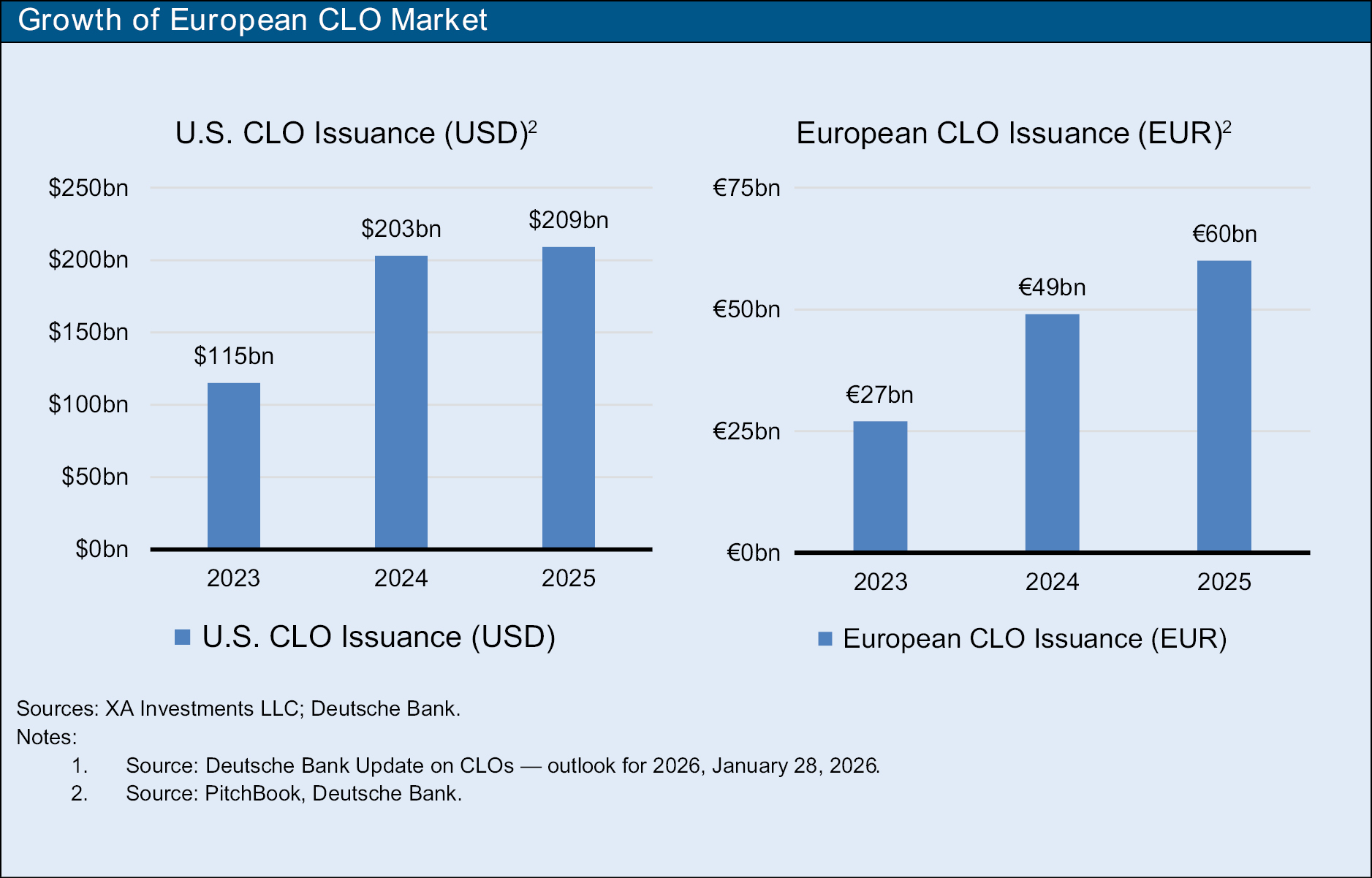
The growth of the size of the European CLO market supports the Fund’s decision to allocate assets to European CLOs. The CLO market in both the U.S. and Europe continues to expand. 2025 was a record-breaking year for CLO deal activity across U.S. and European markets. In the U.S., $209 billion of new CLOs were issued in
5
2025, a 3% year-over-year increase from the $203 billion of new CLOs issued in 2024. In Europe, the percentage increase in new CLO issuance in 2025 as compared to 2024 exceeded the percentage increase in the U.S., with €60 billion (U.S.$68 billion) of new CLOs issued in 2025 as compared to €49 billion (U.S.$52 billion) in 2024, representing an approximately 30.7% increase year-over-year. European CLO issuance is forecasted by Deutsche Bank to grow again in 2026, with €65 billion of new CLOs projected to be issued in 2026 (representing an 8% increase from 2025). Since the end of 2024, the total size of the European CLO market has grown 16% to €294 billion and is projected by Deutsche Bank to reach €300 billion by the end of 2026.
See “Proposal: Approval of King Street Sub-Advisory Agreement — Risk Considerations” for a discussion of additional risks associated with investments in European CLOs.
Q: How will the Fund’s expense limitation be impacted?
A: The Adviser and the prior sub-adviser have entered into a letter agreement (the “Operating Expense Limitation Agreement”) with the Fund through January 31, 2027. Pursuant to the Operating Expense Limitation Agreement, the Adviser and the Sub-Adviser have agreed to waive a portion of their management fee and sub-advisory fee, as applicable, or reimburse the Fund for certain operating expenses so that the expenses of the Fund, exclusive of certain excluded expenses, do not exceed 0.68% of the Fund’s Managed Assets through January 31, 2027. In connection with the proposed appointment of the King Street Sub-Adviser, the Adviser and the King Street Sub-Adviser will agree to maintain such operating expense limitation through January 31, 2027. Upon the termination of such operating expense limitation, if such operating expense limitation is not extended, the operating expenses of the Fund borne by shareholders will increase.
Q: How else is the Adviser supporting the Fund?
A: In order to support the Fund and provide the Fund with additional liquidity to facilitate potential portfolio repositioning associated with the King Street Sub-Adviser assuming management of the Fund, on June 1, 2026, the Adviser and certain of its principals made an aggregate investment of $4 million in the Fund by acquiring 400,000 shares of 5.75% Series 2027 Term Preferred Shares, liquidation preference $10.00 per share, of the Fund (the “Preferred Shares”). The purchasers paid the expenses related to the issuance of Preferred Shares. The Preferred Shares pay a monthly dividend at an annual rate of 5.75% of the liquidation preference, or $10.00 per share, per year. As of June 1, 2026, the aggregate liquidation preference of the Preferred Shares of $4 million represented 7.69% of the Fund’s Managed Assets.
6
Although leverage may create an opportunity for increased return and income for shareholders, it also results in additional risks and can magnify the effect of any losses.
There is no assurance that the leverage strategy will be successful. If income and gains on securities purchased with leverage proceeds are greater than the cost of the leverage, common shareholders’ return will be greater than if leverage had not been used. Conversely, if the income or gains from the securities purchased with the proceeds of leverage are less than the cost of leverage, common shareholders’ return will be less than if leverage had not been used. See “Additional Information — Outstanding Shares — Preferred Shares.”
Q: Will the Fund’s name change?
A: Yes, in connection with the approval of the King Street Sub-Adviser and the effectiveness of the modifications to the Fund’s investment policies described above, the Fund will change its name to “XAI Opportunistic Credit Income Fund.”
Q: What will happen if shareholders do not approve the King Street Sub-Advisory Agreement?
A: If the King Street Sub-Advisory Agreement has not been approved upon the resignation of Octagon as investment sub-adviser on or about July 30, 2026, the King Street Sub-Adviser will serve as investment sub-adviser pursuant to an interim sub-advisory agreement. If shareholders do not approve the King Street Sub-Advisory Agreement within the term of the interim sub-advisory agreement, the Board will take such actions with respect to the management of the Fund as it deems in the best interests of the Fund. While there can be no assurance at this time as to any such course of action to be taken by the Board, it could consider continuing to solicit shareholder approval or pursuing strategic alternatives for the Fund. The Board urges you to vote without delay in order to avoid potential disruption to the Fund’s operations.
Q: Will common shareholders pay costs or expenses related to the proxy solicitation or related legal costs?
A: No, all costs associated with the proxy process will be borne by XA Investments and King Street (and not the Fund).
Q: Will my vote make a difference?
A: Yes! Your vote is important and could make a difference in the governance of the Fund, no matter how many shares you own.
Q: Who is asking for my vote?
A: The enclosed proxy card is solicited by the Board for use at the Special Meeting to be held on Thursday, July 30, 2026, and, if the Special Meeting is adjourned, postponed or delayed, at any later meetings, for the purposes stated in the Notice.
Q: How does the Board recommend that shareholders vote on the Proposal?
A: The Board unanimously recommends that you vote “FOR” the Proposal.
Q: Who is eligible to vote?
A: Shareholders of record of the Fund at the close of business on June 2, 2026 (the “Record Date”) are entitled to attend the Special Meeting and any adjournments, postponements or delays thereof and to vote on the Proposal. Each Share is entitled to one vote. Shares represented by duly executed proxies will be voted in accordance with your instructions.
7
Q: How do I vote my shares?
A: You may vote in any of the four ways listed below:
|
Internet: |
Shareholders should go to the website indicated on the shareholder’s proxy card and enter the control number set forth on the proxy card. Shareholders will be prompted to follow a simple set of instructions, which will appear on the website. |
|||||
|
Telephone: |
Shareholders may call the toll-free phone number indicated on their proxy card to vote their shares. Shareholders will need to enter the control number set forth on their proxy card and then will be prompted to answer a series of simple questions. You may also be able to vote over the phone by calling the Fund’s proxy solicitation firm, Okapi Partners LLC, toll-free at (855) 305-0855. Representatives are available Monday through Friday from 8:00 am to 7:00 pm, Central Time. |
|||||
|
Mail: |
Shareholders may submit a paper proxy card using the accompanying postage-paid envelope. |
|||||
|
In Person: |
Shareholder may attend the Special Meeting at the offices of the Fund’s investment adviser on July 30, 2026 and cast their vote at the meeting. |
Whether or not you plan to attend the Special Meeting, we urge you to vote your shares at your earliest convenience. Please complete the enclosed proxy card, date and sign it and return it promptly, or record your voting instructions by telephone or via the internet so your Shares will be represented at the Special Meeting, no matter how large or small your holdings may be. Instructions regarding how to vote via telephone or the Internet are included on the enclosed proxy card. The required control number for internet and telephone voting is printed on the enclosed proxy card. The control number is used to match proxy cards with shareholders’ respective accounts and to ensure that, if multiple proxy cards are executed, Shares are voted in accordance with the proxy card bearing the latest date.
If you wish to attend the Special Meeting and vote in person, you will be able to do so. If you intend to attend the Special Meeting in person and you are a record holder of Shares, in order to gain admission you must show photographic identification, such as your driver’s license. If you intend to attend the Special Meeting in person and you hold your Shares through a bank, broker or other custodian, in order to gain admission you must show photographic identification, such as your driver’s license, and satisfactory proof of ownership of Shares, such as your voting instruction form (or a copy thereof) or broker’s statement indicating ownership as of the Record Date. If you hold your Shares in a brokerage account or through a bank or other nominee, you will not be able to vote in person at the Special Meeting unless you have previously requested and obtained a “legal proxy” from your broker, bank or other nominee and present it at the Special Meeting.
All Shares represented by properly executed proxies received prior to the Special Meeting will be voted at the Special Meeting in accordance with the instructions marked thereon or otherwise as provided therein. If any other business is brought before the Special Meeting, your Shares will be voted at the proxies’ discretion. If you sign the proxy card, but do not fill in a vote, your Shares will be voted in accordance with the Board’s recommendation for the Proposal.
Shareholders who execute proxy cards or record their voting instructions via telephone, email or the Internet may revoke them at any time before they are voted by filing with the Secretary of the Fund a written notice of revocation, by delivering (including via telephone or the Internet) a duly executed proxy bearing a later date or by attending the Special Meeting and voting in person. Merely attending the Special Meeting, however, will not revoke any previously submitted proxy.
Broker-dealer firms holding Shares in “street name” for the benefit of their customers and clients will request the instructions of such customers and clients on how to vote their Shares on the proposal before the Special Meeting. Broker-dealer firms will not be able to vote the Shares of beneficial owners who do not provide proxy instructions or who do not return a proxy card. A properly executed proxy card or other authorization by a beneficial owner of Shares that does not specify how the beneficial owner’s Shares should be voted on the Proposal may be deemed by a broker-dealer firm to be an instruction to vote such Shares in accordance with the Board’s recommendation in favor of the Proposal in which case such broker-dealer firm will vote such shares
8
accordingly. Broker-dealers who are not members of the NYSE may be subject to other rules, which may or may not permit them to vote your Shares without instruction. We urge you to provide instructions to your broker or nominee so that your votes may be counted.
Q: What vote is required to approve the Proposal?
A: Approval of the Proposal requires the affirmative vote of lesser of (i) 67% or more of the Shares entitled to vote thereon present at the Special Meeting if the holders of more than 50% of such outstanding Shares are present in person or represented by proxy; or (ii) more than 50% of such outstanding Shares entitled to vote thereon.
Shareholders will have equal voting rights (i.e. one vote per Share), with holders of Common Shares and Preferred Shares voting together as a single class.
Q: How many Shares of the Fund were outstanding as of the record date?
A: At the close of business on the Record Date, the Fund had 457,088 Class A Shares, 1,531,233 Class I Shares and 400,000 Preferred Shares outstanding.
Q: Who can I call with questions?
A: If you have any questions regarding the Proposal or the voting process, please call our proxy solicitation agent, Okapi Partners LLC, toll free at (855) 305-0855. Representatives are available to take your call Monday-Friday from 8:00 am to 7:00 pm Central Time.
If you have any questions regarding the Fund, please call XA Investments team at 1-888-903-3358 or view our website www.xainvestments.com for more information. References herein to the Fund’s website are intended to allow investors public access to information regarding the Fund and do not, and are not intended to, incorporate the Fund’s website in this Proxy Statement.
9
PROPOSAL: APPROVAL OF KING STREET SUB-ADVISORY AGREEMENT
Background
XA Investments LLC, a registered investment adviser under the Advisers Act, serves as the Fund’s investment adviser and is responsible for the management of the Fund.
At a meeting held on May 14, 2026 (the “Board Meeting”), the Board, including a majority of the Trustees who are not “interested persons” (as defined in the Investment Company Act of 1940 (the “1940 Act”)) of the Fund, the Adviser or the King Street Sub-Adviser (the “Independent Trustees”), for the reasons discussed below under “— Board Considerations,” unanimously approved the King Street Sub-Advisory Agreement and unanimously recommended approval of the King Street Sub-Advisory Agreement by shareholders.
You are being asked to approve the King Street Sub-Advisory Agreement among the Fund, the Adviser and the King Street Sub-Adviser. The 1940 Act requires that the King Street Sub-Advisory Agreement be approved by the Fund’s shareholders in order for it to become effective.
Octagon Credit Investors, LLC currently serves as investment sub-adviser to the Fund pursuant to the investment sub-advisory agreement, dated May 16, 2025 (the “Prior Sub-Advisory Agreement”), among the Fund, the Adviser and Octagon. Octagon will resign as investment sub-adviser to the Fund, effective on or about July 30, 2026.
King Street Sub-Adviser
The King Street Sub-Adviser is a newly formed, wholly owned subsidiary of King Street. King Street is a leading global alternative asset manager founded in 1995. The King Street Sub-Adviser is registered as an investment adviser under the Advisers Act. The King Street Sub-Adviser is a Delaware limited liability company. The principal business address of King Street and the King Street Sub-Adviser is 299 Park Avenue, 40th Floor, New York, NY 10171.
King Street
King Street is a leading global alternative asset manager founded in 1995 that manages assets across an institutional platform spanning multiple segments of the public and private markets. As of December 31, 2025, King Street and its affiliates had $30.0 billion in assets under management. King Street manages 20 U.S. CLOs and nine European CLOs, which total $12 billion in assets. King Street combines rigorous research, tactical trading, and flexible deployment to create differentiated and opportunistic investment solutions and outcomes. King Street currently employs 270 people, including 99 investment professionals, with offices in New York, London, Singapore, Charlottesville, Dublin, Tokyo, Dubai and Menlo Park.
Investment Approach
The King Street Sub-Adviser focuses on marrying rigorous fundamental research with tactical trading and exceptional sourcing capabilities to seek to identify dislocations and mispriced investment opportunities across asset classes, up and down the capital structure, and in geographies where the firm believes it has an edge through its deep expertise in credit, restructurings, bankruptcies and other event driven situations. King Street’s strong client relationships and deep understanding of how the firm can help meet their objectives have led to long-standing and enduring partnerships. King Street strives to continue evolving its product offerings to provide investment solutions that leverage the firm’s broad investment capabilities and meet its investors’ return objectives.
If approved by the Fund’s shareholders, the Board of Trustees and XA Investments believe the King Street Sub-Adviser’s investment management of the Fund will provide a number of important benefits to help improve the Fund’s performance over time:
• Potential for increased distributions and improved total return performance over time;
• Expanded opportunity set — more varied investment opportunities in different parts of the U.S. and European credit market;
• Rigorous research and credit analysis, tactical trading capabilities, and adaptive investment approach to tailor its management to meet the Fund’s investment objective;
10
• The King Street Sub-Adviser is a wholly owned subsidiary of King Street, a manager with skill and experience investing in the U.S. and global credit markets; and
• Reduced investment management fees, which will favorably impact the Fund’s overall operating expenses for shareholders.
Sub-Advisory Fee
If the Proposal is approved, the Fund will pay to XA Investments an investment advisory fee, payable monthly in arrears, in an annual amount equal to 1.40% of the Fund’s average daily Managed Assets, which represents a reduction from the prior fee of 1.50%. “Managed Assets” means the total assets of the Fund, including assets attributable to the Fund’s use of leverage and preferred shares, minus the sum of its accrued liabilities (other than liabilities incurred for the purpose of creating leverage).
Pursuant to the King Street Sub-Advisory Agreement, the King Street Sub-Adviser will receive, as full compensation for all services rendered by the King Street Sub-Adviser as sub-adviser to the Fund, a sub-advisory fee, payable monthly in arrears, in an amount equal to (i) 60% of the advisory fee payable by the Fund to the Adviser (before giving effect to any fees waived or expenses reimbursed by the Adviser) for Managed Assets up to $200 million and (ii) 52% of the advisory fee payable by the Fund to the Adviser (before giving effect to any fees waived or expenses reimbursed by the Adviser) for Managed Assets above $200 million.
During the time in which the Fund is utilizing leverage, the amount of the fees paid to the Adviser, and thereby to the King Street Sub-Adviser, for investment advisory services will be higher than if the Fund did not utilize leverage because the fees paid will be calculated based on the Fund’s Managed Assets, including proceeds of leverage. This may create a conflict of interest between the Adviser and the King Street Sub-Adviser on the one hand and the common shareholders, because holders of indebtedness, preferred shares or other forms of leverage do not bear the management fee. Rather, common shareholders bear the portion of the management fee attributable to assets purchased with the proceeds of leverage, which means that common shareholders effectively bear the entire management fee. See “Additional Information — Outstanding Shares — Preferred Shares.”
Reimbursement of Expenses. Subject to approval by the Board of Trustees, including majority of the Independent Trustees, the Fund may reimburse the King Street Sub-Adviser for certain reasonable expenses incurred in connection with the day-to-day management of the Fund. These expenses are expected to include the Fund’s allocable share of portfolio management and trading systems, research and analytic tools (including modeling software), diligence-related expenses, and out-of-pocket travel costs incurred in connection with managing the Fund. Expenses related to the King Street Sub-Adviser’s general overhead or corporate operations will not be reimbursable.
Reimbursable expenses will be capped at 0.07% per annum of the Fund’s net assets. Notwithstanding the foregoing, no reimbursement of expenses will be made for any period during which the Fund is subject to an operating expense limitation or expense reimbursement arrangement with the Adviser and/or the King Street Sub-Adviser, if such reimbursement would cause the Trust’s operating expenses to exceed the applicable operating expense limitation or expense reimbursement amount in effect at the time of reimbursement. Eligible expenses incurred by the King Street Sub-Adviser during such period may be reimbursed during a period of up to three years after they are incurred, provided that such reimbursement does not cause the Fund’s operating expenses to exceed the applicable operating expense limitation or expense reimbursement amount in effect at the time such expenses were incurred or at the time of reimbursement.
Under the Prior Sub-Advisory Agreement, the Sub-Adviser may seek reimbursement from the Fund for certain costs and expenses incurred by the Sub-Adviser in connection with the management of the Fund’s assets. XA Investments believes that the Fund will benefit over time from the cap on such expenses imposed in connection with the King Street Sub-Advisory Agreement.
King Street Sub-Advisory Agreement
It is proposed that the Adviser, King Street Sub-Adviser and the Fund enter into the King Street Sub-Advisory Agreement. A form of the King Street Sub-Advisory Agreement is attached in Appendix A hereto.
Sub-Advisory Services. Under the King Street Sub-Advisory Agreement, King Street Sub-Adviser is retained to provide investment sub-advisory services with respect to the Fund’s investment portfolio. The services to be provided by King Street Sub-Adviser include certain of the day-to-day operations of the Fund subject to the oversight
11
and supervision of the Adviser and the direction and control of the Board. Such services include (i) managing the investment and reinvestment of the Fund’s assets in accordance with the Fund’s investment policies, (ii) arranging for the purchase and sale of securities and other assets, (iii) providing investment research and credit analysis concerning the Fund’s assets, (iv) placing orders for purchases and sales of the Fund’s assets, (v) maintaining books and records required to support the Fund’s investment operations, (vi) monitoring on a daily basis the investment activities and portfolio holdings of the Fund and (vii) voting proxies relating to the Fund’s portfolio securities in accordance with King Street Sub-Adviser’s proxy voting policies and procedures.
Compensation. Pursuant to the King Street Sub-Advisory Agreement, King Street Sub-Adviser will receive, as full compensation for all services rendered by King Street Sub-Adviser as sub-adviser to the Fund, a sub-advisory fee, payable monthly in arrears, in an amount equal to (i) 60% of the advisory fee payable by the Fund to the Adviser (before giving effect to any fees waived or expenses reimbursed by the Adviser) for Managed Assets up to $200 million and (ii) 52% of the advisory fee payable by the Fund to the Adviser (before giving effect to any fees waived or expenses reimbursed by the Adviser) for Managed Assets over $200 million. Subject to approval by the Board of Trustees, including majority of the Independent Trustees, the Fund may reimburse the King Street Sub-Adviser for certain reasonable expenses incurred in connection with the day-to-day management of the Fund. Reimbursable expenses will be capped at 0.07% per annum of the Fund’s Managed Assets. See “— Sub-Advisory Fee” above.
Duration and Termination. Under Section 15(a) of the 1940 Act, the King Street Sub-Advisory Agreement requires the approval of (i) the Board, including a majority of the Trustees who are not “interested persons” (as defined in the 1940 Act) of the Fund, the Adviser or King Street Sub-Adviser, and (ii) the shareholders. Assuming approval by shareholders, the King Street Sub-Advisory Agreement shall continue for an initial term of two years. Thereafter, the King Street Sub-Advisory Agreement shall continue in effect from year to year after the initial term if approved annually (i) by the Board or the holders of a majority of the outstanding voting securities of the Fund and (ii) by a majority of the trustees who are not “interested persons” of the Fund, the Adviser or King Street Sub-Adviser, by vote cast in person at a meeting called for the purpose of voting on such approval. The King Street Sub-Advisory Agreement may be terminated (i) by the Fund or the Adviser at any time, without the payment of any penalty, upon giving King Street Sub-Adviser 60 days’ written notice, or (ii) by King Street Sub-Adviser on 60 days’ written notice to the Fund and the Adviser. The King Street Sub-Advisory Agreement will also immediately terminate in the event of its assignment, as defined in the 1940 Act. The King Street Sub-Advisory Agreement also terminates upon the termination of the Fund’s investment advisory agreement with the Adviser.
Limitation of Liability. The King Street Sub-Advisory Agreement provides that King Street Sub-Adviser will not be liable for any error of judgment or mistake of law or for any loss suffered by King Street Sub-Adviser, the Adviser or by the Fund in connection with the performance of the King Street Sub-Advisory Agreement, except a loss resulting from a breach of fiduciary duty with respect to the receipt of compensation for services or a loss resulting from willful misfeasance, bad faith or gross negligence on the part of King Street Sub-Adviser in the performance of its duties or from reckless disregard by King Street Sub-Adviser of its duties under the King Street Sub-Advisory Agreement.
Interim Sub-Advisory Agreement
Rule 15a-4 under the 1940 Act permits the Board (including a majority of the Independent Trustees) to approve and enter into an Interim Sub-Advisory Agreement pursuant to which King Street Sub-Adviser may serve as investment sub-adviser for up to 150 days following the resignation of Octagon as investment sub-adviser, pending receipt of shareholder approval of the King Street Sub-Advisory Agreement.
Based upon the considerations described below under “— Board Considerations,” the Board, including the Independent Trustees, approved the Interim Sub-Advisory Agreement at the Board Meeting. In approving the Interim Sub-Advisory Agreement, the Board, including a majority of the Independent Trustees, determined that the scope and quality of services to be provided by King Street Sub-Adviser under the Interim Sub-Advisory Agreement would be at least equivalent to the scope and quality of services provided under the Prior Sub-Advisory Agreement. The compensation to be paid by the Adviser to the King Street Sub-Adviser under the Interim Sub-Advisory Agreement is not greater than the compensation Octagon would have received under the Prior Sub-Advisory Agreement.
12
The Interim Sub-Advisory Agreement will become effective upon the resignation of Octagon only if the King Street Sub-Advisory Agreement has not been approved by shareholders at that time. There are no material differences between the terms of the Interim Sub-Advisory Agreement and the terms of the King Street Sub-Advisory Agreement, except that the Interim Sub-Advisory Agreement terminates upon the earlier of the 150th day following its effectiveness or the effectiveness of the King Street Sub-Advisory Agreement.
Additional Information About the King Street Sub-Adviser
Principal Executive Officer and Board of Managers. The principal executive officer of the King Street Sub-Adviser is Brian Higgins, Founder, Managing Partner and Chief Investment Officer. The following individuals are executive officers/partners of the King Street Sub-Adviser:
Brian Higgins, Founder, Managing Partner and Chief Investment Officer
Young Choi, Partner and Portfolio Manager
Vincent Dubois-Pelerin, Partner and Head of Capital Formation & Investor Relations
Terry Ing, Partner and Portfolio Manager
Domenico Lia, Partner and Portfolio Manager
Kris Mastronardi, Partner, Chief Operating Officer and Global Head of Strategy
Jeff Rosenbaum, Partner and Portfolio Manager
David Charnin, Managing Director, General Counsel
Bennett Kaufman, Managing Director, Chief Financial Officer
The business address for the principal executive officer and executive officers/partners of the King Street Sub-Adviser is 299 Park Avenue, 40th Floor, New York, NY 10171.
Other Investment Companies Advised by the King Street Sub-Adviser. The King Street Sub-Adviser does not serve as investment adviser or investment sub-adviser to any other registered investment companies with a similar investment objective to the Fund.
Relationships with the Fund. No Trustee or officer of the Fund is an officer employee, director, general partner or shareholder of the King Street Sub-Adviser or has any material direct or indirect interest in the King Street Sub-Adviser or any other person controlling, controlled by or under common control with the King Street Sub-Adviser.
The King Street Sub-Adviser is not an affiliate of the Adviser or Octagon.
Affiliated Brokerage. During the fiscal year ended September 30, 2025, the Fund paid no brokerage commissions to (i) any broker that is an affiliated person of the Fund or an affiliated person of such person, or (ii) any broker an affiliated person of which is an affiliated person of the Fund, the Adviser, Octagon, the King Street Sub-Adviser or the Fund’s administrator.
Other Payments. During the fiscal year ended September 30, 2025, the Fund made no material payments to the King Street Sub-Adviser or any affiliated person of the King Street Sub-Adviser.
Portfolio Managers
The personnel of the King Street Sub-Adviser who will be primarily responsible for the day-to-day management of the Fund’s portfolio will be Young Choi and Terry Ing.
Mr. Choi is a Partner, Global Investment Committee member, Global Head of Trading and Portfolio Manager of the King Street Sub-Adviser. He is based in New York and is a member of King Street’s Management Committee, U.S. and European CLO Investment Committees, Risk Committee and Pricing Committee.
Prior to joining King Street in 2006, Mr. Choi worked at Citadel Investment Group as a Credit Analyst in the Distressed/High Yield Group and was Portfolio Manager of the firm’s $2 billion U.S. leveraged loan and CLO portfolio. Prior to that, Mr. Choi consulted at Bain & Co. Mr. Choi received a B.A. summa cum laude in Economics and a B.S.E. in Electrical Engineering from Duke University.
Mr. Choi will be supported by a team of professionals, including Terry Ing.
13
Mr. Ing is a Partner and Portfolio Manager and Head of U.S. Research of the King Street Sub-Adviser. Terry splits his time between the Menlo Park and New York offices. He is a member of King Street’s Management Committee, Conflicts Committee and Responsible Investment Committee. Prior to joining King Street in 2024, Mr. Ing worked at KKR as a Portfolio Manager and Head of their U.S. Leveraged Credit Research and was a member of the Leverage Credit Investment Committee. Before joining KKR, he was an Executive Vice President and Portfolio Manager at PIMCO, where he focused on the credit hedge fund. Mr. Ing was an adjunct professor at Pepperdine University’s Graziadio Business School and serves on the Board of Directors of the Roberts Impact Investing Fund in association with REDF, a non-profit certified Community Development Financial Institution (CDFI). Mr. Ing received a B.S. in Business Administration from the University of Southern California and an M.A. in Mathematics of Finance from Columbia University.
Other Accounts Managed. The following table sets forth information about funds and accounts other than the Fund for which the portfolio managers are primarily responsible for the day-to-day portfolio management as of December 31, 2025.
|
Other Accounts Managed by Account Type |
||||||||||||
|
Portfolio Manager |
Other Registered |
Other Pooled |
Other Accounts |
|||||||||
|
Young Choi |
0 |
$0 |
32 |
$14,422,000,000 |
0 |
$0 |
||||||
|
Terry Ing |
0 |
$0 |
0 |
$0 |
1 |
$500,000,000 |
||||||
|
Other Accounts for which Advisory Fee is Performance Based |
||||||||||||
|
Other Registered |
Other Pooled |
Other Accounts |
||||||||||
|
Young Choi |
0 |
$0 |
32 |
$14,422,000,000 |
0 |
$0 |
||||||
|
Terry Ing |
0 |
$0 |
0 |
$0 |
0 |
$0 |
||||||
Compensation. As Partners of King Street, Mr. Choi’s and Mr. Ing’s compensation consists of an allocation of the net earnings from the general partner of King Street and affiliated entities, as well as a monthly draw. They also receive allocations related to the performance of certain funds advised by King Street, with a greater allocation in funds which they manage.
Ownership of Securities. As of December 31, 2025, neither Mr. Choi nor Mr. Ing owned shares of the Fund.
Principal Investment Policies and Risks
Changes to Principal Investment Policies. If the Proposal is approved, it will not result in a change to the Fund’s investment objective. The Fund’s investment objective will remain focused on providing high income and total return.
The Board of Trustees has approved certain changes to the Fund’s investment policies to best utilize the King Street Sub-Adviser’s investment capabilities. Currently, under normal conditions, the Fund invests at least 80% of its managed assets (net assets plus any borrowings from leverage) in securities of collateralized loan obligation entities (“CLOs”), including debt tranches (“CLO Debt”) and subordinated tranches of CLOs (“CLO Equity”), with a limit of 20% of the Fund’s managed assets in CLO Equity. Effective as of the later of the approval of the King Street Sub-Advisory Agreement or sixty days from the date hereof, the Fund will instead invest, under normal conditions, at least 80% of its managed assets in CLO securities and other income producing securities. The Fund will invest, under normal conditions, at least 60% of its managed assets in CLO Debt and may invest up to 20% of its managed assets in CLO Equity. Additionally, the Fund may opportunistically invest up to 20% of its managed assets in ABS (including ABS the collateral for which includes, among other assets, student loan receivables, automobile loan and credit card receivables and residential and commercial mortgage-backed securities) and up to 20% of its managed assets in indirect private credit investments, through investments in BDCs.
The King Street Sub-Adviser’s execution of the Fund’s investment strategy will reflect the firm’s dynamic investment approach in the CLO and structured credit market. The Fund will be actively managed and XA Investments expects that the King Street Sub-Adviser’s execution of the Fund’s strategy will be tactical and opportunistic with respect to both asset allocation and security selection, which XA Investments believes will be beneficial to the Fund and its shareholders. As a result, the asset mix is expected to change in response to changing market conditions. In the past, the Fund has had fairly static asset allocations with two primary allocations to U.S. CLO Debt and U.S. CLO
14
Equity. Going forward, the Fund will be managed to take advantage of opportunities in both the U.S. and European CLO markets. The King Street Sub-Adviser will allocate the Fund’s assets on an active basis between U.S. CLO and European CLOs debt securities, paired with smaller allocations to CLO equity securities, asset-backed securities, and indirect private credit investments through BDCs.
Additional Risk Considerations. An investment in the Fund is subject to investment risk, including the possible loss of your entire investment. Investors should consider the specific risk factors and special considerations associated with an investment in the Fund. The proposed changes to the Fund’s investment policies may involve certain additional risks.
European CLO Risks. European CLOs are not denominated in U.S. dollars and primarily hold loans to non-U.S. companies. Investing in securities of non-U.S. issuers may involve certain risks not typically associated with investing in securities of U.S. issuers. These risks include: (i) there may be less publicly available information about non-U.S. issuers or markets due to less rigorous disclosure or accounting standards or regulatory practices; (ii) non-U.S. markets may be smaller, less liquid and more volatile than the U.S. market; (iii) potential adverse effects of fluctuations in currency exchange rates or controls on the value of the Fund’s investments; (iv) the economies of non-U.S. countries may grow at slower rates than expected or may experience a downturn or recession; (v) the impact of economic, political, social or diplomatic events as well as of foreign governmental laws or restrictions and differing legal standards; (vi) certain non-U.S. countries may impose restrictions on the ability of non-U.S. issuers to make payments of principal and interest to investors located in the United States due to blockage of non-U.S. currency exchanges or otherwise; and (vii) withholding and other non-U.S. taxes. Foreign companies are generally not subject to the same accounting, auditing and financial reporting standards as are U.S. companies. In addition, there may be difficulty in obtaining or enforcing a court judgment abroad, including in the event the issuer of a non-U.S. security defaults or enters bankruptcy, administration, or other proceedings. Changes in the non-U.S. currency/United States dollar exchange rate may affect the value of non-U.S. dollar-denominated securities and the unrealized appreciation or depreciation of investments.
While certain or all of the Fund’s non-U.S. dollar-denominated securities may be hedged into U.S. dollars, hedging may not alleviate all currency risks. Forward foreign currency exchange contracts involve certain risks, including the risk of failure of the counterparty to perform its obligations under the contract and the risk that the use of forward contracts may not serve as a complete hedge because of an imperfect correlation between movements in the prices of the contracts and the prices of the currencies hedged. While forward foreign currency exchange contracts may limit the risk of loss due to a decline in the value of the hedged currencies, they also may limit any potential gain that might result should the value of the currencies increase. In addition, because forward currency exchange contracts are privately negotiated transactions, there can be no assurance that the Fund will have flexibility to roll-over a forward currency exchange contract upon its expiration if it desires to do so. Hedging against a decline in the value of a currency does not eliminate fluctuations in the value of a portfolio security traded in that currency or prevent a loss if the value of the security declines. Moreover, it may not be possible for the Fund to hedge against a devaluation that is so generally anticipated that the Fund is not able to contract to sell the currency at a price above the devaluation level it anticipates. The cost to the Fund of engaging in currency exchange transactions varies with such factors as the currency involved, the length of the contract period and prevailing market conditions.
Political or economic disruptions in European countries may adversely affect security values. A significant number of countries in Europe are member states in the European Union (the “EU”), which faces major issues involving its membership, structure, procedures and policies. By adopting the Euro as its currency, a member state relinquishes control over its own monetary policies. In general, monetary policy is set for the Eurozone by the European Central Bank and fiscal policy is overseen and approved by the EU. European countries that are members of, or candidates to join, the Economic and Monetary Union (“EMU”) may be subject to various restrictions, including restrictions on deficits and debt levels. As a result of the foregoing, monetary and fiscal policies may not address the needs of all member countries. In addition, the fiscal policies of a single member state can impact and pose economic risks to the EU as a whole. There is continued concern over national-level support for the Euro, which could lead to certain countries leaving the EMU, the implementation of capital controls, or potentially the dissolution of the Euro. The dissolution of the Euro would have significant negative effects on European economies and would cause funds with holdings denominated in Euros to face substantial challenges, including difficulties relating to settlement of trades and valuation of holdings, diminished liquidity, and the redenomination of holdings into other currencies. The European financial markets have experienced volatility and adverse trends due to concerns about economic downturns, rising
15
government debt levels and the possible default of government debt in several European countries. A default or debt restructuring by any European country can adversely impact holders of that country’s debt and can affect exposures to other EU countries and their financial companies as well.
Asset Backed Securities Risks. Asset-backed securities are a form of structured debt obligation. ABS are payment claims that are securitized in the form of negotiable paper that is issued by a financing company (generally called a special purpose vehicle). Collateral assets are brought into a pool according to specific diversification rules. A special purpose vehicle is founded for the purpose of securitizing these payment claims and the assets of the special purpose vehicle are the diversified pool of collateral assets. The special purpose vehicle issues marketable securities that are intended to represent a lower level of risk than an underlying collateral asset individually, due to the diversification in the pool. The redemption of the securities issued by the special purpose vehicle takes place out of the cash flow generated by the collected assets. A special purpose vehicle may issue multiple securities with different priorities to the cash flows generated and the collateral assets. The collateral for ABS may include, among other assets, home equity loans, automobile and credit card receivables, boat loans, computer leases, airplane leases, mobile home loans, recreational vehicle loans and hospital account receivables. The Fund may invest in these and other types of ABS that may be developed in the future. There is the possibility that recoveries on the underlying collateral may not, in some cases, be available or may be insufficient to support payments on these securities.
The Fund may invest in ABS issued by legal entities that are sponsored by banks, investment banks, other financial institutions or companies, asset management firms or funds and are specifically created for the purpose of issuing such ABS. Investors in ABS receive payments that are part interest and part return of principal or certain ABS may be interest-only securities or principal-only securities. These payments typically depend upon the cash flows generated by an underlying pool of assets and vary based on the rate at which the underlying obligors pay off their liabilities under the underlying assets. The pooled assets provide cash flow to the issuer, which then makes interest and principal payments to investors. As a result, these investments involve the risk, among other risks, that the borrower may default on its obligations backing the ABS and, thus, the value of and interest generated by such investment will decline. In addition to the general risks (such as interest rate risk, prepayment risk, extension risk, market risk, credit risk and liquidity and valuation risk) associated with credit or debt securities discussed herein, ABS are subject to additional risks due to their structure.
During periods of declining interest rates, prepayment of borrowings underlying asset-backed securities can be expected to accelerate. Accordingly, the Fund’s ability to reinvest the returns of principal at comparable yields is subject to generally prevailing interest rates at that time. ABS are also subject to liquidity and valuation risk and, therefore, may be difficult to value accurately or sell at an advantageous time or price and involve greater transaction costs and wider bid/ask spreads than certain other instruments. In addition, the assets or collateral underlying an ABS may be insufficient or unavailable in the event of a default and enforcing rights with respect to these assets or collateral may be difficult and costly.
While traditional fixed-income securities typically pay a fixed rate of interest until maturity, when the entire principal amount is due, an ABS represents an interest in a pool of assets that has been securitized and typically provides for monthly or quarterly payments of interest, at a fixed or floating rate, and may provide for payments of principal from the cash flow of these assets. This pool of assets (and any related assets of the issuing entity) is often the only source of payment for the ABS. The ability of an ABS issuer to make payments on the ABS, and the timing of such payments, is therefore dependent on collections on these underlying assets. The recoveries on the underlying collateral may not, in some cases, be sufficient to support payments on these securities, or may be unavailable in the event of a default and enforcing rights with respect to these assets or collateral may be difficult and costly, which may result in losses to investors in an ABS.
Generally, obligors may prepay the underlying assets in full or in part at any time, subjecting the Fund to prepayment risk related to the ABS it holds. While the expected repayment streams on ABS are determined by the contractual amortization schedules for the underlying assets, an investor’s yield to maturity on an ABS is uncertain and may be reduced by the rate and speed of prepayments of the underlying assets, which may be influenced by a variety of economic, social and other factors. Any prepayments, repurchases, purchases or liquidations of the underlying assets could shorten the average life of the ABS to an extent that cannot be fully predicted. Some ABS may be structured to include a period of rapid amortization triggered by events such as a significant rise in the default rate of the underlying collateral, a sharp drop in the credit enhancement level because of credit losses on the underlying assets, a specified regulatory event or the bankruptcy of the originator. A rapid amortization event will cause any revolving period to end
16
earlier than expected and all collections on the underlying assets will be used to pay principal to investors earlier than expected. In general, the senior most securities will be paid prior to any payments being made on the subordinated securities, and if such payments are made earlier than expected, the Fund’s yield on such ABS may be negatively affected.
In addition, investments in ABS entail additional risks relating to the underlying pools of assets, including credit risk, default risk (such as a borrower’s default on its obligation and the default, failure or inadequacy or unavailability of a guarantee, if any, underlying the ABS intended to protect investors in the event of default) and prepayment and extension risk with respect to the underlying pool or individual assets represented in the pool. The underlying assets of an ABS may include, without limitation, residential or commercial mortgages, motor vehicle installment sales or installment loan contracts, leases of various types of real, personal and other property, receivable from credit card agreements and automobile finance agreements, student loans, consumer loans, and income from other income streams, such as income from business loans. Moreover, additional risks relating to investments in ABS may arise principally because of the type of ABS in which the Fund invests, with such risks primarily associated with the particular assets collateralizing the ABS (such as their type or nature), the structure of such ABS, or the tranche or priority of the ABS held by the Fund (with junior or equity tranches generally carrying higher levels of risk)
Mortgage-Backed Securities (“MBS”) represent an interest in a pool of mortgages. MBS are subject to certain risks, such as: credit risk associated with the performance of the underlying mortgage properties and of the borrowers owning these properties; risks associated with their structure and execution (including the collateral, the process by which principal and interest payments are allocated and distributed to investors and how credit losses affect the return to investors in such MBS); risks associated with the servicer of the underlying mortgages; adverse changes in economic conditions and circumstances, which are more likely to have an adverse impact on MBS secured by loans on certain types of commercial properties than on those secured by loans on residential properties; prepayment and extension risks associated with the underlying assets of certain MBS, which can shorten the weighted average maturity and lower the return of the MBS, or lengthen the expected maturity, respectively, leading to significant fluctuations in the value of the MBS; loss of all or part of the premium, if any, paid; and decline in the market value of the security, whether resulting from changes in interest rates, prepayments on the underlying mortgage collateral or perceptions of the credit risk associated with the underlying mortgage collateral.
The value of MBS may be substantially dependent on the servicing of the underlying pool of mortgages. In addition, the Fund’s level of investment in MBS of a particular type or in MBS issued or guaranteed by affiliated obligors, serviced by the same servicer or backed by underlying collateral located in a specific geographic region, may subject the Fund to additional risk.
When market interest rates decline, more mortgages are refinanced and the securities are paid off earlier than expected. Prepayments may also occur on a scheduled basis or due to foreclosure. When market interest rates increase, the market values of MBS decline. At the same time, however, mortgage refinancings and prepayments slow, which lengthens the effective maturities of these securities. As a result, the negative effect of the rate increase on the market value of MBS is usually more pronounced than it is for other types of debt securities. In addition, due to instability in the credit markets, the market for some MBS has at times experienced reduced liquidity and greater volatility with respect to the value of such securities, making it more difficult to value such securities. The Fund may invest in sub-prime mortgages or MBS that are backed by sub-prime mortgages or defaulted or nonperforming loans, which may be subject to heightened risks compared to other MBS. See “Sub-Prime Mortgage Market Risk” below for more information.
Additional risks relating to investments in MBS may arise principally because of the type of MBS in which the Fund invests, with such risks primarily associated with the particular assets collateralizing the MBS and the structure of such MBS. For example, collateralized mortgage obligations (“CMOs”), which are MBS that are typically collateralized by mortgage loans or mortgage pass-through securities and multi-class pass-through securities, are commonly structured as equity interests in a trust composed of mortgage loans or other MBS. CMOs are usually issued in multiple classes, often referred to as “tranches,” with each tranche having a specific fixed or floating coupon rate and stated maturity or final distribution date. Under the traditional CMO structure, the cash flows generated by the mortgages or mortgage pass-through securities in the collateral pool are used to first pay interest and then pay principal to the holders of the CMOs. Subject to the provisions of individual CMO issues, the cash flow generated by the underlying collateral (to the extent it exceeds the amount required to pay the stated interest) is used to retire the bonds. As a result of these and other structural characteristics of CMOs, CMOs may have complex or highly
17
variable prepayment terms, such as companion classes, interest only or principal only payments, inverse floaters and residuals. These investments generally entail greater market, prepayment and liquidity risks than other MBS, and may be more volatile or less liquid than other MBS. CMOs are further subject to certain risks specific to these securities. For example, the average life of CMOs is typically determined using mathematical models that incorporate prepayment and other assumptions that involve estimates of future economic and market conditions, which may prove to be incorrect, particularly in periods of heightened market volatility. Further, the average weighted life of certain CMOs may not accurately reflect the price volatility of such securities, resulting in price fluctuations greater than what would be expected from interest rate movements alone.
Non-agency MBS (i.e., MBS issued by commercial banks, savings and loans institutions, mortgage bankers, private mortgage insurance companies and other non-governmental issuers) are subject to the risk that the value of such securities will decline because, among other things, the securities are not guaranteed as to principal or interest by the U.S. government or a government sponsored enterprise. Non-agency MBS are not subject to the same underwriting requirements for underlying mortgages as agency MBS and, as a result, mortgage loans underlying non-agency MBS typically have less favorable underwriting characteristics (such as credit and default risk and collateral) and a wider range in terms (such as interest rate, term and borrower characteristics) than agency MBS. Non-agency residential mortgage-backed securities often are issued in the form of several different tranches. Depending on their respective seniority, individual tranches are subject to increased (and sometimes different) credit, prepayment and liquidity and valuation risks as compared to other tranches. These securities are often subject to greater credit, prepayment and liquidity and valuation risks than agency MBS. In addition, these securities may be less readily marketable as the market for these securities is typically smaller and less liquid than the market for agency MBS. For example, during periods of weakness or perceived weakness in the mortgage and real estate sectors, non-agency mortgage-related securities may experience greater price fluctuations and less liquidity than agency mortgage-related securities.
Moreover, the relationship between prepayments and interest rates may give some high-yielding MBS less potential for growth in value than conventional bonds with comparable maturities. In addition, during periods of falling interest rates, the rate of prepayment tends to increase. During such periods, the reinvestment of prepayment proceeds by the Fund will generally be at lower interest rates than the interest rates that were carried by the obligations that have been prepaid. Because of these and other reasons, MBS’s total return and maturity may be difficult to predict precisely. To the extent that the Fund purchases MBS at a premium, prepayments (which may be made without penalty) may result in loss of the Fund’s principal investment to the extent of premium paid.
The general effects of inflation on the U.S. economy can be wide ranging, as evidenced by rising interest rates, wages, and costs of consumer goods and necessities. The long-term effects of inflation on the general economy and on any individual mortgagor are unclear, and in certain cases, rising inflation may affect a mortgagor’s ability to repay its related mortgage loan, thereby reducing the amount received by the holders of MBS with respect to such mortgage loan. Additionally, increased rates of inflation, as recently experienced, may negatively affect the value of certain MBS in the secondary market. In addition, during periods of declining economic conditions, losses on mortgages underlying MBS generally increase. Mortgage-backed securities generally are classified as either commercial mortgage-backed securities (“CMBS”) or residential mortgage-backed securities (“RMBS”), each of which are subject to certain specific risks. CMBS and RMBS are also subject to risks similar to those associated with investing in real estate, such as the possible decline in the value of (or income generated by) the real estate, variations in rental income, fluctuations in occupancy levels and demand for properties or real estate-related services, changes in interest rates and changes in the availability or terms of mortgages and other financing that may render the sale or refinancing of properties difficult or unattractive.
CMBS are collateralized by one or more commercial mortgage loans. Banks and other lending institutions typically group the loans into pools and interests in these pools are then sold to investors, allowing the lender to have more money available to loan to other commercial real estate owners. Commercial mortgage loans may be secured by office properties, retail properties, hotels, mixed use properties or multi-family apartment buildings. The value of, and income generated by, investments in CMBS are subject to the risks of ABS and mortgage-related securities generally, as well as the commercial real estate markets and the real estate securing the underlying mortgage. CMBS are often subject to credit, default, prepayment and liquidity and valuation risks and may experience greater price volatility than other types of ABS or mortgage-related securities.
18
CMBS are subject to particular risks, such as those associated with lack of standardized terms, shorter maturities than residential mortgage loans and payment of all or substantially all of the principal only at maturity rather than regular amortization of principal. In addition, commercial lending generally is viewed as exposing the lender to a greater risk of loss than residential lending, because commercial lending typically involves larger loans to single borrowers or groups of related borrowers than residential mortgage loans. In addition, the repayment of loans secured by income producing properties typically is dependent upon the successful operation of the related real estate project and the cash flow generated therefrom, which can be affected by, among other things: tenant mix, success of tenant businesses, property management decisions, property location and condition, competition from comparable types of properties, changes in laws that increase operating expense or limit rents that may be charged, any need to address environmental contamination at the property, the occurrence of any uninsured casualty at the property, changes in national, regional or local economic conditions and/or specific industry segments, declines in regional or local or other real estate values, public health conditions, declines in regional or local rental or occupancy rates, increases in interest rates, real estate tax rates and other operating expenses, change in governmental rules, regulations and fiscal policies, including environmental legislation, acts of God, terrorism, social unrest and civil disturbances.
Consequently, adverse changes in economic conditions and circumstances are more likely to have an adverse impact on MBS secured by loans on commercial properties than on those secured by loans on residential properties. Economic downturns, rises in unemployment, tightening lending standards and increased interest and lending rates, developments adverse to the commercial real estate markets, and other developments that limit or reduce demand for commercial retail and office spaces (including continued or expanded remote working arrangement) as well as increased maintenance or tenant improvement costs and costs to convert properties for other uses adversely impact these investments. For example, economic decline in the businesses operated by the tenants of office or retail properties may increase the likelihood that the tenants may be unable to pay their rent or that properties may be unable to attract or retain tenants at all or on favorable terms for the commercial real estate owners, resulting in vacancies (potentially for extended periods) and losses. These developments could also result from, among other things, population shifts and other demographic changes, changing tastes and preferences as well as cultural, technological, working or economic and market developments. In addition, changing interest rate environments and associated changes in lending standards and higher refinancing rates may adversely affect the commercial real estate and CMBS markets. Moreover, mortgage-related securities, including CMBS, are subject to (in some cases to a greater extent) general investment, economic, market and/or geopolitical risks that affect general economic conditions and financial markets, such as pandemics, armed conflicts, energy supply or price disruptions, natural disasters and man-made disasters, which may have a significant effect on the underlying commercial mortgage loans and real estate. In addition, adverse developments in the local, regional and national economies affect consumer spending and can have a significant effect on the success of a retail space. Further, increased competition in the market of a retail property through the addition of competing properties nearby can adversely impact the success of a retail property, even if the local, regional and national economies are doing well. Retail properties are also subject to conditions that could negatively affect the retail sector, such as increased unemployment, increased federal income and payroll taxes, increased health care costs, increased state and local taxes, increased real estate taxes, industry slowdowns, lack of availability of consumer credit, weak income growth, increased levels of consumer debt, poor housing market conditions, adverse weather conditions, natural disasters, plant closings, and other factors. Similarly, local real estate conditions, such as an oversupply of, or a reduction in demand for, retail space or retail goods, and the supply and creditworthiness of current and prospective tenants may negatively impact those retail properties. The occurrence of any of the foregoing or similar developments would likely increase the risks associated with these investments, such as the default risk for the properties and loans underlying the CMBS investments, and adversely impact the value of, and income generated by, these investments and the underlying properties or loans. These developments could also result in reduced liquidity for CMBS. CMBS are also subject to the risk that the value of, and income generated by, such securities will decline because, among other things, the securities are not issued or guaranteed as to principal or interest by the U.S. government or a government sponsored enterprise and, thus, would be subject to similar risks as non-agency MBS. CMBS often are issued in the form of several different tranches. Depending on their respective seniority, individual tranches are subject to increased (and sometimes different) credit, prepayment and liquidity and valuation risks as compared to other tranches. CMBS are often subject to credit, default, prepayment and liquidity and valuation risks and may experience greater price volatility than other types of ABS or MBS.
Additional risks may be presented by the type and use of a particular commercial property. Special risks are presented by hotels, hospitals, nursing homes, hospitality properties and certain other property types. Commercial property values and net operating income are subject to volatility, which may result in net operating income becoming
19
insufficient to cover debt service on the related mortgage loan. The exercise of remedies and successful realization of liquidation proceeds relating to CMBS may be highly dependent on the performance of the servicer or special servicer. There may be a limited number of special servicers available, particularly those that do not have conflicts of interest.
Home mortgage loans are typically grouped together into pools by banks and other lending institutions, and interests in these pools are then sold to investors, allowing the bank or other lending institution to have more money available to loan to home buyers. RMBS are particularly subject to the credit risk of the borrower. Credit-related risk on RMBS primarily arises from losses due to delinquencies and defaults by the borrowers in payments on the underlying mortgage loans and breaches by originators and servicers of their obligations under the underlying documentation pursuant to which the RMBS are issued. RMBS are also subject to the risks of MBS generally and the residential real estate markets. The rate of delinquencies and defaults on residential mortgage loans and the aggregate amount of the resulting losses will be affected by a number of factors, including general economic conditions, particularly those in the area where the related mortgaged property is located, the level of the borrower’s equity in the mortgaged property and the individual financial circumstances of the borrower. For example, borrowers with adjustable rate mortgage loans are more sensitive to changes in interest rates, which affect their monthly mortgage payments, and may be unable to secure replacement mortgages at comparably low interest rates. The risk of non-payment is greater for RMBS that are backed by loans that were originated under weak underwriting standards, including loans made to borrowers with limited means to make repayment. RMBS are also subject to risks associated with the actions of mortgage lenders in the marketplace. Such lenders may adjust their loan programs and underwriting standards, which may reduce the availability of mortgage credit to prospective mortgagors. This may result in limited financing alternatives for mortgagors seeking to refinance their existing loans, which may in turn result in higher rates of delinquencies, defaults and losses on mortgages. If a residential mortgage loan is in default, foreclosure on the related residential property may be a lengthy and difficult process involving significant legal and other expenses. The net proceeds obtained by the holder on a residential mortgage loan following the foreclosure on the related property may be less than the total amount that remains due on the loan. The prospect of incurring a loss upon the foreclosure of the related property may lead the holder of the residential mortgage loan to restructure the residential mortgage loan or otherwise delay the foreclosure process.
Income from and values of RMBS also may be greatly affected by demographic trends, such as population shifts or changing tastes and values, or increasing vacancies or declining rents or property values resulting from legal, cultural, technological, global or local economic developments, as well as reduced demand for properties.
Loans made to lower quality borrowers, including those of sub-prime quality, may be underlying assets for an asset-backed security. Loans to such borrowers involve a higher degree of credit, default and the other risks to which MBS are subject, as discussed above. As a result, values of ABS backed by lower quality loans are more likely than others to suffer significant declines due to defaults, delays or the perceived risk of defaults or delays.
The residential mortgage market in the United States has at times experienced difficulties that may adversely affect the performance and market value of certain mortgages and MBS. Delinquencies and losses on residential mortgage loans (especially sub-prime and second-lien mortgage loans) generally have increased at times and may again increase, and a decline in or flattening of housing values (as has been experienced at times and may again be experienced in many housing markets) may exacerbate such delinquencies and losses. Borrowers with adjustable rate mortgage loans are more sensitive to changes in interest rates, which affect their monthly mortgage payments, and may be unable to secure replacement mortgages at comparably low interest rates. Also, a number of residential mortgage loan originators have at times experienced serious financial difficulties or bankruptcy. Largely due to the foregoing, reduced investor demand for mortgage loans and MBS and increased investor yield requirements has at times caused limited liquidity in the secondary market for certain MBS, which can adversely affect the market value of MBS. It is possible that such limited liquidity in such secondary markets could occur again or worsen. If the economy of the United States deteriorates, the incidence of mortgage foreclosures, especially sub-prime mortgages, may increase, which may adversely affect the value of any MBS owned by the Fund.
Any increase in prevailing market interest rates may result in increased payments for borrowers who have adjustable rate mortgages. Moreover, with respect to hybrid mortgage loans after their initial fixed rate period, interest-only products or products having a lower rate, and with respect to mortgage loans with a negative amortization feature which reach their negative amortization cap, borrowers may experience a substantial increase in their monthly payment even without an increase in prevailing market interest rates. Increases in payments for borrowers may result in increased rates of delinquencies and defaults on residential mortgage loans underlying the RMBS.
20
Future legislation or regulation, may have significant impacts on the mortgage market generally and may result in a reduction of available transactional opportunities for the Fund or an increase in the cost associated with such transactions and may adversely impact the value of RMBS.
Business Development Companies Risks. Business development companies (“BDCs”) generally invest in less mature U.S. private companies or thinly traded U.S. public companies which involve greater risk than well-established publicly traded companies. The Fund will indirectly bear its proportionate share of any management fees and other operating expenses incurred by the BDCs and of any performance-based or incentive fees payable by the BDCs in which it invests, in addition to the expenses paid by the Fund. A BDC’s incentive fee may be very high, vary from year to year and be payable even if the value of the BDC’s portfolio declines in a given time period. Incentive fees may create an incentive for a BDC’s manager to make investments that are risky or more speculative than would be the case in the absence of such compensation arrangements, and may also encourage the BDC’s manager to use leverage to increase the return on the BDC’s investments. The use of leverage by BDCs magnifies gains and losses on amounts invested and increases the risks associated with investing in BDCs. A BDC may make investments with a larger amount of risk of volatility and loss of principal than other investment options and may also be highly speculative and aggressive.
The Fund is subject to the conditions set forth in certain provisions of the 1940 Act and Securities and Exchange Commission regulations thereunder that limit the amount that the Fund and its affiliates, in the aggregate, can invest in the outstanding voting securities of an unaffiliated investment company or business development company. The Fund and its affiliates may not actively acquire “control” of an investment company or business development company, which is presumed once ownership of an investment company’s outstanding voting securities exceeds 25%. Also, to comply with provisions of the 1940 Act and regulations thereunder, the Fund may be required to vote shares of an investment company or business development company in the same general proportion as shares held by other shareholders of the investment company or business development company.
BDCs in which the Fund may invest typically invest primarily in private credit assets. Private credit refers to privately negotiated debt provided by a non-bank lender to a borrower. Typically the debt takes the form of a loan and the borrower is a company. Typically, private credit investments are in restricted securities that are not traded in public markets and subject to substantial holding periods, so that a BDC may not be able to resell some of its holdings for extended periods, which may be several years. Investments in private securities are illiquid, can be subject to various restrictions on resale, and there can be no assurance that a BDC will be able to realize the value of such investments in a timely manner. Additionally, private credit investments can range in credit quality depending on security-specific factors, including total leverage, amount of leverage senior to the security in question, variability in the issuer’s cash flows, the size of the issuer, the quality of assets securing debt and the degree to which such assets cover the subject company’s debt obligations. A BDC’s portfolio companies may be leveraged, often as a result of leveraged buyouts or other recapitalization transactions, and often will not be rated by national credit rating agencies. Investments in private companies pose significantly greater risks than investments in public companies. Limited public information generally exists about private companies. A BDC must therefore rely on the ability of its manager to obtain adequate information through due diligence to evaluate the creditworthiness and potential returns from investing in these companies. BDCs may make direct loans and engage in direct lending, which practice involves certain risks.
Shares of listed BDCs are priced by the trading market, which is influenced generally by numerous factors, not all of which are related to the underlying value of the entity’s assets and liabilities.
Board Considerations
At the Board Meeting held on May 14, 2026 (the “Meeting”), the Board, including the Independent Trustees, considered the proposal to appoint Rockford Tower Asset Management, L.L.C. (a wholly owned subsidiary of King Street Capital Management, L.P.) (as used in this section, collectively, “King Street”) as a sub-adviser to the Fund, evaluated the terms of the proposed King Street Sub-Advisory Agreement, and reviewed the duties and responsibilities of trustees generally in evaluating and approving such agreements.
While the King Street Sub-Adviser is newly formed and recently registered as an investment adviser, with no operating history, the King Street Sub-Adviser is a wholly owned subsidiary of King Street Capital Management, L.P, a leading global alternative asset manager founded in 1995. XAI and the Fund desire to enter into a relationship whereby the King Street Sub-Adviser will provide to the Fund King Street’s premier and institutional investment
21
management abilities. In considering the King Street Sub-Adviser, the Board considered the history and track record of King Street Capital Management, L.P and the investment capabilities that the King Street Sub-Adviser could offer as part of the King Street Capital Management, L.P. organization.
In advance of the Board Meeting, the Board requested the Adviser and King Street to respond to questions and provide related information intended to assist the Board in evaluating the proposal. In response to the Board’s request, the Adviser and King Street provided the Board with information including, but not limited to: (i) a draft of the proposed King Street Sub-Advisory Agreement; (ii) a description of the nature, quality and extent of the services that Adviser provides, and that King Street proposed to provide, to the Fund; (iii) the fees charged to the Fund and the fees the Adviser proposed to pay to King Street pursuant to the King Street Sub-Advisory Agreement; (iv) the experience and qualifications of King Street as an investment adviser, as well as of its personnel, including its historical performance managing similar investment strategies; (v) information concerning King Street’s financial condition, business, operations, portfolio management personnel and compliance programs; (vi) information describing the Fund’s advisory fees and operating expenses; and (vii) a copy of King Street’s current Form ADV. The Board also received information comparing the Fund’s historical performance and advisory fees and expenses to those of investment companies that were defined as peers.
Prior to the Board Meeting, the Independent Trustees met to review and discuss the Adviser’s and King Street’s responses to the Board’s request, as well as additional information furnished by the Adviser and King Street. The Independent Trustees requested supplemental information from the Adviser relating to the proposal. At the Board Meeting, in considering whether to approve the King Street Sub-Advisory Agreement, the Board met with representatives of King Street and the Adviser and reviewed and discussed the above information and sought additional and clarifying information as it deemed necessary or appropriate, and management representatives also addressed certain follow-up questions from the Trustees. Following such review and discussion, the Board determined that the information and responses provided by the Adviser and King Street were sufficiently responsive to permit the Board to evaluate the King Street Sub-Advisory Agreement.
Throughout the process, the Independent Trustees had the assistance of their independent legal counsel, who advised them on, among other things, the Board’s duties and obligations. The Independent Trustees had the opportunity to review and discuss all information with their independent legal counsel outside the presence of management. At the Board Meeting, the Trustees also reviewed a memorandum from counsel on the responsibilities of trustees in considering investment advisory arrangements under the 1940 Act.
During its consideration of the proposed King Street Sub-Advisory Agreement, the Board focused on and analyzed the factors that the Board deemed relevant, including: the nature, extent and quality of the services to be provided to the Fund by the Adviser and King Street; the investment performance of the Fund, the Adviser and King Street; the Fund’s expenses; the anticipated profitability to the Adviser and to King Street under the King Street Sub-Advisory Agreement; any anticipated or expected “fall-out” benefits that may accrue to King Street in performing its duties under the King Street Sub-Advisory Agreement; and the effect of asset growth on the Fund’s expenses. Each Trustee may have placed different weight on the different factors considered. No single factor was determinative to the decision of the Board, and the items described below are not all-encompassing of the matters considered.
1. The nature, extent, and quality of the services proposed to be provided by King Street. The Board reviewed the services proposed to be provided by King Street to the Fund pursuant to the King Street Sub-Advisory Agreement, including, without limitation: the nature and quality of the investment advisory services to be provided to the Fund; the background and experience of the personnel of King Street who were proposed to service the Fund; King Street’s experience and expertise in managing funds, other investment products or accounts that invest in assets classes consistent with, or have investment strategies or mandates similar to, those of the Fund; and King Street’s proposed relationship with the Adviser, including with respect to the fair valuation of the Fund’s assets and related tasks in managing and overseeing the assets and investments of the Fund. The Board also considered King Street’s investment capabilities in areas of potential future interest to the Fund. After reviewing the foregoing and further information as the Board deemed appropriate, the Board concluded that the nature, extent and quality of the services to be provided by King Street would be satisfactory and adequate for the Fund.
22
2. The investment performance of the Fund and King Street. The Board compared the historical performance of the Fund with the performance of the Fund’s benchmark indices and comparable group of peer funds. The Board also considered the performance record of King Street in managing funds and/or accounts that have investment objectives, strategies and risks relevant to the Fund’s investment strategies. The Board also considered information provided by the Adviser with respect to its diligence and selection process of King Street as a proposed sub-adviser, including with respect to King Street’s performance record.
3. The costs of the services proposed to be provided and profits anticipated to be realized by King Street and its affiliates from the relationship with the Fund. The Board considered the total expense ratio of the Fund and the management fees the Fund paid to the Adviser, as well as the fees proposed to be paid by the Adviser to King Street pursuant to the King Street Sub-Advisory Agreement. In considering the cost of services to be provided by King Street and the profitability to King Street of its relationship with the Fund, the Board noted that the fees under the King Street Sub-Advisory Agreement are paid by the Adviser and not the Fund, and the Board also noted that the total expense ratio and overall management fees charged to the Fund were not expected to change with the addition of King Street as a sub-adviser. The Board also noted that King Street and the Adviser were agreeing to contractually waive a certain portion of their fees, or to reimburse the Fund, to ensure that certain annual Fund operating expenses do not exceed 68 basis points of the Fund’s managed assets. The Board also considered King Street’s business philosophies and methods of operation; its compliance policies and procedures; its financial condition; the proposed level of commitment to the Fund by King Street and its principals; the costs associated with the trading strategies of the Fund; and the overall expenses of the Fund. The Board also considered the ability of the Adviser to negotiate the King Street Sub-Advisory Agreement with King Street, which is not affiliated with the Adviser, and the fees thereunder at arm’s length.
4. The extent to which economies of scale would be realized as the Fund grows. The Board considered whether economies of scale could be achieved as the Fund grows and whether King Street’s fee reflects these economies of scale in a manner that is fair and reasonable and beneficial for the Fund’s investors. Following further discussion of the Fund’s asset levels, expectations for growth and level of fees, the Board determined that King Street’s proposed fees were fair and reasonable when considering the Fund’s asset levels and economies of scale.
5. Whether fee levels reflect these economies of scale for the benefit of the Fund’s investors. The Board considered the total fees paid by the Fund to the Adviser, and the proposed fees to be paid by the Adviser to King Street, in light of the total assets being managed, the operational expenses incurred in processing transactions, brokerage fees and other related costs and expenses. The Board considered the allocation of fees between the Adviser and King Street in light of the Adviser’s discussion of why such allocations were appropriate given the work involved by each party on behalf of the Fund. The Trustees concluded the total fees paid are fair and reasonably reflect the costs and expenses of managing a fund of similar size and with a similar investment strategy.
The Board weighed these considerations against competing considerations related to the cost and effect of any potential repositioning of the Trust’s portfolio that might be necessitated by King Street’s oversight of the Trust’s portfolio, any risk of implementation of the King Street Sub-Advisory Agreement, and King Street’s limited experience serving as investment sub-adviser to a registered investment company. The Board took into account the information presented to them, including oral presentations at the Meeting, and determined that given the totality of the facts, the potential benefits flowing to the Trust by the retention of King Street outweighed the competing considerations, particularly given the Adviser’s continued role in overseeing the operations of the Trust.
Conclusion
Based on the foregoing and such other matters as were deemed relevant, the Board concluded in its reasonable business judgment that the proposed sub-advisory fee rate is reasonable in relation to the proposed services to be provided by King Street. The Board also concluded in its reasonable business judgment that the costs to be incurred and benefits to be gained by King Street are reasonable in relation to the provision of such services. The Board also
23
found the sub-advisory fee to be reasonable in comparison to the fees charged by advisers to other comparable funds. As a result, at the Board Meeting, the Board concluded that the approval of the King Street Sub-Advisory Agreement was in the best interests of the Fund, and the Board, with the Independent Trustees voting separately, approved the King Street Sub-Advisory Agreement and approved recommending the King Street Sub-Advisory Agreement to the Fund’s shareholders for their approval.
Shareholder Approval
The King Street Sub-Advisory Agreement must be approved by a vote of the holders of a majority of the outstanding voting securities of the Fund. The “vote of the holders of a majority of the outstanding voting securities” is defined in the 1940 Act as the lesser of the vote of shareholders holding (i) 67% or more of the voting securities of the Fund entitled to vote thereon present at the Special Meeting or represented by proxy if holders of more than 50% of the Fund’s outstanding voting securities are present or represented by proxy; or (ii) more than 50% of the outstanding voting securities of the Fund entitled to vote thereon. Shareholders will have equal voting rights (i.e. one vote per Share), with holders of Common Shares and Preferred Shares voting together as a single class.
Abstentions will have the same effect as votes against the Proposal.
Board Recommendation
The Board, including the Independent Trustees, recommends that you vote “FOR” approval of the King Street Sub-Advisory Agreement.
24
ADDITIONAL INFORMATION
Further Information About Voting and the Special Meeting
Quorum. The holders of a majority of the Shares entitled to vote on any matter at a meeting present in person or by proxy shall constitute a quorum at such meeting of the shareholders for purposes of conducting business on such matter. Abstentions and broker non-votes will be counted as Shares present at the Special Meeting for quorum purposes.
Record Date. The Board has fixed the close of business on June 2, 2026 as the Record Date for the determination of shareholders of the Fund entitled to notice of, and to vote at, the Special Meeting. Shareholders of the Fund as of the close of business on the Record Date will be entitled to one vote for each Share held and a fractional vote with respect to fractional Shares with no cumulative voting rights.
How to Vote Your Shares. Whether or not you plan to attend the Special Meeting, we urge you to vote your shares at your earliest convenience. Please complete, sign, date, and return the enclosed proxy card in the postage-paid envelope provided or vote via telephone or the Internet so your Shares will be represented at the Special Meeting. Instructions regarding how to vote via telephone or the Internet are included on the enclosed proxy card. The required control number for Internet and telephone voting is printed on the enclosed proxy card. The control number is used to match proxy cards with shareholders’ respective accounts and to ensure that, if multiple proxy cards are executed, Shares are voted in accordance with the proxy card bearing the latest date.
Shareholders may also be able to submit voting instructions by email by sending a completed and signed proxy card, or written voting instructions containing the shareholder’s name, address of record, and voting directions to XAI@OkapiPartners.com. Email voting instructions must be received no later than 11:59 p.m. Eastern Time on July 29, 2026. The Fund and its proxy solicitor reserve the right to reject any email voting instruction that is incomplete, illegible, improperly executed, or not timely received.
All Shares represented by properly executed proxies received prior to the Special Meeting will be voted at the Special Meeting in accordance with the instructions marked thereon or otherwise as provided therein. If any other business is brought before the Special Meeting, your Shares will be voted at the proxies’ discretion. If you sign the proxy card, but do not fill in a vote, your Shares will be voted in accordance with the Board’s recommendation for the Proposal.
Shareholders who execute proxy cards or record voting instructions via telephone, email or the Internet may revoke them at any time before they are voted by filing with the Secretary of the Fund a written notice of revocation, by delivering (including via telephone or the Internet) a duly executed proxy bearing a later date or by attending the Special Meeting and voting in person. Merely attending the Special Meeting, however, will not revoke any previously submitted proxy.
Attending the Special Meeting. If you wish to attend the Special Meeting and vote in person, you will be able to do so. If you intend to attend the Special Meeting in person and you are a record holder of Shares, in order to gain admission you must show photographic identification, such as your driver’s license. If you intend to attend the Special Meeting in person and you hold your Shares through a bank, broker or other custodian, in order to gain admission you must show photographic identification, such as your driver’s license, and satisfactory proof of ownership of Shares, such as your voting instruction form (or a copy thereof) or broker’s statement indicating ownership as of the Record Date. If you hold your Shares in a brokerage account or through a bank or other nominee, you will not be able to vote in person at the Special Meeting unless you have previously requested and obtained a “legal proxy” from your broker, bank or other nominee and present it at the Special Meeting. You may contact the Fund’s proxy agent at (855) 305-0855 to obtain directions to the site of the Special Meeting.
Additional Information Regarding Voting. Broker-dealer firms holding Shares in “street name” for the benefit of their customers and clients will request the instructions of such customers and clients on how to vote their Shares on the proposal before the Special Meeting. The Fund understands that, under the rules of the NYSE, such broker-dealer firms may for certain “routine” matters, without instructions from their customers and clients, grant discretionary authority to the proxies designated by the Board to vote if no instructions have been received prior to the date specified in the broker-dealer firm’s request for voting instructions. The Proposal is a not a “routine” matter and beneficial
25
owners who do not provide proxy instructions or who do not return a proxy card will not have their Shares voted by broker dealer firms. Such “broker non-votes” will have the same effect as votes against the Proposal. A properly executed proxy card or other authorization by a beneficial owner of Shares that does not specify how the beneficial owner’s Shares should be voted on the Proposal may be deemed by a broker-dealer firm to be an instruction to vote such Shares in accordance with the Board’s recommendation in favor of the Proposal in which case such broker-dealer firm will vote such shares accordingly. Broker-dealers who are not members of the NYSE may be subject to other rules, which may or may not permit them to vote your Shares without instruction. We urge you to provide instructions to your broker or nominee so that your votes may be counted.
Important Notice Regarding the Availability of Proxy Materials for the Shareholder Meeting to be Held on July 30, 2026
This Proxy Statement is available on the Internet at www.OkapiVote.com/OCTIX.
Adviser
XA Investments LLC serves as the investment adviser to the Fund and is responsible for overseeing the Fund’s overall investment strategy and its implementation, including the use of leverage by the Fund. The Adviser is an investment adviser registered under the Investment Advisers Act of 1940 and acts as investment adviser to certain other management investment companies. The Adviser is a Delaware limited liability company, with its principal offices located at 321 North Clark Street, Suite 2430, Chicago, Illinois 60654. The Adviser is controlled by Theodore J. Brombach, Co-Chief Executive Officer of the Adviser and a founding partner of XMS Capital Partners, LLC, and John “Yogi” Spence, Co-Chief Executive Officer of the Adviser and a founding partner of XMS Capital Partners, LLC.
XAI was founded by the principals of XMS Capital Partners, LLC in April 2016. The Adviser’s leadership team believes that the investing public needs better access to a broader range of alternative investment strategies and managers. The Adviser sponsors registered investment companies designed to provide investors with access to institutional-caliber alternative investments, by partnering with established alternative asset managers selected from numerous alternative credit managers, hedge fund managers and private debt and equity firms to sub-advise the Adviser’s funds. As of March 31, 2026, the Adviser managed approximately $763 million in assets. The Adviser is located at 321 North Clark Street, Suite 2430, Chicago, Illinois 60654.
Administrator
Paralel Technologies LLC, located at 1700 Broadway Suite 1850, Denver, CO 80290, serves as administrator to the Fund.
Outstanding Shares
As of the Record Date, the Fund had outstanding 457,088 Class A Shares, 1,531,233 Class I Shares and 400,000 Preferred Shares.
Preferred Shares. On June 1, 2026, the Adviser and certain of its principals made an aggregate investment of $4 million in the Fund by acquiring 400,000 shares of 5.75% Series 2027 Term Preferred Shares, liquidation preference $10.00 per share, of the Fund (the “Preferred Shares”). The purchasers paid the expenses related to the issuance of Preferred Shares.
The Preferred Shares pay a monthly dividend at an annual rate of 5.75% of the liquidation preference, or $10.00 per share, per year. Cumulative cash dividends or distributions on each Preferred Share are payable monthly, when, as and if declared, or under authority granted, by the Board of Trustees of the Fund out of funds legally available for such payment. The Fund will pay dividends on the Preferred Shares on the first business day of each month. The Preferred Shares are senior securities that constitute shares of beneficial interest of the Fund. The Preferred Shares rank senior to the Fund’s Common Shares in priority of payment of dividends and as to the distribution of assets upon dissolution, liquidation or winding up of the Fund’s affairs. The Fund is required to redeem, out of funds legally available therefor, all outstanding Preferred Shares on June 30, 2027 at a price equal to the liquidation preference plus an amount equal to accumulated but unpaid dividends and distributions, if any, on such shares. Additionally, the Fund is required to redeem Preferred Shares to maintain applicable asset coverage ratios.
26
The Fund may use leverage for investment purposes to the extent permitted by 1940 Act. The Fund may, from time to time, use leverage for strategic or tactical purposes in seeking to achieve its investment objective. In addition, the Fund may enter into a borrowing facility to finance repurchase requests. Under the 1940 Act, the Fund may not incur indebtedness if, immediately after incurring such indebtedness, the Fund would have asset coverage (as defined in the 1940 Act) of less than 300% (i.e., for every dollar of indebtedness outstanding, the Fund is required to have at least three dollars of total assets, including the proceeds of leverage). Under the 1940 Act, the Fund may not issue preferred shares if, immediately after issuance, the Fund would have asset coverage (as defined in the 1940 Act) of less than 200% (i.e., for every dollar of preferred shares outstanding, the Fund is required to have at least two dollars of total assets, including the proceeds of leverage).
As of June 1, 2026, the aggregate liquidation preference of the Preferred Shares of $4 million represented 7.69% of the Fund’s Managed Assets. Based on the Fund’s Managed Assets as of June 1, 2026, the annual dividends payable on the Preferred Shares would equal 0.479% of the Fund’s net assets attributable to common shares.
Use of leverage creates an opportunity for increased income and capital appreciation but, at the same time, creates special risks. The use of leverage would cause the Fund’s net asset value and level of distributions to be more volatile than if leverage were not used. The fees paid to the Adviser, and thereby to the sub-adviser, will be calculated on the basis of the Fund’s Managed Assets, including any proceeds from leverage, so the fees paid to the Adviser and sub-adviser will be higher when leverage is utilized. Shareholders bear the portion of the investment advisory fee attributable to the assets purchased with the proceeds of leverage, which means that shareholders effectively bear the entire management fee. There can be no assurance that a leveraging strategy will be utilized or, if utilized, will be successful.
Principal Shareholders
The following table lists each person who, to the knowledge of the Fund, beneficially owned more than 5% of any class of equity securities of the Fund as of the Record Date. The information contained in this table is based on the Fund’s review of Schedule 13D, Schedule 13G, other regulatory filings, and the Fund’s records.
|
Shareholder Name and Address |
Class of |
Share |
Percentage |
|||
|
Wells Fargo Clearing |
Class A Shares |
455,510.61 |
99.52% |
|||
|
Wells Fargo Bank NA |
Class I Shares |
882,795.67 |
57.65% |
|||
|
Wells Fargo Clearing |
Class I Shares |
346,856.39 |
22.65% |
|||
|
Theodore J. Brombach |
Preferred Shares |
300,000* |
75%* |
|||
|
John “Yogi” Spence |
Preferred Shares |
300,000* |
75%* |
|||
|
XMS Holdings LLC |
Preferred Shares |
200,000* |
50%* |
____________
* XMS Holdings LLC, an affiliate of the Adviser, holds 200,000 Preferred Shares. Messrs. Brombach and Spence may be deemed to be a beneficial owner of the Preferred Shares held by XMS Holdings LLC by virtue of their control over the XMS Holdings LLC.
27
Security Ownership of Management
As of the Record Date, no Trustee or officer of the Fund beneficially owned 1% or more of any class of equity securities of the Fund, except as set forth below:
|
Name |
Position with the |
Class of |
Number of |
Percentage of |
||||
|
Theodore J. Brombach |
Trustee, President and Chief Executive Officer |
Preferred Shares |
300,000* |
75% |
||||
|
John “Yogi” Spence |
Vice President |
Preferred Shares |
300,000* |
75% |
____________
* XMS Holdings LLC, an affiliate of the Adviser, holds 200,000 Preferred Shares. Each of Mr. Brombach and Mr. Spence may be deemed to be a beneficial owner of the Preferred Shares held by XMS Holdings LLC by virtue of their control over the XMS Holdings LLC.
As of the Record Date, the Trustees and officers of the Fund as a group owned less than 1% of the outstanding Class I Shares of the Fund (including 4,000 Class I Shares of the Fund held by the Adviser, of which Mr. Brombach and Mr. Spence may be deemed to be a beneficial owner by virtue of his control of the Adviser) and 100% of the outstanding Preferred Shares of the Fund.
Privacy Principles of the Fund
The Fund is committed to maintaining the privacy of its shareholders and to safeguarding their non-public, personal information. The following information is provided to help you understand what personal information the Fund collects, how the Fund protects that information and why, in certain cases, the Fund may share information with select other parties.
Generally, the Fund does not receive any non-public personal information relating to its shareholders, although certain non-public, personal information of its shareholders may become available to the Fund. The Fund does not disclose any non-public, personal information about its shareholders or former shareholders to anyone, except as permitted by law or as is necessary in order to service shareholder accounts (for example, to a transfer agent or third-party administrator).
The Fund restricts access to non-public, personal information about its shareholders to employees of the Adviser and its delegates and affiliates with a legitimate business need for the information. The Fund maintains physical, electronic and procedural safeguards designed to protect the non-public, personal information of its shareholders.
Future Meetings; Shareholder Proposals
The Fund is generally not required to hold annual meetings of shareholders, and the Fund generally does not hold a meeting of shareholders in any year unless certain specified shareholder actions such as election of trustees or approval of a new advisory agreement are required to be taken under the 1940 Act or the Fund’s Declaration of Trust and Bylaws. As such, the Fund has no policy regarding Board members’ attendance at annual meetings of security holders. By observing this practice, the Fund seeks to avoid the expenses customarily incurred in the preparation of proxy material and the holding of shareholder meetings. A shareholder desiring to submit a proposal intended to be presented at any meeting of shareholders of the Fund hereafter called should send the proposal to the Secretary of the Fund, c/o XA Investments LLC, 321 North Clark Street, Suite 2430, Chicago, Illinois 60654, within a reasonable time before the solicitation of the proxies for such meeting. Shareholders who wish to recommend a nominee for election to the Board may do so by submitting the appropriate information about the candidate to the Fund’s Secretary. The mere submission of a proposal by a shareholder does not guarantee that such proposal will be included in the proxy statement because certain rules under the federal securities laws must be complied with before inclusion of the proposal is required. Also, the submission does not mean that the proposal will be presented at the meeting. For a shareholder proposal to be considered at a shareholder meeting, it must be a proper matter for consideration under Delaware law.
28
Expenses of Proxy Solicitation
The cost of soliciting proxies will be borne by the Adviser and King Street (and not the Fund). Certain officers of the Fund and certain officers and employees of the Adviser (none of whom will receive additional compensation therefore), may solicit proxies by telephone, mail, email and personal interviews. Brokerage houses, banks and other fiduciaries may be requested to forward proxy solicitation material to their principals to obtain authorization for the execution of proxies and will be reimbursed for such out-of-pocket expenses.
The Fund has engaged Okapi Partners LLC to assist in the solicitation of proxies. Okapi Partners LLC is expected to receive an estimated fee of $500 from the Adviser and/or King Street and be reimbursed by the Adviser and/or King Street for its reasonable expenses in connection with its solicitation of proxies.
Other Matters
The management of the Fund knows of no other matters that are to be brought before the Special Meeting. However, if any other matters not now known properly come before the Special Meeting, it is the intention of the persons named in the enclosed form of proxy to vote such proxy in accordance with their judgment on such matters.
Failure of a quorum to be present at the Special Meeting may result in an adjournment. The chairperson of the Special Meeting may move for an adjournment to permit further solicitation of proxies if the chair determines that adjournment and further solicitation are reasonable and in the best interests of shareholders. Any adjourned meeting or meetings may be held without the necessity of another notice. For purposes of determining the presence of a quorum, abstentions and broker non-votes will be treated as shares that are present at the meeting.
Please vote promptly by signing and dating each enclosed proxy card and returning it in the accompanying postage-paid return envelope or by following the enclosed instructions to vote by telephone or over the Internet.
June 23, 2026
29
Appendix A
FORM OF INVESTMENT SUB-ADVISORY AGREEMENT
INVESTMENT SUB-ADVISORY AGREEMENT (the “Agreement”), dated as of _____, 2026 (the “Effective Date”) among XAI CLO & Income Opportunities Fund, a Delaware statutory trust (the “Trust”), XA Investments LLC, a Delaware limited liability company (the “Adviser”), and Rockford Tower Asset Management, L.L.C., a Delaware limited liability company (the “Sub-Adviser”).
WHEREAS, the Adviser has agreed to furnish investment management and advisory services to the Trust, a closed-end management investment company registered under the Investment Company Act of 1940, as amended (the “1940 Act”);
WHEREAS, the investment advisory agreement between the Adviser and the Trust dated as of January 27, 2024 (such agreement or the most recent successor agreement between such parties relating to advisory services to the Trust is referred to herein as the “Investment Advisory Agreement”) contemplates that the Adviser may sub-contract investment advisory services with respect to the Trust to a sub-adviser(s) pursuant to a sub-advisory agreement(s) agreeable to the Trust and approved in accordance with the provisions of the 1940 Act;
WHEREAS, the Adviser wishes to retain the Sub-Adviser to provide certain sub-advisory services;
WHEREAS, the Sub-Adviser is a registered investment adviser under the Investment Advisers Act of 1940, as amended (the “Advisers Act”); and
WHEREAS, this Agreement has been approved in accordance with the provisions of the 1940 Act, and the Sub-Adviser is willing to furnish such services upon the terms and conditions herein set forth;
NOW, THEREFORE, in consideration of the mutual premises and covenants herein contained and other good and valuable consideration, the receipt of which is hereby acknowledged, it is agreed by and between the parties hereto as follows:
1. Appointment
(a) The Adviser hereby appoints the Sub-Adviser to act as the investment sub-adviser to the Trust and to furnish the services described herein, for the period and upon the terms herein set forth.
(b) The Sub-Adviser hereby agrees, all as more fully set forth herein, to act as investment sub-adviser to the Trust and to furnish the services described below with respect to the investment of the Trust’s assets and the purchase of securities for and the sale of securities held in the investment portfolio of the Trust.
(c) The Sub-Adviser for all purposes in this Agreement will be deemed to be an independent contractor and, unless otherwise expressly provided or authorized in this Agreement, will have no authority to act for or represent the Adviser or the Trust in any way or otherwise be deemed an agent of the Adviser or the Trust.
2. Duties and Obligations of the Sub-Adviser with Respect to Investment of Assets of the Trust
(a) Subject to the oversight and supervision of the Adviser and direction and control of the Trust’s Board of Trustees, the Sub-Adviser will act as sub-adviser for the Trust and perform one or more of the following services at the request of the Adviser in connection with the investment and reinvestment of the Trust’s assets:
(i) managing the investment and reinvestment of the assets of the Trust in accordance with the investment policies and guidelines of the Trust;
(ii) subject to the provisions of Section 4 hereof, purchasing and selling securities and other assets for the Trust and placing orders for purchases and sales of assets of the Trust;
(iii) providing investment research and credit analysis concerning the assets of the Trust;
(iv) monitoring on a daily basis the investment activities and portfolio holdings relating to the Trust;
A-1
(v) voting proxies relating to the Trust’s portfolio securities in accordance with the proxy voting policies and procedures of the Sub-Adviser; and
(vi) settlement of transactions and completing corporate actions.
(b) At the request of the Adviser, the Sub-Adviser will also, subject to the oversight and supervision of the Adviser and the direction and control of the Trust’s Board of Trustees, consult with the Adviser as to the overall management of the assets of the Trust and the investment policies and practices of the Trust, including (but not limited to) the use by the Trust of financial leverage and matters relating to such financial leverage (e.g., form, amount and costs) and the utilization by the Trust of any interest rate or other hedging or risk management transactions in connection therewith, and will perform any of the services described in the Investment Advisory Agreement.
(c) In addition, the Sub-Adviser will keep the Trust and the Adviser informed of developments relating to the Sub-Adviser or the Trust’s investments materially affecting the Trust and shall, upon request, furnish to the Adviser and the Trust all information relevant to such developments.
(d) The Sub-Adviser will periodically communicate to the Adviser or other services providers of the Trust, at such times as the Adviser may request, information concerning the purchase and sale of securities for the Trust and such other information as the Adviser may reasonably require for purposes of fulfilling its obligations to the Trust under the Investment Advisory Agreement.
3. Covenants
(a) In the performance of its duties under this Agreement, the Sub-Adviser shall at all times conform to, and act in accordance with, any requirements imposed by:
(i) the provisions of the 1940 Act and the Advisers Act and all applicable Rules and Regulations of the SEC;
(ii) any other applicable provision of law;
(iii) the provisions of this Agreement and Declaration of Trust and By-Laws of the Trust, as such documents are amended from time to time;
(iv) the investment objective, policies and restrictions of the Trust as set forth in its Registration Statement on Form N-2; and
(v) any policies and determinations of the Board of Trustees of the Trust.
(b) The Sub-Adviser will not consult with any other sub-adviser of the Trust or any other sub-adviser to a fund under common control with the Trust concerning transactions of the Trust in securities or other assets.
(c) The Sub-Adviser will maintain a written code of ethics (the “Code of Ethics”) pursuant to Rule 17j-1 under the 1940 Act, a copy of which will be provided to the Trust and the Adviser, and will institute procedures reasonably necessary to prevent Access Persons (as defined in Rule 17j-1) from violating its Code of Ethics. The Sub-Adviser will follow such Code of Ethics in performing its services under this Agreement.
(d) The Sub-Adviser will maintain compliance policies and procedures adopted pursuant to Rule 206(4)-7 under the Advisers Act and Rule 38a-1 under the 1940 Act, a copy of which will be provided to the Trust and the Adviser, and follow such compliance policies and procedures in performing its services under this Agreement; and
(e) The Sub-Adviser will cooperate with the chief compliance officer of the Trust in connection with the implementation and operation of the Trust’s compliance policies and procedures adopted pursuant to Rule 38a-1 under the 1940 Act, and will prepare necessary reports and provide the Trust’s chief compliance officer with access to information reasonably necessary for the Trust to comply with Rule 38a-1.
A-2
4. Portfolio Transactions
(a) In the performance of its duties under this Agreement, the Sub-Adviser will place orders either directly with the issuer or with any broker or dealer. Subject to the other provisions of this paragraph, in placing orders with brokers and dealers, the Sub-Adviser will attempt to obtain the best price and the most favorable execution of its orders. In placing orders, the Sub-Adviser will consider the experience and skill of the firm’s securities traders as well as the firm’s financial responsibility and administrative efficiency. Consistent with this obligation, the Sub-Adviser may select brokers on the basis of the research, statistical and pricing services they provide to the Trust and other clients of the Sub-Adviser. Information and research received from such brokers will be in addition to, and not in lieu of, the services required to be performed by the Sub-Adviser hereunder. A commission paid to such brokers may be higher than that which another qualified broker would have charged for effecting the same transaction, provided that the Sub-Adviser determines in good faith that such commission is reasonable in terms either of the transaction or the overall responsibility of the Sub-Adviser to the Trust and its other clients and that the total commissions paid by the Trust will be reasonable in relation to the benefits to the Trust over the long-term. In no instance, however, will the Trust’s securities be purchased from or sold to the Sub-Adviser, or any affiliated person thereof, except to the extent permitted by the SEC or by applicable law.
(b) At the request of the Adviser or the Trust, the Sub-Adviser will identify and provide a written description to the Adviser and the Board of Trustees of the Trust of “soft dollar” arrangements that the Sub-Adviser maintains with respect to the Trust or with brokers or dealers that execute transactions for the Trust, and of research and other services provided to the Sub-Adviser by a broker or dealer (whether prepared by such broker or dealer or by a third party) as a result, in whole or in part, of the direction of Trust transactions to the broker or dealer.
(c) From time to time, the Sub-Adviser or brokers or dealers affiliated with it may find themselves in a position to buy for certain of their clients (each an “Account”) securities which the Sub-Adviser’s investment advisory clients wish to sell, and to sell for certain of their clients securities which advisory clients wish to buy. Where one of the parties is an advisory client, the Sub-Adviser or the affiliated broker or dealer cannot participate in this type of transaction (known as a cross transaction) on behalf of an advisory client and retain commissions from one or both parties to the transaction without the advisory client’s consent. This is because in a situation where the Sub-Adviser is making the investment decision (as opposed to a brokerage client who makes his own investment decisions), and the Sub-Adviser or an affiliate is receiving commissions from both sides of the transaction, there is a potential conflicting division of loyalties and responsibilities on the Sub-Adviser’s part regarding the advisory client. However, the SEC has adopted a rule under the Advisers Act that permits the Sub-Adviser or its affiliates to participate on behalf of an Account in agency cross transactions if the advisory client has given written consent in advance. Therefore, by execution of this Agreement, the Trust authorizes the Sub-Adviser or its affiliates to participate in agency cross transactions involving an Account. The Trust may revoke its consent at any time by written notice to the Sub-Adviser.
5. Confidentiality
Each of the Trust, the Adviser and the Sub-Adviser acknowledge and agree that in satisfying its respective obligations under and performing services in connection with this Agreement, any party may have access to another party’s confidential and proprietary information and materials concerning or pertaining to the other’s business (“confidential information”). Each party will receive and hold such information in the strictest confidence, and acknowledge, represent, and warrant that it will use its best efforts to protect the confidentiality of this information to the same degree of care as it would its own confidential information. Each party agrees that, without the prior written consent of the other party, which approval shall not be unreasonably withheld, such party will not use, copy, or divulge to third parties or otherwise use, except in accordance with the terms of this Agreement, any confidential information of another party without the prior written consent of such other party; provided, however, this covenant shall not apply to (i) information which is in the public domain now or when it becomes in the public domain in the future, other than by reason of a breach of this Agreement, (ii) information which has come to a party from a lawful source not bound to maintain the confidentiality of such information, other than from any other party or an affiliate or representative of that party, (iii) information which is independently developed without the use of confidential information, (iv) disclosures which are required by law, regulatory authority, regulation or legal process or are made to any regulatory agency in the normal course of an examination, audit or investigation involving such party, or (v) disclosure as reasonably necessary in the course of business to third parties subject to a duty to maintain the confidentiality of the information. Notwithstanding the foregoing, the Sub-Adviser may disclose information it receives from or on behalf of the Trust or
A-3
the Adviser to officers and employees of the Sub-Adviser or any of its affiliates in the course of providing the services under this Agreement and the Sub-Adviser may disclose the Trust’s TIN information to third parties as required to perform the Sub-Adviser’s services under this Agreement.
6. Services Not Exclusive
(a) Nothing in this Agreement shall prevent the Sub-Adviser or any officer, employee or other affiliate thereof from acting as investment adviser for any other person, firm or corporation, or from engaging in any other lawful activity, and shall not in any way limit or restrict the Sub-Adviser or any of its officers, employees or agents from buying, selling or trading any securities for its or their own accounts or for the accounts of others for whom it or they may be acting; provided, however, that the Sub-Adviser will undertake no activities which, in its judgment, will adversely affect the performance of its obligations under this Agreement.
(b) The Sub Adviser currently manages, and may in the future manage, other investment accounts and funds, including those with investment objectives similar to the Trust. Securities considered as investments for the Trust may also be appropriate for other investment accounts and funds that may be managed by the Sub-Adviser. Subject to applicable laws and regulations, the Sub-Adviser will attempt to allocate equitably portfolio transactions among the portfolios of its other investment accounts and funds purchasing securities whenever decisions are made to purchase or sell securities by the Trust and one or more of such other accounts or funds over time. In making such allocations, the main factors to be considered by the Sub-Adviser will be the respective investment objectives of the Trust and such other accounts and funds, the relative size of portfolio holdings of the same or comparable securities, the availability of cash for investment by the Trust and such other accounts and funds, the size of investment commitments generally held by the Trust and such accounts and funds, and the opinions of the persons responsible for recommending investments to the Trust and such other accounts and funds.
7. Books and Records
(a) The Sub-Adviser undertakes and agrees to maintain or cause others to maintain, in the form and for the period required by Rule 31a-2 under the 1940 Act, all records relating to the Trust’s investments that are required to be maintained by the Trust pursuant to the 1940 Act with respect to the Sub-Adviser’s responsibilities under this Agreement for the Trust, and which are not otherwise maintained by the administrator, fund accounting agent, custodian or other service providers to the Trust.
(b) In compliance with the requirements of Rule 31a-3 under the 1940 Act, the Sub-Adviser hereby agrees that all records which it maintains for the Trust are the property of the Trust and further agrees to surrender promptly to the Trust any such records upon the Trust’s request, except for any software or other intellectual property that is proprietary to, or owned or licensed by, the Sub-Adviser or any of its affiliates, which shall remain the property of the Sub-Adviser. Notwithstanding the foregoing, the Sub-Adviser shall retain those original records or copies of records in order to comply with the Advisers Act record keeping requirement, applicable law and its own internal policies.
(c) Each of the Adviser and the Trust shall own, have custody of and maintain its general corporate accounts and records. At reasonable times and upon reasonable notice, the Trust shall provide the Sub-Adviser with access to all books, records, accounts, facilities, and personnel necessary or appropriate for the performance of the Sub-Adviser obligations under this Agreement.
8. Custody
Nothing in this Agreement will require the Sub-Adviser to take or receive physical possession of cash, securities, or other investments of the Trust.
9. Expenses
(a) During the term of this Agreement, the Sub-Adviser will bear all costs and expenses of its employees and any overhead incurred in connection with its duties hereunder, except as provided pursuant to paragraph (d) of this Section 9, and shall bear the costs of any salaries or trustees fees of any officers or trustees of the Trust who are affiliated persons (as defined in the 1940 Act) of the Sub-Adviser.
A-4
(b) The Sub-Adviser shall not be responsible for any expenses of the Adviser or the Trust not specifically set forth in this Section 9 or otherwise in any written agreement between the Sub-Adviser and the Trust or the Adviser, as the case may be.
(c) The Trust will bear all other costs, fees and expenses of its operations and transactions, including those relating to: (1) organization; (2) calculation of the Trust’s net asset value (including the cost and expenses of any independent valuation firm, agent or other provider); (3) expenses payable to third parties, including agents, consultants or other advisors, in monitoring financial and legal affairs for the Trust and in monitoring the Trust’s investments; (4) interest payable on indebtedness and dividends and distributions on preferred shares, as applicable, if any, incurred to finance the Trust’s investments; (5) sales and repurchases of the Trust’s common shares and other securities (including, federal and state registration fees and other costs and expenses related thereto); (6) fees payable to third parties, including agents, legal counsel, consultants or other advisors, relating to, or associated with, evaluating and making investments; (7) administrator, transfer agent and custodian fees; (8) federal, state and local taxes; (9) independent trustees’ fees and expenses; (10) costs of preparing and filing reports or other documents required by governmental bodies (including the SEC), including printing costs; (11) costs of any reports, proxy statements or other notices to shareholders, including printing costs; (12) insurance premiums for fidelity bond and other insurance coverage, including the Trust’s allocable portion of the fidelity bond, trustees and officers errors and omissions liability insurance, including independent trustees liability insurance, and any other insurance premium; (13) direct costs and expenses of administration, including printing, mailing, long distance telephone, copying, secretarial and other staff, independent auditors and outside legal costs; (14) brokerage commissions, assignment fees and other costs in connection with the purchase, holding or sale of securities and other investment instruments (including, without limitation, security settlement costs; (15) expenses incidental to holding meetings of the Trust’s shareholders, including proxy solicitations therefor; (16) unusual, non-recurring or extraordinary expenses as may arise, including those relating to actions, suits or proceedings to which the Trust is a party and legal obligations that the Trust may have to indemnify the Trust’s directors, officers and/or employees or agents with respect to these actions, suits or proceedings; and (17) all other expenses incurred by the Trust in connection with administering the Trust’s business.
(d) The Trust may, if and to the extent approved by the Board of Trustees, including a majority of the Trustees who are not parties to this Agreement or interested persons of any party to this Agreement, from time to time reimburse the Sub-Adviser for certain costs and expenses incurred by the Sub-Adviser in connection with the management of the Trust’s assets, which may include the Trust’s allocable share of portfolio management and trading software costs, research expenses (including modeling and analytic software costs), diligence expenses and out-of-pocket travel costs incurred in connection with the management of the Trust’s assets. The Trust shall not reimburse expenses of the Sub-Adviser in excess of 0.07% per annum of the Trust’s Net Assets.
“Net Assets” means the total assets of the Trust, minus its total liabilities, determined in accordance with the Trust’s valuation procedures adopted by the Board of Trustees.
Notwithstanding the foregoing, no reimbursement of expenses will be made for any period during which the Trust is subject to an operating expense limitation or expense reimbursement arrangement with the Adviser and/or the Sub-Adviser, if such reimbursement would cause the Trust’s operating expenses to exceed the applicable operating expense limitation or expense reimbursement amount in effect at the time of reimbursement. Any eligible expenses incurred by the Sub-Adviser during such period may be carried forward for a period of up to three years and reimbursed thereafter, provided that such reimbursement does not cause the Trust’s operating expenses to exceed the applicable operating expense limitation or expense reimbursement amount in effect at the time of reimbursement.
For the avoidance of doubt, in no event shall expenses associated with the general overhead of the Sub-Adviser be reimbursed by the Trust.
10. Compensation of the Sub-Adviser
(a) The Adviser agrees to pay to the Sub-Adviser, and the Sub-Adviser agrees to accept as full compensation for all services rendered by the Sub-Adviser under this Agreement, a sub-advisory fee, payable monthly in arrears, in an amount equal to (i) 60% of the advisory fee payable to the Adviser from the Trust with respect to the first $200 million of the Fund’s Managed Assets and (ii) 52% of the advisory fee payable to the Adviser from the Trust with respect to the Fund’s Managed Assets in excess of $200 million.
A-5
“Managed Assets” means the total assets of the Trust, including the assets attributable to the proceeds from financial leverage (including through the issuance of preferred shares or the issuance senior securities representing indebtedness), minus liabilities, other than liabilities related to any financial leverage.
For purposes of this Agreement, the total assets of the Trust shall be calculated pursuant to the procedures adopted by resolutions of the board of trustees or directors thereof for calculating the value of the Trust’s assets, and on days on which the value of the Trust’s assets are not so determined, the asset value computation to be used will be as determined on the immediately preceding day on which the value of the Trust’s assets was determined.
(b) For any period less than a month during which this Agreement is in effect, the fee shall be prorated according to the proportion which such period bears to a full month of 28, 29, 30 or 31 days, as the case may be.
(c) The Sub-Adviser may elect from time to time, in its sole discretion, to waive its right to receipt of all or a portion of the sub-advisory fee.
11. Representations and Warranties
(a) The Trust represents and covenants to the Sub-Adviser as follows:
(i) The Trust is duly organized and validly existing under the laws of the State of Delaware with the power to own and possess its assets.
(ii) The execution, delivery and performance by the Trust of this Agreement are within the Trust’s powers and have been duly authorized by all necessary actions of the Board of Trustees, and the execution, delivery and performance of this Agreement by the parties to this Agreement do not contravene or constitute a default under (1) any provision of applicable law, rule or regulation, (2) the Trust’s governing instruments, or (3) any agreement, judgment, injunction, order, decree or other instruments binding upon the Trust.
(iii) The Trust is, or will be prior to commencing operations, registered as a closed-end management investment company under the 1940 Act and the Trust’s shares are, or will be prior to commencing operations, registered under the Securities Act of 1933, as amended, and under any applicable state securities laws, or exempt from such registration.
(b) The Adviser represents and covenants to the Sub-Adviser as follows:
(i) The Adviser is duly organized and validly existing under the laws of the State of Delaware.
(ii) The execution, delivery and performance by the Adviser of this Agreement are within the Adviser’s powers and have been duly authorized by all necessary action, and no action by or in respect of, or filing with, any governmental body, agency or official is required on the part of the Adviser for the execution, delivery and performance of this Agreement by the parties to this Agreement, and the execution, delivery and performance of this Agreement by the parties to this Agreement do not contravene or constitute a default under (1) any provision of applicable law, rule or regulation, (2) the Adviser’s governing instruments, or (3) any agreement, judgment, injunction, order, decree or other instruments binding upon the Adviser.
(iii) This Agreement constitutes a valid and binding obligation of the Adviser, enforceable against the Adviser in accordance with its terms, except to the extent such enforceability may be limited by applicable bankruptcy, insolvency, reorganization, or similar laws affecting the rights of creditors generally and by general equity principles.
(iv) The Adviser is not prohibited by the 1940 Act or the Advisers Act from serving as investment adviser to the Trust.
(v) The Adviser hereby acknowledges receipt of Sub-Adviser’s Form ADV, Part 2 before, or at the time of, signing this Agreement.
A-6
(c) The Sub-Adviser represents and covenants to the Adviser and the Trust as follows:
(i) The Sub-Adviser is duly organized and validly existing under the laws of the State of Delaware.
(ii) The execution, delivery and performance by the Sub-Adviser of this Agreement are within the Sub-Adviser’s powers and have been duly authorized by all necessary action, and no action by or in respect of, or filing with, any governmental body, agency or official is required on the part of the Sub-Adviser for the execution, delivery and performance of this Agreement by the parties to this Agreement, and the execution, delivery and performance of this Agreement by the parties to this Agreement do not contravene or constitute a default under (1) any provision of applicable law, rule or regulation, (2) the Sub-Adviser’s governing instruments, or (3) any agreement, judgment, injunction, order, decree or other instruments binding upon the Sub-Adviser.
(iii) This Agreement constitutes a valid and binding obligation of the Sub-Adviser, enforceable against the Sub-Adviser in accordance with its terms, except to the extent such enforceability may be limited by applicable bankruptcy, insolvency, reorganization, or similar laws affecting the rights of creditors generally and by general equity principles.
(iv) The Sub-Adviser is not prohibited by the 1940 Act or the Advisers Act from performing the services contemplated by this Agreement.
12. Certain Information
The Sub-Adviser shall promptly notify the Trust and the Adviser in writing of the occurrence of any of the following events:
(a) the Sub-Adviser failing to be registered as an investment adviser under the Advisers Act;
(b) the Sub-Adviser having been served or otherwise have notice of any action, suit, proceeding, inquiry or investigation, at law or in equity, before or by any court, public board or body, involving the affairs of the Trust;
(c) the occurrence of any change in control of the Sub-Adviser or any parent of the Sub-Adviser within the meaning of the 1940 Act; or
(d) the occurrence of any material adverse change in the business or financial position of the Sub-Adviser.
13. Limitation on Liability
The Sub-Adviser will not be liable for any error of judgment or mistake of law or for any loss suffered by the Adviser or by the Trust in connection with the performance of this Agreement, except a loss resulting from a breach of a fiduciary duty with respect to the receipt of compensation for services or a loss resulting from willful misfeasance, bad faith or gross negligence on its part in the performance of its duties or from reckless disregard by it of its duties and obligations under this Agreement. Nothing herein shall constitute a waiver or restriction of any party’s rights under applicable federal or state securities laws.
14. Indemnification
The Trust shall indemnify, defend and protect the Sub-Adviser, its members and their respective officers, managers, partners, parent, corporate group affiliates, agents, employees, controlling persons, members, and any other person affiliated with any of them (collectively, the “Indemnified Parties”) (each of whom shall be deemed a third party beneficiary hereof) and hold them harmless from and against all damages, liabilities, costs and expenses (including reasonable attorneys’ fees and amounts reasonably paid in settlement) incurred by the Indemnified Parties in or by reason of any pending, threatened or completed action, suit, investigation or other proceeding (including an action or suit by or in the right of the Trust or its security holders) arising out of or otherwise based upon the performance of any of the Sub-Adviser’s duties or obligations under this Agreement or otherwise as an investment adviser of the Trust. Notwithstanding the foregoing provisions of this Section 14 to the contrary, nothing contained herein shall protect or be deemed to protect the Indemnified Parties against or entitle or be deemed to entitle the Indemnified Parties to indemnification in respect of, any liability to the Trust or its security holders to which the Indemnified Parties
A-7
would otherwise be subject by reason of willful misfeasance, bad faith or gross negligence in the performance of any Indemnified Party’s duties or by reason of the reckless disregard of the Sub-Adviser’s duties and obligations under this Agreement (as the same shall be determined in accordance with the 1940 Act and any interpretations or guidance by the SEC or its staff thereunder).
15. Duration and Termination
(a) This Agreement shall become effective as of the Effective Date and, unless sooner terminated with respect to the Trust as provided herein, shall continue in effect for a period of two years. Thereafter, if not terminated, this Agreement shall continue in effect with respect to the Trust for successive periods of 12 months, provided such continuance is specifically approved at least annually by both:
(i) the vote of a majority of the Trust’s Board of Trustees or the vote of a majority of the outstanding voting securities of the Trust at the time outstanding and entitled to vote, and
(ii) the vote of a majority of the Trustees who are not parties to this Agreement or interested persons of any party to this Agreement, cast in person at a meeting called for the purpose of voting on such approval.
(b) Notwithstanding the foregoing, this Agreement may be terminated by (i) the Adviser or the Trust at any time, without the payment of any penalty, upon giving the Sub-Adviser 60 days’ notice (which notice may be waived by the Sub-Adviser), provided that such termination by the Trust shall be directed or approved by the vote of a majority of the Trustees of the Trust in office at the time or by the vote of the holders of a majority of the voting securities of the Trust at the time outstanding and entitled to vote, or (ii) the Sub-Adviser on 60 days’ written notice to the Trust and the Adviser (which notice may be waived by the Trust or the Adviser on behalf of both the Trust and the Adviser).
(c) This Agreement will immediately terminate in the event of its assignment and will immediately terminate upon any termination of the Investment Advisory Agreement between the Trust and the Adviser.
(d) As used in this Agreement, the terms “majority of the outstanding voting securities,” “interested person” and “assignment” shall have the same meanings of such terms in the 1940 Act.
(e) The terms of Sections 5, 7, 10, 13, 14, 18, 19 and 20 of this Agreement shall survive the termination of this Agreement.
16. Notices
Any notice under this Agreement shall be in writing to the other parties and shall be considered as properly given or made if (a) sent by overnight delivery by a nationally recognized air courier service, (b) sent by electronic mail with no receipt of error in the delivery, or (c) mailed by registered or certified mail, return receipt requested, and if addressed to the respective address listed below:
If to Adviser, to:
XA Investments, LLC
321 North Clark Street #2430
Chicago, IL 60654
Attention: General Counsel
If to the Trust, to:
XAI CLO & Income Opportunities Fund
321 North Clark Street #2430
Chicago, IL 60654
Attention: Chief Executive Officer
A-8
If to Sub-Adviser, to:
Rockford Tower Asset Management, L.L.C.
299 Park Avenue, 40th Floor
New York, NY 10171
Attn: [ ]
or at such address as the other party may designate from time to time for the receipt of such notice and shall be deemed effective on receipt.
17. Amendment of this Agreement
No provision of this Agreement may be changed, waived, discharged or terminated orally, but only by an instrument in writing signed by the party against which enforcement of the change, waiver, discharge or termination is sought. Any amendment of this Agreement shall be subject to the 1940 Act.
18. Governing Law
This Agreement shall be governed by and construed in accordance with the laws of the State of Delaware for contracts to be performed entirely therein without reference to choice of law principles thereof and in accordance with the applicable provisions of the 1940 Act. WAIVER OF JURY TRIAL AND PUNITIVE DAMAGES. TO THE EXTENT PERMITTED BY APPLICABLE LAW, EACH OF THE PARTIES HERETO IRREVOCABLY WAIVES ANY AND ALL RIGHT TO TRIAL BY JURY IN ANY LEGAL PROCEEDING ARISING OUT OF OR RELATING TO THIS AGREEMENT OR THE TRANSACTIONS CONTEMPLATED HEREBY AND ANY RIGHT TO SEEK PUNITIVE OR CONSEQUENTIAL DAMAGES.
19. Use of the Name
The Sub-Adviser has consented to the use by the Trust of the name or identifying word “Rockford Tower” or “King Street” in the name of the Trust. Such consent is conditioned upon the employment of the Sub-Adviser as the investment adviser to the Trust. The name or identifying word “Rockford Tower” or “King Street” may be used from time to time solely in connection with the Sub-Adviser’s services under this Agreement. The Sub-Adviser may require the Trust to cease using “Rockford Tower” or “King Street” in the name of the Trust, if the Trust ceases to employ, for any reason, the Sub-Adviser, any successor thereto or any affiliate thereof as investment sub-adviser of the Trust. If so required by the Sub-Adviser, the Trust will cease using “Rockford Tower” or “King Street” in its name as promptly as practicable and make all reasonable efforts to remove “Rockford Tower” or “King Street” from its name.
20. Miscellaneous
(a) The captions in this Agreement are included for convenience of reference only and in no way define or delimit any of the provisions hereof or otherwise affect their construction or effect.
(b) If any provision of this Agreement is invalid, illegal, or unenforceable under applicable law of mandatory application, the validity, legality, and enforceability of that provision or condition in other instances and of the remaining provisions and conditions are not in any way affected thereby.
(c) Nothing contained in this Agreement will be deemed to require the Trust to take any action contrary to the Trust’s Amended and Restated Agreement and Declaration of Trust or By-laws, as they may be amended and/or restated from time to time, or any applicable statute or regulation, or to relieve or deprive the Board of Trustees of its responsibility for and control of the conduct of the affairs of the Trust.
(d) This Agreement shall be binding on, and shall inure to the benefit of the parties hereto and their respective successors.
(e) This Agreement may be executed in counterparts by the parties hereto, each of which when executed is deemed to be an original and all of which together are deemed to be one and the same instrument. Counterparts may be delivered via facsimile, electronic mail (including pdf or any electronic signature complying with the U.S. federal ESIGN Act of 2000, e.g., www.docusign.com) or other transmission method and any counterpart so delivered shall be deemed to have been duly and validly delivered and be valid and effective for all purposes.
(f) This Agreement constitutes the entire understanding and agreement, and supersedes any and all other proposals, understandings, and agreements among the parties with respect to the subject matter hereof.
A-9
IN WITNESS WHEREOF, the parties hereto have caused the foregoing instrument to be executed by their duly authorized officers, all as of the day and the year first above written.
|
XAI CLO & INCOME OPPORTUNITIES FUND |
||||
|
By: |
|
|||
|
Name: |
||||
|
Title: |
||||
|
XA INVESTMENTS LLC |
||||
|
By: |
|
|||
|
Name: |
||||
|
Title: |
||||
|
ROCKFORD TOWER ASSET MANAGEMENT, L.L.C. |
||||
|
By: |
|
|||
|
Name: |
||||
|
Title: |
||||
A-10
Sub-Adviser Expense Reimbursement Limitation Agreement
Reference is made to the Investment Sub-Advisory Agreement (the “Sub-Advisory Agreement”), dated as of _____, 2026 (the “Effective Date”) among XAI CLO & Income Opportunities Fund, a Delaware statutory trust (the “Trust”), XA Investments LLC, a Delaware limited liability company (the “Adviser”), and Rockford Tower Asset Management, L.L.C., a Delaware limited liability company (the “Sub-Adviser”).
WHEREAS, Section 9(d) of the Sub-Advisory Agreement provides that the Trust may, if and to the extent approved by the Board of Trustees of the Trust, including a majority of the Trustees who are not parties to the Sub-Advisory Agreement or interested persons of any party to the Sub-Advisory Agreement, from time to time reimburse the Sub-Adviser for certain costs and expenses incurred by the Sub-Adviser in connection with the management of the Trust’s assets;
NOW, THEREFORE, in consideration of the mutual premises and covenants herein contained and other good and valuable consideration, the receipt of which is hereby acknowledged, it is agreed by and between the parties hereto as follows:
1. Annual Operating Expense Reimbursement Limitation
The Trust shall not reimburse expenses of the Sub-Adviser in excess of 0.07% per annum of the Trust’s Net Assets. “Net Assets” means the total assets of the Trust, minus its total liabilities, determined in accordance with the Trust’s valuation procedures adopted by the Board of Trustees.
2. Fund Expense Limitation Arrangements
No reimbursement of expenses will be made for any period during which the Trust is subject to an operating expense limitation or expense reimbursement arrangement with the Adviser and/or the Sub-Adviser. Any eligible expenses incurred by the Sub-Adviser during such period may be carried forward for a period of up to three years and reimbursed thereafter, provided that such reimbursement does not cause the Trust’s operating expenses to exceed the applicable operating expense limitation or expense reimbursement amount in effect at the time of reimbursement.
3. Miscellaneous
(a) This Agreement will immediately terminate upon any termination of the Sub-Advisory Agreement.
(b) No provision of this Agreement may be changed, waived, discharged or terminated orally, but only by an instrument in writing signed by the party against which enforcement of the change, waiver, discharge or termination is sought. Any amendment of this Agreement shall be subject to the 1940 Act.
(c) This Agreement shall be governed by and construed in accordance with the laws of the State of Delaware for contracts to be performed entirely therein without reference to choice of law principles thereof and in accordance with the applicable provisions of the 1940 Act. WAIVER OF JURY TRIAL AND PUNITIVE DAMAGES. TO THE EXTENT PERMITTED BY APPLICABLE LAW, EACH OF THE PARTIES HERETO IRREVOCABLY WAIVES ANY AND ALL RIGHT TO TRIAL BY JURY IN ANY LEGAL PROCEEDING ARISING OUT OF OR RELATING TO THIS AGREEMENT OR THE TRANSACTIONS CONTEMPLATED HEREBY AND ANY RIGHT TO SEEK PUNITIVE OR CONSEQUENTIAL DAMAGES.
(d) If any provision of this Agreement is invalid, illegal, or unenforceable under applicable law of mandatory application, the validity, legality, and enforceability of that provision or condition in other instances and of the remaining provisions and conditions are not in any way affected thereby.
(e) Nothing contained in this Agreement will be deemed to require the Trust to take any action contrary to the Trust’s Amended and Restated Agreement and Declaration of Trust or By-laws, as they may be amended and/or restated from time to time, or any applicable statute or regulation, or to relieve or deprive the Board of Trustees of its responsibility for and control of the conduct of the affairs of the Trust.
(f) This Agreement shall be binding on, and shall inure to the benefit of the parties hereto and their respective successors.
A-11
(g) This Agreement may be executed in counterparts by the parties hereto, each of which when executed is deemed to be an original and all of which together are deemed to be one and the same instrument. Counterparts may be delivered via facsimile, electronic mail (including pdf or any electronic signature complying with the U.S. federal ESIGN Act of 2000, e.g., www.docusign.com) or other transmission method and any counterpart so delivered shall be deemed to have been duly and validly delivered and be valid and effective for all purposes.
(h) This Agreement constitutes the entire understanding and agreement, and supersedes any and all other proposals, understandings, and agreements among the parties with respect to the subject matter hereof.
(i) Capitalized terms used but not otherwise defined herein have the meanings assigned to them in the Sub-Advisory Agreement.
[Signature Page Follows]
A-12
IN WITNESS WHEREOF, the parties hereto have caused the foregoing instrument to be executed by their duly authorized officers, all as of the day and the year first above written.
|
XAI CLO & INCOME OPPORTUNITIES FUND |
||||
|
By: |
|
|||
|
Name: |
||||
|
Title: |
||||
|
XA INVESTMENTS LLC |
||||
|
By: |
|
|||
|
Name: |
||||
|
Title: |
||||
|
ROCKFORD TOWER ASSET MANAGEMENT, L.L.C. |
||||
|
By: |
|
|||
|
Name: |
||||
|
Title: |
||||
A-13
PROXY PROXY OCTAGON XAI CLO INCOME FUND SPECIAL MEETING OF SHAREHOLDERS TO BE HELD JULY 30, 2026 321 NORTH CLARK STREET, SUITE 2430, CHICAGO, ILLINOIS 60654 THIS PROXY IS BEING SOLICITED BY THE BOARD OF TRUSTEES. The undersigned holder of shares of the above-mentioned Fund, hereby appoints Benjamin D. McCulloch and Kimberly Ann Flynn, proxies for the undersigned, with full powers of substitution and revocation, to represent the undersigned and to vote on behalf of the undersigned all shares of beneficial interest which the undersigned is entitled to vote at the Special Meeting of Shareholders of the Fund to be held in person at the offices of the Fund’s investment adviser, XA Investments LLC, 321 North Clark Street, Suite 2430, Chicago, Illinois 60654 at 10:30 AM Central Time, on July 30, 2026, and any adjournments or postponements thereof (the “Meeting”). In their discretion, the proxy holders named above are authorized to vote upon such other matters as may properly come before the meeting or any adjournments or postponements. RECEIPT OF THE NOTICE OF THE SPECIAL MEETING AND THE ACCOMPANYING PROXY STATEMENT IS HEREBY ACKNOWLEDGED. THIS PROXY CARD WILL BE VOTED AS INSTRUCTED. IF NO SPECIFICATION IS MADE AND THE PROXY CARD IS EXECUTED, THE PROXY CARD WILL BE VOTED “FOR” THE PROPOSAL SET FORTH ON THE REVERSE. CONTROL #: SHARES: Note: Please date and sign exactly as the name appears on this proxy card. When shares are held by joint owners/tenants, at least one holder should sign. When signing in a fiduciary capacity, such as executor, administrator, trustee, attorney, guardian etc., please so indicate. Corporate and partnership proxies should be signed by an authorized person. Signature(s) (Title(s), if applicable) Date PLEASE VOTE VIA THE INTERNET OR TELEPHONE OR MARK, SIGN, DATE AND RETURN THIS PROXY USING THE ENCLOSED ENVELOPE CONTINUED ON THE REVERSE SIDE EVERY SHAREHOLDER’S VOTE IS IMPORTANT! VOTE THIS PROXY CARD TODAY! THERE ARE 3 EASY WAYS TO VOTE YOUR PROXY: 1. By Phone: Call Okapi Partners toll-free at: (855) 305-0855 to vote with a live proxy services representative. Representatives are available to take your vote or to answer any questions Monday through Friday 9:00 AM to 8:00 PM (EST). OR 2. By Internet: Refer to your proxy card for the control number and go to: www.OkapiVote.com/OCTIX2026 and follow the simple on-screen instructions. Alternatively, you can also submit your vote by scanning the unique QR code below and following the simple on-screen instructions: INSERT QR CODE OR 3. By Mail: Sign, Date, and Return this proxy card using the enclosed postage-paid envelope. If possible, please utilize option 1 or 2 to ensure that your vote is received and registered in time for the meeting on July 30, 2026
THE BOARD OF TRUSTEES RECOMMENDS A VOTE “FOR” THE PROPOSAL INSTRUCTIONS: TO VOTE, MARK BLOCKS BELOW IN BLUE OR BLACK INK AS SHOWN IN THIS EXAMPLE: X FOR AGAINST ABSTAIN To approve a new investment sub-advisory agreement among the Fund, XA Investments LLC and Rockford Tower Asset Management, L.L.C.. To transact such other business as may properly come before the Special Meeting or any adjournment(s), postponement(s) or delay(s) thereof. PLEASE FOLD ALONG THE PERFORATION, DETACH AND RETURN THE UPPER PORTION IN THE ENCLOSED ENVELOPE. CONTINUED AND TO BE SIGNED ON REVERSE SIDE IMPORTANT NOTICE REGARDING THE AVAILABILITY OF PROXY MATERIALS FOR THE SPECIAL MEETING OF SHAREHOLDERS TO BE HELD ON JULY 30, 2026 THE NOTICE OF SPECIAL MEETINGS OF SHAREHOLDERS, PROXY STATEMENT AND PROXY CARD ARE AVAILABLE AT: WWW.OKAPIVOTE.COM/OCTIX