UNITED STATES
SECURITIES AND EXCHANGE COMMISSION
Washington, D.C. 20549
SCHEDULE 14A
Proxy Statement Pursuant to Section 14(a)
of the
Securities Exchange Act of 1934
Filed by the Registrant ☒
Filed by a Party other than the Registrant ☐
Check the appropriate box:
| ☐ | Preliminary Proxy Statement |
| ☐ | Confidential, for Use of the Commission Only (as permitted by Rule 14a-6(e)(2)) |
| ☐ | Definitive Proxy Statement |
| ☒ | Definitive Additional Materials |
| ☐ | Soliciting Material Pursuant to §240.14a-12 |
XAI CLO & Income Opportunities Fund
(Name of Registrant as Specified In Its Charter)
(Name of Person(s) Filing Proxy Statement, if Other than the Registrant)
Payment of Filing Fee (Check the appropriate box):
| ☒ | No fee required. |
| ☐ | Fee paid previously with preliminary materials. |
| ☐ | Fee computed on table in exhibit required by Item 25(b) per Exchange Act Rules 14a-6(i)(4) and 0-11. |
On June 30, 2026, XAI Floating Rate & Alternative Income Trust (NYSE: XFLT) (“XFLT”) and XAI CLO & Income Opportunities Fund (“OCTIX”) (together, the “Funds”) hosted a webinar in connection with each Fund’s special meeting of shareholders to be held on July 30, 2026. Set forth below are copies of the webinar materials, a transcript of the webinar and the text of an email that will be sent to shareholders, which includes a hyperlink (https://xainvestments.com/knowledge-bank/webinars/?url=presentation-20260630) to a replay of the webinar.
Important Shareholder Update: XFLT & OCTIX Shareholder Proposals and Portfolio Manager Introduction June 30, 2026 Your Vote Matters! CONFIDENTIAL – INSTITUTIONAL USE ONLY – NOT FOR DISTRIBUTION
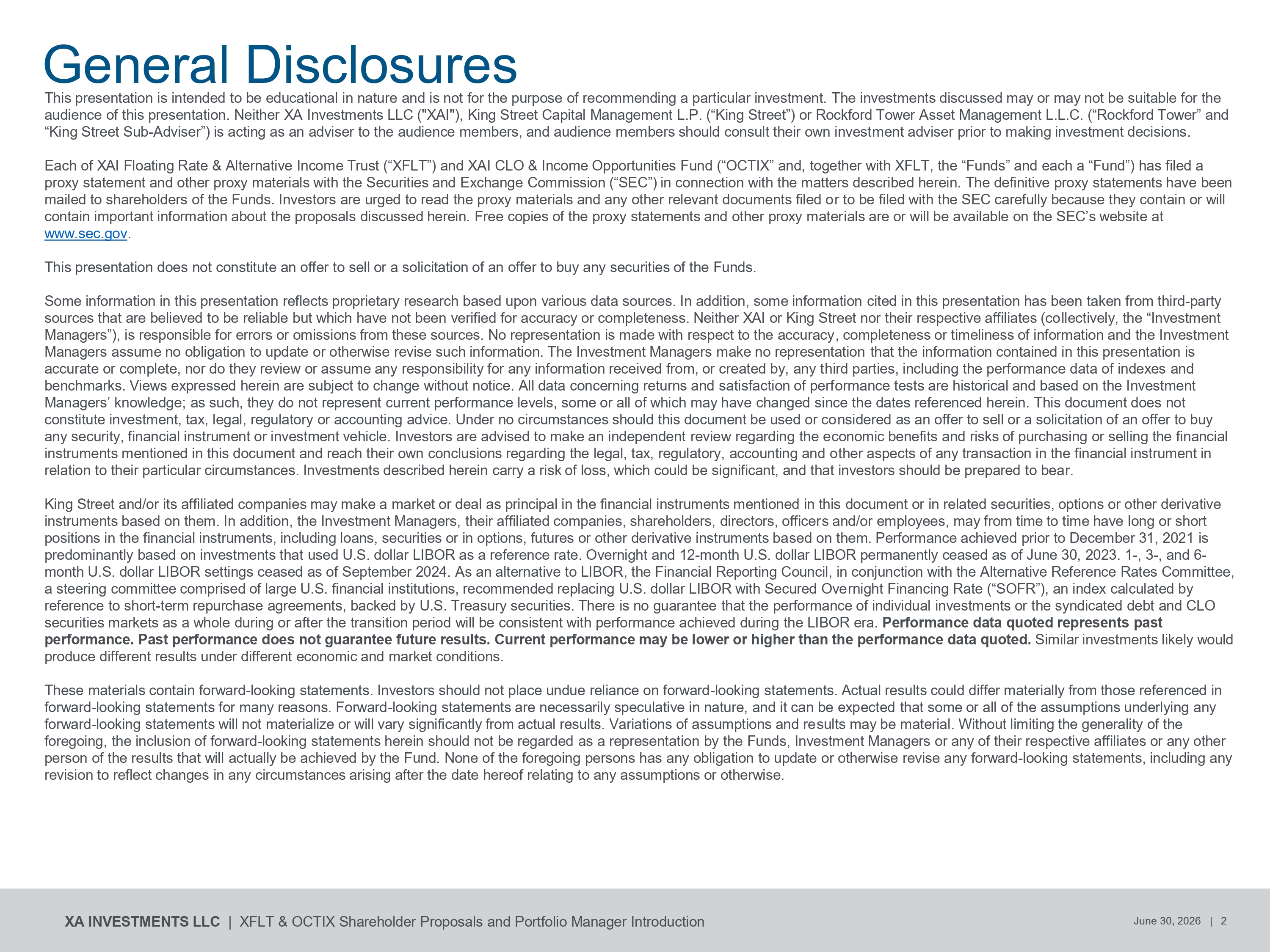
This presentation is intended to be educational in nature and is not for the purpose of recommending a particular investment. The investments discussed may or may not be suitable for the audience of this presentation. Neither XA Investments LLC (“XAI”), King Street Capital Management L.P. (“King Street”) or Rockford Tower Asset Management L.L.C. (“Rockford Tower” and “King Street Sub - Adviser”) is acting as an adviser to the audience members, and audience members should consult their own investment adviser prior to making investment decisions. Each of XAI Floating Rate & Alternative Income Trust (“XFLT”) and XAI CLO & Income Opportunities Fund (“OCTIX” and, together with XFLT, the “Funds” and each a “Fund”) has filed a proxy statement and other proxy materials with the Securities and Exchange Commission (“SEC”) in connection with the matters described herein. The definitive proxy statements have been mailed to shareholders of the Funds. Investors are urged to read the proxy materials and any other relevant documents filed or to be filed with the SEC carefully because they contain or will contain important information about the proposals discussed herein. Free copies of the proxy statements and other proxy materials are or will be available on the SEC’s website at www.sec.gov . This presentation does not constitute an offer to sell or a solicitation of an offer to buy any securities of the Funds. Some information in this presentation reflects proprietary research based upon various data sources. In addition, some information cited in this presentation has been taken from third - party sources that are believed to be reliable but which have not been verified for accuracy or completeness. Neither XAI or King Street nor their respective affiliates (collectively, the “Investment Managers”), is responsible for errors or omissions from these sources. No representation is made with respect to the accuracy, completeness or timeliness of information and the Investment Managers assume no obligation to update or otherwise revise such information. The Investment Managers make no representation that the information contained in this presentation is accurate or complete, nor do they review or assume any responsibility for any information received from, or created by, any third parties, including the performance data of indexes and benchmarks. Views expressed herein are subject to change without notice. All data concerning returns and satisfaction of performance tests are historical and based on the Investment Managers’ knowledge; as such, they do not represent current performance levels, some or all of which may have changed since the dates referenced herein. This document does not constitute investment, tax, legal, regulatory or accounting advice. Under no circumstances should this document be used or considered as an offer to sell or a solicitation of an offer to buy any security, financial instrument or investment vehicle. Investors are advised to make an independent review regarding the economic benefits and risks of purchasing or selling the financial instruments mentioned in this document and reach their own conclusions regarding the legal, tax, regulatory, accounting and other aspects of any transaction in the financial instrument in relation to their particular circumstances. Investments described herein carry a risk of loss, which could be significant, and that investors should be prepared to bear. King Street and/or its affiliated companies may make a market or deal as principal in the financial instruments mentioned in this document or in related securities, options or other derivative instruments based on them. In addition, the Investment Managers, their affiliated companies, shareholders, directors, officers and/or employees, may from time to time have long or short positions in the financial instruments, including loans, securities or in options, futures or other derivative instruments based on them. Performance achieved prior to December 31, 2021 is predominantly based on investments that used U.S. dollar LIBOR as a reference rate. Overnight and 12 - month U.S. dollar LIBOR permanently ceased as of June 30, 2023. 1 - , 3 - , and 6 - month U.S. dollar LIBOR settings ceased as of September 2024. As an alternative to LIBOR, the Financial Reporting Council, in conjunction with the Alternative Reference Rates Committee, a steering committee comprised of large U.S. financial institutions, recommended replacing U.S. dollar LIBOR with Secured Overnight Financing Rate (“SOFR”), an index calculated by reference to short - term repurchase agreements, backed by U.S. Treasury securities. There is no guarantee that the performance of individual investments or the syndicated debt and CLO securities markets as a whole during or after the transition period will be consistent with performance achieved during the LIBOR era. Performance data quoted represents past performance. Past performance does not guarantee future results. Current performance may be lower or higher than the performance data quoted. Similar investments likely would produce different results under different economic and market conditions. These materials contain forward - looking statements. Investors should not place undue reliance on forward - looking statements. Actual results could differ materially from those referenced in forward - looking statements for many reasons. Forward - looking statements are necessarily speculative in nature, and it can be expected that some or all of the assumptions underlying any forward - looking statements will not materialize or will vary significantly from actual results. Variations of assumptions and results may be material. Without limiting the generality of the foregoing, the inclusion of forward - looking statements herein should not be regarded as a representation by the Funds, Investment Managers or any of their respective affiliates or any other person of the results that will actually be achieved by the Fund. None of the foregoing persons has any obligation to update or otherwise revise any forward - looking statements, including any revision to reflect changes in any circumstances arising after the date hereof relating to any assumptions or otherwise. XA INVESTMENTS LLC | XFLT & OCTIX Shareholder Proposals and Portfolio Manager Introduction June 30, 2026 | 2 General Disclosures
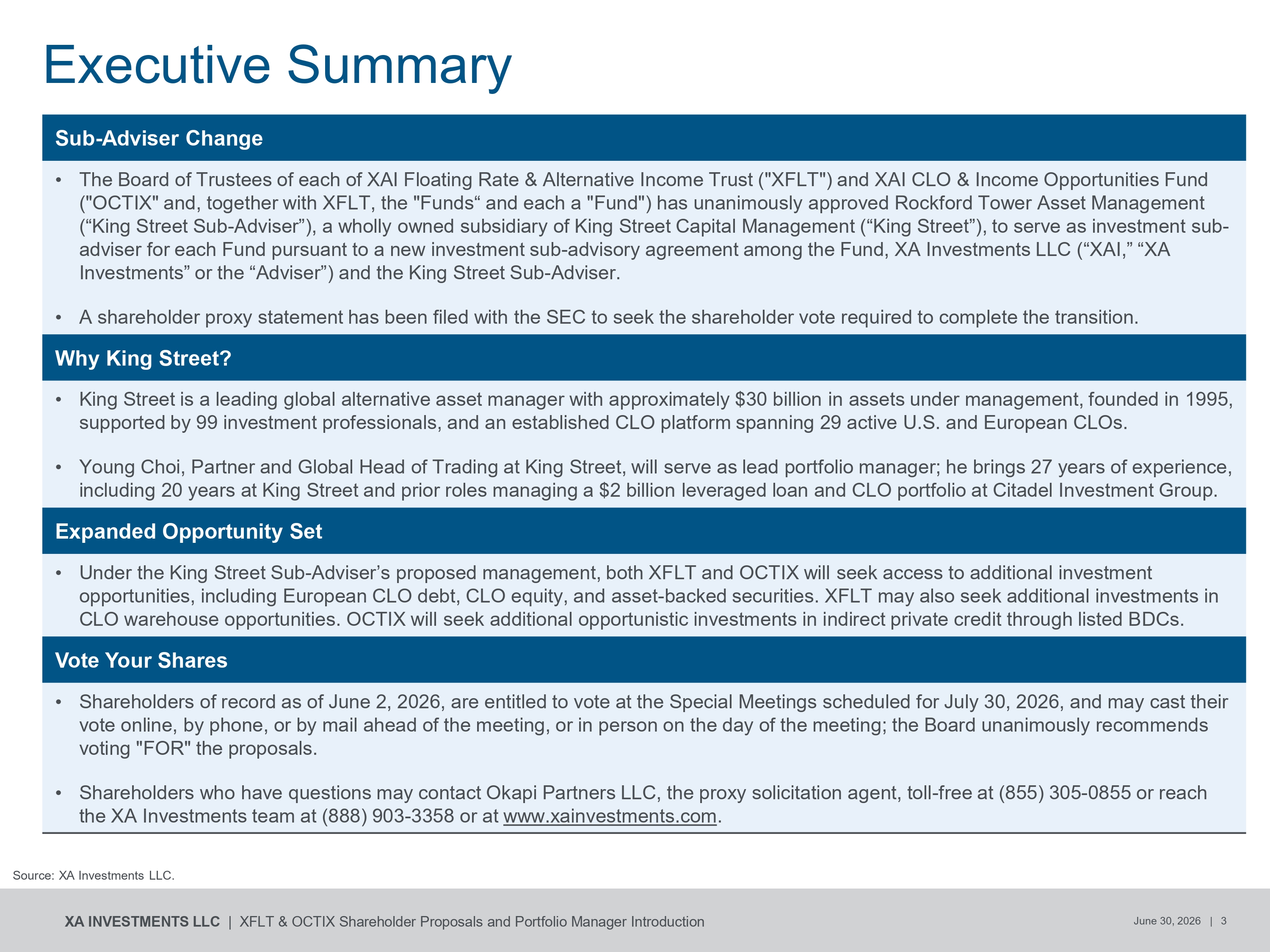
Executive Summary XA INVESTMENTS LLC | XFLT & OCTIX Shareholder Proposals and Portfolio Manager Introduction June 30, 2026 | 3 Source: XA Investments LLC. Sub - Adviser Change • The Board of Trustees of each of XAI Floating Rate & Alternative Income Trust (“XFLT”) and XAI CLO & Income Opportunities Fund (“OCTIX” and, together with XFLT, the “Funds” and each a “Fund”) has unanimously approved Rockford Tower Asset Management (“King Street Sub - Adviser”), a wholly owned subsidiary of King Street Capital Management (“King Street”), to serve as investment sub - adviser for each Fund pursuant to a new investment sub - advisory agreement among the Fund, XA Investments LLC (“XAI,” “XA Investments” or the “Adviser”) and the King Street Sub - Adviser. • A shareholder proxy statement has been filed with the SEC to seek the shareholder vote required to complete the transition. Why King Street? • King Street is a leading global alternative asset manager with approximately $30 billion in assets under management, founded in 1995, supported by 99 investment professionals, and an established CLO platform spanning 29 active U.S. and European CLOs. • Young Choi, Partner and Global Head of Trading at King Street, will serve as lead portfolio manager; he brings 27 years of experience, including 20 years at King Street and prior roles managing a $2 billion leveraged loan and CLO portfolio at Citadel Investment Group. Expanded Opportunity Set • Under the King Street Sub - Adviser’s proposed management, both XFLT and OCTIX will seek access to additional investment opportunities, including European CLO debt, CLO equity, and asset - backed securities. XFLT may also seek additional investments in CLO warehouse opportunities. OCTIX will seek additional opportunistic investments in indirect private credit through listed BDCs. Vote Your Shares • Shareholders of record as of June 2, 2026, are entitled to vote at the Special Meetings scheduled for July 30, 2026, and may cast their vote online, by phone, or by mail ahead of the meeting, or in person on the day of the meeting; the Board unanimously recommends voting “FOR” the proposals. • Shareholders who have questions may contact Okapi Partners LLC, the proxy solicitation agent, toll - free at (855) 305 - 0855 or reach the XA Investments team at (888) 903 - 3358 or at www.xainvestments.com .
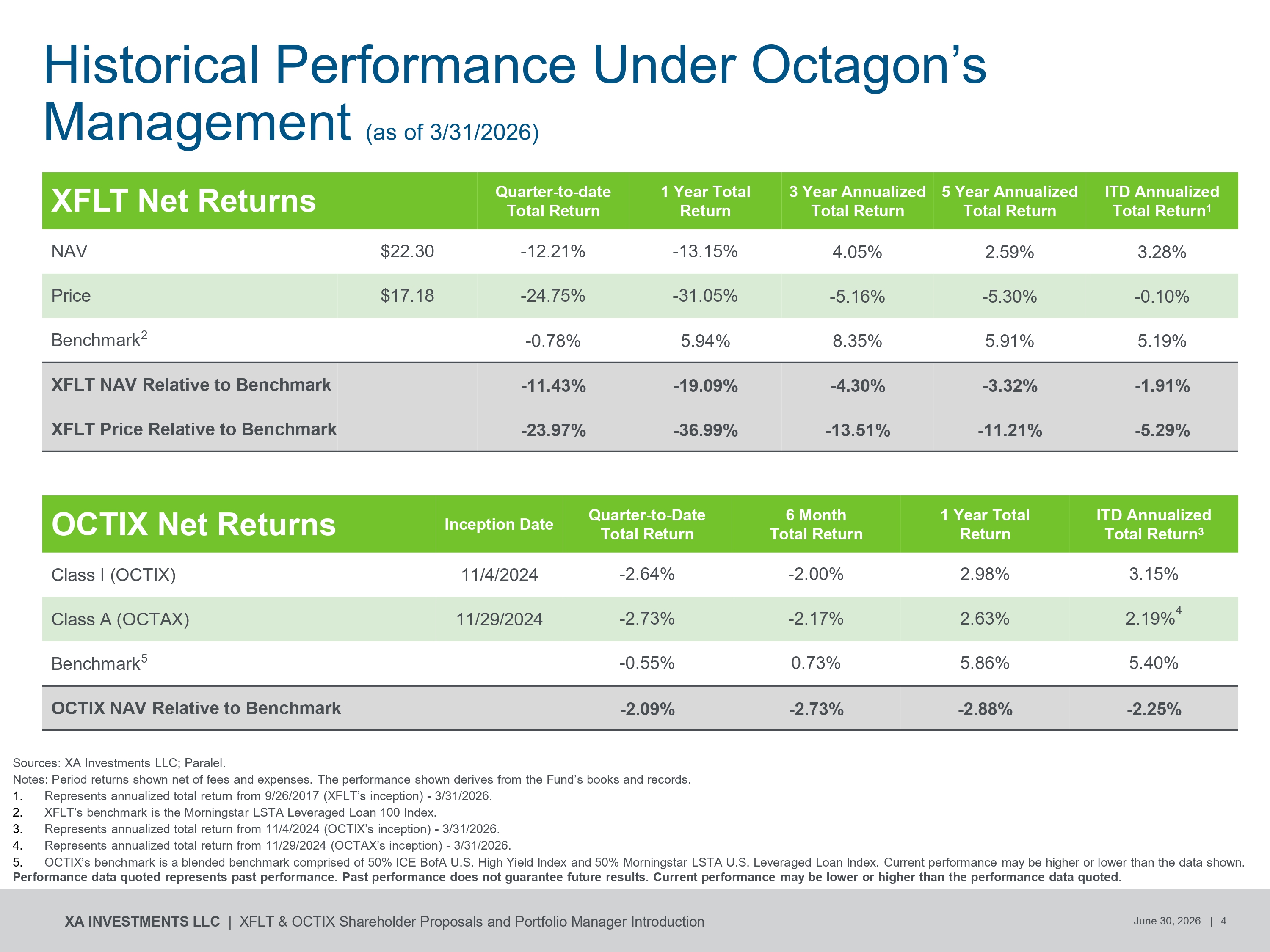
ITD Annualized Total Return 3 1 Year Total Return 6 Month Total Return Quarter - to - Date Total Return Inception Date OCTIX Net Returns 3.15% 2.98% - 2.00% - 2.64% 11/4/2024 Class I (OCTIX) 2.19% 4 2.63% - 2.17% - 2.73% 11/29/2024 Class A (OCTAX) 5.40% 5.86% 0.73% - 0.55% Benchmark 5 - 2.25% - 2.88% - 2.73% - 2.09% OCTIX NAV Relative to Benchmark 5. OCTIX’s benchmark is a blended benchmark comprised of 50% ICE BofA U.S. High Yield Index and 50% Morningstar LSTA U.S. Leveraged Loan Index. Current performance may be higher or lower than the data shown. Performance data quoted represents past performance. Past performance does not guarantee future results. Current performance may be lower or higher than the performance data quoted. XA INVESTMENTS LLC | XFLT & OCTIX Shareholder Proposals and Portfolio Manager Introduction June 30, 2026 | 4 ITD Annualized Total Return 1 5 Year Annualized Total Return 3 Year Annualized Total Return 1 Year Total Return Quarter - to - date Total Return XFLT Net Returns 3.28% 2.59% 4.05% - 13.15% - 12.21% $22.30 NAV - 0.10% - 5.30% - 5.16% - 31.05% - 24.75% $17.18 Price 5.19% 5.91% 8.35% 5.94% - 0.78% Benchmark 2 - 1.91% - 3.32% - 4.30% - 19.09% - 11.43% XFLT NAV Relative to Benchmark - 5.29% - 11.21% - 13.51% - 36.99% - 23.97% XFLT Price Relative to Benchmark Sources: XA Investments LLC; Paralel. Notes: Period returns shown net of fees and expenses. The performance shown derives from the Fund’s books and records. 1. Represents annualized total return from 9/26/2017 (XFLT’s inception) - 3/31/2026. 2. XFLT’s benchmark is the Morningstar LSTA Leveraged Loan 100 Index. 3. Represents annualized total return from 11/4/2024 (OCTIX’s inception) - 3/31/2026. 4. Represents annualized total return from 11/29/2024 (OCTAX’s inception) - 3/31/2026. Historical Performance Under Octagon’s Management (as of 3/31/2026)
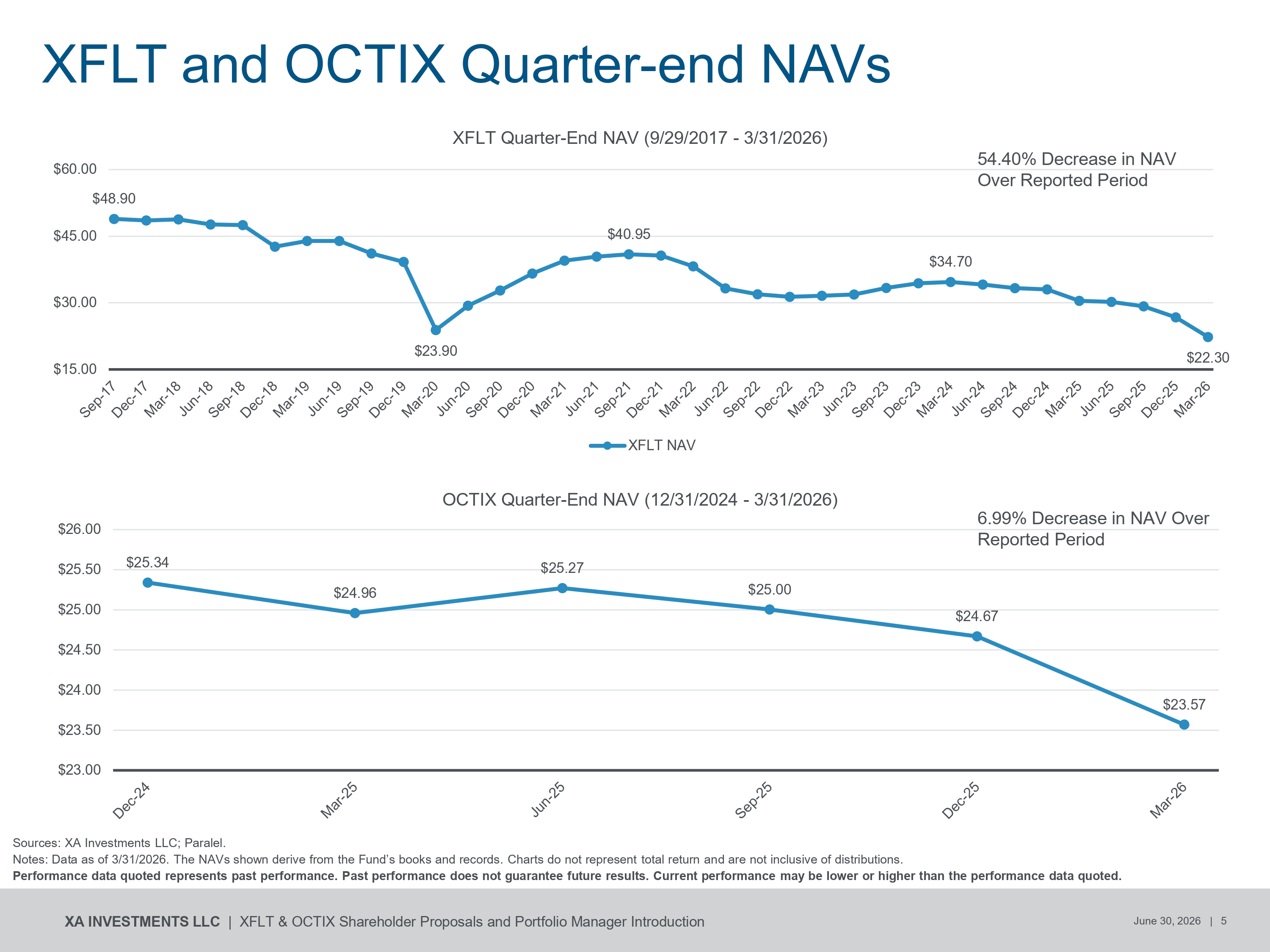
XFLT and OCTIX Quarter - end NAVs Sources: XA Investments LLC; Paralel. Notes: Data as of 3/31/2026. The NAVs shown derive from the Fund’s books and records. Charts do not represent total return and are not inclusive of distributions. XFLT Quarter - End NAV (9/29/2017 - 3/31/2026) $60.00 54.40% Decrease in NAV Over Reported Period $48.90 $23.90 $40.95 $34.70 $22.30 $15.00 $30.00 $45.00 XFLT NAV OCTIX Quarter - End NAV (12/31/2024 - 3/31/2026) $26.00 6.99% Decrease in NAV Over Reported Period $25.34 $24.96 $25.27 $25.00 $24.67 $23.57 $23.50 $23.00 $24.50 $24.00 $25.00 $25.50 Performance data quoted represents past performance. Past performance does not guarantee future results. Current performance may be lower or higher than the performance data quoted. XA INVESTMENTS LLC | XFLT & OCTIX Shareholder Proposals and Portfolio Manager Introduction June 30, 2026 | 5
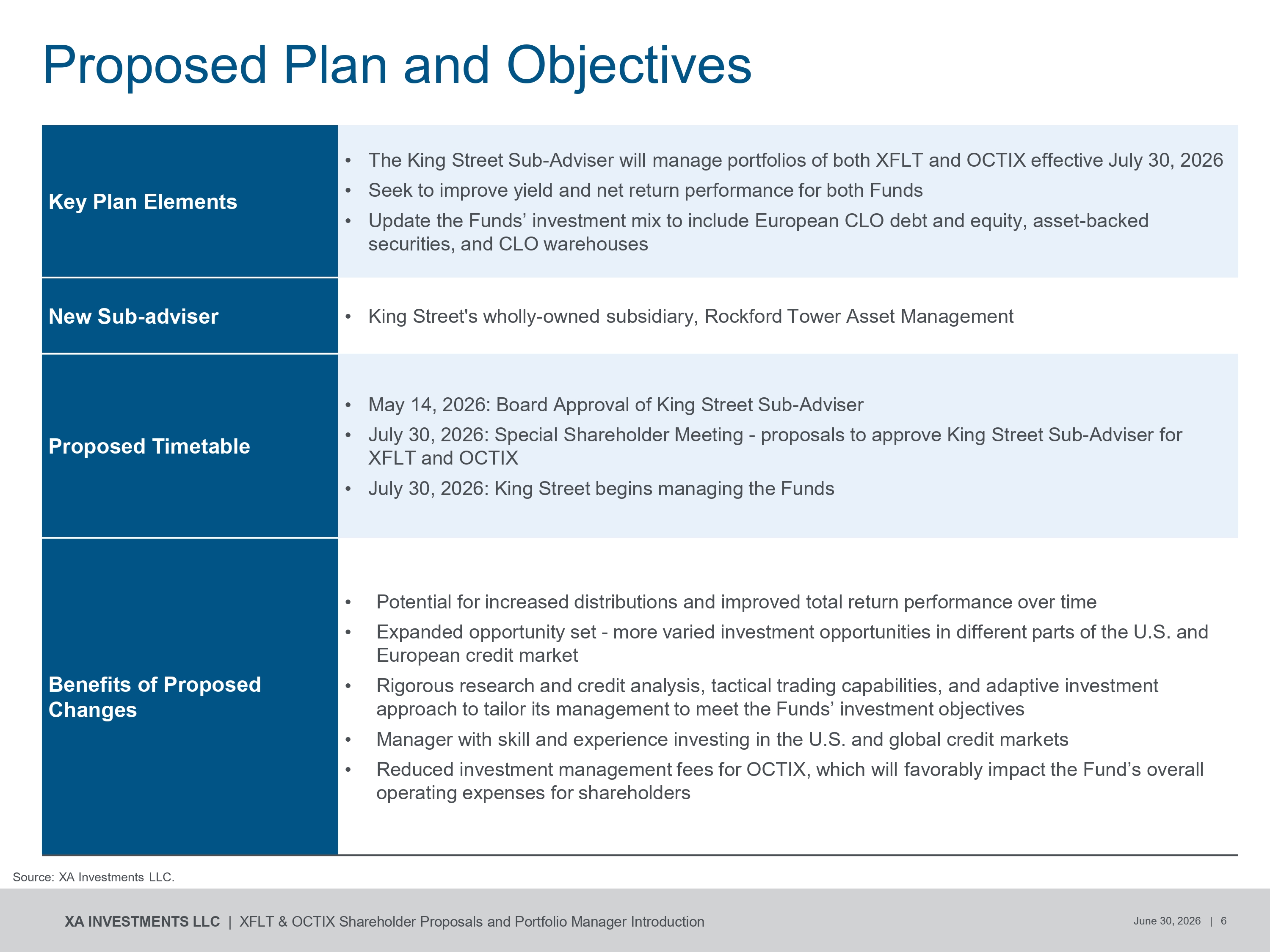
Proposed Plan and Objectives Source: XA Investments LLC. XA INVESTMENTS LLC | XFLT & OCTIX Shareholder Proposals and Portfolio Manager Introduction June 30, 2026 | 6 • The King Street Sub - Adviser will manage portfolios of both XFLT and OCTIX effective July 30, 2026 • Seek to improve yield and net return performance for both Funds • Update the Funds’ investment mix to include European CLO debt and equity, asset - backed securities, and CLO warehouses Key Plan Elements • King Street’s wholly - owned subsidiary, Rockford Tower Asset Management New Sub - adviser • May 14, 2026: Board Approval of King Street Sub - Adviser • July 30, 2026: Special Shareholder Meeting - proposals to approve King Street Sub - Adviser for XFLT and OCTIX • July 30, 2026: King Street begins managing the Funds Proposed Timetable • Potential for increased distributions and improved total return performance over time • Expanded opportunity set - more varied investment opportunities in different parts of the U.S. and European credit market • Rigorous research and credit analysis, tactical trading capabilities, and adaptive investment approach to tailor its management to meet the Funds’ investment objectives • Manager with skill and experience investing in the U.S. and global credit markets • Reduced investment management fees for OCTIX, which will favorably impact the Fund’s overall operating expenses for shareholders Benefits of Proposed Changes
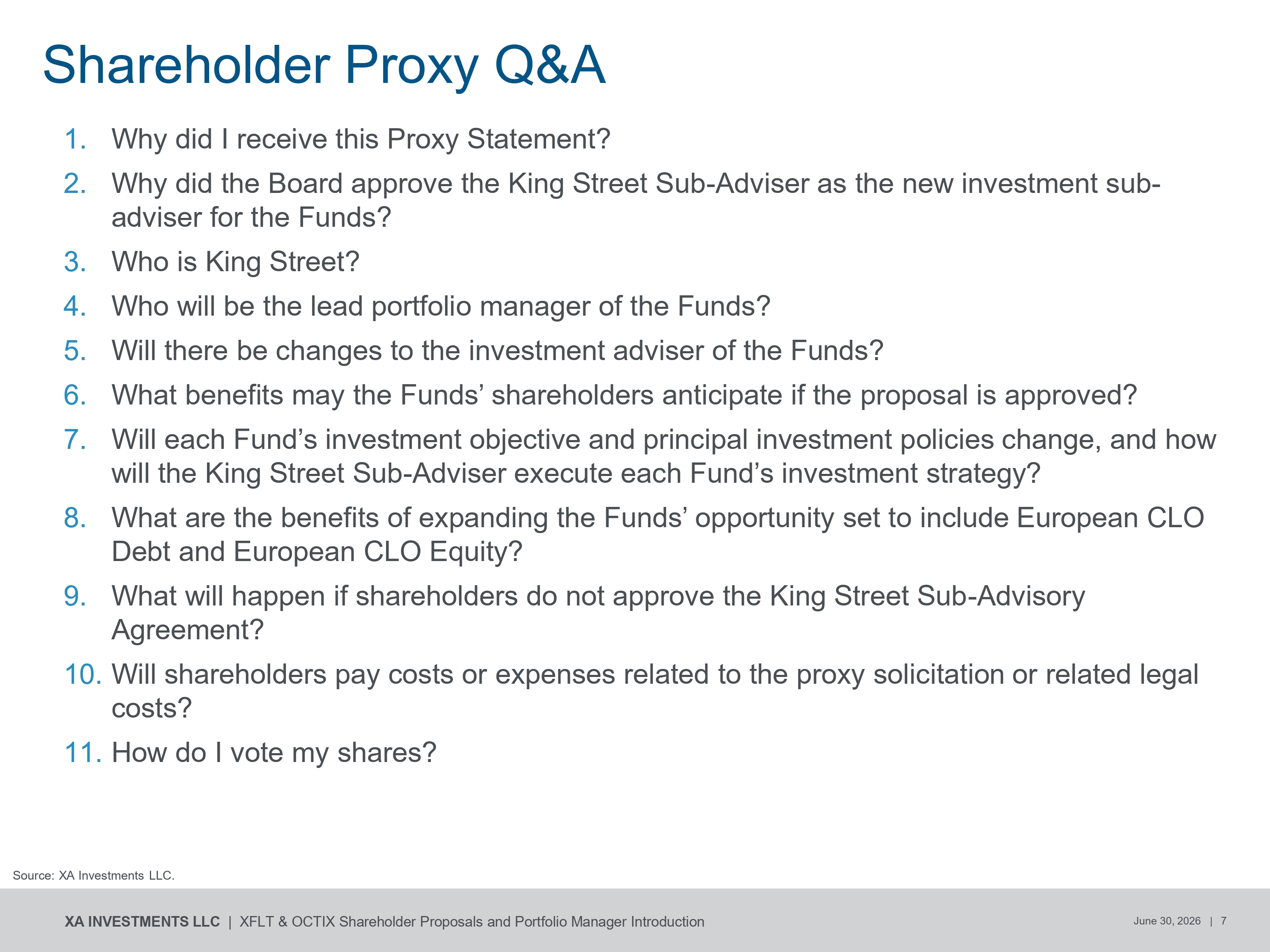
Shareholder Proxy Q&A Source: XA Investments LLC. XA INVESTMENTS LLC | XFLT & OCTIX Shareholder Proposals and Portfolio Manager Introduction June 30, 2026 | 7 1. Why did I receive this Proxy Statement? 2. Why did the Board approve the King Street Sub - Adviser as the new investment sub - adviser for the Funds? 3. Who is King Street? 4. Who will be the lead portfolio manager of the Funds? 5. Will there be changes to the investment adviser of the Funds? 6. What benefits may the Funds’ shareholders anticipate if the proposal is approved? 7. Will each Fund’s investment objective and principal investment policies change, and how will the King Street Sub - Adviser execute each Fund’s investment strategy? 8. What are the benefits of expanding the Funds’ opportunity set to include European CLO Debt and European CLO Equity? 9. What will happen if shareholders do not approve the King Street Sub - Advisory Agreement? 10. Will shareholders pay costs or expenses related to the proxy solicitation or related legal costs? 11. How do I vote my shares?
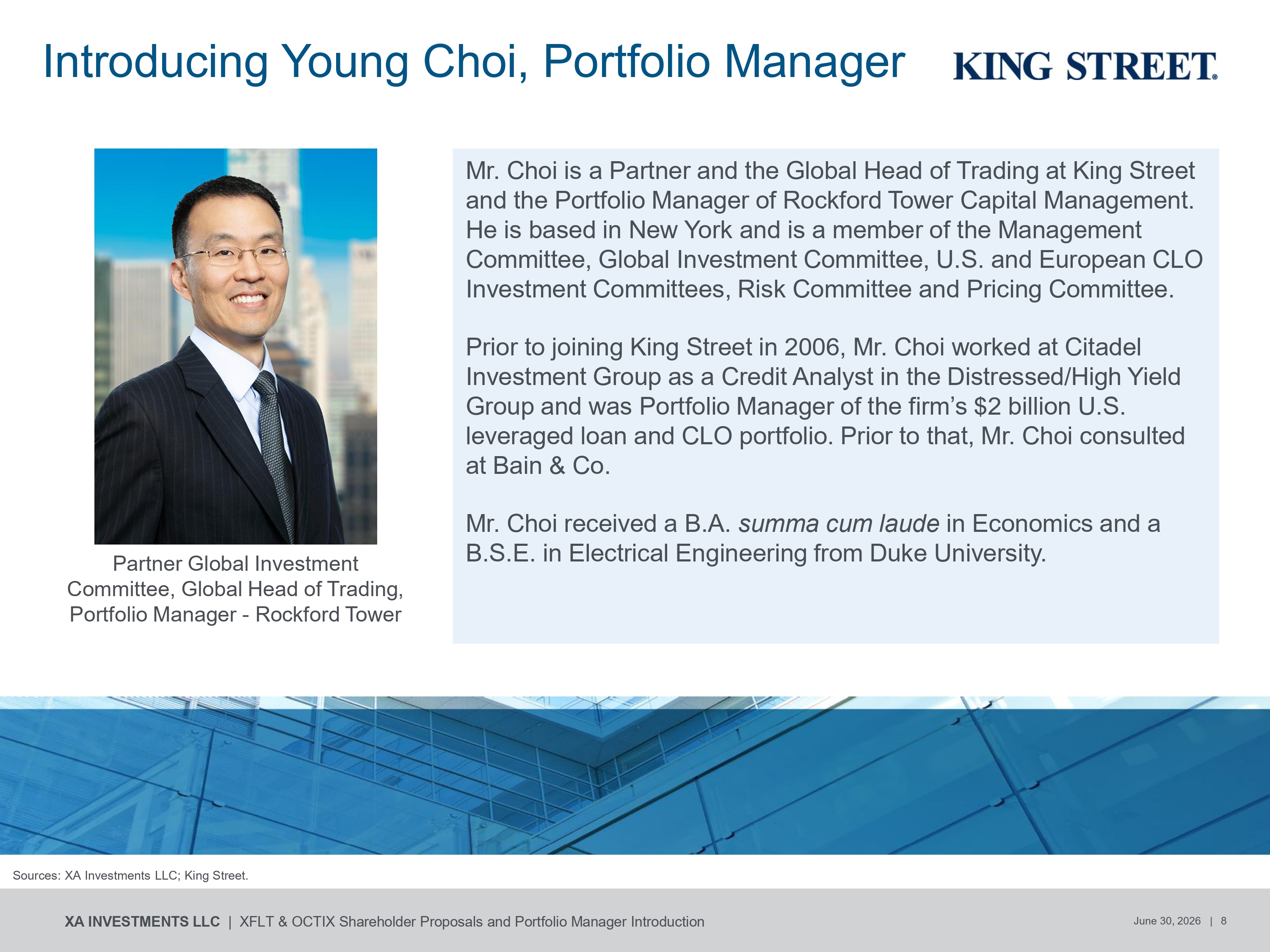
Introducing Young Choi, Portfolio Manager Mr. Choi is a Partner and the Global Head of Trading at King Street and the Portfolio Manager of Rockford Tower Capital Management. He is based in New York and is a member of the Management Committee, Global Investment Committee, U.S. and European CLO Investment Committees, Risk Committee and Pricing Committee. Prior to joining King Street in 2006, Mr. Choi worked at Citadel Investment Group as a Credit Analyst in the Distressed/High Yield Group and was Portfolio Manager of the firm’s $2 billion U.S. leveraged loan and CLO portfolio. Prior to that, Mr. Choi consulted at Bain & Co. Mr. Choi received a B.A. summa cum laude in Economics and a B.S.E. in Electrical Engineering from Duke University. Partner Global Investment Committee, Global Head of Trading, Portfolio Manager - Rockford Tower Sources: XA Investments LLC; King Street. XA INVESTMENTS LLC | XFLT & OCTIX Shareholder Proposals and Portfolio Manager Introduction June 30, 2026 | 8
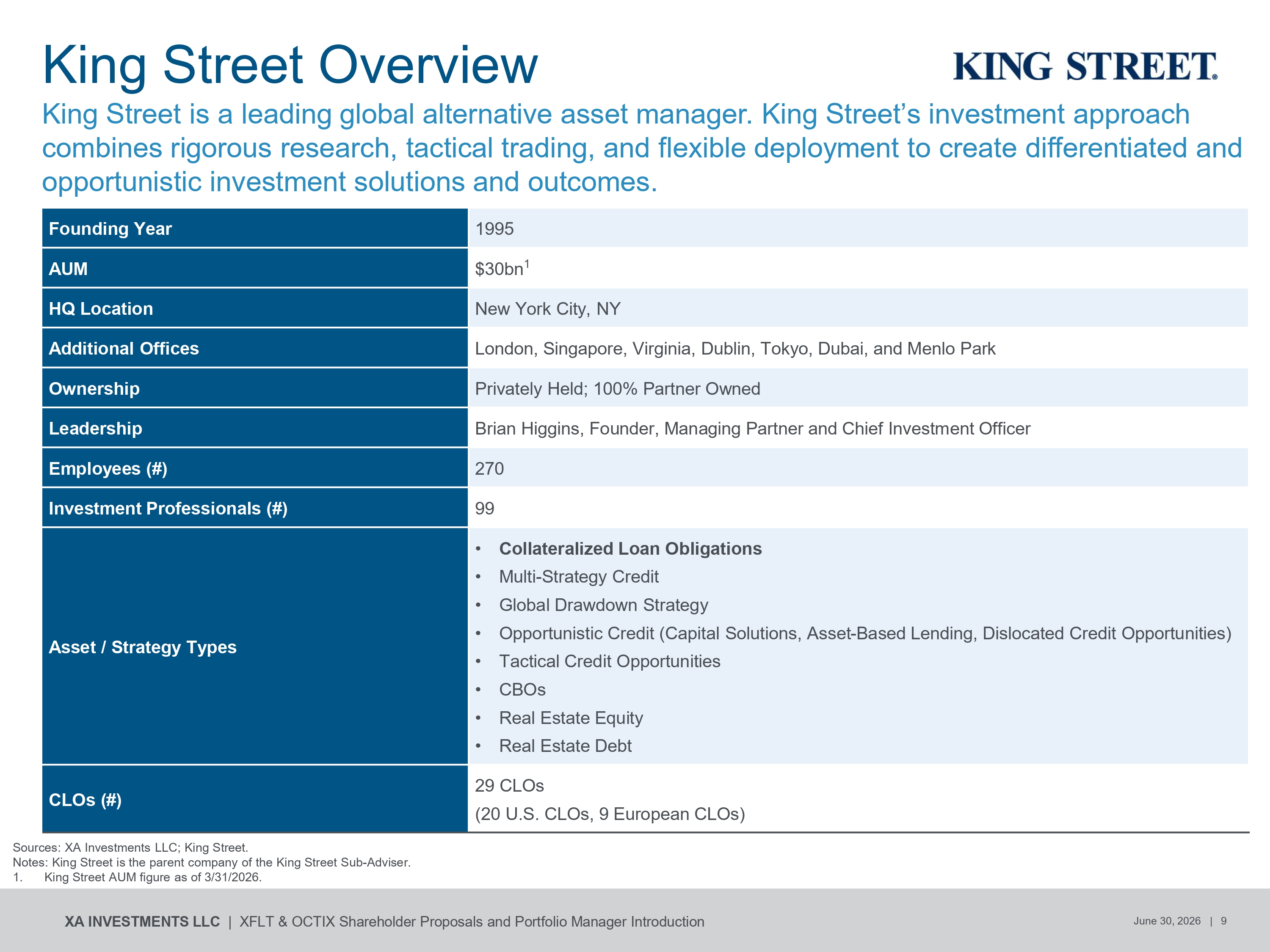
Sources: XA Investments LLC; King Street. Notes: King Street is the parent company of the King Street Sub - Adviser. 1995 Founding Year $30bn 1 AUM New York City, NY HQ Location London, Singapore, Virginia, Dublin, Tokyo, Dubai, and Menlo Park Additional Offices Privately Held; 100% Partner Owned Ownership Brian Higgins, Founder, Managing Partner and Chief Investment Officer Leadership 270 Employees (#) 99 Investment Professionals (#) • Collateralized Loan Obligations • Multi - Strategy Credit • Global Drawdown Strategy • Opportunistic Credit (Capital Solutions, Asset - Based Lending, Dislocated Credit Opportunities) • Tactical Credit Opportunities • CBOs • Real Estate Equity • Real Estate Debt Asset / Strategy Types 29 CLOs (20 U.S. CLOs, 9 European CLOs) CLOs (#) King Street Overview King Street is a leading global alternative asset manager. King Street’s investment approach combines rigorous research, tactical trading, and flexible deployment to create differentiated and opportunistic investment solutions and outcomes. 1. King Street AUM figure as of 3/31/2026. XA INVESTMENTS LLC | XFLT & OCTIX Shareholder Proposals and Portfolio Manager Introduction June 30, 2026 | 9
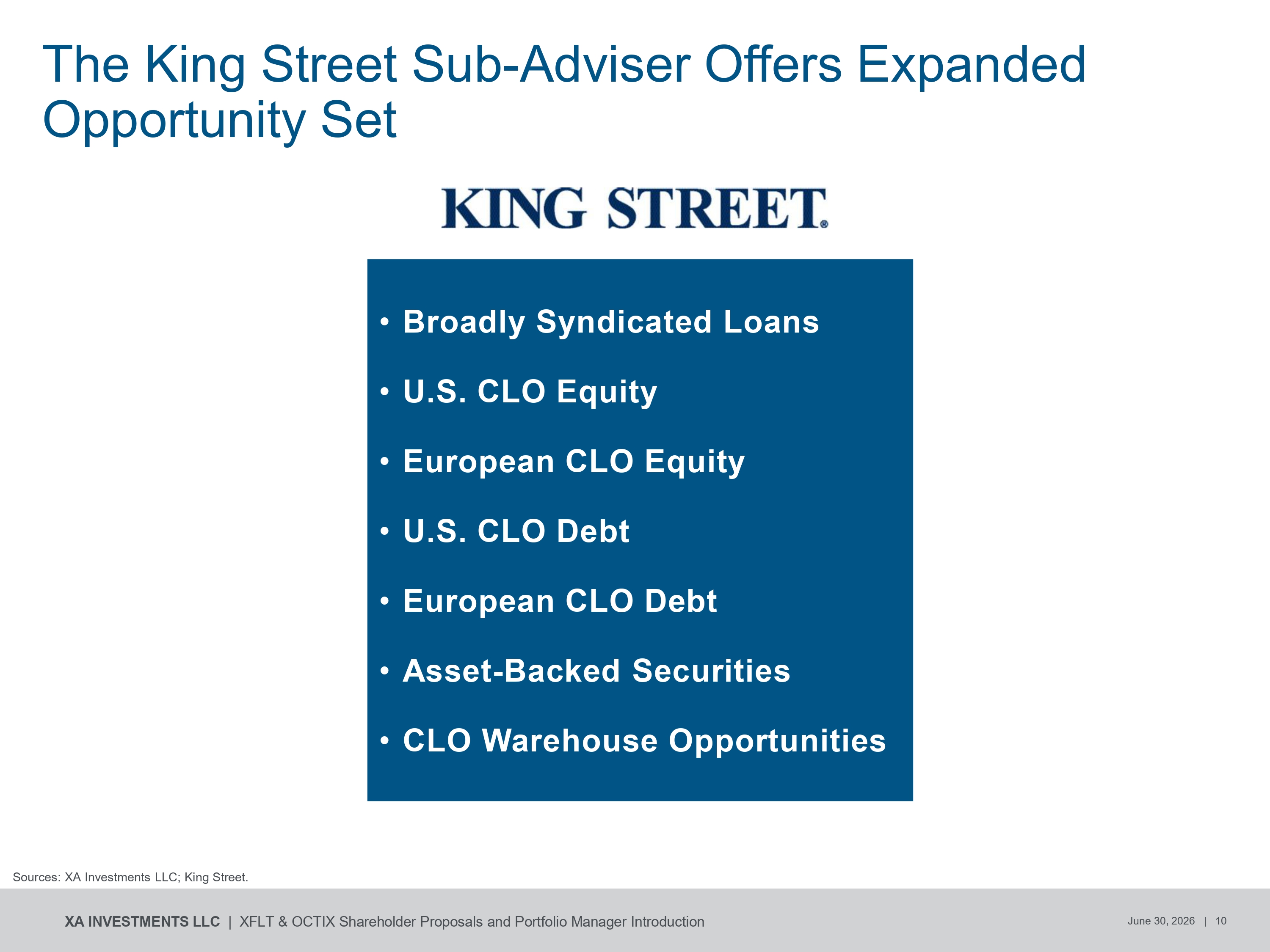
The King Street Sub - Adviser Offers Expanded Opportunity Set • Broadly Syndicated Loans • U.S. CLO Equity • European CLO Equity • U.S. CLO Debt • European CLO Debt • Asset - Backed Securities • CLO Warehouse Opportunities Sources: XA Investments LLC; King Street. XA INVESTMENTS LLC | XFLT & OCTIX Shareholder Proposals and Portfolio Manager Introduction June 30, 2026 | 10
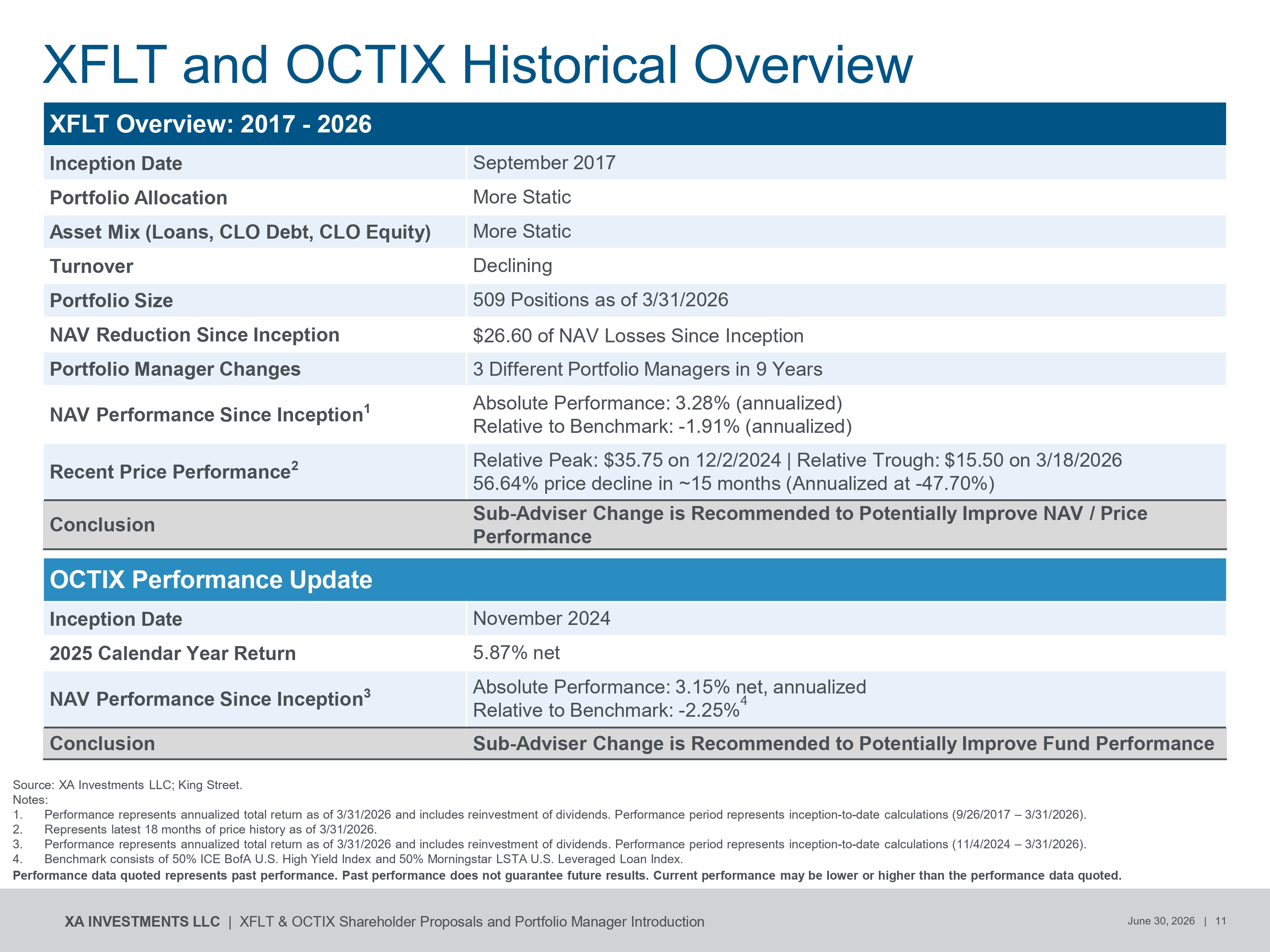
XFLT and OCTIX Historical Overview Performance data quoted represents past performance. Past performance does not guarantee future results. Current performance may be lower or higher than the performance data quoted. XA INVESTMENTS LLC | XFLT & OCTIX Shareholder Proposals and Portfolio Manager Introduction June 30, 2026 | 11 XFLT Overview: 2017 - 2026 September 2017 Inception Date More Static Portfolio Allocation More Static Asset Mix (Loans, CLO Debt, CLO Equity) Declining Turnover 509 Positions as of 3/31/2026 Portfolio Size $26.60 of NAV Losses Since Inception NAV Reduction Since Inception 3 Different Portfolio Managers in 9 Years Portfolio Manager Changes Absolute Performance: 3.28% (annualized) Relative to Benchmark: - 1.91% (annualized) NAV Performance Since Inception 1 Relative Peak: $35.75 on 12/2/2024 | Relative Trough: $15.50 on 3/18/2026 56.64% price decline in ~15 months (Annualized at - 47.70%) Recent Price Performance 2 Sub - Adviser Change is Recommended to Potentially Improve NAV / Price Performance Conclusion OCTIX Performance Update November 2024 Inception Date 5.87% net 2025 Calendar Year Return Absolute Performance: 3.15% net, annualized Relative to Benchmark: - 2.25% 4 NAV Performance Since Inception 3 Sub - Adviser Change is Recommended to Potentially Improve Fund Performance Conclusion Source: XA Investments LLC; King Street. Notes: 1. Performance represents annualized total return as of 3/31/2026 and includes reinvestment of dividends. Performance period represents inception - to - date calculations (9/26/2017 – 3/31/2026). 2. Represents latest 18 months of price history as of 3/31/2026. 3. Performance represents annualized total return as of 3/31/2026 and includes reinvestment of dividends. Performance period represents inception - to - date calculations (11/4/2024 – 3/31/2026). 4. Benchmark consists of 50% ICE BofA U.S. High Yield Index and 50% Morningstar LSTA U.S. Leveraged Loan Index.
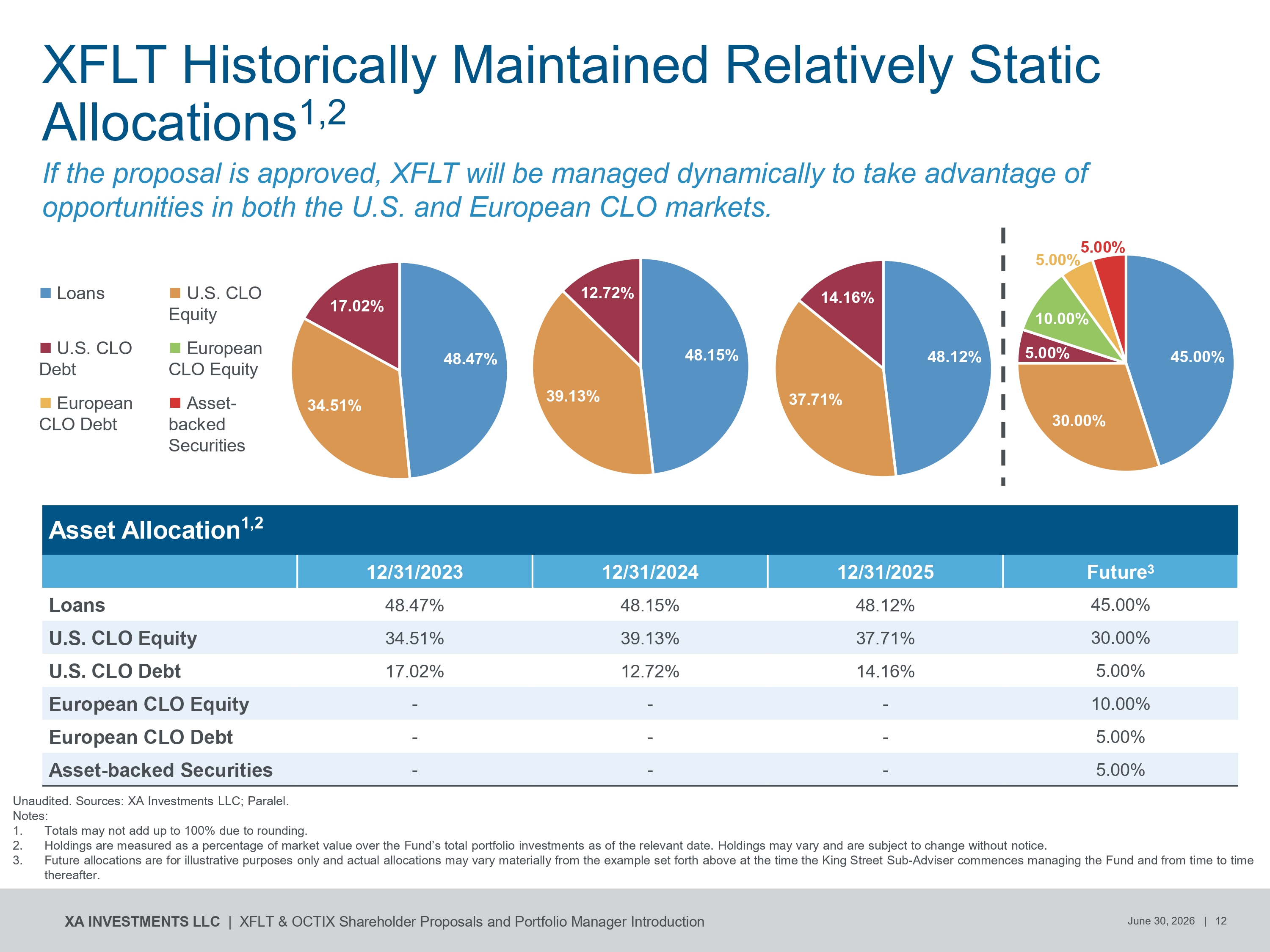
XFLT Historically Maintained Relatively Static Allocations 1,2 Asset Allocation 1,2 Future 3 12/31/2025 12/31/2024 12/31/2023 45.00% 48.12% 48.15% 48.47% Loans 30.00% 37.71% 39.13% 34.51% U.S. CLO Equity 5.00% 14.16% 12.72% 17.02% U.S. CLO Debt 10.00% - - - European CLO Equity 5.00% - - - European CLO Debt 5.00% - - - Asset - backed Securities U.S. CLO Equity Loans European CLO Equity U.S. CLO Debt Asset - backed Securities European CLO Debt Unaudited. Sources: XA Investments LLC; Paralel. Notes: 1. Totals may not add up to 100% due to rounding. 2. Holdings are measured as a percentage of market value over the Fund’s total portfolio investments as of the relevant date. Holdings may vary and are subject to change without notice. 3. Future allocations are for illustrative purposes only and actual allocations may vary materially from the example set forth above at the time the King Street Sub - Adviser commences managing the Fund and from time to time If the proposal is approved, XFLT will be managed dynamically to take advantage of opportunities in both the U.S. and European CLO markets. 48.15% 39.13% 12.72% 48.12% 37.71% 14.16% 48.47% 34.51% 17.02% 45.00% 30.00% 5.00% 10.00% 5.00% 5.00% thereafter. XA INVESTMENTS LLC | XFLT & OCTIX Shareholder Proposals and Portfolio Manager Introduction June 30, 2026 | 12
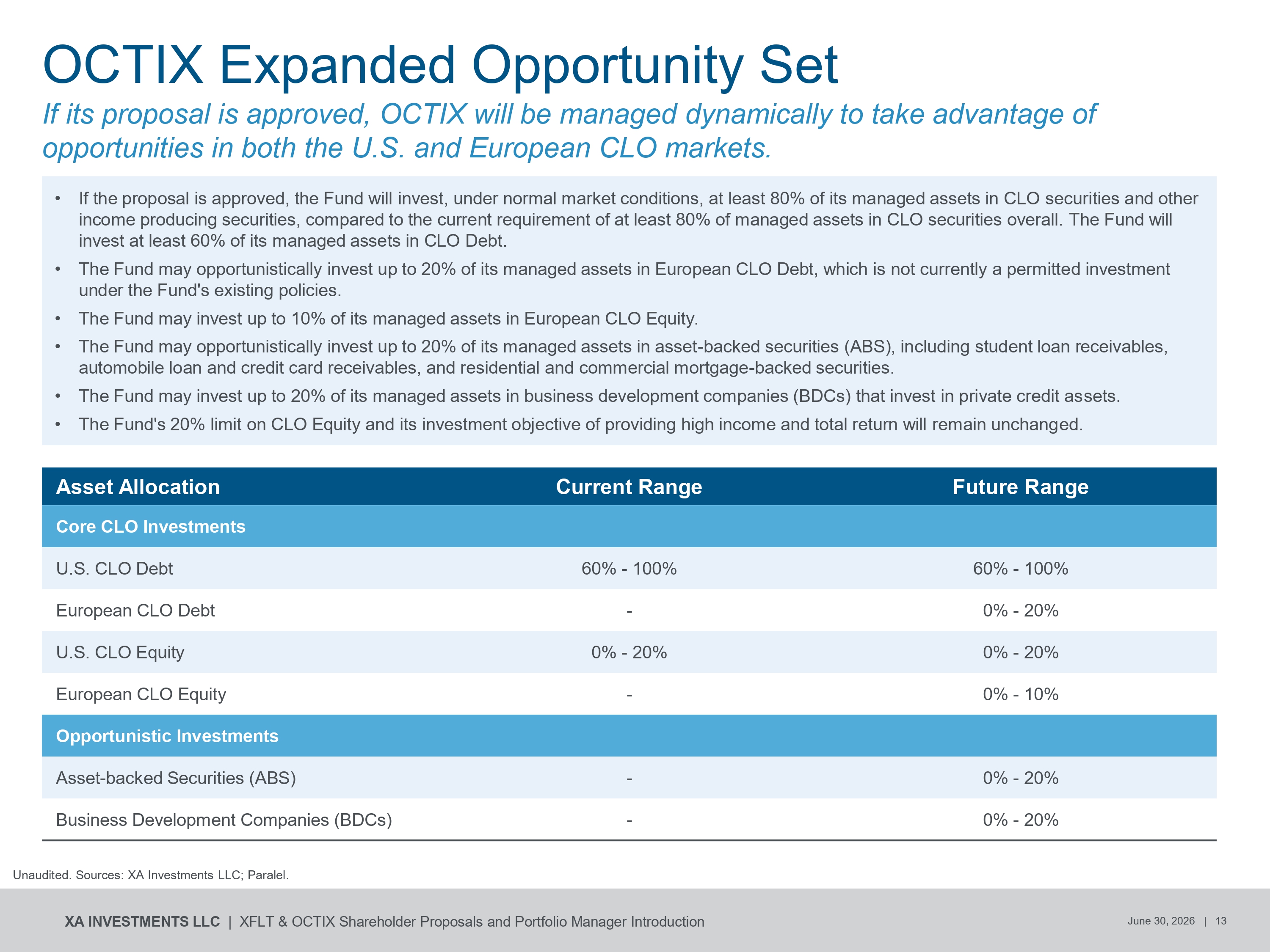
OCTIX Expanded Opportunity Set Unaudited. Sources: XA Investments LLC; Paralel. XA INVESTMENTS LLC | XFLT & OCTIX Shareholder Proposals and Portfolio Manager Introduction June 30, 2026 | 13 If its proposal is approved, OCTIX will be managed dynamically to take advantage of opportunities in both the U.S. and European CLO markets. Future Range Current Range Asset Allocation Core CLO Investments 60% - 100% 60% - 100% U.S. CLO Debt 0% - 20% - European CLO Debt 0% - 20% 0% - 20% U.S. CLO Equity 0% - 10% - European CLO Equity Opportunistic Investments 0% - 20% - Asset - backed Securities (ABS) 0% - 20% - Business Development Companies (BDCs) • If the proposal is approved, the Fund will invest, under normal market conditions, at least 80% of its managed assets in CLO securities and other income producing securities, compared to the current requirement of at least 80% of managed assets in CLO securities overall. The Fund will invest at least 60% of its managed assets in CLO Debt. • The Fund may opportunistically invest up to 20% of its managed assets in European CLO Debt, which is not currently a permitted investment under the Fund’s existing policies. • The Fund may invest up to 10% of its managed assets in European CLO Equity. • The Fund may opportunistically invest up to 20% of its managed assets in asset - backed securities (ABS), including student loan receivables, automobile loan and credit card receivables, and residential and commercial mortgage - backed securities. • The Fund may invest up to 20% of its managed assets in business development companies (BDCs) that invest in private credit assets. • The Fund’s 20% limit on CLO Equity and its investment objective of providing high income and total return will remain unchanged.
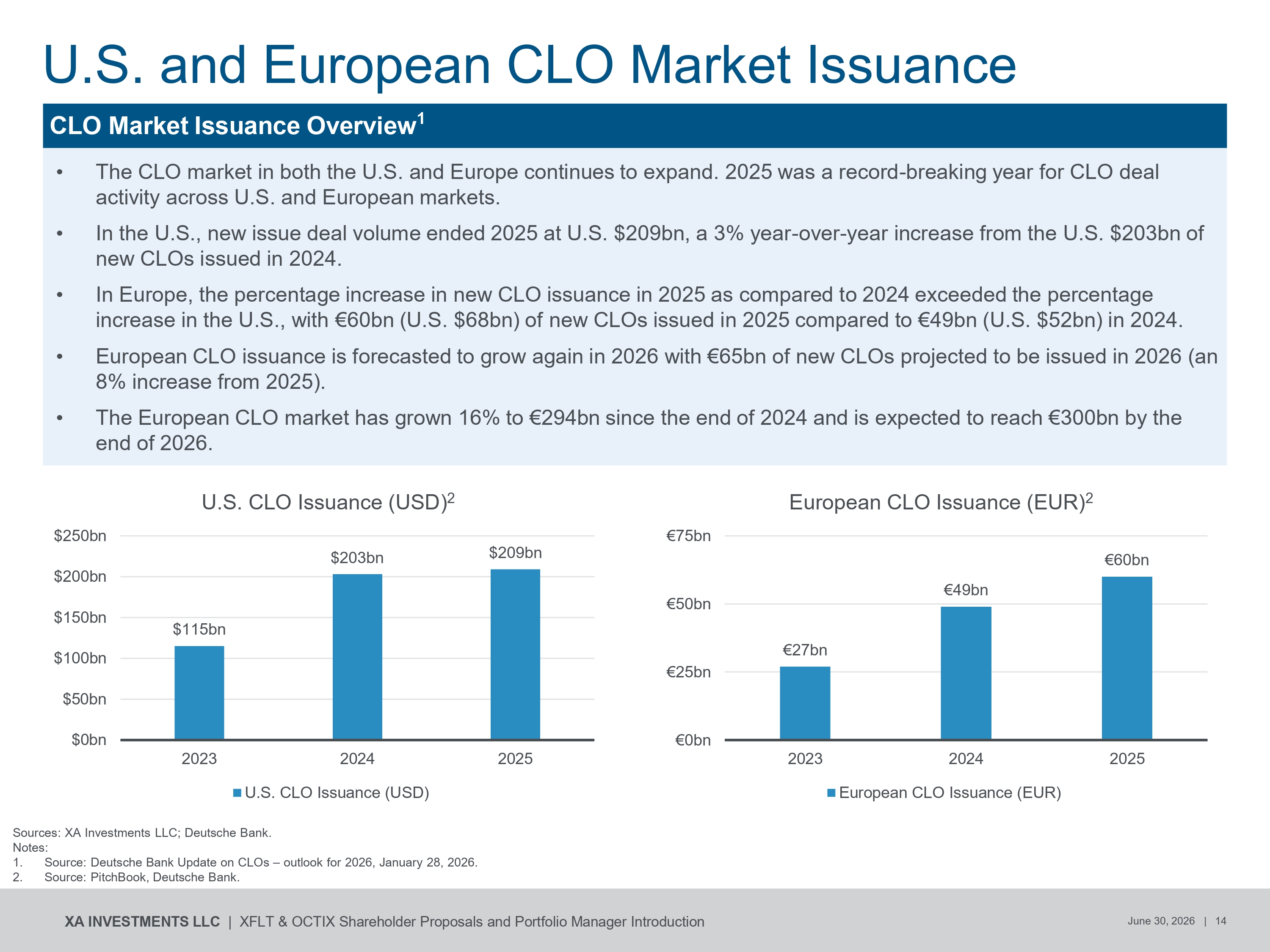
U.S. and European CLO Market Issuance Sources: XA Investments LLC; Deutsche Bank. Notes: 1. Source: Deutsche Bank Update on CLOs – outlook for 2026, January 28, 2026. 2. Source: PitchBook, Deutsche Bank. $115bn $203bn $209bn $0bn $50bn $100bn $150bn $200bn $250bn 2023 2024 2025 U.S. CLO Issuance (USD) 2 U.S. CLO Issuance (USD) CLO Market Issuance Overview 1 • The CLO market in both the U.S. and Europe continues to expand. 2025 was a record - breaking year for CLO deal activity across U.S. and European markets. • In the U.S., new issue deal volume ended 2025 at U.S. $209bn, a 3% year - over - year increase from the U.S. $203bn of new CLOs issued in 2024. • In Europe, the percentage increase in new CLO issuance in 2025 as compared to 2024 exceeded the percentage increase in the U.S., with €60bn (U.S. $68bn) of new CLOs issued in 2025 compared to €49bn (U.S. $52bn) in 2024. • European CLO issuance is forecasted to grow again in 2026 with €65bn of new CLOs projected to be issued in 2026 (an 8% increase from 2025). • The European CLO market has grown 16% to €294bn since the end of 2024 and is expected to reach €300bn by the end of 2026. €27bn €49bn €60bn €0bn €25bn €50bn €75bn 2023 2024 2025 European CLO Issuance (EUR) 2 European CLO Issuance (EUR) XA INVESTMENTS LLC | XFLT & OCTIX Shareholder Proposals and Portfolio Manager Introduction June 30, 2026 | 14
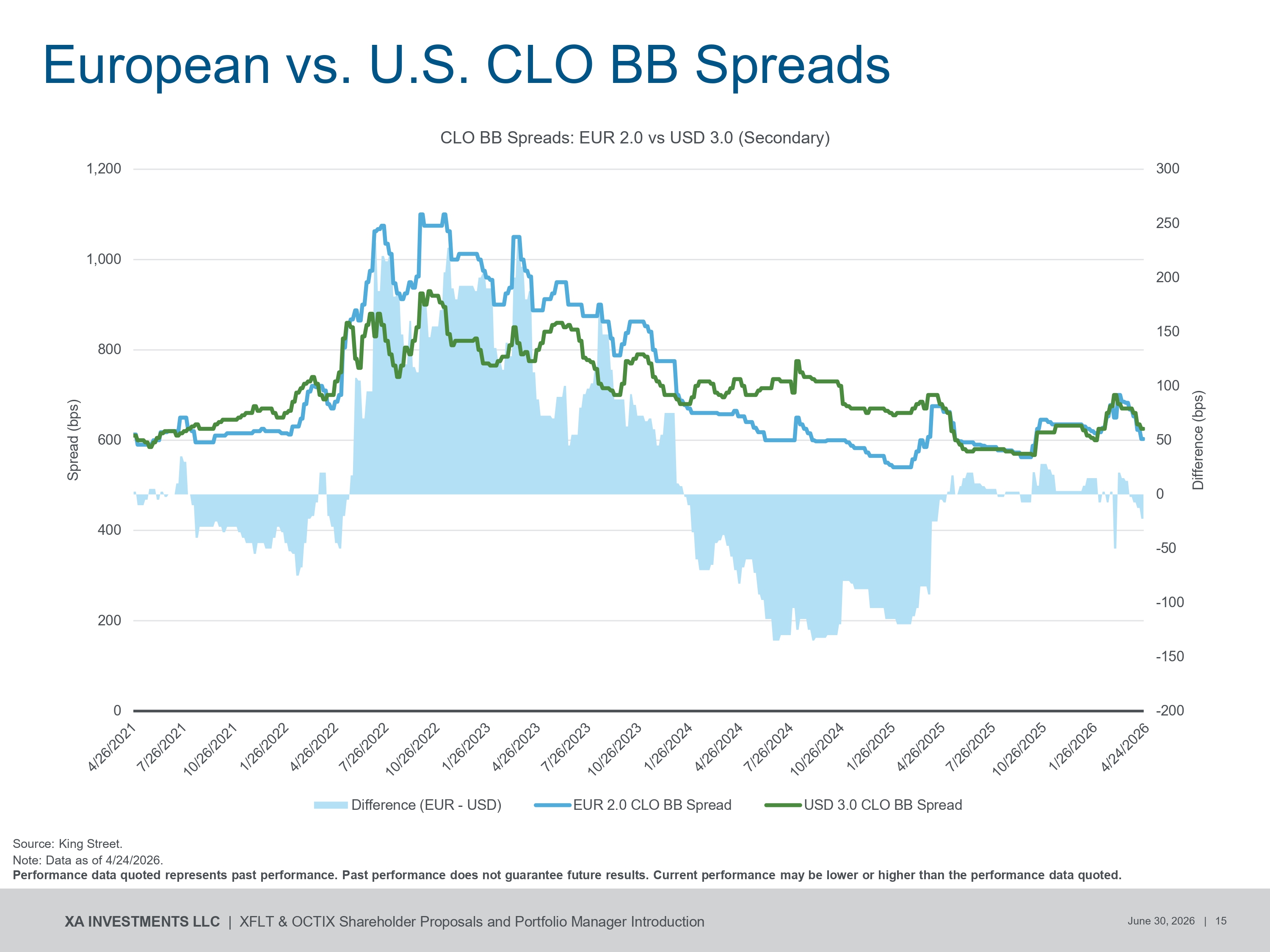
European vs. U.S. CLO BB Spreads - 200 - 150 - 50 - 100 0 50 100 200 150 250 300 0 200 400 600 800 1,000 1,200 Difference (bps) Spread (bps) CLO BB Spreads: EUR 2.0 vs USD 3.0 (Secondary) Difference (EUR - USD) EUR 2.0 CLO BB Spread USD 3.0 CLO BB Spread Source: King Street. Note: Data as of 4/24/2026. Performance data quoted represents past performance. Past performance does not guarantee future results. Current performance may be lower or higher than the performance data quoted. XA INVESTMENTS LLC | XFLT & OCTIX Shareholder Proposals and Portfolio Manager Introduction June 30, 2026 | 15

Your Vote Matters! Record Date: June 2, 2026 | Special Meetings: July 30, 2026 | Board recommends voting ” FOR ” the proposals H OW T O V OT E Y OU R S H AR E S Online Vote at the website listed on your proxy card and follow the on - screen instructions. By Phone Call the toll - free number on your proxy card to record your voting instructions. By Mail Complete, sign, date and return the enclosed proxy card in the postage - paid envelope. In Person Attend the Special Meeting on July 30, 2026, at the offices of the Funds’ investment adviser. Q U E S TI O N S ? Proxy Solicitation Agent - Okapi Partners LLC Toll - free: (855)305 - 0855 XA Investments Team Phone: (888)903 - 3358 Address: 321 N. Clark Street, Suite 2430, Chicago, IL 60654 Web: www.xainvestments.com XA INVESTMENTS LLC | XFLT & OCTIX Shareholder Proposals and Portfolio Manager Introduction June 30, 2026 | 16 Shareholders as of June 2, 2026 are entitled to vote at the Special Meetings, which will be held on July 30, 2026, at the XA Investments offices.

XAInvestments.com | (888) 903 - 3358 321 North Clark Street Suite 2430 Chicago, IL 60654 Kevin Davis XA Investments Managing Director, Head of Sales & Distribution Kimberly Flynn, CFA XA Investments President kdavis@xainvestments.com (832) 752 - 4792 kflynn@xainvestments.com (312) 374 - 6931 Join Us for Our Next Webinar | August 4 th Contact Our Team with Questions XA INVESTMENTS LLC | XFLT & OCTIX Shareholder Proposals and Portfolio Manager Introduction June 30, 2026 | 17
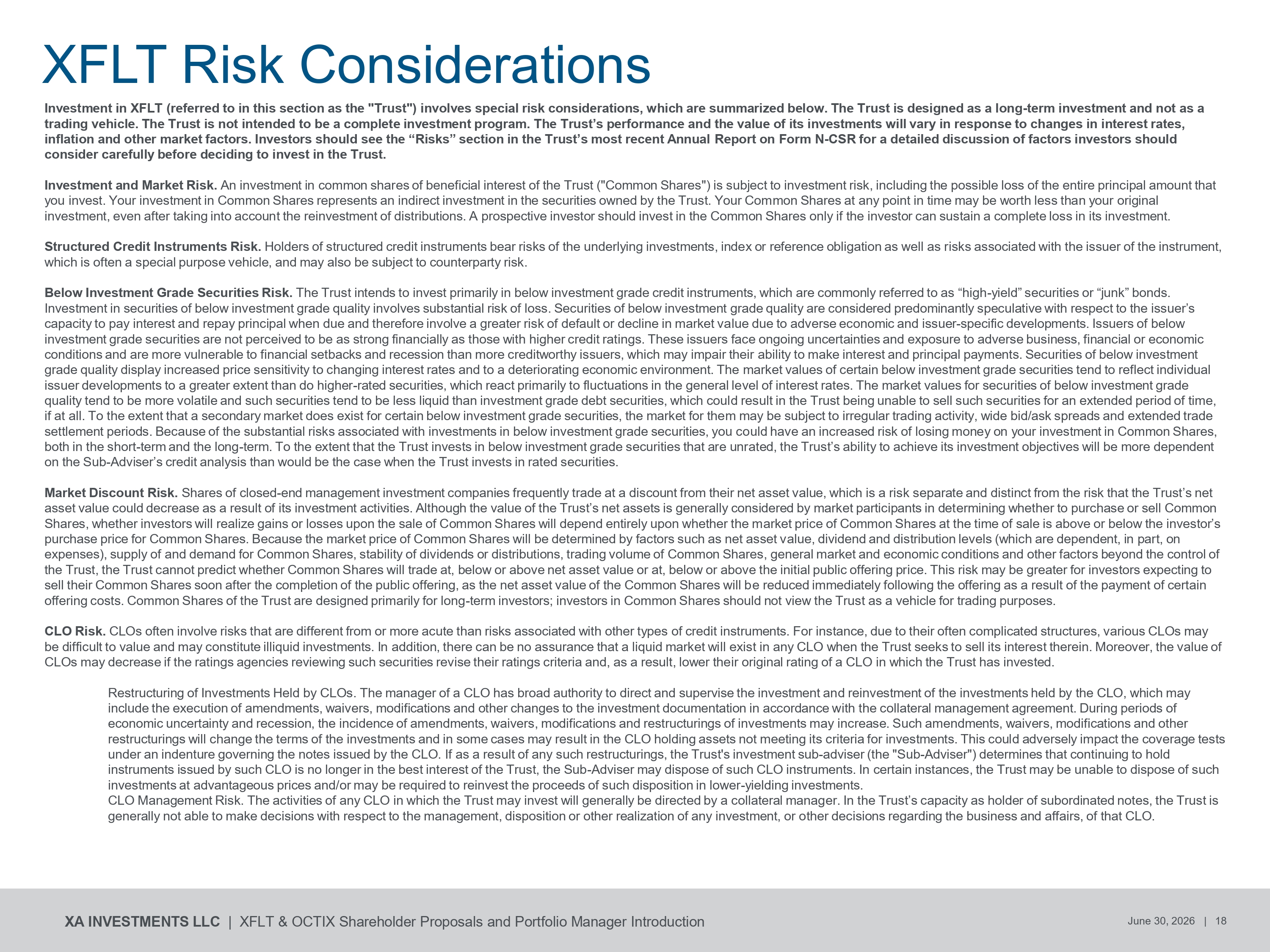
Investment in XFLT (referred to in this section as the “Trust”) involves special risk considerations, which are summarized below. The Trust is designed as a long - term investment and not as a trading vehicle. The Trust is not intended to be a complete investment program. The Trust’s performance and the value of its investments will vary in response to changes in interest rates, inflation and other market factors. Investors should see the “Risks” section in the Trust’s most recent Annual Report on Form N - CSR for a detailed discussion of factors investors should consider carefully before deciding to invest in the Trust. Investment and Market Risk. An investment in common shares of beneficial interest of the Trust (“Common Shares”) is subject to investment risk, including the possible loss of the entire principal amount that you invest. Your investment in Common Shares represents an indirect investment in the securities owned by the Trust. Your Common Shares at any point in time may be worth less than your original investment, even after taking into account the reinvestment of distributions. A prospective investor should invest in the Common Shares only if the investor can sustain a complete loss in its investment. Structured Credit Instruments Risk. Holders of structured credit instruments bear risks of the underlying investments, index or reference obligation as well as risks associated with the issuer of the instrument, which is often a special purpose vehicle, and may also be subject to counterparty risk. Below Investment Grade Securities Risk. The Trust intends to invest primarily in below investment grade credit instruments, which are commonly referred to as “high - yield” securities or “junk” bonds. Investment in securities of below investment grade quality involves substantial risk of loss. Securities of below investment grade quality are considered predominantly speculative with respect to the issuer’s capacity to pay interest and repay principal when due and therefore involve a greater risk of default or decline in market value due to adverse economic and issuer - specific developments. Issuers of below investment grade securities are not perceived to be as strong financially as those with higher credit ratings. These issuers face ongoing uncertainties and exposure to adverse business, financial or economic conditions and are more vulnerable to financial setbacks and recession than more creditworthy issuers, which may impair their ability to make interest and principal payments. Securities of below investment grade quality display increased price sensitivity to changing interest rates and to a deteriorating economic environment. The market values of certain below investment grade securities tend to reflect individual issuer developments to a greater extent than do higher - rated securities, which react primarily to fluctuations in the general level of interest rates. The market values for securities of below investment grade quality tend to be more volatile and such securities tend to be less liquid than investment grade debt securities, which could result in the Trust being unable to sell such securities for an extended period of time, if at all. To the extent that a secondary market does exist for certain below investment grade securities, the market for them may be subject to irregular trading activity, wide bid/ask spreads and extended trade settlement periods. Because of the substantial risks associated with investments in below investment grade securities, you could have an increased risk of losing money on your investment in Common Shares, both in the short - term and the long - term. To the extent that the Trust invests in below investment grade securities that are unrated, the Trust’s ability to achieve its investment objectives will be more dependent on the Sub - Adviser’s credit analysis than would be the case when the Trust invests in rated securities. Market Discount Risk. Shares of closed - end management investment companies frequently trade at a discount from their net asset value, which is a risk separate and distinct from the risk that the Trust’s net asset value could decrease as a result of its investment activities. Although the value of the Trust’s net assets is generally considered by market participants in determining whether to purchase or sell Common Shares, whether investors will realize gains or losses upon the sale of Common Shares will depend entirely upon whether the market price of Common Shares at the time of sale is above or below the investor’s purchase price for Common Shares. Because the market price of Common Shares will be determined by factors such as net asset value, dividend and distribution levels (which are dependent, in part, on expenses), supply of and demand for Common Shares, stability of dividends or distributions, trading volume of Common Shares, general market and economic conditions and other factors beyond the control of the Trust, the Trust cannot predict whether Common Shares will trade at, below or above net asset value or at, below or above the initial public offering price. This risk may be greater for investors expecting to sell their Common Shares soon after the completion of the public offering, as the net asset value of the Common Shares will be reduced immediately following the offering as a result of the payment of certain offering costs. Common Shares of the Trust are designed primarily for long - term investors; investors in Common Shares should not view the Trust as a vehicle for trading purposes. CLO Risk. CLOs often involve risks that are different from or more acute than risks associated with other types of credit instruments. For instance, due to their often complicated structures, various CLOs may be difficult to value and may constitute illiquid investments. In addition, there can be no assurance that a liquid market will exist in any CLO when the Trust seeks to sell its interest therein. Moreover, the value of CLOs may decrease if the ratings agencies reviewing such securities revise their ratings criteria and, as a result, lower their original rating of a CLO in which the Trust has invested. Restructuring of Investments Held by CLOs. The manager of a CLO has broad authority to direct and supervise the investment and reinvestment of the investments held by the CLO, which may include the execution of amendments, waivers, modifications and other changes to the investment documentation in accordance with the collateral management agreement. During periods of economic uncertainty and recession, the incidence of amendments, waivers, modifications and restructurings of investments may increase. Such amendments, waivers, modifications and other restructurings will change the terms of the investments and in some cases may result in the CLO holding assets not meeting its criteria for investments. This could adversely impact the coverage tests under an indenture governing the notes issued by the CLO. If as a result of any such restructurings, the Trust’s investment sub - adviser (the “Sub - Adviser”) determines that continuing to hold instruments issued by such CLO is no longer in the best interest of the Trust, the Sub - Adviser may dispose of such CLO instruments. In certain instances, the Trust may be unable to dispose of such investments at advantageous prices and/or may be required to reinvest the proceeds of such disposition in lower - yielding investments. CLO Management Risk. The activities of any CLO in which the Trust may invest will generally be directed by a collateral manager. In the Trust’s capacity as holder of subordinated notes, the Trust is generally not able to make decisions with respect to the management, disposition or other realization of any investment, or other decisions regarding the business and affairs, of that CLO. XA INVESTMENTS LLC | XFLT & OCTIX Shareholder Proposals and Portfolio Manager Introduction June 30, 2026 | 18 XFLT Risk Considerations
CLO Subordinated Note Risk. The Trust may invest in subordinated notes issued by a CLO, which are junior in priority of payment and are subject to certain payment restrictions generally set forth in an indenture governing the notes. In addition, they generally have only limited voting rights and generally do not benefit from any creditors’ rights or ability to exercise remedies under the indenture governing the notes. The subordinated notes are not guaranteed by another party. The subordinated notes are unsecured and rank behind all of the secured creditors, known or unknown, of the issuer, including the holders of the secured notes it has issued. Consequently, to the extent that the value of the issuer’s portfolio of loan investments has been reduced as a result of conditions in the credit markets, defaulted loans, capital gains and losses on the underlying assets, prepayment or changes in interest rates, the value of the subordinated notes realized at their redemption could be reduced. Accordingly, the subordinated notes may not be paid in full and may be subject to up to 100% loss. Subordinated notes are subject to greater risk that the senior notes issued by the CLO. CLO subordinated notes do not have a fixed coupon and payments on CLO subordinated notes will be based on the income received from the underlying collateral and the payments made to the secured notes, both of which may be based on floating notes. While payments on CLO subordinated notes will vary, CLO subordinated notes may not offer the same level of protection against changes in interest rates as other floating - rate instruments. Subordinated notes are illiquid investments and subject to extensive transfer restrictions, and no party is under any obligation to make a market for subordinated notes. Corporate Credit Investments Risk. Corporate debt instruments pay fixed, variable or floating rates of interest. The value of fixed - income securities in which the Trust invests will change in response to fluctuations in interest rates. In addition, the value of certain fixed - income securities can fluctuate in response to perceptions of creditworthiness, political stability or soundness of economic policies. Fixed - income securities are subject to the risk of the issuer’s inability to meet principal and interest payments on its obligations (i.e., credit risk) and are subject to price volatility due to such factors as interest rate sensitivity, market perception of the creditworthiness of the issuer and general market liquidity (i.e., market risk). Senior Loan Risk. Senior Loans are generally of below investment grade credit quality and are subject to greater risks than investment grade corporate obligations. The prices of these investments may be volatile and will generally fluctuate due to a variety of factors that are inherently difficult to predict, including, but not limited to, changes in interest rates, prevailing credit spreads, general economic conditions, financial market conditions, U.S. and non - U.S. economic or political events, developments or trends in any particular industry, and the financial condition of certain borrowers. Second Lien Loans Risk. Second lien loans are secured by liens on the collateral securing the loan that are subordinated to the liens of at least one other class of obligations of the related obligor, and thus, the ability of the Trust to exercise remedies after a second lien loan becomes a defaulted loan is subordinated to, and limited by, the rights of the senior creditors holding such other classes of obligations. In many circumstances, the Trust may be prevented from foreclosing on the collateral securing a second lien loan until the related senior loan is paid in full. Unsecured Loan Risk. Unsecured loans do not benefit from any security interest in the assets of the borrower. Liens on such borrowers’ assets, if any, will secure the applicable borrower’s obligations under its outstanding secured indebtedness and may secure certain future indebtedness that is permitted to be incurred by the borrower under its secured loan agreements. The holders of obligations secured by such liens will generally control the liquidation of, and be entitled to receive proceeds from, any realization of such collateral to repay their obligations in full before unsecured instruments held by the Trust. In addition, the value of such collateral in the event of liquidation will depend on market and economic conditions, the availability of buyers and other factors. There can be no assurance that the proceeds, if any, from sales of such collateral would be sufficient to satisfy the Trust’s unsecured obligations after payment in full of all secured loan obligations of the borrower. If such proceeds were not sufficient to repay the borrower’s outstanding secured loan obligations, then the Trust’s unsecured claims against the borrower would rank equally with the unpaid portion of such secured creditors’ claims against the borrower’s remaining assets, if any. As a result, the prices of unsecured loans may be more volatile than those of senior loans, second lien and other secured loans and other investments held by the Trust. Loan Participation and Assignment Risk . The Trust may purchase senior loans, second lien loans and unsecured loans on a direct assignment basis from a participant in the original syndicate of lenders or from subsequent assignees of such interests. The Trust may also purchase, without limitation, participations in senior loans, second lien loans and unsecured loans. The purchaser of an assignment typically succeeds to all the rights and obligations of the assigning institution and becomes a lender under the credit agreement with respect to the debt obligation; however, the purchaser’s rights can be more restricted than those of the assigning institution, and, in any event, the Trust may not be able to unilaterally enforce all rights and remedies under the loan and with regard to any associated collateral. A participation typically results in a contractual relationship only with the institution participating out the interest, not with the borrower. In purchasing participations, the Trust generally will have no right to enforce compliance by the borrower with the terms of the loan agreement against the borrower, and the Trust may not directly benefit from the collateral supporting the debt obligation in which it has purchased the participation. As a result, the Trust will be exposed to the credit risk of both the borrower and the institution selling the participation. Further, in purchasing participations in lending syndicates, the Trust may not be able to conduct the same due diligence on the borrower with respect to a loan hat the Trust would otherwise conduct. In addition, as a holder of the participations, the Trust may not have voting rights or inspection rights that the Trust would otherwise have if it were investing directly in the loan, which may result in the Trust being exposed to greater credit or fraud risk with respect to the borrower. Illiquid Investments Risk. The Trust expects to invest in restricted, as well as thinly traded, instruments and securities (including privately placed securities and instruments, which are assets which are subject to Rule 144A. There may be no trading market for these securities and instruments, and the Trust might only be able to liquidate these positions, if at all, at disadvantageous prices. Stressed and Distressed Investments Risk. The Trust may invest in stressed and distressed securities. The ability of the Trust to obtain a profit from these investments may often depend upon factors that are intrinsic to the particular issuer, rather than the market as a whole. Appreciation in the value of such securities may be contingent upon the occurrence of certain events, such as a successful reorganization or merger. If the expected event does not occur, the Trust may incur a loss on the position. Distressed securities may have a limited trading market, resulting in limited liquidity and presenting difficulties to the Trust in valuing its positions. Due to the illiquid nature of many distressed investments, as well as the uncertainties of the reorganization and active management process, the Sub - Adviser may be unable to predict with confidence what the exit strategy will ultimately be for any given position, or that one will definitely be available. Certain distressed investment opportunities may allow a holder to have significant influence on the management, operations and strategic direction of the portfolio companies in which it invests. XA INVESTMENTS LLC | XFLT & OCTIX Shareholder Proposals and Portfolio Manager Introduction June 30, 2026 | 19 XFLT Risk Considerations (cont.)
Leverage Risk. The Trust uses leverage to seek to enhance total return and income. The Trust may use leverage through (i) the issuance of senior securities representing indebtedness, including through borrowing from financial institutions or issuance of debt securities, including notes or commercial paper (collectively, “Indebtedness”), (ii) the issuance of preferred shares (“Preferred Shares”) and/or (iii) reverse repurchase agreements, securities lending, short sales or derivatives, such as swaps, futures or forward contracts, that have the effect of leverage (“portfolio leverage”). The Trust may utilize leverage to the maximum extent permitted under the Investment Company Act of 1940. The Trust has entered into a revolving credit facility and any borrowings through the credit facility are secured by eligible securities held in the Trust’s portfolio of investments. The Trust has also issued preferred shares, which are senior securities that constitute shares of beneficial interest of the Trust. Preferred shares rank senior to the Trust’s Common Shares in priority of payment of dividends and as to the distribution of assets upon dissolution, liquidation or winding up of the Trust’s affairs; equal in priority with all other future series of preferred shares the Trust may issue as to priority of payment of dividends and as to distributions of assets upon dissolution, liquidation or the winding - up of the Trust’s affairs; and subordinate in right of payment to amounts owed under the Trust’s existing credit facility, and to the holder of any future senior indebtedness, which may be issued without the vote or consent of preferred shareholders. The use of leverage is a speculative technique that involves special risks. The Trust currently anticipates utilizing leverage to seek to enhance total return and income. There can be no assurance that the Adviser’s and the Sub - Adviser’s expectations will be realized or that a leveraging strategy will be successful in any particular time period. Use of leverage creates an opportunity for increased income and capital appreciation but, at the same time, creates special risks. Leverage is a speculative technique that exposes the Trust to greater risk and increased costs than if it were not implemented. The more leverage that is utilized by the Trust, the more exposed the Trust will be to the risks of leverage. The use of leverage by the Trust causes the net asset value of the common shares to fluctuate significantly in response to changes in interest rates and other economic indicators. As a result, the net asset value, market price and dividend rate of the common shares is likely to be more volatile than those of a fund that is not exposed to leverage. Leverage increases operating costs, which may reduce total return. The Trust pays interest on its borrowings, which may reduce the Trust’s return. Increases in interest rates that the Trust must pay on its borrowings will increase the cost of leverage and may reduce the return to common shareholders. The risk of increases in interest rates may be greater in the current market environment because interest rates are near historically low levels. During the time in which the Trust is utilizing leverage, the amount of the investment advisory fee paid by the Trust will be higher than if the Trust did not utilize leverage because the fees paid will be calculated based on the Trust’s Managed Assets, including proceeds of leverage. Common shareholders bear the portion of the management fee attributable to assets purchased with the proceeds of leverage, which means that common shareholders effectively bear the entire management fee. Other Investment Companies Risk. Investments in other investment companies present certain special considerations and risks not present in making direct investments in securities in which the Trust may invest. Investments in other investment companies involve operating expenses and fees that are in addition to the expenses and fees borne by the Trust. Such expenses and fees attributable to the Trust’s investments in other investment companies are borne indirectly by common shareholders. Accordingly, investment in such entities involves expense and fee layering. Exchange - Traded Fund Risk. For ETFs tracking an index of securities, the cumulative percentage increase or decrease in the net asset value of the shares of an ETF may over time diverge significantly from the cumulative percentage increase or decrease in the relevant index due to the compounding effect experienced by an ETF which results from a number of factors, including, leverage (if applicable), daily rebalancing, fees, expenses and interest income, which in turn results in greater non - correlation between the return of an ETF and its corresponding index. Short Sales Risk. Short sales involve selling securities of an issuer short in the expectation of covering the short sale with securities purchased in the open market at a price lower than that received in the short sale. If the price of the issuer’s securities declines, the Trust may then cover the short position with securities purchased in the market. The profit realized on a short sale will be the difference between the price received in the sale and the cost of the securities purchased to cover the sale. The possible losses from selling short a security differ from losses that could be incurred from a cash investment in the security; the former may be unlimited, whereas the latter can only equal the total amount of the cash investment. Short selling activities are also subject to restrictions imposed by the federal securities laws and the various national and regional securities exchanges, which restrictions could limit the Trust’s investment activities. There can be no assurance that securities necessary to cover a short position will be available for purchase. Derivatives Risk. Derivatives are financial contracts in which the value depends on, or is derived from, the value of an underlying asset, reference rate or index. The Trust may, but is not required to, engage in various derivatives transactions for hedging and risk management purposes, to facilitate portfolio management and to seek to enhance total return of earn income. The Trust’s use of derivative instruments involves risks different from, or possibly greater than, the risks associated with investing directly in securities and other traditional investments. Derivatives are subject to a number of risks, such as interest rate risk, market risk, counterparty risk, and credit risk. Off - Exchange Derivatives Risk . The Trust may invest a portion of its assets in investments which are not traded on organized exchanges and as such are not standardized . Such transactions may include forward contracts, swaps or options . While some markets for such derivatives are highly liquid, transactions in off - exchange derivatives may involve greater risk than investing in exchange - traded derivatives because there is no exchange market on which to close out an open position . Options Risk . Trading in options involves a number of risks . Specific market movements of the option and the instruments underlying an option cannot be predicted . No assurance can be given that a liquid offset market will exist for any particular option or at any particular time . If no liquid offset market exists, the Trust might not be able to effect an offsetting transaction in a particular option . Futures Risk. Futures contracts markets are highly volatile and are influenced by a variety of factors, including national and international political and economic developments. In addition, because of the low margin deposits normally required in futures trading, a high degree of leverage is typical of a futures trading account. As a result, a relatively small price movement in a futures contract may result in substantial losses to the trader. XA INVESTMENTS LLC | XFLT & OCTIX Shareholder Proposals and Portfolio Manager Introduction June 30, 2026 | 20 XFLT Risk Considerations (cont.)
Swaps Risk. The Trust may utilize swap agreements including, without limitation, interest rate, index and currency swap agreements. The use of swaps is a highly specialized activity that involves investment techniques and risks different from those associated with ordinary securities transactions. There are risks relating to the financial soundness and creditworthiness of the counterparty to swap agreements. Credit Default Swaps Risk. The Trust may enter into credit default swap agreements. The “buyer” in a credit default contract is obligated to pay the “seller” a periodic stream of payments over the term of the contract provided that no event of default on an underlying reference obligation has occurred. The Trust may be either the buyer or seller in a credit default swap transaction. Credit default swap transactions involve greater risks than if a Trust had invested in the reference obligation directly. Credit default swaps are subject to the risk of non - performance by the swap counterparty, including risks relating to the financial soundness and creditworthiness of the swap counterparty. Hedging Transactions Risk. The success of any hedging strategy utilized by the Trust’s will be subject to the Sub - Adviser’s ability to correctly assess the degree of correlation between the performance of the instruments used in the hedging strategy and the performance of the investments in the portfolio being hedged. Since the characteristics of many securities change as markets change or time passes, the success of the Trust’s hedging strategy will also be subject to the Sub - Adviser’s ability to continually recalculate, readjust, and execute hedges in an efficient and timely manner. Counterparty Risk. The Trust will be subject to credit risk with respect to the counterparties to the derivative contracts entered into by the Trust. Synthetic Investment Risk . The Trust may be exposed to certain additional risks should the Sub - Adviser uses derivatives transactions as a means to synthetically implement the Trust’s investment strategies . Customized derivative instruments will likely be highly illiquid, and it is possible that the Trust will not be able to terminate such derivative instruments prior to their expiration date or that the penalties associated with such a termination might impact the Trust’s performance in a materially adverse manner . Segregation and Cover Risk. In connection with certain derivatives transactions, the Trust may be required to segregate liquid assets or otherwise cover such transactions and/or to deposit amounts as premiums or to be held in margin accounts. Such amounts may not otherwise be available to the Trust for investment purposes. The Trust may earn a lower return on its portfolio than it might otherwise earn if it did not have to segregate assets in respect of, or otherwise cover, its derivatives transactions positions. Interest Rate Risk. Interest rate risk is the risk that credit securities will decline in value because of changes in market interest rates. When market interest rates rise, the market value of fixed income credit securities generally will fall. These risks may be greater in the current market environment because while interest rates were historically low in recent years, the Federal Reserve has been increasing the Federal Funds rate to address inflation. Prevailing interest rates may be adversely impacted by market and economic factors. If interest rates rise the markets may experience increased volatility, which may adversely affect the value and/or liquidity of certain of the Trust’s investments. The prices of longer - term securities fluctuate more than prices of shorter - term securities as interest rates change. The Trust’s use of leverage will tend to increase the interest rate risk to which its Common Shares are subject. The Trust invests primarily in variable and floating rate credit instruments and other structured credit investments, which generally are less sensitive to interest rate changes than fixed rate instruments, but generally will not increase in value if interest rates decline. Prepayment Risk. The frequency at which prepayments (including voluntary prepayments by the obligors and accelerations due to defaults) occur on bonds and loans will be affected by a variety of factors including the prevailing level of interest rates and spreads as well as economic, demographic, tax, social, legal and other factors. The adverse effects of prepayments may impact the Trust’s portfolio in several ways. During periods of declining interest rates, when the issuer of a security exercises its option to prepay principal earlier than scheduled, the Trust may be required to reinvest the proceeds of such prepayment in lower - yielding securities. Particular investments may experience outright losses, as in the case of an interest - only security in an environment of faster actual or anticipated prepayments. In addition, particular investments may underperform relative to hedges that the Sub - Adviser may have constructed for these investments, resulting in a loss to the Trust’s overall portfolio. Inflation/Deflation Risk. Inflation risk is the risk that the value of assets or income from investments will be worth less in the future as inflation decreases the value of money. As inflation increases, the real value of the Common Shares and distributions can decline. Deflation risk is the risk that prices throughout the economy decline over time — the opposite of inflation. Deflation may have an adverse effect on the creditworthiness of issuers and may make issuer default more likely, which may result in a decline in the value of the Trust’s portfolio. Duration and Maturity Risk. The Trust has no set policy regarding maturity or duration of credit instruments in which it may invest or of the Trust’s portfolio generally. The price of fixed rate securities with longer maturities or duration generally is more significantly impacted by changes in interest rates than those of fixed rate securities with shorter maturities or duration. Therefore, generally speaking, the longer the duration of the Trust’s portfolio, the more exposure the Trust will have to interest rate risk described above. The Sub - Adviser may seek to adjust the portfolio’s duration or maturity based on its assessment of current and projected market conditions and all factors that the Sub - Adviser deems relevant. The Trust may incur costs in seeking to adjust the portfolio average duration or maturity. There can be no assurance that the Sub - Adviser’s assessment of current and projected market conditions will be correct or that any strategy to adjust the portfolio’s duration or maturity will be successful at any given time. Credit Risk. Credit risk is the risk that an issuer of securities will be unable to pay principal and interest when due, or that the value of the security will suffer because investors believe the issuer is less able to pay. Non - U.S. Investments Risk. The risk of loss associated with investments in securities of foreign issuers include currency exchange risks, expropriation, or limits on repatriating an investment, government intervention, confiscatory taxation, political, economic or social instability, illiquidity, less efficient markets, price volatility and market manipulation. XA INVESTMENTS LLC | XFLT & OCTIX Shareholder Proposals and Portfolio Manager Introduction June 30, 2026 | 21 XFLT Risk Considerations (cont.)
Equity Investments Risk. Incidental to the Trust’s investments in credit instruments, the Trust may acquire or hold equity securities, or warrants to purchase equity securities, of a borrower or issuer. Common equity securities prices fluctuate for a number of reasons, including changes in investors’ perceptions of the financial condition of an issuer, the general condition of the relevant stock market and broader domestic and international political and economic events. European CLO Risks. European CLOs are not denominated in U.S. dollars and primarily hold loans to non - U.S. companies. Investing in securities of non - U.S. issuers may involve certain risks not typically associated with investing in securities of U.S. issuers. These risks include: (i) there may be less publicly available information about non - U.S. issuers or markets due to less rigorous disclosure or accounting standards or regulatory practices; (ii) non - U.S. markets may be smaller, less liquid and more volatile than the U.S. market; (iii) potential adverse effects of fluctuations in currency exchange rates or controls on the value of the Trust’s investments; (iv) the economies of non - U.S. countries may grow at slower rates than expected or may experience a downturn or recession; (v) the impact of economic, political, social or diplomatic events as well as of foreign governmental laws or restrictions and differing legal standards; (vi) certain non - U.S. countries may impose restrictions on the ability of non - U.S. issuers to make payments of principal and interest to investors located in the United States due to blockage of non - U.S. currency exchanges or otherwise; and (vii) withholding and other non - U.S. taxes. Foreign companies are generally not subject to the same accounting, auditing and financial reporting standards as are U.S. companies. In addition, there may be difficulty in obtaining or enforcing a court judgment abroad, including in the event the issuer of a non - U.S. security defaults or enters bankruptcy, administration, or other proceedings. Changes in the non - U.S. currency/United States dollar exchange rate may affect the value of non - U.S. dollar - denominated securities and the unrealized appreciation or depreciation of investments. While certain or all of the Trust’s non - U.S. dollar - denominated securities may be hedged into U.S. dollars, hedging may not alleviate all currency risks. Forward foreign currency exchange contracts involve certain risks, including the risk of failure of the counterparty to perform its obligations under the contract and the risk that the use of forward contracts may not serve as a complete hedge because of an imperfect correlation between movements in the prices of the contracts and the prices of the currencies hedged. While forward foreign currency exchange contracts may limit the risk of loss due to a decline in the value of the hedged currencies, they also may limit any potential gain that might result should the value of the currencies increase. In addition, because forward currency exchange contracts are privately negotiated transactions, there can be no assurance that the Trust will have flexibility to roll - over a forward currency exchange contract upon its expiration if it desires to do so. Hedging against a decline in the value of a currency does not eliminate fluctuations in the value of a portfolio security traded in that currency or prevent a loss if the value of the security declines. Moreover, it may not be possible for the Trust to hedge against a devaluation that is so generally anticipated that the Trust is not able to contract to sell the currency at a price above the devaluation level it anticipates. The cost to the Trust of engaging in currency exchange transactions varies with such factors as the currency involved, the length of the contract period and prevailing market conditions. Political or economic disruptions in European countries may adversely affect security values. A significant number of countries in Europe are member states in the European Union (the “EU”), which faces major issues involving its membership, structure, procedures and policies. By adopting the Euro as its currency, a member state relinquishes control over its own monetary policies. In general, monetary policy is set for the Eurozone by the European Central Bank and fiscal policy is overseen and approved by the EU. European countries that are members of, or candidates to join, the Economic and Monetary Union (“EMU”) may be subject to various restrictions, including restrictions on deficits and debt levels. As a result of the foregoing, monetary and fiscal policies may not address the needs of all member countries. In addition, the fiscal policies of a single member state can impact and pose economic risks to the EU as a whole. There is continued concern over national - level support for the Euro, which could lead to certain countries leaving the EMU, the implementation of capital controls, or potentially the dissolution of the Euro. The dissolution of the Euro would have significant negative effects on European economies and would cause funds with holdings denominated in Euros to face substantial challenges, including difficulties relating to settlement of trades and valuation of holdings, diminished liquidity, and the redenomination of holdings into other currencies. The European financial markets have experienced volatility and adverse trends due to concerns about economic downturns, rising government debt levels and the possible default of government debt in several European countries. A default or debt restructuring by any European country can adversely impact holders of that country’s debt and can affect exposures to other EU countries and their financial companies as well. Portfolio Turnover Risk. The Trust may engage in active and frequent trading of its portfolio securities. High portfolio turnover may result in increased transaction costs to the Trust, including brokerage commissions, dealer mark - ups and other transaction costs on the sale of securities and on reinvestment in other securities. The sale of portfolio securities may result in the realization and/or distribution to shareholders of higher capital gains or losses as compared to a fund with less active trading policies. These effects of higher than normal portfolio turnover may adversely affect Trust performance. Asset Backed Securities Risks. Asset - backed securities are a form of structured debt obligation. ABS are payment claims that are securitized in the form of negotiable paper that is issued by a financing company (generally called a special purpose vehicle). Collateral assets are brought into a pool according to specific diversification rules. A special purpose vehicle is founded for the purpose of securitizing these payment claims and the assets of the special purpose vehicle are the diversified pool of collateral assets. The special purpose vehicle issues marketable securities that are intended to represent a lower level of risk than an underlying collateral asset individually, due to the diversification in the pool. The redemption of the securities issued by the special purpose vehicle takes place out of the cash flow generated by the collected assets. A special purpose vehicle may issue multiple securities with different priorities to the cash flows generated and the collateral assets. The collateral for ABS may include, among other assets, home equity loans, automobile and credit card receivables, boat loans, computer leases, airplane leases, mobile home loans, recreational vehicle loans and hospital account receivables. The Trust may invest in these and other types of ABS that may be developed in the future. There is the possibility that recoveries on the underlying collateral may not, in some cases, be available or may be insufficient to support payments on these securities. XA INVESTMENTS LLC | XFLT & OCTIX Shareholder Proposals and Portfolio Manager Introduction June 30, 2026 | 22 XFLT Risk Considerations (cont.)
Asset Backed Securities Risks (cont.). The Trust may invest in ABS issued by legal entities that are sponsored by banks, investment banks, other financial institutions or companies, asset management firms or funds and are specifically created for the purpose of issuing such ABS. Investors in ABS receive payments that are part interest and part return of principal or certain ABS may be interest - only securities or principal - only securities. These payments typically depend upon the cash flows generated by an underlying pool of assets and vary based on the rate at which the underlying obligors pay off their liabilities under the underlying assets. The pooled assets provide cash flow to the issuer, which then makes interest and principal payments to investors. As a result, these investments involve the risk, among other risks, that the borrower may default on its obligations backing the ABS and, thus, the value of and interest generated by such investment will decline. In addition to the general risks (such as interest rate risk, prepayment risk, extension risk, market risk, credit risk and liquidity and valuation risk) associated with credit or debt securities discussed herein, ABS are subject to additional risks due to their structure. During periods of declining interest rates, prepayment of borrowings underlying asset - backed securities can be expected to accelerate. Accordingly, the Trust’s ability to reinvest the returns of principal at comparable yields is subject to generally prevailing interest rates at that time. ABS are also subject to liquidity and valuation risk and, therefore, may be difficult to value accurately or sell at an advantageous time or price and involve greater transaction costs and wider bid/ask spreads than certain other instruments. In addition, the assets or collateral underlying an ABS may be insufficient or unavailable in the event of a default and enforcing rights with respect to these assets or collateral may be difficult and costly. While traditional fixed - income securities typically pay a fixed rate of interest until maturity, when the entire principal amount is due, an ABS represents an interest in a pool of assets that has been securitized and typically provides for monthly or quarterly payments of interest, at a fixed or floating rate, and may provide for payments of principal from the cash flow of these assets. This pool of assets (and any related assets of the issuing entity) is often the only source of payment for the ABS. The ability of an ABS issuer to make payments on the ABS, and the timing of such payments, is therefore dependent on collections on these underlying assets. The recoveries on the underlying collateral may not, in some cases, be sufficient to support payments on these securities, or may be unavailable in the event of a default and enforcing rights with respect to these assets or collateral may be difficult and costly, which may result in losses to investors in an ABS. Generally, obligors may prepay the underlying assets in full or in part at any time, subjecting the Trust to prepayment risk related to the ABS it holds. While the expected repayment streams on ABS are determined by the contractual amortization schedules for the underlying assets, an investor’s yield to maturity on an ABS is uncertain and may be reduced by the rate and speed of prepayments of the underlying assets, which may be influenced by a variety of economic, social and other factors. Any prepayments, repurchases, purchases or liquidations of the underlying assets could shorten the average life of the ABS to an extent that cannot be fully predicted. Some ABS may be structured to include a period of rapid amortization triggered by events such as a significant rise in the default rate of the underlying collateral, a sharp drop in the credit enhancement level because of credit losses on the underlying assets, a specified regulatory event or the bankruptcy of the originator. A rapid amortization event will cause any revolving period to end earlier than expected and all collections on the underlying assets will be used to pay principal to investors earlier than expected. In general, the senior most securities will be paid prior to any payments being made on the subordinated securities, and if such payments are made earlier than expected, the Trust’s yield on such ABS may be negatively affected. In addition, investments in ABS entail additional risks relating to the underlying pools of assets, including credit risk, default risk (such as a borrower’s default on its obligation and the default, failure or inadequacy or unavailability of a guarantee, if any, underlying the ABS intended to protect investors in the event of default) and prepayment and extension risk with respect to the underlying pool or individual assets represented in the pool . The underlying assets of an ABS may include, without limitation, residential or commercial mortgages, motor vehicle installment sales or installment loan contracts, leases of various types of real, personal and other property, receivable from credit card agreements and automobile finance agreements, student loans, consumer loans, and income from other income streams, such as income from business loans . Moreover, additional risks relating to investments in ABS may arise principally because of the type of ABS in which the Trust invests, with such risks primarily associated with the particular assets collateralizing the ABS (such as their type or nature), the structure of such ABS, or the tranche or priority of the ABS held by the Trust (with junior or equity tranches generally carrying higher levels of risk) Mortgage - Backed Securities (“MBS”) represent an interest in a pool of mortgages. MBS are subject to certain risks, such as: credit risk associated with the performance of the underlying mortgage properties and of the borrowers owning these properties; risks associated with their structure and execution (including the collateral, the process by which principal and interest payments are allocated and distributed to investors and how credit losses affect the return to investors in such MBS); risks associated with the servicer of the underlying mortgages; adverse changes in economic conditions and circumstances, which are more likely to have an adverse impact on MBS secured by loans on certain types of commercial properties than on those secured by loans on residential properties; prepayment and extension risks associated with the underlying assets of certain MBS, which can shorten the weighted average maturity and lower the return of the MBS, or lengthen the expected maturity, respectively, leading to significant fluctuations in the value of the MBS; loss of all or part of the premium, if any, paid; and decline in the market value of the security, whether resulting from changes in interest rates, prepayments on the underlying mortgage collateral or perceptions of the credit risk associated with the underlying mortgage collateral. The value of MBS may be substantially dependent on the servicing of the underlying pool of mortgages. In addition, the Trust’s level of investment in MBS of a particular type or in MBS issued or guaranteed by affiliated obligors, serviced by the same servicer or backed by underlying collateral located in a specific geographic region, may subject the Trust to additional risk. XA INVESTMENTS LLC | XFLT & OCTIX Shareholder Proposals and Portfolio Manager Introduction June 30, 2026 | 23 XFLT Risk Considerations (cont.)
Asset Backed Securities Risks (cont.). When market interest rates decline, more mortgages are refinanced and the securities are paid off earlier than expected. Prepayments may also occur on a scheduled basis or due to foreclosure. When market interest rates increase, the market values of MBS decline. At the same time, however, mortgage refinancings and prepayments slow, which lengthens the effective maturities of these securities. As a result, the negative effect of the rate increase on the market value of MBS is usually more pronounced than it is for other types of debt securities. In addition, due to instability in the credit markets, the market for some MBS has at times experienced reduced liquidity and greater volatility with respect to the value of such securities, making it more difficult to value such securities. The Trust may invest in sub - prime mortgages or MBS that are backed by sub - prime mortgages or defaulted or nonperforming loans, which may be subject to heightened risks compared to other MBS. See “Sub - Prime Mortgage Market Risk” below for more information. Additional risks relating to investments in MBS may arise principally because of the type of MBS in which the Trust invests, with such risks primarily associated with the particular assets collateralizing the MBS and the structure of such MBS. For example, collateralized mortgage obligations (“CMOs”), which are MBS that are typically collateralized by mortgage loans or mortgage pass - through securities and multi - class pass - through securities, are commonly structured as equity interests in a trust composed of mortgage loans or other MBS. CMOs are usually issued in multiple classes, often referred to as “tranches,” with each tranche having a specific fixed or floating coupon rate and stated maturity or final distribution date. Under the traditional CMO structure, the cash flows generated by the mortgages or mortgage pass - through securities in the collateral pool are used to first pay interest and then pay principal to the holders of the CMOs. Subject to the provisions of individual CMO issues, the cash flow generated by the underlying collateral (to the extent it exceeds the amount required to pay the stated interest) is used to retire the bonds. As a result of these and other structural characteristics of CMOs, CMOs may have complex or highly variable prepayment terms, such as companion classes, interest only or principal only payments, inverse floaters and residuals. These investments generally entail greater market, prepayment and liquidity risks than other MBS, and may be more volatile or less liquid than other MBS. CMOs are further subject to certain risks specific to these securities. For example, the average life of CMOs is typically determined using mathematical models that incorporate prepayment and other assumptions that involve estimates of future economic and market conditions, which may prove to be incorrect, particularly in periods of heightened market volatility. Further, the average weighted life of certain CMOs may not accurately reflect the price volatility of such securities, resulting in price fluctuations greater than what would be expected from interest rate movements alone. Non - agency MBS (i.e., MBS issued by commercial banks, savings and loans institutions, mortgage bankers, private mortgage insurance companies and other non - governmental issuers) are subject to the risk that the value of such securities will decline because, among other things, the securities are not guaranteed as to principal or interest by the U.S. government or a government sponsored enterprise. Non - agency MBS are not subject to the same underwriting requirements for underlying mortgages as agency MBS and, as a result, mortgage loans underlying non - agency MBS typically have less favorable underwriting characteristics (such as credit and default risk and collateral) and a wider range in terms (such as interest rate, term and borrower characteristics) than agency MBS. Non - agency residential mortgage - backed securities often are issued in the form of several different tranches. Depending on their respective seniority, individual tranches are subject to increased (and sometimes different) credit, prepayment and liquidity and valuation risks as compared to other tranches. These securities are often subject to greater credit, prepayment and liquidity and valuation risks than agency MBS. In addition, these securities may be less readily marketable as the market for these securities is typically smaller and less liquid than the market for agency MBS. For example, during periods of weakness or perceived weakness in the mortgage and real estate sectors, non - agency mortgage - related securities may experience greater price fluctuations and less liquidity than agency mortgage - related securities. Moreover, the relationship between prepayments and interest rates may give some high - yielding MBS less potential for growth in value than conventional bonds with comparable maturities. In addition, during periods of falling interest rates, the rate of prepayment tends to increase. During such periods, the reinvestment of prepayment proceeds by the Trust will generally be at lower interest rates than the interest rates that were carried by the obligations that have been prepaid. Because of these and other reasons, MBS’s total return and maturity may be difficult to predict precisely. To the extent that the Trust purchases MBS at a premium, prepayments (which may be made without penalty) may result in loss of the Trust’s principal investment to the extent of premium paid. The general effects of inflation on the U.S. economy can be wide ranging, as evidenced by rising interest rates, wages, and costs of consumer goods and necessities. The long - term effects of inflation on the general economy and on any individual mortgagor are unclear, and in certain cases, rising inflation may affect a mortgagor’s ability to repay its related mortgage loan, thereby reducing the amount received by the holders of MBS with respect to such mortgage loan. Additionally, increased rates of inflation, as recently experienced, may negatively affect the value of certain MBS in the secondary market. In addition, during periods of declining economic conditions, losses on mortgages underlying MBS generally increase. Mortgage - backed securities generally are classified as either commercial mortgage - backed securities (“CMBS”) or residential mortgage - backed securities (“RMBS”), each of which are subject to certain specific risks. CMBS and RMBS are also subject to risks similar to those associated with investing in real estate, such as the possible decline in the value of (or income generated by) the real estate, variations in rental income, fluctuations in occupancy levels and demand for properties or real estate - related services, changes in interest rates and changes in the availability or terms of mortgages and other financing that may render the sale or refinancing of properties difficult or unattractive. CMBS are collateralized by one or more commercial mortgage loans. Banks and other lending institutions typically group the loans into pools and interests in these pools are then sold to investors, allowing the lender to have more money available to loan to other commercial real estate owners. Commercial mortgage loans may be secured by office properties, retail properties, hotels, mixed use properties or multi - family apartment buildings. The value of, and income generated by, investments in CMBS are subject to the risks of ABS and mortgage - related securities generally, as well as the commercial real estate markets and the real estate securing the underlying mortgage. CMBS are often subject to credit, default, prepayment and liquidity and valuation risks and may experience greater price volatility than other types of ABS or mortgage - related securities. XA INVESTMENTS LLC | XFLT & OCTIX Shareholder Proposals and Portfolio Manager Introduction June 30, 2026 | 24 XFLT Risk Considerations (cont.)
Asset Backed Securities Risks (cont.). CMBS are subject to particular risks, such as those associated with lack of standardized terms, shorter maturities than residential mortgage loans and payment of all or substantially all of the principal only at maturity rather than regular amortization of principal. In addition, commercial lending generally is viewed as exposing the lender to a greater risk of loss than residential lending, because commercial lending typically involves larger loans to single borrowers or groups of related borrowers than residential mortgage loans. In addition, the repayment of loans secured by income producing properties typically is dependent upon the successful operation of the related real estate project and the cash flow generated therefrom, which can be affected by, among other things: tenant mix, success of tenant businesses, property management decisions, property location and condition, competition from comparable types of properties, changes in laws that increase operating expense or limit rents that may be charged, any need to address environmental contamination at the property, the occurrence of any uninsured casualty at the property, changes in national, regional or local economic conditions and/or specific industry segments, declines in regional or local or other real estate values, public health conditions, declines in regional or local rental or occupancy rates, increases in interest rates, real estate tax rates and other operating expenses, change in governmental rules, regulations and fiscal policies, including environmental legislation, acts of God, terrorism, social unrest and civil disturbances. Consequently, adverse changes in economic conditions and circumstances are more likely to have an adverse impact on MBS secured by loans on commercial properties than on those secured by loans on residential properties. Economic downturns, rises in unemployment, tightening lending standards and increased interest and lending rates, developments adverse to the commercial real estate markets, and other developments that limit or reduce demand for commercial retail and office spaces (including continued or expanded remote working arrangement) as well as increased maintenance or tenant improvement costs and costs to convert properties for other uses adversely impact these investments. For example, economic decline in the businesses operated by the tenants of office or retail properties may increase the likelihood that the tenants may be unable to pay their rent or that properties may be unable to attract or retain tenants at all or on favorable terms for the commercial real estate owners, resulting in vacancies (potentially for extended periods) and losses. These developments could also result from, among other things, population shifts and other demographic changes, changing tastes and preferences as well as cultural, technological, working or economic and market developments. In addition, changing interest rate environments and associated changes in lending standards and higher refinancing rates may adversely affect the commercial real estate and CMBS markets. Moreover, mortgage - related securities, including CMBS, are subject to (in some cases to a greater extent) general investment, economic, market and/or geopolitical risks that affect general economic conditions and financial markets, such as pandemics, armed conflicts, energy supply or price disruptions, natural disasters and man - made disasters, which may have a significant effect on the underlying commercial mortgage loans and real estate. In addition, adverse developments in the local, regional and national economies affect consumer spending and can have a significant effect on the success of a retail space. Further, increased competition in the market of a retail property through the addition of competing properties nearby can adversely impact the success of a retail property, even if the local, regional and national economies are doing well. Retail properties are also subject to conditions that could negatively affect the retail sector, such as increased unemployment, increased federal income and payroll taxes, increased health care costs, increased state and local taxes, increased real estate taxes, industry slowdowns, lack of availability of consumer credit, weak income growth, increased levels of consumer debt, poor housing market conditions, adverse weather conditions, natural disasters, plant closings, and other factors. Similarly, local real estate conditions, such as an oversupply of, or a reduction in demand for, retail space or retail goods, and the supply and creditworthiness of current and prospective tenants may negatively impact those retail properties. The occurrence of any of the foregoing or similar developments would likely increase the risks associated with these investments, such as the default risk for the properties and loans underlying the CMBS investments, and adversely impact the value of, and income generated by, these investments and the underlying properties or loans. These developments could also result in reduced liquidity for CMBS. CMBS are also subject to the risk that the value of, and income generated by, such securities will decline because, among other things, the securities are not issued or guaranteed as to principal or interest by the U.S. government or a government sponsored enterprise and, thus, would be subject to similar risks as non - agency MBS. CMBS often are issued in the form of several different tranches. Depending on their respective seniority, individual tranches are subject to increased (and sometimes different) credit, prepayment and liquidity and valuation risks as compared to other tranches. CMBS are often subject to credit, default, prepayment and liquidity and valuation risks and may experience greater price volatility than other types of ABS or MBS. Additional risks may be presented by the type and use of a particular commercial property . Special risks are presented by hotels, hospitals, nursing homes, hospitality properties and certain other property types . Commercial property values and net operating income are subject to volatility, which may result in net operating income becoming insufficient to cover debt service on the related mortgage loan . The exercise of remedies and successful realization of liquidation proceeds relating to CMBS may be highly dependent on the performance of the servicer or special servicer . There may be a limited number of special servicers available, particularly those that do not have conflicts of interest . Home mortgage loans are typically grouped together into pools by banks and other lending institutions, and interests in these pools are then sold to investors, allowing the bank or other lending institution to have more money available to loan to home buyers. RMBS are particularly subject to the credit risk of the borrower. Credit - related risk on RMBS primarily arises from losses due to delinquencies and defaults by the borrowers in payments on the underlying mortgage loans and breaches by originators and servicers of their obligations under the underlying documentation pursuant to which the RMBS are issued. RMBS are also subject to the risks of MBS generally and the residential real estate markets. The rate of delinquencies and defaults on residential mortgage loans and the aggregate amount of the resulting losses will be affected by a number of factors, including general economic conditions, particularly those in the area where the related mortgaged property is located, the level of the borrower’s equity in the mortgaged property and the individual financial circumstances of the borrower. For example, borrowers with adjustable rate mortgage loans are more sensitive to changes in interest rates, which affect their monthly mortgage payments, and may be unable to secure replacement mortgages at comparably low interest rates. The risk of non - payment is greater for RMBS that are backed by loans that were originated under weak underwriting standards, including loans made to borrowers with limited means to make repayment. RMBS are also subject to risks associated with the actions of mortgage lenders in the marketplace. Such lenders may adjust their loan programs and underwriting standards, which may reduce the availability of mortgage credit to prospective mortgagors. This may result in limited financing alternatives for mortgagors seeking to refinance their existing loans, which may in turn result in higher rates of delinquencies, defaults and losses on mortgages. If a residential mortgage loan is in default, foreclosure on the related residential property may be a lengthy and difficult process involving significant legal and other expenses. The net proceeds obtained by the holder on a residential mortgage loan following the foreclosure on the related property may be less than the total amount that remains due on the loan. The prospect of incurring a loss upon the foreclosure of the related property may lead the holder of the residential mortgage loan to restructure the residential mortgage loan or otherwise delay the foreclosure process. XA INVESTMENTS LLC | XFLT & OCTIX Shareholder Proposals and Portfolio Manager Introduction June 30, 2026 | 25 XFLT Risk Considerations (cont.)
Asset Backed Securities Risks (cont . ) . Income from and values of RMBS also may be greatly affected by demographic trends, such as population shifts or changing tastes and values, or increasing vacancies or declining rents or property values resulting from legal, cultural, technological, global or local economic developments, as well as reduced demand for properties . Loans made to lower quality borrowers, including those of sub - prime quality, may be underlying assets for an asset - backed security . Loans to such borrowers involve a higher degree of credit, default and the other risks to which MBS are subject, as discussed above . As a result, values of ABS backed by lower quality loans are more likely than others to suffer significant declines due to defaults, delays or the perceived risk of defaults or delays . The residential mortgage market in the United States has at times experienced difficulties that may adversely affect the performance and market value of certain mortgages and MBS. Delinquencies and losses on residential mortgage loans (especially sub - prime and second - lien mortgage loans) generally have increased at times and may again increase, and a decline in or flattening of housing values (as has been experienced at times and may again be experienced in many housing markets) may exacerbate such delinquencies and losses. Borrowers with adjustable rate mortgage loans are more sensitive to changes in interest rates, which affect their monthly mortgage payments, and may be unable to secure replacement mortgages at comparably low interest rates. Also, a number of residential mortgage loan originators have at times experienced serious financial difficulties or bankruptcy. Largely due to the foregoing, reduced investor demand for mortgage loans and MBS and increased investor yield requirements has at times caused limited liquidity in the secondary market for certain MBS, which can adversely affect the market value of MBS. It is possible that such limited liquidity in such secondary markets could occur again or worsen. If the economy of the United States deteriorates, the incidence of mortgage foreclosures, especially sub - prime mortgages, may increase, which may adversely affect the value of any MBS owned by the Trust. Any increase in prevailing market interest rates may result in increased payments for borrowers who have adjustable rate mortgages. Moreover, with respect to hybrid mortgage loans after their initial fixed rate period, interest - only products or products having a lower rate, and with respect to mortgage loans with a negative amortization feature which reach their negative amortization cap, borrowers may experience a substantial increase in their monthly payment even without an increase in prevailing market interest rates. Increases in payments for borrowers may result in increased rates of delinquencies and defaults on residential mortgage loans underlying the RMBS. Future legislation or regulation, may have significant impacts on the mortgage market generally and may result in a reduction of available transactional opportunities for the Trust or an increase in the cost associated with such transactions and may adversely impact the value of RMBS. CLO Warehouse Risk. The Trust may invest in participations in CLO warehouses provided for the purposes of enabling the borrowers to acquire assets (“Collateral”) which are ultimately intended to be used to collateralize securities to be issued pursuant to a CLO transaction. The Trust’s participation in any CLO warehouse may take the form of notes (“Warehouse Equity”) which are subordinated to the interests of one or more senior lenders under the CLO warehouse. If the relevant CLO transaction does not proceed for any reason (which may include a decision on the part of the CLO manager not to proceed with the closing of such transaction), the realized value of the Collateral may be insufficient to repay any outstanding amounts owing to the company in respect of the Warehouse Equity, after payments have been made to the senior lenders under the terms of the CLO warehouse, with the consequence that the Trust may not receive back all or any of its investment in the CLO warehouse. This shortfall may be attributable to, amongst other things, a fall in the value of the Collateral between the date of the Trust’s participation in the CLO warehouse and the date that the Collateral is realized. SOFR Risk. The Secured Overnight Financing Rate (“SOFR”) is intended to be a broad measure of the cost of borrowing funds overnight in transactions that are collateralized by U.S. Treasury securities. SOFR is calculated based on transaction - level data collected from various sources. For each trading day, SOFR is calculated as a volume - weighted median rate derived from such data. SOFR is calculated and published by the Federal Reserve Bank of New York (“FRBNY”). If data from a given source required by the FRBNY to calculate SOFR is unavailable for any day, then the most recently available data for that segment will be used, with certain adjustments. If errors are discovered in the transaction data or the calculations underlying SOFR after its initial publication on a given day, SOFR may be republished at a later time that day. Rate revisions will be effected only on the day of initial publication and will be republished only if the change in the rate exceeds one basis point. Market, Economic and Social Developments Risk. Periods of market volatility remain, and may continue to occur in the future, in response to various political, social and economic events both within and outside the United States. These conditions have resulted in, and in many cases continue to result in, greater price volatility, less liquidity, widening credit spreads and a lack of price transparency, with many securities remaining illiquid and of uncertain value. Such market conditions may adversely affect the Trust, including by making valuation of some of the Trust’s securities uncertain and/or result in sudden and significant valuation increases or declines in the Trust’s holdings. Additional Risks. For additional risks relating to investments in the Trust, please see “Risks” in the Trust’s Annual Report on Form N - CSR, which is publicly available on the EDGAR Database on the SEC website at http://www.sec.gov . XA INVESTMENTS LLC | XFLT & OCTIX Shareholder Proposals and Portfolio Manager Introduction June 30, 2026 | 26 XFLT Risk Considerations (cont.)
Investment in the Fund involves risk considerations, which are summarized below. Investing involves risk, including the possible loss of your entire investment. There is no guarantee the Fund’s investment objective will be achieved. Investing in interval funds may be speculative, involve a high degree of risk, and provide limited liquidity. The Fund does not currently intend to list its shares for trading on any national securities exchange and does not expect any secondary trading market in the shares to develop. The shares are, therefore, not readily marketable. Each risk noted below is considered a principal risk of the Fund, regardless of the order in which it appears. The significance of each risk factor may change over time, and you should review each risk factor carefully. These and other risk considerations are described in more detail in the Fund’s prospectus and SAI, each of which can be found on the SEC’s website at www.sec.gov or the Fund’s web page at www.xainvestments.com/OCTIX . Investors should carefully review the prospectus and consider potential risks before investing. Investment and Market Risk. An investment in the Fund is subject to investment risk, including the possible loss of the entire principal amount invested. An investment in the Fund also represents an indirect investment in any underlying investment of the Fund. The value of the Fund or an underlying investment company, like other market investments, may move up or down, sometimes rapidly and unpredictably, and an investment in the Fund at any point in time may be worth less than the original investment, even after taking into account any reinvestment of dividends and distributions. Management Risk. The Fund is an actively managed portfolio, and the value of the Fund may be reduced if the Adviser pursues unsuccessful investments or fails to correctly identify risks affecting the broad economy or specific issuers in which the Fund invests. Credit Risk. If debt obligations held by the Fund are downgraded by ratings agencies or go into default, or if management action, legislation or other government action reduces the ability of issuers to pay principal and interest when due, the value of those obligations may decline and the Fund’s share value and the dividends paid by the Fund may be reduced. Distributions. The Fund intends to pay substantially all of its net investment income, if any, to shareholders through periodic distributions and to distribute any net realized long - term capital gains to shareholders at least annually. The Fund intends to pay monthly distributions to Shareholders. However, there is no assurance the Fund will pay regular monthly distributions or that it will do so at a particular rate. Distributions may be paid by the Fund from any permitted source and, from time to time, all or a portion of a distribution may be a return of capital. Interest Rate Risk. When interest rates increase, the value of the Fund’s credit investments may decline and the Fund’s share value may be reduced. The prices of longer - term securities fluctuate more than prices of shorter - term securities as interest rates change. The Fund will invest primarily in variable and floating rate credit instruments and other structured credit investments, which generally are less sensitive to interest rate changes than fixed rate instruments, but generally will not increase in value if interest rates decline. Inflation/Deflation Risk. Inflation risk is the risk that the value of assets or income from investments will be worth less in the future as inflation decreases the value of money. As inflation increases, the real value of the Fund’s shares and distributions can decline. In addition, during any period of rising inflation, interest rates on borrowings would likely increase, which would tend to further reduce returns to a shareholder. Deflation risk is the risk that prices throughout the economy decline over time — the opposite of inflation. Deflation may have an adverse effect on the creditworthiness of issuers and may make issuer default more likely, which may result in a decline in the value of the Fund’s portfolio. Below Investment Grade/High Yield Securities Risk. Debt obligations that are rated below investment grade and unrated obligations of similar credit quality (commonly referred to as “junk” or “high yield” bonds) may have a substantial risk of loss. These obligations are generally considered to be speculative with respect to the issuer’s ability to pay interest and principal when due. These obligations may be subject to greater price volatility than investment grade obligations, and their prices may decline significantly in periods of general economic difficulty or in response to adverse publicity, changes in investor perceptions or other factors. They may also be subject to greater liquidity risk. Collateralized Loan Obligations (CLOs) Risk. The Fund invests in CLO securities. The underlying obligations of the CLOs in which the Fund invests will include subordinated loans; (ii) debt tranches of other CLOs; and (iii) equity securities incidental to investments in senior loans. CLOs are typically privately offered and sold and may be thinly traded or have a limited trading market. As a result, investments in CLOs may be characterized by the Fund as illiquid securities. CLO Equity Risk. The Fund may invest in CLO Equity, which are subordinated notes issued by a CLO (often referred to as the “residual,” “equity” or “subordinated” tranche), which are junior in priority of payment and are subject to certain payment restrictions generally set forth in an indenture governing the notes. In addition, CLO Equity generally do not benefit from any creditors’ rights or ability to exercise remedies under the indenture governing the notes. CLO Equity are not guaranteed by another party. CLO Equity are subject to greater risk that the senior CLO Debt issued by the CLO. CLOs are typically highly levered, utilizing up to approximately 10 times leverage, and therefore CLO Equity are subject to a higher risk of total loss. There can be no assurance that distributions on the assets held by the CLO will be sufficient to make any distributions or that the yield on the CLO Equity will meet the Fund’s expectations. Interval Fund; Repurchase Offer Risk. Closed - end interval funds differ from open - end fund (commonly known as mutual funds) in that investors in an interval fund do not have the right to redeem their shares on a daily basis. Quarterly repurchases by the Fund of its shares typically are funded from available cash or sales of portfolio securities. The sale of securities to fund repurchases could reduce the market price of those securities, which in turn would reduce the Fund’s NAV. The Fund does not intend to list its shares for trading on any securities exchange, and does not expect a secondary market to develop for the shares. Structured Credit Investments Risk. Holders of structured credit instruments bear risks of the underlying investments, index or reference obligation as well as risks associated with the issuer of the instrument, which is often a special purpose vehicle, and may also be subject to counterparty risk. The Fund typically will have the right to receive payments only from the issuer of the structured credit instrument, and generally would not have direct rights against the issuer of or entity that sold the underlying assets. The Fund may invest in structured credit instruments collateralized by low grade or defaulted loans or securities. Investments in such structured credit instruments are subject to the risks associated with below investment grade securities. The payment of cash flows from underlying assets to senior classes of structured credit investments take precedence over those of subordinated classes, and therefore subordinated classes are subject to greater risk. XA INVESTMENTS LLC | XFLT & OCTIX Shareholder Proposals and Portfolio Manager Introduction June 30, 2026 | 27 OCTIX Risk Considerations
European CLO Risks. European CLOs are not denominated in U.S. dollars and primarily hold loans to non - U.S. companies. Investing in securities of non - U.S. issuers may involve certain risks not typically associated with investing in securities of U.S. issuers. These risks include: (i) there may be less publicly available information about non - U.S. issuers or markets due to less rigorous disclosure or accounting standards or regulatory practices; (ii) non - U.S. markets may be smaller, less liquid and more volatile than the U.S. market; (iii) potential adverse effects of fluctuations in currency exchange rates or controls on the value of the Fund’s investments; (iv) the economies of non - U.S. countries may grow at slower rates than expected or may experience a downturn or recession; (v) the impact of economic, political, social or diplomatic events as well as of foreign governmental laws or restrictions and differing legal standards; (vi) certain non - U.S. countries may impose restrictions on the ability of non - U.S. issuers to make payments of principal and interest to investors located in the United States due to blockage of non - U.S. currency exchanges or otherwise; and (vii) withholding and other non - U.S. taxes. Foreign companies are generally not subject to the same accounting, auditing and financial reporting standards as are U.S. companies. In addition, there may be difficulty in obtaining or enforcing a court judgment abroad, including in the event the issuer of a non - U.S. security defaults or enters bankruptcy, administration, or other proceedings. Changes in the non - U.S. currency/United States dollar exchange rate may affect the value of non - U.S. dollar - denominated securities and the unrealized appreciation or depreciation of investments. While certain or all of the Fund’s non - U.S. dollar - denominated securities may be hedged into U.S. dollars, hedging may not alleviate all currency risks. Forward foreign currency exchange contracts involve certain risks, including the risk of failure of the counterparty to perform its obligations under the contract and the risk that the use of forward contracts may not serve as a complete hedge because of an imperfect correlation between movements in the prices of the contracts and the prices of the currencies hedged. While forward foreign currency exchange contracts may limit the risk of loss due to a decline in the value of the hedged currencies, they also may limit any potential gain that might result should the value of the currencies increase. In addition, because forward currency exchange contracts are privately negotiated transactions, there can be no assurance that the Fund will have flexibility to roll - over a forward currency exchange contract upon its expiration if it desires to do so. Hedging against a decline in the value of a currency does not eliminate fluctuations in the value of a portfolio security traded in that currency or prevent a loss if the value of the security declines. Moreover, it may not be possible for the Fund to hedge against a devaluation that is so generally anticipated that the Fund is not able to contract to sell the currency at a price above the devaluation level it anticipates. The cost to the Fund of engaging in currency exchange transactions varies with such factors as the currency involved, the length of the contract period and prevailing market conditions. Political or economic disruptions in European countries may adversely affect security values. A significant number of countries in Europe are member states in the European Union (the “EU”), which faces major issues involving its membership, structure, procedures and policies. By adopting the Euro as its currency, a member state relinquishes control over its own monetary policies. In general, monetary policy is set for the Eurozone by the European Central Bank and fiscal policy is overseen and approved by the EU. European countries that are members of, or candidates to join, the Economic and Monetary Union (“EMU”) may be subject to various restrictions, including restrictions on deficits and debt levels. As a result of the foregoing, monetary and fiscal policies may not address the needs of all member countries. In addition, the fiscal policies of a single member state can impact and pose economic risks to the EU as a whole. There is continued concern over national - level support for the Euro, which could lead to certain countries leaving the EMU, the implementation of capital controls, or potentially the dissolution of the Euro. The dissolution of the Euro would have significant negative effects on European economies and would cause funds with holdings denominated in Euros to face substantial challenges, including difficulties relating to settlement of trades and valuation of holdings, diminished liquidity, and the redenomination of holdings into other currencies. The European financial markets have experienced volatility and adverse trends due to concerns about economic downturns, rising government debt levels and the possible default of government debt in several European countries. A default or debt restructuring by any European country can adversely impact holders of that country’s debt and can affect exposures to other EU countries and their financial companies as well. Asset Backed Securities Risks. Asset - backed securities are a form of structured debt obligation. ABS are payment claims that are securitized in the form of negotiable paper that is issued by a financing company (generally called a special purpose vehicle). Collateral assets are brought into a pool according to specific diversification rules. A special purpose vehicle is founded for the purpose of securitizing these payment claims and the assets of the special purpose vehicle are the diversified pool of collateral assets. The special purpose vehicle issues marketable securities that are intended to represent a lower level of risk than an underlying collateral asset individually, due to the diversification in the pool. The redemption of the securities issued by the special purpose vehicle takes place out of the cash flow generated by the collected assets. A special purpose vehicle may issue multiple securities with different priorities to the cash flows generated and the collateral assets. The collateral for ABS may include, among other assets, home equity loans, automobile and credit card receivables, boat loans, computer leases, airplane leases, mobile home loans, recreational vehicle loans and hospital account receivables. The Fund may invest in these and other types of ABS that may be developed in the future. There is the possibility that recoveries on the underlying collateral may not, in some cases, be available or may be insufficient to support payments on these securities. The Fund may invest in ABS issued by legal entities that are sponsored by banks, investment banks, other financial institutions or companies, asset management firms or funds and are specifically created for the purpose of issuing such ABS. Investors in ABS receive payments that are part interest and part return of principal or certain ABS may be interest - only securities or principal - only securities. These payments typically depend upon the cash flows generated by an underlying pool of assets and vary based on the rate at which the underlying obligors pay off their liabilities under the underlying assets. The pooled assets provide cash flow to the issuer, which then makes interest and principal payments to investors. As a result, these investments involve the risk, among other risks, that the borrower may default on its obligations backing the ABS and, thus, the value of and interest generated by such investment will decline. In addition to the general risks (such as interest rate risk, prepayment risk, extension risk, market risk, credit risk and liquidity and valuation risk) associated with credit or debt securities discussed herein, ABS are subject to additional risks due to their structure. XA INVESTMENTS LLC | XFLT & OCTIX Shareholder Proposals and Portfolio Manager Introduction June 30, 2026 | 28 OCTIX Risk Considerations (cont.)
Asset Backed Securities Risks (cont.). During periods of declining interest rates, prepayment of borrowings underlying asset - backed securities can be expected to accelerate. Accordingly, the Fund’s ability to reinvest the returns of principal at comparable yields is subject to generally prevailing interest rates at that time. ABS are also subject to liquidity and valuation risk and, therefore, may be difficult to value accurately or sell at an advantageous time or price and involve greater transaction costs and wider bid/ask spreads than certain other instruments. In addition, the assets or collateral underlying an ABS may be insufficient or unavailable in the event of a default and enforcing rights with respect to these assets or collateral may be difficult and costly. While traditional fixed - income securities typically pay a fixed rate of interest until maturity, when the entire principal amount is due, an ABS represents an interest in a pool of assets that has been securitized and typically provides for monthly or quarterly payments of interest, at a fixed or floating rate, and may provide for payments of principal from the cash flow of these assets. This pool of assets (and any related assets of the issuing entity) is often the only source of payment for the ABS. The ability of an ABS issuer to make payments on the ABS, and the timing of such payments, is therefore dependent on collections on these underlying assets. The recoveries on the underlying collateral may not, in some cases, be sufficient to support payments on these securities, or may be unavailable in the event of a default and enforcing rights with respect to these assets or collateral may be difficult and costly, which may result in losses to investors in an ABS. Generally, obligors may prepay the underlying assets in full or in part at any time, subjecting the Fund to prepayment risk related to the ABS it holds. While the expected repayment streams on ABS are determined by the contractual amortization schedules for the underlying assets, an investor’s yield to maturity on an ABS is uncertain and may be reduced by the rate and speed of prepayments of the underlying assets, which may be influenced by a variety of economic, social and other factors. Any prepayments, repurchases, purchases or liquidations of the underlying assets could shorten the average life of the ABS to an extent that cannot be fully predicted. Some ABS may be structured to include a period of rapid amortization triggered by events such as a significant rise in the default rate of the underlying collateral, a sharp drop in the credit enhancement level because of credit losses on the underlying assets, a specified regulatory event or the bankruptcy of the originator. A rapid amortization event will cause any revolving period to end earlier than expected and all collections on the underlying assets will be used to pay principal to investors earlier than expected. In general, the senior most securities will be paid prior to any payments being made on the subordinated securities, and if such payments are made earlier than expected, the Fund’s yield on such ABS may be negatively affected. In addition, investments in ABS entail additional risks relating to the underlying pools of assets, including credit risk, default risk (such as a borrower’s default on its obligation and the default, failure or inadequacy or unavailability of a guarantee, if any, underlying the ABS intended to protect investors in the event of default) and prepayment and extension risk with respect to the underlying pool or individual assets represented in the pool. The underlying assets of an ABS may include, without limitation, residential or commercial mortgages, motor vehicle installment sales or installment loan contracts, leases of various types of real, personal and other property, receivable from credit card agreements and automobile finance agreements, student loans, consumer loans, and income from other income streams, such as income from business loans. Moreover, additional risks relating to investments in ABS may arise principally because of the type of ABS in which the Fund invests, with such risks primarily associated with the particular assets collateralizing the ABS (such as their type or nature), the structure of such ABS, or the tranche or priority of the ABS held by the Fund (with junior or equity tranches generally carrying higher levels of risk). Mortgage - Backed Securities (“MBS”) represent an interest in a pool of mortgages. MBS are subject to certain risks, such as: credit risk associated with the performance of the underlying mortgage properties and of the borrowers owning these properties; risks associated with their structure and execution (including the collateral, the process by which principal and interest payments are allocated and distributed to investors and how credit losses affect the return to investors in such MBS); risks associated with the servicer of the underlying mortgages; adverse changes in economic conditions and circumstances, which are more likely to have an adverse impact on MBS secured by loans on certain types of commercial properties than on those secured by loans on residential properties; prepayment and extension risks associated with the underlying assets of certain MBS, which can shorten the weighted average maturity and lower the return of the MBS, or lengthen the expected maturity, respectively, leading to significant fluctuations in the value of the MBS; loss of all or part of the premium, if any, paid; and decline in the market value of the security, whether resulting from changes in interest rates, prepayments on the underlying mortgage collateral or perceptions of the credit risk associated with the underlying mortgage collateral. The value of MBS may be substantially dependent on the servicing of the underlying pool of mortgages. In addition, the Fund’s level of investment in MBS of a particular type or in MBS issued or guaranteed by affiliated obligors, serviced by the same servicer or backed by underlying collateral located in a specific geographic region, may subject the Fund to additional risk. When market interest rates decline, more mortgages are refinanced and the securities are paid off earlier than expected. Prepayments may also occur on a scheduled basis or due to foreclosure. When market interest rates increase, the market values of MBS decline. At the same time, however, mortgage refinancings and prepayments slow, which lengthens the effective maturities of these securities. As a result, the negative effect of the rate increase on the market value of MBS is usually more pronounced than it is for other types of debt securities. In addition, due to instability in the credit markets, the market for some MBS has at times experienced reduced liquidity and greater volatility with respect to the value of such securities, making it more difficult to value such securities. The Fund may invest in sub - prime mortgages or MBS that are backed by sub - prime mortgages or defaulted or nonperforming loans, which may be subject to heightened risks compared to other MBS. See “Sub - Prime Mortgage Market Risk” below for more information. XA INVESTMENTS LLC | XFLT & OCTIX Shareholder Proposals and Portfolio Manager Introduction June 30, 2026 | 29 OCTIX Risk Considerations (cont.)
OCTIX Risk Considerations (cont.) Asset Backed Securities Risks (cont.). Additional risks relating to investments in MBS may arise principally because of the type of MBS in which the Fund invests, with such risks primarily associated with the particular assets collateralizing the MBS and the structure of such MBS. For example, collateralized mortgage obligations (“CMOs”), which are MBS that are typically collateralized by mortgage loans or mortgage pass - through securities and multi - class pass - through securities, are commonly structured as equity interests in a trust composed of mortgage loans or other MBS. CMOs are usually issued in multiple classes, often referred to as “tranches,” with each tranche having a specific fixed or floating coupon rate and stated maturity or final distribution date. Under the traditional CMO structure, the cash flows generated by the mortgages or mortgage pass - through securities in the collateral pool are used to first pay interest and then pay principal to the holders of the CMOs. Subject to the provisions of individual CMO issues, the cash flow generated by the underlying collateral (to the extent it exceeds the amount required to pay the stated interest) is used to retire the bonds. As a result of these and other structural characteristics of CMOs, CMOs may have complex or highly variable prepayment terms, such as companion classes, interest only or principal only payments, inverse floaters and residuals. These investments generally entail greater market, prepayment and liquidity risks than other MBS, and may be more volatile or less liquid than other MBS. CMOs are further subject to certain risks specific to these securities. For example, the average life of CMOs is typically determined using mathematical models that incorporate prepayment and other assumptions that involve estimates of future economic and market conditions, which may prove to be incorrect, particularly in periods of heightened market volatility. Further, the average weighted life of certain CMOs may not accurately reflect the price volatility of such securities, resulting in price fluctuations greater than what would be expected from interest rate movements alone. XA INVESTMENTS LLC | XFLT & OCTIX Shareholder Proposals and Portfolio Manager Introduction June 30, 2026 | 30 Non - agency MBS (i.e., MBS issued by commercial banks, savings and loans institutions, mortgage bankers, private mortgage insurance companies and other non - governmental issuers) are subject to the risk that the value of such securities will decline because, among other things, the securities are not guaranteed as to principal or interest by the U.S. government or a government sponsored enterprise. Non - agency MBS are not subject to the same underwriting requirements for underlying mortgages as agency MBS and, as a result, mortgage loans underlying non - agency MBS typically have less favorable underwriting characteristics (such as credit and default risk and collateral) and a wider range in terms (such as interest rate, term and borrower characteristics) than agency MBS. Non - agency residential mortgage - backed securities often are issued in the form of several different tranches. Depending on their respective seniority, individual tranches are subject to increased (and sometimes different) credit, prepayment and liquidity and valuation risks as compared to other tranches. These securities are often subject to greater credit, prepayment and liquidity and valuation risks than agency MBS. In addition, these securities may be less readily marketable as the market for these securities is typically smaller and less liquid than the market for agency MBS. For example, during periods of weakness or perceived weakness in the mortgage and real estate sectors, non - agency mortgage - related securities may experience greater price fluctuations and less liquidity than agency mortgage - related securities. Moreover, the relationship between prepayments and interest rates may give some high - yielding MBS less potential for growth in value than conventional bonds with comparable maturities. In addition, during periods of falling interest rates, the rate of prepayment tends to increase. During such periods, the reinvestment of prepayment proceeds by the Fund will generally be at lower interest rates than the interest rates that were carried by the obligations that have been prepaid. Because of these and other reasons, MBS’s total return and maturity may be difficult to predict precisely. To the extent that the Fund purchases MBS at a premium, prepayments (which may be made without penalty) may result in loss of the Fund’s principal investment to the extent of premium paid. The general effects of inflation on the U.S. economy can be wide ranging, as evidenced by rising interest rates, wages, and costs of consumer goods and necessities. The long - term effects of inflation on the general economy and on any individual mortgagor are unclear, and in certain cases, rising inflation may affect a mortgagor’s ability to repay its related mortgage loan, thereby reducing the amount received by the holders of MBS with respect to such mortgage loan. Additionally, increased rates of inflation, as recently experienced, may negatively affect the value of certain MBS in the secondary market. In addition, during periods of declining economic conditions, losses on mortgages underlying MBS generally increase. Mortgage - backed securities generally are classified as either commercial mortgage - backed securities (“CMBS”) or residential mortgage - backed securities (“RMBS”), each of which are subject to certain specific risks. CMBS and RMBS are also subject to risks similar to those associated with investing in real estate, such as the possible decline in the value of (or income generated by) the real estate, variations in rental income, fluctuations in occupancy levels and demand for properties or real estate - related services, changes in interest rates and changes in the availability or terms of mortgages and other financing that may render the sale or refinancing of properties difficult or unattractive. CMBS are collateralized by one or more commercial mortgage loans. Banks and other lending institutions typically group the loans into pools and interests in these pools are then sold to investors, allowing the lender to have more money available to loan to other commercial real estate owners. Commercial mortgage loans may be secured by office properties, retail properties, hotels, mixed use properties or multi - family apartment buildings. The value of, and income generated by, investments in CMBS are subject to the risks of ABS and mortgage - related securities generally, as well as the commercial real estate markets and the real estate securing the underlying mortgage. CMBS are often subject to credit, default, prepayment and liquidity and valuation risks and may experience greater price volatility than other types of ABS or mortgage - related securities.

Asset Backed Securities Risks (cont.). CMBS are subject to particular risks, such as those associated with lack of standardized terms, shorter maturities than residential mortgage loans and payment of all or substantially all of the principal only at maturity rather than regular amortization of principal. In addition, commercial lending generally is viewed as exposing the lender to a greater risk of loss than residential lending, because commercial lending typically involves larger loans to single borrowers or groups of related borrowers than residential mortgage loans. In addition, the repayment of loans secured by income producing properties typically is dependent upon the successful operation of the related real estate project and the cash flow generated therefrom, which can be affected by, among other things: tenant mix, success of tenant businesses, property management decisions, property location and condition, competition from comparable types of properties, changes in laws that increase operating expense or limit rents that may be charged, any need to address environmental contamination at the property, the occurrence of any uninsured casualty at the property, changes in national, regional or local economic conditions and/or specific industry segments, declines in regional or local or other real estate values, public health conditions, declines in regional or local rental or occupancy rates, increases in interest rates, real estate tax rates and other operating expenses, change in governmental rules, regulations and fiscal policies, including environmental legislation, acts of God, terrorism, social unrest and civil disturbances. Consequently, adverse changes in economic conditions and circumstances are more likely to have an adverse impact on MBS secured by loans on commercial properties than on those secured by loans on residential properties. Economic downturns, rises in unemployment, tightening lending standards and increased interest and lending rates, developments adverse to the commercial real estate markets, and other developments that limit or reduce demand for commercial retail and office spaces (including continued or expanded remote working arrangement) as well as increased maintenance or tenant improvement costs and costs to convert properties for other uses adversely impact these investments. For example, economic decline in the businesses operated by the tenants of office or retail properties may increase the likelihood that the tenants may be unable to pay their rent or that properties may be unable to attract or retain tenants at all or on favorable terms for the commercial real estate owners, resulting in vacancies (potentially for extended periods) and losses. These developments could also result from, among other things, population shifts and other demographic changes, changing tastes and preferences as well as cultural, technological, working or economic and market developments. In addition, changing interest rate environments and associated changes in lending standards and higher refinancing rates may adversely affect the commercial real estate and CMBS markets. Moreover, mortgage - related securities, including CMBS, are subject to (in some cases to a greater extent) general investment, economic, market and/or geopolitical risks that affect general economic conditions and financial markets, such as pandemics, armed conflicts, energy supply or price disruptions, natural disasters and man - made disasters, which may have a significant effect on the underlying commercial mortgage loans and real estate. In addition, adverse developments in the local, regional and national economies affect consumer spending and can have a significant effect on the success of a retail space. Further, increased competition in the market of a retail property through the addition of competing properties nearby can adversely impact the success of a retail property, even if the local, regional and national economies are doing well. Retail properties are also subject to conditions that could negatively affect the retail sector, such as increased unemployment, increased federal income and payroll taxes, increased health care costs, increased state and local taxes, increased real estate taxes, industry slowdowns, lack of availability of consumer credit, weak income growth, increased levels of consumer debt, poor housing market conditions, adverse weather conditions, natural disasters, plant closings, and other factors. Similarly, local real estate conditions, such as an oversupply of, or a reduction in demand for, retail space or retail goods, and the supply and creditworthiness of current and prospective tenants may negatively impact those retail properties. The occurrence of any of the foregoing or similar developments would likely increase the risks associated with these investments, such as the default risk for the properties and loans underlying the CMBS investments, and adversely impact the value of, and income generated by, these investments and the underlying properties or loans. These developments could also result in reduced liquidity for CMBS. CMBS are also subject to the risk that the value of, and income generated by, such securities will decline because, among other things, the securities are not issued or guaranteed as to principal or interest by the U.S. government or a government sponsored enterprise and, thus, would be subject to similar risks as non - agency MBS. CMBS often are issued in the form of several different tranches. Depending on their respective seniority, individual tranches are subject to increased (and sometimes different) credit, prepayment and liquidity and valuation risks as compared to other tranches. CMBS are often subject to credit, default, prepayment and liquidity and valuation risks and may experience greater price volatility than other types of ABS or MBS. Additional risks may be presented by the type and use of a particular commercial property. Special risks are presented by hotels, hospitals, nursing homes, hospitality properties and certain other property types. Commercial property values and net operating income are subject to volatility, which may result in net operating income becoming insufficient to cover debt service on the related mortgage loan. The exercise of remedies and successful realization of liquidation proceeds relating to CMBS may be highly dependent on the performance of the servicer or special servicer. There may be a limited number of special servicers available, particularly those that do not have conflicts of interest. XA INVESTMENTS LLC | XFLT & OCTIX Shareholder Proposals and Portfolio Manager Introduction June 30, 2026 | 31 OCTIX Risk Considerations (cont.)
Asset Backed Securities Risks (cont.). Home mortgage loans are typically grouped together into pools by banks and other lending institutions, and interests in these pools are then sold to investors, allowing the bank or other lending institution to have more money available to loan to home buyers. RMBS are particularly subject to the credit risk of the borrower. Credit - related risk on RMBS primarily arises from losses due to delinquencies and defaults by the borrowers in payments on the underlying mortgage loans and breaches by originators and servicers of their obligations under the underlying documentation pursuant to which the RMBS are issued. RMBS are also subject to the risks of MBS generally and the residential real estate markets. The rate of delinquencies and defaults on residential mortgage loans and the aggregate amount of the resulting losses will be affected by a number of factors, including general economic conditions, particularly those in the area where the related mortgaged property is located, the level of the borrower’s equity in the mortgaged property and the individual financial circumstances of the borrower. For example, borrowers with adjustable rate mortgage loans are more sensitive to changes in interest rates, which affect their monthly mortgage payments, and may be unable to secure replacement mortgages at comparably low interest rates. The risk of non - payment is greater for RMBS that are backed by loans that were originated under weak underwriting standards, including loans made to borrowers with limited means to make repayment. RMBS are also subject to risks associated with the actions of mortgage lenders in the marketplace. Such lenders may adjust their loan programs and underwriting standards, which may reduce the availability of mortgage credit to prospective mortgagors. This may result in limited financing alternatives for mortgagors seeking to refinance their existing loans, which may in turn result in higher rates of delinquencies, defaults and losses on mortgages. If a residential mortgage loan is in default, foreclosure on the related residential property may be a lengthy and difficult process involving significant legal and other expenses. The net proceeds obtained by the holder on a residential mortgage loan following the foreclosure on the related property may be less than the total amount that remains due on the loan. The prospect of incurring a loss upon the foreclosure of the related property may lead the holder of the residential mortgage loan to restructure the residential mortgage loan or otherwise delay the foreclosure process. Income from and values of RMBS also may be greatly affected by demographic trends, such as population shifts or changing tastes and values, or increasing vacancies or declining rents or property values resulting from legal, cultural, technological, global or local economic developments, as well as reduced demand for properties. Loans made to lower quality borrowers, including those of sub - prime quality, may be underlying assets for an asset - backed security . Loans to such borrowers involve a higher degree of credit, default and the other risks to which MBS are subject, as discussed above . As a result, values of ABS backed by lower quality loans are more likely than others to suffer significant declines due to defaults, delays or the perceived risk of defaults or delays . The residential mortgage market in the United States has at times experienced difficulties that may adversely affect the performance and market value of certain mortgages and MBS. Delinquencies and losses on residential mortgage loans (especially sub - prime and second - lien mortgage loans) generally have increased at times and may again increase, and a decline in or flattening of housing values (as has been experienced at times and may again be experienced in many housing markets) may exacerbate such delinquencies and losses. Borrowers with adjustable rate mortgage loans are more sensitive to changes in interest rates, which affect their monthly mortgage payments, and may be unable to secure replacement mortgages at comparably low interest rates. Also, a number of residential mortgage loan originators have at times experienced serious financial difficulties or bankruptcy. Largely due to the foregoing, reduced investor demand for mortgage loans and MBS and increased investor yield requirements has at times caused limited liquidity in the secondary market for certain MBS, which can adversely affect the market value of MBS. It is possible that such limited liquidity in such secondary markets could occur again or worsen. If the economy of the United States deteriorates, the incidence of mortgage foreclosures, especially sub - prime mortgages, may increase, which may adversely affect the value of any MBS owned by the Fund. Any increase in prevailing market interest rates may result in increased payments for borrowers who have adjustable rate mortgages. Moreover, with respect to hybrid mortgage loans after their initial fixed rate period, interest - only products or products having a lower rate, and with respect to mortgage loans with a negative amortization feature which reach their negative amortization cap, borrowers may experience a substantial increase in their monthly payment even without an increase in prevailing market interest rates. Increases in payments for borrowers may result in increased rates of delinquencies and defaults on residential mortgage loans underlying the RMBS. Future legislation or regulation, may have significant impacts on the mortgage market generally and may result in a reduction of available transactional opportunities for the Fund or an increase in the cost associated with such transactions and may adversely impact the value of RMBS . Business Development Companies Risks. Business development companies (“BDCs”) generally invest in less mature U.S. private companies or thinly traded U.S. public companies which involve greater risk than well - established publicly traded companies. The Fund will indirectly bear its proportionate share of any management fees and other operating expenses incurred by the BDCs and of any performance - based or incentive fees payable by the BDCs in which it invests, in addition to the expenses paid by the Fund. A BDC’s incentive fee may be very high, vary from year to year and be payable even if the value of the BDC’s portfolio declines in a given time period. Incentive fees may create an incentive for a BDC’s manager to make investments that are risky or more speculative than would be the case in the absence of such compensation arrangements, and may also encourage the BDC’s manager to use leverage to increase the return on the BDC’s investments. The use of leverage by BDCs magnifies gains and losses on amounts invested and increases the risks associated with investing in BDCs. A BDC may make investments with a larger amount of risk of volatility and loss of principal than other investment options and may also be highly speculative and aggressive. XA INVESTMENTS LLC | XFLT & OCTIX Shareholder Proposals and Portfolio Manager Introduction June 30, 2026 | 32 OCTIX Risk Considerations (cont.)
Business Development Companies Risks (cont.). The Fund is subject to the conditions set forth in certain provisions of the 1940 Act and Securities and Exchange Commission regulations thereunder that limit the amount that the Fund and its affiliates, in the aggregate, can invest in the outstanding voting securities of an unaffiliated investment company or business development company. The Fund and its affiliates may not actively acquire “control” of an investment company or business development company, which is presumed once ownership of an investment company’s outstanding voting securities exceeds 25%. Also, to comply with provisions of the 1940 Act and regulations thereunder, the Fund may be required to vote shares of an investment company or business development company in the same general proportion as shares held by other shareholders of the investment company or business development company. BDCs in which the Fund may invest typically invest primarily in private credit assets. Private credit refers to privately negotiated debt provided by a non - bank lender to a borrower. Typically the debt takes the form of a loan and the borrower is a company. Typically, private credit investments are in restricted securities that are not traded in public markets and subject to substantial holding periods, so that a BDC may not be able to resell some of its holdings for extended periods, which may be several years. Investments in private securities are illiquid, can be subject to various restrictions on resale, and there can be no assurance that a BDC will be able to realize the value of such investments in a timely manner. Additionally, private credit investments can range in credit quality depending on security - specific factors, including total leverage, amount of leverage senior to the security in question, variability in the issuer’s cash flows, the size of the issuer, the quality of assets securing debt and the degree to which such assets cover the subject company’s debt obligations. A BDC’s portfolio companies may be leveraged, often as a result of leveraged buyouts or other recapitalization transactions, and often will not be rated by national credit rating agencies. Investments in private companies pose significantly greater risks than investments in public companies. Limited public information generally exists about private companies. A BDC must therefore rely on the ability of its manager to obtain adequate information through due diligence to evaluate the creditworthiness and potential returns from investing in these companies. BDCs may make direct loans and engage in direct lending, which practice involves certain risks. Shares of listed BDCs are priced by the trading market, which is influenced generally by numerous factors, not all of which are related to the underlying value of the entity’s assets and liabilities. Corporate Debt Risk. Corporate debt instruments pay fixed, variable or floating rates of interest. Some debt securities, such as zero coupon bonds, do not make regular interest payments but are issued at a discount to their principal or maturity value. The value of fixed - income securities in which the Fund invests will change in response to fluctuations in interest rates. In addition, the value of certain fixed - income securities can fluctuate in response to perceptions of creditworthiness, political stability or soundness of economic policies. Fixed - income securities are subject to the risk of the issuer’s inability to meet principal and interest payments on its obligations (i.e., credit risk) and are subject to price volatility due to such factors as interest rate sensitivity, market perception of the creditworthiness of the issuer and general market liquidity (i.e., market risk). Loan Risk. Investments in loans are generally subject to the same risks as investments in other types of debt obligations. In addition, in many cases loans are subject to the risks associated with below - investment grade securities. This means loans are often subject to significant credit risks, including a greater possibility that the borrower will be adversely affected by changes in market or economic conditions and may default or enter bankruptcy. This risk of default will increase in the event of an economic downturn or a substantial increase in interest rates. Illiquid Investments Risk. The Fund may invest in restricted, as well as thinly traded, instruments and securities (including privately placed securities and instruments that are subject to Rule 144A). There may be no trading market for these securities and instruments, and the Fund might only be able to liquidate these positions, if at all, at disadvantageous prices. The Fund may be required to sell, distribute in kind or otherwise dispose of investments at a disadvantageous time as a result of any such dissolution. Non - Diversification Risk. The Fund will be classified as “non - diversified,” which means the Fund may invest a larger percentage of its assets in the securities of a smaller number of issuers than a diversified fund. Investment in securities of a limited number of issuers exposes the Fund to greater market risk and potential losses than if its assets were diversified among the securities of a greater number of issuers. Repayment Risk. The prices of certain debt securities may drop because of the failure of borrowers to repay their loans, poor management, or the inability to obtain financing either on favorable terms or at all. If the assets underlying certain debt securities do not generate sufficient income to meet operating expenses, including, where applicable, debt service, lease payments, and other capital expenditures, the income and ability of the issuers of such securities to make payments of interest and principal on their loans will be adversely affected. Credit Risk. Credit risk is the risk that an issuer of securities in which the Fund invests or an asset underlying a CLO in which the Fund invests will be unable to pay principal and interest when due, or that the value of the security will suffer because investors believe the issuer is less able to pay. This is broadly gauged by the credit ratings of the securities in which the Fund invests. Furthermore, the Fund’s investments may not be rated by any rating agency or may be below investment grade. A default, downgrade or credit impairment could result in significant or total loss of an investment. XA INVESTMENTS LLC | XFLT & OCTIX Shareholder Proposals and Portfolio Manager Introduction June 30, 2026 | 33 OCTIX Risk Considerations (cont.)

SOFR Risk. The Secured Overnight Financing Rate (“SOFR”) is intended to be a broad measure of the cost of borrowing funds overnight in transactions that are collateralized by U.S. Treasury securities. SOFR is calculated based on transaction - level data collected from various sources. For each trading day, SOFR is calculated as a volume - weighted median rate derived from such data. SOFR is calculated and published by the Federal Reserve Bank of New York (“FRBNY”). If data from a given source required by the FRBNY to calculate SOFR is unavailable for any day, then the most recently available data for that segment will be used, with certain adjustments. If errors are discovered in the transaction data or the calculations underlying SOFR after its initial publication on a given day, SOFR may be republished at a later time that day. Rate revisions will be effected only on the day of initial publication and will be republished only if the change in the rate exceeds one basis point. Market, Economic and Social Developments Risk. Periods of market volatility remain, and may continue to occur in the future, in response to various political, social and economic events both within and outside the United States. These conditions have resulted in, and in many cases continue to result in, greater price volatility, less liquidity, widening credit spreads and a lack of price transparency, with many securities remaining illiquid and of uncertain value. Such market conditions may adversely affect the Fund, including by making valuation of some of the Fund’s securities uncertain and/or result in sudden and significant valuation increases or declines in the Fund’s holdings. Past performance does not guarantee future results. There is no assurance that the investment process will consistently lead to successful investing. The investment objective of the Fund is to provide high income and total return. There can be no assurance that the Fund will achieve its investment objective, and you could lose some or all of your investment. An investment in this Fund presents a number of risks and is not suitable for all investors. Investors should carefully review the prospectus and consider potential risks before investing. These and other risk considerations are described in more detail in the Fund’s prospectus and SAI, each of which can be found on the SEC’s website at www.sec.gov or the Fund’s web page at xainvestments.com/OCTIX. The Morningstar Indexes are the exclusive property of Morningstar, Inc. Morningstar, Inc., its affiliates and subsidiaries, its direct and indirect information providers and any other third party involved in, or related to, compiling, computing or creating any Morningstar Index (collectively, “Morningstar Parties”) do not guarantee the accuracy, completeness and/or timeliness of the Morningstar Indexes or any data included therein and shall have no liability for any errors, omissions, or interruptions therein. None of the Morningstar Parties make any representation or warranty, express or implied, as to the results to be obtained from the use of the Morningstar Indexes or any data included therein. Distributed by Paralel Distributors LLC, which is not affiliated with the Fund, Adviser or Sub - Adviser. XA INVESTMENTS LLC | XFLT & OCTIX Shareholder Proposals and Portfolio Manager Introduction June 30, 2026 | 34 OCTIX Risk Considerations (cont.)
XFLT & OCTIX Webinar: Important Fund Updates
Tuesday, June 30, 2026 11:00AM ET
Transcript
Kevin Davis: Good morning and welcome! Thank you for joining us today. Today, we plan to address proposed changes to both XFLT and OCTIX that we believe will position the funds for potential improved performance and distributions over time, and provide other potential shareholder benefits.
These changes do require shareholders to vote. Your vote matters, so we appreciate you joining us today. I’m joined today by my colleague, Kim Flynn, who will discuss each fund’s proposal for shareholders to consider.
I’m also pleased to introduce Young Choi, who’s the proposed portfolio manager from King Street for both of the funds. We are excited to be partnering with King Street as we work to improve the fund’s performance going forward.
Now for some… some brief housekeeping matters. I do want to note the following. Shareholders of record as of the record date for the fund’s special meetings are expected to receive a proxy statement, notice of special meetings of shareholders, and proxy card containing detailed information regarding the King Street Sub-Advisor and the King Street Sub-Advisory Agreement.
Shareholders are encouraged to read the proxy statement and accompanying materials carefully when they receive them. The proxy statement is available free of charge at SEC’s website, www.secc.gov. The report is not a solicitation of any proxy.
In order to keep this discussion focused on the matters related to the proxy statements and shareholder meetings, we are not able to take audience questions on this webinar.
We want to have an open dialogue, like our normally scheduled weekly… sorry, quarterly webinars, so we’re planning another webinar with King Street on August 4th, where we do plan to address audience questions.
Please contact us by email at info at xainvestments.com at any point if you’d like to speak with members of the XA Investments team.
I’d like to begin and bring in my partner, Kim Flynn, to the conversation.
Kim, shareholder proxy statements were recently sent by mail. Can you please give us a summary of the proposals and why the Funds Board elected to recommend the proposals to shareholders?
Kim Flynn: Sure, Kevin. Let’s start with why. The board determined, based on factors described in the proxy, that a change in the sub-advisor to the funds was appropriate in seeking to improve performance.
That change involves replacing Octagon Credit with Rockford Tower Asset Management, LLC, which is a wholly owned subsidiary of King Street Capital Management.
Our independent board has thoughtfully considered the proposal, and the board has unanimously approved this change. The board is recommending that shareholders also approve the change. Rockford Tower Asset Management will serve as investment sub-advisor for the funds.
As we discuss proposals today, I want to note that any references to King Street include Rockford Tower Asset Management, which is a wholly owned subsidiary of King Street, employing the same individuals, the same people, and namely, convention, largely identifies the firm’s credit and CLO investment business.
King Street is a leading global alternative asset manager. They have over 30 years of history, and they manage over $30 billion in assets.
Young Choi, who we have with us here today on the webinar, is a senior leader at King Street, and has spent the last 20 years at the firm.
Young will speak with you today about King Street and his colleagues and the team that he manages, and what makes them prepared to take on the mandate and the portfolio management of these funds.
When our fund board made its decision, it considered, obviously, current market conditions in the economy, and specifically in the credit market, but it also factored in a number of important considerations that shareholders should think about.
One is each fund’s poor investment performance on an absolute basis and on a relative basis with respect to the benchmark of that fund. Also, we thought about performance relative to peers while these funds were being managed by Octagon credit investors.
We also had the board, think about the expanded investment capabilities of King Street as compared to Octagon in making their decision.
We mailed proxies to shareholders that outline what we believe will be significant, positive changes to the funds that should be considered by shareholders. It’s really important that we want to note all costs associated with these shareholder meetings, mailings, and the efforts to seek shareholder approval and to seek shareholder vote will be borne by XA Investments in King Street, and importantly, not the funds and not shareholders.
The funds are now seeking shareholder approval of the new sub-advisory agreement, and shareholders of the funds at the close of business on the record date, which is June 2nd, 2026, are entitled to vote at the special meeting. That special meeting is coming up July 30th.
Your vote is important. As Kevin mentioned, every vote counts. The fund board has voted for these proposals.
Glass Lewis, a leading independent governance and proxy analyst firm, recommended a vote for the proposals. The XAI senior leadership team are shareholders in the funds, and we will also vote for the proposals.
We ask that you consider the information and the proxy, and that you vote for the proposals as well.
Kevin Davis: Thank you, Kim. So, investors in XFLT and OCTIX have experienced total return underperformance and erosion of NAV. Kim, can you speak to the performance of the funds and why management is now recommending a change to the sub-advisor?
Kim Flynn: So, in the chart here, we show Octagon’s historical performance in both XFLT and OCTIX. Let’s talk about XFLT first. That fund has a long track record dating back to September of 2017, and the fund has meaningfully underperformed its benchmark in all time periods shown. And if you take a look specifically at the inception to date total return of 3.28% on NAV, that compares to the benchmark return of 5.19%. Now, the benchmark for XFLT is the Morningstar LSTA100 Index, and has been the benchmark for the fund since inception.
And so, this underperformance in several different time periods, has led us to make the change, or the proposed change here.
Now, OCTIX only has about a year and a half track record. The fund still demonstrated underperformance, and, relative to its benchmark. Let’s look at the inception to date, annualized total returns.
For the Class I, that represented 3.15%. For Class A, represented 2.19%, relative to the benchmark, which is a blended benchmark selected by the portfolio managers at 5.40%, resulting in significant, negative relative return to the benchmark.
If we can move to the next slide, this illustrates the NAV for the funds, and since inception, September of 2017, XFLT has seen a 54.4% decrease in the NAV over the reported period. Now, some of this NAV erosion is realized losses, some of it is unrealized losses due to marks down in the portfolio, and the board considered NAV erosion in XFLT in deciding to take proactive measures in working to create a better experience for shareholders. We also wanted to share with you the same, NAV analysis for OCTIX, while over a shorter period of time from December 2024, and the NAV, decline over this period was about 6.99% decrease in NAV. And, OCTIX, this fund is focused on the CLO debt part of the market, and so this was a significant NAV decline that the board also considered in their determinations.
Kevin Davis: So, Kim, what is the timetable that shareholders should be aware of for the proposed changes?
Kim Flynn: Sure. So, the upcoming special meetings will be held beginning at 10 a.m. on July 30th at the XA Investments office in Chicago. At that time, King Street will become the new sub-advisor of the funds and take over portfolio manager responsibilities on the 30th.
Kevin Davis: And what would you say are the main benefits that the board believes the funds will receive via these proposed changes?
Kim Flynn: Sure, I mean, I think there’s a number of different benefits, but I’ll focus on what the board considered, and we’re really happy to talk about the potential positive benefits resulting from a change. Our XA Investments Management team and the fund board believes that King Street will benefit the fund in three main ways.
First, it’s a potential increase in distributions, and a potential for improved performance over time.
Second, King Street, their institutional quality investment management track record is significant, and King Street’s rigorous research and credit analysis tactical trading capabilities adaptive approach, so that they can tailor their management to meet each of the fund’s investment objectives is what we thought was important in terms of improving, the outcomes for shareholders.
Kevin Davis: So, today we plan to cover most of the key questions outlined in the proxy statements. We encourage you to review the proxy statements for more information.
What I would like to do next is bring in Young Choi to the conversation. Young, thank you so much for joining us.
Mr. Choi is a partner and the Global Head of Trading at King Street and the portfolio Manager of Rockford Tower Management. He’s based in New York, and he’s a member of the Management Committee, the Global Investment Committee. U.S. and European CLO Investment Committees, Risk Committee, and the Pricing Committee. Prior to joining King Street in 2006, Mr. Choi worked at Citadel Investment Group as a credit analyst in the Distressed High Yield Group, and was a portfolio manager of the firm’s $2 billion U.S. leverage loan and CLO portfolio. Prior to that, Mr. Choi consulted at Bain. He received his BA summa cum laude in economics and a BSE in electrical engineering from Duke University.
Young, thank you so much for joining us.
Young Choi: Well, thank you, Kevin. I’m very excited to be here today.
Kevin Davis: So, we’re happy to introduce you to the XFLT and OCTIX shareholders. We’re looking forward to working closely in the years to come. Could you give us a brief introduction to King Street and your role specifically in the leadership at the firm?
Young Choi: Sure. So, King Street is a global alternative asset management firm that was founded in 1995. We manage approximately $30 billion in AUM, and we invest opportunistically across both the public and the private markets in corporate credit. So, investment grade, high yield, leveraged loans, structured credit, and real estate, and across our $30 billion in AUM, we manage roughly $12 billion of CLO AUM across 20 U.S. CLOs, as well as 9 European CLOs. However, we just printed our 10th European deal last month, and we also have 1 CBO transaction.
We have approximately 270 employees, with 99 on the investment professional side, with 8 offices globally.
In terms of my role on the leadership team, so, as mentioned previously, I joined King Street in 2006, so this is my 20th year at the firm.
And while I started as a credit analyst, today I am one of the firm’s seven partners and serve as portfolio manager on our global CLO management platform, Rockford Tower, as well as our opportunistic credit strategy.
I also serve on several investment committees, including the firm’s Global Investment Committee, the Management Committee, and our CLO committees, as well as our risk and pricing committees.
Kevin Davis: Young, you mentioned Rockford Tower. Rockford Tower is a division of King Street. Can you describe your focus at Rockford Tower, please?
Young Choi: Sure, so I am the portfolio management, portfolio manager for our CLO management business, Rockford Tower Capital Management. As mentioned earlier, Rockford Tower manages approximately $12 billion in CLO AUM. We launched Rockford Tower in 2017, given that King Street has a long history of investing in CLOs and structured credit going back to 2008, in addition to investing in leveraged loans since the founding of our firm, so over 30 years of investing in leveraged loans.
Now, we liked the idea of creating CLO equity exposure that we managed for our firm’s flagship hedge funds, and we retained all of the equity in a number of our first outstanding U.S. and European CLO transactions. And as we have expanded the platform and built up our track record, we have been able to syndicate third-party equity in a number of our transactions going back to 2021. However, we also have the ability to opportunistically take exposure in the equity of our CLOs as we see opportunities in the market.
As far as my focus at Rockford Tower, I am the CLO… I am on the CLO Investment Committee for both our U.S. and our European platforms, where we are focused on credit selection. So, approving and declining assets, and assessing relative value opportunities across both the primary and the secondary loan markets.
From a portfolio management perspective, we strive to maintain active trading across our deals, as we believe that there is always a trade that can be done that can improve the credit quality and the risk portfolio the risk of a portfolio, you know, maintain or improve the portfolio ratings, maintain or improve the portfolio spread, and hopefully maintain and build portfolio value over time. We’ll likely cover this later on, but we think one of the benefits that we can bring to XFLT and OCTIX will be dynamically allocating, within the fund’s investment strategy. So between both the US and European leveraged loan and CLO mezz, and equity tranches, as the opportunity set and relative value between the two markets evolve over time.
Kevin Davis: So let’s drill down further on the funds themselves. Can you please describe your role specifically for both XFLT and for OCTIX?
Sure, so for XFLT and OCTIX, I will serve as the portfolio manager, and will be supported by Terry Ng.
And for the audience’s benefit, I would like to provide some additional information on Terry. So Terry is a partner at King Street, and the portfolio manager for Rockford Tower’s long-only credit SMA platform, and the head of U.S. research at King Street. And so while Terry joined King Street in 2024, he has been a portfolio manager and leveraged credit research and investor for over 20 years across a number of very well-respected firms, including KKR and PIMCO. So Terry also serves on the firm’s management committee, the Conflicts Committee, and Responsible Investment Committee.
Now, we believe that our firm has the potential to enhance return profile for both XFLT and OCTIX, given a larger opportunity set to invest across both the U.S. and European markets, up and down the capital structure, and two, as we look to apply rigorous research and credit analysis, tactical trading, and an adaptive investment approach across these various markets.
Kevin Davis: Thank you. So, so everyone loves an origin story, young. Could you please describe King Street’s the firm history, the unique aspects to your business, maybe touch on the people and the ownership structure, the expertise, etc?
Young Choi: while I provided some brief background earlier, given that everyone loves an origin story, I’ll share some more details around the firm’s history and unique aspects of our business.
So, as mentioned, King Street was founded in 1995, but it was founded in a windowless office in Midtown Manhattan, with roughly 4 million of AUM, so relatively modest beginnings. But if you fast-forward the clock 31 years, King Street is now a global alternative asset management firm.
Managing $30 billion across a number of funds and strategies from our flagship hedge fund, opportunistic credit strategies, our distressed-focused global drawdown funds, real estate, and then our Rockford Tower CLO management business.
So the firm has remained 100% partner-owned since the firm’s inception, and we’ve strived to maintain an alignment of interests with our investors, as the firm’s partners are one of the largest investors across the funds and strategies that we manage. We have 270 employees, 99 of which are on the investment side, with 8 offices globally from the US, Europe, and Asia.
We are highly research-intensive. We are a highly research-intensive organization. Where we look to marry rigorous research with tactical trading, and an active presence across the global capital markets.
While many investors may think of King Street as a stressed and distressed investor across the firm’s history and multiple cycles, we also invest opportunistically across both the public and private credit markets, across all of corporate credit. So again, investment grade, high-yield, leveraged loans, structured credit, and real estate.
And from an investment perspective, we are generally agnostic with regards to geography, sector, and part of a company’s capital structure. We are opportunistic in that we look to dynamically shift capital to find the best risk-reward investment across the global credit markets. We are also objective in that we evaluate every investment to determine if it is a good long investment, a good short investment, or if we need to maintain price discipline and monitor instead of actively investing at that time.
We’re also, we also look directionally, meaning in certain funds, such as the firm’s flagship funds, we have the ability to go both long and short. And so when you tie in a 30-plus year track record, a large global team that can invest opportunistically with expertise across the global credit markets. I think this is one of the most unique aspects of the firm.
Kevin Davis: Yeah, you know, so King Street has offices in New York, London, Singapore, Tokyo, and others. Can you describe for us the benefits of being a global firm?
Young Choi: Absolutely. I mean, we think that being a global firm has been one of our competitive advantages over our history, particularly in light of some of the recent market environments that we’ve experienced. So if you think about how the markets have evolved over the past 20 years from a global perspective, we had the global financial crisis, which was primarily a U.S. phenomenon, but then quickly spilled over into global markets, followed by the European sovereign debt crisis. We had Brexit, we had COVID-19, then you had global inflationary pressures and a coordinated hiking cycle across the developed markets. In 2022, you had the liability-driven investment crisis in the UK, you had Russia, Ukraine. You had Japan raising rates for the first time in nearly three decades, and now you have artificial intelligence and corresponding disruptions across several industries and sectors.
And I’m sure I missed several global events in there, but the point is, having a global footprint provides several distinct advantages. Specifically, the ability to leverage any underwriting and credit analysis done on certain sectors and names in one region to quickly react to opportunities that may come across the globe for various reasons. You know, an example of this may be investing in companies disrupted by COVID-19, who are very active in the U.S, and then applying this to certain sectors and companies within Europe, whether it was in the leisure space, the rental car space, or cruise… the cruise space, being able to quickly deploy capital into other areas.
Another phenomenon where this has been particularly relevant has been within the leveraged loan space, given the prevalence of weak loan documentation and liability management exercises and distressed debt exchanges. What initially started out and has been largely isolated to the U.S. leveraged loan market started to make its way across the Atlantic to the European markets in 2023. And that institutional knowledge of how this has evolved in the U.S, we believe, has positioned us well for future restructurings and LMEs within the European space.
And so, our global research and investment team are in regular dialogue and communication to ensure that we are coordinated on these types of opportunities, and having that type of scale and reach is certainly a benefit of being a global firm.
Kevin Davis: That’s great. So, Young, can you please describe some of the different areas of the credit market that you do invest in at the firm?
Young Choi: Sure, and we covered some of this earlier, but to go into greater detail, we operate across the global credit markets, you know, both public and private, generally with an opportunistic investment approach as the market opportunity set evolves. And we have… we may invest in investment-grade, you know, high-yield, leveraged loans, structured credit from CLO tranches, ABS, and CMBS, and real estate with a global focus. Specifically within CLOs, we have been a third-party CLO tranche investor since 2008, with an opportunistic focus from senior, mezz, and equity in both the U.S. and the European markets.
Given the firm’s funds and strategy return profile, in general, this has led us to invest in CLO mezz and equity. However, there have been times we’ve been opportunistic in purchasing senior tranches as well, and this will include, you know, the 2008 GFC, the UK LDI in 2022, and in the fourth quarter of 22 to 20… you know, to the second quarter of 23, when CLO AAAs, for instance, were trading north of 200 basis points.
Kevin Davis: So, Young, how do you expect to manage XFLT, and what differences can shareholders expect? And if you could also touch, same topic for OCTIX as well, please.
Young Choi: I think one of the main differences that shareholders can expect is an expanded opportunity set from an investment perspective. We covered this already a bit, but we believe that the ability to invest opportunistically and from a relative value across both the European and the U.S. markets, on both the leverage loan and the CLO space, has the potential to benefit shareholders over time.
In general, in both leverage loans and CLOs, there are a number of market dynamics that tend to shift the relative value proposition from the U.S. to Europe and vice versa.
In the loan market, for the same company that is marketing both a US and a European leveraged loan in the primary markets, in general, the spread is usually wider for the European loan versus the U.S. loan. You know, if you’re looking at CLO equity, for instance, in general, the arbitrage has been better in the European markets versus the US market, at least over the past several years. When you also include the dynamic between where CLO mezz levels make clear between primary deals, resets, one can potentially purchase CLO mezz tranches wider opportunistically due to market technicals. And so we believe that this type of dynamic management within the firm’s investment strategy between different and potentially new opportunities in the credit markets, including European CLO debt and equity, asset-backed securities and European loans all has the potential to improve and enhance performance over time. And for OCTIX, as a CLO structured credit income fund, as mentioned earlier, within the CLO universe, depending on the market environment.
There are a number of market dynamics that tend to shift the relative value proposition between the geographies, and so having a more opportunistic mandate across U.S. and European CLO debt and equity, as well as warehouse first loss, has the potential to improve and enhance performance as well over time.
Kevin Davis: So, over time, how can XFLT and OCTIX benefit from this expanded opportunity set as described in the proxy statement? And maybe, can you give us an example of when a move or a shift might occur?
Young Choi: You know, what I find interesting about the global markets is that while they are certainly correlated, they are distinct periods where relative value shifts from one geography to another.
It is most evident in periods where there is a shock that impacts one region, but not the other. And so we’ve already mentioned one example, the UK LDI crisis in 2022 as the events unfolded, the opportunities were most pronounced in the European markets. So having the flexibility of rotating out of U.S. tranches that were largely unaffected and into European tranches, which were experiencing severe pricing pressure, would have led to improved outcomes.
Now, King Street has been… has seen over our 31 years of investing that relative value is constantly changing. You know, sometimes it will be dramatic, as… as in the previous example, and other times it’ll be subtle changes that compound over an extended period. Now, this shift in relative value occurs not just across geographies, but across asset classes, across sectors, and across capital structures. And so the market is infinitely, infinitely dynamic from that standpoint.
Kevin Davis: Thank you, Young, for that. Kim, I’d like to bring you back in the conversation. Can you please provide some context for investors on why a sub-advisor change is proposed for both funds?
Kim Flynn: Sure, so we’ve prepared a historical overview just to give you some additional, context and information. XFLT was brought to market in September of 2017, and since the funds launched, the portfolio allocations have been fairly static, and the asset mix between loans, CLO debt, CLO equity, has also been fairly static.
The portfolio turnover, has been declining. The current portfolio size right now, as of 3/31, was about 509 positions. This is just quite a few positions in terms of number of holdings in the fund.
The fund, has experienced a NAV reduction, of about 26.6 of NAV losses, and during this time, in the last, actually, it’s been in the last 6 years that we’ve, we’ve had 3 different portfolio manager changes.
And, the NAV performance, as we’ve already covered, since inception, the absolute performance is 3.28%. Relative to the benchmark, it’s negative 1.91%. And recent price performance, the fund has been trading at a discount and, has continued with… it’s been a 56.64% price decline in the last, 15 months. Annualized, that’s negative 47.7%.
OCTIX has a shorter history. The fund was launched in November of 2024. For the 2025 calendar year, which was the first full calendar the net performance was 5.87%. And, that NAV performance since inception was about 3.15% net, that’s an annualized figure, and relative to the benchmark, it was negative, 2.25%.
So we also reached the conclusion that a sub-advisor change would be recommended to potentially improve fund performance.
Kevin Davis: Kim, let’s go back to XFLT allocations, and if you could, can you describe XFLT’s historic asset allocation and discuss the fund’s investment portfolio at large?
Kim Flynn: Sure, so you can see from the pie chart, we’re showing snapshots over the last three calendar year ends, from 2023 on the left to 2025, and you’ll note that the asset mix has largely remained, unchanged. The portfolio is about half the broadly syndicated loans, and then half CLO debt, CLO equity exposure. The CLO equity exposure has ranged between about 35% to 40%, with CLO debt ranging, from about 12% to about 17%. So those pie pieces have remained fairly, consistent since the inception of the fund in 2017, and what’s being proposed toward the future, as Young alluded to, is the ability to, open this pie up for opportunities in other parts of the credit market, potentially European CLO equity, European CLO debt, and asset-backed securities, where there is a relative value opportunity.
Kevin Davis: Kim, Young touched on a number of the capabilities that King Street has available. What does XA Investments expect going forward, and then will the fund be managed more dynamically?
Kim Flynn: I think that, we do expect that XFLT is going to be more dynamic, being more nimble and able to move, into different credit opportunities as the King Street research and team is set up to do, you know, this is all within the mandate for XFLT in terms of its investment strategy. It has the ability to be dynamic and to move between these different opportunities where King Street judges that it makes sense to move. So going forward, the fund will be more, able to take advantage of these types of opportunities, both in the U.S. and in the European CLO markets, and we think that King Street’s execution of XFLT’s strategy will potentially be more dynamic, more opportunistic.
Kevin Davis: So, let’s shift back to OCTIX for a quick minute, so… and discuss some of the portfolio changes. Kim, what are the benefits of an expanded opportunity set, as described in the proxy statement, in an evergreen, continuously offered fund? And why would an expanded set of opportunities be important in deploying the capital?
Kim Flynn: Yeah, so, I mean, OCTIX as an interval fund is taking in capital on an ongoing basis, and so it’s always going to have potentially fresh capital to put to work and deploy, and that allows King Street to have the opportunity to seek these opportunities and it’s a little bit different for OCTIX, given the way that an interval fund is managed relative to a listed closed-end fund, XFLT being the listed closed-end fund. And so, as we describe in the proxy, we think that King Street’s ability to allocate and shift where they see the best opportunities in the credit market is going to allow OCTIX to compete with other income-focused interval funds in the space.
And I think Young, can speak directly to some of the opportunities that he’s seeing in the market today, and maybe how that might change over time.
Kevin Davis: Yeah, Young, I would like to bring you back in the conversation. So you had mentioned some of the European capabilities that King Street has. The European market has certainly expanded in recent years. What kind of opportunity in the future does that afford your team at King Street?
Young Choi: Sure, and as we’ve mentioned a few times already, the main benefit will be a large opportunity set from an investment perspective, when you include European loans, European CLO investments. We believe that allocating to the European market, you have the potential to improve portfolio diversification and risk-adjusted returns above and beyond just having a U.S. leveraged loan portfolio with U.S. CLO investments.
Now, we see the European leverage loans and CLOs as a complement to U.S. exposures due to differences in loan structure, size, and type of the market participants, the loan issuer and sponsor behavior that you see over in Europe, the sector mix, and the volatility patterns. And furthermore, a key benefit of geographic diversification is meaningful sector differences between U.S. CLOs and European CLOs. We believe that this could further reduce the fund’s cyclicality and downside risk, particularly in periods of economic stress or tighter financial conditions. In particular, U.S. CLOs have greater exposure to cyclicals, like technology, transportation, and financials, and European CLOs are more heavily weighted toward defensive sectors, such as healthcare, defense, and business services.
Lastly, one item to note is that we have also seen increased issuance across both the European leverage loan and the European CLO markets. So primary issuance has picked up materially over the past several years, with 2025 being a record issuance year. And when you couple the amount of CLO resets that have occurred in the European CLO markets over the past few years, outstanding deals are being extended, and so you have a quickly growing market.
In addition to a number of new European CLO managers. And so, with dispersion and tiering picking up across vintages and management performance… manager performance, in general, all of these factors tend to lead to a fairly ripe opportunity set over time.
Kevin Davis: So you’ve touched on some of this, but can you describe the differences between the U.S. and European CLO markets?
Young Choi: There are a number of key differences, some of which are as follows. One, in terms of the market size. So the European CLO market is roughly four times the size of the European market, so $1.2 trillion versus $300 billion in the CLO manager universe. So the U.S. market has approximately 130 managers versus roughly 60 managers in Europe. Third, in terms of the loan collateral, there are differences in the loan collateral. So the U.S. market has more loan issuers, and generally, the portfolios have higher diversification, whereas the European CLO market tends to have fewer loan issuers with more concentrated positions and less diversification. Fourth, in terms of the CLO structures, the structures are slightly different, between the two geographies. So in the U.S, the deals are slightly more levered… to achieve the an enhanced CLO… a European CLO structural leverage, what you find is that the capital structures in Europe tend to also have a single B-rated tranche, which enhances the CLO structural leverage. And so, slight differences in structure between the U.S. and the European CLO markets.
The loan collateral itself, in general, as I mentioned, the U.S. portfolios have greater diversification, but also have generally lower portfolio spread, given the market dynamics, versus European CLO portfolios. And maybe lastly, in terms of the actual CLO equity arbitrage.
One could argue that over the past several years, at least, that the dynamics have led to more attractive day-one European CLO equity arbitrage relative to the U.S. CLO market.
Kevin Davis: Young, maybe we can address BB CLO spreads in the Europe versus the U.S. In today’s market, the U.S. CLO debt market, is it more or less attractive than the European CLO debt market, and how or why does that change over time?
Young Choi: Sure, it’s… so it’s challenging to paint a generic brush to say whether U.S. or Europe CLO debt market is more attractive. This will vary depending on what part of the capital structure that you’re participating in, where the cross-currency basis is between, you know, the US dollar and Euro, structural considerations, and among other factors.
But in general, we think the following. So for primary equity.
European CLO equity is more attractive, versus the U.S, just given the day one arbitrage difference. For primary debt spreads, European CLO mezz tranches appears to be screening a little bit cheaper today relative to where Tier 1, Tier 1 U.S. CLO mezz debt trades.
For reset spreads, there’s likely more value and spread in lower-tier U.S. CLO manager debt spreads relative to Europe, because in the European markets, there is just simply less dispersion in manager tiering than what you find than in the US markets.
So I think you will see more attractive opportunity in European CLO debt spreads in the future, given that we anticipate a couple of things. One, in terms of the economic backdrop, you know, given a more challenging economic growth environment in Europe, it’s likely that you will see more credit spread… credit stress within European corporate credit, which will impact European CLO manager performance and ultimately portfolios within the U.S. markets, within the U.S. CLO markets, amongst the 100-plus managers, there is fairly defined tiering and dispersion already in CLO manager debt spreads, and so depending on deal performance, which can become fairly pronounced further down in the CLO capital structure. And maybe lastly, in the European CLO market, there has been fairly limited, CLO manager performance history, just given that it’s a smaller, newer market, and so tiering and pricing dispersion historically hasn’t been as pronounced. However, we believe that that will likely change in the coming years, and so we think as this starts to occur across the European CLO markets, this will be a good opportunity to further increase exposure to European CLO debt and equity over time.
Kevin Davis: So, in practical terms, expanding on that a bit, in what type of market scenarios might the funds shift from European CLO debt or CELO equity exposure to U.S?
Young Choi: All right, and this is repeating some of what we had already said, but I think you will see more attractive opportunities in European CLO debt spreads in the future, given, again, the economic backdrop. So as you see more stress, there will be more tiering, and as a result of that, you will be able to, you know, as you find more opportunities, be able to invest across managers at elevated spreads. And so we think that opportunity will exist.
You already see that in the U.S. markets, and we think it’s a matter of time before you see more of that kind of interject into the European markets. And as this happens, and as this starts to occur, we think the opportunity set will increase in Europe over time.
Kevin Davis: Thank you for that, Young. So… so for the audience, your vote is very important. Every vote counts. The Fund board has voted for the proposals. Glass Lewis, which is an independent governance and proxy analyst firm, recommends a vote for the proposals.
Our senior leadership team, we’re shareholders in the funds, we are voting for the proposals.
We ask that you cast your vote for the proposals, for the reasons that we’ve just… have been described here today, and in the proxy statement, and including some of the potential benefits that we’ve also outlined here on today’s call.
Please take time to vote your shares. There are a few easy ways to do so. You can do it online, you can vote over the phone, by mail, and in person. If you have any questions, please do not hesitate to contact us.
We hope that you’ll join us for our next webinar with King Street, and we do look forward to hearing from you.
Lastly, I’ll say that we’ve included risk disclosures for the funds at the end of this webinar. We encourage shareholders to fully review the proxy statements they received from the funds for more fulsome disclosure of the risks associated with investing in the funds. Thank you for your time today.

July 1, 2026
Dear OCTIX Shareholder,
We are reaching out about the upcoming Special Meeting of Shareholders of the XAI CLO & Income Opportunities Fund (the “Fund” or “OCTIX”). In connection with the meeting, you are asked to vote on an important proposal affecting your investment, which the Board believes will provide a number of meaningful benefits to shareholders of the Fund.
Our records indicate we have not yet received your vote for the meeting, and your participation is very important. Please take a moment to vote your shares as soon as possible. To quickly vote your shares, or if you have any questions, please contact our proxy firm, Okapi Partners, toll-free at (855) 305-0855 or by email at XAI@OkapiPartners.com.
In addition, XA Investments LLC recently hosted a webinar to provide an important update on the proposal being voted on by shareholders of XFLT. If you were unable to attend, you may access a replay of the webinar HERE.
For more information regarding the upcoming shareholder meeting, please click HERE.
Thank you in advance for your assistance and for your continued support of the Fund.