First Quarter 2026 Results 1
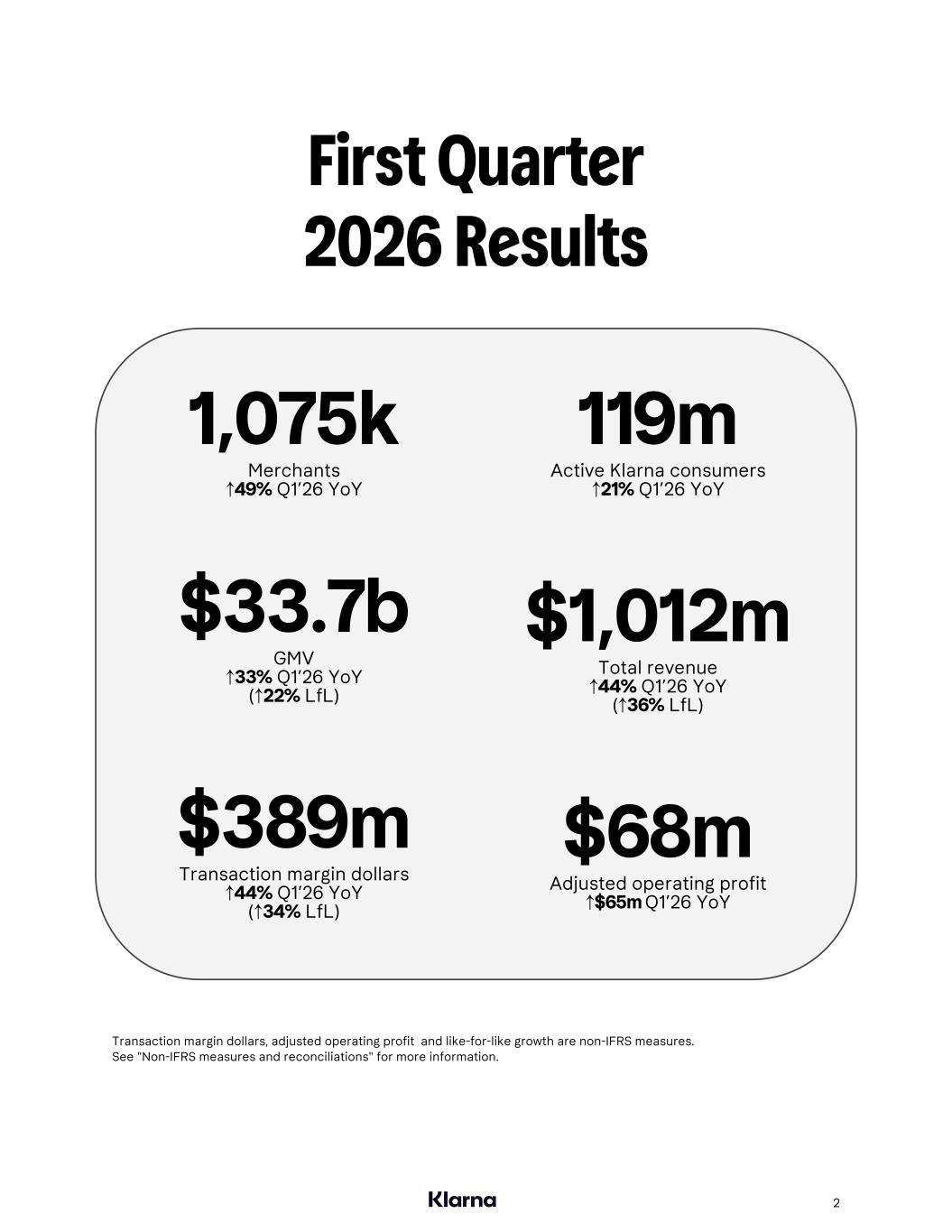
First Quarter 2026 Results 1,075k Merchants ↑49% Q1’26 YoY 119m Active Klarna consumers ↑21% Q1’26 YoY $33.7b GMV ↑33% Q1’26 YoY (↑22% LfL) $1,012m Total revenue ↑44% Q1’26 YoY (↑36% LfL) $389m Transaction margin dollars ↑44% Q1’26 YoY (↑34% LfL) $68m Adjusted operating profit ↑$65m Q1’26 YoY Transaction margin dollars, adjusted operating profit and like-for-like growth are non-IFRS measures. See "Non-IFRS measures and reconciliations" for more information. 2
Letter from the CEO Dear fellow shareholders, 1Q was a strong quarter across the board. GMV of $33.7b grew 33% year-over-year, revenue of $1,012m grew 44%, transaction margin dollars of $389m grew 44%, and adjusted operating income reached $68m, up from $3m a year ago. The FY26 framework is unchanged — these results give us confidence in the trajectory we laid out. Klarna is spend-centric, not lend-centric. We have a product solution for every consumer and merchant need. Pay in Full serves everyday spend. Pay Later, our charge-card equivalent, serves medium-sized purchases with short repayment terms. Thirdly, POS installments (“Fair Financing”), continue to gain share, particularly in the U.S. The vast majority of the POS installment borrowers come to us with an established Pay Later repayment history, which is the foundation of how we underwrite them, allowing us to deepen engagement with our existing consumer base and lift revenue per user. Being spend-centric means our book turns more than 10 times a year and our average balance per consumer is $124, against roughly $6,900 for a typical credit card. We re-underwrite essentially every transaction. Across 20 years and more than half a trillion dollars originated, the through-cycle provision rate has been approximately 0.6%. The funding model is deposit-led. 90% sits in consumer deposits, the vast majority long-term fixed deposits in Europe that support our global balance sheet. That diversification is a durable structural cost advantage, letting us price competitively for consumers and merchants. This quarter we also announced additional funding facilities extending our capacity on top of that base. The network keeps widening. A million merchants are now live (49% YoY). Stripe and Nexi continue to ramp; JPMorgan Payments and Worldpay are scheduled to go live during the year; our deep integration with partners like Stripe, Stripe Link in particular, and more recently Google Gemini sets Klarna firmly inside agentic commerce. U.S. GMV grew 39%, ex-U.S. 31%, and active consumers reached 119 million (21% YoY). Klarna consumer health by our own data reads steady: 30+ days past due on U.S. Financing improved 36 bps from the Q2’25 peak. And not least, the Klarna Card has reached 5 million active users across 16 countries, extending us into everyday spending well beyond the online checkout. TMD is the metric we manage to and how we measure progress and success of the business. As the network scales and consumers deepen, TMD compounds. Same three products. Bigger network. Deeper engagement. Thank you to our shareholders, partners, and employees for building this with us. Sebastian Siemiatkowski CEO and co-founder, Klarna 3
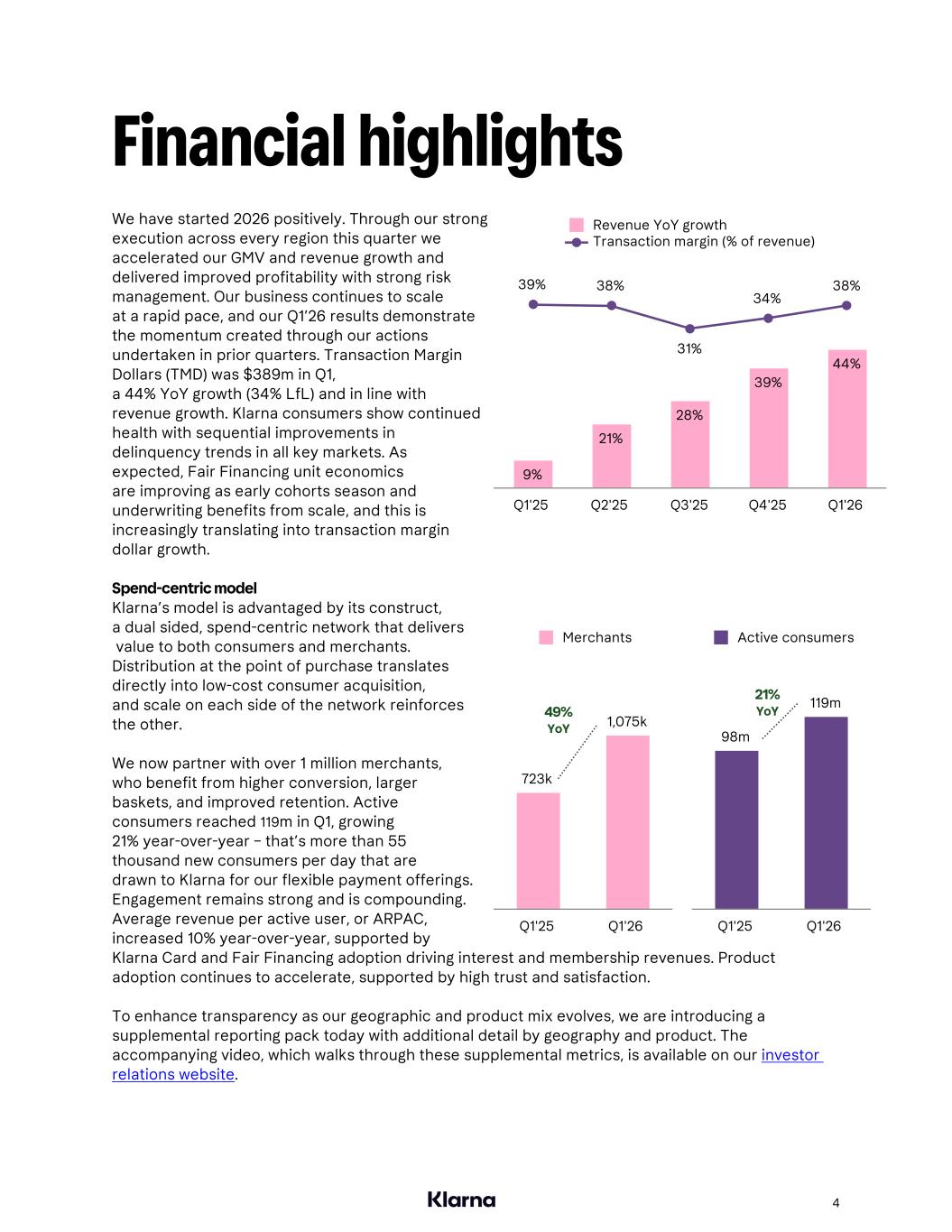
Financial highlights We have started 2026 positively. Through our strong execution across every region this quarter we accelerated our GMV and revenue growth and delivered improved profitability with strong risk management. Our business continues to scale at a rapid pace, and our Q1’26 results demonstrate the momentum created through our actions undertaken in prior quarters. Transaction Margin Dollars (TMD) was $389m in Q1, a 44% YoY growth (34% LfL) and in line with revenue growth. Klarna consumers show continued health with sequential improvements in delinquency trends in all key markets. As expected, Fair Financing unit economics are improving as early cohorts season and underwriting benefits from scale, and this is increasingly translating into transaction margin dollar growth. Spend-centric model Klarna’s model is advantaged by its construct, a dual sided, spend-centric network that delivers value to both consumers and merchants. Distribution at the point of purchase translates directly into low-cost consumer acquisition, and scale on each side of the network reinforces the other. We now partner with over 1 million merchants, who benefit from higher conversion, larger baskets, and improved retention. Active consumers reached 119m in Q1, growing 21% year-over-year – that’s more than 55 thousand new consumers per day that are drawn to Klarna for our flexible payment offerings. Engagement remains strong and is compounding. Average revenue per active user, or ARPAC, increased 10% year-over-year, supported by Klarna Card and Fair Financing adoption driving interest and membership revenues. Product adoption continues to accelerate, supported by high trust and satisfaction. To enhance transparency as our geographic and product mix evolves, we are introducing a supplemental reporting pack today with additional detail by geography and product. The accompanying video, which walks through these supplemental metrics, is available on our investor relations website. 4 9% 21% 28% 39% 44% 39% 38% 31% 34% 38% Revenue YoY growth Transaction margin (% of revenue) Q1'25 Q2'25 Q3'25 Q4'25 Q1'26 98m 119m Active consumers Q1'25 Q1'26 723k 1,075k Merchants Q1'25 Q1'26 21% YoY49% YoY
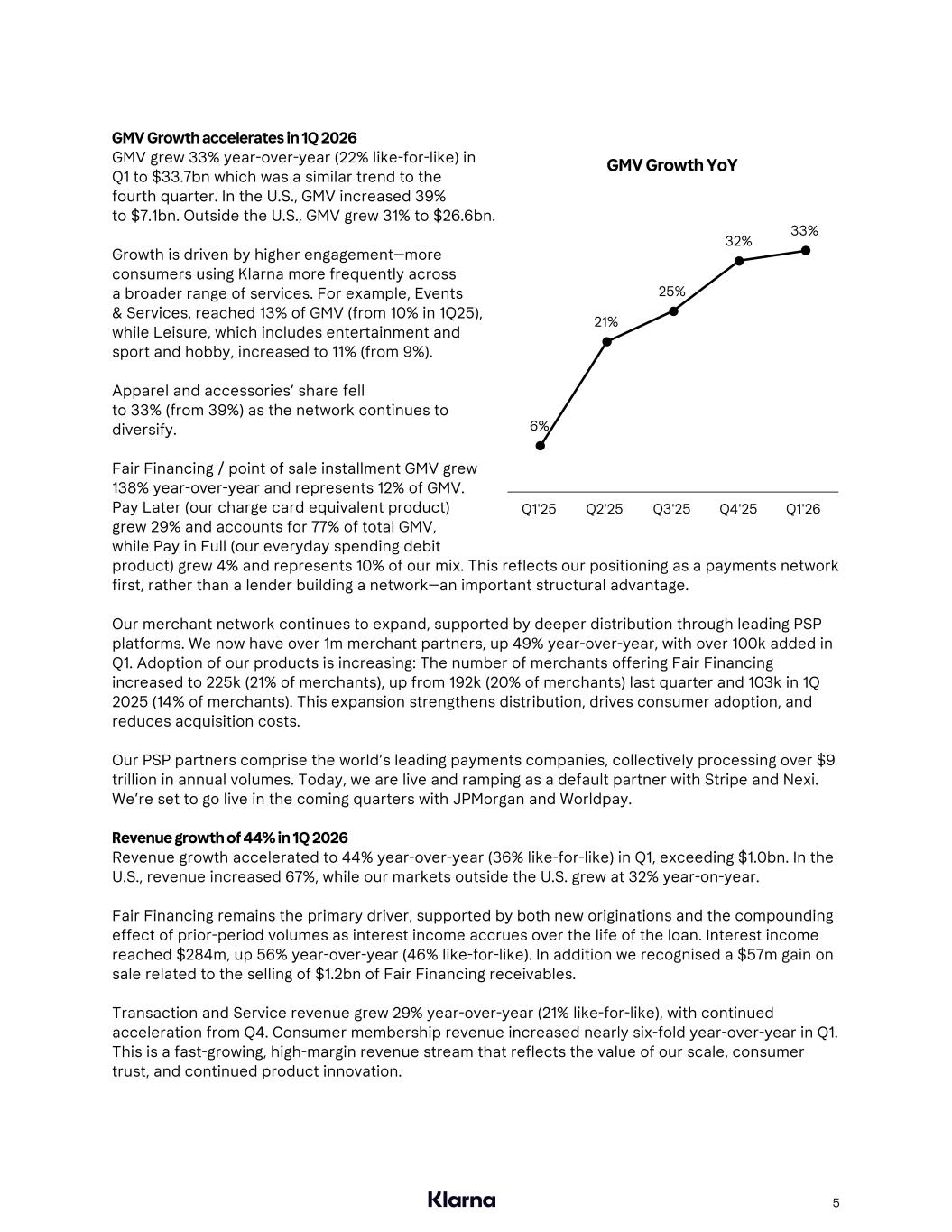
GMV Growth accelerates in 1Q 2026 GMV grew 33% year-over-year (22% like-for-like) in Q1 to $33.7bn which was a similar trend to the fourth quarter. In the U.S., GMV increased 39% to $7.1bn. Outside the U.S., GMV grew 31% to $26.6bn. Growth is driven by higher engagement—more consumers using Klarna more frequently across a broader range of services. For example, Events & Services, reached 13% of GMV (from 10% in 1Q25), while Leisure, which includes entertainment and sport and hobby, increased to 11% (from 9%). Apparel and accessories’ share fell to 33% (from 39%) as the network continues to diversify. Fair Financing / point of sale installment GMV grew 138% year-over-year and represents 12% of GMV. Pay Later (our charge card equivalent product) grew 29% and accounts for 77% of total GMV, while Pay in Full (our everyday spending debit product) grew 4% and represents 10% of our mix. This reflects our positioning as a payments network first, rather than a lender building a network—an important structural advantage. Our merchant network continues to expand, supported by deeper distribution through leading PSP platforms. We now have over 1m merchant partners, up 49% year-over-year, with over 100k added in Q1. Adoption of our products is increasing: The number of merchants offering Fair Financing increased to 225k (21% of merchants), up from 192k (20% of merchants) last quarter and 103k in 1Q 2025 (14% of merchants). This expansion strengthens distribution, drives consumer adoption, and reduces acquisition costs. Our PSP partners comprise the world’s leading payments companies, collectively processing over $9 trillion in annual volumes. Today, we are live and ramping as a default partner with Stripe and Nexi. We’re set to go live in the coming quarters with JPMorgan and Worldpay. Revenue growth of 44% in 1Q 2026 Revenue growth accelerated to 44% year-over-year (36% like-for-like) in Q1, exceeding $1.0bn. In the U.S., revenue increased 67%, while our markets outside the U.S. grew at 32% year-on-year. Fair Financing remains the primary driver, supported by both new originations and the compounding effect of prior-period volumes as interest income accrues over the life of the loan. Interest income reached $284m, up 56% year-over-year (46% like-for-like). In addition we recognised a $57m gain on sale related to the selling of $1.2bn of Fair Financing receivables. Transaction and Service revenue grew 29% year-over-year (21% like-for-like), with continued acceleration from Q4. Consumer membership revenue increased nearly six-fold year-over-year in Q1. This is a fast-growing, high-margin revenue stream that reflects the value of our scale, consumer trust, and continued product innovation. 5 GMV Growth YoY 6% 21% 25% 32% 33% Q1'25 Q2'25 Q3'25 Q4'25 Q1'26
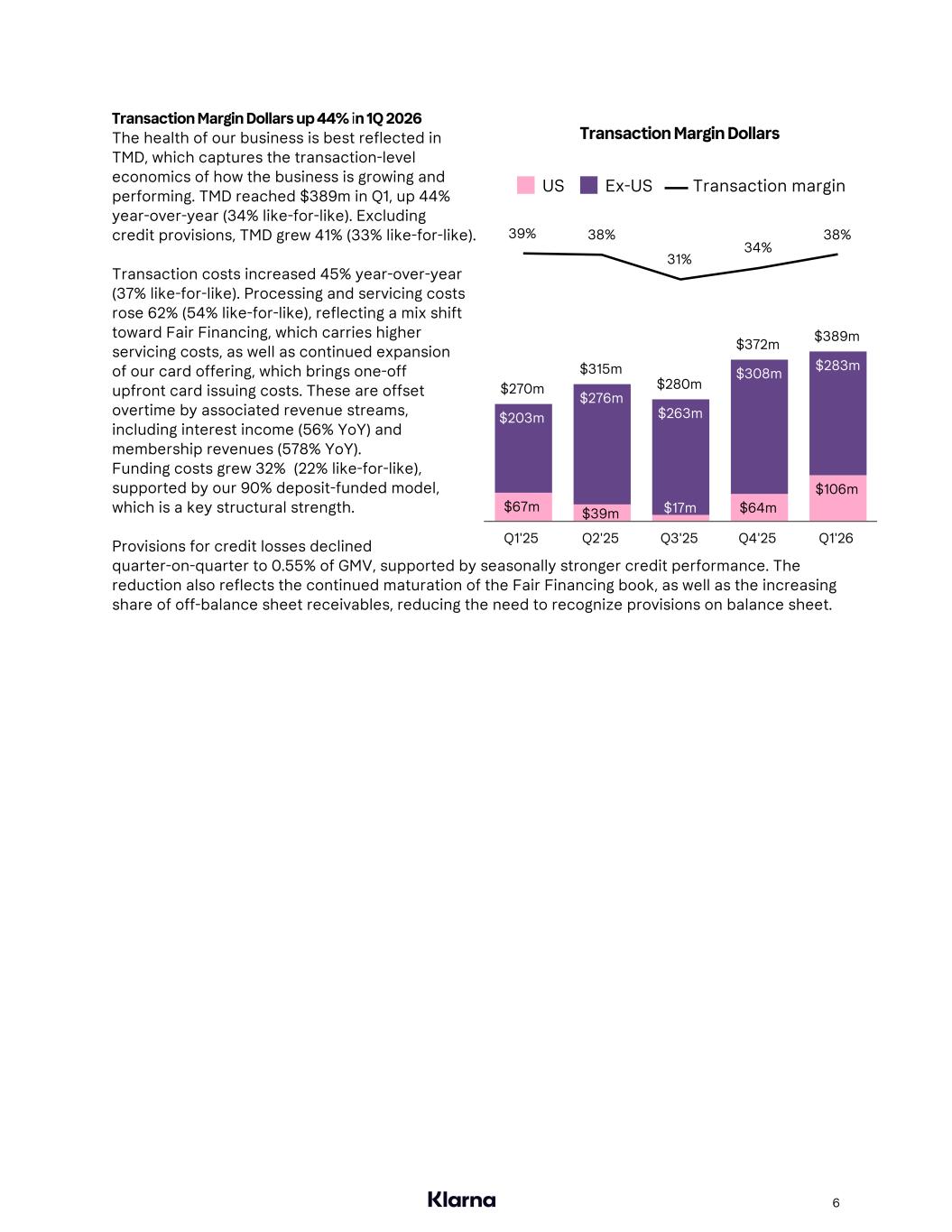
Transaction Margin Dollars up 44% in 1Q 2026 The health of our business is best reflected in TMD, which captures the transaction-level economics of how the business is growing and performing. TMD reached $389m in Q1, up 44% year-over-year (34% like-for-like). Excluding credit provisions, TMD grew 41% (33% like-for-like). Transaction costs increased 45% year-over-year (37% like-for-like). Processing and servicing costs rose 62% (54% like-for-like), reflecting a mix shift toward Fair Financing, which carries higher servicing costs, as well as continued expansion of our card offering, which brings one-off upfront card issuing costs. These are offset overtime by associated revenue streams, including interest income (56% YoY) and membership revenues (578% YoY). Funding costs grew 32% (22% like-for-like), supported by our 90% deposit-funded model, which is a key structural strength. Provisions for credit losses declined quarter-on-quarter to 0.55% of GMV, supported by seasonally stronger credit performance. The reduction also reflects the continued maturation of the Fair Financing book, as well as the increasing share of off-balance sheet receivables, reducing the need to recognize provisions on balance sheet. 6 Transaction Margin Dollars $270m $315m $280m $372m $389m $67m $39m $17m $64m $106m $203m $276m $263m $308m $283m 39% 38% 31% 34% 38% US Ex-US Transaction margin Q1'25 Q2'25 Q3'25 Q4'25 Q1'26
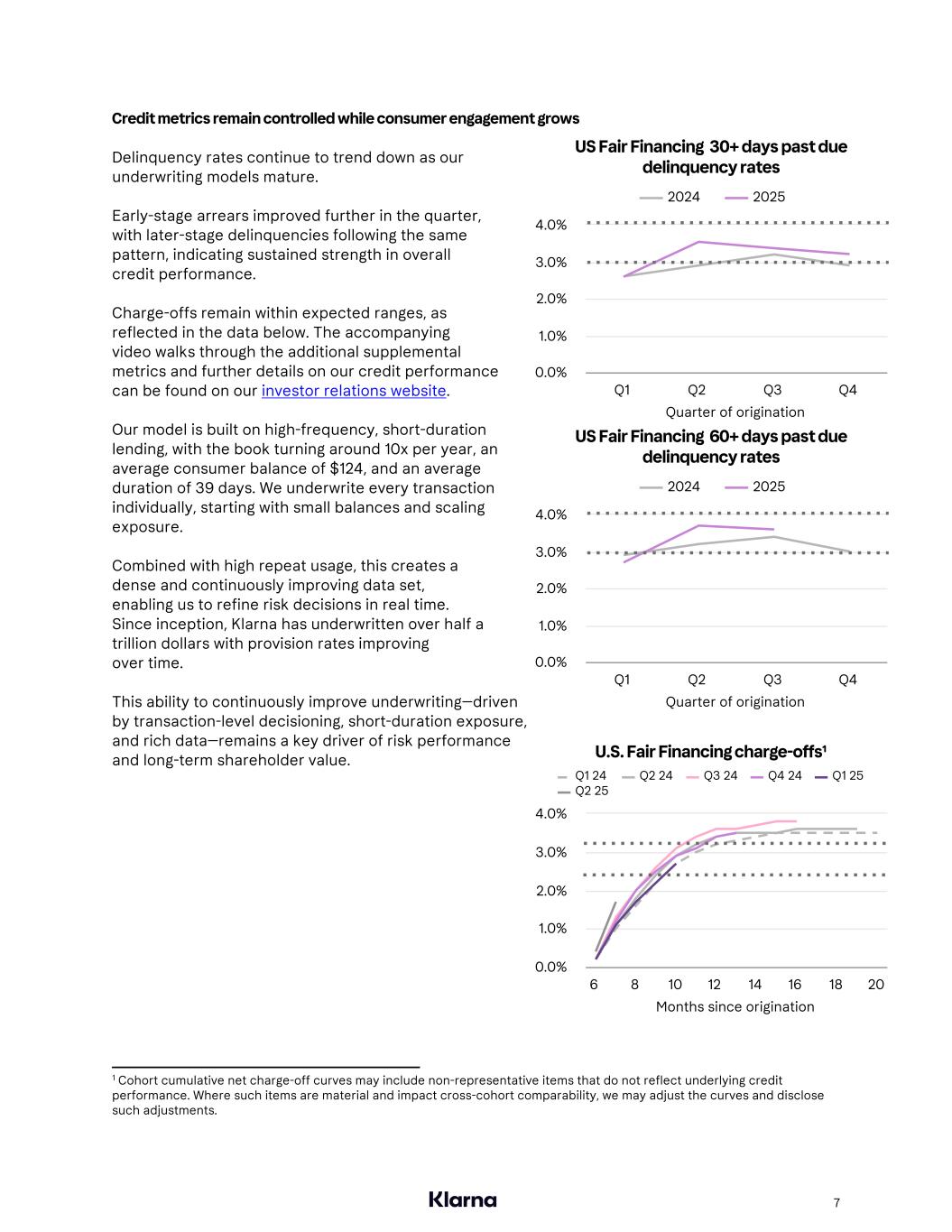
Credit metrics remain controlled while consumer engagement grows Delinquency rates continue to trend down as our underwriting models mature. Early-stage arrears improved further in the quarter, with later-stage delinquencies following the same pattern, indicating sustained strength in overall credit performance. Charge-offs1remain within expected ranges, as reflected in the data below. The accompanying video walks through the additional supplemental metrics and further details on our credit performance can be found on our investor relations website. Our model is built on high-frequency, short-duration lending, with the book turning around 10x per year, an average consumer balance of $124, and an average duration of 39 days. We underwrite every transaction individually, starting with small balances and scaling exposure. Combined with high repeat usage, this creates a dense and continuously improving data set, enabling us to refine risk decisions in real time. Since inception, Klarna has underwritten over half a trillion dollars with provision rates improving over time. This ability to continuously improve underwriting—driven by transaction-level decisioning, short-duration exposure, and rich data—remains a key driver of risk performance and long-term shareholder value. 7 1 Cohort cumulative net charge-off curves may include non-representative items that do not reflect underlying credit performance. Where such items are material and impact cross-cohort comparability, we may adjust the curves and disclose such adjustments. Quarter of origination US Fair Financing 30+ days past due delinquency rates 2024 2025 Q1 Q2 Q3 Q4 0.0% 1.0% 2.0% 3.0% 4.0% Quarter of origination US Fair Financing 60+ days past due delinquency rates 2024 2025 Q1 Q2 Q3 Q4 0.0% 1.0% 2.0% 3.0% 4.0% Months since origination U.S. Fair Financing charge-offs¹ Q1 24 Q2 24 Q3 24 Q4 24 Q1 25 Q2 25 6 8 10 12 14 16 18 20 0.0% 1.0% 2.0% 3.0% 4.0%
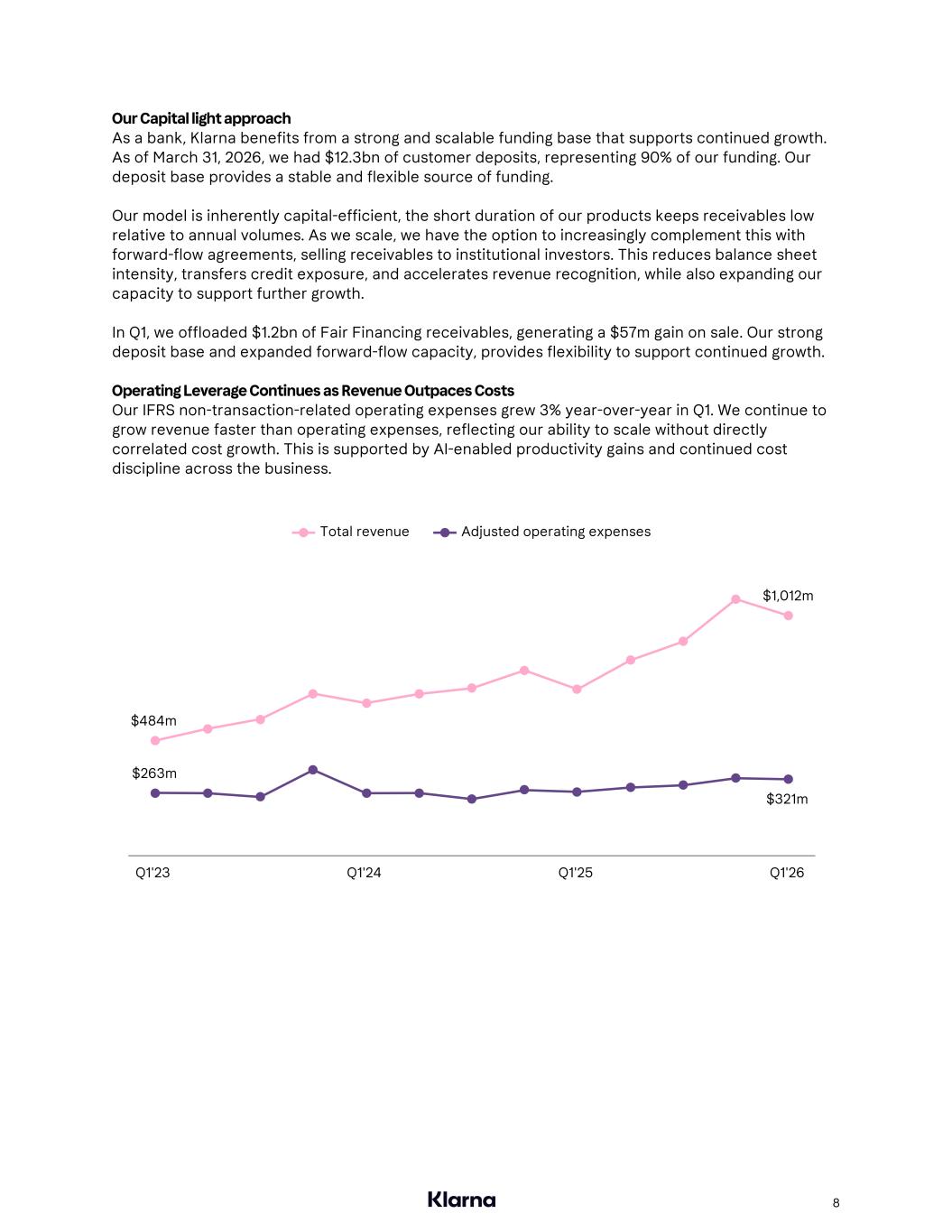
Our Capital light approach As a bank, Klarna benefits from a strong and scalable funding base that supports continued growth. As of March 31, 2026, we had $12.3bn of customer deposits, representing 90% of our funding. Our deposit base provides a stable and flexible source of funding. Our model is inherently capital-efficient, the short duration of our products keeps receivables low relative to annual volumes. As we scale, we have the option to increasingly complement this with forward-flow agreements, selling receivables to institutional investors. This reduces balance sheet intensity, transfers credit exposure, and accelerates revenue recognition, while also expanding our capacity to support further growth. In Q1, we offloaded $1.2bn of Fair Financing receivables, generating a $57m gain on sale. Our strong deposit base and expanded forward-flow capacity, provides flexibility to support continued growth. Operating Leverage Continues as Revenue Outpaces Costs Our IFRS non-transaction-related operating expenses grew 3% year-over-year in Q1. We continue to grow revenue faster than operating expenses, reflecting our ability to scale without directly correlated cost growth. This is supported by AI-enabled productivity gains and continued cost discipline across the business. 8 $484m $1,012m $263m $321m Total revenue Adjusted operating expenses Q1'23 Q1'24 Q1'25 Q1'26
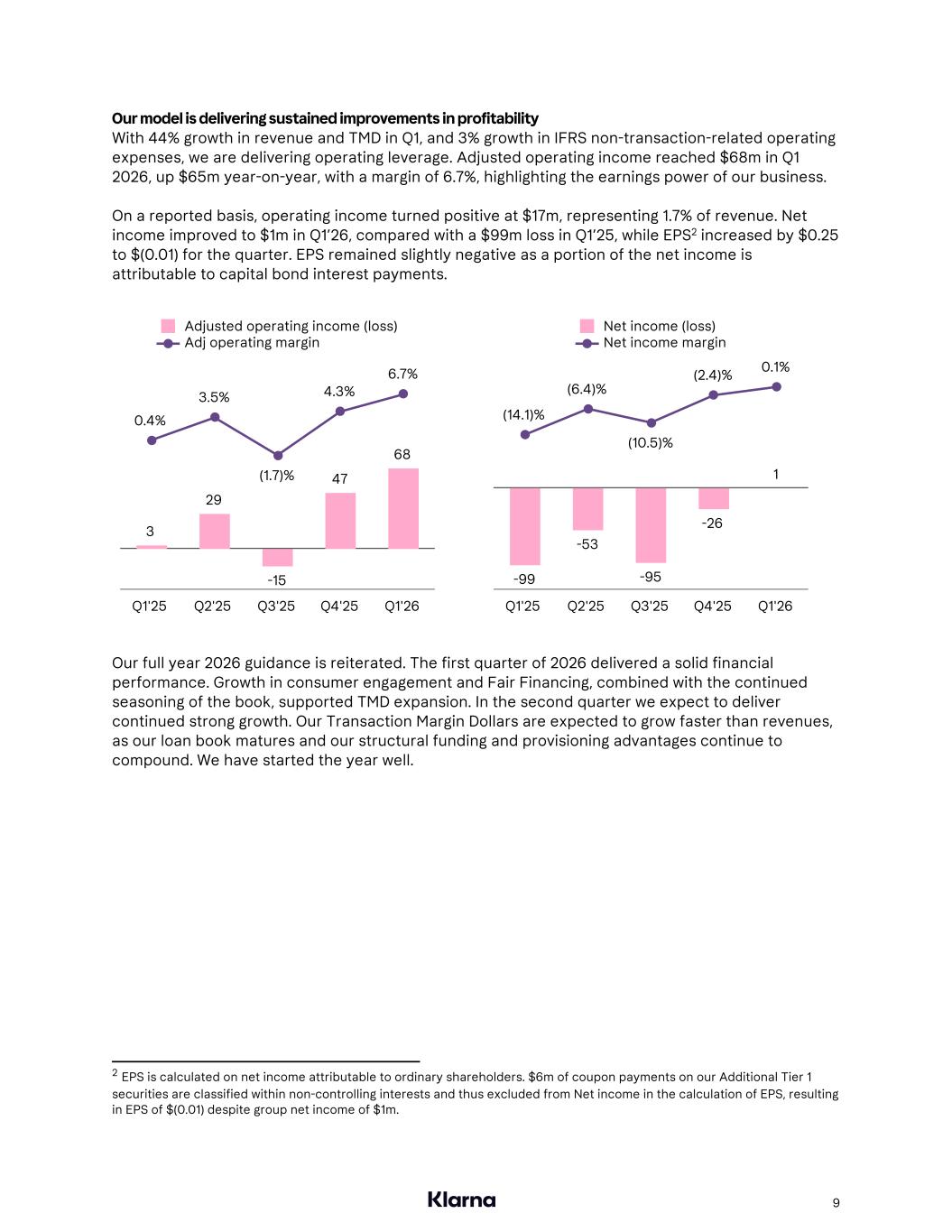
Our model is delivering sustained improvements in profitability With 44% growth in revenue and TMD in Q1, and 3% growth in IFRS non-transaction-related operating expenses, we are delivering operating leverage. Adjusted operating income reached $68m in Q1 2026, up $65m year-on-year, with a margin of 6.7%, highlighting the earnings power of our business. On a reported basis, operating income turned positive at $17m, representing 1.7% of revenue. Net income improved to $1m in Q1’26, compared with a $99m loss in Q1’25, while EPS2 increased by $0.25 to $(0.01) for the quarter. EPS remained slightly negative as a portion of the net income is attributable to capital bond interest payments. Our full year 2026 guidance is reiterated. The first quarter of 2026 delivered a solid financial performance. Growth in consumer engagement and Fair Financing, combined with the continued seasoning of the book, supported TMD expansion. In the second quarter we expect to deliver continued strong growth. Our Transaction Margin Dollars are expected to grow faster than revenues, as our loan book matures and our structural funding and provisioning advantages continue to compound. We have started the year well. 9 2 EPS is calculated on net income attributable to ordinary shareholders. $6m of coupon payments on our Additional Tier 1 securities are classified within non-controlling interests and thus excluded from Net income in the calculation of EPS, resulting in EPS of $(0.01) despite group net income of $1m. 3 29 -15 47 68 0.4% 3.5% (1.7)% 4.3% 6.7% Adjusted operating income (loss) Adj operating margin Q1'25 Q2'25 Q3'25 Q4'25 Q1'26 -99 -53 -95 -26 1 (14.1)% (6.4)% (10.5)% (2.4)% 0.1% Net income (loss) Net income margin Q1'25 Q2'25 Q3'25 Q4'25 Q1'26
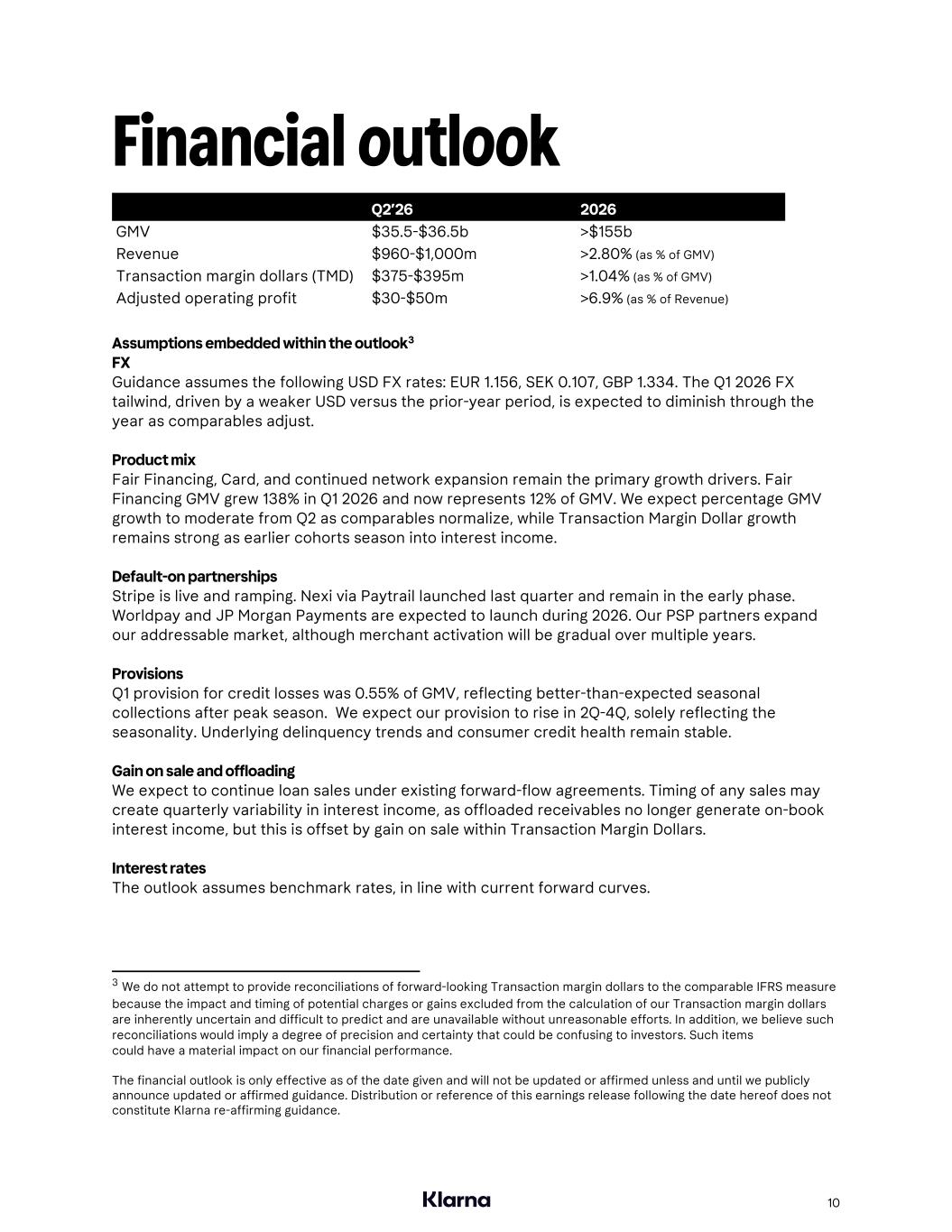
Financial outlook Q2’26 2026 GMV $35.5-$36.5b >$155b Revenue $960-$1,000m >2.80% (as % of GMV) Transaction margin dollars (TMD) $375-$395m >1.04% (as % of GMV) Adjusted operating profit $30-$50m >6.9% (as % of Revenue) Assumptions embedded within the outlook3 FX Guidance assumes the following USD FX rates: EUR 1.156, SEK 0.107, GBP 1.334. The Q1 2026 FX tailwind, driven by a weaker USD versus the prior-year period, is expected to diminish through the year as comparables adjust. Product mix Fair Financing, Card, and continued network expansion remain the primary growth drivers. Fair Financing GMV grew 138% in Q1 2026 and now represents 12% of GMV. We expect percentage GMV growth to moderate from Q2 as comparables normalize, while Transaction Margin Dollar growth remains strong as earlier cohorts season into interest income. Default-on partnerships Stripe is live and ramping. Nexi via Paytrail launched last quarter and remain in the early phase. Worldpay and JP Morgan Payments are expected to launch during 2026. Our PSP partners expand our addressable market, although merchant activation will be gradual over multiple years. Provisions Q1 provision for credit losses was 0.55% of GMV, reflecting better-than-expected seasonal collections after peak season. We expect our provision to rise in 2Q-4Q, solely reflecting the seasonality. Underlying delinquency trends and consumer credit health remain stable. Gain on sale and offloading We expect to continue loan sales under existing forward-flow agreements. Timing of any sales may create quarterly variability in interest income, as offloaded receivables no longer generate on-book interest income, but this is offset by gain on sale within Transaction Margin Dollars. Interest rates The outlook assumes benchmark rates, in line with current forward curves. 10 3 We do not attempt to provide reconciliations of forward-looking Transaction margin dollars to the comparable IFRS measure because the impact and timing of potential charges or gains excluded from the calculation of our Transaction margin dollars are inherently uncertain and difficult to predict and are unavailable without unreasonable efforts. In addition, we believe such reconciliations would imply a degree of precision and certainty that could be confusing to investors. Such items could have a material impact on our financial performance. The financial outlook is only effective as of the date given and will not be updated or affirmed unless and until we publicly announce updated or affirmed guidance. Distribution or reference of this earnings release following the date hereof does not constitute Klarna re-affirming guidance.
Conference call Klarna will host a conference call and webcast to discuss its first quarter 2026 financial results on May 14, 2026, at 8:30 am ET. Participating on the call will be: • Sebastian Siemiatkowski, Chief Executive Officer, and • Niclas Neglen, Chief Financial Officer The conference call will be webcast live on Klarna’s investor relations website at investors.klarna.com. A replay will be available on the same website following the call. 11
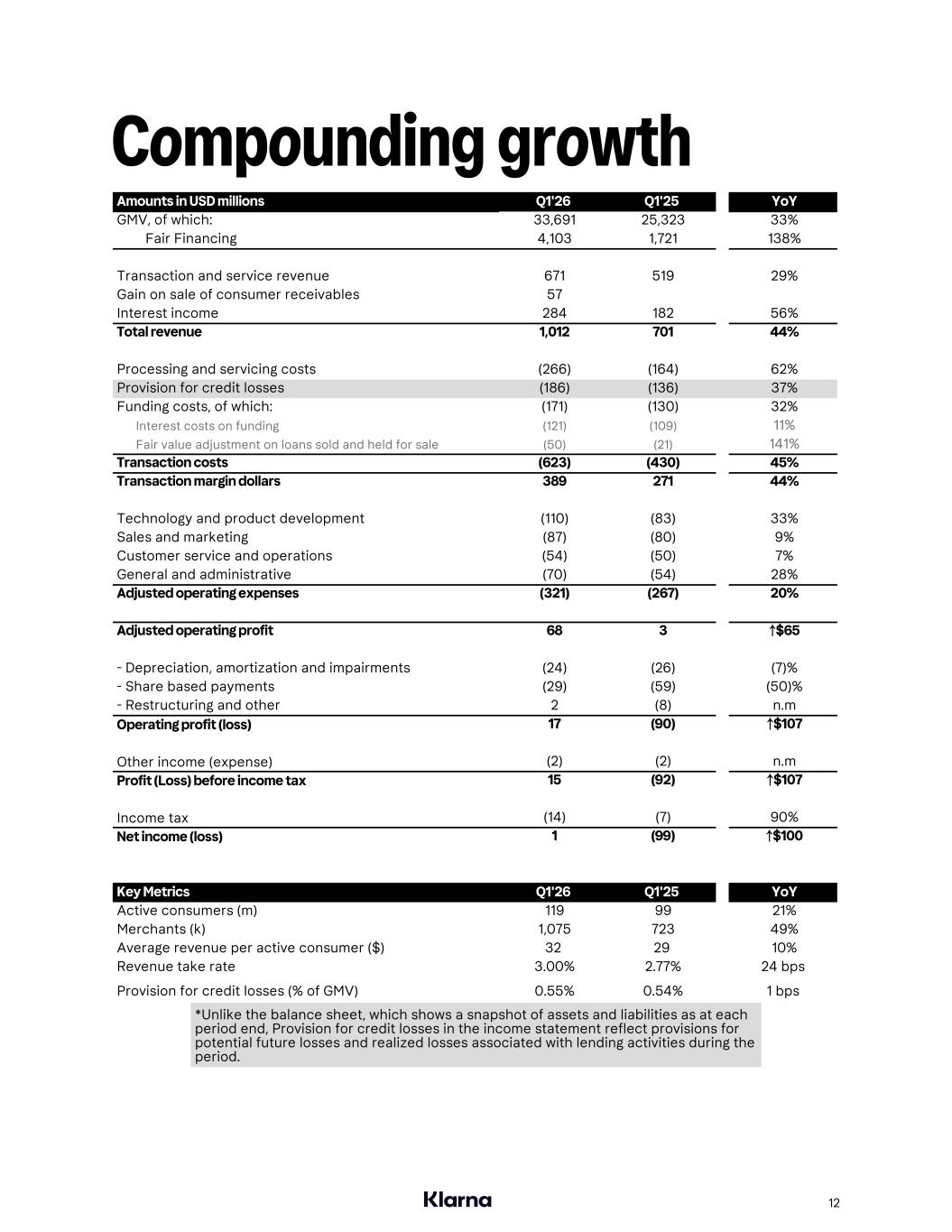
Compounding growth Amounts in USD millions Q1'26 Q1'25 YoY GMV, of which: 33,691 25,323 33% Fair Financing 4,103 1,721 138% Transaction and service revenue 671 519 29% Gain on sale of consumer receivables 57 Interest income 284 182 56% Total revenue 1,012 701 44% Processing and servicing costs (266) (164) 62% Provision for credit losses (186) (136) 37% Funding costs, of which: (171) (130) 32% Interest costs on funding (121) (109) 11% Fair value adjustment on loans sold and held for sale (50) (21) 141% Transaction costs (623) (430) 45% Transaction margin dollars 389 271 44% Technology and product development (110) (83) 33% Sales and marketing (87) (80) 9% Customer service and operations (54) (50) 7% General and administrative (70) (54) 28% Adjusted operating expenses (321) (267) 20% Adjusted operating profit 68 3 ↑$65 - Depreciation, amortization and impairments (24) (26) (7)% - Share based payments (29) (59) (50)% - Restructuring and other 2 (8) n.m Operating profit (loss) 17 (90) ↑$107 Other income (expense) (2) (2) n.m Profit (Loss) before income tax 15 (92) ↑$107 Income tax (14) (7) 90% Net income (loss) 1 (99) ↑$100 Key Metrics Q1'26 Q1'25 YoY Active consumers (m) 119 99 21% Merchants (k) 1,075 723 49% Average revenue per active consumer ($) 32 29 10% Revenue take rate 3.00% 2.77% 24 bps Provision for credit losses (% of GMV) 0.55% 0.54% 1 bps *Unlike the balance sheet, which shows a snapshot of assets and liabilities as at each period end, Provision for credit losses in the income statement reflect provisions for potential future losses and realized losses associated with lending activities during the period. 12
Definitions Like-for-like (LfL) growth Year-over-year change on a like-for-like basis is calculated by adjusting the relevant metric for the impact of foreign currency fluctuations. The impact of foreign currency fluctuations is calculated by translating the reported amounts in the current period using the exchange rates in use during the comparative prior period. Prior to Q1 2026, like-for-like growth also adjusted for the divestiture of Klarna Checkout (KCO), completed in October 2024. As Q1 2025 is the first comparative period in which KCO is fully lapped, no KCO adjustment is required from Q1 2026 onwards. Active Klarna consumers Consumers who have made a purchase or a payment using a Klarna-branded product or logged into the Klarna app within the past 12 months, calculated as of the end of that 12-month period. New merchants Refers to the net new number of merchants onboarded year-over-year. Merchants means the businesses that offer their goods and services to consumers on our network. The number of merchants presented refers to the number of unique combinations of brands (e.g., H&M) available on our network and the markets where such brands are available (e.g., Sweden). Gross merchandise volume (GMV) The total monetary value of all completed purchases on our network in that period, excluding any additional fees and any subsequent actions (such as returns, settlements and disputes). Take rate Total revenue as a percentage of GMV. Average revenue per active consumer (ARPAC) Our total revenue for the trailing twelve months, divided by the number of active Klarna consumers over that period. Transaction margin dollars Transaction margin dollars as total revenue less total transaction costs, which consist of processing and servicing costs, provision for credit losses and funding costs. Transaction margin dollars before Provision for credit losses Transaction margin dollars as total revenue less processing and servicing costs and funding costs. Provision for credit losses (% of GMV) Provision for credit losses divided by GMV. Realized losses (% of GMV) Actual loan losses incurred during the period divided by GMV. Upfront provisions (% of GMV) Upfront provisions which primarily reflect expected losses at origination as well as changes in credit risk of on-book loans, divided by GMV. Adjusted operating profit (loss) Adjusted operating profit (loss) is defined as operating profit (loss) excluding (i) depreciation, amortization and impairments, (ii) share-based payments expense, (iii) restructuring costs and expenses related to preparation for an initial public offering. IFRS non-transaction-related operating expenses IFRS non-transaction-related operating expenses is defined as IFRS operating expenses excluding processing and servicing costs, provision for credit losses and funding costs. 13
Non-IFRS measures and reconciliations We use certain non-IFRS financial measures to supplement our consolidated financial statements, which are presented in accordance with IFRS. These non-IFRS financial measures include Transaction margin dollars, Transaction margin, Adjusted operating profit (loss), Adjusted operating expenses and Adjusted operating margin. We use these non-IFRS financial measures to facilitate the review of our operational performance and as a basis for strategic planning. We also present period-over-period changes in certain metrics on like-for-like (LfL) basis, which is calculated by adjusting the metric for the impact of foreign currency fluctuations. The impact of foreign currency fluctuations is calculated by translating the reported amounts in the current period using the exchange rates in use during the comparative prior period. Transaction margin dollars and Transaction margin are key performance measures used by our management to measure our ability to attain efficiency and scale and to grow these metrics over time. They measure our success in growing revenue while effectively managing our processing and servicing costs, provision for credit losses and funding costs. In addition, by excluding certain items that are nonrecurring or not reflective of the performance of our normal course of business, we believe that Adjusted operating expenses, Adjusted operating profit (loss) and Adjusted operating margin provide meaningful supplemental information regarding our performance. Accordingly, we believe that these non-IFRS financial measures are useful to investors and others because they allow investors to supplement their understanding of our financial trends and evaluate our ongoing and future performance in the same manner as management. However, there are several limitations related to the use of non-IFRS financial measures as they reflect the exercise of judgment by our management about which expenses are excluded or included in determining these non-IFRS measures. These non-IFRS measures should be considered in addition to, not as a substitute for or in isolation from, our financial results prepared in accordance with IFRS. Other companies, including companies in our industry, may calculate these non-IFRS (or similar non-GAAP) financial measures differently or not at all, which reduces their usefulness as comparative measures. Transaction margin dollars is defined as total revenue less total transaction costs, consisting of processing and servicing, provision for credit losses and funding costs. Transaction margin is calculated by dividing Transaction margin dollars by our total revenue. Adjusted operating profit (loss) is defined as operating profit (loss) excluding (i) depreciation, amortization and impairments, (ii) share-based payments expense, (iii) severance-related restructuring costs and (iv) expenses related to the preparation of the initial public offering (IPO). Adjusted operating expenses are defined as operating expenses excluding (i) depreciation, amortization and impairments, (ii) share-based payments expense and (iii) severance-related restructuring costs. Adjusted operating margin is defined as Adjusted operating profit (loss) divided by our total revenue. Depreciation, amortization and impairments below include amounts recorded within Technology and product development expenses in our consolidated statements of profit and loss. We consider the exclusion of certain nonrecurring or noncash items in calculating Adjusted operating profit (loss), Adjusted operating margin and Adjusted non-transaction-related operating expenses to provide a useful measure for investors and others to evaluate our operating results and expenses in the same manner as management. 14
Forward-looking statements This earnings release contains forward-looking statements within the meaning of applicable securities laws. These statements include, but are not limited to, statements regarding our future financial performance, business strategy, growth objectives, market opportunities, and operational plans. Words such as "believe," "expect," "anticipate," "intend," "plan," "will," "may," "could," "estimate," and similar expressions identify forward- looking statements. These forward-looking statements are subject to risks, uncertainties, and assumptions that could cause actual results to differ materially from those expressed or implied, including risks related to: • Our ability to retain and grow consumer and merchant relationships; • Competition and technological developments; • Regulatory compliance and licensing requirements; • Credit risk management and funding availability; • General economic conditions and market volatility; and • Our ability to expand into new markets and products. Forward-looking statements reflect our views as of the date of this release and are based on information currently available to us. We undertake no obligation to update any forward-looking statements, except as required by law. Actual results may differ materially from those anticipated. Investors should not place undue reliance on these forward-looking statements and should review the risk factors in our filings with the SEC for a more complete discussion of risks. 15
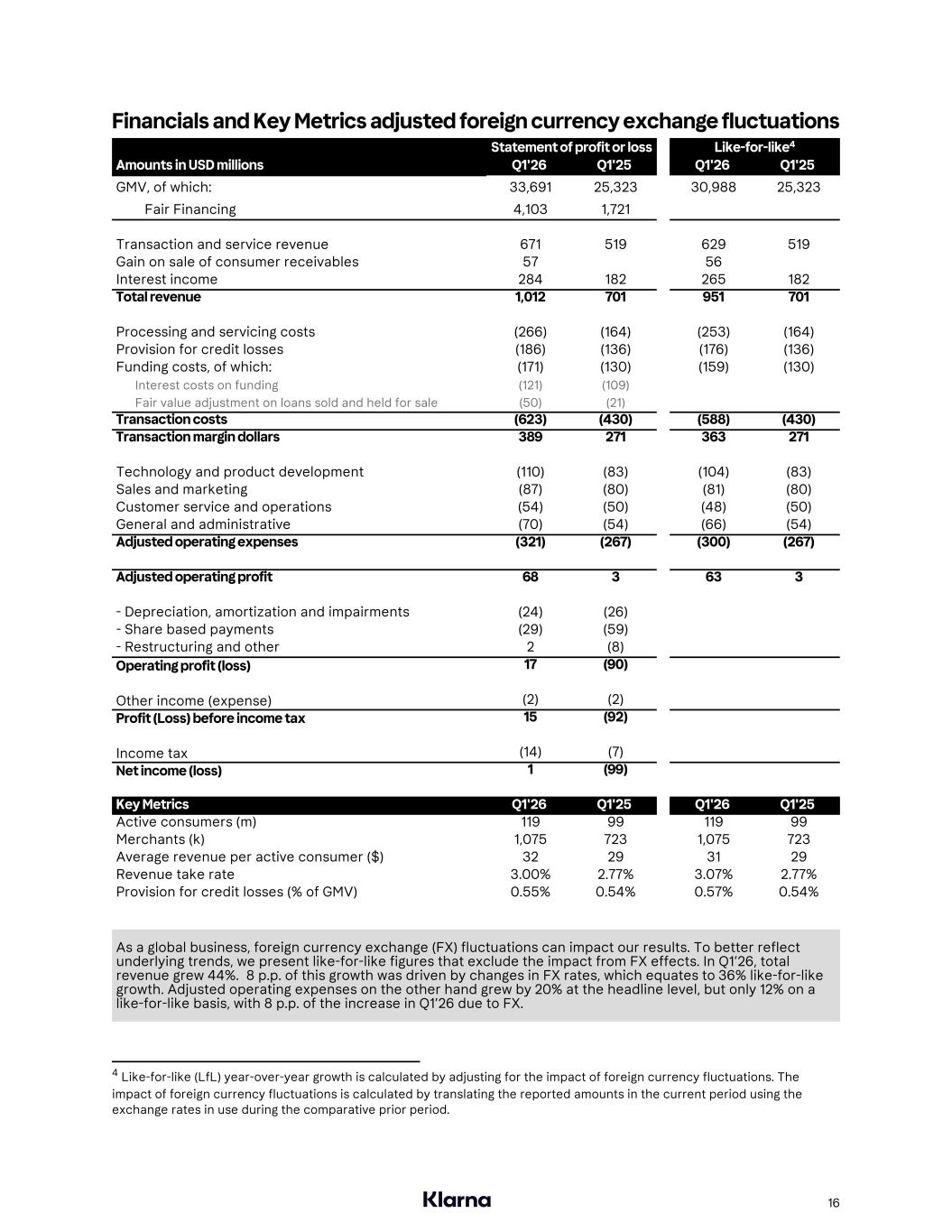
Financials and Key Metrics adjusted foreign currency exchange fluctuations Statement of profit or loss Like-for-like4 Amounts in USD millions Q1'26 Q1'25 Q1'26 Q1'25 GMV, of which: 33,691 25,323 30,988 25,323 Fair Financing 4,103 1,721 Transaction and service revenue 671 519 629 519 Gain on sale of consumer receivables 57 56 Interest income 284 182 265 182 Total revenue 1,012 701 951 701 Processing and servicing costs (266) (164) (253) (164) Provision for credit losses (186) (136) (176) (136) Funding costs, of which: (171) (130) (159) (130) Interest costs on funding (121) (109) Fair value adjustment on loans sold and held for sale (50) (21) Transaction costs (623) (430) (588) (430) Transaction margin dollars 389 271 363 271 Technology and product development (110) (83) (104) (83) Sales and marketing (87) (80) (81) (80) Customer service and operations (54) (50) (48) (50) General and administrative (70) (54) (66) (54) Adjusted operating expenses (321) (267) (300) (267) Adjusted operating profit 68 3 63 3 - Depreciation, amortization and impairments (24) (26) - Share based payments (29) (59) - Restructuring and other 2 (8) Operating profit (loss) 17 (90) Other income (expense) (2) (2) Profit (Loss) before income tax 15 (92) Income tax (14) (7) Net income (loss) 1 (99) Key Metrics Q1'26 Q1'25 Q1'26 Q1'25 Active consumers (m) 119 99 119 99 Merchants (k) 1,075 723 1,075 723 Average revenue per active consumer ($) 32 29 31 29 Revenue take rate 3.00% 2.77% 3.07% 2.77% Provision for credit losses (% of GMV) 0.55% 0.54% 0.57% 0.54% As a global business, foreign currency exchange (FX) fluctuations can impact our results. To better reflect underlying trends, we present like-for-like figures that exclude the impact from FX effects. In Q1’26, total revenue grew 44%. 8 p.p. of this growth was driven by changes in FX rates, which equates to 36% like-for-like growth. Adjusted operating expenses on the other hand grew by 20% at the headline level, but only 12% on a like-for-like basis, with 8 p.p. of the increase in Q1’26 due to FX. 16 4 Like-for-like (LfL) year-over-year growth is calculated by adjusting for the impact of foreign currency fluctuations. The impact of foreign currency fluctuations is calculated by translating the reported amounts in the current period using the exchange rates in use during the comparative prior period.
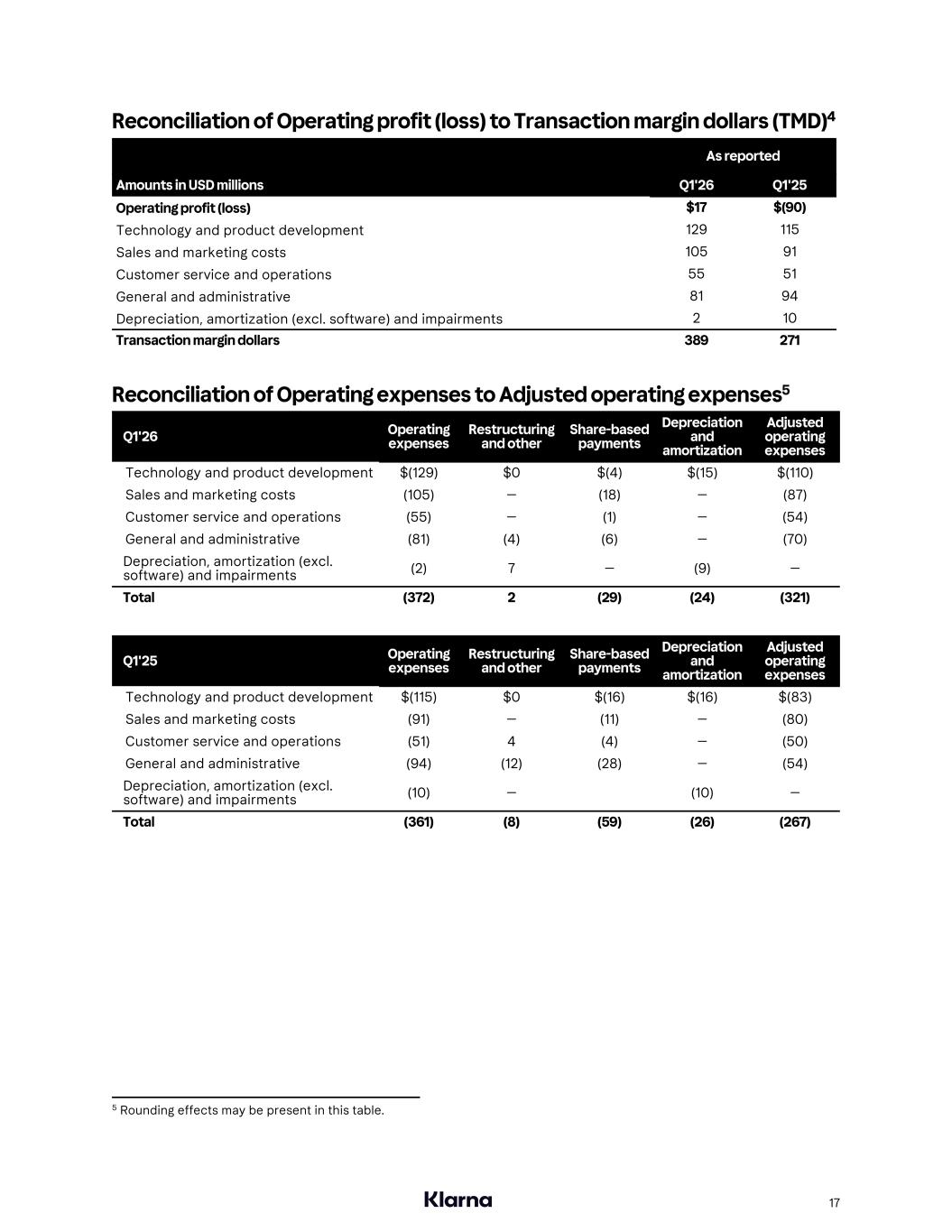
Reconciliation of Operating profit (loss) to Transaction margin dollars (TMD)4 As reported Amounts in USD millions Q1'26 Q1'25 Operating profit (loss) $17 $(90) Technology and product development 129 115 Sales and marketing costs 105 91 Customer service and operations 55 51 General and administrative 81 94 Depreciation, amortization (excl. software) and impairments 2 10 Transaction margin dollars 389 271 Reconciliation of Operating expenses to Adjusted operating expenses5 Q1'26 Operating expenses Restructuring and other Share-based payments Depreciation and amortization Adjusted operating expenses Technology and product development $(129) $0 $(4) $(15) $(110) Sales and marketing costs (105) — (18) — (87) Customer service and operations (55) — (1) — (54) General and administrative (81) (4) (6) — (70) Depreciation, amortization (excl. software) and impairments (2) 7 — (9) — Total (372) 2 (29) (24) (321) Q1'25 Operating expenses Restructuring and other Share-based payments Depreciation and amortization Adjusted operating expenses Technology and product development $(115) $0 $(16) $(16) $(83) Sales and marketing costs (91) — (11) — (80) Customer service and operations (51) 4 (4) — (50) General and administrative (94) (12) (28) — (54) Depreciation, amortization (excl. software) and impairments (10) — (10) — Total (361) (8) (59) (26) (267) 17 5 Rounding effects may be present in this table.
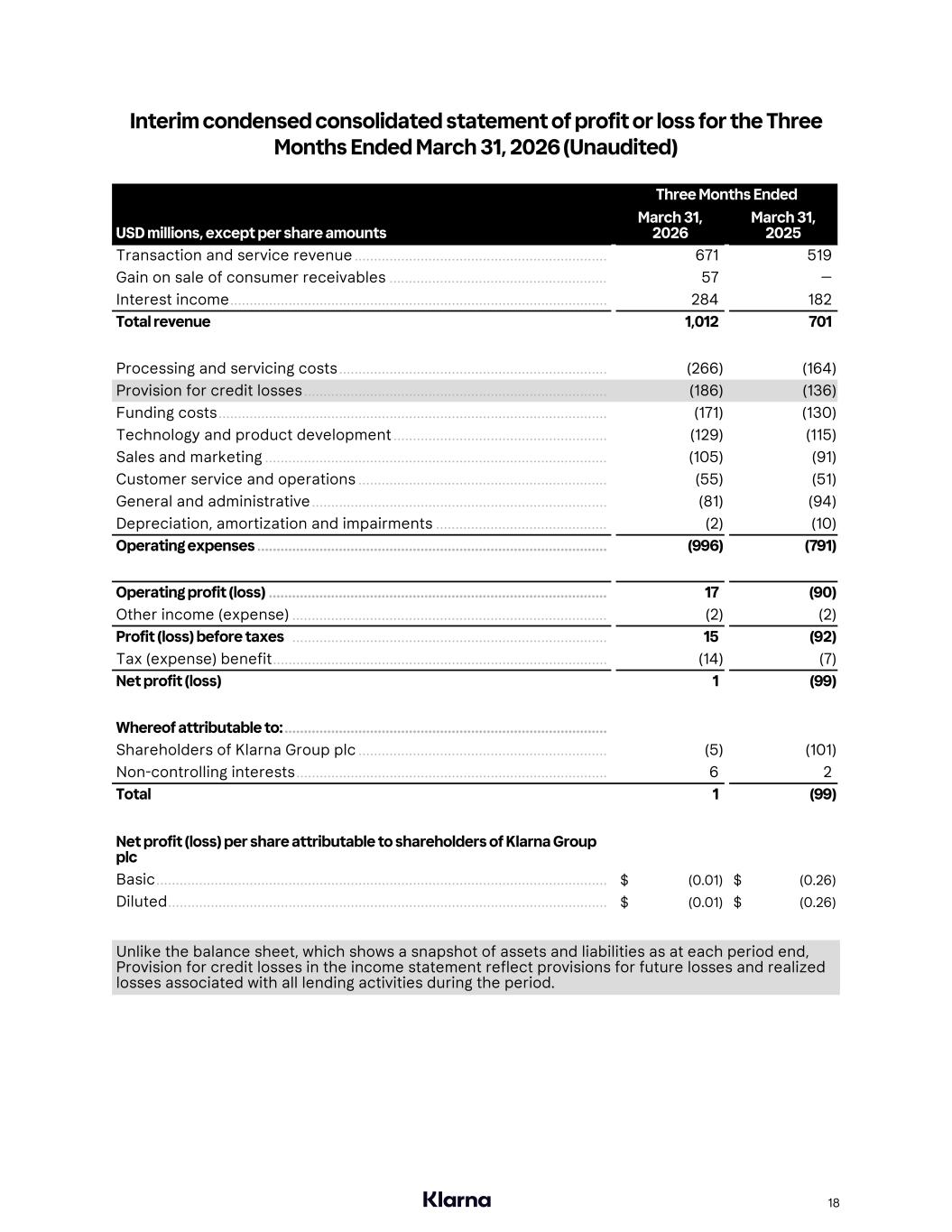
Interim condensed consolidated statement of profit or loss for the Three Months Ended March 31, 2026 (Unaudited) Three Months Ended USD millions, except per share amounts March 31, 2026 March 31, 2025 Transaction and service revenue ................................................................. 671 519 Gain on sale of consumer receivables ........................................................ 57 — Interest income ................................................................................................. 284 182 Total revenue 1,012 701 Processing and servicing costs ..................................................................... (266) (164) Provision for credit losses .............................................................................. (186) (136) Funding costs .................................................................................................... (171) (130) Technology and product development ....................................................... (129) (115) Sales and marketing ........................................................................................ (105) (91) Customer service and operations ................................................................ (55) (51) General and administrative ............................................................................ (81) (94) Depreciation, amortization and impairments ............................................ (2) (10) Operating expenses .......................................................................................... (996) (791) Operating profit (loss) ....................................................................................... 17 (90) Other income (expense) ................................................................................. (2) (2) Profit (loss) before taxes ................................................................................. 15 (92) Tax (expense) benefit ...................................................................................... (14) (7) Net profit (loss) 1 (99) Whereof attributable to: ................................................................................... Shareholders of Klarna Group plc ................................................................ (5) (101) Non-controlling interests ................................................................................ 6 2 Total 1 (99) Net profit (loss) per share attributable to shareholders of Klarna Group plc Basic .................................................................................................................... $ (0.01) $ (0.26) Diluted ................................................................................................................. $ (0.01) $ (0.26) Unlike the balance sheet, which shows a snapshot of assets and liabilities as at each period end, Provision for credit losses in the income statement reflect provisions for future losses and realized losses associated with all lending activities during the period. 18
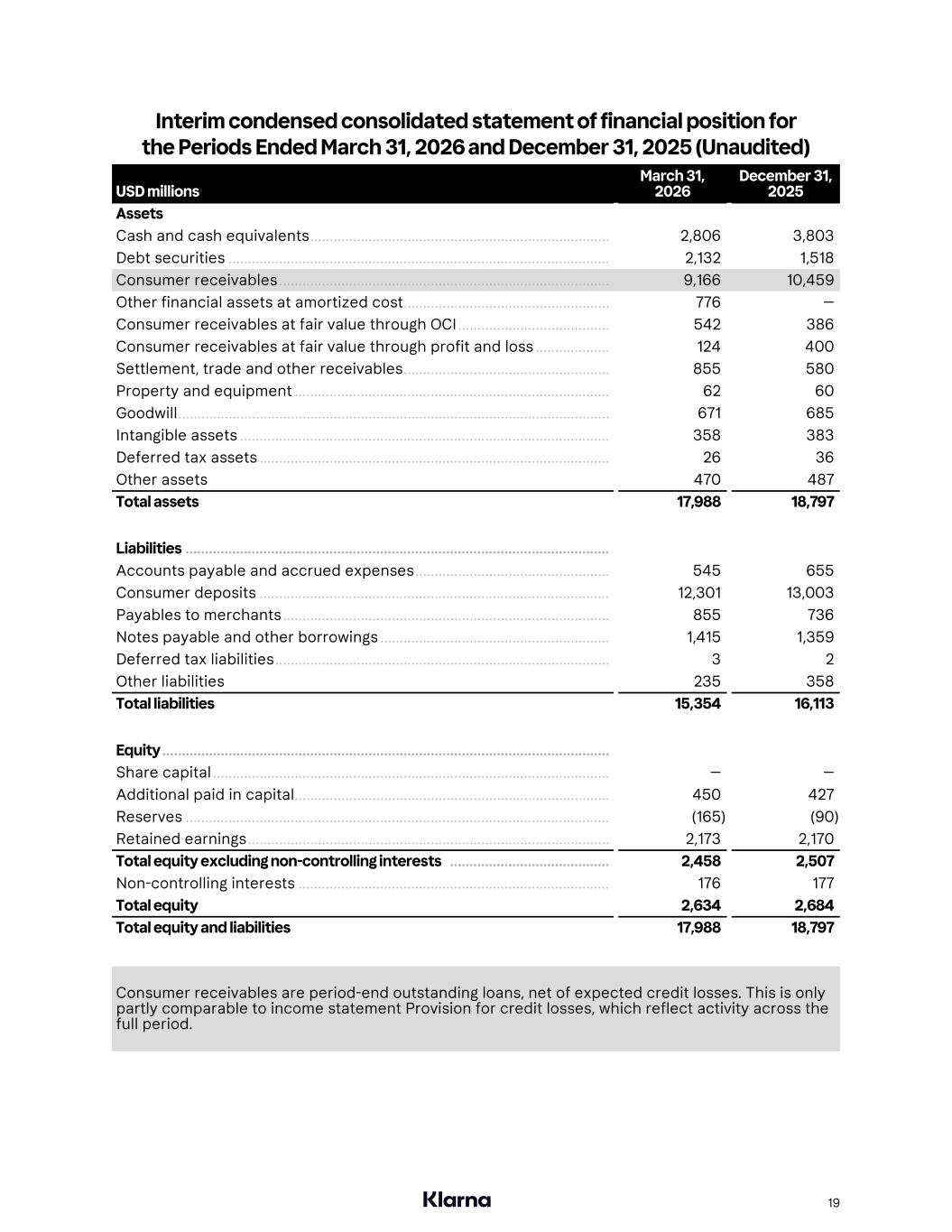
Interim condensed consolidated statement of financial position for the Periods Ended March 31, 2026 and December 31, 2025 (Unaudited) USD millions March 31, 2026 December 31, 2025 Assets Cash and cash equivalents ............................................................................. 2,806 3,803 Debt securities .................................................................................................. 2,132 1,518 Consumer receivables ..................................................................................... 9,166 10,459 Other financial assets at amortized cost ..................................................... 776 — Consumer receivables at fair value through OCI ....................................... 542 386 Consumer receivables at fair value through profit and loss ................... 124 400 Settlement, trade and other receivables ..................................................... 855 580 Property and equipment ................................................................................. 62 60 Goodwill ............................................................................................................... 671 685 Intangible assets ............................................................................................... 358 383 Deferred tax assets .......................................................................................... 26 36 Other assets 470 487 Total assets 17,988 18,797 Liabilities ............................................................................................................. Accounts payable and accrued expenses .................................................. 545 655 Consumer deposits .......................................................................................... 12,301 13,003 Payables to merchants .................................................................................... 855 736 Notes payable and other borrowings ........................................................... 1,415 1,359 Deferred tax liabilities ...................................................................................... 3 2 Other liabilities 235 358 Total liabilities 15,354 16,113 Equity ................................................................................................................... Share capital ...................................................................................................... — — Additional paid in capital ................................................................................. 450 427 Reserves ............................................................................................................. (165) (90) Retained earnings ............................................................................................. 2,173 2,170 Total equity excluding non-controlling interests ......................................... 2,458 2,507 Non-controlling interests ................................................................................ 176 177 Total equity 2,634 2,684 Total equity and liabilities 17,988 18,797 Consumer receivables are period-end outstanding loans, net of expected credit losses. This is only partly comparable to income statement Provision for credit losses, which reflect activity across the full period. 19
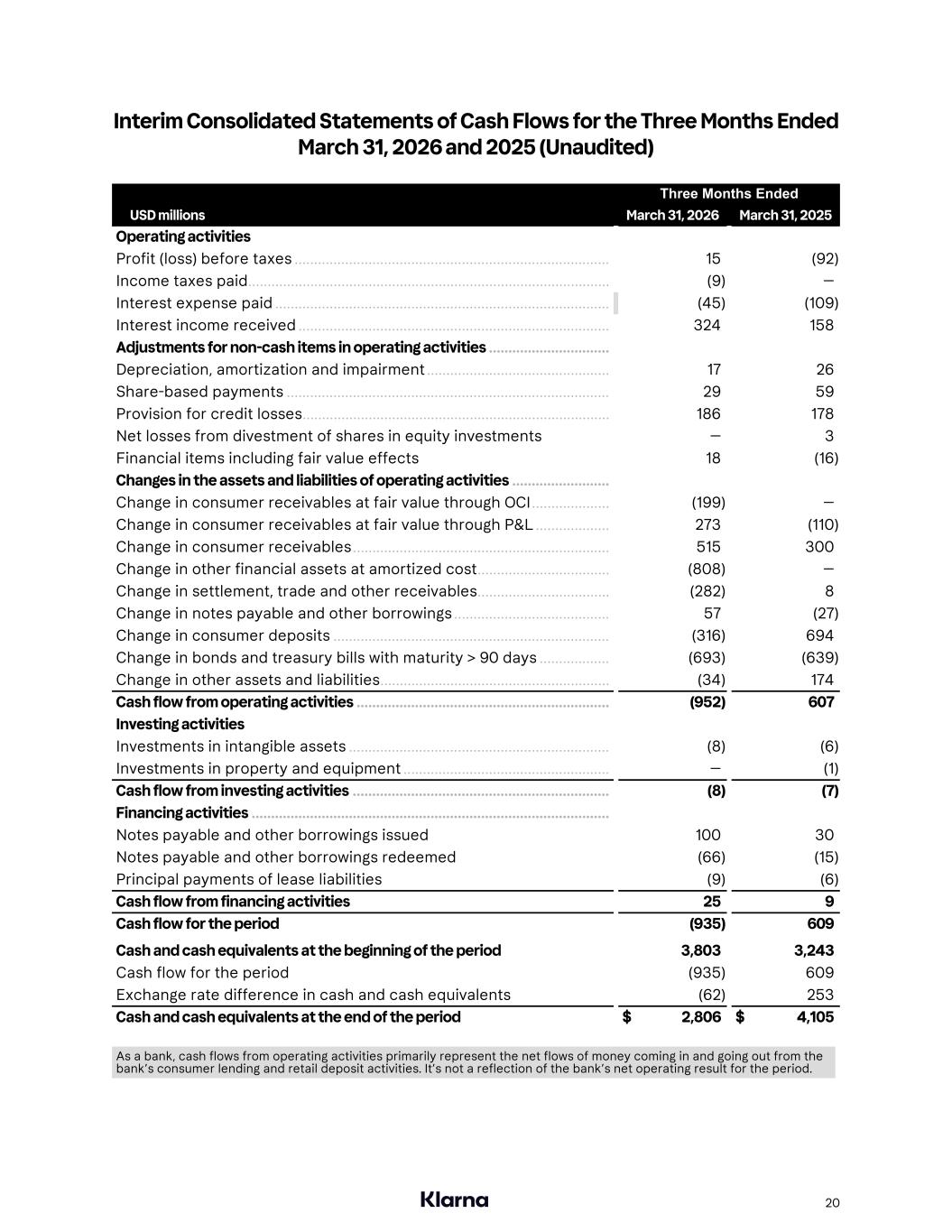
Interim Consolidated Statements of Cash Flows for the Three Months Ended March 31, 2026 and 2025 (Unaudited) Three Months Ended USD millions March 31, 2026 March 31, 2025 Operating activities Profit (loss) before taxes ................................................................................. 15 (92) Income taxes paid ............................................................................................. (9) — Interest expense paid ...................................................................................... (45) (109) Interest income received ................................................................................ 324 158 Adjustments for non-cash items in operating activities ............................... Depreciation, amortization and impairment ............................................... 17 26 Share-based payments ................................................................................... 29 59 Provision for credit losses ............................................................................... 186 178 Net losses from divestment of shares in equity investments — 3 Financial items including fair value effects 18 (16) Changes in the assets and liabilities of operating activities ......................... Change in consumer receivables at fair value through OCI .................... (199) — Change in consumer receivables at fair value through P&L ................... 273 (110) Change in consumer receivables .................................................................. 515 300 Change in other financial assets at amortized cost .................................. (808) — Change in settlement, trade and other receivables .................................. (282) 8 Change in notes payable and other borrowings ........................................ 57 (27) Change in consumer deposits ....................................................................... (316) 694 Change in bonds and treasury bills with maturity > 90 days .................. (693) (639) Change in other assets and liabilities ........................................................... (34) 174 Cash flow from operating activities ................................................................. (952) 607 Investing activities Investments in intangible assets ................................................................... (8) (6) Investments in property and equipment ..................................................... — (1) Cash flow from investing activities .................................................................. (8) (7) Financing activities ............................................................................................ Notes payable and other borrowings issued 100 30 Notes payable and other borrowings redeemed (66) (15) Principal payments of lease liabilities (9) (6) Cash flow from financing activities 25 9 Cash flow for the period (935) 609 Cash and cash equivalents at the beginning of the period 3,803 3,243 Cash flow for the period (935) 609 Exchange rate difference in cash and cash equivalents (62) 253 Cash and cash equivalents at the end of the period $ 2,806 $ 4,105 As a bank, cash flows from operating activities primarily represent the net flows of money coming in and going out from the bank’s consumer lending and retail deposit activities. It’s not a reflection of the bank’s net operating result for the period. 20
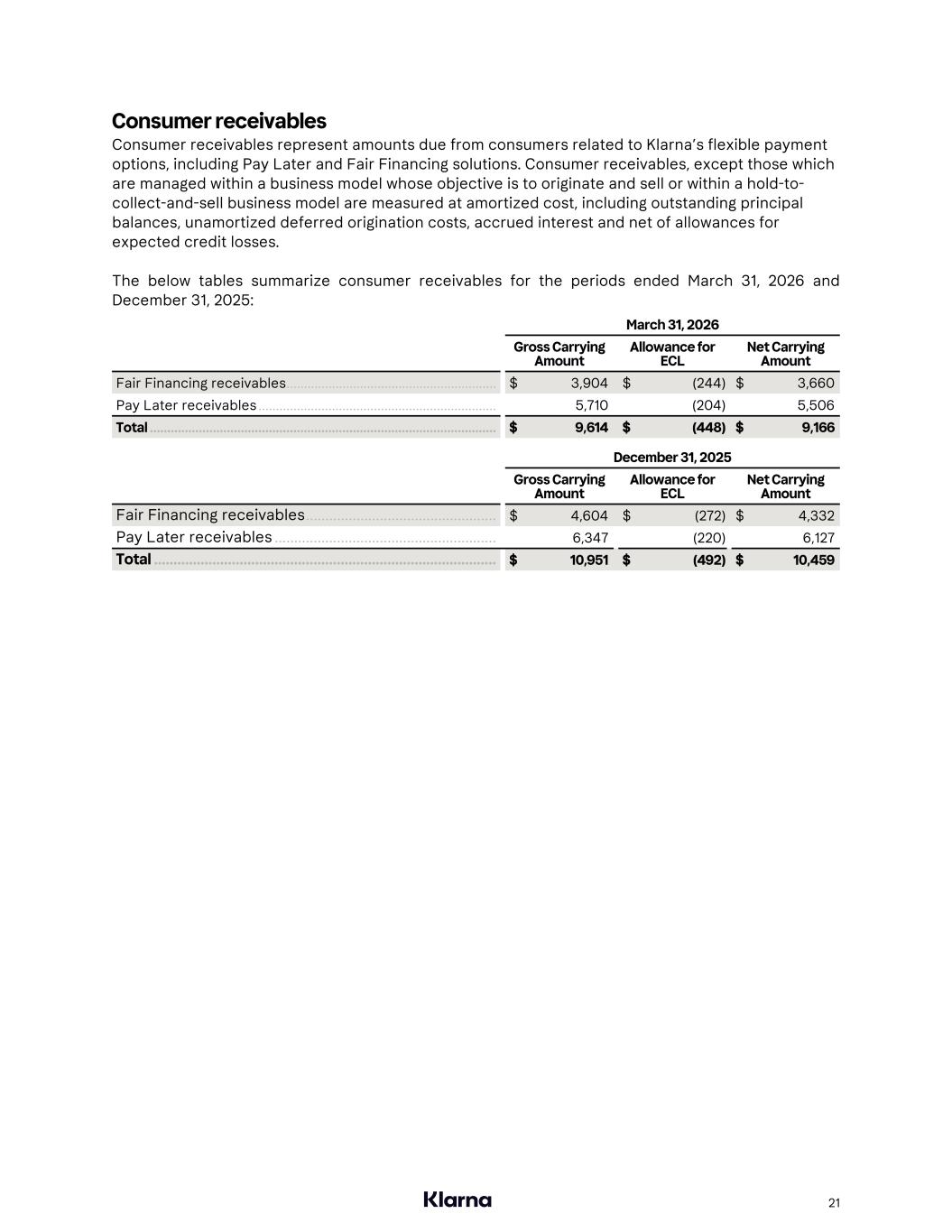
Consumer receivables Consumer receivables represent amounts due from consumers related to Klarna’s flexible payment options, including Pay Later and Fair Financing solutions. Consumer receivables, except those which are managed within a business model whose objective is to originate and sell or within a hold-to- collect-and-sell business model are measured at amortized cost, including outstanding principal balances, unamortized deferred origination costs, accrued interest and net of allowances for expected credit losses. The below tables summarize consumer receivables for the periods ended March 31, 2026 and December 31, 2025: March 31, 2026 Gross Carrying Amount Allowance for ECL Net Carrying Amount Fair Financing receivables ............................................................ $ 3,904 $ (244) $ 3,660 Pay Later receivables .................................................................... 5,710 (204) 5,506 Total ................................................................................................... $ 9,614 $ (448) $ 9,166 December 31, 2025 Gross Carrying Amount Allowance for ECL Net Carrying Amount Fair Financing receivables ................................................. $ 4,604 $ (272) $ 4,332 Pay Later receivables ......................................................... 6,347 (220) 6,127 Total ........................................................................................ $ 10,951 $ (492) $ 10,459 21