Insider trading policy Owner Investor Relations and Acceleration (Org Unit) Approver Board Of Directors Last approved date 2025-08-29 Next revision date
Table of contents 1 Scope 1.1 Referencing documents 2 Purpose and objectives 3 Roles and responsibilities 3.1 Insider trading 3.1.1 What is insider trading 3.1.2 What information is relevant 3.1.3 Who is an Insider 3.1.4 What instruments are covered by this Policy 3.1.5 Trading, Trading Windows and Blackout Periods 3.1.6 When can Insiders Trade in other companies’ securities 3.1.7 When can Insiders gift Klarna securities 3.1.8 Can Insiders pledge Klarna securities 3.1.9 Who can use trading plans under Rule 10b5-1 3.1.10 Tipping, spreading rumors and market manipulation are prohibited 3.1.11 Avoid speculation and short selling 3.1.12 Requirements regarding Klarna’s own Trading activities 3.2 Additional rules for trading in Klarna’s bonds 3.2.1 Extension of Blackout Period for bonds 3.2.2 No trading plans for bonds 3.2.3 Pre-clearance for trading in bonds 3.3 PDMRs in Klarna 3.3.1 Who is a PDMR 3.3.2 PDMR reporting obligations 3.3.3 When and how to report 3.3.4 Notification by Klarna to PDMRs about their reporting obligations 3.3.5 Notification by PDMRs to their closely associated persons 3.3.6 PDMR’s need pre-clearance for trading in bonds 4 Appendix 1 - List of Legislations
1. Scope Klarna has listed shares on a U.S. stock exchange and listed bonds at Nasdaq Stockholm and Euronext Dublin. Both U.S. and EU rules prohibit insider trading, which is when persons who have access to certain key information that is not public knowledge trade in shares or bonds. In Klarna you are only allowed to buy and sell Klarna shares and bonds during defined periods called Trading Windows. The time between Trading Windows is called a Blackout Period and no trading of Klarna shares and bonds is allowed during a Blackout Period. If you have access to certain non-public information you may be prohibited from trading even during a Trading Window. This policy should be read alongside the Insider and Disclosure Policy which includes further details on what information constitutes inside information. The restrictions under the Insider Trading Policy do not only include limitations on trading but also tipping off others and spreading rumours. Breaching rules on insider trading is a crime and consequences for individuals doing it are severe and include monetary fines and imprisonment. You may also face consequences in your Klarna employment, such as being dismissed from work. A summary overview of this policy can be found in the Overview of Insider Trading Policy. 1.1. Referencing documents Insider and disclosure policy Rule 10b5-1 Trading Plan Guidelines 2. Purpose and objectives The purpose of this policy is to ensure that neither Klarna as organization nor individual contributors are involved in illegal insider trading of Klarna securities. 3. Roles and responsibilities Contributor Roles and responsibilities Klarna Contributor Follow this policy and all legislation in relation to insider trading. CFO Responsible for authoring relevant contributors to set up a trading plan and pre-approving trades in Klarna's bonds for persons that qualify as PDMRs (as defined below). Chief Legal Officer Responsible for shortening or canceling Trading Windows where relevant, as well as approving Klarna's own trading activities. Also responsible to provide guidance on how Klarna Contributors should act when in possession of MNPI (as defined below) about Klarna partners. 3.1. Insider trading 3.1.1. What is insider trading Insider trading is when people who have material information about a listed company that is not known to the general public trade in the shares of that company. Insider trading is unfair as the market has not had the chance to digest the information and make any adjustments to the price of a stock. Insiders may have information that will allow them to sell shares before the price falls, or buy before the price goes up. 3.1.2. What information is relevant This Insider Trading Policy applies to trading in Klarna’s shares or bonds, or derivative instruments, when you have access to material non-public information (“MNPI”) or inside information under the European Market Abuse Regulation (“MAR Information”). These concepts are defined in the Insider and Disclosure Policy. Generally, both MNPI and MAR Information concern material information related to Klarna which has not been publicly disclosed and that may have an impact on the price of securities, or which investors may otherwise deem important when making a decision whether or not to invest in Klarna securities. 3.1.3. Who is an Insider This Insider Trading Policy applies to all ‘Insiders’. At Klarna, everyone is treated as an Insider for us to be able to have open sharing of information. In other words, you do not need to actually have MNPI or MAR Information to be subject to the restrictions set out in this Policy. What constitutes MNPI and MAR Information is set out in the Insider and Disclosure Policy. The following persons are defined as Insiders: All Klarna Contributors, Close family members of Klarna Contributors, meaning spouses, domestic partners, and children below the age of 19 (even if financially independent), and any person that is financially dependent on a person or his or her spouse or domestic partner Other persons who have gained access to MNPI and/or MAR Information Entities, share accounts and other investment portfolios and investment accounts where a Klarna Contributor can make investments decisions or influence investment decisions of; and any account established or maintained by Klarna Contributors or their close immediate family members with their consent or knowledge and in which such Klarna Contributors or their close immediate family members have a direct or indirect financial interest. In this Insider Trading Policy, “Klarna Contributor” refers to all employees, employees of record, directors, officers and line consultants of the Klarna Group.
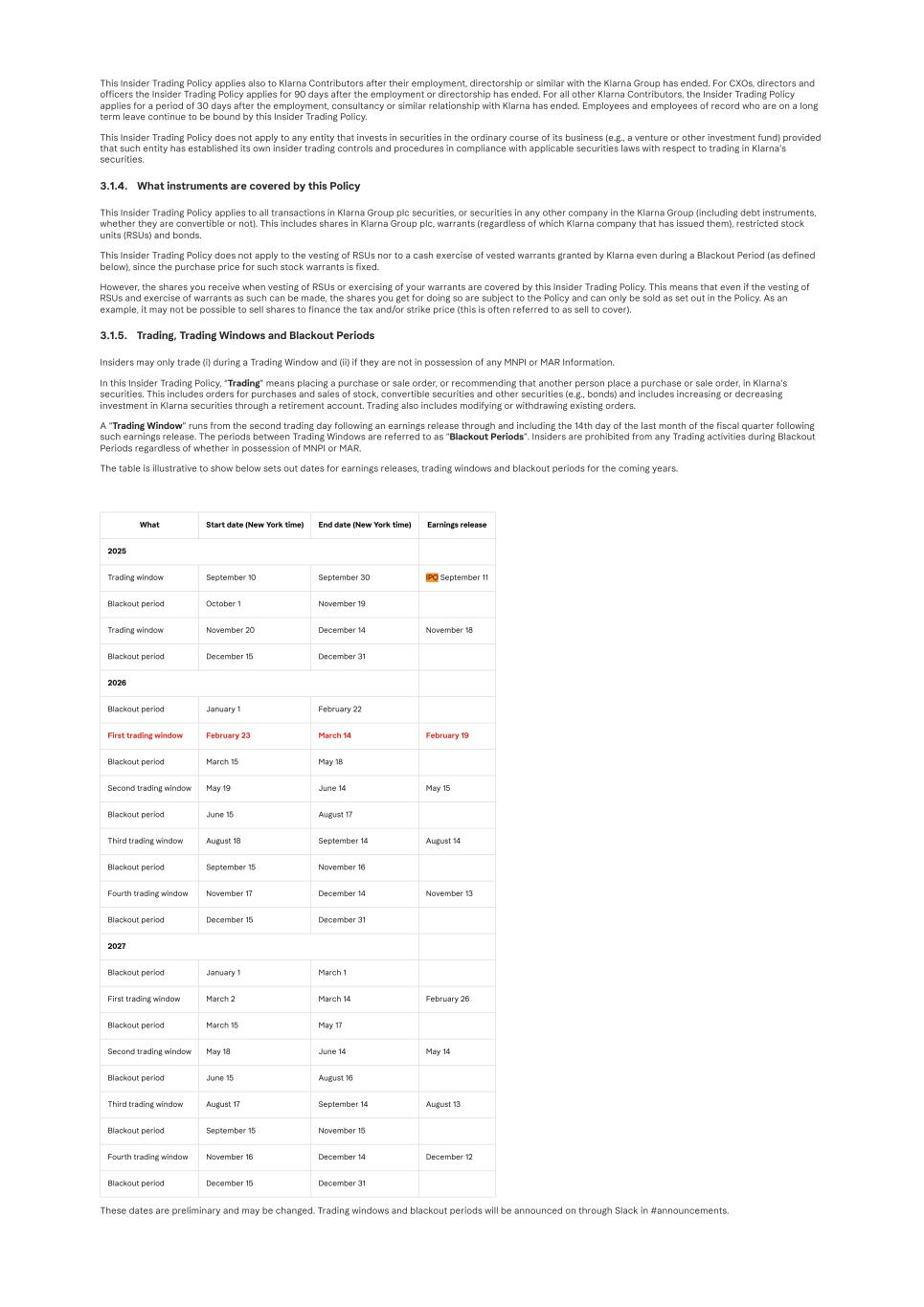
This Insider Trading Policy applies also to Klarna Contributors after their employment, directorship or similar with the Klarna Group has ended. For CXOs, directors and officers the Insider Trading Policy applies for 90 days after the employment or directorship has ended. For all other Klarna Contributors, the Insider Trading Policy applies for a period of 30 days after the employment, consultancy or similar relationship with Klarna has ended. Employees and employees of record who are on a long term leave continue to be bound by this Insider Trading Policy. This Insider Trading Policy does not apply to any entity that invests in securities in the ordinary course of its business (e.g., a venture or other investment fund) provided that such entity has established its own insider trading controls and procedures in compliance with applicable securities laws with respect to trading in Klarna’s securities. 3.1.4. What instruments are covered by this Policy This Insider Trading Policy applies to all transactions in Klarna Group plc securities, or securities in any other company in the Klarna Group (including debt instruments, whether they are convertible or not). This includes shares in Klarna Group plc, warrants (regardless of which Klarna company that has issued them), restricted stock units (RSUs) and bonds. This Insider Trading Policy does not apply to the vesting of RSUs nor to a cash exercise of vested warrants granted by Klarna even during a Blackout Period (as defined below), since the purchase price for such stock warrants is fixed. However, the shares you receive when vesting of RSUs or exercising of your warrants are covered by this Insider Trading Policy. This means that even if the vesting of RSUs and exercise of warrants as such can be made, the shares you get for doing so are subject to the Policy and can only be sold as set out in the Policy. As an example, it may not be possible to sell shares to finance the tax and/or strike price (this is often referred to as sell to cover). 3.1.5. Trading, Trading Windows and Blackout Periods Insiders may only trade (i) during a Trading Window and (ii) if they are not in possession of any MNPI or MAR Information. In this Insider Trading Policy, “Trading” means placing a purchase or sale order, or recommending that another person place a purchase or sale order, in Klarna’s securities. This includes orders for purchases and sales of stock, convertible securities and other securities (e.g., bonds) and includes increasing or decreasing investment in Klarna securities through a retirement account. Trading also includes modifying or withdrawing existing orders. A “Trading Window” runs from the second trading day following an earnings release through and including the 14th day of the last month of the fiscal quarter following such earnings release. The periods between Trading Windows are referred to as “Blackout Periods”. Insiders are prohibited from any Trading activities during Blackout Periods regardless of whether in possession of MNPI or MAR. The table is illustrative to show below sets out dates for earnings releases, trading windows and blackout periods for the coming years. What Start date (New York time) End date (New York time) Earnings release 2025 Trading window September 10 September 30 IPO September 11 Blackout period October 1 November 19 Trading window November 20 December 14 November 18 Blackout period December 15 December 31 2026 Blackout period January 1 February 22 First trading window February 23 March 14 February 19 Blackout period March 15 May 18 Second trading window May 19 June 14 May 15 Blackout period June 15 August 17 Third trading window August 18 September 14 August 14 Blackout period September 15 November 16 Fourth trading window November 17 December 14 November 13 Blackout period December 15 December 31 2027 Blackout period January 1 March 1 First trading window March 2 March 14 February 26 Blackout period March 15 May 17 Second trading window May 18 June 14 May 14 Blackout period June 15 August 16 Third trading window August 17 September 14 August 13 Blackout period September 15 November 15 Fourth trading window November 16 December 14 December 12 Blackout period December 15 December 31 These dates are preliminary and may be changed. Trading windows and blackout periods will be announced on through Slack in #announcements.
The Chief Legal Officer may shorten or cancel any Trading Window without giving a reason for doing so. If that happens, the window for permitted Trading is adjusted accordingly. Insiders are advised to bear in mind that this may happen and that you may be unable to carry out a contemplated trade. If there is a public disclosure of MNPI or MAR Information during a Trading Window (meaning that the information ceases to be MNPI or MAR Information), Insiders who were unable to Trade due to being aware of such information may Trade once a full trading day has passed following the disclosure thereof (subject always to a Trading Window being open at such time). For instance, if the disclosure is made on a Tuesday, the earliest possible trading day will be the immediately following Thursday. 3.1.6. When can Insiders Trade in other companies’ securities If an Insider has become aware of MNPI or MAR Information about, or which may affect the price of the securities of, another company (such as one of Klarna’s partners, suppliers or competitors) through his or her position at Klarna, he or she cannot Trade in, nor recommend or induce another person to trade in, such other company’s securities. He or she should seek guidance from the Chief Legal Officer on how to act when having received such information. If there is a public disclosure of the MNPI or MAR Information in the other company, Insiders who were aware of such information may Trade once a full trading day has passed since disclosure. For instance, if the disclosure is made on a Tuesday, the earliest possible trading day will be the immediately following Thursday. Companies whose only or primary assets (at least 10%) are made up of Klarna stock or derivatives will have their pricing to a large extent dependent on the value of the Klarna stock. Trading in instruments in such companies should be assessed using the same rules as for Klarna stock directly. Trading is therefore only allowed if it would be allowed in Klarna stock. 3.1.7. When can Insiders gift Klarna securities Giving Klarna securities as a gift or a donation is equivalent to selling such securities. For this reason, Insiders may only gift Klarna securities if the criteria for Trading in Klarna securities are met. For instance, no gifts of Klarna securities can be made during Blackout Periods. 3.1.8. Can Insiders pledge Klarna securities No Insider may pledge their Klarna securities without prior written approval by the Chief Financial Officer. The reason is that if the Insider is unable to meet a margin call, the pledgor can sell the securities without the pledgor’s consent. This could mean that an Insider’s shares are sold to meet a margin call due to a drop in valuation, even though the Insider is in possession of MNPI or MAR Information at the time. This prohibition also includes buying Klarna securities on margin (i.e. using money you have borrowed from the broker). 3.1.9. Who can use trading plans under Rule 10b5-1 Some Klarna Contributors are likely to have permanent access to MNPI and therefore risk never being able to trade during a Trading Window. For certain Contributions, such as board members and CXOs, the market may also interpret divestments as something having a negative signal value. The CFO may authorize such employees to set up trading plans, to be able to Trade in Klarna stock regardless of MNPI. This can be achieved under SEC Rule 10b5-1(c), which allows Insiders to set up a trading plan, under which trading occurs automatically according to predetermined criteria (set by the Insider). Trades made under such a trading plan do not fall within the scope of this Policy. Trading plans may only be adopted during Trading Periods and when you do not have MNPI. Because the criteria for trading are set beforehand, trades under an approved trading plan may be executed even if the Insider is in possession of MNPI at the time of trade. The trading plan may only be set up during a Trading Window and provided that the Insider is not in possession of any MNPI at the time. Since trading is automatic, it may not be changed during a Blackout Period or when the Insider is in possession of MNPI. There may be costs involved in setting up a trading plan. Any such costs are to be borne by the person setting up the plan. Any trading plan needs to follow Klarna’s Rule 10b5-1 Trading Plan Guidelines. 3.1.10. Tipping, spreading rumors and market manipulation are prohibited It is illegal for any Insider in possession of MNPI or MAR Information to provide other people with such information or to recommend or influence that they buy or sell the securities (this is called “tipping”). The same goes for recommending or influencing any person to modify or withdraw an existing order. In that case, they may both be held liable. Any confidential information within the Klarna Group is the property of the Klarna Group. Klarna Contributors are not allowed to share such information with others (except with other Klarna Contributors and professional advisers under confidentiality undertakings whose positions require them to know it or for internal documentation purposes), whether or not they have access to MNPI or MAR Information, and whether or not it is made to induce another person to transact in Klarna securities. No Insider should discuss MNPI or MAR Information in public places or in common areas on Klarna property. MNPI or MAR Information should also not be discussed in open Slack channels. Insiders may not engage in spreading, discussing or otherwise encouraging rumors about Klarna that may affect the price of any Klarna security (though this does not preclude Insiders from reporting under Klarna’s Whistleblowing Policy. It is also not allowed for Insiders to engage in, or attempt to engage in, market manipulation. 3.1.11. Avoid speculation and short selling Investing in Klarna securities provides an opportunity to share in the future growth of Klarna. But investment in the Company and sharing in the growth of Klarna does not mean short range speculation based on fluctuations in the market. Such activities may put the personal gain of the Insider in conflict with the best interests of Klarna and its stockholders. Although this Trading Policy does not mean that Insiders may never sell shares, Klarna encourages Insiders to avoid frequent Trading in Klarna stock. Speculating in Klarna stock is not part of the culture of Klarna.
Klarna Contributors should avoid short selling of Klarna securities, as this may be seen as not believing in the future growth of Klarna. Speculating in Klarna stock is not part of the culture of Klarna. 3.1.12. Requirements regarding Klarna’s own Trading activities Klarna itself must comply with EU MAR and U.S. securities laws applicable to its own securities Trading activities, and will not effect transactions in respect of its securities, or adopt any securities repurchase plans, when it is in possession of MNPI or MAR Information concerning the Klarna Group, other than in compliance with applicable law, subject to the policies and procedures adopted by the Company and attached as Exhibit A hereto, and the prior approval of the Chief Legal Officer as set out therein. 3.2. Additional rules for trading in Klarna’s bonds There are additional restrictions for trading in Klarna’s bonds that are subject to EU MAR. 3.2.1. Extension of Blackout Period for bonds For bonds covered by EU MAR, the Blackout Period shall always be extended to include the period of 30 calendar days before any planned earnings release. 3.2.2. No trading plans for bonds Trading plans under 10b5-1 does not have any effect under EU MAR. It is therefore not possible to set a plan to be able to trade in Klarna’s listed debt instruments when you are in possession of MAR Information. If you have adopted a trading plan for Klarna stock, it is not valid for Klarna’s bonds. 3.2.3. Pre-clearance for trading in bonds As set detailed below, PDMRs (currently including only board members and CXOs) require pre-clearance for trading in listed bonds (but not for shares listed on the U.S. stock exchange). 3.3. PDMRs in Klarna 3.3.1. Who is a PDMR “PDMR” is a concept under EU MAR that stands for person discharging managerial responsibilities. PDMRs are subject to additional requirements and restrictions under EU MAR but in relation to equity securities listed on the U.S. stock exchange. The following positions currently qualify as persons discharging managerial responsibilities (PDMRs): 1. Board members of Klarna Bank AB (publ) and Klarna Holding AB (publ); and 2. Management team of Klarna Bank AB (publ) and Klarna Holding AB (publ), currently corresponding to the CXO team. In addition, other senior executives that have regular access to MAR Information and who have power to take managerial decisions affecting the future developments and business prospects of Klarna Bank AB (publ) and Klarna Holding AB (publ) shall also be declared PDMRs by the Chief Legal Officer. 3.3.2. PDMR reporting obligations PDMRs at Klarna and persons closely associated with them must report in writing their transactions in listed bonds related to Klarna and related derivative instruments, both to Klarna and to the SFSA. All transactions need to be reported, including pledges, securities borrowing and transactions within the scope of an endowment policy. 3.3.3. When and how to report Reporting shall take place as soon as an aggregate threshold of EUR 5,000 per calendar year has been reached and not later than three business days after the date of the transaction (i.e., after an agreement regarding purchase or sale has been entered into). PDMRs shall report any transaction to Klarna at cosec@klarna.com. Klarna will then assist the PDMR in making electronic submission to the SFSA website. 3.3.4. Notification by Klarna to PDMRs about their reporting obligations Klarna shall notify all PDMRs in writing of their reporting obligation under EU MAR. Klarna shall also keep a list of all PDMRs and persons closely associated with them. A copy of notices sent and received by Klarna pursuant to this section shall be retained electronically. 3.3.5. Notification by PDMRs to their closely associated persons The PDMR shall notify in writing persons closely associated with him/her regarding their reporting obligation under EU MAR, substantially in accordance with a format to be provided by Klarna. If the person closely associated is a minor, the PDMR shall instead notify the (other) guardian of the minor substantially in accordance with a format to be provided by Klarna. The following persons are deemed to be closely associated with a PDMR: 1. a spouse, or a partner considered to be equivalent to a spouse in accordance with national law; 2. a dependent child, in accordance with national law; 3. a relative who has shared the same household for at least one year on the date of the transaction concerned; or 4. a legal person, trust or partnership, the managerial responsibilities of which are discharged by a PDMR or by a person referred to in item (a), (b) or (c), or which is directly or indirectly controlled by such person, or which is set up for the benefit of such person, or the economic interests of which are substantially equivalent to those of such a person. The PDMR shall keep a copy of such notifications and also send a copy to Klarna by email at cosec@klarna.com. The PDMR shall notify Klarna regarding who is closely associated with him/her by sending a list of these persons by email to cosec@klarna.com. The PDMR shall keep Klarna updated of any changes to the list. 3.3.6. PDMR’s need pre-clearance for trading in bonds PDMRs may not acquire or sell listed bonds issued by Klarna and covered by EU MAR, or derivatives or other financial instruments linked thereto, without first having obtained written approval from Klarna’s CFO. The approval is valid only on the day of the current and next trading day. In individual cases, Klarna’s CFO may decide on a shorter or longer validity period. If the CFO is looking to trade in bonds, approval shall be given by the CEO based on a recommendation by the Chief Legal Officer.

The requirement to obtain pre-clearance also applies during Trading Windows. 4. Appendix 1 - List of Legislations The Policy shall cover relevant external rules including, for instance: Market Abuse Regulation (Regulation (EU) No. 596/2014 The Market Abuse (Amendment) (EU Exit) Regulations 2019 Securities Exchange Act of 1934 (15 U.S.C. § 78j) SEC Rule 10b-5 (17 C.F.R. § 240.10b-5) Insider Trading Sanctions Act of 1984 (ITSA) Insider Trading and Securities Fraud Enforcement Act of 1988 (ITSFEA) Legislation Jurisdictions Source Websites No data available in table