Warehouse Investment Risk.
The Fund may invest in warehouses, which are financing structures created prior to and in anticipation of CLO or CDO closings and issuing securities and are intended to aggregate direct loans, corporate loans and/or other debt obligations that may be used to form the basis of CLO or CDO vehicles (“Warehouses”). To finance the acquisition of a Warehouse’s assets, a financing facility (a “Warehouse Facility”) is often opened by (i) the entity or affiliates of the entity that will become the collateral manager of the CLO or CDO upon its closing and/or (ii) third-party investors that may or may not invest in the CLO or CDO. The period from the date that a Warehouse is opened and asset accumulation begins to the date that the CLO or CDO closes is commonly referred to as the “warehousing period.” In practice, investments in Warehouses (“Warehouse Investments”) are structured in a variety of legal forms, including subscriptions for equity interests or subordinated debt investments in SPVs that obtain a Warehouse Facility secured by the assets acquired in anticipation of a CLO or CDO closing.
A Warehouse Investment generally bears the risk that (i) the warehoused assets (typically senior secured corporate loans) will drop in value during the warehousing period, (ii) certain of the warehoused assets default or for another reason are not permitted to be included in a CLO or CDO and a loss is incurred upon their disposition, and (iii) the anticipated CLO or CDO is delayed past the maturity date of the related Warehouse Facility or does not close at all, and, in either case, losses are incurred upon disposition of all of the warehoused assets. In the case of (iii), a particular CLO or CDO may not close for many reasons, including as a result of a market-wide material adverse change, a manager-related material adverse change or the discretion of the manager or the underwriter.
There can be no assurance that a CLO or CDO related to Warehouse Investments will be consummated. In the event a planned CLO or CDO is not consummated, investors in a Warehouse (which may include the Fund) may be responsible for either holding or disposing of the warehoused assets. Because leverage is typically used in Warehouses, the potential risk of loss may be increased for the owners of Warehouse Investments. This could expose the Fund to losses, including in some cases a complete loss of all capital invested in a Warehouse Investment.
The Warehouse Investments represent leveraged investments in the underlying assets of a Warehouse. Therefore, the value of a Warehouse Investment is often affected by, among other things, (i) changes in the market value of the underlying assets of the Warehouse; (ii) distributions, defaults, recoveries, capital gains, capital losses and prepayments on the underlying assets of the Warehouse; and (iii) the prices, interest rates and availability of eligible assets for reinvestment. Due to the leveraged nature of a Warehouse Investment, a significant portion (and in some circumstances all) of the Warehouse Investments made by the Fund may not be repaid.
LIMITS OF RISK DISCLOSURES
The above discussions of the various risks associated with the Fund reflect all principal risks with respect to an investment in the Fund. Some risks may not be known or anticipated to be material to the Fund at this time. Prospective investors should read this entire Prospectus and consult with their own advisors before deciding whether to invest in the Fund. In addition, as the Fund’s investment program changes or develops over time, an investment in the Fund may be subject to risk factors not described in this Prospectus. The Fund will update this Prospectus to account for any material changes in the risks involved with an investment in the Fund.
The Fund’s Board of Trustees provides broad oversight over the operations and affairs of the Fund. A majority of the Fund’s Board of Trustees is comprised of persons who are independent trustees. StepStone Private Wealth serves as the Fund’s Adviser, StepStone Private Debt serves as the Fund’s
Sub-Adviser
and SGEAIL serves as the Fund’s
56
The Adviser, StepStone Private Wealth, is an investment platform designed to expand access to the private markets for
investors. The Adviser intends to create innovative solutions for investors by focusing on convenience, efficiency and transparency. The Adviser’s mission is to convert the private market advantages enjoyed by institutional investors into opportunities for individual investors. The Adviser is registered as an investment adviser under the Investment Advisers Act of 1940. The Adviser, established in 2019, is based in Charlotte, North Carolina. Please see StepStone Private Wealth’s website at www.stepstonepw.com for the most
information.
StepStone Private Debt and SGEAIL, each an investment adviser registered with the SEC under the Investment Advisers Act of 1940, as amended, are wholly-owned subsidiaries of Swiss Capital Alternative Investments AG (“SCAI”). SCAI is a subsidiary of StepStone Group Inc., which is the sole managing member of StepStone Group Holdings LLC, which in turn is the general partner of StepStone Group LP.
As affiliates of StepStone Group, the Advisers benefit from the organization’s scale and depth across private markets. StepStone Group is a global private markets investment firm focused on providing customized investment solutions and advisory and data services to its clients. StepStone Group’s clients include some of the world’s largest public and private defined benefit and defined contribution pension funds, sovereign wealth funds and insurance companies, as well as prominent endowments, foundations, family offices and private wealth clients. As of September 30, 2024, StepStone Group was responsible for $682 billion of “private market allocations” which includes $176 billion of assets under management and $506 billion of assets under advisement. StepStone Group has over 1,050 professionals across 26 cities in 16 countries. StepStone Group LP is not performing investment advisory services to the Fund.
StepStone Group Inc. is the sole managing member of StepStone Group Holdings LLC, which in turn is the general partner of StepStone Group LP. StepStone Group Inc. is listed and trades on the Nasdaq Global Select Market under the trading symbol STEP. Please see StepStone Group Inc.’s website at www.stepstonegroup.com for additional information.
StepStone Group advises and/or manages accounts other than that of the Fund, which may give rise to certain conflicts of interest. See “Conflicts of Interest.”
Under the terms of the Advisory Agreement, the Adviser is responsible for the overall management of the Fund’s activities. The Adviser is responsible for formulating and updating (as needed) the overall investment strategy of the Fund. The Adviser is also responsible for the structuring and distribution functions for the Fund. In addition, the Adviser is responsible for the operational and governance aspects of the Fund, including the selection and management of the Fund’s service providers and the management of the Fund’s repurchase offers and distributions and dividend reinvestment plan. The Adviser is also responsible for the Fund’s SEC and other regulatory reporting obligations. The Adviser is subject to the ultimate supervision of, and any policies established by, the Board of Trustees.
The Adviser has entered into a
Sub-Advisory
Agreement with StepStone Private Debt. The
Sub-Adviser
is responsible for the
management of the Fund’s assets and activities. The
Sub-Adviser
provides ongoing research, recommendations, and portfolio management regarding the Fund’s investment portfolio subject to the overall supervision of the Adviser and the Fund’s officers and Board of Trustees.
The
Sub-Adviser
has entered into a
Agreement with SGEAIL, which provides ongoing research regarding the Fund’s investment portfolio.
A description of the factors considered by the Fund’s Board of Trustees in approving the Advisory Agreement, the
Sub-Advisory
Agreement and the
Agreement is available in the Fund’s Semi-Annual Report to Shareholders for the fiscal period ended June 30, 2024.
“Private market allocations” means the total amount of assets under management and assets under advisement. StepStone Group LP classifies assets under management if the StepStone Group LP has full discretion over the investment decisions in an account or has responsibility or custody of assets. Assets under advisement consists of client assets for which StepStone Group LP does not have full discretion to make investment decisions but plays a role in advising the client or monitoring their investments.
57
The personnel of the Advisers principally responsible for management of the Fund are experienced and educated investment professionals with a long performance record in private market investments. They have identified, evaluated, structured, managed and monitored billions of dollars in a wide range of private market investments globally and maintain a strong network within the private markets investment community as a result of their prior and ongoing experience. The Advisers believe that, as a result of these relationships, the Fund should have access to a large number of Private Credit and Income opportunities from which to select.
StepStone Private Wealth Team
Bob Long is the Chief Executive Officer of StepStone Private Wealth. Mr. Long has three decades of experience in the private markets and has served as the CEO of two publicly traded companies focused on expanding access for
investors. He was a founding Director of the Defined Contribution Alternatives Association and chairs its Public Policy Committee.
Mr. Long has served as the CEO of a Nasdaq-listed business development company managed by Oak Hill Advisors, a leading global credit investment firm. He was the
co-founder
and CEO of Conversus Capital, and along with Mr. Smith, led the $2 billion IPO of this innovative permanent capital vehicle that was the largest publicly traded fund of private equity funds. Mr. Long also ran Bank of America’s $7 billion AUM Strategic Capital Division, which held investments in over 1,000 private market funds and
co-investments.
Early in his career, Mr. Long served as the lead
in-house
counsel for a large portion of Bank of America’s Investment Banking Division and worked as a securities lawyer for a major law firm. He graduated from
UNC-Chapel
Hill and the University of Virginia School of Law.
A frequent commentator on private market topics, Mr. Long was named one of 50 Game Changers by Private Equity International, has been profiled in the Wall Street Journal, and guest hosted CNBC Squawk Box Europe on numerous occasions. He currently serves on the Gift of Adoption Strategic Advisory Council and previously served on the board of the Children’s Home Society of North Carolina.
Tom Sittema is the Executive Chairman of StepStone Private Wealth. In his four decades of capital markets experience, Mr. Sittema has served as the CEO of an industry-leading private markets asset manager and the Chairman of the Board of numerous publicly registered funds designed for individual investors. He serves on the Board of the Institute for Portfolio Alternatives, a private markets industry group, and during his term as Chairman, led several of its strategic initiatives.
Mr. Sittema served as the CEO of CNL Financial Group, a $10 billion asset manager providing access for individual investors to the private markets where he recruited Mr. Menard. Mr. Sittema held a variety of leadership roles at Bank of America Merrill Lynch / Bank of America over a
27-year
career, including the U.S. Head of Real Estate Investment Trusts and Lodging Investment Banking, and worked closely with Mr. Long for over 10 years.
Mr. Sittema graduated from Dordt College and Indiana University Kelley School of Business. He serves as Board Chair of Advent Health’s Consumer Innovation Advisory Board and is the
co-founder
and board chair of LIFT Orlando, an organization established to break the cycle of generational concentrated poverty in a community in Central Florida. Mr. Sittema is Director of the Florida Council of 100 and has received numerous economic development and civic awards, including Central Florida Social Entrepreneur of the Year.
58
Neil Menard is the President of Distribution for StepStone Private Wealth. Mr. Menard is a seasoned distribution leader with over 30 years of experience in the financial services industry. Over his career, he has built a broad and deep network within the financial advisor and broker dealer communities. He has led sales teams distributing billions of dollars of private capital to hundreds of advisory firms, including the largest players in several verticals.
Mr. Menard recently served as the President of CNL Securities Corporation and CNL Capital Markets where he oversaw the capital raising efforts of the firm then led by Mr. Sittema. Previously, he served as senior vice president of Franklin Square Capital Partners, where he was responsible for creating a new business unit to sell business development companies to registered investment advisors (RIAs), strategically setting a vision for the products and executing that vision in the marketplace. Additionally, he sat on the firm’s management committee where he led the firm’s initiatives in building relationships, as well as creating its RIA team and growing market share in the RIA space.
Mr. Menard spent nine years at Steben & Company Inc., a leading provider of managed futures to independent broker-dealers and RIAs. He was responsible for the
operation of the firm, and he was the head of distribution.
Mr. Menard has served on the board of the Institute for Portfolio Alternatives, a private markets industry group. He is on the board of the Florida Hospital Cardiovascular Institute and graduated from Colby College.
Tim Smith is the Chief Operating Officer and Chief Financial Officer of StepStone Private Wealth. Mr. Smith brings over 30 years of operational experience working in private equity, private markets distribution and asset management businesses. During that time, he has served as the CFO and CEO of two publicly traded companies.
Mr. Smith
co-founded
Carolon Capital UK Limited, a U.K. based distribution firm focusing on long-only strategies for asset managers. He also
co-founded
Carolon Investment Funds headquartered in Dublin, Ireland to assist asset managers with fund structuring and regulatory oversight.
Mr. Smith worked with Mr. Long to launch Conversus Capital and was the CFO of the publicly traded entity. Mr. Smith led all facets of Conversus’ operations, finance, treasury and investor relations activities and led the sale of Conversus’ $2 billion portfolio in 2012.
Mr. Smith is a Certified Public Accountant, has an undergraduate degree from the University of Virginia and a graduate degree from the University of Richmond. Mr. Smith is active with the Loaves and Fishes Food Pantry and serves on the board of the Emergency Medical Center at the University of Virginia.
Ms. Zeitvogel is a member of StepStone Private Wealth.
Prior to joining StepStone, Ms. Zeitvogel spent 12 years at Chapter IV Investors, LLC, an investment adviser that managed a privately held hedge fund with $300 million of assets under management, where she was CFO and CCO. Prior to joining Chapter IV, Ms. Zeitvogel was the CFO of a structured finance firm focused on the acquisition, securitization and value enhancement of distressed debt. Previously, she worked for Wachovia Securities in Investment Banking Finance supporting various business units, including private equity, mergers & acquisitions, leveraged capital and fund investing. Ms. Zeitvogel began her professional career in public accounting at Arthur Andersen, LLP.
59
Ms. Zeitvogel has her BS from Appalachian State University and is a Certified Public Accountant. Ms. Zeitvogel also serves on the board of RunningWorks and is on the steering committee for the Charlotte Chapter of CFO Leadership Council.
Dean Caruvana serves as General Counsel of StepStone Private Wealth and Senior Associate General Counsel of StepStone, where he is responsible for legal matters for StepStone Private Wealth and its investment products, with a focus on securities law and corporate governance matters.
Prior to joining StepStone Private Wealth, Mr. Caruvana was Principal at Blue Owl Capital, where he was responsible for legal oversight of the firm’s BDCs. Mr. Caruvana previously was Vice President at BlackRock, Inc., where he focused on U.S. registered products including
open-end
funds,
closed-end
funds, exchange-traded funds and BDCs. Mr. Caruvana began his career an associate in the Asset Management group at Willkie Farr & Gallagher LLP.
Mr. Caruvana received a B.S. in Accounting and Finance and a M.S. in Accounting from Wagner College and a J.D. from Cornell Law School.
StepStone Private Debt Team
As portfolio managers, Gary Gipkhin and Ariel Goldblatt have primary responsibility for ongoing research, recommendations, and portfolio management regarding the Fund’s investment portfolio. Further information regarding the portfolio managers, including other accounts managed, compensation, ownership of Fund shares, and possible conflicts of interest, is available in the Fund’s SAI.
Gary Gipkhin is a director and member of the private debt investment team at StepStone Group. Prior to joining StepStone Group, Mr. Gipkhin worked in investment banking at SunTrust Robinson Humphrey, where he originated and executed a variety of M&A, debt and equity transactions for clients in the industrials space. Mr. Gipkhin received his BS in finance and accounting from the Kelley School of Business at Indiana University.
Ariel Goldblatt is a partner and member of the private debt team at StepStone Group. Prior to joining StepStone Group in April 2019, Ms. Goldblatt was a director of business development at CNBC, Inc., where she led business development and M&A activity. Prior to that, Ms. Goldblatt was a senior analyst at Eachwin Capital, L.P. an institutionally oriented investment management firm, from February 2013 to February 2017. Before that she worked in private equity, private credit and investment banking at Apax Partners LLP, Crescent Capital Group L.P. and Merrill Lynch & Co. Ms. Goldblatt received her MBA from The Wharton School, University of Pennsylvania and her BS in finance from the Schreyer Honors College, Pennsylvania State University.
A control person generally is a person who beneficially owns more than 25% of the voting securities of a company or has the power to exercise control over the management or policies of such company. As a result of a transaction that was completed on January 2, 2025, the Fund acquired substantially all of the assets of CRDEX Equity Partners LLC (formerly, Cresset Partners Private Credit Fund, LLC) in exchange for Class I Shares of the Fund. As of April 1, 2025, CRDEX Equity Partners LLC held 74% of the Fund’s outstanding Shares.
60
StepStone Private Wealth serves as the Fund’s Administrator under an Administration Agreement with the Fund, and performs certain administrative, accounting and other services for the Fund. In consideration of these administrative services, the Fund pays the Administrator the Administration Fee in an amount up to 0.205% on an annual basis of the Fund’s net assets. The Administration Fee will be accrued daily based on the value of the net assets of the Fund as of the close of business on the prior business day (including any assets in respect of shares that will be repurchased by the Fund on such date). The Administration Fee is due and payable in arrears within ten business days after the end of the month. The Administration Fee is an expense paid out of the Fund’s net assets. The Administrator’s principal business address is 128 S Tryon St., Suite 1600, Charlotte, NC 28202. The Administrator may delegate or
sub-contract
certain of its services to other entities, including a
sub-administrator,
and has done so as described below.
UMB Fund Services, Inc. serves as the Fund’s
Sub-Administrator
to provide certain
sub-administration
and
sub-accounting
services for the Fund. Pursuant to a
sub-administration
agreement and a fund accounting agreement, the Administrator pays the
Sub-Administration
Fee to the
Sub-Administrator
from the proceeds of the Administration Fee in an amount up to 0.055% on an annual basis of the Fund’s net assets, subject to a minimum annual fee. The
Sub-Administration
Fee is calculated in a manner substantially similar to the Administration Fee and is payable monthly in arrears. The
Sub-Administrator’s
principal business address is 235 West Galena Street, Milwaukee, Wisconsin 53212.
Custodian and Transfer Agent
UMB Bank, N.A. (the “Custodian”) serves as the custodian of the Fund’s assets. The Custodian’s principal business address is 928 Grand Blvd., 5th Floor, Kansas City, Missouri 64106.
UMB Fund Services, Inc. (the “Transfer Agent”) serves as transfer agent with respect to maintaining the registry of the Fund’s Shareholders and processing matters relating to subscriptions for, and repurchases of, Shares. The Transfer Agent’s principal business address is 235 West Galena Street, Milwaukee, Wisconsin 53212.
The Advisers bear all of their own costs incurred in providing investment advisory services to the Fund. As described below, however, the Fund bears all other expenses related to its investment program. The Administrator provides or arranges for certain administrative services to be provided to the Fund, among those services are: providing office space, adequate personnel, and communications and other facilities necessary for administration of the Fund, performing certain administrative functions to support the Fund and its service providers, supporting the Fund’s Board and providing it with information, providing accounting and legal services in support of the Fund, compliance testing services, analyzing the value of the Fund’s assets, and reviewing and arranging for payment of the Fund’s expenses and other support services. Such administrative services are included in the Administration Fee. In addition to the services above, the Administrator is responsible for overseeing the
Sub-Administrator.
Expenses borne by the Fund (and thus indirectly by Shareholders) include:
| |
• |
|
all expenses related to its investment program, including, but not limited to, expenses borne indirectly through the Fund’s investments in the underlying assets, including any fees and expenses charged by the investment managers (including management fees, carried interest or incentive fees and redemption or withdrawal fees, however titled or structured), all costs and expenses directly related to due diligence of portfolio transactions for the Fund such as direct |
61
| |
and indirect expenses associated with the Fund’s investments (whether or not consummated), and enforcing the Fund’s rights in respect of such investments, transfer taxes and premiums, taxes withheld on non-U.S. dividends, fees for data and software providers, research expenses, professional fees (including, without limitation, the fees and expenses of consultants, attorneys and experts) and, if applicable, brokerage commissions, interest and commitment fees on loans and debit balances, borrowing charges on securities sold short, dividends on securities sold but not yet purchased and margin fees; |
| |
• |
|
attorneys’ fees and disbursements associated with preparing and updating the Fund’s registration statement and other regulatory filings, and with reviewing potential investments to be made and executing the Fund’s investments; |
| |
• |
|
fees and disbursements of all accountants or auditors engaged by the Fund, expenses related to the annual audit of the Fund, expenses related to the unaudited financial statements of the Fund and expenses related to the preparation, review, approval and filing of the Fund’s tax information; |
| |
• |
|
recordkeeping, custody and transfer agency fees and expenses; |
| |
• |
|
the costs of errors and omissions/Trustees’ and officers’ liability insurance and a fidelity bond; |
| |
• |
|
the Management Fee, the Incentive Fee and the Administration Fee; |
| |
• |
|
fees paid to third-party consultants or service providers relating to the Fund’s establishment or operations and fees paid to third-party providers for due diligence and valuation services; |
| |
• |
|
the costs of preparing and mailing reports and other communications, including proxy, repurchase offer correspondence, annual reports or similar materials, to Shareholders; |
| |
• |
|
fees of Trustees who are not “interested persons” and travel and administrative expenses of Trustees who are not “interested persons” relating to meetings of the Board of Trustees and committees thereof; |
| |
• |
|
costs and charges related to electronic or other platforms through which investors may access, complete and submit subscription and other fund documents or otherwise facilitate activity with respect to their investment in the Fund; |
| |
• |
|
costs of administrative, sub-accounting, recordkeeping or investor related services charged by financial intermediaries in conjunction with processing through the National Securities Clearing Corporation’s Fund/SERV and Networking or similar systems; |
| |
• |
|
all costs and charges for equipment or services used in communicating information regarding the Fund’s transactions among the Adviser and any custodian or other agent engaged by the Fund; |
| |
• |
|
any extraordinary expenses (as defined below), including indemnification expenses as provided for in the Fund’s organizational documents; and |
| |
• |
|
other expenses not explicitly borne by the Adviser or Administrator associated with the investment operations of the Fund; and all reasonable costs and expenses incurred in connection with the formation and organization of, and offering and sale of Shares in, the Fund, as determined by the Adviser, including all legal, accounting, registration and filing fees and expenses will be borne by the Fund. The Fund will also bear certain administrative costs. |
62
The Adviser and Administrator will be reimbursed by the Fund for any of the above expenses that it pays on behalf of the Fund, except as otherwise provided above.
Expense Limitation Agreement
The Adviser has entered into an Expense Limitation and Reimbursement Agreement with the Fund for the Limitation Period. The Adviser may extend the Limitation Period for a period of one year on an annual basis. The Expense Limitation and Reimbursement Agreement limits the amount of the Fund’s aggregate ordinary operating expenses, excluding certain Specified Expenses listed below, borne by the Fund during the Limitation Period to an amount not to exceed 1.00% for Class S, D and I Shares, on an annualized basis, of the Expense Cap.
“Specified Expenses” that are not covered by the Expense Limitation and Reimbursement Agreement include: (i) the Management Fee; (ii) all fees and expenses of Private Credit and Income investments and other investments in which the Fund invests (including the underlying fees of the Investment Funds and other investments (the Acquired Fund Fees and Expenses)); (iii) the Incentive Fee; (iv) transactional costs, including legal costs and brokerage commissions, and sourcing and servicing or related fees incurred by the Fund in connection with the servicing by
non-affiliated
third parties of, and other related administrative services associated with the acquisition and disposition of the Fund’s investments; (v) interest payments incurred on borrowings by the Fund or its subsidiaries; (vi) fees and expenses incurred in connection with any credit facility obtained by the Fund or any of its subsidiaries, including any expenses for acquiring ratings related to the credit facilities; (vii) distribution and shareholder servicing fees, as applicable; (viii) taxes; and (ix) extraordinary expenses resulting from events and transactions that are distinguished by their unusual nature and by the infrequency of their occurrence, including, without limitation, costs incurred in connection with any claim, litigation, arbitration, mediation, government investigation or similar proceeding, indemnification expenses, and expenses in connection with holding and/or soliciting proxies for all annual and other meetings of shareholders.
If the Fund’s aggregate ordinary operating expenses, exclusive of the Specified Expenses, in respect of any Class of Shares for any day exceeding the Expense Cap, the Adviser will waive its Management Fee, waive its Incentive Fee, directly pay and/or reimburse the Fund for expenses to the extent necessary to eliminate such excess. The Adviser may also directly pay expenses on behalf of the Fund and waive its Management Fee under the Expense Limitation and Reimbursement Agreement. To the extent that the Adviser waives its Management Fee or Incentive Fee, reimburses expenses to the Fund or pays expenses directly on behalf of the Fund, it is permitted to recoup from the Fund any such amounts for a period not to exceed three years from the month in which such fees and expenses were waived, reimbursed, or paid, even if such recoupment occurs after the termination of the Limitation Period. However, the Adviser may only recoup the waived fees, reimbursed expenses or directly paid expenses in respect of the applicable Class of Shares if (i) the aggregate ordinary operating expenses have fallen to a level below the Expense Cap and (ii) the recouped amount does not raise the level of aggregate ordinary operating expenses plus waived fees, reimbursed expenses or directly paid expenses in respect of a Class of Shares in the month of recoupment to a level that exceeds any Expense Cap applicable at that time.
Expenses of Investment Funds
The Fund’s Investment Funds bear various expenses in connection with their operations similar to those incurred by the Fund. Investment managers generally assess asset-based fees to, and receive performance or incentive-based fees from, the Investment Funds (or their investors), which effectively will reduce the investment returns of the Fund. These expenses and fees will be in addition to those incurred by the Fund itself. As an investor in the Investment Funds, the Fund bears its proportionate share of their expenses and fees and will also be subject to incentive fees to the investment managers.
Organizational and Offering Costs
The initial operating expenses for a new fund, including
start-up
costs, which may be significant, may be higher than the expenses of an established fund. The Fund incurred organizational and offering expenses of approximately $688,302 in connection with the initial offering of Shares.
63
Organizational costs included, among other things, the cost of organizing as a Delaware statutory trust, including the cost of legal services and other fees pertaining to the Fund’s organization. These costs were paid by the Adviser on behalf of the Fund prior to commencement of operations.
The Fund’s initial offering costs included, among other things, legal, printing and other expenses pertaining to the initial offering. Any offering costs paid by the Adviser on behalf of the Fund prior to commencement of operations were reimbursed to the Adviser upon commencement of operations. Costs associated with the offering of the Shares, capitalized as deferred offering costs, are amortized over a twelve-month period from the date of the associated offering. Following such time, costs associated with the organization and offering of the Fund will be expensed as incurred.
All organizational and offering costs of the Fund paid by the Adviser shall be subject to recoupment by the Adviser under the terms of the Expense Limitation and Reimbursement Agreement.
MANAGEMENT FEE AND INCENTIVE FEES
In consideration of the advisory and other services provided by the Adviser to the Fund, the Fund will pay the Adviser a Management Fee equal to 1.15% on an annualized basis of the Fund’s daily net assets. The Management Fee will be accrued daily and payable monthly in arrears within ten (10) business days after the end of the month. The Management Fee is an expense paid out of the Fund’s net assets. For the avoidance of doubt, the Management Fee is applied to any assets in respect of Shares that will be repurchased by the Fund on such date.
In addition, the Fund will pay the Adviser an income-based incentive fee. The “
,” will be accrued daily and payable quarterly in arrears based on the Fund’s “
Pre-Incentive
Fee Net Investment Income
” for the most recently completed calendar quarter. The payment of the Incentive Fee will be subject to a quarterly hurdle rate, expressed as a rate of return on the value of the Fund’s net assets at the end of the most recently completed calendar quarter, of 1.25% (5.00% annualized) (the “
”), subject to a “
” feature (as described below).
For this purpose, “
Pre-Incentive
Fee Net Investment Income
” means interest income, dividend income and any other income (including any other fees, such as commitment, origination, structuring, diligence and consulting fees or other fees that the Fund (or its wholly-owned subsidiaries) receives from portfolio companies) accrued during the calendar quarter, minus the Fund’s operating expenses for the quarter (including the Management Fee, expenses and fees paid to the Adviser under the Administration Agreement and any interest expense and dividends paid on any issued and outstanding preferred stock or credit agreements, but excluding the Incentive Fee and any shareholder servicing and/or distribution fees), net of any expense waivers or expense payments by the Adviser.
Pre-Incentive
Fee Net Investment Income includes, in the case of investments with a deferred interest feature (such as OID debt instruments with PIK interest and
zero-coupon
securities), accrued income that the Fund has not yet received in cash.
Pre-Incentive
Fee Net Investment Income does not include any realized capital gains, realized capital losses or unrealized appreciation or depreciation.
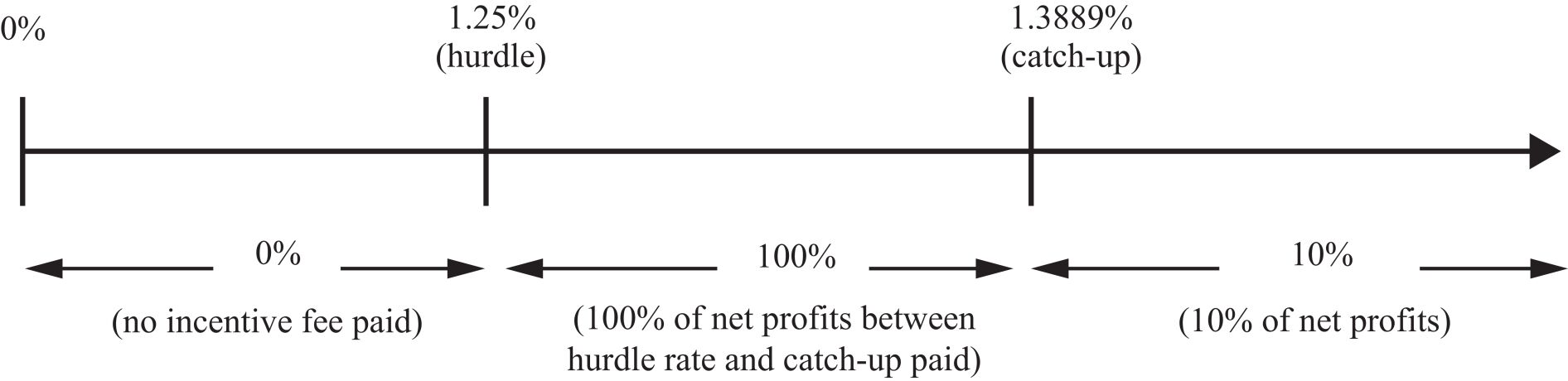
The calculation of the Incentive Fee for each quarter is as follows:
| |
• |
|
No Incentive Fee will be payable to the Adviser in any calendar quarter in which the Fund’s Pre-Incentive Fee Net Investment Income does not exceed the Hurdle Rate; |
| |
• |
|
100% of the dollar amount of the Fund’s Pre-Incentive Fee Net Investment Income, if any, that exceeds the Hurdle Rate but is less than or equal to 1.3889% in any calendar quarter (5.5556% annualized) will be payable to the Adviser. This portion of the Fund’s Incentive Fee that exceeds the Hurdle Rate but is less than or equal to 1.3889% is referred to as the “ ” and is intended to provide the Adviser with an incentive fee of 10% on all of the Fund’s Pre-Incentive Fee Net Investment Income when the Fund’s Pre-Incentive Fee Net Investment Income reaches 1.3889% (5.5556% annualized) on net assets in any calendar quarter; and |
64
| |
• |
|
10% of the dollar amount of the Fund’s Pre-Incentive Fee Net Investment Income, if any, that exceeds 1.3889% (5.5556% annualized) on net assets in any calendar quarter will be payable to the Adviser once the Hurdle Rate and catch-up have been achieved (10% of the Fund’s Pre-Incentive Fee Net Investment Income thereafter will be allocated to the Adviser). |
The Adviser will pay 50% of the Management Fee proceeds and 60% of the Incentive Fee to the
Sub-Adviser
on a monthly and quarterly basis, respectively.
The following is a graphical representation of the calculation of the Incentive Fee:
Fund’s
pre-incentive
fee net investment income
(expressed as a percentage of the Fund’s Net Assets)
CALCULATION OF NET ASSET VALUE
The Fund will calculate its NAV as of the close of business on each business day, in accordance with the procedures described below or as may be determined from time to time in accordance with policies approved by the Board (each, a “Determination Date”). In determining the Fund’s NAV, the Adviser will value the Fund’s investments as of the relevant Determination Date. The NAV of the Fund will equal, unless otherwise noted, the value of the total assets of the Fund, less all of its liabilities, including accrued fees and expenses, each determined as of the relevant Determination Date.
The Class S Shares’ NAV plus the Class D Shares’ NAV plus the Class I Shares’ NAV equals the total value of the net assets of the Fund. The different share NAVs will be calculated separately based on the fees and expenses applicable to each class. Because of differing class fees and expenses, the per share NAV of the classes will vary over time.
The Board has designated the Adviser as the Fund’s valuation designee (the “Valuation Designee”) for purposes of Rule
2a-5
under the 1940 Act. The Board has approved the valuation policy for the Fund and the Adviser (the “Valuation Policy”).
As a general matter, to value the Fund’s investments, the Adviser will use current market values when readily available, and otherwise value the Fund’s investments with fair value methodologies set forth in the Valuation Policy.
Additionally, the values of the Fund’s direct loan investments may be adjusted daily based on the estimated total return that the asset will generate. The Valuation Designee monitors these estimates regularly and updates them as necessary if macro or individual changes warrant any adjustments. At the end of the quarter, each direct loan’s value is adjusted based on the actual income and appreciation or depreciation realized by such loan when its quarterly valuation is reported. This information is updated as soon as the information becomes available.
65
These fair value calculations will involve significant professional judgment by the Adviser in the application of both observable and unobservable attributes, and it is possible that the fair value determined for an investment may differ materially from the value that could be realized upon the sale of the investment. There is no single standard for determining fair value of an investment. Likewise, there can be no assurance that the Fund will be able to purchase or sell an investment at the fair value price used to calculate the Fund’s NAV. Rather, in determining the fair value of an investment for which there are no readily available market quotations, the Adviser may consider several factors, including the below depending on the type of investment:
Publicly Traded Securities
For securities or investments that are quoted, traded or exchanged in an accessible, active market, the Adviser values the asset by multiplying the number of securities held by the quoted market price as of the measurement (or reporting) date. The Adviser does not apply any liquidity or restriction discount regardless of ownership structure or the ability to control the sale of the asset.
Private Credit/Debt/Debt-Like Securities
In determining the estimated fair value of private credit/debt or debt-like securities for which there is no actively traded market, the Adviser generally uses a market interest rate yield analysis. Expected cash flows are projected based on the contractual terms of the debt security and discounted back to the measurement date based on a market yield. A market yield is determined based upon an assessment of current and expected market yields for similar private credit/debt positions and risk profiles. The Fund considers the current contractual interest rate, the expected life and other terms of the private credit/debt position relative to risk of the company and the specific private credit/debt position.
For specialty credit investments, the Fund also considers payment ratios, conditional prepayment rates, charge-off rates, delinquency ratios and other measures of the specific specialty credit investment’s performance. The Adviser’s estimate of fair value also accounts for broader qualitative factors such as the current market environment, maturity profile, issuer performance, covenant compliance, callability and redemption terms, and the issuer’s overall credit quality throughout the life of the investment.
Each direct private credit/debt position is assigned internal credit rating. The ratings are based on available fundamental information and used in conjunction with market inputs to create an estimate of fair value. Private credit/debt positions with higher ratings, no additional steps are taken. Private credit/debt positions with lower internal credit ratings are considered for additional or alternative procedures to determine a fair value, which will include but are not limited to, a review of additional market inputs and performance and other relevant information on comparable assets.
Defaulted private credit/debt positions are valued using several methods including the following: discounting the expected cash flows of the investment; valuing the net assets of the company; reviewing comparable precedent transactions involving similar companies; and using a performance multiple or market-based approach.
For defaulted private credit/debt positions, discounted cash flow valuation uses an internal analysis based on the Adviser’s expectation of future income and expenses, capital structure, exit multiples of a security, and other unobservable inputs which may include contractual and factual loan factors, estimated future payments and credit rating. Generally, an increase in market yields or discount rates or a decrease in EBITDA multiples may result in a decrease in the fair value of certain private credit/debt positions of the Fund.
Collateralized Loan Obligations
CLOs are not traded on a national securities exchange and instead are valued utilizing a market approach. The market approach is a method of determining the valuation of a security based on the selling price of similar securities. The types of factors that may be taken into account in pricing CLOs include: the yield of
66
similar CLOs where pricing is available in the market; the riskiness of the underlying pool of loans; and features of the CLO, including weighted average life test, liability pricing, management fees, covenant cushions, weighted average spread of underlying loans and net asset value. These factors are used to determine an effective yield that is reassessed generally once a quarter at the time of payment or upon a transaction such as an add-on purchase, refinancing or reset.
The Valuation Policy provides that the Fund will value its investments in Investment Funds at fair value. The fair value of such investments as of each Determination Date ordinarily will be the capital account value of the Fund’s interest in such investments as provided by the relevant investment manager as of or prior to the relevant Determination Date; provided that such values will be adjusted for any other relevant information available at the time the Adviser values the Fund’s portfolio, including capital activity and material events occurring between the reference dates of the investment manager’s valuations and the relevant Determination Date. In fair valuing certain equity investments, the Adviser may consider a number of factors such as the Fund’s cost, latest round of financing, company operating performance, market-based performance multiples, announced capital markets activity and any other relevant information will be considered at the time the Adviser values the Fund’s portfolio.
The valuation of the Fund’s investments in private fund or limited partnership (“LP”) investments is performed in accordance with Topic 820 —
Fair Value Measurements and Disclosures
. Generally, investment managers value investments at their market price if market quotations are readily available. In the absence of observable market prices, investment managers value investments using valuation methodologies applied on a consistent basis. For some investments little market activity may exist. The Investment Managers’ determination of fair value is then based on the best information available in the circumstances and may incorporate management’s own assumptions and involves a significant degree of judgment, taking into consideration a combination of internal and external factors, including the appropriate risk adjustments for nonperformance and liquidity risks. Investments for which market prices are not observable include private investments in the equity of operating companies, projects, properties or certain debt positions. Market quotations will not be readily available for most of the Fund’s investments.
The actual realized returns on the investment managers’ unrealized investments will depend on, among other factors, future operating results, the value of the assets and market conditions at the time of disposition, any related transaction costs and the timing and manner of sale, all of which may differ from the assumptions on which the investment managers’ valuations are based. Neither the Fund nor the Adviser has oversight or control over the implementation of the investment managers’ valuation process.
In reviewing the valuations provided by investment managers, the Valuation Policy requires the consideration of all relevant information reasonably available at the time the Adviser values the Fund’s portfolio. The Adviser will consider such information and may conclude in certain circumstances that the information provided by the investment manager does not represent the fair value of a particular Private Credit and Income asset. In accordance with the Valuation Policy, the Adviser will consider whether it is appropriate, in light of all relevant circumstances, to value such interests based on the NAV reported or expected to be reported by the relevant investment manager, or whether to adjust such value to reflect a premium or discount to such NAV.
Notwithstanding the above, Investment Managers unaffiliated with the Fund may adopt a variety of valuation bases and provide differing levels of information concerning Private Market Assets, and there will generally be no liquid markets for such investments. Consequently, there are inherent difficulties in determining the fair value that cannot be eliminated. Neither the Board nor the Adviser will be able to confirm independently the accuracy of valuations provided by any investment managers (which are generally unaudited).
The Adviser may use independent pricing services to assist in calculating the value of the Fund’s investments. In addition, market prices for foreign securities are not determined at the same time of day as the NAV for the Fund. In computing the NAV, the Adviser values foreign securities held by the Fund at the latest
67
closing price on the exchange in which they are traded immediately prior to closing of the New York Stock Exchange (the “NYSE”). Prices of foreign securities quoted in foreign currencies are translated into U.S. dollars at current rates. If events materially affecting the value of a security in the Fund’s portfolio, particularly foreign securities, occur after the close of trading on a foreign market but before the Adviser prices the Fund’s Shares, the security will be valued at fair value. For example, if trading in a portfolio security is halted and does not resume before the Adviser calculates the Fund’s NAV, the Adviser may need to price the security using the Fund’s fair value pricing guidelines.
With respect to any portion of the Fund’s assets that are invested in one or more
open-end
management investment companies registered under the 1940 Act, the Fund’s NAV is calculated based upon the NAVs of those
open-end
management investment companies, and the prospectuses for these companies explain the circumstances under which those companies will use fair value pricing and the effects of using fair value pricing.
As a result of investments by the Fund or other investment vehicles accessed by the Fund, if any, in foreign securities or other instruments denominated in currencies other than the U.S. dollar, the NAV of the Fund’s Shares may be affected by changes in the value of currencies in relation to the U.S. dollar. The value of these instruments denominated in currencies other than the U.S. dollar may be affected significantly on a day that the NYSE is closed, and an investor is not able to purchase, redeem or exchange Shares.
The Adviser or its affiliates act as investment advisers to other clients that may invest in securities for which no public market price exists. Valuation determinations by the Adviser or its affiliates for other clients may result in different values than those ascribed to the same security owned by the Fund. Consequently, the fees charged to the Fund may be different than those charged to other clients, since the method of calculating the fees takes the value of all assets, including assets carried at different valuations, into consideration.
Expenses of the Fund, including the Management Fee and Administration Fees are accrued on a daily basis and taken into account for the purpose of determining the Fund’s daily NAV.
Prospective investors should be aware that situations involving uncertainties as to the value of portfolio positions could have an adverse effect on the Fund’s NAV if the judgments of the Adviser or the investment managers regarding appropriate valuations, should prove incorrect.
The Advisers or their affiliates provide or may provide investment advisory and other services to various entities. The Advisers and certain of their investment professionals and other principals, may also
carry-on
substantial investment activities for their own accounts, for the accounts of family members and for other accounts (collectively, with the other accounts advised by the Advisers and their affiliates, “Other Accounts”). The Fund has no interest in these activities. The Advisers and their affiliates may receive payments from investment managers in connection with such activities, such as advisory and
sub-advisory
fees received as consideration for advisory or
sub-advisory
services rendered with respect to Other Accounts. As a result of the foregoing, the Advisers and the investment professionals who, on behalf of the Advisers, will manage the Fund’s investment portfolio will be engaged in substantial activities other than on behalf of the Fund, may have differing economic interests in respect of such activities, and may have conflicts of interest in allocating their time and activity between the Fund and Other Accounts. Such persons will devote only so much of their time as in their judgment is necessary and appropriate.
There also may be circumstances under which the Advisers will cause one or more Other Accounts to commit a larger percentage of its assets to an investment opportunity than to which the Advisers will commit the Fund’s assets. There also may be circumstances under which the Advisers will make investments for Other Accounts in which the Advisers do not invest on behalf of the Fund, or vice versa.
68
Investment opportunities are made available to the Fund and other clients of StepStone Group where the investment is within the parameters of the applicable strategy. Further, investment opportunities may arise where there is more demand from the Fund and other clients of StepStone Group for a particular investment opportunity than supply. StepStone Group has adopted an Allocation Policy designed to reasonably ensure that all of its clients will be treated fairly and equitably over time. See “Investment Program — StepStone Group’s Allocation Policy.”
The 1940 Act imposes significant limits on
co-investments
with affiliates of the Fund. The Advisers and the Fund have obtained an exemptive order from the SEC that permits the Fund to
co-invest
alongside its affiliates in Private Credit. However, the SEC exemptive order contains certain conditions that limit or restrict the Fund’s ability to participate in such transactions, including, without limitation, where StepStone Group’s advised funds have an existing investment in the operating company or Investment Fund.
The Adviser also intends to compensate, from its own resources, third-party securities dealers, other industry professionals and any affiliates thereof (“financial intermediaries”) in connection with the distribution of Shares in the Fund or for their ongoing servicing of Shares acquired by their clients. Such compensation may take various forms, including a fixed fee, a fee determined by a formula that considers the amount of client assets invested in the Fund, the timing of investment or the overall NAV of the Fund, or a fee determined in some other method by negotiation between the Adviser and such financial intermediaries. Financial intermediaries may also charge investors, at the financial intermediaries’ discretion, a placement fee based on the purchase price of Shares purchased by the investor. As a result of the various payments that financial intermediaries may receive from investors and the Adviser, the amount of compensation that a financial intermediary may receive in connection with the sale of Shares in the Fund may be greater than the compensation it may receive for the distribution of other investment products. This difference in compensation may create an incentive for a financial intermediary to recommend the Fund over another investment product.
Financial intermediaries may be subject to certain conflicts of interest with respect to the Fund. For example, the Fund, the Advisers, Investment Funds or portfolio companies or investment vehicles managed or sponsored by the Advisers or investment managers may (i) purchase securities or other assets directly or indirectly from, (ii) enter into financial or other transactions with or (iii) otherwise convey benefits through commercial activities to a financial intermediary. As such, certain conflicts of interest may exist between such persons and a financial intermediary. Such transactions may occur in the future and generally there is no limit to the amount of such transactions that may occur.
Financial intermediaries may perform investment advisory and other services for other investment entities with investment objectives and policies similar to those of the Fund or an Investment Fund. Such entities may compete with the Fund or the Investment Fund for investment opportunities and may invest directly in such investment opportunities. Financial intermediaries that invest in an Investment Fund or a portfolio company may do so on terms that are more favorable than those of the Fund.
Financial intermediaries that act as selling agents for the Fund also may act as distributor for an Investment Fund in which the Fund invests and may receive compensation in connection with such activities. Such compensation would be in addition to the placement fees described above. Financial intermediaries may pay all or a portion of the fees paid to it to certain of their affiliates, including, without limitation, financial advisors whose clients purchase Shares of the Fund. Such fee arrangements may create an incentive for a financial intermediary to encourage investment in the Fund, independent of a prospective Shareholder’s objectives.
A financial intermediary may provide financing, investment banking services or other services to third parties and receive fees therefore in connection with transactions in which such third parties have interests which may conflict with those of the Fund or an Investment Fund. A financial intermediary may give advice or provide financing to such third parties that may cause them to take actions adverse to the Fund, an Investment Fund or a portfolio company. A financial intermediary may directly or indirectly provide services to, or serve in other roles for compensation for, the Fund, an Investment Fund or a portfolio company. These services and roles may include (either currently or in the future) managing trustee, managing member, general partner, investment
69
manager or advisor, investment
sub-advisor,
distributor, broker, dealer, selling agent and investor servicer, custodian, transfer agent, fund administrator, prime broker, recordkeeper, shareholder servicer, interfund lending servicer, Fund accountant, transaction (
, a swap) counterparty and/or lender. A financial intermediary is expected to provide certain such services to the Fund in connection with the Fund obtaining a credit facility, if any such facility is obtained.
In addition, issuers of securities held by the Fund or its underlying Investment Funds may have publicly or privately traded securities in which a financial intermediary is an investor or makes a market. The trading activities of financial intermediaries generally will be carried out without reference to positions held by the Fund or its underlying Investment Funds and may have an effect on the value of the positions so held, or may result in a financial intermediary having an interest in the issuer adverse to the Fund or the underlying Investment Fund. No financial intermediary is prohibited from purchasing or selling the securities of, otherwise investing in or financing, issuers in which the Fund or its underlying Investment Funds has an interest.
A financial intermediary may sponsor, organize, promote or otherwise become involved with other opportunities to invest directly or indirectly in the Fund or an Investment Fund. Such opportunities may be subject to different terms than those applicable to an investment in the Fund or the Investment Fund, including with respect to fees and the right to receive information.
Set out below are practices that the Advisers may follow. Although the Advisers anticipate that the investment managers will follow practices similar to those described below, no guarantee or assurances can be made that similar practices will be followed or that an investment manager will abide by, and comply with, its stated practices. An investment manager may provide investment advisory and other services, directly or through affiliates, to various entities and accounts other than Private Credit.
Participation in Investment Activities
Directors, principals, officers, employees and affiliates of the Advisers may buy and sell securities or other investments for their own accounts and may have actual or potential conflicts of interest with respect to investments made on behalf of the Fund or its underlying investments. As a result of differing trading and investment strategies or constraints, positions may be taken by directors, principals, officers, employees and affiliates of the Advisers, or by the Advisers for the Other Accounts, or any of their respective affiliates on behalf of their own other accounts (“Investment Manager Accounts”) that are the same as, different from or made at a different time than, positions taken for the Fund or a Private Credit and Income investment.
An investment manager may, from time to time, cause an Investment Fund to effect certain principal transactions in securities with one or more Investment Manager Accounts, subject to certain conditions. Future investment activities of the investment managers, or their affiliates, and the principals, partners, directors, officers or employees of the foregoing, may give rise to additional conflicts of interest.
The Advisers and their affiliates will not purchase securities or other property from, or sell securities or other property to the Fund, except that the Fund may, in accordance with rules under the 1940 Act, engage in transactions with accounts that are affiliated with the Fund as a result of common officers, directors, advisers, members or managing general partners. These transactions would be effected in circumstances in which the Advisers determined that it would be appropriate for the Fund to purchase and another client to sell, or the Fund to sell and another client to purchase, the same security or instrument on the same day.
Future investment activities of the Advisers and their affiliates and their principals, partners, members, directors, officers or employees may give rise to conflicts of interest other than those described above.
70
The Fund currently offers three classes of Shares. Investors purchasing Class S Shares in the Fund may be charged a sales load of up to 3.50% of the investment amount. A Selling Agent may, in its discretion, waive all or a portion of the sales load for certain investors. Effective January 17, 2025, Class T Shares were converted into Class S Shares and Class T Shares are no longer offered.
The minimum initial investment for Class S Shares and Class D Shares in the Fund from each investor is at least $25,000, and the minimum additional investment in the Fund is $5,000. The minimum initial and additional investments may be reduced at the Adviser’s discretion. The Fund reserves the right to repurchase all of the Shares held by a Shareholder if the Shareholder’s account balance in the Fund, as a result of repurchase or transfer requests by the Shareholder, is less than $5,000.
The minimum initial investment for Class I Shares in the Fund from each investor is at least $1,000,000, and the minimum additional investment in the Fund is $100,000, except for additional purchases pursuant to our dividend reinvestment plan. The minimum initial and additional investments may be reduced at the Adviser’s discretion. The Fund reserves the right to repurchase all of the Shares held by a Shareholder if the Shareholder’s account balance in the Fund, as a result of repurchase or transfer requests by the Shareholder, is less than $5,000.
Shares will generally be offered for purchase on each business day, except that Shares may be offered more or less frequently as determined by the Fund in its sole discretion. The Board may also suspend or terminate offerings of Shares at any time.
Except as otherwise described in the following
sub-section,
initial and any additional purchases of Shares of the Fund by any Shareholder must be made via wire transfer of funds or another method of immediately available funds. Payment for each initial or subsequent additional purchases of Shares must be made in one installment. Except as otherwise described in the following
sub-section,
initial and subsequent purchases of Shares will be payable in cash. Orders will be priced at the appropriate price next computed after the order is received by the Administrator. The Fund reserves the right, in its sole discretion, to accept or reject any subscription to purchase Shares in the Fund at any time. In the event that cleared funds and/or a properly completed investor application are not received from a prospective investor prior to the
cut-off
times pertaining to a particular offering, the Fund may hold the relevant funds and investor application for processing in the next offering.
In general, an investment will be accepted if a completed order submission and funds are received in good order in advance of the
cut-off
dates identified in a particular offering. The Fund reserves the right to reject, in its sole discretion, any request to purchase Shares in the Fund at any time.
Investors may be charged a fee if they effect transactions through an intermediary, broker or agent. The Fund has authorized one or more brokers to receive on its behalf purchase and repurchase orders, including the Distributor and Selling Agents. Such brokers are authorized to designate other intermediaries to receive purchase and repurchase orders on the Fund’s behalf. The Fund will be deemed to have received a purchase or repurchase order when an authorized broker or, if applicable, a broker’s authorized designee, receives the order. Investors’ purchase orders will be priced at the Fund’s net asset value next computed after they are received by an authorized broker or the broker’s authorized designee. Investors’ repurchase orders will be priced in accordance with the Share Repurchase Program.
Under certain circumstances, you may purchase shares of the Fund by transferring securities to the Fund in exchange for Shares
(“in-kind
purchase”).
In-kind
purchases may be made only upon the approval of the
71