As filed with the Securities and Exchange Commission on July 2, 2026.
Registration No. 333-
UNITED STATES
SECURITIES AND EXCHANGE COMMISSION
Washington, D.C. 20549
FORM
REGISTRATION STATEMENT
UNDER
THE SECURITIES ACT OF 1933
(Exact name of registrant as specified in its charter)
| 7374 | ||||
| (State
or other Jurisdiction of Incorporation Or Organization) |
(Primary
Standard Industrial Classification Code Number) |
(I.R.S.
Employer Identification Number) |
(Address, Including Zip Code, and Telephone Number, Including Area Code, of Registrant’s Principal Executive Offices)
(Name, Address, Including Zip Code, and Telephone Number, Including Area Code, of Agent For Service)
Copies of all communications, including communications sent to agent for service, should be sent to:
Michael Blankenship, Esq.
Beniamin Smolij, Esq.
Winston Taylor LLP
800 Capitol St Suite 2400
Houston, TX 77002
(713) 651-2600
Approximate date of commencement of proposed sale to the public:
As soon as practicable after the effective date of this Registration Statement.
If any of the securities being registered on this Form are to be offered on a delayed or continuous basis pursuant to Rule 415 under the Securities Act of 1933, check the following box. ☒
If this Form is filed to register additional securities for an offering pursuant to Rule 462(b) under the Securities Act, please check the following box and list the Securities Act registration statement number of the earlier effective registration statement for the same offering. ☐
If this Form is a post-effective amendment filed pursuant to Rule 462(c) under the Securities Act, please check the following box and list the Securities Act registration statement number of the earlier effective registration statement for the same offering. ☐
If this Form is a post-effective amendment filed pursuant to Rule 462(d) under the Securities Act, check the following box and list the Securities Act registration statement number of the earlier effective registration statement for the same offering. ☐
Indicate by check mark whether the registrant is a large accelerated filer, an accelerated filer, a non-accelerated filer, a smaller reporting company or an emerging growth company. See the definitions of “large accelerated filer,” “accelerated filer,” “smaller reporting company” and “emerging growth company” in Rule 12b-2 of the Exchange Act.
| Large accelerated filer | ☐ | Accelerated filer | ☐ | |||
| ☒ | Smaller reporting company | |||||
| Emerging growth company | ||||||
If
an emerging growth company, indicate by check mark if the registrant has elected not to use the extended transition period for complying
with any new or revised financial accounting standards provided pursuant to Section 7(a)(2)(B) of the Securities Act.
The registrant hereby amends this Registration Statement on such date or dates as may be necessary to delay its effective date until the registrant shall file a further amendment which specifically states that this Registration Statement shall thereafter become effective in accordance with Section 8(a) of the Securities Act of 1933 or until the Registration Statement shall become effective on such date as the Securities and Exchange Commission, acting pursuant to said Section 8(a), may determine.
The information in this preliminary prospectus is not complete and may be changed. These securities may not be sold until the registration statement filed with the Securities and Exchange Commission is effective. This prospectus is not an offer to sell nor does it seek an offer to buy these securities in any jurisdiction where the offer or sale is not permitted.
SUBJECT TO COMPLETION, DATED JULY 2, 2026
PRELIMINARY PROSPECTUS
BOOST RUN INC.
58,738,753 Shares of Class A Common Stock
(Inclusive
of 29,533,018 shares of Class A Common Stock Issuable Upon Conversion of Class B Common Stock, 4,007,216 shares of Class A
Common Stock Underlying Private Warrants, 14,229,769 Shares of Class A Common Stock held by Certain
Selling Holders and
10,968,750 Earnout Shares)
4,007,216 Warrants to Purchase Shares of Class A Common Stock
This prospectus relates to the offer and sale, from time to time, by the selling holders identified in this prospectus (collectively, the “Selling Holders”), or their permitted transferees, of (i) up to 9,601,095 shares of our Class A common stock, par value $0.0001 (“Class A Common Stock”), held by certain Selling Holders who received such shares in connection with the Business Combination, (ii) up to 4,628,674 shares of Class A Common Stock issued to the Sponsor and its distributees in exchange for the Founder Shares purchased prior to the Willow Lane IPO, (iii) up to 4,007,216 shares of Class A Common Stock underlying warrants to purchase shares of Class A Common Stock held by certain Selling Holders (the “Private Warrants”), (iv) up to 29,533,018 shares of Class A Common Stock issuable upon the conversion of 29,533,018 shares of our Class B common stock, par value $0.0001 per share (“Class B Common Stock” and, together with the Class A Common Stock, the “Common Stock”), held by certain Selling Holders, (v) up to 10,968,750 shares of Class A Common Stock issued as earnout consideration (the “Earnout Shares”), consisting of up to 7,875,000 shares of Class A Common Stock issuable to Andrew Karos and up to 3,093,750 shares of Class A Common Stock issuable to the Sponsor and the SPV pursuant to the Earnout Agreement (as defined below), and (vi) 4,007,216 Private Warrants held by certain Selling Holders. The shares of Class A Common Stock and Private Warrants that may be sold by the Selling Holders are collectively referred to in this prospectus as the “Offered Securities.” We will not receive any of the proceeds from the sale by the Selling Holders of the Offered Securities.
We will receive all of the proceeds from the exercise of the Private Warrants for cash, if any, to the extent they are exercised for cash. We believe the likelihood that the Selling Holders will exercise their Private Warrants, and therefore the amount of cash proceeds that we would receive, is dependent upon the trading price of our Class A Common Stock. If the trading price for our Class A Common Stock is less than $11.50 per share, we believe holders of our Private Warrants are unlikely to exercise their Private Warrants. Conversely, these holders are more likely to exercise their Private Warrants the higher the price of our Class A Common Stock is above $11.50 per share. The Private Warrants are exercisable on a cashless basis under certain circumstances specified in the Warrant Agreement (as defined herein). To the extent that any Private Warrants are exercised on a cashless basis, the aggregate amount of cash we would receive from the exercise of the Private Warrants will decrease.
We will bear all costs, expenses and fees in connection with the registration of Offered Securities. The Selling Holders will bear all commissions and discounts, if any, attributable to their respective sales of Offered Securities. We are registering the Offered Securities for sale by certain of the Selling Holders pursuant to registration rights agreements with certain of the Selling Holders. See the section of this prospectus titled “Selling Holders” for more information.
The Selling Holders may offer and sell the Offered Securities owned by them covered by this prospectus from time to time. The Selling Holders may offer and sell the Offered Securities owned by them covered by this prospectus in a number of different ways and at varying prices. If any underwriters, dealers or agents are involved in the sale of any of the securities, their names and any applicable purchase price, fee, commission or discount arrangement between or among them will be set forth, or will be calculable from the information set forth, in any applicable prospectus supplement. See the sections of this prospectus titled “About this Prospectus” and “Plan of Distribution” for more information. No securities may be sold without delivery of this prospectus and any applicable prospectus supplement describing the method and terms of the offering of such securities. You should carefully read this prospectus and any applicable prospectus supplement before you invest in our securities.
The Offered Securities being offered by the Selling Holders were purchased by the Selling Holders at, or are exercisable at, various prices, certain of which are below the current trading price of our Class A Common Stock. The sale or the possibility of the sale of the Offered Securities being offered pursuant to this prospectus may negatively impact the market price of the Class A Common Stock.
The Class A Common Stock being offered for resale in this prospectus (including the shares of Class A Common Stock underlying the Class B Common Stock and the Private Warrants) represent approximately 77% of our total outstanding Common Stock on a fully diluted basis as of July 2, 2026. The sale of all the securities being offered in this prospectus could result in a significant decline in the public trading price of our Class A Common Stock. Despite such a decline in the public trading prices, the Selling Holders may still experience a positive rate of return on the securities they purchased due to the differences in the trading price and the purchase prices at which they purchased the securities as described herein. See “Risk Factors - Future sales, or the perception of future sales, of our Class A Common Stock by us or our stockholders in the public market could cause the market price for our Class A Common Stock to decline” and “Risk Factors - Certain existing securityholders acquired their securities in the Company at prices below the current trading price of such securities, and may experience a positive rate of return based on the current trading price. Future investors in our Company may not experience a similar rate of return.”
We are a “controlled company” within the meaning of the listing rules of The Nasdaq Stock Market, LLC (“Nasdaq”). As a controlled company, we are exempt from certain Nasdaq governance requirements that otherwise apply to the composition and function of our board of directors (the “Board”). As a result, (i) our Board does not have a majority of independent directors, (ii) the compensation of our executive officers is not determined by a majority of the independent directors or a committee of independent directors, and (iii) director nominees are not selected or recommended by a majority of the independent directors or a committee of independent directors. As of July 1, 2026, Andrew Karos beneficially owned approximately 90% of the voting power of our outstanding Common Stock. If at any time we cease to be a controlled company, we will take all action necessary to comply with the listing rules of Nasdaq, including appointing a majority of independent directors to our Board and ensuring our compensation committee and nominating and corporate governance committee are each composed entirely of independent directors, subject to any permitted “phase-in” periods.
Our Class A Common Stock is listed on Global Market tier of Nasdaq under the symbol “BRUN.” On June 30, 2026, the last reported sales price of the Class A Common Stock was $38.81 per share. We are an “emerging growth company” as defined under U.S. federal securities laws and, as such, may elect to comply with certain reduced public company reporting requirements for this and future filings. The closing price of our warrants on the Capital Market tier of Nasdaq was $27.18 on June 30, 2026.
See “Risk Factors” beginning on page 13 to read about factors you should consider before investing in shares of our Class A Common Stock and Warrants.
Neither the Securities and Exchange Commission nor any state securities commission has approved or disapproved of these securities or passed upon the accuracy or adequacy of this prospectus. Any representation to the contrary is a criminal offense.
The date of this prospectus is , 2026
TABLE OF CONTENTS
| i |
ABOUT THIS PROSPECTUS
This prospectus is part of a registration statement on Form S-1 (the “Registration Statement”) that we are hereby filing with the Securities and Exchange Commission (the “SEC”) using the “shelf” registration process. Under this shelf registration process, we and the Selling Holders may, from time to time, sell or otherwise distribute the Offered Securities as described in the section titled “Plan of Distribution” in this prospectus. We will not receive any proceeds from the sale by such Selling Holders of the Offered Securities offered by them described in this prospectus. We may receive proceeds from the exercise of Warrants registered hereunder by a person other than the original holder of the Warrants or its affiliates to the extent they are exercised for cash.
Neither we nor the Selling Holders have authorized anyone to provide you with any information or to make any representations other than those contained in this prospectus or any applicable prospectus supplement or any free writing prospectuses prepared by or on behalf of us or to which we have referred you. Neither we nor the Selling Holders take responsibility for and can provide no assurance as to the reliability of, any other information that others may give you. Neither we nor the Selling Holders will make an offer to sell these securities in any jurisdiction where the offer or sale is not permitted.
We may also provide a prospectus supplement or post-effective amendment to the registration statement to add information to, or update or change information contained in, this prospectus. You should read both this prospectus and any applicable prospectus supplement or post-effective amendment to the registration statement together with the additional information to which we refer you in the sections of this prospectus titled “Where You Can Find Additional Information.”
On September 15, 2025, Willow Lane Acquisition Corp., a Cayman Islands exempted company (“SPAC” or “Willow Lane”), entered into a Business Combination Agreement (the “Business Combination Agreement,” as amended by Amendment No. 1 to the Business Combination Agreement, dated January 13, 2026 “Amendment No 1. To the Business Combination Agreement”), with Boost Run Inc., a Delaware corporation (“Boost Run”), Benchmark Merger Sub I Inc., a Delaware corporation and wholly-owned subsidiary of Boost Run (“SPAC Merger Sub”), Boost Run Holdings, LLC, a Delaware limited liability company (“Legacy Boost Run”), Benchmark Merger Sub II LLC, a Delaware limited liability company and wholly-owned subsidiary of Boost Run (“Company Merger Sub”), Andrew Karos, solely in his capacity as the representative of the holders of Legacy Boost Run’s issued and outstanding membership interests, and George Peng, solely in his capacity as the representative of Willow Lane shareholders.
On April 30, 2026, Willow Lane held an extraordinary general meeting of its shareholders (the “Meeting”), in connection with the Business Combination. At the Meeting, Willow Lane shareholders voted to approve the Business Combination and the other related proposals. In connection with the Meeting, no Willow Lane shareholders exercised their rights to redeem any ordinary shares for a pro rata portion of the approximately 134.5 million in the trust account of Willow Lane (the “Trust Account”).
On May 8, 2026 (the “Closing Date” and such consummation, the “Closing”), the parties consummated the transactions contemplated by the Business Combination Agreement (the “Business Combination”), as follows:
On the Closing Date, among other things, SPAC caused the continuation and the domestication of SPAC as a corporation incorporated under the laws of the State of Delaware (the “Conversion”), immediately followed by the deregistration of SPAC as an exempted company in the Cayman Islands. The Conversion occurred in accordance with the Delaware General Corporation Law (the “DGCL”) and Part XII of the Companies Act (As Revised) of the Cayman Islands (the “Companies Act”). Upon the Conversion, each issued and outstanding SPAC security remained outstanding and became a substantially identical security of SPAC as a Delaware corporation.
Following the Conversion, and on the Closing Date, SPAC Merger Sub merged with and into SPAC, with SPAC surviving as a wholly-owned subsidiary of Boost Run (the “SPAC Merger”). Simultaneously with the SPAC Merger, Company Merger Sub merged with and into Legacy Boost Run, with, pursuant to the Certificate of Merger, the surviving entity continuing as Boost Run Services, LLC and a wholly-owned subsidiary of Boost Run (the “Company Merger”, and together with the SPAC Merger, the “Mergers”). As a result of the Business Combination, SPAC and Legacy Boost Run became wholly-owned subsidiaries of Boost Run and Boost Run became a publicly traded company.
| 1 |
Pursuant to the terms of the Business Combination Agreement, at 5:00 p.m. New York City Time on the Closing Date (the “Effective Time”), by virtue of the Mergers, without any action on the part of any party or any other person:
● Each share of capital stock of SPAC Merger Sub issued and outstanding immediately prior to the completion of the SPAC Merger (the “SPAC Merger Effective Time”) was automatically cancelled and converted into one share of common stock of Willow Lane, with the same rights, powers and privileges as the shares so converted.
● Each Willow Lane Public Unit that was issued and outstanding immediately prior to the SPAC Merger Effective Time was automatically separated, and the holder was deemed to hold one Willow Lane Ordinary Share and one-half of one Willow Lane Public Warrant. Each Willow Lane Ordinary Share that was issued and outstanding immediately prior to the SPAC Merger Effective Time was automatically cancelled and converted into the right to receive one share of Boost Run Class A Common Stock, par value $0.0001 per share (“Boost Run Class A Common Stock”). Each Willow Lane Public Warrant was converted into one Boost Run Public Warrant and each Willow Lane Private Warrant was converted into one Boost Run Private Warrant.
● Each membership interest of Company Merger Sub outstanding immediately prior to the completion of the Company Merger (the “Company Merger Effective Time”) was converted into an equal number of membership interests of Legacy Boost Run.
● Each issued and outstanding membership interest of Legacy Boost Run (“Company Interest”) issued and outstanding immediately prior to the Company Merger Effective Time was automatically cancelled and ceased to exist in exchange for the right to receive (i) to the holder of the Class A Units, an installment note in the initial principal amount of $8,500,000 (the “Note”), and (ii) a number of newly issued shares of Boost Run Common Stock (defined below) equal to $441,500,000 divided by $10.00 per share (the “Merger Consideration”), consisting of 14,616,982 shares of Boost Run Class A Common Stock and 29,533,018 shares of Boost Run Class B Common Stock, par value $0.0001 per share (“Boost Run Class B Common Stock”, and together with the Boost Run Class A Common Stock, the “Boost Run Common Stock”), plus (iii) the contingent right to receive up to 7,875,000 Karos Earnout Shares (as defined below) as described below.
On the Closing Date, Boost Run issued an aggregate of 44,150,000 shares of Boost Run Common Stock to the former holders of Company Interests of Legacy Boost Run (collectively, the “Sellers”) in exchange for their equity interests in Legacy Boost Run, consisting of 14,616,982 shares of Boost Run Class A Common Stock and 29,533,018 shares of Boost Run Class B Common Stock, representing aggregate merger consideration with a value of $441,500,000 based on a per share value of $10.00. In addition, Boost Run issued the Note in the initial principal amount of $8,500,000 to Andrew Karos, Chief Executive Officer of Legacy Boost Run.
In connection with the Business Combination, the holder of Class A Units of Legacy Boost Run (“Andrew Karos”) has the contingent right to receive up to 7,875,000 newly issued shares of Boost Run Class A Common Stock (the “Karos Earnout Shares”), based on the performance of the Boost Run Class A Common Stock during the three-year period following the Closing (the “Earnout Period”), as follows: (i) if the VWAP of the Boost Run Class A Common Stock equals or exceeds $12.50 per share for any 20 trading days within any consecutive 30 trading days during the Earnout Period, 2,625,000 Karos Earnout Shares; (ii) if the VWAP equals or exceeds $15.00 per share under the same conditions, an additional 2,625,000 Karos Earnout Shares; and (iii) if the VWAP equals or exceeds $17.50 per share under the same conditions, an additional 2,625,000 Karos Earnout Shares.
In addition, pursuant to the Earnout Agreement (as defined below), Willow Lane Sponsor, LLC (the “Sponsor”) earned 1,125,000 newly issued shares of Boost Run Class A Common Stock (the “Sponsor Earnout Shares”) and Goodrich ILMJS LLC (the “SPV”) earned 1,968,750 newly issued shares of Boost Run Class A Common Stock (the “SPV Earnout Shares”), for a total of 3,093,750 shares, based on the performance of the Boost Run Class A Common Stock during the Earnout Period, with the same VWAP thresholds of $12.50, $15.00 and $17.50 per share described above.
In connection with the SPAC Merger, each outstanding Willow Lane Public Warrant was converted into one Boost Run Public Warrant and each outstanding Willow Lane Private Warrant was converted into one Boost Run Private Warrant. Each Boost Run Public Warrant entitles the holder thereof to purchase one share of Boost Run Class A Common Stock at an exercise price of $11.50 per share, subject to adjustment. The Boost Run Private Warrants have substantially the same terms as the Boost Run Public Warrants, subject to certain limited exceptions. As of the Closing Date, Boost Run had 6,325,000 Boost Run Public Warrants and 5,145,722 Boost Run Private Warrants issued and outstanding.
References to “Boost Run,” the “Company,” “we,” “us,” “our,” prior to the Business Combination refer to Legacy Boost Run, and such references following the Business Combination refer to Boost Run Inc. in its current corporate form as a Delaware corporation called “Boost Run Inc.” or “BRUN.”
| 2 |
MARKET AND INDUSTRY DATA
Certain industry data and market data included in this prospectus were obtained from independent third-party surveys, market research, publicly available information, reports of governmental agencies and industry publications and surveys. All of the estimates of the Company’s management presented herein are based upon review of independent third-party surveys and industry publications prepared by a number of sources and other publicly available information by the Company’s management. Third-party industry publications and forecasts state that the information contained therein has been obtained from sources generally believed to be reliable, yet not independently verified. The industry data, market data and estimates used in this prospectus involve assumptions and limitations, and you are cautioned not to give undue weight to such data and estimates. Although we have no reason to believe that the information from industry publications and surveys included in this prospectus is unreliable, we have not verified this information and cannot guarantee its accuracy or completeness. We believe that industry data, market data and related estimates provide general guidance, but are inherently imprecise. The industry in which the Company operates is subject to a high degree of uncertainty and risk due to a variety of factors, including those described in the section titled “Risk Factors” and elsewhere in this prospectus.
TRADEMARKS, SERVICE MARKS AND TRADE NAMES
This document contains references to trademarks and service marks belonging to other entities. Solely for convenience, trademarks and trade names referred to in this registration statement may appear without the ® or ™ symbols, but such references are not intended to indicate, in any way, that the applicable licensor will not assert, to the fullest extent under applicable law, its rights to these trademarks and trade names. We do not intend our use or display of other companies’ trade names, trademarks or service marks to imply a relationship with, or endorsement or sponsorship of us by, any other companies.
| 3 |
CAUTIONARY NOTE REGARDING FORWARD-LOOKING STATEMENTS
This prospectus includes forward-looking statements within the meaning of Section 27A of the Securities Act of 1933, as amended (the “Securities Act”), and Section 21E of the Securities Exchange Act of 1934, as amended (the “Exchange Act”). Examples of forward-looking statements include, but are not limited to, statements with respect to the expectations, hopes, beliefs, intentions, plans, prospects, financial results or strategies regarding the Company, statements regarding the plans and use of proceeds, future financial condition of the Company and performance and expected financial impacts of the Business Combination on the Company’s business, and the Company’s expectations, intentions, strategies, assumptions or beliefs about future events, results of operations or performance that do not solely relate to historical or current facts.
These forward-looking statements generally are identified by the words “anticipate,” “believe,” “could,” “estimate,” “expect,” “intend,” “may,” “might,” “plan,” “potential,” “should,” “will,” “would,” and similar expressions or the negative of such terms or other comparable terminology. Forward-looking statements are based on assumptions as of the time they are made and are subject to risks, uncertainties and other factors that are difficult to predict with regard to timing, extent, likelihood and degree of occurrence, which could cause actual results to differ materially from anticipated results expressed or implied by such forward-looking statements. Such risks, uncertainties and assumptions, include, but are not limited to:
| ● | the failure to realize the anticipated benefits of the Business Combination and any transactions contemplated thereby; |
| ● | the failure of the Company to maintain the listing of its securities on Nasdaq; |
| ● | costs related to the Business Combination and as a result of the Company becoming a public company; |
| ● | changes in business, market, financial, political and regulatory conditions; |
| ● | the ability of the Company to grow and manage growth profitably; |
| ● | risks relating to the Company’s anticipated operations and business, including the success of any future acquisitions; |
| ● | the Company’s ability to retain its management and key employees; |
| ● | the risk that issuances of equity or debt securities, including issuances of equity securities in connection with the Company’s acquisition strategy, may adversely affect the value of the Company’s common stock and dilute its stockholders; |
| ● | the risk that the Company experiences difficulties managing its growth and expanding operations following the consummation of the Business Combination; |
| ● | challenges in implementing the Company’s business plan, due to lack of an operating history, operational challenges, significant competition and regulation; and |
| ● | the other risks and uncertainties discussed in “Risk Factors” and elsewhere in this prospectus. |
In addition, there may be events that the Company’s management is not able to predict accurately or over which the Company has no control.
The foregoing factors should not be construed as exhaustive and should be read together with the other cautionary statements included in this prospectus, which are incorporated by reference herein. If one or more events related to these or other risks or uncertainties materialize, or if our underlying assumptions prove to be incorrect, actual results may differ materially from what we anticipate. Many of the important factors that will determine these results are beyond our ability to control or predict. Accordingly, you should not place undue reliance on any such forward-looking statements. Any forward-looking statement speaks only as of the date on which it is made, and, except as otherwise required by law, we do not undertake any obligation to publicly update or review any forward-looking statement, whether as a result of new information, future developments or otherwise. New factors emerge from time to time, and it is not possible for us to predict which will arise. In addition, we cannot assess the impact of each factor on our business or the extent to which any factor, or combination of factors, may cause actual results to differ materially from those contained in any forward-looking statements.
| 4 |
PROSPECTUS SUMMARY
Overview
Boost Run provides purpose-built infrastructure and cloud services for high-performance AI workloads by providing the latest NVIDIA graphics processing unit (“GPU”) servers within top-tier data centers allowing customers to run High-Performance Compute (“HPC”), inference and training jobs in certified, affordable and secure environments. Our company is designed to meet the operational, compliance, and performance needs of organizations deploying production AI systems, where infrastructure performance directly impacts business outcomes. As AI transforms enterprise operations, traditional cloud infrastructure often falls short for workloads requiring microsecond-level latency, continuous availability, and specialized hardware optimization.
We combine powerful GPU hardware with stringent security measures and compliance to deliver a platform for AI and HPC to maximize the value of data, models and intellectual property. We offer a diverse range of GPU servers hosted within top-tier datacenter facilities. These AI-compute solutions are designed to enable our users to maximize the value of their data, models, and intellectual property. By combining powerful GPU hardware with stringent security measures and compliance, we provide an ideal platform for running AI and other high-performance computing workloads.
We operate a distributed network of data centers through strategic partnerships with TierPoint and other parties, where Boost Run maintains four active facilities as of the third quarter of 2025; Lenovo as OEM partner; and Lumen for connectivity infrastructure. Our partnership with Carahsoft expands our reach into government contracts, enabling us to serve regulated public sector environments with stringent security and compliance requirements.
We have designed our platform from the ground up to anticipate and thrive in the regulated AI industry by being operator-certified, beyond just data center certification, enabling compliant AI solutions that our peers trust us to provide. In addition, we are audited to top standards, trusted to run sensitive AI workloads for the world’s largest companies, including governments, regulated industries and large corporations by focusing on enterprise grade compliance, security and owner-level certifications. We understand the critical importance of compliance and security when it comes to handling sensitive data and leveraging powerful AI technologies. Our unwavering commitment to industry-leading standards ensures that customers’ data, models, and intellectual property are safeguarded with the utmost care and diligence.
Our business model combines on-demand consumption with variable-term contracts, providing both revenue predictability and customer flexibility. We cater to organizations’ unique and specialized requirements through our Request for Build (“RFB”) program by enabling customers to work closely with our experts to design and deploy fully customized cluster solutions tailored to their specific needs. Customers are able to (i) choose from our extensive range of GPU options to ensure optimal performance for their AI applications; (ii) specify their storage requirements, whether they need high-performance NVMe SSDs, scalable object storage, or a combination of solutions to meet their data storage and access demands; and (iii) define their network requirements, including dedicated IP addresses, bandwidth allocation, and connectivity options, to ensure seamless data transfer and communication for their AI workloads.
Recent Developments
Business Combination with Willow Lane
On May 8, 2026, the SPAC, Boost Run and the additional parties thereto consummated the Business Combination, as follows:
| 5 |
On the Closing Date, among other things, SPAC caused the continuation and the domestication of SPAC as a corporation incorporated under the laws of the State of Delaware, immediately followed by the deregistration of SPAC as an exempted company in the Cayman Islands. The Conversion occurred in accordance with the DGCL and Part XII of the Companies Act. Upon the Conversion, each issued and outstanding SPAC security remained outstanding and became a substantially identical security of SPAC as a Delaware corporation.
Following the Conversion, and on the Closing Date, SPAC Merger Sub merged with and into SPAC, with SPAC surviving as a wholly-owned subsidiary of Boost Run (the “SPAC Merger”). Simultaneously with the SPAC Merger, Company Merger Sub merged with and into Legacy Boost Run, with, pursuant to the Certificate of Merger, the surviving entity continuing as Boost Run Services, LLC and a wholly-owned subsidiary of Boost Run (the “Company Merger”, and together with the SPAC Merger, the “Mergers”). As a result of the Business Combination, SPAC and Legacy Boost Run became wholly-owned subsidiaries of Boost Run and Boost Run became a publicly traded company.
Pursuant to the terms of the Business Combination Agreement, at 5:00 p.m. New York City Time on the Closing Date (the “Effective Time”), by virtue of the Mergers, without any action on the part of any party or any other person:
● Each share of capital stock of SPAC Merger Sub issued and outstanding immediately prior to the SPAC Merger Effective Time was automatically cancelled and converted into one share of common stock of Willow Lane, with the same rights, powers and privileges as the shares so converted.
● Each Willow Lane Public Unit that was issued and outstanding immediately prior to the SPAC Merger Effective Time was automatically separated, and the holder was deemed to hold one Willow Lane Ordinary Share and one-half of one Willow Lane Public Warrant. Each Willow Lane Ordinary Share that was issued and outstanding immediately prior to the SPAC Merger Effective Time was automatically cancelled and converted into the right to receive one share of Boost Run Class A Common Stock, par value $0.0001 per share (“Boost Run Class A Common Stock”). Each Willow Lane Public Warrant was converted into one Boost Run Public Warrant and each Willow Lane Private Warrant was converted into one Boost Run Private Warrant.
● Each membership interest of Company Merger Sub outstanding immediately prior to the Company Merger Effective Time was converted into an equal number of membership interests of Legacy Boost Run.
● Each issued and outstanding membership interest of Legacy Boost Run (“Company Interest”) issued and outstanding immediately prior to the Company Merger Effective Time was automatically cancelled and ceased to exist in exchange for the right to receive (i) to the holder of the Class A Units, an installment note in the initial principal amount of $8,500,000 (the “Note”), and (ii) a number of newly issued shares of Boost Run Common Stock (defined below) equal to $441,500,000 divided by $10.00 per share (the “Merger Consideration”), consisting of 14,616,982 shares of Boost Run Class A Common Stock and 29,533,018 shares of Boost Run Class B Common Stock, par value $0.0001 per share (“Boost Run Class B Common Stock”, and together with the Boost Run Class A Common Stock, the “Boost Run Common Stock”), plus (iii) the contingent right to receive up to 7,875,000 Karos Earnout Shares (as defined below) as described below.
On the Closing Date, Boost Run issued an aggregate of 44,150,000 shares of Boost Run Common Stock to the former holders of Company Interests of Legacy Boost Run (collectively, the “Sellers”) in exchange for their equity interests in Legacy Boost Run, consisting of 14,616,982 shares of Boost Run Class A Common Stock and 29,533,018 shares of Boost Run Class B Common Stock, representing aggregate merger consideration with a value of $441,500,000 based on a per share value of $10.00. In addition, Boost Run issued the Note in the initial principal amount of $8,500,000 to Andrew Karos, Chief Executive Officer of Legacy Boost Run.
In connection with the Business Combination, the holder of Class A Units of Legacy Boost Run (“Andrew Karos”) has the contingent right to receive up to 7,875,000 newly issued shares of Boost Run Class A Common Stock (the “Karos Earnout Shares”), based on the performance of the Boost Run Class A Common Stock during the three-year period following the Closing (the “Earnout Period”), as follows: (i) if the VWAP of the Boost Run Class A Common Stock equals or exceeds $12.50 per share for any 20 trading days within any consecutive 30 trading days during the Earnout Period, 2,625,000 Karos Earnout Shares; (ii) if the VWAP equals or exceeds $15.00 per share under the same conditions, an additional 2,625,000 Karos Earnout Shares; and (iii) if the VWAP equals or exceeds $17.50 per share under the same conditions, an additional 2,625,000 Karos Earnout Shares.
| 6 |
In addition, pursuant to the Earnout Agreement (as defined below), Willow Lane Sponsor, LLC (the “Sponsor”) may earn up to 1,125,000 newly issued shares of Boost Run Class A Common Stock (the “Sponsor Earnout Shares”) and Goodrich ILMJS LLC (the “SPV”) may earn up to 1,968,750 newly issued shares of Boost Run Class A Common Stock (the “SPV Earnout Shares”), for a total of 3,093,750 shares, based on the performance of the Boost Run Class A Common Stock during the Earnout Period, with the same VWAP thresholds of $12.50, $15.00 and $17.50 per share described above.
Assumption of Warrants
In connection with the SPAC Merger, each outstanding Willow Lane Public Warrant was converted into one Boost Run Public Warrant and each outstanding Willow Lane Private Warrant was converted into one Boost Run Private Warrant. Each Boost Run Public Warrant entitles the holder thereof to purchase one share of Boost Run Class A Common Stock at an exercise price of $11.50 per share, subject to adjustment. The Boost Run Private Warrants have substantially the same terms as the Boost Run Public Warrants, subject to certain limited exceptions. As of the Closing Date, Boost Run had 6,325,000 Boost Run Public Warrants and 5,145,722 Boost Run Private Warrants issued and outstanding.
Lock-up Agreement
In connection with the Business Combination, on the Closing Date, Boost Run entered into Lock-Up Agreements (the “Lock-Up Agreements”) with certain stockholders of Legacy Boost Run, pursuant to which each of the parties to the Lock-Up Agreements agreed not to effect any sale or distribution of any equity securities of Boost Run held by any of them during the lock-up period set forth therein, which ends on the earlier of (i) six months after the Closing or (ii) the date on which the closing price of Boost Run Class A Common Stock equals or exceeds $12.00 per share for any 20 trading days within any 30-trading day period, subject to certain permitted transfers and other exceptions.
Registration Rights Agreement
In connection with the Business Combination, on the Closing Date, Boost Run, Willow Lane and the Sponsor entered into an Amended and Restated Registration Rights Agreement (the “Registration Rights Agreement”) with BTIG, LLC, Craig-Hallum Capital Group, LLC and certain members of Legacy Boost Run (collectively with the Sponsor, BTIG, LLC and Craig-Hallum Capital Group, LLC, the “Holders”), pursuant to which Boost Run agreed to register for resale shares of Boost Run Common Stock and other securities held by the Holders, subject to the terms and conditions described therein.
Indemnification Agreements
In connection with the Business Combination, on the Closing Date, Boost Run entered into indemnification agreements (the “Indemnification Agreements”) with each of its directors and executive officers. Subject to certain exceptions, the Indemnification Agreements provide that Boost Run will indemnify each of its directors and executive officers for certain expenses, which may include attorneys’ fees, judgments, fines and settlement amounts, incurred by a director or officer in any action or proceeding arising out of their services as one of Boost Run’s directors or officers or any other company or enterprise to which the person provides services at Boost Run’s request.
The foregoing description of the Indemnification Agreements is qualified in its entirety by reference to the form of Indemnification Agreement, a copy of which is attached as Exhibit 10.3 to this Current Report on Form 8-K and is incorporated herein by reference.
Earnout Agreement
In connection with the Business Combination, on September 15, 2025, Boost Run, the Sponsor and the SPV entered into an Earnout Agreement (the “Earnout Agreement” as amended on January 13, 2026, “Amendment to the Earnout Agreement”), providing that the Sponsor may earn up to 1,125,000 Sponsor Earnout Shares and the SPV may earn up to 1,968,750 SPV Earnout Shares based on the performance of the Boost Run Class A Common Stock during the Earnout Period.
| 7 |
Employment Agreements
In connection with the Business Combination, on the Closing Date, Boost Run entered into an employment agreement with Andrew Karos (the “Karos Employment Agreement”), pursuant to which Mr. Karos serves as Chief Executive Officer of Boost Run. Under the Karos Employment Agreement, Mr. Karos receives a base salary of $1.00 per year, subject to annual review by the Boost Run board of directors (the “Boost Run Board” or the “Board”) (or a duly authorized committee thereof). Mr. Karos’s employment may be terminated by either party at any time and for any reason in accordance with applicable law. The Karos Employment Agreement contains customary confidentiality, intellectual property assignment and non-disparagement covenants. The Karos Employment Agreement is governed by the laws of the State of Illinois.
In connection with the Business Combination, on the Closing Date, Boost Run entered into an employment agreement with Erik Guckel (the “Guckel Employment Agreement”), pursuant to which Mr. Guckel serves as Chief Financial Officer of Boost Run. Under the Guckel Employment Agreement, Mr. Guckel receives an annual base salary of $400,000, subject to annual review by the Boost Run Board or its compensation committee. Mr. Guckel is eligible to earn an annual cash bonus with a target of 75% of his base salary, with the ability to earn between 0% and 150% of such target based on Company and individual performance metrics determined by the Boost Run Board or the compensation committee.
In addition, Mr. Guckel is eligible to receive a one-time long-term incentive award under the Boost Run Inc. 2026 Omnibus Incentive Plan (the “Incentive Plan”) consisting of 1,156,304 time-based restricted stock units, 722,691 performance-based restricted stock units and a nonqualified stock option to purchase 1,011,766 shares of Boost Run Class A Common Stock, subject to the terms and conditions of the Incentive Plan and applicable award agreements.
If Mr. Guckel’s employment is terminated by Boost Run without cause or by Mr. Guckel for good reason (other than in connection with a change in control), Mr. Guckel is entitled to, among other things, receive (i) 12 months of base salary continuation, (ii) any earned but unpaid annual bonus for the prior fiscal year, (iii) a pro-rata annual bonus for the year of termination based on actual performance and (iv) treatment of outstanding equity in accordance with the Incentive Plan and applicable award agreements, in each case subject to his execution and non-revocation of a release of claims. If such termination occurs within 12 months following a change in control, Mr. Guckel is entitled to enhanced severance consisting of, among other things, (i) 18 months of base salary payable in a lump sum, (ii) any earned but unpaid annual bonus for the prior fiscal year, (iii) 100% of the higher of his target bonus or the prior year’s actual bonus and (iv) 100% acceleration of outstanding unvested equity awards, in each case subject to his execution and non-revocation of a release of claims.
The Guckel Employment Agreement also contains customary confidentiality, intellectual property assignment, non-competition, non-solicitation and non-disparagement covenants. The non-competition and non-solicitation covenants apply during employment and for 12 months following termination of employment. The Guckel Employment Agreement is governed by the laws of the State of Illinois.
Corporate Information
Boost Run’s principal executive offices are located at 5 Revere Drive, Suite 200 Northbrook, IL 60062 and its telephone number is (847) 489-3367. Boost Run’s website is www.boostrun.com. Information found on or accessible through our website is not incorporated by reference into this prospectus and should not be considered part of this prospectus.
| 8 |
Implications of Being an Emerging Growth Company
We qualify as an “emerging growth company” as defined in the Jumpstart Our Business Startups Act of 2012 (the “JOBS Act”). For so long as we remain an emerging growth company, we are permitted, and currently intend, to rely on the following provisions of the JOBS Act that contain exceptions from disclosure and other requirements that otherwise are applicable to public companies and file periodic reports with the SEC. These provisions include, but are not limited to:
| ● | being permitted to present only two years of audited financial statements and selected financial data and only two years of related “Management’s Discussion and Analysis of Financial Condition and Results of Operations” in our periodic reports and registration statements, including this prospectus, subject to certain exceptions; |
| ● | not being required to comply with the auditor attestation requirements of Section 404(b) of the Sarbanes-Oxley Act of 2002 (“Sarbanes-Oxley”), as amended; |
| ● | reduced disclosure obligations regarding executive compensation in our periodic reports, proxy statements, and registration statements, including in this prospectus; |
| ● | not being required to comply with any requirement that may be adopted by the Public Company Accounting Oversight Board regarding mandatory audit firm rotation or a supplement to the auditor’s report providing additional information about the audit and the financial statements; and |
| ● | exemptions from the requirements of holding a nonbinding advisory vote on executive compensation and stockholder approval of any golden parachute payments not previously approved. |
We will remain an emerging growth company until the earliest to occur of:
| ● | the fifth anniversary of the date of our first sale of common equity securities pursuant to an effective registration statement; |
| ● | the last day of the fiscal year, in which we have total annual gross revenue of at least $1.235 billion, adjusted yearly for inflation; |
| ● | the date on which we are deemed to be a “large accelerated filer,” as defined in the Exchange Act; and |
| ● | the date on which we have issued more than $1 billion in non-convertible debt over a three-year period. |
We have elected to take advantage of certain of the reduced disclosure obligations in this prospectus and may elect to take advantage of other reduced reporting requirements in our future filings with the SEC. As a result, the information that we provide to holders of our stockholders may be different than what you might receive from other public reporting companies in which you hold equity interests.
We have elected to avail ourselves of the provision of the JOBS Act that permits emerging growth companies to take advantage of an extended transition period to comply with new or revised accounting standards applicable to public companies. As a result, we will not be subject to new or revised accounting standards at the same time as other public companies that are not emerging growth companies.
Organizational Structure
Current Structure
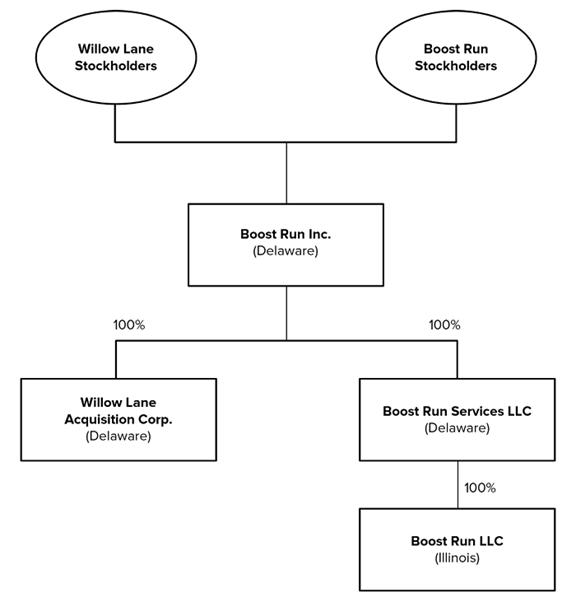
The following simplified diagram illustrates the ownership structure of the Company. The percentage ownerships of shares of our common stock are presented assuming, among other things, that no shares of our common stock are issued pursuant to the Incentive Plan.
| 9 |
| 10 |
Summary of Risk Factors
The risk factors summarized below could materially harm our business, operating results and/or financial condition, impair our future prospects and/or cause the price of our ordinary shares to decline. These risks are discussed more fully following this summary. Material risks that may affect our business, operating results and financial condition include, but are not necessarily limited to, the following:
| ● | Boost Run’s recent growth may not be indicative of its future growth, and if it does not effectively manage its future growth, its business, operating results, financial condition, and prospects may be adversely affected. | |
| ● | Boost Run has a limited number of suppliers for significant components of the equipment it uses to build and operate its platform and provide its solutions and services. Any disruption in the availability of these components could delay Boost Run’s ability to expand or increase the capacity of its infrastructure or replace defective equipment. | |
| ● | Boost Run’s business would be harmed if it were not able to access sufficient power or by increased costs to procure power, prolonged power outages, shortages, or capacity constraints. | |
| ● | Boost Run depends entirely on third-party partners, including data center operators, to host Boost Run’s GPU infrastructure and provide various services in support of its business, and any disruption to these relationships or the performance of these partners could materially harm Boost Run’s business, financial condition, and results of operations. | |
| ● | If Boost Run’s data center providers fail to meet the requirements of its business, or if the data center facilities experience damage, interruption, or a security breach, its ability to provide access to its infrastructure and maintain the performance of its network could be negatively impacted. | |
| ● | Boost Run’s ability to grow its business and serve customer demand is dependent on the availability of suitable colocation capacity from third-party partners, and constraints on partner capacity or partners’ willingness to expand could significantly limit Boost Run’s growth prospects. | |
| ● | Boost Run’s platform may become less competitive if it fails (i) to efficiently enhance its platform, (ii) develop and sell new solutions and services and (iii) respond effectively to rapidly changing technology, evolving industry standards, changing regulations, and changing customer needs, requirements, or preferences. | |
| ● | The broader adoption, use, and commercialization of AI technology, and the continued rapid pace of developments in the AI field, are inherently uncertain. Failure by Boost Run’s customers to continue to use its Boost Run Cloud Platform to support AI use cases in their systems, or Boost Run’s ability to keep up with evolving AI technology requirements and regulatory frameworks, could have a material adverse effect on its business, operating results, financial condition, and prospects. | |
| ● | Boost Run’s operations require substantial capital expenditures, and it will require additional capital to fund its business and support its growth, and any inability to generate or obtain such capital on acceptable terms, if at all, or to lower its total cost of capital, may adversely affect its business, operating results, financial condition, and prospects. | |
| ● | The unaudited pro forma financial information included elsewhere in this prospectus may not be indicative of our future operating results or financial performance. | |
| ● | If the Business Combination’s benefits do not meet the expectations of investors or securities analysts, the market price of Boost Run’s securities may decline. | |
| ● | We are a “controlled company” under Nasdaq listing rules. As a result, our stockholders do not have, and may never have, certain corporate governance protections that are available to stockholders of companies that are not controlled companies. | |
| ● | Our management team has limited experience managing a public company. |
| 11 |
THE OFFERING
| Issuer | Boost Run Inc. | |
| Resale of Class A Common Stock | ||
| Shares of Class A Common Stock offered by the Selling Holders | We are registering the resale by the Selling Holders, or their permitted transferees, of up to 58,738,753 shares of Class A Common Stock, consisting of (i) up to 9,601,095 shares held by certain Selling Holders who received such shares in connection with the Business Combination, (ii) up to 4,628,674 shares issued to the Sponsor and its distributees in exchange for the Founder Shares purchased prior to the Willow Lane IPO, (iii) up to 4,007,216 shares underlying the Private Warrants, (iv) up to 29,533,018 shares issuable upon the conversion of Class B Common Stock held by certain Selling Holders, and (v) up to 10,968,750 shares issued as earnout consideration pursuant to the Earnout Agreement. | |
| Warrants offered by the Selling Holders | We are registering the resale by the Selling Holders, or their permitted transferees, of up to 4,007,216 Private Warrants. | |
| Use of proceeds | We will not receive any proceeds from the sale of the shares of Class A Common Stock by the Selling Holders. We will receive proceeds from the exercise of the Private Warrants to the extent they are exercised for cash. We intend to use any such proceeds for general corporate purposes. See “Use of Proceeds.” | |
| Nasdaq listing | Our Class A Common Stock is listed on the Global Market tier of Nasdaq under the symbol “BRUN.” Our Warrants are listed on Capital Market tier of Nasdaq under the symbol “BRUNW.” | |
| Risk factors | Investing in our Class A Common Stock involves risks. See “Risk Factors” beginning on page 13 of this prospectus for a discussion of certain factors you should carefully consider before deciding to invest in our Class A Common Stock. |
For additional information concerning the offering, see “Plan of Distribution” beginning on page 135.
| 12 |
RISK FACTORS
Any investment in our securities involves a high degree of risk. You should carefully consider all of the information contained in this prospectus and any subsequent prospectus supplement, including our financial statements and related notes thereto, before investing in our securities. However, such risks and those discussed elsewhere in any subsequent prospectus supplement are not the only ones we face. Additional risks and uncertainties that we are unaware of, or that we currently believe are not material, may also become important factors that adversely affect us. If any of the risks described in any subsequent prospectus supplement or others not specified therein materialize, our business, financial condition and results of operations could be materially and adversely affected. In that case, you may lose all or part of your investment.
Unless the context otherwise requires, all references in this subsection to the “Company,” “Boost Run,” “we,” “us,” or “our” refer to the business of Boost Run and its consolidated subsidiaries.
General Risks Related to Boost Run’s Business and Industry
Boost Run’s recent growth may not be indicative of its future growth, and if it does not effectively manage its future growth, its business, operating results, financial condition, and prospects may be adversely affected.
Boost Run was founded in 2023 and launched its Cloud Services Platform at the end of 2024 and has experienced significant growth in a short period of time. Investors should not rely on the revenue growth of any prior quarterly or annual period as an indication of Boost Run’s future performance. Even if Boost Run’s revenue continues to increase, its revenue growth rate is expected to decline in the future as a result of a variety of factors, including the maturation of its business. Overall growth of Boost Run’s revenue will depend on a number of factors, including but not limited to its ability to:
| ● | operate its cloud infrastructure, including due to supply chain limitations and data center or power availability; | |
| ● | compete with other companies in its industry, including those with greater financial, technical, marketing, sales, and other resources; | |
| ● | continue to develop new solutions and services and new functionality for its platform and successfully further optimize its existing infrastructure, solutions, and services; | |
| ● | retain existing customers and increase sales to existing customers, as well as attract new customers and grow its customer base; | |
| ● | successfully expand its business domestically and internationally; | |
| ● | generate sufficient cash flow from operations and raise additional capital, including through indebtedness, to support continued investments in its platform to maintain its technological leadership and the security of its platform; | |
| ● | strategically expand its direct sales force and leverage its existing sales capacity; | |
| ● | introduce and sell its solutions and services to new markets and verticals; | |
| ● | recruit, hire, train, and manage additional qualified personnel for its research and development activities; | |
| ● | maintain its existing, and enter into new, more cost-efficient, financing structures; and | |
| ● | successfully identify and acquire or invest in businesses, products, or technologies that it believes could complement or expand its platform. |
| 13 |
In addition to the factors discussed above, Boost Run’s revenue growth may also be impacted by industry-specific factors, particularly the continued development of AI (including advancements in AI technology that may lead to further compute efficiencies), the broader adoption, use, and commercialization of AI and any impacts of the developing AI regulatory environment.
As many of these factors are beyond Boost Run’s control, it is difficult for it to accurately forecast its future operating results. If the assumptions that Boost Run uses to plan its business are incorrect or change in reaction to changes in its market, it may be unable to maintain consistent revenue or revenue growth, the value of its stock could be volatile, and it may be difficult to achieve and, if achieved, maintain profitability. In addition, changes in the macroeconomic environment, including actual or perceived global banking and finance related issues, domestic and foreign regulatory uncertainty, changes in trade policies (including the imposition of tariffs, trade controls and other trade barriers), labor shortages, supply chain disruptions, volatile interest rates and inflation, spending environments, geopolitical instability, warfare and uncertainty, including the effects of the conflicts in the Middle East and Ukraine and tensions between China and Taiwan, weak economic conditions in certain regions, or a reduction in AI spending regardless of macroeconomic conditions may impact Boost Run’s growth.
In addition, as Boost Run has grown, its number of customers has also increased, and it has increasingly managed more complex deployments of its infrastructure in more complex computing environments. The rapid growth and expansion of Boost Run’s business places a significant strain on its management, operational, engineering, and financial resources. To manage any future growth effectively, Boost Run must continue to improve and expand its infrastructure, including information technology (“IT”) and financial infrastructure, its operating and administrative systems and controls, and its ability to manage headcount, capital, and processes in an efficient manner.
If Boost Run does not manage future growth effectively, its business, operating results, financial condition, and prospects would be harmed. If Boost Run continues to experience rapid growth, it may not be able to successfully implement or scale improvements to its systems, processes, and controls in an efficient, timely, or cost-effective manner. As Boost Run grows, its existing systems, processes, and controls may not prevent or detect all errors, omissions, or fraud. Any future growth will continue to add complexity to Boost Run’s organization and require effective coordination throughout its organization. Failure to manage any future growth effectively could result in increased costs, cause difficulty or delays in deploying Boost Run’s platform to new and existing customers, reduce demand for its platform, and cause difficulties in introducing new solutions and services or other operational difficulties, and any of these difficulties would adversely affect its business, operating results, financial condition, and prospects.
Boost Run has a limited number of suppliers for significant components of the equipment it uses to build and operate its platform and provide its solutions and services. Any disruption in the availability of these components could delay Boost Run’s ability to expand or increase the capacity of its infrastructure or replace defective equipment.
Boost Run does not manufacture the components it uses to build the technology infrastructure underlying its platform. Boost Run has a limited number of suppliers that it uses to procure and configure significant components of the technology infrastructure that it uses to operate its platform and provide its solutions and services to its customers. Utilizing a limited number of suppliers of the components for Boost Run’s technology infrastructure exposes it to risks, including:
| ● | asymmetry between component availability and contractual performance obligations, including where specified components are required; | |
| ● | shifts in market-leading technologies away from those offered by its current suppliers that could impact its ability to offer its customers the solutions and services that they are seeking; |
| 14 |
| ● | reduced control over production costs and constraints based on the then current availability, terms, and pricing of these components, including any delays in its supply chain; | |
| ● | limited ability to control aspects of the quality, performance, quantity, and cost of its infrastructure or of its components; | |
| ● | the potential for binding price or purchase commitments with its suppliers at higher than market rates; |
| ● | reliance on its suppliers to keep up with technological advancements at the same pace as its business and customer demands, including their ability to continue to deliver next generation components that are substantially better than the prior generation; | |
| ● | consolidation among suppliers in its industry, which may harm its ability to negotiate and obtain favorable terms from its suppliers and the third-party suppliers that its suppliers rely on; | |
| ● | labor and political unrest at facilities it does not operate or own; | |
| ● | geopolitical disputes disrupting its or any of its suppliers’ supply chains; | |
| ● | business, legal compliance, litigation, and financial concerns affecting its suppliers or their ability to manufacture and ship components in the quantities, quality, and manner Boost Run requires; | |
| ● | impacts on its supply chain from adverse public health developments, including outbreaks of contagious diseases or pandemics; and | |
| ● | disruptions due to floods, earthquakes, storms, and other natural disasters, particularly in countries with limited infrastructure and disaster recovery resources, or regional conflicts. |
Boost Run’s technology infrastructure components suppliers fulfill its supply requirements on the basis of individual purchase orders, which it often places on a just-in-time basis. Boost Run currently has no long-term contracts or arrangements with its suppliers that guarantee capacity or the continuation of any particular payment terms. Accordingly, Boost Run’s suppliers are not obligated to continue to fulfill its supply requirements, and the prices it is charged for its products and, if applicable, services could be increased on short notice. Further, because Boost Run often submits purchase orders to its suppliers on a just-in-time basis, any delay from its suppliers may result in its inability to provide its infrastructure and platform to its customers on a timely basis and fulfill its contractual requirements under its customer contracts. If Boost Run is required to change suppliers, its ability to meet its obligations to its customers, including scheduled compute access, could be adversely affected and its solutions may not be as performant, which could cause the loss of sales from existing or potential customers, delayed revenue, or an increase in its costs, which could adversely affect its margins. Any production or shipping interruptions for any reason, such as a natural disaster, epidemics, pandemics, capacity shortages, quality problems, or strike or other labor disruption at one of Boost Run’s supplier locations or at shipping ports or locations, could adversely affect sales of its solution and services offerings.
In addition, Boost Run is continually working to expand and enhance its infrastructure features, technology, and network and other technologies to accommodate substantial increases in the computing power required by more compute-intensive workloads on its platform, the amount of data it hosts, and its overall number of total customers. Boost Run may be unable to project accurately the rate or timing of these increases or to allocate resources successfully to address such increases and may underestimate the data center capacity needed to address such increases. Boost Run’s limited number of suppliers, in turn, may not be able to quickly respond to its needs, which would have a negative impact on customer experience and contractual performance. In the future, Boost Run may be required to allocate additional resources, including spending substantial amounts, to build, purchase, or lease or license data centers and equipment and upgrade its technology and network infrastructure in order to handle increased customer usage, and its suppliers may not be able to satisfy such requirements. In addition, Boost Run’s network or its suppliers’ networks might be unable to achieve or maintain data transmission capacity high enough to effectively deliver its services. Boost Run may also face constraints on its ability to deliver its platform, solutions, and services if there is limited power supply. Boost Run’s failure, or its suppliers’ failure, to achieve or maintain high data transmission capacity and sufficient electrical services would impact its ability to meet customer needs and could significantly reduce consumer demand for its services. Such reduced demand and resulting loss of compute, cost increases, or failure to upgrade its equipment or adapt to new technologies would harm its business, operating results, financial condition, and prospects.
| 15 |
Moreover, Boost Run’s suppliers themselves rely on a complex network of third-party suppliers for semiconductor manufacturing, hardware components, and other critical inputs, which introduces additional risks to its supply chain. For example, NVIDIA relies on suppliers such as Taiwan Semiconductor Manufacturing Company for semiconductor fabrication and other manufacturers for compute and networking components. Any disruption in the operations of these upstream suppliers, whether due to equipment failures, geopolitical factors such as the potential for military conflict between China and Taiwan, or supply chain constraints, could affect Boost Run’s suppliers’ ability to supply the significant components of the equipment it uses to operate its platform and provide its solutions and services to its customers, which would, in turn, affect the availability of its solutions and services, as well as lead times.
In addition, to the extent any of Boost Run’s suppliers’ businesses are impacted by business, legal compliance, litigation, and financial concerns, including regulatory scrutiny and export controls, its business, operating results, financial condition, and prospects may be adversely affected. For example, increasing use of tariffs, economic sanctions and export controls has impacted and may in the future impact the availability and cost of GPUs and other components of Boost Run’s platform. The current U.S. presidential administration has discussed imposing broadbased tariffs on imported goods, which, if implemented on components of Boost Run’s infrastructure and other products it uses, could increase its costs. Further, the former U.S. presidential administration had recently released new export controls targeting semiconductor manufacturing equipment and other items related to advanced integrated circuits. It is possible that these and additional restrictions could impede the supply chain in this industry. Additional export restrictions imposed on components of Boost Run’s technologies by the U.S. government may also provoke responses from foreign governments that negatively impact its supply chain, increase the costs for affected imported goods, or limit its ability to obtain additional hardware components, which would also substantially reduce its ability to provide or develop its platform, solutions, and services.
In the event of a supplier unavailability, component shortage, or supply interruption, Boost Run may not be able to secure alternate sources in a timely manner. Securing alternate sources of supply for these components or services may be time-consuming, difficult, and costly and Boost Run may not be able to source these components or services on terms that are acceptable to it, or at all, which may undermine its ability to fill its orders in a timely manner. Any interruption or delay in the supply of any of these components or services, or the inability to obtain these components or services from alternate sources at acceptable prices and within a reasonable amount of time, would harm Boost Run’s ability to meet the demand of its customers, which in turn would have an adverse effect on its business, operating results, financial condition, and prospects.
Boost Run’s business would be harmed if it were not able to access sufficient power or by increased costs to procure power, prolonged power outages, shortages, or capacity constraints.
Boost Run depends on being able to secure power, which powers its data center facilities, in a cost-effective manner. Boost Run’s inability to secure sufficient power or any power outages, shortages, supply chain issues, capacity constraints, or significant increases in the cost of securing power could have an adverse effect on its business, operating results, financial condition, and prospects.
Boost Run relies on third parties to provide enough power to maintain its leased data center facilities and meet the needs of its current and future customers. Boost Run has in the past experienced, and it may in the future experience, insufficient power to service a customer’s project. Any limitation on the delivered energy supply would limit Boost Run’s ability to operate its platform. These limitations would have a negative impact on a given data center or limit Boost Run’s ability to grow its business which could negatively affect its business, operating results, financial condition, and prospects. Limitations on generation, transmission, and distribution may also limit its ability to obtain sufficient power capacity for potential expansion sites in new or existing markets. Power providers, other participants in the power market, and those entities that regulate it may impose onerous operating conditions to any approval or provision of power or Boost Run may experience significant delays and substantial increased costs to provide the level of electrical service required by its current or future leased or licensed data centers, or any data centers it may choose to construct in the future. Boost Run’s ability to find appropriate sites for expansion, including existing sites to lease, will also be limited by access to power.
| 16 |
Boost Run’s leased data center facilities are affected by problems accessing electricity sources, such as planned or unplanned power outages and limitations on transmission or distribution of power. Unplanned power outages, including, but not limited to those relating to large storms, earthquakes, fires, tsunamis, cyberattacks, physical attacks on utility infrastructure, war, and any failures of electrical power grids more generally, and planned power outages by public utilities, could harm Boost Run’s customers and its business. Further, Boost Run’s leased data center facilities are located in leased buildings where, depending upon the lease requirements and number of tenants involved, it may or may not control some or all of the infrastructure, including generators and fuel tanks. As a result, in the event of a power outage, Boost Run could be dependent upon the landlord, as well as the utility company, to restore the power. Even if Boost Run attempts to limit its exposure to system downtime by using backup generators, which are in turn supported by onsite fuel storage and through contracts with fuel suppliers, these measures may not always prevent downtime or solve for long-term or large-scale outages. Any outage or supply disruption could adversely affect Boost Run’s customer experience, as well as its business, operating results, financial condition, and prospects.
The global energy market is currently experiencing inflation and volatility pressures. Various macroeconomic and geopolitical factors are contributing to the instability and global power shortage, including the war in Ukraine, severe weather events, governmental regulations, government relations, and inflation. Boost Run expects the cost for power to continue to be volatile and unpredictable and subject to inflationary pressures, which could materially affect its financial forecasting, business, operating results, financial condition, and prospects.
Boost Run depends entirely on third-party partners, including data center operators, to host Boost Run’s GPU infrastructure and provide various services in support of its business, and any disruption to these relationships or the performance of these partners could materially harm Boost Run’s business, financial condition, and results of operations.
Boost Run does not own or operate data centers. Instead, Boost Run relies exclusively on third-party colocation providers to house, power, cool, and provide connectivity to Boost Run’s GPU servers and infrastructure. Boost Run also relies on third-party partners to provide various services in support of its business, including hardware delivery, installation, service and technical support, as well as the provision of equipment and personnel. If a local partner is unwilling or unable to deliver its services for any reason including, but not limited to, a dispute with Boost Run, the deterioration of its financial condition or a loss of personnel, Boost Run may be unable to engage an alternative partner or subcontractors to perform the same services, or on terms substantially similar to those with its existing partners. The failure to do so may cause Boost Run to breach the terms of existing contracts, impede its ability to complete orders, and/or result in damage to its customer relationships, any of which may damage Boost Run’s reputation and have a material adverse effect on its business and results of operations.
Boost Run’s business model requires Boost Run to deploy significant capital investment in GPU equipment that Boost Run installs in facilities controlled by third parties. If any of Boost Run’s colocation partners experience financial distress, operational difficulties, or elects to terminate or not renew their agreements with Boost Run, Boost Run could lose access to the facilities housing Boost Run’s equipment. Such a loss of access could result in:
| ● | Immediate service disruptions to Boost Run’s customers; | |
| ● | Breach of Boost Run’s customer service level agreements and contractual obligations; | |
| ● | Significant costs to relocate equipment to alternative facilities; | |
| ● | Extended downtime during equipment migration, resulting in lost revenue; | |
| ● | Physical damage to equipment during relocation; | |
| ● | Inability to recover equipment if colocation partner enters bankruptcy or receivership; | |
| ● | Stranded capital if equipment cannot be economically relocated; | |
| ● | Customer attrition and reputational damage; and | |
| ● | Litigation from customers whose services are disrupted. |
| 17 |
The number of data center facilities with sufficient power capacity, cooling capabilities, and network infrastructure to support high-density GPU deployments is limited, particularly as demand for AI infrastructure has increased substantially. Boost Run may rely on a concentrated number of colocation partners, and the loss of any single major partner relationship could have a disproportionate impact on Boost Run’s business. If Boost Run is unable to secure alternative colocation capacity on acceptable terms, or at all, Boost Run may be unable to fulfill commitments to existing customers or pursue new business opportunities.
Furthermore, colocation providers serve multiple customers, including some that may compete directly with Boost Run. Boost Run’s partners may prioritize other customers over Boost Run for capacity allocation, customer service, facility improvements, or access to new capacity. During periods of high demand or capacity constraints, Boost Run may face difficulty securing adequate space, power, or cooling to support Boost Run’s growth plans. Partners may also increase pricing, impose less favorable terms, or require longer-term commitments as a condition of providing or expanding capacity for Boost Run.
Boost Run’s agreements with colocation partners typically have defined terms and are subject to renewal. There can be no assurance that Boost Run will be able to renew these agreements on commercially reasonable terms, or at all. Upon expiration of an agreement, a colocation partner may elect not to renew, may demand substantially higher fees, may reduce the scope of services provided, or may impose operational restrictions that adversely affect Boost Run’s ability to serve customers. The terms of Boost Run’s colocation agreements may be shorter than the terms of Boost Run’s customer contracts, creating a mismatch that exposes Boost Run to significant risk if Boost Run is unable to maintain uninterrupted access to facilities necessary to serve long-term customer commitments.
Additionally, changes in ownership or control of Boost Run’s colocation partners—whether through acquisition, merger, restructuring, or other transactions—could adversely affect Boost Run’s relationships with these partners. New ownership may seek to renegotiate terms, terminate agreements, redirect capacity to other uses, or implement operational changes that negatively impact Boost Run. Boost Run may have limited contractual protections in the event of a change in control of a colocation partner.
Boost Run’s ability to expand Boost Run’s business and enter new markets is also constrained by the availability of suitable colocation partners in desired geographic locations. If Boost Run is unable to establish relationships with colocation providers in strategic markets, Boost Run’s growth may be limited, and Boost Run may be unable to meet customer requirements for geographic diversity or data sovereignty. Given Boost Run’s complete dependence on third-party colocation providers, any adverse developments affecting these critical partnerships could have a material adverse effect on Boost Run’s business, results of operations, financial condition, and future prospects.
If Boost Run’s data center providers fail to meet the requirements of its business, or if the data center facilities experience damage, interruption, or a security breach, its ability to provide access to its infrastructure and maintain the performance of its network could be negatively impacted.
Boost Run leases space in or otherwise licenses use of third-party data centers located in the U.S. Boost Run’s business is reliant on these data center facilities. Given that Boost Run leases or licenses use of this data center space, it does not control the operation of these third-party facilities. Consequently, Boost Run could be subject to service disruptions as well as failures to provide adequate support for reasons that are outside of its direct control. Boost Run’s data center facilities and network infrastructure are vulnerable to damage or interruption from a variety of sources including earthquakes, floods, fires, power loss, system failures, computer and other cybersecurity vulnerabilities, physical or electronic break-ins, human error, malfeasance or interference, including by employees, former employees, or contractors, as well terrorist acts and other catastrophic events. Boost Run and the data center facilities it leases space in or license use of have experienced, and may in the future experience, disruptions, outages, and other performance problems due to a variety of factors, including availability or sufficiency of power, infrastructure changes, and capacity constraints, occasionally due to an overwhelming number of customers accessing its infrastructure simultaneously. Boost Run’s third-party data centers and network infrastructure may also be subject to cybersecurity attacks, including supply chain attacks, due to the actions of outside parties or human error, malfeasance, insider threats, system errors or vulnerabilities, insufficient cybersecurity controls, a combination of these, or otherwise, which may cause service outages and otherwise impact its ability to provide its solutions and services. While Boost Run reviews the security measures of its third-party data centers, it cannot ensure that these measures will be sufficient to prevent a cybersecurity attack or to protect the continued operation of its platform in the event of a cybersecurity attack, and any impact to its solutions and services may also impact its business, operating results, financial condition, and prospects. Data center facilities housing Boost Run’s network infrastructure may also be subject to local administrative actions, changes to legal or permitting requirements, labor disputes, litigation to stop, limit, or delay operations, and other legal challenges, including local government agencies seeking to gain access to customer accounts for law enforcement or other reasons. In addition, while Boost Run has entered into various agreements for the lease of data center space, equipment, maintenance, and other services, those third parties could fail to deliver on their contractual obligations under those agreements, including agreements to provide it with certain data, equipment, and utilities information required to run its business. Furthermore, Boost Run may require the data centers it leases to have certain highly specific attributes in order to effectively run its business. For example, Boost Run’s state-of-the art data centers may also require networking equipment, high-speed interconnects, enhanced access to power, and liquid cooling infrastructure. In some cases, these third-party data centers are required to undergo extensive retrofitting and improvement efforts, including to incorporate novel developments in Boost Run’s industry, which are time consuming, expensive, and less efficient than if it were to lease from spaces already designed for its operations, and which may not ultimately be successful in meeting all of its requirements.
| 18 |
If third parties fail to successfully deliver on such performance requirements, Boost Run’s ability to maintain the performance of its network would be negatively impacted. Other factors, many of which are beyond Boost Run’s control, that can affect the delivery, performance, and availability of its platform include:
| ● | the development, maintenance, and functioning of the infrastructure of the internet as a whole; | |
| ● | the performance and availability of third-party telecommunications services with the necessary speed, data capacity, and security for providing reliable internet access and services; | |
| ● | the success or failure of its redundancy systems; | |
| ● | the success or failure of its disaster recovery and business continuity plans; | |
| ● | decisions by the owners and operators of the data center facilities where its infrastructure is installed or by global telecommunications service provider partners who provide it with network bandwidth to terminate its contracts, discontinue services to it, shut down operations or facilities, increase prices, change service levels, limit bandwidth, declare bankruptcy, breach their contracts with it, or prioritize the traffic of other parties; | |
| ● | its ability to enter into data center agreements and leases according to its business needs and on terms and with counterparties acceptable to it; and | |
| ● | changing sentiment by government regulators relating to data center development, including in response to public concerns regarding environmental impact and development, which may result in restrictive government regulation or otherwise impact the future construction of additional data centers. |
In addition, many of the leases Boost Run has entered into for third-party data centers have multi-year terms and fixed capacity. If Boost Run does not accurately anticipate the data center capacity required by its customers, including if they use less or more of its infrastructure than expected, it would incur additional costs due to leasing more capacity than is used and paid for by its customers or, alternatively, in seeking additional data center capacity to fulfill unexpected demand on terms that may not be economically reasonable or acceptable to it, if it is able to lease additional capacity at all. Boost Run may also need to seek additional data center capacity in the event any leases with third parties are terminated or not renewed, which it may be unable to do on reasonable terms or at all.
| 19 |
The occurrence of any of these factors, or Boost Run’s inability to efficiently and cost-effectively fix such errors or other problems that may be identified, could damage its reputation, negatively impact its relationship with its customers, or otherwise materially harm its business, operating results, financial condition, and prospects.
In the future, Boost Run may develop its own data centers, rather than relying on third parties and, because of its limited experience in this area, it could experience unforeseen difficulties. For example, any potential expansion of Boost Run’s data center infrastructure would be complex, and unanticipated delays in the completion of those projects or availability of components may lead to increased project costs, operational inefficiencies, or interruptions in the delivery or degradation of the quality of its platform. In addition, there may be issues related to this infrastructure that are not identified during the testing phases of design and implementation, which may only become evident after Boost Run has started to fully utilize the underlying equipment, that could further degrade its platform or increase its costs.
Boost Run deploys substantial capital in GPU equipment and other infrastructure housed in facilities that Boost Run does not own or control, exposing Boost Run to significant risks of equipment loss, damage, theft, or inability to access or recover Boost Run’s assets.
Boost Run’s business model involves purchasing and owning high-value GPU servers, networking equipment, and other infrastructure that Boost Run deploys in data centers operated by third parties. These assets represent a substantial portion of Boost Run’s total capital investment and are critical to Boost Run’s ability to generate revenue. However, because these assets are located in facilities controlled by others, Boost Run faces unique risks related to the security, protection, and recoverability of this equipment.
Boost Run’s equipment may be vulnerable to physical theft, damage, or loss while housed in third-party facilities. Although colocation providers typically implement physical security measures, Boost Run has limited ability to directly oversee or control these security protocols. Security incidents at partner facilities—including unauthorized access, theft, sabotage, or insider threats from partner employees or other customers—could result in the loss or damage of Boost Run’s equipment. The specialized nature of Boost Run’s GPU equipment makes it a particularly attractive target for theft, as these assets have high resale value and are in substantial demand.
In addition to theft and physical damage, Boost Run’s equipment may be at risk if a colocation partner experiences financial distress or enters bankruptcy. In such scenarios, Boost Run may face significant difficulties recovering Boost Run’s equipment. Although Boost Run owns the equipment, the partner may assert liens, may commingle Boost Run’s equipment with assets of other parties, or may restrict access to the facility during bankruptcy proceedings. Boost Run may be required to engage in costly and time-consuming litigation to establish Boost Run’s ownership rights and recover Boost Run’s property. During this period, Boost Run would be unable to use the equipment to serve customers, resulting in lost revenue and potential breach of customer contracts. In some cases, Boost Run may be unable to recover equipment at all, resulting in a complete loss of the capital invested in that equipment.
Equipment deployed in third-party facilities may also be damaged by events affecting the facility itself, including fire, flood, power surges, cooling system failures, natural disasters, or other casualties. While colocation providers may maintain insurance coverage for their facilities, such coverage may not extend to customer-owned equipment, or may provide inadequate compensation for Boost Run’s losses. Boost Run’s own insurance coverage may be insufficient to fully compensate Boost Run for equipment losses, particularly if multiple assets are damaged in a single incident. Moreover, even if Boost Run receives insurance proceeds, the time required to procure and deploy replacement equipment—particularly for high-demand GPUs with extended lead times—could result in prolonged service disruptions and customer attrition.
The physical location of Boost Run’s equipment in third-party facilities also creates complications for Boost Run’s financing arrangements. Lenders providing equipment financing or other secured debt may have concerns about perfecting security interests in equipment located at third-party sites. Collateral verification, equipment inspections, and recovery of collateral in default scenarios may be more complex and costly when equipment is dispersed across multiple third-party locations. These complications may limit Boost Run’s ability to obtain favorable financing terms or may require Boost Run to provide additional collateral or guarantees, increasing Boost Run’s cost of capital.
Boost Run may also face disputes with colocation partners regarding responsibility for equipment damage or loss. Partner agreements may contain limitations of liability that prevent Boost Run from recovering the full value of damaged or lost equipment from the partner. Determining causation and liability when equipment failures occur in third-party facilities can be complex and contentious, particularly when multiple parties (the colocation provider, equipment vendors, network providers, and others) may share responsibility for the incident.
| 20 |
Finally, Boost Run may have limited ability to monitor and verify the physical condition and location of Boost Run’s equipment on an ongoing basis. While colocation partners may provide periodic reports, Boost Run may lack real-time visibility into equipment status, maintenance activities, or physical security incidents. This limited visibility could delay Boost Run’s detection of equipment problems or security breaches, increasing potential losses. The concentration of high-value assets in facilities that Boost Run does not control represents a significant vulnerability in Boost Run’s business model. Any material loss, damage, theft, or inability to access or recover Boost Run’s equipment could have a material adverse effect on Boost Run’s business, results of operations, financial condition, and cash flows.
Because Boost Run does not own or operate the data centers in which Boost Run’s equipment is deployed, Boost Run has limited control over critical operational factors including power reliability, cooling efficiency, physical security, network connectivity, and maintenance activities, which could adversely affect service quality and customer satisfaction.
Boost Run’s reliance on third-party colocation providers means that Boost Run does not have direct control over aspects of the infrastructure and operations that are critical to delivering reliable, high-performance GPU cloud services to Boost Run’s customers. This lack of operational control exposes Boost Run to risks that could impair service quality, increase costs, and damage Boost Run’s reputation.
Boost Run depends entirely on colocation partners to provide adequate and reliable power and cooling for Boost Run’s high-density GPU deployments. Modern AI accelerators such as NVIDIA B300, B200 and H200 servers consume substantial power and generate significant heat, requiring robust electrical distribution and cooling systems. If colocation partners have inadequate or inefficient cooling systems, Boost Run’s GPU equipment may experience thermal throttling, reduced performance, accelerated hardware degradation, or unexpected failures. These issues directly impact the service quality Boost Run can deliver to customers and may result in SLA breaches, service credits, or customer churn.
Boost Run’s ability to deliver high-performance cloud services depends on robust, low-latency network connectivity. However, network architecture, routing, interconnections, and bandwidth within and between facilities are controlled by colocation partners and their network providers. Network limitations imposed by colocation infrastructure may constrain Boost Run’s ability to support certain customer use cases or may result in suboptimal performance compared to competitors with owned infrastructure and custom-designed networks.
Colocation partners periodically perform scheduled maintenance on facility systems including electrical distribution, cooling systems, fire suppression, networking equipment, and building infrastructure. During these maintenance windows, Boost Run’s equipment may need to be powered down or may experience service disruptions. Boost Run must schedule around partner maintenance windows rather than optimizing maintenance timing for Boost Run’s own operational needs or customer requirements. Frequent or poorly timed maintenance windows may force Boost Run to breach customer SLAs or limit Boost Run’s ability to offer high-availability services.
When operational incidents occur—whether power failures, cooling problems, physical security breaches, network outages, or other issues—Boost Run is dependent on colocation partner staff to detect, diagnose, and resolve the problem. This dependency may result in extended outages, inadequate root cause analysis, recurring problems, or insufficient remediation that continues to affect service quality.
Without direct control of facility infrastructure, Boost Run may have incomplete visibility into operational conditions affecting Boost Run’s equipment. Limited visibility impairs Boost Run’s ability to proactively identify and address issues before they impact customers, to optimize operations, or to provide customers with detailed operational transparency and reporting.
As the AI and GPU computing market evolves rapidly, new infrastructure technologies, architectures, and operational practices may emerge that improve performance, efficiency, or cost-effectiveness. Boost Run’s ability to adopt these innovations is constrained by colocation partners’ infrastructure, policies, and willingness to accommodate Boost Run’s requests. Vertically integrated competitors that control their own facilities can rapidly implement infrastructure innovations to gain competitive advantages, while Boost Run may be limited to the capabilities that colocation partners offer to all customers.
| 21 |
The cumulative effect of these operational control limitations is that Boost Run may deliver inferior service quality, experience higher operational costs, respond more slowly to problems, or be unable to support certain customer requirements compared to competitors with owned infrastructure and direct operational control. These disadvantages could materially harm Boost Run’s business, financial condition and results of operation.
Boost Run’s business model involves paying colocation fees to third-party data center operators in addition to the costs of acquiring and maintaining GPU equipment, creating a layered cost structure that may limit Boost Run’s profitability and pricing competitiveness relative to vertically integrated competitors.
Unlike vertically integrated competitors that own and operate their own data centers, Boost Run must pay ongoing fees to third-party colocation providers for rack space, power, cooling, connectivity, and related services in addition to bearing the full cost of purchasing, deploying, and maintaining GPU equipment. This dual cost structure creates significant pressure on Boost Run’s gross margins and may place Boost Run at a competitive disadvantage.
Because Boost Run must pass through or absorb colocation provider margins in addition to covering Boost Run’s own operating costs and desired profit margins, Boost Run may have less pricing flexibility than competitors who own their facilities. Colocation providers have substantial pricing power, particularly in markets where suitable data center capacity is constrained or where providers face their own increasing costs for power, cooling, labor, and regulatory compliance. If colocation costs increase faster than Boost Run can raise prices to customers, Boost Run’s gross margins will compress, potentially leading to unprofitable operations. Boost Run may face resistance from customers if Boost Run attempts to pass through colocation fee increases, particularly in a competitive market or if customers have alternative providers or the option to build their own infrastructure.
The competitive dynamics of the GPU cloud services market may also limit Boost Run’s pricing power. Large cloud service providers (“hyperscalers”) such as Amazon Web Services, Microsoft Azure, and Google Cloud Platform have massive scale advantages, vertical integration, and the ability to subsidize GPU offerings with profits from other services. These competitors may price services at levels that Boost Run cannot profitably match given Boost Run’s layered cost structure. Similarly, other GPU cloud providers with owned infrastructure may enjoy cost advantages that allow them to underprice Boost Run while maintaining profitability.
Boost Run’s gross margins may also be negatively impacted by utilization rates. While colocation fees and equipment depreciation represent largely fixed costs, revenue is variable based on customer demand. During periods of low utilization, Boost Run must continue paying full colocation fees while generating reduced revenue, substantially compressing margins or resulting in losses. Unlike data center owners who may have more flexibility to reduce certain operating costs during low utilization periods, Boost Run has limited ability to reduce colocation expenses without terminating agreements and removing equipment from facilities.
The combination of equipment capital costs, equipment depreciation, and ongoing colocation fees creates a high break-even point for Boost Run’s operations. If Boost Run is unable to maintain adequate utilization rates and pricing levels, Boost Run may be unable to achieve or sustain profitability. The challenging unit economics of Boost Run’s business model may also make it difficult to attract investment capital, secure favorable debt financing, or achieve the scale necessary to compete effectively with better-capitalized and vertically integrated competitors.
Any sustained pressure on Boost Run’s pricing, increases in colocation costs, or inability to achieve and maintain high utilization rates could result in material margin compression that adversely affects Boost Run’s business, financial condition and results of operation.
| 22 |
Boost Run’s ability to grow its business and serve customer demand is dependent on the availability of suitable colocation capacity from third-party partners, and constraints on partner capacity or partners’ willingness to expand could significantly limit Boost Run’s growth prospects.
Unlike vertically integrated data center operators that can plan and build capacity to meet their growth projections, Boost Run’s expansion is constrained by the availability of suitable colocation capacity from third-party partners. Boost Run cannot independently develop new capacity and must instead rely on partners’ existing available capacity or partners’ willingness to expand their facilities to accommodate Boost Run’s needs. This dependency creates significant limitations on Boost Run’s growth trajectory and competitive positioning.
The market for high-density colocation space suitable for GPU deployments has become increasingly constrained due to surging demand for AI infrastructure. Many data centers were not originally designed to support the power densities required by modern GPU servers, which can consume 10-20x more power per rack than traditional enterprise IT equipment. If suitable colocation capacity is unavailable in markets where Boost Run has customer demand or strategic objectives, Boost Run may be unable to pursue these opportunities, allowing competitors to capture market share that Boost Run cannot address.
Even when existing capacity is constrained, Boost Run’s ability to grow depends on partners’ decisions about whether and how to expand their facilities. Partners must balance capacity allocation among multiple customers and strategic priorities.
Even when partners are willing to expand, the timeline from decision to available capacity can be substantial. Data center construction or retrofit projects typically require 12-24 months or longer, depending on project complexity, permitting requirements, utility infrastructure, and equipment availability. Boost Run’s dependence on partner capacity expansion timelines means Boost Run cannot respond agilely to market opportunities or rapidly scale to meet demand spikes, placing Boost Run at a disadvantage relative to competitors that control their own development pipelines.
To secure access to expanded capacity, colocation partners may require Boost Run to commit to minimum capacity levels, make substantial deposits or pre-payments, or enter into take-or-pay arrangements where Boost Run must pay for contracted capacity regardless of actual utilization.
Boost Run’s geographic expansion and market coverage is limited to locations where suitable colocation partners exist. If Boost Run wishes to enter new markets to serve customer needs for data sovereignty, geographic diversity, low latency, or local presence, Boost Run must first identify and establish relationships with appropriate colocation providers. These geographic limitations may prevent Boost Run from serving certain customer segments or competing effectively in global markets.
During periods of severe capacity constraints, colocation partners must decide how to allocate limited available capacity among existing and prospective customers. As a relatively smaller GPU cloud provider dependent on third-party infrastructure, Boost Run may receive lower priority than competitors, hyperscalers, or other customers that partners view as more valuable. This could result in Boost Run being unable to secure needed capacity even when partners have capacity available, or being offered capacity only on unfavorable terms.
The fundamental constraint that Boost Run cannot independently create the data center capacity needed to support Boost Run’s growth represents a structural limitation on Boost Run’s business model. If suitable colocation capacity is unavailable, delayed, or offered only on unfavorable terms, Boost Run’s growth may be severely limited, customer demand may go unmet, competitive position may erode, and financial results may be materially adversely affected. Any sustained inability to secure adequate colocation capacity to support Boost Run’s business plan could have a material adverse effect on Boost Run’s business, results of operations, and financial condition.
From time to time, Boost Run evaluates and potentially consummates strategic investments, combinations, joint-ventures, acquisitions or alliances, which could require significant management attention, disrupt Boost Run’s business and adversely affect Boost Run’s financial results.
Boost Run evaluates and considers strategic investments, combinations, joint-ventures, acquisitions or alliances in cloud services or related businesses around the globe in order to grow Boost Run’s business. These transactions could be material to Boost Run’s financial condition and results of operations if consummated. If Boost Run is able to identify an appropriate business opportunity, Boost Run may not be able to successfully consummate the transaction and, even if Boost Run does consummate such a transaction, Boost Run may be unable to obtain the benefits or avoid the difficulties and risks of such transaction.
| 23 |
Strategic investments or acquisitions will involve risks commonly encountered in business relationships, including:
| ● | difficulties in assimilating and integrating the operations, personnel, systems, data, technologies, products and services of the acquired business; | |
| ● | inability of the acquired technologies, products or businesses to achieve expected levels of revenue, profitability, productivity or other benefits; | |
| ● | difficulties in retaining, training, motivating and integrating key personnel; | |
| ● | diversion of management’s time and resources from Boost Run’s normal daily operations; |
| ● | difficulties in successfully incorporating licensed or acquired technology and rights into Boost Run’s businesses; | |
| ● | difficulties in maintaining uniform standards, controls, procedures and policies within the combined organizations; | |
| ● | difficulties in retaining relationships with customers, employees and suppliers of the acquired business; | |
| ● | risks of entering markets, in parts of the U.S., Canada and/or abroad, in which Boost Run has limited or no prior experience; | |
| ● | failure to successfully further develop the acquired technology; | |
| ● | liability for activities of the acquired business before the acquisition, including intellectual property infringement claims, violations of laws, commercial disputes, tax liabilities and other known and unknown liabilities; | |
| ● | potential disruptions to Boost Run’s ongoing businesses; and | |
| ● | unexpected costs and unknown risks and liabilities associated with strategic investments or acquisitions. |
Boost Run may not make any investments or acquisitions, or any future investments or acquisitions may not be successful, may not benefit Boost Run’s business strategy, may not generate sufficient revenues to offset the associated acquisition costs or may not otherwise result in the intended benefits. In addition, Boost Run cannot assure you that any future investment in our acquisition of new businesses or technology will achieve market acceptance or prove to be profitable.
Any future acquisitions also could result in the issuance of shares, incurrence of debt, contingent liabilities or future write-offs of intangible assets or goodwill, any of which could have a negative impact on Boost Run’s cash flows, financial condition and results of operations. Integration of an acquired company may also disrupt ongoing operations and require management resources that otherwise would be focused on developing and expanding Boost Run’s existing business. Boost Run may experience losses related to potential investments in other companies, which could harm Boost Run’s financial condition and results of operations. Further, Boost Run may not realize the anticipated benefits of any acquisition or strategic alliance if such investments do not materialize.
To finance any acquisitions or strategic alliance, Boost Run may choose to issue shares of common stock, preference shares or a combination of debt and equity as consideration, which could significantly dilute the ownership of Boost Run’s existing shareholders. Additional funds may not be available on terms that are favorable to Boost Run, or at all. If the price of Boost Run’s common stock is low or volatile, Boost Run may not be able to acquire other companies or fund strategic alliance project using shares as consideration.
| 24 |
If Boost Run is unable to obtain the anticipated benefits from these transactions, or if Boost Run encounters difficulties in integrating any acquired operations with Boost Run’s business, Boost Run’s financial condition and results of operations could be materially harmed.
Boost Run’s estimates of market opportunity and forecasts of market growth may prove to be inaccurate, and even if the markets in which it competes achieve the forecasted growth, its business could fail to grow at similar rates, if at all.
Boost Run’s estimates of market opportunity and forecasts of market growth may prove to be inaccurate. Market opportunity estimates and growth forecasts, including those Boost Run has generated itself, are subject to significant uncertainty and are based on assumptions and estimates that may not prove to be accurate, including the risks described herein. Even if the markets in which Boost Run competes achieve the forecasted growth, its business could fail to grow at similar rates, if at all. Further, if AI is not broadly adopted by enterprises to the extent Boost Run expects, or if new use cases do not arise, then its opportunity may be smaller than it expects.
The variables that go into the calculation of Boost Run’s market opportunity are subject to change over time, and there is no guarantee that any particular number or percentage of addressable customers covered by its market opportunity estimates will purchase its platform at all or generate any particular level of revenue for it. Any expansion in the markets in which Boost Run operates depends on a number of factors, including the cost, performance, and perceived value associated with its platform and those of its competitors. Even if the markets in which Boost Run competes meet the size estimates and growth forecast, its business could fail to grow at similar rates, if at all. Boost Run’s growth is subject to many factors, including its success in implementing its business strategy, which is subject to many risks and uncertainties. Accordingly, Boost Run’s forecasts for market growth should not be taken as indicative of its future growth.
Boost Run’s platform may become less competitive if it fails (i) to efficiently enhance its platform, (ii) develop and sell new solutions and services and (iii) respond effectively to rapidly changing technology, evolving industry standards, changing regulations, and changing customer needs, requirements, or preferences.
The market in which Boost Run competes is relatively new and subject to rapid technological change, evolving industry standards and regulatory changes, as well as changing customer needs, requirements, and preferences. The success of Boost Run’s business will depend, in part, on its ability to predict, to adapt, and to respond effectively to these changes on a timely basis. If Boost Run is unable to develop and sell new solutions and services that satisfy and are adopted by new and existing customers and provide enhancements, new features, and capabilities to its infrastructure that keep pace with rapid technological and industry change, its business, operating results, financial condition, and prospects could be adversely affected. Further, prospective or existing customers may influence Boost Run’s product roadmap by requiring features optimal for their particular use case. If Boost Run is unable to adapt to meet customers’ requirements, they may use competitive offerings or internal solutions that eliminate reliance on third-party providers, and its business, operating results, financial condition, and prospects could be adversely affected. Moreover, prioritizing development of such features may require significant engineering resources and may not be compatible with the requirements of other customers, which could impact overall adoption of Boost Run’s platform. If new technologies emerge that limit or eliminate reliance on AI cloud platform providers like Boost Run, or that enable its competitors to deliver competitive services at lower prices, more efficiently, more conveniently, or more securely, such technologies could adversely impact its ability to compete. If Boost Run’s solutions do not allow it or its customers to comply with the latest regulatory requirements, sales of its platform, solutions, and services to existing customers may decrease and new customers will be less likely to adopt its platform.
Boost Run’s future growth depends on its ability to continue to meet the needs of new customers and the expanding needs of its existing customers as their use of its platform, solutions, and services grows. As sales of its platform grow, Boost Run will need to devote additional resources to expanding, improving, and maintaining its infrastructure and integrating with third-party applications. In addition, Boost Run will need to appropriately scale its internal business systems and its services organization, including customer support, to serve its growing customer base, and to improve its IT and financial infrastructure, operating and administrative systems, and its ability to effectively manage headcount, capital and processes, including by reducing costs and inefficiencies. Any failure of, or delay in, these efforts could result in impaired system performance and reduced customer satisfaction, which would negatively impact Boost Run’s revenue growth and its reputation. Boost Run may not be successful in developing or implementing these technologies. In addition, it takes a significant amount of time to plan, develop, and test improvements to Boost Run’s technologies and infrastructure, and it may not be able to accurately forecast demand or predict the results it will realize from such improvements. In some circumstances, Boost Run may also determine to scale its technology through the acquisition of complementary businesses and technologies rather than through internal development, which may divert management’s time and resources. To the extent that Boost Run does not effectively scale its operations to meet the needs of its growing customer base and to maintain performance as its customers expand their use of its services, Boost Run will not be able to grow as quickly as it anticipates, its customers may reduce or terminate use of its platform and it will be unable to compete as effectively and its business, operating results, financial condition, and prospects will be adversely affected.
| 25 |
Boost Run continually works to upgrade and enhance its platform, solutions, and services in response to customer demand and to keep up with technological changes. Part of this process entails cycling out outdated components of Boost Run’s infrastructure and replacing them with the latest technology available. This requires Boost Run to make certain estimates with respect to the useful life of the components of its infrastructure and to maximize the value of the components of its infrastructure, including its GPUs, to the fullest extent possible. Boost Run cannot guarantee that its estimates will be accurate or that its attempts at maximizing value will be successful. Any changes to the significant assumptions underlying Boost Run’s estimates or to the estimates of its components’ useful lives, or any inability to redeploy components of its existing infrastructure to extend past their contracted life could significantly affect its business, operating results, financial condition, and prospects.
Boost Run’s platform must also integrate with a variety of network, hardware, storage, and software technologies, and it needs to continuously modify and enhance the capabilities of its platform to adapt to changes and innovation in these technologies. If Boost Run’s customers widely adopt new technologies, it may need to redesign parts of its platform to work with those new technologies. These development efforts may require significant engineering, marketing, and sales resources, all of which would affect Boost Run’s business, operating results, financial condition, and prospects. Any failure of Boost Run’s infrastructure’s capabilities to operate effectively with future technologies and software platforms could reduce the demand for its platform. If Boost Run is unable to respond to these changes in a cost-effective manner, its platform may become less marketable and less competitive or obsolete, and its business may be harmed.
In addition, Boost Run must also continue to effectively manage its capital expenditures by maintaining and expanding its data center capacity, servers and equipment, grow in geographies where it currently has limited or no presence, and ensure that the performance, features, and reliability of its services and its customer service remain competitive in a rapidly changing technological environment. If Boost Run fails to manage its growth, the quality of its platform may suffer, which could negatively affect its brand and reputation and harm its ability to retain and attract customers and employees.
The broader adoption, use, and commercialization of AI technology, and the continued rapid pace of developments in the AI field, are inherently uncertain. Failure by Boost Run’s customers to continue to use its Boost Run Cloud Platform to support AI use cases in their systems, or Boost Run’s ability to keep up with evolving AI technology requirements and regulatory frameworks, could have a material adverse effect on its business, operating results, financial condition, and prospects.
As part of its growth strategy, Boost Run seeks to attract and acquire customers requiring high-performance computing, such as AI, machine learning, and automated decision-making technologies, including proprietary AI algorithms and models (collectively, “AI Technologies”).
AI has been developing at a rapid pace and continues to evolve and change. As demand continues for AI services, AI providers, including Boost Run’s customers, have sought increased compute capacity to enable advancements in their AI models and service the demands of end users. Boost Run cannot predict whether additional computing power will continue to be required to develop larger, more powerful AI models, or if the practical limits of AI technology will plateau in the future regardless of available compute capacity. Further, there have been recent advancements in AI technology, including open-source AI models, that may lead to compute and other efficiencies that may impact the demand for AI services, including Boost Run’s platform, solutions, and services, which may adversely impact its revenue and profitability. In the event that existing scaling laws do not continue to apply as they have in the past, demand by Boost Run’s customers for compute resources, including its solutions and services, may not continue to increase over time, or may decrease if overall demand for AI is impacted by a lack of further technological development. If Boost Run is unable to keep up with the changing AI landscape or in developing services to meet its customers’ evolving AI needs, or if the AI landscape does not develop to the extent it or its customers expect, its business, operating results, financial condition, and prospects may be adversely impacted.
| 26 |
Additionally, Boost Run may incur significant costs and experience significant delays in developing new solutions and services or enhancing its current platform to adapt to the changing AI landscape, and may not achieve a return on investment or capitalize on the opportunities presented by demand for AI solutions. Moreover, while AI adoption is likely to continue and may accelerate, the long-term trajectory of this technological trend is uncertain. Further, market acceptance, understanding, and valuation of solutions and services that incorporate AI Technologies are uncertain and the perceived value of AI Technologies used and/or provided by its customers could be inaccurate. If AI is not broadly adopted by enterprises to the extent Boost Run expects, or if new use cases do not arise, then its opportunity may be smaller than it expects. Further, if the consumer perception and perceived value of AI Technologies is inaccurate this could have a material adverse effect on Boost Run’s customers, which in turn could have a material adverse effect on its business, operating results, financial condition, and prospects.
Concerns relating to the responsible use by Boost Run’s customers of new and evolving technologies, such as AI, which are supported by its platform, may result in collateral reputational harm to it. AI may pose emerging ethical issues and if Boost Run’s platform enables customer solutions that draw controversy due to their perceived or actual impact on society, it may experience brand or reputational harm, competitive harm, or legal liability.
Furthermore, the rapid pace of innovation in the field of AI has led to developing and evolving regulatory frameworks globally, which are expected to become increasingly complex as AI continues to evolve. Regulators and lawmakers around the world have started proposing and adopting, or are currently considering, regulations and guidance specifically on the use of AI. Regulations related to AI Technologies have been introduced in the U.S. at the federal level and are also enacted and advancing at the state level. Additional regulations may impact Boost Run’s customers’ ability to develop, use and commercialize AI Technologies, which would impact demand for its platform, solutions, and services and may affect its business, operating results, financial condition, and prospects.
AI and related industries, including cloud services, are under increasing scrutiny from regulators due to their concerns about market concentration, anti-competitive practices, and the pace of partnerships and acquisitions involving generative AI startups. As the industry continues to grow, transactions and business conduct will likely continue to draw scrutiny from regulators. Boost Run’s customers may become subject to further AI regulations, including any restrictions on the total consumption of compute technology, which could cause a delay or impediment to the commercialization of AI technology and could lead to a decrease in demand for its customers’ AI infrastructure, and may adversely affect its business, operating results, financial condition, and prospects.
Boost Run’s operations require substantial capital expenditures, and it will require additional capital to fund its business and support its growth, and any inability to generate or obtain such capital on acceptable terms, if at all, or to lower its total cost of capital, may adversely affect its business, operating results, financial condition, and prospects.
Boost Run requires substantial capital expenditures to support its growth and respond to business challenges. Boost Run has made significant financial investments in its business, and it intends to continue to make such investments in the future, including expenditures to procure components for, maintain, upgrade, and enhance its platform, including costs related to obtaining third-party chips and leasing and maintaining, enhancing, and expanding its data centers.
Additional financing may not be available on terms favorable to Boost Run, if at all. If adequate financing is not available on acceptable terms, Boost Run may be unable to invest in future growth opportunities, which could harm its business, operating results, financial condition, and prospects. If Boost Run raises additional equity financing, Boost Run’s shareholders may experience significant dilution of their ownership interests, and the per share value of Boost Run’s shares of common stock could decline. Furthermore, if Boost Run engages in debt financing, Boost Run may not be able to obtain such financing on terms favorable to it and the holders of debt will have priority over the holders of Boost Run common stock on order of payment preference. Further, the current global macroeconomic environment could make it more difficult to raise additional capital on favorable terms, if at all. Such terms may involve restrictive covenants making it difficult to engage in capital raising activities and pursue business opportunities, including potential acquisitions. The trading prices of recently-public companies have been highly volatile as a result of multiple factors including, the conflicts in the Middle East and Ukraine and tensions between China and Taiwan, inflation, interest rate volatility, domestic and foreign regulatory uncertainty, changes in trade policies, including the imposition of tariffs, trade controls and other trade barriers, actual or perceived instability in the banking system, and market downturns, which may reduce its ability to access capital on favorable terms or at all. In addition, a recession, depression, or other sustained adverse market event could adversely affect Boost Run’s business and financial results. If Boost Run is unable to obtain adequate financing or financing on terms satisfactory to it when it requires, its ability to continue to support its business growth and to respond to business challenges could be significantly impaired and its business may be adversely affected, requiring it to delay, reduce, or eliminate some or all of its operations. Even if Boost Run is able to raise such capital, it cannot guarantee that it will deploy it in such a fashion that allows it to achieve better operating results or grow its business.
| 27 |
Moreover, in order to fund investments in Boost Run’s infrastructure, it has pioneered and scaled innovative financing structures that have enabled it to grow its business through timely and flexible access to capital. While Boost Run expects its cost of capital to continue declining as it benefits from economies of scale and access new forms of financing, including asset-backed securitizations and rated parent-level debt, its ability to lower its cost of capital depends upon a number of factors, many of which are beyond its control, including broader macroeconomic conditions. If Boost Run is unable to continue lowering its cost of capital, its ability to effectively compete, especially with larger competitors that have greater financial and other resources, as well as its operating results, financial condition, and business, may be adversely impacted.
Boost Run has an evolving business model which is subject to various uncertainties.
As cloud services and data centers become more widely available, Boost Run expects the services and products associated with them to evolve. In order to stay current with the industry, Boost Run’s business model requires Boost Run to evolve as well. Boost Run cannot offer any assurance that these or any other modifications will be successful or will not result in harm to Boost Run’s business. Boost Run may not be able to manage growth effectively, which could damage Boost Run’s reputation, limit Boost Run’s growth and negatively affect Boost Run’s operating results. Further, as the markets in which Boost Run operates continue to evolve, new market participants have emerged and may continue to emerge and this may require Boost Run to further evaluate Boost Run’s business model and products and services. Boost Run cannot provide any assurance that Boost Run will successfully identify all emerging trends and growth opportunities in this business sector, and Boost Run may lose out on those opportunities. Such circumstances could have a material adverse effect on Boost Run’s business, prospects or operations.
| 28 |
Boost Run does not have any business interruption or disruption insurance coverage.
Currently, Boost Run does not have any business liability or disruption insurance to cover Boost Run’s operations, other than director’s and officer’s liability insurance. Boost Run has determined that the costs of insuring for these risks and the difficulties associated with acquiring such insurance on commercially reasonable terms make it impractical for Boost Run to have such insurance. Any uninsured business disruptions may result in Boost Run incurring substantial costs and the diversion of resources, which could have an adverse effect on Boost Run’s results of operations and financial condition.
A network or data security incident against Boost Run, or its third-party providers, whether actual, alleged, or perceived, could harm its reputation, create liability and regulatory exposure, and adversely impact its business, operating results, financial condition, and prospects.
Companies are subject to an increasing number, and wide variety, of attacks on their networks on an ongoing basis. Traditional computer “hackers,” malicious code (such as viruses and worms), phishing attempts, ransomware, account takeover, business email compromise, employee fraud or bad actors, theft or misuse, denial of service attacks, misconfigurations, bugs, or other vulnerabilities in commercial software that is integrated into Boost Run’s (or its suppliers’ or service providers’) IT systems, and sophisticated nation-state sponsored actors engage in cyber intrusions and attacks that create risks for its infrastructure and the data, including personal information, which it hosts and transmits. State-supported and geopolitical-related cyberattacks may rise in connection with regional geopolitical conflicts such as the conflicts in the Middle East and Ukraine and tensions between China and Taiwan. Moreover, the ongoing war in Ukraine and associated activities in Russia as well as in the Middle East, have increased the risk of cyberattacks on various types of infrastructure and operations. Additionally, bad actors are beginning to utilize AI-based tools to execute attacks, creating unprecedented cybersecurity challenges. Boost Run may be a valuable target for cyberattacks given the critical data which it hosts and transmits.
Although Boost Run has developed systems and processes designed to protect its information systems and the data it manages, prevent cybersecurity incidents, data loss and other security breaches, effectively respond to known and potential risks, and expects to continue to expend significant resources to bolster these protections, there can be no assurance that these security measures will provide absolute security or prevent breaches or attacks. Boost Run has experienced from time to time, and may experience in the future, breaches of its security measures due to human error, malfeasance, insider threats, system errors or vulnerabilities, or other irregularities. Unauthorized parties have attempted, and Boost Run expects that they will continue to attempt, to gain access to its systems and facilities, as well as those of its customers, partners, and third-party service providers, through various means, including hacking, social engineering, phishing, and attempting to fraudulently induce individuals (including employees, service providers, and Boost Run’s customers) into disclosing usernames, passwords, payment card information, or other sensitive information, which may, in turn, be used to access Boost Run’s cloud services. Threats can come from a variety of sources, including criminal hackers, hacktivists, state-sponsored intrusions, industrial espionage, and insiders. Certain threat actors may be supported by significant financial and technological resources, making them even more sophisticated and difficult to detect.
Protecting its own assets has become more expensive and these costs may increase as the threat landscape increases, including as a result of use by bad actors of AI. Boost Run may face difficulties or delays in identifying or otherwise responding to any attacks or actual or potential security breaches or threats. These risks are exacerbated by developments in generative AI. A breach in Boost Run’s or its third-party providers’ data security or an attack against its platform could and have impacted its infrastructure and systems, creating system disruptions or slowdowns and providing access to malicious parties to information hosted and transmitted by its infrastructure, resulting in data, including the data of its customers, being publicly disclosed, misused, altered, lost, or stolen, which could subject it to liability and reputational harm and adversely affect its financial condition. While to date no incidents have had a material impact on Boost Run’s operations or financial results, it cannot guarantee that material incidents will not occur in the future. If compromised, Boost Run’s own systems could be used to facilitate or magnify an attack. Further, the increase in remote work by companies and individuals in recent years has generally increased the attack surface available to bad actors for exploitation, and as such, the risk of a cybersecurity incident potentially occurring has increased.
| 29 |
Any actual, alleged, or perceived security breach in Boost Run’s third-party providers’ or partners’ systems or networks, or any other actual, alleged or perceived data security breach that it or its third-party providers or partners suffer, could result in damage to its reputation, negative publicity, loss of customers and sales, loss of competitive advantages over its competitors, increased costs to remedy any problems and otherwise respond to any incident, regulatory investigations and enforcement actions, fines and penalties, costly litigation (including class actions), and other liability. Boost Run would also be exposed to a risk of loss or litigation and potential liability under laws, regulations, and contracts that protect the privacy and security of personal information.
Due to concerns about data security and integrity, a growing number of legislative and regulatory bodies have adopted breach notification and other requirements in the event that information subject to such laws is accessed by unauthorized persons and additional regulations regarding security of such data are possible. Boost Run may need to notify governmental authorities and affected individuals with respect to such incidents. For example, laws in the European Union, the United Kingdom, and the U.S. may require businesses to provide notice to individuals whose personal information has been disclosed as a result of a data security breach. Complying with such numerous and complex regulations in the event of a data security breach can be expensive and difficult, and failure to comply with these regulations could subject Boost Run to regulatory scrutiny and additional liability. In addition, certain of Boost Run’s customer agreements, as well as privacy laws, may require it to promptly report security incidents involving its systems or those of its third-party partners that compromise the security, confidentiality, or integrity of certain processed customer data. Regardless of Boost Run’s contractual protections, these mandatory disclosures could be costly, result in litigation, harm its reputation, erode customer trust, and require significant resources to mitigate issues stemming from actual or perceived security breaches.
Boost Run may also incur significant financial and operational costs to investigate, remediate, eliminate, and put in place additional tools and devices designed to prevent actual or perceived security breaches and other security incidents, as well as costs to comply with any notification obligations resulting from any security incidents. Any of these negative outcomes could adversely affect the market perception of its infrastructure and customer and investor confidence in Boost Run, and would adversely affect its business, operating results, financial condition, and prospects.
Further, from time to time, government entities (including law enforcement bodies) may in the future seek Boost Run’s assistance with obtaining access to its customers’ data. Although Boost Run strives to protect the privacy of its customers, it may be required from time to time to provide access to customer data to government entities. In light of Boost Run’s privacy commitments, although it may legally challenge law enforcement requests to provide access to its systems or other customer content, it may nevertheless face complaints that it has provided information improperly to law enforcement or in response to non-meritorious third-party complaints. Boost Run may experience adverse political, business, and reputational consequences, to the extent that it does not provide assistance to or comply with requests from government entities in the manner requested or challenge those requests publicly or in court or provide, or are perceived as providing, assistance to government entities that exceeds its legal obligations. Any such disclosure could significantly and adversely impact Boost Run’s business and reputation.
Boost Run’s ability to maintain customer satisfaction depends in part on the quality of Boost Run’s customer support and cloud operations services. Boost Run’s failure to maintain high-quality customer support and cloud operations services could have an adverse effect on Boost Run’s business, operating results, financial condition, and future prospects.
Boost Run believes that the successful use of Boost Run’s platform requires a high level of support and engagement for many of Boost Run’s customers. In order to deliver appropriate customer support and engagement, Boost Run must successfully assist Boost Run’s customers in deploying and continuing to use Boost Run’s platform, resolve performance issues, address interoperability challenges with the customers’ existing IT infrastructure, and respond to security threats and cyber-attacks and performance and reliability problems that may arise from time to time. Increased demand for customer support and cloud operations services, without corresponding increases in revenue, could increase Boost Run’s costs and adversely affect Boost Run’s business, operating results, financial condition, and future prospects.
Furthermore, there can be no assurance that Boost Run will be able to hire sufficient support personnel as and when needed, particularly if Boost Run’s sales exceed Boost Run’s internal forecasts. Boost Run expects to increase the number of its customers, and that growth may put additional pressure on Boost Run’s customer support and cloud operations services teams. Boost Run’s customer support and cloud operations services teams may need additional personnel to respond to customer demand. Boost Run may be unable to respond quickly enough to accommodate short-term increases in customer demand for services. To the extent that Boost Run is unsuccessful in hiring, training, and retaining adequate support resources, Boost Run’s ability to provide high-quality and timely support to Boost Run’s customers will be negatively impacted, and Boost Run’s customers’ satisfaction and their purchase of Boost Run’s infrastructure could be adversely affected.
| 30 |
In addition, as Boost Run continues to grow Boost Run’s operations and expand outside of the U.S., Boost Run needs to be able to provide efficient services that meet Boost Run’s customers’ needs globally at scale, and Boost Run’s customer support and cloud operations services teams may face additional challenges, including those associated with operating the platforms and delivering support, training, and documentation in languages other than English and providing services across expanded time-zones. If Boost Run is unable to provide efficient customer support services globally at scale, Boost Run’s ability to grow Boost Run’s operations may be harmed, and Boost Run may need to hire additional services personnel which could increase Boost Run’s expenses, and negatively impact Boost Run’s business, financial condition, operating results, and future prospects.
Boost Run’s platform is complex and performance problems or defects associated with its platform may adversely affect its business, operating results, financial condition, and prospects.
It may become increasingly difficult to maintain and improve Boost Run’s platform performance, especially during peak demand spikes and as its customer base grows and its platform becomes more complex. If Boost Run’s platform is unavailable or if its customers are unable to access its platform within a reasonable amount of time or at all, it could experience a loss of customers, lost or delayed market acceptance of its platform, delays in payment to it by customers or issuance of credits to impacted customers, injury to its reputation and brand, warranty and legal claims against it, significant cost of remedying these problems, and the diversion of its resources. For example, in the past, Boost Run has experienced, and it may in the future experience, insufficient power to service a customer’s project and have been required to provide service credits to that customer due to resulting performance issues. In addition, to the extent that it does not effectively address capacity constraints, upgrade its systems as needed, and continually develop its technology and network architecture to accommodate actual and anticipated changes in technology, its business, operating results, financial condition, and prospects, as well as its reputation, may be adversely affected.
Further, the hardware and software technology underlying Boost Run’s platform is inherently complex and may contain material defects or errors, particularly when new solutions and services are first introduced or when new features or capabilities are released. Boost Run has, from time to time, found defects or errors in its platform, and new defects or errors may be detected in the future by it or its customers. Boost Run cannot ensure that its platform, including any new solutions and services that it releases, will not contain defects. Any real or perceived errors, failures, vulnerabilities, or bugs in Boost Run’s platform could result in negative publicity or lead to data security access, retention, or other performance issues, all of which could harm its business. Boost Run also relies on third-party suppliers for the most significant components of the equipment it uses to operate its infrastructure. These third-party suppliers may also experience defects or errors in the products that Boost Run utilizes in its platform, which would impact its platform and may result in performance problems or service interruptions. The costs incurred in correcting any such defects or errors, including those in third-party components, may be substantial and could harm Boost Run’s business. Moreover, the harm to Boost Run’s reputation and legal liability related to such defects or errors may be substantial and could similarly harm its business.
In addition, most of Boost Run’s customer agreements and terms of service contain service level commitments. If Boost Run is unable to meet the stated service level commitments due to performance problems or defects, it may be contractually obligated to provide the affected customers with service credits or refunds, which could significantly affect its revenue in the periods in which any issues occur and the credits or refunds are applied. As a result of degradation of service and interruptions to its platform, Boost Run has provided, and may continue to provide, service credits and/or refunds to certain of its affected customers with whom it had service level commitments. Boost Run could also face customer terminations with refunds of prepaid amounts, which could significantly affect both its current and future revenues. Any service level failures could harm Boost Run’s business.
| 31 |
Any failure of Boost Run’s IT systems or those of one or more of its IT service providers, business partners, vendors, suppliers, or other third-party service providers, or any other failure by such third parties to provide services to it may negatively impact its relationships with customers and harm its business.
Boost Run’s business depends on various IT systems and outsourced IT services. Boost Run relies on third-party IT service providers, business partners, vendors, and suppliers to provide critical IT systems, corporate infrastructure, and other services and are, by necessity, dependent on them to adequately address cybersecurity threats to, and other vulnerabilities, defects, or deficiencies of or in their own systems. This includes infrastructure such as electronic communications, finance, marketing, and recruiting platforms and services such as IT network development and network monitoring, and third-party data center hosting of its systems for Boost Run’s internal and customer use. Boost Run does not own or control the operation of the third-party facilities or equipment used to provide such services. Boost Run’s third-party vendors and service providers have no obligation to renew their agreements with it on commercially reasonable terms or at all. If Boost Run is unable to renew these agreements on commercially reasonable terms, including with respect to service levels and cost, or at all, it may be required to transition to a new provider, and it may incur significant costs and possible service interruption in connection with doing so. In addition, such service providers could decide to close their facilities or change or suspend their service offerings without adequate notice to it. Moreover, any financial difficulties, such as bankruptcy, faced by such vendors, the nature and extent of which are difficult to predict, may harm Boost Run’s business. Since Boost Run cannot easily switch vendors without making other business trade-offs, any disruption with respect to its current providers would impact its operations and its business may be harmed. Furthermore, Boost Run’s disaster recovery systems and those of such third parties may not function as intended or may fail to adequately protect its business information in the event of a significant business interruption, Any termination, failure, or other disruption of any of such systems or services of Boost Run’s third-party IT providers, business partners, vendors, and suppliers could lead to operating inefficiencies or disruptions, which could harm its business, operating results, financial condition, and prospects.
Boost Run has a limited operating history at its current scale, which makes it difficult to evaluate its current business and prospects.
Boost Run has a relatively short history operating its business at its current scale and have grown rapidly during that time. Boost Run was founded in 2023 and launched its Cloud Services Platform in late 2024. Boost Run’s limited operating history, including its limited history of selling its cloud infrastructure offering, the dynamic and rapidly evolving market in which it sells its platform, and the concentration of its revenue from a limited number of customers, as well as numerous other factors beyond its control, may make it difficult to evaluate its current business, prospects and other trends. Boost Run has encountered, and will continue to encounter, risks and uncertainties frequently experienced by growing companies in rapidly changing industries and sectors, such as the risks and uncertainties described herein. Any predictions about Boost Run’s future revenue and expenses may not be as accurate as they would be if it had a longer operating history or operated in a more predictable or established market. If Boost Run’s assumptions regarding these risks and uncertainties are incorrect or change due to fluctuations in its markets, any material reduction in AI or machine learning spending, changes in demand for specialized AI cloud infrastructure, or otherwise, or if it does not address these risks successfully, its operating and financial results could differ materially from its expectations and its business, operating results, financial condition, and prospects would be adversely affected. Boost Run cannot ensure that it will be successful in addressing these and other challenges it may face in the future. The risks associated with having a limited operating history may be exacerbated by current macroeconomic and geopolitical conditions discussed herein.
Failure to attract, grow and retain a diverse and balanced customer base could adversely affect Boost Run’s business and operating results.
Boost Run’s ability to attract, grow and retain a diverse and balanced customer base, consisting of enterprises, cloud service providers, network service providers, and digital economy customers, may affect Boost Run’s ability to grow its business. Boost Run’s ability to attract customers will depend on a variety of factors, including Boost Run’s product offerings, the presence of carriers, the overall mix of customers, the presence of key customers attracting business through ecosystems, the data center’s operating reliability and security and its ability to effectively market its product offerings. Boost Run’s inability to develop, provide or effectively execute any of these factors may adversely affect the development, growth and retention of a diverse and balanced customer base and adversely affect its business, financial condition and results of operations.
| 32 |
A substantial portion of Boost Run’s revenue is driven by a limited number of its customers, and the loss of, or a significant reduction in, spend from one or a few of its top customers would adversely affect its business, operating results, financial condition, and prospects.
A substantial portion of Boost Run’s revenue is driven by a limited number of customers.
For the year ended December 31, 2024, three customers accounted for approximately 71.6%, 12.0%, and 10.4%, respectively, of Boost Run’s revenue. In addition, for the year ended December 31, 2025, three customers accounted for approximately 44.5%, 15.8%, and 15.6%, respectively, of Boost Run’s revenue. Any negative changes in demand from Boost Run’s top customers, in its top customers’ ability or willingness to perform under their contracts with Boost Run or in Boost Run’s broader strategic relationship with its top customers would adversely affect its business, operating results, financial condition, and prospects. In addition to risks associated with customers discontinuing use of its solutions services and products, Boost Run faces risks that customers may fail to continue usage following renewal events, or fail to place additional orders for products. Boost Run’s clients enter into master services agreements which automatically renew over three-month periods and therefore Boost Run faces renewal timing risk from its counterparties. In addition, under the applicable master services agreement, individual purchase orders are generated for Boost Run’s solutions which have varying term durations, ranging from hours to multiple years, depending on the customer’s selected commitment period. A single customer may hold multiple active orders under a single master service agreement, each with its own duration.
Boost Run anticipates that it will continue to derive a significant portion of its revenue from a limited number of customers for the foreseeable future, and in some cases, the portion of its revenue attributable to certain customers may increase in the future. The composition of Boost Run’s customer base, including its top customers, may fluctuate from period to period given that its customer composition has evolved and is expected to continue to evolve significantly as its business continues to evolve and scale and as the use cases for AI continue to develop. However, Boost Run may not be able to maintain or increase revenue from its top customers for a variety of reasons, including the following:
| ● | customers may develop their own infrastructure that may compete with its services; | |
| ● | some of its customers may redesign their systems to require fewer of its services with limited notice to it and may choose not to renew or increase their purchases of its platform, solutions, and services; and | |
| ● | its customers may have pre-existing or concurrent relationships with, or may be, current or potential competitors that may affect such customers’ decisions to purchase its platform, solutions, and services. |
Customer relationships often require Boost Run to continually improve its platform, which may involve significant technological and design challenges, and its customers may place considerable pressure on it to meet tight development and capacity availability schedules. Accordingly, Boost Run may have to devote a substantial amount of its resources to its strategic relationships, which could detract from or delay its completion of other important development projects. Delays in making capacity or AI infrastructure available and performing to contractual specifications could impair Boost Run’s relationships with its customers and negatively impact forecasted sales of the services under development. Customer dissatisfaction with Boost Run’s products and services may materially and adversely affect its business, and a failure to continuously improve its solutions may render its technology obsolete.
Boost Run has identified material weaknesses in its internal control over financial reporting. If Boost Run’s remediation of such material weaknesses is not effective, or if it experiences additional material weaknesses in the future or otherwise fails to develop and maintain effective internal control over financial reporting, its ability to produce timely and accurate financial statements or comply with applicable laws and regulations could be impaired.
Boost Run is subject to the reporting requirements of the Exchange Act, the Sarbanes-Oxley Act, and the rules and regulations of the applicable listing standards of the Nasdaq. Boost Run expects that the requirements of these rules and regulations will continue to increase its legal, accounting, and financial compliance costs, make some activities more difficult, time-consuming, and costly, and place significant strain on its personnel, systems, and resources.
| 33 |
Boost Run is required to maintain internal control over financial reporting and to evaluate and determine the effectiveness of its internal control over financial reporting. Beginning with Boost Run’s annual report on Form 10-K for the year ending December 31, 2029, it will be required to provide a management report on internal control over financial reporting, and it also expects its independent registered public accounting firm will be required to formally attest to the effectiveness of its internal control over financial reporting. Neither Boost Run nor its independent registered public accounting firm were required to, and therefore did not, perform an evaluation of its internal control over financial reporting as of or for any period included in its financial statements, nor any period subsequent in accordance with the provisions of the Sarbanes-Oxley Act. However, while preparing the financial statements that are included in the Prospectus, Boost Run identified material weaknesses in its internal control over financial reporting. A material weakness is a deficiency, or a combination of deficiencies, in Boost Run’s control over financial reporting such that there is a reasonable possibility that a material misstatement of its annual or interim financial statements will not be prevented or detected on a timely basis.
The material weaknesses identified pertained to the lack of effectively designed, implemented, and maintained IT general controls over applications that support Boost Run’s financial reporting processes, insufficient segregation of duties across financially relevant functions, and lack of sufficient number of qualified personnel within its accounting, finance, and operations functions who possessed an appropriate level of expertise to provide reasonable assurance that transactions were being appropriately recorded and disclosed. Boost Run has concluded that these material weaknesses existed because it did not have the necessary business processes, systems, personnel, and related internal controls.
As of the date of this prospectus, management had completed the following remedial actions to help address these material weaknesses:
● consulted with experts on technical accounting matters, internal controls, and in the preparation of its financial statements;
● performed a risk assessment over the organization and IT systems used as part of financial reporting and business processes, including the various layers of technology; and
● hired additional accounting, finance, and operations resources, including critical leadership roles with public company and internal control experience responsible for designing, implementing, and monitoring its internal controls, including the Chief Accounting Officer, Chief Operating Officer, and Chief Information Officer.
While management has made improvements to Boost Run’s control environment and business processes to support and scale with its growing operations, the identified material weaknesses remain un-remediated. Boost Run expects that its remediation efforts will continue to take place in 2026, and include the following:
● designing, developing, and deploying an enhanced IT General Controls (“ITGC”) framework, including the implementation of a number of systems, processes and tools to enable the effectiveness and consistent execution of these controls;
● continuing to implement ITGCs to manage access and program changes within its IT environment and to support the evaluation, monitoring, and ongoing effectiveness of key applications and key reports;
● continuing to implement processes and controls to better manage and monitor its segregation of duties risks, including enhancing the usage of technology and tools for segregation of duties within Boost Run’s systems, applications and tools; and
● continuing to expand its resources with the appropriate level of expertise within its accounting, finance, and operations functions; to implement, monitor, and maintain business processes and ITGCs.
Boost Run may not be able to fully remediate these material weaknesses until these steps have been completed and the internal controls have been operating effectively for a sufficient period of time. This evaluation process, including testing the effectiveness of the remediation efforts, is expected to extend into 2026. Additionally, as stated above, Boost Run has not performed an evaluation of its internal control over financial reporting; accordingly, it cannot ensure that it has identified all, or that it will not in the future have additional, material weaknesses. Further, to the extent Boost Run acquires other businesses, the acquired company may not have a sufficiently robust system of internal controls and it may uncover new deficiencies. Material weaknesses may still exist when Boost Run reports on the effectiveness of its internal control over financial reporting as required under Section 404 of the Sarbanes-Oxley Act, beginning with its annual report on Form 10-K for the year ending December 31, 2026.
The process of designing and implementing internal control over financial reporting required to comply with the disclosure and attestation requirements of Section 404 of the Sarbanes-Oxley Act will be time consuming and costly. If during the evaluation and testing process Boost Run identifies additional material weaknesses in its internal control over financial reporting or determine that existing material weaknesses have not been remediated, its management will be unable to assert that its internal control over financial reporting is effective. Even if Boost Run’s management concludes that its internal control over financial reporting is effective, its independent registered public accounting firm may conclude that there are material weaknesses with respect to its internal control over financial reporting. If Boost Run is unable to assert that its internal control over financial reporting is effective, or when required in the future, if its independent registered public accounting firm is unable to express an unqualified opinion as to the effectiveness of its internal control over financial reporting, investors may lose confidence in the accuracy and completeness of its financial reports, the market price of its stock could be adversely affected and it could become subject to litigation or investigations by the stock exchange on which its securities are listed, the SEC, or other regulatory authorities, which could require additional financial and management resources.
Further, as a public company, significant resources and management oversight are required. As a result, management’s attention may be diverted from other business concerns, which could harm Boost Run’s business, operating results, financial condition, and prospects.
| 34 |
The unaudited pro forma financial information included elsewhere in this prospectus may not be indicative of our future operating results or financial performance.
The Sarbanes-Oxley Act requires, among other things, that Boost Run maintain effective disclosure controls and procedures, and internal control, over financial reporting. Boost Run is continuing to develop and refine its disclosure controls, internal control over financial reporting, and other procedures that are designed to ensure information required to be disclosed by it in its financial statement and in the reports that it will file with the SEC is recorded, processed, summarized, and reported within the time period specified in SEC rules and forms, and information required to be disclosed in reports under the Exchange Act is accumulated and communicated to its principal executive and financial officers. In order to maintain and improve the effectiveness of Boost Run’s internal controls and procedures, it has expanded, and anticipates that it will continue to expend, significant resources, including accounting-related costs and significant management oversight.
The unaudited pro forma financial information included in this prospectus is presented for illustrative purposes only and had been prepared based on a number of assumptions. Accordingly, such pro forma financial information may not be indicative of our future operating results or financial performance, and our actual financial condition and results of operations may vary materially from the unaudited pro forma results of operations and balance sheet contained elsewhere in this prospectus, including as a result of such assumptions not being accurate. See “Unaudited Pro Forma Condensed Combined Financial Information.”
Risks Related to Boost Run’s People
The loss of any member of Boost Run’s management team, its inability to execute an effective succession plan, or its inability to attract and retain qualified personnel could adversely affect its business.
Boost Run’s success and future growth will depend to a significant degree on the skills and services of its management team. Boost Run will need to continue to grow Boost Run’s management in order to alleviate pressure on Boost Run’s existing team and in order to continue to develop Boost Run’s business. If Boost Run’s management team fails to work together effectively and to execute Boost Run’s plans and strategies on a timely basis, its business could be harmed. Furthermore, if Boost Run fails to execute an effective contingency or succession plan with the loss of any member of management, the loss of such management personnel may significantly disrupt its business.
The loss of key members of management could inhibit Boost Run’s growth prospects. Boost Run’s future success also depends in large part on its ability to attract, retain and motivate key management and operating personnel. As Boost Run continues to develop and expand its operations, Boost Run may require personnel with different skills and experiences who have a sound understanding of its business. The market for highly qualified personnel in Boost Run’s industry is very competitive, and it may be unable to attract or retain such personnel. If Boost Run is unable to attract or retain such personnel, its business could be harmed.
Boost Run’s operations may be negatively affected if it is unable to obtain, develop and retain key personnel and skilled labor forces.
Boost Run must attract, develop and retain executive officers and other professional, technical and labor forces with the skills and experience necessary to successfully manage, operate and grow. In some cases, competition for these employees is on a regional, national, or global basis. At times of low unemployment, it may be difficult for Boost Run to attract and retain qualified and affordable personnel. A shortage in the supply of skilled personnel creates competitive hiring markets, increased labor expenses, decreased productivity and potentially lost business opportunities to support Boost Run’s operating and growth strategies. Additionally, if Boost Run is unable to hire employees with the requisite skills, it may be forced to incur significant training expenses. As a result, Boost Run’s ability to maintain productivity, relationships with customers, competitive costs, and quality services is limited by the ability to employ, retain and train the necessary skilled personnel and could negatively affect its results of operations, financial position and cash flows.
| 35 |
Regulatory Risks
Boost Run’s cloud services business is subject to complex and evolving U.S. and foreign laws and regulations regarding AI, machine learning, and automated decision making.
In recent years, the use of machine learning, AI and automated decision making has come under increased regulatory scrutiny, and governments and regulators in the U.S., European Union and other places have announced the need for greater regulation regarding the use of machine learning and AI generally. New laws, guidance and decisions in this area may limit Boost Run’s cloud services business, or require Boost Run to make changes to its cloud service technology and infrastructure and Boost Run’s operations that may adversely affect Boost Run’s business, financial condition and results of operations.
For example, certain global privacy laws regulate the use of automated decision making and may require that the existence of automated decision making be disclosed to the data subject with a meaningful explanation of the logic used in such decision making in certain circumstances, and that safeguards must be implemented to safeguard individual rights, including the right to obtain human intervention and to contest any decision. Other global privacy laws allow individuals the right to opt out of certain automated processing of personal data and create other requirements that impact automated decision-making.
A number of states have issued or proposed laws that require developers and deployers of high-risk AI tools and systems to conduct risk assessments and take steps to avoid algorithmic discrimination. In addition, these laws provide consumers with the right to pre-use notice and certain rights to opt-out of use of such tools for certain kinds of automated decisions and to seek human review for adverse decisions. These laws could impose additional obligations on Boost Run to comply with such requirements and limit Boost Run’s ability to use AI and automated decision making. Violations of such laws could expose Boost Run to fines and sanctions and consumer class actions.
In the European Union, the EU AI Act establishes a comprehensive, risk-based governance framework for AI in the EU market. The EU AI Act entered in force on August 1, 2024, and the majority of the substantive requirements will apply two years later (beginning 2026). The EU AI Act will apply to companies that develop, use and/or provide AI in the European Union and includes requirements around transparency, conformity assessments and monitoring, risk assessments, human oversight, security, accuracy, general purpose AI and foundation models, and proposes fines for breach of up to 7% of worldwide annual turnover (revenue). Additionally, in September of 2022, the European Commission proposed two Directives seeking to establish a harmonized civil liability regime for AI in the European Union, in order to facilitate civil claims in respect of harm caused by AI and to include AI-enabled products within the scope of the European Union’s existing strict liability regime. Once fully applicable, the EU AI Act will have a material impact on the way AI is regulated in the European Union, and together with developing guidance and/or decisions in this area may affect Boost Run’s use of AI and Boost Run’s ability to provide, improve, or commercialize Boost Run’s cloud services, and could require additional compliance measures that could materially adversely affect Boost Run’s business, results of operations, and financial condition.
Export restrictions that target AI may have a material adverse impact on Boost Run’s operations.
The increasing focus on the strategic importance of AI technologies has already resulted in regulatory restrictions that target products and services capable of enabling or facilitating AI, including semiconductors and related critical technologies, and may in the future result in additional restrictions impacting some or all of Boost Run’s service offerings. Such restrictions could include additional unilateral or multilateral export controls on certain products or technology, including, but not limited to, cloud service technologies. As geopolitical tensions have increased, semiconductors associated with AI, including GPUs and associated products, are increasingly the focus of export control restrictions implemented by the U.S. and its allies, and it is likely that additional unilateral or multilateral controls will be adopted. Such controls may be very broad in scope and application, require Boost Run to obtain export licenses from government regulators, prohibit Boost Run from exporting Boost Run’s services to any or all customers in one or more markets or could impose other conditions that limit Boost Run’s ability to provide cloud services from or serve demand abroad and could negatively and materially impact Boost Run’s business, revenue, and financial results.
Export controls targeting GPUs and semiconductors associated with AI could restrict Boost Run’s ability to export Boost Run’s technology or services, even though competitors may not be subject to similar restrictions, creating a competitive disadvantage for Boost Run and negatively impacting Boost Run’s business and financial results. For example, the U.S. government has implemented various export control measures that restrict the export of advanced semiconductors and chip-making equipment to certain countries, particularly China. These restrictions have been expanded over time and may continue to be expanded in the future. The Biden administration implemented rules in October 2022 and updated them in October 2023 that impose significant restrictions on exports of advanced AI chips, semiconductor manufacturing equipment, and supercomputing items to China and other countries of concern. In January 2025, the U.S. Department of Commerce announced additional export control measures targeting AI chips and related technologies, further tightening restrictions on the transfer of advanced computing capabilities to certain countries and end-users. The Trump administration subsequently rescinded that rule in 2025, while continuing to modify export controls through other actions, including additional Entity List designations and new licensing requirements for certain chip exports to China.
| 36 |
These export controls could impact Boost Run in several ways. First, Boost Run’s ability to acquire GPUs and other hardware necessary for Boost Run’s operations may be affected if suppliers face restrictions on their ability to manufacture or sell such equipment. Second, if Boost Run has customers or potential customers in restricted countries or regions, Boost Run may be prohibited from providing cloud services to such customers, which could limit Boost Run’s addressable market and revenue potential. Third, Boost Run may face restrictions on where Boost Run can deploy Boost Run’s infrastructure or provide Boost Run’s services, potentially forcing Boost Run to forgo certain geographic markets or customer segments entirely.
Increasing use of economic sanctions may also impact demand for Boost Run’s services, negatively impacting Boost Run’s business and financial results. Additional unilateral or multilateral controls are also likely to include deemed export control limitations that negatively impact the ability of Boost Run’s research and development teams to execute Boost Run’s roadmap or other objectives in a timely manner. Under deemed export rules, the sharing of controlled technology or source code with foreign nationals within the U.S. may be treated as an export to that person’s country or countries of nationality, potentially requiring export licenses even for domestic activities. This could restrict Boost Run’s ability to hire talented engineers and researchers from certain countries, limit collaboration within Boost Run’s teams, and slow Boost Run’s pace of innovation.
Additional export restrictions may not only impact Boost Run’s ability to serve overseas markets, but also provoke responses from foreign governments, including China, that negatively impact Boost Run’s ability to provide Boost Run’s services to customers in all markets worldwide, which could also substantially reduce Boost Run’s revenue. For example, foreign governments may impose retaliatory measures that restrict access to critical components, materials, or technologies that Boost Run needs for Boost Run’s operations, or may impose restrictions on companies that comply with U.S. export controls, creating a difficult regulatory environment for Boost Run to navigate.
The regulatory landscape for AI and related technologies is rapidly evolving, and new restrictions or modifications to existing restrictions could be implemented with little advance notice. The complexity and breadth of these regulations make compliance challenging, and inadvertent violations could result in significant penalties, including fines, denial of export privileges, and reputational harm. Management of the requirements of the supply chain is complicated and time consuming. Boost Run’s results and competitive position may be harmed if Boost Run is restricted in offering Boost Run’s services, if customers purchase services from competitors who are not subject to the same restrictions, if customers develop their own cloud services to avoid export control complications, or if Boost Run is unable to provide contractual warranty or other extended service obligations due to export control limitations.
Furthermore, the uncertainty created by evolving export control regulations may cause customers to delay purchasing decisions, diversify their suppliers to include non-U.S. providers, or seek alternative solutions that are not subject to the same regulatory restrictions. This could result in Boost Run losing business to foreign competitors who are not subject to U.S. export controls, even if Boost Run’s technology and services are superior. The long-term impact of export controls on the competitiveness of U.S. technology companies in the global AI market remains uncertain, but there is a risk that such controls could accelerate the development of competing AI ecosystems in other countries that do not rely on U.S. technology, ultimately reducing demand for Boost Run’s services over time.
| 37 |
Boost Run is subject to governmental regulation and other legal obligations related to data privacy, data protection and information security. If Boost Run is unable to comply with these, Boost Run may be subject to governmental enforcement actions, litigation, fines and penalties or adverse publicity.
Boost Run collects and processes data, including personal, financial and confidential information about individuals, including Boost Run’s employees, business partners, and in connection with Boost Run’s cloud services operations, potentially data that Boost Run’s customers store or process on Boost Run’s infrastructure. The collection, use and processing of such data about individuals are governed by data privacy laws and regulations enacted in the U.S. (federal and state), European Union, and other jurisdictions around the world. These data privacy laws and regulations are complex, continue to evolve, and on occasion may be inconsistent between jurisdictions leading to uncertainty in interpreting such laws and it is possible that these laws, regulations and requirements may be interpreted and applied in a manner that is inconsistent with Boost Run’s existing information processing practices. Many of these laws are significantly litigated and/or subject to regulatory enforcement. The implication of this includes that various federal, state and foreign legislative or regulatory bodies may enact or adopt new or additional laws and regulations concerning data privacy, data retention, data transfer, and data protection. Such laws may continue to restrict or dictate how Boost Run collects, maintains, combines and disseminates information and could have a material adverse effect on Boost Run’s business, results of operations, financial condition and prospects.
In the U.S., there are numerous federal and state laws and regulations that could apply to Boost Run’s operations or the operations of Boost Run’s partners, including data breach notification laws, financial information and other data privacy laws, and consumer protection laws and regulations (e.g., Section 5 of the FTC Act), that govern the collection, use, disclosure, and protection of personal information. Although Boost Run primarily provides infrastructure services and may not directly collect consumer data in the same manner as consumer-facing businesses, Boost Run may be deemed a “service provider” or “processor” under various privacy laws, which imposes specific obligations regarding the handling of personal information on behalf of Boost Run’s customers.
For example, California has enacted the California Consumer Privacy Act (“CCPA”) and the California Privacy Rights Act (“CPRA”), which, among other things, allows California consumers to request that certain companies disclose the types of personal information collected by such companies, to correct that information, to delete that information and to opt-out of the sale or sharing of personal information for cross-context behavioral advertising. Several other states have enacted privacy and data protection laws in recent years that are currently in effect and grant similar rights and impose similar obligations as the CCPA, and new privacy laws enacted in Maryland, Minnesota, Rhode Island, and Tennessee will take effect over the next couple years. Other states in the U.S. are also separately proposing laws to regulate privacy and security of personal data. The proliferation of state privacy laws creates a complex compliance environment, particularly as these laws may have different definitions, requirements, and exemptions. Boost Run’s failure, and/or the failure by the various third party vendors and service providers with which Boost Run does business, to comply with applicable privacy policies or federal or state laws or changes in applicable laws and regulations, or any compromise of security that results in the unauthorized release of personal information or other user data could damage Boost Run’s reputation and the reputation of Boost Run’s third party vendors and service providers, discourage potential users from trying Boost Run’s products and services and/or result in fines and/or proceedings by governmental agencies and/or consumers, any one or all of which could adversely affect Boost Run’s business, financial condition and results of operations and, as a result, Boost Run’s company. In addition, Boost Run, Boost Run’s subsidiaries or Boost Run’s business affiliates may not have adequate insurance coverage to compensate for losses resulting from privacy or data security incidents.
Foreign data privacy laws, such as the General Data Protection Regulation (“GDPR”) in the European Union and the United Kingdom Data Protection Act (“UK GDPR”) impose stringent data privacy and security requirements that may impact Boost Run’s ability to collect and process personal information of residents of the EU and the UK. Although Boost Run’s primary operations may be U.S.-based, to the extent Boost Run has customers, employees, or business partners in the European Union or United Kingdom, or processes data of EU or UK residents, Boost Run may be subject to GDPR and UK GDPR requirements.
The transfer of personal information from the European Union and United Kingdom to the U.S. and other jurisdictions may be subject to additional restrictions and require the use of transfer mechanisms recognized by GDPR and UK GDPR, such as the use of Standard Contractual Clauses, which impose numerous obligations on data importers and exporters. The legal landscape for international data transfers continues to evolve, particularly following the invalidation of the EU-U.S. Privacy Shield framework and subsequent challenges to Standard Contractual Clauses. Boost Run may need to implement additional safeguards or modify its data handling practices to ensure compliance with evolving international data transfer requirements, which could increase costs and operational complexity.
| 38 |
To the extent Boost Run processes certain types of sensitive data on behalf of customers (such as health information, financial information, or data subject to specific regulatory regimes), Boost Run may be subject to additional compliance requirements under laws such as the Health Insurance Portability and Accountability Act (“HIPAA”), the Gramm-Leach-Bliley Act (“GLBA”), or regulations promulgated by financial services regulators. While Boost Run provides infrastructure rather than direct services in these regulated sectors, Boost Run may be deemed a “business associate” under HIPAA or a “service provider” under other regulatory frameworks, which would impose specific contractual and operational obligations on Boost Run regarding data security and privacy.
In addition to substantive privacy requirements, Boost Run is subject to various cybersecurity and data breach notification laws. All 50 U.S. states, the District of Columbia, and multiple U.S. territories have enacted data breach notification laws that require companies to notify affected individuals and, in some cases, state regulators and credit reporting agencies, when personal information is subject to unauthorized access or acquisition. The requirements of these laws vary by state, including in terms of the definition of personal information, the timing of notification, and the entities that must be notified. Compliance with multiple state breach notification laws following a security incident could be costly and operationally complex.
The legal and regulatory landscape for data privacy and security is rapidly evolving, with new laws and regulations being proposed and enacted at federal, state, and international levels. The interpretation and enforcement of these laws is also developing, creating uncertainty about compliance requirements. Boost Run may be required to expend significant financial and operational resources to ensure ongoing compliance with privacy and security laws, including by implementing new technical and organizational measures, updating contracts with customers and vendors, providing training to employees, and engaging privacy and security consultants and legal counsel.
Moreover, as Boost Run’s business grows and evolves, particularly if Boost Run expands into new geographic markets or offers new services, Boost Run may become subject to additional privacy and security laws and regulations. The failure to anticipate or comply with new or evolving privacy and security requirements could result in regulatory investigations, enforcement actions, fines, civil litigation, injunctions requiring changes to Boost Run’s business practices, reputational harm, and loss of customer confidence, any of which could have a material adverse effect on Boost Run’s business, results of operations, financial condition, and future prospects.
Intellectual Property Risks
Boost Run does not have any patents protecting its intellectual property and may not be able to prevent others from unauthorized use of Boost Run’s intellectual property, which could harm Boost Run’s business and competitive position.
Boost Run regards trademarks, domain names, know-how, proprietary technologies and similar intellectual property as critical to Boost Run’s success, and Boost Run relies on a combination of intellectual property laws and contractual arrangements, including confidentiality and non-compete agreements with Boost Run’s directors, officers and executive employees, to protect Boost Run’s proprietary rights. However, Boost Run does not have any non-compete agreements with Boost Run’s non-executive employees, nor does Boost Run have any patents protecting Boost Run’s intellectual property. Thus, Boost Run cannot assure you that any of Boost Run’s intellectual property rights would not be challenged, invalidated, circumvented or misappropriated, or such intellectual property will be sufficient to provide Boost Run with competitive advantages. In addition, because of the rapid pace of technological change in Boost Run’s industry, parts of Boost Run’s business rely on technologies developed or licensed by third parties, and Boost Run may not be able to obtain or continue to obtain licenses and technologies from these third parties on reasonable terms, or at all.
Preventing any unauthorized use of Boost Run’s intellectual property is difficult and costly and the steps Boost Run takes may be inadequate to prevent the misappropriation of Boost Run’s intellectual property. In the event that Boost Run resorts to litigation to enforce Boost Run’s intellectual property rights, such litigation could result in substantial costs and a diversion of Boost Run’s managerial and financial resources. Boost Run can provide no assurance that Boost Run will prevail in such litigation. In addition, Boost Run’s trade secrets may be leaked or otherwise become available to, or be independently discovered by, Boost Run’s competitors. To the extent that Boost Run’s employees or consultants use intellectual property owned by others in their work for Boost Run, disputes may arise as to the rights in related know-how and inventions. Any failure in protecting or enforcing Boost Run’s intellectual property rights could have a material adverse effect on Boost Run’s business, financial condition and results of operations.
| 39 |
Boost Run licenses technology from third parties for the development of its solutions, and its inability to maintain those licenses could harm its business.
Boost Run currently incorporates, and will in the future incorporate, technology that it licenses from third parties, including software, into its offerings. If Boost Run is unable to continue to use or license these technologies on reasonable terms, or if these technologies become unreliable, unavailable, or fail to operate properly, it may not be able to secure adequate alternatives in a timely manner or at all, and its ability to offer its solutions and remain competitive in its market would be harmed. Further, licensing technologies from third parties exposes Boost Run to increased risk of being the subject of intellectual property infringement and vulnerabilities due to, among other things, its lower level of visibility into the development process with respect to such technology and the care taken to safeguard against risks. Boost Run cannot be certain that its licensors do not or will not infringe on the intellectual property rights of third parties or that its licensors have or will have sufficient rights to the licensed intellectual property in all jurisdictions in which it may sell its platform. Some of Boost Run’s agreements with its licensors may be terminated by them for convenience, or otherwise provide for a limited term. If Boost Run is unable to continue to license technology because of intellectual property infringement claims brought by third parties against its licensors or against it, or if it is unable to continue its license agreements or enter into new licenses on commercially reasonable terms, its ability to develop and sell its platform containing or dependent on that technology would be limited, and its business, including its financial condition, cash flows, and operating results could be harmed.
Additionally, if Boost Run is unable to license technology from third parties, it may be forced to acquire or develop alternative technology, which it may be unable to do in a commercially feasible manner, or at all, and may require it to use alternative technology of lower quality or performance standards. This could limit or delay Boost Run’s ability to offer new or competitive offerings and increase its costs. Third-party software Boost Run relies on may be updated infrequently, unsupported, or subject to vulnerabilities that may not be resolved in a timely manner, any of which may expose its solutions to vulnerabilities. Any impairment of the technologies or of Boost Run’s relationship with these third parties could harm its business, operating results, financial condition, and prospects.
Some of Boost Run’s technology incorporates “open-source” software, and failure to comply with the terms of the underlying open-source software licenses could adversely affect its business, results of operations, financial condition, and prospects.
Boost Run uses open-source software in its solutions and services and may continue to use open-source software in the future. Certain open-source licenses contain requirements that Boost Run make available source code for modifications or derivative works it creates. If Boost Run combines its proprietary software with open-source software in a certain manner, it could, under certain open-source licenses, be required to release the source code of its proprietary software to the public on unfavorable terms or at no cost. Any actual or claimed requirement to disclose Boost Run’s proprietary source code or pay damages for breach of contract may allow its competitors to create similar products with lower development effort and time and, ultimately, could result in a loss of sales for it.
The use and distribution of open-source software may entail greater risks than the use of third-party commercial software, as open-source licensors generally do not provide support, warranties, indemnification or other contractual protections regarding infringement claims or the quality of the code, which they are not typically required to maintain and update, and they can change the license terms on which they offer the open-source software. Although Boost Run believes that it has complied with its obligations under the applicable licenses for open-source software, it is possible that it may not be aware of all instances where open-source software has been incorporated into its proprietary software or used in connection with its solutions or its corresponding obligations under open-source. Boost Run takes steps to monitor its use of open-source software in an effort both to comply with the terms of the applicable open-source licenses and to avoid subjecting its platform to conditions it does not intend, but there are risks associated with use of open-source software that cannot be eliminated and could negatively affect its business. Boost Run relies on multiple software programmers to design its proprietary software and, while it takes steps to vet software before it is incorporated into its proprietary software and monitor the software incorporated into its proprietary software, it cannot be certain that its programmers have not incorporated open-source software into its proprietary software that it intends to maintain as confidential or that they will not do so in the future. In addition, the wide availability of source code used in Boost Run’s offerings could expose it to security vulnerabilities. Such use, under certain circumstances, could materially adversely affect Boost Run’s business, operating results, financial condition, and prospects, as well as its reputation, including if it is required to take remedial action that may divert resources away from its development efforts.
| 40 |
On occasion, companies that use open-source software have faced claims challenging their use of open-source software or compliance with open-source license terms. There is evolving legal precedent for interpreting the terms of certain open-source licenses, including the determination of which works are subject to the terms of such licenses. The terms of many open-source licenses have not been interpreted by U.S. courts, and there is a risk that these licenses could be construed in ways that could impose unanticipated conditions or restrictions on Boost Run’s ability to commercialize any offerings incorporating such software. Moreover, Boost Run cannot ensure that its processes for controlling its use of open-source software in its platform will be effective. From time to time, Boost Run may face claims from third parties asserting ownership of, or demanding release of, the open-source software or derivative works that it developed using such software (which could include its proprietary source code), or otherwise seeking to enforce the terms of the applicable open-source license. These claims, regardless of validity, could result in time consuming and costly litigation, divert management’s time and attention away from developing the business, expose it to customer indemnity claims, or force it to disclose source code. Litigation could be costly for it to defend, result in paying damages, entering into unfavorable licenses, have a negative effect on Boost Run’s business, operating results, financial condition, and prospects, or cause delays by requiring it to devote additional research and development resources to change its solution.
Boost Run may face claims from third parties claiming ownership of, or demanding the release of, the technology and any other intellectual property that Boost Run developed using or derived from such open-source technology.
Boost Run utilizes a combination of open-source and licensed third-party technologies in the development and operation of Boost Run’s cloud services. While open-source technologies enable rapid development and cost efficiencies, they also pose potential risks, such as security vulnerabilities, lack of long-term support, and legal risks related to licensing terms. Similarly, reliance on licensed third-party technologies may expose Boost Run to risks associated with changes in licensing terms, costs, or discontinuation of the licensed products.
Boost Run intends to continue to use open-source technology in the future. There is a risk that open-source technology licenses could be construed in a manner that imposes unanticipated conditions or restrictions on Boost Run’s ability to offer Boost Run’s products. By the terms of certain open-source licenses, if Boost Run combines Boost Run’s proprietary software with open-source software in a certain manner, Boost Run could be required to release the source code of Boost Run’s proprietary software and make Boost Run’s proprietary software available under open-source licenses. Open-source licensors may also decide to change the conditions on which they make their open-source technology available for Boost Run’s use. Additionally, Boost Run may face claims from third parties claiming ownership of, or demanding the public release or free license of, the technology and any other intellectual property that Boost Run developed using or derived from such open-source technology. The terms of many open-source licenses have not been interpreted by U.S. courts. There is a risk that these licenses could be construed in a way that could impose unanticipated conditions or restrictions on Boost Run’s ability to commercialize Boost Run’s services. These claims could result in litigation and could require that Boost Run make Boost Run’s technology freely available, purchase a costly license or cease offering the implicated products or services unless and until Boost Run can re-engineer them to avoid infringement. This re-engineering process could require significant technology and product development resources, and Boost Run may not be able to complete the process successfully. Failure to adequately manage these risks could result in operational disruptions, legal liabilities, and adverse impacts on Boost Run’s business, results of operations, and financial condition.
Boost Run may be subject to intellectual property infringement claims, which may be expensive to defend and may disrupt Boost Run’s business and operations.
Boost Run cannot be certain that Boost Run’s operations or any aspects of Boost Run’s business do not or will not infringe upon or otherwise violate trademarks, patents, copyrights, know-how or other intellectual property rights held by third parties. Boost Run may be, from time to time, subject to legal proceedings and claims relating to the intellectual property rights of others. In addition, there may be third-party trademarks, patents, copyrights, know-how or other intellectual property rights that are infringed by Boost Run’s products, services or other aspects of Boost Run’s business without Boost Run’s awareness. Holders of such intellectual property rights may seek to enforce such intellectual property rights against Boost Run in the U.S. or other jurisdictions. If any third-party infringement claims are brought against Boost Run, Boost Run may be forced to divert management’s time and other resources from Boost Run’s business and operations to defend against these claims, regardless of their merits. If Boost Run were found to have violated the intellectual property rights of others, Boost Run may be subject to liability for Boost Run’s infringement activities or may be prohibited from using such intellectual property, and Boost Run may incur licensing fees or be forced to develop alternatives of Boost Run’s own. Moreover, intellectual property ownership and license rights, including copyright, surrounding AI technologies has not been fully addressed by courts or laws or regulations, and the use or adoption of AI technologies into Boost Run’s offerings may result in exposure to claims of copyright infringement or other intellectual property misappropriation. As a result, Boost Run’s business and results of operations may be materially and adversely affected.
| 41 |
General Risk Factors
Adverse global macroeconomic conditions, geopolitical risks, or reduced spending on AI and machine learning or on cloud infrastructure could adversely affect Boost Run’s business, operating results, financial condition, and prospects.
Boost Run’s business depends on the overall demand for and adoption of AI and machine learning and cloud infrastructure and on the economic health of its current and prospective customers. In addition, the purchase of Boost Run’s platform is often discretionary and may involve a significant commitment of capital and other resources. Weak global and regional economic conditions, including U.S. and global macroeconomic issues, actual or perceived global banking and finance related issues, domestic and foreign regulatory uncertainty, changes in trade policies, including the imposition of tariffs, trade controls and other trade barriers, labor shortages, supply chain disruptions, rising interest rates and inflation, spending environments, geopolitical instability, warfare and uncertainty, including the effects of the conflicts in the Middle East and Ukraine, and tensions between China and Taiwan, weak economic conditions in certain regions or a reduction in business spending, including spending on developing AI and machine learning capabilities and on cloud infrastructure, regardless of macroeconomic conditions, could adversely affect Boost Run’s business, operating results, financial condition, and prospects, including resulting in longer sales cycles, a negative impact on its ability to attract and retain new customers, increase sales of its platform, or sell additional solutions and services to its existing customers, lower prices for its solutions and services, and slower or declining growth.
Geopolitical risks, including those arising from trade tension and/or the imposition of trade tariffs, terrorist activity, or acts of civil or international hostility, are increasing. In particular, the imposition of tariffs, trade controls, border taxes, or other barriers to trade may directly or indirectly impact Boost Run’s business, operating results, financial condition, prospects, and stock price. For example, the U.S. has recently announced tariffs, certain of which have been temporarily suspended, on imported goods from most countries and select countries have announced retaliatory tariffs in response, contributing to volatility in the markets. There can be no assurance that Boost Run will be able to mitigate the impacts of the foregoing or any future changes in global trade dynamics on its business. Similarly, the potential for military conflict between China and Taiwan could have negative impacts on the global economy, including by affecting the supply of semiconductors from Taiwan, contributing to higher energy prices and creating uncertainty in the global capital markets. While Boost Run does not currently have employees or direct operations in Taiwan, its suppliers rely heavily on semiconductors supplied by Taiwan which are an important component of its platform and any reduction in that supply could materially disrupt its operations.
Boost Run may be adversely affected by natural disasters, pandemics, and other catastrophic events, and by man-made problems such as war and regional geopolitical conflicts around the world, that could disrupt its business operations, and its business continuity and disaster recovery plans may not adequately protect it from a serious disaster.
Natural disasters or other catastrophic events may cause damage or disruption to Boost Run’s operations, international commerce, and the global economy, and thus could have an adverse effect on it. Boost Run’s business operations are also subject to interruption by fire, power shortages, flooding, and other events beyond its control. In addition, Boost Run’s global operations expose it to risks associated with public health crises, such as pandemics and epidemics, which could harm its business and cause its operating results to suffer. Further, acts of war, armed conflict, terrorism and other geopolitical unrest, such as the conflicts in the Middle East and Ukraine and tensions between China and Taiwan, could cause disruptions in Boost Run’s business or the businesses of its partners or the economy as a whole.
| 42 |
In the event of a natural disaster, including a major earthquake, blizzard, or hurricane, or a catastrophic event such as a fire, power loss, cyberattack, or telecommunications failure, Boost Run may be unable to continue its operations and may endure system interruptions, reputational harm, delays in development of its platform, lengthy interruptions in service, breaches of data security, and loss of critical data, all of which could have an adverse effect on its future operating results. Climate change could result in an increase in the frequency or severity of such natural disasters. Moreover, any of Boost Run’s office locations or data centers may be vulnerable to the adverse effects of climate change. For example, certain of Boost Run’s corporate offices and data centers are located in California, a state that frequently experiences earthquakes, wildfires, and resultant air quality impacts and power shutoffs associated with wildfire prevention, heatwaves, and droughts. These events can, in turn, have impacts on inflation risk, food security, water security, and on Boost Run’s employees’ health and well-being. Additionally, all the aforementioned risks will be further increased if Boost Run does not implement an effective disaster recovery plan or its partners’ disaster recovery plans prove to be inadequate.
Boost Run may be negatively impacted by future litigation, claims or investigations.
Boost Run may become party to, among other things, environmental, commercial, contract, warranty, antitrust, tax, property entitlements and land use, product liability, health and safety, and employment claims. The outcome of any future lawsuits, claims, investigations or proceedings is often difficult to predict and could be adverse and material in amount. In addition to the monetary cost, litigation can divert management’s attention from Boost Run’s core business opportunities. Development of new information in these matters can often lead to changes in management’s estimated liabilities associated with these proceedings including the judge’s rulings or judgements, jury verdicts, settlements or changes in applicable law. The outcome of such matters is often difficult to predict and unfavorable outcomes could have a material impact to Boost Run’s results of operations, financial position and cash flows.
Risks Related to Being a Public Company
If securities or industry analysts do not publish research, publish inaccurate or unfavorable research or cease publishing research about Boost Run, the price for our shares and the trading volume could decline significantly.
The trading market for Boost Run’s shares will depend, in part, on the research and reports that securities or industry analysts publish about Boost Run or its business. We may be unable to sustain coverage by well-regarded securities and industry analysts. If only a limited number of securities or industry analysts maintain coverage of Boost Run, or if these securities or industry analysts are not widely respected within the general investment community, the demand for Boost Run’s shares could decrease, which might cause the price for Boost Run’s shares and the trading volume to decline significantly. In the event that Boost Run obtains securities or industry analyst coverage, if one or more of the analysts who cover Boost Run downgrade their assessment of Boost Run or publish inaccurate or unfavorable research about our business, the market price and liquidity for Boost Run’s shares could be negatively impacted.
An active trading market for Boost Run’s shares may not be sustained, which would adversely affect the liquidity and price of Boost Run’s shares.
An active trading market for Boost Run’s shares may not be sustained. You may be unable to sell your shares of Boost Run common stock unless an active market can be sustained.
The trading prices of Boost Run’s shares may be volatile and may fluctuate due to a variety of factors, some of which are beyond our control, including, but not limited to:
| ● | actual or anticipated fluctuations in our financial condition or results of operations; |
| ● | variance in our financial performance from expectations of securities analysts; |
| ● | changes in our projected operating and financial results; |
| 43 |
| ● | changes in laws and regulations affecting our business, our customers, suppliers, or our industry; |
| ● | announcements of new offerings and expansions by us or our competitors; |
| ● | our ability to continue to innovate and bring offerings to market in a timely manner; |
| ● | our involvement in actual or potential litigation or regulatory investigations; |
| ● | negative publicity about us, our offerings or our industry; |
| ● | changes in our senior management or key personnel; |
| ● | announcements of new investments, acquisitions, strategic partnerships, or joint ventures by us or our competitors; |
| ● | sales of our securities by us or our shareholders or, as well as the anticipation of lock-up releases; |
| ● | our operating results failing to meet the expectation of securities analysts or investors in a particular period; |
| ● | changes in the post-combination company’s capital structure, such as future issuances of securities or the incurrence of additional debt; |
| ● | the volume of Boost Run common stock available for public sale; |
| ● | general economic, political, regulatory, industry, and market conditions; |
| ● | natural disasters or major catastrophic events; and |
| ● | other events or factors, including those resulting from war, incidents of terrorism, natural disasters, pandemics or responses to these events. |
These and other factors may cause the market price and demand for Boost Run’s shares to fluctuate substantially, which may limit or prevent investors from readily selling their shares and may otherwise negatively affect the liquidity of Boost Run’s shares. Following periods of such volatility in the market price of a company’s securities, securities class action litigation has often been brought against that company. Because of the potential volatility of Boost Run’s shares, Boost Run may become the target of securities litigation in the future. Securities litigation could result in substantial costs and divert management’s attention and resources from its business.
If the Business Combination’s benefits do not meet the expectations of investors or securities analysts, the market price of Boost Run’s securities may decline.
If the benefits of the Business Combination do not meet the expectations of investors or securities analysts, the market price of Boost Run’s securities may decline. Fluctuations in the price of Boost Run’s securities could contribute to the loss of all or part of your investment. Prior to the Business Combination, there was not a public market for Boost Run’s securities. Accordingly, the valuation ascribed to Boost Run’s ordinary shares in the Business Combination may not be indicative of the actual price that will prevail in the trading market. The trading price of Boost Run’s securities could be volatile and subject to wide fluctuations in response to various factors, some of which are beyond its control. Boost Run’s securities may trade at prices significantly below the price you paid for them. In such circumstances, the trading price of Boost Run’s securities may not recover and may experience a further decline, which could have a material adverse effect on your investment in our securities.
Broad market and industry factors may materially harm the market price of our securities irrespective of Boost Run’s operating performance. The stock market in general has experienced price and volume fluctuations that have often been unrelated or disproportionate to the operating performance of the particular companies affected. The trading prices and valuations of these stocks, and of Boost Run’s securities, may not be predictable. A loss of investor confidence in the market for the stocks of other companies that investors perceive to be similar to Boost Run could depress Boost Run’s stock price regardless of its business, prospects, financial conditions or results of operations. A decline in the market price of Boost Run’s securities also could adversely affect its ability to obtain additional financing in the future.
| 44 |
Our issuance of additional shares in connection with financings, acquisitions, investments, our equity incentive plans or otherwise will dilute all other shareholders.
We expect to issue additional share capital in the future that will result in dilution to all other shareholders. We expect to grant equity awards to key employees under our equity incentive plans including without limitation the Incentive Plan. We may also raise capital through equity financings in the future. As part of our business strategy, we may acquire or make investments in companies, solutions or technologies and issue equity securities to pay for any such acquisition or investment. Any such issuances of additional share capital may cause shareholders to experience significant dilution of their ownership interests and the per share value of Boost Run’s shares to decline.
Future resales of our outstanding securities, including the registration of securities for resale under the Registration Rights Agreement, may cause the market price of our securities to drop significantly, even if our business is doing well.
Boost Run has 61,428,674 shares of common stock outstanding. Additionally, Boost Run has the obligation to register the resale of certain securities held by the former SPAC sponsors and affiliates of Boost Run. Accordingly, there may be a large number of shares of Boost Run common stock sold in the market in the near future. The sale or possibility of sale of these securities could have the effect of increasing the volatility in our share price or putting significant downward pressure on the price of our common stock.
The requirements of being a public company may strain our resources, divert our management’s attention and affect our ability to attract and retain qualified board members.
We are subject to the reporting requirements of the Securities Exchange Act of 1934, the Sarbanes-Oxley Act, the Dodd-Frank Act, Nasdaq listing requirements and other applicable securities rules and regulations. As such, we incur additional legal, accounting and other expenses as a public company. These expenses may increase even more if we no longer qualify as an “emerging growth company,” as defined in Section 2(a) of the Securities Act. The Exchange Act requires, among other things, that we file annual and current reports with respect to our business and operating results. The Sarbanes-Oxley Act requires, among other things, that we maintain effective disclosure controls and procedures and internal control over financial reporting. We may need to hire more employees or engage outside consultants to comply with these requirements, which will increase our costs and expenses.
Changing laws, regulations and standards relating to corporate governance and public disclosure are creating uncertainty for public companies, increasing legal and financial compliance costs and making some activities more time-consuming. These laws, regulations and standards are subject to varying interpretations, in many cases due to their lack of specificity, and, as a result, their application in practice may evolve over time as new guidance is provided by regulatory and governing bodies. This could result in continuing uncertainty regarding compliance matters and higher costs necessitated by ongoing revisions to disclosure and governance practices. We expect these laws and regulations to increase our legal and financial compliance costs and to render some activities more time-consuming and costly, although we are currently unable to estimate these costs with any degree of certainty.
As a result of disclosure of information in this prospectus and in filings required of a public company, our business and financial condition will become more visible, which we believe may result in threatened or actual litigation, including by competitors and other third parties. If such claims are successful, our business and operating results could be adversely affected, and, even if the claims do not result in litigation or are resolved in our favor, these claims, and the time and resources necessary to resolve them, could cause an adverse effect on our business, financial condition, results of operations, prospects and reputation.
| 45 |
Boost Run is an “emerging growth company,” and it cannot be certain if the reduced SEC reporting requirements applicable to emerging growth companies will make Boost Run’s shares less attractive to investors, which could have a material and adverse effect on us, including our growth prospects.
Boost Run is an “emerging growth company” as defined in the JOBS Act. Boost Run will remain an “emerging growth company” until the earliest to occur of (i) the last day of the fiscal year (a) following the fifth anniversary of the closing of the Business Combination, (b) in which we have total annual gross revenue of at least $1.235 billion or (c) in which we are deemed to be a large accelerated filer, which means the market value of shares of Boost Run common stock held by non-affiliates exceeds $700 million as of the last business day of our prior second fiscal quarter, and (ii) the date on which we issued more than $1.0 billion in non-convertible debt during the prior three-year period. We intend to take advantage of exemptions from various reporting requirements that are applicable to most other public companies, including, but not limited to, an exemption from the provisions of Section 404(b) of the Sarbanes-Oxley Act requiring that our independent registered public accounting firm provide an attestation report on the effectiveness of our internal control over financial reporting and reduced disclosure obligations regarding executive compensation.
In addition, Section 102(b)(1) of the JOBS Act exempts “emerging growth companies” from being required to comply with new or revised financial accounting standards until private companies (that is, those that have not had a Securities Act registration statement declared effective or do not have a class of securities registered under the Exchange Act) are required to comply with the new or revised financial accounting standards. The JOBS Act provides that a company can elect to opt out of the extended transition period and comply with the requirements that apply to non-emerging growth companies, but any such election to opt out is irrevocable. We have elected not to opt out of such extended transition period, which means that when a standard is issued or revised and it has different application dates for public or private companies, we, as an emerging growth company, can adopt the new or revised standard at the time private companies adopt the new or revised standard. This may make comparison of our financial statements with certain other public companies difficult or impossible because of the potential differences in accounting standards used.
As a “smaller reporting company” we are permitted to provide less disclosure than larger public companies which may make our common stock less attractive to investors.
Boost Run is currently a “smaller reporting company,” as defined by Rule 12b-2 of the Exchange Act. As a smaller reporting company, it is eligible to take advantage of certain exemptions from various reporting requirements applicable to other public companies. Consequently, it may be more challenging for investors to analyze our results of operations and financial prospects which may result in less investor confidence. Investors may find the Boost Run common stock less attractive as a result of our smaller reporting company status. If some investors find the Boost Run common stock less attractive, there may be a less active trading market for the Boost Run common stock and the share price may be more volatile.
We are a “controlled company” under Nasdaq listing rules. As a result, our stockholders do not have, and may never have, certain corporate governance protections that are available to stockholders of companies that are not controlled companies.
Boost Run’s majority shareholder, Andrew Karos, controls a majority of the voting power of our Common Stock. Therefore, we are a “controlled company” under Nasdaq listing rules. As a controlled company, we are not required to comply with certain provisions requiring that (i) a majority of our directors be independent, (ii) the compensation of our executives be determined by independent directors or (iii) nominees for election to our Board be selected by independent directors. Because we intend to continue to take advantage of these exemptions, our stockholders may not have the protections that these rules are intended to provide. Our status as a controlled company could cause our Class A Common Stock to be less attractive to certain investors or otherwise reduce the trading price of our Class A Common Stock.
Boost Run may be unable to maintain the listing of its securities on Nasdaq.
Boost Run’s securities are listed on Nasdaq. If Boost Run is unable to continue to meet the listing requirements of Nasdaq, Boost Run’s securities could be delisted from trading on Nasdaq in the future. If its securities are delisted, Boost Run could face significant material adverse consequences, including:
| ● | a limited availability of market quotations for its securities; | |
| ● | reduced liquidity with respect to its securities; |
| 46 |
| ● | a determination that its shares are a “penny stock,” which will require brokers trading in its securities to adhere to more stringent rules, possibly resulting in a reduced level of trading activity in the secondary trading market for its securities; | |
| ● | a limited amount of news and analyst coverage for the post-transaction company; and | |
| ● | a decreased ability to issue additional securities or obtain additional financing in the future. |
It is expected that Boost Run will retain most, if not all, of its available funds and any future earnings to fund the development and growth of its business. As a result, it is not expected that Boost Run will pay any cash dividends in the foreseeable future. The Boost Run Board has discretion as to whether to distribute dividends. Even if the board of directors decides to declare and pay dividends, the timing, amount and form of future dividends, if any, will depend on the future results of operations and cash flow, capital requirements and surplus, the amount of distributions, if any, received by us from subsidiaries, our financial condition, contractual restrictions and other factors deemed relevant by the board of directors. Accordingly, you may need to rely on sales of Boost Run’s shares after price appreciation, which may never occur, as the only way to realize any future gains on your investment. There is no guarantee that the shares of Boost Run common stock will appreciate in value or that the market price of the shares of Boost Run common stock will not decline.
Our management team has limited experience managing a public company.
Most of the members of our management team have limited or no experience in managing a publicly traded company, interacting with public company investors, and complying with the increasingly complex laws and regulations pertaining to public companies. Our management team may not successfully or efficiently manage our transition to being a public company subject to significant regulatory oversight and reporting obligations under the federal securities laws and the continuous scrutiny of securities analysts and investors. These new obligations and constituents will require significant attention from our senior management and may divert their attention away from the day-to-day management of our business, which could adversely affect our business, financial condition, and operating results.
We may be adversely affected by the effects of inflation and a potential recession.
Global inflation has adversely affected, and may continue to affect, our liquidity, business, financial condition, and results of operations by increasing our overall cost structure, particularly if we are unable to increase the prices we charge for our offerings. The existence of inflation in the economy has resulted in, and may continue to result in, higher interest rates and capital costs, increased costs of labor, weakening exchange rates and other similar effects. As a result of inflation, we have experienced and may continue to experience, cost increases. In addition, poor economic and market conditions, including a potential recession, may negatively impact the research and development investments and consumer spending levels and willingness, which would adversely affect our operating income and results of operations. If we are unable to take effective measures in a timely manner to mitigate the impact of the inflation as well as a potential recession, our business, financial condition, and results of operations could be adversely affected.
A decline in general economic conditions or a disruption of financial markets may affect the discretionary income of consumers, which in turn could adversely affect our profitability.
Our operations and profitability are directly or indirectly affected by general economic conditions and, in particular, conditions that have a direct impact on the demand for GPUs designed to facilitate artificial intelligence and machine learning workloads. A decline in general economic conditions could reduce the level of discretionary income that customers have to spend on our offerings, which could negatively impact our revenue. The revenue generated from a particular offering could be affected directly by declines in consumer spending more broadly, resulting in a reduction in revenue we receive through various income-sharing and/or profit-sharing arrangements. In addition, adverse economic conditions, including volatility and disruptions in financial markets, may also affect other shareholders or investors in this arena, thereby potentially affecting their ability to cooperate with us.
| 47 |
Risks Related to Ownership of our Class A Common Stock and Warrants
The price of our Class A Common Stock may change significantly, and you could lose all or part of your investment as a result.
The trading price of our Class A Common Stock is volatile. The stock market recently has experienced extreme volatility. This volatility often has been unrelated or disproportionate to the operating performance of particular companies. Investors may not be able to resell their shares of our Class A Common Stock at an attractive price due to a number of factors, including, but not limited to, the following:
| ● | results of operations that vary from the expectations of securities analysts and investors; |
| ● | results of operations that vary from those of our competitors; |
| ● | changes in expectations as to our future financial performance, including financial estimates and investment recommendations by securities analysts and investors; |
| ● | declines in the market prices of stock generally; |
| ● | strategic actions by us or our competitors; |
| ● | announcements by us or our competitors of significant contracts, acquisitions, joint ventures, other strategic relationships or capital commitments; |
| ● | any significant change in our management; |
| ● | changes in general economic or market conditions or trends in our industry or market; |
| ● | changes in business or regulatory conditions, including new laws or regulations or new interpretations of existing laws or regulations applicable to our business; |
| ● | future sales of our Class A Common Stock or other securities; |
| ● | investor perceptions of the investment opportunity associated with our Class A Common Stock relative to other investment alternatives; |
| ● | the public’s response to press releases or other public announcements by us or third parties, including our filings with the SEC; |
| ● | litigation involving us, our industry, or both, or investigations by regulators into our Board, our operations or those of our competitors; |
| 48 |
| ● | guidance, if any, that we provide to the public, any changes in this guidance or our failure to meet this guidance; |
| ● | the sustainability of an active trading market for our Class A Common Stock; |
| ● | actions by institutional or activist stockholders; |
| ● | changes in accounting standards, policies, guidelines, interpretations or principles; and |
| ● | other events or factors, including those resulting from pandemics, natural disasters, war, acts of terrorism or responses to these events. |
The broad market and industry fluctuations may adversely affect the market price of our Class A Common Stock, regardless of our actual operating performance. In addition, price volatility may be greater if the public float and trading volume of our Class A Common Stock is low. In the past, following period of market volatility, stockholders have instituted securities class action litigation. If we are involved in securities litigation, it could have a substantial cost and divert resources and the attention of executive management from our business, regardless of the outcome of such litigation.
The dual class structure of our Common Stock has the effect of concentrating voting control with holders of our Class B Common Stock, which limits the ability of holders of our Class A Common Stock to influence corporate matters.
Pursuant to our Amended and Restated Certificate of Incorporation (the “Certificate of Incorporation”), each share of our Class B Common Stock has 10 votes per share, and each share of our Class A Common Stock has one vote per share. Andrew Karos, our founder and Chief Executive Officer, holds all of the outstanding shares of our Class B Common Stock, representing approximately 48% of our outstanding Common Stock but over 90% of the total voting power of our outstanding Common Stock due to the 10-to-one voting ratio between our Class B Common Stock and our Class A Common Stock. Because of this concentrated voting control, Mr. Karos controls the outcome of all matters submitted to our stockholders. This concentrated control limits and precludes the ability of holders of shares of our Class A Common Stock to influence corporate matters. Transfers of shares of our Class B Common Stock will generally result in those shares converting into shares of Class A Common Stock, with limited exceptions. The conversion of shares of our Class B Common Stock into Class A Common Stock has the effect, over time, of increasing the relative voting power of each remaining share of Class B Common Stock.
Future sales, or the perception of future sales, of our Class A Common Stock by us or our stockholders in the public market could cause the market price for our Class A Common Stock to decline.
Following the completion of the Business Combination, there were 61,428,674 shares of our Common Stock issued and outstanding (assuming no Public Shares were redeemed by Willow Lane’s public shareholders). Additionally, 6,325,000 Public Warrants and 5,145,722 Private Warrants are outstanding, each exercisable for one share of Class A Common Stock at $11.50 per share. After the registration statement of which this prospectus is a part is effective, and until such time that it is no longer effective or all of the Offered Securities are sold, the registration statement will permit the resale of the Offered Securities. The resale, or expected or potential resale, of a substantial number of our Class A Common Stock in the public market could adversely affect the market price for our Class A Common Stock and make it more difficult for investors to sell their Class A Common Stock at times and prices that such investors feel are appropriate. Furthermore, we expect that, because there will be a large number of shares registered pursuant to the registration statement of which this prospectus forms a part, the Selling Holders will continue to offer the Offered Securities for a significant period of time, the precise duration of which cannot be predicted. Accordingly, the adverse market and price pressures resulting from the offering of the Offered Securities may continue for an extended period of time.
| 49 |
As restrictions on resale end and the registration statement of which this prospectus forms a part is available for use, the market price of our Class A Common Stock could decline if the holders of currently restricted shares sell them or are perceived by the market as intending to sell them. These sales, or the possibility that these sales may occur, also might make it more difficult for us to sell equity securities in the future at a time and at a price that we deem appropriate. Further, sales of our Class A Common Stock upon expected expiration of resale restrictions could encourage short sales by market participants. Generally, short selling means selling a security, contract or commodity not owned by the seller. The seller is committed to eventually purchase the financial instrument previously sold. Short sales are used to capitalize on an expected decline in the security’s price. As such, short sales of our Class A Common Stock could have a tendency to depress the price of our Class A Common Stock, which could further increase the potential for short sales.
In addition, shares of our Common Stock are reserved for future issuance under the Incentive Plan and will become eligible for sale in the public market once those shares are issued, subject to any applicable vesting requirements, lock-up agreements and other restrictions imposed by law. We expect to file one or more registration statements on Form S-8 under the Securities Act to register shares of our Common Stock or securities convertible into or exchangeable for shares of our Common Stock issued pursuant to the Incentive Plan. Any such registration statements on Form S-8 will automatically become effective upon filing. Accordingly, shares registered under such registration statements will be available for sale in the open market.
In addition, registration rights we may grant in the future, including in the ordinary course of our business, may further depress market prices if these registration rights are exercised or shares of our Class A Common Stock are sold under resale registration statements. The presence of additional shares trading in the public market may also adversely affect the market price of our Class A Common Stock.
As part of our acquisition business strategy, we have in the past and may in the future acquire businesses and issue equity securities to pay for any such acquisition. We may also raise capital through equity financing in the future. Any such issuances of additional capital stock may cause stockholders to experience significant dilution in their percentage of ownership of our stock and cause the per share value of our Class A Common Stock to decline.
Furthermore, while certain of the Selling Holders may experience a positive rate of return based on the current trading price of our Class A Common Stock, public stockholders may not experience a similar rate of return on the securities purchased in the open market due to potential differences in the purchase prices paid by public stockholders for shares of Class A Common Stock bought in the open market and the Selling Holders in transactions in which they purchased or received their Offered Securities and the current trading price of our Class A Common Stock.
Andrew Karos, our founder and Chief Executive Officer, controls the Company, and his interests may conflict with the interests of the Company or yours in the future.
As of May 8, 2026, Andrew Karos, our founder and Chief Executive Officer, beneficially owns all of the outstanding shares of Class B Common Stock, representing approximately 48% of the outstanding shares of our Common Stock but over 90% of the combined voting power of our Common Stock. Each share of our Class B Common Stock has 10 votes per share, and each share of our Class A Common Stock has one vote per share. Therefore, Mr. Karos has the ability to elect all of the members of our Board and thereby control our policies and operations, including the appointment of management, future issuances of Class A Common Stock or other securities, the payment of dividends, if any, on the Class A Common Stock, our ability to incur or issue debt, amendments to our Certificate of Incorporation or our Amended and Restated By-Laws (the “Bylaws,” and together with the Certificate of Incorporation, our “Organizational Documents”) and entry into extraordinary transactions. This concentration of voting control could deprive investors of an opportunity to receive a premium for their shares of Class A Common Stock as part of a sale of the Company and ultimately might affect the market price of our Class A Common Stock.
As a result, the interests of Mr. Karos may not in all cases be aligned with your interests. In addition, Mr. Karos may have an interest in pursuing acquisitions, divestitures and other transactions that, in his judgment, could enhance his investment, even though such transactions might involve risks to you. For example, Mr. Karos could cause us to make acquisitions that increase our indebtedness or cause us to sell revenue-generating assets. Mr. Karos may from time to time hold interests in businesses that compete directly or indirectly with ours. The Organizational Documents provide that Mr. Karos, any of his affiliates or any director who is not employed by the Company or his or her affiliates do not have a duty to refrain from engaging, directly or indirectly, in the same business activities or similar business activities or lines of business in which we operate. Mr. Karos also may pursue acquisition opportunities that may be complementary to our business, and, as a result, those acquisition opportunities may not be available to us.
| 50 |
So long as Mr. Karos beneficially owns enough shares of our Class B Common Stock, Mr. Karos will continue to effectively control our decisions, even if the number of shares of outstanding Class B Common Stock is limited in proportion to the total number of shares of Common Stock outstanding. Pursuant to the Organizational Documents, shares of our Class B Common Stock may be transferred to an unrelated third party if Mr. Karos consents to such transfer.
We may issue preferred stock with terms that could adversely affect the voting power or value of our Class A Common Stock.
Our Amended and Restated Certificate of Incorporation authorizes us to issue, without the approval of our stockholders, one or more classes or series of preferred stock having such designations, preferences, limitations and relative rights, including preferences over our Class A Common Stock with respect to dividends and distributions, as our Board may determine. The terms of one or more classes or series of preferred stock could adversely impact the voting power or value of our Class A Common Stock. For example, we might grant holders of preferred stock the right to elect some number of our directors in all events or upon the happening of specified events or the right to veto specified transactions. Similarly, the repurchase or redemption rights or liquidation preferences we might assign to holders of preferred stock could affect the residual value of our Class A Common Stock.
Boost Run may redeem unexpired warrants prior to their exercise at a time that is disadvantageous to holders, thereby making the Boost Run Public Warrants worthless.
Boost Run will have the ability to redeem outstanding Boost Run Public Warrants at any time after they become exercisable and prior to their expiration, at a price of $0.01 per warrant, provided that the closing price of the Boost Run Class A Common Stock equals or exceeds $18.00 per share (as adjusted for share subdivisions, share capitalizations, reorganizations, recapitalizations and the like) for any 20 trading days within a 30 trading-day period ending on the third trading day prior to proper notice of such redemption and provided that certain other conditions are met on the date Boost Run gives notice of redemption. Boost Run will not redeem the warrants unless an effective registration statement under the Securities Act covering the Boost Run Class A Common Stock issuable upon exercise of the warrants is effective and a current prospectus relating to those Boost Run Class A Common Stock is available throughout the 30-day redemption period, except if the warrants may be exercised on a cashless basis and such cashless exercise is exempt from registration under the Securities Act. If and when the Boost Run Public Warrants become redeemable by Boost Run, Boost Run may exercise its redemption right even if Boost Run is unable to register or qualify the underlying securities for sale under all applicable state securities laws. Redemption of the outstanding Boost Run Public Warrants could force you to (i) exercise your warrants and pay the exercise price therefor at a time when it may be disadvantageous for you to do so, (ii) sell your warrants at the then-current market price when you might otherwise wish to hold your warrants or (iii) accept the nominal redemption price which, at the time the outstanding warrants are called for redemption, is likely to be substantially less than the market value of your warrants.
The Amended and Restated Certificate of Incorporation designates certain courts as the sole and exclusive forum for certain types of actions and proceedings that may be initiated by our stockholders, which could limit the ability of our stockholders to obtain a favorable judicial forum for disputes with us or our directors, officers or other employees.
The Amended and Restated Certificate of Incorporation provides that, unless a majority of the Board consents in writing to the selection of an alternative forum, the Court of Chancery of the State of Delaware shall, to the fullest extent permitted by law, be the sole and exclusive forum for any stockholder (including a beneficial owner) to bring: (i) any derivative action or proceeding brought on our behalf; (ii) any action asserting a claim of breach of fiduciary duty owed by any of our directors, officers or other employees to us or our stockholders; (iii) any action asserting a claim against us, our directors, officers or employees arising pursuant to any provision of the Delaware General Corporation Law or the Certificate of Incorporation or Bylaws; or (iv) any action asserting a claim against us, our directors, officers or employees that is governed by the internal affairs doctrine, and that if any such action is filed in a court other than a court located within the State of Delaware (a “Foreign Action”), the stockholder bringing the suit will be deemed to have consented to service of process on such stockholder’s counsel, and (a) the personal jurisdiction of state and federal courts located within the State of Delaware in connection with any action brought in any such court to enforce the exclusive forum provision described above and (b) having service of process made upon such claiming party in any such enforcement action by service upon such claiming party’s counsel in the Foreign Action as agent for such claiming party. The exclusive forum provision does not apply to: (A) actions as to which the Court of Chancery determines that there is an indispensable party not subject to its jurisdiction (and the indispensable party does not consent to personal jurisdiction within ten days); (B) actions vested in the exclusive jurisdiction of another court or forum; (C) actions for which the Court of Chancery does not have subject matter jurisdiction; or (D) any action arising under the Securities Act or the Exchange Act, or rules and regulations promulgated thereunder, for which there is exclusive federal or concurrent federal and state jurisdiction. These provisions may limit a stockholder’s ability to bring a claim in a judicial forum that it finds favorable for disputes with us or our directors, officers or other employees, which may discourage such lawsuits against us and our directors, officers and employees. Alternatively, if a court were to find these provisions inapplicable to, or unenforceable in respect of, one or more covered proceedings, we may incur additional costs associated with resolving such matters in other jurisdictions, which could adversely affect our business and financial condition.
| 51 |
We do not intend to pay cash dividends on our Class A Common Stock in the foreseeable future, and therefore only appreciation, if any, of the price of our Class A Common Stock will provide a return to our stockholders.
We do not intend to pay cash dividends on our Class A Common Stock in the foreseeable future. Any future determination as to the declaration and payment of cash dividends will be at the discretion of our Board and will depend upon our financial condition, results of operations, contractual restrictions, capital requirements, business prospects and other factors deemed relevant by our Board. As a result, only appreciation of the price of our Class A Common Stock, which may not occur, will provide a return to our stockholders.
Certain existing securityholders acquired their securities in the Company at prices below the current trading price of such securities, and may experience a positive rate of return based on the current trading price. Future investors in our Company may not experience a similar rate of return.
Certain securityholders in the Company, including certain of the Selling Holders, acquired Class A Common Stock and the Warrants at prices below the current trading price of such securities and may experience a positive rate of return based on the current trading price. On June 30, 2026, the closing price of our Common Stock was $38.81 per share.
Given the relatively lower purchase prices that many of our Selling Holders paid to acquire their shares of Class A Common Stock or Warrants compared to their current trading prices, these Selling Holders in some instances may earn a significant positive rate of return on their investment depending on the market price of our Class A Common Stock at the time that such Selling Holders choose to sell their securities. The Selling Holders purchased, or were given as consideration, as applicable, the securities offered for resale at effective purchase prices ranging from significantly below to above current trading prices. Investors who purchase our Class A Common Stock on Nasdaq following our Business Combination may not experience a similar rate of return on the securities they purchased due to differences in the purchase prices and the current trading price.
| 52 |
USE OF PROCEEDS
All of the Offered Securities offered by the Selling Holders pursuant to this prospectus will be sold by the Selling Holders for their respective accounts. We will not receive any of the proceeds from these sales.
We will receive proceeds from the exercise of the Warrants to the extent they are exercised for cash, if any. Assuming the exercise of all of the Warrants being offered pursuant to this prospectus for cash at the $11.50 exercise price per share, we would receive an aggregate of approximately $132 million before expenses. However, we will not receive any proceeds from the sale of the shares of Class A Common Stock issuable upon the exercise of the Warrants. We have broad discretion over the use of any proceeds from the exercise of the Warrants, which we anticipate will be used for general corporate purposes.
There is no assurance that the holders of the Warrants will elect to exercise for cash any or all of such Warrants, especially when the trading price of our Class A Common Stock is less than the $11.50 exercise price per share of such Warrants. We believe the likelihood that warrantholders will exercise their respective Warrants, and therefore the amount of cash proceeds that we would receive, is dependent upon the trading price of our Class A Common Stock. If the trading price for our Class A Common Stock is less than the $11.50 exercise price per share of a Warrant, we expect that a warrantholder would not exercise their Warrants. To the extent that any Warrants are exercised on a “cashless basis” under certain conditions, we would not receive any proceeds from the exercise of such Warrants.
As of the date of this prospectus, we have neither included nor intend to include any potential cash proceeds from the exercise of our Warrants in our short-term or long-term liquidity sources or capital resource planning. We do not expect to rely on the cash exercise of Warrants to fund our operations. Instead, we intend to seek additional funds, primarily through the issuance of debt or equity securities for cash to operate our business, including through the business development activities discussed above to continue to support our operations. Therefore, the availability or unavailability of any proceeds from the exercise of our Warrants is not expected to affect our ability to fund our operations. We will continue to evaluate the probability of Warrant exercise over the life of our Warrants and the merit of including potential cash proceeds from the exercise thereof in our liquidity sources and capital resources planning.
The Selling Holders will pay any brokerage fees or commissions and expenses incurred by them for brokerage, accounting, tax or legal services or any other expenses incurred in selling the Offered Securities. We will bear the costs, fees and expenses incurred in effecting the registration of the securities covered by this prospectus, including all registration and filing fees, Nasdaq listing fees and fees and expenses of our counsel and our independent registered public accounting firm.
| 53 |
MARKET INFORMATION FOR COMMON STOCK AND DIVIDEND POLICY
Market Information
Our Class A Common Stock is listed on Nasdaq under the symbols “BRUN.” Our Class A Common Stock began public trading on May 11, 2026. As of July 2, 2026, there were 47 holders of record of our Class A Common Stock, which does not include holders whose shares are held in nominee or “street name” accounts through banks, brokers or other financial institutions.
Dividend Policy
We have not declared or paid any dividends on our Class A Common Stock. We currently do not anticipate paying cash dividends on our Class A Common Stock for the foreseeable future. Any decision to declare and pay dividends on our Class A Common Stock in the future will be made at the sole discretion of our Board and will depend on, among other things, our results of operations, cash requirements, financial condition, contractual restrictions, including those under any current or future debt instruments, and other factors that our Board may deem relevant.
| 54 |
UNAUDITED PRO FORMA CONDENSED COMBINED FINANCIAL INFORMATION
Defined terms included below have the same meaning as terms defined and included elsewhere in this proxy statement/prospectus.
Introduction
The following unaudited pro forma condensed combined financial information and accompanying notes are provided to aid you in your analysis of the financial aspects of the Business Combination. The following information is also relevant to understanding the unaudited pro forma condensed combined financial information contained herein:
| ● | On September 15, 2025, Willow Lane (or “SPAC”), entered into the Business Combination Agreement, as amended on January 13, 2026, with (i) Boost Run, (ii) SPAC Merger Sub, (iii) Company Merger Sub, (iv) Boost Run Holdings, (v) George Peng, solely in the capacity as the representative from and after the Effective Time (as defined in the Business Combination Agreement) for Willow Lane shareholders as of immediately prior to the Effective Time and their successors and assigns (other than the holders of Boost Run Holdings’ issued and outstanding membership interests) in accordance with the terms and conditions of the Business Combination Agreement, and (vi) Andrew Karos, solely in the capacity as the representative from and after the Effective Time for the Sellers as of immediately prior to the Effective Time (and their successors and assigns) in accordance with the terms and conditions of the Business Combination Agreement. On May 8, 2026, the Business Combination was consummated. Pursuant to the terms of the Business Combination Agreement, among other things: |
| ● | Willow Lane Conversion |
Prior to the Effective Time, the SPAC changed of the domicile of Willow Lane pursuant to a transfer by way of continuation of an exempted company out of the Cayman Islands and a domestication into the State of Delaware (the “Conversion”). Upon consummation of the Conversion, all of the issued and outstanding securities of the SPAC remained outstanding and automatically converted into substantially identical securities of the SPAC as a Delaware corporation.
| ● | The SPAC Merger |
SPAC Merger Sub merged with and into Willow Lane, with Willow Lane continuing as the surviving entity and as a result of which each issued and outstanding security of Willow Lane immediately prior to the effective time of the SPAC Merger was no longer outstanding and was automatically cancelled in exchange for which the security holders of Willow Lane received substantially equivalent securities of Boost Run:
| (a) | Willow Lane Public Units. At the Effective Time, each issued and outstanding Willow Lane Public Unit was automatically detached, and the holder was deemed to hold one Willow Lane Ordinary Share and one-half (1/2) of one Willow Lane Public Warrant. | |
| (b) | Willow Lane Ordinary Share. At the Effective Time, each issued and outstanding Willow Lane Ordinary Share was converted automatically into and thereafter represented the right to receive one share of Class A Common Stock of Boost Run; following which, all Willow Lane Ordinary Shares were ceased to be outstanding and automatically were cancelled and ceased to exist. | |
| (c) | Willow Lane Warrants. At the Effective Time, each issued and outstanding Willow Lane Public Warrant was converted into one Public Warrant of Boost Run and each issued and outstanding Willow Lane Private Warrant was converted into one Private Warrant of Boost Run. At the Effective Time, Willow Lane Warrants ceased to be outstanding and were automatically cancelled and retired and ceased to exist. Each of the Boost Run Public Warrants had, and was subject to, substantially the same terms and conditions set forth in Willow Lane Public Warrants, and each of the Boost Run Private Warrants had, and was subject to, substantially the same terms and conditions set forth in Willow Lane Private Warrants, except that in each case they represented the right to acquire shares of Class A Common Stock of Boost Run in lieu of Willow Lane Ordinary Shares. | |
| (d) | Treasury Stock. At the Effective Time, if there were any shares of capital stock of Willow Lane that were owned by Willow Lane as treasury shares or by any direct or indirect subsidiary of Willow Lane, such shares were cancelled and extinguished without any conversion thereof or payment therefor. |
| 55 |
| ● | The Company Merger |
The Company Merger Sub merged with and into Boost Run Holdings, with Boost Run Holdings continuing as the surviving entity, and as a result of which each issued and outstanding security of Boost Run Holdings immediately prior to the effective time of the Company Merger was no longer outstanding and automatically was cancelled in exchange for which the security holders of Boost Run Holdings received shares of Boost Run Common Stock:
(a) Company Interests. At the Effective Time, each Company Interest issued and outstanding immediately prior to the Effective Time was cancelled and ceased to exist in exchange for the right to receive (i) first, the Note (defined below) to the seller holding the Class A Units, and then (ii) the merger consideration plus (iii) the percentage share of the Karos Earnout Shares. As of the Effective Time, each holder of Company Interests ceased to have any other rights with respect to the Company Interests.
(b) Treasury Interests. At the Effective Time, if there were any equity securities of Boost Run Holdings that were owned by Boost Run Holdings in treasury or any equity securities of Boost Run Holdings owned by any direct or indirect subsidiary of Boost Run Holdings immediately prior to the Effective Time, such equity interests (collectively, the “Excluded Interests”) were canceled and ceased to exist without any conversion thereof or payment therefor.
(c) Company Convertible Securities. Any outstanding company convertible security, if not exercised or converted prior to the Effective Time, was cancelled, retired and terminated and ceased to represent a right to acquire, be exchanged for or convert into Company Interests.
(d) Company Merger Sub Interests. At the Effective Time, each membership interest of Company Merger Sub outstanding immediately prior to the Effective Time was converted into an equal number of membership interests of Boost Run Holdings’ surviving subsidiary, with the same rights, powers and privileges as the membership interests so converted and constituted the only equity interests in Boost Run Holdings’ surviving subsidiary.
(e) SPAC Merger Sub Stock. At the Effective Time, each share of common stock of SPAC Merger Sub outstanding immediately prior to the Effective Time was converted into an equal number of shares of common stock of SPAC surviving subsidiary, with the same rights, powers and privileges as the shares so converted and constituted the only outstanding shares of capital stock of SPAC surviving subsidiary.
| ● | Effect of Mergers on Issued and Outstanding Securities of Boost Run |
At the Effective Time, all of the shares of Boost Run issued and outstanding immediately prior to the Effective Time were canceled and extinguished without any conversion or payment.
| ● | The Aggregate Consideration |
The aggregate consideration to be paid in connection with the Company Merger consisted of: (i) a number of newly issued shares of Boost Run Common Stock equal to $441.5 million divided by $10.00, (ii) an installment note in the initial principal amount of $8.5 million to be issued to Andrew Karos, Chief Executive Officer of Boost Run Holdings (the “Note”), and (iii) the Karos Earnout Shares payable to Andrew Karos.
| 56 |
| ● | Karos Earnout Shares |
Mr. Karos had a contingent right to receive up to 7,875,000 Karos Earnout Shares, based on the performance of the Boost Run Class A Common Stock (the “Share Price Targets”) during the three-year period after the Closing (the “Earnout Period”), in three equal tranches, subject to the following conditions:
| (i) | one-third of the Karos Earnout Shares, if, within the Earnout Period, the VWAP of Boost Run Class A Common Stock equals or exceeds $12.50 per share, subject to adjustments, for a period of at least 20 out of 30 consecutive trading days; | |
| (ii) | one-third of the Karos Earnout Shares, if, within the Earnout Period, the VWAP of Boost Run Class A Common Stock equals or exceeds $15.00 per share, subject to adjustments, for a period of at least 20 out of 30 consecutive trading days; and | |
| (iii) | the remaining one-third of the Karos Earnout Shares, if, within the Earnout Period, the VWAP of Boost Run Class A Common Stock equals or exceeds $17.50 per share, subject to adjustments, for a period of at least 20 out of 30 consecutive trading days. |
As of the date of filing this proxy statement/prospectus, the contingencies related to the Karos Earnout Shares have been resolved, and 7,875,000 Karos Earnout Shares were issued accordingly.
| ● | Sponsor and SPV Earnout Shares |
The Sponsor, the SPV and Boost Run entered into an Earnout Agreement, dated as of September 15, 2025 and amended on January 13, 2026, providing that the Sponsor could earn up to 1,125,000 Sponsor Earnout Shares and the SPV could earn up to 1,968,750 SPV Earnout Shares (or 3,093,750 shares in total) based on the performance of Boost Run Class A Common Stock during the three-year period beginning on and following the Closing, as follows: in the event that the VWAP of Boost Run Class A Common Stock equals or exceeds the prices set forth below for any 20 trading days within any consecutive 30 trading days during the specified Earnout Period, the Sponsor and the SPV shall be entitled to receive the following amounts of such shares: (i) $12.50 per share – 375,000 such shares for the Sponsor and 656,250 for the SPV; (ii) $15.00 per share – 375,000 such shares for the Sponsor and 656,250 for the SPV; and (iii) $17.50 per share –375,000 such shares for the Sponsor and 656,250 for the SPV. As of the date of filing this proxy statement/prospectus, the contingencies related to the Sponsor Earnout Shares and SPV Earnout Shares have been resolved, and 3,093,750 shares were issued accordingly.
Management has concluded that Karos Earnout Shares and Sponsor and SPV Earnout Shares, together “earnout shares” are equity-classified in accordance with ASC 815, Derivatives and Hedging as the arrangements are considered free-standing, indexed to Boost Run’s own stock, and meet the remaining equity-classification criteria. The earnout shares are reflected within additional paid-in capital in the unaudited pro forma financial information. As the earnout shares represent consideration transferred in a reverse recapitalization, the value of these earnout shares was recorded as a reduction to additional paid-in capital, thus the net impact of these transactions to additional paid-in capital was $0.
| ● | Weil Consulting Agreement |
Pursuant to the Weil Consulting Agreement, dated January 13, 2026, Boost Run has agreed to engage B. Luke Weil, Chairman and Chief Executive Officer of Willow Lane, to provide advice as needed with respect to business strategy and corporate governance and to use his reasonable efforts to introduce Boost Run to clients and investors, commencing on the first business day following the day of the Closing and agreed to grant in three equal tranches totaling 336,000 shares of Boost Run Class A Common Stock (the “Deferred Shares”), subject to vesting provided that Boost Run’s VWAP meets or exceeds $12.00, $14.50 and $17.00, respectively, for 30 out of 45 days during the earnout period following the date of the Closing (the “Deferred Shares Arrangement”). The Deferred Shares Arrangement pursuant to the Weil Consulting Agreement has been accounted for as equity under ASC 718, Compensation – Stock Compensation. As of the date of filing this proxy statement/prospectus, the contingencies related to the Weil Consulting Agreement have been resolved, and 336,000 Deferred Shares were issued accordingly.
| 57 |
| ● | Craig-Hallum Letter Agreement |
On January 13, 2026, Willow Lane, Boost Run Holdings and Craig-Hallum entered into a letter agreement, pursuant to which, Craig-Hallum has agreed to reduce its deferred underwriting commission by $500,000, in exchange for the right of participation (the “Right of Participation”) in any Boost Run subsequent financings after the Closing where a bank or agent is paid commissions or fees. The Right of Participation will last for 12 months after the Closing, and Craig-Hallum will be offered no less than 10% economics of the commissions or fees paid to banks or agents in the Boost Run subsequent financings, and will expire at the earlier of (i) 12 months from the Closing and (ii) receipt by Craig-Hallum of at least $250,000 in net fees or commissions as part of the Boost Run subsequent financings.
The table below presents the exchange of Boost Run Holdings’ Class A Units, Class B Units and Class C Units for Boost Run Class A Common Stock and Class B Common Stock that has occurred upon the Closing:
| Boost Run Holdings Units outstanding as of immediately prior to Closing | Number
of Shares of Boost Run Common Stock issued to Boost Run Holdings Unit Holders upon Closing | |||||||||
| Class A Units | 8,500 | Class B (1) | 29,533,018 | |||||||
| Class B Units | 4,149 | Class A | 14,241,982 | |||||||
| Class C Units | 128 | Class A | 375,000 | |||||||
| 12,777 | 44,150,000 | |||||||||
| (1) | In connection with the Company Merger, Boost Run issued the Note in amount of $8.5 million to Mr. Karos. The Note was fully paid in cash by Boost Run upon the Closing. |
| ● | Willow Lane Redeemable Class A Ordinary Shares |
On April 29, 2026, Willow Lane issued a press release announcing that, as of the deadline for holders of redeemable Class A Ordinary Shares of Willow Lane to request redemption of such Willow Lane public shares in connection with the consummation of the Business Combination between Willow Lane and Boost Run Holdings, Willow Lane received no redemption requests.
Additional Information Related to the Unaudited Pro Forma Condensed Combined Financial Information
The unaudited pro forma condensed combined financial information has been prepared based on Willow Lane’s and Boost Run Holdings’ historical financial statements as adjusted to give effect to the Business Combination. The unaudited pro forma condensed combined balance sheet as of March 31, 2026 gives pro forma effect to the Business Combination as if it had occurred on March 31, 2026. The unaudited pro forma condensed combined statements of operations for the three months ended March 31, 2026 and for the year ended December 31, 2025 reflect adjustments assuming that any adjustments that were made to the unaudited pro forma condensed combined balance sheet as of March 31, 2026 are assumed to have been made on January 1, 2025 for the purpose of adjusting the unaudited pro forma condensed combined statements of operations.
Boost Run was incorporated on September 5, 2025 and is deemed as a surviving entity for the sole purpose of effectuating the Business Combination. Upon closing of the SPAC Merger, SPAC Merger Sub merged with and into Willow Lane, with Willow Lane remaining as the surviving wholly owned subsidiary of Boost Run. Upon closing of the Company Merger, Company Merger Sub merged with and into Boost Run Holdings, with Boost Run Holdings remaining as the surviving wholly owned subsidiary of Boost Run.
Boost Run is presented as a separate column in the unaudited pro forma condensed combined balance sheet as of March 31, 2026 and unaudited pro forma condensed combined statements of operations for the three months ended March 31, 2026 and the period from September 5, 2025 (inception) through December 31, 2025 solely for illustrative purposes, to demonstrate that its results were not inadvertently excluded. Boost Run had no revenue and only incurred minimal general and administrative expenses during the three months ended March 31, 2026 and the period from September 5, 2025 through December 31, 2025. As a result, its inclusion had no impact on the pro forma net loss per share for the three months ended March 31, 2026 and the year ended December 31, 2025.
| 58 |
The pro forma financial information has been derived from and should be read in conjunction with:
| ● | the accompanying notes to the unaudited pro forma condensed combined financial information; |
| ● | the historical unaudited financial statements of Willow Lane as of and for the three months ended March 31, 2026 and the related notes included elsewhere in this proxy statement/prospectus; | |
| ● | the historical audited financial statements of Willow Lane as of and for the year ended December 31, 2025 and the related notes included elsewhere in this proxy statement/prospectus; | |
| ● | the historical unaudited consolidated financial statements of Boost Run Holdings as of and for the three months ended March 31, 2026 and the related notes included elsewhere in this proxy statement/prospectus; |
| ● | the historical audited consolidated financial statements of Boost Run Holdings as of and for the year ended December 31, 2025 and the related notes included elsewhere in this proxy statement/prospectus; |
| ● | the historical unaudited consolidated financial statements of Boost Run as of and for the three months ended March 31, 2026, and the related notes included elsewhere in this proxy statement/prospectus; |
| ● | the historical audited consolidated financial statements of Boost Run as of December 31, 2025 and for the period from September 5, 2025 through December 31, 2025, and the related notes included elsewhere in this proxy statement/prospectus; | |
| ● | the section entitled “Management’s Discussion and Analysis of Financial Condition and Results of Operations” and the other financial information relating to Willow Lane, Boost Run Holdings and Boost Run included elsewhere in this proxy statement/prospectus. |
The unaudited pro forma condensed combined financial information is provided for illustrative purposes only and is not necessarily indicative of what the actual results of operations and financial position would have been had the Business Combination taken place on the dates indicated, nor are they indicative of the future consolidated results of operations or financial position of the combined company. The unaudited pro forma adjustments are based on information currently available, and assumptions and estimates underlying the unaudited pro forma adjustments are described in the accompanying notes to the unaudited pro forma condensed combined financial information. If the actual facts are different than these assumptions, the amounts and shares outstanding in the unaudited pro forma condensed combined financial information that follows will be different, and those changes could be material.
| 59 |
UNAUDITED PRO FORMA CONDENSED COMBINED BALANCE SHEET
AS OF MARCH 31, 2026
(in thousands)
| Historical | ||||||||||||||||||||||
| Boost Run | Willow Lane | Boost Run Holdings | Transaction Accounting Adjustments | Notes | Pro Forma Balance Sheet | |||||||||||||||||
| Assets | ||||||||||||||||||||||
| Current assets | ||||||||||||||||||||||
| Cash | $ | - | $ | 97 | $ | 13,241 | 133,769 | 3(a) | $ | 107,570 | ||||||||||||
| (1,430 | ) | 3(o) | ||||||||||||||||||||
| (4,086 | ) | 3(d) | ||||||||||||||||||||
| (225 | ) | 3(g) | ||||||||||||||||||||
| (3,183 | ) | 3(i) | ||||||||||||||||||||
| (277 | ) | 3(j) | ||||||||||||||||||||
| (8,500 | ) | 3(r) | ||||||||||||||||||||
| (18,682 | ) | 3(p) | ||||||||||||||||||||
| (380 | ) | 3(k) | ||||||||||||||||||||
| (2,774 | ) | 3(f) | ||||||||||||||||||||
| Accounts receivable | - | - | 11,479 | 11,479 | ||||||||||||||||||
| Deferred transaction costs | - | - | 1,662 | (1,662 | ) | 3(i) | - | |||||||||||||||
| Prepaid expenses, current | - | 154 | 3,428 | (154 | ) | 3(e) | 4,858 | |||||||||||||||
| 1,430 | 3(o) | |||||||||||||||||||||
| Other current assets | - | - | 632 | (52 | ) | 3(q) | 580 | |||||||||||||||
| Total current assets | - | 251 | 30,442 | 93,794 | 124,487 | |||||||||||||||||
| Investments in Trust Account | - | 133,769 | - | (133,769 | ) | 3(a) | - | |||||||||||||||
| Operating lease right-of-use assets | - | - | 107,407 | 107,407 | ||||||||||||||||||
| Finance lease right-of-use assets | - | - | 94,054 | 94,054 | ||||||||||||||||||
| Equipment, net | - | - | 30,814 | 30,814 | ||||||||||||||||||
| Prepaid expenses, non-current | - | - | 1,115 | 1,115 | ||||||||||||||||||
| Intangible assets | - | - | 16 | 16 | ||||||||||||||||||
| Capitalized software | - | - | 250 | 250 | ||||||||||||||||||
| Total assets | $ | - | $ | 134,020 | $ | 264,098 | $ | (39,975 | ) | $ | 358,143 | |||||||||||
| Liabilities and Shareholders’ (Deficit) Equity | ||||||||||||||||||||||
| Current liabilities | ||||||||||||||||||||||
| Accounts payable | $ | - | $ | - | $ | 10,912 | $ | (1,827 | ) | 3(i) | 9,085 | |||||||||||
| Credit card payable | - | - | 174 | 174 | ||||||||||||||||||
| Operating lease liability, current | - | - | 12,435 | 12,435 | ||||||||||||||||||
| Finance lease liabilities, current | - | - | 38,147 | 38,147 | ||||||||||||||||||
| Accrued expenses and other current liabilities | 50 | 1,482 | 23,481 | 250 | 3(b) | 22,672 | ||||||||||||||||
| (1,156 | ) | 3(i) | ||||||||||||||||||||
| 32 | 3(j) | |||||||||||||||||||||
| (1,467 | ) | 3(f) | ||||||||||||||||||||
| Related party loan, current | - | - | 1,430 | (1,430 | ) | 3(p) | - | |||||||||||||||
| Debt, current | - | - | 15,358 | (15,358 | ) | 3(p) | - | |||||||||||||||
| Related party payable | 52 | - | - | (52 | ) | 3(q) | - | |||||||||||||||
| Total current liabilities | 102 | 1,482 | 101,937 | (21,008 | ) | 82,513 | ||||||||||||||||
| Accrued expenses and other liabilities, non-current | - | - | 19,614 | (21 | ) | 3(p) | 19,593 | |||||||||||||||
| Operating lease liability, non-current | - | - | 89,696 | 89,696 | ||||||||||||||||||
| Finance lease liabilities, non-current | - | - | 48,635 | 48,635 | ||||||||||||||||||
| Deferred underwriting fee payable | - | 4,428 | - | (500 | ) | 3(b) | - | |||||||||||||||
| 158 | 3(c) | |||||||||||||||||||||
| (4,086 | ) | 3(d) | ||||||||||||||||||||
| Total liabilities | 102 | 5,910 | 259,882 | (25,457 | ) | 240,437 | ||||||||||||||||
| WLAC Ordinary Shares, subject to possible redemption | - | 133,769 | - | (133,769 | ) | 3(h) | - | |||||||||||||||
| Shareholders’ Equity (Deficit): | ||||||||||||||||||||||
| Willow Lane Preference shares | - | - | - | - | ||||||||||||||||||
| Willow Lane Class A Ordinary Shares | - | - | - | - | 3(h) | - | ||||||||||||||||
| Willow Lane Class B Ordinary Shares | - | - | - | - | 3(h) | - | ||||||||||||||||
| Members’ interests | - | - | 11,182 | (11,182 | ) | 3(r) | - | |||||||||||||||
| Boost Run Class A Common Stock | - | - | - | 2 | 3(h) | 3 | ||||||||||||||||
| 1 | 3(r) | |||||||||||||||||||||
| Boost Run Class B Common Stock | - | - | - | 3 | 3(r) | 3 | ||||||||||||||||
| Additional paid-in capital | - | - | 14,191 | 133,767 | 3(h) | 148,429 | ||||||||||||||||
| (4,667 | ) | 3(r) | ||||||||||||||||||||
| (2,025 | ) | 3(i) | ||||||||||||||||||||
| - | 3(l) | |||||||||||||||||||||
| 250 | 3(b) | |||||||||||||||||||||
| (158 | ) | 3(c) | ||||||||||||||||||||
| 51 | 3(n) | |||||||||||||||||||||
| 7,020 | 3(m) | |||||||||||||||||||||
| Accumulated deficit | (102 | ) | (5,659 | ) | (21,157 | ) | (154 | ) | 3(e) | (30,729 | ) | |||||||||||
| (1,307 | ) | 3(f) | ||||||||||||||||||||
| (225 | ) | 3(g) | ||||||||||||||||||||
| (380 | ) | 3(k) | ||||||||||||||||||||
| 163 | 3(i) | |||||||||||||||||||||
| (309 | ) | 3(j) | ||||||||||||||||||||
| (7,020 | ) | 3(m) | ||||||||||||||||||||
| (51 | ) | 3(n) | ||||||||||||||||||||
| (1,873 | ) | 3(p) | ||||||||||||||||||||
| 7,345 | 3(r) | |||||||||||||||||||||
| Total shareholders’ equity (deficit) | (102 | ) | (5,659 | ) | 4,216 | 119,251 | 117,706 | |||||||||||||||
| Total liabilities and shareholders’ equity (deficit) | $ | - | $ | 134,020 | $ | 264,098 | (39,975 | ) | $ | 358,143 | ||||||||||||
| 60 |
UNAUDITED PRO FORMA CONDENSED COMBINED STATEMENT OF OPERATIONS
FOR THE THREE MONTHS ENDED MARCH 31, 2026
(in thousands, except share and per share data)
| Historical | |||||||||||||||||||||||
| For the Three Months Ended March 31, 2026 | Transaction | Pro Forma | |||||||||||||||||||||
| Boost Run | Willow Lane | Boost Run Holdings | Accounting Adjustments | Notes | Statement of Operations | ||||||||||||||||||
| Revenue | $ | - | $ | - | $ | 10,956 | $ | - | $ | 10,956 | |||||||||||||
| Operating costs and expenses: | |||||||||||||||||||||||
| Cost of revenue (excluding depreciation and amortization) | - | - | 1,579 | 1,579 | |||||||||||||||||||
| Selling, general and administrative (excluding depreciation and amortization) | 51 | 765 | 2,658 | (30 | ) | 4(e) | 3,444 | ||||||||||||||||
| Depreciation and amortization | - | - | 4,723 | 4,723 | |||||||||||||||||||
| Colocation lease cost | - | - | 4,667 | 4,667 | |||||||||||||||||||
| Total operating costs and expenses | 51 | 765 | 13,627 | (30 | ) | 14,413 | |||||||||||||||||
| Loss from operations | (51 | ) | (765 | ) | (2,671 | ) | 30 | (3,457 | ) | ||||||||||||||
| Other income (expense): | |||||||||||||||||||||||
| Interest expense | - | - | (1,397 | ) | 734 | 4(i) | (663 | ) | |||||||||||||||
| Loss in fair value of digital asset receivable | - | - | (3 | ) | (3 | ) | |||||||||||||||||
| Other income, net | - | - | (47 | ) | (47 | ) | |||||||||||||||||
| Interest earned on cash in the bank account | - | 2 | - | (2 | ) | 4(a) | - | ||||||||||||||||
| Interest earned on investments in Trust Account | - | 1,186 | - | (1,186 | ) | 4(a) | - | ||||||||||||||||
| Total other income (expense), net | - | 1,188 | (1,447 | ) | (454 | ) | (713 | ) | |||||||||||||||
| Net income (loss) | $ | (51 | ) | $ | 423 | $ | (4,118 | ) | $ | (424 | ) | 4(m) | $ | (4,170 | ) | ||||||||
| Weighted average shares outstanding of Class A Ordinary Shares | 12,650,000 | ||||||||||||||||||||||
| Basic and diluted net income per share, Class A Ordinary Shares | $ | 0.02 | |||||||||||||||||||||
| Weighted average shares outstanding of Class B Ordinary Shares | 4,628,674 | ||||||||||||||||||||||
| Basic and diluted net income per share, Class B Ordinary Shares | $ | 0.02 | |||||||||||||||||||||
| Net loss attributable to Class A unit holders - basic & dilutive | $ | (4,118.00 | ) | ||||||||||||||||||||
| Weighted average units outstanding - Class A - basic & dilutive | 8,500 | ||||||||||||||||||||||
| Net loss per unit - Class A - basic & dilutive | $ | (484.5 | ) | ||||||||||||||||||||
| Weighted average shares outstanding, Boost Run Class A Common Stock - basic and diluted | 1 | 31,895,656 | 4(n) | ||||||||||||||||||||
| Net loss per share attributable to Boost Run Class A Common Stock - basic and dilutive | $ | (51,000.00 | ) | $ | (0.07 | ) | 4(n) | ||||||||||||||||
| Weighted average shares outstanding, Boost Run Class B Ordinary Share - basic and dilutive | 29,533,018 | 4(n) | |||||||||||||||||||||
| Net loss per share attributable to Boost Run Class B Common Stock - basic and dilutive | $ | (0.07 | ) | 4(n) | |||||||||||||||||||
| 61 |
UNAUDITED PRO FORMA CONDENSED COMBINED STATEMENT OF OPERATIONS
FOR THE YEAR ENDED DECEMBER 31, 2025
(in thousands, except share and per share data)
| Historical | |||||||||||||||||||||||
| For the period from September 5, 2025 (Inception) through December 31, 2025 | Year ended December 31, 2025 | ||||||||||||||||||||||
| Boost Run | Willow Lane | Boost Run Holdings | Transaction Accounting Adjustments | Notes | Pro Forma Statement of Operations | ||||||||||||||||||
| Revenue | $ | - | $ | - | $ | 26,887 | $ | - | $ | 26,887 | |||||||||||||
| Operating costs and expenses: | |||||||||||||||||||||||
| Cost of revenue (excluding depreciation and amortization) | - | - | 3,891 | 3,891 | |||||||||||||||||||
| Selling, general and administrative (excluding depreciation and amortization) | 51 | 2,018 | 18,269 | 1,307 | 4(b) | 31,128 | |||||||||||||||||
| 154 | 4(c) | ||||||||||||||||||||||
| 225 | 4(d) | ||||||||||||||||||||||
| 309 | 4(f) | ||||||||||||||||||||||
| 248 | 4(j) | ||||||||||||||||||||||
| (120 | ) | 4(e) | |||||||||||||||||||||
| 1,430 | 4(k) | ||||||||||||||||||||||
| 380 | 4(g) | ||||||||||||||||||||||
| 7,020 | 4(h) | ||||||||||||||||||||||
| (163 | ) | 4(l) | |||||||||||||||||||||
| Depreciation and amortization | - | - | 10,536 | 10,536 | |||||||||||||||||||
| Colocation lease cost | - | - | 5,244 | 5,244 | |||||||||||||||||||
| Total operating costs and expenses | 51 | 2,018 | 37,940 | 10,790 | 50,799 | ||||||||||||||||||
| Loss from operations | (51 | ) | (2,018 | ) | (11,053 | ) | (10,790 | ) | (23,912 | ) | |||||||||||||
| Other income (expense): | |||||||||||||||||||||||
| Gain on sale | - | - | (195 | ) | (195 | ) | |||||||||||||||||
| Interest expense | - | - | (2,013 | ) | 267 | 4(i) | (1,746 | ) | |||||||||||||||
| Loss in fair value of digital asset receivable | - | - | (70 | ) | (70 | ) | |||||||||||||||||
| Loss in change in fair value of liability-classified warrants | - | - | (2,992 | ) | (2,992 | ) | |||||||||||||||||
| Other income, net | - | - | 49 | 49 | |||||||||||||||||||
| Interest earned on cash in the bank account | - | 36 | - | (36 | ) | 4(a) | - | ||||||||||||||||
| Interest earned on Investments in Trust Account | - | 5,420 | - | (5,420 | ) | 4(a) | - | ||||||||||||||||
| Total other income (expense), net | - | 5,456 | (5,221 | ) | (5,189 | ) | (4,954 | ) | |||||||||||||||
| Net income (loss) | $ | (51 | ) | $ | 3,438 | $ | (16,274 | ) | $ | (15,979 | ) | 4(m) | $ | (28,866 | ) | ||||||||
| Weighted average shares outstanding of Class A Ordinary Shares | 12,650,000 | ||||||||||||||||||||||
| Basic and diluted net income per share, Class A Ordinary Shares | $ | 0.20 | |||||||||||||||||||||
| Weighted average shares outstanding of Class B Ordinary Shares | 4,628,674 | ||||||||||||||||||||||
| Basic and diluted net income per share, Class B Ordinary Shares | $ | 0.20 | |||||||||||||||||||||
| Net loss attributable to Class A unit holders - basic & dilutive | $ | (16,274 | ) | ||||||||||||||||||||
| Weighted average units outstanding - Class A - basic & dilutive | 8,500 | ||||||||||||||||||||||
| Net loss per unit - Class A - basic & dilutive | $ | (1,914.59 | ) | ||||||||||||||||||||
| Weighted average shares outstanding, Boost Run Class A Common Stock - basic and diluted | 1 | 31,895,656 | 4(n) | ||||||||||||||||||||
| Net loss per share attributable to Boost Run Class A Common Stock - basic and dilutive | $ | (51,450.00 | ) | $ | (0.47 | ) | 4(n) | ||||||||||||||||
| Weighted average shares outstanding, Boost Run Class B Ordinary Share - basic and dilutive | 29,533,018 | 4(n) | |||||||||||||||||||||
| Net loss per share attributable to Boost Run Class B Common Stock - basic and dilutive | $ | (0.47 | ) | 4(n) | |||||||||||||||||||
| 62 |
NOTES TO UNAUDITED PRO FORMA CONDENSED COMBINED FINANCIAL INFORMATION
1. Basis of Pro Forma Presentation
The unaudited pro forma condensed combined financial information was prepared in accordance with Article 11 of SEC Regulation S-X, as amended. The adjustments presented in the unaudited pro forma condensed combined financial information have been identified and presented to provide relevant information necessary for an understanding of Boost Run upon consummation of the Business Combination.
The pro forma adjustments reflecting the consummation of the Business Combination are based on certain currently available information and certain assumptions and methodologies that both Willow Lane and Boost Run Holdings believe are reasonable under the circumstances. The pro forma adjustments, which are described in the accompanying notes, may be revised as additional information becomes available and is evaluated. Therefore, it is likely that the actual adjustments will differ from the pro forma adjustments, and it is possible the differences may be material. Both Willow Lane and Boost Run Holdings believe that the assumptions and methodologies provide a reasonable basis for presenting all the significant effects of the Business Combination based on information available to management at this time and that the pro forma adjustments give appropriate effect to those assumptions and are properly applied in the unaudited pro forma condensed combined financial information.
The following table summarizes the pro forma number of shares of Boost Run Common Stock outstanding following the consummation of the Business Combination, excluding the potential dilutive effect of 6,325,000 Boost Run Public Warrants, 5,145,722 Boost Run Private Warrants, 7,875,000 Karos Earnout Shares, 1,125,000 Sponsor Earnout Shares, 1,968,750 SPV Earnout Shares, and 336,000 Deferred Shares. The Boost Run Public Warrants and Boost Run Private Warrants became exercisable upon completion of the Business Combination and will expire five years after the completion of the Business Combination or earlier upon their redemption or liquidation.
| Pro
Forma Combined Share Ownership | ||||||||
| Shares | % | |||||||
| Boost Run Class A Common Stock issued to Sponsors and SPV | 4,628,674 | 8 | % | |||||
| Boost Run Class A Common Stock issued to Willow Lane public shareholders | 12,650,000 | 21 | % | |||||
| Boost Run Class B Common Stock issued to Boost Run Holdings Unit Holders | 29,533,018 | 48 | % | |||||
| Boost Run Class A Common Stock issued to Boost Run Holdings Unit Holders | 14,616,982 | 23 | % | |||||
| Total shares of Boost Run Common Stock | 61,428,674 | 100 | % | |||||
The following table summarizes the combined voting power of Boost Run following the consummation of the Business Combination, excluding the potential dilutive effect of 6,325,000 Boost Run Public Warrants and 5,145,722 Boost Run Private Warrants, 7,875,000 Karos Earnout Shares, 1,125,000 Sponsor Earnout Shares, 1,968,750 SPV Earnout Shares, and 336,000 Deferred Shares. The Boost Run Inc. Public Warrants and Boost Run Inc. Private Warrants became exercisable upon completion of the Business Combination and will expire five years after the completion of the Business Combination or earlier upon their redemption or liquidation.
| Pro
Forma Combined Share Ownership | ||||||||
| Votes | % | |||||||
| Boost Run Class A Common Stock issued to Sponsors and SPV | 4,628,674 | 1 | % | |||||
| Boost Run Class A Common Stock issued to Willow Lane public shareholders | 12,650,000 | 4 | % | |||||
| Boost Run Class B Common Stock issued to Boost Run Holdings Unit Holders | 295,330,176 | 91 | % | |||||
| Boost Run Class A Common Stock issued to Boost Run Holdings Unit Holders | 14,616,982 | 4 | % | |||||
| Total votes determined based on the outstanding shares of Boost Run Common Stock. | 327,225,832 | 100 | % | |||||
| 63 |
The following table summarizes the pro forma number of fully diluted shares of Boost Run Common Stock outstanding following the consummation of the Business Combination.
| Pro Forma Combined Share Ownership | ||||||||
| Shares | % | |||||||
| Boost Run Class A Common Stock issued to Sponsors and SPV | 4,628,674 | 5 | % | |||||
| Boost Run Class A Common Stock issued to Willow Lane public shareholders | 12,650,000 | 15 | % | |||||
| Boost Run Class B Common Stock issued to Boost Run Holdings Unit Holders | 29,533,018 | 35 | % | |||||
| Boost Run Class A Common Stock issued to Boost Run Holdings Unit Holders | 14,616,982 | 17 | % | |||||
| Boost Run Class A Common Stock issued to WLAC Public Warrants | 6,325,000 | 8 | % | |||||
| Boost Run Class A Common Stock issued to WLAC Private Warrants | 5,145,722 | 7 | % | |||||
| Karos Earnout Shares issued to Boost Run Holdings Unit Holders | 7,875,000 | 9 | % | |||||
| Earnout shares issued to the Sponsor and SPV | 3,093,750 | 4 | % | |||||
| Deferred Shares issued to consultant | 336,000 | 0 | % | |||||
| Total fully diluted shares of Boost Run Common Stock | 84,204,146 | 100 | % | |||||
The following table summarizes the combined voting power of Boost Run based on the fully diluted shares of Boost Run Common Stock outstanding following the consummation of the Business Combination.
| Pro Forma Combined Share Ownership | ||||||||
| Votes | % | |||||||
| Boost Run Class A Common Stock issued to Sponsors and SPV | 4,628,674 | 1 | % | |||||
| Boost Run Class A Common Stock issued to Willow Lane public shareholders | 12,650,000 | 4 | % | |||||
| Boost Run Class B Common Stock issued to Boost Run Holdings Unit Holders | 295,330,176 | 84 | % | |||||
| Boost Run Class A Common Stock issued to Boost Run Holdings Unit Holders | 14,616,982 | 4 | % | |||||
| Boost Run Class A Common Stock issued to WLAC Public Warrants | 6,325,000 | 2 | % | |||||
| Boost Run Class A Common Stock issued to WLAC Private Warrants | 5,145,722 | 2 | % | |||||
| Karos Earnout Shares issued to Boost Run Holdings Unit Holders | 7,875,000 | 2 | % | |||||
| Earnout shares issued to the Sponsor and SPV | 3,093,750 | 1 | % | |||||
| Deferred Shares issued to consultant | 336,000 | 0 | % | |||||
| Total votes determined based on the fully diluted shares of Boost Run Common Stock | 350,001,304 | 100 | % | |||||
2. Accounting for the Business Combination
The Business Combination was accounted for as a reverse recapitalization in accordance with U.S. GAAP. Under this method of accounting, although Willow Lane acquired all of the outstanding equity interests of Boost Run Holdings in the Business Combination, Willow Lane was treated as the “acquired” company and Boost Run Holdings was treated as the accounting acquirer for financial statement reporting purposes. Accordingly, the Business Combination was treated as the equivalent of Boost Run Holdings issuing stock for net assets of Willow Lane, accompanied by a recapitalization. The net assets of Willow Lane and Boost Run Holdings were stated at historical cost, with no goodwill or other intangible assets recorded. Subsequent to the completion of the Business Combination, the results of operations are those of Boost Run Holdings.
Boost Run Holdings has been determined to be the accounting acquirer based on evaluation of the following facts and circumstances:
| ● | Legacy Boost Run Holdings stockholders has a majority of the voting interest in Boost Run, with 90% of the voting power on the fully diluted basis. | |
| ● | Boost Run Holdings appointed a majority of the directors to Boost Run Board; | |
| ● | Boost Run Holdings’ operations comprise the ongoing operations of Boost Run; and | |
| ● | Boost Run Holdings’ existing senior management comprises all of the senior management of Boost Run. |
| 64 |
3. Adjustments to Unaudited Pro Forma Condensed Combined Balance Sheet
The pro forma notes and adjustments, based on preliminary estimates that could change materially as additional information is obtained, are as follows:
Pro Forma Transaction Accounting Adjustments:
| a) | To reflect the release of the marketable securities held in the Trust Account to cash as no Willow Lane’s public shareholders exercised their right to have Willow Lane Class A Ordinary Shares redeemed for their pro rata share of the Trust Account. |
| b) | To reflect the $0.5 million reduction in the deferred underwriting fee payable pursuant to the letter agreement, under which Craig-Hallum agreed to reduce its deferred underwriting fee in exchange for a Right of Participation in any Boost Run subsequent financings after Closing. The reduction was recorded as a decrease to deferred underwriting fee payable and a corresponding increase to additional paid-in capital. In addition, a $0.3 million current liability was recognized to be paid to Craig-Hallum, recorded as an increase to accrued expenses and other current liabilities and a corresponding decrease to additional paid-in capital. |
| c) | To reflect the $0.2 million increase in deferred underwriting fees payable to Craig-Hallum, as agreed between Willow Lane and Craig-Hallum, with a corresponding decrease to additional paid-in capital. | |
| d) | To reflect the payment of Willow Lane’s deferred underwriting commission of $4.1 million. An adjustment was recognized to decrease cash of $4.1 million, deferred underwriting fee payable of $4.1 million resulting from a $0.5 million reduction pursuant to the January 13, 2026 letter agreement described in Note 3(b), and inclusive of an additional $0.2 million payment described in Note 3(c). |
| e) | To reflect the derecognition of $0.2 million prepayments primarily related to the D&O insurance which was fully utilized at Closing. |
| f) | To reflect the recognition of additional transaction costs of $1.3 million, not yet reflected in the historical financial statements of Willow Lane, which incurred by Willow Lane in connection with the Business Combination, such as advisory, legal, accounting, auditing, and other professional fees. An adjustment was recognized to decrease cash of $2.8 million upon the settlement and accrued expenses and other current liabilities of $1.5 million, with a corresponding increase in accumulated deficit of $1.3 million in the unaudited pro forma condensed combined balance sheet. |
| g) | To reflect the payment of $0.2 million for the D&O insurance tail policies that were purchased by Willow Lane before the completion of the Business Combination, pursuant to the Business Combination Agreement. The policy does not cover any claims incurred after the consummation of the Business Combination. |
| h) | To reflect the reclassification of 12,650,000 Willow Lane Class A Ordinary Shares subject to possible redemption, or $133.8 million, from temporary equity to equity upon the consummation of the Business Combination as no public shareholders of Willow Lane Class A Ordinary Shares subject to possible redemption exercised their redemption rights. Immediately prior to Closing, all outstanding 4,628,674 Willow Lane Class B Ordinary Shares were automatically converted into Willow Lane Class A Ordinary Shares. Upon closing of the SPAC Merger, all Willow Lane Class A Ordinary Shares were automatically converted into Boost Run Class A Common Stock on a one-to-one basis, pursuant to the Business Combination Agreement. |
| i) | To reflect the settlement of transaction costs incurred by Boost Run Holdings in connection with the Business Combination, such as advisory, legal, accounting and auditing fees and other professional fees, as reductions in cash of $3.2 million, deferred transaction costs of $1.7 million, accounts payable of $1.8 million, accrued expenses and other current liabilities of $1.2 million, and additional paid-in capital of $2.0 million with a corresponding decrease in accumulated deficit of $0.2 million in the unaudited pro forma condensed combined balance sheet. As the Business Combination was accounted for as a reverse recapitalization equivalent to the issuance of equity by Boost Run Holdings for the net assets of Willow Lane, certain direct and incremental costs of the Business Combination were treated as a reduction of the net proceeds received within additional paid-in capital. |
| 65 |
| j) | To reflect the payment of $0.3 million for the D&O insurance tail policies that were purchased by Boost Run Holdings before the completion of the Business Combination, pursuant to the Business Combination Agreement. The policy does not cover any claims incurred after the consummation of the Business Combination. |
| k) | To reflect a bonus payment of $0.4 million by Boost Run Holdings in connection with the completion of the Business Combination. | |
| l) | To reflect the earnout shares issuable to Mr. Karos, the Sponsor and the SPV within equity in additional paid-in capital as the earnout shares are classified as equity in accordance with ASC 815, Derivatives and Hedging because the arrangements are considered free-standing, indexed to Boost Run’s own stock, and meet the remaining equity-classification criteria. As the earnout shares represent consideration transferred in a reverse recapitalization, the value of these earnout shares was recorded as a reduction to additional paid-in capital, thus the net impact of these transactions to additional paid-in capital was $0. |
| m) | To reflect the recognition of share-based compensation of $7.0 million incurred in connection with the Business Combination related to the Deferred Shares pursuant to the Weil Consulting Agreement. The Deferred Shares Arrangement under the Weil Consulting Agreement has been accounted for as equity in accordance with ASC 718, Compensation — Stock Compensation. |
| n) | To reflect share-based compensation expense of $0.1 million related to the accelerated vesting of 4,149 Class B Units of Boost Run Holdings at Closing, immediately prior to these Class B Units were exchanged for shares of Boost Run Class A Common Stock.
| |
| o) | To reflect the payment of a $1.4 million premium for a prepaid D&O insurance policy for the combined company’s directors and officers upon the Closing. | |
| p) | To reflect the aggregate repayments of the bridge loans and Related Party Loan of $18.7 million upon the Closing, as reductions in cash of $18.7 million, Related Party Loan, current of $1.4 million, and debt, current of $15.4 million, with a corresponding increase in accumulated deficit of $1.9 million.
| |
| q) | To eliminate related party receivable and related party payable between Boost Run Holdings and Boost Run. | |
| r) | To reflect the recapitalization of Boost Run Holdings through the contribution of all outstanding Class A Units, Class B Units and Class C Units of Boost Run Holdings, and the issuance of 14,616,982 shares of Boost Run Class A Common Stock and 29,533,018 shares of Boost Run Class B Common Stock and the derecognition of accumulated deficit of Willow Lane, the accounting acquiree. As a result of the recapitalization, Boost Run Holdings’ members’ interests of $11.2 million and Willow Lane’s accumulated deficit of $7.3 million, comprising the historical accumulated deficit of $5.7 million and the impact to accumulated deficit of pro forma adjustments related to the derecognition of $0.2 million of prepaid D&O insurance which was fully utilized at Closing, the recognition of $1.3 million of Willow Lane transaction costs and the payment of $0.2 million of D&O insurance tail policies (see Notes 3(e), 3(f), 3(g), respectively), have been derecognized. The shares of Boost Run Common Stock issued and the payment of the Note of $8.5 million in exchange for Boost Run Holdings’ member’s interests were recorded as an increase to Boost Run Common Stock of $4 thousand, a decrease to cash of $8.5 million and a decrease to additional paid-in capital in amount of $4.7 million. |
| 66 |
| 4. | Adjustments to Unaudited Pro Forma Condensed Combined Statements of Operations |
The pro forma notes and adjustments, based on preliminary estimates that could change materially as additional information is obtained, are as follows:
Pro Forma Transaction Accounting Adjustments:
| a) | To reflect an adjustment to eliminate interest and dividend earned related to the cash and investments held in the Trust Account and interest earned on cash in the bank account, assuming the adjustment as described in Note 3(a) was made on January 1, 2025. | |
| b) | To reflect Willow Lane’s advisory, legal, accounting, auditing, and other professional fees incurred in connection with the Business Combination, as an increase to general and administrative expenses in the unaudited pro forma condensed combined statement of operations for the year ended December 31, 2025, assuming that the adjustment as described in Note 3(f) was made on January 1, 2025. |
| c) | To reflect the derecognition of $0.2 million prepayment primarily related to the D&O insurance that was fully utilized at Closing, assuming that the adjustment as described in Note 3(e) was made on January 1, 2025. |
| d) | To reflect an adjustment to recognize $0.2 million for the D&O insurance tail policies that were purchased by Willow Lane before the completion of the Business Combination, pursuant to the Business Combination Agreement, assuming the adjustment described in Note 3(g) was made on January 1, 2025. The policy does not cover any claims incurred after the consummation of the Business Combination. |
| e) | To reflect an adjustment to eliminate Willow Lane’s administrative support fees, incurred under an administrative services arrangement for general and administrative services, including office space, administrative and support services, as if the Business Combination had occurred on January 1, 2025. |
| f) | To reflect an adjustment to recognize $0.3 million for the D&O insurance tail policies that were purchased by Boost Run Holdings before the completion of the Business Combination, pursuant to the Business Combination Agreement, assuming the adjustment as described in Note 3(j) was made on January 1, 2025. The policy does not cover any claims incurred after the consummation of the Business Combination. |
| g) | To reflect the bonus expenses of $0.4 million incurred by Boost Run Holdings in connection with the Business Combination, assuming the adjustment as described in Note 3(k) was made on January 1, 2025. |
| h) | To reflect the share-based compensation expense of $7.0 million related to the vesting of the Deferred Shares pursuant to the Weil Consulting Agreement as described in Note 3(m). |
| i) | To reflect the elimination of interest expense as all debt was fully paid in cash upon the Closing described in Note 3(p), as if the Business Combination had occurred on January 1, 2025. |
| j) | To reflect the share-based compensation expense related to the accelerated vesting of 4,149 Class B Units of Boost Run Holdings at Closing, immediately prior to these Class B Units were exchanged for shares of Boost Run Class A Common Stock as described in Note 3(n).
| |
| k) | To reflect one year of amortization expense for the combined company’s D&O insurance policy recorded in Note 3(o) for the year ended December 31, 2025, as if the Business Combination had occurred on January 1, 2025. | |
| l) | To reflect the reduction of certain direct and incremental costs incurred by Boost Run Holdings in connection with the Business Combination as the Business Combination was accounted for as a reverse recapitalization equivalent to the issuance of equity by Boost Run Holdings for the net assets of Willow Lane. An adjustment was recognized to decrease selling, general and administrative expenses in the unaudited pro forma condensed combined statement of operations for the year ended December 31, 2025, assuming that the adjustment as described in Note 3(i) was made on January 1, 2025. |
| m) | Boost Run did not recognize current or deferred tax expense upon consummation of the Business Combination. Boost Run would be in a taxable loss for the period and the U.S. deferred tax balances would be offset by a full valuation allowance. Therefore, no income tax provision impact related to the transaction accounting adjustments is reflected. |
| 67 |
| n) | The pro forma basic and diluted net loss per share amounts presented in the unaudited pro forma condensed combined statements of operations are based upon the number of Boost Run Common Stock outstanding at the Closing of the Business Combination, as if the Business Combination occurred on January 1, 2025. The calculation of weighted-average shares outstanding for pro forma basic and diluted net loss per share assumes that the shares issuable in connection with the Business Combination have been outstanding for the entirety of the period presented. |
Pro forma basic and diluted net loss per share attributable to common shareholders is calculated as follows for the three months ended March 31, 2026 and the year ended December 31, 2025:
| Three months ended March 31, 2026 | ||||||||
| Class A | Class B | |||||||
| (in thousands, except share and per share amounts) | ||||||||
| Numerator: | ||||||||
| Net loss | $ | (2,165 | ) | $ | (2,005 | ) | ||
| Denominator: | ||||||||
| Boost Run Class A Common Stock issued to Sponsors and SPV | 4,628,674 | - | ||||||
| Boost Run Class A Common Stock issued to Willow Lane public shareholders | 12,650,000 | - | ||||||
| Boost Run Class A Common Stock issued to Boost Run Holdings Unit Holders | 14,616,982 | - | ||||||
| Boost Run Class B Common Stock issued to Boost Run Holdings Unit Holders | - | 29,533,018 | ||||||
| Weighted-average shares of common stock outstanding - basic | 31,895,656 | 29,533,018 | ||||||
| Pro forma net loss per share attributable to shareholders - basic & diluted | $ | (0.07 | ) | $ | (0.07 | ) | ||
| Year ended December 31, 2025 | ||||||||
| Class A | Class B | |||||||
| (in thousands, except share and per share amounts) | ||||||||
| Numerator: | ||||||||
| Net loss | $ | (14,988 | ) | $ | (13,878 | ) | ||
| Denominator: | ||||||||
| Boost Run Class A Common Stock issued to Sponsors and SPV | 4,628,674 | - | ||||||
| Boost Run Class A Common Stock issued to Willow Lane public shareholders | 12,650,000 | - | ||||||
| Boost Run Class A Common Stock issued to Boost Run Holdings Unit Holders | 14,616,982 | - | ||||||
| Boost Run Class B Common Stock issued to Boost Run Holdings Unit Holders | - | 29,533,018 | ||||||
| Weighted-average shares of common stock outstanding - basic | 31,895,656 | 29,533,018 | ||||||
| Pro forma net loss per share attributable to shareholders - basic & diluted | $ | (0.47 | ) | $ | (0.47 | ) | ||
The computation of pro forma diluted net loss per share attributable to common shareholders for the three months ended March 31, 2026 and the year ended December 31, 2025 excludes 6,325,000 Boost Run Public Warrants, 5,145,722 Boost Run Private Warrants, 7,875,000 Karos Earnout Shares, 1,125,000 Sponsor Earnout Shares, 1,968,750 SPV Earnout Shares, and 336,000 Deferred Shares, as their inclusion would have been antidilutive.
| 68 |
MANAGEMENT’S
DISCUSSION AND ANALYSIS OF FINANCIAL CONDITION
AND RESULTS OF OPERATIONS
The following discussion and analysis should be read in conjunction with the financial statements and related notes of Boost Run Holdings, LLC. (“Boost Run Holdings”) included elsewhere in this proxy statement/prospectus. This discussion contains forward-looking statements reflecting Boost Run Holdings’ current expectations, estimates and assumptions concerning events and financial trends that may affect Boost Run Holdings’ future operating results or financial position. Actual results and timing of events may differ materially from those contained in these forward-looking statements due to a number of factors, including those discussed in the sections entitled “Risk Factors” and “Cautionary Statement Regarding Forward-Looking Statements.”
These statements include, among other things, statements concerning Boost Run Holdings’ expectations regarding:
| ● | continued growth and market share gains; | |
| ● | variability in sales in certain product and service categories from year to year; | |
| ● | expected impact on sales of certain products and services; | |
| ● | increasing or decreasing inflation or stagflation, and changing interest rates in many geographies and changes in currency exchange rates and currency regulations; | |
| ● | competition in Boost Run Holdings’ markets; | |
| ● | macroeconomic, geopolitical factors and other disruptions, including the transition in administrations, tariffs or other trade disruptions, public health issues, wars, natural disasters and economic growth; | |
| ● | government regulation, tariffs and other policies; | |
| ● | drivers of long-term growth and operating leverage, such as pricing of Boost Run Holdings’ products and services, sales productivity, pipeline and capacity, functionality, value and technology improvements in Boost Run Holdings’ service offerings; | |
| ● | growing Boost Run Holdings’ solution sales through channel partners to businesses / service providers, Boost Run Holdings’ ability to execute these sales and the complexity of providing solutions (including the increased competition and unpredictability of timing associated with sales to larger enterprises), the impact of sales to these organizations on Boost Run Holdings’ long-term growth, expansion and operating results, and the effectiveness of Boost Run Holdings’ sales organization; | |
| ● | Boost Run Holdings’ ability to successfully anticipate market changes, including those related to cloud-based solutions and to sell, support and meet service level agreements related to cloud-based solutions; | |
| ● | growth expectations for the secure networking market; | |
| ● | forecasts of future demand including changing market drivers and demands; | |
| ● | Boost Run Holdings’ ability to hire properly qualified and effective sales, support and engineering employees; | |
| ● | trends in revenue, cost of revenue and gross margin; | |
| ● | trends in Boost Run Holdings’ operating expense, including cost of revenue, selling, general and administrative expense, depreciation and amortization expense, colocation lease cost, and expectations regarding these expenses; | |
| ● | expected impact of plans and strategy for the acceleration of Boost Run Holdings’ data center footprint and Boost Run Holdings’ points of presence deployment; | |
| ● | expectations that Boost Run Holdings’ operating expense will increase year over year during 2026; | |
| ● | uncertain tax benefits and Boost Run Holdings’ effective domestic and global tax rates, the impact of interpretations of, or changes to tax law, and the timing of tax payments; | |
| ● | expectations regarding spending related to real estate assets, acquisitions and development, including data centers and points of presence, office building and warehouse investments, as well as other capital expenditures and related to the impact on cash flow and expenses; | |
| ● | estimates of a range of 2026 spending on capital expenditures; | |
| ● | expansions and other changes to Boost Run Holdings’ real property holdings and development; | |
| ● | expected outcomes and liabilities in alleged claims; | |
| ● | Boost Run Holdings’ intentions regarding the sufficiency of Boost Run Holdings’ existing cash, cash equivalents and investments to meet Boost Run Holdings’ cash needs, including Boost Run Holdings’ debt servicing requirements, for at least the next 12 months; | |
| ● | other statements regarding Boost Run Holdings’ future operations, financial condition and prospects and business strategies; and | |
| ● | adoption and impact of new accounting standards. |
| 69 |
Business Overview
Boost Run Holdings is a Delaware limited liability company formed on March 21, 2024, to serve as the parent entity of Boost Run LLC, an Illinois limited liability company originally organized on August 16, 2023. On March 22, 2024, Boost Run Holdings and Boost Run LLC entered into a contribution agreement under which Boost Run Holdings acquired 100% of the membership interests of Boost Run LLC, resulting in Boost Run LLC becoming a wholly owned subsidiary of Boost Run Holdings (the “Contribution”). This transaction represents a transfer of ownership interests between entities under common control and is accounted for in accordance with Accounting Standards Codification (“ASC”) 805-50, Business Combinations—Subtopic 50: Transactions Between Entities Under Common Control. Under this guidance, the assets and liabilities of Boost Run LLC were transferred to Boost Run Holdings at their carrying amounts as of the date of transfer, with no recognition of goodwill or gain/loss. The Contribution also results in a change in the reporting entity under U.S. generally accepted accounting principles (“GAAP”), with Boost Run Holdings now serving as the ultimate parent company for financial reporting purposes. Accordingly, comparative interim condensed consolidated financial statements and consolidated financial statements have been retrospectively adjusted to reflect the financial position and results of operations of Boost Run Holdings as if the entities had always been combined.
Boost Run Holdings owns, leases, and operates bare metal GPUs servers housed within top-tier certified data centers. Boost Run Holdings’ compute offerings are generally more affordable than those of major cloud providers, depending on contract duration and model type. Through its Infrastructure as Code (“IaC”) automation, Boost Run Holdings enables customers to access its services in a simple and secure manner. This makes Boost Run Holdings’ platform an ideal solution for organizations seeking to run sophisticated artificial intelligence (“AI”) models, including Large Language Models (“LLMs”), generative models, and other high-performance computing workloads. Whether training massive neural networks, running inference at scale, or executing computationally intensive scientific simulations, Boost Run Holdings’ GPU servers deliver the necessary performance at a cost that supports operational efficiency.
Amended and Restated LLC Agreement
In August 2025, Boost Run Holdings entered into an Amended and Restated Limited Liability Company Agreement, replacing the original agreement dated March 22, 2024. The amended agreement formalized a multi-class equity structure, including Boost Run Holdings’ Class A, Class B, and Class C units, each with distinct economic and governance rights. Class A units retained voting rights and priority in distributions, Class B units were structured as profits interests subject to vesting and participation thresholds, and Class C units were issued to a lender in connection with a financing arrangement and were not profits interests and were not subject to vesting but do have participation thresholds. In August 2025, pursuant to the August 2025 Warrant Cancellation Agreement, Boost Run Holdings issued 128 newly-created Class C units. In September 2025, pursuant to the Amended and Restated LLC Agreement, the board of directors of Boost Run Holdings granted 506 Class B units. The Class A, Class B, and Class C units of Boost Run Holdings were exchanged for our Class A and Class B Common Stock, pursuant to the terms of the Business Combination Agreement as described below, upon the closing of the transaction.
Business Combination
On September 15, 2025, we entered into a Business Combination Agreement with Willow Lane, Boost Run Holdings, SPAC Merger Sub, our wholly-owned subsidiary, and Company Merger Sub, our wholly-owned subsidiary. The Business Combination Agreement provided for a two-step merger transaction in which, first, SPAC Merger Sub merged with and into Willow Lane, with Willow Lane surviving as our wholly-owned subsidiary, and, immediately thereafter, Company Merger Sub merged with and into Boost Run Holdings, with Boost Run Holdings surviving as our wholly-owned subsidiary.
On January 13, 2026, the parties to the Business Combination Agreement entered into Amendment No. 1 to the Business Combination Agreement, which, among other matters, confirmed that our post-closing board of directors consists of seven directors—two designated by Willow Lane and five designated by Boost Run Holdings.
| 70 |
On the Closing Date, the Business Combination was consummated and our equity holders received total consideration consisting of (i) an $8.5 million installment note, (ii) $441.5 million in Class A and Class B common stock (based on a $10.00 per share valuation), and (iii) an earnout arrangement up to 7,875,000 Karos Earnout Shares in three equal tranches upon our stock performance with a volume-weighted average price (“VWAP”) that meets or exceeds $12.50, $15.00, and $17.50, respectively, for twenty out of thirty consecutive trading days over a three-year earnout period. As of the date of filing this proxy statement/prospectus, the contingencies related to the Karos Earnout Shares have been resolved, and 7,875,000 Karos Earnout Shares were issued accordingly.
In addition, in connection with the completion of the Business Combination, the Sponsor and the SPV received an earnout arrangement pursuant to which the Sponsor could earn up to 1,125,000 Sponsor Earnout Shares and the SPV could earn up to 1,968,750 SPV Earnout Shares, for a total of 3,093,750 shares, based on the performance of our Class A Common Stock during the earnout period, with the same VWAP thresholds of $12.50, $15.00 and $17.50 per share described above. As of the date of filing this proxy statement/prospectus, the contingencies related to the Sponsor Earnout Shares and SPV Earnout Shares have been resolved, and 3,093,750 shares were issued accordingly.
The Business Combination was accounted for as a reverse recapitalization, with Boost Run Holdings deemed to be the accounting acquirer. Accordingly, the transaction is equivalent to the issuance of Boost Run Holdings’ equity for the net assets of Willow Lane, accompanied by a recapitalization of Boost Run Holdings’ consolidated equity structure. By virtue of the consummation of the Business Combination, we have become a publicly traded company, with Willow Lane and Boost Run Holdings as our wholly owned subsidiaries. Prior to the closing of the Mergers, Willow Lane re-domiciled from the Cayman Islands to the State of Delaware.
In connection with the Closing of the Business Combination, Boost Run Holdings also repaid in full all outstanding borrowings under its bridge loan arrangements, including the August 2025 Bridge Loan and the February 2026 Bridge Loans, as well as amounts outstanding under the related party loan. As a result, Boost Run Holdings had no outstanding debt obligations related to these arrangements after the Closing Date.
The transaction was qualified as an “exchange” within the meaning of Section 351 of the Internal Revenue Code for U.S. federal income tax purposes. Each party to the Business Combination Agreement is responsible for its own tax liabilities, including any adverse consequences arising from the failure of the transaction to qualify under Section 351.
Upon Closing, we assumed all outstanding Willow Lane securities, which have been converted into our equivalent securities. Our Class A Common Stock and public warrants have commenced trading on The Nasdaq Stock Market LLC subsequent to the Closing Date.
Financial Summary of Boost Run Holdings for the three months ended March 31, 2026 and 2025
| ● | Total revenue was $10.96 million for the three months ended March 31, 2026, an increase of 165% compared to $4.14 million for the three months ended March 31, 2025. | |
| ● | Total cost of revenue was $1.58 million for the three months ended March 31, 2026, an increase of 125% compared to $0.70 million for the three months ended March 31, 2025. | |
| ● | Total selling, general and administrative was $2.66 million for the three months ended March 31, 2026, an increase of 243% compared to $0.77 million for the three months ended March 31, 2025. | |
| ● | Total depreciation and amortization was $4.72 million for the three months ended March 31, 2026, an increase of 244% compared to $1.37 million for the three months ended March 31, 2025. | |
| ● | Total colocation lease cost was $4.67 million for the three months ended March 31, 2026, an increase of 476% compared to $0.81 million for the three months ended March 31, 2025. | |
| ● | Total other expenses, net was $1.45 million for the three months ended March 31, 2026, an increase of 214% compared to $0.46 million for the three months ended March 31, 2025. | |
| ● | Net loss was $4.12 million for the three months ended March 31, 2026, compared to net income of $0.02 million for the three months ended March 31, 2025. |
| 71 |
Financial Summary of Boost Run Holdings for the years ended December 31, 2025 and 2024
| ● | Total revenue was $26.89 million for the year ended December 31, 2025, an increase of 239% compared to $7.94 million for the year ended December 31, 2024. | |
| ● | Total cost of revenue was $3.89 million for the year ended December 31, 2025, an increase of 102% compared to $1.93 million for the year ended December 31, 2024. | |
| ● | Total selling, general and administrative was $18.27 million for the year ended December 31, 2025, an increase of 947% compared to $1.75 million for the year ended December 31, 2024. | |
| ● | Total depreciation and amortization was $10.54 million for the year ended December 31, 2025, an increase of 316% compared to $2.53 million for the year ended December 31, 2024. | |
| ● | Total colocation lease cost was $5.24 million for the year ended December 31, 2025, an increase of 192% compared to $1.80 million for the year ended December 31, 2024. | |
| ● | Total other expenses, net was $5.22 million for the year ended December 31, 2025, an increase of 3,551% compared to $0.14 million for the year ended December 31, 2024. | |
| ● | Net loss was $16.27 million for the year ended December 31, 2025, an increase of 7,576% compared to $0.21 million for the year ended December 31, 2024. |
Impact of Macroeconomic and Geopolitical Developments
Boost Run Holdings’ overall performance depends in part on worldwide economic and geopolitical conditions, such as Gross Domestic Product (“GDP”) growth, the war in Ukraine or tensions between China and Taiwan, and their impact on customer behavior. Worsening economic conditions, including inflation, changing interest rates, tariffs and other trade disruptions, slower growth, any recession, fluctuations in foreign exchange rates and other changes in economic conditions, may result in decreased sales productivity and growth and adversely affect Boost Run Holdings’ results of operations and financial performance. Boost Run Holdings has seen certain impacts on business, results of operations, financial condition, cash flows, liquidity and capital and financial resources such as longer sales cycles and delayed purchases.
Worsening economic conditions may have a material negative impact on Boost Run Holdings’ results in future periods and may negatively impact its billings, revenue and costs, and may decrease growth and profitability. The extent of the impact of economic conditions on Boost Run Holdings’ operational and financial performance will depend on ongoing developments, including those discussed above and others identified in the “Risk Factors” section in this proxy statement/prospectus. Given the dynamic nature of these circumstances, the full impact of worsening economic conditions on Boost Run Holdings’ business and operations, results of operations, financial condition, cash flows, liquidity and capital and financial resources cannot be reasonably estimated at this time.
Business Model
Boost Run Holdings typically provides compute power via high-performance GPU servers through three primary channels:
| ● | Boost Run Holdings’ Platform - Customers rent GPU compute directly via Boost Run Holdings’ proprietary platform. Boost Run Holdings also utilizes excess GPU compute on Boost Run Holdings’ platform for blockchain rewards. | |
| ● | Third-Party Platforms - Boost Run Holdings supplies GPU infrastructure to other AI platforms that lack their own hardware, earning revenue based on GPU usage. | |
| ● | Brokers - GPU brokers purchase access to Boost Run Holdings’ GPU capacity for resale to their customers. |
Boost Run Holdings owns GPU infrastructure which is housed across multiple colocation facilities in the U.S., such as Oregon, Washington; Richardson, Texas; Fort Worth, Texas; Chicago, Illinois; Charlotte, North Carolina; Seattle, Washington; and Minneapolis, Minnesota. The colocation facilities provide hosting services-including space, power, connectivity, and physical security-but do not own or supply the GPU hardware.
| 72 |
Regardless of channel, Boost Run Holdings’ GPU rental agreements are similar in nature: once servers are provisioned, the customer assumes full control over the equipment, including GPU utilization, workloads executed, and end-user access. Boost Run Holdings does not retain operating rights after commencement. In addition to the GPU servers, the agreements require Boost Run Holdings to provide supporting services-such as preparing facilities to host the equipment, supplying reliable and continuous power and internet connectivity, maintaining physical security, configuring the operating system and automation tooling as requested by the lessee, and assisting with deployment or redeployment of the equipment in the event of failure. These ancillary responsibilities are bundled with the server rentals as part of Boost Run Holdings’ fulfillment of the obligations. Boost Run Holdings does not alter the lessee’s control of the GPU servers but ensure the servers remain operational and usable throughout the lease term.
Key Metrics
Boost Run Holdings monitors several key metrics, including the key financial metrics set forth below, in order to help evaluate growth trends, establish budgets, measure the effectiveness of sales and marketing efforts, and assess operational efficiencies. The following tables summarize Boost Run Holdings’ revenue, gross profit, gross profit margin and capital expenditure on GPU acquisitions. Boost Run Holdings’ revenue is discussed below under “Components of Operating Results,” and gross profit, gross profit margin and capital expenditure on GPU acquisitions is discussed immediately below in the following tables for the three months ended March 31, 2026 and 2025, and for the years ended December 31, 2025 and 2024, respectively.
| For the three months ended March 31, | ||||||||
| 2026 | 2025 | |||||||
| (in thousands) | ||||||||
| Revenue | $ | 10,956 | $ | 4,140 | ||||
| Gross profit | $ | 9,377 | $ | 3,437 | ||||
| Gross profit margin | 85.6 | % | 83.0 | % | ||||
| Capital expenditure on GPU acquisitions | $ | 8,931 | $ | 681 | ||||
| For the years ended December 31, | ||||||||
| 2025 | 2024 | |||||||
| (in thousands) | ||||||||
| Revenue | $ | 26,887 | $ | 7,935 | ||||
| Gross profit | $ | 22,996 | $ | 6,005 | ||||
| Gross profit margin | 85.5 | % | 75.7 | % | ||||
| Capital expenditure on GPU acquisitions | $ | 11,553 | $ | 3,729 | ||||
Gross profit. Boost Run Holdings defines gross profit as revenue less cost of revenue.
Gross profit was $9.38 million for the three months ended March 31, 2026 compared to $3.44 million for the three months ended March 31, 2025, an increase of $5.94 million, or 173%. The increase primarily reflects higher GPU utilization rates, expansion of customer contracts in the enterprise AI vertical, and incremental pricing adjustments. Revenue outpaced cost of revenue as Boost Run Holdings gained efficiencies in operations period over period.
Gross profit was $23.00 million for the year ended December 31, 2025 compared to $6.01 million for the year ended December 31, 2024, an increase of $16.99 million, or 283%. The increase primarily reflects higher GPU utilization rates, expansion of customer contracts in the enterprise AI vertical, and incremental pricing adjustments. Revenue outpaced cost of revenue as Boost Run Holdings gained efficiencies in operations period over period.
Gross profit margin. Gross profit as a percentage of revenue, or gross profit margin, has been and will continue to be affected by a variety of factors, including the GPU utilization rates, the number of customer contracts, expansion/contraction of existing customer contracts, and pricing adjustments.
| 73 |
Gross profit margin was 85.6% for the three months ended March 31, 2026 compared to 83.0% for the three months ended March 31, 2025, an increase of 2.6%. Boost Run Holdings attributes the increase in gross profit margin to greater efficiencies in operations.
Gross profit margin was 85.5% for the year ended December 31, 2025 compared to 75.7% for the year ended December 31, 2024, an increase of 9.8%. Boost Run Holdings attributes the increase in gross profit margin to greater efficiencies in operations.
Capital Expenditure on GPU acquisitions. Boost Run Holdings defines capital expenditure as money spent to acquire, upgrade, or extend the life of Boost Run Holdings’ GPU equipment.
Capital expenditures on GPU equipment was $8.93 million for the three months ended March 31, 2026 compared to $0.68 million for the three months ended March 31, 2025, an increase of $8.25 million, or 1,211%. Boost Run Holdings attributes the increase in capital expenditure to larger upfront purchases attributable to certain contracts for the three months ended March 31, 2026 as compared to the three months ended March 31, 2025.
Capital expenditures on GPU equipment was $11.55 million for the year ended December 31, 2025 compared to $3.73 million for the year ended December 31, 2024, an increase of $7.82 million, or 210%. Boost Run Holdings attributes the increase in capital expenditure to larger upfront purchases attributable to certain contracts for the year ended December 31, 2025 as compared to the year ended December 31, 2024.
Components of Operating Results
Revenue. Boost Run Holdings generates income by providing lessees with access to Boost Run Holdings’ high-performance GPU servers under GPU rental agreements. Boost Run Holdings enters into contracts with both end lessees and with third parties who separately contract with their own customers to use its solutions. These agreements contain lease components for the right to use specifically identified GPU servers and related hardware within dedicated data center areas, along with non-lease components for ancillary services which include the provision of power, internet connectivity, security, and lessee support.
Cost of revenue. Cost of revenue primarily consists of data center service fees and building rent, excluding depreciation and amortization, including costs associated with Boost Run Holdings’ facilities, such as third-party service fees, business licenses, and other related expenses. Colocation rent (which includes utilities) and depreciation and amortization are reported separately as an operating cost and expense.
Selling, general and administrative. Selling, general and administrative is primarily comprised of payroll costs, legal and accounting services, software and applications, unit-based compensation, travel, taxes paid, office expenses, and finance charges.
Depreciation and amortization. Equipment acquired is recorded at cost, net of accumulated depreciation. Depreciation is computed using the straight-line method over the estimated useful life of the respective assets.
Colocation lease cost. Colocation lease costs represent the costs Boost Run Holdings incurs to rent data centers to house Boost Run Holdings’ GPUs. The expenses consist of costs such as operating lease expenses related to the data centers and office and equipment, as well as short-term lease cost and variable lease costs.
| 74 |
Critical Accounting Policies and Estimates
Boost Run Holdings’ discussion and analysis of its financial condition and results of operations are based upon Boost Run Holdings’ interim condensed consolidated financial statements and consolidated financial statements, which have been prepared in accordance with GAAP. These principles require Boost Run Holdings to make estimates and judgments that affect the reported amounts of assets, liabilities, revenue, cost of revenue and expenses, and related disclosures. Boost Run Holdings bases estimates on historical experience and various other assumptions that it believes to be reasonable under the circumstances. On an ongoing basis, Boost Run Holdings evaluates estimates, including those related to revenue recognition, internal-use software, unit-based compensation, debt, and income taxes. To the extent that there are material differences between these estimates and actual results, Boost Run Holdings’ future interim condensed consolidated financial statements and consolidated financial statements will be affected. Some of the judgments that Boost Run Holdings makes in applying its accounting estimates in these areas are described in Note 2 to Boost Run Holdings’ interim condensed consolidated financial statements section and Note 2 to Boost Run Holdings’ consolidated financial statements section included elsewhere in this proxy statement/prospectus. There have been no material changes to Boost Run Holdings’ critical accounting policies and estimates as disclosed in Form 10-Q filed on June 1, 2026. The preparation of financial statements in conformity with U.S. GAAP continues to require Boost Run Holdings to make estimates and assumptions that affect the amounts reported in the interim condensed consolidated financial statements and consolidated financial statements. Actual results could differ materially from those estimates.
Known Trends and Uncertainties
Boost Run Holdings expects continued growth in demand for GPU-based computing and AI-driven infrastructure. However, market conditions remain dynamic. Component supply constraints, power availability, and changes in data-center energy regulation could influence Boost Run Holdings’ ability to scale operations or maintain current pricing levels. Additionally, fluctuations in interest rates or macroeconomic slowdowns in Boost Run Holdings’ end markets may affect its customers’ spending patterns and project timing.
Results of Operations of Boost Run Holdings for the three months ended March 31, 2026 and 2025
The following tables set forth Boost Run Holdings’ results of operations for the periods presented. The period-to-period comparison of financial results is not necessarily indicative of financial results to be achieved in future periods.
| For the three months ended March 31, | ||||||||||||||||
| 2026 | 2025 | Change | % | |||||||||||||
| (in thousands) | ||||||||||||||||
| Revenue | $ | 10,956 | $ | 4,140 | $ | 6,816 | 165 | % | ||||||||
| Operating costs and expenses: | ||||||||||||||||
| Cost of revenue (excluding depreciation and amortization) | 1,579 | 703 | 876 | 125 | % | |||||||||||
| Selling, general and administrative (excluding depreciation and amortization) | 2,658 | 774 | 1,884 | 243 | % | |||||||||||
| Depreciation and amortization | 4,723 | 1,371 | 3,352 | 244 | % | |||||||||||
| Colocation lease cost | 4,667 | 810 | 3,857 | 476 | % | |||||||||||
| Total operating costs and expenses | 13,627 | 3,658 | 9,969 | 273 | % | |||||||||||
| (Loss) income from operations | $ | (2,671 | ) | $ | 482 | $ | (3,153 | ) | 654 | % | ||||||
| Other (expense) income: | ||||||||||||||||
| Loss on sale of fixed assets | - | (195 | ) | 195 | 100 | % | ||||||||||
| Interest expense | (1,397 | ) | (209 | ) | (1,188 | ) | 568 | % | ||||||||
| Loss in fair value of digital asset receivable | (3 | ) | (61 | ) | 58 | 95 | % | |||||||||
| Other (expense) income, net | (47 | ) | 4 | (51 | ) | (1,275 | )% | |||||||||
| Total other expenses, net | (1,447 | ) | (461 | ) | (986 | ) | 214 | % | ||||||||
| Net (loss) income | $ | (4,118 | ) | $ | 21 | $ | (4,139 | ) | (19,710 | )% | ||||||
Three months ended March 31, 2026 compared to the three months ended March 31, 2025
Revenue
| For the three months ended March 31, | ||||||||||||||||
| 2026 | 2025 | Change | % | |||||||||||||
| (in thousands) | ||||||||||||||||
| Revenue | $ | 10,956 | $ | 4,140 | $ | 6,816 | 165 | % | ||||||||
| 75 |
Revenue was $10.96 million for the three months ended March 31, 2026 compared to $4.14 million for the three months ended March 31, 2025 an increase of $6.82 million, or 165%. The increase primarily reflects higher GPU utilization rates, expansion of customer contracts in the enterprise AI vertical, and incremental pricing adjustments. Boost Run Holdings added seven new lessees which contributed lease income of $3.83 million and seven new customers who contributed blockchain rewards of $0.15 million for the three months ended March 31, 2026. Existing lessees contributed $2.84 million more revenue for the three months ended March 31, 2026 compared to the three months ended March 31, 2025.
Cost of revenue
| For the three months ended March 31, | ||||||||||||||||
| 2026 | 2025 | Change | % | |||||||||||||
| (in thousands) | ||||||||||||||||
| Cost of revenue (excluding depreciation and amortization) | $ | 1,579 | $ | 703 | $ | 876 | 125 | % | ||||||||
Cost of revenue was $1.58 million for the three months ended March 31, 2026 compared to $0.70 million for the three months ended March 31, 2025. Cost of revenue increased $0.88 million, or 125%. The increase primarily reflects higher GPU utilization rates and expansion of customer contracts in the enterprise AI vertical. The increase in cost of revenue was outpaced by the increase in revenue as Boost Run Holdings gained efficiencies in operations period over period.
Selling, general and administrative
| For the three months ended March 31, | ||||||||||||||||
| 2026 | 2025 | Change | % | |||||||||||||
| (in thousands) | ||||||||||||||||
| Selling, general and administrative (excluding depreciation and amortization) | $ | 2,658 | $ | 774 | $ | 1,884 | 243 | % | ||||||||
Selling, general and administrative expense was $2.66 million for the three months ended March 31, 2026 compared to $0.77 million for the three months ended March 31, 2025. Selling, general and administrative increased $1.89 million, or 243%. The increase primarily reflects higher GPU utilization rates and expansion of customer contracts in the enterprise AI vertical. Of the $1.89 million increase, it is primarily driven by (i) a $0.6 million increase in payroll expense related to six new employees added during the three months ended March 31, 2026, (ii) $0.4 million increase in legal and accounting services, (iii) a $0.4 million increase in contract labor, (iv) a $0.3 million increase in software and application expenses due to Boost Run Holdings’ growth, and (v) a $0.1 million increase in travel expenses. The remaining net increase in selling, general and administrative expenses is mostly due to increases in general business expenses, insurance, and office expenses, offset by a decrease in finance charges.
Depreciation and amortization
| For the three months ended March 31, | ||||||||||||||||
| 2026 | 2025 | Change | % | |||||||||||||
| (in thousands) | ||||||||||||||||
| Depreciation and amortization | $ | 4,723 | $ | 1,371 | $ | 3,352 | 244 | % | ||||||||
Depreciation and amortization expense was $4.72 million for the three months ended March 31, 2026 compared to $1.37 million for the three months ended March 31, 2025, an increase of $3.35 million or 244%. The increase was primarily attributable to (i) $0.6 million of higher depreciation expense on owned assets, primarily driven by approximately $17.0 million of equipment additions during the three months ended March 31, 2026; (ii) $0.7 million of incremental amortization expense related to finance leases executed on a staggered basis in early 2025, which were only partially reflected in the prior-year period; and (iii) $2.1 million of amortization expense associated with finance leases entered into subsequent to March 31, 2025.
| 76 |
Colocation lease cost
| For the three months ended March 31, | ||||||||||||||||
| 2026 | 2025 | Change | % | |||||||||||||
| (in thousands) | ||||||||||||||||
| Colocation lease cost | $ | 4,667 | $ | 810 | $ | 3,857 | 476 | % | ||||||||
Colocation lease cost was $4.67 million for the three months ended March 31, 2026 compared to $0.81 million for the three months ended March 31, 2025. Colocation lease cost increased $3.86 million, or 476%. The increase was primarily driven by three new colocation facilities that commenced operations subsequent to March 31, 2025 and therefore did not contribute to expense in the prior year period: Durham, North Carolina for $0.7 million, Charlotte, North Carolina for $0.5 million, and Minneapolis, Minnesota for $2.7 million.
Other expenses, net
| For the three months ended March 31, | ||||||||||||||||
| 2026 | 2025 | Change | % | |||||||||||||
| (in thousands) | ||||||||||||||||
| Total other expenses, net | $ | (1,447 | ) | $ | (461 | ) | $ | (986 | ) | 214 | % | |||||
Total other expenses, net was $1.45 million for the three months ended March 31, 2026 compared to $0.46 million for the three months ended March 31, 2025. The change of $0.99 million, or 214%, in total other expense, net was primarily due to the increase interest expense associated with the Bridge Loans and office and equipment finance leasing agreements, as well as the loss on sale associated with the disposal of hardware equipment during the first three months ended March 31, 2025.
Results of Operations of Boost Run Holdings for the years ended December 31, 2025 and 2024
The following tables set forth Boost Run Holdings’ results of operations for the periods presented. The period-to-period comparison of financial results is not necessarily indicative of financial results to be achieved in future periods.
For the years ended December 31, | ||||||||||||||||
| 2025 | 2024 | Change | % | |||||||||||||
| (in thousands) | ||||||||||||||||
| Revenue | $ | 26,887 | $ | 7,935 | $ | 18,952 | 239 | % | ||||||||
| Operating costs and expenses: | ||||||||||||||||
| Cost of revenue (excluding depreciation and amortization) | 3,891 | 1,930 | 1,961 | 102 | % | |||||||||||
| Selling, general and administrative (excluding depreciation and amortization) | 18,269 | 1,745 | 16,524 | 947 | % | |||||||||||
| Depreciation and amortization | 10,536 | 2,534 | 8,002 | 316 | % | |||||||||||
| Colocation lease cost | 5,244 | 1,795 | 3,449 | 192 | % | |||||||||||
| Total operating costs and expenses | 37,940 | 8,004 | 29,936 | 374 | % | |||||||||||
| Loss from operations | $ | (11,053 | ) | $ | (69 | ) | $ | (10,984 | ) | (15,919 | )% | |||||
| Other (expense) income: | ||||||||||||||||
| (Loss) gain on sale of fixed assets | (195 | ) | 54 | (249 | ) | (461 | )% | |||||||||
| Interest expense | (2,013 | ) | (206 | ) | (1,807 | ) | (877 | )% | ||||||||
| Loss in fair value of digital asset receivable | (70 | ) | — | (70 | ) | — | ||||||||||
| Loss in change in fair value of liability-classified warrants | (2,992 | ) | — | (2,992 | ) | — | ||||||||||
| Other income, net | 49 | 9 | 40 | 444 | % | |||||||||||
| Total other expenses, net | (5,221 | ) | (143 | ) | (5,078 | ) | (3,551 | )% | ||||||||
| Net loss | $ | (16,274 | ) | $ | (212 | ) | $ | (16,062 | ) | (7,576 | )% | |||||
| 77 |
Year ended December 31, 2025 compared to the year ended December 31, 2024
Revenue
For the years ended December 31, | ||||||||||||||||
| 2025 | 2024 | Change | % | |||||||||||||
| (in thousands) | ||||||||||||||||
| Revenue | $ | 26,887 | $ | 7,935 | $ | 18,952 | 239 | % | ||||||||
Revenue was $26.89 million for the year ended December 31, 2025 compared to $7.94 million for the year ended December 31, 2024 an increase of $18.95 million, or 239%. The increase primarily reflects higher GPU utilization rates, expansion of customer contracts in the enterprise AI vertical, and incremental pricing adjustments. Boost Run Holdings added twelve new lessees which contributed lease income of $6.13 million and four new customers who contributed blockchain rewards of $5.66 million for the year ended December 31, 2025. Existing lessees contributed $7.16 million more revenue for the year ended December 31, 2025 compared to the year ended December 31, 2024.
Cost of revenue
For the years ended December 31, | ||||||||||||||||
| 2025 | 2024 | Change | % | |||||||||||||
| (in thousands) | ||||||||||||||||
| Cost of revenue (excluding depreciation and amortization) | $ | 3,891 | $ | 1,930 | $ | 1,961 | 102 | % | ||||||||
Cost of revenue was $3.89 million for the year ended December 31, 2025 compared to $1.93 million for the year ended December 31, 2024. Cost of revenue increased $1.96 million, or 102%. The increase primarily reflects higher GPU utilization rates and expansion of customer contracts in the enterprise AI vertical. The increase in cost of revenue was outpaced by the increase in revenue as Boost Run Holdings gained efficiencies in operations period over period.
Selling, general and administrative
For the years ended December 31, | ||||||||||||||||
| 2025 | 2024 | Change | % | |||||||||||||
| (in thousands) | ||||||||||||||||
| Selling, general and administrative (excluding depreciation and amortization) | $ | 18,269 | $ | 1,745 | $ | 16,524 | 947 | % | ||||||||
Selling, general and administrative expense was $18.27 million for the year ended December 31, 2025 compared to $1.75 million for the year ended December 31, 2024. Selling, general and administrative increased $16.52 million, or 947%. The increase primarily reflects higher GPU utilization rates and expansion of customer contracts in the enterprise AI vertical. Of the $16.52 million increase, it is primarily driven by a: (i) $12.86 million increase in unit-based compensation, (ii) $1.65 million increase in legal and accounting services, (iii) $1.47 million increase in payroll expense related to eight new employees added during the year ended December 31, 2025, (iv) $0.21 million increase in software and application expenses due to Boost Run Holdings’ growth, (v) $0.09 million increase in travel expenses, and (vi) $0.06 million increase in taxes paid. The remaining $0.18 million net increase in selling, general and administrative expense is mostly due to increases in office expenses, shipping, property insurance, meals and general business expenses.
| 78 |
Depreciation and amortization
For the years ended December 31, |
||||||||||||||||
| 2025 | 2024 | Change | % | |||||||||||||
| (in thousands) | ||||||||||||||||
| Depreciation and amortization | $ | 10,536 | $ | 2,534 | $ | 8,002 | 316 | % | ||||||||
Depreciation and amortization expense was $10.54 million for the year ended December 31, 2025 compared to $2.53 million for the year ended December 31, 2024, an increase of $8.01 million or 316%. The increase primarily reflects higher GPU utilization rates and expansion of lessee contracts in the enterprise AI vertical. The increase in depreciation and amortization expense is further attributable to the timing of GPU servers placed into service and the capital expenditures of $11.55 million made during the year ended December 31, 2025.
Colocation lease cost
For the years ended December 31, | ||||||||||||||||
| 2025 | 2024 | Change | % | |||||||||||||
| (in thousands) | ||||||||||||||||
| Colocation lease cost | $ | 5,244 | $ | 1,795 | $ | 3,449 | 192 | % | ||||||||
Colocation lease cost was $5.24 million for the year ended December 31, 2025 compared to $1.80 million for the year ended December 31, 2024. Colocation lease cost increased $3.44 million, or 192%. The increase primarily reflects higher GPU utilization rates and expansion of customer contracts in the enterprise AI vertical, offset in part by increased data-center operating costs. Boost Run Holdings has colocation leases in Oregon, Washington; Richardson, Texas; Fort Worth, Texas; Chicago, Illinois; Charlotte, North Carolina; Seattle, Washington; and Minneapolis, Minnesota.
Other expenses, net
For the years ended December 31, | ||||||||||||||||
| 2025 | 2024 | Change | % | |||||||||||||
| (in thousands) | ||||||||||||||||
| Total other expenses, net | $ | (5,221 | ) | $ | (143 | ) | $ | (5,078 | ) | 3,551 | % | |||||
Total other expenses, net was $5.22 million for the year ended December 31, 2025 compared to $0.14 million for the year ended December 31, 2024. The change of $5.08 million, or 3,551%, in total other expense, net was primarily due to the loss in change in fair value of liability-classified warrants, increase in finance lease interest expense for office and equipment leasing agreements, and loss on sale associated with the disposal of hardware equipment.
Liquidity and Capital Resources
The accompanying interim condensed consolidated financial statements and consolidated financial statements have been prepared on a going concern basis. As of March 31, 2026, Boost Run Holdings had cash of $13.24 million, an accumulated deficit of $21.16 million and a working capital deficit of $71.50 million. As of December 31, 2025 and December 31, 2024, Boost Run Holdings had cash of $9.75 million and $0.34 million, respectively. Subsequent to March 31, 2026, we completed the Mergers that resulted in the net cash receipt of approximately $95.38 million and the repayment of the bridge loans and related party loan. Management has evaluated Boost Run Holdings’ liquidity position and expected cash flows and believes that, based on Boost Run Holdings’ current cash balances, proceeds from the Mergers, and anticipated cash flows from operations, Boost Run Holdings has sufficient liquidity to meet the obligations as they become due for at least one year from the date these interim condensed consolidated financial statements are issued.
| 79 |
Financing Arrangements
Bridge Loan
On August 11, 2025, Boost Run Holdings entered into a bridge loan agreement (the “August 2025 Bridge Loan Agreement”) providing for an initial draw of $5.00 million (the “August 2025 Bridge Loan”), with up to an additional $20.00 million available at the lender’s discretion. The August 2025 Bridge Loan bears interest at the prime rate plus 4.50%, subject to a prime rate floor of 7.5%, with interest-only payments for the first 12 months, followed by monthly amortization of 1.25% of the principal. The August 2025 Bridge Loan matures on August 11, 2028, and is secured by substantially all of Boost Run Holdings’ assets.
Boost Run Holdings recorded a total debt discount of $0.14 million and debt issuance costs of $0.05 million at issuance which are being amortized over the contractual term of the loan. As of March 31, 2026, the unamortized debt discount and issuance costs totaled $0.11 million and $0.04 million, respectively, resulting in a carrying amount of $4.85 million. As of December 31, 2025, the unamortized debt discount and issuance costs totaled $0.12 million and $0.04 million, respectively, resulting in a carrying amount of $4.84 million. As of March 31, 2026 and December 31, 2025, the outstanding principal balance was $5.00 million, and Boost Run Holdings was in compliance with all applicable financial and non-financial covenants. Boost Run Holdings typically pays interest due in advance; accordingly, no accrued interest was recorded in the interim condensed consolidated statements of financial position as of March 31, 2026 and in the consolidated statements of financial position as of December 31, 2025.
On February 27, 2026, Boost Run Holdings entered into an amendment and waiver agreement to its August 2025 Bridge Loan Agreement (the “First Amendment and Waiver Agreement”), pursuant to which Boost Run Holdings issued additional short-term bridge loans totaling $11.00 million (the “February 2026 Bridge Loans”). Boost Run Holdings received $9.95 million in net proceeds, reflecting a $1.05 million total debt discount. As of March 31, 2026, the unamortized debt discount and debt issuance costs totaled $0.47 million and $0.02 million, respectively, resulting in a net carrying of $10.51 million.
The First Amendment and Waiver Agreement did not modify the contractual cash flows of Boost Run Holdings’ existing August 2025 Bridge Loan Agreement, and the February 2026 Bridge Loans were accounted for as newly issued debt. As amended, the aggregate committed borrowings under the agreement increased to $16.00 million, and the agreement permits up to an additional $9.00 million of discretionary borrowings.
The February 2026 Bridge Loans matured on the earlier of April 28, 2026 or the consummation of a permitted SPAC acquisition. The February 2026 Bridge Loans bear no stated interest, and the original issue discount, together with related financing fees, is amortized to interest expense over the contractual term using the effective interest method. As of March 31, 2026, the August 2025 Bridge Loan and February 2026 Bridge Loans were classified as current liabilities.
The First Amendment and Waiver Agreement also provides for continued reimbursement of lender expenses, preserves existing mandatory prepayment and make-whole provisions, and includes a waiver of certain existing defaults. The waiver applied only to specified defaults existing as of the amendment date and did not modify Boost Run Holdings’ ongoing covenant requirements.
Interest expense related to the bridge loans, substantially all of which represents amortization of original issue discounts and debt issuance costs associated with both the August 2025 Bridge Loan and the February 2026 Bridge Loans, which were $0.72 million for the three months ended March 31, 2026. Interest expense associated with the August 2025 Bridge Loan, including amortization of debt issuance costs and discounts, was $0.26 million for the year ended December 31, 2025.
The bridge loans were paid off concurrent with the Closing of the Business Combination. Refer to Notes 9 and 16 to Boost Run Holdings’ interim condensed consolidated financial statements section included elsewhere in this proxy statement/prospectus for more information related to Boost Run Holdings bridge loans.
| 80 |
Related Party Loan
During 2025, Boost Run Holdings received $1.43 million proceeds from the subordinated loan agreement with its chief executive officer, Andrew Karos (“Related Party Loan”). The Related Party Loan bears interest at 4.33% per annum and is subordinated to Boost Run Holdings’ obligations under its bridge loans. The Related Party Loan matures on the earlier of August 11, 2028, or 91 days after repayment of the bridge loans. The Related Party Loan was paid off concurrent with the Closing of the Business Combination.
Post-Combination Capitalization and Liquidity Outlook
On May 8, 2026, we consummated the Business Combination, pursuant to which Boost Run Holdings became a wholly owned subsidiary of us. In connection with the Closing of the Business Combination, no redemptions were submitted by Willow Lane shareholders.
Upon Closing, our Class A Common Stock and public warrants began trading on the Nasdaq Stock Market LLC under the ticker symbols “BRUN” and “BRUNW,” respectively, beginning on May 11, 2026.
The proceeds from the Business Combination have strengthened our liquidity position and are expected to support the expansion of its GPU infrastructure platform and general working capital needs. As of the date of this filing, we believe we have sufficient liquidity to fund our planned operations for at least the next twelve months.
Off-Balance Sheet Financing Arrangements
Boost Run Holdings had no obligations, assets or liabilities which would be considered off-balance sheet arrangements as of March 31, 2026, December 31, 2025 and 2024. Boost Run Holdings did not participate in transactions that create relationships with unconsolidated entities or financial partnerships, often referred to as variable interest entities, which would have been established for the purpose of facilitating off-balance sheet arrangements. Boost Run Holdings has not entered into any off-balance sheet financing arrangements, established any special purpose entities, guaranteed any debt or commitments of other entities, or purchased any non-financial assets.
Contractual Obligations and Other Commitments
Leases
As of March 31, 2026, Boost Run Holdings had future operating and finance lease liabilities of $102.13 million and $86.78 million, respectively. Of those amounts, an aggregate of $37.99 million is payable before December 31, 2026.
As of December 31, 2025, Boost Run Holdings had future operating and finance lease liabilities of $9.36 million and $30.39 million, respectively. Of those amounts, an aggregate of $19.11 million is payable before December 31, 2026.
As of December 31, 2024, Boost Run Holdings had future operating and finance lease liabilities of $2.82 million and $2.03 million, respectively. Of those amounts, an aggregate of $1.97 million is payable before December 31, 2025.
Bridge Loan
Boost Run Holdings entered into a $5.0 million bridge loan agreement on August 11, 2025. Monthly repayments of the August 2025 Bridge Loan are due beginning on September 1, 2026, with a lump sum payment of $3.5 million due at the loan’s maturity on August 11, 2028. As of March 31, 2026 and 2025, Boost Run Holdings had a loan balance of $4.85 million and zero, respectively, outstanding. As of December 31, 2025 and 2024, Boost Run Holdings had a loan balance of $4.84 million and zero, respectively, outstanding.
Boost Run Holdings entered into the $11.0 million First Amendment and Waiver Agreement on February 27, 2026. The February 2026 Bridge Loans do not bear interest and will be paid in full on April 28, 2026, or at close. As of March 31, 2026 and 2025, Boost Run Holdings had a loan balance of $10.51 million and zero, respectively, outstanding.
The bridge loans were paid off concurrent with the Closing of the Business Combination.
| 81 |
Related Party Loan
Boost Run Holdings entered into a $1.43 million Related Party Loan agreement on November 25, 2025. The Related Party Loan matures on the earlier of August 11, 2028, or 91 days after repayment of the bridge loans, and bears interest at 4.33% per annum. As of March 31, 2026, the outstanding Related Party Loan principal balance was $1.43 million with accrued interest of $0.02 million. As of December 31, 2025, the outstanding Related Party Loan principal balance was $1.43 million with accrued interest of $0.01 million. Boost Run Holdings did not have a Related Party Loan as of December 31, 2024. The Related Party Loan was paid off concurrently with the Closing of the Business Combination.
Cash Flow
The following table summarizes Boost Run Holdings’ cash flow data for the three months ended March 31, 2026 and 2025:
| For the three months ended March 31, | ||||||||
| 2026 | 2025 | |||||||
| (in thousands) | ||||||||
| Net cash provided by operating activities | $ | 13,235 | $ | 1,258 | ||||
| Net cash (used in) provided by investing activities | (15,948 | ) | 218 | |||||
| Net cash provided by (used in) financing activities | 6,207 | (470 | ) | |||||
| Net change in cash and cash equivalents | $ | 3,494 | $ | 1,006 | ||||
Operating Activities
Cash generated by operating activities is Boost Run Holdings’ primary source of liquidity. It is primarily comprised of net income (loss), as adjusted for non-cash items and changes in operating assets and liabilities. Non-cash adjustments consist primarily of depreciation and amortization, unit-based compensation expense, loss (gain) on sale of fixed assets, non-cash lease expense, loss in change of fair value of digital asset receivable, loss in change in fair value of liability-classified warrants, and non-cash interest expense. Changes in operating assets and liabilities consisted of changes in accounts receivable, prepaid expenses, other current assets, accounts payable, operating lease liabilities, credit card payable, and other current liabilities.
Net cash provided by operating activities was $13.24 million for the three months ended March 31, 2026, compared to $1.26 million for the three months ended March 31, 2025, or an increase of $11.98 million or 952%. The increase in operating cash flow was a result of the continued growth of Boost Run Holdings’ business, improved profitability and its ability to successfully manage working capital.
Investing Activities
The changes in cash flows from investing activities primarily relate to purchases and sale of equipment. Historically, in making a lease-versus-ownership decision related to office or data center space, Boost Run Holdings considered various factors including financial metrics, expected long-term growth rates, time to market, operating costs and changes in asset values. Boost Run Holdings may also make cash payments in connection with future business combinations.
Net cash used in investing activities of $15.95 million for the three months ended March 31, 2026 was primarily related to purchases of equipment of $8.93 million, operating lease prepayments of $5.07 million, and finance lease prepayments of $1.95 million.
Net cash provided by investing activities of $0.22 million for the three months ended March 31, 2025 was primarily related to the proceeds from the sale of equipment of $0.92 million, partially offset by purchases of equipment of $0.68 million and intangible assets of $0.02 million.
| 82 |
Financing Activities
The changes in cash flows from financing activities primarily relate to capital contributions, proceeds from Bridge Loan, net, payments toward deferred transaction costs, proceeds from Related Party Loan, and principal payments on finance lease liabilities.
Net cash provided by financing activities of $6.21 million for the three months ended March 31, 2026 was primarily driven by proceeds from the Bridge Loan, net of $9.95 million, partially offset by payments of finance lease liabilities of $3.72 million and payments toward deferred transaction costs of $0.02 million.
Net cash used in financing activities of $0.47 million for the three months ended March 31, 2025 was primarily driven by payments of finance lease liabilities of $0.97 million, partially offset by capital contributions from the owners of $0.50 million.
The following table summarizes Boost Run Holdings’ cash flow data for the years ended December 31, 2025 and 2024:
| For the years ended December 31, | ||||||||
| 2025 | 2024 | |||||||
| (in thousands) | ||||||||
| Net cash provided by operating activities | $ | 24,930 | $ | 2,958 | ||||
| Net cash used in investing activities | (10,654 | ) | (3,787 | ) | ||||
| Net cash (used in) provided by financing activities | (4,864 | ) | 1,098 | |||||
| Net change in cash and cash equivalents | $ | 9,412 | $ | 269 | ||||
Operating Activities
Net cash provided by operating activities was $24.93 million for the year ended December 31, 2025, compared to $2.96 million for the year ended December 31, 2024, or an increase of $21.97 million or 742%. The increase in operating cash flow was a result of the continued growth of Boost Run Holdings’ business, improved profitability and its ability to successfully manage working capital.
Investing Activities
Net cash used in investing activities of $10.65 million for the year ended December 31, 2025 was primarily related to purchases of equipment of $11.55 million and intangible assets of $0.02 million, partially offset by proceeds from the sale of equipment of $0.92 million.
Net cash used in investing activities of $3.79 million for the year ended December 31, 2024 was primarily related to purchases of equipment of $3.73 million and capitalized software of $0.37 million, partially offset by proceeds from the sale of equipment of $0.31 million.
Financing Activities
Net cash used by financing activities of $4.86 million for the year ended December 31, 2025 was primarily driven by finance lease payments of $11.53 million and payments toward deferred transaction costs of $0.07 million, partially offset by proceeds from Bridge Loan, net of $4.81 million, proceeds from Related Party Loan of $1.43 million, and capital contributions from the owners of $0.50 million.
Net cash provided by financing activities of $1.10 million for the year ended December 31, 2024 was primarily driven by capital contributions from the owners of $1.50 million, partially offset by payment of finance lease liabilities of $0.40 million.
Recent /Accounting Pronouncements
Refer to the notes to Boost Run Holdings’ interim condensed consolidated financial statements and consolidated financial statements included elsewhere in this proxy statement/prospectus in this proxy statement/prospectus for a full description of recently adopted accounting pronouncements.
Emerging Growth Company Status
Boost Run Holdings and we are an emerging growth company, as defined in the Jumpstart Our Business Startups Act of 2012 (the “JOBS Act”). Under the JOBS Act, emerging growth companies can delay adopting new or revised accounting standards issued subsequent to the enactment of the JOBS Act, until such time as those standards apply to private companies. Boost Run Holdings and we have elected to use this extended transition period for complying with new or revised accounting standards that have different effective dates for public and private companies until the earlier of the date that it (i) is no longer an emerging growth company or (ii) affirmatively and irrevocably opts out of the extended transition period provided in the JOBS Act. As a result, the accompanying consolidated financial statements may not be comparable to companies that comply with the new or revised accounting pronouncements as of public company effective dates.
Quantitative and Qualitative Disclosures about Market Risk
There have been no material changes to Boost Run Holdings’ exposure to market risk from those disclosed in the amendment number 2 to Form S-4 filed on March 11, 2026.
| 83 |
BUSINESS
Unless the context otherwise requires, all references in this section to “Boost Run,” the “Company,” “we,” “us,” or “our” refer to the business of Boost Run Inc. and its consolidated subsidiaries. The financial results discussed in this section are those of Legacy Boost Run prior to the consummation of the Business Combination, which became the business of Boost Run upon the closing of the Business Combination. For additional information, see “Index to Financial Statements.” The industry in which we operate is subject to a high degree of uncertainty and risk due to a variety of factors. These risks may adversely affect our financial condition, results of operations or liquidity. These risks are not the only risks we face, and many are outside of our control. This prospectus is qualified in its entirety by all these risk factors. For additional information regarding these risk factors, see the section titled “Risk Factors.”
Overview
Boost Run provides purpose-built infrastructure and cloud services for high-performance AI workloads by providing the latest NVIDIA graphics processing unit (“GPU”) servers within top-tier data centers allowing customers to run High-Performance Compute (“HPC”), inference and training jobs in certified, affordable and secure environments. Our company is designed to meet the operational, compliance, and performance needs of organizations deploying production AI systems, where infrastructure performance directly impacts business outcomes. As AI transforms enterprise operations, traditional cloud infrastructure often falls short for workloads requiring microsecond-level latency, continuous availability, and specialized hardware optimization.
We combine powerful GPU hardware with stringent security measures and compliance to deliver a platform for AI and HPC to maximize the value of data, models and intellectual property. We offer a diverse range of GPU servers hosted within top-tier datacenter facilities. These AI-compute solutions are designed to enable our users to maximize the value of their data, models, and intellectual property. By combining powerful GPU hardware with stringent security measures and compliance, we provide an ideal platform for running AI and other high-performance computing workloads.
We operate a distributed network of data centers through strategic partnerships with TierPoint and other parties, where Boost Run maintains four active facilities as of the third quarter of 2025; Lenovo as OEM partner; and Lumen for connectivity infrastructure. Our partnership with Carahsoft expands our reach into government contracts, enabling us to serve regulated public sector environments with stringent security and compliance requirements.
We leverage the power of Infrastructure as Code (“IaC”) to streamline the provisioning and management of networking and compute resources to rapidly deploy instances on-demand. Our IaC approach automates the deployment of complex network configurations, ensuring consistent and secure connectivity across multiple data centers. These workflows enable us to rapidly spin up high-performance GPU compute instances on demand.
We have designed our platform from the ground up to anticipate and thrive in the regulated AI industry by being operator-certified, beyond just data center certification, enabling compliant AI solutions that our peers trust us to provide. In addition, we are audited to top standards, trusted to run sensitive AI workloads for the world’s largest companies, including governments, regulated industries and large corporations by focusing on enterprise grade compliance, security and owner-level certifications. We understand the critical importance of compliance and security when it comes to handling sensitive data and leveraging powerful AI technologies. Our unwavering commitment to industry-leading standards ensures that customers’ data, models, and intellectual property are safeguarded with the utmost care and diligence.
| 84 |
Our business model combines on-demand consumption with variable-term contracts, providing both revenue predictability and customer flexibility. We cater to organizations’ unique and specialized requirements through our Request for Build (“RFB”) program by enabling customers to work closely with our experts to design and deploy fully customized cluster solutions tailored to their specific needs. Customers are able to (i) choose from our extensive range of GPU options to ensure optimal performance for their AI applications; (ii) specify their storage requirements, whether they need high-performance NVMe SSDs, scalable object storage, or a combination of solutions to meet their data storage and access demands; and (iii) define their network requirements, including dedicated IP addresses, bandwidth allocation, and connectivity options, to ensure seamless data transfer and communication for their AI workloads.
The Boost Run platform integrates proprietary orchestration, automation, and monitoring with purpose-built data center infrastructure. Compliance controls are foundational, enabling automated policy enforcement across multiple regulatory frameworks. Performance is optimized through hardware-software co-optimization and intelligent workload scheduling, maximizing resource utilization. Predictive maintenance identifies potential failures before they impact production, while dynamic scaling adjusts resource allocation in response to demand fluctuations.
Industry Background
The computing industry has undergone successive architectural transformations, each characterized by exponential improvements in price-performance ratios and fundamental shifts in deployment models. The mainframe era centralized computational capabilities in enterprises and grew the PC market to over 100 million units annually by 1999. Cloud infrastructure spending exceeded $500 billion annually, with leading providers generating $100 billion in annual revenue.
The artificial intelligence era has demonstrated unprecedented adoption velocity. ChatGPT reached 100 million users within two months of launch in late 2022, growing to 858 million unique visitors as of December 2025. The AI market expanded from $391 billion in 2025 to a projected $1.81 trillion by 2030, representing a compound annual growth rate of 27.67%. Enterprise adoption accelerated from 55% of organizations utilizing AI in 2023 to 78% in 2024.
Infrastructure investment has scaled commensurately. Technology companies have announced capital expenditures exceeding $80 billion annually for AI infrastructure, with 70% allocated to AI servers. Government commitments include China’s $47.5 billion semiconductor fund, France’s €109 billion technology investment, Saudi Arabia’s $100 billion AI initiative, and programs in Canada and India totaling several billion dollars. Computational requirements expand exponentially, with training compute doubling every five months.
This demand surge has precipitated acute infrastructure constraints. Premium GPUs command prices exceeding $40,000 per unit with extended lead times. Supply chain analysts project persistent component shortages through 2026, constraining availability for traditional enterprise buyers.
The competitive landscape has concentrated dramatically. 90% of notable 2024 AI models originated from industry participants versus 60% in 2023. The U.S. produced 40 notable models compared to China’s 15 and Europe’s three, with U.S. private investment reaching $109.1 billion versus China’s $9.3 billion. Model performance convergence at the frontier suggests infrastructure efficiency increasingly determines competitive advantage, as the performance gap among top-10 models narrowed from 11.9% to 5.4%.
Enterprise value creation has shifted to operational deployment. 85% of organizations integrated AI agents by 2025, with companies reporting 20-30% productivity gains and 65% utilizing generative AI in production environments. The infrastructure layer has emerged as a critical value capture point, with enterprises requiring integrated platforms combining hardware acceleration, model serving, data pipelines, and operational tooling to deploy AI at scale.
Against this backdrop, Boost Run has positioned itself as an infrastructure enabler operating GPU compute across multiple tier-one data centers with enterprise certifications including SOC2, HIPAA, ISO27701 and ISO27001 compliance. Our IaC approach automates deployment of complex network configurations, enabling rapid provisioning of GPU compute instances while maintaining enterprise-grade security. The platform provides both graphical interfaces and comprehensive API access, enabling customers to configure and manage GPU servers programmatically while maintaining control over system configurations.
| 85 |
The convergence of unprecedented demand, severe supply constraints, and the requirement for specialized infrastructure expertise creates opportunity for providers capable of bridging the gap between compute availability and enterprise AI deployment requirements. We offer operational capabilities, security compliance, and flexible deployment models through its variable term structure and on-demand consumption options, addressing market needs beyond raw hardware access to enable organizations to deploy AI workloads in production environments.
Market Dynamics Driving Infrastructure Evolution
Computational Scale Imperatives
The advancement of AI capabilities directly correlates with computational resources deployed. Training modern large language models can require thousands of petaflop/s-days. If training compute continues to increase 4x per year, the industry would encounter significant data constraints within five years. The relationship between compute and capability follows predictable patterns. When larger models are fed with more data, overall performance improves. However, achieving these theoretical improvements requires overcoming significant infrastructure challenges.
Hardware Evolution and Limitations
The GPU landscape continues evolving rapidly. Modern GPUs excel in large-scale AI training. However, hardware alone cannot solve the infrastructure challenge. Key constraints in high-performance AI infrastructure include memory bandwidth bottlenecks, where limited data transfer rates can significantly constrain training speeds. Interconnect latency also poses a challenge, as communication overhead between components can have a substantial impact on overall efficiency. Additionally, power and thermal limits become increasingly important in high-density deployments, necessitating sophisticated cooling solutions to maintain optimal performance. Finally, as cluster sizes grow, component reliability becomes a critical concern, with failure rates increasing exponentially and posing risks to system stability and uptime.
Software Architecture for Regulated Environments
Purpose-built software stacks are designed to maximize resource utilization while ensuring ongoing compliance with regulatory requirements. These platforms achieve this by incorporating automated compliance monitoring that operates across multiple jurisdictions, enabling organizations to adapt to varying legal and regulatory landscapes. Secure multi-tenancy is implemented with robust data protection standards, ensuring that each tenant’s data remains isolated and protected. Comprehensive audit trail generation is built into the system, providing detailed records of all activities for transparency and accountability. Additionally, policy enforcement engines are integrated to uphold governance rules, ensuring that organizational policies and regulatory mandates are consistently applied throughout the infrastructure.
Operational Complexity in Regulated AI
AI infrastructure is shifting from an unregulated frontier to a highly governed environment. 2025 marks a pivotal year as U.S. state laws and the EU AI Act take effect. Organizations face complex requirements spanning data governance, algorithmic transparency, and operational accountability. Operating AI infrastructure at scale introduces unique complexities that traditional platforms cannot adequately address. These multiply in regulated environments where non-compliance can result in fines up to €10 million or 2% of worldwide turnover.
Key operational challenges include workload orchestration respecting regulatory boundaries, dynamic resource allocation with data residency requirements, real-time performance and compliance monitoring, and rapid incident response minimizing regulatory exposure.
The intersection of AI infrastructure and regulatory compliance creates significant talent challenges, requiring expertise spanning deep learning frameworks, distributed systems, compliance frameworks, security engineering, and data privacy standards.
| 86 |
Economic Considerations
The financial implications of the cost of compliance extend beyond the initial infrastructure investments and encompass a range of ongoing costs and risks. Organizations must account for recurring audit and certification expenses, as maintaining compliance with industry standards requires regular assessments and documentation. Additionally, there is a continuous need to adapt to evolving regulatory requirements, which can necessitate updates to systems, processes, and controls. Compliance processes themselves may introduce delays in deployment timelines, as new solutions or updates must be validated before going live. Finally, the risk of potential fines and reputational damage remains ever-present, as non-compliance or security breaches can result in significant financial penalties and harm to an organization’s public image.
Value Creation Through Compliant Infrastructure
Properly architected infrastructure creates competitive advantages through market access to regulated industries, enhanced customer trust, streamlined compliance processes, and faster capability deployment within governance frameworks.
Organizations deploying production AI workloads require infrastructure platforms that address four critical operational domains through integrated architectural design rather than point solutions.
| ● | Regulatory Compliance and Governance. Enterprise platforms must incorporate compliance controls as foundational architectural elements rather than supplementary features. This regulatory-first approach embeds policy enforcement mechanisms at each infrastructure layer, enabling automated compliance validation across multiple regulatory frameworks simultaneously. Comprehensive audit capabilities provide the evidentiary documentation required for regulatory examinations, internal controls assessments, and third-party certifications. Such architecture reduces compliance risk while enabling organizations to demonstrate adherence to evolving regulatory requirements across jurisdictions. |
| ● | Performance and Resource Optimization. Effective platforms achieve operational efficiency through hardware-software co-optimization that maximizes utilization of underlying compute resources. Intelligent workload scheduling algorithms allocate resources based on job characteristics, priority hierarchies, and real-time availability. Predictive maintenance capabilities leverage telemetry data to identify potential failures before they impact production workloads. Dynamic scaling mechanisms adjust resource allocation in response to demand fluctuations, ensuring service level objectives are met without sustained over-provisioning. |
| ● | Operational Management and Reliability. Self-service provisioning capabilities accelerate development cycles while maintaining governance through integrated compliance verification at the point of resource allocation. Automated configuration management reduces operational overhead and minimizes configuration drift across distributed infrastructure. Unified monitoring systems provide centralized observability across the infrastructure stack, while simplified disaster recovery mechanisms ensure business continuity without extensive manual intervention or complex operational runbooks. |
| ● | Economic Model and Cost Transparency. Consumption-based pricing models align infrastructure costs with actual resource utilization, eliminating capital expenditure associated with capacity planning uncertainty. Transparent cost allocation mechanisms enable precise chargeback to business units or projects, facilitating accurate financial planning and accountability. Integrated optimization recommendations identify efficiency opportunities, while predictable pricing structures support reliable budget forecasting across planning cycles. |
The regulated AI infrastructure market represents a significant growth opportunity. IDC expects AI Infrastructure spending to reach $223 billion by 2028. Key drivers include enterprise AI adoption, expanding regulatory requirements, growing model complexity, and edge AI proliferation.
The AI infrastructure market has reached a juncture where technical capability alone no longer ensures success. Organizations must navigate complex regulatory requirements while delivering performance and reliability. This creates compelling opportunities for purpose-built platforms integrating compliance, performance, and operational excellence from the ground up. Success requires fundamental reimagining of how AI systems are built, deployed, and managed in regulated environments.
| 87 |
Our Solution
Boost Run delivers advanced GPU server solutions for mission-critical sectors including government, aerospace and defense, healthcare, financial services, energy, higher education, and scientific research. We address the need for enterprise-grade, compliant GPU resources that can be provisioned rapidly without long-term capital commitments.
Primary Features and Customer Benefits
Boost Run offers enterprise-grade security and compliance, with SOC2 Type 1 & 2, HIPAA, ISO27701 and ISO27001 certifications. Our infrastructure utilizes both SXM and PCIe connectivity along with NVLink, Ethernet, RoCE and InfiniBand technologies to provision bare metal servers, which delivers maximum performance without virtualization overhead, direct hardware access for optimal GPU utilization and support for the latest NVIDIA GPUs. Leveraging IaC, we streamline the provisioning and management of networking and compute resources, automate deployment of complex network configurations and enable rapid spin-up of GPU compute instances on demand. The platform is designed with an API-first approach, offering comprehensive documentation and programmatic access for all operations. Customers benefit from flexible deployment and pricing options, including both GUI and API access, customer cluster solutions and dynamic resource allocation. Time-based resource rental is available, with flexible pricing and customized rental durations.
Key Differentiators
| 1. | Compliance-first approach for regulated industries. Unlike many GPU cloud providers, Boost Run prioritizes regulatory compliance, making it suitable for healthcare, financial services, and government sectors. |
| 2. | Bare metal performance for latency-sensitive workloads. Direct hardware access ensures maximum performance for latency-sensitive and compute-intensive workloads. |
| 3. | Flexible consumption models. From hourly rentals to multi-month commitments, the platform adapts to diverse budgetary and operational requirements. |
| 4. | Expert support for custom cluster design and deployment. Team of experts work closely throughout the RFB process, providing guidance to ensure custom clusters meet or exceed performance, scalability, and security requirements. |
This architecture enables organizations to leverage GPU compute as a utility service, paying only for what they use while maintaining the performance characteristics of dedicated infrastructure. The composable nature ensures that whether customers need a single GPU for a few hours or a multi-thousand GPU cluster for months, the platform can accommodate their requirements without forcing them into rigid, one-size-fits-all solutions.
Competitive Strengths
The Triple Crown of Certifications. While competitors chase raw compute capacity, we’ve invested in what enterprises actually need: trust and compliance. Our SOC2 Type 1 & 2, HIPAA, ISO27701 and ISO27001 certifications represent years of rigorous process development and millions in compliance investments that create formidable barriers to entry.
Battle-Tested Team with Unparalleled Domain Expertise. The Company’s senior leadership team possesses specialized expertise across infrastructure deployment, quantitative systems architecture, and enterprise financial operations, with demonstrated experience managing mission-critical, performance-sensitive computational environments where operational failures result in material financial consequences.
The leadership team has collectively deployed production infrastructure across multiple jurisdictions and data center facilities, achieving microsecond-level latency optimization in environments where execution speed directly correlates to business outcomes. This experience encompasses the operational complexities of multi-geography deployments, including regulatory compliance across jurisdictions and the technical challenges of maintaining performance consistency across distributed infrastructure. The team’s background spans high-frequency trading platforms requiring continuous availability, where downtime measured in microseconds translated to quantifiable financial losses, providing foundational expertise in designing systems where availability, performance predictability, and rapid fault recovery constitute business-critical requirements.
| 88 |
The team combines technical infrastructure expertise with deep domain knowledge in quantitative modeling and financial mathematics. This interdisciplinary capability enables translation of complex computational requirements into infrastructure specifications and informs the Company’s approach to workload characterization, performance optimization, and risk management. Security and compliance capabilities draw from experience implementing military-grade security protocols and managing mission-critical systems subject to stringent regulatory and contractual protections—expertise increasingly relevant as AI workloads process sensitive data across regulated industries.
From a financial and operational perspective, the leadership team brings sophisticated understanding of high-performance computational economics, combining financial acumen with technical knowledge of compute cluster deployment and operation. This expertise enables rigorous analysis of infrastructure economics, capital allocation decisions, and the financial modeling required to scale operations while maintaining predictable unit economics. The team’s academic credentials include advanced degrees in financial mathematics, engineering, and business from leading institutions, complemented by practical experience authoring technical literature and deploying capital-intensive infrastructure at scale.
Revolutionary Infrastructure Automation – Speed at Scale. We’ve engineered every layer of our infrastructure for speed and reliability:
Innovative Networking Architecture
| ● | Custom Software-Defined Networking implementation | |
| ● | Dynamic routing algorithms adapted from HFT systems | |
| ● | RoCE and NVLink optimization for maximum GPU-to-GPU throughput | |
| ● | Automated network configuration that eliminates manual errors |
Bare Metal Automation Excellence
| ● | Sub 1-hour deployment: From bare metal to production-ready GPU server | |
| ● | Infrastructure as Code: 100% reproducible deployments using Ansible and Terraform | |
| ● | Zero-touch provisioning: Automated OS installation, driver configuration, and security hardening | |
| ● | API-driven everything: Full programmability for DevOps integration |
Financial Services Mastery
| ● | Ultra-low latency networking: Low microsecond latency between nodes | |
| ● | Tick data processing: Optimized for time-series analysis at scale | |
| ● | Risk computation frameworks: Pre-configured for VaR, Monte Carlo simulations | |
| ● | Secure multi-tenancy: Guaranteed isolation for competing trading firms |
Healthcare & Life Sciences Specialization
| ● | DICOM-compliant storage: Medical imaging optimization | |
| ● | Clinical trial infrastructure: Secure, isolated environments for patient data |
The Bottom Line: Why Customers Choose Boost Run
When enterprises evaluate GPU infrastructure providers, the decision comes down to trust, expertise, and execution. Boost Run delivers on all three:
| ● | Provider that combines HIPAA compliance with high-performance GPU infrastructure | |
| ● | Our team has lived through the evolution from HFT to AI, bringing irreplaceable experience | |
| ● | Our automation delivers faster deployment than traditional providers | |
| ● | Our scale enables pricing and availability that smaller providers can’t match | |
| ● | Our focus on compliance opens doors that others can’t walk through |
| 89 |
In a market where everyone claims to offer GPU compute, Boost Run provides something far more valuable: a trusted partner who understands that infrastructure isn’t just about hardware – it’s about enabling our customers to transform their industries through AI, with the confidence that their data is secure, their workloads will perform, and their infrastructure will scale.
Our Market Opportunity
The AI infrastructure market represents a transformative opportunity, with the potential to fundamentally reshape global economic productivity. Industry analysis suggests AI technologies could greatly contribute to global GDP by the end of this decade, driven by widespread adoption across enterprises seeking automation, enhanced decision-making, and competitive differentiation.
Market Dynamics and Evolution
The market is currently dominated by training workloads as organizations race to develop advanced models. However, we expect a gradual shift toward inference as models move into production, with inference potentially accounting for an increasing share of compute demand over the five-year horizon.
Enterprise adoption patterns suggest a bifurcation of workload requirements - cutting-edge applications requiring latest-generation infrastructure while mature workloads can operate efficiently on previous-generation hardware, creating opportunities across the infrastructure spectrum.
The geographic distribution of compute infrastructure will expand significantly, driven by data sovereignty requirements, latency considerations, and the need for resilient, distributed architectures to support mission-critical AI applications.
Growth Strategies
Boost Run stands at the intersection of two critical market forces: the explosive demand for AI infrastructure and the enterprise need for secure, compliant, and flexible compute solutions. Unlike traditional cloud providers who retrofitted AI capabilities onto existing infrastructure, we built our platform from the ground up with a singular focus: delivering GPU compute that meets the stringent requirements of regulated industries while maintaining the performance demands of cutting-edge AI workloads.
Three Pillars of Growth
Pillar 1: Deep Specialization in Regulated Markets
Our unique position as one of the few GPU infrastructure providers with HIPAA, SOC2, ISO27701, and ISO27001 certifications creates natural expansion paths into markets our competitors cannot easily serve. For example, the pharmaceutical and biotech sectors are experiencing a computational renaissance. Drug discovery timelines that once spanned decades are collapsing to years through AI-powered molecular modeling. Our HIPAA-compliant infrastructure removes the primary barrier these organizations face: securely processing patient data and proprietary research.
Further, our founding team’s DNA in high-frequency trading gives us unique credibility in financial services. We understand that microseconds matter in trading, but so does regulatory compliance. We’re developing specialized offerings for real-time risk computation for derivatives trading, anti-money laundering pattern detection at scale, and quantitative research environments with guaranteed data isolation.
| 90 |
Pillar 2: The Platform-as-a-Product Evolution
Rather than simply renting GPUs, we’re transforming how enterprises consume AI infrastructure by developing a comprehensive abstraction layer that allows enterprises to focus on their AI applications rather than infrastructure management. This includes:
| ● | Automated workload orchestration that matches job requirements to optimal hardware configurations | |
| ● | Intelligent cost optimization that automatically shifts between reserved and spot instances | |
| ● | Built-in MLOps capabilities for experiment tracking, model versioning, and deployment pipelines |
Our API-first philosophy extends beyond basic provisioning. We’re building:
| ● | Native integrations with popular ML frameworks (e.g., PyTorch, TensorFlow, JAX) | |
| ● | One-click deployment from Jupyter notebooks to production | |
| ● | Automatic performance profiling and optimization recommendations |
Pillar 3: Strategic Infrastructure Expansion
Unlike competitors pursuing purely centralized mega-clusters, we’re implementing a distributed infrastructure strategy:
| ● | Metro Edge Deployments: Placing smaller clusters in multiple metropolitan areas for latency-sensitive inference | |
| ● | Private Cluster Options: On-premises management for organizations that cannot use public cloud |
Our Product Offerings and Platform
Boost Run provides the latest NVIDIA GPU servers within top-tier data centers allowing customers to run HPC, inference and training jobs in certified, affordable and secure environments.
We combine powerful GPU hardware with stringent security measures and compliance to deliver a platform for AI and HPC to maximize the value of data, models and IP. We offer a diverse range of GPU servers hosted within top-tier datacenter facilities. These AI-compute solutions are designed to enable our users to maximize the value of their data, models, and intellectual property. By combining powerful GPU hardware with stringent security measures and compliance, we provide an ideal platform for running AI and other high-performance computing workloads.
GPU Compute Capabilities
Boost Run operates a diversified portfolio of enterprise-grade NVIDIA GPUs specifically designed to facilitate heavy artificial intelligence and machine learning workloads. Our current portfolio of diversified GPU servers includes, among others: the NVIDIA Hopper series and the latest generation Blackwell series, which represent high-performance compute platforms capable of handling the most demanding AI applications. These GPU systems enable our customers to execute both inference workloads for real-time AI model deployment, as well as training workloads for large-scale model development and fine-tuning. Our GPU infrastructure is geographically distributed across multiple regions in the United States, providing customers with low-latency access to computational resources regardless of their location. This multi-region GPU deployment strategy ensures high availability, geographic redundancy, and compliance with data residency requirements for customers operating in regulated industries. As an NVIDIA Preferred Partner, Boost Run maintains newly released GPU architectures, enabling us to offer our customers the latest generation compute capabilities as they become available from NVIDIA. This partnership status positions us to integrate cutting-edge GPU technology into our infrastructure ahead of general market availability, providing our enterprise customers with competitive advantages in deploying state-of-the-art AI solutions.
Quarterly Capacity Expansion
We intend to deploy approximately 3,000 GPUs per quarter through fiscal year 2026, subject to continued supply chain accessibility, timely data center delivery, and ongoing access to NVIDIA’s latest GPU releases. This additional capacity will be strategically deployed to facilitate the diverse needs of our expanding customer base, including enterprise accounts requiring dedicated compute resources for mission-critical AI applications, as well as customers seeking flexible access to GPU infrastructure.
| 91 |
Capital Requirements for GPU Deployment
The planned 2026 GPU deployment is expected to require total gross capital investment in the range of approximately $1.0 to $1.2 billion, depending on final hardware mix, server configuration, and pricing at the time of procurement. The Company expects to deploy a variety of server types during 2026, including RTXPro, B200, and B300 configurations, each of which has different capital costs, power requirements, and performance characteristics.
This total capital requirement reflects the aggregate hardware cost for the full-year deployment and does not represent a single upfront cash outlay.
Deployment Structure and Funding Strategy
Capital is deployed in project-based tranches, typically consisting of 150 to 300 GPU nodes per project. The capital cost of each project is determined based on negotiated pricing with original equipment manufacturers and technology partners, including strategic OEM and technical relationships.
The Company does not expect to fund the full deployment through balance sheet cash. Instead, deployments are funded through a combination of:
| ● | Customer prepayments and operating revenues, and | |
| ● | Equipment lease financing, which is structured to optimize pricing flexibility, cash flow, and financial performance, and generally includes a buyout option at the end of the lease term. |
As a result, only a portion of the total project capital cost is funded with near-term cash, with the remainder financed over the lease term.
Liquidity and 12-Month Capital Needs
The previously disclosed $40.31 million represents the Company’s estimated near-term liquidity required to fund operations for the next 12 months, including working capital needs, operating expenses, and financing-related obligations. This amount does not represent the full capital required for the 2026 GPU deployment, which is primarily funded through project-level lease financing and customer prepayments as described above.
Operating Cost Profile
Including operating expenses and financing impacts, the Company estimates that total operating costs will represent approximately 55%–65% of revenues. Based on projected 2026 revenues of approximately $170–180 million, total operating costs are estimated to range from approximately $102–108 million.
Infrastructure Capabilities
Compute. Our compute is delivered through GPU nodes interconnected with state-of-the-art, high-performance networking technology such as NVLink and Ethernet/RoCE that provides extensive scalability for AI workloads. GPU nodes are the sole engines for our AI compute and are supported by the latest generation of memory and NVMe SSDs. These components help to extract maximum performance out of GPUs. We continuously monitor the health and performance of GPU nodes to ensure improved resilience and rapid recovery.
GPU Compute. We provide our customers with access to a portfolio of high-performance GPUs that are purpose-built for AI. This includes the NVIDIA B300, B200, H200, H100, A100 RTX Pro 6000, RTX L40s, and RTX 6000 Ada.
Networking. Our networking architecture is highly specialized and uniquely designed to meet the complex needs of AI use cases. It includes our high-performance technology such as RoCEv2 based cluster networking, NVLink, and Ethernet, provides for extensive scalability for AI workloads and efficient offloading of certain processing tasks. The ultra-fast connection and superior throughput enabled by our networking architecture ensures faster training and inference times for our customers at the speeds that they need.
| 92 |
Boost Run Virtual Private Cloud (“VPC”) Network Architecture
Our VPC service provides customers with completely isolated, private cloud environments within our distributed GPU infrastructure, delivering enterprise-grade network security and performance for mission-critical AI workloads. Built on a sophisticated EVPN-VXLAN fabric architecture, our network design implements spine-leaf topologies optimized for high-bandwidth, low-latency computing with predictable performance characteristics across all customer deployments.
Each customer VPC operates within a dedicated network domain using advanced segmentation technologies that ensure complete control plane and data plane isolation. VXLAN overlay networks provide comprehensive Layer 2 and Layer 3 segmentation with distributed access control lists enforced at every network endpoint, guaranteeing zero cross-tenant data exposure even under high-traffic conditions. Our implementation leverages cryptographically enforced separation through unique network identifiers, route target communities, and BGP route filtering to maintain strict tenant boundaries while enabling dynamic network provisioning and scaling.
Network automation is fundamental to our operations and security posture. We employ infrastructure-as-code deployment methodologies using advanced automation frameworks that manage switch configurations, VXLAN provisioning, security policy enforcement, and real-time compliance monitoring across our entire network infrastructure. This automation extends to intelligent network monitoring and self-healing capabilities, automatically detecting network anomalies, performance degradation, and security events while implementing automated remediation procedures that maintain strict adherence to customer security policies and service level agreements.
Our platform spans multiple geographically distributed data centers with high-speed interconnects and redundant network paths that provide automatic failover capabilities without service disruption. Integrated connectivity through global network providers enables secure hybrid cloud deployments with encrypted private connections, allowing customers to seamlessly extend their on-premises infrastructure into our GPU computing environment. Customer traffic benefits from hardware-accelerated packet processing at network edge points, with advanced packet forwarding engines providing microsecond-level latency performance.
The network architecture incorporates multi-path load balancing and Equal-Cost Multi-Path routing protocols that ensure optimal bandwidth utilization across all available network resources. Advanced Quality of Service mechanisms prioritize AI training and inference traffic while maintaining consistent performance isolation between customer workloads. Our implementation includes comprehensive network telemetry and analytics capabilities that provide real-time visibility into network performance, security events, and capacity utilization patterns, enabling proactive optimization and security response.
Storage
Boost Run’s GPU servers come equipped with high-performance Non-Volatile Memory Express (“NVMe”) SSDs that connect directly through the PCIe interface, delivering exceptional throughput and minimal latency critical for AI workloads. Unlike traditional local storage solutions that rely on SATA or SAS interfaces with their inherent bottlenecks, our NVMe storage provides direct CPU-to-storage communication paths that can achieve high read/write speeds, with latencies measured in microseconds rather than milliseconds. This dramatic performance improvement translates to faster model loading times, quicker checkpoint saves during training, and the ability to handle massive datasets without creating I/O bottlenecks that would otherwise throttle GPU utilization. The parallel architecture of NVMe allows multiple queues and commands to execute simultaneously, making it particularly well-suited for the parallel processing nature of AI workloads where multiple GPU threads may need to access training data concurrently.
Through our strategic partnerships, Boost Run also provisions enterprise-grade parallel file systems designed specifically for AI infrastructure, offering petabyte-scale capacity with distributed architecture that aggregates performance across hundreds or thousands of drives simultaneously. These shared storage systems deliver aggregate throughput measured in terabytes per second, enabling hundreds of GPU nodes to access shared datasets without contention, while implementing sophisticated data management features like automatic tiering between NVMe, SSD, and HDD layers based on access patterns. The distributed nature provides built-in redundancy and fault tolerance through erasure coding or replication, ensuring that hardware failures don’t interrupt critical training runs that may have been running for weeks. Most importantly, these systems enable true collaborative AI development by allowing multiple teams to share datasets, models, and checkpoints across the organization while maintaining namespace isolation and quality-of-service guarantees for different workload priorities.
| 93 |
Server Organization
Customers have the ability to rent our GPU servers in various configurations, as (i) bare metal servers through our Bare Metal Instances, and (ii) as custom buildouts that cater to a wide range of AI workloads through our RFB program.
We offer multiple configurations through our Bare Metal Instances which may be scaled up or down to meet customer needs.
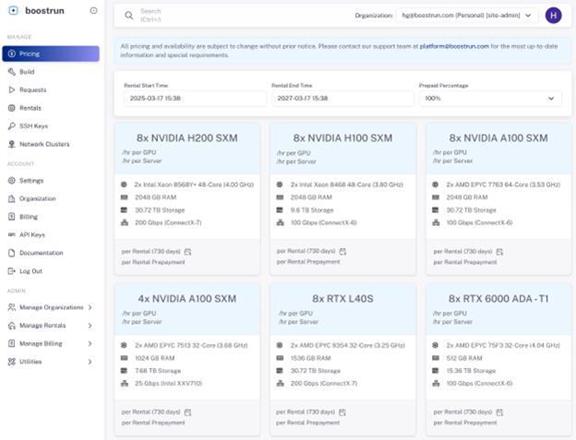
In addition, we cater to organizations’ unique and specialized requirements through our RFB program by enabling customers to work closely with our experts to design and deploy fully customized cluster solutions tailored to their specific needs. Customers are able to (i) choose from our extensive range of GPU options, including the latest NVIDIA offerings, to ensure optimal performance for their AI applications, (ii) specify their storage requirements, whether they need high-performance NVMe SSDs, scalable object storage, or a combination of solutions to meet their data storage and access demands, and (iii) define their network requirements, including dedicated IP addresses, bandwidth allocation, and connectivity options, to ensure seamless data transfer and communication for their AI workloads.
| 94 |
Dual Certification Approach
Boost Run maintains a SOC 2 Type II certification covering Security, Availability, and Confidentiality Trust Services Categories, along with HIPAA compliance certification. This comprehensive audit, conducted by Aprio LLP, validates our robust control environment across several key control areas, including multi-factor authentication and access controls, continuous security monitoring, change management and Infrastructure as Code, data protection and encryption, physical security controls, and vendor and risk management.
Our dual certification approach provides:
| 1. | Comprehensive Coverage: SOC 2 demonstrates operational effectiveness of controls while ISO 27001 validates our systematic approach to information security management | |
| 2. | Healthcare Compliance: HIPAA Security Rule compliance integrated throughout our control framework, with specific controls mapped to all administrative, physical, and technical safeguards | |
| 3. | Continuous Improvement: Regular surveillance audits, annual reviews, and ongoing monitoring ensure our controls evolve with emerging threats | |
| 4. | Business Continuity: Documented and tested Business Continuity and Disaster Recovery plans for AWS production environments |
This comprehensive control framework ensures that Boost Run maintains the highest standards of security, availability, and confidentiality for our GPU infrastructure services, providing enterprise clients with confidence in our ability to protect their sensitive workloads and data.
Robust Security Measures
Boost Run delivers comprehensive security across our distributed GPU computing platform, spanning multiple data centers with advanced isolation technologies, confidential computing capabilities, and enterprise-grade compliance frameworks designed specifically for AI workloads.
Our safeguards include end-to-end encryption, audit logging, role-based access controls, and executed Business Associate Agreements with healthcare customers. HIPAA-compliance physical security at our data centers is provided through TierPoint facilities with 24/7 monitoring, biometric access controls and comprehensive visitor logging. Infrastructure safeguards encompass redundant power systems, network segmentation isolating healthcare traffic, intrusion detection systems, and secure hardware disposal procedures, and is validated through annual SOC2 Type II, HIPAA, ISO27701 and SO27001 certifications.
Security is foundational to Boost Run’s AI infrastructure platform. Our comprehensive security architecture protects customer data, models, and workloads through hardware-level isolation, enterprise-grade compliance, and advanced confidential computing technologies, while delivering the performance and scalability required for production AI applications.
Data Center Footprint
Through our partnership with TierPoint and other parties, we offer enterprise-grade infrastructure optimized for high-density GPU deployments across multiple regions. Facilities support both traditional air-cooled and next-generation liquid-cooled GPU deployments, with high-density power distribution, purpose-built GPU zones with reinforced flooring for heavy equipment, and flexible rack configurations from quarter to full cabinet deployments. The modular data center design allows us to rapidly scale from initial deployments to multi-megawatt installations without infrastructure bottlenecks.
TierPoint operates 40+ data centers across 20 markets nationwide, providing Boost Run customers with multi-region redundancy for disaster recovery and workload distribution, sub-5ms latency to major metropolitan areas, a 200Gbps+ network backbone with direct cloud on-ramps, and dark fiber interconnects between facilities for burst capacity.
This partnership allows Boost Run to focus on GPU orchestration and platform innovation while TierPoint handles the complex physical infrastructure requirements of modern AI workloads. Together, we deliver the performance of purpose-built AI infrastructure with the reliability and compliance of enterprise data centers.
| 95 |
Over the next 12 months, we plan to expand our data center footprint by adding 16MW of secure capacity in the eastern and central U.S. through our partnership with TierPoint and other parties, further enhancing our geographic resiliency. Our current data centers are located in Seattle, Washington; Durham, North Carolina; Dallas, Texas; and Richardson, Texas. Additional capacity will be brought online in phases quarterly beginning in the first quarter of 2026, with potential new expansions in Charlotte, North Carolina; St. Louis, Missouri; and Breinigsville, Pennsylvania.
Our Culture and Values
At Boost Run, we believe exceptional infrastructure is built by brilliant individuals who obsess over performance, reliability, and customer success. We’re a team of technical experts who thrive on solving complex problems at the intersection of AI and infrastructure.
Deep Technical Excellence. Every team member brings deep technical expertise to the table. We don’t just operate infrastructure—we understand it fundamentally. We believe that when you put smart people in a room with a hard problem, they’ll find a way to solve it. Technical depth, not organizational hierarchy, drives our innovation.
Details Matter. While we can architect at massive scale and discuss the future of AI, we know that success lives in the details: optimizing network routes, fine-tuning configurations, and eliminating bottlenecks. We dive deep because surface-level understanding leads to surface-level solutions. Getting into the weeds isn’t just encouraged—it’s essential.
Customer-First Engineering. When customers face challenges, we don’t just provide support—we become their partners. We’ll join their Slack channels at 2 AM, optimize their workloads, and go the extra mile to ensure they achieve peak performance and reliability. Their success defines ours. We measure ourselves not by tickets closed, but by customer breakthroughs enabled.
Our customer experience model delivers enterprise-grade support with the responsiveness of a boutique consultancy. Technical support is led by our CIO and CTO, with intelligent triage and automation systems for rapid issue resolution. Customers have direct Slack access to our engineering team and a unified control plane for managing their infrastructure.
Ownership & Initiative. We’re go-getters who don’t wait for permission to improve things. See a problem? Fix it. Spot an opportunity? Run with it. We value action over process, results over rhetoric. Every employee owns our platform’s success and has the autonomy to make it better.
Transparent Partnership. We communicate honestly and directly. When customers ask hard questions, we provide detailed, thoughtful answers. We share our metrics openly, learn from our mistakes publicly, and build trust through transparency. No buzzwords, no hand-waving—just straight talk about what’s possible and how to achieve it.
Our Philosophy
Put brilliant, driven people together, give them challenging problems and the freedom to solve them, and get out of their way.
We’re building something that matters—the computational foundation that will power the next generation of AI breakthroughs. We don’t have endless meetings or rigid processes. We have shared principles, mutual trust, and an unwavering commitment to excellence.
Our Customers
Boost Run targets a diverse customer base, including financial services firms, healthcare and life sciences organizations, geospatial and earth observation companies, AI startup, infrastructure brokers, and digital asset companies. We provide specialized features, compliance certifications, and operational excellence to each sector.
| 96 |
Financial Services & Trading Firms. Financial institutions require GPU infrastructure that can process massive datasets quickly while maintaining ultra-low latency for algorithmic trading systems where milliseconds mean millions of dollars. Our platform targets quantitative trading desks, hedge funds, and investment banks that demand colocation capabilities with major exchanges and dark fiber connections enabling high-frequency trading strategies, regulatory compliance with comprehensive audit scales, risk modeling acceleration, and isolated compute environments with hardware-level security for proprietary trading algorithms.
Healthcare & Life Sciences. Boost Run maintains comprehensive HIPAA compliance at both the operator and data center levels, enabling healthcare organizations to leverage AI while protecting patient data. Our infrastructure provides localized compute to meet regulatory standards while offering GPU acceleration powered by NVIDIA hardware for AI/ML workloads in diagnostics, treatment, and research. Our platform supports everything from small clinical AI pilots to large-scale population health analytics, with dedicated support for FDA-submission workloads and clinical trial data processing.
Geospatial & Earth Observation. The geospatial sector requires massive parallel processing for satellite imagery analysis, climate modeling, and geographic information systems. GPU acceleration can achieve 300x speedups for raster calculations and viewshed operations compared to traditional CPU algorithms.
Government Agencies (via Carahsoft Partnership). Through our strategic partnership with Carahsoft, Boost Run provides GPU infrastructure to federal, state, and local government agencies. Carahsoft serves as our Master Government Aggregator, making our platform available through SEWP V, ITES-SW2, and other government contract vehicles.
AI Startups & Scale-ups. AI startups require access to powerful and scalable GPU infrastructure without the prohibitive capital expenditure of building private data centers.
Infrastructure Brokers & Resellers. Boost Run partners with cloud brokers and managed service providers who require reliable GPU capacity for their end customers.
Third-Party Platforms & Digital Assets. Emerging sectors including blockchain, Web3, and digital asset companies utilize our infrastructure for DeFi analytics, and blockchain infrastructure.
For the year ended December 31, 2024, three customers accounted for approximately 71.6%, 12.0%, and 10.4%, respectively, of Boost Run’s audited revenue. In addition, for year ended December 31, 2025, three customers accounted for approximately 44.5%, 15.8%, and 15.6%, respectively, of Boost Run’s audited revenue. The following tables show our top three customers for the year ended December 31, 2024, and for the year ended December 31, 2025:
| Top Three Customers for the Year Ended December 31, 20241 | ||
| Customer | Percent of Revenue (%) | |
| RunPod Inc. | 71.6 | |
| Zillion Technologies, Inc. | 12.0 | |
| Vast.ai Inc. | 10.4 | |
| 1. No other customers represented greater than 10% of Boost Run’s revenue for the applicable period. | ||
| Top Three Customers for the Year Ended December 31, 20251 | ||
| Customer | Percent of Revenue (%) | |
| RunPod Inc. | 44.5 | |
| Shadeform, Inc. | 15.8 | |
| Manifold Labs, Inc. | 15.6 | |
| 1. No other customers represented greater than 10% of Boost Run’s revenue for the applicable period. | ||
Customers enter into master services agreements (“MSAs”) with us, which serve as the governing agreement required to access the Boost Run platform, where bare metal server provisioning takes place. The MSA establishes the overarching terms and conditions for the customer relationship. Individual server rentals on the Boost Run platform are documented through purchase orders and invoices that are automatically generated by the Boost Run platform upon order placement. These purchase orders may have varying term durations, ranging from hours to multiple years, depending on the customer’s selected commitment period. A single customer may hold multiple active orders under a single MSA, each with its own duration. Once an order is placed on the Boost Run platform, it is non-cancelable for the specified term duration, and any fees associated with that order are non-refundable.
| 97 |
Our MSAs run for three-month terms and automatically renew for three-month periods. After the initial three-month term, either party may terminate for convenience by providing ninety (90) days’ written notice, with termination becoming effective at the conclusion of the then-existing term. In addition, a customer may terminate the MSA, or an applicable order, for cause if (1) we materially breach our obligations under the MSA and (2) fail to cure such breach within thirty (30) days of receiving written notice. Upon any termination, all outstanding fees become immediately due and payable. Boost Run also retains the right to suspend or terminate services immediately in circumstances such as suspected breach of the acceptable use policy, unauthorized access, or as required by law.
We believe our diversifying customer base creates a resilient business model while cross-pollination of ideas between sectors drives continuous platform innovation. Whether powering Wall Street’s fastest trades or accelerating breakthrough medical research, Boost Run delivers the computational foundation for transformative AI applications across every industry.
Go-to-Market Approach
Boost Run takes a fundamentally different approach to market penetration—we operate like a specialized AI infrastructure collective rather than a traditional cloud vendor.
Our philosophy rejects the typical enterprise sales playbook. Instead of building large sales organizations, we’ve cultivated a network of AI infrastructure experts who understand the technical nuances of GPU workloads. These advisors and advocates naturally connect us with teams hitting scaling bottlenecks, creating organic demand without aggressive outreach campaigns.
Rather than segmenting into traditional sales/marketing/support silos, our team operates as a unified technical advisory group. Engineers handle customer conversations, technical leads drive partnership discussions, and our support interactions often evolve into strategic planning sessions.
This unconventional model works because AI infrastructure buyers are sophisticated technical practitioners who value expertise over polish. They need partners who understand distributed training, inference optimization, and GPU memory management—not scripted sales pitches.
Our “marketing” consists primarily of open-source contributions, technical documentation, and infrastructure benchmarks that demonstrate real performance advantages. We measure success not by pipeline coverage, but by customer infrastructure utilization rates.
This approach has allowed us to secure major AI workloads while maintaining a team fraction of the size of traditional cloud providers—proving that in AI infrastructure, technical depth beats sales breadth.
Competition
Boost Run operates in a dynamic AI infrastructure market facing competition from both established clouds and specialized GPU providers.
Our competitive landscape includes major cloud platforms—AWS, Azure, Google Cloud—plus dedicated AI infrastructure specialists like CoreWeave, Nebius and White Fiber. While these competitors command substantial resources, Boost Run’s purpose-built architecture delivers superior performance for AI workloads, attracting partnerships even from traditional rivals.
Boost Run’s differentiation stems from:
| ● | Field-proven performance handling massive AI workloads |
| 98 |
| ● | Optimized infrastructure reducing compute costs |
| ● | Intelligent orchestration minimizing downtime |
| ● | Self-managing platform eliminating operational overhead |
| ● | Immediate availability of latest NVIDIA GPUs |
| ● | Industry-leading cluster scale |
| ● | Zero-trust security architecture |
| ● | Deep integration with AI frameworks |
| ● | Expert AI engineering support |
| ● | Customizable deployments for unique requirements |
| ● | Straightforward pricing without hidden fees |
Boost Run’s growth trajectory confirms our technical leadership in accelerated computing, powered by priority GPU access and proprietary orchestration software purpose-built for model development and deployment.
Intellectual Property
Our intellectual property is an important aspect of our business and helps us to maintain our competitive position. To establish and protect our rights in our proprietary technology, we rely upon a combination of trade secret and trademark laws and contractual restrictions such as confidentiality agreements, licenses and intellectual property assignment agreements.
We control access to our intellectual property and confidential information through internal and external controls. We maintain a policy requiring our employees, contractors, consultants and other third parties to enter into confidentiality and proprietary rights agreements to control access to and non-disclosure of our proprietary information. Intellectual property laws and our procedures and restrictions provide only limited protection, and any of our intellectual property rights may be challenged, invalidated, circumvented, infringed, misappropriated or violated.
Government Regulation
We are subject to the laws and regulations of various jurisdictions and governmental agencies affecting our operations and the sale of our infrastructure and services in areas including, but not limited to: AI, AI, intellectual property; tax; import and export requirements; anti-corruption; economic and trade sanctions; national security and foreign investment; foreign exchange controls and cash repatriation restrictions; data privacy and security requirements (such as the CCPA); competition; advertising; employment; product regulations; environment, health and safety requirements; and consumer laws. To date, costs and accruals incurred to comply with these governmental regulations have not been material to our capital expenditures and results of operations. Although there is no assurance that existing or future governmental laws and regulations applicable to our operations and the sale of our infrastructure services will not have a material adverse effect on our capital expenditures, operating results, and competitive position, we do not currently anticipate material expenditures for government regulations. Nonetheless, we believe that global trade regulations could potentially have a material impact on our business.
Facilities
We are headquartered in Northbrook, Illinois. As of the date of this prospectus, 2025, we lease office space at 5 Revere Drive, Suite 200 Northbrook, IL 60062.
| 99 |
In addition, we sub-lease space at third-party colocation providers to house, power, cool, and provide connectivity to Boost Run’s GPU servers and infrastructure at the following locations:
| ● | Dallas/Fort Worth, TX | |
| ● | Research Triangle Park (RTP), NC | |
| ● | Charlotte, NC | |
| ● | Seattle, WA | |
| ● | Richardson, TX |
We believe that our current facilities are adequate to meet our current needs and that, should it be needed, suitable additional or alternative space will be available to accommodate our operations.
Legal Proceedings
From time to time, we may be involved in various legal proceedings arising from the normal course of business activities. We are not presently a party to any litigation the outcome of which, we believe, if determined adversely to us, would individually or taken together have a material adverse effect on our business, results of operations, cash flows or financial condition. We may in the future receive claims from third parties asserting, among other things, infringement of their intellectual property rights. Defending such proceedings is costly and can impose a significant burden on management and employees, we may receive unfavorable preliminary or interim rulings in the course of litigation, and there can be no assurances that favorable final outcomes will be obtained.
| 100 |
CERTAIN RELATIONSHIPS AND RELATED PARTY TRANSACTIONS
Unless the context otherwise requires, references to “Boost Run,” the “Company,” “we,” “us,” “our,” prior to the Business Combination refer to Legacy Boost Run, and such references following the Business Combination refer to Boost Run Inc. and its consolidated subsidiaries, including Legacy Boost Run.
In addition to the various agreements and arrangements discussed in the sections titled “Directors, Executive Officers and Corporate Governance” and “Executive Compensation,” the following is a description of each transaction since January 1, 2023 and each currently proposed transaction in which:
| ● | the Company has been or is to be a participant; |
| ● | the amount involved exceeded or exceeds $120,000; and |
| ● | any of the Company’s directors, executive officers or holders of more than 5% of its capital stock, or any immediate family member of, or person sharing the household with, any of these individuals, had or will have a direct or indirect material interest. |
Transactions Prior to the Business Combination
Founder Shares
On July 17, 2024, the Sponsor paid $25,000 to cover offering costs in consideration of 4,364,250 Founder Shares. Subsequently, on September 27, 2024, Willow Lane capitalized $26.4424 standing to the credit of its share premium account and issued to the Sponsor an additional 264,424 Founder Shares, as a result of which the Sponsor has purchased and holds an aggregate of 4,628,674 Founder Shares. Following and as a result of that capitalization and issuance of additional Founder Shares, the Sponsor is deemed to have purchased the Founder Shares for $0.005 per share.
The number of Founder Shares outstanding was determined based on the expectation that the total size of the Willow Lane IPO would be a maximum of 12,650,000 units if the over-allotment option was exercised in full, and therefore that such Founder Shares would represent approximately 26.79% of the issued and outstanding Willow Lane Ordinary Shares after the Willow Lane IPO. Up to 603,740 Founder Shares were to be surrendered for no consideration depending on the extent to which the over-allotment option was exercised. On November 12, 2024, the over-allotment option was exercised in full and such Founder Shares are no longer subject to forfeiture.
Pursuant to the Willow Lane Private Warrants Purchase Agreements, the Sponsor, BTIG and Craig-Hallum purchased an aggregate of 5,145,722 Willow Lane Private Warrants, at a price of $1.00 per Willow Lane Private Warrant, for an aggregate purchase price of $5,145,722 in the private placement that closed simultaneously with the Willow Lane IPO. Each Willow Lane Private Warrant entitles the holder thereof to purchase one Class A Ordinary Share at $11.50 per share. Of those 5,145,722 Willow Lane Private Warrants, the Sponsor purchased 4,007,216 Willow Lane Private Warrants, and BTIG and Craig-Hallum, together, purchased 1,138,500 Willow Lane Private Warrants. The Willow Lane Private Warrants are identical to the Public Warrants included as part of the units sold in the Willow Lane IPO, subject to certain limited exceptions as described in the Registration Statement in connection with Willow Lane IPO, including certain transfer restrictions. If Willow Lane does not complete its initial business combination within the Combination Period, the Willow Lane Private Warrants will expire worthless. The Willow Lane Private Warrants (and underlying securities) are identical to the Public Warrants sold in the Willow Lane IPO.
Administrative Services Agreement
Pursuant to the Administrative Services Agreement, commencing on November 7, 2024, through the earlier of consummation of the initial business combination and Willow Lane’s liquidation, Willow Lane pay an affiliate of the Sponsor an aggregate of $10,000 per month for office space, utilities, and secretarial and administrative support. For the year ended December 31, 2025 and the period from July 3, 2024 (inception) through December 31, 2024, Willow Lane incurred and paid $120,000 and $20,000, respectively, in fees for these services pursuant to the Administrative Services Agreement
| 101 |
IPO Promissory Note
On July 18, 2024, the Sponsor agreed to loan to Willow Lane an aggregate of up to $300,000 to cover expenses related to the Willow Lane IPO pursuant to the IPO Promissory Note. This loan was non-interest-bearing and payable on the earlier of December 31, 2024, or the date on which Willow Lane consummated the Willow Lane IPO. Willow Lane repaid all the outstanding balance of the IPO Promissory Note at the closing of the Willow Lane IPO on November 18, 2024. As of December 31, 2025 and 2024, the IPO Promissory Note had been paid in full and borrowings under the IPO Promissory Note were no longer available
Working Capital Loans
In addition, in order to finance transaction costs in connection with an intended initial business combination, the Sponsor or an affiliate of the Sponsor or certain of our officers and directors may, but are not obligated to, loan to Willow Lane Working Capital Loans as may be required on a non-interest basis. If Willow Lane completes an initial business combination, it would repay such Working Capital Loans unless they are converted into Working Capital Warrants. In the event that the initial business combination does not close, Willow Lane may use a portion of the working capital held outside the Trust Account to repay such Working Capital Loans, but no proceeds from the Trust Account would be used for such repayment. Up to $1,500,000 of such Working Capital Loans may be convertible into Working Capital Warrants of the post-business combination entity at a price of $1.00 per warrant at the option of the lender. Such Working Capital Warrant would be identical to the Willow Lane Private Warrants. Except as set forth above, the terms of such Working Capital Loans, if any, have not been determined and no written agreements exist with respect to such Working Capital Loans. Prior to the completion of Willow Lane’s initial business combination, Willow Lane does not expect to seek loans from parties other than the Sponsor or an affiliate of the Sponsor as it does not believe third parties will be willing to loan such funds and provide a waiver against any and all rights to seek access to funds in the Trust Account. As of December 31, 2025 and 2024, no such Working Capital Loans were outstanding.
Transactions Post Business Combination
Registration Rights Agreement
Pursuant to the Registration Rights Agreement, the Holders (as defined therein), which include the Sponsor, BTIG, LLC (“BTIG”), Craig-Hallum Capital Group (“Craig-Hallum”), LLC, and certain members of Legacy Boost Run (the “Boost Run Holders”), have registration rights to require the Company to register for resale certain securities held by them. Such securities include shares of Boost Run Common Stock issued to Legacy Boost Run members in connection with the Company Merger (including any Earnout Shares), the Founder Shares (including shares of Boost Run Common Stock issued upon conversion thereof in the SPAC Merger), the Private Warrants and shares of Boost Run Class A Common Stock issuable upon exercise thereof, and any warrants issuable upon conversion of working capital loans to the Sponsor and shares of Boost Run Class A Common Stock issuable upon exercise thereof. The Holders are entitled to make up to three demands that the Company register such securities. In addition, the Holders have certain “piggy-back” registration rights with respect to registration statements filed subsequent to completion of the Business Combination. Notwithstanding anything to the contrary, BTIG and Craig-Hallum may only make a demand on one occasion and only during the five-year period beginning on the effective date of the Willow Lane IPO registration statement. In addition, BTIG and Craig-Hallum may participate in a “piggy-back” registration only during the seven-year period beginning on the effective date of the Willow Lane IPO registration statement. The Company will bear the expenses incurred in connection with the filing of any such registration statements.
Letter Agreement
The Sponsor, directors and officers have also entered into the Letter Agreement, with Willow Lane, pursuant to which, they have waived their rights to liquidating distributions from the Trust Account with respect to any Founder Shares held by them if we fail to complete an initial business combination within the Combination Period. However, if the Sponsor, directors and officers acquire Public Shares in or after the Willow Lane IPO, they will be entitled to liquidating distributions from the Trust Account with respect to such Public Shares if we fail to complete an initial business combination within the Combination Period.
| 102 |
Additionally, pursuant to the Letter Agreement, the Sponsor, directors and officers will not propose any amendment to the Willow Lane Memorandum and Articles (i) to modify the substance or timing of Willow Lane’s obligation to allow redemption in connection with its initial business combination or to redeem 100% of Willow Lane Public Shares if it does not complete its initial business combination within the Combination Period or (ii) with respect to any other material provisions relating to rights of holders of Willow Lane Class A Ordinary Shares or pre-initial business combination activity, in each case, unless it provides Willow Lane’s Public Shareholders with the opportunity to redeem their Public Shares upon effectiveness of any such amendment at a per-share price, payable in cash, equal to the aggregate amount then on deposit in the Trust Account, including interest earned on the funds held in the Trust Account (less income taxes payable), divided by the number of then outstanding Public Shares.
Transfer Agreement
On September 15, 2025, the Sponsor entered into a transfer agreement the (“Transfer Agreement”) with the SPV. Pursuant to the Transfer Agreement, the SPV shall purchase from the Sponsor, immediately prior to the Closing, 27.5% of the 4,628,674 Founder Shares held by the Sponsor and 27.5% of the 4,007,216 warrants to purchase Willow Lane ordinary shares held by the Sponsor, at a purchase price for all such securities equal to $1.75 per Founder Share purchased, for an the aggregate purchase price of $2,227,548.75.
Earnout Agreement
The Sponsor, Boost Run and the SPV entered into an Earnout Agreement, dated as of September 15, 2025 and amended on January 13, 2026, providing that the Sponsor may earn up to 1,125,000 Sponsor Earnout Shares and the SPV may earn up to 1,968,750 SPV Earnout Shares (or 3,093,750 shares in total) based on the performance of Boost Run Class A Common Stock during the three-year period beginning on and following the Closing, as follows: in the event that the VWAP of Boost Run Class A Common Stock equals or exceeds the prices set forth below for any 20 trading days within any consecutive 30 trading days during the specified earnout period, the Sponsor and the SPV shall be entitled to receive the following amounts of such shares: (i) $12.50 per share – 375,000 such shares for the Sponsor and 656,250 for the SPV; (ii) $15.00 per share – 375,000 such shares for the Sponsor and 656,250 for the SPV; and (iii) $17.50 per share – 375,000 such shares for the Sponsor and 656,250 for the SPV.
Insider Letter Amendment
On September 15, 2025, Willow Lane, Boost Run, Boost Run and the underwriter of the Willow Lane IPO, on the one hand, and the Sponsor and Willow Lane’s directors and officers, on the other hand, entered into the Insider Letter Amendment to the Insider Letter to (i) add Boost Run and Boost Run as parties to the Insider Letter, (ii) revise the terms of the Insider Letter to reflect the Transactions, including the issuance of Boost Run securities in exchange for Willow Lane securities, and have Boost Run assume and be assigned the rights and obligations of Willow Lane under the Insider Letter, (iii) amend the terms of the lock-up set forth in the Insider Letter to conform with the lock-up terms in the Lock-Up Agreements described above, and (iv) release 10% of the Willow Lane Founder Shares from lock-up restrictions, subject to and contingent upon the Closing.
| 103 |
In connection with Boost Run’s inception, Mr. Karos funded Boost Run’s initial formation costs, totalling $8.5 million (the “Contribution”). In consideration for the Contribution, Boost Run and Mr. Karos entered into the Contribution Agreement on March 22, 2024, whereby the Boost Run agreed to issue 85,000 class A units of Boost Run (the “Class A Units”), each Class A Unit entitling the holder to a return of capital in the amount of $1,000 per Class A Unit, in aggregate entitling the holder to a repayment of $8.5 million (the “Class A Return of Capital”). Pursuant to the Business Combination Agreement, in connection with the Closing, Boost Run will pay the Class A Return of Capital to Mr. Karos, the sole holder of Class A Units.
Policies and Procedures for Related Person Transactions
In connection with the Closing of the Business Combination, the Board adopted a written policy for the review, approval and ratification of transactions with related parties. The policy covers transactions between the Company and any of our executive officers and directors or their respective affiliates, director nominees, 5% or greater security holders or family members of any of the foregoing.
The policy defines a related party transaction as a transaction, arrangement or relationship, or any series of similar transactions, arrangements or relationships in which the Company was or is to be a participant in which the amount involved exceeds $120,000 in the aggregate in any fiscal year, and in which a related party had or will have a direct or indirect material interest.
Under the policy, the audit committee of the Board reviews transactions covered by this policy to determine, among other things:
| ● | whether the terms of the transaction are fair to the Company, have resulted from arm’s length negotiations and are on terms at least as favorable as would apply if the transaction did not involve a related party; |
| ● | whether there are demonstrable business reasons for the Company to enter into the transaction; |
| ● | whether the transaction is material to the Company; |
| ● | the role the related party played in arranging the transaction; |
| ● | whether the transaction could impair the independence of a director; and |
| ● | the interests of all related parties in the transaction. |
A related party transaction will only be approved or ratified by the audit committee if the audit committee determines that the transaction is beneficial to the Company and the terms of the transaction are fair to the Company. In addition, under the Company’s Code of Business Conduct and Ethics, directors and executive officers have an affirmative responsibility to seek determinations and prior authorizations or approvals of potential conflicts of interest exclusively from the Board.
| 104 |
DIRECTORS, EXECUTIVE OFFICERS AND CORPORATE GOVERNANCE
Board of Directors and Executive Officers
The below sets forth certain information concerning the persons who currently serve as directors and/or executive officers of Boost Run.
| Name | Age | Position | ||
| Executive Officers | ||||
| Andrew Karos | 49 | Chief Executive Officer, Chair and Director | ||
| Erik Guckel | 55 | Chief Financial Officer | ||
| Harry Georgakopoulos | 48 | Chief Operating Officer, Secretary and Director | ||
| Directors | ||||
| Sean Goodrich | 49 | Director | ||
| B. Luke Weil | 46 | Director | ||
| Ryan Burke | 52 | Director | ||
| Rayne Steinberg | 47 | Director | ||
| Jeffrey Kleinops | 43 | Director |
Executive Officers
Andrew Karos – Chief Executive Officer, Chair and Director.
Andrew Karos has served as Executive Officer and chair of the Boost Run Board since May 2026. Mr. Karos has served as founder and Chief Executive Officer of Boost Run LLC since 2023, where he leads the company’s enterprise-grade GPU cloud infrastructure platform serving AI and high-performance computing customers. Prior to founding Boost Run LLC, Mr. Karos served as Managing Director and Head of Electronic Trading at Galaxy Digital Holdings Ltd. (Nasdaq: GLXY) (“Galaxy Digital”) from 2020 to 2023, where he was a member of the executive committee. Galaxy Digital acquired Blue Fire Capital, LLC (“Blue Fire Capital”), the quantitative trading firm Mr. Karos co-founded and led as Owner and Chief Executive Officer. At Blue Fire Capital, Mr. Karos built a sophisticated algorithmic trading operation that utilized over $500M in credit facilities for high-frequency trading strategies across multiple asset classes, with global infrastructure spanning six countries and thirteen top-tier data centers. Mr. Karos’s career has focused on building and scaling technology-driven businesses in highly regulated environments, combining expertise in quantitative finance, algorithmic trading, and infrastructure development. His track record encompasses successful company formation, capital deployment, risk management, and strategic exits in both traditional and emerging technology sectors. We believe Mr. Karos is qualified to serve as a member of the Boost Run Board due to the perspective and experience he brings as our founder and Chief Executive Officer in addition to his extensive industry experience.
Erik Guckel – Chief Financial Officer
Erik Guckel has served as Chief Financial Officer of Boost Run since May 2026. Mr. Guckel has served as Chief Financial Officer of Boost Run since August 2025. He is a seasoned international finance executive with over 25 years of broad experience in Fortune 500 and large private firms serving the energy and industrial sectors. Prior to joining Boost Run, Mr. Guckel served as Senior Director at Key Logic Systems from September 2024 to August 2025, where he led diversification strategy and finance. Mr. Guckel also served as President and Chief Executive Officer of GEKo Consulting LLC, a technical consulting firm focused on energy and computing, from November 2016 through August 2025 and previously served as Senior Director of Strategic Development at KBR Inc. from April 2021 to February 2024 and as Director and Interim Vice President of M&A and Corporate Business Development at Honeywell from December 2016 to April 2021.
| 105 |
Mr. Guckel has specialized expertise in financial planning & analysis, mergers & acquisitions, structured finance, debt capital markets and strategic management focused on the financing and deployment of proprietary technologies and strategic growth.
He has closed over $2 billion in corporate transactions, has managed a $3B debt portfolio and has secured funding for first-of-a-kind facility construction. He has also led the development of significant strategic partnerships and joint ventures in the Americas, Europe and Asia.
Mr. Guckel obtained an MBA in Finance, Accounting and Economics from the University of Chicago, a PhD in Chemical Engineering from the University of Illinois-Urbana-Champaign, and a BS in Chemical Engineering from UW-Madison, focused on computational science and engineering and applied mathematics.
Harry Georgakopoulos – Chief Operating Officer, Secretary and Director
Harilaos Georgakopoulos has served as Chief Operating Officer, Secretary and on the Board since May 2026. In his role as Chief Operating Officer, Mr. Georgakopoulos oversees operations for Boost Run’s AI infrastructure and high-performance computing platform. Prior to joining Boost Run, Mr. Georgakopoulos served as a Managing Director at Galaxy Digital Holdings Ltd. (Nasdaq: GLXY) from November 2020 to March 2024, where he led the company’s on-chain activities, including researching and managing DeFi trades and working closely with the management team in driving strategic growth initiatives. Before Galaxy Digital, he held the position of Head of Digital Assets at Blue Fire Capital, LLC from June 2015 to November 2020.
Mr. Georgakopoulos began his career as an Electrical Engineer at Motorola after graduating from the University of Illinois at Urbana-Champaign, before transitioning to developing and trading high-frequency strategies in equities, futures, options, and digital assets. His expertise encompasses electrical engineering, quantitative finance, and operations management, with extensive experience implementing and deploying AI and reinforcement learning models within the engineering and financial sectors. He is also the author of “Quantitative Trading with R: Understanding Mathematical and Computational Tools from a Quant’s Perspective,” published by Palgrave Macmillan in 2015.
Mr. Georgakopoulos obtained a Master of Science degree in Financial Mathematics from the University of Chicago in 2005 and a Master’s degree in Electrical Engineering from the National Technological University in 2001. He served as an adjunct lecturer in the Financial Risk Management program at Loyola University Chicago between November 2009 and February 2016. He earned his Bachelor’s degree from the University of Illinois at Urbana-Champaign in 1999. We believe Mr. Georgakopoulos is qualified to serve as a member of the Boost Run Board due to his financial and operations management expertise as well as his extensive industry experience.
Non-Employee Directors
Sean Goodrich
Sean Goodrich has served on the Boost Run Board Since May 2026. Mr. Goodrich is a financial executive with over two decades of leadership in global capital markets. He has overseen his family office since 2019. From March 2023 until October of 2025, he served as president of Islet Capital. Previously Mr. Goodrich served as president of Foundry Works from 2020 until October 2022. Previously, Mr. Goodrich was partner at Cantor Fitzgerald (“Cantor”) from August 1998 to March 2019, where he ultimately served as Co-Head of Equities and Head of Sales, driving strategic growth and client development. In 2012, he founded Cantor’s SPAC banking franchise, building it into one of the industry’s most active platforms. Mr. Goodrich earned his Bachelor’s degree from Villanova University in 1998. We believe Mr. Goodrich is qualified to serve as a member of the Boost Run Board due to his financial and capital markets expertise.
| 106 |
B. Luke Weil
B. Luke Weil has served on the Boost Run Board since May 2026. Mr. Weil served as the Chief Executive Officer and Chairman of the Board of Willow Lane since its formation in July 2024, and is the sole managing member of the Sponsor. Mr. Weil has been the Chief Executive Officer of Willow Lane II since August 2025 and Chairman of Willow Lane II since December 2025. Previously, he served as the Non-Executive Chairman and a managing member of the sponsor of Andina III from its inception on January 2019 through its business combination with Stryve Foods. (Nasdaq: SNAX) in July 2021. From July 2015 to March 2018, Mr. Weil was the non-Executive Chairman and a managing member of the sponsor of Andina II, which completed a business combination with Lazyday’s R.V. Center, Inc (Nasdaq: GORV). He served as Chief Executive Officer of Andina from January 2013 until its merger with Tecnoglass Inc. (NYSE:TGLS) in December 2013.
Since July 2021, Mr. Weil has served as a member of the Board of Directors of Stryve Foods. During that period, he also engaged in various philanthropic activities. He has previously served as a board member of Lazydays Holdings, Inc. from March 2018 to April 2021 and of Tecnoglass from September 2011 until March 2012. Mr. Weil also sat on the Board of All Market, Inc. (d/b/a Runa) from May 2012 to December 2018.
Earlier in his career, from 2008 to 2013, Mr. Weil headed International Business Development for Scientific Games Corporation in Latin America where, among other responsibilities, he oversaw business acquisitions in the region. From 2004 to 2006, Luke was an associate and then Junior Partner at Business, Strategies, & Insight, a government relations and business consulting firm. Luke started his career as an investment banker at Bear Stearns. From 2006 to 2008, Mr. Weil attended Columbia Business School. From September 1998 to May 2002, Mr. Weil attended Brown University. Mr. Weil received a B.A. from Brown University and an M.B.A. from Columbia Business School.
We believe Mr. Weil is well-qualified to serve as a member of the Boost Run Board due to his extensive business experience in strategic planning and corporate development.
Ryan Burke
Ryan Burke has served on the Boost Run Board since May 2026. Mr. Burke has served as Chief Investment Officer for Rainy Partners since 2008, where he evaluates new investment opportunities and manages a portfolio of private investments, publicly traded securities, and operating businesses. Mr. Burke is also currently Chief Investment Officer of BFO, LLC; a Partner at Prime Macaya Capital Management, LP, a New York-based hedge fund; and a Director at Copperstate Farms, a vertically integrated Arizona cannabis company. From 2020 through 2023, Mr. Burke served as Chief Financial Officer of Senior Connect Acquisition Corp. I, a Nasdaq-listed SPAC. Prior to its sale to Galaxy Digital Holdings in 2020, he was a partner and director at Blue Fire Capital, a proprietary trading firm and global liquidity provider specializing in cryptocurrencies. Mr. Burke has previously served as Chief Financial Officer for various Rainy portfolio companies. Earlier in his career, he was a Portfolio Manager and Chief Risk Officer at Alpine Capital, a New York-based long-short hedge fund, and began his career as a financial analyst at Morgan Stanley Capital Partners, a $1.9 billion private equity fund. Mr. Burke holds an MBA from the Fuqua School of Business at Duke University and a BA from Duke University. We believe Mr. Burke is qualified to serve as a member of the Boost Run Board due to his extensive experience in investment management, financial analysis, and executive leadership across both public and private companies.
Rayne Steinberg
Rayne Steinberg has served on the Boost Run Board since May 2026. Mr. Steinberg has served on the Willow Lane Board of Directors since November 2024 and has been an independent director of Willow Lane II since February 2026. Since November 2019, Mr. Steinberg has been Chief Executive Officer at Arca Capital Management LLC. Mr. Steinberg leads the company’s strategic direction and is responsible for securities structuring and risk management. Since February 2018, he has been the Co-Founder and Chief Executive Officer, Praesidium Partners, Inc. (parent of Arca Capital Management LLC) and of Arca Investment Management, Inc., the investment adviser. Mr. Steinberg has an extensive history of financial and entrepreneurial success with nearly two decades of experience. Prior to founding Arca, Mr. Steinberg co-founded an asset management company, WisdomTree, where he was responsible for raising capital, creating intellectual property, and building and overseeing a sales team responsible for raising $50 billion in ETF assets under management. Mr. Steinberg holds a Bachelor of Science degree in Economics from The Wharton School of the University of Pennsylvania. We believe that Mr. Steinberg is well-qualified to serve as a member of the Boost Run Board due to his prior finance and entrepreneurial experience.
| 107 |
Jeffrey Kleinops
Jeffrey Kleinops has served on the Boost Run Board since May 2026. Kleinops is a capital market and fintech executive with experience across institutional trading, digital assets, and financial infrastructure. Mr. Kleinops has served as Head of Institutional Partnerships at Figure Markets since April 2024. Previously, Kleinops served as Head of Business Development for Trading at Galaxy Digital, where he was responsible for institutional lending, trading, and market-making services for institutional, high-net-worth, and platform clients. He brings broad experience across trading, derivatives, structured products, marketplace lending, and cryptocurrency markets. Mr. Kleinops holds a Bachelor of Business Administration (BBA) with a focus on Banking, Corporate Finance, and Securities Law, as well as a Bachelor of Science (BS) in Economics from Southern Methodist University.
Controlled Company Exemption
Boost Run’s majority shareholder, Andrew Karos, holds a majority of the voting power of Boost Run common stock and Boost Run is a “controlled company” within the meaning of applicable rules of Nasdaq. Under these rules, a company of which more than 50% of the voting power for the election of directors is held by an individual, group or another company is a “controlled company” and may elect not to comply with certain corporate governance requirements, including the requirements (a) that a majority of the board consists of independent directors; (b) for an annual performance evaluation of the nominating and corporate governance and compensation committees; (c) that the controlled company has a nominating and corporate governance committee that is composed entirely of independent directors with a written charter addressing the committee’s purpose and responsibilities; and (d) that the controlled company has a compensation committee that is composed entirely of independent directors with a written charter addressing the committee’s purpose and responsibility. Boost Run may rely on certain of these exemptions from the corporate governance requirements of Nasdaq. In the event that Boost Run ceases to be a “controlled company”, and its shares continue to be listed on Nasdaq, it will be required to comply with these provisions within the applicable transition periods.
Family Relationships
There are not expected to be any family relationships between members of the Boost Run Board and any of its executive officers.
Board of Directors
The Boost Run Board consists of seven directors. At each succeeding annual general meeting of Boost Run, all the directors of Boost Run shall be elected for a term of three years, to succeed the directors whose terms expire at such annual meeting. Under the terms of the Boost Run Charter, there is no limit on the number of terms a director may serve on the Boost Run Board.
Director Independence
Nasdaq listing rules require that a majority of the board of directors of a company listed on Nasdaq be composed of “independent directors,” which is defined generally as a person other than an officer or employee of the company or its subsidiaries or any other individual having a relationship, which, in the opinion of the company’s board of directors, would interfere with the director’s exercise of independent judgment in carrying out the responsibilities of a director. Boost Run’s Board has determined that, each of Rayne Steinberg, Ryan Burke and Jeffrey Kleinops are an independent director under the Nasdaq listing rules and Rule 10A-3 of the Exchange Act. In making these determinations, Boost Run’s Board considered the current and prior relationships that each non-employee director has with Willow Lane and/or the Legacy Boost Run and has with Boost Run and all other facts and circumstances Boost Run’s Board deemed relevant in determining independence, including the beneficial ownership of Boost Run common stock by each non-employee director, and the transactions involving them described in the section titled “Certain Relationships and Related Transactions.” As a controlled company, Boost Run will be largely exempt from the foregoing requirements.
| 108 |
Committees of the Board of Directors
The Boost Run Board has a standing Audit Committee, Compensation Committee and Nominating and Governance Committee. Subject to phase-in rules, the Nasdaq Rules and Rule 10A-3 of the Exchange Act require that the audit committee of a listed company be comprised solely of independent directors. Each committee operates under a charter that has been approved by our Board and has the composition and responsibilities described below. Boost Run is relying on the phase-in schedules available to companies under Nasdaq Listing Rule 5615(b)(1) with respect to certain of Nasdaq’s corporate governance requirements, including the requirements relating to a majority independent board and the independence of the audit committee, compensation committee, and nominations committee. As a result, the Company may not be in full compliance with certain of Nasdaq’s corporate governance standards for up to one year following the listing date, during which time the Company may be subject to reduced independent oversight with respect to board and committee functions.
Audit Committee
Our Audit Committee has been established in accordance with Section 3(a)(58)(A) of the Exchange Act and consists of Rayne Steinberg, Ryan Burke, and Jeffrey Kleinops, each of whom are independent directors and are “financially literate” as defined under Nasdaq listing standards. Ryan Burke serves as chairman of the Audit Committee. Boost Run’s Board has determined that Ryan Burke qualifies as an “audit committee financial expert,” as defined under rules and regulations of the SEC.
The audit committee’s duties are set forth in our Audit Committee Charter.
Compensation Committee
Our Compensation Committee consists of Andrew Karos, Harry Georgakopoulos, and Ryan Burke, of whom Ryan Burke is an independent director. Andrew Karos serves as chairman of the Compensation Committee. The functions of the Compensation Committee are set forth in a Compensation Committee Charter.
Nominating and Governance Committee
Our Nominating and Corporate Governance Committee consists of Harry Georgakopoulos, B. Luke Weil and Ryan Burke, of whom Ryan Burke is an independent director under Nasdaq’s listing standards. Ryan Burke serves as the chair of the Nominating and Corporate Governance Committee. The Nominating and Corporate Governance Committee is responsible for overseeing the selection of persons to be nominated to serve on the Boost Run Board. The Nominating and Corporate Governance Committee considers persons identified by its members, management, stockholders, investment bankers and others.
The guidelines for selecting nominees, are specified in the Nominating and Corporate Governance Committee Charter.
Code of Business Conduct and Ethics
We have adopted a Code of Business Conduct and Ethics for our directors, officers, employees and certain affiliates in accordance with applicable federal securities laws, a copy of which is available on Boost Run’s website. The information on Boost Run’s website is not incorporated by reference into this prospectus. Boost Run will make a printed copy of the Code of Business Conduct and Ethics available to any stockholder who so requests. Requests for a printed copy may be directed to Harry Georgakopoulos at hg@boostrun.com.
If we amend or grant a waiver of one or more of the provisions of our Code of Business Conduct and Ethics, we intend to satisfy the requirements under Item 5.05 of Form 8-K regarding the disclosure of amendments to or waivers from provisions of our Code of Business Conduct and Ethics that apply to our principal executive officer, principal financial officer and principal accounting officer by posting the required information on Boost Run’s website.
| 109 |
Indemnification Agreements
The Boost Run Charter contain provisions that limit the liability of our directors and officers for monetary damages to the fullest extent permitted by the DGCL. Consequently, Boost Run’s directors and officers will not be personally liable to Boost Run or our stockholders for monetary damages for any breach of fiduciary duties as directors or officers, except liability for:
| ● | any breach of the director’s or officer’s duty of loyalty to Boost Run or its stockholders; | |
| ● | any act or omission not in good faith or that involves intentional misconduct or a knowing violation of law; | |
| ● | unlawful payments of dividends or unlawful stock repurchases or redemptions as provided in Section 174 of the DGCL; | |
| ● | any transaction from which the director or officer derived an improper personal benefit; and | |
| ● | with respect to officers, any action by or in the right of the corporation. |
The Boost Run Charter and Boost Run Bylaws require Boost Run to indemnify its directors and officers to the maximum extent not prohibited by the DGCL and allow Boost Run to indemnify other employees and agents as set forth in the DGCL. Subject to certain limitations, the Boost Run Bylaws also require Boost Run to advance expenses incurred by its directors and officers for the defense of any action for which indemnification is required or permitted, subject to very limited exceptions.
Boost Run has entered into separate indemnification agreements with its directors, officers, and certain of its other employees. These agreements, among other things, require Boost Run to indemnify its directors, officers, and key employees for certain expenses, including attorneys’ fees, judgments, fines, and settlement amounts actually and reasonably incurred by such director, officer, or key employee in any action or proceeding arising out of their service to Boost Run or any of its subsidiaries or any other company or enterprise to which the person provides services at Boost Run’s request. Subject to certain limitations, Boost Run’s indemnification agreements also require Boost Run to advance expenses incurred by Boost Run’s directors, officers, and key employees for the defense of any action for which indemnification is required or permitted.
Boost Run believes that these provisions in the Boost Run Charter and indemnification agreements are necessary to attract and retain qualified persons such as directors, officers, and key employees. Boost Run also maintains directors’ and officers’ liability insurance.
The limitation of liability and indemnification provisions in the Boost Run Charter and Boost Run Bylaws may discourage stockholders from bringing a lawsuit against Boost Run’s directors and officers for breaches of their fiduciary duties. They may also reduce the likelihood of derivative litigation against Boost Run’s directors and officers, even though an action, if successful, might benefit Boost Run and other stockholders. Further, a stockholder’s investment may be adversely affected to the extent that Boost Run pays the costs of settlement and damage awards against directors and officers as required by these indemnification provisions.
Insofar as indemnification for liabilities arising under the Securities Act may be permitted to directors, executive officers or persons controlling Boost Run, Boost Run has been informed that in the opinion of the SEC such indemnification is against public policy as expressed in the Securities Act and is therefore unenforceable.
| 110 |
EXECUTIVE COMPENSATION
Unless the context otherwise requires, references to “Boost Run,” the “Company,” “we,” “us,” “our,” prior to the Business Combination refer to Legacy Boost Run, and such references following the Business Combination refer to Boost Run Inc. and its consolidated subsidiaries, including Legacy Boost Run.
Introduction
As an emerging growth company, Boost Run has opted to comply with the executive compensation disclosure rules applicable to “smaller reporting companies,” as such term is defined in the rules promulgated under the Securities Act. This section discusses the material components of the executive compensation program for our Chief Executive Officer and our two other most highly compensated executive officers, whom we refer to as our “Named Executive Officers” or “NEOs”. For the fiscal year ending December 31, 2025 (“Fiscal Year 2025”), our NEOs were:
| ● | Andrew Karos, our Chief Executive Officer; |
| ● | Harilaos Georgakopoulos, our Chief Operating Officer; and |
| ● | Erik Guckel, our Chief Financial Officer. |
This discussion may contain forward-looking statements that are based on our current plans, considerations, expectations and determinations regarding future compensation programs. Actual compensation programs that we adopt could vary significantly from our historical practices and currently planned programs summarized in this discussion.
Executive Compensation Program
The objective of our compensation program is to provide a total compensation package to our executives that will enable Boost Run to attract, motivate and retain outstanding individuals, align the interests of our executive team with those of our shareholders, encourage individual and collective contributions to the successful execution of our short- and long-term business strategies and reward our executives for performance.
The compensation program for our NEOs for the fiscal year ending December 31, 2024 (“Fiscal Year 2024”) and Fiscal Year 2025 consisted of a base salary, discretionary cash annual bonus eligibility, other cash bonuses, and long-term incentive compensation awards, as described below.
| ● | Base Salary. Mr. Georgakopoulos and Mr. Guckel are each paid a base salary commensurate with their skill set, experience, performance, role and responsibilities. Mr. Georgakopoulos had an annual salary of $250,000 for Fiscal Year 2024 and Fiscal Year 2025. Mr. Guckel’s employment commenced in 2025, and he had an annual salary of $250,000 for such year. Mr. Karos did not receive a salary for services provided in Fiscal Year 2024 or Fiscal Year 2025. |
| ● | Short-Term Cash Incentives. Mr. Guckel received a cash annual bonus based on the achievement of company and individual performance in Fiscal Year 2025, which was pro-rated based on his August 19, 2025 start date and was paid in the first quarter of 2026. Mr. Georgakopoulos and Mr. Karos did not receive a discretionary bonus or other cash bonus for services provided in Fiscal Year 2024 or Fiscal Year 2025. | |
| ● | Other Cash Bonuses. Mr. Guckel received a sign-on bonus equal to $80,000 in connection with the commencement of his employment with Boost Run LLC, which was paid within 30 days of his start date. The sign-on bonus is subject to clawback in the event that Mr. Guckel’s employment is terminated for any reason other than without “Cause” (as defined in his offer letter) before August 19, 2026. |
| 111 |
| ● | Long-Term Equity Incentives. Mr. Georgakopoulos was granted time-vesting Class B Units in Boost Run during Fiscal Year 2024, which are intended to be treated as profits interests for federal income tax purposes. Mr. Karos and Mr. Guckel were not granted Class B Units in Fiscal Year 2024 or Fiscal Year 2025. |
Summary Compensation Table
The following table presents information regarding the total compensation awarded to, earned by and paid to the NEOs for services rendered to Boost Run (and its subsidiaries) in all capacities for the fiscal years ended December 31, 2024 and December 31, 2025.
| Name and Principal Position | Year | Salary ($) | Bonus ($)(2) | Option Awards ($)(3) | Other Compensation ($)(4) | Total ($) | ||||||||||||||||||
| Andrew Karos(1) | 2025 | — | — | — | — | — | ||||||||||||||||||
| Chief Executive Officer | 2024 | — | — | — | — | — | ||||||||||||||||||
| Harilaos Georgakopoulos | 2025 | 250,000 | — | — | — | 250,000 | ||||||||||||||||||
| Chief Operating Officer | 2024 | 250,000 | — | 1,033,876 | — | 1,283,876 | ||||||||||||||||||
| Erik Guckel (5) | 2025 | 104,167 | 163,333 | — | — | 267,500 | ||||||||||||||||||
| Chief Financial Officer | 2024 | — | — | — | — | — | ||||||||||||||||||
(1) The amounts reported in this column represent the annual base salary earned by Mr. Georgakopoulos for Fiscal Years 2024 and 2025 and by Mr. Guckel for Fiscal Year 2025 only, given that his employment with Boost Run LLC began on August 19, 2025. Mr. Karos did not receive a salary or any other compensation for providing services to Boost Run (and its subsidiaries) in Fiscal Year 2024 or Fiscal Year 2025. For additional information, see below under “Elements of Compensation — Base Salary.”
(2) The amount reported in this column represents an annual cash bonus equal to $83,333 that was earned by Mr. Guckel for services provided in 2025, which was based on the achievement of company and individual performance metrics with respect to Fiscal Year 2025 and pro-rated based on Mr. Guckel’s August 19, 2025 start date. Mr. Guckel’s annual cash bonus was paid in the first quarter of 2026. The amount reported in this column also represents a $80,000 sign-on bonus that Mr. Guckel received in connection with the commencement of his employment with Boost Run LLC, which was paid within 30 days of his start date. Mr. Guckel’s sign-on bonus is subject to clawback in the event that his employment is terminated for any reason other than without “Cause” (as defined in Mr. Guckel’s offer letter) before August 19, 2026. Mr. Georgakopoulos and Mr. Karos did not receive a discretionary bonus or other cash bonus for services provided in Fiscal Year 2024 or Fiscal Year 2025. For additional information, see below under “Elements of Compensation — Bonuses” and “Agreements with Our NEOs”.
(3) The amounts reported in this column relate to Class B Units of Boost Run that were granted to Mr. Georgakopoulos in Fiscal Year 2024, which are intended to constitute profits interests for federal income tax purposes. Amounts shown reflect the fair value computed as of the grant date in accordance with Financial Accounting Standards Board ASC Topic 718. For additional information, see below under “Elements of Compensation — Equity-based Compensation.” The amounts in this column do not correspond to the actual value that may be received by Mr. Georgakopoulos from his Class B Unit awards. None of our NEOs were granted incentive equity in Fiscal Year 2025. For additional information, see below under “Elements of Compensation — Equity-based Compensation.”
(4) None of our NEOs received any perquisites or special personal benefits for Fiscal Year 2024 or Fiscal Year 2025.
(5) No compensation is reported for Mr. Guckel with respect to Fiscal Year 2024 because his employment with Boost Run LLC did not commence until August 19, 2025.
Narrative Disclosure to the Summary Compensation Table
Elements of Compensation
Base Salary
Mr. Georgakopoulos and Mr. Guckel receive a base salary to compensate them for services rendered to Boost Run and its subsidiaries. The base salary payable to each such Named Executive Officer provides a fixed compensation component commensurate with the executive’s skill, experience, role and responsibilities. The base salary amounts shown in the “Summary Compensation Table” above reflect the actual amounts earned by Mr. Georgakopoulos for Fiscal Years 2024 and 2025 and by Mr. Guckel for Fiscal Year 2025 only, given that his employment with Boost Run LLC began on August 19, 2025. Mr. Karos did not receive a salary for services provided in Fiscal Year 2024 or Fiscal Year 2025.
| 112 |
Bonuses
As described further below in the section titled “Agreements with Our NEOs”, Mr. Georgakopoulos and Mr. Guckel are each party to an offer letter with Boost Run LLC that provides for general annual bonus eligibility as determined in the sole discretion of Boost Run LLC. Mr. Georgakopoulos did not receive an annual bonus for Fiscal Year 2024 or Fiscal Year 2025, and Mr. Guckel earned an annual cash bonus equal to $83,333 based on the achievement of company and individual performance metrics for Fiscal Year 2025, which was pro-rated based on his start date and was paid in the first quarter of 2026.
In connection with the commencement of his employment with Boost Run LLC, Mr. Guckel received a $80,000 sign-on bonus, which was paid within 30 days of his August 19, 2025 start date. Mr. Guckel’s sign-on bonus is subject to clawback in the event that his employment is terminated for any reason other than without “Cause” (as defined in his offer letter) before August 19, 2026.
Mr. Karos did not receive a cash bonus for services provided in Fiscal Year 2024 or Fiscal Year 2025.
Equity-based Compensation
Boost Run has granted Class B Units to certain key employees to incentivize and retain such employees, including Mr. Georgakopoulos. The Class B Units are intended to qualify as profits interests for federal income tax purposes. A Class B Unit enables the grantee to participate in the long-term growth and financial success of Boost Run by providing the grantee with the right to receive distributions in Boost Run to the extent that the Class B Unit is vested as of the distribution date and the distribution amount exceeds the “participation threshold” specified in the underlying award agreement. Class B Unitholders do not have any voting rights with respect to their Class B Units.
The Class B Units generally vest on the two-year anniversary of the grant date and accelerate in vesting upon the consummation of “Liquidity Event” (as such term is defined in the underlying award agreement), in each case subject to the grantee’s continued service through the applicable vesting date. During Fiscal Year 2024, Mr. Georgakopoulos was granted 2,153 Class B Units on April 20, 2024 and 154 Class B Units on May 24, 2024. Each such award was granted with a participation threshold of $1,000 per Class B Unit and remained outstanding as of December 31, 2025. None of our NEOs were granted Class B Units in Fiscal Year 2025, and Mr. Karos and Mr. Guckel did not hold any Class B Units as of December 31, 2025.
While unvested Class B Units are generally subject to forfeiture if an executive’s service is terminated for any reason prior to vesting, Mr. Georgakopoulos is eligible to vest in a portion of his Class B Units if his service is terminated without “Cause” (as defined in his underlying award agreements). Outstanding Class B Units, whether vested or unvested, immediately revert to Boost Run if an executive’s service is terminated for “Cause” at any time (as such term is defined in the underlying award agreement), and all of the outstanding Class B Units immediately vest and are no longer subject to forfeiture upon a “Liquidity Event” (as the term is defined in the underlying award agreement).
Immediately following an award of Class B Units in Holdings to a grantee, the grantee contributes the Class B Units to Boost Run Management LLC (“Manager LLC”) in exchange for an equal number of Class B Units in Manager LLC that mirror the rights and terms of the Class B Units in Holdings as described above.
As of December 31, 2025, there were 4,277 outstanding Class B Units, none of which were vested. Upon consummation of the Business Combination, all Class B Units held by the NEOs and other employees that were unvested immediately prior to the closing automatically vested and were paid out.
| 113 |
Other Benefits
Our NEOs are generally eligible to participate in the health and welfare benefit programs offered by Boost Run and its subsidiaries, including medical, dental, and vision benefit plans, on the same basis as other employees, subject to the terms and eligibility requirements of those plans. Boost Run and its subsidiaries did not offer any retirement benefits in Fiscal Year 2024 or 2025. We do not typically provide any perquisites or special personal benefits to our Named Executive Officers.
Agreements with our NEOs
As of the date of this filing, Mr. Karos is not party to an employment agreement with Boost Run (or its subsidiaries). Mr. Georgakopoulos and Mr. Guckel are each party to an offer letter with Boost Run LLC, a subsidiary of Boost Run, the material terms of which are summarized below.
Mr. Georgakopoulos
Mr. Georgakopoulos is party to an offer letter, dated April 20, 2024, with Boost Run LLC, pursuant to which he serves as its Chief Operating Officer. Mr. Georgakopoulos’s offer letter provides for an annual base salary equal to $250,000 and also provides that he may be eligible to receive an annual bonus based on company and individual performance metrics as determined by Boost Run LLC in its sole discretion. Mr. Georgakopoulos’ offer letter does not provide for any incentive equity eligibility or change in control, severance or termination benefits upon a termination of employment or change in control of Boost Run or its subsidiaries.
Mr. Guckel
Mr. Guckel is party to an offer letter, dated July 31, 2025, with Boost Run LLC, pursuant to which he serves as its Chief Financial Officer. Mr. Guckel’s offer letter provides for an annual base salary equal to $250,000, and a discretionary annual bonus with a target equal to $200,000 based on company and individual performance and prorated for Fiscal Year 2025. The offer letter further provides for a $80,000 sign-on bonus that is payable within 30 days of Mr. Guckel’s start date and subject to clawback in the event that his employment is terminated for any reason other than without “Cause” (as defined therein) before the one-year anniversary of his start date. Mr. Guckel is also eligible to receive a $350,000 transaction bonus upon Boost Run LLC’s successful closing of a de-SPAC transaction on or before December 31, 2026, which is payable within 30 days of the date that such transaction closes.
In the event that Mr. Guckel’s employment is terminated without “Cause” (as defined therein), he is eligible to receive the following “single-trigger” severance benefits: (i) 12 months of continued salary payments, payable in equal installments over the 12-month period following such termination, (ii) any earned but unpaid annual bonus for the prior fiscal year, and (iii) a pro-rated portion of the annual bonus for the fiscal year in which such termination occurred, payable at the same time that annual bonuses are ordinarily paid. Mr. Guckel will also remain eligible to receive the transaction bonus described above. Any severance benefits, including Mr. Guckel’s continued eligibility to receive the transaction bonus, are subject to Mr. Guckel’s execution and non-revocation of a release of claims in favor of Boost Run LLC.
Mr. Guckel’s offer letter does not provide for any incentive equity eligibility or, aside from the transaction bonus, change in control benefits upon a change in control of Boost Run or its subsidiaries.
| 114 |
Outstanding Equity Awards at End of Fiscal Year 2025
The following table summarizes the number of outstanding Class B Units awards held by the Named Executive Officers as of December 31, 2025.
| Option Awards(1) | ||||||||||||||||||
| Name | Grant Date | Number of Securities Underlying Unexercised Options Exercisable (#) | Number of Securities Underlying Unexercised Options Unexercisable (#)(2) | Option Exercise Price ($) | Option Expiration Date | |||||||||||||
| Andrew Karos | - | - | - | - | - | |||||||||||||
| Harilaos Georgakopoulos | 4/20/2024(3) | - | 2,153 | - | ||||||||||||||
| 5/24/2024(4) | - | 154 | - | - | ||||||||||||||
| Erik Guckel | - | - | - | - | - | |||||||||||||
| (1) | Amounts reported in the “Option Awards” column reflect grants of Class B Units of Boost Run that were outstanding as of the end of Fiscal Year 2025. The Class B Units are intended to constitute profits interests for federal income tax purposes. Despite the fact that the Class B Units do not require the payment of an exercise price, we believe that they are most similar economically to stock options, and as such, they are classified as “options” under the definition provided in Item 402(a)(6)(i) of Regulation S-K as an instrument with an “option-like feature”. Each Class B Unit is granted with a specific participation threshold and will only provide value to the grantee based upon Boost Run’s growth above that participation threshold. |
| (2) | The Class B Unit awards are reflected as “unexercisable” because they were unvested as of December 31, 2025. None of the Named Executive Officers held vested Class B Units as of December 31, 2025. |
| (3) | Represents an award of Class B Units of Boost Run granted on April 20, 2024 with a participation threshold of $1,000 per Unit. The award vests on the two-year anniversary of the grant date and accelerates in vesting upon the consummation of “Liquidity Event” (as such term is defined in the underlying award agreement), in each case subject to the grantee’s continued service through the applicable vesting date. The award was unvested and outstanding as of December 31, 2025. |
| (4) | Represents awards of Class B Units of Boost Run granted on May 24, 2024 with a participation threshold of $1,000 per Unit. The awards vest on the two-year anniversary of the grant date and accelerate in vesting upon the consummation of “Liquidity Event” (as such term is defined in the underlying award agreement), in each case subject to the grantee’s continued service through the applicable vesting date. The award was unvested and outstanding as of December 31, 2025. |
Potential Payments Upon Termination or Change in Control
Mr. Georgakopoulos received equity incentive compensation in the form of Class B Units that immediately vested and were no longer subject to forfeiture upon the consummation of “Liquidity Event” (as such term is defined in the underlying award agreement). Mr. Georgakopoulos was also eligible to vest in a portion of his Class B Units if his service was terminated without “Cause” (as defined in his underlying award agreements). Upon consummation of the Business Combination, all Class B Units held by Mr. Georgakopoulos and other employees that were unvested immediately prior to the closing automatically vested and were paid out. For more information, see the subsection titled “Equity-based Compensation.”
Under his offer letter, Mr. Guckel was eligible to receive certain severance benefits upon a termination of employment without “Cause” (as defined therein), subject to his execution and non-revocation of a general release of claims in favor of Boost Run LLC. Mr. Guckel was also eligible to receive a transaction bonus equal to $350,000 upon Boost Run LLC’s successful closing of a de-SPAC transaction on or before December 31, 2026 pursuant to his offer letter. Upon consummation of the Business Combination, this transaction bonus became payable to Mr. Guckel within 30 days of the closing. For more information, see the subsection titled “Agreements with our NEOs.”
Other than these Class B Unit awards, severance benefits, and Mr. Guckel’s transaction bonus, our NEOs were not eligible to receive any potential payments upon any form of termination or resignation of employment or a change in control of Boost Run (or its subsidiaries) if such event took place on December 31, 2025, or at any other point during Fiscal Year 2025.
Executive Officer and Director Compensation
Boost Run is developing an executive compensation program and a director compensation program, each of which is designed to align compensation with Boost Run’s business objectives and the creation of stockholder value, while enabling Boost Run to attract, retain, incentivize and reward individuals who contribute to the long-term success of Boost Run. Decisions regarding the executive compensation and director compensation programs are made by the compensation committee of the Board of Directors.
Director Compensation Program
No non-employee directors received any compensation for services rendered to Boost Run for Fiscal Year 2024 or Fiscal Year 2025.
| 115 |
SECURITY OWNERSHIP OF CERTAIN BENEFICIAL OWNERS AND MANAGEMENT
The following table and accompanying footnotes set forth information regarding the beneficial ownership of Boost Run common stock as of July 2, 2026.
This ownership information is provided in respect of:
| ● | each person who is the beneficial owner of more than 5% of the issued and outstanding shares of Boost Run common stock; | |
| ● | each of Boost Run’s current executive officers and directors; | |
| ● | all of Boost Run’s executive officers and directors as a group. |
Beneficial ownership is determined according to the rules of the SEC, which generally provide that a person has beneficial ownership of a security if he, she or it possesses sole or shared voting or investment power over that security, including options and warrants that are currently exercisable or exercisable within 60 days.
Beneficial ownership of Boost Run common stock is based on 76,409,600 shares of Boost Run common stock issued and outstanding as of July 2, 2026, consisting of 46,876,582 shares of Boost Run Class A Common Stock and 29,533,018 shares of Boost Run Class B Common Stock. Each share of Boost Run Class B Common Stock is entitled to ten (10) votes per share.
Unless otherwise noted in the footnotes to the following table, and subject to applicable community property laws, the persons and entities named in the table have sole voting and investment power with respect to their beneficially owned Boost Run common stock.
| Name and Address of Beneficial Owner(1) | Shares of Class A Common Stock | % of Class | Shares of Class B Common Stock | % of Class | Voting Power | |||||||||||||||
| Directors and Officers | ||||||||||||||||||||
| Andrew Karos | 37,408,018 | (2) | 48.96 | % | 29,533,018 | 100 | % | 88.60 | % | |||||||||||
| Erik Guckel | - | - | - | - | - | |||||||||||||||
| Harry Georgakopoulos(3) | 8,016,095 | 17.10 | % | - | - | 2.34 | % | |||||||||||||
| Sean Goodrich(5) | 4,034,135 | 8.61 | % | - | - | 1.18 | % | |||||||||||||
| B. Luke Weil(4) | 1,250,301 | 2.67 | % | - | - | * | ||||||||||||||
| Ryan Burke | 792,500 | 1.69 | % | - | - | * | ||||||||||||||
| Jeffrey Kleinops | - | - | - | - | - | |||||||||||||||
| Rayne Steinberg | 33,882 | * | - | - | * | |||||||||||||||
| All directors and officers as a group (eight individuals) | 51,535,021 | 67.45 | % | 29,533,018 | 100 | % | 92.73 | % | ||||||||||||
| Other 5% Shareholders | ||||||||||||||||||||
| Goodrich ILMJS LLC(5) | 4,034,135 | 8.61 | % | - | - | 1.18 | % | |||||||||||||
| Daniel Gormley-Rahn | 2,278,257 | 4.86 | % | - | - | * | ||||||||||||||
| Tynan Wilke | 1,898,542 | 4.05 | % | - | - | * | ||||||||||||||
| TOMS Capital Investment Management LP(6) | 3,902,300 | 8.32 | % | - | - | 1.14 | % | |||||||||||||
| A23 Revocable Trust No. 1, Dated January 26, 2026(3) | 8,016,095 | 25.13 | % | - | - | 2.45 | % | |||||||||||||
*Less than 1%
| 116 |
| (1) | Unless otherwise noted, the business address of each of the following entities or individuals is c/o Boost Run Inc., 5 Revere Drive, Suite 200, Northbrook, IL 60062. |
| (2) | Consists of (i) 29,533,018 shares of Boost Run Class A Common Stock which may be issued upon the conversion of 29,533,018 shares of Boost Run Class B Common Stock and (ii) 7,875,000 Earnout Shares received pursuant to the Earnout Agreement and the Business Combination Agreement. |
| (3) | A23 Revocable Trust No. 1, Dated January 26, 2026 is the record holder of such securities. Mr. Georgakopoulos is the Trustee of A23 Revocable Trust No. 1, Dated January 26, 2026 and holds sole voting and dispositive power with respect to the shares of Boost Run Class A Common Stock held of record by A23 Revocable Trust No. 1, Dated January 26, 2026. Mr. Georgakopoulos disclaims any beneficial ownership of the securities held by A23 Revocable Trust No. 1, Dated January 26, 2026 other than to the extent of any pecuniary interest he may have therein, directly or indirectly. |
| (4) | Mr. Weil is the sole managing member of the Sponsor and holds voting and investment discretion with respect to the shares of Boost Run Class A Common Stock held of record by the Sponsor. Mr. Weil disclaims any beneficial ownership of the securities held by Willow Lane’s Sponsor other than to the extent of any pecuniary interest he may have therein, directly or indirectly. |
| (5) | Goodrich ILMJS LLC is the record holder of such securities. Mr. Goodrich is the managing member of Goodrich ILMJS LLC and holds voting and investment discretion with respect to the shares of Boost Run Class A Common Stock held of record by Goodrich ILMJS LLC. Mr. Goodrich disclaims any beneficial ownership of the securities held by Goodrich ILMJS LLC other than to the extent of any pecuniary interest he may have therein, directly or indirectly. Includes 4,034,135 shares of Boost Run Class A Common Stock and excludes 1,101,986 shares of Boost Run Class A Common Stock which are issuable upon the exercise of 1,101,986 Boost Run Warrants. |
| (6) | The reported position is according to a Schedule 13G filed with the SEC on May 7, 2026 by TOMS Capital Investment Management LP, organized under the laws of the State of Delaware (“TCIM”). TCIM Management GP LLC (“TCIM GP”) is the General Partner of TCIM, and Noam Gottesman is the Senior Member of TCIM GP. Each of TCIM and TCIM GP have established a management board which has been delegated responsibility for all aspects of the management and operation of TCIM and TCIM GP. The principal business address of each of the parties above is 590 Madison Avenue, 27th Floor, New York, New York 10022. 450 West 14th Street, 13th Floor, New York, NY 10014. |
| 117 |
DESCRIPTION OF SECURITIES
The following summary sets forth the material terms of Boost Run’s securities. This summary is not intended to be a complete summary of the rights and preferences of such securities. The full text of the Boost Run Inc. amended and restated certificate of incorporation (the “Boost Run Charter”) is filed as an exhibit to the registration statement of which this prospectus forms a part. You are encouraged to read the applicable provisions of the DGCL, the Boost Run Charter, and the Boost Run Inc. amended and restated bylaws (the “Boost Run Bylaws”) in their entirety for a complete description of the rights and preferences of Boost Run’s securities.
Authorized and Outstanding Stock
The Boost Run Charter authorizes the issuance of 500,000,000 shares of Boost Run Class A Common Stock, par value $0.0001 per share, 200,000,000 shares of Boost Run Class B Common Stock, par value $0.0001 per share, and 300,000,000 shares of Boost Run Preferred Stock, par value $0.0001 per share.
Common stock
Voting. Holders of shares of Boost Run common stock exclusively possess all voting power with respect to Boost Run and are entitled to vote on all matters submitted to Boost Run stockholders for their vote or approval. Each share of Boost Run Class A Common Stock has the voting power of one vote, and each share of Boost Run Class B Common Stock has the voting power of ten votes. As a result, Boost Run is a controlled company under Nasdaq listing standards, with decisions of Boost Run being controlled by Andrew Karos. Under the terms of the Boost Run Bylaws, directors are elected by a plurality of the votes cast by Boost Run’s stockholders present in person virtually or represented by proxy at the meeting and entitled to vote thereon. All other matters presented to Boost Run’s stockholders at a meeting at which a quorum is present shall be determined by the vote of a majority of the votes cast by Boost Run’s stockholders present in person virtually or represented by proxy at the meeting and entitled to vote thereon, unless the matter is one upon which, by applicable law, the Boost Run Charter (as further described below), the Boost Run Bylaws or applicable Stock Exchange rules, a different vote is required, in which case such provision shall govern and control the decision of such matter.
Dividends. The holders of shares of Boost Run common stock are entitled to receive dividends, as and if declared by the Boost Run Board out of legally available funds.
Liquidation Rights. Upon the liquidation or dissolution of Boost Run, the holders of shares of Boost Run common stock are entitled to share ratably in those of Boost Run’s assets that are legally available for distribution to Boost Run stockholders after payment of liabilities and subject to the prior rights of any holders of preferred stock then outstanding.
Preferred Stock
The Boost Run Charter provides that shares of Boost Run Preferred Stock may be issued from time to time in one or more series of any number of shares, provided that the aggregate number of shares issued and not retired of any and all such series shall not exceed the total number of shares of Boost Run Preferred Stock authorized, and with such powers, including voting powers, if any, and the designations, preferences and relative, participating, optional or other special rights, if any, and any qualifications, limitations or restrictions thereof, all as shall hereafter be stated and expressed in the resolution or resolutions providing for the designation and issue of such shares of Boost Run Preferred Stock from time to time adopted by the Boost Run Board pursuant to authority so to do which is expressly vested in the Boost Run Board. The powers, including voting powers, if any, preferences and relative, participating, optional and other special rights of each series of Boost Run Preferred Stock, and the qualifications, limitations or restrictions thereof, if any, may differ from those of any and all other series at any time outstanding. The Boost Run Board is able to, without stockholder approval, issue Boost Run Preferred Stock with voting and other rights that could adversely affect the voting power and other rights of the holders of Boost Run common stock and could have anti-takeover effects. The ability of the Boost Run Board to issue Boost Run Preferred Stock without stockholder approval could have the effect of delaying, deferring or preventing a change of control of Boost Run or the removal of existing management. Each series of shares of Boost Run Preferred Stock: (i) may have such voting rights or powers, full or limited, if any; (ii) may be subject to redemption at such time or times and at such prices, if any; (iii) may be entitled to receive dividends (which may be cumulative or noncumulative) at such rate or rates, on such conditions and at such times, and payable in preference to, or in such relation to, the dividends payable on any other class or classes or series of stock, if any; (iv) may have such rights upon the voluntary or involuntary liquidation, winding-up or dissolution of, upon any distribution of the assets of, or in the event of any merger, sale or consolidation of, Boost Run, if any; (v) may be made convertible into or exchangeable for, shares of any other class or classes or of any other series of the same or any other class or classes of stock of Boost Run (or any other securities of Boost Run) at such price or prices or at such rates of exchange and with such adjustments, if any; (vi) may be entitled to the benefit of a sinking fund to be applied to the purchase or redemption of shares of such series in such amount or amounts, if any; (vii) may be entitled to the benefit of conditions and restrictions upon the creation of indebtedness of Boost Run or any subsidiary, upon the issue of any additional shares (including additional shares of such series or of any other series) and upon the payment of dividends or the making of other distributions on, and the purchase, redemption or other acquisition by Boost Run or any subsidiary of, any outstanding shares of Boost Run, if any; (viii) may be subject to restrictions on transfer or registration of transfer, or on the amount of shares that may be owned by any person or group of persons; and (ix) may have such other relative, participating, optional or other special rights, qualifications, limitations or restrictions thereof, if any; all as shall be stated in said resolution or resolutions of the Boost Run Board providing for the designation and issue of such shares of Boost Run Preferred Stock.
| 118 |
Boost Run Public Warrants
Upon the consummation of the Business Combination, each whole Willow Lane Warrant outstanding for the purchase of one Willow Lane Class A Ordinary Share was converted into a Boost Run Public Warrant which is exercisable for one share of Boost Run Class A Common Stock, with all other terms of such warrants remaining unchanged. The following is a description of the Boost Run Public Warrants.
Each whole Boost Run Public Warrant entitles the registered holder to subscribe for one share of Boost Run Class A Common Stock at a price of $11.50 per share, subject to adjustment as discussed below, at any time commencing 30 days after the Closing Date, provided that Boost Run has an effective registration statement under the Securities Act covering the shares of Boost Run common stock issuable upon exercise of the Boost Run Public Warrants and a current prospectus relating to them is available and such shares are registered, qualified or exempt from registration under the securities, or blue sky, laws of the state of residence of the holder. In the event that the foregoing conditions are not satisfied with respect to a Boost Run Public Warrant, the holder of such Boost Run Public Warrant will not be entitled to exercise such Boost Run Public Warrant and such Boost Run Public Warrant may have no value and expire worthless. In no event will Boost Run be required to net cash settle any Boost Run Public Warrant. Pursuant to the Warrant Agreement, a Boost Run Public Warrant holder may exercise its Boost Run Public Warrants only for a whole number of shares of Boost Run common stock. This means only a whole Boost Run Public Warrant may be exercised at a given time by a Boost Run Public Warrant holder. The Boost Run Public Warrants will expire five years after the Closing Date, at 5:00 p.m., New York City time, or earlier upon redemption or liquidation.
Boost Run has agreed that as soon as practicable, but in no event later than 20 business days after the Closing Date, Boost Run will use best efforts to file with the SEC a registration statement covering registration under the Securities Act of the shares of Boost Run common stock issuable upon exercise of the Boost Run Public Warrants. Boost Run will use best efforts to cause the same to become effective and to maintain the effectiveness of such registration statement, and a current prospectus relating thereto, until the expiration of the Boost Run Public Warrants in accordance with the provisions of the Warrant Agreement. If a registration statement covering the shares of Boost Run common stock issuable upon exercise of the Boost Run Public Warrants is not effective by the sixtieth (60th) business day after the Closing Date, Boost Run Public Warrant holders may, until such time as there is an effective registration statement and during any period when Boost Run will have failed to maintain an effective registration statement, exercise Boost Run Public Warrants on a “cashless basis” in accordance with Section 3(a)(9) of the Securities Act or another exemption.
Redemption of Boost Run Public Warrants
Once the Boost Run Public Warrants become exercisable, Boost Run may call the Boost Run Public Warrants for redemption for cash:
| ● | in whole and not in part; |
| ● | at a price of $0.01 per Boost Run Public Warrant; |
| 119 |
| ● | upon not less than 30 days’ prior written notice of redemption to each Boost Run Public Warrant holder; and |
| ● | if, and only if, the last reported sale price of the shares of Boost Run Class A Common Stock equals or exceeds $18.00 per share (as adjusted for stock splits, stock dividends, reorganizations, recapitalizations and the like) on each of 20 trading days within a 30-trading day period ending three trading days before Boost Run sends the notice of redemption to the Boost Run Public Warrant holders. |
Boost Run will not redeem the Boost Run Public Warrants as described above unless a registration statement under the Securities Act covering the issuance of the shares of Boost Run common stock issuable upon exercise of the Boost Run Public Warrants is then effective and a current prospectus relating to those shares is available throughout the 30-day redemption period.
Boost Run does not intend to take any steps to notify holders of Boost Run Public Warrants that such Boost Run Public Warrants have become eligible for redemption except if it actually seeks to redeem the Boost Run Public Warrants. In order to redeem the Boost Run Public Warrants, Boost Run must provide 30 days’ prior written notice of redemption to each Boost Run Public Warrant holder and have a current registration statement in effect with respect to the shares of Boost Run Class A Common Stock underlying such Boost Run Public Warrant. If the foregoing conditions are satisfied and Boost Run issues a notice of redemption, each Boost Run Public Warrant holder can exercise his, her or its Warrant prior to the scheduled redemption date in accordance with the above. However, the price of the shares of Boost Run Class A Common Stock may fall below the $18.00 trigger price (as adjusted) as well as the $11.50 warrant exercise price (as adjusted) after the redemption notice is issued.
Boost Run has established the last of the redemption criterion discussed above to prevent a redemption call unless there is at the time of the call a significant premium to the Boost Run Public Warrant exercise price. If the foregoing conditions are satisfied and Boost Run issues a notice of redemption of the Boost Run Public Warrants, each Boost Run Public Warrant holder will be entitled to exercise his, her or its Boost Run Public Warrant prior to the scheduled redemption date. However, the price of the shares of Boost Run common stock may fall below the $18.00 redemption trigger price as well as the $11.50 exercise price after the redemption notice is issued.
If Boost Run calls the Boost Run Public Warrants for redemption as described above, Boost Run management will have the option to require any holder that wishes to exercise its warrant to do so on a “cashless basis.” In determining whether to require all holders to exercise their warrants on a “cashless basis,” Boost Run management will consider, among other factors, Boost Run’s cash position, the number of Boost Run Public Warrants that are outstanding and the dilutive effect on Boost Run’s stockholders of issuing the maximum number of shares of Boost Run common stock issuable upon the exercise of the warrants. If Boost Run’s management takes advantage of this option, all holders of warrants would pay the exercise price by surrendering their warrants for that number of shares of Boost Run common stock equal to the quotient obtained by dividing (x) the product of the number of shares of Boost Run common stock underlying the warrants, multiplied by the excess of the “fair market value” (defined below) over the exercise price of the warrants by (y) the fair market value. The “fair market value” shall mean the average reported last sale price of the Boost Run common stock for the 10 trading days ending on the third trading day prior to the date on which the notice of redemption is received by the holders of warrants. If Boost Run’s management takes advantage of this option, the notice of redemption will contain the information necessary to calculate the number of shares of Boost Run common stock to be received upon exercise of the warrants, including the “fair market value” in such case. Requiring a cashless exercise in this manner will reduce the number of shares to be issued and thereby lessen the dilutive effect of a warrant redemption. Boost Run believes this feature is an attractive option if it does not need the cash from the exercise of the warrants.
A holder of a Boost Run Public Warrant may notify Boost Run in writing in the event it elects to be subject to a requirement that such holder will not have the right to exercise such Boost Run Public Warrant, to the extent that after giving effect to such exercise, such person (together with such person’s affiliates), to the warrant agent’s actual knowledge, would beneficially own in excess of 4.9% or 9.8% (or such other amount as a holder may specify) of the shares of Boost Run common stock outstanding immediately after giving effect to such exercise.
| 120 |
Anti-dilution adjustments
If the number of issued shares of Boost Run common stock is increased by a stock dividend payable in shares of Boost Run Common stock, or by a split-up of shares of Boost Run common stock or other similar event, then, on the effective date of such stock dividend, split-up or similar event, the number of shares of Boost Run common stock issuable on exercise of each warrant will be increased in proportion to such increase in the outstanding shares of Boost Run common stock. A rights offering to holders of Boost Run common stock entitling holders to purchase shares of Boost Run common stock at a price less than the fair market value will be deemed a stock dividend of a number of shares of Boost Run common stock equal to the product of (i) the number of shares of Boost Run common stock actually sold in such rights offering (or issuable under any other equity securities sold in such rights offering that are convertible into or exercisable for Boost Run common stock) and (ii) one (1) minus the quotient of (x) the price per share of Boost Run common stock paid in such rights offering divided by (y) the fair market value. For these purposes (i) if the rights offering is for securities convertible into or exercisable for Boost Run common stock, in determining the price payable for Boost Run common stock, there will be taken into account any consideration received for such rights, as well as any additional amount payable upon exercise or conversion and (ii) fair market value means the volume weighted average price of Boost Run common stock as reported during the ten (10) trading day period ending on the trading day prior to the first date on which the shares of Boost Run common stock trade on the applicable exchange or in the applicable market, regular way, without the right to receive such rights.
In addition, if Boost Run, at any time while the Boost Run Public Warrants are outstanding and unexpired, pays a dividend or makes a distribution in cash, securities or other assets to the holders of Boost Run common stock on account of such shares of Boost Run common stock (or other shares of capital stock into which the warrants are convertible), other than (a) as described above or (b) certain ordinary cash dividends (initially defined as up to $0.50 per share in a 365 day period), then the warrant exercise price will be decreased, effective immediately after the effective date of such event, by the amount of cash and/or the fair market value of any securities or other assets paid on each share of Boost Run common stock in respect of such event.
If the number of outstanding shares of Boost Run common stock is decreased by a consolidation, combination, reverse stock split or reclassification of shares of Boost Run common stock or other similar event, then, on the effective date of such consolidation, combination, reverse stock split, reclassification or similar event, the number of shares of Boost Run common stock issuable on exercise of each warrant will be decreased in proportion to such decrease in outstanding shares of Boost Run common stock.
Whenever the number of shares of Boost Run common stock purchasable upon the exercise of the warrants is adjusted, as described above, the warrant exercise price will be adjusted by multiplying the warrant exercise price immediately prior to such adjustment by a fraction (x) the numerator of which will be the number of shares of Boost Run common stock purchasable upon the exercise of the warrants immediately prior to such adjustment, and (y) the denominator of which will be the number of shares of Boost Run common stock so purchasable immediately thereafter.
In case of any reclassification or reorganization of the outstanding shares of Boost Run common stock (other than those described above or that solely affects the par value of such shares of Boost Run common stock), or in the case of any merger or consolidation of Boost Run with or into another corporation (other than a consolidation or merger in which Boost Run is the continuing corporation and that does not result in any reclassification or reorganization of the outstanding shares of Boost Run common stock), or in the case of any sale or conveyance to another corporation or entity of the assets or other property of Boost Run as an entirety or substantially as an entirety in connection with which Boost Run is dissolved, the holders of the warrants will thereafter have the right to purchase and receive, upon the basis and upon the terms and conditions specified in the warrants and in lieu of the shares of Boost Run common stock immediately theretofore purchasable and receivable upon the exercise of the rights represented thereby, the kind and amount of shares of stock or other securities or property (including cash) receivable upon such reclassification, reorganization, merger or consolidation, or upon a dissolution following any such sale or transfer, that the holder of the warrants would have received if such holder had exercised their warrants immediately prior to such event. If less than 70% of the consideration receivable by the holders of Boost Run common stock in such a transaction is payable in the form of common stock in the successor entity that is listed for trading on a national securities exchange or is quoted in an established over-the-counter market, or is to be so listed for trading or quoted immediately following such event, and if the registered holder of the warrant properly exercises the warrant within thirty days following public disclosure of such transaction, the warrant exercise price will be reduced as specified in the Warrant Agreement based on the Black-Scholes value (as defined in the Warrant Agreement) of the warrant. The purpose of such exercise price reduction is to provide additional value to holders of the warrants when an extraordinary transaction occurs during the exercise period of the warrants pursuant to which the holders of the warrants otherwise do not receive the full potential value of the warrants in order to determine and realize the option value component of the warrant. This formula is to compensate the Warrant Holder for the loss of the option value portion of the warrant due to the requirement that the Warrant Holder exercise the warrant within 30 days of the event. The Black-Scholes model is an accepted pricing model for estimating fair market value where no quoted market price for an instrument is available.
| 121 |
The Boost Run Public Warrants were issued in registered form under a Warrant Agreement by and among Continental Stock Transfer & Trust Company, the warrant agent, Willow Lane and Boost Run. The Warrant Agreement provides that the terms of the Boost Run Public Warrants may be amended without the consent of any holder to cure any ambiguity or correct any defective provision, and that all other modifications or amendments require the vote or written consent of the holders of at least 50% of the then outstanding Boost Run Public Warrants. You should review a copy of the Warrant Agreement for a complete description of the terms and conditions applicable to the Boost Run Public Warrants.
Exclusive Forum
The Boost Run Charter requires, to the fullest extent permitted by law, that derivative actions brought in its name, actions against Boost Run’s directors, officers and employees for breach of fiduciary duty and certain other actions may be brought only in the Court of Chancery in the State of Delaware, except any action (A) as to which the Court of Chancery in the State of Delaware determines that there is an indispensable party not subject to the jurisdiction of the Court of Chancery (and the indispensable party does not consent to the personal jurisdiction of the Court of Chancery within ten days following such determination), (B) which is vested in the exclusive jurisdiction of a court or forum other than the Court of Chancery or (C) for which the Court of Chancery does not have subject matter jurisdiction. If an action is brought outside of Delaware, the stockholder bringing the suit will be deemed to have consented to service of process on such stockholder’s counsel. Although we believe this provision benefits Boost Run by providing increased consistency in the application of law in the types of lawsuits to which it applies, a court may determine that this provision is unenforceable, and to the extent it is enforceable, the provision may have the effect of discouraging lawsuits against Boost Run’s directors and officers.
Notwithstanding the foregoing, the Court of Chancery of the State of Delaware shall not be the sole and exclusive forum for any of the following actions: (A) as to which the Court of Chancery in the State of Delaware determines that there is an indispensable party not subject to the jurisdiction of the Court of Chancery (and the indispensable party does not consent to the personal jurisdiction of the Court of Chancery within ten days following such determination), (B) which is vested in the exclusive jurisdiction of a court or forum other than the Court of Chancery, (C) for which the Court of Chancery does not have subject matter jurisdiction, or (D) any action arising under the Securities Act of 1933, as amended, or the Securities Exchange Act of 1934, as amended, or, in each case, rules and regulations promulgated thereunder, for which there is exclusive federal or concurrent federal and state jurisdiction
Anti-Takeover Effects of Provisions of the Boost Run Charter and Bylaws
The provisions of the Boost Run Charter and the Boost Run Bylaws and of the DGCL summarized below may have an anti-takeover effect and may delay, defer or prevent a tender offer or takeover attempt that you might consider in your best interest, including an attempt that might result in your receipt of a premium over the market price for your shares of Boost Run common stock.
The Boost Run Charter and the Boost Run Bylaws contain certain provisions that are intended to enhance the likelihood of continuity and stability in the composition of the Boost Run Board and that may have the effect of delaying, deferring or preventing a future takeover or change in control of Boost Run unless such takeover or change in control is approved by the Boost Run Board.
| 122 |
These provisions include:
Advance Notice Procedures. The Boost Run Bylaws provide that Boost Run stockholders seeking to bring business before Boost Run’s annual meeting of stockholders, or to nominate candidates for election as directors at Boost Run’s annual meeting of stockholders, must provide timely notice of their intent in writing. To be timely, a stockholder’s notice will need to be received by Boost Run’s secretary at Boost Run’s principal executive offices not later than the close of business on the 90th day nor earlier than the close of business on the 120th day prior to the anniversary date of the immediately preceding annual meeting of stockholders. Pursuant to Rule 14a-8 of the Exchange Act, proposals seeking inclusion in Boost Run’s annual proxy statement must comply with the notice periods contained therein. The Boost Run Bylaws also specify certain requirements as to the form and content of a stockholders’ meeting. These provisions may preclude Boost Run’s stockholders from bringing matters before Boost Run’s annual meeting of stockholders or from making nominations for directors at Boost Run’s annual meeting of stockholders.
Authorized but Unissued Shares. Boost Run’s authorized but unissued shares of Boost Run common stock and Boost Run Preferred Stock are available for future issuance without stockholder approval, subject to rules of the securities exchange on which the Boost Run common stock is listed. These additional shares may be utilized for a variety of corporate purposes, including future public offerings to raise additional capital, corporate acquisitions, in connection with the redemption or exchange of Boost Run Public Warrants and employee benefit plans. The existence of authorized but unissued shares of Boost Run common stock and preferred stock could render more difficult or discourage an attempt to obtain control of a majority of Boost Run common stock by means of a proxy contest, tender offer, merger or otherwise.
Special Meetings of Stockholders. The Boost Run Bylaws provide that special meetings of Boost Run’s stockholders may be called only by the Chairman, the Chief Executive Officer or the Boost Run Board.
Business Combinations. Boost Run has opted out of Section 203. In general, Section 203 prohibits a publicly held Delaware corporation from engaging in a “business combination” with an “interested stockholder” for a period of three years after the date of the transaction in which the person became an interested stockholder, unless the business combination is approved in the following prescribed manner:
| ● | prior to the time of the transaction, the board of directors of the corporation approved either the business combination or the transaction which resulted in the stockholder becoming an interested stockholder; |
| ● | upon completion of the transaction that resulted in the stockholder becoming an interested stockholder, the stockholder owned at least 85% of the voting stock of the corporation outstanding at the time the transaction commenced, excluding for purposes of determining the number of shares outstanding (i) shares owned by persons who are directors and also officers and (ii) shares owned by employee stock plans in which employee participants do not have the right to determine confidentially whether shares held subject to the plan will be tendered in a tender or exchange offer; and |
| ● | on or subsequent to the time of the transaction, the business combination is approved by the board and authorized at an annual meeting stockholders, and not by written consent, by the affirmative vote of at least 66⅔% of the outstanding voting stock which is not owned by the interested stockholder. |
Generally, for purposes of Section 203, a “business combination” includes a merger, asset or stock sale, or other transaction resulting in a financial benefit to the interested stockholder. An “interested stockholder” is a person who, together with affiliates and associates, owns or, within three years prior to the determination of interested stockholder status, owned 15% or more of a corporation’s outstanding voting securities.
Such provisions may encourage companies interested in acquiring Boost Run to negotiate in advance with the Boost Run Board because the stockholder approval requirement would be avoided if the Boost Run Board approves either the business combination or the transaction that results in the stockholder becoming an interested stockholder. However, such provisions also could discourage attempts that might result in a premium over the market price for the shares held by stockholders. These provisions also may make it more difficult to accomplish transactions that stockholders may otherwise deem to be in their best interests.
Listing of Boost Run Common Stock and Boost Run Public Warrants
Boost Run Class A Common Stock is listed on the Global Market tier of Nasdaq under the symbol “BRUN” and the Boost Run Public Warrants are listed on the Capital Market tier of Nasdaq under the symbol “BRUNW.”
Dividends
The payment of cash dividends in the future will be dependent upon Boost Run’s revenues and earnings, if any, capital requirements and general financial conditions. The payment of any cash dividends will be within the discretion of the Boost Run Board.
| 123 |
SELLING HOLDERS
This prospectus relates to the offer and sale, from time to time, by the stockholders identified in the table below, who we refer to in this prospectus as the “Selling Holders” and their respective transferees, pledgees, donees, assignees or other successors (each also a Selling Holder for purposes of this prospectus), of (i) up to 9,601,095 shares of our Class A Common Stock held by certain Selling Holders who received such shares in connection with the Business Combination, (ii) up to 4,628,674 shares of Class A Common Stock issued to the Sponsor and its distributees in exchange for the Founder Shares purchased prior to the Willow Lane IPO, (iii) up to 4,007,216 shares of Class A Common Stock underlying the Private Warrants, (iv) up to 29,533,018 shares of Class A Common Stock issuable upon the conversion of 29,533,018 shares of our Class B Common Stock held by certain Selling Holders, (v) up to 10,968,750 shares of Class A Common Stock issued as earnout consideration, consisting of up to 7,875,000 Karos Earnout Shares issuable to Andrew Karos and up to 3,093,750 shares issuable to the Sponsor and the SPV pursuant to the Earnout Agreement, and (vi) 4,007,216 Private Warrants held by certain Selling Holders. The Selling Holders identified below may currently hold additional securities of the Company.
The percent of beneficial ownership for the Selling Holders is based on 46,876,582 shares of Class A Common Stock outstanding and 29,533,018 shares of Class B Common Stock outstanding as of July 2, 2026. Beneficial ownership is determined in accordance with the rules of the SEC. These rules generally attribute beneficial ownership of securities to persons who possess sole or shared voting power or investment power with respect to such securities. Except as otherwise indicated, each Selling Holder listed below has sole voting and investment power with respect to the shares of our Common Stock beneficially owned by it.
Information concerning the Selling Holders may change from time to time and any changed information will be set forth in supplements to this prospectus, if and when necessary. “Selling Holders” includes the holders set forth below and any donees, pledgees, transferees or other successors-in-interest selling shares or Warrant received after the date of this prospectus from the Selling Holders as a gift, pledge, or other non-sale related transfer.
The Selling Holders are not obligated to sell any of the securities offered by this prospectus. Because each Selling Holder identified in the table below may sell some or all of the securities owned by it that are included in this prospectus, and because there are currently no agreements, arrangements or understandings with respect to the sale of any of such securities, no estimate can be given as to the number of securities covered by this prospectus that will be held by the Selling Holders. Except as set forth in the footnotes below, the business address for each person is c/o Boost Run Inc., 5 Revere Drive, Suite 200, Northbrook, IL 60062.
| 124 |
In addition, subject to the registration rights agreements described below, each Selling Holder may sell, transfer or otherwise dispose of, at any time and from time to time, our securities it holds in transactions exempt from the registration requirements of the Securities Act after the date on which the Selling Holders provided the information set forth on the table below. Therefore, for purposes of the following table we have assumed that each Selling Holder will sell all of the securities beneficially owned by it that are covered by this prospectus and will not acquire any additional securities of the Company.
Number of Shares of Class A Common Stock Beneficially Owned |
Maximum Number of Shares of Class A Common Stock Offered |
Number of Shares of Class A Common Stock Beneficially Owned After the Offered Shares Are Sold |
||||||||||||||||||||||||||
| Name of Selling Holder | Number of Shares of Class A Common Stock Beneficially Owned (#)(1) |
Percentage of Class A Common Stock Beneficially Owned (%)(2) |
Total Voting Power of Class A Common Stock and Class B Common Stock(3) (%) |
Offered (#) | Number of Shares of Class A Common Stock Beneficially Owned (#)(4) |
Percentage of Class A Common Stock Beneficially Owned (%) |
Total Voting Power of Class A Common Stock and Class B Common Stock (%)(3) |
|||||||||||||||||||||
| Andrew Karos(5) | 37,408,018 | 48.96 | 88.60 | 37,408,018 | - | - | - | |||||||||||||||||||||
| A23 Revocable Trust No. 1, Dated January 26, 2026(6) | 8,016,095 | 25.13 | 2.45 | 8,016,095 | - | - | - | |||||||||||||||||||||
| Goodrich ILMJS LLC(7) | 4,034,135 | 8.61 | 1.18 | 4,034,135 | - | - | - | |||||||||||||||||||||
| Willow Lane Sponsor, LLC(8) | 8 | * | * | 8 | - | - | - | |||||||||||||||||||||
| George Peng(9) | 98,016 | * | * | 98,016 | - | - | - | |||||||||||||||||||||
| Maya Hernandez(10) | 43,563 | * | * | 43,563 | - | - | - | |||||||||||||||||||||
| Joann O’Shea(11) | 27,106 | * | * | 27,106 | - | - | - | |||||||||||||||||||||
| Mauricio Orellana(12) | 33,882 | * | * | 33,882 | - | - | - | |||||||||||||||||||||
| Robert Stevens(13) | 48,403 | * | * | 48,403 | - | - | - | |||||||||||||||||||||
| Rayne Steinberg(14) | 33,882 | * | * | 33,882 | - | - | - | |||||||||||||||||||||
| Nicholas B. Weil(15) | 211,631 | * | * | 211,631 | - | - | - | |||||||||||||||||||||
| A. Lorne Weil 2024 II Art III Trust FBO Alexander Weil(16) | 175,278 | * | * | 175,278 | - | - | - | |||||||||||||||||||||
| A. Lorne Weil 2024 II Art III Trust FBO Francesca Weil(17) | 175,278 | * | * | 175,278 | - | - | - | |||||||||||||||||||||
| Steve Lee(18) | 38,722 | * | * | 38,722 | - | - | - | |||||||||||||||||||||
| Guillermo Arevalo(19) | 38,722 | * | * | 38,722 | - | - | - | |||||||||||||||||||||
| B. Luke Weil(20) | 1,250,306 | 2.67 | * | 1,250,306 | - | - | - | |||||||||||||||||||||
| 125 |
Number of Shares of Class A Common Stock Beneficially Owned |
Maximum Number of Shares of Class A Common Stock Offered |
Number of Shares of Class A Common Stock Beneficially Owned After the Offered Shares Are Sold |
||||||||||||||||||||||||||
| Name of Selling Holder | Number of Shares of Class A Common Stock Beneficially Owned (#)(1) |
Percentage of Class A Common Stock Beneficially Owned (%)(2) |
Total Voting Power of Class A Common Stock and Class B Common Stock(3) (%) |
Offered (#) | Number of Shares of Class A Common Stock Beneficially Owned (#)(4) |
Percentage of Class A Common Stock Beneficially Owned (%) |
Total Voting Power of Class A Common Stock and Class B Common Stock (%)(3) |
|||||||||||||||||||||
| Magnetar Constellation Master Fund, Ltd(21) | 119,865 | * | * | 119,865 | - | - | - | |||||||||||||||||||||
| Magnetar Structured Credit Fund, LP(21) | 83,380 | * | * | 83,380 | - | - | - | |||||||||||||||||||||
| Magnetar Xing He Master Fund Ltd(21) | 78,168 | * | * | 78,168 | - | - | - | |||||||||||||||||||||
| Magnetar SC Fund Ltd(21) | 36,478 | * | * | 36,478 | - | - | - | |||||||||||||||||||||
| Purpose Alternative Credit Fund Ltd(21) | 46,900 | * | * | 46,900 | - | - | - | |||||||||||||||||||||
| Purpose Alternative Credit Fund – T LLC(21) | 10,420 | * | * | 10,420 | - | - | - | |||||||||||||||||||||
| Magnetar Lake Credit Fund LLC(21) | 93,801 | * | * | 93,801 | - | - | - | |||||||||||||||||||||
| Magnetar Alpha Star Fund LLC(21) | 52,111 | * | * | 52,111 | - | - | - | |||||||||||||||||||||
| 126 |
Number of Shares of Class A Common Stock Beneficially Owned |
Maximum Number of Shares of Class A Common Stock Offered |
Number of Shares of Class A Common Stock Beneficially Owned After the Offered Shares Are Sold |
||||||||||||||||||||||||||
| Name of Selling Holder | Number of Shares of Class A Common Stock Beneficially Owned (#)(1) |
Percentage of Class A Common Stock Beneficially Owned (%)(2) |
Total Voting Power of Class A Common Stock and Class B Common Stock(3) (%) |
Offered (#) | Number of Shares of Class A Common Stock Beneficially Owned (#)(4) |
Percentage of Class A Common Stock Beneficially Owned (%) |
Total Voting Power of Class A Common Stock and Class B Common Stock (%)(3) |
|||||||||||||||||||||
| YA II PN, Ltd.(22) | 521,123 | 1.11 | * | 521,123 | - | - | - | |||||||||||||||||||||
| Kepos Alpha Master Fund L.P.(23) | 415,102 | * | * | 415,102 | - | - | - | |||||||||||||||||||||
| Kepos Special Opportunities Master Fund L.P.(24) | 106,021 | * | * | 106,021 | - | - | - | |||||||||||||||||||||
| The K2 Principal Fund L.P.(25) | 521,123 | 1.11 | * | 521,123 | - | - | - | |||||||||||||||||||||
| Linden Capital L.P.(26) | 521,123 | 1.11 | * | 521,123 | - | - | - | |||||||||||||||||||||
| Verition Multi-Strategy Master Fund Ltd.(27) | 521,123 | 1.11 | * | 521,123 | - | - | - | |||||||||||||||||||||
| SPAC Sponsor Capital Access(28) | 260,562 | * | * | 260,562 | - | - | - | |||||||||||||||||||||
| LMR Multi-Strategy Master Fund Limited(29) | 260,562 | * | * | 260,562 | - | - | - | |||||||||||||||||||||
| LMR CCSA Master Fund Limited(30) | 260,562 | * | * | 260,562 | - | - | - | |||||||||||||||||||||
| Nautilus Master Fund L.P.(31) | 260,562 | * | * | 260,562 | - | - | - | |||||||||||||||||||||
| Harraden Circle Investors, LP(32) | 125,067 | * | * | 125,067 | - | - | - | |||||||||||||||||||||
| Harraden Circle Special Opportunities, LP(32) | 338,729 | * | * | 338,729 | - | - | - | |||||||||||||||||||||
| Harraden Circle Concentrated, LP(32) | 57,327 | * | * | 57,327 | - | - | - | |||||||||||||||||||||
| Alyeska Master Fund, L.P.(33) | 521,123 | 1.11 | * | 521,123 | - | - | - | |||||||||||||||||||||
| * | Indicates less than one percent. |
| (1) | Represents shares of Class A Common Stock, including the shares of Class A Common Stock that may be issued upon the conversion of the outstanding shares of Class B Common Stock and the exercise of the Private Warrants. |
| (2) | The percentage of beneficial ownership for the Selling Holders is based on 46,876,582 shares of Class A Common Stock outstanding and 29,533,018 shares of Class B Common Stock outstanding as of July 2, 2026. |
| 127 |
| (3) | Represents the voting power with respect to all shares of Class A Common Stock and Class B Common Stock outstanding, voting as a single class. Shares of Class A Common Stock are entitled to one vote per share, and shares of Class B Common Stock are entitled to 10 votes per share. |
| (4) | We do not know when or in what amounts the Selling Holders will offer shares for sale, if at all. The Selling Holders may sell any or all of the shares covered by this prospectus. Because the Selling Holders may offer all or some of the shares from time to time pursuant to this prospectus, we cannot estimate the number of shares that will be held by the Selling Holders after completion of the offering. However, for purposes of this table, we have assumed that after completion of the offering, none of the shares covered by this prospectus will be held by the Selling Holders. |
| (5) | Consists of (i) 29,533,018 shares of Boost Run Class A Common Stock which may be issued upon the conversion of 29,533,018 shares of Boost Run Class B Common Stock and (ii) 7,875,000 Earnout shares received pursuant to the Earnout Agreement and the Business Combination Agreement. |
| (6) | A23 Revocable Trust No. 1, Dated January 26, 2026 is the record holder of such securities. Mr. Georgakopoulos is the Trustee of A23 Revocable Trust No. 1, Dated January 26, 2026 and holds sole voting and dispositive power with respect to the shares of Boost Run Class A Common Stock held of record by A23 Revocable Trust No. 1, Dated January 26, 2026. Mr. Georgakopoulos disclaims any beneficial ownership of the securities held by A23 Revocable Trust No. 1, Dated January 26, 2026 other than to the extent of any pecuniary interest he may have therein, directly or indirectly. |
| (7) | Goodrich ILMJS LLC is the record holder of such securities. Mr. Goodrich is the managing member of Goodrich ILMJS LLC and holds voting and investment discretion with respect to the shares of Boost Run Class A Common Stock held of record by Goodrich ILMJS LLC. Mr. Goodrich disclaims any beneficial ownership of the securities held by Goodrich ILMJS LLC other than to the extent of any pecuniary interest he may have therein, directly or indirectly. Beneficial ownership includes 4,034,135 shares of Boost Run Class A Common Stock and excludes 1,101,986 shares of Boost Run Class A Common Stock which are issuable upon the exercise of 1,101,986 Boost Run Warrants. The number of shares shown in the fourth column does not give effect to the 4.9% (or 9.8% at the holder’s election) beneficial ownership limitation in the Private Warrants; as a result, the number of shares a selling securityholder may actually acquire/own at any time is limited. |
| (8) | Consists of 3 shares of Class A Common Stock and 5 shares of Class A Common Stock underlying Warrants. Willow Lane Sponsor, LLC, Willow Lane’s Sponsor, is the record holder of such securities. Mr. Weil is the sole managing member of the Sponsor and holds voting and investment discretion with respect to the Ordinary Shares held of record by the Sponsor. Mr. Weil disclaims any beneficial ownership of the securities held by the Sponsor other than to the extent of any pecuniary interest he may have therein, directly or indirectly. |
| (9) | Consists of 98,016 shares of Class A Common Stock. Mr. Peng served as the Chief Financial Officer of Willow Lane Acquisition Corp. prior to the Business Combination. The address for Mr. Peng is c/o Willow Lane Acquisition Corp., 250 West 57th Street, Suite 415, New York, NY 10107. |
| (10) | Consists of 43,563 shares of Class A Common Stock. Ms. Hernandez served as the Treasurer and Director of Business Development of Willow Lane Acquisition Corp. prior to the Business Combination. The address for Ms. Hernandez is c/o Willow Lane Acquisition Corp., 250 West 57th Street, Suite 415, New York, NY 10107. |
| (11) | Consists of 27,106 shares of Class A Common Stock. The address for Ms. O’Shea is c/o Willow Lane Acquisition Corp., 250 West 57th Street, Suite 415, New York, NY 10107. |
| (12) | Consists of 33,882 shares of Class A Common Stock. Mr. Orellana served as an independent director of Willow Lane Acquisition Corp. prior to the Business Combination. The address for Mr. Orellana is c/o Willow Lane Acquisition Corp., 250 West 57th Street, Suite 415, New York, NY 10107. |
| (13) | Consists of 48,403 shares of Class A Common Stock. Mr. Stevens served as an independent director of Willow Lane Acquisition Corp. prior to the Business Combination. The address for Mr. Stevens is c/o Willow Lane Acquisition Corp., 250 West 57th Street, Suite 415, New York, NY 10107. |
| (14) | Consists of 33,882 shares of Class A Common Stock. Mr. Steinberg served as an independent director of Willow Lane Acquisition Corp. prior to the Business Combination and currently serves on the Boost Run Board. The address for Mr. Steinberg is c/o Willow Lane Acquisition Corp., 250 West 57th Street, Suite 415, New York, NY 10107. |
| (15) | Consists of 211,631 shares of Class A Common Stock. The address for Mr. Weil is c/o Willow Lane Acquisition Corp., 250 West 57th Street, Suite 415, New York, NY 10107. |
| (16) | Consists of (i) 48,403 shares of Class A Common Stock and (ii) 126,875 shares of Class A Common Stock underlying Warrants received by the A. Lorne Weil 2024 II Art III Trust FBO Alexander Weil upon distribution from Willow Lane Sponsor, LLC. A. Lorne Weil, as advisor to Willow Lane Acquisition Corp. and Willow Lane II, may be deemed to have a pecuniary interest in such securities. The address for the Trust is c/o Willow Lane Acquisition Corp., 250 West 57th Street, Suite 415, New York, NY 10107. |
| (17) | Consists of (i) 48,403 shares of Class A Common Stock and (ii) 126,875 shares of Class A Common Stock underlying Warrants received by the A. Lorne Weil 2024 II Art III Trust FBO Francesca Weil upon distribution from Willow Lane Sponsor, LLC. A. Lorne Weil, as advisor to Willow Lane Acquisition Corp. and Willow Lane II, may be deemed to have a pecuniary interest in such securities. The address for the Trust is c/o Willow Lane Acquisition Corp., 250 West 57th Street, Suite 415, New York, NY 10107. |
| (18) | Consists of 38,722 shares of Class A Common Stock. The address for Mr. Lee is c/o Willow Lane Acquisition Corp., 250 West 57th Street, Suite 415, New York, NY 10107. |
| 128 |
| (19) | Consists of 38,722 shares of Class A Common Stock. The address for Mr. Arevalo is c/o Willow Lane Acquisition Corp., 250 West 57th Street, Suite 415, New York, NY 10107. |
| (20) | Consists of 1,250,301 shares of Class A Common Stock directly held by B. Luke Weil, 3 shares of Class A Common Stock beneficially owned through Willow Lane Sponsor, LLC, and 5 shares of Class A Common Stock underlying Warrants beneficially owned through Willow Lane Sponsor, LLC. B. Luke Weil served as the Chief Executive Officer and Chairman of the Board of Willow Lane Acquisition Corp. prior to the Business Combination and currently serves on the Boost Run Board. Mr. Weil is the sole managing member of Willow Lane Sponsor, LLC and holds voting and investment discretion with respect to securities held of record by the Sponsor. Mr. Weil disclaims any beneficial ownership of the securities held by the Sponsor other than to the extent of any pecuniary interest he may have therein, directly or indirectly. The address for Mr. Weil is c/o Willow Lane Acquisition Corp., 250 West 57th Street, Suite 415, New York, NY 10107. |
| (21) | Magnetar Financial LLC, a Delaware limited liability company, serves as the investment adviser to each of the Magnetar Funds and, as such, exercises voting and investment power over the shares of Class A Common Stock and Warrants held for each Magnetar Fund’s account. Magnetar Capital Partners LP, a Delaware limited partnership, serves as the sole member and parent holding company of Magnetar Financial LLC. Supernova Management LLC, a Delaware limited liability company, is the general partner of Magnetar Capital Partners LP. David J. Snyderman is the manager of Supernova Management LLC. Each of Magnetar Financial LLC, Magnetar Capital Partners LP, Supernova Management LLC and David J. Snyderman disclaims beneficial ownership of these securities except to the extent of their respective pecuniary interests therein. The principal business address of each of the foregoing is 1603 Orrington Avenue, 13th Floor, Evanston, Illinois 60201. |
| (22) | Consists of (i) 191,707 shares of Class A Common Stock, (ii) 265,148 shares of Class A Common Stock underlying Warrants received upon distribution from Willow Lane Sponsor, LLC and (iii) 64,268 Sponsor Earnout Shares transferred to YA II PN, Ltd. from Willow Lane Sponsor, LLC. YA II PN, Ltd. is a Cayman Islands exempt limited partnership. Yorkville Advisors Global, LP is the investment manager to YA II PN, Ltd. and, as such, has voting and investment control over the securities held by YA II PN, Ltd. Yorkville Advisors Global II, LLC is the general partner of Yorkville Advisors Global, LP. Mark Angelo is the managing member of Yorkville Advisors Global II, LLC. Each of Yorkville Advisors Global, LP, Yorkville Advisors Global II, LLC and Mark Angelo disclaims beneficial ownership of the securities held by YA II PN, Ltd., except to the extent of their respective pecuniary interests therein. The principal business address of the foregoing is 1012 Springfield Avenue, Mountainside, NJ 07092. |
| (23) | Consists of (i) 152,702 shares of Class A Common Stock, (ii) 211,208 shares of Class A Common Stock underlying Warrants received upon distribution from Willow Lane Sponsor, LLC and (iii) 51,192 Sponsor Earnout Shares transferred to Kepos Alpha Master Fund L.P. from Willow Lane Sponsor, LLC. Kepos Capital LP serves as the investment manager to Kepos Alpha Master Fund L.P. and, as such, has voting and investment control over the securities held by Kepos Alpha Master Fund L.P. Kepos Capital GP LLC is the general partner of Kepos Capital LP. Mark Carhart is the managing member of Kepos Capital GP LLC. Each of Kepos Capital LP, Kepos Capital GP LLC and Mark Carhart disclaims beneficial ownership of the securities held by Kepos Alpha Master Fund L.P., except to the extent of their respective pecuniary interests therein. The principal business address of the foregoing is 11 Times Square, 35th Floor, New York, NY 10036. |
| (24) | Consists of (i) 39,005 shares of Class A Common Stock, (ii) 53,940 shares of Class A Common Stock underlying Warrants received upon distribution from Willow Lane Sponsor, LLC and (iii) 13,076 Sponsor Earnout Shares transferred to Kepos Special Opportunities Master Fund L.P. from Willow Lane Sponsor, LLC. Kepos Capital LP serves as the investment manager to Kepos Special Opportunities Master Fund L.P. and, as such, has voting and investment control over the securities held by Kepos Special Opportunities Master Fund L.P. Kepos Capital GP LLC is the general partner of Kepos Capital LP. Mark Carhart is the managing member of Kepos Capital GP LLC. Each of Kepos Capital LP, Kepos Capital GP LLC and Mark Carhart disclaims beneficial ownership of the securities held by Kepos Special Opportunities Master Fund L.P., except to the extent of their respective pecuniary interests therein. The principal business address of the foregoing is 11 Times Square, 35th Floor, New York, NY 10036. |
| (25) | Consists of (i) 191,707 shares of Class A Common Stock, (ii) 265,148 shares of Class A Common Stock underlying Warrants received upon distribution from Willow Lane Sponsor, LLC and (iii) 12,153 Sponsor Earnout Shares transferred to The K2 Principal Fund L.P. from Willow Lane Sponsor, LLC. The K2 Principal Fund L.P. is a Delaware limited partnership. K2 Advisors, LLC serves as the investment manager to The K2 Principal Fund L.P. and, as such, has voting and investment control over the securities held by The K2 Principal Fund L.P. The principal business address of the foregoing is 2101 L Street NW, Suite 800, Washington, DC 20037. |
| (26) | Consists of 191,707 shares of Class A Common Stock, (ii) 265,148 shares of Class A Common Stock underlying Warrants received upon distribution from Willow Lane Sponsor, LLC and (iii) 64,268 Sponsor Earnout Shares transferred to Linden Capital L.P. from Willow Lane Sponsor, LLC. Linden Advisors LP serves as the investment manager to Linden Capital L.P. and, as such, has voting and investment control over the securities held by Linden Capital L.P. Siu Min Wong is the managing member of Linden GP LLC, the general partner of Linden Advisors LP. Each of Linden Advisors LP, Linden GP LLC and Siu Min Wong disclaims beneficial ownership of the securities held by Linden Capital L.P., except to the extent of their respective pecuniary interests therein. The principal business address of the foregoing is 590 Madison Avenue, 15th Floor, New York, NY 10022. |
| 129 |
| (27) | Consists of (i) 191,707 shares of Class A Common Stock, (ii) 265,148 shares of Class A Common Stock underlying Warrants received upon distribution from Willow Lane Sponsor, LLC and (iii) 64,268 Sponsor Earnout Shares transferred to Verition Multi-Strategy Master Fund Ltd. from Willow Lane Sponsor, LLC. Verition Fund Management LLC serves as the investment manager to Verition Multi-Strategy Master Fund Ltd. and, as such, has voting and investment control over the securities held by Verition Multi-Strategy Master Fund Ltd. Nicholas Maounis is the managing member of Verition Fund Management LLC. Each of Verition Fund Management LLC and Nicholas Maounis disclaims beneficial ownership of the securities held by Verition Multi-Strategy Master Fund Ltd., except to the extent of their respective pecuniary interests therein. The principal business address of the foregoing is 1 American Lane, 3rd Floor, Greenwich, CT 06831. |
| (28) | Consists of (i) 95,854 shares of Class A Common Stock, (ii) 132,574 shares of Class A Common Stock underlying Warrants received upon distribution from Willow Lane Sponsor, LLC and (iii) 32,134 Sponsor Earnout Shares transferred to SPAC Sponsor Capital Access from Willow Lane Sponsor, LLC. Access Industries Holdings LLC is the managing member of Access Industries Management, LLC, which serves as the investment manager with voting and investment control over the securities held by Access Industries, LLC. The principal business address of the foregoing is 40 West 57th Street, New York, NY 10019. |
| (29) | Consists of (i) 95,854 shares of Class A Common Stock, (ii) 132,574 shares of Class A Common Stock underlying Warrants received upon distribution from Willow Lane Sponsor, LLC and (iii) 32,134 Sponsor Earnout Shares transferred to LMR Multi-Strategy Master Fund Limited from Willow Lane Sponsor, LLC. LMR Partners LLP serves as the investment manager to LMR Multi-Strategy Master Fund Limited and, as such, has voting and investment control over the securities held by LMR Multi-Strategy Master Fund Limited. The principal business address of the foregoing is 25 Cabot Square, London E14 4QZ, United Kingdom. |
| (30) | Consists of (i) 95,854 shares of Class A Common Stock, (ii) 132,574 shares of Class A Common Stock underlying Warrants received upon distribution from Willow Lane Sponsor, LLC and (iii) 32,134 Sponsor Earnout Shares transferred to LMR CCSA Master Fund Limited from Willow Lane Sponsor, LLC. LMR Partners LLP serves as the investment manager to LMR CCSA Master Fund Limited and, as such, has voting and investment control over the securities held by LMR CCSA Master Fund Limited. The principal business address of the foregoing is 25 Cabot Square, London E14 4QZ, United Kingdom. |
| (31) | Consists of (i) 95,854 shares of A Common Stock, (ii) 132,574 shares of Class A Common Stock underlying Warrants received upon distribution from Willow Lane Sponsor, LLC and (iii) 31,134 Sponsor Earnout Shares transferred to Nautilus Master Fund L.P. from Willow Lane Sponsor, LLC. Periscope Capital Inc. serves as the investment manager to and has voting and investment control over the securities held by Nautilus Master Fund L.P. Jamie Wise is the Chief Executive Officer of Periscope Capital Inc. and may be deemed to be the beneficial owner of the interests held by Nautilus Master Fund L.P. Jamie Wise and Periscope Capital Inc., however, disclaim any beneficial ownership of the interests held by Nautilus Master Fund, L.P. Periscope. The principal business address of the foregoing is 333 Bay Street, Suite 1240, Toronto, Ontario M5H 2R2, Canada. |
| (32) | Harraden Circle Management, LLC serves as the investment manager to each of Harraden Circle Investors, LP, Harraden Circle Special Opportunities, LP and Harraden Circle Concentrated, LP (collectively, the “Harraden Funds”) and, as such, has voting and investment control over the securities held by each of the Harraden Funds. Alexander Harraden is the managing member of Harraden Circle Management, LLC. Each of Harraden Circle Management, LLC and Alexander Harraden disclaims beneficial ownership of the securities held by the Harraden Funds, except to the extent of their respective pecuniary interests therein. The principal business address of the foregoing is 85 Broad Street, 29th Floor, New York, NY 10004. |
| (33) | Consists of (i) 191,707 shares of Class A Common Stock, (ii) 265,148 shares of Class A Common Stock underlying Warrants received upon distribution from Willow Lane Sponsor, LLC and (iii) 64,268 Sponsor Earnout Shares transferred to Alyeska Master Fund, L.P. from Willow Lane Sponsor, LLC. Alyeska Investment Group, L.P., the investment manager of Alyeska Master Fund, L.P., has voting and investment control of the shares held by Alyeska Master Fund, L.P. Anand Parekh is the Chief Executive Officer of Alyeska Investment Group, L.P. and may be deemed to be the beneficial owner of such shares. Mr. Parekh, however, disclaims any beneficial ownership of the shares held by Alyeska Master Fund, L.P. The registered address of Alyeska Master Fund, L.P. is at c/o Maples Corporate Services Limited, P.O. Box 309, Ugland House, South Church Street George Town, Grand Cayman, KY1-1104, Cayman Islands. Alyeska Investment Group, L.P. is located at 77 W. Wacker, Suite 700, Chicago IL 60601. |
| 130 |
| Warrants | ||||||||||||||||||||
| Name of Selling Holder | Number of Warrants Beneficially Owned (#) | Percentage (%)(1) | Maximum Number of Warrants Offered(#)(2) | Warrants Beneficially Owned After the Offered Warrants are Sold | Percentage (%) | |||||||||||||||
| A. Lorne Weil 2024 II Art III Trust FBO Alexander Weil(3) | 126,875 | 1.7 | 126,875 | - | - | |||||||||||||||
| A. Lorne Weil 2024 II Art III Trust FBO Francesca Weil(4) | 126,875 | 1.7 | 126,875 | - | - | |||||||||||||||
| Magnetar Constellation Master Fund, Ltd.(5) | 60,987 | * | 60,987 | - | - | |||||||||||||||
| Magnetar Structured Credit Fund, LP(5) | 42,424 | * | 42,424 | - | - | |||||||||||||||
| Magnetar Xing He Master Fund Ltd(5) | 39,772 | * | 39,772 | - | - | |||||||||||||||
| Magnetar SC Fund Ltd(5) | 18,560 | * | 18,560 | - | - | |||||||||||||||
| Purpose Alternative Credit Fund Ltd(5) | 23,863 | * | 23,863 | - | - | |||||||||||||||
| Purpose Alternative Credit Fund – T LLC(5) | 5,302 | * | 5,302 | - | - | |||||||||||||||
| Magnetar Lake Credit Fund LLC(5) | 47,726 | * | 47,726 | - | - | |||||||||||||||
| Magnetar Alpha Star Fund LLC(5) | 26,514 | * | 26,514 | - | - | |||||||||||||||
| YA II PN, Ltd (6) | 265,148 | 3.55 | 265,148 | - | - | |||||||||||||||
| Kepos Alpha Master Fund L.P.(7) | 211,208 | 2.83 | 211,208 | - | - | |||||||||||||||
| Kepos Special Opportunies Master Fund L.P.(8) | 53,940 | * | 53,940 | - | - | |||||||||||||||
| The K2 Principal Fund L.P.(9) | 265,148 | 3.55 | 265,148 | - | - | |||||||||||||||
| Linden Capital L.P.(10) | 265,148 | 3.55 | 265,148 | - | - | |||||||||||||||
| Verition Multi-Strategy Master Fund Limited(11) | 265,148 | 3.55 | 265,148 | - | - | |||||||||||||||
SPAC Sponsor Capital Access(12) | 132,574 | 1.78 | 132,574 | - | - | |||||||||||||||
| LMR Multi-Strategy Master Fund Limited(13) | 132,574 | 1.78 | 132,574 | - | - | |||||||||||||||
| LMR CCSA Master Fund Limited(14) | 132,574 | 1.78 | 132,574 | - | - | |||||||||||||||
| Nautilus Master Fund L.P.(15) | 132,574 | 1.78 | 132,574 | - | - | |||||||||||||||
| Harradan Circle Investors, LP(16) | 63,635 | * | 63,635 | - | - | |||||||||||||||
| Harradan Circle Special Opportunities, LP(16) | 172,346 | 2.31 | 172,346 | - | - | |||||||||||||||
| Harraden Circle Concentrated, LP(16) | 29,167 | * | 29,167 | - | - | |||||||||||||||
| Alyeska Master Fund, L.P.(17) | 265,148 | 3.55 | 265,148 | - | - | |||||||||||||||
| Goodrich ILMJS LLC(18) | 1,101,986 | 14.77 | 1,101,986 | - | - | |||||||||||||||
| B. Luke Weil(19) | 5 | * | 5 | - | - | |||||||||||||||
| Willow Lane Sponsor, LLC(20) | 5 | * | 5 | |||||||||||||||||
| * | Indicates less than one percent. |
| (1) | The percent of beneficial ownership for the Warrants is based on 7,458,535 shares of Class A Common Stock underlying warrants to purchase shares of Class A Common Stock held by certain Selling Holders as of July 2, 2026. |
| (2) | Assumes that each Selling Holder (i) will sell all of the Warrants beneficially owned by it that are covered by this prospectus and (ii) does not acquire beneficial ownership of any additional Warrants. |
| 131 |
| (3) | A. Lorne Weil, as advisor to Willow Lane Acquisition Corp. and Willow Lane II, may be deemed to have a pecuniary interest in such securities. The address for the Trust is c/o Willow Lane Acquisition Corp., 250 West 57th Street, Suite 415, New York, NY 10107. |
| (4) | A. Lorne Weil, as advisor to Willow Lane Acquisition Corp. and Willow Lane II, may be deemed to have a pecuniary interest in such securities. The address for the Trust is c/o Willow Lane Acquisition Corp., 250 West 57th Street, Suite 415, New York, NY 10107. |
| (5) | Magnetar Financial LLC, a Delaware limited liability company, serves as the investment adviser to each of the Magnetar Funds and, as such, exercises voting and investment power over the shares of Class A Common Stock and Warrants held for each Magnetar Fund’s account. Magnetar Capital Partners LP, a Delaware limited partnership, serves as the sole member and parent holding company of Magnetar Financial LLC. Supernova Management LLC, a Delaware limited liability company, is the general partner of Magnetar Capital Partners LP. David J. Snyderman is the manager of Supernova Management LLC. Each of Magnetar Financial LLC, Magnetar Capital Partners LP, Supernova Management LLC and David J. Snyderman disclaims beneficial ownership of these securities except to the extent of their respective pecuniary interests therein. The principal business address of each of the foregoing is 1603 Orrington Avenue, 13th Floor, Evanston, Illinois 60201. |
| (6) | YA II PN, Ltd. is a Cayman Islands exempt limited partnership. Yorkville Advisors Global, LP is the investment manager to YA II PN, Ltd. and, as such, has voting and investment control over the securities held by YA II PN, Ltd. Yorkville Advisors Global II, LLC is the general partner of Yorkville Advisors Global, LP. Mark Angelo is the managing member of Yorkville Advisors Global II, LLC. Each of Yorkville Advisors Global, LP, Yorkville Advisors Global II, LLC and Mark Angelo disclaims beneficial ownership of the securities held by YA II PN, Ltd., except to the extent of their respective pecuniary interests therein. The principal business address of the foregoing is 1012 Springfield Avenue, Mountainside, NJ 07092. |
| (7) | Kepos Capital LP serves as the investment manager to Kepos Alpha Master Fund L.P. and, as such, has voting and investment control over the securities held by Kepos Alpha Master Fund L.P. Kepos Capital GP LLC is the general partner of Kepos Capital LP. Mark Carhart is the managing member of Kepos Capital GP LLC. Each of Kepos Capital LP, Kepos Capital GP LLC and Mark Carhart disclaims beneficial ownership of the securities held by Kepos Alpha Master Fund L.P., except to the extent of their respective pecuniary interests therein. The principal business address of the foregoing is 11 Times Square, 35th Floor, New York, NY 10036. |
| (8) | Kepos Capital LP serves as the investment manager to Kepos Special Opportunities Master Fund L.P. and, as such, has voting and investment control over the securities held by Kepos Special Opportunities Master Fund L.P. Kepos Capital GP LLC is the general partner of Kepos Capital LP. Mark Carhart is the managing member of Kepos Capital GP LLC. Each of Kepos Capital LP, Kepos Capital GP LLC and Mark Carhart disclaims beneficial ownership of the securities held by Kepos Special Opportunities Master Fund L.P., except to the extent of their respective pecuniary interests therein. The principal business address of the foregoing is 11 Times Square, 35th Floor, New York, NY 10036. |
| (9) | The K2 Principal Fund L.P. is a Delaware limited partnership. K2 Advisors, LLC serves as the investment manager to The K2 Principal Fund L.P. and, as such, has voting and investment control over the securities held by K2 Principal Fund L.P. The principal business address of the foregoing is 2101 L Street NW, Suite 800, Washington, DC 20037. |
| (10) | Linden Advisors LP serves as the investment manager to Linden Capital L.P. and, as such, has voting and investment control over the securities held by Linden Capital L.P. Siu Min Wong is the managing member of Linden GP LLC, the general partner of Linden Advisors LP. Each of Linden Advisors LP, Linden GP LLC and Siu Min Wong disclaims beneficial ownership of the securities held by Linden Capital L.P., except to the extent of their respective pecuniary interests therein. The principal business address of the foregoing is 590 Madison Avenue, 15th Floor, New York, NY 10022. |
| 132 |
| (11) | Verition Fund Management LLC serves as the investment manager to Verition Multi-Strategy Master Fund Ltd. and, as such, has voting and investment control over the securities held by Verition Multi-Strategy Master Fund Ltd. Nicholas Maounis is the managing member of Verition Fund Management LLC. Each of Verition Fund Management LLC and Nicholas Maounis disclaims beneficial ownership of the securities held by Verition Multi-Strategy Master Fund Ltd., except to the extent of their respective pecuniary interests therein. The principal business address of the foregoing is 1 American Lane, 3rd Floor, Greenwich, CT 06831. |
| (12) | Access Industries Holdings LLC is the managing member of Access Industries Management, LLC, which serves as the investment manager with voting and investment control over the securities held by Access Industries, LLC. The principal business address of the foregoing is 40 West 57th Street, New York, NY 10019. |
| (13) | LMR Partners LLP serves as the investment manager to LMR Multi-Strategy Master Fund Limited and, as such, has voting and investment control over the securities held by LMR Multi-Strategy Master Fund Limited. The principal business address of the foregoing is 25 Cabot Square, London E14 4QZ, United Kingdom. |
| (14) | LMR Partners LLP serves as the investment manager to LMR CCSA Master Fund Limited and, as such, has voting and investment control over the securities held by LMR CCSA Master Fund Limited. The principal business address of the foregoing is 25 Cabot Square, London E14 4QZ, United Kingdom. |
| (15) | Periscope Capital Inc. serves as the investment manager to and has voting and investment control over the securities held by Nautilus Master Fund L.P. The principal business address of the foregoing is 333 Bay Street, Suite 1240, Toronto, Ontario M5H 2R2, Canada. |
| (16) | Harraden Circle Management, LLC serves as the investment manager to the Harraden Funds and, as such, has voting and investment control over the securities held by each of the Harraden Funds. Alexander Harraden is the managing member of Harraden Circle Management, LLC. Each of Harraden Circle Management, LLC and Alexander Harraden disclaims beneficial ownership of the securities held by the Harraden Funds, except to the extent of their respective pecuniary interests therein. The principal business address of the foregoing is 85 Broad Street, 29th Floor, New York, NY 10004. |
| (17) | Alyeska Investment Group, L.P., the investment manager of Alyeska Master Fund, L.P., has voting and investment control of the shares held by Alyeska Master Fund, L.P. Anand Parekh is the Chief Executive Officer of Alyeska Investment Group, L.P. and may be deemed to be the beneficial owner of such shares. Mr. Parekh, however, disclaims any beneficial ownership of the shares held by Alyeska Master Fund, L.P. The registered address of Alyeska Master Fund, L.P. is at c/o Maples Corporate Services Limited, P.O. Box 309, Ugland House, South Church Street George Town, Grand Cayman, KY1-1104, Cayman Islands. Alyeska Investment Group, L.P. is located at 77 W. Wacker, Suite 700, Chicago IL 60601. |
| (18) | Goodrich ILMJS LLC is the record holder of such securities. Mr. Goodrich is the managing member of Goodrich ILMJS LLC and holds voting and investment discretion with respect to the shares of Boost Run Class A Common Stock held of record by Goodrich ILMJS LLC. Mr. Goodrich disclaims any beneficial ownership of the securities held by Goodrich ILMJS LLC other than to the extent of any pecuniary interest he may have therein, directly or indirectly. Consists of 1,101,986 shares of Boost Run Class A Common Stock which are issuable upon the exercise of 1,101,986 Boost Run Warrants. |
| (19) | Consists of 5 shares of Class A Common Stock underlying Warrants beneficially owned through Willow Lane Sponsor, LLC. B. Luke Weil served as the Chief Executive Officer and Chairman of the Board of Willow Lane Acquisition Corp. prior to the Business Combination and currently serves on the Boost Run Board. Mr. Weil is the sole managing member of Willow Lane Sponsor, LLC and holds voting and investment discretion with respect to securities held of record by the Sponsor. Mr. Weil disclaims any beneficial ownership of the securities held by the Sponsor other than to the extent of any pecuniary interest he may have therein, directly or indirectly. The address for Mr. Weil is c/o Willow Lane Acquisition Corp., 250 West 57th Street, Suite 415, New York, NY 10107. |
| (20) | Consists of 5 shares of Class A Common Stock underlying Warrants. Willow Lane Sponsor, LLC, Willow Lane’s Sponsor, is the record holder of such securities. Mr. Weil is the sole managing member of the Sponsor and holds voting and investment discretion with respect to the Ordinary Shares held of record by the Sponsor. Mr. Weil disclaims any beneficial ownership of the securities held by the Sponsor other than to the extent of any pecuniary interest he may have therein, directly or indirectly. |
Material Relationships with Selling Holders
Business Combination Agreement
On September 15, 2025, Willow Lane Acquisition Corp., a Cayman Islands exempted company (“Willow Lane”), entered into the Business Combination Agreement with Boost Run Inc., a Delaware corporation (“Boost Run”), Benchmark Merger Sub I Inc., a Delaware corporation and wholly-owned subsidiary of Boost Run (“SPAC Merger Sub”), Boost Run Holdings, LLC, a Delaware limited liability company (“Legacy Boost Run”), Benchmark Merger Sub II LLC, a Delaware limited liability company and wholly-owned subsidiary of Boost Run (“Company Merger Sub”), Andrew Karos, solely in his capacity as the representative of the holders of Legacy Boost Run’s issued and outstanding membership interests, and George Peng, solely in his capacity as the representative of Willow Lane shareholders. On the Closing Date, the Company consummated the Business Combination pursuant to the Business Combination Agreement.
Immediately prior to the Closing, on May 8, 2026, Willow Lane transferred by way of continuation out of its jurisdiction of incorporation from the Cayman Islands and domesticated into the State of Delaware (the “Conversion”). The Conversion occurred in accordance with the Delaware General Corporation Law and Part XII of the Companies Act (As Revised) of the Cayman Islands. At the Domestication Effective Time (a) each Willow Lane Class A Ordinary Share that was issued and outstanding immediately prior to the Domestication Effective Time converted automatically, on a one-for-one basis, into one share of SPAC Class A Common Stock, (b) each Willow Lane Class B Ordinary Share that was issued and outstanding immediately prior to the Domestication Effective Time converted automatically, on a one-for-one basis, into one share of SPAC Class B Common Stock, and (c) each then-issued and outstanding Willow Lane Private Warrant converted automatically, on a one-for-one basis, into one SPAC Private Warrant.
On the Closing Date, immediately following the Conversion, SPAC Merger Sub merged with and into Willow Lane, with Willow Lane surviving the SPAC Merger as a wholly owned subsidiary of Boost Run. At the SPAC Merger Effective Time, among other things, (a) each share of SPAC Class A Common Stock issued and outstanding immediately prior to the SPAC Merger Effective Time was canceled and converted into one share of Boost Run Class A Common Stock, (b) each share of SPAC Class B Common Stock issued and outstanding immediately prior to the SPAC Merger Effective Time was canceled and converted into one share of Boost Run Class A Common Stock, and (c) each then-outstanding SPAC Private Warrant was automatically assumed and converted into a Boost Run Private Warrant to purchase one share of Boost Run Class A Common Stock.
On the Closing Date, immediately following the SPAC Merger, Company Merger Sub merged with and into Legacy Boost Run, with Legacy Boost Run surviving the Company Merger as a wholly owned subsidiary of Boost Run. At the Company Merger Effective Time, among other things, (a) the Company issued 14,616,982 shares of Boost Run Class A Common Stock to members of Legacy Boost Run, and (b) the Company issued 29,533,018 shares of Boost Run Class B Common Stock to Andrew Karos.
| 133 |
Registration Rights Agreement
Pursuant to the Registration Rights Agreement, the Holders, have registration rights to require the Company to register for resale certain securities held by them. Such securities include shares of Boost Run Common Stock issued to Legacy Boost Run members in connection with the Company Merger (including any Earnout Shares), the Founder Shares (including shares of Boost Run Common Stock issued upon conversion thereof in the SPAC Merger), the Private Warrants and shares of Boost Run Class A Common Stock issuable upon exercise thereof, and any warrants issuable upon conversion of working capital loans to the Sponsor and shares of Boost Run Class A Common Stock issuable upon exercise thereof. The Holders are entitled to make up to three demands that the Company register such securities. In addition, the Holders have certain “piggy-back” registration rights with respect to registration statements filed subsequent to completion of the Business Combination. Notwithstanding anything to the contrary, BTIG and Craig-Hallum may only make a demand on one occasion and only during the five-year period beginning on the effective date of the Willow Lane IPO registration statement. In addition, BTIG and Craig-Hallum may participate in a “piggy-back” registration only during the seven-year period beginning on the effective date of the Willow Lane IPO registration statement. The Company will bear the expenses incurred in connection with the filing of any such registration statements. The Company is filing this registration statement, of which this prospectus forms a part, in satisfaction of its obligations under the Registration Rights Agreement.
Indemnification Agreements
In connection with the Closing of the Business Combination, the Company entered into indemnification agreements with each of its directors and executive officers. The indemnification agreements provide that the Company will indemnify each of its directors and executive officers against any and all expenses incurred by that director or executive officer because of his or her status as one of the Company’s directors or executive officers, to the fullest extent permitted by Delaware law and the Organizational Documents. In addition, the indemnification agreements provide that, to the fullest extent permitted by Delaware law, the Company will advance all expenses incurred by its directors and executive officers in connection with a legal proceeding involving his or her status as a director or executive officer.
| 134 |
PLAN OF DISTRIBUTION
We are registering the resale by the Selling Holders from time to time of up to 58,738,753 shares of Class A Common Stock, consisting of: (a) up to 14,229,769 shares of Class A Common Stock; (b) up to 29,533,018 shares of Class A Common Stock issuable upon the conversion of Class B Common Stock; (c) up to 4,007,216 shares of Class A Common Stock issuable upon the exercise of the Private Warrants; and (d) up to 10,968,750 Earnout Shares. In addition, we are registering the resale by certain Selling Holders from time to time of up to 4,007,216 Private Warrants.
We will not receive any of the proceeds from the sale of any securities by the Selling Holders. We will, however, receive the proceeds from any exercise of the Private Warrants for cash. The aggregate proceeds to the Selling Holders will be the purchase price of the securities less any discounts and commissions borne by the Selling Holders. The Selling Holders will pay any underwriting discounts and commissions and expenses incurred by the Selling Holders for brokerage, accounting, tax or legal services or any other expenses incurred by the Selling Holders in disposing of the securities. We will bear all other costs, fees and expenses incurred in effecting the registration of the securities covered by this prospectus, including, without limitation, all registration and filing fees, Nasdaq listing fees and fees and expenses of our counsel and our independent registered public accountants.
The securities beneficially owned by the Selling Holders covered by this prospectus may be offered and sold from time to time by the Selling Holders. The term “Selling Holders” includes donees, pledgees, transferees or other successors in interest selling securities received after the date of this prospectus from a Selling Holder as a gift, pledge, partnership distribution or other transfer. The Selling Holders will act independently of us in making decisions with respect to the timing, manner and size of each sale. Such sales may be made on one or more exchanges or in the over-the-counter market or otherwise, at prices and under terms then prevailing or at prices related to the then current market price or in negotiated transactions. Each Selling Holder reserves the right to accept and, together with its respective agents, to reject, any proposed purchase of securities to be made directly or through agents. The Selling Holders and any of their permitted transferees may sell their securities offered by this prospectus on any stock exchange, market or trading facility on which the securities are traded or in private transactions. If underwriters are used in the sale, such underwriters will acquire the shares for their own account. These sales may be at a fixed price or varying prices, which may be changed, or at market prices prevailing at the time of sale, at prices relating to prevailing market prices or at negotiated prices. The securities may be offered to the public through underwriting syndicates represented by managing underwriters or by underwriters without a syndicate. The obligations of the underwriters to purchase the securities will be subject to certain conditions. The underwriters will be obligated to purchase all the securities offered if any of the securities are purchased.
Subject to the limitations set forth in any applicable registration rights agreement, the Selling Holders may use any one or more of the following methods when selling the securities offered by this prospectus:
| ● | purchases by a broker-dealer as principal and resale by such broker-dealer for its own account pursuant to this prospectus; |
| ● | ordinary brokerage transactions and transactions in which the broker solicits purchasers; |
| ● | block trades in which the broker-dealer so engaged will attempt to sell the securities as agent but may position and resell a portion of the block as principal to facilitate the transaction; |
| ● | an over-the-counter distribution in accordance with the rules of Nasdaq; |
| ● | through trading plans entered into by a Selling Holder pursuant to Rule 10b5-1 under the Exchange Act that are in place at the time of an offering pursuant to this prospectus and any applicable prospectus supplement hereto that provide for periodic sales of their securities on the basis of parameters described in such trading plans; |
| ● | to or through underwriters or broker-dealers; |
| 135 |
| ● | settlement of short sales entered into after the date of this prospectus; |
| ● | agreements with broker-dealers to sell a specified number of the securities at a stipulated price per share or warrant; |
There can be no assurance that the Selling Holders will sell all or any of the securities offered by this prospectus. In addition, the Selling Holders may also sell securities under Rule 144 under the Securities Act, if available, or in other transactions exempt from registration, rather than under this prospectus. The Selling Holders have the sole and absolute discretion not to accept any purchase offer or make any sale of securities if they deem the purchase price to be unsatisfactory at any particular time.
The Selling Holders also may transfer the securities in other circumstances, in which case the transferees, pledgees or other successors-in-interest will be the selling beneficial owners for purposes of this prospectus.
Upon being notified by a Selling Holder that a donee, pledgee, transferee, or other successor-in-interest intends to sell our securities, we will, to the extent required, promptly file a supplement to this prospectus to name specifically such person as a Selling Holder.
With respect to a particular offering of the securities held by the Selling Holders, to the extent required, an accompanying prospectus supplement or, if appropriate, a post-effective amendment to the registration statement of which this prospectus is part, will be prepared and will set forth the following information: the specific securities to be offered and sold; the names of the Selling Holders; the respective purchase prices and public offering prices, the proceeds to be received from the sale, if any, and other material terms of the offering; settlement of short sales entered into after the date of this prospectus; the names of any participating agents, broker-dealers or underwriters; and any applicable commissions, discounts, concessions and other items constituting compensation from the Selling Holders.
A Selling Holder may fix a price or prices of our securities at:
| ● | fixed prices; | |
| ● | market prices prevailing at the time of any sale under this registration statement; | |
| ● | prices related to market prices; | |
| ● | varying prices determined at the time of sale; or | |
| ● | negotiated prices |
A Selling Holder may change the price of the securities offered from time to time.
In addition, a Selling Holder that is an entity may elect to make an in-kind distribution of securities to its members, partners or stockholders pursuant to the registration statement of which this prospectus is a part by delivering a prospectus with a plan of distribution. Such members, partners or stockholders would thereby receive freely tradeable securities pursuant to the distribution through a registration statement. To the extent a distributee is an affiliate of ours (or to the extent otherwise required by law), we may file a prospectus supplement in order to permit the distributees to use the prospectus to resell the securities acquired in the distribution.
Subject to the terms of the agreement(s) governing the registration rights applicable to a Selling Holder’s securities, such Selling Holder may transfer securities to one or more “permitted transferees” in accordance with such agreements and, if so transferred, such permitted transferee(s) will be the selling beneficial owner(s) for purposes of this prospectus. Upon being notified by a Selling Holder interest intends to sell our securities, we will, to the extent required, promptly file a supplement to this prospectus to name specifically such person as a Selling Holder.
| 136 |
To the extent required, this prospectus may be amended or supplemented from time to time to describe a specific plan of distribution. In connection with distributions of the securities or otherwise, the Selling Holders may enter into hedging transactions with broker-dealers or other financial institutions. In connection with such transactions, broker-dealers or other financial institutions may engage in short sales of the securities in the course of hedging the positions they assume with Selling Holders. The Selling Holders may also sell the securities short and redeliver the securities to close out such short positions. The Selling Holders may also enter into option or other transactions with broker-dealers or other financial institutions which require the delivery to such broker-dealer or other financial institution of securities offered by this prospectus, which securities such broker-dealer or other financial institution may resell pursuant to this prospectus (as supplemented or amended to reflect such transaction). The Selling Holders may also pledge securities to a broker-dealer or other financial institution, and, upon a default, such broker-dealer or other financial institution, may effect sales of the pledged securities pursuant to this prospectus (as supplemented or amended to reflect such transaction).
A Selling Holder, or agents designated by it, may directly solicit, from time to time, offers to purchase the securities. Any such agent may be deemed to be an “underwriter” as the term is defined in the Securities Act. Any agents involved in the offer or sale of the securities and any commissions payable by a Selling Holder to these agents will be named and described in any applicable prospectus supplement. The agents may also be our customers or may engage in transactions with or perform services for us in the ordinary course of business.
If any Selling Holder utilizes any underwriters in the sale of the securities in respect of which this prospectus is delivered, we and the Selling Holder will enter into an underwriting agreement with those underwriters at the time of sale to them. We will set forth the names of these underwriters and the terms of the transaction in the prospectus supplement, which will be used by the underwriters to make resales of the securities in respect of which this prospectus is delivered to the public. The underwriters may also be our or the Selling Holder’s customers or may engage in transactions with or perform services for us or any Selling Holder in the ordinary course of business.
In order to facilitate the offering of the securities, any underwriters or agents, as the case may be, involved in the offering of such securities may engage in transactions that stabilize, maintain or otherwise affect the price of our securities. Specifically, the underwriters or agents, as the case may be, may overallot in connection with the offering, creating a short position in our securities for their own account. In addition, to cover overallotments or to stabilize the price of our securities, the underwriters or agents, as the case may be, may bid for, and purchase, such securities in the open market. Finally, in any offering of securities through a syndicate of underwriters, the underwriting syndicate may reclaim selling concessions allotted to an underwriter or a broker-dealer for distributing such securities in the offering if the syndicate repurchases previously distributed securities in transactions to cover syndicate short positions, in stabilization transactions or otherwise. Any of these activities may stabilize or maintain the market price of the securities above independent market levels. The underwriters or agents, as the case may be, are not required to engage in these activities, and may end any of these activities at any time.
It is possible that one or more underwriters may make a market in our securities, but such underwriters will not be obligated to do so and may discontinue any market making at any time without notice. We cannot give any assurance as to the liquidity of the trading market for our securities. Our Class A Common Stock is listed on Nasdaq under the symbol “BRUN.”
| 137 |
If any Selling Holder utilizes a dealer in the sale of the securities in respect of which this prospectus is delivered, the Selling Holder will sell those securities to the dealer, as principal. The dealer may then resell those securities to the public at varying prices to be determined by the dealer at the time of resale. The dealers may also be our or the Selling Holder’s customers or may engage in transactions with, or perform services for, us or the Selling Holder in the ordinary course of business.
The Selling Holders may solicit offers to purchase the securities directly from, and they may sell such securities directly to, institutional investors or others. In this case, no underwriters or agents would be involved. The terms of any of those sales, including the terms of any bidding or auction process, if utilized, will be described in the applicable prospectus supplement.
We or any Selling Holder may agree to indemnify underwriters, dealers and agents who participate in the distribution of securities against certain liabilities to which they may become subject in connection with the sale of the securities, including liabilities arising under the Securities Act.
The Selling Holders may engage in at the market offerings into an existing trading market in accordance with Rule 415(a)(4) under the Securities Act.
The Selling Holders may authorize underwriters, broker-dealers or agents to solicit offers by certain purchasers to purchase the securities at the public offering price set forth in the prospectus supplement pursuant to delayed delivery contracts providing for payment and delivery on a specified date in the future. The contracts will be subject only to those conditions set forth in the prospectus supplement, and the prospectus supplement will set forth any commissions we or the Selling Holders pay for solicitation of these contracts.
A Selling Holder may enter into derivative transactions with third parties, or sell securities not covered by this prospectus to third parties in privately negotiated transactions. If the applicable prospectus supplement indicates, in connection with those derivatives, the third parties may sell securities covered by this prospectus and the applicable prospectus supplement, including in short sale transactions. If so, the third party may use securities pledged by any Selling Holder or borrowed from any Selling Holder or others to settle those sales or to close out any related open borrowings of stock, and may use securities received from any Selling Holder in settlement of those derivatives to close out any related open borrowings of stock. The third party in such sale transactions will be an underwriter and will be identified in the applicable prospectus supplement (or a post-effective amendment).
In addition, any Selling Holder may otherwise loan or pledge securities to a financial institution or other third party that in turn may sell the securities short using this prospectus. Such financial institution or other third party may transfer its economic short position to investors in our securities or in connection with a concurrent offering of other securities.
In effecting sales, broker-dealers or agents engaged by the Selling Holders may arrange for other broker-dealers to participate. Broker-dealers or agents may receive commissions, discounts or concessions from the Selling Holders in amounts to be negotiated immediately prior to the sale.
The specific terms of any lock-up provisions in respect of any given offering will be described in any applicable prospectus supplement.
In compliance with the guidelines of the Financial Industry Regulatory Authority (“FINRA”), the aggregate maximum discount, commission, fees or other items constituting underwriting compensation to be received by any FINRA member or independent broker-dealer will not exceed 8% of the gross proceeds of any offering pursuant to this prospectus and any applicable prospectus supplement.
| 138 |
If at the time of any offering made under this prospectus a member of FINRA participating in the offering has a “conflict of interest” as defined in FINRA Rule 5121 (“Rule 5121”), that offering will be conducted in accordance with the relevant provisions of Rule 5121.
To our knowledge, there are currently no plans, arrangements or understandings between the Selling Holders and any broker-dealer or agent regarding the sale of the securities by the Selling Holders. Upon our notification by a Selling Holder that any material arrangement has been entered into with an underwriter or broker-dealer for the sale of securities through a block trade, special offering, exchange distribution, secondary distribution or a purchase by an underwriter or broker-dealer, we will file, if required by applicable law or regulation, a supplement to this prospectus pursuant to Rule 424(b) under the Securities Act disclosing certain material information relating to such underwriter or broker-dealer and such offering.
The underwriters, dealers and agents may engage in transactions with us or the Selling Holders, or perform services for us or the Selling Holders, in the ordinary course of business for which they receive compensation.
Underwriters, broker-dealers or agents may facilitate the marketing of an offering online directly or through one of their affiliates. In those cases, prospective investors may view offering terms and a prospectus online and, depending upon the particular underwriter, broker-dealer or agent, place orders online or through their financial advisors.
In offering the securities covered by this prospectus, the Selling Holders and any underwriters, broker-dealers or agents who execute sales for the Selling Holders may be deemed to be “underwriters” within the meaning of the Securities Act in connection with such sales. Any discounts, commissions, concessions or profit they earn on any resale of those securities may be underwriting discounts and commissions under the Securities Act. The underwriters, broker-dealers and agents may engage in transactions with us or the Selling Holders, may have banking, lending or other relationships with us or the Selling Holders or may perform services for us or the Selling Holders, in the ordinary course of business.
The Selling Holders and any other persons participating in the sale or distribution of the securities will be subject to applicable provisions of the Securities Act and the Exchange Act, and the rules and regulations thereunder, including, without limitation, Regulation M. These provisions may restrict certain activities of, and limit the timing of purchases and sales of any of the securities by, the Selling Holders or any other person, which limitations may affect the marketability of the securities.
| 139 |
In order to comply with the securities laws of certain states, if applicable, the securities must be sold in such jurisdictions only through registered or licensed brokers or dealers. In addition, in certain states the securities may not be sold unless they have been registered or qualified for sale in the applicable state or an exemption from the registration or qualification requirement is available and is complied with.
We have advised the Selling Holders that the anti-manipulation rules of Regulation M under the Exchange Act may apply to sales of securities in the market and to the activities of the Selling Holders and their affiliates. In addition, we will make copies of this prospectus available to the Selling Holders for the purpose of satisfying the prospectus delivery requirements of the Securities Act. The Selling Holders may indemnify any broker-dealer that participates in transactions involving the sale of the securities against certain liabilities, including liabilities arising under the Securities Act.
We have agreed to indemnify the Selling Holders against certain liabilities, including certain liabilities under the Securities Act, the Exchange Act or other federal or state law. Agents, broker-dealers and underwriters may be entitled to indemnification by us and the Selling Holders against certain civil liabilities, including liabilities under the Securities Act, or to contribution with respect to payments which the agents, broker-dealers or underwriters may be required to make in respect thereof.
We have agreed with certain Selling Holders pursuant to the Registration Rights Agreement to use reasonable best efforts to keep the registration statement of which this prospectus constitutes a part effective until such time as such Selling Holders cease to hold any securities eligible for registration under the Registration Rights Agreement.
To the extent required, this prospectus may be amended or supplemented from time to time to describe a specific plan of distribution.
Lock-Up Agreements
In connection with the Business Combination, certain stockholders of Legacy Boost Run entered into Lock-Up Agreements (the “Company Lock-Up Agreements”) with the Company and Willow Lane, pursuant to which each of the parties agreed to restrictions on the transfer of their shares of Boost Run Common Stock received in connection with the Business Combination (the “Company Lock-Up Securities”). In addition, on September 15, 2025, Willow Lane, Boost Run, Boost Run and the underwriter of the Willow Lane IPO, on the one hand, and the Sponsor and Willow Lane’s directors and officers, on the other hand, entered into the Letter Amendment to the Insider Letter (the “SPAC Lock-Up Agreement” and together with the Company Lock-Up Agreements, the “Lock-Up Agreements”), pursuant to which each of the parties agreed to restrictions on the transfer of their shares of Boost Run Common Stock received in connection with the Business Combination (the “SPAC Lock-Up Securities” and together with the Company Lock-Up Securities, the “Lock-Up Securities”).
Subject to the exceptions described below, the Lock-Up Agreements restrict transfers during the period (the “Lock-Up Period”) commencing on the Closing Date and ending on the earlier of (i) six months after the Closing, (ii) the date on which the closing price of Boost Run Common Stock equals or exceeds $12.00 per share (as adjusted for share splits, share capitalizations, reorganizations, recapitalizations and the like) for any 20 trading days within any 30-trading day period commencing after the Closing or (iii) subsequent to the Closing, the date on which the Company completes a liquidation, merger, share exchange, reorganization or other similar transaction that results in all of the Company’s shareholders having the right to exchange their shares for cash, securities or other property; provided, however, that the Lock-Up Period shall not apply to 10% of the Lock-Up Securities.
| 140 |
Notwithstanding the foregoing, under the Lock-Up Agreements, the transfer restrictions shall not apply to transfers:
| ● | by gift; | |
| ● | by will or other testamentary document or intestate succession upon the death of the holder; | |
| ● | to any Permitted Transferee (as defined in the Lock-Up Agreements), including immediate family members, trusts for the benefit of the holder or their family, distributees of the holder (if an entity), or affiliates of the holder; | |
| ● | to the Company pursuant to any contractual arrangement providing for the repurchase of shares in connection with the termination of the holder’s employment with or services to the Company. |
During the applicable Lock-Up Period, holders may not, directly or indirectly, lend, offer, pledge, hypothecate, encumber, donate, assign, sell, contract to sell, sell any option or contract to purchase, purchase any option or contract to sell, grant any option, right or warrant to purchase, or otherwise transfer or dispose of any Lock-Up Securities, enter into any swap or other arrangement that transfers to another, in whole or in part, any of the economic consequences of ownership of the Lock-Up Securities, or publicly disclose the intention to do any of the foregoing; provided, that any such transfer to a permitted transferee shall be conditioned on the transferee executing and delivering to the Company an agreement stating that the transferee is receiving and holding the Lock-Up Securities subject to the provisions of the Lock-Up Agreement applicable to the transferring holder.
Warrants
The Warrants (including the Class A Common Stock issuable upon exercise of the Warrants) are subject to restrictions on transfer, assignment and sale. See “Description of Securities - Warrants.”
| 141 |
LEGAL MATTERS
The validity of the securities offered hereby will be passed upon for us by Winston Taylor LLP. Any underwriters or agents will be advised about other issues relating to the offering by counsel to be named in the applicable prospectus supplement.
CHANGE IN ACCOUNTANTS
On May 8, 2026, the Board approved the engagement of Elliott Davis, PLLC (“Elliott Davis”) as the independent registered public accounting firm to audit the Company’s consolidated financial statements for the year ending December 31, 2026. Following the completion of Elliott Davis’s standard client acceptance procedures, Elliott Davis’s appointment became effective upon the filing of the Company’s quarterly report on Form 10-Q for the three months ended March 31, 2026, which was filed on June 1, 2026. Elliott Davis served as the independent registered public accounting firm of Legacy Boost Run and Boost Run Inc. prior to the Business Combination. Accordingly, WithumSmith+Brown, PC (“Withum”), the independent registered public accounting firm of Willow Lane prior to the Business Combination, was informed on May 8, 2026 that it would not be retained to serve as the Company’s independent registered public accounting firm upon the filing of the Company’s quarterly report on Form 10-Q for the three months ended March 31, 2026, which was filed on June 1, 2026. The termination of the engagement of Withum was approved by the audit committee.
The report of Withum on Willow Lane’s financial statements as of and for the year ended December 31, 2025 did not contain an adverse opinion or a disclaimer of opinion, nor was it qualified or modified as to uncertainty, audit scope or accounting principles, except that such report contained a paragraph which noted that there was substantial doubt as to Willow Lane’s ability to continue as a going concern because of its liquidity condition and date for mandatory liquidation and subsequent dissolution.
During the period from July 3, 2024 (inception) to December 31, 2025, and the subsequent interim period through May 8, 2026, there were no: (i) disagreements (as defined in Item 304(a)(1)(iv) of Regulation S-K and the related instructions) with Withum on any matter of accounting principles or practices, financial statement disclosure, or auditing scope or procedures, which disagreements, if not resolved to the satisfaction of Withum would have caused Withum to make reference thereto in its reports on the financial statements for such years, or (ii) reportable events (as described in Item 304(a)(1)(v) of Regulation S-K).
During the period from September 5, 2025 (inception) to December 31, 2025, and the subsequent interim period through May 8, 2026, neither the Company nor anyone on the Company’s behalf consulted with Elliott Davis regarding (i) the application of accounting principles to a specified transaction, either completed or proposed, or the type of audit opinion that might be rendered on the financial statements of the Company, and no written report or oral advice was provided to the Company by Elliott Davis that Elliott Davis concluded was an important factor considered by the Company in reaching a decision as to the accounting, auditing or financial reporting issue; or (ii) any matter that was either the subject of a disagreement, as that term is defined in Item 304(a)(1)(iv) of Regulation S-K, or a reportable event, as that term is defined in Item 304(a)(1)(v) of Regulation S-K of the Exchange Act.
The Company provided Withum with a copy of the foregoing disclosures prior to the filing of the registration statement of which this prospectus forms a part and requested that Withum furnish the Company with a letter addressed to the SEC stating whether it agrees with the statements made by the Company set forth above. A copy of Withum’s letter, dated May 14, 2026, is attached as Exhibit 16.1 to the registration statement of which this prospectus forms a part.
| 142 |
EXPERTS
The financial statements of Willow Lane Acquisition Corp. included in this prospectus and elsewhere in the registration statement have been audited by WithumSmith+Brown, PC, an independent registered public accounting firm, as stated in their report appearing herein. Such financial statements are included in reliance upon the report of such firm given upon their authority as experts in accounting and auditing.
The consolidated financial statements of Boost Run Holdings, LLC as of and for the years ended December 31, 2025, and 2024 appearing in this proxy statement/prospectus have been audited by Elliott Davis, PLLC, an independent registered public accounting firm, as set forth in their report thereon which report expresses an unqualified opinion and includes an explanatory paragraph relating to going concern, appearing elsewhere in this proxy statement/prospectus. Such consolidated financial statements are included in reliance on such report given on the authority of such firm as experts in accounting and auditing.
The consolidated financial statements of Boost Run Inc. as of December 31, 2025 and for the period from September 5, 2025 (inception) to December 31, 2025 appearing in this proxy statement/prospectus have been audited by Elliott Davis, PLLC, an independent registered public accounting firm, as set forth in their report thereon which report expresses an unqualified opinion and includes an explanatory paragraph relating to going concern, appearing elsewhere in this proxy statement/prospectus. Such consolidated financial statements are included in reliance on such report given on the authority of such firm as experts in accounting and auditing.
WHERE YOU CAN FIND ADDITIONAL INFORMATION
We have filed with the SEC a registration statement on Form S-1 under the Securities Act with respect to the securities offered hereby. This prospectus, which constitutes part of the registration statement, does not contain all of the information set forth in the registration statement and the exhibits and schedules thereto. For further information with respect to the Company and its securities, reference is made to the registration statement and the exhibits and any schedules filed therewith. Statements contained in this prospectus as to the contents of any contract or any other document referred to are not necessarily complete, and in each instance, we refer you to the copy of the contract or other document filed as an exhibit to the registration statement. Each of these statements is qualified in all respects by this reference.
You can read our SEC filings, including the registration statement, over the internet at the SEC’s website at www.sec.gov. We are subject to the information reporting requirements of the Exchange Act and we are required to file reports, proxy statements and other information with the SEC. These reports, proxy statements, and other information are available for inspection and copying at the SEC’s website referred to above. We also maintain a website at www.suncrete.com, at which you may access these materials free of charge as soon as reasonably practicable after they are electronically filed with, or furnished to, the SEC. Information contained on or accessible through our website is not a part of this prospectus, and the inclusion of our website address in this prospectus is an inactive textual reference only.
| 143 |
INDEX TO FINANCIAL STATEMENTS
CONSOLIDATED FINANCIAL STATEMENTS OF BOOST RUN INC.
BOOST RUN INC.
BOOST RUN HOLDINGS, LLC
BOOST RUN INC.
INDEX TO FINANCIAL STATEMENTS
| BOOST RUN HOLDINGS LLC. |
| F-1 |
REPORT OF INDEPENDENT REGISTERED PUBLIC ACCOUNTING FIRM
To the Stockholder of Boost Run Inc.
Opinion
We have audited the accompanying consolidated balance sheet of Boost Run Inc. (the “Company”) as of December 31, 2025, the related consolidated statements of operations, stockholder’s deficit, and cash flows for the period from September 5, 2025 (inception) to December 31, 2025, and the related notes to the consolidated financial statements (collectively, the “financial statements”). In our opinion, the financial statements present fairly, in all material respects, the financial position of the Company as of December 31, 2025, and the results of its operations and its cash flows for the period from September 5, 2025 (inception) to December 31, 2025, in conformity with accounting principles generally accepted in the United States of America.
Substantial Doubt about the Company’s Ability to Continue as a Going Concern
The accompanying financial statements have been prepared assuming that the Company will continue as a going concern. As discussed in Note 2 to the financial statements, the Company had no operating activities other than expenses incurred for legal and accounting professional services, had no cash, and has stated that substantial doubt exists about the Company’s ability to continue as a going concern. Management’s evaluation of the events and conditions and management’s plans regarding those matters are also described in Note 2. The financial statements do not include any adjustments that might result from the outcome of this uncertainty.
Basis for Opinion
These financial statements are the responsibility of the Company’s management. Our responsibility is to express an opinion on the Company’s financial statements based on our audit. We are a public accounting firm registered with the Public Company Accounting Oversight Board (United States) (“PCAOB”) and are required to be independent with respect to the Company in accordance with U.S. federal securities laws and the applicable rules and regulations of the Securities and Exchange Commission and the PCAOB.
We conducted our audit in accordance with the standards of the PCAOB and in accordance with auditing standards generally accepted in the United States of America. Those standards require that we plan and perform the audit to obtain reasonable assurance about whether the financial statements are free of material misstatement, whether due to error or fraud. The Company is not required to have, nor were we engaged to perform, an audit of its internal control over financial reporting. As part of our audit, we are required to obtain an understanding of internal control over financial reporting but not for the purpose of expressing an opinion on the effectiveness of the Company’s internal control over financial reporting. Accordingly, we express no such opinion.
Our audit included performing procedures to assess the risks of material misstatement of the financial statements, whether due to error or fraud, and performing procedures that respond to those risks. Such procedures included examining, on a test basis, evidence regarding the amounts and disclosures in the financial statements. Our audit also included evaluating the accounting principles used and significant estimates made by management, as well as evaluating the overall presentation of the financial statements. We believe that our audit provides a reasonable basis for our opinion.
/s/ Elliott Davis, PLLC
We have served as the Company’s auditor since 2025.
Charlotte, North Carolina
March 11, 2026
| F-2 |
Boost Run Inc.
Consolidated Balance Sheet
| December 31, 2025 | ||||
| Liabilities | ||||
| Current liabilities: | ||||
| Accrued expenses | $ | |||
| Related party payable | ||||
| Total liabilities | $ | |||
| Stockholder’s deficit | ||||
| Common stock ( authorized, $ par value, share issued and outstanding) | ||||
| Accumulated deficit | ( | ) | ||
| Total stockholder’s deficit | ( | ) | ||
| Total liabilities and stockholder’s deficit | $ | |||
The accompanying notes are an integral part of these consolidated financial statements.
| F-3 |
Boost Run Inc.
Consolidated Statement of Operations
For the period from September 5, 2025 (inception) through December 31, 2025 | ||||
| Operating costs and expenses: | ||||
| General and administrative | $ | |||
| Loss from operations | ( | ) | ||
| Net Loss | $ | ( | ) | |
| Weighted average common stock outstanding | ||||
| Net loss per share - basic and dilutive | $ | ) | ||
The accompanying notes are an integral part of these consolidated financial statements.
| F-4 |
Boost Run Inc.
Consolidated Statement of Stockholder’s Deficit
Common stock shares | Accumulated deficit | Total deficit | ||||||||||
| Beginning balance at September 5, 2025 (date of inception) | $ | $ | ||||||||||
| Common stock issuance | ||||||||||||
| Net loss | ( | ) | ( | ) | ||||||||
| Ending balance at December 31, 2025 | $ | ( | ) | $ | ( | ) | ||||||
The accompanying notes are an integral part of these consolidated financial statements.
| F-5 |
Boost Run Inc.
Consolidated Statement of Cash Flows
For the period from September 5, 2025 (inception) through December 31, 2025 | ||||
| Cash flows from operating activities | ||||
| Net loss | $ | ( | ) | |
| Changes in operating liabilities: | ||||
| Accrued expenses | ||||
| Related party payable | ||||
| Net cash used in operating activities | $ | |||
| Net change in cash and cash equivalents | ||||
| Cash and cash equivalents at beginning of the period | ||||
| Cash and cash equivalents at end of the period | $ | |||
The accompanying notes are an integral part of these consolidated financial statements.
| F-6 |
BOOST RUN INC.
NOTES TO THE CONSOLIDATED FINANCIAL STATEMENTS
AS OF DECember 31, 2025 AND FOR THE Period from September 5, 2025 (INCEPTION) thROUGH DECember 31, 2025
| 1. | NATURE OF OPERATIONS |
Boost Run Inc. (“Boost Run” or the “Company”) was incorporated on September 5, 2025 (the “Inception Date”), under the laws of the State of Delaware. The Company’s registered office is located in Wilmington, Delaware, and its registered agent at that address is The Corporation Trust Company.
On September 5, 2025, Boost Run Inc. entered into two subscription agreements to acquire ownership interests in affiliated entities formed for the purpose of facilitating a special purpose acquisition company (“SPAC”) merger transaction, as discussed in Note 6, Commitments and Contingencies – Merger (the “Merger”).
Investment in Benchmark Merger Sub I Inc.
The
Company subscribed for and purchased shares of common stock, par value $ per share, of Benchmark Merger Sub I Inc. (“SPAC
Merger Sub”), a Delaware corporation, for a total consideration of $
Investment in Benchmark Merger Sub II LLC
The
Company also subscribed for and purchased
Management has evaluated the nature and purpose of these entities and determined that consolidation under ASC 810, Consolidation, is appropriate. Accordingly, the financial results of Benchmark Merger Sub I Inc. and Benchmark Merger Sub II LLC are included in the consolidated financial statements of Boost Run Inc.
As a result of these transactions, Benchmark Merger Sub I Inc. and Benchmark Merger Sub II LLC became wholly owned subsidiaries of Boost Run Inc.
Basis of Presentation
The accompanying consolidated financial statements have been prepared in conformity with generally accepted accounting principles in the United States of America (“U.S. GAAP”) and applicable rules and regulations of the U.S. Securities and Exchange Commission (“SEC”). Any reference in these notes to applicable guidance is meant to refer to U.S. GAAP, as found in the ASC and Accounting Standards Update (“ASU”) of the Financial Accounting Standards Board. The Company has selected December 31 as its fiscal year end.
Principles of Consolidation
The financial statements include the accounts of Boost Run Inc., Benchmark Merger Sub I Inc. and Benchmark Merger Sub II LLC. In the opinion of the Company, the accompanying consolidated financial statements contain all adjustments, consisting of only normal recurring adjustments, necessary for a fair presentation of its financial position and its results of operations, changes in stockholder’s deficit and cash flows. The consolidated financial statements include the financial statements of Boost Run Inc., Benchmark Merger Sub I Inc. and Benchmark Merger Sub II LLC. All intercompany balances and transactions have been eliminated in consolidation.
| F-7 |
| 2. | LIQUIDITY AND GOING CONCERN |
As of December 31, 2025, and for the period from the Inception Date through December 31, 2025, the Company had no operating activities other than expenses incurred for legal and accounting professional services. As of December 31, 2025, the Company had no cash.
These factors raise substantial doubt regarding the Company’s ability to continue as a going concern within one year of the date these consolidated financial statements are available to be issued.
The Company was formed for the purpose of facilitating a business combination transaction and is not intended to have independent operating activities. The Company is seeking to alleviate going concern risk through debt and equity financing in the United States (“U.S.”) capital markets to support its working capital needs and merger-related activities following the consummation of the Merger.
However, there is no guarantee that such financing will be available or sufficient to alleviate the substantial doubt about the Company’s ability to continue as a going concern. The Company’s ability to continue as a going concern is dependent upon the successful completion of the business combination transaction, the availability of additional financing, and the support of its shareholders and affiliates to fund its ongoing administrative and merger-related obligations.
These accompanying consolidated financial statements have been prepared assuming that the Company will continue as a going concern and do not include any adjustments that might result from the outcome of this uncertainty.
| 3. | SUMMARY OF SIGNIFICANT ACCOUNTING POLICIES |
Use of estimates
The preparation of the accompanying consolidated financial statements in conformity with GAAP requires management to make certain estimates and assumptions that affect the reported amounts and disclosures of assets and liabilities at the date of the consolidated financial statements and the reported amounts of expenses during the reporting period. Management adjusts estimates as facts and circumstances become known. There were no significant estimates or assumptions affecting the consolidated financial statements as of December 31, 2025.
Fair Value Measurements
Fair value is defined as the price that the Company would receive to sell an investment in a timely transaction or pay to transfer a liability in a timely transaction with an independent buyer in the principal market, or in the absence of a principal market, the most advantageous market for the investment or liability. A framework is used for measuring fair value utilizing a three-tier hierarchy that prioritizes the inputs to valuation techniques used to measure fair value. The hierarchy gives the highest priority to unadjusted quoted prices in active markets for identical assets or liabilities (Level 1) and the lowest priority to unobservable inputs (Level 3).
The three levels of the fair value hierarchy are as follows:
| ● | Level 1—Unadjusted quoted prices in active markets that are accessible at the measurement date for identical, unrestricted assets or liabilities; | |
| ● | Level 2—Quoted prices in markets that are not considered to be active or financial instrument valuations for which all significant inputs are observable, either directly or indirectly; and, | |
| ● | Level 3—Prices or valuations that require inputs that are both significant to the fair value measurement and unobservable. |
| F-8 |
Financial instruments are categorized in their entirety based on the lowest level of input that is significant to the fair value measurement. The assessment of the significance of a particular input to the fair value measurement requires judgment and considers factors specific to the investment.
The Company may choose to measure many financial instruments and certain other items at fair value at specified election dates. Subsequent unrealized gains and losses on items for which the fair value option has been elected will be reported in earnings.
Advertising Expense
The Company has no operating activities other than incurring professional fees and has not incurred any advertising expenses since inception.
The Company computes basic earnings (loss) per share (“basic EPS”) and diluted earnings (loss) per share (“diluted EPS”) for its common shares in accordance with Accounting Standards Codification (“ASC”) Topic 260, Earnings Per Share.
Basic EPS is calculated by dividing net income (loss) available to shareholders by the weighted-average number of respective shares outstanding during the period.
Diluted EPS reflects the potential dilution that could occur if securities or other contracts to issue common shares were exercised or converted into common shares, using the treasury stock and if-converted methods, as applicable.
Since inception, the Company has one share of common stock outstanding and has not had any potentially dilutive or other participating securities outstanding; therefore, basic and diluted net loss per share are the same for all periods presented.
Income Taxes
The Company accounts for income taxes under the asset and liability method, which requires the recognition of deferred tax assets and liabilities for the expected future tax consequences of events that have been included in the financial statements. Under this method, the Company determines deferred tax assets and liabilities on the basis of the differences between the financial statement and tax bases of assets and liabilities by using enacted tax rates in effect for the year in which the differences are expected to reverse. The effect of a change in tax rates on deferred tax assets and liabilities is recognized in income in the period that includes the enactment date.
The Company recognizes deferred tax assets to the extent that it believes that these assets are more likely than not to be realized. In making such a determination, it considers all available positive and negative evidence, including future reversals of existing taxable temporary differences, projected future taxable income, tax-planning strategies, and results of recent operations. If the Company determines that it would be able to realize its deferred tax assets in the future in excess of their net recorded amount, it would make an adjustment to the deferred tax asset valuation allowance, which would reduce the provision for income taxes.
The Company records uncertain tax positions in accordance with ASC 740 on the basis of a two-step process in which (1) it determines whether it is more likely than not that the tax positions will be sustained on the basis of the technical merits of the position and (2) for those tax positions that meet the more-likely-than-not recognition threshold, it recognizes the largest amount of tax benefit that is more than 50 percent likely to be realized upon ultimate settlement with the related tax authority.
The Company recognizes interest and penalties related to unrecognized tax benefits on the income tax expense line in the accompanying consolidated statement of operations.
| F-9 |
Segment Information
The Company determined its operating segment after considering its organizational structure and the information regularly reviewed and evaluated by its chief operating decision maker (“CODM”) in deciding how to allocate resources and assess performance. The Company has determined that its CODM is its Chief Executive Officer, who reviews the financial information on a regular basis for purposes of making operating decisions, allocation of resources, and assessing financial performance.
The CODM uses net income (loss) to measure segment profit or loss in order to identify underlying trends in the performance of the business for purposes of allocating resources and evaluating financial performance. The Company’s objective in making resource allocation decisions is to optimize the financial results. Significant segment expenses that the CODM reviews and utilizes to manage the Company’s operations are general and administrative expenses at the level which are presented in the Company’s consolidated statement of operations.
On
the basis of these factors, the Company determined that it operates and manages its business as
Emerging Growth Company Status
The Company is an emerging growth company, as defined in the Jumpstart Our Business Startups Act of 2012 (the “JOBS Act”). Under the JOBS Act, emerging growth companies can delay adopting new or revised accounting standards issued subsequent to the enactment of the JOBS Act, until such time as those standards apply to private companies. The Company has elected to use this extended transition period for complying with new or revised accounting standards that have different effective dates for public and private companies until the earlier of the date that it (i) is no longer an emerging growth company or (ii) affirmatively and irrevocably opts out of the extended transition period provided in the JOBS Act. As a result, these consolidated financial statements may not be comparable to companies that comply with the new or revised accounting pronouncements as of public company effective dates.
Recently Adopted Accounting Pronouncement
In December 2023, the FASB issued ASU No. 2023-09, Income Taxes (Topic 740): Improvements to Income Tax Disclosures, which focuses on the rate reconciliation and income taxes paid. ASU No. 2023-09 requires a public business entity (“PBE”) to disclose, on an annual basis, a tabular rate reconciliation using both percentages and currency amounts, broken out into specified categories with certain reconciling items further broken out by nature and jurisdiction to the extent those items exceed a specified threshold. In addition, all entities are required to disclose income taxes paid, net of refunds received disaggregated by federal, state/local, and foreign and by jurisdiction if the amount is at least 5% of total income tax payments, net of refunds received. For PBEs, the new standard is effective for annual periods beginning after December 15, 2024, with early adoption permitted. For entities other than PBEs, the requirements will be effective for annual periods beginning after December 15, 2025. An entity may apply the amendments in this ASU prospectively by providing the revised disclosures for the period ending December 31, 2025 and continuing to provide the pre-ASU disclosures for the prior periods, or may apply the amendments retrospectively by providing the revised disclosures for all period presented. As of December 31, 2025, the Company adopted this new ASU and it only impacts the Company’s income tax disclosures with no impact to its operations, cash flows, or financial condition.
| 4. | STOCKHOLDER’S DEFICIT |
Authorized Capital Stock
As
of December 31, 2025, the Company was incorporated in the State of Delaware and authorized to issue up to shares of common
stock with a par value of $ per share, resulting in a total authorized par value of $
| F-10 |
Equity-Based Compensation and Dividends
As of December 31, 2025, equity-based compensation plans or dividend distributions have been authorized or declared.
| 5. | RELATED PARTY |
During
the period from September 5, 2025 (inception) through December 31, 2025, Boost Run Holdings LLC (“Boost Run Holdings”), a
related party, paid $
As a result, the Company recorded a related party payable to Boost Run Holdings for the amount paid. The balance remained outstanding as of December 31, 2025. The payable is unsecured, non-interest bearing, and due on demand, and no formal repayment terms exist between the parties.
| 6. | COMMITMENTS AND CONTINGENCIES |
Merger
Merger Agreement
On September 15, 2025, the Company entered into a SPAC merger agreement (the “Merger Agreement”) by and among Willow Lane Acquisition Corp. (the “SPAC”), Boost Run Holdings LLC, the Company, SPAC Merger Sub, and Company Merger Sub.
The Merger Agreement provides for a two-step merger transaction (the “Mergers”) in which, first, SPAC Merger Sub will merge with and into the SPAC (the “SPAC Merger”), with the SPAC surviving as a wholly-owned subsidiary of the Company, and, immediately thereafter, Company Merger Sub will merge with and into Boost Run Holdings LLC. (the “Company Merger”), with Boost Run Holdings LLC. surviving as a wholly-owned subsidiary of the Company. By virtue of the consummation of the Mergers, the Company will become a publicly traded company, with the SPAC and Boost Run Holdings LLC as its wholly-owned subsidiaries. Prior to the closing of the Mergers, the SPAC will re-domicile from the Cayman Islands to the State of Delaware.
At
closing, the equity holders of Boost Run Holding LLC will receive total consideration consisting of (i) an $
The transaction is intended to qualify as an “exchange” within the meaning of Section 351 of the Internal Revenue Code for U.S. federal income tax purposes. Each party to the Merger Agreement will be responsible for its own tax liabilities, including any adverse consequences arising from the failure of the transaction to qualify under Section 351.
The closing of the Mergers is subject to customary closing conditions, including, among others, approval of the transaction by the equity holders/member of the SPAC and Boost Run Holdings LLC, effectiveness of a registration statement on Form S-4 to be filed by the Company with the SEC, expiration or termination of any applicable waiting periods under the Hart-Scott-Rodino Antitrust Improvements Act, accuracy of representations and warranties, approval for listing of the Company’s Class A Common Stock on Nasdaq, absence of any law or order prohibiting the consummation of the transaction, and other conditions as set forth in the Merger Agreement.
Upon closing, the Company will assume all outstanding SPAC securities, which will convert into equivalent Company securities.
| 7. | INCOME TAXES |
As of December, 31, 2025, the Company’s net loss was from domestic operations.
As of December 31, 2025, there was $0 tax provision recorded due to the Company generating tax losses and maintaining a full valuation allowance against deferred tax assets.
| F-11 |
The reconciliation of the Company’s statutory rate and effective tax rate is as follows:
For the period from September 5, 2025 (inception) through December 31, 2025 | ||||||||
| Amount | Percent | |||||||
| Pretax Loss | $ | ( | ) | |||||
| US Federal statutory tax rate | $ | ( | ) | % | ||||
| State and local income taxes, net of Federal benefit | ||||||||
| Change in Federal valuation allowance | ( | )% | ||||||
| Total | $ | |||||||
The components of the Company’s deferred tax assets and liabilities are as follows:
For the period from September 5, 2025 (inception) through December 31, 2025 | ||||
| Deferred tax assets: | ||||
| Capitalized start-up costs | $ | |||
| Net operating loss carryforwards | ||||
| Total deferred tax assets before valuation allowance | $ | |||
| Valuation allowance | ( | ) | ||
| Total deferred tax assets after valuation allowance | $ | |||
As
of December 31, 2025, the Company had $
The
future realization of the tax benefits from existing temporary differences and tax attributes ultimately depends on the existence of
sufficient taxable income. The Company assesses the realizability of its deferred tax assets at each balance sheet date. In assessing
the realization of its deferred tax assets, the Company considers whether it is more likely than not that some portion or all of the
deferred tax assets will not be realized. The Company considers the projected future taxable income, expected reversal of existing deferred
tax liabilities, and tax planning strategies in making this assessment. After consideration of all available evidence, both positive
and negative, the Company determined that it is not more likely than not that its net deferred tax assets will be realized in the foreseeable
future. As a result, the Company increased its valuation allowance by $
The future realization of the Company’s net operating loss carryforwards and other tax attributes may also be limited by the change in ownership rules under the U.S. Internal Revenue Code Section 382. Under Section 382, if a corporation undergoes an ownership change (as defined), the corporation’s ability to utilize its net operating loss carryforwards and other tax attributes to offset income may be limited. The Company has not completed a study to assess whether an ownership change has occurred or whether there have been multiple ownership changes.
The Company records uncertain tax positions as liabilities in accordance with ASC 740-10 and adjusts these liabilities when judgment changes as a result of the evaluation of new information not previously available. Since there is complexity in some of these uncertainties, the ultimate resolution may result in a payment that is materially different from the current estimate of the unrecognized tax benefit liabilities. These differences will be reflected as increases or decreases to income tax expense in the period in which new information is available. The calculation and assessment of the Company’s income tax exposures generally involves the uncertainties in the application of complex tax laws and regulations for federal, state, and foreign jurisdictions. A tax benefit from an uncertain tax position may be recognized when it is more likely than not that the position will be sustained upon local tax examination including resolutions of any related appeals or litigation on the basis of the technical merits.
| F-12 |
The Company files income tax returns in the US where it is subject to tax examination by federal and state tax authorities. The Company is not currently under examination for income taxes, and is not aware of any issues under review that could result in significant payments, accruals or material deviation from its tax positions. To the extent the Company has tax attribute carryforwards, the tax years in which the attribute was generated may still be adjusted upon examination by local tax authorities to the extent utilized in a future period. The statute of limitations for the Company is open for the year ended December 31, 2025.
As of December 31, 2025, the Company has not recorded any unrecognized tax benefits.
| 8. | SEGMENT |
When
evaluating the Company’s performance and making key decisions regarding resource allocation the CODM reviews several key metrics,
which include general and administrative expenses of $
| 9. | SUBSEQUENT EVENTS |
Subsequent events have been evaluated through March 11, 2026, the date the consolidated financial statements were available to be issued and have determined that there have been no events that have occurred that would require adjustments or disclosures in the consolidated financial statements except for the below items:
Merger Agreement Amendment
On January 13, 2026, the Company, Boost Run LLC and the SPAC entered into Amendment No. 1 to the Merger Agreement, which, among other matters, confirms that the post-closing board of directors of the Company will consist of seven directors—two designated by the SPAC and five designated by the Company—and extends the latest date for closing to June 30, 2026.
Simultaneously,
and in connection with the previously announced earnout structure, the Company, Boost Run LLC, Willow Lane Sponsor, LLC (the “Sponsor”),
and Goodrich ILMJS LLC (the “SPV”) entered into an amendment to the earnout agreement providing that the Sponsor may earn
up to newly issued shares of Pubco Class A common stock and the SPV may earn up to newly issued shares of Pubco Class
A common stock ( shares in total) based on the performance of Pubco Class A common stock during the three-year period beginning
on and following the closing, as follows: in the event that the volume weighted average price (“VWAP”) of Pubco Class A common
stock equals or exceeds
Consulting Agreement
On January 13, 2026, the Company entered into a consulting services agreement with B. Luke Weil, Chairman and Chief Executive Officer of the SPAC, pursuant to which Mr. Weil will provide advice on business strategy and corporate governance and use reasonable efforts to introduce the Company to clients and investors, commencing on the first business day following the closing of the Merger. In consideration for these services, the Company agreed to grant Mr. Weil shares of the Company’s Class A common stock on the date of closing, subject to vesting based on the Company’s stock price performance during the post-closing period.
| F-13 |
REPORT OF INDEPENDENT REGISTERED PUBLIC ACCOUNTING FIRM
To the Managing Member of Boost Run Holdings, LLC
Opinion
We have audited the accompanying consolidated balance sheets of Boost Run Holdings, LLC (the “Company”) as of December 31, 2025 and 2024, the related consolidated statements of operations, changes in members’ capital, and cash flows for the years then ended, and the related notes to the consolidated financial statements (collectively, the “financial statements”). In our opinion, the financial statements present fairly, in all material respects, the financial position of the Company as of December 31, 2025 and 2024, and the results of its operations and its cash flows for the years then ended, in conformity with accounting principles generally accepted in the United States of America.
Substantial Doubt about the Company’s Ability to Continue as a Going Concern
The accompanying financial statements have been prepared assuming that the Company will continue as a going concern. As discussed in Note 1 to the financial statements, the Company expects that cash outflows from operating expenses, lease commitments, finance lease and debt obligations will exceed available cash resources during the twelve months following issuance of the financial statements, and has stated that substantial doubt exists about the Company’s ability to continue as a going concern. Management’s evaluation of the events and conditions and management’s plans regarding those matters are also described in Note 1. The financial statements do not include any adjustments that might result from the outcome of this uncertainty.
Basis for Opinion
These financial statements are the responsibility of the Company’s management. Our responsibility is to express an opinion on the Company’s financial statements based on our audits. We are a public accounting firm registered with the Public Company Accounting Oversight Board (United States) (“PCAOB”) and are required to be independent with respect to the Company in accordance with U.S. federal securities laws and the applicable rules and regulations of the Securities and Exchange Commission and the PCAOB.
We conducted our audits in accordance with the standards of the PCAOB and in accordance with auditing standards generally accepted in the United States of America. Those standards require that we plan and perform the audit to obtain reasonable assurance about whether the financial statements are free of material misstatement, whether due to error or fraud. The Company is not required to have, nor were we engaged to perform, an audit of its internal control over financial reporting. As part of our audits, we are required to obtain an understanding of internal control over financial reporting but not for the purpose of expressing an opinion on the effectiveness of the Company’s internal control over financial reporting. Accordingly, we express no such opinion.
Our audits included performing procedures to assess the risks of material misstatement of the financial statements, whether due to error or fraud, and performing procedures that respond to those risks. Such procedures included examining, on a test basis, evidence regarding the amounts and disclosures in the financial statements. Our audits also included evaluating the accounting principles used and significant estimates made by management, as well as evaluating the overall presentation of the financial statements. We believe that our audits provide a reasonable basis for our opinion.
/s/ Elliott Davis, PLLC
We have served as the Company’s auditor since 2025.
Charlotte, North Carolina
March 27, 2026
| F-14 |
Boost Run Holdings, LLC
Consolidated Balance Sheets
(in thousands, except unit and per unit amounts)
| December 31, | ||||||||
| 2025 | 2024 | |||||||
| ASSETS | ||||||||
| Current assets: | ||||||||
| Cash | $ | $ | ||||||
| Accounts receivable | ||||||||
| Deferred transaction costs | ||||||||
| Prepaid expenses | ||||||||
| Other current assets | ||||||||
| Total current assets | $ | $ | ||||||
| Operating lease right-of-use assets | ||||||||
| Finance lease right-of-use assets | ||||||||
| Equipment, net | ||||||||
| Intangible assets | ||||||||
| Capitalized software | ||||||||
| Total assets | $ | $ | ||||||
| LIABILITIES AND MEMBERS’ CAPITAL | ||||||||
| Current liabilities: | ||||||||
| Accounts payable | $ | $ | ||||||
| Credit card payable | ||||||||
| Operating lease liabilities, current | ||||||||
| Finance lease liabilities, current | ||||||||
| Other current liabilities | ||||||||
| Debt, current | ||||||||
| Total current liabilities | $ | $ | ||||||
| Operating lease liabilities, non-current | ||||||||
| Finance lease liabilities, non-current | ||||||||
| Related party loan, non-current | ||||||||
| Debt, non-current | ||||||||
| Total liabilities | $ | $ | ||||||
| Commitments and contingencies (Note 14) | ||||||||
| Members’ capital: | ||||||||
| Members’ interests | $ | $ | ||||||
| Additional paid-in capital | ||||||||
| Accumulated deficit | ( | ) | ( | ) | ||||
| Total members’ capital | ||||||||
| Total liabilities and members’ capital | $ | $ | ||||||
The accompanying notes are an integral part of these consolidated financial statements.
| F-15 |
Boost Run Holdings, LLC
Consolidated Statements of Operations
(in thousands, except unit and per unit amounts)
| For the Years Ended December 31, | ||||||||
| 2025 | 2024 | |||||||
| Revenue | $ | $ | ||||||
| Operating costs and expenses: | ||||||||
| Cost of revenue (excluding depreciation and amortization) | ||||||||
| Selling, general and administrative (excluding depreciation and amortization) | ||||||||
| Depreciation and amortization | ||||||||
| Colocation lease cost | ||||||||
| Total operating costs and expenses | ||||||||
| Loss from operations | $ | ( | ) | $ | ( | ) | ||
| Other (expense) income: | ||||||||
| (Loss) gain on sale of fixed assets | ( | ) | ||||||
| Interest expense | ( | ) | ( | ) | ||||
| Loss in fair value of digital asset receivable | ( | ) | ||||||
| Loss in change in fair value of liability-classified warrants | ( | ) | ||||||
| Other income, net | ||||||||
| Total other expenses, net | ( | ) | ( | ) | ||||
| Net loss | $ | ( | ) | $ | ( | ) | ||
| Net loss attributable to Class A unit holders - basic & dilutive | $ | ( | ) | $ | ( | ) | ||
| Weighted average units outstanding - Class A - basic & dilutive | ||||||||
| Net loss per unit - Class A - basic & dilutive | $ | ) | $ | ) | ||||
The accompanying notes are an integral part of these consolidated financial statements.
| F-16 |
Boost Run Holdings, LLC
Consolidated Statements of Changes in Members’ Capital
(in thousands, except unit and per unit amounts)
| Members’ interests | Additional | Total | ||||||||||||||||||||||
| Class A Units | Class C Units | Amounts | paid-in capital | Accumulated Deficit | members’ capital | |||||||||||||||||||
| Balance at December 31, 2023 | $ | $ | $ | ( | ) | $ | ||||||||||||||||||
| Net loss | - | - | ( | ) | ( | ) | ||||||||||||||||||
| Unit-based compensation | - | - | ||||||||||||||||||||||
| Contributions | - | - | ||||||||||||||||||||||
| Balance at December 31, 2024 | $ | $ | $ | ( | ) | $ | ||||||||||||||||||
| Net loss | - | - | ( | ) | ( | ) | ||||||||||||||||||
| Unit-based compensation | - | - | ||||||||||||||||||||||
| Contributions | - | - | ||||||||||||||||||||||
| Issuance of Class C Units | ||||||||||||||||||||||||
| Balance at December 31, 2025 | $ | $ | $ | ( | ) | $ | ||||||||||||||||||
The accompanying notes are an integral part of these consolidated financial statements.
| F-17 |
Boost Run Holdings, LLC
Consolidated Statements of Cash Flows
(in thousands)
| For the Years Ended December 31, | ||||||||
| 2025 | 2024 | |||||||
| Cash flows from operating activities | ||||||||
| Net loss | $ | ( | ) | $ | ( | ) | ||
| Adjustments to reconcile net loss to net cash provided by operating activities: | ||||||||
| Depreciation and amortization | ||||||||
| Unit-based compensation expense | ||||||||
| Loss (gain) on sale of fixed assets | ( | ) | ||||||
| Non-cash lease expense | ||||||||
| Loss in change in fair value of digital asset receivable | ||||||||
| Loss in change in fair value of liability-classified warrants | ||||||||
| Non-cash interest expense | ||||||||
| Changes in operating assets and liabilities: | ||||||||
| Accounts receivable | ( | ) | ( | ) | ||||
| Prepaid expenses | ( | ) | ( | ) | ||||
| Other current assets | ( | ) | ||||||
| Accounts payable | ||||||||
| Operating lease liabilities | ( | ) | ( | ) | ||||
| Credit card payable | ( | ) | ||||||
| Other current liabilities | ||||||||
| Net cash provided by operating activities | $ | $ | ||||||
| Cash flows from investing activities | ||||||||
| Purchases of equipment | ( | ) | ( | ) | ||||
| Purchase of intangible assets | ( | ) | ||||||
| Proceeds from sale of equipment | ||||||||
| Capitalized software costs | ( | ) | ||||||
| Net cash used in investing activities | ( | ) | $ | ( | ) | |||
| Cash flows from financing activities | ||||||||
| Capital contributions | ||||||||
| Proceeds from Bridge Loan, net | ||||||||
| Payments toward deferred transaction costs | ( | ) | ||||||
| Proceeds from Related Party Loan | ||||||||
| Finance lease liabilities | ( | ) | ( | ) | ||||
| Net cash (used in) provided by financing activities | ( | ) | $ | |||||
| Net change in cash and cash equivalents | ||||||||
| Cash and cash equivalents at beginning of the period | ||||||||
| Cash and cash equivalents at end of the period | $ | $ | ||||||
| Supplemental disclosures of cash flow information: | ||||||||
| Cash paid for interest | $ | $ | ||||||
| Noncash investing and financing activity: | ||||||||
| Right-of-use assets obtained in exchange for new finance lease liabilities | $ | $ | ||||||
| Right-of-use assets obtained in exchange for new operating lease liabilities | $ | $ | ||||||
| Purchased fixed assets included in accounts payable | $ | $ | ||||||
| Issuance of Class C Units | $ | $ | ||||||
| Deferred transaction costs in accounts payable and other current liabilities | $ | $ | ||||||
The accompanying notes are an integral part of these consolidated financial statements.
| F-18 |
Boost Run Holdings, LLC
Notes to the Consolidated Financial Statements
(Amounts in thousands, except unit and per unit amounts)
Note 1. Description of Business and Basis of Presentation
Description and Organization
Boost
Run Holdings, LLC (“Boost Run Holdings” or the “Company”) is a Delaware limited liability company formed on March
21, 2024, to serve as the parent entity of Boost Run LLC, an Illinois limited liability company originally organized on August 16, 2023.
On March 22, 2024, Boost Run Holdings and Boost Run LLC entered into a contribution agreement under which Boost Run Holdings acquired
The Company owns and operates bare metal Graphics Processing Unit (“GPU”) servers housed within top-tier certified data centers. The Company’s compute offerings are generally more affordable than those of major cloud providers, depending on contract duration and model type. Through its Infrastructure as Code (“IaC”) automation, the Company enables customers to access its services in a simple and secure manner. This makes the Company’s platform an ideal solution for organizations seeking to run sophisticated artificial intelligence (“AI”) models, including Large Language Models (“LLMs”), generative models, and other high-performance computing workloads. Whether training massive neural networks, running inference at scale, or executing computationally intensive scientific simulations, the Company’s GPU servers deliver the necessary performance at a cost that supports operational efficiency.
Amended and Restated LLC Agreement
In August 2025, the Company entered into an Amended and Restated Limited Liability Company Agreement, replacing the original agreement dated March 22, 2024. The amended agreement formalizes a multi-class equity structure, including Class A, Class B, and Class C units, each with distinct economic and governance rights. Class A units retain voting rights and priority in distributions, Class B units are structured as profits interests subject to vesting and participation thresholds, and Class C units were issued to a lender in connection with a financing arrangement and are not profits interests and are not subject to vesting but do have participation thresholds. In August 2025, pursuant to the August 2025 Warrant Cancellation Agreement (as defined in Note 9 – Debt), the Company issued newly-created Class C units. In September 2025, pursuant to the Amended and Restated LLC Agreement, the board of directors granted Class B units.
Merger Agreement
On September 15, 2025, Willow Lane Acquisition Corp. (the “SPAC”) entered into a Business Combination Agreement (the “Merger Agreement”) by and among the SPAC, Boost Run Inc., (“Pubco”), Benchmark Merger Sub I Inc., a wholly-owned subsidiary of Pubco (“SPAC Merger Sub”), Benchmark Merger Sub II LLC, a wholly-owned subsidiary of Pubco (“Company Merger Sub”), and the Company.
| F-19 |
The Merger Agreement provides for a two-step merger transaction (the “Mergers”) in which, first, SPAC Merger Sub will merge with and into the SPAC (the “SPAC Merger”), with the SPAC surviving as a wholly-owned subsidiary of Pubco, and, immediately thereafter, Company Merger Sub will merge with and into the Company (the “Company Merger”), with the Company surviving as a wholly-owned subsidiary of Pubco. By virtue of the consummation of the mergers, Pubco will become a publicly traded company, with the SPAC and the Company as its wholly owned subsidiaries. Prior to the closing of the Mergers, the SPAC will re-domicile from the Cayman Islands to the State of Delaware.
At
closing, Boost Run Inc’s equity holders will receive total consideration consisting of (i) an $
The transaction is intended to qualify as an “exchange” within the meaning of Section 351 of the Internal Revenue Code for U.S. federal income tax purposes. Each party to the Merger Agreement will be responsible for its own tax liabilities, including any adverse consequences arising from the failure of the transaction to qualify under Section 351.
Upon closing, Pubco will assume all outstanding SPAC securities, which will convert into equivalent Pubco securities.
Going Concern and Liquidity
The
consolidated financial statements have been prepared on the assumption that the Company will continue as a going concern. Since inception
in 2023, the Company has pursued rapid growth, investing heavily in equipment, data center leases, and personnel to meet rising demand
for GPU infrastructure. For year ended December 31, 2025, the Company generated $
The
Company’s current financial condition raises substantial doubt about its ability to continue as a going concern for a period of
twelve months from the issuance date of the consolidated financial statements. Management’s plans to address this need for capital
include Boost Run’s pursuit of a proposed business combination with the SPAC, which is expected to provide significant capital
through the SPAC’s cash in trust and potential financing transactions in connection with such transaction, if any. This transaction,
which attributes a pre-money equity valuation of approximately $
Basis of Presentation
The accompanying consolidated financial statements have been prepared in accordance with GAAP and applicable rules and regulations of the U.S. Securities and Exchange Commission (“SEC”). Any reference in these notes to applicable guidance is meant to refer to U.S. GAAP, as found in the ASC and Accounting Standards Updates (“ASUs”) of the FASB.
Principles of Consolidation
The consolidated financial statements include the accounts of Boost Run Holdings, LLC and Boost Run LLC. In the opinion of the Company, the accompanying consolidated financial statements contain all adjustments, consisting of only normal recurring adjustments, necessary for a fair presentation of its financial position and its results of operations, changes in members’ interests and cash flows. The consolidated financial statements include the consolidated financial statements of Boost Run Holdings, LLC and Boost Run LLC. All intercompany balances and transactions have been eliminated in consolidation.
| F-20 |
Prior Period Reclassifications
Certain amounts in prior periods have been reclassified to conform with current period presentation. The reclassifications had no effect on previously reported net income or accumulated deficit.
Note 2. Summary of Significant Accounting Policies
Use of Estimates
The preparation of financial statements in accordance with GAAP requires management to make certain estimates and assumptions. These estimates and assumptions impact the reported amounts of assets and liabilities, the disclosure of contingent assets and liabilities as of the date of the consolidated financial statements, and the recognition of revenues and expenses during the reporting period.
Estimates and judgments are based on several factors including historical experience, the facts and circumstances available at the time the estimates are made, general economic conditions and trends and the assessment of the probable future outcome. Significant estimates include the useful lives assigned to equipment and intangible assets, the fair value of blockchain awards receivable, the discount rates used for operating leases, unit-based compensation including the determination of the fair value of the Company’s Class B units (the “Profit Interest Units”) and warrants, and the determination of the fair value of the Company’s Class C units issued in conjunction with the execution of the Bridge Loan Agreement (see Note 9 – Debt), prior to the SPAC Merger.
Actual results could differ from those estimates. Estimates and assumptions are reviewed periodically and the effects of changes, if any, are reflected in the statements of operations in the period that they are determined.
Segment Information
The Company determined its operating segment after considering its organizational structure and the information regularly reviewed and evaluated by its chief operating decision maker (“CODM”) in deciding how to allocate resources and assess performance. The Company has determined that its CODM is its Chief Executive Officer, who reviews the financial information on a regular basis for purposes of making operating decisions, allocation of resources, and assessing financial performance.
The CODM uses net income (loss) to measure segment profit or loss in order to identify underlying trends in the performance of the business for purposes of allocating resources and evaluating financial performance. The Company’s objective in making resource allocation decisions is to optimize the financial results. Significant segment expenses that the CODM reviews and utilizes to manage the Company’s operations are cost of revenue, and selling, general and administrative expenses at the level which are presented in the Company’s statements of operations.
On the basis of these factors, the Company determined that it operates and manages its business as one operating segment and, therefore, has one reportable segment. The Company’s primary source of income is from GPU rental services. All ancillary revenue sources—such as revenue generated through the Boost Run Platform, third-party platforms, or brokers—are aggregated within this segment, as they primarily support the provision of GPU rental services. All of the Company’s long-lived assets are located in the United States, and substantially all revenue is earned from providing GPU rental services to customers throughout the United States.
Fair Value Measurements
Certain assets and liabilities are carried at fair value under U.S. GAAP. Fair value is defined as the exchange price that would be received for an asset or paid to transfer a liability (an exit price) in the principal or most advantageous market for the asset or liability in an orderly transaction between market participants on the measurement date. Valuation techniques used to measure fair value must maximize the use of observable inputs and minimize the use of unobservable inputs. Financial assets and liabilities carried at fair value are to be classified and disclosed in one of the following three levels of the fair value hierarchy, of which the first two are considered observable and the last is considered unobservable:
Level 1 — Quoted prices in active markets for identical assets or liabilities.
| F-21 |
Level 2 — Observable inputs (other than Level 1 quoted prices), such as quoted prices in active markets for similar assets or liabilities, quoted prices in markets that are not active for identical or similar assets or liabilities, or other inputs that are observable or can be corroborated by observable market data.
Level 3 — Unobservable inputs that are supported by little or no market activity that are significant to determining the fair value of the assets or liabilities, including pricing models, discounted cash flow methodologies and similar techniques.
The carrying values of the Company’s accounts receivable, prepaid expenses and other current assets, accounts payable, credit card payable, and accrued expenses and other current liabilities approximate their fair values due to the short-term nature of these instruments.
The fair values of the Class B Profit Interest Units issued in 2024 and 2025 (see Unit-Based Compensation policy within Note 2, Summary of Significant Accounting Policies and Note 12, Unit-Based Compensation) were determined using the Option Pricing Method (“OPM”), which allocates the Company’s equity value among the various classes of units based on the rights and preferences within the capital structure, assuming a future exit event.
This model incorporates Level 3 inputs and critical assumptions and it takes into account factors such as vesting conditions, liquidation preferences, and the relative seniority of each instrument. Given the absence of a public market for the Company’s units, a discount for lack of marketability (“DLOM”) was applied to arrive at the final per-unit fair value.
The OPM requires the use of significant assumptions including expected term, expected volatility, expected dividend yield, and the risk-free interest rate. The expected term represents the anticipated period the awards will remain outstanding, based on current expectations regarding a potential liquidity event. Volatility was estimated based on the historical volatilities of comparable publicly traded companies over a period consistent with the expected holding period. The risk-free interest rate was based on the U.S. Treasury yield curve in effect at the time of grant, with a maturity matching the expected term of the awards. The Company has not declared or paid dividends to date and does not anticipate doing so in the foreseeable future; accordingly, a dividend yield of zero was applied.
Concentration of Credit Risk
The Company’s financial instruments that are exposed to concentrations of credit risk consist primarily of cash. The Company places its cash with a high credit quality U.S. financial institution. At various times throughout the period, the Company’s cash deposits may exceed the amount insured by the Federal Deposit Insurance Corporation. Generally, these deposits may be redeemed upon demand and, therefore, bear minimal risk. The Company has not experienced any losses of such amounts and management believes it is not exposed to any significant credit risk on its cash.
Concentration of Customers
The
Company is exposed to certain inherent risks. The Company performs ongoing credit evaluations of its customers’ financial condition
and requires no collateral. For each of the years ended December 31, 2025, and 2024 three customers contributed at least 10% of the Company’s
revenue, representing approximately
| F-22 |
Cash
As of December 31, 2025 and 2024, the Company’s cash consists of bank deposits.
Deferred transaction costs
Deferred
transaction costs, consisting of legal and accounting fees and costs relating to the Company’s planned Merger are capitalized and
recorded on the consolidated balance sheets. The deferred transaction costs will be offset against the proceeds received upon the closing
of the planned Merger. In the event that the Company’s plans for a Merger are terminated, all of the deferred transaction costs
will be written off within operating expenses in the Company’s consolidated statements of operations. As of December 31, 2025 there
were $
Accounts receivable
The Company records accounts receivable at the invoiced amount, net of allowances for doubtful accounts. The allowance for doubtful accounts is established through a provision for credit losses that reflects the Company’s estimate of expected credit losses over the life of the receivable, in accordance with ASC 326, Financial Instruments – Credit Losses. In developing this estimate, the Company considers a variety of factors, including historical collection experience, the aging of receivables, current and expected future economic conditions, customer-specific information, and other relevant qualitative factors.
Accounts receivable are written off when they are deemed uncollectible and after all reasonable collection efforts have been exhausted. Recoveries of accounts previously written off are recorded when received.
Equipment, net
Equipment acquired by the Company is recorded at cost, net of accumulated depreciation. Expenditures for repairs and maintenance are expensed as incurred, if any. Depreciation is computed using the straight-line method over the estimated useful life of the respective assets as follows:
| Computer hardware | |
| Computer equipment |
Intangible Assets
The Company’s intangible assets consist solely of IP addresses, which are recognized when acquired and measured at cost or fair value if obtained through a business combination in accordance with ASC 805, Business Combinations (“ASC 805”). Intangible assets are evaluated to determine whether they are indefinite-lived or definite-lived based on legal, regulatory, and contractual factors. Indefinite-lived intangible assets are not amortized, while definite-lived intangible assets are amortized on a straight-line basis over their estimated useful life. As of December 31, 2025, the Company’s intangible assets are all indefinite-lived.
Intangible assets are tested for impairment in accordance with ASC 350-30, Intangibles – Goodwill and Other (“ASC 350”) for indefinite-lived assets and ASC 360, Impairment or Disposal of Long-Lived Assets (“ASC 360”) for definite-lived assets whenever events or changes in circumstances indicate the carrying amount may not be recoverable, or annually for indefinite-lived assets. Impairment losses, if any, are recognized in the Consolidated Statements of Operations. Costs to maintain or renew intangible assets are expensed as incurred. As of December 31, 2025, there was no impairment of the Company’s IP addresses.
Internal-Use Software
The Company capitalizes certain costs incurred for the development and implementation of computer software for internal use. These costs generally relate to the development and implementation of the internally developed software for the Company’s use in managing business activities. The Company capitalizes these costs when it is determined that it is probable that the project will be completed and the software will be used to perform the function intended, and the preliminary project stage is completed. Capitalized internal-use software development and implementation costs are included in equipment, net within the consolidated balance sheets. Capitalized implementation costs are amortized on a straight-line basis over the estimated useful life of four years. Costs related to the preliminary project stage, post-implementation, training and maintenance are expensed as incurred. For the year ended December 31, 2025, the Company recorded $96 of amortization expense related to internal-use software, which is included in the consolidated statement of operations. No amortization expense was recognized for these assets during the year ended December 31, 2024.
| F-23 |
Leases - Lessee
The Company, as lessee, has entered into operating and finance leases for office space, data center facilities, and hardware. In accordance with ASU 2016-02, Leases (“Topic 842”), as amended, the Company determines whether an arrangement is, or contains, a lease at the inception of the arrangement based on the unique facts and circumstances present in the arrangement, including whether the Company controls the use of identified assets. If a lease is determined to exist, the term of such lease is assessed based on the commencement date on which the underlying asset is made available for the Company’s use by the lessor. The Company’s assessment of the lease term reflects the non-cancelable term of the lease, inclusive of any rent-free periods and periods covered by early-termination options which the Company is reasonably certain of not exercising, as well as periods covered by renewal options which the Company is reasonably certain of exercising. The Company also determines lease classification as either operating or finance at lease commencement, which governs the pattern of expense recognition and presentation over the lease term. The total consideration in the Company’s operating leases are recognized as lease expense on a straight-line basis. The Company recognizes the amortization of its finance lease right-of-use assets on a straight-line basis and separately recognizes the accretion of interest on the finance lease liability using the effective interest method.
The Company has elected to apply the available expedient to combine lease and associated non-lease components for all classes of underlying assets. For leases with a term exceeding twelve months, a lease liability is recognized on the Company’s consolidated balance sheets at lease commencement, reflecting the present value of its fixed payment obligations over the lease term. A corresponding right-of-use asset equal to the initial lease liability is also recognized, adjusted for any prepaid rent and initial direct costs incurred in connection with the execution of the lease and reduced by any lease incentives received. For purposes of measuring the present value of its fixed payment obligations for a given lease, the Company uses its incremental borrowing rate, as the rates implicit in the Company’s leases are not readily determinable. The Company’s incremental borrowing rate reflects the rate it would pay to borrow on a similarly secured basis and term, the economic environment of the associated lease, and other relevant information available to management.
For leases with a term of twelve months or less, at commencement, and that do not include an option to purchase the underlying assets that the Company is reasonably certain to exercise, the Company has elected the expedient to not measure and recognize an associated lease liability or right-of-use asset.
For the Company’s operating leases, fixed lease payments are recognized as lease expense on a straight-line basis over the lease term. Variable lease costs are recognized as the obligation for payment is incurred and primarily consist of insurance and property tax reimbursements to the lessor for its office space lease and electrical overage costs for its colocation leases.
The Company addresses lease modifications that are not accounted for as separate leases at the effective date of the modification. If the terms and conditions of the lease are changed, the classification of the lease is reassessed, the lease payments are updated and the lease liability is remeasured using the applicable incremental borrowing rate at the effective date of the lease modification. Any resulting changes in the lease liability are recognized in the carrying amount of the related right-of-use asset.
| F-24 |
Leases - Lessor
Revenues from GPU Rentals
The Company generates revenue by providing customers with access to its high-performance GPU servers under GPU rental agreements. The Company enters into contracts with both end customers and with third parties who separately contract with their own customers to use Boost Run’s services. These agreements contain lease components for the right to use specifically identified GPU servers and related hardware within dedicated data center areas, along with non-lease components for ancillary services which include the provision of power, internet connectivity, security, and customer support. The company has elected the lessor practical expedient available under ASC Topic 842, Leases, to combine the non-lease components that have the same pattern of transfer as the related operating lease components into a single combined component. The single combined component is accounted for under ASC Topic 842 as an operating lease if the lease components are the predominant components and is accounted for under ASC Topic 606 if the nonlease components are the predominant components. The lease components are the predominant components in our GPU rental arrangements and the single combined components in these arrangements are accounted for under the operating lease guidance of ASC Topic 842.
The agreements provide customers with the exclusive right to control the use of the GPU servers during the contract term, including the ability to determine workloads, GPU utilization, and end-user access. Lease terms are based on the stated noncancellable initial term of the order, commencing when servers are provisioned. The initial terms of the GPU rental agreements may be extended if mutually agreed by both parties.
We have concluded that it is probable that substantially all of the payments will be collected over the term of the arrangements and recognize the combined lease component payments on a straight-line basis over the respective lease terms. The difference between revenue recognized during the period and the contractual payments made is recorded in customer deposits classified in accrued expenses and other current liabilities in the consolidated balance sheets.
Certain agreements include variable payments related to a percentage of net revenues generated in the period or for additional capacity or ancillary services requested by customers. Variable lease payments are recognized in profit or loss when the changes in facts and circumstances on which the variable lease payments are based occur. The GPU servers remain on the Company’s balance sheet and continue to be depreciated over their estimated useful lives of approximately four years.
In
certain instances, payments can be collected in USDC, a stablecoin redeemable on demand on a one-to-one basis for U.S. dollars, with
revenue measured based on the total amount of USDC received. USDC received as a form of payment are quickly converted to cash such that
the Company held $
Debt
The Company issued a bridge loan to a lender (see Note 9 – Debt). The Company’s bridge loan is carried at an amortized cost basis, net of unamortized debt issuance costs and discount. The debt issuance costs and discount associated with the term loan are recorded as a reduction of the carrying value of the bridge loan and amortized to interest expense in the consolidated statements of operations using the effective interest method over the contractual terms of the bridge loan.
Revenue recognition
The Company recognizes revenue in accordance with ASC 606, Revenue from Contract with Customers (“ASC 606”). The core principle of the revenue standard is that an entity should recognize revenue to depict the transfer of promised goods or services to customers in an amount that reflects the consideration to which the Company expects to be entitled in exchange for those goods or services. The following five steps are applied to achieve that core principle:
| ● | Step 1: Identify the contract with the customer; | |
| ● | Step 2: Identify of the performance obligations in the contract; | |
| ● | Step 3: Determine of the transaction price; | |
| ● | Step 4: Allocate the transaction price to the performance obligations in the contract; and | |
| ● | Step 5: Recognize revenue when, or as, the Company satisfies a performance obligation. |
| F-25 |
In order to identify the performance obligations in a contract with a customer, an entity must assess the promised goods or services in the contract and identify each promised good or service that is distinct. A performance obligation meets ASC 606’s definition of a “distinct” good or service (or bundle of goods or services) if both of the following criteria are met:
| ● | The customer can benefit from the good or service either on its own or together with other resources that are readily available to the customer (i.e., the good or service is capable of being distinct); and | |
| ● | The entity’s promise to transfer the good or service to the customer is separately identifiable from other promises in the contract (i.e., the promise to transfer the good or service is distinct within the context of the contract). |
If a good or service is not distinct, the good or service is combined with other promised goods or services until a bundle of goods or services is identified that is distinct.
The transaction price is the amount of consideration to which an entity expects to be entitled in exchange for transferring promised goods or services to a customer. The consideration promised in a contract with a customer may include fixed amounts, variable amounts, or both. When determining the transaction price, an entity must consider the effects of all of the following:
| ● | Variable consideration | |
| ● | Constraining estimates of variable consideration | |
| ● | The existence of a significant financing component in the contract | |
| ● | Noncash consideration | |
| ● | Consideration payable to a customer |
Variable consideration is included in the transaction price only to the extent that it is probable that a significant reversal in the amount of cumulative revenue recognized under the accounting contract will not occur when the uncertainty associated with the variable consideration is subsequently resolved.
The transaction price is allocated to each performance obligation on a relative standalone selling price basis.
The transaction price allocated to each performance obligation is recognized when that performance obligation is satisfied, at a point in time or over time, as appropriate.
Blockchain Rewards
Blockchain rewards represent the revenues earned from the provision of GPU computing services to decentralized networks, Bittensor and Aethir. The Company contributes computing power to these networks, who meet the definition of a customer under ASC 606, in exchange for consideration in the form of TAO and ATH respectively (collectively, “digital assets”).
The Company’s performance obligation is to provide computing services that support network operations and validation. Each arrangement consists of a single performance obligation that is satisfied over time as the customer simultaneously receives and consumes the benefits of the services provided. Contracts with customers are open-ended and can be terminated at any time without penalty. Accordingly, the contract term is limited to the period in which services are provided. For Bittensor, this period is defined as the processing of a block, or unit of data in the Bittensor blockchain, which takes approximately 72 minutes, after which rewards are calculated and distributed. For Aethir, rewards and service fees are calculated daily.
The transaction price is measured at the fair value of the digital assets earned at the end of the contract term when the consideration becomes determinable. Revenue is recognized over time as services are provided, with recognition occurring at the point the earned amount is fixed and determinable. Digital assets received as a form of payment are converted to cash or used to fulfill expenses shortly after they are earned. As such, the Company held $0 in TAO and ATH as of December 31, 2025.
Accounts receivable denominated in digital assets represent rights to receive a fixed amount of digital assets and are initially measured at the fair value of the asset receivable. These receivables are accounted for as hybrid instruments, with a receivable host contract that contains an embedded derivative based on the changes in the fair value of the underlying digital asset. The embedded derivative is accounted for at fair value.
| F-26 |
Cost of Revenue (excluding depreciation and amortization)
Cost of revenue primarily consists of data center service fees and building rent, excluding depreciation and amortization, including costs associated with the Company’s facilities, such as third-party service fees, business licenses, personnel costs for employees involved in data center operations and customer success, including salaries, bonuses, benefits, unit-based compensation expense, and other related expenses.
Colocation rent (which includes utilities) and depreciation and amortization are reported separately as an operating cost and expense.
Selling, General and Administrative (excluding depreciation and amortization)
Selling expense consists of personnel costs associated with selling and marketing the Company’s platform, such as salaries, unit-based compensation expense, travel expenses, and other related expenses, short term and variable lease cost, and third-party professional services costs associated with marketing programs.
General and administrative expense consist of costs associated with corporate functions including the Company’s finance, legal, human resources, information technology (“IT”), and facilities. These costs include personnel costs, such as salaries, bonuses, benefits, unit-based compensation expense, and other related expenses, third-party professional services costs, such as legal, accounting, and audit services, corporate facilities, depreciation for equipment and other costs necessary to operate our corporate functions, including expenses for non-income taxes, insurance, and office rental.
Depreciation and amortization related to selling, general and administrative are reported separately as an operating cost and expense.
Advertising Expense
The Company has not incurred any advertising expenses since inception. Advertising costs are expensed as incurred.
The Company grants Class B units to employees in exchange for services rendered to or on behalf of the Company and represents Profits Interests. The Company measures all Class B units granted to employees, directors and non-employees in accordance with ASC 718, Compensation—Stock Compensation, based on the fair value of the awards on the date of grant. For employee awards, the expense is recognized on a straight-line basis over the requisite service period for awards that actually vest, which is generally the period from the grant date to the end of the vesting period. For non-employee awards, the expense for awards that actually vest is recognized based on when the goods or services are provided as if the entity had paid cash for the goods or services. The Company elected to account for forfeitures of awards as they occur.
The Company classifies unit-based compensation expense in its statements of operations in the same manner in which the award recipient’s payroll costs are classified or in which the award recipient’s service payments are classified.
The fair value of the Profit Interest Units was estimated as described in the Fair Value Measurements section above, based on third-party valuations. As a privately held company, the fair value of the common units is determined by the board of directors at each grant date.
Colocation Lease Cost
Colocation lease costs represent the costs the Company incurs to rent data centers to house their GPUs. The expenses consist of costs such as operating lease expenses related to the data centers and equipment, as well as short-term lease cost and variable lease costs.
| F-27 |
Income Taxes
The Company is a limited liability company. As a limited liability company, the Company has elected to be treated as a partnership for federal and state income tax reporting purposes. Accordingly, for federal and certain state income tax purposes, the Company’s income will be included in the income tax returns of its members. In most jurisdictions, income tax liabilities and/or tax benefits are passed through to the individual members. As a result, there is no income tax impact to the Company’s consolidated financial statements.
ASC Topic 740, Income Taxes, sets forth standards for financial presentation and disclosure of income tax liabilities and expense. Further, this standard prescribes a recognition threshold and measurement attribute for the financial statement recognition and measurement of a tax position taken or expected to be taken in a tax return. The evaluation first will be required to determine whether it is more-likely-than-not that a tax position will be sustained upon examination, including resolution of any related appeals or litigation processes, based upon the technical merits of the position. All related interest and penalties would be expensed as incurred. The Company has evaluated its tax positions for the years ended December 31, 2025 and 2024 and does not believe it has any uncertain tax positions that would require either recognition or disclosure in the accompanying consolidated financial statements.
Emerging Growth Company Status
The Company is an emerging growth company, as defined in the Jumpstart Our Business Startups Act of 2012 (the “JOBS Act”). Under the JOBS Act, emerging growth companies can delay adopting new or revised accounting standards issued subsequent to the enactment of the JOBS Act, until such time as those standards apply to private companies. The Company has elected to use this extended transition period for complying with new or revised accounting standards that have different effective dates for public and private companies until the earlier of the date that it (i) is no longer an emerging growth company or (ii) affirmatively and irrevocably opts out of the extended transition period provided in the JOBS Act. As a result, these consolidated financial statements may not be comparable to companies that comply with the new or revised accounting pronouncements as of public company effective dates.
Recently Adopted Accounting Pronouncements
In December 2023, the Financial Accounting Standards Board (“FASB”) issued ASU 2023-08, Accounting for and Disclosure of Crypto Assets (“ASU 2023-08”), which provides guidance on the accounting for and disclosure of crypto assets and requires that the Company (i) subsequently remeasures crypto assets at fair value in the consolidated balance sheets and record gains and losses from remeasurement in net income (loss) in the consolidated statements of operations; (ii) present crypto assets separate from other intangible assets in the consolidated balance sheets; (iii) present the gains and losses from remeasurement of crypto assets separately in the consolidated statements of operations; and (iv) provide specific disclosures for crypto assets. The amendments in ASU 2023-08 are effective for all entities for fiscal years beginning after December 15, 2024, including interim periods within those fiscal years, with early adoption permitted. The Company adopted ASU 2023-08 as of January 1, 2025.
In May 2025, the FASB issued ASU 2025-03, Determining the Accounting Acquirer in the Acquisition of a Variable Interest Entity (“ASU 2025-03”), which revises the guidance in Accounting Standards Codification (“ASC”) 805, Business Combinations, on identifying the accounting acquirer in a business combination in which the legal acquiree is a variable interest entity (VIE). The amendments in ASU 2025-03 are effective for annual reporting periods beginning after December 15, 2026, and interim reporting periods within those annual reporting periods, with early adoption permitted. The Company adopted ASU 2025-03 as of January 1, 2025 in conjunction with the contemplating Mergers aforementioned. There has been no impact on the Company’s financial position, results of operations or cash flows as a result of the adoption.
Accounting Pronouncements Not Yet Adopted
In November 2024, the FASB issued ASU 2024-03, Disaggregation of Income Statement Expenses (“ASC 2024-03”), which requires entities to disaggregate any relevant expense caption presented on the face of the income statement within continuing operations into the following required natural expense categories, as applicable: (1) purchases of inventory, (2) employee compensation, (3) depreciation, (4) intangible asset amortization, and (5) depreciation, depletion, and amortization recognized as part of oil- and gas-producing activities or other depletion expenses. The guidance is effective for fiscal years beginning after December 15, 2026, and interim periods beginning after December 15, 2027, with early adoption permitted. The Company is currently evaluating the impact this amended guidance may have on its consolidated financial statements.
| F-28 |
In July 2025, the FASB issued ASU 2025-05, Measurement of Credit Losses for Accounts Receivable and Contract Assets (“ASC 2025-05”), which provides a practical expedient for all entities in developing reasonable and supportable forecasts as part of estimating expected credit losses to assumes that current conditions as of the balance sheet date do not change for the remaining life of the asset. The amendments in ASU 2025-05 are effective for annual reporting periods beginning after December 15, 2025, and interim reporting periods within those annual reporting periods, with early adoption permitted. The Company is currently evaluating the impact this amended guidance may have on its consolidated financial statements.
There are no other new accounting pronouncements that are expected to have a significant impact on the Company’s consolidated financial statements.
Note 3. Prepaid Expenses
Prepaid expenses consisted of the following:
| December 31, | ||||||||
| 2025 | 2024 | |||||||
| Operating lease prepaid | $ | $ | ||||||
| Other | ||||||||
| Total prepaid expenses | $ | $ | ||||||
Note 4. Equipment, Net
Equipment, net consisted of the following:
| December 31, | ||||||||
| 2025 | 2024 | |||||||
| Computer hardware | $ | $ | ||||||
| Fixed assets not in service | ||||||||
| Computer equipment | ||||||||
| Less: accumulated depreciation | ( | ) | ( | ) | ||||
| Equipment, net | $ | $ | ||||||
All computer hardware shown above is leased to customers under operating lease arrangements.
Depreciation
expense for equipment was $
| F-29 |
Note 5. Revenues
The following table presents the Company’s disaggregated revenues:
| For the Years Ended December 31, | ||||||||
| 2025 | 2024 | |||||||
| Lease revenue | $ | $ | ||||||
| Blockchain award revenue | ||||||||
| Total revenue | $ | $ | ||||||
Note 6. Fair Value Measurements
The authoritative guidance on fair value measurements establishes a three-tier fair value hierarchy for disclosure of fair value measurements as follows:
Level 1 — Quoted prices in active markets for identical assets or liabilities.
Level 2 — Observable inputs (other than Level 1 quoted prices), such as quoted prices in active markets for similar assets or liabilities, quoted prices in markets that are not active for identical or similar assets or liabilities, or other inputs that are observable or can be corroborated by observable market data.
Level 3 — Unobservable inputs that are supported by little or no market activity that are significant to determining the fair value of the assets or liabilities, including pricing models, discounted cash flow methodologies and similar techniques.
Assets and liabilities measured at fair value are classified in their entirety based on the lowest level of input that is significant to the fair value measurement. The Company’s assessment of the significance of a particular input to the fair value measurement in its entirety requires management to make judgments and consider factors specific to the asset or liability.
The carrying values of the Company’s accounts receivable, prepaid expenses, other current assets, accounts payable, credit card payable, and accrued expenses and other current liabilities approximate their fair values due to the short-term nature of these instruments. The carrying value of long-term debt approximates fair value because of the market interest rate of the debt.
Financial Instruments Recorded at Fair Value on a Recurring Basis
August 2025 Warrant
As
discussed in Note 9 – Debt, in August 2025, the Company issued a warrant under the Bridge Loan Agreement granting the holder rights
to acquire up to 2.40% of a subsidiary’s economic interests on a fully diluted basis, subject to incremental increases tied to
additional loan advances (the “August 2025 Warrant”). The issuance value of the August 2025 Warrant was $
The following table provides a summary of changes in the estimated fair value of the August 2025 Warrant using significant Level 3 inputs:
| Balance - January 1, 2025 | $ | |||
| Issuance of August 2025 Warrant | ||||
| Change in fair value of the August 2025 Warrant | ||||
| Settlement of the August 2025 Warrant | ( | ) | ||
| Balance - December 31, 2025 | $ |
| F-30 |
The change in fair value of the August 2025 Warrant is recorded as loss in change in fair value of liability-classified warrants in the consolidated statement of operations for the year ended December 31, 2025.
Digital Asset Receivable
As part of the Company’s Blockchain Rewards revenue generating activities, the Company was required to make an initial deposit of USDC and ATH tokens with the Aethir network. These tokens are given to the network in connecting with staking services and remain with the network until the end of the company’s provision of services to the network. As tokens are held and controlled by the network, the deposit represents a receivable for the Company, accounted for as a hybrid instrument under ASC 815 with the host contract representing the underlying digital assets receivable and an embedded derivative based on the changes in fair value of the underlying digital assets. Digital assets receivable are included in accounts receivable in the consolidated balance sheets.
The Company uses active spot prices as the only key input to determine the fair value of the embedded derivative related to digital assets receivable. Fair value is measured using quoted digital asset prices at the time of measurement within the Company’s principal market. Key inputs for measuring the embedded derivative on digital assets receivable are observable and can be validated against pricing sources with reasonable price transparency. The reliance on observable inputs supports the categorization of the embedded derivative as Level 2 within the fair value hierarchy.
The following table provides a summary of changes in the estimated fair value of the digital asset receivable using Level 2 inputs:
| Balance - January 1, 2025 | $ | |||
| Staking deposit | ||||
| Change in fair value | ( | ) | ||
| Balance - December 31, 2025 | $ |
The change in fair value of the digital asset receivable is recorded as loss in fair value of digital asset receivable in the consolidated statement of operations for the year ended December 31, 2025.
Financial Instruments Not Recorded at Fair Value on a Recurring Basis
Profit Interest Units and Class C units
The fair values of the Profit Interest Units and the Class C units issued in 2025 were determined using the Option Pricing Method (“OPM”), which allocates the Company’s equity value among the various classes of units based on the rights and preferences within the capital structure, assuming a future exit event.
This model incorporates Level 3 inputs and critical assumptions, and it takes into account factors such as vesting conditions, liquidation preferences, and the relative seniority of each instrument. Given the absence of a public market for the Company’s units, a discount for lack of marketability (“DLOM”) was applied to arrive at the final per-unit fair value.
The OPM requires the use of significant assumptions including expected term, expected volatility, expected dividend yield, and the risk-free interest rate. The expected term represents the anticipated period in which the awards will remain outstanding, based on current expectations regarding a potential liquidity event. Volatility was estimated based on the historical volatilities of comparable publicly traded companies over a period consistent with the expected holding period. The risk-free interest rate was based on the U.S. Treasury yield curve in effect at the time of grant, with a maturity matching the expected term of the awards. The Company has not declared or paid dividends to date and does not anticipate doing so in the foreseeable future; accordingly, a dividend yield of zero was applied.
| F-31 |
Based
on these assumptions, the probability-weighted fair value per Class C unit was $
The Profit Interest Units are accounted for as unit-based compensation in accordance with ASC 718, Compensation – Stock Compensation. Refer to Note 12 – Unit-Based Compensation for information regarding the grant date fair value of the grants during the period.
Note 7. Other Current Liabilities
Other current liabilities consisted of the following:
| December 31, | ||||||||
| 2025 | 2024 | |||||||
| Customer deposits | $ | $ | ||||||
| Accrued bonus | ||||||||
| Taxes | ||||||||
| Other | ||||||||
| Total other current liabilities | $ | $ | ||||||
Note 8. Leases
Operating Leases
GPU Sale-leaseback
In
January 2024, the Company entered into a sale-leaseback agreement. Under this agreement, the Company sold GPU servers valued at $
Colocation and office leases
The Company enters into colocation leases in the United States for dedicated data center space where the Company keeps its GPU servers and related hardware. The colocation leases have lease terms up to three years and require fixed monthly payments to be made over the lease term. The colocation leases provide the Company with minimum amounts of power capacity and costs for overages above the established capacity thresholds are charged to the Company. These overage payments are treated as variable lease payments and are excluded from the measurement of the colocation leases. During both 2024 and 2025, the Company entered into two colocation leases with three-year lease terms in each period.
The
Company leases office space in Chicago, IL, with an initial lease term of
| F-32 |
Finance Leases
During
2024, the Company entered into four finance lease agreements for GPU servers that commenced during the first half of 2024 and have
Short-term Leases
In
October 2023, the Company entered into a twelve-month lease for dedicated colocation space and related services, whereby the Company
can terminate at any time for convenience with advance notice of sixty days, with optional term extension. The lease is treated as a
short-term lease and is not recognized on the consolidated balance sheets. The Company paid fees of $
The components of lease cost were as follows:
| Lease cost: | Financial statement line item | December 31, 2025 | December 31, 2024 | |||||||
| Operating lease cost: | ||||||||||
| Operating lease expense - data centers | Colocation lease cost | $ | $ | |||||||
| Operating lease expense - office and equipment | Colocation lease cost | |||||||||
| Finance lease cost: | ||||||||||
| Amortization of right-of-use assets | Depreciation and amortization | |||||||||
| Finance lease interest expense - office and equipment | Interest expense | |||||||||
| Short-term lease cost | Colocation lease cost | |||||||||
| Variable lease cost | Colocation lease cost | |||||||||
| Total lease cost | $ | $ | ||||||||
Information relating to the weighted average remaining lease term and discount rate is as follows:
| December 31, 2025 | December 31, 2024 | |||||||
| Weighted Average Remaining Lease Term (Years) | ||||||||
| Operating leases | ||||||||
| Finance leases | ||||||||
| Weighted Average Discount Rate | ||||||||
| Operating leases | % | % | ||||||
| Finance leases | % | % | ||||||
Supplemental disclosure of cash flow information related to leases is as follows:
| December 31, 2025 | December 31, 2024 | |||||||
| Lease Payments | ||||||||
| Operating cash flows for operating leases | $ | $ | ||||||
| Operating cash flows for finance leases | $ | $ | ||||||
| Financing cash flows for finance leases | $ | $ | ||||||
The following table presents the maturity of the Company’s operating and finance lease liabilities as of December 31, 2025:
| Operating Leases | Finance Leases | |||||||
| 2026 | $ | $ | ||||||
| 2027 | ||||||||
| 2028 | ||||||||
| 2029 | ||||||||
| 2030 | ||||||||
| Thereafter | ||||||||
| Total lease payments | ||||||||
| Less: imputed interest | ( | ) | ( | ) | ||||
| Present value of lease liabilities | $ | $ | ||||||
The
Company entered into two colocation leases that had not yet commenced as of December 31, 2025, and are therefore excluded from the consolidated
financial statements and the disclosures above.
| F-33 |
During
the year ended December 31, 2025, the Company made advance payments totaling $
Lessor Accounting
The
Company generates income by renting access to its Nvidia GPUs through its proprietary platform, third-party AI platforms, and GPU brokers,
under rental agreements. The Company’s agreements with lessees are categorized as either having terms greater than one month or
having month-to-month terms. For the Company’s agreements greater than one month, lessees are required to make up-front payments
at the inception of the agreement. Lessees in month-to-month agreements are required to make payments in arrears after the provision
of services has been rendered. Accordingly, as of December 31, 2025, lessees were not contractually obligated to make any future payments
pursuant to existing agreements in place in excess of the accounts receivable balance of $
Note 9. Debt
Bridge Loan
On
August 11, 2025, the Company entered into a bridge loan agreement (the “August 2025 Bridge Loan Agreement”) providing for
an initial draw of $
Related Party Loan
On
November 25, 2025, the Company entered into a subordinated loan agreement with its CEO, Andrew Karos, under which the Company borrowed
$
As
of December 31, 2025, the outstanding principal balance of the Related Party Loan was $
| F-34 |
Warrant Agreement
In
connection with the August 2025 Bridge Loan Agreement, on August 11, 2025, the Company issued the August 2025 Warrant (as defined in
Note 5 – Fair Value Measurements), entitling the holder to purchase equity interests representing
On August 28, 2025, the Company and the warrant holder entered into a Warrant Cancellation Agreement (the “August 2025 Warrant Cancellation Agreement”), pursuant to which the August 2025 Warrant was cancelled in its entirety. In consideration for the cancellation, the warrant holder received Class C units in Boost Run Holdings, LLC. See Note 11 – Members’ Capital for more details related to the issuance of Class C units. See Fair Value Measurements under Note 2 – Summary of Significant Accounting Policies for the valuation methodology and assumptions used to derive the fair value of the Class C units.
Debt Maturities
The following table reflects the Company’s debt maturities:
| 2026 | $ | |||
| 2027 | ||||
| 2028 | ||||
| 2029 | ||||
| Thereafter | ||||
| Less: Unamortized debt issuance costs and discount at December 31, 2025 | ( | ) | ||
| $ |
Note 10. Related Party
On
November 25, 2025, the Company entered into the Related Party Loan with its CEO, Andrew Karos, under which the Company borrowed $
Note 11. Members’ Capital
The Company has authorized an unlimited number of Class A, Class B and Class C units as of December 31, 2025, of which Class A units Class C units are issued and outstanding. The Company is entitled to make distributions to members as approved by the managing member. Class A units have priority over the Class C.
Class C Units
On
August 28, 2025, the Company issued Class C units in connection with the 2025 August Warrant Cancellation Agreement (see Note 9 –
Debt), which entitle the holder to certain economic rights in Boost Run Holdings, LLC. These units are non-voting and are subject to
a participation threshold of $ per unit. Distributions to Class C unit holders are subordinate to the return of capital to Class
A members and are only made after the Class A members have received distributions equal to their return of capital and certain Class
C participation thresholds have been met. Additional Class C units may be issued to the holder upon the funding of subsequent draw loans
under the August 2025 Bridge Loan Agreement, with up to
| F-35 |
As discussed in Note 5 – Fair Value Measurements, the Company estimated the fair value of the Class C Units using the following Black-Scholes model assumptions on the date of grant:
| August 30, | ||||
| 2025 | ||||
| Weighted average expected volatility | % | |||
| Risk-free interest rate | % | |||
| Dividend yield | % | |||
| M&A expected term (years) | ||||
| de-SPAC scenario (years) | ||||
| M&A Discount for lack of marketability (“DLOM”) | % | |||
| deSPAC DLOM | % | |||
The fair value measurement is classified within Level 3 of the fair value hierarchy due to the use of significant unobservable inputs.
Pursuant to the Amended and Restated Limited Liability Company Agreement dated August 2025 to provide appropriate equity-based incentives to key employees, the Company issued Profit Interest Units to individuals in exchange for services rendered to or on behalf of the Company. These units, once granted, are generally subject to vesting conditions, which may vary by individual.
Profit Interest Units do not require any capital contribution and entitle holders to share in the future appreciation of the Company’s fair market value through distributions. A Profit Interest Unit becomes eligible for distributions only if: (i) the unit is vested as of the distribution date, and (ii) the total distribution amount exceeds a threshold (or “Participation Threshold”) amount established by the Board on the date of grant. Holders of Profit Interest Units, however, have no voting rights with respect to such units on matters concerning the Company’s business or affairs.
The Profit Interest Units are accounted for as unit-based compensation in accordance with ASC 718, Compensation – Stock Compensation. These units generally vest over two years and do not have a contractual expiration date. The Profit Interest Units are subject to forfeiture until the service-based vesting requirement is satisfied through continued employment or service with the Company.
| Profit Interest Units | Weighted Average Profit Interest Unit Participation Threshold | |||||||
| Unvested balance as of December 31, 2023 | $ | |||||||
| Granted | ||||||||
| Vested | ||||||||
| Forfeited | ||||||||
| Unvested balance as of December 31, 2024 | ||||||||
| Granted | ||||||||
| Vested | ( | ) | ||||||
| Forfeited | ||||||||
| Unvested balance as of December 31, 2025 | $ | |||||||
| Vested balance as of December 31, 2025 | $ | |||||||
During the years ended December 31, 2025, the Company granted profit interest units that include post-termination restrictive covenants. The Company determined that these awards do not contain substantive service conditions for accounting purposes under ASC 718. Accordingly, compensation cost related to these awards was recognized upon grant based on the grant date fair value.
| F-36 |
During the years ended December 31, 2025 and 2024, the Company recorded unit-based compensation expense of $ and $, respectively, related to the Profit Interest Units to selling, general and administrative expense within the consolidated statements of operations. As of December 31, 2025, unrecognized unit-based compensation expense related to the Profit Interest Units was $, which is expected to be recognized over a weighted-average period of approximately years.
The weighted-average grant date fair value per Profit Interest Units granted during the year ended December 31, 2025 and 2024 were $ and $, respectively. The total fair value of vested options during December 31, 2025 and 2024 was $ and $, respectively.
| December 31, | ||||||||
| 2025 | 2024 | |||||||
| Weighted average expected term (years) | ||||||||
| Weighted average expected volatility | % | % | ||||||
| Risk-free interest rate | % | % | ||||||
| Dividend yield | % | % | ||||||
| Weighted average Marketability Discount | % | % | ||||||
The Company has structured its equity interests into three classes of units: Class A, Class B and Class C. Class A consisted of units as of December 31, 2025 and December 31, 2024. During 2025, the Company granted restricted Class B and Class C units. Class B Units (otherwise known as Profit Interest Units) are subject to a service-based vesting schedule and have a Participation Threshold of $ or $ per unit. Class C units have a Participation Threshold of $ per unit.
The Company computes its basic earnings (loss) per unit (“Basic EPU”) and diluted earnings (loss) per unit (“Diluted EPU”) using the two-class method. The allocation of earnings between Class A, Profit Interest Units and Class C units is determined based on their respective economic rights and target capital accounts in relation to the Company’s undistributed earnings. Basic EPU is computed as net income (loss) divided by the weighted-average number of units outstanding for the period. Diluted EPU reflects the potential dilution that could occur using the treasury stock and if-converted methods, as applicable.
As the Company incurred a net loss for the year ended December 31, 2025 and the Profit Interest Units are not obligated to share losses, the related Participation Threshold was not met for the year ended December 31, 2025, the Profit Interest Units were not eligible for distributions for both periods presented. As such, the Profit Interest Units are excluded from the Basic EPU computation, as their income allocation would be zero.
The Profit Interest Units are not convertible into Class A units and were therefore not considered under the if-converted method for the Diluted EPU computation. In addition, inclusion of the Profit Interest Units would have no dilutive impact on the Diluted EPU, as there were no earnings allocations as discussed above and their effect would be zero per unit. Accordingly, the Profit Interest Units were excluded from the Diluted EPU computation.
The Class C units were excluded from the Basic and Diluted EPU computation because the income distribution threshold was not met for the year ended December 31, 2025, therefore the earnings per share for Class C units is zero for the period presented.
Refer to the consolidated statements of operations for the computations of Basic and Diluted EPU. There were no adjustments to the numerator or denominator for the periods presented.
| F-37 |
Note 14. Commitments and Contingencies
Graphics Processing Unit and Managed Services Agreement
On
November 6, 2025, the Company entered into a graphics processing unit (“GPU”) and managed services agreement with a customer
to provide GPU clusters and related managed services. The agreement covers 1152 B300 GPUs for a two-year term beginning upon delivery
and acceptance, expected February 2026. The committed fees are approximately $
From time to time, the Company may be involved in legal proceedings arising in the normal course of business. When deemed appropriate by management, the Company records reserves in its consolidated financial statements for pending litigation matters. As of December 31, 2025 and 2024, management was not aware of any pending or threatened legal actions that would require accrual or disclosure.
Note 15. Segment Information
When evaluating the Company’s performance and making key decisions regarding resource allocation the CODM reviews several key metrics, which include the following:
| For the Years Ended December 31, | ||||||||
| 2025 | 2024 | |||||||
| Cost of revenue (excluding depreciation and amortization) | $ | $ | ||||||
| Selling, general and administrative (excluding depreciation and amortization) | ||||||||
| Depreciation and amortization | ||||||||
| Colocation lease cost | ||||||||
| Total operating expenses | $ | $ | ||||||
The Company’s long-lived assets were located in the U.S. as of December 31, 2025 and 2024.
Note 16. Subsequent Events
The Company has evaluated subsequent events through March 27, 2026 the date these consolidated financial statements were available to be issued, and determined that there have been no events that have occurred that would require adjustments to disclosures in the consolidated financial statements other than the following.
Merger Agreement Amendment and Waiver
On January 13, 2026, the Company, Pubco, and the SPAC entered into Amendment No. 1 to the Merger Agreement, which, among other matters, confirms that the post-closing board of directors of Pubco will consist of seven directors—two designated by the SPAC and five designated by the Company—and extends the latest date for closing to June 30, 2026.
Simultaneously,
and in connection with the previously announced earnout structure, the Company, Pubco, Willow Lane Sponsor, LLC (the “Sponsor”),
and Goodrich ILMJS LLC (the “SPV”) entered into an amendment to the earnout agreement providing that the Sponsor may earn
up to
newly issued shares of Pubco Class A common stock and the SPV
may earn up to
newly issued shares of Pubco Class A common stock (
shares in total) based on the performance of Pubco Class A
common stock during the three-year period beginning on and following the closing, as follows: in the event that the volume weighted average
price (“VWAP”) of Pubco Class A common stock equals or exceeds
Bridge Loan Amendment
On
February 27, 2026, the Company entered into a First Amendment and Waiver to its August 2025 Bridge Loan Agreement (the “Amended
August 2025 Bridge Loan Agreement”), providing $
Customer Agreements
On
March 15, 2026, subsequent to the balance sheet date, the Company entered into a multi-year GPU server rental agreement with a customer,
pursuant to which the Company will provide 160 NVIDIA B300 GPU servers (1,280 GPUs) hosted in Charlotte, North Carolina for an initial
36-month term commencing April 21, 2026. The agreement has a total contract value of approximately $
On
March 16, 2026, the Company entered into a one-year GPU server rental agreement with a customer, pursuant to which the Company will provide
32 NVIDIA H200 GPU servers (256 GPUs) hosted in Raleigh, North Carolina, beginning April 11, 2026. The agreement has a total contract
value of approximately $
| F-38 |
Boost Run Inc.
Condensed Consolidated Balance Sheets
| March 31, 2026 | December 31, 2025 | |||||||
| (Unaudited) | ||||||||
| Liabilities | ||||||||
| Current liabilities: | ||||||||
| Accrued expenses | $ | $ | ||||||
| Related party payable | ||||||||
| Total liabilities | $ | $ | ||||||
| Stockholder’s deficit | ||||||||
| Common stock ( authorized, $ par value, share issued and outstanding) | ||||||||
| Accumulated deficit | ( | ) | ( | ) | ||||
| Total stockholder’s deficit | ( | ) | ( | ) | ||||
| Total liabilities and stockholder’s deficit | $ | $ | ||||||
The accompanying notes are an integral part of these condensed consolidated financial statements.
| F-39 |
Boost Run Inc.
Condensed Consolidated Statement of Operations
| For the Three Months Ended March 31, 2026 | ||||
| (Unaudited) | ||||
| Operating costs and expenses: | ||||
| General and administrative | $ | |||
| Loss from operations | ( | ) | ||
| Net Loss | $ | ( | ) | |
| Weighted average common stock outstanding | ||||
| Net loss per share - basic and diluted | $ | ) | ||
The accompanying notes are an integral part of these condensed consolidated financial statements.
| F-40 |
Boost Run Inc.
Condensed Consolidated Statement of Stockholder’s Deficit
| Common stock shares | Accumulated deficit | Total Stockholder’s deficit | ||||||||||
| (Unaudited) | ||||||||||||
| Beginning balance at January 1, 2026 | $ | ( | ) | $ | ( | ) | ||||||
| Net loss | - | ( | ) | ( | ) | |||||||
| Ending balance at March 31, 2026 | $ | ( | ) | $ | ( | ) | ||||||
The accompanying notes are an integral part of these condensed consolidated financial statements.
| F-41 |
Boost Run Inc.
Condensed Consolidated Statement of Cash Flows
| For the Three Months Ended March 31, 2026 | ||||
| (Unaudited) | ||||
| Cash flows from operating activities | ||||
| Net loss | $ | ( | ) | |
| Changes in operating liabilities: | ||||
| Related party payable | ||||
| Accrued expenses | ||||
| Net cash used in operating activities | $ | |||
| Net cash used in investing activities | ||||
| Net change in cash and cash equivalents | ||||
| Cash and cash equivalents at beginning of the period | ||||
| Cash and cash equivalents at end of the period | $ | |||
The accompanying notes are an integral part of these condensed consolidated financial statements.
| F-42 |
BOOST RUN INC.
NOTES TO THE CONDENSED CONSOLIDATED FINANCIAL STATEMENTS
| 1. | NATURE OF OPERATIONS AND BASIS OF PRESENTATION |
Boost Run Inc. (“Boost Run” or the “Company”) was incorporated on September 5, 2025 (the “Inception Date”), under the laws of the State of Delaware. The Company’s registered office is located in Wilmington, Delaware, and its registered agent at that address is The Corporation Trust Company.
On September 5, 2025, Boost Run Inc. entered into two subscription agreements to acquire ownership interests in affiliated entities formed for the purpose of facilitating a special purpose acquisition company (“SPAC”) merger transaction, as discussed in Note 6, Commitments and Contingencies – Merger (the “Merger”).
Investment in Benchmark Merger Sub I Inc.
The
Company subscribed for and purchased shares of common stock, par value $ per share, of Benchmark Merger Sub I Inc. (“SPAC
Merger Sub”), a Delaware corporation, for a total consideration of $
Investment in Benchmark Merger Sub II LLC
The
Company also subscribed for and purchased
Management has evaluated the nature and purpose of these entities and determined that consolidation under ASC 810, Consolidation, is appropriate. Accordingly, the financial results of Benchmark Merger Sub I Inc. and Benchmark Merger Sub II LLC are included in the condensed consolidated financial statements of Boost Run Inc.
As a result of these transactions, Benchmark Merger Sub I Inc. and Benchmark Merger Sub II LLC became wholly owned subsidiaries of Boost Run Inc.
Basis of Presentation
The accompanying condensed consolidated financial statements have been prepared in conformity with generally accepted accounting principles in the United States of America (“U.S. GAAP”) and applicable rules and regulations of the U.S. Securities and Exchange Commission (“SEC”). Any reference in these notes to applicable guidance is meant to refer to U.S. GAAP, as found in the ASC and Accounting Standards Update (“ASU”) of the Financial Accounting Standards Board. The Company has selected December 31 as its fiscal year end.
The accompanying unaudited interim condensed consolidated financial statements have been prepared in accordance with U.S. GAAP for interim financial information. Accordingly, they do not include all of the information and footnotes required by U.S. GAAP for complete financial statements.
In the opinion of management, all adjustments (consisting only of normal recurring adjustments) considered necessary for a fair presentation of the Company’s financial position as of March 31, 2026, and its results of operations and cash flows for the interim period presented, have been included. The results of operations for the interim period is not necessarily indicative of the results that may be expected for the full fiscal year or any other future period.
The information included in these unaudited condensed consolidated financial statements should be read in conjunction with information included in the fiscal year 2025 annual consolidated financial statements included elsewhere in Form S-4, Amendment No. 2 filed March 11, 2026.
| F-43 |
Principles of Consolidation
The financial statements include the accounts of Boost Run Inc., Benchmark Merger Sub I Inc. and Benchmark Merger Sub II LLC. In the opinion of the Company, the accompanying condensed consolidated financial statements contain all adjustments, consisting of only normal recurring adjustments, necessary for a fair presentation of its financial position and its results of operations, changes in stockholder’s deficit and cash flows. The condensed consolidated financial statements include the financial statements of Boost Run Inc., Benchmark Merger Sub I Inc. and Benchmark Merger Sub II LLC. All intercompany balances and transactions have been eliminated in consolidation.
| 2. | LIQUIDITY AND GOING CONCERN |
The
accompanying interim condensed consolidated financial statements have been prepared on a going concern basis. As of March 31, 2026,
the Company had no operating activities other than expenses incurred for legal and accounting professional services. As of March 31,
2026, the Company had cash.
Subsequent to March 31, 2026, the Company completed the Mergers that resulted in the receipt of approximately $
| 3. | SUMMARY OF SIGNIFICANT ACCOUNTING POLICIES |
Use of estimates
The preparation of the accompanying condensed consolidated financial statements in conformity with GAAP requires management to make certain estimates and assumptions that affect the reported amounts and disclosures of assets and liabilities at the date of the consolidated financial statements and the reported amounts of expenses during the reporting period. Management adjusts estimates as facts and circumstances become known. There were no significant estimates or assumptions affecting the condensed consolidated financial statements as of March 31, 2026.
Fair Value Measurements
Fair value is defined as the price that the Company would receive to sell an investment in a timely transaction or pay to transfer a liability in a timely transaction with an independent buyer in the principal market, or in the absence of a principal market, the most advantageous market for the investment or liability. A framework is used for measuring fair value utilizing a three-tier hierarchy that prioritizes the inputs to valuation techniques used to measure fair value. The hierarchy gives the highest priority to unadjusted quoted prices in active markets for identical assets or liabilities (Level 1) and the lowest priority to unobservable inputs (Level 3).
| F-44 |
The three levels of the fair value hierarchy are as follows:
| ● | Level 1—Unadjusted quoted prices in active markets that are accessible at the measurement date for identical, unrestricted assets or liabilities; | |
| ● | Level 2—Quoted prices in markets that are not considered to be active or financial instrument valuations for which all significant inputs are observable, either directly or indirectly; and, | |
| ● | Level 3—Prices or valuations that require inputs that are both significant to the fair value measurement and unobservable. |
Financial instruments are categorized in their entirety based on the lowest level of input that is significant to the fair value measurement. The assessment of the significance of a particular input to the fair value measurement requires judgment and considers factors specific to the investment.
The Company may choose to measure many financial instruments and certain other items at fair value at specified election dates. Subsequent unrealized gains and losses on items for which the fair value option has been elected will be reported in earnings.
The Company computes basic earnings (loss) per share (“basic EPS”) and diluted earnings (loss) per share (“diluted EPS”) for its common shares in accordance with Accounting Standards Codification (“ASC”) Topic 260, Earnings Per Share.
Basic EPS is calculated by dividing net income (loss) available to shareholders by the weighted-average number of respective shares outstanding during the period.
Diluted EPS reflects the potential dilution that could occur if securities or other contracts to issue common shares were exercised or converted into common shares, using the treasury stock and if-converted methods, as applicable.
Since inception, the Company has one share of common stock outstanding and has not had any potentially dilutive or other participating securities outstanding; therefore, basic and diluted net loss per share are the same for all periods presented.
Segment Information
The Company determined its operating segment after considering its organizational structure and the information regularly reviewed and evaluated by its chief operating decision maker (“CODM”) in deciding how to allocate resources and assess performance. The Company has determined that its CODM is its Chief Executive Officer, who reviews the financial information on a regular basis for purposes of making operating decisions, allocation of resources, and assessing financial performance.
The CODM uses net income (loss) to measure segment profit or loss in order to identify underlying trends in the performance of the business for purposes of allocating resources and evaluating financial performance. The Company’s objective in making resource allocation decisions is to optimize the financial results. Significant segment expenses that the CODM reviews and utilizes to manage the Company’s operations are general and administrative expenses at the level which are presented in the Company’s condensed consolidated statement of operations.
On
the basis of these factors, the Company determined that it operates and manages its business as
| F-45 |
Emerging Growth Company Status
The Company is an emerging growth company, as defined in the Jumpstart Our Business Startups Act of 2012 (the “JOBS Act”). Under the JOBS Act, emerging growth companies can delay adopting new or revised accounting standards issued subsequent to the enactment of the JOBS Act, until such time as those standards apply to private companies. The Company has elected to use this extended transition period for complying with new or revised accounting standards that have different effective dates for public and private companies until the earlier of the date that it (i) is no longer an emerging growth company or (ii) affirmatively and irrevocably opts out of the extended transition period provided in the JOBS Act. As a result, these condensed consolidated financial statements may not be comparable to companies that comply with the new or revised accounting pronouncements as of public company effective dates.
Recently Issued Accounting Pronouncements
Management has evaluated recently issued accounting standards that have not yet been adopted and concluded that none apply to the Company or are expected to have a material effect on the Company’s condensed consolidated financial statements.
| 4. | STOCKHOLDER’S DEFICIT |
Authorized Capital Stock
As
of March 31, 2026, the Company was incorporated in the State of Delaware and authorized to issue up to shares
of common stock with a par value of $ per share, resulting in a total authorized par value of $
Equity-Based Compensation and Dividends
As of March 31, 2026, equity-based compensation plans or dividend distributions have been authorized or declared.
| 5. | RELATED PARTY |
During the 3 months ended March 31, 2026, Boost Run Holdings LLC (“Boost Run Holdings”), a related party, incurred in audit fees directly to the Company’s independent registered public accounting firm on behalf of the Company. The Company and Boost Run Holdings are separate legal entities, and the Company was the beneficiary of the services provided.
As
a result, the Company recorded a related party payable to Boost Run Holdings for the amount incurred. The balance outstanding as of March
31, 2026 is $
| 6. | COMMITMENTS AND CONTINGENCIES |
Merger
Merger Agreement
On September 15, 2025, the Company entered into a SPAC merger agreement (the “Merger Agreement”) by and among Willow Lane Acquisition Corp. (the “SPAC”), Boost Run Holdings LLC, the Company, SPAC Merger Sub, and Company Merger Sub.
The Merger Agreement provides for a two-step merger transaction (the “Mergers”) in which, first, SPAC Merger Sub will merge with and into the SPAC (the “SPAC Merger”), with the SPAC surviving as a wholly-owned subsidiary of the Company, and, immediately thereafter, Company Merger Sub will merge with and into Boost Run Holdings LLC. (the “Company Merger”), with Boost Run Holdings LLC. surviving as a wholly-owned subsidiary of the Company. By virtue of the consummation of the Mergers, the Company will become a publicly traded company, with the SPAC and Boost Run Holdings LLC as its wholly-owned subsidiaries. Prior to the closing of the Mergers, the SPAC will re-domicile from the Cayman Islands to the State of Delaware.
| F-46 |
At
closing, the equity holders of Boost Run Holdings LLC will receive total consideration consisting of (i) an $
The transaction is intended to qualify as an “exchange” within the meaning of Section 351 of the Internal Revenue Code for U.S. federal income tax purposes. Each party to the Merger Agreement will be responsible for its own tax liabilities, including any adverse consequences arising from the failure of the transaction to qualify under Section 351.
The closing of the Mergers is subject to customary closing conditions, including, among others, approval of the transaction by the equity holders/member of the SPAC and Boost Run Holdings LLC, effectiveness of a registration statement on Form S-4 to be filed by the Company with the SEC, expiration or termination of any applicable waiting periods under the Hart-Scott-Rodino Antitrust Improvements Act, accuracy of representations and warranties, approval for listing of the Company’s Class A Common Stock on Nasdaq, absence of any law or order prohibiting the consummation of the transaction, and other conditions as set forth in the Merger Agreement.
Upon closing, the Company will assume all outstanding SPAC securities, which will convert into equivalent Company securities.
Merger Agreement Amendment
On January 13, 2026, the Company, Boost Run LLC and the SPAC entered into Amendment No. 1 to the Merger Agreement, which, among other matters, confirms that the post-closing board of directors of the Company will consist of seven directors—two designated by the SPAC and five designated by the Company—and extends the latest date for closing to June 30, 2026.
Simultaneously,
and in connection with the previously announced earnout structure, the Company, Boost Run LLC, Willow Lane Sponsor, LLC (the “Sponsor”),
and Goodrich ILMJS LLC (the “SPV”) entered into an amendment to the earnout agreement providing that the Sponsor may earn
up to newly issued shares of Pubco Class A common stock and the SPV may earn up to newly issued shares of Pubco Class
A common stock ( shares in total) based on the performance of Pubco Class A common stock during the three-year period beginning
on and following the closing, as follows: in the event that the volume weighted average price (“VWAP”) of Pubco Class A common
stock equals or exceeds
Consulting Agreement
On
January 13, 2026, the Company entered into a consulting services agreement with B. Luke Weil, Chairman and Chief Executive Officer of
the SPAC, pursuant to which Mr. Weil will provide advice on business strategy and corporate governance and use reasonable efforts to
introduce the Company to clients and investors, commencing on the first business day following the closing of the Merger. In consideration
for these services, the Company agreed to grant Mr. Weil shares of the Company’s Class A common stock on the date of closing,
subject to vesting based on the Company’s stock price performance during the post-closing period.
| F-47 |
| 7. | SEGMENT |
When
evaluating the Company’s performance and making key decisions regarding resource allocation the CODM reviews several key metrics,
which include general and administrative expenses of $
| 8. | SUBSEQUENT EVENTS |
The Company has evaluated subsequent events through the date these interim condensed consolidated financial statements were issued and determined that there have been no events that have occurred that would require adjustments to disclosures in the interim condensed consolidated financial statements other than the following.
Merger
On May 8, 2026 (the “Closing Date”), the previously disclosed business combination pursuant to the Merger Agreement was consummated. In accordance with the terms of the Merger Agreement, (i) SPAC Merger Sub merged with and into Willow Lane Acquisition Corp. (the “SPAC”), with the SPAC surviving as a wholly owned subsidiary of the Company, and (ii) immediately thereafter, Company Merger Sub merged with and into Boost Run Holdings LLC, with it surviving as a wholly owned subsidiary of Pubco. As a result of the Mergers, the Company became a publicly traded company and the SPAC and Boost Run Holdings LLC became its wholly owned subsidiaries.
In
connection with the closing of the Mergers, the Company’s equity holders received aggregate consideration including (i) an
installment note with an initial principal amount of $
The Mergers were accounted for as a reverse recapitalization, with the Company deemed to be the accounting acquirer. Accordingly, the transaction is equivalent to the issuance of equity by the Company for the net assets of the SPAC, accompanied by a recapitalization of the Company’s equity structure.
In connection with the closing of the Mergers, the Company also repaid in full all outstanding borrowings under Boost Run Holdings LLC bridge loan arrangements, including the August 2025 Bridge Loan and the February 2026 Bridge Loans, as well as amounts outstanding under Boost Run Holdings LLC related party loan. As a result, the Company had no outstanding debt obligations related to these arrangements after the Closing Date.
Additionally, all outstanding SPAC securities converted into equivalent Company securities, and the Company’s Class A common stock and public warrants commenced trading on The Nasdaq Stock Market LLC subsequent to the Closing Date.
| F-48 |
Boost Run Holdings, LLC
Interim Condensed Consolidated Balance Sheets
(in thousands, except unit and per unit amounts)
| March 31, | December 31, | |||||||
| 2026 | 2025 | |||||||
| (Unaudited) | ||||||||
| ASSETS | ||||||||
| Current assets: | ||||||||
| Cash | $ | $ | ||||||
| Accounts receivable | ||||||||
| Deferred transaction costs | ||||||||
| Prepaid expenses | ||||||||
| Other current assets | ||||||||
| Total current assets | $ | $ | ||||||
| Operating lease right-of-use assets | ||||||||
| Finance lease right-of-use assets | ||||||||
| Equipment, net | ||||||||
| Prepaid expenses, non-current | ||||||||
| Intangible assets | ||||||||
| Capitalized software | ||||||||
| Total assets | $ | $ | ||||||
| LIABILITIES AND MEMBERS’ CAPITAL | ||||||||
| Current liabilities: | ||||||||
| Accounts payable | $ | $ | ||||||
| Credit card payable | ||||||||
| Operating lease liabilities, current | ||||||||
| Finance lease liabilities, current | ||||||||
| Accrued expenses and other liabilities, current | ||||||||
| Related party loan, current | ||||||||
| Debt, current | ||||||||
| Total current liabilities | $ | $ | ||||||
| Accrued expenses and other liabilities, non-current | ||||||||
| Operating lease liabilities, non-current | ||||||||
| Finance lease liabilities, non-current | ||||||||
| Related party loan, non-current | ||||||||
| Debt, non-current | ||||||||
| Total liabilities | $ | $ | ||||||
| Commitments and contingencies (Note 14) | ||||||||
| Members’ capital: | ||||||||
| Members’ interests | $ | $ | ||||||
| Additional paid-in capital | ||||||||
| Accumulated deficit | ( | ) | ( | ) | ||||
| Total members’ capital | ||||||||
| Total liabilities and members’ capital | $ | $ | ||||||
The accompanying notes are an integral part of these interim condensed consolidated financial statements.
| F-49 |
Boost Run Holdings, LLC
Interim Condensed Consolidated Statements of Operations
(in thousands, except unit and per unit amounts)
| For the three months ended March 31, | ||||||||
| 2026 | 2025 | |||||||
| (Unaudited) | ||||||||
| Revenue | $ | $ | ||||||
| Operating costs and expenses: | ||||||||
| Cost of revenue (excluding depreciation and amortization) | ||||||||
| Selling, general and administrative (excluding depreciation and amortization) | ||||||||
| Depreciation and amortization | ||||||||
| Colocation lease cost | ||||||||
| Total operating costs and expenses | ||||||||
| (Loss) income from operations | $ | ( | ) | $ | ||||
| Other (expense) income: | ||||||||
| Loss on sale of fixed assets | ( | ) | ||||||
| Interest expense | ( | ) | ( | ) | ||||
| Loss in fair value of digital asset receivable | ( | ) | ( | ) | ||||
| Other (expense) income, net | ( | ) | ||||||
| Total other expenses, net | ( | ) | ( | ) | ||||
| Net (loss) income | $ | ( | ) | $ | ||||
| Net (loss) income to Class A unit holders - basic & diluted | $ | ( | ) | $ | ||||
| Weighted average units outstanding - Class A - basic & diluted | ||||||||
| Net (loss) income per unit - Class A - basic & diluted | $ | ) | $ | |||||
The accompanying notes are an integral part of these interim condensed consolidated financial statements.
| F-50 |
Boost Run Holdings, LLC
Interim Condensed Consolidated Statements of Changes in Members’ Capital
(in thousands, except unit and per unit amounts)
| Members’ interests | Additional | Total | ||||||||||||||||||||||
| (Unaudited) | Class A Units | Class C Units | Amounts | paid-in capital | Accumulated Deficit | members’ capital | ||||||||||||||||||
| Balance at December 31, 2025 | $ | $ | $ | ( | ) | $ | ||||||||||||||||||
| Net loss | - | - | ( | ) | ( | ) | ||||||||||||||||||
| Unit-based compensation | - | - | ||||||||||||||||||||||
| Balance at March 31, 2026 | $ | $ | $ | ( | ) | $ | ||||||||||||||||||
| Members’ interests | Additional | Total | ||||||||||||||||||||||
| (Unaudited) | Class A Units | Class C Units | Amounts | paid-in capital | Accumulated Deficit | members’ capital | ||||||||||||||||||
| Balance at December 31, 2024 | $ | $ | $ | ( | ) | $ | ||||||||||||||||||
| Net income | - | - | ||||||||||||||||||||||
| Unit-based compensation | - | - | ||||||||||||||||||||||
| Contributions | - | - | ||||||||||||||||||||||
| Balance at March 31, 2025 | $ | $ | $ | ( | ) | $ | ||||||||||||||||||
The accompanying notes are an integral part of these interim condensed consolidated financial statements.
| F-51 |
Boost Run Holdings, LLC
Interim Condensed Consolidated Statements of Cash Flows
(in thousands)
| For the three months ended March 31, | ||||||||
| 2026 | 2025 | |||||||
| (Unaudited) | ||||||||
| Cash flows from operating activities | ||||||||
| Net (loss) income | $ | ( | ) | $ | ||||
| Adjustments to reconcile net (loss) income to net cash provided by operating activities: | ||||||||
| Depreciation and amortization | ||||||||
| Unit-based compensation expense | ||||||||
| Loss on sale of fixed assets | ||||||||
| Non-cash lease expense | ||||||||
| Loss in change in fair value of digital asset receivable | ||||||||
| Non-cash interest expense | ||||||||
| Changes in operating assets and liabilities: | ||||||||
| Accounts receivable | ( | ) | ( | ) | ||||
| Prepaid expenses | ( | ) | ( | ) | ||||
| Other current assets | ( | ) | ( | ) | ||||
| Accounts payable | ( | ) | ||||||
| Operating lease liabilities | ( | ) | ( | ) | ||||
| Credit card payable | ( | ) | ( | ) | ||||
| Accrued expenses and other liabilities | ||||||||
| Net cash provided by operating activities | ||||||||
| Cash flows from investing activities | ||||||||
| Purchases of equipment | ( | ) | ( | ) | ||||
| Operating lease prepayments | ( |
) | ||||||
| Finance lease prepayments | ( |
) | ||||||
| Purchase of intangible assets | ( | ) | ||||||
| Proceeds from sale of equipment | ||||||||
| Net cash (used in) provided by investing activities | ( | ) | ||||||
| Cash flows from financing activities | ||||||||
| Capital contributions | ||||||||
| Proceeds from Bridge Loan, net | ||||||||
| Payments toward deferred transaction costs | ( | ) | ||||||
| Finance lease liabilities | ( | ) | ( | ) | ||||
| Net cash used in financing activities | $ | ( | ) | |||||
| Net change in cash and cash equivalents | ||||||||
| Cash and cash equivalents at beginning of the period | ||||||||
| Cash and cash equivalents at end of the period | $ | $ | ||||||
| Supplemental disclosures of cash flow information: | ||||||||
| Cash paid for interest | $ | $ | ||||||
| Noncash investing and financing activity: | ||||||||
| Right-of-use assets obtained in exchange for new finance lease liabilities | $ | $ | ||||||
| Right-of-use assets obtained in exchange for new operating lease liabilities | $ | $ | ||||||
| Purchased fixed assets included in accounts payable | $ | $ | ||||||
| Deferred transaction costs in accounts payable and other current liabilities | $ | $ | ||||||
The accompanying notes are an integral part of these interim condensed consolidated financial statements.
| F-52 |
Boost Run Holdings, LLC
Notes to the Interim Condensed Consolidated Financial Statements
(Amounts in thousands, except unit and per unit amounts)
Note 1. Description of Business and Basis of Presentation
Description and Organization
Boost
Run Holdings, LLC (“Boost Run Holdings” or the “Company”) is a Delaware limited liability company formed on March
21, 2024, to serve as the parent entity of Boost Run LLC, an Illinois limited liability company originally organized on August 16, 2023.
On March 22, 2024, Boost Run Holdings and Boost Run LLC entered into a contribution agreement under which Boost Run Holdings acquired
The Company owns and operates bare metal Graphics Processing Unit (“GPU”) servers housed within top-tier certified data centers. The Company’s compute offerings are generally more affordable than those of major cloud providers, depending on contract duration and model type. Through its Infrastructure as Code (“IaC”) automation, the Company enables customers to access its services in a simple and secure manner. This makes the Company’s platform an ideal solution for organizations seeking to run sophisticated artificial intelligence (“AI”) models, including Large Language Models (“LLMs”), generative models, and other high-performance computing workloads. Whether training massive neural networks, running inference at scale, or executing computationally intensive scientific simulations, the Company’s GPU servers deliver the necessary performance at a cost that supports operational efficiency.
Amended and Restated LLC Agreement
In August 2025, the Company entered into an Amended and Restated Limited Liability Company Agreement, replacing the original agreement dated March 22, 2024. The amended agreement formalizes a multi-class equity structure, including Class A, Class B, and Class C units, each with distinct economic and governance rights. Class A units retain voting rights and priority in distributions, Class B units are structured as profits interests subject to vesting and participation thresholds, and Class C units were issued to a lender in connection with a financing arrangement and are not profits interests and are not subject to vesting but do have participation thresholds. In August 2025, pursuant to the August 2025 Warrant Cancellation Agreement (as defined in Note 9 – Debt), the Company issued newly-created Class C units. In September 2025, pursuant to the Amended and Restated LLC Agreement, the board of directors granted Class B units.
Merger Agreement
On September 15, 2025, Willow Lane Acquisition Corp. (the “SPAC”) entered into a Business Combination Agreement (the “Merger Agreement”) by and among the SPAC, Boost Run Inc., (“Pubco”), Benchmark Merger Sub I Inc., a wholly-owned subsidiary of Pubco (“SPAC Merger Sub”), Benchmark Merger Sub II LLC, a wholly-owned subsidiary of Pubco (“Company Merger Sub”), and the Company.
| F-53 |
The Merger Agreement provides for a two-step merger transaction (the “Mergers”) in which, first, SPAC Merger Sub will merge with and into the SPAC (the “SPAC Merger”), with the SPAC surviving as a wholly-owned subsidiary of Pubco, and, immediately thereafter, Company Merger Sub will merge with and into the Company (the “Company Merger”), with the Company surviving as a wholly-owned subsidiary of Pubco. By virtue of the consummation of the mergers, Pubco will become a publicly traded company, with the SPAC and the Company as its wholly owned subsidiaries. Prior to the closing of the Mergers, the SPAC will re-domicile from the Cayman Islands to the State of Delaware.
At
closing, Boost Run Inc’s equity holders will receive total consideration consisting of (i) an $
The transaction is intended to qualify as an “exchange” within the meaning of Section 351 of the Internal Revenue Code for U.S. federal income tax purposes. Each party to the Merger Agreement will be responsible for its own tax liabilities, including any adverse consequences arising from the failure of the transaction to qualify under Section 351.
Upon closing, Pubco will assume all outstanding SPAC securities, which will convert into equivalent Pubco securities.
Merger Agreement Amendment and Waiver
On January 13, 2026, the Company, Pubco, and the SPAC entered into Amendment No. 1 to the Merger Agreement, which, among other matters, confirms that the post-closing board of directors of Pubco will consist of seven directors—two designated by the SPAC and five designated by the Company—and extends the latest date for closing to June 30, 2026.
Simultaneously,
and in connection with the previously announced earnout structure, the Company, Pubco, Willow Lane Sponsor, LLC (the “Sponsor”),
and Goodrich ILMJS LLC (the “SPV”) entered into an amendment to the earnout agreement providing that the Sponsor may earn
up to newly issued shares of Pubco Class A common stock and the SPV may earn up to newly issued shares of Pubco Class
A common stock ( shares in total) based on the performance of Pubco Class A common stock during the three-year period beginning
on and following the closing, as follows: in the event that the volume weighted average price (“VWAP”) of Pubco Class A common
stock equals or exceeds
On May 8, 2026, the Mergers were consummated. Refer to Note 16 -Subsequent Events for details.
Liquidity and Going Concern
The
accompanying interim condensed consolidated financial statements have been prepared on a going concern basis. As of March 31, 2026,
the Company had cash of $
| F-54 |
Basis of Presentation
The accompanying interim condensed consolidated financial statements have been prepared in accordance with GAAP and applicable rules and regulations of the U.S. Securities and Exchange Commission (“SEC”). Any reference in these notes to applicable guidance is meant to refer to U.S. GAAP, as found in the Accounting Standards Codification (“ASC”) and Accounting Standards Updates (“ASUs”) of the FASB.
The interim condensed consolidated financial statements as of March 31, 2026 and for the three months ended March 31, 2026 and 2025, in the opinion of management, include all adjustments, consisting of normal recurring items, to present fairly our financial position, results of operations, and cash flows. Our operating results for the three months ended March 31, 2026 are not necessarily indicative of the results to be expected for the full year. The interim condensed consolidated financial statements and related notes as of and for the three months ended March 31, 2026 have been prepared on the same basis as and should be read in conjunction with the consolidated financial statements for the year ended December 31, 2025. Certain information and footnote disclosures normally included in financial statements prepared in accordance with U.S. GAAP have been condensed or omitted pursuant to the rules of the SEC. The Company believes the disclosures made are adequate to keep the information presented from being misleading.
Note 2. Summary of Significant Accounting Policies
Use of Estimates
The preparation of financial statements in accordance with GAAP requires management to make certain estimates and assumptions. These estimates and assumptions impact the reported amounts of assets and liabilities, the disclosure of contingent assets and liabilities as of the date of the interim condensed consolidated financial statements, and the recognition of revenues and expenses during the reporting period.
Estimates and judgments are based on several factors including historical experience, the facts and circumstances available at the time the estimates are made, general economic conditions and trends and the assessment of the probable future outcome. Significant estimates include the useful lives assigned to equipment and intangible assets, the fair value of blockchain awards receivable, the discount rates used for operating leases, unit-based compensation including the determination of the fair value of the Company’s Class B units (the “Profit Interest Units”) and warrants, and the determination of the fair value of the Company’s Class C units issued in conjunction with the execution of the Bridge Loan Agreement (see Note 9 – Debt), prior to the SPAC Merger.
Actual results could differ from those estimates. Estimates and assumptions are reviewed periodically and the effects of changes, if any, are reflected in the statements of operations in the period that they are determined.
Equipment, net
Equipment acquired by the Company is recorded at cost, net of accumulated depreciation. Expenditures for repairs and maintenance are expensed as incurred, if any. Depreciation is computed using the straight-line method over the estimated useful life of the respective assets as follows:
| Computer hardware | ||
| Tool and machine | ||
| Computer equipment |
Fixed Assets Not In Service
Fixed assets not yet placed into service consist of costs incurred to acquire, construct, or develop long-lived assets that are not yet ready for their intended use and are recorded within equipment, net. Capitalized costs include direct materials and services, payroll and related costs for employees directly involved in the project, and other costs necessary to bring the assets to a condition and location for their intended use. Interest is capitalized for qualifying assets in accordance with ASC 835-20.
Assets not in service are not depreciated until they are substantially complete and ready for their intended use, at which time they are placed into service and reclassified to the appropriate equipment category. The Company evaluates these assets for impairment in accordance with ASC 360 when events or changes in circumstances indicate the carrying amount may not be recoverable, including instances of project delays, changes in scope, or abandonment. Capitalized costs associated with abandoned projects are written off in the period such determination is made.
Intangible Assets
The Company’s intangible assets consist solely of IP addresses, which are recognized when acquired and measured at cost or fair value if obtained through a business combination in accordance with ASC 805, Business Combinations (“ASC 805”). Intangible assets are evaluated to determine whether they are indefinite-lived or definite-lived based on legal, regulatory, and contractual factors. Indefinite-lived intangible assets are not amortized, while definite-lived intangible assets are amortized on a straight-line basis over their estimated useful life. As of March 31, 2026, the Company’s intangible assets are all indefinite-lived.
Intangible assets are tested for impairment in accordance with ASC 350-30, Intangibles – Goodwill and Other (“ASC 350”) for indefinite-lived assets and ASC 360, Impairment or Disposal of Long-Lived Assets (“ASC 360”) for definite-lived assets whenever events or changes in circumstances indicate the carrying amount may not be recoverable, or annually for indefinite-lived assets. Impairment losses, if any, are recognized in the Consolidated Statements of Operations. Costs to maintain or renew intangible assets are expensed as incurred. As of March 31, 2026, there was no impairment of the Company’s IP addresses.
| F-55 |
Deferred transaction costs
Deferred
transaction costs, consisting of legal and accounting fees and costs relating to the Company’s planned Merger are capitalized and
recorded on the interim condensed consolidated balance sheets. The deferred transaction costs will be offset against the proceeds received
upon the closing of the planned Merger. In the event that the Company’s plans for a Merger are terminated, all of the deferred
transaction costs will be written off within operating expenses in the Company’s interim condensed consolidated statements of operations.
As of March 31, 2026 and December 31, 2025 there were $
Leases - Lessor
Revenues from GPU Rentals
The Company generates revenue by providing customers with access to its high-performance GPU servers under GPU rental agreements. The Company enters into contracts with both end customers and with third parties who separately contract with their own customers to use Boost Run’s services. These agreements contain lease components for the right to use specifically identified GPU servers and related hardware within dedicated data center areas, along with non-lease components for ancillary services which include the provision of power, internet connectivity, security, and customer support. The company has elected the lessor practical expedient available under ASC Topic 842, Leases, to combine the non-lease components that have the same pattern of transfer as the related operating lease components into a single combined component. The single combined component is accounted for under ASC Topic 842 as an operating lease if the lease components are the predominant components and is accounted for under ASC Topic 606 if the nonlease components are the predominant components. The lease components are the predominant components in our GPU rental arrangements and the single combined components in these arrangements are accounted for under the operating lease guidance of ASC Topic 842.
The agreements provide customers with the exclusive right to control the use of the GPU servers during the contract term, including the ability to determine workloads, GPU utilization, and end-user access. Lease terms are based on the stated noncancellable initial term of the order, commencing when servers are provisioned. The initial terms of the GPU rental agreements may be extended if mutually agreed by both parties.
We have concluded that it is probable that substantially all of the payments will be collected over the term of the arrangements and recognize the combined lease component payments on a straight-line basis over the respective lease terms. The difference between revenue recognized during the period and the contractual payments made is recorded in customer deposits classified in accrued expenses and other current liabilities in the consolidated balance sheets.
Certain agreements include variable payments related to a percentage of net revenues generated in the period or for additional capacity or ancillary services requested by customers. Variable lease payments are recognized in profit or loss when the changes in facts and circumstances on which the variable lease payments are based occur. The GPU servers remain on the Company’s balance sheet and continue to be depreciated over their estimated useful lives of approximately four years.
Revenue
The Company recognizes revenue in accordance with ASC 606, Revenue from Contract with Customers (“ASC 606”). The core principle of the revenue standard is that an entity should recognize revenue to depict the transfer of promised goods or services to customers in an amount that reflects the consideration to which the Company expects to be entitled in exchange for those goods or services. The following five steps are applied to achieve that core principle:
| ● | Step 1: Identify the contract with the customer; | |
| ● | Step 2: Identify the performance obligations in the contract; | |
| ● | Step 3: Determine of the transaction price; | |
| ● | Step 4: Allocate the transaction price to the performance obligations in the contract; and | |
| ● | Step 5: Recognize revenue when, or as, the Company satisfies a performance obligation. |
| F-56 |
In order to identify the performance obligations in a contract with a customer, an entity must assess the promised goods or services in the contract and identify each promised good or service that is distinct. A performance obligation meets ASC 606’s definition of a “distinct” good or service (or bundle of goods or services) if both of the following criteria are met:
| ● | The customer can benefit from the good or service either on its own or together with other resources that are readily available to the customer (i.e., the good or service is capable of being distinct); and | |
| ● | The entity’s promise to transfer the good or service to the customer is separately identifiable from other promises in the contract (i.e., the promise to transfer the good or service is distinct within the context of the contract). |
If a good or service is not distinct, the good or service is combined with other promised goods or services until a bundle of goods or services is identified that is distinct.
The transaction price is the amount of consideration to which an entity expects to be entitled in exchange for transferring promised goods or services to a customer. The consideration promised in a contract with a customer may include fixed amounts, variable amounts, or both. When determining the transaction price, an entity must consider the effects of all of the following:
| ● | Variable consideration | |
| ● | Constraining estimates of variable consideration | |
| ● | The existence of a significant financing component in the contract | |
| ● | Noncash consideration | |
| ● | Consideration payable to a customer |
Variable consideration is included in the transaction price only to the extent that it is probable that a significant reversal in the amount of cumulative revenue recognized under the accounting contract will not occur when the uncertainty associated with the variable consideration is subsequently resolved.
The transaction price is allocated to each performance obligation on a relative standalone selling price basis.
The transaction price allocated to each performance obligation is recognized when that performance obligation is satisfied, at a point in time or over time, as appropriate.
Blockchain Rewards
Blockchain rewards represent the revenues earned from the provision of GPU computing services to decentralized networks, Bittensor and Aethir. The Company contributes computing power to these networks, who meet the definition of a customer under ASC 606, in exchange for consideration in the form of TAO and ATH respectively (collectively, “digital assets”).
The Company’s performance obligation is to provide computing services that support network operations and validation. Each arrangement consists of a single performance obligation that is satisfied over time as the customer simultaneously receives and consumes the benefits of the services provided. Contracts with customers are open-ended and can be terminated at any time without penalty. Accordingly, the contract term is limited to the period in which services are provided. For Bittensor, this period is defined as the processing of a block, or unit of data in the Bittensor blockchain, which takes approximately 72 minutes, after which rewards are calculated and distributed. For Aethir, rewards and service fees are calculated daily.
The transaction price is measured at the fair value of the digital assets earned at the end of the contract term when the consideration becomes determinable. Revenue is recognized over time as services are provided, with recognition occurring at the point the earned amount is fixed and determinable. Digital assets received as a form of payment are converted to cash or used to fulfill expenses shortly after they are earned. As such, the Company held $0 in TAO and ATH as of March 31, 2026.
| F-57 |
Accounts receivable denominated in digital assets represent rights to receive a fixed amount of digital assets and are initially measured at the fair value of the asset receivable. These receivables are accounted for as hybrid instruments, with a receivable host contract that contains an embedded derivative based on the changes in the fair value of the underlying digital asset. The embedded derivative is accounted for at fair value.
Debt
The Company issued a bridge loan to a lender (see Note 9 – Debt). The Company’s bridge loan is carried at an amortized cost basis, net of unamortized debt issuance costs and discount. The debt issuance costs and discount associated with the term loan are recorded as a reduction of the carrying value of the bridge loan and amortized to interest expense in the interim condensed consolidated statements of operations using the effective interest method over the contractual terms of the bridge loan.
In February 2026, the Company entered into an amendment to its existing loan agreement (see Note 9 – Debt). The difference between the principal amount and proceeds received was recorded as a debt discount. The Company determined that this arrangement represents a new borrowing and accounted for it as a separate debt issuance. The term loan does not bear stated cash interest; accordingly, the Company recognizes non-cash interest expense through the amortization of the debt discount and any associated issuance costs over the expected term of the borrowing using the effective interest method. Given the short-term nature of the instrument, such amounts are amortized over the contractual term through maturity or earlier repayment.
Segment Information
The Company determined its operating segment after considering its organizational structure and the information regularly reviewed and evaluated by its chief operating decision maker (“CODM”) in deciding how to allocate resources and assess performance. The Company has determined that its CODM is its Chief Executive Officer, who reviews the financial information on a regular basis for purposes of making operating decisions, allocation of resources, and assessing financial performance.
The CODM uses net income (loss) to measure segment profit or loss in order to identify underlying trends in the performance of the business for purposes of allocating resources and evaluating financial performance. The Company’s objective in making resource allocation decisions is to optimize the financial results. Significant segment expenses that the CODM reviews and utilizes to manage the Company’s operations are cost of revenue, and selling, general and administrative expenses at the level which are presented in the Company’s statements of operations.
On the basis of these factors, the Company determined that it operates and manages its business as one operating segment and, therefore, has one reportable segment. The Company’s primary source of income is from GPU rental services. All ancillary revenue sources—such as revenue generated through the Boost Run Platform, third-party platforms, or brokers—are aggregated within this segment, as they primarily support the provision of GPU rental services. All of the Company’s long-lived assets are located in the United States, and substantially all revenue is earned from providing GPU rental services to customers throughout the United States.
Emerging Growth Company Status
The Company is an emerging growth company, as defined in the Jumpstart Our Business Startups Act of 2012 (the “JOBS Act”). Under the JOBS Act, emerging growth companies can delay adopting new or revised accounting standards issued subsequent to the enactment of the JOBS Act, until such time as those standards apply to private companies. The Company has elected to use this extended transition period for complying with new or revised accounting standards that have different effective dates for public and private companies until the earlier of the date that it (i) is no longer an emerging growth company or (ii) affirmatively and irrevocably opts out of the extended transition period provided in the JOBS Act. As a result, these interim condensed consolidated financial statements may not be comparable to companies that comply with the new or revised accounting pronouncements as of public company effective dates.
| F-58 |
Recently Adopted Accounting Pronouncements
In July 2025, the FASB issued ASU 2025-05, Measurement of Credit Losses for Accounts Receivable and Contract Assets (“ASC 2025-05”) amending ASC 326, Credit Losses, which provides a practical expedient for all entities in developing reasonable and supportable forecasts as part of estimating expected credit losses to assumes that current conditions as of the balance sheet date do not change for the remaining life of the asset. The amendments in ASU 2025-05 are effective for annual reporting periods beginning after December 15, 2025, and interim reporting periods within those annual reporting periods, with early adoption permitted. The Company adopted ASU 2025-05 on January 1, 2026, and the adoption did not have a material impact on the Company’s interim condensed consolidated financial statements.
Accounting Pronouncements Not Yet Adopted
In November 2024, the FASB issued ASU 2024-03, Disaggregation of Income Statement Expenses (“ASC 2024-03”), which requires entities to disaggregate any relevant expense caption presented on the face of the income statement within continuing operations into the following required natural expense categories, as applicable: (1) purchases of inventory, (2) employee compensation, (3) depreciation, (4) intangible asset amortization, and (5) depreciation, depletion, and amortization recognized as part of oil- and gas-producing activities or other depletion expenses. The guidance is effective for fiscal years beginning after December 15, 2026, and interim periods beginning after December 15, 2027, with early adoption permitted. The Company is currently evaluating the impact this amended guidance may have on its interim condensed consolidated financial statements.
There are no other new accounting pronouncements that are expected to have a significant impact on the Company’s interim condensed consolidated financial statements.
Note 3. Prepaid Expenses
Prepaid expenses consisted of the following:
| March 31, | December 31, | |||||||
| 2026 | 2025 | |||||||
| Software and apps | $ | $ | ||||||
| Operating lease prepaid | ||||||||
| Other | ||||||||
| Total prepaid expenses, current | $ | $ | ||||||
| Software and apps | ||||||||
| Other | ||||||||
| Total prepaid expenses, non-current | $ | $ | ||||||
Note 4. Equipment, Net
Equipment, net consisted of the following:
| March 31, | December 31, | |||||||
| 2026 | 2025 | |||||||
| Computer hardware | $ | $ | ||||||
| Fixed assets not in service | ||||||||
| Tool and machine | 66 | - | ||||||
| Computer equipment | ||||||||
| Less: accumulated depreciation | ( | ) | ( | ) | ||||
| Equipment, net | $ | $ | ||||||
All computer hardware shown above is leased to customers under operating lease arrangements.
Depreciation
expense for equipment was $
| F-59 |
Note 5. Revenues
The following table presents the Company’s disaggregated revenues:
| For the three months ended March 31, | ||||||||
| 2026 | 2025 | |||||||
| Lease revenue | $ | $ | ||||||
| Blockchain award revenue | ||||||||
| Total revenue | $ | $ | ||||||
Note 6. Fair Value Measurements
The authoritative guidance on fair value measurements establishes a three-tier fair value hierarchy for disclosure of fair value measurements as follows:
Level 1 — Quoted prices in active markets for identical assets or liabilities.
Level 2 — Observable inputs (other than Level 1 quoted prices), such as quoted prices in active markets for similar assets or liabilities, quoted prices in markets that are not active for identical or similar assets or liabilities, or other inputs that are observable or can be corroborated by observable market data.
Level 3 — Unobservable inputs that are supported by little or no market activity that are significant to determining the fair value of the assets or liabilities, including pricing models, discounted cash flow methodologies and similar techniques.
Assets and liabilities measured at fair value are classified in their entirety based on the lowest level of input that is significant to the fair value measurement. The Company’s assessment of the significance of a particular input to the fair value measurement in its entirety requires management to make judgments and consider factors specific to the asset or liability.
The carrying values of the Company’s accounts receivable, prepaid expenses, other current assets, accounts payable, credit card payable, and accrued expenses and other current liabilities approximate their fair values due to the short-term nature of these instruments. The carrying value of long-term debt approximates fair value because of the market interest rate of the debt.
Financial Instruments Recorded at Fair Value on a Recurring Basis
Digital Asset Receivable
As part of the Company’s Blockchain Rewards revenue generating activities, the Company was required to make an initial deposit of USDC and ATH tokens with the Aethir network. These tokens are given to the network in connecting with staking services and remain with the network until the end of the company’s provision of services to the network. As tokens are held and controlled by the network, the deposit represents a receivable for the Company, accounted for as a hybrid instrument under ASC 815 with the host contract representing the underlying digital assets receivable and an embedded derivative based on the changes in fair value of the underlying digital assets. Digital assets receivable are included in accounts receivable in the consolidated balance sheets.
The Company uses active spot prices as the only key input to determine the fair value of the embedded derivative related to digital assets receivable. Fair value is measured using quoted digital asset prices at the time of measurement within the Company’s principal market. Key inputs for measuring the embedded derivative on digital assets receivable are observable and can be validated against pricing sources with reasonable price transparency. The reliance on observable inputs supports the categorization of the embedded derivative as Level 2 within the fair value hierarchy.
| F-60 |
During the three months ended March 31, 2026, the security deposit was returned by the Aethir network, resulting in full settlement of the digital asset receivable. Accordingly, no digital asset receivable remained outstanding as of March 31, 2026:
| Balance - December 31, 2025 | $ | |||
| Change in fair value | ||||
| Settlement of digital asset receivable | ( | ) | ||
| Balance - March 31, 2026 | $ |
Note 7. Accrued Expenses and Other Liabilities
Accrued expenses and other current liabilities consisted of the following:
| March 31, | December 31, | |||||||
| 2026 | 2025 | |||||||
| Customer deposits | $ | $ | ||||||
| Professional fees | ||||||||
| Accrued bonus | ||||||||
| Taxes | ||||||||
| Other | ||||||||
| Total accrued expenses and other liabilities, current | $ | $ | ||||||
| Customer deposits | ||||||||
| Total accrued expenses and other liabilities, non-current | $ | $ | ||||||
Note 8. Leases
Operating Leases
The Company enters into colocation leases in the United States for dedicated data center space where the Company keeps its GPU servers and related hardware. The colocation leases provide the Company with minimum amounts of power capacity and costs for overages above the established capacity thresholds that are charged to the Company. These overage payments are treated as variable lease payments and are excluded from the measurement of the colocation leases.
During
the three months ended March 31, 2026, the Company entered into two colocation leases with lease terms of three and
The
Company leased office space in Chicago, IL, which had an initial lease term of
Finance Leases
During
the three months ended March 31, 2026, the Company entered into 12 finance lease agreements for GPU servers that have
During
the three months ended March 31, 2025, the Company entered into six finance lease agreements for GPU servers that have
| F-61 |
Short-term Leases
In
October 2023, the Company entered into a twelve-month lease for dedicated colocation space and related services. The lease was treated
as a short-term lease and was not recognized on the interim condensed consolidated balance sheets. The Company paid fees of $
Lessor Accounting
The
Company generates income by renting access to its Nvidia GPUs through its proprietary platform, third-party AI platforms, and GPU brokers,
under rental agreements. The Company’s agreements with lessees are categorized as either having terms greater than one month or
having month-to-month terms. For the Company’s agreements greater than one month, lessees are required to make up-front payments
at the inception of the agreement. Lessees in month-to-month agreements are required to make payments in arrears after the provision
of services has been rendered. Accordingly, as of March 31, 2026, lessees were not contractually obligated to make any future payments
pursuant to existing agreements in place in excess of the accounts receivable balance of $
Note 9. Debt
Bridge Loan
On
August 11, 2025, the Company entered into a bridge loan agreement (the “August 2025 Bridge Loan Agreement”) providing for
an initial borrowing of $
At
issuance, the Company recorded a debt discount of $
On
February 27, 2026, the Company entered into an amendment and waiver agreement to the August 2025 Bridge Loan Agreement (the “First
Amendment and Waiver Agreement”), pursuant to which the Company issued additional short-term bridge loans totaling $
The
First Amendment and Waiver Agreement did not modify the contractual cash flows of the Company’s existing August 2025 Bridge Loan
Agreement, and the February 2026 Bridge Loans were accounted for as newly issued debt. As amended, the aggregate committed borrowings
under the agreement increased to $
The February 2026 Bridge Loans mature on the earlier of April 28, 2026 or the consummation of a permitted SPAC acquisition. The February 2026 Bridge Loans bear no stated interest, and the original issue discount, together with related financing fees, is amortized to interest expense over the contractual term using the effective interest method. As of March 31, 2026, the February 2026 Bridge Loans were classified as current liabilities.
| F-62 |
The First Amendment and Waiver Agreement also provides for continued reimbursement of lender expenses, preserves existing mandatory prepayment and make-whole provisions, and includes a waiver of certain existing defaults. The waiver applied only to specified defaults existing as of the amendment date and did not modify the Company’s ongoing covenant requirements.
Interest
expense related to the bridge loans, substantially all of which represents amortization of original issue discounts and debt issuance
costs associated with both the August 2025 bridge loan and the February 2026 Bridge Loans, was $
Subsequent to March 31, 2026, in connection with the consummation of the Mergers (see Note 16 – Subsequent Events), the Company repaid in full all outstanding borrowings under these arrangements.
Warrant Agreement
In
connection with the August 2025 Bridge Loan Agreement, on August 11, 2025, the Company issued the August 2025 Warrant, entitling the holder to purchase equity interests representing
On August 28, 2025, the Company and the warrant holder entered into a Warrant Cancellation Agreement (the “August 2025 Warrant Cancellation Agreement”), pursuant to which the August 2025 Warrant was cancelled in its entirety. In consideration for the cancellation, the warrant holder received Class C units in Boost Run Holdings, LLC.
Debt Maturities
The following table reflects the Company’s debt maturities:
| 2026 | $ | |||
| 2027 | ||||
| 2028 | ||||
| 2029 | ||||
| Thereafter | ||||
| Less: Unamortized debt issuance costs and discount at March 31, 2026 | ( | ) | ||
| $ |
Note 10. Related Party
On
November 25, 2025, the Company entered into the Related Party Loan with its CEO, Andrew Karos, under which the Company borrowed $
As
of March 31, 2026 and December 31, 2025, the Company had a related party receivable from Boost Run Inc. of $
| F-63 |
Note 11. Members’ Capital
The Company has authorized an number of Class A, Class B and Class C units as of March 31, 2026, of which Class A units, Class C units are issued and outstanding. The Company is entitled to make distributions to members as approved by the managing member. Class A units have priority over the Class C.
Class C Units
On
August 28, 2025, the Company issued Class C units in connection with the 2025 August Warrant Cancellation Agreement, which entitle the holder to certain economic rights in Boost Run Holdings, LLC. These units are non-voting and are subject to
a participation threshold of $ per unit. Distributions to Class C unit holders are subordinate to the return of capital to Class
A members and are only made after the Class A members have received distributions equal to their return of capital and certain Class
C participation thresholds have been met. Additional Class C units may be issued to the holder upon the funding of subsequent draw loans
under the August 2025 Bridge Loan Agreement, with up to
The Company estimated the fair value of the Class C Units using the following Black-Scholes model assumptions on the date of grant:
| August 30, | ||||
| 2025 | ||||
| Weighted average expected volatility | % | |||
| Risk-free interest rate | % | |||
| Dividend yield | % | |||
| M&A expected term (years) | ||||
| de-SPAC scenario (years) | ||||
| M&A Discount for lack of marketability (“DLOM”) | % | |||
| deSPAC DLOM | % | |||
The fair value measurement is classified within Level 3 of the fair value hierarchy due to the use of significant unobservable inputs.
Pursuant to the Amended and Restated Limited Liability Company Agreement dated August 2025 to provide appropriate equity-based incentives to key employees, the Company issued Profit Interest Units to individuals in exchange for services rendered to or on behalf of the Company. These units, once granted, are generally subject to vesting conditions, which may vary by individual.
Profit Interest Units do not require any capital contribution and entitle holders to share in the future appreciation of the Company’s fair market value through distributions. A Profit Interest Unit becomes eligible for distributions only if: (i) the unit is vested as of the distribution date, and (ii) the total distribution amount exceeds a threshold (or “Participation Threshold”) amount established by the Board on the date of grant. Holders of Profit Interest Units, however, have no voting rights with respect to such units on matters concerning the Company’s business or affairs.
The Profit Interest Units are accounted for as unit-based compensation in accordance with ASC 718, Compensation – Stock Compensation. These units generally vest over two years and do not have a contractual expiration date. The Profit Interest Units are subject to forfeiture until the service-based vesting requirement is satisfied through continued employment or service with the Company.
| F-64 |
| Profit Interest Units | Weighted Average Profit Interest Unit Participation Threshold | |||||||
| Unvested balance as of December 31, 2025 | $ | |||||||
| Granted | ||||||||
| Vested | ( | ) | ||||||
| Forfeited | ||||||||
| Unvested balance as of March 31, 2026 | $ | |||||||
| Vested balance as of March 31, 2026 | $ | |||||||
During the three months ended March 31, 2026 and 2025, the Company recorded unit-based compensation expense of $ and $, respectively related to the Class B Units. As of March 31, 2026, unamortized stock-based compensation related to the unvested Class B Units totaled $, which is expected to be recognized over a weighted-average period of years.
The Company has structured its equity interests into three classes of units: Class A, Class B and Class C. Class A consisted of units as of March 31, 2026 and March 31, 2025. During 2025, the Company granted restricted Class B and 128 Class C units. Class B Units (otherwise known as Profit Interest Units) are subject to a service-based vesting schedule and have a Participation Threshold of $ or $ per unit. Class C units have a Participation Threshold of $ per unit.
The Company computes its basic earnings (loss) per unit (“Basic EPU”) and diluted earnings (loss) per unit (“Diluted EPU”) using the two-class method. The allocation of earnings between Class A, Profit Interest Units and Class C units is determined based on their respective economic rights and target capital accounts in relation to the Company’s undistributed earnings. Basic EPU is computed as net income (loss) divided by the weighted-average number of units outstanding for the period. Diluted EPU reflects the potential dilution that could occur using the treasury stock and if-converted methods, as applicable.
As the Company incurred a net loss for the three months ended March 31, 2026 and the Profit Interest Units are not obligated to share losses, the related Participation Threshold was not met for the three months ended March 31, 2026, the Profit Interest Units were not eligible for distributions for both periods presented. As such, the Profit Interest Units are excluded from the Basic EPU computation, as their income allocation would be zero.
The Profit Interest Units are not convertible into Class A units and were therefore not considered under the if-converted method for the Diluted EPU computation. In addition, inclusion of the Profit Interest Units would have no dilutive impact on the Diluted EPU, as there were no earnings allocations as discussed above and their effect would be zero per unit. Accordingly, the Profit Interest Units were excluded from the Diluted EPU computation.
The Class C units were excluded from the Basic and Diluted EPU computation because the income distribution threshold was not met for the three months ended March 31, 2026, therefore the earnings per share for Class C units is zero for the period presented.
Refer to the interim condensed consolidated statements of operations for the computations of Basic and Diluted EPU. There were no adjustments to the numerator or denominator for the periods presented.
Note 14. Commitments and Contingencies
From time to time, the Company may be involved in legal proceedings arising in the normal course of business. When deemed appropriate by management, the Company records reserves in its interim condensed consolidated financial statements for pending litigation matters. As of March 31, 2026, management was not aware of any pending or threatened legal actions that would require accrual or disclosure.
| F-65 |
Note 15. Segment Information
When evaluating the Company’s performance and making key decisions regarding resource allocation the CODM reviews several key metrics, which include the following:
| For the three months ended March 31, | ||||||||
| 2026 | 2025 | |||||||
| Cost of revenue (excluding depreciation and amortization) | $ | $ | ||||||
| Selling, general and administrative (excluding depreciation and amortization) | ||||||||
| Depreciation and amortization | ||||||||
| Colocation lease cost | ||||||||
| Total operating expenses | $ | $ | ||||||
The Company’s long-lived assets were located in the U.S. as of March 31, 2026 and December 31, 2025.
Note 16. Subsequent Events
The Company has evaluated subsequent events through the date these interim condensed consolidated financial statements were issued, and determined that there have been no events that have occurred that would require adjustments to disclosures in the interim condensed consolidated financial statements other than the following.
Partnership and License Agreements
Partnership Agreement
On
April 17, 2026, the Company entered into a Partnership Agreement (“PA”), establishing a five-year strategic purchasing arrangement.
The agreement includes minimum annual purchase commitments across specified product categories, with aggregate commitments totaling approximately
$
License Agreement
Merger
On May 8, 2026 (the “Closing Date”), the previously disclosed business combination pursuant to the Merger Agreement was consummated. In accordance with the terms of the Merger Agreement, (i) SPAC Merger Sub merged with and into Willow Lane Acquisition Corp. (the “SPAC”), with the SPAC surviving as a wholly owned subsidiary of Boost Run Inc., and (ii) immediately thereafter, Company Merger Sub merged with and into the Company, with the Company surviving as a wholly owned subsidiary of Boost Run Inc. As a result of the Mergers, Boost Run Inc. became a publicly traded company and the SPAC and the Company became its wholly owned subsidiaries.
In
connection with the closing of the Mergers, Boost Run Inc’s equity holders received aggregate consideration including (i) an installment
note with an initial principal amount of $
The Mergers were accounted for as a reverse recapitalization, with Boost Run Inc. deemed to be the accounting acquirer. Accordingly, the transaction is equivalent to the issuance of equity by Boost Run Inc. for the net assets of the SPAC, accompanied by a recapitalization of Boost Run Inc’s consolidated equity structure.
In connection with the closing of the Mergers, the Company also repaid in full all outstanding borrowings under its bridge loan arrangements, including the August 2025 Bridge Loan and the February 2026 Bridge Loans, as well as amounts outstanding under the related party loan. As a result, the Company had no outstanding debt obligations related to these arrangements after the Closing Date.
Additionally, all outstanding SPAC securities converted into equivalent Boost Run Inc. securities, and its Class A common stock and public warrants commenced trading on The Nasdaq Stock Market LLC subsequent to the Closing Date.
| F-66 |
PART II
INFORMATION NOT REQUIRED IN PROSPECTUS
Item 13. Other Expenses of Issuance and Distribution.
The following table sets forth all costs and expenses, other than underwriting discounts and commissions, payable by us in connection with the securities being registered. All amounts shown are estimates except for the SEC registration fee.
| Amount Paid or to be Paid | ||||
| SEC Registration Fee | $ | 290,565.46 | ||
| Printing | $ | * | ||
| Legal fees and expenses | $ | * | ||
| Accounting fees and expenses | $ | * | ||
| Miscellaneous expenses | $ | * | ||
| Total: | $ | 290,565.46 | ||
Item 14. Indemnification of Directors and Officers.
Limitation of Liability
Section 102(b)(7) of the DGCL permits a corporation, in its certificate of incorporation, to limit or eliminate, subject to certain statutory limitations, the liability of directors and officers to the corporation or its stockholders for monetary damages for breaches of fiduciary duty, except for liability:
| ● | for any breach of a director or officer’s duty of loyalty to the corporation or its stockholders; | |
| ● | for acts or omissions not in good faith or that involve intentional misconduct or a knowing violation of law; | |
| ● | of a director in respect of certain unlawful dividend payments or stock redemptions or repurchases; | |
| ● | for any transaction from which a director or officer derives an improper personal benefit; and | |
| ● | of an officer in any action by or in the right of the corporation. |
In accordance with Section 102(b)(7) of the DGCL, our Certificate of Incorporation provides that no director or officer shall be personally liable to us or any of our stockholders for monetary damages resulting from breaches of their fiduciary duty as directors or officers, except to the extent such limitation on or exemption from liability is not permitted under the DGCL or any other law of the State of Delaware. The effect of this provision is to eliminate our rights and the rights of our stockholders (through stockholders’ derivative suits on our behalf) to recover monetary damages against a director or officer for breach of the fiduciary duty of care as a director or officer, including breaches resulting from negligent or grossly negligent behavior, except as restricted by Section 102(b)(7) of the DGCL. However, this provision does not limit or eliminate our rights or the rights of any stockholder to seek non-monetary relief, such as an injunction or rescission, in the event of a breach of a director or officer’s duty of care.
If the DGCL or any other law of the State of Delaware is amended to authorize corporate action further eliminating or limiting the liability of directors or officers, then, in accordance with our Certificate of Incorporation, the liability of our directors or officers to us or our stockholders will be eliminated or limited to the fullest extent authorized by the DGCL or any other law of the State of Delaware, as so amended. Any repeal or amendment of provisions of our Certificate of Incorporation limiting or eliminating the liability of directors or officers, whether by our stockholders or by changes in law, or the adoption of any other provisions inconsistent therewith, will (unless otherwise required by law) be prospective only, except to the extent such amendment or change in law permits us to further limit or eliminate the liability of directors or officers on a retroactive basis.
| II-1 |
Indemnification
Section 145 of the DGCL permits a corporation, under specified circumstances, to indemnify its directors, officers, employees or agents against expenses (including attorneys’ fees), judgments, fines and amounts paid in settlements actually and reasonably incurred by them in connection with any action, suit or proceeding brought by third parties by reason of the fact that they were or are directors, officers, employees or agents of the corporation, if such directors, officers, employees or agents acted in good faith and in a manner they reasonably believed to be in or not opposed to the best interests of the corporation and, with respect to any criminal action or proceeding, had no reason to believe their conduct was unlawful. In a derivative action, i.e., one by or in the right of the corporation, indemnification may be made only for expenses actually and reasonably incurred by directors, officers, employees or agents in connection with the defense or settlement of an action or suit, and only with respect to a matter as to which they shall have acted in good faith and in a manner they reasonably believed to be in or not opposed to the best interests of the corporation, except that no indemnification shall be made if such person shall have been adjudged liable to the corporation, unless and only to the extent that the court in which the action or suit was brought shall determine upon application that the defendant directors, officers, employees or agents are fairly and reasonably entitled to indemnity for such expenses despite such adjudication of liability.
Our Certificate of Incorporation provides that we will, to the fullest extent authorized or permitted by applicable law, indemnify our current and former directors and officers, as well as those persons who, while serving as our directors or officers, are or were serving as directors, officers, employees or agents of another entity, trust or other enterprise, including service with respect to an employee benefit plan, in connection with any threatened, pending or completed proceeding, whether civil, criminal, administrative or investigative, against all expense, liability and loss (including, without limitation, attorney’s fees, judgments, fines, ERISA excise taxes and penalties and amounts paid in settlement) reasonably incurred or suffered by any such person in connection with any such proceeding. Notwithstanding the foregoing, a person eligible for indemnification pursuant to our Certificate of Incorporation will be indemnified by us in connection with a proceeding initiated by such person only if such proceeding was authorized by our board of directors, except for proceedings to enforce rights to indemnification.
The right to indemnification conferred by our Certificate of Incorporation is a contractual right that includes the right to be paid by us the expenses incurred in defending or otherwise participating in any proceeding referenced above in advance of its final disposition, provided, however, that if the DGCL requires, an advancement of expenses will be made only upon delivery to us of an undertaking, by or on behalf of such officer or director, to repay all amounts so advanced if it is ultimately determined that such person is not entitled to be indemnified for such expenses under our Certificate of Incorporation or otherwise.
The rights to indemnification and advancement of expenses are not deemed to be exclusive of any other rights that any person covered by our Certificate of Incorporation may have or hereafter acquire under law, our Certificate of Incorporation, our Bylaws, an agreement, vote of stockholders or disinterested directors, or otherwise.
Any repeal or amendment of provisions of our Certificate of Incorporation affecting indemnification rights, whether by our stockholders or by changes in law, or the adoption of any other provisions inconsistent therewith, will (to the extent permitted by applicable law) be prospective only, except to the extent that such amendment or change in law permits us to provide broader indemnification rights on a retroactive basis, and will not in any way diminish or adversely affect any right or protection existing at the time of such repeal or amendment or adoption of such inconsistent provision with respect to any act or omission occurring prior to such repeal or amendment or adoption of such inconsistent provision. Our Certificate of Incorporation also permits us, to the extent and in the manner authorized or permitted by law, to indemnify and to advance expenses to persons other that those specifically covered by our Certificate of Incorporation.
| II-2 |
Our Bylaws include provisions relating to advancement of expenses and indemnification rights consistent with those set forth in our Certificate of Incorporation. In addition, our Bylaws provide for a right of an indemnitee to bring a suit in the event that a claim for indemnification or advancement of expenses is not paid in full by us within a specified period of time. Our Bylaws also permit us to purchase and maintain insurance, at our expense, to protect us and/or any of our directors, officers, employees or agents or any directors, officers, employees or agents of another entity, trust or other enterprise against any expense, liability or loss, whether or not we would have the power to indemnify such person against such expense, liability or loss under the DGCL.
Any repeal or amendment of provisions of our Bylaws affecting indemnification rights, whether by our board of directors, stockholders or by changes in applicable law, or the adoption of any other provisions inconsistent therewith, will (unless otherwise required by law) be prospective only, except to the extent such amendment or change in law permits us to provide broader indemnification rights on a retroactive basis, and will not in any way diminish or adversely affect any right or protection existing thereunder with respect to any act or omission occurring prior to such repeal or amendment or adoption of such inconsistent provision.
We have entered into indemnification agreements with each of our current directors and executive officers. These agreements require us to indemnify these individuals to the fullest extent permitted under Delaware law against liabilities that may arise by reason of their service to us, and to advance expenses incurred as a result of any proceeding against them as to which they could be indemnified. We also intend to enter into indemnification agreements with future directors and executive officers.
Insofar as indemnification for liabilities arising under the Securities Act may be permitted to directors, officers or persons controlling us pursuant to the foregoing provisions, we have been informed that in the opinion of the SEC such indemnification is against public policy as expressed in the Securities Act and is therefore unenforceable.
Item 15. Recent Sales of Unregistered Securities.
Founder Shares
On July 17, 2024, the Sponsor paid $25,000 to cover offering costs in consideration of 4,364,250 Founder Shares. Subsequently, on September 27, 2024, Willow Lane capitalized $26.4424 standing to the credit of its share premium account and issued to the Sponsor an additional 264,424 Founder Shares, as a result of which the Sponsor has purchased and holds an aggregate of 4,628,674 Founder Shares. Following and as a result of that capitalization and issuance of additional Founder Shares, the Sponsor is deemed to have purchased the Founder Shares for $0.005 per share. The issuance of the Founder Shares was made in reliance on the exemption from registration provided by Section 4(a)(2) of the Securities Act.
Private Placement Warrants
Simultaneously with the closing of the Willow Lane IPO on November 12, 2024, the Sponsor, BTIG and Craig-Hallum purchased an aggregate of 5,145,722 Private Placement Warrants at a price of $1.00 per Private Placement Warrant, or $5,145,722 in the aggregate, in the Private Placement. Of those 5,145,722 Private Placement Warrants, the Sponsor purchased 4,007,216 Private Placement Warrants and BTIG and Craig-Hallum, together, purchased an aggregate of 1,138,500 Private Placement Warrants. Each whole Private Placement Warrant entitles the registered holder to purchase one Class A Ordinary Share at a price of $11.50 per share, subject to adjustment. The issuance of the Private Placement Warrants was made in reliance on the exemption from registration provided by Section 4(a)(2) of the Securities Act.
| II-3 |
Item 16. Exhibits and Financial Statement Schedules.
See the Exhibit Index immediately following the signature page hereto, which is incorporated by reference as if fully set forth herein.
Item 17. Undertakings.
(a) The undersigned registrant hereby undertakes:
(1) To file, during any period in which offers or sales are being made, a post-effective amendment to this Registration Statement:
(i) To include any prospectus required by section 10(a)(3) of the Securities Act;
(ii) To reflect in the prospectus any facts or events arising after the effective date of this Registration Statement (or the most recent post-effective amendment thereof) which, individually or in the aggregate, represent a fundamental change in the information set forth in the registration statement. Notwithstanding the foregoing, any increase or decrease in volume of securities offered (if the total dollar value of securities offered would not exceed that which was registered) and any deviation from the low or high end of the estimated maximum offering range may be reflected in the form of prospectus filed with the SEC pursuant to Rule 424(b) if, in the aggregate, the changes in volume and price represent no more than 20% change in the maximum aggregate offering price set forth in the “Calculation of Registration Fee” table in the effective registration statement; and
(iii) To include any material information with respect to the plan of distribution not previously disclosed in this Registration Statement or any material change to such information in this Registration Statement;
provided, however, that paragraphs (a)(1)(i), (ii), (iii) above do not apply if the registration statement is on Form S-1 and the information required to be included in a post-effective amendment by those paragraphs is contained in reports filed with or furnished to the SEC by the registrant pursuant to section 13 or section 15(d) of the Exchange Act that are incorporated by reference in the registration statement.
(2) That, for the purpose of determining any liability under the Securities Act of 1933, each such post-effective amendment shall be deemed to be a new registration statement relating to the securities offered therein, and the offering of such securities at that time shall be deemed to be the initial bona fide offering thereof.
(3) To remove from registration by means of a post-effective amendment any of the securities being registered which remain unsold at the termination of the offering.
(4) That, for the purpose of determining liability under the Securities Act of 1933 to any purchaser: each prospectus filed pursuant to Rule 424(b) as part of a registration statement relating to an offering, other than registration statements relying on Rule 430B or other than prospectuses filed in reliance on Rule 430A (§230.430A of this chapter), shall be deemed to be part of and included in the registration statement as of the date it is first used after effectiveness. Provided, however, that no statement made in a registration statement or prospectus that is part of the registration statement or made in a document incorporated or deemed incorporated by reference into the registration statement or prospectus that is part of the registration statement will, as to a purchaser with a time of contract of sale prior to such first use, supersede or modify any statement that was made in the registration statement or prospectus that was part of the registration statement or made in any such document immediately prior to such date of first use.
(5) that, for the purpose of determining liability of the registrant under the Securities Act to any purchaser in the initial distribution of the securities, the undersigned registrant undertakes that in a primary offering of securities of the undersigned registrant pursuant to this Registration Statement, regardless of the underwriting method used to sell the securities to the purchaser, if the securities are offered or sold to such purchaser by means of any of the following communications, the undersigned registrant will be a seller to the purchaser and will be considered to offer or sell such securities to such purchaser:
(a) any preliminary prospectus or prospectus of the undersigned registrant relating to the offering required to be filed pursuant to Rule 424;
(b) any free writing prospectus relating to the offering prepared by or on behalf of the undersigned registrant or used or referred to by the undersigned registrant;
(c) the portion of any other free writing prospectus relating to the offering containing material information about the undersigned registrant or its securities provided by or on behalf of an undersigned registrant; and
(d) any other communication that is an offer in the offering made by the undersigned registrant to the purchaser.
(b) Insofar as indemnification for liabilities arising under the Securities Act of 1933, may be permitted to directors, officers and controlling persons of the registrant pursuant to the foregoing provisions, or otherwise, the registrant has been advised that in the opinion of the SEC such indemnification is against public policy as expressed in the Act and is, therefore, unenforceable. In the event that a claim for indemnification against such liabilities (other than the payment by the registrant of expenses incurred or paid by a director, officer or controlling person of the registrant in the successful defense of any action, suit or proceeding) is asserted by such director, officer or controlling person in connection with the securities being registered, the registrant will, unless in the opinion of its counsel the matter has been settled by controlling precedent, submit to a court of appropriate jurisdiction the question whether such indemnification by it is against public policy as expressed in the Act and will be governed by the final adjudication of such issue.
| II-4 |
EXHIBIT INDEX
Item 16. Exhibits
| II-5 |
| II-6 |
| Exhibit
Number |
Description of Exhibit | |
| 21.1* | List of Subsidiaries of Boost Run Post-Business Combination. | |
| 23.1* | Consent of WithumSmith+Brown, PC. | |
| 23.2** | Consent of Elliott Davis, PLLC, independent registered public accounting firm of Legacy Boost Run and Boost Run Inc. | |
| 23.3 | Consent of Winston Taylor LLP (included in Exhibit 5.1). | |
| 23.5* | Consent of Newbridge Securities Corporation. | |
| 24.1** | Powers of Attorney (included as part of signature pages hereto). | |
| 101.INS* | Inline XBRL Instance Document. | |
| 101.SCH* | Inline XBRL Taxonomy Extension Schema Document. | |
| 101.CAL* | Inline XBRL Taxonomy Extension Calculation Linkbase Document. | |
| 101.DEF* | Inline XBRL Taxonomy Extension Definition Linkbase Document. | |
| 101.LAB* | Inline XBRL Taxonomy Extension Label Linkbase Document. | |
| 101.PRE* | Inline XBRL Taxonomy Extension Presentation Linkbase Document. | |
| 104 | Cover Page Interactive Data File (formatted as Inline XBRL and contained in Exhibit 101). | |
| 107** | Filing Fee Table. |
| * | Previously filed. |
| ** | Filed herein. |
| † | Certain schedules, exhibits and similar attachments have been omitted in accordance with Regulation S-K Item 601(a)(5). The registrant agrees to furnish supplementally a copy of all omitted information to the SEC upon its request. |
| †† | Pursuant to Regulation S-K Item 601(b)(10)(iv), certain information contained in this Exhibit has been redacted as indicated therein. The Registrant has furnished, supplementally, an unredacted copy of the exhibit to the SEC upon its request. |
| # | Certain personally identifiable information has been omitted from this exhibit pursuant to Item 601(a)(6) of Regulation S-K. |
| II-7 |
SIGNATURES
Pursuant to the requirements of the Securities Act of 1933, the registrant certifies that it has reasonable grounds to believe that it meets all of the requirements for filing on Form S-1 and has duly caused this Registration Statement to be signed on its behalf by the undersigned, thereunto duly authorized, on July 2, 2026.
| BOOST RUN INC. | ||
| By: | /s/ Andrew Karos | |
| Name: | Andrew Karos | |
| Title: | Chief Executive Officer | |
POWER OF ATTORNEY
KNOW ALL PERSONS BY THESE PRESENTS, that each person whose signature appears below constitutes and appoints Andrew Karos and Erik Guckel, and each of them, as his or her true and lawful agents, proxies and attorneys in-fact, with full power of substitution and resubstitution, for him or her and in his or her name, place and stead, in any and all capacities to sign this Form S-1 of Boost Run Inc., and any or all amendments thereto, and to file the same, with all exhibits thereto, and all other documents in connection therewith, with the Securities and Exchange Commission, granting unto said attorneys-in-fact and agents full power and authority to do and perform each and every act and thing requisite or necessary to be done in and about the premises hereby ratifying and confirming all that such agent, proxy and attorney-in-fact or any of his substitutes, may lawfully do or cause to be done by virtue thereof.
*****
Pursuant to the requirements of the Securities Act of 1933, as amended, this Registration Statement has been signed by the following persons in the capacities and on the dates indicated below.
| Signature | Title | Date | ||
| /s/ Andrew Karos | Chief Executive Officer, Chair and Director | July 2, 2026 | ||
| Andrew Karos | (Principal Executive Officer) | |||
| /s/ Erik Guckel | Chief Financial Officer | July 2, 2026 | ||
| Erik Guckel | (Principal Financial and Accounting Officer) | |||
| /s/ Harry Georgakopoulos | Chief Operating Officer, Secretary and Director | July 2, 2026 | ||
| Harry Georgakopoulos | ||||
| /s/ Sean Goodrich | Director | July 2, 2026 | ||
| Sean Goodrich | ||||
| /s/ B. Luke Weil | Director | July 2, 2026 | ||
| B. Luke Weil | ||||
| /s/ Ryan Burke | Director | July 2, 2026 | ||
| Ryan Burke | ||||
| /s/ Rayne Steinberg | Director | July 2, 2026 | ||
| Rayne Steinberg | ||||
| /s/ Jeffrey Kleinops | Director | July 2, 2026 | ||
| Jeffrey Kleinops |
| II-8 |