Indicate by check mark whether the registrant (1) has filed all reports required to be filed by Section 13 or 15(d) of the Securities Exchange Act of 1934 during the preceding 12 months (or for such shorter period that the registrant was required to file such reports), and (2) has been subject to such filing requirements for the past 90 days.
Yes☒ No ☐
Indicate by check mark whether the registrant has submitted electronically every Interactive Data File required to be submitted pursuant to Rule 405 of Regulation S-T (§ 232.405 of this chapter) during the preceding 12 months (or for such shorter period that the registrant was required to submit such files).
Yes☒ No ☐
Indicate by check mark whether the registrant is a large accelerated filer, an accelerated filer, a non-accelerated filer, a smaller reporting company, or an emerging growth company. See the definitions of “large accelerated filer,” “accelerated filer,” “smaller reporting company,”and "emerging growth company" in Rule 12b-2 of the Exchange Act.
Large accelerated filer
☐
Accelerated filer
☐
Non-accelerated filer
☒
Smaller reporting company
☐
Emerging growth company
☐
If an emerging growth company, indicate by check mark if the registrant has elected not to use the extended transition period for complying with any new or revised financial accounting standards provided pursuant to Section 13(a) of the Exchange Act.
☐
Indicate by check mark whether the registrant has filed a report on and attestation to its management’s assessment of the effectiveness of its internal control over financial reporting under Section 404(b) of the Sarbanes-Oxley Act (15 U.S.C. 7262(b)) by the registered public accounting firm that prepared or issued its audit report.
☐
If securities are registered pursuant to Section 12(b) of the Act, indicate by check mark whether the financial statements of the registrant included in the filing reflect the correction of an error to previously issued financial statements.
☐
Indicate by check mark whether any of those error corrections are restatements that required a recovery analysis of incentive-based compensation received by any of the registrant’s executive officers during the relevant recovery period pursuant to §240.10D-1(b).
☐
Indicate by check mark whether the registrant is a shell company (as defined in Rule 12b-2 of the Act).
Yes ☐ No ☒
As of June 30, 2025, the last business day of the registrant’s most recently completed second fiscal quarter, the registrant was a privately-held company and there was no established public market for the registrant’s common stock. The registrant’s common stock began trading on NYSE on August 14, 2025. The aggregate market value of the registrant’s outstanding common stock, other than shares held by persons who may be deemed affiliates of the registrant, computed by reference to the closing price for the common stock on December 31, 2025, as reported on NYSE of $44.38, was $2.98 billion.
Indicate the number of shares outstanding of each of the registrant’s classes of common stock, as of the latest practicable date.
Class
Outstanding at February 20, 2026
Common Stock, $0.001 par value
91,651,482
DOCUMENTS INCORPORATED BY REFERENCE
Portions of the Miami International Holdings, Inc.’s proxy statement for the 2026 annual meeting of stockholders to be filed pursuant to Regulation 14A within 120 days after December 31, 2025 are incorporated by reference in Part III of this Form 10-K.
The terms “MIAX,” the “Company,” “we,” “us” and “our” refer to Miami International Holdings, Inc. (“MIH”), together with our wholly-owned subsidiaries. The term “MIAX Exchanges” refers to our SEC regulated exchanges: MIAX Options, MIAX Pearl Options, MIAX Pearl Equities, MIAX Emerald and MIAX Sapphire.
MIAX®, MIAX Options®, MIAX Pearl®, MIAX Emerald® and MIAX Sapphire® are registered trademarks or service marks in the United States and certain other jurisdictions of MIH. MIAX Futures™ and TINI™ are currently pending.
This Annual Report on Form 10-K contains references to our trademarks and service marks and to those belonging to other entities. Solely for convenience, trademarks and trade names referred to in this prospectus, including logos, artwork, and other visual displays, may appear without the ® or ™ symbols, but in the case of our trademarks and trade names or those of our licensors, such references are not intended to indicate in any way that we will not assert, to the fullest extent under applicable law, our rights or the rights of the applicable licensor to these trademarks and trade names. We do not intend our use or display of other entities’ trade names, trademarks, or service marks to imply a relationship with, or endorsement or sponsorship of us by, any other entity.
This Annual Report on Form 10-K includes market share and industry data that we obtained from industry publications and surveys, reports of governmental agencies and internal company surveys. Industry publications and surveys generally state that the information they contain has been obtained from sources believed to be reliable, but we cannot assure you that this information is accurate or complete. We have not independently verified any of the data from third-party sources nor have we ascertained the underlying economic assumptions relied upon therein. Statements as to our market position are based on the most currently available market data. While we are not aware of any misstatements regarding industry data presented herein, our estimates involve risks and uncertainties and are subject to change based on various factors. Please refer to the “Risk Factors” in Part I, Item 1A of this Annual Report on Form 10-K and our other filings with the Securities and Exchange Commission (the “SEC”).
This Annual Report on Form 10-K contains forward-looking statements within the meaning of the Private Securities Litigation Reform Act of 1995 that involve a number of risks and uncertainties. You can identify these statements by forward-looking words such as “may,” “might,” “should,” “expect,” “plan,” “anticipate,” “believe,” “estimate,” “predict,” “potential” or “continue,” and the negative of these terms and other comparable terminology. All statements that reflect our expectations, assumptions or projections about the future other than statements of historical fact are forward-looking statements, including statements in “Business” and “Management’s Discussion and Analysis of Financial Condition and Results of Operations.” These forward-looking statements, which are subject to known and unknown risks, uncertainties and assumptions about us, may include projections of our future financial performance based on our growth strategies and anticipated trends in our business. These statements are only predictions based on our current expectations and projections about future events. There are important factors that could cause our actual results, level of activity, performance or achievements to differ materially from those expressed or implied by the forward-looking statements. In particular, you should consider the risks and uncertainties described under “Risk Factors” in this Annual Report on Form 10-K and other filings with the SEC.
While we believe we have identified material risks, these risks and uncertainties are not exhaustive. Moreover, we operate in a very competitive and rapidly changing environment. New risks and uncertainties emerge from time to time, and it is not possible to predict all risks and uncertainties, nor can we assess the impact of all factors on our business or the extent to which any factor, or combination of factors, may cause actual results to differ materially from those contained in any forward-looking statements.
Some factors that could cause actual results to differ include:
•our expectations regarding our operating and financial results and performance, competitive position, including pricing within our industry and our ability to maintain profitability and generate profitable growth over time;
•the sufficiency of our existing capital resources to fund our future operating expenses;
•the timing and success of our new products and product offerings;
•changes to the regulatory environment and compliance with law and regulations;
•our ability to attract trading volume to our exchanges;
•our ability to maintain order flow from our order flow providers;
•revenues from our market data fees and access and capacity fees;
•our dependence on third parties;
•changes in user preferences;
•our ability to attract and retain skilled management and other personnel;
•our ability to minimize the risks, including credit and default risks, associated with operating a clearing house;
•the growth of our business through offering new services and product offerings and acquisitions or strategic alliances;
•our ability to invest in technology and keep up with rapid technological changes affecting our industry;
•the impairment of our goodwill, other intangible assets or investments;
•our ability to protect our intellectual property rights and avoid violating the intellectual property rights of others; and
•the impact on our business of global economic, political and financial market events or conditions, including regional conflicts and war.
For a detailed discussion of these and other factors that might affect our performance, see Part I, Item 1A of this Annual Report on Form 10-K. We do not undertake, and expressly disclaim, any duty to update any forward-looking statement whether as a result of new information, future events or otherwise, except as required by law. We caution you not to place undue reliance on the forward-looking statements, which speak only as of the date of this filing.
The following description of our business should be read in conjunction with the information included elsewhere in this Annual Report on Form 10-K for the year ended December 31, 2025. This description contains forward-looking statements that involve risks and uncertainties. Actual results could differ significantly from the results discussed in the forward-looking statements due to the factors set forth in “Risk Factors” and elsewhere in this Annual Report on Form 10-K.
Overview
We are a technology-driven leader in building and operating regulated financial marketplaces across multiple asset classes and geographies. Our MIAX Exchanges, MIAX Futures Exchange and Bermuda Stock Exchange marketplaces are enabled by our in-house built, proprietary technology. We believe the speed and performance of our proprietary technology coupled with our fully integrated, award-winning customer service, sets us apart from our competitors.
Our MIAX Exchange trading platform was originally built to meet the high-performance quoting demands of the U.S. options trading industry. We are regarded as a market leader relative to many of our peers with respect to our technology, based on feedback from our customers. We differentiate our trading platform with our throughput, latency, reliability and wire-order determinism.
We maintain a broad portfolio of U.S. exchange and clearing licenses, in both securities and futures. We operate markets across a diverse number of asset classes including options and cash equities as well as futures and options on futures. Our markets currently include: options on our exchanges regulated by the SEC through MIAX Options, MIAX Pearl, MIAX Emerald, and MIAX Sapphire; U.S. equities through MIAX Pearl Equities — also regulated by the SEC; U.S. futures and options on futures through MIAX Futures Exchange, LLC (“MIAX Futures,” formerly the Minneapolis Grain Exchange, LLC (MGEX), which is regulated by the Commodity Futures Trading Commission (the “CFTC”); and international listings through The Bermuda Stock Exchange (“BSX”), which is regulated by the Bermuda Monetary Authority (the “BMA”), and The International Stock Exchange Group Limited (“TISEG”), which via its subsidiary, The International Stock Exchange Authority Limited (“TISEA”), is regulated by the Guernsey Financial Services Commission (“GFSC”). We also own Dorman Trading, LLC (“Dorman Trading”), a full-service Futures Commission Merchant (“FCM”) registered with the CFTC and the National Futures Association (“NFA”).
In July 2024, we entered into a master index services license agreement (the “Bloomberg License Agreement”) with Bloomberg Index Services Limited (“Bloomberg”) to develop a suite of proprietary products, including index futures, options on futures, and cash index options, based on Bloomberg’s portfolio of indexes as agreed to by the parties from time to time (the “Bloomberg Products”). Pursuant to the service schedules under the Bloomberg License Agreement (the “Service Schedules”), we have a ten year exclusive license to list futures, options on futures, and cash-settled index options on (i) the Bloomberg 500 Index (the “B500 Index”), (ii) the Bloomberg US Large Cap Volatility Index (the “B500 Volatility Index”) and (iii) the Bloomberg US 100 Price Return Index (“B100Q Index”). We have the exclusive right to list these proprietary products, in North and South America, on any of our affiliated exchanges. We plan to exclusively list certain Bloomberg Products on our exchange in the second quarter of 2026. See “Business — Our Growth Strategy — Creating New Product Offerings” and “Business — Intellectual Property and License Agreements”.
Until January 20, 2026, LedgerX LLC d/b/a MIAX Derivatives Exchange (“MIAXdx”), which is regulated by the CFTC with the ability to list for trading fully collateralized U.S. futures, options on futures, and swaps was a wholly-owned subsidiary of ours. Effective as of January 20, 2026, we sold 90% of the issued and outstanding equity of MIAXdx to a joint venture established by Robinhood Markets, Inc. (“Robinhood”) in partnership with Susquehanna International Group (“SIG”). We have retained 10% of the issued and outstanding equity of MIAXdx, now known as Rothera Exchange and Clearing LLC (“Rothera”) (such transaction, the “MIAXdx Transaction”). Robinhood has announced that its joint venture with SIG will serve FCMs platforms with futures and derivative products, including prediction market contracts. Rothera has announced that it expects to launch its products in the second quarter of 2026.
Since launching our first options exchange in 2012, MIAX has grown to be the 13th largest global derivatives exchange operator as of December 31, 2025, as measured by the total number of futures and options contracts traded on exchanges as reported by the Futures Industry Association (the “FIA”). In 2025, trading in multi-listed U.S. options on our exchanges totaled 2.4 billion contracts, a 41.1% increase from the 2024 total. Total volume of futures and options on futures on the MIAX Futures exchange reached 3.3 million contracts in 2025, a 2.2% increase from the 2024 total. According to data
published by Options Price Reporting Authority (“OPRA”), MIAX Options was ranked second in multi-listed options market share for electronic complex orders in 2024 and 2025.
MIAX has a strong track record of organic growth. By increasing scale and launching new marketplaces, we have been able to substantially grow our transaction volume. Our average daily volume in U.S. options on the MIAX Exchanges in 2025 was 9.5 million contracts as compared to 6.7 million contracts in 2024. This increase represents a compound annual growth rate of 25.3% from our average daily volume of 1.0 million contracts in 2015.
Our History
Subsequent to the significant consolidation amongst equity and options exchanges, MIAX’s founders saw an opportunity to build a differentiated exchange managed by a team with trading, exchange and technology experience. The founders’ vision was to use a technology-first and customer-centric approach to develop faster and more reliable markets for participants.
MIAX was launched with a mission to provide:
•marketplaces that cater to the needs of the customer and trading communities;
•competitive pricing based on a low-cost operating structure;
•superior customer service and performance; and
•outstanding technology, reliability and risk protections.
We received SEC approval for our first options exchange, MIAX Options, which officially launched in December 2012 with a Pro-Rata allocation model and Customer Rebate pricing structure.
In 2013, we established our first of five equity rights programs (“ERPs”), a unique performance warrant program designed to build market share while further aligning us with our trading firms, order flow providers and market makers. All of our ERPs provided participating exchange member firms with the right to acquire equity in MIH in exchange for payment of an initial purchase price or the prepayment of certain exchange fees (in the case of ERPs I through IV) or the prepayment of certain exchange fees (in the case of ERP V). The warrants issued to each participant under these programs vested upon the achievement of certain liquidity volume targets by such firm on MIAX Options, MIAX Pearl or MIAX Pearl Equities, as applicable. We have successfully completed all five ERPs, which have resulted in significant market share gains. See “Notes to Consolidated Financial Statements — Note 17 - Equity — Equity Rights Program” for additional information regarding the warrants issued under our ERPs.
We launched our second options exchange, MIAX Pearl, in February 2017. MIAX Pearl offers a Price-Time allocation model with a Maker-Taker pricing structure. In March 2019, we launched our third options exchange, MIAX Emerald a hybrid model with a Pro Rata allocation model like MIAX Options and Maker-Taker pricing structure like MIAX Pearl.
In August 2024, we launched our fourth options exchange, MIAX Sapphire, which uses a Taker-Maker pricing structure and Price-Time allocation model. In September 2025, we launched the MIAX Sapphire physical trading floor in Miami, Florida. In November 2024, we entered into a Location Agreement with Bloomberg Media, a division of Bloomberg L.P., to provide Bloomberg Media a dedicated broadcast position on the trading floor of MIAX Sapphire. Bloomberg Media intends to use the broadcast position for the purpose of live and pre-recorded reporting and news coverage by Bloomberg Media from the trading floor.
Following the success of our options exchanges, we scaled and leveraged the technology built for our core options systems to launch cash equities on MIAX Pearl Equities, our first equities platform, in September 2020. MIAX Pearl Equities offers a Price-Time allocation model with a Maker-Taker fee structure.
We completed the acquisition of MIAX Futures in December 2020. This strategically important acquisition provided us with access to the U.S. futures market and positions MIAX as a multi-asset operator. The licenses held by MIAX Futures, including its designated contract market (“DCM”) and derivatives clearing organization (“DCO”) licenses, enable us to offer vertically integrated products and services in futures listing and clearing.
In October 2022, we acquired Dorman Trading, a full-service FCM registered with the CFTC. Dorman Trading provides execution and clearing services for introducing brokers, retail customers, institutional clients and professional traders on a number of futures exchanges.
In May 2023, we acquired MIAXdx, now Rothera, which holds a DCO and a DCM license from the CFTC. Effective as of January 20, 2026, we closed the MIAXdx Transaction.
We expanded our international capabilities through our acquisition of BSX, which we completed in December 2020. BSX is a fully electronic, vertically integrated international securities market, headquartered in Bermuda that specializes in the listing and trading of capital market instruments such as equities, debt issues, funds, hedge funds, derivative warrants and insurance linked securities (“ILS”).
We further expanded our international capabilities through the acquisition of The International Stock Exchange Group Limited (the “TISE Acquisition”), which closed on June 5, 2025. TISEG, via its subsidiary, TISEA, provides financial markets and securities services to public and private companies. TISEA operates an investment exchange known as TISE. Headquartered in Guernsey, TISE’s Qualified Investor Bond Market (“QIBM”) is a leading market in Europe for listing high yield bonds, private equity debt and has a growing reputation for securitization transactions. TISE also has a pool of investment funds, a significant share of the market for listed UK Real Estate Investment Trusts (“REITs”) and hosts a sustainable finance segment known as TISE Sustainable.
Our Markets
U.S. Options
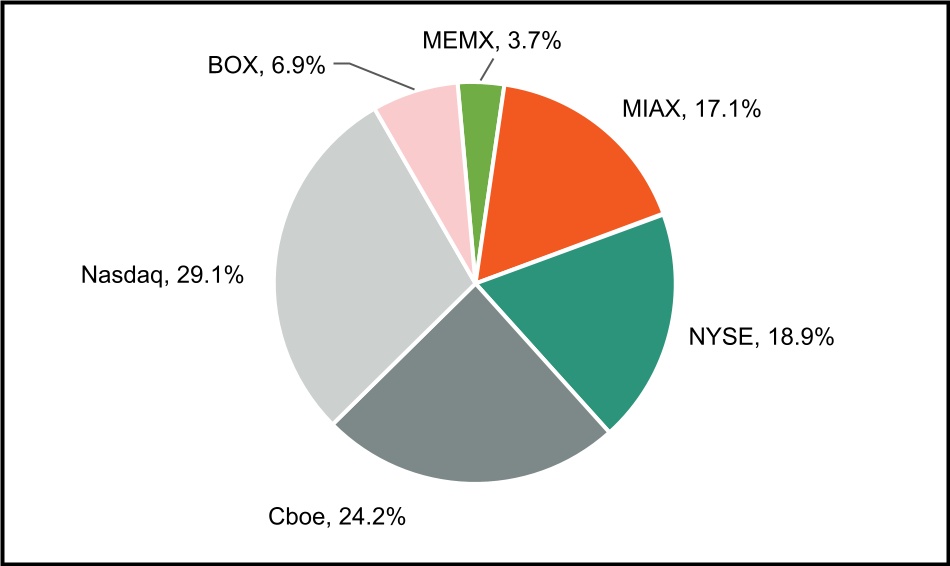
We operate four fully automated electronic options exchanges in the United States which are each national securities exchanges regulated by the SEC with different allocation and pricing models. Each of our U.S. options exchanges has a distinct allocation and pricing model. Total volume in 2025 reached 2.4 billion contracts, a 41.1% increase from the 2024 total and representing a market share of 17.1% during this period. We have traded in excess of 10.8 billion contracts from inception through December 31, 2025 on our options exchanges. We have grown our options market share over time by focusing on delivering superior technology capabilities, innovation, product development, exceptional customer service, and competitive pricing.
U.S. options exchanges differ by their allocation model and pricing model. The allocation model determines who, among those posting orders on the exchange (“Liquidity Makers”) at a given price, are allocated trading volume when an order or quote is placed to execute against resting liquidity (“Liquidity Takers”). Regardless of allocation model, more aggressively priced liquidity always trades ahead of liquidity at a worse price. For liquidity resting with the same price, a Price-Time allocation will allocate trades to liquidity based on the time the liquidity was entered on the book, so older liquidity will be executed ahead of newer liquidity, while Pro Rata allocation typically allocates trades to liquidity based on the size of the resting liquidity.
The pricing model used by an exchange determines who is charged an exchange transaction fee and who is paid an exchange liquidity payment. A Maker-Taker model generally charges a lower fee or pays a liquidity payment to the Liquidity Maker for each contract traded and charges a higher transaction fee to the Liquidity Taker. A Taker-Maker model generally charges a lower fee or pays a liquidity payment to the Liquidity Taker for each contract traded and charges a higher transaction fee to the Liquidity Maker. The Customer Rebate model generally charges market makers and professional traders to execute each contract traded and pays a liquidity payment to customers. Fee models used by exchanges are complex and can be differentiated by a number of factors including the type of customer executing the trade, the number of legs in a trade, the price of the option or for trades executed in auction mechanisms.
The launch of the MIAX Sapphire electronic exchange provides our market participants with access to approximately 94% of total multi-listed volume, with the remaining approximately 6% being volume traded on exchange floors. In order to have access to the remaining 6% of the multi-listed options market traded on exchange floors, we launched a trading floor in Miami, Florida in September 2025. We intend to release new functionality in the future on the MIAX Sapphire trading floor to attract additional volume.
U.S. Options Industry Market Share by Exchange Group
(as of December 31, 2025)
Source: The Options Clearing Corporation
Overview of MIAX Options Exchanges
(as of December 31, 2025)
Exchange Model
Listings
Exchange
Year Launched
Allocation Model
Pricing Model
Underlyings / Symbols
Options
MIAX Options
Dec ’12
Pro Rata
Customer Rebate
3,595
1,362,614
MIAX Pearl Options
Feb ’17
Price-Time
Maker-Taker
3,596
1,363,202
MIAX Emerald Options
Mar ’19
Pro Rata
Maker-Taker
3,596
1,363,202
MIAX Sapphire Options
Aug ‘24
Price-Time
Taker-Maker
3,607
1,364,720
U.S. Equities
Under MIAX Pearl’s national securities exchange license and leveraging the technology and systems built for our options exchanges, MIAX Pearl Equities was launched as a cash equities exchange on September 29, 2020, and as of December 31, 2025, had a total of 56 exchange members. It was built with the support of our trading firms, liquidity providers and market makers to provide an alternative to the incumbent equities platforms in the United States. MIAX Pearl Equities is a fully automated electronic equities trading platform that leverages MIAX’s technology and infrastructure. The MIAX options technology was adapted for the unique functional and performance demands of equities
trading, which allows us to provide high performance while taking advantage of the scale associated with a system built for options trading.
MIAX Pearl Equities offers trading in all U.S. equity securities designated under the Regulation National Market System (“NMS”) qualifying for Unlisted Trading Privileges (“UTP”) using a Price-Time allocation model and Maker-Taker fee structure. The total addressable market of U.S. equities for 2025 is broken down into the following: approximately 32% in the Price-Time allocation model, 11% in the pre-market and after hours market, 6% in the opening and closing auction markets and 51% in the trading reporting facilities.
In February 2025, MIAX Pearl Equities expanded its trading hours for its equity trading platform (the “Expanded Trading Hours”). MIAX Pearl Equities now accepts orders at 3:30 a.m. Eastern Time (“ET”) with orders being eligible for execution beginning at 4:00 a.m. ET until 5:00 p.m. ET. The Early Trading Session operates from 4:00 a.m. ET until 9:30 a.m. ET. The Late Trading Session operates from 4:00 p.m. ET until 8:00 p.m. ET. In 2025, MIAX Pearl Equities reported volume of 45.8 billion shares, a decrease of 8.2% from 2024, which totaled 49.9 billion shares, and represented a market share of 1.0%.
U.S. Futures
MIAX Futures. MIAX Futures is a fully electronic, vertically integrated futures exchange and clearing house that was established in 1881. It is registered with the CFTC as a DCM and DCO. MIAX Futures provides us with access to the U.S. futures market, positioning MIAX as a multi-asset exchange operator. In the past few years, there has been increased competition in providing clearing services and we expect competition to continue to increase. As the trading of centrally cleared products has increased over the past decade, both as a result of global regulatory requirements and in recognition of the role of central counterparties in adding stability to the financial system and reducing market risk, so has the use of clearing houses in clearing exchange transactions. However, the high financial and regulatory burdens in achieving CFTC recognition as a DCO in the U.S. has increased demand to outsource or use a third-party service provider like MIAX Futures for central clearing services.
We believe that MIAX Futures’ unrestricted DCO license as it relates to futures and options on futures is highly valuable given that an unrestricted license can offer margin on cleared futures positions as compared to certain other DCOs that can only offer fully collateralized clearing on futures positions. As of December 31, 2025, we had 14 MIAX Futures clearing members eligible to clear MIAX Futures products, most of which are FCMs. Additional FCMs access MIAX Futures’ markets through relationships with existing clearing members.
The MIAX Futures DCM offers us the ability to list our own futures products on the MIAX Futures trading platform. We launched MIAX Futures Onyx in June 2025, with the migration of Minneapolis Hard Red Spring Wheat futures. We intend to list other products, such as additional agricultural futures products, and additional financial futures products on the MIAX Futures Onyx trading platform, subject to certain regulatory filings.
The MIAX Futures DCO operates on proprietary technology, which we upgraded in 2023 to support our growing portfolio of new products and to enhance customer experience. The MIAX Futures DCO serves as the exclusive venue for the clearing of agricultural products listed on the MIAX Futures DCM.
MIAX Futures Clearing could also be an attractive venue for providing clearing services to other DCMs that do not have a DCO or have a restricted DCO.
Total 2025 volume on MIAX Futures reached 3.3 million contracts, an increase of 2.2% from the 2024 total. The MIAX Futures market share in 2025 was less than 1% of the total U.S. futures and options on futures contracts.
Dorman Trading. In October 2022, MIH acquired all of the issued and outstanding membership interests of Dorman Trading. Dorman Trading is a Chicago-based FCM registered with the CFTC, providing execution and clearing services for introducing brokers, retail customers, institutional clients and professional traders on a number of futures exchanges. Dorman Trading and its predecessor companies have been in business for over 40 years.
Dorman Trading is a trading member of the Chicago Mercantile Exchange, Inc. Group of exchanges consisting of the Chicago Mercantile Exchange (“CME”), the Chicago Board of Trade (“CBOT”), the New York Mercantile Exchange (“NYMEX”) and the Commodity Exchange Inc. (“COMEX”) and is a clearing member of CME Clearing for trades executed on the Chicago Mercantile Exchange, Inc. Group of exchanges. Dorman Trading is also a trading member of ICE Futures U.S., a clearing member of ICE Clear U.S. and a clearing member of MIAX Futures. Further, Dorman Trading is a participant firm of Coinbase Derivatives exchange with such trades cleared on Nodal Clear, LLC through Wedbush Securities Inc. Dorman Trading is a Disclosed Client Market Participant of the Eurex Exchange (Germany) with such
transactions cleared on Eurex Clearing A.G. through ADMIS International Ltd. Dorman Trading also offers access to certain exchanges through ADM Investor Services U.S., for the (i) Cboe Futures Exchange, LLC, with trades cleared on the OCC, (ii) ICE Europe exchange, with trades cleared on ICE Clear Europe; and (iii) Euronext exchange with trades cleared on Euronext Clearing.
Dorman Trading has relationships with introducing brokers, both domestic and international, who solicit clients for their execution services. Those introducing brokers work to establish execution and/or clearing accounts with Dorman Trading for those new client relationships, but generally serve as the primary relationship and customer service point of contact for those clients.
MIAXdx. MIH acquired MIAXdx in May 2023, which was a fully electronic vertically integrated DCM and DCO, with regulatory approval from the CFTC to list and clear fully collateralized futures, options on futures and swaps. Fully collateralized positions are those wherein the DCO holds, at all times, funds or commodities (such as Bitcoin or Ether) in the form of the required payment sufficient to cover the maximum possible obligation or loss that a party or a counterparty could incur upon liquidation or expiration of the contract.
On October 16, 2017, MIAXdx commenced its principal business activities, making it the first federally regulated exchange and clearing house to list and clear fully collateralized, physically settled Bitcoin swaps and options through its SEF. On June 24, 2019, MIAXdx began to list and clear fully collateralized, physically settled Bitcoin derivatives products through its DCM. On June 30, 2021, MIAXdx began to list and clear fully collateralized, physically settled Ether swaps and options. In March 2025, MIAXdx began to list and clear fully collateralized, cash settled range binary options on the price of Bitcoin on its DCM and DCO.
Effective as of January 20, 2026, we closed the MIAXdx Transaction.
International Listings
BSX is a fully electronic, vertically integrated international securities market, headquartered in Bermuda and organized in 1971. BSX specializes in the listing and trading of capital market instruments such as equities, debt issues, funds, hedge funds, derivative warrants and ILS.
BSX is the global leader in the listing of ILS vehicles which provide catastrophic peril reinsurance coverage. Issuance figures are stated in notional value. As of December 31, 2025, 746 ILS in total were listed on BSX with an aggregate market issuance outstanding of $65.2 billion. Of the total ILS listings, 520 were vehicles providing catastrophic peril reinsurance coverage. The global issuance for that class was $61.3 billion, with BSX listed ILS vehicles providing catastrophic peril reinsurance coverage having an outstanding value of $57.2 billion representing approximately 93.2% of the global issuance. As of December 31, 2025, there were 1,209 securities listed on BSX, a 2.9% decrease from the 1,245 securities listed as of December 31, 2024. The market capitalization of the companies listed on BSX totaled approximately $331.6 billion as of December 31, 2025.
In addition to gaining access to BSX’s existing international market, the acquisition of BSX gives us access to another vertically integrated market ecosystem that can accelerate our growth strategy. Bermuda has an advanced cryptocurrency and digital asset regulatory environment, positioning it to be a leading jurisdiction for the trading of these products. We believe that this type of environment, combined with our existing BSX business and new product pipeline, will allow us to quickly introduce and test out new product opportunities in Bermuda, which may include innovative cryptocurrency and digital asset products. We anticipate that these products would not be made available to U.S. persons unless such persons are eligible under applicable law and we would, in consultation with counsel, implement appropriate procedures to ensure that the investors in any products meet the eligibility requirements of such products.
TISE has been headquartered and organized in Guernsey, a British Crown Dependency in the Channel Islands, since 2013. TISE operates across Guernsey, Dublin, Isle of Man, Jersey and London. TISEA is regulated by the GFSC.
TISE provides financial markets and securities services to companies globally. Best known as one of Europe’s major professional bond markets, as of December 31, 2025, there were more than 2,500 issuers from over 35 countries listing securities valued at nearly £800 billion on TISE.
As of December 31, 2025, 4,818 securities were admitted to listing and trading on TISE, a 7.4% increase on the 4,787 securities listed as of December 31, 2024.
TISE’s QIBM is a leading market in Europe for listing high yield bonds, private equity debt and securitization transactions. There were 533 high yield bonds listed on TISE as of December 31, 2025, an increase of 14.4% compared to
December 31, 2024. As of December 31, 2025, there were 2,135 private equity debt securities listed on TISE, an increase of 6.4% compared to December 31, 2024. There were 631 securitization bonds listed on TISE as of December 31, 2025, an increase of 16.6% compared to December 31, 2024. In addition, TISE has a pool of investment funds, a significant share of which is UK REITs. As of December 31, 2025, TISE has the largest market for listed UK REITs, with 41 UK REITs listed on TISE.
The TISE Acquisition provides us with access to the European and UK markets and gives us access to another vertically integrated market ecosystem that can accelerate our growth strategy. Guernsey also has a favorable regulatory and tax environment with an internationally recognized and robust financial services industry.
Our Competitive Strengths
We have established ourselves as a leading multi-asset exchange operator by leveraging a number of key strengths, including:
Proprietary MIAX Exchange Technology Platform
We operate a proprietary, advanced trading system for the MIAX Exchanges that was developed in-house and designed for the unique functional and performance demands of both options and cash equities trading. Our trading system has been a key driver of our market share growth in U.S. Options and U.S. Equities. For additional information regarding our technology, see “ — Our Technology” below.
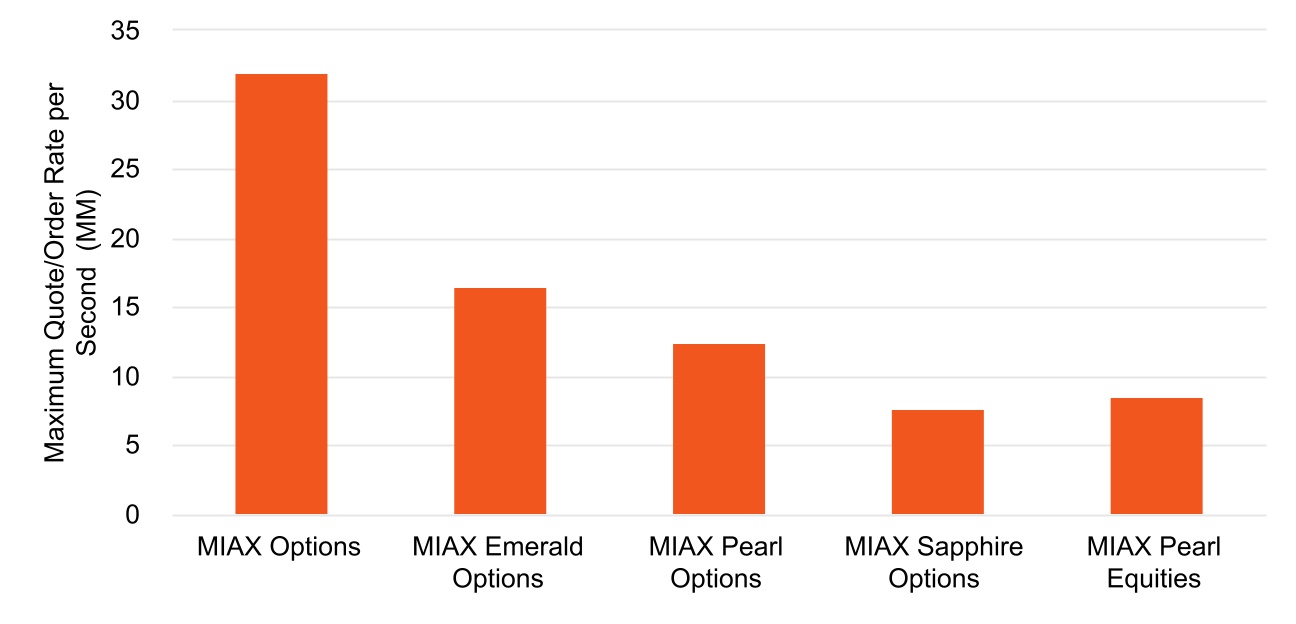
Our MIAX Exchange trading platforms have experienced very low operational downtime. In 2025, our MIAX Options, MIAX Emerald, MIAX Pearl and MIAX Sapphire exchange markets were immediately and automatically accessible (i.e., fully operational), 99.99986341% of the time. We believe that this reliability provides our customers with an additional incentive to use our platforms to mitigate trade execution risk, especially in times of extreme market volatility. Our maximum sustained throughput capability (as measured by the maximum quotes and orders per second) for each of the MIAX Exchanges is currently the following:
Maximum Quote/Order Rate per Second
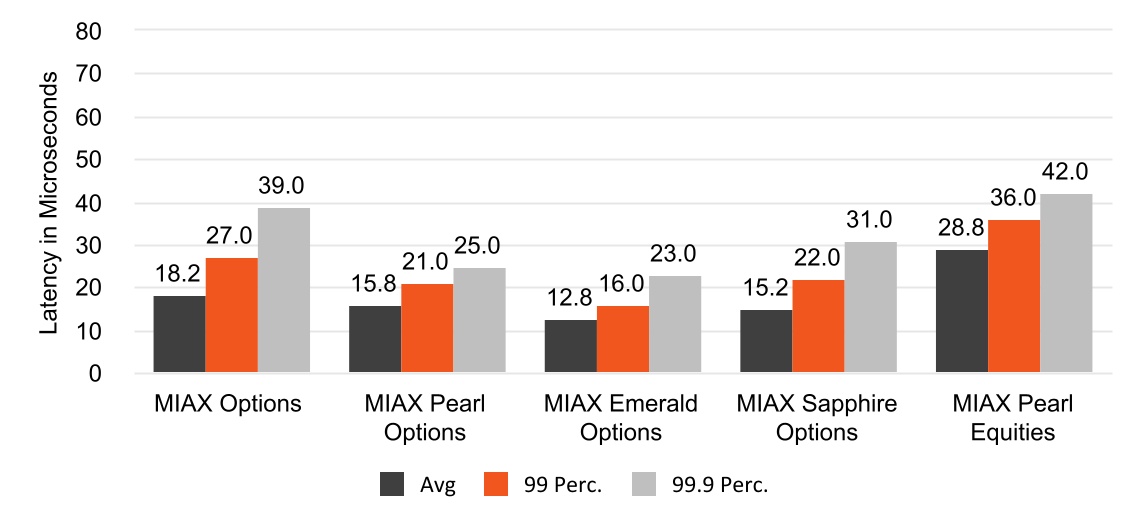
A combination of high throughput and low latency performance on a per message basis are essential to provide our members with a consistent experience, even in times of high volatility and market stress. Consistent low-latency experience across a range of market conditions (on average and at the 99th and 99.9th percentiles) provides liquidity providers with the confidence to display deeper and tighter markets on our exchange. Low-latency behavior for a single message without high throughput can cause system queuing, which results in much larger outliers at the 99th and 99.9th percentiles. Our average latency and latency at the 99th and 99.9th percentiles are shown below and demonstrate the consistency of our systems:
We have a highly experienced leadership team with experience in developing, operating and trading on exchanges. This experience, along with our culture of collaboration with our trading member firms through strategic relationships, has helped build a strong track record of innovation and product development.
We continue to evaluate new product possibilities on an ongoing basis and have a robust pipeline of new products we plan to launch in the future on our exchanges covering different asset classes, including the Bloomberg Products. See “Our Growth Strategy — Creating new product offerings” below.
Multi-Asset Exchange Operator with Broad Portfolio of Licenses
We operate across a broad range of asset classes, with exchanges in the options, equities and futures and options on futures markets and a regulated futures clearing house. This provides us an opportunity to launch new products to expand our markets, allows us to provide clearing-as-a-service solutions to other DCMs, and enables us to accelerate product development. We believe we are well positioned to grow and become a leading player in the U.S. regulated markets through our DCO and DCM regulatory licenses with the CFTC and national securities exchange licenses with the SEC.
Strong, Collaborative Relationships with Key Market Participants
Since launching in 2012, we have developed deep relationships with our client base, working with them to solve the key challenges faced by today’s market participants. Many of these relationships were developed through our ERPs, which allowed us to align the interests of some of the largest order flow providers and market makers with our exchanges. These strategic relationships developed through our ERPs have been a critical tool in expanding our exchanges. Although we cannot predict whether the firms that participated in our ERPs will continue to provide the same level of order flow to our exchanges as they historically have, we believe that we have demonstrated to these firms the advantages that we offer and that they will continue to drive order flow to us based on their positive experiences.
Successful History of M&A
We have successfully used M&A to drive growth in our business through the acquisitions of MIAX Futures, BSX, Dorman Trading, MIAXdx and TISEG. These strategic investments across a range of capital markets sectors have given us differentiated access to business opportunities and helped us to accelerate the development of new products. In addition, we have made a number of strategic minority equity investments in companies that may offer us access to commercial opportunities to develop new products and accelerate the growth of our business.
We made our first strategic investment in 2016, in Ledger Holdings, the former parent company of MIAXdx, one of the first CFTC approved regulated trading platforms and clearing houses specifically designed for cryptocurrencies and digital assets. This investment gave us insight into the regulatory framework of futures exchanges and clearing, laying the foundation for the acquisition of MIAX Futures. Ledger Holdings was acquired by West Realm Shire Services Inc. in October 2021, resulting in a significant return on our investment. In May 2023, we acquired 100% of the membership
interests of MIAXdx from Ledger Holdings in FTX Trading Ltd.’s bankruptcy (the “FTX Bankruptcy”). Effective as of January 20, 2026, we entered into the MIAXdx Transaction.
Between April 2023 and July 2024, we acquired various minority interests in TISEG, cumulatively increasing our ownership to 29.46% prior to subsequently acquiring its remaining equity interests in June 2025. The TISE Acquisition provides us with access to the European and UK markets and gives us access to another vertically integrated market ecosystem that can accelerate our growth strategy. Guernsey has a favorable regulatory and tax environment with an internationally recognized and robust financial services industry.
Through our investments, MIAX has developed a strong understanding of the market infrastructure ecosystem enabling us to move quickly on M&A opportunities to accelerate development of products. For more information about our strategic investments see “Notes to Consolidated Financial Statements — Note 6 - Investments”.
Deep, Highly Experienced Team
Our core team members have extensive experience in the financial markets covering a wide range of functions including trading, clearing, order routing, trading and clearing technology, exchange operations, clearing operations, finance, legal and regulatory with many team members being with us since inception. This depth of experience has enabled us to accumulate the knowledge, relationships and capabilities needed to serve complex, dynamic and highly regulated markets and foster a culture of collaborative innovation with member firms, which has been an important contributor to our success to date.
Our Growth Strategy
We believe we are well positioned to leverage our competitive strengths to enhance our market position, develop new products and services and continue expanding into new asset classes and geographies. We are focused on several attractive growth opportunities in MIAX’s core markets and beyond, as described below.
Creating new product offerings
We are focused on creating new proprietary products and expect to launch several new products with innovative pricing, including the Bloomberg Products as well as other cash settled futures. Futures and options on the B500 Index and B100Q Index will offer competitive fees, enhanced product choice and more granular contract sizes, providing retail and institutional investors with an alternative way to manage exposure in the U.S. equity market.
The first Bloomberg Product we plan to exclusively list in the second quarter of 2026 on MIAX Futures will be small notional futures contracts on the B100Q Index (the “Tini B100Q Futures”) and the B500 Index (the “Tini B500 Futures”) and futures on the B500 Index (the “B500 Standard Futures”). We also plan to subsequently launch options on futures products, including options on futures on certain of the Bloomberg Products and cash-settled index options on certain of the Bloomberg Products on MIAX Options.
We believe that the methodology utilized by the B500 Index and the B100Q index has advantages. The B500 Index employs a transparent, rules-based methodology to track the 500 most highly capitalized U.S.-listed companies. It is designed to provide users with clear, predictive, U.S. large cap exposure, free of undue subjectivity. The methodology for the B500 Index also allows for high profile initial public offerings to be eligible for inclusion in the index sooner (after the first five consecutive trading days) versus certain other indexes (which require a minimum of 12 months). The methodology for the B100Q Index employs a transparent, rules-based methodology to track the 100 highest most highly capitalized companies whose primary listing is on The Nasdaq Stock Market LLC, and belong to Bloomberg’s sector classification of technology, health care, consumer staples, consumer discretionary or communications.
MIAX Futures plans to clear the Bloomberg Products that trade on MIAX Futures through The Options Clearing Corporation (“OCC”), which we believe will offer net capital efficiencies to clearing members, including a more efficient margin treatment for a portfolio of Bloomberg Products and other non-MIAX products with similar characteristics. OCC clearing members will be able to leverage OCC’s cross-margining processes to combine futures and options positions in Bloomberg Products, resulting in offsetting and lower margin requirements and improved capital efficiency for the clearing member’s account than would be available if the Bloomberg Products were cleared in the Clearing House. OCC will act as a central processing facility for futures and options positions in Bloomberg Products for OCC clearing members, providing an additional layer of counterparty risk mitigation.
In addition to the Bloomberg Products, we are developing other new products for our markets and plan to expand our suite of proprietary and other products on MIAX Futures. We intend to list other products, such as additional agricultural
futures products, and additional financial futures products on the MIAX Futures Onyx trading platform, subject to certain regulatory filings.
The timing of the launch of new products, including the Bloomberg Products, is subject to market conditions, evaluation of market size, customer interest and other factors, including Company resources. In addition, the launch of new products will be subject to the us making the necessary rule filings with the CFTC and the SEC, as applicable.
Continuing to grow our options exchanges
We plan to continue expanding our market share across our options exchanges by monitoring the competitiveness of our fees and pricing models, improving our technology and adding functionality to provide an industry-leading experience for our members, including on MIAX Sapphire trading floor in Miami, Florida. Our execution capability, system reliability, and customer service, especially during times of volatility, have been key differentiators in increasing our market share and relevance.
We are offering daily (“Short-Term Options”) options for certain popular individual stocks and ETFs that meet certain criteria (“Qualifying Securities”). We expect that these Short-Term Options may have a positive impact on the growth in the options market and on our exchanges given their importance to both retail and institutional participants. On January 26, 2026, the MIAX Options Exchanges began listing options with Monday and Wednesday weekly expirations on the nine underlying securities that currently meet the criteria for Qualifying Securities, and plan to continue to list such Monday and Wednesday weekly expirations on the Qualifying Securities (as determined on a quarterly basis) going forward in the future.
As we continue to build scale and grow our market position, we expect to attract increased membership and volume through additional functionality and market models, increased penetration into the existing membership base and expanded use and sale of market data and analytics products across our multi-listed and proprietary product offerings.
Expanding our futures markets
MIAX Futures provides us with a vertically integrated futures exchange and clearing platform to list futures and options on new products that will be exclusive to our exchange. This provides us an opportunity to become a substantial player in the futures market and grow our product suite. We are currently in the process of transforming MIAX Futures from an agricultural focused market to a full solution DCM and DCO, both in terms of products and technology.
The MIAX Futures DCO license, which is an unrestricted license as it relates to futures and options on futures, allows MIAX Futures to offer clearing on a margined basis. This presents a growth opportunity in the area of clearing as a service as we focus on establishing relationships with entities that want to clear their products in a regulated environment with full margining capability. We believe that MIAX Futures is an attractive alternative to competitor DCOs given our partnership approach and track record of innovation and product development.
The licenses held by MIAX Futures, including the DCM and DCO licenses, and FCM license held by Dorman Trading, enable us to provide products and services in futures execution, listing and clearing.
The MIAXdx Transaction provides us with potential exposure in the U.S. futures market to event based contracts with our retained 10% ownership interest in Rothera.
Increasing our international presence
The acquisitions of BSX and TISEG provide us with an opportunity to position ourselves as a leader among international listing venues by utilizing BSX’s and TISE’s numerous international recognitions and expertise in their respective products and markets. BSX and TISE provide us with venues to expand our leading MIAX technology, derivatives trading, and regulatory expertise to address emerging markets as well as providing BSX and TISE with opportunities for collaboration across networks and additional support for their businesses and a coordinated approach to business development, marketing and growth of our international listing business.
The Bermuda regulatory environment also provides us with an attractive opportunity for introducing innovative cryptocurrency and digital asset products on BSX. Bermuda is recognized as a global leader in the regulation of cryptocurrency and digital assets through the development and introduction of a comprehensive regulatory and legislative framework known as the Digital Asset Business Act. We expect that any digital asset products launched on BSX would not be made available to U.S. persons unless such persons are eligible under applicable law and we would, in consultation with
counsel, implement appropriate procedures to ensure that the investors in any products meet the eligibility requirements of such products.
In November 2021, BSX moved into its new headquarters, “Exchange House” located in Hamilton, Bermuda, which provides BSX with the ability to expand its operational footprint as its business grows. We have invested in BSX corporate technology infrastructure and integrated it into the MIAX corporate technology infrastructure to enable BSX to leverage MIAX’s leading technology as it expands its operations. In March 2025 we launched our own BSX trading, clearing and settlement system for trading products listed on BSX.
The TISE Acquisition also provides us with the opportunity to expand into the UK and European markets. Headquartered and organized in Guernsey, TISE operates in a favorable regulatory and tax environment and as part of a robust financial services industry. TISE’s ability to operate and attract listings benefits from its proximity to UK and European markets while remaining independent of certain operational requirements dictated by the regulatory environment in the UK and the European Union.
Further monetizing and enhancing our data and analytics capabilities
As we increase our market share in core markets, the relevance of our market data products grows in value. We believe we are at an inflection point in our ability to further commercialize our market data. We are not encumbered by legacy systems or reliant on our core data revenues to date, so we have significant flexibility in how we monetize and distribute our data, providing an attractive growth opportunity. Our proprietary products may also provide an additional avenue to create exclusive data and analytics products for our customers. We believe our strategic investments also create opportunities for development of additional products as well as data and analytics offerings.
BSX also has, since September 2021, been publishing select MIAX Pearl Equities market data to the Pyth Data Foundation (“Pyth”) network (such network the “Pyth Network”), a decentralized cross-chain data provider for financial market data distribution built on the Solana blockchain. The inclusion of this market data gives users access to select market data from the MIAX Pearl Equities order book in the DeFi space and creates new opportunities for the use of our market data. BSX earns tokens for the data it provides to the Pyth Network. For additional information regarding Pyth tokens, see “Management’s Discussion and Analysis of Financial Condition and Results of Operations — Overview — Pyth Tokens Unlocking.”
Increasing the profitability of our cash equities exchange
Leveraging the scalability of our team and technology, and following the success of our options exchanges, management set out to build MIAX Pearl Equities to provide a transparent venue that leverages our technology and superior customer service. We are focused on growing the profitability of MIAX Pearl Equities. Exchange transaction fees generate different capture rates depending upon the type of product and other factors, including the type of customer and certain volume discounts. We are focusing on improving our capture rates on MIAX Pearl Equities, which may decrease our volume and market share in equities, but increase our revenues from these transactions.
Our Technology
Technology is a key component of our business strategy and we regard it as crucial to our success. We have developed our own proprietary technology platform. Our MIAX Exchange platform employs monitoring, security and risk management tools that provide significant benefits for market participants trading on the MIAX Exchanges and have become industry standard. This platform was custom built by our experienced technology team well-versed in the unique functional and performance demands of equities and derivatives trading. Many of the team members have been with us since inception and have a deep understanding of our technology infrastructure. We believe our innovative technology platform coupled with our award-winning customer service sets us apart from our competitors.
•Throughput is a measurement of the rate at which an exchange can process quotes and orders in aggregate. This is an important benchmark at times of market stress and can have a significant impact on latency. Throughput is an especially significant benchmark in the options markets given the number of products traded (in excess of one million options). Consistent behavior even in times of market stress will generally improve the quality of an exchanges displayed markets and quality of executions and reduce negative expectancy trades, thereby allowing liquidity providers to offer better markets with less risk.
•Latency is a measurement of the time it takes to receive, fully transact and reply to a market participant’s quote or order. Latency is an important factor in the quality of liquidity posted at an exchange.
•Determinism is a measurement of how frequently the ordering of market updates received at the edge of the exchange network are preserved all the way through the system to the matching engine. Our MIAX Emerald Exchange system is extremely deterministic and sequences orders that arrive within as low as eight nanoseconds of each other which is critical to the predictability of execution. Preserving this ordering is highly desired by exchange participants that invest in technology to be the fastest at reacting to market updates.
Our interface solutions facilitate well defined and easy to implement industry accepted approaches to integration with our trading platform, creating greater flexibility and ease of use. We use the same base technology across our MIAX Exchange options and equities markets, which optimizes efficiency, versatility, resiliency and scalability and allows for uniformity of customer experience. This allows us to quickly launch new markets and products and provides us with significant operating leverage. We also offer a number of customer interfaces, including MIAX Exchange binary interfaces, data feeds and FIX gateway for orders. Latency equalized cross-connects in the primary data center ensures fair and cost-efficient access to the MIAX Exchange systems.
Our MIAX Exchange trading platform was originally built to meet the high-performance quoting demands of the U.S. options trading industry. We are regarded as a market leader relative to many of our peers with respect to our technology based on feedback from our customers. We differentiate our trading platform with our throughput, latency, reliability and wire-order determinism.
The MIAX Exchange platform undergoes continuous automated testing to ensure high reliability together with advanced monitoring and systems security. The platform is highly resilient and has experienced very low operational downtime. Our exchanges also maintain a geographically diverse disaster recovery center from our primary data centers to ensure continuous operation including systems infrastructure and operations. The MIAX Exchanges maintain primary and disaster recovery connections to the various National Market System facilities such as CTS, UTP, OCC, the Depository Trust & Clearing Corporation (“DTCC”), CAT and FINRA.
Our MIAX Exchange platform has received numerous recognitions in the industry including recognition for exceptional customer service and innovative product development including most recently at the 2025 Fund Intelligence Operations and Service Award, where MIAX received the “Technology Innovation Award” as well as the award for “Best Trading Platform,” which it has received for the third year in a row. In 2025, MIAX was also selected as one of 40 organizations in the inaugural TabbFORUM’s NOVA Awards, which honor the financial industry’s ongoing commitment to technology-driven innovation. NOVA Awards selections are the result of TabbFORUM research, nominations and recommendations solicited from the financial community, and take into account the role of innovation within an organization, as well as the organization’s industry impact and leadership.
The MIAX Futures DCO operates on proprietary technology, which we upgraded in June 2023 to support our growing portfolio of new products and to enhance customer experience. We launched MIAX Futures Onyx in June 2025 for trading products on the MIAX Futures DCM with the MIAX Futures flagship product, Minneapolis Hard Red Spring Wheat Futures. MIAX Futures Onyx is an electronic trading platform built on MIAX proprietary technology. This new technology can power multiple platforms to provide for the trading of agricultural and financial futures and options on futures in geographically diverse locations. MIAX Futures Onyx will support both agricultural and financial products. We plan to introduce functionality to the MIAX Futures Onyx trading platform to support the trading of financial futures products in the second quarter of 2026.
In March 2025, we launched our own BSX trading, clearing and settlement system for trading products listed on BSX based on MIAX proprietary technology. The new BSX system includes a trading and market data dissemination system located in Bermuda for BSX listed securities with disaster recovery systems at an off-island location; customized web-based order management system for utilization by the BSX brokerage community; middle office technology to support system configuration, surveillance, reporting and other services required by BSX as well as a centralized security depository for clearing and management of BSX securities.
Our technology strategy has been, and continues to be, combining the use of emerging technologies with improved processes to enhance customer experience, eliminate repetitive or error prone tasks and to remain laser focused on our core mission of providing efficient scalable platforms that focus on latency, throughput and determinism. We have several efforts underway to research and evaluate in 2026 the potential use of certain new technologies, such as artificial intelligence (“AI”) to further our goals of efficiency and improved quality. We continue to explore or expand the use of other technologies such as the cloud, blockchain, tokenization and other emerging technologies to increase productivity and potentially drive enhancements to our regulatory program or the development of new products or trading platforms.
Our equities and options customers are SEC-registered broker-dealers and the sponsored access clients of those broker-dealers. As of December 31, 2025, the MIAX Exchanges had a total of 227 members, including 48 exchange members on MIAX Options, 43 exchange members on MIAX Pearl Options, 40 exchange members on MIAX Emerald, 40 exchange members on MIAX Sapphire and 56 exchange members on MIAX Pearl Equities. Our total number of members includes 75 distinct firms. These members include sell side banks, proprietary trading firms and market makers, as well as buy side institutions, hedge funds and retail customers participating via broker-dealers.
MIAX Futures is a DCM and DCO under the jurisdiction of the CFTC, providing DCM and DCO services in an array of asset classes. Customers on MIAX Futures have historically consisted of large agricultural trading firms and other corporate customers. As MIAX Futures has evolved from a predominantly agricultural exchange to a diversified financial futures exchange, we have attracted several additional broker-dealer customers. As of December 31, 2025, we had 14 MIAX Futures clearing members eligible to clear MIAX Futures products listed on its DCM, most of which are FCMs. Additional FCMs access MIAX Futures’ markets through relationships with existing clearing members.
BSX trading memberships are available to international brokers who meet BSX requirements. As of December 31, 2025, BSX had 16 exchange members.
TISE offers three membership options. Category 1 Listing Member, for QIBM, Category 2 Listing Member, for its equity market or a Category 3 Trading Member, for all markets. Each membership criteria has eligibility requirements, as set forth in TISE’s membership rules. As of December 31, 2025, TISE had 44 members.
Dorman Trading provides futures clearing and execution services for introducing brokers, retail customers, international clients and professional traders.
Our Sales and Marketing Approach
Our sales and marketing strategy is focused primarily on educating market participants about our value proposition, services and products including proprietary products and leading technology. Through targeted communications and meetings, as well as our presence at industry trade conferences and participation in industry forums, we focus on educating existing and prospective customers about the benefits of using our markets and products. Our team operates with a highly integrated approach across sales, technology, trading operations and senior management when interacting with clients so the full benefits of our offering are properly demonstrated from day one.
We operate with high standards of customer service throughout the customer lifecycle. We can onboard customers quickly and efficiently and our embedded customer operations team provides high quality support to members. Our team has a deep understanding of both our products and our technology, so customers are given real-time answers to any issues or queries they may have.
Competition
The market for execution services is intensely competitive in the asset classes in which we operate. We face intense competition and compete with a broad range of market participants. Further consolidation and alliances among our trading competitors could impair our competitive position.
Securities market participants have multiple venue choices for the execution of orders. In addition to national securities equities exchanges, in the United States, these venues include numerous alternative trading systems (“ATSs”), many of which operate as “dark pools” owned by our principal investors and broker-dealers who internalize orders for execution.
Competition in Our Exchange Businesses
We compete in the United States in listed equity options against 14 exchanges owned by Cboe, Nasdaq, Intercontinental Exchange, Inc. (“ICE”), BOX Holdings Group LLC, Investors Exchange LLC and MEMX. The Company anticipates that two additional U.S. equity options exchanges will come to market in 2026. We compete in the U.S. listed cash equity securities market against exchanges owned by Cboe, Nasdaq, ICE, IEX, MEMX, LTSE, 24X Exchange LLC, other regional exchanges and several ATSs. The Company anticipates additional U.S. cash equity securities markets may launch in 2026.
MIAX Futures primarily competes against futures markets owned by Cboe, CME Group and ICE.
In our proprietary and exclusively listed products, we compete against other derivatives exchanges that offer similar products, as well as against financial market participants that offer similar over-the-counter derivatives. In April 2025, CME started trading Hard Red Spring Wheat futures and options on Hard Red Spring Wheat futures contracts.
We face competition based on technology, customer experience and price. We also face competition based on products and services offered, such as order types and risk management tools. We believe that we compete favorably with respect to these factors. However, many of our current and potential competitors are more established and substantially larger than we are, and have a substantially greater market presence, as well as greater financial, technical, marketing and other resources. In addition, many of our competitors have broader name recognition, offer a wider range of services and products and have a larger customer base than we do. Some of them may be able to respond more quickly to new or evolving opportunities, technologies and customer requirements than we can and may be able to undertake more extensive promotional activities.
Our challenge is to maximize the routing of equities and options orders from broker-dealers to the MIAX Exchanges rather than to our competitors and to convince liquidity providers to concentrate an increased amount of their market making activity on the MIAX Exchanges. We compete through a variety of methods, including:
•Offering market participants a higher quality experience that results in an efficient, transparent and liquid marketplace for trading equities and options through our electronic platforms;
•Providing advanced technology that offers broad functionality, fast execution, ease of use, scalability, reliability and security;
•Offering customers execution and the NBBO with the additional potential for price improvement;
•Offering cost-effective trading venues;
•Providing personalized service and responsiveness to client needs in the form of customer on-boarding, connectivity, testing/certification and accurate and timely responses to customer inquiries and concerns throughout the trading day;
•Providing both real time and next day trade data to permit clients to make critical trading decisions as quickly as possible, and enabling them to trade more profitably in reaction to order flow trends, directed order flow, and changing market conditions;
•Offering participants access to a broad array of products and services, including proprietary products; and
•Committing to work directly with the member firms through development of trading solutions that foster growth for the firms and profitability for their clients.
Competition in the Clearing Business
In the past few years, there has been increased competition in providing clearing services and we expect competition to continue to increase in connection with compliance with the Dodd-Frank Wall Street Reform and Consumer Protection Act and other various laws and regulations. Futures contracts generally must be settled on the same venue in which the contract was purchased or on a third party DCO that has an agreement in place with the futures exchange to clear its products. Competitors to MIAX Futures in the clearing services space include, among others, companies such as CME, ICE and the OCC. In light of the implementation of new regulatory requirements and other reforms of the financial services industry, we believe that other exchanges and infrastructure providers also may undertake to provide clearing and other related post-trade services, such as Nodal Clear, LLC and Cboe Clear U.S., LLC in the United States, as CFTC regulated DCOs.
We believe competition in clearing services is based on, among other things, the value of providing customers with capital and margin efficiencies; quality and reliability of the services; creditworthiness of the clearing house; regulatory costs; timely delivery of the services; reputation; diversity of the service offerings; confidentiality of positions and information security protective measures; and the fees charged for the services provided.
Competition in the FCM Business
Dorman Trading is also affected by price competition. It competes with other FCMs primarily on the basis of price and service. A number of its competitors have greater financial, technical, marketing and other resources than does Dorman Trading. Some of them offer superior technology and a wider range of services and products than Dorman Trading offers, are larger and better capitalized, have greater name recognition, and have more extensive client bases.
Demand for our market data faces competition from other securities exchanges, technology companies, third-party market data providers and information and software vendors, who have their own substantial market data distribution capabilities that serve as alternative means for receiving open market data feeds instead of connecting directly to our exchanges or trading venues. The sale of our proprietary data products is also under competitive threat from ATSs and trading venues that offer similar products. Distributors and consumers of our market data may also use our market data as an input into a product that competes against one of our traded or cleared products.
Competition in the International Listings Business
BSX and TISE compete with other international listing venues, including The London Stock Exchange, the Singapore Stock Exchange and the Hong Kong Exchange for international insurance-linked listings and Euronext, Luxembourg Stock Exchange, the Vienna Stock Exchange, The London Stock Exchange for debt listings. A number of these competitors have greater financial, technical, marketing and other resources than does BSX and TISE. Some of them are larger and better capitalized, have greater name recognition, and have more extensive client bases.
Intellectual Property and License Agreements
We believe that our intellectual property portfolio provides us with an important competitive advantage. We own three issued patents in the United States, one issued patent in the Gulf Cooperation Council and one pending application in the Gulf Cooperation Council. These patents cover certain aspects of our technology and services. The actual protection afforded by these patents varies depending on the scope of coverage of each individual patent as well as the availability of legal remedies in each jurisdiction.
Trade secrets are an important element of our intellectual property. Many of the technologies used in our business and the services we provide are kept as trade secrets. We take steps to protect our trade secrets, including by restricting access to only those who need to know, entering into confidentiality and invention assignment agreements with employees and consultants and utilizing non-disclosure agreements with third parties with whom we conduct business.
We own many of the product names, trademarks and service marks used in conjunction with our technologies and services. MIAX, MIAX Options, MIAX PRIME®, MIAX Technologies®, MIAX Pearl®, MIAX Emerald® and MIAX Sapphire®, are our registered U.S. trademarks or service marks. We have also filed applications to register trademarks in the U.S. that are currently pending and/or have common law rights. MIAX Futures™ and TINI™ are currently pending.
We also use intellectual property that is owned by third parties pursuant to licenses and services agreements. For example, in July 2024, we entered into the Bloomberg License Agreement with Bloomberg to develop the Bloomberg Products. Pursuant to the Service Schedules under the Bloomberg License Agreement, we have a ten year exclusive license to list futures, options on futures, and cash-settled index options on (i) the B500 Index, (ii) the B500 Volatility Index and (iii) the B100Q Index. The ten-year term under the Service Schedule does not expire until the tenth anniversary of the date the first product is listed.
The Service Schedule is primarily structured as a revenue sharing arrangement, whereby Bloomberg is paid a portion of the net transaction fees collected for executions in each Bloomberg Product listed and traded on one of our affiliated U.S. exchanges. The revenue share percentages are tiered, based upon the average daily volume of the Bloomberg Products listed and traded on our exchanges, calculated on a quarterly basis. We have sole discretion to determine the amount of the transaction fees charged to market participants that transact in each of the Bloomberg Products on one of our affiliated U.S. exchanges, subject to certain regulatory filings. The Service Schedule also contains joint marketing obligations of the parties to market and promote the Bloomberg Products and the Bloomberg Indexes.
Services Agreements
MIAX Futures has a services agreement with SMARTS Market Surveillance Pty Ltd. (the “SMARTS Agreements”) for surveillance monitoring of certain data for MIAX Futures. The SMARTS Agreements expires in 2027, with automatic renewal and standard termination provisions.
We have a services agreement with Devexperts Inc. for certain market data and index calculation and distribution services which automatically renews on an annual basis. The number of renewal terms is not limited.
Dorman Trading has a services agreement with FIS Capital Markets US LLC (as amended, the “FIS Agreement”) for certain back-office clearing and accounting services. The current term of the FIS Agreement expires February 1, 2029.
MIAX Futures had a services agreement with CME for the listing and trading of MIAX Futures contracts on the CME Globex platform, offering access to MIAX Futures-listed products which terminated on June 30, 2025.
Human Capital
We recognize that attracting, motivating and retaining talented employees at all levels is critical to our success and growth strategy. We have made a number of strategic new hires and promotions which will bring positive traction to our various initiatives. We strive to create and maintain an empowering environment in which our employees can thrive and be inspired to make exceptional contributions to our Company and positive contributions to our local communities. We value innovation, passion, data-driven decision making, persistence and integrity.
Employees
As of December 31, 2025, we employed 439 individuals between MIH and its subsidiaries, 392 are located primarily at our Princeton, New Jersey; Minneapolis, Minnesota; and Chicago, Illinois operations. We currently employ 8 individuals at BSX, at our Hamilton, Bermuda operation and 39 individuals at TISEG (including TISEA). Our employee base is comprised of employees involved in technology and operations as well as business development, financial, regulation, human resources, compliance, legal, administrative and managerial support.
None of our employees are represented by a labor union or party to a collective bargaining agreement. Management believes that we have strong relationships with our employees, and we have never experienced a work stoppage.
Corporate Social Responsibility (“CSR”)
We are committed to environmental, social and governance matters through our Corporate Social Responsibility Group (“CSRG”). Our CSRG is focused on creating a socially responsible company. Our future success will be enhanced by our ability to attract and engage employees with a culture that promotes sustainability, collaboration, social responsibility and innovation, which will be important to the success of our business and defining the markets of tomorrow. We are exploring changes across our company aimed at fostering an environment where all can flourish and contribute. CSRG is comprised of employees from the junior level up to executive management. The CSRG is focused on, among other things, unlocking the potential of a variety of initiatives by applying our shared perspectives, capabilities and cultural experiences. The CSRG is a collective voice on how we strive to promote positive change at the social, environmental and governance levels. The CSRG is open to all employees and works to put in place short-term and long-term initiatives across our Company to achieve our corporate social responsibility goals. Our CSRG currently include the following with a focus on the noted areas:
•Financial Literacy and Education (educational opportunities in the financial area); and
•Governance (governance developments).
We also have a CSRG steering committee comprised of senior management who report to the boards of directors of MIH and our subsidiaries (including members of the risk committees) on the initiatives of the CSRG. We are focused on employee outreach regarding our CSR initiatives and establishing a number of CSR-related programs that will allow employees to contribute to our CSR mission and locally within their communities.
As an equal opportunity employer, all qualified applicants receive consideration without regard to sex, race, color, ethnicity, religion, gender, sexual orientation, gender identity or expression, national origin or ancestry, citizenship status, age, disability, veteran or military status, marital status, domestic partnership or civil union status, pregnancy, or other protected status.
Competitive Compensation
We strive to provide comprehensive packages of competitive compensation and benefits in each market in which we operate, which we believe is important to ensure our employees’ health, well-being, and financial security. Our
compensation program is designed to attract, retain and empower employees to successfully execute our growth strategy. We review the competitiveness of our compensation and benefits frequently.
Our compensation program seeks to retain our most talented employees in a highly dynamic, competitive market, while also engaging and exciting current and future employees who possess the leading skills and competencies needed for us to achieve our strategy and objectives. Our compensation program is comprised of base salary, an annual cash bonus incentive program based on employee performance and long-term equity incentive awards. The long-term equity awards are designed to align our employee interests with those of our stockholders. In addition to cash and equity compensation, we also offer employee benefits such as health (medical, dental and vision) insurance, life insurance, paid time off and a U.S. 401(k) plan with our Company matching a portion of employees’ contribution.
Employee Development
Employee development is critical to our success. Career development and training opportunities are available throughout our ranks, including both Company-wide “lunch and learns” and self-directed learning from a wide array of available resources. Through our health insurance employee assistance plans, employees can receive free and discounted counseling services for dealing with traumatic life events, mental health issues and stress, as well as general wellness programs.
We expect employees to perform their duties to the best of their ability and to develop their competencies for career growth. We recognize the need to provide ongoing, timely and constructive performance feedback. Our aim is to provide employees with performance feedback on an annual basis, with many of our managers providing feedback to their reports on a more regular basis. We believe this drives the professional development of our employees while also providing fair and equitable rewards and recognition.
To further these efforts, through our insurance provider, employees can sign up for the HorizonBfit program that creates an opportunity to elevate employee health consciousness while we execute our wellness vision and strategies. We also offer various employee assistance programs provided by the health insurance policy offered to employees.
We also continue to create an open and frank atmosphere in which any grievance, complaint, suggestion, or question receives a timely response. We offer a whistleblower hotline for complaints, which can be made anonymously. Additionally, employees can raise questions and suggestions to the Human Resources department in-person and are responded to individually or addressed at our Town Hall meetings. The objective of these Town Halls is to provide employees with an update on company news, share updates from major business lines, as well as provide a forum to ask questions and offer feedback. Town Halls can include updates on anything from legislation that may impact our business to CSR topics. Employees are encouraged to participate in free flow of information and communication and to offer positive and constructive feedback in furtherance of active transparency.
Regulatory Environment and Compliance
Various aspects of our business are subject to regulation by the SEC, the CFTC, BMA and the GFSC, and market participants may be subject to regulation by the SEC, CFTC, FINRA, NFA, Board of Governors of the Federal Reserve, U.S. Department of the Treasury and/or foreign regulators. Each of the MIAX Exchanges, MIAX Futures, BSX and TISEA has rules pertaining to their respective disciplinary processes. The following is a discussion of the more significant areas of regulation of us by the SEC, the CFTC, BMA and the GFSC.
Miami International Holdings, Inc.
Certain aspects of MIH are subject to regulatory oversight, including certain ownership and voting restrictions on its stockholders. The focus of the SEC’s regulation of MIH is to assure fair representation of members in the selection of the directors of the MIAX Exchanges, public participation in the governance of the MIAX Exchanges and that the MIAX Exchanges can satisfy their regulatory responsibilities under the Exchange Act. Furthermore, the SEC requires that MIH give due regard to the preservation of the independence of the self-regulatory function of the MIAX Exchanges and to MIH’s obligations to investors and the general public. The SEC also requires that MIH not take any actions that would interfere with the effectuation of any decisions by the Board of Directors of any of the MIAX Exchanges relating to its regulatory functions or the structure of the market that it regulates or that would interfere with the ability of such MIAX Exchange to carry out its responsibilities under the Exchange Act. To the extent that MIH’s business activities involve or relate to the MIAX Exchanges, the officers and directors of MIH may be deemed to be officers and directors of the MIAX Exchanges for purposes of and subject to oversight under the federal securities laws. Accordingly, the SEC may exercise direct supervision and disciplinary authority over certain MIH activities and those activities may require rule filings submitted to the SEC and, in some cases, public notice and comment. The CFTC, BMA and GFSC have similar
requirements with respect to MIH’s ownership of entities regulated by the CFTC, BMA and GFSC and require certain filings to be made relating to the ownership of a certain level of stock by MIH stockholders.
SEC Regulation — the MIAX Exchanges
Federal securities laws have established a two-tiered system for the regulation of securities exchanges and market participants. The first tier consists of the SEC, which has primary responsibility for enforcing federal securities laws and regulations. The second tier consists of self-regulatory organizations (“SROs”), which include national securities exchanges such as the MIAX Exchanges, which are non-governmental entities that must register with and are regulated by the SEC. To the extent common rules and common members exist between SROs, these supervisory duties can be delegated by SEC-approved plans among SROs. An SRO can also contractually outsource these supervisory duties to another SRO through a regulatory services agreement (“RSA”); however, in such cases, the SRO outsourcing the duties remains ultimately responsible and liable for the performance of the supervisory duties.
We currently operate four options markets and one cash equity market in the United States regulated by the SEC. We operate MIAX Options pursuant to the SRO license of Miami International Securities Exchange, LLC; MIAX Pearl Options and MIAX Pearl Equities pursuant to the SRO license of MIAX Pearl, LLC; MIAX Emerald pursuant to the SRO license of MIAX Emerald, LLC; and MIAX Sapphire pursuant to the SRO license of MIAX Sapphire, LLC. We refer to the foregoing collectively as the MIAX Exchanges. As SROs, each entity has separate rules pertaining to its broker-dealer members and to non-members that trade on the MIAX Exchanges. Broker-dealers that choose to become members of our exchanges are subject to the rules of those exchanges.
SROs are an essential component of the regulatory scheme of the Exchange Act for providing fair and orderly markets and protecting investors. To be registered as a national securities exchange, an exchange must successfully undergo an application and review process with the SEC prior to beginning operations. Among other things, the SEC must determine that the SRO has the ability to carry out the purposes of the Exchange Act and to enforce compliance by its members and persons associated with its members with the provisions of the Exchange Act, the rules and regulations thereunder and the rules of the exchange.
In general, an exchange SRO is responsible for operating its trading platforms consistent with its rules and regulating its members through the adoption and enforcement of rules governing the business conduct of its members. The rules of the exchange must also assure fair representation of its members in the selection of its directors and administration of its affairs and, among other things, provide that at least 20% of its directors be member representative directors and a majority of its directors not be associated with a member of the exchange or with a broker or dealer. To comply with this requirement, the MIAX Exchanges have adopted structural and governance standards, including that their by-laws require a certain number of directors to be representatives of their members. Additionally, the rules of the exchange must be adequate to ensure fair dealing and to protect investors and may not impose any burden on competition not necessary or appropriate in furtherance of the purposes of the Exchange Act.
As registered national securities exchanges, virtually all facets of our exchange operations are subject to the SEC’s oversight, as prescribed by the Exchange Act. The Exchange Act and the rules thereunder impose on us many regulatory and operational responsibilities, including record keeping and the day-to-day responsibilities for market operations and broker-dealer oversight, including evaluating and authorizing broker-dealer applicants for exchange membership, conducting automated surveillance of trading occurring on the MIAX Exchanges, performing examinations of members, conducting investigations when potential misconduct is identified, and bringing disciplinary actions against members when warranted. Furthermore, as SROs, the MIAX Exchanges are potentially subject to regulatory or legal action by the SEC. The SEC has broad enforcement powers to censure, fine, issue cease-and-desist orders, prohibit us from engaging in some of our businesses, suspend or revoke any of the MIAX Exchanges’ designation as a registered securities exchange or remove or censure any of our officers or directors who violate applicable laws or regulations.
We are also subject to the record keeping requirements of Section 17 of the Exchange Act, including the requirement pursuant to Section 17(b) of the Exchange Act to make records available to the SEC for examination. In addition, the MIAX Exchanges are subject to periodic inspection by SEC staff and will continue to be subject to such inspection in the future. To the extent such reviews and inspections result in regulatory or other changes, we may be required to modify the manner in which we conduct our business, which may adversely affect our competitive position.
Section 19 of the Exchange Act also requires the MIAX Exchanges to submit to the SEC proposed changes to any of their respective rules, policies and practices, including revisions of their respective certificates of incorporation, by-laws, or other governing documents or those of MIH, their parent company. The SEC will publish the proposal for public comment, after which the SEC may approve or disapprove the proposal, as it deems appropriate. Certain categories of rule changes,
like fee changes, can be effective on filing, but the SEC retains the ability to suspend or reject such filings within prescribed periods of time. The SEC’s review is designed to ensure that each of the MIAX Exchanges’ rules, policies and practices are consistent with the Exchange Act and the rules and regulations thereunder.
As national securities exchanges, the MIAX Exchanges are assessed fees pursuant to Section 31 of the Exchange Act. Section 31 fees are assessed on the notional value of equities and options transactions and are designed to recover the costs to the government of supervision and regulation of securities markets and securities professionals. Section 31 fees are paid directly to the SEC and the MIAX Exchanges then pass these costs along to their members as regulatory transaction fees.
Regulatory Agreements and Industry Groups — the MIAX Exchanges
The MIAX Exchanges have entered into agreements under which third parties have agreed to perform regulatory functions on behalf of its markets (e.g., RSA with FINRA). As discussed below, in certain other instances for our exchanges, a third party has been allocated the regulatory responsibility under Rule 17d-1 or Rule 17d-2 under the Exchange Act, while in others, we retain the regulatory responsibility for the activities.
Regulatory Services Agreement with FINRA
The MIAX Exchanges have entered into an agreement with FINRA under which FINRA performs certain regulatory functions on behalf of the MIAX Exchanges. The MIAX Exchanges remain responsible for the regulation of their members and marketplaces and retain the authority for bringing disciplinary actions against their members, although FINRA performs various disciplinary-related functions on behalf of the MIAX Exchanges.
Rule 17d-2 Agreements
Section 17(d) of the Exchange Act and the related Exchange Act rules permit SROs to allocate certain regulatory responsibilities to avoid duplicative oversight and regulation. Exchange Act Rule 17d-2 permits SROs to enter into agreements, commonly called Rule 17d-2 agreements, which are approved by the SEC and concern the enforcement of rules applicable to all SROs and relating to members those SROs have in common. The MIAX Exchanges have entered into certain bilateral Rule 17d-2 agreements under which FINRA is allocated responsibility for enforcing certain federal securities laws and certain MIAX Exchange rules that are common with FINRA rules. The MIAX Exchanges have entered into certain other multi-party Rule 17d-2 agreements that allocate responsibility among the participating SROs, which may include the MIAX Exchanges, for ensuring that their allocated common members comply with certain rules governing, among other items, options related sales practices, options related market surveillance, insider trading, national market system, or NMS, compliance and CAT NMS plan compliance.
Regulation NMS and Industry Plans — the MIAX Exchanges
Regulations NMS, Options Order Protection and Locked/Crossed Market Plan and Equity Market Structure
MIAX Pearl Equities is subject to Regulation NMS for its cash equity markets. The MIAX Options Exchanges have joined the Options Order Protection and Locked/Crossed Market Plan. These are designed to facilitate the routing of orders among exchanges to create a national market system as mandated by the Exchange Act. One of the principal purposes of a national market system is to assure that brokers may execute investors’ orders at the best market price. Both Regulation NMS and the Options Order Protection and Locked/Crossed Market Plan require that exchanges avoid trade-throughs, locking or crossing of markets and provide market participants with electronic access to the best prices among the markets for the applicable cash equity or options order.
In addition, Regulation NMS also requires that every national securities exchange on which an NMS stock is traded and every national securities association act jointly pursuant to one or more national market system plans to disseminate consolidated information, including an NBBO, on quotations for transactions in NMS stocks and that such plan or plans provide for the dissemination of all consolidated information for an individual NMS stock through a single plan processor. We are member participants of several NMS plans, as described below.
In December 2022, the SEC released four proposals that could impact equity market structure: (1) Disclosure of Order Execution Information (Rule 605); (2) Regulation NMS Amendments: Tick Size, Access Fees, and Transparency; (3) Regulation Best Execution; and (4) Proposed Rule to Enhance Order Competition. Each of these proposals has been noticed for public comment, and in 2024, Rule 605 and the Tick Size/Access Fee Cap proposals were approved by the SEC and await implementation. Rule 605 and Tick Size/Access Fee Cap rule may result in increased technology and compliance costs to the Company. In June 2025, the SEC withdrew the Regulation Best Execution and Order Competition proposals.
Additionally, in 2025, the SEC held a roundtable to examine potential amendments to Rule 611 (the Order Protection Rule) under Regulation NMS.
Equities Consolidated Insider Trading (CIT) Plan
MIAX Pearl Equities is a member exchange in the Consolidated Insider Trading plan (“CIT Plan”), which provides for the joint surveillance, investigation and detection of insider trading on each of the participating exchanges’ equities markets. FINRA operates the CIT Plan facility.
Options Regulatory Surveillance Authority (ORSA) Plan
MIAX Options, MIAX Pearl, MIAX Emerald and MIAX Sapphire are member exchanges in the Options Regulatory Surveillance Authority plan (“ORSA Plan”), which provides for the joint surveillance, investigation and detection of insider trading on each of the participating exchanges’ options markets. FINRA operates the ORSA Plan facility.
Consolidated Tape Association (CTA) Plan, Consolidated Quotation System (CQS) Plan, Unlisted Trading Privileges (UTP) Plan and Options Price Regulatory (OPRA) Plan (collectively the “U.S. Tape Plans”)
MIAX Pearl Equities participates in the CTA plan (“CTA Plan”), the CQS plan (“CQS Plan”) and the UTP plan (“UTP Plan”), which disseminate certain core trading information, such as last sale reports and quotations for the U.S. equities markets. Data is derived from various market centers, including securities exchanges, FINRA and broker dealers. Under the U.S. Tape Plans, all U.S. exchanges and associations that quote and trade exchange-listed securities must provide their data to a securities information processor for data consolidation and dissemination.
To accommodate overnight exchange equity trading in the U.S. by certain exchanges, on January 12, 2026, the CTA Plan, the CQS Plan, and the UTP Plan filed amendments with the SEC to extend their hours of operation to receive and disseminate quotation information, last sale price information, and related information in equity securities from 9:00 p.m. ET Sunday to 8:00 p.m. ET Friday, with a pause in operations at 8:00 p.m. ET Monday through Thursday. Subject to SEC approval, the CTA Plan, the CQS Plan, and the UTP Plan expect to implement the new hours of operation in December 2026. Several exchanges have announced that they plan to operate during their new extended hours of operation. We are assessing this development.
On November 20, 2024, the SEC issued an order approving a new Consolidated Tape Plan (“New CT Plan”), which, when fully operational will replace the current CTA Plan, CQS Plan and UTP Plan. MIAX Pearl Equities is a participant of the New CT Plan.
MIAX Options, MIAX Pearl, MIAX Emerald and MIAX Sapphire are also member exchanges in OPRA, the designated securities information processor for market information that is generated through the trading of exchange-listed securities options in the United States. The Securities Industry Automation Corporation (“SIAC”) acts as the administrator and processor for OPRA. Intercontinental Exchange, through its subsidiaries, owns SIAC. OPRA disseminates certain core trading information, such as last sale reports and quotations. The OPRA agreement, which has been approved by the SEC, sets forth a system for reporting options information that is administered by the member exchanges through OPRA, a limited liability company consisting of representatives of the member exchanges.
Options Listing Procedures (“OLPP”) Plan
The United States options exchanges (including MIAX Options, MIAX Pearl, MIAX Emerald and MIAX Sapphire) and OCC are sponsors of the OLPP plan (the “OLPP Plan”), a national market system plan which describes procedures to be followed by the parties in connection with selecting specified underlying interests for listing purposes and requesting a review of such selections. The OLPP Plan additionally describes procedures for selecting options series, determining operational procedures relative to adjustment decisions and admitting and removing plan sponsors.
Limit Up-Limit Down (“LULD”) Plan
MIAX Pearl is a participant in the LULD plan (“LULD Plan”), which governs the establishment, operation and administration of a market-wide limit up-limit down mechanism that is intended to address extraordinary market volatility in NMS stocks, as defined in Rule 600(b) of Regulation NMS under the Exchange Act. The LULD Plan sets forth market-wide LULD requirements designed to prevent trades in individual NMS Stocks from occurring outside of the specified price bands and also governs quotations in NMS stocks.
National Market System Plan for the Selection and Reservation of Securities Symbols (“ISRA”) Plan
MIAX Options and MIAX Pearl are participants in the Intermarket Symbol Reservation Authority plan (“ISRA Plan”), which governs the establishment, operation and administration of a uniform system for the selection and reservation of securities symbols. SROs that have joined the ISRA Plan utilize this system to reserve one- to five-character root symbols, utilizing a web-based tool developed and maintained by the OCC, the plan processor.
Order Execution Quality Disclosure Plan (“Rule 605”)
MIAX Pearl is a participant in the order Execution Quality Disclosure Plan, which establishes procedures under Rule 605 of Regulation NMS (previously Rule 11Ac1-5 under the Exchange Act). Rule 605 generally requires a market center that trades Regulation NMS stocks to make available to the public monthly electronic execution reports that include uniform statistical measures of execution quality. In 2024, the SEC approved amendments to Rule 605 that are expected to be implemented in August 2026.
Consolidated Audit Trail Plan (“CAT Plan”)
The CAT Plan functions as the limited liability company agreement of Consolidated Audit Trail, LLC (“CAT LLC”) , the limited liability company formed under Delaware state law through which the SROs (the "Plan Participants") conduct the activities of the Consolidated Audit Trail (“CAT”) . The CAT Plan also serves as the national market system plan pertaining to the creation, implementation, and maintenance of a CAT that tracks orders throughout their lifecycle, which strives to enhance regulators' ability to efficiently monitor trading activity in Eligible Securities in the U.S. securities markets. Eligible Securities currently include NMS Stocks, Listed Options, and OTC Equities. Order and trade data is required to be reported to the CAT central repository the following day by each SRO/Plan Participant and broker-dealer (an “Industry Member”), along with certain customer and account information by each Industry Member. On November 15, 2016, the SEC approved the CAT Plan and a phased implementation was originally required to begin in November 2017; however, there were some delays. The first phase of CAT ultimately went live in November 2018, at which time we and other SROs/Plan Participants began initial reporting of order and trade file submissions to the CAT. The second phase of CAT (“Phase 2”) for Industry Members began with order and trade file submissions in June 2020. The final Phase 2 implementation sub-phase, related to Industry Member submissions to the customer and account information submissions system (“CAIS”), was completed on May 31, 2024.
On September 6, 2023, the SEC issued an order approving an amendment to the CAT Plan to implement a revised funding model (“CAT Funding Model”) for CAT LLC to fund the CAT. The approved CAT Funding Model contemplated two categories of CAT fees calculated based on the “executed equivalent shares” of transactions in eligible securities: (i) CAT fees assessed by CAT LLC to Industry Members who are CAT Executing Brokers (the brokers responsible for executing each side of the transaction) to recover a portion of historical CAT costs previously funded by monies loaned to CAT LLC by the Plan Participants; and (ii) CAT fees assessed by CAT LLC to CAT Executing Brokers and Plan Participants to fund CAT costs.
On October 17, 2023, Citadel Securities, LLC (“Citadel”) and the American Securities Association filed a petition for review of the CAT Funding Model in the U.S. Court of Appeals for the 11th Circuit (“11th Circuit”). The 11th Circuit vacated the CAT Funding Model order in July 2025. After the CAT Funding Model order was vacated, the 11th Circuit's order became effective at the end of November 2025, CAT LLC could no longer collect the fees that it previously collected. There is currently no funding model in place for CAT LLC to fund the CAT. On September 5, 2025, CAT LLC filed with the SEC a proposed amendment to the CAT Plan to implement a revised funding model for CAT LLC to fund the CAT, which proposal is currently pending with the SEC.
Portions of promissory notes related to the funding of the implementation and operation of the CAT may not be collectible. The allowance for notes receivable credit losses associated with the CAT is calculated using a methodology that is primarily based on the structure of the notes and various potential outcomes under the CAT Funding Model. See our “Notes to Consolidated Financial Statements - Note 8 - Other Assets, Net” for more information.
Participation in Intermarket Surveillance Group — the MIAX Exchanges
The MIAX Exchanges are participants in the Intermarket Surveillance Group (“ISG”). ISG is an international information-sharing cooperative governed by a written agreement that provides for a comprehensive surveillance sharing arrangement. In addition to the agreement for confidential information sharing, the ISG provides a framework for the coordination of regulatory efforts among exchanges trading securities, commodity futures and related products to address potential intermarket manipulations and trading abuses.
Regulation SCI is a set of rules designed to strengthen the technology infrastructure of the U.S. securities markets. Regulation SCI applies to national securities exchanges, operators of certain ATSs, market data information providers and clearing agencies, subjecting these entities to extensive new compliance obligations, with the goals of reducing the occurrence of technical issues that disrupt the securities markets and improving recovery time when disruptions occur. We implemented an inter-disciplinary program to ensure compliance with Regulation SCI. Regulation SCI policies and procedures were created, internal policies and procedures were updated, and an information technology governance program was developed to ensure compliance.
CFTC Regulation — MIAX Futures
General. As a DCM and DCO, MIAX Futures is registered with, and subject to, the jurisdiction of the CFTC. In its operation as a DCM, MIAX Futures provides a derivatives exchange where futures and options on futures contracts may be listed and traded. In its operation as a DCO, MIAX Futures operates a clearing house that may clear and settle futures and options on futures transactions. As a result, MIAX Futures functions as a CCP, interposing itself between counterparties to contracts traded in one or more financial markets, becoming the counterparty to each party in a trade and thereby ensuring the future performance of open contracts. MIAX Futures only clears futures and options on futures permitted to be cleared by U.S. DCOs registered with the CFTC.
In its regulatory oversight role, the CFTC oversees the operation of DCMs and DCOs, each of which are required to meet legal requirements to register with the CFTC. To maintain its registrations as a DCM and DCO, MIAX Futures has an ongoing obligation to comply with applicable core principles established in the Commodity Exchange Act, as amended (“CEA”) and CFTC regulations.
CFTC regulations require DCOs to address netting arrangements, margin and collateral requirements, finality and settlement of funds and default procedures within their legal framework. MIAX Futures has adopted rules and procedures to address each of these areas to provide legal certainty. In addition, because MIAX Futures has elected to be a subpart C DCO, it is held to certain heightened risk management standards under CFTC regulations. See “— MIAX Futures subpart C DCO Election” below.
MIAX Futures Margin Models. The calculation of margin requirements plays a critical role in managing counterparty risk. MIAX Futures’ margin models are designed to cover at least 99% of expected market volatility. MIAX Futures clearing evaluates a number of factors including historical data, changes in market conditions, and shifts in general market dynamics when determining adequate and appropriate margin for futures and options on futures. MIAX Futures’ margin methodology consists of a base calculation, which is primarily based on historical data using lookback periods of up to 10 years, volatility floors, and metrics designed to capture and address increases in volatility. MIAX Futures clearing also may apply a volatility add-on factor to its margin calculation for any anticipated increased market volatility.
MIAX Futures subpart C DCO Election. MIAX Futures has elected to opt-in to subpart C requirements (and is therefore a “subpart C DCO”) of part 39 of the CFTC regulations that implement Section 5b(c)(2) of the CEA, which sets forth core principles with which a DCO must comply in order to be registered and to maintain registration as a DCO (“DCO Core Principles”). Subpart C of part 39 establishes additional heightened requirements for those DCOs that have been designated as systemically important (“SIDCOs”) by the Financial Stability Oversight Council in accordance with Title VIII of the Dodd-Frank Wall Street Reform and Consumer Protection Act (“Dodd-Frank Act”) and for other DCOs upon election. The CFTC has stated publicly that the subpart C regulations are consistent with the Principles for Financial Market Infrastructures (“PFMIs”), published by the Bank for International Settlements’ Committee on Payments and Market Infrastructures (“CPMI”) (formerly the “Committee on Payments and Settlement Systems”) and the Technical Committee of the International Organization of Securities Commissions (“IOSCO”). MIAX Futures’ election to opt-in as a subpart C DCO was effective on January 10, 2014.
In July 2012, the Basel Committee on Banking Supervision, the international body that sets standards for the regulation of banks, published the “Capital Requirements for Bank Exposures to Central Counterparties” (“Basel CCP Capital Requirements”), which describes standards for capital charges arising from bank exposures to central counterparties (“CCPs”) related to over-the-counter derivatives, exchange-traded derivatives, and securities financing transactions. The Basel CCP Capital Requirements create financial incentives for banks, including their subsidiaries and affiliates, to clear financial derivatives with CCPs that are prudentially supervised in a jurisdiction where the relevant regulator has adopted rules or regulations that are consistent with the standards set forth in the PFMIs.
Specifically, the Basel CCP Capital Requirements introduced new capital charges based on counterparty risk for banks conducting financial derivatives transactions through a CCP. These incentives include significantly lower capital charges for trade exposures arising from derivatives cleared through qualifying central counterparties (“QCCPs”) than those cleared through non-qualifying central counterparties. A QCCP is defined as an entity that (i) is licensed to operate as a CCP and is permitted by the appropriate regulator to operate as such, and (ii) is prudentially supervised in a jurisdiction where the relevant regulator has established and publicly indicated that it applies to the CCP, on an ongoing basis, domestic rules and regulations that are consistent with the PFMIs. The failure of a CCP to achieve QCCP status could result in significant costs to its bank customers.
Since MIAX Futures is prudentially supervised by the CFTC under regulations that the CFTC has publicly stated are consistent with the PFMIs and satisfies the criteria established for QCCP treatment under Basel CCP Capital Requirements, any banks subject to the Basel CCP Capital Requirements (including a bank located in Europe) with affiliates that are clearing members at MIAX Futures can get the benefit of the lower risk weight under the Basel CCP Capital Requirements for their exposures to MIAX Futures. In addition, under EU regulations, a non-EU CCP (such as MIAX Futures) must be recognized as a third-country CCP by the European Securities and Markets Authority to qualify as a QCCP. See “European Regulation - MIAX Futures — European Securities and Markets Authority Recognition” for additional information.
Compliance with CEA and CFTC Regulations. The CFTC evaluates compliance by MIAX Futures with the CEA and CFTC regulations and conducts risk assessments and surveillance through a variety of methods. For example, the CFTC conducts regular reviews, known as rule enforcement reviews, of the ongoing compliance by MIAX Futures with governing regulations as an SRO. During these rule enforcement reviews, the CFTC may examine items such as the audit trails, trade practice and market surveillance programs, disciplinary and dispute resolution programs, recordkeeping, financial resources, risk management programs, settlement procedures and default rules of MIAX Futures. The CFTC Division of Market Oversight conducts these rule enforcement reviews for all DCMs, while the CFTC Division of Clearing and Risk has primary responsibility for performing rule enforcement reviews of DCOs.
The CFTC also oversees exchanges by imposing strict reporting obligations, including the requirement that MIAX Futures reports daily on each clearing member’s positions and trading activity and MIAX Futures provides quarterly reports detailing certain financial information. All MIAX Futures rules are approved by its board of directors or under delegated authority, and must be submitted to the CFTC for certification prior to becoming effective to ensure compliance by MIAX Futures with the CEA and CFTC regulations.
As an SRO, MIAX Futures has the duty of establishing and enforcing just and equitable trade practices in its marketplace, as well as protecting the public through adequate financial and market surveillance. The Department of Audits and Investigations of MIAX Futures is primarily responsible for carrying out these duties by ensuring that registrants and market participants are complying with applicable provisions of the CEA, CFTC regulations and rules, and rules, policies and procedures of MIAX Futures. Failure to do so may result in fines, disciplinary actions, suspension, or being barred from trading, and the CFTC may take further action, including banning a participant from the market. In addition, MIAX Futures is a member of the Joint Compliance Committee (JCC) and the Joint Audit Committee (JAC), which are cooperative organizations that facilitate the sharing of information and oversight of certain market participants.
We only plan to list futures and options on futures on the MIAX Futures DCM that are permitted for such listing under the CEA and applicable CFTC regulations. Prior to making available for trading any new product, MIAX Futures, as the DCM, needs to submit the product to the CFTC and demonstrate compliance with the CEA and applicable regulations
Dorman Trading is a clearing member of MIAX Futures. MIAX Futures has adopted rules, policies and procedures for conflicts of interests for an affiliated FCM. MIAX Futures could be conflicted in pursuing regulatory action against Dorman Trading as a clearing member of MIAX Futures because Dorman Trading is an affiliate under common ownership. Any failure by MIAX Futures to diligently and fairly regulate its markets or to otherwise fulfill its regulatory obligations, including MIAX Futures’ obligation to abide by its conflict-of-interest rules, could significantly harm our reputation, trigger scrutiny by the CFTC, and adversely affect our business.
Other U.S. Regulation — MIAX Futures
Basel III Endgame Rules. In July 2023 the Federal Reserve Board, Federal Deposit Insurance Corporation and Office of the Comptroller of the Currency jointly proposed to implement various Basel Committee standards that would increase bank capital requirements (“Basel III Endgame”). Among other requirements, Basel III Endgame would apply certain credit valuation adjustment risk capital requirements to bank-affiliated clearing members’ exposures to their clearing clients. This proposal would increase capital requirements for client clearing activities, which could increase costs for clearing services and impact MIAX Futures. In September 2024, Michael Barr, Vice Chairman for Supervision of the
Federal Reserve, indicated that he intends to recommend that both the Basel III Endgame and G-SIB surcharge be re-proposed. Under the new Administration, it is possible that the Basel III Endgame and G-SIB surcharge could be revised beyond the changes suggested by Mr. Barr.
FSB Stability Board Proposal. In April 2024, the Financial Stability Board (“FSB”) issued a report, Financial Resources and Tools for Central Counterparty Resolution, calling for resolution authorities to have ready access to a combination of resources and tools as options to use in the resolution of a CCP. The FSB cannot dictate the implementation of its standards, including in the U.S., but has historically exerted pressure on local jurisdictions to adopt its proposals. While the CFTC has not indicated any intention to support such a proposal, if it were supported in the U.S. this proposal could negatively impact cleared markets by increasing costs, reducing participation, and disincentivizing default management participation.
European Regulation — MIAX Futures
European Securities and Markets Authority Recognition (ESMA). In 2016, the European Securities and Markets Authority (“ESMA”) recognized MIAX Futures as a third-country CCP under EMIR and categorized MIAX Futures as a Tier 1 third-country CCP under EMIR 2.2 in 2021. While registration with ESMA was not a requirement for its business activities, MIAX Futures believed recognition would be in the best interest of its market participants including in order to qualify as a QCCP in the European Union as described above. Its status as a third country CCP in the European Union does not, however, give rise to any conflict of law risks. Rather, its status is largely predicated on the general supervisory equivalence in the United States and the European Union and MIAX Futures continues to operate under the United States regulatory framework and the CFTC’s jurisdiction.
Bank of England. In March 2019, MIAX Futures notified the Bank of England of its intent to enter into the Temporary Recognition Regime that is currently in place for non-United Kingdom CCPs in accordance with relevant statutory provisions. In 2021, MIAX Futures applied for permanent recognition as a non-UK, third country CCP with the Bank of England. The UK Temporary Recognition Regime for third-country CCPs was amended in September 2025 to extend until December 31, 2027, and MIAX Futures’ application remains pending.
European Market Infrastructure Regulation (“EMIR”). Regulation (EU) No 648/2012 of the European Parliament and of the Council of July 4, 2012 on OTC derivatives, central counterparties and trade repositories (the “European Market Infrastructure Regulation” or “EMIR”) sets out rules relating to over-the-counter (“OTC”) derivatives markets, central counterparties and trade repositories. EMIR imposes requirements on entities that enter into any form of derivatives contract and applies directly to firms in the EU that trade derivatives and indirectly to non-EU firms that trade derivatives with EU firms. EMIR also provides a mechanism for recognizing non-EU central counterparties such as MIAX Futures and the requirements for receiving recognition. EMIR was enhanced and amended by EMIR REFIT and EMIR 2.2. In December 2024, the regulatory framework was further amended when EMIR 3.0 entered into effect with the aim of making EU clearing services more attractive to market participants and reducing exposures to non-EU CCPs.
U.S. Regulation — Dorman Trading
CFTC and NFA. Dorman Trading’s business as an FCM is regulated by the CFTC under the CEA, which governs the federal regulation of derivatives transactions and the activities of all persons required to register as intermediaries or advisors with the CFTC and the NFA. As such, Dorman Trading is required to comply with regulatory requirements imposed by the rules of the CFTC, the NFA and the exchanges and clearing houses of which it is a member. Dorman Trading has implemented and enforces policies and procedures reasonably designed to comply with applicable law and regulation.
Regulators and self-regulatory organizations oversee the conduct of the Dorman Trading business in many ways, and several perform regular examinations to monitor compliance by Dorman Trading with applicable statutes, regulations and rules. These statutes, regulations and rules cover many aspects of the Dorman Trading business, including: maintaining specified minimum amounts of capital; the treatment of customer assets, including custody, control, safekeeping and segregation of its customer funds and U.S. Treasury securities; the methods by which customers can fund accounts with Dorman Trading; sales and marketing activities, including its interaction with, and solicitation of, customers; disclosures to customers, including those related to product risks, self-dealing and material conflicts of interest; the collection, use, transfer and protection of customer personal information; AML practices; recordkeeping and reporting requirements; and continuing education and licensing requirements for Dorman Trading employees, and supervision of the conduct of directors, officers and employees.
The primary responsibility for ensuring that Dorman Trading complies with all applicable regulatory requirements is vested in the Dorman Trading compliance and finance departments. In addition, the Dorman Trading compliance department is responsible for ongoing Dorman Trading employee training and education programs, supervision of Dorman Trading personnel required to be licensed by our regulators, review of sales, marketing and other communications and other related functions. The Dorman Finance department is responsible for financial reporting, capital requirement monitoring, and segregation of customer funds and similar matters. Also, Dorman Trading sales employees are licensed pursuant to applicable regulations.
Failure to comply with any regulatory requirements applicable to Dorman Trading could result in a variety of sanctions, including, but not limited to, revocation of applicable licenses and registrations, restrictions or limitations on our ability to carry on the Dorman Trading business, suspensions of individual employees and significant fines.
Dorman Trading is regulated and subject to minimum net capital requirements. Dorman Trading was in compliance with its capital regulatory requirements as of December 31, 2025.
Dorman Trading collects margin from clients in the form of cash and U.S. Treasury securities and maintains customer-segregated funds from its clients relating to their trading of futures and options on U.S. commodities exchanges, making it subject to CFTC regulation 1.20, which specifies that such funds must be held in segregation and not commingled with the firm’s own assets. Dorman Trading maintains acknowledgment letters from each depository at which it maintains customer-segregated funds in which the depository acknowledges the nature of funds on deposit in the account. In addition, CFTC regulations require filing of a daily segregation calculation, which compares the assets held in clients segregated depositories (“segregated assets”) to the firm’s total segregated assets held on deposit from clients (“segregated liabilities”). The amount of customer-segregated funds must be in excess of the segregated liabilities owed to clients. Any shortfall in such assets must be immediately communicated to the CFTC. Dorman Trading does not permit any crypto-assets such as Bitcoin or Ether to be used for margin, and accordingly Dorman Trading does not safeguard any crypto-assets for its clients.
In addition, Dorman Trading is subject to CFTC regulation 1.25, which governs the acceptable investment of customer-segregated funds. This regulation allows for the investment of customer-segregated funds in readily marketable instruments, including U.S. Treasury securities, municipal securities, government sponsored enterprise securities, certificates of deposit, interest in money market mutual funds, repurchase transactions with unaffiliated entities in otherwise allowable securities, foreign sovereign debt in specified countries, and interest in short-term ETFs that seek to replicate the performance of a published short-term U.S. Treasury index composed of instruments with a remaining maturity of twelve months or less and issued or unconditionally guaranteed by the U.S. Treasury. Dorman Trading predominately invests its customer-segregated funds in U.S. Treasury securities, interest-bearing bank deposits, and interest-bearing clearing house deposits.
Dorman Trading maintains customer secured deposits from its clients relating to their trading of futures and options on futures traded on, or subject to the rules of, a foreign board of trade, making it subject to CFTC Regulation 30.7, which requires that such funds must be carried in separate accounts in an amount sufficient to satisfy all of Dorman Trading’s current obligations to customers trading foreign futures and foreign options on foreign commodity exchanges or boards of trade, which are designated as secured customer accounts.
Dorman Trading relies upon margin requirements and credit administration practices to protect itself from credit losses. With respect to margin, Dorman Trading has policies that direct the timely liquidation or close out of under-margined positions. It employs credit administration practices that are guided by policies that address customer selection, account documentation, and the determination of creditworthiness.
Dorman Trading has a Risk Management Unit (“RMU”) that monitors and addresses market, credit, segregation, capital and liquidity and operational and technology risks. The RMU adheres to a “risk management program” mandated by the CFTC to properly protect customer and firm funds as well as to maintain sound business practices and controls.
The Dorman Trading business involves establishing and carrying open positions for clients on futures exchanges. For its cash settled futures and options on futures, Dorman Trading is required to post and maintain margin or credit support for these positions. For its cash settled futures products, if a client is unable to meet its margin call, Dorman Trading may liquidate the client’s account. However, there can be no assurance that in each case the liquidation of the account will not result in a loss to Dorman Trading or that liquidation will be feasible, given market conditions, size of the account and tenor of the positions.
Dorman Trading’s financial exposure with respect to futures products is a function of credit and market risk. As the member of the derivatives clearing organization that clears the positions of Dorman Trading client positions, Dorman Trading must make financial settlement whether or not the Dorman Trading client defaults. Dorman Trading is therefore subject to the credit risk of a client default and market risk of adverse price movements at a time a client with open positions defaults. These risks are mitigated by the requirement that clients of Dorman Trading must post margin for their positions.
Dorman Trading — Additional Regulations
OFAC. The U.S. maintains various economic sanctions programs administered by the U.S. Treasury Department’s Office of Foreign Assets Control (“OFAC”). The OFAC administered sanctions take many forms, but generally prohibit or restrict trade and investment in and with sanctions targets, and in some cases require blocking of the target’s assets. Violations of any of the OFAC-administered sanctions are punishable by civil fines, criminal fines, and imprisonment. All U.S. persons and corporations are subject to compliance with OFAC. Dorman Trading, by virtue of its membership model that include individuals, must take certain measures required by OFAC.
U.S. Patriot Act. Dorman Trading is subject to a variety of statutory and regulatory requirements concerning its relationships with customers and the review and monitoring of their transactions. Specifically, Dorman Trading is subject to the Uniting and Strengthening America by Providing Appropriate Tools Required to Intercept and Obstruct Terrorism Act of 2001 (the “USA PATRIOT Act”), which requires that Dorman Trading maintain a comprehensive AML program, a customer identification program, designate an AML compliance officer, provide specified employee training and conduct an annual independent audit of its AML program. The USA PATRIOT Act seeks to promote cooperation among financial institutions, regulators and law enforcement entities in identifying parties that may be involved in terrorism or money laundering. Anti-money laundering laws outside of the U.S. contain similar provisions.
Bank Secrecy Act. Dorman Trading is subject to the Bank Secrecy Act and regulations thereunder. The Bank Secrecy Act requires institutions to establish anti-money laundering programs and include explicit customer due diligence requirements in the Customer Due Diligence Rule (the “CDD Rule”). In particular, the CDD Rule requires Dorman Trading to identify and verify the identity of the natural persons (known as beneficial owners) of legal entity customers who own, control, and profit from companies when those companies open accounts.
The CDD Rule has four core requirements. It requires covered financial institutions to establish and maintain written policies and procedures that are reasonably designed to: identify and verify the identity of a customer; identify and verify the identity of the beneficial owners of companies opening accounts; understand the nature and purpose of customer relationships to develop customer risk profiles; and conduct ongoing monitoring to identify and report suspicious transactions and, on a risk basis, to maintain and update customer information.
With respect to the requirement to obtain beneficial ownership information, financial institutions have to identify and verify the identity of any individual who owns 25% or more of a legal entity, and an individual who controls the legal entity. These requirements are applied to customers which meet the CDD Rule Criteria.
Exchange Membership. Dorman Trading is a member of a number of exchanges as described above in “— Our Markets — U.S. Futures — Dorman Trading.” These exchanges impose their own requirements on a variety of matters, in some cases addressing capital adequacy, protection of client assets, trade execution, record-keeping and reporting. Dorman Trading’s Designated Self-Regulatory Organization (“DSRO”) is Chicago Mercantile Exchange, Inc. Failure to comply with exchange membership requirements and rules could result in a variety of consequences, including, but not limited to fines and revocation of memberships, which would limit the ability of Dorman Trading to carry on its business with these exchanges.
EU Regulation — Dorman Trading
As described above, EMIR imposes requirements on entities that enter into any form of derivative contract and applies directly to firms in the EU and the UK that trade derivatives. See — “European Regulation — MIAX Futures — European Market Infrastructure Regulation.” Some EMIR requirements apply indirectly to non-EU firms that trade derivatives with EU and UK firms, including Dorman Trading. Accordingly, under these rules, Dorman is required to comply with the risk management requirements for OTC bilateral derivatives, including portfolio reconciliation, portfolio compression, record keeping, dispute resolution and margining; and clear through central counterparties. All OTC derivatives will be subject to the mandatory clearing obligation.
BSX was incorporated under the Bermuda Stock Exchange Company Act 1992, as amended by the Bermuda Stock Exchange Amendment Acts in 1996, 1997 and 2002. As a financial institution within the meaning of the Bermuda Monetary Authority Act 1969, as amended (the “BMA Act”), it is subject to the supervision, regulation and inspection of the BMA. In addition, all Bermuda companies, including BSX, must comply with the provisions of the Companies Act of 1981.
BSX is regulated by the BMA under the Investment Business Act of 2003 (“IBA”), specifically Part IV; Regulation of Investment Exchanges and Clearing Houses as a “Recognised Investment Exchange”. BSX is however otherwise a self-regulating financial institution, as it is not subject to a separate regulatory statute, unlike other financial institutions regulated by the BMA.
Other recognitions/designations applicable to the BSX are that it is:
•an “Appointed Stock Exchange” for the purposes of the Companies Act 1981, as amended.
•an internationally recognized exchange for the listing of ILS, equities, collective investment vehicles (investment funds) and debt securities, equities, mutual funds and bonds, depository receipts, derivative warrant securities and data distribution services.
•a designated offshore securities market by the SEC
•a full member of the World Federation of Exchanges. It is also recognized by other governments and exchange commissions around the world, including the London Stock Exchange, the Australian government and the Canadian Department of Finance.
The IBA provides for certain ownership limitations that affect BSX, and MIH as its parent company, where a person intends to acquire 10% or more or become a majority shareholder of the BSX or its parent, then the prior approval of the BMA must be obtained. This ownership requirement however becomes a notification only for so long as MIH remains listed on an exchange recognized by the BMA, such as NYSE. Any of MIH’s stockholders who become a Shareholder Controller by owning 10%, 20%, 33% or 50% of MIH’s capital stock, shall provide written notice to the BMA stating that they have become a Shareholder Controller within not less than 45 days after becoming such a Shareholder Controller.
Clients contractually agree to be bound by applicable BSX regulations. In the event of a breach of the regulations, BSX has the authority to enforce action to remedy the cause giving rise to the breach or to suspend, censure or expel the entity. BSX oversees its regulations and regulates the entities that use the services of the exchange.
Regulation of TISE — Guernsey
TISEG, and its subsidiary, TISEA, were incorporated in 2013 in Guernsey. TISEA acts as the frontline regulator for TISE and is responsible for the admission to listing and trading of securities and the supervision of the exchange’s members and issuers. TISEA establishes, supervises and enforces the Listing Rules and Membership Rules (including Trading and Settlement Rules), which regulate the conduct of TISE’s issuers and members.
TISEA is subject to the supervision, regulation and inspection of the GFSC. TISEA is licensed to carry on the business of operating an investment exchange by the GFSC under the Protection of Investors (Bailiwick of Guernsey) Law, 2020 (the “POI Law”). Since January 2025, TISEA is also subject to the Regulated Investment Exchange Operator Rules and Guidance, 2024 (the “RIEO Rules”) published by the GFSC, which apply to all persons licensed to carry on the restricted activity of operating an investment exchange under the POI Law. The RIEO Rules aim to provide a single consolidated set of rules for the operation of an investment exchange. TISEA is also subject to various other regulations and rules issued by the GFSC.
MIH, through its wholly owned subsidiary MIAX Global, LLC, owns 100% of the issued share capital and voting rights of TISEG. As TISEA is a subsidiary of TISEG, the GFSC requires TISEA to notify them within a period of 14 days of any person who, alone or with “associates” (as defined in the POI Law), becomes or ceases to be the holder of 5% or more but less than 15% of the voting power of our capital stock. Additionally, the POI Law requires that any person who, alone or with associates, acquires 15% or more of the voting power of our capital stock shall be considered a shareholder controller under the POI Law and shall require prior approval of the GFSC before acquiring such ownership.
The States of Guernsey (acting by or through the Policy & Resources Committee) also owns a non-participating share (“NPS”) in the capital of TISEG. The NPS recognizes the important role TISE plays in the infrastructure of the Bailiwick
of Guernsey and the purpose of the NPS is to protect Guernsey’s interests in TISE’s core operations remaining in and associated with the Bailiwick of Guernsey. The effect of the NPS is that consent is required from the States of Guernsey for a limited number of specified corporate actions including: (i) the removal of TISEG or TISEA from the register of companies in Guernsey for the purposes of becoming incorporated in another place; (ii) relocating the principal place of business of TISEG or TISEA from Guernsey; (iii) any sale or transfer of shares in TISEA; (iv) passing any shareholder resolution which would have the effect of allowing TISEA to pass into new ownership; (v) a name change; and (vi) to make any changes to the consent requirements in respect of the aforementioned corporate actions.
TISE has a wide range of international recognitions and memberships, which reflect its standing at the heart of the European and global capital market community. TISE is recognized as a designated offshore securities market by the SEC, is a recognized stock exchange for the purposes of HM Revenue and Customs and the Irish Revenue Commissioners and is an approved stock exchange by BaFin.
Privacy and Data Protection
Our business is subject to rules and regulations adopted by state, federal and foreign governments, and regulatory organizations governing data privacy. These jurisdictions have enacted or are proposing various data protection regimes, resulting in a rapidly evolving landscape governing how we collect, use, transfer and protect personal data across the Company.
Available Information
On our investor relations website, ir.miaxglobal.com, we post the following filings after they are electronically filed with or furnished to the SEC: Annual Reports on Form 10-K, Quarterly Reports on Form 10-Q, Current Reports on Form 8-K, Beneficial Ownership Reports on Forms 3, 4, and 5, and amendments to those reports filed or furnished pursuant to Sections 13(a), 15(d), or 16 of the Exchange Act. All such filings are available, free of charge, on our website as soon as reasonably practicable after we file such material electronically with, or furnish it to, the SEC. The SEC also maintains a website that contains our SEC filings. The address of the site is www.sec.gov.
We webcast our earnings calls and certain events we participate in or host with members of the investment community on our investor relations website. Additionally, we provide notifications of news or announcements regarding our financial performance, including SEC filings, investor events, press and earnings releases, and blogs as part of our investor relations website. We encourage our investors to routinely monitor our investor relations page, in addition to our press releases, SEC filings, and public conference calls and webcasts, as information posted on them could be deemed to be material information. The contents of our websites are not intended to be incorporated by reference into this Annual Report on Form 10-K or in any other report or document we file with the SEC, and any references to our websites are intended to be inactive textual references only.
A description of the risks and uncertainties associated with our business is set forth below. You should carefully consider the risks and uncertainties described below, together with all of the other information included in this Annual Report, including the section titled “Management’s Discussion and Analysis of Financial Condition and Result of Operations” and our consolidated financial statements and the related notes thereto. Our business, results of operations, financial condition, or prospects could also be materially and adversely affected by risks and uncertainties that are not presently known to us or that we currently believe are not material. If any of the risks actually occur, our business, results of operations, financial condition, and prospects could be materially and adversely affected. Some statements in this Annual Report on Form 10-K, including statements in the following risk factors, constitute forward-looking statements. Please refer to our note regarding forward-looking statements above.
Summary of Risk Factors
The following is a summary of some of the key risks and uncertainties associated with our business more fully described below:
Risks Related to Our Business
•A significant portion of our operating revenues is generated by our transaction and clearing-based business. If the amount of trading volume on our markets or clearing volume decreases, or the product mix shifts to lower revenue products, our revenues less cost of revenues from transaction and clearing fees will most likely decrease.
•Global economic, political and financial market events, government shutdowns and other macro-economic conditions may negatively impact our business.
•Our failure to maintain order flow from our order flow providers could negatively affect our results of operations.
•Revenues from our market data fees and access fees on our MIAX Exchanges may be reduced due to declines in our market share, trading volumes or regulatory changes.
•We face intense competition.
•We are dependent on the members of our senior management team and other key personnel.
•We are dependent on highly skilled employees with experience in our industry.
•Financial or other problems experienced by third parties could have an adverse effect on our business.
•Our cost structure is largely fixed. If our revenues decline and we are unable to reduce our costs, our profitability will be adversely affected.
Risks Related to Owning a Clearing House
•We are exposed to risks related to defaults by clearing members and liquidity risks.
•Settlement bank failures could pose both credit risks and liquidity risks to the MIAX Futures clearing house.
•If a number of clearing members on MIAX Futures substantially reduce their open interest, default or withdraw as clearing members, the concentration of risks within the MIAX Futures clearing house will be spread among a smaller pool of clearing members, which would make it more difficult to absorb and manage risk in the event of another clearing member’s default.
Risks Related to Owning an FCM
•Dorman Trading is subject to margin funding requirements on short notice and is exposed to counterparty credit risk whereby the failure by persons with whom it does business to meet their financial obligations could adversely affect the business, financial condition and results of operations of Dorman Trading.
•Dorman Trading is subject to risk of default by financial institutions that hold its funds and its customers’ funds.
•Dorman Trading’s risk management policies and procedures may leave it exposed to unidentified or unanticipated risk, which could harm its business.
•We may not be successful in offering new services or product offerings, including the Bloomberg Products or other proprietary and exclusively listed products.
•Our failure to manage the growth of our business could harm us.
•We may fail to realize the anticipated cost savings, growth opportunities, synergies and other benefits anticipated from mergers and acquisitions or strategic alliance transactions.
Risks Related to Our Technology
•We may not be able to keep up with rapid technological changes affecting our industry.
•If we experience significant or recurring systems failures or capacity constraints, our reputation may be harmed and we may experience a loss of business.
•Our continued growth may require significant investments in technology.
•The technology upon which we rely, including technology provided by third parties, may be vulnerable to security risks, cybersecurity risks, operational disruptions, and other risks and events that could harm our business.
•We depend on third-party providers for key components and services that are important to our business. An interruption or cessation of such components or services by any third party could have a material adverse effect on our business.
Risks Related to Our Financial Position
•We may not be able to accurately predict our future capital needs, and we may not be able to obtain future financing to fund our operations on favorable terms or at all.
Risks Related to Legal and Regulatory Matters
•We are subject to comprehensive regulation, which can negatively impact our ability to implement needed changes or expand our products or services, and are subject to censures, fines and other legal proceedings if we fail to comply with legal and regulatory obligations.
•There may be regulatory hurdles to launching new products.
•Changes to the legislative or regulatory environment may impose new or unanticipated burdens on one or more of our exchanges or the MIAX Futures clearing house.
•Our compliance with data privacy and data protection laws may result in greater costs for us.
•If our risk management methods are not effective, our business, reputation and financial results may be adversely affected.
•We are subject to litigation risks, regulatory compliance risks and associated enforcement risks, and other liabilities.
Risks Related to Intellectual Property
•We and our licensors may not be able to protect, maintain, defend, or enforce our respective intellectual property rights.
•We may not be able to obtain, maintain, protect, defend and enforce our patents, trademarks and trade names.
•Any infringement by us on intellectual property rights of others could have a material adverse effect on our business.
Risks Related to Our Common Stock
•Future sales and issuances of our common stock or rights to purchase common stock could result in dilution and could cause the price of our common stock to decline.
•If a substantial number of shares become available for sale and are sold in a short period of time, the market price of our common stock could decline.
•An active, liquid trading market for our common stock may not be maintained.
•The market price of our common stock is subject to fluctuations and may not reflect our long-term value at any given time, and we may be subject to securities litigation as a result.
•Certain members of our exchanges are also stockholders of MIH and may have conflicts of interest with non-member stockholders.
•Our amended and restated certificate of incorporation contains provisions that set ownership and voting limitations and a right to redeem shares transferred or owned in violation of these provisions, and there are also certain other regulatory limitations on the ownership and transfer of our capital stock.
•Certain provisions in our amended and restated certificate of incorporation and amended and restated by-laws contain provisions that may make the acquisition of our Company more difficult.
•We do not currently intend to pay dividends on our common stock.
General Risk Factors
•Global health crises and other health risks could negatively affect our business.
•Climate-related risks could pose operational, commercial, and financial risks.
•If we fail to continue to implement and maintain effective internal controls over financial reporting, investors may lose confidence in the accuracy and completeness of our financial reports.
Risks Related to Our Business
A significant portion of our operating revenues is generated by our transaction and clearing-based business. If the amount of trading volume on our markets or clearing volume decreases, or the product mix shifts to lower revenue products, our revenues less cost of revenues from transaction and clearing fees will most likely decrease.
Our business is dependent on our ability to attract and maintain order flow, both in absolute terms and relative to other market centers. Approximately 60.6% and 51.6% of our revenues less cost of revenues for the fiscal years ended December 31, 2025 and 2024, respectively, were from net transaction and clearing fees, calculated as transaction and clearing fees, less liquidity payments, brokerage, clearing, exchange, and Section 31 fees, divided by revenues less cost of revenues. See “Management’s Discussion and Analysis of Financial Condition and Results of Operations — Key Components of Our Results of Operations” for additional information.
Our exchanges’ current market participants and any market participants that our exchanges obtain in the future could decide to reduce their level of trading activity for any reason, including:
•a reduction in trading demand by customers;
•heightened capital maintenance requirements or other regulatory or legislative requirements;
•reduced access to capital required to fund trading activities; and
•significant market disruptions.
Dorman Trading’s revenues and operating results may fluctuate because of the following, among other, factors: market conditions, such as price levels and volatility in the commodities markets in which Dorman Trading operates; changes in the volume of customer trading activities; and, the level and volatility of interest rates.
Trading volumes and values are directly affected by economic, political and market conditions, broad trends in business and finance, unforeseen market closures or other disruptions in trading, the level and volatility of interest rates, inflation, changes in price levels of securities and the overall level of investor confidence.
If the amount of trading volume on our exchanges or through our FCM were to decrease, we would likely see a decrease in fees. If we are unable to maintain our current trading volume or grow the trading volume on our exchanges or through our FCM, our financial performance would be negatively affected.
In addition, exchange transaction fees generated are different based on type of product and other factors, including the type of customer and certain volume discounts. If the amount of our trading volume decreases or the mix traded shifts to our lower revenue per contract products, then our revenues from transaction fees will most likely decrease. We can offer no assurance that we would be able to reduce our costs to match the amount of any such decrease.
Global economic, political and financial market events or conditions may negatively impact our business.
Adverse macroeconomic conditions, including recessions, inflation, supply chain issues, labor shortages, government shutdowns, political uncertainty and discord, currency fluctuations, interest rate changes, regional conflicts or wars and other geopolitical events or conflicts, international trade disputes and sanction laws, including the imposition of tariffs or other protectionist measures, actual or anticipated large-scale defaults or failures or slowdown of global trade have in the past negatively impacted consumer and corporate confidence and resulted in reductions in consumer, government and corporate spending, and could have such effects in the future, which could negatively impact our business.
During 2025, macroeconomic conditions, including changes in the interest rate environment, inflation, as well as changes in government policies and other geopolitical events, such as the conflicts in Ukraine and the Middle East and the events in Venezuela, as well as the imposition of sanctions and tariffs, contributed to economic and political uncertainty and volatility in global markets. Those factors resulted in a dynamic operating environment and generally impacted our operations and results in a positive manner as volatility in the equity and options markets contributed to higher volumes on our exchanges. We cannot predict whether there will be continued volatility in the equity and options markets in 2026 or whether there will continue to be sustained or increasing volumes on our exchanges as a result.
A substantial portion of our revenues are derived from market data and access fees and fees for transactions executed and cleared in our markets. The market data and access fees and trading volumes in our markets could decline substantially if our market participants reduce their level of spending or trading activity for any reason, including:
•adverse market conditions that curtail the addition of new customers or cause a decrease in purchases by our existing customers for our products and services;
•weakness in the macroeconomic environment that causes our customers to delay or cancel existing orders or subscriptions;
•cost-cutting pressures across the industry or a decrease in demand for our products and services that lead to a reduction in price;
•consolidation in our markets or the markets of our customers that results in a reduction in the number of market participants;
•a reduction in trading demand by customers or a decision to curtail or cease hedging or speculative trading;
•regulatory or legislative changes impacting our business, our customers and financial markets;
•disruptions due to terrorism, regional conflicts, wars, pandemics or other catastrophes;
•a prolonged decrease in volatility in the financial markets;
•heightened capital and margin requirements or mandated reductions in leverage resulting from new regulations;
•defaults by clearing or exchange members or the inability of participants to pay out contractual obligations;
•unforeseen market closures or other disruptions in trading and clearing;
•changes to our contract specifications that are not viewed favorably by our market participants; or
•reduced access to, or availability of, capital required to fund trading activities.
A reduction in our overall trading volume could render our markets less attractive to market participants as a source of liquidity, which could result in further loss of trading volume and associated transaction-based revenues. A reduction in
trading volumes could also result in a corresponding decrease in the demand for our market data, which would further reduce our overall revenue.
Actual events involving reduced or limited liquidity, defaults, non-performance or other adverse developments that affect financial institutions, other companies in the financial services industry or the financial services industry generally, or concerns or rumors about any events of these kinds, have in the past and may in the future lead to market-wide liquidity problems. Additionally, uncertainty and liquidity concerns in the financial markets can prove detrimental to the financial services industry and its participants, such as our vendors, suppliers, and investors, and may also adversely affect our operations and stock price.
We may face risks related to supply chain interruptions that result from AI companies working on the increased adoption, application and development of AI globally, which could have a material adverse effect on our business, operating results and financial condition.
We depend on a number of third-party software and hardware providers for aspects and components of our trading, clearing and other systems. We may be unable to procure hardware and software from these providers that is necessary for the continued operation of our trading, clearing and other systems if AI companies procure large quantities of components from our providers, disrupting our supply chain.
We will also need to continue to make investments in our trading, clearing and other systems, and investments to accommodate additional asset classes and new proprietary classes, and increased trading and clearing activity as our business grows, by continuing to purchase software and hardware components. Disruptions in our supply chain from AI companies sourcing similar software and hardware components may cause us to be unable to procure the software and hardware necessary for these systems and products on a timely basis, or we may be unable to increase the capacity and capabilities of our systems to accommodate increasing trading and clearing activity on a timely basis, which may impact our ability to maintain or expand our businesses.
As AI companies increasingly develop AI and require more software and hardware components, they may source such components from our providers, which may expose us to operational vulnerabilities in our trading, clearing and other systems if we are unable to upgrade, replace or expand our systems on a timely basis, or at all.
As a result of AI companies’ increasing development of AI, we have experienced and may in the future experience supply shortages or longer lead times that could harm our operations, driven by raw material or component availability from our providers. Some of the components we use in our technical infrastructure and systems may be available from only one or limited sources, and we may not be able to find replacement vendors on favorable terms in the event of a supply chain disruption caused by AI companies. A significant supply interruption that affects us or our vendors could delay critical network infrastructure and systems upgrades or expansions.
Our ability to scale our business and technical infrastructure may also be constrained by the availability of hardware and software impacted by AI companies looking to procure similar components for their businesses. Securing the necessary software and hardware to be able to scale our business and technical infrastructure may involve entering into complex, long-lead-time arrangements with our vendors to mitigate supply chain disruption risks, which may require us to commit to significant terms and conditions.
Global trade policies, including the assessment of tariffs and other impositions on imported goods, may have a material adverse impact on our business.
If any tariffs on imported goods were to increase the costs of the products and services we use in our business, in particular the technology, communications, cloud, computer, and networking products and services that we use, and we were unable to mitigate the impacts of any such increased costs, it could have a material adverse impact on our business and our results of operations.
Our failure to maintain order flow from order flow providers could negatively affect our results of operations.
Since September 2013, we implemented five ERPs, with a number of participating member firms in MIAX Options, MIAX Pearl and MIAX Pearl Equities, respectively, whereby such firms acquired the ability to earn warrants to purchase MIH common stock in exchange for the delivery of a certain fixed percentage of ADV, over certain measurement periods. As of June 30, 2024, the periods during which warrants may be earned under all ERPs have expired. See “Note 17 - Equity — Equity Rights Program” within “Notes to Consolidated Financial Statements” for additional information regarding the warrants issued under our ERPs.
We cannot predict whether the firms that participated in our ERPs will continue to be incentivized to provide the same level of order flow to our MIAX Exchanges after such participants have sold their shares of our common stock.
Furthermore, we may face competition from our ERP participants and other exchange members who already have or may acquire an ownership interest in competing businesses (including other national securities exchanges, dark pools, ATSs and electronic communication networks). These businesses may compete with us, either in relation to existing product and service offerings or any diversification of our product and service offerings into new asset classes and/or new geographic locations.
Revenues from our market data fees, access fees and other non-transaction fees on our MIAX Exchanges may be reduced due to declines in our market share, trading volumes or regulatory changes.
Non-transaction fees accounted for 49.1% and 39.4% of our revenues less cost of revenues for the years ended December 31, 2024 and December 31, 2025, including 12.2% and 32.5% for the year ended December 31, 2024 and 9.7% and 24.6% for the year ended December 31, 2025, for market data and access fees, respectively, on our MIAX Exchanges. The occurrence of any event that reduces the amount of market data fees that we receive, whether as a result of fee reductions, fewer members subscribing to the U.S. tape plans or other market data offerings, declines in market share, trading volumes, or notional volumes, or regulatory changes may have a direct negative impact on our business, financial condition, and operating results. For example, if our market share of U.S. listed equities and options on our MIAX Exchanges were to decline, our share of market data fees could also decline. Moreover, market data fees could decline as a result of a reduction in the number of market data users, because of, for example, consolidation among market data subscribers.
Regulatory and legal developments could also reduce the amount of revenue that we generate from our MIAX Exchange non-transaction fees, such as connectivity, access, and market data fees, related to our U.S. equity and equity options exchanges. With respect to our U.S. equities and equity options MIAX Exchanges, our ability to assess non-transaction fees, including connectivity fees, access fees, and market data fees are subject to review by the SEC. There continues to be opposing industry viewpoints and challenges to the extent that U.S. equities and equity options exchanges should be able to charge for or increase certain fees, including regulatory related fees, connectivity fees, market access fees, CAT fees and market data fees, and the ability to increase such non-transaction fees could be impacted. For example, the SEC approved revised CAT funding models which provided certain exemptions allowing SROs to collect fees from industry members. Such exemptions have been challenged. As a result, the SROs, including the MIAX Exchanges, may continue to incur significant costs and not be reimbursed for prospective and historical CAT costs. See “Business — Regulatory Environment and Compliance — Regulation NMS and Industry Plans — the MIAX Exchanges — Consolidated Audit Trail.”
If constraints are placed on our ability to charge for market access, including non-transaction fees such as connectivity fees, access fees, CAT fees or market data fees in the United States, it could have a negative impact on our revenues. If we are unable to maintain or increase the non-transaction fees on our exchanges, our financial performance may be negatively affected. We cannot predict whether, or in what form, any regulatory or other changes will take effect or their impact on our business.
We face intense competition. If we are unable to successfully compete, our business, financial condition and operating results may be materially adversely affected.
The market for trade execution services, clearing and products is intensely competitive in the asset classes in which we operate. We face competition from other securities, options and futures exchanges, FCMs, OTC markets, clearing organizations, consortia formed by our members and large industry participants, ATSs, technology firms, including market data distributors and electronic trading system developers, and others.
Increased competition may result in a decline in our share of trading activity and a decline in our revenues from transaction and clearing fees and market data fees. We compete with a number of entities on several different fronts, including the cost, quality and speed of our trade execution, functionality and ease of use of our trading and clearing platforms, the range of our products and services, our technological innovation and adaptation and our reputation.
Some of our competitors have longer operating histories and have greater financial, marketing, technological, personnel and other resources than we do. These factors may enable them to develop similar or more innovative products, to offer lower transaction and clearing fees or better execution to their customers or to execute their business strategies more quickly or efficiently than we can. In addition, our business, financial condition and operating results may be
materially adversely affected if we cannot successfully develop, introduce and/or market new services and products or if we need to adopt costly and customized technology for our services and products.
Emerging technologies, alternative settlement mechanisms, and 24-hour trading may also affect our traditional business models. The adoption of tokenization including settlement of tokenized equities securities or other emerging settlement technologies that enable self-clearing may reduce demand for traditional clearing services. New or existing competitors may also develop products or technologies that provide similar economic exposure or functionality to our existing offerings through different mechanisms, which may reduce demand for our products.
Existing or new competitors may:
•respond more quickly to competitive pressures;
•develop products that compete with our products or are preferred by our customers;
•offer products and services at prices below ours to gain market share or to promote other businesses;
•develop and expand their technology and service offerings more efficiently;
•provide better, more user-friendly and more reliable technology;
•take greater advantage of acquisitions, alliances and other opportunities that may provide a competitive advantage;
•market, promote, bundle and sell their products and services more effectively;
•leverage existing relationships with customers and partners more effectively or exploit brand names to market and sell their services; and
•exploit regulatory disparities between traditional, regulated exchanges and alternative markets, including over-the-counter markets for equity securities, that benefit from a reduced regulatory burden and lower-cost business model.
Our success will depend on our ability to maintain and expand our product and service offerings, our customer base and our technology. To remain competitive, we must continue to enhance and improve the responsiveness, functionality, accessibility and reliability of our electronic platforms and our proprietary technology. The financial services industry is characterized by rapid technological change, change in use patterns, change in client preferences, frequent product and service introductions, and the emergence of new industry standards and practices.
If our products, markets, services and technology are not competitive or we fail to anticipate or respond adequately to changes in technology, customer preferences and regulatory requirements or we have any significant delays in product development efforts our business, financial condition and operating results could be materially harmed.
Our business may be adversely affected by price competition.
The business of operating exchanges is characterized by intense price competition, in particular with respect to transaction fees. The pricing model for trade execution for options has changed in response to competitive market conditions and we and our competitors have adjusted transaction fees and fee structures accordingly. These changes have resulted in significant pricing and cost pressures on us, especially on transaction fees for our multiple-listed products. It is likely that this pressure will continue and even intensify as our competitors continue to seek to increase their share of trading by further reducing their transaction fees or by offering other financial incentives to order providers to induce them to direct orders to their markets.
It is possible that one or more of our competitors may engage in aggressive pricing strategies and significantly decrease or completely eliminate their profit margin for a period of time in order to capture a greater share of trading volume. Some order-providing firms on our exchanges have taken equity positions in other exchanges that compete with us. Furthermore, to attract market share, we may offer “inverted” pricing or no-transaction fee trading from time to time. These forms of promotions may adversely affect our profitability and we cannot assure you that once we stop these forms of promotions, we will be able to retain volume.
Dorman Trading is also affected by price competition. It competes with other FCMs primarily on the basis of price and service. A number of its competitors have greater financial, technical, marketing and other resources than does Dorman
Trading. Some of them offer superior technology and a wider range of services and products than Dorman Trading offers, are larger and better capitalized, have greater name recognition, and have more extensive client bases.
Competition from other venues with respect to our proprietary products could negatively impact our revenues.
We anticipate that in the future, a larger portion of our revenues will be generated by exclusively-licensed products, such as the Bloomberg Products. Our competitors have developed, offer and provide, or may in the future develop, offer and provide, a market for the trading of products that are similar to those products that we offer or plan to offer and we may not be successful at taking away volume from other exchanges’ products. It is also possible that a third party may offer trading in products that are the same as those that are the subject of one of our exclusive licenses, but in a jurisdiction in which the owner cannot require a license or in a manner otherwise not covered by our exclusive license. The value of our licenses to exclusively list securities index options and futures also depends on the continued ability of index owners to require licenses for the trading of options and futures based on their indexes.
Specifically, the Bloomberg Products will be a new set of products which compete against an asset class that has dominance and a historical presence in the market and as a result, we may or may not get adopters to trade these Bloomberg Products which could lead to lower than anticipated revenues generated by these products. It takes time to compete with an established product and gain market share in a competing product and the amount of time it may take to gain market share cannot be reasonably estimated.
If one or more of the index providers from which we have licenses or service providers with respect to proprietary products fail to maintain the quality and integrity of their indexes or fail to perform under our agreements with them, or if customer preferences change, or if we fail to maintain the quality and integrity of our proprietary indexes or fail to perform under our license or service provider agreements, revenues we generate from trading in these proprietary products or the calculation and dissemination of index values may suffer.
We entered into the Bloomberg License Agreement with Bloomberg to develop a suite of proprietary products, including index futures, options on futures, and cash index options, based on Bloomberg’s portfolio of indexes. Pursuant to the Bloomberg License Agreement and related schedules, we are authorized to list certain products based on Bloomberg’s indexes. The quality and integrity of each of these indexes are dependent on the ability of the index providers, including us, to properly maintain the indices, including by means of the calculation and rebalancing of the index, and calculating final settlement prices for products based on the indexes, and are dependent on the index providers for a number of things, including providing index data.
We also rely on index providers to enforce intellectual property rights against unlicensed uses of the indexes and uses of the indexes that infringe on our licenses. Furthermore, some of our agreements concerning our proprietary products provide for the parties to those agreements to provide important services to us. If we or any of our index providers are unable to maintain the quality and integrity of their indexes, or if any of the index providers or service providers, or we, fail to perform our obligations under these agreements, trading in these products, and therefore transaction fees we receive, may be adversely affected or we may not receive the financial benefits of the agreements that we negotiated.
We are dependent on the members of our senior management team and other key personnel.
We are highly dependent upon our Chairman and Chief Executive Officer, Thomas P. Gallagher, our Executive Vice President and Chief Information Officer, Douglas M. Schafer, Jr., our Executive Vice President, General Counsel and Corporate Secretary, Barbara J. Comly, our Executive Vice President and Chief Financial Officer, Lance Emmons and our Executive Vice President, Chief Strategy Officer and our Chief Executive Officer of MIAX Futures, Shelly Brown. Each of these individuals’ talents and leadership have been, and continue to be, critical to our success. The diminution or loss of the services of any one of these individuals for any reason, and any negative market or industry perception arising from that diminution or loss, could have a material adverse effect on our business and financial condition.
Our success also depends largely on the efforts and abilities of the other key members of our senior management team a number of whom have worked together closely since MIH’s inception in 2007.
Several members of our senior management team are subject to employment agreements. The agreements for Mr. Gallagher and Ms. Comly each have a term through December 31, 2028. The agreements for Mr. Emmons and Mr. Brown each have terms through December 31, 2026. The agreement for Mr. Schafer has a current term through June 30, 2026. Notwithstanding the foregoing, an employment agreement and the corresponding employment relationship between us and our senior management may be terminated at any time by either party with or without cause. Accordingly, it is possible that one or more members of our senior management team could resign, including to work elsewhere. Because each member of
our senior management team has a different area of specialization, the departure of any one of these individuals could create a deficiency in one of the core aspects of our business.
We are also dependent on the efforts of our team of technology professionals, many of whom have been with us for several years, and on our ability to recruit and retain highly skilled and often specialized personnel, particularly in light of the rapid pace of technological advances. The level of competition in our industry for individuals with this level of experience or these skills is intense. Significant losses of key personnel, particularly to competitors, could make it difficult for us to compete successfully. In addition, we may be unable to attract and retain qualified management and personnel in the future, including in relation to any diversification of our product and service offerings into new asset classes and/or new geographic locations. Effective succession planning is also important to our long-term success. Failure to ensure effective transfer of knowledge and smooth transitions involving our management team and key employees could hinder our strategic planning and execution.
We are dependent on highly skilled employees with experience in our industry and a failure to attract and retain highly skilled employees could adversely affect our business, financial condition and our future growth.
Our business is also dependent on highly skilled employees who provide specialized services to our members and oversee our technology and compliance functions. The competition in the technology industry for qualified employees is intense and many of these employees with extensive knowledge and experience in highly technical and complex areas of the technology industry, including the options, equities and futures trading and clearing industry, “big data” and other technology firms are difficult to attract and retain. Because of the complexity and risks associated with our business and the specialized knowledge required to conduct this business effectively, and because the growth in this industry has increased demand for qualified personnel, many of our employees could find employment at other well established financial technology companies if they chose to do so, particularly if we fail to provide competitive levels of compensation. We also compete for talent with large and well-known technology companies outside of the financial services industry. If we fail to retain our current employees, it would be difficult and costly to identify, recruit and train replacements needed to continue to implement and expand our business. In particular, failure to retain and attract qualified systems and compliance personnel could result in systems errors, technology failures or regulatory infractions. This could ultimately harm our reputation and we may incur additional costs.
Financial or other problems experienced by third parties could have an adverse effect on our business.
We are exposed to credit risk from third parties, including customers, clearing houses and counterparties. Our customers and other third parties may default on their obligations to us due to a lack of liquidity, operational failure, bankruptcy or other reasons. We limit our exposure to credit risk by evaluating the counterparties with which we make investments and execute agreements.
With respect to orders routed to other markets for execution on behalf of our customers, we are exposed to some counterparty credit risk in the case of failure to perform on the part of our routing brokers. Credit difficulties or insolvency, or the perceived possibility of credit difficulties or insolvency, of one or more larger or more visible market participants could also result in market-wide credit difficulties or other market disruptions. We also have credit risk related to fees that are billed in arrears to customers on a monthly basis. Our customers include financial institutions whose ability to satisfy their contractual obligations may be impacted by volatile securities markets. Credit losses such as those described above could adversely affect our consolidated financial position and results of operations.
We are exposed to further credit risk at the MIAX Futures clearing house and Dorman Trading primarily from the potential default or insolvency of a clearing member (in the case of MIAX Futures) or a customer (in the case of Dorman Trading). The MIAX Futures clearing house as well as Dorman Trading are exposed to the risk of insolvency of a settlement bank. Credit risk from clearing participants stems from the potential risk of non-performance by a participant to satisfy its obligations, financial or otherwise, to the clearing house. Although MIAX Futures clears a limited number of physically delivered contracts, MIAX Futures may face large credit exposures on final settlement days should a participant fail to perform on its delivery obligations. We are also exposed to liquidity risk through the MIAX Futures clearing operations and Dorman Trading in the event MIAX Futures or Dorman Trading, respectively, are unable to meet its payment obligations on time. MIAX Futures and Dorman Trading are subject to credit and liquidity risk in the event settlement or custodial banks are unable to make payments when due, or ever.
Our exposure to credit risk may be further impacted by volatile securities markets that may affect the ability of our customers, counterparties and other third parties to satisfy their obligations to us. Moreover, we may not be successful in managing our credit risk through policies, safeguards and risk management procedures. Any losses arising from such defaults or other credit losses could materially adversely affect our financial condition and operating results.
We are also exposed to market risk, which generally represents the risk of loss that may result from the potential change in the value of a financial instrument as a result of fluctuations in interest rates and market prices. Market risk, including procyclicality, is another source of risk faced by MIAX Futures and Dorman Trading.
There has been volatility and unexpected price movements in the commodities markets recently, including futures and options on futures of these products. The volatility has also impacted the U.S. wheat market, as a result of world political events, including those associated with regional conflicts, wars, weather related impacts and tariffs. Although we have not been negatively impacted by these events to date, we may be impacted by such events in the future.
Information relating to quantitative and qualitative disclosures about certain of these current risks is described further in “Item 7A - Quantitative and Qualitative Disclosures About Market Risk.”
Our cost structure is largely fixed. If our revenues decline and we are unable to reduce our costs, our profitability will be adversely affected.
Our cost structure, with the exception of cost of revenues directly tied to trading volumes and stock-based compensation, is largely fixed. We base our cost structure on historical and expected levels of demand for our products and services. If demand for our products and services and our resulting revenues decline, we may not be able to adjust our cost structure on a timely basis. In that event, our profitability will be adversely affected.
Risks Related to Owning a Clearing House
We are exposed to risks related to defaults by clearing members and liquidity risks.
There are risks inherent in operating a clearing house such as the MIAX Futures clearing house, including exposure to market and counterparty risk, liquidity risks, defaults by clearing members and risks associated with custody and investing margin or guaranty fund assets provided by clearing members to the MIAX Futures clearing house, which could subject our clearing business to substantial losses. By substituting the MIAX Futures clearing house as a counterparty to the clearing members of the MIAX Futures clearing house in each transaction, the MIAX Futures clearing house is exposed to liquidity risks in that it must fulfill its payment obligations as central counterparty to non-defaulting members for each daily settlement cycle. It is critical that the MIAX Futures clearing house perform its obligations without delay so that questions about its solvency do not arise and comply with CFTC regulations.
In the event of a default by a clearing member, the MIAX Futures clearing house would apply assets pursuant to the methodology and order set forth in its rules. Under the current rules of the MIAX Futures clearing house, MIAX Futures would first apply assets of the defaulting clearing member to satisfy its payment obligation, including excess funds, security deposits, margins and performance bonds. If the defaulting member’s assets are insufficient to cure the loss, MIAX Futures would use its own capital in the form of the MIAX Futures clearing house dedicated reserve funds. Thereafter, the guaranty fund contributions of non-defaulting clearing members would be applied to mutually share the loss. As a last resort, the working capital reserve of MIAX Futures for such defaults would be applied to cover the loss. A clearing member may seek to end its MIAX Futures clearing house membership if it believes the risk associated with such membership is too great, including as a result of the types of futures products the MIAX Futures clearing house clears or may clear in the future. If a significant number of clearing members were to exit the MIAX Futures clearing house, the clearing business would be materially and adversely affected.
Although the MIAX Futures clearing house has policies and procedures to help ensure that clearing members can satisfy their obligations, such policies and procedures may not succeed in fully preventing losses after a member’s default. In addition, although we believe that we have carefully analyzed the process for setting margin rates and our financial safeguards, it is a complex process and there is no guarantee that our procedures will adequately protect us from the risks related to clearing these products. We cannot assure you these measures and safeguards will be sufficient to protect us from a default or that we will not be materially and adversely affected in the event of a significant or multiple defaults.
The MIAX Futures clearing house may incur large credit exposures on final settlement days.
The MIAX Futures clearing house may incur large credit exposures on final settlement days, when the full principal value of transactions may be at risk. This can occur if, upon maturity, futures contracts are settled through delivery and delivery versus payment (“DVP”) is not achieved. If a commodity or underlying instrument is delivered prior to receipt of payment, the deliverer risks losing its full value. Many products traded by derivatives exchanges call for cash settlement rather than delivery, and principal risk is thereby eliminated. These cash settlements are generally handled through the same channels as other cash payments. However, certain contracts that are settled through physical delivery have resulted in quite substantial deliveries in recent years. In these cases, where a DVP mechanism is not available the MIAX Futures
clearing house has used other techniques (prepayment, third-party guarantees) to limit the size of exposures or the risk of loss.
The amounts owed by the MIAX Futures clearing house clearing members in any particular intraday variation cycle or (typically) end-of-day settlement cycle depend on the open positions held by those clearing members and on changes in the market value of those positions. In each settlement cycle, a given MIAX Futures clearing house clearing member may owe the MIAX Futures clearing house money or may be owed money by the MIAX Futures clearing house. The amount owed to the MIAX Futures clearing house, if any, by a single clearing member can vary quite considerably from day to day. Moreover, if multiple clearing members on the MIAX Futures clearing house use the same settlement bank, the total exposure to a settlement bank could far exceed the largest exposure to any single clearing member, which is currently the case at the MIAX Futures clearing house.
Settlement bank failures could pose both credit risks and liquidity risks to the MIAX Futures clearing house.
MIAX Futures uses commercial settlement banks to effect daily cash settlements and, therefore, is exposed to the risk of settlement bank failures. Such failures could pose both credit risks and liquidity risks to the MIAX Futures clearing house. The size of the MIAX Futures clearing house’s credit and liquidity exposures to their settlement banks may be quite significant depending on: (1) the sums held on deposit at the settlement bank that fails; (2) the amounts owed to the MIAX Futures clearing house by clearing members or participants that utilized the settlement bank on the date of its failure; (3) the amounts owed to clearing members or participants from MIAX Futures on the date of the settlement bank’s failure; (4) the timing of the settlement bank’s failure; and (5) the terms of the applicable agreements between the MIAX Futures clearing house and clearing members or participants and settlement banks.
The MIAX Futures clearing house may also make demand deposits with banks that are secured only to the value of FDIC insurance or other national deposit guarantee schemes, which is small, and therefore, the deposits may in significant part be lost in the event one of these banks becomes insolvent.
If a number of clearing members on MIAX Futures substantially reduce their open interest, default or withdraw as clearing members, the concentration of risks within the MIAX Futures clearing house will be spread among a smaller pool of clearing members, which would make it more difficult to absorb and manage risk in the event of another clearing member’s default.
Clearing members in MIAX Futures have provided margin and security deposits with an aggregate balance of $70.1 million in cash and $235.7 million in U.S. Treasury bills as of December 31, 2025 compared to $87.7 million in cash and $325.4 million in U.S. Treasury bills as of December 31, 2024. MIAX Futures has an obligation to return margin and security deposit contributions to clearing members to the extent that the relevant member’s risk based on its open contracts to the clearing house is reduced. If a number of clearing members substantially reduce their open interest, default or withdraw, the concentration of risks within the MIAX Futures clearing house will be spread among a smaller pool of clearing members, which would make it more difficult to absorb and manage risk in the event of a further clearing member’s default.
The MIAX Futures clearing house seeks to offer customers, intermediaries and clearing members universal access in order to maximize the efficient use of capital, exercise appropriate oversight of value at risk and maintain operating leverage from clearing activities by the MIAX Futures clearing house. Clearing members from some of the larger clearing houses have expressed the view that clearing members should control the governance of clearing houses or that clearing houses should be operated as utilities rather than as part of for-profit enterprises.
Some of these members, along with certain industry associations, have sought, and may seek in the future, the adoption of legislative or regulatory changes that would facilitate mechanisms or policies that allow market participants to transfer positions of futures or options from an exchange-owned clearing house to a clearing house owned and controlled by clearing firms. If these legislative or regulatory changes are adopted, our revenues and profits could be adversely affected.
Risks Related to Owning an FCM
Dorman Trading is subject to margin funding requirements on short notice.
The Dorman Trading business involves establishing and carrying open positions for clients on futures exchanges. Dorman Trading is a clearing FCM on several futures exchanges and as such is required to post and maintain margin or credit support for the positions of clients on these futures exchanges. Although Dorman Trading collects margin or other deposits from its clients for these positions, adverse price movements can occur which will require Dorman Trading to post
margin or other deposits with clearing houses on short notice, whether or not it is able to collect additional margin or credit support from its clients. Dorman Trading has in place procedures for collecting margin and other deposits from clients on a same-day basis; however, there can be no assurance that these procedures will provide Dorman Trading with sufficient funds to satisfy any additional margin or credit support it may be required to post in the event of severe adverse price movements affecting the open positions of its clients. Generally, if a client is unable to meet its margin call, Dorman Trading may liquidate the client’s account. However, there can be no assurance that in each case the liquidation of the account will not result in a loss to Dorman Trading or that liquidation will be feasible, given market conditions, size of the account and tenor of the positions.
Dorman Trading is exposed to counterparty credit risk whereby the failure by persons with whom it does business to meet their financial obligations could adversely affect the business, financial condition and results of operations of Dorman Trading.
Dorman Trading is exposed to the risk that its counterparties fail to meet their obligations to it or to other parties, resulting in financial loss to Dorman Trading. These risks include:
•failure by clients and counterparties to fulfill contractual obligations and honor commitments to Dorman Trading;
•failure by clients to deposit additional collateral for their margin requirements during periods of price movement;
•failure by clients to meet their margin obligations;
•failure by banks to adequately discharge their obligations to Dorman Trading on a timely basis or remain solvent; and
•default by clearing members in the clearing houses of which Dorman Trading is a member which could cause Dorman Trading to absorb shortfalls pro rata with other clearing members.
While Dorman Trading has policies, procedures and controls in place to identify and manage its credit risk, there can be no assurance that they will effectively mitigate the credit risk exposure of Dorman Trading. If Dorman Trading’s policies, procedures and automated controls fail, its business, financial condition and results of operations may be adversely affected.
Dorman Trading is subject to risk of default by financial institutions that hold its funds and its customers’ funds.
Dorman Trading deposits its own funds and its customers’ funds with banks and other financial institutions, including other FCMs under omnibus arrangements to effect daily cash settlements and, therefore, is exposed to the risks of settlement bank failures. Such failures could pose both credit risks and liquidity risks to Dorman Trading. In the event of the insolvency of one of these financial institutions, Dorman Trading might not be able to fully recover the assets it has deposited since, in certain cases, it will be among the institution’s unsecured creditors. Dorman Trading may also make demand deposits with banks that are secured only to the value of FDIC insurance or other national deposit guarantee coverage, which is small, and therefore, the deposits may in significant part be lost in the event one of these banks becomes insolvent. As a result, Dorman Trading’s business, financial condition and results of operations could be materially adversely affected by the loss of these funds.
Dorman Trading relies on relationships with introducing brokers for obtaining some of its clients and its business could be harmed by failure to maintain relationships with these introducing brokers and Dorman Trading’s business or reputation could be harmed by such introducing broker misconduct or errors.
Dorman Trading has relationships with introducing brokers who solicit clients for their execution services. Those introducing brokers work to establish execution and/or clearing accounts with Dorman Trading for those new client relationships, but generally serve as the primary relationship and customer service point for those clients. Dorman Trading’s failure to maintain its relationships with these introducing brokers or the failure of these introducing brokers to establish and maintain client relationships could result in a loss of revenues, which would adversely affect Dorman Trading’s business.
In addition, Dorman Trading may be held responsible by regulators or third parties for any improper conduct by its introducing brokers, even though Dorman Trading does not control their activities. This may be the case even when the introducing brokers are separately regulated. Many of the introducing brokers of Dorman Trading operate websites, which they use to advertise Dorman Trading services or direct customers to Dorman Trading, and there may be statements on such websites in relation to services of Dorman Trading that may not be accurate and may not comply with applicable rules
and regulations. Any disciplinary action taken against Dorman Trading relating to the activities of its introducing brokers, or directly against any of the introducing brokers of Dorman Trading, could have a material adverse effect on the reputation of Dorman Trading, damage the Dorman Trading brand name and adversely affect the business, financial condition and operating results of Dorman Trading.
Dorman Trading’s risk management policies and procedures may leave it exposed to unidentified or unanticipated risks, which could harm its business.
Dorman Trading’s risk management policies and procedures may not be fully effective in mitigating its risk exposure in all market environments or against all types of risk, including risks that are unidentified or unanticipated. Dorman Trading’s risk management policies and procedures rely on a combination of technology and human controls and supervision by Dorman Trading employees that are subject to error and failure. Some of its methods for managing risk are discretionary by nature and are based on internally developed controls and observed historical market behavior, and also involve reliance on standard industry practices. These methods may not adequately prevent losses, particularly as they relate to extreme market movements, which may be significantly greater than historical fluctuations in the market. In addition, Dorman Trading’s risk management policies and procedures also may not adequately prevent losses due to technical errors if Dorman Trading’s testing and quality control practices are not effective in preventing software or hardware failures. To the extent that Dorman Trading elects to adjust its risk management policies and procedures to allow for an increase in risk tolerance, Dorman Trading will be exposed to the risk of greater losses. Even if Dorman Trading’s risk management procedures are effective in mitigating known risks, new unanticipated risks may arise and it may not be protected against significant financial loss stemming from these unanticipated risks.
Risks Related to Our Growth Strategy
We may not be successful in offering new services or product offerings, including the Bloomberg Products or other proprietary products or the technologies to support these products.
We have spent and may continue to spend substantial time and money developing new services and product offerings and improving current product or service offerings. We anticipate launching several new products in the future, such as additional agricultural futures products and financial futures products, including the Bloomberg Products. Any unexpected difficulty we encounter in implementing new business initiatives or products could result in a delay. We cannot currently predict the timing for the launch of new business initiatives or products and any unexpected difficulty we encounter in implementing the new business initiative or products could result in a delay. The timing of the launch of new products and services will be subject to market conditions, customer interest, any regulatory approvals or filings, new technology required to support such products and other factors including Company resources.
We launched MIAX Futures Onyx in June 2025 with the Minneapolis Hard Red Spring Wheat futures contracts. We plan to launch financial futures products on MIAX Futures Onyx. It may take some time for market participants and vendors to connect to our new trading system for commodity futures products or financial futures products. If participants are unable or unwilling to connect to the new trading system our business and market liquidity may be adversely affected.
If our future product launches are not successful, we may miss a potential market opportunity and not be able to recover the costs of such initiatives. Further, we have entered into and may seek in the future to enter into or increase our presence in markets that already have established competitors who may enjoy the protection of high barriers to entry, among other advantages.
Our failure to manage the growth of our business could harm us.
We have experienced significant growth in our business since our inception in 2007. While the MIAX Exchange Group’s overall market share has increased since the launch of MIAX Options, there is no guarantee this will continue in the future.
We may need to expand and adapt our operational infrastructure and increase the number of our personnel to pursue growth opportunities. Our exchange business relies on our exchange technology and other operational and financial reporting and control systems. To effectively manage our growth, we will need to continue to upgrade and improve the exchange technology and other operational and financial systems, procedures and controls. In particular, as our exchange technology grows, any failure of our exchange technology to accommodate the increasing number of transactions, order flow and new products could adversely affect our business and ability to collect revenue. These new systems, upgrades and improvements will require a dedication of resources and in some cases are likely to be complex. If we are unable to adapt our systems and technology in a timely manner to accommodate our growth, we may not be able to offer our proposed new products and our business may be adversely affected.
We may fail to realize the anticipated cost savings, growth opportunities, synergies and other benefits anticipated from mergers and acquisitions or strategic alliance transactions.
Integration of companies is complex and time consuming, and requires substantial resources and effort. For any merger or acquisition we engage in, we will have to successfully combine the businesses in a manner that permits expected cost savings and synergies to be realized. The integration process and other disruptions resulting from mergers or acquisitions may also disrupt each company’s business or cause inconsistencies in standards, controls, procedures and policies that could adversely affect our relationships with market participants, employees, regulators and others with whom we or the target entity has business or other dealings or our ability to achieve the anticipated benefits of the merger or acquisition. In addition, difficulties in integrating the businesses or any negative impact on the regulatory functions of any of our companies could harm the reputation of the companies. We may not successfully achieve our integration objectives, and we may not realize the anticipated cost savings, revenue growth and synergies in full or at all, or it may take longer to realize them than expected, which could negatively impact our results of operations or financial condition.
Risks Related to our Technology
We may not be able to keep up with rapid technological changes affecting our industry.
Our industry is characterized by rapidly changing technology, evolving industry standards and regulations, changes in use and user requirements and preferences, and frequent product and service introductions embodying new technologies. Our failure to anticipate or respond adequately to these changes or any significant delays in product development efforts, including delays in the launch of our proprietary products, could have a material adverse effect on our business. Remaining competitive in a rapidly changing industry depends upon our being able to attract and retain a highly-skilled technology staff and our ability to invest the financial resources necessary to keep our systems up to date. If we fail to do so, our systems could become less competitive, resulting in decreased trading volumes, which would have a material adverse effect on our business, financial condition and operating results.
If we experience significant or recurring systems failures or capacity constraints, our reputation may be harmed and we may experience a loss of business.
Our business is dependent on our ability to process, execute and monitor, in an efficient and uninterrupted manner, a large number of transactions, which occur at high volumes and frequencies across multiple systems, and our ability to access key business data, financial information, order processing and invoicing. We rely on the capacity, reliability and security of our information technology, communication network and other business systems and software supporting our operations. Our systems, or those of our third-party providers, including cloud providers, may fail or be shut down or may operate slowly due to capacity constraints, resulting in one or more of the following:
•unanticipated disruptions in service to our customers;
•slower response times and delays in our users’ trade execution, clearing and processing;
•failed settlement of trades;
•incomplete or inaccurate accounting, recording or processing of trades;
•distribution of inaccurate or untimely market data to participants who rely on this data in their trading activity;
•financial losses;
•security breaches;
•litigation or other user claims;
•loss of users; or
•regulatory sanctions.
If any of these events occur, our business, financial condition and results of operations could be materially adversely affected.
While we have programs in place to identify and minimize our exposure to vulnerabilities and work in collaboration with the technology industry to share corrective measures with our business partners, we cannot guarantee that such events will not occur in the future. Our markets have experienced occasional system failures in the past and could experience
future systems failures. Such events may undermine users’ confidence in our products and services, or otherwise negatively affect our business.
Our continued growth may require significant investments in technology. If we are unable to increase the capacity and capabilities of our systems, or implement the financial futures trading system at MIAX Futures on a timely basis, our business could be materially adversely affected.
If we cannot upgrade, replace or expand our systems as may be needed from time to time, or if our systems otherwise fail to perform, we could experience unanticipated disruptions in service, slower response times and delays in the introduction of new products and services as well as disruption in the trading or clearing of existing products.
We may need to make significant investments in hardware, software and telecommunications infrastructure to accommodate additional asset classes and new proprietary classes, increased trading and clearing activity as our business grows. If we are unable to develop and launch these new systems on a timely basis, or increase the capacity and capabilities of our systems to accommodate increasing trading and clearing activity, our ability to maintain or expand our businesses could be materially adversely affected.
The technology upon which we rely, including technology provided by third parties, may be vulnerable to security risks, cybersecurity risks, operational disruptions, and other risks and events that could harm our business.
The secure and reliable operation of our technology, including our computer systems and communications networks, and those of our service providers and market participants, is critical to our business. Our technology, our people, our third-party service providers and our users may be vulnerable to targeted attacks, such as “phishing” attacks, unauthorized access, fraud, computer viruses, denial of service attacks, terrorism, “ransom” attacks, firewall or encryption failures or other security risks. The financial services industry has been the target of criminal groups, political activist groups and nation-state actors, and our role as a financial services provider may place us at greater risk than other public companies for a cyberattack or other information security threats. While we have not experienced cyberattacks that are individually, or in the aggregate, material or would be considered reasonably likely to materially affect us, including our business strategy, results of operations or financial condition, we have experienced cyber incidents of varying degrees in the past. Our security defenses may also be impacted or breached due to employee error, malfeasance, system errors or vulnerabilities. Outside parties may attempt to fraudulently induce employees, or users, to disclose sensitive information in order to gain access to our technology systems and data, or our users’ data.
We maintain policies, procedures and controls designed to protect the confidentiality, integrity, availability and reliability of our exchange trading and clearing systems, networks and information more broadly, and to guard against cybersecurity incidents and unauthorized access. These safeguards and measures may nevertheless prove insufficient to prevent cybersecurity incidents, subjecting us to potential liability and damages, loss of business, penalties, unfavorable publicity, damage to our reputation, and increased scrutiny from our regulators, all of which could materially affect our business.
Although we have insurance for our exchanges and clearing house and limitations of liability under the rules of our exchanges and clearing house against some cyber and privacy risks and attacks, we may be subject to litigation and financial losses that exceed these policies or exchange and clearing house rules limits or are not covered under any of our insurance policies or such exchange rules limitations. We may be required to expend significant resources in the event of any real or threatened breaches in security or system failures, including to protect against threatened breaches, to alleviate damage caused by an actual breach, and to address any reputational harm or litigation or regulatory liability. Security breaches could result in the loss of market participants, declines in trading volume, and could negatively impact our competitive position and our business, financial condition and operating results.
We are also subject to laws and regulations regarding data protection and data security as well as oversight by our regulators as to our cybersecurity practices. As cyber threats continue to evolve and increase, and as the regulatory environment related to information security, data collection and use, and privacy becomes increasingly rigorous, we may be required to devote significant additional resources to modify and enhance our security controls and to identify and remediate any security vulnerabilities, which could have an adverse effect on our business, financial condition and operating results.
Our role in the global financial system positions us at a greater risk for cyberattacks, cyberterrorism and other cybersecurity risks.
The cybersecurity threat landscape remains a macro concern for most organizations, and particularly those associated with the U.S. financial infrastructure. We may be more likely than other companies to be a target of cyberattacks and other
cybersecurity risks due to our role in the global financial services industry and the high-profile nature of many of our businesses that deliver critical services to a broad range of financial market participants. Our systems and those of our third-party service providers are vulnerable to cyberattacks, hacking and other cybersecurity risks, which could result in wrongful manipulation, disclosure, destruction, or use of our information or that of a third party, or which could make our customers unable or reluctant to use our electronic platforms or other products and services.
It is impossible to precisely predict the likelihood or impact of any cyberattack on the securities industry generally, or on our business. In the event of a cyberattack or a threat of a cyberattack, our security measures and contingency plans may be inadequate to prevent significant disruptions in our business, technology or access to the infrastructure necessary to maintain our business. Any of these events could adversely affect our business, financial condition and operating results.
We depend on third-party providers for key components and services that are important to our business. An interruption or cessation of such components or services by any third party could have a material adverse effect on our business.
We depend on a number of third-party providers, such as banks, telephone companies, internet service providers, data processors, cloud hosting providers, data center providers, and software and hardware vendors, for aspects of our trading, clearing and other systems, surveillance systems, as well as communications and networking equipment, computer hardware and software and related support and maintenance. Some of these providers rely on third parties for key services, such as Amazon Web Services, Google Cloud and Microsoft Azure.
We also depend on third-party providers with whom we have contracted for key exchange components and services, like clearing organizations such as the OCC, DTCC, routing broker-dealers, processors of market information such as UTP, CTA, OPRA and other services and various vendors of communications, back-office services and networking products and services. Our FCM also depends on third-party providers for key services to its customers.
With respect to options traded on national securities exchanges, all contracts traded on our MIAX Exchanges must be cleared through clearing members of OCC. Should one of these clearing members or liquidity providers exit the business, withdraw from our options exchanges or impose additional market-maker financial requirements, or if market-makers were unable to transfer to another clearing member or other liquidity providers were unable to provide additional liquidity, the result could be a significant disruption to the options markets, including ours.
If OCC or DTCC were unable to perform clearing services for existing or new products, or their clearing members were unable or unwilling to clear through them, transactions could likely not occur on our markets, or there may be delays, including until clearing is moved to another clearing agency. OPRA consolidates options and UTP and the CTA consolidate equities market information, such as last sale reports and quotations. If any of them were unable to provide this information for a sustained period of time, we may be unable to offer trading on our options and equities markets.
We also rely on third-party broker-dealers for routing services in U.S. listed equity securities in certain circumstances. Specifically, these third-party broker-dealers will route an order from a customer away from our markets to another trading venue if there is insufficient liquidity on our markets to match the order. We rely on BofA Securities, Inc., FOG Equities, LLC, Goldman Sachs & Co. LLC, Morgan Stanley & Co. LLC, and Wolverine Execution Services, LLC to route orders to other markets.
We are heavily dependent on technology for our markets and services, including our data and disaster recovery centers, some of which are housed by third parties, and certain communications and networking products and services. If any of these technologies are unavailable and cannot be replaced in a sufficiently short time period, we may be unable to operate our markets.
In addition, we currently rely on FINRA to perform certain regulatory functions on behalf of the MIAX Exchanges pursuant to an RSA which we entered into in 2014. However, we maintain ultimate responsibility for the regulatory activities of the MIAX Exchanges.
We cannot assure you that any of these providers will be able to continue to provide these services in an efficient manner or that they will be able to adequately expand their services to meet our needs. An interruption or malfunction in or the cessation or impairment of an important service by a third party or disruption of a third party’s operations could cause us to halt trading in some or all of our products or our services, make us unable to conduct other aspects of our business, cause us to experience the loss of a significant number of market participants or cause us to experience a significant reduction in trading activity on our options, equities and futures markets, each of which could have a material adverse effect on our business, financial condition and operating results.
Our use of open source software code may subject our software to general release or require us to re-engineer our software, which could harm our business.
Our technology platform contains software licensed to us by third-party authors under “open source” licenses. Although we assess the risk posed by open source software prior to using it in connection with our products and services, use of open source software may entail greater risks than use of third-party commercial software, as open source licensors generally do not provide support, warranties, indemnification or other contractual protections regarding infringement claims or the quality of the code. Companies that incorporate open source software into their products have, from time to time, faced claims challenging the ownership of open source software. As a result, we could be subject to suits by parties claiming ownership of what we believe to be open source software. In addition, some open source software licenses require users who distribute open source software as part of their software to publicly disclose all or part of the source code in their software and make any derivative works of the open source code available on unfavorable terms or at no cost. Open source license terms may be ambiguous, and many of the risks associated with usage of open source software cannot be eliminated. Although we routinely review any use of open source software for compliance with applicable open source license terms, the terms of many open source licenses have not been interpreted by U.S. or foreign courts. As a result, there is a risk that these licenses could be construed in a way that could impose unanticipated conditions or restrictions on our ability to use the open source software. However, if we were found to have inappropriately used open source software, we may be required to release our proprietary source code, re-engineer or discontinue use of our software or take other remedial action any or all of which could cause disruptions in, or impose significant costs on, our business.
Our products, platforms, and internal systems rely on software that is highly technical, and if these systems contain errors, bugs or vulnerabilities, or if we are unsuccessful in addressing or mitigating technical limitations or vulnerabilities in our systems, our business could be adversely affected.
Our products and internal systems rely on software, including software developed and maintained by third parties, which is highly technical and complex. We rely heavily on these highly technical systems for our operations, and any system failures could have an adverse effect on our reputation, business, financial condition and results of operations. The software on which we rely may contain errors, bugs or vulnerabilities, and our systems are subject to certain technical limitations that may compromise our ability to meet our objectives. Some errors, bugs or vulnerabilities may be difficult to detect and may only be discovered after code has been released for external or internal use. Such vulnerabilities may lead to unfavorable user experiences, delayed product introductions or an inability to provide some or all of our services to users.
Regardless of the steps taken to avoid and mitigate technological errors and risks, we cannot guarantee that technological outages will not occur. Such errors, bugs, vulnerabilities or defects could also be exploited by malicious actors and result in exposure of data of users on our platform, or otherwise result in a security breach or other security incident. We may need to expend significant financial and development resources to analyze, correct, eliminate, or work around errors or defects or to address and eliminate vulnerabilities. Any failure to timely and effectively resolve any such errors, bugs, vulnerabilities or defects in the software on which we rely, and any associated degradations or interruptions of service, could result in damage to our reputation, loss of users, loss of revenue, regulatory or governmental inquiries, civil litigation, or liability for damages, any of which could have an adverse effect on our business, financial condition and results of operations.
If we determine to use AI in any of our products, it may be unsuccessful and may give rise to various risks, which could adversely affect our business, reputation or operating results.
Our financial performance depends, in part, on our ability to develop and market new and innovative services and to adopt or develop new technologies that differentiate our products or provide cost efficiencies, while avoiding increased related expenses. Our adoption of emerging technologies, including AI and machine learning tools, poses both risk of displacement and opportunity for innovation. As AI is a new and evolving technology in the early stages of commercial use, there are significant risks involved in the development and deployment of AI. Moreover, there can be no assurance that if we adopt the use of AI will enhance our products or services or augment our business or operating results. Market acceptance of AI technologies is uncertain, and we may be unsuccessful in any development efforts utilizing these technologies. Any AI-related initiatives and offerings, or use in our internal operations, could give rise to risks related to accuracy, transparency, bias, discrimination, intellectual property infringement, misappropriation or leakage, defamation, data privacy and cybersecurity, among others. We are also exposed to risks related to the use of AI technologies by third-party vendors, clients and other financial intermediaries.
In addition, the use of such technologies is governed by an evolving set of laws and regulations, and there is no single global regulatory framework for AI, which creates further uncertainties regarding compliance with such laws and
regulations. As a result, our ability to leverage AI could be restricted by burdensome and costly legal requirements. The use of AI may also give rise to ethical concerns or negative public perceptions, which may cause brand or reputational harm.
Additionally, our existing competitors or new entrants may be developing other AI products and technologies, which may be superior in features or functionality, or cost, to any offerings by us in the future, or could negatively impact our business by causing our clients to rely less on our products and services. Our competitors may also develop and incorporate more quickly new technologies, such as blockchain, atomic settlement, distributed ledger technology, quantum computing, tokenization, the cloud, and other emerging technologies.
Risks Related to Our Financial Position
We may not be able to accurately predict our future capital needs, and we may not be able to obtain future financing to fund our operations on favorable terms or at all.
We may need to raise funds in the future to fund our operations and growth, including to support any future acquisitions. Any required financing may not be available on terms acceptable to us, or at all. As a result, our ability to respond to changes in business and economic conditions and engage in beneficial transactions, including to obtain debt or equity financing as needed in the future, on favorable terms or at all, may be limited, which could adversely affect our business, financial condition, and results of operations. If we are able to raise funds by issuing equity securities or convertible debt, investors may experience significant dilution of their ownership interest, and the newly issued securities may have rights senior to those of the holders of our common stock. If we raise funds by obtaining loans from third parties the terms of those new financing arrangements may include negative covenants or other restrictions on our business that could impair our operational flexibility and would also require us to incur interest expense. Higher interest rates could increase debt service requirements on any debt we subsequently incur, and could reduce funds available for operations, future business opportunities or other purposes. If we need to repay debt during periods of rising interest rates, we could be required to refinance our then-existing debt on unfavorable terms or liquidate one or more of our assets to repay such debt at times which may not permit realization of the maximum return on such assets and could result in a loss. If financing is not available when required or is not available on acceptable terms, we may have to scale back our operations, and we may not be able to expand our business, take advantage of business opportunities or respond to competitive pressures, which could negatively impact our revenue and the competitiveness of our services.
We have issued warrants exercisable for our securities, which if exercised, would increase the number of shares eligible for future resale in the public market and result in dilution to our stockholders.
As of December 31, 2025, we had warrants outstanding which entitle the holders thereof to purchase an aggregate of 14,215,311 shares of our common stock. If outstanding warrants are exercised, it will result in dilution to the then existing holders of common stock and increase the number of shares eligible for resale in the public market. Sales of substantial numbers of such shares in the public market could adversely affect the market price of our common stock. For additional information, see “Notes to Consolidated Financial Statements — Note 17 - Equity — Warrants.”
We may be required to recognize impairments of our goodwill, other intangible assets or investments.
The determination of the value of goodwill and other intangible assets requires the use of estimates and assumptions that affect our consolidated financial statements. As of December 31, 2025 and December 31, 2024, we had goodwill of approximately $62.2 million and $46.8 million, respectively, relating to our acquisitions. As of December 31, 2025 and December 31, 2024, other intangible assets were approximately $170.8 million and $114.2 million, respectively.
During 2024 and 2025, we did not record any impairments of our goodwill. There was no impairment of intangibles in 2024 or 2025. In 2024 we recorded a $4.1 million loss related to other-than temporary impairment of three of our investments. There was no impairment of investments for the year ended December 31, 2025. We cannot assure you that we will not experience future events that may result in these types of impairments. An impairment of the value of our existing goodwill, other intangible assets and other investments and assets could have a significant negative impact on our future operating results.
For additional information on our investments and goodwill and other intangible assets, see Notes 6 and 12 of our “Notes to Consolidated Financial Statements” and “Management’s Discussion and Analysis of Financial Condition and Results of Operations — Critical Accounting Policies — Goodwill and Indefinite-Lived Intangible Assets and Related Impairment.”
Pyth tokens are based on a highly volatile asset, and fluctuations in the price of Pyth tokens have in the past affected and may affect our financial results in the future.
We hold Pyth tokens, which are based on a highly volatile asset that may experience unexpected significant price fluctuations that could have cascading effects. Fluctuations in the price of Pyth tokens have in the past affected and may affect our financial results in the future. Our historical financial statements do not reflect the potential variability in earnings that we may experience in the future relating to our Pyth tokens holdings. Our Pyth token holdings are less liquid than our existing cash and cash equivalents and may not be able to serve as a source of liquidity for us to the same extent as cash and cash equivalents. For additional information regarding our Pyth tokens, see “Management’s Discussion and Analysis of Financial Condition and Results of Operations — Overview — Pyth Tokens Unlocking.”
Risks Related to Legal and Regulatory Matters
The MIAX Exchanges are subject to comprehensive regulation by the SEC.
MIAX Options, MIAX Pearl, MIAX Emerald and MIAX Sapphire are registered national securities exchanges and SROs, and, as such, are subject to comprehensive regulation by the SEC.
In addition to the regulatory requirements governing the operation of our exchanges, we also have certain responsibilities for regulating the members that trade on our exchanges. These regulatory obligations generally include proper licensing and qualification of the firms and individuals, substantive conduct standards, communication and disclosure rules, monitoring and surveillance, training, capital requirements, supervisory obligations, maintenance of AML programs, suspicious activity reporting, risk management standards, trade reporting, and ongoing examinations and reviews. The risks from failing to comply with these regulatory obligations include potential liability, disciplinary action against the firm and individuals, monetary penalties, and restrictions on future activities. While we have entered into agreements under which FINRA provides certain regulatory services with respect to our options and equities exchanges, we retain ultimate responsibility for the regulation of our members.
Our ability to comply with applicable laws and rules is largely dependent on the establishment and maintenance of appropriate systems and procedures, our ability to attract and retain qualified personnel, the ability of FINRA to perform under its RSA, and our ability to complete any new additional responsibilities for regulating our members and our oversight of the work done by FINRA.
The SEC has broad powers to audit, investigate and enforce compliance and to punish noncompliance by SROs pursuant to applicable laws, rules and regulations. If a regulatory authority were to find one of our programs of enforcement or compliance to be deficient, our SROs could be the subject of investigations and enforcement proceedings that may result in substantial sanctions, including revocation of registration as a national securities exchange. Any such investigations or proceedings, whether successful or unsuccessful, could result in substantial costs, the diversion of resources, including management time, and potential harm to our reputation, which could have a material adverse effect on our business, financial condition and operating results. See “Business—Regulatory Environment and Compliance”.
MIAX Futures is subject to comprehensive regulation by the CFTC.
MIAX Futures is a DCM and a DCO registered with the CFTC. The operations of MIAX Futures is subject to regulation by the CFTC under CEA and CFTC regulations issued thereunder. The CEA generally requires that in the United States futures trading be conducted on a DCM. The CEA and CFTC regulations establish criteria for an exchange to be designated as a DCM. Designation as a DCM is non-exclusive. This means that the CFTC may permit additional exchanges or trading platforms to be DCMs for trading the same or similar contracts.
MIAX Futures is subject to the oversight of the CFTC and to a variety of ongoing regulatory and reporting responsibilities under the CEA and CFTC regulations. As a DCM and DCO, MIAX Futures is required to comply with the applicable core principles and regulations under the CEA. MIAX Futures has surveillance and regulatory operations and procedures to monitor and enforce compliance by market participants with MIAX Futures rules. If MIAX Futures fails to comply with applicable laws, rules or regulations, it may be subject to censure, fines, cease-and-desist orders, suspension of its business, removal of personnel or other sanctions, including revocation of its registration as a DCM and/or DCO, all of which could have a material adverse effect on our business. See “Business—Regulatory Environment and Compliance”.
Dorman Trading is subject to comprehensive regulation by the CFTC.
Dorman Trading is a FCM registered with the CFTC. The operations of Dorman Trading are subject to regulation by the CFTC under the CEA and CFTC regulations issued thereunder. The CFTC, the NFA, and the CME (as DSRO of
Dorman Trading) as well as the applicable foreign regulators and the exchanges on which Dorman Trading does business require compliance with their respective rules and regulations. These regulations govern a broad and diverse range of Dorman Trading’s activities, including, without limitation, risk management, disclosures to clients, reporting requirements, client identification and AML requirements, safeguarding client assets (customer segregated funds that are deposited as margin) and personal information and the conduct of its directors, officers and employees.
Failure to comply with any of these laws, rules or regulations could have a material adverse effect on our business, results of operations and financial condition, including as a result of regulatory investigations and enforcement proceedings, civil litigation, fines and/or other settlement payments. In addition, changes in existing rules or regulations, including the interpretation thereof, or the adoption of new rules or regulations, could subject Dorman Trading to increased cost and risk of regulatory investigation or civil litigation, one or more of which could have a material adverse effect on the business of Dorman Trading.
Regulatory action adversely affecting proprietary products exclusively licensed by us may negatively impact our revenues derived from those products.
Our ability to generate revenue derived from trading exchange-listed products, including the Bloomberg Products, may be dependent upon us submitting proposed rule changes to the CFTC and the SEC, as applicable. We, and the index owners, may be subject to changes in the law or other actions taken in the future that might impede our ability to exclusively offer trading in certain index options and futures, including an order to halt trading by the SEC or CFTC.
As an index provider, we could be subject to SEC regulatory action for failing to properly disclose certain aspects of the calculation methodology. Since we calculate some of our own licensed indexes and also engage others to calculate on our behalf, we could be subject to similar regulatory exposure if we do not properly disclose all of the calculation features.
The SEC may adopt rules and regulations around benchmarks, similar to the regulatory framework in Europe under Benchmarks Regulation (“BMR”). If they do, we would have to ensure that the indexes that underlie our products are compliant with those regulations.
Our ability to implement or amend rules or regulatory approval orders could be limited or delayed because of regulatory oversight, review or approval or a government shutdown, which could negatively affect our ability to implement needed changes or expand our products or services.
The SEC requires registered exchanges to submit proposed rule changes for functional changes as well as fee changes to the SEC. Even where a proposed rule change may be effective upon its filing with the SEC, the SEC retains the right to abrogate, suspend or disapprove such rule changes. The SEC review process can be lengthy and can delay the implementation of proposed rule changes that the MIAX Exchanges believe are necessary or appropriate. This could negatively affect the ability of the MIAX Exchanges to make necessary changes or implement business decisions or fee changes.
The CFTC, which regulates MIAX Futures, also requires registered exchanges and clearing houses to submit proposed rule changes. Such rule changes are required for changes in exchange or clearing house functionality and fees, among other things. Amendments to MIAX Futures’ DCO order of registration would be required from the CFTC for MIAX Futures to be able to clear binary options contracts, such as event based contracts, in addition to changes to MIAX futures rules. Any rule changes would either be subject to self-certification or would require approval by the CFTC. Any DCO order changes would require approval by the CFTC. Even where a proposed rule change is self-certified, the CFTC retains the right to stay such rule changes. The CFTC may not approve a proposed rule change or order change or may delay such approval in a manner that could negatively affect the ability of MIAX Futures to make a desired change.
We may be subject to censures, fines and other legal proceedings if we fail to comply with legal and regulatory obligations.
We operate in a highly regulated industry and are subject to extensive regulation. The SEC and CFTC have broad powers to audit, investigate and enforce compliance and to punish noncompliance by, as applicable, SROs, DCMs, DCOs, and FCMs pursuant to applicable laws, rules and regulations. Our ability to comply with complex and changing regulation is largely dependent on our establishment and maintenance of compliance, audit and reporting systems that can quickly adapt and respond, as well as our ability to attract and retain qualified compliance and other risk management personnel. There is no assurance that our policies and procedures will always be effective or that we will always be successful in monitoring or evaluating the risks to which we are or may be exposed. If a regulatory authority were to find one of our programs of enforcement or compliance to be deficient, our SROs, DCM, DCO or FCM could be the subject of investigations and enforcement proceedings that may result in substantial sanctions, including revocation of registration as
a national securities exchange, DCM, DCO or FCM. Any such investigations or proceedings, whether successful or unsuccessful, could result in substantial costs, the diversion of resources, including management time and potential harm to our reputation, which could have a material adverse effect on our business, financial condition and operating results.
There may be regulatory hurdles to launching new products and if we fail to obtain any required regulatory approvals, such failure may result in delays or restrictions on our ability to benefit fully from these offerings.
From time to time, we have launched, and may in the future launch, new products, services and business ventures and continue to explore and pursue other opportunities to strengthen our business and grow our company. If we fail to obtain any required regulatory approval associated with a new product offering on a timely basis, such failure may result in delays or restrictions on our ability to benefit fully from these offerings.
Changes to the legislative or regulatory environment may impose new or unanticipated burdens on one or more of our exchanges or the MIAX Futures clearing house, which could have a material adverse effect on our business, financial condition and operating results.
The listed options, equities and futures markets depend on a national market structure that facilitates the efficient buying and selling of underlying stocks, futures and other products. Congress, the SEC, CFTC and other regulatory authorities, including the BMA, the GFSC or other foreign regulatory authorities, could enact legislative or regulatory changes that could adversely affect the ability of our market participants to use our markets, or participate in the options, equities and futures industries at all. Any such changes could result in the loss of a significant number of market participants or a reduction in trading activity on the MIAX Exchanges, MIAX Futures, BSX or TISE or through our FCM, any of which could have a material adverse effect on our business, financial condition and operating results. Changes or proposed changes in regulation may also result in additional technology and compliance costs for us and modification of market participants’ trading activity on our exchanges.
Further, Congress, regulators and some media have scrutinized electronic trading, payment for order flow and other forms of remuneration, and the structure of equity markets. The SEC continues to consider various potential market structure changes, which could result in reduced trading volumes, or which could negatively affect our business. To the extent the SEC adopts additional regulatory changes related to market structure, market data, access or capacity, our business, financial condition and operating results could be negatively impacted.
Because SROs are required by federal law to perform a variety of regulatory functions, some courts have held that SROs are immune to certain private causes of action relating to the performance of these regulatory functions (however some courts may not apply this immunity doctrine to all claims). In addition, legislative or regulatory developments may change the application of this immunity doctrine. Limitations on the application of the immunity doctrine could result in an increased exposure to litigation, increased liability and/or other legal expenses. We could also be exposed to liability to regulators or other governmental authorities even in situations where immunity would bar a civil claim.
Our options exchanges charge an options regulatory fee (“ORF”) to members. We and other options exchanges have announced that we intend to modify the amount and calculation method utilized to assess ORF to our members. We plan to change the calculation method we use to assess ORF to our members, which may reduce the ORF we collect. Our results of operation may be adversely affected by increasing regulatory costs if our collected ORF revenue is reduced.
Regulatory changes to CAT where we could not collect fees for our costs could have a material impact on us. See “Business — Regulatory Environment and Compliance — Regulation NMS and Industry Plans - the MIAX Exchanges — Consolidated Audit Trail Plan”.
Additionally, event contract products, which allow customers to trade on the outcome of future events, are subject to complex and evolving legal and regulatory frameworks and interpretation. For example, several state regulators have sought to enforce state laws against CFTC-regulated entities that are offering sports-based event contracts to residents of their states. In January 2026, the CFTC Chairman announced support of event contract markets generally and indicated the CFTC would draft rules to support lawful innovation in these markets. Several state regulators and tribal gaming commissions have warned that offering sports-based event contracts may violate state law, and litigation between these state regulators and tribal gaming commissions on one side and industry participants listing or providing retail customers with access to sports-based event contracts on the other is pending in multiple courts. Courts thus far have issued different opinions regarding whether federal law preempts state gaming law regarding sports-based event contracts. These cases are still pending, and appellate courts may reach different conclusions regarding the applicability of state laws to sports based event contracts. The outcome of these cases could impact the ability of CFTC regulated entities to offer certain event contracts such as sports-based event contracts.
BSX and TISE rely on various international recognitions and memberships to attract and maintain their listings businesses. Both Bermuda and Guernsey have robust anti-money laundering and combating financing of terrorism and proliferation financing (“AML/CFT/CPF”) measures in place, which include external assessments of each jurisdictions’ technical compliance with the Financial Action Task Force (“FATF”) recommendations and the effectiveness of their AML/CFT/CPF systems. Changes to the legislative, regulatory and fiscal environment, including in jurisdictions outside of Bermuda and Guernsey, could significantly alter the type and volume of business and could strengthen or erode the competitive position of BSX’s or TISE’s listings and trading businesses, as applicable. In particular, BSX and TISE both list debt securities for issuers seeking to avail themselves of the Quoted Eurobond Exemption, and their respective new and existing debt listings businesses could be negatively impacted by amendments to the Quoted Eurobond Exemption or, most significantly, if BSX’s or TISE’s Recognized Stock Exchange status was withdrawn by HM Revenue and Customs in the UK and the Office of the Revenue Commissioners in Ireland.
Changes in the tax laws and regulations affecting us, our products, offerings and our market participants could have a material adverse effect on our business.
We are subject to complex and evolving U.S. tax laws and regulations, trade policies and other policies, which may in the future make changes to corporate income tax rates, the treatment of foreign earnings, or other income tax laws that could affect our future income tax provision and reduce our earnings while increasing the complexity, burden and cost of tax compliance.
Our determination of our tax liability is subject to review by applicable tax authorities. Any adverse outcome of such a review could harm our results of operations and financial condition. The determination of our tax liabilities requires significant judgment and, in the ordinary course of business, there are many transactions and calculations where the ultimate tax determination is complex and uncertain. Our future effective tax rates could be favorably or unfavorably affected by changes in tax rates or changes in tax laws or their interpretation. In addition, any changes to laws, regulations, policies or other legal restrictions regarding the employment, staffing, supervision or business activities of international or non-U.S. citizen employees of U.S. companies may adversely affect our business.
A number of federal, state and local jurisdictions in the United States and EU Member States have considered a financial transaction tax, but many details remain to be discussed and agreed, including how to assess the tax. Legislation has also been previously proposed in Congress that would require all derivative contracts to be subject to U.S. federal income tax on a mark-to-market basis and require gains and losses be taxed at ordinary income tax rates. If such proposals were to become law, they could have a negative impact on the securities industry and on us by making transactions more costly to market participants, which may impact derivatives trading behavior, reduce trading or clearing and could make our markets less competitive, and they could result in a reduction in volumes and liquidity, which would have a negative impact on our operations.
Additionally, changes to the legislative, regulatory and fiscal environment, including in jurisdictions outside of Bermuda and Guernsey, could significantly alter the type and volume of business and could strengthen or erode the competitive position of BSX’s or TISE’s listings and trading businesses, as applicable. In particular, BSX and TISE both list debt securities for issuers seeking to avail themselves of the Quoted Eurobond Exemption, which allows for interest payments on certain debt securities to be paid without deducting UK and Irish withholding tax. BSX’s and TISE’s respective new and existing debt listings businesses could be negatively impacted by amendments to the Quoted Eurobond Exemption or, most significantly, if BSX’s or TISE’s Recognized Stock Exchange status was withdrawn by HM Revenue and Customs in the UK and the Office of the Revenue Commissioners in Ireland.
Our ability to use certain net operating loss carryforwards and certain other tax attributes may be limited if we undergo an “ownership change” for U.S. federal income tax purposes.
Under U.S. federal income tax principles set forth in Sections 382 and 383 of the Internal Revenue Code of 1986, as amended (the “Code”), if a corporation that is a “loss” corporation undergoes an “ownership change,” the corporation’s ability to use its pre-change net operating loss carryforwards and other pre-change tax attributes to offset its post-change income and taxes may be limited. Similar rules may apply under state tax laws.
In general, an “ownership change” occurs if there is a cumulative change in ownership of the relevant corporation by “5% shareholders” (as defined under U.S. income tax laws) that exceeds 50 percentage points over a rolling three-year period. Generally, a corporation is a loss corporation if, at the date of the ownership change, the corporation has tax loss carryforwards and other built-in losses or deductions which may be used in a tax year after the ownership change (“pre-change loss”). We may experience an ownership change upon future issuances of our stock or due to secondary trading of our stock which may be outside of our control. In the event of any such ownership change, the resulting limitations on the
ability to use net operating loss carryforwards and other tax assets could adversely impact our business, financial condition, results of operations and cash flows.
Our exchanges have self-regulatory obligations that may create conflicts of interest.
Each of our exchanges has obligations to regulate and monitor activities in its markets and ensure compliance with applicable law and the rules of its markets by market participants, including rules related to derivatives transactions on these markets. For example, each of our U.S. national securities exchanges is responsible for identifying possible violations of certain securities laws by its members and taking regulatory action against those members if such violations are confirmed. MIAX Futures is responsible for identifying possible violations of the MIAX Futures contract market rules by its members or participants including rules related to derivatives transactions on these markets and taking regulatory action against those members if such violations are confirmed. BSX is responsible for overseeing compliance with its trading regulations and investigating and reviewing any alleged breaches or other misconduct.
Our exchanges could be conflicted in pursuing such regulatory actions against its customers, because to do so could result in a loss of trading volumes on its markets. The SEC has previously expressed concern about potential conflicts of interest of “for-profit” exchanges performing the role of an SRO that must oversee and surveil members of the exchange that are also crucial to the exchange’s economic success. In addition, because Dorman Trading is a trading and clearing FCM on MIAX Futures, MIAX Futures could be conflicted in pursuing regulatory action against Dorman Trading as a clearing member of MIAX Futures because Dorman Trading is an affiliate under common ownership. Any failure by one of our exchanges to diligently and fairly regulate its markets or to otherwise fulfill its regulatory obligations, including MIAX Futures’ obligation to abide by its conflict-of-interest rules, could significantly harm our reputation, trigger scrutiny by the SEC, the CFTC, BMA or other applicable regulatory authority, and adversely affect our business.
We are subject to laws, rules, regulations, policies, industry standards and contractual obligations regarding data privacy and security. Many of these laws and regulations are subject to change and reinterpretation and could result in claims, changes to our business practices, monetary penalties, increased cost of operations, or other harm to our business.
We are subject to a variety of federal, state, local, and non-U.S. laws, directives, rules, policies, industry standards and regulations, as well as contractual obligations, relating to privacy and the collection, protection, use, retention, security, disclosure, transfer and other processing of personal data and other data, including the Gramm-Leach-Bliley Act of 1999, Section 5 of the Federal Trade Commission Act and state laws, which provides consumers with the right to know what personal data is being collected, request deletion of their personal data, know whether their personal data is sold or disclosed and to whom and opt out of the sale of their personal data, among other rights. The regulatory framework for data privacy and security worldwide is evolving and, as a result, interpretation, implementation standards and enforcement practices are likely to remain uncertain for the foreseeable future. New laws, amendments to or reinterpretations of existing laws, regulations, standards and other obligations might require us to incur additional costs and restrict our business operations, and might require us to change how we use, collect, store, transfer or otherwise process certain types of personal data, to implement new processes to comply with those laws and our customers’ exercise of their rights thereunder, and could greatly increase the cost of providing our offerings, require significant changes to our operations, or even prevent us from providing some offerings in jurisdictions in which we currently operate and in which we might operate in the future or incur potential liability in an effort to comply with certain legislation. There is a risk of enforcement actions in response to rules and regulations promulgated under the authority of federal agencies and state attorneys general and legislatures and consumer protection agencies.
Any failure or perceived failure by us or our third-party service providers to comply with our posted privacy policies or with any applicable federal, state or similar foreign laws, rules, regulations, industry standards, policies, certifications or orders relating to data privacy and security, or any compromise of security that results in the theft, unauthorized access, acquisition, use, disclosure, or misappropriation of personal data or other customer data, could result in significant awards, fines, civil and/or criminal penalties or judgments, proceedings or litigation by governmental agencies or customers, including class action privacy litigation in certain jurisdictions and negative publicity and reputational harm, one or all of which could have an adverse effect on our reputation, business, financial condition and results of operations.
Our compliance with data privacy and data protection laws may result in greater costs for us.
There is ongoing public concern regarding data privacy and data protection in many jurisdictions in which we operate. Many of those jurisdictions have passed data privacy legislation, with many more contemplating new laws. The laws and regulations related to privacy and data protection are increasing in complexity and number, change frequently and increasingly conflict among the various countries in which we operate or in the jurisdictions where our customers reside,
which has resulted in greater compliance risk and cost for us. Privacy and data protection regulations often require monitoring of, and changes to, our data practices in regard to the collection, use, disclosure, storage, transfer and/or security of personal and sensitive information. Regulatory activity in the privacy area may also hinder our business, for example, by restricting use or sharing of data, including for marketing or advertising or limiting the use of, limiting our ability to provide certain data to our customers, or otherwise regulating AI and machine learning, including the use of algorithms and automated processing in ways that could materially affect our business, or that may lead to significant increases in the cost of compliance.
These developments could impact our profitability in the affected jurisdictions, or even make it uneconomical for us to continue to conduct all or certain of our businesses in such jurisdictions, or could cause us to incur significant costs associated with changing our business practices, restructuring our businesses or moving all or certain of our businesses and our employees to other jurisdictions.
If our risk management methods are not effective, our business, reputation and financial results may be adversely affected.
Our ability to comply with all applicable laws and regulations is largely dependent on our establishment and maintenance of compliance, risk, audit and reporting systems and procedures, as well as our ability to attract and retain qualified compliance personnel.
We have methods to identify, monitor and manage our risks. Management of legal and regulatory risk requires policies and procedures to properly monitor and manage risk. If our policies, procedures and compliance systems are not effective or if we are not successful in monitoring or evaluating the risks to which we are or may be exposed, our business, reputation, financial condition and operating results could be materially adversely affected. We cannot provide assurance that our policies and procedures will always be effective, or that our management, compliance department, risk management department and related enterprise risk management program and internal auditors would be able to identify any such ineffectiveness. If these departments or programs and related policies and procedures are not effective, we may be subject to monetary or other penalties by our regulators, and our insurance policies may not provide adequate coverage.
Some of our risk management methods may depend upon evaluation of information regarding markets, customers or other matters that are publicly available or otherwise accessible by us. That information may not in all cases be accurate, complete, up-to-date or properly evaluated. If our methods are not fully effective or if we are not always successful in monitoring or evaluating the risks to which we are or may be exposed, our business, reputation, financial condition and operating results could be materially adversely affected. In addition, our insurance policies may not provide adequate coverage.
We could be harmed by misconduct or errors that are difficult to detect and deter.
There have been a number of highly publicized cases involving fraud or other misconduct or manipulative activity by employees of financial services firms and other market participants in the past. Improper trading activity on our platforms by participants could include activities such as spoofing, layering, wash trading and other forms of manipulation. Misconduct by our employees and agents could include hiding unauthorized activities from us, improper or unauthorized activities on behalf of customers or our Company, improper securities trading activities, circumvention of controls and procedures, improper use or unauthorized disclosure of assets, improper use and unauthorized disclosure of data or confidential information of the Company or its customers, among other potential misconduct.
It is not always possible to deter misconduct, and the precautions we take to prevent and detect this activity may not be effective in all cases. If we were found to have not met our regulatory oversight and compliance obligations, we could be subject to regulatory sanctions, financial penalties, restrictions on our activities for failure to properly identify, monitor and respond to potentially problematic activity and serious harm to our reputation. Our employees and agents also may commit errors that could subject us to financial claims for negligence, as well as regulatory actions, or result in our voluntary assumption of financial liability. Further, allegations by regulatory or criminal authorities of improper trading activities could affect our brand and reputation and reduce the number of participants trading in our markets. If that should occur, we could face a corresponding decline in trading volume and revenue.
We are subject to litigation risks, regulatory compliance risks and associated enforcement risks, and other liabilities.
Many aspects of our business involve substantial risks of litigation and other liabilities. Although under current law we expect to be immune from private suits arising from conduct within our regulatory authority and from acts and forbearances incident to the exercise of our regulatory authority, we expect this immunity will only cover certain of our
activities in the United States, and we could be exposed to liability under foreign, national and local laws, court decisions and rules and regulations promulgated by regulatory agencies.
Some of our other liability risks arise under the laws and regulations relating to the tax, employment, intellectual property, anti-money laundering, technology export, cybersecurity, foreign asset controls, compliance obligations, foreign corrupt practices, employee labor and employment areas, including anti-discrimination and fair-pay laws and regulations. Liability could also result from disputes over the terms of a trade executed on one of our markets, claims that a system failure or delay cost a customer money, claims we entered into an unauthorized transaction or claims that we provided materially false or misleading statements in connection with a transaction.
Further, we could incur significant expenses defending any future enforcement actions or claims, even those without merit, which could adversely affect our business, financial condition and operating results. The outcomes of existing claims and any future claims cannot be determined and an adverse resolution of any lawsuit or claim against us may require us to pay substantial damages or impose restrictions on how we conduct business, either of which could adversely affect our business, financial condition and operating results. In addition, we may have to establish accruals for those matters in circumstances when a loss contingency is considered probable and the related amount is reasonably estimable. Any such accruals may be adjusted as circumstances change.
Risks Related to Intellectual Property
We and our licensors may not be able to protect, maintain, defend, or enforce our respective intellectual property rights. This could adversely affect our business, financial condition and results of operations.
Our success and ability to compete depend in part upon our ability to obtain, maintain, protect, defend and enforce our intellectual property rights and proprietary technology. We rely on patent, trade secret, unfair competition, copyright and trademark laws and contractual protections to protect our proprietary technology, proprietary products, index methodologies and other proprietary rights. If we, or any of our current or future licensors, do not adequately protect our intellectual property and proprietary technology, competitors may be able to use our intellectual property rights and proprietary technology or the goodwill we have acquired in the marketplace and overcome any competitive advantage we may have, which could adversely affect our business.
In addition to registered intellectual property rights, we rely on non-registered proprietary information and technology, such as trade secrets, confidential information and know-how. We take active steps to protect our intellectual property, proprietary technology and confidential information by requiring our employees and consultants who develop intellectual property on our behalf to enter into confidentiality and invention assignment agreements. We also require third parties, with whom we may share confidential information to enter into nondisclosure and confidentiality agreements. However, these agreements may be breached, or may not effectively prevent unauthorized access to or unauthorized use, disclosure, misappropriation or reverse engineering of our confidential information, intellectual property, or technology. Enforcing a claim that a party misappropriated a trade secret or know-how is difficult, expensive and time-consuming, and the outcome is unpredictable. In addition, trade secrets and know-how can be difficult to protect. The loss of trade secret protection could make it easier for third parties to compete with our products and services by copying functionality. If any of our trade secrets were to be lawfully obtained or independently developed by a competitor or other third party, we would have no right to prevent them from using that technology or information to compete with us, and our competitive position would be materially and adversely harmed.
The steps we take to protect our intellectual property rights may not be sufficient to effectively prevent third parties from copying, or otherwise obtaining and using our proprietary intellectual property without authorization, listing our proprietary or exclusively-licensed products without licenses, or otherwise infringing on our rights. Although we take active steps to protect our intellectual property and proprietary technology, there can be no assurance our intellectual property rights will be sufficient to protect against unauthorized parties offering products or services that are substantially similar to ours and compete with our business or attempting to copy aspects of our technology and use information that we consider proprietary. We also may fail to maintain or be unable to obtain adequate protections for certain of our intellectual property rights in the United States and certain non-U.S. countries, and our intellectual property rights may not receive the same degree of protection in non-U.S. countries as they would in the United States because of the differences in non-U.S. patent, trademark, copyright and other laws concerning intellectual property and proprietary rights. Any of our intellectual property rights may be successfully challenged, opposed, diluted, misappropriated or circumvented by others or invalidated, narrowed in scope or held unenforceable through administrative process or litigation in the United States or in non-U.S. jurisdictions. Furthermore, legal standards relating to the validity, enforceability and scope of protection of intellectual property rights are uncertain and any changes in, or unexpected interpretations of, intellectual property laws may compromise our ability to enforce our trade secrets and intellectual property rights.
We may not be able to obtain, maintain, protect, defend and enforce our patents, thereby harming our competitive position.
Although our core intellectual property strategy involves trade secrets/confidential information laws, we have also patented, or may submit applications to patent, aspects of our technology and related tools. However, we cannot guarantee that any of our patent applications will result in the issuance of a patent. In addition, patents may be contested, circumvented, or found unenforceable. While issued patents are presumed to be valid, this is not conclusive, and there is a risk they could later be deemed invalid. In addition, case law surrounding the patentability of software continues to evolve, and changes in such laws may affect our ability to patent software in the future.
We may not be able to obtain, maintain, protect and enforce our trademarks and trade names, or build name recognition in our markets of interest, thereby harming our competitive position.
We believe that the protection of our trademark rights is an important factor in product recognition, protecting our brand and maintaining goodwill. We may be unable to obtain trademark protection for our technologies, logos and brands that may be used in the future, may not provide us with competitive advantages or distinguish our products and services from those of our competitors. Further, we may not successfully register our trademarks.
Our existing trademarks could be diluted, declared generic or our use of marks could be found to infringe other marks. If any of the foregoing occurs, we could be forced to re-brand our products, resulting in loss of brand recognition and requiring us to devote resources to developing and promoting new brands, and suffer other competitive harm. Third parties may also adopt trademarks similar to ours, which could harm our brand identity and lead to market confusion.
If we fail to comply with our obligations under license or technology agreements with third parties or are unable to license rights to use technologies on reasonable terms, we may be required to pay damages and could potentially lose license rights that are critical to our business.
We rely on the intellectual property rights of our licensors in connection with our listing of exclusively-licensed products, including technologies, data, content and software from third parties that are important to our business, and in the future we may enter into additional agreements that provide us with licenses to valuable intellectual property or technology.
If we fail to comply with any of the obligations under our license agreements, we may be required to pay damages and the licensor may have the right to terminate the license. Termination by the licensor would cause us to lose valuable rights, and could prevent us from offering our products and services, or inhibit our ability to offer future products and services. Our business would suffer if any current or future licenses terminate, if the licensors fail to abide by the terms of the license, if the licensed intellectual property rights are found to be invalid or unenforceable, or if we are unable to enter into necessary licenses on acceptable terms. Moreover, our licensors may own or control intellectual property that has not been licensed to us and, as a result, we may be subject to claims, regardless of their merit, that we are infringing or otherwise violating the licensor’s rights.
The licensors who provide us with technology that we incorporate in our product offerings also could become subject to various infringement claims. We cannot guarantee that our acquired licensed products, technologies and content do not or will not infringe, misappropriate or otherwise violate the intellectual property rights of others.
In the future, we may identify additional third-party intellectual property we may need to license to engage in our business. However, such licenses may not be available on acceptable terms or at all. The licensing or acquisition of third-party intellectual property rights is a competitive area, and several more-established companies may pursue strategies to license or acquire third-party intellectual property rights that we may consider attractive or necessary. In addition, companies that perceive us to be a competitor may be unwilling to assign or license rights to us. Even if such licenses are available, we may be required to pay the licensor substantial royalties based on sales of our products and services. Such royalties are a component of the cost of our products or services and may affect the margins on our products and services. In addition, such licenses may be non-exclusive, which could give our competitors access to the same intellectual property licensed to us. Any of the foregoing could have a material adverse effect on our competitive position with respect to such competitive product or business.
The failure of third parties with which we have material agreements to meet their contractual and other obligations could adversely affect our business.
The success of our material technology offerings depends in part on material third-party vendor, licensor, or partner relationships that we have entered into to offer our products and services. Although certain of our contracts with such third parties stipulate performance obligations and service levels, any failure by such third parties to perform to the standards or
legal requirements required under our contracts with them may result in downstream effects to users or failures to offer our products. In addition, the results or services provided by such third parties may not be reliable. To date, we have not had disputes with any of our licensors. However, we cannot guarantee that such dispute will not arise in the future. Any such disputes could adversely affect the ability of our products and services to function.
Any infringement by us on intellectual property rights of others could have a material adverse effect on our business.
Our competitors, as well as others, have obtained, or may obtain, patents or may otherwise hold intellectual property rights, such as trade secrets, that are related to our technology or the types of products and services we offer or plan to offer. We may not be aware of all intellectual property that may pose a risk of claims of infringement by our products, services or technologies. In addition, some potential patent applications in the U.S. are confidential until the application is published, and therefore we cannot evaluate the extent to which our products, services or technologies may be covered or asserted to be covered in pending patent applications that have not yet published. Also, some of our employees may have executed non-disclosure agreements with former employers. As a consequence, we may be subject to claims of misappropriation that we must defend. Thus, we cannot be sure that our products, services or technologies do not infringe on the rights of others or that others will not make claims of infringement against us.
Claims of infringement are not uncommon in our industry, and even if we believe that such claims are without merit, they can be time-consuming and costly to defend and divert management resources and attention. If one or more of our products, services or technologies were determined to infringe a patent or other intellectual property right held by another party, we may be required to pay damages, stop using, developing or marketing those products, services or technologies, obtain a license from the intellectual property rights holders, or redesign those products, services or technologies to avoid infringement. If we were required to stop using, developing or marketing certain products, services or technologies, our business, financial condition and operating results could be materially harmed. Moreover, if we were unable to obtain required licenses or redesign our products, services or technologies to avoid infringement, our business, financial condition and operations could be materially adversely affected as a result.
From time to time, our competitors or other third parties may claim, or have in the past claimed, that we are infringing upon, misappropriating or otherwise violating their intellectual property rights. See Notes to Consolidated Financial Statements, “Note 16 - Commitments and Contingencies - Claims and Litigation” for information relating to our current litigation.
Risks Related to Our Common Stock
Future sales and issuances of our common stock or rights to purchase common stock, including pursuant to our equity incentive plans, could result in additional dilution of the percentage ownership of our stockholders and could cause the price of our common stock to decline.
In the future, we may sell common stock, convertible securities, or other equity securities in one or more transactions at prices and in the manner we may determine from time to time. We expect to issue securities to employees, directors and other service providers pursuant to our equity incentive plans. If we sell common stock, convertible securities, or other equity securities, or common stock is issued pursuant to equity incentive plans, our investors’ holdings may be materially diluted. In addition, if we sell equity securities with rights, preferences and privileges senior to those of holders of our common stock, the price of our common stock could decline.
If a substantial number of shares become available for sale and are sold in a short period of time, the market price of our common stock could decline.
If a substantial amount of our common stock is sold into the public market, the market price of our common stock could decrease significantly. The perception in the public market that our stockholders might sell shares of common stock could also depress our market price. In connection with our secondary offering, completed on December 15, 2025, the Company, its directors and executive officers and the selling stockholders have agreed with the underwriters, subject to certain limited exceptions, to be subject to a lock-up agreements expiring March 11, 2026 (the “Secondary Lock-up Period”). After the expiration of the Secondary Lock-up Period and any applicable Rule 144 holding periods have elapsed, additional shares will be eligible for sale in the public market. The market price of shares of our common stock may drop significantly when the restrictions on resale by these locked up shareholders lapse.
We have filed registration statements to register shares reserved for future issuance under our equity compensation plans. As a result, subject to the satisfaction of applicable exercise periods and the expiration or waiver of the Secondary Lock-up Period referred to above, the shares issued upon exercise of outstanding stock options will be available for immediate resale in the open market. These sales could also cause the trading price of our common stock to decline.
An active, liquid trading market for our common stock may not be maintained.
We can provide no assurance that we will be able to maintain an active trading market for our common stock. The lack of an active market may impair the ability of any investor to sell our common stock at the time an investor may wish to sell them or at a price that an investor may consider reasonable. An inactive market may also impair our ability to raise capital by selling securities and may impair our ability to acquire other businesses or technologies using our shares as consideration, which, in turn, could materially adversely affect our business.
If financial analysts issue inaccurate or unfavorable research regarding, or do not or cease to cover, our common stock, our stock price and trading volume could decline.
The trading market for our common stock is influenced by the research and reports that financial analysts publish about us, our business, our market and our competitors. We do not control these analysts or the content and opinions included in their reports. If any of the analysts who cover us issues an inaccurate or unfavorable opinion regarding our stock price, our stock price would likely decline. In addition, the stock prices of companies in our industry have declined significantly after those companies have failed to meet, or significantly exceed, the financial guidance publicly announced by the companies or the expectations of analysts. If our financial results fail to meet our announced guidance, if any, or the expectations of analysts or public investors, analysts could downgrade our common stock or publish unfavorable research about us. If one or more of these analysts cease coverage of our common stock or fail to publish reports on us regularly, our visibility in the financial markets could decrease, which in turn could cause our stock price or trading volume to decline.
The market price of our common stock is subject to fluctuations and may not reflect our long-term value at any given time, and we may be subject to securities litigation as a result.
The price of our common stock is likely to be significantly affected by a variety of factors and events including short-term changes to our financial condition or results of operations as reflected in our quarterly financial statements. Other factors unrelated to our performance that may have an effect on the price of our common stock include the following: (i) the extent of analyst coverage available to investors concerning our business may be limited if investment banks with research capabilities do not follow our securities; (ii) lessening in trading volume and general market interest in our securities may affect an investor’s ability to trade significant numbers of our common stock; (iii) the size of our public float may limit the ability of some institutions to invest in our securities; and (iv) a substantial decline in the price of our common stock that persists for a significant period of time could cause our securities to be delisted from the NYSE, further reducing market liquidity.
As a result of any of these factors, the market price of our common stock is subject to fluctuations and may not accurately reflect our long-term value at any given point in time. Securities class action litigation has often been brought against companies following periods of volatility in the market price of their securities. We may be the target of similar litigation in the future. Securities litigation could result in substantial costs and damages and divert management’s attention and resources.
Certain members of our exchanges are also stockholders of MIH and may have conflicts of interest with non-member stockholders.
Certain members of our exchanges are also stockholders of MIH. There may be a conflict of interest between non-member stockholders and stockholders who are also members of our exchanges. The amount of profit that members derive from their trading activities are, in part, dependent on the fees they are charged to trade and access our markets, and the rules and structure of our markets. As a result, members who are our stockholders may not have the same economic interests as our non-member holders. In addition, our stockholder-members may have differing interests among themselves depending on the roles they serve in our markets, their methods of trading and the products they trade. Consequently, stockholder-members may advocate that we enhance and protect their trading opportunities and the value of their trading privileges over their investment in our capital stock, if any.
Our amended and restated certificate of incorporation contains provisions that set ownership and voting limitations and a right to redeem shares transferred or owned in violation of these provisions, and there are also certain other regulatory limitations on the ownership and transfer of our capital stock.
Our amended and restated certificate of incorporation contains certain voting and ownership limitations and transfer restrictions that will remain in place for as long as we control a registered U.S. national securities exchange. Specifically, our amended and restated certificate of incorporation prohibits (i) any person from owning greater than 40% of any class of our capital stock, (ii) exchange members from owning greater than 20% of any class of our capital stock and (iii) all persons from voting shares representing more than 20% of the voting power of our then issued and outstanding capital
stock either alone or together with any related persons, in each case subject to certain conditions and exceptions, including the waiver by the board of directors (except with respect to exchange members). These limitations may impede a change of control transaction.
Our amended and restated certificate of incorporation requires that prior notice be given to our board of directors by any person (either alone or with its related persons) that proposes to own, of record or beneficially, more than 40% of any class of our capital stock or to exercise voting rights, or grant proxies or consents with respect to our capital stock, constituting more than 20% of the voting power of our then issued and outstanding capital stock. It also prohibits any MIAX Exchange members from owning greater than 20% of any class of our capital stock. In addition, our amended and restated certificate of incorporation also requires any person (either alone or with its related persons) that at any time owns, of record or beneficially, 5% or more of our then outstanding shares of capital stock that has the right to vote in the election of our board of directors, to immediately upon acquiring knowledge of its ownership of 5% or more of the then outstanding shares of such stock to give our board of directors written notice of such ownership. Any person required to provide notice to our board of directors with respect to 5% or greater ownership is also required to provide written notice to our board of directors promptly after any changes in the content of that notice, including with respect to changes in ownership level (subject to certain exceptions described in our amended and restated certificate of incorporation).
In the event of a transfer of shares of our capital stock or the exercise of voting rights in violation of these ownership and voting limitations, we have the right to redeem the shares sold, transferred, assigned, pledged or owned in violation of the limitations contained in our amended and restated certificate of incorporation at a price per share equal to par value.
In addition, as a holder of 100% of the issued share capital and voting rights of BSX, the BMA has authority to require additional approvals or notices from us or our stockholders in connection with changes to our capitalization structure. If any of MIH’s stockholders becomes a 10%, 20%, 33% or 50% stockholder of MIH (“Shareholder Controller”), such stockholder will be required to provide written notice to the BMA stating that they have become a Shareholder Controller within not less than 45 days after becoming such a Shareholder Controller.
We also own 100% of the issued share capital and voting rights of TISEG. As TISEA is a subsidiary of TISEG, the GFSC requires TISEA to notify them within a period of 14 days of any person who, alone or with “associates” (as defined in the POI Law), becomes or ceases to be the holder of 5% or more but less than 15% of the voting power of our capital stock. Additionally, the POI Law requires that any person who, alone or with associates, acquires 15% or more of the voting power of our capital stock shall be considered a shareholder controller under the POI Law and shall require prior approval of the GFSC before acquiring such ownership.
Certain provisions in our amended and restated certificate of incorporation and amended and restated by-laws contain provisions that may make the acquisition of our Company more difficult.
Certain provisions in our amended and restated certificate of incorporation and amended and restated by-laws contain provisions that may make the acquisition of our Company more difficult, including the following:
•our amended and restated certificate of incorporation does not provide for cumulative voting;
•vacancies on our board of directors may be filled only by a majority of the directors then in office and not by stockholders;
•a special meeting of our stockholders may only be called by either (i) our board of directors, (ii) our Chairman, (iii) our Chief Executive Officer, (iv) the President, or (iv) stockholders owning a majority of our capital stock issued and outstanding and entitled to vote; and
•our amended and restated certificate of incorporation authorizes undesignated preferred stock, the terms of which may be established and shares of which may be issued without further action by our stockholders.
Section 203 of the Delaware General Corporation Law (the “DGCL”) may discourage, delay or prevent a change in control of our Company. Section 203 imposes certain restrictions on mergers, business combinations and other transactions between us and holders of 15% or more of our common stock. See “Description of Capital Stock.”
These provisions, alone or together, could discourage, delay or prevent a transaction involving a change in control of our Company. These provisions could also discourage proxy contests and make it more difficult for stockholders to elect directors of their choosing and to cause us to take other corporate actions they desire, any of which, under certain circumstances, could limit the opportunity for our stockholders to receive a premium for their shares of our common stock, and could also affect the price that some investors are willing to pay for our common stock.
We do not currently intend to pay dividends on our common stock and, consequently, your ability to achieve a return on your investment will depend on appreciation in the price of our common stock.
We have never declared or paid any cash dividends on our capital stock. We do not intend to pay any cash dividends on our common stock for the foreseeable future. We currently intend to retain any future earnings to finance our business. The DGCL also imposes requirements that may restrict our ability to pay dividends to holders of our common stock. As a result, stockholders must rely on sales of their shares of common stock after price appreciation as the only way to realize any future gains on their investment. The payment of any future dividends, if any, will be determined by our board of directors in light of conditions then existing, including our earnings, financial condition and capital requirements, business conditions and other factors.
In addition, we are a legal entity separate and distinct from our operating subsidiaries. Our principal source of cash flow, including cash flow to pay dividends to our stockholders is dividends from our subsidiaries. There are statutory and regulatory limitations on the payment of dividends by certain of our subsidiaries to us. If our subsidiaries are unable to make dividend payments in the future to us and sufficient cash or liquidity is not otherwise available, we may not be able to make dividend payments in the future to our stockholders.
General Risk Factors
Global health crises, pandemics and other health risks could negatively affect our business.
A global health crisis, pandemics, and other health risks, may have significant impacts on economies around the world. Governments, public institutions, and other organizations around the world may take, or reimpose previous, emergency measures to combat potential global health crises, pandemics and other health risks, including vaccination requirements, implementation of travel bans, stay-at-home orders, border closures, and closures of offices, factories, schools, public buildings and businesses. These measures may disrupt the supply chain and may interfere with the ability of our employees, vendors, technology equipment suppliers, data and disaster recovery centers, and other service providers to perform their respective responsibilities and obligations relative to the conduct of our business. Further, impacts to trading behavior due to market disruptions, temporary regulatory measures and other future developments caused by the effects of global health crises, pandemics or other health risks, could impact trading volumes and the demand for our products, market data and services, which could have a material adverse effect on our business, financial condition, operating results and cash flows and could heighten many of the other risks described herein.
Climate-related risks could pose operational, commercial, and financial risks.
Climate-related risks and increases in the frequency or severity of extreme weather events and other natural disasters, and such events could negatively impact our activities and results of operations and impact the activities of our customers or third-party vendors or suppliers. The physical commodities and assets underlying certain of our markets may also be impacted by climate-related risks and extreme weather events, which could impact users of our markets. The risks associated with extreme weather events and other natural disasters may evolve rapidly and we expect that climate-related risks may increase over time.
If we fail to continue to implement and maintain effective internal controls over financial reporting, investors may lose confidence in the accuracy and completeness of our financial reports.
As a public company, we are required to maintain internal controls over financial reporting and to report any material weaknesses in such internal controls. As a newly public company, however, we are not required to comply fully with the SEC’s rules that implement Section 404 of the Sarbanes-Oxley Act until our second Annual Report on Form 10-K, expected for the year ending December 31, 2026. In particular, we are not required to provide an annual management report on the effectiveness of our internal controls over financial reporting and our independent registered public accounting firm is not required to formally attest to the effectiveness of our internal controls over financial reporting until such time.
We cannot assure you that the measures we have taken to date, and that we are continuing to implement, will be sufficient to maintain effective internal controls over financial reporting. If we fail to continue implementing and maintaining effective internal controls over financial reporting, there could be a reasonable possibility that control deficiencies could result in a material misstatement of our annual or interim financial statements that would not be prevented or detected on a timely basis.
To achieve compliance with Section 404 within the prescribed period, we have engaged in a process to document and evaluate our internal control over financial reporting, which is time consuming, costly and complicated. In this regard, we
will need to continue to dedicate internal resources, including through the hiring of additional financial and accounting personnel, engage outside consultants, maintain a detailed work plan to assess and document the adequacy of internal control over financial reporting, continue to take steps to improve control processes as appropriate, validate through testing that controls are functioning as documented and implement a continuous reporting and improvement process for internal control over financial reporting. There is a risk that we will not be able to conclude, within the prescribed timeframe or at all, that our internal control over financial reporting is effective as required by Section 404.
If, during our evaluation and testing process, we identify deficiencies in our internal control over financial reporting, our management will be unable to assert that our internal control over financial reporting is effective, our independent registered public accounting firm may conclude that there are material weaknesses or significant deficiencies with respect to our internal controls or the level at which our internal controls are documented, designed, implemented, or reviewed. If we are unable to assert that our internal control over financial reporting is effective, or when required in the future, if our independent registered public accounting firm is unable to express an opinion as to the effectiveness of our internal control over financial reporting, investors may lose confidence in the accuracy and completeness of our financial reports and the valuation of our common stock could be adversely affected.
Item 1B. Unresolved Staff Comments
Not applicable.
Item 1C. Cybersecurity
Risk Management and Strategy
As a highly regulated company, we maintain policies, procedures, and controls designed to safeguard against material risks from cybersecurity threats by protecting the confidentiality, integrity, availability, and reliability of our systems, networks, and information. These policies, procedures, and controls are subject to monitoring, auditing, and evaluation practices pursuant to our cybersecurity and risk programs, which are supported by a defense strategy that includes: the Enterprise Risk Management Department, the Information Security Department, the Business Systems Development Department, the Legal Department, the Compliance and Regulatory Department, the Internal Audit team, and the Board of Directors and Risk Committee of the Company. We have developed and conduct at least annually cybersecurity awareness training programs for our employees. We also regularly engage an independent third-party to conduct cybersecurity penetration tests and conduct our own vulnerability assessments and security incident response readiness tabletop exercises. In addition, the information technology systems of our self-regulatory organizations are subject to periodic reviews, audits, and inspections by regulatory authorities. We also conduct diligence on cybersecurity practices in connection with our overall risk assessment when evaluating potential acquisitions and new products. As described herein, the processes that we have adopted for assessing, identifying, and managing material risks from cybersecurity threats have been integrated into our overall risk management systems.
We engage assessors, consultants, auditors, and other third parties, on an as needed basis, in connection with testing and designing our information security and cybersecurity controls and processes. For example, we engage third parties to assist with cybersecurity threat detection, conduct penetration tests, run security incident response readiness tabletop exercises, and conduct cybersecurity resiliency assessments. We strive to utilize best practices in our information security and cybersecurity management and follow applicable industry standards.
In support of our risk management framework, we maintain a third-party security policy and a vendor management policy and program to manage risks from third-party service providers. Embedded in these policies is a defined process to assess the risks related to new third-party service providers. We follow a risk-based approach and conduct due diligence review of third-party service providers for potential cybersecurity risks to the Company.
To date, we are not aware of risks from cybersecurity threats, including as a result of any previous cybersecurity incidents, that have materially affected or are reasonably likely to materially affect the Company, including our business strategy, results of operations or financial condition. We cannot assure you that we will not experience risks from future threats or incidents that may be material. Please also refer to the risk factors above for additional information.
Governance
The Board provides oversight of risks from cybersecurity threats and has designated primary responsibility to the Risk Committee, which oversees our information security programs, including cybersecurity, and is actively involved in monitoring the progress of our key cybersecurity initiatives.The Risk Committee receives updates and reports on information security-related topics, including cybersecurity risks, from senior management, including from the Company’s
Chief Risk Officer & Chief Information Security Officer. These updates and reports include presentations from senior management on cybersecurity architecture and resiliency, incident management, the results of business continuity and disaster recovery exercises, significant data privacy matters, insider threats, the results of cybersecurity monitoring and testing and the status of any remediation items thereto, information related to third-party cyber assessments, risks associated with the use of third-party service providers, and material changes to information technology programs. Further, summaries of the proceedings from prior Risk Committee meetings are provided to the Board on a routine basis.
We have internal incident response and management teams, and dedicated positions for managing and assessing material risks from cybersecurity threats, including our Chief Risk Officer & Chief Information Security Officer, the Computer Security Incident Response Team (“CSIRT”), and a dedicated internal information security team.
Our Chief Risk Officer & Chief Information Security Officer has extensive experience in the industry. He has served as the Chief Risk Officer of the MIAX Exchanges since joining us in 2011 and as the Chief Information Security Officer of the Company and the MIAX Exchanges since 2017. He has served as the Chief Risk Officer for the Company since 2022. We believe that combining the roles of the Chief Risk Officer and Chief Information Security Officer has several benefits, including the assurance that the information security functions benefit from alignment with the risk management appetite of the Company and that the need for strong information security controls is embedded within the risk management framework and maintained by a representative of senior management.
The Company’s cybersecurity strategy and roadmap was developed and is maintained by our Chief Risk Officer & Chief Information Security Officer in consideration of applicable information security regulatory requirements of a highly regulated financial market operator and evolving industry standards. He is currently responsible for oversight of the Company’s risk management functions, including the enterprise risk management, information security, data privacy, and information technology asset management programs. The Information Security Department is staffed with personnel and equipped with tools available on a 24 x 7 basis.
The Security and Risk Management team is comprised of experienced professionals with strong academic and technical backgrounds in information technology and cybersecurity. Team members hold graduate degrees in technology-related disciplines and maintain a range of industry-recognized certifications, including Certified Information Systems Auditor (CISA), Certified Information Systems Security Professional (CISSP), and specialized certifications in network security, firewall administration, and endpoint security. This combination of advanced education, professional certifications, and hands-on experience enables the team to design, implement, and oversee robust security and risk management frameworks aligned with industry best practices and regulatory expectations.
Potential cybersecurity incidents may be reported by anyone or any tool, including system operators, users, or security control alerts. We maintain a vulnerability management program in which we regularly scan network elements and computer systems pursuant to our written Vulnerability Management Policy. Information security analysts in the Information Security Department are responsible for triaging potential cybersecurity incidents. The CSIRT is responsible for determining whether a cybersecurity incident has occurred or is in progress and communicating information regarding the nature and severity of the incident to senior management and others as required by the Company’s written Security Incident Response Standard and Plan. Cybersecurity incidents are tracked and documented pursuant to processes described within our Incident Management Policy and Security Incident Response Standard and Plan. Potential cybersecurity incidents may also be reported to our responsible senior management team and Disclosure Committee to determine if further action and/or public disclosure is required.
Responsible persons report information about the material risk from cybersecurity threats to the Board and/or the Risk Committee with the frequency and detail merited by the severity of the cybersecurity threats.
Item 2. Properties
Our executive offices, technology development center and the National Operations Center for the MIAX Exchanges are located in Princeton, New Jersey, as part of a 94,445 square foot lease expiring in September 2027. Additional offices and a multi-purpose training, meeting and conference center are part of the MIAX Exchange’s state-of-the-art facility in Miami, Florida. In September 2023, we entered into a 38,409 square foot lease for the floor-based trading operations of our fourth U.S. Options Exchange, MIAX Sapphire, located in the Wynwood section of Miami, Florida, which expires in 2034. We also own The Grain Exchange through MGEX Real Estate Holdings, LLC (“MGEX Real Estate Holdings”), a campus of three historic buildings with architectural features that date as far back as 120 years located in downtown Minneapolis and listed in the National Register of Historic Places, which is under contract for sale. The Grain Exchange campus has a total of 325,000 square feet of space. As of December 31, 2025, MGEX Real Estate Holdings leased approximately 102,000 square feet of space to various tenants, including MIAX Futures. BSX operating facilities are located at Exchange
House in Hamilton, Bermuda, as part of a lease expiring in 2026 (which we intend to renew); Dorman Trading operating facilities are located in Chicago, Illinois, as part of a lease expiring in 2028; and TISEG operating facilities are located in St. Peter Port, Guernsey, as part of a lease expiring in 2031. We have also entered into leases for the primary and secondary data centers we operate for the MIAX Exchanges, BSX and MIAX Futures. The executive offices for MIAXdx were located in our Princeton, New Jersey headquarters.
We believe our facilities are adequate for our current operations and that additional space can be obtained if needed.
Item 3. Legal Proceedings
We incorporate herein by reference the discussion set forth in Item 8 - “Note 16 - Commitments and Contingencies - Claims and Litigation” of the consolidated financials statements included herein.
Item 5. Market for Registrant's Common Equity, Related Stockholder Matters, and Issuer Purchases of Equity Securities
Common Stock
The Company’s common stock is listed on NYSE under the trading symbol MIAX. As of February 20, 2026, there were approximately 497 holders of record of our common stock.
Dividends
Holders of our common stock are entitled to receive dividends when, as and if declared by our board of directors out of funds legally available for payment, subject to the rights of holders, if any, of our preferred stock. In the event a dividend is paid in the form of shares of common stock, the holders of common stock will receive shares of common stock, subject to applicable ownership and voting limitations.
Any decision to pay dividends on our common stock will be at the discretion of our board of directors. Our board of directors may or may not determine to declare dividends in the future. The board of directors’ determination to issue dividends will depend upon our profitability and financial condition (including that of our subsidiaries), contractual restrictions, restrictions imposed by applicable law and other factors that our board of directors deems relevant.
Recent Sales of Unregistered Securities
There were no sales of equity securities during the period covered by this Report that were not registered under the Securities Act and were not previously reported in a Quarterly Report on Form 10-Q or a Current Report on Form 8-K filed by the Company.
Use of Proceeds
Not applicable.
Stockholder Return Performance Graph
The following performance graph shall not be deemed soliciting material or to be filed with the SEC for purposes of Section 18 of the Exchange Act, nor shall such information be incorporated by reference into any of our other filings under the Exchange Act or Securities Act.
The graph below matches the cumulative total return of holders of Miami International Holdings, Inc.'s common stock with the cumulative total returns of the S&P 500 index and a customized peer group of four companies that includes: Cboe, CME Group Inc, ICE and Nasdaq. The graph assumes that the value of the investment in our common stock, in each index, and in the peer group (including reinvestment of dividends) was $100 on August 14, 2025 and tracks it through December 31, 2025.
The comparisons shown in the graph below are based upon historical data. We caution that the stock price performance shown in the graph below is not indicative of, nor is it intended to forecast, the potential future performance of our common stock.
Item 7. Management's Discussion and Analysis of Financial Condition and Results of Operations
This section presents management’s perspective on our financial condition and results of operations. The following discussion and analysis is intended to highlight and supplement data and information presented elsewhere in this Annual Report on Form 10-K, and should be read in conjunction with the accompanying audited consolidated financial statements and the notes thereto, included in Item 8 in this Annual Report on Form 10-K. It is also intended to provide you with information that will assist you in understanding our consolidated financial statements, the changes in key items in those consolidated financial statements from year to year, and the primary factors that accounted for those changes. To the extent that this discussion describes prior performance, the descriptions relate only to the periods shown, which may not be indicative of our future financial outcomes. In addition to historical information, this discussion contains forward-looking statements that involve risks, uncertainties and assumptions that could cause results to differ materially from management’s expectations. Factors that could cause such differences are discussed in the sections titled “Special Note Regarding Forward-Looking Statements” and “Item 1A - Risk Factors.”
The following discusses financial conditions and results of operations for the year ended December 31, 2025 compared to the year ended December 31, 2024. Discussion of financial conditions and results of operations for the year ended December 31, 2024 compared to the year ended December 31, 2023 can be found in “Management’s Discussion and Analysis of Financial Condition and Results of Operations” included in the Company’s Form 424(b)(4) Prospectus filed with the SEC on December 15, 2025.
Overview
Our Company
We are a technology-driven leader in building and operating regulated financial marketplaces across multiple asset classes and geographies.
We operate markets across a diverse number of asset classes including options, futures and cash equities and are developing a portfolio of new products. Our markets include: options through MIAX Options, MIAX Pearl, MIAX Emerald, and MIAX Sapphire; U.S. equities through MIAX Pearl Equities; U.S. futures and options on futures through MIAX Futures, and international listings through BSX and TISE. We also own Dorman Trading, an FCM. We also trade Hard Red Spring Wheat futures and options on MIAX Futures. Through MIAX Futures Clearing, we also offer clearing services for U.S. futures and options on futures. We also owned MIAXdx, a DCM, and a DCO prior to the disposition of MIAXdx in January 2026.
MIAXdx Transaction
On January 20, 2026, the Company completed the sale of 90% of the issued and outstanding equity in MIAXdx to a joint venture established by Robinhood Markets, Inc. in partnership with Susquehanna International Group. MIH has retained 10% of the issued and outstanding equity of MIAXdx, now known as Rothera Exchange and Clearing LLC.
The Company determined that MIAXdx met the criteria to be classified as held for sale, and accordingly, its total assets of $41.0 million and total liabilities of $2.8 million are presented separately as assets held for sale and liabilities held for sale, respectively, in the consolidated balance sheet as of December 31, 2025.
The sale of MIAXdx resulted in a gain of approximately $50 million, which was recognized upon closing in January 2026.
TISE Acquisition
On June 5, 2025, MIH, through MIH East completed the TISE Acquisition. Prior to the TISE Acquisition, MIH East owned 29.46% of the issued ordinary share capital in TISEG. The total cash consideration paid for the TISE Acquisition was approximately £51.5 million ($69.7 million).
Initial Public Offering
In August 2025, we raised $396.8 million in gross proceeds from our initial public offering (the “IPO”) of 17,250,000 shares of common stock, including the full exercise of the underwriters’ option to purchase additional shares.
On August 21, 2024, the Company entered into a five-year loan agreement (the “2029 Senior Secured Term Loan”) for an aggregate principal amount of $100 million at a stated interest rate of 12.90% per annum payable quarterly. The Company received net proceeds of $95 million after deducting upfront fees. Prior to the second anniversary of the loan, the lenders, at their sole discretion, could make additional term loans to the Company in an aggregate amount of up to $100 million. The 2029 Senior Secured Term Loan was due to mature on August 21, 2029.
In connection with the 2029 Senior Secured Term Loan, the Company issued to the lenders warrants to purchase up to 2,277,338 and 1,518,226 shares of common stock with an exercise price equal to $7.15 and $8.55 per share, respectively, with an expiration date of August 21, 2032. The warrants included a cashless exercise feature, anti-dilution protection, a put right for unexercised warrants under certain conditions and an automatic exercise requirement immediately prior to expiration.
The warrants provided that at any time following the earlier of (i) an event of default, as defined in the loan agreement, or repayment in full of the 2029 Senior Secured Term Loan and (ii) the sixth anniversary of the loan agreement, the lenders, had the right, but not the obligation, to require the Company to redeem any unexercised portion of the warrants for a purchase price equal to its fair value. The put right terminated upon completion of the Company’s IPO in August 2025.
The puttable warrants issued with debt were accounted for as a liability carried at fair value subject to remeasurement at each balance sheet date, with any change in the fair value recognized as a component of non-operating income (expense) in the consolidated statements of operations. A portion of the 2029 Senior Secured Term Loan was attributed to the puttable warrants which at the time of issuance had been valued at $59.5 million. The initial fair value of the puttable warrants was recorded as a debt discount which was being amortized, together with debt issuance costs amounting to $5.8 million, to interest expense using the effective interest method over the life of the loan at an effective interest rate of 52.6%.
As of December 31, 2024, the fair value of the puttable warrants was determined to be $64.2 million. The Company determined the initial and subsequent fair value measurements of the warrant liability using a Black-Scholes valuation model. The rights to put warrants terminated upon completion of the Company’s IPO in August 2025. Upon completion of the IPO, the outstanding puttable warrants issued with debt were remeasured at fair value and reclassified to additional paid-in capital in the consolidated balance sheet as of December 31, 2025.
In June 2025, the lenders and the Company entered into Amendment No. 1 to the 2029 Senior Secured Loan Agreement pursuant to which the lenders made an incremental term loan to the Company in the aggregate principal amount of $40 million on substantially the same terms as the 2029 Senior Secured Term Loan (the “Incremental Term Loan”). The Incremental Term Loan had an interest rate of 12.90% per annum, was payable in cash and was due to mature in August 2029. The proceeds from the Incremental Term Loan were used to fund a portion of the purchase price of the TISE Acquisition. The Company received net proceeds of $36.9 million after deducting upfront fees and lenders’ issuance costs. The Company incurred additional issuance costs of $3.0 million. The upfront fees together with debt issuance costs were being amortized using the effective interest method over the life of the loan at an effective interest rate of 17.0%.
On August 18, 2025, the Company used proceeds from the IPO to repay the entire outstanding balance of the 2029 Senior Secured Term Loan including the Incremental Term Loan in an aggregate principal amount of $140.0 million. The Company paid $178.4 million, including the outstanding interest payable of $2.5 million and a prepayment premium of $36.0 million. The Company recorded a loss on debt extinguishment of $107.7 million, which included the unamortized debt discount and issuance cost balance of $71.6 million, the prepayment premium of $36.0 million and legal expenses of $0.1 million.
The Company recognized $11.9 million and $5.9 million of interest expense related to the 2029 Senior Secured Term Loan during the years ended December 31, 2025 and 2024, respectively, including $2.8 million and $1.1 million related to the accretion of the debt discounts and deferred financing costs.
In December 2025, in connection with a secondary offering completed by the Company, the lenders under the 2029 Senior Secured Term Loan exercised an aggregate of 3,690,079 warrants on a cashless basis, resulting in the issuance of 3,065,826 shares of the Company’s common stock. The secondary offering consisted of an aggregate of 7,762,500 shares of the Company’s common stock, sold at a public offering price $41.00 per share, and was comprised entirely of secondary shares, including shares issued upon the exercise of warrants, sold by certain selling stockholders of the Company. The Company did not sell any shares of common stock and did not receive any proceeds from the secondary offering.
In 2021, BSX entered into agreements with Pyth to begin publishing limited derived equities market data for certain symbols from MIAX Pearl Equities on the Pyth Network, a decentralized financial market data distribution platform for aggregated data. In exchange, Pyth granted BSX Pyth tokens which became inaccessible in 2022 resulting in an impairment of those assets. During 2023, pursuant to a replacement token agreement, BSX received 500 million replacement Pyth tokens which were locked and restricted from trading with a four year unlock schedule commencing on May 20, 2024. The Company also received an additional 0.8 million locked reward Pyth tokens, which will be unlocked at various times during 2025 through 2028. While the Pyth tokens are locked they are not in the control or possession of BSX, cannot be traded by BSX, and are held by another entity. The Pyth tokens unlock on the schedule based on the agreement under which they were issued, and do not require any further performance by BSX in order to receive the Pyth tokens as they unlock.
On May 20, 2024, the first 125 million Pyth tokens were unlocked by Pyth. During the quarter ended June 30, 2024, BSX sold the 125 million tokens for $52.6 million, net of expenses incurred. The net proceeds from the token sale were recorded as a gain on sale of intangible asset in non-operating (expense) income on the consolidated statement of operations. On May 20, 2025, another 125 million Pyth tokens were unlocked by Pyth and subsequently sold by the Company during the second quarter of 2025 for $16.2 million, net of related expenses. The remaining 250 million locked tokens will be distributed to BSX by the Pyth Network at the time of unlocking and are expected to be unlocked at a rate of 125 million tokens each on May 20, 2026 and May 20, 2027. This right to receive Pyth tokens meets the definition of a derivative as an active market was established for these tokens in the second quarter of 2024 and are therefore recognized at fair value at each reporting date and recorded in derivative assets (current and noncurrent) in the consolidated balance sheets with the changes in the fair value recognized in non-operating (expense) income on the consolidated statements of operations. As of December 31, 2025, the fair value of derivative assets associated with the 250 million locked Pyth tokens amounted to $11.1 million.
Our Business Model
Business Segments
We report four business segments: Options, Equities, Futures, and International. Segment performance is primarily based on revenues less cost of revenues, operating income and adjusted earnings before interest, taxes, depreciation, and amortization (“EBITDA”). We have aggregated all of our corporate costs and eliminations, as well as other business ventures, within Corporate and Other; however, operating expenses that relate to activities of a specific segment have been allocated to that segment.
Management allocates resources, assesses performance and manages our business according to these four business segments:
Options. The Options segment includes our business operations relating to listed options on the stocks of individual equity options and options on ETPs, such as ETFs, which are “multi-listed” options and listed on a non-exclusive basis. These options trade on MIAX Options, MIAX Pearl, MIAX Emerald and MIAX Sapphire, which are all U.S. national security exchanges. The Options segment also includes applicable market data revenue generated from the OPRA Plan, the licensing of proprietary options market data, index licensing and access services.
Equities. The Equities segment includes our business operations relating to listed U.S. equities and ETP transaction services that occur on MIAX Pearl. The Equities segment also includes applicable market data revenue generated from the CTA Plan, the UTP Plan, and the CQS Plan, as well as licensing of proprietary equities market data, routing services and access services.
Futures. The Futures segment includes our business operations relating to futures transaction services provided by our futures exchange and clearing house, MIAX Futures. These services include offerings for trading and clearing of futures products, the licensing of proprietary market data, listings fees, as well as access services. In October 2022, we acquired Dorman Trading, a full-service FCM registered with the CFTC, which is included within the Futures segment. In May 2023, we acquired MIAXdx, a futures exchange, clearing house, and swaps execution facility registered with the CFTC. MIAXdx was included within the Futures segment until it was sold by the Company in January 2026.
International.The International segment includes listing services for capital market instruments such as equities, debt issues, funds, hedge funds, derivative warrants and insurance linked securities provided by BSX and listing of high yield bonds and private equity debt by TISE.
In broad terms, our business performance is impacted by several drivers, including macroeconomic events affecting the risk and return of financial assets, investor sentiment, the regulatory environment for capital markets, geopolitical events, tax policies, central bank policies and changing technology, particularly in the financial services industry. We believe our future revenues and net income will continue to be influenced by a number of trends, including:
•trading volumes in listed equity options; trading volumes in listed futures; volumes in listed equity securities and ETFs;
•our ability to continue expanding market share in listed equity options, listed futures, and listed equity securities and ETFs;
•our ability to develop and successfully launch proprietary futures and options products based on licensed Bloomberg indexes, and to generate sufficient trading activity to support their long-term viability;
•the demand for and pricing structure of the U.S. Tape Plan market data distributed by the Securities Information Processors (“SIPs”) and the market data distributed by OPRA which determine the pool size of the industry market data revenue we receive based on a known formula using trading and/or quoting activity, as required by NMS;
•consolidation and expansion of our customers and competitors in the industry;
•the demand for information about, or access to, our markets, which is dependent on the products we trade, our importance as a liquidity center and the quality and pricing of our data and access services;
•continuing pressure in transaction fee pricing due to intense competition;
•inverted pricing, where liquidity payments exceed transaction revenues, implemented to attract volume in listed equity securities and ETFs and volumes on our proprietary products;
•ongoing costs, funding uncertainties, and regulatory and litigation developments related to the implementation of the CAT, including risks related to the collection of promissory notes issued to fund CAT;
•regulatory changes relating to market structure and increased capital requirements and those which affect certain types of instruments, transactions, pricing structures, capital market participants or reporting or compliance requirements; and
•significant structural, political and monetary issues as well as macroeconomic effects of global events, including developments in tariffs, changes in inflation, fluctuations in commodity prices, potential recession, and prevailing interest rate levels, and geopolitical developments such as regional conflicts or wars, which have resulted and may continue to result in an increased or subdued market volatility, changes in trading volumes, and greater market uncertainty.
Key Components of Our Results of Operations
Revenues
Transaction and Clearing Fees
Transaction fees represent fees we charge to our exchange member firms, as customers, for the performance obligation of executing a trade on our exchanges and comprise the majority of our revenues. These fees can be variable based on trade volume tiered discounts; however, as all tiered discounts are calculated monthly, the actual discount is recorded on a monthly basis in accordance with our published fee schedules. Transaction fees also include Dorman Trading’s sales and brokerage commissions generated by customers trading activity on options and futures. Transaction fees are recognized across all operating segments and are recorded as transactions occur on a trade-date basis. Clearing fees, which include settlement fees, are charged by us for transactions cleared by MIAX Futures, Dorman Trading and BSX. Clearing fees can be variable based on cleared volume tiered discounts; however, as all tiered discounts are calculated monthly, the actual discount is recorded and billed on a monthly basis in accordance with our published fee schedules. Clearing fees are recognized in the Futures segment for MIAX Futures and Dorman Trading and in the International segment for BSX, and are recorded as transactions are cleared.
Tiered discounts are offered to customers based on the amount of trades that are executed on our exchanges. As these are volume driven, they reduce the transaction price and are recorded net in transaction fees. Liquidity payments are paid for certain customer transactions are accounted for as consideration payable to a customer and are recorded separately as cost of revenues.
Transaction and clearing fees also result in regulatory fees. Regulatory fees include the options regulatory fee (“ORF”) and Section 31 fees. ORF is in place to fund our regulatory oversight function of the exchange marketplace and is determined based on the number of customer contracts and cannot be used for non-regulatory purposes. Section 31 fees are transaction fees charged by the SEC to the exchanges. The Section 31 fees charged to customers are based on the fee set by the SEC per notional value of transactions executed on our securities markets and are calculated and billed monthly. Beginning on May 14, 2025, the rate was reduced from $27.80 per million for covered sales to a rate of $0.00 per million. This reduction was a temporary adjustment and the fee will revert to a new rate once legislation for fiscal year 2026 appropriation is enacted. The Section 31 fee collected by us is ultimately payable to the SEC, and therefore we record a corresponding cost of revenues.
Access Fees
Access fees include fees assessed for allowing customers, which include exchange member firms and non-member firms, to connect their networks to one of our exchanges for a specified period of time. Fees for these services are assessed to customers for the opportunity to trade as member firms, or in the case of non-member firms to provide these services to member firms, and use other related functions of the exchanges. Access fees are billed monthly in accordance with our published fee schedules and are recognized during the period the service is provided, which is generally one month. Access fees are recognized across all operating segments.
Market Data Fees
We charge market data fees for making market data available to customers either through direct subscriptions or through our participation in the U.S. Tape Plans. Market data revenue includes distributions from the U.S. Tape Plans, which is distributed based upon each individual exchange’s market share of U.S. volume, trades, and/or quotes. Market data revenue also includes market data revenue earned from the sale of proprietary market data directly to the customer on a subscription basis. Market data revenue is recognized in the period the data is provided. U.S. Tape Plan market data is recognized in the Options and Equities segments. Proprietary market data fees are recognized across all segments.
Other Revenue
Other revenue primarily includes initial and annual listing fees from TISE, BSX, and MIAX Futures listings, member fines, office rental income, and interest income from MIAX Futures and Dorman Trading clearing operations.
Concentration of Revenue
The following tables summarize each customer’s revenue concentration as a percentage of the Company’s total revenues during the years ended December 31, 2025 and 2024:
Year Ended
December 31,
2025
2024
Customer 1
15
%
15
%
Customer 2
19
%
16
%
Customer 3
11
%
12
%
While the Company has historically had certain recurring customers, no customer is contractually or otherwise obligated to continue to use our services and therefore there is no assurance that recurring customers or revenues will continue in future periods.
Cost of Revenues
Liquidity Payments
Liquidity payments are directly correlated to the volume of securities traded on our markets. We record liquidity payments paid to market participants providing liquidity and/or order flow as cost of revenues and consider them to be a distinct service. In certain instances, including for new segments and proprietary products, liquidity payments exceed
transaction fees resulting in inverted pricing. In our Equities segment, we have at times offered liquidity payments higher than transaction fees to attract order flow that might otherwise trade on other exchanges.
For certain new products in our Futures segment, we currently waive certain transaction fees and provide liquidity payments to attract volumes from competing proprietary products offered on other exchanges. Additionally, in our Futures segment through Dorman Trading, we record liquidity payments to introducing brokers.
Brokerage, Clearing and Exchange Fees
Brokerage, clearing and exchange fees include fees incurred by Dorman Trading for clearing and settlement services paid to executing brokers, exchanges, clearing organizations and banks. There are also various rules that require U.S. options and equities trade executions occur at the National Best Bid/Offer (“NBBO”) displayed by any exchange. Linkage order routing consists of the cost incurred to provide a service whereby our equities and options exchanges deliver orders to other execution venues when there is a potential for obtaining a better execution price or when instructed to directly route an order to another venue by the order provider. The service affords exchange order flow providers an opportunity to obtain the best available execution price and may also result in cost benefits to those clients. Such an offering improves our competitive position and provides an opportunity to attract orders which would otherwise bypass our exchanges. We utilize third-party brokers to facilitate such delivery. Additionally, within brokerage, clearing and exchange fees are costs incurred by MIAX Futures for futures trades executed on CME Globex. The expense for CME Globex ceased beginning June 30, 2025 when MIAX Futures migrated from the CME Globex platform and onto the MIAX Futures Onyx trading platform.
Section 31 Fees
Exchanges under the authority of the SEC (MIAX Options, MIAX Pearl, MIAX Emerald and MIAX Sapphire) are assessed fees pursuant to the Exchange Act designed to recover the costs to the U.S. government of supervision and regulation of securities markets and securities professionals. We treat these fees as a pass-through charge to customers executing eligible listed equities and listed equity options trades. Accordingly, we recognize the amount that we are charged under Section 31 as a cost of revenues and the corresponding amount that we charge our customers as transaction fees revenue. Since the regulatory transaction fees recorded in revenues are equal to the Section 31 fees recorded in cost of revenues, there is no impact on our operating income. Beginning on May 14, 2025, the rate was reduced from $27.80 per million for covered sales to a rate of $0.00 per million. This reduction was a temporary adjustment and the fee will revert to a new rate once legislation for fiscal year 2026 appropriation is enacted.
Equity Rights Program
We incurred expenses for certain share-based payment awards as part of our ERPs. Under these programs, we recorded the fair value of the number of shares that vested in a period as a cost of revenues. The vesting period for the last share-based payment, related to ERP V, commenced January 1, 2021 and ended June 30, 2024. No warrant expense was recognized thereafter.
Revenues generated during the year ended December 31, 2024 exceeded the costs incurred with respect to ERP V participants. See “Segment Operating Results — Equities” for additional information.
Other Cost of Revenues
Other cost of revenues include interest paid to customers generated from customer funds deposited with Dorman Trading to satisfy margin requirements held by third-party banks or on deposit with or pledged to clearing organizations or other FCMs, as well as the investment of customer funds in allowable securities, primarily U.S. Treasury obligations. MIAX Futures pays interest to clearing members from member funds deposited with MIAX Futures as clearinghouse performance bonds and guarantee funds. Also included with other cost of revenues are third-party trading platform fees which we charge to customers. These costs are incurred in our Futures segment by Dorman Trading.
Operating Expenses
Compensation and Benefits
Compensation and benefits represent our largest expense category and tend to be driven by our staffing requirements, financial performance and the general dynamics of the employment market. Stock-based compensation is a non-cash expense related to equity awards. Stock-based compensation can vary depending on the quantity and fair value of the award on the date of grant and the related service period. Certain outstanding equity awards vested or had vesting accelerated upon the Company’s initial public offering.
Information technology and communications consists primarily of costs related to hosted data centers, maintenance and support of computer equipment and software, circuits supporting our wide area network and fees paid to information vendors for market data.
Depreciation and Amortization
Depreciation and amortization expense results from the depreciation of long-lived assets purchased, the amortization of purchased and internally developed software and the amortization of intangible assets.
Occupancy
Occupancy costs primarily consist of expenses related to owned and leased properties including rent, maintenance, utilities and real estate taxes.
Professional Fees and Outside Services
Professional fees and outside services consist primarily of consulting services, which include supplemental staff activities primarily related to legal, technology support, regulatory, audit and tax advisory services.
Marketing and Business Development
Marketing and business development includes marketing programs for new products, branding, promotions and corporate events.
Acquisition-Related Costs
Acquisition-related costs relate to the TISE Acquisition. The acquisition-related costs include fees for investment banking advisors, lawyers, accountants, tax advisors, and other external costs directly related to the acquisition.
General, Administrative, and Other Expenses
General, administrative, and other expenses represent all other costs necessary to support our operations including travel and entertainment, Board fees and commercial insurance.
Non-Operating Income (Expense)
Income and expenses incurred through activities outside of our core operations are considered non-operating and are classified as other income (expense). These activities primarily include the change in fair value of puttable common stock, change in fair value of puttable warrants issued with debt, interest expense related to outstanding debt facilities, loss on extinguishment of debt, interest earned on the investing of excess cash, consideration paid for termination of put liability, unrealized gains and losses on derivative assets (right to receive Pyth tokens), and gains and losses on sale of intangible assets.
Results of Operations
The following are summaries of changes in financial performance and include certain non-GAAP financial measures. Management uses these non-GAAP measures internally in conjunction with GAAP measures to help evaluate our performance and to help make financial and operational decisions. These non-GAAP financial measures assist management in comparing our performance on a consistent basis for purposes of business decision making by removing the impact of certain items management believes do not reflect our underlying operations.
We believe our presentation of these measures provides investors with greater transparency into financial measures used by management and is useful to investors for period-to-period comparisons of our ongoing operating performance.
These non-GAAP financial measures are not presented in accordance with, or as an alternative to, GAAP financial measures and may be calculated differently from non-GAAP measures used by other companies, which reduces their usefulness as comparative measures. We encourage analysts, investors and other interested parties to use these non-GAAP measures as supplemental information to the GAAP financial measures included herein, including our consolidated financial statements, to enhance their analysis and understanding of our performance and in making comparisons. See the footnotes below for definitions, additional information and reconciliations to the closest GAAP measure.
Comparison of the Years Ended December 31, 2025 and 2024
Overview
The following summarizes changes in financial performance for the year ended December 31, 2025, compared to the year ended December 31, 2024 (in thousands, except share, per share amounts and percentages):
Year Ended
December 31,
Increase/
(Decrease)
Percent Change
2025
2024
Total revenues
$
1,364,073
$
1,140,072
$
224,001
19.6
%
Total cost of revenues
933,543
864,428
69,115
8.0
%
Revenues less cost of revenues
430,530
275,644
154,886
56.2
%
Total operating expenses
338,562
278,469
60,093
21.6
%
Operating income (loss)
91,968
(2,825)
94,793
*
Income (loss) before income tax provision
(68,579)
105,081
(173,660)
*
Income tax expense
(1,450)
(3,095)
1,645
*
Net income (loss)
(70,029)
101,986
(172,015)
*
Net loss attributable to non-controlling interest
—
(137)
137
*
Net income (loss) attributable to MIH
$
(70,029)
$
102,123
$
(172,152)
*
Basic earnings (loss) per share
$
(1.00)
$
1.68
$
(2.68)
*
Diluted earnings (loss) per share
$
(1.00)
$
1.39
$
(2.39)
*
Basic weighted average shares outstanding
69,836,032
60,698,967
9,137,065
15.1
%
Diluted weighted average shares outstanding
69,836,032
74,625,858
(4,789,826)
(6.4)
%
Adjusted revenues less cost of revenues(1)
$
430,530
$
277,619
$
152,911
55.1
%
EBITDA(2)
$
(35,728)
$
139,239
$
(174,967)
*
EBITDA margin(3)
(8.3)
%
50.5
%
(58.8) pts
*
Adjusted EBITDA(2)
$
199,100
$
82,082
$
117,018
142.6
%
Adjusted EBITDA margin(3)
46.2
%
29.6
%
16.6 pts
56.1
%
Adjusted earnings(4)
$
164,799
$
44,907
$
119,892
267.0
%
Adjusted earnings margin(4)
38.3
%
16.2
%
22.1 pts
136.4
%
Adjusted diluted earnings per share(4)
$
1.82
$
0.62
$
1.20
193.5
%
Diluted weighted average shares outstanding used for adjusted diluted earnings per share
90,582,541
74,625,858
15,956,683
21.4
%
__________________
*Not meaningful
(1)Adjusted revenues less cost of revenues is defined as revenues less cost of revenues excluding the cost of the ERP. Adjusted revenues less cost of revenues does not represent, and should not be considered as an alternative to, revenues less cost of revenues as determined in accordance with GAAP. We have presented revenues less cost of revenues and adjusted revenues less cost of revenues because we consider them important supplemental measures of our performance. In addition, we use adjusted revenues less cost of revenues as a measure of operating performance for preparation of our forecasts. Other companies may calculate revenues less cost of revenues and adjusted revenues less cost of revenues differently than we do. Revenues less cost of revenues and adjusted revenues less cost of revenues have limitations as analytical tools, and you should not consider them in isolation or as substitutes for analysis of our results as reported under GAAP.
(2)EBITDA is defined as income before interest expense and amortization of debt discount costs, interest income, income taxes and depreciation and amortization. Adjusted EBITDA is defined as EBITDA before share-based compensation, investment gain/loss, litigation costs, acquisition-related costs, change in fair value of puttable warrants issued with debt, change in fair value of puttable common stock, loss on extinguishment of debt, one-time IPO payments, settlement fee, impairment charges, gain/loss on intangible asset, warrant modifications, and unrealized gain/loss on derivative assets. EBITDA and adjusted EBITDA do not represent, and should not be considered as, alternatives to net income as determined in accordance with GAAP. We have presented EBITDA and adjusted EBITDA because we consider them important supplemental measures of our performance. In addition, we use adjusted EBITDA as a measure of operating performance for preparation of our forecasts. Other companies may calculate EBITDA and adjusted EBITDA differently than we do. EBITDA and adjusted EBITDA have limitations as analytical tools, and you should not consider them in isolation or as substitutes for analysis of our results as reported under GAAP.
(3)EBITDA margin represents EBITDA divided by revenues less cost of revenues. Adjusted EBITDA margin represents adjusted EBITDA divided by adjusted revenues less cost of revenues.
(4)Adjusted earnings is defined as net income (loss) adjusted for share-based compensation, investment gain/loss, litigation costs, acquisition-related costs, change in fair value of puttable warrants issued with debt, change in fair value of puttable common stock, loss on extinguishment of debt, one-time IPO payments, settlement fee, impairment charges, gain/loss on intangible asset, warrant modifications, and unrealized gain/loss on derivative assets, net of the income tax effects of these adjustments. Adjusted earnings margin represents adjusted earnings divided by adjusted revenues less cost of revenues. Adjusted diluted earnings per share represents adjusted earnings divided by diluted weighted average shares outstanding used for adjusted diluted earnings per share (which includes the impact of anti-dilutive securities on a GAAP basis). Adjusted earnings does not represent, and should not be considered as, alternatives to net income as determined in accordance with GAAP. We have presented adjusted earnings because we consider this an important supplemental measure of our performance. In addition, we use adjusted earnings as a measure of operating performance for preparation of our forecasts. Other companies may calculate adjusted earnings differently than we do. Adjusted earnings has limitations as an analytical tool, and you should not consider it in isolation or as substitute for analysis of our results as reported under GAAP.
Net income (loss) allocated to common shareholders
$
235,695
$
(12,014)
$
(53,710)
$
(58,645)
$
(181,355)
$
(70,029)
Interest expense and amortization of debt issuance costs
—
—
111
—
12,775
12,886
Interest income
(1,592)
—
(785)
(305)
(6,732)
(9,414)
Income tax expense
—
—
—
962
488
1,450
Depreciation and amortization
14,620
5,639
5,169
1,500
2,451
29,379
EBITDA
248,723
(6,375)
(49,215)
(56,488)
(172,373)
(35,728)
Share-based compensation(1)
24,815
4,460
15,288
1,473
11,530
57,566
Investment gain(2)
—
—
(1,797)
—
(8,577)
(10,374)
Litigation costs(3)
3,321
—
—
—
1,107
4,428
Impairment charges(4)
—
—
—
—
2,717
2,717
Acquisition-related costs(5)
—
—
—
—
2,901
2,901
Change in fair value of puttable warrants issued with debt(6)
—
—
—
—
1,172
1,172
Change in fair value of puttable common stock(7)
—
—
—
—
2,229
2,229
Loss on sale of intangible asset(8)
—
—
—
2,054
—
2,054
Unrealized loss on derivative assets(9)
—
—
—
54,915
—
54,915
One-time IPO payments(10)
—
—
—
—
8,048
8,048
Warrant modifications(11)
—
—
—
—
1,516
1,516
Loss of extinguishment of debt(12)
—
—
—
—
107,656
107,656
Adjusted EBITDA
$
276,859
$
(1,915)
$
(35,724)
$
1,954
$
(42,074)
$
199,100
__________________
(1)Share-based compensation represents expenses associated with stock options of $14.4 million, restricted stock awards of $42.0 million, and warrants of $1.2 million that have been granted to employees, directors and service providers. The 2025 expense of $57.6 million is made up of $53.3 million to employees within compensation and benefits, $2.8 million to service providers within professional fees and outside services, and $1.5 million to directors within general, administrative, and other.
(2)Investment gain of $10.4 million represents unrealized gain of $8.6 million from the TISE Acquisition, and $1.8 million of unrealized gain on marketable equity securities.
(3)Litigation costs are associated with ongoing litigation related to the Nasdaq matter, see “Item 3 — Legal Proceedings — Nasdaq Matter.”
(4)Impairment charges of $2.7 million related to owned land and building impairments.
(5)Relates to the TISE Acquisition.
(6)The change in fair value of warrants issued with debt represents the change in fair value of outstanding puttable warrants issued in connection with the issuance of the 2029 Senior Secured Term Loan. The right to put warrants terminated upon completion of the IPO in August 2025.
(7)The change in fair value of puttable common stock represents the change in fair value of outstanding puttable common stock issued in connection with the Company’s ERPs I and II that have an associated put right which requires the Company to repurchase a certain percentage of the fair market value of the award upon exercise. The right to put shares terminated upon completion of the IPO in August 2025.
(8)Represents the realized loss on the second tranche of the 125 million Pyth tokens that were unlocked in the second quarter of 2025 by the Pyth Network and sold by BSX during the second quarter of 2025.
(9)Reflects the unrealized loss resulting from the mark-to-market valuation of the 125 million Pyth tokens upon unlocking prior to their sale during the second quarter of 2025, and of the 250 million Pyth tokens that remain locked by the Pyth Network as of December 31, 2025.
(10)One-time IPO bonuses paid to certain employees and termination payments to former directors.
(11)Represents expense recognized upon the extension of the expiration date of certain warrants.
(12)Represents the write-off of the unamortized debt discount and issuance costs and the payment of prepayment premium related to the repayment of the 2029 Senior Secured Term Loan.
Net income (loss) allocated to common shareholders
$
134,831
$
(27,148)
$
(42,420)
$
125,650
$
(88,790)
102,123
Interest expense and amortization of debt issuance costs
—
—
173
—
13,778
13,951
Interest income
(1,264)
—
(899)
—
(1,139)
(3,302)
Income tax expense (benefit)
—
—
(2,188)
—
5,283
3,095
Depreciation and amortization
11,216
5,919
3,446
584
2,207
23,372
EBITDA
144,783
(21,229)
(41,888)
126,234
(68,661)
139,239
Share-based compensation(1)
15,823
5,977
11,342
2,591
7,898
43,631
Investment (gain) loss(2)
—
—
(952)
—
2,037
1,085
Litigation costs(3)
6,646
—
—
—
2,215
8,861
Change in fair value of puttable warrants issued with debt(4)
—
—
—
—
4,662
4,662
Change in fair value of puttable common stock(5)
—
—
—
—
10,594
10,594
Settlement fee(6)
—
—
—
—
3,000
3,000
Settlement of induced conversion expense in common stock(7)
—
—
—
—
1,365
1,365
Gain on sale of intangible asset(8)
—
—
—
(52,604)
—
(52,604)
Impairment charges(9)
—
—
—
—
6,089
6,089
Unrealized gain on derivative assets(10)
—
—
—
(83,840)
—
(83,840)
Adjusted EBITDA
$
167,252
$
(15,252)
$
(31,498)
$
(7,619)
$
(30,801)
$
82,082
__________________
(1)Share-based compensation represents expenses associated with stock options of $11.6 million, restricted stock awards of $28.0 million and warrants of $2.0 million that have been granted to employees, directors and service providers as well as the expense associated with the ERP of $2.0 million. The 2024 expense of $43.6 million is made up of $37.0 million to employees within compensation and benefits, $2.9 million to service providers within professional fees and outside services, $1.7 million to directors within general, administrative, and other, and $2.0 million in the ERP cost of revenues.
(2)Investment (gain) loss of $1.1 million represents an unrealized loss for an observable price change in the value of an investment, net of unrealized gain on marketable equity securities.
(3)Litigation costs are associated with ongoing litigation related to the Nasdaq matter, see “Item 3 — Legal Proceedings — Nasdaq Matter.”
(4)The change in fair value of warrants issued with debt represents the change in fair value of outstanding puttable warrants issued in connection with the issuance of the 2029 Senior Secured Term Loan.
(5)The change in fair value of puttable common stock of $10.6 million represents the increase in fair value of outstanding puttable common stock issued in connection with the Company’s ERPs I and II that have an associated put right which requires the Company to repurchase a certain percentage of the fair market value of the award upon exercise.
(6)The Company recognized expense of $3.0 million related to a settlement fee paid to its Prior Loan Agreement lender. See Note 11 “Debt Obligations” of the consolidated financial statements included in Item 8.
(7)Represents the fair value of common stock issued to convertible loan holders in excess of the consideration issuable under the original term loan agreements, offered as an inducement to convert prior to maturity.
(8)Represents the realized gain on 125 million Pyth tokens that were unlocked by the Pyth Network and sold by BSX during the second quarter of 2024. BSX sold these tokens for $52.6 million, net of expenses incurred.
(9)Impairment charges include $4.1 million for an other-than-temporary impairment of minority equity investments held in three private companies, and $2.0 million related to owned land and building impairments.
(10)Represents the unrealized gain on 375 million Pyth tokens that remain locked by the Pyth Network as of December 31, 2024. These tokens were recorded at fair market value during the second quarter of 2024 when an active market emerged for the tokens.
The following is a reconciliation of net income (loss) allocated to common stockholders to adjusted earnings (in thousands):
Year Ended
December 31,
2025
2024
Net income (loss) allocated to common shareholders
$
(70,029)
$
102,123
Share-based compensation(1)
57,566
43,631
Investment (gain) loss(2)
(10,374)
1,085
Litigation costs(3)
4,428
8,861
Impairment charge(4)
2,717
6,089
Acquisition-related costs(5)
2,901
—
Change in fair value of puttable warrants issued with debt(6)
1,172
4,662
Change in fair value of puttable common stock(7)
2,229
10,594
(Gain) loss on sale of intangible asset(8)
2,054
(52,604)
Unrealized (gain) loss on derivative assets(9)
54,915
(83,840)
Settlement fee(10)
—
3,000
Settlement of induced conversion expense in common stock(11)
—
1,365
Loss on extinguishment of debt(12)
107,656
—
Warrant modifications(13)
1,516
—
One-time IPO payments(14)
8,048
—
Tax effect of adjustments
—
(59)
Adjusted earnings
$
164,799
$
44,907
__________________
(1)Share-based compensation represents expenses associated with stock options, restricted stock awards and warrants that have been granted to employees, directors and service providers as well as the expense associated with the ERP.
(2)Represents unrealized gain or loss from the TISE investment or acquisition, net of unrealized gain or loss on marketable equity securities.
(3)Litigation costs are associated with ongoing litigation related to the Nasdaq matter, see “Item 3 — Legal Proceedings — Nasdaq Matter.”
(4)2025 impairment charges related to owned land and building impairments. 2024 impairment charges include $4.1 million for an other-than-temporary impairment of minority equity investments held in three private companies, and $2.0 million related to owned land and building impairments.
(5)Relates to the TISE Acquisition.
(6)The change in fair value of warrants issued with debt represents the change in fair value of outstanding puttable warrants issued in connection with the issuance of the 2029 Senior Secured Term Loan. The right to put warrants terminated upon completion of the IPO in August 2025.
(7)The change in fair value of puttable common stock represents the change in fair value of outstanding puttable common stock issued in connection with the Company’s ERPs I and II that have an associated put right which requires the Company to repurchase a certain percentage of the fair market value of the award upon exercise. The right to put shares terminated upon completion of the IPO in August 2025.
(8)2025 represents the realized loss on the second tranche of the 125 million Pyth tokens that were unlocked in the second quarter of 2025 by the Pyth Network and sold by BSX during the second quarter of 2025. 2024 represents the realized gain on the first tranche of the 125 million Pyth tokens that were unlocked in the second quarter of 2024 by the Pyth Network and sold by BSX during the second quarter of 2024.
(9)Represents the unrealized gain or loss on Pyth tokens that remain locked by the Pyth Network and unrealized gain or loss resulting from the mark-to-market valuation of the Pyth tokens upon unlocking prior to their sale. These tokens were recorded at fair market value during the second quarter of 2024 when an active market emerged for the tokens.
(10)The Company recognized expense of $3.0 million related to a settlement fee paid to its Prior Loan Agreement lender. See Note 11 “Debt Obligations” of the consolidated financial statements included in Item 8.
(11)Represents the fair value of common stock issued to convertible loan holders in excess of the consideration issuable under the original term loan agreements, offered as an inducement to convert prior to maturity.
(12)Represents the write-off of the unamortized debt discount and issuance costs and the payment of prepayment premium related to the repayment of the 2029 Senior Secured Term Loan.
(13)Represents expense recognized upon the extension of the expiration date of certain warrants.
(14)One-time IPO bonuses paid to certain employees and termination payments to former directors.
The following summarizes changes in certain operational and financial metrics for the year ended December 31, 2025 compared to the year ended December 31, 2024.
*Percentage calculation is not meaningful. Represents a change in inverted fees.
(1)ADV is calculated as total contracts or shares for the period divided by total trading days for the period.
(2)RPC represents transaction and clearing fees less liquidity payments, brokerage, clearing and exchange fees and Section 31 fees (Net Transaction Fees), divided by total contracts traded during the period.
(3)Equities capture per one hundred shares refers to transaction and clearing fees less liquidity payments, brokerage, clearing and exchange fees, and Section 31 fees (Net Transaction Fees), divided by one-hundredth of total shares.
We closely monitor changes in ADV, market share and revenue per contract or equities capture as they directly impact our transaction related revenues. Transaction related revenues are a function of industry ADV, MIH market share, revenue per contract or equities capture, and number of trading days. We use changes in market ADV to identify broader industry trends, which can impact our revenues and profitability. We use changes in market share in areas such as evaluating our market position relative to our competitors and evaluating potential trading system functionality changes. Similarly, we use revenue per contract or equities capture changes in areas such as analysis of product or customer mix and to identify potential fee changes.
We believe the growth in Options Market ADV for the year ended December 31, 2025 compared to the prior period of 25.8% is due to the continuation of several trends including heightened market volatility, growing retail participation, technological advances, increased sophistication of trading strategies, and the proliferation and adoption of new asset classes and financial products.
We believe the increase in U.S. Equities Market ADV for the year ended December 31, 2025 compared to the prior period of 44.3% is due to similar trends as seen in the Options Market.
Our Options market share for the year ended December 31, 2025 compared to the prior period increased to 17.1% from 15.1%. Our Options revenue per contract increased 18.7% for the year ended December 31, 2025 compared to the prior period primarily due to changes in product mix.
Our U.S. Equities market share for the year ended December 31, 2025 compared to the prior period decreased to 1.0% from 1.6%. Our Equities capture improved for the year ended December 31, 2025 compared to the prior period due to pricing changes, although the capture was still negative as liquidity payments exceeded transaction revenues.
Futures agricultural products ADV for the year ended December 31, 2025 compared to the prior period increased 2.6% due to higher volatility partially offset by participant migration timing to MIAX Futures Onyx. Futures agricultural revenue per contract decreased 11.1% primarily due to the introduction of a program in May 2025 to incentivize Hard Red Spring Wheat liquidity providers during and following the migration to the new MIAX Futures Onyx trading platform.
Revenues
Total revenues for the year ended December 31, 2025 increased $224.0 million, or 19.6%, compared to the prior period primarily due to:
•$230.8 million increase in Options transaction and clearing fees primarily as a result of a 24.8% increase in Options market contracts, a 41.1% increase in MIH Options contracts, partially offset by a 7.5% decrease in transaction and clearing fees revenue per contract.
•$15.2 million increase in Options access fees primarily due to the launch of MIAX Sapphire in August 2024.
•$11.3 million increase due to the TISE Acquisition in June 2025.
•$8.1 million increase in Options market data fees primarily due new product offerings as well as the launch of MIAX Sapphire in August 2024.
•$7.1 million decrease in Futures transaction and clearing fees primarily due to lower clearing revenue from Dorman Trading.
•$34.4 million decrease in Equities transaction and clearing fees primarily as a result of a 37.5% decrease in MIAX Pearl Equities market share, as well as a 14.1% decrease in gross capture, partially offset by a 43.2% increase in U.S. Equities industry market shares.
The following summarizes changes in revenues for the year ended December 31, 2025 compared to the year ended December 31, 2024 (in thousands, except percentages):
Year Ended
December 31,
Increase/ (Decrease)
Percent
Change
2025
2024
Transaction and clearing fees
$
1,189,429
$
1,000,114
$
189,315
18.9
%
Access fees
106,048
89,567
16,481
18.4
%
Market data fees
41,598
33,646
7,952
23.6
%
Other revenue
26,998
16,745
10,253
61.2
%
Total revenues
$
1,364,073
$
1,140,072
$
224,001
19.6
%
Transaction and Clearing Fees
The following table presents transaction and clearing fees by operating segment for the year ended December 31, 2025 compared to the year ended December 31, 2024 (in thousands, except percentages):
Transaction and clearing fees increased $189.3 million, or 18.9%, for the year ended December 31, 2025 compared to the same period in 2024, primarily due to:
•$230.8 million increase in Options transaction and clearing fees primarily as a result of a 24.8% increase in Options market contracts, a 41.1% increase in MIH Options contracts, partially offset by a 7.5% decrease in transaction and clearing fees revenue per contract.
•$7.1 million decrease in Futures transaction and clearing fees primarily due to lower clearing revenue from Dorman Trading.
•$34.4 million decrease in Equities transaction and clearing fees primarily as a result of a 37.5% decrease in MIAX Pearl Equities market share, as well as a 14.1% decrease in gross capture, partially offset by a 43.2% increase in U.S. Equities industry volume.
Access Fees
Access fees increased $16.5 million, or 18.4%, for the year ended December 31, 2025 compared to the same period in 2024, primarily due to the launch of MIAX Sapphire in August 2024.
Market Data Fees
Market data fees increased $8.0 million, or 23.6%, for the year ended December 31, 2025 compared to the same period in 2024, primarily due to:
•$7.4 million increase in proprietary market data primarily due to fee increases and new product offerings.
•$2.6 million increase in OPRA revenue due to higher market share.
•$2.1 million decrease from lower MIAX Pearl Equities quote market share which decreased our share of fees from the U.S. Tape Plans.
Other Revenue
Other revenue increased $10.3 million or 61.2% for the year ended December 31, 2025 compared to the same period in 2024, primarily due to the TISE Acquisition in June 2025.
Cost of Revenues
Cost of revenues increased $69.1 million, or 8.0%, for the year ended December 31, 2025 compared to the same period in 2024, primarily due to:
•$139.1 million increase in Options liquidity payments primarily driven by a 24.8% increase in Options market contracts, a 41.1% increase in MIH Options contracts, partially offset by an 11.7% decrease in liquidity payments cost of revenue per contract.
•$4.7 million increase in Futures liquidity payments due to increased Dorman trading rebates as well as increased rebates at the MIAX Futures Exchange due to the introduction of a program in May 2025 to incentivize Hard Red Spring Wheat liquidity providers during and following the migration to the new MIAX Futures Onyx trading platform.
•$2.0 million decrease in the ERP cost of revenue due to the program ending as of June 30, 2024.
•$26.9 million decrease in Section 31 fees primarily due to a decrease in the average Section 31 fee rate, partially offset by higher Options volume.
•$12.7 million decrease in Futures brokerage, clearing and exchange fees primarily due to an $11.1 million decrease in clearing fees for Dorman Trading, and a decrease of $1.6 million in the MIAX Futures Exchange due to the migration from the CME Globex trading platform to the MIAX Futures Onyx trading platform.
•$33.1 million decrease in Equities liquidity payments primarily driven by a 37.5% decrease in MIAX Pearl Equities market share, and a 14.6% decrease in MIAX Pearl Equities liquidity capture, partially offset by a 43.2% increase in U.S. Equities industry volume.
The following summarizes changes in cost of revenues for the year ended December 31, 2025 compared to the year ended December 31, 2024 (in thousands, except percentages):
Year Ended
December 31,
Increase/
(Decrease)
Percent Change
2025
2024
Liquidity payments
$
837,896
$
727,177
$
110,719
15.2
%
Brokerage, clearing and exchange fees
55,264
68,462
(13,198)
(19.3)
%
Section 31 fees
35,225
62,140
(26,915)
(43.3)
%
Equity rights program
—
1,975
(1,975)
(100.0)
%
Other cost of revenues
5,158
4,674
484
10.4
%
Total cost of revenues
$
933,543
$
864,428
$
69,115
8.0
%
__________________
*Not meaningful
Liquidity Payments
The following table presents liquidity payments by operating segment for the year ended December 31, 2025 compared to the year ended December 31, 2024 (in thousands, except percentages):
Year Ended December 31,
Increase/
(Decrease)
Percent Change
2025
2024
Options
$
705,045
$
565,982
$
139,063
24.6
%
Equities
120,623
153,711
(33,088)
(21.5)
%
Futures
12,228
7,484
4,744
63.4
%
Total liquidity payments
$
837,896
$
727,177
$
110,719
15.2
%
Liquidity payments increased $110.7 million, or 15.2%, for the year ended December 31, 2025 compared to the same period in 2024, primarily due to:
•$139.1 million increase in Options liquidity payments primarily driven by a 24.8% increase in Options market contracts, a 41.1% increase in MIH Options contracts, partially offset by an 11.7% decrease in liquidity payments cost of revenue per contract.
•$4.7 million increase in Futures liquidity payments due to increased Dorman trading rebates as well as increased rebates at the MIAX Futures Exchange due to the introduction of a program in May 2025 to incentivize Hard Red Spring Wheat liquidity providers during and following the migration to the new MIAX Futures Onyx trading platform.
•$33.1 million decrease in Equities liquidity payments primarily driven by a 37.5% decrease in MIAX Pearl Equities market share, and a 14.6% decrease in MIAX Pearl Equities liquidity capture, partially offset by a 43.2% increase in U.S. Equities industry volume.
Brokerage, Clearing and Exchange Fees
Brokerage, clearing and exchange fees decreased $13.2 million, or 19.3%, for the year ended December 31, 2025 compared to the same period in 2024 primarily due to an $11.1 million decrease in clearing fees for Dorman Trading, and a decrease of $1.6 million in the MIAX Futures Exchange due to the migration from the CME Globex trading platform to the MIAX Futures Onyx trading platform.
Section 31 fees decreased $26.9 million, or 43.3%, for the year ended December 31, 2025 compared to the same period in 2024, primarily due to a decrease in the average Section 31 fee rate, partially offset by higher Options volume.
Equity Rights Program
ERP expense decreased $2.0 million, or 100.0%, for the year ended December 31, 2025 compared to the same period in 2024 as the program ended as of June 30, 2024.
Other Cost of Revenues
For the year ended December 31, 2025 compared to the same period in 2024, other cost of revenues was relatively unchanged.
Revenues Less Cost of Revenues
Revenues less cost of revenues increased $154.9 million, or 56.2%, for the year ended December 31, 2025 compared to the same period in 2024, primarily due to:
•$103.4 million increase in Options transaction and clearing fees less liquidity payments, brokerage, clearing, exchange and Section 31 fees due to due to a 24.8% increase in Options market contracts, a 41.1% increase in MIH Options contracts, and an 18.7% increase in revenue per contract.
•$16.5 million increase in access fees primarily due to the launch of MIAX Sapphire in August 2024.
•$14.4 million increase in Equities transaction and clearing fees less liquidity payments, brokerage, clearing, exchange and Section 31 fees, primarily due to improved but still negative pricing as liquidity payments exceeded transaction revenues, and lower market share on negative pricing, partially offset by higher industry volume.
•$11.3 million increase in other revenue primarily due to the TISE acquisition in June 2025.
•$8.0 million increase in market data fees primarily due to increased proprietary market data from fee increases and new product offerings, as well as higher OPRA revenue primarily due to the launch of MIAX Sapphire in August 2024.
•$2.0 million decrease in the ERP expense as the program ended as of June 30, 2024.
The following summarizes the components of revenues less cost of revenues for the year ended December 31, 2025 compared to the year ended December 31, 2024 (in thousands, except percentages):
Year Ended
December 31,
Increase/ (Decrease)
Percent
Change
2025
2024
Transaction and clearing fees less liquidity payments, brokerage, clearing, exchange, and Section 31 fees
Transaction and Clearing Fees Less Liquidity Payments, Brokerage, Clearing, Exchange and Section 31 Fees
Transaction and clearing fees less liquidity payments, brokerage, clearing, exchange and Section 31 fees (“Net Transaction Fees”) increased $118.7 million, or 83.4%, for the year ended December 31, 2025, compared to the same period in 2024, primarily due to:
•$103.4 million increase in Options net transaction fees due to a 24.8% increase in Options market contracts, a 41.1% increase in MIH Options contracts, and an 18.7% increase in revenue per contract.
•$14.4 million increase in Equities net transaction fees primarily due to improved but still negative pricing as liquidity payments exceeded transaction revenues, and lower market share on negative pricing, partially offset by higher industry volume.
Access Fees
Access fees increased $16.5 million, or 18.4%, for the year ended December 31, 2025 compared to the same period in 2024, primarily due to the launch of MIAX Sapphire in August 2024.
Market Data Fees
Market data fees increased $8.0 million, or 23.6%, for the year ended December 31, 2025 compared to the same period in 2024, primarily due to:
•$7.4 million increase in proprietary market data primarily due to fee increases and new product offerings.
•$2.6 million increase in OPRA revenue due to higher market share.
•$2.1 million decrease from lower MIAX Pearl Equities quote market share which decreased our share of fees from the U.S. Tape Plans.
Other Revenue
Other revenue increased $10.3 million or 61.2% for the year ended December 31, 2025 compared to the same period in 2024, primarily due to the TISE Acquisition in June 2025.
Equity Rights Program
ERP expense decreased $2.0 million for the year ended December 31, 2025 compared to the same period in 2024 as the program ended June 30, 2024.
Other Cost of Revenues
For the year ended December 31, 2025 compared to the same period in 2024, other cost of revenues was relatively unchanged.
Operating Expenses
Total operating expenses for the year ended December 31, 2025 compared to the same period in 2024 increased $60.1 million, or 21.6%, primarily due to increased share-based compensation and bonuses related to the IPO, increased headcount, higher information technology expenses, and TISE acquisition costs. These were partially offset by lower legal and litigation costs.
The following summarizes the components of operating expenses for the year ended December 31, 2025 compared to the year ended December 31, 2024 (in thousands, except percentages):
Year Ended
December 31,
Increase/ (Decrease)
Percent
Change
2025
2024
Operating Expenses:
Compensation and benefits
$
188,313
$
145,225
$
43,088
29.7
%
Information technology and communication costs
35,367
29,167
6,200
21.3
%
Depreciation and amortization
29,379
23,372
6,007
25.7
%
Occupancy costs
11,984
9,405
2,579
27.4
%
Professional fees and outside services
42,792
47,656
(4,864)
(10.2)
%
Marketing and business development
2,756
3,063
(307)
(10.0)
%
Acquisition-related costs
2,901
—
2,901
—
%
General, administrative, and other
25,070
20,581
4,489
21.8
%
Total operating expenses
$
338,562
$
278,469
$
60,093
21.6
%
The following is a reconciliation of operating expenses to adjusted operating expenses by segment (in thousands):
Year Ended December 31, 2025
Options
Equities
Futures
International
Corporate / Other
Total
Total operating expenses
$
141,286
$
30,764
$
77,310
$
15,646
$
73,556
$
338,562
Share-based compensation - Compensation and benefits(1)
(24,815)
(4,460)
(15,131)
(1,396)
(7,475)
(53,277)
Share-based compensation - Professional fees and outside services(2)
—
—
—
—
(2,767)
(2,767)
Share-based compensation - General, administrative, and other(3)
—
—
(157)
(77)
(1,288)
(1,522)
Total share-based compensation
(24,815)
(4,460)
(15,288)
(1,473)
(11,530)
(57,566)
Litigation - Professional fees and outside services
(3,321)
—
—
—
(1,107)
(4,428)
Depreciation and amortization
(14,620)
(5,639)
(5,169)
(1,500)
(2,451)
(29,379)
One-time IPO payments - Compensation and benefits
—
—
—
—
(6,848)
(6,848)
One-time IPO payments - General, administrative, and other
—
—
—
—
(1,200)
(1,200)
Total one-time IPO payments
—
—
—
—
(8,048)
(8,048)
Impairment of long-lived assets - General, administrative, and other
—
—
—
—
(2,717)
(2,717)
Acquisition-related costs
—
—
—
—
(2,901)
(2,901)
Total adjusted operating expenses
$
98,530
$
20,665
$
56,853
$
12,673
$
44,802
$
233,523
__________________
(1)The Options segment includes $4.2 million in stock options, and $20.6 million in restricted stock awards. The Equities segment includes $0.8 million in stock options, and $3.7 million in restricted stock awards. The Futures segment includes $6.0 million in stock options, and $9.2 million in restricted stock awards. The International segment includes $0.4 million in stock options, and $1.0 million in restricted stock awards. The Corporate / Other segment includes $1.3 million in stock options, and $6.2 million in restricted stock awards.
(2)The Corporate / Other segment includes $0.7 million in stock options, $0.8 million in restricted stock awards, and $1.2 million in warrants.
(3)The Futures segment includes $0.1 million in stock options, and $0.1 million in restricted stock awards. The International segment includes less than $0.1 million in both stock options and restricted stock awards. The Corporate / Other segment includes $0.9 million in stock options, and $0.4 million in restricted stock awards.
Share-based compensation - Compensation and benefits(1)
(15,710)
(4,002)
(10,352)
(2,126)
(4,810)
(37,000)
Share-based compensation - Professional fees and outside services(2)
—
—
—
—
(2,927)
(2,927)
Share-based compensation - General, administrative, and other(3)
(113)
—
(990)
(465)
(161)
(1,729)
Total share-based compensation(4)
(15,823)
(4,002)
(11,342)
(2,591)
(7,898)
(41,656)
Litigation - Professional fees and outside services
(6,646)
—
—
—
(2,215)
(8,861)
Settlement fee - General, administrative, and other
—
—
—
—
(3,000)
(3,000)
Depreciation and amortization
(11,216)
(5,919)
(3,446)
(584)
(2,207)
(23,372)
Impairment of long-lived assets - General, administrative, and other
—
—
—
—
(1,981)
(1,981)
Total adjusted operating expenses
$
80,315
$
19,589
$
53,665
$
10,930
$
35,100
$
199,599
__________________
(1)The Options segment includes $3.2 million in stock options, and $12.5 million in restricted stock awards. The Equities segment includes $0.8 million in stock options, and $3.2 million in restricted stock awards. The Futures segment includes $4.5 million in stock options, and $5.9 million in restricted stock awards. The International segment includes $0.6 million in stock options, and $1.5 million in restricted stock awards. The Corporate / Other segment includes $1.0 million in stock options, and $3.8 million in restricted stock awards.
(2)The Corporate / Other segment includes $0.5 million in stock options, $0.4 million in restricted stock awards, and $2.0 million in warrants.
(3)The Options segment includes $0.1 million in stock options, and less than $0.1 million in restricted stock awards. The Futures segment includes $0.6 million in stock options, and $0.4 million in restricted stock awards. The International segment includes $0.3 million in stock options, and $0.2 million in and restricted stock awards. The Corporate / Other segment includes $0.1 million in stock options, and $0.1 million in restricted stock awards.
(4)Excludes the cost of the ERP which is included in cost of revenues.
Compensation and Benefits
Compensation and benefits increased $43.1 million, or 29.7%, for the year ended December 31, 2025 compared to the same period in 2024, primarily due to:
•$16.7 million increase in share-based compensation primarily due to acceleration of vesting upon the IPO.
•$14.7 million increase in salaries and benefits primarily driven by higher headcount.
•$6.8 million increase due to one-time IPO bonuses paid to certain employees.
•$6.1 million increase in cash bonuses primarily driven by increased headcount and higher profitability.
•$1.2 million decrease due to higher internally developed software.
Information Technology and Communication Costs
Information technology and communication costs increased $6.2 million, or 21.3%, for the year ended December 31, 2025 compared to the same period in 2024, primarily due to:
•$5.2 million increase in software and hardware maintenance costs primarily due to the buildout of the MIAX Sapphire exchange and the new MIAX Futures and BSX trading platforms.
•$0.8 million increase for data center costs primarily due to additional space needed for expansion, and other general IT expense.
Depreciation and amortization increased $6.0 million, or 25.7% for the year ended December 31, 2025 compared to the same period in 2024, primarily due to:
•$6.0 million increase resulting from capital spending including the launch of the MIAX Sapphire trading floor, and the new MIAX Futures and BSX trading platforms, as well as increased trading system and business system capacity growth and new functionality.
•$0.5 million increase due to the acquisition of TISE.
•$0.4 million decrease from certain assets being fully depreciated.
Occupancy Costs
Occupancy costs increased $2.6 million, or 27.4%, for the year ended December 31, 2025 compared to the same period in 2024, primarily due to a lease renewal, and additional space for the MIAX Sapphire floor.
Professional Fees and Outside Services
Professional fees and outside services costs decreased $4.9 million, or 10.2%, for the year ended December 31, 2025 compared to the same period in 2024, primarily due to:
•$4.4 million decrease in litigation expenses.
•$2.2 million decrease in regulatory expenses primarily driven by lower CAT costs.
•$0.5 million decrease in employee placement fees.
•$0.7 million increase in consulting.
•$1.6 million increase in audit fees.
Marketing and Business Development
Marketing and business development costs were relatively unchanged for the year ended December 31, 2025 compared to the same period in 2024.
Acquisition-Related Costs
Acquisition-related costs of $2.9 million for the year ended December 31, 2025 relate to the TISE Acquisition. Acquisition-related costs include fees for professional services, and other external costs directly related to the acquisition. There were no acquisition-related costs in 2024.
General, Administrative, and Other
General, administrative, and other expenses increased $4.5 million, or 21.8% for the year ended December 31, 2025 compared to the same period in 2024, primarily due to:
•$2.3 million increased travel and entertainment.
•$1.7 million increase in director-related fees primarily due to one-time IPO related termination payments to former directors.
•$0.8 million increase in bank related fees.
•$0.7 million increase due to owned land and building impairments.
•$0.5 million for reimbursement to certain MIAX Sapphire exchange members resulting from claims for losses due to a system disruption caused by an operational error.
•$3.0 million decrease due to a 2024 settlement fee paid to the Prior Loan Agreement lender.
As a result of the items above, there was operating income of $92.0 million for the year ended December 31, 2025, compared to an operating loss of $2.8 million for the same period in 2024.
Change in Fair Value of Puttable Common Stock
The change in fair value of puttable common stock of $(2.2) million for the year ended December 31, 2025, and $(10.6) million for the year ended December 31, 2024 represents the increase in fair value of outstanding common stock awarded to the participants of ERPs I and II. Prior to the IPO, these awards had an associated put right that could require the Company to repurchase a certain percentage of the fair market value of the award upon exercise. The fair market value of these awards was reflected in puttable common stock, net of current portion on the Company’s consolidated balance sheets.
The right to put shares terminated upon completion of the Company’s IPO in August 2025.
Change in Fair Value of Puttable Warrants Issued with Debt
The change in fair value of puttable warrants issued with debt of $(1.2) million for the year ended December 31, 2025, and $(4.7) million for the year ended December 31, 2024 represents the increase in fair value of the warrants issued in connection with the 2029 Senior Secured Term Loan. Prior to the IPO, the warrants included a put right for unexercised warrant under certain conditions. The initial fair value of the puttable warrants was accounted for as a debt discount and the fair value of the outstanding liability was reflected in puttable warrants issued with debt on the Company’s consolidated balance sheets.
The right to put warrants terminated upon completion of the Company’s IPO in August 2025.
Interest Expense and Amortization of Debt Issuance Costs
Interest expense and amortization of debt issuance costs was $12.9 million for the year ended December 31, 2025, a decrease of $1.1 million, or 7.6%, compared to the same period in 2024, primarily due to a reduction in the weighted-average principal balance outstanding in 2025. On August 18, 2025, the Company used portion of the proceeds from the IPO to repay the entire outstanding balance of the 2029 Senior Secured Term Loan including the Incremental Term Loan in an aggregate principal amount of $140.0 million.
Interest Income
Interest income was $9.4 million for the year ended December 31, 2025, an increase of $6.1 million or 185.1% compared to the same period in 2024, primarily due to a higher average cash balance from proceeds from the IPO and increased cash from operations.
Unrealized Gain (Loss) on Derivative Assets
For the year ended December 31, 2024, the unrealized gain of $83.8 million represents the unrealized gain on 375 million Pyth tokens that remain locked by the Pyth Network. These tokens were recorded at fair market value during the second quarter of 2024 when an active market emerged for the tokens. For the year ended December 31, 2025, the unrealized loss of $54.9 million reflects the unrealized loss resulting from the mark-to-market valuation of the 125 million Pyth tokens upon unlocking prior to their sale during the second quarter of 2025, and of the 250 million Pyth tokens that remain locked by the Pyth Network.
Gain (Loss) on Sale of Intangible Asset
The 2024 gain of $52.6 million represents the realized gain on the first tranche of the 125 million Pyth tokens that were unlocked by the Pyth Network and sold by BSX during the second quarter of 2024. BSX sold these tokens for $52.6 million, net of expenses incurred. The 2025 loss of $2.1 million represents the realized loss on the second tranche of the 125 million Pyth tokens that were unlocked in the second quarter of 2025 by the Pyth Network and sold by BSX during the second quarter of 2025. The loss represents the difference in the fair value of the intangible asset (upon unlocking of the underlying Pyth tokens) and the sale proceeds. BSX sold these tokens for $16.2 million, net of expenses incurred.
On August 18, 2025, the Company used a portion of the proceeds from the IPO to repay the entire outstanding balance of the 2029 Senior Secured Term Loan including the Incremental Term Loan in an aggregate principal amount of $140.0 million. The Company paid $178.4 million, including the outstanding interest payable of $2.5 million and a prepayment premium of $36.0 million. For the year ended December 31, 2025, the Company recorded a loss on debt extinguishment of $107.7 million, which included the unamortized debt discount and issuance cost balance of $71.6 million, the prepayment premium of $36.0 million and legal expenses of $0.1 million.
Impairment of Investments
During the year ended December 31, 2024, the Company recorded a total impairment charge of $4.1 million on its investments in private companies. The Company determined that an other-than-temporary impairment existed for these investees primarily due to significant deterioration in their financial condition.
Other, Net
For the year ended December 31, 2025, other income, net of $11.0 million primarily represents an $8.6 million gain on the remeasurement of the pre-existing equity interest in TISE, unrealized gain on marketable equity securities of $1.8 million, dividend income of $1.0 million, and foreign currency gain of $0.9 million, partially offset by a warrant modification expense of $1.5 million. For the year ended December 31, 2024, other income, net of $1.5 million represents dividend income of $3.6 million, $0.4 million of MIAXdx fees charged for the digital assets deposits, and unrealized gain on marketable equity securities of $1.0 million net of an observable price change of an investment of $2.0 million, and inducement expenses for debt conversions of $1.5 million
Income (Loss) Before Income Tax Provision
As a result of the above, loss before income tax provision was $68.6 million for the year ended December 31, 2025 compared to an income before income tax provision of $105.1 million for the same period in 2024.
Income Tax Provision
For the year ended December 31, 2025, there was an income tax expense of $1.5 million. For the year ended December 31, 2024, there was an income tax expense of $3.1 million. The decrease of $1.6 million was primarily due to the non-recurrence of a deferred tax expense in the year ended December 31, 2024, partially offset by the current tax expense on TISE’s post-acquisition income. Based on the Company's assessment at December 31, 2025 and 2024, which was based on historical operating results, the Company recorded a valuation allowance against deferred tax assets of $109.2 million and $93.6 million, respectively. If the improvements in the U.S. operating results continue, the Company anticipates that, within the next 12 months, sufficient positive evidence should become available to reach a conclusion that a significant portion of the valuation allowance would no longer be required.
Net Income (Loss)
As a result of the items above, there was a net loss for the year ended December 31, 2025 of $70.0 million compared to a net income of $102.0 million for the same period in 2024.
Segment Operating Results
We report results from our four segments: Options, Equities, Futures, and International. Segment performance is primarily based on adjusted revenues less cost of revenues, operating income and adjusted EBITDA. We have aggregated all corporate costs, as well as other business ventures, within the Corporate and Other as those activities should not be used to evaluate a segment’s operating performance. All operating expenses that relate to activities of a specific segment have been allocated to that segment.
The following summarizes our total revenues by segment (in thousands, except percentages):
Percentage of Total Revenues
Year Ended
December 31,
Percent Change
Year Ended December 31,
2025
2024
2025
2024
Options
$
1,107,019
$
851,754
30.0
%
81.2
%
74.7
%
Equities
153,346
187,769
(18.3)
%
11.2
%
16.5
%
Futures
87,869
96,075
(8.5)
%
6.4
%
8.4
%
International
14,689
3,311
343.6
%
1.1
%
0.3
%
Corporate/Other
1,150
1,163
(1.1)
%
0.1
%
0.1
%
Total revenues
$
1,364,073
$
1,140,072
19.6
%
100.0
%
100.0
%
The following summarizes our total adjusted revenues less cost of revenues by segment (in thousands, except percentages):
Percentage of Total Adjusted Revenues Less Cost of Revenues
Year Ended
December 31,
Percent Change
Year Ended December 31,
2025
2024
2025
2024
Options
$
375,391
$
247,567
51.6
%
87.2
%
89.2
%
Equities
18,750
4,337
332.3
%
4.4
%
1.6
%
Futures
20,470
21,241
(3.6)
%
4.8
%
7.7
%
International
14,689
3,311
343.6
%
3.4
%
1.2
%
Corporate/Other
1,230
1,163
5.8
%
0.3
%
0.4
%
Total adjusted revenues less cost of revenues(1)
$
430,530
$
277,619
55.1
%
100.0
%
100.0
%
(1)See “Overview” above for a reconciliation of revenues less costs of revenues to adjusted revenues less costs of revenues.
Options
The following summarizes revenues less cost of revenues, operating expenses, operating income, adjusted EBITDA and adjusted EBITDA margin for our Options segment (in thousands, except percentages):
Year Ended,
December 31,
Percent
Change
Percentage of Total Revenues
Year Ended, December 31,
2025
2024
2025
2024
Revenues less cost of revenues
$375,391
$247,567
51.6
%
33.9
%
29.1
%
Operating expenses
141,286
114,000
23.9
%
12.8
%
13.4
%
Operating income
$234,105
$133,567
75.3
%
21.1
%
15.7
%
Adjusted EBITDA(1)
$276,859
$167,252
65.5
%
25.0
%
19.6
%
Adjusted EBITDA margin(2)
73.8
%
67.6
%
__________________
(1)See “Overview” above for a reconciliation of net income to adjusted EBITDA and management’s reasons for using such non-GAAP measures.
(2)Adjusted EBITDA margin represents adjusted EBITDA divided by adjusted revenues less cost of revenues.
Revenues less cost of revenues increased $127.8 million for the year ended December 31, 2025 compared to the year ended December 31, 2024, primarily due to:
•$103.4 million increase in Options transaction and clearing fees less liquidity payments, brokerage, clearing, exchange and Section 31 fees due to a 24.8% increase in Options market contracts, a 41.1% increase in MIH Options contracts, and an 18.7% increase in revenue per contract.
•$15.2 million increase in access fees primarily due to the launch of MIAX Sapphire in August 2024.
•$5.5 million increase in proprietary market data primarily due to the launch of MIAX Sapphire in August 2024, as well as fee increases and new product offerings.
•$2.6 million increase in OPRA market data fees primarily due to the launch of MIAX Sapphire in August 2024.
•$1.1 million increase in regulatory fines income.
For the year ended December 31, 2025, operating expenses increased $27.3 million compared to the year ended December 31, 2024 primarily due to:
•$21.5 million increase in compensation and benefits primarily driven by higher share-based compensation due to acceleration of vesting upon the IPO, additional headcount, and higher bonus.
•$3.5 million increase in information technology and communication costs.
•$3.4 million increase in depreciation and amortization primarily due to the launch of MIAX Sapphire.
•$1.7 million increase in occupancy costs primarily due to the launch of MIAX Sapphire.
•$1.3 million increased travel and entertainment.
•$0.5 million for reimbursement to certain MIAX Sapphire exchange members resulting from claims for losses due to a system disruption caused by an operational error.
•$1.0 million decrease in regulatory fees primarily due to lower CAT costs.
•$3.7 million decrease in litigation and other legal expenses.
As a result of the items above, operating income increased $100.5 million, or 75.3%, for the year ended December 31, 2025 compared to the same period in 2024. After adjusting for share-based compensation and litigation costs, adjusted EBITDA increased $109.6 million, or 65.5%, for the year ended December 31, 2025 compared to the same period in the prior year.
Equities
The following summarizes revenues less cost of revenues, operating expenses, operating income, adjusted EBITDA and adjusted EBITDA margin for our Equities segment (in thousands, except percentages):
Percentage of Total Revenues
Year Ended,
December 31,
Percent Change
Year Ended, December 31,
2025
2024
2025
2024
Revenues less cost of revenues
$
18,750
$
2,362
693.8
%
12.2
%
1.3
%
Operating expenses
30,764
29,510
4.2
%
20.1
%
15.7
%
Operating loss
$
(12,014)
$
(27,148)
*
*
*
Adjusted EBITDA(1)
$
(1,915)
$
(15,252)
*
*
*
Adjusted EBITDA margin(2)
*
*
__________________
*Not meaningful
(1)See “Overview” above for a reconciliation of net income to adjusted EBITDA and management’s reasons for using such non-GAAP measures.
(2)Adjusted EBITDA margin represents adjusted EBITDA divided by Adjusted revenues less cost of revenues.
Revenues less cost of revenues increased $16.4 million for the year ended December 31, 2025 compared to the year ended December 31, 2024, primarily due to:
•$14.4 million increase in Equities transaction and clearing fees less liquidity payments, brokerage, clearing, exchange and Section 31 fees, primarily due to improved but still negative pricing as liquidity payments exceeded transaction revenues, and lower market share on negative pricing, partially offset by higher industry volume.
•$2.0 million decrease in the ERP cost of revenue due to the program ending as of June 30, 2024.
•$1.0 million increase in proprietary market data primarily due to fee increases and new product offerings.
•$1.0 million increase in access fees.
•$2.1 million decrease from lower MIAX Pearl Equities quote market share which decreased our share of fees from the U.S. Tape Plans.
For the year ended December 31, 2025, operating expenses increased $1.3 million compared to the year ended December 31, 2024 primarily due to:
•$1.4 million increase in information technology and communication costs primarily due to higher software maintenance.
•$0.6 million increase in compensation and benefits primarily driven by higher share-based compensation due to acceleration of vesting upon the IPO, partially offset by lower allocated headcount.
•$0.5 million decrease in regulatory fees primarily due to lower CAT costs.
As a result of the items above, there was an operating loss of $12.0 million for the year ended December 31, 2025 as compared to an operating loss of $27.1 million in the same period in the prior year. After adjusting for share-based compensation, adjusted EBITDA was a loss of $1.9 million as compared to a $15.3 million loss for the same period in the prior year.
Futures
The following summarizes revenues less cost of revenues, operating expenses, operating income, adjusted EBITDA and adjusted EBITDA margin for our Futures segment (in thousands, except percentages):
Year Ended,
December 31,
Percent
Change
Percentage of Total Revenues
Year Ended, December 31,
2025
2024
2025
2024
Revenues less cost of revenues
$
20,470
$
21,241
(3.6)
%
23.3
%
22.1
%
Operating expenses
77,310
68,453
12.9
%
88.0
%
71.2
%
Operating loss
$
(56,840)
$
(47,212)
*
*
*
Adjusted EBITDA(1)
$
(35,724)
$
(31,498)
*
*
*
Adjusted EBITDA margin(2)
*
*
__________________
*Not meaningful
(1)See “Overview” above for a reconciliation of net income to adjusted EBITDA and management’s reasons for using such non-GAAP measures.
(2)Adjusted EBITDA margin represents adjusted EBITDA divided by adjusted revenues less cost of revenues.
Revenues less cost of revenues decreased $0.8 million for the year ended December 31, 2025 compared to the year ended December 31, 2024 due to:
•$0.9 million higher net transaction fees primarily due to lower CME Globex cost of revenue, and increased agricultural volume, partially offset by lower RPC.
For the year ended December 31, 2025, operating expenses increased $8.9 million compared to the same period in the prior year, primarily due to:
•$8.0 million increase in compensation and benefits primarily driven by higher share-based compensation due to acceleration of vesting upon the IPO.
•$1.7 million increase in depreciation and amortization primarily due to the buildout of the new MIAX Futures clearing and trading platform (MIAX Futures Onyx).
•$0.6 million increase in marketing and business development expenses.
•$2.6 million decrease in professional fees and outside services primarily due to lower legal and regulatory expenses.
As a result of the items above, there was an operating loss of $56.8 million for the year ended December 31, 2025 as compared to an operating loss of $47.2 million in the same period in the prior year. After adjusting for share-based compensation and investment gain/loss, adjusted EBITDA was a loss of $35.7 million as compared to a $31.5 million loss for the same period in the prior year.
International
The following summarizes revenues less cost of revenues, operating expenses, operating income, adjusted EBITDA and adjusted EBITDA margin for our International segment (in thousands, except percentages):
Percentage of Total Revenues
Year Ended,
December 31,
Percent Change
Year Ended, December 31,
2025
2024
2025
2024
Revenues less cost of revenues
$
14,689
$
3,311
343.6
%
100.0
%
100.0
%
Operating expenses
15,646
14,105
10.9
%
106.5
%
426.0
%
Operating loss
$
(957)
$
(10,794)
*
*
*
Adjusted EBITDA(1)
$
1,954
$
(7,619)
*
*
*
Adjusted EBITDA margin(2)
13.3
%
*
__________________
*Not meaningful
(1)See “Overview” above for a reconciliation of net income to adjusted EBITDA and management’s reasons for using such non-GAAP measures.
(2)Adjusted EBITDA margin represents adjusted EBITDA divided by Adjusted revenues less cost of revenues.
Revenues less cost of revenues increased $11.4 million for the year ended December 31, 2025 compared to the year ended December 31, 2024, primarily due to the TISE Acquisition in June 2025.
For the year ended December 31, 2025, operating expenses increased $1.5 million compared to the year ended December 31, 2024 primarily due to:
•$5.3 million increase in total operating expenses due to the TISE Acquisition in June 2025.
•$3.2 million decrease in compensation and benefits excluding the impact of the TISE Acquisition due to lower allocation of employees based on project work.
As a result of the items above, there was an operating loss of $1.0 million for the year ended December 31, 2025 as compared to an operating loss of $10.8 million in the same period in the prior year. After adjusting primarily for unrealized and realized gains and losses on Pyth tokens, and share-based compensation, adjusted EBITDA was $2.0 million as compared to a $7.6 million loss for the same period in the prior year.
Since our inception, we have financed operations primarily through issuances of common stock and warrants, borrowings under credit facilities and cash flow from operating activities.
On August 15, 2025, the Company completed its IPO, in which the Company issued 17,250,000 shares of common stock at a public offering price of $23.00 per share, which included 2,250,000 shares issued pursuant to the underwriters’ option to purchase additional shares of the Company’s common stock. The Company received $396.8 million in proceeds, before deducting underwriting discounts and commissions and offering expenses.
Based on our current level of operations, we believe our available cash, available borrowings and cash provided by operations will be adequate to meet our current liquidity needs for the next 12 months. In the near term, we expect that our cash from operations will meet our cash needs to fund our operations and capital expenditures. Our future capital requirements will depend on many factors, including but not limited to, our growth rate, headcount, sales and marketing activities, research and development efforts, capital expenditures, the introduction of new products and offerings, potential merger and acquisition activity, other strategic initiatives, volatility in the market or in certain securities and trading volume of our customers. We may be required to seek additional equity or debt financing in the future. In the event that we require additional financing, we may not be able to raise such financing on terms acceptable to us or at all. If we are unable to raise additional capital or generate cash flows necessary to expand our operations and invest in continued innovation, we may not be able to compete successfully, which would harm our business, results of operations and financial condition.
Cash Flows
The following table summarizes our cash flow activities for the years ended December 31, 2025 and 2024 (in thousands):
Year Ended
December 31,
2025
2024
Net cash provided by operating activities
$
167,833
$
111,439
Net cash used in investing activities
(101,326)
(40,585)
Net cash provided by financing activities
214,768
29,406
Effect of exchange rate changes on cash and cash equivalents
(89)
—
Increase in cash, cash equivalents, segregated cash, and restricted cash
$
281,186
$
100,260
Year Ended
December 31,
2025
2024
Reconciliation of cash, cash equivalents, segregated cash, and restricted cash:
Cash and cash equivalents
$
433,648
$
150,341
Cash segregated under federal and other regulations
27,618
30,809
Restricted cash
6,005
6,270
Restricted cash (clearing house performance bonds and guarantee funds)
70,078
87,744
Restricted cash (participant margin deposits)
—
1,234
Cash and cash equivalents and participant margin deposits included in assets held for sale
20,235
—
Total
$
557,584
$
276,398
Cash Provided by Operating Activities
Cash provided by operating activities consisted of net income (loss) adjusted for certain non-cash items including depreciation and amortization and share-based compensation expense, as well as the effect of changes in operating assets and liabilities. Net operating assets and liabilities at any specific point in time are subject to many variables, including variability in user activity, the timing of cash receipts and payments and vendor payment terms.
For the year ended December 31, 2025, cash provided by operating activities was $167.8 million, primarily due to a net loss of $70.0 million, $268.0 million add-back of non-cash expenses, partially offset by $30.1 million of cash outflows from changes in operating assets and liabilities The primary drivers of the non-cash expenses during the period was a $107.7 million loss on extinguishment of debt, unrealized loss of $54.9 million on the right to receive Pyth tokens, depreciation and amortization expense of $29.4 million, and share-based compensation expense of $57.6 million.
For the year ended December 31, 2024, cash provided by operating activities was $111.4 million, primarily due to net income of $102.0 million and an add-back of non-cash expense of $17.8 million, partially offset by an increase in net operating assets of $8.3 million. The primary driver of the non-cash expense add-back includes share-based compensation of $43.6 million, depreciation and amortization of $23.4 million, change in fair value of puttable warrants and puttable common stock of $15.3 million, and other non-cash expenses of $19.4 million, partially offset by the unrealized gain on the right to receive Pyth tokens of $83.8 million.
Cash Used in Investing Activities
For the year ended December 31, 2025, cash used in investing activities was $101.3 million, consisting of $56.5 million in cash paid, net of cash acquired for TISE, $22.8 million in purchases of property, equipment and leasehold improvements, $12.1 million in capitalization of internally developed software, and $10.0 million for purchases of investments.
For the year ended December 31, 2024, cash used in investing activities was $40.6 million, consisting of $26.7 million in purchases of property, equipment and leasehold improvements, $12.3 million in capitalization of internally developed software and $1.6 million in purchases of investments.
Cash Provided by Financing Activities
For the year ended December 31, 2025, cash provided by financing activities was $214.8 million, consisting primarily of $365.6 million in net proceeds from the IPO, $36.9 million in proceeds from issuance of debt, $12.3 million in proceeds from issuance of common stock and convertible preferred stock, partially offset by $140.0 million of debt principal repayment, $36.1 million of debt prepayment premium, and $21.8 million from stock repurchases.
For the year ended December 31, 2024, cash flows provided by financing activities was $29.4 million, consisting primarily of $95.0 million in proceeds from issuance of debt with puttable warrants, $10.0 million in proceeds from issuance of common stock and convertible preferred stock, partially offset by $57.3 million of debt repayments, $12.4 million for repurchases of common stock and $5.9 million for payment of debt issuance costs.
Contractual Obligations
As of December 31, 2025, we have outstanding unsecured promissory notes of $1.5 million, issued in 2023 and maturing in 2026. Unpaid interest on these promissory notes (but not the principal) is convertible, at the option of the holder, into shares of the Company’s common stock at a conversion price of $20.50 through the maturity date.
As of December 31, 2025, MIAX Futures and Dorman Trading maintain revolving lines of credit with certain banks.
For a discussion of the Company’s outstanding debt, see Note 11 (“Debt”) to our consolidated financial statements and related notes included elsewhere in this Annual Report on Form 10-K.
Off-Balance Sheet Arrangements
The following table summarizes our off-balance sheet arrangements as of December 31, 2025. The amount of the obligations presented in the table summarizes our commitments to settle contractual obligations in cash as of the dates presented.
Payments due by period
Total
Less than 1 year
More than 1 year
Purchase obligations
$
13,473
$
2,799
$
10,674
Purchase obligations include long-term non-cancelable agreements with consultants and vendors to provide services.
For a discussion of recently adopted accounting pronouncements and recently issued accounting pronouncements not yet adopted, see Note 2 to our consolidated financial statements included elsewhere in this Annual Report on Form 10-K.
Critical Accounting Policies and Estimates
The preparation of consolidated financial statements in conformity with U.S. GAAP requires our management to make estimates and assumptions that affect the reported amounts of assets and liabilities, disclosure of the amounts of contingent assets and liabilities at the date of the financial statements and the reported amounts of revenues and expenses during the reporting period. Actual results could differ materially from those estimates. On an ongoing basis, the Company evaluates its estimates, including those related to areas that require a significant level of judgment or are otherwise subject to an inherent degree of uncertainty. The Company bases its estimates on historical experience, observance of trends in particular areas, information available from outside sources and various other assumptions that are believed to be reasonable under the circumstances. Information from these sources form the basis for making judgments about the carrying values of assets and liabilities that may not be readily apparent from other sources.
We have identified the policies below as critical to our business operations and the understanding of our results of operations. The impact of, and any associated risks related to, these policies on our business operations is discussed throughout “Management’s Discussion and Analysis of Financial Condition and Results of Operations.” For a detailed discussion on the application of these and other accounting policies, see Note 2 “Summary of Significant Accounting Policies” to our consolidated financial statements and related notes included elsewhere in this Annual Report on Form 10-K.
Goodwill and Indefinite-Lived Intangible Assets and Related Impairment
Goodwill represents the excess of the purchase price over the fair value assigned to the net assets, including identifiable intangible assets, of businesses acquired. Goodwill is allocated to our reporting units based on the assignment of the fair values of each reporting unit (“RU”) of the acquired company. Indefinite-lived intangible assets are comprised of exchange licenses. Goodwill and indefinite-lived intangible assets are not amortized but are tested for impairment at least annually or when indicators of impairment are identified.
We assess goodwill for impairment annually on October 1, or more frequently if events or circumstances indicate that the carrying amounts may not be fully recoverable. We first consider the option to assess qualitative factors to determine whether it is more likely than not that the fair value of the reporting unit is less than its carrying amount. If we conclude that it is more likely than not that the fair value is less than the carrying amount, we then perform a one-step quantitative impairment test by comparing the reporting unit’s fair value with its carrying value. An impairment loss is recognized for the amount by which the RUs carrying value exceeds its fair value, up to the total amount of goodwill allocated to the reporting unit.
When a quantitative test is performed, we estimate the fair value of a reporting unit using a combination of an income approach and a market approach. The income approach uses a discounted cash flow methodology that involves significant judgment and projections of future performance. Assumptions about future revenues and future operating expenses, capital expenditures and changes in working capital are based on the annual operating plan and other business plans for each reporting unit. These plans take into consideration numerous factors, including historical experience, current and future operational plans, anticipated future economic conditions and growth expectations for the industries and end markets in which we participate.
We review our indefinite-lived intangible assets, for impairment whenever events or circumstances indicate that the carrying amount of an asset or asset group may not be fully recoverable. Similar to goodwill impairment testing, we test for impairment of indefinite-lived intangible assets during the fourth quarter of our fiscal year using an October 1 measurement date and may first perform a qualitative assessment. If we elect to perform or are required to perform a quantitative assessment, the test consists of a comparison of the fair value of the indefinite-lived intangible asset to its carrying amount as of the impairment testing date. The determination of asset fair value is subject to significant judgment and utilizes valuation techniques including discounting estimated future cash flows. Our estimates of cash flows are based on past experiences adjusted for trends and future expectation, and can be significantly impacted by changes in our business or economic conditions. If the carrying value of the asset exceeds the estimated undiscounted future cash flows, an impairment loss is recognized for the difference between the estimated fair value and the carrying value.
We record deferred taxes on an asset and liability method whereby deferred tax assets are recognized for deductible temporary differences and operating loss and tax credit carryforwards, and deferred tax liabilities are recognized for taxable temporary differences. Temporary differences are the differences between the reported amounts of assets and liabilities and their tax bases. Deferred tax assets are reduced by a valuation allowance when, in the opinion of management, it is more likely than not that some portion or all of the deferred tax assets will not be realized. Deferred tax assets and liabilities are adjusted for the effects of changes in tax laws and rates on the date of enactment.
We recognize the tax benefit from an uncertain tax position only if it is more likely than not that the tax position will be sustained on examination by the taxing authorities, based upon the technical merits of the position. The tax benefit recognized in the consolidated financial statements from such a position is measured based on the largest benefit that has a greater than 50% likelihood of being realized upon ultimate settlement. Also, interest and penalties expense is recognized on the full amount of deferred benefits for uncertain tax positions. Our policy is to include interest and penalties related to unrecognized tax benefits in the income tax provision within the consolidated statements of operations.
Item 7A. Quantitative and Qualitative Disclosures about Market Risk
Market risk generally represents the risk of loss that may result from the potential change in the value of a financial instrument as a result of fluctuations in interest rates and market prices. Information relating to quantitative and qualitative disclosures about these market risks is described below.
Interest Rate Risk
As of December 31, 2025 and December 31, 2024, our cash and cash equivalents were $433.6 million and $150.3 million, respectively, of which $0.6 million and $0.6 million, respectively, were held in Bermuda, and $21.7 million and $0.0 million, respectively, were held in Guernsey. The remaining cash and cash equivalents are denominated in U.S. dollars and held primarily in interest-bearing accounts with financial institutions. Given the short-term nature and composition of these cash and cash equivalent balances, we do not believe that the results of operations or cash flows would be affected to any significant degree by a sudden change in market interest rates. As of December 31, 2025, we had $1.5 million in outstanding debt related to unsecured promissory notes. The outstanding debt bears interest at a fixed interest rate. Changes in interest rates will have no impact on the interest we pay on fixed rate obligations.
Currency Exchange Risk
We are exposed to foreign currency translation risk as revenues and expenses from our operations in Guernsey, through TISE, are denominated in British pound. For the year ended December 31, 2025, the foreign currency impact of TISE on our consolidated revenues and expenses was not material.
Equity Risk
Our investment in TISE with functional currency of British pound is exposed to volatility in currency exchange rate through translation of our net assets or equity to U.S. dollar. The translation of the non-U.S. dollar statement of financial condition into U.S. dollar, our reporting currency, results in a cumulative translation adjustment, which is recorded in accumulated other comprehensive income, net within stockholders' equity on our consolidated balance sheets. As of December 31, 2025, our net equity investment in TISE amounted to $99.6 million and a 10% change in British pound foreign currency exchange rate would result in a $10.0 million impact on our consolidated equity.
Credit Risk
We are exposed to credit risk from third parties, including customers, counterparties and clearing agents. These parties may default on their obligations due to bankruptcy, lack of liquidity, operational failure or other reasons. We limit our exposure to credit risk by considering such risk when selecting the counterparties with which we make investments and execute agreements. The Company maintains cash with multiple regulated financial institutions and brokerage firms, and such balances may occasionally exceed depository insurance limits. Management monitors the financial condition of these institutions and believes that the likelihood of loss is remote.
We do not have counterparty credit risk with respect to trades matched on our options or equities exchanges in the U.S. With respect to equities, we deliver matched trades of our customers to the National Securities Clearing Corporation (“NSCC”) without taking on counterparty risk for those trades. NSCC acts as a central counterparty on all equity
transactions occurring on MIAX Pearl Equities and, as such, guarantees clearance and settlement of all of our matched equity trades. Similarly, with respect to U.S. options, we deliver matched trades of our customers to the OCC, which acts as a central counterparty on all transactions occurring on MIAX Options, MIAX Pearl, MIAX Emerald and MIAX Sapphire and, as such, guarantees clearance and settlement of all of our matched options trades.
With respect to orders routed to other markets for execution on behalf of our customers, we are exposed to some counterparty credit risk in the case of failure to perform on the part of our routing brokers. We believe that any potential requirement for us to make payments under these guarantees is remote and accordingly, have not recorded any liability in the consolidated financial statements for these guarantees.
Credit difficulties or insolvency, or the perceived possibility of credit difficulties or insolvency, of one or more larger or more visible market participants could also result in market-wide credit difficulties or other market disruptions.
We also have credit risk related to fees that are billed in arrears to customers on a monthly basis. Our potential exposure to credit losses on these transactions is represented by the receivable balances in our consolidated balance sheet. Our customers are financial institutions whose ability to satisfy their contractual obligations may be impacted by volatile securities markets.
On a regular basis, we review and evaluate changes in the status of our counterparties’ creditworthiness. Credit losses such as those described above could adversely affect our consolidated financial position and results of operations. Any such effects to date have been minimal.
Through MIAX Futures, the Company is exposed to further credit risk through our clearing operations. MIAX Futures holds material amounts of clearing participant collateral, both cash and non-cash deposits, which are held or invested primarily to provide security of capital while minimizing credit risk as well as liquidity and market risks. The following is a summary of the risks associated with these deposits and how these risks are mitigated:
•Credit Risk — Credit risk to MIAX Futures comes primarily from two sources, which are the potential default or insolvency of a clearing participant or the insolvency of a settlement bank. Credit risk from clearing participants stems from the potential risk of non-performance by a participant to satisfy its obligations, financial or otherwise, to the clearing house. MIAX Futures attempts to mitigate credit risk posed by clearing participants through a variety of methods, such as marking open positions to market twice daily and requiring clearing participants to make security deposits and pledge margin based upon open positions held at MIAX Futures. Furthermore, MIAX Futures uses risk-based margin methodologies and models to estimate volatilities and determine appropriate margin requirements expected to cover exposures and reduce credit risk posted by market fluctuations. Although MIAX Futures clears limited physically delivered contracts, MIAX Futures may face large credit exposures on final settlement days should a participant fail to perform on its delivery obligations. To mitigate this risk, MIAX Futures closely monitors clearing participant exposures during the delivery period and applies product-specific heightened risk management standards through its rules. As to credit risk of settlement banks, MIAX Futures rules require that clearing participants maintain accounts at a settlement bank approved by MIAX Futures. In addition, MIAX Futures monitors approved settlement banks on an ongoing basis by performing financial reviews that evaluate, among other items, a bank’s capital resources and liquidity.
•Liquidity Risk — Liquidity risk is the risk MIAX Futures may not be able to meet its payment obligations on time. To help mitigate this risk, MIAX Futures monitors its liquidity requirements closely and maintains funds and assets in a manner which attempts to minimize the risk of loss or delay in the access by the clearing house to such funds and assets. For example, liquidity risks posed by clearing participants are addressed through the collection of margin and the posting of security deposits. On a daily basis, MIAX Futures calculates performance bond requirements for all of its clearing participants’ portfolios and requires that clearing participants post funds to the clearing house to cover its margin requirement. MIAX Futures also maintains multiple lines of credit that could be drawn upon to increase liquidity in the event of a default of a clearing participant. Lastly, MIAX Futures holds sufficient liquid resources to meet its financial obligations in the event of a default by the two clearing participants or their affiliates creating the largest combined loss to the clearing house in extreme but plausible market conditions.
•Market Risk — Market risk, including procyclicality, is another a source of risk faced by MIAX Futures. To help mitigate market risk, the clearing house establishes bond requirements designed to limit the likelihood of procyclical changes in such requirements and mitigate costly and disruptive adjustments to performance bond requirements in periods of high market volatility. Specifically, MIAX Futures rules provide that when calculating performance bond requirements, the clearing house will include measures designed to limit procyclicality that are
equivalent to at least one of the options listed in Article 1, paragraph 2(b) of the European Commission’s Implementing Decision 2016/377.
Through Dorman Trading, the Company is exposed to further regulatory and credit risks. Dorman Trading holds material amounts of customer funds. The following is a summary of the risks associated with these funds and how these risks are mitigated:
•Regulatory Risk — Dorman Trading is registered as a futures commission merchant with the CFTC and NFA, and a member of various commodities and futures exchanges in the U.S. and abroad. Dorman Trading has a responsibility to meet margin calls at all exchanges on a daily basis, and even on an intra-day basis, if deemed necessary by relevant regulators or exchanges. Dorman Trading requires clients to make margin deposits the next business day, and requires their largest clients to make intra-day margin payments during periods of significant price movement. Margin required to be posted to the exchanges is a function of clients’ net, or non-clearing FCM gross, open positions and required margin per contract. Dorman Trading is subject to minimum capital requirements under Section 4(f)(b) of the Commodity Exchange Act, Part 1.17 of the rules and regulations of the CFTC. These rules specify the minimum amount of capital that must be available to support clients’ account balances and open trading positions, including the amount of assets that Dorman Trading must maintain in relatively liquid form. Further, the rules are designed to maintain general financial integrity and liquidity. The regulations discussed above limit funds available for dividends to us. As a result, we may be unable to access our operating subsidiaries’ funds when we need them.
•Client and Counterparty Credit and Liquidity Risk — Dorman Trading’s operations expose us to credit risk of default of our clients and counterparties. The risk includes liquidity risk to the extent our clients or counterparties are unable to make timely payment of margin or other credit support. We are indirectly exposed to the financing and liquidity risks of our clients and counterparties, including the risks that our clients and counterparties may not be able to finance their operations. As a clearing broker, Dorman Trading acts on behalf of their clients for all trades consummated on exchanges. Dorman Trading must pay initial and variation margin to the exchanges, on a net basis, before receiving the required payments from our clients. Accordingly, Dorman Trading is responsible for clients’ obligations with respect to these transactions, which exposes us to significant credit risk. Dorman Trading’s clients are required to make any margin deposits the next business day, and requires their largest clients to make intra-day margin payments during periods of significant price movement. Dorman Trading’s clients are obligated to maintain margin requirements at the level set by the respective exchanges, but we have the ability to increase margin requirements for clients based on their open positions, trading activity, or market conditions. Additionally, Dorman Trading deposits its own funds and its customers’ funds with banks and other financial institutions, including other FCMs under omnibus arrangements to effect daily cash settlements and, therefore, is exposed to the risks of settlement bank failures. Such failures could pose both credit risks and liquidity risks to Dorman Trading. In the event of the insolvency of one of these financial institutions, Dorman Trading might not be able to fully recover the assets it has deposited since, in certain cases, it will be among the institution’s unsecured creditors. Dorman Trading may also make demand deposits with banks that are secured only to the value of FDIC insurance or other national deposit guarantee coverage, which is small, and therefore, the deposits may in significant part be lost in the event any of these banks or financial institutions become insolvent. As a result, Dorman Trading’s business, financial condition and results of operations could be materially adversely affected by the loss of these funds.
Report of Independent Registered Public Accounting Firm
To the Stockholders and the Board of Directors
Miami International Holdings, Inc.:
Opinion on the Consolidated Financial Statements
We have audited the accompanying consolidated balance sheets of Miami International Holdings, Inc. and subsidiaries (the Company) as of December 31, 2025 and 2024, the related consolidated statements of operations, comprehensive income (loss), changes in stockholders’ equity, and cash flows for each of the years in the three-year period ended December 31, 2025, and the related notes (collectively, the consolidated financial statements). In our opinion, the consolidated financial statements present fairly, in all material respects, the financial position of the Company as of December 31, 2025 and 2024, and the results of its operations and its cash flows for each of the years in the three-year period ended December 31, 2025, in conformity with U.S. generally accepted accounting principles.
Basis for Opinion
These consolidated financial statements are the responsibility of the Company’s management. Our responsibility is to express an opinion on these consolidated financial statements based on our audits. We are a public accounting firm registered with the Public Company Accounting Oversight Board (United States) (PCAOB) and are required to be independent with respect to the Company in accordance with the U.S. federal securities laws and the applicable rules and regulations of the Securities and Exchange Commission and the PCAOB.
We conducted our audits in accordance with the standards of the PCAOB. Those standards require that we plan and perform the audit to obtain reasonable assurance about whether the consolidated financial statements are free of material misstatement, whether due to error or fraud. Our audits included performing procedures to assess the risks of material misstatement of the consolidated financial statements, whether due to error or fraud, and performing procedures that respond to those risks. Such procedures included examining, on a test basis, evidence regarding the amounts and disclosures in the consolidated financial statements. Our audits also included evaluating the accounting principles used and significant estimates made by management, as well as evaluating the overall presentation of the consolidated financial statements. We believe that our audits provide a reasonable basis for our opinion.
Critical Audit Matter
The critical audit matter communicated below is a matter arising from the current period audit of the consolidated financial statements that was communicated or required to be communicated to the audit committee and that: (1) relates to accounts or disclosures that are material to the consolidated financial statements and (2) involved our especially challenging, subjective, or complex judgments. The communication of a critical audit matter does not alter in any way our opinion on the consolidated financial statements, taken as a whole, and we are not, by communicating the critical audit matter below, providing a separate opinion on the critical audit matter or on the accounts or disclosures to which it relates.
Evaluation of the fair value measurements of acquired intangible assets
As discussed in Note 3 to the consolidated financial statements, on June 5, 2025, the Company completed its acquisition of The International Stock Exchange Group Limited which was accounted for as a business combination. Accordingly, the purchase price attributable to the acquisition was allocated to the assets acquired and liabilities assumed based on their estimated fair values. As part of the acquisition, the Company recognized intangible assets consisting of an exchange license of $63,000 thousand and customer relationships of $13,000 thousand. The fair value of the exchange license was determined using an income approach, specifically the excess earnings method, that considered future revenues and a discount rate. The fair value of the customer relationships was also determined using an income approach, specifically the with-or-without method, that considered future revenues and a discount rate.
We identified the evaluation of the fair value measurements of the exchange license and customer relationships intangible assets as a critical audit matter. A high degree of audit effort, including specialized skills and knowledge, and subjective and complex auditor judgment was involved in the assessment of the fair value measurements due to significant measurement uncertainty. Specifically, the assessment encompassed the evaluation of the fair value measurement methodologies and key assumptions, including future revenues and the discount rate.
The following are the primary procedures we performed to address this critical audit matter. We evaluated the Company’s process to develop the fair value measurements of the exchange license and customer relationships intangible assets by testing certain sources of data, inputs, and assumptions that the Company used, and considered the relevance and reliability of such data, inputs, and assumptions. We involved valuation professionals with specialized skills and knowledge, who assisted in:
•evaluating the fair value measurement methodologies for compliance with U.S. generally accepted accounting principles
•evaluating the method to develop key assumptions by comparing to commonly applied industry valuation techniques as well as internal and external data
•evaluating the reasonableness of future earnings by comparing to historical internal data, and the discount rate by comparing to internal and publicly available data.
/s/ KPMG LLP
We have served as the Company’s auditor since 2021.
MIAMI INTERNATIONAL HOLDINGS, INC. AND SUBSIDIARIES
CONSOLIDATED BALANCE SHEETS (continued)
(dollars in thousands, except share amounts)
December 31, 2025
December 31, 2024
Stockholders’ Equity:
Convertible preferred stock - par value $0.001 (25,000,000 authorized, and 0 issued and outstanding at December 31, 2025 and 781,859 issued and outstanding at December 31, 2024)
—
1
Common stock - voting and nonvoting, par value $0.001 (600,000,000 authorized (400,000,000 voting, 200,000,000 nonvoting); 85,890,086 issued and 85,536,287 outstanding common stock at December 31, 2025 ( 85,536,287 voting, 0 nonvoting)) and 63,219,480 issued and 63,181,011 outstanding non-puttable common stock at December 31, 2024 (59,683,661voting, 3,497,350 nonvoting)
86
63
Common stock in treasury, at cost, 353,799 shares at December 31, 2025 and 38,469 shares at December 31, 2024
(8,232)
(775)
Additional paid-in capital
1,522,143
930,638
Accumulated deficit
(632,339)
(562,310)
Accumulated other comprehensive loss, net
(641)
—
Total stockholders’ equity
881,017
367,617
Total liabilities and stockholders' equity
$
1,259,425
$
973,651
See accompanying notes to consolidated financial statements.
MIAMI INTERNATIONAL HOLDINGS, INC. AND SUBSIDIARIES
CONSOLIDATED STATEMENTS OF OPERATIONS (continued)
(dollars in thousands, except share and per share amounts)
Year Ended December 31,
2025
2024
2023
Weighted-average shares of common stock outstanding
Basic
69,836,032
60,698,967
56,457,675
Diluted
69,836,032
74,625,858
56,457,675
Net income (loss) per share attributable to common stock
Basic
$
(1.00)
$
1.68
$
(0.37)
Diluted
$
(1.00)
$
1.39
$
(0.37)
See accompanying notes to consolidated financial statements.
111
MIAMI INTERNATIONAL HOLDINGS, INC. AND SUBSIDIARIES
CONSOLIDATED STATEMENTS OF COMPREHENSIVE INCOME (LOSS)
(dollars in thousands)
Year Ended December 31,
2025
2024
2023
Net income (loss)
$
(70,029)
$
102,123
$
(20,890)
Other comprehensive loss, net of income tax:
Foreign currency translation adjustments, net of tax benefit of $0.1 million for the year ended December 31, 2025, and $0 for both years ended December 31, 2024 and 2023
(641)
—
—
Comprehensive income (loss) attributable to stockholders
$
(70,670)
$
102,123
$
(20,890)
See accompanying notes to consolidated financial statements.
MIAMI INTERNATIONAL HOLDINGS, INC. AND SUBSIDIARIES
NOTES TO CONSOLIDATED FINANCIAL STATEMENTS
1.NATURE OF OPERATIONS
Miami International Holdings, Inc. (“MIH” or the “Company”) through its subsidiaries operates diverse markets across options, futures, and cash equities. This includes markets in U.S. options through MIAX Options, MIAX Pearl, MIAX Emerald and MIAX Sapphire; U.S. equities through MIAX Pearl Equities (collectively, the “MIAX Exchanges”); futures and options on futures through the MIAX Futures Exchange, LLC (“MIAX Futures” formerly Minneapolis Grain Exchange), Dorman Trading, LLC (“Dorman Trading”) and LedgerX LLC (“LedgerX”) d/b/a MIAX Derivatives Exchange (“MIAXdx”); and international listings through the Bermuda Stock Exchange (“BSX”) and The International Stock Exchange (“TISE”). The MIAX Exchanges, MIAX Futures and BSX are powered by the Company’s in-house built proprietary technology platform.
On August 12, 2024, the Company launched its fourth electronic U.S. equity option exchange, MIAX Sapphire, a Taker-Maker exchange, with a trading floor in Miami, Florida, which launched in September 2025.
On June 5, 2025, the Company, via its wholly-owned subsidiary MIH East Holdings, Limited (“MIH East”) acquired the entire issued and to be issued ordinary share capital of the International Stock Exchange Group Limited (“TISEG”) not already owned by MIH East (“TISE Acquisition”). TISEG, which via its subsidiary, The International Stock Exchange Authority Limited (“TISEA”), provides financial markets and securities services to public and private companies. TISEA operates TISE, an investment exchange which is regulated by the Guernsey Financial Services Commission (“GFSC”).
On November 25, 2025, M 7 Holdings, LLC (“M 7 Holdings”) a wholly-owned subsidiary of the Company, entered into a definitive agreement to sell 90% of the issued and outstanding equity of MIAXdx to a joint venture established by Robinhood Markets, Inc. in partnership with Susquehanna International Group. The Company will retain 10% of the issued and outstanding equity of MIAXdx, now known as Rothera Exchange and Clearing LLC (the “MIAXdx Transaction”). The MIAXdx Transaction closed on January 20, 2026. See Note 3 - Business Combinations and Dispositions for details.
The Company is headquartered in Princeton, New Jersey with principal offices in Miami, Minneapolis, Chicago, Hamilton, Bermuda and St. Peter Port, Guernsey.
Reverse Stock Split
On July 15, 2025, the Company amended its restated certificate of incorporation with the Secretary of the State of Delaware and effected a reverse stock split of the Company’s issued and outstanding and treasury shares of common stock, nonvoting common stock and Series B convertible preferred stock at a ratio of one-for-two (the “Reverse Stock Split”). As a result of the Reverse Stock Split, every two shares outstanding of common stock, nonvoting common stock and Series B convertible preferred stock were combined and now represent one share of common stock, nonvoting common stock and Series B convertible preferred stock, respectively. The Reverse Stock Split did not impact the number of authorized shares of common stock, Series B convertible preferred stock and nonvoting common stock or their par value. No fractional shares were issued as a result of the Reverse Stock Split.
All issued and outstanding shares of common stock, nonvoting common stock and Series B preferred stock, treasury stock, warrants to purchase shares of common stock, options to purchase shares of common stock, nonvoting common stock and Series B convertible preferred stock, restricted stock, per share data and related information contained in these consolidated financial statements have been adjusted to give effect to the Reverse Stock Split for all periods presented.
Initial Public Offering
On August 15, 2025, the Company closed its initial public offering (the “IPO”), in which the Company issued 17,250,000 shares of common stock at a public offering price of $23.00 per share, which included 2,250,000 shares issued pursuant to the underwriters’ option to purchase additional shares of the Company’s common stock. The Company received $396.8 million in proceeds from the IPO, before deducting underwriting discounts and commissions and offering expenses. A portion of the proceeds received was used to fully repay all of the Company’s outstanding borrowings under the 2029 Senior Secured Term Loan, including the Incremental Term Loan (as defined below). See Note 11 - Debt Obligations.
Additionally, in connection with the IPO, all shares of the Company’s outstanding nonvoting common stock and Series B convertible preferred stock were converted into a total of 3,706,117 and 946,959 shares, respectively, of the Company’s common stock on a one-to-one basis.
118
MIAMI INTERNATIONAL HOLDINGS, INC. AND SUBSIDIARIES
NOTES TO CONSOLIDATED FINANCIAL STATEMENTS
2.SUMMARY OF SIGNIFICANT ACCOUNTING POLICIES
Basis of Presentation
These consolidated financial statements have been prepared in accordance with accounting principles generally accepted in the United States of America (“GAAP”) and include the accounts and transactions of Miami International Holdings, Inc. and its majority owned subsidiaries. In preparing the consolidated financial statements, all significant intercompany accounts and transactions have been eliminated.
For those consolidated subsidiaries in which the Company’s ownership is less than 100% and for which the Company has control over the assets and liabilities and the management of the entity, the outside stockholders’ interest is shown as non-controlling interest.
Segment Information
The Company has four business segments: Options, Equities, Futures and International, which is reflective of how the Company’s chief operating decision-maker (“CODM”) reviews and operates the business. See Note 19 - Segment Reporting for more information. Substantially all of the Company’s revenues and assets are attributed to or located in the United States.
Use of Estimates
The preparation of consolidated financial statements in accordance with GAAP requires management to make estimates and assumptions that affect the reported amounts in the consolidated financial statements and accompanying notes. These estimates are based on historical experience, and other assumptions that management believes to be reasonable under the circumstances, which together form the basis for making judgments about the carrying values of assets and liabilities.
Assumptions and estimates used in preparing the consolidated financial statements include those related to the reserve for credit losses on receivables, useful lives and impairment of fixed assets, the capitalization and estimated useful life of internally developed software, the valuation of warrants on puttable shares and the valuation of puttable common stock, the recognition and measurement of goodwill and intangible assets, impairment of long-term investments, the valuation and recognition of share-based compensation, the discount rate used for operating leases, the recognition and measurement of current and deferred income tax assets and liabilities, and the valuation of derivative assets. Actual results could differ from these estimates and could have a material adverse effect on the Company's consolidated financial statements.
Revenue Recognition
For further discussion related to revenue recognition of fees, such as transaction and clearing fees, access fees, market data fees, see Note 4 - Revenue Recognition.
Cash and Cash Equivalents
Cash and cash equivalents include cash and amounts due from banks, interest-bearing bank balances and other highly liquid investments with original maturities of 90 days or less. Cash equivalents also include investments in treasury funds that invest in U.S. Treasury securities and have original or acquired maturities of 90 days or less. The Company places its cash and cash equivalents with financial institutions and at times, cash held in bank accounts may exceed the Federal Deposit Insurance Corporation insurance limit. The Company monitors its risk of loss associated with such balances and deems the risk of loss to be remote. The carrying values of the Company’s cash and cash equivalents approximates fair value.
Cash and Securities Segregated under Federal and Other Regulations
Pursuant to requirements of the Commodity Exchange Act and Commission Regulation 1.20 (“Section 1.20”) and Regulation 30.7 (“Section 30.7”), funds deposited with Dorman Trading by customers relating to futures and options on futures contracts in regulated commodities must be carried in separate accounts, which are designated as segregated customer accounts. The deposits in segregated customer accounts are maintained for the exclusive benefit of customers.
119
MIAMI INTERNATIONAL HOLDINGS, INC. AND SUBSIDIARIES
NOTES TO CONSOLIDATED FINANCIAL STATEMENTS
Restricted Cash
Restricted cash, which was $6.0 million as of December 31, 2025 and $6.3 million as of December 31, 2024, is restricted from withdrawal due to a contractual or regulatory requirement or not available for general use and as such is classified as restricted in the consolidated balance sheets. Restricted cash primarily includes funds held for the Company's trading and clearing businesses.
Accounts Receivable, Net
Accounts receivable are concentrated with the Company’s member firms and market data distributors and are primarily collected through the Options Clearing Corporation (“OCC”) and the National Securities Clearing Corporation (“NSCC”). Transaction and clearing fees are netted against the liquidity payments for each member firm and the balance owed from a member firm is recognized as accounts receivable, net if the amount is to be received and as accounts payable and other liabilities if the amount is owed to the member firm. Management evaluates the Company’s accounts receivables periodically and determines an appropriate allowance for uncollectible accounts receivable using an aging schedule. The aging schedule applies loss rates based on historical loss information and as deemed necessary, is adjusted for the difference in the nature of the receivables that exist at the reporting date from the historical period. In circumstances where a specific member firm’s inability to meet its financial obligations is probable, the Company records a provision for uncollectible accounts against the member firm’s receivable. Due to the short-term nature of the accounts receivable, changes in future economic conditions are not expected to have a significant impact on the expected credit losses. The accounts receivable are presented net of allowance for credit losses on the consolidated balance sheets and the associated losses are presented in other operating expenses on the consolidated statements of operations. At December 31, 2025 and 2024, the allowance for accounts receivable did not have a significant impact on the Company’s consolidated financial statements.
Clearing House Performance Bonds and Guarantee Funds
MIAX Futures clearing members’ cash contributions are included in clearing house performance bonds and guarantee funds in the consolidated balance sheets as both a current asset and a current liability. These balances may fluctuate over time due to changes in the amount of deposits required and whether members choose to provide cash or non-cash contributions. Non-cash contributions include U.S. Treasury Bill securities that must meet specific criteria approved by MIAX Futures. Non-cash contributions are pledged assets that are not recorded in the consolidated balance sheets as the Company does not take legal ownership of these assets and the risks and rewards remain with the clearing members.
Participant Margin Deposits
Participant margin deposits represent cash and cash equivalents maintained in segregated MIAXdx bank accounts that are controlled by MIAXdx but are held for the benefit of customers. Customer agreements generally require that accounts and transactions be fully-collateralized, which requires that customers post sufficient cash and/or digital asset margin deposits prior to trade execution in order to satisfy the maximum potential loss on all open positions. In addition, customers may opt into a collateral netting system that allows a customer’s required collateral for a given option to be netted with the customer’s other options of the same type and term. In all cases, the Company still holds the maximum potential loss on the entire portfolio of positions. Participant margin deposits are recorded as an asset with a corresponding liability in the consolidated balance sheets. As of December 31, 2025, the participant margin deposits and the corresponding liability were presented within the assets held for sale and liabilities held for sale, respectively on the consolidated balance sheets.
Receivables from and Payables to Broker-Dealers, Futures Commission Merchants, and Clearing Organizations
Dorman Trading, a futures commission merchant, records receivables from broker-dealers, futures commission merchants and clearing organizations representing margin deposits, in the form of cash and securities, held at clearing organizations as well as amounts deposited with and receivables from broker-dealers and futures commission merchants, less any payables where any right of offset exists. Where amounts are owed to broker-dealers, futures commission merchants and clearing organizations, and there is no right of offset, the amount due is presented within payables to clearing organizations on the consolidated balance sheets.
Deposits held at clearing organizations pertain primarily to cash deposits made to satisfy clearing organization margin requirements on customer open futures and options on futures positions, as well as to satisfy the requirements set by clearing exchanges for clearing membership. In addition to margin, deposits with clearing organizations include guaranty
120
MIAMI INTERNATIONAL HOLDINGS, INC. AND SUBSIDIARIES
NOTES TO CONSOLIDATED FINANCIAL STATEMENTS
deposits, which are held by clearing organizations for use in potential default situations by one or more members of the clearing organizations. The guaranty deposits may be applied to Dorman Trading’s obligations to the clearing organization or to the clearing organization’s obligations to unrelated parties.
Deposits with clearing organizations also include securities deposited with, or pledged to, clearing organizations. These securities are primarily U.S. Treasury obligations that were either pledged to Dorman Trading by its customers or represent investments of customer funds. These securities are carried at fair value with any change in fair value reflected in payables to customers for those pledged by customers, or to ‘interest income’ (included in other revenue in the consolidated statements of operations) for those securities that represent an investment of customers funds.
Receivables from and Payables to Customers and Non-customers
Receivables from customers, net includes the total of net deficits in individual exchange-traded futures and option on futures and amounts due from other services provided to Dorman Trading’s customers. Customer deficits arise from realized and unrealized trading losses on futures, options on futures and amounts due on cash and margin transactions. The receivables from customers was $1.1 million as of December 31, 2025 and immaterial as of December 31, 2024 and is presented within the accounts receivable, net on the consolidated balance sheets. Receivables from non-customers are considered general corporate assets and do not affect customer segregation. In the normal course of business, Dorman Trading may advance funds to customers to facilitate settlement of physical commodity deliveries arising from futures contracts. Delivery financing receivables represent short-term advances to customers and are generally secured by the underlying commodity and warehouse receipts held by the Company. These amounts are typically repaid within a short period following delivery. At December 31, 2025 and 2024, delivery financing receivables was $9.5 million and $0, respectively and is included in accounts receivable, net in the consolidated balance sheet.
Payables to customers consists of funds received, accrued interest payable on those funds, and the net market value of open option contracts with customers. Customer deficit accounts are reported gross of customer accounts that contain net credit or positive balances, except where a right of setoff exists. Net deficits in individual trading accounts include both secured and unsecured deficit balances due from customers.
Equity Securities Owned
Equity securities owned, included in other current assets in the consolidated balance sheets, represent marketable securities carried at fair value and measured on a recurring basis. See Note 15 - Fair Value. Related realized and unrealized gains and losses are recognized in current period earnings within other, net in non-operating (expense) income in the consolidated statements of operations.
Investments
The Company holds equity investments in certain non-marketable securities with no readily determinable fair values. The Company generally accounts for equity investments using the measurement alternative when it does not have a controlling interest or significant influence and when there is an absence of readily determinable fair value for the respective investment. Equity classified non-marketable securities are subject to periodic review to determine whether any events or changes in circumstances indicate that the investments may no longer qualify for the measurement alternative and require remeasurement at fair value. To the extent the measurement alternative continues to apply, the Company evaluates whether there are any impairment indicators that require an impairment adjustment. In the event of impairment, the Company recognizes a loss for the difference between the carrying amount and the estimated fair value of the equity investment.
Exchange Membership and Stock, at cost
Dorman Trading as a full-service FCM providing execution and clearing services for introducing brokers, retail customers, institutional clients and professional traders on a number of futures exchanges is required to hold certain exchange and clearing organization memberships with the respective exchange venues for such execution and clearing purposes. Exchange memberships that represent an ownership interest which must be held by Dorman Trading to conduct business in the respective venues are accounted for at cost with appropriate consideration for other-than-temporary impairment. Fair value is determined using quoted market prices and recent transactions. As of and for the years ended December 31, 2025 and 2024, no impairment was recognized. Alternatively, exchange memberships, or seats, that only represent the right to conduct business on an exchange, but not an ownership interest in the exchange, are accounted for as
121
MIAMI INTERNATIONAL HOLDINGS, INC. AND SUBSIDIARIES
NOTES TO CONSOLIDATED FINANCIAL STATEMENTS
indefinite-lived intangible assets at cost with potential impairment determined under FASB ASC 350, Intangibles - Goodwill and Other. As of and during the years ended December 31, 2025, 2024 and 2023, there were no indicators that would suggest that the carrying values of exchange memberships that do not represent an ownership interest are impaired. These memberships are included in other assets, net on the consolidated balance sheets.
Fair Value Measurement
The Company accounts for certain assets and liabilities at fair value. Fair value of a financial instrument is the amount that would be received to sell an asset or paid to transfer a liability in an orderly transaction between market participants at the measurement date, which is the exit price.
The fair value hierarchy under GAAP prioritizes the inputs to valuation techniques used to measure fair value. The hierarchy gives the highest priority to unadjusted quoted prices in active markets for identical assets or liabilities (level 1 measurements) and the lowest priority to unobservable inputs (level 3 measurements). The levels of the fair value hierarchy are as follows:
•Level 1 - Observable inputs that reflect quoted prices (unadjusted) for identical assets or liabilities in active markets.
•Level 2 - Inputs that reflect quoted prices in active markets for similar assets or liabilities, quoted prices for identical or similar assets or liabilities in inactive markets and inputs other than quoted prices that are directly or indirectly observable in the marketplace.
•Level 3 - Unobservable inputs which are supported by little or no market activity.
Fixed Assets, Net
Fixed assets are stated at cost, net of accumulated depreciation. Depreciation is computed on a straight-line basis over the estimated useful lives of the related assets ranging from three to five years for furniture, equipment and software, and one to twenty five years for building and improvements. Fixed assets acquired under capital leases are depreciated over the life of the lease or the estimated useful life of the asset, whichever is shorter. Leasehold improvements are amortized over the shorter of the remaining term of the respective lease to which they relate or the remaining useful lives of the leasehold improvement. Any gain or loss on the retirement of assets is recognized currently.
Internally Developed Software, Net
The Company capitalizes costs of internally developed software incurred during the application development stage, which includes design, coding, installation and testing activities while costs incurred during the preliminary project stage are expensed as incurred in accordance with FASB ASC 350, Intangibles - Goodwill and Other. Once the software is ready for its intended use, these costs are amortized on a straight-line basis over the software’s estimated useful life, generally five years.
Impairment of Long-lived Assets
A review of impairment of long-lived assets is performed at least annually or when events or changes in circumstances indicate that the carrying values of the assets may not be recoverable. Impairment indicators may include, but are not limited to, a significant decline in the observable market value of an asset, a significant change in the extent or manner in which an asset is used, or any other significant adverse change that would indicate that the carrying amount of an asset or group of assets may not be recoverable. Impairment losses are recorded if the asset’s carrying value is not recoverable through its undiscounted future cash flows. Impairment losses are measured based upon the difference between the carrying amount and estimated fair value of the related asset or asset group. During the years ended December 31, 2025, 2024 and 2023, the Company recorded an impairment loss amounting to $2.7 million, $2.0 million and $7.6 million, respectively, relating to owned land and building, which was included in general, administrative, and other in the consolidated statements of operations.
Goodwill and Other Intangible Assets, Net
Goodwill represents the excess of purchase price over the value assigned to the net tangible and identifiable intangible assets of a business acquired. Goodwill is allocated to the Company’s reporting units based on the assignment of the fair
122
MIAMI INTERNATIONAL HOLDINGS, INC. AND SUBSIDIARIES
NOTES TO CONSOLIDATED FINANCIAL STATEMENTS
values of each reporting unit of the acquired company. The Company tests goodwill for impairment at the reporting unit level annually on October 1st or more frequently if conditions exist that indicate that the goodwill may be impaired. The Company performed its annual goodwill impairment test for the periods presented and determined that no impairment existed.
Intangible assets, net are comprised of customer relationships, trade name, non-compete agreements, exchange licenses, and a FCM license. Intangible assets determined to have an indefinite useful life are not amortized, but tested for impairment at least annually or more frequently if events and circumstances exist that indicate that the assets carrying value may be impaired. Intangible assets that have a finite life are amortized on a straight-line basis over their estimated useful lives.
The estimated useful lives of intangible assets are as follows:
Estimated useful life
Customer relationships
3 - 15 years
Trade name
2 years
Non-compete agreements
3 years
The Company tests finite-lived intangible assets for impairment whenever events or changes in circumstances indicate that the carrying amount may not be recoverable. When these indicators exist, an estimate is made of the undiscounted net future cash flows over the remaining life of such assets. If the total of the estimated cash flows is less than the carrying amount, an impairment would exist, which is measured based upon the difference between the carrying amount and the fair value of the assets. The Company performed its annual intangible assets impairment test as of October 1st. No impairment was identified for intangible assets as of and for the years ended December 31, 2025, 2024 and 2023.
Foreign Currency
The financial statements of TISEG is translated into U.S. dollars using the exchange rate in effect as of each balance sheet date. Statements of operations and cash flow amounts are translated using the average exchange rate during the period. The cumulative effects of translating the balance sheet accounts from the functional currency into the U.S. dollar at the applicable exchange rates are included in accumulated other comprehensive loss, net in the accompanying consolidated balance sheets. TISEG’s operations in Guernsey are recorded in Pounds sterling. The financial statements of BSX are translated from Bermudan dollars into U.S. dollars. The Bermudan dollar is pegged to the U.S. dollar at a one-to-one ratio, resulting in no translation adjustments. Investments in equity securities for which the measurement alternative is elected are non-monetary assets and are remeasured at the historical exchange rate. The historical exchange rate used is as of the later of i) the acquisition date; or ii) the most recent date on which the equity security was adjusted to fair value due to observable price changes in orderly transactions for a similar investment of the same issuer, or impairment.
For the year ended December 31, 2025, the Company recorded a gain of $0.9 million resulting from foreign currency translations. No foreign currency translations gain or loss was recorded during the years ended December 31, 2024 and 2023. Foreign currency gains and losses are recorded as other (expense) income, net in the consolidated statements of operations.
Business Combinations
The Company uses the acquisition method of accounting for business combination transactions, and, accordingly, recognizes the fair values of assets acquired and liabilities assumed in the consolidated financial statements. Transaction costs related to the acquisition of the acquired company are expensed as incurred. The allocation of fair values may be subject to adjustment after the initial allocation for up to a one-year period as more information becomes available relative to the fair values as of the acquisition date. The Company estimates and records acquisition date estimated fair value of contingent consideration as part of purchase price consideration for acquisitions. Estimating contingent consideration fair value incorporates assumptions regarding future operating results, discount rates, and probabilities assigned to various potential operating results scenarios.
123
MIAMI INTERNATIONAL HOLDINGS, INC. AND SUBSIDIARIES
NOTES TO CONSOLIDATED FINANCIAL STATEMENTS
Assets and Liabilities Held for Sale
Assets and liabilities to be disposed of by sale are reclassified into assets and liabilities held for sale, respectively on the Company’s consolidated balance sheets. The reclassification occurs when all the held for sale criteria have been met. Disposal groups are measured at the lower of carrying value or fair value less costs to sell. Assets held for sale are not depreciated or amortized. The Company assess the recoverability of disposal groups each reporting period they remain classified as held for sale.
Debt Issuance Costs
Debt issuance costs incurred are capitalized as a contra-liability and amortized over the contractual term of the debt using the effective interest method. In cases where amortization expense approximates the effective interest, the cost is amortized on a straight line basis.
Warrants
The Company accounts for warrants as either equity-classified or liability-classified instruments based on an assessment of the warrant’s specific terms and applicable GAAP guidance. The assessment considers whether the warrants are freestanding financial instruments and whether they meet the definition of a liability. Warrants are considered liability classified if the warrants are mandatorily redeemable, obligate the issuer to settle the warrants or the underlying shares by paying cash or other assets, or may require settlement by issuing a variable number of shares. Liability classified warrants are required to be accounted for at fair value on the date of issuance and each subsequent reporting period, with all changes in fair value after the issuance date reflected in the change in fair value of warrants on puttable shares & puttable common stock and puttable warrants issued with debt in the consolidated statements of operations.
If the warrants do not require liability classification, in order to conclude equity classification, the Company assesses whether the warrants are indexed to the Company's common stock and whether the warrants are classified as equity under GAAP. Equity classified warrants are accounted for at fair value on the issuance date with no changes in fair value recognized after the issuance date.
Share-based Compensation
The Company has in effect stock incentive plans under which stock options and restricted stock awards have been granted to employees, non-employees, and non-employee members of the Board of Directors. Occasionally, warrants have also been granted to employees, non-employees and non-employee members of the Board of Directors. The Company records share-based compensation expense for all share-based compensation granted based on the grant-date fair value. Prior to the IPO, management used the assistance of a third party to determine the estimated fair value of the Company’s common stock using the Company’s earnings projections and capitalization tables.
The fair value of the options and warrants is derived using a Black-Scholes option valuation model. This model requires the input of highly subjective assumptions including the fair value of the Company's stock, the implied stock price volatility of similar public entities and the estimated life of each award. The Company estimates the expected term for stock options using the simplified method as the midpoint between the vesting date and the contractual expiration date of the award. Due to the limited trading history of the Company’s stock, the Company estimates the volatility using volatilities of a group of public companies in a comparable industry. The risk free interest rate is derived from the U.S. Treasury instruments with maturities similar to the expected term of the options. The fair value of equity-based awards granted to employees and directors is amortized over the vesting period of the award on a straight-line basis, net of any actual forfeitures.
GAAP establishes that equity-based payment transactions with non-employees shall be measured at the fair value of the equity instruments issued. When options or warrants are granted, the fair value of the equity instrument is estimated using the Black-Scholes option valuation model. In general, the Company recognizes expense in the same manner as if it was to pay cash for the services received instead of paying with the equity instrument.
Earnings per Share
Basic earnings per share ("EPS") is calculated by dividing the net income (loss) available to the Company's common stockholders by the weighted-average number of shares outstanding during the period.
124
MIAMI INTERNATIONAL HOLDINGS, INC. AND SUBSIDIARIES
NOTES TO CONSOLIDATED FINANCIAL STATEMENTS
Diluted earnings per share is calculated by dividing net income (loss) available to the Company’s common stockholders by the sum of the weighted average number of common shares outstanding plus all additional common shares that would have been outstanding if the potentially dilutive common shares had been issued. The dilutive effect is calculated using the more dilutive of the two-class or treasury stock methods.
Income Taxes
Deferred taxes are recorded on an asset and liability method whereby deferred tax assets are recognized for deductible temporary differences and operating loss and tax credit carryforwards, and deferred tax liabilities are recognized for taxable temporary differences. Temporary differences are the differences between the reported amounts of assets and liabilities and their tax bases. Deferred tax assets are reduced by a valuation allowance when, in the opinion of management, it is more likely than not that some portion or all of the deferred tax assets will not be realized. Deferred tax assets and liabilities are adjusted for the effects of changes in tax laws and rates on the date of enactment.
The Company recognizes the tax benefit from an uncertain tax position only if it is more likely than not that the tax position will be sustained on examination by the taxing authorities, based upon the technical merits of the position. The tax benefit recognized in the consolidated financial statements from such a position is measured based on the largest benefit that has a greater than 50% likelihood of being realized upon ultimate settlement.
The Company’s policy is to include interest and penalties related to an underpayment of income taxes, including those related to uncertain tax positions, in the income tax provision within the consolidated statements of operations.
Leases
The Company determines whether a contract is or contains a lease at contract inception. The Company recognizes right of use operating lease assets and operating lease liabilities at the lease’s commencement date based on the present value of remaining fixed lease payments over the lease term. As the rate implicit in the lease is not readily determinable in most of the Company’s leases, the Company uses its incremental borrowing rate based on the information available at a lease’s commencement date to determine the present value of lease payments. The Company’s incremental borrowing rate for a lease is the rate of interest it would have to pay on a collateralized basis to borrow an amount equal to the lease payments under similar terms. The operating lease asset also includes any fixed lease payments made, net of lease incentives, and incurred initial direct costs.
Operating lease expense for fixed lease payments is recognized on a straight-line basis over the lease term. Variable lease payments are expensed as incurred and may include payments for common area maintenance, property taxes and other non-fixed payments for services provided by the lessor. The Company’s lease terms may include options to extend or terminate the lease when it is reasonably certain that the Company will exercise that option. The Company’s leases do not contain any material residual guarantees or material restrictive covenants.
Recent Accounting Pronouncements
Recent Accounting Pronouncements – Adopted by the Company
In December 2023, the Financial Accounting Standards Board (“FASB”) issued Accounting Standard Update (“ASU”) 2023-08, Intangibles—Goodwill and Other—Crypto Assets (Subtopic 350-60): Accounting for and Disclosure of Crypto Assets (“ASU 350-60”), which addresses the accounting and disclosure requirements for certain crypto assets. The amendments are effective for fiscal years beginning after December 15, 2024, including interim periods within that year, which will require the Company to measure crypto assets that meet the scope criteria at fair value and to reflect changes in fair value in net income each reporting period. The amendments in ASU 350-60 will also require the Company to present crypto assets measured at fair value separately from other intangible assets on the balance sheet and changes in the fair value measurement of crypto assets separately from changes in the carrying amounts of other intangible assets on the income statement. While ASU 350-60 provides clarity on expected changes to the accounting standards for crypto assets, the accounting standard may not resolve all uncertainties regarding how the Company accounts for crypto asset transactions, crypto assets, and related revenue and expenses. The adoption of the standard did not have any material impact on the Company’s consolidated financial statements.
In December 2023, the FASB issued ASU 2023-09, Income Taxes (Topic 740): Improvements to Income Tax Disclosures, which amends annual income tax disclosure requirements to include disaggregated information about the
125
MIAMI INTERNATIONAL HOLDINGS, INC. AND SUBSIDIARIES
NOTES TO CONSOLIDATED FINANCIAL STATEMENTS
Company’s effective tax rate reconciliation and income taxes paid. For public companies, the amendments are effective for fiscal years beginning after December 15, 2024. The Company adopted the standard, retrospectively and included the necessary disclosures in its annual consolidated financial statements for the year ending December 31, 2025. ASU 2023-09 did not have any impact on the Company’s financial position or results of operations.
In August 2020, the FASB issued ASU 2020-06, Debt—Debt with Conversion and Other Options (Subtopic 470-20) and Derivatives and Hedging—Contracts in Entity’s Own Equity (Subtopic 815-40). The ASU simplifies the accounting for certain financial instruments with characteristics of liabilities and equity. The FASB reduced the number of accounting models for convertible debt and convertible preferred stock instruments and made certain disclosure amendments to improve the information provided to users. The Company adopted this new standard as of January 1, 2024 using the modified retrospective approach, which resulted in a $0.4 million decrease in additional paid-in capital, $0.2 million decrease in the opening balance of accumulated deficit, and $0.2 million increase in the outstanding debt balance.
In November 2023, the FASB issued ASU 2023-07, Segment Reporting (Topic 280): Improvements to Reportable Segment Disclosures, which updates reportable segment disclosure requirements primarily through enhanced disclosures about significant segment expenses. The amendments are effective for fiscal years beginning after December 15, 2023, and for interim periods within fiscal years beginning after December 15, 2024. The Company retrospectively adopted the ASU for the period ended December 31, 2024. The adoption of the standard did not have any material impact on the Company’s consolidated financial statements. See Note 19 - Segment Reporting.
Recent Accounting Pronouncements - Not yet adopted
In November 2024, the FASB issued ASU 2024-03, Income Statement—Reporting Comprehensive Income—Expense Disaggregation Disclosures. ASU 2024-03 amends ASC 220, Comprehensive Income to expand income statement expense disclosures and require disclosure in the notes to the financial statements of specified information about certain costs and expenses. ASU 2024-03 is required to be adopted for fiscal years commencing after December 15, 2026 and interim reporting periods beginning after December 15, 2027 with early adoption permitted. The Company expects to adopt the update for the annual financial statements issued for the year ending December 31, 2027 and is currently evaluating the impact of adopting the standard on the consolidated financial statements.
In September 2025, the FASB issued ASU 2025-06, Targeted Improvements to the Accounting for Internal-Use Software. The accounting improvements replace the development-stage-based guidance with a principles-based “probable-to-complete” capitalization threshold and clarify disclosure requirements for capitalized internal-use software. ASU 2025-06 is effective for annual periods beginning after December 15, 2027 and for interim reporting periods within those annual periods, with early adoption permitted. The Company expects to adopt the update for the interim and annual financial statements issued for the year ending December 31, 2028 and is currently evaluating the impact of adopting the standard on the consolidated financial statements.
In December 2025, the FASB issued ASU 2025-12, Codification Improvements which makes improvements to the Accounting Standards Codification ("ASC") for a broad range of Topics arising from technical corrections, unintended application of the Codification, clarifications, and other minor improvements. This update is effective for annual reporting periods beginning after December 15, 2026, including interim reporting periods within those annual reporting periods. The Company is currently evaluating the impact of adopting this standard on the consolidated financial statements.
In December 2025, the FASB issued ASU 2025-11, Interim Reporting (Topic 270) - Narrow Scope Improvements which amends and clarifies the interim disclosure requirements of ASC 270. The standard provides clarity about current requirements to help entities determine whether disclosures not specified in ASC 270 should be provided in interim reporting periods. This update is effective for interim reporting periods beginning after December 15, 2027. The Company is currently evaluating the impact of adopting this standard on the consolidated financial statements.
3.BUSINESS COMBINATIONS AND DISPOSITIONS
TISE Acquisition
On June 5, 2025, the Company, via MIH East completed the TISE Acquisition. TISEG, through its subsidiary, TISEA, provides financial markets and securities services to public and private companies. TISEA operates an investment exchange known as TISE and is regulated by the GFSC.TISE is headquartered in Guernsey.The TISE Acquisition
126
MIAMI INTERNATIONAL HOLDINGS, INC. AND SUBSIDIARIES
NOTES TO CONSOLIDATED FINANCIAL STATEMENTS
provides the Company access to the European and UK markets, as well as access to another vertically integrated market ecosystem.
Prior to the TISE Acquisition, MIH East owned 29.46% of the issued ordinary share capital in TISE. The Company remeasured such pre-existing equity interest at fair value for $25.5 million based on the purchase price. The remeasurement resulted in the recognition of a pre-tax gain of $8.6 million, which was reflected within other, net in non-operating (expense) income on the consolidated statement of operations. The total cash consideration paid for the remaining issued and to be issued ordinary share capital of TISE was approximately £51.5 million ($69.7 million).
The acquisition was accounted for as a business combination. Assets acquired totaled approximately $116.1 million, including $18.0 million of goodwill and $76.0 million of intangible assets. The goodwill generated in the acquisition is not tax deductible. Total liabilities assumed amounted to approximately $20.9 million. The Company has completed the purchase price allocation and assessment of the fair value of assets acquired and liabilities assumed; accordingly, the purchase price attributable to the acquisition was allocated to the assets acquired and liabilities assumed based on their estimated fair values. The allocation of the purchase price was as follows (in thousands):
Cash and cash equivalents
$
12,423
Accounts receivable
1,967
Other current assets
5,872
Fixed assets
109
Internally developed software
1,200
Other assets
528
Other intangible assets
76,000
Goodwill
18,042
Total assets acquired
116,141
Accounts payable and other liabilities
1,333
Other current liabilities
1,532
Deferred transaction revenues
5,689
Non-current liabilities
1,127
Deferred tax liability
11,227
Total liabilities assumed
20,908
Total purchase consideration
$
95,233
The estimated useful lives of intangible assets, primarily based on the expected period of benefit to the Company, and fair values of the identifiable intangible assets at acquisition date were as follows (in thousands):
Fair Value
Estimated Useful Life
Exchange license
$
63,000
Indefinite
Customer relationships
$
13,000
15 years
The exchange license was valued using an income approach, specifically the excess earnings method, which estimates the present value of future cash flows attributable to the license after deducting contributory asset charges, including working capital, fixed assets, software, assembled workforce, and customer relationships. The valuation reflects management’s estimates of future revenues, operating costs, and associated cash flows expected to be generated from the license.
Customer relationships were valued using an income approach, specifically the with-and-without method, which measures the incremental cash flows expected to be generated from existing customer relationships compared to a hypothetical scenario in which such relationships are not in place. The valuation considered future revenues, variable operating costs, capital expenditures, and working capital requirements.
The estimated cash flows for both asset classes were discounted to present value using a discount rate of 13.0%, which reflects the risks associated with the respective intangible assets.
127
MIAMI INTERNATIONAL HOLDINGS, INC. AND SUBSIDIARIES
NOTES TO CONSOLIDATED FINANCIAL STATEMENTS
For the year ended December 31, 2025, the Company incurred acquisition costs of $2.9 million. These costs included legal and other professional services directly related to the acquisition of TISE and were recognized in acquisition-related costs in the Company's consolidated statement of operations. Since the acquisition of TISE on June 5, 2025, the Company has included revenue of $11.3 million and net income of $5.4 million, in the consolidated statement of operations for year ended December 31, 2025.
Disposition of MIAXdx
On November 25, 2025, M 7 Holdings, a wholly-owned subsidiary of the Company, entered into a definitive agreement to sell 90% of the issued and outstanding equity of MIAXdx to a joint venture established by Robinhood Markets, Inc. in partnership with Susquehanna International Group. The Company will retain 10% of the issued and outstanding equity of MIAXdx, now known as Rothera Exchange and Clearing LLC. The MIAXdx Transaction closed on January 20, 2026. Assets and liabilities related to the MIAXdx Transaction are segregated and reported as assets held for sale and liabilities held for sale, respectively within the consolidated balance sheet. The assets held for sale are recorded at their carrying value as it was lower that the estimated fair value less cost to sell.
The following table summarizes components of assets and liabilities held for sale on the consolidated balance sheet as of December 31, 2025 (in thousands):
Assets held for sale
Cash and cash equivalents
$
18,724
Participant margin deposit
1,511
Other current assets
221
Goodwill
2,520
Intangible assets
18,000
Total assets held for sale
$
40,976
Liabilities held for sale
Accounts payable and other liabilities
$
100
Accrued compensation payable
1,147
Participant margin deposit payable
1,511
Total liabilities held for sale
$
2,758
The sale of MIAXdx resulted in a gain of approximately $50.0 million, which was recognized upon closing in January 2026.
4.REVENUE RECOGNITION
The Company primarily generates revenues by assessing fees to its member firms for the services it renders, which include providing access to its exchanges, enabling transaction-based trading on its exchanges, and providing access to various market data. Revenue for the Company’s services are recognized as control of the services are transferred to the customer. The amount recognized is the amount that reflects the consideration the Company expects to be entitled to in exchange for its services.
The Company determines the transaction price at the outset of the arrangement based on the contractual and payment terms associated with the transaction. The typical term for the Company’s contracts with customers ranges from the time it takes to complete a single transaction to one month, depending on the service being provided. Customers are usually billed each month in arrears with standard payment terms, although the Company does occasionally bill customers in advance. Fees associated with each contract are fixed within the month in which the service is provided. The Company assesses the services promised in the contracts with customers and identifies a performance obligation for each promise to transfer to the customer a service that is distinct — i.e., if such service is separately identifiable and if a customer can benefit from it on its own or with other resources that are readily available to the customer.
128
MIAMI INTERNATIONAL HOLDINGS, INC. AND SUBSIDIARIES
NOTES TO CONSOLIDATED FINANCIAL STATEMENTS
Transaction and clearing fees: Transaction fees represent fees the Company charges to its exchange member firms, as customers, for the performance obligation of executing a trade on the Company’s exchanges and comprise the majority of the Company’s revenues. These fees can be variable based on trade volume tiered discounts; however, as all tiered discounts are calculated monthly, the actual discount is recorded on a monthly basis in accordance with the Company’s published fee schedules. Transaction fees also include Dorman Trading’s sales and brokerage commissions generated by customers trading activity on options and futures. Commission revenue is reported on a gross basis as the Company is responsible for the execution of the customers’ purchases and sales and maintaining relationships with exchanges. Transaction fees are recognized across all operating segments and are recorded as transactions occur on a trade-date basis.
Clearing fees, which include settlement fees, are charged by the Company for transactions cleared by MIAX Futures, Dorman Trading, MIAXdx and BSX. Clearing fees can be variable based on cleared volume tiered discounts; however, as all tiered discounts are calculated monthly, the actual discount is recorded and billed on a monthly basis in accordance with the Company’s published fee schedules. Clearing fees that are passed through to the customers’ accounts are reported gross on the Company’s consolidated statements of operations as the Company maintains control over the clearing and execution services provided, maintains relationships with the exchanges or clearing brokers, and has ultimate discretion in whether the fees are passed through to the customers and the rates at which they are passed through. Clearing fees are recognized in the Futures segment for MIAX Futures, Dorman Trading and MIAXdx and in the International segment for BSX and are recorded as transactions are cleared.
Tiered discounts are offered to customers based on the amount of trades that are executed on the Company’s exchanges. As these are volume driven, they reduce the transaction price and are recorded net in transaction fees on the consolidated statements of operations. Liquidity payments paid for certain customer transactions are accounted for as consideration payable to a customer and are recorded separately as liquidity payments, which are classified within cost of revenue in the consolidated statements of operations.
Transaction and clearing fees also result in regulatory fees. Regulatory fees include the options regulatory fee (“ORF”) and Section 31 fees. ORF is in place to fund the Company’s regulatory oversight function of the exchange marketplace and is determined based on the number of customer contracts and cannot be used for non-regulatory purposes. Section 31 fees are transaction fees charged by the SEC to the exchanges. The Section 31 fees charged to customers are based on the fee set by the SEC per notional value of transactions executed on the Company’s securities markets and are calculated and billed monthly. The Section 31 fees collected by the Company are ultimately payable to the SEC and are therefore classified within cost of revenue in the consolidated statements of operations. Beginning on May 14, 2025, the rate was reduced from $27.80 per million for covered sales to a rate of $0.00 per million. This reduction was a temporary adjustment and the fee will revert to a new rate once legislation for fiscal year 2026 appropriation is enacted.
Access fees: Access fees include fees assessed for allowing customers, which include exchange member firms and non-member firms, to connect their networks to one of the Company’s exchanges or to an external exchange for a specified period of time. Fees for these services are assessed to customers for the opportunity to trade as member firms, or in the case of non-member firms to provide these services to member firms and use other related functions of the exchanges. Access fees are billed monthly in accordance with the Company’s published fee schedules and recognized during the period the service is provided, which is generally one month. Access fees are recognized across all operating segments.
Market data fees: Market data fees include making market data available to customers either through direct subscriptions, through third party platforms or through the Company’s participation in the Consolidated Tape Association (“CTA”) Plan, the Unlisted Trading Privileges (“UTP”) Plan, and the Consolidated Quotation System (“CQS”) Plan and the Options Price Regulatory (“OPRA”) Plan (collectively the “U.S. Tape Plans”). Market data revenue includes distributions from the U.S. Tape Plans, which is distributed based upon each individual exchange’s market share of U.S. volume, trades, and/or quotes. Market data revenue also includes market data revenue earned from the sale of proprietary market data directly to the customer on a subscription basis or from third parties where the Company is the principal in the transaction. Market data revenue is recognized in the period the data is provided. U.S. Tape Plan market data is recognized in the Options and Equities segments. Proprietary market data fees are recognized across all operating segments.
Other revenue: Other revenue primarily includes initial and annual listing fees from TISE, MIAX Futures and BSX listings, member fines, office rental income and interest income from MIAX Futures and Dorman Trading clearing operations. Initial listing fees are billed upfront and recognized as revenue when the performance obligations is satisfied upon the listing becoming effective, which occurs shortly after the contract execution. Annual listing fees are recognized
129
MIAMI INTERNATIONAL HOLDINGS, INC. AND SUBSIDIARIES
NOTES TO CONSOLIDATED FINANCIAL STATEMENTS
on a straight-line basis over the period to which the fee relates. Member fines are not available for general corporate purposes and can only be used to offset the cost of the MIAX Exchange’s regulatory operations.
Consideration payable to a customer: As discussed in the transaction and clearing fees section above, liquidity payments are accounted for as consideration payable to a customer and are recorded separately as liquidity payments within cost of revenues in the consolidated statements of operations in the period in which the payment is earned by the customer and the payment is provided. In certain instances, including for new segments and proprietary products, liquidity payments may exceed transaction fees resulting in inverted pricing. The Company considers liquidity payments to be a distinct transaction. The Company believes that providing (or removing) liquidity is a distinct service that is provided by customers, as the Company benefits from having an enhanced liquidity pool available on its markets, and that it is separately identifiable given its separation on the published fee schedules. The Company believes that the enhanced liquidity pool attracts order flow and promotes order execution on the Company’s trading platforms. Through enhanced order flow, and therefore higher market share, the Company also earns additional market data fees and access fees.
Additionally, the Company issued certain warrants to customers as part of its ERPs (as defined below) detailed in Note 17. Under these programs, the Company records the fair value of the number of warrants that vest in a period as a cost of revenues. Customers vest in the warrants as and when they transact certain volumes of trades on the Company’s exchanges which is considered a sales incentive offering that reward customers solely in return for executing increased trading volumes with the Company. The warrant vesting period for the last program ended on June 30, 2024.
The following table summarizes revenue disaggregated by the Company's Options, Equities, Futures and International segments and the Corporate and Other unit (in thousands):
Year Ended December 31, 2025
Options
Equities
Futures
International
Corporate & Other
Consolidated
Revenue
Transaction and clearing fees
$
988,130
$
129,062
$
71,983
$
254
$
—
$
1,189,429
Access fees
90,386
14,738
990
162
(228)
106,048
Market data fees
27,222
9,519
4,568
319
(30)
41,598
Other revenue
1,281
27
10,328
13,954
1,408
26,998
$
1,107,019
$
153,346
$
87,869
$
14,689
$
1,150
$
1,364,073
Timing of revenue recognition
Services transferred at a point in time
$
989,949
$
129,089
$
72,811
$
5,146
$
—
$
1,196,995
Services transferred over time
117,070
24,257
15,058
9,543
1,150
167,078
$
1,107,019
$
153,346
$
87,869
$
14,689
$
1,150
$
1,364,073
130
MIAMI INTERNATIONAL HOLDINGS, INC. AND SUBSIDIARIES
NOTES TO CONSOLIDATED FINANCIAL STATEMENTS
Year Ended December 31, 2024
Options
Equities
Futures
International
Corporate and Other
Consolidated
Revenue
Transaction and clearing fees
$
757,286
$
163,507
$
79,102
$
219
$
—
$
1,000,114
Access fees
75,218
13,739
694
144
(228)
89,567
Market data fees
19,084
10,523
3,744
319
(24)
33,646
Other revenue
166
—
12,535
2,629
1,415
16,745
$
851,754
$
187,769
$
96,075
$
3,311
$
1,163
$
1,140,072
Timing of revenue recognition
Services transferred at a point in time
$
757,629
$
163,507
$
79,986
$
508
$
—
$
1,001,630
Services transferred over time
94,125
24,262
16,089
2,803
1,163
138,442
$
851,754
$
187,769
$
96,075
$
3,311
$
1,163
$
1,140,072
Year Ended December 31, 2023
Options
Equities
Futures
International
Corporate and Other
Consolidated
Revenue
Transaction and clearing fees
$
696,429
$
143,720
$
66,760
$
233
$
—
$
907,142
Access fees
75,251
12,005
832
180
(219)
88,049
Market data fees
16,555
9,437
3,694
427
1
30,114
Other revenue
52
6
12,442
2,404
798
15,702
$
788,287
$
165,168
$
83,728
$
3,244
$
580
$
1,041,007
Timing of revenue recognition
Services transferred at a point in time
$
696,698
$
143,954
$
67,055
$
480
$
—
$
908,187
Services transferred over time
91,589
21,214
16,673
2,764
580
132,820
$
788,287
$
165,168
$
83,728
$
3,244
$
580
$
1,041,007
Deferred transaction revenue consists of prepaid transaction and non-transaction fees which are recognized as revenue when earned. During the year ended December 31, 2025, the Company received prepaid fees of $12.4 million and recorded $6.4 million as part of the TISE Acquisition and recognized deferred transaction revenue of $11.4 million. During the year ended December 31, 2024, the Company received prepaid fees of $3.7 million and and recognized deferred transaction revenue of $3.9 million.
Concentration of revenue: For the year ended December 31, 2025, the Company derived $613.7 million of the $1,364 million in total revenue from three customers, with such customers accounting for 19%, 15% and 11% of the Company’s total revenue. For the year ended December 31, 2024, the Company derived $494.7 million of the $1,140 million in total revenue from three customers, with such customers accounting for 16%, 15% and 12% of the Company’s total revenue. For the year ended December 31, 2023, the Company derived $447.4 million of the $1,041.0 million in total revenue from three customers, with such customers accounting for 16%, 16% and 11% of the Company’s total revenue. Revenues from transactions with the top three customers in 2025, 2024 and 2023 are reported primarily within the Options segment. No customer is contractually or otherwise obligated to continue to use the Company’s services. The loss of, or a significant reduction of, participation by these customers may have a material adverse effect on the Company’s business, financial position, results of operations and cash flows.
131
MIAMI INTERNATIONAL HOLDINGS, INC. AND SUBSIDIARIES
NOTES TO CONSOLIDATED FINANCIAL STATEMENTS
5.RECEIVABLE FROM BROKER-DEALERS, FUTURES COMMISSION MERCHANTS AND CLEARING ORGANIZATIONS
Receivable from and payable to broker-dealers, futures commission merchants and clearing organizations are as follows (in thousands):
December 31, 2025
December 31, 2024
Assets
Receivable from broker-dealers and futures commission merchants
$
5,274
$
10,517
Receivable from clearing organizations
Cash margin
121,384
128,572
Cash guarantee deposits
6,875
8,075
Total receivable from broker-dealers, futures commission merchants and clearing organizations
$
133,533
$
147,164
Liabilities
Payable to clearing organizations
$
11
$
2,746
Total payable to clearing organizations
$
11
$
2,746
6.INVESTMENTS
From time to time the Company makes investments in entities of strategic relevance. These investments primarily consist of illiquid and non-controlling positions in entities with no readily determinable fair value, which are carried at cost less any impairment and are adjusted for observable price changes from orderly transactions for identical or similar securities. As of December 31, 2025 and 2024, the carrying amount of investments made by the Company was $19.2 million and $31.0 million, respectively.
During the year ended December 31, 2025, the Company purchased a minority interest in a privately held company for $5.0 million.
The Company, through MIH East, acquired a minority investment in TISEG, the carrying amount of this investment was $17.3 million at December 31, 2023. In July 2024, the Company acquired additional shares for $1.6 million and recorded a loss of $2.0 million within other, net on the consolidated statement of operations to account for the observable price change in the value of its prior investment. As of December 31, 2024 the Company owned 29.46% of the total outstanding shares of TISEG and the carrying amount was $16.8 million. An ownership interest in an entity over 20% generally leads to a presumption that the investor has the ability to exercise significant influence over the investee, requiring the investee to be accounted for by the investor under the equity method of accounting. The Company had concluded it did not have the ability to exercise significant influence over the operating and financial policies of the investee and did not have any representative or designee on the investee's board of directors. Further, the equity method of accounting would require that the investee routinely provide the Company with certain non-public information and information not available to its other shareholders, convert the investee’s results to GAAP and prepare a full purchase price allocation which was not available to the Company. Therefore, the Company accounted for its investment as an equity investment under the measurement alternative.
On June 5, 2025, the Company acquired the entire issued and to be issued ordinary share capital of TISEG not already owned by MIH East. The Company paid a total cash consideration of £51.5 million ($69.7 million based on British pound/U.S. dollar exchange rate of 1.35356) or £22.50 for each share MIH East did not previously own. The Company recorded a gain of $8.6 million within other, net under non-operating (expense) income in the consolidated statement of operations to account for the observable price change in the value of its prior investment. See Note 3 - Business Combinations and Dispositions for further information on the TISE Acquisition. During the year ended December 31, 2025 and 2024, the Company received dividends of $0.8 million and $3.1 million from TISEG, which are recorded within other, net in the consolidated statement of operations. The Company did not receive any dividends during the year ended December 31, 2023.
132
MIAMI INTERNATIONAL HOLDINGS, INC. AND SUBSIDIARIES
NOTES TO CONSOLIDATED FINANCIAL STATEMENTS
During the year ended December 31, 2024, based on qualitative assessments performed by management, the Company determined that an other-than-temporary impairment existed for certain investments. The Company impaired minority equity investments in two privately held companies for a total carrying amount of $2.5 million as both investees were experiencing cash flow issues and would likely suspend operations in the near future. The Company impaired the outstanding carrying amount of $1.6 million for another investment, which was partially impaired in 2023, as the investee continued experiencing delays in implementing business plan initiatives due to regulatory hurdles.
During the year ended December 31, 2023, the Company recorded a total impairment loss of $2.4 million on three of its investments based on qualitative assessments performed by management. The Company impaired minority equity investments in two privately held companies with a carrying amount of $0.7 million and $0.2 million respectively. The Company determined that an other-than-temporary impairment existed for both investments as they were likely to suspend operations subsequent to the period. The Company impaired another minority interest investment as the investee was expected to experience delays in implementing certain business plan initiatives due to regulatory hurdles which could adversely affect its financial condition. As a result, the Company recorded an impairment loss of $1.5 million.
7.FIXED ASSETS AND INTERNALLY DEVELOPED SOFTWARE, NET
Fixed assets and internally developed software, net consisted of the following (in thousands):
December 31,
2025
2024
Fixed assets, net:
Land
$
2,209
$
2,209
Building and improvements
9,373
12,036
Furniture and equipment
126,086
112,137
Leasehold improvements
31,368
22,591
Purchased software
7,492
7,285
Less: Accumulated depreciation and amortization
(129,674)
(111,780)
Total fixed assets, net
$
46,854
$
44,478
Internally developed software, net:
Capitalized internal-use software
$
112,843
$
98,435
Less: Accumulated depreciation and amortization
(76,510)
(66,173)
Total internally developed software, net
$
36,333
$
32,262
Depreciation and amortization expense for fixed assets and internally developed software for the years ended December 31, 2025, 2024 and 2023 was $28.3 million, $22.6 million and $20.2 million, respectively.
During 2025, the Company recognized an impairment charge of $2.7 million to building and improvements which is included in general, administrative, and other within operating expenses in the consolidated statement of operations and reported under the Corporate and Other segment.
During 2024, the Company determined impairment indicators were present in connection with land and building, indicating a test for recoverability. As of December 31, 2024 the Minneapolis commercial office market continued to decline due to increased cost of capital and decrease in demand for commercial space. The Company recognized an impairment charge of $2.0 million to building and improvements which was included in general, administrative, and other within the operating expenses in the consolidated statement of operations and reported under the Corporate and Other unit. See Note 19 - Segment Reporting for more information. The impairment was allocated on a pro-rata basis to land and building and improvements in the amount of $0.5 million and $1.5 million, respectively.
As of December 31, 2023, there was a significant decrease in the Minneapolis commercial office market primarily because of increased cost of capital due to higher interest rates and a decrease in demand for commercial space due to flexible work arrangements. For the year ended December 31, 2023, the Company recognized an impairment charge of $7.6 million. The impairment was allocated on a pro-rata basis to land and building and improvements in the amount of $1.7 million and $5.9 million, respectively. During 2024 and 2023, the fair value of the asset group was determined based
133
MIAMI INTERNATIONAL HOLDINGS, INC. AND SUBSIDIARIES
NOTES TO CONSOLIDATED FINANCIAL STATEMENTS
on a combination of income capitalization approach, which involved estimating the future cash flows for the asset group discounted to their present values and sales comparison approach where the subject property is compared with comparable properties that have been sold recently. The discount rate used in the determination of fair value using the income capitalization approach was based on consideration of the risks inherent in the cash flows and market as of the valuation date.
8.OTHER ASSETS, NET
The following table presents the components of other assets (in thousands):
December 31,
2025
2024
Notes receivable, net of $26.1 million allowance for credit losses as of December 31, 2025 and 2024
$
39,609
$
51,189
Right of use assets
15,143
15,478
Exchange memberships and stock, at cost
3,829
3,829
Prepaid membership fees
4,000
4,000
Deferred IPO costs
—
5,978
Other
1,164
1,253
Total other assets, net
$
63,745
$
81,727
Deferred IPO costs consist of costs incurred in connection with the IPO, including certain legal, accounting, and other IPO related costs. The Company reclassified the outstanding deferred offering costs of $9.6 million to additional paid-in capital in the consolidated balance sheet as a reduction of the net proceeds received from the IPO.
The notes receivable relates to the Consolidated Audit Trail (“CAT”), which involves the creation of an audit trail to enhance regulators’ ability to monitor trading activities in the U.S. markets through a phased implementation. The funding for the development and operation of the CAT was provided by the Self-Regulatory Organizations (“SROs”), which include the Company’s exchanges and by broker-dealers in exchange for promissory notes, a portion of which are expected to be repaid by Consolidated Audit Trail, LLC (“CAT LLC”).
In 2016, the SEC approved a plan to establish CAT to improve regulators’ ability to monitor trading activity. Each of the MIAX Exchanges is a participant in the CAT NMS Plan, which governs the collection, consolidation, and retention of all information reported to CAT pursuant to Securities Exchange Act of 1934, as amended (the “Exchange Act”) Rule 613 for securities listed on the MIAX Exchanges. In 2018, the first phase of CAT went live and required SRO participants to begin reporting to the CAT. The SRO participants jointly own a limited liability company, CAT LLC, which conducts the activities of the CAT. Implementation and operation of the CAT has resulted in significant expenditures by the MIAX Exchanges.
On September 6, 2023, the SEC approved a revised funding model (“2023 Funding Order”), called the “Executed Share Model”, for the SRO participants and the industry to share CAT costs. The Executed Share Model establishes a framework that SRO plan participants may use to recover the costs to create, develop, and maintain the CAT, as well as a method for allocating CAT costs among the SRO participants and the industry. Prior to the effectiveness of the Executed Share Model, funding was provided solely by the SROs, partly in exchange for promissory notes.
Under the Executed Share Model, the SRO participants were able to submit filings pursuant to Section 19(b) of the Exchange Act to impose fees on the industry members. Details of the fees, including the budgeted prospective CAT costs and certain of the costs previously covered entirely by the SRO participants, were required to be provided in those Section 19(b) filings. On October 17, 2023, the 2023 Funding Order was challenged in the 11th Circuit U.S. Court of Appeals (“11th Circuit”).
In August 2024, the SRO participants submitted filings with the SEC to recoup certain historical CAT costs incurred prior to January 1, 2022, and prospective CAT costs from July 26, 2024, through December 31, 2024. These filings have been published and are effective. In December 2024, the SROs submitted filings with the SEC to recoup certain prospective CAT costs from January 1, 2025, through June 30, 2025. In June 2025, the SROs submitted filings with the SEC to recoup certain prospective CAT costs from July 1, 2025, through December 31, 2025. On July 25, 2025, the 11th
134
MIAMI INTERNATIONAL HOLDINGS, INC. AND SUBSIDIARIES
NOTES TO CONSOLIDATED FINANCIAL STATEMENTS
Circuit issued an opinion that the Executed Share Model is arbitrary and in violation of the Administrative Procedures Act. The 11th Circuit thus vacated the 2023 Funding Order, stayed the decision for sixty days after issuance of the mandate, and remanded the matter to the SEC for further proceedings consistent with their opinion. On September 30, 2025, the SEC issued an order allowing the SRO participants to reduce CAT operating costs while retaining the CAT’s core regulatory functionality. Also on September 30, 2025, the 11th Circuit issued its mandate and the deadline for the SEC to act was set for November 29, 2025.
On September 5, 2025, CAT LLC filed with the SEC a proposed amendment to implement a revised funding model (the “Amendment”). On November 21, 2025, the SEC issued an order instituting proceedings to determine whether to approve or disapprove the Amendment. Comments on the Amendment were due to be submitted to the SEC by December 17, 2025. On December 18, 2025, CAT LLC filed with the SEC a proposed amendment to further reduce CAT operating costs, with comments due to be submitted to the SEC by January 30, 2026. Absent some change, the MIAX Exchanges could be required to stop charging both historical and prospective CAT fees. As a result, the SROs, including the MIAX Exchanges, may continue to incur significant costs and not be reimbursed for prospective and historical CAT costs.
On April 16, 2024, other plaintiffs petitioned the United States District Court for the Western District of Texas Waco Division to completely shut down CAT based on constitutional grounds (“Waco Case”). The Waco Case was stayed until January 15, 2026. On January 15, 2026, certain of the defendants motioned the court to continue the stay until July 2026, which plaintiffs oppose. The Waco Case is still pending, and may result in the CAT SRO participants being unable to recoup any CAT costs, as well as incurring addition costs related to CAT.
The following table presents the change in the notes receivable, net of allowance for the notes receivable as of December 31, 2025 and 2024 (in thousands):
Balance at December 31, 2023
$
46,256
Notes issued, net of allowance for credit losses
5,786
Repayments
(853)
Balance at December 31, 2024
51,189
Notes issued, net of allowance for credit losses
—
Repayments
(11,580)
Balance at December 31, 2025
$
39,609
The allowance for notes receivable associated with CAT is calculated primarily based on the structure of the notes and potential outcomes under the CAT funding model.
The following represents the change in allowance for notes receivable for the year ended December 31, 2025 and 2024 (in thousands):
Balance at January 1, 2024
$
(23,176)
Provision for uncollectible amount
(2,892)
Write-offs charged against the allowance
—
Recoveries collected
—
Balance at January 1, 2024
$
(26,068)
Provision for uncollectible amount
—
Write-offs charged against the allowance
—
Recoveries collected
—
Balance at December 31, 2025
$
(26,068)
135
MIAMI INTERNATIONAL HOLDINGS, INC. AND SUBSIDIARIES
NOTES TO CONSOLIDATED FINANCIAL STATEMENTS
9.ACCOUNTS PAYABLE AND OTHER LIABILITIES
The following table presents the components of accounts payable and other liabilities (in thousands):
December 31,
2025
2024
Accounts payable
$
8,326
$
12,813
Liquidity payments payable
32,491
31,100
Accrued expenses
8,970
8,795
Current portion of put obligation
—
22,711
Current portion of capital lease obligation
173
151
Current portion of operating lease liability
6,518
6,622
Marketing fees payable
11,692
8,172
Section 31 fees payable
—
28,414
Accrued interest payable
168
451
ACH reserve deposit payable
—
745
Accrued taxes payable
1,204
206
Other
238
181
Accounts payable and other liabilities
$
69,780
$
120,361
10.PUTTABLE COMMON STOCK, NET OF CURRENT PORTION
Puttable common stock from exercise of warrants represents the fair value of outstanding puttable common stock acquired from the exercise of vested warrants by eligible equity rights program participants. The Company remeasured the puttable common stock at each reporting date until the liability was settled and the change in fair value was recognized within non-operating (expense) income in the Company’s consolidated statements of operations. The rights to put shares terminated upon completion of the Company’s IPO in August 2025, and the outstanding puttable common stock was remeasured at fair value and reclassified into common stock at par value and additional paid-in capital in the consolidated balance sheet. See Note 17 - Equity.
As of December 31, 2024, the fair value of puttable common stock, net of current portion, was $78.4 million. The current portion amounting to $22.7 million as of December 31, 2024, was included in accounts payable and other liabilities in the consolidated balance sheets. See Note 9 - Accounts Payable and Other Liabilities for additional details.
11.DEBT OBLIGATIONS
The carrying value of the Company’s outstanding debt consisted of the following (in thousands, except for interest rate):
December 31,
Interest Rate
2025
2024
Senior secured term loans
2029 Senior Secured Term Loan
12.9%
—
100,000
Convertible loans
9.5%
—
5,000
Notes payable
8%
1,519
1,519
Total
1,519
106,519
Unamortized debt discount, issue cost, and beneficial conversion factor
(11)
(69,484)
Total debt, including current obligations
1,508
37,035
Current portion of long-term debt
(1,508)
(4,767)
Total long-term debt
$
—
$
32,268
136
MIAMI INTERNATIONAL HOLDINGS, INC. AND SUBSIDIARIES
NOTES TO CONSOLIDATED FINANCIAL STATEMENTS
Prior Loan Agreement
In March 2021, the Company entered into a loan agreement, which as amended, resulted in an aggregate principal amount of $110.3 million (“Prior Loan Agreement”). This loan was due to mature on April 26, 2024. The Company issued 162,338 warrants to purchase the Company’s common stock to the lender at an exercise price of $14.50. The loan had an effective interest rate of 14.5%. On April 26, 2024, the Company entered into an agreement to extend the maturity of the Prior Loan Agreement to June 17, 2024. Additionally, the Company extended the expiration of 662,338 outstanding warrants to purchase shares of common stock previously issued in connection with the Prior Loan Agreement to September 30, 2024 from April 26, 2024, resulting in an incremental debt discount of $0.5 million. On June 17, 2024, the Company paid the outstanding principal and interest of $57.3 million and $0.4 million, respectively.
The Company recognized $4.8 million and $12.2 million of interest expense related to the Prior Loan Agreement including $1.3 million related to the accretion of the debt discounts and deferred financing costs during the years ended December 31, 2024 and 2023.
2029 Senior Secured Term Loan
On August 21, 2024, the Company entered into a five year loan agreement (the “2029 Senior Secured Term Loan”) for an aggregate principal amount of $100 million at a stated interest rate of 12.90% per annum payable quarterly. The Company received net proceeds of $95 million after deducting upfront fees. Prior to the second anniversary of the loan, the lenders, at their sole discretion, could make additional term loans to the Company in an aggregate amount of up to $100 million. The 2029 Senior Secured Term Loan was due to mature on August 21, 2029.
In connection with the 2029 Senior Secured Term Loan, the Company issued to the lenders warrants to purchase up to 2,277,338 and 1,518,226 shares of common stock with an exercise price equal to $7.15 and $8.55 per share, respectively, with an expiration date of August 21, 2032. The warrants included a cashless exercise feature, anti-dilution protection, a put right for unexercised warrants under certain conditions and an automatic exercise requirement immediately prior to expiration.
The warrants provided that at any time following the earlier of (i) an event of default, as defined in the loan agreement, or repayment in full of the 2029 Senior Secured Term Loan and (ii) the sixth anniversary of the loan agreement and until the completion of a Qualified IPO, the lenders, had the right, but not the obligation, to require the Company to redeem any unexercised portion of the warrants for a purchase price equal to its fair value. Pursuant to the 2029 Senior Secured Term Loan Agreement, a “Qualified IPO” was defined as an underwritten public offering by the Company of its common equity interests (a) that results in a publicly traded float of at least $500 million as of the date of the initial public offering and (b) where the aggregate primary and secondary offering proceeds, net of underwriting discounts and commissions, are at least $250 million.
The puttable warrants issued with debt were accounted for as a liability carried at fair value subject to remeasurement at each balance sheet date, with any change in the fair value recognized as a component of non-operating income (expense) in the consolidated statements of operations. A portion of the 2029 Senior Secured Term Loan was attributed to the puttable warrants which at the time of issuance had been valued at $59.5 million. The initial fair value of the puttable warrants was recorded as a debt discount which was being amortized, together with debt issuance costs amounting to $5.8 million, to interest expense using the effective interest method over the life of the loan at an effective interest rate of 52.6%.
As of December 31, 2024, the fair value of the puttable warrants was determined to be $64.2 million. The Company determined the initial and subsequent fair value measurements of the warrant liability using a Black-Scholes valuation model. See Note 15 - Fair Value Measurement. The rights to put warrants terminated upon completion of the Company’s IPO in August 2025. Upon completion of the IPO, the outstanding puttable warrants issued with debt were remeasured at fair value and reclassified into additional paid-in capital in the consolidated balance sheet. See Note 17 - Equity.
In June 2025, the lenders and the Company entered into Amendment No. 1 to the 2029 Senior Secured Loan Agreement pursuant to which the lenders made an incremental term loan to the Company in the aggregate principal amount of $40 million on substantially the same terms as the 2029 Senior Secured Term Loan (“Incremental Term Loan”). The Incremental Term Loan had an interest rate of 12.90% per annum, was payable in cash and matured in August 2029. A portion of the proceeds from the Incremental Term Loan was used to fund the purchase price of the TISE Acquisition. The Company received net proceeds of $36.9 million after deducting upfront fees and lenders issuance costs. The Company
137
MIAMI INTERNATIONAL HOLDINGS, INC. AND SUBSIDIARIES
NOTES TO CONSOLIDATED FINANCIAL STATEMENTS
incurred additional issuance costs of $3.0 million. The upfront fees together with debt issuance costs was being amortized using the effective interest method over the life of the loan at an effective interest rate of 17.0%.
On August 18, 2025, the Company used proceeds from the IPO to repay the entire outstanding balance of the 2029 Senior Secured Term Loan including the Incremental Term Loan in an aggregate principal amount of $140.0 million. The Company paid $178.4 million, including the outstanding interest payable of $2.5 million and a prepayment premium of $36.0 million. The Company recorded a loss on debt extinguishment of $107.7 million, which included the unamortized debt discount and issuance cost balance of $71.6 million, the prepayment premium of $36.0 million and legal expenses of $0.1 million.
The Company recognized $11.9 million and $5.9 million of interest expense related to the 2029 Senior Secured Term Loan during the year ended December 31, 2025 and 2024, respectively, including $2.8 million and $1.1 million related to the accretion of the debt discounts and deferred financing costs.
Convertible loans
During 2020, the Company issued a 9.5% convertible loan for $5.0 million to an existing stockholder due five years from the date of issuance. Interest was payable quarterly and the loan was convertible into the Company’s common stock at the option of the holder at a price of $16.00 per share. On issuance of the loan, the Company extended the maturity date of 1,807,847 warrants issued to the lender and its affiliates, and the change in the fair value of the warrants issued amounted to $0.6 million. Should the notes be converted at maturity, the lender would receive a beneficial conversion feature allowing the conversion at 75% of the lowest issue price. The Company recorded the beneficial conversion feature at its intrinsic value of $0.4 million. This was recorded as a debt discount and an addition to additional paid-in capital. On January 1, 2024, the unamortized discount of $0.1 million was charged to additional paid-in capital upon the adoption of ASU 2020-06.
In December 2025, the lender converted the entire $5.0 million of outstanding principal into 312,500 shares of common stock at a conversion price of $16.00 per share. The total accrued and unpaid interest was $0.1 million as of the date of conversion, which was converted into 5,287 shares of the Company's common stock.
During 2021, the Company issued $56.2 million of convertible promissory notes to existing stockholders and third-party investors. The notes had a three-year term from the date of issuance and accrue interest at a fixed rate of 10% per annum; the principal and the unpaid interest due are convertible at the option of the holder into shares of the Company’s common stock at a conversion price of $18.00 per share until maturity. The Company issued 100,000 warrants at an exercise price of $18.00 per share to the Prior Loan Agreement lender for providing consent for the issuance of the convertible notes. The fair value of the warrants was $0.2 million, which was recorded as debt discount and is being amortized over the term of the loan.
During the year ended December 31, 2024, the lenders converted the entire $56.2 million of outstanding principal into 3,119,444 shares of common stock at a conversion price of $18.00 per share. The total accrued and unpaid interest was $1.8 million as of the date of conversion, of which the Company converted $1.6 million into 90,755 shares of the Company's common stock and paid cash for the remaining $0.2 million. The Company incurred inducement expense of $1.5 million which represents the interest payable for the period post conversion through original maturity. The Company paid inducement expense of $1.4 million through issuance of 68,006 shares of the Company’s common stock, which represents the fair value of the consideration transferred in excess of the consideration issuable under the original terms of the convertible loan and paid cash for the remaining $0.1 million. Inducement expense is recognized within other, net in the consolidated statement of operations.
The Company recognized interest expense amounting to $0.8 million, $3.0 million and $4.9 million related to the convertible loans for the years ended December 31, 2025, 2024 and 2023, including amortization of debt discount and deferred financing cost of $0.2 million for the year ended December 31, 2025 and $0.4 million for both years ended December 31, 2024 and 2023.
Notes Payable
In December 2023, the Company issued a $1.5 million promissory note at an interest rate of 8% to an existing shareholder due three years from the date of issuance. Interest is payable on a semi-annual basis in cash or shares of the Company’s Common Stock at the price of $20.50 per share at the option of the holder. The Company issued 7,408 warrants
138
MIAMI INTERNATIONAL HOLDINGS, INC. AND SUBSIDIARIES
NOTES TO CONSOLIDATED FINANCIAL STATEMENTS
to purchase common stock at an exercise price of $20.50 per share to the lender. The fair value of the warrants issued was immaterial, which was recorded as debt discount and is being amortized over the term of the loan. Interest expense was $0.1 million and the amortization of debt discount was immaterial for the year ended December 31, 2025 and 2024. Interest expense and the amortization of debt discount was immaterial for the period ended December 31, 2023.
The future expected loan repayment related to the senior secured term loan, notes payable and convertible loans as of December 31, 2025 are as follows (in thousands):
Year Ending December 31,
2026
$
1,519
2027 and thereafter
—
1,519
Less: Unamortized debt discount and BCF
(11)
Total
$
1,508
Interest expense recognized on the senior secured term loans, convertible loans and notes payable, included in interest expense and amortization of debt issuance cost in the consolidated statements of operations, for the years ended December 31, 2025, 2024 and 2023 is as follows (in thousands):
Year Ended December 31,
2025
2024
2023
Component of interest expense:
Contractual interest
$
9,832
$
11,027
$
16,886
Amortization of debt discount and issuance cost and beneficial conversion factor
3,019
2,841
1,881
Interest expense
$
12,851
$
13,868
$
18,767
Lines of Credit
As of December 31 2025, MIAX Futures maintained two unsecured revolving lines of credit with a bank, one for $6.0 million and another for $4.0 million. Both unsecured lines of credit expire on December 31, 2027. Borrowings bear interest at the bank's prime rate less 0.25% (effective rate of 6.50% as of December 31, 2025 and 7.25% as of December 31, 2024) and have an annual commitment fee of 0.40%. MIAX Futures also maintained a secured line of credit with another bank for $40 million, which will expire on July 28, 2026. The secured line of credit carries an interest at the bank's prime rate of 6.75% as of December 31, 2025 and 7.50% as of December 31, 2024, and an annual commitment fee of 0.25% through July 2026. At December 31, 2025 and December 31, 2024, there were no amounts outstanding on any lines of credit.
Nointerest expense was incurred related to the above lines of credit for the years ended December 31, 2025, 2024 and 2023. MIAX Futures is required to maintain certain financial minimums and restrictions. MIAX Futures complied with all such covenants as at December 31, 2025.
As of December 31, 2025, Dorman Trading maintained an unsecured revolving line of credit for $10.0 million at an interest rate equal to the bank's prime rate. If the loans are not repaid when due, the interest rate would be determined by adding 3.0% to the prime rate. There was no amount outstanding as of December 31, 2025 and December 31, 2024 and Dorman Trading did not incur any interest expense during the years ended December 31, 2025, 2024 and 2023.
139
MIAMI INTERNATIONAL HOLDINGS, INC. AND SUBSIDIARIES
NOTES TO CONSOLIDATED FINANCIAL STATEMENTS
12.GOODWILL AND INTANGIBLE ASSETS
The following table presents the details of goodwill by segment (in thousands):
Options
Futures
Equities
International
Total
Balance as of December 31, 2023
$
—
$
46,256
$
—
$
562
$
46,818
Additions
—
—
—
—
—
Balance as of December 31, 2024
$
—
$
46,256
$
—
$
562
$
46,818
Additions
—
—
—
18,042
18,042
Reclass to assets held for sale
—
(2,520)
—
—
(2,520)
Foreign currency translation
—
—
—
(129)
(129)
Balance as of December 31, 2025
$
—
$
43,736
$
—
$
18,475
$
62,211
The following table presents the details of carrying value of intangible assets by segment (in thousands):
Options
Futures
Equities
International
Total
Balance as of December 31, 2023
$
—
$
107,713
$
—
$
7,000
$
114,713
Additions
—
—
—
—
—
Amortization
—
(489)
—
—
(489)
Balance as of December 31, 2024
$
—
$
107,224
$
—
$
7,000
$
114,224
Additions
—
—
—
76,000
76,000
Reclass to assets held for sale
—
(18,000)
—
—
(18,000)
Amortization
—
(412)
—
(492)
(904)
Changes in foreign currency exchange rates
—
—
—
(546)
(546)
Balance as of December 31, 2025
$
—
$
88,812
$
—
$
81,962
$
170,774
The following table presents the gross carrying value and accumulated amortization for intangible assets (in thousands):
December 31, 2025
Weighted Average Remaining Useful Life (Years)
Gross Carrying Amount
Accumulated Amortization
Foreign Currency Translation
Impairment
Net Book Value
Exchange licenses
Indefinite
$
148,000
$
—
$
(452)
$
—
$
147,548
FCM license
Indefinite
6,000
—
—
—
6,000
Customer relationships
13.6
20,250
(2,930)
(94)
—
17,226
Other
0
200
(200)
—
—
—
Total
$
174,450
$
(3,130)
$
(546)
$
—
$
170,774
December 31, 2024
Weighted Average Remaining Useful Life (Years)
Gross Carrying Amount
Accumulated Amortization
Foreign Currency Translation
Impairment
Net Book Value
Exchange licenses
Indefinite
$
103,000
$
—
$
—
$
—
$
103,000
FCM license
Indefinite
6,000
—
—
—
6,000
Customer relationships
12.8
7,250
(2,032)
—
—
5,218
Other
0.8
200
(194)
—
—
6
Total
$
116,450
$
(2,226)
$
—
$
—
$
114,224
140
MIAMI INTERNATIONAL HOLDINGS, INC. AND SUBSIDIARIES
NOTES TO CONSOLIDATED FINANCIAL STATEMENTS
The Company recorded amortization expense of $1.1 million for the year ended December 31, 2025 and $0.5 million for the years ended December 31, 2024 and 2023. The estimated future amortization expense of the intangible assets is as follows (in thousands):
2026
$
1,273
2027
1,273
2028
1,273
2029
1,273
2030
1,273
Thereafter
10,861
Total
$
17,226
In 2021, BSX entered into agreements with a wholly owned subsidiary of Pyth Data Foundation (“Pyth”) to provide certain data to the Pyth Network in exchange for 500 million Pyth tokens. During 2023, pursuant to a replacement token agreement, BSX received 500 million replacement Pyth tokens which were locked and restricted from trading with a four year unlock schedule commencing on May 20, 2024. While the Pyth tokens are locked they are not in the control or possession of BSX, cannot be traded by BSX, and are held by another entity. The Pyth tokens unlock on the schedule based on the agreement under which they were issued, and do not require any further performance by BSX in order to receive the Pyth tokens as they unlock.
On May 20, 2024, 125 million of the 500 million right to receive Pyth tokens were unlocked by the Pyth Network and during the quarter ended June 30, 2024, BSX sold the 125 million tokens for $52.6 million, net of expenses incurred. The net proceeds from the tokens’ sale were recorded as a gain on sale of intangible asset in non-operating (expense) income on the consolidated statement of operations.
On May 20, 2025, the second tranche of the 125 million right to receive Pyth tokens were unlocked by the Pyth Network, BSX sold the entire 125 million tokens for $16.2 million, net of expenses incurred. The Company recorded a loss on sale of $2.1 million, which was the difference between the fair value of the derivative assets and the net proceeds received. The loss on sale of intangible asset was recorded in non-operating (expense) income on the consolidated statement of operations.
Locked Pyth tokens are considered the right to receive crypto tokens. The remaining 250 million locked Pyth tokens as of December 31, 2025 are expected to be unlocked at a rate of 125 million tokens on each of the next two unlock anniversary dates of May 20, 2026 and 2027. The Company received an additional 1.0 million locked reward Pyth tokens, which will be unlocked at various times during 2026 through 2028. When BSX becomes entitled to the right to receive crypto tokens, it assesses if such right includes an embedded feature that meets the definition of a derivative requiring separate accounting treatment. At each reporting date, BSX reevaluates its conclusion on whether there is an embedded derivative based on current facts and circumstances. During the second quarter of 2024, an active market emerged for Pyth tokens, the crypto tokens in which BSX has outstanding rights to receive in exchange for its previous services to certain customers. Prior to the existence of an active market, BSX concluded that the right to receive crypto tokens did not meet the definition of a derivative as there was no market mechanism to net settle the contract so therefore it was not separately accounted for as an embedded derivative. Once an active market was established in the second quarter of 2024, BSX determined that the right to receive crypto tokens included an embedded derivative to be separately accounted for in accordance with Accounting Standard Codification (“ASC”) 815, Derivatives and Hedging. The embedded derivatives are recognized at fair value at each reporting date and recorded in derivative assets (current and noncurrent) in the consolidated balance sheets. Changes in the fair value of the embedded derivatives are reported in unrealized gain (loss) on derivative assets in the consolidated statements of operations.
As of December 31, 2025 and 2024, the Company recognized the fair value of derivative assets on the consolidated balance sheet amounting to $11.1 million and $83.8 million. The corresponding change is fair value during the years ended December 31, 2025 and 2024 resulted in an loss of $54.9 million and a gain of $83.8 million, respectively and was recorded within non-operating (expense) income on the consolidated statement of operations. The derivative assets are classified as current or noncurrent in the consolidated balance sheet based on the timing when tranches of Pyth tokens are expected to unlock.
141
MIAMI INTERNATIONAL HOLDINGS, INC. AND SUBSIDIARIES
NOTES TO CONSOLIDATED FINANCIAL STATEMENTS
13.EMPLOYEE BENEFIT PLAN
The Company maintains a voluntary defined contribution 401(k) plan in which employees may contribute up to 100% of their salary and bonus, subject to statutory maximum contribution amounts. The Company matches 50% of the first 6% of employee contributions. The expense relating to the matching contribution was $1.7 million, $1.9 million and $1.4 million for the years ended December 31, 2025, 2024 and 2023, respectively.
Dorman Trading maintained a Safe Harbor 401(k) plan for qualified employees, wherein Dorman Trading matches up to 3% of qualified employee contributions up to a defined maximum, and makes further discretionary contributions to the plan, subject to certain limitations as set forth in the plan agreement. Dorman’s plan was merged with the Company’s 401(k) plan effective January 1, 2024. Employer contributions made to the plan was $0.1 million for the year ended December 31, 2023.
14.CLEARING HOUSE PERFORMANCE BONDS AND GUARANTEE FUNDS
Clearing members involved in clearing commodity futures and options are required to provide margin and security deposits with the clearing house as performance bonds and guarantee funds in order to meet their financial obligations and as protection against potential losses or default. MIAX Futures policy allows clearing members to deposit cash or U.S. Treasury Bills in order to satisfy the required margin and security deposits.
As of December 31, 2025 and December 31, 2024, the Company had performance bonds and guarantee funds totaling $305.7 million and $413.2 million respectively, as summarized below (in thousands):
December 31, 2025
Cash
U.S. Treasury Bills (1)
Total
Margin deposits
$
22,073
$
226,684
$
248,757
Security deposits
48,005
8,984
56,989
Total performance bonds and guarantee funds
$
70,078
$
235,668
$
305,746
December 31, 2024
Cash
U.S. Treasury Bills (1)
Total
Margin deposits
$
38,594
$
315,148
$
353,742
Security deposits
49,150
10,266
59,416
Total performance bonds and guarantee funds
$
87,744
$
325,414
$
413,158
__________________
(1)The U.S. Treasury Bills are not reflected in the consolidated balance sheets, as MIAX Futures does not take economic ownership of these securities
MIAX Futures is required, under the Commodity Exchange Act, to segregate cash and securities deposited by clearing members on behalf of their customers. Exchange rules require a segregation of all funds deposited by clearing members from operating funds. The amount of cash and securities deposited may fluctuate significantly over time due to the quantity of open MIAX Futures positions, margin and security requirements, investment choices by clearing members, and market valuations of securities.
Cash deposited as performance bonds and guarantee funds is included on the consolidated balance sheets because the cash is deposited in MIAX Futures controlled bank accounts. Effective October 1, 2023, MIAX Futures at its discretion, may distribute interest earned on the cash balances that are posted for margin and security deposits. For the year ended December 31, 2025, MIAX Futures distributed interest amounting to $1.2 million, which is reflected within other cost of revenues in the consolidated statement of operations. For the year December 31, 2024, MIAX Futures distributed interest amounting to $1.7 million. U.S. Treasury Bills deposited by the clearing members are not reflected on the consolidated balance sheets as MIAX Futures does not take economic ownership of these securities or have the right to sell or re-pledge, and MIAX Futures does not earn interest on these. These U.S. Treasury Bills are held at a nominee account in MIAX Futures’ name for the benefit of the clearing members and are immediately accessible by MIAX Futures in the event of a default.
142
MIAMI INTERNATIONAL HOLDINGS, INC. AND SUBSIDIARIES
NOTES TO CONSOLIDATED FINANCIAL STATEMENTS
15.FAIR VALUE MEASUREMENT
Assets and Liabilities Measured at Fair Value on a Recurring Basis
The following tables present the Company’s fair value hierarchy for those assets and liabilities measured at fair value on a recurring basis (in thousands):
December 31, 2025
Total
Level 1
Level 2
Level 3
Assets:
Equity securities owned(1)
$
16,942
$
16,942
$
—
$
—
Derivative assets (current and non-current portion)
11,131
—
11,131
—
Total assets
$
28,073
$
16,942
$
11,131
$
—
December 31, 2024
Total
Level 1
Level 2
Level 3
Assets:
Equity securities owned(1)
$
10,218
$
10,218
$
—
$
—
Derivative assets (current and non-current portion)
83,840
—
83,840
—
Total assets
$
94,058
$
10,218
$
83,840
$
—
Liabilities:
Puttable common stock from exercise of warrants, net of current portion
$
78,424
$
—
$
—
$
78,424
Puttable warrants issued with debt
64,188
—
—
64,188
Total liabilities
$
142,612
$
—
$
—
$
—
$
142,612
__________________
(1)These amounts are reflected within other current assets in the consolidated balance sheets. During the year ended December 31, 2025, the Company purchased shares of a publicly listed company for $5.0 million.
Equity securities that trade in active markets and are valued using quoted market prices with reasonable levels of price transparency are classified within Level 1 of the fair value hierarchy.
As disclosed in Note 12, during 2023, BSX received 500 million Pyth tokens, of which 125 million were unlocked in May 2024 and another 125 million were unlocked in May 2025. As of December 31, 2025 and 2024, 250 million tokens and 375 million tokens remained locked, respectively. The entire locked Pyth tokens were accounted for as an embedded derivative recognized at fair value at December 31, 2025 and 2024. In estimating the fair value of the right to receive Pyth tokens which are classified under Level 2, the Company applied a discount for lack of marketability using option pricing models utilizing observable inputs which include comparable tokens and their volatility.
With respect to the puttable common stock and puttable warrants issued with debt, prior to the IPO, the Company engaged a third party to assist the Company in determining the fair value of the Company’s common stock. The fair value of the common stock was determined based upon a variety of factors including two weighted scenarios. The first scenario utilized an IPO exit through a probability-weighted expected return method, while the second scenario utilized a non-IPO exit through a discounted cash flow and guideline public company methodologies. These methods included assumptions over the Company’s historical and projected revenue and earnings, the likelihood of achieving a liquidity event, such as an initial public offering or sale of the Company, the valuation of comparable companies and other general economic factors including economic growth, inflation, interest rate environment and discount rates. Prior to the termination of the put right associated with the puttable warrants issued with debt upon IPO, the Company also used a Black-Scholes model to determine the value of the warrants where the fair value of the Company's common stock was used as an input into the valuation.
143
MIAMI INTERNATIONAL HOLDINGS, INC. AND SUBSIDIARIES
NOTES TO CONSOLIDATED FINANCIAL STATEMENTS
At December 31, 2024, the key inputs into the Black-Scholes model to value the puttable warrants issued with debt were as follows:
Common stock price
$22.34
Risk- free interest rate
4.50%
Expected term (years)
7.64
Expected volatility
24.81%
Dividend yield
0.00%
Certain financial assets and liabilities, including cash and cash equivalents, accounts receivable and accounts payable are not measured at fair value on a recurring basis, but the carrying values approximate fair value due to their liquid or short-term nature.
Assets and Liabilities Measured at Fair Value on a Non-recurring Basis
The Company invests in securities without readily determinable fair values in which the carrying value was $19.2 million and $31.0 million as of December 31, 2025 and 2024, respectively. Other than the $8.6 million gain recognized by the Company upon acquiring the remaining interest in TISEG in June 2025, which reflected the observable change in the fair value of the Company’s previously held investment, there were no impairments or adjustments to the carrying amounts of investments without readily determinable fair values during the year ended December 31, 2025. See Note 6 - Investments for details. The Company adjusted the carrying value of one of the investments without readily determinable fair values based upon an observable price change and recognized an unrealized loss of $2.0 million during the year ended December 31, 2024.
The Company’s long-lived assets, including fixed assets, goodwill, indefinite-lived intangible and finite-lived intangible assets subject to amortization, are measured at fair value on a non-recurring basis. Fair value of these assets is estimated using primarily unobservable inputs. These assets are measured at cost but are written-down to fair value, if necessary, as a result of impairment.
The Company performed its annual impairment test of goodwill and indefinite-lived intangible assets as of October 1, 2025 and 2024. The Company applied either a qualitative or quantitative approach when assessing goodwill and indefinite-lived intangible assets for impairment.
For the annual impairment test at October 1, 2024, when the quantitative approach was used, the fair value of a reporting unit was determined utilizing a combination of an income approach (i.e. discounted cash flow) and a market approach, and was compared to its carrying value. Internal operational budgets and long-range strategic plans were used as a basis for the discounted cash flow analysis. The Company also utilized assumptions for working capital, capital expenditures, and terminal growth rates. For the year ended December 31, 2024, the discount rate of 22%applied to the cash flow analysis was based on the estimated market weighted average cost of capital for the reporting units subjected to quantitative evaluation.
When a qualitative impairment assessment for goodwill and indefinite-lived intangible assets was performed at October 1, 2025 and 2024, the Company considered relevant events and circumstances, including macroeconomic conditions, industry and market trends, overall financial performance, changes in key assumptions, and other entity-specific factors. Based on this qualitative assessment, the Company concluded that it was not more likely than not that the fair value of any reporting unit or indefinite-lived intangible asset was less than its carrying amount. Accordingly, no quantitative impairment testing was performed and no impairment charges were recorded in 2025 and 2024.
The Company’s indefinite-lived intangible assets consist of exchange licenses. During periods in which a quantitative assessment was performed, the fair value of these assets was determined using either an income approach, which estimated and discounted future net cash flows to present value, or a market approach, as appropriate. During the quantitative impairment test performed in 2024 where an income approach was used, a discount rate of 26% was applied based on the estimated market cost of capital adjusted for the specific risk associated with the asset relative to other elements of the business.
144
MIAMI INTERNATIONAL HOLDINGS, INC. AND SUBSIDIARIES
NOTES TO CONSOLIDATED FINANCIAL STATEMENTS
Fair Value of Assets and Liabilities
The Company's debt obligations are comprised of fixed rate senior secured term loans, notes payable and convertible loans which are presented at carrying value on the Company's consolidated balance sheets.
The 2029 Senior Secured Term Loan and notes payable were classified as Level 2 under the fair value hierarchy, and the fair value of the loans was determined by utilizing a discounted cash flow analysis. The discount rate was determined based on the implied cost of debt. In August 2025, the Company paid the entire outstanding principal of the 2029 Senior Secured Term Loan. See Note 11 - Debt Obligations.
The convertible loans were classified as Level 3 under the fair value hierarchy. The fair value of the convertible loans with $16 per share conversion was determined by utilizing the greater of conversion value or a discounted cash flow analysis as well as a Black-Scholes valuation model to measure the fair value attributable to the conversion feature. At December 31, 2024, the Company utilized a Black-Scholes valuation model to determine the fair value of the convertible loans which represents their conversion value.
The key valuation inputs into the Black-Scholes model to value the conversion feature of the Company’s convertible debt at December 31, 2024 were as follows:
Common stock price
$22.34
Risk-free interest rate
4.17%
Expected term (years)
0.93
Expected volatility
17.00%
Dividend yield
0.00%
The carrying values and fair values of the Company’s debt obligations for 2025 and 2024 were as follows (in thousands, except per share amounts):
December 31,
2025
2024
Carrying Value
Fair Value
Carrying Value
Fair Value
2029 Senior Secured Term Loan (1)
$
—
$
—
$
30,770
$
42,108
Notes payable
1,508
1,426
1,498
1,334
Convertible loans (promissory notes convertible at $16 per share)
—
—
4,767
6,981
$
1,508
$
1,426
$
37,035
$
50,423
__________________
(1)The principal amount of the 2029 Senior Secured Term Loan was $0 and $100.0 million as of December 31, 2025 and 2024, respectively. See Note 11 - Debt Obligations for details.
145
MIAMI INTERNATIONAL HOLDINGS, INC. AND SUBSIDIARIES
NOTES TO CONSOLIDATED FINANCIAL STATEMENTS
Information on Level 3 Financial Liabilities
The following table summarizes the changes in the fair value of the Company’s Level 3 financial liabilities during the years ended December 31, 2025, 2024 and 2023 (in thousands):
Puttable Common Stock from Exercise of Warrants
Puttable Warrants Issued with Debt
Balance as of December 31, 2022
$
227,778
$
—
Reclassification of current portion of put liability
(11,355)
—
Termination of put liability
(137,263)
—
Fair value adjustments
26
—
Balance as of December 31, 2023
79,186
—
Reclassification of current portion of put liability
(11,356)
—
Issuance of puttable warrants
—
59,526
Fair value adjustments
10,594
4,662
Balance as of December 31, 2024
78,424
64,188
Termination of put liability
(16,210)
—
Fair value adjustments
2,229
1,172
Conversion upon IPO
(64,443)
(65,360)
Balance as of December 31, 2025
$
—
$
—
16.COMMITMENTS AND CONTINGENCIES
Purchase Commitments
The Company from time to time enters into long term non-cancelable agreements with consultants and vendors to provide certain services. As of December 31, 2025, the outstanding commitment was $13.5 million, of which $2.8 million in 2026, $2.1 million in 2027, $1.9 million is payable in 2028, $1.8 million in 2029, $1.6 million is payable in 2030 and $3.3 million is payable in 2031 and beyond.
MIAX Futures Guaranty Fund
In the event of default by a clearing member, MIAX Futures would first apply assets of the defaulting clearing member to satisfy its payment obligation. These assets include the defaulting member’s security deposits, margins, performance bonds, guarantees and any other available assets. Thereafter, if a loss remains, MIAX Futures would use funds designated from the applicable tranche of the guaranty fund, in the order of priority listed by rules, with each source of funds to be completely exhausted, to the extent practical, before the next source is applied.
MIAX Futures maintains one guaranty fund with two separate tranches that reflect relative contributions from different product classes to the guaranty fund. Following a default, MIAX Futures would attempt to isolate the loss to the relevant tranche of the default waterfall before applying any funds from the other tranche. The order of funds utilized would be: excess funds of the defaulting clearing member, security deposits of the defaulting clearing member; margins and performance bonds of the defaulting clearing member and payments of any guarantor; the MIAX Futures clearing house reserve funds dedicated to the relevant tranche(s); security deposits of non-defaulting clearing members in the relevant tranche; and in certain instances, then surplus funds of MIAX Futures. In the event a loss still remained, MIAX Futures would use any clearing house reserve funds from the other tranche that had not been applied before utilizing security deposits of non-defaulting clearing members from the other tranche.
MIAX Futures and LedgerX are both a DCM and a DCO that operate under the regulatory oversight of the CFTC. As such, MIAX Futures and LedgerX are required to maintain financial resources to cover its projected operating costs for a period of at least one year. The financial resources must include unencumbered, liquid financial assets which may include a committed line of credit or similar facility equal to at least six months of its projected operating costs. At December 31, 2025, both MIAX Futures and LedgerX were in compliance with all DCM and DCO financial requirements.
146
MIAMI INTERNATIONAL HOLDINGS, INC. AND SUBSIDIARIES
NOTES TO CONSOLIDATED FINANCIAL STATEMENTS
Full Collateralization of LedgerX Contracts
LedgerX is a fully electronic vertically integrated DCM, DCO and SEF, with regulatory approval from the CFTC to list and clear fully collateralized futures, options on futures, and swaps. Fully collateralized positions are those wherein the DCO holds, at all times, funds or commodities (such as Bitcoin or Ethereum) in the form of the required payment sufficient to cover the maximum possible obligation or loss that a party or a counterparty could incur upon liquidation or expiration of the contract.
As of July 24, 2024, LedgerX has delisted all of its physically settled products on its DCM and SEF, and does not clear any physically settled crypto products on its DCO. Moreover, LedgerX intends to no longer offer trading or clearing services for any physically settled crypto products.
LedgerX Customer Digital Assets
As part of its transition to cash-settled products, LedgerX discontinued the listing of physically-settled cryptocurrency derivatives during 2024 and ceased accepting digital assets as collateral during 2025. As of December 31, 2025, LedgerX no longer provides custody of any digital assets on behalf of its customers.
Prior to the discontinuance of the custodial activities, LedgerX was committed to safeguarding all participant digital assets and, as a result, could have been liable to its customers for losses arising from theft or loss of private keys. LedgerX did not incur any such losses during the years ended December 31, 2025 and 2024. Accordingly, no liability was accrued within the consolidated balance sheet as of December 31, 2025 and 2024.
As of December 31, 2025 and 2024, the fair value of the digital assets maintained by LedgerX for the benefit of its customers was $0 million and $9.3 million, respectively. These digital assets were not recorded in the consolidated balance sheets as of December 31, 2025 and 2024.
Derivative Contracts
Certain derivative contracts that the Company has entered into meet the accounting definition of a guarantee under ASC 460. Derivatives that meet the ASC 460 definition of guarantees include futures contracts and written options. The maximum potential payout for these derivative contracts cannot be estimated as increases in interest rates, foreign exchange rates, securities prices, commodities prices and indices in the future could possibly be unlimited.
The Company records all derivative contracts at fair value. For this reason, the Company does not monitor its risk exposure to derivatives contracts based on derivative notional amounts; rather the Company manages its risk exposure on a fair value basis. The Company believes that the notional amounts of the derivative contracts generally overstate its exposure. Aggregate market risk limits have been established, and market risk measures are routinely monitored against these limits. The Company believes that market risk is substantially diminished when all financial instruments are aggregated.
Dorman Trading Member Guarantees
Dorman Trading is a member of various exchanges that trade and clear futures contracts. Dorman Trading may be required to pay a proportionate share of the financial obligations of another member who may default on its obligation to the exchange in accordance with the rules of the applicable exchange of which Dorman Trading is a member. Although the rules governing different exchange memberships vary, in general Dorman Trading’s guarantee obligations would arise only if the exchange had previously exhausted its resources. In addition, any such guarantee obligation would be apportioned among the other non-defaulting members of the exchange. Any potential contingent liability under these membership agreements cannot be estimated. The Company has not recorded any contingent liability in the financial statements for these agreements. The Company believes that any potential requirement to make payments under these agreements is remote.
Dorman Trading Minimum Capital Requirements
The Company’s subsidiary, Dorman Trading, as a futures commission merchant is subject to Commodity Futures Trading Commission minimum capital requirements (Regulation 1.17). Dorman Trading is required to maintain "net capital" equivalent to the greater of $1,000,000 or the sum of 8% of the customer risk maintenance margin requirement
147
MIAMI INTERNATIONAL HOLDINGS, INC. AND SUBSIDIARIES
NOTES TO CONSOLIDATED FINANCIAL STATEMENTS
plus 8% of the non-customer risk maintenance margin requirement, as these terms are defined. In addition, Dorman Trading is subject to the minimum capital requirements of the exchanges on which Dorman Trading does business.
At December 31, 2025 and 2024, Dorman Trading had adjusted net capital of $27.7 million and $28.5 million, respectively. Under Regulation 1.17, the net capital requirement at December 31, 2025 and 2024 was $4.5 million and $4.8 million, respectively. Additionally, as of December 31, 2025 and 2024, Dorman Trading was in compliance with the minimum capital requirements of the exchanges in which Dorman Trading operates. The net capital rule may effectively restrict member withdrawals and the repayment of subordinated loans.
Claims and Litigation
Nasdaq
On September 1, 2017, Nasdaq, Inc. (“Nasdaq”), filed an action against the Company in the U.S. District Court for the District of New Jersey (the “Court”) alleging patent infringement and trade secret misappropriation relating to Nasdaq’s electronic trading technology and platforms. The Company subsequently filed six petitions before the Patent Trial and Appeal Board (“PTAB”) at the United States Patent and Trademark Office (“USPTO”) seeking a determination that the subject patent was invalid under the current law. The Court proceeding was stayed in December 2018, pending resolution of the PTAB proceedings. All claims asserted by Nasdaq against the Company under the six patents at issue were invalidated by the PTAB in 2019 (the “PTAB Final Written Decisions”). Nasdaq’s request for review of the PTAB Final Written Decisions was denied.
On August 31, 2021, the Company filed an Answer and Counterclaims in the NJ District Court (the “Company’s Answer”). The Company’s Answer included denials of the allegations made by Nasdaq in the Complaint and Counterclaims by the Company including monopolization antitrust claims, patent misuse, sham litigation, and fraud on the USPTO by Nasdaq. The Company is seeking attorneys’ fees and costs and such other relief as the Court may find to be just and proper. On June 21, 2022, Nasdaq waived its right to appeal the PTAB’s Final Written Decisions and the stay in the Court matter was lifted as all of the PTAB proceedings were concluded with each of the Nasdaq patent claims at issue invalidated. The Company filed an Amended Answer and Counterclaims on August 5, 2022. The Amended Counterclaims added claims of fraud on the patent office and Lanham Act violations. On July 25, 2023, the Court denied a motion by the Company to dismiss Nasdaq’s trade secret claims and also denied a motion by Nasdaq to dismiss the Company’s counterclaims. The Court granted Nasdaq’s motion to stay and bifurcate the Company’s counterclaims.
The parties each filed motions for summary judgment and motions to exclude certain experts which were denied by the Court on September 29, 2025. The Court, granted Nasdaq’s motion to bifurcate MIAX’s equitable defenses of laches and unclean hands. Subsequently, the Court informed the parties that they should re-initiate discovery on the Company’s counterclaims against Nasdaq. The Court further informed the parties that it intends to preside over one trial with two phases, the first being the trade secret claims, followed by the second phase in which the Company would present its counterclaims against Nasdaq. Discovery on MIAX’s Counterclaims opened on November 14, 2025 and is set to close by the end of April 2026 absent an extension. The Company intends to continue defending its interest in this matter vigorously.
General
As a self-regulatory organization under the jurisdiction of the SEC, and as a DCO, Swaps Execution Facility and DCM under the jurisdiction of the CFTC, and as a registered exchange under the jurisdictions of the Bermuda Monetary Authority (“BMA”) and GFSC, each of the MIAX Exchanges, MIAX Futures, BSX and TISE are subject to routine reviews and inspections by the SEC, CFTC, BMA and GFSC, respectively and as applicable. Dorman Trading, as a registered Futures Commission Merchant (“FCM”), is regulated by the CFTC and is subject to routine reviews and inspections by the CFTC and National Futures Association (“NFA”). Management does not believe that the outcome of any of these reviews or inspections will have a material impact on the consolidated financial position, results of operations or cash flows of the Company.
In the normal course of its business, the Company is exposed to asserted and unasserted claims. In the opinion of management, these matters will not have a material adverse effect on the consolidated financial position, results of operations or cash flows of the Company.
148
MIAMI INTERNATIONAL HOLDINGS, INC. AND SUBSIDIARIES
NOTES TO CONSOLIDATED FINANCIAL STATEMENTS
17.EQUITY
Common Stock
In August 2025, the Company completed its IPO, in which the Company issued and sold 17,250,000 shares of its voting common stock, including 2,250,000 shares issued upon the exercise in full of the underwriters’ option to purchase additional shares, at a public offering price of $23.00 per share. The IPO resulted in net proceeds to the Company of $369.0 million after deducting the underwriting discounts and commissions and before deducting offering costs of $9.6 million, which were charged to additional paid-in capital as a reduction of the net proceeds received from the IPO. In connection with the IPO, all issued and outstanding shares of the Company’s nonvoting common stock and Series B convertible preferred stock were converted into an aggregate of 3,706,117 and 946,959 shares, respectively, of the Company’s voting common stock on a one-to-one basis.
In December 2025, the Company completed a secondary public offering of 7,762,500 shares of its common stock, which included 1,012,500 shares sold pursuant to the underwriters’ exercise in full of its option to purchase additional shares, at a price to the public of $41.00 per share (the “Secondary Offering”). The Secondary Offering consisted entirely of secondary shares including shares issued upon the exercise of warrants sold by certain selling stockholders of the Company. The Company did not sell any shares of common stock and did not receive any proceeds in connection with the Secondary Offering.
At December 31, 2025 and 2024, the Company was authorized to issue up to 400,000,000 shares of voting common stock, $0.001 par value per share, 200,000,000 shares of non-voting common stock, $0.001 par value per share. As of December 31, 2025, 85,890,086 and 85,536,287 shares of common stock were issued and outstanding, respectively. As of December 31, 2024, 67,746,555 and 67,708,086 shares of common stock were issued and outstanding (including 4,527,075 shares of puttable common stock), respectively. The Company’s amended and restated certificate of incorporation contains certain voting and ownership limitations and transfer restrictions that will remain in place for as long as the Company controls a registered U.S. national securities exchange. Specifically, the Company’s amended and restated certificate of incorporation prohibits (i) any person from owning greater than 40% of any class of the Company’s capital stock, (ii) exchange members from owning greater than 20% of any class of the Company’s capital stock and (iii) all persons from voting shares representing more than 20% of the voting power of the Company’s then issued and outstanding capital stock either alone or together with any related persons, in each case subject to certain conditions and exceptions, including the waiver by the board of directors (except with respect to exchange members). Each share of nonvoting common stock is convertible into one share of common stock at the option of the holder. Each share of common stock and nonvoting common stock is entitled to receive dividends subject to the rights of the preferred stock. A decision to pay dividends on common stock will be at the discretion of the Company’s board of directors.
In February 2024, the Company issued 275,610 shares of common stock with 27,561 warrants to purchase shares of common stock for total proceeds of $5.7 million in a private placement transaction. The warrants to purchase shares of common stock have an exercise price equal to $20.50 per share and expiration date of three years from the date of issuance.
As of December 31, 2025 and 2024, 36,256,212 and 35,201,810 shares of common stock, respectively, were reserved for issuance in connection with warrants, convertible loans, share-based incentive plans and common stock to be granted to third parties.
Preferred Stock
The Company is authorized to issue up to 25,000,000 shares of preferred stock $0.001 par value per share in one or more series, as may be designated by the board of directors. Prior to the IPO, 10,000,000 shares of the preferred stock had been designated as Series B convertible preferred stock.
Each share of Series B convertible preferred stock is convertible into a share of common stock on a one-to-one basis at the option of the holder upon the occurrence of the following events: once the Company becomes a public company, upon a merger or consolidation with or into another legal entity, or upon the sale of all or substantially all of the Company’s assets in which the common stockholders participate. The preferred stock has no voting rights, except with respect to certain transactions for which the preferred stockholders are entitled to vote separately as a class. The Series B convertible preferred stockholders participate as to dividends on the same basis as the common stockholders.
149
MIAMI INTERNATIONAL HOLDINGS, INC. AND SUBSIDIARIES
NOTES TO CONSOLIDATED FINANCIAL STATEMENTS
During the year ended December 31, 2025, prior to the IPO, the Company received proceeds of $0.8 million through the exercise of 66,666 options to purchase shares of Series B convertible preferred stock and issued 98,434 shares of Series B convertible preferred stock pursuant to cashless exercises of 207,500 options to purchase shares of Series B convertible preferred stock.
During the year ended December 31, 2024, the Company issued 35,000 shares of Series B convertible preferred stock upon exercise of outstanding options consisting of 25,000 shares of Series B convertible preferred stock for aggregate cash proceeds of $0.3 million and 10,000 shares of Series B convertible preferred stock pursuant to cashless exercises of 25,000 options to purchase shares of Series B convertible preferred stock.
During the year ended December 31, 2023, the Company issued 8,157 shares of Series B convertible preferred stock pursuant to cashless exercises of 20,500 options to purchase shares of Series B convertible preferred stock.
Upon conversion of the Company’s outstanding Series B convertible preferred stock into 946,959 shares of voting common stock in connection with the IPO, such outstanding shares of Series B convertible preferred stock were retired and cancelled and may not be reissued by the Company. As a result, the authorized shares of Series B convertible preferred stock decreased to 9,053,041. At December 31, 2025 and 2024, there were 0 and 781,859 outstanding shares of Series B convertible preferred stock, respectively.
As of December 31, 2025 and 2024, 0 and 950,416 shares of Series B convertible preferred stock, respectively, were reserved for issuance in connection with share-based incentive plans.
In 2010, all outstanding Series A preferred shares were converted into common stock. As part of this conversion, the holders converting Series A preferred shares received contingent promissory notes totaling $15.0 million, which remain outstanding as of December 31, 2025. These contingent promissory notes are only payable, without interest, upon a deemed liquidation event which includes a merger or sale of the Company, therefore expense will only be recognized at such time. As of December 31, 2025, there are no outstanding preferred shares with liquidation preferences.
Treasury Stock
The Company has generally withheld shares of its common stock to cover employees' portion of required tax withholdings when employee equity awards are issued or vest. These shares are valued at cost, which equals the fair value of the common stock on the date of issuance or vesting and reflected as a reduction to the Company’s stockholders’ equity and included in treasury stock, at cost in the consolidated balance sheets. The weighted average cost per share held in treasury was $23.27 and $20.14 as of December 31, 2025 and 2024, respectively.
Warrants
The Company issued warrants to purchase shares of common stock primarily in connection with equity rights programs (see Equity Rights Program below), stock issuances, certain debt issuances, and consulting agreements. There were outstanding warrants to acquire 14,215,311 and 14,615,703 shares of common stock outstanding at December 31, 2025 and 2024, respectively. The outstanding warrants at December 31, 2025 and 2024 include 512,783 and 2,740,068 warrants, respectively, issued to the Company's Equity Rights Program (“ERP”) participants.
The warrants vest over time or upon the achievement of performance criteria with respect to certain warrants issued in connection with certain service providers and generally expire at various times through 2032. As of December 31, 2025 and 2024, 1,350,000 and 1,808,333 warrants, respectively were unvested. The fair value of each warrant grant was derived using the Black-Scholes option pricing model. For the years ended December 31, 2025, 2024 and 2023, the Company recorded $1.2 million, $2.0 million and $0.8 million, respectively, of share-based compensation expense related to warrants issued in connection with consulting agreements.
Effective as of June 30, 2025, the Company entered into an exchange agreement with one of its ERP participants pursuant to which the ERP participant surrendered and the Company canceled and retired 5,887,286 shares of its voting common stock and 331,218 shares of its nonvoting common stock in exchange for a pre-funded warrant to purchase up to 6,218,504 shares of the Company’s voting common stock, which has a perpetual term, an exercise price equal to $0.002 per share and a cashless exercise feature. If the Company pays any dividends or otherwise makes any pro rata distributions to its stockholders, the holder of the pre-funded warrant is also entitled to receive its share of such dividends or distributions on an as-exercised basis based on the number of shares of the Company’s common stock then issuable
150
MIAMI INTERNATIONAL HOLDINGS, INC. AND SUBSIDIARIES
NOTES TO CONSOLIDATED FINANCIAL STATEMENTS
pursuant to the pre-funded warrant. In August 2025, the ERP participant exchanged an additional 575,071 shares of the Company’s voting common stock it purchased from an ERP II participant (then shares of puttable common stock prior to the purchase) for a pre-funded warrant to purchase up to 575,071 shares of the Company’s voting common stock with the same terms as the initial pre-funded warrant above (see Equity Rights Program below).
On August 21, 2024, in connection with the 2029 Senior Secured Term Loan, the Company issued to the lenders 3,795,564 warrants to purchase shares of the Company’s common stock. The warrants to purchase shares of common stock have an exercise price equal to $7.15 per share and $8.55 per share for the 2,277,338 and 1,518,226 warrants, respectively, and an expiration date of August 21, 2032. As disclosed in Note 11 - Debt Obligations, prior to the IPO, these warrants had been accounted for as a liability given the put right associated with the financial instruments. Upon completion of the IPO, in accordance with the terms of the 2029 Senior Secured Term Loan, such put right was terminated. The Company remeasured the puttable warrants at fair value for $65.4 million and reclassified into additional paid-in capital in the consolidated balance sheet as of December 31, 2025.
In December 2025, in connection with the Secondary Offering, the lenders under the 2029 Senior Secured Term Loan exercised an aggregate of 3,690,079 warrants on a cashless basis, resulting in the issuance of 3,065,826 shares of the Company’s common stock.
During the year ended December 31, 2025, the Company raised proceeds of $5.7 million through the exercise of 1,285,530 of previously issued warrants to purchase common stock and issued 1,361,289 shares of voting common stock pursuant to cashless exercise of 2,007,310 warrants (excluding the warrants exercised by the lenders under the 2029 Senior Secured Term Loan).
During the year ended December 31, 2024, the Company issued an aggregate of 1,795,955 shares of common stock for warrants exercised. The Company raised proceeds of $1.6 million through the exercise of 429,989 of previously issued warrants to purchase common stock and issued 1,365,966 shares of voting common stock pursuant to cashless exercise of 2,117,179 warrants.
During the year ended December 31, 2023, the Company issued an aggregate of 71,000 shares of voting common stock for warrants exercised for cash proceeds of $0.9 million. There were no cashless exercise of warrants during the year ended December 31, 2023.
151
MIAMI INTERNATIONAL HOLDINGS, INC. AND SUBSIDIARIES
NOTES TO CONSOLIDATED FINANCIAL STATEMENTS
The following table summarizes information about warrant activities for the years ended December 31, 2025, 2024 and 2023:
Common Stock Warrants
Number of Warrants
Weighted Average Exercise Price
Outstanding at December 31, 2022
15,924,483
$
9.98
Granted
1,233,284
$
20.74
Exercised
(71,000)
$
12.36
Forfeited
(1,119,703)
$
5.50
Expired
(657,505)
$
14.42
Outstanding at December 31, 2023
15,309,559
$
11.26
Granted
4,085,625
$
8.59
Exercised
(2,547,168)
$
6.82
Forfeited
(1,806,063)
$
5.50
Expired
(426,250)
$
14.48
Outstanding at December 31, 2024
14,615,703
$
11.91
Granted
6,793,575
$
0.002
Exercised
(6,982,919)
$
8.13
Forfeited
(100,000)
$
14.00
Expired
(111,048)
$
15.26
Outstanding at December 31, 2025
14,215,311
$
8.03
Additional information regarding warrants outstanding as of December 31, 2025 and 2024 is as follows:
Warrants to Purchase Common Stock
Weighted Average Exercise Price
Expiration Date
Number of Warrants Outstanding
Pre-funded warrant
$
0.002
Perpetual
6,793,575
Issued with debt
$
15.23
Jul 2026 - Aug 2032
312,893
Issued to employees, directors and service providers
$
18.16
Jan 2026 - Mar 2030
2,620,000
Issued with common stock
$
15.34
Apr 2026 - Dec 2027
1,613,781
Purchase of warrants
$
14.50
Oct 2026
2,362,279
Issued to strategic investors under ERPs
$
5.50
Aug 2027
512,783
Outstanding at December 31, 2025
14,215,311
Warrants to Purchase Common Stock
Weighted Average Exercise Price
Expiration Date
Number of Warrants Outstanding
Issued with debt
$
8.34
Jan 2025 - Aug 2032
4,020,471
Issued to employees, directors and service providers
$
18.06
Jun 2025 - Mar 2030
3,862,703
Issued with common stock
$
15.34
Apr 2026 - Dec 2027
1,613,778
Purchase of warrants
$
14.50
Oct 2025 - Dec 2025
2,378,683
Issued to strategic investors under ERPs
$
4.20
Apr 2025 - Sep 2027
2,740,068
Outstanding at December 31, 2024
14,615,703
152
MIAMI INTERNATIONAL HOLDINGS, INC. AND SUBSIDIARIES
NOTES TO CONSOLIDATED FINANCIAL STATEMENTS
Equity Rights Program
The Company launched its first ERP, ERP I, in September 2013 and subsequently introduced four additional ERPs between February 2015 and September 2020. Each ERP included a certain number of units allowing the Company’s customers to obtain common stock warrants in return for a prepaid fee, which was applied to future purchases by the customer of the Company’s services. The common stock warrants vested in tranches over designated time periods based on certain performance criteria, which generally required the customer to execute qualifying trades on the Company’s exchanges in an amount equal to a specified fixed percentage of the average daily volume of trades on the applicable exchange.
The shares of common stock and warrants issued under ERP I and II were classified as liability instruments and the shares of common stock and warrants issued under ERP III, IV and V were classified as equity instruments on the Company’s consolidated balance sheets. The ERP awards were determined by the Company to be consideration payable to a customer and recorded as cost of revenue on the Company’s consolidated statements of operations, based on the grant date fair value of the awards.
Warrants issued under ERP I and II vested over a certain period provided that ERP participants met the specific performance criteria, which required the participant to trade an agreed-upon number of options contracts, subject to certain exceptions, on MIAX Options Exchange on a daily basis over a specified number of months. All vested warrants under ERP I and II were exercised before their expiration on August 31, 2020 and January 31, 2022, respectively.
Puttable common stock from exercise of ERP I and II warrants:
The Company recorded the underlying puttable common stock issued upon exercise of the warrants as a liability. ERP I and II participants had put rights to require the Company to purchase a certain percentage of the shares held on the put vesting date in cash at a price per share equal to a fixed percentage of the fair market value of the Company’s common stock. Eligible participants could exercise the put rights during the 90 day period commencing on the initial put vesting date and each anniversary thereof (each, an annual “Put Period”). Put rights terminate upon the sale, transfer or other disposition of puttable common shares held by an ERP participant or the consummation of an initial public offering of the Company’s common stock where the offering proceeds, net of underwriting discounts and commissions, exceed $250 million.
As a result of the termination of the put right associated with the puttable common stock from exercise of ERP I and II warrants upon completion of the Company’s IPO in August 2025, the outstanding puttable common stock was remeasured at fair value and reclassified into common stock at par value and additional paid-in capital in the consolidated balance sheet as of December 31, 2025. The fair value of the 2,801,862 shares of outstanding puttable common stock at the IPO date of $64.4 million was determined based on the offering price of $23.00 per share.
The puttable common stock was carried at fair value on the consolidated balance sheet as of December 31, 2024. The fair value of the puttable common stock was determined based on the estimated fair value of the Company’s common stock. See Note 15 - Fair Value Measurement for details regarding the Company’s common stock valuation prior to the IPO. The puttable common stock had been remeasured at each reporting period until settlement or when the redemption feature was eliminated and the change in fair value was recorded as non-operating income (expense) within the consolidated statements of operations. The fair value of the puttable common stock, net of current portion from exercise of warrants outstanding was $78.4 million at December 31, 2024. The current portion of put obligation included in accounts payable and other liabilities in the consolidated balance sheet as of December 31, 2024 was $22.7 million. See Note 9 - Accounts Payable and Other Liabilities.
In September 2023, the Company received a put notice (the “September 2023 Put Notice”) from an ERP II participant to redeem 2,231,645 shares of common stock it acquired pursuant to ERP II. In December 2023, the ERP II participant sold 506,432 shares to another ERP participant. As a result of this sale, such shares were no longer puttable to the Company and therefore, the fair value of the puttable common stock on the date of sale of $10.1 million was reclassified from non-current liabilities to additional paid-in capital in the consolidated balance sheet as of December 31, 2023. The net total number of shares subject to the September 2023 Put Notice was consequently reduced to 1,725,213 shares with an aggregate put price of $34.1 million with one-third of the put obligation of $11.4 million due and payable on January 17, 2024 (the put closing date), and the remaining two payments of $11.4 million each to be made on each of the two succeeding calendar year anniversaries of the put closing date. As permitted under the terms of ERP II, in January 2024, the Company elected to defer payment of the first installment of the put obligation of $11.4 million. In accordance with such election, two-thirds of
153
MIAMI INTERNATIONAL HOLDINGS, INC. AND SUBSIDIARIES
NOTES TO CONSOLIDATED FINANCIAL STATEMENTS
the put price or $22.7 million was due on January 17, 2025, the first anniversary of the put closing date, with the remaining payment of $11.4 million due on January 17, 2027, the third anniversary of the put closing date.
On February 21, 2025, after extending the payment date with respect to the two-thirds of the put price or $22.7 million from January 17, 2025, the ERP II participant sold the corresponding 1,150,142 shares subject to the September 2023 Put Notice to another ERP participant. In August 2025, the ERP II participant sold the remaining 575,071 shares under the September 2023 Put Notice with a put price of $11.4 million to the same entity. In connection with these sales, the put right associated with such shares was terminated and the related current put payable of $22.7 million (included in accounts payable and other liabilities) and noncurrent put payable of $11.4 million (included in puttable common stock, net of current portion) as of December 31, 2024 were extinguished. The Company then remeasured the fair values of the current put liability for $25.7 million and the noncurrent put liability for $13.2 million, measured at the respective put termination dates, and recorded the aggregate fair value in common stock at par value and additional paid-in capital in the consolidated balance sheet as of December 31, 2025. Immediately following the sale of the 575,071 shares of puttable common stock to another ERP participant, such ERP participant exchanged those shares with the Company for a pre-funded warrant to purchase up to 575,071 shares of the Company’s voting common stock.
In December 2023, the Company and certain participants of ERP I and ERP II holding an aggregate of 6,356,730 shares of puttable common stock entered into respective agreements to terminate the put right associated with the puttable common stock in exchange for certain consideration. As the Company’s obligation to purchase the puttable common stock was extinguished, such financial instrument is no longer considered a liability and was reclassified to stockholder's equity. The Company remeasured the put liability at fair value on the put termination date for $127.1 million and reclassified from puttable common stock, net of current portion to common stock at par value and additional paid-in capital in the consolidated balance sheet as of December 31, 2023. The Company paid cash consideration of $2.4 million or $0.80 per share of puttable common stock to terminate the put right associated with 2,985,110 shares of puttable common stock. To terminate the put right related to 3,371,620 shares of puttable common stock, the Company paid total consideration of $2.7 million, equal to $0.80 per share of puttable common stock, in the form of 131,576 shares of common stock valued at $20.50 per share. The aggregate consideration paid to extinguish the put right amounting to $5.1 million was recorded in loss on extinguishment of puttable common stock liability within non-operating (expense) income in the consolidated statement of operations.
The terms of ERP III, IV and V are similar to ERP I and II, except the shares do not have any put rights and therefore the ERP III, IV and V awards are equity classified.
Equity Rights Offering III (ERP III) - On June 30, 2017, the Company entered into a third equity rights offering where the basic terms were similar to the first two offerings with respect to warrant exercise periods, but did not contain a put right. The warrant vesting period ended on December 31, 2020 and no warrant expense was recognized thereafter. In June 2024, all 1,556,706 outstanding ERP III warrants were exercised prior to expiration on June 30, 2024, including the issuance of 987,821 shares of voting common stock pursuant to cashless exercise of 1,151,567 ERP III warrants.
Equity Rights Offering IV (ERP IV) - On April 30, 2018, the Company entered into a fourth equity rights offering where the basic terms were similar to the first two offerings with respect to warrant exercise periods, but like ERP III did not contain a put right. The warrant vesting period ended on December 31, 2020 and no warrant expense was recognized thereafter. In April 2025, all 1,610,929 outstanding ERP IV warrants were exercised prior to expiration on April 30, 2025, including the issuance of 699,657 shares of voting common stock pursuant to cashless exercise of 813,161 ERP IV warrants.
Equity Rights Offering V (ERP V) - On September 11, 2020, the Company closed a fifth equity rights offering where warrants vest provided that the participant met the specific performance criteria, which required the participants trade an agreed-upon number of equities contracts, subject to certain exceptions, on MIAX Pearl on a daily basis over a specified number of months. The warrants expire on the earliest to occur of (i) September 11, 2027, or (ii) the two-year anniversary of the Company’s IPO, or (iii) a merger or sale of the Company. The warrant vesting period ended on June 30, 2024 and no warrant expense was recognized thereafter. During the fourth quarter of 2025, 616,356 warrants were exercised, including the issuance of 153,162 shares of voting common stock pursuant to cashless exercise of 176,447 ERP V warrants.
The Company recognized warrant expense of $0, $2.0 million and $4.6 million for the years ended December 31, 2025, 2024 and 2023, respectively, representing the fair market value associated with vested warrants. These expenses are included in cost of revenues in the consolidated statements of operations.
154
MIAMI INTERNATIONAL HOLDINGS, INC. AND SUBSIDIARIES
NOTES TO CONSOLIDATED FINANCIAL STATEMENTS
The outstanding warrants for each ERP series as of December 31, 2025 and 2024 are as follows:
December 31,
2025
2024
ERP IV
—
1,610,929
ERP V
512,783
1,129,139
Total
512,783
2,740,068
18.SHARE-BASED COMPENSATION
In accordance with the Company’s stock incentive plans, the Company may grant stock option awards to employees, consultants and non-employee members of the Company’s Board of Directors. The Company may grant restricted stock awards to employees, consultants and non-employee members of the Company’s Board of Directors.
On May 16, 2022, the Company adopted the 2022 Equity Incentive Plan (“2022 Plan”) whereby the Company may grant up to 10,000,000 shares of the Company’s voting common stock. Commencing on the first day of each fiscal year beginning January 1, 2023 and ending January 1, 2032, the available shares under the 2022 Plan are to be increased by a number of shares of voting common stock of the Company equal to the lesser of (a) 5% of the aggregate number of shares outstanding on the final day of the immediately preceding fiscal year and (b) such smaller number of shares as determined by a committee as defined in the 2022 Plan. As a result, effective January 1, 2026 and 2025, the available shares under the 2022 Plan were increased for a new total of 23,129,145 and 18,852,332 shares, respectively. In addition to the 2022 Plan, the Company has outstanding stock awards granted pursuant to the 2021 Stock Option and Incentive Plan for Employees and Consultants (“2021 Plan”) which was effective January 26, 2021, the 2013 Director Stock Incentive Plan and the 2013 Employee Stock Incentive Plan (together, the “2013 Plans”), which were both effective November 15, 2013 and the 2008 Director Stock Incentive Plan and the 2008 Employee and Consultant Stock Incentive Plan (“2008 Plans”). In 2022, the Company terminated the 2021 Plan and the 2013 Plans. The Company terminated the 2008 Plans in 2018. The number of shares issuable in accordance with the Company’s various Employee and Director Stock Incentive Plans at December 31, 2025 and 2024 were 23,617,996 and 24,682,754 shares, respectively.
Stock Options
Share-based compensation payments related to stock options are recognized in the consolidated financial statements based on the grant date fair value using the Black-Scholes option pricing model. Share-based compensation expense is recognized over the related service or vesting period, net of actual forfeitures. The following assumptions were used by the Company for determining the fair value of awards granted:
December 31,
2025
2024
2023
Weighted-average expected term (years)
5.0 – 6.3
5.1 – 6.0
5.0 – 6.0
Volatility (range)
21.7% – 27.2%
26.3% – 27.4%
26.2% – 27.6%
Risk-free interest rate (range)
3.5% – 4.1%
3.6% – 4.5%
3.6% – 4.7%
Dividend yield
0.00%
0.00%
0.00%
Stock options are exercisable at prices that range from $12.00 to $48.94 per share. The options generally vest over a period of up to five years and expire after ten years.
The weighted-average grant-date fair value of options granted during the years 2025, 2024 and 2023 was $7.86, $6.98 and $6.70, respectively. The total intrinsic value of options exercised during the years ended December 31, 2025, 2024 and 2023 was $21.7 million, $6.6 million and $2.3 million, respectively.
Share-based compensation expense is included in compensation and benefits expense in the consolidated statements of operations. Stock-based compensation expense related to stock options was $15.5 million, $12.3 million and $12.5 million for the years ended December 31, 2025, 2024 and 2023, respectively. As of December 31, 2025, there were $23.6 million
155
MIAMI INTERNATIONAL HOLDINGS, INC. AND SUBSIDIARIES
NOTES TO CONSOLIDATED FINANCIAL STATEMENTS
in total unrecognized compensation costs related to stock options. These costs are expected to be recognized over a weighted average period of 2.06 years.
Due to the full valuation allowance provided on its net deferred tax assets, the Company had not recorded any tax benefit attributable to stock-based awards for the years ended December 31, 2025, 2024 and 2023.
The following table summarizes information about the stock option activity during the years ended December 31, 2025, 2024 and 2023 (aggregate intrinsic value, in thousands):
Number of Options
Weighted Average Exercise Price
Weighted Average Remaining Life
(in Years)
Aggregate Intrinsic Value
Outstanding at December 31, 2022
22,213,680
$
13.42
5.01
$
149,713
Granted
2,461,387
$
20.04
Exercised
(282,250)
$
12.06
Cancelled, expired or forfeited
(3,223,853)
$
10.22
Outstanding at December 31, 2023
21,168,964
$
14.68
5.42
$
119,677
Exercisable at December 31, 2023
17,489,973
$
13.60
4.73
$
115,513
Granted
2,489,785
$
20.07
Exercised
(835,541)
$
12.23
Cancelled, expired or forfeited
(1,618,300)
$
14.03
Outstanding at December 31, 2024
21,204,908
$
15.47
5.36
$
149,710
Exercisable at December 31, 2024
17,565,664
$
14.43
4.64
$
142,023
Granted
2,657,056
$
22.80
Exercised
(1,479,377)
$
13.17
Cancelled, expired or forfeited
(344,673)
$
19.97
Outstanding at December 31, 2025
22,037,914
$
16.43
5.10
$
616,036
Exercisable at December 31, 2025
17,710,269
$
15.16
4.18
$
517,472
156
MIAMI INTERNATIONAL HOLDINGS, INC. AND SUBSIDIARIES
NOTES TO CONSOLIDATED FINANCIAL STATEMENTS
Additional information regarding stock options outstanding as of December 31, 2025 is as follows (aggregate intrinsic value, in thousands):
Stock Options Outstanding
Stock Options Exercisable
Exercise Price
Number of Options Outstanding
Weighted Average Remaining Contractual Life
(in years)
Aggregate Intrinsic Value
Number of Exercisable Options
Aggregate Intrinsic Value
$
12.00
8,184,256
2.16
$
265,006
8,184,256
$
265,006
$
13.50
177,779
4.18
5,490
177,779
5,490
$
14.00
758,559
4.35
23,045
758,559
23,045
$
15.22
2,491,355
4.91
72,648
2,491,355
72,648
$
15.50
154,998
5.30
4,476
154,998
4,476
$
16.14
2,167,463
5.54
61,209
2,167,463
61,209
$
16.34
54,497
3.27
1,528
54,497
1,528
$
19.84
1,848,061
7.17
45,351
1,315,668
32,286
$
20.00
319,558
8.18
7,791
216,460
5,277
$
20.08
1,708,562
8.33
41,518
654,410
15,902
$
20.60
22,075
7.97
525
22,075
525
$
20.76
422,465
7.62
9,979
282,174
6,665
$
21.32
21,148
8.74
488
21,148
488
$
22.34
291,541
9.16
6,426
137,041
3,020
$
22.40
2,227,461
9.45
48,960
—
—
$
23.00
79,000
9.61
1,689
—
—
$
24.70
94,999
6.75
1,870
94,999
1,870
$
25.78
554,486
6.21
10,313
554,486
10,313
$
25.98
287,401
6.40
5,288
287,401
5,288
$
26.00
132,500
6.80
2,435
132,500
2,435
$
44.07
3,000
9.90
1
3,000
1
$
44.73
250
9.92
NA
—
NA
$
48.94
36,500
9.86
NA
—
NA
22,037,914
5.10
$
616,036
17,710,269
$
517,472
157
MIAMI INTERNATIONAL HOLDINGS, INC. AND SUBSIDIARIES
NOTES TO CONSOLIDATED FINANCIAL STATEMENTS
Additional information regarding stock options outstanding as of December 31, 2024 is as follows (aggregate intrinsic value, in thousands):
Stock Options Outstanding
Stock Options Exercisable
Exercise Price
Number of Options Outstanding
Weighted Average Remaining Contractual Life
(in years)
Aggregate Intrinsic Value
Number of Exercisable Options
Aggregate Intrinsic Value
$
12.00
9,260,428
2.90
$
95,753
9,260,428
$
95,753
$
13.50
200,000
5.17
1,768
200,000
1,768
$
14.00
771,689
5.35
6,436
771,689
6,436
$
15.22
2,854,875
5.97
20,327
2,854,875
20,327
$
15.50
155,000
6.30
1,060
155,000
1,060
$
16.14
2,186,742
6.54
13,558
2,186,742
13,558
$
16.34
54,500
6.90
327
54,500
327
$
19.84
1,881,761
8.24
4,706
795,706
1,989
$
20.00
446,827
9.20
1,046
154,027
360
$
20.08
1,744,256
9.44
3,943
50,000
113
$
20.60
24,787
8.97
43
24,787
43
$
20.76
456,477
8.62
721
168,839
267
$
21.32
21,148
9.74
22
21,148
22
$
24.70
94,994
7.75
NA
63,334
NA
$
25.78
581,519
7.21
NA
395,512
NA
$
25.98
287,410
7.42
NA
287,410
NA
$
26.00
182,495
7.80
NA
121,667
NA
21,204,908
5.36
$
149,710
17,565,664
$
142,023
Restricted Stock
The Company grants restricted stock awards that vest upon the satisfaction of both time-based service and performance-based conditions. In certain cases, restricted stock is granted to certain employees that vest only upon the satisfaction of performance-based conditions such as the Company's consummation of a deemed liquidation event or an IPO.
The total fair value as of the respective vesting dates of restricted stock that vested during 2025, 2024 and 2023 was $53.3 million, $30.8 million and $9.8 million, respectively, including the $46.8 million fair value of 2,035,000 restricted stock that vested upon IPO for the year ended December 31, 2025. Total compensation expense related to the shares granted was $38.2 million, 28.0 million and $12.7 million for the years ended December 31, 2025, 2024 and 2023, respectively. Of the total restricted stock compensation expense for the year ended December 31, 2025, the Company recognized $11.9 million related to certain awards where the performance condition was met upon the completion of the IPO in August 2025 and $9.4 million related to certain awards that vest upon IPO and satisfaction of a subsequent time-based service condition. The compensation expense related to restricted stock is included in employee compensation and benefits on the consolidated statements of operations. Share-based compensation expense related to the restricted stock awards is measured at the grant date fair value of the Company's common stock. See Note 15 - Fair Value Measurement for details regarding the Company’s common stock valuation prior to the IPO. As of December 31, 2025, there was $9.1 million of unrecognized compensation cost. Of this amount, $7.7 million relates to awards for which the time-based vesting condition is not fully satisfied, the weighted average period of unrecognized share-based compensation cost is 0.55 year. Unrecognized share-based compensation of $1.4 million relates to awards for which the performance-based vesting condition had not yet been satisfied.
158
MIAMI INTERNATIONAL HOLDINGS, INC. AND SUBSIDIARIES
NOTES TO CONSOLIDATED FINANCIAL STATEMENTS
The following table summarizes information about the unvested restricted stock activities during the years ended December 31, 2025, 2024 and 2023:
Number of Shares
Weighted-Average Grant Date Fair Value
Outstanding at December 31, 2022
2,957,190
$
16.94
Awarded
1,999,113
$
20.40
Vested
(443,552)
$
15.94
Cancelled or forfeited
(375)
$
19.16
Outstanding at December 31, 2023
4,512,376
$
17.42
Awarded
608,134
$
20.10
Vested
(1,476,930)
$
15.46
Cancelled or forfeited
(166,917)
$
14.15
Outstanding at December 31, 2024
3,476,663
$
18.85
Awarded
400,000
$
22.40
Vested
(2,292,372)
$
18.94
Cancelled or forfeited
(4,209)
$
19.15
Outstanding at December 31, 2025
1,580,082
$
18.73
In 2010 and 2011, in addition to grants issued under the Employee and Director Stock Incentive Plans, the Company also granted restricted stock awards to certain employees and non-employee service providers that, at the original grant or when subsequently modified, vest only upon the satisfaction of performance-based conditions such as the Company's consummation of a deemed liquidation event or an IPO. As of December 31, 2024, there were 714,310 unvested restricted shares related to these grants with weighted-average grant date fair value of $9.82 per share and $3.8 million of unrecognized compensation costs. For the year ended December 31, 2025, the Company recognized the entire $3.8 million of share-based compensation expense related to these awards as the restricted shares vested upon the completion of the IPO in August 2025. At vesting date, the total fair value of the restricted shares amounted to $16.4 million.
19.SEGMENT REPORTING
The Company operates four reportable segments: Options, Equities, Futures, and International which is reflective of how the Company’s CODM reviews and operates.
Options – The Options segment includes listed options on the stocks of individual corporations (“equity options”) and options on exchange-traded products (“ETPs”), such as exchange-traded funds (“ETFs”), which are “multi-listed” options and listed on a non-exclusive basis. These options trade on MIAX Options, MIAX Pearl, MIAX Emerald and MIAX Sapphire, all U.S. national security exchanges. The Options segment also includes applicable market data revenue generated from OPRA Plan, the licensing of proprietary options market data, index licensing, and access services.
Equities – The Equities segment includes our business operations relating to listed U.S. equities and ETP transaction services that occur on MIAX Pearl. The Equities segment also includes applicable market data revenue generated from the CTA Plan, the UTP Plan, and the CQS Plan, as well as licensing of proprietary equities market data, routing services, and access services.
Futures – The Futures segment includes transaction services provided by MIAX Futures, Dorman Trading and MIAXdx, which includes offerings for trading and clearing of futures products, the licensing of proprietary market data, as well as access services.
International – The International segment, which represents the Company’s operations outside of U.S., includes listing services for capital market instruments such as equities, debt issues, funds, hedge funds, derivative warrants and insurance linked securities provided by BSX and listing of high yield bonds and private equity debt by TISE.
Corporate and Other – Corporate and Other includes certain other business ventures, corporate costs and operations including intersegment elimination as such items are not used to evaluate the operating performance of the above segments.
159
MIAMI INTERNATIONAL HOLDINGS, INC. AND SUBSIDIARIES
NOTES TO CONSOLIDATED FINANCIAL STATEMENTS
An operating segment is generally defined as a component of business for which discreet financial information is available and whose results are reviewed by the CODM. Operating segments are aggregated into reportable segments if certain criteria are met. The Company’s CODM is its Chief Executive Officer who manages business operations, evaluates performance and allocates resources based on the segments net revenues and operating income. Revenue and cost of revenue is recorded specifically in the segment in which they are earned or to which they relate. The Company directly allocates expenses to the operating segments when reasonably possible to do so. Beginning in the third quarter of 2025, Management concluded that non-operating (expenses) income and income (loss) before tax provision at the segment-level are provided to the CODM on a recurring basis. However, the CODM does not consider non-operating (expense) income when evaluating performance of or allocating resources to the operating segment.
The following table presents certain selected financial information for the Company’s reportable operating segments and Corporate and Other (in thousands):
Year Ended December 31, 2025
Options
Equities
Futures
International
Corporate and Other
Consolidated
Revenues
$
1,107,019
$
153,346
$
87,869
$
14,689
$
1,150
$
1,364,073
Less: Cost of revenue
731,628
134,596
67,399
—
(80)
933,543
Revenues less cost of revenue
$
375,391
$
18,750
$
20,470
$
14,689
$
1,230
$
430,530
Operating expenses
Compensation and benefits
80,950
14,194
52,022
8,352
32,795
188,313
Information technology and communication costs
15,161
6,943
9,890
2,381
992
35,367
Depreciation and amortization
14,620
5,639
5,169
1,500
2,451
29,379
Professional fees and outside services
15,733
1,708
2,380
1,321
21,650
42,792
Acquisition-related costs
—
—
—
—
2,901
2,901
General, administrative, and other expenses
14,822
2,280
7,849
2,092
12,767
39,810
Total operating expenses
141,286
30,764
77,310
15,646
73,556
338,562
Operating income (loss)
$
234,105
$
(12,014)
$
(56,840)
$
(957)
$
(72,326)
$
91,968
Non-operating (expense) income
Change in fair value of warrants on puttable shares & puttable common stock
—
—
—
—
(2,229)
(2,229)
Change in fair value of puttable warrants issued with debt
—
—
—
—
(1,172)
(1,172)
Interest income
1,592
—
785
305
6,732
9,414
Interest expense and amortization of debt issuance costs
—
—
(111)
—
(12,775)
(12,886)
Gain (loss) on intangible asset
—
—
—
(2,054)
—
(2,054)
Unrealized gain (loss) on derivative assets
—
—
—
(54,915)
—
(54,915)
Loss on debt extinguishment
—
—
—
—
(107,656)
(107,656)
Other, net
(2)
—
2,456
(62)
8,559
10,951
Income (loss) before income tax provision
$
235,695
$
(12,014)
$
(53,710)
$
(57,683)
$
(180,867)
$
(68,579)
160
MIAMI INTERNATIONAL HOLDINGS, INC. AND SUBSIDIARIES
NOTES TO CONSOLIDATED FINANCIAL STATEMENTS
Year Ended December 31, 2024
Options
Equities
Futures
International
Corporate and Other
Consolidated
Revenues
$
851,754
$
187,769
$
96,075
$
3,311
$
1,163
$
1,140,072
Less: Cost of revenue
604,187
185,407
74,834
—
—
864,428
Revenues less cost of revenue
$
247,567
$
2,362
$
21,241
$
3,311
$
1,163
$
275,644
Operating expenses
Compensation and benefits
59,466
13,573
44,072
8,357
19,757
145,225
Information technology and communication costs
11,691
5,570
9,241
2,255
410
29,167
Depreciation and amortization
11,216
5,919
3,446
584
2,207
23,372
Professional fees and outside services
20,523
2,404
4,977
790
18,962
47,656
General, administrative, and other expenses
11,104
2,044
6,717
2,119
11,065
33,049
Total operating expenses
114,000
29,510
68,453
14,105
52,401
278,469
Operating income (loss)
$
133,567
$
(27,148)
$
(47,212)
$
(10,794)
$
(51,238)
$
(2,825)
Non-operating (expense) income
Change in fair value of warrants on puttable shares & puttable common stock
—
—
—
—
(10,594)
(10,594)
Change in fair value of puttable warrants issued with debt
—
—
—
—
(4,662)
(4,662)
Interest income
1,264
—
899
—
1,139
3,302
Interest expense and amortization of debt issuance costs
—
—
(173)
—
(13,778)
(13,951)
Impairment of investment
—
—
—
—
(4,108)
(4,108)
Gain (loss) on intangible asset
—
—
—
52,604
—
52,604
Unrealized gain (loss) on derivative assets
—
—
—
83,840
—
83,840
Other, net
—
—
1,878
—
(403)
1,475
Income (loss) before income tax provision
$
134,831
$
(27,148)
$
(44,608)
$
125,650
$
(83,644)
$
105,081
161
MIAMI INTERNATIONAL HOLDINGS, INC. AND SUBSIDIARIES
NOTES TO CONSOLIDATED FINANCIAL STATEMENTS
Year Ended December 31, 2023
Options
Equities
Futures
International
Corporate and Other
Consolidated
Revenues
$
788,287
$
165,168
$
83,728
$
3,244
$
580
$
1,041,007
Less: Cost of revenue
575,137
173,608
59,793
—
—
808,538
Revenues less cost of revenue
$
213,150
$
(8,440)
$
23,935
$
3,244
$
580
$
232,469
Operating expenses
Compensation and benefits
49,180
11,750
31,960
4,704
13,091
110,685
Information technology and communication costs
10,635
5,188
5,840
487
363
22,513
Depreciation and amortization
10,553
5,481
1,501
498
2,997
21,030
Professional fees and outside services
18,005
3,441
5,177
649
17,441
44,713
Acquisition-related costs
—
—
—
—
2,723
2,723
General, administrative, and other expenses
8,032
2,193
8,627
1,444
13,375
33,671
Total operating expenses
96,405
28,053
53,105
7,782
49,990
235,335
Operating income (loss)
$
116,745
$
(36,493)
$
(29,170)
$
(4,538)
$
(49,410)
$
(2,866)
Non-operating (expense) income
Change in fair value of puttable common stock
—
—
—
—
(26)
(26)
Loss on extinguishment of puttable common stock liability
—
—
—
—
(5,085)
(5,085)
Interest income
1,477
—
605
—
582
2,664
Interest expense and amortization of debt issuance costs
—
—
(91)
—
(18,784)
(18,875)
Impairment of investment
—
—
—
—
(2,419)
(2,419)
Other, net
—
—
2,633
—
1,905
4,538
Income (loss) before income tax provision
$
118,222
$
(36,493)
$
(26,023)
$
(4,538)
$
(73,237)
$
(22,069)
162
MIAMI INTERNATIONAL HOLDINGS, INC. AND SUBSIDIARIES
NOTES TO CONSOLIDATED FINANCIAL STATEMENTS
20.INCOME TAXES
Income before income taxes, income tax provision and income tax paid consists of the following (in thousands):
Year Ended December 31
2025
2024
2023
Income before income tax provision:
Domestic
$
(25,576)
$
(31,186)
$
(22,796)
Foreign
(43,003)
136,267
727
Total
$
(68,579)
$
105,081
$
(22,069)
Current tax expense (benefit):
Federal
$
—
$
—
$
—
State
14
(93)
167
Foreign
962
—
—
Total current
976
(93)
167
Deferred tax expense (benefit):
Federal
36
939
53
State
512
2,249
(917)
Foreign
(74)
—
—
Total deferred
474
3,188
(864)
Total income tax expense (benefit)
$
1,450
$
3,095
$
(697)
Income tax paid (received)
Federal
$
—
$
—
$
—
State and local
Illinois
257
(1,155)
—
New York City
12
54
32
New York State
39
106
7
Minnesota
—
(349)
11
Pennsylvania
263
210
548
Other
110
86
4
Foreign
Guernsey
98
—
—
United Kingdom
5
—
—
Total
$
784
$
(1,048)
$
602
163
MIAMI INTERNATIONAL HOLDINGS, INC. AND SUBSIDIARIES
NOTES TO CONSOLIDATED FINANCIAL STATEMENTS
A reconciliation of the statutory U.S. federal income tax rate to the effective income tax rate for the years ended December 31, 2025, 2024 and 2023 is as shown in the table below (amounts in thousands). The Company has elected to apply retrospective application of ASU 2023-09 in its presentation of the reconciliation.
Year Ended December 31,
2025
2024
2023
Amount
Percent
Amount
Percent
Amount
Percent
Statutory U.S. federal income tax rate
$
(14,402)
21.0
%
$
22,067
21.0
%
$
(4,634)
21.0
%
State and local income taxes, net of federal income tax effect1
330
(0.5)
%
1,816
1.7
%
(963)
4.4
%
Foreign tax effects:
Bermuda2
12,270
(17.9)
%
(28,377)
(27.0)
%
183
(0.8)
%
Guernsey3
(382)
0.6
%
—
—
%
—
—
%
United Kingdom (UK)4
Statutory rate difference between UK and USA
382
(0.6)
%
46
—
%
65
(0.3)
%
Non-taxable income in UK5
(2,388)
3.5
%
(239)
(0.2)
%
(339)
1.5
%
Effect of changes in federal tax laws or rates enacted in the current period
—
—
%
—
—
%
—
—
%
Effect of cross-border tax laws:
Subpart F6
(12,270)
17.9
%
28,377
27.0
%
—
—
%
Net Controlled Foreign Corporation Tested Income7
1,336
(1.9)
%
—
—
%
—
—
%
Tax on income from disregarded entities for US tax purposes8
2,006
(2.9)
%
193
0.2
%
275
(1.2)
%
Federal tax credits9
(9,091)
13.3
%
—
—
%
—
—
%
Changes in federal valuation allowance
8,414
(12.3)
%
(20,929)
(19.8)
%
4,537
(20.6)
%
Nontaxable or nondeductible federal items:
Share based compensation10
(14,445)
21.1
%
(3,421)
(3.3)
%
(18)
0.1
%
Executive compensation11
23,722
(34.6)
%
—
—
%
—
—
%
Original issue discount12
3,265
(4.8)
%
(96)
(0.1)
%
—
—
%
Fair value change on redeemable common shares and puttable warrants
714
(1.0)
%
3,204
3.0
%
5
—
%
Other
1,230
(1.8)
%
209
0.2
%
192
(0.9)
%
Changes in unrecognized tax benefits13
759
(1.1)
%
245
0.2
%
—
—
%
Effective tax rate
$
1,450
(2.1)
%
$
3,095
2.9
%
$
(697)
3.2
%
1.The majority of the expense in 2025, 2024 and 2023 relates to Illinois and Pennsylvania. The amount for 2025 includes R&D tax credits in New Jersey fully offset by a valuation allowance.
2.Relates to the statutory tax rate difference of 21% between Bermuda and the USA on the results of the BSX, which includes the income or loss on PYTH Tokens. On December 27, 2023 the Bermuda government enacted legislation into law, the Bermuda Corporate Income Tax Act 2023, which introduces a 15% corporate income tax (“CIT”) effective from January 1, 2025 that is applicable to Bermuda businesses that are part of multinational enterprise (“MNE”) groups with annual revenue of €750 million or more. The 15% CIT will not apply to the BSX for the first five years, under the exception for MNEs with limited international footprint.
3.Relates to the statutory tax rate difference of 6% between Guernsey and the USA on the post-acquisition results of TISE. Guernsey's Qualified Domestic Top-up Tax (DTT), designed to ensure a 15% minimum effective tax rate for large multinational enterprises under OECD Pillar Two rules, was enacted to be effective for financial years starting on or after January 1, 2025.
4.Relates to MIH East, the intermediate parent company of TISE before the shares were transferred to a US subsidiary of MIH Inc on November 5, 2025.
5.Mainly unrealized gain on TISE with no UK deferred tax because of UK substantial shareholding exemption.
6.The negative amount in 2025 mainly relates to a reduction in the deferred tax liability on the reduction on unrealized gains on PYTH Tokens held by BSX, with an offsetting amount in changes in valuation allowance.
7.Relates to TISE.
8.Relates to MIH East.
9.Relates to R&D tax credits and the amount in 2025 includes $7.0 million in respect of prior years.
10.This is the permanent difference between the tax deduction and the expense in the income statement for share options, RSAs and warrants.
11.Relates to IRC 162(m) which limits the deduction for compensation paid to a public company's top executives to $1 million per covered employee per year. The adjustment mainly relates to the accelerated vesting of RSAs triggered by the IPO, and the write off of the deferred tax asset on share awards for these employees.
12.Relates to the 2029 Senior Secured Term Loan and will have no impact in future years because the loan was repaid in 2025.
13.Includes penalties and interest accrued on unrecognized tax benefits.
164
MIAMI INTERNATIONAL HOLDINGS, INC. AND SUBSIDIARIES
NOTES TO CONSOLIDATED FINANCIAL STATEMENTS
The components of deferred tax assets and liabilities as of December 31, 2025 and 2024 are as follows (in thousands):
Year Ended December 31,
2025
2024
Federal and state net operating losses
$
70,551
$
65,362
Accrued expenses
11,500
9,573
Interest carryforward
24,137
6,484
Unexercised ERP warrants
1,478
7,981
Stock based compensation
14,608
24,924
R&D credits
15,825
2,337
Depreciation and amortization
5,220
7,747
Lease liability
6,280
6,129
R&E capitalized expenses
—
6,252
Other
3,059
1,129
Gross deferred tax assets
152,658
137,918
Valuation allowance
(109,161)
(93,644)
Net deferred tax assets
43,497
44,274
Unrealized gain on derivative assets
(3,135)
(23,294)
Intangible assets and land
(37,905)
(26,206)
Internally developed software
(11,996)
(1,240)
Right of use asset
(4,150)
(4,300)
Fixed assets
(3,136)
—
Investments
(5,563)
—
Deferred tax liabilities
(65,885)
(55,040)
Net deferred tax liability
$
(22,388)
$
(10,766)
The Company provides a valuation allowance against deferred tax assets if, based on management’s assessment of historical and projected future operating results and other available evidence, it is more likely than not that some or all of the deferred tax assets will not be realized. Based on the Company's assessment at December 31, 2025 and 2024, which was based on historical operating results, the Company recorded a valuation allowance of $109.2 million and $93.6 million, respectively. The valuation allowance increased by $15.5 million in 2025 and decreased by $24.4 million in 2024. If the improvements in the U.S. operating results continue, the Company anticipates that, within the next 12 months, sufficient positive evidence should become available to reach a conclusion that a significant portion of the valuation allowance would no longer be required. The net deferred tax liability relates to the balance of the liability on indefinite lived assets that remains after being reduced by net operating losses carryforward, which are limited to 80% of the taxable income in any one period together with a deferred tax liability on the fair value adjustments related to the TISE acquisition. The deferred tax liability of $11.2 million arising on the TISE acquisition was the main driver for the increase in the net deferred tax liability.
There is no unrecognized deferred tax liability for temporary differences related to investments in foreign subsidiaries and foreign corporate joint ventures as of December 31, 2025.
As of December 31, 2025, the Company had Federal net operating loss carryforwards of $257.6 million. Federal net operating losses in the amount of $33.7 million incurred for years ending on or before December 31, 2017 have a twenty year carryforward period. Those losses are set to expire between 2035 and 2037. Losses in the amount of $223.9 million incurred in years beginning on or after January 1, 2018 do not have an expiration period. While these losses will have an unlimited carryforward period, they will only be permitted to offset 80% of current taxable income.
As of December 31, 2024, the Company had Federal net operating loss carryforwards of $241.8 million. Federal net operating losses in the amount of $54.5 million incurred for years ending on or before December 31, 2017 have a twenty year carryforward period. Those losses are set to expire between 2033 and 2037. Losses in the amount of $187.3 million
165
MIAMI INTERNATIONAL HOLDINGS, INC. AND SUBSIDIARIES
NOTES TO CONSOLIDATED FINANCIAL STATEMENTS
incurred in years beginning on or after January 1, 2018 do not have an expiration period. While these losses will have an unlimited carryforward period, they will only be permitted to offset 80% of current taxable income.
As of December 31, 2025 and 2024, the Company had state net operating loss carryforwards of $244.7 million and $217.2 million, respectively. State net operating losses in the amount of $9.4 million can be carried forward indefinitely. The remaining $235.4 million will begin expiring in 2034.
As of December 31, 2025 the Company had federal and state R&D tax credit carryforwards of $10.8 million and $5.0 million, respectively, which both start to expire in 2028. As of December 31, 2024, the Company had federal R&D tax credit carryforwards of $2.3 million which start to expire in 2028.
A reconciliation of the beginning and ending amount of unrecognized tax benefits, all of which would impact the effective tax rate, is as follows (in thousands):
Year Ended December 31,
2025
2024
2023
Beginning balance of unrecognized tax benefits
$
2,219
$
1,816
$
—
Additions based on tax positions taken in current year
4,851
243
1,816
Additions based on tax positions taken in prior years
706
160
—
Ending balance of unrecognized tax benefits
$
7,776
$
2,219
$
1,816
The Company recognizes penalties and interest accrued on unrecognized tax benefits as a component of income tax expense. In 2025, 2024 and 2023 the Company accrued $0.1 million, $0.1 million and nil, respectively, for interest and penalties. As of December 31, 2025 and 2024 accrued interest and penalties were $0.1 million and $0.1 million, respectively, recorded in non-current liabilities.
In the normal course of business, the Company is subject to examination in various tax jurisdictions. The major jurisdictions and their respective earliest open period subject to examination are as follows:
Jurisdiction
Year
U.S. Federal
2022
U.S. State and Local Jurisdictions:
Illinois
2021
New Jersey
2022
New York City
2022
New York State
2022
Pennsylvania
2022
Guernsey
2024
21.RELATED PARTY TRANSACTIONS
Loan transactions
During 2021, the Company issued convertible promissory notes to certain related parties amounting to $48.1 million at an interest rate of 10% per annum with a maturity date three years from date of issuance. The notes along with all accrued but unpaid interest is convertible at the option of the lender into shares of common stock of the Company at a conversion price of $18.00 per share until the maturity date of such notes. On March 31, 2024, the Company entered into an agreement with the lender to convert $2.0 million of the outstanding loan into 111,111 shares of the Company's common stock. On May 2, 2024, the remaining $46.1 million was converted into 2,561,111 shares of the Company’s common stock. See Note 11 - Debt Obligations for details.
In December 2020, the Company had issued convertible promissory notes to a shareholder of the Company in the principal amount of $5.0 million, at an interest rate of 9.5% per annum. In consideration for making such loan, the Company agreed to extend the expiration dates until December 31, 2025 for an aggregate total of 1,807,847 warrants to purchase Company common stock previously issued. In December 2025, the Company converted the entire $5.0 million of
166
MIAMI INTERNATIONAL HOLDINGS, INC. AND SUBSIDIARIES
NOTES TO CONSOLIDATED FINANCIAL STATEMENTS
outstanding principal into 312,500 shares of common stock at a conversion price of $16.00 per share. The total accrued and unpaid interest was $0.1 million as of the date of conversion, which was converted into 5,287 shares of the Company's common stock. The outstanding principal and interest was $5.0 million and $0.2 million, respective at December 31, 2024.
Financial consulting, placement and professional fees
The Company enters into agreements with companies affiliated with certain shareholders, directors, and executive officers of the Company, to provide consulting services to the Company in exchange for compensation. During the years ended December 31, 2025, 2024 and 2023 the Company paid $2.7 million, $1.2 million and $2.0 million, respectively for certain consulting services. In addition, during the year ended December 31, 2024, the Company paid an advisory fee of $4.3 million to a related party in connection with the 2029 Senior Secured Term Loan, which was recorded as debt discount and was being amortized over the term of the loan. The Company issued 137,500 warrants to a related party during the year ended December 31, 2024 for certain stockholder services to be rendered which warrants vest upon the completion of the agreed upon services. No warrants were issued to related parties during the year ended December 31, 2025.
Private placement sales of stock and warrants
During the year ended December 31, 2024, the Company issued 275,610 shares of common stock with 27,561 warrants to purchase shares of common stock for total proceeds of $5.7 million in a private placement transaction to a related party. The warrants to purchase shares of common stock have an exercise price equal to $20.50 per share and expiration date of three years from the date of issuance. There were no purchase of common stock by related parties during the year ended December 31, 2025. There were no purchases of warrants to purchase common stock by related parties during the year ended December 31, 2025 and 2024.
22.EARNINGS PER SHARE
The following table sets forth the computation of basic and diluted earnings (loss) per share (in thousands, except share and per share data):
Year Ended December 31,
2025
2024
2023
Basic net income (loss) per share:
Net income (loss)
$
(70,029)
$
101,986
$
(21,372)
Net loss attributable to non-controlling interest
—
(137)
(482)
Net income (loss) attributable to Miami International Holdings, Inc.
$
(70,029)
$
102,123
$
(20,890)
Weighted-average common shares outstanding
69,836,032
60,698,967
56,457,675
Basic net income (loss) per share
$
(1.00)
$
1.68
$
(0.37)
Diluted net income (loss) per share:
Net income (loss) attributable to Miami International Holdings, Inc.
$
(70,029)
$
102,123
$
(20,890)
Add: convertible debt interest expense, net of tax
—
1,296
—
Adjusted net income (loss) attributable to Miami International Holdings, Inc.
$
(70,029)
$
103,419
$
(20,890)
Weighted-average common shares and share equivalents outstanding
69,836,032
74,625,858
56,457,675
Diluted net income (loss) per share
$
(1.00)
$
1.39
$
(0.37)
167
MIAMI INTERNATIONAL HOLDINGS, INC. AND SUBSIDIARIES
NOTES TO CONSOLIDATED FINANCIAL STATEMENTS
The potentially dilutive shares of common stock that have been excluded from the calculation of earnings (loss) per share because of the anti-dilutive effect for the years ended December 31, 2025, 2024 and 2023 are as follows:
Year Ended December 31,
2025
2024
2023
Outstanding stock options
22,037,914
5,578,703
21,168,964
Warrants to purchase shares of common stock
14,215,311
966,845
15,309,559
Convertible preferred stock
—
781,859
746,859
Debt/accrued interest convertible into shares of common stock
2,987
526,055
3,598,142
Unvested restricted stock awards
1,580,082
1,624,309
4,512,376
Total potentially diluted shares of common stock
37,836,294
9,477,771
45,335,900
23.LEASES
The Company has operating leases related to office space and data centers under non-cancellable operating leases that expire at various times through December 2034, some of which include options to renew or extend the lease for an additional 10 years. As of December 31, 2025, there are no leases with residual value guarantees or leases not yet commenced to which the Company is committed. The Company combines the lease and non-lease components of lease payments in determining right of use assets and related lease liabilities.
Leases with an initial term of twelve-months or less that do not include an option to purchase the underlying asset are not recorded on the consolidated balance sheets and are expensed on a straight-line basis over the lease term. The lease expenses related to the short term leases was $0.4 million and $0.2 million for the year ended December 31, 2025 and 2024, respectively. The short term lease expense was immaterial during the year ended December 31, 2023. Lease expense related to office space amounted to $8.3 million, $6.4 million and $4.4 million for the years ended December 31, 2025, 2024 and 2023, respectively, and are recorded within occupancy costs in the consolidated statements of operations. Lease expense related to the data center amounted to $10.4 million, $9.6 million and $7.0 million for the year ended December 31, 2025, 2024 and 2023, respectively, and are recorded within information technology and communication costs in the consolidated statements of operations.
The components of operating lease cost for the years ended December 31, 2025, 2024 and 2023 were as follows (in thousands):
December 31,
2025
2024
2023
Operating lease cost:
Fixed lease cost
$
10,329
$
9,063
$
5,939
Short-term lease cost
374
184
—
Variable lease cost
8,369
6,763
5,498
Total operating lease cost
$
19,072
$
16,010
$
11,437
Supplemental cash flow information related to the operating leases for the years ended December 31, 2025, 2024 and 2023 is as follows (in thousands):
December 31,
2025
2024
2023
Cash paid for amounts included in the measurement of lease liabilities:
Operating cash flows from operating leases
$
9,350
$
7,795
$
7,016
168
MIAMI INTERNATIONAL HOLDINGS, INC. AND SUBSIDIARIES
NOTES TO CONSOLIDATED FINANCIAL STATEMENTS
The following table presents the supplemental balance sheet information related to operating leases for the year ended December 31, 2025 and 2024 (in thousands):
December 31,
2025
2024
Operating lease right of use assets
$
15,143
$
15,478
Total right of use asset
$
15,143
$
15,478
Current portion of operating lease liability
$
6,518
$
6,622
Non-current operating lease liabilities
16,761
15,438
Less: Tenant improvement allowance receivable
(573)
(2,426)
Total leased liabilities
$
22,706
$
19,634
The Company records the operating lease right of use assets within other assets, net, the current portion of the operating lease liability within accounts payable and other liabilities and the non-current operating lease liabilities within other non-current liabilities in the consolidated balance sheets.
The weighted-average remaining lease term and the weighted-average discount rate for the operating and finance leases were as follows:
December 31,
2025
2024
Operating
Finance
Operating
Finance
Weighted average remaining lease term (years)
5.1
3.4
5.6
3.8
Weighted average discount rate
17.8%
8.0%
17.6%
7.9%
The Company uses its incremental borrowing rate as the discount rate, which is based on the implied cost of debt. The undiscounted cash flow for future maturities of the Company's lease liabilities as of December 31, 2025 are as follows (in thousands):
Operating Lease
Finance Lease
2026
$
10,714
$
199
2027
7,513
174
2028
2,711
105
2029
2,688
105
2030
2,751
16
Thereafter
10,928
—
Total lease payments
37,305
599
Less: imputed interest
(14,026)
(59)
Total lease liabilities
23,279
540
Less: current lease liabilities
(6,518)
(173)
Total non-current lease liabilities
$
16,761
$
367
Company as a lessor
The Company leases office space obtained as part of the acquisition of MIAX Futures. The Company has classified the lease relationship as an operating lease.
169
MIAMI INTERNATIONAL HOLDINGS, INC. AND SUBSIDIARIES
NOTES TO CONSOLIDATED FINANCIAL STATEMENTS
The following table sets out a maturity analysis of lease receivables, showing the undiscounted lease payments to be received after the reporting date (in thousands):
2026
$
1,271
2027
645
2028
373
2029
337
2030
80
Thereafter
—
Total lease receivable
$
2,706
24.SUBSEQUENT EVENTS
The Company evaluated subsequent events and transactions that occurred after the balance sheet date up to the date that the financial statements were issued. Based upon this review, other than described below, the Company did not identify any subsequent events that would have required adjustment or disclosure in the consolidated financial statements.
As disclosed in Note 3 - Business Combinations and Dispositions, the MIAXdx Transaction closed on January 20, 2026.
Item 9. Changes in and Disagreements With Accountants on Accounting and Financial Disclosures
Not applicable.
Item 9A. Controls and Procedures
Evaluation of Disclosure Controls and Procedures
Our disclosure controls and procedures are designed to ensure that information we are required to disclose in reports that we file or submit under the Exchange Act is recorded, processed, summarized, and reported within the time periods specified in SEC rules and forms, and that such information is accumulated and communicated to our management, including our Chief Executive Officer and Chief Financial Officer, as appropriate, to allow timely decisions regarding required disclosure.
Our management, with the participation and supervision of our Chief Executive Officer (our principal executive officer) and our Chief Financial Officer (our principal financial officer), have evaluated the effectiveness of our disclosure controls and procedures (as defined in Rules 13a-15(e) and 15d-15(e) under the Exchange Act) as of the end of the period covered by this Annual Report on Form 10-K. Based on such evaluation, our Chief Executive Officer and Chief Financial Officer have concluded that as of such date, our disclosure controls and procedures were, in design and operation, effective at a reasonable assurance level.
Management's Annual Report on Internal Control over Financial Reporting
This annual report does not include a report of management's assessment regarding internal control over financial reporting due to a transition period established by rules of the Securities and Exchange Commission for newly public companies.
Attestation Report of the Registered Public Accounting Firm
This annual report does not include an attestation report of the Company's registered public accounting firm due to a transition period established by rules of the Securities and Exchange Commission for newly public companies.
Changes in Internal Control over Financial Reporting
No changes occurred in the Company’s internal control over financial reporting during the fourth quarter of 2025 that have materially affected, or are reasonably likely to materially affect, the Company’s internal control over financial reporting.
Limitations on Effectiveness of Controls and Procedures
Our management, including our Chief Executive Officer and Chief Financial Officer, believes that our disclosure controls and procedures and internal control over financial reporting are designed to provide reasonable assurance of achieving their objectives and are effective at the reasonable assurance level. However, the effectiveness of any internal control over financial reporting is subject to inherent limitations, including the exercise of judgment in designing, implementing, operating, and evaluating the controls and procedures, and the inability to eliminate misconduct completely. Because of the inherent limitations in all control systems, no evaluation of controls can provide absolute assurance that all control issues and instances of fraud, if any, have been detected. The design of any system of controls is based in part on certain assumptions about the likelihood of future events, and there can be no assurance that any design will succeed in achieving its stated goals under all potential future conditions. Over time, controls may become inadequate because of changes in conditions or deterioration in the degree of compliance with policies or procedures. Because of the inherent limitations in a cost-effective control system, misstatements due to error or fraud may occur and not be detected.
Item 9B. Other Information
(a) None.
(b) Insider Adoption or Termination of Trading Arrangements
The directors and officers who informed us of the adoption, modification or termination of a “Rule 10b5-1 trading arrangement” or “non-Rule 10b5-1 trading arrangement” (as those terms are defined in Item 408(c) of Regulation S-K) during the quarter ended December 31, 2025, are described in the table below. Each such plan is intended to satisfy the affirmative defense conditions of Rule 10b5-1(c) under the Exchange Act (“Rule 10b5-1 Plan”).
Name and Title
Action
Date Adopted
Aggregate Number of Common Stock to be Purchased or Sold Pursuant to Trading Arrangement
Expiration Date(1)
Thomas P. Gallagher Chairman & Chief Executive Officer(2)
Executive Vice President, General Counsel and Corporate Secretary
Adoption
12/18/2025
up to 416,668 shares to be sold
2/15/2027
Edward Deitzel
Executive Vice President and Chief Regulatory Officer; Chief Compliance Officer of the MIAX Exchanges
Adoption
12/30/2025
up to 133,335 shares to be sold
3/10/2027
Douglas M. Schafer Jr.
Executive Vice President and Chief Information Officer
Adoption
12/16/2025
up to 483,334 shares to be sold
2/10/2027
Kurt M. Eckert Director
Adoption
12/18/2025
up to 55,105 shares to be sold
9/1/2026
J. Gray Teekell Director
Adoption
12/17/2025
up to 18,000 shares to be sold
10/1/2026
(1) Except as indicated by footnote, each trading arrangement permitted or permits transactions through and including the earlier to occur of (a) the completion of all purchases or sales or (b) the date listed in the table. Each Rule 10b5-1 Plan only permits transactions upon expiration of the applicable mandatory cooling-off period.
(2) This plan is for both Mr. Gallagher and Gallagher Investments, LLC as to which Mr. Gallagher maintains beneficial ownership, including dispositive and voting control over.
(3) Mr. Gallagher’s rule 10b5-1 trading arrangement provides for the sale of a percentage of shares to be received upon future vesting of certain restricted stock awards, net of any shares withheld by us to satisfy applicable taxes. The number of shares to be withheld, and thus the exact number of shares to be sold pursuant to the Rule 10b5-1 trading arrangement, can only be determined upon the occurrence of such future vesting event. For purposes of this disclosure, the aggregate number of securities reported reflects the maximum number of shares that may be received upon the vesting of certain restricted stock awards, excluding the potential effect of shares that may be withheld for taxes.
(4) Mr. Brown’s rule 10b5-1 trading arrangement provides for the sale of certain shares to be received upon future vesting of certain restricted stock awards, net of any shares withheld by us to satisfy applicable taxes. The number of shares to be sold and withheld, and thus the exact number of shares to be sold pursuant to the Rule 10b5-1 trading arrangement, can only be determined upon the occurrence of the future vesting event. For purposes of this disclosure, the aggregate number of securities reported reflects the maximum number of shares that may be received upon the vesting of certain restricted stock awards, excluding the potential effect of shares that may be withheld for taxes.
Item 9C. Disclosure Regarding Foreign Jurisdictions that Prevent Inspections
Item 10. Directors, Executive Officers and Corporate Governance
Information relating to the Company’s directors, including our audit committee and audit committee financial experts and the procedures by which stockholders can recommend director nominees, and the Company’s executive officers will be in the Company’s definitive Proxy Statement for our 2026 Annual Meeting of Stockholders, which will be filed within 120 days of the end of the Company’s fiscal year ended December 31, 2025 (“2026 Proxy Statement”) and is incorporated herein by reference.
Item 11. Executive Compensation
Information relating to the Company’s executive officer and director compensation and the compensation committee of the Company’s Board of Directors will be in the 2026 Proxy Statement and is incorporated herein by reference.
Item 12. Security Ownership of Certain Beneficial Owners and Management and Related Stockholder Matters
Information relating to security ownership of certain beneficial owners of the Company’s common stock, information relating to the security ownership of the Company’s management, and equity compensation plan information will be in the 2026 Proxy Statement and is incorporated herein by reference.
Item 13. Certain Relationships and Related Transactions, and Director Independence
Information regarding certain relationships and related transactions and director independence will be in the 2026 Proxy Statement and is incorporated herein by reference.
Item 14. Principal Accounting Fees and Services
Information regarding principal accountant fees and services will be in the 2026 Proxy Statement and is incorporated herein by reference.
Cover Page Interactive Data File (embedded as Inline XBRL document).
__________________
*Indicates previously filed
** Furnished, not filed.
+Indicates management contract or compensatory plan
†Indicates certain portions of this document that constitute confidential information have been redacted in accordance with Regulation S-K, Item 601(b)(2) or (10).
#Indicates portions of this exhibit have been omitted in accordance with Item 601(a)(5) of Regulation S-K. The Registrant undertakes to furnish a copy of all omitted schedules and exhibits to the SEC upon its request.
≠Indicates portions of this exhibit have been omitted in accordance with Item 601(a)(6) of Regulation S-K.
Pursuant to the requirements of the Securities Exchange Act of 1934, the Registrant has duly caused this report to be signed on its behalf by the undersigned, thereunto duly authorized in Princeton, New Jersey on March 5, 2026.
MIAMI INTERNATIONAL HOLDINGS, INC.
By:
/s/ Thomas P. Gallagher
Thomas P. Gallagher
Chairman and Chief Executive Officer
(Principal Executive Officer)
By:
/s/ Lance Emmons
Lance Emmons
Executive Vice President and Chief Financial Officer
We the undersigned executive officers and directors of Miami International Holdings, Inc., hereby severally constitute and appoint Thomas P. Gallagher and Barbara Comly, and each of them singly, our true and lawful attorneys with full power to any of them, and to each of them singly, to sign for us and in our names in the capacities indicated below, any and all amendments to this Annual Report on Form 10-K for the year ended December 31, 2025 and to file the same, with all exhibits thereto, and other documents in connection therewith, with the Securities and Exchange Commission, granting to said attorney-in-fact and agent, full power and authority to do and perform each and every act and thing requisite and necessary to be done in and about the premises, as fully to all intents and purposes as he or she might or could do in person, hereby ratifying and confirming all that said attorney-in-fact and agent, or his or her substitute, may lawfully do or cause to be done by virtue hereof.
Pursuant to the requirements of the Securities Exchange Act of 1934, this report has been signed below by the following persons on behalf of the registrant and in the capacities on the dates indicated.
Signature
Title
Date
/s/ Thomas P. Gallagher
Chairman and Chief Executive Officer
(Principal Executive Officer)
March 5, 2026
Thomas P. Gallagher
/s/ Lance Emmons
Executive Vice President and Chief Financial Officer